Foreign Intelligence Surveillance Opinion and Order – September 2012
Open PDFDocument date: 2012-09-25
Type: FOIA
Pages: 9
Classification: TOP SECRET SI
Dissemination: ORCON, NOFORN
A FISC opinion concluding the government has resolved the deficiencies identified in the FISC’s ruling from October 3, 2011. ACLU/EFF FOIA Litigation.
My notes
TOP SECRET//SI//ORCON,NOFORN
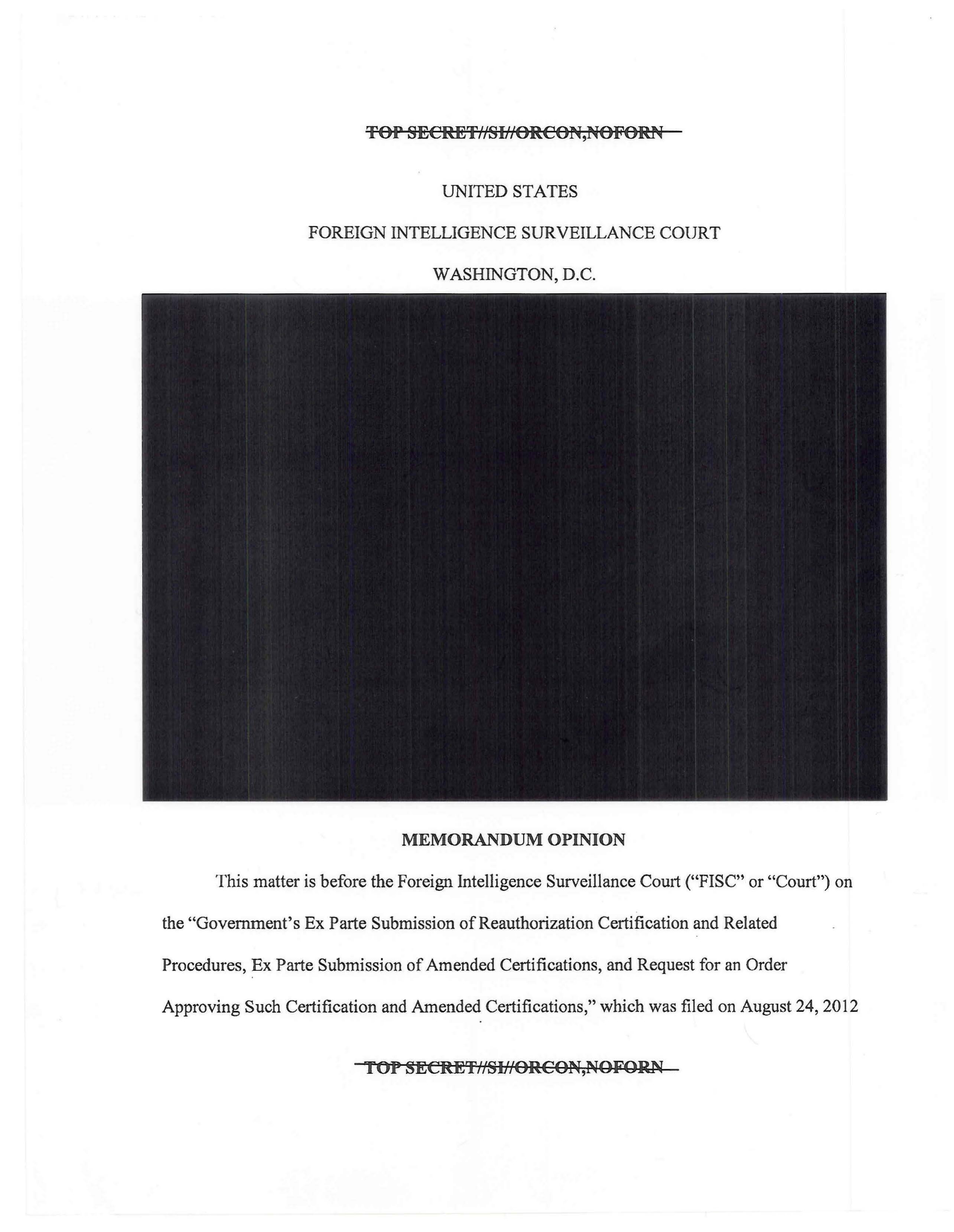
UNITED STATES
FOREIGN INTELLIGENCE SURVEILLANCE COURT
WASHINGTON, D.C.
[REDACTED]
MEMORANDUM OPINION
This matter is before the Foreign Intelligence Surveillance Court ("FISC" or "Court") on
the "Government's Ex Parte Submission of Reauthorization Certification and Related
Procedures, Ex Parte Submission of Amended Certifications, and Request for an Order
Approving Such Certification and Amended Certifications," which was filed on August 24, 2012
TOP SECRET//SI//ORCON,NOFORN
TOP SECRET//SI//ORCON,NOFORN
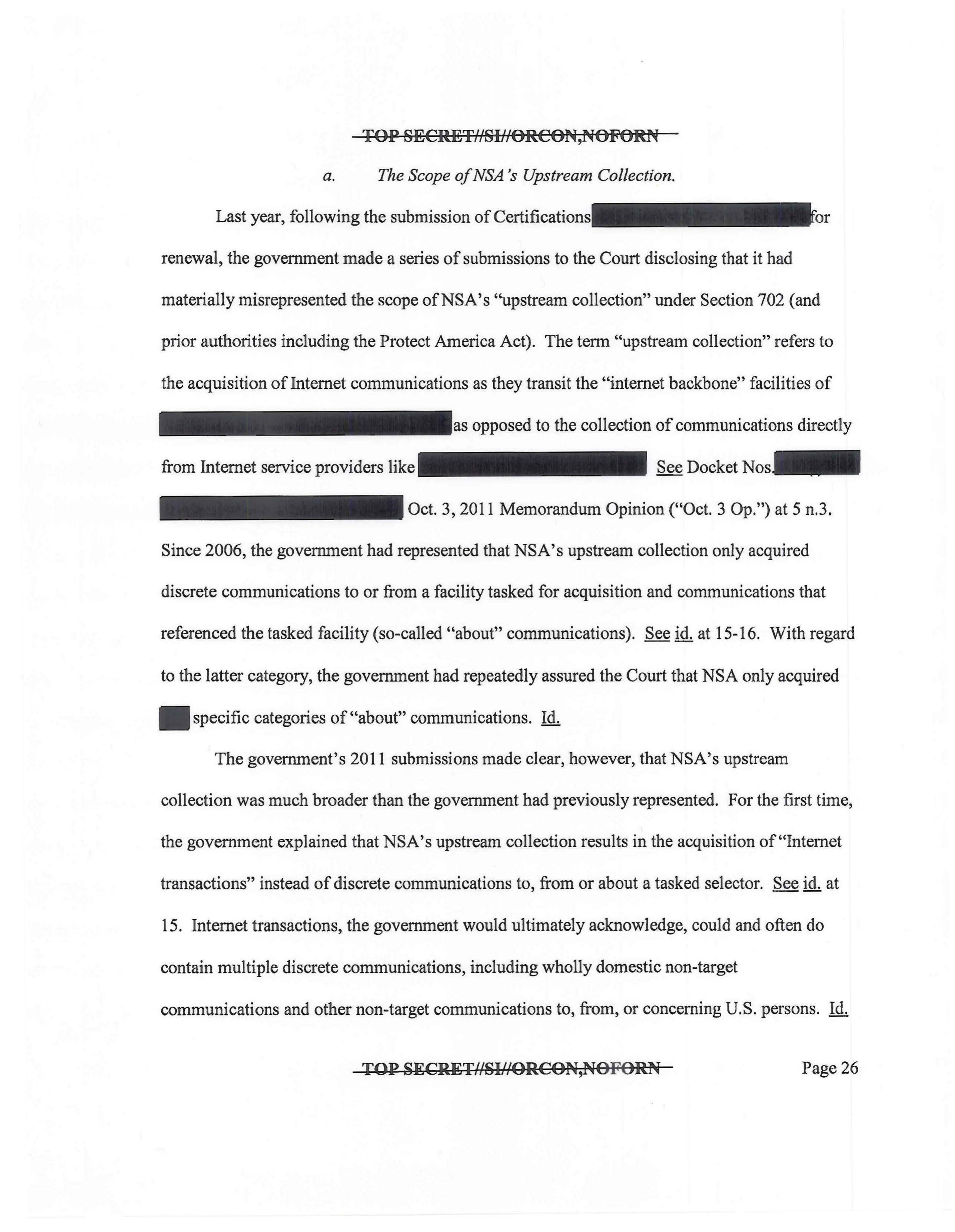
a. The Scope of NSA's Upstream Collection.
Last year, following the submission of Certifications [REDACTED] for
renewal, the government made a series of submissions to the Court disclosing that it had
materially misrepresented the scope of NSA's "upstream collection" under Section 702 (and
prior authorities including the Protect America Act). The term "upstream collection" refers to
the acquisition of Internet communications as they transit the "internet backbone" facilities of
[REDACTED] as opposed to the collection of communications directly
from Internet service providers like [REDACTED]. See Docket Nos. [REDACTED]
[REDACTED] Oct. 3, 2011 Memorandum Opinion ("Oct. 3 Op.") at 5 n.3.
Since 2006, the government had represented that NSA's upstream collection only acquired
discrete communications to or from a facility tasked for acquisition and communications that
referenced the tasked facility (so-called "about" communications). See id. at 15-16. With regard
to the latter category, the government had repeatedly assured the Court that NSA only acquired
[REDACTED] specific categories of "about" communications. Id.
The government's 2011 submissions made clear, however, that NSA's upstream
collection was much broader than the government had previously represented. For the first time,
the government explained that NSA's upstream collection results in the acquisition of "Internet
transactions" instead of discrete communications to, from or about a tasked selector. See id. at
15. Internet transactions, the government would ultimately acknowledge, could and often do
contain multiple discrete communications, including wholly domestic non-target
communications and other non-target communications to, from, or concerning U.S. persons. Id.
TOP SECRET//SI//ORCON, NOFORN
Page 26
TOP SECRET//SI//ORCON, NOFORN
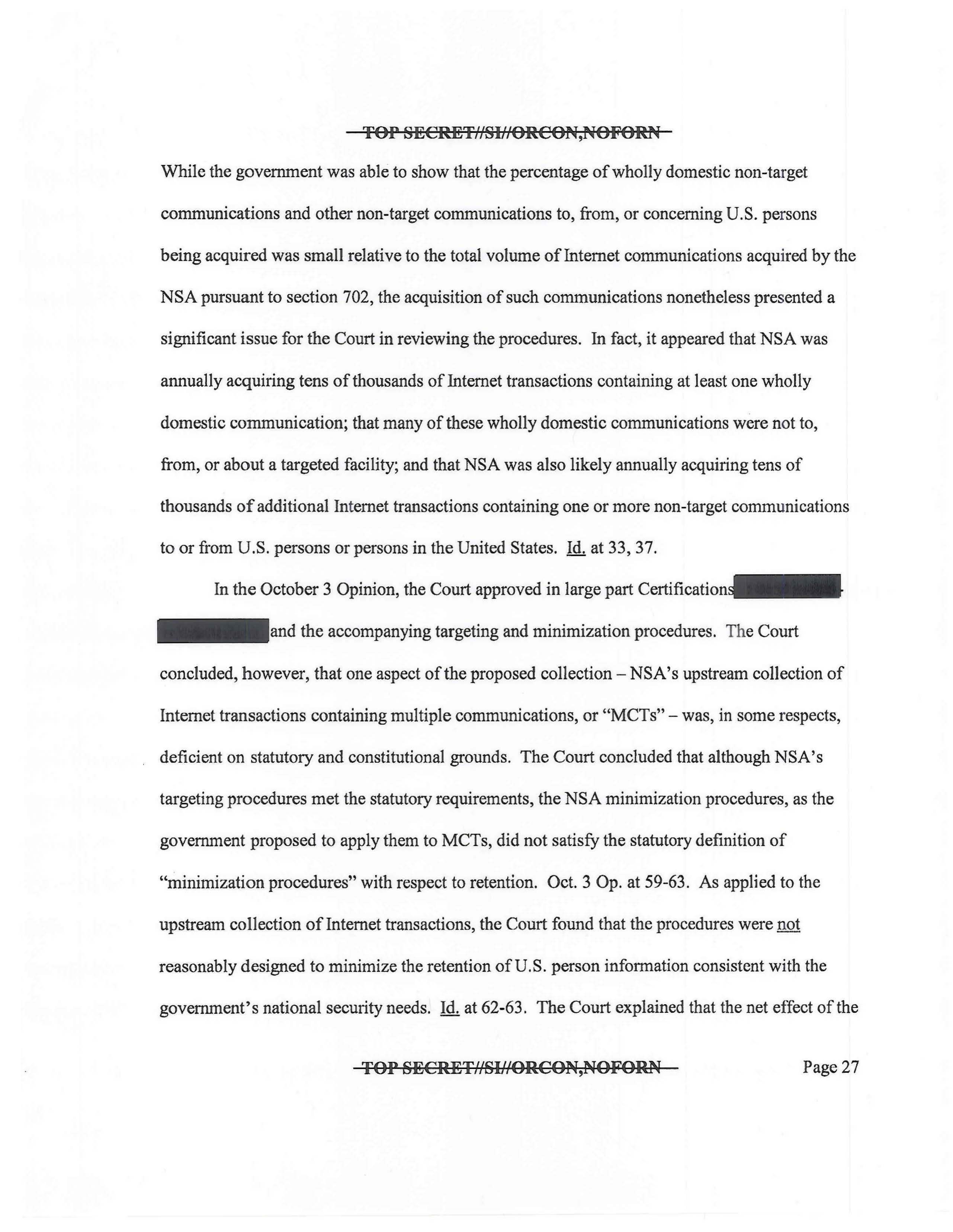
While the government was able to show that the percentage of wholly domestic non-target
communications and other non-target communications to, from, or concerning U.S. persons
being acquired was small relative to the total volume of Internet communications acquired by the
NSA pursuant to section 702, the acquisition of such communications nonetheless presented a
significant issue for the Court in reviewing the procedures. In fact, it appeared that NSA was
annually acquiring tens of thousands of Internet transactions containing at least one wholly
domestic communication; that many of these wholly domestic communications were not to,
from, or about a targeted facility; and that NSA was also likely annually acquiring tens of
thousands of additional Internet transactions containing one or more non-target communications
to or from U.S. persons or persons in the United States. Id. at 33, 37.
In the October 3 Opinion, the Court approved in large part Certifications [REDACTED]
and the accompanying targeting and minimization procedures. The Court
concluded, however, that one aspect of the proposed collection - NSA's upstream collection of
Internet transactions containing multiple communications, or "MCTs” – was, in some respects,
deficient on statutory and constitutional grounds. The Court concluded that although NSA's
targeting procedures met the statutory requirements, the NSA minimization procedures, as the
government proposed to apply them to MCTs, did not satisfy the statutory definition of
"minimization procedures" with respect to retention. Oct. 3 Op. at 59-63. As applied to the
upstream collection of Internet transactions, the Court found that the procedures were not
reasonably designed to minimize the retention of U.S. person information consistent with the
government's national security needs. Id. at 62-63. The Court explained that the net effect of the
TOP SECRET//SI//ORCON,NOFORN
Page 27
TOP SECRET//SI//ORCON,NOFORN
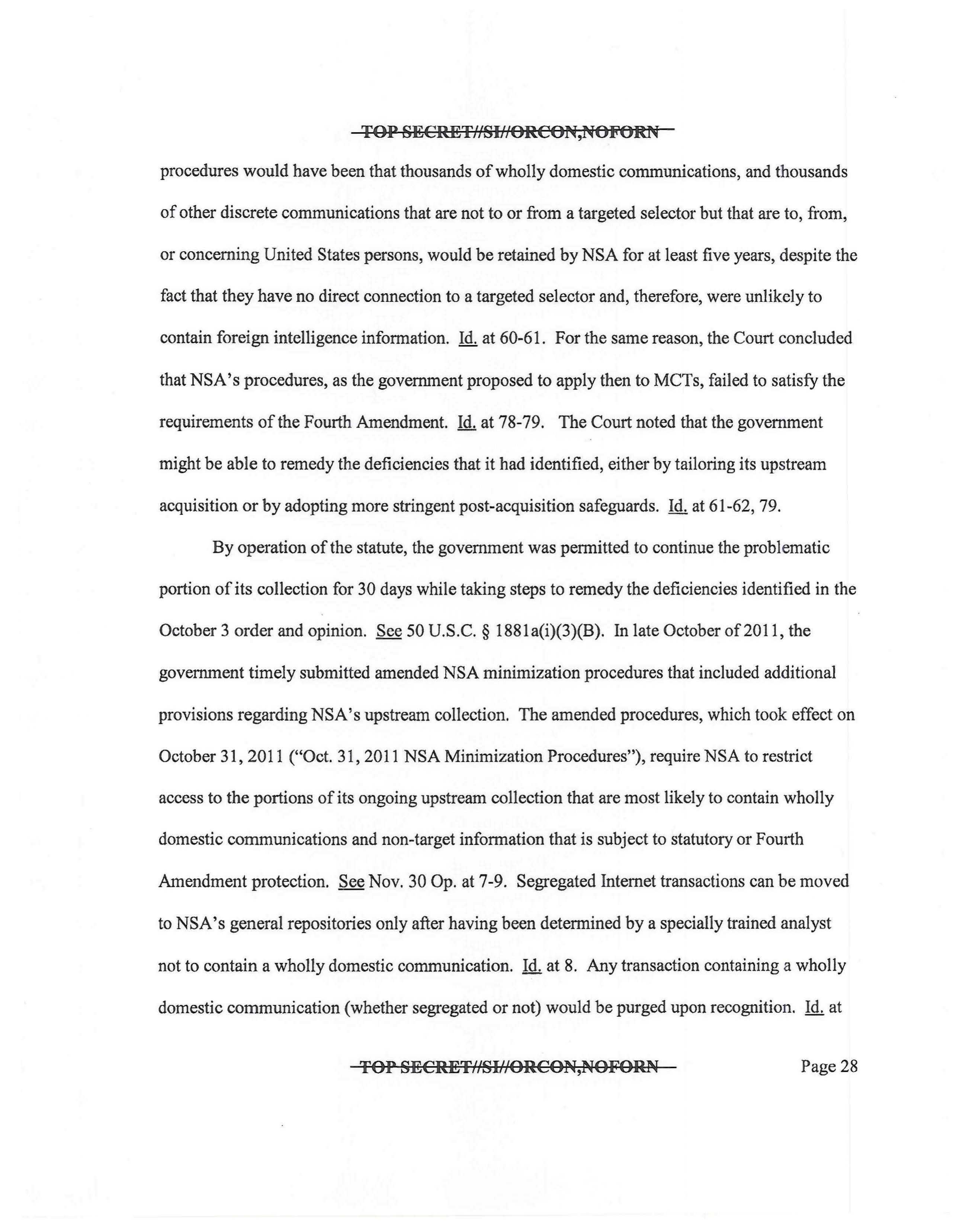
procedures would have been that thousands of wholly domestic communications, and thousands
of other discrete communications that are not to or from a targeted selector but that are to, from,
or concerning United States persons, would be retained by NSA for at least five years, despite the
fact that they have no direct connection to a targeted selector and, therefore, were unlikely to
contain foreign intelligence information. Id. at 60-61. For the same reason, the Court concluded
that NSA's procedures, as the government proposed to apply then to MCTs, failed to satisfy the
requirements of the Fourth Amendment. Id. at 78-79. The Court noted that the government
might be able to remedy the deficiencies that it had identified, either by tailoring its upstream
acquisition or by adopting more stringent post-acquisition safeguards. Id. at 61-62, 79.
By operation of the statute, the government was permitted to continue the problematic
portion of its collection for 30 days while taking steps to remedy the deficiencies identified in the
October 3 order and opinion. See 50 U.S.C. § 1881a(i)(3)(B). In late October of 2011, the
government timely submitted amended NSA minimization procedures that included additional
provisions regarding NSA's upstream collection. The amended procedures, which took effect on
October 31, 2011 ("Oct. 31, 2011 NSA Minimization Procedures"), require NSA to restrict
access to the portions of its ongoing upstream collection that are most likely to contain wholly
domestic communications and non-target information that is subject to statutory or Fourth
Amendment protection. See Nov. 30 Op. at 7-9. Segregated Internet transactions can be moved
to NSA's general repositories only after having been determined by a specially trained analyst
not to contain a wholly domestic communication. Id. at 8. Any transaction containing a wholly
domestic communication (whether segregated or not) would be purged upon recognition. Id. at
TOP SECRET//SI//ORCON,NOFORN
Page 28
TOP SECRET//SI//ORCON,NOFORN
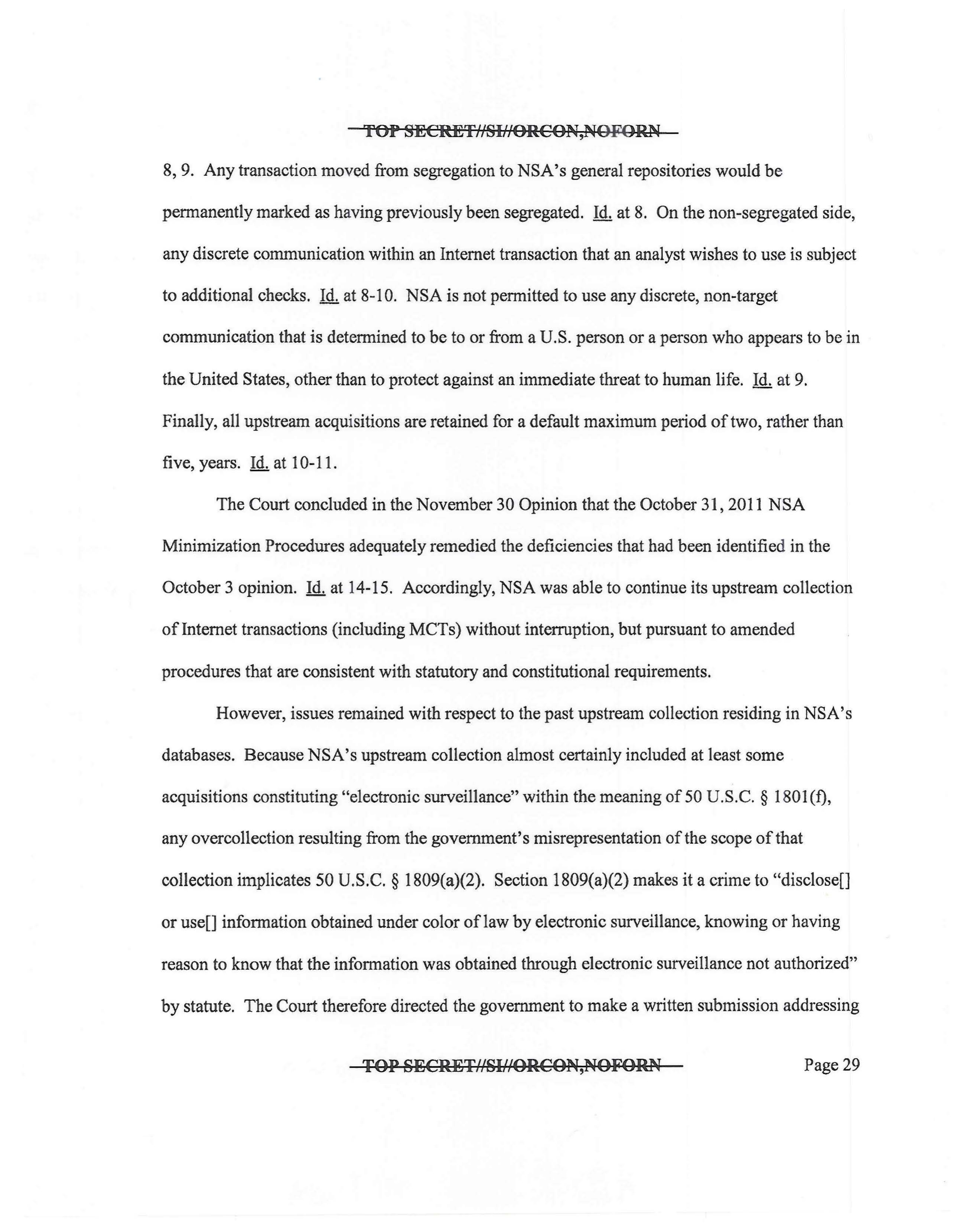
8, 9. Any transaction moved from segregation to NSA's general repositories would be
permanently marked as having previously been segregated. Id. at 8. On the non-segregated side,
any discrete communication within an Internet transaction that an analyst wishes to use is subject
to additional checks. Id. at 8-10. NSA is not permitted to use any discrete, non-target
communication that is determined to be to or from a U.S. person or a person who appears to be in
the United States, other than to protect against an immediate threat to human life. Id. at 9.
Finally, all upstream acquisitions are retained for a default maximum period of two, rather than
five, years. Id. at 10-11.
The Court concluded in the November 30 Opinion that the October 31, 2011 NSA
Minimization Procedures adequately remedied the deficiencies that had been identified in the
October 3 opinion. Id. at 14-15. Accordingly, NSA was able to continue its upstream collection
of Internet transactions (including MCTs) without interruption, but pursuant to amended
procedures that are consistent with statutory and constitutional requirements.
However, issues remained with respect to the past upstream collection residing in NSA's
databases. Because NSA's upstream collection almost certainly included at least some
acquisitions constituting "electronic surveillance" within the meaning of 50 U.S.C. § 1801(f),
any overcollection resulting from the government's misrepresentation of the scope of that
collection implicates 50 U.S.C. § 1809(a)(2). Section 1809(a)(2) makes it a crime to "disclose[]
or use[] information obtained under color of law by electronic surveillance, knowing or having
reason to know that the information was obtained through electronic surveillance not authorized"
by statute. The Court therefore directed the government to make a written submission addressing
TOP SECRET//SI//ORCON,NOFORN
Page 29
TOP SECRET//SI//ORCON,NOFORN
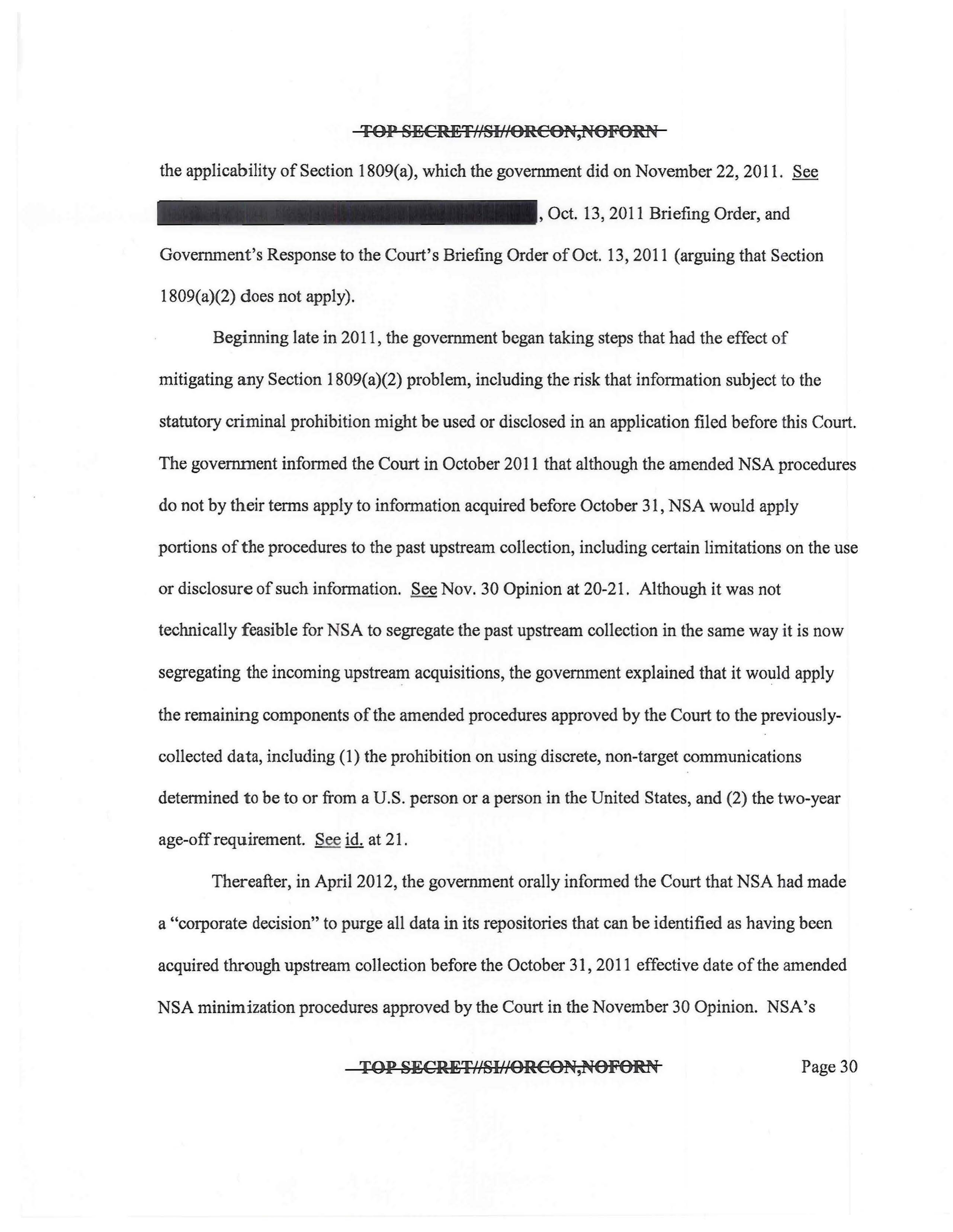
the applicability of Section 1809(a), which the government did on November 22, 2011. See
[REDACTED] Oct. 13, 2011 Briefing Order, and
Government's Response to the Court's Briefing Order of Oct. 13, 2011 (arguing that Section
1809(a)(2) does not apply).
Beginning late in 2011, the government began taking steps that had the effect of
mitigating any Section 1809(a)(2) problem, including the risk that information subject to the
statutory criminal prohibition might be used or disclosed in an application filed before this Court.
The government informed the Court in October 2011 that although the amended NSA procedures
do not by their terms apply to information acquired before October 31, NSA would apply
portions of the procedures to the past upstream collection, including certain limitations on the use
or disclosure of such information. See Nov. 30 Opinion at 20-21. Although it was not
technically feasible for NSA to segregate the past upstream collection in the same way it is now
segregating the incoming upstream acquisitions, the government explained that it would apply
the remaining components of the amended procedures approved by the Court to the previously-
collected data, including (1) the prohibition on using discrete, non-target communications
determined to be to or from a U.S. person or a person in the United States, and (2) the two-year
age-off requirement. See id. at 21.
Thereafter, in April 2012, the government orally informed the Court that NSA had made
a "corporate decision" to purge all data in its repositories that can be identified as having been
acquired through upstream collection before the October 31, 2011 effective date of the amended
NSA minimization procedures approved by the Court in the November 30 Opinion. NSA's
TOP SECRET//SI//ORCON,NOFORN
Page 30
TOP SECRET//SI//ORCON,NOFORN
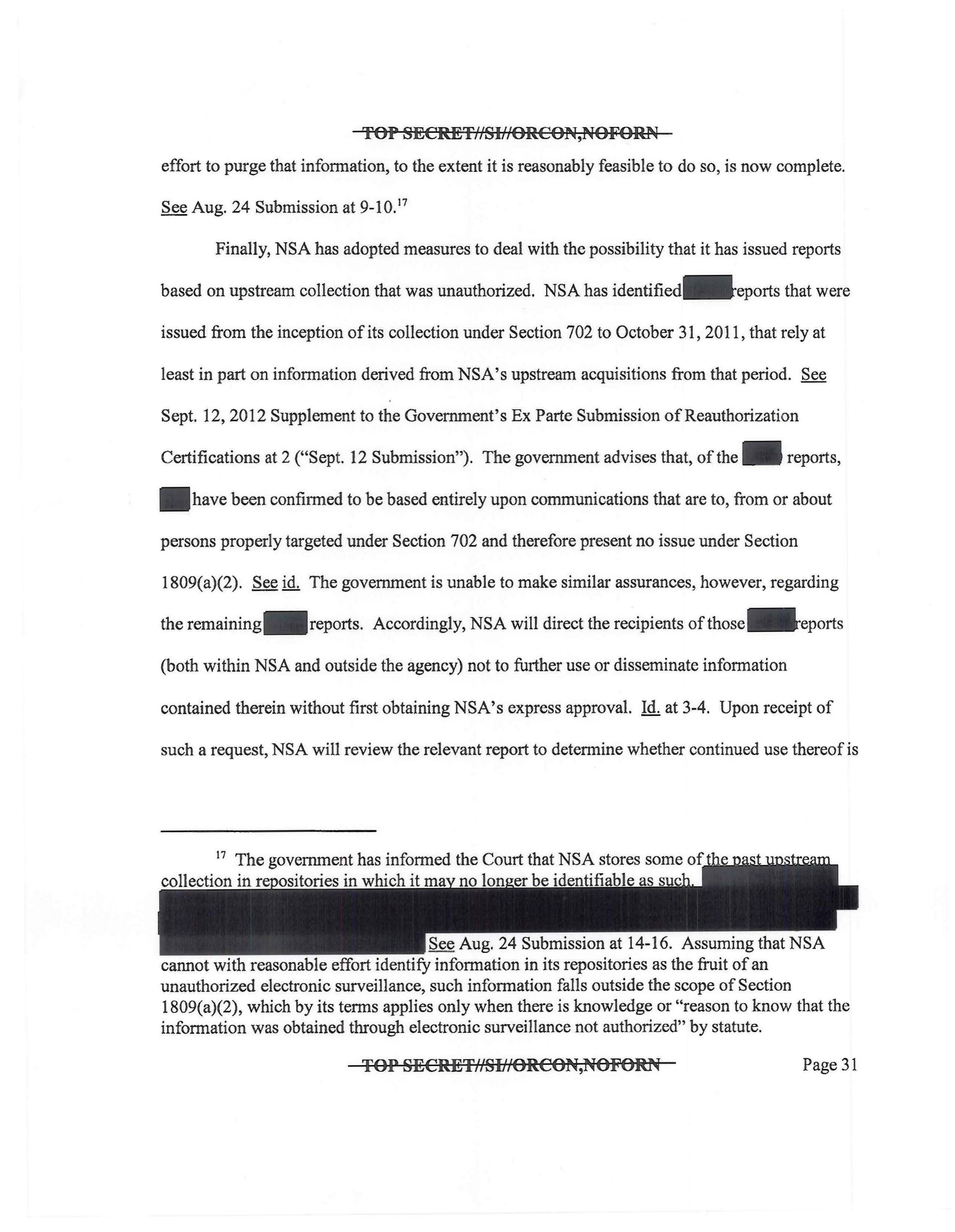
effort to purge that information, to the extent it is reasonably feasible to do so, is now complete.
See Aug. 24 Submission at 9-10.17
Finally, NSA has adopted measures to deal with the possibility that it has issued reports
based on upstream collection that was unauthorized. NSA has identified [REDACTED] reports that were
issued from the inception of its collection under Section 702 to October 31, 2011, that rely at
least in part on information derived from NSA's upstream acquisitions from that period. See
Sept. 12, 2012 Supplement to the Government's Ex Parte Submission of Reauthorization
Certifications at 2 ("Sept. 12 Submission"). The government advises that, of the [REDACTED] reports,
[REDACTED] have been confirmed to be based entirely upon communications that are to, from or about
persons properly targeted under Section 702 and therefore present no issue under Section
1809(a)(2). See id. The government is unable to make similar assurances, however, regarding
the remaining [REDACTED] reports. Accordingly, NSA will direct the recipients of those [REDACTED] reports
(both within NSA and outside the agency) not to further use or disseminate information
contained therein without first obtaining NSA's express approval. Id. at 3-4. Upon receipt of
such a request, NSA will review the relevant report to determine whether continued use thereof is
17 The government has informed the Court that NSA stores some of the past upstream
collection in repositories in which it may no longer be identifiable as such. [REDACTED]
[REDACTED] See Aug. 24 Submission at 14-16. Assuming that NSA
cannot with reasonable effort identify information in its repositories as the fruit of an
unauthorized electronic surveillance, such information falls outside the scope of Section
1809(a)(2), which by its terms applies only when there is knowledge or "reason to know that the
information was obtained through electronic surveillance not authorized" by statute.
TOP SECRET//SI//ORCON,NOFORN
Page 31
TOP SECRET//SI//ORCON,NOFORN
appropriate. Id. at 4.18 Finally, the government has informed the Court that it will not use any
report that cites to upstream collection acquired prior to October 31, 2011 in an application to
this Court absent express notice to, and approval of, the Court. Aug. 24 Submission at 24.
Taken together, the remedial steps taken by the government since October 2011 greatly
reduce the risk that NSA will run afoul of Section 1809(a)(2) in its handling of the past upstream
acquisitions made under color of Section 702. NSA's self-imposed prohibition on using non-
target communications to or from a U.S. person or a person in the United States helped to ensure
that the fruits of unauthorized electronic surveillance were not used or disclosed while it was
working to purge the pre-October 31, 2011 upstream collection. And NSA's subsequent purge of
that collection from its repositories and the above-described measures it has taken with respect to
derivative reports further reduce the risk of a problem under Section 1809(a)(2). Finally, the
amended NSA minimization procedures provide that in the event, despite NSA's effort to purge
the prior upstream collection, the agency discovers an Internet transaction acquired before
October 31, 2011, such transaction must be purged upon recognition. See Amended NSA
Minimization Procedures at 8 § 3(c)(3). In light of the foregoing, it appears to the Court that the
outstanding issues raised by NSA's upstream collection of Internet transactions have been
resolved, subject to the discussion of changes to the minimization procedures that appears
18 For instance, NSA may determine that the report is fully supported by cited
communications other than the ones obtained through upstream communication. Sept. 12
Submission at 4. In other instances, NSA may revise the report so that it no longer relies upon
upstream communications and reissue it. Id. If such steps are not feasible because the report
cannot be supported without the upstream communication, NSA will cancel the report. Id.
TOP SECRET//SI//ORCON,NOFORN
Page 32
TOP SECRET//SI//ORCON,NOFORN
below. 19
[REDACTED]
19 Under the circumstances, the Court finds it unnecessary to further address the
arguments advanced by the government in its November 22, 2011 response to the Court's
October 13, 2011 briefing order regarding Section 1809(a), particularly those regarding the scope
of prior Section 702 authorizations.
TOP SECRET//SI//ORCON,NOFORN
Page 33
Related Documents
-
Foreign Intelligence Surveillance Opinion and Order – November 2011 FOIA [pdf]
A FISC opinion concluding the NSA’s minimization procedures adequately address the deficiencies identified in the FISC’s ruling from October 3, 2011. ACLU/EFF FOIA Litigation.
People: Bates, John D.ACLU,EFF ↗ (2013-08-21) -
-
Motion of the American Civil Liberties Union, the American Civil Liberties Union of the Nation's Capital, and the Media Freedom and Information Clinic for the Release of Court Records, In re Opinions & Orders of this Court Addressing Bulk Collection of Data Under the Foreign Intelligence Surveillance Act, No. Misc. 13-08 (FISA Ct. Nov. 7, 2013). FOIA [pdf]
-
-
Supplemental Opinion and Order from the Foreign Intelligence Surveillance Court FOIA [pdf]
Supplemental Opinion and Order of the FISC reiterating Court ordered restrictions on NSA’s handling of query results of the telephony metadata program, and directing the Government to provide the court with additional information regarding queries of the telephony metadata. ACLU/EFF FOIA Litigation.
People: Walton, Reggie B.ACLU,EFF ↗ (2013-09-10)