Motion of the American Civil Liberties Union, the American Civil Liberties Union of the Nation's Capital, and the Media Freedom and Information Clinic for the Release of Court Records, In re Opinions & Orders of this Court Addressing Bulk Collection of Data Under the Foreign Intelligence Surveillance Act, No. Misc. 13-08 (FISA Ct. Nov. 7, 2013).
Open PDFDocument date: 2013-11-07
Type: FOIA
Pages: 35
Classification: -
Dissemination: -
FISC/FISCR Court Filings
My notes
U.S. FOREIGN
INTELLIGENCE
SURVEILLANCE COURT
2013 NOV -7 PM 2:42
LEEANN FLYNN HALL
CLERK OF COURT
UNITED STATES
FOREIGN INTELLIGENCE SURVEILLANCE COURT
WASHINGTON, D.C.
IN RE OPINIONS & ORDERS OF THIS COURT
ADDRESSING BULK COLLECTION OF DATA
UNDER THE FOREIGN INTELLIGENCE
SURVEILLANCE ACT
No. Misc. 13-8
MOTION OF THE AMERICAN CIVIL LIBERTIES UNION,
THE AMERICAN CIVIL LIBERTIES UNION OF THE NATION'S CAPITAL, AND
THE MEDIA FREEDOM AND INFORMATION ACCESS CLINIC
FOR THE RELEASE OF COURT RECORDS
David A. Schulz
Jonathan Manes
Media Freedom and Information Access Clinic
Yale Law School
P.O. Box 208215
New Haven, CT 06520
Phone: (212) 850-6103
Fax: (212) 850-6299
dschulz@lskslaw.com
Alex Abdo
Brett Max Kaufman
Patrick Toomey
Jameel Jaffer
American Civil Liberties Union Foundation
125 Broad Street, 18th Floor
New York, NY 10004
Phone: (212) 549-2500
Fax: (212) 549-2654
aabdo@aclu.org
Arthur B. Spitzer
American Civil Liberties Union of the
Nation's Capital
4301 Connecticut Avenue, N.W., Suite 434
Washington, DC 20008
Phone: (202) 457-0800
Fax: (202) 457-0805
artspitzer@aclu-nca.org
TABLE OF CONTENTS
PRELIMINARY STATEMENT.................................................................................... 1
FACTUAL BACKGROUND....................................................................................... 3
JURISDICTION........................................................................................................... 9
ARGUMENT............................................................................................................... 10
I. MOVANTS HAVE STANDING TO BRING THIS PUBLIC-ACCESS MOTION. 10
II. THE FIRST AMENDMENT REQUIRES THE RELEASE OF THIS COURT'S OPINIONS CONCERNING THE LEGALITY OF THE GOVERNMENT'S BULK COLLECTION OF AMERICANS' DATA. 12
A. The First Amendment right of access attaches to judicial opinions, including the opinions of this Court concerning the bulk collection of Americans' data. 12
- "Experience".......................................................................................... 13
- "Logic"................................................................................................... 16
B. The First Amendment requires disclosure of the Court's opinions relating to bulk collection. 21
III. THE COURT SHOULD ORDER DECLASSIFICATION REVIEW UNDER RULE 62 AND THEN APPLY THE FIRST AMENDMENT STANDARD TO ANY PROPOSED SEALING BY THE GOVERNMENT. 24
CONCLUSION............................................................................................................ 28
i
PRELIMINARY STATEMENT
Pursuant to the First Amendment and Rule 62 of the Foreign Intelligence Surveillance
Court's Rules of Procedure, the American Civil Liberties Union and the American Civil
Liberties Union of the Nation's Capital (together, the "ACLU") and the Media Freedom and
Information Access Clinic at Yale Law School (“MFIAC") (collectively, "Movants")
respectfully move the Foreign Intelligence Surveillance Court ("FISC") to unseal its opinions
addressing the legal basis for the "bulk collection" of data by the United States government
under the Foreign Intelligence Surveillance Act (“FISA”), 50 U.S.C. § 1801 et seq., including
but not limited to 50 U.S.C. § 1842. These opinions are subject to the public's First Amendment
right of access, and no proper basis exists to keep the legal discussion in these opinions secret.¹
In June 2013, government officials acknowledged the existence of an ongoing, seven-
year program of bulk collection of the call-detail records of nearly every telephonic
communication in the country. The program was approved by this Court pursuant to a provision
of FISA amended by Section 215 of the Patriot Act, 50 U.S.C. § 1861.² Days after this call-
tracking program was first revealed, Movants asked this Court to disclose its opinions addressing
the meaning, scope, and constitutionality of Section 215 and the legality of the call-tracking
¹ Movants use the term “bulk collection" in this motion in the same way this Court used it in
In re Application of the FBI for an Order Requiring the Production of Tangible Things from
[REDACTED], No. BR 13-109, 2013 WL 5741573 (FISA Ct. Aug. 29, 2013).
² "The Patriot Act" is the common name for the Uniting and Strengthening America by
Providing Appropriate Tools Required to Intercept and Obstruct Terrorism Act of 2001, Pub. L.
No. 107-56, 115 Stat. 272 (Oct. 26, 2001). Section 215 amended FISA in part and empowers the
Director of the FBI to obtain secret orders from this Court compelling third parties to produce
"any tangible things" upon a showing that there are "reasonable grounds to believe that the
tangible things sought are relevant" to an authorized foreign-intelligence or terrorism
investigation. Id. § 1861(a)(1), (b)(2)(A). The orders are accompanied by a gag order forbidding
recipients from disclosing having received the order. See id. § 1861(c)-(d).
1
program. .³ This Court granted that motion in part, and the government is now undertaking a
declassification review of one of the Court's opinions in response.⁴
Since Movants filed that motion, however, it has become clear that other critical opinions
of this Court approving the bulk collection of Americans' information remain secret. Movants
seek access to those opinions for two reasons. First, some of those opinions pertain to other
forms of bulk collection that the government has now acknowledged, such as the bulk collection
of internet metadata and cell-site location information. The public is entitled to know the legal
bases for those programs, but those bases have not yet been disclosed. Second, some of those
opinions predate the call-tracking program and apparently supply the original legal analysis
necessary to understand this Court's later authorization of the call-tracking program. For
example, it appears that one of the earlier bulk-collection opinions provides the Court's most
comprehensive discussion both of the constitutionality of bulk collection under the Fourth
Amendment and of the meaning of the term "relevant" as it appears in various FISA provisions.
Movants' current request for access to opinions of this Court evaluating the legality of
bulk collection seeks to vindicate the public's overriding interest in understanding how a far-
reaching federal statute is being construed and implemented, and how constitutional privacy
protections are being enforced. The First Amendment guarantees the public a qualified right of
access to those opinions because judicial opinions interpreting constitutional and statutory limits
on governmental authorities including those relevant to foreign-intelligence surveillance-have
³ See Motion of ACLU & MFIAC for the Release of Court Records, In re Orders of this
Court Interpreting Section 215 of the Patriot Act, No. Misc. 13-02 (FISA Ct. June 12, 2013),
http://1.usa.gov/15dJTjx.
⁴ See In re Orders of this Court Interpreting Section 215 of the PATRIOT Act (In re Section
215 Orders), No. Misc. 13-02, 2013 WL 5460064, at *7 (FISA Ct. Sept. 13, 2013); see also
Order, In re Section 215 Orders, No. Misc. 13-02 (FISA Ct. Oct. 8, 2013),
http://1.usa.gov/18MXSQg (ordering declassification review of February 19, 2013 FISC
opinion).
2
always been available for inspection by the public, and because their release is so manifestly
fundamental in a democracy committed to the rule of law. Public disclosure serves to improve
the functioning of the Court itself, to enhance its perceived fairness and independence, and to
educate citizens about the Court's role in ensuring the integrity of the FISA system. This First
Amendment guarantee of public access may be overcome only if the government is able to
demonstrate a substantial probability of harm to a compelling interest and the absence of any
alternative means to protect that interest. Any limits on the public's right of access must then be
narrowly tailored and demonstrably effective in avoiding that harm.
The Court should acknowledge the public's First Amendment right of access to these
opinions and order their prompt publication. Because the opinions are of critical importance to
the ongoing public debate about the legitimacy of the government's surveillance activities,
Movants respectfully request that the Court publish the opinions as quickly as possible, with only
those redactions justified under the stringent First Amendment standard. Alternatively, the Court
should exercise its discretion to publish the opinions expeditiously in the public interest.
FACTUAL BACKGROUND
In June 2013, The Guardian disclosed a previously secret order issued by this Court
compelling Verizon Business Network Services, a major U.S. telecommunications provider, to
produce to the National Security Agency ("NSA”) “all call detail records or 'telephony
metadata" of its customers over a ninety-day period. Soon thereafter, the government disclosed
that the Secondary Order belongs to a broader NSA program that has been in place for seven
⁵ Secondary Order at 2, In Re Application of the FBI for an Order Requiring the Production
of Tangible Things from Verizon Bus. Network Servs., Inc. on Behalf of MCI Commc'n Servs.,
Inc., No. BR 13-80 (FISA Ct. Apr. 25, 2013) ("Secondary Order"),
https://s3.amazonaws.com/s3.documentcloud.org/documents/709012/verizon.pdf; see Glenn
Greenwald, NSA Collecting Phone Records of Millions of Verizon Customers Daily, Guardian,
June 5, 2013, http://gu.com/p/3gc62.
3
years involving the bulk collection of metadata-including the times and durations of calls-
concerning virtually every phone call, domestic and international, made or received in the United
States.⁶
In the months following the government's acknowledgment of the NSA's call-tracking
program, the public learned that the government's bulk collection of records has not been limited
to call records. In late June 2013, an administration official acknowledged a now-discontinued
government surveillance program that involved the collection of Americans' internet metadata in
bulk.⁷ The Director of National Intelligence (“DNI"), James R. Clapper, later reiterated that
acknowledgment.⁸ Additional releases of documents by the government have provided more
details, specifying the apparent legal basis for the internet-metadata program.⁹
Indeed, several recent disclosures suggest that the government's bulk-collection activities
go beyond even telephony and internet metadata. During a hearing before the Senate Judiciary
Committee in early October, DNI Clapper disclosed that the NSA "conducted a secret pilot
project in 2010 and 2011 to test the collection of bulk data about the location of Americans'
⁶ See Administration White Paper: Bulk Collection of Telephony Metadata Under Section 215
of the USA PATRIOT Act at 1 (Aug. 9, 2013),
http://big.assets.huffingtonpost.com/Section215.pdf; Dep't of Justice, Report on the National
Security Agency's Bulk Collection Programs for USA PATRIOT Act Reauthorization at 3 (Feb.
2, 2011), http://l.usa.gov/1cdFJ1G.
⁷ See Glenn Greenwald & Spencer Ackerman, How the NSA Is Still Harvesting Your Online
Data, Guardian, June 27, 2013, http://gu.com/p/3gqmz.
⁸ See James R. Clapper, DNI, Cover Letter Announcing Document Release (Aug. 21, 2013),
http://1.usa.gov/1bU8Cgt.
⁹ See, e.g., Memorandum from Vito T. Potenza, General Counsel, NSA, to Staff Director,
House Permanent Select Committee on Intelligence (Feb. 25, 2009), http://1.usa.gov/1cplAa9
(stating that bulk collection of internet metadata was based on FISA's pen-register provision, 50
U.S.C. § 1841); see also, e.g., Letter from Ronald Weich, Assistant Attorney General, to Rep.
Bobby Scott, House Committee on the Judiciary, at 1 (Dec. 17. 2009), http://1.usa.gov/1dk3hQO
(referring to "bulk collection of telephony metadata" under Section 215 and a "similar collection
program conducted under the pen register/trap and trace authority of FISA").
4
cellphones."¹⁰ Though DNI Clapper told Congress that the government is no longer engaged in
the bulk collection of location information under Section 215, officials have elsewhere stated that
the government is authorized to obtain location information in bulk under the Secondary Order.¹¹
On April 1, 2011, the NSA's Office of General Counsel informed the Senate Select Committee
on Intelligence that the Department of Justice ("DOJ") had advised the NSA in February 2010
that obtaining cell-site location information for "testing purposes was permissible based upon the
current language of the [FISC's] BR FISA order requiring the production of 'all call detail
records," and that the DOJ had "orally advised the FISC" only after the acquisition of this
information.¹² Under questioning from lawmakers, various government officials have declined to
deny that the government is currently collecting Americans' location information in bulk, stating
only that such information is not being collected "under this program"-i.e., the call-tracking
program already acknowledged under Section 215.¹³
There are reasons to believe that the government is engaged in the bulk collection of
other records as well. In a statement issued this summer, Senators Ron Wyden and Mark Udall----
both members of the Senate Select Committee on Intelligence-warned that:
> [T]he Patriot Act's surveillance authorities are not limited to phone records. In
> fact, section 215 of the Patriot Act can be used to collect any type of records
> whatsoever. The fact that Patriot Act authorities were used for the bulk collection
> of email records as well as phone records underscores our concern that this
¹⁰ Charlie Savage, In Test Project, N.S.A. Tracked Cellphone Locations, N.Y. Times, Oct. 2,
2013, http://nyti.ms/18OAlz2.
¹¹ See Siobhan Gorman & Julian E. Barnes, Officials: NSA Doesn't Collect Cellphone-
Location Records, Wall St. J., June 16, 2013, http://on.wsj.com/16RpQNF.
¹² See Letter from [REDACTED], Attorney, Office of General Counsel, NSA, to Senate Select
Committee on Intelligence at 1 (Apr. 1, 2011), http://1.usa.gov/1gWqiy0.
¹³ See, e.g., Letter from James R. Clapper, DNI, to Senator Ron Wyden, at 1 (July 26, 2013),
http://1.usa.gov/1acgiHi; Oversight of the Administration's Use of FISA Authorities: Hearing
Before the H. Comm. on the Judiciary, 113th Cong. at 29:33–36:00 (July 17, 2013),
http://cs.pn/1bpUHRJ (statement of John C. Inglis, Deputy Director, NSA).
5
> authority could be used to collect other types of records in bulk as well, including
> information on credit card purchases, medical records, library records, firearm
> sales records, financial information and a range of other sensitive subjects. These
> other types of collection could clearly have a significant impact on Americans'
> constitutional rights.¹⁴
Senator Wyden expanded on this warning in a speech given later in July 2013, suggesting
that the government's view of its bulk-collection authority is "essentially limitless":
> Especially troubling is the fact that there is nothing in the Patriot Act that limits
> this sweeping bulk collection to phone records. The government can use the
> Patriot Act's business records authority to collect, collate and retain all sorts of
> sensitive information, including medical records, financial records, or credit card
> purchases. They could use this authority to develop a database of gun owners or
> readers of books and magazines deemed subversive. This means that the
> government's authority to collect information on law-abiding American citizens is
> essentially limitless. If it is a record held by a business, membership organization,
> doctor, or school, or any other third party, it could be subject to bulk collection
> under the Patriot Act.¹⁵
Additionally, this Court has confirmed that it has addressed the legality of bulk collection
of Americans' data outside the context of the call-tracking program. On September 17, 2013, the
Court published a partially redacted opinion issued on August 29, 2013 ("August 2013 FISC
Opinion") explaining its renewal of the NSA's call-tracking program.¹⁶ In its opinion, the Court
relied upon earlier unpublished FISC opinions that apparently addressed the "issue of relevance
for bulk collections" under another provision of FISA and, presumably, the constitutionality of
¹⁴ Sen. R. Wyden & Sen. M. Udall, Wyden, Udall Statement on the Disclosure of Bulk Email
Records Collection Program (July 2, 2013), http://1.usa.gov/121Flua (emphasis added).
¹⁵ Sen. R. Wyden, Remarks as Prepared for Delivery for the Center for American
Progress Event on NSA Surveillance (July 23, 2013),
http://www.americanprogress.org/wp-
content/uploads/2013/07/7232013WydenCAPspeech.pdf (emphasis added).
¹⁶ In re Application of the FBI for an Order Requiring the Production of Tangible Things
from [REDACTED], No. BR 13-109, 2013 WL 5741573, at *1 (FISA Ct. Aug. 29, 2013).
6
the bulk collection of metadata under the Fourth Amendment.¹⁷ The Court did not summarize or
otherwise expand upon the previous, still-secret FISC opinions addressing the government's bulk
collection of Americans' data.
Thus, despite the government's and this Court's publication of some information
concerning the legal basis for the call-tracking program and other government surveillance
activities, crucial aspects of that legal basis remain secret-in particular, this Court's original
analysis of the constitutionality of bulk data collection under the Fourth Amendment and the
Court's interpretation of the term “relevant" under 50 U.S.C. § 1842.¹⁸
Last month, The Washington Post reported that various current and former government
officials have called for the declassification and release of "the original—and still classified-
judicial interpretation that held that the bulk collection of Americans' data was lawful."¹⁹ The
officials expressed concern that despite the disclosures made by the government and this Court
over the past three months, the public has still not been provided with the original, complete
¹⁷ Id. at *6 ("This Court has previously examined the issue of relevance for bulk collections.
See [REDACTED]. While those matters involved different collections from the one at issue here, the
relevance standard was similar." (citing 50 U.S.C. § 1842(c)(2))); see id. at *2 ("This Court had
reason to analyze this distinction [between individual and bulk collection] in a similar context in
[REDACTED].").
¹⁸ In addressing the Fourth Amendment implications of the call-tracking program, the August
2013 FISC Opinion concludes that "[t]he production of telephone service provider metadata is
squarely controlled by the U.S. Supreme Court decision in Smith v. Maryland, 442 U.S. 735
(1979)." 2013 WL 5741573, at *2. A more recent FISC opinion renewing the call-tracking
program concurs and also considers the program's constitutionality in light of the Supreme
Court's decision in United States v. Jones, 132 S. Ct. 945 (2012). See Memorandum at 4-6, In re
Application of the FBI for an Order Requiring the Production of Tangible Things from
[REDACTED], No. BR 13-158 (FISA Ct. Oct. 11, 2013), http://1.usa.gov/19QvFam. However, no
published FISC opinion to date has addressed the compatibility of the Fourth Amendment with
the bulk collection of other kinds of metadata, and the Court's original discussion of Smith and
related authorities with respect to bulk collection remains secret.
¹⁹ Ellen Nakashima & Carol D. Leonnig, _Effort Underway to Declassify Document that Is
Legal Foundation for NSA Phone Program_, Wash. Post, Oct. 12, 2013, http://wapo.st/17reSyy
(revealing the existence of a FISC opinion authored by then-Presiding Judge Kollar-Kotelly).
7
legal basis for the FISC's approval of the call-tracking program. As one former administration
official put it:
> If the question is, "How was this program authorized and what type of legal
> analysis first took place?" the [August 2013 FISC Opinion] is just not
> responsive.... It's hard for me to imagine, with all that's already out there, that
> highly classified intelligence material would be so deeply entwined in the legal
> analysis in that original interpretation that they couldn't somehow release it.²⁰
And Senators Patrick Leahy and Ron Wyden both issued statements to the Post expressing their
firm support for the release of the FISC's original legal analysis of the call-tracking program.²¹
The sum of the disclosures and releases of information over the past several months have
generated a sustained and profound debate about the use of the government's surveillance
authorities and, in particular, the NSA's collection of Americans' data in bulk. Since early June
2013, Congress has held more than ten hearings to question government officials about NSA
surveillance. Lawmakers have introduced legislation to end such bulk collection.²² And the
government itself has initiated various reviews of its collection activities and authorities.²³
This Court, too, has recognized the immense public interest in the ongoing debate. In _In
re Section 215 Orders_, the Court acknowledged the important values served by the disclosure of
these opinions. It noted that previous public disclosures had "engendered considerable public
interest and debate" and that further "[p]ublication of FISC opinions... would contribute to that
debate."²⁴ The Court also underscored the assertions by legislators of the "value of public
²⁰ Id.
²¹ See id.
²² See, e.g., Uniting and Strengthening America by Fulfilling Rights and Ending
Eavesdropping, Dragnet-collection, and On-line Monitoring Act (“USA FREEDOM Act”), H.R.
3361, 113th Cong. (2013), http://1.usa.gov/1dnrXb3.
²³ See Paul Lewis, _NSA Review Panel to Present Obama with Dossier on Surveillance
Reforms_, Guardian, Oct. 28, 2013, http://gu.com/p/3kv3p.
²⁴ In re Section 215 Orders, 2013 WL 5460064, at *7.
8
information and debate in representing their constituents and discharging their legislative
responsibilities," and affirmed that "[p]ublication would also assure citizens of the integrity of
this Court's proceedings."²⁵ Likely for the same reason, the Court's Presiding Judge published
his correspondence with Congress explaining the FISC's operating procedures and detailing
certain statistics concerning the Court's approval of government applications, including under
Section 215.²⁶
Despite the extraordinary public interest in the surveillance programs authorized by the
Court, an unknown number of legal opinions evaluating the constitutionality of and statutory
basis for the bulk collection of Americans' data remain secret.
JURISDICTION
As an inferior federal court established by Congress under Article III, this Court
possesses inherent powers, including "supervisory power over its own records and files....”
Nixon v. Warner Commc'ns, Inc., 435 U.S. 589, 598 (1978); accord Chambers v. NASCO, Inc.,
501 U.S. 32, 43 (1991) (“It has long been understood that [c]ertain implied powers must
necessarily result to our Courts of justice from the nature of their institution." (quotation marks
omitted)). As this Court has previously determined, the FISC therefore has "jurisdiction in the
first instance to adjudicate a claim of right to the court's very own records and files." _In re
Motion for Release of Court Records_, 526 F. Supp. 2d 484, 487 (FISA Ct. 2007).
²⁵ Id.; see Memorandum, In re Application of the FBI for an Order Requiring the Production
of Tangible Things from [REDACTED], No. BR 13-158 (FISA Ct. Oct. 11, 2013),
http://1.usa.gov/19QvFam; In re Application of the FBI for an Order Requiring the Production
of Tangible Things from [REDACTED], 2013 WL 5741573.
²⁶ See Letter from Hon. Reggie B. Walton, Presiding Judge, FISC, to Hon. Patrick J. Leahy,
Chairman, Comm. on the Judiciary (Oct. 11, 2013), http://1.usa.gov/19FoYrJ; Letter from Hon.
Reggie B. Walton, Presiding Judge, FISC, to Hon. Patrick J. Leahy, Chairman, Comm. on the
Judiciary (July 29, 2013), http://1.usa.gov/laloM6n.
9
ARGUMENT
I. MOVANTS HAVE STANDING TO BRING THIS PUBLIC-ACCESS MOTION.
To demonstrate Article III standing, a party seeking judicial action must show “(1) that it
has suffered an 'injury in fact'; (2) that the injury is caused by or fairly traceable to the
challenged actions of the defendant; and (3) that it is likely that the injury will be redressed by a
favorable decision." Ethyl Corp. v. EPA, 306 F.3d 1144, 1147 (D.C. Cir. 2002) (citing _Lujan v.
Defenders of Wildlife_, 504 U.S. 555, 560–61 (1992)). Each element is met here.
Denial of access to court opinions alone constitutes an injury sufficient to satisfy Article
III. As the Supreme Court recognized in _Globe Newspaper Co. v. Superior Court for County of
Norfolk_, 457 U.S. 596 (1982), the First Amendment right of access "serves to ensure that the
individual citizen can effectively participate in and contribute to our republican system of self-
government." Id. at 604; see Richmond Newspapers Inc. v. Virginia, 448 U.S. 555, 576 (1980)
(The First Amendment prohibits "the government from limiting the stock of information from
which members of the public may draw." (quotation marks omitted)). The right extends to
organizations, and not just individuals. See N.Y. Civil Liberties Union v. N.Y.C. Transit Auth.,
684 F.3d 286, 294–95 (2d Cir. 2011).
Accordingly, when a court closes its proceedings or seals records that are subject to the
First Amendment right, any person denied access to the proceeding or record suffers a concrete
and particularized injury. The injury is concrete because the party seeking access is in fact being
deprived of information, and it is particular because the party specifically sought and was denied
the material. Thus, in a case challenging a district court's exclusion of the press and public from
plea and sentencing hearings and from access to court documents, the Fourth Circuit had no
trouble summarily holding that a newspaper whose reporter was denied access "meets the
standing requirement because it has suffered 'an injury that is likely to be redressed by a
10
favorable decision.'" In re Wash. Post, 807 F.2d 383, 388 n.4 (4th Cir. 1986) (alteration omitted)
(quoting Cent. S.C. Chapter, Soc'y of Prof'l Journalists v. Martin, 556 F.2d 706, 707–08 (4th
Cir. 1977)); see also, e.g., N.Y.C. Transit Auth., 684 F.3d at 295 (concluding that "exclusion
from at least some... hearings" sufficed to "establish[] ... an actual injury”); _Huminski v.
Corsones_, 396 F.3d 53, 83–84 (2d Cir. 2005) (holding that the right of access can be "asserted by
an identified excluded individual" and that "any member of the public not only members of the
public selected by the courts themselves-may come and bear witness to what happens beyond
the courtroom door").²⁷
Movants also satisfy the second and third prongs of the standing analysis: causation and
redressability. There can be no doubt that Movants' inability to inspect this Court's opinions
"fairly can be traced to" this Court's denial of public access to them. See _Valley Forge Christian
Coll. v. Ams. United for Separation of Church & State_, 454 U.S. 464, 472 (1982). It is likewise
clear that there is a ""substantial probability' that a favorable outcome would redress [Movants']
injuries." Town of Barnstable v. FAA, 659 F.3d 28, 31 (D.C. Cir. 2011). By releasing the
²⁷ In the recent request by Movants for access to the opinions of this Court interpreting
Section 215, Judge Saylor imposed a heightened burden upon parties seeking to assert a right of
access, requiring a showing that the denial of access to this Court's opinions "impedes [access-
seekers'] own activities in a concrete, particular way" or that gaining access "would be of
concrete, particular assistance to them in their own activities." In re Section 215 Orders, 2013
WL 5460064, at *2. MFIAC has moved for reconsideration of the Court's holding in that
proceeding that it did not have standing to assert the right of access, see id. at *4, and contends
that these additional showings are not properly part of the standing analysis. See Mem. of Law in
Supp. of Mot. by MFIAC for Recons. of this Court's Sep. 13, 2013 Op. on the Issue of Article III
Standing, In Re Section 215 Orders, No. Misc. 13-02 (FISA Ct. Oct. 11, 2013),
http://1.usa.gov/1aTGGa4 (“MFIAC Recons. Br."). But even if those showings are necessary to
establish standing, both the ACLU and MFIAC satisfy the additional requirements. See _In re
Section 215 Orders_, 2013 WL 5460064, at *4 (holding that the ACLU has standing to assert a
right of access to FISC records); MFIAC Recons. Br. at 15-16; Decl. of Maxwell S. Mishkin in
Supp. of MFIAC Recons. Br., Ex. to MFIAC Recons. Br. (describing the litigation, advocacy,
and educational activities of MFIAC).
11
requested portions of its opinions on bulk data collection, this Court would enforce the right of
access that Movants assert.
II. THE FIRST AMENDMENT REQUIRES THE RELEASE OF THIS COURT'S
OPINIONS CONCERNING THE LEGALITY OF THE GOVERNMENT'S BULK
COLLECTION OF AMERICANS' DATA.
A. The First Amendment right of access attaches to judicial opinions,
including the opinions of this Court concerning the bulk collection of
Americans' data.
That the judicial process should be as open to the public as possible is a principle
enshrined in both the Constitution and the common law. See Richmond Newspapers, 448 U.S. at
564-73; Lugosch v. Pyramid Co. of Onondaga, 435 F.3d 110, 119 (2d Cir. 2006) ("The common
law right of public access to judicial documents is firmly rooted in our nation's history."); cf.
Letter from James Madison to W.T. Barry (Aug. 4, 1822), in 9 Writings of James Madison at 103
(G. Hunt ed. 1910) ("A popular Government, without popular information, or the means of
acquiring it, is but a Prologue to a Farce or a Tragedy; or, perhaps both."). Under the Supreme
Court's "experience and logic" test, the First Amendment right of public access attaches to
judicial proceedings and records where (a) the type of judicial process or record sought has
historically been available to the public, and (b) public access plays a "significant positive role"
in the functioning of the process itself. _Press-Enterprise Co. v. Superior Court (Press-Enterprise
II)_, 478 U.S. 1, 9, 11 (1986); see Globe Newspaper, 457 U.S. at 605-07; Wash. Post v. Robinson,
935 F.2d 282, 287-92 (D.C. Cir. 1991). Proceedings and records to which the right of access
attaches are presumptively open to the public and may be closed only where there is a substantial
probability of harm to a compelling government interest, and where no alternative to a narrow
limitation of access can effectively protect against that harm. N.Y.C. Transit Auth., 684 F.3d at
296. In other words, the right of access is qualified but may not be denied "without sufficient
justification." Id.
12
Here, there is a nearly unbroken tradition of public access to judicial rulings and opinions
interpreting the Constitution and the laws governing the American people. Moreover, public
access to such rulings and opinions allows the public to function as an essential check on its
government and improves judicial decisionmaking. Those interests are particularly acute in the
context of this Court's opinions interpreting the reach and constitutionality of the government's
surveillance authorities. Access would enhance the functioning of this Court and the FISA
system by: facilitating effective public oversight, increasing the legitimacy and independence of
this Court, subjecting this Court's legal opinions to scrutiny within our common-law system, and
permitting Congress, subject-matter experts, and the broader public to evaluate this Court's legal
interpretations as they consider changes to the law. For these reasons, and as explained more
fully below, the constitutional right of access extends to the opinions of this Court concerning the
legality of the bulk collection of Americans' data.
- "Experience"
The Supreme Court has instructed that the experience prong of its two-part test "does not
look to the particular practice of any one jurisdiction, but instead 'to the experience in that type
or kind of hearing throughout the United States . . . ." El Vocero de P.R. v. Puerto Rico, 508
U.S. 147, 150 (1993) (per curiam) (quoting Rivera-Puig v. Garcia-Rosario, 983 F.2d 311, 323
(1st Cir. 1992)). In other words, the proper focus of the "experience" analysis is the type of
governmental process or record to which a petitioner seeks access, not the past practice of the
specific forum. See, e.g., N.Y.C. Transit Auth., 684 F.3d at 301 (rejecting view that "Richmond
Newspapers test looks... to the formal description of the forum"); _Hartford Courant Co. v.
Pellegrino_, 380 F.3d 83, 94 (2d Cir. 2004) (examining First Amendment right of access to court
"docket sheets and their historical counterparts," beginning with early English courts); In re Bos.
13
Herald, Inc., 321 F.3d 174, 184 (1st Cir. 2003) (experience test includes examination of
"analogous proceedings and documents").
Under this approach, in assessing the past experience of access to a new forum whose
secrecy is being challenged, it is inappropriate to analyze only the history of that forum itself.
Because there will never be a tradition of public access in new forums, this approach would
permit Congress to circumvent the constitutional right of access altogether-even as to, say,
criminal trials-simply by providing that such trials henceforth be heard in a newly created
forum. See, e.g., N.Y.C. Transit Auth., 684 F.3d at 296 (“Immunizing government proceedings
from public scrutiny by placing them in institutions the Framers could not have imagined...
would make avoidance of constitutional protections all too easy."); In re Copley Press, Inc., 518
F.3d 1022, 1027 (9th Cir. 2008). The proper approach, therefore, is to examine whether the type
of proceeding or record at issue-here judicial opinions interpreting the meaning and
constitutionality of public statutes-has historically been available to the public. See, e.g., _N.Y.C.
Transit Auth._, 684 F.3d at 299.
No type of judicial record enjoys a more uninterrupted history of openness than judicial
opinions. As explained by the Third Circuit:
> As ours is a common-law system based on the "directive force" of precedents, its
> effective and efficient functioning demands wide dissemination of judicial
> decisions.... Even that part of the law which consists of codified statutes is
> incomplete without the accompanying body of judicial decisions construing the
> statutes. Accordingly, under our system of jurisprudence the judiciary has the
> duty of publishing and disseminating its decisions.
Lowenschuss v. W. Pub. Co., 542 F.2d 180, 185 (3d Cir. 1976) (quoting Benjamin N. Cardozo,
The Nature of the Judicial Process 20, 21–22 (1963)); see Scheiner v. Wallace, No. 93 Civ.
0062, 1996 WL 633226, at *1 (S.D.N.Y. Oct. 31, 1996) (“The public interest in an accountable
14
judiciary generally demands that the reasons for a judgment be exposed to public scrutiny."
(citing United States v. Amodeo, 71 F.3d 1044, 1048-49 (2d Cir. 1995))).
Given this history, courts have customarily disclosed opinions dealing with the
government's authority to conduct investigations and gather information about U.S. citizens. For
example, the First Amendment right of access has been held to apply to judicial opinions
construing the government's search and seizure powers. See _In re Application of N.Y. Times Co.
for Access to Certain Sealed Court Records_, 585 F. Supp. 2d 83, 88 (D.D.C. 2008). And federal
courts have routinely published their opinions interpreting the scope and constitutionality of
intelligence collection permitted under FISA and related authorities-the very type of opinions
Movants seek here. See, e.g., United States v. U.S. Dist. Court for the E. Dist. of Mich., 407 U.S.
297 (1972) (considering constitutionality of warrantless-wiretapping program conducted by the
government to "protect the national security"); United States v. Duggan, 743 F.2d 59, 72-74, 77
(2d Cir. 1984) (analyzing FISA's original "purpose" requirement, and holding that "FISA does
not violate the probable cause requirement of the Fourth Amendment"); _Jewel v. Nat'l Sec.
Agency_, 673 F.3d 902, 905 (9th Cir. 2011) (reversing dismissal of lawsuit challenging
"widespread warrantless eavesdropping in the United States"); _In re Application for Pen Register
& Trap/Trace Device with Cell Site Location Auth. (In re PR/TT with CSLI)_, 396 F. Supp. 2d
747, 748-49 (S.D. Tex. 2005) (refusing government request to seal opinion "because it concerns
a matter of statutory interpretation" and the issue explored "has serious implications for the
balance between privacy and law enforcement, and is a matter of first impression"); see also,
e.g., Defs.' Mem. in Opp. at 32–59, Amnesty Int'l USA v. McConnell, 646 F. Supp. 2d 633
(S.D.N.Y. 2009) (ECF No. 10) (public, unredacted arguments of the government defending the
constitutionality of the FISA Amendments Act).
15
- "Logic"
Just as fundamentally, the "significant positive role" of public judicial decisionmaking in
a democracy is so essential that it is hardly ever questioned. Courts have repeatedly recognized
that public access to judicial opinions serves a vital function:
> The decisions and opinions of the justices are the authorized expositions and
> interpretations of the laws, which are binding upon all the citizens. They declare
> the unwritten law, and construe and declare the meaning of the statutes. Every
> citizen is presumed to know the law thus declared, and it needs no argument to
> show that justice requires that all should have free access to the opinions, and that
> it is against sound public policy to prevent this, or to suppress and keep from the
> earliest knowledge of the public the statutes, or the decisions and opinions of the
> justices. Such opinions stand, upon principle, on substantially the same footing as
> the statutes enacted by the legislature. It can hardly be contended that it would be
> within the constitutional power of the legislature to enact that the statutes and
> opinions should not be made known to the public.... The policy of the state
> always has been that the opinions of the justices, after they are delivered, belong
> to the public.
Nash v. Lathrop, 142 Mass. 29, 35-36 (1886) (emphasis added) (cited by Banks v. Manchester,
128 U.S. 244, 253–54 (1888) (Blatchford, J.)); see also Lowenschuss, 542 F.2d at 185. The
importance of public access to judicial opinions flows from two bedrock principles: (1) the
public's right to know what the law is, as a condition of democratic governance; and (2) the
founding recognition that, in our political system, it is "emphatically the province and duty of the
judicial department to say what the law is." Marbury v. Madison, 5 U.S. (1 Cranch) 137, 177
(1803). Because courts determine what the law means and therefore what the law is the
societal need for access to judicial opinions is paramount.
The value in making judicial opinions available to the public only increases where, as
here, the opinions concern both the power of the executive branch and the constitutional rights of
citizens. See FTC v. Standard Fin. Mgmt. Corp., 830 F.2d 404, 410 (1st Cir. 1987) (access to
court files "accentuated" where "the public's right to know what the executive branch is about
coalesces with the concomitant right of the citizenry to appraise the judicial branch"); In re
16
PR/TT with CSLI, 396 F. Supp. 2d at 748-49 (refusing government request to seal order that "has
serious implications for the balance between privacy and law enforcement").
This principle applies with equal force in the context of national security, where the
courts routinely recognize and give effect to the public's right of access to judicial orders and
opinions. See, e.g., United States v. Aref, 533 F.3d 72, 82–83 (2d Cir. 2008); In re Wash. Post,
807 F.2d at 393; United States v. Rosen, 487 F. Supp. 2d 703, 710, 716–17 (E.D. Va. 2007). In
fact, where matters of national security are at stake, the role of public evaluation of judicial
decisions takes on an even weightier role. See, e.g., In re Wash. Post, 807 F.2d at 393; _United
States v. Ressam_, 221 F. Supp. 2d 1252, 1262 (W.D. Wash. 2002). Moreover, public access to
the opinions of this Court is important to the functioning of the FISA system in several respects.
First, public access to the opinions of this Court will promote public confidence in the
integrity, reliability, and independence of the FISC and the FISA system. Access to the reasoning
and actions of this Court will allow the public to evaluate for itself the operation of the FISA
system and the legal bases for the government's actions. As the Supreme Court has explained,
"[p]eople in an open society do not demand infallibility from their institutions, but it is difficult
for them to accept what they are prohibited from observing." Press-Enterprise II, 478 U.S. at 13
(quotation marks omitted). See, e.g., Globe Newspaper, 457 U.S. at 606 (public access to court
documents and proceedings "fosters an appearance of fairness, thereby heightening public
respect for the judicial process"); Aref, 533 F.3d at 83 ("Transparency is pivotal to public
perception of the judiciary's legitimacy and independence."); In re Orion Pictures Corp., 21
F.3d 24, 26 (2d Cir. 1994) (public access "helps safeguard the integrity, quality, and respect in
our judicial system, and permits the public to keep a watchful eye on the workings of public
agencies" (quotation marks and citations omitted)); Ressam, 221 F. Supp. 2d at 1263 (explaining
17
that "the general practice of disclosing court orders to the public not only plays a significant role
in the judicial process, but is also a fundamental aspect of our country's open administration of
justice").
Second, allowing the public to review and assess the reasoning of the opinions of this
Court will support more refined decisionmaking in future cases. For example, since the recent
release of some of the Court's orders construing Section 215, there has already been a
proliferation of highly sophisticated legal debate over the foundations of the program. See, e.g.,
David S. Kris, On the Bulk Collection of Tangible Things, Lawfare Res. Paper Series (Sep. 29,
2013), http://www.lawfareblog.com/wp-content/uploads/2013/09/Lawfare-Research-Paper-
Series-No.-4-2.pdf; Marty Lederman, _The Kris Paper, and the Problematic FISC Opinion on the
Section 215 "Metadata" Collection Program_, Just Security (Oct. 1, 2013 5:25 PM),
http://justsecurity.org/2013/10/01/kris-paper-legality-section-215-metadata-collection; Laura K.
Donohue, Bulk Metadata Collection: Statutory and Constitutional Considerations, 37 Harv. J. L.
& Pub. Pol'y (forthcoming 2014), http://justsecurity.org/wp-content/uploads/2013/10/Just-
Security-Donohue-PDF.pdf. This kind of detailed public discussion, which can only benefit the
FISA system, was impossible prior to the release of this Court's opinions.
Third, publishing this Court's opinions of broad legal significance will contribute to the
body of decisional law essential to the functioning of our common-law system. Article III courts
have always built upon the work of their predecessors by refining, reworking, or even, at times,
abandoning decisions issued in the past. See, e.g., Penny v. Little, 4 Ill. (3 Scam.) 301, 304
(1841) (Douglass, J.) ("The common law is a beautiful system; containing the wisdom and
experience of ages."). This iterative process lies at the foundation of our legal system but has
been stunted by the continued secrecy of this Court's significant legal opinions. Other courts
18
should have access to this Court's determinations relating to bulk collection so that they may rely
on, respond to, or distinguish this Court's reasoning.²⁸
Fourth, access to this Court's opinions will educate citizens about the functioning of the
FISA system and improve democratic oversight. Because the information released to date does
not adequately explain the constitutional and statutory bases for bulk collection, the release of
the requested opinions would permit the public and Congress itself to more fully understand
these programs and to contribute to the ongoing debate. See generally Br. of Amici Curiae U.S.
Representatives Amash et al. in Support of the Motion of the ACLU and MFIAC for the Release
of Court Records, In re Section 215 Orders (June 28, 2013), http://1.usa.gov/13mI1HL.
Members of Congress have acknowledged the importance of proper oversight, but that oversight
has been impeded by the secrecy surrounding the authority this Court has construed the
government to possess. See, e.g., Letter from Sens. Dianne Feinstein, Jeff Merkley, Ron Wyden,
& Mark Udall to Hon. John Bates, Presiding Judge, FISC (Feb. 13, 2013),
http://www.fas.org/irp/agency/doj/fisa/fisc-021313.pdf; Rep. Jim Sensenbrenner, _How Obama
Has Abused the Patriot Act_, L.A. Times, Aug. 19, 2013, http://lat.ms/17AIdiU. Indeed, members
of this Court have recognized the value of public disclosure of its opinions construing the
government's surveillance authority. See, e.g., In re Section 215 Orders, 2013 WL 5460064, at
*7; cf. Nakashima & Leonnig, supra (Judge “Kollar-Kotelly told associates this summer that she
²⁸ See also, e.g., California v. Carney, 471 U.S. 386, 400–01 (1985) (Stevens, J., dissenting)
("The only true rules governing search and seizure have been formulated and refined in the
painstaking scrutiny of case-by-case adjudication. Consideration of this matter by the lower
courts in a series of litigated cases would surely have facilitated a reasoned accommodation of
the conflicting interests. To identify rules that will endure, we must rely on the state and lower
federal courts to debate and evaluate the different approaches to difficult and unresolved
questions of constitutional law. Deliberation on the question over time winnows out the
unnecessary and discordant elements of doctrine and preserves ‘whatever is pure and sound and
fine." (quoting Benjamin Cardozo, The Nature of the Judicial Process 179 (1921))).
19
wanted her legal argument out, according to two people familiar with what she said. Several
members of the intelligence court want more transparency about the court's role to dispel what
they consider a misperception that the court acted as a rubber stamp for the administration's top-
secret spying programs."). As the Supreme Court noted in Richmond Newspapers, "[w]ithout
publicity, all other checks are insufficient: in comparison of publicity, all other checks are of
small account." 448 U.S. at 569 (quoting Jeremy Bentham, Rationale of Judicial Evidence 524
(1827)).
For these reasons, public disclosure of this Court's opinions addressing the
constitutionality of the government's bulk collection of data and construing the meaning of
"relevance" in FISA would contribute to the functioning of the FISA system and benefit the
public interest. Cf. In re Section 215 Orders, 2013 WL 5460064, at *7 (“[M]ovants
and amici have presented several substantial reasons why the public interest might be served by
the[] publication" of FISC opinions interpreting Section 215.). In particular, release of the
opinions requested in this proceeding would shed further light on the Court's interpretation of the
statutory term "relevant," and it would provide the public with the Court's original Fourth
Amendment analysis of whether and under what conditions the bulk collection of Americans'
data complies with the Constitution. As Senator Wyden has urged,
> The original legal interpretation that said that the Patriot Act could be used to
> collect Americans' records in bulk should never have been kept secret and should
> be declassified and released. This collection has been ongoing for years and
> the public should be able to compare the legal interpretation under which it was
> originally authorized with more recent documents.
Nakashima & Leonnig, supra; see also id. (Sen. Leahy: The release of "any additional legal
analysis' related to the phone records program... 'is exactly the sort of transparency we need in
order to have a full and open debate about whether this program is legal and appropriate or
needed.").
20
In sum, because there is a longstanding American tradition of public access to judicial
opinions; because such access positively contributes to the integrity of the judicial process, the
democratic legitimacy of this Court, and the public understanding of laws passed in its name; and
because the release of opinions addressing bulk collection would illuminate crucial gaps in the
public knowledge about the breadth of its government's surveillance activities under the statute,
the public's First Amendment right of access attaches to the Court's legal opinions relating to the
bulk collection of Americans' data.
This Court erred in concluding otherwise in denying a 2007 public-access motion brought
by the ACLU. First, by limiting its analysis to whether two previously published opinions of this
Court "establish a tradition of public access," the Court took too narrow a view of the
"experience" prong of the Supreme Court's test. See In re Motion for Release of Court Records,
526 F. Supp. 2d at 493 (emphasis omitted). Again, "the 'experience' test of Globe Newspaper
does not look to the particular practice of any one jurisdiction, but instead 'to the experience in
that type or kind of hearing throughout the United States.” El Vocero, 508 U.S. at 150 (quotation
marks omitted). Second, the Court erred in concluding that public access would "result in a
diminished flow of information, to the detriment of the process in question." See _In re Motion for
Release of Court Records_, 526 F. Supp. 2d at 496. Instead, disclosure of the requested opinions
would serve weighty democratic interests by informing the governed about the meaning of
public laws enacted on their behalf.
B. The First Amendment requires disclosure of the Court's opinions relating
to bulk collection.
Although the First Amendment right of access is a qualified one, judicial records that are
subject to the right may be kept from the public only upon a rigorous showing. Different
21
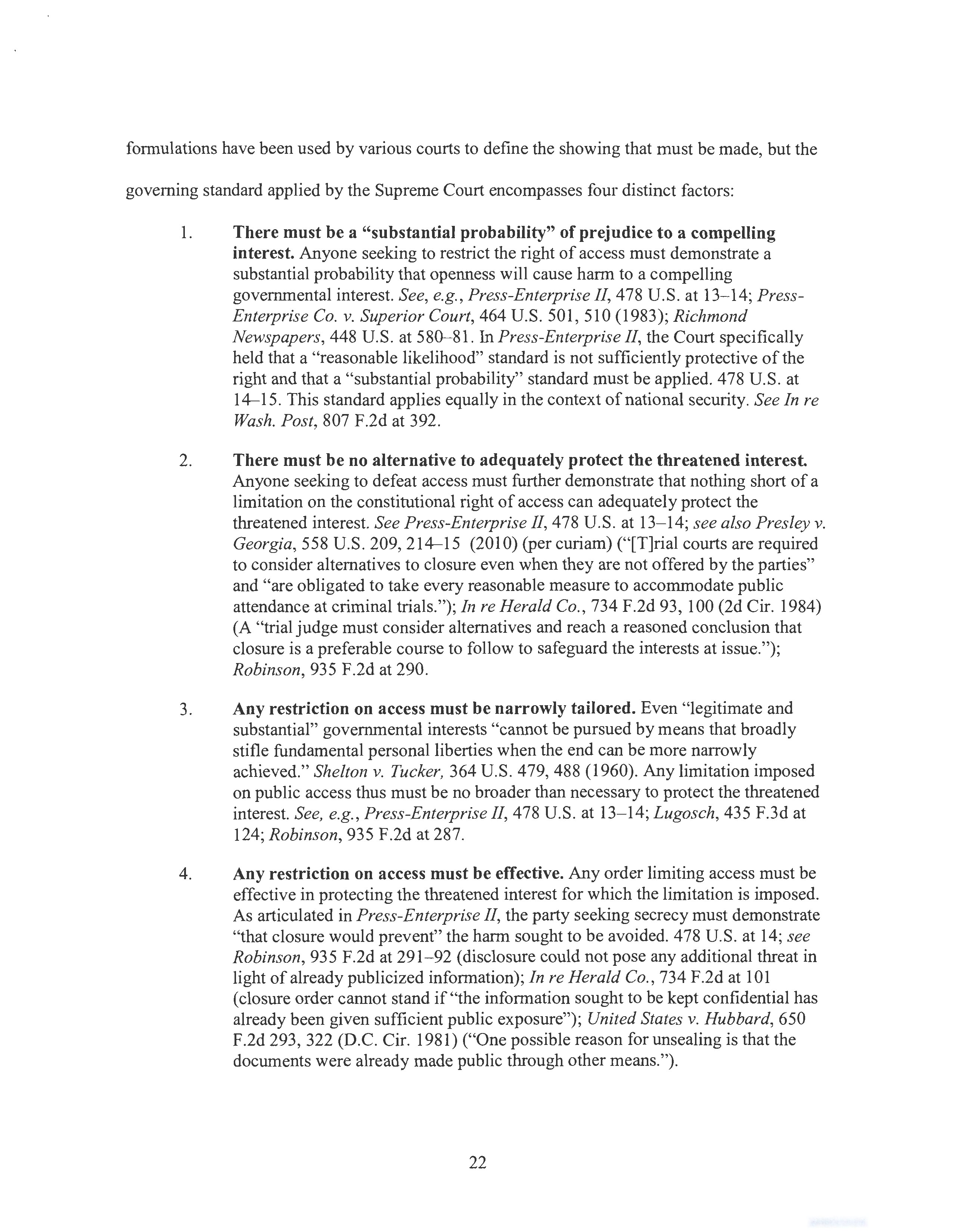
formulations have been used by various courts to define the showing that must be made, but the
governing standard applied by the Supreme Court encompasses four distinct factors:
- There must be a "substantial probability" of prejudice to a compelling
interest. Anyone seeking to restrict the right of access must demonstrate a
substantial probability that openness will cause harm to a compelling
governmental interest. See, e.g., Press-Enterprise II, 478 U.S. at 13-14; _Press-
Enterprise Co. v. Superior Court_, 464 U.S. 501, 510 (1983); _Richmond
Newspapers_, 448 U.S. at 580–81. In Press-Enterprise II, the Court specifically
held that a "reasonable likelihood" standard is not sufficiently protective of the
right and that a “substantial probability” standard must be applied. 478 U.S. at
14-15. This standard applies equally in the context of national security. See _In re
Wash. Post_, 807 F.2d at 392.
- There must be no alternative to adequately protect the threatened interest.
Anyone seeking to defeat access must further demonstrate that nothing short of a
limitation on the constitutional right of access can adequately protect the
threatened interest. See Press-Enterprise II, 478 U.S. at 13–14; see also _Presley v.
Georgia_, 558 U.S. 209, 214–15 (2010) (per curiam) ("[T]rial courts are required
to consider alternatives to closure even when they are not offered by the parties"
and "are obligated to take every reasonable measure to accommodate public
attendance at criminal trials."); In re Herald Co., 734 F.2d 93, 100 (2d Cir. 1984)
(A "trial judge must consider alternatives and reach a reasoned conclusion that
closure is a preferable course to follow to safeguard the interests at issue.");
Robinson, 935 F.2d at 290.
- Any restriction on access must be narrowly tailored. Even "legitimate and
substantial" governmental interests “cannot be pursued by means that broadly
stifle fundamental personal liberties when the end can be more narrowly
achieved." Shelton v. Tucker, 364 U.S. 479, 488 (1960). Any limitation imposed
on public access thus must be no broader than necessary to protect the threatened
interest. See, e.g., Press-Enterprise II, 478 U.S. at 13–14; Lugosch, 435 F.3d at
124; Robinson, 935 F.2d at 287.
- Any restriction on access must be effective. Any order limiting access must be
effective in protecting the threatened interest for which the limitation is imposed.
As articulated in Press-Enterprise II, the party seeking secrecy must demonstrate
"that closure would prevent the harm sought to be avoided. 478 U.S. at 14; see
Robinson, 935 F.2d at 291-92 (disclosure could not pose any additional threat in
light of already publicized information); In re Herald Co., 734 F.2d at 101
(closure order cannot stand if "the information sought to be kept confidential has
already been given sufficient public exposure"); United States v. Hubbard, 650
F.2d 293, 322 (D.C. Cir. 1981) ("One possible reason for unsealing is that the
documents were already made public through other means.").
22
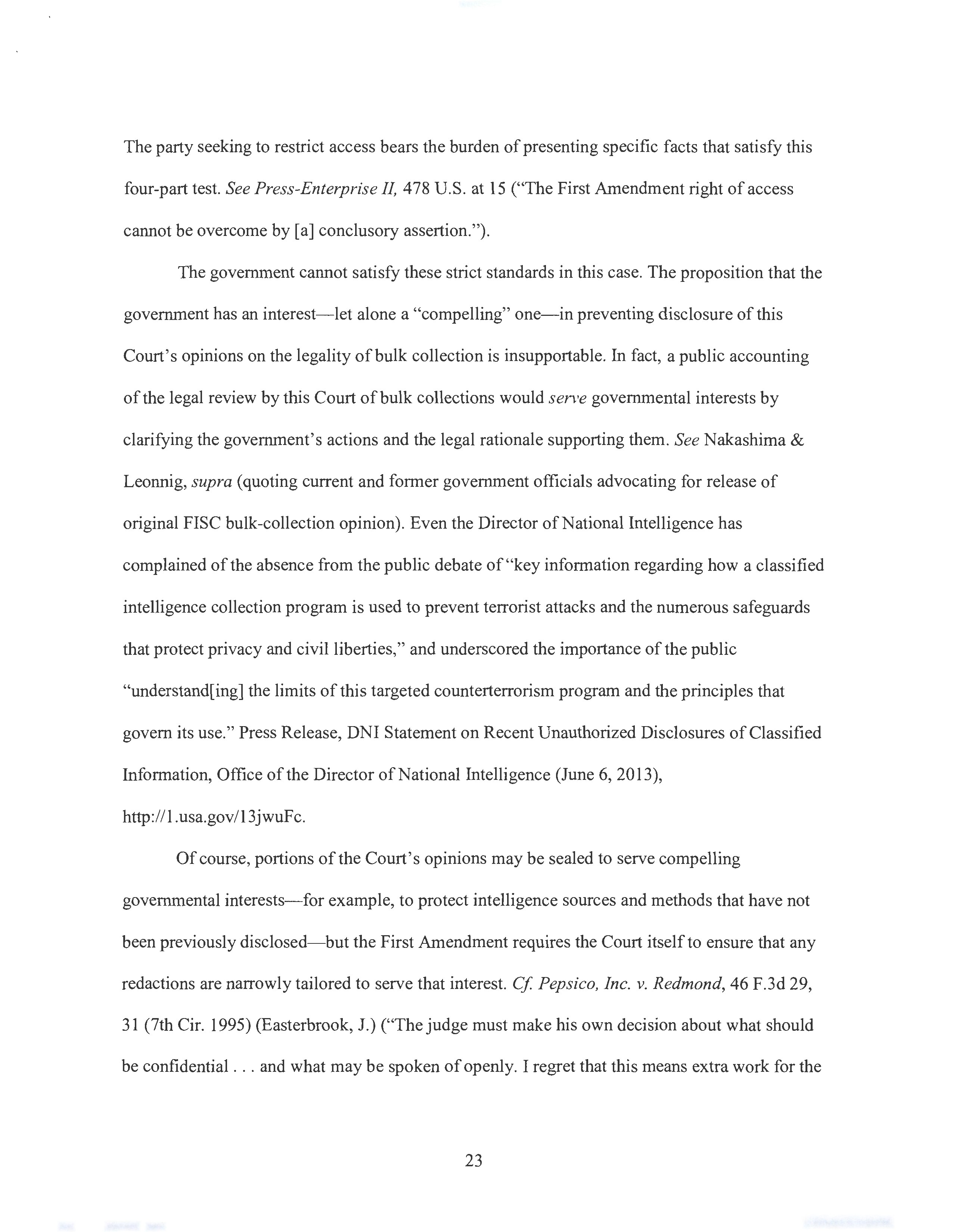
The party seeking to restrict access bears the burden of presenting specific facts that satisfy this
four-part test. See Press-Enterprise II, 478 U.S. at 15 ("The First Amendment right of access
cannot be overcome by [a] conclusory assertion.").
The government cannot satisfy these strict standards in this case. The proposition that the
government has an interest-let alone a "compelling" one-in preventing disclosure of this
Court's opinions on the legality of bulk collection is insupportable. In fact, a public accounting
of the legal review by this Court of bulk collections would serve governmental interests by
clarifying the government's actions and the legal rationale supporting them. See Nakashima &
Leonnig, supra (quoting current and former government officials advocating for release of
original FISC bulk-collection opinion). Even the Director of National Intelligence has
complained of the absence from the public debate of "key information regarding how a classified
intelligence collection program is used to prevent terrorist attacks and the numerous safeguards
that protect privacy and civil liberties," and underscored the importance of the public
"understand[ing] the limits of this targeted counterterrorism program and the principles that
govern its use." Press Release, DNI Statement on Recent Unauthorized Disclosures of Classified
Information, Office of the Director of National Intelligence (June 6, 2013),
http://1.usa.gov/13jwuFc.
Of course, portions of the Court's opinions may be sealed to serve compelling
governmental interests--for example, to protect intelligence sources and methods that have not
been previously disclosed--but the First Amendment requires the Court itself to ensure that any
redactions are narrowly tailored to serve that interest. Cf. Pepsico, Inc. v. Redmond, 46 F.3d 29,
31 (7th Cir. 1995) (Easterbrook, J.) ("The judge must make his own decision about what should
be confidential [REDACTED] and what may be spoken of openly. I regret that this means extra work for the
23
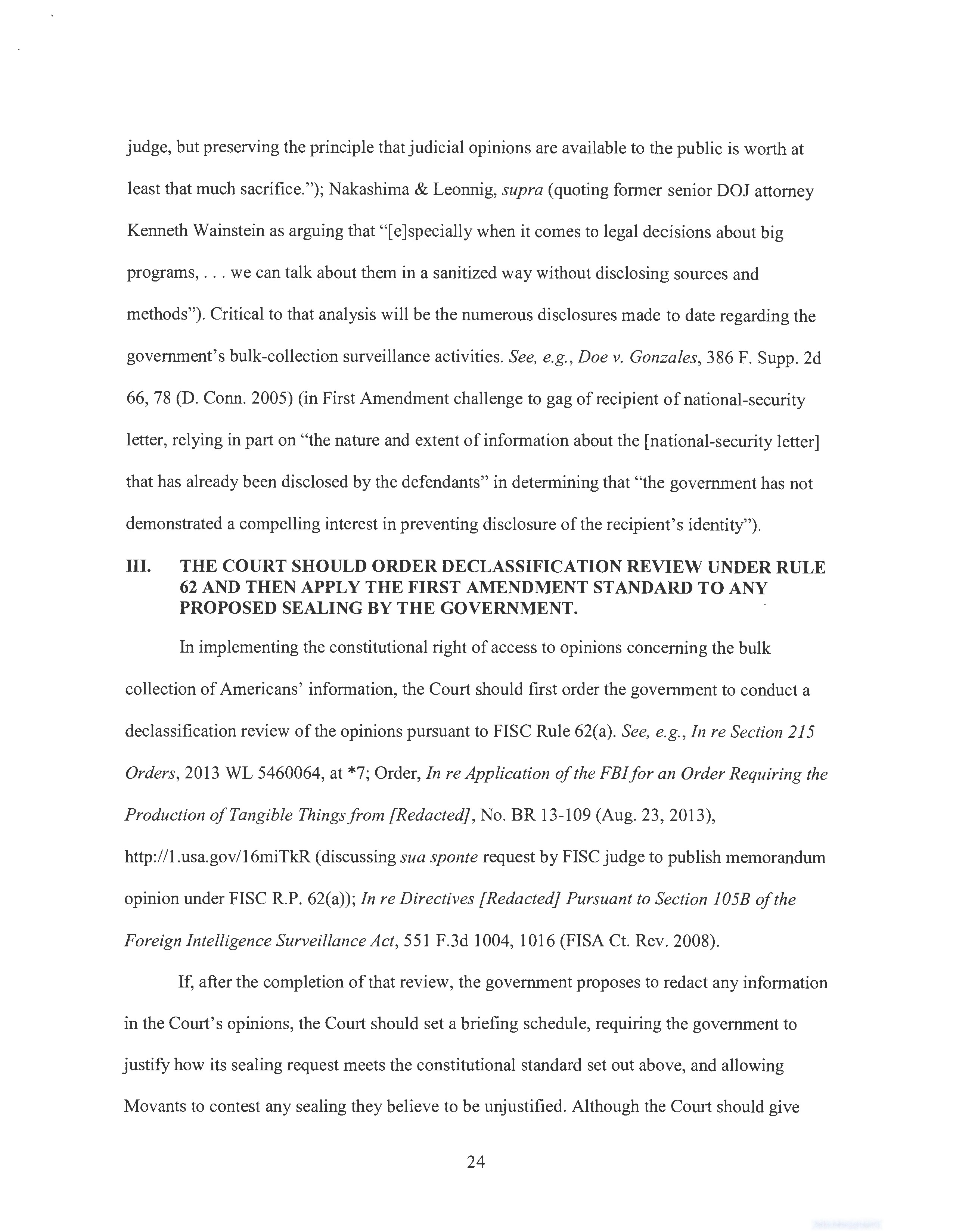
judge, but preserving the principle that judicial opinions are available to the public is worth at
least that much sacrifice."); Nakashima & Leonnig, supra (quoting former senior DOJ attorney
Kenneth Wainstein as arguing that "[e]specially when it comes to legal decisions about big
programs,... we can talk about them in a sanitized way without disclosing sources and
methods"). Critical to that analysis will be the numerous disclosures made to date regarding the
government's bulk-collection surveillance activities. See, e.g., Doe v. Gonzales, 386 F. Supp. 2d
66, 78 (D. Conn. 2005) (in First Amendment challenge to gag of recipient of national-security
letter, relying in part on "the nature and extent of information about the [national-security letter]
that has already been disclosed by the defendants" in determining that "the government has not
demonstrated a compelling interest in preventing disclosure of the recipient's identity").
III. THE COURT SHOULD ORDER DECLASSIFICATION REVIEW UNDER RULE
62 AND THEN APPLY THE FIRST AMENDMENT STANDARD TO ANY
PROPOSED SEALING BY THE GOVERNMENT.
In implementing the constitutional right of access to opinions concerning the bulk
collection of Americans' information, the Court should first order the government to conduct a
declassification review of the opinions pursuant to FISC Rule 62(a). See, e.g., _In re Section 215
Orders_, 2013 WL 5460064, at *7; Order, _In re Application of the FBI for an Order Requiring the
Production of Tangible Things from [REDACTED]_, No. BR 13-109 (Aug. 23, 2013),
http://1.usa.gov/16miTkR (discussing sua sponte request by FISC judge to publish memorandum
opinion under FISC R.P. 62(a)); _In re Directives [REDACTED] Pursuant to Section 105B of the
Foreign Intelligence Surveillance Act_, 551 F.3d 1004, 1016 (FISA Ct. Rev. 2008).
If, after the completion of that review, the government proposes to redact any information
in the Court's opinions, the Court should set a briefing schedule, requiring the government to
justify how its sealing request meets the constitutional standard set out above, and allowing
Movants to contest any sealing they believe to be unjustified. Although the Court should give
24
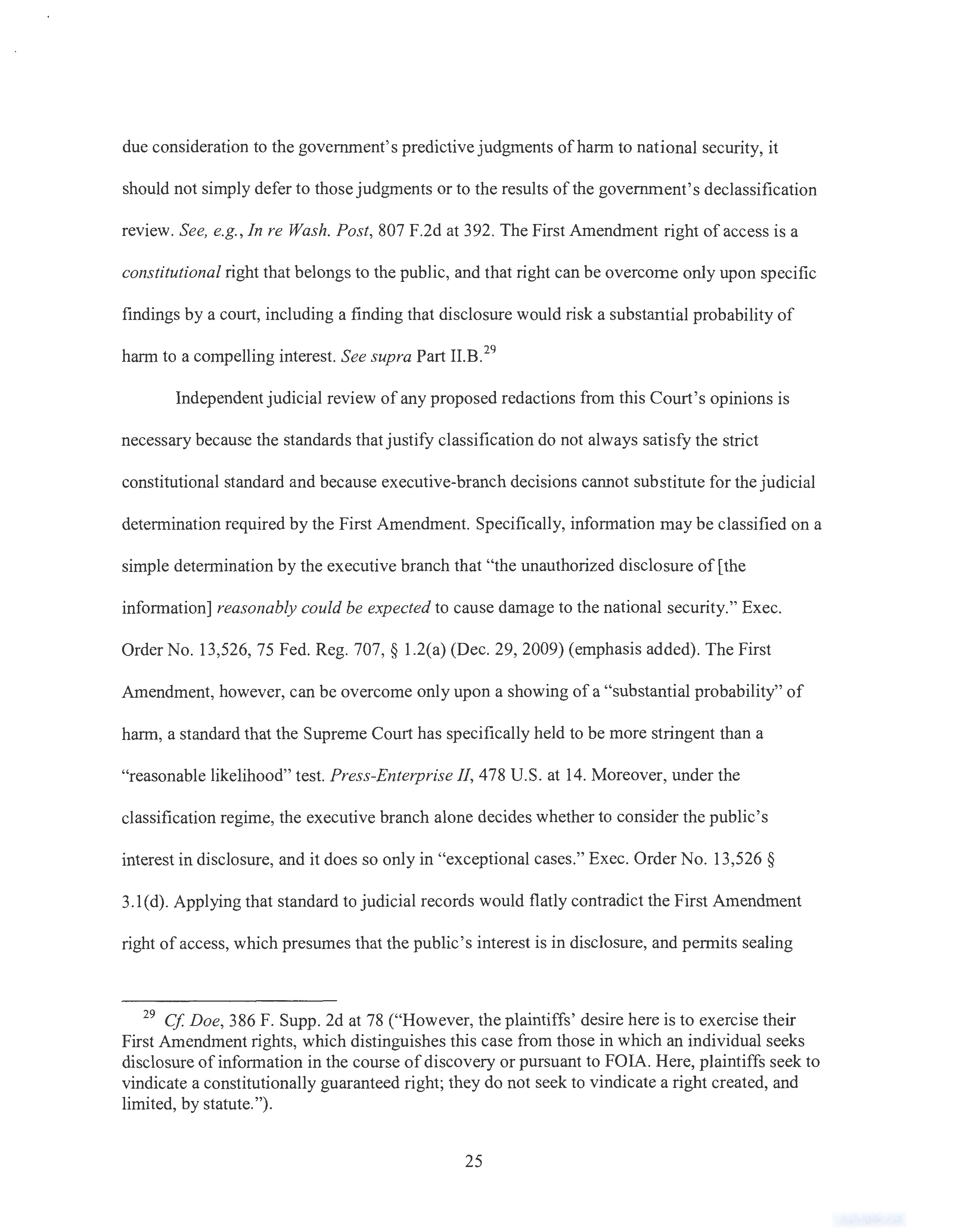
due consideration to the government's predictive judgments of harm to national security, it
should not simply defer to those judgments or to the results of the government's declassification
review. See, e.g., In re Wash. Post, 807 F.2d at 392. The First Amendment right of access is a
constitutional right that belongs to the public, and that right can be overcome only upon specific
findings by a court, including a finding that disclosure would risk a substantial probability of
harm to a compelling interest. See supra Part II.B.²⁹
Independent judicial review of any proposed redactions from this Court's opinions is
necessary because the standards that justify classification do not always satisfy the strict
constitutional standard and because executive-branch decisions cannot substitute for the judicial
determination required by the First Amendment. Specifically, information may be classified on a
simple determination by the executive branch that "the unauthorized disclosure of [the
information] reasonably could be expected to cause damage to the national security." Exec.
Order No. 13,526, 75 Fed. Reg. 707, § 1.2(a) (Dec. 29, 2009) (emphasis added). The First
Amendment, however, can be overcome only upon a showing of a "substantial probability" of
harm, a standard that the Supreme Court has specifically held to be more stringent than a
"reasonable likelihood" test. Press-Enterprise II, 478 U.S. at 14. Moreover, under the
classification regime, the executive branch alone decides whether to consider the public's
interest in disclosure, and it does so only in "exceptional cases." Exec. Order No. 13,526 §
3.1(d). Applying that standard to judicial records would flatly contradict the First Amendment
right of access, which presumes that the public's interest is in disclosure, and permits sealing
²⁹ Cf. Doe, 386 F. Supp. 2d at 78 ("However, the plaintiffs' desire here is to exercise their
First Amendment rights, which distinguishes this case from those in which an individual seeks
disclosure of information in the course of discovery or pursuant to FOIA. Here, plaintiffs seek to
vindicate a constitutionally guaranteed right; they do not seek to vindicate a right created, and
limited, by statute.").
25
only if there are no less-restrictive alternatives and if the limitation on access is narrowly
tailored.
Furthermore, whether the public's constitutional right of access has been overcome is a
question for the courts, not one that rests with the executive. See Press-Enterprise II, 478 U.S.
13-14. As the Fourth Circuit has forcefully explained,
> [T]roubled as we are by the risk that disclosure of classified information could
> endanger the lives of both Americans and their foreign informants, we are equally
> troubled by the notion that the judiciary should abdicate its decisionmaking
> responsibility to the executive branch whenever national security concerns are
> present. History teaches us how easily the spectre of a threat to "national security"
> may be used to justify a wide variety of repressive government actions. A blind
> acceptance by the courts of the government's insistence on the need for secrecy,
> without notice to others, without argument, and without a statement of reasons,
> would impermissibly compromise the independence of the judiciary and open the
> door to possible abuse.
In re Wash. Post, 807 F.2d at 391-92; see United States v. Hershey, 20 M.J. 433, 436 (C.M.A.
1985) ("[E]ven when the interest sought to be protected is national security, the Government
must demonstrate a compelling need to exclude the public...." (emphasis omitted)); _United
States v. Grunden_, 2 M.J. 116, 122 (C.M.A. 1977) (although classification and the policy
determinations it involves "are not normal judicial functions, immunization from judicial review
cannot be countenanced in situations where strong countervailing constitutional interests exist").
Case law under the Classified Information Procedures Act, 18 U.S.C., App. 3 (2000)
("CIPA"), confirms that the fact of classification does not automatically trump the constitutional
right of access. To seal classified information where CIPA is involved, the government must
make "a sufficient showing that disclosure of the information sought would impair identified
national interests in substantial ways," and the court must conduct an "independent review" to
determine that closure is "narrowly tailored to protect national security." Aref, 533 F.3d at 82-
83; see In re Wash. Post, 807 F.2d at 393 (district court not excused under CIPA "from making
26
the appropriate constitutional inquiry"); Rosen, 487 F. Supp. 2d at 710, 716-17 (a statute cannot
defeat a constitutional right and "government's ipse dixit that information is damaging to
national security is not sufficient to close the courtroom doors"); see also _United States v.
Moussaoui_, 65 F. App'x 881, 887 (4th Cir. 2003) (under CIPA procedures, courts "must
independently determine whether, and to what extent, the proceedings and documents must be
kept under seal"); United States v. Poindexter, 732 F. Supp. 165, 167 n.9 (D.D.C. 1990) (“CIPA
obviously cannot override a constitutional right of access"); United States v. Pelton, 696 F. Supp.
156, 159 (D. Md. 1986) (same).
In other contexts, too, courts routinely scrutinize executive-branch classifications. See,
e.g., Campbell v. U.S. Dep't of Justice, 164 F.3d 20, 30 (D.C. Cir. 1999); _Goldberg v. U.S. Dep't
of State_, 818 F.2d 71, 76 (D.C. Cir. 1987). This principle is not controversial, and in other
forums, the government has expressly accepted it. See, e.g., Final Reply Br. for Appellants at 8
n.1, Ctr. for Int'l Envtl. Law v. Office of the U.S. Trade Rep., No. 12-5136 (D.C. Cir. Nov. 27,
2012), 2012 WL 5940305 (clarifying that the government has not "suggested that the
Executive's determination that a document is classified should be conclusive or unreviewable").
For these reasons, merely ordering discretionary release under Rule 62(a) after executive
declassification review would not satisfy the constitutional right of access. The Court should thus
order declassification review as a first step and then test any sealing proposed by the government
against the standard required by the First Amendment. Of course, even if the Court holds that the
First Amendment right of access does not attach to the legal opinions requested by Movants, it
should nonetheless exercise its discretion as it has in the past and in the public interest-to
order the government to conduct a declassification review of its opinions pursuant to Rule 62.
See, e.g., In re Section 215 Orders, 2013 WL 5460064, at *7.
27
CONCLUSION
For the foregoing reasons, the movants respectfully request that this Court unseal its
opinions addressing the constitutional and statutory bases for the "bulk collection" of records
under various authorities within FISA, including but not limited to 50 U.S.C. § 1842, with only
those limited redactions that satisfy the strict test to overcome the constitutional right of access.
Given the relevance of the opinions to an ongoing debate of immense public interest, Movants
request expedited consideration of this motion, as well as oral argument.
Dated: November 6, 2013
David A. Schulz
Jonathan Manes
Media Freedom and Information Access Clinic
Yale Law School
P.O. Box 208215
New Haven, CT 06520
Phone: (212) 850-6103
Fax: (212) 850-6299
dschulz@lskslaw.com
/s/ Alex Abdo
Alex Abdo
Brett Max Kaufman
Patrick Toomey
Jameel Jaffer
American Civil Liberties Union Foundation
125 Broad Street, 18th Floor
New York, NY 10004
Phone: (212) 549-2500
Fax: (212) 549-2654
aabdo@aclu.org
Arthur B. Spitzer
American Civil Liberties Union of the
Nation's Capital
4301 Connecticut Avenue, N.W., Suite 434
Washington, DC 20008
Phone: (202) 457-0800
Fax: (202) 457-0805
artspitzer@aclu-nca.org
* This motion has been prepared in part by a clinic operated by Yale Law School, but does not
purport to present the school's institutional views, if any. Yale Law School students assisting on
the papers: Patrick Hayden '14, John Langford '14, Max Mishkin '14, and Brianna van Kan '15.
28
CERTIFICATE OF SERVICE
I, Alex Abdo, certify that on this day, November 6, 2013, a copy of the foregoing brief
was served by UPS on the following persons:
Eric H. Holder
Attorney General
Office of the Attorney General
U.S. Department of Justice
National Security Division
950 Pennsylvania Avenue, N.W.
Washington, DC 20530
John P. Carlin
Acting Assistant Attorney General for National Security
U.S. Department of Justice
National Security Division
950 Pennsylvania Avenue, N.W.
Washington, DC 20530
Christine Gunning
Litigation Security Group
U.S. Department of Justice
2 Constitution Square
145 N Street, N.E.
Suite 2W-115
Washington, DC 20530
/s/ Alex Abdo
Alex Abdo
UNITED STATES
FOREIGN INTELLIGENCE SURVEILLANCE COURT
WASHINGTON, D.C.
U.S. FOREIGN
INTELLIGENCE
SURVEILLANCE COURT
2013 NOV -7 PM 2:42
LEEANN FLYNN HALL
CLERK OF COURT
IN RE OPINIONS & ORDERS OF THIS COURT
ADDRESSING BULK COLLECTION OF DATA
UNDER THE FOREIGN INTELLIGENCE
SURVEILLANCE ACT
No. Misc. 13-8
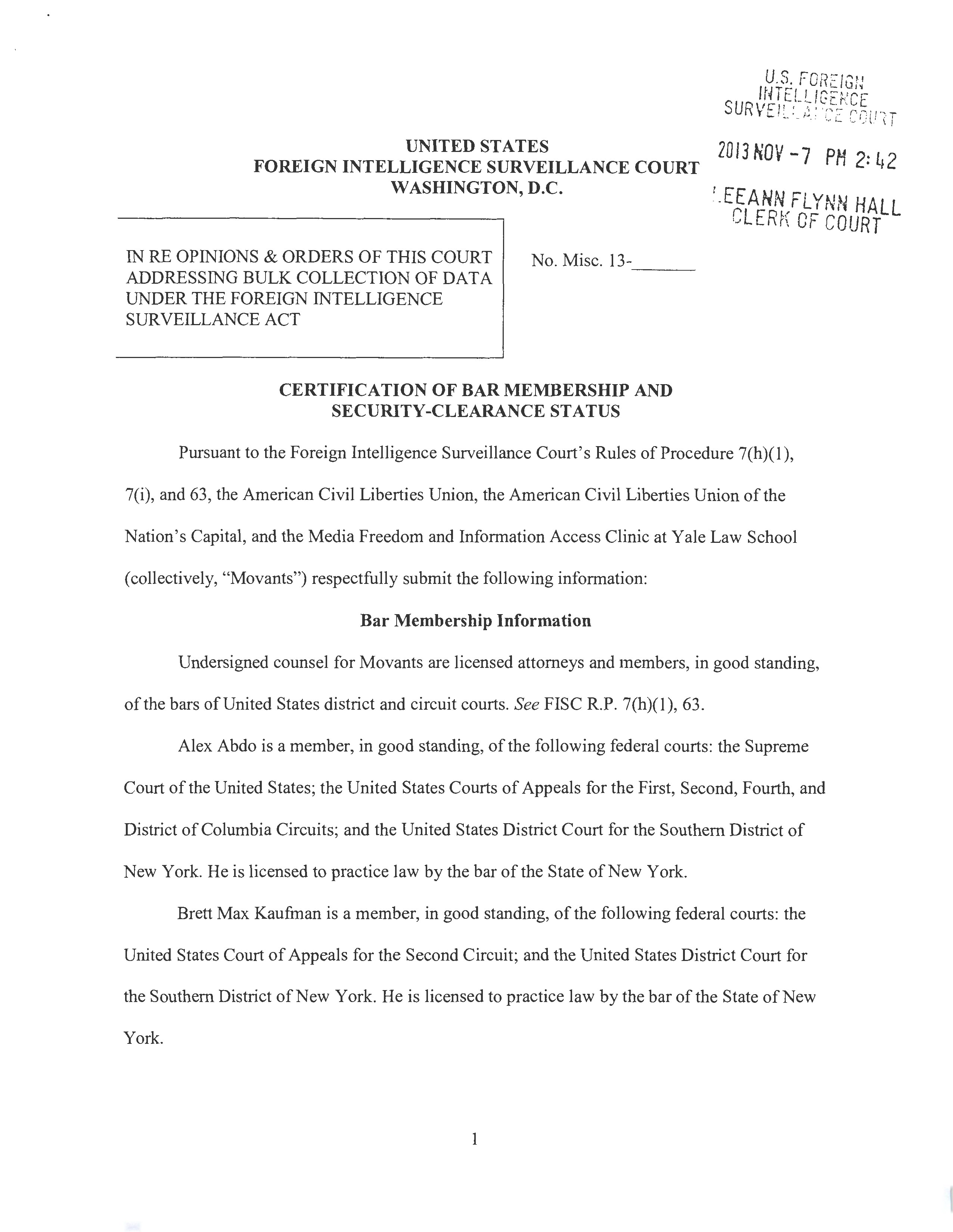
CERTIFICATION OF BAR MEMBERSHIP AND
SECURITY-CLEARANCE STATUS
Pursuant to the Foreign Intelligence Surveillance Court's Rules of Procedure 7(h)(1),
7(i), and 63, the American Civil Liberties Union, the American Civil Liberties Union of the
Nation's Capital, and the Media Freedom and Information Access Clinic at Yale Law School
(collectively, "Movants") respectfully submit the following information:
Bar Membership Information
Undersigned counsel for Movants are licensed attorneys and members, in good standing,
of the bars of United States district and circuit courts. See FISC R.P. 7(h)(1), 63.
Alex Abdo is a member, in good standing, of the following federal courts: the Supreme
Court of the United States; the United States Courts of Appeals for the First, Second, Fourth, and
District of Columbia Circuits; and the United States District Court for the Southern District of
New York. He is licensed to practice law by the bar of the State of New York.
Brett Max Kaufman is a member, in good standing, of the following federal courts: the
United States Court of Appeals for the Second Circuit; and the United States District Court for
the Southern District of New York. He is licensed to practice law by the bar of the State of New
York.
1
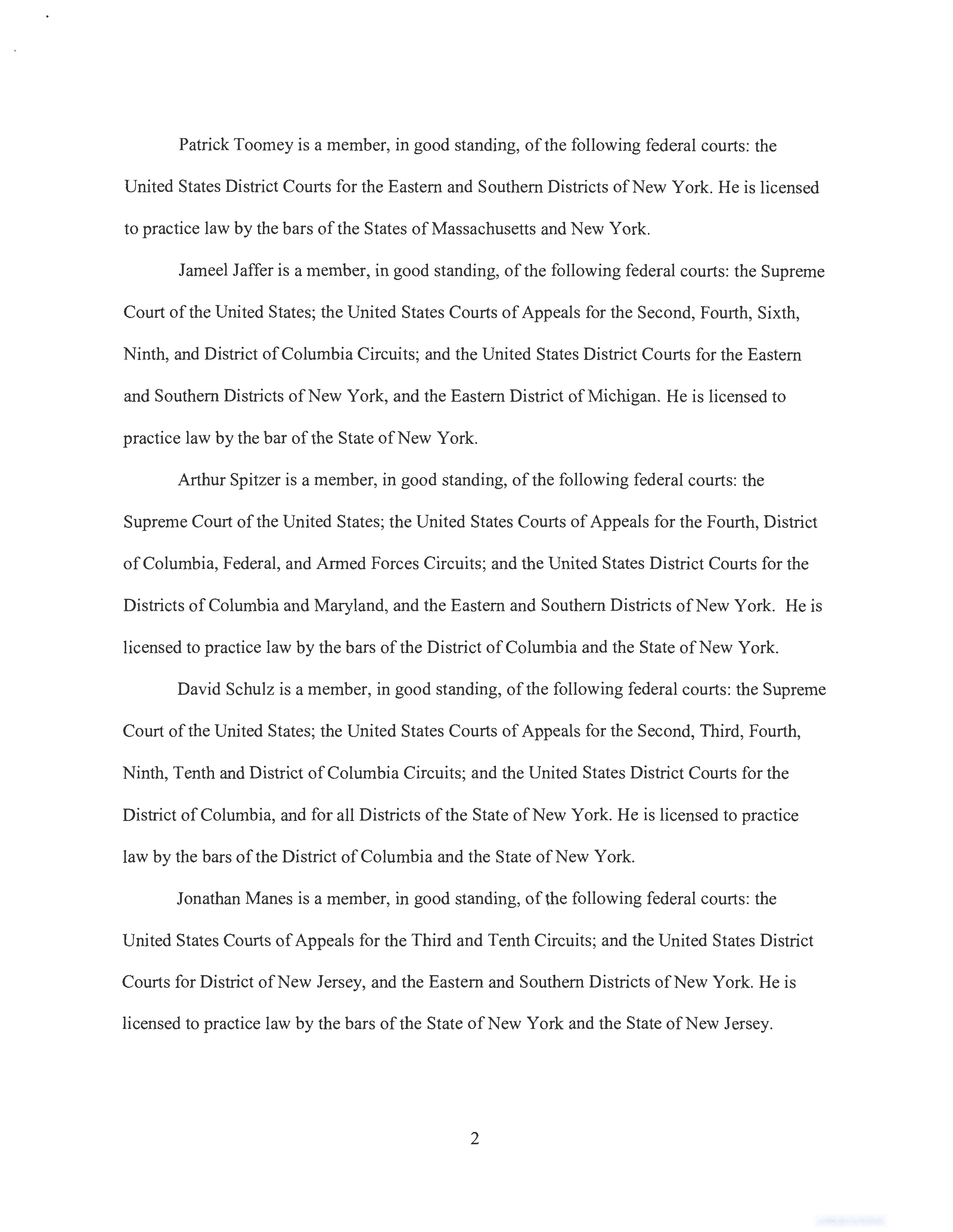
Patrick Toomey is a member, in good standing, of the following federal courts: the
United States District Courts for the Eastern and Southern Districts of New York. He is licensed
to practice law by the bars of the States of Massachusetts and New York.
Jameel Jaffer is a member, in good standing, of the following federal courts: the Supreme
Court of the United States; the United States Courts of Appeals for the Second, Fourth, Sixth,
Ninth, and District of Columbia Circuits; and the United States District Courts for the Eastern
and Southern Districts of New York, and the Eastern District of Michigan. He is licensed to
practice law by the bar of the State of New York.
Arthur Spitzer is a member, in good standing, of the following federal courts: the
Supreme Court of the United States; the United States Courts of Appeals for the Fourth, District
of Columbia, Federal, and Armed Forces Circuits; and the United States District Courts for the
Districts of Columbia and Maryland, and the Eastern and Southern Districts of New York. He is
licensed to practice law by the bars of the District of Columbia and the State of New York.
David Schulz is a member, in good standing, of the following federal courts: the Supreme
Court of the United States; the United States Courts of Appeals for the Second, Third, Fourth,
Ninth, Tenth and District of Columbia Circuits; and the United States District Courts for the
District of Columbia, and for all Districts of the State of New York. He is licensed to practice
law by the bars of the District of Columbia and the State of New York.
Jonathan Manes is a member, in good standing, of the following federal courts: the
United States Courts of Appeals for the Third and Tenth Circuits; and the United States District
Courts for District of New Jersey, and the Eastern and Southern Districts of New York. He is
licensed to practice law by the bars of the State of New York and the State of New Jersey.
2
Security-Clearance Information
Pursuant to FISC R.P. 7(i), Movants certify that Arthur Spitzer holds a "Secret" security
clearance issued by the Department of Justice.
Because Movants' motion and the related briefing do not contain classified information,
Movants respectfully submit that all undersigned counsel may participate in proceedings on the
motion without access to classified information or security clearances. See FISC R.P. 63
(requiring counsel only to have "appropriate security clearances").
Dated: November 6, 2013
David A. Schulz
Media Freedom and Information Access Clinic
Yale Law School
P.O. Box 208215
New Haven, CT 06520
Phone: (212) 850-6103
Fax: (212) 850-6299
dschulz@lskslaw.com
Respectfully submitted,
/s/ Alex Abdo
Alex Abdo
Brett Max Kaufman
Patrick Toomey
Jameel Jaffer
American Civil Liberties Union Foundation
125 Broad Street, 18th Floor
New York, NY 10004
Phone: (212) 549-2500
Fax: (212) 549-2654
aabdo@aclu.org
Arthur B. Spitzer
American Civil Liberties Union of the
Nation's Capital
4301 Connecticut Avenue, N.W., Suite 434
Washington, DC 20008
Phone: (202) 457-0800
Fax: (202) 457-0805
artspitzer@aclu-nca.org
3
CERTIFICATE OF SERVICE
I, Alex Abdo, certify that on this day, November 6, 2013, a copy of the foregoing
certification was served by UPS on the following persons by the methods indicated:
Christine Gunning
Litigation Security Group
U.S. Department of Justice
2 Constitution Square
145 N Street, N.E.
Suite 2W-115
Washington, DC 20530
John P. Carlin
J. Bradford Wiegmann
Tashina Gauhar
Jeffrey M. Smith
Nicholas J. Patterson
U.S. Department of Justice
National Security Division
950 Pennsylvania Ave., N.W.
Washington, DC 20530
/s/ Alex Abdo
Alex Abdo