Foreign Intelligence Surveillance Opinion and Order – November 2011
Open PDFDocument date: 2011-11-30
Type: FOIA
Pages: 24
Classification: TOP SECRET COMINT
Dissemination: ORCON, NOFORN
A FISC opinion concluding the NSA’s minimization procedures adequately address the deficiencies identified in the FISC’s ruling from October 3, 2011. ACLU/EFF FOIA Litigation.
My notes
TOP SECRET//COMINT//ORCON,NOFORN
UNITED STATES
FOREIGN INTELLIGENCE SURVEILLANCE COURT
WASHINGTON, D.C.
[REDACTED]
MEMORANDUM OPINION
These matters are before the Foreign Intelligence Surveillance Court ("FISC" or "Court")
on:
[REDACTED]
[REDACTED]
[REDACTED]
[REDACTED]
[REDACTED]
TOP SECRET//COMINT//ORCON,NOFORN
TOP SECRET//COMINT//ORCON,NOFORN
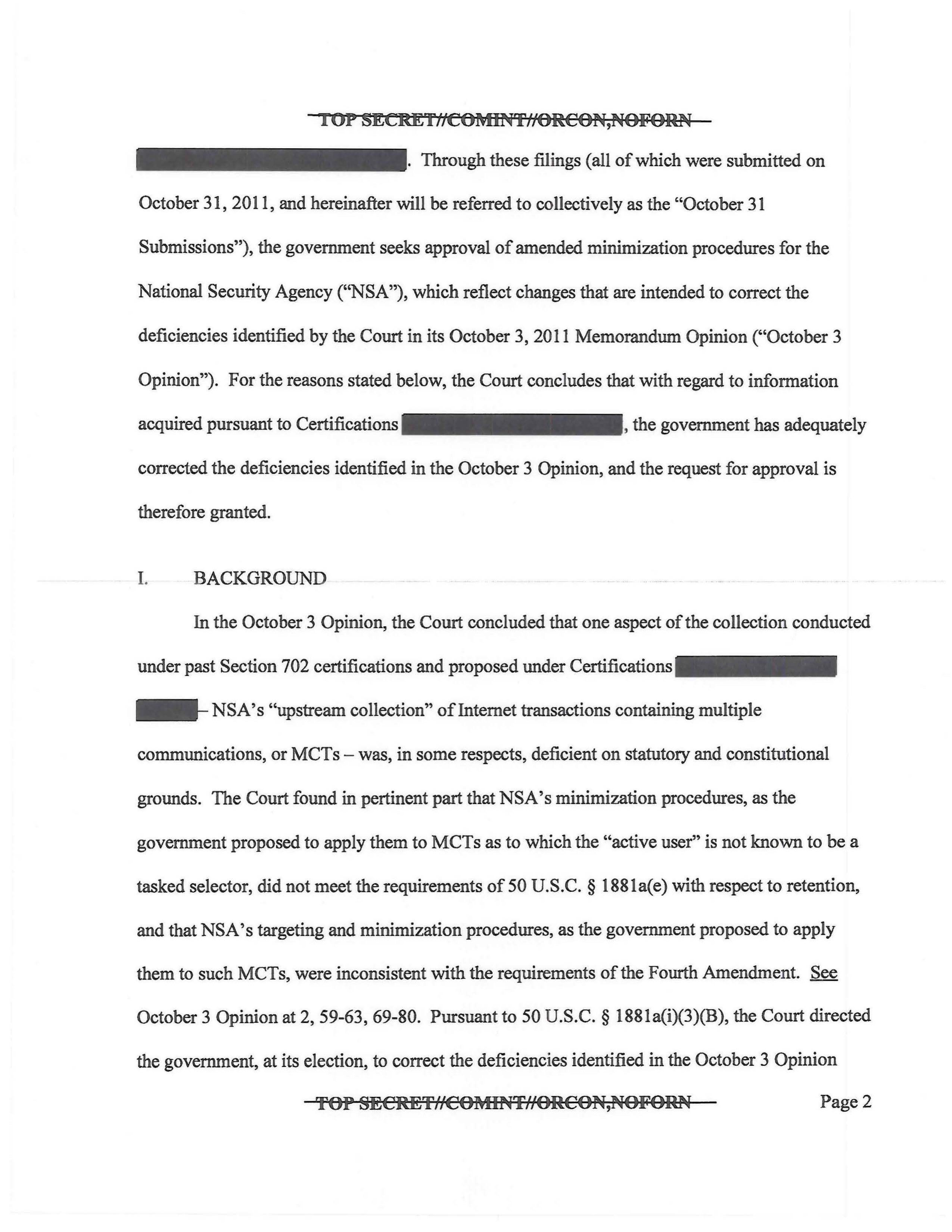
[REDACTED] Through these filings (all of which were submitted on
October 31, 2011, and hereinafter will be referred to collectively as the "October 31
Submissions"), the government seeks approval of amended minimization procedures for the
National Security Agency ("NSA"), which reflect changes that are intended to correct the
deficiencies identified by the Court in its October 3, 2011 Memorandum Opinion ("October 3
Opinion"). For the reasons stated below, the Court concludes that with regard to information
acquired pursuant to Certifications [REDACTED], the government has adequately
corrected the deficiencies identified in the October 3 Opinion, and the request for approval is
therefore granted.
I. BACKGROUND
In the October 3 Opinion, the Court concluded that one aspect of the collection conducted
under past Section 702 certifications and proposed under Certifications [REDACTED]
[REDACTED]—NSA's "upstream collection" of Internet transactions containing multiple
communications, or MCTs—was, in some respects, deficient on statutory and constitutional
grounds. The Court found in pertinent part that NSA's minimization procedures, as the
government proposed to apply them to MCTs as to which the "active user" is not known to be a
tasked selector, did not meet the requirements of 50 U.S.C. § 1881a(e) with respect to retention,
and that NSA's targeting and minimization procedures, as the government proposed to apply
them to such MCTs, were inconsistent with the requirements of the Fourth Amendment. See
October 3 Opinion at 2, 59-63, 69-80. Pursuant to 50 U.S.C. § 1881a(i)(3)(B), the Court directed
the government, at its election, to correct the deficiencies identified in the October 3 Opinion
TOP SECRET//COMINT//ORCON,NOFORN
Page 2
TOP SECRET//COMINT//ORCON,NOFORN
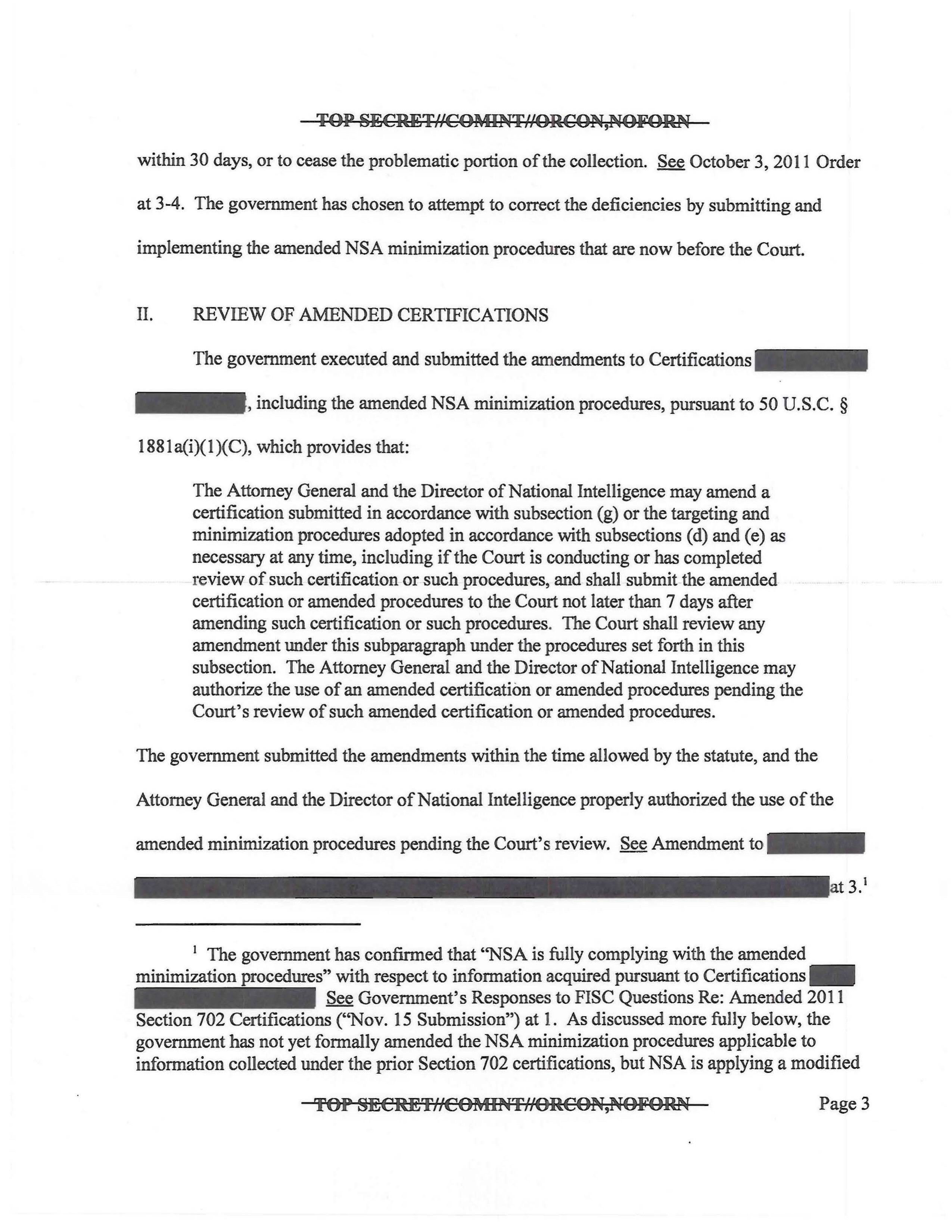
within 30 days, or to cease the problematic portion of the collection. See October 3, 2011 Order
at 3-4. The government has chosen to attempt to correct the deficiencies by submitting and
implementing the amended NSA minimization procedures that are now before the Court.
II. REVIEW OF AMENDED CERTIFICATIONS
The government executed and submitted the amendments to Certifications [REDACTED]
[REDACTED], including the amended NSA minimization procedures, pursuant to 50 U.S.C. §
1881a(i)(1)(C), which provides that:
The Attorney General and the Director of National Intelligence may amend a
certification submitted in accordance with subsection (g) or the targeting and
minimization procedures adopted in accordance with subsections (d) and (e) as
necessary at any time, including if the Court is conducting or has completed
review of such certification or such procedures, and shall submit the amended
certification or amended procedures to the Court not later than 7 days after
amending such certification or such procedures. The Court shall review any
amendment under this subparagraph under the procedures set forth in this
subsection. The Attorney General and the Director of National Intelligence may
authorize the use of an amended certification or amended procedures pending the
Court's review of such amended certification or amended procedures.
The government submitted the amendments within the time allowed by the statute, and the
Attorney General and the Director of National Intelligence properly authorized the use of the
amended minimization procedures pending the Court's review. See Amendment to [REDACTED]
[REDACTED] at 3.¹
¹ The government has confirmed that "NSA is fully complying with the amended
minimization procedures" with respect to information acquired pursuant to Certifications [REDACTED]. See Government's Responses to FISC Questions Re: Amended 2011
Section 702 Certifications ("Nov. 15 Submission") at 1. As discussed more fully below, the
government has not yet formally amended the NSA minimization procedures applicable to
information collected under the prior Section 702 certifications, but NSA is applying a modified
TOP SECRET//COMINT//ORCON,NOFORN
Page 3
TOP SECRET//COMINT//ORCON,NOFORN
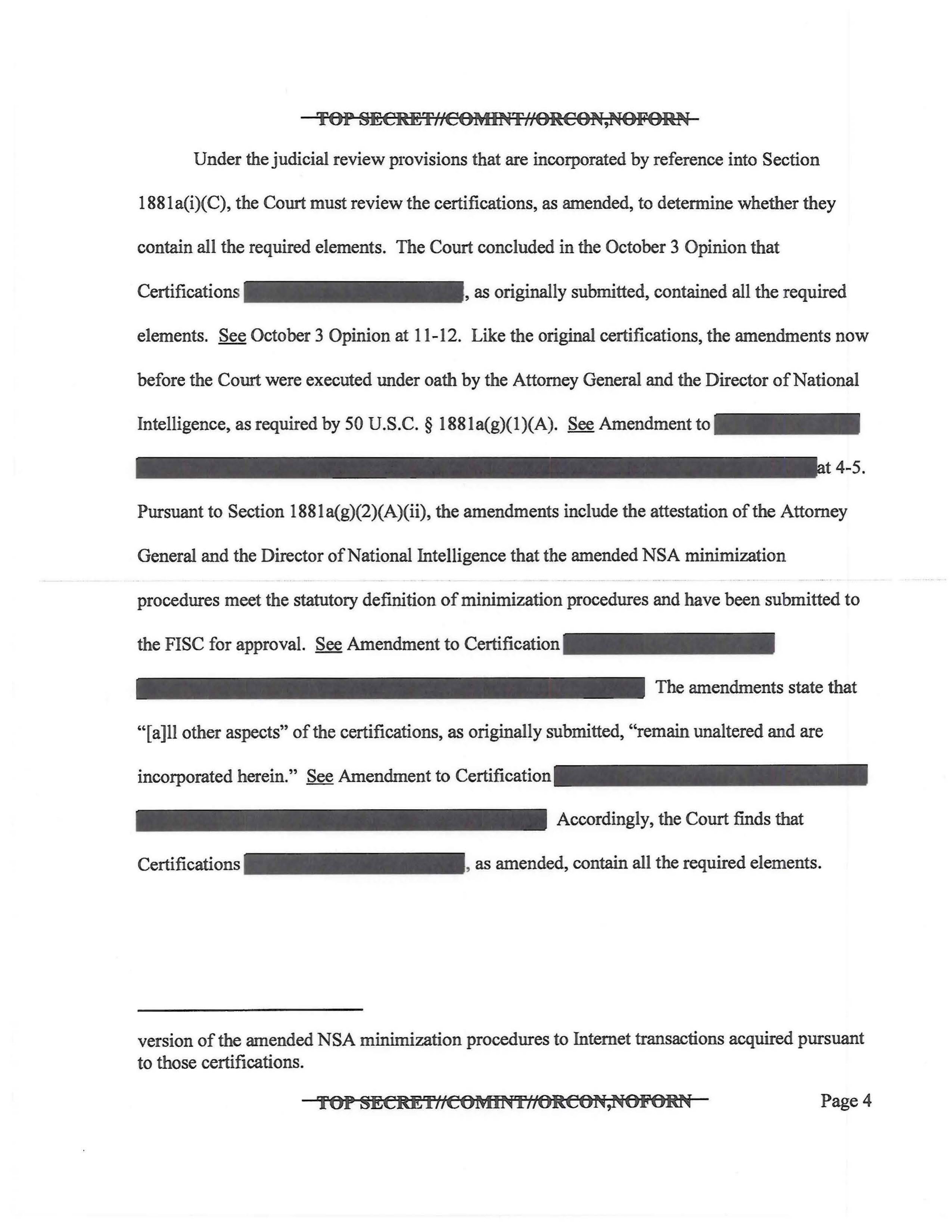
Under the judicial review provisions that are incorporated by reference into Section
1881a(i)(C), the Court must review the certifications, as amended, to determine whether they
contain all the required elements. The Court concluded in the October 3 Opinion that
Certifications [REDACTED], as originally submitted, contained all the required
elements. See October 3 Opinion at 11-12. Like the original certifications, the amendments now
before the Court were executed under oath by the Attorney General and the Director of National
Intelligence, as required by 50 U.S.C. § 1881a(g)(1)(A). See Amendment to [REDACTED]
[REDACTED] at 4-5.
Pursuant to Section 1881a(g)(2)(A)(ii), the amendments include the attestation of the Attorney
General and the Director of National Intelligence that the amended NSA minimization
procedures meet the statutory definition of minimization procedures and have been submitted to
the FISC for approval. See Amendment to Certification [REDACTED]
[REDACTED]. The amendments state that
"[a]ll other aspects" of the certifications, as originally submitted, "remain unaltered and are
incorporated herein." See Amendment to Certification [REDACTED]
[REDACTED]. Accordingly, the Court finds that
Certifications [REDACTED], as amended, contain all the required elements.
[REDACTED] version of the amended NSA minimization procedures to Internet transactions acquired pursuant
to those certifications.
TOP SECRET//COMINT//ORCON,NOFORN
Page 4
TOP SECRET//COMINT//ORCON,NOFORN
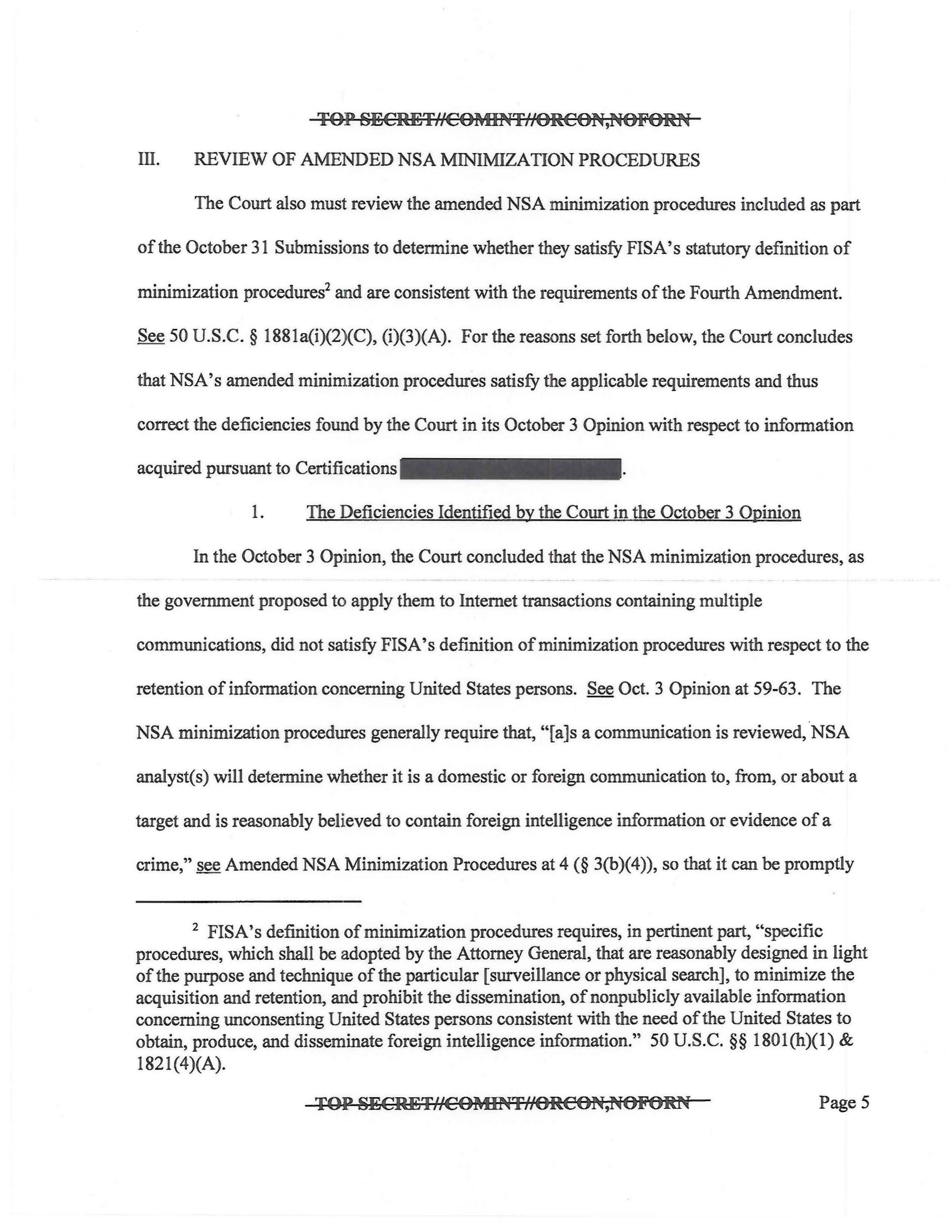
III. REVIEW OF AMENDED NSA MINIMIZATION PROCEDURES
The Court also must review the amended NSA minimization procedures included as part
of the October 31 Submissions to determine whether they satisfy FISA's statutory definition of
minimization procedures² and are consistent with the requirements of the Fourth Amendment.
See 50 U.S.C. § 1881a(i)(2)(C), (i)(3)(A). For the reasons set forth below, the Court concludes
that NSA's amended minimization procedures satisfy the applicable requirements and thus
correct the deficiencies found by the Court in its October 3 Opinion with respect to information
acquired pursuant to Certifications [REDACTED].
- The Deficiencies Identified by the Court in the October 3 Opinion
In the October 3 Opinion, the Court concluded that the NSA minimization procedures, as
the government proposed to apply them to Internet transactions containing multiple
communications, did not satisfy FISA's definition of minimization procedures with respect to the
retention of information concerning United States persons. See Oct. 3 Opinion at 59-63. The
NSA minimization procedures generally require that, "[a]s a communication is reviewed, NSA
analyst(s) will determine whether it is a domestic or foreign communication to, from, or about a
target and is reasonably believed to contain foreign intelligence information or evidence of a
crime." See Amended NSA Minimization Procedures at 4 (§ 3(b)(4)), so that it can be promptly
² FISA's definition of minimization procedures requires, in pertinent part, "specific
procedures, which shall be adopted by the Attorney General, that are reasonably designed in light
of the purpose and technique of the particular [surveillance or physical search], to minimize the
acquisition and retention, and prohibit the dissemination, of nonpublicly available information
concerning unconsenting United States persons consistent with the need of the United States to
obtain, produce, and disseminate foreign intelligence information." 50 U.S.C. §§ 1801(h)(1) &
1821(4)(A).
TOP SECRET//COMINT//ORCON,NOFORN
Page 5
TOP SECRET//COMINT//ORCON,NOFORN
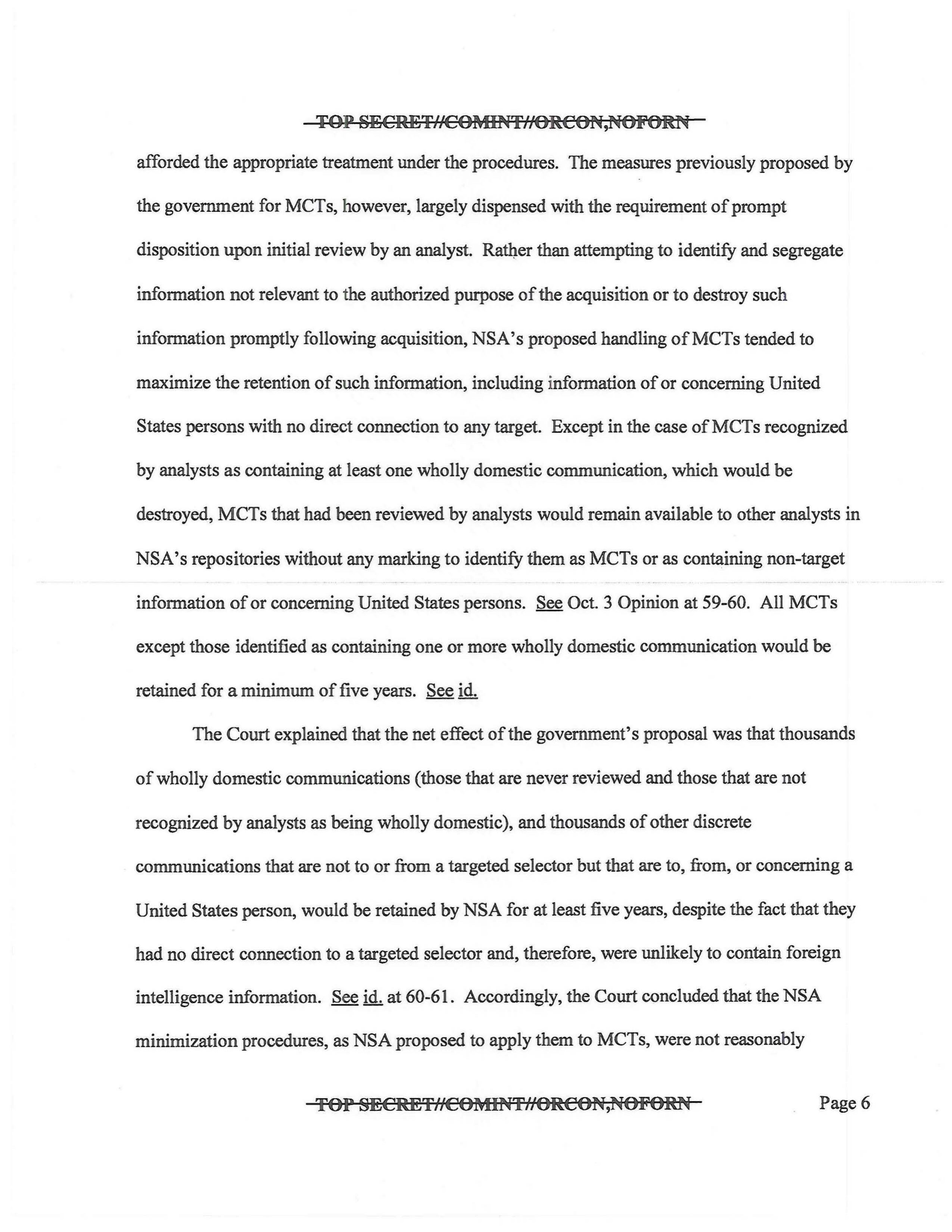
afforded the appropriate treatment under the procedures. The measures previously proposed by
the government for MCTs, however, largely dispensed with the requirement of prompt
disposition upon initial review by an analyst. Rather than attempting to identify and segregate
information not relevant to the authorized purpose of the acquisition or to destroy such
information promptly following acquisition, NSA's proposed handling of MCTs tended to
maximize the retention of such information, including information of or concerning United
States persons with no direct connection to any target. Except in the case of MCTs recognized
by analysts as containing at least one wholly domestic communication, which would be
destroyed, MCTs that had been reviewed by analysts would remain available to other analysts in
NSA's repositories without any marking to identify them as MCTs or as containing non-target
information of or concerning United States persons. See Oct. 3 Opinion at 59-60. All MCTs
except those identified as containing one or more wholly domestic communication would be
retained for a minimum of five years. See id.
The Court explained that the net effect of the government's proposal was that thousands
of wholly domestic communications (those that are never reviewed and those that are not
recognized by analysts as being wholly domestic), and thousands of other discrete
communications that are not to or from a targeted selector but that are to, from, or concerning a
United States person, would be retained by NSA for at least five years, despite the fact that they
had no direct connection to a targeted selector and, therefore, were unlikely to contain foreign
intelligence information. See id. at 60-61. Accordingly, the Court concluded that the NSA
minimization procedures, as NSA proposed to apply them to MCTs, were not reasonably
TOP SECRET//COMINT//ORCON,NOFORN
Page 6
TOP SECRET//COMINT//ORCON,NOFORN
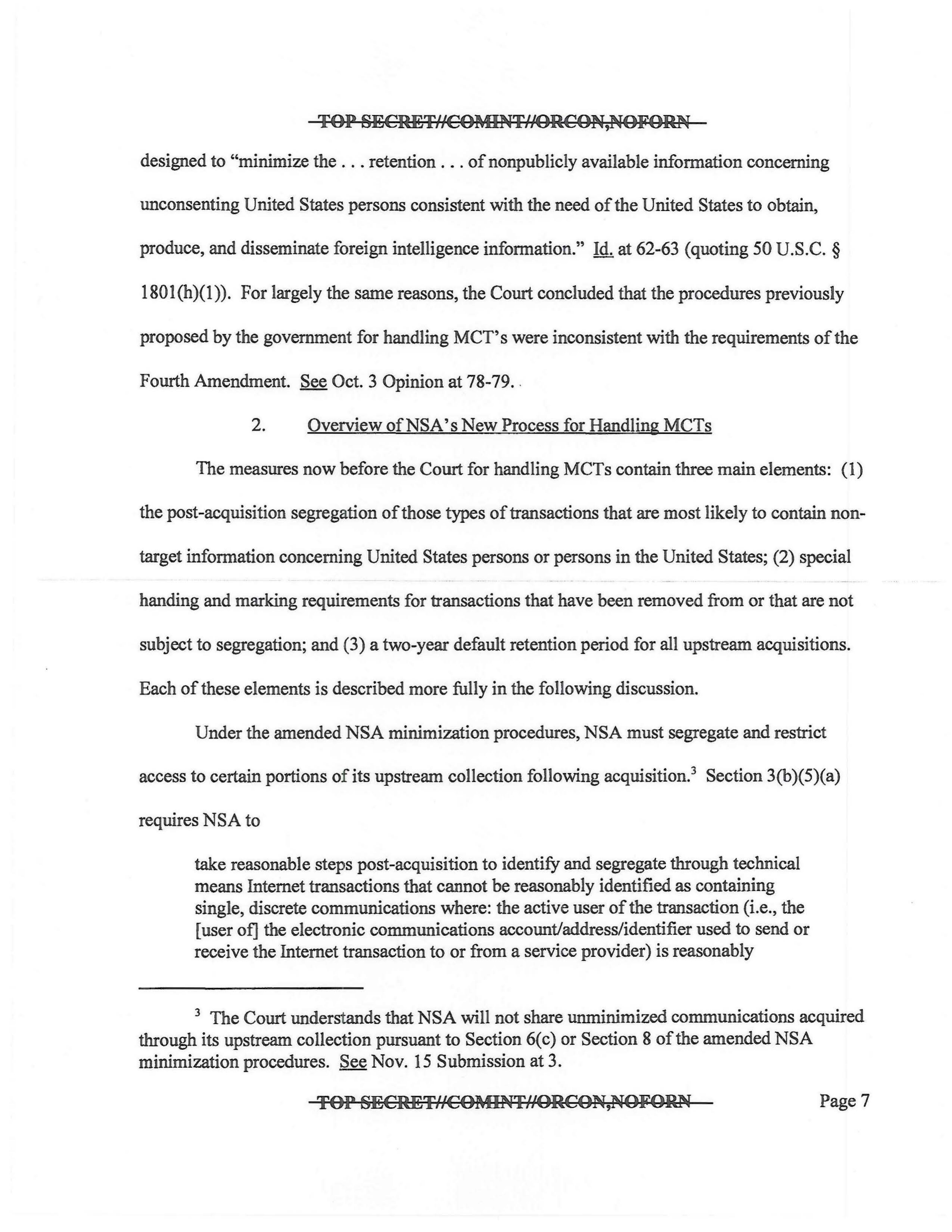
designed to "minimize the... retention of nonpublicly available information concerning
unconsenting United States persons consistent with the need of the United States to obtain,
produce, and disseminate foreign intelligence information." Id. at 62-63 (quoting 50 U.S.C. §
1801(h)(1)). For largely the same reasons, the Court concluded that the procedures previously
proposed by the government for handling MCT's were inconsistent with the requirements of the
Fourth Amendment. See Oct. 3 Opinion at 78-79..
- Overview of NSA's New Process for Handling MCTs
The measures now before the Court for handling MCTs contain three main elements: (1)
the post-acquisition segregation of those types of transactions that are most likely to contain non-
target information concerning United States persons or persons in the United States; (2) special
handing and marking requirements for transactions that have been removed from or that are not
subject to segregation; and (3) a two-year default retention period for all upstream acquisitions.
Each of these elements is described more fully in the following discussion.
Under the amended NSA minimization procedures, NSA must segregate and restrict
access to certain portions of its upstream collection following acquisition.³ Section 3(b)(5)(a)
requires NSA to
take reasonable steps post-acquisition to identify and segregate through technical
means Internet transactions that cannot be reasonably identified as containing
single, discrete communications where: the active user of the transaction (i.e., the
[user of] the electronic communications account/address/identifier used to send or
receive the Internet transaction to or from a service provider) is reasonably
³ The Court understands that NSA will not share unminimized communications acquired
through its upstream collection pursuant to Section 6(c) or Section 8 of the amended NSA
minimization procedures. See Nov. 15 Submission at 3.
TOP SECRET//COMINT//ORCON,NOFORN
Page 7
TOP SECRET//COMINT//ORCON,NOFORN
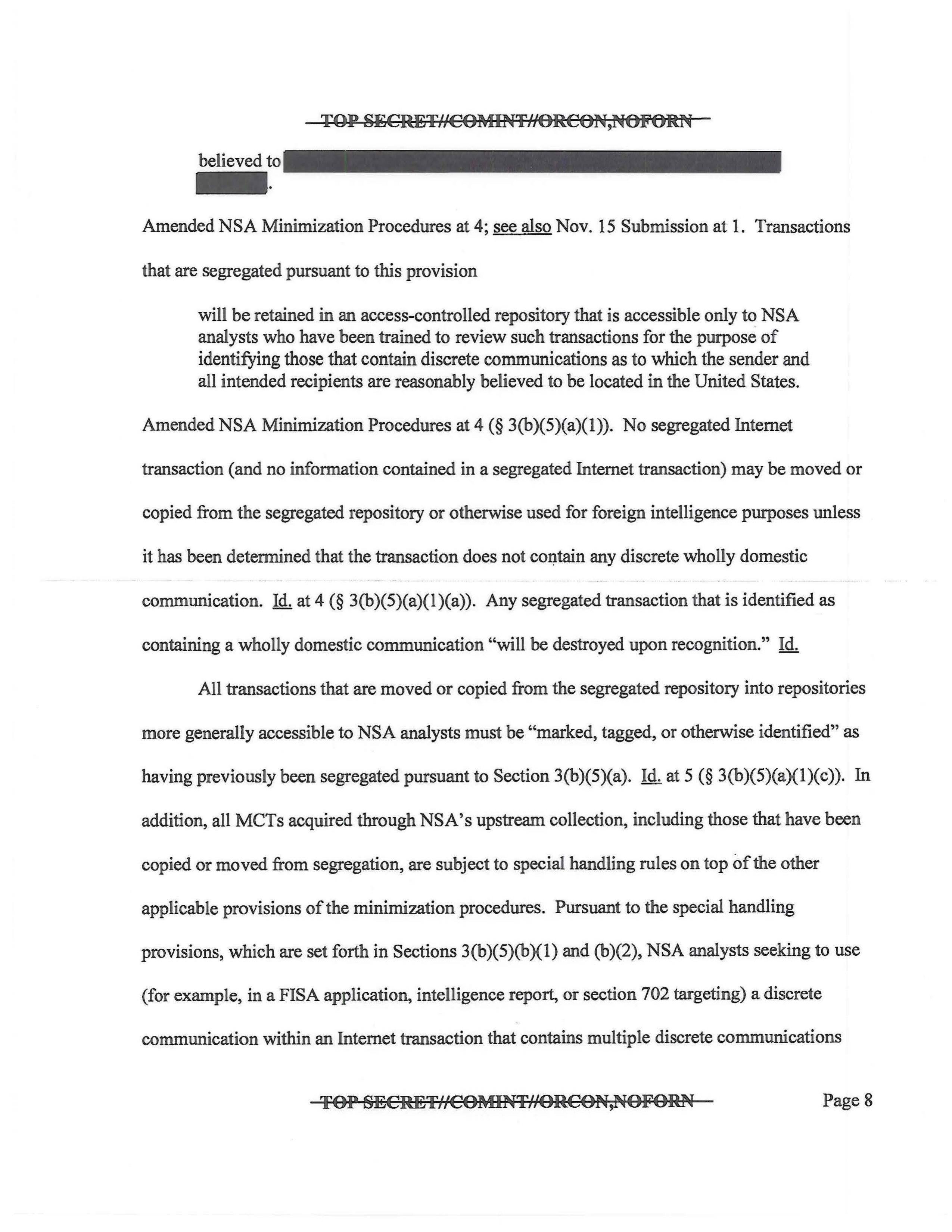
believed to [REDACTED] Amended NSA Minimization Procedures at 4; see also Nov. 15 Submission at 1. Transactions
that are segregated pursuant to this provision
will be retained in an access-controlled repository that is accessible only to NSA
analysts who have been trained to review such transactions for the purpose of
identifying those that contain discrete communications as to which the sender and
all intended recipients are reasonably believed to be located in the United States.
Amended NSA Minimization Procedures at 4 (§ 3(b)(5)(a)(1)). No segregated Internet
transaction (and no information contained in a segregated Internet transaction) may be moved or
copied from the segregated repository or otherwise used for foreign intelligence purposes unless
it has been determined that the transaction does not contain any discrete wholly domestic
communication. Id. at 4 (§ 3(b)(5)(a)(1)(a)). Any segregated transaction that is identified as
containing a wholly domestic communication "will be destroyed upon recognition." Id.
All transactions that are moved or copied from the segregated repository into repositories
more generally accessible to NSA analysts must be "marked, tagged, or otherwise identified" as
having previously been segregated pursuant to Section 3(b)(5)(a). Id. at 5 (§ 3(b)(5)(a)(1)(c)). In
addition, all MCTs acquired through NSA's upstream collection, including those that have been
copied or moved from segregation, are subject to special handling rules on top of the other
applicable provisions of the minimization procedures. Pursuant to the special handling
provisions, which are set forth in Sections 3(b)(5)(b)(1) and (b)(2), NSA analysts seeking to use
(for example, in a FISA application, intelligence report, or section 702 targeting) a discrete
communication within an Internet transaction that contains multiple discrete communications
TOP SECRET//COMINT//ORCON,NOFORN
Page 8
TOP SECRET//COMINT//ORCON,NOFORN-
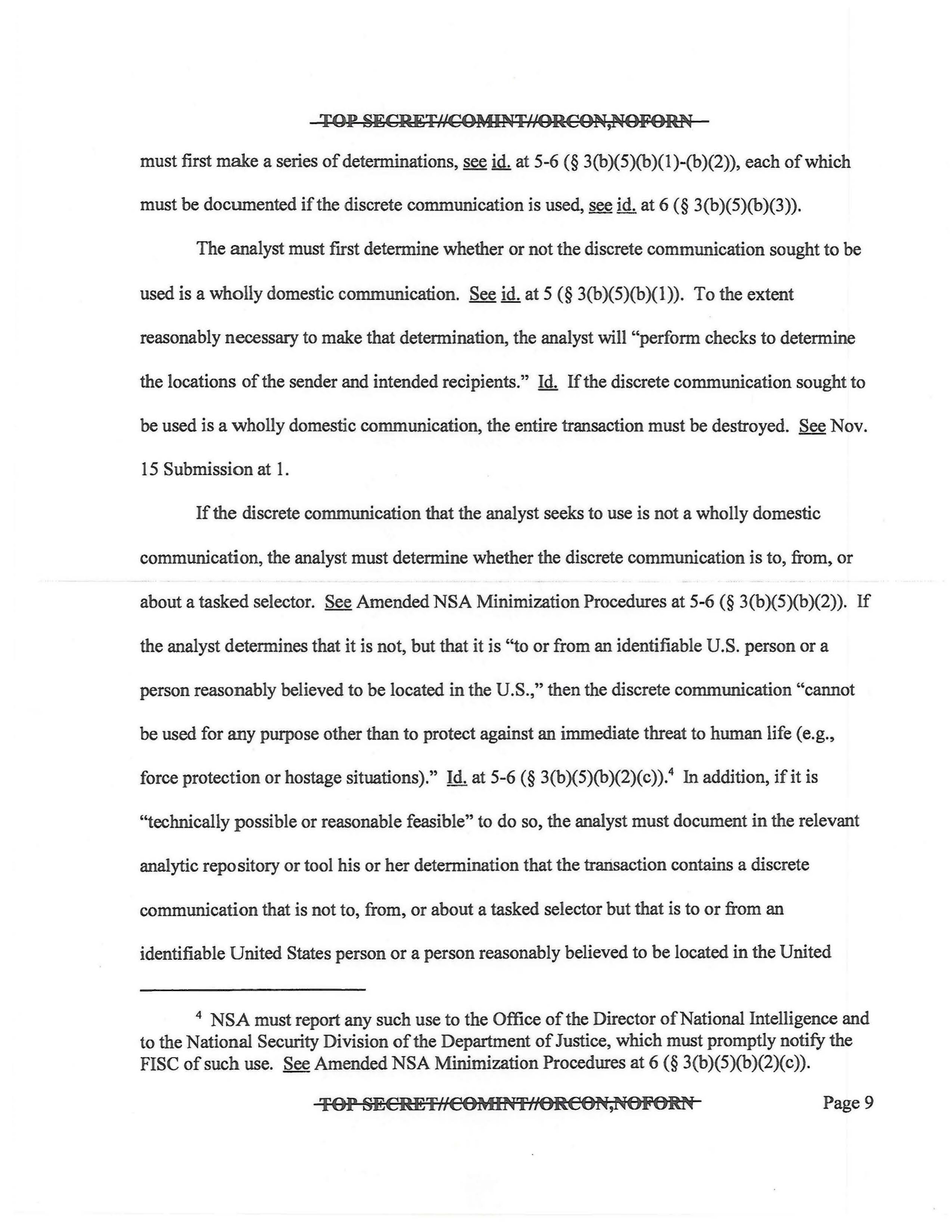
must first make a series of determinations, see id. at 5-6 (§ 3(b)(5)(b)(1)-(b)(2)), each of which
must be documented if the discrete communication is used, see id. at 6 (§ 3(b)(5)(b)(3)).
The analyst must first determine whether or not the discrete communication sought to be
used is a wholly domestic communication. See id. at 5 (§ 3(b)(5)(b)(1)). To the extent
reasonably necessary to make that determination, the analyst will "perform checks to determine
the locations of the sender and intended recipients." Id. If the discrete communication sought to
be used is a wholly domestic communication, the entire transaction must be destroyed. See Nov.
15 Submission at 1.
If the discrete communication that the analyst seeks to use is not a wholly domestic
communication, the analyst must determine whether the discrete communication is to, from, or
about a tasked selector. See Amended NSA Minimization Procedures at 5-6 (§ 3(b)(5)(b)(2)). If
the analyst determines that it is not, but that it is "to or from an identifiable U.S. person or a
person reasonably believed to be located in the U.S.," then the discrete communication "cannot
be used for any purpose other than to protect against an immediate threat to human life (e.g.,
force protection or hostage situations)." Id. at 5-6 (§ 3(b)(5)(b)(2)(c)). In addition, if it is
"technically possible or reasonable feasible" to do so, the analyst must document in the relevant
analytic repository or tool his or her determination that the transaction contains a discrete
communication that is not to, from, or about a tasked selector but that is to or from an
identifiable United States person or a person reasonably believed to be located in the United
⁴ NSA must report any such use to the Office of the Director of National Intelligence and
to the National Security Division of the Department of Justice, which must promptly notify the
FISC of such use. See Amended NSA Minimization Procedures at 6 (§ 3(b)(5)(b)(2)(c)).
TOP SECRET//COMINT//ORCON,NOFORN
Page 9
TOP SECRET//COMINT//ORCON,NOFORN
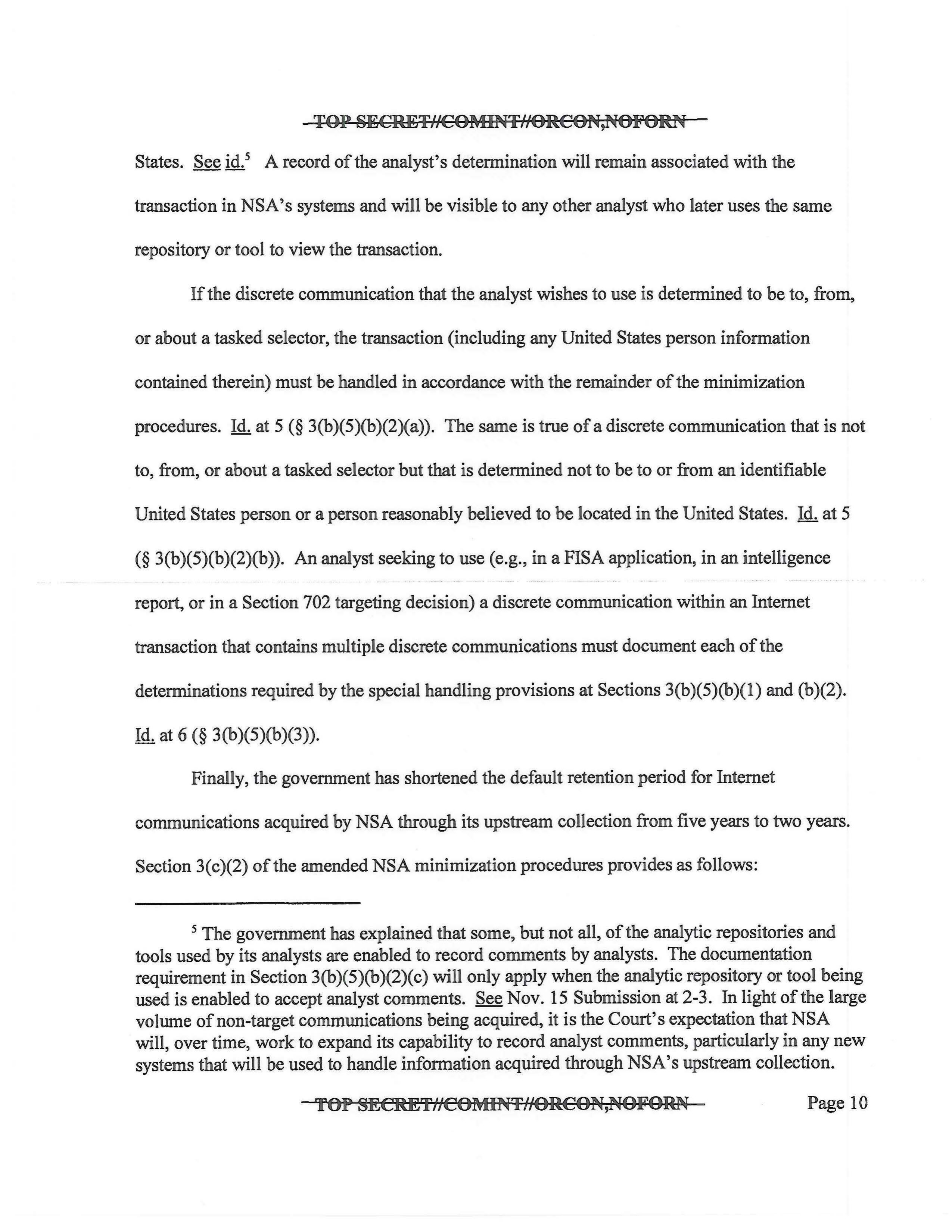
States. See id.⁵ A record of the analyst's determination will remain associated with the
transaction in NSA's systems and will be visible to any other analyst who later uses the same
repository or tool to view the transaction.
If the discrete communication that the analyst wishes to use is determined to be to, from,
or about a tasked selector, the transaction (including any United States person information
contained therein) must be handled in accordance with the remainder of the minimization
procedures. Id. at 5 (§ 3(b)(5)(b)(2)(a)). The same is true of a discrete communication that is not
to, from, or about a tasked selector but that is determined not to be to or from an identifiable
United States person or a person reasonably believed to be located in the United States. Id. at 5
(§ 3(b)(5)(b)(2)(b)). An analyst seeking to use (e.g., in a FISA application, in an intelligence
report, or in a Section 702 targeting decision) a discrete communication within an Internet
transaction that contains multiple discrete communications must document each of the
determinations required by the special handling provisions at Sections 3(b)(5)(b)(1) and (b)(2).
Id. at 6 (§ 3(b)(5)(b)(3)).
Finally, the government has shortened the default retention period for Internet
communications acquired by NSA through its upstream collection from five years to two years.
Section 3(c)(2) of the amended NSA minimization procedures provides as follows:
⁵ The government has explained that some, but not all, of the analytic repositories and
tools used by its analysts are enabled to record comments by analysts. The documentation
requirement in Section 3(b)(5)(b)(2)(c) will only apply when the analytic repository or tool being
used is enabled to accept analyst comments. See Nov. 15 Submission at 2-3. In light of the large
volume of non-target communications being acquired, it is the Court's expectation that NSA
will, over time, work to expand its capability to record analyst comments, particularly in any new
systems that will be used to handle information acquired through NSA's upstream collection.
TOP SECRET//COMINT//ORCON,NOFORN
Page 10
TOP SECRET//COMINT//ORCON,NOFORN
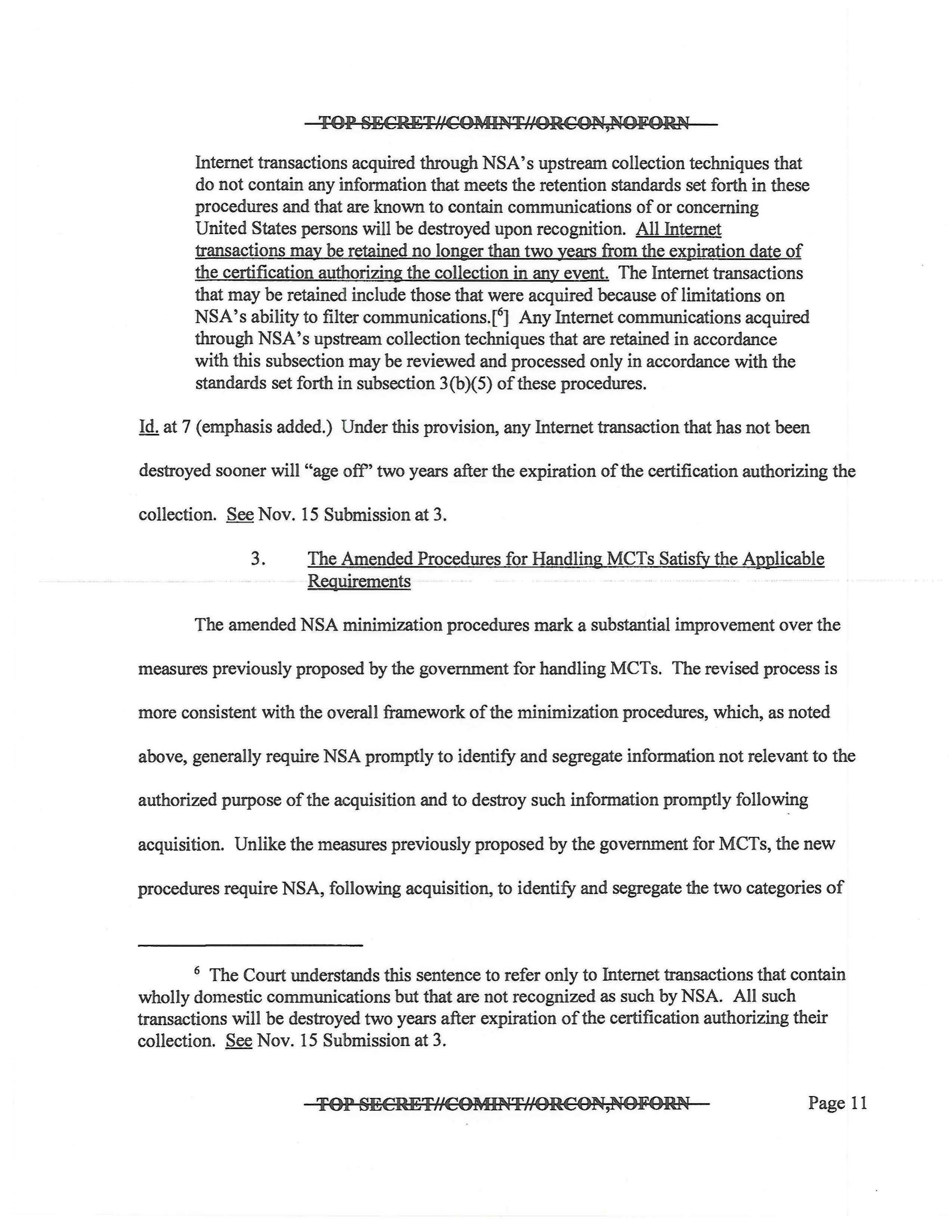
Internet transactions that are acquired through NSA's upstream collection techniques that
do not contain any information that meets the retention standards set forth in these
procedures and that are known to contain communications of or concerning
United States persons will be destroyed upon recognition. All Internet
transactions may be retained no longer than two years from the expiration date of
the certification authorizing the collection in any event. The Internet transactions
that may be retained include those that were acquired because of limitations on
NSA's ability to filter communications.[⁶] Any Internet communications acquired
through NSA's upstream collection techniques that are retained in accordance
with this subsection may be reviewed and processed only in accordance with the
standards set forth in subsection 3(b)(5) of these procedures.
Id. at 7 (emphasis added.) Under this provision, any Internet transaction that has not been
destroyed sooner will "age off" two years after the expiration of the certification authorizing the
collection. See Nov. 15 Submission at 3.
- The Amended Procedures for Handling MCTs Satisfy the Applicable
Requirements
The amended NSA minimization procedures mark a substantial improvement over the
measures previously proposed by the government for handling MCTs. The revised process is
more consistent with the overall framework of the minimization procedures, which, as noted
above, generally require NSA promptly to identify and segregate information not relevant to the
authorized purpose of the acquisition and to destroy such information promptly following
acquisition. Unlike the measures previously proposed by the government for MCTs, the new
procedures require NSA, following acquisition, to identify and segregate the two categories of
⁶ The Court understands this sentence to refer only to Internet transactions that contain
wholly domestic communications but that are not recognized as such by NSA. All such
transactions will be destroyed two years after expiration of the certification authorizing their
collection. See Nov. 15 Submission at 3.
TOP SECRET//COMINT//ORCON,NOFORN
Page 11
TOP SECRET//COMINT//ORCON,NOFORN
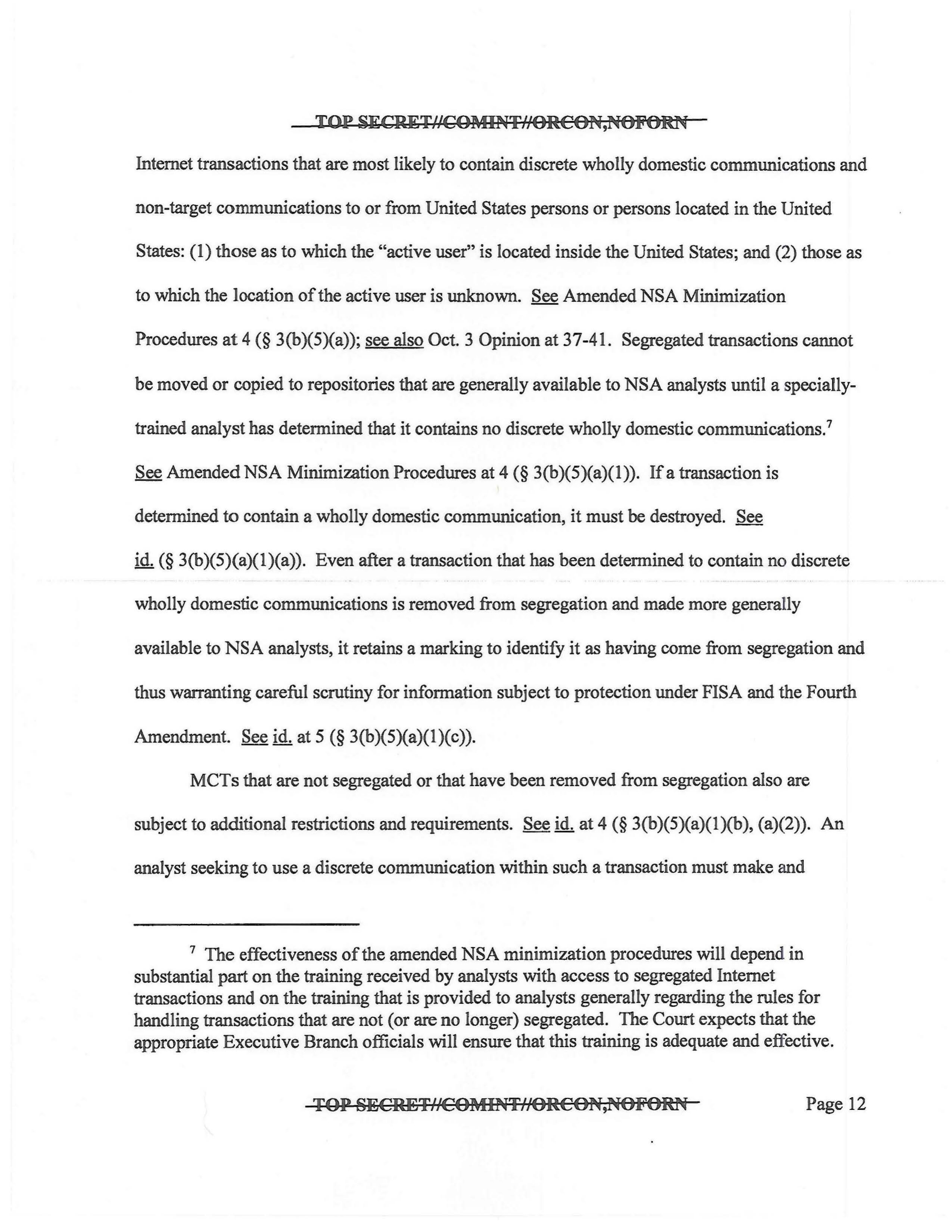
Internet transactions that are most likely to contain discrete wholly domestic communications and
non-target communications to or from United States persons or persons located in the United
States: (1) those as to which the "active user" is located inside the United States; and (2) those as
to which the location of the "active user" is unknown. See Amended NSA Minimization
Procedures at 4 (§ 3(b)(5)(a)); see also Oct. 3 Opinion at 37-41. Segregated transactions cannot
be moved or copied to repositories that are generally available to NSA analysts until a specially-
trained analyst has determined that it contains no discrete wholly domestic communications.⁷
See Amended NSA Minimization Procedures at 4 (§ 3(b)(5)(a)(1)). If a transaction is
determined to contain a wholly domestic communication, it must be destroyed. See
id. (§ 3(b)(5)(a)(1)(a)). Even after a transaction has been determined to contain no discrete
wholly domestic communications is removed from segregation and made more generally
available to NSA analysts, it retains a marking to identify it as having come from segregation and
thus warranting careful scrutiny for information subject to protection under FISA and the Fourth
Amendment. See id. at 5 (§ 3(b)(5)(a)(1)(c)).
MCTs that are not segregated or that have been removed from segregation also are
subject to additional restrictions and requirements. See id. at 4 (§ 3(b)(5)(a)(1)(b), (a)(2)). An
analyst seeking to use a discrete communication within such a transaction must make and
⁷ The effectiveness of the amended NSA minimization procedures will depend in
substantial part on the training received by analysts with access to segregated Internet
transactions and on the training that is provided to analysts generally regarding the rules for
handling transactions that are not (or are no longer) segregated. The Court expects that the
appropriate Executive Branch officials will ensure that this training is adequate and effective.
TOP SECRET//COMINT//ORCON,NOFORN
Page 12
TOP SECRET//COMINT//ORCON,NOFORN
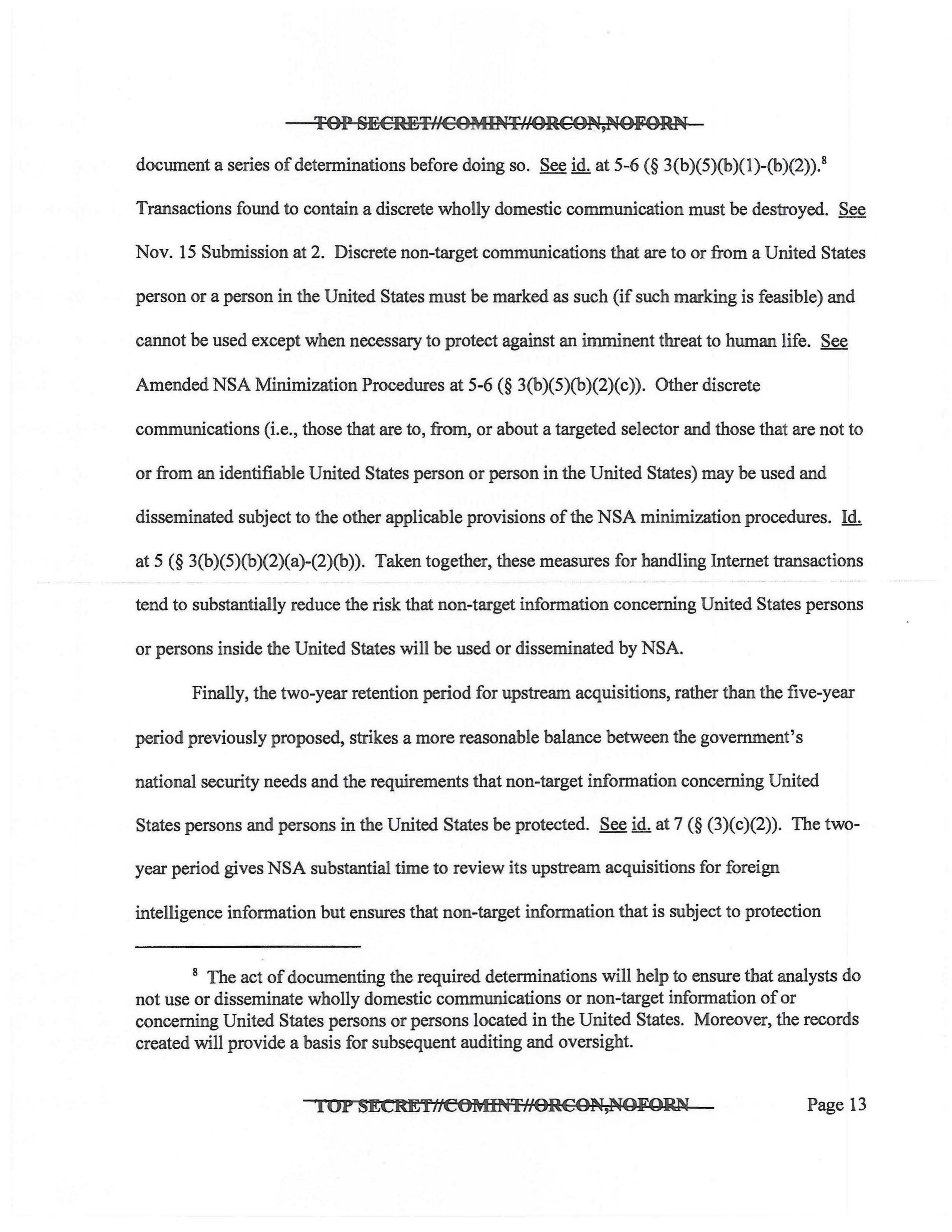
document a series of determinations before doing so. See id. at 5-6 (§ 3(b)(5)(b)(1)-(b)(2)).⁸
Transactions found to contain a discrete wholly domestic communication must be destroyed. See
Nov. 15 Submission at 2. Discrete non-target communications that are to or from a United States
person or a person in the United States must be marked as such (if such marking is feasible) and
cannot be used except when necessary to protect against an imminent threat to human life. See
Amended NSA Minimization Procedures at 5-6 (§ 3(b)(5)(b)(2)(c)). Other discrete
communications (i.e., those that are to, from, or about a targeted selector and those that are not to
or from an identifiable United States person or person in the United States) may be used and
disseminated subject to the other applicable provisions of the NSA minimization procedures. Id.
at 5 (§ 3(b)(5)(b)(2)(a)-(2)(b)). Taken together, these measures for handling Internet transactions
tend to substantially reduce the risk that non-target information concerning United States persons
or persons inside the United States will be used or disseminated by NSA.
Finally, the two-year retention period for upstream acquisitions, rather than the five-year
period previously proposed, strikes a more reasonable balance between the government's
national security needs and the requirements that non-target information concerning United
States persons and persons in the United States be protected. See id. at 7 (§ 3(c)(2)). The two-
year period gives NSA substantial time to review its upstream acquisitions for foreign
intelligence information but ensures that non-target information that is subject to protection
[REDACTED].
⁸ The act of documenting the required determinations will help to ensure that analysts do
not use or disseminate wholly domestic communications or non-target information of or
concerning United States persons or persons located in the United States. Moreover, the records
created will provide a basis for subsequent auditing and oversight.
TOP SECRET//COMINT//ORCON,NOFORN
Page 13
TOP SECRET//COMINT//ORCON,NOFORN
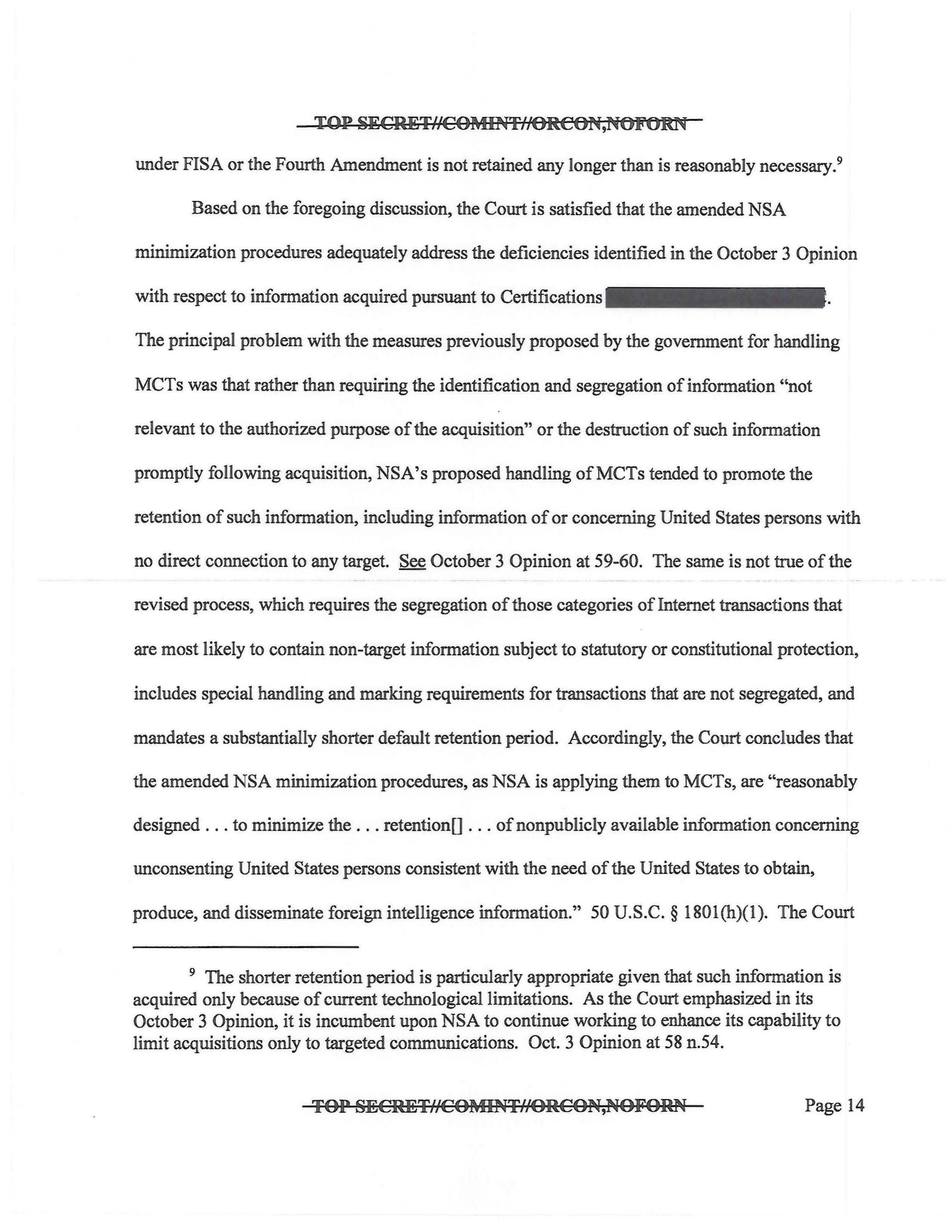
under FISA or the Fourth Amendment is not retained any longer than is reasonably necessary.⁹
Based on the foregoing discussion, the Court is satisfied that the amended NSA
minimization procedures adequately address the deficiencies identified in the October 3 Opinion
with respect to information acquired pursuant to Certifications [REDACTED].
The principal problem with the measures previously proposed by the government for handling
MCTs was that rather than requiring the identification and segregation of information "not
relevant to the authorized purpose of the acquisition" or the destruction of such information
promptly following acquisition, NSA's proposed handling of MCTs tended to promote the
retention of such information, including information of or concerning United States persons with
no direct connection to any target. See October 3 Opinion at 59-60. The same is not true of the
revised process, which requires the segregation of those categories of Internet transactions that
are most likely to contain non-target information subject to statutory or constitutional protection,
includes special handling and marking requirements for transactions that are not segregated, and
mandates a substantially shorter default retention period. Accordingly, the Court concludes that
the amended NSA minimization procedures, as NSA is applying them to MCTs, are "reasonably
designed ... to minimize the ... retention[] ... of nonpublicly available information concerning
unconsenting United States persons consistent with the need of the United States to obtain,
produce, and disseminate foreign intelligence information." 50 U.S.C. § 1801(h)(1). The Court
⁹ The shorter retention period is particularly appropriate given that such information is
acquired only because of current technological limitations. As the Court emphasized in its
October 3 Opinion, it is incumbent upon NSA to continue working to enhance its capability to
limit acquisitions only to targeted communications. Oct. 3 Opinion at 58 n.54.
TOP SECRET//COMINT//ORCON,NOFORN
Page 14
TOP SECRET//COMINT//ORCON,NOFORN
is also satisfied that the revised minimization procedures, taken together with the applicable
targeting procedures, are consistent with the requirements of the Fourth Amendment.
- The New [REDACTED] Provision
The amended NSA minimization procedures contain a new provision that is not directly
related to the government's efforts to address the deficiencies identified by the Court in its
October 3 Opinion.
[REDACTED]
TOP SECRET//COMINT//ORCON,NOFORN
Page 15
TOP SECRET//COMINT//ORCON,NOFORN
[REDACTED]
TOP SECRET//COMINT//ORCON,NOFORN
Page 16
TOP SECRET//COMINT//ORCON,NOFORN
[REDACTED]
TOP SECRET//COMINT//ORCON,NOFORN
Page 17
TOP SECRET//COMINT//ORCON,NOFORN
[REDACTED]
TOP SECRET//COMINT//ORCON,NOFORN
Page 18
TOP SECRET//COMINT//ORCON,NOFORN
[REDACTED]
TOP SECRET//COMINT//ORCON,NOFORN
Page 19
TOP SECRET//COMINT//ORCON,NOFORN
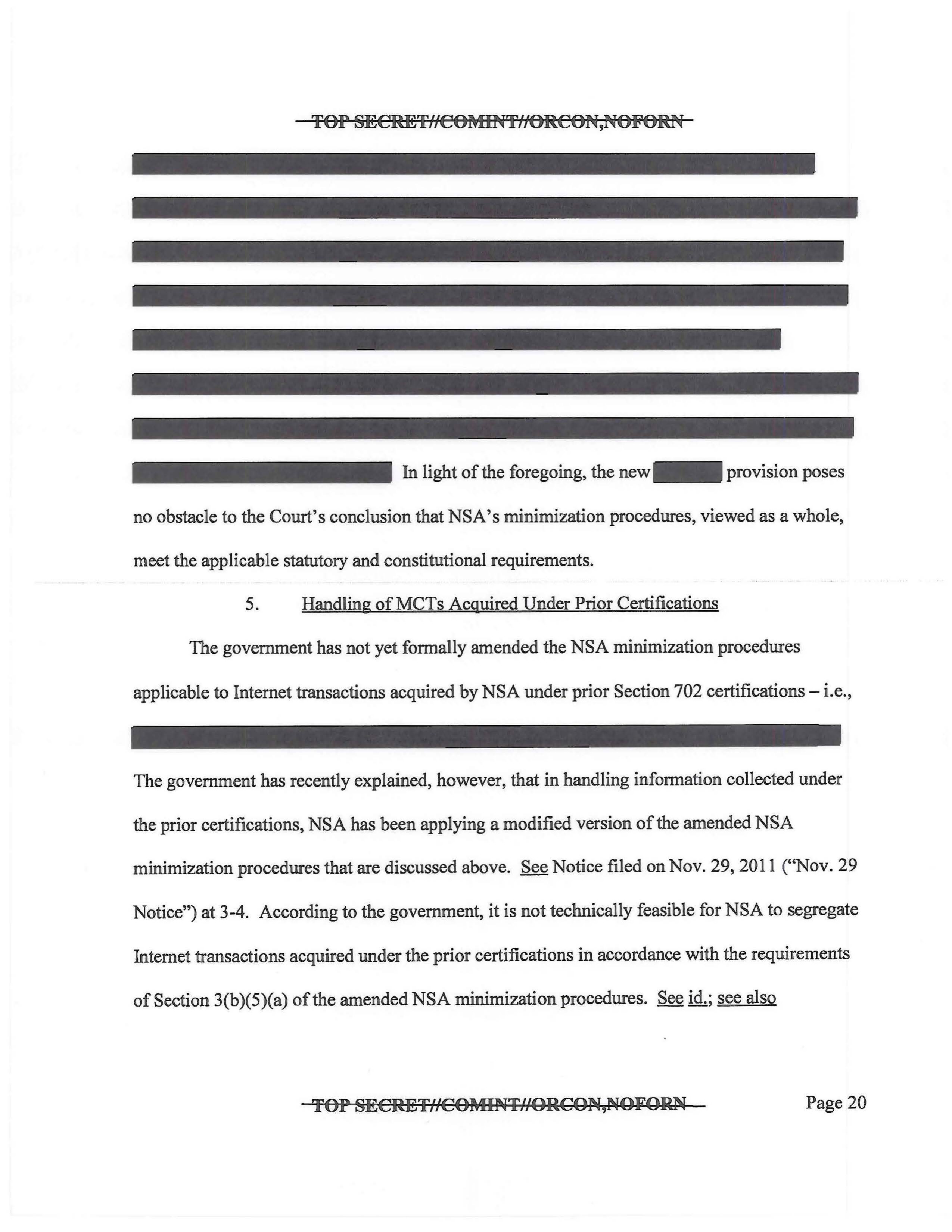
[REDACTED] In light of the foregoing, the new [REDACTED] provision poses
no obstacle to the Court's conclusion that NSA's minimization procedures, viewed as a whole,
meet the applicable statutory and constitutional requirements.
- Handling of MCTs Acquired Under Prior Certifications
The government has not yet formally amended the NSA minimization procedures
applicable to Internet transactions acquired by NSA under prior Section 702 certifications – i.e.,
[REDACTED]
The government has recently explained, however, that in handling information collected under
the prior certifications, NSA has been applying a modified version of the amended NSA
minimization procedures that are discussed above. See Notice filed on Nov. 29, 2011 ("Nov. 29
Notice") at 3-4. According to the government, it is not technically feasible for NSA to segregate
Internet transactions acquired under the prior certifications in accordance with the requirements
of Section 3(b)(5)(a) of the amended NSA minimization procedures. See id.; see also
TOP SECRET//COMINT//ORCON,NOFORN
Page 20
TOP SECRET//COMINT//ORCON,NOFORN
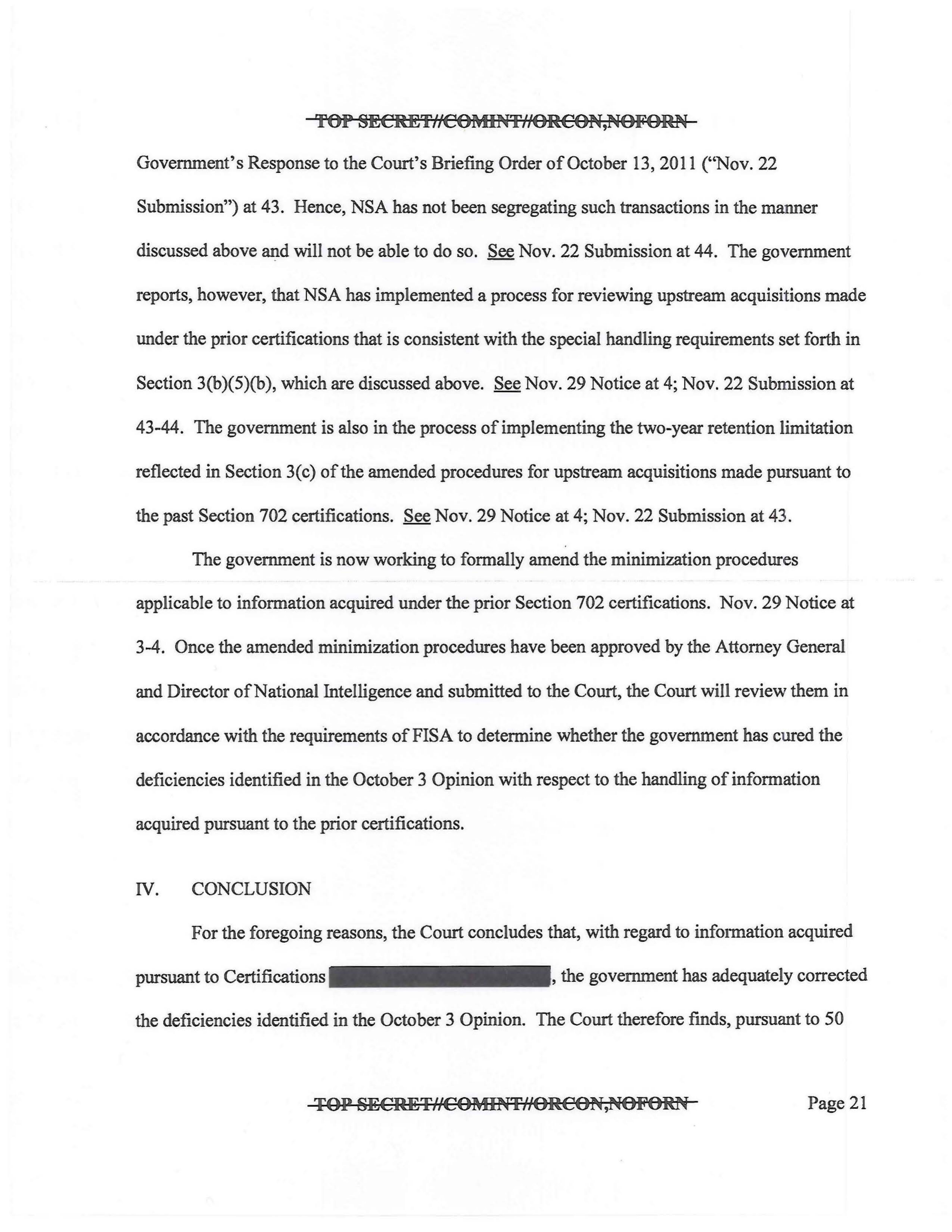
Government's Response to the Court's Briefing Order of October 13, 2011 ("Nov. 22
Submission") at 43. Hence, NSA has not been segregating such transactions in the manner
discussed above and will not be able to do so. See Nov. 22 Submission at 44. The government
reports, however, that NSA has implemented a process for reviewing upstream acquisitions made
under the prior certifications that is consistent with the special handling requirements set forth in
Section 3(b)(5)(b), which are discussed above. See Nov. 29 Notice at 4; Nov. 22 Submission at
43-44. The government is also in the process of implementing the two-year retention limitation
reflected in Section 3(c) of the amended procedures for upstream acquisitions made pursuant to
the past Section 702 certifications. See Nov. 29 Notice at 4; Nov. 22 Submission at 43.
The government is now working to formally amend the minimization procedures
applicable to information acquired under the prior Section 702 certifications. Nov. 29 Notice at
3-4. Once the amended minimization procedures have been approved by the Attorney General
and Director of National Intelligence and submitted to the Court, the Court will review them in
accordance with the requirements of FISA to determine whether the government has cured the
deficiencies identified in the October 3 Opinion with respect to the handling of information
acquired pursuant to the prior certifications.
IV. CONCLUSION
For the foregoing reasons, the Court concludes that, with regard to information acquired
pursuant to Certifications [REDACTED], the government has adequately corrected
the deficiencies identified in the October 3 Opinion. The Court therefore finds, pursuant to 50
TOP SECRET//COMINT//ORCON,NOFORN
Page 21
TOP SECRET//COMINT//ORCON,NOFORN
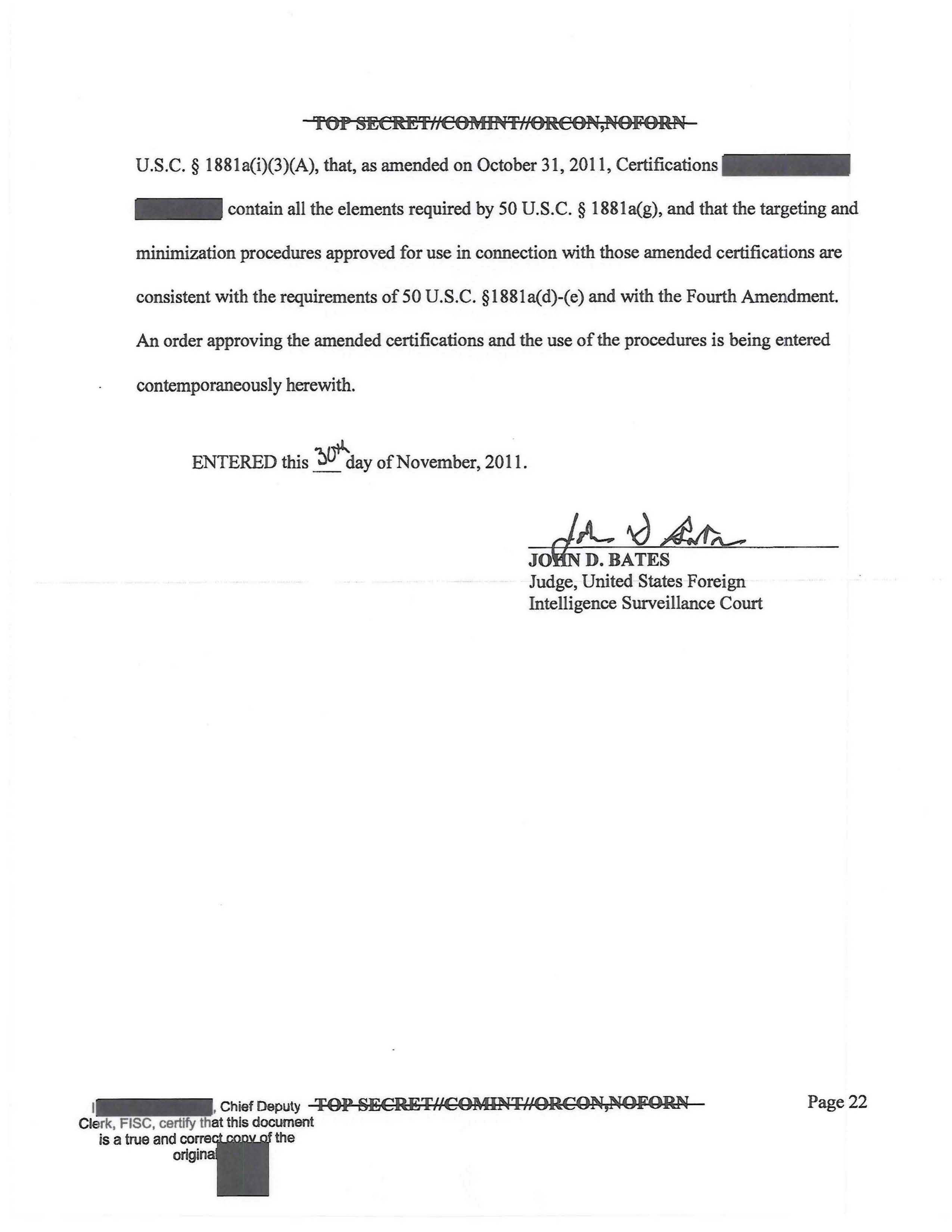
U.S.C. § 1881a(i)(3)(A), that, as amended on October 31, 2011, Certifications [REDACTED]
contain all the elements required by 50 U.S.C. § 1881a(g), and that the targeting and
minimization procedures approved for use in connection with those amended certifications are
consistent with the requirements of 50 U.S.C. §1881a(d)-(e) and with the Fourth Amendment.
An order approving the amended certifications and the use of the procedures is being entered
contemporaneously herewith.
ENTERED this 30th day of November, 2011.
JOHN D. BATES
Judge, United States Foreign
Intelligence Surveillance Court
I, [REDACTED] Chief Deputy
Clerk, FISC, certify that this document
is a true and correct copy of the
original [REDACTED]
TOP SECRET//COMINT//ORCON,NOFORN
Page 22
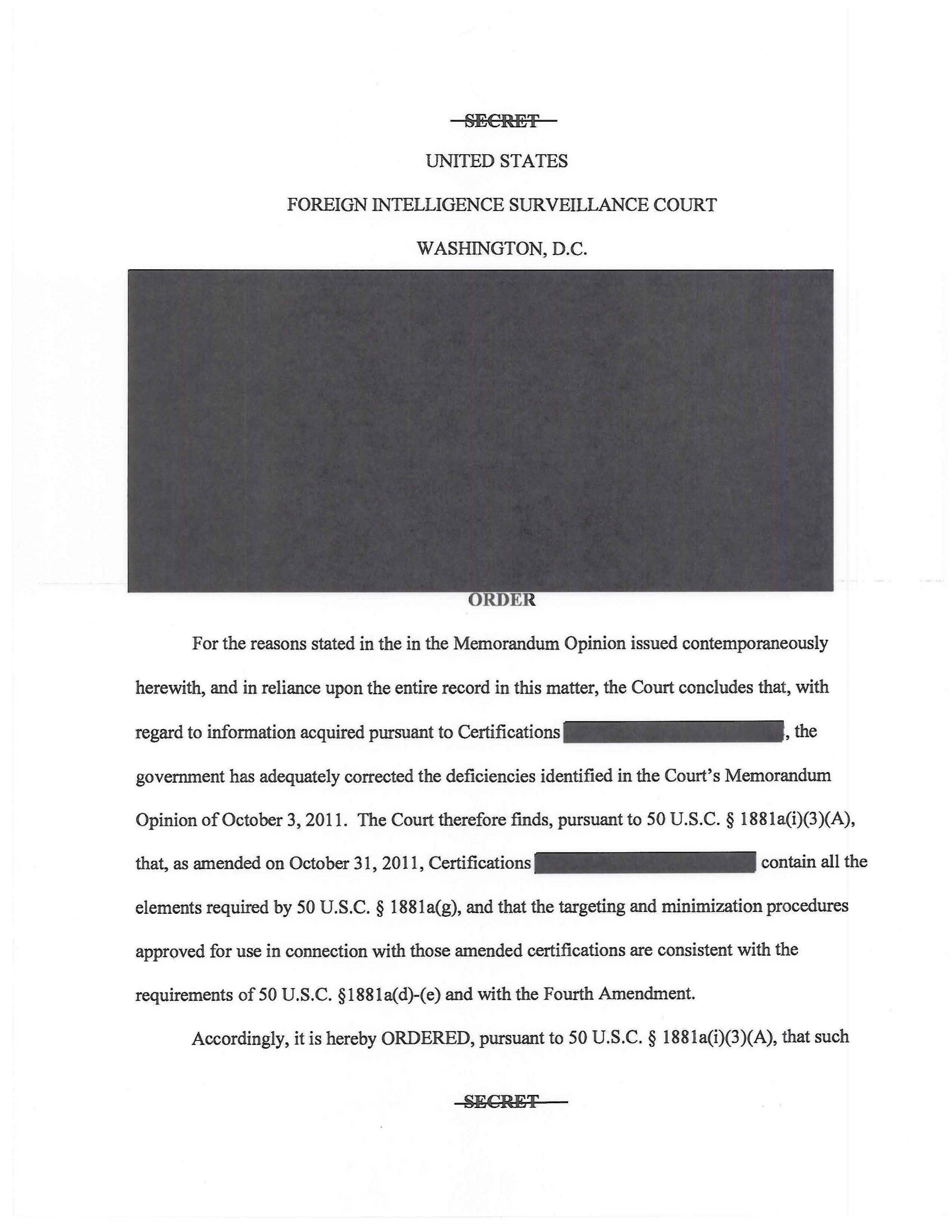
SECRET
UNITED STATES
FOREIGN INTELLIGENCE SURVEILLANCE COURT
WASHINGTON, D.C.
[REDACTED]
ORDER
For the reasons stated in the in the Memorandum Opinion issued contemporaneously
herewith, and in reliance upon the entire record in this matter, the Court concludes that, with
regard to information acquired pursuant to Certifications [REDACTED], the
government has adequately corrected the deficiencies identified in the Court's Memorandum
Opinion of October 3, 2011. The Court therefore finds, pursuant to 50 U.S.C. § 1881a(i)(3)(A),
that, as amended on October 31, 2011, Certifications [REDACTED] contain all the
elements required by 50 U.S.C. § 1881a(g), and that the targeting and minimization procedures
approved for use in connection with those amended certifications are consistent with the
requirements of 50 U.S.C. §1881a(d)-(e) and with the Fourth Amendment.
Accordingly, it is hereby ORDERED, pursuant to 50 U.S.C. § 1881a(i)(3)(A), that such
SECRET
SECRET
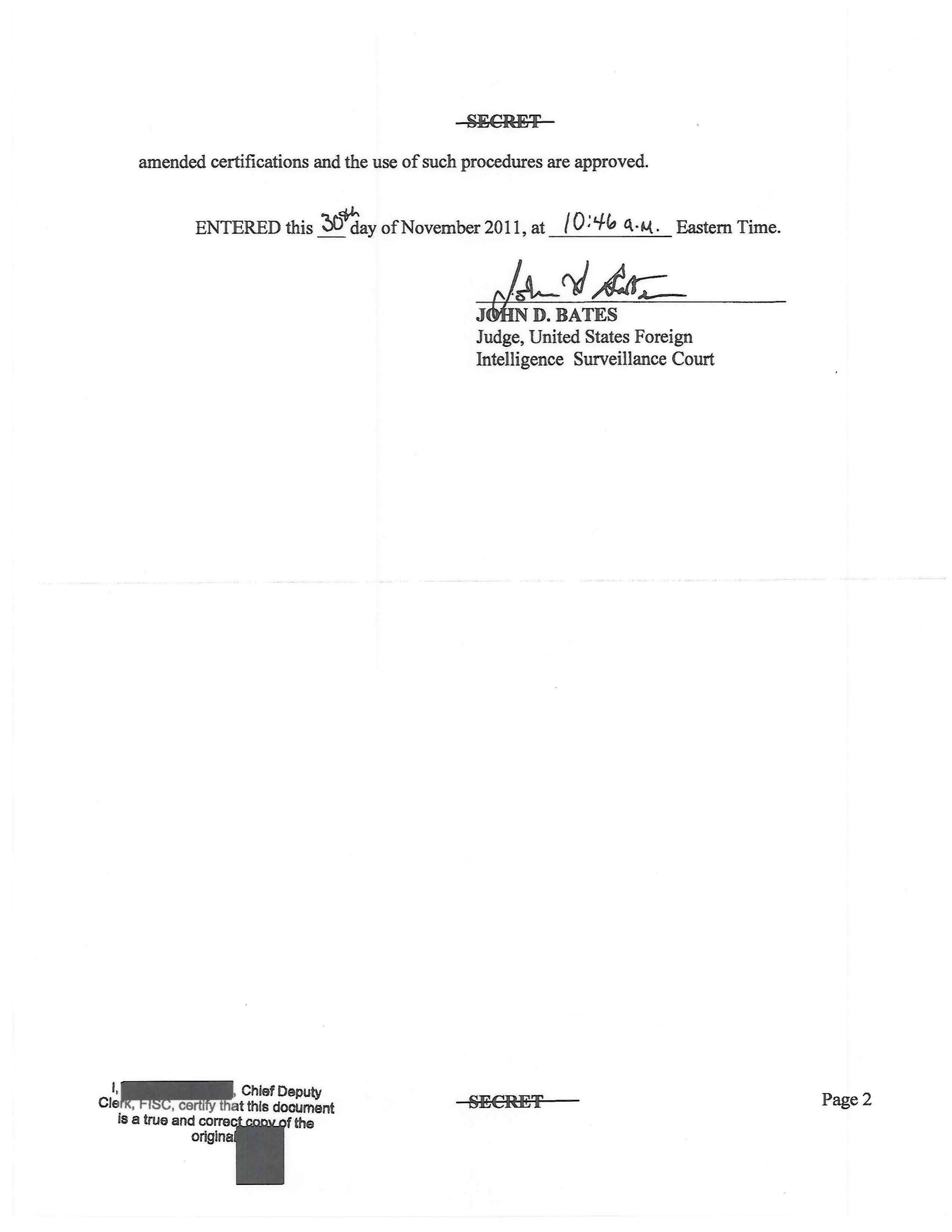
amended certifications and the use of such procedures are approved.
ENTERED this 30th day of November 2011, at 10:46 a.m. Eastern Time.
JOHN D. BATES
Judge, United States Foreign
Intelligence Surveillance Court
I, [REDACTED] Chief Deputy
Clerk, FISC, certify that this document
is a true and correct copy of the
original [REDACTED]
SECRET
Page 2
Related Documents
-
Foreign Intelligence Surveillance Opinion and Order – September 2012 FOIA [pdf]
A FISC opinion concluding the government has resolved the deficiencies identified in the FISC’s ruling from October 3, 2011. ACLU/EFF FOIA Litigation.
ACLU,EFF ↗ (2013-08-21) -
-
Motion of the American Civil Liberties Union, the American Civil Liberties Union of the Nation's Capital, and the Media Freedom and Information Clinic for the Release of Court Records, In re Opinions & Orders of this Court Addressing Bulk Collection of Data Under the Foreign Intelligence Surveillance Act, No. Misc. 13-08 (FISA Ct. Nov. 7, 2013). FOIA [pdf]
-
-
Supplemental Opinion and Order from the Foreign Intelligence Surveillance Court FOIA [pdf]
Supplemental Opinion and Order of the FISC reiterating Court ordered restrictions on NSA’s handling of query results of the telephony metadata program, and directing the Government to provide the court with additional information regarding queries of the telephony metadata. ACLU/EFF FOIA Litigation.
People: Walton, Reggie B.ACLU,EFF ↗ (2013-09-10)