Supplemental Opinion and Order from the Foreign Intelligence Surveillance Court
Open PDFDocument date: 2009-11-05
Type: FOIA
Pages: 7
Classification: TOP SECRET COMINT
Dissemination: NOFORN
Supplemental Opinion and Order of the FISC reiterating Court ordered restrictions on NSA’s handling of query results of the telephony metadata program, and directing the Government to provide the court with additional information regarding queries of the telephony metadata. ACLU/EFF FOIA Litigation.
My notes
TOP SECRET//COMINT//NOFORN
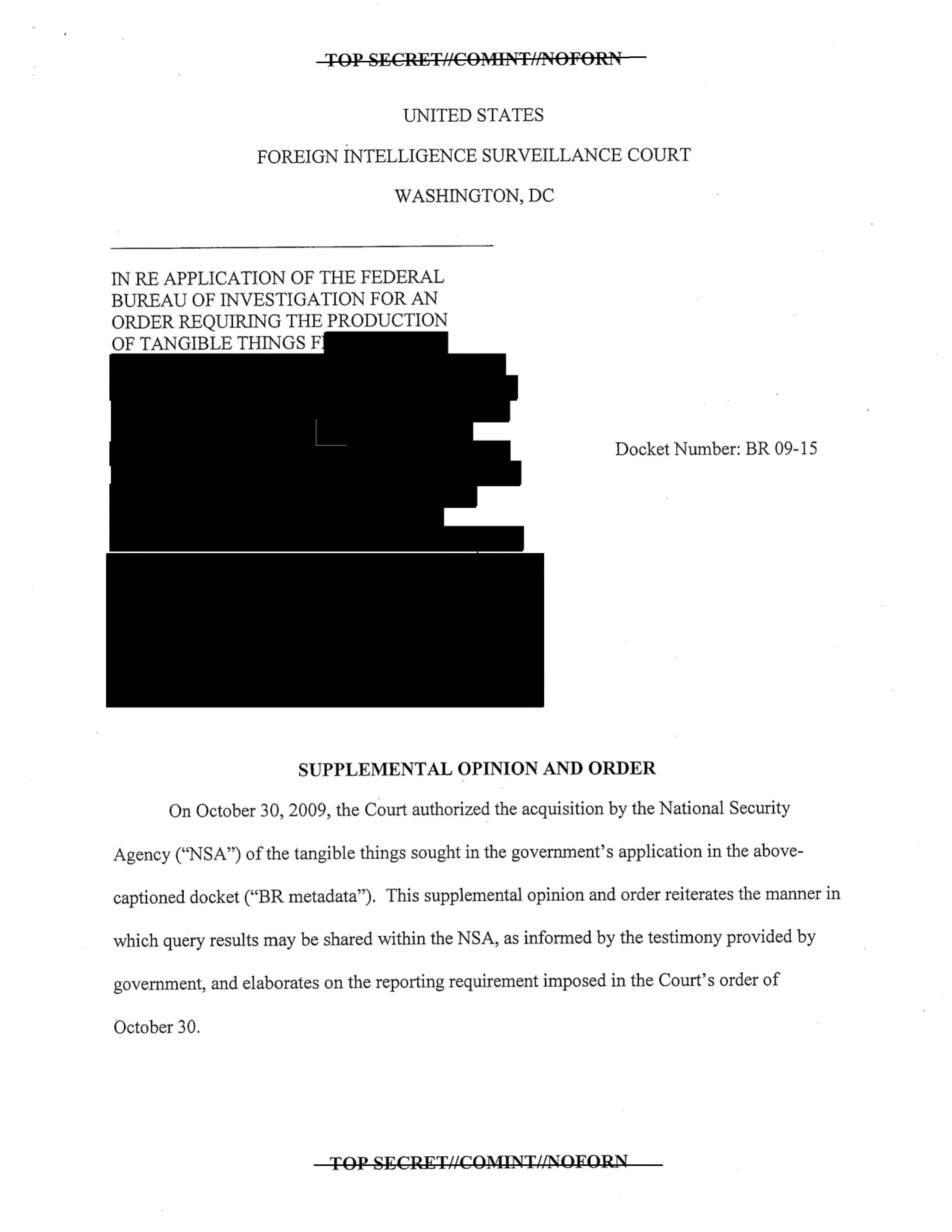
UNITED STATES
FOREIGN INTELLIGENCE SURVEILLANCE COURT
WASHINGTON, DC
IN RE APPLICATION OF THE FEDERAL
BUREAU OF INVESTIGATION FOR AN
ORDER REQUIRING THE PRODUCTION
OF TANGIBLE THINGS F[REDACTED]
Docket Number: BR 09-15
SUPPLEMENTAL OPINION AND ORDER
On October 30, 2009, the Court authorized the acquisition by the National Security
Agency ("NSA") of the tangible things sought in the government's application in the above-
captioned docket ("BR metadata"). This supplemental opinion and order reiterates the manner in
which query results may be shared within the NSA, as informed by the testimony provided by
government, and elaborates on the reporting requirement imposed in the Court's order of
October 30.
TOP SECRET//COMINT//NOFORN
TOP SECRET//COMINT//NOFORN
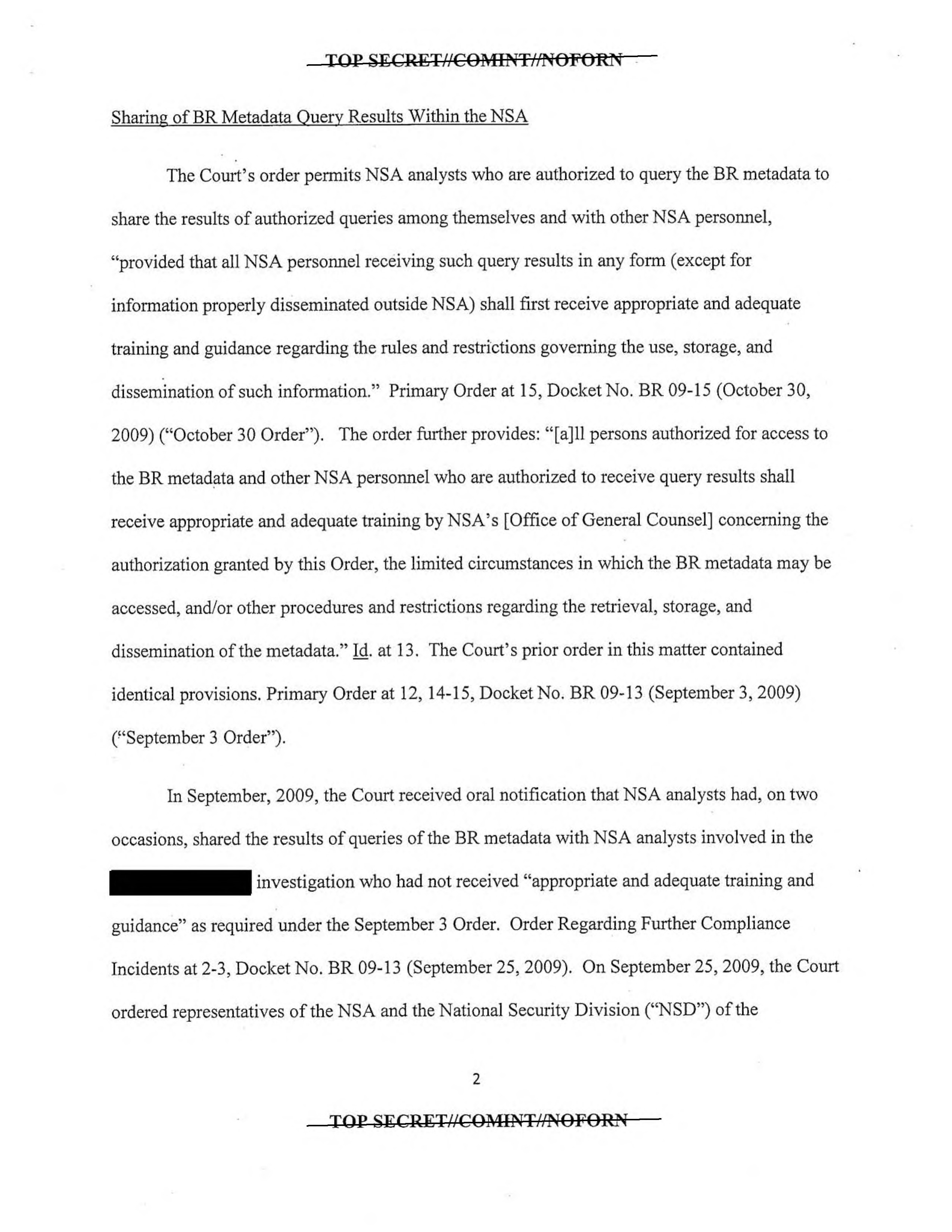
Sharing of BR Metadata Query Results Within the NSA
The Court's order permits NSA analysts who are authorized to query the BR metadata to
share the results of authorized queries among themselves and with other NSA personnel,
"provided that all NSA personnel receiving such query results in any form (except for
information properly disseminated outside NSA) shall first receive appropriate and adequate
training and guidance regarding the rules and restrictions governing the use, storage, and
dissemination of such information." Primary Order at 15, Docket No. BR 09-15 (October 30,
2009) ("October 30 Order"). The order further provides: "[a]ll persons authorized for access to
the BR metadata and other NSA personnel who are authorized to receive query results shall
receive appropriate and adequate training by NSA's [Office of General Counsel] concerning the
authorization granted by this Order, the limited circumstances in which the BR metadata may be
accessed, and/or other procedures and restrictions regarding the retrieval, storage, and
dissemination of the metadata." Id. at 13. The Court's prior order in this matter contained
identical provisions. Primary Order at 12, 14-15, Docket No. BR 09-13 (September 3, 2009)
("September 3 Order").
In September, 2009, the Court received oral notification that NSA analysts had, on two
occasions, shared the results of queries of the BR metadata with NSA analysts involved in the
[REDACTED] investigation who had not received "appropriate and adequate training and
guidance" as required under the September 3 Order. Order Regarding Further Compliance
Incidents at 2-3, Docket No. BR 09-13 (September 25, 2009). On September 25, 2009, the Court
ordered representatives of the NSA and the National Security Division ("NSD") of the
2
TOP SECRET//COMINT//NOFORN
TOP SECRET//COMINT//NOFORN
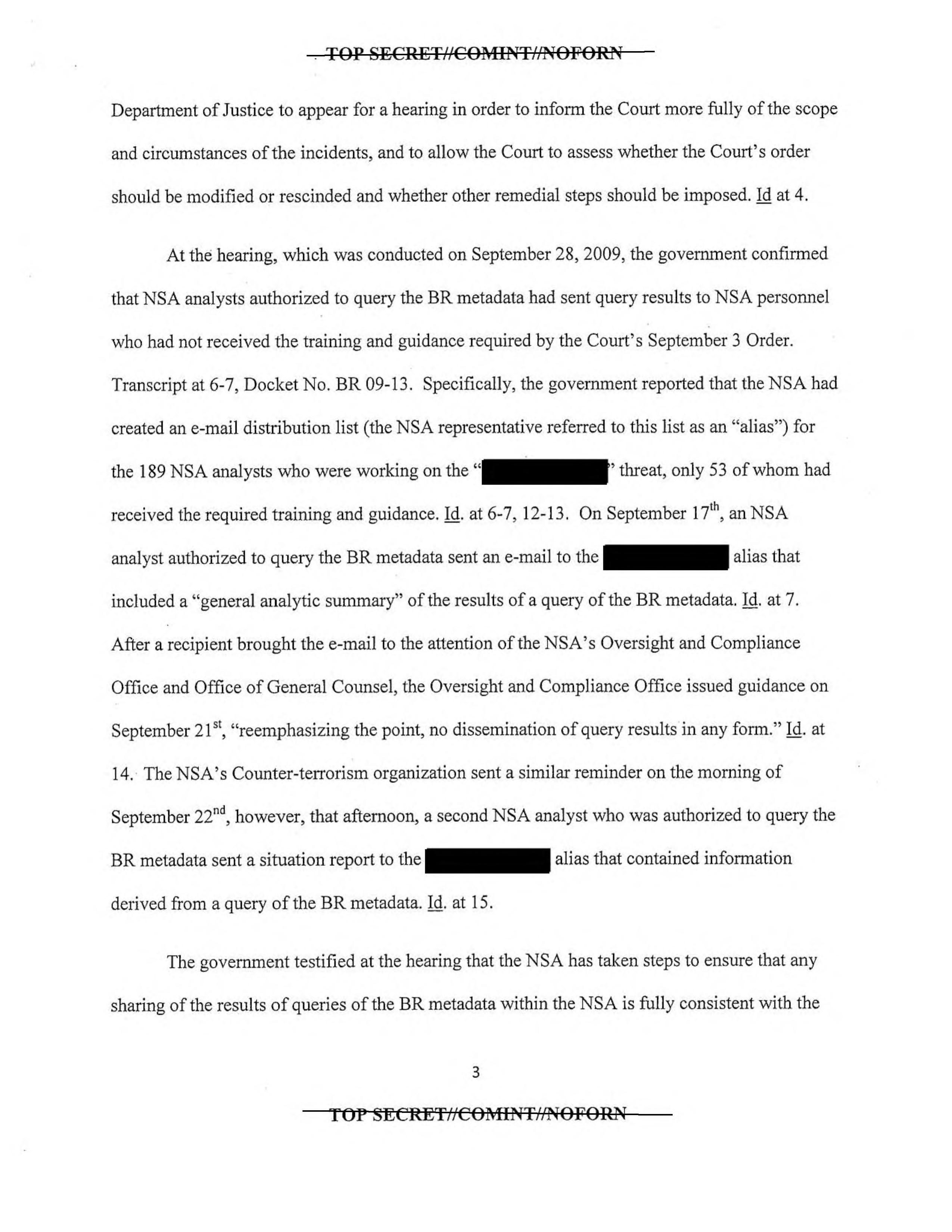
Department of Justice to appear for a hearing in order to inform the Court more fully of the scope
and circumstances of the incidents, and to allow the Court to assess whether the Court's order
should be modified or rescinded and whether other remedial steps should be imposed. Id at 4.
At the hearing, which was conducted on September 28, 2009, the government confirmed
that NSA analysts authorized to query the BR metadata had sent query results to NSA personnel
who had not received the training and guidance required by the Court's September 3 Order.
Transcript at 6-7, Docket No. BR 09-13. Specifically, the government reported that the NSA had
created an e-mail distribution list (the NSA representative referred to this list as an "alias") for
the 189 NSA analysts who were working on the "[REDACTED]" threat, only 53 of whom had
received the required training and guidance. Id. at 6-7, 12-13. On September 17th, an NSA
analyst authorized to query the BR metadata sent an e-mail to the [REDACTED] alias that
included a "general analytic summary" of the results of a query of the BR metadata. Id. at 7.
After a recipient brought the e-mail to the attention of the NSA's Oversight and Compliance
Office and Office of General Counsel, the Oversight and Compliance Office issued guidance on
September 21st, "reemphasizing the point, no dissemination of query results in any form." Id. at
14. The NSA's Counter-terrorism organization sent a similar reminder on the morning of
September 22nd, however, that afternoon, a second NSA analyst who was authorized to query the
BR metadata sent a situation report to the [REDACTED] alias that contained information
derived from a query of the BR metadata. Id. at 15.
The government testified at the hearing that the NSA has taken steps to ensure that any
sharing of the results of queries of the BR metadata within the NSA is fully consistent with the
3
TOP SECRET//COMINT//NOFORN
TOP SECRET//COMINT//NOFORN
Court's orders. First, the NSA has issued guidance interpreting "query results in any form," to
mean any information of any kind derived from the BR metadata. Id. at 16. Second, NSA aliases
for sharing information that could include BR metadata query results, will be limited to NSA
personnel who have received the necessary training and guidance to receive those query results.
Id. at 21-22. The Court hereby affirms that the NSA may share BR metadata query results in this
manner consistent with the Court's October 30 Order. The only exception to this practice is
under circumstances in which the Court has expressly authorized a deviation.¹
Report on Queries Described in Footnote 6 of the Court's October 30 Order
According to the government, one advantage of the BR metadata repository is that it is
historical in nature, reflecting contact activity from the past that cannot be captured in the present
or prospectively. Declaration of [REDACTED] at 7, Docket No. BR 09-15. At the
government's request, the Court's September 3 Order and October 30 Order both acknowledge
that the government may query the BR metadata for historical purposes, using a telephone
identifier that is not currently associated with one of the targeted foreign powers, but that was for
a period of time in the past.²
¹ For example, pursuant to paragraph (3)J of the Court's order, NSA personnel authorized to query the BR metadata
may use and share the identity of high-volume telephone identifiers and other types of identifiers not associated with
specific users for purposes of metadata reduction and management, without regard to whether the recipient has
received the training and guidance required for access to BR metadata query results.
² Both orders contain the following footnote: "The Court understands that from time to time the information
available to designated approving officials will indicate that a telephone identifier was, but may not presently be, or
is, but was not formerly, associated with [REDACTED]. In such a circumstance, so long as the designated approving official can
determine that the reasonable, articulable suspicion standard can be met for a particular period of time with respect
to the telephone identifier, NSA may query the BR metadata using that telephone identifier. However, analysts
conducting queries using such telephone identifiers must be made aware of the time period for (continued...)
4
TOP SECRET//COMINT//NOFORN
TOP SECRET//COMINT//NOFORN
Nevertheless, the NSA's querying of the BR metadata using telephone identifiers that do
not currently satisfy the "reasonable articulable suspicion" standard has been a source of concern
for the Court. Given that telephone providers regularly re-assign telephone identifiers, and in
light of the fact that the NSA acquires approximately [REDACTED] call detail records per day, the
vast majority of which are irrelevant to the Federal Bureau of Investigation's ("FBI")
investigations and concern communications of United States persons in the United States, it
would appear likely that such a query could produce results that include metadata from United
States persons not under investigation by the FBI. In order to allay these concerns, the Court's
September 3 Order mandated that any application to renew or reinstate the authority granted
therein must include a report describing, among other things, how the NSA has conducted [these
types of queries] and minimized any information obtained or derived therefrom. September
3Order at 18.
The government's report submitted as Exhibit B to its Application in Docket Number 09-
15, stated:
From time to time, NSA may have information indicating that a particular
identifier was used by an individual associated w[REDACTED] only for a
particular timeframe. In these circumstances, NSA would seek and grant as
appropriate, RAS approval, with the understanding that contact chaining would be
conducted in a manner that covered a limited timeframe that has been identified.
(...continued) which the telephone identifier has been associated with [REDACTED] in order that the analysis and minimization of the
information retrieved from their queries may be informed by that fact." September 3 Order at 9, n. 5; October 30
Order at 9, n. 6.
5
TOP SECRET//COMINT//NOFORN
TOP SECRET//COMINT//NOFORN
The report then provided one example of how the NSA had conducted such a query. NSA Report
to the Foreign Intelligence Surveillance Court (BR 09-13) at 15-16.
This report was not sufficiently detailed to allay the Court's concerns, and the Court
therefore continues to be concerned about the likelihood that these queries could reveal
communications of United States person users of the telephone identifier who are not the subject
of FBI investigations. As a result, the Court's October 30 Order contains the same reporting
requirements as the September 3 Order. October 30 Order at 18-19. However, to assist the
government in providing a report that satisfies its needs, the Court HEREBY ORDERS that any
report submitted by the government pursuant to paragraph (3)S of the Court's October 30 Order
shall include the following information with regard to how the NSA has conducted queries of the
BR metadata using telephone identifiers determined to satisfy the reasonable articulable
suspicion standard at some time in the past, but that do not currently meet the standard, and how
the NSA minimized any information obtained or derived therefrom:
- The total number of such queries run during the reporting period and what percentage
those queries constitute of the total number of queries run. - Would the status of a telephone identifier that was approved for querying under these
circumstances be changed on the Station Table to non-RAS approved once a single query
using that identifier has been run? If not, does the NSA have an automated process to
limit queries of that telephone identifier to the specified time frame? If not, how will an
NSA analyst know that any query of that telephone identifier must be limited to the time
period for which the reasonable articulable suspicion existed?
6
TOP SECRET//COMINT//NOFORN
TOP SECRET//COMINT//NOFORN
3. Are NSA analysts permitted to conduct more than one query using any telephone
identifier determined to have met the reasonable articulable suspicion standard under
circumstances described above, and if so, for what purpose? If query results from the
first query indicated that the telephone identifier's association with the foreign power
terminated earlier than the date the NSA believed the identifier no longer met the
reasonable articulable suspicion, would the timeframe restriction be adjusted for any
subsequent query?
4. If this type of query is run, and the NSA analyst who ran the query determines that the
query results include records of communications that were made after the telephone
identifier was re-assigned to a United States person who is not associated with the foreign
power, must the analyst delete or otherwise mask such records prior to sharing the query
results with NSA analysts authorized to receive query results pursuant to paragraph (3)I
of the Court's order?
ENTERED this 5th day of November, 2009.
REGGIE B. WALTON
Judge, United States Foreign
Intelligence Surveillance Court
7
TOP SECRET//COMINT//NOFORN
[REDACTED]
Related Documents
-
Supplemental Opinion from the Foreign Intelligence Surveillance Court FOIA [pdf]
Opinion of the FISC concluding that the production of bulk telephony metadata records pursuant to Section 501 of FISA is not inconsistent with Sections 2702 and 2703 of Title 18 of the United States Code. ACLU/EFF FOIA Litigation.
People: Walton, Reggie B.ACLU,EFF ↗ (2013-10-10) -
-
Motion of the American Civil Liberties Union, the American Civil Liberties Union of the Nation's Capital, and the Media Freedom and Information Clinic for the Release of Court Records, In re Opinions & Orders of this Court Addressing Bulk Collection of Data Under the Foreign Intelligence Surveillance Act, No. Misc. 13-08 (FISA Ct. Nov. 7, 2013). FOIA [pdf]
-
-