Tag: training 24 documents
Search documents matching “training” →Free-text subjects the curators added. Unlike the other axes these are not necessarily from the documents' own vocabulary, so they are the loosest thing to browse by (and the most forgiving).
Graphs
By Banner
By Classification
Refine (combine with another filter, via search)
Sort: Title
Documents
-
Wireless LAN / CNE Tool Training Course and Evaluation [pdf]
This document is a slide deck introducing a "Close Access" NSA training course to "familiarize, educate, and certify students in the operational usage" of various computer network exploitation tools.
-
A Behind-the-Scenes Look at the NSA-Ethiopian Relationship SIDtoday [pdf]
This SIDtoday article details the NSA's growing collaboration with Ethiopian security agencies, particularly through the Operation Lion's Pride SIGINT program. It highlights a successful training session where Ethiopian soldiers and civilians learned traffic analysis, strengthening the relationship between the NSA, Ethiopian National Defense Forces (ENDF), and the Information Network Security Agency (INSA).
Programs: LIONSPRIDE -
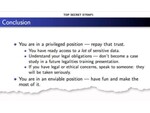
Access to the future [pdf]
The conclusion slide excerpt of a GCHQ presentation on TEMPORA, telling analysts they are in a "privileged" and "enviable" position with ready access to a great deal of sensitive data, and to "have fun and make the most of it".
Programs: TEMPORA -
DFS and NSA partnership [pdf]
DFS the NSA Sister Organization. This document outlines a high-level visit by Japan’s Directorate for Signals Intelligence (DFS), described as NSA’s “sister organization,” to the NSA/CSS headquarters in early 2013. The purpose was to strengthen their decades-long partnership, focusing on SIGINT-enabled cyber capabilities, training, and mutual understanding of each agency’s role in cyber defense.
People: Alexander, Keith B.“The Untold Story of Japan's Secret Spy Agency” - The Intercept ↗ (2018-05-19) · “日本の諜報 スクープ 最高機密ファイル” - NHK ↗ (2018-05-19) · Gallagher, Ryan -
DNI101 [pdf]
This TOP SECRET training guide, "DNI 101," provides a workflow for Digital Network Intelligence analysts on how to investigate a target's email address, detailing the specific tools, databases, and methodology used, and stressing the critical difference between initial open-source/classified research and the active "targeting" of raw SIGINT repositories like XKEYSCORE, PINWALE, and MARINA.
Programs: NKB · FOXTRAIL · FOREMAN · PINWALE · LIONHEART · XKEYSCORE · DISHFIRE · MARINA · MECWEB · MAINWAY · TRAFFICTHIEF · MAUI · ANCHORY · M3 · INTELLINK · HOMEBASE · PROTON · UTT · CADENCE · SPEEDBUMP · TUNINGFORK · MASTERSHAKE · BLACKPEARL · JACKSPARROW · ROADBED · STORYDUTY · LIONROAR · DOPHONE · UIS -
Email Address vs User Activity [pdf]
This 2009 NSA training presentation explains how to use the XKEYSCORE system to search raw SIGINT, detailing the differences between the "Email Address" query, which finds email addresses in full content, and the more flexible "User Activity" query, which can search for selectors like cookies, usernames, and phone numbers.
“XKEYSCORE: NSA’s Google for the World’s Private Communications” - The Intercept ↗ (2015-07-01) · “No Place to Hide” - Metropolitan Books ↗ (2014-05-13) · Marquis-Boire, Morgan · Greenwald, Glenn · Lee, Micah -
FAIRVIEW site book [pdf]
The Fairview TDY Handbook provides essential guidelines for NSA employees travelling in support of the FAIRVIEW Program, detailing required training, security protocols, and travel procedures for both CONUS and OCONUS missions. It covers travel authorization, necessary courses, cover travel considerations, vehicle usage, and operational security (OPSEC) instructions for visits to partner and collection sites. The handbook emphasizes security, confidentiality, and appropriate conduct while interacting with partner organizations and traveling to sensitive locations.
Programs: FAIRVIEW · EAGLE · EDEN · TITANPOINT · PINECONE · TITANPOINTE · BLARNEY · STORMBREW · OAKSTAR · SILVER COLLAM · SSO · LITHIUM -
Finding and Querying Document Metadata [pdf]
This 2009 NSA training guide, created by Booz Allen Hamilton, explains how analysts can use the XKEYSCORE system to track targets by searching for "non-traditional selectors" embedded within documents, such as author names, company information, or even the hash values of company logos.
Programs: XKEYSCORE · TUNINGFORK · PINWALE · FOXACID · FOXBASE · CARBOY · CARDAMON · UNITEDRAKE · CADENCE -
FISA Amendments Act of 2008 Section 702 summary document [pdf]
This document summarizes the way the law works and describes the three types of certifications used to permit the surveillance, as well as targeting and minimization procedures. The three certification are for foreign governments, counterterrorism and WMD/proliferation.
-
Free File Uploaders [pdf]
This 2009 NSA training presentation for the XKEYSCORE system details how analysts can monitor Free File Uploader (FFU) websites like Zshare and RapidShare, which are difficult to track due to a lack of strong selectors. The guide introduces the "Web File Transfer" plug-in, a specialized tool designed to extract key metadata like original filenames and download/delete links from FFU web traffic.
-
Full Log vs HTTP [pdf]
This 2009 NSA training presentation explains the difference between using the "Full Log" and "HTTP Activity" queries in the XKEYSCORE surveillance system, showing analysts how to use both in tandem to gain a complete picture of a target's online activities, including identifying the use of anonymizing proxies.
-
HTTP Activity vs User Activity [pdf]
This NSA training document from June 2009 explains the distinction between HTTP Activity (general web browsing data) and User Activity (communications metadata from specific protocols like webmail and chat) within the XKEYSCORE surveillance system, demonstrating through Iranian examples how analysts combine both search types to develop comprehensive intelligence on targets.
Programs: XKEYSCORE · MARINA · FOXTRAIL · DECODEORDAIN · YACHTSHOP · BRUTUS · WINDCHASER · NKB · UIS · STARPROC -
Introduction to BADDECISION [pdf]
This presentation details the use of the NSA program BADDECISION, which is a computer network exploitation tool (CNE) that uses a frame injection technique to redirect the target client to a FOXACID server.
-
Introduction to Context Sensitive Scanning with X-KEYSCORE Fingerprints [pdf]
This May 2010 NSA training document introduces XKEYSCORE's context-sensitive scanning capabilities using "fingerprints"—customizable detection rules that allow analysts to surgically target specific types of Internet traffic without needing prior knowledge of email addresses or other strong selectors, using over 70 unique contexts to identify patterns in communications and behaviors.
-
Introduction to WLAN / 802.11 Active CNE Operations [pdf]
This NSA powerpoint introduces computer network exploitation (CNE) criteria and assesment as well as active CNE operations. It also introduces the FOXACID program, which is a program to deliver content based exploits to web browsers.
-
Japan official NSA visit, HF briefing [pdf]
The document describes ongoing NSA efforts to renew high-frequency direction-finding (HFDF) collaboration with Japan’s Directorate for SIGINT (DFS) after Japan withdrew from the CROSSHAIR network in 2009. By 2012–2013, both sides were manually exchanging HFDF data, and the NSA sought to advance toward automated data sharing via its BORESIGHT system while reassuring Japan that it would not replace or override its existing technology.
“Japan Made Secret Deals With the NSA That Expanded Global Surveillance” - The Intercept ↗ (2017-04-24) · “アメリカに監視される日本 ~スノーデン“未公開ファイル”の衝撃” - NHK ↗ (2017-04-24) · Gallagher, Ryan · Ikegami, Akira -
Laws on interception - Oversight - Implications for JCE (JCE UK Legalities Context) [pdf]
This GCHQ training presentation on UK surveillance laws, oversight mechanisms, and implications for Joint Collaborative Environment operations explicitly acknowledges that the UK has "a light oversight regime compared with US," detailing how RIPA, ISA, commissioners, and the Investigatory Powers Tribunal function to provide legal authorization while noting the Tribunal has "always found in our favour."
Programs: JTRIG -
New Contact-Chaining Procedures to Allow Better, Faster Analysis SIDtoday [pdf]
The SIGINT Management Directive 424 briefing (Jan 2011) announces a major procedural shift at the NSA, allowing analysts to conduct contact chaining and large-scale metadata analysis from any selector, regardless of nationality or location. This change removes prior restrictions on U.S. data, enabling more powerful social network mapping for foreign intelligence purposes.
Programs: GATEKEEPER -
NSA director's affidavit on foreign surveillance [pdf]
The affidavit was submitted in support of the 2010 certification concerning foreign governments, factions and other entities. In it, Alexander states that pursuant to the certification, NSA seeks to acquire foreign intelligence information concerning foreign powers. The list of foreign powers is in Exhibit F.
People: Alexander, Keith B. -
NSA Intelligence Relationship with Sweden [pdf]
A 2013 NSA information paper documenting the agency's long-standing intelligence partnership with Sweden's signals intelligence service FRA, covering joint collection on Russian targets, counterterrorism, cryptanalysis, and cyber defense — a relationship kept classified due to Sweden's official political neutrality.