Publisher: The Washington Post 40 documents
Search documents matching “The Washington Post” →Who published each document. Mostly a news outlet, but sometimes a book. A partner outlet that reported the story without publishing the documents keeps its byline and its article, but is not a publisher here.
Graphs
By Banner
By Classification
Refine (combine with another filter, via search)
Sort: Title
Documents
-
NSA target package [pdf]
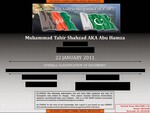
This 2011 target package focuses on Muhammad Tahir Shahzad (alias Abu Hamza), a Pakistan-based bomb builder and Al-Qaeda facilitator. The document was produced by the Counter IED Analysis Integration Cell (CAIC) at the NSA. Notably, the document credits the tracking of Shahzad’s 60+ digital selectors with the eventual capture of high-value targets, including himself and Bali bombing suspect Umar Patek. The accompanying Washington Post investigation uses this specific case to highlight the massive scale of "incidental collection." While Shahzad was a valid foreign target under Section 702 of the FISA Amendments Act (FAA), the investigation revealed that for every legitimate target like him, the NSA intercepted nine "non-targeted" users—many of whom were Americans—capturing deeply personal photos, medical records, and private correspondence.
-
NSA/CSS Mission: PROVIDE AND PROTECT VITAL INFORMATION FOR THE NATION [pdf]
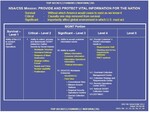
These slides, from an internal presentation in the first week of October 2001, show how critical the NSA sees electronic eavesdropping.
-
Op MULLENIZE and beyond - Staining machines 10/10/12 [pdf]
This 2012 report from the NSA's British counterpart, the GCHQ, describes a method of "staining" electronic traffic to distinguish otherwise anonymous users. It is used to unmask Tor users and devices on networks in which many computers share the same Internet address. The method relies on planting code in a web browser to change the "user agent," which is the way the browser identifies itself on the web. In a two month period, the report says, GCHQ managed to implant about 200 computers with uniquely identifying stains.
-
PRISM/US-984XN Overview [pdf]
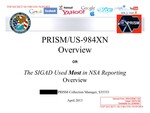
A 2013 NSA training presentation revealing that major U.S. tech companies — including Google, Facebook, Apple, Microsoft, and Skype — secretly gave the NSA direct access to their servers, allowing the agency to collect users' emails, chats, photos, and files in real time, with the FBI acting as intermediary.
Programs: PRISM · FAIRVIEW · STORMBREW · BLARNEY · OAKSTAR · UTT · PRINTAURA · PINWALE · NUCLEON · TRAFFICTHIEF · SCISSORS · MARINA · MAINWAY · FALLOUT · CONVEYANCE · REPRISMFISA · SSO“U.S., British intelligence mining data from nine U.S. Internet companies in broad secret program” - The Washington Post ↗ (2013-06-06) · “NSA Prism program taps in to user data of Apple, Google and others” - The Guardian ↗ (2013-06-07) · “L'ampleur de l'espionnage mondial par la NSA” - Le Monde ↗ (2013-10-21) · “NSA files decoded: Edward Snowden's surveillance revelations explained” - The Guardian ↗ (2013-11-01) · “No Place to Hide” - Metropolitan Books ↗ (2014-05-13) · “Dark Mirror: Edward Snowden and the American Surveillance State” - Penguin Press ↗ (2020-05-19) · Gellman, Barton · Poitras, Laura · Greenwald, Glenn · MacAskill, Ewen · Untersinger, Martin · Dance, Gabriel -
Research & Technology – Penetrating Hard Targets [pdf]
The NSA’s “Penetrating Hard Targets” program aims at developing a cryptologically useful quantum computer capable of breaking strong encryption systems, including those protecting global financial and government communications. Conducted under the U.S. intelligence “black budget,” the program focuses on quantum physics research, engineering studies, and experimental milestones such as achieving dynamical decoupling and quantum control on semiconductor qubits, which are foundational for scaling to larger systems. A related initiative, “Owning the Net,” explores quantum communication technologies to develop new Quantum Key Distribution (QKD) attacks and assess the security of emerging encryption methods.
-
Roger Dingledine at NSA NOV 2007 [pdf]
An NSA internal wiki page summarising a talk given at NSA on 1 November 2007 by Roger Dingledine, one of Tor's inventors, covering who Tor's users are, anonymity system design concepts, and Tor's weaknesses.
People: Dingledine, Roger -
SID Oversight and Compliance [pdf]
Signals Intelligence Directorate (SID) oversight and compliance. A 2012 quarterly audit of the NSA's surveillance activities, which describes 865 violations by the NSA of the surveillance laws and its internal rules and regulations.
-
SIGINT Authority decision tree [pdf]
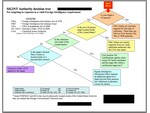
A one-page NSA training chart that walks an analyst from a targeting request to the legal authority that covers it, branching on whether the target is a US person, where the target is, where the collection site is, and whether the target is a Second Party citizen.
-
Special Source Operations - The Cryptologic Provider of Intelligence from Global High-Capacity Telecommunications Systems [pdf]
The document outlines NSA special source operations for accessing global telecommunications data, detailing corporate and foreign cable interception programs. It highlights the MUSCULAR program (DS-200B), a joint NSA–GCHQ operation in the UK that taps into high-capacity fiber-optic links to collect and process large volumes of data from private networks.
-
SSO - MYSTIC [pdf]
This collection of SSO slides details the NSA's MYSTIC program, a massive signals intelligence (SIGINT) operation capable of recording and archiving 100% of a country's mobile phone calls. The slides reveal the program's reach across several nations, using colorful codenames for specific collection sites.
Programs: MYSTIC · SCALAWAG · ACIDWASH · OILYRAG · VENATOR · RANCIDRINSE · LOLLYGAG · EVENINGEASEL · DUSKPALLET · BASECOAT · PERMANENTPRESS · ETCHINGSPIN“NSA surveillance program reaches ‘into the past’ to retrieve, replay phone calls” - The Washington Post ↗ (2014-03-18) · “The NSA Is Recording Every Cell Phone Call in the Bahamas” - The Intercept ↗ (2014-05-19) · Gellman, Barton · Soltani, Ashkan · Devereaux, Ryan · Greenwald, Glenn · Poitras, Laura -
SSO Collection Optimization [pdf]
This is another presentation on problems with the National Security Agency's overcollection of address books and buddy lists and its efforts to weed out useless content. See also EFF_-_20131104-wapo-optimization_google
-
SSO Collection Optimization [pdf]
The documents reveal that the NSA, in collaboration with GCHQ, accessed private internal networks of Google and Yahoo by intercepting data in transit between their data centers, without breaking into user accounts or servers. This involved analyzing proprietary formats and protocols, such as Google’s Gaia authentication system, using specialized tools to extract intelligence while operating primarily under foreign jurisdiction with fewer legal restrictions.
-
SSO Collection Optimization Overview [pdf]
This excerpt is from an article in the NSA's "Intellipedia," a classified system built with the same open-source software used by Wikipedia. Like the other documents, it describes the problem of high-volume, low-value data collection — and the NSA's response — with a focus on Internet contact lists.
-
SSO GHOSTMACHINE Analytics [pdf]
This document describes the NSA’s cloud analytics platform GHOSTMACHINE, used by Special Source Operations (SSO) to process and analyze massive volumes of data (e.g., from FASCIA) using Hadoop-based infrastructure. It’s essentially the backbone system for querying, correlating, and enriching surveillance data at scale — not just a single analytic, but the analytic/cloud environment powering many programs.
Programs: GHOSTMACHINE · FASCIA · CERF · POPTOP · DRT · SIGDASYS · JUGGERNAUT · SEADIVER · AST128 · TUSKATTIRE · ASDF · BROKENRECORD · REDHAWK · SSO -
Summary of DNR and DNI Co-Travel Analytics [pdf]
The document outlines the NSA’s development and testing of multiple “co-traveler” analytics—sophisticated tools that analyze bulk mobile location data to identify people who travel together or follow similar patterns, even if they are not known intelligence targets. It details various analytic systems, their data sources (such as FASCIA, VLR, GCID), architectures, scoring methods, and future enhancements, illustrating a large-scale surveillance framework for mapping human movement and relationships.
Programs: CO-TRAVELER · CHALKFUN · TMI · PACT · RT-RG · SORTINGLEAD · FASCIA · Hectic Snare · DRT · Juggernaut · GM-PLACE · Fast Follower · MGSC · ELKPRINTS · VOICESAIL · CULTWEAVE · OCTAVE · OCTSKYWARD · SEDB · JEMA · The Café · UTT · ASDF · GHOSTMACHINE · CLOUDBASE · FASTSCOPE · GOLDMINER · CHET · GEOT · TMAC · SPCMA · MAPREDUCE · ACCUMULO · GAMBIT · ICREACH -
Targeting Rationale (TAR) [pdf]
An NSA document describing how analysts should explain their targeting decisions under the FISA Amendments Act.
-
Tasking of SCALAWAG [pdf]
An NSA Special Source Operations memo describing bandwidth and latency problems caused by the SCALAWAG bulk voice collection program, and introducing the RETRO Tool — a capability allowing analysts to reach back up to 30 days into a buffer of recorded phone calls from an entire country to retrieve audio that was never individually targeted.
Programs: SCALAWAG · DOUBLEARROW · UTT · OCTAVE · NUCLEON · RETROSPECTIVE · RETROTOOL · RETRO · FASCIA · SSO -
Tor - 2006 CES Summer Program [pdf]
The following document is a 2006 research paper produced for the NSA's "Cryptanalysis and Exploitation Services" office. It lays out the technical features of Tor and proposes a number of theoretical and practical attacks, some of which the NSA developed and used in subsequent years. Among other things, the paper describes an NSA-written adaptation of Tor, "indistinguishable from an original Tor client," which enables the NSA to gather intelligence inside the network. It also describes two kinds of "denial of service" attacks against Tor, code-named Coil and Flower, which are used to divert would-be anonymous communications into open channels.
Programs: MJOLNIR -
WINDSTOP - Last 30 Days [pdf]
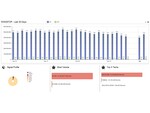
The WINDSTOP report shows massive NSA collection activity over a 30-day period, with daily DNI (Digital Network Intelligence) and DNR (Dialed Number Recognition) records reaching up to 600 million per day. Most data volume came from DS-300 and DS-200B collection points, processed primarily through XKEYSCORE and TURMOIL, and included a mix of signal types such as PCS, INMAR, MCIP, VSAT, and PSTN. The chart follows the same structure as BOUNDLESSINFORMANT, the NSA’s global SIGINT visualization tool, using bar and pie charts to track and categorize collection volume by signal type, SIGAD, and processing system.
-
WINDSTOP/2P System Highlights [pdf]
A March 2013 NSA Special Source Operations internal report describing a volume management problem at MUSCULAR — the joint NSA/GCHQ programme tapping Yahoo and Google inter-datacenter fiber links — specifically concerning Yahoo's proprietary Narchive email transfer format, which was generating 15GB/day of mostly stale email data representing 25% of the collection site's daily allocation.