Classification: SI 1067 documents
Search documents matching “SI” →Each document's classification level, as component values. If a document contains multiple classifications, the highest is used here.
Graphs
By document date (11 years)
By published date (9 years)
By Banner
Refine (combine with another filter, via search)
Sort: Title
Documents
-
GCHQ Intelligence Production Head Outlines Present and Future Priorities SIDtoday [pdf]
According to a talk recently given at NSA's UK base in Menwith Hill, counterterrorism absorbs most (30%) of GCHQ's resources. Afghanistan and China are given increasing attention, while Russia gets less. Long term, GCHQ foresees challenges in keeping up with the internet and "huge amounts of data", while peace is expected in Iraq.
People: Ashton, JonThe Intercept ↗ (2019-05-29) -
GCHQ Perspective on Annual Bilat SIDtoday [pdf]
Topics at an annual meeting between the Signals Intelligence Directorate and its GCHQ counterpart included the relative paucity of GCHQ efforts in China, the need to devote sufficient resources to Russia and weapons of mass destruction in the face of counterterrorism mandates, and the need to better geolocate targets, writes GCHQ's director for signals intelligence operations.
The Intercept ↗ (2017-09-13) -
GCSB Director Visits Denver SIDtoday [pdf]
The director of New Zealand’s Government Communications Security Bureau visits NSA/CSS Colorado.
The Intercept ↗ (2018-08-15) -
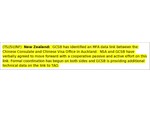
GCSB has identified an MFA data link [pdf]
A short extract from an April 2013 NSA document recording that GCSB had identified a Chinese Ministry of Foreign Affairs data link between the Chinese Consulate and the Chinese Visa Office in Auckland, and that NSA and GCSB had verbally agreed to mount a joint passive and active operation against it.
“Leaked papers reveal NZ plan to spy on China for US” - The New Zealand Herald ↗ (2015-04-19) · “New Zealand Plotted Hack on China With NSA” - The Intercept ↗ (2015-04-18) · Fisher, David · Gallagher, Ryan · Hager, Nicky -
Gearing Up for the Spring Offensive SIDtoday [pdf]
A rock drill will be held to focus on planning for an upcoming spring offensive against al Qaeda in the Afghanistan-Pakistan area. NSA representatives will be posted to Kabul/Bagram and Islamabad.
People: Quirk, RichardThe Intercept ↗ (2016-12-07) -
General Zahner's View from the Front SIDtoday [pdf]
Description of Brig. Gen. Zahner’s speech, which covered the role of intelligence in Operation Iraqi Freedom and the importance of taking risks.
People: Zahner, RichardThe Intercept ↗ (2016-05-16) -
Generally Speaking: A Place in History SIDtoday [pdf]
The first in a series called “Generally Speaking” from the Signals Intelligence director. In this installment, he tells the SID workforce that they’re heroes in the brand new war on terrorism.
People: Quirk, RichardThe Intercept ↗ (2016-08-10) -
Generally Speaking: Back from the Front SIDtoday [pdf]
After returning from Baghdad, the Signals Intelligence director says all the SIGINT analysts deployed in the war zone are heroes.
Programs: TAREXThe Intercept ↗ (2016-08-10) -
Generally Speaking: Driving History SIDtoday [pdf]
The Signals Intelligence director tells members of the SID workforce that they’re not just spectators of history, they’re making decisions that drive it.
People: Quirk, RichardThe Intercept ↗ (2016-08-10) -
Generally Speaking: Iraq -- Worth All The Effort! SIDtoday [pdf]
Nearly three years since the Iraq War started, the situation is difficult and discouraging, and “we are bombarded with negative news coverage that paints a ‘can’t win’ story.” But, the Signals Intelligence director explains, elections in Iraq reaffirmed his personal belief that “we are doing the right thing.”
People: Quirk, RichardThe Intercept ↗ (2016-08-10) -
Generally Speaking: Learning Lessons from CSTs in Iraq SIDtoday [pdf]
The Signals Intelligence director spoke with five analysts who served in the field in Iraq to gather feedback about their experience and how to improve the entire SIGINT system to make it more effective.
People: Quirk, RichardThe Intercept ↗ (2016-08-10) -
GEO Build-Out SIDtoday [pdf]
The Geospatial Exploitation Office division of Analysis and Production is split into six regional production centers, each undergoing changes as part of the build-out.
Programs: VOICESAILThe Intercept ↗ (2018-08-15) -
GEOCELL Supports IRAQI FREEDOM SIDtoday [pdf]
The Geospatial Exploitation Office, on 24/7 watch for the Iraq War, assisted in the mapping of geolocation communications data in near real time for high-value targets and threat activity.
Programs: GEOCELLThe Intercept ↗ (2016-05-16) -
German, NSA SIGINTers Share DNI Processing Knowledge SIDtoday [pdf]
A delegation from Germany’s Federal Intelligence Service visits Fort Meade, Maryland, to learn about the NSA’s “packet level” selection and filtering of internet-based traffic, which is opposite to the approach used by the Germans.
“The NSA in Germany: Snowden's Documents Available for Download” - Der Spiegel ↗ (2014-06-18) · The Intercept ↗ (2018-08-15) -
Getting an Expert Opinion SIDtoday [pdf]
Describes the new E-document Sharing Program, designed to let analysts share SIGINT ”stripped of references to its source” with technical experts who can help understand it, using computers to avoid travel.
Programs: IWSThe Intercept ↗ (2016-08-10) -
Getting Leads: GEO Mining SIDtoday [pdf]
Description of an approach to sifting through large amounts of phone call metadata to find leads for new surveillance target called "GEO Mining." The author gives an example of searching for heroin-production labs in Afghanistan using GEO Mining, by filtering all phone calls in Afghanistan down to calls made near known heroin-processing labs. In this case, "The top 20 handsets were then tasked for collection, and at least one has produced reportable intelligence."
People: Brown, PaulThe Intercept ↗ (2017-04-24) -
Getting the 'Ungettable' Intelligence: An Interview with TAO's Teresa Shea SIDtoday [pdf]
An interview with Teresa Shea, then chief of Tailored Access Operations, NSA's offensive hacking unit. In 2006 TAO had "access to over 258 target sets in 89 countries."
The Intercept ↗ (2019-05-29) -
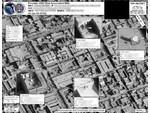
GHOSTHUNTER aerial image (2009) [pdf]
This imagery showcases a real-world application of the GHOSTHUNTER program operated out of Menwith Hill Station in the UK. The document features an aerial satellite photograph used to pinpoint the precise physical location of VSAT (Very Small Aperture Terminal) satellite dishes. By linking a target's digital footprint—specifically their MAC address and IP address—to a specific set of geographic coordinates, the NSA and GCHQ can identify the exact building or compound where a person is using the internet. This capability is a cornerstone of the "find, fix, finish" cycle used to support "covert operations" and targeted killing missions in conflict zones like Yemen, Somalia, and Afghanistan.
Programs: GHOSTHUNTER -
Ghosthunter and the geolocating of internet cafes [pdf]
This document announces an NSA “R Spotlight” webcast introducing GHOSTHUNTER, a multi-agency geolocation program designed to locate Time Division Multiple Access (TDMA) VSAT Internet access points, particularly internet cafés across the Middle East and North Africa in support of U.S. military operations. By mid-2009, GHOSTHUNTER had successfully geolocated over 5,000 VSAT terminals across Middle East demonstrating its operational effectiveness and integration with broader intelligence efforts.
Programs: GHOSTHUNTER -
GHOSTHUNTER Goes Global [pdf]
This document announces that GHOSTHUNTER, operated from Menwith Hill Station (MHS), is being used to geolocate terminals associated with high-value targets in Iraq and surrounding Middle Eastern countries. It references a hyperlinked article in the station’s Horizon newsletter for further details, which requires a secure NTS-PKI certificate to access due to its classification. The title suggests that GHOSTHUNTER has achieved global reach.
Programs: GHOSTHUNTER