Tag: latency 5 documents
Search documents matching “latency” →Free-text subjects the curators added. Unlike the other axes these are not necessarily from the documents' own vocabulary, so they are the loosest thing to browse by (and the most forgiving).
Graphs
By Banner
By Classification
Refine (combine with another filter, via search)
Sort: Title
Documents
-
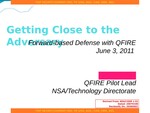
Getting Close to the Adversary – Forward-based Defense with QFIRE (June 3, 2011) [pdf]
This document describes the QFIRE project which is designed to give the NSA a global, low-latency platform for “forward-based defense”, enabling real-time detection and manipulation of Internet traffic close to its source. By co-locating passive sensors (TURMOIL), decision logic (TURBINE), and injection capabilities, QFIRE can rapidly reset connections, redirect targets for exploitation, inject malicious payloads, and even seize control of botnets. It operates as part of the broader QUANTUMTHEORY architecture, leveraging both cooperative and non-cooperative infrastructure worldwide to enable CNE/CND/CNA effects with minimal delay.
Programs: QFIRE · QUANTUMTHEORY · TURBULENCE · TURMOIL · TURBINE · TUTELAGE · QUANTUM · QUANTUMSKY · QUANTUMINSERT · QUANTUMBOT · QUANTUMCOPPER · STRAIGHTBIZARRE · BLINDDATE · TUMULT · ISLANDTRANSPORT · SURPLUSHANGAR · MIDDLEMAN · SCSnet · WEALTHYCLUSTER · SSO -
Tasking of SCALAWAG [pdf]
An NSA Special Source Operations memo describing bandwidth and latency problems caused by the SCALAWAG bulk voice collection program, and introducing the RETRO Tool — a capability allowing analysts to reach back up to 30 days into a buffer of recorded phone calls from an entire country to retrieve audio that was never individually targeted.
Programs: SCALAWAG · DOUBLEARROW · UTT · OCTAVE · NUCLEON · RETROSPECTIVE · RETROTOOL · RETRO · FASCIA · SSO -
Tor - 2006 CES Summer Program [pdf]
The following document is a 2006 research paper produced for the NSA's "Cryptanalysis and Exploitation Services" office. It lays out the technical features of Tor and proposes a number of theoretical and practical attacks, some of which the NSA developed and used in subsequent years. Among other things, the paper describes an NSA-written adaptation of Tor, "indistinguishable from an original Tor client," which enables the NSA to gather intelligence inside the network. It also describes two kinds of "denial of service" attacks against Tor, code-named Coil and Flower, which are used to divert would-be anonymous communications into open channels.
Programs: MJOLNIR -
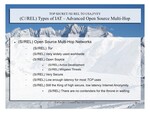
Types of IAT - Advanced Open Source Multi-hop [pdf]
This top-secret NSA/GCHQ document provides a detailed technical overview of the Tor network, including how it works, its strengths as the “king of high secure, low-latency Internet anonymity,” methods for identifying Tor traffic, censorship-driven protocol obfuscation, and ongoing intelligence efforts to analyze, fingerprint, and exploit Tor through passive SIGINT and active research, including collaboration between US and UK agencies.
People: Appelbaum, Jacob -
When Seconds Count: Forwarding High-Priority Traffic SIDtoday [pdf]
High-priority GSM data collected from Baghdad is sent to NSA Georgia. In late 2004, NSA Georgia reported that the delays in receiving this data hampered its ability to help troops on the ground in Iraq. The NSA made some changes to the tools used to select numbers to intercept and to the architecture in Baghdad, which has reduced these delays.
People: Strauss, JaniceThe Intercept ↗ (2018-03-01)