CQV Fields Nov 2010 NSA
Open PDFDocument date: 2010-11-01
Pages: 1
Genre: other
Classification: -
Dissemination: -
An NSA field definition guide for the ECHELON system's CQV database, cataloging how intercepted communications are tagged, routed, and indexed—from file types and appid fingerprints to Forward Instruction Tables, country codes derived from trigraphs, and dictionary-based keyword tokens that steer selected traffic to a requesting system and/or analysts.
My notes
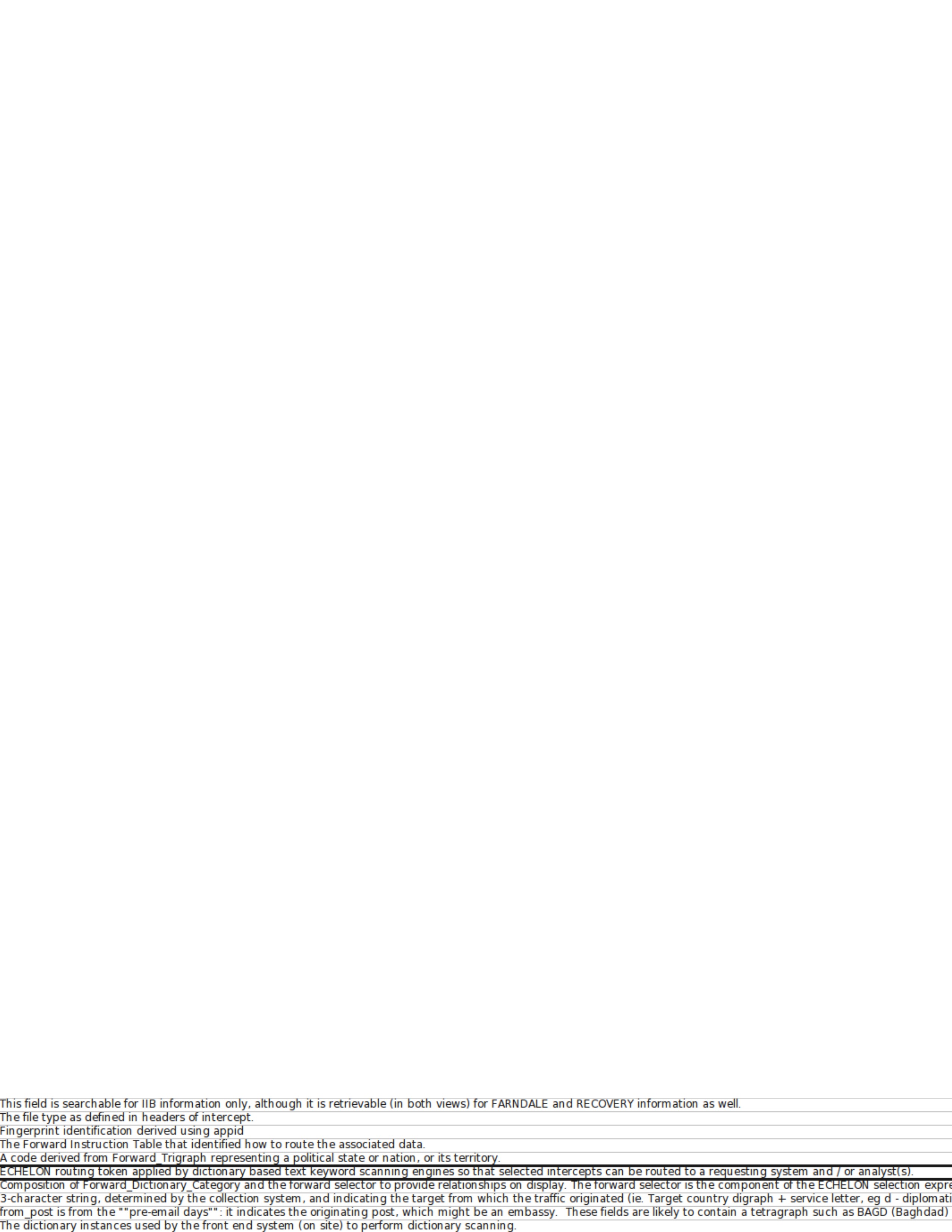
This field is searchable for IIB information only, although it is retrievable (in both views) for FARNDALE and RECOVERY information as well.
The file type as defined in headers of intercept.
Fingerprint identification derived using appid
The Forward Instruction Table that identified how to route the associated data.
A code derived from Forward_Trigraph representing a political state or nation, or its territory.
ECHELON routing token applied by dictionary based text keyword scanning engines so that selected intercepts can be routed to a requesting system and / or analyst(s).
Composition of Forward_Dictionary_Category and the forward selector to provide relationships on display. The forward selector is the component of the ECHELON selection expr
3-character string, determined by the collection system, and indicating the target from which the traffic originated (ie. Target country digraph + service letter, eg d - diplomat
from_post is from the ""pre-email days"": it indicates the originating post, which might be an embassy. These fields are likely to contain a tetragraph such as BAGD (Baghdad)
The dictionary instances used by the front end system (on site) to perform dictionary scanning.
Published in the Same Report
(5 documents)
-
Back in Time: The ECHELON Story SIDtoday [pdf]
When "ECHELON" was in the public spotlight, the European Commission investigated allegations that the NSA was conducting industrial espionage by targeting communications satellites. The NSA avoided a visit from the investigators. The final report “reflected” that the NSA played by the rules with congressional oversight, and “events post-9/11 have overtaken the spotlight.”
Programs: ECHELON“GCHQ and Me: My Life Unmasking British Eavesdroppers” - The Intercept ↗ (2015-08-03) · The Intercept ↗ (2018-03-01) · Campbell, Duncan -
Comsat GCHQ [pdf]
GCHQ outlines its COMSAT antenna strategy, driven by ballooning maintenance costs from decades of accumulated satellite dishes at CARBOY, SOUNDER, and SNICK—aiming to cut total cost of ownership while expanding collection under the Five Eyes SHAREDQUEST program and NSA's "Access It All" push.
Marking: SECRET -
Cyprus GCHQ [pdf]
GCHQ's Cyprus facilities strategy document outlining plans to maximize intelligence collection through integrated COMSAT, TRF, Weapons, and MASINT operations across three sites (Ayios Nikolaos, Akrotiri, Troodos)—sustaining the NSA partnership under the ECHELON Agreement while standardizing IT infrastructure with UK hubs at Bude, Scarborough, Cheltenham, Digby, and Menwith Hill Station for enhanced interoperability and load-sharing.
Programs: DARKQUEST · IVE · FORESIGHT · SHARKQUEST · BASSQUEST · BURSTTDMA · APPARITION · SHAREDVISION · ECHELON · SOUNDER · GLAIVE · LECKWITH -
NWP NSA [pdf]
A January 2011 internal NSA newsletter from Yakima Research Station (YRS) covering the station's early history as the West Coast ECHELON/FROSTING satellite interception facility established in 1966 to collect INTELSAT communications, and its more recent expansion into cloud-based cyber threat discovery using FORNSAT and Special Source Operations data.
Programs: EARLYBIRD · FROSTING · TRANSIENT · ECHELON · JACKKNIFE · SAFEGUARD · STEAMS · CYBERQUEST · GINPENNANT · RUMBUCKET · CROSSBONES · SSO -
NWP2 NSA [pdf]
The July 2012 issue of the Yakima Research Station's internal newsletter, covering the station's upcoming 40th anniversary celebrations, its origins under the ECHELON programme for INTELSAT collection during the Cold War, and a Norwegian partner enablement operation, alongside routine staff and community content.
Programs: ECHELON
Related Documents
-
PRESTON Architecture [pdf]
The PRESTON architecture, centered on GCHQ’s PRESTON Processing system, is detailed across multiple views showing how the agency intercepts, processes, and stores communications. It outlines a sophisticated surveillance framework that integrates lawful interception, data processing, and analyst access, emphasizing covert monitoring and management of intercepted data.
Programs: PRESTON · FAST GROK · BOXSTER · MARMION · GENTIAN · TERRAIN · BLACKNIGHT · CORINTH · FARNDALE · SAMDYCE · B3M · VSLT · SAMBOK · HAUSTORIUM · FUNFAIR · Cheltenham · SALAMANCA · IIB · LOCHNVAR · MONACO · HOTLINE · Benhall · GDR · CE · BRIGHTON · ARSENIDE · SPQR · TACHO · TRAFFIC MASTER · KEYCARD · XKEYSCORE · COURIERSKILL · MONKEYPUZZLE · PILBEAM · GREENHEART · CCDF · GTE · CADENCE · TERRAINS · GCNET · HENCE -
Operational Legalities – GCHQ Powerpoint Presentation [pdf]
GCHQ’s “Operational Legalities” deck is an internal compliance playbook that translates the UK’s surveillance laws into day‑to‑day SIGINT procedure—drilling staff on authorisation, necessity, and proportionality, and walking through warrants, targeting justifications, database queries, dissemination, and oversight. Half slides and half speaker notes, it shows how analysts are trained to document, audit, and defend operations under ISA, RIPA, HRA, and WTA while navigating edge cases like location, nationality, second‑party constraints, and “indirect targeting.”
-
NWP2 NSA [pdf]
The July 2012 issue of the Yakima Research Station's internal newsletter, covering the station's upcoming 40th anniversary celebrations, its origins under the ECHELON programme for INTELSAT collection during the Cold War, and a Norwegian partner enablement operation, alongside routine staff and community content.
Programs: ECHELON -
NWP NSA [pdf]
A January 2011 internal NSA newsletter from Yakima Research Station (YRS) covering the station's early history as the West Coast ECHELON/FROSTING satellite interception facility established in 1966 to collect INTELSAT communications, and its more recent expansion into cloud-based cyber threat discovery using FORNSAT and Special Source Operations data.
Programs: EARLYBIRD · FROSTING · TRANSIENT · ECHELON · JACKKNIFE · SAFEGUARD · STEAMS · CYBERQUEST · GINPENNANT · RUMBUCKET · CROSSBONES · SSO -
Field Station Rattler SIDtoday [pdf]
The Signals Intelligence Directorate team led by Maj. Gen. Richard Quirk visited the Baghdad international zone and met with diplomats at the U.S. embassy, and the NSA deployed staffers at the "No Heads Palace" headquarters of signals intelligence in Iraq.
People: Price, Wally · Quirk, Richard · Jeffrey · Kett · Allston · al-Zarqawi, Abu Musab · Hussein, SaddamThe Intercept ↗ (2017-09-13)