PR-TT Memorandum Opinion
Open PDFDocument date: -
Type: FOIA
Pages: 117
Classification: TOP SECRET COMINT
Dissemination: ORCON, NOFORN
ACLU/EFF FOIA Litigation.
My notes




























TOP SECRET//COMINT//ORCON,NOFORN
UNITED STATES
FOREIGN INTELLIGENCE SURVEILLANCE COURT
WASHINGTON, D.C.
[REDACTED]
Docket Number: PR/TT [REDACTED]
MEMORANDUM OPINION
This matter is before the Court upon the government's application to re-initiate in
expanded form a pen register/trap and trace (PR/TT) authorization for the National Security
Agency (NSA) to engage in bulk acquisition of metadata¹ about Internet communications. The
government's application also seeks Court authorization to query and use information previously
obtained by NSA, regardless of whether the information was authorized to be acquired under
¹ When used in reference to a communication, "metadata" is information “about the
communication, not the actual communication itself," including "numbers dialed, the length of a
call, internet protocol addresses, e-mail addresses, and similar information concerning the
delivery of the communication rather than the message between two parties." ² Wayne R.
LaFave, Jerold H. Israel, Nancy J. King & Orin S. Kerr, Criminal Procedure § 4.6(b) at 476 (3d
ed. 2007).
TOP SECRET//COMINT//ORCON,NOFORN
TOP SECRET//COMINT//ORCON,NOFORN
prior bulk PR/TT orders of the Foreign Intelligence Surveillance Court (FISC or "Court") or
exceeded the scope of previously authorized acquisition. For the reasons explained herein, the
government's application will be granted in part and denied in part.
I.
History of Bulk PR/TT Acquisitions Under the Foreign Intelligence Surveillance Act
From [REDACTED], NSA was authorized, under a series of FISC
orders under the PR/TT provisions of the Foreign Intelligence Surveillance Act (FISA), 50
U.S.C. §§ 1841-1846, to engage in the bulk acquisition of specified categories of metadata about
Internet communications. Although the specific terms of authorization under those orders varied
over time, there were important constants. Notably, each order limited the authorized acquisition
to [REDACTED] categories of metadata.² As detailed herein, the government acknowledges that
[REDACTED]
TOP SECRET//COMINT//ORCON,NOFORN
2
TOP SECRET//COMINT//ORCON,NOFORN
NSA exceeded the scope of authorized acquisition continuously during the more than [REDACTED] years
of acquisition under these orders.
In addition, each order authorized NSA analysts to access the acquired metadata only
through queries based on validated "seed" accounts, i.e., Internet accounts for which there was a
reasonable articulable suspicion ("RAS") that they were associated with a targeted international
terrorist group; for accounts used by U.S. persons, RAS could not be based solely on activities
protected by the First Amendment.3 The results of such queries provided analysts with
information about the [REDACTED] of contacts and usage for a seed account, as reflected in the
collected metadata, which in turn could help analysts identify previously unknown accounts or
persons affiliated with a targeted terrorist group. See [REDACTED] Opinion at 41-45. Finally,
each bulk PR/TT order included a requirement that NSA could disseminate U.S. person
information to other agencies only upon a determination by a designated NSA official that it is
related to counterterrorism information and is necessary to understand the counterterrorism
information or to assess its importance.4
2( continued)
[REDACTED]
TOP SECRET//COMINT//ORCON,NOFORN
3
TOP SECRET//COMINT//ORCON,NOFORN
The current application relies on this prior framework, but also seeks to expand
authorization in ways that test the limits of what the applicable FISA provisions will bear. It also
raises issues that are closely related to serious compliance problems that have characterized the
government's implementation of prior FISC orders. It is therefore helpful at the outset to
summarize both the underlying rationale of the prior authorizations and the government's
frequent failures to comply with their terms.
A. Initial Approval
The first application for a bulk PR/TT authorization was granted by the Honorable
Colleen Kollar-Kotelly in [REDACTED] Judge Kollar-Kotelly authorized PR/TT surveillance [REDACTED]
[REDACTED]
See [REDACTED] Opinion at 72-80.5 When known, the particular customers [REDACTED]
[REDACTED] were identified in the Court's order pursuant to 50 U.S.C. § 1842(d)(2)(A)(ii). See [REDACTED]
[REDACTED] Opinion at 22-23.
The [REDACTED] Opinion authorized the acquisition of [REDACTED] categories of metadata:
[REDACTED]
TOP SECRET//COMINT//ORCON,NOFORN
4
TOP SECRET//COMINT//ORCON,NOFORN
[REDACTED]
The government proposed to collect these categories of metadata from [REDACTED]
[REDACTED]
TOP SECRET//COMINT//ORCON,NOFORN
5
TOP SECRET//COMINT//ORCON,NOFORN
Judge Kollar-Kotelly found that the proposed collection of information within Categories
[REDACTED] comported with the applicable statutory definitions of "pen register" and "trap
and trace device,” id. at 13-17, and with the Fourth Amendment, id. at 58-61.[REDACTED]
The [REDACTED] Opinion stated the Court's understanding that the application sought
authority to obtain only [REDACTED] categories of information and specified that it authorized “only
the collection of information in Categories [REDACTED] Id. at 11 (emphasis in
original). Each subsequent bulk PR/TT order adopted as its rationale the analysis and
conclusions set out in the [REDACTED] Opinion.
8
7 See 18 U.S.C. § 3127(3), (4). These definitions are more fully discussed at pages 25-
26, infra.
8 See e.g., Docket No. PR/TT [REDACTED] Primary Order issued on [REDACTED] at 5; Docket
(continued...)
TOP SECRET//COMINT//ORCON,NOFORN
6
TOP SECRET//COMINT//ORCON,NOFORN
It was anticipated that the authorized PR/TT surveillance would "encompass [REDACTED]
[REDACTED]
Opinion at 39-40 (internal quotations omitted).
Pursuant to 50 U.S.C. § 1842(c)(2), the initial application included a certification that the
information likely to be obtained was relevant to an ongoing investigation to protect against
international terrorism, which was not being conducted solely upon the basis of activities
protected by the First Amendment. Docket No. PR/TT [REDACTED] Application filed [REDACTED]
[REDACTED]
⁹ Bulk PR/TT surveillance was first approved in support of investigations of [REDACTED] and the collected
metadata could only be accessed through queries based on seed accounts for which there was
RAS that the account was associated with [REDACTED] July
Opinion at 72, 83. The range of terrorist organizations for which a RAS determination
could support querying the metadata was [REDACTED]
[REDACTED]
The present description of these Foreign Powers is contained in
the Declaration of Michael E. Leiter, Director of the National Counterterrorism Center (NCTC),
filed in docket number [REDACTED] which is incorporated by reference in the current application. See
Docket No. PR/TT [REDACTED] Application filed [REDACTED] at 2.
TOP SECRET//COMINT//ORCON,NOFORN
7
TOP SECRET//COMINT//ORCON,NOFORN
[REDACTED] Application”), at 26.¹⁰ Judge Kollar-Kotelly found that the sweeping and non-
targeted scope of the proposed acquisition was consistent with this certification of relevance.
[REDACTED] Opinion at 49. In making this finding, the Court relied on several factors,
including NSA’s efforts “to build a meta data archive that will be, in relative terms, richly
populated with [REDACTED] communications,” at least as compared with the entire universe
of Internet communications, [REDACTED] Opinion at 47,¹¹ and the presence of “safeguards”
proposed by the government “to ensure that the information collected will not be used for
unrelated purposes,” id. at 27, thereby protecting “the continued validity of the certification of
relevance,” id. at 70. These safeguards importantly included both the limitation that NSA
¹⁰ The government argued that “FISA prohibits the Court from engaging in any
substantive review of this certification,” and that “the Court’s exclusive function” was “to verify
that it contains the words required” by the statute. [REDACTED] Opinion at 26. The Court did
not find such arguments persuasive. Id. However, because the government had in fact provided
a detailed explanation of the basis for the certification, the Court did not “decide whether it
would be obliged to accept the applicant’s certification without any explanation of its basis” and
instead “assume[d] for purposes of this case that it may and should consider the basis” of the
certification of relevance. Id. at 27-28.
[REDACTED]
TOP SECRET//COMINT//ORCON,NOFORN
8
TOP SECRET//COMINT//ORCON,NOFORN
analysts could access the bulk metadata only on the basis of RAS-approved queries, id. at 42-43,
56-58, and the rule governing dissemination of U.S. person information outside of NSA, id. at
85.
However, the finding of relevance most crucially depended on the conclusion that "the
proposed bulk collection . . . is necessary for NSA to employ . . . analytic tools [that] are likely to
generate useful investigative leads for ongoing efforts by the [Federal Bureau of Investigation
(FBI)] (and other agencies) to identify and track [REDACTED] Id. at 48.
Consequently, "the collection of both a huge volume and high percentage of unrelated
communications . . . is necessary to identify the much smaller number of [REDACTED]
such that the entire mass of collected metadata is relevant to investigating [REDACTED]
affiliated persons. Id. at 48-49; see also id. at 53-54 (relying on government's
explanation why bulk collection is "necessary to identify and monitor [REDACTED] operatives
whose Internet communications would otherwise go undetected in the huge streams of [REDACTED]
communications").
B. First Disclosure of Overcollection
During the initial period of authorization, the government disclosed that NSA's
acquisitions had exceeded the scope of what the government had requested and the FISC had
approved. Insofar as it is instructive regarding the separate form of overcollection that has led
directly to the current application, this prior episode is summarized here.
TOP SECRET//COMINT//ORCON,NOFORN
9
TOP SECRET//COMINT//ORCON,NOFORN
On [REDACTED] the government provided written notice to the FISC that it had
exceeded the scope of authorized collection [REDACTED] Docket No. PR/TT [REDACTED] Notice
of Compliance Incidents, filed on [REDACTED]. On the same day, Judge Kollar-Kotelly ordered
the government to provide additional information about this non-compliance, including a "full
description of the scope, nature, and circumstances of any unauthorized collection" [REDACTED]
Docket No. PR/TT [REDACTED] Order Regarding Disclosed Violations Involving [REDACTED]
issued on [REDACTED] Order"), at 6. The government made an
interim response to the [REDACTED] Order in the form of a Declaration of [REDACTED]
filed in Docket No. PR/TT [REDACTED] on [REDACTED]
Decl."), and a fuller response in the form of a Declaration of [REDACTED]
filed in Docket No. PR/TT [REDACTED] on [REDACTED]
Decl.").
As described by the government, the unauthorized collection resulted from failures to
[REDACTED] in the manner required. [REDACTED] Decl. at 8-11.12 By the
government's account, the lack of required [REDACTED] did not result from technical difficulty or
malfunction, but rather from a failure of "those NSA officials who understood in detail the
requirements of the [REDACTED] Opinion] . . . to communicate those requirements effectively
[REDACTED]
TOP SECRET//COMINT//ORCON,NOFORN
10
TOP SECRET//COMINT//ORCON,NOFORN
to the [REDACTED] who were directly responsible" for implementation.
Id. at 5. The government assessed the violations to have been caused by "poor management, lack
of involvement by compliance officials, and lack of internal verification procedures - not by bad
faith." Id. at 7.
The Court had specifically directed the government to explain whether this unauthorized
collection involved the acquisition of information other than the approved Categories [REDACTED]
[REDACTED] Order at 7. In response, the Deputy Secretary of Defense stated that the
"Director of NSA has informed me that at no time did NSA collect any category of information
. . . other than the [REDACTED] categories of meta data" approved in the [REDACTED] Opinion, but also
noted that the NSA's Inspector General had not completed his assessment of this issue. [REDACTED]
[REDACTED] Decl. at 21.13 As discussed below, this assurance turned out to be untrue.
Regarding the information obtained through unauthorized collection, the Court ordered
the government to describe whether it "has been, or can be, segregated from information that
NSA was authorized to collect," "how the government proposes to dispose of" it, and "how the
government proposes to ensure that [it] is not included . . . in applications presented to this
Court." [REDACTED] Order at 7-8. In response, the government stated that, while it was not
13 At a hearing on [REDACTED] Judge Kollar-Kotelly referred to this portion of the
Deputy Secretary's declaration and asked: "[Clan we conclude that there wasn't content here?"
[REDACTED] of NSA, replied: "There is not the physical
possibility of our having [REDACTED]
Docket Nos. [REDACTED] Transcript of Hearing Conducted [REDACTED] at 16-17.
TOP SECRET//COMINT//ORCON,NOFORN
11
TOP SECRET//COMINT//ORCON,NOFORN
feasible to segregate authorized collection from unauthorized collection on an item-by-item
basis, NSA had eliminated access to the database that contained the entire set of metadata, and
repopulated the databases used by analysts to run queries so that they only contained information
[REDACTED] that had not been involved in the unauthorized collection.
[REDACTED] Decl. at 25-26. The government asserted that, after taking these actions, NSA was
“making queries against a database that contain[ed] only meta data that NSA was authorized to
collect.” Id. at 26. As to information disseminated outside of NSA, the government reported that
it had reviewed disseminated NSA reports and concluded that just one report was potentially
based on improperly collected information. [REDACTED] Decl. at 9-10. NSA cancelled
this report and confirmed that the recipient agencies had purged it from their records. Id. at 11.
The initial bulk PR/TT authorization granted by the [REDACTED] Opinion was set to
expire on [REDACTED] shortly after the government had disclosed this unauthorized
collection. On that date, Judge Kollar-Kotelly granted an application for continued bulk PR/TT
acquisition; however, in that application, the government only requested authorization for
acquisition [REDACTED] that had not been subject to the [REDACTED] See
Docket No. PR/TT [REDACTED] Application filed on [REDACTED] Application”), at 9-
15; Primary Order issued on [REDACTED] at 2-5.14 The government represented that the PR/TT
[REDACTED] had “fully complied with the orders of the Court.”
14
Subsequent applications and orders followed the same approach. See, e.g., Docket No.
PR/TT [REDACTED] Application filed on [REDACTED] at 9-13; Primary Order issued on [REDACTED] at
2-5.
TOP SECRET//COMINT//ORCON,NOFORN
12
TOP SECRET//COMINT//ORCON,NOFORN
Declaration of [REDACTED] at 2-3 (Exhibit C to [REDACTED] Application). The government
also described in that application new oversight mechanisms to ensure against future
overcollection. [REDACTED] Application at 8-9. These included a requirement that, "at least
twice during the 90-day authorized period of surveillance," NSA's Office of General Counsel
(NSA OGC) "will conduct random spot checks [REDACTED] to ensure that [REDACTED]
functioning as authorized by the Court. Such spot checks will require an examination of a
sample of data." Id. at 9. The Court adopted this requirement in its orders granting the
application, as well as in subsequent orders for bulk PR/TT surveillance. 15
C. Overcollection Disclosed in [REDACTED]
In December [REDACTED] the government reported to the FISC a separate case of unauthorized
collection, which it attributed to a typographical error in how a prior application and resulting
orders had described communications [REDACTED] See Docket No.
PR/TT [REDACTED] Verified Motion for an Amended Order filed on [REDACTED] at 4-6. The
government sought a nunc pro tunc correction of the typographical error in the prior orders,
which would have effectively approved two months of unauthorized collection. Id. at 7. The
government represented that, with regard to prior collection [REDACTED] it could not
15 See
[REDACTED]
TOP SECRET//COMINT//ORCON,NOFORN
13
TOP SECRET//COMINT//ORCON,NOFORN
"accurately segregate" information that fell within the scope of the prior orders from those that
did not. Id.
The FISC approved prospective collection [REDACTED] on the terms requested by the
government when it granted a renewal application [REDACTED] See Docket No. PR/TT
[REDACTED] Primary Order issued on [REDACTED] at 5-6. However, the FISC withheld nunc pro
tunc relief for the previously collected information, and NSA removed from its systems all data
collected [REDACTED] under the prior order. See Docket [REDACTED]
[REDACTED] at 18.
D. Non-Compliance Disclosed
The next relevant compliance problems surfaced in [REDACTED] and involved three general
subjects: (1) accessing of metadata; (2) disclosure of query results and information derived
therefrom; and (3) overcollection. These compliance disclosures generally coincided with
revelations about similar problems under a separate line of FISC orders providing for NSA's
bulk acquisition of metadata for telephone communications pursuant to 50 U.S.C. § 1861.16
- Accessing Metadata
On January [REDACTED] the government disclosed that NSA had regularly accessed the bulk
telephone metadata using a form of automated querying based on telephone numbers that had not
been approved under the RAS standard. See Docket No. BR 08-13, Order Regarding
16 The Section 1861 orders, like the bulk PR/TT orders, permit NSA analysts to access
the bulk telephone metadata only through queries based on RAS-approved telephone numbers.
See, e.g., Docket No. [REDACTED] , at 7-10.
TOP SECRET//COMINT//ORCON,NOFORN
14
TOP SECRET//[REDACTED]//ORCON,NOFORN
Preliminary Notice of Compliance Incident Dated [REDACTED] issued on [REDACTED] at 2-3.
The Honorable Reggie B. Walton of this Court ordered the government to verify that access to
the bulk PR/TT metadata complied with comparable restrictions, noting "the similarity between
the querying practices and requirements employed" in both contexts. See Docket No. PR/TT [REDACTED]
[REDACTED] Order issued on [REDACTED] at 1.
In response, the government reported that it had identified, and discontinued, a non-
automated querying practice for PR/TT metadata that it had concluded was non-compliant with
the required RAS approval process. See Docket No. PR/TT [REDACTED] Government's Response to
the Court's Order Dated [REDACTED] filed on [REDACTED] at 2-6 ([REDACTED]
Response").¹⁷ The government's [REDACTED] Response also described additional oversight and
¹⁷ This practice involved an analyst running a query using as a seed "a U.S.-based e-mail
account" that had been in direct contact with a properly validated seed account, but had not itself
been properly validated under the RAS approval process. [REDACTED] Response at 2-3. When
he granted renewed authorization for bulk PR/TT surveillance on [REDACTED] , Judge Walton
ordered the government not to resume this practice without prior Court approval. See Docket
No. PR/TT [REDACTED] Primary Order issued [REDACTED] at 10.
In its response, the government also described an automated means of querying, which it
regarded as consistent with the applicable PR/TT orders. This form of querying involved the
determination that an e-mail address satisfied the RAS standard, but for the lack of a connection
to one of the Foreign Powers (e.g, there were sufficient indicia that the user of the e-mail address
was involved in terrorist activities, but the user's affiliation with a particular group was
unknown). See Declaration of Lt. Gen. Keith B. Alexander, Director of NSA, at 8 (attached at
Tab 1 to [REDACTED] Response) ([REDACTED] Alexander Decl."). In the event that such an
e-mail address was in contact with a RAS-approved seed account on an NSA “Alert List," that e-
mail address would itself be used as a seed for automatic querying, on the theory that the
requisite nexus to one of the Foreign Powers had been established. Id. at 8-9. The government
later reported that it had discontinued this practice, see Docket No. PR/TT [REDACTED] NSA 90-Day
(continued...)
TOP SECRET//COMINT//ORCON,NOFORN
15
TOP SECRET//COMINT//ORCON,NOFORN
compliance measures being taken with regard to the bulk PR/TT program, see
Response at 6-7, which Judge Walton adopted as requirements in his order authorizing continued
bulk PR/TT surveillance on [REDACTED] See Docket No. PR/TT [REDACTED] Primary Order issued
[REDACTED] at 13-14. Finally, the government's response noted the commencement by NSA
of a "complete ongoing end-to-end system engineering and process review (technical and
operational) of NSA's handling of PR/TT metadata to ensure that the material is handled in strict
compliance with the terms of the PR/TT Orders and the NSA's descriptions to the Court."[REDACTED]
[REDACTED] Alexander Decl. at 16.18
17(...continued)
Report filed [REDACTED] at 8 (Exhibit B to Application), and the Court ordered the
government not to resume it without prior Court approval. See Docket No. PR/TT
Primary Order issued [REDACTED] at 10.
18 On [REDACTED] the government provided written notice of a separate form of
unauthorized access relating to the use by NSA technical personnel of bulk PR/TT metadata to
identify [REDACTED] which they then employed for “metadata reduction and management activities” in
other data repositories. See Docket No. PR/TT [REDACTED] Preliminary Notice of Compliance
Incident filed on [REDACTED] at 2-3. The government assessed this practice to be inconsistent
with restrictions on accessing and using bulk PR/TT metadata. Id. at 3. On [REDACTED] Judge
Walton issued a supplemental order which, inter alia, directed the government to discontinue
such use or show cause why continued use was necessary and appropriate. See Docket No.
PR/TT [REDACTED] Supplemental Order issued on [REDACTED] Order”), at 4. In
response, the government described the deleterious effects that would likely result from
discontinuing the use of [REDACTED] derived from the bulk PR/TT metadata. See
Docket No. PR/TT [REDACTED] Declaration of [REDACTED] NSA, filed on [REDACTED] at 1-3, 6
Decl.”). On [REDACTED] Judge Walton approved the continuation of
NSA's use of [REDACTED] Docket No. PR/TT [REDACTED] Supplemental Order issued on
[REDACTED] at 2-3. In addition, with regard to a then-recent misstatement by the government
concerning when NSA had terminated automatic querying of the bulk PR/TT metadata, see [REDACTED]
(continued...)
TOP SECRET//COMINT//ORCON,NOFORN
16
TOP SECRET//COMINT//ORCON,NOFORN
2. Disclosure of Query Results and Information Derived Therefrom
Also in the [REDACTED] Order, the Court noted recent disclosure of the extent to which
NSA analysts who were not authorized to access the PR/TT metadata directly nonetheless
received unminimized query results. [REDACTED] Order at 2. The Court permitted the
continuance of this practice for a 20-day period, but provided that such sharing shall not continue
thereafter "unless the government has satisfied the Court, by written submission, that [it] is
necessary and appropriate." Id. at 4. In response, the government stated that “NSA's collective
expertise in [the targeted] Foreign Powers resides in more than one thousand intelligence
analysts,” less than ten percent of whom were authorized to query the PR/TT metadata. [REDACTED]
[REDACTED] Declaration at 7-8. Therefore, the government posited that sharing “unminimized
query results with non-PR/TT-cleared analysts is critical to the success of NSA's
counterterrorism mission.” Id. at 8. Judge Walton authorized the continued sharing of such
information within NSA, subject to the training requirement discussed at pages 18-19, infra.
See Docket Nos. PR/TT [REDACTED] & BR 09-06, Order issued on [REDACTED]
Order”), at 7.
On [REDACTED] the government submitted a notice of non-compliance regarding
dissemination of information outside of NSA that resulted from NSA's placing of query results
into a database accessible by other agencies’ personnel without the determination, required for
^(18)(...continued)
[REDACTED] Order at 2, the Court ordered NSA not to “resume automated querying of the PR/TT
metadata without the prior approval of the Court.” Id. at 3.
TOP SECRET//COMINT//ORCON,NOFORN
17
TOP SECRET//COMINT//ORCON,NOFORN
any U.S. person information, that it related to counterterrorism information and was necessary to
understand the counterterrorism information or assess its importance. See Docket No. PR/TT
[REDACTED] Preliminary Notice of Compliance Incident filed on [REDACTED] Between [REDACTED]
and [REDACTED] approximately 47 analysts from the FBI, the Central Intelligence Agency
(CIA), and the National Counterterrorism Center (NCTC) queried this database in the course of
their responsibilities and accessed unminimized U.S. person information. See Docket No.
PR/TT [REDACTED] Report of the United States filed on [REDACTED] Report"),
Exhibit A, Declaration of Lt. Gen. Keith B. Alexander, Director, NSA, at 11-13. NSA
terminated access to this database for other agencies' personnel by [REDACTED] Id. at 12.
Based on its end-to-end review, NSA concluded that NSA personnel "failed to make the
connection between continued use of the database and the new dissemination procedures
required by the Court's Orders." Id. at 15.
The government further disclosed that, apart from this shared database, NSA analysts
made it a general practice to disseminate to other agencies NSA intelligence reports containing
U.S. person information extracted from the PR/TT metadata without obtaining the required
determination. See Docket No. PR/TT [REDACTED] Government's Response to the Court's
Supplemental Order Entered on [REDACTED] filed on [REDACTED] at 2. The large majority
of disseminated reports had been written by analysts cleared to directly query the PR/TT
metadata. See Docket No. PR/TT [REDACTED] Declaration of [REDACTED] NSA, filed on [REDACTED]
at 2. In response to these disclosures, Judge Walton ordered that, prior to receiving query
TOP SECRET//COMINT//ORCON,NOFORN
18
TOP SECRET//COMINT//ORCON,NOFORN
results, any NSA analyst must first have received “appropriate and adequate training and
guidance regarding all rules and restrictions governing the use, storage, and dissemination of
such information.” [REDACTED] Order at 7. He also required the government to submit weekly
reports on dissemination, including a certification that the required determination had been made
for any dissemination of U.S. person information, and to include “in its submissions regarding
the results of the end-to-end review[] a full explanation” of why this dissemination rule had been
disregarded. Id. at 7-8.
Subsequently, in response to the latter requirement, the government merely stated:
“Although NSA now understands the fact that only a limited set of individuals were authorized
to approve these releases under the Court’s authorization, it seemed appropriate at the time” to
delegate approval authority to others. [REDACTED] Report, Exhibit A, at 17. The government’s
explanation speaks only to the identity of the approving official, but a substantive determination
regarding the counterterrorism nature of the information and the necessity of including U.S.
person information was also required under the Court’s orders. See page 3, supra. It appears
that, for the period preceding the adoption of the weekly reporting requirement, there is no record
of the required determination being made by any NSA official for any dissemination. As far as
can be ascertained, the requirement was simply ignored. See [REDACTED] Report, Exhibit A, at
18-19.
NSA completed its “end-to-end review” of the PR/TT metadata program on [REDACTED]
[REDACTED]. See [REDACTED] Report, Exhibit B. On [REDACTED] Judge Walton granted an
TOP SECRET//COMINT//ORCON,NOFORN
19
TOP SECRET//COMINT//ORCON,NOFORN
application for continued bulk PR/TT authorization. In that application, the government
represented that “all the technologies used by NSA to implement the authorizations granted
by docket number PR/TT [REDACTED] and previous docket numbers only collect, or collected,
authorized metadata." Docket No. PR/TT [REDACTED] Application filed on [REDACTED]
Application"), at 11 n.6 (emphasis in original).
3. Overcollection
Notwithstanding this and many similar prior representations, there in fact had been
systemic overcollection since [REDACTED] On [REDACTED] the government provided written
notice of yet another form of substantial non-compliance discovered by NSA OGC on [REDACTED]
19 this time involving the acquisition of information beyond the [REDACTED] authorized categories.
See Docket No. PR/TT [REDACTED] Preliminary Notice of Compliance Incident filed on [REDACTED]
at 2. This overcollection, which had occurred continuously since the initial authorization in [REDACTED]
id. at 3, included the acquisition of [REDACTED]
[REDACTED] id. at 2. The
government reported that NSA had ceased querying PR/TT metadata and suspended receipt of
metadata [REDACTED]
[REDACTED] Id. The government later advised that this continuous overcollection acquired
[REDACTED]
19 Since [REDACTED] NSA OGC had been obligated to conduct periodic checks of the
metadata obtained at [REDACTED] to ensure that [REDACTED] were functioning in an
authorized manner. See page 13, supra.
TOP SECRET//COMINT//ORCON,NOFORN
20
TOP SECRET//COMINT//ORCON,NOFORN
many other types of data²⁰ and that “[v]irtually every PR/TT record” generated by this program
included some data that had not been authorized for collection. [REDACTED] Application,
Exhibit D, NSA Response to FISA Court Questions dated [REDACTED] (“[REDACTED]
Response”), at 18.
The government has provided no comprehensive explanation of how so substantial an
overcollection occurred, only the conclusion that, [REDACTED]
[REDACTED] there was a failure to translate the
technical requirements” [REDACTED] “into accurate and precise technical
descriptions for the Court.” [REDACTED] Report, Exhibit A, at 31. The government has said
nothing about how the systemic overcollection was permitted to continue, [REDACTED]
[REDACTED] On the record before the Court, the most charitable
interpretation possible is that the same factors identified by the government [REDACTED]
[REDACTED] remained unabated and in full effect:
non-communication with the technical personnel directly responsible [REDACTED]
[REDACTED] resulting from poor management. However, given the duration of this problem, the
oversight measures ostensibly taken since [REDACTED] to detect overcollection, and the extraordinary
[REDACTED]
TOP SECRET//COMINT//ORCON,NOFORN
21
TOP SECRET//COMINT//ORCON,NOFORN
fact that NSA's end-to-end review overlooked unauthorized acquisitions that were documented
in virtually every record of what was acquired, it must be added that those responsible for
conducting oversight at NSA failed to do so effectively. The government has expressed a belief
that "the stand-up of NSA's Office of the Director of Compliance in July 2009" will help avoid
similar failures in the future, both with respect to explaining to the FISC what NSA actually
intends to do and in conforming NSA's actions to the terms of FISC authorizations. Id. at 31-32.
E. Expiration of Bulk PR/TT Authorities
The PR/TT authorization granted in Docket No. PR/TT [REDACTED] was set to expire on
[REDACTED] On [REDACTED] the government submitted a proposed renewal
application, which acknowledged [REDACTED] information that
may not have been contemplated under prior orders. See Docket No. PR/TT [REDACTED]
Supplemental Order issued on [REDACTED] Order"), at 2. The proposed
application sought approval [REDACTED] subject to the
restrictions that NSA analysts would not query the PR/TT metadata previously received by
NSA²¹ and that information prospectively obtained [REDACTED] would be stored
[REDACTED] and not [REDACTED]
[REDACTED] o access or use. Id. at 2. After Judge Walton expressed concern about the merits of the
²¹ The government requested in its proposed application that, if "immediate access to the
metadata repository is necessary in order to protect against an imminent threat to human life," the
government would "first notify the Court." [REDACTED] Order at 3. Instead, Judge Walton
permitted access to protect against an imminent threat as long as the government provided a
report.
TOP SECRET//COMINT//ORCON,NOFORN
22
TOP SECRET//COMINT//ORCON,NOFORN
proposed application,22 the government elected not to submit a final application. Id. at 3. As a
result, the authorization for bulk PR/TT surveillance expired on [REDACTED] judge
Walton directed that the government “shall not access the information [previously] obtained . . .
for any analytic or investigative purpose” and shall not “transfer to any other NSA facility
information . . . currently stored [REDACTED] Id.
at 4-5. He also provided that, “[i]n the extraordinary event that the government determines
immediate access to the [PR/TT metadata] is necessary in order to protect against an imminent
threat to human life, the government may access the information,” and shall thereafter “provide a
written report to the Court describing the circumstances and results of the access.” Id. at 5.23
F. The Current Application
On [REDACTED] the government submitted another proposed application, which
in most substantive respects is very similar to the final application now before the Court.
Thereafter, on [REDACTED] the undersigned judge met with
representatives of the executive branch to explore a number of factual and legal questions
presented. The government responded to the Court’s questions in three written submissions,
22 The proposed application did not purport to specify the types of data acquired [REDACTED] or, importantly, to provide a legal justification for such acquisition under a
PR/TT order.
23 In compliance with this requirement, the government has reported that, under this
emergency exception, NSA has run queries of the bulk metadata in response to threats stemming
from (i) [REDACTED]
See, e.g., Docket No. PR/TT [REDACTED] Reports filed on [REDACTED]
and various reports filed from [REDACTED]
TOP SECRET//COMINT//ORCON,NOFORN
23
TOP SECRET//COMINT//ORCON,NOFORN
filed on [REDACTED] the government then submitted its
revised, final application on [REDACTED], with those prior written responses attached as Exhibit
D.
To enter the PR/TT order requested in the current application, or a modified PR/TT order,
the Court must find that the application meets all of the requirements of Section 1842. See 50
U.S.C. § 1842(d)(1). Some of these requirements are plainly met: the government has submitted
to a judge of the FISC a written application that has been approved by the Attorney General (who
is also the applicant). See [REDACTED] Application at 1, 20; 50 U.S.C. § 1842(a)(1), (b)(1), (c).
The application identifies the Federal officer seeking to use the PR/TT devices covered by it as
General Keith B. Alexander, the Director of NSA, who has also verified the application pursuant
to 28 U.S.C. § 1746 in lieu of an oath or affirmation. See [REDACTED] pplication at 5, 18; 50
U.S.C. § 1842(b), (c)(1).
In other respects, however, the Court's review of this application is not nearly so
straightforward. As a crucial threshold matter, there are substantial questions about whether
some aspects of the proposed collection are properly regarded as involving the use of PR/TT
devices. There are also noteworthy issues regarding the certification of relevance pursuant to
Section 1842(c)(2) and the specifications that the order must include under Section
1842(d)(2)(A), as well as post-acquisition concerns regarding the procedures for handling the
metadata. The Court's resolution of these issues is set out below.
TOP SECRET//COMINT//ORCON,NOFORN
24
TOP SECRET//COMINT//ORCON,NOFORN
In the remainder of this Opinion, the Court will first consider whether the proposed
collection involves the use of a PR/TT device within the meaning of the applicable statutory
definitions, and whether the data that the government seeks to collect consists of information that
may properly be acquired by such a device. Next, the Court will consider whether the
application satisfies the statutory relevance standard and contains all the necessary elements. The
Court will then address the procedures and restrictions proposed by the government for the
retention, use, and dissemination of the information that is collected. Finally, the Court will
consider the government's request for permission to use all previously-collected data, including
information falling outside the scope of the Court's prior authorizations.
II. **The Proposed Collection, as Modified Herein, Involves the Installation and Use of PR/TT
Devices**
A. The Applicable Statutory Definitions
For purposes of 50 U.S.C. §§ 1841-1846, FISA adopts the definitions of "pen register"
and "trap and trace device" set out in 18 U.S.C. § 3127. See 50 U.S.C. § 1841(2). Section 3127
provides the following definitions:
> (3) the term "pen register" means a device or process which records or decodes
> dialing, routing, addressing, or signaling information transmitted by an instrument
> or facility from which a wire or electronic communication is transmitted,
> provided, however, that such information shall not include the contents of any
> communication . . .;[24]
24 The definition excludes any device or process used by communications providers or
customers for certain billing-related purposes or “for cost accounting or other like purposes in the
ordinary course of business." § 3127(3). These exclusions are not pertinent to this case.
TOP SECRET//COMINT//ORCON,NOFORN
25
TOP SECRET//COMINT//ORCON,NOFORN
(4) the term "trap and trace device" means a device or process which captures the
incoming electronic or other impulses which identify the originating number or
other dialing, routing, addressing, and signaling information reasonably likely to
identify the source of a wire or electronic communication, provided, however, that
such information shall not include the contents of any communication.
These definitions employ three other terms - "electronic communication," "wire
communication," and "contents" - that are themselves governed by statutory definitions "set
forth for such terms in section 2510" of title 18. 18 U.S.C. § 3127(1). Section 2510 defines
these terms as follows:
(1) "Electronic communication" is defined as:
any transfer of signs, signals, writing, images, sounds, data, or intelligence of any
nature transmitted in whole or in part by a wire, radio, electromagnetic,
photoelectronic or photooptical system that affects interstate or foreign commerce,
but does not include - (A) any wire or oral communication.[25]
18 U.S.C. § 2510(12).
(2) "Wire communication" is defined as:
any aural transfer made in whole or in part through the use of facilities for the
transmission of communications by the aid of wire, cable, or other like connection
between the point of origin and the point of reception . . . furnished or operated by
any person engaged in providing or operating such facilities for the transmission
of interstate or foreign communications or communications affecting interstate or
foreign commerce.
18 U.S.C. § 2510(1).
25 The other exclusions to this definition at Section 2510(12)(B)-(D) are not relevant to
this case.
TOP SECRET//COMINT//ORCON,NOFORN
26
TOP SECRET//COMINT//ORCON,NOFORN
(3) "Contents" is defined to "include[] any information concerning the substance, purport,
or meaning" of a "wire, oral, or electronic communication." 18 U.S.C. § 2510(8).26
Together, these definitions set bounds on the Court's authority to issue the requested
order because the devices or processes to be employed must meet the definition of "pen register"
or "trap and trace device."
As explained by the government, the proposed collection [REDACTED]
[REDACTED] Declaration of Gen. Keith B. Alexander,
Director of NSA, at 23-24 (attached as Exhibit A to [REDACTED] Application) ([REDACTED]
Alexander Decl.").
[REDACTED]
[REDACTED]
26 Different definitions of "wire communication" and "contents" are set forth at 50
U.S.C. § 1801(1) & (n). The definitions in Section 1801, however, apply to terms “[a]s used in
this subchapter” – i.e., in 50 U.S.C. §§ 1801-1812 (FISA subchapter on electronic surveillance) –
and thus are not applicable to the terms "wire communication” and “contents" as used in the
definition of "pen register" and "trap and trace device" applicable to Sections 1841-1846 (FISA
subchapter on pen registers and trap and trace devices).
TOP SECRET//COMINT//ORCON,NOFORN
27
TOP SECRET//COMINT//ORCON.NOFORN
[REDACTED]
See id., Tab 2, at 1-2 n.2.27
Subject to the following discussion of what types of information may properly be
regarded as non-content addressing, routing or signaling information, the Court concludes that
this [REDACTED] is consistent with the statutory definitions of "pen register" and, insofar
as information about the source of a communication is obtained, "trap and trace device." Each
communication subject to collection is either a wire communication or an electronic
[REDACTED]
TOP SECRET//COMINT//ORCON,NOFORN
28
TOP SECRET//COMINT//ORCON,NOFORN
communication under the definitions set forth above. 28 The end-result of the collection process29
is that only metadata authorized by the Court for collection is forwarded to NSA for retention and
use.
[REDACTED]
Finally, and again subject to the
discussion below regarding what types of information may properly be acquired, the Court
concludes that the automated processes resulting in the transmission to NSA of information
28 Many of the communications for which information will be acquired will fall within
the broad definition of "electronic communication" at 18 U.S.C. § 2510(12). If, however, a
covered communication consists of an “aural transfer," i.e., "a transfer containing the human
voice at any point between and including the point of origin and the point of reception," id. §
2510(18), then it could constitute a “wire communication" under the meaning of Section
2510(1). In either case, the communications subject to collection are “wire or electronic
communication[s]," as required in Sections 3127(3) & (4).
29 The term "process," as used in the definitions of "pen register" and "trap and trace
device", has its "generally understood" meaning of "a series of actions or operations conducing
to an end" and "covers software and hardware operations used to collect information." In re
Application of the United States for an Order Authorizing the Installation and Use of a PR/TT
Device on E-Mail Account, 416 F. Supp.2d 13, 16 n.5 (D.D.C. 2006) (Hogan, District Judge)
(internal quotations and citations omitted).
30 Accord [REDACTED] Opinion at 12-13; In re Application of the United States for an
Order Authorizing the Use of Two PR/TT Devices, 2008 WL 5082506 at *1 (E.D.N.Y. Nov. 26,
2008) (Garaufis, District Judge) (recording and transmitting contents permissible under PR/TT
order where government computers were configured to immediately delete all contents). But see
In re Application of the United States for an Order Authorizing the Use of a PR/TT Device On
Wireless Telephone, 2008 WL 5255815 at *3 (E.D.N.Y. Dec. 16, 2008) (Orenstein, Magistrate
Judge) (any recording of contents impermissible under PR/TT order, even if deleted before
information is provided to investigators).
TOP SECRET//COMINT//ORCON,NOFORN
29
TOP SECRET//COMINT//ORCON,NOFORN
resulting from [REDACTED] about communications is a form of "record[ing]" or "decod[ing]"
permissible under the definition of "pen register."
C. The Requested Information
The application seeks to expand considerably the types of information authorized for
acquisition. Although the government provides new descriptions for the categories of
information sought, see [REDACTED] Alexander Decl., Tab 2, they encompass all the types of
information that were actually collected (to include unauthorized collection) under color of the
prior orders. Memorandum of Law and Fact in Support of Application for Pen Registers and
Trap and Trace Devices for Foreign Intelligence Purposes ("Memorandum of Law") at 3,
submitted as Exhibit B to the [REDACTED] Application.
- The Proper Understanding of DRAS Information and Contents
The government contends that all of the data requested in this application may properly
be collected by a PR/TT device because all of it is dialing, routing, addressing or signaling
("DRAS") information, and none constitutes contents. Id. at 22. In support of that contention,
the government advances several propositions concerning the meaning of "dialing, routing,
addressing, or signaling information" and "contents," as those terms are used in the definitions of
"pen register" and "trap and trace device." While it is not necessary to address all of the
government's assertions, a brief discussion of the government's proposed statutory construction
will be useful in explaining the Court's decision to approve most, but not all, of the proposed
collection.
TOP SECRET//COMINT//ORCON,NOFORN
30
TOP SECRET//COMINT//ORCON,NOFORN
The government argues that DRAS information and contents are "mutually exclusive
categories," and that Congress intended for DRAS information "to be synonymous with 'non-
content." Id. at 23, 51. The Court is not persuaded that the government's proposed construction
can be squared with the statutory text. The definition of pen register covers “a device or process
which records or decodes dialing, routing, addressing, or signaling information transmitted by an
instrument or facility . . ., provided, however, that such information shall not include the contents
of any communication." § 3127(3). The structure of the sentence – an affirmative description of
the information to be recorded or decoded, followed by a proviso that “such information shall not
include the contents of any communication" – does not suggest an intention by Congress to
create two mutually exclusive categories of information. Instead, the sentence is more naturally
read as conveying two independent requirements – the information to be recorded or decoded
must be DRAS information and, whether or not it is DRAS, it must not be contents. The same
observations apply to the similarly-structured definition of “trap and trace device." See 18
U.S.C. § 3127(4) (“a device or process which captures the incoming electronic or other impulses
which identify the originating number or other dialing, routing, addressing, and signaling
information reasonably likely to identify the source of a wire or electronic communication,
provided, however, that such information shall not include the contents of any communication").
The breadth of the terms used by Congress to identify the categories of information
subject to collection and to define "contents" reinforces the conclusion that DRAS and contents
are not mutually exclusive categories. As the government observes, see Memorandum of Law at
TOP SECRET//COMINT//ORCON,NOFORN
31
TOP SECRET//COMINT//ORCON,NOFORN
37, the ordinary meanings of the terms “dialing,” “routing,” addressing,” and “signaling” – which
are not defined by the statute – are relatively broad. Moreover, as noted above, the term
“contents” is broadly defined to include “any information concerning the substance, purport, or
meaning of [an electronic] communication.” 18 U.S.C. § 2510(8) (emphasis added). And
“electronic communication,” too, is defined broadly to mean “any transfer of signs, signals,
writing, images, sounds, data or intelligence of any nature transmitted in whole or in part by a
wire, radio, electromagnetic, photoelectronic, or photooptical system . . . .” 18 U.S.C. §
2510(12) (emphasis added).
Given the breadth of the terms used in the statute, it is not surprising that courts have
identified forms of information that constitute both DRAS and contents. In the context of
Internet communications, a Uniform Resource Locator (URL) – “an address that can lead you to
a file on any computer connected to the Internet”31 – constitutes a form of “addressing
information” under the ordinary meaning of that term. Yet, in some circumstances a URL can
also include “contents” as defined in Section 2510(8). In particular, if a user runs a search using
an Internet search engine, the “search phrase would appear in the URL after the first forward
slash” as part of the addressing information, but would also reveal contents, i.e., the “substance’
and ‘meaning’ of the communication . . . that the user is conducting a search for information on a
particular topic.” In re Application of the United States for an Order Authorizing the Use of a
Pen Register and Trap, 396 F. Supp.2d 45, 49 (D. Mass. 2005) (Collins, Magistrate Judge); see
31 See Newton’s Telecom Dictionary 971 (24th ed. 2008).
TOP SECRET//COMINT//ORCON,NOFORN
32
TOP SECRET//COMINT//ORCON,NOFORN
also In re Pharmatrak, Inc., 329 F.3d 9, 16, 18 (1st Cir. 2003) (URLs including search terms are
"contents" under Section 2510(8)).32 In the context of telephone communications, the term
"dialing information” can naturally be understood to encompass all digits dialed by a caller.
However, some digits dialed after a call has been connected, or "cut through," can constitute
"contents" – for example, if the caller is inputting digits in response to prompts from an
automated prescription refill system, the digits may convey substantive instructions such as the
prescription number and desired pickup time for a refill. Courts accordingly have described post-
cut-through digits as dialing information, some of which also constitutes contents. See In re
Application of the United States for an Order (1) Authorizing the Installation and Use of a PR/TT
Device and (2) Authorizing Release of Subscriber and Other Information, 622 F. Supp.2d 411,
412 n.1, 413 (S.D. Tex. 2007) (Rosenthal, District Judge); In re Application, 396 F. Supp.2d at
48.
In light of the foregoing, the Court rejects the government's contention that DRAS
information and contents are mutually exclusive categories. Instead, the Court will, in
accordance with the language and structure of Section 3127(3) and (4), apply a two-part test to
32 But see H.R. Rep. No. 107-236(I), at 53 (2001) (stating that the portion of a URL
"specifying Web search terms or the name of a requested file or article" is not DRAS information
and therefore could not be collected by a PR/TT device).
TOP SECRET//COMINT//ORCON,NOFORN
33
TOP SECRET//COMINT//ORCON,NOFORN
the information that the government seeks to acquire and use in this case: (1) is the information
DRAS information?; and (2) is it contents?33
In determining whether or not the types of information sought by the government
constitute DRAS information, the Court is guided by the ordinary meanings of the terms
"addressing," "routing," and "signaling," and by the context in which the terms are used.34 As
the government asserts, “addressing information" may generally be understood to be
"information that identifies recipients of communications or participants in a communication"
and "may refer to people [or] devices." Memorandum of Law at 37.35 The Court also agrees
with the government that “routing information" can generally be understood to include
information regarding "the path or means by which information travels." Memorandum of Law
at 37. As will be explained more fully in the discussion of "communications actions" below, the
Court adopts a somewhat narrower definition of "signaling information" than the government. In
summary, the Court concludes that signaling information includes information that is utilized in
33
To decide the issues presented by the application, the Court need not reach the
government's contention that Congress intended DRAS information to include all information
that is not contents, or its alternative argument that, if there is a third category consisting of non-
DRAS, non-content information, a PR/TT device may properly collect such information. See
Memorandum of Law at 49-51.
34 The government does not contend that any of the information sought constitutes only
"dialing information," which it asserts "presumptively relates to telephones." Memorandum of
Law at 37 n.19.
35 See Newton's Telecom Dictionary at 89 ("An address comprises the characters
identifying the recipient or originator of transmitted data.").
TOP SECRET//COMINT//ORCON,NOFORN
34
TOP SECRET//COMINT//ORCON,NOFORN
or pertains to (1) logging into or out of an account or (2) processing or transmitting an e-mail or
IM communication. See pages 50-56, infra. 36
With regard to "contents,” the Court is, of course, bound by the definition set forth in
Section 2510(8), which, as noted, covers "any information concerning the substance, purport, or
meaning" of the wire or electronic communication to which the information relates. When the
communication at issue is between or among end users, application of the definition of
"contents" can be relatively straightforward. For an e-mail communication, for example, the
contents would most obviously include the text of the message, the attachments, and the subject-
line information. In the context of person-to-computer communications like the interactions
between a user and a web-mail service provider, however, determining what constitutes contents
can become "hazy." See 2 LaFave, et al. Criminal Procedure § 4.6(b) at 476 ("[W]hen a person
sends a message to a machine, the meaning of 'contents' is unclear."). Particularly in the user-
to-provider context, the broad statutory definition of contents includes some information beyond
what might, in ordinary parlance, be considered the contents of a communication.
2. The Categories of Metadata Sought for Acquisition
The government requests authority to [REDACTED] categories of
[REDACTED]
36 For purposes of this Opinion, the term “e-mail communications" refers to e-mail
messages sent between e-mail users [REDACTED]
TOP SECRET//COMINT//ORCON,NOFORN
35
TOP SECRET//COMINT//ORCON,NOFORN
[REDACTED]
TOP SECRET//COMINT//ORCON,NOFORN
36
TOP SECRET//COMINT//ORCON,NOFORN
[REDACTED]
TOP SECRET//COMINT//ORCON,NOFORN
37
TOP SECRET//COMINT//ORCON,NOFORN
[REDACTED]
TOP SECRET//COMINT//ORCON,NOFORN
38
TOP SECRET//COMINT//ORCON,NOFORN
[REDACTED]
TOP SECRET//COMINT//ORCON,NOFORN
39
TOP SECRET//COMINT//ORCON,NOFORN
TOP SECRET//COMINT//ORCON,NOFORN
40
TOP SECRET//COMINT//ORCON,NOFORN
[REDACTED]
TOP SECRET//COMINT//ORCON,NOFORN
41
TOP SECRET//COMINT//ORCON,NOFORN
[REDACTED]
TOP SECRET//COMINT//ORCON,NOFORN
42
TOP SECRET//COMINT//ORCON,NOFORN
[REDACTED]
TOP SECRET//COMINT//ORCON,NOFORN
43
TOP SECRET//COMINT//ORCON,NOFORN
[REDACTED]
TOP SECRET//COMINT//ORCON,NOFORN
44
TOP SECRET//COMINT//ORCON,NOFORN
[REDACTED]
TOP SECRET//COMINT//ORCON,NOFORN
45
TOP SECRET//COMINT//ORCON,NOFORN
[REDACTED]
TOP SECRET//COMINT//ORCON,NOFORN
46
TOP SECRET//COMINT//ORCON.NOFORN
[REDACTED]
TOP SECRET//COMINT//ORCON,NOFORN
47
TOP SECRET//COMINT//ORCON,NOFORN
[REDACTED]
TOP SECRET//COMINT//ORCON,NOFORN
48
TOP SECRET//COMINT//ORCON,NOFORN
[REDACTED]
TOP SECRET//COMINT//ORCON,NOFORN
49
TOP SECRET//COMINT//ORCON,NOFORN
[REDACTED]
TOP SECRET//COMINT//ORCON,NOFORN
50
TOP SECRET//COMINT//ORCON,NOFORN
[REDACTED]
TOP SECRET//COMINT//ORCON,NOFORN
51
TOP SECRET//COMINT//ORCON,NOFORN
[REDACTED]
Within the definitions of "pen register" and "trap and trace device,” “signaling
information" appears as the fourth and final item in a list of undefined terms that all modify
"information": "dialing, routing, addressing, [and/or] signaling information." 18 U.S.C.
§ 3127(3), (4). It is well-established in statutory interpretation that one term appearing within a
list may take its meaning from the character of the other listed terms.47 Here, the other three
terms modifying “information" are not merely "associated with" a communication. Rather,
dialing, routing, and addressing information are all types of information that, in the context of a
[REDACTED]
47 See, e.g., Dolan v. United States Postal Serv., 546 U.S. 481, 486-87 (2006) ("[A]
word is known by the company it keeps' -- a rule that 'is often wisely applied where a word is
capable of many meanings in order to avoid the giving of unintended breadth to the Acts of
Congress."") (quoting Jarecki v. G.D. Searle & Co., 367 U.S. 303, 307 (1961)); Schreiber v.
Burlington Northern, Inc., 472 U.S. 1, 8 (1985) (recognizing the “familiar principle of statutory
construction that words grouped in a list should be given related meaning") (quoting Securities
Indus. Ass'n v. Board of Governors, 468 U.S. 207, 218 (1984)).
TOP SECRET//COMINT//ORCON,NOFORN
52
TOP SECRET//COMINT//ORCON,NOFORN
communication, particularly relate to the transmission of the communication to its intended
party. By placing “signaling” within the same list of types of communication-related
information, Congress presumably intended “signaling information” likewise to relate to the
transmission of a communication.
The wording of a related provision lends further support to this interpretation:
A government agency authorized to install and use a pen register or trap and trace
device . . . shall use technology reasonably available to it that restricts the
recording or decoding of electronic or other impulses to the dialing, routing,
addressing, and signaling information utilized in the processing and transmitting
of wire or electronic communications so as not to include the contents of any wire
or electronic communications.
18 U.S.C. § 3121(c) (emphasis added). Questions of available technology aside, there is no
reason to think Congress intended to compel an agency deploying a PR/TT device to try to avoid
acquiring data that would constitute DRAS information under the definitions of “pen register”
and “trap and trace device.” For this reason, Section 3121(c) strongly suggests that the intended
scope of acquisition under a PR/TT device is DRAS information utilized in the processing and
transmitting of a communication. 48
[REDACTED]
TOP SECRET//COMINT//ORCON,NOFORN
53
TOP SECRET//COMINT//ORCON,NOFORN
The legislative history relied on by the government, see Memorandum of Law at 52, actually points to a similar conclusion about the intended scope of signaling information to be acquired by a PR/TT device. It states that "orders for the installation of [PR/TT] devices may obtain any non-content information – 'dialing, routing, addressing, and signaling information' – utilized in the processing or transmitting of wire and electronic communications." H.R. Rep. No. 107-236(I), at 53 (emphasis added; footnote omitted). Moreover, the particular types of information mentioned in the legislative history as DRAS information that may be collected by a PR/TT device all pertain to the processing or transmitting of a communication. See, e.g., id. (referencing "attempted connections," including "busy signals” and “packets that merely request a telnet connection in the Internet context"). The House report states that "non-content information contained in the 'options field' of a network packet header constitutes 'signaling' information and is properly obtained by an authorized pen register or trap and trace device." Id. at 53 n.1.
[REDACTED]
TOP SECRET//COMINT//ORCON,NOFORN
54
TOP SECRET//COMINT//ORCON,NOFORN
[REDACTED]
TOP SECRET//COMINT//ORCON,NOFORN
55
TOP SECRET//COMINT//ORCON,NOFORN
[REDACTED]
b. Contents
As noted above, "contents,” “when used with respect to any . . . electronic
communication, includes any information concerning the substance, purport, or meaning of that
communication." 18 U.S.C. § 2510(8) (emphasis added). "Electronic communication” is also
defined broadly, so that it encompasses the exchanges of information between account user and
provider that are described by communications actions. And of course, the definitions of "pen
register" and "trap and trace device" provide that the information acquired "shall not include the
contents of any communication," Section 3127(3) & (4) (emphasis added) – unqualified language
that certainly seems to include electronic communications between account users and providers.
The combined literal effect of these provisions appears to be that PR/TT devices may not obtain
any information concerning the substance, purport, or meaning of any communication, including
those between account users and providers, and that communications actions that divulge any
such information would be impermissible “contents" for purposes of a PR/TT authorization.
The government does not directly confront the statutory text on this point. It does argue,
however, that an expansive, literal understanding of the prohibition on acquiring "contents”
would lead to an absurd and unintended restriction on what PR/TT devices can do. Specifically,
the government notes that the electronic impulses transmitted by dialing digits on a telephone
49 The Court's understanding of "processing" and "transmitting" e-mail [REDACTED]
is set forth below. See pages 63-64, infra.
TOP SECRET//COMINT//ORCON,NOFORN
56
TOP SECRET//COMINT//ORCON,NOFORN
literally qualify as an “electronic communication" under Section 2510(12), but the "import" of
that communication – i.e., "place a call from this telephone to the one whose number has been
dialed" - has never been understood to be impermissible “contents" under the PR/TT statute.
See [REDACTED] Response at 7.
⁵⁰ While Congress sought, in the relevant statutory definitions, to reinforce "a line
identical to the constitutional distinction" between contents and non-contents "drawn by the . . .
Supreme Court in Smith v. Maryland, 442 U.S. 735, 741-43 (1979)," H.R. Rep. No. 107-236(I),
at 53, it also expanded the "pen register" and "trap and trace" definitions to a broad range of
Internet communications for which the scope of Fourth Amendment protections is unclear, see,
e.g., 2 LaFave, et al. Criminal Procedure § 4.4(a) at 456-57 (the law is "highly unsettled," with "a
range of different ways that courts plausibly could apply the Fourth Amendment to Internet
communications").
TOP SECRET//COMINT//ORCON,NOFORN
57
TOP SECRET//COMINT//ORCON,NOFORN
[REDACTED]
TOP SECRET//COMINT//ORCON,NOFORN
58
TOP SECRET//COMINT//ORCON.NOFORN
[REDACTED]
TOP SECRET//COMINT//ORCON,NOFORN
59
TOP SECRET//COMINT//ORCON,NOFORN
[REDACTED]
TOP SECRET//COMINT//ORCON,NOFORN
60
TOP SECRET//COMINT//ORCON,NOFORN
[REDACTED]
TOP SECRET//COMINT//ORCON,NOFORN
61
TOP SECRET//COMINT//ORCON,NOFORN
[REDACTED]
53
See, e.g., TRW Inc. v. Andrews, 534 US. 19, 31 (2001) (“It is our duty to give effect, if
possible, to every clause and word of a statute.") (citation and internal quotations omitted);
accord Duncan v. Walker, 533 U.S. 167, 174 (2001).
TOP SECRET//COMINT//ORCON,NOFORN
62
TOP SECRET//COMINT//ORCON,NOFORN
[REDACTED]
TOP SECRET//COMINT//ORCON,NOFORN
63
TOP SECRET//COMINT//ORCON NOFORN
[REDACTED]
TOP SECRET//COMINT//ORCON,NOFORN
64
TOP SECRET//COMINT//ORCON,NOFORN
[REDACTED]
[REDACTED]
TOP SECRET//COMINT//ORCON,NOFORN
65
TOP SECRET//COMINT//ORCON,NOFORN
[REDACTED]
TOP SECRET//COMINT//ORCON,NOFORN
66
TOP SECRET//COMINT//ORCON,NOFORN
[REDACTED]
TOP SECRET//COMINT//ORCON,NOFORN
67
TOP SECRET//COMINT//ORCON,NOFORN
[REDACTED]
TOP SECRET//COMINT//ORCON,NOFORN
68
TOP SECRET//COMINT//ORCON,NOFORN
[REDACTED]
TOP SECRET//COMINT//ORCON,NOFORN
69
TOP SECRET//COMINT//ORCON,NOFORN
[REDACTED]
TOP SECRET//COMINT//ORCON,NOFORN
70
TOP SECRET//COMINT//ORCON,NOFORN
The foregoing analysis has involved difficult line-drawing. But the end-results
correspond well with the evident legislative purpose of permitting the acquisition of DRAS
information for e-mail[REDACTED] while avoiding the acquisition of the contents of
electronic communications,[REDACTED]
[REDACTED] The Court believes that this approach is necessary to ensure that the authority
sought by the government[REDACTED] is limited to non-
content signaling information properly subject to collection by a PR/TT device. Given the
challenges presented by this category of metadata, the Court's authorization will be limited to the
[REDACTED] approved above.[REDACTED]
III. The Application Satisfies the Applicable Statutory Requirements
A. Request to Re-Initiate and Expand Collection
The current application, in comparison with prior dockets, seeks authority to acquire a
much larger volume of metadata at a greatly expanded range of facilities, while also modifying
[REDACTED]
TOP SECRET//COMINT//ORCON,NOFORN
71
TOP SECRET//COMINT//ORCON,NOFORN
– and in some ways relaxing – the rules governing the handling of metadata. In the foreseeable
future, NSA does not expect to implement the full scope of the requested authorization because
of processing limitations. [REDACTED] Response at 1. Even so, NSA projects the creation of
[REDACTED] metadata records per day during the period of the requested order,
compared with the norm under prior orders of approximately [REDACTED] records per day. Id.
That is roughly an 11- to 24-fold increase in volume.
The history of material misstatements in prior applications and non-compliance with prior
orders gives the Court pause before approving such an expanded collection. The government's
poor track record with bulk PR/TT acquisition, see pages 9-22, supra, presents threshold
concerns about whether implementation will conform with, or exceed, what the government
represents and the Court may approve. However, after reviewing the government's submissions
and engaging in thorough discussions with knowledgeable representatives, the Court believes
that the government has now provided an accurate description of the functioning of the [REDACTED]
and the types of information they obtain. In addition, the Court is approving proposed
modifications of the rules for NSA's handling of acquired information only insofar as they do not
detract from effective implementation of protections regarding U.S. person information.
B. Relevance
The current application includes a certification by the Attorney General "that the
[REDACTED]
TOP SECRET//COMINT//ORCON,NOFORN
72
TOP SECRET//COMINT//ORCON,NOFORN
information likely to be obtained from the pen registers and trap and trace devices requested in
this Application . . . is relevant to ongoing investigations to protect against international terrorism
that are not being conducted solely upon the basis of activities protected by the First Amendment
to the Constitution." [REDACTED] Application at 19. In its wording, this certification complies
with the statute's requirement of a certification of relevance.57 As explained below, the Court
also finds that there is an adequate basis for regarding the information to be acquired as relevant
to the terrorist-affiliated Foreign Powers that are the subject of the investigations underlying the
application. See note 9, supra.58
As summarized above, the [REDACTED] Opinion's finding of relevance most crucially
depended on the conclusion that bulk collection is necessary for NSA to employ analytic tools
that are likely to generate useful investigative leads to help identify and track terrorist operatives.
See page 9, supra. However, in finding relevance, the [REDACTED] Opinion also relied on
[REDACTED]
57 Under FISA, a PR/TT application requires
a certification by the applicant that the information likely to be obtained is foreign
intelligence information not concerning a United States person or is relevant to an
ongoing investigation to protect against international terrorism or clandestine
intelligence activities, provided that such investigation of a United States person
is not conducted solely on the basis of activities protected by the first amendment
to the Constitution.
50 U.S.C. § 1842(c)(2).
58 The government again argues that the Court should conduct no substantive review of
the certification of relevance. See Memorandum of Law at 29. This opinion follows Judge
Kollar-Kotelly's [REDACTED] Opinion in assuming, without conclusively deciding, that
substantive review is warranted. See note 10, supra.
TOP SECRET//COMINT//ORCON,NOFORN
73
TOP SECRET//COMINT//ORCON,NOFORN
NSA's efforts to acquire metadata that [REDACTED]
See page 8, supra. 59 For purposes of
assessing relevance, the primary difference between the current application and prior bulk PR/TT
authorizations is that the current application encompasses a much larger volume of
communications, without limiting the requested authorization to streams of data with a relatively
high concentration of Foreign Power communications.60
There is precedent, however, for concluding that a wholly non-targeted bulk production
of metadata under Section 1861 can be relevant to international terrorism investigations. In those
cases, the FISC has found that the ongoing production by major telephone service providers of
call detail records for all domestic, United States-to-foreign, and foreign-to-United States calls, in
order to facilitate comparable forms of NSA analysis and with similar restrictions on handling
and dissemination, is relevant to investigations of the Foreign Powers. See, e.g., Docket No. [REDACTED]
59 As part of the relevance analysis, the [REDACTED] Opinion also relied on the presence
of "safeguards" governing the handling and dissemination of the bulk metadata and information
derived from it. The safeguards proposed in the current application are discussed below, and, as
modified, the Court finds them to be adequate. See Part IV, infra.
60 The current application also seeks to expand the categories of metadata to be acquired
for each communication. The Court is satisfied that the categories of metadata described in the
current application constitute directly relevant information, insofar as they relate to
communications of a Foreign Power. See, e.g., [REDACTED] Alexander Decl. at 19-22. The
metadata for other communications is relevant to the investigations of the Foreign Powers for the
reasons discussed herein.
TOP SECRET//COMINT//ORCON,NOFORN
74
TOP SECRET//COMINT//ORCON,NOFORN
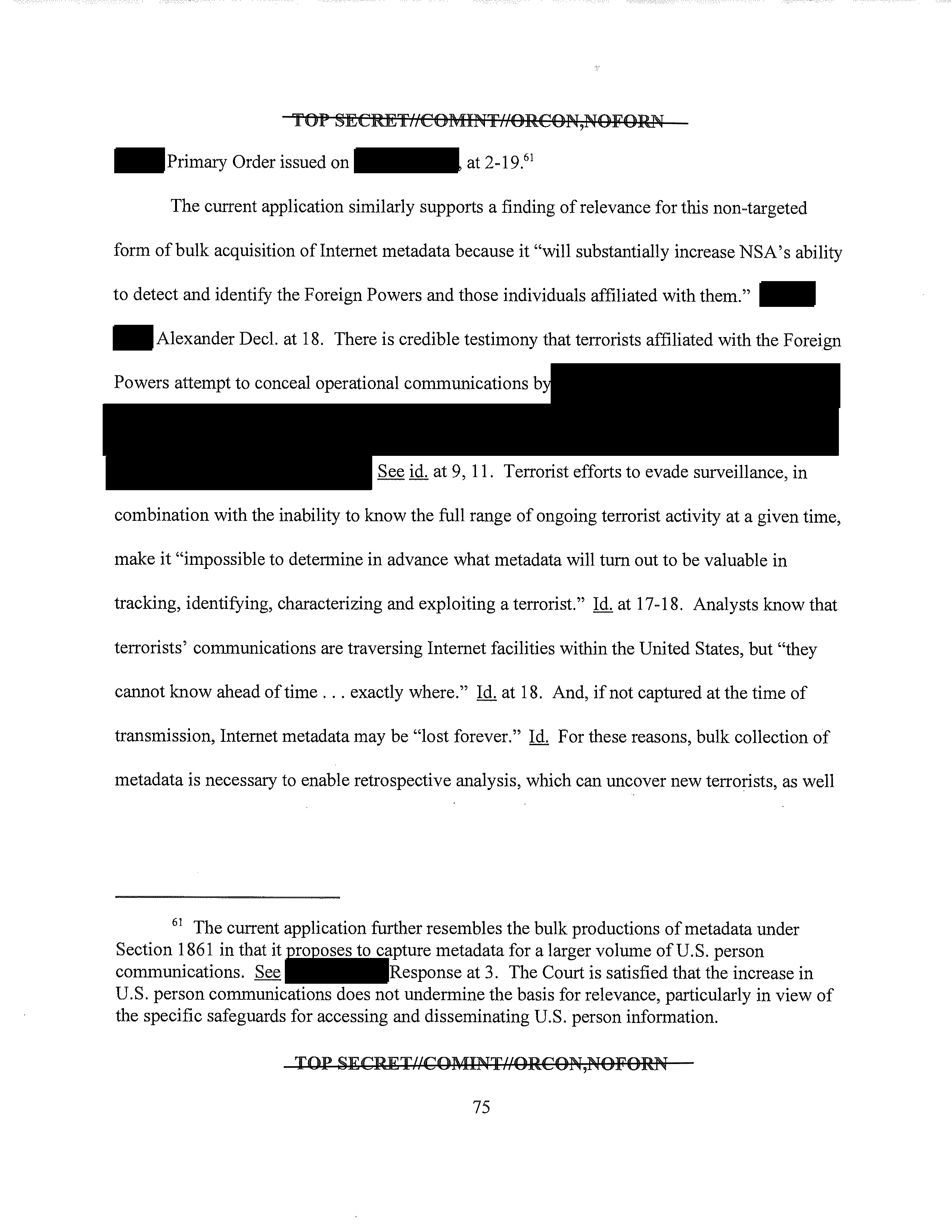
[REDACTED] Primary Order issued on [REDACTED] at 2-19.61
The current application similarly supports a finding of relevance for this non-targeted
form of bulk acquisition of Internet metadata because it “will substantially increase NSA’s ability
to detect and identify the Foreign Powers and those individuals affiliated with them.” [REDACTED]
[REDACTED] Alexander Decl. at 18. There is credible testimony that terrorists affiliated with the Foreign
Powers attempt to conceal operational communications by [REDACTED]
[REDACTED] See id. at 9, 11. Terrorist efforts to evade surveillance, in
combination with the inability to know the full range of ongoing terrorist activity at a given time,
make it “impossible to determine in advance what metadata will turn out to be valuable in
tracking, identifying, characterizing and exploiting a terrorist.” Id. at 17-18. Analysts know that
terrorists’ communications are traversing Internet facilities within the United States, but “they
cannot know ahead of time . . . exactly where.” Id. at 18. And, if not captured at the time of
transmission, Internet metadata may be “lost forever.” Id. For these reasons, bulk collection of
metadata is necessary to enable retrospective analysis, which can uncover new terrorists, as well
61
The current application further resembles the bulk productions of metadata under
Section 1861 in that it proposes to capture metadata for a larger volume of U.S. person
communications. See [REDACTED] Response at 3. The Court is satisfied that the increase in
U.S. person communications does not undermine the basis for relevance, particularly in view of
the specific safeguards for accessing and disseminating U.S. person information.
TOP SECRET//COMINT//ORCON,NOFORN
75
TOP SECRET//COMINT//ORCON,NOFORN
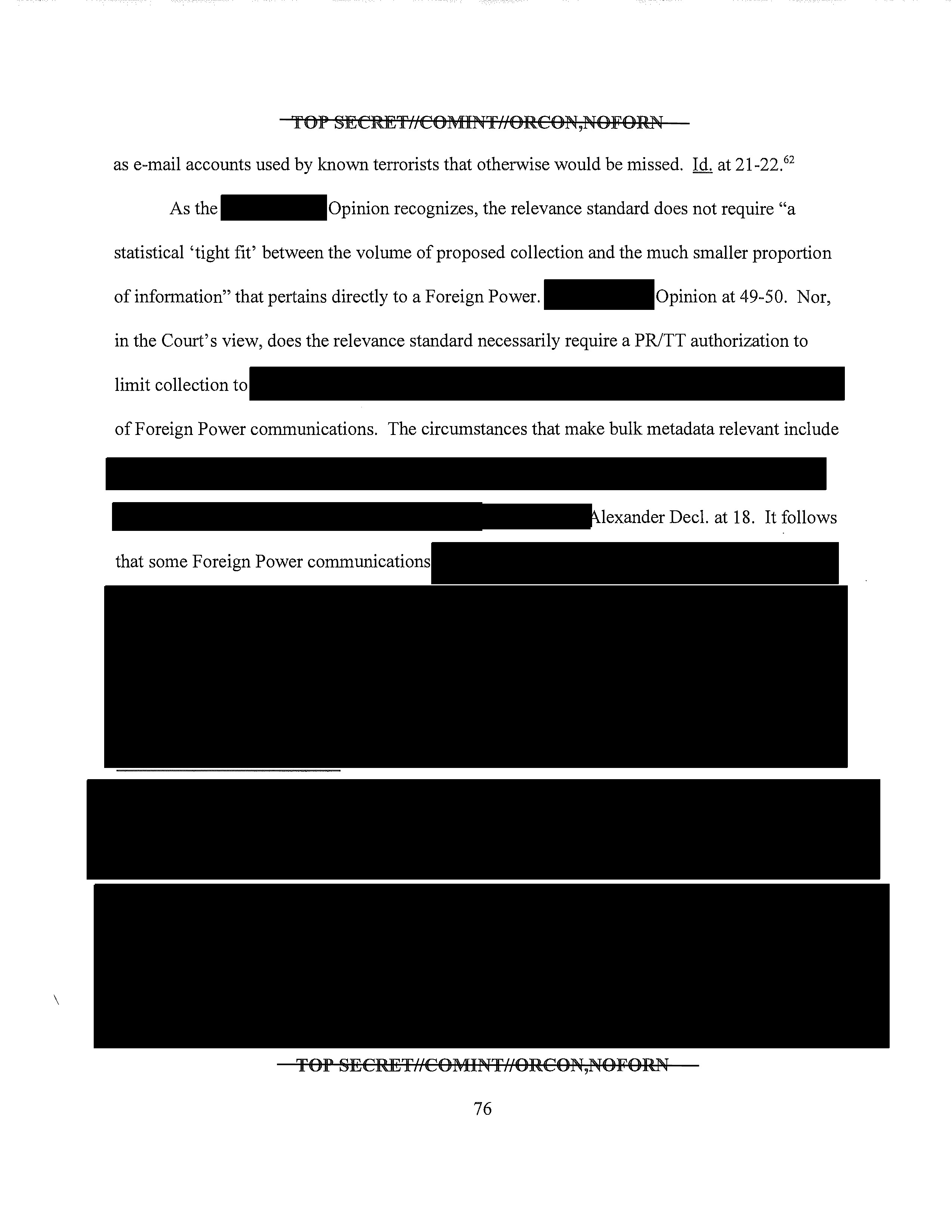
as e-mail accounts used by known terrorists that otherwise would be missed. Id. at 21-22.62
As the [REDACTED] Opinion recognizes, the relevance standard does not require “a
statistical 'tight fit' between the volume of proposed collection and the much smaller proportion
of information” that pertains directly to a Foreign Power. [REDACTED] Opinion at 49-50. Nor,
in the Court's view, does the relevance standard necessarily require a PR/TT authorization to
limit collection to [REDACTED] of Foreign Power communications. The circumstances that make bulk metadata relevant include
[REDACTED] Alexander Decl. at 18. It follows
that some Foreign Power communications
[REDACTED]
TOP SECRET//COMINT//ORCON,NOFORN
76
TOP SECRET//COMINT//ORCON,NOFORN
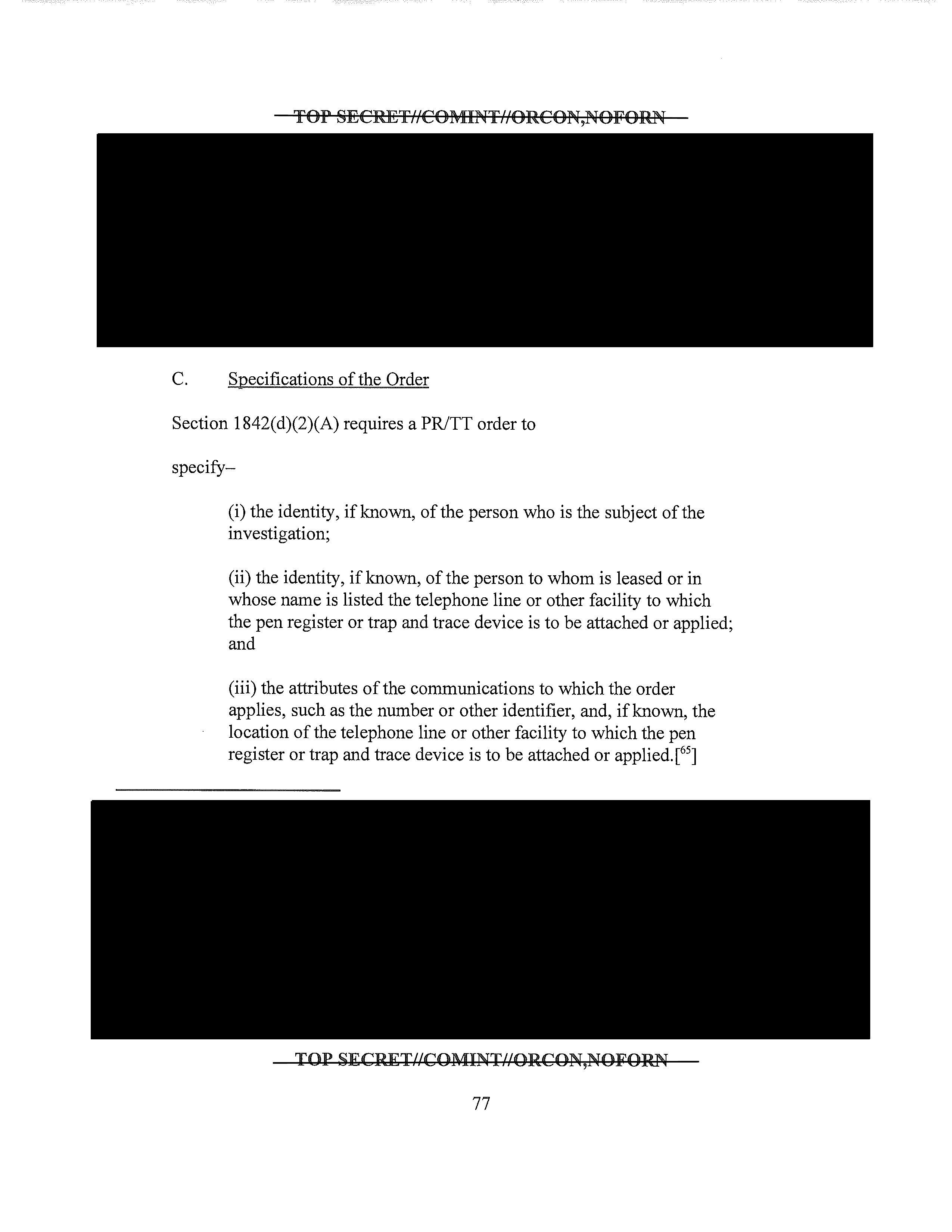
[REDACTED]
C. Specifications of the Order
Section 1842(d)(2)(A) requires a PR/TT order to
specify—
(i) the identity, if known, of the person who is the subject of the
investigation;
(ii) the identity, if known, of the person to whom is leased or in
whose name is listed the telephone line or other facility to which
the pen register or trap and trace device is to be attached or applied;
and
(iii) the attributes of the communications to which the order
applies, such as the number or other identifier, and, if known, the
location of the telephone line or other facility to which the pen
register or trap and trace device is to be attached or applied.[65]
[REDACTED]
TOP SECRET//COMINT//ORCON,NOFORN
77
TOP SECRET//COMINT//ORCON,NOFORN
In this case, the subjects of the relevant investigations are sufficiently identified, to the extent
known, as the enumerated Foreign Powers "and unknown persons in the United States and
abroad affiliated with the Foreign Powers."[REDACTED] Primary Order at 2-3.
[REDACTED]
TOP SECRET//COMINT//ORCON,NOFORN
78
TOP SECRET//COMINT//ORCON,NOFORN
[REDACTED]
[REDACTED]
67 See, e.g., Docket No. PR/TT [REDACTED] Application at 26 n.15, Primary Order issued on [REDACTED] at 3
TOP SECRET//COMINT//ORCON,NOFORN
79
TOP SECRET//COMINT//ORCON,NOFORN
[REDACTED]
[REDACTED]
At this pre-collection stage, it is uncertain to which facilities PR/TT devices will be
attached or applied during the pendency of the initial order. See pages 76-77, supra; [REDACTED]
Response at 1-2. For this reason, and because the Court is satisfied that other specifications
in the order will adequately demarcate the scope of authorized collection, the Court will issue an
order that does not identify persons pursuant to Section 1842(d)(2)(A)(ii). However, once this
surveillance is implemented, the government's state of knowledge may well change.
Accordingly, the Court expects the government in any future application to identify persons (as
described in Section 1842(d)(2)(A)(ii)) who are known to the government for any facility that the
government knows will be subjected to PR/TT surveillance during the period covered by the
requested order.
Section 1842(d)(2)(A)(iii) requires the order to specify “the attributes of the
communications to which the order applies, such as the number or other identifier, and, if known,
the location of the telephone line or other facility to which the pen register or trap and trace
device is to be attached or applied.” The order specifies the location of each facility. The Court
is also satisfied that “the attributes of the communications to which the order applies” are
TOP SECRET//COMINT//ORCON,NOFORN
80
TOP SECRET//COMINT//ORCON,NOFORN
appropriately specified. Acquisition of particular forms of metadata (described in Part II, supra)
is authorized for all e-mail [REDACTED] communications traversing any of the
communications facilities at the specified locations. This form of specification is consistent with
the language of Section 1842(d)(2)(A)(iii) and is sufficient to delineate the scope of authorized
acquisition from that which is not authorized. 68
IV. The Court Approves, Subject to Modifications, the Restrictions and Procedures Proposed
by the Government For the Retention, Use, and Dissemination of the PR/TTMetadata
Unlike other provisions of FISA, the PR/TT provisions of the statute do not expressly
require the adoption and use of minimization procedures. Compare 50 U.S.C. §§ 1805(c)(2)(A)
& 1824(c)(2)(A) (providing that orders authorizing electronic surveillance or physical search
must direct that minimization procedures be followed). Accordingly, routine FISA PR/TT orders
do not require that minimization procedures be followed. The government acknowledges,
however, that the application now before the Court is not routine. As discussed above, the
government seeks to acquire information concerning [REDACTED] electronic communications, the
vast majority of which, viewed individually, are not relevant to the counterterrorism purpose of
the collection, and many of which involve United States persons. In light of the sweeping and
non-targeted nature of the collection for which authority is sought, the government proposes a
[REDACTED]
TOP SECRET//COMINT//ORCON,NOFORN
81
TOP SECRET//COMINT//ORCON,NOFORN
number of restrictions on retention, use, and dissemination, some of which the government refers
to as “minimization” procedures. See, e.g., Memorandum of Law at 4, 17. The restrictions now
proposed by the government are similar, but not identical, to the rules that were adopted by the
Court in its [REDACTED] Order in Docket Number PR/TT [REDACTED]
Order”), the most recent order authorizing bulk PR/TT collection by NSA.
Absent any suggestion by the government that a different standard should apply, the
Court is guided in assessing the proposed restrictions by the definition of minimization
procedures in 50 U.S.C. § 1801(h).69 Because procedures satisfying that definition are sufficient
69 Section 1801(h) defines “minimization procedures” in pertinent part as follows:
(1) specific procedures, which shall be adopted by the Attorney General, that are
reasonably designed in light of the purpose and technique of the particular
surveillance, to minimize the acquisition and retention, and prohibit the
dissemination, of nonpublicly available information concerning unconsenting
United States persons consistent with the need of the United States to obtain,
produce, and disseminate foreign intelligence information;
(2) procedures that require that nonpublicly available information, which is not
foreign intelligence information, as defined in [50 U.S.C. § 1801(e)(1)], shall not
be disseminated in a manner that identifies any United States person, without such
person’s consent, unless such person’s identity is necessary to understand foreign
intelligence information or assess its importance; [and]
(3) notwithstanding paragraphs (1) and (2), procedures that allow for the retention
and dissemination of information that is evidence of a crime which has been, is
being, or is about to be committed and that is to be retained or disseminated for
law enforcement purposes[.]
. . .
50 U.S.C. § 1801(h).
TOP SECRET//COMINT//ORCON,NOFORN
82
TOP SECRET//COMINT//ORCON,NOFORN
under FISA to protect the privacy interests of United States persons with respect to the
acquisition, use, and dissemination of the contents of communications, restrictions meeting the
same standard are also at least adequate in the context of the collection and use of non-content
metadata. Guided by the Section 1801(h) standard, the Court concludes, for the reasons stated
below, that the procedures proposed by the government, subject to the modifications described
below, are reasonably designed in light of the nature and purpose of the bulk PR/TT collection to
protect United States person information, and to ensure that the information acquired is used and
disseminated in furtherance of the counterterrorism purpose of the collection.
A. Storage and Traceability
NSA will continue to store the PR/TT data that it retains in repositories within secure
networks under NSA's control. [REDACTED] Alexander Decl. at 24. As was the case under the
[REDACTED] Order, the data collected pursuant to the authority now sought by the
government will carry unique markings that render it distinguishable from information collected
by NSA pursuant to other authorities. [REDACTED] Response at 15; see also Declaration of
[REDACTED] NSA, filed on [REDACTED] in Docket No. PR/TT [REDACTED]
Decl.") at 14 n.8. The markings, which are applied to the data before it is made available
for analytic querying and remain attached to the information as it is stored in metadata
repositories, see [REDACTED] Response at 15, are designed to ensure that software and other
controls (such as user authentication tools) can restrict access to the PR/TT data solely to
authorized personnel who have received appropriate training regarding the special rules for using
TOP SECRET//COMINT//ORCON,NOFORN
83
TOP SECRET//COMINT//ORCON,NOFORN
and disseminating such information. See [REDACTED] Alexander Decl. at 24-25;
[REDACTED] Decl. at 14 n.8. After PR/TT metadata is queried in accordance with the procedures
described below, the query results (including analytic output based on query results) will remain
identifiable as bulk PR/TT-derived information. See [REDACTED] Response at 15. Such
traceability enables NSA personnel to adhere to the special rules for disseminating PR/TT-
derived information that are described below.
B. Access to the Metadata by Technical Personnel for Non-Analytic Purposes
Under the approach proposed by the government, "[t]rained and authorized technical
personnel" will be permitted to access the metadata to ensure that it is “usable for intelligence
analysis." Id. at 25. For example, such personnel may access the metadata to perform processes
designed to prevent the collection, processing, or analysis of metadata associated with [REDACTED]
[REDACTED] to create and
maintain records necessary to demonstrate compliance with the terms of authority granted; or to
develop and test technologies for possible use with the metadata. Id.¹ Similar non-analytic
70 The government has explained that "[q]uery results could include information
provided orally or in writing, and could include a tip or a lead (e.g., 'A query on RAS-approved
identifier A revealed a direct contact with identifier Z'), a written or electronic depiction of a
chain or pattern, a compilation or summary of direct or indirect contacts of a RAS-approved
seed, a draft or finished report, or any other information that would be returned following a
properly predicated PR/TT query." [REDACTED] Response at 15 n.6.
71 An authorized NSA technician may query the metadata with a non-RAS-approved
identifier for the limited purpose of determining whether such identifier is an unwanted [REDACTED]
[REDACTED] Alexander Decl. at 25. After recognizing a [REDACTED]
(continued...)
TOP SECRET//COMINT//ORCON,NOFORN
84
TOP SECRET//COMINT//ORCON,NOFORN
access by appropriately trained and authorized technical personnel was permitted under the [REDACTED] Order. See [REDACTED] Order at 10.
C. Access by Analysts
NSA analysts will query the metadata that is collected only with RAS-approved “seed” identifiers, in accordance with the same basic framework that was approved by the Court in the [REDACTED] Order. See [REDACTED] Alexander Decl. at 26-27; [REDACTED] Order at 7-9.
An identifier may be approved for use as a querying seed in one of two ways. First, an identifier may be used as a seed after a designated “approving official” (i.e., the Chief or Deputy Chief of NSA's Homeland Analysis Center, or one of 20 authorized Homeland Mission Coordinators72) determines that the available facts give rise to a reasonable articulable suspicion that the identifier is associated with one of the targeted Foreign Powers. [REDACTED] Alexander Decl. at 26-27. Before querying can be performed using an identifier that is reasonably believed to be used by a United States person, NSA's Office of General Counsel (OGC) must determine that the identifier is not regarded as associated with a Foreign Power solely based on activities that are
71(...continued)
[REDACTED] through such a query, the NSA technician could share the query results - i.e., the identifier and the fact that it is a [REDACTED] with other NSA personnel responsible for the removal of unwanted metadata from NSA's repositories, but would not be permitted to share any other information from the query. Id. at 25-26.
72 The [REDACTED] Order identified one approving official in addition to the 22 officials listed here. See [REDACTED] Order at 8 (listing the Chief, Special FISA Oversight and Processing, Oversight and Compliance, Signals Intelligence Directorate as one of the 23 approving officials).
TOP SECRET//COMINT//ORCON,NOFORN
85
TOP SECRET//COMINT//ORCON,NOFORN
protected by the First Amendment. Id. at 27. Second, an identifier that is the subject of
electronic surveillance or physical search pursuant to 50 U.S.C. § 1805 or § 1824 based on this
Court's finding of probable cause that such identifier is used by an agent of a Foreign Power may
be deemed RAS-approved without review by an NSA designated approving official. Id.
As was the case under the Court's [REDACTED] Order and prior orders in this matter,
RAS-approved queries of the collected data will take the form of “contact chaining." Id. at 18.
Such queries yield data for all communications within two "hops" of the RAS-approved seed. Id.
The first hop acquires data regarding all identifiers that have been in contact with the seed, and
the second hop yields data for all identifiers in contact with identifiers that were revealed by the
first hop. Id. at 18 n.12. The government asserts, and the Court has previously accepted, that
"[g]oing out to the second 'hop' enhances NSA's ability to find, detect and identify the Foreign
Powers and those affiliated with them by greatly increasing the chances that previously unknown
Foreign Power-associated identifiers may be uncovered." Id. at 18-19 n.12; [REDACTED]
Opinion and Order at 48.73
73 NSA also intends to perform [REDACTED]
The government has clarified in connection with this
application, however, that [REDACTED] is not used as a means for querying the metadata, but
instead is applied only to the results of RAS-approved contact-chaining queries. See [REDACTED]
Response at 16.
TOP SECRET//COMINT//ORCON,NOFORN
86
TOP SECRET//COMINT//ORCON,NOFORN
The government's proposed RAS-approval and querying process differs in two
noteworthy respects from the approach previously approved by the Court. First, unlike RAS
approvals made pursuant to the [REDACTED] Order and prior orders in this matter, 74 RAS
approvals made under the approach now proposed by the government will expire after a specified
time. A determination by a designated approving official for an identifier reasonably believed to
be used by a United States person would be effective for 180 days, while such a determination
for any other identifier would last for one year. [REDACTED] Alexander Decl. at 27. An
identifier deemed approved based on FISC-authorized electronic surveillance or physical search
will be subject to use as a seed for the duration of the FISC authorization. Id. The adoption of
fixed durations for RAS approvals will require the government at regular intervals to renew its
RAS assessments for identifiers that it wishes to continue to use as querying "seeds." The re-
evaluations that will be required under the proposed approach can be expected to increase the
likelihood that query results are relevant to the counterterrorism purpose of the bulk metadata
collection and to reduce the amount of irrelevant query results (including information regarding
74 Previously, approved identifiers remained eligible for querying until they were
affirmatively removed from the list of approved "seed" accounts. The government's practice was
to remove identifiers from the list only "[w]hen NSA receive[d] information that suggest[ed] that
a RAS-approved e-mail address [was] no longer associated with one of the Foreign Powers";
implicitly, the mere passage of time without new information did not obligate the government to
revoke a RAS approval. See Docket No. PR/TT [REDACTED] NSA 90-Day Report to the Foreign
Intelligence Surveillance Court filed on [REDACTED] at 6. The government had informed the
Court on [REDACTED] that it was "developing a framework within which to revalidate, and
when appropriate, reverse . . . RAS approvals," id. at 6, but it does not appear that the new
framework had been implemented before the expiration of the Court's [REDACTED] Order on [REDACTED]
TOP SECRET//COMINT//ORCON,NOFORN
87
TOP SECRET//COMINT//ORCON,NOFORN
United States persons) that is yielded.
The second proposed change to the process involves the number of NSA personnel
permitted to perform RAS-approved queries. Unlike the [REDACTED] Order and prior orders
in this matter, which limited the number of analysts permitted to run such queries, the re-
initiation proposed by the government has no such limitation. See Id. at 26 n.18; [REDACTED]
Order at 7. The government instead proposes the use of "technical controls" to "block any
analytic query of the metadata with a non-RAS-approved seed." [REDACTED] Alexander Decl. at
26 n.18. The government further notes that all analytic queries will continue to be logged, and
that the creation and maintenance of auditable records will "continue to serve as a compliance
measure." Id.; see also [REDACTED] Order at 7. In light of the safeguards noted by the
government, and the additional fact that no identifier will be eligible for use as a querying seed
without having first been approved for querying by a designated approving official (or deemed
approved by virtue of a FISC order), the Court is satisfied that it is unnecessary to limit the
number of NSA analysts eligible to conduct RAS-approved queries.
D. Sharing of Query Results Within NSA
The government's proposal for sharing query results within NSA is similar to the
approach approved by the Court last year. The [REDACTED] Order provided, subject to a
proviso that is discussed below, that the unminimized results of RAS-approved queries could be
"shared with other NSA personnel, including those who are not authorized to access the PR/TT
metadata." [REDACTED] Order at 11. The basis for such widespread sharing of query results
TOP SECRET//COMINT//ORCON,NOFORN
88
TOP SECRET//COMINT//ORCON,NOFORN
within NSA was the government's assertion that analysts throughout the agency address
counterterrorism issues as part of their missions and, therefore, have a need for the information. 75
Presumably for the same reason, the government proposes in the application now before the
Court that the results of RAS-approved queries be available to all NSA analysts for intelligence
purposes, and that such analysts be allowed to apply "the full range of SIGINT analytical
tradecraft" to the query results. [REDACTED] Alexander Decl. at 28 n.19.76 The Court is satisfied
75
In a declaration filed in Docket Number PR/TT [REDACTED] late last year, the Director of
NSA explained that:
NSA's collective expertise in the[] Foreign Powers resides in more than [REDACTED]
intelligence analysts, who sit, not only in the NSA's Counterterrorism Analytic
Enterprise, but also in other NSA organizations or product lines. Analysts from other
product lines also address counterterrorism issues specific to their analytic missions and
expertise. For example, the International Security Issues product line pursues foreign
intelligence information on [REDACTED] including [REDACTED]
The mission of the Combating Proliferation product line includes
identifying connections between proliferators of weapons of mass destruction and
terrorists, including those associated with the Foreign Powers. The International Crime
and Narcotics product line identifies connections between terrorism and human or nuclear
smuggling or other forms of international crime. . . . Each of the NSA's ten product lines
has some role in protecting the Homeland from terrorists, including the Foreign Powers.
Because so many analysts touch upon terrorism information, it is impossible to estimate
how many analysts might be served by access to the PR/TT results.
[REDACTED] Report, Exhibit A at 5-6.
76 The [REDACTED] Order did not explicitly authorize NSA analysts to apply the "full
range of SIGINT tools” to PR/TT query results, but, at the same time it placed no limit on the
analytical tools or techniques that could be applied by the trained analysts who were entitled to
have access to query results. Accordingly, the Court views the express reference to "the full
range of analytic tools" in the government's proposal as a clarification of prior practice that the
Court, in any event, approves.
TOP SECRET//COMINT//ORCON,NOFORN
89
TOP SECRET//COMINT//ORCON,NOFORN
that such internal sharing remains appropriate, subject to the training requirement that is
discussed below.
E. Dissemination Outside NSA
The government's proposed rules for disseminating PR/TT-derived information outside
of NSA are slightly different from the procedures that were previously in place. Under the
[REDACTED] Order, NSA was required to "treat information from queries of the PR/TT
metadata in accordance with United States Signals Intelligence Directive 18 (USSID 18)" –
NSA's standard procedures for handling Signals Intelligence collection – and to "apply USSID
18 to minimize information concerning U.S. persons obtained from the pen registers and trap and
trace devices authorized herein." [REDACTED] Order at 12. In addition,
> before NSA disseminate[d] any U.S. person identifying information outside of NSA, the
> Chief of Information Sharing Services in the Signals Intelligence Directorate, the Senior
> Operations Officer at NSA's National Security Operations Center, the Signals
> Intelligence Directorate Director, the Deputy Director of NSA, or the Director of NSA
> [was required to] determine that the information identifying the U.S. person [was] in fact
> related to counterterrorism information and that it [was] necessary to understand the
> counterterrorism information or assess its importance.
Id.
The government's proposal has the same two basic elements, although they are worded
slightly differently. First, NSA “will apply the minimization and dissemination procedures of
Section 7 of [USSID 18] to any results from queries of the metadata disseminated outside of
NSA in any form." [REDACTED] Alexander Decl. at 28. Second,
prior to disseminating any U.S. person information outside NSA, one of the officials
listed in Section 7.3(c) of USSID 18 (<u>i.e.</u>, the Director of NSA, the Deputy Director of
TOP SECRET//COMINT//ORCON,NOFORN
90
TOP SECRET//COMINT//ORCON,NOFORN
NSA, the Director of the Signals Intelligence Directorate (SID), the Deputy Director of
the SID, the Chief of the Information Services (ISS) office, the Deputy Chief of the ISS
office, and the Senior Operation Officer of the National Security Operations Center) must
determine that the information identifying the U.S. person is in fact related to
counterterrorism information and that it is necessary to understand the counterterrorism
information or assess its importance.
Id.
The differences are not material. Although the proposal refers specifically to "the
minimization and dissemination procedures of Section 7 of [USSID 18]" rather than to USSID
18 generally, the Court does not understand any difference in meaning to be intended; indeed,
Section 7 is the portion of USSID 18 that specifically covers disseminations outside NSA. See
[REDACTED] Application, Tab C (USSID 18), at 8-10. With regard to the application of the
counterterrorism purpose requirement, the proposal adds two high-ranking NSA officials (the
Deputy Director of the SID and the Deputy Chief of the ISS office) to the list of five officials
who were previously designated to make the required determination. The Court is aware of no
reason to think that the two additional officials are less suited than the other five to make the
required determination, or that their designation as approving officials will undermine the
internal check that is provided by having high-ranking NSA officials approve disseminations that
include United States person identifying information.77
77 Like the [REDACTED] Order, the government's proposal would also permit NSA to
"share results derived from intelligence analysis queries of the metadata, including U.S. person
identifying information, with Executive Branch personnel . . . in order to enable them to
determine whether the information contains exculpatory or impeachment information or is
otherwise discoverable in legal proceedings." [REDACTED] Alexander Decl. 28-29; see also
[REDACTED] (continued...)
TOP SECRET//COMINT//ORCON,NOFORN
91
TOP SECRET//COMINT//ORCON,NOFORN
The government's proposal contains one additional element that was not part of the
framework approved by the Court in the [REDACTED] Order. Specifically, the government
proposes that "[i]n the extraordinary event that NSA determines that there is a need to
disseminate information identifying a U.S. person that is related to foreign intelligence
information, as defined by 50 U.S.C. § 1801(e), other than counterterrorism information and that
is necessary to understand the foreign intelligence information or assess its importance, the
Government will seek prior approval from the Court." [REDACTED] Alexander Decl. at 28 n.20.
Insofar as the government's proposal invites the Court to review and pre-approve individual
disseminations of information based upon the Court's own assessments of foreign intelligence
value, the Court declines the invitation. The judiciary is ill-equipped to make such assessments,
which involve matters on which the courts generally defer to the Executive Branch.78 In the
7"(...continued)
[REDACTED] Order at 12-13. The government's current proposal also permits such sharing with
Executive Branch personnel "to facilitate their lawful oversight functions." [REDACTED] Alexander Decl. at 29. Although the [REDACTED] order did not contain an explicit provision
to this effect, sharing for such purposes was plainly contemplated. See, e.g., [REDACTED] Order at 16 (providing for NSD review of RAS querying justifications).
78
See, e.g., Holder v. Humanitarian Law Project, — U.S. —, 2010 WL 2471055, *22
(June 21, 2010) ("[W]hen it comes to collecting evidence and drawing factual inferences in [the
national security] area, the lack of competence on the part of the courts is marked.") (citation and
internal quotation marks omitted); Reno v. American-Arab Anti-Discrimination Comm., 525
U.S. 471, 491 (1999) ("a court would be ill-equipped to determine [the] authenticity and utterly
unable to assess [the] adequacy" of the executive's security or foreign policy reasons for treating
certain foreign nationals as a "special threat"); Regan v. Wald, 468 U.S. 222, 243 (1984) (giving
the "traditional deference to executive judgment" in foreign affairs in sustaining President's
decision to restrict travel to Cuba against a due process challenge).
TOP SECRET//COMINT//ORCON,NOFORN
92
TOP SECRET//COMINT//ORCON,NOFORN
event, however, that NSA encounters circumstances that it believes necessitate alteration of the
dissemination procedures that have been approved by the Court, the government may obtain
prospectively-applicable modifications to those requirements upon a determination by the Court
that such modifications are appropriate under the circumstances and in light of the sweeping and
non-targeted nature of the PR/TT collection. Cf. Standard Minimization Procedures for FBI
Electronic Surveillance and Physical Search § I.D (on file with the Court in Docket No. 08-
1833).
F. Retention
Under the [REDACTED] Order, the PR/TT metadata was available for querying for
four and one-half years, after which it had to be destroyed. [REDACTED] Order at 13. The four-
and-one-half-year retention period was originally set based upon NSA's assessment of how long
collected metadata is likely to have operational value. See [REDACTED] Opinion at 70-71.
Pursuant to the government's proposal, the retention period would be extended to five years.
[REDACTED] Application at 13. The government asserts that the purpose of the change is to
"develop and maintain consistency" with the retention period for NSA's bulk telephony metadata
collection, which is authorized by this Court under the FISA business records provision, 50
U.S.C. § 1861. [REDACTED] Response at 24. The Court is satisfied that the relatively small
extension of the retention period that is sought by the government is justified by the
administrative benefits that would result.
TOP SECRET//COMINT//ORCON,NOFORN
93
TOP SECRET//COMINT//ORCON,NOFORN
G. Oversight
The government proposes to employ an internal oversight regime that closely tracks the
oversight provisions adopted by the Court in the [REDACTED] Order, requiring, among other
things, that NSA OGC and NSD take various steps to ensure that the data is collected and
handled in accordance with the scope of the authorization. Compare [REDACTED] Order at 13-
16, with [REDACTED] Alexander Decl. at 29-30. There is, however, one significant difference.
The [REDACTED] Order required NSA OGC to ensure that all NSA personnel permitted to
access the metadata or receive query results were first “provided the appropriate and adequate
training and guidance regarding the procedures and restrictions for storage, access, and
dissemination of the PR/TT metadata and/or PR/TT metadata-derived information, i.e., query
results.” [REDACTED] Order at 13-14. The analogous oversight provision in the government's
current proposal, by contrast, directs NSA OGC and the Office of the Director of Oversight and
Compliance (ODOC) to ensure that adequate training and guidance is provided to NSA personnel
having access to the metadata, but not to those receiving query results. See [REDACTED]
Alexander Decl. at 29. As discussed above, the government has proposed special rules and
restrictions on the handling and dissemination of query results. Most notably, PR/TT query
results must remain identifiable as bulk PR/TT-derived information, see [REDACTED] Response
at 15, and may not be disseminated outside NSA without the prior determination by a designated
official that any United States person information relates to counterterrorism information and that
it is necessary to understand the counterterrorism information or to assess its importance. [REDACTED]
TOP SECRET//COMINT//ORCON,NOFORN
94
TOP SECRET//COMINT//ORCON,NOFORN
[REDACTED] Alexander Decl. at 28. To follow those rules, NSA personnel must know and understand
them.
As noted above, NSA's record of compliance with these rules has been poor. Most
notably, NSA generally disregarded the special rules for disseminating United States person
information outside of NSA until it was ordered to report such disseminations and certify to the
FISC that the required approval had been obtained. See pages 18-19, supra. The government has
provided no meaningful explanation why these violations occurred, but it seems likely that
widespread ignorance of the rules was a contributing factor.
Accordingly, the Court will order NSA OGC and ODOC to ensure that all NSA personnel
who receive PR/TT query results in any form first receive appropriate and adequate training and
guidance regarding the procedures and restrictions for the handling and dissemination of such
information.
H. Reporting
The reporting requirements proposed by the government are similar to the reporting
requirements adopted by the Court in the [REDACTED] Order. Compare
Alexander Decl. at 31, with [REDACTED] Order at 16-18. As was previously the case, the
government will submit reports to the Court approximately every 30 days and upon requesting
any renewal of the authority sought. Se[REDACTED] Alexander Dec. at 31. The 30-day reports
will include "a discussion of the queries made since the last report and NSA's application of the
RAS standard." Id. Because NSA will not apply the requested authority to particular
TOP SECRET//COMINT//ORCON,NOFORN
95
TOP SECRET//COMINT//ORCON,NOFORN
[REDACTED] however, the 30-day reports will no longer include a discussion of "changes in the
description of the [REDACTED] , or in the nature of the communications carried thereon.” See
[REDACTED] Order at 16. Like the [REDACTED] Order, the government's proposal will also
require it, upon seeking renewal of the requested authority, to file a report describing "any new
facility proposed to be added" and "any changes proposed in the collection methods." [REDACTED]
Alexander Decl. at 31.
The [REDACTED] Order also directed the government to submit weekly reports listing
each instance in which “NSA has shared, in any form, information obtained or derived from the
PR/TT metadata with anyone outside NSA,” including a certification that the requirements for
disseminating United States person information (i.e., that a designated official had determined
that any such information related to counterterrorism information and was necessary to
understand counterterrorism information or to assess its importance) had been followed. See
[REDACTED] Order at 17. The government’s proposal does not include such a requirement.
In light of NSA’s historical problems complying with the requirements for disseminating PR/TT-
derived information, the Court is not prepared to eliminate this reporting requirement altogether.
At the same time, the Court does not believe that weekly reports are still necessary to ensure
compliance. Accordingly, the Court will order that the 30-day reports described in the preceding
paragraph include a statement of the number of instances since the preceding report in which
NSA has shared, in any form, information obtained or derived from the PR/TT metadata with
anyone outside NSA. For each such instance in which United States person information has been
TOP SECRET//COMINT//ORCON,NOFORN
96
TOP SECRET//COMINT//ORCON,NOFORN
shared, the report must also include NSA's attestation that one of the officials authorized to
approve such disseminations determined, prior to dissemination, that the information was related
to counterterrorism information and necessary to understand the counterterrorism information or
to assess its importance.
V. The Government's Request for Authority to Access and Use All
Previously Collected Data
The government seeks authority to access and use all previously acquired bulk PR/TT
data, including information not authorized for collection under the Court's prior orders, subject
to the same restrictions and procedures that will apply to newly-acquired PR/TT collection. See
[REDACTED] Application at 16. For the following reasons, the Court will grant the government's
request in part and deny it in part.
A. The [REDACTED] Order
As discussed above, after the government disclosed the continuous and widespread
collection of data exceeding the scope of the Court's prior orders dating back to [REDACTED] it elected
not to seek renewal of the authority granted in the [REDACTED] Order. The government was
unable, before the expiration of that authority on [REDACTED] to determine the extent to
which the previously-acquired information exceeded the scope of the Court's orders or to rule
out the possibility that some of the information fell outside the scope of the pen register statute.
See [REDACTED] Order at 2-4. Accordingly, as an interim measure, Judge Walton entered an
order on [REDACTED] directing the government not to access the information previously
TOP SECRET//COMINT//ORCON,NOFORN
97
TOP SECRET//COMINT//ORCON,NOFORN
obtained “for any analytic or investigative purpose,” except when such access is “necessary to
protect against an imminent threat to human life.” See [REDACTED] Order at 4-5; see also page
23, supra.
The application now before the Court includes a request to lift the [REDACTED] Order.
See [REDACTED] Application at 16. Since [REDACTED], both the Court and the
government have had the opportunity to make a thorough assessment of the scope and
circumstances of the overcollection and to consider the pertinent legal issues. Based on that
assessment, the Court believes that it is now appropriate to rescind the [REDACTED]
Order, which, as noted, was intended to be an interim measure, and to refine the rules for
handling the prior bulk PR/TT collection.
B. The Court Lacks Authority to Grant the Government's Request in its Entirety
The Court concludes that it has only limited authority to grant the government’s request
for permission to resume accessing and using previously-collected information. As discussed in
more detail below, the Court concludes that it possesses authority to permit the government to
query data collected within the scope of the Court’s prior orders, and that it is appropriate under
the circumstances to grant such approval. But for information falling outside the scope of the
prior orders, the Court lacks authority to approve any use or disclosure that would be prohibited
under 50 U.S.C. § 1809(a)(2). Accordingly, the Court will deny the government’s request with
respect to those portions of the unauthorized collection that are covered by Section 1809(a)(2).
To the extent that other portions of the unauthorized prior collection may fall outside the reach of
TOP SECRET//COMINT//ORCON,NOFORN
98
TOP SECRET//COMINT//ORCON,NOFORN
Section 1809(a)(2), the Court concludes that it has authority to grant the government's request
and that it is appropriate under the circumstances to do so.
- Information Authorized for Acquisition Under the Court's Prior Orders
The government argues that the FISA PR/TT statute, 50 U.S.C. § 1842, empowers the
Court to authorize NSA to resume querying the prior collection in its entirety. See Memorandum
of Law at 72-73. As discussed above, the Court continues to be satisfied that it may, pursuant to
Section 1842 and subject to appropriate restrictions, authorize NSA to acquire, in bulk, the
metadata associated with Internet communications transiting the United States. Further, although
Section 1842 does not explicitly require the application of minimization procedures to PR/TT-
acquired information, the Court also agrees that in light of the sweeping and non-targeted nature
of this bulk collection, it has authority to impose limitations on access to and use of the metadata
that NSA has accumulated.
The Court is satisfied that it may invoke the same authority to permit NSA to resume
querying the PR/TT information that was collected in accordance with the Court's prior orders.
The Court is further persuaded that, in light of the government's assertion of national security
need, it is appropriate to exercise that authority. Accordingly, the Court hereby orders that the
government may access, use, and disseminate bulk PR/TT information that was collected in
79 See [REDACTED] Alexander Decl. at 10 n.6 ("The ability of NSA to access the
information collected under docket number PR/TT [REDACTED] and previous dockets is vital to NSA's
ability to carry out its counterterrorism intelligence mission. If NSA is not able to combine the
information it collects prospectively with the information it collected [previously], there will be a
substantial gap in the information available to NSA.").
TOP SECRET//COMINT//ORCON,NOFORN
99
TOP SECRET//COMINT//ORCON,NOFORN
accordance with the terms of the Court's prior orders, subject to the procedures and restrictions
discussed herein that will apply to newly-acquired metadata.
2. Information Not Authorized for Acquisition Under the Court's Prior
Orders
By contrast, the Court is not persuaded that it has authority to grant the government's
request with respect to all information collected outside the scope of its prior orders. FISA itself
precludes the Court from granting that request in full.
a. 50 U.S.C. § 1809(a)(2) Precludes the Court from Granting the
Government's Request with Respect to Some of the Prior
Unauthorized Collection
The crucial provision of FISA, 50 U.S.C. § 1809, provides, in pertinent part, as follows:
(a) Prohibited Activities
A person is guilty of an offense if he intentionally –
(2) discloses or uses information obtained under color of law by electronic surveillance,
knowing or having reason to know that the information was obtained through electronic
surveillance not authorized by this chapter, chapter 119, 121, or 206 of Title 18 or any
express statutory authorization that is an additional exclusive means for conducting
electronic surveillance under section 1812 of this title.
50 U.S.C. § 1809(a)(2).
Section 1809(a)(2) has three essential elements: (1) the intentional disclosure or use of
information (2) obtained under color of law through electronic surveillance (3) by a person
knowing or having reason to know that the information was obtained through electronic
surveillance not authorized by one of the enumerated (or similar) statutory provisions. The
TOP SECRET//COMINT//ORCON,NOFORN
100
TOP SECRET//COMINT//ORCON,NOFORN
government’s request to access, use, and disseminate the fruits of the prior unauthorized
collection implicates all three elements of Section 1809(a)(2)’s criminal prohibition.
Application of the first two elements is straightforward. Plainly, conducting contact
chaining inquiries of stored data and sharing the query results both within and outside NSA
would constitute the intentional use and disclosure of information.⁸⁰ It is also clear that the data
previously collected by the government – which was acquired through the use of orders issued by
this Court pursuant to FISA – was obtained “under color of law.” See West v. Atkins, 487 U.S.
42, 49-50 (1988) (explaining that the misuse of authority possessed by virtue of law is action
“under color of law”).⁸¹
The third element requires lengthier discussion, but, in summary, the Court concludes
that some of the prior bulk PR/TT collection is information that the responsible government
officials know or have reason to know was obtained through electronic surveillance not
authorized by one of the statutory provisions referred to in Section 1809(a)(2). To begin with,
⁸⁰ Insofar as the government contends that Section 1809(a)(2) reaches only “intentional
violations of the Court’s orders,” or “willful” as opposed to intentional conduct, see
Memorandum of Law at 74 n. 37, the Court disagrees. The plain language of the statute requires
proof that the person in question “intentionally” disclosed or used information “knowing or with
reason to know” the information was obtained in the manner described.
⁸¹ The phrase “a person” in Section 1809 is certainly intended to cover government
officials. In addition to requiring conduct “under color of law,” the statute provides an
affirmative defense to prosecution for a “law enforcement or investigative officer engaged in the
course of his official duties” in connection with electronic surveillance “authorized by and
conducted pursuant to a search warrant or court order of a court of competent jurisdiction.” See
50 U.S.C. § 1809(b).
TOP SECRET//COMINT//ORCON,NOFORN
101
TOP SECRET//COMINT//ORCON,NOFORN
the language of Section 1809(a)(2) demonstrates that Congress intended at least some
unauthorized PR/TT acquisitions to be covered by the criminal prohibition. The statute expressly
reaches, among other things, information obtained through "electronic surveillance not
authorized by this chapter, [or] chapter 119, 121, or 206 of Title 18." Section 1809 is part of
Chapter 36 of Title 50 of the U.S. Code. Chapter 36, in turn, encompasses all of FISA, as
codified in Title 50, including FISA's PR/TT provisions found at 50 U.S.C. §§ 1841-1846.
Accordingly, "this chapter" in Section 1809(a)(2) refers in part to the FISA PR/TT provisions.
Moreover, Chapter 206 of Title 18, which is also referenced in Section 1809(a)(2), consists
exclusively of the PR/TT provisions of the criminal code, 18 U.S.C. §§ 3121-3127, key portions
of which are incorporated by reference into FISA. See 50 U.S.C. § 1841(2) (incorporating the
definitions of "pen register" and "trap and trace device" found at 18 U.S.C. § 3127). Because
Chapter 206 of Title 18 authorizes no means of acquiring information other than through the use
of PR/TT devices, Section 1809(a)(2)'s reference to "electronic surveillance" must be understood
to include at least some information acquired through the use of PR/TT authority.
That conclusion is reinforced by examination of FISA's definition of "electronic
surveillance," which applies to Section 1809, see 50 U.S.C. § 1801 ("As used in this
subchapter:..."), and which is broad enough to include some (but not necessarily all)
information acquired through the use of PR/TT devices.82 "Electronic surveillance" is defined, in
82 See also H.R. Rep. 95-1283, pt. 1, at 51 (1978) ("The surveillance covered by [Section
1801(f)(2)] is not limited to the acquisition of the oral or verbal contents of a communication . . .
(continued...)
TOP SECRET//COMINT//ORCON,NOFORN
102
TOP SECRET//COMINT//ORCON,NOFORN
pertinent part, as "the acquisition by an electronic, mechanical, or other surveillance device of the
contents of any wire communication to or from a person in the United States, without the consent
of any party thereto, if such acquisition occurs in the United States." 50 U.S.C. § 1801(f)(2).83
For purposes of this definition of "electronic surveillance," "contents" is defined in Section
1801(n) to include, among other things, “any information concerning the identity of the parties"
to a communication "or the existence . . . of that communication."84 "Wire communication" is
defined as "any communication while it is being carried by a wire, cable, or other like connection
82(...continued)
[and] includes any form of 'pen register' or 'touch-tone decoder' device which is used to acquire,
from the contents of a voice communication, the identities or locations of the parties to the
communication.").
83
Section 1801(f) includes three additional definitions of "electronic surveillance," only
one of which appears to have any possible application with regard to the prior bulk PR/TT
collection. Subsections (f)(1) ("the acquisition . . . of any wire or radio communication sent by
or intended to be received by a particular, known United States person who is in the United
States, if the contents are acquired by intentionally targeting that United States person") and
(f)(3) ("the intentional acquisition . . . of any radio communication") are flatly inapplicable.
Subsection (f)(4) could apply to the extent the prior collection included non-wire
communications acquired under "circumstances in which a person has a reasonable expectation
of privacy and a warrant would be required for law enforcement purposes." The Court's analysis
of Section 1809(a)(2) would, of course, apply identically to prior unauthorized collection
constituting "electronic surveillance" under any of the definitions set forth in Section 1801(f).
84 As noted above, the definition of "contents" in Section 1801(n) is different than the
definition of "contents" in 18 U.S.C. § 2510(8) – the latter definition does not include
information concerning the identity of the parties to or the existence of the communication. See
page 27, supra; [REDACTED] Opinion at 6 n.6. Accordingly, information constituting "contents"
as used in Section 1801(f) can be acquired through the use of a PR/TT device, provided that it
does not also constitute "contents" under Section 2510(8) and that it otherwise satisfies the
statutory requirements for acquisition by PR/TT collection.
TOP SECRET//COMINT//ORCON,NOFORN
103
TOP SECRET//COMINT//ORCON,NOFORN
furnished or operated by any person engaged as a common carrier in providing or operating such
facilities for the transmission of interstate or foreign commerce." 50 U.S.C. § 1801(1). Reading
those definitions together, then, “electronic surveillance” includes, among other things, the
acquisition (1) by an electronic, mechanical, or other surveillance device (2) of information
concerning the identity of the parties to or the existence of any communication to or from a
person in the United States, (3) when such information is acquired in the United States (4) while
the communication is being carried on a wire, cable, or other like connection furnished or
operated by a common carrier.
The unauthorized portion of the prior PR/TT collection includes some information that
meets all four of these criteria. First, there is no question that the prior collection was acquired
through the use of "electronic, mechanical, or other surveillance devices." See, e.g., [REDACTED]
Decl. at 9 (describing the use of “NSA-controlled equipment or devices” to “extract
metadata for subsequent forwarding to NSA's repositories").
Second, the overcollection included information concerning the identity of the parties to
and the existence of communications to or from persons in the United States. Persons in the
United States were parties to some of the communications for which data was acquired. See,
e.g., [REDACTED] Application at 5-6 (stating that the collection will include metadata pertaining
to persons within the United States); id. at 9 (stating that the "collection activity . . . will collect
metadata from electronic communications that are: (1) between the United States and abroad; (2)
between overseas locations; and (3) wholly within the United States"). And, as discussed above,
TOP SECRET//COMINT//ORCON,NOFORN
104
TOP SECRET//COMINT//ORCON,NOFORN
the unauthorized collection included:
[REDACTED]
All of these
forms of information concern the existence of an associated communication, and many of them
could also concern the identities of the communicants.
Third, the data previously collected, both authorized and unauthorized, was acquired in
the United States. See, e.g., [REDACTED] Application at 9 ("All of the collection activity
described above will occur in the United States...."); [REDACTED] Opinion at 72-80 [REDACTED]
Fourth, it appears that much, and perhaps all, of the information previously collected was
acquired while the associated communication was "being carried by a wire, cable, or other like
connection furnished or operated by any person engaged as a common carrier in providing or
operating such facilities for the transmission of interstate or foreign commerce." See 50 U.S.C. §
1801(1).
[REDACTED]
TOP SECRET//COMINT//ORCON,NOFORN
105
TOP SECRET//COMINT//ORCON,NOFORN
[REDACTED]
TOP SECRET//COMINT//ORCON,NOFORN
106
TOP SECRET//COMINT//ORCON.NOFORN
[REDACTED]
For the foregoing reasons, the Court concludes that at least some of the data previously
collected, including portions of the data that was not authorized by the Court's prior orders,
constitutes unauthorized "electronic surveillance" under Section 1809(a)(2). But that does not
complete the analysis. Section 1809 does not prohibit all disclosures or uses of unauthorized
electronic surveillance; rather, it reaches disclosure or use only by "a person knowing or having
reason to know" that the information was obtained through unauthorized electronic surveillance.
The Court concludes that the knowledge requirement is satisfied for some of the prior
unauthorized collection constituting electronic surveillance. The government has acknowledged
that particular portions of the prior collection fell outside the scope of the Court's prior
[REDACTED]
TOP SECRET//COMINT//ORCON,NOFORN
107
TOP SECRET//COMINT//ORCON,NOFORN
authorizations. See generally [REDACTED] Report. Further, some of that unauthorized
collection is identifiable as electronic surveillance – i.e., as information concerning the identity
of the parties to or the existence of any communication to or from a person in the United States
that was acquired in the United States while the communication was being carried on a wire,
cable, or other like connection furnished or operated by a common carrier. As demonstrated
above, the government's filings dating back to [REDACTED] demonstrate that most, if not all, of the
information previously collected was acquired in the United States [REDACTED]
[REDACTED] The government's descriptions of the
overcollected information make clear that the information concerns the identity of the parties, the
existence of the communication, or both. Finally, the information available to the government –
e.g., e-mail identifiers [REDACTED] — is likely to make some of the data collected identifiable
as concerning communications to or from a person in the United States. Accordingly, the Court
concludes that the government officials responsible for using and making disclosures of bulk
PR/TT-derived information know or have reason to know that portions of the prior collection
constitute unauthorized electronic surveillance.⁸⁶
⁸⁶ In the law enforcement context, courts have held that there is no statutory prohibition
on the use – specifically, the evidentiary use – of the results of unlawful PR/TT surveillance.
See, e.g., Forrester, supra, 512 F.3d at 512-13 (citing cases). Those decisions, however, do not
address the potential application of Section 1809(a)(2), and so provide no basis for departing
from the clear terms of that statutory prohibition. Indeed, Forrester recognized that suppression
would be warranted if it were "clearly contemplated by [a] relevant statute” and stressed that the
party seeking suppression had failed to "point to any statutory language requiring suppression."
(continued...)
TOP SECRET//COMINT//ORCON,NOFORN
108
TOP SECRET//COMINT//ORCON,NOFORN
b.
Section 1809(a)(2) Applies to the Prior Collection
The government does not contest that portions of the prior collection contain information that the responsible officials know or have reason to know constitutes “electronic surveillance" that was collected without the necessary authority. Instead, the government offers several reasons why it believes Section 1809(a)(2) presents no bar to Court approval of use of the prior collection. The Court finds the government's contentions unpersuasive.
The government argues that the opening phrase of 50 U.S.C. § 1842(a) vests the Court with authority to enter an order rendering Section 1809(a)(2) inapplicable. See Memorandum of Law at 74 n. 37. The Court disagrees. Section 1842(a), which is entitled "Application for authorization or approval," provides in pertinent part as follows:
> Notwithstanding any other provision of law, the Attorney General or a designated attorney for the government may make an application for an order or an extension of an order authorizing or approving the installation or use of a pen register or trap and trace device for any investigation to obtain foreign intelligence information....
As the context makes clear, the opening phrase "[n]othwithstanding any other provision of law" in Section 1842 relates to the circumstances in which the government may apply for an order permitting it to install and use a PR/TT device for foreign intelligence purposes. It does not speak to the Court's authority to grant a request for permission to use and disclose information
86(...continued)
Id. at 512; see also Nardone v. United States, 302 U.S. 379, 382-84 (1937) (statute prohibiting any person from divulging the substance of interstate wire communications precluded testimony by law enforcement agents about such communications).
TOP SECRET//COMINT//ORCON,NOFORN
109
TOP SECRET//COMINT//ORCON,NOFORN
obtained in violation of prior orders authorizing the installation of PR/TT devices. Indeed, the
Court finds nothing in the text of Section 1842 or the other provisions of FISA that can be read to
confer such authority, particularly in the face of the clear prohibition set forth in Section
1809(a)(2).
The government next contends that because the Court has, in its prior orders, regulated
access to and use of previously accumulated metadata, it follows that the Court may now
authorize NSA to access and use all previously collected information, including information that
was acquired outside the scope of prior authorizations, so long as the information "is within the
scope of the [PR/TT] statute and the Constitution." Memorandum of Law at 73. But the
government overstates the precedential significance of the Court's past practice. The fact that the
Court has, at the government's invitation, exercised authority to limit the use of properly-
acquired bulk PR/TT data does not support the conclusion that it also has authority to permit the
use of improperly-acquired PR/TT information, especially when such use is criminally prohibited
by Section 1809(a)(2).
The Court has limited the access to and use of information collected in accordance with
prior authorizations, in view of the sweeping and non-targeted nature of that collection. The
Court has done so within a statutory framework that generally permits the government to make
comparatively liberal use, for foreign intelligence purposes, of information acquired pursuant to
PR/TT orders, and in which the Court generally has a relatively small role beyond the acquisition
TOP SECRET//COMINT//ORCON,NOFORN
110
TOP SECRET//COMINT//ORCON,NOFORN
stage. 87 Thus, the Court's prior orders in this matter are notable not because they permitted the
use of PR/TT-acquired data – again, the statute itself generally allows the use and dissemination
of properly-acquired PR/TT information for foreign intelligence purposes – but because they
imposed restrictions on such use to account for the bulk and non-targeted nature of the
collection. 88 The Court has never authorized the government to access and use information
collected outside the scope of its prior orders in this matter. Indeed, in the prior instances in
which the Court learned of overcollections, it has carefully monitored the disposition of the
improperly-acquired information to ensure that it was not used or disseminated by the
government. See pages 11-12, 14, supra.
The government further contends that Rule 10(c) of the Rules of this Court gives the
Court discretion to authorize access to and use of the overcollected information. Memorandum
of Law at 73. The Court disagrees. Rule 10(c) requires the government, upon discovering that
87 As discussed above, unlike the provisions for electronic surveillance and physical
search, see 50 U.S.C. §§ 1801-1812, 1821-1829, the FISA PR/TT provisions do not require the
application of Court-approved minimization procedures. In the context of Court-authorized
electronic surveillance and physical searches, such procedures govern not only the acquisition of
information, but also its retention and dissemination. See 50 U.S.C. §§ 1801(h), 1821(4). Like
the electronic surveillance and physical search provisions, the FISA PR/TT provisions limit the
use and disclosure of information acquired for law enforcement and other non-foreign
intelligence-related purposes. Compare 50 U.S.C. § 1845 with 50 U.S.C. § 1806.
88 Contrary to the government's assertion, the imposition of restrictions on the use and
dissemination of the data collected is not “unique” to the bulk PR/TT. Indeed, the Court restricts
the government's use of [REDACTED]
See, e.g., Docket No. PR/TT [REDACTED] Primary Order at 4.
TOP SECRET//COMINT//ORCON,NOFORN
111
TOP SECRET//COMINT//ORCON,NOFORN
"any authority granted by the Court has been implemented in a manner that did not comply with
the Court's authorization," to notify the Court of the incident and to explain, among other things,
"how the government proposes to dispose of or treat any information obtained as a result of the
non-compliance." FISC Rule 10(c). Rule 10 does not explicitly give the Court the authority to
do anything. To be sure, the rule implicitly recognizes the Court's authority, subject to FISA and
other applicable law, to ensure compliance with its orders and with applicable Court-approved
procedures. It does not, however, state or suggest that the Court is free in the event of an
overcollection to dictate any disposition of the overcollected material that it wishes, without
regard to other provisions of law, such as Section 1809(a)(2).89
Finally, insofar as the government suggests that the Court has inherent authority to permit
the use and disclosure of all unauthorized collection without regard to Section 1809, see
Memorandum of Law at 73-74 & n.37, the Court again must disagree. To be sure, this Court,
like all other Article III courts, was vested upon its creation with certain inherent powers. See In
[REDACTED]
TOP SECRET//COMINT//ORCON,NOFORN
112
TOP SECRET//COMINT//ORCON,NOFORN
re Motion for Release of Court Records, 526 F. Supp. 2d 484, 486 (FISA Ct. 2007); see also
Chambers v. NASCO, Inc., 501 U.S. 32, 43 (1991) ("It has long been understood that [c]ertain
implied powers must necessarily result to our Courts of justice from the nature of their
institution. . . ."). It is well settled, however, that the exercise of such authority "is invalid if it
conflicts with constitutional or statutory provisions." Thomas v. Arn, 474 U.S. 140, 148 (1985).
And defining crimes is not among the inherent powers of the federal courts; rather, federal crimes
are defined by Congress and are solely creatures of statute. Bousley v. United States, 523 U.S.
614, 620-21 (1998); United States v. Hudson, 11 U.S. (7 Cranch) 32, 34 (1812). Accordingly,
when Congress has spoken clearly, a court assessing the reach of a criminal statute must heed
Congress's intent as reflected in the statutory text. See, e.g., Huddleston v. United States, 415
U.S. 814, 831 (1974). The plain language of Section 1809(a)(2) makes it a crime for any person,
acting under color of law, intentionally to use or disclose information with knowledge or reason
to know that the information was obtained through unauthorized electronic surveillance. The
Court simply lacks the power, inherent or otherwise, to authorize the government to engage in
conduct that Congress has unambiguously prohibited.90
90 In its [REDACTED] Response at page 4 n.1, the government added an alternative
request for the Court to amend all prior bulk PR/TT orders nunc pro tunc to permit acquisition of
the overcollected information. The Court denies that request. Nunc pro tunc relief is appropriate
to conform the record to a court's original intent but is not a means to alter what was originally
intended or what actually transpired. See, e.g., U.S. Philips Corp. v. KBC Bank N.V., 590 F.3d
1091, 1094 (9th Cir. 2010) (citing cases). Here, the prior bulk PR/TT orders make clear that the
Court intended to authorize the government to acquire only information [REDACTED]
(continued...)
TOP SECRET//COMINT//ORCON,NOFORN
113
TOP SECRET//COMINT//ORCON,NOFORN
For the foregoing reasons, the Court will deny the government's request for authority to
access and use portions of the accumulated prior PR/TT collection constituting information that
the government knows or has reason to know was obtained through electronic surveillance not
authorized by the Court's prior orders.
c. Portions of the Unauthorized Collection Falling Outside the Scope
of Section 1809(a)(2)
There is one additional category of information to consider – overcollected information
that is not subject to Section 1809(a)(2). The Court is not well positioned to attempt a
comprehensive description of the particular types of information that are subject (or not) to
Section 1809(a)(2)'s prohibition, but it appears that some of the overcollected data is likely to
fall outside its reach. For example, NSA may have no way to determine based on the available
information whether a particular piece of data relates to a communication obtained from the
[REDACTED]
[REDACTED] Similarly, it may not be apparent from available
information whether the communication to which a piece of data relates is to or from a person in
the United States, such that acquisition constituted electronic surveillance as defined at Section
1801(f)(2).
90(...continued)
[REDACTED] categories. Nunc pro tunc relief would thus be inappropriate here. See page 14,
supra (discussing an instance in which the Court declined to grant a comparable request for nunc
pro tunc relief).
TOP SECRET//COMINT//ORCON,NOFORN
114
TOP SECRET//COMINT//ORCON,NOFORN
When it is not known, and there is no reason to know, that a piece of information was
acquired through electronic surveillance that was not authorized by the Court's prior orders, the
information is not subject to the criminal prohibition in Section 1809(a)(2). Of course,
government officials may not avoid the strictures of Section 1809(a)(2) by cultivating a state of
deliberate ignorance when reasonable inquiry would likely establish that information was indeed
obtained through unauthorized electronic surveillance. See, e.g., United States v. Whitehill, 532
F.3d 746, 751 (8th Cir.) (where "failure to investigate is equivalent to 'burying one's head in the
sand,'" willful blindness may constitute knowledge), cert. denied, 129 S. Ct. 610 (2008).
However, when it is not known, and there is genuinely no reason to know, that a piece of
information was acquired through electronic surveillance that was not authorized by the Court's
prior orders, the information is not subject to the criminal prohibition in Section 1809(a)(2).
The Court is satisfied that neither Section 1809(a)(2) nor any other provision of law
precludes it from authorizing the government to access and use this category of information. The
bigger question here is whether the Court should grant such authority. Given NSA's
longstanding and pervasive violations of the prior orders in this matter, the Court believes that it
would be acting well within its discretion in precluding the government from accessing or using
such information. Barring any use of the information would provide a strong incentive for the
exercise of greater care in this massive collection by the executive branch officials responsible
for ensuring compliance with the Court's orders and other applicable requirements. On the other
hand, the government has asserted that it has a strong national security interest in accessing and
TOP SECRET//COMINT//ORCON,NOFORN
115
TOP SECRET//COMINT//ORCON,NOFORN
using the overcollected information. The Court has no basis to question that assertion.
Furthermore, high-level officials at the Department of Justice and NSA have personally assured
the Court that they will closely monitor the acquisition and use of the bulk PR/TT collection to
ensure that the law, as reflected in the Court's orders, is carefully followed by all responsible
officials and employees. In light of the government's assertions of need, and in heavy reliance on
the assurances of the responsible officials, the Court is prepared – albeit reluctantly – to grant the
government's request with respect to information that is not subject to Section 1809(a)(2)'s
prohibition. Hence, the government may access, use, and disseminate such information subject
to the restrictions and procedures described above that will apply to future collection.
The Court expects the responsible executive branch officials to act with care and in good
faith in determining which portions of the prior collection are subject to Section 1809(a)(2)'s
prohibition. The authorization to use overcollected information falling outside the scope of the
criminal prohibition should not be understood as an invitation to disregard information that, if
pursued, would create a reason to know that data was obtained by unauthorized electronic
surveillance within the meaning of Section 1809(a)(2). The Court also expects the government
to keep it reasonably apprised with regard to efforts to segregate those portions of the prior
collection that it intends to use from the portions it is prohibited from using. Accordingly, the
Court will order that each of the 30-day reports described above include a description of those
efforts.
TOP SECRET//COMINT//ORCON,NOFORN
116
TOP SECRET//COMINT//ORCON,NOFORN
VI. Conclusion
For all the reasons set forth herein, the government's application will be granted in part
and denied in part. Accompanying Primary and Secondary Orders are being issued
contemporaneously with this Memorandum Opinion.
Signed [REDACTED] P02:37 E.T.
Date Time
JOHN D. BATES
Judge, United States Foreign
Intelligence Surveillance Court
TOP SECRET//COMINT//ORCON,NOFORN
117
Related Documents
-
-
Notice of Motion, Memorandum in Support of Motion by Media Freedom and Information Access Clinic for Reconsideration of This Court's September 13, 2013 Opinion on the Issue of Article III Standing, and Declaration of Maxwell S. Mishkin, In re Orders of this Court Interpreting Section 215 of the Patriot Act FOIA [pdf]
-
-
-
October 3, 2011 John Bates FISC Opinion FOIA [pdf]
This FISC opinion, written by presiding judge John D. Bates, holds aspects of the NSA. ACLU/EFF FOIA Litigation.
Programs: PRISMACLU,EFF ↗ (2013-08-21)