October 3, 2011 John Bates FISC Opinion
Open PDFDocument date: 2011-10-03
Type: FOIA
Pages: 85
Classification: TOP SECRET COMINT
Dissemination: ORCON,NOFORN
This FISC opinion, written by presiding judge John D. Bates, holds aspects of the NSA. ACLU/EFF FOIA Litigation.
My notes
(b)(1), (b)(3)
TOP SECRET//COMINT//ORCON,NOFORN
UNITED STATES
FOREIGN INTELLIGENCE SURVEILLANCE COURT
WASHINGTON, D.C.
[REDACTED]
MEMORANDUM OPINION
These matters are before the Foreign Intelligence Surveillance Court ("FISC" or "Court")
on: (1) the "Government's Ex Parte Submission of Reauthorization Certification and Related
Procedures, Ex Parte Submission of Amended Certifications, and Request for an Order
Approving Such Certification and Amended Certifications" for DNI/AG 702(g) Certifications
TOP SECRET//COMINT//ORCON,NOFORN
(b)(1), (b)(3)
TOP SECRET//COMINT//ORCON,NOFORN
[REDACTED], which was filed on April 20, 2011; (2) the "Government's Ex Parte
Submission of Reauthorization Certification and Related Procedures, Ex Parte Submission of
Amended Certifications, and Request for an Order Approving Such Certification and Amended
Certifications" for DNI/AG 702(g) Certifications [REDACTED], which
was filed on April 22, 2011; and (3) the "Government's Ex Parte Submission of Reauthorization
Certification and Related Procedures, Ex Parte Submission of Amended Certifications, and
Request for an Order Approving Such Certification and Amended Certifications" for DNI/AG
702(g) Certifications [REDACTED], which was also filed on April 22,
2011.1
Through these submissions, the government seeks approval of the acquisition of certain
telephone and Internet communications pursuant to Section 702 of the Foreign Intelligence
Surveillance Act ("FISA" or the "Act"), 50 U.S.C. § 1881a, which requires judicial review for
compliance with both statutory and constitutional requirements. For the reasons set forth below,
the government's requests for approval are granted in part and denied in part. The Court
concludes that one aspect of the proposed collection - the "upstream collection" of Internet
transactions containing multiple communications - is, in some respects, deficient on statutory
and constitutional grounds.
1 For ease of reference, the Court will refer to these three filings collectively as the "April
2011 Submissions."
TOP SECRET//COMINT//ORCON,NOFORN
Page 2
(b)(1), (b)(3)
TOP SECRET//COMINT//ORCON,NOFORN
I. BACKGROUND
A. The Certifications and Amendments
The April 2011 Submissions include DNI/AG 702(g) Certification [REDACTED], all of which were executed by the Attorney
General and the Director of National Intelligence ("DNI") pursuant to Section 702. [REDACTED]
previous certifications have been submitted by the government and approved by the Court
pursuant to Section 702. [REDACTED] (collectively, the "Prior 702
Dockets"). Each of the April 2011 Submissions also includes supporting affidavits by the
Director or Acting Director of the National Security Agency ("NSA"), the Director of the Federal
Bureau of Investigation ("FBI"), [REDACTED]
two sets of targeting procedures, for use by NSA and FBI respectively; and three sets of
minimization procedures, for use by NSA, FBI, and CIA, respectively.2
Like the acquisitions approved by the Court in the eight Prior 702 Dockets, collection [REDACTED]
2 The targeting and minimization procedures accompanying Certification [REDACTED] are
identical to those accompanying [REDACTED]. As discussed
below, the NSA targeting procedures and FBI minimization procedures accompanying
Certifications [REDACTED] also are identical to the NSA targeting procedures
and FBI minimization procedures that were submitted by the government and approved by the
Court for use in connection with Certifications [REDACTED]. The FBI targeting
procedures and the NSA and CIA minimization procedures that accompany the April 2011
Submissions differ in several respects from the corresponding procedures that were submitted by
the government and approved by the Court in connection with Certifications [REDACTED].
TOP SECRET//COMINT//ORCON,NOFORN
Page 3
(b)(1), (b)(3)
TOP SECRET//COMINT//ORCON,NOFORN
under Certifications [REDACTED] is limited to "the targeting of non-United
States persons reasonably believed to be located outside the United States," Certification [REDACTED]
[REDACTED]
[REDACTED]
[REDACTED]
[REDACTED]
[REDACTED]
[REDACTED]
[REDACTED]
[REDACTED]
[REDACTED]
[REDACTED]
The April 2011 Submissions also include amendments to certifications that have been
submitted by the government and approved by the Court in the Prior 702 Dockets. The
amendments, which have been authorized by the Attorney General and the DNI, provide that
information collected under the certifications in the Prior 702 Dockets will, effective upon the
Court's approval of Certifications [REDACTED], be handled subject to the same
TOP SECRET//COMINT//ORCON,NOFORN
Page 4
(b)(1), (b)(3)
TOP SECRET//COMINT//ORCON,NOFORN
revised NSA and CIA minimization procedures that have been submitted for use in connection
with Certifications
[REDACTED]
B. The May 2 "Clarification" Letter
On May 2, 2011, the government filed with the Court a letter pursuant to FISC Rule 13(a)
titled "Clarification of National Security Agency's Upstream Collection Pursuant to Section 702
of FISA" ("May 2 Letter"). The May 2 Letter disclosed to the Court for the first time that NSA's
"upstream collection" of Internet communications includes the acquisition of entire
"transaction[s]"
[REDACTED]
According to the May 2 Letter, such transactions may contain data that is wholly
unrelated to the tasked selector, including the full content of discrete communications that are not
to, from, or about the facility tasked for collection. See id, at 2-3. The letter noted that NSA
uses [REDACTED] to ensure that
"the person from whom it seeks to obtain foreign intelligence information is located overseas,"
but suggested that the government might lack confidence in the effectiveness of such measures as
applied to Internet transactions. See id, at 3 (citation omitted).
³ The term "upstream collection" refers to NSA's interception of Internet
communications as they transit [REDACTED], rather than to acquisitions directly from Internet service providers such as
[REDACTED].
⁴ The concept of "Internet transactions" is discussed more fully below. See infra, pages
27-41 and note 23.
TOP SECRET//COMINT//ORCON,NOFORN
Page 5
(b)(1), (b)(3)
TOP SECRET//COMINT//ORCON,NOFORN
C. The Government's First Motion for Extensions of Time
On May 5, 2011, the government filed a motion seeking to extend until July 22, 2011, the
30-day periods in which the Court must otherwise complete its review of Certifications [REDACTED]
and the amendments to the certifications in the Prior 702 Dockets. See
Motion for an Order Extending Time Limit Pursuant to 50 U.S.C. § 1881a(j)(2) at 1 ("May
Motion"). The period for FISC review of Certification [REDACTED]
was then set to expire on May 20, 2011, and the period for
review of the other pending certifications and amendments was set to expire on May 22, 2011.
Id. at 6.^5
The government noted in the May Motion that its efforts to address the issues raised in
the May 2 Letter were still ongoing and that it intended to "supplement the record . . . in a
manner that will aid the Court in its review" of the certifications and amendments and in making
the determinations required under Section 702. Id. at 7. According to the May Motion, however,
the government would "not be in a position to supplement the record until after the statutory time
limits for such review have expired." Id. The government further asserted that granting the
requested extension of time would be consistent with national security, because, by operation of
[^5] 50 U.S.C. § 1881a(i)(1)(B) requires the Court to complete its review of the certification and accompanying targeting and minimization procedures and issue an order under subsection 1881a(i)(3) not later than 30 days after the date on which the certification and procedures are submitted. Pursuant to subsection 1881a(i)(1)(C), the same time limit applies to review of an amended certification or amended procedures. However, 50 U.S.C. § 1881a(j)(2) permits the Court, by order for reasons stated, to extend "as necessary for good cause in a manner consistent with national security," the time limit for the Court to complete its review and issue an order under Section 1881a(i)(3).
TOP SECRET//COMINT//ORCON,NOFORN
Page 6
(b)(1), (b)(3)
TOP SECRET//COMINT//ORCON,NOFORN
statute, the government's acquisition of foreign intelligence information under Certifications
[REDACTED] could continue pending completion of the Court's review. See id.
at 9-10.
On May 9, 2011, the Court entered orders granting the government's May Motion. Based
upon the representations in the motion, the Court found that there was good cause to extend the
time limit for its review of the certifications to July 22, 2011, and that the extensions were
consistent with national security. May 9, 2011 Orders at 4.
D. The May 9 Briefing Order
Because it appeared to the Court that the acquisitions described in the May 2 Letter
exceeded the scope of collection previously disclosed by the government and approved by the
Court, and might, in part, fall outside the scope of Section 702, the Court issued a Briefing Order
on May 9, 2011 ("Briefing Order"), in which it directed the government to answer a number of
questions in writing. Briefing Order at 3-5. On June 1, 2011, the United States filed the
"Government's Response to the Court's Briefing Order of May 9, 2011" ("June 1 Submission").
After reviewing the June 1 Submission, the Court, through its staff, directed the government to
answer a number of follow-up questions. On June 28, 2011, the government submitted its
written responses to the Court's follow-up questions in the "Government's Response to the
Court's Follow-Up Questions of June 17, 2011" ("June 28 Submission").
E. The Government's Second Motion for Extensions of Time
The Court met with senior officials of the Department of Justice on July 8, 2011, to
TOP SECRET//COMINT//ORCON,NOFORN
Page 7
(b)(1), (b)(3)
TOP SECRET//COMINT//ORCON,NOFORN
discuss the information provided by the government in the June 1 and June 28 Submissions.
During the meeting, the Court informed the government that it still had serious concerns
regarding NSA's acquisition of Internet transactions and, in particular, whether the Court could
make the findings necessary to approve the acquisition of such transactions pursuant to Section
702. The Court also noted its willingness to entertain any additional filings that the government
might choose to make in an effort to address those concerns.
On July 14, 2011, the government filed a motion seeking additional sixty-day extensions
of the periods in which the Court must complete its review of DNI/AG 702(g) Certifications
[REDACTED], and the amendments to the certifications in the Prior 702 Dockets.
Motion for Orders Extending Time Limits Pursuant to 50 U.S.C. § 1881a(j)(2) (“July Motion”).⁶
In its July Motion, the government indicated that it was in the process of compiling
additional information regarding the nature and scope of NSA's upstream collection, and that it
was “examining whether enhancements to NSA's systems or processes could be made to further
ensure that information acquired through NSA's upstream collection is handled in accordance
with the requirements of the Act.” Id. at 8. Because additional time would be needed to
supplement the record, however, the government represented that a 60-day extension would be
necessary. Id. at 8, 11. The government argued that granting the request for an additional
extension of time would be consistent with national security, because, by operation of statute, the
⁶ As discussed above, by operation of the Court's order of May 9, 2011, pursuant to 50
U.S.C. § 1881a(j)(2), the Court was required to complete its review of, and issue orders under 50
U.S.C.§ 1881a(i)(3) concerning, DNI/AG 702(g) Certifications [REDACTED]
and the amendments to the certifications in the Prior 702 Dockets, by July 22, 2011. Id. at 6.
TOP SECRET//COMINT//ORCON,NOFORN
Page 8
(b)(1), (b)(3)
TOP SECRET//COMINT//ORCON,NOFORN
government's acquisition of foreign intelligence information under Certifications [REDACTED]
could continue pending completion of the Court's review. Id. at 9-10.
On July 14, 2011, the Court entered orders granting the government's motion. Based
upon the representations in the motion, the Court found that there was good cause to extend the
time limit for its review of the certifications to September 20, 2011, and that the extensions were
consistent with national security. July 14, 2011 Orders at 4.
F.
The August 16 and August 30 Submissions
On August 16, 2011, the government filed a supplement to the June 1 and June 28
Submissions ("August 16 Submission"). In the August 16 Submission, the government
described the results of "a manual review by [NSA] of a statistically representative sample of the
nature and scope of the Internet communications acquired through NSA's . . . Section 702
upstream collection during a six-month period." Notice of Filing of Aug. 16 Submission at 2.
Following a meeting between the Court staff and representatives of the Department of Justice on
August 22, 2011, the government submitted a further filing on August 30, 2011 ("August 30
Submission").
G. The Hearing and the Government's Final Written Submission
Following review of the August 30 Submission, the Court held a hearing on September 7,
2011, to ask additional questions of NSA and the Department of Justice regarding the
government's statistical analysis and the implications of that analysis. The government made its
TOP SECRET//COMINT//ORCON,NOFORN
Page 9
(b)(1), (b)(3)
TOP SECRET//COMINT//ORCON,NOFORN
final written submissions on September 9, 2011, and September 13, 2011 ("September 9
Submission" and "September 13 Submission," respectively).
H.
The Final Extension of Time
On September 14, 2011, the Court entered orders further extending the deadline for its
completion of the review of the certifications and amendments filed as part of the April
Submissions. The Court explained that "[g]iven the complexity of the issues presented in these
matters coupled with the Court's need to fully analyze the supplemental information provided by
the government in recent filings, the last of which was submitted to the Court on September 13,
2011, the Court will not be able to complete its review of, and issue orders . . . concerning [the
certifications and amendments] by September 20, 2011."
[REDACTED]
[REDACTED] The Court further explained that although it had originally
intended to extend the deadline by only one week, the government had advised the Court that
"for technical reasons, such a brief extension would compromise the government's ability to
ensure a seamless transition from one Certification to the next."
[REDACTED]
[REDACTED] Accordingly, the Court extended the deadline to October 10,
2011.
[REDACTED]
TOP SECRET//COMINT//ORCON,NOFORN
Page 10
(b)(1), (b)(3)
TOP SECRET//COMINT//ORCON,NOFORN
II. REVIEW OF CERTIFICATIONS
The Court must review a certification submitted pursuant to Section 702 of FISA "to
determine whether [it] contains all the required elements." 50 U.S.C. § 1881a(i)(2)(A). The
Court's examination of Certifications [REDACTED] confirms that:
(1) the certifications have been made under oath by the Attorney General and the DNI, as
required by 50 U.S.C. § 1881a(g)(1)(A), see Certification [REDACTED]
(2) the certifications contain each of the attestations required by 50 U.S.C.
§ 1881a(g)(2)(A), see Certification [REDACTED];
(3) as required by 50 U.S.C. § 1881a(g)(2)(B), each of the certifications is accompanied
by the applicable targeting procedures[^7] and minimization procedures[^8];
(4) each of the certifications is supported by the affidavits of appropriate national security
officials, as described in 50 U.S.C. § 1881a(g)(2)(C)[^9]; and
(5) each of the certifications includes an effective date for the authorization in compliance
[REDACTED]
[^7]: See April 2011 Submissions, NSA Targeting Procedures and FBI Targeting Procedures
(attached to Certifications [REDACTED]).
[^8]: See April 2011 Submissions, NSA Minimization Procedures, FBI Minimization
Procedures, and CIA Minimization Procedures (attached to Certifications [REDACTED]).
[^9]: See April 2011 Submissions, Affidavits of John C. Inglis, Acting Director, NSA
(attached to Certifications [REDACTED]); Affidavit of Gen. Keith B. Alexander,
U.S. Army, Director, NSA (attached to Certification [REDACTED]); Affidavits of Robert S.
Mueller, III, Director, FBI (attached to Certifications [REDACTED]);
TOP SECRET//COMINT//ORCON,NOFORN
Page 11
(b)(1), (b)(3)
TOP SECRET//COMINT//ORCON,NOFORN
with 50 U.S.C. § 1881a(g)(2)(D), see Certification [REDACTED]
[REDACTED]
The Court therefore finds that Certification [REDACTED]
[REDACTED] contain all the required elements. 50 U.S.C. § 1881a(i)(2)(A).
III. REVIEW OF THE AMENDMENTS TO THE CERTIFICATIONS IN THE PRIOR DOCKETS.
Under the judicial review procedures that apply to amendments by virtue of Section 1881a(i)(1)(C), the Court must review each of the amended certifications "to determine whether the certification contains all the required elements." 50 U.S.C. § 1881a(i)(2)(A). The Court has previously determined that the certifications in each of the Prior 702 Dockets, as originally submitted to the Court and previously amended, contained all the required elements.¹¹ Like the prior certifications and amendments, the amendments now before the Court were executed under oath by the Attorney General and the DNI, as required by 50 U.S.C. § 1881a(g)(1)(A), and submitted to the Court within the time allowed under 50 U.S.C. § 1881a(i)(1)(C). See [REDACTED]
¹⁰ The statement described in 50 U.S.C. § 1881a(g)(2)(E) is not required in this case because there has been no "exigent circumstances" determination under Section 1881a(c)(2).
¹¹ [REDACTED]
TOP SECRET//COMINT//ORCON,NOFORN
Page 12
(b)(1), (b)(3)
TOP SECRET//COMINT//ORCON,NOFORN
Certification[REDACTED]
12 Pursuant
to Section 1881a(g)(2)(A)(ii), the latest amendments include the attestations of the Attorney
General and the DNI that the accompanying NSA and CIA minimization procedures meet the
statutory definition of minimization procedures, are consistent with the requirements of the
Fourth Amendment, and will be submitted to the Court for approval. Certification[REDACTED]. The latest amendments also
include effective dates that comply with 50 U.S.C. § 1881a(g)(2)(D) and § 1881a(i)(1).
Certification[REDACTED] All other aspects
of the certifications in the Prior 702 Dockets – including the further attestations made therein in
accordance with § 1881a(g)(2)(A), the NSA targeting procedures and FBI minimization
procedures submitted therewith in accordance with § 1881a(g)(2)(B),13 and the affidavits
executed in support thereof in accordance with § 1881a(g)(2)(C) – are unaltered by the latest
amendments.
In light of the foregoing, the Court finds that the certifications in the Prior 702 Dockets,
as amended, each contain all the required elements. 50 U.S.C. § 1881a(i)(2)(A).
12 The amendments to the certifications in the Prior 702 Dockets were approved by the
Attorney General on April 11, 2011, and by the DNI on April 13, 2011. See Certification[REDACTED]
13 Of course, targeting under the certifications filed in the Prior 702 Dockets will no
longer be permitted following the Court's issuance of an order on Certifications[REDACTED]
TOP SECRET//COMINT//ORCON,NOFORN
Page 13
TOP SECRET//COMINT//ORCON,NOFORN
IV. REVIEW OF THE TARGETING AND MINIMIZATION PROCEDURES
The Court is required to review the targeting and minimization procedures to determine
whether they are consistent with the requirements of 50 U.S.C. § 1881a(d)(1) and (e)(1). See
50 U.S.C. § 1881a(i)(2)(B) and (C); see also 50 U.S.C. § 1881a(i)(1)(C) (providing that amended
procedures must be reviewed under the same standard). Section 1881a(d)(1) provides that the
targeting procedures must be "reasonably designed" to "ensure that any acquisition authorized
under [the certification] is limited to targeting persons reasonably believed to be located outside
the United States" and to "prevent the intentional acquisition of any communication as to which
the sender and all intended recipients are known at the time of the acquisition to be located in the
United States." Section 1881a(e)(1) requires that the minimization procedures "meet the
definition of minimization procedures under [50 U.S.C. §§] 1801(h) or 1821(4)...." Most
notably, that definition requires "specific procedures, which shall be adopted by the Attorney
General, that are reasonably designed in light of the purpose and technique of the particular
[surveillance or physical search], to minimize the acquisition and retention, and prohibit the
dissemination, of nonpublicly available information concerning unconsenting United States
persons consistent with the need of the United States to obtain, produce, and disseminate foreign
intelligence information." 50 U.S.C. §§ 1801(h) & 1821(4). Finally, the Court must determine
whether the targeting and minimization procedures are consistent with the requirements of the
Fourth Amendment. 50 U.S.C. § 1881a(i)(3)(A).
TOP SECRET//COMINT//ORCON,NOFORN
Page 14
(b)(1), (b)(3)
TOP SECRET//COMINT//ORCON,NOFORN
A. The Effect of the Government's Disclosures Regarding NSA's Acquisition of
Internet Transactions on the Court's Review of the Targeting and Minimization
Procedures
The Court's review of the targeting and minimization procedures submitted with the
April 2011 Submissions is complicated by the government's recent revelation that NSA's
acquisition of Internet communications through its upstream collection under Section 702 is
accomplished by acquiring Internet "transactions," which may contain a single, discrete
communication, or multiple discrete communications, including communications that are neither
to, from, nor about targeted facilities. June 1 Submission at 1-2. That revelation fundamentally
alters the Court's understanding of the scope of the collection conducted pursuant to Section 702
and requires careful reexamination of many of the assessments and presumptions underlying its
prior approvals.
In the first Section 702 docket, [REDACTED], the government disclosed that
its Section 702 collection would include both telephone and Internet communications.
According to the government, the acquisition of telephonic communications would be limited to
"to/from" communications – i.e., communications to or from a tasked facility. The government
explained, however, that the Internet communications acquired would include both to/from
communications and "about" communications – i.e., communications containing a reference to
the name of the tasked account. See [REDACTED]
Based upon the government's descriptions of the proposed collection, the Court understood that
the acquisition of Internet communications under Section 702 would be limited to discrete
"to/from" communications between or among individual account users and to "about"
TOP SECRET//COMINT//ORCON,NOFORN
Page 15
(b)(1), (b)(3)
TOP SECRET//COMINT//ORCON,NOFORN
communications falling within [REDACTED] specific categories that had been first described to the Court
in prior proceedings. [REDACTED]
[REDACTED] The Court's analysis and ultimate
approval of the targeting and minimization procedures in Docket No. [REDACTED], and in the
other [REDACTED] Prior 702 Dockets, depended upon the government's representations regarding the
scope of the collection. In conducting its review and granting those approvals, the Court did not
take into account NSA's acquisition of Internet transactions, which now materially and
fundamentally alters the statutory and constitutional analysis. 14
14 The Court is troubled that the government's revelations regarding NSA's acquisition
of Internet transactions mark the third instance in less than three years in which the government
has disclosed a substantial misrepresentation regarding the scope of a major collection program.
In March, 2009, the Court concluded that its authorization of NSA's bulk acquisition of
telephone call detail records from [REDACTED] in the so-called "big business
records" matter "ha[d] been premised on a flawed depiction of how the NSA uses [the acquired]
metadata," and that "[t]his misperception by the FISC existed from the inception of its authorized
collection in May 2006, buttressed by repeated inaccurate statements made in the government's
submissions, and despite a government-devised and Court-mandated oversight regime." Docket
[REDACTED] Contrary to the government's repeated
assurances, NSA had been routinely running queries of the metadata using querying terms that
did not meet the required standard for querying. The Court concluded that this requirement had
been "so frequently and systemically violated that it can fairly be said that this critical element of
the overall . . . regime has never functioned effectively." Id.
[REDACTED]
TOP SECRET//COMINT//ORCON,NOFORN
Page 16
(b)(1), (b)(3)
TOP SECRET//COMINT//ORCON,NOFORN
The government's submissions make clear not only that NSA has been acquiring Internet
transactions since before the Court's approval of the first Section 702 certification in 2008,¹⁵ but
also that NSA seeks to continue the collection of Internet transactions. Because NSA's
acquisition of Internet transactions presents difficult questions, the Court will conduct its review
in two stages. Consistent with the approach it has followed in past reviews of Section 702
certifications and amendments, the Court will first consider the targeting and minimization
procedures as applied to the acquisition of communications other than Internet transactions – i.e.,
to the discrete communications between or among the users of telephone and Internet
communications facilities that are to or from a facility tasked for collection.¹⁶ The Court will
[REDACTED]
[REDACTED]
¹⁵ The government's revelations regarding the scope of NSA's upstream collection
implicate 50 U.S.C. § 1809(a), which makes it a crime (1) to "engage[] in electronic surveillance
under color of law except as authorized" by statute or (2) to "disclose[] or use[] information
obtained under color of law by electronic surveillance, knowing or having reason to know that
the information was obtained through electronic surveillance not authorized" by statute. See
[REDACTED] (concluding that Section
1809(a)(2) precluded the Court from approving the government's proposed use of, among other
things, certain data acquired by NSA without statutory authority through its "upstream
collection"). The Court will address Section 1809(a) and related issues in a separate order.
¹⁶ As noted, the Court previously authorized the acquisition of [REDACTED] categories of "about"
communications. The Court now understands that all "about" communications are acquired by
means of NSA's acquisition of Internet transactions through its upstream collection. See June 1
Submission at 1-2, see also Sept. 7, 2011 Hearing Tr. at 76. Accordingly, the Court considers the
(continued...)
TOP SECRET//COMINT//ORCON,NOFORN
Page 17
(b)(1), (b)(3)
TOP SECRET//COMINT//ORCON,NOFORN
then assess the effect of the recent disclosures regarding NSA's collection of Internet transactions
on its ability to make the findings necessary to approve the certifications and the NSA targeting
and minimization procedures,¹⁷
B. The Unmodified Procedures
The government represents that the NSA targeting procedures and the FBI minimization
procedures filed with the April 2011 Submissions are identical to the corresponding procedures
that were submitted to the Court in Docket Nos. [REDACTED]¹⁸
The Court has reviewed each of these sets of procedures and confirmed that is the case. In fact,
the NSA targeting procedures and FBI minimization procedures now before the Court are copies
¹⁶(...continued)
categories of "about" communications to be a subset of the Internet transactions that NSA
acquires. The Court's discussion of the manner in which the government proposes to apply its
targeting and minimization procedures to Internet transactions generally also applies to the [REDACTED]
categories of "about" communications. See infra, pages 41-79.
¹⁷ The FBI and the CIA do not receive unminimized communications that have been
acquired through NSA's upstream collection of Internet communications, Sept. 7, 2011 Hearing
Tr. at 61-62. Accordingly, the discussion of Internet transactions that appears below does not
affect the Court's conclusions that the FBI targeting procedures, the CIA minimization
procedures, and the FBI minimization procedures meet the statutory and constitutional
requirements.
¹⁸ See Government's Ex Parte Submission of Reauthorization Certification and Related
Procedures, Ex Parte Submission of Amended Certifications, and Request for an Order
Approving Such Certification and Amended Certifications for DNI/AG 702(g) Certifications [REDACTED], Government's Ex Parte Submission of Reauthorization
Certification and Related Procedures, Ex Parte Submission of Amended Certifications, and
Request for an Order Approving Such Certification and Amended Certifications for DNI/AG
702(g) Certifications [REDACTED], Government's Ex Parte
Submission of Reauthorization Certification and Related Procedures, Ex Parte Submission of
Amended Certifications, and Request for an Order Approving Such Certification and Amended
Certifications for DNI/AG 702(g) Certifications [REDACTED].
TOP SECRET//COMINT//ORCON,NOFORN
Page 18
(b)(1), (b)(3)
TOP SECRET//COMINT//ORCON,NOFORN
of the procedures that were initially filed on July 29, 2009, in Docket No. [REDACTED] 19 The
Court found in those prior dockets that the targeting and minimization procedures were
consistent with the requirements of 50 U.S.C. § 1881a(d)-(e) and with the Fourth Amendment.
See Docket No. [REDACTED]
[REDACTED]
The Court is prepared to renew its past findings that the NSA targeting procedures
(as applied to forms of to/from communications that have previously been described to the
Court) and the FBI minimization procedures are consistent with the requirements of 50 U.S.C. §
1881a(d)-(e) and with the Fourth Amendment. 20
C. The Amended Procedures
As noted above, the FBI targeting procedures and the NSA and CIA minimization
procedures submitted with the April 2011 Submissions differ in a number of respects from the
corresponding procedures that were submitted by the government and approved by the Court in
connection with Certifications [REDACTED]. For the reasons that follow, the
Court finds that, as applied to the previously authorized collection of discrete communications to
or from a tasked facility, the amended FBI targeting procedures and the amended NSA and CIA
19 Copies of those same procedures were also submitted in Docket Nos. [REDACTED]
20 The Court notes that the FBI minimization procedures are not "set forth in a clear and
self-contained manner, without resort to cross-referencing," as required by FISC Rule 12, which
became effective on November 1, 2010. The Court expects that future submissions by the
government will comport with this requirement.
TOP SECRET//COMINT//ORCON,NOFORN
Page 19
(b)(1), (b)(3)
TOP SECRET//COMINT//ORCON,NOFORN
minimization procedures are consistent with the requirements of 50 U.S.C. § 1881a(d)-(e) and
with the Fourth Amendment.
- The Amended FBI Targeting Procedures
The government has made three changes to the FBI targeting procedures, all of which
involve Section I.4. That provision requires the FBI, [REDACTED]
[REDACTED]
[REDACTED]
[REDACTED]
[REDACTED]
[REDACTED]
[REDACTED]
The new language proposed by the government would allow the FBI to [REDACTED]
[REDACTED]
The government has advised the Court that this change was prompted
by the fact that [REDACTED]
[REDACTED]
Nevertheless,
the current procedures require the FBI to [REDACTED] The change is intended to
eliminate the requirement of [REDACTED]
The second change, reflected in subparagraph (a) of Section I.4, would allow the FBI,
under certain circumstances, to [REDACTED]
[REDACTED]
TOP SECRET//COMINT//ORCON,NOFORN
Page 20
(b)(1), (b)(3)
TOP SECRET//COMINT//ORCON,NOFORN
[REDACTED]
[REDACTED]
[REDACTED]
[REDACTED]
[REDACTED]
[REDACTED]
[REDACTED]
[REDACTED]
[REDACTED]
[REDACTED]
The above-described changes to the FBI targeting procedures pose no obstacle to a
• finding by the Court that the FBI targeting procedures are "reasonably designed" to "ensure that
any acquisition authorized . . . is limited to targeting persons reasonably believed to be located
outside the United States" and to "prevent the intentional acquisition of any communication as to
which the sender and all intended recipients are known at the time of the acquisition to be located
in the United States." 50 U.S.C. § 1881a(d)(1).
[REDACTED]
[REDACTED]
TOP SECRET//COMINT//ORCON,NOFORN
Page 21
(b)(1), (b)(3)
TOP SECRET//COMINT//ORCON,NOFORN
Furthermore, as the Court has previously noted, before the FBI targeting procedures are applied, NSA will have followed its own targeting procedures in determining that the user of the facility to be tasked for collection is a non-United States person reasonably believed to be located outside the United States. See Docket No. [REDACTED]. The [REDACTED]
Id. The Court has previously found that [REDACTED] proposed for use in connection with Certifications [REDACTED] are reasonably designed to ensure that the users of tasked selectors are non-United States persons reasonably believed to be located outside the United States and also consistent with the Fourth Amendment. See Docket No. [REDACTED]. [REDACTED]. It therefore follows that the amended FBI targeting procedures, which provide additional assurance that the users of tasked accounts are non-United States persons located outside the United States, also pass muster.
- The Amended NSA Minimization Procedures
The most significant change to the NSA minimization procedures regards the rules for querying the data that NSA acquires pursuant to Section 702. The procedures previously approved by the Court effectively impose a wholesale bar on queries using United States-Person identifiers. The government has broadened Section 3(b)(5) to allow NSA to query the vast majority of its Section 702 collection using United States-Person identifiers, subject to approval
TOP SECRET//COMINT//ORCON,NOFORN
Page 22
(b)(1), (b)(3)
TOP SECRET//COMINT//ORCON,NOFORN
pursuant to internal NSA procedures and oversight by the Department of Justice.21 Like all other
NSA queries of the Section 702 collection, queries using United States-person identifiers would
be limited to those reasonably likely to yield foreign intelligence information. NSA
Minimization Procedures § 3(b)(5). The Department of Justice and the Office of the DNI would
be required to conduct oversight regarding NSA's use of United States-person identifiers in such
queries. See id.
This relaxation of the querying rules does not alter the Court's prior conclusion that NSA
minimization procedures meet the statutory definition of minimization procedures.
[REDACTED]
[REDACTED] contain an analogous provision allowing
queries of unminimized FISA-acquired information using identifiers - including United States-
person identifiers - when such queries are designed to yield foreign intelligence information.
See [REDACTED] In granting [REDACTED] applications for electronic surveillance or
physical search since 2008, including applications targeting United States persons and persons in
the United States, the Court has found that the [REDACTED] meet the definitions of minimization
procedures at 50 U.S.C. §§ 1801(h) and 1821(4). It follows that the substantially-similar
21 The government is still in the process of developing its internal procedures and will
not permit NSA analysts to begin using United States-person identifiers as selection terms until
those procedures are completed. June 28 Submission at 4 n.3. In addition, the government has
clarified that United States-person identifiers will not be used to query the fruits of NSA's
upstream collection. Aug. 30 Submission at 11. NSA's upstream collection acquires
approximately 9% of the total Internet communications acquired by NSA under Section 702.
Aug. 16 Submission at 2.
TOP SECRET//COMINT//ORCON,NOFORN
Page 23
(b)(1), (b)(3)
TOP SECRET//COMINT//ORCON,NOFORN
querying provision found at Section 3(b)(5) of the amended NSA minimization procedures should not be problematic in a collection that is focused on non-United States persons located outside the United States and that, in the aggregate, is less likely to result in the acquisition of nonpublic information regarding non-consenting United States persons.
A second change to the NSA minimization procedures is the addition of language specifying that the five-year retention period for communications that are not subject to earlier destruction runs from the expiration date of the certification authorizing the collection. See NSA Minimization Procedures, §§ 3(b)(1), 3(c), 5(3)(b), and 6(a)(1)(b). The NSA minimization procedures that were previously approved by the Court included a retention period of five years, but those procedures do not specify when the five-year period begins to run. The change proposed here harmonizes the procedures with the corresponding provision of the [REDACTED] minimization procedures for Section 702 that has already been approved by the Court. See [REDACTED] Minimization Procedures at 3 (¶j).
The two remaining changes to the NSA minimization procedures are intended to clarify the scope of the existing procedures. The government has added language to Section 1 to make explicit that the procedures apply not only to NSA employees, but also to any other persons engaged in Section 702-related activities that are conducted under the direction, authority or control of the Director of NSA, NSA Minimization Procedures at 1. According to the government, this new language is intended to clarify that Central Security Service personnel conducting signals intelligence operations authorized by Section 702 are bound by the procedures, even when they are deployed with a military unit and subject to the military chain of
TOP SECRET//COMINT//ORCON,NOFORN
Page 24
(b)(1), (b)(3)
TOP SECRET//COMINT//ORCON,NOFORN
command. The second clarifying amendment is a change to the definition of "identification of a
United States person" in Section 2. The new language eliminates a potential ambiguity that
might have resulted in the inappropriate treatment of the name, unique title, or address of a
United States person as non-identifying information in certain circumstances. Id, at 2. These
amendments, which resolve any arguable ambiguity in favor of broader application of the
protections found in the procedures, raise no concerns.
3. The Amended CIA Minimization Procedures
The CIA minimization procedures include a new querying provision
[REDACTED]
[REDACTED] The new language would allow the CIA to
conduct queries of Section 702-acquired information using United States-person identifiers. All
CIA queries of the Section 702 collection would be subject to review by the Department of
Justice and the Office of the DNI.
[REDACTED], the addition of the
new CIA querying provision does not preclude the Court from concluding that the amended CIA
minimization procedures satisfy the statutory definition of minimization procedures and comply
with the Fourth Amendment.²²
The amended CIA minimization procedures include
[REDACTED]
[REDACTED]
²² The Court understands that NSA does not share its upstream collection in
unminimized form with the CIA. [REDACTED]
TOP SECRET//COMINT//ORCON,NOFORN
Page 25
(b)(1), (b)(3)
TOP SECRET//COMINT//ORCON,NOFORN
[REDACTED]
[REDACTED]
[REDACTED]
[REDACTED]
[REDACTED] raises no concerns in the context of the CIA minimization procedures,
[REDACTED]
[REDACTED]
[REDACTED]
[REDACTED]
[REDACTED]
[REDACTED]
[REDACTED]
[REDACTED]
[REDACTED]
The government also has added [REDACTED]
[REDACTED]
[REDACTED]
[REDACTED]
[REDACTED]
[REDACTED]
[REDACTED]
[REDACTED]
[REDACTED]
[REDACTED]
TOP SECRET//COMINT//ORCON,NOFORN
Page 26
(b)(1), (b)(3)
TOP SECRET//COMINT//ORCON,NOFORN
[REDACTED] It likewise raises no Fourth Amendment problem.
[REDACTED]
[REDACTED]
[REDACTED]
Finally, a new provision
[REDACTED]
[REDACTED]
[REDACTED]
[REDACTED]
[REDACTED]
[REDACTED]
[REDACTED]
[REDACTED] The Court likewise sees no problem with the addition
[REDACTED] to the CIA minimization procedures.
D. The Effect of the Government's Disclosures Regarding NSA's Acquisition of
Internet Transactions
Based on the government's prior representations, the Court has previously analyzed
NSA's targeting and minimization procedures only in the context of NSA acquiring discrete
communications. Now, however, in light of the government's revelations as to the manner in
which NSA acquires Internet communications, it is clear that NSA acquires "Internet
TOP SECRET//COMINT//ORCON,NOFORN
Page 27
(b)(1), (b)(3)
TOP SECRET//COMINT//ORCON,NOFORN
transactions, 23 including transactions that contain a single discrete communication ("Single
Communication Transactions" or "SCTs"), and transactions that contain multiple discrete
communications ("Multi-[C]ommunication Transactions" or "MCTs"), see Aug. 16 Submission
at 1.
The Court has repeatedly noted that the government's targeting and minimization
procedures must be considered in light of the communications actually acquired. See Docket No.
[REDACTED] ("Substantial implementation problems can,
notwithstanding the government's intent, speak to whether the applicable targeting procedures
are 'reasonably designed' to acquire only the communications of non-U.S. persons outside the
United States."), see also Docket No. [REDACTED]
Until now, the Court had a singular understanding of the nature of NSA's acquisitions under
Section 702. Accordingly, analysis of the implementation of the procedures focused on whether
NSA's procedures were applied effectively in that context and whether the procedures adequately
addressed over-collections that occurred. But, for the first time, the government has now advised
the Court that the volume and nature of the information it has been collecting is fundamentally
different from what the Court had been led to believe. Therefore, the Court must, as a matter of
first impression, consider whether, in view of NSA's acquisition of Internet transactions, the
targeting and minimization procedures satisfy the statutory standards and comport with the
23 The government describes an Internet "transaction" as "a complement of 'packets'
traversing the Internet that together may be understood by a device on the Internet and, where
applicable, rendered in an intelligible form to the user of that device." June 1 Submission at 1.
TOP SECRET//COMINT//ORCON,NOFORN
Page 28
(b)(1), (b)(3)
TOP SECRET//COMINT//ORCON,NOFORN
Fourth Amendment.
For the reasons set forth below, the Court finds that NSA's targeting procedures, as the
government proposes to implement them in connection with MCTs, are consistent with the
requirements of 50 U.S.C. §1881a(d)(1). However, the Court is unable to find that NSA's
minimization procedures, as the government proposes to apply them in connection with MCTs,
are "reasonably designed in light of the purpose and technique of the particular [surveillance or
physical search], to minimize the acquisition and retention, and prohibit the dissemination, of
nonpublicly available information concerning unconsenting United States persons consistent
with the need of the United States to obtain, produce, and disseminate foreign intelligence
information." 50 U.S.C. §§ 1801(h)(1) &1821(4)(A). The Court is also unable to find that
NSA's targeting and minimization procedures, as the government proposes to implement them in
connection with MCTs, are consistent with the Fourth Amendment.
- The Scope of NSA's Upstream Collection
NSA acquires more than two hundred fifty million Internet communications each year
pursuant to Section 702, but the vast majority of these communications are obtained from
Internet service providers and are not at issue here. 24 Sept. 9 Submission at 1; Aug. 16
Submission at Appendix A. Indeed, NSA's upstream collection constitutes only approximately
24 In addition to its upstream collection, NSA acquires discrete Internet communications
from Internet service providers such as [REDACTED] Aug. 16 Submission at 2; Aug. 30 Submission at 11; see also Sept. 7, 2011 Hearing Tr.
at 75-77. NSA refers to this non-upstream collection as its "PRISM collection." Aug. 30
Submission at 11. The Court understands that NSA does not acquire "Internet transactions"
through its PRISM collection. See Aug. 16 Submission at 1.
TOP SECRET//COMINT//ORCON,NOFORN
Page 29
(b)(1), (b)(3)
TOP SECRET//COMINT//ORCON,NOFORN
9% of the total Internet communications being acquired by NSA under Section 702. Sept. 9
Submission at 1; Aug. 16 Submission at 2.
Although small in relative terms, NSA's upstream collection is significant for three
reasons. First, NSA's upstream collection is "uniquely capable of acquiring certain types of
targeted communications containing valuable foreign intelligence information."²⁵ Docket No.
[REDACTED]
Second, the Court now understands that, in order to collect those targeted Internet
communications, NSA's upstream collection devices acquire Internet transactions, and NSA
acquires millions of such transactions each year.²⁶ Third, the government has acknowledged that,
due to the technological challenges associated with acquiring Internet transactions, NSA is
unable to exclude certain Internet transactions from its upstream collection. See June 1
Submission at 3-12.
In its June 1 Submission, the government explained that NSA's upstream collection
devices have technological limitations that significantly affect the scope of collection.
[REDACTED]
[REDACTED]
²⁵ [REDACTED]
²⁶ NSA acquired more than 13.25 million Internet transactions through its upstream
collection between January 1, 2011, and June 30, 2011. See Aug. 16 Submission at 2; see also
Sept. 9 Submission at 1-2.
TOP SECRET//COMINT//ORCON,NOFORN
Page 30
(b)(1), (b)(3)
TOP SECRET//COMINT//ORCON,NOFORN
[REDACTED] See id, at 7. Moreover, at the time of
acquisition, NSA's upstream Internet collection devices are generally incapable of distinguishing
between transactions containing only a single discrete communication to, from, or about a tasked
selector and transactions containing multiple discrete communications, not all of which may be
to, from, or about a tasked selector. 27 Id. at 2.
As a practical matter, this means that NSA's upstream collection devices acquire any
Internet transaction transiting the device if the transaction contains a targeted selector anywhere
within it, and:
[REDACTED]
[REDACTED]
See id, at 6.
The practical implications of NSA's acquisition of Internet transactions through its
upstream collection for the Court's statutory and Fourth Amendment analyses are difficult to
assess. The sheer volume of transactions acquired by NSA through its upstream collection is
such that any meaningful review of the entire body of the transactions is not feasible. As a result,
the Court cannot know for certain the exact number of wholly domestic communications
acquired through this collection, nor can it know the number of non-target communications
[REDACTED]
TOP SECRET//COMINT//ORCON,NOFORN
Page 31
(b)(1), (b)(3)
TOP SECRET//COMINT//ORCON,NOFORN
acquired or the extent to which those communications are to or from United States persons or
persons in the United States. Instead, NSA and the Court can only look at samples of the data
and then draw whatever reasonable conclusions they can from those samples. Even if the Court
accepts the validity of conclusions derived from statistical analyses, there are significant hurdles
in assessing NSA's upstream collection. Internet service providers are constantly changing their
protocols and the services they provide, and often give users the ability to customize how they
use a particular service. 28 Id. at 24-25. As a result, it is impossible to define with any specificity
the universe of transactions that will be acquired by NSA's upstream collection at any point in
the future.
Recognizing that further revelations concerning what NSA has actually acquired through
its 702 collection, together with the constant evolution of the Internet, may alter the Court's
analysis at some point in the future, the Court must, nevertheless, consider whether NSA's
targeting and minimization procedures are consistent with FISA and the Fourth Amendment
based on the record now before it. In view of the revelations about how NSA is actually
conducting its upstream collection, two fundamental underpinnings of the Court's prior
assessments no longer hold true.
28 [REDACTED]
TOP SECRET//COMINT//ORCON,NOFORN
Page 32
(b)(1), (b)(3)
TOP SECRET//COMINT//ORCON,NOFORN
First, the Court previously understood that NSA's technical measures²⁹ would prevent the acquisition of any communication as to which the sender and all intended recipients were located in the United States ("wholly domestic communication") except for "theoretically possible" cases
[REDACTED]
[REDACTED]
[REDACTED]
The Court now understands, however, that NSA has acquired, is acquiring, and, if the certifications and procedures now before the Court are approved, will continue to acquire, tens of thousands of wholly domestic communications. NSA's manual review of a statistically representative sample drawn from its upstream collection³⁰ reveals that NSA acquires approximately 2,000-10,000 MCTs each year that contain at least one wholly domestic communication.³¹ See Aug. 16 Submission at 9. In addition to these MCTs, NSA
[REDACTED]
29
[REDACTED]
30 In an effort to address the Court's concerns, NSA conducted a manual review of a random sample consisting of 50,440 Internet transactions taken from the more than 13.25 million Internet transactions acquired through NSA's upstream collection during a six month period. See generally Aug. 16 Submission (describing NSA's manual review and the conclusions NSA drew therefrom). The statistical conclusions reflected in this Memorandum Opinion are drawn from NSA's analysis of that random sample.
31 Of the approximately 13.25 million Internet transactions acquired by NSA through its upstream collection during the six-month period, between 996 and 4,965 are MCTs that contain a wholly domestic communication not to, from, or about a tasked selector. Aug. 16 Submission at 9.
TOP SECRET//COMINT//ORCON,NOFORN
Page 33
(b)(1), (b)(3)
TOP SECRET//COMINT//ORCON,NOFORN
likely acquires tens of thousands more wholly domestic communications every year,32 given that
NSA's upstream collection devices will acquire a wholly domestic "about" SCT if it is routed
internationally. 33 Moreover, the actual number of wholly domestic communications acquired
32 NSA's manual review focused on examining the MCTs acquired through NSA's
upstream collection in order to assess whether any contained wholly domestic communications.
Sept. 7, 2011 Hearing Tr. at 13-14. As a result, once NSA determined that a transaction
contained a single, discrete communication, no further analysis of that transaction was done. See
Aug. 16 Submission at 3. After the Court expressed concern that this category of transactions
might also contain wholly domestic communications, NSA conducted a further review. See
Sept. 9 Submission at 4. NSA ultimately did not provide the Court with an estimate of the
number of wholly domestic "about" SCTs that may be acquired through its upstream collection.
Instead, NSA has concluded that "the probability of encountering wholly domestic
communications in transactions that feature only a single, discrete communication should be
smaller -- and certainly no greater -- than potentially encountering wholly domestic
communications within MCT's." Sept. 13 Submission at 2.
The Court understands this to mean that the percentage of wholly domestic
communications within the universe of SCTs acquired through NSA's upstream collection
should not exceed the percentage of MCTs containing a wholly domestic communication that
NSA found when it examined all of the MCTs within its statistical sample. Since NSA found 10
MCTs with wholly domestic communications within the 5,081 MCTs reviewed, the relevant
percentage is .197% (10/5,081), Aug. 16 Submission at 5.
NSA's manual review found that approximately 90% of the 50,440 transactions in the
sample were SCTs. Id. at 3. Ninety percent of the approximately 13.25 million total Internet
transactions acquired by NSA through its upstream collection during the six-month period, works
out to be approximately 11,925,000 transactions. Those 11,925,000 transactions would
constitute the universe of SCTs acquired during the six-month period, and .197% of that universe
would be approximately 23,000 wholly domestic SCTs. Thus, NSA may be acquiring as many
as 46,000 wholly domestic "about" SCTs each year, in addition to the 2,000-10,000 MCTs
referenced above.
33 Internet communications are “nearly always transmitted from a sender to a recipient
through multiple legs before reaching their final destination." June 1 Submission at 6. For
example, an e-mail message sent from the user of [REDACTED] to the user of [REDACTED]
will at the very least travel from the [REDACTED] user's
own computer, to [REDACTED] , to [REDACTED] and then to the computer of the [REDACTED]
user. Id. Because the communication's route is made up of multiple legs, the transaction used to
transmit the communication across any particular leg of the route need only identify the IP
(continued...)
TOP SECRET//COMINT//ORCON,NOFORN
Page 34
(b)(1), (b)(3)
TOP SECRET//COMINT//ORCON,NOFORN
may be still higher in view of NSA's inability conclusively to determine whether a significant
portion of the MCTs within its sample contained wholly domestic communications. 34
Second, the Court previously understood that NSA's upstream collection would only
acquire the communication of a United States person or a person in the United States if: 1) that
33(...continued)
addresses at either end of that leg in order to properly route the communication. Id. at 7. As a
result, for each leg of the route, the transaction header will only contain the IP addresses at either
end of that particular leg. Id.
[REDACTED]
34 During its manual review, NSA was unable to determine whether 224 of the 5,081
MCTs reviewed contained any wholly domestic communications, because the transactions
lacked sufficient information for NSA to determine the location or identity of the "active user"
(i.e., the individual using the electronic communications account/address/identifier to interact
with his/her Internet service provider). Aug. 16 Submission at 7. NSA then conducted an
intensive review of all available information for each of these MCTs, including examining the
contents of each discrete communication contained within it, but was still unable to determine
conclusively whether any of these MCTs contained wholly domestic communications. Sept. 9
Submission at 3. NSA asserts that "it is reasonable to presume that [the] 224 MCTs do not
contain wholly domestic communications," but concedes that, due to the limitations of the
technical means used to prevent the acquisition of wholly domestic communications, NSA may
acquire wholly domestic communications. See Aug. 30 Submission at 7-8. The Court is
prepared to accept that the number of wholly domestic communications acquired in this category
of MCTs is relatively small, for the reasons stated in the government's August 30 Submission.
However, when considering NSA's upstream collection as a whole, and the limitations of NSA's
technical means, the Court is not prepared to presume that the number of wholly domestic
communications contained within this category of communications will be zero. Accordingly,
the Court concludes that this category of communications acquired through NSA's upstream
collection may drive the total number of wholly domestic communications acquired slightly
higher.
TOP SECRET//COMINT//ORCON,NOFORN
Page 35
(b)(1), (b)(3)
TOP SECRET//COMINT//ORCON,NOFORN
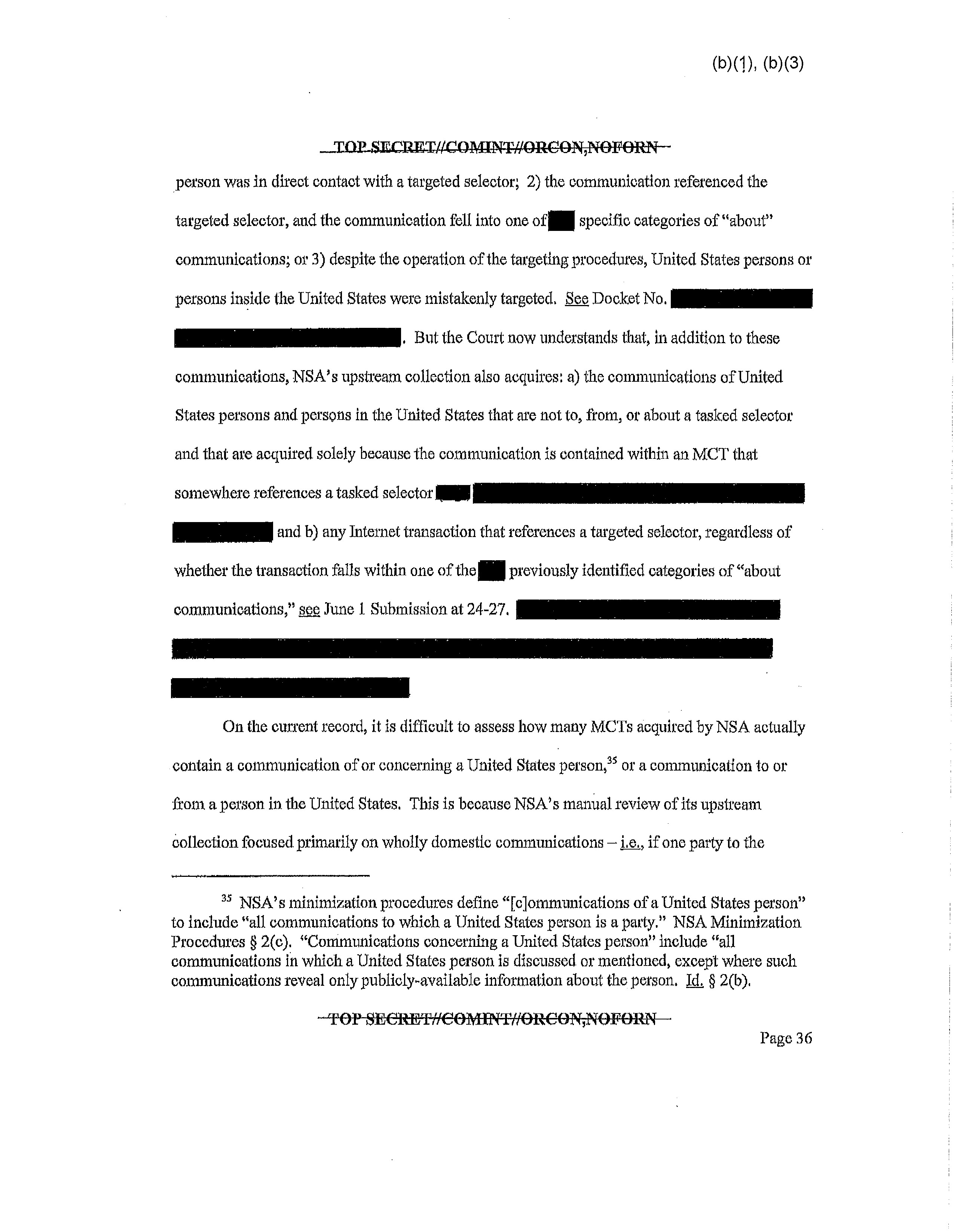
person was in direct contact with a targeted selector, 2) the communication referenced the
targeted selector, and the communication fell into one of [REDACTED] specific categories of "about"
communications; or 3) despite the operation of the targeting procedures, United States persons or
persons inside the United States were mistakenly targeted. See Docket No. [REDACTED]
[REDACTED] But the Court now understands that, in addition to these
communications, NSA's upstream collection also acquires: a) the communications of United
States persons and persons in the United States that are not to, from, or about a tasked selector
and that are acquired solely because the communication is contained within an MCT that
somewhere references a tasked selector [REDACTED]
and b) any Internet transaction that references a targeted selector, regardless of
whether the transaction falls within one of the [REDACTED] previously identified categories of "about
communications," see June 1 Submission at 24-27.
[REDACTED]
[REDACTED]
On the current record, it is difficult to assess how many MCTs acquired by NSA actually
contain a communication of or concerning a United States person, 35 or a communication to or
from a person in the United States. This is because NSA's manual review of its upstream
collection focused primarily on wholly domestic communications - i.e., if one party to the
35 NSA's minimization procedures define "[c]ommunications of a United States person"
to include "all communications to which a United States person is a party." NSA Minimization
Procedures § 2(c). "Communications concerning a United States person" include "all
communications in which a United States person is discussed or mentioned, except where such
communications reveal only publicly-available information about the person. Id. § 2(b).
TOP SECRET//COMINT//ORCON,NOFORN
Page 36
TOP SECRET//COMINT//ORCON,NOFORN
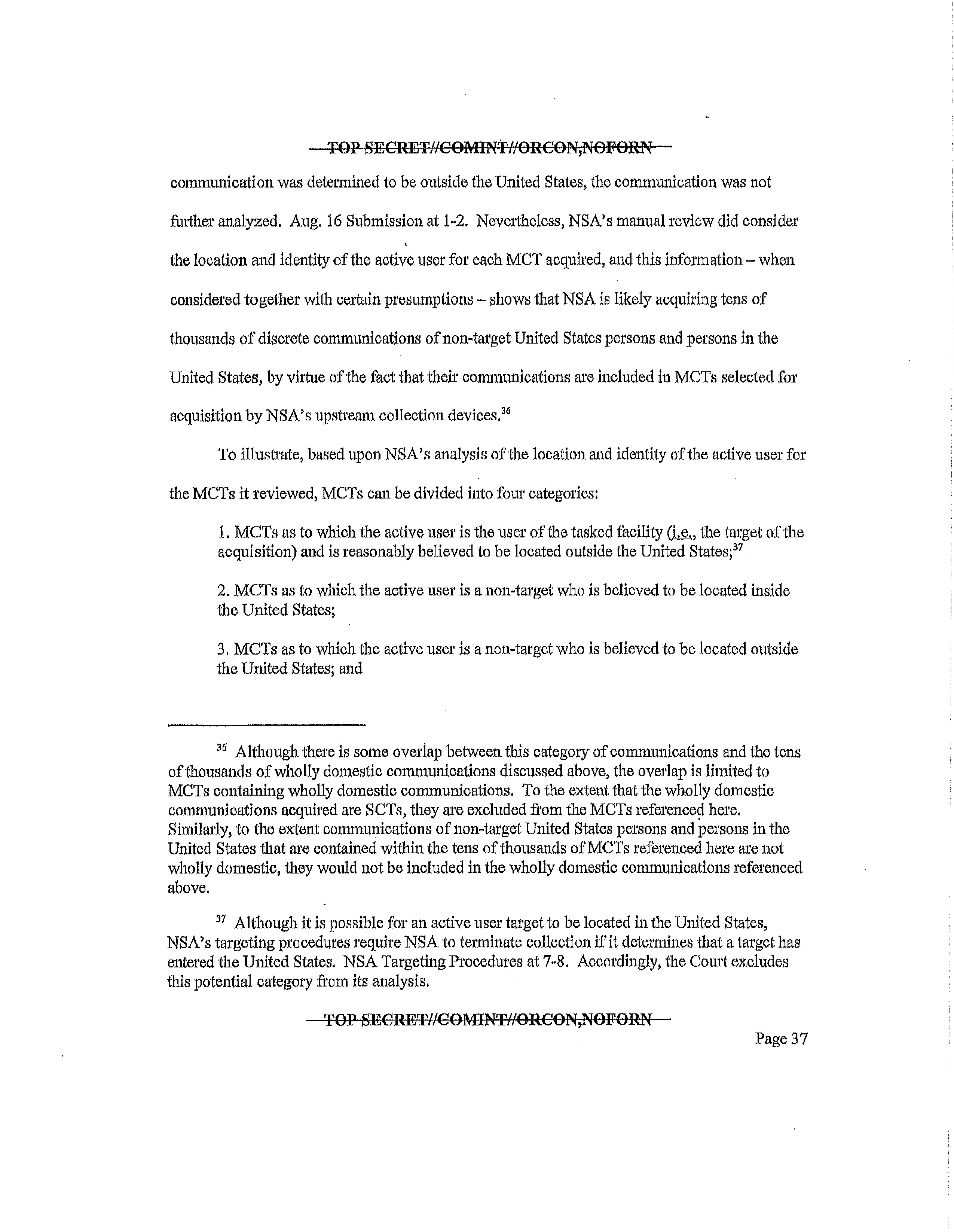
communication was determined to be outside the United States, the communication was not
further analyzed. Aug. 16 Submission at 1-2. Nevertheless, NSA's manual review did consider
the location and identity of the active user for each MCT acquired, and this information -- when
considered together with certain presumptions – shows that NSA is likely acquiring tens of
thousands of discrete communications of non-target United States persons and persons in the
United States, by virtue of the fact that their communications are included in MCTs selected for
acquisition by NSA's upstream collection devices. ³⁶
To illustrate, based upon NSA's analysis of the location and identity of the active user for
the MCTs it reviewed, MCTs can be divided into four categories:
- MCTs as to which the active user is the user of the tasked facility (i.e., the target of the
acquisition) and is reasonably believed to be located outside the United States;³⁷ - MCTs as to which the active user is a non-target who is believed to be located inside
the United States; - MCTs as to which the active user is a non-target who is believed to be located outside
the United States; and
³⁶ Although there is some overlap between this category of communications and the tens
of thousands of wholly domestic communications discussed above, the overlap is limited to
MCTs containing wholly domestic communications. To the extent that the wholly domestic
communications acquired are SCTs, they are excluded from the MCTs referenced here.
Similarly, to the extent communications of non-target United States persons and persons in the
United States that are contained within the tens of thousands of MCTs referenced here are not
wholly domestic, they would not be included in the wholly domestic communications referenced
above.
³⁷ Although it is possible for an active user target to be located in the United States,
NSA's targeting procedures require NSA to terminate collection if it determines that a target has
entered the United States. NSA Targeting Procedures at 7-8. Accordingly, the Court excludes
this potential category from its analysis.
TOP SECRET//COMINT//ORCON,NOFORN
Page 37
TOP SECRET//COMINT//ORCON,NOFORN
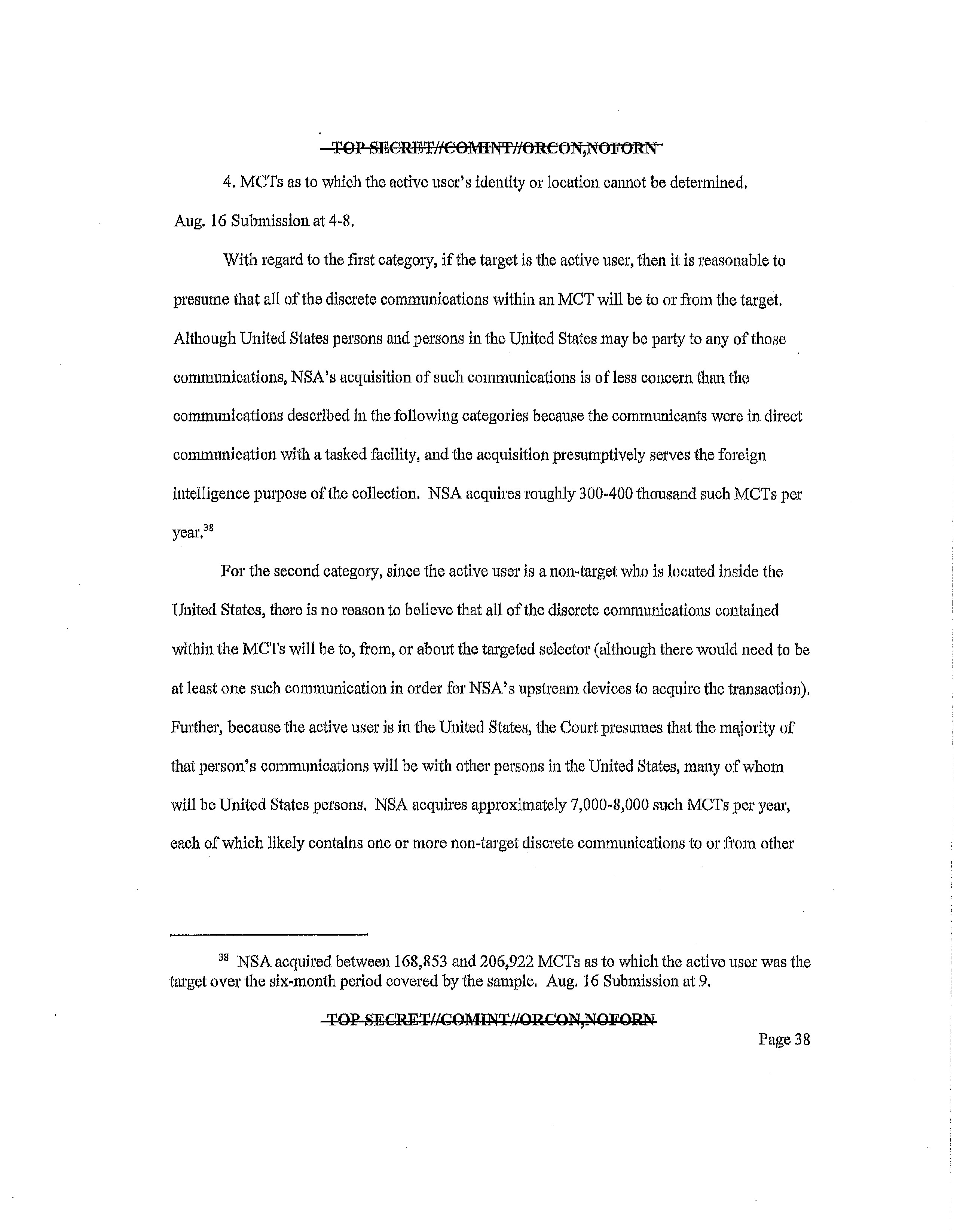
4. MCTs as to which the active user's identity or location cannot be determined.
Aug. 16 Submission at 4-8.
With regard to the first category, if the target is the active user, then it is reasonable to
presume that all of the discrete communications within an MCT will be to or from the target.
Although United States persons and persons in the United States may be party to any of those
communications, NSA's acquisition of such communications is of less concern than the
communications described in the following categories because the communicants were in direct
communication with a tasked facility, and the acquisition presumptively serves the foreign
intelligence purpose of the collection. NSA acquires roughly 300-400 thousand such MCT's per
year.
38
For the second category, since the active user is a non-target who is located inside the
United States, there is no reason to believe that all of the discrete communications contained
within the MCTs will be to, from, or about the targeted selector (although there would need to be
at least one such communication in order for NSA's upstream devices to acquire the transaction).
Further, because the active user is in the United States, the Court presumes that the majority of
that person's communications will be with other persons in the United States, many of whom
will be United States persons. NSA acquires approximately 7,000-8,000 such MCTs per year,
each of which likely contains one or more non-target discrete communications to or from other
38 NSA acquired between 168,853 and 206,922 MCTs as to which the active user was the
target over the six-month period covered by the sample. Aug. 16 Submission at 9.
TOP SECRET//COMINT//ORCON,NOFORN
Page 38
TOP SECRET//COMINT//ORCON,NOFORN
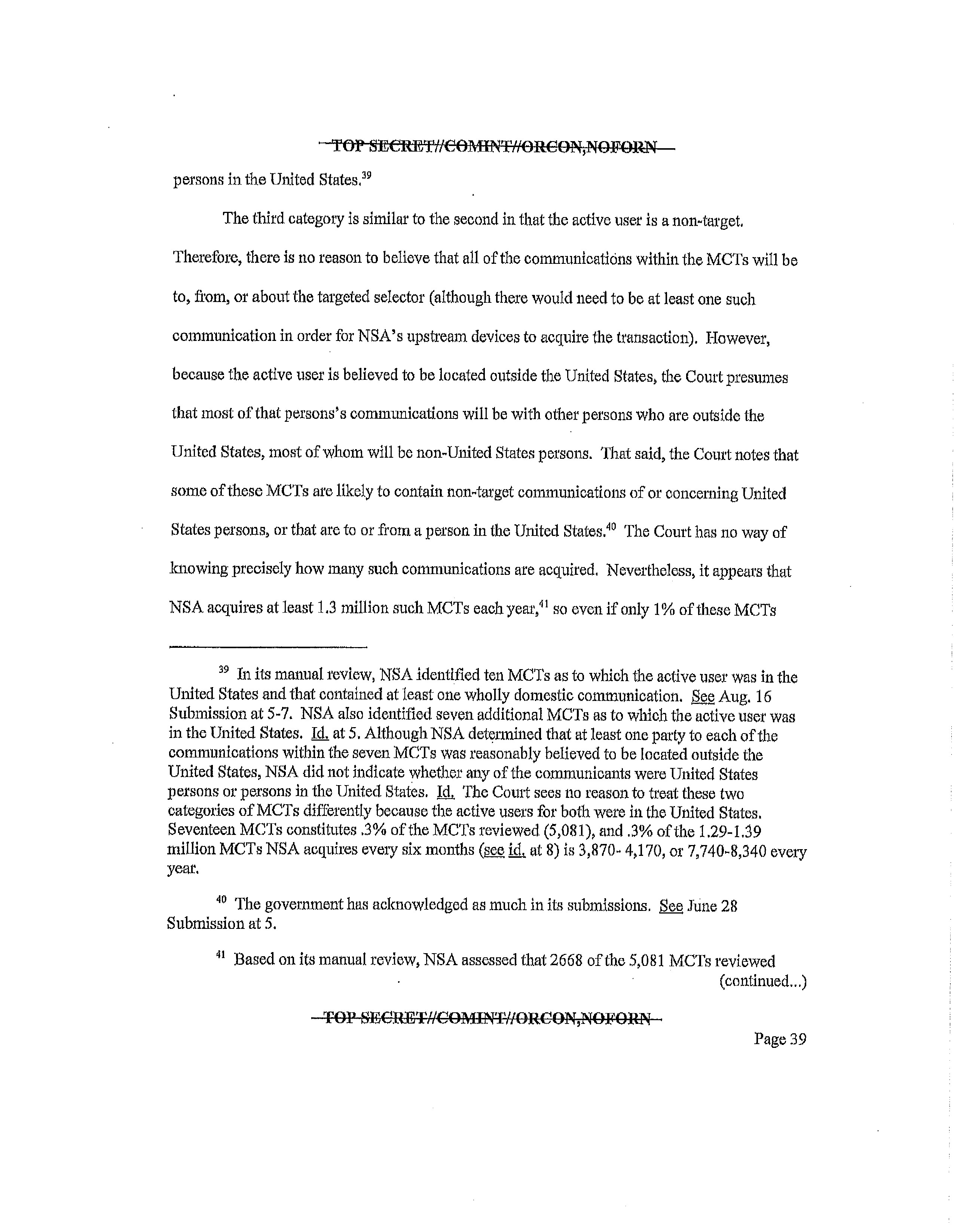
persons in the United States. 39
The third category is similar to the second in that the active user is a non-target.
Therefore, there is no reason to believe that all of the communications within the MCTs will be
to, from, or about the targeted selector (although there would need to be at least one such
communication in order for NSA's upstream devices to acquire the transaction). However,
because the active user is believed to be located outside the United States, the Court presumes
that most of that persons's communications will be with other persons who are outside the
United States, most of whom will be non-United States persons. That said, the Court notes that
some of these MCTs are likely to contain non-target communications of or concerning United
States persons, or that are to or from a person in the United States. 40 The Court has no way of
knowing precisely how many such communications are acquired. Nevertheless, it appears that
NSA acquires at least 1.3 million such MCTs each year, 41 so even if only 1% of these MCT's
39 In its manual review, NSA identified ten MCTs as to which the active user was in the
United States and that contained at least one wholly domestic communication. See Aug. 16
Submission at 5-7. NSA also identified seven additional MCTs as to which the active user was
in the United States. Id, at 5. Although NSA determined that at least one party to each of the
communications within the seven MCTs was reasonably believed to be located outside the
United States, NSA did not indicate whether any of the communicants were United States
persons or persons in the United States. Id. The Court sees no reason to treat these two
categories of MCTs differently because the active users for both were in the United States.
Seventeen MCTs constitutes .3% of the MCTs reviewed (5,081), and .3% of the 1.29-1.39
million MCTs NSA acquires every six months (see id, at 8) is 3,870- 4,170, or 7,740-8,340 every
year.
40 The government has acknowledged as much in its submissions. See June 28
Submission at 5.
41 Based on its manual review, NSA assessed that 2668 of the 5,081 MCTs reviewed
TOP SECRET//COMINT//ORCON,NOFORN
(continued...)
Page 39
(b)(1), (b)(3)
TOP SECRET//COMINT//ORCON,NOFORN
contain a single non-target communication of or concerning a United States person, or that is to
or from a person in the United States, NSA would be acquiring in excess of 10,000 additional
discrete communications each year that are of or concerning United States persons, or that are to
or from a person in the United States.
The fourth category is the most problematic, because without the identity of the active
user—i.e., whether the user is the target or a non-target—or the active user's location, it is
difficult to determine what presumptions to make about these MCTs. NSA acquires
approximately 97,000-140,000 such MCTs each year.⁴² In the context of wholly domestic
communications, the government urges the Court to apply a series of presumptions that lead to
the conclusion that this category would not contain any wholly domestic communications. Aug.
30 Submission at 4-8. The Court questions the validity of those presumptions, as applied to
wholly domestic communications, but certainly is not inclined to apply them to assessing the
likelihood that MCTs might contain communications of or concerning United States persons, or
communications to or from persons in the United States. The active users for some of these
⁴¹(...continued)
(approximately 52%) had a non-target active user who was reasonably believed to be located
outside the United States. Aug. 16 Submission at 4-5. Fifty-two percent of the 1.29 to 1.39
million MCTs that NSA assessed were acquired through its upstream collection every six months
would work out to 670,800 - 722,800 MCTs, or approximately 1.3-1.4 million MCTs per year
that have a non-target active user believed to be located outside the United States.
⁴² NSA determined that 224 MCTs of the 5,081 MCTs acquired during a six-month
period [REDACTED] From this, NSA concluded that it acquired between 48,609
and 70,168 such MCTs every six months through its upstream collection (or approximately
97,000-140,000 such MCTs each year). Id. at 9 n.27.
TOP SECRET//COMINT//ORCON,NOFORN
Page 40
TOP SECRET//COMINT//ORCON,NOFORN
MCTs may be located in the United States, and, even if the active user is located overseas, the
MCTs may contain non-target communications of or concerning United States persons or that are
to or from persons in the United States. Accordingly, this "unknown" category likely adds
substantially to the number of non-target communications of or concerning United States persons
or that are to or from persons in the United States being acquired by NSA each year.
In sum, then, NSA's upstream collection is a small, but unique part of the government's
overall collection under Section 702 of the FAA. NSA acquires valuable information through its
upstream collection, but not without substantial intrusions on Fourth Amendment-protected
interests. Indeed, the record before this Court establishes that NSA's acquisition of Internet
transactions likely results in NSA acquiring annually tens of thousands of wholly domestic
communications, and tens of thousands of non-target communications of persons who have little
or no relationship to the target but who are protected under the Fourth Amendment. Both
acquisitions raise questions as to whether NSA's targeting and minimization procedures comport
with FISA and the Fourth Amendment.
2. NSA's Targeting Procedures
The Court will first consider whether NSA's acquisition of Internet transactions through
its upstream collection, as described above, means that NSA's targeting procedures, as
implemented, are not "reasonably designed" to: 1) "ensure that any acquisition authorized under
[the certifications] is limited to targeting persons reasonably believed to be located outside the
United States"; and 2) "prevent the intentional acquisition of any communication as to which the
sender and all intended recipients are known at the time of the acquisition to be located in the
TOP SECRET//COMINT//ORCON,NOFORN
Page 41
(b)(1), (b)(3)
TOP SECRET//COMINT//ORCON,NOFORN
United States." 50 U.S.C. § 1881a(d)(1); id. § (1)(2)(B). The Court concludes that the manner in
which NSA is currently implementing the targeting procedures does not prevent the Court from
making the necessary findings, and hence NSA's targeting procedures do not offend FISA.
a.
Targeting Persons Reasonably Believed to be Located
Outside the United States
To the extent NSA is acquiring Internet transactions that contain a single discrete
communication that is to, from, or about a tasked selector, the Court's previous analysis remains
valid. As explained in greater detail in the Court's September 4, 2008 Memorandum Opinion, in
this setting the person being targeted is the user of the tasked selector, and NSA's pre-targeting
and post-targeting procedures ensure that NSA will only acquire such transactions so long as
there is a reasonable belief that the target is located outside the United States. Docket No.
[REDACTED]
But NSA's acquisition of MCTs complicates the Court's analysis somewhat. With regard
to "about" communications, the Court previously found that the user of the tasked facility was
the "target" of the acquisition, because the government's purpose in acquiring such
communications is to obtain information about that user. See id. at 18. Moreover, the
communication is not acquired because the government has any interest in the parties to the
communication, other than their potential relationship to the user of the tasked facility, and the
parties to an "about" communication do not become targets unless and until they are separately
vetted under the targeting procedures. See id. at 18-19.
In the case of "about" MCTs – i.e., MCTs that are acquired because a targeted selector is
referenced somewhere in the transaction – NSA acquires not only the discrete communication
TOP SECRET//COMINT//ORCON,NOFORN
Page 42
TOP SECRET//COMINT//ORCON,NOFORN
(b)(1), (b)(3)
that references the tasked selector, but also in many cases the contents of other discrete
communications that do not reference the tasked selector and to which no target is a party. See
May 2 Letter at 2-3 [REDACTED] By acquiring such MCTs, NSA likely
acquires tens of thousands of additional communications of non-targets each year, many of
whom have no relationship whatsoever with the user of the tasked selector. While the Court has
concerns about NSA's acquisition of these non-target communications, the Court accepts the
government's representation that the "sole reason [a non-target's MCT] is selected for
acquisition is that it contains the presence of a tasked selector used by a person who has been
subjected to NSA's targeting procedures." June 1 Submission at 4. Moreover, at the time of
acquisition, NSA's upstream collection devices often lack the capability to determine whether a
transaction contains a single communication or multiple communications, or to identify the
parties to any particular communication within a transaction. See id. Therefore, the Court has
no reason to believe that NSA, by acquiring Internet transactions containing multiple
communications, is targeting anyone other than the user of the tasked selector. See United States
v. Chemical Found., Inc., 272 U.S. 1, 14-15 (1926) ("The presumption of regularity supports the
official acts of public officers, and, in the absence of clear evidence to the contrary, courts
presume that they have properly discharged their official duties.").
b. Acquisition of Wholly Domestic Communications
NSA's acquisition of Internet transactions complicates the analysis required by Section
1881a(d)(1)(B), since the record shows that the government knowingly acquires tens of
thousands of wholly domestic communications each year. At first blush, it might seem obvious
TOP SECRET//COMINT//ORCON,NOFORN
Page 43
(b)(1), (b)(3)
TOP SECRET//COMINT//ORCON,NOFORN
that targeting procedures that permit such acquisitions could not be "reasonably designed . . . to
prevent the intentional acquisition of any communication as to which the sender and all intended
recipients are known at the time of the acquisition to be located in the United States." 50 U.S.C.
§ 1881a(d)(1)(B). However, a closer examination of the language of the statute leads the Court
to a different conclusion.
The government focuses primarily on the "intentional acquisition" language in Section
1881a(d)(1)(B). Specifically, the government argues that NSA is not "intentionally" acquiring
wholly domestic communications because the government does not intend to acquire transactions
containing communications that are wholly domestic and has implemented technical means to
prevent the acquisition of such transactions. See June 28 Submission at 12. This argument fails
for several reasons.
NSA targets a person under Section 702 certifications by acquiring communications to,
from, or about a selector used by that person. Therefore, to the extent NSA's upstream collection
devices acquire an Internet transaction containing a single, discrete communication that is to,
from, or about a tasked selector, it can hardly be said that NSA's acquisition is "unintentional."
In fact, the government has argued, and the Court has accepted, that the government intentionally
acquires communications to and from a target, even when NSA reasonably – albeit mistakenly –
believes that the target is located outside the United States. See Docket No. [REDACTED]
With respect to MCTs, the sole reason NSA acquires such transactions is the presence of
a tasked selector within the transaction. Because it is technologically infeasible for NSA's
TOP SECRET//COMINT//ORCON,NOFORN
Page 44
TOP SECRET//COMINT//ORCON,NOFORN
upstream collection devices to acquire only the discrete communication to, from, or about a
tasked selector that may be contained within an MCT, however, the government argues that the
only way to obtain the foreign intelligence information found within the discrete communication
is to acquire the entire transaction in which it is contained. June 1 Submission at 21. As a result,
the government intentionally acquires all discrete communications within an MCT, including
those that are not to, from or about a tasked selector. See June 28 Submission at 12, 14; see also
Sept. 7, 2011 Hearing Tr, at 33-34.
The fact that NSA's technical measures cannot prevent NSA from acquiring transactions
containing wholly domestic communications under certain circumstances does not render NSA's
acquisition of those transactions "unintentional." The government repeatedly characterizes such
acquisitions as a "failure" of NSA's "technical means." June 28 Submission at 12; see also Sept.
7, 2011 Hearing Tr. at 35-36. However, there is nothing in the record to suggest that NSA's
technical means are malfunctioning or otherwise failing to operate as designed. Indeed, the
government readily concedes that NSA will acquire a wholly domestic "about" communication if
the transaction containing the communication is routed through an international Internet link
being monitored by NSA or is routed through a foreign server. See June 1 Submission at 29.
And in the case of MCTs containing wholly domestic communications that are not to, from, or
about a tasked selector, NSA has no way to determine, at the time of acquisition, that a particular
communication within an MCT is wholly domestic. See id. Furthermore, now that NSA's
manual review of a sample of its upstream collection has confirmed that NSA likely acquires
tens of thousands of wholly domestic communications each year, there is no question that the
TOP SECRET//COMINT//ORCON,NOFORN
Page 45
TOP SECRET//COMINT//ORCON,NOFORN
government is knowingly acquiring Internet transactions that contain wholly domestic
communications through its upstream collection.⁴³
The government argues that an NSA analyst's post-acquisition discovery that a particular
Internet transaction contains a wholly domestic communication should retroactively render
NSA's acquisition of that transaction "unintentional." June 28 Submission at 12. That argument
is unavailing. NSA's collection devices are set to acquire transactions that contain a reference to
the targeted selector. When the collection device acquires such a transaction, it is functioning
precisely as it is intended, even when the transaction includes a wholly domestic communication.
The language of the statute makes clear that it is the government's intention at the time of
acquisition that matters, and the government conceded as much at the hearing in this matter.
Sept. 7, 2011 Hearing Tr. at 37-38.
Accordingly, the Court finds that NSA intentionally acquires Internet transactions that
reference a tasked selector through its upstream collection with the knowledge that there are tens
of thousands of wholly domestic communications contained within those transactions. But this
is not the end of the analysis. To return to the language of the statute, NSA's targeting
procedures must be reasonably designed to prevent the intentional acquisition of "any
communication as to which the sender and all intended recipients are known at the time of
⁴³ It is generally settled that a person intends to produce a consequence either (a) when he
acts with a purpose of producing that consequence or (b) when he acts knowing that the
consequence is substantially certain to occur. Restatement (Third) of Torts § 1 (2010); see also
United States v. Dyer, 589 F.3d 520, 528 (1st Cir. 2009) (in criminal law, ""intent' ordinarily
requires only that the defendant reasonably knew the proscribed result would occur"), cert,
denied, 130 S. Ct. 2422 (2010).
TOP SECRET//COMINT//ORCON,NOFORN
Page 46
(b)(1), (b)(3)
TOP SECRET//COMINT//ORCON,NOFORN
acquisition to be located in the United States." 50 U.S.C. § 1881a(d)(1)(B) (emphasis added).
The underscored language requires an acquisition-by-acquisition inquiry. Thus, the Court must
consider whether, at the time NSA intentionally acquires a transaction through its upstream
collection, NSA will know that the sender and all intended recipients of any particular
communication within that transaction are located in the United States.
Presently, it is not technically possible for NSA to configure its upstream collection
devices [REDACTED]
[REDACTED]
[REDACTED]
[REDACTED] the practical
effect of this technological limitation is that NSA cannot know at the time it acquires an Internet
transaction whether the sender and all intended recipients of any particular discrete
communication contained within the transaction are located inside the United States.
[REDACTED]
[REDACTED]
[REDACTED]
[REDACTED]
[REDACTED]
[REDACTED]
44 See supra, note 33.
TOP SECRET//COMINT//ORCON,NOFORN
Page 47
(b)(1), (b)(3)
TOP SECRET//COMINT//ORCON,NOFORN
[REDACTED]
[REDACTED]
[REDACTED]
[REDACTED]
[REDACTED]
[REDACTED]
Given that NSA's upstream collection devices lack the capacity to detect wholly domestic
communications at the time an Internet transaction is acquired, the Court is inexorably led to the
conclusion that the targeting procedures are "reasonably designed" to prevent the intentional
acquisition of any communication as to which the sender and all intended recipients are known at
the time of the acquisition to be located in the United States. This is true despite the fact that
NSA knows with certainty that the upstream collection, viewed as a whole, results in the
acquisition of wholly domestic communications.
By expanding its Section 702 acquisitions to include the acquisition of Internet
transactions through its upstream collection, NSA has, as a practical matter, circumvented the
spirit of Section 1881a(b)(4) and (d)(1) with regard to that collection. NSA's knowing
acquisition of tens of thousands of wholly domestic communications through its upstream
collection is a cause of concern for the Court. But the meaning of the relevant statutory provision
is clear and application to the facts before the Court does not lead to an impossible or absurd
result. The Court's review does not end with the targeting procedures, however. The Court must
TOP SECRET//COMINT//ORCON,NOFORN
Page 48
TOP SECRET//COMINT//ORCON,NOFORN
also consider whether NSA's minimization procedures are consistent with §1881a(e)(1) and
whether NSA's targeting and minimization procedures are consistent with the requirements of
the Fourth Amendment.
3.
NSA's Minimization Procedures, As Applied to MCTs in the Manner Proposed by the Government, Do Not Meet FISA's Definition of "Minimization Procedures"
The Court next considers whether NSA's minimization procedures, as the government
proposes to apply them to Internet transactions, meet the statutory requirements. As noted above,
50 U.S.C. § 1881a(e) (1) requires that the minimization procedures "meet the definition of
minimization procedures under [50 U.S.C. §§] 1801(h) or 1821(4)...." That definition requires
"specific procedures, which shall be adopted by the Attorney General, that are reasonably
designed in light of the purpose and technique of the particular [surveillance or physical search],
to minimize the acquisition and retention, and prohibit the dissemination, of nonpublicly
available information concerning unconsenting United States persons consistent with the need of
the United States to obtain, produce, and disseminate foreign intelligence information." 50
U.S.C. §§ 1801(h)(1) & 1821(4)(A). For the reasons stated below, the Court concludes that
NSA's minimization procedures, as applied to MCTs in the manner proposed by the government,
do not meet the statutory definition in all respects.
a.
The Minimization Framework
NSA's minimization procedures do not expressly contemplate the acquisition of MCTs,
and the language of the procedures does not lend itself to straightforward application to MCTs.
Most notably, various provisions of the NSA minimization procedures employ the term
TOP SECRET//COMINT//ORCON,NOFORN
Page 49
TOP SECRET//COMINT//ORCON,NOFORN
"communication" as an operative term. As explained below, for instance, the rules governing
retention, handling, and dissemination vary depending whether or not a communication is
deemed to constitute a "domestic communication" instead of a "foreign communication," see
NSA Minimization Procedures §§ 2(e), 5, 6, 7; a communication "of" or "concerning" a U.S.
person, see id. §§ 2(b)-(c), 3(b)(1)-(2), 3(c); a "communication to, from, or about a target," id.
§ 3(b)(4); or a "communication... reasonably believed to contain foreign intelligence
information or evidence of a crime," id. But MCTs can be fairly described as communications
that contain several smaller communications. Applying the terms of the NSA minimization
procedures to MCTs rather than discrete communications can produce very different results.
In a recent submission, the government explained how NSA proposes to apply its
minimization procedures to MCTs. See Aug. 30 Submission at 8-11.45 Before discussing the
measures proposed by the government for handling MCTs, it is helpful to begin with a brief
overview of the NSA minimization procedures themselves. The procedures require that all
acquisitions "will be conducted in a manner designed, to the greatest extent feasible, to minimize
the acquisition of information not relevant to the authorized purpose of the collection." NSA
45 Although NSA has been collecting MCTs since before the Court's approval of the first
Section 702 certification in 2008, see June 1 Submission at 2, it has not, to date, applied the
measures proposed here to the fruits of its upstream collection. Indeed, until NSA's manual
review of a six-month sample of its upstream collection revealed the acquisition of wholly
domestic communications, the government asserted that NSA had never found a wholly domestic
communication in its upstream collection. See id.
TOP SECRET//COMINT//ORCON,NOFORN
Page 50
TOP SECRET//COMINT//ORCON,NOFORN
Minimization Procedures § 3(a). Following acquisition, the procedures require that, "[a]s a
communication is reviewed, NSA analyst(s) will determine whether it is a domestic or foreign
communication to, from, or about a target and is reasonably believed to contain foreign
intelligence information or evidence of a crime." Id. § 3(b)(4). "Foreign communication means
a communication that has at least one communicant outside of the United States." Id. § 2(e).
"All other communications, including communications in which the sender and all intended
recipients are reasonably believed to be located in the United States at the time of acquisition, are
domestic communications." Id. In addition, domestic communications include "[a]ny
communications acquired through the targeting of a person who at the time of targeting was
reasonably believed to be located outside the United States but is in fact located inside the United
States at the time such communications were acquired, and any communications acquired by
targeting a person who at the time of the targeting was believed to be a non-United States person
but was in fact a United States person . . . ." Id. § 3(d)(2). A domestic communication must be
"promptly destroyed upon recognition unless the Director (or Acting Director) of NSA
specifically determines, in writing, that" the communication contains foreign intelligence
46 Of course, NSA's separate targeting procedures, discussed above, also govern the
manner in which communications are acquired.
TOP SECRET//COMINT//ORCON,NOFORN
Page 51
TOP SECRET//COMINT//ORCON,NOFORN
information or evidence of a crime, or that it falls into another narrow exception permitting
retention. See id. § 5.47
Upon determining that a communication is a "foreign communication," NSA must decide
whether the communication is "of" or "concerning" a United States person. Id. § 6.
"Communications of a United States person include all communications to which a United States
person is a party." Id. § 2(c). "Communications concerning a United States person include all
communications in which a United States person is discussed or mentioned, except where such
communications reveal only publicly-available information about the person." Id. § 2(b).
A foreign communication that is of or concerning a United States person and that is
determined to contain neither foreign intelligence information nor evidence of a crime must be
destroyed "at the earliest practicable point in the processing cycle," and "may be retained no
longer than five years from the expiration date of the certification in any event." Id. § 3(b)(1).48
47 Once such a determination is made by the Director, the domestic communications at
issue are effectively treated as "foreign communications" for purposes of the rules regarding
retention and dissemination.
48 Although Section 3(b)(1) by its terms applies only to "inadvertently acquired
communications of or concerning a United States person," the government has informed the
Court that this provision is intended to apply, and in practice is applied, to all foreign
communications of or concerning United States persons that contain neither foreign intelligence
information nor evidence of a crime. Docket No. 702(i)-08-01, Sept. 2, 2008 Notice of
Clarification and Correction at 3-5. Moreover, Section 3(c) of the procedures separately provides
that foreign communications that do not qualify for retention and that "are known to contain
communications of or concerning United States persons will be destroyed upon recognition,"
and, like unreviewed communications, "may be retained no longer than five years from the
(continued...)
TOP SECRET//COMINT//ORCON,NOFORN
Page 52
TOP SECRET//COMINT//ORCON,NOFORN
A foreign communication that is of or concerning a United States person may be retained
indefinitely if the "dissemination of such communications with reference to such United States
persons would be permitted" under the dissemination provisions that are discussed below, or if it
contains evidence of a crime. Id. § 6(a)(2)-(3). If the retention of a foreign communication of or
concerning a United States person is "necessary for the maintenance of technical databases," it
may be retained for five years to allow for technical exploitation, or for longer than five years if
more time is required for decryption or if the NSA Signals Intelligence Director "determines in
writing that retention for a longer period is required to respond to authorized foreign intelligence
or counterintelligence requirements." Id. § 6(a)(1).
As a general rule, "[a] report based on communications of or concerning a United States
person may be disseminated" only "if the identity of the United States person is deleted and a
generic term or symbol is substituted so that the information cannot reasonably be connected
with an identifiable United States person." Id. § 6(b). A report including the identity of the
United States person may be provided to a "recipient requiring the identity of such person for the
performance of official duties," but only if at least one of eight requirements is also met – for
instance, if "the identity of the United States person is necessary to understand foreign
intelligence information or assess its importance," or if "information indicates the United States
48(...continued)
expiration date of the certification authorizing the collection in any event."
TOP SECRET//COMINT//ORCON,NOFORN
Page 53
(b)(1), (b)(3)
TOP SECRET//COMINT//ORCON,NOFORN
person may be . . . an agent of a foreign power" or that he is "engaging in international terrorism
activities." Id. [REDACTED]
b. Proposed Minimization Measures for MCTs
The government proposes that NSA's minimization procedures be applied to MCTs in
the following manner. After acquisition, upstream acquisitions, including MCTs, will reside in
NSA repositories until they are accessed (e.g., in response to a query) by an NSA analyst
performing his or her day-to-day work. NSA proposes adding a "cautionary banner" to the tools
its analysts use to view the content of communications acquired through upstream collection
under Section 702. See Aug. 30 Submission at 9. The banner, which will be "broadly displayed
on [such] tools," will "direct analysts to consult guidance on how to identify MCTs and how to
handle them." Id. at 9 & n.6. [REDACTED] Analysts will be trained to identify MCTs and to recognize
wholly domestic communications contained within MCTs. See id, at 8-9.
When an analyst identifies an upstream acquisition as an MCT, the analyst will decide
whether or not he or she "seek[s] to use a discrete communication within [the] MCT,"
[REDACTED] The procedures also permit NSA to provide unminimized communications to
[REDACTED] FBI (subject to their own minimization procedures), and to foreign governments for the
limited purpose of obtaining "technical and linguistic assistance." NSA Minimization
Procedures §§. 6(c), 8(b). Neither of these provisions has been used to share upstream
acquisitions. Sept. 7, 2011 Hearing Tr. at 61-62.
[REDACTED] The banner will not be displayed for communications that "can be first identified
through technical means where the active user is NSA's tasked selector or that contain only a
single, discrete communication based on particular stable and well-known protocols." Aug. 30
Submission at 9 n.6. See infra, note 27, and supra, note 54.
TOP SECRET//COMINT//ORCON,NOFORN
Page 54
TOP SECRET//COMINT//ORCON,NOFORN
presumably by reviewing some or all of the MCT's contents. Id., at 8.51 "NSA analysts seeking
to use a discrete communication contained in an MCT (for example, in a FISA application,
intelligence report, or Section 702 targeting) will assess whether the discrete communication is
to, from, or about a tasked selector." Id. The following framework will then be applied:
- If the discrete communication that the analyst seeks to use is to, from, or about a tasked
selector, "any U.S. person information in that communication will be handled in
accordance with the NSA minimization procedures." Id. Presumably, this means that the
discrete communication will be treated as a "foreign communication" that is "of" or
"concerning" a United States person, as described above. The MCT containing that
communication remains available to analysts in NSA's repositories without any marking
to indicate that it has been identified as an MCT or as a transaction containing United
States person information. - If the discrete communication sought to be used is not to, from, or about a tasked
selector, and also not to or from an identifiable United States person, "that
communication (including any U.S. person information therein) will be handled in
accordance with the NSA minimization procedures." Id., at 8-9.52 Presumably, this
means that the discrete communication will be treated as a "foreign communication" or, if
it contains information concerning a United States person, as a "foreign communication"
"concerning a United States person," as described above. The MCT itself remains
available to analysts in NSA's repositories without any marking to indicate that it has
been identified as an MCT or that it contains one or more communications that are not to,
from, or about a targeted selector.
51 A transaction that is identified as an SCT rather than an MCT must be handled in
accordance with the standard minimization procedures that are discussed above.
52 The Court understands that absent contrary information, NSA treats the user of an
account who appears to be located in the United States as "an identifiable U.S. person." See
Aug, 30 Submission at 9 n.7 ("To help determine whether a discrete communication not to, from,
or about a tasked selector is to or from a U.S. person, NSA would perform the same sort of
technical analysis it would perform before tasking an electronic communications
account/address/identifier in accordance with its section 702 targeting procedures.").
TOP SECRET//COMINT//ORCON,NOFORN
Page 55
TOP SECRET//COMINT//ORCON,NOFORN
- A discrete communication that is not to, from, or about a tasked selector but that is to or
from an identifiable United States person "cannot be used for any purpose other than to
protect against an immediate threat to human life (e.g., force protection or hostage
situations)." Id, at 9. Presumably, this is a reference to Section 1 of the minimization
procedures, which allows NSA to deviate from the procedures in such narrow
circumstances, subject to the requirement that prompt notice be given to the Office of the
Director of National Intelligence, the Department of Justice, and the Court that the
deviation has occurred. Regardless of whether or not the discrete communication is used
for this limited purpose, the MCT itself remains in NSA's databases without any marking
to indicate that it is an MCT, or that it contains at least one communication that is to or
from an identifiable United States person. See id.; Sept. 7, 2011 Hearing Tr. at 61. - If the discrete communication sought to be used by the analyst (or another discrete
communication within the MCT) is recognized as being wholly domestic, the entire MCT
will be purged from NSA's systems. See Aug. 30 Submission at 3.
c. Statutory Analysis
i. Acquisition
The Court first considers how NSA's proposed handling of MCTs bears on whether
NSA's minimization procedures are "reasonably designed in light of the purpose and technique
of the particular surveillance, to minimize the acquisition . . . of nonpublicly available
information concerning unconsenting United States persons consistent with the need of the
United States to obtain, produce, and disseminate foreign intelligence information." See 50
U.S.C. § 1801(h)(1) (emphasis added). Insofar as NSA likely acquires approximately 2,000-
10,000 MCTs each year that contain at least one wholly domestic communication that is neither
to, from, nor about a targeted selector, and tens of thousands of communications of or
53 As noted above, NSA's upstream collection also likely results in the acquisition of tens
(continued...)
TOP SECRET//COMINT//ORCON,NOFORN
Page 56
(b)(1), (b)(3)
TOP SECRET//COMINT//ORCON,NOFORN
concerning United States persons with no direct connection to any target, the Court has serious
concerns. The acquisition of such non-target communications, which are highly unlikely to have
foreign intelligence value, obviously does not by itself serve the government's need to "obtain,
produce, and disseminate foreign intelligence information." See 50 U.S.C. § 1801(h)(1).
The government submits, however, that the portions of MCTs that contain references to
targeted selectors are likely to contain foreign intelligence information, and that it is not feasible
for NSA to limit its collection only to the relevant portion or portions of each MCT – i.e., the
particular discrete communications that are to, from, or about a targeted selector. The Court
53(...continued)
of thousands of wholly domestic SCTs that contain references to targeted selectors. See supra,
pages 33-34 & note 33 (discussing the limits [REDACTED]
[REDACTED] Although the collection of wholly
domestic "about" SCTs is troubling, they do not raise the same minimization-related concerns as
discrete, wholly domestic communications that are neither to, from, nor about targeted selectors,
or as discrete communications of or concerning United States persons with no direct connection
to any target, either of which may be contained within MCTs. The Court has effectively
concluded that certain communications containing a reference to a targeted selector are
reasonably likely to contain foreign intelligence information, including communications between
non-target accounts that contain the name of the targeted facility in the body of the message. See
Docket No. 07-449, May 31, 2007 Primary Order at 12 (finding probable cause to believe that
certain "about" communications were "themselves being sent and/or received by one of the
targeted foreign powers"). Insofar as the discrete, wholly domestic "about" communications at
issue here are communications between non-target accounts that contain the name of the targeted
facility, the same conclusion applies to them. Accordingly, in the language of FISA's definition
of minimization procedures, the acquisition of wholly domestic communications about targeted
selectors will generally be "consistent with the need of the United States to obtain, produce, and
disseminate foreign intelligence information." See 50 U.S.C. 1801(h)(1). Nevertheless, the
Court understands that in the event NSA identifies a discrete, wholly domestic "about"
communication in its databases, the communication will be destroyed upon recognition. See
NSA Minimization Procedures § 5.
TOP SECRET//COMINT//ORCON,NOFORN
Page 57
(b)(1), (b)(3)
TOP SECRET//COMINT//ORCON,NOFORN
accepts the government's assertion that the collection of MCTs yields valuable foreign
intelligence information that by its nature cannot be acquired except through upstream collection.
See Sept. 7, 2011 Hearing Tr. at 69-70, 74. For purposes of this discussion, the Court further
accepts the government's assertion that it is not feasible for NSA to avoid the collection of MCTs
as part of its upstream collection or to limit its collection only to the specific portion or portions
of each transaction that contains the targeted selector. See id, at 48-50; June 1 Submission at
27.54 The Court therefore concludes that NSA's minimization procedures are, given the current
state of NSA's technical capability, reasonably designed to minimize the acquisition of
nonpublicly available information concerning unconsenting United States persons consistent with
the need of the United States to obtain, produce, and disseminate foreign intelligence
information.
[REDACTED]
In any event, it is incumbent upon NSA to continue working to enhance its capability to
limit acquisitions only to targeted communications.
TOP SECRET//COMINT//ORCON,NOFORN
Page 58
TOP SECRET//COMINT//ORCON,NOFORN
ii.
Retention
The principal problem with the government's proposed handling of MCTs relates to what
will occur, and what will not occur, following acquisition. As noted above, the NSA
minimization procedures generally require that, "[a]s a communication is reviewed, NSA
analyst(s) will determine whether it is a domestic or foreign communication to, from, or about a
target and is reasonably believed to contain foreign intelligence information or evidence of a
crime," see NSA Minimization Procedures § 3(b)(4), so that it can be promptly afforded the
appropriate treatment under the procedures. The measures proposed by the government for
MCTs, however, largely dispense with the requirement of prompt disposition upon initial review
by an analyst. Rather than attempting to identify and segregate information "not relevant to the
authorized purpose of the acquisition" or to destroy such information promptly following
acquisition, NSA's proposed handling of MCTs tends to maximize the retention of such
information, including information of or concerning United States persons with no direct
connection to any target. See id. § 3(b)(1).
The proposed measures focus almost exclusively on the discrete communications within
MCTs that analysts decide, after review, that they wish to use. See Aug. 30 Submission at 8-10.
An analyst is not obligated to do anything with other portions of the MCT, including any wholly
domestic discrete communications that are not immediately recognized as such, and
communications of or concerning United States persons that have no direct connection to the
targeted selector. See id.; Sept. 7, 2011 Hearing Tr. at 61. If, after reviewing the contents of an
TOP SECRET//COMINT//ORCON,NOFORN
Page 59
TOP SECRET//COMINT//ORCON,NOFORN
entire MCT, the analyst decides that he or she does not wish to use any discrete communication
contained therein, the analyst is not obligated to do anything unless it is immediately apparent to
him or her that the MCT contains a wholly domestic communication (in which case the entire
MCT is deleted).⁵⁵ See Aug. 30 Submission at 8-10.
Except in the case of those recognized as containing at least one wholly domestic
communication, MCTs that have been reviewed by analysts remain available to other analysts in
NSA's repositories without any marking to identify them as MCTs. See id.; Sept. 7, 2011
Hearing Tr. at 61. Nor will MCTs be marked to identify them as containing discrete
communications to or from United States persons but not to or from a targeted selector, or to
indicate that they contain United States person information. See Aug. 30 Submission at 8-10;
Sept. 7, 2011 Hearing Tr. at 61. All MCTs except those identified as containing one or more
wholly domestic communications will be retained for a minimum of five years. The net effect is
that thousands of wholly domestic communications (those that are never reviewed and those that
are not recognized by analysts as being wholly domestic), and thousands of other discrete
⁵⁵ The government's submissions make clear that, in many cases, it will be difficult for
analysts to determine whether a discrete communication contained within an MCT is a wholly
domestic communication. NSA's recent manual review of a six-month representative sample of
its upstream collection demonstrates how challenging it can be for NSA to recognize wholly
domestic communications, even when the agency's full attention and effort are directed at the
task. See generally Aug. 16 and Aug. 30 Submissions. It is doubtful that analysts whose
attention and effort are focused on identifying and analyzing foreign intelligence information will
be any more successful in identifying wholly domestic communications. Indeed, each year the
government notifies the Court of numerous compliance incidents involving good-faith mistakes
and omissions by NSA personnel who work with the Section 702 collection.
TOP SECRET//COMINT//ORCON,NOFORN
Page 60
TOP SECRET//COMINT//ORCON,NOFORN
communications that are not to or from a targeted selector but that are to, from, or concerning a United States person, will be retained by NSA for at least five years, despite the fact that they have no direct connection to a targeted selector and, therefore, are unlikely to contain foreign intelligence information.
It appears that NSA could do substantially more to minimize the retention of information concerning United States persons that is unrelated to the foreign intelligence purpose of its upstream collection. The government has not, for instance, demonstrated why it would not be feasible to limit access to upstream acquisitions to a smaller group of specially-trained analysts who could develop expertise in identifying and scrutinizing MCTs for wholly domestic communications and other discrete communications of or concerning United States persons. Alternatively, it is unclear why an analyst working within the framework proposed by the government should not be required, after identifying an MCT, to apply Section 3(b)(4) of the NSA minimization procedures to each discrete communication within the transaction. As noted above, Section 3(b)(4) states that "[a]s a communication is reviewed, NSA analyst(s) will determine whether it is a domestic or foreign communication to, from, or about a target and is reasonably believed to contain foreign intelligence information or evidence of a crime." NSA Minimization Procedures § 3(b)(4). If the MCT contains information "of" or "concerning" a United States person within the meaning of Sections (2)(b) and (2)(c) of the NSA minimization procedures, it is unclear why the analyst should not be required to mark it to identify it as such. At a minimum, it seems that the entire MCT could be marked as an MCT. Such markings would
TOP SECRET//COMINT//ORCON,NOFORN
Page 61
TOP SECRET//COMINT//ORCON,NOFORN
alert other NSA personnel who might encounter the MCT to take care in reviewing it, thus
reducing the risk of error that seems to be inherent in the measures proposed by the government,
which are applied by each analyst, acting alone and without the benefit of his or her colleagues'
prior efforts.⁵⁶ Another potentially helpful step might be to adopt a shorter retention period for
MCTs and unreviewed upstream communications so that such information "ages off" and is
deleted from NSA's repositories in less than five years.
This discussion is not intended to provide a checklist of changes that, if made, would
necessarily bring NSA's minimization procedures into compliance with the statute. Indeed, it
may be that some of these measures are impracticable, and it may be that there are other plausible
(perhaps even better) steps that could be taken that are not mentioned here. But by not fully
exploring such options, the government has failed to demonstrate that it has struck a reasonable
balance between its foreign intelligence needs and the requirement that information concerning
United States persons be protected. Under the circumstances, the Court is unable to find that, as
applied to MCTs in the manner proposed by the government, NSA's minimization procedures
are "reasonably designed in light of the purpose and technique of the particular surveillance to
minimize the . . . retention . . . of nonpublicly available information concerning unconsenting
⁵⁶ The government recently acknowledged that "it's pretty clear that it would be better" if
NSA used such markings but that "[t]he feasibility of doing that [had not yet been] assessed,"
Sept. 7, 2011 Hearing Tr. at 56.
TOP SECRET//COMINT//ORCON,NOFORN
Page 62
(b)(1), (b)(3)
TOP SECRET//COMINT//ORCON,NOFORN
United States persons consistent with the need of the United States to obtain, produce, and
disseminate foreign intelligence information. "57 See 50 U.S.C. §§ 1801(h)(1) & 1821(4)(A).
iii. Dissemination
The Court next turns to dissemination. At the outset, it must be noted that FISA imposes
a stricter standard for dissemination than for acquisition or retention. While the statute requires
procedures that are reasonably designed to "minimize" the acquisition and retention of
information concerning United States persons consistent with the need of the United States to
obtain, produce, and disseminate foreign intelligence information, the procedures must be
reasonably designed to "prohibit" the dissemination of information concerning United States
persons consistent with that need. See 50 U.S.C. § 1801(h)(1) (emphasis added).
57 NSA's minimization procedures contain two provisions that state, in part, that "[t]he
communications that may be retained [by NSA] include electronic communications acquired
because of limitations
[REDACTED]
The government further represented that it "ha[d] not seen" such a
circumstance in collection under the Protect America Act ("PAA"), which was the predecessor to
Section 702. Id. at 29, 30. And although NSA apparently was acquiring Internet transactions
under the PAA, the government made no mention of such acquisitions in connection with these
provisions of the minimization procedures (or otherwise). See id, at 27-31. Accordingly, the
Court does not read this language as purporting to justify the procedures proposed by the
government for MCTs. In any event, such a reading would, for the reasons stated, be
inconsistent with the statutory requirements for minimization.
TOP SECRET//COMINT//ORCON,NOFORN
Page 63
TOP SECRET//COMINT//ORCON,NOFORN
As the Court understands it, no United States-person-identifying information contained in any MCT will be disseminated except in accordance with the general requirements of NSA's minimization procedures for "foreign communications" "of or concerning United States persons" that are discussed above. Specifically, "[a] report based on communications of or concerning a United States person may be disseminated" only "if the identity of the United States person is deleted and a generic term or symbol is substituted so that the information cannot reasonably be connected with an identifiable United States person." NSA Minimization Procedures § 6(b). A report including the identity of the United States person may be provided to a "recipient requiring the identity of such person for the performance of official duties," but only if at least one of eight requirements is also met – for instance, if "the identity of the United States person is necessary to understand foreign intelligence information or assess its importance." Id.⁵⁸
This limitation on the dissemination of United States-person-identifying information is helpful. But the pertinent portion of FISA's definition of minimization procedures applies not merely to information that identifies United States persons, but more broadly to the dissemination of "information concerning unconsenting United States persons." 50 U.S.C. § 1801(h)(1) (emphasis added).⁵⁹ The government has proposed several additional restrictions that
⁵⁸ Although Section 6(b) uses the term "report," the Court understands it to apply to the dissemination of United States-person-identifying information in any form.
⁵⁹ Another provision of the definition of minimization procedures bars the dissemination of information (other than certain forms of foreign intelligence information) "in a manner that
(continued...)
TOP SECRET//COMINT//ORCON,NOFORN
Page 64
TOP SECRET//COMINT//ORCON,NOFORN
will have the effect of limiting the dissemination of "nonpublicly available information
concerning unconsenting United States persons consistent with the need of the United States to
disseminate foreign intelligence information." Id. First, as noted above, the government will
destroy MCTs that are recognized by analysts as containing one or more discrete wholly
domestic communications. Second, the government has asserted that NSA will not use any
discrete communication within an MCT that is determined to be to or from a United States
person but not to, from, or about a targeted selector, except when necessary to protect against an
immediate threat to human life. See Aug. 30 Submission at 9. The Court understands this to
mean, among other things, that no information from such a communication will be disseminated
in any form unless NSA determines it is necessary to serve this specific purpose. Third, the
government has represented that whenever it is unable to confirm that at least one party to a
discrete communication contained in an MCT is located outside the United States, it will not use
any information contained in the discrete communication. See Sept. 7, 2011 Hearing Tr. at 52,
The Court understands this limitation to mean that no information from such a discrete
communication will be disseminated by NSA in any form.
Communications as to which a United States person or a person inside the United States
^(59(...continued))
^identifies any United States person," except when the person's identity is necessary to understand
^foreign intelligence information or to assess its importance. See 50 U.S.C. §§ 1801(h)(2),
^1821(4)(b). Congress's use of the distinct modifying terms "concerning" and "identifying" in
^two adjacent and closely-related provisions was presumably intended to have meaning. See, e.g.,
^Russello v. United States, 464 U.S. 16, 23 (1983).
TOP SECRET//COMINT//ORCON,NOFORN
Page 65
TOP SECRET//COMINT//ORCON,NOFORN
is a party are more likely than other communications to contain information concerning United
States persons. And when such a communication is neither to, from, nor about a targeted facility,
it is highly unlikely that the "need of the United States to disseminate foreign intelligence
information" would be served by the dissemination of United States-person information
contained therein. Hence, taken together, these measures will tend to prohibit the dissemination
of information concerning unconsenting United States persons when there is no foreign-
intelligence need to do so.60 Of course, the risk remains that information concerning United
States persons will not be recognized by NSA despite the good-faith application of the measures
it proposes. But the Court cannot say that the risk is so great that it undermines the
reasonableness of the measures proposed by NSA with respect to the dissemination of
information concerning United States persons.61 Accordingly, the Court concludes that NSA's
60 Another measure that, on balance, is likely to mitigate somewhat the risk that
information concerning United States persons will be disseminated in the absence of a foreign-
intelligence need is the recently-proposed prohibition on running queries of the Section 702
upstream collection using United States-person identifiers. See Aug. 30 Submission at 10-11.
To be sure, any query, including a query based on non-United States-person information, could
yield United States-person information. Nevertheless, it stands to reason that queries based on
information concerning United States persons are at least somewhat more likely than other
queries to yield United States-person information. Insofar as information concerning United
States persons is not made available to analysts, it cannot be disseminated. Of course, this
querying restriction does not address the retention problem that is discussed above.
61 In reaching this conclusion regarding the risk that information concerning United
States persons might be mistakenly disseminated, the Court is mindful that by taking additional
steps to minimize the retention of such information, NSA would also be reducing the likelihood
that it might be disseminated when the government has no foreign intelligence need to do so.
TOP SECRET//COMINT//ORCON,NOFORN
Page 66
(b)(1), (b)(3)
TOP SECRET//COMINT//ORCON,NOFORN
minimization procedures are reasonably designed to "prohibit the dissemination[] of nonpublicly
available information concerning unconsenting United States persons consistent with the need of
the United States to... disseminate foreign intelligence information." See 50 U.S.C.
§ 1801(h)(1).62
4.
NSA'S Targeting and Minimization Procedures Do Not, as
Applied to Upstream Collection that Includes MCTs, Satisfy the
Requirements of the Fourth Amendment
The final question for the Court is whether the targeting and minimization procedures are,
as applied to upstream collection that includes MCTs, consistent with the Fourth Amendment.
See 50 U.S.C. § 1881a(i)(3)(A)-(B), The Fourth Amendment provides:
The right of the people to be secure in their persons, houses, papers, and
effects, against unreasonable searches and seizures, shall not be violated, and no
Warrants shall issue, but upon probable cause, supported by Oath or affirmation,
and particularly describing the place to be searched, and the persons or things to
be seized.
The Court has assumed in the prior Section 702 Dockets that at least in some
circumstances, account holders have a reasonable expectation of privacy in electronic
communications, and hence that the acquisition of such communications can result in a "search"
or "seizure" within the meaning of the Fourth Amendment. See, e.g., Docket No. [REDACTED]
The government accepts the proposition that the acquisition of
62 The Court further concludes that the NSA minimization procedures, as the government
proposes to apply them to MCTs, satisfy the requirements of 50 U.S.C. §§ 1801(h)(2)-(3) and
1821(4)(B)-(C). See supra, note 59 (discussing 50 U.S.C. §§ 1801(h)(2) & 1821(4)(B)). The
requirements of 50 U.S.C. §§ 1801(h)(4) and 1821(4)(D) are inapplicable here.
TOP SECRET//COMINT//ORCON,NOFORN
Page 67
(b)(1), (b)(3)
TOP SECRET//COMINT//ORCON,NOFORN
electronic communications can result in a "search" or "seizure" under the Fourth Amendment.
See Sept. 7, 2011 Hearing Tr. at 66. Indeed, the government has acknowledged in prior Section
702 matters that the acquisition of communications from facilities used by United States persons
located outside the United States "must be in conformity with the Fourth Amendment." Docket
Nos [REDACTED] The same is true
of the acquisition of communications from facilities used by United States persons and others
within the United States. See United States v. Verdugo-Urquidez, 494 U.S. 259, 271 (1990)
(recognizing that "aliens receive constitutional protections when they have come within the
territory of the United States and developed substantial connections with this country").
a. The Warrant Requirement
The Court has previously concluded that the acquisition of foreign intelligence
information pursuant to Section 702 falls within the "foreign intelligence exception" to the
warrant requirement of the Fourth Amendment. See Docket No. [REDACTED]
The government's recent revelations regarding NSA's acquisition of MCTs
do not alter that conclusion. To be sure, the Court now understands that, as a result of the
transactional nature of the upstream collection, NSA acquires a substantially larger number of
communications of or concerning United States persons and persons inside the United States
than previously understood. Nevertheless, the collection as a whole is still directed at [REDACTED]
[REDACTED] conducted for the purpose of national security – a
TOP SECRET//COMINT//ORCON,NOFORN
Page 68
TOP SECRET//COMINT//ORCON,NOFORN
purpose going "well beyond any garden-variety law enforcement objective.'" See id. (quoting
In re Directives, Docket No. 08-01, Opinion at 16 (FISA Ct. Rev. Aug. 22, 2008) (hereinafter
"In re Directives")). ⁶³ Further, it remains true that the collection is undertaken in circumstances
in which there is a "high degree of probability that requiring a warrant would hinder the
government's ability to collect time-sensitive information and, thus, would impede the vital
national security interests that are at stake.'" Id, at 36 (quoting In re Directives at 18).
Accordingly, the government's revelation that NSA acquires MCTs as part of its Section 702
upstream collection does not disturb the Court's prior conclusion that the government is not
required to obtain a warrant before conducting acquisitions under NSA's targeting and
minimization procedures.
b. Reasonableness
The question therefore becomes whether, taking into account NSA's acquisition and
proposed handling of MCTs, the agency's targeting and minimization procedures are reasonable
under the Fourth Amendment. As the Foreign Intelligence Surveillance Court of Review ("Court
of Review") has explained, a court assessing reasonableness in this context must consider "the
nature of the government intrusion and how the government intrusion is implemented. The more
important the government's interest, the greater the intrusion that may be constitutionally
⁶³ A redacted, de-classified version of the opinion in In re Directives is published at 551
F.3d 1004. The citations herein are to the unredacted, classified version of the opinion,
TOP SECRET//COMINT//ORCON,NOFORN
Page 69
(b)(1), (b)(3)
TOP SECRET//COMINT//ORCON,NOFORN
tolerated." In re Directives at 19-20 (citations omitted), quoted in Docket No [REDACTED]. The court must therefore
balance the interests at stake. If the protections that are in place for individual privacy Interests are sufficient in light of the government interest at stake, the constitutional scales will tilt in favor of upholding the government's actions. If, however, those protections are insufficient to alleviate the risks of government error and abuse, the scales will tip toward a finding of unconstitutionality.
Id, at 20 (citations omitted), quoted in Docket No [REDACTED]
In conducting this balancing, the Court must consider the "totality of the circumstances." Id. at 19. Given the all-encompassing nature of Fourth Amendment reasonableness review, the targeting and minimization procedures are most appropriately considered collectively. See Docket No. [REDACTED] (following the same approach). ⁶⁴
The Court has previously recognized that the government's national security interest in conducting acquisitions pursuant to Section 702 ""is of the highest order of magnitude."" Docket No. [REDACTED] (quoting In re Directives at 20). The Court has further accepted the government's representations that NSA's upstream collection is "uniquely capable of acquiring certain types of targeted communications containing valuable foreign intelligence information."" Docket No. [REDACTED] (quoting
⁶⁴ Reasonableness review under the Fourth Amendment is broader than the statutory assessment previously addressed, which is necessarily limited by the terms of the pertinent provisions of FISA.
TOP SECRET//COMINT//ORCON,NOFORN
Page 70
(b)(1), (b)(3)
TOP SECRET//COMINT//ORCON,NOFORN
government filing). There is no reason to believe that the collection of MCTs results in the
acquisition of less foreign intelligence information than the Court previously understood.
Nevertheless, it must be noted that NSA's upstream collection makes up only a very
small fraction of the agency's total collection pursuant to Section 702. As explained above, the
collection of telephone communications under Section 702 is not implicated at all by the
government's recent disclosures regarding NSA's acquisition of MCTs. Nor do those disclosures
affect NSA's collection of Internet communications directly from Internet service providers
[REDACTED], which accounts for approximately 91% of the Internet
communications acquired by NSA each year under Section 702. See Aug. 16 Submission at
Appendix A. And the government recently advised that NSA now has the capability, at the time
of acquisition, to identify approximately 40% of its upstream collection as constituting discrete
communications (non-MCTs) that are to, from, or about a targeted selector. See id, at 1 n.2.
Accordingly, only approximately 5.4% (40% of 9%) of NSA's aggregate collection of Internet
communications (and an even smaller portion of the total collection) under Section 702 is at
issue here. The national security interest at stake must be assessed bearing these numbers in
mind.
The government's recent disclosures regarding the acquisition of MCT's most directly
affect the privacy side of the Fourth Amendment balance. The Court's prior approvals of the
targeting and minimization procedures rested on its conclusion that the procedures "reasonably
confine acquisitions to targets who are non-U.S. persons outside the United States," who thus
TOP SECRET//COMINT//ORCON,NOFORN
Page 71
(b)(1), (b)(3)
TOP SECRET//COMINT//ORCON,NOFORN
"are not protected by the Fourth Amendment." Docket No [REDACTED]
The Court's approvals also rested upon the understanding that acquisitions under the
procedures "will intrude on interests protected by the Fourth Amendment only to the extent that
(1) despite the operation of the targeting procedures, U.S. persons, or persons actually in the
United States, are mistakenly targeted; or (2) U.S. persons, or persons located in the United
States, are parties to communications to or from tasked selectors (or, in certain circumstances,
communications that contain a reference to a tasked selector)." Id. at 38. But NSA's acquisition
of MCTs substantially broadens the circumstances in which Fourth Amendment-protected
interests are intruded upon by NSA's Section 702 collection. Until now, the Court has not
considered these acquisitions in its Fourth Amendment analysis.
Both in terms of its size and its nature, the intrusion resulting from NSA's acquisition of
MCTs is substantial. The Court now understands that each year, NSA's upstream collection
likely results in the acquisition of roughly two to ten thousand discrete wholly domestic
communications that are neither to, from, nor about a targeted selector, as well as tens of
thousands of other communications that are to or from a United States person or a person in the
United States but that are neither to, from, nor about a targeted selector.65 In arguing that NSA's
65 As discussed earlier, NSA also likely acquires tens of thousands of discrete, wholly
domestic communications that are "about" a targeted facility. Because these communications are
reasonably likely to contain foreign intelligence information and thus, generally speaking, serve
the government's foreign intelligence needs, they do not present the same Fourth Amendment
concerns as the non-target communications discussed here. See supra, note 53.
TOP SECRET//COMINT//ORCON,NOFORN
Page 72
(b)(1), (b)(3)
TOP SECRET//COMINT//ORCON,NOFORN
targeting and minimization procedures satisfy the Fourth Amendment notwithstanding the
acquisition of MCTs, the government stresses that the number of protected communications
acquired is relatively small in comparison to the total number of Internet communications
obtained by NSA through its upstream collection. That is true enough, given the enormous
volume of Internet transactions acquired by NSA through its upstream collection (approximately
26.5 million annually). But the number is small only in that relative sense. The Court recognizes
that the ratio of non-target, Fourth Amendment-protected communications to the total number of
communications must be considered in the Fourth Amendment balancing. But in conducting a
review under the Constitution that requires consideration of the totality of the circumstances, see
In re Directives at 19, the Court must also take into account the absolute number of non-target,
protected communications that are acquired. In absolute terms, tens of thousands of non-target,
protected communications annually is a very large number.
The nature of the intrusion at issue is also an important consideration in the Fourth
Amendment balancing. See, e.g., Board of Educ. v. Earls, 536 U.S. 822, 832 (2002); Vernonia
Sch. Dist. 47J v. Acton, 515 U.S. 646, 659 (1995). At issue here are the personal [REDACTED]
communications of U.S. persons and persons in the United States. A person's "papers" are
among the four items that are specifically listed in the Fourth Amendment as subject to
protection against unreasonable search and seizure. Whether they are transmitted by letter,
TOP SECRET//COMINT//ORCON,NOFORN
Page 73
TOP SECRET//COMINT//ORCON,NOFORN
telephone or e-mail, a person's private communications are akin to personal papers. Indeed, the
Supreme Court has held that the parties to telephone communications and the senders and
recipients of written communications generally have a reasonable expectation of privacy in the
contents of those communications. See Katz, 389 U.S. at 352; United States v. United States
Dist. Ct. (Keith), 407 U.S. 297, 313 (1972); United States v. Jacobsen, 466 U.S. 109, 114 (1984).
The intrusion resulting from the interception of the contents of electronic communications is,
generally speaking, no less substantial.⁶⁶
The government stresses that the non-target communications of concern here (discrete
wholly domestic communications and other discrete communications to or from a United States
person or a person in the United States that are neither to, from, nor about a targeted selector) are
acquired incidentally rather than purposefully. See June 28 Submission at 13-14. Insofar as
NSA acquires entire MCTs because it lacks the technical means to limit collection only to the
discrete portion or portions of each MCT that contain a reference to the targeted selector, the
Court is satisfied that is the case. But as the government correctly recognizes, the acquisition of
non-target information is not necessarily reasonable under the Fourth Amendment simply
⁶⁶ Of course, not every interception by the government of a personal communication
results in a "search" or "seizure" within the meaning of the Fourth Amendment. Whether a
particular intrusion constitutes a search or seizure depends on the specific facts and
circumstances involved.
TOP SECRET//COMINT//ORCON,NOFORN
Page 74
(b)(1), (b)(3)
TOP SECRET//COMINT//ORCON,NOFORN
because its collection is incidental to the purpose of the search or surveillance. See id. at 14.
There surely are circumstances in which incidental intrusions can be so substantial as to render a
search or seizure unreasonable. To use an extreme example, if the only way for the government
to obtain communications to or from a particular targeted [REDACTED] required also acquiring
all communications to or from every other [REDACTED], such collection would certainly raise
very serious Fourth Amendment concerns.
Here, the quantity and nature of the information that is "incidentally" collected
distinguishes this matter from the prior instances in which this Court and the Court of Review
have considered incidental acquisitions. As explained above, the quantity of incidentally-
acquired, non-target, protected communications being acquired by NSA through its upstream
collection is, in absolute terms, very large, and the resulting intrusion is, in each instance,
likewise very substantial. And with regard to the nature of the acquisition, the government
acknowledged in a prior Section 702 docket that the term "incidental interception" is "most
commonly understood to refer to an intercepted communication between a target using a facility
subject to surveillance and a third party using a facility not subject to surveillance." Docket Nos.
[REDACTED] This is the sort of
acquisition that the Court of Review was addressing in In re Directives when it stated that
"incidental collections occurring as a result of constitutionally permissible acquisitions do not
TOP SECRET//COMINT//ORCON,NOFORN
Page 75
TOP SECRET//COMINT//ORCON,NOFORN
render those acquisitions unlawful,” In re Directives at 30. But here, by contrast, the incidental
acquisitions of concern are not direct communications between a non-target third party and the
user of the targeted facility. Nor are they the communications of non-targets that refer directly to
a targeted selector. Rather, the communications of concern here are acquired simply because
they appear somewhere in the same transaction as a separate communication that is to, from, or
about the targeted facility. 67
The distinction is significant and impacts the Fourth Amendment balancing. A discrete
communication as to which the user of the targeted facility is a party or in which the targeted
67 The Court of Review plainly limited its holding regarding incidental collection to the
facts before it. See In re Directives at 30 ("On these facts, incidentally collected communications
of non-targeted United States persons do not violate the Fourth Amendment.") (emphasis added).
The dispute in In re Directives involved the acquisition by NSA of discrete to/from
communications from an Internet Service Provider, not NSA's upstream collection of Internet
transactions. Accordingly, the Court of Review had no occasion to consider NSA's acquisition
of MCTs (or even "about" communications, for that matter). Furthermore, the Court of Review
noted that "[t]he government assures us that it does not maintain a database of incidentally
collected information from non-targeted United States persons, and there is no evidence to the
contrary." Id. Here, however, the government proposes measures that will allow NSA to retain
non-target United States person information in its databases for at least five years.
The Title III cases cited by the government (see June 28 Submission at 14-15) are
likewise distinguishable. Abraham v. County of Greenville, 237 F.3d 386, 391 (4th Cir. 2001),
did not involve incidental overhears at all. The others involved allegedly non-pertinent
communications to or from the facilities for which wiretap authorization had been granted, rather
than communications to or from non-targeted facilities. See Scott v. United States, 436 U.S.
128, 130-31 (1978), United States v. McKinnon, 721 F.2d 19, 23 (1st Cir. 1983), and _United
States v. Doolittle_, 507 F.2d 1368, 1371, aff'd en banc, 518 F.2d 500 (5th Cir. 1975).
TOP SECRET//COMINT//ORCON,NOFORN
Page 76
(b)(1), (b)(3)
TOP SECRET//COMINT//ORCON,NOFORN
facility is mentioned is much more likely to contain foreign intelligence information than is a
separate communication that is acquired simply because it happens to be within the same
transaction as a communication involving a targeted facility. Hence, the national security need
for acquiring, retaining, and disseminating the former category of communications is greater than
the justification for acquiring, retaining, and disseminating the latter form of communication.
The Court of Review and this Court have recognized that the procedures governing
retention, use, and dissemination bear on the reasonableness under the Fourth Amendment of a
program for collecting foreign intelligence information. See In re Directives at 29-30; Docket
No. [REDACTED] As explained in the discussion of NSA's
minimization procedures above, the measures proposed by NSA for handling MCTs tend to
maximize, rather than minimize, the retention of non-target information, including information
of or concerning United States persons. Instead of requiring the prompt review and proper
disposition of non-target information (to the extent it is feasible to do so), NSA's proposed
measures focus almost exclusively on those portions of an MCT that an analyst decides, after
review, that he or she wishes to use. An analyst is not required to determine whether other
portions of the MCT constitute discrete communications to or from a United States person or a
person in the United States, or contain information concerning a United States person or person
inside the United States, or, having made such a determination, to do anything about it. Only
TOP SECRET//COMINT//ORCON,NOFORN
Page 77
TOP SECRET//COMINT//ORCON,NOFORN
those MCTs that are immediately recognized as containing a wholly domestic discrete
communication are purged, while other MCTs remain in NSA's repositories for five or more
years, without being marked as MCTs. Nor, if an MCT contains a discrete communication of, or
other information concerning, a United States person or person in the United States, is the MCT
marked as such. Accordingly, each analyst who retrieves an MCT and wishes to use a portion
thereof is left to apply the proposed minimization measures alone, from beginning to end, and
without the benefit of his colleagues' prior review and analysis. Given the limited review of
MCTs that is required, and the difficulty of the task of identifying protected information within
an MCT, the government's proposed measures seem to enhance, rather than reduce, the risk of
error, overretention, and dissemination of non-target information, including information
protected by the Fourth Amendment.
In sum, NSA's collection of MCTs results in the acquisition of a very large number of
Fourth Amendment-protected communications that have no direct connection to any targeted
facility and thus do not serve the national security needs underlying the Section 702 collection as
a whole. Rather than attempting to identify and segregate the non-target, Fourth-Amendment
protected information promptly following acquisition, NSA's proposed handling of MCTs tends
to maximize the retention of such information and hence to enhance the risk that it will be used
and disseminated. Under the totality of the circumstances, then, the Court is unable to find that
TOP SECRET//COMINT//ORCON,NOFORN
Page 78
(b)(1), (b)(3)
TOP SECRET//COMINT//ORCON,NOFORN
the government's proposed application of NSA's targeting and minimization procedures to
MCTs is consistent with the requirements of the Fourth Amendment. The Court does not
foreclose the possibility that the government might be able to tailor the scope of NSA's upstream
collection, or adopt more stringent post-acquisition safeguards, in a manner that would satisfy the
reasonableness requirement of the Fourth Amendment. 68
V. CONCLUSION
For the foregoing reasons, the government's requests for approval of the certifications
and procedures contained in the April 2011 Submissions are granted in part and denied in part.
The Court concludes that one aspect of the proposed collection – the "upstream collection" of
Internet transactions containing multiple communications, or MCTs – is, in some respects,
deficient on statutory and constitutional grounds. Specifically, the Court finds as follows:
- Certifications [REDACTED] and the amendments to the Certifications
in the Prior 702 Dockets, contain all the required elements;
68 As the government notes, see June 1 Submission at 18-19, the Supreme Court has
"repeatedly refused to declare that only the 'least intrusive' search practicable can be reasonable
under the Fourth Amendment." City of Ontario v. Quon, — U.S. —, 130 S. Ct. 2619, 2632
(2010) (citations and internal quotation marks omitted). The foregoing discussion should not be
understood to suggest otherwise. Rather, the Court holds only that the means actually chosen by
the government to accomplish its Section 702 upstream collection are, with respect to MCTs,
excessively intrusive in light of the purpose of the collection as a whole.
TOP SECRET//COMINT//ORCON,NOFORN
Page 79
(b)(1), (b)(3)
TOP SECRET//COMINT//ORCON,NOFORN
- As applied to telephone communications and discrete Internet communications that
are to or from a facility tasked for collection, to non-MCT "about" communications falling
within the [REDACTED] categories previously described by the government, 69 and to MCTs as to which the
"active user" is known to be a tasked selector, the targeting and minimization procedures adopted
in accordance with 50 U.S.C. § 1881a(d)-(e) are consistent with the requirements of those
subsections and with the Fourth Amendment to the Constitution of the United States;
- NSA's targeting procedures, as the government proposes to implement them in
connection with the acquisition of MCTs, meet the requirements of 50 U.S.C. § 1881a(d);
- NSA's minimization procedures, as the government proposes to apply them to MCTs
as to which the "active user” is not known to be a tasked selector, do not meet the requirements
of 50 U.S.C. § 1881a(e) with respect to retention; and
- NSA's targeting and minimization procedures, as the government proposes to apply
them to MCTs as to which the "active user" is not known to be a tasked selector, are inconsistent
with the requirements of the Fourth Amendment.
69 See Docket No. [REDACTED]
TOP SECRET//COMINT//ORCON,NOFORN
Page 80
(b)(1), (b)(3)
TOP SECRET//COMINT//ORCON,NOFORN
Orders approving the certifications and amendments in part are being entered
contemporaneously herewith.
ENTERED this 3rd day of October, 2011.
JOHN D. BATES
Judge, United States Foreign
Intelligence Surveillance Court
[REDACTED] Deputy Clerk,
FISC, certify that this document
is a true and correct copy of
the original.
[REDACTED]
(b)(6)
TOP SECRET//COMINT//ORCON,NOFORN
Page 81
(b)(1), (b)(3)
TOP SECRET//COMINT//ORCON,NOFORN
UNITED STATES
FOREIGN INTELLIGENCE SURVEILLANCE COURT
WASHINGTON, D.C.
[REDACTED]
ORDER
These matters are before the Court on: (1) the "Government's Ex Parte Submission of
Reauthorization Certification and Related Procedures, Ex Parte Submission of Amended
Certifications, and Request for an Order Approving Such Certification and Amended
Certifications" for DNI/AG 702(g) Certifications [REDACTED] which was filed
TOP SECRET//COMINT//ORCON,NOFORN
(b)(1), (b)(3)
TOP SECRET//COMINT//ORCON,NOFORN
on April 20, 2011; (2) the "Government's Ex Parte Submission of Reauthorization Certification
and Related Procedures, Ex Parte Submission of Amended Certifications, and Request for an
Order Approving Such Certification and Amended Certifications" for DNI/AG 702(g)
Certifications
[REDACTED]
which was filed on April 22, 2011; and (3)
the "Government's Ex Parte Submission of Reauthorization Certification and Related
Procedures, Ex Parte Submission of Amended Certifications, and Request for an Order
Approving Such Certification and Amended Certifications" for DNI/AG 702(g) Certifications
[REDACTED]
which was also filed on April 22, 2011 (collectively, the
"April 2011 Submissions").
Through the April 2011 Submissions, the government seeks approval of the acquisition of
certain telephone and Internet communications pursuant to Section 702 of the Foreign
Intelligence Surveillance Act ("FISA" or the "Act"), 50 U.S.C. § 1881a, which requires judicial
review for compliance with both statutory and constitutional requirements. For the reasons set
forth in the accompanying Memorandum Opinion, the government's requests for approval are
granted in part and denied in part. The Court concludes that one aspect of the proposed
collection - the "upstream collection" of Internet transactions containing multiple
communications, or "MCTs" - is, in some respects, deficient on statutory and constitutional
grounds. Specifically, the Court finds as follows:
- DNI/AG 702(g) Certifications
[REDACTED]
as well as the
amendments to the other certifications listed above and contained in the April 2011 Submissions,
TOP SECRET//COMINT//ORCON,NOFORN
Page 2
(b)(1), (b)(3)
TOP SECRET//COMINT//ORCON,NOFORN
contain all the required elements;
- As applied to telephone communications and discrete Internet communications that
are to or from a facility tasked for collection, to non-MCT "about" communications falling
within the [REDACTED] categories previously described by the government,¹ and to MCTs as to which the
"active user" is known to be a tasked selector, the targeting and minimization procedures adopted
in accordance with 50 U.S.C. § 1881a(d)-(e) are consistent with the requirements of those
subsections and with the Fourth Amendment to the Constitution of the United States;
- NSA's targeting procedures, as the government proposes to implement them in
connection with the acquisition of MCTs, meet the requirements of 50 U.S.C. § 1881a(d);
- NSA's minimization procedures, as the government proposes to apply them to MCTs
as to which the "active user" is not known to be a tasked selector, do not meet the requirements
of 50 U.S.C. § 1881a(e) with respect to retention; and
- NSA's targeting and minimization procedures, as the government proposes to apply
them to MCTs as to which the "active user" is not known to be a tasked selector, are inconsistent
with the requirements of the Fourth Amendment.
Accordingly, pursuant to 50 U.S.C. § 1881a(i)(3)(B), the government shall, at its election:
(a) not later than 30 days from the issuance of this Order, correct the deficiencies
identified in the accompanying Memorandum Opinion; or,
¹ See Docket No. 702(i)-08-01, Sept. 4, Memorandum Opinion at 17-18 n.14.
TOP SECRET//COMINT//ORCON,NOFORN
Page 3
(b)(1), (b)(3)
TOP SECRET//COMINT//ORCON,NOFORN
(b) cease the implementation of the Certifications insofar as they permit the acquisition of
MCTs as to which the "active user" is not known to be a tasked selector.
ENTERED this 3rd day of October, 2011, at 4:55p M. Eastern Time.
JOHN D. BATES
Judge, United States Foreign
Intelligence Surveillance Court
TOP SECRET//COMINT//ORCON,NOFORN
Page 4
[REDACTED] Deputy Clerk,
FISC, certify that this document
is a true and correct copy of
the original [REDACTED]
(b)(6)
Related Documents
-
-
Foreign Intelligence Surveillance Opinion and Order – November 2011 FOIA [pdf]
A FISC opinion concluding the NSA’s minimization procedures adequately address the deficiencies identified in the FISC’s ruling from October 3, 2011. ACLU/EFF FOIA Litigation.
People: Bates, John D.ACLU,EFF ↗ (2013-08-21) -
-
-
Brief of Amici Curiae U.S. Representatives Amash, Broun, Gabbard, Griffith, Holt, Jones, Lee, Lofgren, Massie, McClintock, Norton, O'Rourke, Pearce, Salmon, Sanford, and Yoho in Support of the Motion of the American Civil Liberties Union, the American Civil Liberties Union of the Nation's Capital, and the Media Freedom and Information Access Clinic for the Release of Court Records, In re Orders of this Court Interpreting Section 215 of the Patriot Act FOIA [pdf]