Reply Brief in Support of Motion of the American Civil Liberties Union, the American Civil Liberties Union of the Nation's Capital, and the Media Freedom and Information Access Clinic for the Release of Court Records, In re Orders of this Court Interpreting Section 215 of the Patriot Act
Open PDFDocument date: 2013-07-12
Type: FOIA
Pages: 22
Classification: -
Dissemination: -
FISC/FISCR Court Filings
My notes
UNITED STATES
FOREIGN INTELLIGENCE SURVEILLANCE COURT
WASHINGTON, DC
Case No. Misc. 13-02
IN RE ORDERS ISSUED BY THIS COURT
INTERPRETING SECTION 215 OF THE
PATRIOT ACT
REPLY BRIEF IN SUPPORT OF MOTION OF THE AMERICAN CIVIL
LIBERTIES UNION, THE AMERICAN CIVIL LIBERTIES UNION OF THE NATION'S
CAPITAL, AND THE MEDIA FREEDOM AND INFORMATION ACCESS CLINIC
FOR THE RELEASE OF COURT RECORDS
David A. Schulz
Media Freedom and Information Access Clinic
Yale Law School
40 Ashmun Street, 4th Floor
New Haven, CT 06511
Phone: (203) 436-5892
Fax: (203) 436-0851
david.schulz@yale.edu
Alex Abdo
Brett Max Kaufman
Patrick Toomey
Jameel Jaffer
American Civil Liberties Union Foundation
125 Broad Street, 18th Floor
New York, NY 10004
Phone: (212) 549-2500
Fax: (212) 549-2654
aabdo@aclu.org
Arthur B. Spitzer
American Civil Liberties Union of the
Nation's Capital
4301 Connecticut Avenue, N.W., Suite 434
Washington, DC 20008
Phone: (202) 457-0800
Fax: (202) 457-0805
artspitzer@aclu-nca.org
PRELIMINARY STATEMENT
Movants' request for access to the legal opinions of this Court evaluating the meaning,
scope, and constitutionality of Section 215 of the Patriot Act, 50 U.S.C. § 1861, seeks to
vindicate the public's overriding interest in understanding a far-reaching federal statute. The
First Amendment guarantees the public a qualified right of access to those opinions, because
judicial opinions interpreting constitutional and statutory limits on governmental authorities—
including those relevant to foreign-intelligence surveillance—have always been available for
inspection by the public and because their release is so manifestly fundamental in a democracy
committed to the rule of law.
The government's contrary view—that legal opinions of an Article III court controlling
the constitutional rights of millions of Americans may forever be denied to the public, even if
any legitimate interest in secrecy has expired or can be accommodated—is wrong. Indeed, if the
government succeeds in depriving the public of the tools necessary to understand the laws passed
by its elected officials, it will have eroded the foundations of our democracy. The government's
theory affects more than the public's right to this Court's opinions; its reasoning would likewise
deny the public a right of access to the opinions of courts sitting in review of those opinions,
whether issued by the Court of Review or even the Supreme Court of the United States. That
result would defeat democratic oversight and undermine public confidence in our legal
institutions.
The government arrives at its radical position through a sleight of hand: because this
Court has operated in secrecy since it was created in 1978, the government claims the
constitutional right of access does not attach to the Court's legal opinions. In other words, the
government insists that the Court's opinions should remain secret because they have been secret.
1
This reasoning is dizzyingly circular. The question is not whether the FISC has, to date,
published its opinions, but whether court rulings on the scope of the government's surveillance
authorities are immune from the constitutional right of access. Plainly, they are not. And, as
explained below, the undeniable value to our nation of public access to this Court's
pronouncements on the meaning and scope of surveillance laws is sufficient, on its own, to
confirm the existence of a First Amendment right to inspect them. As sixteen U.S.
representatives explained as amici curiae, the opinions sought "are essential to the proper
functioning of the legislative branch of government and an informed public debate.... Without
access to this information, Congress and the public cannot have a meaningful debate about how
these laws operate in practice." Br. of Rep. Amash et al. 1.
The government's claimed need for blanket secrecy surrounding this Court's
interpretation of Section 215 is in significant tension with its own public statements describing
how that provision is being applied. Since Movants filed their motion, the government has
continued to publicly defend the program of surveillance it is operating under Section 215 with
the selective disclosure of additional details. This Court need not and should not sit idly by while
administration officials continue to publicly characterize its opinions. Depriving the public of
access to those opinions, which clearly should not be sealed in their entirety, undermines faith in
government and ultimately jeopardizes the relatively limited information that truly should be
kept secret. As Justice Stewart warned in New York Times Co. v. United States, 403 U.S. 713,
729 (1971) (Stewart, J., concurring):
[W]hen everything is classified, then nothing is classified, and the system
becomes one to be disregarded by the cynical or the careless, and to be
manipulated by those intent on self-protection or self-promotion.... [T]he
hallmark of a truly effective internal security system would be the maximum
possible disclosure, recognizing that secrecy can best be preserved only when
credibility is truly maintained.
2
The Court should recognize a public right of access to its legal opinions concerning
Section 215 and publish them as quickly as possible, with only those redactions strictly
necessary to preserve a compelling governmental interest. Alternatively, it should exercise its
discretion to do so in recognition of the significant importance of public access to this
information.
1
ARGUMENT
I. The Public Has a Constitutional Right of Access to the Legal Opinions of this Court
Construing the Constitution and the Scope of the Government's Surveillance
Authorities.
A. Judicial Opinions, Including Those Interpreting the Scope of the Government's
Surveillance Authorities, Have Historically Been Public.
The Constitution guarantees the public a qualified right of access to the legal opinions of
this Court, because opinions interpreting the constitutionality and scope of congressional
enactments, including surveillance laws, have always been available for public inspection and
because disclosure is of obvious and overwhelming public importance. See Movants' Br. 6-15.
The core of the government's response is the argument that the secrecy of this Court's opinions
justifies the secrecy of this Court's opinions. See Gov't Br. 6–7. But that begs the question. The
question is not whether the forum has, to date, published its orders and opinions, but whether the
rulings it issues on the scope of the government's surveillance authorities are immune from the
constitutional commitment to judicial transparency. They are not, because the types of opinions
1 The government repeatedly characterizes this motion as an attempt to relitigate a motion
filed by the American Civil Liberties Union in 2007. But the facts have changed, as the
government itself acknowledges. See Gov't Br. 12. As explained below, this Court's role in
overseeing the government's surveillance has shifted, requiring it to issue opinions adjudicating
more than merely the validity of the government's selection of particular surveillance targets.
See, e.g., FISA Amendments Act of 2008, Pub. L. No. 110-261, 122 Stat. 2436. Movants now
argue for a constitutional right of access tethered to the Court's expanded role in construing the
Constitution and the nation's surveillance laws.
3
sought by Movants—Article III legal opinions interpreting the country's surveillance laws and
the Constitution's application to those laws—have historically been public.
This is true even of opinions about FISA and the government's other foreign-intelligence
surveillance powers. In United States v. U.S. District Court, 407 U.S. 297 (1972), for example,
the Supreme Court publicly considered the constitutionality of a warrantless-wiretapping
program conducted by the government "to protect the national security." Id. at 301. And in
dozens of other cases, the lower courts have publicly heard suits related to other national-security
surveillance activities—whether conducted pursuant to FISA,2 the government's claimed
inherent authority,3 or more recent enactments4—all while protecting properly sealed
information about intelligence sources and methods. Public handling of these cases has been the
norm, and indeed, outside of this Court's decision in 2007, Movants are not aware of a single
case in which a court has rejected the public's qualified right of access to legal opinions
interpreting public surveillance laws. Indeed, even more generally, the legal opinions of Article
2 See, e.g., United States v. Duggan, 743 F.2d 59, 72–74, 77 (2d Cir. 1984) (analyzing FISA's
original "purpose" requirement, and holding that "FISA does not violate the probable cause
requirement of the Fourth Amendment"); United States v. Abu-Jihaad, 630 F.3d 102, 118–29 (2d
Cir. 2010) (analyzing FISA's "significant purpose" requirement in light of Patriot Act
amendments and Fourth Amendment requirements, and collecting other cases); Mayfield v.
United States, 504 F. Supp. 2d 1023, 1039-40 (D. Or. 2007) (same), rev'd and remanded, 599
F.3d 964 (9th Cir. 2010); United States v. Belfield, 692 F.2d 141, 148-49 (D.C. Cir. 1982)
(considering the constitutionality of FISA's discovery and suppression procedures).
3 See, e.g., Jewel v. Nat'l Sec. Agency, 673 F.3d 902, 905 (9th Cir. 2011) (reversing dismissal
of lawsuit challenging "widespread warrantless eavesdropping in the United States"); Order,
Jewel v. Nat'l Sec. Agency, No. C 08-0437, 2013 WL 3388503 (N.D. Cal. July 8, 2013)
(rejecting government's assertion of state-secrets defense after remand); Am. Civil Liberties
Union v. Nat'l Sec. Agency, 438 F. Supp. 2d 754 (E.D. Mich. 2006) (adjudicating the
constitutionality of the National Security Agency's warrantless wiretapping of Americans under
the President's Terrorist Surveillance Program), rev'd on other grounds, 493 F.3d 644 (6th Cir.
2007).
4 See, e.g., Defs.' Mem. in Opp. at 32-59, Amnesty Int'l USA v. McConnell, 646 F. Supp. 2d
633 (S.D.N.Y. 2009) (defending the constitutionality of the FISA Amendments Act on Fourth
Amendment and Article III grounds).
4
III courts interpreting public laws and the Constitution's application to those laws have always
been public. See, e.g., Movants' Br. 7–8. The contrary proposition has no historical foundation
and is anathema to our democracy.
Nonetheless, the government embraces the view that the public is not entitled to know
how this Court has interpreted the law and construed the Constitution. Its arguments in support
of that proposition all hinge on its characterization of the FISC as a unique court that oversees
classified matters. See Gov't Br. 6 ("Indeed, proceedings before the FISC involve highly
sensitive and classified matters involving national security, relating, for example, to efforts by
the United States to foil acts of international terrorism. By their very nature, such proceedings
need to be conducted in secrecy.").
There are two fundamental flaws with this view.
First, by focusing on the FISC as a unique forum, the government begins from an
improper premise. The relevant question is whether the type of records at issue—legal
interpretations of public laws, including the government's surveillance authorities—have
historically been public. In emphasizing instead the practice of this Court, the government
advances the same logic rejected in El Vocero de P.R. v. Puerto Rico, 508 U.S. 147, 150 (1993)
("The Puerto Rico Supreme Court's reliance on Puerto Rican tradition is also misplaced.").
Moreover, in assessing the "experience" of access, it is inappropriate to analyze the history of a
new forum whose secrecy is being challenged. Because there will never be a tradition of public
access in new forums, the government's logic would permit Congress to circumvent the
constitutional right of access—even as to, say, criminal trials—by providing that such trials
henceforth be heard in some new forum.
5
The government argues that the FISC has no historical analogues. See Gov't Br. 6
(characterizing this Court's proceedings as "unlike the operations of any other court"). The FISC
is unusual in that all of its cases concern foreign intelligence, but this fact, to which the
government returns repeatedly, is neither here nor there. While this Court may be unique in the
composition of its caseload, it has no monopoly on cases concerning foreign intelligence. In any
event, to determine whether the right of access attaches, the important question is not the general
nature of the FISC's docket but whether there is a history of openness with respect to the
particular type of judicial records sought. Were the government's contrary argument correct, U.S.
District Court and the dozens of public opinions concerning FISA and other foreign-intelligence
collection would not just be secret—they would not be subject to a constitutional right of access.
The government's focus on the bulk of the Court's early history, as evidence of its
tradition of secrecy, is similarly misplaced. Thirty years ago, one could have argued that the
nature of the Court's primary task—determining whether the government had demonstrated
probable cause to believe a specific surveillance target was an agent of a foreign power, 50
U.S.C. § 1805(a)(2)—was analogous to proceedings not always subject to a right of access. In
recent years, however, the FISC's responsibilities have changed dramatically. No longer is this
Court confined to making individualized assessments of probable cause. Today, the FISC
oversees broad surveillance programs, makes programmatic determinations regarding the
implementation of these programs, and apparently decides the extent to which such programs are
constitutional. See, e.g., Secondary Order, In re Application of the FBI for an Order Requiring
the Production of Tangible Things from Verizon Bus. Network Servs., Inc., No. BR 13-80 (FISA
Ct. Apr. 25, 2013), available at http://bit.ly/11FY393; 50 U.S.C. § 1881a.
6
In carrying out those new responsibilities, the Court reportedly issues broad legal
opinions essential to the public's understanding of the laws that regulate government surveillance
and that define the limits of their privacy. That is not the kind of role the FISC has traditionally
played. As Judge James Robertson, a former judge of this Court, explained:
The FISA approval process works just fine when it deals with individual
applications for surveillance warrants, because approving search warrants and
wiretap orders and trap and trace orders and foreign intelligence surveillance
warrants one at a time is familiar ground for judges.... But what happened after
the revelations in late 2005 about NSA circumventing the FISA process was that
Congress passed the FISA Amendments Act of 2008 and introduced a new role
for the FISC, which was to approve surveillance programs. That change, in my
view, turned the FISA court into something like an administrative agency, which
makes and approves rules for others to follow.
Hearing of the Privacy and Civil Liberties Oversight Board on Legal Perspectives at 31:27–
32:28 (July 9, 2013), http://cs.pn/177IpII.
Second, the government's implicit suggestion that courts must reject the right of access
for all cases about "highly sensitive and classified matters involving national security" is simply
wrong. Gov't Br. 6. Courts regularly entertain such suits in public, sealing only those portions
that must be sealed to preserve higher values. See, e.g., supra notes 2–4; In re Guantanamo Bay
Detainee Litig., 630 F. Supp. 2d 1, 11 (D.D.C. 2009) (recognizing right of public access to
Guantanamo Bay habeas corpus proceedings); Gov't Response 1-2, Am. Civil Liberties Union v.
United States, No. 13-003 (U.S.C.M.C.R. Mar. 7, 2013) (acknowledging that Article II military-
commission proceedings are subject to the First Amendment right of public access and its strict-
scrutiny test), available at http://bit.ly/10Rw3DL; Al Haramain Islamic Found., Inc. v. U.S.
Dep't of the Treasury, 686 F.3d 965 (9th Cir. 2012) (publicly addressing constitutionality of the
5 See, e.g., Jennifer Valentino-Devries & Siobhan Gorman, Secret Court's Redefinition of
'Relevant' Empowered Vast NSA Data-Gathering, Wall St. J., July 8, 2013,
http://on.wsj.com/13x8QKU; Eric Lichtblau, In Secret, Court Vastly Broadens Powers of N.S.A.,
N.Y. Times, July 6, 2013, http://nyti.ms/12beiA3.
7
freezing of the assets of an alleged "specially designated global terrorist," based in part on
classified evidence); KindHearts for Charitable Humanitarian Dev., Inc. v. Geithner, 647 F.
Supp. 2d 857 (N.D. Ohio 2009) (similar).
For these reasons, there is a tradition of public access to Article III opinions generally
and, specifically, to those interpreting the scope and constitutionality of the nation's surveillance
laws.
Even if there were no history of openness, however, that would not defeat the existence
of the First Amendment right where the policy reasons supporting access are clear. Courts have
often found the First Amendment right of access to attach even where there is no tradition of
openness. In New York Civil Liberties Union v. New York City Transit Authority, 684 F.3d 286,
298 (2d Cir. 2012), for example, the Second Circuit found a First Amendment right of access to
administrative hearings conducted by New York City's Transit Authority Bureau, which was
created in 1986. Looking to "the reasoning of the public access cases," the court found that a
proper application of the experience and logic test should "focus not on formalistic descriptions
of the government proceeding but on the kind of work the proceeding actually does and on the
First Amendment principles at stake." Id. at 299. As a result, the Bureau's scant history was not
dispositive—a point that the court made clear:
If... government institutions that did not exist at the time of the Framers were
insulated from the principles of accountability and public participation that the
Framers inscribed in the First Amendment, legislatures could easily avoid
constitutional strictures by moving an old governmental function to a new
institutional location. Immunizing government proceedings from public scrutiny
by placing them in institutions the Framers could not have imagined... would
make avoidance of constitutional protections all too easy.
Id.; see also In re Copley Press, Inc., 518 F.3d 1022, 1027 (9th Cir. 2008) ("Even without
historical experience, logic requires that at least part of these [plea-related] hearings be open to
8
the public" despite the lack of "historical experience of public access to these hearings...
because the hearings didn't exist until quite recently.")."
B. "Logic" Supports the Release of the Judicial Opinions Sought.
The public's First Amendment interest and the logic supporting access is at its zenith
when it comes to judicial opinions that interpret our laws. The long history and practice set forth
in the motion is an expression of that logic, and it speaks to the special importance of this
category of judicial records. See Movants' Br. 7-8. The government is badly mistaken when it
argues that Movants assert nothing more than a generic interest in more information. Gov't Br. 9.
That claim is belied both by the limited subset of FISC records that Movants seek and by the
particular value of those records to the proper functioning of our democracy. As courts have
repeatedly recognized, public access to judicial opinions serves an exceptionally vital function:
The decisions and opinions of the justices are the authorized expositions and
interpretations of the laws, which are binding upon all the citizens. They declare
the unwritten law, and construe and declare the meaning of the statutes. Every
citizen is presumed to know the law thus declared, and it needs no argument to
show that justice requires that all should have free access to the opinions, and that
it is against sound public policy to prevent this, or to suppress and keep from the
earliest knowledge of the public the statutes, or the decisions and opinions of the
justices. Such opinions stand, upon principle, on substantially the same footing as
the statutes enacted by the legislature. It can hardly be contended that it would be
within the constitutional power of the legislature to enact that the statutes and
6 See also Detroit Free Press v. Ashcroft, 303 F.3d 681, 701 (6th Cir. 2002) (finding that even
brief historical tradition can be "sufficient to establish a First Amendment right of access where
the beneficial effects of access to that process are overwhelming and uncontradicted"); United
States v. Simone, 14 F.3d 833, 840, 838 (3d Cir. 1994) (finding right of access to post-trial
hearings on juror misconduct because "logic counsels" that openness will "have a positive
effect" and the "experience' prong. provides little guidance"); United States v. Suarez, 880
F.2d 626, 631 (2d Cir. 1989) (finding First Amendment right of access to Criminal Justice Act
forms despite a "lack of tradition' with respect to the CJA forms" because of the "public's
strong interest in how its funds are being spent"); Seattle Times Co. v. U.S. Dist. Court, 845 F.2d
1513, 1516-17 (9th Cir. 1988) (finding First Amendment right because "public scrutiny" would
"benefit" the proceedings, despite lack of an "unbroken history of public access"); United States
v. Chagra, 701 F.2d 354, 363 (5th Cir. 1983) (noting that "lack of an historic tradition of open
bail reduction hearings does not bar our recognizing a right of access to such hearings").
9
opinions should not be made known to the public.... The policy of the state
always has been that the opinions of the justices, after they are delivered, belong
to the public.
Nash v. Lathrop, 142 Mass. 29, 35-36 (1886) (emphasis added) (cited by Banks v. Manchester,
128 U.S. 244, 253–54 (1888) (Blatchford, J.)); see also Lowenschuss v. W. Pub. Co., 542 F.2d
180, 185 (3d Cir. 1976). The public's right to judicial opinions is, in reality, the sum of two
bedrock principles: (1) the public's right to know what the law is, as a condition of democratic
governance; and (2) the founding recognition that, in our political system, it is "emphatically the
province and duty of the judicial department to say what the law is." Marbury v. Madison, 5 U.S.
(1 Cranch) 137, 177 (1803).
Because courts determine what the law means and therefore what the law is—the public
interest in access to judicial opinions could not run deeper. As amici emphasize, these opinions
enable the public to engage their elected representatives on matters of grave importance. See Br.
of Rep. Amash et al. 9–10. The FISC's interpretations of our surveillance laws are part and
parcel of this dialogue, but without open access to those interpretations, the conversation cannot
move forward. The ongoing public debate is one about the lawful limits of government power,
and those limits can and should be made known without revealing the targets of the underlying
investigations. This is the specific and compelling logic for allowing the public access to the
7 That conversation should also include the courts themselves, to allow our tradition of
common-law decisionmaking to function. California v. Carney, 471 U.S. 386, 400-01 (1985)
(Stevens, J., dissenting) ("The only true rules governing search and seizure have been formulated
and refined in the painstaking scrutiny of case-by-case adjudication. Consideration of this matter
by the lower courts in a series of litigated cases would surely have facilitated a reasoned
accommodation of the conflicting interests. To identify rules that will endure, we must rely on
the state and lower federal courts to debate and evaluate the different approaches to difficult and
unresolved questions of constitutional law. Deliberation on the question over time winnows out
the unnecessary and discordant elements of doctrine and preserves 'whatever is pure and sound
and fine." (quoting Benjamin N. Cardozo, The Nature of the Judicial Process 179 (1921))).
10
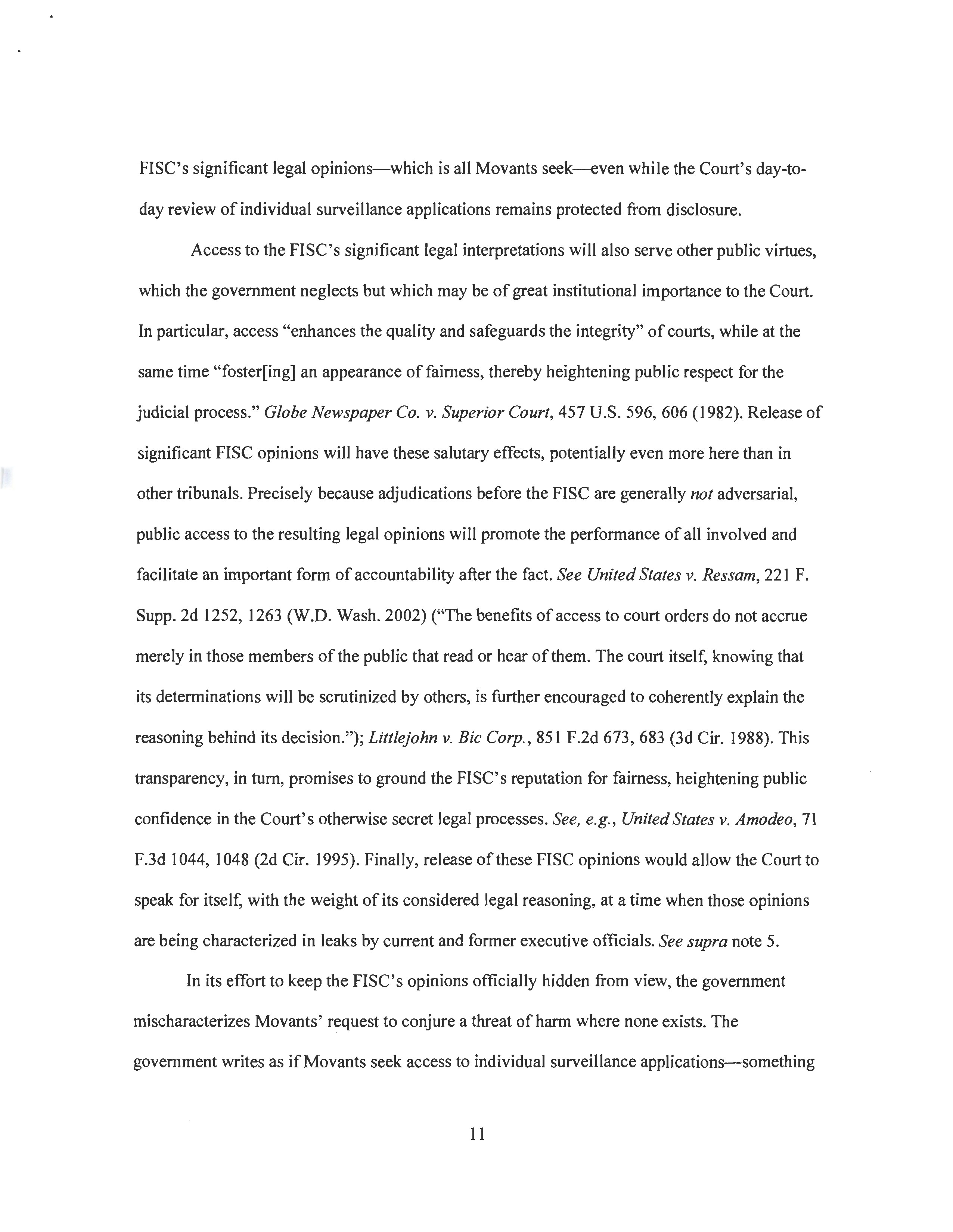
FISC's significant legal opinions—which is all Movants seek—even while the Court's day-to-
day review of individual surveillance applications remains protected from disclosure.
Access to the FISC's significant legal interpretations will also serve other public virtues,
which the government neglects but which may be of great institutional importance to the Court.
In particular, access "enhances the quality and safeguards the integrity" of courts, while at the
same time "foster[ing] an appearance of fairness, thereby heightening public respect for the
judicial process." Globe Newspaper Co. v. Superior Court, 457 U.S. 596, 606 (1982). Release of
significant FISC opinions will have these salutary effects, potentially even more here than in
other tribunals. Precisely because adjudications before the FISC are generally not adversarial,
public access to the resulting legal opinions will promote the performance of all involved and
facilitate an important form of accountability after the fact. See United States v. Ressam, 221 F.
Supp. 2d 1252, 1263 (W.D. Wash. 2002) ("The benefits of access to court orders do not accrue
merely in those members of the public that read or hear of them. The court itself, knowing that
its determinations will be scrutinized by others, is further encouraged to coherently explain the
reasoning behind its decision."); Littlejohn v. Bic Corp., 851 F.2d 673, 683 (3d Cir. 1988). This
transparency, in turn, promises to ground the FISC's reputation for fairness, heightening public
confidence in the Court's otherwise secret legal processes. See, e.g., United States v. Amodeo, 71
F.3d 1044, 1048 (2d Cir. 1995). Finally, release of these FISC opinions would allow the Court to
speak for itself, with the weight of its considered legal reasoning, at a time when those opinions
are being characterized in leaks by current and former executive officials. See supra note 5.
In its effort to keep the FISC's opinions officially hidden from view, the government
mischaracterizes Movants' request to conjure a threat of harm where none exists. The
government writes as if Movants seek access to individual surveillance applications—something
11
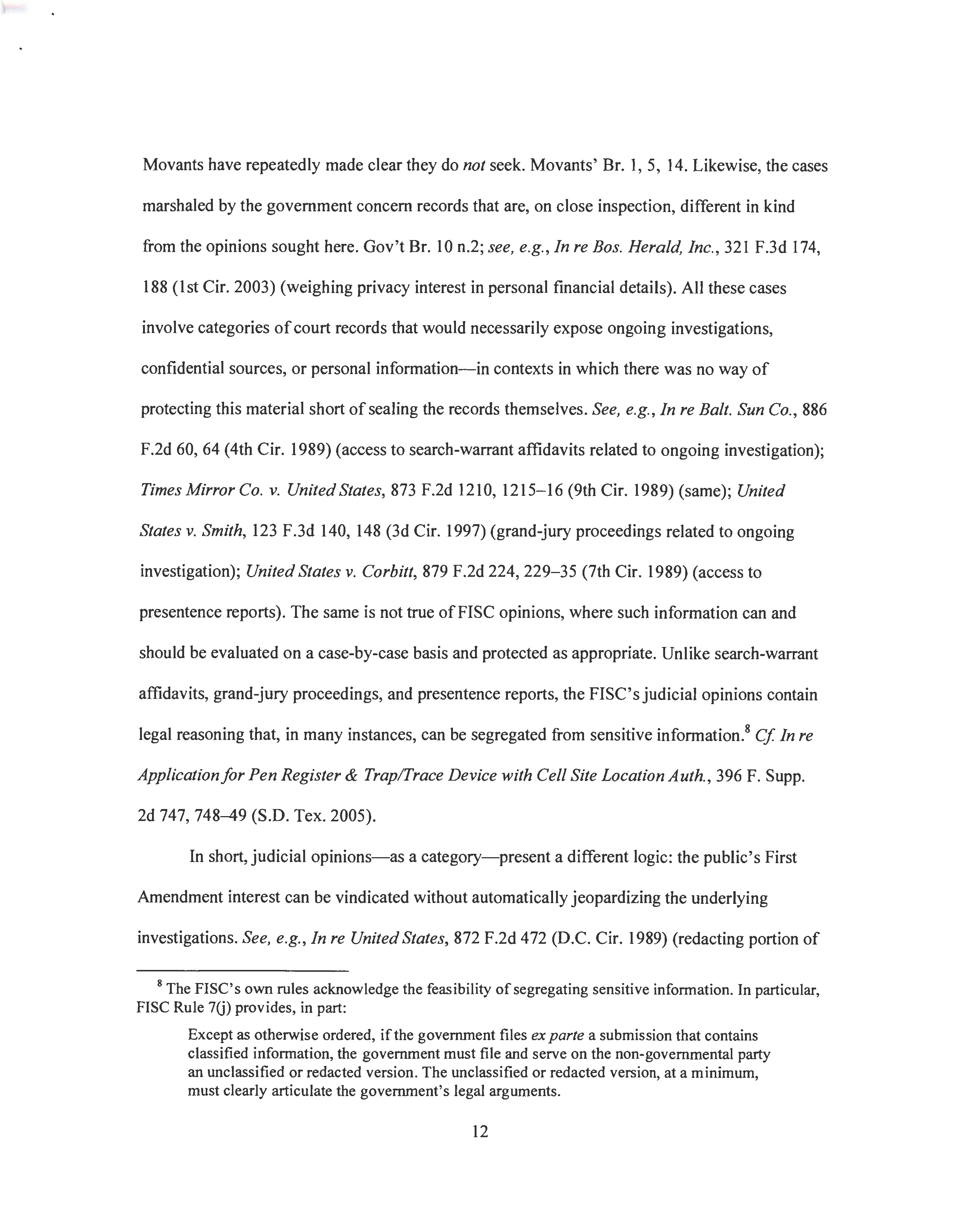
Movants have repeatedly made clear they do not seek. Movants' Br. 1, 5, 14. Likewise, the cases
marshaled by the government concern records that are, in close inspection, different in kind
from the opinions sought here. Gov't Br. 10 n.2; see, e.g., In re Bos. Herald, Inc., 321 F.3d 174,
188 (1st Cir. 2003) (weighing privacy interest in personal financial details). All these cases
involve categories of court records that would necessarily expose ongoing investigations,
confidential sources, or personal information—in contexts in which there was no way of
protecting this material short of sealing the records themselves. See, e.g., In re Balt. Sun Co., 886
F.2d 60, 64 (4th Cir. 1989) (access to search-warrant affidavits related to ongoing investigation);
Times Mirror Co. v. United States, 873 F.2d 1210, 1215–16 (9th Cir. 1989) (same); United
States v. Smith, 123 F.3d 140, 148 (3d Cir. 1997) (grand-jury proceedings related to ongoing
investigation); United States v. Corbitt, 879 F.2d 224, 229–35 (7th Cir. 1989) (access to
presentence reports). The same is not true of FISC opinions, where such information can and
should be evaluated on a case-by-case basis and protected as appropriate. Unlike search-warrant
affidavits, grand-jury proceedings, and presentence reports, the FISC's judicial opinions contain
legal reasoning that, in many instances, can be segregated from sensitive information.8 Cf. In re
Application for Pen Register & Trap/Trace Device with Cell Site Location Auth., 396 F. Supp.
2d 747, 748-49 (S.D. Tex. 2005).
In short, judicial opinions—as a category—present a different logic: the public's First
Amendment interest can be vindicated without automatically jeopardizing the underlying
investigations. See, e.g., In re United States, 872 F.2d 472 (D.C. Cir. 1989) (redacting portion of
8 The FISC's own rules acknowledge the feasibility of segregating sensitive information. In particular,
FISC Rule 7(j) provides, in part:
Except as otherwise ordered, if the government files ex parte a submission that contains
classified information, the government must file and serve on the non-governmental party
an unclassified or redacted version. The unclassified or redacted version, at a minimum,
must clearly articulate the government's legal arguments.
12
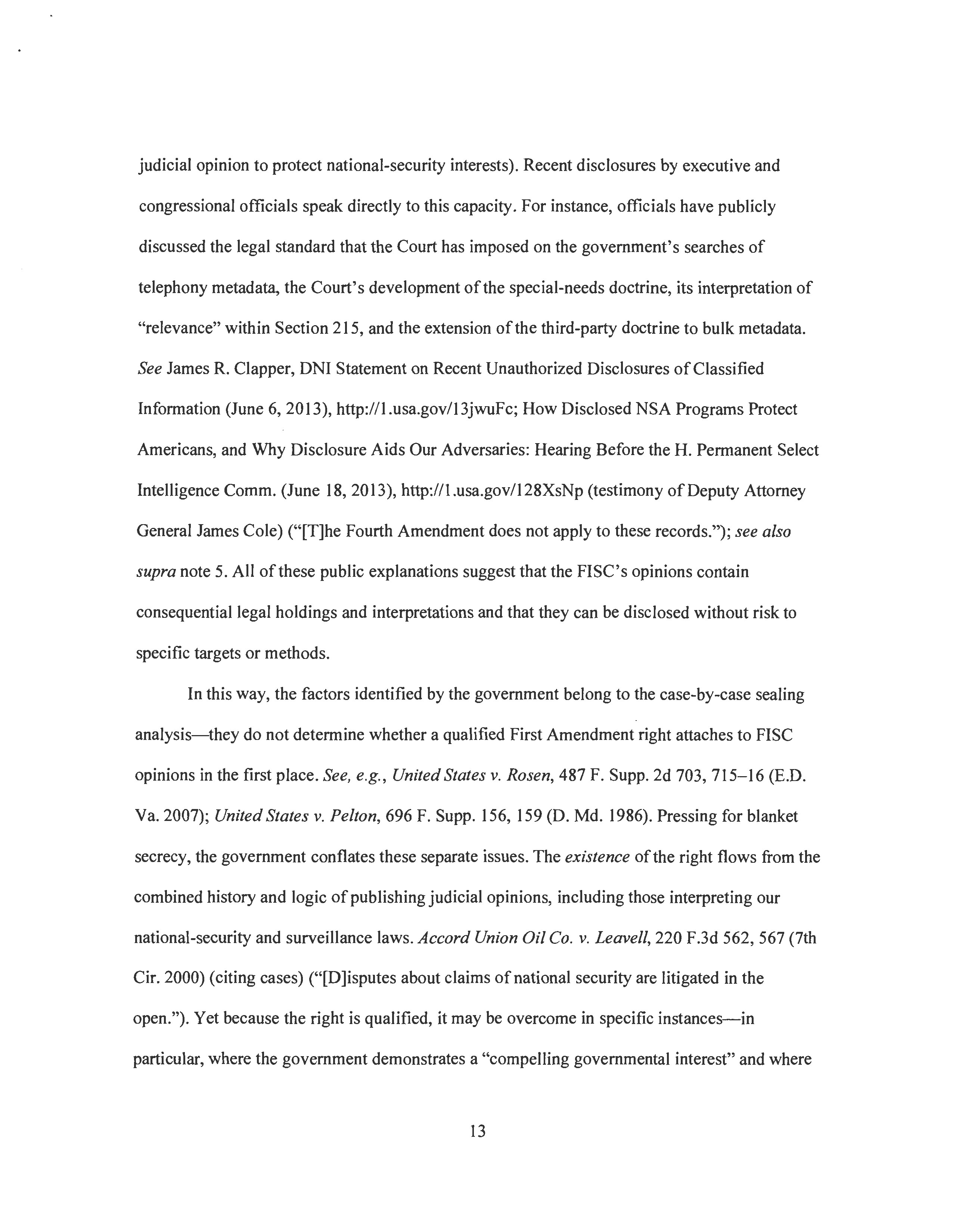
judicial opinion to protect national-security interests). Recent disclosures by executive and
congressional officials speak directly to this capacity. For instance, officials have publicly
discussed the legal standard that the Court has imposed on the government's searches of
telephony metadata, the Court's development of the special-needs doctrine, its interpretation of
"relevance" within Section 215, and the extension of the third-party doctrine to bulk metadata.
See James R. Clapper, DNI Statement on Recent Unauthorized Disclosures of Classified
Information (June 6, 2013), http://1.usa.gov/13jwuFc; How Disclosed NSA Programs Protect
Americans, and Why Disclosure Aids Our Adversaries: Hearing Before the H. Permanent Select
Intelligence Comm. (June 18, 2013), http://1.usa.gov/128XsNp (testimony of Deputy Attorney
General James Cole) ("[T]he Fourth Amendment does not apply to these records."); see also
supra note 5. All of these public explanations suggest the FISC's opinions contain
consequential legal holdings and interpretations and that they can be disclosed without risk to
specific targets or methods.
In this way, the factors identified by the government belong to the case-by-case sealing
analysis—they do not determine whether a qualified First Amendment right attaches to FISC
opinions in the first place. See, e.g., United States v. Rosen, 487 F. Supp. 2d 703, 715–16 (E.D.
Va. 2007); United States v. Pelton, 696 F. Supp. 156, 159 (D. Md. 1986). Pressing for blanket
secrecy, the government conflates these separate issues. The existence of the right flows from the
combined history and logic of publishing judicial opinions, including those interpreting our
national-security and surveillance laws. Accord Union Oil Co. v. Leavell, 220 F.3d 562, 567 (7th
Cir. 2000) (citing cases) ("[D]isputes about claims of national security are litigated in the
open."). Yet because the right is qualified, it may be overcome in specific instances—in
particular, where the government demonstrates a "compelling governmental interest" and where
13
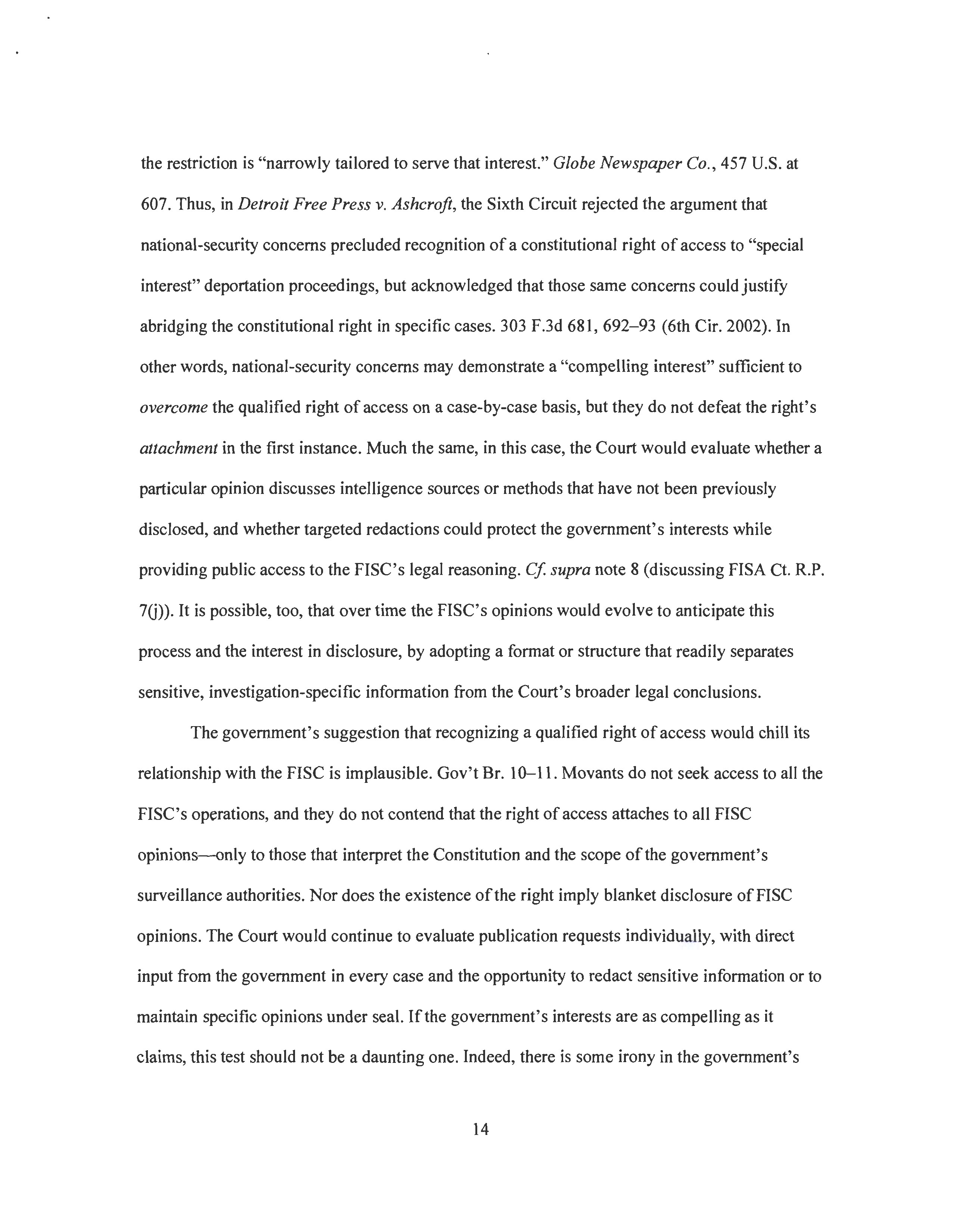
the restriction is "narrowly tailored to serve that interest.” Globe Newspaper Co., 457 U.S. at
607. Thus, in Detroit Free Press v. Ashcroft, the Sixth Circuit rejected the argument that
national-security concerns precluded recognition of a constitutional right of access to "special
interest" deportation proceedings, but acknowledged that those same concerns could justify
abridging the constitutional right in specific cases. 303 F.3d 681, 692-93 (6th Cir. 2002). In
other words, national-security concerns may demonstrate a "compelling interest" sufficient to
overcome the qualified right of access on a case-by-case basis, but they do not defeat the right's
attachment in the first instance. Much the same, in this case, the Court would evaluate whether a
particular opinion discusses intelligence sources or methods that have not been previously
disclosed, and whether targeted redactions could protect the government's interests while
providing public access to the FISC's legal reasoning. Cf. supra note 8 (discussing FISA Ct. R.P.
7(j)). It is possible, too, that over time the FISC's opinions would evolve to anticipate this
process and the interest in disclosure, by adopting a format or structure that readily separates
sensitive, investigation-specific information from the Court's broader legal conclusions.
The government's suggestion that recognizing a qualified right of access would chill its
relationship with the FISC is implausible. Gov't Br. 10–11. Movants do not seek access to all the
FISC's operations, and they do not contend that the right of access attaches to all FISC
opinions—only to those that interpret the Constitution and the scope of the government's
surveillance authorities. Nor does the existence of the right imply blanket disclosure of FISC
opinions. The Court would continue to evaluate publication requests individually, with direct
input from the government in every case and the opportunity to redact sensitive information or to
maintain specific opinions under seal. If the government's interests are as compelling as it
claims, this test should not be a daunting one. Indeed, there is some irony in the government's
14
effort to recast the familiar First Amendment standard as a chilling device. Most importantly,
recognizing a qualified right of access would not dramatically remake the government's
relationship to the Court: as the government acknowledges, the current Rules permit the Court to
publish its opinions while redacting "properly classified information." FISA Ct. R.P. 62(a); see
Gov't Br. 1, 12–16. Thus, the logic of disclosure is already suggested by the FISC's own
procedures, as well as the prior publication of FISC and Foreign Intelligence Surveillance Court
of Review ("FISCR") opinions in the public interest. See, e.g., Order, In re Directives
[REDACTED] Pursuant to Section 105B of the Foreign Intelligence Surveillance Act, No. 08-01 at
1 (FISA Ct. Rev. Jan. 12, 2009), http://bit.ly/r32r2W (observing that "[i]t would serve the public
interest and the orderly administration of justice to publish" the FISCR opinion).
II. This Court Has the Discretion to Release Its Own Opinions and Need Not Defer
Exclusively to the Executive Branch with Respect to Classification.
Movants also properly seek the release of this Court's opinions interpreting Section 215
pursuant to the Court's Rules of Procedure. The crux of the government's argument is that Rule
62(a) forecloses a member of the public who is "not a party to any opinions at issue,” Gov't Br.
13, from filing a motion for release of FISC records. To reject that strained reading of Rule
62(a), the Court need look no further than its own dismissal of that same contention six years ago
in In re Motion for Release of Court Records, 526 F. Supp. 2d 484, 486-87 (FISA Ct. 2007) ("In
re Release"). Rule 62(a)'s authorization of motions for publication by "a party" permits, rather
than prohibits, Movants' request. Nowhere in the text of the Rules is the word "party" cabined to
mean solely "a party to any opinions at issue,” as the government would have it. Moreover, that
9 Where the Rules insist on qualifying the term "party," they are clear in doing so. See, e.g.,
FISA Ct. R.P. 7(h) ("party other than the government"), 46 ("party in a proceeding under" the
FISA); see also FISA Ct. R.P. 33 (using "petitioner" to refer to "[t]he recipient of a production
order").
15
"[e]very court has supervisory power over its own records and files" is by now axiomatic. Nixon
v. Warner Commc'ns, Inc., 435 U.S. 589, 598 (1978). Thus, even if the applicable Rule were
unclear, the Court would undoubtedly have the "inherent power" to consider Movants' request.
In re Release, 526 F. Supp. 2d at 487.
Moreover, the government's unduly narrow focus on the FISC Rules' executive-branch
declassification procedures substantially understates the Court's capacity—indeed, its judicial
duty—to independently review government claims of classification. The government correctly
acknowledges that, even absent a First Amendment right of access, publication of FISC opinions
is within the "sound discretion of the judges of this Court." Gov't Br. 13.10 But it wrongly argues
that the FISC "cannot release an opinion that contains (or may contain) classified information
without first ordering the Executive Branch to conduct a classification review." Gov't Br. 14. In
so arguing, the government attempts to convert a permissive rule into a mandatory one. See FISA
Ct. R. P. 62(a) ("Before publication, the Court may, as appropriate, direct the Executive Branch
to review the order, opinion, or other decision" as to classification questions. (emphasis added)).
That the FISC "may" enlist the executive branch to assist it in preparing its own opinions for
public release merely underscores the Court's authority to prepare them for publication itself.
Furthermore, the government misreads the FISC's deference to the executive branch on
particular classification matters in the past. See Gov't Br. 14–15 (citing In re Release, 526 F.
Supp. 2d at 491, 495); see also Movants' Br. 16-17 (discussing publicly released FISC and
FISCR opinions). What the government elides is that the supervisory power of the FISC over its
own records grants it the discretion—like any other Article III court—to determine whether one
10 The Court exercised that discretion just last month. See In re Motion for Consent to
Disclosure of Court Records or, in the Alternative, a Determination of the Effect of the Court's
Rules on Statutory Access Rights, Misc. 13-01 (FISA Ct. June 12, 2013).
16
of its own judicial opinions or a portion thereof warrants public disclosure notwithstanding a
claim of classification by the executive branch.
The FISC's inherent authority to publish redacted versions of its own opinions stands
independently of its obligation to do so when First Amendment interests are at stake. That
authority compels the same result when the Court finds that the public's interest in release
outweighs the government's interest in continued secrecy. Cf. Nixon, 435 U.S. at 602 (describing
the "task of weighing the interests advanced by the parties in light of the public interest and the
duty of the courts"). No matter the context, "[a] blind acceptance by the courts of the
government's insistence" as to its interest's decisive weight “would impermissibly compromise
the independence of the judiciary and open the door to possible abuse." In re Wash. Post Co.,
807 F.2d 383, 391 (4th Cir. 1986); accord United States v. Smith, 899 F.2d 564, 569 (6th Cir.
1990). As a result, courts routinely scrutinize executive-branch classifications, which are never
determinative of claims to public access. See, e.g., John Doe, Inc. v. Mukasey, 549 F.3d 861,
882-83 (2d Cir. 2009) (applying strict scrutiny to classification decisions in challenge to
national-security-letter gag orders) ("The fiat of a governmental official, though senior in rank
and doubtless honorable in the execution of official duties, cannot displace the judicial obligation
to enforce constitutional requirements."); Campbell v. U.S. Dep't of Justice, 164 F.3d 20, 30
(D.C. Cir. 1998) ("[D]eference is not equivalent to acquiescence" when evaluating national-
security assertions as to FOIA exemptions.); Goldberg v. U.S. Dep't of State, 818 F.2d 71, 76
(D.C. Cir. 1987) (same). This principle is not controversial, and in other forums, the government
has expressly accepted it. See, e.g., Final Reply Br. 8 n.1, Ctr. for Int'l Envtl. Law v. Office of the
U.S. Trade Representative, No. 12-5136 (D.C. Cir. Nov. 27, 2012), 2012 WL 5940305
(clarifying that the government has not "suggested that the Executive's determination that a
17
document is classified should be conclusive or unreviewable"). Far from an "abuse of
discretion," Gov't Br. 15, applying scrutiny to executive-branch claims about the national-
security consequences of release of information is a fundamental task of Article III courts,
including—indeed, especially—the FISC.11
The FISC's fitness to determine that the public interest compels the release of classified
information in certain circumstances is not at all preempted by the existence of FOIA. See Gov't
Br. 15 n.4. If this Court properly determines that the First Amendment right of access applies,
strict scrutiny requires the government to present specific and articulable reasons supporting a
"compelling governmental interest," and the Court must "narrowly tailor[]" any restriction of
access to the Section 215 opinions. Globe Newspaper Co., 457 U.S. at 607. Even if the Court
acts upon its own discretion to grant the requested relief, FOIA's availability has no bearing on
the Court's ultimate and autonomous assessment of whether a legitimate national-security need
merits the opinions' continued secrecy, in total or in part. The FISC has recognized that its
judges often have "more expertise in national security matters than a typical district court judge."
In re Release, 526 F. Supp. 2d at 495 n.31. It would be incongruous, to say the least, to accept
the government's assertion that district courts may review classification in cases under FOIA
seeking executive-branch documents, but that the FISC may not do the same upon motions for
public access to its own legal opinions.
11 The government's suggestion that Rule 3 of the FISC Rules of Procedure counsels to the
contrary is mistaken. See Gov't Br. 15. That the judges and staff of this Court must obtain
security clearances, and that they "shall comply" with certain statutory security procedures when
handling classified information, FISA Ct. R.P. 3, does not speak to the Court's institutional
authority as an independent branch of government to publicly release its own opinions
interpreting the nation's public laws, or any other of its records, see In re Release, 526 F. Supp.
2d at 486-87.
18
Finally, a considered balancing of the relevant interests plainly warrants the relief sought.
See Movants' Br. 17-18. The Section 215 opinions of this Court interpret a public law. As that
law's democratic source, the public is entitled to understand Section 215's legal contours,
particularly in light of the government's public acknowledgments of the broad powers the
provision sanctions. And this Court's unique role in monitoring the government's surveillance
activities entitles it, as well, to ensure that the public has the necessary information to assess the
truth and logic of what is now publicly known about Section 215, rather than only piecemeal
disclosures made to the press. See, e.g., supra note 5.
Movants do not take lightly the responsibility of both the executive branch and the FISC
to prevent the public disclosure of certain information. But as the Court of Review has
recognized in the recent past, see Order, In re Directives [REDACTED] Pursuant to Section 105B of
the Foreign Intelligence Surveillance Act, No. 08-01 (FISA Ct. Rev. Jan. 12, 2009), the release
of its legal interpretations of broad significance would not call that responsibility into question,
while advancing vital public values and furthering ongoing democratic debates.
CONCLUSION
For the foregoing reasons, Movants respectfully request that this Court unseal its
opinions evaluating the meaning, scope, and constitutionality of Section 215 of the Patriot Act.
Movants request that these materials be released as quickly as possible and with only those
redactions essential to protect information that the Court determines, after independent review, to
warrant continued sealing.
19
Dated: July 12, 2013
Respectfully submitted,
Alex Abdo
David A. Schulz
Media Freedom and Information Access Clinic
Yale Law School
40 Ashmun Street, 4th Floor
New Haven, CT 06511
Phone: (203) 436-5892
Fax: (203) 436-0851
david.schulz@yale.edu
Brett Max Kaufman
Patrick Toomey
Jameel Jaffer
American Civil Liberties Union Foundation
125 Broad Street, 18th Floor
New York, NY 10004
Phone: (212) 549-2500
Fax: (212) 549-2654
aabdo@aclu.org
Arthur B. Spitzer
American Civil Liberties Union of the
Nation's Capital
4301 Connecticut Avenue, N.W., Suite 434
Washington, DC 20008
Phone: (202) 457-0800
Fax: (202) 457-0805
artspitzer@aclu-nca.org
20
CERTIFICATE OF SERVICE
I, Alex Abdo, certify that on this day, July 12, 2013, a copy of the foregoing certification
was served on the following persons by the methods indicated:
By email and UPS overnight delivery
Christine Gunning
Litigation Security Group
U.S. Department of Justice
2 Constitution Square
145 N Street, N.E.
Suite 2W-115
Washington, DC 20530
Email: Christine.E.Gunning@usdoj.gov
By UPS overnight delivery
John P. Carlin
J. Bradford Wiegmann
Tashina Gauhar
Jeffrey M. Smith
Nicholas J. Patterson
U.S. Department of Justice
National Security Division
950 Pennsylvania Ave., N.W.
Washington, DC 20530
Phone: (202) 514-5600
Alex Abdo
Related Documents
-
Brief of Amici Curiae U.S. Representatives Amash, Broun, Gabbard, Griffith, Holt, Jones, Lee, Lofgren, Massie, McClintock, Norton, O'Rourke, Pearce, Salmon, Sanford, and Yoho in Support of the Motion of the American Civil Liberties Union, the American Civil Liberties Union of the Nation's Capital, and the Media Freedom and Information Access Clinic for the Release of Court Records, In re Orders of this Court Interpreting Section 215 of the Patriot Act FOIA [pdf]
-
Motion of U.S. Representatives Amash, Broun, Gabbard, Griffith, Holt, Jones, Lee, Lofgren, Massie, McClintock, Norton, O'Rourke, Pearce, Salmon, Sanford, and Yoho for Leave to File a Brief as Amici Curiae in Support of the Motion of the American Civil Liberties Union, the American Civil Liberties Union of the Nation's Capital, and the Media Freedom and Information Access Clinic for the Release of Court Records, In re Orders of this Court Interpreting Section 215 of the Patriot Act FOIA [pdf]
-
-
Motion of the American Civil Liberties Union, the American Civil Liberties Union of the Nation's Capital, and the Media Freedom and Information Clinic for the Release of Court Records, In re Opinions & Orders of this Court Addressing Bulk Collection of Data Under the Foreign Intelligence Surveillance Act, No. Misc. 13-08 (FISA Ct. Nov. 7, 2013). FOIA [pdf]
-