Motion of The Reporters Committee for Freedom of the Press and 25 Media Organizations for Leave to File Brief as Amicus Curiae in Support of the November 6, 2013 Motion by the American Civil Liberties Union, et al., for the Release of Court Records; the October 11, 2013 Motion by the Media Freedom and Information Clinic for Reconsideration of this Court's September 13, 2013 Opinion on the Issue of Article III Standing; and the November 12, 2013 Motion of ProPublica, Inc. for Release of Court Records,...
Open PDFDocument date: 2013-11-26
Type: FOIA
Pages: 25
Classification: -
Dissemination: -
FISC/FISCR Court Filings
My notes
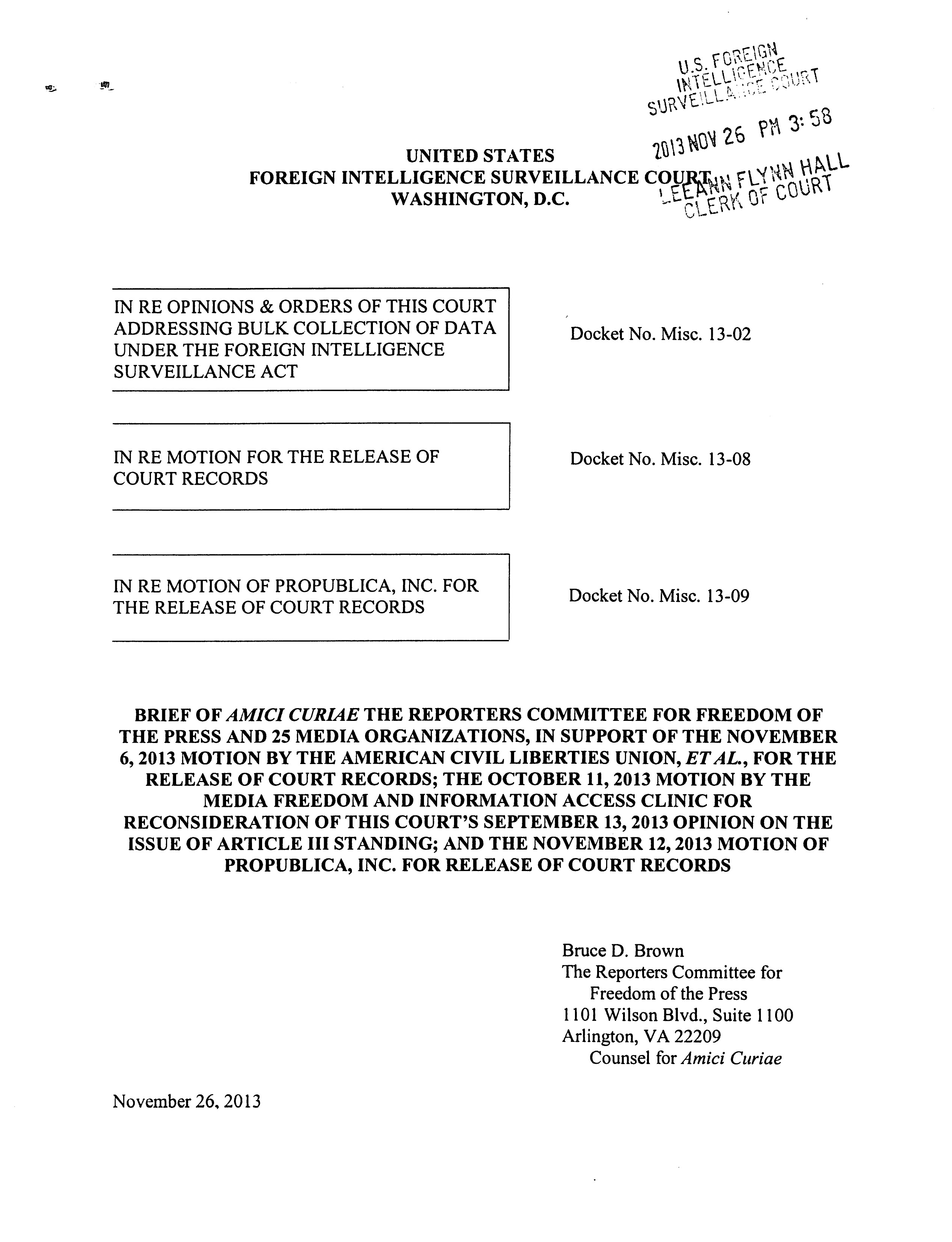
UNITED STATES
FOREIGN INTELLIGENCE SURVEILLANCE COURT
WASHINGTON, D.C.
U.S. FOREIGN
INTELLIGENCE
SURVEILLANCE COURT
2013 NOV 26 PM 3:58
CLEON FLYNN HALL
CLERK OF COURT
IN RE OPINIONS & ORDERS OF THIS COURT
ADDRESSING BULK COLLECTION OF DATA
UNDER THE FOREIGN INTELLIGENCE
SURVEILLANCE ACT
Docket No. Misc. 13-02
IN RE MOTION FOR THE RELEASE OF
COURT RECORDS
Docket No. Misc. 13-08
IN RE MOTION OF PROPUBLICA, INC. FOR
THE RELEASE OF COURT RECORDS
Docket No. Misc. 13-09
BRIEF OF AMICI CURIAE THE REPORTERS COMMITTEE FOR FREEDOM OF
THE PRESS AND 25 MEDIA ORGANIZATIONS, IN SUPPORT OF THE NOVEMBER
6, 2013 MOTION BY THE AMERICAN CIVIL LIBERTIES UNION, ET AL., FOR THE
RELEASE OF COURT RECORDS; THE OCTOBER 11, 2013 MOTION BY THE
MEDIA FREEDOM AND INFORMATION ACCESS CLINIC FOR
RECONSIDERATION OF THIS COURT'S SEPTEMBER 13, 2013 OPINION ON THE
ISSUE OF ARTICLE III STANDING; AND THE NOVEMBER 12, 2013 MOTION OF
PROPUBLICA, INC. FOR RELEASE OF COURT RECORDS
November 26, 2013
Bruce D. Brown
The Reporters Committee for
Freedom of the Press
1101 Wilson Blvd., Suite 1100
Arlington, VA 22209
Counsel for Amici Curiae
ii
TABLE OF CONTENTS
TABLE OF CONTENTS...................................................................................................... ii
TABLE OF AUTHORITIES...............................................................................................iii
IDENTITY OF AMICI CURIAE......................................................................................... 1
SUMMARY OF THE ARGUMENT.................................................................................... 2
ARGUMENT...................................................................................................................... 3
I. The right of access to court proceedings and documents belongs to the general public
and can be vindicated by any member of the public............................................... 3
A. All members of the public share an equal right of access to the courts................ 4
B. The standard applied by this Court undermines the right of even the news media
to seek access to court records and proceedings............................................. 6
C. The changing dynamics of the news industry have increased the importance of
a broad public right to challenge court closure............................................... 7
II. The documents sought in these cases are critically important to improving public
understanding of this Court and the federal government's national security
operations............................................................................................................. 10
A. These opinions are needed to promote robust debate about important public
issues and to instill faith in the judicial system........................................... 10
B. Recent revelations about programs that this Court has sanctioned underscore
the need for information about its decision-making process....................... 12
CONCLUSION................................................................................................................. 14
APPENDIX A.................................................................................................................. A-1
APPENDIX B.................................................................................................................. A-3
iii
TABLE OF AUTHORITIES
Cases
Broadrick v. Oklahoma, 413 U.S. 601 (1973)................................................................... 5
Gannett Co., Inc. v. DePasquale, 443 U.S. 368 (1979)............................................. 3, 5, 11
In re Access to Jury Questionnaires, 37 A.3d 879 (D.C. 2012)........................................ 5
In Re Application of the FBI for an Order Requiring the Production of Tangible Things from
Verizon Bus. Network Servs., Inc., on Behalf of MCI Commc'n Servs., Inc. d/b/a/ Verizon
Bus. Servs., No. BR 13-80 (FISC Apr. 25, 2013), available at http://bit.ly/11FY393........... 13
New York Times v. Sullivan, 376 U.S. 254 (1964)......................................................... 8
New York Times v. United States, 403 U.S. 713 (1971).................................................. 8
Nixon v. Warner Communications, Inc., 435 U.S. 589 (1978)..................................... 3, 4, 7
Pell v. Procunier, 417 U.S. 817 (1974)........................................................................ 6, 7
Press-Enterprise Co. v. Superior Court of California, Riverside (“Press-Enterprise I"),
464 U.S. 501 (1984).......................................................................................... 3, 5, 8, 11
Press-Enterprise Co. v. Superior Court of California, Riverside (“Press-Enterprise II”),
478 U.S. 1 (1986).................................................................................................... 3
Richmond Newspapers, Inc. v. Virginia, 448 U.S. 555 (1980)..................................... passim
Other Authorities
Charlie Savage & Scott Shane, Secret Court Rebuked N.S.A. on Surveillance, N.Y. Times,
Aug. 21, 2013, available at http://nyti.ms/15aSPIr.................................................... 12
Growth in Foundation Support for Media in the United States, Knight Foundation (Nov. 2013),
available at http://bit.ly/1a0zL22.............................................................................. 9
Jamie Schuman, The Shadows of the Spooks, The News Media and the Law, Fall 2013....... 11
Joseph Menn, Secret U.S. Court Approved Wider NSA Spying Even After Finding Excesses,
Reuters, Nov. 19, 2013, available at http://reut.rs/I1AmGn......................................... 12
Kimberly Dozier & Stephen Braun, NSA Reveals More Secrets After Court Order, Associated
Press, Aug. 22, 2013, available at http://bit.ly/14llee7................................................ 12
Leonard Downie Jr., The Obama Administration and the Press: Leak Investigations and
Surveillance in Post-9/11 America, Comm. to Protect Journalists, Oct. 10, 2013, available
at http://bit.ly/1c3Cnfg........................................................................................... 11
Lucas A. Powe, Jr., The Fourth Estate and the Constitution (1992).................................. 6
iv
Media, Freedom and Information Access Clinic, http://www.law.yale.edu/academics/MFIA.htm
(last visited Nov. 22, 2013)......................................................................................... 8
Memorandum Opinion by Judge John Bates, pp. 21-22, available at http://1.usa.gov/1gZwy7b 12
Misc. 13-02 (Opinion and Order of Sept. 13, 2013.................................................... 3, 6
Misc. 13-09 (Motion of Nov. 12, 2013)......................................................................... 3
Nicolas Cornell, Note, Overbreadth and Listeners' Rights, 123 Harv. L. Rev. 1749 (2010)........ 5
RonNell Andersen Jones, Litigation, Legislation and Democracy in a Post-Newspaper America,
68 Wash. & Lee L. Rev. 557 (2011)................................................................... 6, 8, 9, 10
1
IDENTITY OF AMICI CURIAE
Amici, who are described more fully in Appendix B, are The Reporters Committee for
Freedom of the Press, American Society of News Editors, Atlantic Media, Inc., Bay Area News
Group, Belo Corp., Bloomberg L.P., Courthouse News Service, The E.W. Scripps Company,
First Amendment Coalition, Gannett Co., Inc., Hearst Corporation, Investigative Reporters and
Editors, Investigative Reporting Workshop at American University, The McClatchy Company,
Media Consortium, The National Press Club, National Press Photographers Association,
National Public Radio, Inc., The New York Times Company, The New Yorker, North Jersey
Media Group Inc., Online News Association, POLITICO LLC, Radio Television Digital News
Association, The Seattle Times Company, and The Washington Post.
2
SUMMARY OF THE ARGUMENT
Public access to court proceedings is the linchpin of public acceptance of the legitimacy
and credibility of judicial institutions. This right has long been understood as one held by the
public at large under the First Amendment and at common law, with the news media often acting
as a proxy - but never a substitute – for the general public. This Court's decision on September
13, 2013 to exclude the Media Freedom and Information Access Clinic at Yale Law School
(MFIAC) from that right by concluding that the group lacked standing, and to adopt a narrow
test under which it found that the ACLU had standing, interferes with the most basic
constitutional commandments and common-law traditions underlying the laws of access to
courts, and is particularly problematic in a court already so closed off from public view.
Amici, as news media organizations, often represent the public interest before courts in
pressing for access and also by educating the public about how the judicial system operates. The
MFIAC performs the same service. The public and the press have always been understood to
have equal access to court records and court proceedings, much as both the public and the media
are understood to have co-extensive First Amendment rights generally. The fact that, in practice,
it is often traditional news media outlets litigating for access or records does not mean that public
interest organizations lack standing to vindicate the public's access rights as well. That MFIAC
sought access to court records and was denied them constitutes an injury-in-fact under the
Richmond Newspapers line of cases. There is no question of the cause of the injury, nor is there
any doubt that this Court has the power to redress that injury.
Furthermore, the public has an important interest in learning the justification behind the
decision to allow the NSA to conduct its surveillance programs. The recently declassified
disclosures about how some of those decisions have been made support the idea that the public
needs to know more about how the FISA Court has set this important precedent.
3
ARGUMENT
I. The right of access to court proceedings and documents belongs to the general
public and can be vindicated by any member of the public.
The effort to have this Court release the precedential opinions that underlie the National
Security Agency's surveillance programs is still active, as this Court has ordered the government
to conduct a declassification review after finding that the ACLU had standing to pursue a claim
for public access to the decisions. Misc. 13-02 (Opinion and Order of Sept. 13, 2013. However,
some of the focus has now turned to the issue of what parties must show to have standing to
prosecute that right of access. The ACLU and its Nation's Capital chapter were only allowed to
proceed because they could demonstrate that lack of access “impedes their own activities in a
concrete, particular way,” id. at 5, while the MFIAC was denied standing in the same order, id. at
9. In addition, ProPublica has joined this cause and stressed that it has standing as a member of
the media. Misc. 13-09 (Motion of Nov. 12, 2013).
While the news media have a long tradition of fighting for public access to court
proceedings and records, it is important for this Court to recognize that this right is possessed by
the public at large, and the interests at stake can be vindicated by anyone. In fact, the key
Supreme Court access cases Nixon v. Warner Communications, Inc., 435 U.S. 589 (1978),
Gannett Co., Inc. v. DePasquale, 443 U.S. 368 (1979), Richmond Newspapers, Inc. v. Virginia,
448 U.S. 555 (1980), Press-Enterprise Co. v. Superior Court of California, Riverside (“Press-
Enterprise I"), 464 U.S. 501 (1984), and Press-Enterprise Co. v. Superior Court of California,
Riverside (“Press-Enterprise II”), 478 U.S. 1 (1986) – do not examine the question of standing to
bring an action for access. These cases establish a presumption of a right of access based on the
4
important public interests at stake and do not even pause to consider whether the parties have
demonstrated any particular harm. Instead, the public interest in access, by itself, is enough.
A. All members of the public share an equal right of access to the courts.
Although it is news organizations that have traditionally brought suit to obtain access to
records and proceedings, courts have firmly based this right of access in a right of the general
public to know how its courts operate. Moreover, courts have found that all members of the
public equally share the right to enforce these long-established understandings.
Nixon v. Warner Communications, the seminal Supreme Court case recognizing the
common-law right of access to judicial documents, noted a presumptive right of access based on
nothing more than a citizen's desire to hold the government accountable:
It is clear that the courts of this country recognize a general right to inspect and copy
public records and documents, including judicial records and documents. In contrast to
the English practice, American decisions generally do not condition enforcement of this
right on a proprietary interest in the document or upon a need for it as evidence in a
lawsuit. The interest necessary to support the issuance of a writ compelling access has
been found, for example, in the citizen's desire to keep a watchful eye on the workings of
public agencies, and in a newspaper publisher's intention to publish information
concerning the operation of government.
Nixon, 435 U.S. at 598 (citations and footnotes omitted). At issue in Nixon was access to
presidential tapes during a trial of Watergate conspirators. The Court did not presume that
Warner Communications had standing only because it had thrust itself into coverage of the
Watergate investigation; the Court clearly would have entertained an action for access by any
citizen with a "watchful eye." Id.
In Richmond Newspapers v. Virginia, 448 U.S. at 564-75, applying the First Amendment,
the Court examined at great length the history of openness in trials and its importance to the
public. As the Court concluded,
5
People in an open society do not demand infallibility from their institutions, but it is
difficult for them to accept what they are prohibited from observing. When a criminal
trial is conducted in the open, there is at least an opportunity both for understanding the
system in general and its workings in a particular case.
Id. at 572. These substantial public interests were not based on anything other than the
generalized interest in having an open justice system, and standing to intervene was not
addressed. Id. See also In re Access to Jury Questionnaires, 37 A.3d 879, 885 (D.C. 2012)
("The right of public access is 'a right that any member of the public can assert[.]") (citation
omitted). When media organizations have sued for access, the Supreme Court has repeatedly
framed the right of access as a right of the public generally, not a right unique to the press. See
Gannett, 443 U.S. at 370 (framing issue as whether “members of the public" can attend pre-trial
proceedings); Press-Enterprise I, 464 U.S. at 508 (finding that "everyone in the community" can
attend voir dire). As access is a public right, any member of the public who has been excluded
from a courtroom can intervene.
Although the Supreme Court has not demanded a showing of standing before allowing an
access action, it is nonetheless clear that denial of information at the heart of democratic process
would suffice as a harm that establishes standing. See Broadrick v. Oklahoma, 413 U.S. 601,
611-12 (1973) (explaining that because the First Amendment requires "breathing space,"
standing rules are relaxed in constitutional challenges of state action and litigants can sue for
violations of others' rights). See also Nicolas Cornell, Note, Overbreadth and Listeners' Rights,
123 Harv. L. Rev. 1749 (2010) ("Insofar as the First Amendment protects a general right of the
citizenry to open and undistorted discourse, such a right is an appropriate basis for standing.").
To contextualize this presumption of openness, the Supreme Court has explained that a
public right of access dates back to England and colonial America. See Richmond Newspapers,
448 U.S. at 564 ("[T]hroughout its evolution, the trial has been open to all who care to
6
observe."). New Jersey's colonial charter, for instance, allowed "any person or persons" to
"freely come" to civil or criminal trials. Id. at 567 (citation omitted). Consequently, the
holdings of Richmond Newspapers and other access cases are not about "media-specific rights."
RonNell Andersen Jones, Litigation, Legislation and Democracy in a Post-Newspaper America,
68 Wash. & Lee L. Rev. 557, 627 (2011). Instead, the cases are a "bold statement on the needs
of 'people in an open society' and the value of public observation in government proceedings."
Id. Indeed, in oral argument in Richmond Newspapers, Chief Justice Warren E. Burger asked the
news outlet's attorney whether there is a difference between "a person who wants to attend [a
trial] to write something or just make a speech about it." Lucas A. Powe, Jr., The Fourth Estate
and the Constitution 244 (1992). The lawyer, Lawrence Tribe, replied "None, nor if he just
wanted to inform himself as a citizen." Id. (emphasis added).
Cases outside of the court-access area also show that the press and public's rights of
access are generally co-extensive in other ways. When news outlets have challenged statutes
that prohibit the general public from interviewing prison inmates, courts have declined to find
that journalists have special access rights under the Constitution. Instead, they have said that
reporters have no First Amendment newsgathering rights "not available to the public generally."
Pell v. Procunier, 417 U.S. 817, 834 (1974). Such a determination reiterates that members of the
public and reporters share the same rights to watch a trial or read judicial opinions; neither's
interest is greater than the other, but both are sufficient to advance an action for public access.
B. The standard applied by this Court undermines the right of even the news
media to seek access to court records and proceedings.
This Court ignored Supreme Court precedent when it denied MFIAC standing because it
found that the clinic had not "participated in public debate about Section 215." Misc. 13-02
(Opinion and Order of Sept. 13, 2013) at 9 n.13. The Richmond Newspapers line of cases and
7
Broadrick show that because access to court information is a public right, anyone who wants
access has standing to pursue it. Requiring groups to show that access would be of "concrete,
particular assistance to them in their own activities," as this Court held, would be akin to
requiring an individual who is barred from the courtroom to prove that his past actions show that
he has a specific stake in attending a hearing. Id. at 5. But, as Richmond Newspapers explains,
"what transpires in the courtroom is public property." 448 U.S. at 593 (citation omitted).
Potential harm to the public debate and erosion in confidence to the judicial system is an injury
that everyone shares when access rights are denied.
Moreover, this Court's standard would directly threaten the traditional ability of the news
media to fight for access. While it seems that a news organization that intends to report on a
public controversy would be able to satisfy this standard, a court could use it to deny standing to
a media party that could not show a prior track record of covering a particular issue. Such a rule,
however, ignores the constitutionally compelled mandate of Richmond Newspapers: that access
is a right that everyone has and that an abridgement of that right harms the public's right to hold
its government accountable.
C. The changing dynamics of the news industry have increased the importance
of a broad public right to challenge court closure.
Although the access right to court records and proceedings is one that all people hold,
courts have recognized that reporters serve as "surrogates" for members of the public who are
unable to attend hearings or obtain documents themselves. Richmond Newspapers, 448 U.S. at
573; see also Nixon, 435 U.S. at 609 ("[T]he press serves as the information-gathering agent of
the public."). As such, although it is not constitutionally required, journalists sometimes receive
special seating and priority of entry to courtrooms so that they can fulfill their role of informing
the public. Richmond Newspapers, 448 U.S. at 573; see also Pell, 417 U.S. at 830-31
8
(acknowledging that reporters, by virtue of their profession, receive permission to observe prison
programs and interview participants).
Given that journalists help ensure public access by serving as the "information-gathering
agent" of people who cannot go to courtrooms themselves, it is especially important that this
Court recognize the interests of new groups, like MFIAC, that are forming to take on these same
responsibilities for the benefit of the public. MFIAC's mission is "to support a robust
investigative role for news organizations and to preserve the public's right of access to
information, thereby ensuring a well-informed public sphere." Media, Freedom and Information
Access Clinic, http://www.law.yale.edu/academics/MFIA.htm (last visited Nov. 22, 2013).
Although the media and the public generally have co-extensive First Amendment rights
and equal rights of access to court records, the news media have often played a special role in the
judicial system. Traditional news media have historically led the effort to increase public access
to the courts. See Jones, supra, at 559. These companies have spent the past century advocating
on behalf of the public in all areas of First Amendment law, thereby reducing the need for
members of the public to take up the fight themselves. Among the major constitutional victories
the media have won for the public are the right to publish without prior restraint (New York
Times v. United States, 403 U.S. 713 (1971), protection from defamation lawsuits for good-faith
mistakes (New York Times v. Sullivan, 376 U.S. 254 (1964), access to the voir dire portion of a
trial (Press-Enterprise Co. v. Superior Ct. of Cal., Riverside, 464 U.S. 501 (1984), and the right
of access to criminal trials (Richmond Newspapers, Inc. v. Virginia, 448 U.S. 555 (1980)). See
Jones, supra, at 573-575. As Jones explains, “In this role, these entities claim credit for the
establishment and implementation of some of the nation's most important statutory and
constitutional mandates. Their death threatens the preservation, enforcement, and further
9
development of these mandates." Id. at 559. While amici feel that news of their "death" has
been greatly exaggerated, shrinking budgets at large media companies have inevitably meant a
drop-off in First Amendment litigation from those outlets. When the news organizations that
have historically had the financial resources to vindicate the right of access are less able to
pursue every access case, it becomes critical that lower courts follow the concept so clearly
established in Nixon and Richmond Newspapers – that court access is truly a public right that
may be defended by anyone to whom it is denied.
More and more often now, those defenders are organizations like MFIAC. Private
foundations are increasingly funding the pursuit of access litigation. See Growth in Foundation
Support for Media in the United States, Knight Foundation, 4 (Nov. 2013), available at
http://bit.ly/1a0zL22. Between 2009 and 2011, media access and access policy efforts received
$134.7 million from private foundations. Id. at 12-13. This figure demonstrates that outside
groups that traditionally have not been involved in access debates are becoming participants in
this crucial area of First Amendment jurisprudence. New entrants should not be excluded, as
MFIAC was, for attempting to join this critical field. Additionally, the primacy foundations have
put recently on open government and access efforts highlights the vital role MFIAC and other
clinical and public interest programs play in public discourse and in vindicating and protecting
the public's constitutional rights. As these types of organizations assume a greater role in
helping represent the public's interests, it is essential that this Court and others recognize the
importance of these actors in the constitutional debate.
While the litigation leadership from the traditional news media that this country has seen
over the past century will surely continue, university programs like MFIAC are particularly well-
positioned to represent the public interest in access cases they choose to pursue. A need for a
10
proxy representative of the general public in First Amendment cases undoubtedly remains.
"Given the complexity, expense, and time involved in making even simple requests, [newsroom
lawyers] are skeptical that members of the public will be able or willing to take up the effort
alone." Jones, supra, at 597. Just as an individual member of the public who is turned away
from the courthouse can seek redress for that harm, an individual public interest group that is
litigating to increase public knowledge and understanding of the court system has standing to
protest its own exclusion. Law school clinics, like MFIAC, are serving the public interest in new
and creative ways for the benefit of all of our legal and judicial institutions. Id. at 628. This
Court must recognize the role such groups are playing in representing the public, much in the
way the judiciary has always trusted the traditional media to do.
II. The documents sought in these cases are critically important to improving public
understanding of this Court and the federal government's national security
operations.
The scope, legality, and administration of NSA surveillance programs – including bulk
call tracking and collection of internet metadata and cell-site location information – have
generated great public controversy in recent months. While many of the amici here have already
weighed in on the issue of the important public interest at stake in access to the precedential
opinions of this Court, see Brief of Amicus Curiae of the Reporters Committee for Freedom of
the Press et al., filed July 15, 2013, further disclosures in recent months about these decisions
amplify the need for access and merits attention here.
A. These opinions are needed to promote robust debate about important public
issues and to instill faith in the judicial system.
Chief among the justifications for the presumption of court openness is that “uninhibited,
robust, and wide-open debate" about public issues strengthens democracy by giving voters better
understanding about government programs put in place by their elected officials. Richmond
11
Newspapers, 448 U.S. at 587 (Brennan, J., concurring) (citation omitted). For amici, opinions on
the legal basis of NSA programs are especially important because uncertainty about the scope of
surveillance efforts has deterred confidential sources from speaking with reporters. Discussing
the NSA surveillance programs, New York Times investigative reporter and three-time Pulitzer
Prize winner David Barstow said, “I have absolutely no doubt whatsoever that stories have not
gotten done because of this." Jamie Schuman, The Shadows of the Spooks, The News Media and
the Law, Fall 2013, at 9; see also Leonard Downie Jr., The Obama Administration and the Press:
Leak Investigations and Surveillance in Post-9/11 America, Comm. to Protect Journalists, Oct.
10, 2013, available at http://bit.ly/1c3Cnfg. Major works of journalism, from stories about the
Watergate break-in to pieces on harsh CIA investigation tactics, have relied on confidential
interviews. When potential sources refuse to speak to reporters out of fear of surveillance,
quality reporting is diminished and the public is less informed.
Another benefit of court openness is that secrecy weakens the credibility of the justice
system and government affairs in general. Press-Enterprise I, 464 U.S. at 508. In Gannett Co.,
Inc. v. DePasquale, the Supreme Court explained, “Public confidence cannot long be maintained
where important judicial decisions are made behind closed doors and then announced in
conclusive terms to the public, with the record supporting the court's decision sealed from public
view." 443 U.S. at 429 (Blackmun, J., concurring in part and dissenting in part) (quoting United
States v. Cianfrani, 573 F.2d 835, 851 (3rd Cir. 1978)).
In addition to closing its proceedings and sealing its records, the FISA Court has only one
side - the government – arguing before it. Disclosing precedential opinions would be a major
step towards fostering trust in the Court and public understanding of surveillance programs.
12
These changes would especially benefit journalists, whose work requires the willingness of
sources to speak with them.
B. Recent revelations about programs that this Court has sanctioned
underscore the need for information about its decision-making process.
The need for openness is especially important in light of the recent revelations about the
programs this Court has sanctioned and the government's expansion of surveillance beyond what
this Court has indicated it intended. In the past six months, Americans have learned that this
Court approved the collection of the "to" and "from" fields in e-mail messages, as well as the
date and time the messages were sent. Joseph Menn, Secret U.S. Court Approved Wider NSA
Spying Even After Finding Excesses, Reuters, Nov. 19, 2013, available at http://reut.rs/I1AmGn.
It has also become public that this Court criticized the government for exceeding the surveillance
authority this Court had granted it in earlier cases. In an opinion released just this month, Judge
John Bates referred to systematic overcollection and concluded that:
given the duration of this problem, the oversight measures ostensibly taken since
[REDACTED] to detect overcollection, and the extraordinary fact that NSA's end-to-
end review overlooked unauthorized acquisitions that were documented in
virtually every record of what was acquired, it must be added that those
responsible for conducting oversight at NSA failed to do so effectively.
Memorandum Opinion by Judge John Bates, pp. 21-22, available at http://1.usa.gov/1gZwy7b;
see also Menn, supra; Kimberly Dozier & Stephen Braun, NSA Reveals More Secrets After
Court Order, Associated Press, Aug. 22, 2013, available at http://bit.ly/141Iee7; Charlie Savage
& Scott Shane, Secret Court Rebuked N.S.A. on Surveillance, N.Y. Times, Aug. 21, 2013,
available at http://nyti.ms/15aSPIr. Judge Bates' concerns over NSA's overreaching emphasizes
why it is so important that Americans, through organizations like MFIAC, have access to this
Court's decisions.
13
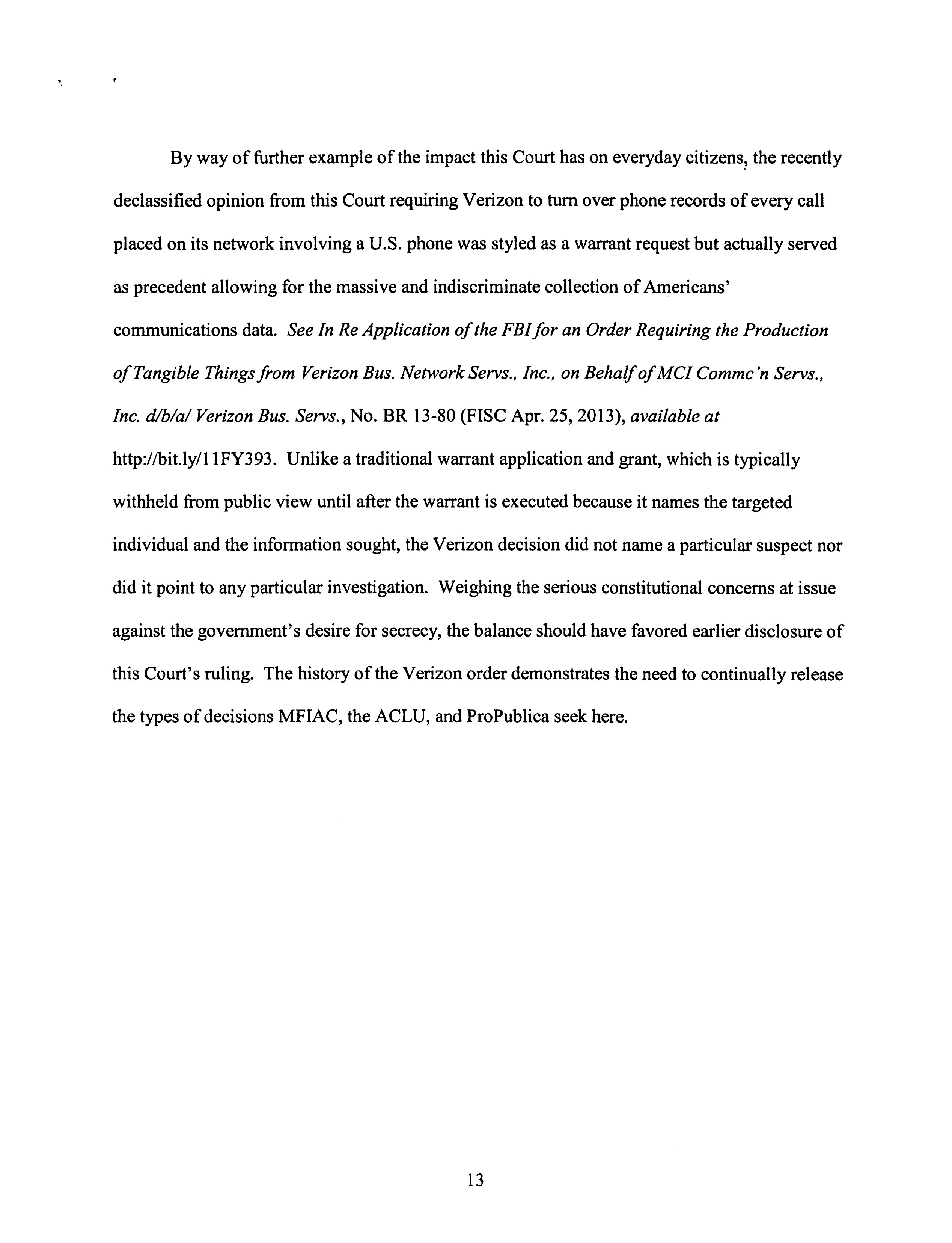
By way of further example of the impact this Court has on everyday citizens, the recently
declassified opinion from this Court requiring Verizon to turn over phone records of every call
placed on its network involving a U.S. phone was styled as a warrant request but actually served
as precedent allowing for the massive and indiscriminate collection of Americans'
communications data. See In Re Application of the FBI for an Order Requiring the Production
of Tangible Things from Verizon Bus. Network Servs., Inc., on Behalf of MCI Commc'n Servs.,
Inc. d/b/a/ Verizon Bus. Servs., No. BR 13-80 (FISC Apr. 25, 2013), available at
http://bit.ly/11FY393. Unlike a traditional warrant application and grant, which is typically
withheld from public view until after the warrant is executed because it names the targeted
individual and the information sought, the Verizon decision did not name a particular suspect nor
did it point to any particular investigation. Weighing the serious constitutional concerns at issue
against the government's desire for secrecy, the balance should have favored earlier disclosure of
this Court's ruling. The history of the Verizon order demonstrates the need to continually release
the types of decisions MFIAC, the ACLU, and ProPublica seek here.
14
CONCLUSION
For the reasons stated above, this Court should grant the ACLU and MFIAC's November
6, 2013 motion for the release of court records; the MFIAC's October 11, 2013 motion for
reconsideration; and ProPublica's November 12, 2013 motion for release of court records.
Pursuant to this Court's order, dated July 18, 2013, and United States Foreign
Intelligence Surveillance Court R.P. 7(h)(1) and 63, the Reporters Committee for Freedom of the
Press respectfully submits the following information:
Bruce D. Brown is a member in good standing of the United States District Court for the
District of Columbia (#457317), admitted September 12, 2011. Additionally, Brown is a
member of good standing of the bar of the Commonwealth of Massachusetts (#629541) and the
District of Columbia (#426092). Amici further certify that the undersigned does not currently
hold a security clearance.
Respectfully submitted,
Bruce D. Brown
The Reporters Committee for
Freedom of the Press
1101 Wilson Blvd., Suite 1100
Arlington, VA 22209
Phone: 703-807-2100
Fax: 703-807-2109
bbrown@rcfp.org
Counsel for Amici Curiae
*Additional amici counsel listed below
A-1
APPENDIX A
Of counsel to amici curiae:
Gregg P. Leslie
Emily R. Grannis
Jamie T. Schuman (Admission pending, Pa.)
The Reporters Committee for
Freedom of the Press
1101 Wilson Blvd., Suite 1100
Arlington, VA 22209
Kevin M. Goldberg
Fletcher, Heald & Hildreth, PLC
1300 N. 17th St., 11th Floor
Arlington, VA 22209
Counsel for American Society of
News Editors
Bruce L. Gottlieb
Aretae Wyler
Atlantic Media, Inc.
600 New Hampshire Ave., NW
Washington, DC 20037
Marshall Anstandig
Senior VP/General Counsel
Andrew Huntington
General Counsel/Director of Labor
Relations
Bay Area News Group
750 Ridder Park Drive
San Jose, CA 95190
James Chadwick
Sheppard Mullin Richter & Hampton LLP
390 Lytton Avenue
Palo Alto, CA 94301
Additional Counsel for Bay Area News
Group
Russell F. Coleman
Belo Corp.
400 S. Record Street
Dallas, TX 75202
Randy L. Shapiro
Global Media Counsel
Bloomberg LP
731 Lexington Avenue
New York, NY 10022
Rachel Matteo-Boehm
Bryan Cave LLP
560 Mission Street, Suite 2500
San Francisco, CA 94105
Counsel for Courthouse News Service
David M. Giles
Vice President/Deputy General Counsel
The E.W. Scripps Company
312 Walnut St., Suite 2800
Cincinnati, OH 45202
Peter Scheer
First Amendment Coalition
534 Fourth St., Suite B
San Rafael, CA 94901
Barbara W. Wall
Vice President/Senior
Associate General Counsel
Gannett Co., Inc.
7950 Jones Branch Drive
McLean, VA 22107
Jonathan Donnellan
Kristina Findikyan
Hearst Corporation
Office of General Counsel
300 W. 57th St., 40th Floor
New York, NY 10019
Karole Morgan-Prager
Juan Cornejo
The McClatchy Company
2100 Q Street
Sacramento, CA 95816
A-2
Charles D. Tobin
Holland & Knight LLP
800 17th Street, NW
Suite 1100
Washington, DC 20006
Counsel for The National Press Club
Mickey H. Osterreicher
1100 M&T Center, 3 Fountain Plaza,
Buffalo, NY 14203
Counsel for National Press Photographers
Association
Denise Leary
Ashley Messenger
National Public Radio, Inc.
1111 North Capitol St. NE
Washington, D.C. 20002
David McCraw
V.P./Assistant General Counsel
The New York Times Company
620 Eighth Avenue
New York, NY 10018
Lynn Oberlander
General Counsel
The New Yorker
4 Times Square
New York, NY 10036
Jennifer A. Borg
General Counsel
North Jersey Media Group Inc.
1 Garret Mountain Plaza
Woodland Park, NJ 07424
Jonathan D. Hart
Dow Lohnes PLLC
1200 New Hampshire Ave., NW
Washington, DC 20036
Counsel for Online News Association
Jerald N. Fritz
Vice President and General Counsel
POLITICO LLC
1000 Wilson Blvd., Suite 2700
Arlington, VA 22209
Kathleen A. Kirby
Wiley Rein LLP
1776 K St., NW
Washington, DC 20006
Counsel for Radio Television Digital News
Association
Bruce E. H. Johnson
Davis Wright Tremaine LLP
1201 Third Ave., Suite 2200
Seattle, WA 98101
Counsel for The Seattle Times Co.
John B. Kennedy
James A. McLaughlin
Kalea S. Clark
The Washington Post
1150 15th Street, N.W.
Washington, D.C. 20071
A-3
APPENDIX B
The Reporters Committee for Freedom of the Press is a voluntary, unincorporated
association of reporters and editors that works to defend the First Amendment rights and freedom
of information interests of the news media. The Reporters Committee has provided
representation, guidance and research in First Amendment and Freedom of Information Act
litigation since 1970.
With some 500 members, American Society of News Editors ("ASNE”) is an
organization that includes directing editors of daily newspapers throughout the Americas. ASNE
changed its name in April 2009 to American Society of News Editors and approved broadening
its membership to editors of online news providers and academic leaders. Founded in 1922 as
American Society of Newspaper Editors, ASNE is active in a number of areas of interest to top
editors with priorities on improving freedom of information, diversity, readership and the
credibility of newspapers.
Atlantic Media, Inc. is a privately held, integrated media company that publishes The
Atlantic, National Journal, Quartz and Government Executive. These award-winning titles
address topics in national and international affairs, business, culture, technology and related
areas, as well as cover political and public policy issues at federal, state and local levels. The
Atlantic was founded in 1857 by Oliver Wendell Holmes, Ralph Waldo Emerson, Henry
Wadsworth Longfellow and others.
Bay Area News Group is operated by MediaNews Group, one of the largest newspaper
companies in the United States with newspapers throughout California and the nation. The Bay
Area News Group includes The Oakland Tribune, The Daily Review, The Argus, San Jose
Mercury News, Contra Costa Times, Marin Independent Journal, West County Times, Valley
Times, East County Times, Tri-Valley Herald, Santa Cruz Sentinel, San Mateo County
Times, Vallejo Times-Herald and Vacaville Reporter, all in California.
Belo Corp. owns 20 television stations that reach more than 14% of U.S. television
households.
Bloomberg L.P., based in New York City, operates Bloomberg News, which is
comprised of more than 1,500 professionals in 145 bureaus around the world. Bloomberg News
publishes more than 6,000 news stories each day, and The Bloomberg Professional Service
maintains an archive of more than 15 million stories and multimedia reports and a photo library
comprised of more than 290,000 images. Bloomberg News also operates as a wire service,
syndicating news and data to over 450 newspapers worldwide with a combined circulation of 80
million people in more than 160 countries. Bloomberg News operates the following: cable and
satellite television news channels broadcasting worldwide; WBBR, a 24-hour business news
radio station that syndicates reports to more than 840 radio stations worldwide; Bloomberg
Markets and Bloomberg Businessweek magazines; and Bloomberg.com, which receives 3.5
million individual user visits each month.
Courthouse News Service is a California-based legal news service for lawyers and the
news media that focuses on court coverage throughout the nation, reporting on matters raised in
trial courts and courts of appeal up to and including the U.S. Supreme Court.
A-4
The E.W. Scripps Company is a diverse, 131-year-old media enterprise with interests in
television stations, newspapers, local news and information websites and licensing and
syndication. The company's portfolio of locally focused media properties includes: 19 TV
stations (ten ABC affiliates, three NBC affiliates, one independent and five Spanish-language
stations); daily and community newspapers in 13 markets; and the Washington-based Scripps
Media Center, home of the Scripps Howard News Service.
First Amendment Coalition is a nonprofit public interest organization dedicated to
defending free speech, free press and open government rights in order to make government, at all
levels, more accountable to the people. The Coalition's mission assumes that government
transparency and an informed electorate are essential to a self-governing democracy. To that end,
we resist excessive government secrecy (while recognizing the need to protect legitimate state
secrets) and censorship of all kinds.
Gannett Co., Inc. is an international news and information company that publishes 82
daily newspapers in the United States, including USA TODAY, as well as hundreds of non-daily
publications. In broadcasting, the company operates 23 television stations in the U.S. with a
market reach of more than 21 million households. Each of Gannett's daily newspapers and TV
stations operates Internet sites offering news and advertising that is customized for the market
served and integrated with its publishing or broadcasting operations.
Hearst Corporation is one of the nation's largest diversified media companies. Its major
interests include the following: ownership of 15 daily and 38 weekly newspapers, including
the Houston Chronicle, San Francisco Chronicle and Albany (N.Y.) Times Union; nearly 300
magazines around the world, includingGood Housekeeping, Cosmopolitan and O, The Oprah
Magazine; 29 television stations, which reach a combined 18% of U.S. viewers; ownership in
leading cable networks, including Lifetime, A&E and ESPN; business publishing, including a
joint venture interest in Fitch Ratings; and Internet businesses, television production, newspaper
features distribution and real estate.
Investigative Reporters and Editors, Inc. is a grassroots nonprofit organization dedicated
to improving the quality of investigative reporting. IRE was formed in 1975 to create a forum in
which journalists throughout the world could help each other by sharing story ideas,
newsgathering techniques and news sources.
The Investigative Reporting Workshop, a project of the School of Communication (SOC)
at American University, is a nonprofit, professional newsroom. The Workshop publishes in-
depth stories at investigativereportingworkshop.org about government and corporate
accountability, ranging widely from the environment and health to national security and the
economy.
The McClatchy Company, through its affiliates, is the third-largest newspaper publisher
in the United States with 30 daily newspapers and related websites as well as numerous
community newspapers and niche publications.
A-5
The Media Consortium is a network of the country's leading, progressive, independent
media outlets. Our mission is to amplify independent media's voice, increase our collective
clout, leverage our current audience and reach new ones.
The National Press Club is the world's leading professional organization for journalists.
Founded in 1908, the Club has 3,100 members representing most major news organizations. The
Club defends a free press worldwide. Each year, the Club holds over 2,000 events, including
news conferences, luncheons and panels, and more than 250,000 guests come through its doors.
The National Press Photographers Association ("NPPA”) is a 501(c)(6) non-profit
organization dedicated to the advancement of visual journalism in its creation, editing and
distribution. NPPA's approximately 7,000 members include television and still photographers,
editors, students and representatives of businesses that serve the visual journalism industry. Since
its founding in 1946, the NPPA has vigorously promoted the constitutional rights of journalists
as well as freedom of the press in all its forms, especially as it relates to visual journalism. The
submission of this brief was duly authorized by Mickey H. Osterreicher, its General Counsel.
National Public Radio, Inc. is an award-winning producer and distributor of
noncommercial news programming. A privately supported, not-for-profit membership
organization, NPR serves a growing audience of more than 26 million listeners each week by
providing news programming to 285 member stations that are independently operated,
noncommercial public radio stations. In addition, NPR provides original online content and
audio streaming of its news programming. NPR.org offers hourly newscasts, special features and
10 years of archived audio and information.
The New York Times Company is the publisher of The New York Times, The Boston
Globe, and International Herald Tribune and operates such leading news websites as
nytimes.com and bostonglobe.com.
The New Yorker is an award-winning magazine, published weekly in print, digital, and
online. Its writers, including Jane Mayer, David Grann, and Raffi Khatchadourian, regularly use
information gained from federal and state freedom of information laws to report on matters of
state, national, and international importance.
North Jersey Media Group Inc. (“NJMG”) is an independent, family-owned printing and
publishing company, parent of two daily newspapers serving the residents of northern New
Jersey: The Record (Bergen County), the state's second-largest newspaper, and the Herald
News (Passaic County). NJMG also publishes more than 40 community newspapers serving
towns across five counties and a family of glossy magazines, including (201) Magazine, Bergen
County's premiere magazine. All of the newspapers contribute breaking news, features, columns
and local information to NorthJersey.com. The company also owns and publishes Bergen.com
showcasing the people, places and events of Bergen County.
Online News Association ("ONA") is the world's largest association of online journalists.
ONA's mission is to inspire innovation and excellence among journalists to better serve the
public. ONA's more than 2,000 members include news writers, producers, designers, editors,
bloggers, technologists, photographers, academics, students and others who produce news for the
A-6
Internet or other digital delivery systems. ONA hosts the annual Online News Association
conference and administers the Online Journalism Awards. ONA is dedicated to advancing the
interests of digital journalists and the public generally by encouraging editorial integrity and
independence, journalistic excellence and freedom of expression and access.
POLITICO LLC is a nonpartisan, Washington-based political journalism organization
that produces a series of websites, video programming and a newspaper covering politics and
public policy.
Radio Television Digital News Association (“RTDNA”) is the world's largest and only
professional organization devoted exclusively to electronic journalism. RTDNA is made up of
news directors, news associates, educators and students in radio, television, cable and electronic
media in more than 30 countries. RTDNA is committed to encouraging excellence in the
electronic journalism industry and upholding First Amendment freedoms.
The Seattle Times Company, locally owned since 1896, publishes the daily
newspaper The Seattle Times, together with The Issaquah Press, Yakima Herald-Republic, Walla
Walla Union-Bulletin, Sammamish Review and Newcastle-News, all in Washington state.
WP Company LLC (d/b/a The Washington Post) publishes one of the nation's most
prominent daily newspapers, as well as a website, www.washingtonpost.com, that is read by an
average of more than 20 million unique visitors per month.
CERTIFICATE OF SERVICE
I, Bruce D. Brown, certify that on November 26, 2013, a copy of this motion, together
with the accompanying brief of amici curiae, were served on the following by in-person
delivery.
Christine Gunning
Litigation Security Group
U.S. Department of Justice
2 Constitution Square
145 N ST NE, Suite 2W-115
Washington, DC 20530
Christine.e.gunning@usdoj.gov
I further certify that this motion and the accompanying brief were served on the following
by electronic mail:
Alex Abdo
American Civil Liberties Union
Foundation
125 Broad Street, 18th Floor
New York, NY 10004
aabdo@aclu.org
David A. Schulz
Media Freedom and Information
Access Clinic
Yale Law School
P.O. Box 208215
New Haven, CT 06520
dschulz@lskslaw.com
Arthur B. Spitzer
American Civil Liberties Union of
the Nation's Capital
4301 Connecticut Avenue, NW,
Suite 434
Washington, DC 20008
artspitzer@aclu-nca.org
David Greene
Electronic Frontier Foundation
815 Eddy Street
San Francisco, CA 94109
davidg@eff.org
Counsel for ProPublica, Inc.
Bruce D. Brown
Published in the Same Report
(1 documents)
-
Motion of The Reporters Committee for Freedom of the Press and 25 Media Organizations for Leave to File Brief as Amicus Curiae in Support of the November 6, 2013 Motion by the American Civil Liberties Union, et al., for the Release of Court Records; the October 11, 2013 Motion by the Media Freedom and Information Clinic for Reconsideration of this Court's September 13, 2013 Opinion on the Issue of Article III Standing; and the November 12, 2013 Motion of ProPublica, Inc. for Release of Court Records,... FOIA [pdf]
Related Documents
-
Motion of The Reporters Committee for Freedom of the Press and 25 Media Organizations for Leave to File Brief as Amicus Curiae in Support of the November 6, 2013 Motion by the American Civil Liberties Union, et al., for the Release of Court Records; the October 11, 2013 Motion by the Media Freedom and Information Clinic for Reconsideration of this Court's September 13, 2013 Opinion on the Issue of Article III Standing; and the November 12, 2013 Motion of ProPublica, Inc. for Release of Court Records,... FOIA [pdf]
-
Motion of U.S. Representatives Amash, Broun, Gabbard, Griffith, Holt, Jones, Lee, Lofgren, Massie, McClintock, Norton, O'Rourke, Pearce, Salmon, Sanford, and Yoho for Leave to File a Brief as Amici Curiae in Support of the Motion of the American Civil Liberties Union, the American Civil Liberties Union of the Nation's Capital, and the Media Freedom and Information Access Clinic for the Release of Court Records, In re Orders of this Court Interpreting Section 215 of the Patriot Act FOIA [pdf]
-
Notice of Motion, Memorandum in Support of Motion by Media Freedom and Information Access Clinic for Reconsideration of This Court's September 13, 2013 Opinion on the Issue of Article III Standing, and Declaration of Maxwell S. Mishkin, In re Orders of this Court Interpreting Section 215 of the Patriot Act FOIA [pdf]
-
-
Motion of the American Civil Liberties Union, the American Civil Liberties Union of the Nation's Capital, and the Media Freedom and Information Clinic for the Release of Court Records, In re Opinions & Orders of this Court Addressing Bulk Collection of Data Under the Foreign Intelligence Surveillance Act, No. Misc. 13-08 (FISA Ct. Nov. 7, 2013). FOIA [pdf]