The United States’ Opposition to the Motion of ProPublica, Inc. for the Release of Court Records, In re Motion of ProPublica, Inc. for the Release of Court Records, No. Misc. 13-09 (FISA Ct. Dec. 11, 2013).
Open PDFDocument date: 2013-12-11
Type: FOIA
Pages: 9
Classification: -
Dissemination: -
FISC/FISCR Court Filings
My notes
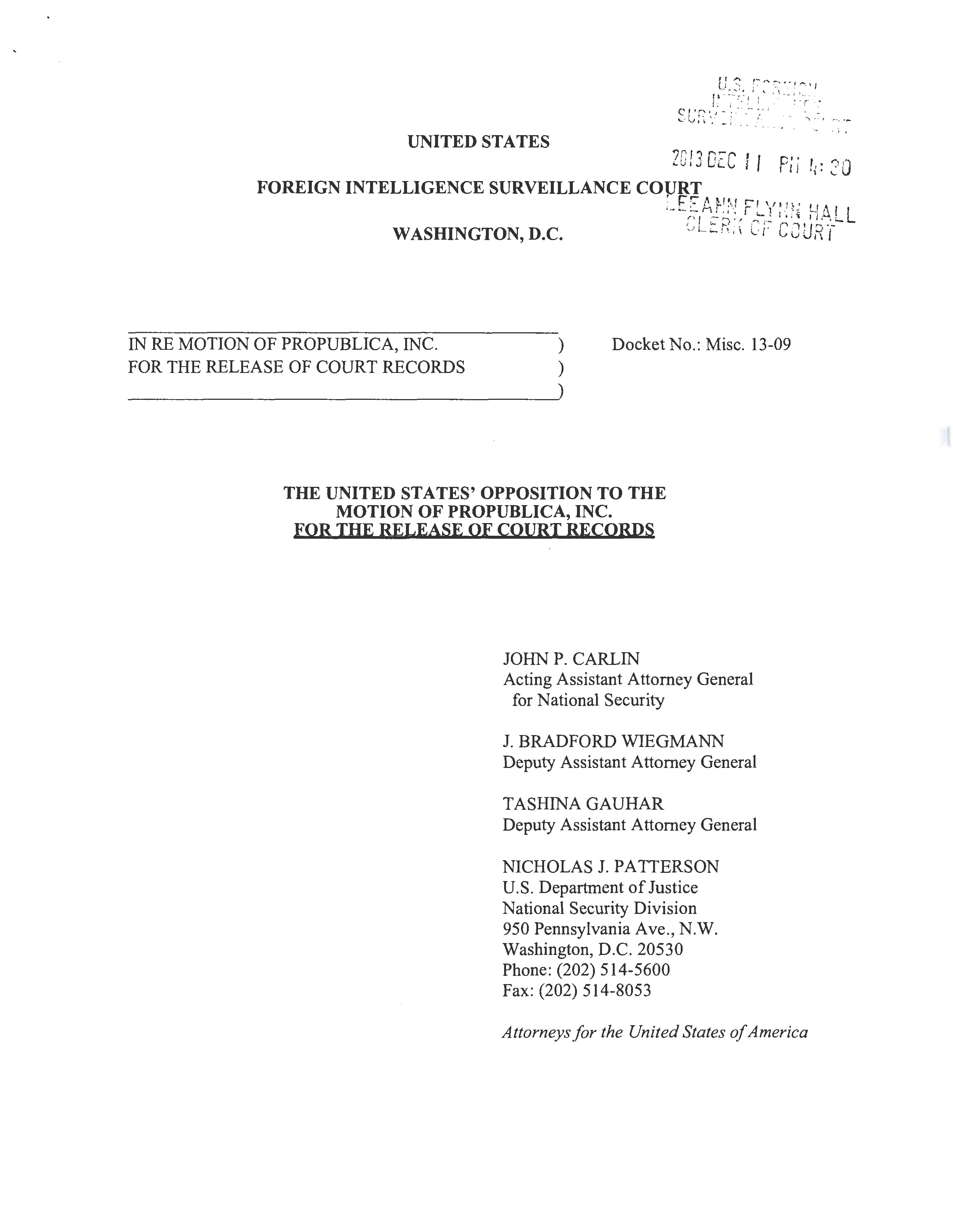
UNITED STATES
FOREIGN INTELLIGENCE SURVEILLANCE COURT
WASHINGTON, D.C.
U.S. FORSION
2013 DEC 11 PM 4:20
LEEANN FLYNN HALL
CLERK OF COURT
IN RE MOTION OF PROPUBLICA, INC.
FOR THE RELEASE OF COURT RECORDS
)
)
)
)
Docket No.: Misc. 13-09
THE UNITED STATES' OPPOSITION TO THE
MOTION OF PROPUBLICA, INC.
FOR THE RELEASE OF COURT RECORDS
JOHN P. CARLIN
Acting Assistant Attorney General
for National Security
J. BRADFORD WIEGMANN
Deputy Assistant Attorney General
TASHINA GAUHAR
Deputy Assistant Attorney General
NICHOLAS J. PATTERSON
U.S. Department of Justice
National Security Division
950 Pennsylvania Ave., N.W.
Washington, D.C. 20530
Phone: (202) 514-5600
Fax: (202) 514-8053
Attorneys for the United States of America
ProPublica, Inc. (“ProPublica”) seeks the publication of “a certain Foreign Intelligence
Suryeillance Court (‘FISC’) opinion or opinions that appear to underlie the government’s
collection of telephone metadata. The specific opinion or opinions sought are those referenced
on, but redacted from, pages 8, 9, and 19-20 of _In re Application of the FBI for an Order
Requiring the Production of Tangible Things From [Redacted], No. BR 13-109 (FISA Ct. Aug.
29, 2013) (‘BR 13-109’)._” Mot. at 1. ProPublica’s motion should be dismissed because the
relevant opinion has been subjected to classification review and the unclassified portions
released, and there is no basis for the Court to order a new classification review.
ARGUMENT
I. ProPublica's Motion Should Be Dismissed Because a Declassified Version of the Requested Opinion Has Already Been Released.
ProPublica’s motion should be dismissed because the Government has already released a
declassified version of the opinion that is referenced on, but redacted from, pages 8, 9, and 19-20
of _In re Application of the FBI for an Order Requiring the Production of Tangible Things From
[Redacted], No. BR 13-109, Order (Foreign Intel. Surv. Ct. Aug. 29, 2013)._ After a
classification review conducted by the Executive Branch consistent with Executive Order 13,526
(Dec. 29, 2009), all unclassified portions of this opinion were released by the Executive Branch.
This opinion is:
> The Court’s Opinion (J. Kollar-Kotelly) granting the Government’s application
> seeking the collection of bulk electronic communications metadata pursuant to
> Section 402 of the Foreign Intelligence Surveillance Act, the Pen Register and Trap
> and Trace provision. (Released by the Executive Branch on November 18, 2013),
> available at http://www.dni.gov/files/documents/1118/CLEANEDPRTT%201.pdf.
Because the Government has already conducted a thorough classification review of this opinion,
there is no basis to require the Government to review it again.
1
II. The Court Should Not Order the Government to Conduct a New Classification Review of the Opinion.
A. ProPublica does not have standing to seek declassification.
Although this Court has inherent authority to require a classification review of its own
opinions as a matter of discretion, and can order such a review sua sponte, that authority should
be exercised in a manner that is consistent with FISA and this Court’s rules. FISA does not
provide third parties with the right to seek disclosure of classified records of this Court. _In re
Mot. for Release of Ct. Records_, 526 F. Supp. 2d 484, 491 (Foreign Intel. Surv. Ct. 2007). Under
United States Foreign Intelligence Surveillance Court (“FISC”) Rule of Procedure 62(a) (“FISC
Rule”), only a “party” may move the Court for publication of an opinion. This Court recently
concluded that “the term ‘party’ in Rule 62(a) refers to a party to the proceeding that resulted in
the ‘opinion, order, or other decision’ being considered for publication.” _In re Orders of this Ct.
Interpreting Section 215 of the Patriot Act, Docket No. Misc. 13-02, Opinion and Order, at 11
(Foreign Intel. Surv. Ct. Sept. 13, 2013)_, available at
http://www.uscourts.gov/uscourts/courts/fisc/misc-13-02-order-130813.pdf. ProPublica is not a
[^1] Rule 62. Release of Court Records
(a) Publication of Opinions. The judge who authored an order, opinion, or
other decision may sua sponte or on motion by a party request that it be
published. Upon such request, the Presiding Judge, after consulting with
other Judges of the Court, may direct that an order, opinion or other
decision be published. Before publication, the Court may, as appropriate,
direct the Executive Branch to review the order, opinion, or other decision
and redact it as necessary to ensure that properly classified information is
appropriately protected pursuant to Executive Order 13526 (or
its successor).
FISC Rule of Procedure 62(a).
2
party to the proceedings that generated the relevant opinion and, therefore, does not have
standing to move for publication of the opinion.
FISC Rule 62(a)’s limitation on who can move for publication of an order, opinion, or
other decision is in accord with the fact that a comprehensive statutory regime—the Freedom of
Information Act (“FOIA”)—governs requests for documents classified by and in the possession
of the Executive Branch. See In re Release, 526 F. Supp. 2d at 491 n.18, 496 n.32. As this
Court has recognized, although this Court has supervisory power over its own records and could
conduct a review “under the same standards as a district court would in FOIA litigation,” “there
would be no point in this Court’s merely duplicating the judicial review that the ACLU, and
anyone else, can obtain by submitting a FOIA request to the Department of Justice for these
same records.” Id. at 496 n.32.
The Court should insist that ProPublica respect, and not through its motion attempt to
circumvent, the FOIA process enacted by Congress. Accordingly, the Government submits that
the Court should not exercise its inherent discretion to determine whether to order a
declassification review in this case. FOIA carefully prescribes a process whereby parties must
first seek administrative review of FOIA requests before bringing litigation, and FOIA includes
additional exemptions beyond the classification exemptions that would overlap with a
declassification review ordered by the FISC. Such duplicative processes therefore raise
administrative concerns, and the FISC should resist invitations to serve as an alternative forum
for FISC-related matters that can and should be resolved through the FOIA process established
by Congress.
3
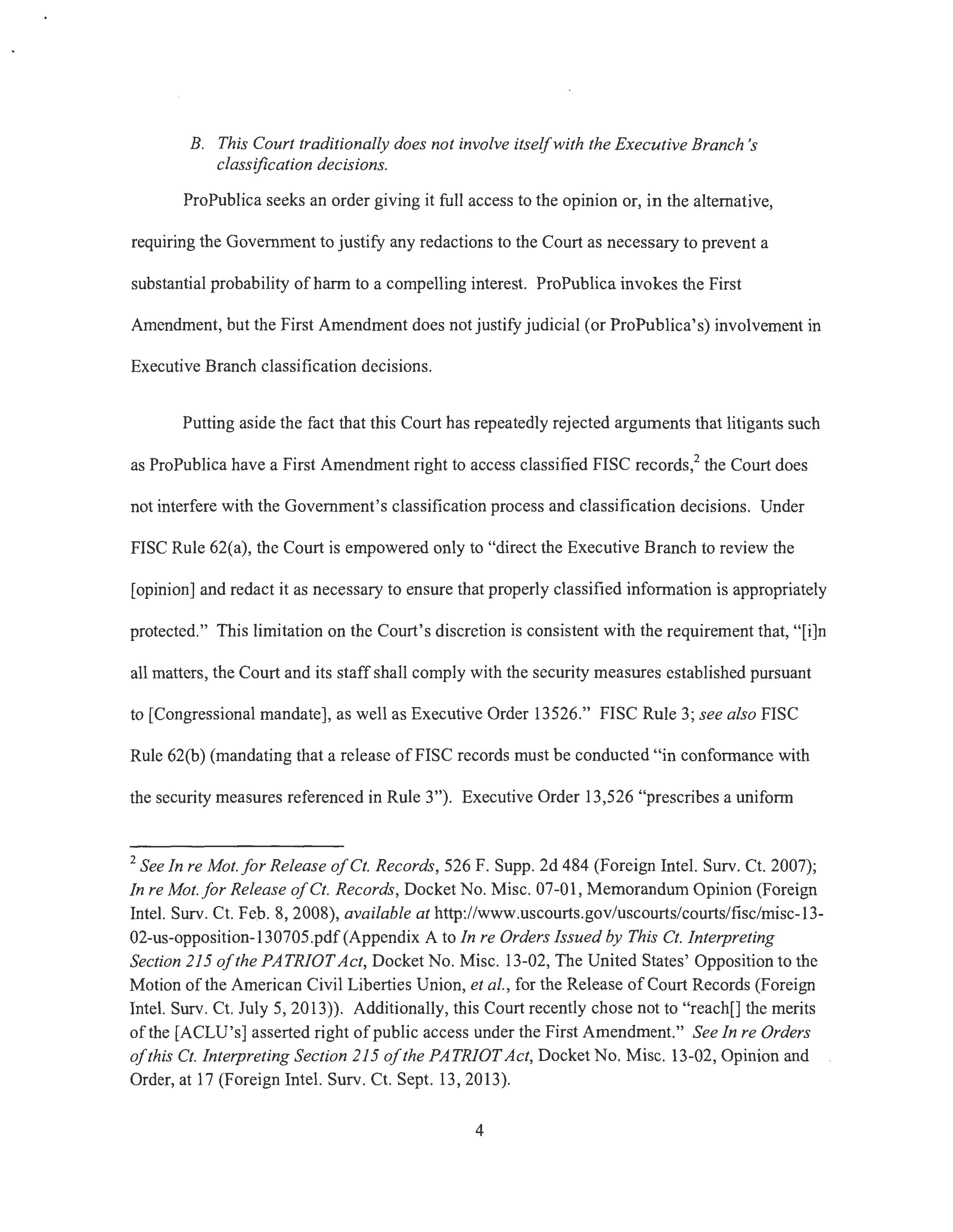
B. This Court traditionally does not involve itself with the Executive Branch's classification decisions.
ProPublica seeks an order giving it full access to the opinion or, in the alternative,
requiring the Government to justify any redactions to the Court as necessary to prevent a
substantial probability of harm to a compelling interest. ProPublica invokes the First
Amendment, but the First Amendment does not justify judicial (or ProPublica’s) involvement in
Executive Branch classification decisions.
Putting aside the fact that this Court has repeatedly rejected arguments that litigants such
as ProPublica have a First Amendment right to access classified FISC records,[^2] the Court does
not interfere with the Government’s classification process and classification decisions. Under
FISC Rule 62(a), the Court is empowered only to “direct the Executive Branch to review the
[opinion] and redact it as necessary to ensure that properly classified information is appropriately
protected.” This limitation on the Court’s discretion is consistent with the requirement that, “[i]n
all matters, the Court and its staff shall comply with the security measures established pursuant
to [Congressional mandate], as well as Executive Order 13526.” FISC Rule 3; see also FISC
Rule 62(b) (mandating that a release of FISC records must be conducted “in conformance with
the security measures referenced in Rule 3”). Executive Order 13,526 “prescribes a uniform
[^2] See In re Mot. for Release of Ct. Records, 526 F. Supp. 2d 484 (Foreign Intel. Surv. Ct. 2007);
_In re Mot. for Release of Ct. Records, Docket No. Misc. 07-01, Memorandum Opinion (Foreign
Intel. Surv. Ct. Feb. 8, 2008)_, available at http://www.uscourts.gov/uscourts/courts/fisc/misc-13-
02-us-opposition-130705.pdf (Appendix A to _In re Orders Issued by This Ct. Interpreting
Section 215 of the PATRIOT Act, Docket No. Misc. 13-02, The United States’ Opposition to the
Motion of the American Civil Liberties Union, et al., for the Release of Court Records (Foreign
Intel. Surv. Ct. July 5, 2013)_). Additionally, this Court recently chose not to “reach[] the merits
of the [ACLU’s] asserted right of public access under the First Amendment.” _See In re Orders
of this Ct. Interpreting Section 215 of the PATRIOT Act, Docket No. Misc. 13-02, Opinion and
Order, at 17 (Foreign Intel. Surv. Ct. Sept. 13, 2013)_.
4
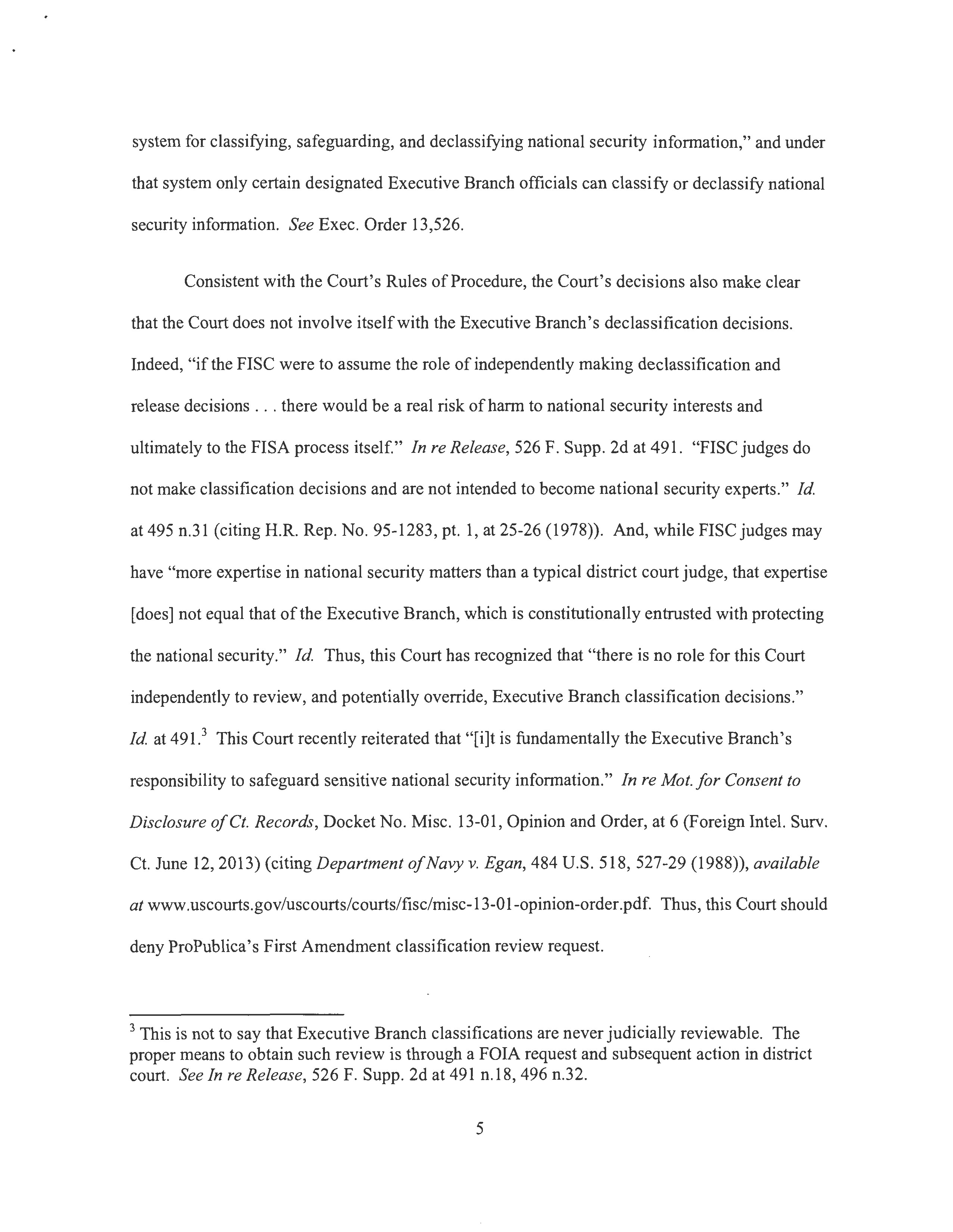
system for classifying, safeguarding, and declassifying national security information,” and under
that system only certain designated Executive Branch officials can classify or declassify national
security information. See Exec. Order 13,526.
Consistent with the Court’s Rules of Procedure, the Court’s decisions also make clear
that the Court does not involve itself with the Executive Branch’s declassification decisions.
Indeed, “if the FISC were to assume the role of independently making declassification and
release decisions . . . there would be a real risk of harm to national security interests and
ultimately to the FISA process itself.” In re Release, 526 F. Supp. 2d at 491. “FISC judges do
not make classification decisions and are not intended to become national security experts.” Id.
at 495 n.31 (citing H.R. Rep. No. 95-1283, pt. 1, at 25-26 (1978)). And, while FISC judges may
have “more expertise in national security matters than a typical district court judge, that expertise
[does] not equal that of the Executive Branch, which is constitutionally entrusted with protecting
the national security.” Id. Thus, this Court has recognized that “there is no role for this Court
independently to review, and potentially override, Executive Branch classification decisions.”
Id. at 491.[^3] This Court recently reiterated that “[i]t is fundamentally the Executive Branch’s
responsibility to safeguard sensitive national security information.” _In re Mot. for Consent to
Disclosure of Ct. Records, Docket No. Misc. 13-01, Opinion and Order, at 6 (Foreign Intel. Surv.
Ct. June 12, 2013) (citing Department of Navy v. Egan, 484 U.S. 518, 527-29 (1988))_, available
at www.uscourts.gov/uscourts/courts/fisc/misc-13-01-opinion-order.pdf. Thus, this Court should
deny ProPublica’s First Amendment classification review request.
[^3] This is not to say that Executive Branch classifications are never judicially reviewable. The
proper means to obtain such review is through a FOIA request and subsequent action in district
court. See In re Release, 526 F. Supp. 2d at 491 n.18, 496 n.32.
5
For these reasons, the Court should deny ProPublica’s request for a new classification
review of the relevant opinion. There is no need for this Court to order a new classification
review of the relevant opinion because the Government recently conducted a thorough
classification review of the opinion and made “public as much information as possible about
certain sensitive intelligence collection programs undertaken under the authority of the Foreign
Intelligence Surveillance Act (FISA) while being mindful of the need to protect national
security.”[^4] Release of this document reflected the Executive Branch’s continued commitment to
making information about intelligence collection publicly available when appropriate and
consistent with the national security of the United States.
CONCLUSION
For the reasons stated above, ProPublica’s Motion should be denied.
[^4] DNI Clapper Declassifies Intelligence Community Documents Regarding Collection Under
Section 501 of the Foreign Intelligence Surveillance Act (FISA), available at
http://icontherecord.tumblr.com/post/60867560465/dni-clapper-declassifies-intelligence-
community.
6
December 11, 2013
Respectfully submitted,
JOHN P. CARLIN
Acting Assistant Attorney General
for National Security
J. BRADFORD WIEGMANN
Deputy Assistant Attorney General
TASHINA GAUHAR
Deputy Assistant Attorney General
/s/ Nicholas J. Patterson
NICHOLAS J. PATTERSON
U.S. Department of Justice
National Security Division
950 Pennsylvania Ave., N.W.
Washington, D.C. 20530
Phone: (202) 514-5600
Fax: (202) 514-8053
Attorneys for the United States of America
7
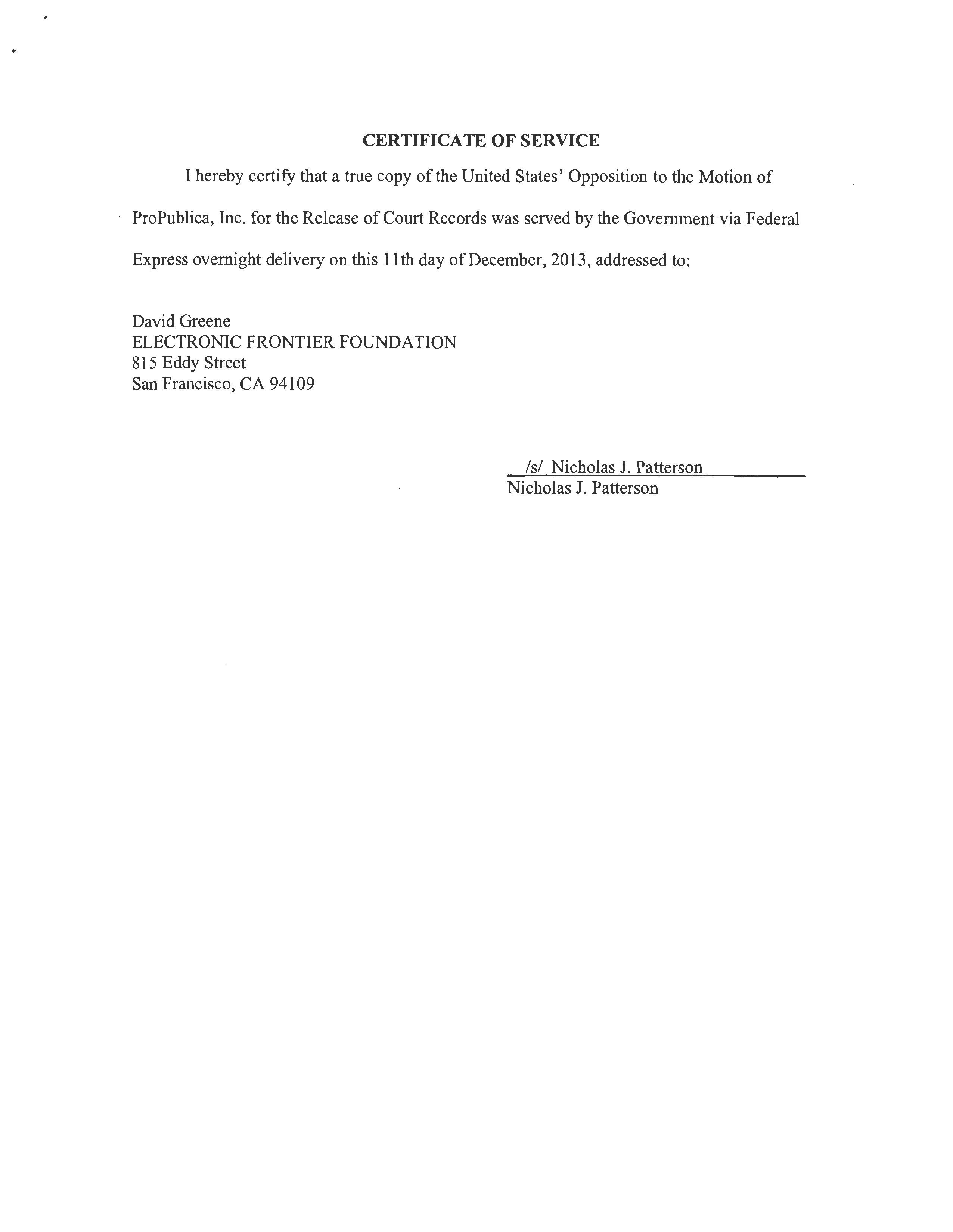
CERTIFICATE OF SERVICE
I hereby certify that a true copy of the United States’ Opposition to the Motion of
ProPublica, Inc. for the Release of Court Records was served by the Government via Federal
Express overnight delivery on this 11th day of December, 2013, addressed to:
David Greene
ELECTRONIC FRONTIER FOUNDATION
815 Eddy Street
San Francisco, CA 94109
/s/ Nicholas J. Patterson
Nicholas J. Patterson
Related Documents
-
-
-
-
-
Response of the United States to Motions for Declaratory Judgment by Google Inc., Microsoft Corporation, Yahoo! Inc., Facebook, Inc., and LinkedIn Corporation, In re Motion for Declaratory Judgment of a First Amendment Right to Publish Aggregate Info. About FISA Orders, No. Misc. 13-03 (FISA Ct. Sept. 30, 2013). FOIA [pdf]