Response of the United States to Motions for Declaratory Judgment by Google Inc., Microsoft Corporation, Yahoo! Inc., Facebook, Inc., and LinkedIn Corporation, In re Motion for Declaratory Judgment of a First Amendment Right to Publish Aggregate Info. About FISA Orders, No. Misc. 13-03 (FISA Ct. Sept. 30, 2013).
Open PDFDocument date: 2013-09-30
Type: FOIA
Pages: 33
Classification: -
Dissemination: -
FISC/FISCR Court Filings
My notes
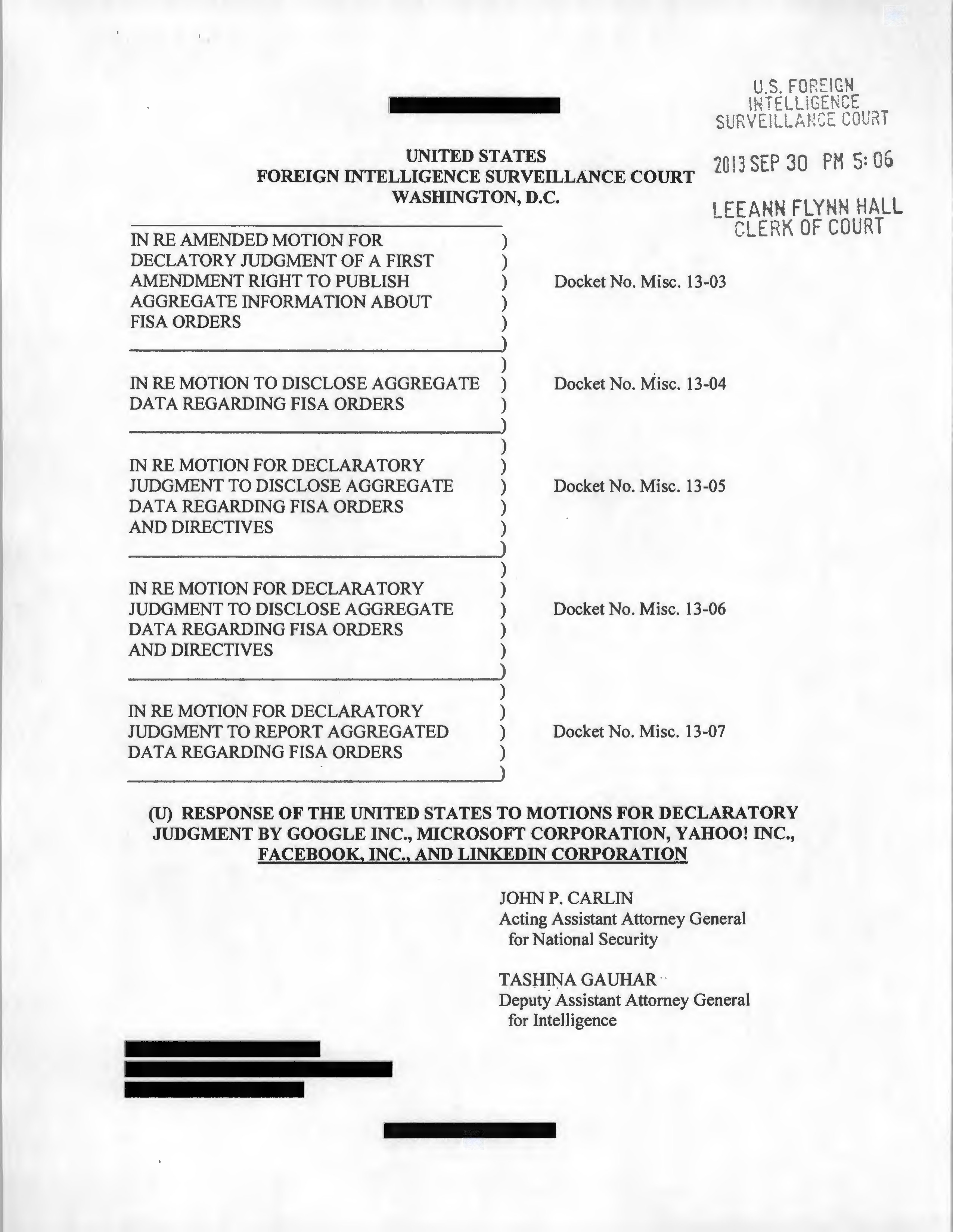

U.S. FOREIGN
INTELLIGENCE
SURVEILLANCE COURT
2013 SEP 30 PM 5:06
LEEANN FLYNN HALL
CLERK OF COURT
UNITED STATES
FOREIGN INTELLIGENCE SURVEILLANCE COURT
WASHINGTON, D.C.
IN RE AMENDED MOTION FOR
DECLATORY JUDGMENT OF A FIRST
AMENDMENT RIGHT TO PUBLISH
AGGREGATE INFORMATION ABOUT
FISA ORDERS
Docket No. Misc. 13-03
IN RE MOTION TO DISCLOSE AGGREGATE
DATA REGARDING FISA ORDERS
Docket No. Misc. 13-04
IN RE MOTION FOR DECLARATORY
JUDGMENT TO DISCLOSE AGGREGATE
DATA REGARDING FISA ORDERS
AND DIRECTIVES
Docket No. Misc. 13-05
IN RE MOTION FOR DECLARATORY
JUDGMENT TO DISCLOSE AGGREGATE
DATA REGARDING FISA ORDERS
AND DIRECTIVES
Docket No. Misc. 13-06
IN RE MOTION FOR DECLARATORY
JUDGMENT TO REPORT AGGREGATED
DATA REGARDING FISA ORDERS
Docket No. Misc. 13-07
(U) RESPONSE OF THE UNITED STATES TO MOTIONS FOR DECLARATORY
JUDGMENT BY GOOGLE INC., MICROSOFT CORPORATION, YAHOO! INC.,
FACEBOOK, INC., AND LINKEDIN CORPORATION
JOHN P. CARLIN
Acting Assistant Attorney General
for National Security
TASHINA GAUHAR
Deputy Assistant Attorney General
for Intelligence
[REDACTED]
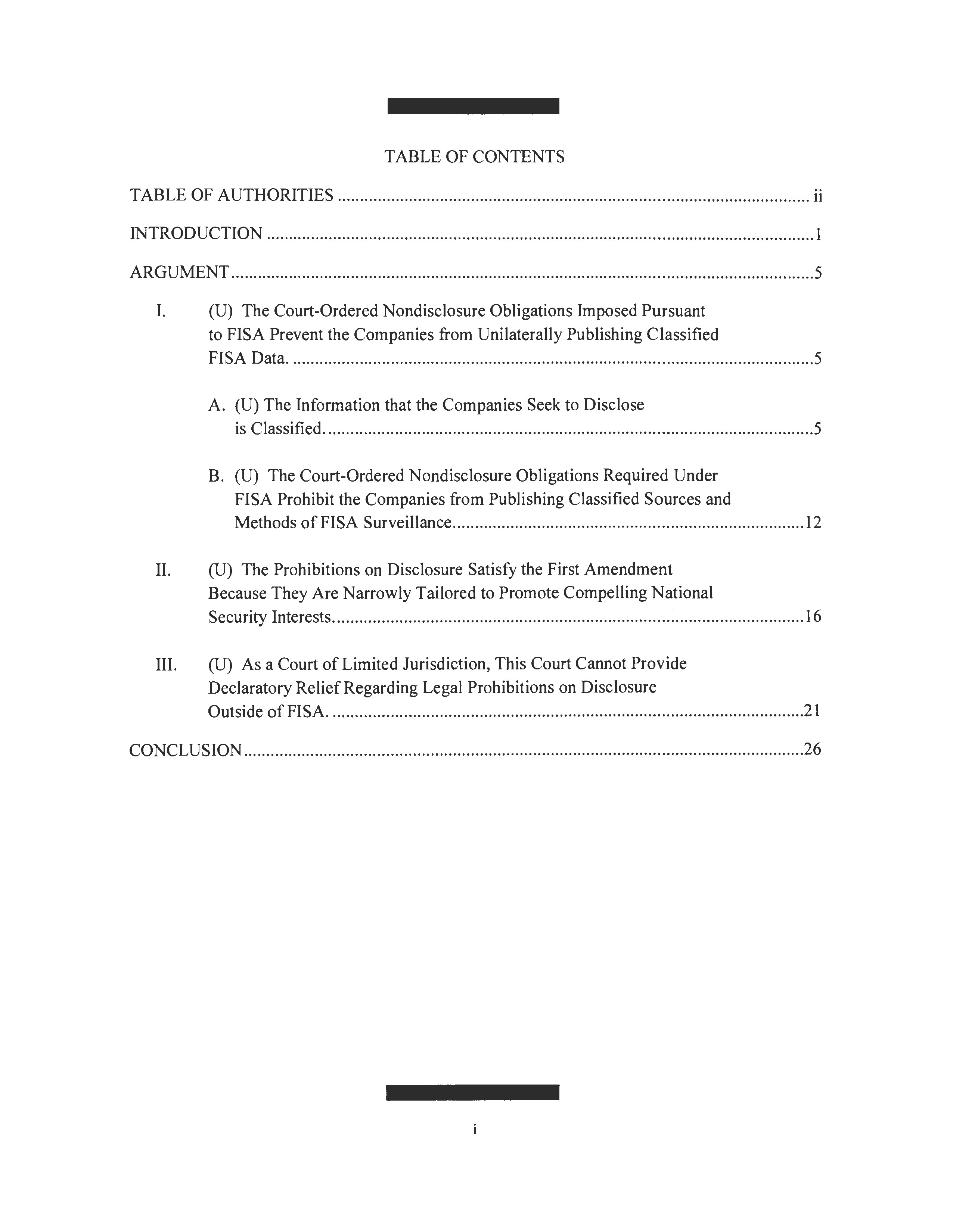
TABLE OF CONTENTS
TABLE OF AUTHORITIES ................................................................................................ ii
INTRODUCTION ................................................................................................................ 1
ARGUMENT ...................................................................................................................... 5
I. (U) The Court-Ordered Nondisclosure Obligations Imposed Pursuant
to FISA Prevent the Companies from Unilaterally Publishing Classified
FISA Data. ............................................................................................... 5
A. (U) The Information that the Companies Seek to Disclose
is Classified. ................................................................................... 5
B. (U) The Court-Ordered Nondisclosure Obligations Required Under
FISA Prohibit the Companies from Publishing Classified Sources and
Methods of FISA Surveillance. .................................................... 12
II. (U) The Prohibitions on Disclosure Satisfy the First Amendment
Because They Are Narrowly Tailored to Promote Compelling National
Security Interests. ................................................................................. 16
III. (U) As a Court of Limited Jurisdiction, This Court Cannot Provide
Declaratory Relief Regarding Legal Prohibitions on Disclosure
Outside of FISA. .................................................................................. 21
CONCLUSION ................................................................................................................. 26
i
[REDACTED]
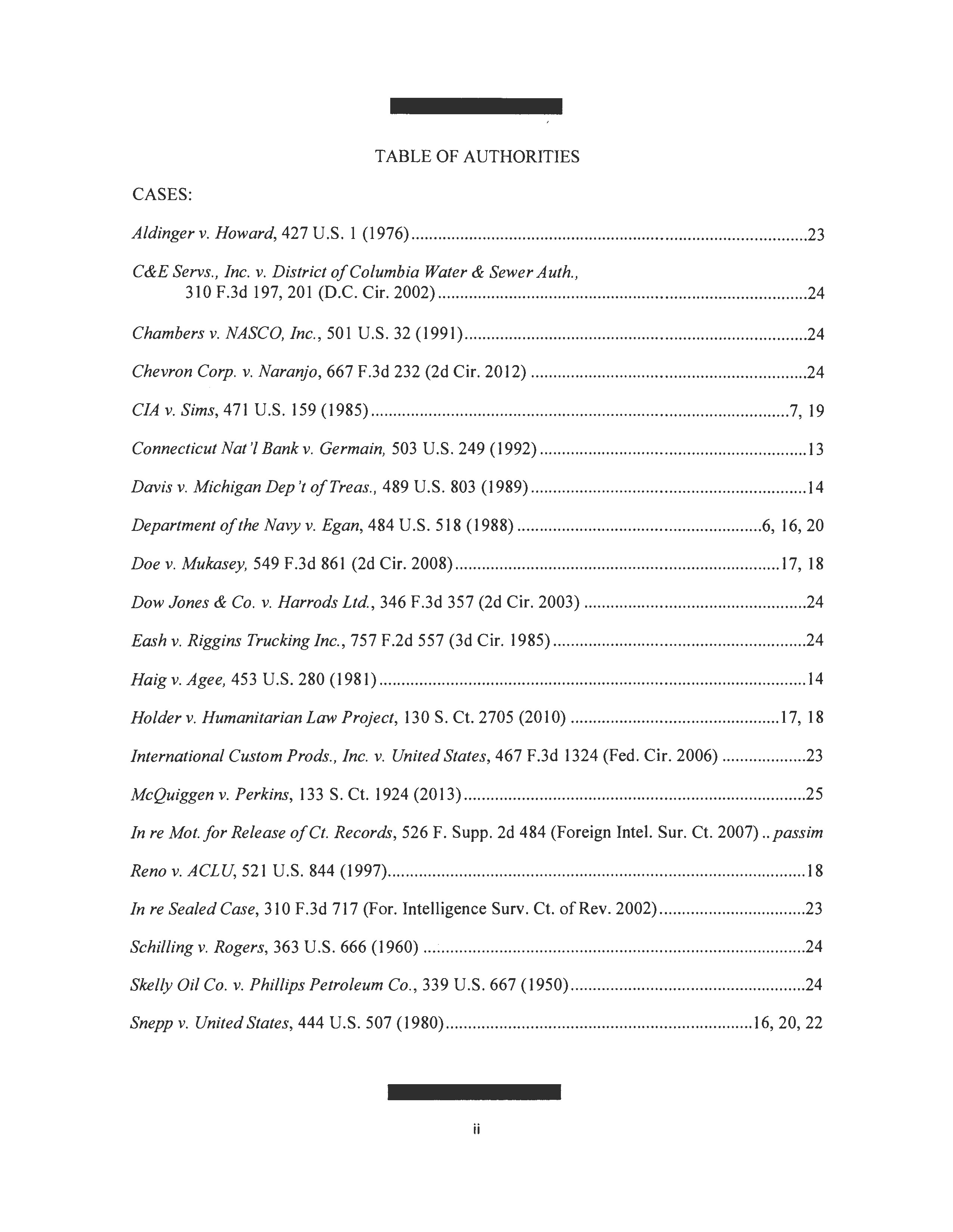
TABLE OF AUTHORITIES
CASES:
Aldinger v. Howard, 427 U.S. 1 (1976)...............................................................................23
C&E Servs., Inc. v. District of Columbia Water & Sewer Auth.,
310 F.3d 197, 201 (D.C. Cir. 2002).........................................................................24
Chambers v. NASCO, Inc., 501 U.S. 32 (1991)...................................................................24
Chevron Corp. v. Naranjo, 667 F.3d 232 (2d Cir. 2012).....................................................24
CIA v. Sims, 471 U.S. 159 (1985)..................................................................................7, 19
Connecticut Nat’l Bank v. Germain, 503 U.S. 249 (1992).................................................13
Davis v. Michigan Dep’t of Treas., 489 U.S. 803 (1989)...................................................14
Department of the Navy v. Egan, 484 U.S. 518 (1988)...............................................6, 16, 20
Doe v. Mukasey, 549 F.3d 861 (2d Cir. 2008)............................................................17, 18
Dow Jones & Co. v. Harrods Ltd., 346 F.3d 357 (2d Cir. 2003)........................................24
Eash v. Riggins Trucking Inc., 757 F.2d 557 (3d Cir. 1985)..............................................24
Haig v. Agee, 453 U.S. 280 (1981).....................................................................................14
Holder v. Humanitarian Law Project, 130 S. Ct. 2705 (2010).....................................17, 18
International Custom Prods., Inc. v. United States, 467 F.3d 1324 (Fed. Cir. 2006)..........23
McQuiggen v. Perkins, 133 S. Ct. 1924 (2013)...................................................................23
In re Mot. for Release of Ct. Records, 526 F. Supp. 2d 484 (Foreign Intel. Sur. Ct. 2007) .passim
Reno v. ACLU, 521 U.S. 844 (1997)...................................................................................18
In re Sealed Case, 310 F.3d 717 (For. Intelligence Surv. Ct. of Rev. 2002)........................23
Schilling v. Rogers, 363 U.S. 666 (1960)............................................................................24
Skelly Oil Co. v. Phillips Petroleum Co., 339 U.S. 667 (1950)..........................................24
Snepp v. United States, 444 U.S. 507 (1980).............................................................16, 20, 22
ii
[REDACTED]
Steel Co. v. Citizens for a Better Env't, 523 U.S. 83 (1998)............................................23
United States v. Boyce, 594 F.2d 1246 (9th Cir. 1979)...................................................22
United States v. King, 395 U.S. I (1969)........................................................................25
United States v. Marchetti, 466 F.2d 1309 (4th Cir. 1972)...........................................7, 19
United States v. Nixon, 418 U.S. 683 (1974)...................................................................6
United States v. Pappas, 94 F.3d 795 (2d Cir. 1996).....................................................22
United States v. Sterling, 724 F.3d 482 (4th Cir. 2013)............................................16, 17
United States v. Yunis, 867 F.2d 617 (D.C. Cir. 1989)................................................7, 19
Whitman v. American Trucking Ass'ns, 531 U.S. 457 (2001)........................................15
Wilson v. CIA, 586 F.3d 171 (2d Cir. 2009)...................................................................22
CONSTITUTION AND STATUTES:
U.S. Const. Amend. I................................................................................................passim
All Writs Act, 28 U.S.C. § 1651.....................................................................................25
Declaratory Judgment Act, 28 U.S.C. § 2201................................................................24
Foreign Intelligence Surveillance Act of 1978, 50 U.S.C. § 1801 et seq.:
50 U.S.C. § 1803(b)...................................................................................................25
50 U.S.C. § 1804.........................................................................................................23
50 U.S.C. § 1805(c)(2)(B)...........................................................................................13
50 U.S.C. § 1805(c)(2)(C)...........................................................................................13
50 U.S.C. § 1822(d)......................................................................................................25
50 U.S.C. § 1823.........................................................................................................23
50 U.S.C. § 1824(c)(2)(B)-(C).....................................................................................13
50 U.S.C. § 1842.........................................................................................................23
50 U.S.C. § 1842(d)(2)(B)...........................................................................................13
iii
[REDACTED]
50 U.S.C. § 1861 ........................................................................................................23
50 U.S.C. § 1861(d)(1) ................................................................................................14
50 U.S.C. § 1861(f)(3) ................................................................................................25
50 U.S.C. § 1881 ........................................................................................................23
50 U.S.C. § 1881a(h)(1)(A) ........................................................................................13
50 U.S.C. § 1881a(h)(1)(B) ........................................................................................13
50 U.S.C. § 1881a(h)(6)(A) ........................................................................................25
50 U.S.C. § 1881a(i)(4)(A) ........................................................................................25
50 U.S.C. § 1881b(f)(1) ..............................................................................................25
50 U.S.C. § 1881c(e)(1) ..............................................................................................25
12 U.S.C. § 3414 ........................................................................................................1, 2
15 U.S.C. § 1681u ......................................................................................................2
15 U.S.C. § 1681v ......................................................................................................2
18 U.S.C. § 798(a)(3) ..................................................................................................22
18 U.S.C. § 798(b) ..................................................................................................22, 23
18 U.S.C. § 2709 ........................................................................................................2
28 U.S.C. § 1291 ........................................................................................................25
50 U.S.C. § 3162 ........................................................................................................2
iv
[REDACTED]
(U) INTRODUCTION
(U) The United States Government firmly supports a policy of appropriate transparency
with respect to its intelligence activities. As the President has emphasized, such a policy furthers
accountability and increases public trust in the Government's activities. Consistent with this
approach, the Government is actively engaged in a careful review of classified information
related to the foreign intelligence surveillance activities authorized by this Court. The purpose of
this review is to make public as much information about these activities as is consistent with the
national security interests of the United States. In conducting this review, the Government must
balance the need to inform the public about these activities with the need to protect classified
sources and methods of intelligence collection, including the Government's ability (or inability)
to conduct surveillance on particular electronic communication service providers or platforms.
Releasing information that could induce adversaries to shift communications platforms in order
to avoid surveillance would cause serious harm to the national security interests of the United
States. See Declaration of Andrew G. McCabe, Acting Executive Assistant Director, Federal
Bureau of Investigation (FBI) (attached).
(U) Balancing the competing interests at stake, the Government has taken a number of
significant steps—above and beyond what the law requires—in order to promote transparency
and to accommodate the legitimate interests of companies, including those that have filed
motions before this Court and others that have not. For example, for the first time, in the winter
of 2013, the Government agreed that companies may report the aggregate number of National
Security Letters (NSLs) they receive, in numerical ranges and on a periodic basis.¹ More
¹ (U) NSLs are a type of administrative subpoena issued by U.S. Government agencies, particularly the
Federal Bureau of Investigation (FBI), when investigating matters related to national security. See 12
1
[REDACTED]
recently, the Government, in consultation with the Court, agreed to permit companies to make a
wider set of disclosures by opting instead to report, in certain bands, the aggregate number of
criminal and national security related orders they receive from federal, state, and local
government entities combined, and the number of user accounts affected by such orders. A
number of companies have agreed to exercise that option, which allows them to demonstrate to
their customers that the sum total of all such process affects only a tiny fraction of the
companies' user accounts.²
(U) In addition, on August 29, 2013, the Government announced that it will report
annually the total number of orders issued nationwide and the total number of targets the orders
affect. The report will include (a) the number of Foreign Intelligence Surveillance Act (FISA)
orders or warrants issued based on probable cause (i.e., pursuant to Title I, Title III, Section 703,
or Section 704 of FISA) and the number of targets affected by those orders or warrants; (b) the
number of directives issued pursuant to Section 702 of FISA and the number of targets affected
by those directives; (c) the number of orders issued pursuant to FISA's pen register provision
(Title IV of FISA) and the number of targets affected by those orders; (d) the number of orders
issued pursuant to FISA's business records provision (Title V of FISA) and the number of targets
affected by those orders; and (e) the number of NSLs issued by the Government nationwide and
the number of targets affected by the NSLs.
U.S.C. § 3414; 15 U.S.C. §§ 1681u, 1681v; 18 U.S.C. § 2709; 50 U.S.C. § 3162 (NSL statutory
authorities).
[REDACTED]
2
[REDACTED]
(U) The Government's annual report of the use of various FISA authorities will provide
the public significant information about how often the Government uses its foreign intelligence
investigative authorities. The companies' ability to disclose how often they have responded to
Government process will allow them to inform their customers about the likelihood that their
information will be disclosed. On the other hand, because the Government's reporting will not
be broken down by company, and the companies' reporting will aggregate criminal and non-
criminal, content and non-content, and federal, state and local process, these reports will not
provide our adversaries with a roadmap to the existence or extent of Government surveillance of
any particular provider or communications platform.
(U) Dissatisfied with the Government's efforts to strike the appropriate balance between
the public interest in transparency and the protection of national security, the petitioners seek
declaratory relief that would effectively give every communications provider in the United States
the right to reveal the nature and scope of any FISA surveillance of their communications
platforms. Such information would be invaluable to our adversaries, who could thereby derive a
clear picture of where the Government's surveillance efforts are directed and how its
surveillance activities change over time, including when the Government initiates or expands
surveillance efforts involving providers or services that adversaries previously considered "safe."
(U) In their original motions, Google and Microsoft sought to publish one aggregate
number for all the FISA process they receive. After failing to reach a settlement with the
Government, however, they amended their motions to seek relief that would present an even
greater risk to national security: the right to disclose the precise number of FISA process they
may receive under each separate provision of FISA. See Amended Google Mot. at 7; Microsoft
3
[REDACTED]
Mot. at 5. Microsoft goes still further, seeking to disclose separate categories for "non-content"
requests and "content and non-content" requests. Id. (emphasis in original). After Google and
Microsoft filed their amended motions, Yahoo! Inc., Facebook, Inc., and LinkedIn filed motions
seeking essentially the same scope of relief.
(U) Because revealing FISA data on a company-by-company basis would cause serious
harm to national security, such data has been classified by the FBI. That classification decision
establishes that unilaterally disclosing the information would undermine the secrecy of the
surveillance, in violation of this Court's orders, which require any company that has received a
FISA order to protect the secrecy of the intelligence acquisitions. The companies assert that the
secrecy requirements apply only to particular surveillance targets. But that implausible reading
ignores the forest for the trees. It would permit damaging disclosures that would reveal sources
and methods of surveillance potentially nationwide. The secrecy provisions in the orders flow
from statutory requirements that, according to their plain language, protect such sources and
methods, not just particular collection efforts. Indeed, limiting the secrecy protections only to
information revealing a particular surveillance target would authorize a wide range of other
damaging disclosures, from the nature of surveillance targets to their general locations, among
others.
(U) Contrary to the companies' argument that they have a First Amendment right to
disclose this sensitive national security information, it is well-settled that prohibitions on the
disclosure of classified information, such as the ones contained in this Court's orders, satisfy the
First Amendment. The Government has a compelling interest in protecting such national
4
[REDACTED]
security information from disclosure, and the prohibitions on disclosure are narrowly tailored to
protect that interest.
(U) Finally, insofar as the companies argue that no other laws or regulations prohibit the
disclosures they seek, the Court lacks jurisdiction to issue declaratory relief unrelated to
prohibitions imposed pursuant to FISA. Because the data the companies seek to disclose is
classified, the disclosures are prohibited by other sources of law, such as nondisclosure
agreements between the Government and company employees. The interpretation and
application of such non-FISA prohibitions are outside the specialized jurisdiction of this Court.
(U) Accordingly, the Court should deny the companies' motions for declaratory relief.
(U) ARGUMENT
I. (U) The Court-Ordered Nondisclosure Obligations Imposed Pursuant to FISA
Prevent the Companies from Unilaterally Publishing Classified FISA Data.
(U) The companies assert that the information they seek to disclose is not classified,
disregarding the harms to national security the proposed disclosures would likely cause. But
classification judgments belong to the Executive Branch, not the companies, and the Executive
Branch has classified the information. The companies' flawed premise undermines their entire
argument: the only plausible reading of FISA, and the Court's orders, is that FISA orders and
directives bar recipients from disclosing properly classified information about the nature and
scope of the authorized surveillance activities.
A. (U) The Information that the Companies Seek to Disclose is Classified.
(U) The companies fail to address the harm their disclosures would cause to national
security, beyond pointing out that they do not seek to disclose individual surveillance targets.
5
[REDACTED]
The companies' narrow focus on individual targets ignores that the disclosures would risk
revealing the Government's collection capabilities as they presently exist and as they develop in
the future. McCabe Decl. ¶ 30. Such disclosures could therefore cause significant harm to
national security. As a result, the FBI has classified the data the companies seek to publish at the
Secret level. Id. ¶ 27; see also id. ¶¶ 22-26.
(U) The FBI's assessment of harm is entitled to deference. This Court has previously
held that "there is no role for this Court independently to review, and potentially override,
Executive Branch classification decisions." In re Mot. for Release of Ct. Records, 526 F. Supp.
2d 484, 491 (Foreign Intel. Sur. Ct. 2007). As the Court recognized, if the U.S. Foreign
Intelligence Surveillance Court (FISC) "were to assume the role of independently making
declassification and release decisions... there would be a real risk of harm to national security
interests and ultimately to the FISA process itself." Id. Moreover, "even if a typical FISC judge
ha[s] more expertise in national security matters than a typical district court judge, that expertise
would still not equal that of the Executive Branch, which is constitutionally entrusted with
protecting the national security." Id. at 495 n.31. This Court's holding is consistent with the fact
that "courts have traditionally shown the utmost deference" to the Executive Branch's authority
to classify and control access to national security information. Department of the Navy v. Egan,
484 U.S. 518, 530 (1988) (emphasis added) (quoting United States v. Nixon, 418 U.S. 683, 710
(1974)).
(U) The FBI based its classification decision on a review of all pertinent information,
including whether disclosure of the data in the manner proposed by the companies would risk
filling out the mosaic of information available to our adversaries in their efforts to assess and
6
[REDACTED]
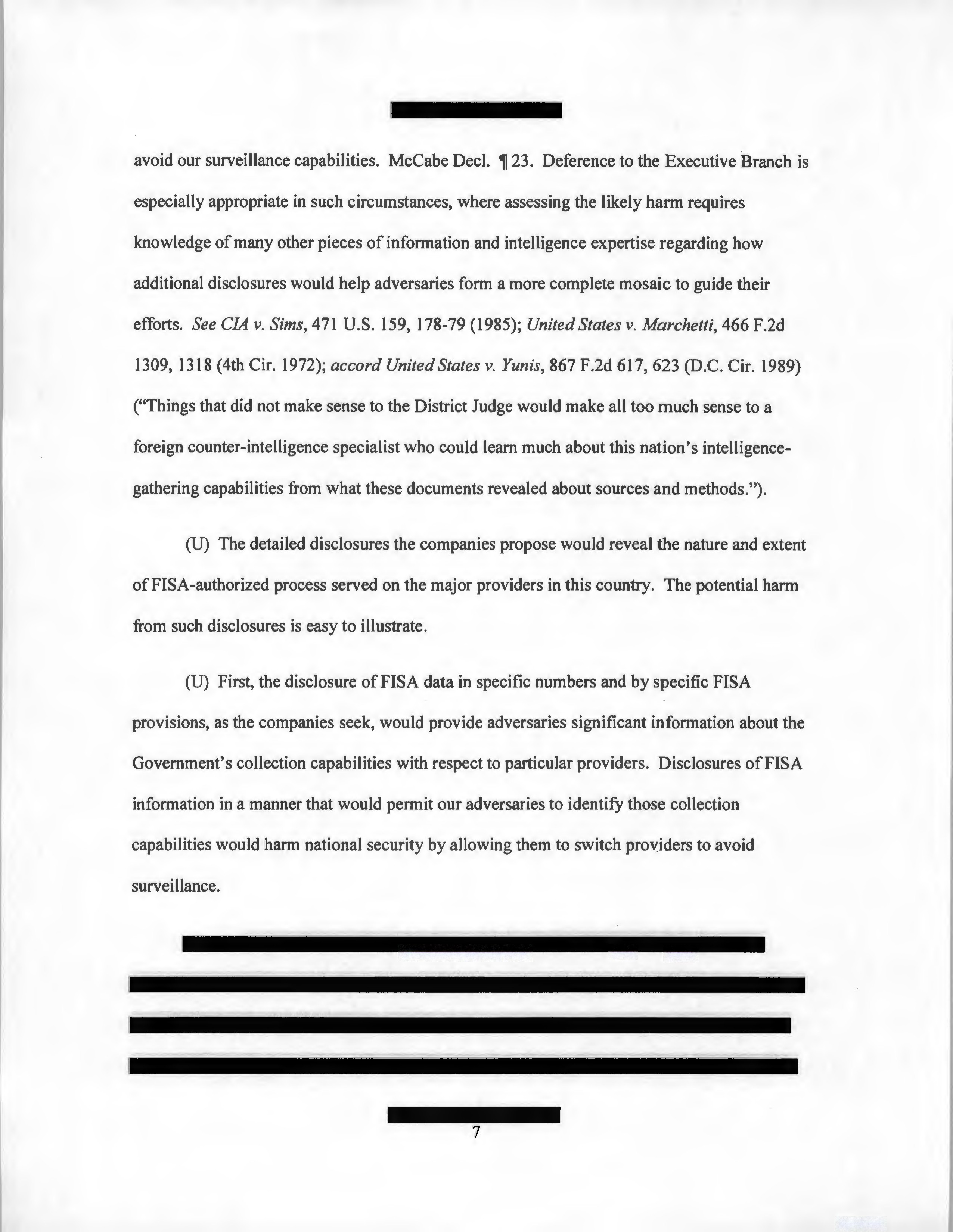
avoid our surveillance capabilities. McCabe Decl. ¶ 23. Deference to the Executive Branch is
especially appropriate in such circumstances, where assessing the likely harm requires
knowledge of many other pieces of information and intelligence expertise regarding how
additional disclosures would help adversaries form a more complete mosaic to guide their
efforts. See CIA v. Sims, 471 U.S. 159, 178-79 (1985); United States v. Marchetti, 466 F.2d
1309, 1318 (4th Cir. 1972); accord United States v. Yunis, 867 F.2d 617, 623 (D.C. Cir. 1989)
("Things that did not make sense to the District Judge would make all too much sense to a
foreign counter-intelligence specialist who could learn much about this nation's intelligence-
gathering capabilities from what these documents revealed about sources and methods.").
(U) The detailed disclosures the companies propose would reveal the nature and extent
of FISA-authorized process served on the major providers in this country. The potential harm
from such disclosures is easy to illustrate.
(U) First, the disclosure of FISA data in specific numbers and by specific FISA
provisions, as the companies seek, would provide adversaries significant information about the
Government's collection capabilities with respect to particular providers. Disclosures of FISA
information in a manner that would permit our adversaries to identify those collection
capabilities would harm national security by allowing them to switch providers to avoid
surveillance.
[REDACTED]
7
[REDACTED]
8
[REDACTED]
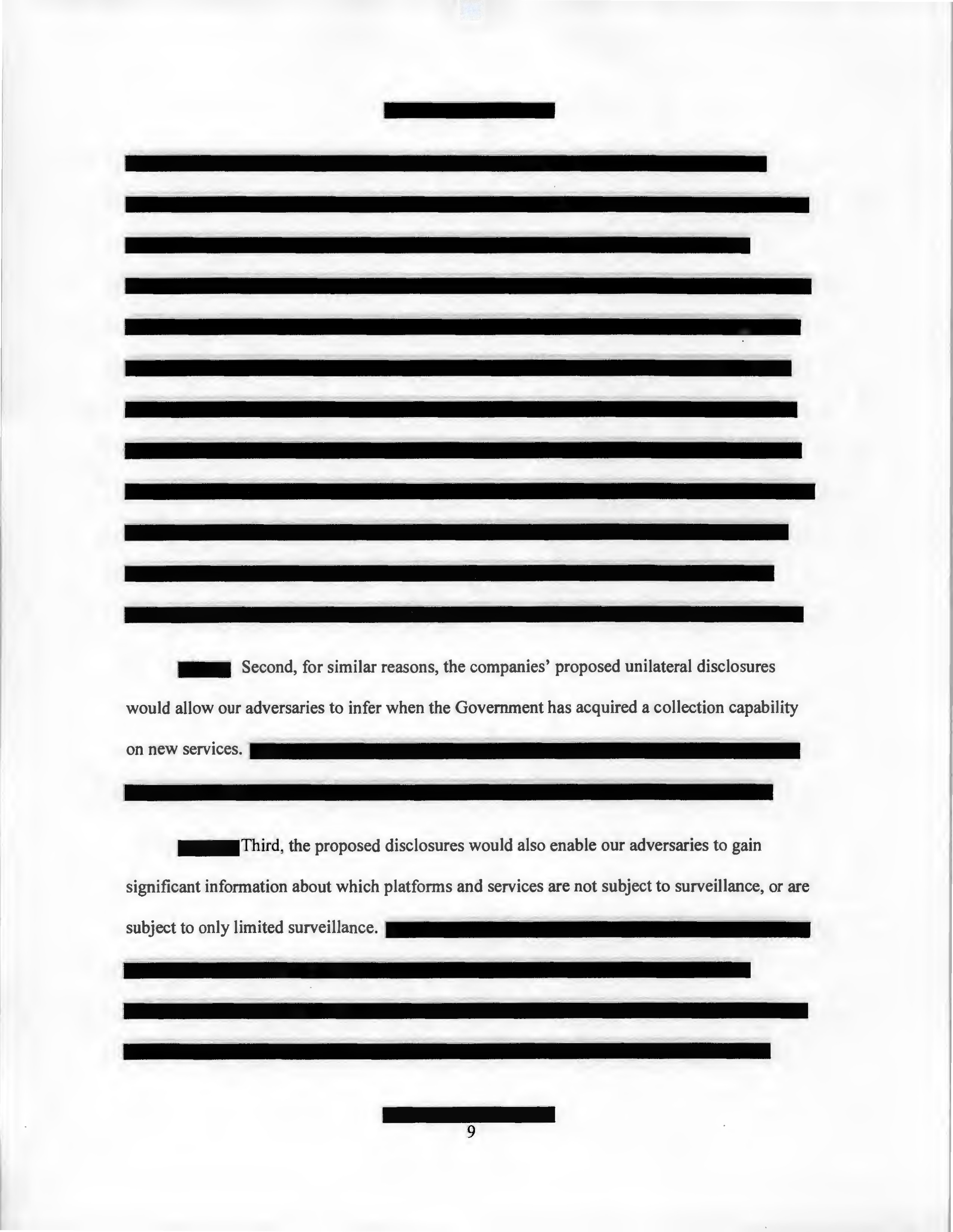
Second, for similar reasons, the companies' proposed unilateral disclosures
would allow our adversaries to infer when the Government has acquired a collection capability
on new services.
[REDACTED]
Third, the proposed disclosures would also enable our adversaries to gain
significant information about which platforms and services are not subject to surveillance, or are
subject to only limited surveillance.
[REDACTED]
9
[REDACTED]
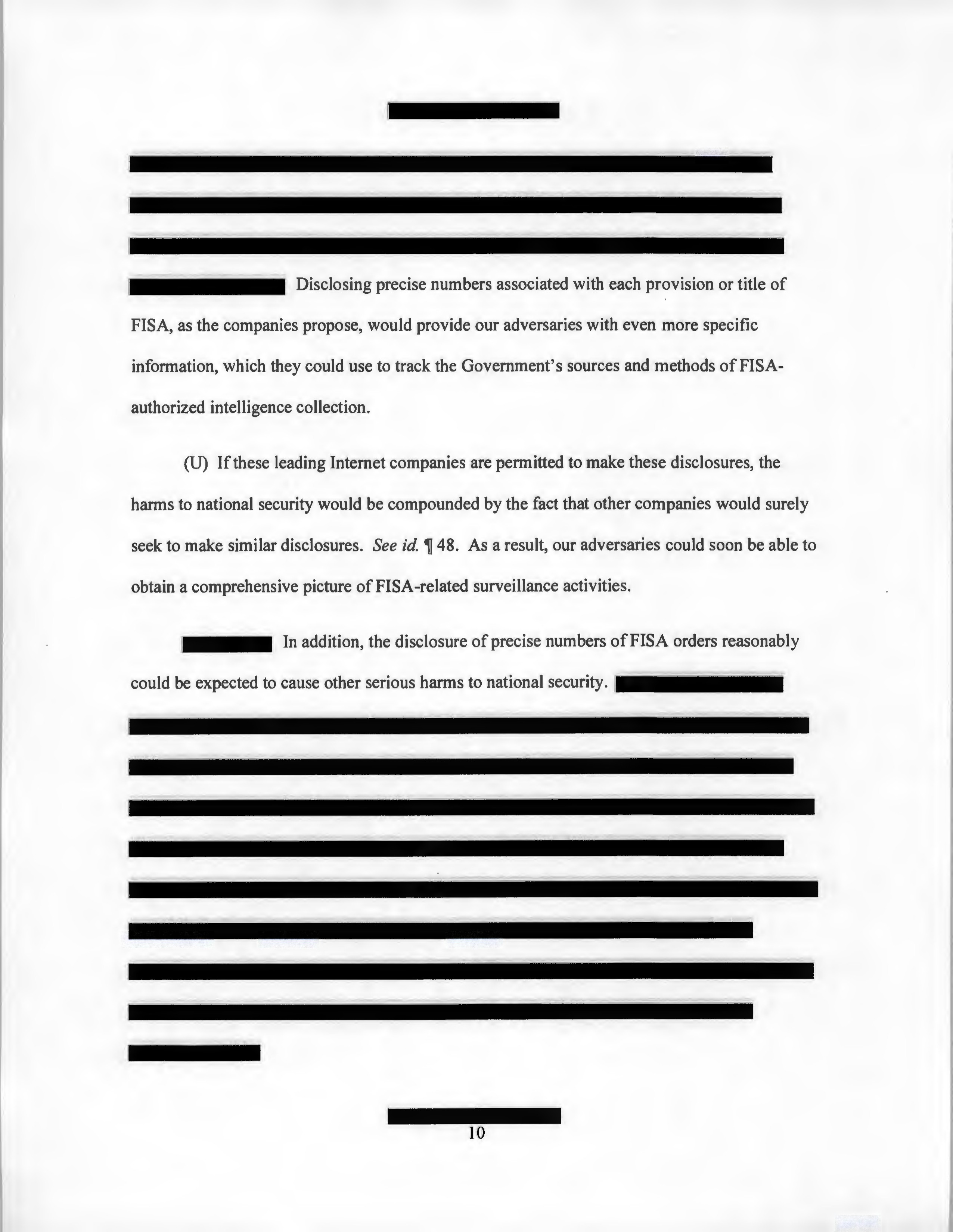
Disclosing precise numbers associated with each provision or title of
FISA, as the companies propose, would provide our adversaries with even more specific
information, which they could use to track the Government's sources and methods of FISA-
authorized intelligence collection.
(U) If these leading Internet companies are permitted to make these disclosures, the
harms to national security would be compounded by the fact that other companies would surely
seek to make similar disclosures. See id. ¶ 48. As a result, our adversaries could soon be able to
obtain a comprehensive picture of FISA-related surveillance activities.
[REDACTED] In addition, the disclosure of precise numbers of FISA orders reasonably
could be expected to cause other serious harms to national security.
[REDACTED]
10
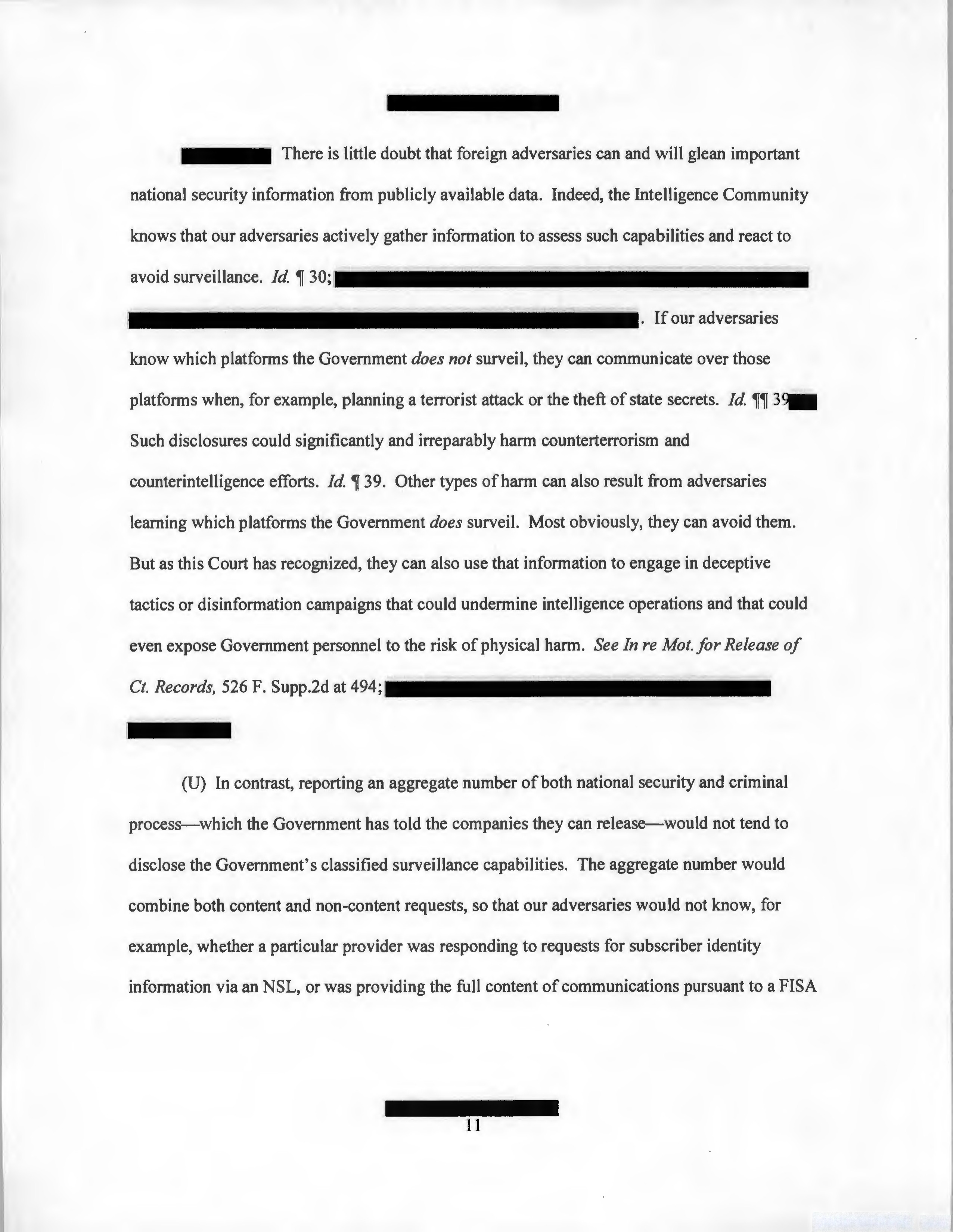
[REDACTED] There is little doubt that foreign adversaries can and will glean important
national security information from publicly available data. Indeed, the Intelligence Community
knows that our adversaries actively gather information to assess such capabilities and react to
avoid surveillance. Id. ¶ 30.
[REDACTED] If our adversaries
know which platforms the Government does not surveil, they can communicate over those
platforms when, for example, planning a terrorist attack or the theft of state secrets. Id. ¶¶ 39,
[REDACTED] Such disclosures could significantly and irreparably harm counterterrorism and
counterintelligence efforts. Id. ¶ 39. Other types of harm can also result from adversaries
learning which platforms the Government does surveil. Most obviously, they can avoid them.
But as this Court has recognized, they can also use that information to engage in deceptive
tactics or disinformation campaigns that could undermine intelligence operations and that could
even expose Government personnel to the risk of physical harm. See In re Mot. for Release of
Ct. Records, 526 F. Supp.2d at 494; [REDACTED]
(U) In contrast, reporting an aggregate number of both national security and criminal
process—which the Government has told the companies they can release—would not tend to
disclose the Government's classified surveillance capabilities. The aggregate number would
combine both content and non-content requests, so that our adversaries would not know, for
example, whether a particular provider was responding to requests for subscriber identity
information via an NSL, or was providing the full content of communications pursuant to a FISA
11
[REDACTED]
or Title III wiretap order. Thus, the extent of the Government's actual capabilities would be
masked from our adversaries.
(U) It is quintessentially an Executive Branch responsibility to assess these risks to
national security and to determine what information can be disclosed consistent with both
transparency and national security interests. The Government cannot agree to the disclosures the
companies seek because the disclosures will harm national security by risking the disclosure of
the Government's capabilities to conduct surveillance with respect to particular providers and
Internet platforms. In assessing whether the companies' proposed disclosures will undermine the
secrecy of the Government's intelligence collection activities under FISA, the Court should defer
to the judgment of the Executive Branch.
B. (U) The Court-Ordered Nondisclosure Obligations Required Under FISA
Prohibit the Companies from Publishing Classified Sources and Methods of
FISA Surveillance.
(U) As explained below, the nondisclosure provisions in FISA orders are prescribed by
statute and require companies to protect the secrecy of authorized surveillance. Because the
information the companies seek to disclose has been properly classified, it follows that protecting
the secrecy of the acquisitions underlying that information requires keeping the information
secret. The companies would interpret this Court's orders as protecting only information about
specific targets, therefore permitting the broad disclosure of damaging information about the
Government's sources and methods of surveillance overall. But such a result is contrary to the
text and purpose of the secrecy provisions in FISA on which the orders are based.
(U) As an initial matter, the provisions of FISA should be enforced as written,
Connecticut Nat'l Bank v. Germain, 503 U.S. 249, 253-54 (1992), and neither provision at issue
12
[REDACTED]
here contains the "particular target" limitation on secrecy that the companies advance. Titles I
and VII of FISA provide that FISA orders "shall direct," and FISA directives "may direct,"
recipients to provide the Government with "all information, facilities, or assistance necessary to
accomplish the acquisition in a manner that will protect the secrecy of the acquisition," without
limitation. 50 U.S.C. § 1881a(h)(1)(A) (Title VII); see also 50 U.S.C. § 1805(c)(2)(B) (similar
language for Title I).⁴ Additionally, the orders "shall direct" and the directives "may direct" that
recipients "maintain under security procedures approved by the Attorney General and the
Director of National Intelligence any records concerning the acquisition or the aid furnished"
that such electronic communication service provider maintains. 50 U.S.C. § 1881a(h)(1)(B)
(Title VII); see also 50 U.S.C. § 1805(c)(2)(C) (similar language for Title I).⁵ Consistent with
the Executive Branch's authority to control classified information, that provision explicitly
⁴ (S/NF) To the extent that the moving companies receive process pursuant to Titles I and VII, the Title VII directives contain the statutorily permitted nondisclosure provisions, while the Title I orders contain nondisclosure requirements that track the statutory provision, although not identically. Title I orders typically contain language such as: “This order and warrant is sealed and the specified person and its agents and employees shall not disclose to the targets or to any other person the existence of the order and warrant or this investigation or the fact of any of the activities authorized herein or the means used to accomplish them, except as otherwise may be required by legal process and then only after prior notification to the Attorney General.” Of course, disclosing the number of Title I orders received would violate such a provision as it would “disclose . . . the existence” of each of the orders.
⁵ (U) The other FISA titles that provide search or surveillance authorities also contain nondisclosure
provisions. See 50 U.S.C. § 1824(c)(2)(B)-(C) (requiring Title III orders to require the recipient to assist
in the physical search "in such a manner as will protect its secrecy" and provide that "any records
concerning the search or the aid furnished" that the recipient retains be maintained under appropriate
security procedures); 50 U.S.C. § 1842(d)(2)(B) (requiring Title IV orders to direct that recipients
"furnish any information, facilities, or technical assistance necessary to accomplish the installation and
operation of the pen register or trap and trace device in such a manner as will protect its secrecy," and
provide that "any records concerning the pen register or trap and trace device or the aid furnished" that
the recipient retains shall be maintained under appropriate security procedures); 50 U.S.C. § 1861(d)(1)
(providing that "[n]o person shall disclose to any other person that the [FBI] has sought or obtained
tangible things pursuant to an order under" Title V of FISA). Because the potential national security
harm at issue is the disclosure of information that could provide adversaries with information about the
Government's electronic surveillance capacities, the nondisclosure provisions in Titles I and VII – the
titles that concern electronic surveillance are most relevant here.
13
[REDACTED]
provides for Executive Branch approval of the companies' procedures for maintaining all records
associated with surveillance. The provision is not limited to protecting only specific targeting
information that such records would reveal, and on its face does not give companies the right to
disclose classified information so long as records are disclosed in large groups.
(U) Moreover, "[i]t is a fundamental canon of statutory construction that the words of a
statute must be read in their context and with a view to their place in the overall statutory
scheme." Davis v. Michigan Dep't of Treas., 489 U.S. 803, 809 (1989). Reading a "particular
target" limitation into FISA's secrecy provisions would be inconsistent with FISA's strong
protections for the secrecy of the intelligence collection activities subject to the Court's review.
Although the Government is seeking to make public as much information about these activities
as the national security interests of the United States will permit, "[i]n the FISA context, there is
an unquestioned tradition of secrecy, based on the vitally important need to protect national
security." In re Mot. for Release of Ct. Records, 526 F. Supp.2d at 490-91 (citing Haig v. Agee,
453 U.S. 280, 307 (1981)). Such protections extend not just to targets but also to surveillance
sources and methods generally, because "[t]he identification of targets and methods of
surveillance would permit adversaries to evade surveillance, conceal their activities, and possibly
mislead investigators through false information." Id. at 494.
(U) The implausibility of interpreting the "secrecy of the acquisition" to reach only the
identification of targets is illustrated not only by the FBI's declaration but by the wide range of
other damaging disclosures that interpretation would permit. There are numerous types of
damaging disclosures that could be made without revealing the identity of a particular target,
including general information concerning the type of target and their locations. The same is true
14
[REDACTED]
of the companies' narrow interpretation that the "records" they must protect extend only to the
"identity" of subscribers or the "substance of communications," see LinkedIn Mot. at 8-9.
(U) It would be illogical to conclude that Congress enacted a "comprehensive statutory
scheme designed to protect FISC records from routine public disclosure," In re Mot. for Release
of Ct. Records, 526 F. Supp. 2d at 491, while allowing every public company to reveal damaging
information about the nature and scope of surveillance under each separate title or provision of
FISA. Cf. Whitman v. American Trucking Ass'ns, 531 U.S. 457, 468 (2001) (Congress "does
not, one might say, hide elephants in mouseholes."). And although the companies invoke FISA's
congressional reporting requirements to support their contemplated disclosures, those reporting
requirements are another example of the careful protections provided for FISA information.
Unlike the classified reports submitted to Congress, the information publicly reported pursuant to
FISA provides aggregated data at a level of detail far less than even what the Government
recently committed to provide voluntarily, and certainly not comparable to what the companies
now seek. None of the Government's disclosures report company-by-company data.
(U) Accordingly, most reasonably construed, FISA's secrecy provisions prohibit the
disclosure of FISA-related data in a manner that would provide insights into the Government's
intelligence activities and risk harm to national security. The companies' proposed disclosures
reasonably could be expected to cause serious harm to national security by revealing the
Government's electronic surveillance capabilities and targeting actions on a company-by-
company basis, potentially nationwide. See Part I.A supra. Relatedly, the disclosure of the
classified data would reveal FISA-related sources and methods, and thus would be plainly
15
[REDACTED]
inconsistent with maintaining "records concerning the acquisition" in a manner that will protect
its secrecy as determined by the Executive Branch.
(U) For these reasons, the Court should reject the companies' contention that any orders
and directives they have received only prevent disclosures that concern particular surveillance
targets. Their motions should be denied because their proposed disclosures would risk harm to
national security by revealing the nature and scope of intelligence collection activities conducted
by the Government pursuant to FISA.
II. (U) The Prohibitions on Disclosure Satisfy the First Amendment Because They Are
Narrowly Tailored to Promote Compelling National Security Interests.
(U) The companies' First Amendment challenge turns on the same flawed premise that
undermines their statutory argument. They argue that prohibiting their proposed disclosures
would violate the First Amendment because the disclosures would not reveal particular
surveillance targets, and therefore would not cause harm to national security. But as detailed
above, the disclosures risk causing serious harm to national security. The Court's orders barring
such disclosure satisfy any level of First Amendment scrutiny because they are narrowly tailored
to serve a compelling governmental interest.
(U) As the companies acknowledge, "[t]he Government has a compelling interest in
protecting . . . the secrecy of information important to our national security." Snepp v. United
States, 444 U.S. 507, 509 n.3 (1980); Department of the Navy v. Egan, 484 U.S. at 527; United
States v. Sterling, 724 F.3d 482, 509 (4th Cir. 2013). The companies' contemplated disclosures
risk significant harm to national security by revealing the nature and scope of the Government's
intelligence collection on a company-by-company basis throughout the country. See Part I.A,
supra. This "evaluation of the facts by the Executive is entitled to deference" even in
16
[REDACTED]
assessing First Amendment interests because, "when it comes to collecting evidence and drawing
factual inferences in this area, the lack of competence on the part of the courts is marked, and
respect for the Government's conclusions is appropriate." Holder v. Humanitarian Law Project,
130 S. Ct. 2705, 2727 (2010) (internal quotation marks and citation omitted).
(U) The Government's interest in preventing harm to national security is more than
sufficient to outweigh the companies' interests in speaking about the particular FISA process
they may receive. The principal case on which the companies rely, Doe v. Mukasey, 549 F.3d
861 (2d Cir. 2008), supports the Government's position. In Doe, the court concluded that the
nondisclosure requirement applicable to unclassified NSLs “is not a typical prior restraint or a
typical content-based restriction warranting the most rigorous First Amendment scrutiny." Id.
877. The court reached that conclusion after rejecting analogies to government processes in
which the limited public interest in disclosure justifies lower First Amendment scrutiny, such as
grand juries, civil discovery, or pre-publication review. Id. at 876-77. The court distinguished
grand jury secrecy as "inher[ent] in the nature of the proceeding," whereas NSLs "might or
might not" justify secrecy. Id. But FISA proceedings and foreign intelligence collection are
subject to even stronger secrecy protections than grand juries and necessarily involve classified
information. See, e.g., In re Mot. for Release of Ct. Records, 526 F. Supp.2d at 490 ("It is this
highly classified, and fundamentally secret, nature of FISC records that distinguishes them from
the records of other courts."). Accordingly, the companies' First Amendment interests should be
evaluated against the "comprehensive statutory scheme designed to protect FISC records from
routine public disclosure" and the absence of any long-standing practice of releasing the kind of
information they seek to disclose. Id. at 491.
17
[REDACTED]
(U) Even outside the unique FISA context, Doe concluded that, while a "conclusory
assertion" of harm would be insufficient to justify a prohibition, courts should defer to the
"Government's considered assessment of why disclosure in a particular case may result in an
enumerated harm related to such great matters as international terrorism or clandestine
intelligence activities." 549 F.3d at 881 (emphasis in original). Even as to unclassified NSLs,
nondisclosure can be justified where the Government "indicate[s] the nature of the apprehended
harm and provide[s] a court with some basis to assure itself (based on in camera presentations
where appropriate) that the link between disclosure and risk of harm is substantial." Id. at 881-
82 (a "demonstration of a reasonable likelihood of potential harm, related to international
terrorism or clandestine intelligence activities, will virtually always outweigh the First
Amendment interest in speaking about such a limited and particularized occurrence as the receipt
of an NSL and will suffice to maintain the secrecy of the fact of such receipt"). Here, the
Government has explained in detail the serious harm to national security that the companies'
proposed disclosures reasonably could be expected to cause.
(U) Recognizing that the Government has a compelling interest in protecting national
security, the companies argue that the prohibitions on disclosure are not narrowly tailored. But
the restrictions are narrowly tailored because there are no "less restrictive alternatives [that]
would be at least as effective in achieving" the Government's compelling interest. Reno v.
ACLU, 521 U.S. 844, 874 (1997); see also Humanitarian Law Project, 130 S. Ct. at 2723-30
(upholding a statute that restricted plaintiffs from "communicating a message" because the
Government had "adequately substantiated" its determination that the statutory restriction served
"the Government's interest in combating terrorism [which] is an urgent objective of the highest
order"). The Government has demonstrated why vital national security considerations preclude
18
[REDACTED]
disclosure of information about FISA-authorized surveillance that will reveal the Government's
surveillance activities by provider and platform. See Part I.A supra.
(U) Relying on authority involving the disclosure of individual NSLs, the companies
argue that the disclosure prohibitions are not narrowly tailored because aggregate disclosures of
FISA data by large providers, such as themselves, will not reveal a particular surveillance target.
But this is another example of their flawed premise. The harm to national security that led the
FBI to classify the information concerns the disclosure of intelligence sources and methods of
electronic surveillance, not the identification of a particular individual recipient of process.
Irrespective of whether disclosures would tend to reveal a particular surveillance target, they
would allow adversaries to derive a clear picture of the nature and extent of the Government's
FISA surveillance activities with respect to every major provider in the country. Such harm to
national security would result from disclosure of the data by any type of provider, large or small,
and from the totality of information that would be disclosed. The Government is entitled to
significant deference in assessing the harms to national security, and its judgment—not that of
the providers—is critical to determining the scope of the prohibitions on disclosure that are
necessary to protect national security interests. See, e.g., Sims, 471 U.S. at 178-79; Marchetti,
466 F.2d at 1318; Yunis, 867 F.2d at 623.
(U) The companies also argue that the Government's public disclosures of aggregated
FISA data somehow demonstrate that the prohibitions on the companies' proposed disclosures
are not narrowly tailored. On the contrary, the Government's voluntary disclosures of FISA data
demonstrate that the Government seeks to protect such information in a narrowly tailored
manner and has carefully stopped short of permitting disclosures that would cause harm. None
of the Government's public disclosures reveal any information that would allow our adversaries
19
[REDACTED]
to determine the Government's surveillance capabilities of specific companies or specific
platforms, or the timing of when the Government acquires certain surveillance capabilities. See
McCabe Decl. ¶ 66. Rather, the Government has provided as much data as reasonably possible,
consistent with national security, to inform the public about the nature of its intelligence
activities.
(U) Finally, the companies argue that the public debate about the Government's
surveillance activities justifies disclosure. Although the Government has attempted to release as
much information as possible about the intelligence collection activities overseen by this Court,
the public debate about surveillance does not give the companies the First Amendment right to
disclose information that the Government has determined must remain classified. The
companies are "correct in asserting that certain benefits could be expected" from public
disclosure, but the argument "proves too much." In re Mot. for Release of Ct. Records, 526 F.
Supp. 2d at 494 (citation omitted). It fails to account for the "detrimental consequences of broad
public access" to such information. Id. at 494-95; see also Snepp, 444 U.S. at 509 n.3; Egan,
484 U.S. at 527.⁶
⁶ (U) Moreover, it is unclear whether the companies need to disclosure such data to serve their interests
in responding to erroneous reporting about their role in Government surveillance. The companies
contend that they need to disclose FISA data to respond to "inaccurate media reporting" that suggests that
the companies "provide[] the United States Government with direct access to [their] servers and network
infrastructure." Am. Microsoft Mot. at 3; accord Am. Google Mot. at 2; Yahoo! Mot. at 2; Facebook
Mot. at 2. But the companies fail to explain why disclosing precise numbers of various types of FISA
orders that they may have received is necessary or even relevant to refuting mistaken reports that the
Government has unlimited "direct access" to the companies' servers. Indeed, the companies make clear
that, without the need to disclose any classified information, they have been able to clearly and forcefully
respond to the inaccurate or misleading reporting. See Am. Google Mot. at 2-3 (referencing statement of
Larry Page and David Drummond); Facebook Mot. at 2 (referencing statement of Mark Zuckerberg).
And the Government itself has responded forcefully to such erroneous reports. See, e.g., Office of the
Director of National Intelligence, IC on the Record, available at http://icontherecord.tumblr.com/
topics/section-702. There is reason to believe that these efforts have been successful. See Joseph Menn,
Analysis: Despite fears, NSA revelations helping U.S. tech industry, Reuters, 9/15/13 RTRSUSTOP
20
[REDACTED]
(U) Accordingly, there is no constitutional impediment to protecting from disclosure
properly classified information about the Government's sources and methods of intelligence
collection. Such disclosures reasonably could be expected to cause serious harm to national
security. The prohibitions on disclosure at issue here are narrowly tailored to prevent such harm.
III. (U) As a Court of Limited Jurisdiction, This Court Cannot Provide Declaratory
Relief Regarding Legal Prohibitions on Disclosure Outside of FISA.
(U) The companies seek relief that goes well beyond restraints imposed pursuant to
FISA. They also seek a declaration that "no applicable law or regulation" prohibits their
proposed disclosures. See Am. Google Mot. at 7; see also LinkedIn Mot. at 1; Am. Microsoft
Mot. at 5. But the interpretation and application of these other potential prohibitions on
disclosure is not within this Court's specialized jurisdiction.
(U) Because the information that the companies seek permission to disclose is properly
classified, it is subject to prohibitions on the disclosure of classified information. For example,
employees of the companies have signed nondisclosure agreements that prohibit disclosure of
classified information, whether publicly, to another employee or agent, or to any other person.
13:09:19 ("Google Inc. and Facebook Inc. [] say privately that they have felt little if any impact on their
business [from the disclosures]. Insiders at... Microsoft Corp.[] also say they are seeing no fallout.").
² (U) Additionally, as described above, the Government has permitted the companies to release the
aggregate number of governmental requests for information (combining criminal and national security
requests), which would demonstrate that only an exceptionally small percentage of their customers'
accounts are subject to any governmental process at all. See, e.g., Ted Ullyot, General Counsel,
Facebook, Facebook Releases Data Including All National Security Requests (June 14, 2013),
http://newsroom.fb.com/News/636/Facebook-Releases-Data-Including-All-National-Security-Requests
("With more than 1.1 billion monthly active users worldwide, this means that a tiny fraction of one
percent of our user accounts were the subject of any kind of U.S. state, local, or federal U.S. government
request (including criminal and national security-related requests) in the past six months.").
21
[REDACTED]
See McCabe Decl. ¶ 65.⁷ Where relevant employees have entered into nondisclosure agreements
that prohibit them from disclosing classified information, "[t]he Government is entitled to
enforce its agreements to maintain the confidentiality of classified information." United States v.
Pappas, 94 F.3d 795, 801 (2d Cir. 1996); see also Wilson v. CIA, 586 F.3d 171, 183-84 (2d Cir.
2009). Nondisclosure agreements are "a reasonable means for protecting this vital interest" that
are consistent with the First Amendment. Snepp, 444 U.S. at 509 n.3. Other laws and
regulations might also prohibit the companies' proposed disclosures. See, e.g., 18 U.S.C.
§ 798(a)(3).
(U) This Court would not have jurisdiction to assess the potential applicability of such
prohibitions, even if it could otherwise do so. Like any other Article III court, this Court has an
obligation to assure itself of its jurisdiction before proceeding to the merits of a dispute. Steel
Co. v. Citizens for a Better Env't, 523 U.S. 83, 94 (1998); see also In re Sealed Case, 310 F.3d
717, 731-32 (For. Intelligence Surv. Ct. of Rev. 2002) (FISC operates within "the constitutional
bounds that restrict an Article III court"). As the Supreme Court has held, "[f]or a court to
pronounce upon the meaning or the constitutionality of a state or federal law when it has no
jurisdiction to do so is, by very definition, for a court to act ultra vires." Steel Co., 523 U.S. at
101-02.
⁷ (U) Both the current standard nondisclosure agreement, which went into effect in July 2013, and the
previous version contained the following language: "I hereby agree that I will never divulge classified
information to anyone unless: (a) I have officially verified that the recipient has been properly authorized
by the United States Government to receive it; or (b) I have been given prior written notice of
authorization from the United States Government Department or Agency... responsible for the
classification of... information of last granting me a security clearance that such disclosure is
permitted.") See Standard Form 312: Classified Information Nondisclosure Agreement (effective July
2013), available at: http://www.gsa.gov/portal/forms/ download/116218; Standard Form 312: Classified
Information Nondisclosure Agreement (effective prior to July 2013), available at:
http://armypubs.army.mil/forms/pdf/sf312.pdf.
22
[REDACTED]
(U) This Court, like all Article III courts, is a "court[] of limited jurisdiction marked out
by Congress." International Custom Prods., Inc. v. United States, 467 F.3d 1324, 1326 (Fed.
Cir. 2006) (quoting Aldinger v. Howard, 427 U.S. 1, 15 (1976)). This Court has been granted a
narrow and specialized (but vital) jurisdiction limited to certain specified applications and
certifications that may be filed by the Government and two types of petitions that a private party
may file. See 50 U.S.C. §§ 1804, 1823, 1842, 1861, 1881. Thus, FISA does not provide this
Court with jurisdiction to provide declaratory relief regarding the applicability or enforceability
of non-FISA prohibitions on disclosure.
(U) Nor could such relief fall within this Court's inherent jurisdiction. Beyond those
powers necessary for the exercise of its statutory jurisdiction or useful to adjudicate such cases,
such as the power to construe the Court's own orders and procedures, "inherent power, which
might be termed irreducible inherent authority, encompasses an extremely narrow range of
authority involving activity so fundamental to the essence of a court as a constitutional tribunal
that to divest the court of absolute command within this sphere is really to render practically
meaningless the terms 'court' and 'judicial power." Eash v. Riggins Trucking Inc., 757 F.2d
557, 562 (3d Cir. 1985) (en banc). The review and construction of nondisclosure agreements
and other prohibitions on disclosure unrelated to FISA or the Court's rules and orders fall far
outside the powers that "necessarily result to [this Court] from the nature of [the] institution,"
and therefore fall outside the Court's inherent jurisdiction. Chambers v. NASCO, Inc., 501 U.S.
32, 43 (1991) (citation omitted).
(U) The companies rely on the Declaratory Judgment Act (DJA), 28 U.S.C. § 2201, but
the DJA cannot create jurisdiction where jurisdiction is lacking. The DJA provides that "[i]n a
case of actual controversy within its jurisdiction,.. any court of the United States, upon the
23
[REDACTED]
filing of an appropriate pleading, may declare the rights and other legal relations of any
interested party seeking such declaration." However, the DJA is "procedural only." Chevron
Corp. v. Naranjo, 667 F.3d 232, 244 (2d Cir. 2012) (quoting Skelly Oil Co. v. Phillips Petroleum
Co., 339 U.S. 667, 671 (1950)). It "does not create an independent cause of action," id., and it
"is not an independent source of federal jurisdiction." C&E Servs., Inc. v. District of Columbia
Water & Sewer Auth., 310 F.3d 197, 201 (D.C. Cir. 2002) (quoting Schilling v. Rogers, 363 U.S.
666, 677 (1960)).⁸
(U) While the DJA refers to "any court of the United States," the Supreme Court has
held that it does not necessarily confer the power to grant declaratory relief on a specialized
tribunal of limited, statutorily specified jurisdiction. See United States v. King, 395 U.S. 1, 3-4
(1969). In King, the Supreme Court unanimously held that the DJA did not confer the power to
grant declaratory relief on the United States Court of Claims, an Article III court of specialized
jurisdiction. See id. at 4. The Court reasoned that the type of relief contemplated by the DJA
"ha[d] never been 'within [the Court of Claims'] jurisdiction" given that, unlike a court that
exercises general federal question and diversity jurisdiction, the Court of Claims had, since its
creation in 1855, a specialized and narrow jurisdiction. Id. (quoting the DJA).
(U) Given the limited jurisdiction of the FISC, the level of specificity with which
Congress described it, and its "esoteric nature," In re Mot. for Release of Ct. Records, 526 F.
Supp. at 486, it is unlikely that Congress intended to provide “expanded jurisdiction,” King, 395
U.S. at 4, to broadly grant declaratory relief, pursuant to the DJA, about companies' rights to
⁸ (U) Additionally, the DJA provides a court with "discretion to determine whether it will exert
jurisdiction over a proposed declaratory action or not," and this has been "consistently interpreted... as a
broad grant of discretion to district courts to refuse to exercise jurisdiction over a declaratory action that
they would otherwise be empowered to hear." Dow Jones & Co. v. Harrods Ltd., 346 F.3d 357, 359 (2d
Cir. 2003).
24
[REDACTED]
make public disclosures. This is particularly so given that Congress created this Court and
imbued it with specialized jurisdiction after King was decided. See, e.g., McQuiggen v. Perkins,
133 S. Ct. 1924, 1934 n.3 (2013) ("Congress legislates against the backdrop of existing law.").⁹
(U) Because this Court lacks jurisdiction to review the applicability of the nondisclosure
agreements or any other laws or regulations beyond FISA that restrict the disclosure of classified
information, this Court should reject the companies' request for broad declaratory relief
concerning such prohibitions.
⁹ (U) An additional feature of FISA that counsels against a finding that the Court can exercise general
declaratory powers pursuant to the DJA is the limited statutory appellate jurisdiction of the Foreign
Intelligence Surveillance Court of Review. Unlike federal circuit courts of appeals, which have a general
statutory grant of jurisdiction over all final judgments by district courts within their respective circuits,
see 28 U.S.C. § 1291, FISA contains specific appellate provisions that vest the Court of Review with
appellate jurisdiction over particular types of rulings from this Court. See, e.g., 50 U.S.C. §§ 1803(b),
1822(d), 1861(f)(3), 1881a(h)(6)(A), 1881a(i)(4)(A), 1881b(f)(1), 1881c(e)(1). In an appropriate case,
the Court of Review (like this Court) could issue an extraordinary writ pursuant to the All Writs Act, 28
U.S.C. § 1651.
25
[REDACTED]
(U) CONCLUSION
(U) For the reasons stated above, the Motions should be denied.
September 30, 2013
Respectfully submitted,
JOHN P. CARLIN
Acting Assistant Attorney General
for National Security
TASHINA GAUHAR
Deputy Assistant Attorney General
for Intelligence
CHRISTOPHER HARDEE
Chief Counsel for Policy
National Security Division
/s/ Nicholas J. Patterson
JEFFREY M. SMITH
NICHOLAS J. PATTERSON
U.S. Department of Justice
National Security Division
950 Pennsylvania Ave., N.W.
Washington, D.C. 20530
Phone: (202) 514-5600
Fax: (202) 514-8053
Attorneys for the United States of America
26
[REDACTED]
(U) CERTIFICATE OF SERVICE
(U) I hereby certify that a true copy of the Response of the United States to Motions for
Declaratory Judgment by Google Inc., Microsoft Corporation, Yahoo! Inc., Facebook, Inc., and
Linkedin Corporation was served by hand-delivery on this 30th day of September, 2013, to
Christine Gunning, Chief of Operations, Litigation Security Group, or her delegate, for
forwarding to the Court. Additionally, redacted copies of the brief and accompanying
declaration were served by the Government via Federal Express overnight delivery on this 30th
day of September, 2013, addressed to:
Albert Gidari
Perkins Coie LLP
1201 Third Avenue, Suite 4900
Seattle, WA 98101
Attorney for Google Inc.
James Garland
David N. Fagan
Alexander A. Berengaut
Covington & Burling LLP
1201 Pennsylvania Avenue, NW
Washington, DC 20004-2401
Attorneys for Microsoft Corporation
Marc J. Zwillinger
Jacob A. Sommer
ZwillGen PLLC
1705 N Street, NW
Washington, DC 20036
Attorneys for Yahoo! Inc.
[REDACTED]
Carl J. Nichols
Wilmer Cutler Pickering Hale and Dorr LLP
1875 Pennsylvania Avenue, NW
Washington, DC 20006
Attorney for Facebook, Inc.
Jerome C. Roth
Jonathan H. Blavin
Justin P. Raphael
Munger, Tolles & Olson LLP
560 Mission Street, 27th Floor
San Francisco, CA 94105
Attorneys for LinkedIn Corporation
/s/ Nicholas J. Patterson
Nicholas J. Patterson
Related Documents
-
Motion of the First Amendment Coalition, American Civil Liberties Union, Center for Democracy and Technology, Electronic Frontier Foundation, and TechFreedom for Leave to File Brief as Amici Curiae in Support of the Motions for Declaratory Judgment, In re Motion for Declaratory Judgment of Google Inc.'s First Amendment Right to Publish Aggregate Info. About FISA Orders, No. Misc. 13-03 (FISA Ct. July 8, 2013). FOIA [pdf]
-
Motion of the First Amendment Coalition, American Civil Liberties Union, Center for Democracy and Technology, Electronic Frontier Foundation, and TechFreedom as Amici Curiae for Leave to Participate in Oral Argument, In re Motion for Declaratory Judgment of Google Inc.'s First Amendment Right to Publish Aggregate Information About FISA Orders, No. Misc. 13-03 (FISA Ct. Oct. 10, 2013). FOIA [pdf]
-
-
-