Motion of ProPublica, Inc. for the Release of Court Records, In re Motion of ProPublica, Inc. for the Release of Court Records, No. Misc. 13-09 (FISA Ct. Nov. 12, 2013).
Open PDFDocument date: 2013-11-12
Type: FOIA
Pages: 30
Classification: -
Dissemination: -
FISC/FISCR Court Filings
My notes
U.S. FOREIGN
INTELLIGENCE
SURVEILLANCE COURT
UNITED STATES FOREIGN
INTELLIGENCE SURVEILLANCE COURT2013 NOV 12 PM 3:41
WASHINGTON, D.C.
LEEANN FLYNN HALL
CLERK OF COURT
IN RE MOTION OF PROPUBLICA, INC.
FOR THE RELEASE OF COURT RECORDS
)
)
Docket No.: 13-09
MOTION OF PROPUBLICA, INC. FOR THE RELEASE OF COURT RECORDS
David Greene
ELECTRONIC FRONTIER FOUNDATION
815 Eddy Street
San Francisco, CA 94109
(415) 436-9333
davidg@eff.org
Counsel for Movant ProPublica, Inc.
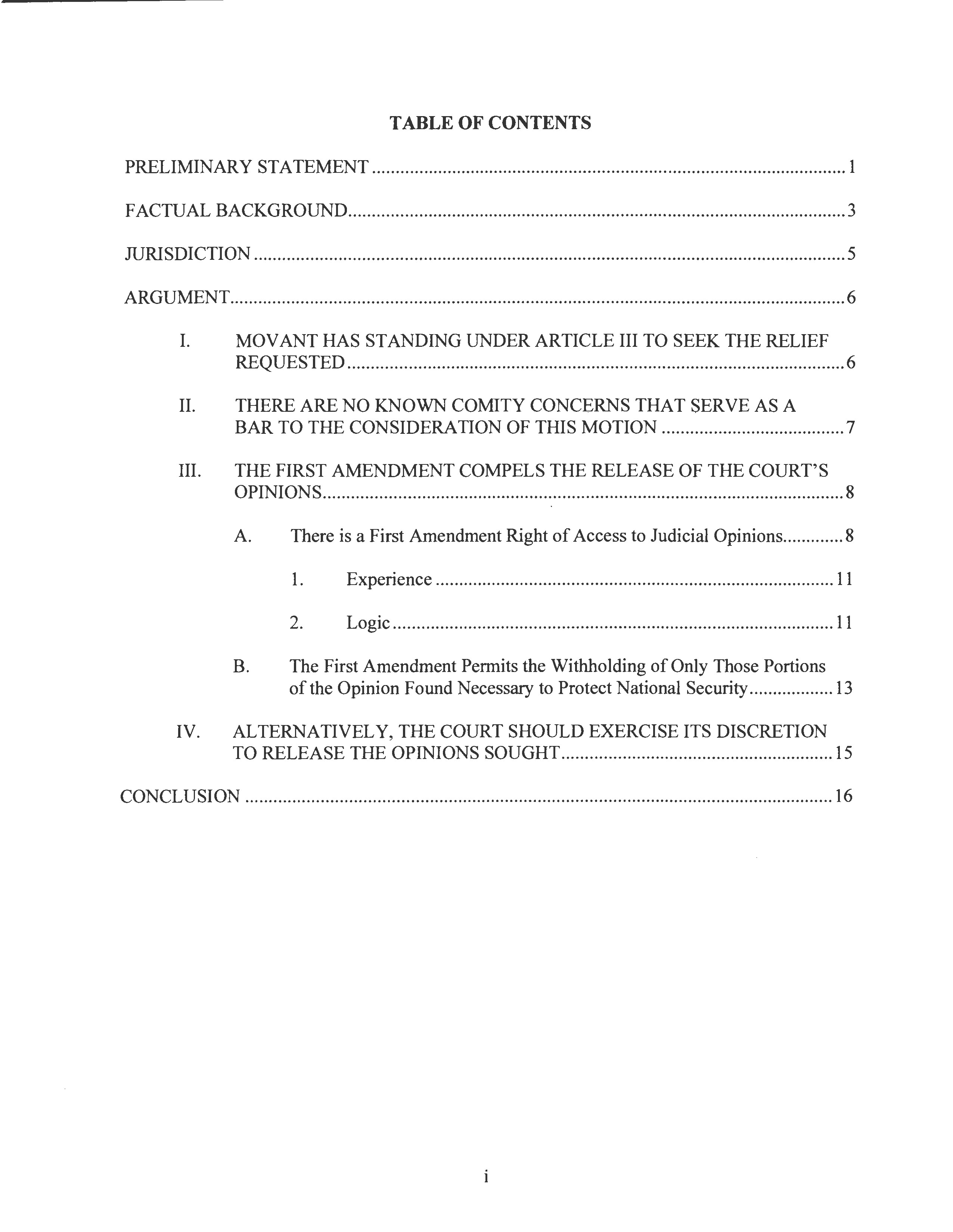
TABLE OF CONTENTS
PRELIMINARY STATEMENT.................................................................................................... 1
FACTUAL BACKGROUND....................................................................................................... 3
JURISDICTION.......................................................................................................................... 5
ARGUMENT................................................................................................................................ 6
I. MOVANT HAS STANDING UNDER ARTICLE III TO SEEK THE RELIEF
REQUESTED .............................................................................................................. 6
II. THERE ARE NO KNOWN COMITY CONCERNS THAT SERVE AS A
BAR TO THE CONSIDERATION OF THIS MOTION ........................................ 7
III. THE FIRST AMENDMENT COMPELS THE RELEASE OF THE COURT'S
OPINIONS................................................................................................................... 8
A. There is a First Amendment Right of Access to Judicial Opinions.........................8
- Experience.......................................................................................................11
- Logic...............................................................................................................11
B. The First Amendment Permits the Withholding of Only Those Portions
of the Opinion Found Necessary to Protect National Security.............................13
IV. ALTERNATIVELY, THE COURT SHOULD EXERCISE ITS DISCRETION
TO RELEASE THE OPINIONS SOUGHT..............................................................15
CONCLUSION........................................................................................................................... 16
i
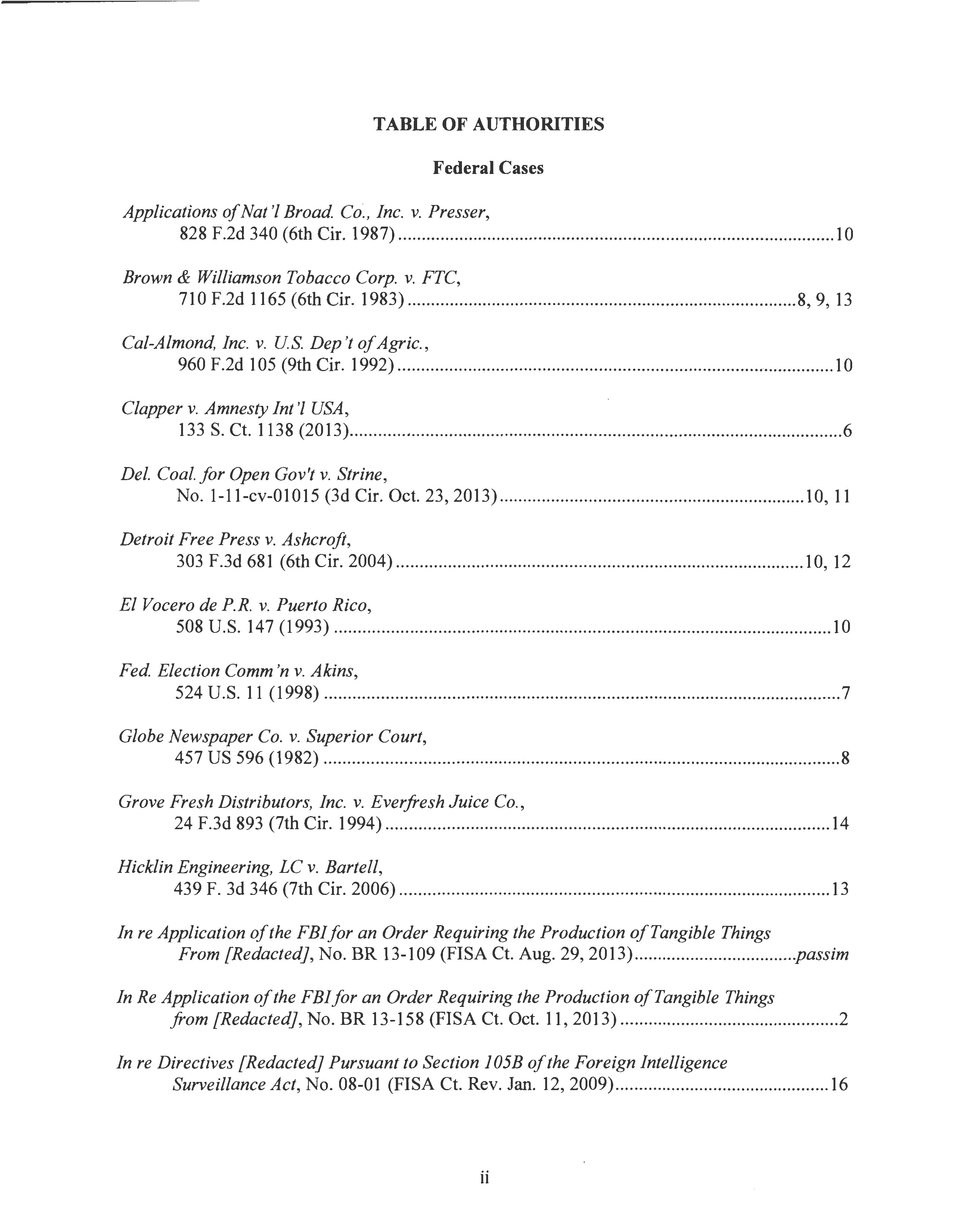
TABLE OF AUTHORITIES
Federal Cases
Applications of Nat'l Broad. Co., Inc. v. Presser,
828 F.2d 340 (6th Cir. 1987) ................................................................................10
Brown & Williamson Tobacco Corp. v. FTC,
710 F.2d 1165 (6th Cir. 1983) ........................................................................8, 9, 13
Cal-Almond, Inc. v. U.S. Dep't of Agric.,
960 F.2d 105 (9th Cir. 1992)................................................................................10
Clapper v. Amnesty Int'l USA,
133 S. Ct. 1138 (2013)............................................................................................6
Del. Coal. for Open Gov't v. Strine,
No. 1-11-cv-01015 (3d Cir. Oct. 23, 2013).....................................................10, 11
Detroit Free Press v. Ashcroft,
303 F.3d 681 (6th Cir. 2004) ..........................................................................10, 12
El Vocero de P.R. v. Puerto Rico,
508 U.S. 147 (1993) ..............................................................................................10
Fed. Election Comm'n v. Akins,
524 U.S. 11 (1998) ..................................................................................................7
Globe Newspaper Co. v. Superior Court,
457 US 596 (1982) ..................................................................................................8
Grove Fresh Distributors, Inc. v. Everfresh Juice Co.,
24 F.3d 893 (7th Cir. 1994) ..................................................................................14
Hicklin Engineering, LC v. Bartell,
439 F. 3d 346 (7th Cir. 2006) ..............................................................................13
In re Application of the FBI for an Order Requiring the Production of Tangible Things
From [Redacted], No. BR 13-109 (FISA Ct. Aug. 29, 2013)...............................passim
In Re Application of the FBI for an Order Requiring the Production of Tangible Things
from [Redacted], No. BR 13-158 (FISA Ct. Oct. 11, 2013) ...................................2
In re Directives [Redacted] Pursuant to Section 105B of the Foreign Intelligence
Surveillance Act, No. 08-01 (FISA Ct. Rev. Jan. 12, 2009)..................................16
ii
In re Dow Jones & Co., Inc.,
842 F.2d 603 (2nd Cir. 1988) ................................................................................7
In re Motion for Release of Court Records,
526 F. Supp. 2d 484 (FISA Ct. 2007)..........................................................6, 9, 13, 15
In re Oliver,
333 U.S. 257 (1948) ..............................................................................................12
In re Orders of this Court Interpreting Section 215 of the Patriot Act at 16-17,
No. Misc. 13-02 (FISA Ct. Sep. 13, 2013)..........................................................passim
Lowenschuss v. West Pub. Co.,
542 F.2d 180 (3d Cir. 1976) ..............................................................................9, 10
Lujan v. Defenders of Wildlife,
504 U.S. 555 (1992) ................................................................................................6
N.Y. Civil Liberties Union v. N.Y.C. Transit Auth.,
684 F.3d 286 (2d Cir. 2012) ....................................................................................7
Nixon v. Warner Commc'ns Inc.,
435 U.S. 589 (1978) ..........................................................................................5, 15
Press-Enter. Co. v. Superior Court,
464 U.S. 501 (1984) ..............................................................................................14
Press-Enter. Co. v. Superior Court,
478 U.S. 1 (1986) ................................................................................................passim
Raines v. Byrd,
529 U.S. 811 (1997) ................................................................................................6
Redacted,
2011 WL 10945618 (FISA Ct. Oct. 3, 2011)......................................................11
Redacted,
2012 WL 9189263 (FISA Ct. Aug. 24, 2012)......................................................11
Richmond Newspapers Inc. v. Virginia,
448 U.S. 555 (1980) ..........................................................................................8, 12
Smith v. Maryland,
442 U.S. 735 (1979) ..........................................................................................3, 5
iii
United States v Rosen,
487 F. Supp. 2d 703 (E.D. Va. 2007)..................................................................14
United States v. Jones,
132 S. Ct. 945 (2012)................................................................................................2
United States v. Simone,
14 F.3d 833 (3d Cir. 1994) ..................................................................................10
Federal Statutes
50 U.S.C. § 1861 ....................................................................................................passim
Federal Rules
Foreign Intelligence Surveillance Court's Rule of Procedure 62........................1, 15, 16
Constitutional Provisions
First Amendment....................................................................................................passim
Fourth Amendment................................................................................................passim
Other Authorities
Charlie Savage, Extended Ruling by Secret Court Backs Collection of Phone Data,
N.Y. Times, Sep. 17, 2013 ........................................................................................5
Jennifer Valentino DeVries & Siobhan Gorman, Secret Court's Redefinition of 'Relevant'
Empowered Vast NSA Data-Gathering, Wall St. J. (July 8, 2013, 3:13 AM)............12
Jim Sensenbrenner, Op-Ed., How Obama Has Abused the Patriot Act, L.A. Times,
Aug. 19, 2013 ............................................................................................................4
John Locke, Treatise of Civil Government §§ 124, 136-37 (1690)............................13
Julian Sanchez, Are Internet Backbone Pen Registers Constitutional?, Just Security
(Sep. 23, 2013, 7:55 PM)..........................................................................................5
Office of the Dir. of Nat'l Intelligence, IC on the Record, DNI Clapper Declassifies
Intelligence Community Documents Regarding Collection Under Section 501 of the
Foreign Intelligence Surveillance Act (FISA) (Sep. 10, 2013)................................11
Office of the Dir. of Nat'l Intelligence, IC on the Record, Release of Previously Classified
August 29, 2013 Foreign Intelligence Surveillance Court Opinion (Sep. 17, 2013, 4:58
PM)..........................................................................................................................14
iv
Orin Kerr, Hints and Questions About the Secret Fourth Amendment Rulings of the FISA
Court, Volokh Conspiracy (July 7, 2013, 1:37 AM)................................................12
Orin Kerr, My (Mostly Critical) Thoughts on the August 2013 FISC Opinion on Section 215,
The Volokh Conspiracy (Sep. 17, 2013, 7:39 PM)....................................................5
Statement by the President, Office of the Press Secretary (June 7, 2013) ................4
Status Report, Elec. Frontier Found. v. U.S. Dep't of Justice,
No. 4:11-cv-05221 (N.D. Cal. Sep. 04, 2013), ECF No. 63....................................8
U.S. Foreign Intelligence Surveillance Court Public Filings (last visited October 8, 2013).........11
Zoë Carpenter, Congress Renews Efforts to Curb NSA Surveillance,
The Nation (Sep. 24, 2013, 4:52 PM)........................................................................5
v
PRELIMINARY STATEMENT
Pursuant to the First Amendment and to Rule 62 of the Foreign Intelligence Surveillance
Court's Rules of Procedure ("FISC Rules"), ProPublica, Inc. (“ProPublica") respectfully moves
for the publication of a certain Foreign Intelligence Surveillance Court ("FISC") opinion or
opinions that appear to underlie the government's collection of telephone metadata. The specific
opinion or opinions sought are those referenced on, but redacted from, pages 8, 9, and 19-20 of
In re Application of the FBI for an Order Requiring the Production of Tangible Things From
[Redacted], No. BR 13-109 (FISA Ct. Aug. 29, 2013) (“BR 13-109").
The opinion or opinions sought are cited in BR 13-109 as stating "[s]o long as no
individual has a reasonable expectation of privacy in meta[]data, the large number of persons
whose communications will be subjected to the . . . surveillance is irrelevant to the issue of
whether a Fourth Amendment search or seizure will occur." BR 13-109 at 8-9 (quoting
[Redacted], at 63). The Court further cited to the opinion or opinions sought, stating, "This Court
has previously examined the issue of relevance." Id. at 19-20. Lastly, movant seeks the opinion
or opinions quoted on page 20 of BR 13-109 as follows:
- The "finding of relevance most crucially depended on the conclusion that bulk
collection is necessary for NSA to employ tools that are likely to generate useful
investigative leads to help identify and track terrorist operatives." - Bulk collections are "necessary to identify the much smaller number of
[international terrorist] communications." - "[T]he entire mass of collected metadata is relevant to investigating [international
terrorist groups] and affiliated persons."
1
These records should be unsealed because the public has a First Amendment right of
access to them.
In the alternative, this Court, recognizing the considerable public interest in the opinions
sought, should exercise its discretion to publish its own opinions. The opinions to which access
is sought appear to set forth the FISC's ultimate legal authority supporting bulk collection of
telephone call records pursuant to Section 215 of the USA PATRIOT Act. As this Court recently
noted in the context of a request to unseal different FISC records, there is such a "considerable
public interest" in the FISC opinions interpreting "the meaning, scope, and constitutionality of
Section 215" because the publication of such opinions will “contribute to an informed debate...
[and] assure citizens of the integrity of this Court's proceedings." In re Orders of this Court
Interpreting Section 215 of the Patriot Act at 16-17, No. Misc. 13-02 (FISA Ct. Sep. 13, 2013)
("Misc. 13-02"). Although numerous FISC opinions regarding Section 215 have now been made
public, the FISC's ultimate authority for the bulk collection of records remains secret.¹ Like
nesting dolls, the opinions that have been released thus far merely cite to redacted opinions, and
when those opinions are released, they too cite to and rely on other redacted opinions. For the
same reasons supporting the conclusion that the public interest would be served by the disclosure
of opinions interpreting Section 215, the Court should provide the full legal rationale by
publishing its opinions relied on in the now-public BR 13-109.
¹ The FISC's most recent published Section 215 order discusses bulk collection of metadata and
the Fourth Amendment in the context of the Supreme Court's decision in United States v. Jones,
132 S. Ct. 945 (2012). In Re Application of the FBI for an Order Requiring the Production of
Tangible Things from [Redacted], No. BR 13-158 (FISA Ct. Oct. 11, 2013). However, the Court
reaffirmed the analysis from BR 13-109, underscoring the importance of the still-secret opinions
sought here. Id. at 4-5.
2
FACTUAL BACKGROUND
On September 17, 2013, the FISC released a partially redacted version of a previously
classified August 29, 2013 memorandum opinion requiring a telephone service provider to
produce bulk "telephony metadata" on an ongoing basis to the National Security Agency
("NSA"), pursuant to Section 215. See BR 13-109 at 1-2. Relying on the Supreme Court's 1979
opinion in Smith v. Maryland, 442 U.S. 735 (1979), for the proposition "that a person does not
have a legitimate expectation of privacy in telephone numbers dialed," the Court held that bulk
collection of telephony metadata under Section 215 does not violate the Fourth Amendment. Id.
at 8-9. The Court noted the significant distinction that in Smith "the government was obtaining
the telephone company's metadata of one person suspected of a crime... [but] [h]ere the
government is requesting daily production of certain telephony metadata in bulk... without
specifying the particular number of an individual." Id. at 8. However, the Court concluded that
this was a distinction without a difference because "where one individual does not have a Fourth
Amendment interest, grouping together a large number of similarly situated individuals cannot
result in a Fourth Amendment interest springing into existence ex nihilo." Id. at 9. The Court's
authority for this conclusion was a redacted citation to an earlier FISC opinion "analyz[ing] this
distinction in a similar context." Id. at 8. Similarly, in its statutory analysis of whether bulk
collection of telephony metadata meets Section 215's relevance standard, the Court again
provided a redacted citation to an earlier FISC opinion. Id. at 19 ("This Court has previously
examined the issue of relevance for bulk collections. See [redacted].") Relying on this redacted
3
opinion,² the Court concluded that the bulk collection fit within Section 215's statutory language.
Id. at 20-21.
The release of this redacted BR 13-109 opinion interpreting Section 215 occurred against
the backdrop of the FISC's public ruling four days earlier on a motion by the American Civil
Liberties Union (“ACLU"), the American Civil Liberties Union of the Nation's Capital
(“ACLU-NC”), and the Media Freedom and Information Access Clinic (“MFIAC”) (hereinafter
collectively "the ACLU") requesting that the Court release FISC opinions interpreting
Section 215. See Misc. 13-02. As an exercise of its discretion, the FISC held that any opinions
not already at issue in the ACLU's ongoing FOIA litigation should be reviewed for
declassification and published subject to the approval of the authoring judge. Id. at 16, 18.
Although it did not reach the merits of the ACLU's asserted First Amendment right of access,
the Court agreed that release of these opinions would serve the public interest and inform the
ongoing debate. Id. at 16-17.
In addition to these public releases by the FISC, there has been a significant public debate
regarding the legality of the telephone call records collection since the disclosure of the existence
of the program in June 2013. In June, after The Guardian and the Washington Post disclosed a
FISC order allowing bulk collection of telephony metadata under Section 215, public debate
intensified. President Obama as well as other members of the executive and legislative branch
spoke publicly about the program and "welcome[d] this debate." Statement by the President,
Office of the Press Secretary (June 7, 2013), http://1.usa.gov/12xerjF; see also Jim
Sensenbrenner, Op-Ed., How Obama Has Abused the Patriot Act, L.A. Times, Aug. 19, 2013,
² Because of the redactions, it is unclear whether the Court was citing to a single opinion or to
two or more. See BR 13-109 at 20 (several redacted citations on the subject bulk collections and
relevance).
4
http://www.latimes.com/opinion/commentary/la-oe-sensenbrenner-data-patriot-act-obama-
20130819,0,1387481.story (criticizing executive branch's interpretation of Section 215); Zoë
Carpenter, Congress Renews Efforts to Curb NSA Surveillance, The Nation (Sep. 24, 2013, 4:52
PM),
http://www.thenation.com/blog/176328/congress-renews-efforts-curb-nsa-surveillance
(discussing congressional proposals to revise Section 215 to end bulk collection).
The FISC's release of the BR 13-109 opinion on September 17 has amplified public
discussion of the Court's interpretation of the statute. See, e.g., Charlie Savage, Extended Ruling
by Secret Court Backs Collection of Phone Data, N.Y. Times, Sep. 17, 2013,
http://www.nytimes.com/2013/09/18/us/opinion-by-secret-court-calls-collection-of-phone-data-
legal.html. Yet despite the FISC's release of this opinion, commentators have noted that the
Court's legal analysis remains skeletal because of its reliance on earlier, still-secret opinions. See
Julian Sanchez, Are Internet Backbone Pen Registers Constitutional?, Just Security (Sep. 23,
2013, 7:55 PM), http://justsecurity.org/2013/09/23/internet-backbone-pen-registers-constitutional
(referencing citation of secret Fourth Amendment opinions and these opinions' possible
misreading of Smith v. Maryland); Orin Kerr, My (Mostly Critical) Thoughts on the August 2013
FISC Opinion on Section 215, The Volokh Conspiracy (Sep. 17, 2013, 7:39 PM),
http://www.volokh.com/2013/09/17/thoughts-august-2013-fisc-opinion-section-215 (explaining
that on question of relevance, the Court "refers to an earlier [secret] decision. . . then just
concludes[.]").
JURISDICTION
The FISC is an Article III court established by Congress, Misc. 13-02 at 4, with
"supervisory power over its own records and files." Nixon v. Warner Commc'ns Inc., 435 U.S.
589, 598 (1978). In particular, this Court has held that that it has "jurisdiction in the first instance
5
to adjudicate a claim of right to the court's very own records and files." In re Motion for Release
of Court Records, 526 F. Supp. 2d 484, 487 (FISA Ct. 2007); accord Misc. 13-02 at 11-12 (FISC
not precluded by FISC Rules from adjudicating "claim of right' to access 'its very own records
and files" or "requests for discretionary publication," at least where “non-parties . . . have
sufficient information to make reasonably concrete, rather than abstract arguments in favor of
publication"). As detailed below, movant has concrete arguments for publication under both a
claim of right and as a discretionary request. Accordingly, the Court has jurisdiction.
ARGUMENT
I. MOVANT HAS STANDING UNDER ARTICLE III TO SEEK THE RELIEF
REQUESTED
Standing is "[o]ne element of the case or controversy requirement." Clapper v. Amnesty
Int'l USA, 133 S. Ct. 1138, 1146 (2013) (quoting Raines v. Byrd, 529 U.S. 811, 818 (1997)). To
establish standing under Article III, a party invoking federal jurisdiction must demonstrate an
injury that is "concrete, particularized, and actual or imminent; fairly traceable to the challenged
action; and redressable by a favorable ruling." Clapper, 133 S. Ct. at 1147; accord Lujan v.
Defenders of Wildlife, 504 U.S. 555, 560-61 (1992) (three "irreducible" elements of standing are
"injury-in-fact," "causal connection . . . [to] conduct complained of," and likelihood of
redressability).
Movant has standing to seek the publication of the FISC records. Movant's First
Amendment right of access is violated by the continued withholding of these records from the
public, which is an “actual, rather than imminent" injury. Misc. 13-02 at 4-5. "Nor is there any
real question that this claimed injury is fairly traceable to the government's decision" to withhold
them or "that it would be redressed by this Court's directing that those opinions be published."
Id. Federal courts have found that news media entities have standing to challenge the closure of
6
court records and proceedings. See, e.g., In re Dow Jones & Co., Inc., 842 F.2d 603, 607-08 (2nd
Cir. 1988) (news agencies have standing because they are "potential recipients of speech" of
underlying closed court proceeding); see also N.Y. Civil Liberties Union v. N.Y.C. Transit Auth.,
684 F.3d 286, 294-95 (2d Cir. 2012) (“[O]nly a perceptible impairment of an organization's
activities is necessary for there to be an injury in fact.").
Moreover, as this Court found in Misc. 13-02, an entity suffers a sufficiently concrete
injury so as to confer standing if it demonstrates "active participation" in the public debate over
the matters at issue. Misc. 13-02 at 8-9 (finding that the ACLU had standing to move to unseal a
FISC opinion). In such a situation, a movant asserts an injury-in-fact, not simply a "generalized
grievance[]," which would be insufficient to confer standing. Id. at 6 (quoting Fed. Election
Comm'n v. Akins, 524 U.S. 11, 23-24 (1998)).
As a Pulitzer-Prize-winning press organization that routinely cover matters of privacy
and Internet policy, movant has reported extensively on the government's surveillance efforts.
See Declaration of Richard Tofel ("Tofel Decl.”) ¶¶ 4-7. This reporting includes a discussion of
the asserted justification for the bulk collection of metadata. See id. ¶ 8. The withholding of FISC
opinions that pass on these justifications hinders movant's abilities to fully explain the
government's actions to the public. Id. ¶ 9. This is a concrete injury that goes to the heart of
movant's organizational activities. Such a showing is more than sufficient to confer standing.
II. THERE ARE NO KNOWN COMITY CONCERNS THAT SERVE AS A BAR TO
THE CONSIDERATION OF THIS MOTION
This Court also has no prudential barriers to ruling on its motion. In Misc. 13-02, the
Court, citing comity concerns and the first-to-file rule, declined to consider the motions to unseal
that pertained to FISC opinions that were the subject of ongoing FOIA litigation to which the
7
movant was a party. Misc. 13-02 at 12-16. Movant here is not a party to any existing related
FOIA litigation.³
III. THE FIRST AMENDMENT COMPELS THE RELEASE OF THE COURT'S
OPINIONS
A. There is a First Amendment Right of Access to Judicial Opinions
The Supreme Court has recognized that the public has a First Amendment right of access
to many judicial proceedings. See Richmond Newspapers Inc. v. Virginia, 448 U.S. 555, 564-73
(1980); Globe Newspaper Co. v. Superior Court, 457 US 596, 603-05 (1982); see also Brown &
Williamson Tobacco Corp. v. FTC, 710 F.2d 1165, 1177 (6th Cir. 1983) (explaining that the
public nature of legal principles and decisions is a "fundamental feature of the American judicial
system," with roots in "the English common law, the American constitutional system, and the
notion of 'the consent of the governed'").
Following the Richmond Newspapers line of cases, courts employ the two-step
"experience and logic" test to determine whether there is a right of public access to a category of
judicial proceedings: "First, because a tradition of accessibility implies the favorable judgment of
experiences, we have considered whether the place and process have historically been open to
the press and general public." Press-Enter. Co. v. Superior Court, 478 U.S. 1, 8 (1986) (Press-
Enter. II) (citations and internal quotation marks omitted). "Second, in this setting the Court has
traditionally considered whether public access plays a significant positive role in the functioning
of the particular process in question." Id.
³ Movant's counsel, Electronic Frontier Foundation, is a party to FOIA litigation pertaining to
legal authority upon which the Department of Justice and National Security Agency base their
interpretation of Section 215. See Status Report, Elec. Frontier Found. v. U.S. Dep't of Justice,
No. 4:11-cv-05221 (N.D. Cal. Sep. 04, 2013), ECF No. 63. It does not appear that the FISC
opinion sought by this motion would be responsive to that FOIA request or otherwise subject to
that FOIA litigation. Id. at 2.
8
This Court has at least twice been faced with a claimed First Amendment right of access
to its opinions. See In re Motion for Release of Court Records, 526 F. Supp. 2d at 484; Misc. 13-
02. In the first case, the Court held that whatever the general American legal tradition of
openness in judicial proceedings, the FISC itself had no such tradition that could meet the
experience test. In re Motion for Release of Court Records, 526 F. Supp. 2d at 492-93 ("[T]he
FISC has never held a public hearing in its history, and a total of two opinions have been
released to the public in nearly three decades of operation. During that period, the FISC has
issued literally thousands of classified orders to which the public has had no access."). In the
second, the Court was asked to reconsider this holding but instead granted the movant's request
without reaching the merits of the First Amendment argument. Misc. 13-02 at 17.
However, it is now clear both that experience favors finding a right of access, and that the
FISC's position with regard to the general tradition of openness has changed. What is more,
these changes emphasize the logic in finding a right of access.
- Experience
The experience prong is satisfied here because there is an unbroken history of Article III
court opinions being public. Lowenschuss v. West Pub. Co., 542 F.2d 180, 185 (3d Cir. 1976)
("[U]nder our system of jurisprudence the judiciary has the duty of publishing and disseminating
its decisions."); Brown & Williamson, 710 F.2d at 1177 (opinions and records are presumptively
public because "court records often provide important, sometimes the only, bases or explanations
for a court's decision").
⁴ The Court also rejected the argument that a narrower subset of its opinions, those of "broad
legal significance," should qualify for the experience test. In re Motion for Release, 526 F. Supp.
2d at 493.
9
The experience prong does not require a tradition of openness dating back to the
ratification of the Constitution. See Press-Enter. II, 478 U.S. at 10-12 (relying on post-Bill of
Rights history); Applications of Nat'l Broad. Co., Inc. v. Presser, 828 F.2d 340, 344 (6th Cir.
1987) (finding First Amendment right of access while reviewing history from 1924-1984).
Indeed, even a very recent tradition of openness may be sufficient. See Detroit Free Press v.
Ashcroft, 303 F.3d 681, 703 (6th Cir. 2004) (finding that a "brisk evolution" in pattern of
openness of deportation proceedings satisfied the experience test). This is especially the case
where "the beneficial effects of access to that process are overwhelming and uncontradicted." Id.
at 701; see also United States v. Simone, 14 F.3d 833, 842 (3d Cir. 1994) (finding First
Amendment right of access despite no history on point); Cal-Almond, Inc. v. U.S. Dep't of
Agric., 960 F.2d 105, 109 (9th Cir. 1992) (finding tradition of public access is reflected in
current statutes).
The FISC is an Article III court issuing judicial opinions based on the "directive force of
precedents," and is therefore part of the long tradition of public dissemination of judicial
opinions. Lowenschuss, 542 F.2d at 185. That the FISC is a different type of Article III court
than, for example, the federal district courts, is not relevant. The experience test looks not "to the
particular practice of any one jurisdiction, but instead to the experience in that type or kind of
hearing throughout the United States." El Vocero de P.R. v. Puerto Rico, 508 U.S. 147, 150
(1993) (per curiam) (quotation marks omitted). As the Third Circuit recently found, even the
government's description of a proceeding as a type that has been traditionally closed to the
public, such as an arbitration, is not dispositive of the experience test. Del. Coal. for Open Gov't
v. Strine, No. 1-11-cv-01015, slip op. at 18 (3d Cir. Oct. 23, 2013). Thus, the right of access
applies to a government-sponsored arbitration because it bears important hallmarks of a court
10
proceeding and is "deeply rooted in the way the judiciary functions in a democratic society." Id.
at 18.
Even if this Court were correct in stating that the court should look to the FISC's
particular tradition rather than the tradition of Article III courts in general, recent experience
shows a "brisk evolution" in the openness of FISC opinions. Indeed, the tradition of openness of
the FISC opinions is much different than that encountered in 2007, when the FISC rejected the
existence of a First Amendment right of access. The number of opinions available to the public
since 2007 has multiplied many times over.⁵
In sum, the experience test favors finding a right of access both with regard to the general
tradition of openness of judicial opinions and in regard to the FISC's recent moves to release far
more material publicly than ever before.
- Logic
Similarly, the release of the FISC opinions sought by movant will serve a "significant
positive role in the functioning of the particular process in question." Press-Enter. II, 478 U.S. at
8-9. The Supreme Court has explained that the logic test looks to the benefits that public access
to the proceeding or materials would confer, such as "enhanc[ing] both the basic fairness of the
⁵ At least eight FISC opinions have been made available to the public since 2007, including four
in 2013 alone. Many other orders and filings to the court are also now publicly available. See,
e.g., U.S. Foreign Intelligence Surveillance Court Public Filings,
http://www.uscourts.gov/uscourts/courts/fisc/index.html (last visited October 8, 2013) (featuring
memorandum opinions in case numbers BR 13-158, 13-109, Misc. 13-02, and Misc. 13-01 as
well as additional orders and filings); Redacted, 2012 WL 9189263 (FISA Ct. Aug. 24, 2012)
(memorandum opinion); Redacted, 2011 WL 10945618 (FISA Ct. Oct. 3, 2011) (memorandum
opinion); Office of the Dir. of Nat'l Intelligence, IC on the Record, DNI Clapper Declassifies
Intelligence Community Documents Regarding Collection Under Section 501 of the Foreign
Intelligence Surveillance Act (FISA) (Sep. 10, 2013),
http://icontherecord.tumblr.com/post/60867560465/dni-clapper-declassifies-intelligence-
community (featuring orders and filings from 2006-2009 and supplemental opinions in case
numbers 08-13 and 09-15).
11
criminal trial and the appearance of fairness so essential to public confidence in the system." Id.
In the criminal context, a public trial can have "therapeutic value,” serving as an outlet for
"community concern, hostility, and emotion.” Richmond Newspapers, 448 U.S. at 569; Detroit
Free Press, 303 F.3d at 704. Perhaps even more important, public access to judicial proceedings
ensures accuracy and fairness in the process. Richmond Newspapers, 448 U.S. at 592 (citing In
re Oliver, 333 U.S. 257, 270 (1948)).
This Court has already recognized the benefits of public release of its opinions construing
Section 215 in language that closely parallels the purposes of the logic test:
"Publication of FISC opinions relating to this provision would contribute to an
informed public debate. Congressional amici emphasize the value of public
information and debate in representing their constituents and discharging their
legislative responsibilities. Publication would also assure citizens of the integrity
of this Court's proceedings."
Misc. 13-02 at 16-17. Publication has especially clear benefits where, as here, the opinions at
issue contain foundational legal analysis, including interpretation of public statutes and the
Constitution itself. As public debate over FISA and Section 215 has grown, commentators have
suggested that the FISC's classified opinions are leading to a de facto "secret body of case law"
interpreting the Fourth Amendment. Orin Kerr, Hints and Questions About the Secret Fourth
Amendment Rulings of the FISA Court, Volokh Conspiracy (July 7, 2013, 1:37 AM),
http://www.volokh.com/2013/07/07/hints-and-questions-about-the-secret-fourth-amendment-
rulings-of-the-fisa-court. Similar questions exist about the FISC's "circuit"-specific
interpretation of relevance. Jennifer Valentino DeVries & Siobhan Gorman, Secret Court's
Redefinition of 'Relevant' Empowered Vast NSA Data-Gathering, Wall St. J. (July 8, 2013, 3:13
AM), http://online.wsj.com/article/SB10001424127887323873904578571893758853344.html.
In this regard, the previous release of the Section 215 opinion can only be seen as a half-
12
measure, since an informed public cannot yet read these foundational interpretations for itself.
See Hicklin Engineering, LC v. Bartell, 439 F. 3d 346 (7th Cir. 2006) (“The political branches of
government claim legitimacy by election, judges by reason. Any step that withdraws an element
of the judicial process from public view makes the ensuing decision look more like fiat and
requires rigorous justification."); Brown & Williamson, 710 F.2d at 1177 n.6 ("Long ago Locke
emphasized the need for 'promulgated standing laws'—'established, settled, known laws
received and allowed by common consent'.... They would not 'put a force into the magistrate's
hands to execute his unlimited will arbitrarily upon them.") (quoting Locke, Treatise of Civil
Government §§ 124, 136-37 (1690)).
Finally, at this point, it can hardly be contended that the benefits of disclosure are
outweighed by the harm of a decreased flow of information and an avoidance of judicial review.
Cf. In re Motion for Release, 526 F. Supp. 2d at 496 ("The greater risk of declassification and
disclosure over Executive branch objections would chill the government's interactions with the
Court.... [G]overnment officials might choose to conduct a search or surveillance without
FISC approval where the need for such approval is unclear.") After widespread reporting of
unauthorized disclosures and repeated discussion by public officials of the government's legal
authority for bulk collection of metadata, the cat is out of the bag. Because release of the
opinions sought is in keeping with the tradition of Article III courts in general and the FISC's
evolving practice in specific, and because release would enhance public debate and increase this
Court's legitimacy, the Court should find that a First Amendment right of access exists.
B. The First Amendment Permits the Withholding of Only Those Portions of
the Opinion Found Necessary to Protect National Security
Although the right is not unbounded, "[t]he First Amendment presumes that there is a
right of access to proceedings and documents" that meet the experience and logic test. Grove
13
Fresh Distributors, Inc. v. Everfresh Juice Co., 24 F.3d 893, 897 (7th Cir. 1994). Once the right
applies, the documents sought are presumptively open unless the court finds that four criteria
support their retention: (1) There is an "overriding interest" supporting the retention of the
records, (2) that this retention is no broader than necessary to protect that interest, (3) that no
reasonable alternatives to the retention exist, and (4) this finding is supported by sufficiently
specific findings. Press-Enter. Co. v. Superior Court, 464 U.S. 501, 510 (1984) (Press-Enter. I).
Thus, the burden is on the government to demonstrate that retention "is essential to preserve
higher values," based on a non-conclusory showing of a "substantial probability" of harm to the
interest asserted. Press-Enter. II, 478 U.S. at 13-14, 15.
With the growing record of now-public FISC opinions, the government cannot contend
that it has an overriding interest in withholding the opinions sought. The government has pointed
to the recently publicized Section 215 opinion as proof of its commitment to increasing
transparency and assuring citizens that it is working within the law. Office of the Dir. of Nat'l
Intelligence, IC on the Record, Release of Previously Classified August 29, 2013 Foreign
Intelligence
Surveillance
Court Opinion (Sep. 17, 2013, 4:58 PM),
http://icontherecord.tumblr.com/post/61526105674/release-of-previously-classified-august-29-
2013 ("The opinion affirms that the bulk telephony metadata collection is both lawful and
constitutional.") It would therefore be incongruous to maintain that the Section 215 opinion can
be released but that the very legal authorities relied on to reach this conclusion are somehow
subject to a more compelling need for secrecy. Of course, the Court can redact those portions of
an opinion for which the government can meet its burden of showing a compelling interest.
Press-Enter. II, 478 U.S. at 13 (specific showing required); United States v Rosen, 487 F. Supp.
2d 703, 716 (E.D. Va. 2007) (redacting classified information requires specific showing even in
14
national security context). The Court has already ordered such a review in the context of
opinions interpreting Section 215, Misc. 13-02 at 18 (requiring government to submit “proposed
redactions”), and the finding of a First Amendment right of access to the opinions in this case
should only strengthen the necessity of such a review here.
IV. ALTERNATIVELY, THE COURT SHOULD EXERCISE ITS DISCRETION
TO RELEASE THE OPINIONS SOUGHT
Even if a First Amendment right of access does not exist, this Court instead may rely on
its supervisory powers over its own records to publish the opinions sought by movant. Nixon,
435 U.S. at 598; In re Motion for Release, 526 F. Supp. 2d at 487. In addition, FISC Rule 62(a)
gives the Court "discretion to direct publication sua sponte." Misc. 13-02 at 11; FISC Rule 62(a).
Given the Court's previous decision to invoke Rule 62(a) to allow publication of those Section
215 opinions not at issue in other litigation, Misc. 13-02 at 17, movant respectfully request that
the Court similarly use its discretion to allow publication of the opinions that form the legal
authority for the now-public Section 215 opinion.
Movant's argument for publication is specific to the circumstances and aimed at
furthering an already lively public debate. See Misc. 13-02 at 12 (where non-party to FISC
proceeding can make "reasonably concrete, rather than abstract, arguments in favor of
publication,” FISC may consider publication under Rule 62(a)). Movant does not seek release of
unspecified or random FISC opinions, but only those cited and centrally relied on for
fundamental legal principles in the already public FISC opinion on Section 215. Nor does
movant seek disclosure of any properly classified information. Rule 62(a) provides a mechanism
for publication of an opinion with “[r]edactions after consultation with the Executive Branch,
[that] can be made to exclude such classified materials without distorting the content of the
discussion of the statutory and constitutional issues." Order, In re Directives [Redacted]
15
Pursuant to Section 105B of the Foreign Intelligence Surveillance Act, No. 08-01 at 1 (FISA Ct.
Rev. Jan. 12, 2009), available at http://bit.ly/r32r2W; FISC Rule 62(a); see also Misc. 13-02 at
17-18 (invoking Rule 62(a) to request that the government "submit proposed redactions" for
Section 215 opinions subject to release).
CONCLUSION
For the foregoing reasons, movant respectfully requests that this Court unseal the
opinions relied on in its recently released Section 215 opinion which provide support for the
legality of bulk metadata collection under the Fourth Amendment and under a relevance
standard.
Dated: November 8, 2013
Respectfully submitted,
DAVID GREENE
ELECTRONIC FRONTIER FOUNDATION
815 Eddy Street
San Francisco, CA 94109
(415) 436-9333
davidg@eff.org
Counsel for Movant ProPublica, Inc.
16
U.S. FOREIGN
INTELLIGENCE
SURVEILLANCE COURT
UNITED STATES FOREIGN
INTELLIGENCE SURVEILLANCE COURT
WASHINGTON, D.C.
2013 NOV 12 PM 3:41.
LEEANN FLYNN HALL
CLERK OF COURT
IN RE MOTION OF PROPUBLICA, INC.
FOR THE RELEASE OF COURT RECORDS
)
Docket No.: 13-09
DECLARATION OF RICHARD TOFEL
David Greene
ELECTRONIC FRONTIER FOUNDATION
815 Eddy Street
San Francisco, CA 94109
(415) 436-9333
davidg@eff.org
Counsel for ProPublica, Inc.
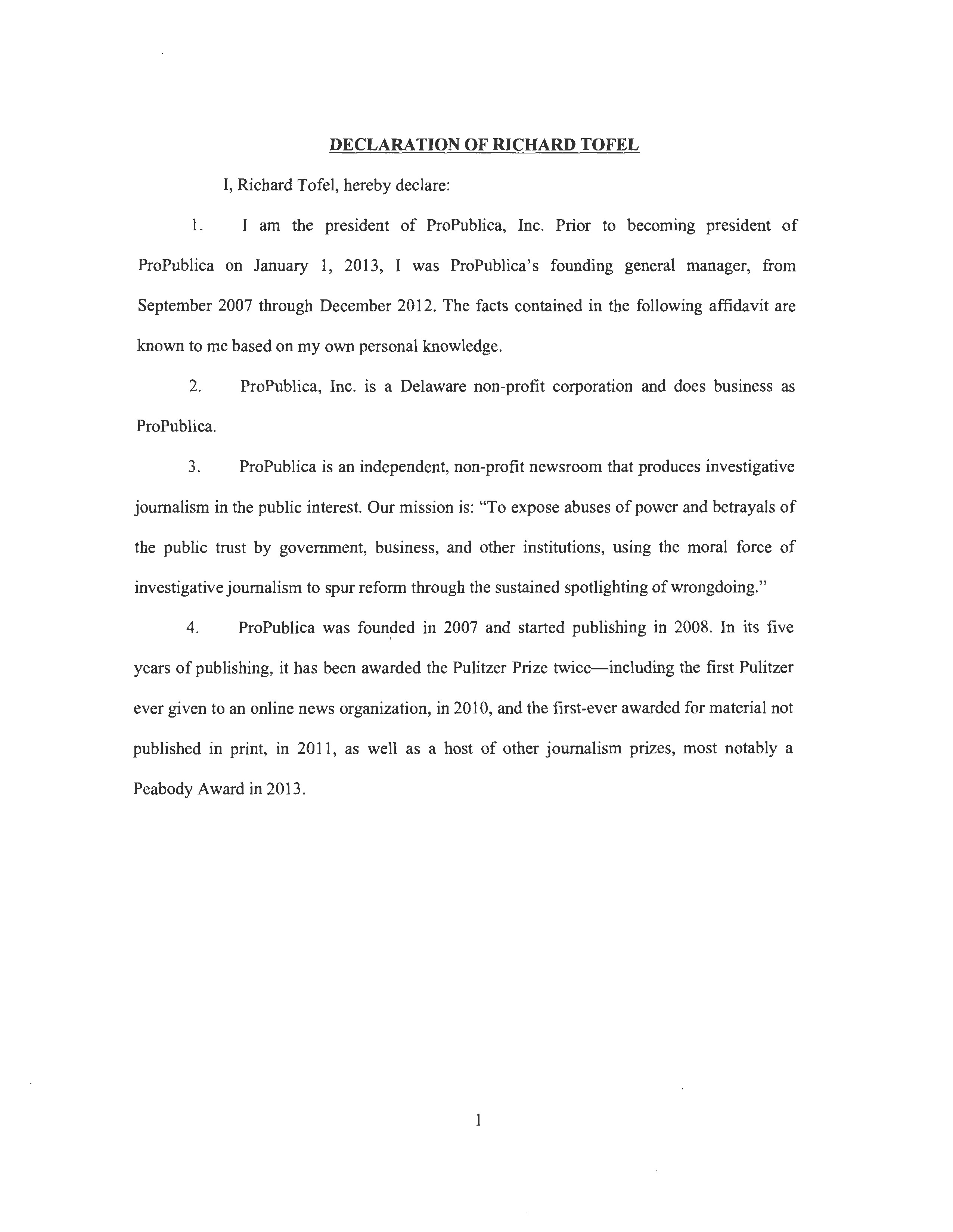
DECLARATION OF RICHARD TOFEL
I, Richard Tofel, hereby declare:
- I am the president of ProPublica, Inc. Prior to becoming president of
ProPublica on January 1, 2013, I was ProPublica's founding general manager, from
September 2007 through December 2012. The facts contained in the following affidavit are
known to me based on my own personal knowledge.
- ProPublica, Inc. is a Delaware non-profit corporation and does business as
ProPublica.
- ProPublica is an independent, non-profit newsroom that produces investigative
journalism in the public interest. Our mission is: "To expose abuses of power and betrayals of
the public trust by government, business, and other institutions, using the moral force of
investigative journalism to spur reform through the sustained spotlighting of wrongdoing."
- ProPublica was founded in 2007 and started publishing in 2008. In its five
years of publishing, it has been awarded the Pulitzer Prize twice—including the first Pulitzer
ever given to an online news organization, in 2010, and the first-ever awarded for material not
published in print, in 2011, as well as a host of other journalism prizes, most notably a
Peabody Award in 2013.
1
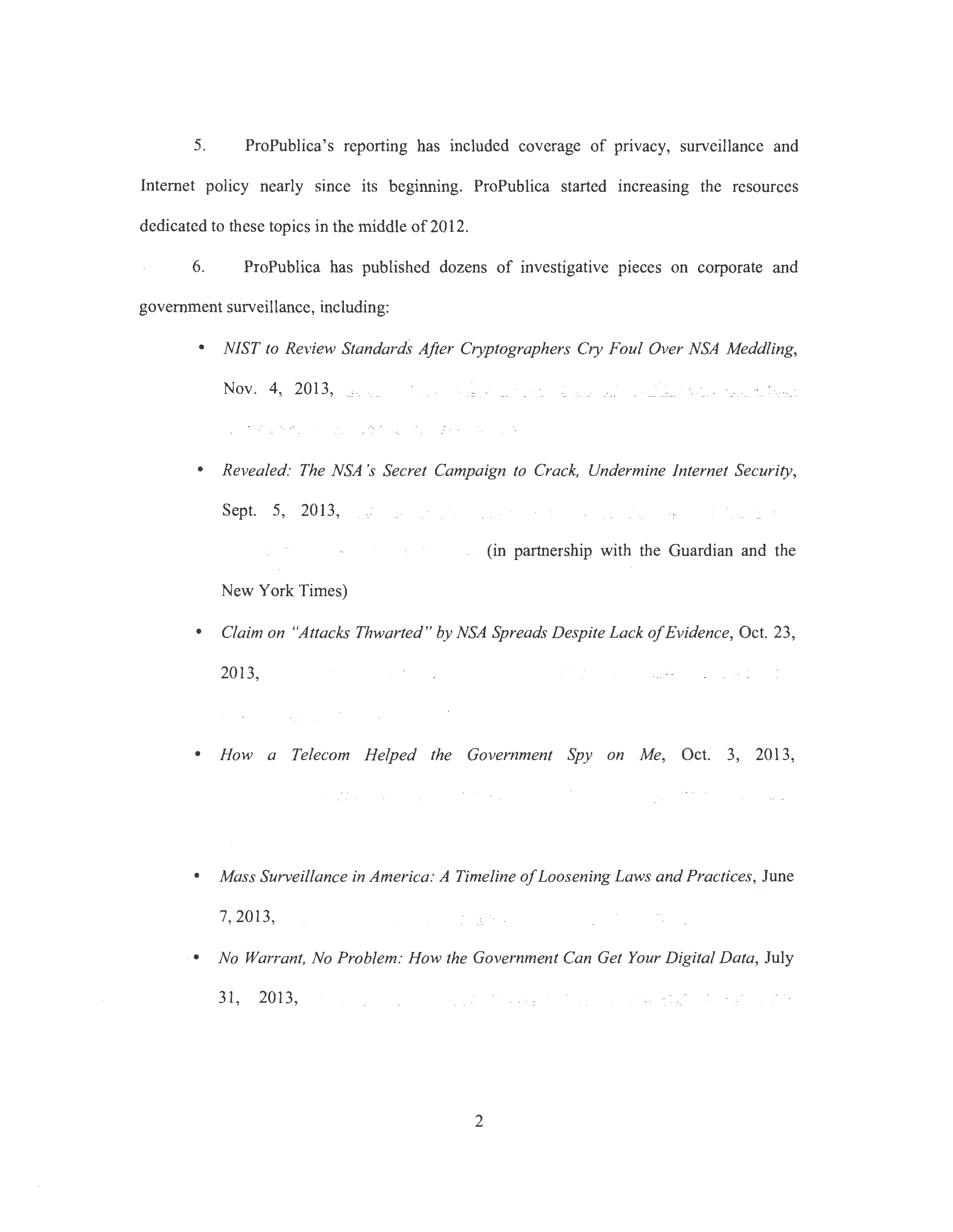
- ProPublica's reporting has included coverage of privacy, surveillance and
Internet policy nearly since its beginning. ProPublica started increasing the resources
dedicated to these topics in the middle of 2012.
- ProPublica has published dozens of investigative pieces on corporate and
government surveillance, including:
- NIST to Review Standards After Cryptographers Cry Foul Over NSA Meddling,
Nov. 4, 2013, [REDACTED]
- Revealed: The NSA's Secret Campaign to Crack, Undermine Internet Security,
Sept. 5, 2013, [REDACTED] (in partnership with the Guardian and the
New York Times)
- Claim on "Attacks Thwarted" by NSA Spreads Despite Lack of Evidence, Oct. 23,
2013, [REDACTED]
- How a Telecom Helped the Government Spy on Me, Oct. 3, 2013, [REDACTED]
- Mass Surveillance in America: A Timeline of Loosening Laws and Practices, June
7, 2013, [REDACTED]
- No Warrant, No Problem: How the Government Can Get Your Digital Data, July
31, 2013, [REDACTED]
2
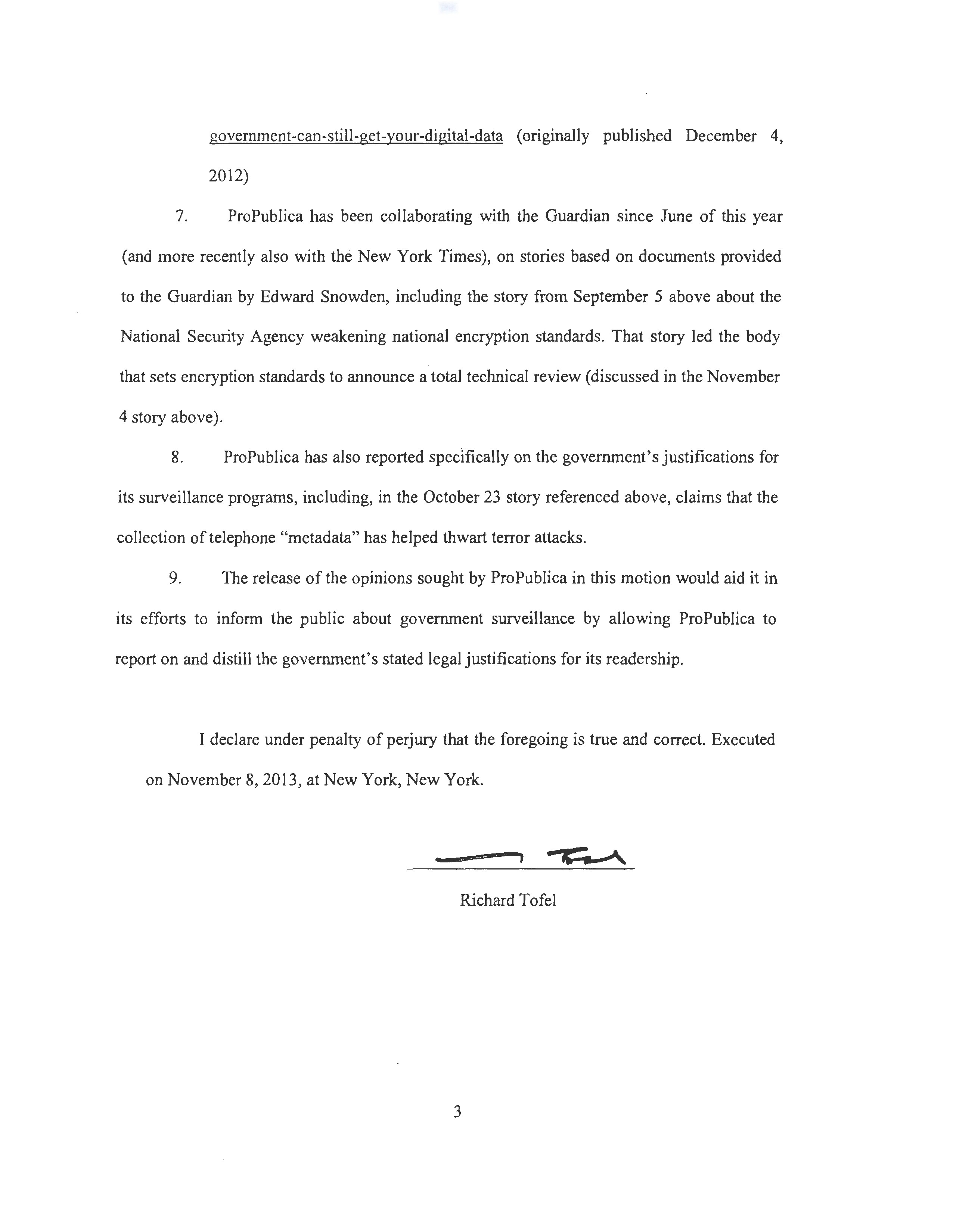
government-can-still-get-your-digital-data (originally published December 4,
2012)
- ProPublica has been collaborating with the Guardian since June of this year
(and more recently also with the New York Times), on stories based on documents provided
to the Guardian by Edward Snowden, including the story from September 5 above about the
National Security Agency weakening national encryption standards. That story led the body
that sets encryption standards to announce a total technical review (discussed in the November
4 story above).
- ProPublica has also reported specifically on the government's justifications for
its surveillance programs, including, in the October 23 story referenced above, claims that the
collection of telephone "metadata" has helped thwart terror attacks.
- The release of the opinions sought by ProPublica in this motion would aid it in
its efforts to inform the public about government surveillance by allowing ProPublica to
report on and distill the government's stated legal justifications for its readership.
I declare under penalty of perjury that the foregoing is true and correct. Executed
on November 8, 2013, at New York, New York.
Richard Tofel
3
U.S. FOREIGH
INTELLIGENCE
SURVEILLANCE COURT
UNITED STATES FOREIGN
INTELLIGENCE SURVEILLANCE COURT
WASHINGTON, D.C.
2013 NOV 12 PM 3:42
LEEANN FLYNN HALL
CLERK OF COURT
IN RE MOTION OF PROPUBLICA, INC.
FOR THE RELEASE OF COURT RECORDS
)
Docket No.: 13-09
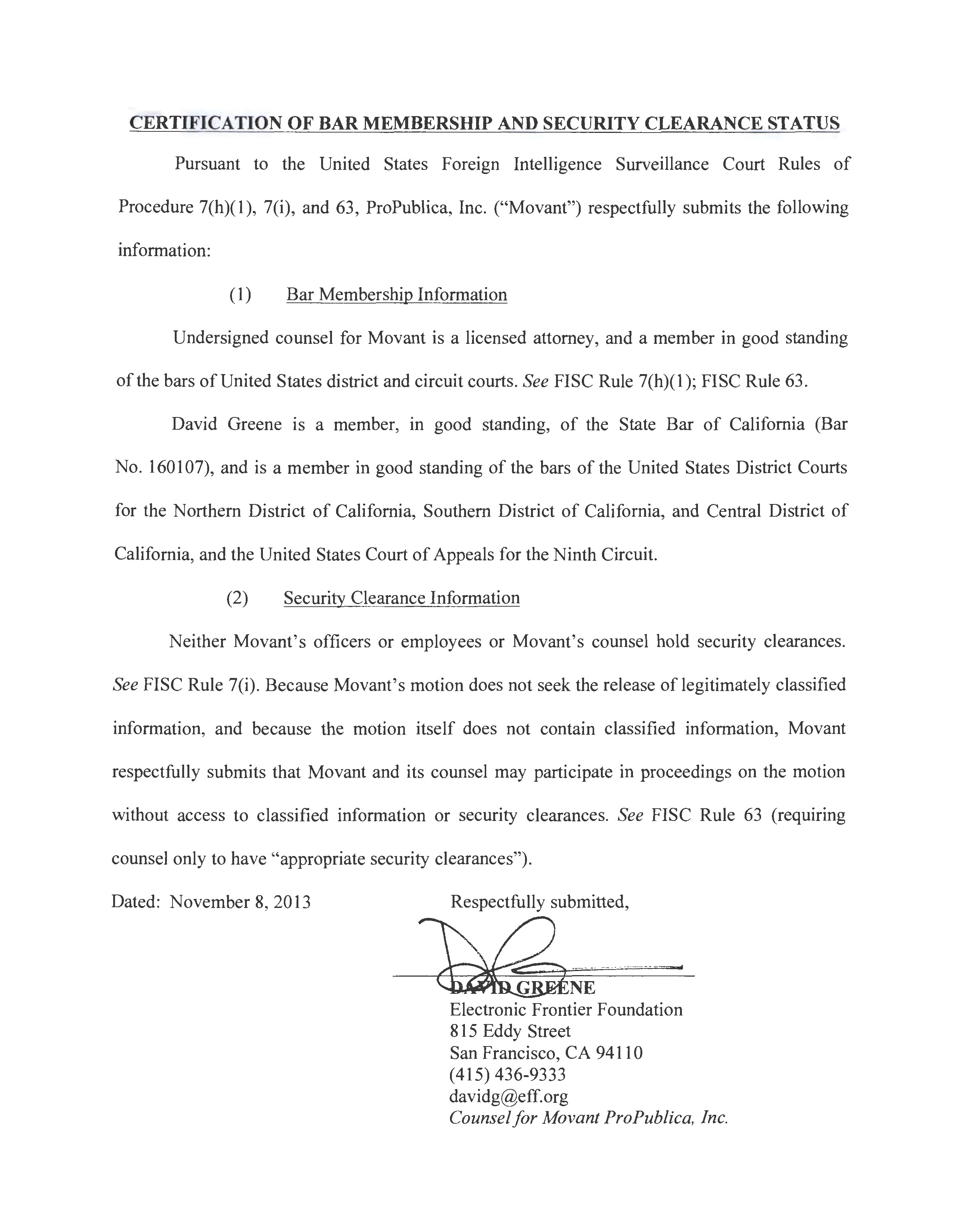
CERTIFICATION OF BAR MEMBERSHIP AND SECURITY CLEARANCE STATUS
David Greene
ELECTRONIC FRONTIER FOUNDATION
815 Eddy Street
San Francisco, CA 94109
(415) 436-9333
davidg@eff.org
Counsel for Movant ProPublica, Inc.
CERTIFICATION OF BAR MEMBERSHIP AND SECURITY CLEARANCE STATUS
Pursuant to the United States Foreign Intelligence Surveillance Court Rules of
Procedure 7(h)(1), 7(i), and 63, ProPublica, Inc. ("Movant") respectfully submits the following
information:
(1) Bar Membership Information
Undersigned counsel for Movant is a licensed attorney, and a member in good standing
of the bars of United States district and circuit courts. See FISC Rule 7(h)(1); FISC Rule 63.
David Greene is a member, in good standing, of the State Bar of California (Bar
No. 160107), and is a member in good standing of the bars of the United States District Courts
for the Northern District of California, Southern District of California, and Central District of
California, and the United States Court of Appeals for the Ninth Circuit.
(2) Security Clearance Information
Neither Movant's officers or employees or Movant's counsel hold security clearances.
See FISC Rule 7(i). Because Movant's motion does not seek the release of legitimately classified
information, and because the motion itself does not contain classified information, Movant
respectfully submits that Movant and its counsel may participate in proceedings on the motion
without access to classified information or security clearances. See FISC Rule 63 (requiring
counsel only to have "appropriate security clearances").
Dated: November 8, 2013
Respectfully submitted,
DAVID GREENE
Electronic Frontier Foundation
815 Eddy Street
San Francisco, CA 94110
(415) 436-9333
davidg@eff.org
Counsel for Movant ProPublica, Inc.
U.S. FOREIGN
INTELLIGENCE
SURVEILLANCE COURT
UNITED STATES FOREIGN
INTELLIGENCE SURVEILLANCE COURT
WASHINGTON, D.C.
2013 NOV 12 PM 3:42
LEEANN FLYNN HALL
CLERK OF COURT
IN RE MOTION OF PROPUBLICA, INC.
FOR THE RELEASE OF COURT RECORDS
)
Docket No.: 13-09
CERTIFICATION OF SERVICE
David Greene
ELECTRONIC FRONTIER FOUNDATION
815 Eddy Street
San Francisco, CA 94109
(415) 436-9333
davidg@eff.org
Counsel for ProPublica, Inc.
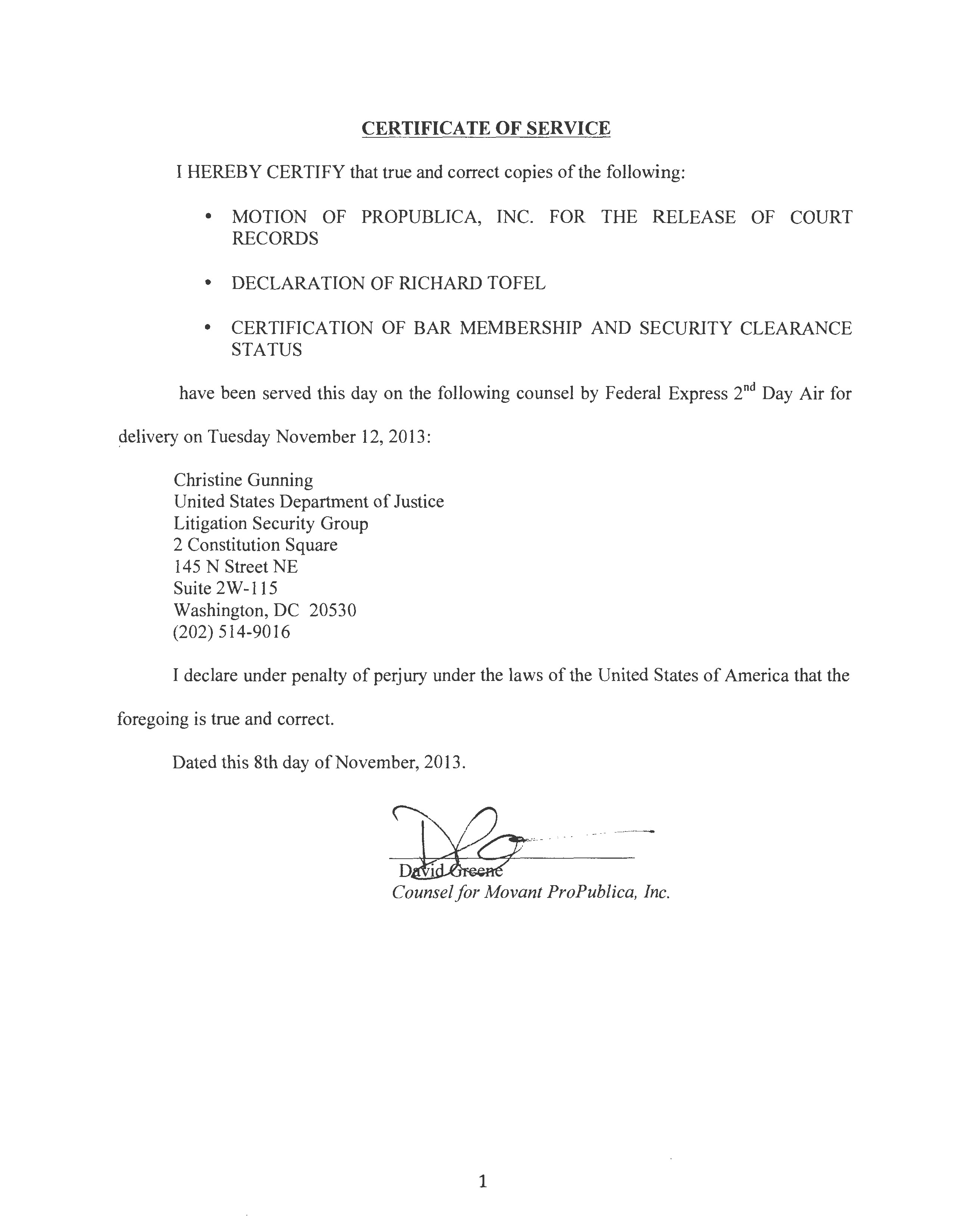
CERTIFICATE OF SERVICE
I HEREBY CERTIFY that true and correct copies of the following:
- MOTION OF PROPUBLICA, INC. FOR THE RELEASE OF COURT
RECORDS
- DECLARATION OF RICHARD TOFEL
- CERTIFICATION OF BAR MEMBERSHIP AND SECURITY CLEARANCE
STATUS
have been served this day on the following counsel by Federal Express 2nd Day Air for
delivery on Tuesday November 12, 2013:
Christine Gunning
United States Department of Justice
Litigation Security Group
2 Constitution Square
145 N Street NE
Suite 2W-115
Washington, DC 20530
(202) 514-9016
I declare under penalty of perjury under the laws of the United States of America that the
foregoing is true and correct.
Dated this 8th day of November, 2013.
David Greene
Counsel for Movant ProPublica, Inc.
1
Related Documents
-
-
-
Motion of the American Civil Liberties Union, the American Civil Liberties Union of the Nation's Capital, and the Media Freedom and Information Clinic for the Release of Court Records, In re Opinions & Orders of this Court Addressing Bulk Collection of Data Under the Foreign Intelligence Surveillance Act, No. Misc. 13-08 (FISA Ct. Nov. 7, 2013). FOIA [pdf]
-
-