Amicus Curiae Brief of Apple Inc. in Support of Providers' Motions for Declaratory Judgment, In re Motions for Declaratory Judgment to Disclose Aggregate Data Regarding FISA Orders and Directives
Open PDFDocument date: 2013-11-05
Type: FOIA
Pages: 28
Classification: -
Dissemination: -
FISC/FISCR Court Filings
My notes
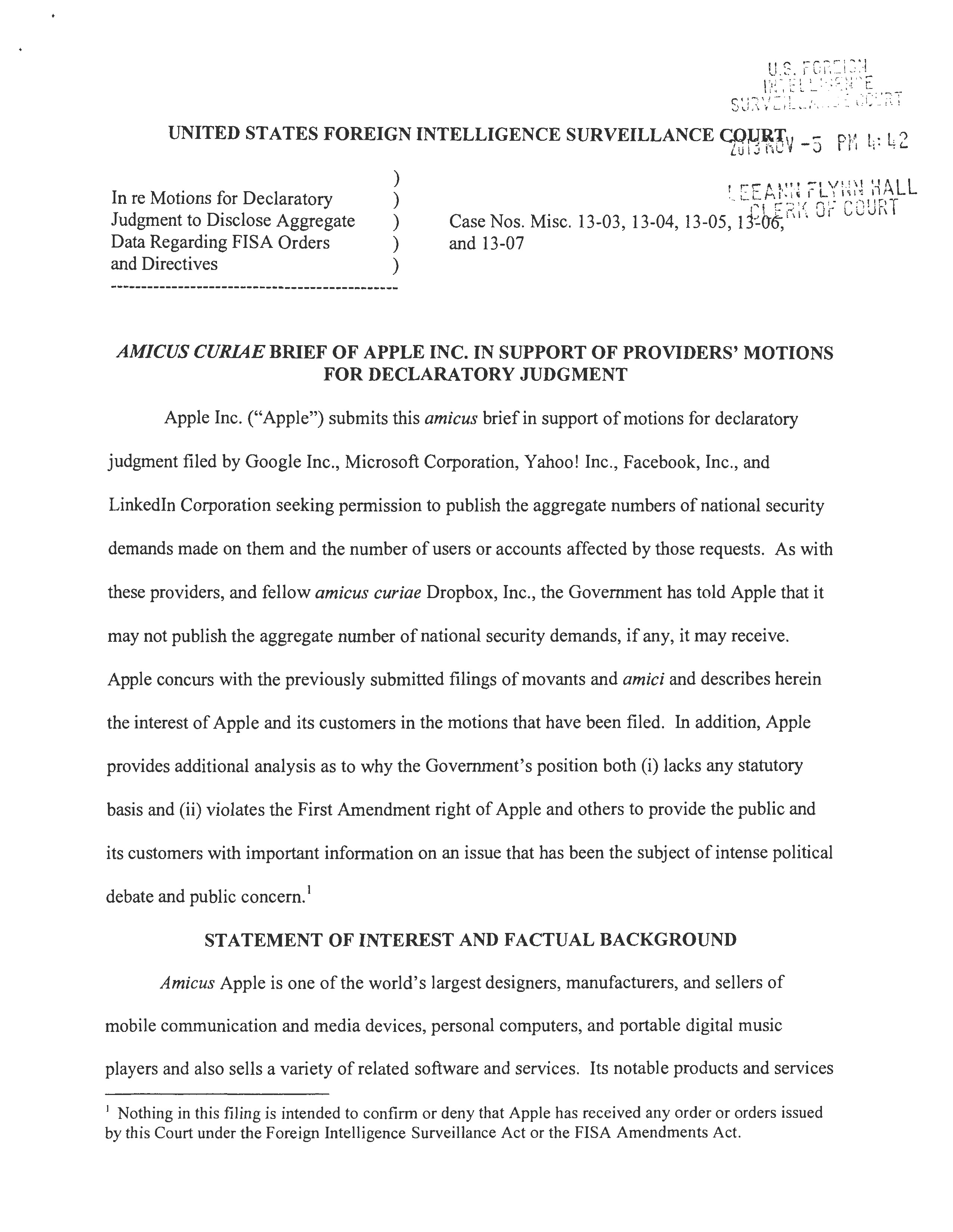


U.S. FOREIGN
INTELLIGENCE
SURVEILLANCE COURT
UNITED STATES FOREIGN INTELLIGENCE SURVEILLANCE COURT
In re Motions for Declaratory
Judgment to Disclose Aggregate
Data Regarding FISA Orders
and Directives
)
)
)
)
)
2013 NOV-5 PM 4:42
LEEANN FLYNN HALL
CLERK OF COURT
Case Nos. Misc. 13-03, 13-04, 13-05, 13-06,
and 13-07
AMICUS CURIAE BRIEF OF APPLE INC. IN SUPPORT OF PROVIDERS' MOTIONS
FOR DECLARATORY JUDGMENT
Apple Inc. ("Apple") submits this amicus brief in support of motions for declaratory
judgment filed by Google Inc., Microsoft Corporation, Yahoo! Inc., Facebook, Inc., and
LinkedIn Corporation seeking permission to publish the aggregate numbers of national security
demands made on them and the number of users or accounts affected by those requests. As with
these providers, and fellow amicus curiae Dropbox, Inc., the Government has told Apple that it
may not publish the aggregate number of national security demands, if any, it may receive.
Apple concurs with the previously submitted filings of movants and amici and describes herein
the interest of Apple and its customers in the motions that have been filed. In addition, Apple
provides additional analysis as to why the Government's position both (i) lacks any statutory
basis and (ii) violates the First Amendment right of Apple and others to provide the public and
its customers with important information on an issue that has been the subject of intense political
debate and public concern.¹
STATEMENT OF INTEREST AND FACTUAL BACKGROUND
Amicus Apple is one of the world's largest designers, manufacturers, and sellers of
mobile communication and media devices, personal computers, and portable digital music
players and also sells a variety of related software and services. Its notable products and services
¹ Nothing in this filing is intended to confirm or deny that Apple has received any order or orders issued
by this Court under the Foreign Intelligence Surveillance Act or the FISA Amendments Act.
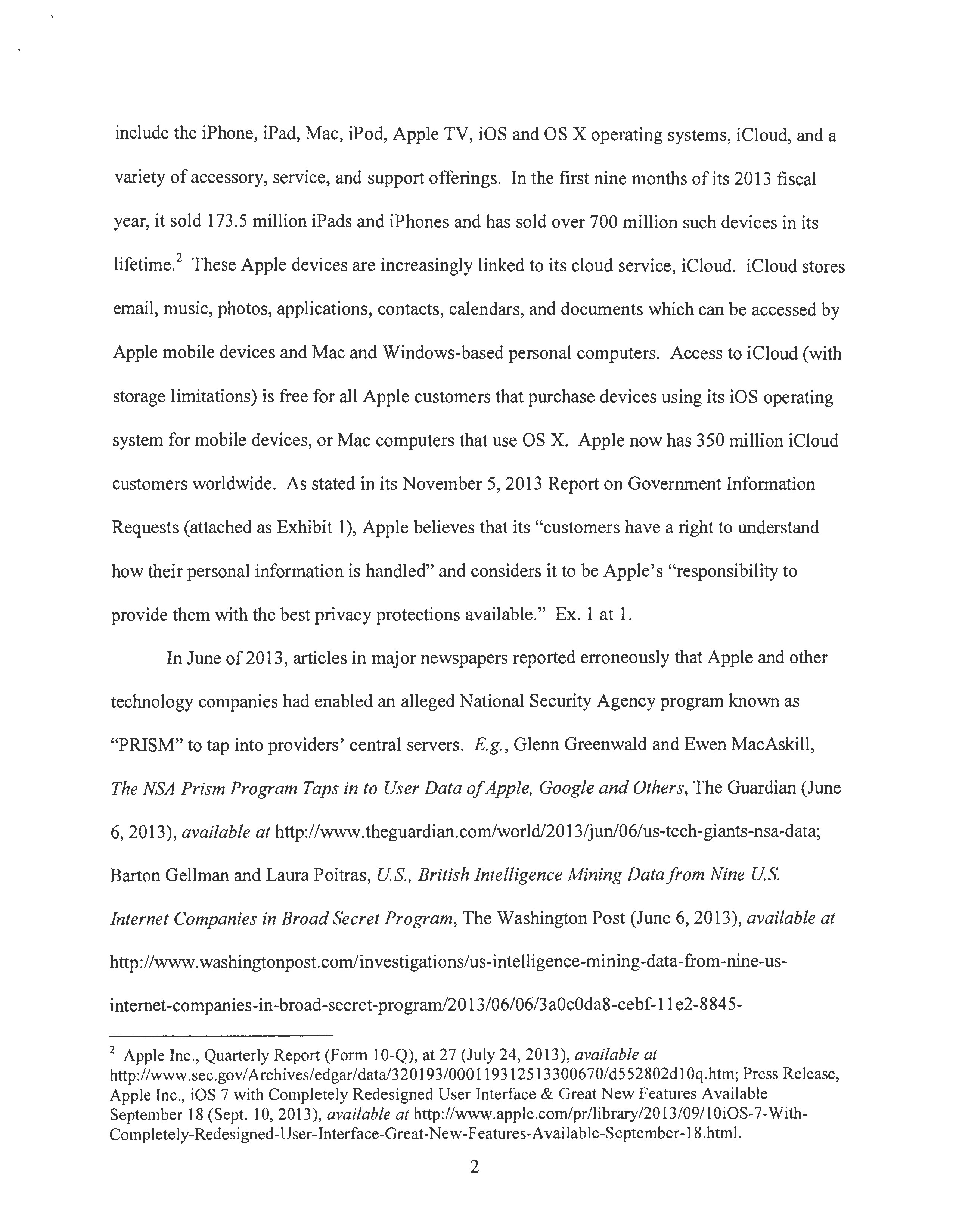
include the iPhone, iPad, Mac, iPod, Apple TV, iOS and OS X operating systems, iCloud, and a
variety of accessory, service, and support offerings. In the first nine months of its 2013 fiscal
year, it sold 173.5 million iPads and iPhones and has sold over 700 million such devices in its
lifetime.² These Apple devices are increasingly linked to its cloud service, iCloud. iCloud stores
email, music, photos, applications, contacts, calendars, and documents which can be accessed by
Apple mobile devices and Mac and Windows-based personal computers. Access to iCloud (with
storage limitations) is free for all Apple customers that purchase devices using its iOS operating
system for mobile devices, or Mac computers that use OS X. Apple now has 350 million iCloud
customers worldwide. As stated in its November 5, 2013 Report on Government Information
Requests (attached as Exhibit 1), Apple believes that its "customers have a right to understand
how their personal information is handled" and considers it to be Apple's "responsibility to
provide them with the best privacy protections available." Ex. 1 at 1.
In June of 2013, articles in major newspapers reported erroneously that Apple and other
technology companies had enabled an alleged National Security Agency program known as
"PRISM" to tap into providers' central servers. E.g., Glenn Greenwald and Ewen MacAskill,
The NSA Prism Program Taps in to User Data of Apple, Google and Others, The Guardian (June
6, 2013), available at http://www.theguardian.com/world/2013/jun/06/us-tech-giants-nsa-data;
Barton Gellman and Laura Poitras, _U.S., British Intelligence Mining Data from Nine U.S.
Internet Companies in Broad Secret Program_, The Washington Post (June 6, 2013), available at
http://www.washingtonpost.com/investigations/us-intelligence-mining-data-from-nine-us-
internet-companies-in-broad-secret-program/2013/06/06/3a0c0da8-cebf-11e2-8845-
² Apple Inc., Quarterly Report (Form 10-Q), at 27 (July 24, 2013), available at
http://www.sec.gov/Archives/edgar/data/320193/000119312513300670/d552802d10q.htm; Press Release,
Apple Inc., iOS 7 with Completely Redesigned User Interface & Great New Features Available
September 18 (Sept. 10, 2013), available at http://www.apple.com/pr/library/2013/09/10iOS-7-With-
Completely-Redesigned-User-Interface-Great-New-Features-Available-September-18.html.
2
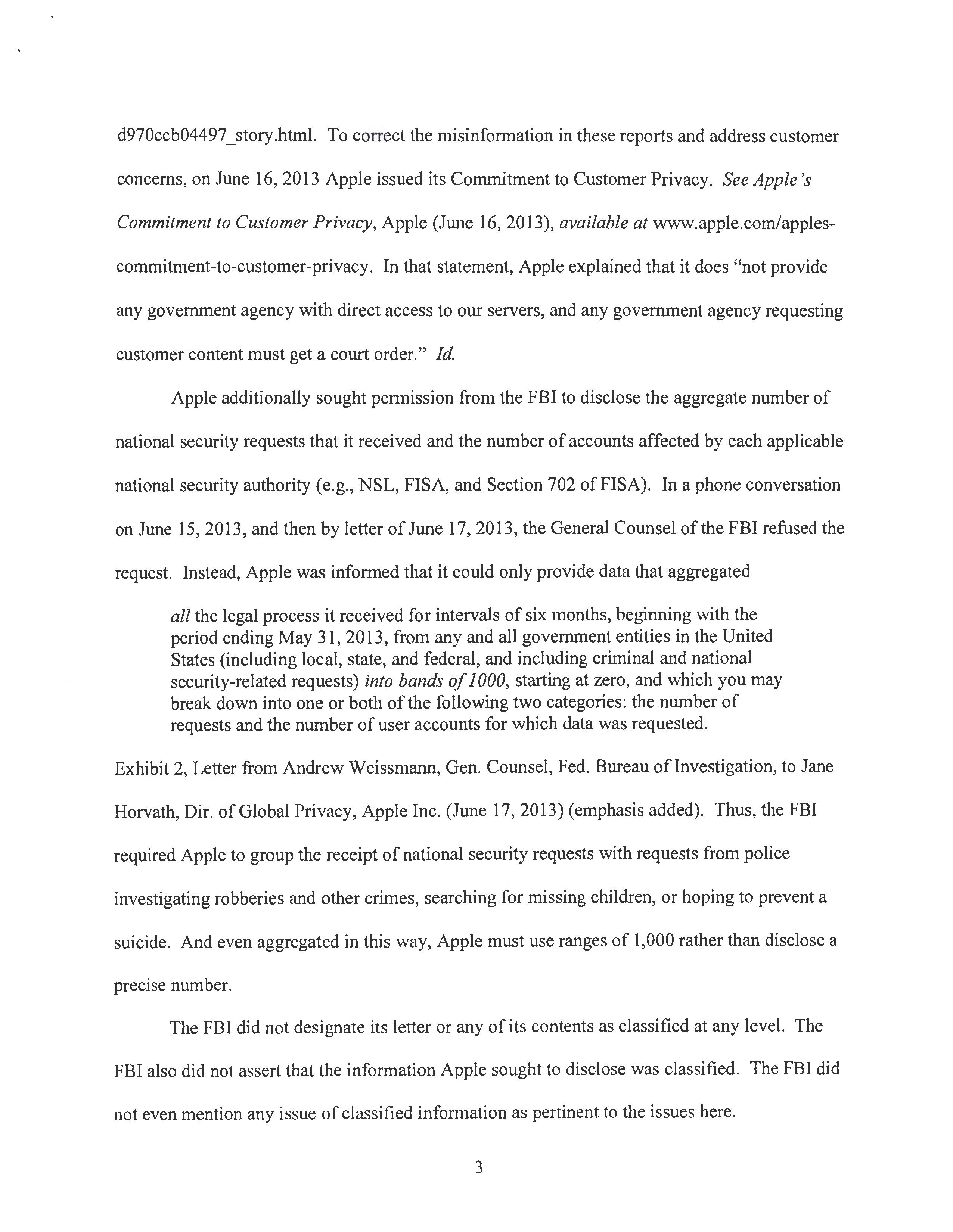
d970ccb04497_story.html. To correct the misinformation in these reports and address customer
concerns, on June 16, 2013 Apple issued its Commitment to Customer Privacy. See _Apple's
Commitment to Customer Privacy_, Apple (June 16, 2013), available at www.apple.com/apples-
commitment-to-customer-privacy. In that statement, Apple explained that it does "not provide
any government agency with direct access to our servers, and any government agency requesting
customer content must get a court order." Id.
Apple additionally sought permission from the FBI to disclose the aggregate number of
national security requests that it received and the number of accounts affected by each applicable
national security authority (e.g., NSL, FISA, and Section 702 of FISA). In a phone conversation
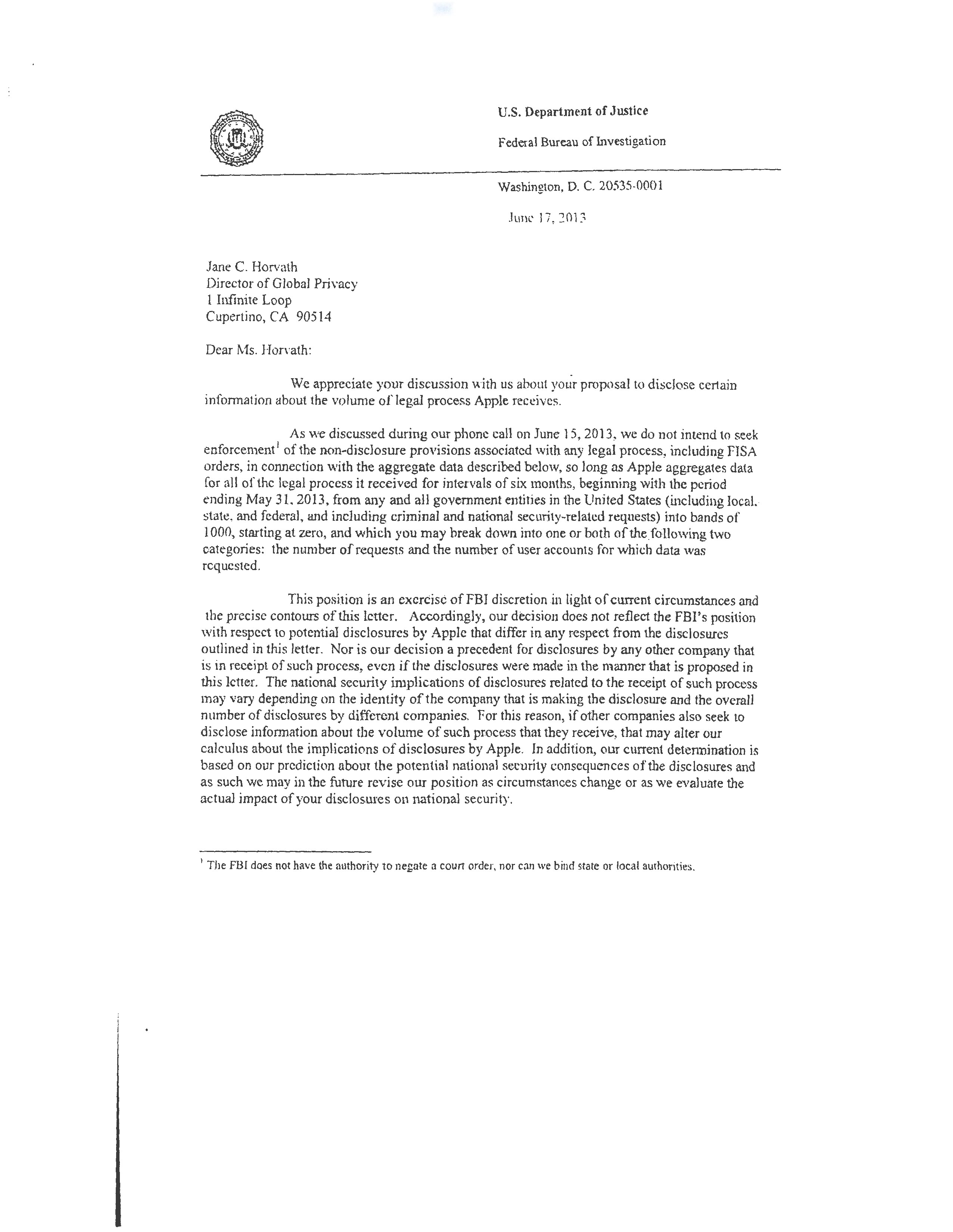
on June 15, 2013, and then by letter of June 17, 2013, the General Counsel of the FBI refused the
request. Instead, Apple was informed that it could only provide data that aggregated
all the legal process it received for intervals of six months, beginning with the
period ending May 31, 2013, from any and all government entities in the United
States (including local, state, and federal, and including criminal and national
security-related requests) into bands of 1000, starting at zero, and which you may
break down into one or both of the following two categories: the number of
requests and the number of user accounts for which data was requested.
Exhibit 2, Letter from Andrew Weissmann, Gen. Counsel, Fed. Bureau of Investigation, to Jane
Horvath, Dir. of Global Privacy, Apple Inc. (June 17, 2013) (emphasis added). Thus, the FBI
required Apple to group the receipt of national security requests with requests from police
investigating robberies and other crimes, searching for missing children, or hoping to prevent a
suicide. And even aggregated in this way, Apple must use ranges of 1,000 rather than disclose a
precise number.
The FBI did not designate its letter or any of its contents as classified at any level. The
FBI also did not assert that the information Apple sought to disclose was classified. The FBI did
not even mention any issue of classified information as pertinent to the issues here.
3
In its letter, the FBI instead discussed the FISA statute as the relevant issue. Even on that
issue, the FBI did not identify anything in the law that authorizes the Government to prohibit
disclosure of the aggregate number of national security requests received by Apple. Instead, the
Bureau's letter portrayed its decision as an exercise of its discretion not to enforce the statute
against Apple specifically. Id. at 1 ("[W]e do not intend to seek enforcement of the non-
disclosure provisions associated with any legal process, including FISA orders, in connection
with the aggregate data described below . . . [and this] position is an exercise of FBI discretion in
light of current circumstances and the precise contours of this letter."). It further reserved the
right to reach a different conclusion as to other companies and/or to restrict further Apple's
ability to disclose even this limited information upon notice to Apple.
As a result of these restrictions, in its most recent report Apple was able to disclose to the
public and its customers only that it has received 1,000-2,000 requests for user account
information affecting 2,000-3,000 user accounts from all federal, state, and local law-
enforcement agencies combined. Ex. 1 at 3. The report further states that actual data were
disclosed in 0-1,000 instances. Id. From Apple's perspective, as well as the perspective of its
customers and the public as a whole, this limited disclosure does not contribute effectively to the
debate over the Government's national security systems and (as discussed infra) is unnecessary
to protect national security. By design, it combines the aggregate data that are of the greatest and
most timely public concern, and the greatest concern to Apple and its customers, with other
unrelated aggregate data in a deliberate attempt to reduce public knowledge as to the activities of
the Government.
4
ARGUMENT
I. THE GOVERNMENT HAS NO LEGAL AUTHORITY TO PROHIBIT THE
DISCLOSURE OF THE AGGREGATE NUMBER OF NATIONAL SECURITY
REQUESTS.
Apple concurs with movants that nothing in FISA or any other law prohibits providers
from disclosing aggregate information about the number of demands they receive by individual
national security authority (e.g., NSL, FISA, and Section 702 of FISA). Under FISA, a
particular order may direct the recipient to furnish necessary assistance for the particular
surveillance "in such a manner as will protect its secrecy." 50 U.S.C. § 1805(c)(2)(B) (2013);
see also id. § 1824(c)(2)(B) (same requirement for a physical search where the target is a foreign
power or the agent of a foreign power); id. § 1881a(h)(1)(A) (same requirement for a request to
an electronic communications service provider for persons located outside the United States); id.
§ 1881b(c)(5)(B) (same requirement where the target is a United States person located outside
the United States). These provisions are designed to protect the secrecy of particular orders in
order to preserve the integrity of ongoing investigations. They are not designed to preclude
companies from reporting aggregate data. Nothing in FISA's text or legislative history suggests
that the Act prohibits a recipient of a FISA order from confirming (or denying) the basic fact that
it has (or has not) received nondescript legal process under FISA, or from disclosing the
aggregate number of requests it has received.
FISA generally requires providers to maintain any records they generate as a result of
these requests "under security procedures approved by the Attorney General and the Director of
National Intelligence." Id. § 1805(c)(2)(C); see also id. § 1881a(h)(1)(B). These provisions
have the same purpose - i.e., protecting target-specific data – and do not impose a ban on the
disclosure of aggregate numbers of requests a provider receives. 50 U.S.C. § 1807 even requires
the Attorney General to publish aggregate data across providers, and the Attorney General has
5
previously released such reports to the public.³ Id. § 1807. FISA thus supports the disclosure of
aggregate data.
The Government's response to Apple's request confirms the absence of any legal support
for its position. As discussed above, the letter from the FBI's General Counsel at no point claims
that Apple's proposed disclosures would cover classified information. Nor does the letter
identify any legal authority supporting its position. Instead, it asserts that the FBI will not
"enforce" the nondisclosure provisions against Apple as an exercise of its "discretion," if
Apple's disclosure is limited in the manner prescribed by the FBI. See Ex. 2. It is thus fair to
assume that the FBI is well aware that there is no legal authority for its position but is using its
non-enforcement discretion as a way of creating a de facto licensing system for aggregate data
disclosure that has no foundation in law.
The Government's recent filing does not point to anything in FISA that prohibits
disclosure of the relevant material. It relies only on provisions allowing it to "protect the secrecy
of the acquisition" and "records concerning the acquisition or aid furnished." Response of the
United States to Motions for Declaratory Judgment by Google Inc., Microsoft Corporation,
Yahoo Inc.!, Facebook, Inc., and LinkedIn Corporation ("Gov't Resp.") at 13 (internal citations
and quotation marks omitted) (emphasis added). Disclosure of the aggregate number of requests
received, however, would not reveal anything or provide any "records" about any particular
"acquisition" or "the acquisition or aid furnished."
³ See Letter from Peter J. Kadzik, Principal Deputy Assistant Attorney Gen., U.S. Dep't of Justice, to
Harry Reid, Majority Leader, U.S. Senate (Apr. 30, 2013), available at
http://www.justice.gov/nsd/foia/foia_library/2012fisa-ltr.pdf (noting that (1) during 2012, the
Government made 1,856 applications to the FISC for authority to conduct electronic surveillance and/or
physical searches for foreign intelligence purposes; and (2) the FISC did not deny any applications in
whole or in part).
6
The Government asserts that there would be a "wide range of damaging disclosures" from
the proposed disclosure here. Id. at 14. Notably, however, the Government fails to identify a
single one other than a vague reference to topics "from the nature of surveillance targets to their
general locations." Id. at 4. These examples are not at all clear, and the Government notably
fails to provide any elaboration to its public filing on this point as to how aggregate data could,
for example, disclose anything about surveillance targets much less their "nature" or "location."
To the extent, however, that the Government is suggesting that the proffered
interpretation would allow damaging disclosures about particular requests, that is not the case.
FISA permits the Government to prevent the disclosure of information about particular requests
even if the disclosure does not identify a target by name. It does not, however, prohibit the
release of the aggregate number of requests received and accounts affected by individual national
security authority (e.g., NSL, FISA, or Section 702 of FISA) where no details are provided about
any individual request.
The Government's filing also claims, for the first time, that all of the data the providers
seek to disclose are classified. See id. at 5-6. This argument does nothing to alter the fact that
the Government has failed to identify anything in FISA (the subject of the Court's jurisdiction)
that prohibits the disclosure of the aggregate number of FISA process received and accounts
affected by individual national security authority (e.g., NSL, FISA, or Section 702 of FISA).
Further, as described above, at no point in the FBI's initial response to the providers did the
Bureau suggest that a disclosure aggregating received national security legal process by
individual national security authority (e.g., NSL, FISA, or Section 702 of FISA) would be
classified. It is thus implausible for the Government now to claim that the aggregate number of
7
legal contacts providers may receive under each individual national security authority and
accounts affected thereby is itself classified.
Further, Apple, along with certain other providers, has sought to report only the total
number of national security legal process received and accounts affected in the aggregate by
individual national security authority (e.g., NSL, FISA, or Section 702 of FISA). That basic
information cannot be considered "properly classified" – given the wide variety of tools
available to the Government under FISA and other factors discussed in the next section, such an
aggregate disclosure of legal process under the Act would not offer would-be adversaries any
useful information regarding the Government's intelligence sources or methods.
II. THE BLANKET BAN ON DISCLOSING THE AGGREGATE NUMBER OF
NATIONAL SECURITY REQUESTS VIOLATES THE FIRST AMENDMENT
BECAUSE IT IS NOT NECESSARY TO PROTECT NATIONAL SECURITY.
The legal standard that governs this dispute is straightforward, and the Government does
not deny it. Under the First Amendment, content-based restrictions such as the restrictions at
issue here are subject to strict scrutiny and are thus "presumptively invalid." United States v.
Stevens, 559 U.S. 460, 468 (2010) (content-based restrictions are "presumptively invalid,' and
the Government bears the burden to rebut that presumption") (quoting United States v. Playboy
Ent. Grp., Inc., 529 U.S. 803, 817 (2000)). Further, because the Government has prohibited
providers from speaking about aggregate data without first obtaining the Government's
permission, the restriction is a prior restraint and presumptively invalid for that reason as well.
Am. Freedom Defense Initiative v. WMATA, 898 F. Supp. 2d 73, 79 (D.D.C. 2012) (a prior
restraint bears "a heavy presumption against its constitutional validity”) (quoting Bantam Books,
Inc. v. Sullivan, 372 U.S. 58, 70 (1963)); see Neb. Press Ass 'n v. Stuart, 427 U.S. 539, 559
(1976) ("[P]rior restraints on speech and publication are the most serious and the least tolerable
infringement on First Amendment rights."). Moreover, "speech on public issues" such as the
8
Government's surveillance program "occupies the highest rung of the hierarchy of First
Amendment values, and is entitled to special protection." See Snyder v. Phelps, 131 S. Ct. 1207,
1215 (2011) (quoting Connick v. Myers, 461 U.S. 138, 145 (1983)); Mills v. Alabama, 384 U.S.
214, 218 (1966) ("[T]here is practically universal agreement that a major purpose of [the First]
Amendment was to protect the free discussion of governmental affairs.").
To survive strict scrutiny, a restriction must, at a minimum, be "necessary to serve a
compelling state interest" and "narrowly drawn to achieve that end." Am. Freedom Defense
Initiative, 898 F. Supp. 2d at 80 (quoting Perry Educ. Ass'n v. Perry Local Educators' Ass'n,
460 U.S. 37, 45 (1983)); see also United States v. Alvarez, 132 S. Ct. 2537, 2549, 2551 (2012)
(the "First Amendment requires that the Government's chosen restriction on the speech at issue
be 'actually necessary' to achieve its interest" and that such a “restriction must be the 'least
restrictive means among available, effective alternatives'") (quoting Ashcroft v. Am. Civil
Liberties Union, 542 U.S. 656, 666 (2004)).
As various courts have recognized, this is a "demanding standard" that few restrictions
survive. See Brown v. Ent. Merchs. Ass'n, 131 S. Ct. 2729, 2738 (2011) (quoting Playboy Ent.
Grp., Inc., 529 U.S. at 818); Am. Freedom Defense Initiative, 898 F. Supp. 2d at 80-81 (there "is
no doubt that content-based restrictions can rarely pass constitutional review" and neither party
"points to a case concerning a content-based restriction where the Supreme Court concluded that
the government had a compelling interest and the restriction could be approved because it was
sufficiently narrowly tailored").
Courts vigorously enforce the narrow tailoring requirement in both the national security
and non-national security contexts. See Al Haramain Islamic Found., Inc. v. U.S. Dep't of the
Treasury, 686 F.3d 965, 997-1001 (9th Cir. 2012) (restrictions on providing aid to terrorists
9
violated the First Amendment based on the failure of the Government to establish that the
restrictions were "narrowly tailored to advance the concededly compelling government interest
of preventing terrorism"); Doe v. Mukasey, 549 F.3d 861, 878-81 (2d Cir. 2009) (restrictions on
disclosure of receipt of national security letters were not narrowly tailored to fulfill the
compelling interest of ensuring no harm to national security); In re Nat'l Sec. Letter, 930 F.
Supp. 2d 1064, 1075-77 (N.D. Cal. 2013) (restrictions on disclosure of national security letters
were not narrowly tailored); Am. Freedom Defense Initiative, 898 F. Supp. 2d at 83 (granting a
preliminary injunction against a prohibition on a pro-Israel and anti-Muslim subway
advertisement because it was unnecessary to serve the concededly compelling interest of
protecting passenger safety).⁴
The need for such vigilance is if anything even more compelling where, as here, the
decision to suppress speech rests entirely in the hands of administrative officials operating purely
based on a promise of non-enforcement with no discernible standards governing the exercise of
their discretion and no legal framework governing the de facto licensing system they have
created. See City of Lakewood v. Plain Dealer Publ'g Co., 486 U.S. 750, 757 (1988) (referring
to the "time-tested knowledge that in the area of free expression a licensing statute placing
⁴ The seriousness with which the courts take this requirement is reflected in the strict application of the
least restrictive alternative test even to content-based restrictions that impact non-political speech, which
occupies a lower "rung on the hierarchy of First Amendment values." Alvarez, 132 S. Ct. at 2551 (the
Government failed to show why additional speech or creating a database of Congressional Medal of
Honor recipients would not have been viable less restrictive alternatives to a criminal prohibition on false
claims to have received the medal); Am. Civil Liberties Union, 542 U.S. at 670 (a prohibition on posting
material harmful to minors without imposing age-verification procedures violated the First Amendment
because it was not narrowly tailored due to the Government's failure to show that alternatives such as
encouraging the use of blocking and filtering software would not be equally as effective); Playboy Ent.
Grp., Inc., 529 U.S. at 827 (striking down restrictions designed to prevent "signal bleed" from sexually
explicit stations because the Government had failed to show that individual blocking requests were not a
viable less restrictive alternative); Fabulous Assocs., Inc. v. Pa. Pub. Utils. Comm'n, 896 F.2d 780, 785-
88 (3d Cir. 1990) (restrictions on access to providers of sexually explicit telephone messaging services
struck down because of availability of other alternatives).
10
unbridled discretion in the hands of a government official or agency constitutes a prior restraint
and may result in censorship"); see also ACLU v. Reno, 929 F. Supp. 824, 857 (E.D. Pa. 1996)
("[T]he bottom line is that the First Amendment should not be interpreted to require us to entrust
the protection it affords to the judgment of prosecutors.").
As with virtually all such restrictions, the restrictions at issue here – specifically (1) the
required reporting of aggregate request data in bands of 1,000 and (2) the prohibition on
disclosure of aggregate national security requests received and accounts affected by individual
national security authority (e.g., NSL, FISA, or Section 702 of FISA) – fail to meet this
demanding standard. Beginning with the former, the Government's restriction irrationally
prohibits a provider's disclosure that the provider has received 6,500 requests while permitting
the disclosure that the provider has received 6,000-7,000 requests.⁶ There could be no basis for
asserting that the first disclosure harms national security while the second does not, and the
Government's brief tellingly makes no effort to defend its restriction. Thus, the Government has
not even purported to satisfy its constitutional obligation to determine the least restrictive
alternative or impose only those restrictions that are necessary to protect a compelling
government interest.
The ban on the providers' ability to disclose the aggregate number of national security
requests that they receive also is unnecessary to protect national security. As indicated above,
⁵ Apple addresses in this brief only the ban on disclosure of the aggregate number of national requests
received and the requirement that the aggregate number of law-enforcement requests be grouped in bands
of 1,000. It does not address the prohibition on providers' disclosure of the total number of process
received in each FISA category, although it endorses the other providers' assertion that these prohibitions
also are not narrowly tailored.
⁶ To avoid any suggestion that it has disclosed the actual number of requests it has received, Apple is
using Microsoft's reported 6,000-7,000 range to illustrate the point. See Microsoft Corporation's First
Amended Motion for Declaratory Judgment or Other Appropriate Relief Authorizing Disclosure of
Aggregate Data Regarding Any FISA Orders It Has Received at 4.
11
Apple has 350 million iCloud customers worldwide and has sold nearly 700 million iPad and
iPhone devices in the company's history. There were only 1,000-2,000 combined law-
enforcement and national security requests for user account information to Apple in the first half
of 2013. See Ex. 1 at 3. Whatever percentage of this number is accounted for by national
security requests would necessarily represent an infinitesimal fraction of Apple's overall
subscriber base. It is therefore simply not possible that disclosure of the aggregate figure could
compromise an investigation or reveal to a user that the user has been targeted under FISA or the
FISA Amendments Act. See In re Nat'l Sec. Letter, 930 F. Supp. 2d at 1076 (observing that the
interest in prohibiting disclosure diminishes as a provider's subscriber base increases).
The Government does not appear to argue that disclosing the total number of nondescript
FISA process the providers have received would reveal any target-specific data, but asserts
nonetheless that this focus is too narrow because the proposed disclosure could enable
adversaries to avoid surveillance. Gov't Resp. at 19. This assertion, however, does not
withstand scrutiny. It simply is not a secret that the user accounts of some of the largest
electronic communications service providers in the world can be and are subject to FISA
surveillance. The NSA has publicly admitted that it regularly compels information from service
providers. National Security Agency, The National Security Agency: Missions, Authorities,
Oversight and Partnerships, Lawfare, 6 (Aug. 9, 2013), available at
http://www.lawfareblog.com/wp-content/uploads/2013/10/NSA-August-9-2013-Memorandum-
on-Missions-Authorities-Oversight-and-Partnerships.pdf ("Under all FISA and FAA programs,
the government compels one or more providers to assist NSA with the collection of information
responsive to the foreign intelligence need."). And the very fact that the providers are filing
these motions shows that they receive such process because if they received no such process,
12
there would be no legal bar to saying so. See also Chenda Ngak, Apple, Microsoft, Facebook
Release New Details on National Security Requests, CBSNews (June 17, 2013), available at
http://www.cbsnews.com/8301-205_162-57589619/apple-microsoft-facebook-release-new-
details-on-national-security-requests/ ("Facebook and Microsoft say they were granted
permission from the U.S. government to disclose more information about FISA requests and
national security letters, but only if aggregated with criminal requests from local, state and
federal law enforcement.").
Moreover, by the logic of the Government, the "safest" platforms would be those who
receive no FISA requests, but there is no bar to those platforms saying that they have received no
FISA requests. Thus, if the Government's predictions were sound, our adversaries would
already know "which platforms the Government does not surveil." Gov't Resp. at 11. For
example, Apple's November 5 Report on Government Information Requests discloses that
"Apple has never received an order under Section 215 of the USA Patriot Act." Ex. 1 at 5.
There also is no basis for believing that release of the aggregate number of requests
received by major providers would reveal anything about the ability to conduct surveillance of
those who use these platforms that is not already known. The type of data that these services
have and do not have on their servers (whether email, Facebook account information, or
something else) is not classified information. It is rather a core element of the services that they
provide. For example, Apple's November 5 report explains that it protects "personal
conversations by providing end-to-end encryption over iMessage and FaceTime." Ex. 1 at 1.
The Report further explains that Apple does not "store location data, Maps searches, or Siri
requests in any identifiable form." Id. At the same time, Apple users know that they use
Apple's services to store content online, including emails, music, and photographs through such
13
services as iTunes and iCloud, and that such content may accordingly be the subject of FISA
requests as well as requests from state and local law-enforcement agencies.
Further, the basic methods of intelligence gathering that would be the subject of the
disclosures also are not classified. Instead, they appear in the pages of the still unclassified
United States Code. Given this publicly available information, an adversary who uses Yahoo!
(particularly one sophisticated enough to monitor provider disclosures) could not be using
Yahoo! because he believes it is immune from surveillance or because he believes Yahoo! is
safer than other platforms. Instead, he is using that service because it provides the functionality
he needs and because he believes that he has not been targeted for surveillance. The disclosures
sought, if allowed, would not disabuse him of either notion.
The foregoing is why it is fundamentally misleading (and perpetuating of the very
misconceptions that the providers have filed these motions to correct) for the Government to
assert throughout its brief that the Government is subjecting "providers" to surveillance when it,
for example, issues a FISA request related to an individual user account. A search of a particular
user's Facebook account is no more surveillance of Facebook than a search warrant executed on
a single house is surveillance of the United States. The Government also has imposed the same
restrictions on all providers. This one-size-fits-all approach further demonstrates the absence of
any basis for the suggestion that the prohibitions are designed to prevent the release of
information that would demonstrate that the users of one provider are exceedingly vulnerable to,
or uniquely immune from, the reach of the Government.
With respect to particular FISA categories, the Government itself has agreed to report the
aggregate numbers of both FISA orders, and the targets those orders affect, on an annual basis.
Office of the Director of National Intelligence, DNI Clapper Directs Annual Release of
14
Information Related to Orders Issued Under National Security Authorities, IC on the Record
(Aug. 29, 2013), available at icontherecord.tumblr.com. Those reports will quantify the number
of times the Government has invoked each surveillance "method" authorized by FISA, including
the number of FISA orders issued on the basis of probable cause under Sections 703 and 704,
Section 702 orders, FISA Pen Register and Trap and Trace Orders under Title IV, business
records requests pursuant to Title V, and more. Id. These disclosures further demonstrate that
disclosure of the relative number of aggregate requests in each category does not harm national
security, particularly when, as is the case with the providers that have filed motions as well as
Apple, any given request could be targeting any one of hundreds of millions of potential targets.
The Government has also placed on providers the burden of moving for judicial review to
lift the speech restrictions rather than imposing a burden on itself to seek judicial review to
impose such a requirement. See Doe, 549 F.3d at 881 (holding that "in the absence of
Government-initiated judicial review," a statutory restriction on disclosure of the receipt of a
national security letter "is not narrowly tailored to conform to First Amendment procedural
standards").
As a final note, Apple notes the Government's unintentionally revealing statement on
page 1 of its brief that "the Government has taken a number of significant steps – above and
beyond what the law requires – in order to promote transparency." It should go without saying
that the First Amendment is law. Thus, any disclosures the Government has authorized as
unnecessary to protect national security are, by definition, not "above and beyond what the law
requires." They are what the law requires. The Government's suggestion that permitting speech
is a function of grace and dispensation, rather than a constitutional requirement, further
15
demonstrates that it has not narrowly tailored the restrictions it has placed on the disclosure of
aggregate data by providers.
CONCLUSION
For the foregoing reasons, the providers' motions should be granted, and the Court
should declare that the providers have a right to disclose accurate information about the number
of national security requests received and the number of user accounts affected.
Pursuant to FISC Rule of Procedure 7(h)(1), Attorneys for Amicus Apple Inc. certify that
the undersigned attorneys are members in good standing of the Bar of the District of Columbia.
Attorneys further certify that they do not currently hold a security clearance.
Dated: November 5, 2013
Respectfully submitted,
William Isaacson, D.C. Bar No. 414788
Samuel C. Kaplan, D.C. Bar No. 463350
Michael J. Gottlieb, D.C. Bar No. 974960
BOIES, SCHILLER & FLEXNER, LLP
5301 Wisconsin Ave. NW
Washington, DC 20015
(t) (202) 237-2727
(f) (202) 237-6131
wisaacson@bsfllp.com
Attorneys for Amicus Curiae Apple Inc.
16
CERTIFICATE OF SERVICE
I hereby certify this 5th day of November, 2013, that I caused the foregoing document to
be served by hand delivery on the following:
Christine Gunning
Litigation Security Group
United States Department of Justice
2 Constitution Square
145 N St., NE, Suite 2W-115
Washington, DC 20530
In addition, I caused the foregoing document to be served by electronic mail on:
Albert Gidari
Perkins Coie LLP
1201 Third Avenue, Suite 4900
Seattle, WA 98101
agidari@perkinscoie.com
Counsel for Google Inc.
Carl Nichols
Wilmer Cutler Pickering Hale and Dorr LLP
1875 Pennsylvania Avenue, NW
Washington, DC 20006
Carl.nichols@wilmerhale.com
Counsel for Facebook, Inc.
Jerome C. Roth
Munger, Tolles & Olson LLP
560 Mission Street, 27th Floor
San Francisco, CA 94105
Jermone.Roth@mto.com
Counsel for LinkedIn Corporation
James Garland
Covington & Burling LLP
1201 Pennsylvania Avenue, NW
Washington, DC 20004
jgarland@cov.com
Counsel for Microsoft Corporation
Marc Zwillinger
ZwillGen PLLC
1705 N St. NW
Washington, DC 20036
marc@zwillgen.com
Counsel for Yahoo! Inc.
Samuel C. Kaplan
Exhibit 1
U.S. FOREIGN
INTELLIGENCE
SURVEILLANCE COURT
2013 NOV-5 PM 4:42
LEEANN FLYNN HALL
CLERK OF COURT
Report on Government
Information Requests
November 5, 2013
Protecting Personal Data
We believe that our customers have a right to understand how their personal
information is handled, and we consider it our responsibility to provide them
with the best privacy protections available. Apple has prepared this report on
the requests we receive from governments seeking information about individual
users or devices in the interest of transparency for our customers around
the world.
This report provides statistics on requests related to customer accounts as well
as those related to specific devices. We have reported all the information we
are legally allowed to share, and Apple will continue to advocate for greater
transparency about the requests we receive.
Apple offers customers a single, straightforward privacy policy that covers every
Apple product. Customer privacy is a consideration from the earliest stages of
design for all our products and services. We work hard to deliver the most secure
hardware and software in the world, including such innovative security solutions
as Find My iPhone and Touch ID, which have made the iPhone both more secure
and more convenient.
Perhaps most important, our business does not depend on collecting personal
data. We have no interest in amassing personal information about our customers.
We protect personal conversations by providing end-to-end encryption over
iMessage and FaceTime. We do not store location data, Maps searches, or Siri
requests in any identifiable form.
Advocating for
Greater Transparency
At the time of this report, the U.S. government does not allow Apple to
disclose, except in broad ranges, the number of national security orders, the
number of accounts affected by the orders, or whether content, such as emails,
was disclosed. We strongly oppose this gag order, and Apple has made the case
for relief from these restrictions in meetings and discussions with the White
House, the U.S. Attorney General, congressional leaders, and the courts. Despite
our extensive efforts in this area, we do not yet have an agreement that we feel
adequately addresses our customers' right to know how often and under what
circumstances we provide data to law enforcement agencies.
We believe that dialogue and advocacy are the most productive way to bring
about a change in these policies, rather than filing a lawsuit against the U.S.
government. Concurrent with the release of this report, we have filed an Amicus
brief at the Foreign Intelligence Surveillance Court (FISA Court) in support of
a group of cases requesting greater transparency. Later this year, we will file a
second Amicus brief at the Ninth Circuit in support of a case seeking greater
transparency with respect to National Security Letters. We feel strongly that the
government should lift the gag order and permit companies to disclose complete
and accurate numbers regarding FISA requests and National Security Letters. We
will continue to aggressively pursue our ability to be more transparent.
Requests from
Law Enforcement
Like many companies, Apple receives requests from law enforcement agencies
to provide customer information. As we have explained, any government agency
demanding customer content from Apple must get a court order. When we receive
such a demand, our legal team carefully reviews the order. If there is any question
about the legitimacy or scope of the court order, we challenge it. Only when we are
satisfied that the court order is valid and appropriate do we deliver the narrowest
possible set of information responsive to the request.
Unlike many other companies dealing with requests for customer data from
government agencies, Apple's main business is not about collecting information.
As a result, the vast majority of the requests we receive from law enforcement seek
information about lost or stolen devices, and are logged as device requests. These
types of requests frequently arise when our customers ask the police to assist them
with a lost or stolen iPhone, or when law enforcement has recovered a shipment of
stolen devices.
Only a small fraction of the requests that Apple receives seek personal information
related to an iTunes, iCloud, or Game Center account. Account-based requests
generally involve account holders' personal data and their use of an online service in
which they have an expectation of privacy, such as government requests for customer
identifying information, email, stored photographs, or other user content stored
online. Apple logs these as account requests.
We believe it is important to differentiate these categories and report them
individually. Device requests and account requests involve very different types of
data. Many of the device requests we receive are initiated by our own customers
working together with law enforcement. Device requests never include national
security-related requests.
Reporting the Number of
Requests for Information
About Customer Accounts
The following tables detail the account requests and device requests Apple received
from law enforcement agencies between January 1, 2013, and June 30, 2013.
Table 1 shows account requests. The U.S. government has given us permission to
share only a limited amount of information about these orders, with the requirement
that we combine national security orders with account-based law enforcement
requests and report only a consolidated range in increments of 1000.
The most common account requests involve robberies and other crimes or requests
from law enforcement officers searching for missing persons or children, finding a
kidnapping victim, or hoping to prevent a suicide. Responding to an account request
usually involves providing information about an account holder's iTunes or iCloud
account, such as a name and an address. In very rare cases, we are asked to provide
stored photos or email. We consider these requests very carefully and only provide
account content in extremely limited circumstances.
Table 2 shows device requests. Even though device requests have not been the focus
of public debate, we are disclosing them to make our report as comprehensive as
possible. These may include requests for the customer contact information provided
to register a device with Apple or the date the device first used Apple services. We
count devices based on the individual serial numbers related to an investigation.
For further information about data in these tables, please see the glossary below.
¹National Security Letters (NSLs), which are often the first step in an investigation, do not carry a court order but by law
they may not be used to obtain customer content. NSL orders are limited to transactional data such as a customer's contact
information. Apple is required by law to comply with these requests if we have the information being sought. Apple assesses
the legitimacy of each NSL as if it were a regular court order.
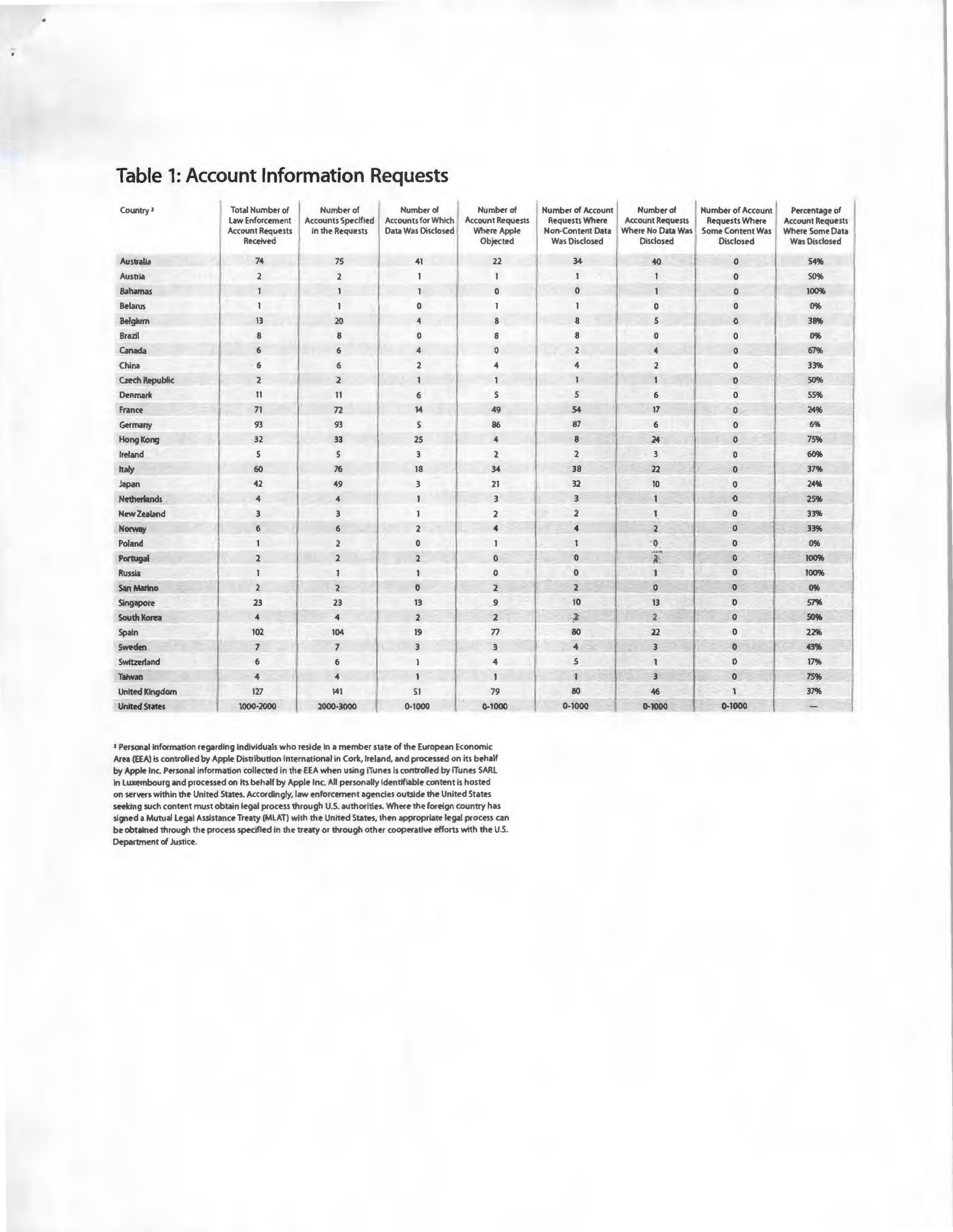
Table 1: Account Information Requests
| Country ² | Total Number of Law Enforcement Account Requests Received | Number of Accounts Specified in the Requests | Number of Accounts for Which Data Was Disclosed | Number of Account Requests Where Apple Objected | Number of Account Requests Where Non-Content Data Was Disclosed | Number of Account Requests Where No Data Was Disclosed | Number of Account Requests Where Some Content Was Disclosed | Percentage of Account Requests Where Some Data Was Disclosed |
|---|---|---|---|---|---|---|---|---|
| Australia | 74 | 75 | 41 | 22 | 34 | 40 | 0 | 54% |
| Austria | 2 | 2 | 1 | 1 | 1 | 1 | 0 | 50% |
| Bahamas | 1 | 1 | 1 | 0 | 0 | 1 | 0 | 100% |
| Belarus | 1 | 1 | 0 | 1 | 1 | 0 | 0 | 0% |
| Belgium | 13 | 20 | 4 | 8 | 8 | 5 | 0 | 38% |
| Brazil | 8 | 8 | 0 | 8 | 8 | 0 | 0 | 0% |
| Canada | 6 | 6 | 4 | 0 | 2 | 4 | 0 | 67% |
| China | 6 | 6 | 2 | 4 | 4 | 2 | 0 | 33% |
| Czech Republic | 2 | 2 | 1 | 1 | 1 | 1 | 0 | 50% |
| Denmark | 11 | 11 | 6 | 5 | 5 | 6 | 0 | 55% |
| France | 71 | 72 | 14 | 49 | 54 | 17 | 0 | 24% |
| Germany | 93 | 93 | 5 | 86 | 87 | 6 | 0 | 6% |
| Hong Kong | 32 | 33 | 25 | 4 | 8 | 24 | 0 | 75% |
| Ireland | 5 | 5 | 3 | 2 | 2 | 3 | 0 | 60% |
| Italy | 60 | 76 | 18 | 34 | 38 | 22 | 0 | 37% |
| Japan | 42 | 42 | 3 | 21 | 32 | 10 | 0 | 24% |
| Netherlands | 4 | 4 | 1 | 3 | 3 | 1 | 0 | 25% |
| New Zealand | 3 | 3 | 1 | 2 | 2 | 1 | 0 | 33% |
| Norway | 6 | 6 | 2 | 4 | 4 | 2 | 0 | 33% |
| Poland | 1 | 2 | 0 | 1 | 1 | 0 | 0 | 0% |
| Portugal | 2 | 2 | 2 | 0 | 0 | 0 | 100% | |
| Russia | 1 | 1 | 1 | 0 | 0 | 1 | 0 | 100% |
| San Marino | 2 | 2 | 0 | 2 | 2 | 0 | 0 | 0% |
| Singapore | 23 | 23 | 13 | 9 | 10 | 13 | 0 | 57% |
| South Korea | 4 | 4 | 2 | 2 | 2 | 2 | 0 | 50% |
| Spain | 102 | 104 | 19 | 77 | 80 | 22 | 0 | 22% |
| Sweden | 7 | 7 | 3 | 3 | 4 | 3 | 0 | 43% |
| Switzerland | 6 | 6 | 1 | 4 | 5 | 1 | 0 | 17% |
| Taiwan | 4 | 4 | 1 | 1 | 1 | 3 | 0 | 75% |
| United Kingdom | 127 | 141 | 51 | 79 | 80 | 46 | 1 | 37% |
| United States | 1000-2000 | 2000-3000 | 0-1000 | 0-1000 | 0-1000 | 0-1000 | 0-1000 |
² Personal information regarding individuals who reside in a member state of the European Economic
Area (EEA) is controlled by Apple Distribution International in Cork, Ireland, and processed on its behalf
by Apple Inc. Personal information collected in the EEA when using iTunes is controlled by iTunes SARL
in Luxembourg and processed on its behalf by Apple Inc. All personally identifiable content is hosted
on servers within the United States. Accordingly, law enforcement agencies outside the United States
seeking such content must obtain legal process through U.S. authorities. Where the foreign country has
signed a Mutual Legal Assistance Treaty (MLAT) with the United States, then appropriate legal process can
be obtained through the process specified in the treaty or through other cooperative efforts with the U.S.
Department of Justice.
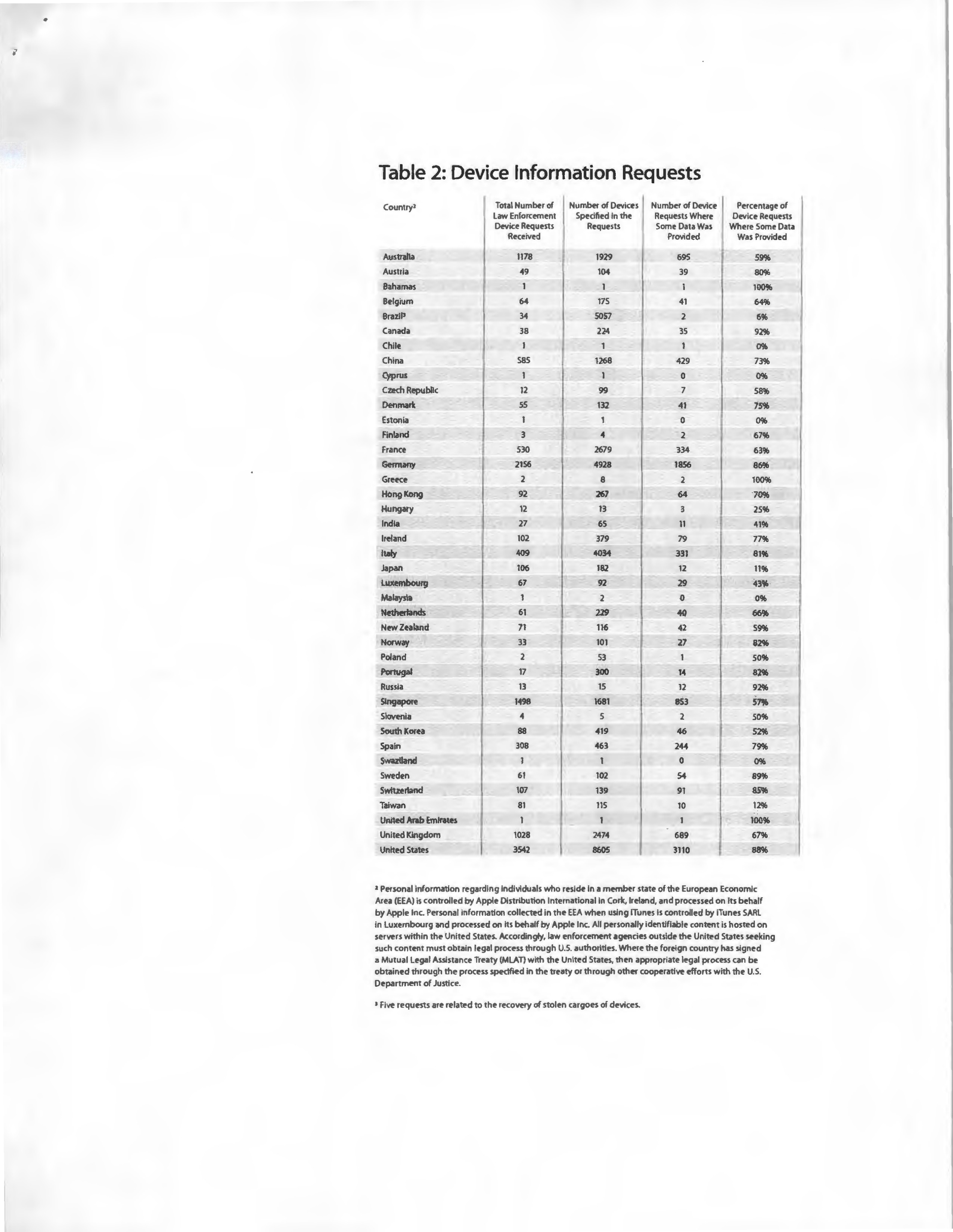
Table 2: Device Information Requests
| Country ² | Total Number of Law Enforcement Device Requests Received | Number of Devices Specified in the Requests | Number of Device Requests Where Some Data Was Provided | Percentage of Device Requests Where Some Data Was Provided |
|---|---|---|---|---|
| Australia | 1178 | 1929 | 695 | 59% |
| Austria | 49 | 104 | 39 | 80% |
| Bahamas | 1 | 1 | 1 | 100% |
| Belgium | 64 | 175 | 41 | 64% |
| Brazil³ | 34 | 5057 | 2 | 5% |
| Canada | 38 | 224 | 35 | 92% |
| Chile | 1 | 1 | 1 | 0% |
| China | 585 | 1268 | 429 | 73% |
| Cyprus | 1 | 1 | 0 | 0% |
| Czech Republic | 12 | 99 | 7 | 58% |
| Denmark | 55 | 132 | 41 | 75% |
| Estonia | 1 | 1 | 0 | 0% |
| Finland | 3 | 4 | 2 | 67% |
| France | 530 | 2679 | 334 | 63% |
| Germany | 2156 | 4928 | 1856 | 86% |
| Greece | 2 | 8 | 2 | 100% |
| Hong Kong | 92 | 267 | 64 | 70% |
| Hungary | 12 | 13 | 3 | 25% |
| India | 27 | 65 | 11 | 41% |
| Ireland | 102 | 379 | 79 | 77% |
| Italy | 409 | 4034 | 331 | 81% |
| Japan | 106 | 182 | 12 | 11% |
| Luxembourg | 67 | 92 | 29 | 43% |
| Malaysia | 1 | 2 | 0 | 0% |
| Netherlands | 61 | 229 | 40 | 66% |
| New Zealand | 71 | 116 | 42 | 59% |
| Norway | 33 | 101 | 27 | 82% |
| Poland | 2 | 53 | 1 | 50% |
| Portugal | 17 | 300 | 14 | 82% |
| Russia | 13 | 15 | 12 | 92% |
| Singapore | 1498 | 1681 | 853 | 57% |
| Slovenia | 4 | 5 | 2 | 50% |
| South Korea | 88 | 419 | 46 | 52% |
| Spain | 308 | 463 | 244 | 79% |
| Swaziland | 3 | 1 | 0 | 0% |
| Sweden | 61 | 102 | 54 | 89% |
| Switzerland | 107 | 139 | 91 | 85% |
| Taiwan | 81 | 115 | 10 | 12% |
| United Arab Emirates | 1 | 1 | 1 | 100% |
| United Kingdom | 1028 | 2474 | 689 | 67% |
| United States | 3542 | 8605 | 3110 | 88% |
² Personal information regarding individuals who reside in a member state of the European Economic
Area (EEA) is controlled by Apple Distribution International in Cork, Ireland, and processed on its behalf
by Apple Inc. Personal information collected in the EEA when using iTunes is controlled by iTunes SARL
in Luxembourg and processed on its behalf by Apple Inc. All personally identifiable content is hosted on
servers within the United States. Accordingly, law enforcement agencies outside the United States seeking
such content must obtain legal process through U.S. authorities. Where the foreign country has signed
a Mutual Legal Assistance Treaty (MLAT) with the United States, then appropriate legal process can be
obtained through the process specified in the treaty or through other cooperative efforts with the U.S.
Department of Justice.
³ Five requests are related to the recovery of stolen cargoes of devices.
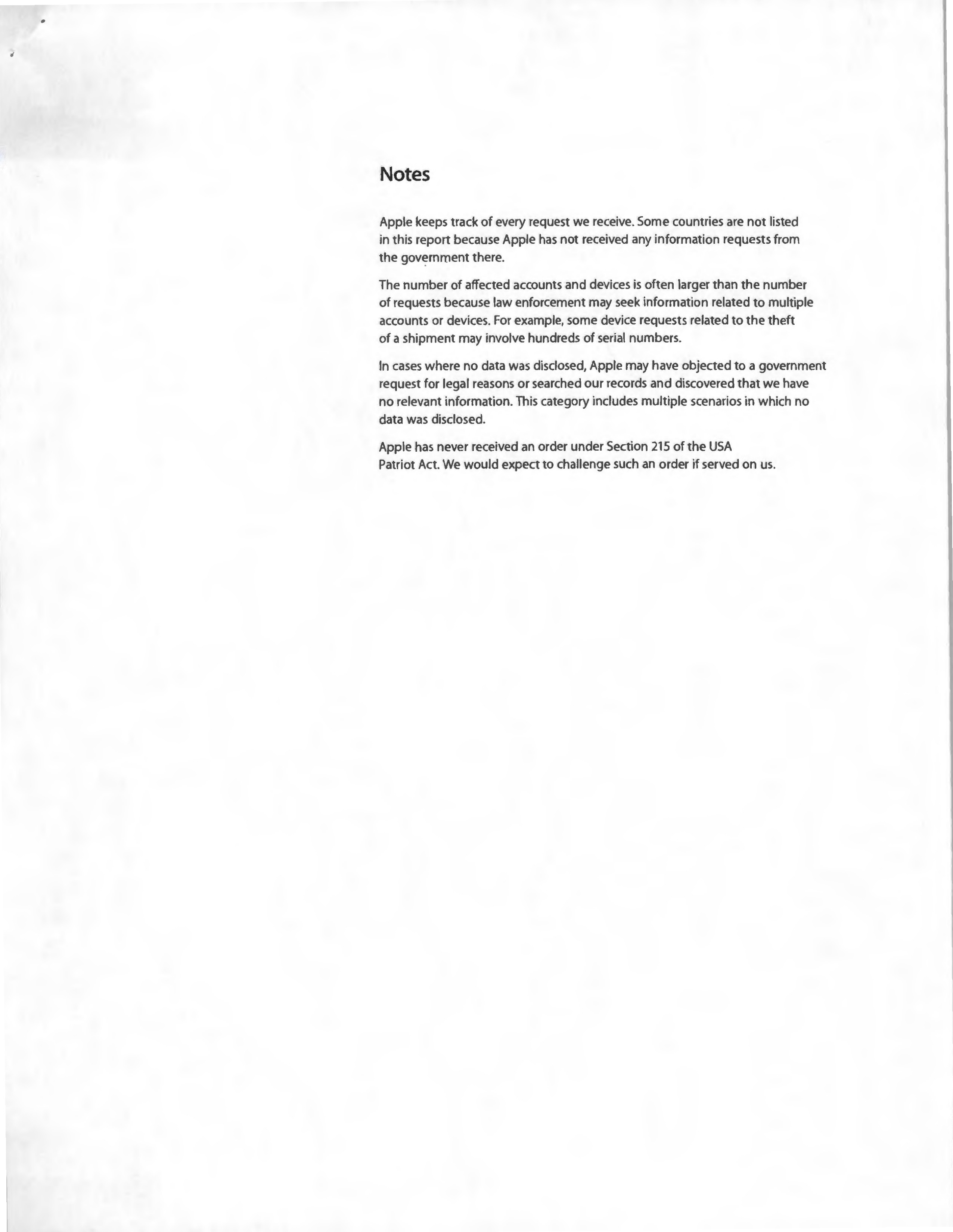
Notes
Apple keeps track of every request we receive. Some countries are not listed
in this report because Apple has not received any information requests from
the government there.
The number of affected accounts and devices is often larger than the number
of requests because law enforcement may seek information related to multiple
accounts or devices. For example, some device requests related to the theft
of a shipment may involve hundreds of serial numbers.
In cases where no data was disclosed, Apple may have objected to a government
request for legal reasons or searched our records and discovered that we have
no relevant information. This category includes multiple scenarios in which no
data was disclosed.
Apple has never received an order under Section 215 of the USA
Patriot Act. We would expect to challenge such an order if served on us.
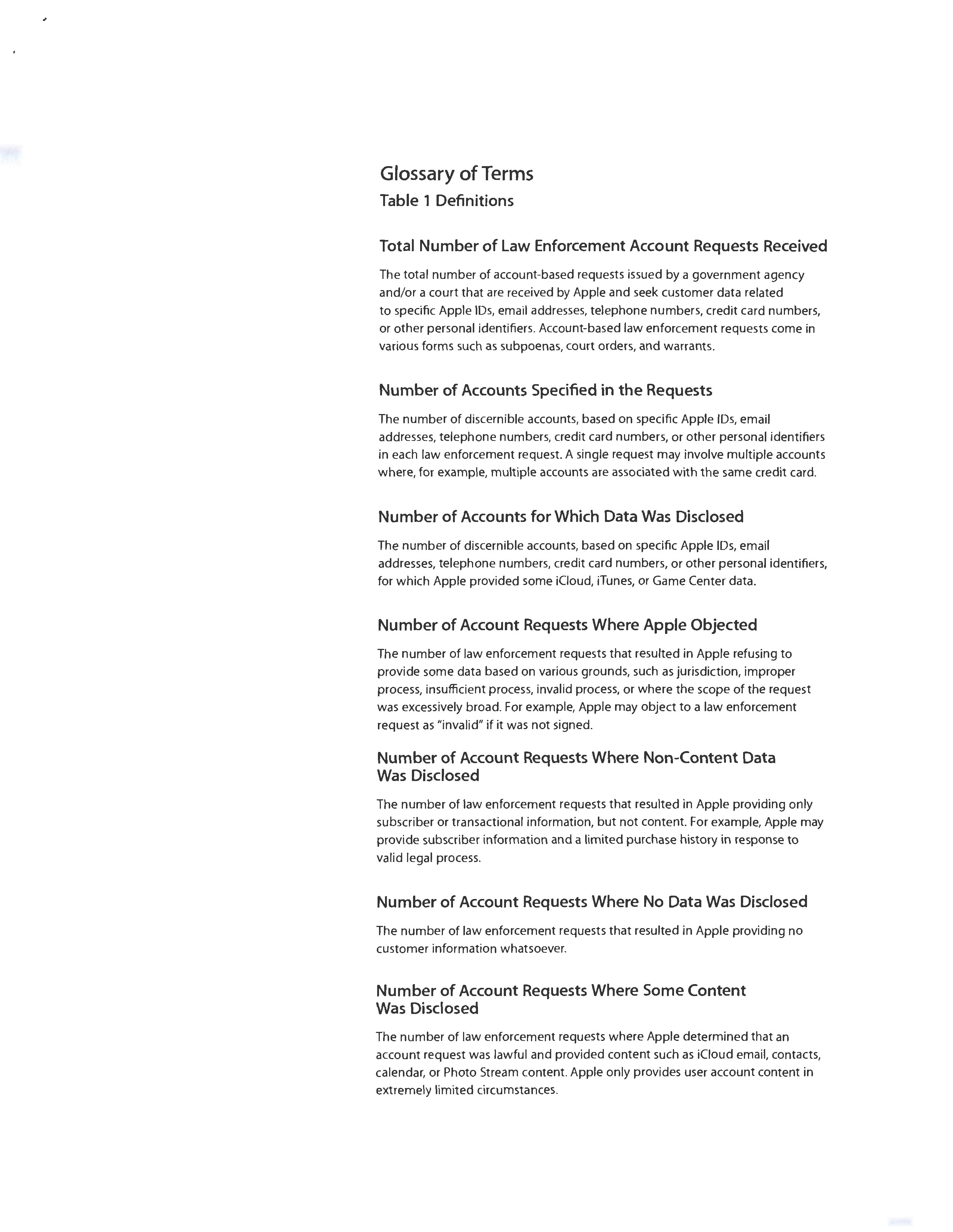
Glossary of Terms
Table 1 Definitions
Total Number of Law Enforcement Account Requests Received
The total number of account-based requests issued by a government agency
and/or a court that are received by Apple and seek customer data related
to specific Apple IDs, email addresses, telephone numbers, credit card numbers,
or other personal identifiers. Account-based law enforcement requests come in
various forms such as subpoenas, court orders, and warrants.
Number of Accounts Specified in the Requests
The number of discernible accounts, based on specific Apple IDs, email
addresses, telephone numbers, credit card numbers, or other personal identifiers
in each law enforcement request. A single request may involve multiple accounts
where, for example, multiple accounts are associated with the same credit card.
Number of Accounts for Which Data Was Disclosed
The number of discernible accounts, based on specific Apple IDs, email
addresses, telephone numbers, credit card numbers, or other personal identifiers,
for which Apple provided some iCloud, iTunes, or Game Center data.
Number of Account Requests Where Apple Objected
The number of law enforcement requests that resulted in Apple refusing to
provide some data based on various grounds, such as jurisdiction, improper
process, insufficient process, invalid process, or where the scope of the request
was excessively broad. For example, Apple may object to a law enforcement
request as "invalid" if it was not signed.
Number of Account Requests Where Non-Content Data
Was Disclosed
The number of law enforcement requests that resulted in Apple providing only
subscriber or transactional information, but not content. For example, Apple may
provide subscriber information and a limited purchase history in response to
valid legal process.
Number of Account Requests Where No Data Was Disclosed
The number of law enforcement requests that resulted in Apple providing no
customer information whatsoever.
Number of Account Requests Where Some Content
Was Disclosed
The number of law enforcement requests where Apple determined that an
account request was lawful and provided content such as iCloud email, contacts,
calendar, or Photo Stream content. Apple only provides user account content in
extremely limited circumstances.
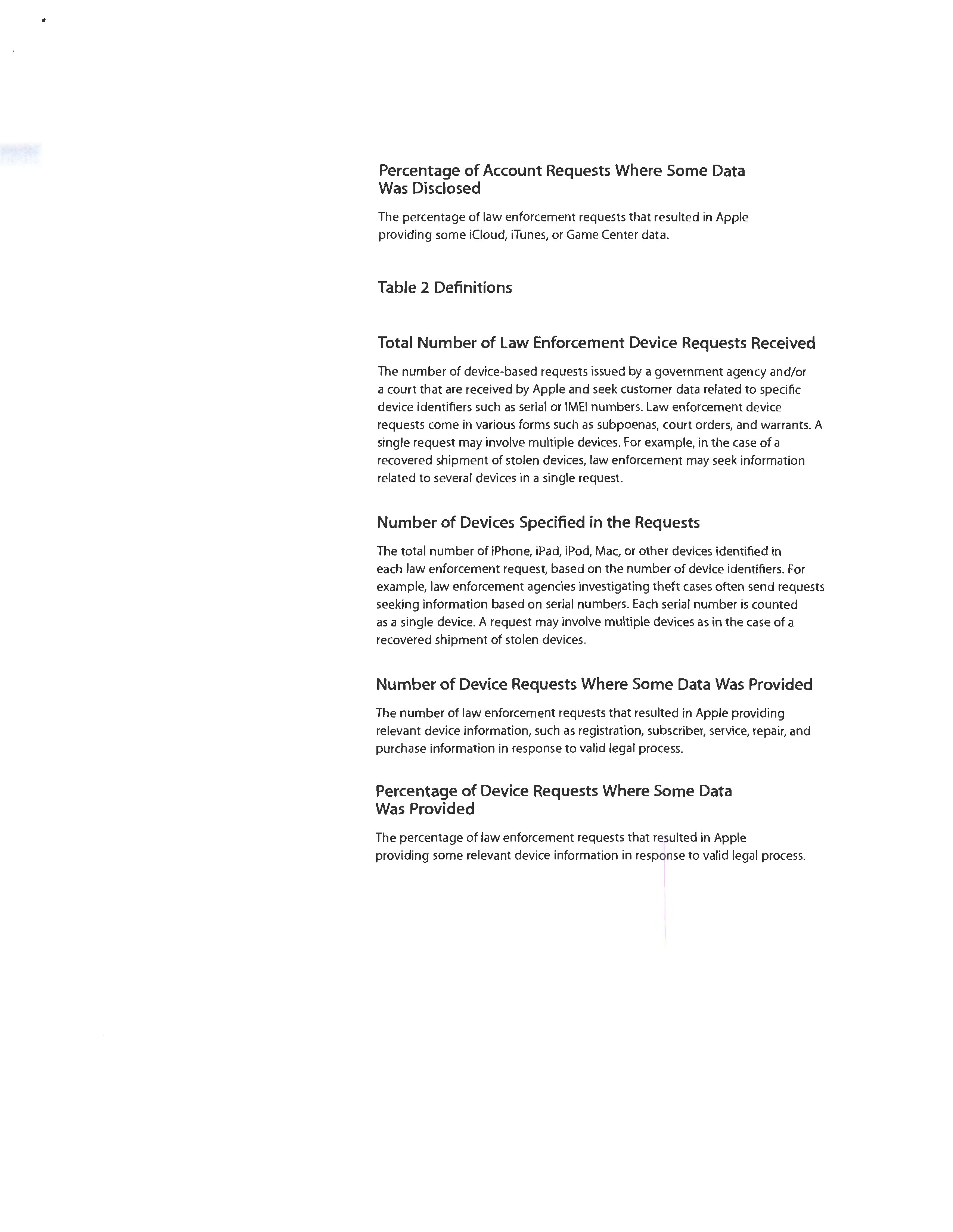
Percentage of Account Requests Where Some Data
Was Disclosed
The percentage of law enforcement requests that resulted in Apple
providing some iCloud, iTunes, or Game Center data.
Table 2 Definitions
Total Number of Law Enforcement Device Requests Received
The number of device-based requests issued by a government agency and/or
a court that are received by Apple and seek customer data related to specific
device identifiers such as serial or IMEI numbers. Law enforcement device
requests come in various forms such as subpoenas, court orders, and warrants. A
single request may involve multiple devices. For example, in the case of a
recovered shipment of stolen devices, law enforcement may seek information
related to several devices in a single request.
Number of Devices Specified in the Requests
The total number of iPhone, iPad, iPod, Mac, or other devices identified in
each law enforcement request, based on the number of device identifiers. For
example, law enforcement agencies investigating theft cases often send requests
seeking information based on serial numbers. Each serial number is counted
as a single device. A request may involve multiple devices as in the case of a
recovered shipment of stolen devices.
Number of Device Requests Where Some Data Was Provided
The number of law enforcement requests that resulted in Apple providing
relevant device information, such as registration, subscriber, service, repair, and
purchase information in response to valid legal process.
Percentage of Device Requests Where Some Data
Was Provided
The percentage of law enforcement requests that resulted in Apple
providing some relevant device information in response to valid legal process.
Exhibit 2
U.S. FOREIGN
INTELLIGENCE
SURVEILLANCE COURT
2013 NOV-5 PM 4:42
LEEANN FLYNN HALL
CLERK OF COURT
U.S. Department of Justice
Federal Bureau of Investigation
Washington, D. C. 20535-0001
June 17, 2013
Jane C. Horvath
Director of Global Privacy
1 Infinite Loop
Cupertino, CA 90514
Dear Ms. Horvath:
We appreciate your discussion with us about your proposal to disclose certain
information about the volume of legal process Apple receives.
As we discussed during our phone call on June 15, 2013, we do not intend to seek
enforcement¹ of the non-disclosure provisions associated with any legal process, including FISA
orders, in connection with the aggregate data described below, so long as Apple aggregates data
for all of the legal process it received for intervals of six months, beginning with the period
ending May 31, 2013, from any and all government entities in the United States (including local,
state, and federal, and including criminal and national security-related requests) into bands of
1000, starting at zero, and which you may break down into one or both of the following two
categories: the number of requests and the number of user accounts for which data was
requested.
This position is an exercise of FBI discretion in light of current circumstances and
the precise contours of this letter. Accordingly, our decision does not reflect the FBI's position
with respect to potential disclosures by Apple that differ in any respect from the disclosures
outlined in this letter. Nor is our decision a precedent for disclosures by any other company that
is in receipt of such process, even if the disclosures were made in the manner that is proposed in
this letter. The national security implications of disclosures related to the receipt of such process
may vary depending on the identity of the company that is making the disclosure and the overall
number of disclosures by different companies. For this reason, if other companies also seek to
disclose information about the volume of such process that they receive, that may alter our
calculus about the implications of disclosures by Apple. In addition, our current determination is
based on our prediction about the potential national security consequences of the disclosures and
as such we may in the future revise our position as circumstances change or as we evaluate the
actual impact of your disclosures on national security.
¹ The FBI does not have the authority to negate a court order, nor can we bind state or local authorities.
Jane C. Horvath
Page 2
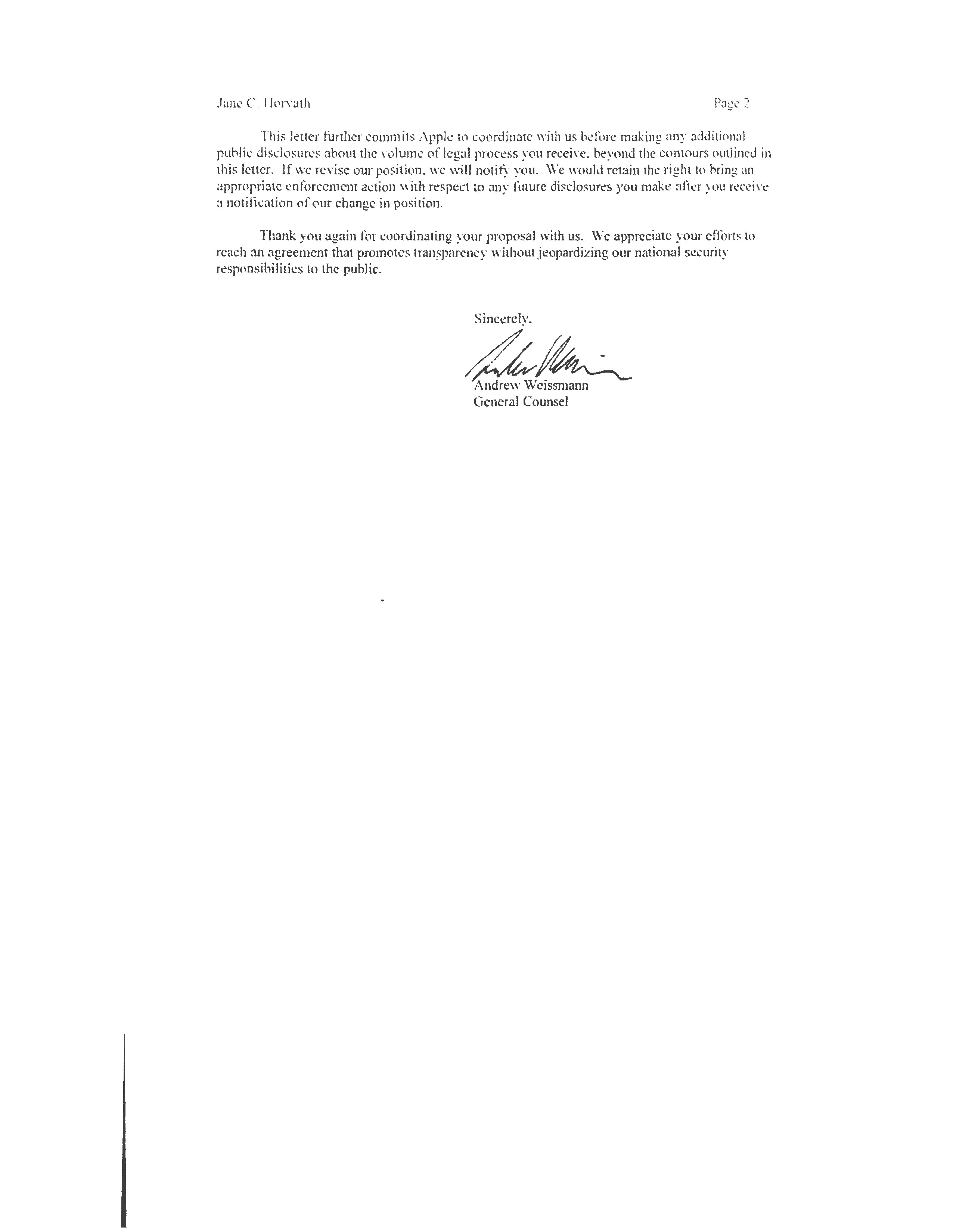
This letter further commits Apple to coordinate with us before making any additional
public disclosures about the volume of legal process you receive, beyond the contours outlined in
this letter. If we revise our position, we will notify you. We would retain the right to bring an
appropriate enforcement action with respect to any future disclosures you make after you receive
a notification of our change in position.
Thank you again for coordinating your proposal with us. We appreciate your efforts to
reach an agreement that promotes transparency without jeopardizing our national security
responsibilities to the public.
Sincerely,
Andrew Weissmann
General Counsel