Motion of Dropbox, Inc. for Leave to File Amicus Curiae Brief, In re Motions to Disclose Aggregate Data Regarding FISA Orders and Directives
Open PDFDocument date: 2013-09-23
Type: FOIA
Pages: 11
Classification: -
Dissemination: -
FISC/FISCR Court Filings
My notes
U.S. FOREIGN
INTELLIGENCE
UNITED STATES FOREIGN INTELLIGENCE SURVEILLANCE COURT
2013 SEP 23 PM 3:44
In re Motions To Disclose Aggregate Data
Regarding FISA Orders and Directives
LEEANN FLYNN HALL
Case Nos. Misc. 13-03, 13-04,
13-05, 13-06
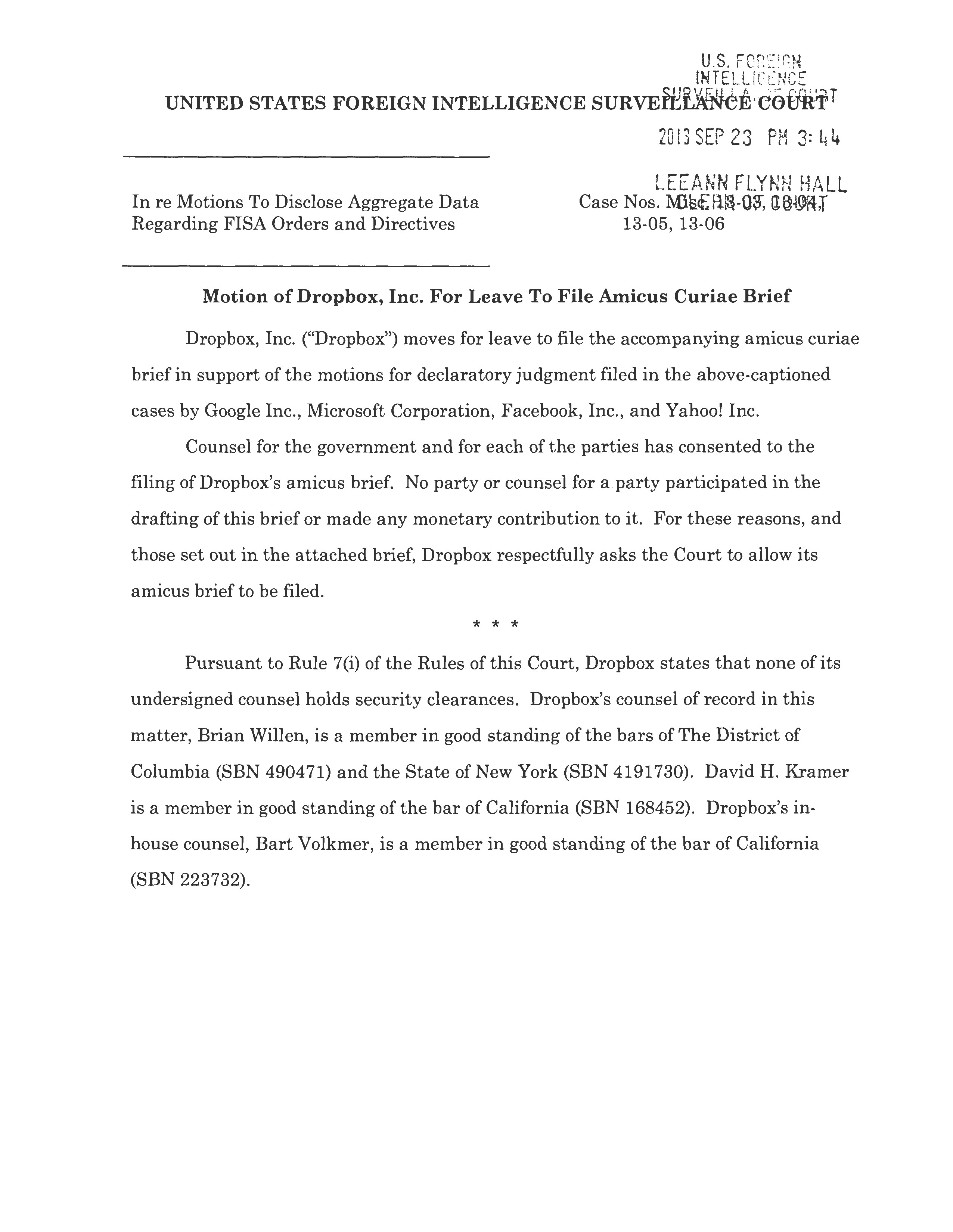
Motion of Dropbox, Inc. For Leave To File Amicus Curiae Brief
Dropbox, Inc. (“Dropbox”) moves for leave to file the accompanying amicus curiae
brief in support of the motions for declaratory judgment filed in the above-captioned
cases by Google Inc., Microsoft Corporation, Facebook, Inc., and Yahoo! Inc.
Counsel for the government and for each of the parties has consented to the
filing of Dropbox's amicus brief. No party or counsel for a party participated in the
drafting of this brief or made any monetary contribution to it. For these reasons, and
those set out in the attached brief, Dropbox respectfully asks the Court to allow its
amicus brief to be filed.
Pursuant to Rule 7(i) of the Rules of this Court, Dropbox states that none of its
undersigned counsel holds security clearances. Dropbox's counsel of record in this
matter, Brian Willen, is a member in good standing of the bars of The District of
Columbia (SBN 490471) and the State of New York (SBN 4191730). David H. Kramer
is a member in good standing of the bar of California (SBN 168452). Dropbox's in-
house counsel, Bart Volkmer, is a member in good standing of the bar of California
(SBN 223732).
Dated: September 23, 2013
Respectfully submitted,
WILSON SONSINI GOODRICH & ROSATI
Professional Corporation
Brian M. Willen
Bart Volkmer
Dropbox, Inc.
185 Berry Street, Suite 400
San Francisco, CA 94107
(415) 857-6875
bart@dropbox.com
1301 Avenue of the Americas
New York, NY 10019
Tel: (650) 849-3340
Fax: (212) 999-5899
bwillen@wsgr.com
David H. Kramer
650 Page Mill Road
Palo Alto, CA 94304
(650) 493-9300
dkramer@wsgr.com
Counsel for Dropbox, Inc.
-2-
UNITED STATES FOREIGN INTELLIGENCE SURVEILLANCE COURT
In re Motions To Disclose Aggregate Data
Regarding FISA Orders and Directives
Case Nos. Misc. 13-03, 13-04,
13-05, 13-06
[Proposed] Order on Motion of Dropbox, Inc. For Leave To File Amicus
Curiae Brief
Now before the Court is the motion of Dropbox, Inc. to file an amicus curiae
brief in the above-captioned cases. Dropbox has an interest in these cases, and all the
parties have consented to the filing of Dropbox's proposed brief. Accordingly, it is
hereby ordered that Dropbox's motion for leave to file an amicus curiae brief is
GRANTED.
SO ORDERED, this ___ day of _____, 2013.
United States Foreign Intelligence Surveillance Court
Washington, D.C.
-3-
Certificate of Service
I hereby certify this 23rd day of September, 2013, that at or before the time of
filing this submission, the Government (care of the Security and Emergency Planning
Staff, United States Department of Justice) has been served by hand delivery and
electronic mail with a copy of this motion pursuant to Rule 8(a) of the FISC Rules of
Procedure, on the following:
Christine E. Gunning
Litigation Security Group
United States Department of Justice
2 Constitution Square
145 N Street, N.E.
Suite 2W-115
Washington, D.C. 20530
Email: Christine.E.Gunning@usdoj.gov
I further certify that I caused to be served a copy of the foregoing motion,
together with the accompanying brief amicus curiae, on the following persons by
electronic mail:
James Garland
Covington & Burlington LLP
1201 Pennsylvania Avenue, NW
Washington, DC 20004
jgarland@cov.com
Counsel for Microsoft Corporation
Carl Nichols
Wilmer Cutler Pickering Hale and Dorr LLP
1875 Pennsylvania Avenue, N.W.
Washington, D.C. 20006
Carl.nichols@wilmerhale.com
Counsel for Facebook, Inc.
Albert Gidari
Perkins Coie LLP
1201 Third Avenue, Suite 4900
Seattle, WA 98101
agidari@perkinscoie.com
Counsel for Google Inc.
Marc Zwillinger
ZwillGen PLLC
1705 N. St. NW
Washington, D.C. 20036
marc@zwillgen.com
Counsel for Yahoo! Inc.
Brian M. Willen
Counsel for Dropbox, Inc.
-4-
UNITED STATES FOREIGN INTELLIGENCE SURVEILLANCE COURT
In re Motions To Disclose Aggregate
Data Regarding FISA Orders and
Directives
Case Nos. Misc. 13-03, 13-04, 13-
05, 13-06
Amicus Curiae Brief of Dropbox, Inc. In Support of Service
Providers' Motions to Publish Information About National-Security
Requests
"Secrecy in government is fundamentally anti-democratic. . . .
Open debate and discussion of public issues are vital to our
national health."
— New York Times Co. v. United States, 403 U.S. 713, 724
(1971) (Douglas, J., concurring)
Dropbox, Inc. ("Dropbox") respectfully submits this amicus curiae brief to
support the motions filed by Google, Microsoft, Yahoo, and Facebook (the "Service
Providers") seeking the Court's permission to publish the number of national-
security requests they have received and the number of users affected by those
requests. Dropbox has an interest in these motions because the government has told
Dropbox that it isn't allowed to publish exactly how many national-security
requests, if any, it receives. Instead, the government will permit Dropbox to provide
information about national-security requests only if those requests are lumped
together with regular law-enforcement requests and, even then, only in bands of
1,000. Because Dropbox received fewer than 100 regular law-enforcement requests
last year, reporting in the government's format would decrease Dropbox's ongoing
transparency efforts.
There is no statute, nor any other law, supporting the government's
demands. To the contrary, the proposed gag order violates the First Amendment, as
it interferes with both the public's right to obtain truthful information about a
matter of substantial public debate and service providers' rights to publish such
1
information. For these reasons, Dropbox supports the Service Providers' motions
and asks the Court to confirm that all online services may publish accurate
information about the number of national-security requests received within a
reporting period, along with the number of accounts affected by those requests.
- Dropbox And Its Interest In These Proceedings
Dropbox is a service that empowers people to store their documents, photos,
videos, and other materials online and to access and share them from anywhere.
Dropbox is committed to protecting the privacy of the hundreds of millions of people
who use its service, and to disclosing data about any law-enforcement requests that
seek user information.
Since May 2012, Dropbox has published a Transparency Report (available at
https://www.dropbox.com/transparency) that includes the total number of requests
for user information that Dropbox receives each year and the number of accounts
affected by those requests. Dropbox's Transparency Report does not currently
include national-security requests. That's because the government demands that
services like Dropbox disclose only the aggregate number of all law-enforcement and
national-security requests they receive. Even if presented that way, the government
insists that the disclosures must be reported in bands of 1,000.
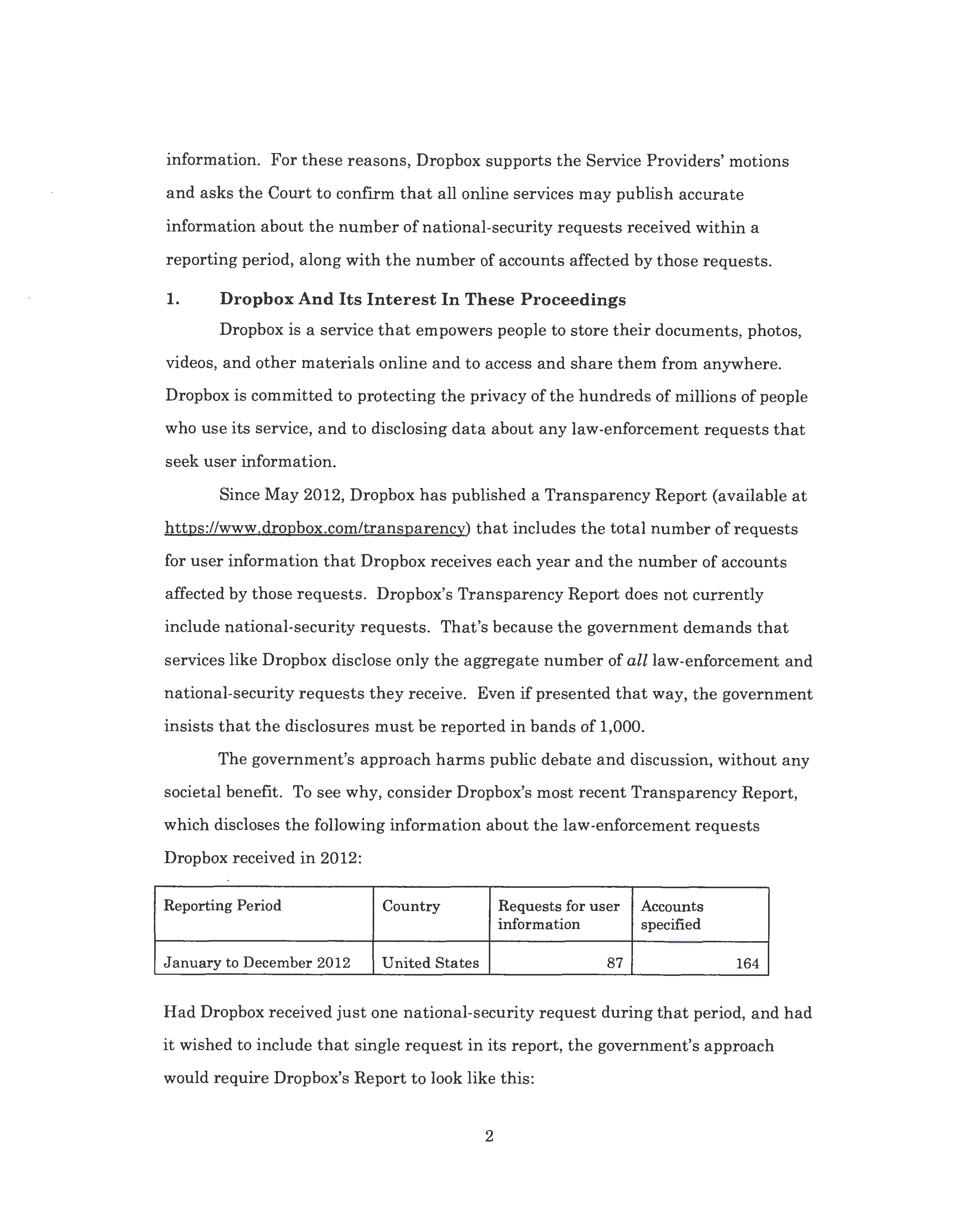
The government's approach harms public debate and discussion, without any
societal benefit. To see why, consider Dropbox's most recent Transparency Report,
which discloses the following information about the law-enforcement requests
Dropbox received in 2012:
| Reporting Period | Country | Requests for user information | Accounts specified |
|---|---|---|---|
| January to December 2012 | United States | 87 | 164 |
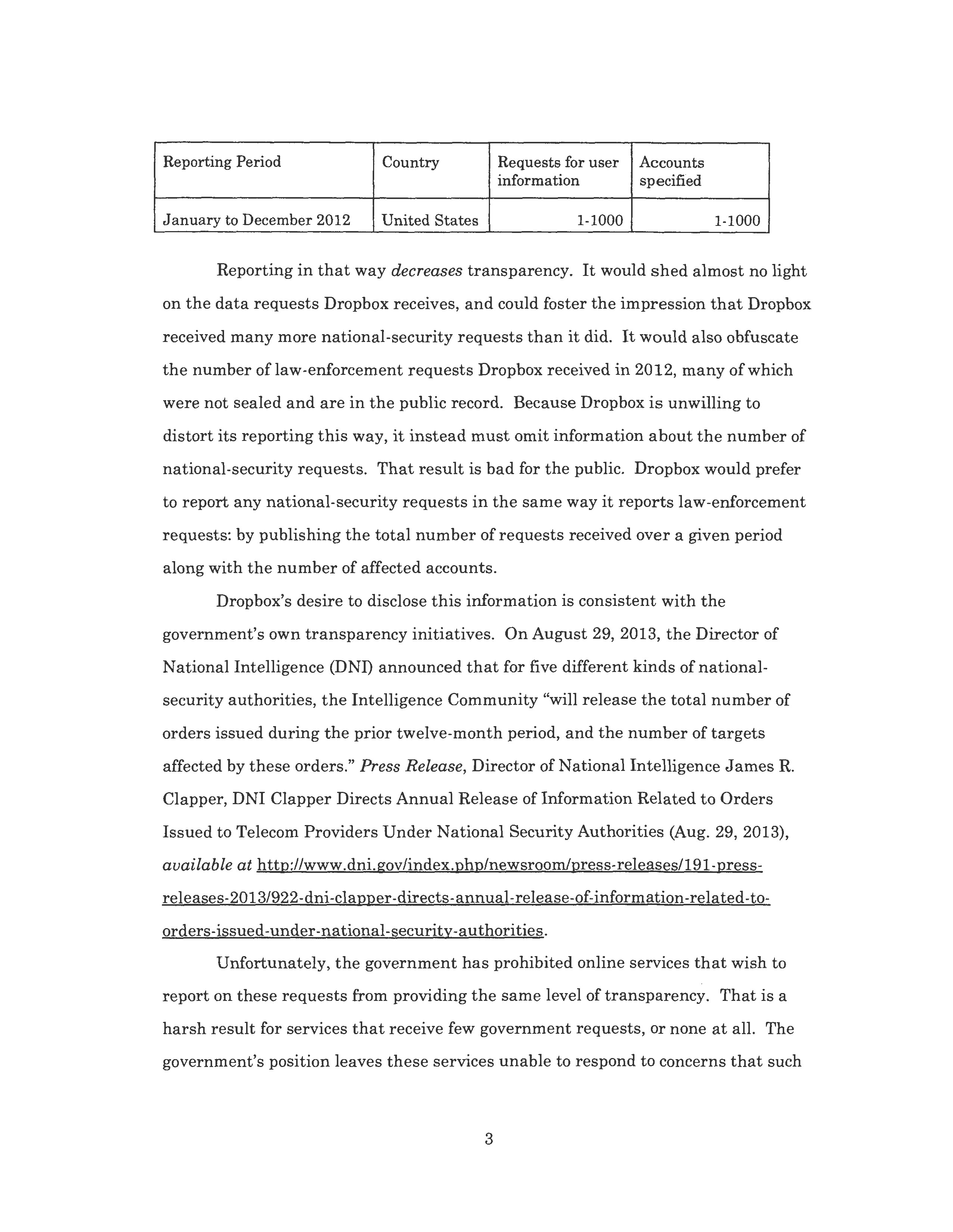
Had Dropbox received just one national-security request during that period, and had
it wished to include that single request in its report, the government's approach
would require Dropbox's Report to look like this:
2
| Reporting Period | Country | Requests for user information | Accounts specified |
|---|---|---|---|
| January to December 2012 | United States | 1-1000 | 1-1000 |
Reporting in that way decreases transparency. It would shed almost no light
on the data requests Dropbox receives, and could foster the impression that Dropbox
received many more national-security requests than it did. It would also obfuscate
the number of law-enforcement requests Dropbox received in 2012, many of which
were not sealed and are in the public record. Because Dropbox is unwilling to
distort its reporting this way, it instead must omit information about the number of
national-security requests. That result is bad for the public. Dropbox would prefer
to report any national-security requests in the same way it reports law-enforcement
requests: by publishing the total number of requests received over a given period
along with the number of affected accounts.
Dropbox's desire to disclose this information is consistent with the
government's own transparency initiatives. On August 29, 2013, the Director of
National Intelligence (DNI) announced that for five different kinds of national-
security authorities, the Intelligence Community "will release the total number of
orders issued during the prior twelve-month period, and the number of targets
affected by these orders." Press Release, Director of National Intelligence James R.
Clapper, DNI Clapper Directs Annual Release of Information Related to Orders
Issued to Telecom Providers Under National Security Authorities (Aug. 29, 2013),
available at http://www.dni.gov/index.php/newsroom/press-releases/191-press-
releases-2013/922-dni-clapper-directs-annual-release-of-information-related-to-
orders-issued-under-national-security-authorities.
Unfortunately, the government has prohibited online services that wish to
report on these requests from providing the same level of transparency. That is a
harsh result for services that receive few government requests, or none at all. The
government's position leaves these services unable to respond to concerns that such
3
requests are routine and widespread.1 For that reason, the Court's ruling on these
motions will impact Dropbox and similarly situated services.
- Barring Service Providers From Truthfully Reporting The Number
of National Security Requests Made By The Government Violates
The First Amendment
Recent events have ignited a heated debate about the government's use of its
powers under the Foreign Intelligence Surveillance Act and similar laws. Online
services like Dropbox, and the people who use them, have a right to participate fully
in this debate because they are directly affected by the government's activities.
Service providers may be asked to provide information in response to government
demands, and those providers often face questions about whether they are doing
enough to protect users' privacy. At a minimum, people want to know how often
information housed on those services is handed over to the government. That is a
legitimate request, and providers should be allowed to respond to it by disclosing the
number of national-security requests they receive.
The government has no authority supporting its claim that the law prevents
services from disclosing this information. Even if it did, allowing the government to
silence this speech would violate the First Amendment rights of online services and
people who use them. The First Amendment provides "special protection against
orders that prohibit the publication or broadcast of particular information or
commentary." Nebraska Press Ass'n v. Stuart, 427 U.S. 539, 556 (1976). And the
Supreme Court has made clear "that First Amendment protection extends equally to
right to receive information." Allentown Mack Sales and Serv., Inc. v. NLRB, 522
U.S. 359, 386-87 (1998).
The government is violating these rights by ordering private parties to keep
quiet on an important matter involving the government's conduct. In doing so, it is
preventing the public from learning basic facts about how the government is using
its national-security powers. A prior restraint on speech like that is "the most
1 Many people have written to Dropbox over the past few months asking about
Dropbox's involvement with national-security requests from the government.
4
serious and the least tolerable infringement on First Amendment rights," Stuart,
427 U.S. at 559, and faces a "heavy presumption against its constitutional validity,"
Bantam Books, Inc. v. Sullivan, 372 U.S. 570, 70 (1963).
The only way the government can prevail on these motions would be to show
that its proposed gag order is "narrowly tailored" to protecting national security and
that there are no "less restrictive alternatives" that would be equally effective. See
United States v. Playboy Entertainment Group, Inc., 529 U.S. 803, 813 (2000);
Freedman v. Maryland, 380 U.S. 51, (1965). *Accord In re National Security Letter, —
F. Supp. 2d —, 2013 WL 1095417 (N.D. Cal. 2013)* (applying these standards in
holding that prohibitions on disclosing information about National Security Letters
violated the First Amendment). The government cannot come close to showing that.
The government's effort to silence online services and thereby keep the public
in the dark is not at all tailored to protecting national security. No harm to national
security can be expected from the Service Providers releasing accurate information
about the number of national-security requests that have been made. The
government is planning on releasing similar information itself. The proposed
disclosures would not reveal the substance of any request nor identify any
subscriber who was the target of such a request. We are talking here simply about
aggregate numbers that should have been made public months ago.
The Court should not permit the government to invoke the mere label of
"national security" to justify the speech restraints it seeks—especially not here,
where the speech will inform the public about the government's use of its national-
security powers. As Justice Black observed when the Supreme Court rejected the
government's effort to block publication of the Pentagon Papers: "The word 'security'
is a broad, vague generality whose contours should not be invoked to abrogate the
fundamental law embodied in the First Amendment. The guarding of military and
diplomatic secrets at the expense of informed representative government provides no
real security for our Republic." New York Times v. United States, 403 U.S. at 719
(Black, J., concurring).
5
Conclusion
For these reasons, Dropbox asks the Court to grant the Service Providers'
motions and, in doing so, to make clear that online services have a First Amendment
right to publish accurate information about how many national-security requests
they receive and how many user accounts are implicated.
Dated: September 23, 2013
Respectfully submitted,
WILSON SONSINI GOODRICH & ROSATI
Professional Corporation
Brian M. Willen
Bart Volkmer
Dropbox, Inc.
185 Berry Street, Suite 400
San Francisco, CA 94107
(415) 857-6875
bart@dropbox.com
1301 Avenue of the Americas
New York, NY 10019
Tel: (650) 849-3340
Fax: (212) 999-5899
bwillen@wsgr.com
David H. Kramer
650 Page Mill Road
Palo Alto, CA 94304
(650) 493-9300
dkramer@wsgr.com
Counsel for Dropbox, Inc.
6
Certificate of Service
I hereby certify this 23rd day of September, 2013, that at or before the time of
filing this submission, the Government (care of the Security and Emergency
Planning Staff, United States Department of Justice) has been served by hand
delivery and electronic mail with a copy of this Amicus Curiae brief pursuant to Rule
8(a) of the FISC Rules of Procedure, on the following:
Christine E. Gunning
Litigation Security Group
United States Department of Justice
2 Constitution Square
145 N Street, N.E.
Suite 2W-115
Washington, D.C. 20530
Email: Christine.E.Gunning@usdoj.gov
I further certify that I caused to be served a copy of the foregoing motion,
together with the accompanying brief amicus curiae, on the following persons by
electronic mail:
James Garland
Covington & Burlington LLP
1201 Pennsylvania Avenue, NW
Washington, DC 20004
jgarland@cov.com
Counsel for Microsoft Corporation
Carl Nichols
Wilmer Cutler Pickering Hale and Dorr LLP
1875 Pennsylvania Avenue, N.W.
Washington, D.C. 20006
Carl.nichols@wilmerhale.com
Counsel for Facebook, Inc.
Albert Gidari
Perkins Coie LLP
1201 Third Avenue, Suite 4900
Seattle, WA 98101
agidari@perkinscoie.com
Counsel for Google Inc.
Marc Zwillinger
ZwillGen PLLC
1705 N. St. NW
Washington, D.C. 20036
marc@zwillgen.com
Counsel for Yahoo! Inc.
Brian M. Willen
Counsel for Dropbox, Inc.
7
Related Documents
-
-
-
-
Motion of the First Amendment Coalition, American Civil Liberties Union, Center for Democracy and Technology, Electronic Frontier Foundation, and TechFreedom for Leave to File Brief as Amici Curiae in Support of the Motions for Declaratory Judgment, In re Motion for Declaratory Judgment of Google Inc.'s First Amendment Right to Publish Aggregate Info. About FISA Orders, No. Misc. 13-03 (FISA Ct. July 8, 2013). FOIA [pdf]
-
Motion to Establish a Public Briefing Schedule Including the Filings of Briefs by Amici Curiae, for Leave for the Center for National Security Studies to File an Amicus Brief, and a Suggestion for Hearing En Banc, In re Application of the Federal Bureau of Investigation for an Order Requiring Production of Tangible Things from [REDACTED], No. BR 13-109 (FISA Ct. Oct. 17, 2013) FOIA [pdf]