Yahoo's Motion for Declaratory Judgement to Disclose Aggregate Data Regarding FISA Orders and Directives, In re Motion for Declaratory Judgment to Disclose Aggregate Data Regarding FISA Orders and Directives, No. Misc. 13-05 (FISA Ct. Sept. 9, 2013).
Open PDFDocument date: 2013-09-09
Type: FOIA
Pages: 11
Classification: -
Dissemination: -
FISC/FISCR Court Filings
My notes
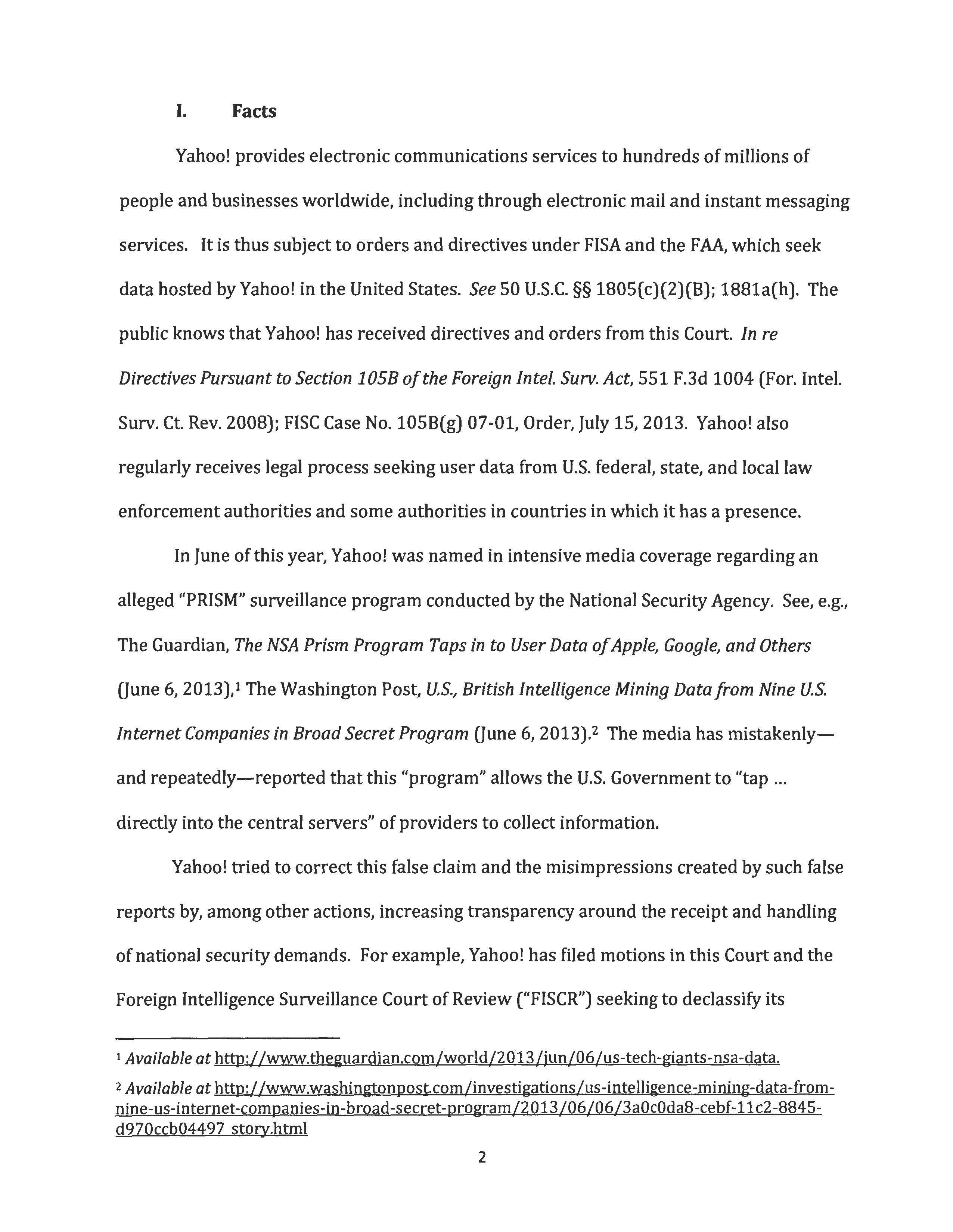
U.S. FOREIGN
INTELLIGENCE
SURVEILLANCE COURT
2013 SEP -9 PM 12: 22
LEEANN FLYNN HALL
CLERK OF COURT
United States Foreign Intelligence Surveillance Court
In re Motion for Declaratory
Judgment to Disclose Aggregate
Data Regarding FISA Orders
and Directives
Case No. 13-05
YAHOO!'S MOTION FOR DECLARATORY JUDGEMENT TO DISCLOSE AGGREGATE DATA
REGARDING FISA ORDERS AND DIRECTIVES
Yahoo! Inc. ("Yahoo!") and other electronic communications providers have been
intensely and publicly scrutinized for their alleged "participation" in surveillance that the
Government has conducted under the Foreign Intelligence Surveillance Act ("FISA") and
other national security authorities. Yahoo! has been unable to engage fully in the debate
about whether the Government has properly used its powers because the Government has
placed a prior restraint on Yahoo!'s speech by forbidding Yahoo! and other providers from
disclosing aggregate numbers of demands for surveillance they receive (if any) under FISA.
At the same time, the Government has released volumes of previously-classified documents
confirming the use of FISA surveillance and has promised to report its own aggregate
numbers shortly. See generally Office of the Director of National Intelligence, IC on the
Record, available at icontherecord.tumblr.com. Preventing Yahoo! from disclosing similar
data is a content-based restriction on Yahoo!'s First Amendment rights that is not narrowly
tailored to further national security.
Yahoo! thus moves this Court, under 28 U.S.C. § 2201 and Foreign Intelligence
Surveillance Court Rule of Procedure 6(d), for a declaratory judgment or for other
appropriate relief, confirming its legal authority to disclose specific statistics that pertain to
its receipt of orders of this Court and directives under 50 U.S.C. § 1881a, if any, in six month
reporting cycles without violating FISA, the FISC rules of procedure or any court orders.
1
I. Facts
Yahoo! provides electronic communications services to hundreds of millions of
people and businesses worldwide, including through electronic mail and instant messaging
services. It is thus subject to orders and directives under FISA and the FAA, which seek
data hosted by Yahoo! in the United States. See 50 U.S.C. §§ 1805(c)(2)(B); 1881a(h). The
public knows that Yahoo! has received directives and orders from this Court. In re
Directives Pursuant to Section 105B of the Foreign Intel. Surv. Act, 551 F.3d 1004 (For. Intel.
Surv. Ct. Rev. 2008); FISC Case No. 105B(g) 07-01, Order, July 15, 2013. Yahoo! also
regularly receives legal process seeking user data from U.S. federal, state, and local law
enforcement authorities and some authorities in countries in which it has a presence.
In June of this year, Yahoo! was named in intensive media coverage regarding an
alleged "PRISM" surveillance program conducted by the National Security Agency. See, e.g.,
The Guardian, The NSA Prism Program Taps in to User Data of Apple, Google, and Others
(June 6, 2013),¹ The Washington Post, U.S., British Intelligence Mining Data from Nine U.S.
Internet Companies in Broad Secret Program (June 6, 2013).² The media has mistakenly—
and repeatedly—reported that this "program" allows the U.S. Government to "tap
directly into the central servers" of providers to collect information.
Yahoo! tried to correct this false claim and the misimpressions created by such false
reports by, among other actions, increasing transparency around the receipt and handling
of national security demands. For example, Yahoo! has filed motions in this Court and the
Foreign Intelligence Surveillance Court of Review ("FISCR") seeking to declassify its
¹ Available at http://www.theguardian.com/world/2013/jun/06/us-tech-giants-nsa-data.
² Available at http://www.washingtonpost.com/investigations/us-intelligence-mining-data-from-
nine-us-internet-companies-in-broad-secret-program/2013/06/06/3a0c0da8-cebf-11c2-8845-
d970ccb04497_story.html
2
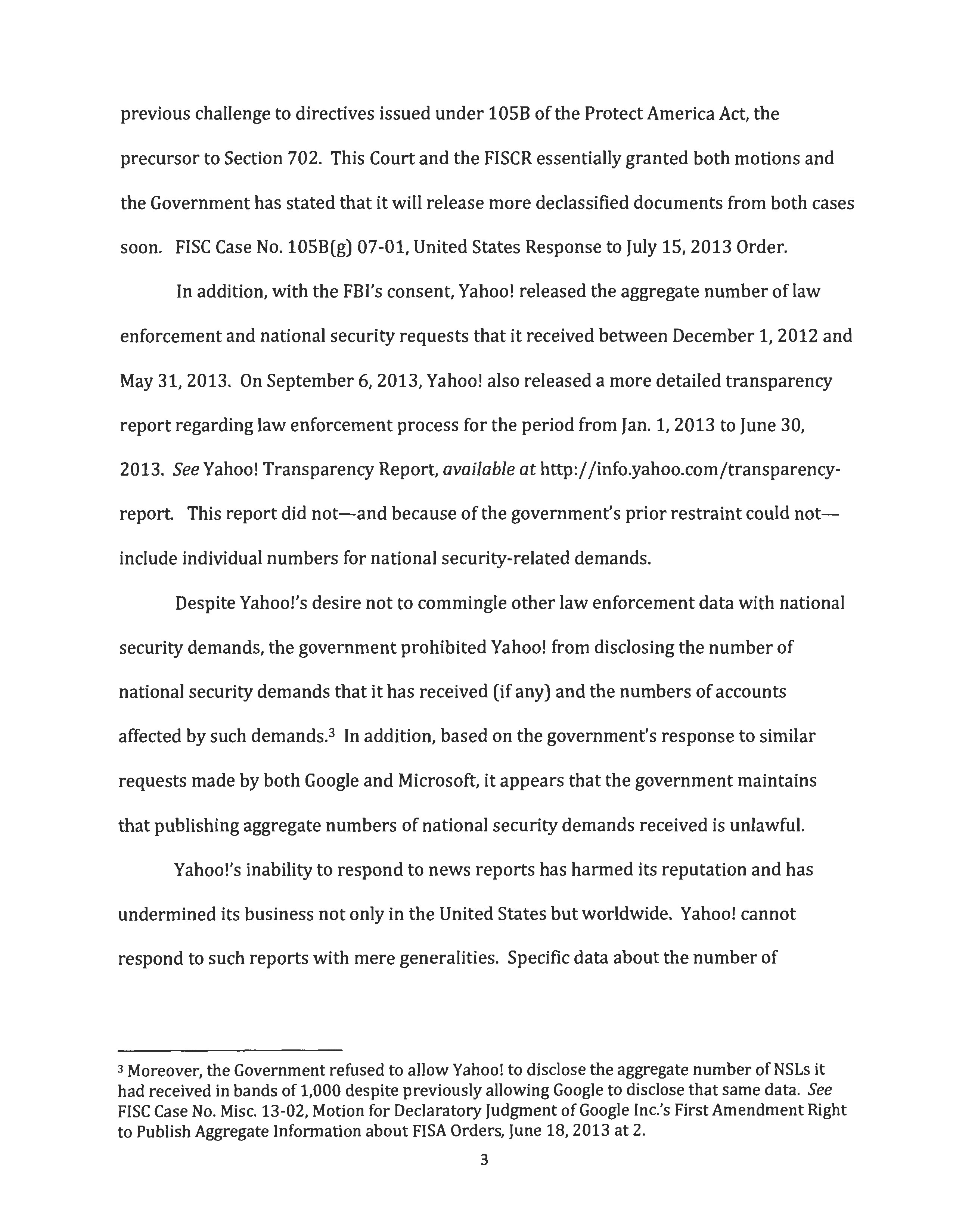
previous challenge to directives issued under 105B of the Protect America Act, the
precursor to Section 702. This Court and the FISCR essentially granted both motions and
the Government has stated that it will release more declassified documents from both cases
soon. FISC Case No. 105B(g) 07-01, United States Response to July 15, 2013 Order.
In addition, with the FBI's consent, Yahoo! released the aggregate number of law
enforcement and national security requests that it received between December 1, 2012 and
May 31, 2013. On September 6, 2013, Yahoo! also released a more detailed transparency
report regarding law enforcement process for the period from Jan. 1, 2013 to June 30,
2013. See Yahoo! Transparency Report, available at http://info.yahoo.com/transparency-
report. This report did not—and because of the government's prior restraint could not—
include individual numbers for national security-related demands.
Despite Yahoo!'s desire not to commingle other law enforcement data with national
security demands, the government prohibited Yahoo! from disclosing the number of
national security demands that it has received (if any) and the numbers of accounts
affected by such demands.³ In addition, based on the government's response to similar
requests made by both Google and Microsoft, it appears that the government maintains
that publishing aggregate numbers of national security demands received is unlawful.
Yahoo!'s inability to respond to news reports has harmed its reputation and has
undermined its business not only in the United States but worldwide. Yahoo! cannot
respond to such reports with mere generalities. Specific data about the number of
³ Moreover, the Government refused to allow Yahoo! to disclose the aggregate number of NSLs it
had received in bands of 1,000 despite previously allowing Google to disclose that same data. See
FISC Case No. Misc. 13-02, Motion for Declaratory Judgment of Google Inc.'s First Amendment Right
to Publish Aggregate Information about FISA Orders, June 18, 2013 at 2.
3
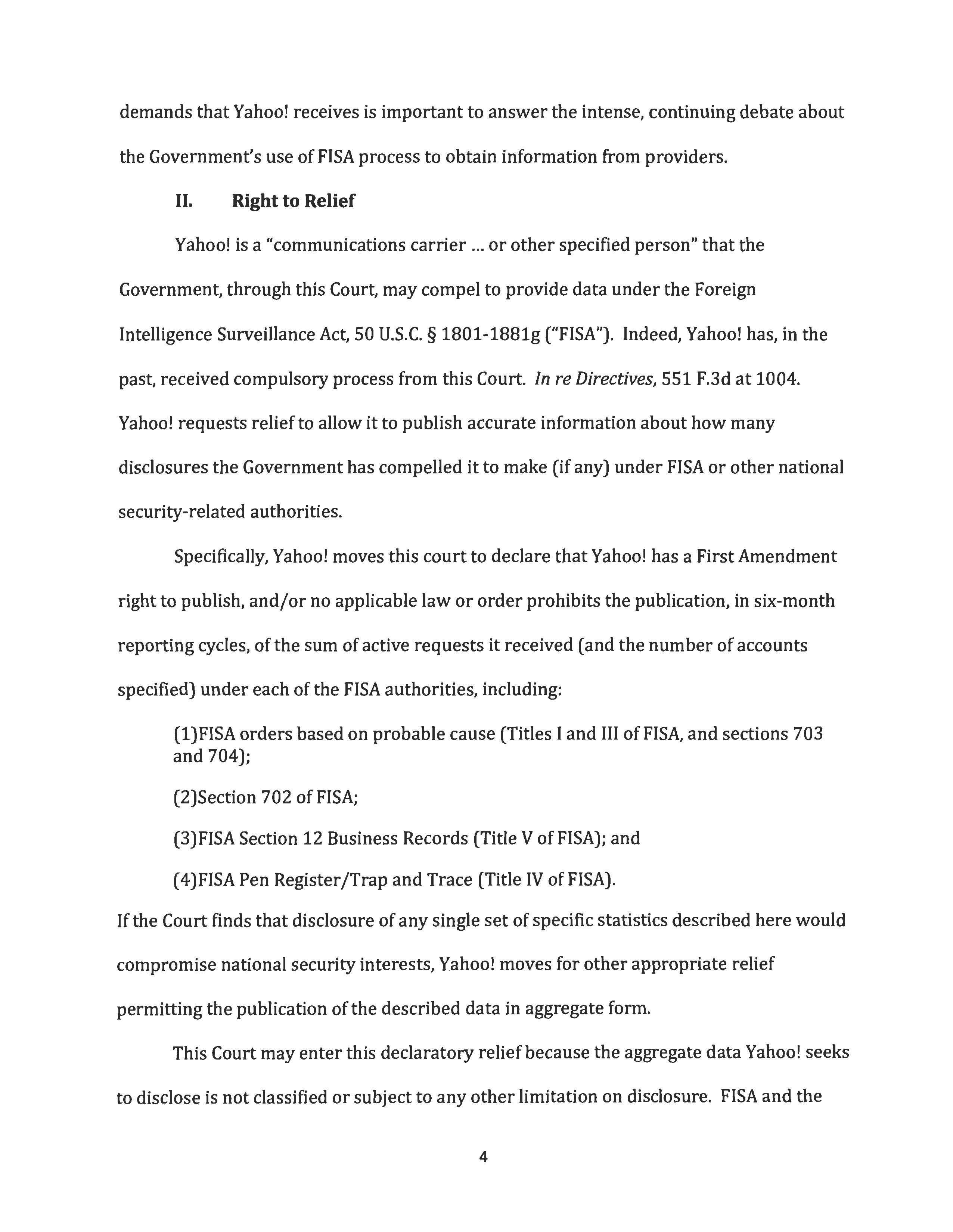
demands that Yahoo! receives is important to answer the intense, continuing debate about
the Government's use of FISA process to obtain information from providers.
II. Right to Relief
Yahoo! is a "communications carrier ... or other specified person" that the
Government, through this Court, may compel to provide data under the Foreign
Intelligence Surveillance Act, 50 U.S.C. § 1801-1881g (“FISA"). Indeed, Yahoo! has, in the
past, received compulsory process from this Court. In re Directives, 551 F.3d at 1004.
Yahoo! requests relief to allow it to publish accurate information about how many
disclosures the Government has compelled it to make (if any) under FISA or other national
security-related authorities.
Specifically, Yahoo! moves this court to declare that Yahoo! has a First Amendment
right to publish, and/or no applicable law or order prohibits the publication, in six-month
reporting cycles, of the sum of active requests it received (and the number of accounts
specified) under each of the FISA authorities, including:
(1) FISA orders based on probable cause (Titles I and III of FISA, and sections 703
and 704);
(2) Section 702 of FISA;
(3) FISA Section 12 Business Records (Title V of FISA); and
(4) FISA Pen Register/Trap and Trace (Title IV of FISA).
If the Court finds that disclosure of any single set of specific statistics described here would
compromise national security interests, Yahoo! moves for other appropriate relief
permitting the publication of the described data in aggregate form.
This Court may enter this declaratory relief because the aggregate data Yahoo! seeks
to disclose is not classified or subject to any other limitation on disclosure. FISA and the
4
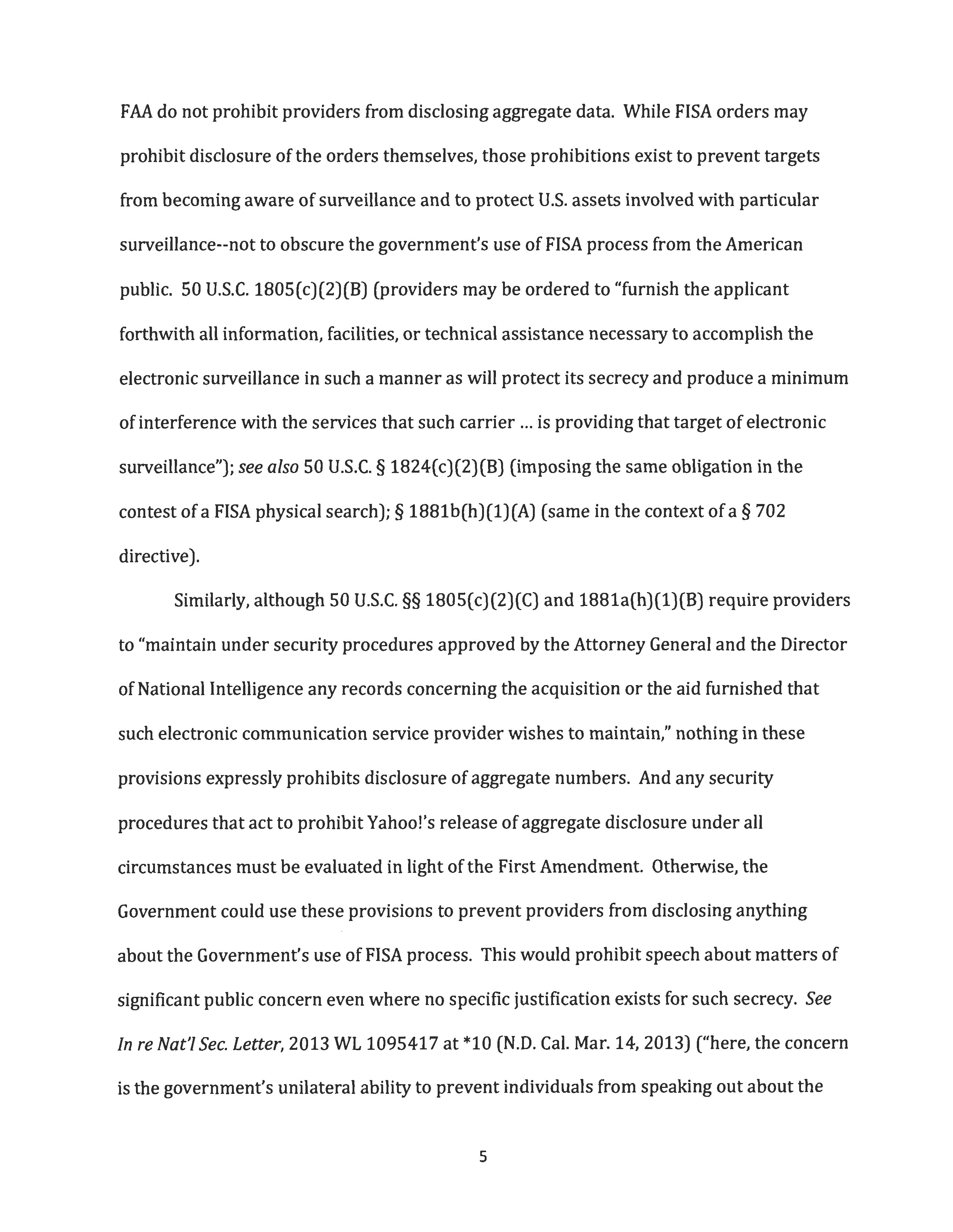
FAA do not prohibit providers from disclosing aggregate data. While FISA orders may
prohibit disclosure of the orders themselves, those prohibitions exist to prevent targets
from becoming aware of surveillance and to protect U.S. assets involved with particular
surveillance—not to obscure the government's use of FISA process from the American
public. 50 U.S.C. 1805(c)(2)(B) (providers may be ordered to "furnish the applicant
forthwith all information, facilities, or technical assistance necessary to accomplish the
electronic surveillance in such a manner as will protect its secrecy and produce a minimum
of interference with the services that such carrier ... is providing that target of electronic
surveillance"); see also 50 U.S.C. § 1824(c)(2)(B) (imposing the same obligation in the
contest of a FISA physical search); § 1881b(h)(1)(A) (same in the context of a § 702
directive).
Similarly, although 50 U.S.C. §§ 1805(c)(2)(C) and 1881a(h)(1)(B) require providers
to "maintain under security procedures approved by the Attorney General and the Director
of National Intelligence any records concerning the acquisition or the aid furnished that
such electronic communication service provider wishes to maintain," nothing in these
provisions expressly prohibits disclosure of aggregate numbers. And any security
procedures that act to prohibit Yahoo!'s release of aggregate disclosure under all
circumstances must be evaluated in light of the First Amendment. Otherwise, the
Government could use these provisions to prevent providers from disclosing anything
about the Government's use of FISA process. This would prohibit speech about matters of
significant public concern even where no specific justification exists for such secrecy. See
In re Nat'l Sec. Letter, 2013 WL 1095417 at *10 (N.D. Cal. Mar. 14, 2013) ("here, the concern
is the government's unilateral ability to prevent individuals from speaking out about the
5
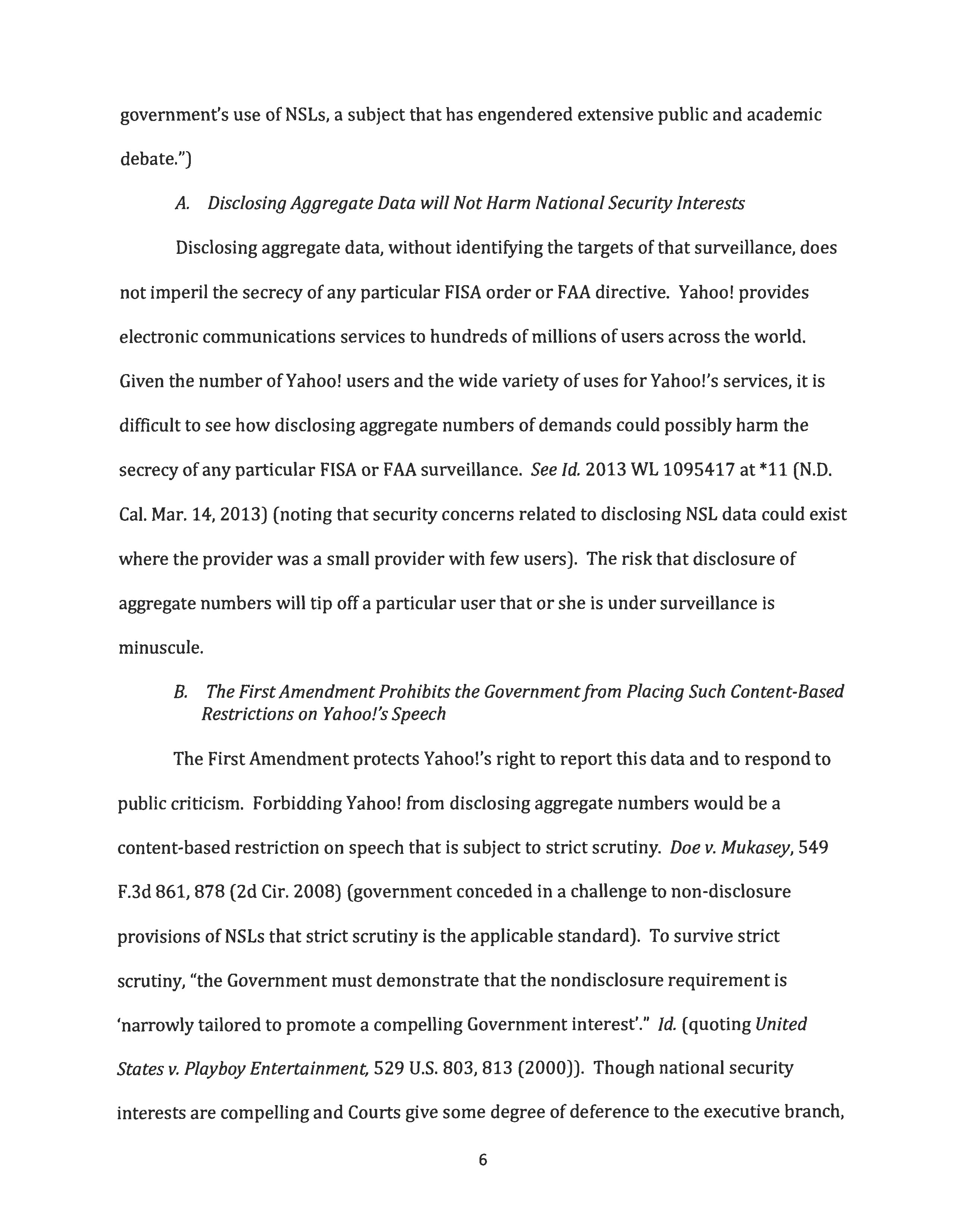
government's use of NSLs, a subject that has engendered extensive public and academic
debate.")
A. Disclosing Aggregate Data will Not Harm National Security Interests
Disclosing aggregate data, without identifying the targets of that surveillance, does
not imperil the secrecy of any particular FISA order or FAA directive. Yahoo! provides
electronic communications services to hundreds of millions of users across the world.
Given the number of Yahoo! users and the wide variety of uses for Yahoo!'s services, it is
difficult to see how disclosing aggregate numbers of demands could possibly harm the
secrecy of any particular FISA or FAA surveillance. See Id. 2013 WL 1095417 at *11 (N.D.
Cal. Mar. 14, 2013) (noting that security concerns related to disclosing NSL data could exist
where the provider was a small provider with few users). The risk that disclosure of
aggregate numbers will tip off a particular user that or she is under surveillance is
minuscule.
B. The First Amendment Prohibits the Government from Placing Such Content-Based
Restrictions on Yahoo!'s Speech
The First Amendment protects Yahoo!'s right to report this data and to respond to
public criticism. Forbidding Yahoo! from disclosing aggregate numbers would be a
content-based restriction on speech that is subject to strict scrutiny. Doe v. Mukasey, 549
F.3d 861, 878 (2d Cir. 2008) (government conceded in a challenge to non-disclosure
provisions of NSLs that strict scrutiny is the applicable standard). To survive strict
scrutiny, "the Government must demonstrate that the nondisclosure requirement is
'narrowly tailored to promote a compelling Government interest'." Id. (quoting United
States v. Playboy Entertainment, 529 U.S. 803, 813 (2000)). Though national security
interests are compelling and Courts give some degree of deference to the executive branch,
6
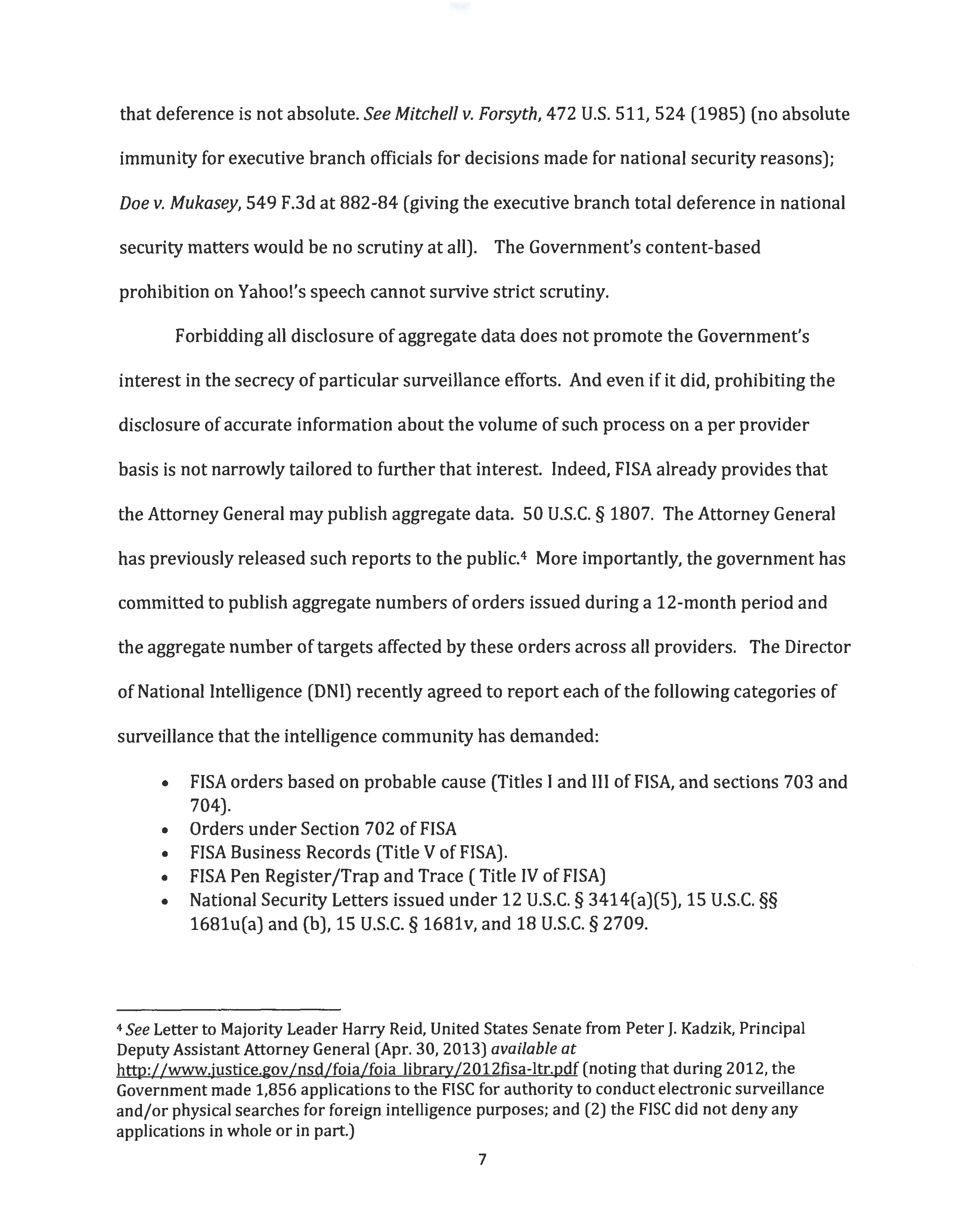
that deference is not absolute. See Mitchell v. Forsyth, 472 U.S. 511, 524 (1985) (no absolute
immunity for executive branch officials for decisions made for national security reasons);
Doe v. Mukasey, 549 F.3d at 882-84 (giving the executive branch total deference in national
security matters would be no scrutiny at all). The Government's content-based
prohibition on Yahoo!'s speech cannot survive strict scrutiny.
Forbidding all disclosure of aggregate data does not promote the Government's
interest in the secrecy of particular surveillance efforts. And even if it did, prohibiting the
disclosure of accurate information about the volume of such process on a per provider
basis is not narrowly tailored to further that interest. Indeed, FISA already provides that
the Attorney General may publish aggregate data. 50 U.S.C. § 1807. The Attorney General
has previously released such reports to the public.⁴ More importantly, the government has
committed to publish aggregate numbers of orders issued during a 12-month period and
the aggregate number of targets affected by these orders across all providers. The Director
of National Intelligence (DNI) recently agreed to report each of the following categories of
surveillance that the intelligence community has demanded:
- FISA orders based on probable cause (Titles I and III of FISA, and sections 703 and
704). - Orders under Section 702 of FISA
- FISA Business Records (Title V of FISA).
- FISA Pen Register/Trap and Trace (Title IV of FISA)
- National Security Letters issued under 12 U.S.C. § 3414(a)(5), 15 U.S.C. §§
1681u(a) and (b), 15 U.S.C. § 1681v, and 18 U.S.C. § 2709.
⁴ See Letter to Majority Leader Harry Reid, United States Senate from Peter J. Kadzik, Principal
Deputy Assistant Attorney General (Apr. 30, 2013) available at
http://www.justice.gov/nsd/foia/foia_library/2012fisa-ltr.pdf (noting that during 2012, the
Government made 1,856 applications to the FISC for authority to conduct electronic surveillance
and/or physical searches for foreign intelligence purposes; and (2) the FISC did not deny any
applications in whole or in part.)
7
See generally DNOI Clapper Directs Annual Release of Information Related to Orders Issued
Under National Security Authorities (August 29, 2013) available at
http://icontherecord.tumblr.com/post/59719173750/dni-clapper-directs-annual-release-
of-information. The government's release will aggregate this information across all
providers. Id. However, Yahoo! seeks the ability to disclose the portion of these requests it
receives. The Government's public release of similar data—which was likely motivated by
a desire to inform the public and to correct the misimpressions caused by inaccurate
reporting—undermines any argument that prohibiting Yahoo! from publicly disclosing the
same data would harm national security.
Finally, any FISA provisions that would allow the Government to prohibit Yahoo!
from making the requested disclosures would not survive strict scrutiny because of the
strong public interest in this information as part of the national, ongoing debate over the
Government's use of surveillance powers under FISA and the Government's own
participation in that debate. That the Government engages in such surveillance is now part
of the public record—and the government has released and plans to release more data
about its programs. To that end, the Director of National Intelligence has also
acknowledged that President Obama directed him to "declassify and make public as much
information as possible about certain sensitive NSA programs while being mindful of the
need to protect sensitive classified intelligence and national security."⁵ The information
that Yahoo! seeks to disclose furthers the Government's avowed interest in transparency,
without compromising national security, especially in light of the public knowledge that
⁵ DNI Declassifies Intelligence Community Documents Regarding Collection Under Section 702 of
the Foreign Intelligence Surveillance Act (FISA), Aug. 21, 2013, available at
http://www.dni.gov/index.php/newsroom/press-releases/191-press-releases-2013/915-dni-
declassifies-intelligence-community-documents-regarding-collection-under-section-702-of-the-
foreign-intelligence-surveillance-act-fisa
8
Yahoo! has received intelligence process. Given these statements and extensive public
reporting on the issue, completely prohibiting Yahoo!'s speech regarding these issues is not
narrowly tailored to serve a compelling interest. The First Amendment does not allow the
Government to suppress private speech, while the Government itself speaks extensively
about the same subject.
III. Conclusion
Yahoo! requests that this Court issue a declaratory judgment declaring that Yahoo!
may lawfully disclose the requested information. Yahoo! also requests that the Court set a
briefing schedule for this motion that would allow it an opportunity to respond to any
opposition the Government files in response to this petition.⁶
IV. Rule 7 Statement
Pursuant to FISC Rules of Procedure 7(h) & (i), Yahoo! states that its undersigned
counsel, Marc J. Zwillinger holds a top secret security clearance, which was granted by the
FBI to permit him to advise his clients about classified legal process. He is also a member in
good standing of the bars of Illinois and the District of Columbia. He has previously
appeared before this Court. Jacob Sommer held a secret security clearance, which is
currently being renewed. The FBI originally granted the clearance to allow him to advise
his clients concerning classified legal process. He is a member in good standing of the bars
of the District of Columbia and South Carolina. He has also previously appeared before this
Court.
⁶ Yahoo! would be willing to coordinate such schedule with the schedule to be entered in Case Nos.
Misc. 13-03 and 13-04, which cases involve similar, but not identical, requests for relief filed by
Google and Microsoft.
9
Dated: September 9, 2013
Signature:
Marc J. Zwillinger
Jacob A. Sommer
ZwillGen PLLC
1705 N St. NW
Washington, DC 20036
marc@zwillgen.com
jake@zwillgen.com
Attorneys for Yahoo! Inc.
10
CERTIFICATE OF SERVICE
I hereby certify that on September 9, 2013, I caused copies of the foregoing motion
to be served on:
Christine Gunning
United States Department of Justice
Litigation Security Group
2 Constitution Square
145 N St NE
Suite 2W-115
Washington, D.C. 20530
(202) 514-9016
Carli.Rodriguez-Feo@usdoj.gov
pursuant to FISC Rule 8 and procedures established by the Security and Emergency
Planning Staff, United States Department of Justice.
Marc J. Zwillinger
11
Related Documents
-
-
-
-
Response of the United States to Motions for Declaratory Judgment by Google Inc., Microsoft Corporation, Yahoo! Inc., Facebook, Inc., and LinkedIn Corporation, In re Motion for Declaratory Judgment of a First Amendment Right to Publish Aggregate Info. About FISA Orders, No. Misc. 13-03 (FISA Ct. Sept. 30, 2013). FOIA [pdf]
-