Supplemental Opinion from the Foreign Intelligence Surveillance Court
Open PDFDocument date: 2008-12-12
Type: FOIA
Pages: 5
Classification: TOP SECRET COMINT MR
Dissemination: ORCON, NOFORN
Opinion of the FISC concluding that the production of bulk telephony metadata records pursuant to Section 501 of FISA is not inconsistent with Sections 2702 and 2703 of Title 18 of the United States Code. ACLU/EFF FOIA Litigation.
My notes
TOP SECRET//COMINT//ORCON,NOFORN//MR
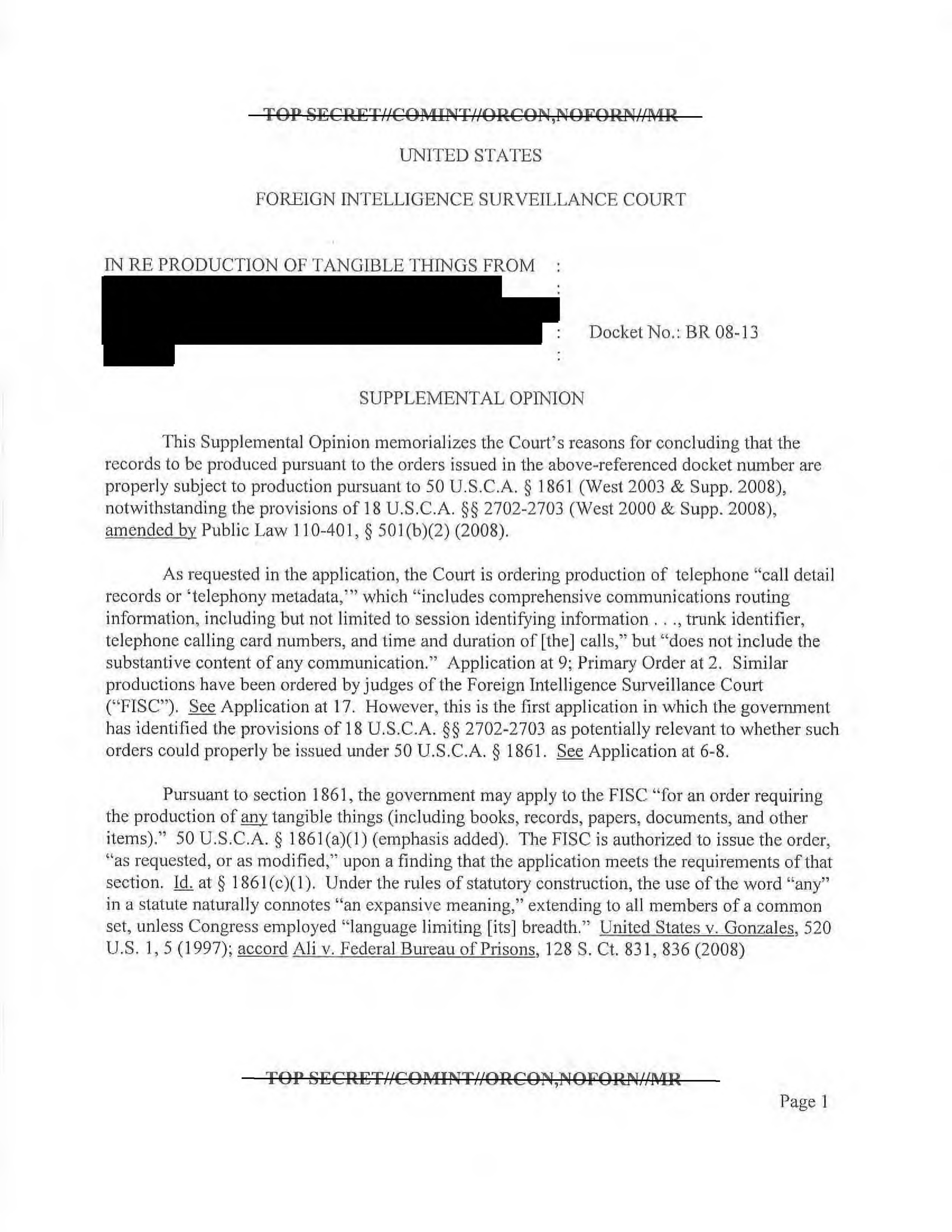
UNITED STATES
FOREIGN INTELLIGENCE SURVEILLANCE COURT
IN RE PRODUCTION OF TANGIBLE THINGS FROM
[REDACTED]
[REDACTED]
[REDACTED]
Docket No.: BR 08-13
SUPPLEMENTAL OPINION
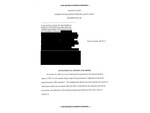
This Supplemental Opinion memorializes the Court's reasons for concluding that the
records to be produced pursuant to the orders issued in the above-referenced docket number are
properly subject to production pursuant to 50 U.S.C.A. § 1861 (West 2003 & Supp. 2008),
notwithstanding the provisions of 18 U.S.C.A. §§ 2702-2703 (West 2000 & Supp. 2008),
amended by Public Law 110-401, § 501(b)(2) (2008).
As requested in the application, the Court is ordering production of telephone "call detail
records or 'telephony metadata," which "includes comprehensive communications routing
information, including but not limited to session identifying information ., trunk identifier,
telephone calling card numbers, and time and duration of [the] calls," but "does not include the
substantive content of any communication." Application at 9; Primary Order at 2. Similar
productions have been ordered by judges of the Foreign Intelligence Surveillance Court
("FISC"). See Application at 17. However, this is the first application in which the government
has identified the provisions of 18 U.S.C.A. §§ 2702-2703 as potentially relevant to whether such
orders could properly be issued under 50 U.S.C.A. § 1861. See Application at 6-8.
Pursuant to section 1861, the government may apply to the FISC "for an order requiring
the production of any tangible things (including books, records, papers, documents, and other
items)." 50 U.S.C.A. § 1861(a) (1) (emphasis added). The FISC is authorized to issue the order,
"as requested, or as modified," upon a finding that the application meets the requirements of that
section. Id. at § 1861(c)(1). Under the rules of statutory construction, the use of the word "any"
in a statute naturally connotes "an expansive meaning," extending to all members of a common
set, unless Congress employed "language limiting [its] breadth." United States v. Gonzales, 520
U.S. 1, 5 (1997); accord Ali v. Federal Bureau of Prisons, 128 S. Ct. 831, 836 (2008)
TOP SECRET//COMINT//ORCON,NOFORN//MR
Page 1
TOP SECRET//COMINT//ORCON,NOFORN//MR
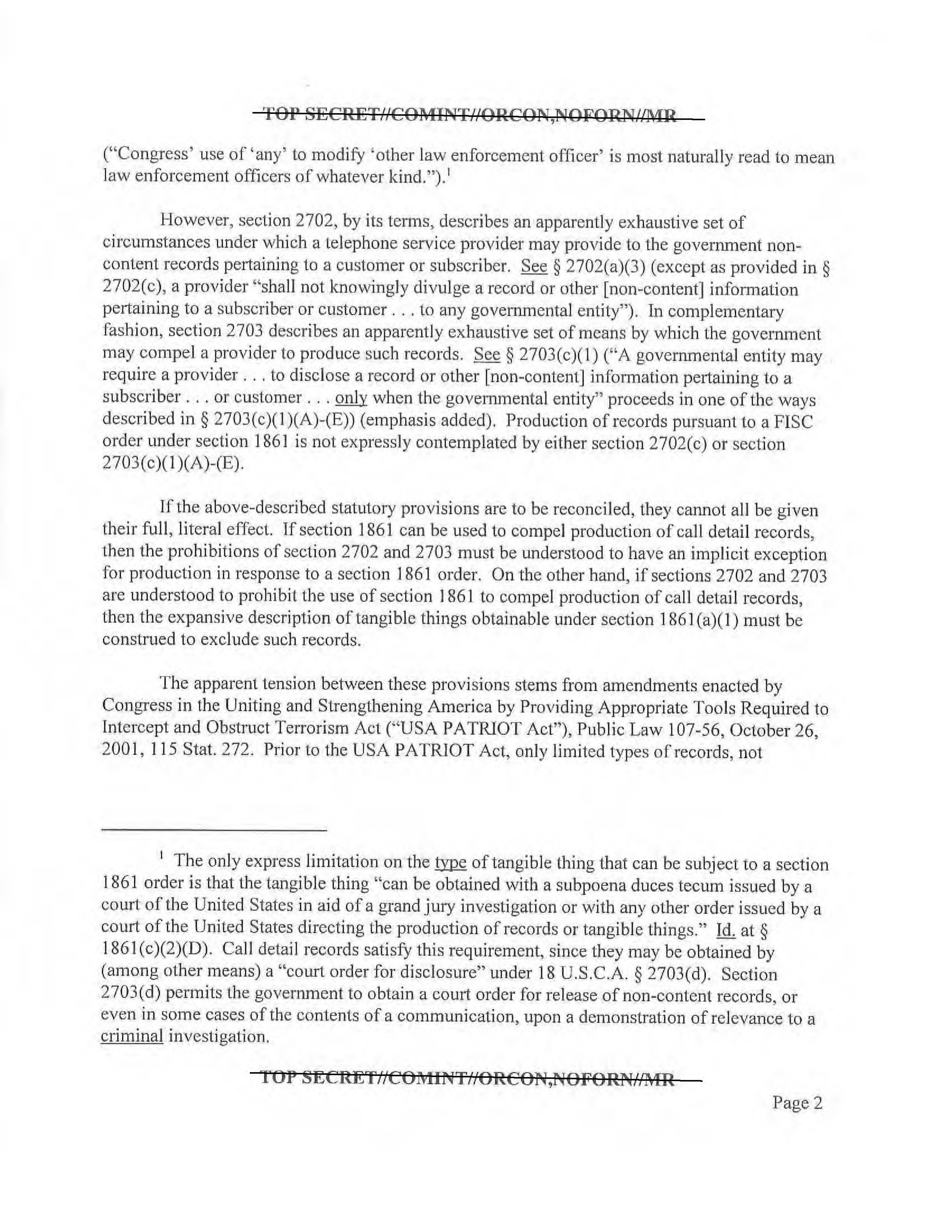
("Congress' use of 'any' to modify 'other law enforcement officer' is most naturally read to mean
law enforcement officers of whatever kind.").¹
However, section 2702, by its terms, describes an apparently exhaustive set of
circumstances under which a telephone service provider may provide to the government non-
content records pertaining to a customer or subscriber. See § 2702(a)(3) (except as provided in §
2702(c), a provider "shall not knowingly divulge a record or other [non-content] information
pertaining to a subscriber or customer... to any governmental entity"). In complementary
fashion, section 2703 describes an apparently exhaustive set of means by which the government
may compel a provider to produce such records. See § 2703(c)(1) ("A governmental entity may
require a provider... to disclose a record or other [non-content] information pertaining to a
subscriber... or customer only when the governmental entity" proceeds in one of the ways
described in § 2703(c)(1)(A)-(E)) (emphasis added). Production of records pursuant to a FISC
order under section 1861 is not expressly contemplated by either section 2702(c) or section
2703(c)(1)(A)-(E).
If the above-described statutory provisions are to be reconciled, they cannot all be given
their full, literal effect. If section 1861 can be used to compel production of call detail records,
then the prohibitions of section 2702 and 2703 must be understood to have an implicit exception
for production in response to a section 1861 order. On the other hand, if sections 2702 and 2703
are understood to prohibit the use of section 1861 to compel production of call detail records,
then the expansive description of tangible things obtainable under section 1861(a)(1) must be
construed to exclude such records.
The apparent tension between these provisions stems from amendments enacted by
Congress in the Uniting and Strengthening America by Providing Appropriate Tools Required to
Intercept and Obstruct Terrorism Act ("USA PATRIOT Act"), Public Law 107-56, October 26,
2001, 115 Stat. 272. Prior to the USA PATRIOT Act, only limited types of records, not
¹ The only express limitation on the type of tangible thing that can be subject to a section
1861 order is that the tangible thing "can be obtained with a subpoena duces tecum issued by a
court of the United States in aid of a grand jury investigation or with any other order issued by a
court of the United States directing the production of records or tangible things." Id. at §
1861(c)(2)(D). Call detail records satisfy this requirement, since they may be obtained by
(among other means) a "court order for disclosure" under 18 U.S.C.A. § 2703(d). Section
2703(d) permits the government to obtain a court order for release of non-content records, or
even in some cases of the contents of a communication, upon a demonstration of relevance to a
criminal investigation.
TOP SECRET//COMINT//ORCON,NOFORN//MR
Page 2
TOP SECRET//COMINT//ORCON,NOFORN//MR
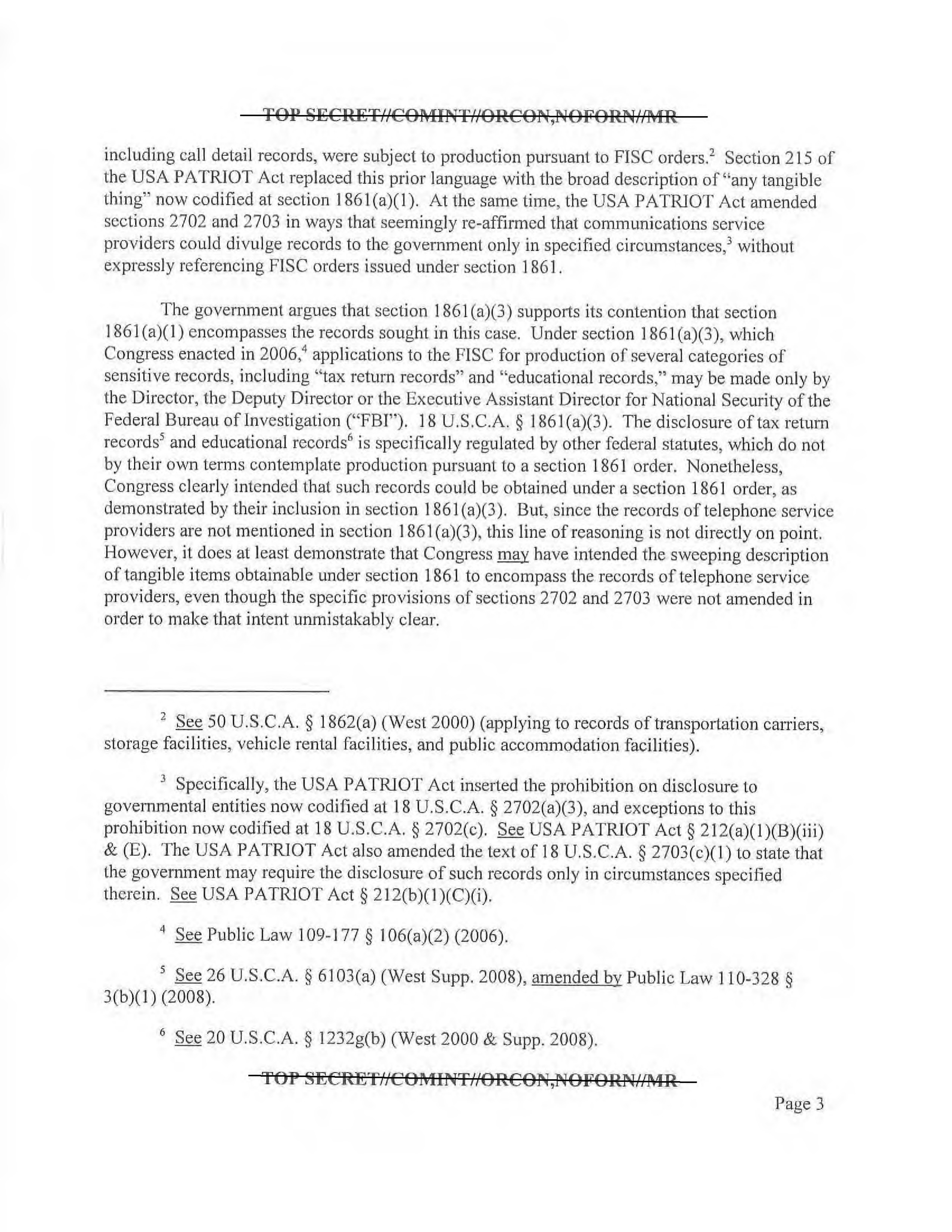
including call detail records, were subject to production pursuant to FISC orders.² Section 215 of
the USA PATRIOT Act replaced this prior language with the broad description of "any tangible
thing" now codified at section 1861(a)(1). At the same time, the USA PATRIOT Act amended
sections 2702 and 2703 in ways that seemingly re-affirmed that communications service
providers could divulge records to the government only in specified circumstances,³ without
expressly referencing FISC orders issued under section 1861.
The government argues that section 1861(a)(3) supports its contention that section
1861(a)(1) encompasses the records sought in this case. Under section 1861(a)(3), which
Congress enacted in 2006,⁴ applications to the FISC for production of several categories of
sensitive records, including "tax return records"⁵ and "educational records,"⁶ may be made only by
the Director, the Deputy Director or the Executive Assistant Director for National Security of the
Federal Bureau of Investigation ("FBI"). 18 U.S.C.A. § 1861(a)(3). The disclosure of tax return
records and educational records is specifically regulated by other federal statutes, which do not
by their own terms contemplate production pursuant to a section 1861 order. Nonetheless,
Congress clearly intended that such records could be obtained under a section 1861 order, as
demonstrated by their inclusion in section 1861(a)(3). But, since the records of telephone service
providers are not mentioned in section 1861(a)(3), this line of reasoning is not directly on point.
However, it does at least demonstrate that Congress may have intended the sweeping description
of tangible items obtainable under section 1861 to encompass the records of telephone service
providers, even though the specific provisions of sections 2702 and 2703 were not amended in
order to make that intent unmistakably clear.
² See 50 U.S.C.A. § 1862(a) (West 2000) (applying to records of transportation carriers,
storage facilities, vehicle rental facilities, and public accommodation facilities).
³ Specifically, the USA PATRIOT Act inserted the prohibition on disclosure to
governmental entities now codified at 18 U.S.C.A. § 2702(a)(3), and exceptions to this
prohibition now codified at 18 U.S.C.A. § 2702(c). See USA PATRIOT Act § 212(a)(1)(B)(iii)
& (E). The USA PATRIOT Act also amended the text of 18 U.S.C.A. § 2703(c)(1) to state that
the government may require the disclosure of such records only in circumstances specified
therein. See USA PATRIOT Act § 212(b)(1)(C)(i).
⁴ See Public Law 109-177 § 106(a)(2) (2006).
⁵ See 26 U.S.C.A. § 6103(a) (West Supp. 2008), amended by Public Law 110-328 §
3(b)(1) (2008).
⁶ See 20 U.S.C.A. § 1232g(b) (West 2000 & Supp. 2008).
TOP SECRET//COMINT//ORCON,NOFORN//MR
Page 3
TOP SECRET//COMINT//ORCON,NOFORN//MR
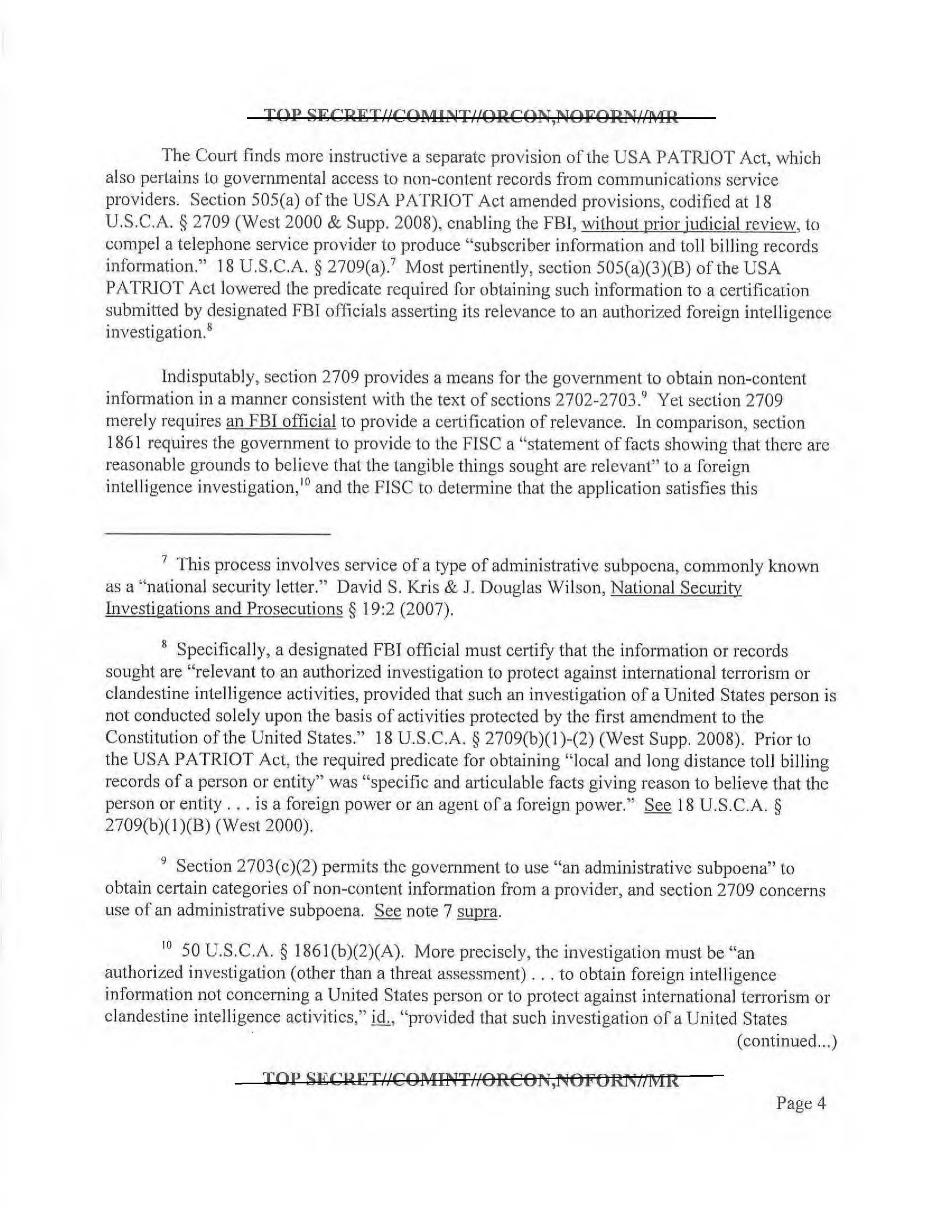
The Court finds more instructive a separate provision of the USA PATRIOT Act, which
also pertains to governmental access to non-content records from communications service
providers. Section 505(a) of the USA PATRIOT Act amended provisions, codified at 18
U.S.C.A. § 2709 (West 2000 & Supp. 2008), enabling the FBI, without prior judicial review, to
compel a telephone service provider to produce "subscriber information and toll billing records
information." 18 U.S.C.A. § 2709(a). Most pertinently, section 505(a)(3)(B) of the USA
PATRIOT Act lowered the predicate required for obtaining such information to a certification
submitted by designated FBI officials asserting its relevance to an authorized foreign intelligence
investigation.⁸
Indisputably, section 2709 provides a means for the government to obtain non-content
information in a manner consistent with the text of sections 2702-2703.⁹ Yet section 2709
merely requires an FBI official to provide a certification of relevance. In comparison, section
1861 requires the government to provide to the FISC a "statement of facts showing that there are
reasonable grounds to believe that the tangible things sought are relevant"¹⁰ to a foreign
intelligence investigation, and the FISC to determine that the application satisfies this
⁷ This process involves service of a type of administrative subpoena, commonly known
as a "national security letter." David S. Kris & J. Douglas Wilson, _National Security
Investigations and Prosecutions_ § 19:2 (2007).
⁸ Specifically, a designated FBI official must certify that the information or records
sought are "relevant to an authorized investigation to protect against international terrorism or
clandestine intelligence activities, provided that such an investigation of a United States person is
not conducted solely upon the basis of activities protected by the first amendment to the
Constitution of the United States." 18 U.S.C.A. § 2709(b)(1)-(2) (West Supp. 2008). Prior to
the USA PATRIOT Act, the required predicate for obtaining "local and long distance toll billing
records of a person or entity" was "specific and articulable facts giving reason to believe that the
person or entity... is a foreign power or an agent of a foreign power." See 18 U.S.C.A. §
2709(b)(1)(B) (West 2000).
⁹ Section 2703(c)(2) permits the government to use "an administrative subpoena" to
obtain certain categories of non-content information from a provider, and section 2709 concerns
use of an administrative subpoena. See note 7 supra.
¹⁰ 50 U.S.C.A. § 1861(b)(2)(A). More precisely, the investigation must be "an
authorized investigation (other than a threat assessment)... to obtain foreign intelligence
information not concerning a United States person or to protect against international terrorism or
clandestine intelligence activities," id., "provided that such investigation of a United States
(continued...)
TOP SECRET//COMINT//ORCON,NOFORN//MR
Page 4
TOP SECRET//COMINT//ORCON,NOFORN//MR
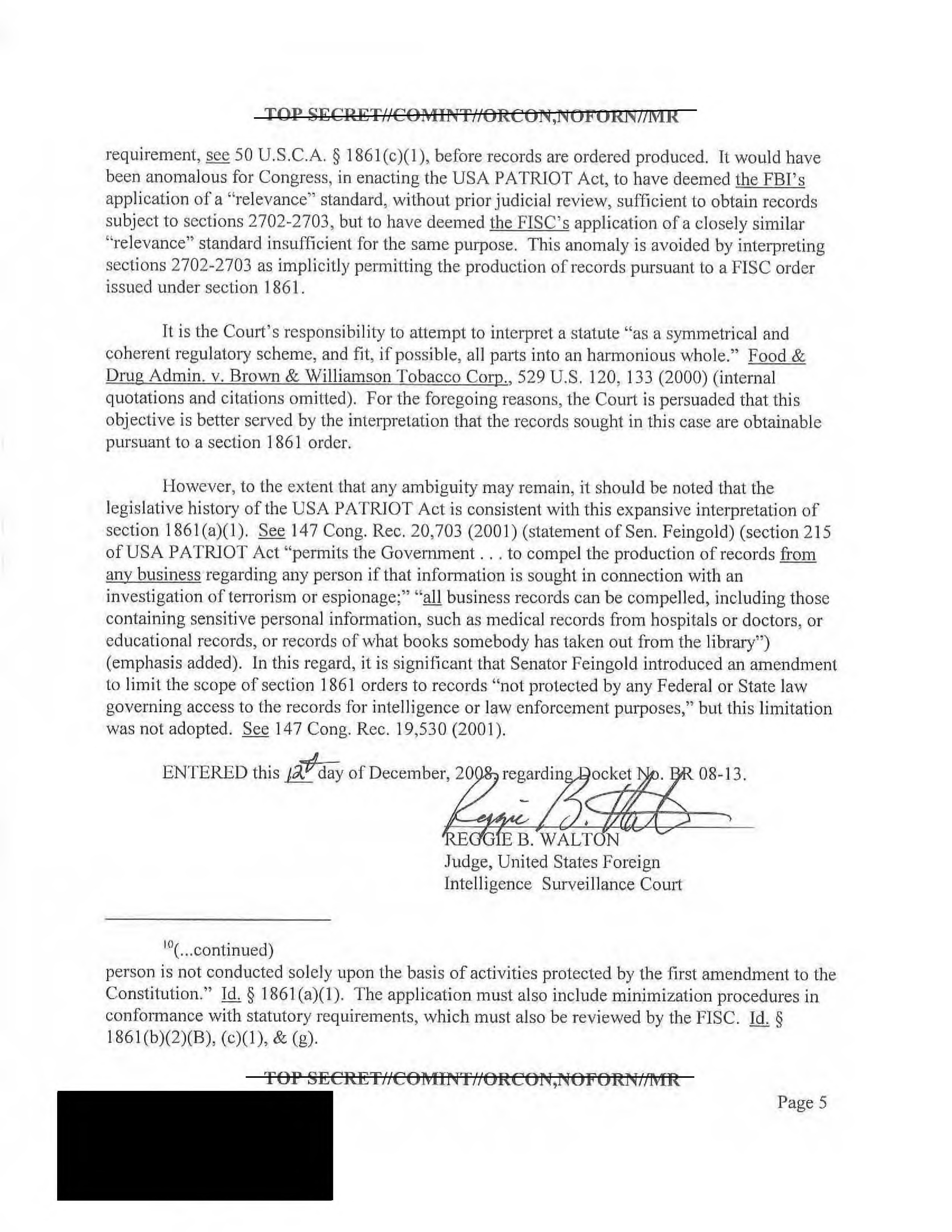
requirement, see 50 U.S.C.A. § 1861(c)(1), before records are ordered produced. It would have
been anomalous for Congress, in enacting the USA PATRIOT Act, to have deemed the FBI's
application of a "relevance" standard, without prior judicial review, sufficient to obtain records
subject to sections 2702-2703, but to have deemed the FISC's application of a closely similar
"relevance" standard insufficient for the same purpose. This anomaly is avoided by interpreting
sections 2702-2703 as implicitly permitting the production of records pursuant to a FISC order
issued under section 1861.
It is the Court's responsibility to attempt to interpret a statute "as a symmetrical and
coherent regulatory scheme, and fit, if possible, all parts into an harmonious whole." _Food &
Drug Admin. v. Brown & Williamson Tobacco Corp._, 529 U.S. 120, 133 (2000) (internal
quotations and citations omitted). For the foregoing reasons, the Court is persuaded that this
objective is better served by the interpretation that the records sought in this case are obtainable
pursuant to a section 1861 order.
However, to the extent that any ambiguity may remain, it should be noted that the
legislative history of the USA PATRIOT Act is consistent with this expansive interpretation of
section 1861(a)(1). See 147 Cong. Rec. 20,703 (2001) (statement of Sen. Feingold) (section 215
of USA PATRIOT Act "permits the Government... to compel the production of records from
any business regarding any person if that information is sought in connection with an
investigation of terrorism or espionage;" "all business records can be compelled, including those
containing sensitive personal information, such as medical records from hospitals or doctors, or
educational records, or records of what books somebody has taken out from the library")
(emphasis added). In this regard, it is significant that Senator Feingold introduced an amendment
to limit the scope of section 1861 orders to records "not protected by any Federal or State law
governing access to the records for intelligence or law enforcement purposes," but this limitation
was not adopted. See 147 Cong. Rec. 19,530 (2001).
ENTERED this 12ᵗʰ day of December, 2008, regarding Docket No. BR 08-13.
REGGIE B. WALTON
Judge, United States Foreign
Intelligence Surveillance Court
¹⁰(...continued)
person is not conducted solely upon the basis of activities protected by the first amendment to the
Constitution." Id. § 1861(a)(1). The application must also include minimization procedures in
conformance with statutory requirements, which must also be reviewed by the FISC. Id. §
1861(b)(2)(B), (c)(1), & (g).
TOP SECRET//COMINT//ORCON,NOFORN//MR-
Page 5
[REDACTED]
Related Documents
-
Supplemental Opinion and Order from the Foreign Intelligence Surveillance Court FOIA [pdf]
Supplemental Opinion and Order of the FISC reiterating Court ordered restrictions on NSA’s handling of query results of the telephony metadata program, and directing the Government to provide the court with additional information regarding queries of the telephony metadata. ACLU/EFF FOIA Litigation.
People: Walton, Reggie B.ACLU,EFF ↗ (2013-09-10) -
Motion of the American Civil Liberties Union, the American Civil Liberties Union of the Nation's Capital, and the Media Freedom and Information Clinic for the Release of Court Records, In re Opinions & Orders of this Court Addressing Bulk Collection of Data Under the Foreign Intelligence Surveillance Act, No. Misc. 13-08 (FISA Ct. Nov. 7, 2013). FOIA [pdf]
-
-
-