FISC Opinion Granting Government Application Pursuant to Section 402
Open PDFDocument date: -
Type: FOIA
Pages: 87
Classification: TOP SECRET HCS COMINT
Dissemination: NOFORN
A FISC opinion granting the government’s application seeking collection of metadata pursuant to Section 402 of FISA. ACLU/EFF FOIA Litigation.
My notes
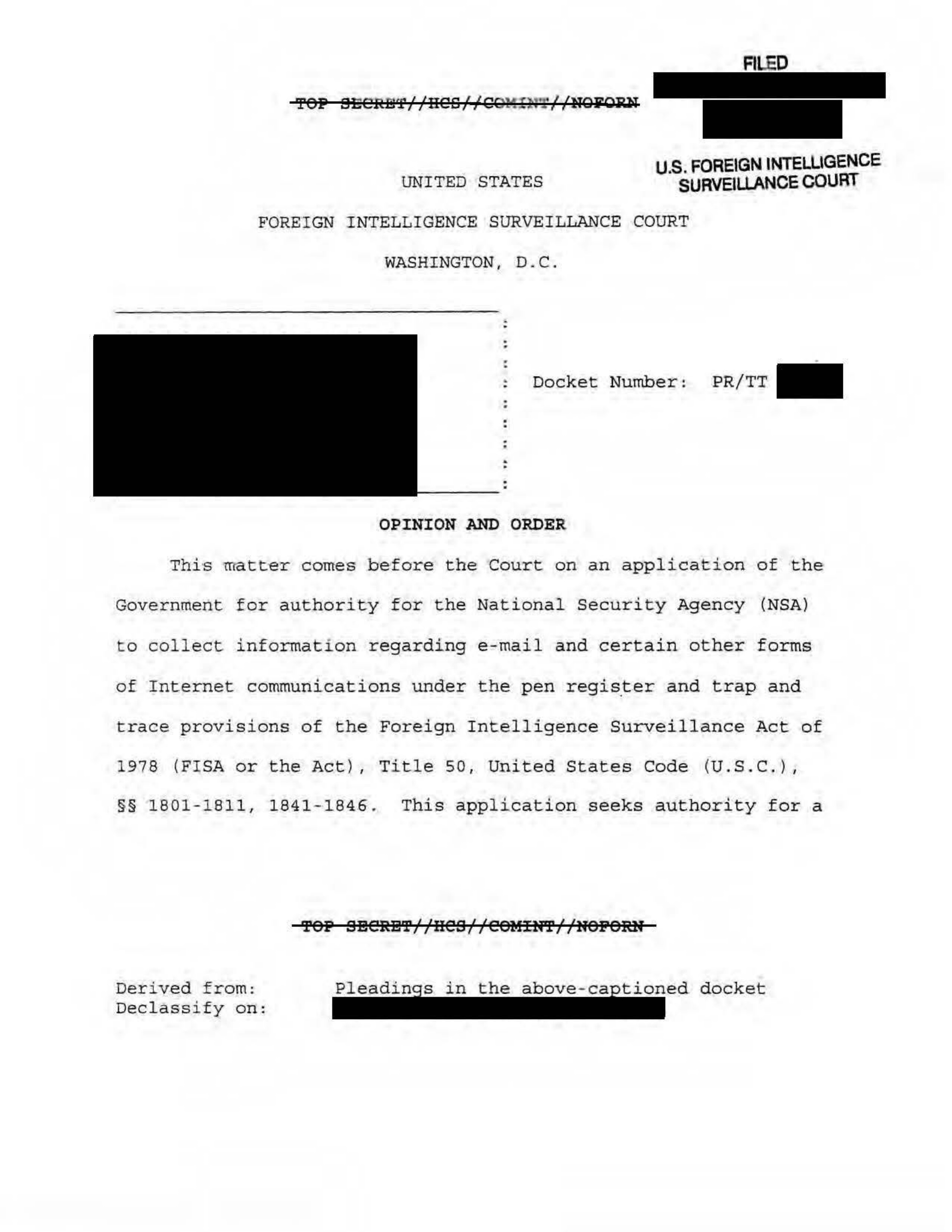








TOP SECRET//HCS//COMINT//NOFORN
FILED
UNITED STATES
U.S. FOREIGN INTELLIGENCE
SURVEILLANCE COURT
FOREIGN INTELLIGENCE SURVEILLANCE COURT
WASHINGTON, D.C.
[REDACTED]
Docket Number: PR/TT [REDACTED]
OPINION AND ORDER
This matter comes before the Court on an application of the
Government for authority for the National Security Agency (NSA)
to collect information regarding e-mail and certain other forms
of Internet communications under the pen register and trap and
trace provisions of the Foreign Intelligence Surveillance Act of
1978 (FISA or the Act), Title 50, United States Code (U.S.C.),
§§ 1801-1811, 1841-1846. This application seeks authority for a
TOP SECRET//HCS//COMINT//NOFORN
Derived from: Pleadings in the above-captioned docket
Declassify on: [REDACTED]
TOP SECRET//HCS//COMINT//NOFORN
much broader type of collection than other pen register/trap and
trace applications and therefore presents issues of first
impression.¹ For that reason, it is appropriate to explain why
the Court concludes that the application should be granted as
modified herein.
Accordingly, this Opinion and Order sets out the bases for
the Court's findings that: (1) the collection activities
proposed in the application involve the installation and use of
"pen registers" and/or "trap and trace devices" as those terms
are used in FISA, 50 U.S.C. §§ 1841-1846; (2) the application,
which specifies restrictions on the retention, accessing, use,
and dissemination of information obtained from these collection
activities, "satisfies the requirements" of 50 U.S.C. § 1842 for
the issuance of an order "approving the installation and use of a
pen register or trap and trace device," id. § 1842(d) (1), subject
to modifications stated herein;² and (3) the installation and use
of these pen registers and/or trap and trace devices pursuant to
¹ The application was filed in two steps: an application
filed on [REDACTED] followed by an addendum filed on [REDACTED]
For ease of reference, the following discussion refers to
both submissions collectively as the application.
² The Court has authority in this case to "enter an ex
parte order as requested, or as modified." 50 U.S.C.
§ 1842 (d) (1).
TOP SECRET//HCS//COMINT//NOFORN
2
TOP SECRET//HCS//COMINT//NOFORN
this Opinion and Order will comply with the First and Fourth
Amendments.
In making these findings, the Court relies on factual
representations made in the application, which was submitted by
the Attorney General as applicant and verified by the Director of
the NSA (DIRNSA); in the separate declaration of the DIRNSA
(Attachment A to the application); and in the declaration of the
[REDACTED] (Attachment B to the
application). The Court has given careful consideration to the
arguments presented in the Government's memorandum of law and
fact (Attachment C to the application).
By letter dated [REDACTED] the Court directed the
Government to respond to two questions necessary to its ruling on
this application. The Court relies on the Government's responses
to these questions, which were provided in a letter submitted on
[REDACTED]
The Court also relies on information and arguments presented
in a briefing to the Court on [REDACTED] which addressed the
current and near-term threats posed by [REDACTED]
³ One of these questions concerned First Amendment issues
presented by the application. The other concerned the length of
time that the Government expected the collected information to
retain operational significance. These questions and the
Government's responses are discussed more fully below.
TOP SECRET//HCS//COMINT//NOFORN
3
TOP SECRET//HCS//COMINT//NOFORN
[REDACTED] investigations conducted by the Federal Bureau of
Investigation (FBI) to counter those threats, the proposed
collection activities of the NSA (now described in the instant
application), the expected analytical value of information so
collected in efforts to identify and track operatives [REDACTED]
and the legal bases for conducting these
collection activities under FISA's pen register/trap and trace
provisions.⁴
The principal statutory issues in this matter are whether
the proposed collection constitutes the installation and use of
"pen registers" and/or "trap and trace devices" and, if so,
whether the certification pursuant to 50 U.S.C. § 1842(c)(2) is
adequate. These issues are addressed below.
I. THE PROPOSED COLLECTION IS A FORM OF PEN REGISTER AND
TRAP AND TRACE SURVEILLANCE.
For purposes of 50 U.S.C. §§ 1841-1846, FISA adopts the
definitions of "pen register" and "trap and trace device" set out
⁴ This briefing was attended by (among others) the Attorney
General, [REDACTED] the DIRNSA; the Director of the FBI; the
Counsel to the President; the Assistant Attorney General for the
Office of Legal Counsel; the Director of the Terrorist Threat
Integration Center (TTIC); and the Counsel for Intelligence
Policy.
TOP SECRET//HCS//COMINT//NOFORN
4
TOP SECRET//HCS//COMINT//NOFORN
in 18 U.S.C. § 3127. See 50 U.S.C. § 1841(2). Section 3127
gives the following definitions:
(3) the term "pen register" means a device or process
which records or decodes dialing, routing, addressing,
or signaling information transmitted by an instrument
or facility from which a wire or electronic
communication is transmitted, provided, however, that
such information shall not include the contents of any
communication, but such term does not include any
device or process used by a provider or customer of a
wire or electronic communication service for billing,
or recording as an incident to billing, for
communications services by such provider or any device
or process used by a provider or customer of a wire
communication service for cost accounting or other like
purposes in the ordinary course of business;
(4) the term "trap and trace device" means a device or
process which captures the incoming electronic or other
impulses which identify the originating number or other
dialing, routing, addressing, and signaling information
reasonably likely to identify the source of a wire or
electronic communication, provided, however, that such
information shall not include the contents of any
communication.
These definitions employ three other terms - "electronic
communication," "wire communication," and "contents" - that are
themselves governed by statutory definitions "set forth for such
terms in section 2510" of title 18. 18 U.S.C. § 3127(1).
Section 2510 defines these terms as follows:
(1) "Electronic communication" is defined at 18 U.S.C.
§ 2510 (12) as "any transfer of signs, signals, writing, images,
sounds, data, or intelligence of any nature transmitted in whole
TOP SECRET//HCS//COMINT//NOFORN
5
TOP SECRET//HCS//COMINT//NOFORN
or in part by a wire, radio, electromagnetic, photoelectronic or
photooptical system that affects interstate or foreign commerce,
but does not include - (A) any wire or oral communication."⁵
(2) "Wire communication" is defined at 18 U.S.C. § 2510(1)
as
any aural transfer made in whole or in part through the
use of facilities for the transmission of
communications by the aid of wire, cable, or other like
connection between the point of origin and the point of
reception . . . furnished or operated by any person
engaged in providing or operating such facilities for
the transmission of interstate or foreign
communications or communications affecting interstate
or foreign commerce.
(3) "Contents" is defined at 18 U.S.C. § 2510 (8) to
"include[] any information concerning the substance, purport, or
meaning" of a "wire, oral, or electronic communication."⁶
While the definitions of "pen register" and "trap and trace
device" each contain several elements, the application of these
⁵ The other exclusions to this definition at § 2510 (12) (B) -
(D) are not relevant to this case.
⁶ Different definitions of "wire communication" and
"contents" are provided at 50 U.S.C. § 1801(1), (n). However,
the definitions set forth in § 1801 apply to terms "[a]s used in
this subchapter," i.e., in 50 U.S.C. §§ 1801-1811 (FISA
subchapter on electronic surveillance), and thus have no bearing
on the meaning of "wire communication" and "contents" as used in
the definitions of "pen register" and "trap and trace device"
applicable to §§ 1841-1846 (separate FISA subchapter on pen
registers and trap and trace devices).
TOP SECRET//HCS//COMINT//NOFORN
6
TOP SECRET//HCS//COMINT//NOFORN
definitions to the devices described in the application presents
two primary questions: (1) Does the information to be obtained
constitute "dialing, routing, addressing, or signaling
information" that does not include the "contents" of any
communication? (2) Does the means by which such information
would be obtained come within the definition of "pen register" or
"trap and trace device?" In addressing these questions, the
Court is mindful that "when the statute's language is plain, the
sole function of the courts - at least where the disposition
required by the text is not absurd - is to enforce it according
to its terms." Lamie v. United States Trustee, 124 S. Ct. 1023,
1030 (2004) (internal quotations and citations omitted).
A. The Information to Be Obtained Is "Dialing, Routing,
Addressing, or Signaling Information" and Not
"Contents."
The Government uses the umbrella term "meta data" to
designate the categories of information it proposes to collect.
This meta data comprises [REDACTED] categories:
[REDACTED]
TOP SECRET//HCS//COMINT//NOFORN
7
TOP SECRET//HCS//COMINT//NOFORN
[REDACTED]
TOP SECRET//HCS//COMINT//NOFORN
8
TOP SECRET//HCS//COMINT//NOFORN
[REDACTED]
[REDACTED]
TOP SECRET//HCS//COMINT//NOFORN
9
TOP SECRET//HCS//COMINT//NOFORN
Also, the address from which
an e-mail was sent and [REDACTED]
are not part of the e-mail's "contents."
⁸ This is the first application presented to this Court for
authority to [REDACTED] under pen register/trap and trace
authority. The Court understands that FBI devices implementing
prior pen register/trap and trace surveillance authorized by this
Court have not obtained [REDACTED] See Memorandum of Law
and Fact at 23-24 n.14. The fact that prior applications did not
seek authority for this specific form of collection sheds no
light on the merits of the instant application.
TOP SECRET//HCE//COMINT//NOFORN
10
TOP SECRET//HCS//COMINT//NOPORN
but this isolated fact does not provide "information
concerning the substance, purport, or meaning" of the e-mail. 18
U.S.C. § 2510(8).⁹
The DIRNSA Declaration mentions other types of information
that are not described in the application as forms of meta data
to be collected.¹⁰ The Court understands such references to
pertain to information or inferences that could be gleaned from
accumulating meta data in Categories [REDACTED] above and/or
analyzing meta data, perhaps in conjunction with information from
other sources. This Opinion and Order authorizes only the
collection of information in Categories [REDACTED]
⁹ The finding that the [REDACTED] meta data do not
constitute "content" is also supported by the assurance that meta
data "does not include information from either the 'subject' or
're' line of the E-mail [REDACTED] DIRNSA Declaration at 3 n.1.
¹⁰ These references in the DIRNSA Declaration include
[REDACTED] at 12, and information said to
pertain to elements of [REDACTED]
TOP SECRET//HCO//COMINT//NOFORN
11
TOP SECRET//HCS//COMINT//NOFORN
B. The Methods By Which NSA Proposes to Obtain This
Information Involve the Use of "Pen Registers" and
"Trap and Trace Devices."
NSA proposes to obtain meta data in the above-described
Categories [REDACTED]
[REDACTED]
TOP SECRET//HCS//COMINT//NOFORN
12
TOP SECRET//HCS//COMINT//NOFORN-
[REDACTED]
Because the application of the definitions of "pen register"
and "trap and trace device" to this means of collection involves
a similar analysis for meta data in Categories [REDACTED], these
groups of information are discussed separately below.
- The Methods of Collecting Categories [REDACTED]
Fall Within the Plain Meaning of the Statutory
Definitions.
The above-described means of collecting information in
Categories [REDACTED] satisfies each of the elements of the
applicable statutory definition of a "pen register." It consists
of "a device or process which records or decodes" non-content
routing or addressing information "transmitted by an instrument
or facility from which a wire or electronic communication is
transmitted." 18 U.S.C. § 3127(3).
[REDACTED]
¹¹ "Transmit" means "1. To convey or dispatch from one
person, thing, or place to another. . . . 4. Electron. To send
(a signal), as by wire or radio." Webster's II New College
Dictionary 1171 (2001).
TOP SECRET//HCS//COMINT//NOFORN
13
TOP SECRET//HCS//COMINT//NOFORN
[REDACTED]
Finally, the proposed collection does not involve "any device or
process used . . . for billing, or recording as an incident to
billing, for communications services . . . or . . . for cost
accounting or other like purposes," which is excluded from the
definition of "pen register" under section 3127(3).
Accordingly, based on "the language employed by Congress and
the assumption that the ordinary meaning of that language
accurately expresses the legislative purpose," Engine Mfrs. Ass'n
v. South Coast Air Quality Mgmt. Dist., 124 S. Ct. 1756, 1761
(2004) (internal quotations and citation omitted), the Court
concludes that the means by which the NSA proposes to collect
¹² For ease of reference, this Opinion and Order generally
speaks of "electronic communications." The communication
involved will usually be an "electronic communication" under the
above-quoted definition at 18 U.S.C. § 2510(12). In the event
that the communication consists of an "aural transfer," i.e., "a
transfer containing the human voice at any point between and
including the point of origin and the point of reception," id.
§ 2510(1), then it could fall instead under the above-quoted
definition of "wire communication" at § 2510(1). In either case,
the communication would be "a wire or electronic communication,"
as required to fall within the definitions at §§ 3127(3) and
3127(4).
TOP SECRET//HCS//COMINT//NOFORN
14
TOP SECRET//HCS//COMINT//NOFORN
meta data in Categories [REDACTED] above falls under the
definition of "pen register" at section 3127(3).
The application also seeks authority to collect at least
some of the same meta data by the same means under the rubric of
a "trap and trace device" as defined at section 3127 (4).
Although it appears to the Court that all of the collection
authorized herein comes within the definition of "pen register,"
the Court additionally finds that such collection, as it pertains
to meta data in Categories [REDACTED]
(for example, information from the "from" line of
an e-mail), also satisfies the definition of "trap and trace
device" under section 3127(4).
Under section 3127(4), a "trap and trace device" is "a
device or process which captures the incoming electronic or other
impulses which identify the originating number or other [non-
content] dialing, routing, addressing, and signaling information
reasonably likely to identify the source of a wire or electronic
communication." As discussed above, the proposed collection
would use a device or process to obtain non-content meta data
[REDACTED]
TOP SECRET//HCC//COMINT//NOFORN
15
TOP SECRET//HCS//COMINT//NOFORN
[REDACTED]
Thus, based on the plain meaning of
¹³ "Capture" is defined as, inter alia, " . . . 3. To
succeed in preserving in a permanent form." Webster's II New
College Dictionary 166 (2001).
[REDACTED]
Such a result could be argued to violate the "cardinal principle
of statutory construction that we must give effect, if possible,
to every clause and word of a statute." Williams v. Taylor, 529
U.S. 362, 404 (2000) (internal quotations and citation omitted).
[REDACTED]
-TOP SECRET//HCS//COMINT//NOFORN
16
TOP SECRET//HCS//COMINT//NOFORN
the applicable definitions, the proposed collection involves a
form of both pen register and trap and trace surveillance.
[REDACTED]
TOP SECRET//HCS//COMINT//NOFORN
17
TOP SECRET//HCS//COMINT//NOFORN
[REDACTED]
The Court
accordingly finds that the plain meaning of sections 3127 (3) and
3127(4) encompasses the proposed collection of meta data.
Alternatively, the Court finds that any ambiguity on this
point should be resolved in favor of including this proposed
collection within these definitions, since such an interpretation
would promote the purpose of Congress in enacting and amending
FISA regarding the acquisition of non-content addressing
information. Congress amended FISA in 1998, and again in 2001,
TOP SECRET//HCS//COMINT//NOFORN
18
TOP SECRET//HCS//COMINT//NOFORN
to relax the requirements for Court-authorized surveillance to
obtain non-content addressing information through pen register
and trap-and-trace devices, recognizing that such information is
not protected by the Fourth Amendment. See page 29 below. As
part of the USA PATRIOT Act in 2001, Congress also amended FISA
to provide for Court orders for the production of "any tangible
things," such as business records, under the same relevance
standard as was adopted for pen register/trap and trace
authorizations. See Pub. L. No. 107-56, Title II, § 215, 115
Stat. 290, codified at 50 U.S.C. § 1861.
[REDACTED] like other forms of meta data, is not protected
by the Fourth Amendment because users of e-mail do not have a
reasonable expectation of privacy in such information. See pages
59-62 below. It is a form of non-content addressing information,
which Congress has determined should receive a limited form of
statutory protection under a relevance standard if obtained
through pen register/trap and trace devices pursuant to 50 U.S.C.
§ 1842, and/or through compelled production of business records
(e.g., toll records for long-distance phone calls) under 50
U.S.C. § 1861.
A narrow reading of the definitions of "pen register" and
"trap-and-trace device" to exclude [REDACTED] would
TOP SECRET//HCS//COMINT//NOFORN
19
TOP SECRET//HCS//COMINT//NOFORN
remove this particular type of non-content addressing information
from the statutory framework that Congress specifically created
for it. Based on such a narrow interpretation, this information
could not be collected through pen register/trap and trace
surveillance, even where it unquestionably satisfies the
relevance standard. Nor could this information be obtained under
the business records provision, because it is not generally
retained by communications service providers. See page 41 below.
There is no indication that Congress believed that the
availability of non-content addressing information under the
relevance standard should hinge on the technical means of
collection. If anything, the legislative history, see 147 Cong.
Rec. S11000 (daily ed. Oct. 25, 2001) (statement of Sen. Patrick
Leahy) (supporting clarification of "the statute's proper
application to tracing communications in an electronic
environment . . . in a manner that is technology neutral"), and
the adoption of an identical relevance standard for the
production of business records and other tangible things under
section 1861, suggest otherwise.
Accordingly, the Court alternatively finds that, if the
application of sections 3127(3) and 3127(4) to the [REDACTED]
were thought to be ambiguous, such
TOP SECRET//HCS//COMINT//NOFORN
20
TOP SECRET//HCS//COMINT//NOFORN
ambiguity should be resolved in favor of an interpretation of the
definitions of "pen register" and "trap and trace device" that
encompasses the proposed collection.
- The Proposed Collection is Consistent With Other
Provisions of FISA
Nothing that is fairly implied by other provisions of FISA
governing pen register and trap and trace surveillance would
prevent authorization of the proposed collection as a form of pen
register/trap and trace surveillance. One provision requires
that an order authorizing a pen register or trap and trace
surveillance specify "the identity, if known, of the person to
whom is leased or in whose name is listed the telephone line or
other facility to which the pen register or trap and trace device
is to be attached or applied." 50 U.S.C. § 1842(d)(2)(A)(ii).
Plainly, there is no requirement to state the identity of such a
person if it is not "known." However, this provision might still
be read to imply that Congress expected that such facilities
would be leased or listed to some particular person, even if the
identity of that person were unknown in some cases. However,
even if Congress had such a general expectation, the language of
the statute does not require that there be such a person for
every facility to which a pen register or trap and trace device
is to be attached or applied. Drawing the contrary conclusion
TOP SECRET//HCS//COMINT//NOFORN
21
TOP SECRET//HCS//COMINT//NOFORN
from the wording of § 1842(d)(2)(A)(ii) would make the
applicability of the statute depend on the commercial or
administrative practices of particular communications service
providers - a result that here would serve no apparent purpose of
Congress. Cf. Smith v. Maryland, 442 U.S. 735, 745 (1979)
(finding that the "fortuity of whether or not the phone company
elects to make [for its own commercial purposes] a quasi-
permanent record of a particular number dialed" is irrelevant to
whether the Fourth Amendment applies to use of a pen register).¹⁶
In this case [REDACTED]
[REDACTED]
¹⁶ Similarly, for purposes of the subchapter on pen
register/trap and trace surveillance, FISA defines an "aggrieved
person" in relevant part, as any person "whose communication
instrument or device was subject to the use of a pen register or
trap and trace device . . . to capture incoming electronic or
other communications impulses." 50 U.S.C. § 1841(3)(B). The
term "whose" suggests a relationship between some person and "a
communication instrument or device" that was "subject to the use
of a pen register or trap and trace device." [REDACTED] indeed, the use of
different language implies that these phrases can refer to
different objects, so that the definition of "aggrieved person"
sheds no light on whether a "facility" under § 1842(d)(2)(A)(ii)-
(iii) is necessarily associated with an individual user.
TOP SECRET//HCS//COMINT//NOFORN
22
TOP-SECRET//HCS//COMINT//NOFORN
[REDACTED]
The
Court is satisfied that this Opinion and Order complies with the
specification requirements of § 1842 (d) (2) (A).
The Court recognizes that, by concluding that these
definitions do not restrict the use of pen registers and trap and
trace devices to communication facilities associated with
individual users, it is finding that these definitions encompass
an exceptionally broad form of collection. Perhaps the opposite
result would have been appropriate under prior statutory
language.¹⁷ However, our "starting point" must be "the existing
¹⁷ Prior to amendments in 2001 by the USA PATRIOT Act,
Public Law 107-56, Title II, § 216(c), 18 U.S.C. § 3127(3)
defined "pen register" as "a device which records or decodes
electronic or other impulses which identify the numbers dialed or
otherwise transmitted on the telephone line to which such device
is attached," and § 3127(4) defined "trap and trace device" as a
"device which captures the incoming electronic or other impulses
which identify the originating number of an instrument or device
from which a wire or electronic communication was transmitted."
18 U.S.C.A. § 3127(3), (4) (2000). Despite this textual focus
on telephone communications, especially in § 3127(3), many
(though not all) courts expansively construed both definitions to
apply as well to e-mail communications. Memorandum of Law and
Facc at 25-26 & 1.16; Orin S. Kerr, Internet Surveillance Law
(continued...)
TOP SECRET//HCS//COMINT//NOFORN
23
TOP SECRET//HCS//COMINT//NOFORN
statutory text," not "predecessor statutes,” Lamie, 124 S. Ct. at
1030, and analysis of that text shows that collecting information
in Categories [REDACTED] above by the means described in the
application involves use of "pen registers" and "trap and trace
devices."¹⁸
Of course, merely finding that the proposed collection falls
within these definitions does not mean that the requirements for
an order authorizing such collection have been met. We turn now
to those requirements.
¹⁷(...continued)
After the USA PATRIOT Act: The Big Brother That Isn't, 97 Nw. U.
L. Rev. 607, 633-36 (2003). Extending these prior definitions to
bulk collection regarding e-mail communications would have
required further departure from the pre-USA PATRIOT Act statutory
language.
¹⁸ The legislative history of the USA PATRIOT Act indicates
that Congress sought to make the definitions of "pen register"
and "trap and trace device" "technology neutral" by confirming
that they apply to Internet communications. See footnote 45
below. It does not suggest that Congress specifically gave
thought to whether the new definitions would encompass collection
in bulk from communications facilities that are not associated
with individual users. The silence of the legislative history on
this point provides no basis for departing from the plain meaning
of the current definitions. See Sedima, S.P.R.L. v. Imrex Co.,
473 U.S. 479, 495 n.13 (1985).
TOP SECRET//HCS//COMINT//NOFORN
24
TOP SECRET//HCS//COMINT//NOFORN
II. THE STATUTORY REQUIREMENTS FOR ISSUING AN ORDER
AUTHORIZING THE PROPOSED PEN REGISTER AND TRAP AND
TRACE SURVEILLANCE HAVE BEEN MET.
Under FISA's pen register/trap and trace provisions:
Notwithstanding any other provision of law, the
Attorney General . . . may make an application for an
order . . . authorizing or approving the installation
and use of a pen register or trap and trace device for
any investigation to obtain foreign intelligence
information not concerning a United States person or to
protect against international terrorism . . . provided
that such investigation of a United States person is
not conducted solely upon the basis of activities
protected by the first amendment to the Constitution
which is being conducted by the (FBI) under such
guidelines as the Attorney General approves pursuant to
Executive Order No. 12333, or a successor order.
50 U.S.C. § 1842(a) (1). This authority "is in addition to the
authority . . . to conduct . . . electronic surveillance" under
§§ 1801-1811. Id. § 1842(a) (2).
Such applications shall include, inter alia,
a certification by the applicant that the information
likely to be obtained is foreign intelligence
information not concerning a United States person or is
relevant to an ongoing investigation to protect against
international terrorism . . . provided that such
investigation of a United States person is not
conducted solely on the basis of activities protected
by the first amendment to the Constitution.
Id. § 1842 (c) (2). "Upon an application made pursuant to this
section, the judge shall enter an ex parte order as requested, or
as modified, approving the installation and use of a pen register
TOP SECRET//HCS//COMINT//NOFORN
25
TOP SECRET//HCS//COMINT//NOFORN
or trap and trace device if the judge finds that the application
satisfies the requirements of [§ 1842]." Id. § 1842(d)(1).
Obviously, the application has been made by the Attorney
General, § 1842(a)(1), has been approved by the Attorney General,
§ 1842(c), and has been submitted in writing and under oath to a
judge of this Court. § 1842(b)(1). The application, at 5,
identifies the DIRNSA as "the Federal officer seeking to use the
pen register or trap and trace device." § 1842(c)(1).
The application also contains a certification by the
Attorney General, at 26, containing the language specified in
§ 1842(c)(2). The Government argues that FISA prohibits the
Court from engaging in any substantive review of this
certification. In the Government's view, the Court's exclusive
function regarding this certification would be to verify that it
contains the words required by § 1842(c)(2); the basis for a
properly worded certification would be of no judicial concern.
See Memorandum of Law and Fact at 28-34.
The Court has reviewed the Government's arguments and
authorities and does not find them persuasive.¹⁹ However, in
¹⁹ For example, the Government cites legislative history
that "Congress intended to 'authorize[] FISA judges to issue a
pen register or trap and trace order upon a certification that
the information sought is relevant to' an FBI investigation.
(continued...)
TOP SECRET//HCS//COMINT//NOFORN
26
TOP SECRET//HCS//COMINT//NOFORN
this case the Court need not, and does not, decide whether it
would be obliged to accept the applicant's certification without
any explanation of its basis. Arguing in the alternative, the
Government has provided a detailed explanation of 1) the threat
currently posed by [REDACTED] 2) the reason the
bulk collection described in the application is believed
necessary as a means for NSA [REDACTED]
3) how that information will contribute to FBI
investigations to protect against [REDACTED]
and 4) what safeguards will be observed to ensure that the
information collected will not be used for unrelated purposes or
¹⁹(...continued)
Memorandum of Law and Fact at 30 (quoting S. Rep. No. 105-185, at
27 (1998). However, authorizing the Court to issue an order when
a certification is made, and requiring it to do so without
resolving doubts about the correctness of the certification, are
quite different.
The Government also cites United States v. Hallmark, 911
F.2d 399 (10th Cir. 1990), in arguing that the Court should not
review the basis of the certification. However, the Hallmark
court reserved the analogous issue under Title 18 - "the precise
nature of the court's review under 18 U.S.C. § 3123" of the
relevancy certification in an application for a law enforcement
pen register or trap and trace device - and expressed "no opinion
as to whether the court may, for instance, inquire into the
government's factual basis for believing the pen register or trap
and trace information to be relevant to a criminal
investigation." Id. at 402 n.3.
TOP SECRET//HES//COMINT//NOFORN-
27
TOP SECRET//HCS//COMINT//NOFORN
otherwise misused. The Government also provides legal arguments
that, under these specific circumstances, the proposed collection
satisfies the relevancy requirement of § 1842(c)(2), despite its
resulting in the collection of meta data from an enormous volume
of communications, the large majority of which will be unrelated
to international terrorism. In view of this record, the Court
will assume for purposes of this case that it may and should
consider the basis of the certification under § 1842(c)(2).
Nonetheless, the Court is mindful that FISA does not require
any finding of probable cause in order for pen register and trap
and trace surveillance to be authorized. In this regard, the
statutory provisions that govern this case contrast sharply with
those that apply to other forms of electronic surveillance and
physical search.²⁰ Before Congress amended FISA in 1998 to add
§§ 1841-1846, this Court could authorize pen register and trap
and trace surveillance only upon the same findings as would be
required to authorize interception of the full contents of
²⁰ To issue an electronic surveillance order, the Court
must find "probable cause to believe that . . . the target of the
electronic surveillance is a foreign power or an agent of a
foreign power" and "each of the facilities or places at which the
electronic surveillance is directed is being used, or is about to
be used, by a foreign power or an agent of a foreign power." 50
U.S.C. § 1805(a)(3). Similar probable cause findings are
required for warrants authorizing physical search under id.
§ 1824(a)(3).
TOP SECRET//HCS//COMINT//NOFORN
28
TOP SECRET//HCS//COMINT//NOFORN
communications. See S. Rep. 105-185, at 27 (1998) When it
originally enacted §§ 1841-1846 in 1998, Congress recognized that
pen register and trap and trace information is not protected by
the Fourth Amendment and concluded that a lower standard for
authorization "was necessary in order to permit, as is the case
in criminal investigations, the use of this very valuable
investigative tool at the critical early stages of foreign
intelligence and international terrorism investigations." Id.
These 1998 provisions included a form of a "reasonable suspicion"
standard for pen register/trap and trace authorizations.²¹ As
part of the USA PATRIOT Act in 2001, Congress lowered the
standard again, to the current requirement of relevance.²² Given
this history, it is obvious that Congress intended pen register
²¹ Under the provisions enacted in 1998, a pen register or
trap and trace application had to include "information which
demonstrates that there is reason to believe" that a
communication facility "has been or is about to be used in
communication with," inter alia, "an individual who is engaging
or has engaged in international terrorism or clandestine
intelligence activities." Public Law 105-272 § 601(2).
²² The legislative history of the USA PATRIOT Act reflects
that, "in practice," the standard passed in 1998 was "almost as
burdensome as the requirement to show probable cause required
for more intrusive techniques" and that the FBI "made a clear
case that a relevance standard is appropriate for
counterintelligence and counterterrorism investigations." 147
Cong. Rec. S11003 (daily ed. Oct. 25, 2001) (statement of Sen.
Leahy).
TOP SECRET//HCS//COMINT//NOFORN
29
TOP SECRET//HCS//COMINT//NOFORN
and trap and trace authorizations to be more readily available
than authorizations for electronic surveillance to acquire the
full contents of communications.
The Court also recognizes that, for reasons of both
constitutional authority and practical competence, deference
should be given to the fully considered judgment of the executive
branch in assessing and responding to national security threats²³
and in determining the potential significance of intelligence-
related information.²⁴ Such deference is particularly
²³ See, e.g., Reno v. American-Arab Anti-Discrimination
Comm., 525 U.S. 471, 491 (1999) ("a court would be ill equipped
to determine [the] authenticity and utterly unable to assess
[the] adequacy of the executive's security or foreign policy
reasons for treating certain foreign nationals as "a special
threat"); Regan v. Wald, 468 U.S. 222, 243 (1984) (giving "the
traditional deference to executive judgment" in foreign affairs
in sustaining President's decision to restrict travel to Cuba
against a Due Process Clause challenge); cf. Department of Navy
v. Egan, 484 U.S. 518, 529 (1988) (outside body reviewing
executive branch decisions on eligibility for security clearances
could not "determine what constitutes an acceptable margin of
error in assessing the potential risk").
²⁴ The Supreme Court has observed that, in deciding whether
disclosing particular information might compromise an
intelligence source, what "may seem trivial to the uninformed,
may appear of great moment to one who has a broad view of the
scene and may put the questioned item of information in its
proper context." CIA v. Sims, 471 U.S. 159, 178 (1985) (internal
quotation and citation omitted). Accordingly, the decisions of
[REDACTED] "who must of course be familiar with the whole
picture, as judges are not, are worthy of great deference given
the magnitude of the national security interests and potential
(continued...)
TOP SECRET//HCS//COMINT//NOFORN
30
TOP SECRET//HCC//COMINT//NOFORM
appropriate in this context, where the Court is not charged with
making independent probable cause findings.
A. The Government Has Provided Information In Support of
the Certification of Relevance.
In support of the certification of relevance, the Government
relies on the following facts and circumstances:
- The Threat Currently Posed [REDACTED]
[REDACTED]
²⁴(...continued)
risks at stake." Id. at 179.
²⁵ For simplicity, this opinion standardizes the variant
spellings of foreign names appearing in different documents
submitted in support of the application.
TOP SECRET//HCS//COMINT//NOFORN
31
TOP SECRET//HCS//COMINT//NOFORN
[REDACTED]
TOP SECRET//HCS//COMINT//NOFORN
32
TOP SECRET//HCS//COMINT//NOFORN
[REDACTED]
- FBI Investigations to Track and Identify [REDACTED]
in the United States
[REDACTED]
TOP SECRET//HCS//COMINT//NOFORN
33
TOP SECRET//HCS//COMINT//NOFORN
[REDACTED]
- The Use of the Internet by [REDACTED]
[REDACTED]
TOP SECRET//HCS//COMINT//NOFORN
34
TOP SECRET//HCS//COMINT//NOFORN
[REDACTED]
- The Scope of the Proposed Collection of Meta Data
In an effort both to identify unknown and to track known
operatives [REDACTED] through their Internet
communications, NSA seeks to acquire meta data, as described
above, from all e-mail [REDACTED]
are described in detail in the application and
the DIRNSA Declaration. In brief, they are:
[REDACTED]
²⁷ For ease of reference, the term [REDACTED] is
used to mean [REDACTED]
TOP SECRET//HCS//COMINT//NOFORN
35
TOP SECRET//HCS//COMINT//NOFORN
[REDACTED]
TOP SECRET//HCS//COMINT//NOFORN
36
TOP SECRET//HCS//COMINT//NOFORN
[REDACTED]
TOP SECRET//HCS//COMINT//NOFORN
37
TOP SECRET//HCS//COMINT//NOFORN
[REDACTED]
TOP SECRET//HCS//COMINT//NOFORN
38
TOP SECRET//HCS//COMINT//NOFORN
[REDACTED]
The raw volume of the proposed collection is enormous. NSA
estimates that this collection will encompass [REDACTED]
In absolute
terms, the proposed surveillance “will result in the collection
of meta data pertaining to [REDACTED] electronic communications,
including meta data pertaining to communications of United States
persons located within the United States who are not the subject
of any FBI investigation." Application at 4. Some proportion of
these communications - less than half, but still a huge number in
absolute terms - can be expected to be communications [REDACTED]
TOP SECRET//HCS//COMINT//NOFORN
39
TOP SECRET//HCS//COMINT//NOFORN
[REDACTED]
who bear no relation to [REDACTED]
- How NSA Proposes to Use this Data to Track Known
[REDACTED]
As noted above, the purpose of this collection is to track
known operatives and to identify unknown operatives of [REDACTED]
through their Internet communications. NSA
²⁹ As noted above, collection of meta data from [REDACTED]
[REDACTED]
TOP SECRET//HCS//COMINT//NOFORN
40
TOP SECRET//HCS//COMINT//NOFORN
[REDACTED]
states that even identified operatives [REDACTED]
[REDACTED]
Through the proposed bulk collection, NSA would acquire an
archive of meta data for large volumes of communications that, in
NSA's estimation, represent a relatively rich environment for
finding [REDACTED] communications through later analysis.³¹
³¹ See DIRNSA Declaration at 5 [REDACTED]
TOP SECRET//HCS//COMINT//NOFORN
41
TOP SECRET//HCS//COMINT//NOFORN
[REDACTED]
NSA asserts that more precisely targeted forms of collection
against known accounts would tend to screen out the "unknowns"
that NSA wants to discover, so that NSA needs bulk collection in
order to identify unknown [REDACTED] communications. See
id. at 14 ("It is not possible . . . to target collection solely
to known terrorist E-mail accounts and at the same time use the
advantages of meta data analysis to discover the enemy."). 15
("To be able to fully exploit meta data, the data must be
collected in bulk. Analysts know that terrorists' E-mails are
located somewhere in the billions of data bits; what they cannot
know ahead of time is exactly where.")
NSA proposes to employ two analytic methods on the body of
archived meta data it seeks to collect. Both these methods
involve querying the archived meta data regarding a particular
"seed" account. In the Government's proposal, an account would
qualify as a seed account only if NSA concludes, "based on the
factual and practical considerations of everyday life on which
reasonable and prudent persons act, there are facts giving rise to
a reasonable articulable suspicion that a particular known e-
mail address is associated with [REDACTED]
[REDACTED]
TOP SECRET//HCS//COMINT//NOFORN
42
TOP SECRET//HCS//COMINT//NOFORN
[REDACTED]
Application at 19-20; accord DIRNSA
Declaration at 19. The two methods are:
(1) Contact chaining. NSA will use computer algorithms to
identify within the archived meta data all e-mail [REDACTED]
accounts that have been in contact with
the seed account, as well as all accounts that have been in
contact with an account within the first tier of accounts that
had direct contact with the seed account, and [REDACTED]
DIRNSA Declaration
at 15-16.
[REDACTED]
TOP SECRET//HCS//COMINT//NOFORN
43
TOP SECRET//HCS//COMINT//NOFORN-
An example may illustrate the claimed benefits of bulk
collection and subsequent analysis of meta data.
[REDACTED]
Without an archive of meta data, the Government could
target prospective collection on that account, but information
about past use would be unavailable.
[REDACTED]
³²
However, if an archive of meta data were available, NSA
could use the newly discovered account as a "seed" account.
Accounts previously in contact with the "seed" account could be
identified and further investigation could be pursued to
determine if the users of those accounts are [REDACTED]
³² Assuming that applicable legal requirements could be
met, the Government also could collect the full contents of
future messages by electronic surveillance of the account and of
stored prior messages by physical search of the account.
However, [REDACTED] could thwart these forms of collection also.
TOP SECRET//HOS//COMINT//NOFORN
44
TOP SECRET//HCS//COMINT//NOFORN
[REDACTED]
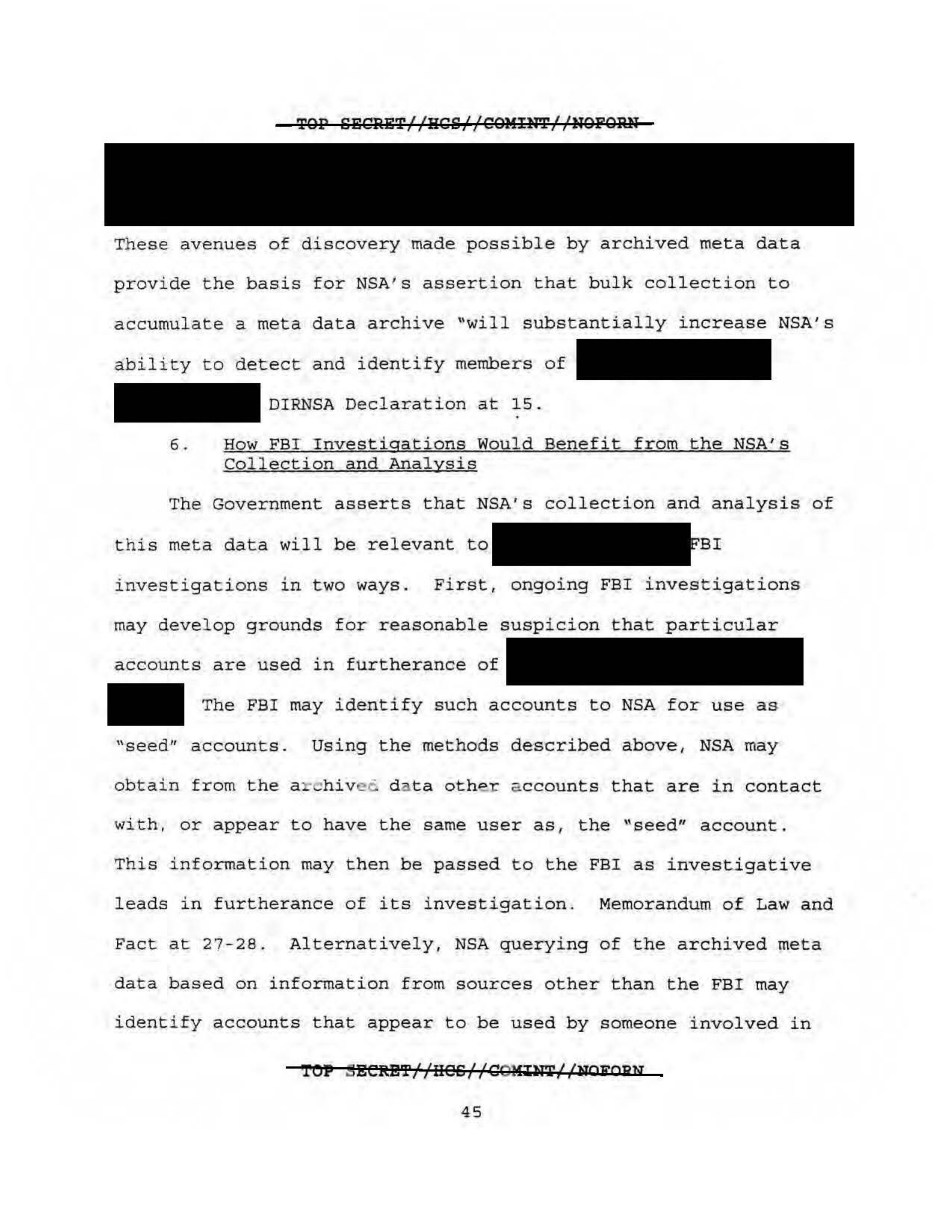
These avenues of discovery made possible by archived meta data
provide the basis for NSA's assertion that bulk collection to
accumulate a meta data archive "will substantially increase NSA's
ability to detect and identify members of [REDACTED]
DIRNSA Declaration at 15.
- How FBI Investigations Would Benefit from the NSA's
Collection and Analysis
The Government asserts that NSA's collection and analysis of
this meta data will be relevant to [REDACTED] FBI
investigations in two ways. First, ongoing FBI investigations
may develop grounds for reasonable suspicion that particular
accounts are used in furtherance of [REDACTED]
The FBI may identify such accounts to NSA for use as
"seed" accounts. Using the methods described above, NSA may
obtain from the archived data other accounts that are in contact
with, or appear to have the same user as, the "seed" account.
This information may then be passed to the FBI as investigative
leads in furtherance of its investigation. Memorandum of Law and
Fact at 27-28. Alternatively, NSA querying of the archived meta
data based on information from sources other than the FBI may
identify accounts that appear to be used by someone involved in
TOP SECRET//HCS//COMINT//NOFORN
45
TOP SECRET//HCS//COMINT//NOFORN
[REDACTED]
activities. If such accounts are relevant to
FBI investigative responsibilities - for example, if it appears
that their users are in the United States - then NSA will provide
information to the FBI, which may prove relevant to ongoing FBI
investigations or provide the predicate for new investigations of
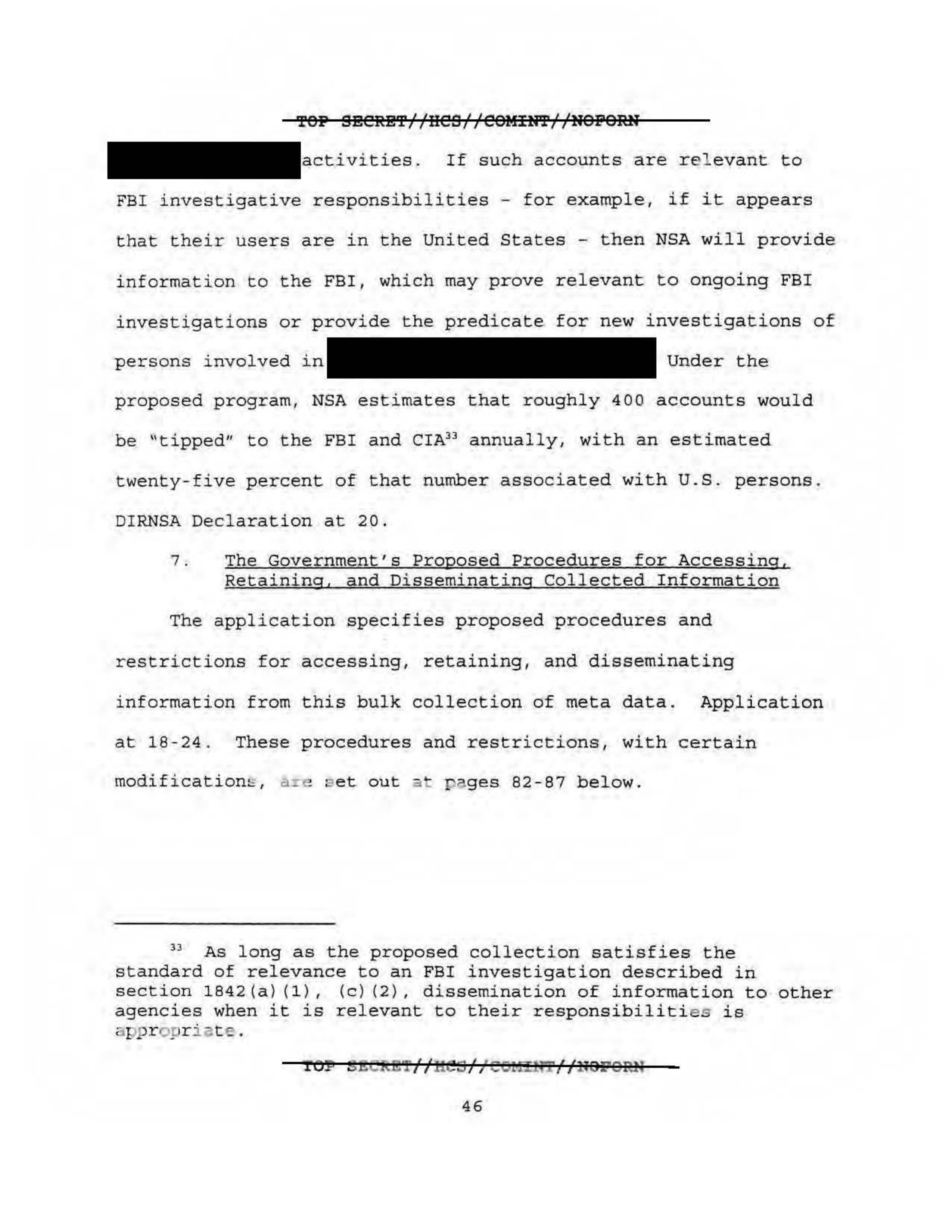
persons involved in [REDACTED] Under the
proposed program, NSA estimates that roughly 400 accounts would
be "tipped" to the FBI and CIA" annually, with an estimated
twenty-five percent of that number associated with U.S. persons.
DIRNSA Declaration at 20.
- The Government's Proposed Procedures for Accessing,
Retaining, and Disseminating Collected Information
The application specifies proposed procedures and
restrictions for accessing, retaining, and disseminating
information from this bulk collection of meta data. Application
at 18-24. These procedures and restrictions, with certain
modifications, are set out at pages 82-87 below.
³³ As long as the proposed collection satisfies the
standard of relevance to an FBI investigation described in
section 1842(a)(1), (c)(2), dissemination of information to other
agencies when it is relevant to their responsibilities is
appropriate.
TOP SECRET//HCS//COMINT//NOFORN
46
TOP SECRET//HCS//COMINT//NOFORN
[REDACTED]
B. The Information To Be Obtained Is Likely to be Relevant
to Ongoing FBI Investigations to Protect Against
International Terrorism.
As shown above, the application and supporting materials
demonstrate that the FBI has numerous pending investigations on
[REDACTED] subjects and that a major challenge faced by the
FBI is the identification of [REDACTED] within the
United States. [REDACTED]
The
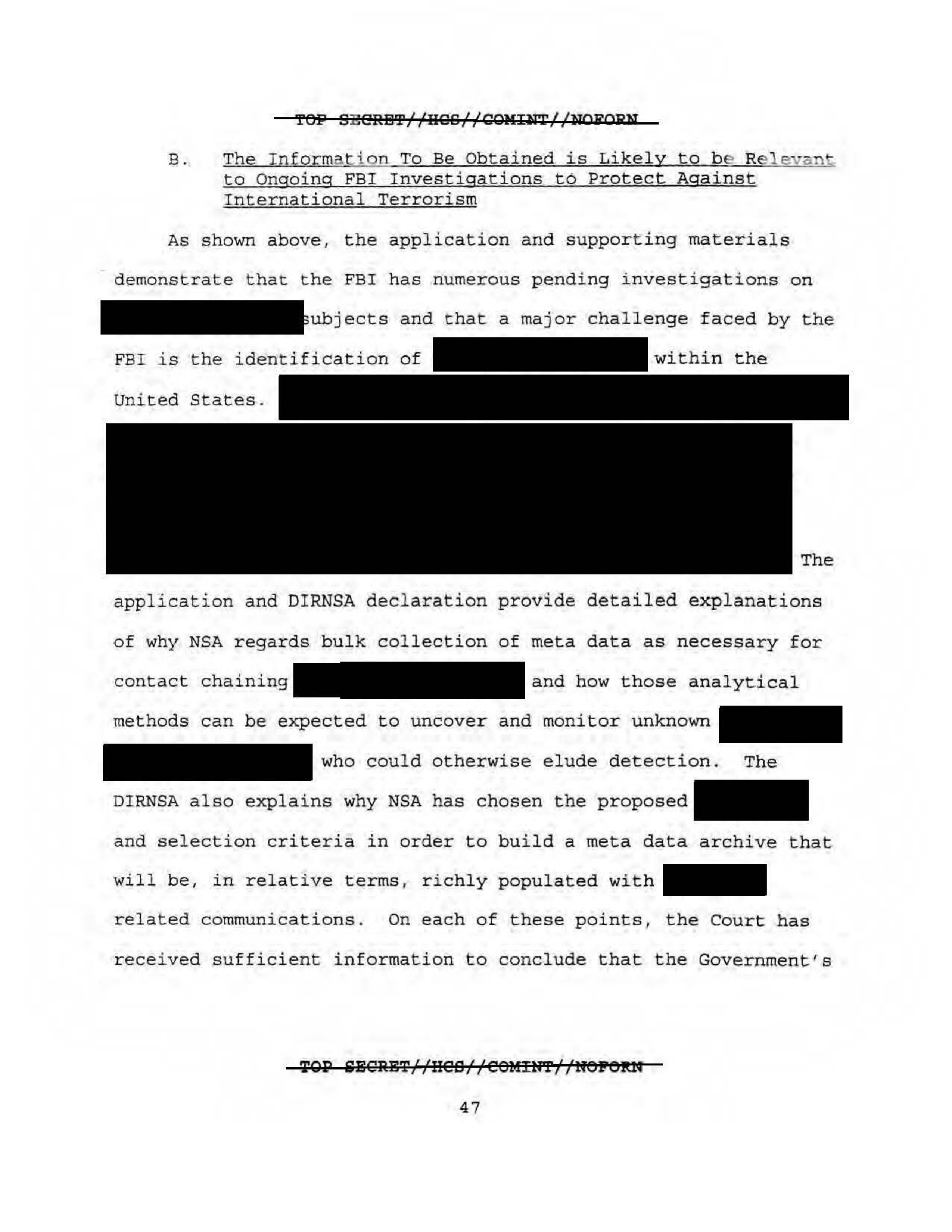
application and DIRNSA declaration provide detailed explanations
of why NSA regards bulk collection of meta data as necessary for
contact chaining [REDACTED] and how those analytical
methods can be expected to uncover and monitor unknown [REDACTED]
who could otherwise elude detection. The
DIRNSA also explains why NSA has chosen the proposed [REDACTED]
and selection criteria in order to build a meta data archive that
will be, in relative terms, richly populated with [REDACTED]
related communications. On each of these points, the Court has
received sufficient information to conclude that the Government's
TOP SECRET//HCS//COMINT//NOFORN
47
TOP SECRET//HCS//COMINT//NOFORN
assessments are fully considered and plausibly grounded in facts
submitted to the Court.
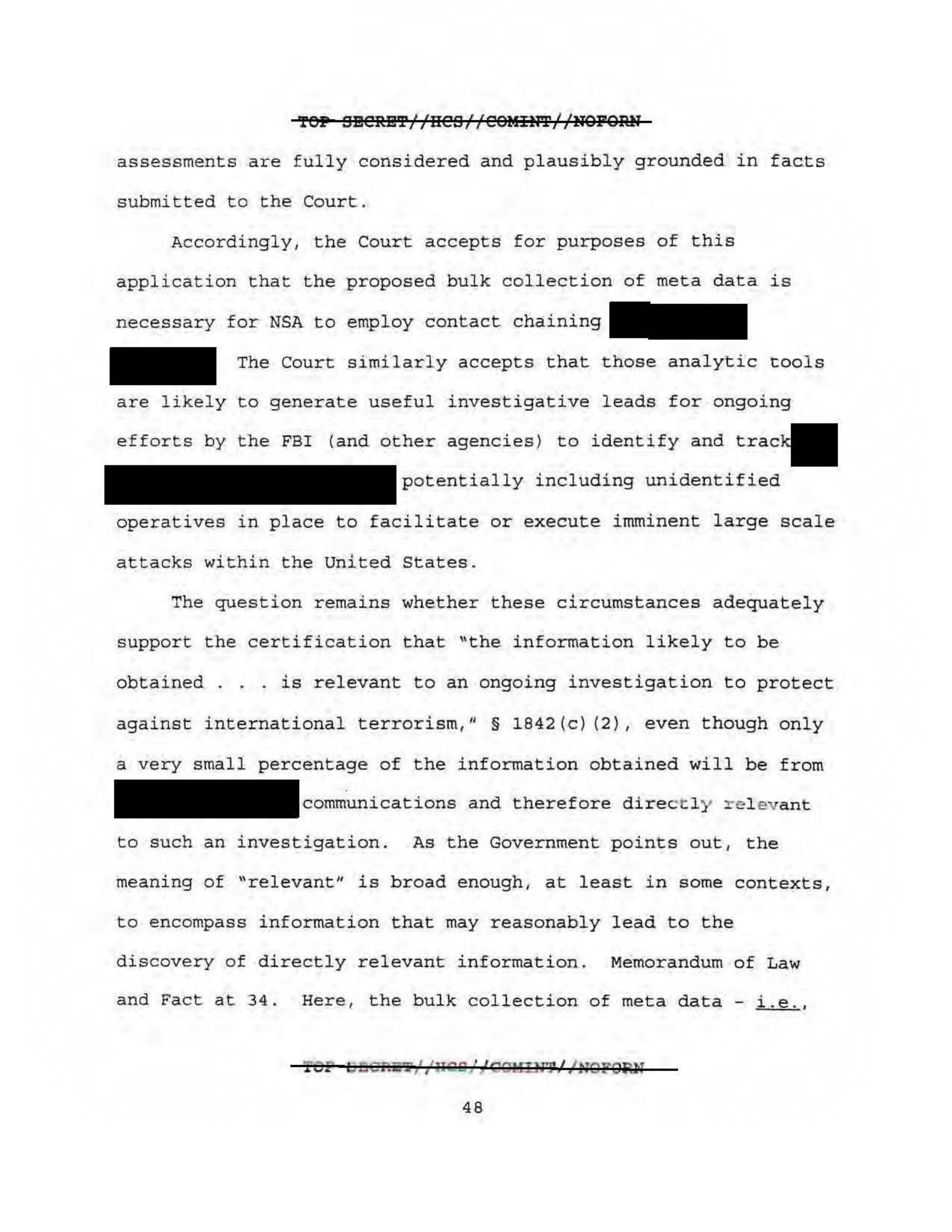
Accordingly, the Court accepts for purposes of this
application that the proposed bulk collection of meta data is
necessary for NSA to employ contact chaining [REDACTED]
The Court similarly accepts that those analytic tools
are likely to generate useful investigative leads for ongoing
efforts by the FBI (and other agencies) to identify and track
[REDACTED] potentially unidentifed
operatives in place to facilitate or execute imminent large scale
attacks within the United States.
The question remains whether these circumstances adequately
support the certification that "the information likely to be
obtained . . . is relevant to an ongoing investigation to protect
against international terrorism," § 1842(c)(2), even though only
a very small percentage of the information obtained will be from
[REDACTED] communications and therefore directly relevant
to such an investigation. As the Government points out, the
meaning of "relevant" is broad enough, at least in some contexts,
to encompass information that may reasonably lead to the
discovery of directly relevant information. Memorandum of Law
and Fact at 34. Here, the bulk collection of meta data - i.e.,
[REDACTED]
TOP SECRET//HCS//COMINT//NOFORN
48
TOP SECRET//HCS//COMINT//NOFORN
the collection of both a huge volume and high percentage of
unrelated communications - is necessary to identify the much
smaller number of [REDACTED] communications.
The Court is persuaded that, in the circumstances of this
case, the scope of the proposed collection is consistent with the
certification of relevance.³⁴ In so finding, the Court concludes
that, under the circumstances of this case, the applicable
relevance standard does not require a statistical "tight fit"
between the volume of proposed collection and the much smaller
proportion of information that will be directly relevant to
[REDACTED]
³⁴ The Government analogizes this case to ones in which the
Court has authorized overbroad electronic surveillance under 50
U.S.C. §§ 1801-1811. Memorandum of Law and Fact and Law at 42-43.
The Court has authorized the latter form of collection where it is
not technologically possible to acquire [REDACTED]
The two
situations are similar in that they both involve collection of an
unusually large volume of non-foreign intelligence information as
a necessary means of obtaining the desired foreign intelligence
information. Yet there are also important differences between
these cases. An overbroad electronic surveillance under 50
U.S.C. §§ 1801-1811 requires probable cause to believe that the
target is an agent of a foreign power and uses the particular
facility at which surveillance will be directed. § 1805(a)(3). In
this case under 50 U.S.C. §§ 1841-1846, no probable cause
findings are required, and the bulk collection is justified as
necessary to discover unknown [REDACTED] persons and
facilities, rather than to acquire communications to and from
identified agents of a foreign power. Because of these
differences, the authorization of bulk collection under §§ 1841-
1846 should not be taken as precedent for similar collection of
the full contents of communications under §§ 1801-1811.
TOP SECRET//HCS//COMINT//NOFORN
49
TOP SECRET//HCS//COMINT//NOFORN-
FBI investigations. In reaching this conclusion,
the Court finds instructive Supreme Court precedents on when a
search that is not predicated on individualized suspicion may
nonetheless be reasonable under the Fourth Amendment. See
Memorandum of Law and Fact at 43-48.³⁵
The Supreme Court has recognized a "longstanding principle
that neither a warrant nor probable cause, nor, indeed, any
measure of individualized suspicion, is an indispensable
component of reasonableness in every circumstance." National
Treasury Employees Union v. Von Raab, 489 U.S. 656, 665 (1989);
accord, e.g., Board of Educ. of Indep. School Dist. No. 92 of
Pottawatomie County v. Earls, 536 U.S. 822, 829 (2002); United
States v. Martinez-Fuerte, 428 U.S. 543, 560-61 (1976).
Specifically, the Court has held that, "where a Fourth Amendment
intrusion serves special governmental needs, beyond the normal
need for law enforcement, it is necessary to balance the
individual's privacy expectations against the Government's
³⁵ For the reasons explained below at pages 59-66, the
Court finds that there is no privacy interest protected by the
Fourth Amendment in the meta data to be collected. Nevertheless,
the Court agrees with the Government's suggestion that the
balancing methodology used to assess the reasonableness of a
Fourth Amendment search or seizure is helpful in applying the
relevance standard to this case. Memorandum of Law and Fact at
43.
TOP SECRET//HCS//COMENT//NOFORN
50
TOP SECRET//HCS//COMINT//NOFORN
interests to determine whether it is impractical to require a
warrant or individualized suspicion in the particular context."
Von Raab, 489 U.S. at 665-66; accord, e.g., Earls, 536 U.S. at
829.
This balancing analysis considers "the nature of the privacy
interest allegedly compromised" and "the character of the
intrusion" upon that interest. Earls, 536 U.S. at 830, 832. The
privacy interest in the instant meta data is not of a stature
protected by the Fourth Amendment. See pages 59-66 below.
Moreover, the nature of the intrusion is mitigated by the
restrictions on accessing and disseminating this information,
under which only a small percentage of the data collected will be
seen by any person. Cf. Earls, 536 U.S. at 833 (finding that
restrictions on access to drug-testing information lessen the
testing program's intrusion on privacy).
The assessment of reasonableness under the Fourth Amendment
also considers "the nature and immediacy of the government's
concerns and the efficacy of the [program] in meeting them." Id.
at 834. In this case, the Government's concern is to identify
and track [REDACTED] operatives, and ultimately to thwart
terrorist attacks. This concern clearly involves national
TOP SECRET//HCS//COMINT//NOFORN
51
TOP SECRET//HCS//COMINT//NOFORN
security interests beyond the normal need for law enforcement³⁶
and is at least as compelling as other governmental interests
that have been held to justify searches in the absence of
individualized suspicion. See, e.g., Earls (drug testing of
secondary school students engaged in extracurricular activities);
Michigan Dep't of State Police v. Sitz, 496 U.S. 444 (1990)
(highway checkpoints to identify drunk drivers); Von Raab (drug
testing of Customs Service employees applying for promotion to
sensitive positions); Skinner v. Railway Labor Executives' Ass'n,
489 U.S. 602 (1989) (drug and alcohol testing of railroad
workers).³⁷ The Government's interest here has even greater
"immediacy" in view of the above-described intelligence reporting
and assessment regarding ongoing plans for large scale attacks
within the United States.
As to efficacy under the Fourth Amendment analysis, the
Government need not make a showing that it is using the least
intrusive means available. Earls, 536 U.S. at 837; Martinez-
³⁶ See In Re Sealed Case, 310 F.3d 717, 744-46 (Foreign
Int. Surv. Ct. Rev. 2002) (per curiam) (discussing the prevention
of terrorist attacks as a special need beyond ordinary law
enforcement).
³⁷ Moreover, the Government's need in this case could be
analogized to the interest in discovering or preventing danger
from "latent or hidden conditions," which may justify
suspicionless searches. See, e.g., Von Raab, 489 U.S. at 668.
TOP SECRET//RES//COMINT//NOFORN
52
TOP SECRET//HCS//COMINT//NOFORN
Fuerte, 428 U.S. at 556-57 n.12. Rather, the question is whether
the Government has chosen "a reasonably effective means of
addressing" the need. Earls, 536 U.S. at 837. In structuring a
program involving suspicionless search or seizure, e.g., in
positioning roadblocks at certain points, "the choice among . . .
reasonable alternatives remains with the governmental officials
who have a unique understanding of, and a responsibility for,
limited public resources." Sitz, 496 U.S. at 453-54; see also
Martinez-Fuerte, 428 U.S. at 566 ("deference is to be given to
the administrative decisions of higher ranking officials"). A
low percentage of positive outcomes among the total number of
searches or seizures does not necessarily render a program
ineffective.³⁸
In this case, senior responsible officials, whose judgment
on these matters is entitled to deference, see pages 30-31 above,
have articulated why they believe that bulk collection and
archiving of meta data are necessary to identify and monitor
[REDACTED] operatives whose Internet communications would
³⁸ See Sitz, 496 U.S. at 454 ("detention of the 126
vehicles that entered the checkpoint resulted in the arrest of
two drunken drivers"); Martinez-Fuerte, 428 U.S. at 546 & n.1,
554 (checkpoint near border to detect illegal migrants: out of
"roughly 146,000 vehicles" temporarily "'seized,"' 171 were found
to contain deportable aliens).
TOP SECRET//HCS//COMINT//NOFORN
53
TOP SECRET//HCS//COMINT//NOFORN
otherwise go undetected in the huge streams of [REDACTED]
These officials have also explained why they
seek to collect meta data [REDACTED] identified in the
application. Based on these
explanations, the proposed collection appears to be a reasonably
effective means to this end.
In summary, the bulk collection proposed in this case is
analogous to suspicionless searches or seizures that have been
upheld under the Fourth Amendment in that the Government's need
is compelling and immediate, the intrusion on individual privacy
interests is limited, and bulk collection appears to be a
reasonably effective means of detecting and monitoring [REDACTED]
related operatives and thereby obtaining information likely to be
[REDACTED] to ongoing FBI investigations. In these circumstances,
the certification of relevance is consistent with the fact that
only a very small proportion of the huge volume of information
collected will be directly relevant to the FBI'S [REDACTED]
investigations.
³⁹ Cf. Martinez-Fuerte, 428 U.S. at 557 (requiring
reasonable suspicion for stops at highway checkpoints "on major
routes . . . would be impractical because the flow of traffic
tends to be too heavy to allow the particularized study of a
given car").
TOF SECRET//MCG//COMINT//NOFORN
54
TOP SECRET//HCS//COMINT//NOFORN
C. The Pertinent FBI Investigations of U.S. Persons Are
Not Conducted Solely Upon the Basis of First Amendment
Activities.
When the information likely to be obtained concerns a U.S.
person, § 1842(c)(2) requires a certification that the "ongoing
investigation . . . of a United States person is not conducted
solely upon the basis of activities protected by the first
amendment to the Constitution." The certification in this case
states that the pertinent investigation is not being conducted on
such a basis. Application at 26. The application refers to
numerous FBI National Security investigations "being conducted
under guidelines approved by the Attorney General pursuant to
Executive Order No. 12,333."⁴⁰ Id. at 6.
Those investigations are being conducted on the basis
of activities of [REDACTED] and unknown
affiliates in the United States and abroad, and to the
extent these subjects of investigation are United
States persons, not solely on the basis of activities
that are protected by the First Amendment to the
Constitution.
Id.
Thus, the certification and application contain the proper
assurance that the relevant investigations of U.S. persons are
⁴⁰ § 1842(a)(1) permits the filing of applications for
installation and use of pen register and trap and trace devices
to obtain information relevant to certain investigations "under
such guidelines as the Attorney General approves pursuant to
Executive Order No. 12333, or a successor order."
TOP SECRET//HCC//COMINT//NOFORN
55
TOP SECRET//HCS//COMINT//NOFORN
not being conducted solely on the basis of activities protected
by the First Amendment. However, the unusual breadth of this
collection and its relation to the pertinent FBI investigations
calls for further attention to this issue. In the usual case,
the FBI conducts pen register and trap and trace surveillance of
a particular communications facility (e.g., a phone number or e-
mail address) because it carries communications of a person who
is the subject of an FBI investigation. The required
certification typically varies depending on whether the subject
is a U.S. person: if not, the certification will state, in the
language of § 1842(c)(2), that the information likely to be
obtained "is foreign intelligence information not concerning a
United States person;" if the subject is a U.S. person, the
certification will state that such information is "relevant to an
ongoing investigation to protect against international terrorism
. . . provided that such investigation of a United States person
is not conducted solely upon the basis of activities protected by
the first amendment to the Constitution." This usual practice
conforms to the clear statutory purpose that pen register/trap
and trace information about the communications of U.S. persons
will not be targeted for collection unless it is relevant to an
TOP SECRET//HCS//COMINT//NOFORN
56
TOP SECRET//HCS//COMINT//NOFORN
investigation that is not solely based upon First Amendment
activities.
In this case, the initial acquisition of information is not
directed at facilities used by particular individuals of
investigative interest, but meta data concerning the
communications of such individuals' [REDACTED]
Here, the legislative purpose is best
effectuated at the querying stage, since it will be at a point
that an analyst queries the archived data that information
concerning particular individuals will first be compiled and
reviewed. Accordingly, the Court orders that NSA apply the
following modification of its proposed criterion for querying the
archived data: [REDACTED] will qualify as a seed
[REDACTED] only if NSA concludes, based on the factual
and practical considerations of everyday life on which reasonable
and prudent persons act, there are facts giving rise to a
reasonable articulable suspicion that a particular known [REDACTED]
is associated with [REDACTED]
provided, however, that an [REDACTED] believed to be used by a U.S. person
shall not be regarded as associated with [REDACTED]
solely on the basis of activities that are protected by the First
TOP SECRET//HCC//COMINT//NOFORN
57
TOP SECRET//HCS//COMINT//NOFORN
Amendment to the Constitution.⁴¹ For example, an e-mail account
used by a U.S. person could not be a seed account if the only
information thought to support the belief that the account is
associated with [REDACTED] is that, in sermons or in postings on a
web site, the U.S. person espoused jihadist rhetoric that fell
short of "advocacy . . . directed to inciting or producing
imminent lawless action and . . . likely to incite or produce
such action." Brandenburg v. Ohio, 395 U.S. 444, 447 (1969) (per
curiam).
III. THE PROPOSED COLLECTION AND HANDLING OF META DATA
DO NOT VIOLATE THE FIRST OR FOURTH AMENDMENTS.
Because this case presents a novel use of statutory
authorities for pen register/trap and trace surveillance, the
Court will also explain why it is satisfied that this
surveillance comports with the protections of the Fourth
Amendment and the First Amendment.
A. Fourth Amendment Issues
The foregoing analysis has observed at various points that
the Fourth Amendment does not apply to the proposed collection of
⁴¹ This modification will realize more fully the
Government's suggestion that "[t]he information actually viewed
by any human being . . . will be just as limited - and will be
based on the same targeted, individual standards - as in the case
of an ordinary pen register or trap and trace device." [REDACTED]
at 3. Government's Letter of [REDACTED]
TOP SECRET//HCS//COMINT//NOFORN
58
TOP SECRET//HCS//COMINT//NOFORN
meta data. See, e.g., pages 19, 50-51 above. This section
explains the basis for that conclusion.
First, as a general matter, there is no reasonable
expectation of privacy under the Fourth Amendment in the meta
data to be collected. This conclusion follows directly from the
reasoning of Smith v. Maryland, 442 U.S. 735 (1979), which
concerned the use of a pen register on a home telephone line. In
that case, the Supreme Court found that it was doubtful that
telephone users had a subjective expectation of privacy in the
numbers they dialed, id. at 742-43, and that in any case such an
expectation "is not one that society is prepared to recognize as
reasonable.'" Id. at 743 (quoting Katz v. United States, 389 U.S.
347, 361 (1967)). The Court "consistently has held that a person
has no legitimate expectation of privacy in information he
voluntarily turns over to third parties," since he "assume[s] the
risk" that the third party would reveal that information to the
government. Id. at 743-44.⁴² The Court found this principle
applicable to dialed phone numbers, regardless of the automated
means by which the call is placed and the "fortuity of whether or
⁴² This principle applies even if there is an understanding
that the third party will treat the information as confidential.
See SEC v. Jerry T. O'Brien, Inc., 467 U.S. 735, 743 (1984);
United States v. Miller, 425 U.S. 435, 443 (1976).
TOP SECRET//HES//COMINT//NOFORN-
59
TOP SECRET//HCS//COMINT//NOFORN
not the phone company in fact elects to make a quasi-permanent
record of a particular number dialed." Id. at 744-45.⁴³
The same analysis applies to the meta data involved in this
application. Users of e-mail [REDACTED] voluntarily
expose addressing information for
communications they send and receive to communications service
providers. Having done so, they lack any legitimate expectation
of privacy in such information for Fourth Amendment purposes.⁴⁴
Moreover, the relevant statutes put this form of pen
register/trap and trace surveillance on a par with pen
register/trap and trace surveillance of telephone calls, on the
⁴³ While Smith involved a pen register, its reasoning
equally applies to trap and trace devices that capture the
originating numbers of incoming calls. See, e.g., United States
v. Hallmark, 911 F.2d 399, 402 (10th Cir. 1990).
⁴⁴ Cf. Guest v. Leis, 255 F.3d 325, 335-36 (6th Cir. 2001)
(users of computer bulletin board service lacked reasonable
expectation of privacy in subscriber information that they
provided to systems operator); United States v. Kennedy, 81
F.Supp.2d 1103, 1110 (D. Kan. 2000) (no reasonable expectation of
privacy in subscriber information provided to ISP); United States
v. Hambrick, 55 F.Supp.2d 504, 508-09 (W.D. Va. 1999) (no
reasonable expectation of privacy in screen name and other
information provided to ISP), aff'd, 225 F.3d 656 (4th Cir. 2000)
(Table).
TOP SECRET//HCS//COMINT//NOFORN
60
TOP SECRET//HCS//COMINT//NOFORN
premise that neither form of surveillance involves a Fourth
Amendment search or seizure.⁴⁵
This conclusion is equally well-founded for the proposed
collection of [REDACTED] Nothing in the
Smith analysis depends on the fact that a telephone pen register
acquires addressing information for a call while it is being
placed, rather than from data [REDACTED]
Indeed, the controlling principle - that voluntary disclosure of
information to a third party vitiates any legitimate expectation
that the third party will not provide it to the government - has
been applied to records [REDACTED] See Jerry T.
O'Brien, Inc., 467 U.S. at 737-38, 743 (records of prior stock
⁴⁵ The USA PATRIOT Act amended 18 U.S.C. § 3127 to clarify
that its definitions of "pen register" and "trap and trace
device" applied to Internet communications. See Public Law 107-
56, Title II, § 216(c); 147 Cong. Rec. S11000 (daily ed. Oct. 25,
2001) (statement of Sen. Leahy) (noting that prior statutory
language was "ill-equipped" for Internet communications and
supporting clarification of "the statute's proper application to
tracing communications in an electronic environment . . . in a
manner that is technology neutral"). Authorization to install
such devices requires relevance to an investigation, but not any
showing of probable cause. See 18 U.S.C. § 3123(a)(1), (2)
(investigation conducted under guidelines approved under
Executive Order 12333); 50 U.S.C. § 1842(a)(1), (c)(2) [REDACTED]
TOP SECRET//HCS//COMINT//NOFORN
61
TOP SECRET//HCS//COMINT//NOFORN
trading); Miller, 425 U.S. at 436-38, 443 (checks, deposit slips,
and other bank records).⁴⁶
For these reasons, it is clear that, in ordinary
circumstances, pen register/trap and trace surveillance of
Internet communications does not involve a Fourth Amendment
search or seizure. However, since this application involves
unusually broad collection and distinctive modes of analyzing
information, the Court will explain why these special
circumstances do not alter its conclusion that no Fourth
Amendment search or seizure is involved.
First, regarding the breadth of the proposed surveillance,
it is noteworthy that the application of the Fourth Amendment
depends on the government's intruding into some individual's
reasonable expectation of privacy. Whether a large number of
persons are otherwise affected by the government's conduct is
irrelevant. Fourth Amendment rights "are personal in nature, and
cannot bestow vicarious protection on those who do not have a
reasonable expectation of privacy in the place to be searched."
[REDACTED]
TOP SECRET//HCS//COMINT//NOFORN
62
TOP SECRET//HCS//COMINT//NOFORN-
Steagald v. United States, 451 U.S. 204, 219 (1981); accord,
e.g., Rakas v. Illinois, 439 U.S. 128, 133 (1978) ("Fourth
Amendment rights are personal rights which . . . may not be
vicariously asserted.") (quoting Alderman v. United States, 394
U.S. 165, 174 (1969)). Since the Fourth Amendment bestows "a
personal right that must be invoked by an individual," a person
"claim[ing] the protection of the Fourth Amendment . . . must
demonstrate that he personally has an expectation of privacy in
the place searched, and that his expectation is reasonable."
Minnesota v. Carter, 525 U.S. 83, 88 (1998). So long as no
individual has a reasonable expectation of privacy in meta data,
the large number of persons whose communications will be
subjected to the proposed pen register/trap and trace
surveillance is irrelevant to the issue of whether a Fourth
Amendment search or seizure will occur.
Regarding the proposed analytical uses of the archived meta
data, it might be thought that [REDACTED] not
immediately available from conventional pen register/trap and
TOP SECRET//HCS//COMINT//NOFORN
63
TOP SECRET//HCS//COMINT//NOFORN
trace surveillance might itself implicate the Fourth Amendment.⁴⁷
However, that suggestion would be at odds with precedent that the
subsequent use of the results of a search cannot itself involve
an additional or continuing violation of the Fourth Amendment.
For example, in United States v. Calandra, 414 U.S. 338 (1974),
it was argued that each question before a grand jury "based on
evidence obtained from an illegal search and seizure constitutes
a fresh and independent violation of the witness' constitutional
rights," and that such questioning involved "an additional
intrusion" into the privacy of the witness "in violation of the
⁴⁷ The public disclosure of aggregated and compiled data
has been found to impinge on privacy interests protected under
the Freedom of Information Act (FOIA), even if the information
was previously available to the public in a scattered, less
accessible form. See United States Dept. of Justice v. Reporters
Comm. for Freedom of the Press, 489 U.S. 749 (1989) (FBI "rap
sheets," including public-record information on arrests and
disposition of criminal charges, qualified for "personal privacy"
exemption from disclosure under FOIA, 5 U.S.C. § 552(b)(7)(C));
but cf. Paul v. Davis, 424 U.S. 693, 712-13 (1976) (circulating a
flyer publicizing an arrest for shoplifting did not violate
constitutional right to privacy). In this case, because section
1842 authorizes the Attorney General to apply for pen
register/trap and trace authorities "[n]otwithstanding any other
provision of law," 50 U.S.C. § 1842(a)(1), and states that the
Court "shall enter an ex parte order . . . approving the
installation and use of a pen register or trap and trace device"
upon a finding "that the application satisfies the requirements
of [section 1842)," id. § 1842(d)(1), the Court has no need to
consider how other statutes, such as the Privacy Act, 5 U.S.C.
§ 552a, might apply to the proposed activities of the Government.
-TOP SECRET//HCS//COMINT//NOFORN
64
TOP SECRET//HCS//COMINT//NOFORN
Fourth Amendment." 414 U.S. at 353 & n.9 (internal quotations
omitted). The Court rejected this argument, explaining:
The purpose of the Fourth Amendment is to prevent
unreasonable governmental intrusions into the privacy
of one's person, house, papers, or effects. . . .
That wrong . . . is fully accomplished by the original
search without probable cause. Grand jury questions
based on evidence obtained thereby involve no
independent governmental invasion of one's person,
house, papers, or effects . . . . Questions based on
illegally obtained evidence are only a derivative use
of the product of a past unlawful search and seizure.
They work no new Fourth Amendment wrong.
414 U.S. at 354 (emphasis added); accord United States v.
Verdugo-Urquidez, 494 U.S. 259, 264 (1990); United States v.
Leon, 468 U.S. 897, 906 (1984); see also United States v.
Jacobsen, 466 U.S. 109, 117 (1984) ("Once frustration of the
original expectation of privacy occurs, the Fourth Amendment does
not prohibit governmental use of the now nonprivate
information.").
In this case, sophisticated analysis of archived meta data
may yield more information about a person's Internet
communications than what would at first be apparent.
Nevertheless, such analysis would, like the grand jury
questioning in Calandra, involve merely a derivative use of
information already obtained, rather than an independent
governmental invasion of matters protected by the Fourth
-TOP SECRET//HCS//COMINT//NOFORN
65
TOP SECRET//HCS//COMINT//NOFORN
Amendment. Accordingly, the Court finds that the proposed
collection and analysis does not involve a search or seizure
under the Fourth Amendment.
B. First Amendment Issues
By letter dated [REDACTED] the Court asked the
Government to address "the general First Amendment implications
of collecting and retaining this large volume of information that
is derived, in part, from the communications of U.S. persons."
In response, the Government acknowledges that surveillance that
acquires "the contents of communications might in some cases
implicate First Amendment interests, in particular the freedom of
association," Government's Letter of [REDACTED] at 1, but
denies or minimizes the First Amendment implications of
surveillance that only acquires non-content addressing
information.
The weight of authority supports the conclusion that
Government information-gathering that does not constitute a
Fourth Amendment search or seizure will also comply with the
First Amendment when conducted as part of a good-faith criminal
investigation. See Reporters Comm. for Freedom of the Press v.
AT&T, 593 F.2d 1030, 1051 (D.C. Cir. 1978) (First Amendment
protects activities "subject to the general and incidental
TOP SECRET//HCS//COMINT//NOFORN
66
TOP SECRET//HCS//COMINT//NOFORN
burdens that arise from good faith enforcement of otherwise valid
criminal and civil laws that are not themselves" directed at
First Amendment conduct; accordingly, subpoenas to produce
reporters' telephone toll records without prior notice did not
violate the First Amendment) (emphasis in original); United
States v. Aguilar, 883 F.2d 662, 705 (9th Cir. 1989) (use of
undercover informants "to infiltrate an organization engaged in
protected first amendment activities" must be part of
investigation "conducted in good faith; i.e., not for the purpose
of abridging first amendment freedoms"); United States v. Gering,
716 F.2d 615, 620 (9th Cir. 1983) (mail covers targeting minister
at residence and church upheld against First Amendment challenge
absent showing "that mail covers were improperly used and
burdened . . . free exercise or associational rights").
Conversely,
all investigative techniques are subject to abuse and
can conceivably be used to oppress citizens and groups,
rather than to further proper law enforcement goals.
In some cases, bad faith use of these techniques may
constitute an abridgment of the First Amendment rights
of the citizens at whom they are directed.
Reporters Comm., 593 F.2d at 1064.⁴⁸
⁴⁸ Part of Judge Wilkey's opinion in Reporters Comm.
categorically concludes that the First Amendment affords no
protections against government investigation beyond what is
(continued...)
TOP SECRET//HCS//COMINT//NOFORN
67
TOP SECRET//HCS//COMINT//NOFORN
Here, the proposed collection of meta data is not for
ordinary law enforcement purposes, but in furtherance of the
compelling national interest of identifying and tracking
[REDACTED] and ultimately of thwarting terrorist
attacks. The overarching investigative effort against [REDACTED]
is not aimed at curtailing First Amendment activities and
satisfies the "good faith" requirement described in the above-
cited cases. However, the extremely broad nature of this
collection carries with it a heightened risk that collected
information could be subject to various forms of misuse,
potentially involving abridgement of First Amendment rights of
innocent persons. For this reason, special restrictions on the
accessing, retention, and dissemination of such information are
necessary to guard against such misuse. See pages 82-87 below.
With such restrictions in place, the proposed collection of non-
⁴⁸(...continued)
provided by the Fourth and Fifth Amendments. Id. at 1053-60.
However, that part of the opinion was not joined by the other
judge in the majority, who opined that the result of First
Amendment analysis "may not always coincide with that attained by
application of Fourth Amendment doctrine." Id. at 1071 n.4
(Robinson, J.).
TOP SECRET//HCS//COMINT//NOFORN
68
TOP SECRET//HCS//COMINT//NOFORN
content addressing information does not violate the First
Amendment.⁴⁹
IV. TO ENSURE LAWFUL IMPLEMENTATION OF THIS SURVEILLANCE
AUTHORITY, NSA IS ORDERED TO COMPLY WITH THE PROPOSED
RESTRICTIONS AND PROCEDURES, AS MODIFIED BY THE COURT.
The proposed collection involves an extraordinarily broad
implementation of a type of surveillance that Congress has
regulated by statute, even in its conventional, more narrowly
targeted form. To ensure that this authority is implemented in a
lawful manner, NSA is ordered to comply with the restrictions and
procedures set out below at pages 82-87, which the Court has
adapted from the Government's application.⁵⁰ Adherence to them
⁴⁹ The court in Paton v. La Prade, 469 F. Supp. 773, 780-82
(D.N.J. 1978), held that a mail cover on a dissident political
organization violated the First Amendment because it was
authorized under a regulation that was overbroad in its use of
the undefined term "national security." In contrast, this pen
register/trap and trace surveillance does not target a political
group and is authorized pursuant to statute on the grounds of
relevance to an investigation to protect against "international
terrorism," a term defined at 50 U.S.C. § 1801(c). This
definition has been upheld against a claim of First Amendment
overbreadth. See United States v. Falvey, 540 F. Supp. 1306,
1314-15 (E.D.N.Y. 1982).
⁵⁰ The principal changes that the Court has made from the
procedures described in the application are the inclusion of a
"First Amendment proviso" as part of the "reasonable suspicion"
standard for an [REDACTED] to be used as the basis
for querying archived meta data, see pages 57-58 above, the
adoption of a date after which meta data may not be retained, see
pages 70-71 below, and an enhanced role for the NSA's Office of
(continued...)
TOP SECRET//HCS//COMINT//NOFORN-
69
TOP SECRET//HCS//COMINT//NOFORN
will help ensure that this information is used for the stated
purpose of its collection - the identification and tracking of
[REDACTED] their Internet communications -
thereby safeguarding the continued validity of the certification
of relevance under § 1842(c)(2). These procedures will also help
effectuate 50 U.S.C. § 1845(a)(2), which directs that no
information from a Court-authorized pen register or trap and
trace device "may be used or disclosed by Federal officers or
employees except for lawful purposes," and ensure that such use
and disclosure will not abridge First Amendment rights.
The Court's letter of [REDACTED] asked the Government to
explain "[f]or how long . . . the information collected under
this authority [would] continue to be of operational value to the
counter-terrorism investigation(s) for which it is collected."
The Government's letter of [REDACTED] stated that such
information "would continue to be of significant operational
value for at least 18 months," based on NSA's "analytic
judgment." [REDACTED] Letter at 3. During that period, meta
⁵⁰(...continued)
General Counsel in the implementation of this authority, see
pages 84-85 below. The Court recognizes that, as circumstances
change and experience is gained in implementing this authority,
the Government may propose other modifications to these
procedures.
TOP SECRET//HCS//COMINT//NOFORN
70
TOP SECRET//HCS//COMINT//NOFORN
data would be available to analysts online for authorized
querying. After 18 months, NSA "believes that there continues to
be operational value in retaining e-mail meta data . . . in an
'off-line' storage system," since "in certain circumstances"
information of that age could "provide valuable leads for the
investigation into [REDACTED] Id. However, the value of such
information "would diminish over time," so that "NSA assesses
that meta data would have operational value in off-line storage
for a period of three years, and could be destroyed after that
time (that is, a total of four and one-half years after it was
initially collected)." Id. In accordance with this assessment,
NSA is ordered to destroy archived meta data collected under this
authority no later than four and one-half years after its initial
collection.
Accordingly, a verified application having been made by the
Attorney General of the United States for an order authorizing
installation and use of pen registers and trap and trace devices
pursuant to the Foreign Intelligence Surveillance Act of 1978
(FISA or the Act), Title 50, United States Code (U.S.C.),
§§ 1801-1811, 1841-1846, and full consideration having been given
TOP SECRET//HCS//COMINT//NOFORN
71
TOP SECRET//HCS//COMINT//NOFORN
to the matters set forth therein, the Court finds, on the grounds
explained above, that:
- The Attorney General is authorized to approve
applications for pen registers and trap and trace devices under
the Act and to make such applications under the Act.
- The applicant has certified that the information likely
to be obtained from the requested pen registers and trap and
trace devices is relevant to an ongoing investigation to protect
against international terrorism that is not being conducted
solely upon the basis of activities protected by the First
Amendment to the Constitution.
- [REDACTED] in the
United States and abroad are the subjects of National Security
investigations conducted by the Federal Bureau of Investigation
(FBI) under guidelines approved by the Attorney General pursuant
to Executive Order No. 12333.
- The pen registers and trap and trace devices [REDACTED]
[REDACTED]
TOP SECRET//HCS//COMINT//NOFORN
72
TOP SECRET//HCS//COMINT//NOFORN-
[REDACTED]
⁵¹ The Government has represented that it is overwhelmingly
likely that at [REDACTED]
⁵² The Government has represented that it is overwhelmingly
likely that [REDACTED]
TOP SECRET//HCS//COMINT//NOFORN
73
TOP SECRET//HCS//COMINT//NOFORN
[REDACTED]
[REDACTED]
TOP SECRET//HCS//COMINT//NOFORN
74
TOP SECRET//HCS//COMINT//NOFORN
[REDACTED]
⁵³ The Government has represented that it is overwhelmingly
likely that [REDACTED]
TOP SECRET//HCS//COMINT//NOFORN
75
TOP SECRET//HCS//COMINT//NOFORN
[REDACTED]
TOP SECRET//HCS//COMINT//NOFORN
76
TOP SECRET//HCS//COMINT//NOFORN-
[REDACTED]
⁵⁴ The Government has represented that the majority of the
communications [REDACTED]
TOP SECRET//HCC//COMINT//NOFORN
77
TOP SECRET//HCC//COMINT//NOFORN
[REDACTED]
⁵⁵ Because electronic communications will [REDACTED]
TOP SECRET//HCS//COMINT//NOFORN
78
TOP SECRET//HCS//COMINT//NOFORN
[REDACTED]
[REDACTED]
TOP SECRET//HCS//COMINT//NOFORN
79
TOP SECRET//HCS//COMINT//NOFORN
[REDACTED]
WHEREFORE, the Court finds that the application of the
United States [REDACTED] pen registers and trap and trace
devices, as described in the application, satisfies the
requirements of the Act and specifically of 50 U.S.C. § 1842 and,
therefore,
IT IS HEREBY ORDERED, pursuant to the authority conferred on
this Court by the Act, that the application is GRANTED, AS
MODIFIED HEREIN, and it is
FURTHER ORDERED, as follows:
(1) Installation and use of pen registers and trap and
trace devices as requested in the Government's application is
authorized for a period of ninety days from the date of this
Opinion and Order, unless otherwise ordered by this Court, as
follows: installation and use of pen registers and/or trap and
TOP SECRET//HCS//COMINT//NOFORN
80
TOP SECRET//HCS//COMINT//NOFORN
trace devices as described above to collect all addressing and
routing information reasonably likely to identify the sources or
destinations of the electronic communications identified above on
[REDACTED] identified above, including the "to," "from," "cc,"
and "bcc" fields for those communications [REDACTED]
[REDACTED]
Collection of the contents of such communications
as defined by 18 U.S.C. § 2510(8) is not authorized.
(2) The authority granted is within the United States.
(3) As requested in the application, [REDACTED]
(specified persons), are directed to furnish the NSA with
⁵⁷ Although the application makes clear that the assistance
of these specified persons is contemplated, it does not expressly
request that the Court direct these specified persons to assist
the surveillance. However, because the application, at 24,
requests that the Court enter the proposed orders submitted with
the application and those proposed orders would direct the
specified persons to provide assistance, the application
effectively requests the Court to direct such assistance.
TOP SECRET//HCS//COMINT//NOFORN
81
TOP SECRET//HCS//COMINT//NOFORN
any information, facilities, or technical assistance necessary to
accomplish the installation and operation of pen registers and
trap and trace devices in such a manner as will protect their
secrecy and produce a minimum amount of interference with the
services each specified person is providing to its subscribers.
Each specified person shall not disclose the existence of the
investigation or of the pen registers and trap and trace devices
to any person, unless or until ordered by the Court, and shall
maintain all records concerning the pen registers and trap and
trace devices, or the aid furnished to the NSA, under the
security procedures approved by the Attorney General [REDACTED]
that have previously been or
will be furnished to each specified person and are on file with
this Court.
(4) The NSA shall compensate the specified person(s)
referred to above for reasonable expenses incurred in providing
such assistance in connection with the installation and use of
the pen registers and trap and trace devices herein.
(5) The NSA shall follow the following procedures and
restrictions regarding the storage, accessing, and disseminating
of information obtained through use of the pen register and trap
and trace devices authorized herein:
TOP SECRET//HCS//COMINT//NOFORN
82
TOP SECRET//HCS//COMINT//NOFORN
a. The NSA shall store such information in a manner
that ensures that it will not be commingled with other data.
b. The ability to access such information shall be
limited to ten specially cleared analysts and to specially
cleared administrators. The NSA shall ensure that the
mechanism for accessing such information will automatically
generate a log of auditing information for each occasion
when the information is accessed, to include the accessing
user's login, IP address, date and time, and retrieval
request.
c. Such information shall be accessed only through
queries using the contact chaining [REDACTED]
methods described at page 43 above. Such queries shall be
performed only on the basis of a particular known [REDACTED]
after the NSA has concluded, based on the
factual and practical considerations of everyday life on
which reasonable and prudent persons act, that there are
facts giving rise to a reasonable articulable suspicion that
[REDACTED] is associated with [REDACTED]
provided, however, that [REDACTED]
believed to be used by a U.S. person
shall not be regarded as associated with [REDACTED]
TOP SECRET//HCS//COMINT//NOFORN
83
TOP SECRET//HCS//COMINT//NOFORN
[REDACTED]
solely on the basis of
activities that are protected by the First Amendment to the
Constitution. Queries shall only be conducted with the
approval of one of the following NSA officials: the Program
Manager, Counterterrorism Advanced Analysis; the Chief or
Deputy Chief, Counterterrorism Advanced Analysis Division;
or a Counterterrorism Advanced Analysis Shift Coordinator in
the Analysis and Production Directorate of the Signals
Intelligence Directorate.
d. Because the implementation of this authority
involves distinctive legal considerations, NSA's Office of
General Counsel shall:
i) ensure that analysts with the ability to access
such information receive appropriate training and
guidance regarding the querying standard set out in
paragraph c. above, as well as other procedures and
restrictions regarding the retrieval, storage, and
dissemination of such information.
ii) monitor the designation of individuals with
access to such information under paragraph b. above and
the functioning of the automatic logging of auditing
information required by paragraph b. above.
TOP SECRET//HCS//COMINT//NOFORN
84
TOP SECRET//HCS//COMINT//NOFORN
iii) to ensure appropriate consideration of any
First Amendment issues, review and approve proposed
queries of meta data in online or "off-line" storage
based on seed accounts used by U.S. persons.⁵⁸
e. The NSA shall apply the Attorney General-approved
guidelines in United States Signals Intelligence Directive
18 (Attachment D to the application) to minimize
information concerning U.S. persons obtained from the pen
registers and trap and trace devices authorized herein.
Prior to disseminating any U.S. person information outside
of the NSA, the Chief of Customer Response in the NSA's
Signals Intelligence Directorate shall determine that the
information is related to counterterrorism information and
is necessary to understand the counterterrorism information
or to assess its importance.
f. Information obtained from the authorized pen
registers and trap and trace devices shall be available
⁵⁸ The Court notes that, in conventional pen register/trap
and trace surveillance, there is judicial review of the
application before any U.S. [REDACTED] In
this case, the analogous decision to use a particular e-mail
account as a seed account takes place [REDACTED]
in these circumstances, it shall be incumbent on NSA's
Office of General Counsel to review the legal adequacy for the
basis of such queries, including the First Amendment proviso, set
out in paragraph c. above.
TOP SECRET//HCS//COMINT//NOFORN
85
TOP SECRET//HCS//COMINT//NOFORN
online for querying, as described in paragraphs b. and c.
above, for eighteen months. After such time, such
information shall be transferred to an "off-line" tape
system, which shall only be accessed by a cleared
administrator in order to retrieve information that
satisfies the standard for online accessing stated in
paragraph c. above and is reasonably believed, despite its
age, to be relevant to an ongoing investigation of [REDACTED]
Searches of meta data
in "off-line" storage shall be approved by one of the
officials identified in paragraph c. above.
g. Meta data shall be destroyed no later than 18
months after it is required to be put into "off-line"
storage, i.e., no later than four and one-half years
after its initial collection.
h. Any application to renew or reinstate the authority
granted herein shall include:
i) a report discussing queries that have been made
since the prior application to this Court and the NSA's
application of the standard set out in paragraph c.
above to those queries.
TOP SECRET//HCS//COMINT//NOFORN
86
TOP SECRET//HCS//COMINT//NOFORN
ii) detailed information regarding [REDACTED]
proposed to be added to such authority.
iii) any changes in the description of the [REDACTED]
above or in the nature of the
communications [REDACTED]
iv) any changes in the proposed means of
collection, to include [REDACTED]
the pen register and/or trap and trace
devices [REDACTED]
Signed [REDACTED] 10:30 a.m. E.D.T.
Date [REDACTED] Time [REDACTED]
This authorization regarding [REDACTED] in the United States and Abroad expires on the
[REDACTED] at 5:00 p.m., Eastern Daylight Time.
Colleen Kollar-Kotelly
COLLEEN KOLLAR-KOTELLY
Presiding Judge, United States Foreign
Intelligence Surveillance Court
TOP SECRET//HCS//COMINT//NOFORN
87
Related Documents
-
-
-
-
Procedures Used By The National Security Agency For Targeting Non-United States Persons Reasonably Believed To Be Located Outside The United States To Acquire Foreign Intelligence Court Information Pursuant To Section 702 Of The Foreign Intelligence Surveillance Act Of 1978 [pdf]
The NSA’s 2009 Section 702 targeting procedures lay out how analysts decide who can be surveilled without a warrant, supposedly limiting spying to foreigners abroad. In reality, the rules give the agency wide latitude to presume people are foreign, rely on vague “totality of the circumstances” tests, and allow broad technical methods like IP filters and metadata checks. Oversight is mostly internal and after-the-fact, creating significant potential for U.S. communications to be swept up with little accountability.
People: Holder, Eric H. Jr. -
Minimization Procedures Used By The National Security Agency In Connection With Acquisitions Of Foreign Intelligence, Information Pursuant To Section 702 Of The Foreign Intelligence Court Surveillance Act Of 1978 [pdf]
The NSA’s Section 702 minimization rules expose how the agency can collect, keep, and use Americans’ communications without warrants, despite claiming to target only foreigners. While the document sets out procedures for handling U.S. data, it includes broad loopholes—like keeping “inadvertently” collected domestic messages for years, sharing unfiltered data with the FBI, CIA, and even foreign governments, and giving NSA analysts wide discretion over who gets surveilled—all under secret FISA Court approval.
People: Holder, Eric H. Jr.