April 10, 2009 NSA Notification Memorandum to SSCI
Open PDFDocument date: 2009-04-10
Type: FOIA
Pages: 6
Classification: TOP SECRET COMINT
Dissemination: NOFORN
A memo from the NSA to Senate Select Committee on Intelligence (SSCI) on the status of its ongoing review of metadata collection programs under Sections 501 and 402 of FISA. ACLU/EFF FOIA Litigation.
My notes
DEPARTMENT OF DEFENSE
UNITED STATES OF AMERICA
TOP SECRET//COMINT//NOFORN
NATIONAL SECURITY AGENCY
CENTRAL SECURITY SERVICE
FORT GEORGE G. MEADE, MARYLAND 20755
APR 10 2009
MEMORANDUM FOR MAJORITY STAFF DIRECTOR, SENATE
SELECT COMMITTEE ON INTELLIGENCE
SUBJECT: (U) Congressional Notification - INFORMATION MEMORANDUM
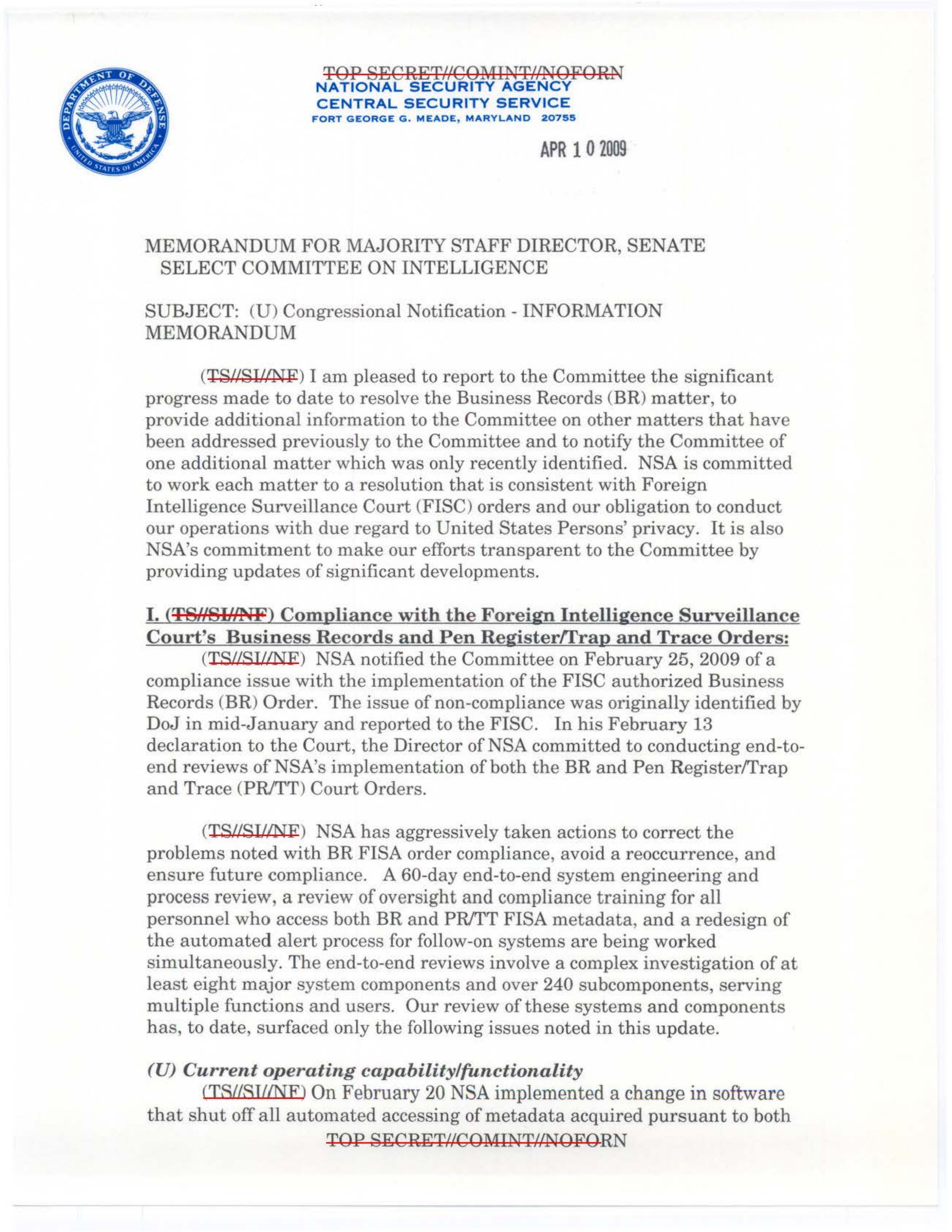
(TS//SI//NF) I am pleased to report to the Committee the significant
progress made to date to resolve the Business Records (BR) matter, to
provide additional information to the Committee on other matters that have
been addressed previously to the Committee and to notify the Committee of
one additional matter which was only recently identified. NSA is committed
to work each matter to a resolution that is consistent with Foreign
Intelligence Surveillance Court (FISC) orders and our obligation to conduct
our operations with due regard to United States Persons' privacy. It is also
NSA's commitment to make our efforts transparent to the Committee by
providing updates of significant developments.
I. (TS//SI//NF) Compliance with the Foreign Intelligence Surveillance
Court's Business Records and Pen Register/Trap and Trace Orders:
(TS//SI//NF) NSA notified the Committee on February 25, 2009 of a
compliance issue with the implementation of the FISC authorized Business
Records (BR) Order. The issue of non-compliance was originally identified by
DoJ in mid-January and reported to the FISC. In his February 13
declaration to the Court, the Director of NSA committed to conducting end-to-
end reviews of NSA's implementation of both the BR and Pen Register/Trap
and Trace (PR/TT) Court Orders.
(TS//SI//NF) NSA has aggressively taken actions to correct the
problems noted with BR FISA order compliance, avoid a reoccurrence, and
ensure future compliance. A 60-day end-to-end system engineering and
process review, a review of oversight and compliance training for all
personnel who access both BR and PR/TT FISA metadata, and a redesign of
the automated alert process for follow-on systems are being worked
simultaneously. The end-to-end reviews involve a complex investigation of at
least eight major system components and over 240 subcomponents, serving
multiple functions and users. Our review of these systems and components
has, to date, surfaced only the following issues noted in this update.
(U) Current operating capability/functionality
(TS//SI//NF) On February 20 NSA implemented a change in software
that shut off all automated accessing of metadata acquired pursuant to both
TOP SECRET//COMINT//NOFORN
TOP SECRET//COMINT//NOFORN
BR and PR/TT FISC orders. NSA accepted that this would disrupt processes
that had no identified compliance concerns, to include those supporting
material acquired under the PR/TT FISA Court Order; however, NSA decided
that halting automated access to the BR and PR/TT metadata to be the most
prudent course of action.
- (U//FOUO) BR Operations/Mitigation
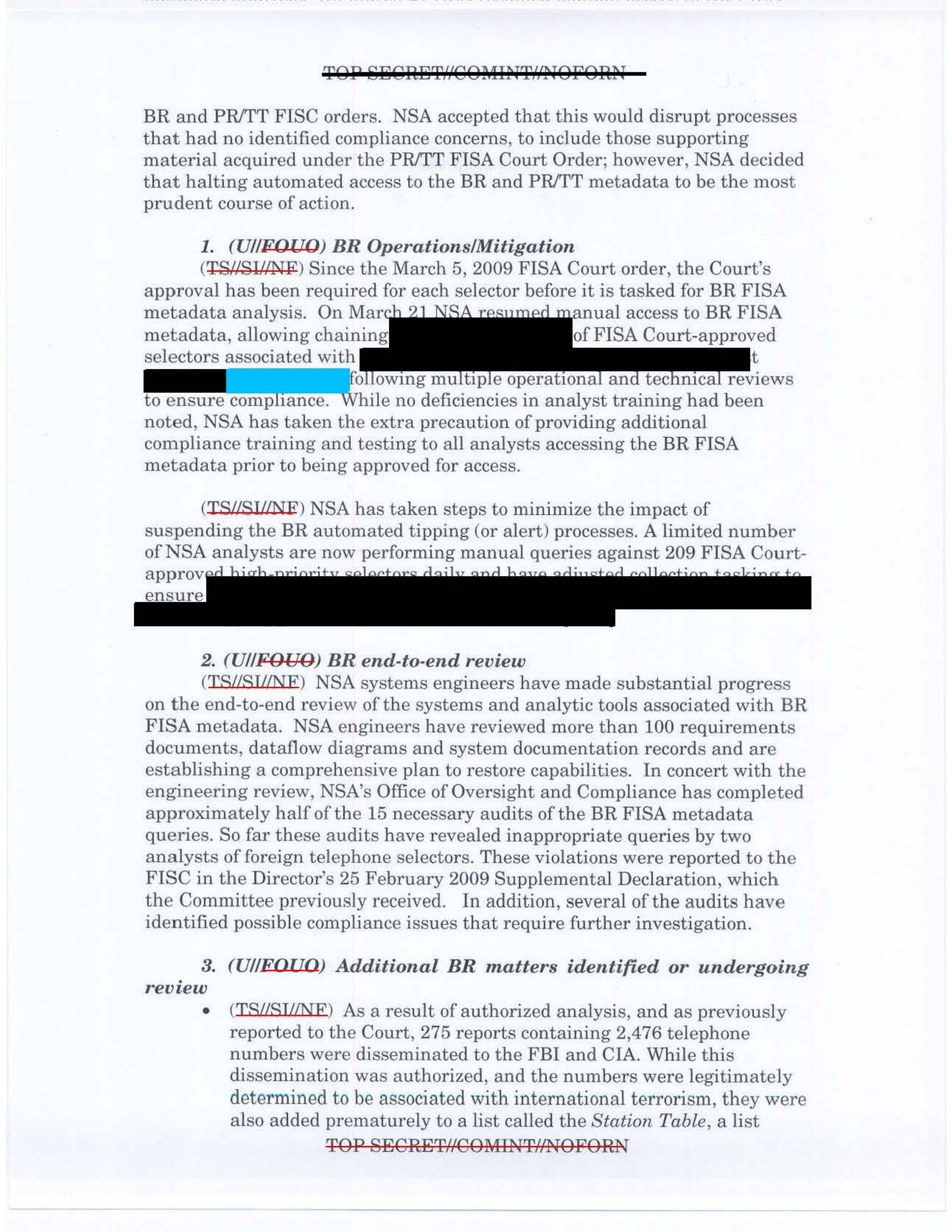
(TS//SI//NF) Since the March 5, 2009 FISA Court order, the Court's
approval has been required for each selector before it is tasked for BR FISA
metadata analysis. On March 21 NSA resumed manual access to BR FISA
metadata, allowing chaining [REDACTED] of FISA Court-approved
selectors associated with [REDACTED] following multiple operational and technical reviews
to ensure compliance. While no deficiencies in analyst training had been
noted, NSA has taken the extra precaution of providing additional
compliance training and testing to all analysts accessing the BR FISA
metadata prior to being approved for access.
(TS//SI//NF) NSA has taken steps to minimize the impact of
suspending the BR automated tipping (or alert) processes. A limited number
of NSA analysts are now performing manual queries against 209 FISA Court-
approved high-priority selectors daily and have adjusted collection tasking to
ensure [REDACTED]
- (U//
FOUO) BR end-to-end review
(TS//SI//NF) NSA systems engineers have made substantial progress
on the end-to-end review of the systems and analytic tools associated with BR
FISA metadata. NSA engineers have reviewed more than 100 requirements
documents, dataflow diagrams and system documentation records and are
establishing a comprehensive plan to restore capabilities. In concert with the
engineering review, NSA's Office of Oversight and Compliance has completed
approximately half of the 15 necessary audits of the BR FISA metadata
queries. So far these audits have revealed inappropriate queries by two
analysts of foreign telephone selectors. These violations were reported to the
FISC in the Director's 25 February 2009 Supplemental Declaration, which
the Committee previously received. In addition, several of the audits have
identified possible compliance issues that require further investigation.
- (U//
FOUO) Additional BR matters identified or undergoing
review
(TS//SI//NF)As a result of authorized analysis, and as previously
reported to the Court, 275 reports containing 2,476 telephone
numbers were disseminated to the FBI and CIA. While this
dissemination was authorized, and the numbers were legitimately
determined to be associated with international terrorism, they were
also added prematurely to a list called the Station Table, a list
TOP SECRET//COMINT//NOFORN
TOP SECRET//COMINT//NOFORN
designed to store numbers determined by NSA to meet the
reasonable articulable suspicion standard "RAS-approved". The
problem identified is that these numbers did not undergo the
formal NSA Office of General Counsel RAS-designation review as
required by the Court prior to being added to the Station Table.
(TS//SI//NF)NSA continues to review whether additional
automated tools may have queried the business records metadata.(TS//SI//NF)NSA is reviewing its application of the 5-year data
retention limitation provision of the FISC order.
- (U//
FOUO) Status of BR training
(TS//SI//NF) NSA formed a team in early February to address both the
immediate and long-term training required for analysts accessing metadata
acquired through BR FISA and PR/TT FISA. The team initiated a redesign
of the Agency's BR FISA training and has administered BR FISA oral
competency tests. Training for PR/TT FISA will involve a new curriculum
and competency exam and is projected to be available by June 1, 2009.
(TS//SI//NF) NSA also is updating its BR FISA Standard Operating
Procedures (SOP) document. An interim version of the new SOP details the
processes and procedures governing access to BR FISA metadata. The
interim SOP also describes the overall process to ensure consistency with the
FISC order. The SOP will be revised as necessary as additional analytic tools
are reinstated and automated processes are resumed following FISC
approval.
- (U//
FOUO) Status of PR/TT Operations and Review
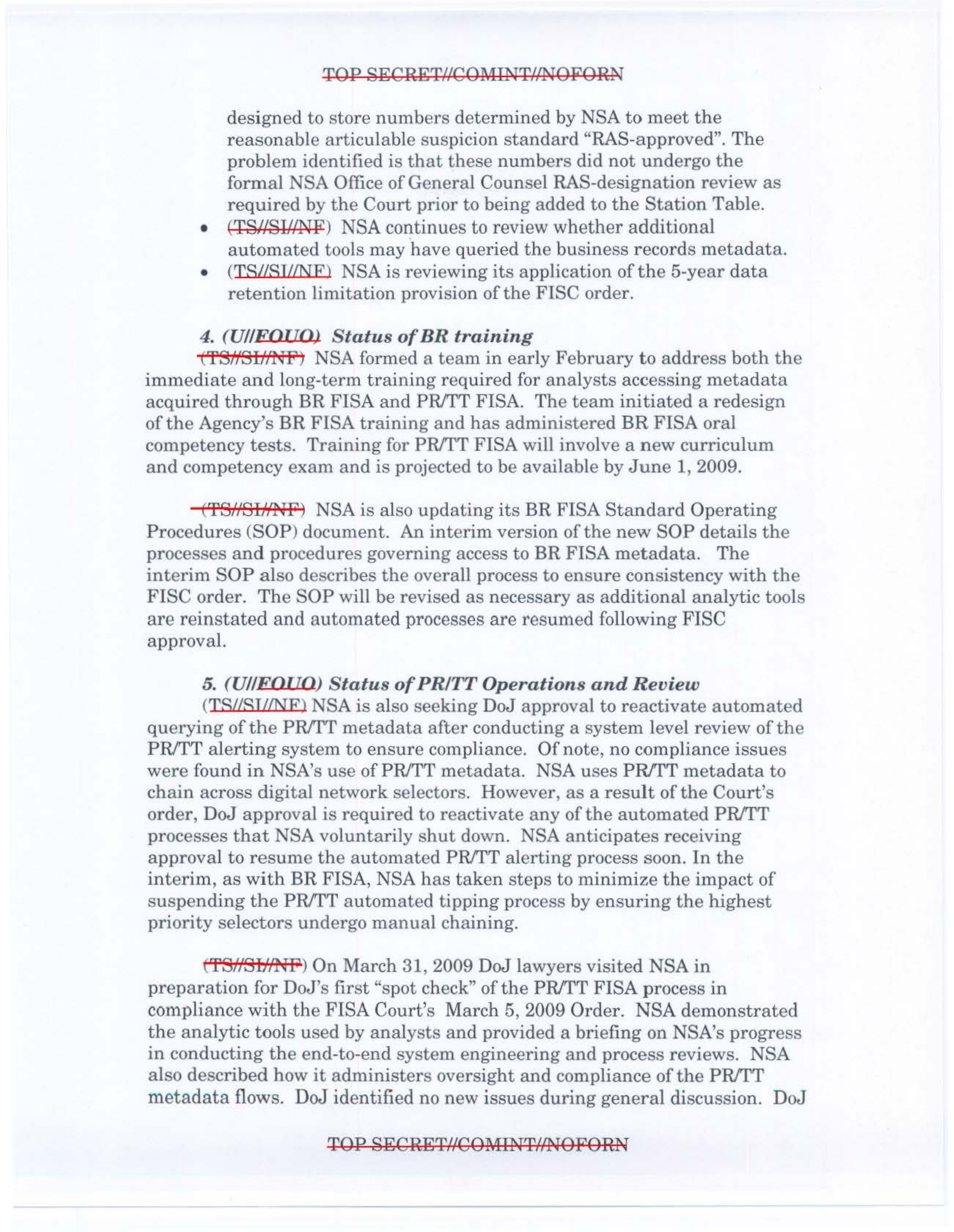
(TS//SI//NF) NSA is also seeking DoJ approval to reactivate automated
querying of the PR/TT metadata to ensure compliance. Of note, no compliance issues
were found in NSA's use of PR/TT metadata. NSA uses PR/TT metadata to
chain across digital network selectors. However, as a result of the Court's
order, DoJ approval is required to reactivate any of the automated PR/TT
processes that NSA voluntarily shut down. NSA anticipates receiving
approval to resume the automated PR/TT alerting process soon. In the
interim, as with BR FISA, NSA has taken steps to minimize the impact of
suspending the PR/TT automated tipping process by ensuring the highest
priority selectors undergo manual chaining.
(TS//SI//NF) On March 31, 2009 DoJ lawyers visited NSA in
preparation for DoJ's first "spot check" of the PR/TT FISA process in
compliance with the FISA Court's March 5, 2009 Order. NSA demonstrated
the analytic tools used by analysts and provided a briefing on NSA's progress
in conducting the end-to-end system engineering and process reviews. NSA
also described how it administers oversight and compliance of the PR/TT
metadata flows. DoJ identified no new issues during general discussion. DoJ
TOP SECRET//COMINT//NOFORN
TOP SECRET//COMINT//NOFORN
is scheduled to visit in late April for their first formal "spot check" on PR/TT
FISA as well as a routine review of BR FISA.
(TS//SI//NF) The end-to-end review of the PR/TT systems and
processes is underway and will be concluded upon completion of the BR FISA
review.
II. (U//FOUO) Overcollection
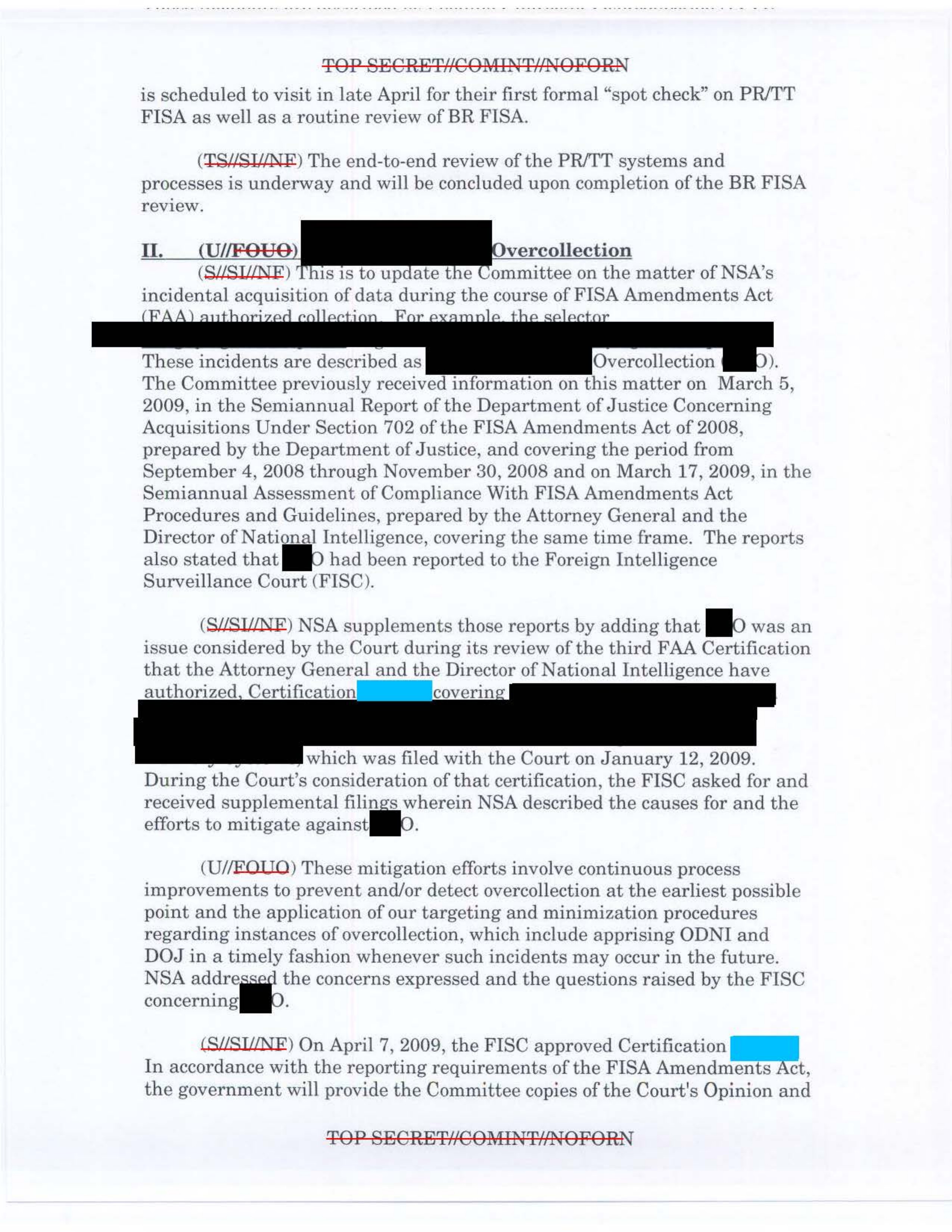
(S//SI//NF) This is to update the Committee on the matter of NSA's
incidental acquisition of data during the course of FISA Amendments Act
(FAA) authorized collection. For example, the selector [REDACTED]
These incidents are described as [REDACTED] Overcollection [REDACTED].
The Committee previously received information on this matter on March 5,
2009, in the Semiannual Report of the Department of Justice Concerning
Acquisitions Under Section 702 of the FISA Amendments Act of 2008,
prepared by the Department of Justice, and covering the period from
September 4, 2008 through November 30, 2008 and on March 17, 2009, in the
Semiannual Assessment of Compliance With FISA Amendments Act
Procedures and Guidelines, prepared by the Attorney General and the
Director of National Intelligence, covering the same time frame. The reports
also stated that [REDACTED] had been reported to the Foreign Intelligence
Surveillance Court (FISC).
(S//SI//NF) NSA supplements those reports by adding that [REDACTED] was an
issue considered by the Court during its review of the third FAA Certification
that the Attorney General and the Director of National Intelligence have
authorized, Certification [REDACTED] covering [REDACTED]
which was filed with the Court on January 12, 2009.
During the Court's consideration of that certification, the FISC asked for and
received supplemental filings wherein NSA described the causes for and the
efforts to mitigate against [REDACTED].
(U//FOUO) These mitigation efforts involve continuous process
improvements to prevent and/or detect overcollection at the earliest possible
point and the application of our targeting and minimization procedures
regarding instances of overcollection, which include apprising ODNI and
DOJ in a timely fashion whenever such incidents may occur in the future.
NSA addressed the concerns expressed and the questions raised by the FISC
concerning [REDACTED].
(S//SI//NF) On April 7, 2009, the FISC approved Certification [REDACTED]
In accordance with the reporting requirements of the FISA Amendments Act,
the government will provide the Committee copies of the Court's Opinion and
TOP SECRET//COMINT//NOFORN
TOP SECRET//COMINT//NOFORN
Order, as well as of the government's application and pleadings in the
matter, to include the supplemental filings referenced above.
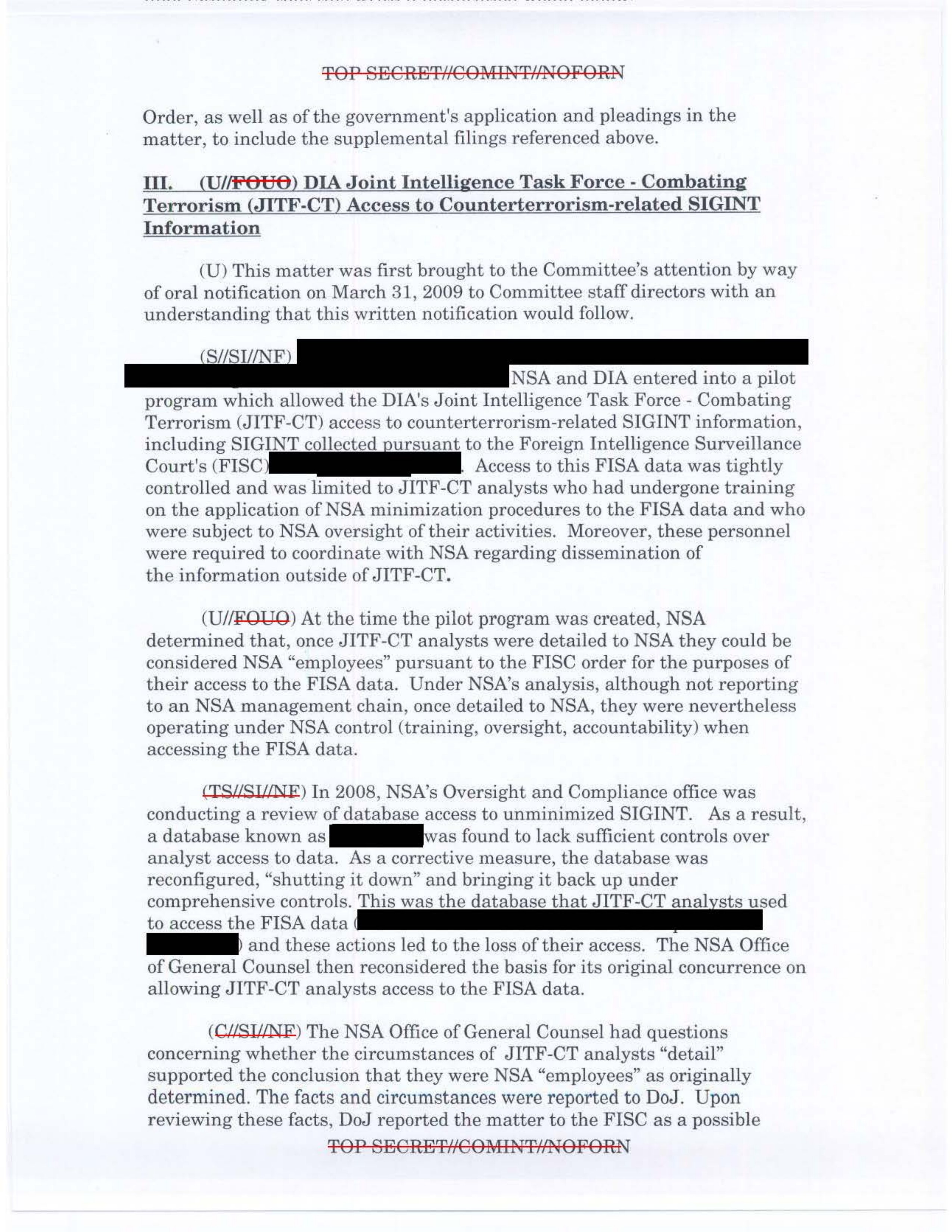
III. (U//FOUO) DIA Joint Intelligence Task Force - Combating
Terrorism (JITF-CT) Access to Counterterrorism-related SIGINT
Information
(U) This matter was first brought to the Committee's attention by way
of oral notification on March 31, 2009 to Committee staff directors with an
understanding that this written notification would follow.
(S//SI//NF) [REDACTED] NSA and DIA entered into a pilot
program which allowed the DIA's Joint Intelligence Task Force - Combating
Terrorism (JITF-CT) access to counterterrorism-related SIGINT information,
including SIGINT collected pursuant to the Foreign Intelligence Surveillance
Court's (FISC) [REDACTED]. Access to this FISA data was tightly
controlled and was limited to JITF-CT analysts who had undergone training
on the application of NSA minimization procedures to the FISA data and who
were subject to NSA oversight of their activities. Moreover, these personnel
were required to coordinate with NSA regarding dissemination of
the information outside of JITF-CT.
(U//FOUO) At the time the pilot program was created, NSA
determined that, once JITF-CT analysts were detailed to NSA they could be
considered NSA "employees" pursuant to the FISC order for the purposes of
their access to the FISA data. Under NSA's analysis, although not reporting
to an NSA management chain, once detailed to NSA, they were nevertheless
operating under NSA control (training, oversight, accountability) when
accessing the FISA data.
(TS//SI//NF) In 2008, NSA's Oversight and Compliance office was
conducting a review of database access to unminimized SIGINT. As a result,
a database known as [REDACTED] was found to lack sufficient controls over
analyst access to data. As a corrective measure, the database was
reconfigured, "shutting it down" and bringing it back up under
comprehensive controls. This was the database that JITF-CT analysts used
to access the FISA data [REDACTED]
and these actions led to the loss of their access. The NSA Office
of General Counsel then reconsidered the basis for its original concurrence on
allowing JITF-CT analysts access to the FISA data.
(C//SI//NF) The NSA Office of General Counsel had questions
concerning whether the circumstances of JITF-CT analysts "detail"
supported the conclusion that they were NSA "employees" as originally
determined. The facts and circumstances were reported to DoJ. Upon
reviewing these facts, DoJ reported the matter to the FISC as a possible
TOP SECRET//COMINT//NOFORN
TOP SECRET//COMINT//NOFORN
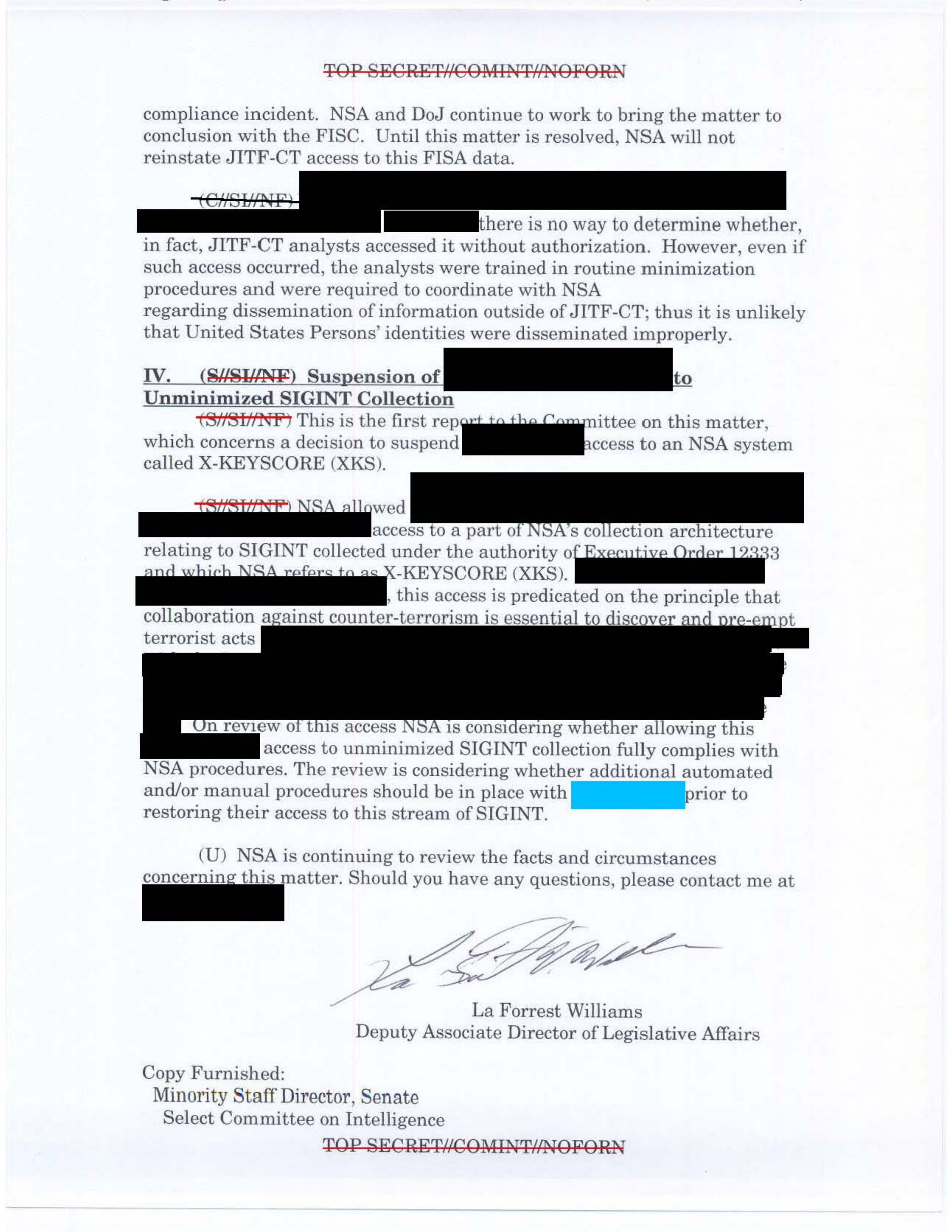
compliance incident. NSA and DoJ continue to work to bring the matter to
conclusion with the FISC. Until this matter is resolved, NSA will not
reinstate JITF-CT access to this FISA data.
(C//SI//NF) [REDACTED] there is no way to determine whether,
in fact, JITF-CT analysts accessed it without authorization. However, even if
such access occurred, the analysts were trained in routine minimization
procedures and were required to coordinate with NSA
regarding dissemination of information outside of JITF-CT; thus it is unlikely
that United States Persons' identities were disseminated improperly.
IV. (S//SI//NF) Suspension of [REDACTED] to
Unminimized SIGINT Collection
(S//SI//NF) This is the first report to the Committee on this matter,
which concerns a decision to suspend [REDACTED] access to an NSA system
called X-KEYSCORE (XKS).
(S//SI//NF) NSA allowed [REDACTED] access to a part of NSA's collection architecture
relating to SIGINT collected under the authority of Executive Order 12333
and which NSA refers to as X-KEYSCORE (XKS).
[REDACTED] this access is predicated on the principle that
collaboration against counter-terrorism is essential to discover and pre-empt
terrorist acts
[REDACTED]
[REDACTED]
On review of this access NSA is considering whether allowing this
[REDACTED] access to unminimized SIGINT collection fully complies with
NSA procedures. The review is considering whether additional automated
and/or manual procedures should be in place with [REDACTED] prior to
restoring their access to this stream of SIGINT.
(U) NSA is continuing to review the facts and circumstances
concerning this matter. Should you have any questions, please contact me at
[REDACTED]
La Forrest Williams
Deputy Associate Director of Legislative Affairs
Copy Furnished:
Minority Staff Director, Senate
Select Committee on Intelligence
TOP SECRET//COMINT//NOFORN
Related Documents
-
June 29, 2009 NSA Notification Memorandum to HPSCI FOIA [pdf]
A memo from the NSA to Senate Select Committee on Intelligence (SSCI) on the status of its ongoing review of metadata collection programs under Section 501 and 402 of FISA. ACLU/EFF FOIA Litigation.
People: Williams, La ForrestACLU,EFF ↗ (2013-11-18) -
December 1, 2010 NSA Memorandum to SSCI FOIA [pdf]
A memo from the NSA to the Senate Select Committee on Intelligence (SSCI) about cell site location information. ACLU/EFF FOIA Litigation.
ACLU,EFF ↗ (2013-11-18) -
FAIRVIEW dataflow charts April 2012 [pdf]
This document outlines data flow diagrams that show how various types of sensitive communication, including voice, fax, and modem traffic, are handled through systems operated by the NSA and its partners. These partners include corporations, telecommunications companies, ISPs, and other entities involved in processing and managing the data through secure and classified channels. The document covers processing flows for various data types, metadata, and communications systems under NSA's control, detailing how data is routed, stored, and analyzed across different platforms and sites.
Programs: FAIRVIEW · SAGUARO · TURNSTILE · MESA · TITANPOINT · RIMROCK · MAILORDER · PINECONE · BLARNEY · STONEGATE · TINSEL · CONVEYANCE · FISHWAY · NUCLEON · PINWALE · SCISSORS · COURIERSKILL · DRIFTWOOD · ASDF · FALLOUT · MARINA · LOPERS · WEALTHYCLUSTER · PUPR · CLEARSIGHT · MIDFIELD · CADENCE · BUGCATCHER · WAYLAND · DESOTO · GATEKEEP · HIGHDECIBEL · XKEYSCORE · YANKEE · TOPROCK · FASCIA · DISHFIRE · SEAGULL · BIGDIPPER · CORPORATE · LILDIPPER · HAVASU · WEALTHYCLUSTER2 · RAGTIME · TUMULT · TATTOO · DARKTHUNDER · ICYTWINS · TML-STATUS · WATERFRONT · VULCANDEATHGRIP · STEELFLAUTA · UNITY · KEYCARD · UTT · BTUBE · ISLANDTRANSPORT · SSO · MAINWAY · SSDM · TUBE · TITANPOINTE · TURMOIL · VPCS“NSA Spying Relies on AT&T’s ‘Extreme Willingness to Help’” - ProPublica ↗ (2015-08-15) · “AT&T Helped U.S. Spy on Internet on a Vast Scale” - The New York Times ↗ (2015-08-15) · “Titanpointe: The NSA’s Spy Hub in New York, Hidden in Plain Sight” - The Intercept ↗ (2016-11-16) · Angwin, Julia · Larson, Jeff · Savage, Charlie · Moltke, Henrik · Poitras, Laura · Risen, James · Gallagher, Ryan -
OAKSTAR Weekly Update - Program Highlights Week of: March 30 - April 5, 2013 [pdf]
The document is a NSA weekly operations update from March 30 - April 5, 2013, reporting hardware failures and server issues with XKeyscore, efforts to reroute data and replace components, ongoing metadata collection metrics, and continued intelligence production, with OAKSTAR's 2013 serialized product totals at 430 reports and 2,641 GISTs (MONKEYROCKET: 1 report).
-
SIGINT Development Support II Program Management Review, 24 April 2013 (select slides) [pdf]
These selected slides briefly celebrate two NSA “success stories”: penetrating Pakistan’s Green Line infrastructure with SECONDDATE-enabled implants, and seizing country-wide leverage over Lebanon’s internet backbone through Ogero to siphon off Hezbollah-related data. It shows how U.S. intelligence treated supposedly inaccessible national networks as targets to be shaped, exploited, and folded into its global surveillance machine. See extra slide in "NSA Supply Chain Attack From PMR 4-24-13" https://theintercept.com/document/2019/01/24/nsa-supply-chain-attack-from-pmr-4-24-13/
Programs: MONSTERMIND · CHELSEABLUE · SECONDDATE · QUANTUM · REXKWONDO · STORMBREW · XKEYSCORE · MARINA · HAMMERCORE · HAMREX · CADENCE · HAMMERSTEIN · SSO