June 29, 2009 NSA Notification Memorandum to HPSCI
Open PDFDocument date: 2009-06-29
Type: FOIA
Pages: 5
Classification: TOP SECRET COMINT
Dissemination: NOFORN
A memo from the NSA to Senate Select Committee on Intelligence (SSCI) on the status of its ongoing review of metadata collection programs under Section 501 and 402 of FISA. ACLU/EFF FOIA Litigation.
My notes
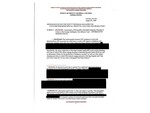
TOP SECRET//COMINT//NOFORN
NATIONAL SECURITY AGENCY
FORT GEORGE G. MEADE, MARYLAND 20755-6000
JUN 2 9 2009
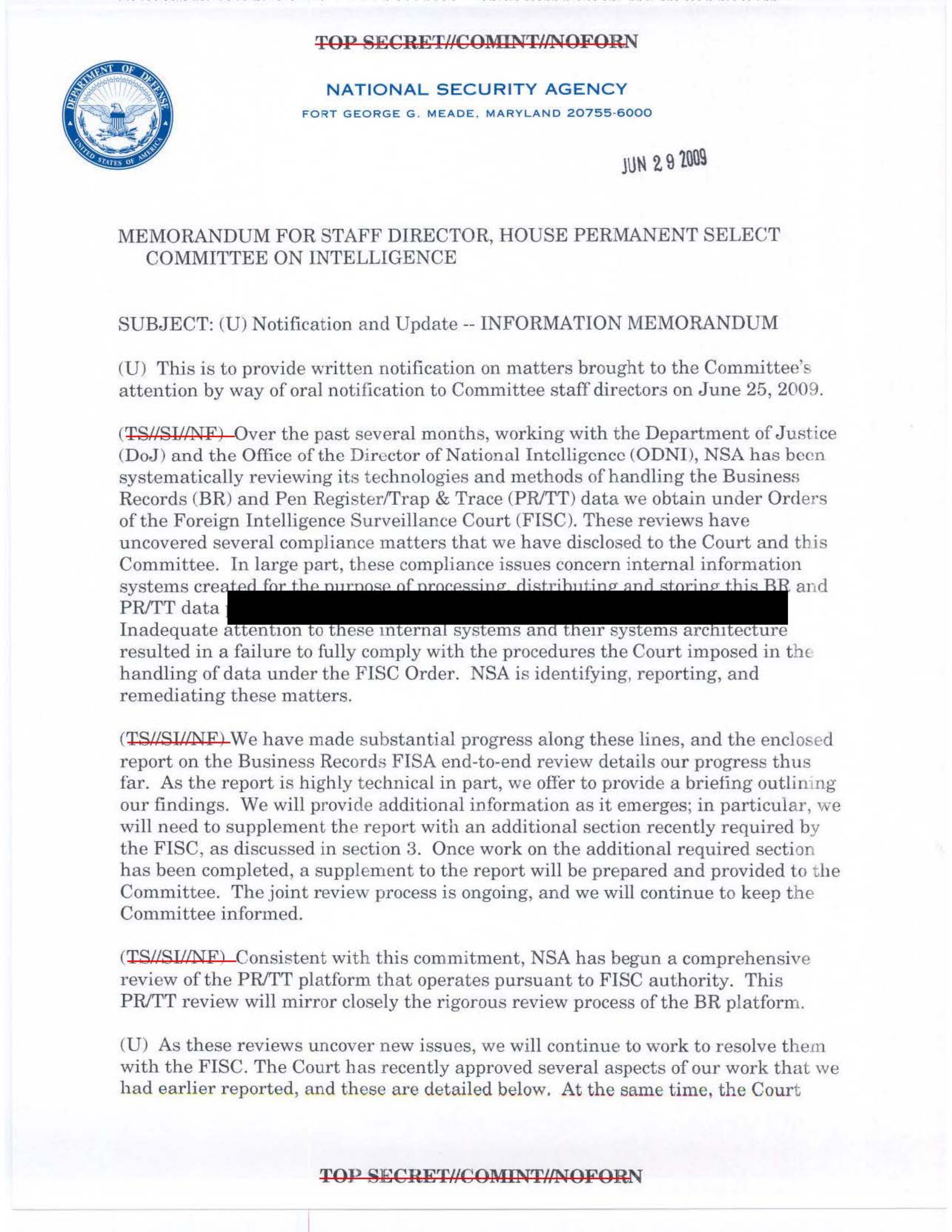
MEMORANDUM FOR STAFF DIRECTOR, HOUSE PERMANENT SELECT
COMMITTEE ON INTELLIGENCE
SUBJECT: (U) Notification and Update -- INFORMATION MEMORANDUM
(U) This is to provide written notification on matters brought to the Committee's
attention by way of oral notification to Committee staff directors on June 25, 2009.
(TS//SI//NF) Over the past several months, working with the Department of Justice
(DoJ) and the Office of the Director of National Intelligence (ODNI), NSA has been
systematically reviewing its technologies and methods of handling the Business
Records (BR) and Pen Register/Trap & Trace (PR/TT) data we obtain under Orders
of the Foreign Intelligence Surveillance Court (FISC). These reviews have
uncovered several compliance matters that we have disclosed to the Court and this
Committee. In large part, these compliance issues concern internal information
systems created for the purpose of processing, distributing and storing this BR and
PR/TT data.
(TS//SI//NF) Inadequate attention to these internal systems and their systems architecture
resulted in a failure to fully comply with the procedures the Court imposed in the
handling of data under the FISC Order. NSA is identifying, reporting, and
remediating these matters.
(TS//SI//NF) We have made substantial progress along these lines, and the enclosed
report on the Business Records FISA end-to-end review details our progress thus
far. As the report is highly technical in part, we offer to provide a briefing outlining
our findings. We will provide additional information as it emerges; in particular, we
will need to supplement the report with an additional section recently required by
the FISC, as discussed in section 3. Once work on the additional required section
has been completed, a supplement to the report will be prepared and provided to the
Committee. The joint review process is ongoing, and we will continue to keep the
Committee informed.
(TS//SI//NF) Consistent with this commitment, NSA has begun a comprehensive
review of the PR/TT platform that operates pursuant to FISC authority. This
PR/TT review will mirror closely the rigorous review process of the BR platform.
(U) As these reviews uncover new issues, we will continue to work to resolve them
with the FISC. The Court has recently approved several aspects of our work that we
had earlier reported, and these are detailed below. At the same time, the Court
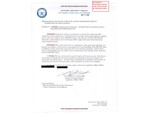
TOP SECRET//COMINT//NOFORN
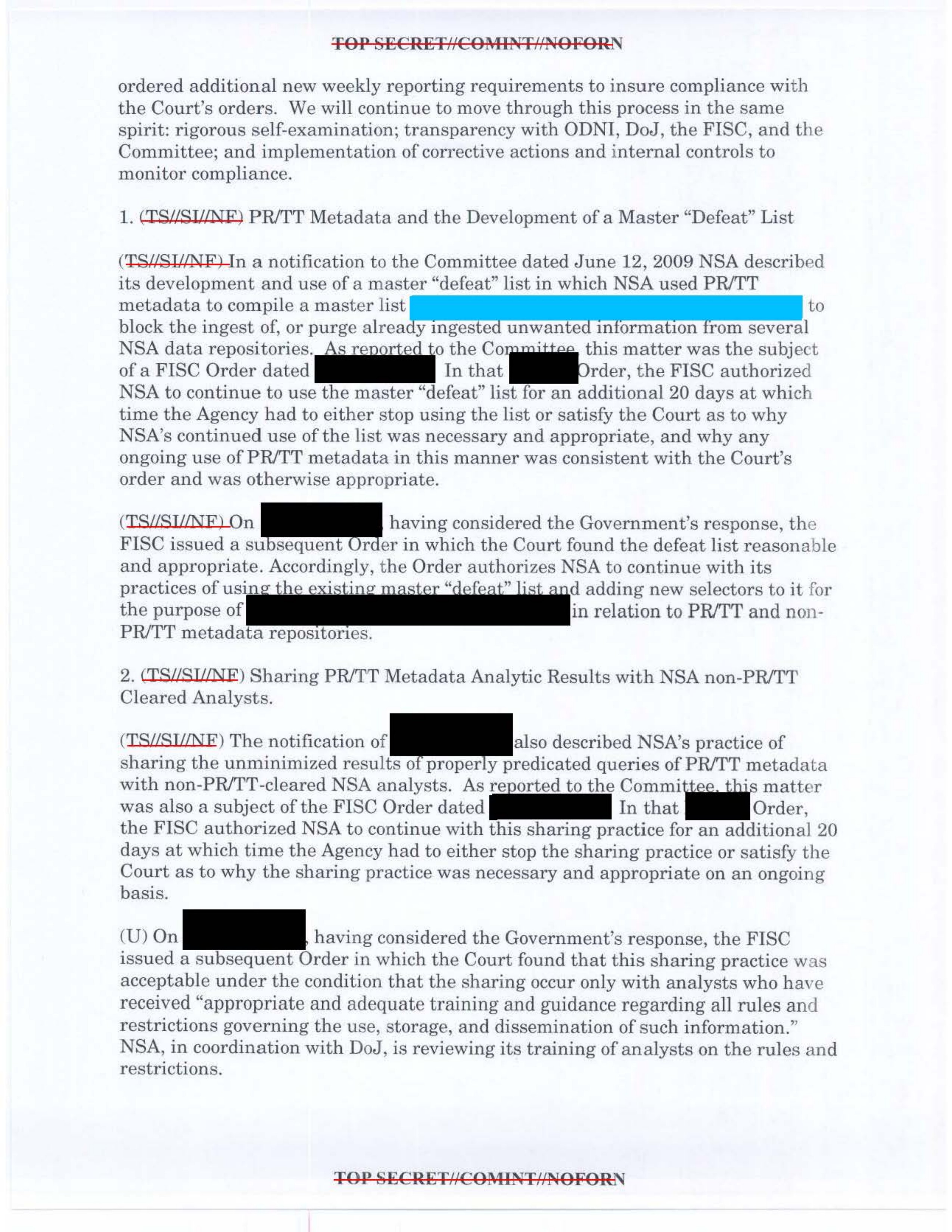
ordered additional new weekly reporting requirements to insure compliance with
the Court's orders. We will continue to move through this process in the same
spirit: rigorous self-examination; transparency with ODNI, DOJ, the FISC, and the
Committee; and implementation of corrective actions and internal controls to
monitor compliance.
- (TS//SI//NE) PR/TT Metadata and the Development of a Master "Defeat" List
(TS//SI//NF) In a notification to the Committee dated June 12, 2009 NSA described
its development and use of a master "defeat" list in which NSA used PR/TT
metadata to compile a master list [REDACTED] to
block the ingest of, or purge already ingested unwanted information from several
NSA data repositories. As reported to the Committee, this matter was the subject
of a FISC Order dated [REDACTED] In that [REDACTED] Order, the FISC authorized
NSA to continue to use the master "defeat" list for an additional 20 days at which
time the Agency had to either stop using the list or satisfy the Court as to why
NSA's continued use of the list was necessary and appropriate, and why any
ongoing use of PR/TT metadata in this manner was consistent with the Court's
order and was otherwise appropriate.
(TS//SI//NF) On [REDACTED] having considered the Government's response, the
FISC issued a subsequent Order in which the Court found the defeat list reasonable
and appropriate. Accordingly, the Order authorizes NSA to continue with its
practices of using the existing master "defeat" list and adding new selectors to it for
the purpose of [REDACTED] in relation to PR/TT and non-
PR/TT metadata repositories.
- (TS//SI//NF) Sharing PR/TT Metadata Analytic Results with NSA non-PR/TT
Cleared Analysts.
(TS//SI//NF) The notification of [REDACTED] also described NSA's practice of
sharing the unminimized results of properly predicated queries of PR/TT metadata
with non-PR/TT-cleared NSA analysts. As reported to the Committee, this matter
was also a subject of the FISC Order dated [REDACTED] In that [REDACTED] Order,
the FISC authorized NSA to continue with this sharing practice for an additional 20
days at which time the Agency had to either stop the sharing practice or satisfy the
Court as to why the sharing practice was necessary and appropriate on an ongoing
basis.
(U) On [REDACTED] having considered the Government's response, the FISC
issued a subsequent Order in which the Court found that this sharing practice was
acceptable under the condition that the sharing occur only with analysts who have
received "appropriate and adequate training and guidance regarding all rules and
restrictions governing the use, storage, and dissemination of such information."
NSA, in coordination with DoJ, is reviewing its training of analysts on the rules and
restrictions.
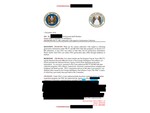
TOP SECRET//COMINT//NOFORN
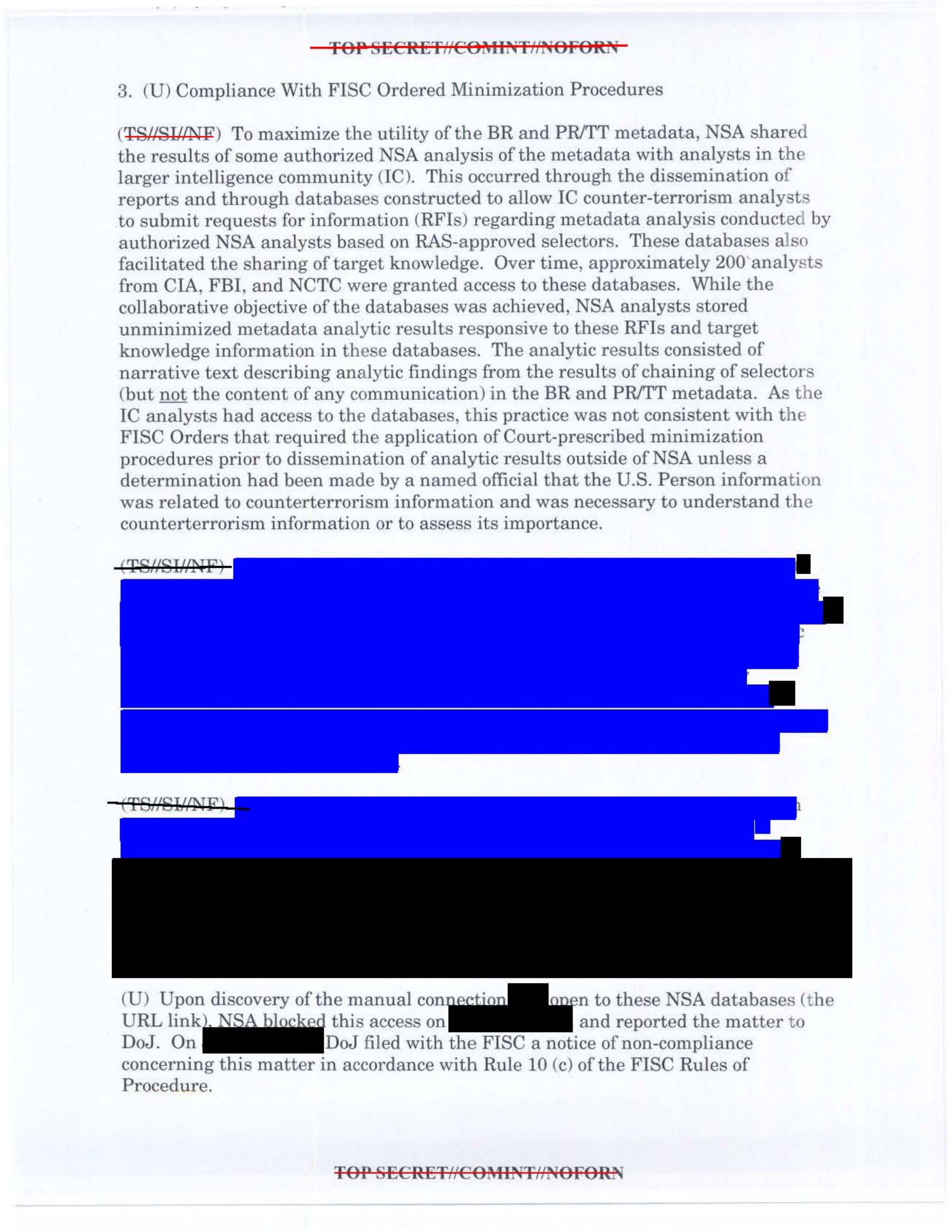
3. (U) Compliance With FISC Ordered Minimization Procedures
(TS//SI//NF) To maximize the utility of the BR and PR/TT metadata, NSA shared
the results of some authorized NSA analysis of the metadata with analysts in the
larger intelligence community (IC). This occurred through the dissemination of
reports and through databases constructed to allow IC counter-terrorism analysts
to submit requests for information (RFIs) regarding metadata analysis conducted by
authorized NSA analysts based on RAS-approved selectors. These databases also
facilitated the sharing of target knowledge. Over time, approximately 200 analysts
from CIA, FBI, and NCTC were granted access to these databases. While the
collaborative objective of the databases was achieved, NSA analysts stored
unminimized metadata analytic results responsive to these RFIs and target
knowledge information in these databases. The analytic results consisted of
narrative text describing analytic findings from the results of chaining of selectors
(but not the content of any communication) in the BR and PR/TT metadata. As the
IC analysts had access to the databases, this practice was not consistent with the
FISC Orders that required the application of Court-prescribed minimization
procedures prior to dissemination of analytic results outside of NSA unless a
determination had been made by a named official that the U.S. Person information
was related to counterterrorism information and was necessary to understand the
counterterrorism information or to assess its importance.
(TS//SI//NF) [REDACTED]
(TS//SI//NF) [REDACTED]
(U) Upon discovery of the manual connection [REDACTED] open to these NSA databases (the
URL link), NSA blocked this access on [REDACTED] and reported the matter to
DoJ. On [REDACTED] DoJ filed with the FISC a notice of non-compliance
concerning this matter in accordance with Rule 10 (c) of the FISC Rules of
Procedure.
TOP SECRET//COMINT//NOFORN
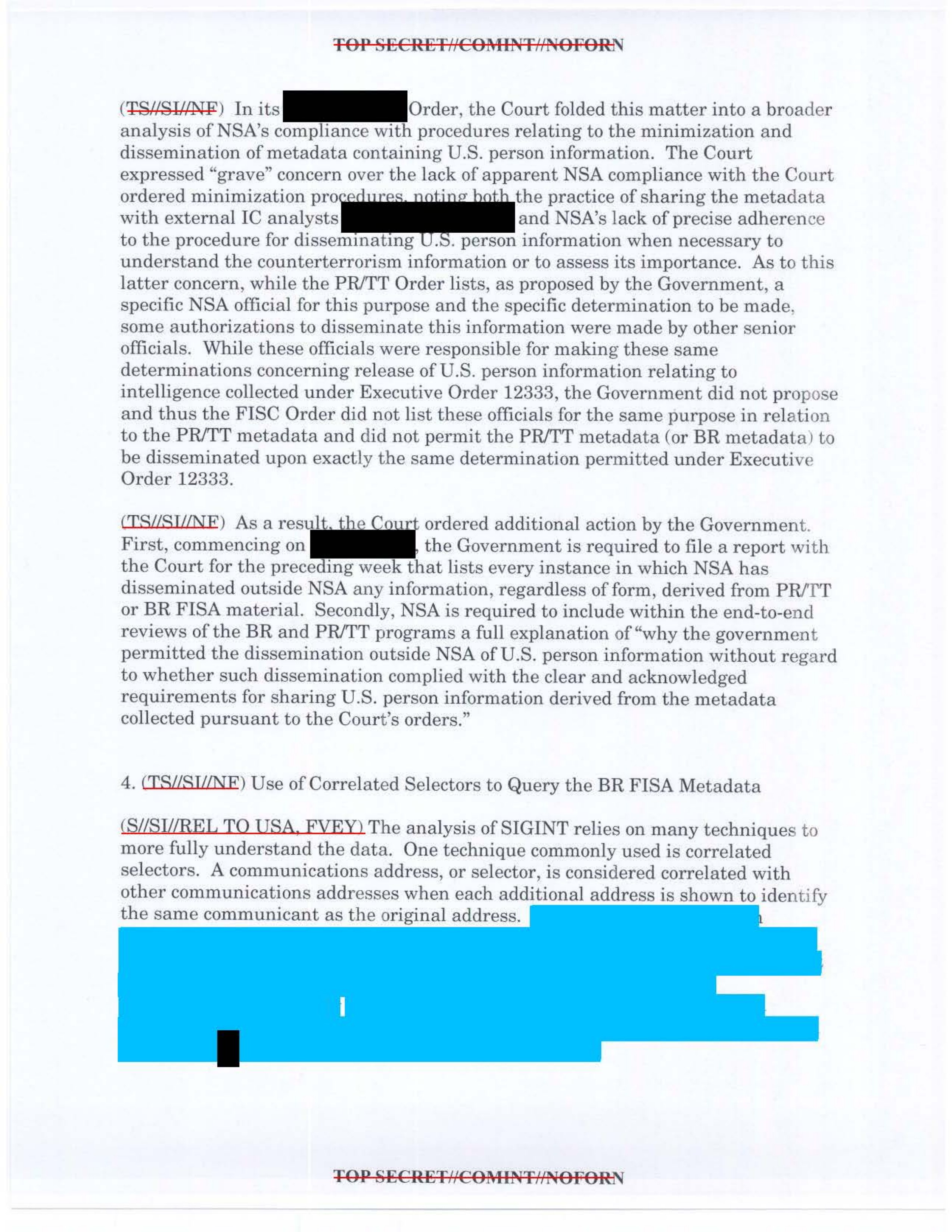
(TS//SI//NF) In its [REDACTED] Order, the Court folded this matter into a broader
analysis of NSA's compliance with procedures relating to the minimization and
dissemination of metadata containing U.S. person information. The Court
expressed "grave" concern over the lack of apparent NSA compliance with the Court
ordered minimization procedures, noting both the practice of sharing the metadata
with external IC analysts [REDACTED] and NSA's lack of precise adherence
to the procedure for disseminating U.S. person information when necessary to
understand the counterterrorism information or to assess its importance. As to this
latter concern, while the PR/TT Order lists, as proposed by the Government, a
specific NSA official for this purpose and the specific determination to be made,
some authorizations to disseminate this information were made by other senior
officials. While these officials were responsible for making these same
determinations concerning release of U.S. person information relating to
intelligence collected under Executive Order 12333, the Government did not propose
and thus the FISC Order did not list these officials for the same purpose in relation
to the PR/TT metadata and did not permit the PR/TT metadata (or BR metadata) to
be disseminated upon exactly the same determination permitted under Executive
Order 12333.
(TS//SI//NE) As a result, the Court ordered additional action by the Government.
First, commencing on [REDACTED] the Government is required to file a report with
the Court for the preceding week that lists every instance in which NSA has
disseminated outside NSA any information, regardless of form, derived from PR/TT
or BR FISA material. Secondly, NSA is required to include within the end-to-end
reviews of the BR and PR/TT programs a full explanation of "why the government
permitted the dissemination outside NSA of U.S. person information without regard
to whether such dissemination complied with the clear and acknowledged
requirements for sharing U.S. person information derived from the metadata
collected pursuant to the Court's orders."
- (TS//SI//NE) Use of Correlated Selectors to Query the BR FISA Metadata
(S//SI//REL TO USA, FVEY) The analysis of SIGINT relies on many techniques to
more fully understand the data. One technique commonly used is correlated
selectors. A communications address, or selector, is considered correlated with
other communications addresses when each additional address is shown to identify
the same communicant as the original address.
[REDACTED]
TOP SECRET//COMINT//NOFORN
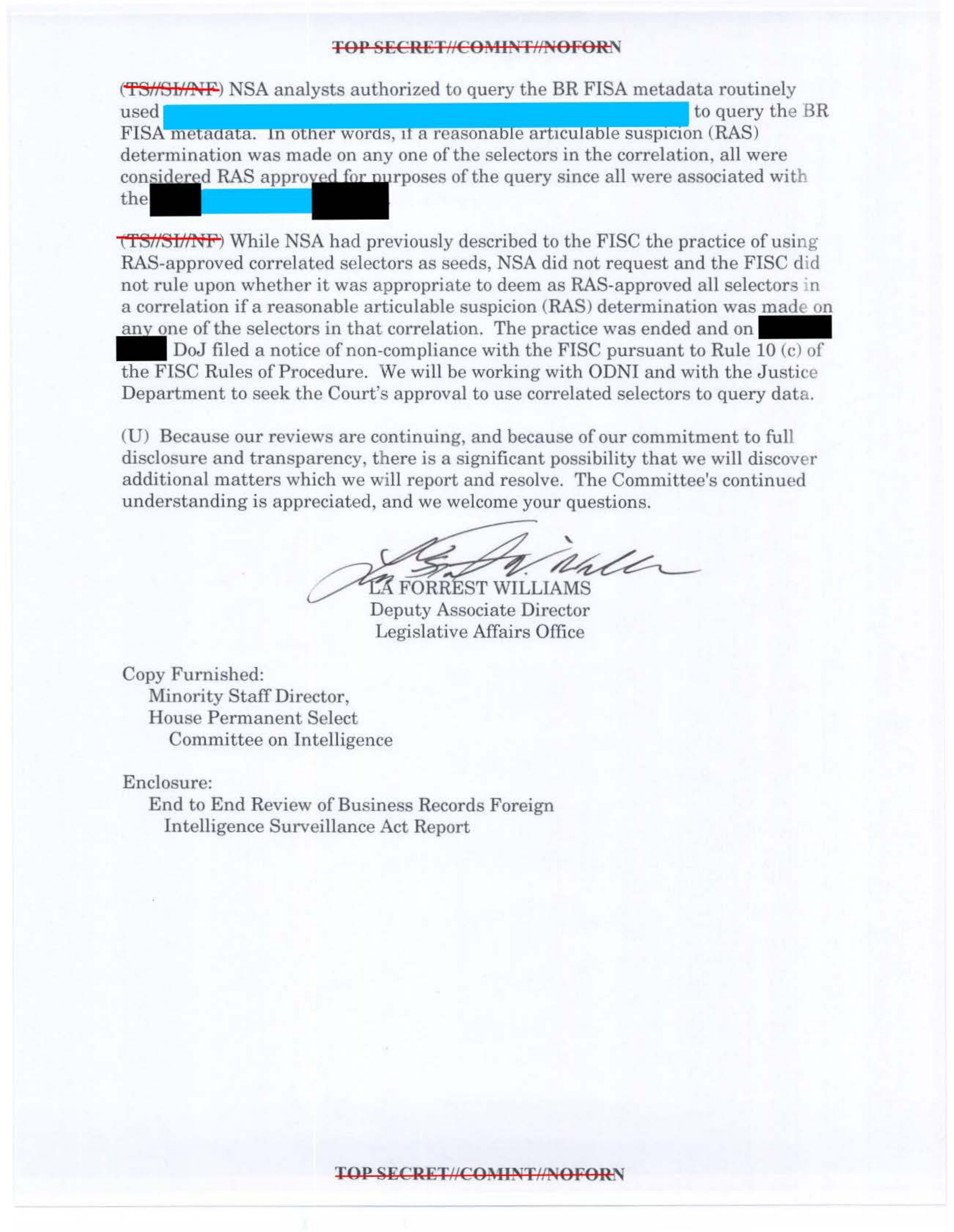
(TS//SI//NF) NSA analysts authorized to query the BR FISA metadata routinely
used [REDACTED] to query the BR
FISA metadata. In other words, it a reasonable articulable suspicion (RAS)
determination was made on any one of the selectors in the correlation, all were
considered RAS approved for purposes of the query since all were associated with
the [REDACTED]
(TS//SI//NF) While NSA had previously described to the FISC the practice of using
RAS-approved correlated selectors as seeds, NSA did not request and the FISC did
not rule upon whether it was appropriate to deem as RAS-approved all selectors in
a correlation if a reasonable articulable suspicion (RAS) determination was made on
any one of the selectors in that correlation. The practice was ended and on [REDACTED]
DoJ filed a notice of non-compliance with the FISC pursuant to Rule 10 (c) of
the FISC Rules of Procedure. We will be working with ODNI and with the Justice
Department to seek the Court's approval to use correlated selectors to query data.
(U) Because our reviews are continuing, and because of our commitment to full
disclosure and transparency, there is a significant possibility that we will discover
additional matters which we will report and resolve. The Committee's continued
understanding is appreciated, and we welcome your questions.
LA FORREST WILLIAMS
Deputy Associate Director
Legislative Affairs Office
Copy Furnished:
Minority Staff Director,
House Permanent Select
Committee on Intelligence
Enclosure:
End to End Review of Business Records Foreign
Intelligence Surveillance Act Report
TOP SECRET//COMINT//NOFORN
Related Documents
-
April 10, 2009 NSA Notification Memorandum to SSCI FOIA [pdf]
A memo from the NSA to Senate Select Committee on Intelligence (SSCI) on the status of its ongoing review of metadata collection programs under Sections 501 and 402 of FISA. ACLU/EFF FOIA Litigation.
Programs: XKEYSCOREACLU,EFF ↗ (2013-11-18) -
August 29, 2008 NSA Memorandum FOIA [pdf]
An NSA memo providing guidance on policy as to the applicable legal standards for querying metadata pursuant to Sections 501 and 402 of FISA. ACLU/EFF FOIA Litigation.
ACLU,EFF ↗ (2013-11-18) -
NSA Memo: Congressional Notification & BR FISA End-to-End Review Status FOIA [pdf]
An NSA memo to the Senate Select Committee on Intelligence and House Permanent Selection Committee on Intelligence providing a status report about the ongoing end-to-end review of the NSA’s bulk telephony metadata collection under Section 215. ACLU/EFF FOIA Litigation.
People: Williams, La ForrestACLU,EFF ↗ (2013-10-28) -
December 1, 2010 NSA Memorandum to SSCI FOIA [pdf]
A memo from the NSA to the Senate Select Committee on Intelligence (SSCI) about cell site location information. ACLU/EFF FOIA Litigation.
ACLU,EFF ↗ (2013-11-18) -
Memorandum of the United States in response to the Court's Order Dated January 28, 2009 FOIA [pdf]
Memorandum of the Government providing additional information relating to the compliance incident described directly above and describing additional oversight mechanisms deployed by the Government following identification of this compliance incident. ACLU/EFF FOIA Litigation.
Programs: ESECSACLU,EFF ↗ (2013-10-10)