Back in Time: The KAL-007 Shootdown
Open PDFDocument date: 2006-07-19
Type: SIDtoday
Pages: 1
Genre: newsletter
Banner: DYNAMIC PAGE -- HIGHEST POSSIBLE CLASSIFICATION IS TOP SECRET // SI / TK // REL TO USA AUS CAN GBR NZL
Classification: SECRET SI
Dissemination: -
The 1983 shoot-down of a Korean airliner and the United States' use of intercept tapes to prove the Soviets was behind it led to a crisis in the intelligence relationship with Japan.
My notes
DYNAMIC PAGE -- HIGHEST POSSIBLE CLASSIFICATION IS
TOP SECRET // SI / TK // REL TO USA AUS CAN GBR NZL
SIDtoday
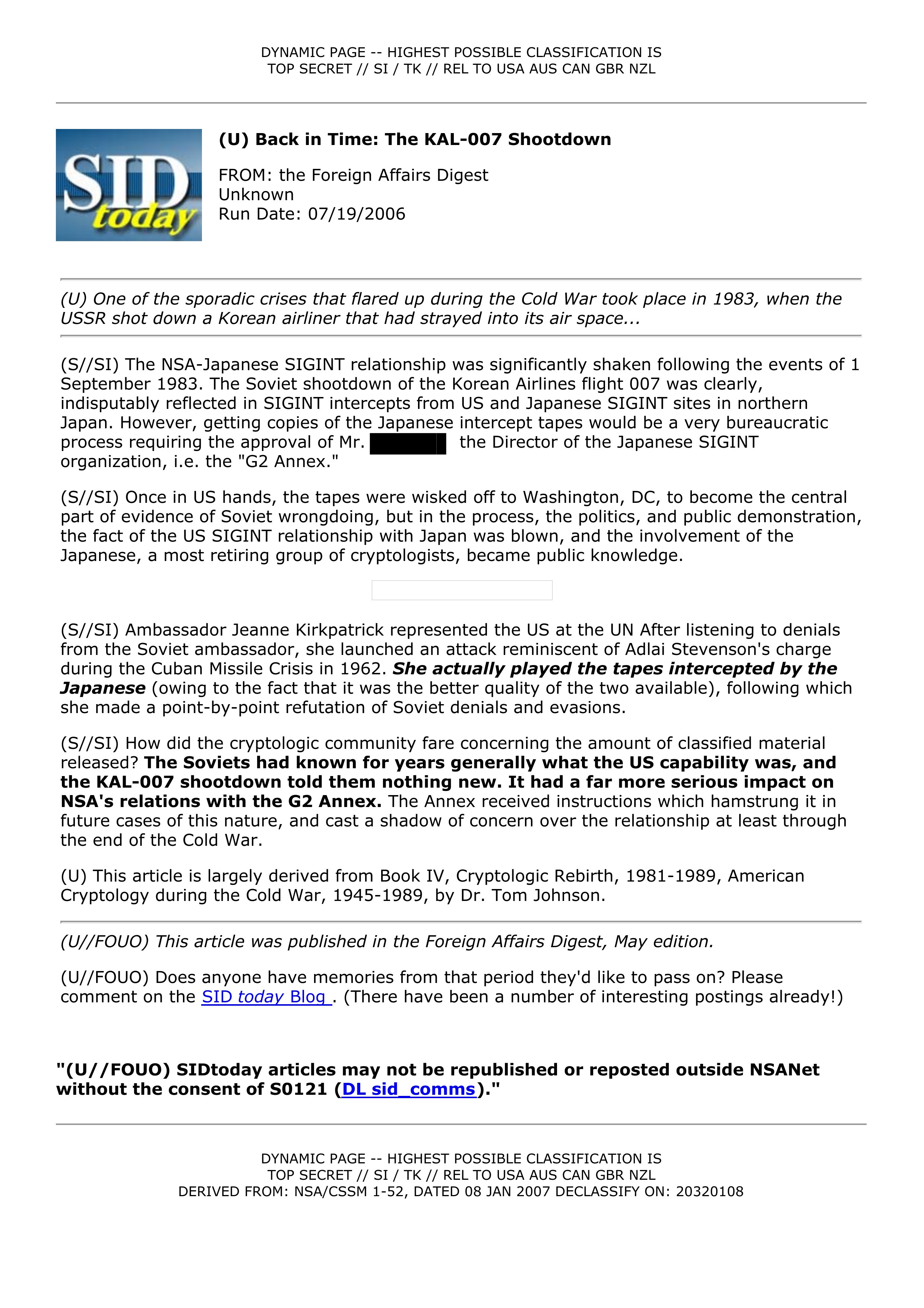
(U) Back in Time: The KAL-007 Shootdown
FROM: the Foreign Affairs Digest
Unknown
Run Date: 07/19/2006
(U) One of the sporadic crises that flared up during the Cold War took place in 1983, when the
USSR shot down a Korean airliner that had strayed into its air space...
(S//SI) The NSA-Japanese SIGINT relationship was significantly shaken following the events of 1
September 1983. The Soviet shootdown of the Korean Airlines flight 007 was clearly,
indisputably reflected in SIGINT intercepts from US and Japanese SIGINT sites in northern
Japan. However, getting copies of the Japanese intercept tapes would be a very bureaucratic
process requiring the approval of Mr. [REDACTED] the Director of the Japanese SIGINT
organization, i.e. the "G2 Annex."
(S//SI) Once in US hands, the tapes were wisked off to Washington, DC, to become the central
part of evidence of Soviet wrongdoing, but in the process, the politics, and public demonstration,
the fact of the US SIGINT relationship with Japan was blown, and the involvement of the
Japanese, a most retiring group of cryptologists, became public knowledge.
(S//SI) Ambassador Jeanne Kirkpatrick represented the US at the UN After listening to denials
from the Soviet ambassador, she launched an attack reminiscent of Adlai Stevenson's charge
during the Cuban Missile Crisis in 1962. She actually played the tapes intercepted by the
Japanese (owing to the fact that it was the better quality of the two available), following which
she made a point-by-point refutation of Soviet denials and evasions.
(S//SI) How did the cryptologic community fare concerning the amount of classified material
released? The Soviets had known for years generally what the US capability was, and
the KAL-007 shootdown told them nothing new. It had a far more serious impact on
NSA's relations with the G2 Annex. The Annex received instructions which hamstrung it in
future cases of this nature, and cast a shadow of concern over the relationship at least through
the end of the Cold War.
(U) This article is largely derived from Book IV, Cryptologic Rebirth, 1981-1989, American
Cryptology during the Cold War, 1945-1989, by Dr. Tom Johnson.
(U//FOUO) This article was published in the Foreign Affairs Digest, May edition.
(U//FOUO) Does anyone have memories from that period they'd like to pass on? Please
comment on the SID today Blog . (There have been a number of interesting postings already!)
"(U//FOUO) SIDtoday articles may not be republished or reposted outside NSANet
without the consent of S0121 (DL sid_comms)."
DYNAMIC PAGE -- HIGHEST POSSIBLE CLASSIFICATION IS
TOP SECRET // SI / TK // REL TO USA AUS CAN GBR NZL
DERIVED FROM: NSA/CSSM 1-52, DATED 08 JAN 2007 DECLASSIFY ON: 20320108
Published in the Same Report
(10 of 12 documents)
-
Japan official NSA visit, cyber briefing [pdf]
This document outlines cooperation between the NSA and Japan’s Directorate for SIGINT (DFS) to develop Japan’s capabilities for providing signals intelligence (SIGINT) support to cyber defense operations, particularly against Chinese cyber activities. It details meetings, training, and data-sharing efforts from 2012–2013 aimed at enhancing Japan’s cyber intelligence capacity under U.S. guidance.
“Japan Made Secret Deals With the NSA That Expanded Global Surveillance” - The Intercept ↗ (2017-04-24) · “アメリカに監視される日本 ~スノーデン“未公開ファイル”の衝撃” - NHK ↗ (2017-04-24) · Gallagher, Ryan · Ikegami, Akira -
Japan official NSA visit, HF briefing [pdf]
The document describes ongoing NSA efforts to renew high-frequency direction-finding (HFDF) collaboration with Japan’s Directorate for SIGINT (DFS) after Japan withdrew from the CROSSHAIR network in 2009. By 2012–2013, both sides were manually exchanging HFDF data, and the NSA sought to advance toward automated data sharing via its BORESIGHT system while reassuring Japan that it would not replace or override its existing technology.
“Japan Made Secret Deals With the NSA That Expanded Global Surveillance” - The Intercept ↗ (2017-04-24) · “アメリカに監視される日本 ~スノーデン“未公開ファイル”の衝撃” - NHK ↗ (2017-04-24) · Gallagher, Ryan · Ikegami, Akira -
NSA liaison in Tokyo opens new office SIDtoday [pdf]
This SIDtoday document describes how the NSA liaison to Japan (SUSLAJ) has moved its office from downtown Tokyo to the US Embassy, aiming to strengthen coordination with the US Ambassador and other intelligence representatives. This relocation follows a long-standing SIGINT partnership between NSA and Japan, dating back to the 1950s, and reflects the growing importance of US-Japan intelligence cooperation.
People: Schieffer, Thomas“Japan Made Secret Deals With the NSA That Expanded Global Surveillance” - The Intercept ↗ (2017-04-24) · “アメリカに監視される日本 ~スノーデン“未公開ファイル”の衝撃” - NHK ↗ (2017-04-24) · Gallagher, Ryan · Ikegami, Akira -
Shift to Software Demodulation in Misawa Expands Collection, Saves Money SIDtoday [pdf]
This SIDtoday document details how the Misawa Security Operations Center (MSOC) has implemented a software demodulation system called WORDGOPHER to process low-data-rate satellite signals. This shift to software-based processing allows MSOC to increase SIGINT collection, save millions of dollars by reducing reliance on expensive hardware demodulators, and improve overall mission efficiency.
“Japan Made Secret Deals With the NSA That Expanded Global Surveillance” - The Intercept ↗ (2017-04-24) · “アメリカに監視される日本 ~スノーデン“未公開ファイル”の衝撃” - NHK ↗ (2017-04-24) · “No Place to Hide” - Metropolitan Books ↗ (2014-05-13) · Gallagher, Ryan · Ikegami, Akira · Greenwald, Glenn -
Special-Delivery SIGINT: How NSA Got Reports to US Negotiators In Time for Them To Be of Value SIDtoday [pdf]
The SIDtoday document details a covert NSA operation to deliver SIGINT to U.S. negotiators during the International Whaling Commission meeting, facilitating strategic decision-making by providing real-time intelligence on lobbying efforts. While effective in advancing U.S. objectives, the operation highlights the use of surveillance tactics in diplomatic settings, potentially compromising the integrity of international negotiations.
Programs: MAUI“Japan Made Secret Deals With the NSA That Expanded Global Surveillance” - The Intercept ↗ (2017-04-24) · “アメリカに監視される日本 ~スノーデン“未公開ファイル”の衝撃” - NHK ↗ (2017-04-24) · Gallagher, Ryan · Ikegami, Akira -
US, Japan Now Exchanging Collection from Reconnaissance Missions SIDtoday [pdf]
This SIDtoday document describes a successful effort by NSA and Japan to exchange SIGINT from airborne reconnaissance missions, enhancing bilateral intelligence cooperation in East Asia. The exchange, which covers a range of SIGINT types beyond just ELINT, allows both countries to share reconnaissance mission summaries, including intelligence on Chinese, North Korean, and Russian military activities, with extensive sanitization and coordination efforts involved to ensure security and compliance with agreed parameters.
“Japan Made Secret Deals With the NSA That Expanded Global Surveillance” - The Intercept ↗ (2017-04-24) · “アメリカに監視される日本 ~スノーデン“未公開ファイル”の衝撃” - NHK ↗ (2017-04-24) · Gallagher, Ryan · Ikegami, Akira -
Charlie Meals Opens New Engineering Support Facility in Japan SIDtoday [pdf]
The NSA opened an engineering support facility at Yokota Air Base in Japan. The $6.6 million facility, paid for almost entirely by the Japanese government, produces and repairs antennas for NSA operations across the globe.
People: Meals, Charlie“Japan Made Secret Deals With the NSA That Expanded Global Surveillance” - The Intercept ↗ (2017-04-24) · “アメリカに監視される日本 ~スノーデン“未公開ファイル”の衝撃” - NHK ↗ (2017-04-24) · The Intercept ↗ (2017-04-24) · Gallagher, Ryan · Ikegami, Akira -
CROSSHAIR — Foreign Partners Filling HF/DF Gaps for the US SIDtoday [pdf]
The U.S. closed a number of High Frequency Direction-Finding sensor sites in the 1990s. To ensure they're able to track signals in areas that had previously been covered by now-shuttered stations, the Signals Intelligence Directorate worked with Second and Third Party partners to share resources and establish a global direction-finding network.
Programs: CROSSHAIR“Japan Made Secret Deals With the NSA That Expanded Global Surveillance” - The Intercept ↗ (2017-04-24) · “アメリカに監視される日本 ~スノーデン“未公開ファイル”の衝撃” - NHK ↗ (2017-04-24) · The Intercept ↗ (2017-09-13) · Gallagher, Ryan · Ikegami, Akira -
The International Security Issues Build-Out SIDtoday [pdf]
The International Security Issues mission, which is responsible for 13 nations, is expanding beyond Washington to participate in build-outs at NSA facilities in Georgia, Hawaii, Texas, and the European Security Command.
Programs: FOLLOWTHEMONEYPeople: Hambleton, Regina“No Place to Hide” - Metropolitan Books ↗ (2014-05-13) · “Japan Made Secret Deals With the NSA That Expanded Global Surveillance” - The Intercept ↗ (2017-04-24) · “アメリカに監視される日本 ~スノーデン“未公開ファイル”の衝撃” - NHK ↗ (2017-04-24) · The Intercept ↗ (2018-08-15) · Greenwald, Glenn · Gallagher, Ryan · Ikegami, Akira -
Japan provided with XKEYSCORE [pdf]
This document outlines a request for approval to provide training to the Japanese Directorate for SIGINT (DFS) on using advanced SIGINT systems, including XKEYSCORE, to enhance Japan's cyber network defense capabilities. This training, scheduled for April 2013, aligns with U.S. strategic goals to bolster the cyber defense abilities of allied nations, highlighting ongoing NSA collaboration with Japan on surveillance and cybersecurity.
“Japan Made Secret Deals With the NSA That Expanded Global Surveillance” - The Intercept ↗ (2017-04-24) · “アメリカに監視される日本 ~スノーデン“未公開ファイル”の衝撃” - NHK ↗ (2017-04-24) · Gallagher, Ryan · Ikegami, Akira
See all 13 documents published with “アメリカに監視される日本 ~スノーデン“未公開ファイル”の衝撃” →
Related Documents
-
Follow-Up: President Reagan Addresses the Nation After KAL-007 Shootdown SIDtoday [pdf]
Following up on the recent article about shoot-down of the Korean airliner KAL 007, this article presents Ronald Reagan's address to the nation in which a segment of audio intercepted by the Japanese partner agency was played.
People: Reagan, RonaldThe Intercept ↗ (2019-05-29) -
Back in Time: Taiwanese Off-Island Collection Sites SIDtoday [pdf]
For two decades, Taiwan targeted China from collection sites in Korea, Thailand and India. Because of costs outweighing the intelligence value and the risk of diplomatic fallout, the US pulled out in '83, giving Taiwan a "one-time cash payment" as compensation.
The Intercept ↗ (2019-05-29) -
The Most Northerly Permanent Settlement in the World -- And SIGINTers Are There SIDtoday [pdf]
Alert, a facility in the High Arctic, is the worlds most northern permanently inhabited settlement. In 1957 a SIGINT station - the "jewel in Canada´s Cold War collection crown" - was added. It still operates today.
The Intercept ↗ (2019-05-29) -
Back in Time: A Look at the US-ROK SIGINT Relationship SIDtoday [pdf]
A brief history of the unique wartime signals intelligence relationship between the U.S. and South Korea, including the founding of South Korea's own SIGINT agency and the United States Special Liaison Adviser Korea that continues today.
People: Cho, Yong IlThe Intercept ↗ (2017-09-13) -
The United Nations at Sixty-One SIDtoday [pdf]
On the occasion of United Nations Day, a post looks at the UN's history, mission, and accomplishments.
Marking: UNCLASSIFIEDThe Intercept ↗ (2019-05-29)