SIGINT Architecture: Why Do We Need One?
Open PDFDocument date: 2006-05-08
Type: SIDtoday
Pages: 2
Genre: newsletter
Banner: DYNAMIC PAGE -- HIGHEST POSSIBLE CLASSIFICATION IS TOP SECRET // SI / TK // REL TO USA AUS CAN GBR NZL
Classification: UNCLASSIFIED
Dissemination: FOUO
Information architectures such as the NSA’s must meet a number of legal, budgetary, and compatibility requirements. Also, a new set of minimum design principles has been agreed upon.
My notes

DYNAMIC PAGE -- HIGHEST POSSIBLE CLASSIFICATION IS
TOP SECRET // SI / TK // REL TO USA AUS CAN GBR NZL
SIDtoday
(U//FOUO) SIGINT Architecture: Why Do We Need One?
FROM: Michael McNamee
Chief, SIGINT Systems Engineering (S01A)
Run Date: 05/08/2006
(U//FOUO) In most large-scale human endeavors a common and coherent vision is critical to
success. The primary purpose of the SIGINT portion of the NSA/CSS enterprise architecture is to
communicate a clear and coherent vision of the future SIGINT system and its capabilities to
developers, managers making investment decisions, program managers and external
stakeholders. With this in mind, SIGINT System Engineering has been working with SID line
organizations, ITD , developers and Technical Directors to create an agreed-upon minimum
set of design principles embodied by the architecture products indicated below.
(U//FOUO) However, architectures are seldom complete and must be agile to cope with
changing target threats and evolving external partner architectures, and the team will work
together to update the architecture to address new technological solutions such as the on-going
TURBULENCE and PRESSUREWAVE development activities.
(U//FOUO) There are several reasons to develop architectures. Can you pass this test?
True or False:
- It's the law - Congress and OMB (Office of Management and Budget) have mandated that
all federal agencies produce enterprise architectures compliant with the Federal
Enterprise Architecture (FEA) and expect that development activities be aligned to the
respective architectures.
- The Clinger Cohen Act requires that federal Agencies develop an enterprise architecture
for Automated Information Systems and show how investment in the capabilities improve
performance or reduce the total cost of ownership.
- Beginning in 1998, the Defense Department (DoD) mandated the C4ISR* architecture
framework to increase systems interoperability and information flow down to the
warfighter.
- Architecture communicates the roadmap ahead to managers and the development
workforce, reducing duplicative development, driving down integration costs and reducing
development risk.
(U//FOUO) ANSWER: All the above are true. Question #4 provides the fundamental goal of
having all within an organization working towards common development objectives and making
coherent investment decisions.
(U//FOUO) Furthermore, the DoD and Intelligence Community have directed the use of a Service
Oriented Architecture (SOA) and implementing web services to enable interoperability. The job
of SIGINT System Engineering will be to continue to work with developers in the line
organizations to document and update the development roadmap ahead.
(U//FOUO) Program managers and developers throughout SID and ITD as well as Lane Managers
will need to ensure that contracts and design decisions reflect the SV-4, OV-7, TV-1 and security
guidelines at the below links:
- OV-5 "To-Be" Baseline Architecture Operational Activity Model OV-5
- SV-4 "To-Be" Baseline Architecture System Data Flow
- OV-7 "To-Be" Baseline Architecture Logical Data Model
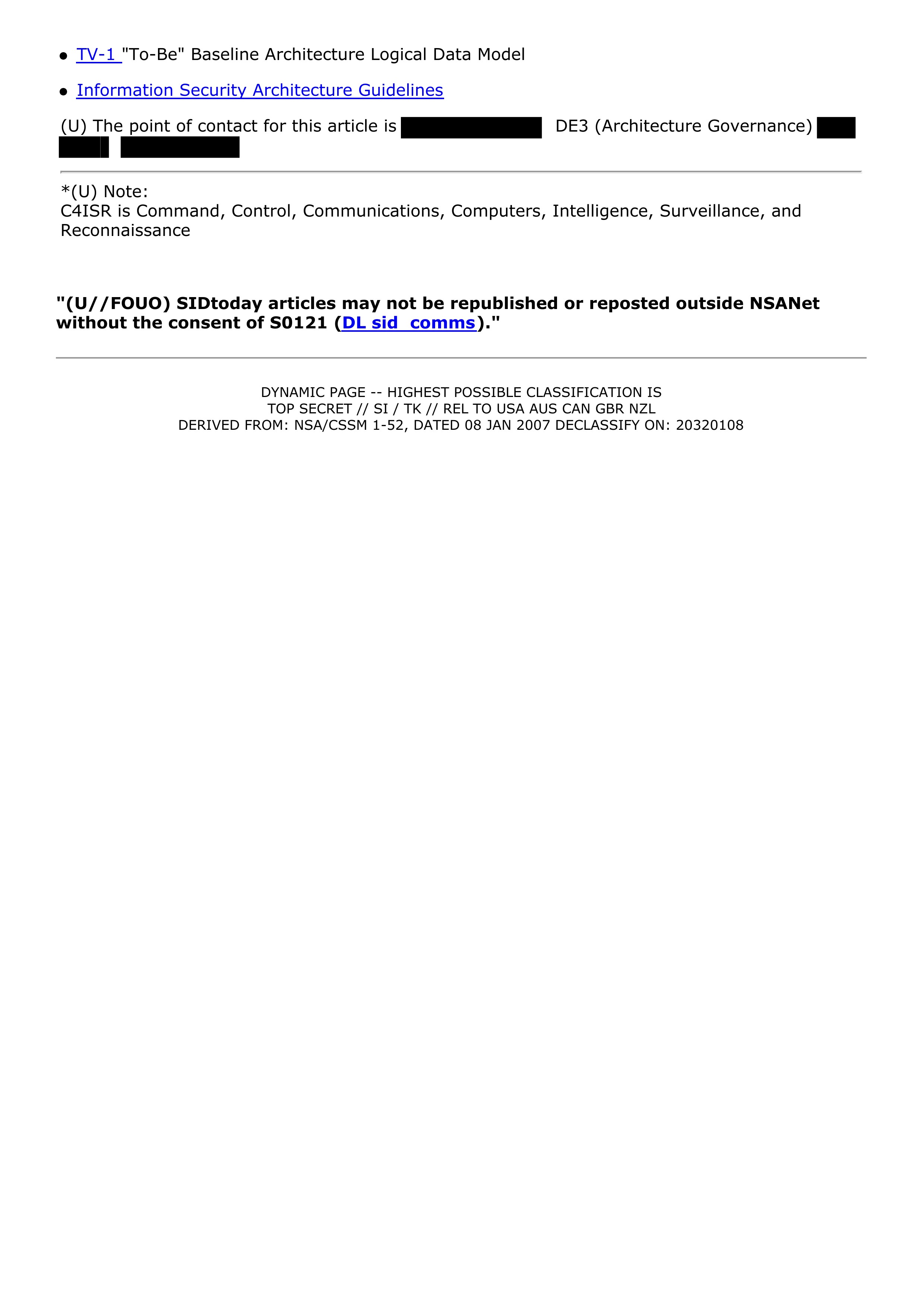
- TV-1 "To-Be" Baseline Architecture Logical Data Model
- Information Security Architecture Guidelines
(U) The point of contact for this article is [REDACTED] DE3 (Architecture Governance) [REDACTED]
[REDACTED] [REDACTED]
*(U) Note:
C4ISR is Command, Control, Communications, Computers, Intelligence, Surveillance, and
Reconnaissance
"(U//FOUO) SIDtoday articles may not be republished or reposted outside NSANet
without the consent of S0121 (DL sid comms)."
DYNAMIC PAGE -- HIGHEST POSSIBLE CLASSIFICATION IS
TOP SECRET // SI / TK // REL TO USA AUS CAN GBR NZL
DERIVED FROM: NSA/CSSM 1-52, DATED 08 JAN 2007 DECLASSIFY ON: 20320108
Related Documents
-
A SIGINT SOA? SIDtoday [pdf]
SID will implement a Service-Oriented Architecture (SOA) for its various websites, apps, and databases, to help increase the shareability of its resources across the Intelligence Community.
People: McNamee, MichaelThe Intercept ↗ (2019-05-29) -
Analytic Challenges from Active-Passive Integration [pdf]
This NSA briefing addresses the technical and administrative friction caused by "shaping" operations. Shaping occurs when an active malware implant, typically situated on network infrastructure like a router, copies specific data streams and redirects them past a passive surveillance sensor such as TURMOIL. While this ensures the capture of data that might otherwise be missed, it creates a "double metadata" conflict where a single piece of intelligence carries two competing sets of identifiers: one from the active Tailored Access Operations (TAO) implant and another from the passive collection site. The document tasks analysts with finding a way to reconcile these source notations to ensure the data remains searchable and legally compliant within legacy databases.
Programs: BRAVENICKEL · HAMMERMILL · APEX · TURMOIL · HAMMERSTONE · PRESSUREWAVE · METROTUBE · TOYGRIPPE · TURBULENCE · METAWAVE · MARINA · SSO · CONVEYANCE · NUCLEON · FASCIA · HAMMERCHANT -
Analytic Challenges from Active-Passive Integration [pdf]
This NSA presentation examines metadata attribution challenges arising when active TAO implants exfiltrate traffic through passive TURMOIL collection infrastructure, creating conflicts where intercepted data carries dual classification markings, case notations, and legal authorities from both collection systems. The briefing highlights how existing databases and analytic tools were not designed to handle traffic with two simultaneous sets of metadata parameters, requiring enterprise-wide solutions to consistently attribute and track actively-shaped intelligence collection.
Programs: BRAVENICKEL · HAMMERMILL · APEX · MARINA · TURMOIL · PRESSUREWAVE · METROTUBE · TOYGRIPPE · HAMMERSTEIN · HAMMERSTONE · METAWAVE · TURBULENCE · SSO -
TURBULENCE - APEX - Active/passive Exfiltration [pdf]
This 2009 NSA presentation details APEX (Active/Passive Exfiltration), a TURBULENCE program component that combines passive collection infrastructure with active TAO implants to exfiltrate VPN and VoIP traffic from deep within target networks back to NSA collection systems. The system uses the FASHIONCLEFT protocol to tunnel captured packets through compromised routers and network devices, enabling decryption of VPN tunnels and collection of voice communications that would otherwise be invisible to passive surveillance.
Programs: TURBULENCE · TURMOIL · HAMMERSTEIN · HAMMERCHANT · FASHIONCLEFT · TUTELAGE · TURBINE · TRAFFICTHIEF · XKEYSCORE · ANALYTICS · PRESSUREWAVE · TOYGRIPPE · POISONNUT · FLAXENPRECEPT · FOGYNULL · FUNNELAPS · SHELLGREY · METROTUBE · VINYLSEAT · OLYMPUS · UNITEDRAKE · FIGBUILD · SURPASSPIN · ROOTKNOT · OPTICPINCH · SEAGULFARO · TREBLECLEF · CONVEY · PINWALE · SWEEPFORWARD · QUANTUM · KEYCARD · ASDF · TUBE · PUZZLECUBE · WEALTHYCLUSTER2 · COALSHOVEL · HAMMERMILL · ISLANDTRANSPORT · FASCIA · TURBINIE · APEX · PPF · AEG · FIP · SSO · PICARESQUE · PSP · IVE · PSC · CHIMNEYPOOL · CORESSC · FLASHHANDLE · IBRIDGE · CORALREEF · VAO · NUCLEON · PIQBLADE“The Digital Arms Race: NSA Preps America for Future Battle” - Der Spiegel ↗ (2015-01-17) · “How the NSA Plans to Infect ‘Millions’ of Computers with Malware” - The Intercept ↗ (2014-03-12) · “How the NSA Plans to Infect ‘Millions’ of Computers with Malware” - The Intercept ↗ (2014-03-12) · Appelbaum, Jacob · Gibson, Aaron · Guarnieri, Claudio · Müller-Maguhn, Andy · Poitras, Laura · Rosenbach, Marcel · Ryge, Leif · Schmundt, Hilmar · Sontheimer, Michael · Gallagher, Ryan · Greenwald, Glenn -
VALIANTSURF [pdf]
An NSA WikiInfo page for VALIANTSURF — the coverterm for NSA's IPSec VPN decryption capability within the TURMOIL collection platform — describing the four data flow types for intercepting and breaking encrypted VPN traffic, the full deployment roster across collection sites including Menwith Hill, SMOKYSINK, MUSCULAR, CROSSCUT and others, and the architectural taxonomy of the VALIANTSURF programme including its MALIBU and WAIMEA processing architectures and their relationship to LONGHAUL, POISONNUT and GALLANTWAVE.
Programs: VALIANTSURF · TURMOIL · TURBULENCE · HOOKED · HOOKEDHAND · CINDER · CINDERASH · CINDERTRACK · SCARLETFEVER · LONGHAUL · FALLOUT · TOYGRIPPE · PICARESQUE · XKEYSCORE · PRESSUREWAVE · ASDF · MAILORDER · TUBE · KEYCARD · POISONNUT · ISLANDHIDEAWAY · ISLANDTRANSPORT · EXOPUMP · CORALREEF · PINWALE · TUSCARORA · ONEROOF · CONVEYANCE · TURTLEPOWER · WDM · CADENCE · UTT · SCISSORS · FISHWAY · BTUBE · DNCA · ROMULANALE · GALLANTWAVE · ROMULANGAWK · ROMULANGOWL · MALIBU · WAIMEA · WAIMEAVISAGE · ROMULANVISAGE · WAIMEAVISE · ROMULANVISE · APEX · METROTUBE · MADFORGE · JSORCERER · CROSSCUT · CIET · LATTICE · STARQUAKE · SARATOGA · MUSCULAR · SMOKYSINK · SLACKKEY · TUMMS · PURGE · SURGE · NUCLEON · SPAGIC · PPF · SOAP · TUMULT · FIP · PIQBLADE · DEEPDIVE · IBRIDGE