Intelligence Campaign Planning: The Future of DoD Planning
Open PDFDocument date: 2005-04-20
Type: SIDtoday
Pages: 2
Genre: newsletter
Banner: DYNAMIC PAGE -- HIGHEST POSSIBLE CLASSIFICATION IS TOP SECRET // SI / TK // REL TO USA AUS CAN GBR NZL
Classification: SECRET
Dissemination: -
The Defense Department is developing a new process for integrating intelligence operations into planning for combat campaigns. New plans from each of the Combatant Command centers will develop in tandem with advisers from the NSA rather than as separate parallel processes.
My notes
DYNAMIC PAGE -- HIGHEST POSSIBLE CLASSIFICATION IS
TOP SECRET // SI / TK // REL TO USA AUS CAN GBR NZL
SIDtoday
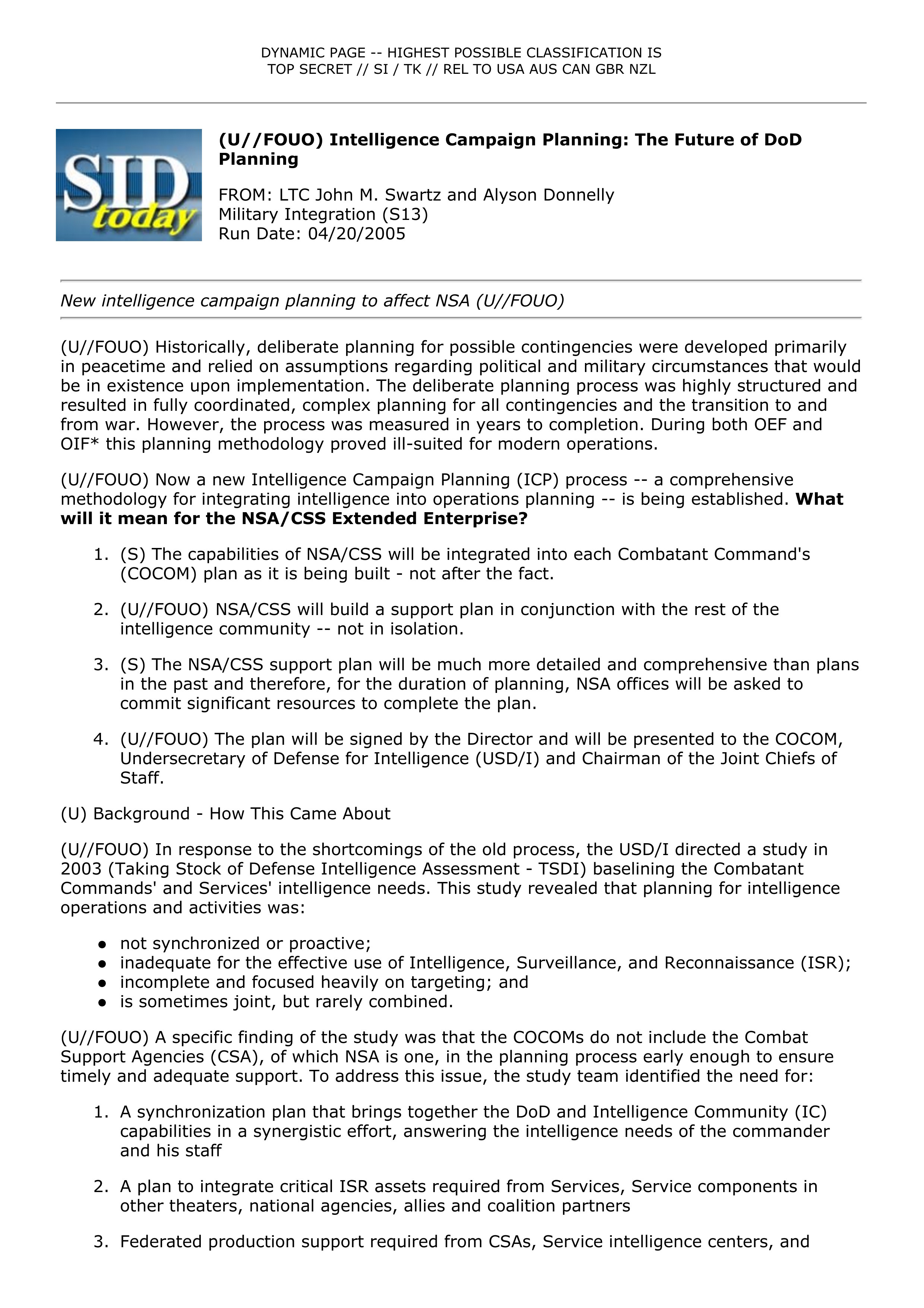
(U//FOUO) Intelligence Campaign Planning: The Future of DoD
Planning
FROM: LTC John M. Swartz and Alyson Donnelly
Military Integration (S13)
Run Date: 04/20/2005
New intelligence campaign planning to affect NSA (U//FOUO)
(U//FOUO) Historically, deliberate planning for possible contingencies were developed primarily
in peacetime and relied on assumptions regarding political and military circumstances that would
be in existence upon implementation. The deliberate planning process was highly structured and
resulted in fully coordinated, complex planning for all contingencies and the transition to and
from war. However, the process was measured in years to completion. During both OEF and
OIF* this planning methodology proved ill-suited for modern operations.
(U//FOUO) Now a new Intelligence Campaign Planning (ICP) process -- a comprehensive
methodology for integrating intelligence into operations planning -- is being established. What
will it mean for the NSA/CSS Extended Enterprise?
- (S) The capabilities of NSA/CSS will be integrated into each Combatant Command's
(COCOM) plan as it is being built - not after the fact.
- (U//FOUO) NSA/CSS will build a support plan in conjunction with the rest of the
intelligence community -- not in isolation.
- (S) The NSA/CSS support plan will be much more detailed and comprehensive than plans
in the past and therefore, for the duration of planning, NSA offices will be asked to
commit significant resources to complete the plan.
- (U//FOUO) The plan will be signed by the Director and will be presented to the COCOM,
Undersecretary of Defense for Intelligence (USD/I) and Chairman of the Joint Chiefs of
Staff.
(U) Background - How This Came About
(U//FOUO) In response to the shortcomings of the old process, the USD/I directed a study in
2003 (Taking Stock of Defense Intelligence Assessment - TSDI) baselining the Combatant
Commands' and Services' intelligence needs. This study revealed that planning for intelligence
operations and activities was:
- not synchronized or proactive;
- inadequate for the effective use of Intelligence, Surveillance, and Reconnaissance (ISR);
- incomplete and focused heavily on targeting; and
- is sometimes joint, but rarely combined.
(U//FOUO) A specific finding of the study was that the COCOMs do not include the Combat
Support Agencies (CSA), of which NSA is one, in the planning process early enough to ensure
timely and adequate support. To address this issue, the study team identified the need for:
- A synchronization plan that brings together the DoD and Intelligence Community (IC)
capabilities in a synergistic effort, answering the intelligence needs of the commander
and his staff
- A plan to integrate critical ISR assets required from Services, Service components in
other theaters, national agencies, allies and coalition partners
- Federated production support required from CSAs, Service intelligence centers, and
COCOM Joint Intelligence/Analysis Centers (JICs/JAC) in other theaters
- A plan for linguistics and reserve augmentation
(U//FOUO) The next Contingency Planning Guidance (CPG) will further facilitate the DoD's shift
to a compressed, iterative process, to be known as the Adaptive Planning Process (APP). The
goal of adaptive planning is to produce and iterate flexible options that anticipate and respond
rapidly to changing conditions -- producing plans rapidly and allowing for existing plans to be
updated in months, not years.
(U//FOUO) For further information, please contact [REDACTED], Chief, S132 Military Integration
-- Plans & Exercises (PLEX) Division, [REDACTED].
*(U) Notes:
OEF = Operation ENDURING FREEDOM
OIF = Operation IRAQI FREEDOM
"(U//FOUO) SIDtoday articles may not be republished or reposted outside NSANet
without the consent of S0121 (DL sid_comms)."
DYNAMIC PAGE -- HIGHEST POSSIBLE CLASSIFICATION IS
TOP SECRET // SI / TK // REL TO USA AUS CAN GBR NZL
DERIVED FROM: NSA/CSSM 1-52, DATED 08 JAN 2007 DECLASSIFY ON: 20320108
Related Documents
-
Rock Drills: Not Just for Military Planning Anymore SIDtoday [pdf]
Rock Drills, which are rehearsals of missions, originally received that name because military commanders would often use rocks to represent different units. Now known as ROC (Rehearsal of Concept) Drills, they are "adversary-driven scenarios" used by the NSA to test plans for operations.
Marking: SECRETPeople: West, GavinThe Intercept ↗ (2017-09-13) -
Announcing the Birth of the JFCC-ISR SIDtoday [pdf]
A new office of U.S. Strategic Command called the Joint Functional Component Command for Intelligence, Surveillance, and Reconnaissance will house representatives of the NSA, National Geospatial Agency, and Defense Intelligence Agency to coordinate intelligence that directly supports global combat missions.
People: Cusick, JimThe Intercept ↗ (2017-09-13) -
SID Linguists Train DoD Polygraphers SIDtoday [pdf]
Signals Intelligence Directorate linguists with field experience helped train Department of Defense polygraphers before deployment to Afghanistan, where polygraphs are increasingly used to vet local informants and potential employees, with an interpreter as an intermediary.
Marking: SECRETThe Intercept ↗ (2018-08-15) -
Planning the Future of the Collection Skill Community SIDtoday [pdf]
NSA staff is aging, and most new hires for signals intelligence collection positions arrive at the agency with inadequate training. Human resources and others have formed a committee to determine what skills are needed for these jobs, and how to create viable career development plans to ensure that the NSA is staffed to collect intelligence in a decade.
People: Berlin, CharlesThe Intercept ↗ (2018-03-01) -
SROB Plans the Future of SIGINT SIDtoday [pdf]
The SIGINT Requirement Oversight Board is the senior forum for discussion of the future of signals intelligence and validates documents concerning the acquisition process.
People: Quirk, RichardThe Intercept ↗ (2017-09-13)