Trade Jargon: Got Your 'Ears'? (repost)
Open PDFDocument date: 2004-01-02
Type: SIDtoday
Pages: 2
Genre: newsletter
Banner: DYNAMIC PAGE -- HIGHEST POSSIBLE CLASSIFICATION IS TOP SECRET // SI / TK // REL TO USA AUS CAN GBR NZL
Classification: UNCLASSIFIED
Dissemination: FOUO
(Slightly modified repost) Description of the unique jargon used by SIGINT transcription experts, or "scribes."
My notes
DYNAMIC PAGE -- HIGHEST POSSIBLE CLASSIFICATION IS
TOP SECRET // SI / TK // REL TO USA AUS CAN GBR NZL
SIDtoday
(U) Trade Jargon: Got Your 'Ears'? (repost)
FROM: SIGINT Communications
Run Date: 01/02/2004
FROM: SIGINT Communications
(U) Note: This article appeared on December 12th.
(U//FOUO) There are many different professions at work within SID, and each speaks its own
specialized "language". Once a person becomes accustomed to hearing the jargon, it becomes
second nature - but an outsider sitting in on a typical SID meeting would likely have no idea
what's going on! We thought it would be interesting to document some of this "SID jargon" -
we'll start by looking at the vocabulary of one of the core SIGINT professions: transcription.
(U//FOUO) Transcription is sometimes confused with translation. What's the difference? When
you are translating, you take something written in one language and convert it into another.
Transcription, on the other hand, is when a person listens to a person talking and writes down
(in the original language) what was said. Sounds easy? It isn't! Aside from the fact that the
sound quality may not be the greatest, there's the need to be proficient in a foreign language,
not to mention that the speakers may have dialects, quirks of speech, use unfamiliar slang, etc.
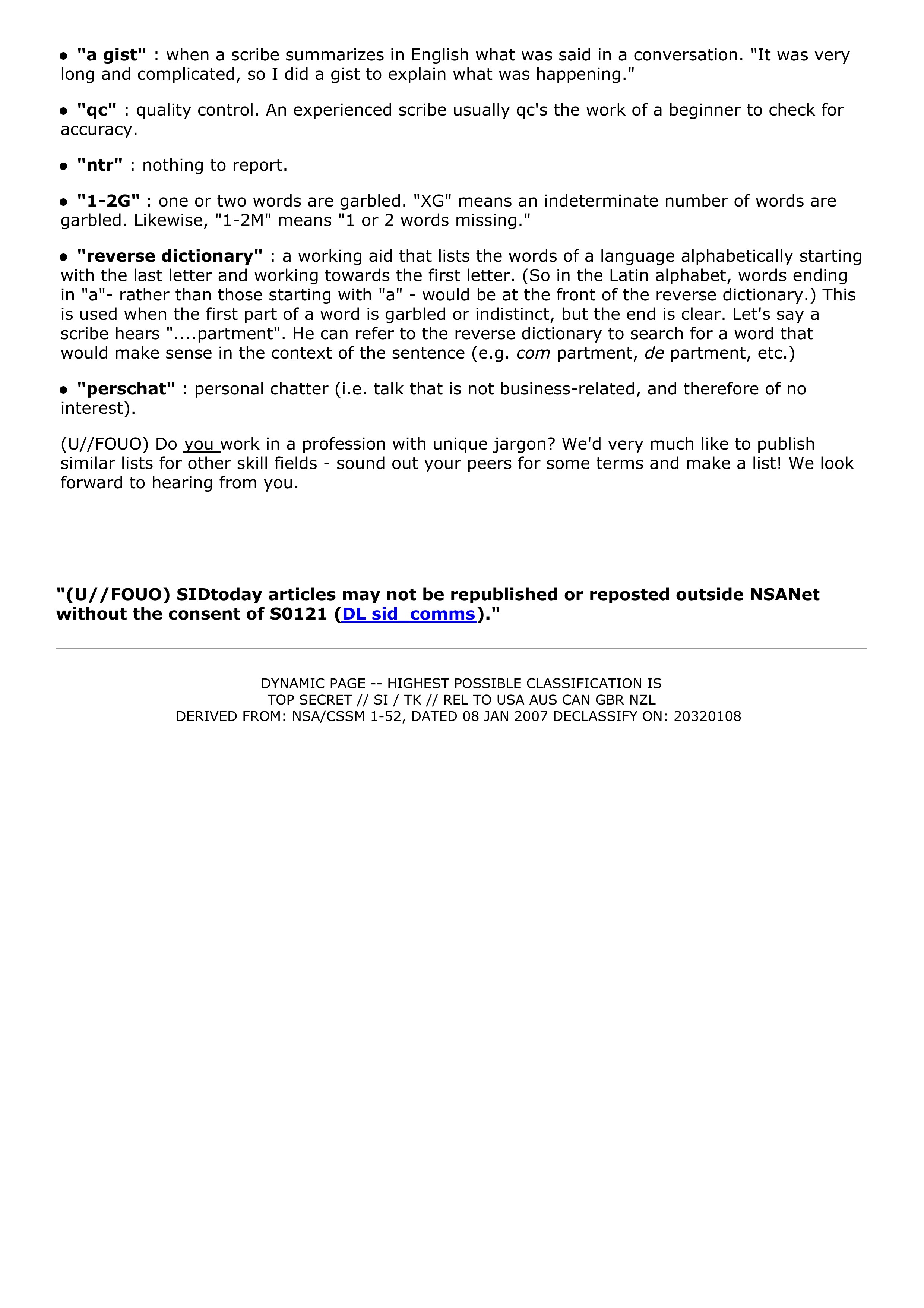
(U//FOUO) Here's a list of commonly used transcription terms. It may give some insight into
what it's like to be a transcriber (or "scribe" for short)!:
- "foot pedal" : a device used to allow the scribe to back up, play, fast forward, etc. a
recording using his feet, thereby freeing up the hands for typing. - "rock on it" : the act of listening to a certain garbled word over and over to try to figure out
what is being said. - "A%" (called A-value or simply A-val): a marking used by a scribe to note "I am positive
that's what's being said." This contrasts with "B%", which means, "I think that's what's being
said," or "C%" which means, "That's what it sounds like, but I can't nail down what the word is."
In a transcript, such a term might appear something like this: "Mr. Smith(B%) said he was the
director of the newly-formed company." - "read" : this is a scale indicating how clear a recording is. A read of 1 indicates that there is
nothing intelligible. A read of 5 (the highest, called "5-by") means near perfect audio quality.
You might hear a scribe say, "This read of 2 is terrible! I can only pick out a word here and
there!" - "a cut" : a recorded conversation. "There was nothing to report on the first three cuts, but
the reporters will want us to work on the fourth cut asap, as a VIP was speaking!" - "voice id" : when a scribe knows a speaker's voice so well that he can identify the person on
that basis alone. "The caller didn't say his name, but the senior scribe knew the voice well
enough to do a voice id on the person: it was Mr. Jones." - "ears" : a scribe's earphones. "Put on your ears and come listen to this cut."
- "ui fem" : an unidentified female. "A ui fem came on the line and asked to speak to the
operator." The counterpart to this is "ui male". - "scan" : to listen quickly through a recording to determine whether or not it merits
transcription. - "a gist" : when a scribe summarizes in English what was said in a conversation. "It was very
long and complicated, so I did a gist to explain what was happening." - "qc" : quality control. An experienced scribe usually qc's the work of a beginner to check for
accuracy. - "ntr" : nothing to report.
- "1-2G" : one or two words are garbled. "XG" means an indeterminate number of words are
garbled. Likewise, "1-2M" means "1 or 2 words missing." - "reverse dictionary" : a working aid that lists the words of a language alphabetically starting
with the last letter and working towards the first letter. (So in the Latin alphabet, words ending
in "a"- rather than those starting with "a" - would be at the front of the reverse dictionary.) This
is used when the first part of a word is garbled or indistinct, but the end is clear. Let's say a
scribe hears "....partment". He can refer to the reverse dictionary to search for a word that
would make sense in the context of the sentence (e.g. com partment, de partment, etc.) - "perschat" : personal chatter (i.e. talk that is not business-related, and therefore of no
interest).
(U//FOUO) Do you work in a profession with unique jargon? We'd very much like to publish
similar lists for other skill fields - sound out your peers for some terms and make a list! We look
forward to hearing from you.
"(U//FOUO) SIDtoday articles may not be republished or reposted outside NSANet
without the consent of S0121 (DL sid comms)."
DYNAMIC PAGE -- HIGHEST POSSIBLE CLASSIFICATION IS
TOP SECRET // SI / TK // REL TO USA AUS CAN GBR NZL
DERIVED FROM: NSA/CSSM 1-52, DATED 08 JAN 2007 DECLASSIFY ON: 20320108
Related Documents
-
Trade Jargon: Got Your 'Ears'? SIDtoday [pdf]
Description of the unique jargon used by SIGINT transcription experts, or "scribes."
The Intercept ↗ (2016-08-10) -
Trade Jargon: Got Your 'Ears'? (repost) SIDtoday [pdf]
(Slightly modified repost) Description of the unique jargon used by SIGINT transcription experts, or "scribes."
The Intercept ↗ (2016-12-07) -
Letters to the Editor: Trade Jargon SIDtoday [pdf]
Letters from readers about transcribers and translators.
The Intercept ↗ (2016-08-10) -
Early Daze at the Agency SIDtoday [pdf]
A staffer reflects on NSA jargon and how overwhelming it can be for a new hire.
Marking: CONFIDENTIALThe Intercept ↗ (2016-08-10) -
Mailroom Jargon: Flaking for the Ninth Floor Run? SIDtoday [pdf]
A list of specialized terms used in the NSA mailroom.
The Intercept ↗ (2017-04-24)