Reported Documents (810 total)
Documents published alongside news reporting on the Snowden disclosures.
Sort: Title
Documents
-
GCHQ NAC review – April to June (2011) [pdf]
The GCHQ NAC review (Apr–Jun 2011) details the continuation of Operation Socialist, describing how NAC supported mapping Belgacom’s internal network and guided CNE operators to infiltrate key GRX routers. The aim was to establish positions within the network to enable man-in-the-middle (MitM) operations against roaming mobile handsets.
“Operation Socialist: The Inside Story of How British Spies Hacked Belgium’s Largest Telco” - The Intercept ↗ (2014-12-13) · “Lees hier hoe de Britse geheime dienst GCHQ Belgacom aanviel” - NRC ↗ (2014-12-13) · “Britse geheime dienst bespioneerde jarenlang Belgacom-klanten” - De Standaard ↗ (2014-12-13) · Gallagher, Ryan · Modderkolk, Huib · Vanhecke, Nikolas · Eeckhaut, Mark -
GCHQ NAC review – January to March (2011) [pdf]
The GCHQ NAC review (Jan–Mar 2011) highlights a successful MyNOC surge against GRX operators that significantly expanded intelligence on operator networks and traffic during Operation Socialist. This effort facilitated a major CNE operation against Belgacom (MERION ZETA), securing both deep and edge network access, with continued work to build on this infiltration.
“Operation Socialist: The Inside Story of How British Spies Hacked Belgium’s Largest Telco” - The Intercept ↗ (2014-12-13) · “Lees hier hoe de Britse geheime dienst GCHQ Belgacom aanviel” - NRC ↗ (2014-12-13) · “Britse geheime dienst bespioneerde jarenlang Belgacom-klanten” - De Standaard ↗ (2014-12-13) · Gallagher, Ryan · Modderkolk, Huib · Vanhecke, Nikolas · Eeckhaut, Mark -
GCHQ NAC review – January to March (2012) [pdf]
The GCHQ NAC review (Jan–Mar 2012) reports ongoing progress in maintaining CNE access to the Belgacom GRX operator, with the CNE EREPO team issuing new operational requirements to the NAC to further guide and support the hacking operation "OP Socialist".
“Operation Socialist: The Inside Story of How British Spies Hacked Belgium’s Largest Telco” - The Intercept ↗ (2014-12-13) · “Lees hier hoe de Britse geheime dienst GCHQ Belgacom aanviel” - NRC ↗ (2014-12-13) · “Britse geheime dienst bespioneerde jarenlang Belgacom-klanten” - De Standaard ↗ (2014-12-13) · Gallagher, Ryan · Modderkolk, Huib · Vanhecke, Nikolas · Eeckhaut, Mark -
GCHQ NAC review – July to September (2011) [pdf]
The GCHQ NAC review (Jul–Sep 2011) outlines the continued support by NAC following the successful OP SOCIALIST operation, focusing on mapping Belgacom’s internal network and identifying key internal GRX routers to establish man-in-the-middle (MitM) platforms targeting roaming mobile handsets.
“Operation Socialist: The Inside Story of How British Spies Hacked Belgium’s Largest Telco” - The Intercept ↗ (2014-12-13) · “Lees hier hoe de Britse geheime dienst GCHQ Belgacom aanviel” - NRC ↗ (2014-12-13) · “Britse geheime dienst bespioneerde jarenlang Belgacom-klanten” - De Standaard ↗ (2014-12-13) · Gallagher, Ryan · Modderkolk, Huib · Vanhecke, Nikolas · Eeckhaut, Mark -
GCHQ NAC review – October to December (2011) [pdf]
The GCHQ NAC review (Oct–Dec 2011) reports that the Belgacom GRX exploitation was highly successful, enabling both CNE and Crypt Ops by uncovering extensive VPN exploitation opportunities through OP SOCIALIST II. The surge operation focused on mapping mobile operators connecting via VPN, analyzing GTP traffic for target selector extraction, and identifying optimal access points—ultimately strengthening sustained network exploitation under the VERACIOUS Project.
“Operation Socialist: The Inside Story of How British Spies Hacked Belgium’s Largest Telco” - The Intercept ↗ (2014-12-13) · “Lees hier hoe de Britse geheime dienst GCHQ Belgacom aanviel” - NRC ↗ (2014-12-13) · “Britse geheime dienst bespioneerde jarenlang Belgacom-klanten” - De Standaard ↗ (2014-12-13) · Gallagher, Ryan · Modderkolk, Huib · Vanhecke, Nikolas · Eeckhaut, Mark -
GCHQ Report on the Technical Capabilities of the Powerful Espionage Program TEMPORA, which Allows for Full Take. [pdf]
In May 2012, GCHQ introduced the TEMPORA internet buffer capability, enabling full take collection of internet communications. This innovation provides NSA and GCHQ analysts access to extensive amounts of data, enhancing their analytical capabilities significantly.
-
GCHQ Visit to NSA on Voice Analytics Systems [pdf]
This document is a GCHQ report detailing a late-November (2007?) visit to NSA’s R64 division focused on collaboration in language identification (LID) and speaker identification (SID) systems, including sharing models and research insights. It also describes NSA tools like Hotzone and Voice RT for real-time voice analysis, and mentions an upcoming visit from the CLEAR consortium to address challenges in speech intelligibility and audio recovery for intercepted communications.
-
GCHQ VisWeek 2008 Conference Report [pdf]
This GCHQ document summarizes key findings from the VisWeek 2008 visualization conference in Ohio, highlighting techniques and tools relevant to SIGINT analysis including collaborative analysis capabilities, graph visualization methods, and the Palantir Government platform. The report recommends incorporating features like analyst notebooks for tracking investigations, collaborative workspaces for multiple analysts, and various graph layout algorithms into GCHQ's MONTE VISTA visualization system.
Programs: MONTE VISTA · MAMBA · CHARTBREAKER · PIGS EAR · KNIME · RAPTOR · BROAD OAK · HAUSTORIUM · SALAMANCA · IIB · INFOVIS · PALANTIR -
GCHQ – Computer Network Exploitation [pdf]
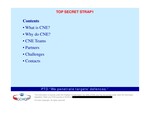
This document outlines GCHQ’s Computer Network Exploitation (CNE) capabilities, detailing how teams remotely access computers and networks without owners’ consent to gather intelligence, support operations, and conduct effects. It also covers operational tools, techniques, infrastructure, joint working with partners, deconfliction, and challenges such as avoiding detection and meeting increasing intelligence demands.
-
GCHQ – Making network sense of the encryption problem (2011) [pdf]
GCHQ’s Network Analysis Centre convened a 2011 roundtable on “making network sense” of encryption, pushing a metadata-first strategy to triage SSL/TLS, IKE, OpenVPN, and SSH flows, pivot from “seed” indicators, and zero in on targets and subnets worth decrypting. The playbook leans on enrichment, AS-level scoping (explicitly citing Belgacom AS6774 GRX VPNs), and “access optimisation” to collect data pre‑encryption—passively or actively.
Programs: SQUEAL · BEARDEDPIGGY · CLOUD · IRASCIBLEHARE · IRASCIBLERABBIT · IRASCIBLEMOOSE · IRASCIBLEEMITT“Operation Socialist: The Inside Story of How British Spies Hacked Belgium’s Largest Telco” - The Intercept ↗ (2014-12-13) · “Lees hier hoe de Britse geheime dienst GCHQ Belgacom aanviel” - NRC ↗ (2014-12-13) · “Britse geheime dienst bespioneerde jarenlang Belgacom-klanten” - De Standaard ↗ (2014-12-13) · Gallagher, Ryan · Modderkolk, Huib · Vanhecke, Nikolas · Eeckhaut, Mark -
-
GCSB access, XKEYSCORE [pdf]
4 p.These documents confirm that GCSB's Waihopai base (IRONSAND) provides Five Eyes partners, including the UK, with both "strong selected data" and a "full-take feed" of communications from the South Pacific via the NSA's XKEYSCORE system, confirming New Zealand's deep integration into the U.S.-led surveillance network despite facing internal issues with GCSB analysts accessing their own national data within NSA databases.
-
GCSB has identified an MFA data link [pdf]
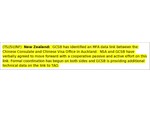
A short extract from an April 2013 NSA document recording that GCSB had identified a Chinese Ministry of Foreign Affairs data link between the Chinese Consulate and the Chinese Visa Office in Auckland, and that NSA and GCSB had verbally agreed to mount a joint passive and active operation against it.
“Leaked papers reveal NZ plan to spy on China for US” - The New Zealand Herald ↗ (2015-04-19) · “New Zealand Plotted Hack on China With NSA” - The Intercept ↗ (2015-04-18) · Fisher, David · Gallagher, Ryan · Hager, Nicky -
GCSB monitoring candidates for WTO director general via XKEYSCORE fingerprint [pdf]
GCSB used XKEYSCORE to intercept emails mentioning other candidates for WTO job and paid close attention to Indonesian contender.
Programs: XKEYSCOREPeople: Azevêdo, Roberto · Bark, Taeho · Blanco, Herminio · González, Anabel · Groser, Tim · Hindawi, Ahmad Thougan · Kyerematen, Alan · Mohamed, Amina · Pangestu, Mari“How spy agency homed in on Groser's rivals” - The New Zealand Herald ↗ (2015-03-23) · “New Zealand Spied on WTO Director Candidates” - The Intercept ↗ (2015-03-22) · Hager, Nicky · Gallagher, Ryan -
GCSB SIGINT Development Quarterly Report [pdf]
This GCSB quarterly report from July 2009 provides a Top Secret review of major telecommunications developments in the South West Pacific, focusing on the intelligence challenges posed by competitive deregulation and new infrastructure projects, while also detailing GCSB's efforts to enhance its collection capabilities, including the fine-tuning of GSM collection in the Solomon Islands, supporting DSD analyses in Fiji, and preparing for full-take XKEYSCORE data sharing with allies.
“New Zealand Spies on Neighbors in Secret "Five Eyes" Global Surveillance” - The Intercept ↗ (2015-03-04) · “Snowden revelations / The price of the Five Eyes club: Mass spying on friendly nations” - The New Zealand Herald ↗ (2015-03-04) · “New Zealand Spy Data Shared With Bangladeshi Human Rights Abusers” - The Intercept ↗ (2015-04-15) · “Secret documents shine light on GCSB spying in Bangladesh” - The New Zealand Herald ↗ (2015-04-16) · Gallagher, Ryan · Hager, Nicky -
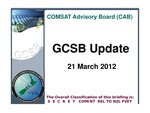
GCSB Update - 21 March 2012 [pdf]
This GCSB briefing from March 2012 reviews key developments at the IRONSAND (Waihopai) base, including senior management changes, ongoing legal challenges, the crucial satellite target shift from IS-701 to IS-18 which altered the coverage beams, and the introduction of new technologies like SILVER PEAK WAN optimization and Huawei VoIP systems impacting South Pacific collection.
Programs: IRONSAND · SHAREDQUEST · SILVERPEAK · SPEARGUN · DARKQUEST · FALLOWHAUNT · KEYCARD · APPARITION · SHADOWCATPeople: Fletcher, Ian -
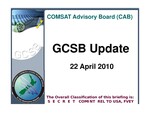
GCSB Update - 22 April 2010 [pdf]
This GCSB briefing from April 2010 provides an internal update on the operational status and development pathway for the Waihopai satellite surveillance station (codenamed IRONSAND). It reports near-perfect system availability statistics for numerous NSA/GCSB systems like LEGALREPTILE and JUGGERNAUT, details collaboration on virtualization and collection initiatives, and notes consequences arising from external court decisions.
Programs: IRONSAND · CALIX · COMMONGROUND · DUALTIRE · FLUTE · FRESNELEFFECT · JACKHAMMER · JUGGERNAUT · KILOMISER · KRAUSS · LATENTHEAT · LEGALREPTILE · LOPERS · MOONSCAPE · SEMITONE · SSA · STONEGATE · SURFBOARD · VENUSAFFECT · VINEYARD · VINTAGE · WEALTHYCLUSTER · VQUEST · TORUS · SHAREDQUEST -
Getting Close to the Adversary – Forward-based Defense with QFIRE (June 3, 2011) [pdf]
This document describes the QFIRE project which is designed to give the NSA a global, low-latency platform for “forward-based defense”, enabling real-time detection and manipulation of Internet traffic close to its source. By co-locating passive sensors (TURMOIL), decision logic (TURBINE), and injection capabilities, QFIRE can rapidly reset connections, redirect targets for exploitation, inject malicious payloads, and even seize control of botnets. It operates as part of the broader QUANTUMTHEORY architecture, leveraging both cooperative and non-cooperative infrastructure worldwide to enable CNE/CND/CNA effects with minimal delay.
Programs: QFIRE · QUANTUMTHEORY · TURBULENCE · TURMOIL · TURBINE · TUTELAGE · QUANTUM · QUANTUMSKY · QUANTUMINSERT · QUANTUMBOT · QUANTUMCOPPER · STRAIGHTBIZARRE · BLINDDATE · TUMULT · ISLANDTRANSPORT · SURPLUSHANGAR · MIDDLEMAN · SCSnet · WEALTHYCLUSTER · SSO -
GHOSTHUNTER aerial image (2009) [pdf]
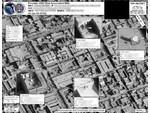
This imagery showcases a real-world application of the GHOSTHUNTER program operated out of Menwith Hill Station in the UK. The document features an aerial satellite photograph used to pinpoint the precise physical location of VSAT (Very Small Aperture Terminal) satellite dishes. By linking a target's digital footprint—specifically their MAC address and IP address—to a specific set of geographic coordinates, the NSA and GCHQ can identify the exact building or compound where a person is using the internet. This capability is a cornerstone of the "find, fix, finish" cycle used to support "covert operations" and targeted killing missions in conflict zones like Yemen, Somalia, and Afghanistan.
Programs: GHOSTHUNTER -
Ghosthunter and the geolocating of internet cafes [pdf]
This document announces an NSA “R Spotlight” webcast introducing GHOSTHUNTER, a multi-agency geolocation program designed to locate Time Division Multiple Access (TDMA) VSAT Internet access points, particularly internet cafés across the Middle East and North Africa in support of U.S. military operations. By mid-2009, GHOSTHUNTER had successfully geolocated over 5,000 VSAT terminals across Middle East demonstrating its operational effectiveness and integration with broader intelligence efforts.
Programs: GHOSTHUNTER