Tag: certificate analysis 3 documents
Search documents matching “certificate analysis” →Free-text subjects the curators added. Unlike the other axes these are not necessarily from the documents' own vocabulary, so they are the loosest thing to browse by (and the most forgiving).
Refine (combine with another filter, via search)
Sort: Title
Documents
-
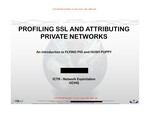
PROFILING SSL AND ATTRIBUTING PRIVATE NETWORKS [pdf]
A TOP SECRET GCHQ presentation introducing two prototype cloud analytics — FLYING PIG, a knowledge base for investigating TLS/SSL traffic at scale across approximately 20 billion events per week, and HUSH PUPPY, a tool for attributing private network traffic to identifiable organisations — with live interface screenshots demonstrating queries against mail.ru infrastructure and operational successes including identification of the Afghan Ministry of Defence network and a foreign Ministry of Foreign Affairs VSAT network.
Programs: FLYINGPIG · HUSHPUPPY · QUICKANT · GEOFUSION · LEGIONJADE · LEGIONRUBY · MAKERSMARK · XKEYSCORE · NOSEYPARKER“Prying Eyes: Inside the NSA's War on Internet Security” - Der Spiegel ↗ (2014-12-28) · “'Brasil é um grande alvo', diz jornalista sobre vigilância dos EUA” - O Globo ↗ (2013-07-07) · Appelbaum, Jacob · Gibson, Aaron · Grothoff, Christian · Müller-Maguhn, Andy · Poitras, Laura · Sontheimer, Michael · Stöcker, Christian · Greenwald, Glenn · Kaz, Roberto · Casado, José -
TLS trends at GCHQ [pdf]
A GCHQ presentation describing their TLS trends analysis programme, which processed approximately 10 billion SSL/TLS Server Hello events per week from Special Source cable tapping and COMSAT collection to produce weekly trend reports, alongside two operational tools — TargeTLS for matching TLS events against BROAD OAK target profiles, and FLYING PIG, a TLS knowledge base enabling analysts to query certificate, IP and client data across the full intercept base.
-
Tracking Targets Through Proxies & Anonymizers [pdf]
This NSA presentation details methods for tracking and de-anonymizing internet users who employ privacy tools like Tor, proxies, and VPN services such as AnchorFree's Hotspot Shield. The document explains how the agency reverse-engineers anonymization tools, creates "fingerprints" to identify their traffic in surveillance systems, and correlates encrypted connections to reveal users' real IP addresses and locations—acknowledging this work "makes for sad analysts" when targets successfully obscure their identities.