Classification: SI 1067 documents
Search documents matching “SI” →Each document's classification level, as component values. If a document contains multiple classifications, the highest is used here.
Graphs
By document date (11 years)
By published date (9 years)
By Banner
Refine (combine with another filter, via search)
Sort: Title
Documents
-
NCRs with Foreign Relations Missions Become 'SUSLAs' SIDtoday [pdf]
New titles have been created for four NSA/CSS Representatives (NCRs) to major Third Party partners. Special US Liaisons Advisors (SUSLA) to Italy and Germany were first named, now followed by Special US Liaison Advisors to Turkey (SUSLAT), Thailand (SUSLAB), Japan (SUSLAJ) and Korea (SUSLAK).
People: Schwemin, Sharon“Turkey Is 'Partner and Target' for the NSA” - Der Spiegel ↗ (2014-08-31) · “How the NSA Helped Turkey Kill Kurdish Rebels” - The Intercept ↗ (2014-08-31) · The Intercept ↗ (2019-05-29) · Poitras, Laura · Rosenbach, Marcel · Sontheimer, Michael · Stark, Holger -
NCTC Current Status of Major Terrorism Figures [pdf]
A TOP SECRET joint HUMINT–COMINT status report from June 2008 summarizes the whereabouts and threat posture of senior al‑Qaida leaders, highlighting Usama bin Ladin, Ayman al‑Zawahiri, and a key courier assessed as critical to locating them. The document reflects U.S. intelligence tracking priorities just three years before bin Ladin’s death.
-
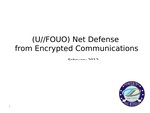
Net Defense from Encrypted Communications [pdf]
A NSA Technology Directorate briefing from February 2012 describing BLUESNORT — a capability that repurposes GALLANTWAVE's SSL/TLS decryption pipeline for network defence, re-injecting decrypted traffic into TURMOIL Stage 1 Prime where BLUESNORT detects malware and other malicious activity — representing description of NSA using its own bulk decryption infrastructure for cyber defence as well as intelligence collection.
-
New 'Profile-Based' Target Discovery Tool Shows Promise SIDtoday [pdf]
A new metadata analysis tool is deployed in an attempt to find drug trafficking targets in southwest Asia. Instead, it stumbles on an Iran-based human smuggling ring. This, the article posits, represents “a promising and innovative means of identifying previously unknown SIGINT targets.”
People: Cummins, SteveThe Intercept ↗ (2018-08-15) -
New Cell to Make SIGINT Assessment Reporting 'All That It Can Be' SIDtoday [pdf]
A new department will focus exclusively on SIGINT Assessment reports, which are holistic analyses of all the information the NSA has on a certain target, often spanning years. These reports are popular within the community.
People: Johnson, CarlThe Intercept ↗ (2018-03-01) -
New CNO Capability Poised to Help Counter IEDs, Geolocate Terrorists SIDtoday [pdf]
A new capability allows for denial-of-service attacks against High Power Cordless Phone (HPCP) networks and geolocation of high value targets. HPCP networks are frequently used by insurgents in Iraq and Afghanistan as a way to trigger IEDs.
The Intercept ↗ (2018-08-15) -
New Collection Access Yields 'Spectacular' Intel SIDtoday [pdf]
In October 2004, one signals intelligence program, "RAINFALL," "successfully geolocated signals of a suspected Indian nuclear weapons storage facility." In response, several other parts of the NSA collaborated to confirm that the signals were related to Indian nuclear weapons, and to begin a new collection effort that revealed "spectacular" amounts of intelligence on India's nuclear weapons capabilities.
The Intercept ↗ (2017-09-13) -
New Contact-Chaining Procedures to Allow Better, Faster Analysis SIDtoday [pdf]
The SIGINT Management Directive 424 briefing (Jan 2011) announces a major procedural shift at the NSA, allowing analysts to conduct contact chaining and large-scale metadata analysis from any selector, regardless of nationality or location. This change removes prior restrictions on U.S. data, enabling more powerful social network mapping for foreign intelligence purposes.
Programs: GATEKEEPER -
New CT Intelligence Exchange With Asia-Pacific Partners SIDtoday [pdf]
The NSA has begun signals intelligence-sharing partnerships with seven other countries' intelligence agencies about 12 specific terrorist groups active in the Asia-Pacific region.
People: Meals, CharlieThe Intercept ↗ (2017-09-13) -
New Equipment for NISTs SIDtoday [pdf]
An update on new equipment that the National Intelligence Support Team deployed in Iraq, including a mainframe "configured to fit inside two shock-mounted ruggedized containers" that hosts a Microsoft Exchange server, file hosting, and other services in the field.
Programs: ITISPeople: Harte, BryanThe Intercept ↗ (2016-12-07) -
New FAA702 Certification in the Works - Cyber Threat [pdf]
A 23 March 2012 SSO article on a draft FAA 702 certification for cyber threats. It would let analysts task selectors tied to malicious cyber activity without attributing them to a foreign government or terrorist group, and would codify tasking of IP addresses and code strings through PRISM and the upstream accesses.
-
New Field Position in St. Louis SIDtoday [pdf]
Announcing a job opening in St. Louis for an NSA SIGINT analyst working integrated within the National Geospatial-Intelligence Agency.
The Intercept ↗ (2016-08-10) -
New GLAIVE (HF Collection System) Course Is Accredited SIDtoday [pdf]
A new course on HF collection using the GLAIVE system has been converted to National Cryptologic School standards. Students can earn credits learning about the joint NSA / GCHQ system which uses Commercial-Off-The-Shelf hardware.
The Intercept ↗ (2018-08-15) -
New HF Collection System Installed on Korean Island SIDtoday [pdf]
A new system for HF (High Frequency) and DF (Direction Finding) radio signal collection was airlifted to a remote South Korean island and installed by NSA engineers and General Dynamics contractors at a South Korean Defense Security Agency collection site.
Programs: CHARTVEINThe Intercept ↗ (2019-05-29) -
New Intel Summary Is Unveiled: 'AMOC Northern High-Lights' SIDtoday [pdf]
Is Unveiled: 'AMOC Northern High-Lights' - The Intercept Snowden Archive —— The SIDtoday Files Browse the Archive New Intel Summary Is Unveiled: ‘AMOC Northern High-Lights’ SUMMARY The Alaska Mission Operations Center has started releasing a new intelligence summary on the “hottest issues from recent Russian military aviation operations,” with more context, background, and analysis than traditional serialized reports.
The Intercept ↗ (2018-08-15) -
New Iranian NERA Satlink Identified SIDtoday [pdf]
An operator of the RAINFALL program discovered a new satellite signal coming from Iran. After two different NSA departments analyzed data from the signal, they discovered it was a NERA Satlink network for digital video broadcasting. They guess that the signal may be used by the Islamic Republic of Iran Broadcasting (IRIB) or the Iranian government.
The Intercept ↗ (2019-05-29) -
New NSA Policy on Modeling and Simulation SIDtoday [pdf]
A new policy on “Modeling and Simulation Verification, Validation and Accreditation” has been implemented.
The Intercept ↗ (2018-08-15) -
New Operations Building at MHS Completed, Fit-Up Begins SIDtoday [pdf]
A 2011 NSA internal report describes the completion of “Project Phoenix” at Menwith Hill Station in the UK — a new operations building featuring a state-of-the-art data center, auditorium, and collaborative office spaces designed to enhance mission resilience, technological capacity, and training infrastructure. The project marks a major modernization effort, expanding Menwith Hill’s operational footprint and preparing it to support new intelligence systems and missions.
-
New Policy Affects SIGINT Development: The Unmasking of Canadian Phone Numbers SIDtoday [pdf]
The Communications Security Establishment — the NSA’s Canadian partner agency — has authorized the unmasking of Canadian phone numbers “incidentally” collected by the NSA. This allows for easier contact chaining and other forms of target development involving Canadian phone numbers.
Programs: FASCIAThe Intercept ↗ (2018-08-15) -
New Policy: Preserving Intellectual Capital in the Event of a Disaster SIDtoday [pdf]
A new directive obligates Signals Intelligence Directorate staff to save materials designated “intellectual capital” to common shared drives and directories, so they can be recovered in case a disaster renders Fort Meade inoperable. Such materials can include source code, databases, and planning and procedure documents.
The Intercept ↗ (2018-03-01)