Motion for Declaratory Judgment of Google Inc.'s First Amendment Right to Publish Aggregate Information About FISA Orders, In re Motion for Declaratory Judgment of a First Amendment Right to Publish Aggregate Info. About FISA Orders
Open PDFDocument date: 2013-06-18
Type: FOIA
Pages: 6
Classification: -
Dissemination: -
FISC/FISCR Court Filings
My notes
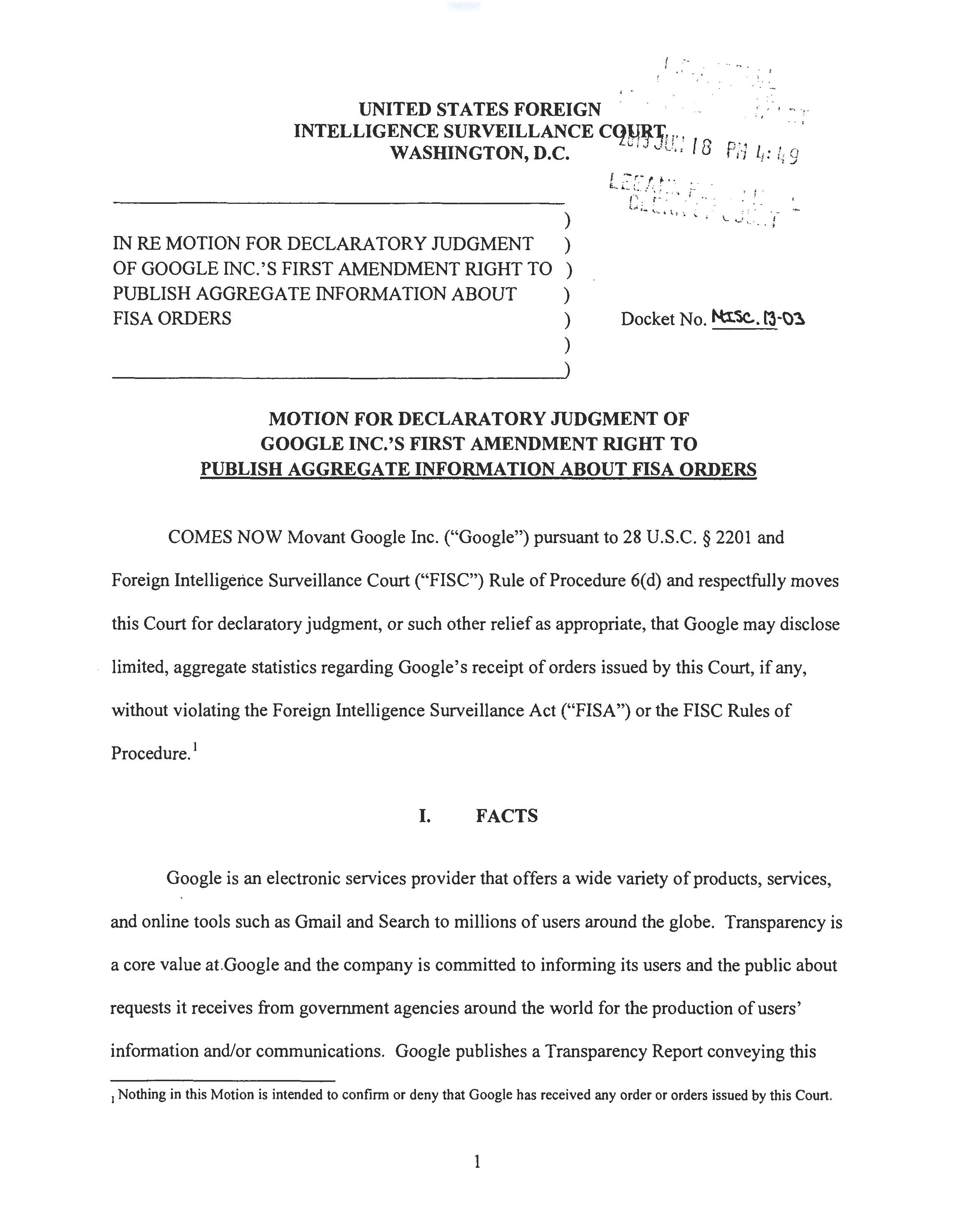
UNITED STATES FOREIGN
INTELLIGENCE SURVEILLANCE COURT
WASHINGTON, D.C.
2013 JUN 18 PH 4:49
IN RE MOTION FOR DECLARATORY JUDGMENT
OF GOOGLE INC.'S FIRST AMENDMENT RIGHT TO
PUBLISH AGGREGATE INFORMATION ABOUT
FISA ORDERS
Docket No. NISC. 13-03
MOTION FOR DECLARATORY JUDGMENT OF
GOOGLE INC.'S FIRST AMENDMENT RIGHT TO
PUBLISH AGGREGATE INFORMATION ABOUT FISA ORDERS
COMES NOW Movant Google Inc. ("Google") pursuant to 28 U.S.C. § 2201 and
Foreign Intelligence Surveillance Court ("FISC") Rule of Procedure 6(d) and respectfully moves
this Court for declaratory judgment, or such other relief as appropriate, that Google may disclose
limited, aggregate statistics regarding Google's receipt of orders issued by this Court, if any,
without violating the Foreign Intelligence Surveillance Act ("FISA") or the FISC Rules of
Procedure.¹
I. FACTS
Google is an electronic services provider that offers a wide variety of products, services,
and online tools such as Gmail and Search to millions of users around the globe. Transparency is
a core value at Google and the company is committed to informing its users and the public about
requests it receives from government agencies around the world for the production of users'
information and/or communications. Google publishes a Transparency Report conveying this
¹ Nothing in this Motion is intended to confirm or deny that Google has received any order or orders issued by this Court.
1
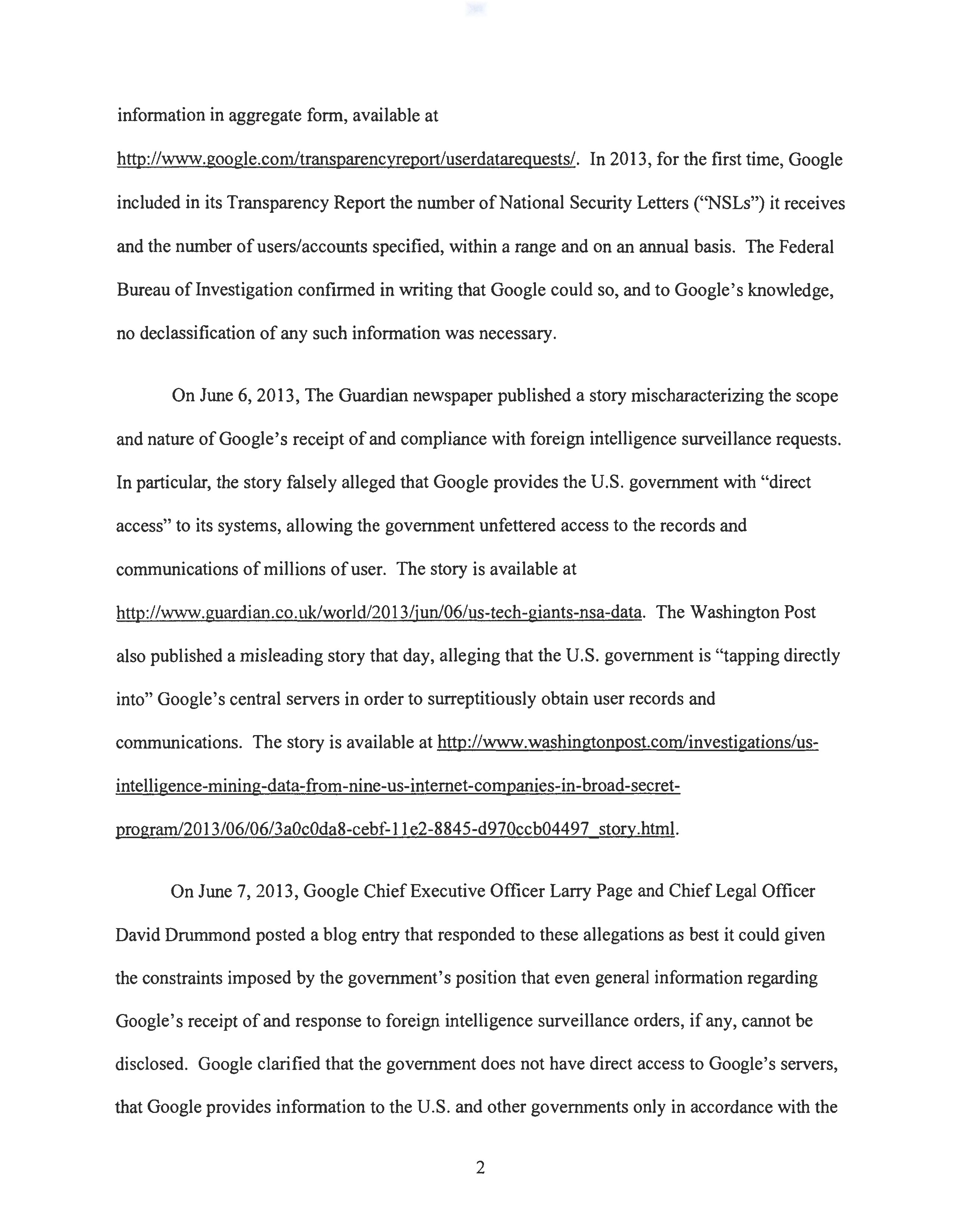
information in aggregate form, available at
http://www.google.com/transparencyreport/userdatarequests/. In 2013, for the first time, Google
included in its Transparency Report the number of National Security Letters ("NSLs") it receives
and the number of users/accounts specified, within a range and on an annual basis. The Federal
Bureau of Investigation confirmed in writing that Google could so, and to Google's knowledge,
no declassification of any such information was necessary.
On June 6, 2013, The Guardian newspaper published a story mischaracterizing the scope
and nature of Google's receipt of and compliance with foreign intelligence surveillance requests.
In particular, the story falsely alleged that Google provides the U.S. government with "direct
access" to its systems, allowing the government unfettered access to the records and
communications of millions of user. The story is available at
http://www.guardian.co.uk/world/2013/jun/06/us-tech-giants-nsa-data. The Washington Post
also published a misleading story that day, alleging that the U.S. government is "tapping directly
into" Google's central servers in order to surreptitiously obtain user records and
communications. The story is available at http://www.washingtonpost.com/investigations/us-
intelligence-mining-data-from-nine-us-internet-companies-in-broad-secret-
program/2013/06/06/3a0c0da8-cebf-11e2-8845-d970ccb04497_story.html.
On June 7, 2013, Google Chief Executive Officer Larry Page and Chief Legal Officer
David Drummond posted a blog entry that responded to these allegations as best it could given
the constraints imposed by the government's position that even general information regarding
Google's receipt of and response to foreign intelligence surveillance orders, if any, cannot be
disclosed. Google clarified that the government does not have direct access to Google's servers,
that Google provides information to the U.S. and other governments only in accordance with the
2
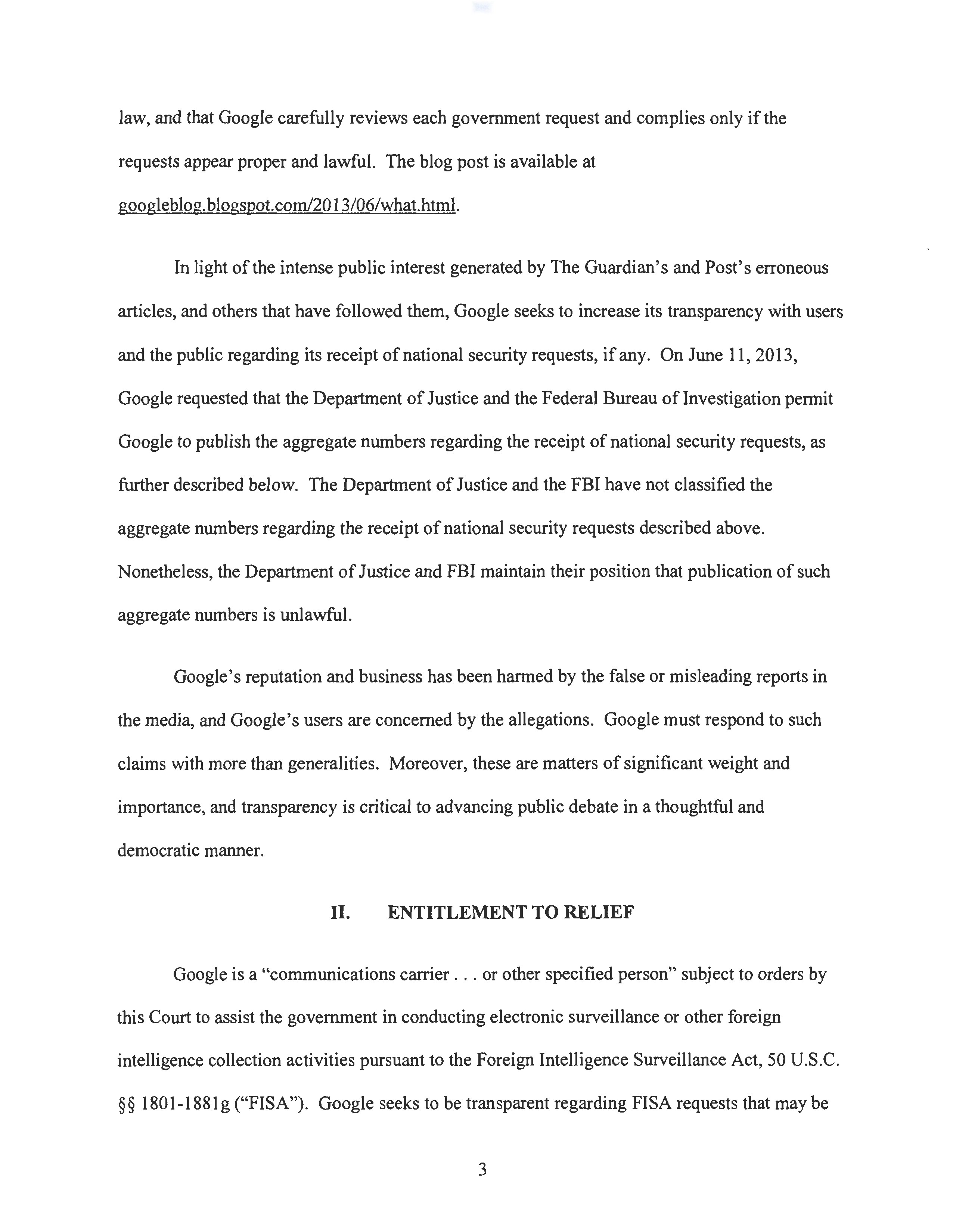
law, and that Google carefully reviews each government request and complies only if the
requests appear proper and lawful. The blog post is available at
googleblog.blogspot.com/2013/06/what.html.
In light of the intense public interest generated by The Guardian's and Post's erroneous
articles, and others that have followed them, Google seeks to increase its transparency with users
and the public regarding its receipt of national security requests, if any. On June 11, 2013,
Google requested that the Department of Justice and the Federal Bureau of Investigation permit
Google to publish the aggregate numbers regarding the receipt of national security requests, as
further described below. The Department of Justice and the FBI have not classified the
aggregate numbers regarding the receipt of national security requests described above.
Nonetheless, the Department of Justice and FBI maintain their position that publication of such
aggregate numbers is unlawful.
Google's reputation and business has been harmed by the false or misleading reports in
the media, and Google's users are concerned by the allegations. Google must respond to such
claims with more than generalities. Moreover, these are matters of significant weight and
importance, and transparency is critical to advancing public debate in a thoughtful and
democratic manner.
II. ENTITLEMENT TO RELIEF
Google is a "communications carrier . . . or other specified person" subject to orders by
this Court to assist the government in conducting electronic surveillance or other foreign
intelligence collection activities pursuant to the Foreign Intelligence Surveillance Act, 50 U.S.C.
§§ 1801-1881g ("FISA"). Google seeks to be transparent regarding FISA requests that may be
3
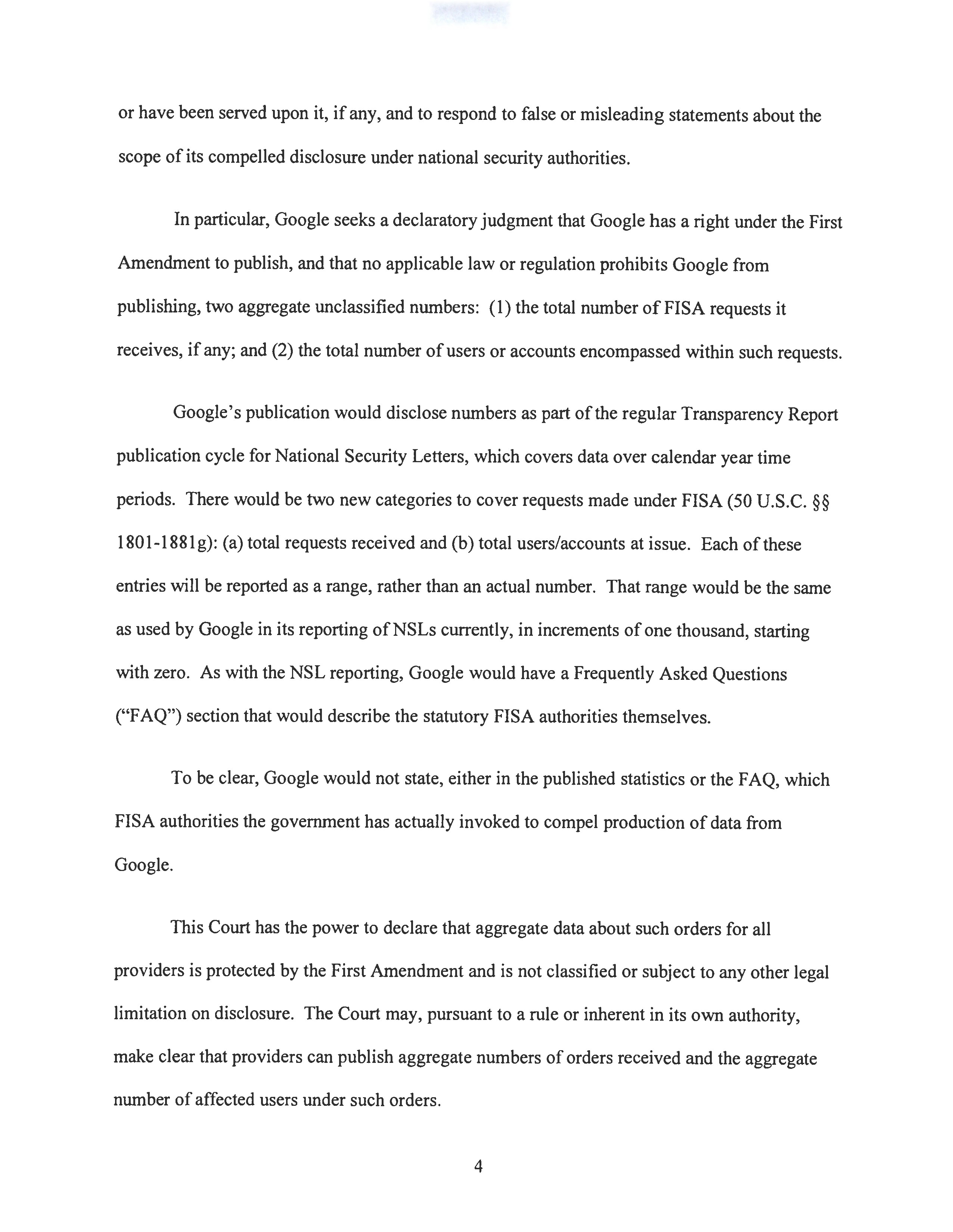
or have been served upon it, if any, and to respond to false or misleading statements about the
scope of its compelled disclosure under national security authorities.
In particular, Google seeks a declaratory judgment that Google has a right under the First
Amendment to publish, and that no applicable law or regulation prohibits Google from
publishing, two aggregate unclassified numbers: (1) the total number of FISA requests it
receives, if any; and (2) the total number of users or accounts encompassed within such requests.
Google's publication would disclose numbers as part of the regular Transparency Report
publication cycle for National Security Letters, which covers data over calendar year time
periods. There would be two new categories to cover requests made under FISA (50 U.S.C. §§
1801-1881g): (a) total requests received and (b) total users/accounts at issue. Each of these
entries will be reported as a range, rather than an actual number. That range would be the same
as used by Google in its reporting of NSLs currently, in increments of one thousand, starting
with zero. As with the NSL reporting, Google would have a Frequently Asked Questions
("FAQ") section that would describe the statutory FISA authorities themselves.
To be clear, Google would not state, either in the published statistics or the FAQ, which
FISA authorities the government has actually invoked to compel production of data from
Google.
This Court has the power to declare that aggregate data about such orders for all
providers is protected by the First Amendment and is not classified or subject to any other legal
limitation on disclosure. The Court may, pursuant to a rule or inherent in its own authority,
make clear that providers can publish aggregate numbers of orders received and the aggregate
number of affected users under such orders.
4
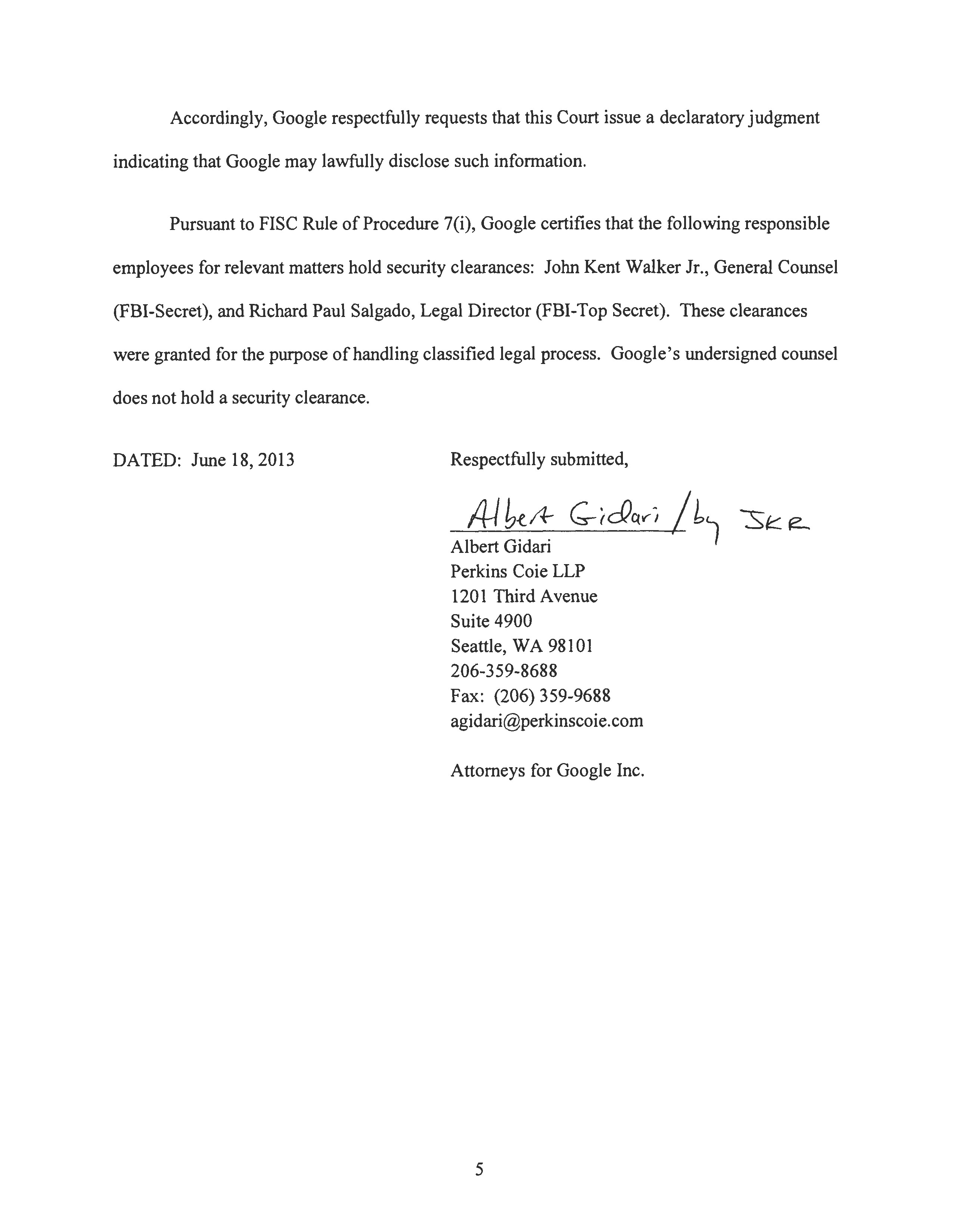
Accordingly, Google respectfully requests that this Court issue a declaratory judgment
indicating that Google may lawfully disclose such information.
Pursuant to FISC Rule of Procedure 7(i), Google certifies that the following responsible
employees for relevant matters hold security clearances: John Kent Walker Jr., General Counsel
(FBI-Secret), and Richard Paul Salgado, Legal Director (FBI-Top Secret). These clearances
were granted for the purpose of handling classified legal process. Google's undersigned counsel
does not hold a security clearance.
DATED: June 18, 2013
Respectfully submitted,
Albert Gidari / by JKR
Albert Gidari
Perkins Coie LLP
1201 Third Avenue
Suite 4900
Seattle, WA 98101
206-359-8688
Fax: (206) 359-9688
agidari@perkinscoie.com
Attorneys for Google Inc.
5
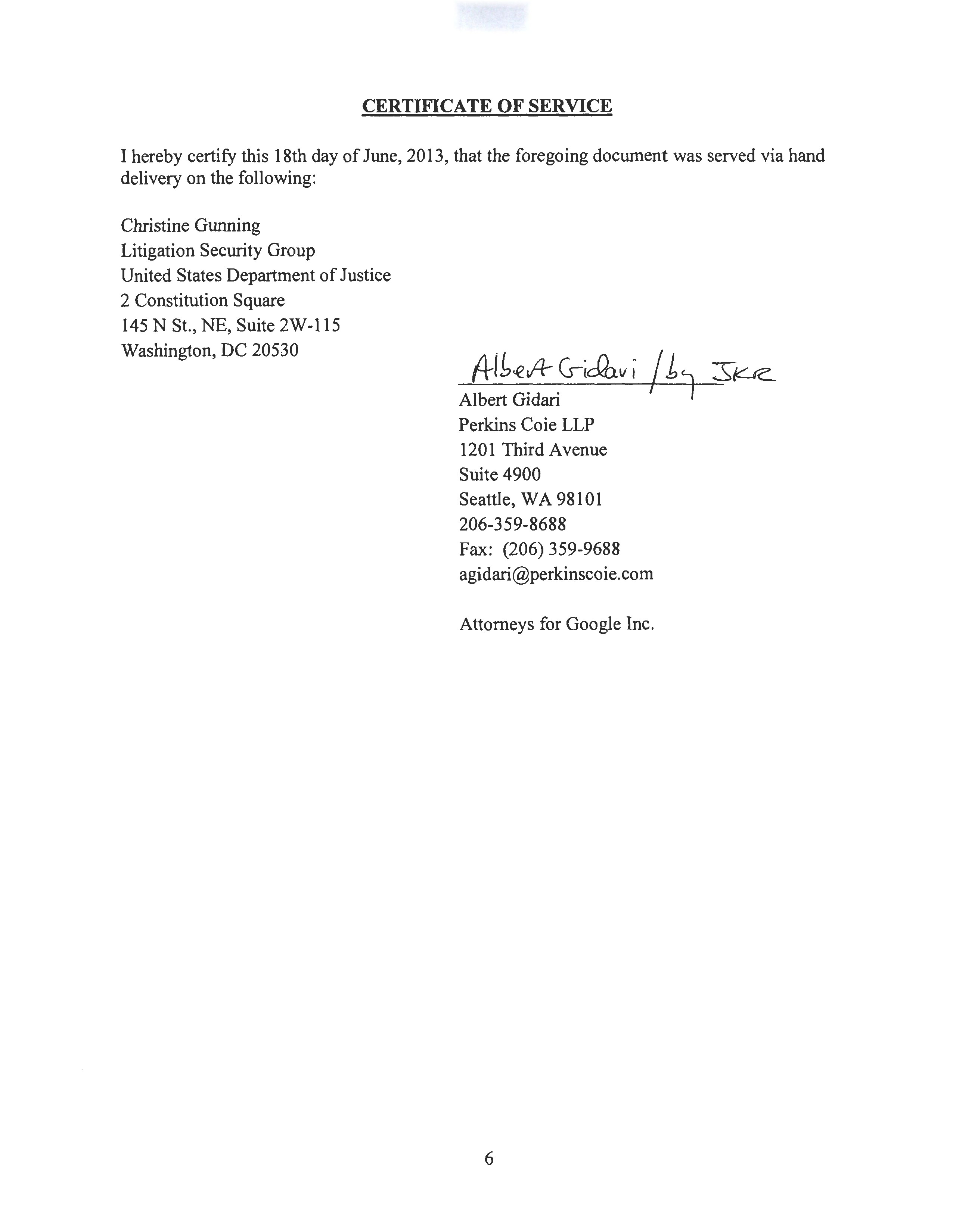
CERTIFICATE OF SERVICE
I hereby certify this 18th day of June, 2013, that the foregoing document was served via hand
delivery on the following:
Christine Gunning
Litigation Security Group
United States Department of Justice
2 Constitution Square
145 N St., NE, Suite 2W-115
Washington, DC 20530
Albert Gidari / by JKR
Albert Gidari
Perkins Coie LLP
1201 Third Avenue
Suite 4900
Seattle, WA 98101
206-359-8688
Fax: (206) 359-9688
agidari@perkinscoie.com
Attorneys for Google Inc.
6
Related Documents
-
Motion of the First Amendment Coalition, American Civil Liberties Union, Center for Democracy and Technology, Electronic Frontier Foundation, and TechFreedom for Leave to File Brief as Amici Curiae in Support of the Motions for Declaratory Judgment, In re Motion for Declaratory Judgment of Google Inc.'s First Amendment Right to Publish Aggregate Info. About FISA Orders, No. Misc. 13-03 (FISA Ct. July 8, 2013). FOIA [pdf]
-
Response of the United States to Motions for Declaratory Judgment by Google Inc., Microsoft Corporation, Yahoo! Inc., Facebook, Inc., and LinkedIn Corporation, In re Motion for Declaratory Judgment of a First Amendment Right to Publish Aggregate Info. About FISA Orders, No. Misc. 13-03 (FISA Ct. Sept. 30, 2013). FOIA [pdf]
-
Brief of First Amendment Coalition, American Civil Liberties Union, Center for Democracy and Technology, Electronic Frontier Foundation, and TechFreedom as Amici Curiae in Support of the Motions for Declaratory Judgment, In re Motion for Declaratory Judgment of Google Inc.'s First Amendment Right to Publish Aggregate Info. About FISA Orders FOIA [pdf]
-
Motion of the First Amendment Coalition, American Civil Liberties Union, Center for Democracy and Technology, Electronic Frontier Foundation, and TechFreedom as Amici Curiae for Leave to Participate in Oral Argument, In re Motion for Declaratory Judgment of Google Inc.'s First Amendment Right to Publish Aggregate Information About FISA Orders, No. Misc. 13-03 (FISA Ct. Oct. 10, 2013). FOIA [pdf]
-