Reply in Support of Motion to Strike the Government's Ex Parte Response to Motions to Disclose Aggregate Data Regarding FISA Orders, In re Motion to Disclose Aggregate Data Regarding FISA Orders, Nos. Misc. 13-03, 13-04, 13-05, 13-06, 13-07
Open PDFDocument date: 2013-12-20
Type: FOIA
Pages: 12
Classification: -
Dissemination: -
FISC/FISCR Court Filings
My notes
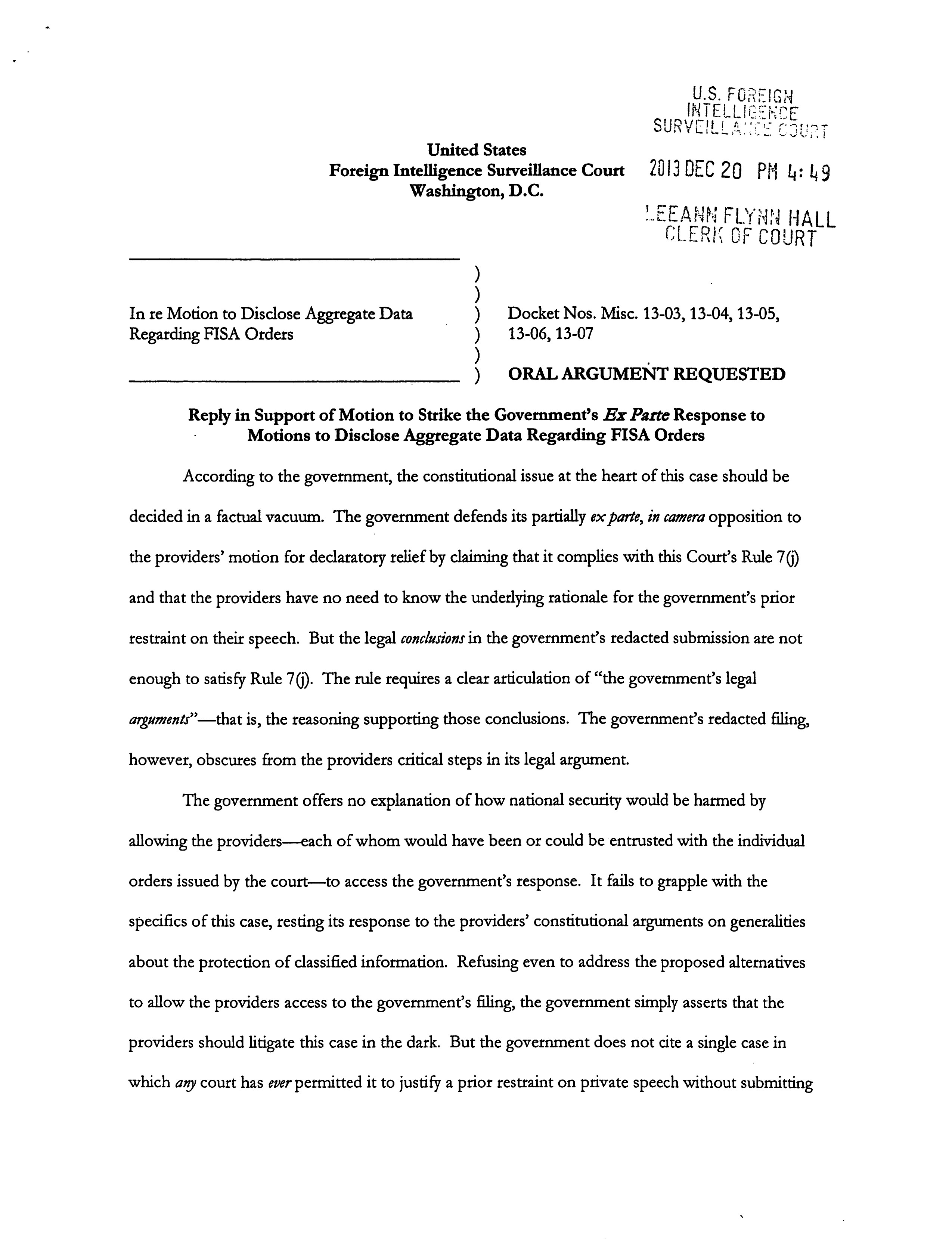
U.S. FOREIGN
INTELLIGENCE
SURVEILLANCE COURT
United States
Foreign Intelligence Surveillance Court
Washington, D.C.
2013 DEC 20 PM 4:49
LEEANN FLYNN HALL
CLERK OF COURT
In re Motion to Disclose Aggregate Data
Regarding FISA Orders
Docket Nos. Misc. 13-03, 13-04, 13-05,
13-06, 13-07
ORAL ARGUMENT REQUESTED
Reply in Support of Motion to Strike the Government's Ex Parte Response to
Motions to Disclose Aggregate Data Regarding FISA Orders
According to the government, the constitutional issue at the heart of this case should be
decided in a factual vacuum. The government defends its partially ex parte, in camera opposition to
the providers' motion for declaratory relief by claiming that it complies with this Court's Rule 7(j)
and that the providers have no need to know the underlying rationale for the government's prior
restraint on their speech. But the legal conclusions in the government's redacted submission are not
enough to satisfy Rule 7(j). The rule requires a clear articulation of "the government's legal
arguments"—that is, the reasoning supporting those conclusions. The government's redacted filing,
however, obscures from the providers critical steps in its legal argument.
The government offers no explanation of how national security would be harmed by
allowing the providers—each of whom would have been or could be entrusted with the individual
orders issued by the court—to access the government's response. It fails to grapple with the
specifics of this case, resting its response to the providers' constitutional arguments on generalities
about the protection of classified information. Refusing even to address the proposed alternatives
to allow the providers access to the government's filing, the government simply asserts that the
providers should litigate this case in the dark. But the government does not cite a single case in
which any court has ever permitted it to justify a prior restraint on private speech without submitting
its evidence to the rigors of the adversarial process. Permitting such a course here would violate not
only Rule 7(j) but also the providers' constitutional rights. Unless the government allows the
providers the access they seek, the Court should strike the redacted portions of its response.
ARGUMENT
I. The government's response does not comply with Rule 7(j)
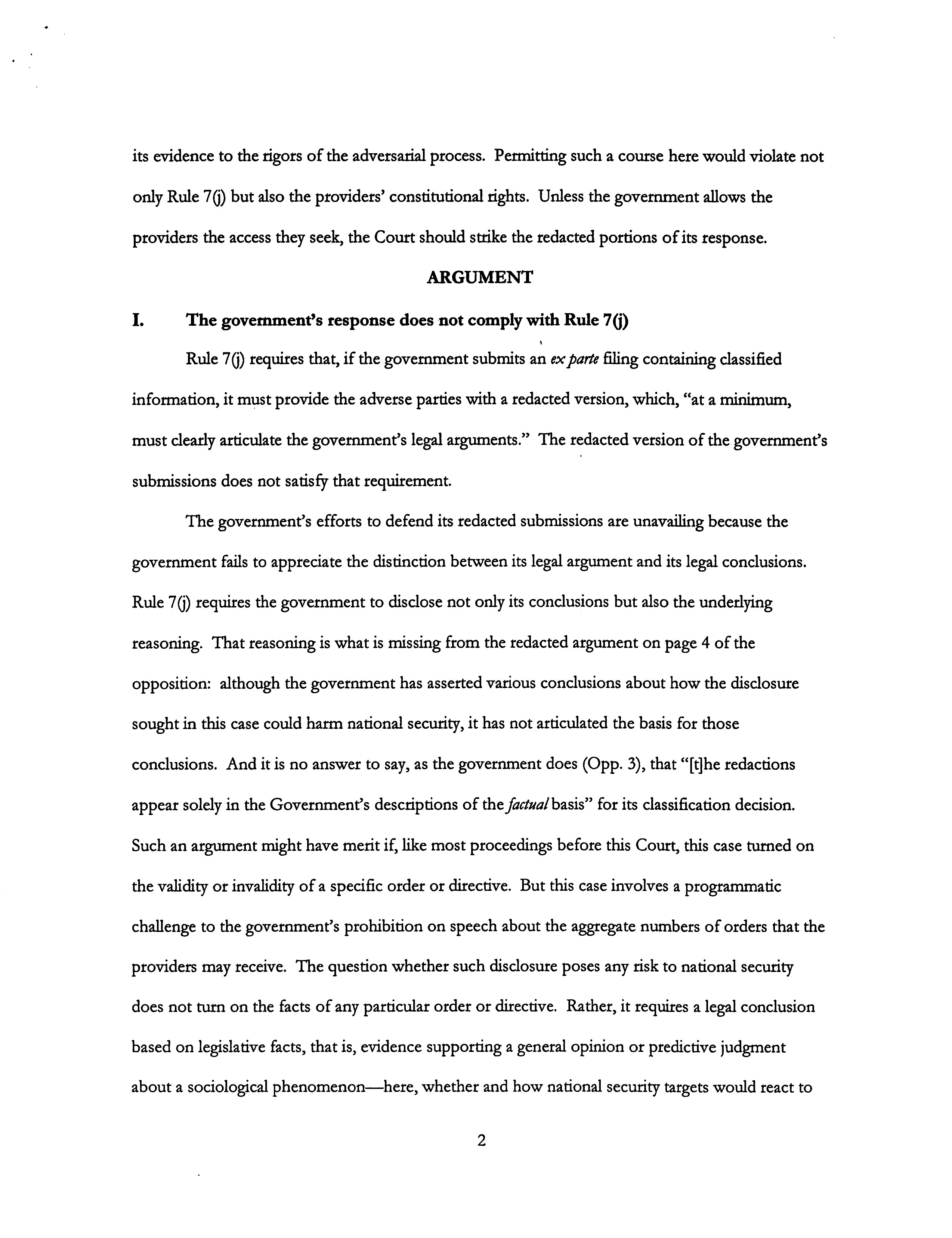
Rule 7(j) requires that, if the government submits an ex parte filing containing classified
information, it must provide the adverse parties with a redacted version, which, "at a minimum,
must clearly articulate the government's legal arguments." The redacted version of the government's
submissions does not satisfy that requirement.
The government's efforts to defend its redacted submissions are unavailing because the
government fails to appreciate the distinction between its legal argument and its legal conclusions.
Rule 7(j) requires the government to disclose not only its conclusions but also the underlying
reasoning. That reasoning is what is missing from the redacted argument on page 4 of the
opposition: although the government has asserted various conclusions about how the disclosure
sought in this case could harm national security, it has not articulated the basis for those
conclusions. And it is no answer to say, as the government does (Opp. 3), that "[t]he redactions
appear solely in the Government's descriptions of the factual basis" for its classification decision.
Such an argument might have merit if, like most proceedings before this Court, this case turned on
the validity or invalidity of a specific order or directive. But this case involves a programmatic
challenge to the government's prohibition on speech about the aggregate numbers of orders that the
providers may receive. The question whether such disclosure poses any risk to national security
does not turn on the facts of any particular order or directive. Rather, it requires a legal conclusion
based on legislative facts, that is, evidence supporting a general opinion or predictive judgment
about a sociological phenomenon—here, whether and how national security targets would react to
2
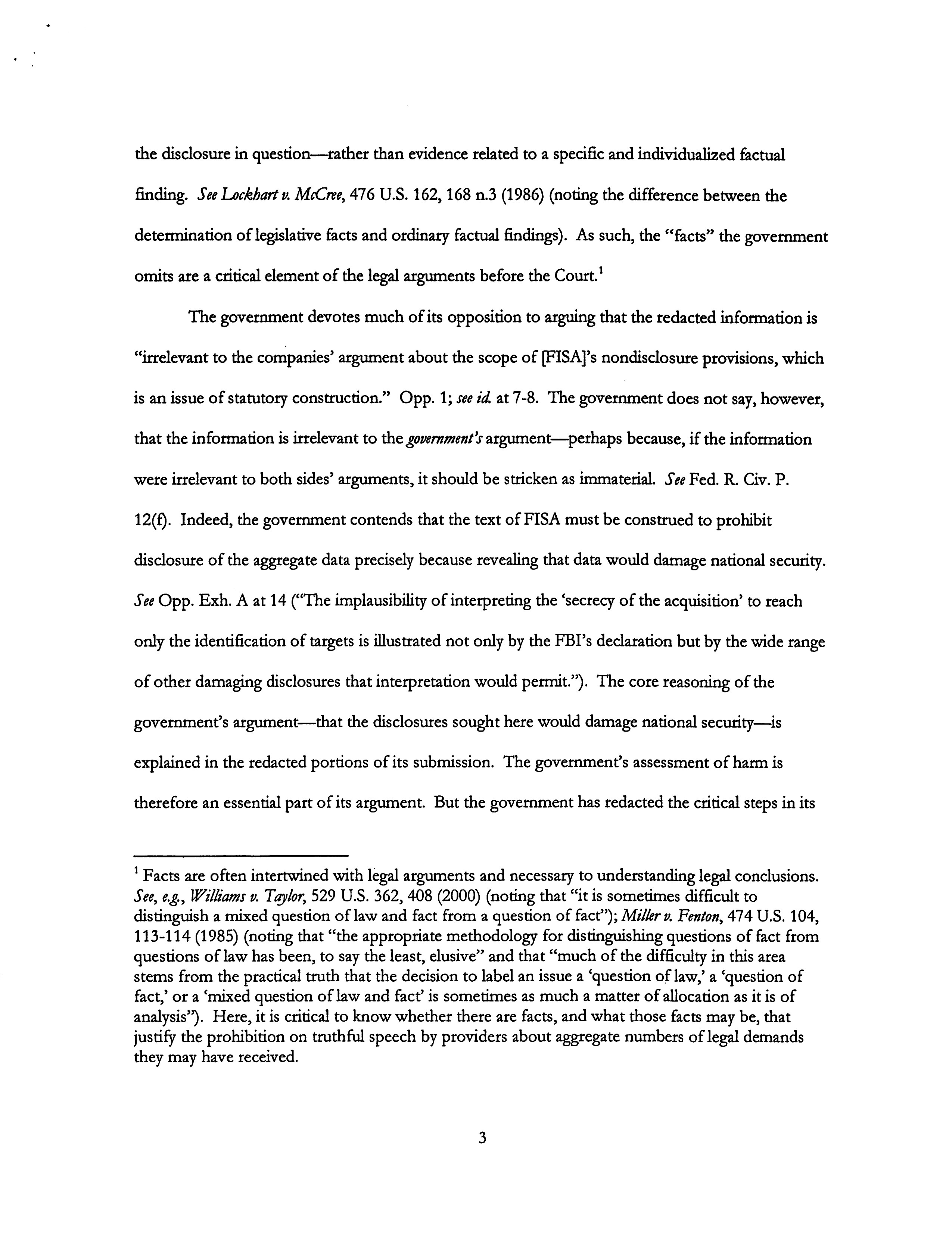
the disclosure in question—rather than evidence related to a specific and individualized factual
finding. See Lockhart v. McCree, 476 U.S. 162, 168 n.3 (1986) (noting the difference between the
determination of legislative facts and ordinary factual findings). As such, the "facts" the government
omits are a critical element of the legal arguments before the Court.¹
The government devotes much of its opposition to arguing that the redacted information is
"irrelevant to the companies' argument about the scope of [FISA]'s nondisclosure provisions, which
is an issue of statutory construction." Opp. 1; see id. at 7-8. The government does not say, however,
that the information is irrelevant to the government's argument—perhaps because, if the information
were irrelevant to both sides' arguments, it should be stricken as immaterial. See Fed. R. Civ. P.
12(f). Indeed, the government contends that the text of FISA must be construed to prohibit
disclosure of the aggregate data precisely because revealing that data would damage national security.
See Opp. Exh. A at 14 ("The implausibility of interpreting the 'secrecy of the acquisition' to reach
only the identification of targets is illustrated not only by the FBI's declaration but by the wide range
of other damaging disclosures that interpretation would permit."). The core reasoning of the
government's argument—that the disclosures sought here would damage national security—is
explained in the redacted portions of its submission. The government's assessment of harm is
therefore an essential part of its argument. But the government has redacted the critical steps in its
¹ Facts are often intertwined with legal arguments and necessary to understanding legal conclusions.
See, e.g., Williams v. Taylor, 529 U.S. 362, 408 (2000) (noting that "it is sometimes difficult to
distinguish a mixed question of law and fact from a question of fact"); Miller v. Fenton, 474 U.S. 104,
113-114 (1985) (noting that "the appropriate methodology for distinguishing questions of fact from
questions of law has been, to say the least, elusive" and that "much of the difficulty in this area
stems from the practical truth that the decision to label an issue a 'question of law,' a 'question of
fact,' or a 'mixed question of law and fact' is sometimes as much a matter of allocation as it is of
analysis"). Here, it is critical to know whether there are facts, and what those facts may be, that
justify the prohibition on truthful speech by providers about aggregate numbers of legal demands
they may have received.
3
reasoning and refused to give the providers' counsel access to them, making the filing insufficient
under Rule 7(j).
If the Court has any doubt whether the redacted brief "clearly articulate[s] the government's
legal arguments" within the meaning of Rule 7(j), it still should strike the government's brief, for two
reasons. First, the rule provides that a clear articulation of a brief's legal arguments is only a
minimum requirement. If the rule required nothing more, then the words "at a minimum" would be
superfluous, contrary to the "cardinal principle of statutory construction that a statute ought, upon
the whole, to be so construed that, if it can be prevented, no clause, sentence, or word shall be
superfluous, void, or insignificant." TRW, Inc. v. Andrews, 534 U.S. 19, 31 (2001) (internal quotation
marks omitted). The rule therefore gives the Court discretion to order disclosure that goes beyond
what is required "at a minimum." Because the redacted information is central to the issues in this
case, such disclosure is appropriate here. Second, if Rule 7(j) were construed to permit the
government's redacted filing, it would be unconstitutional for the reasons set forth below.
II. If Rule 7(j) were construed to permit the government's filing of heavily redacted
submissions in this case, it would violate the First and Fifth Amendments
While ex parte filings may be permissible in some contexts, accepting the government's _ex
parte_ filing in this case would pose two constitutional problems: it would prevent the providers from
participating fully in the resolution of their First Amendment claim, and it would violate the
providers' procedural due process rights by depriving them of adequate safeguards to protect their
substantive First Amendment rights. The government's response to both points is essentially the
same: it asserts (Opp. 9) the general proposition that "courts can review classified national security
information ex parte and in camera." That may be true, but it is not relevant here. The providers do
not suggest that the government can never rely on ex parte filings to be reviewed in camera. Rather,
they argue that the government cannot rely on ex parte filings to justify a prior restraint on speech in
this case. The government is therefore wrong when it suggests (Opp. 9) that "[n]umerous courts
4
have rejected the same constitutional arguments the companies assert here." The government does
not cite—and providers are not aware of—any case in which a court permitted the government to
justify a prior restraint without explaining the reasons for the restraint so that they could be
challenged by the party restrained.
First Amendment. In arguing that the providers should be prohibited from reviewing the core
reasoning supporting its prior restraint, the government relies heavily on Stillman v. CIA, 319 F.3d
546 (D.C. Cir. 2003), in which, it says (Opp. 11-12), the court denied counsel access to classified
information. In fact, the D.C. Circuit held only that the district court should not have ordered
access to classified information without first determining "whether it can, consistent with the
protection of Stillman's first amendment rights to speak and to publish, and with the appropriate
degree of deference owed to the Executive Branch concerning classification decisions, resolve the
classification issue without the assistance of plaintiff's counsel." 319 F.3d at 549. The D.C. Circuit
went on to explain that, if the district court determined that the "need for such assistance outweighs
the concomitant intrusion upon the Government's interest in national security," it could consider
ordering disclosure. Id. Stillman thus supports the argument that, in a case like this one, the
resolution of First Amendment claims may require that counsel be granted access to the classified
information that forms a critical part of the government's legal argument.
Significantly, the court in Stillman emphasized the plaintiff's status as a government employee
whose speech the government has a greater ability to control than that of a private citizen. As the
court observed, "[i]f the Government classified the information properly, then Stillman simply ha[d]
no first amendment right to publish it" because as part of his employment he "voluntarily signed the
agreement that expressly obligated him to submit any proposed publication for prior review" and
because the CIA may "impos[e] reasonable restrictions on employee activities that in other contexts
might be protected by the First Amendment." 319 F.3d at 548 (quoting Snepp v. United States, 444
5
U.S. 507, 510 n.3 (1980)) (emphasis added). That reasoning does not apply here because the
providers are not government employees who voluntarily agreed to restrictions on their
speech. They are private companies who wish to speak to their users and the public about whether,
and if so how often, the government has ordered them to produce information. For that reason,
this is just the kind of "other context" contemplated by the court in Stillman in which access to
classified information is necessary to allow First Amendment claims to be fully litigated.²
Fifth Amendment Due Process Clause. The government cites (Opp. 9-11) various cases denying
due process claims for access to classified information, but none of the cases establishes the broad
proposition that such access is never appropriate. Instead, many of the cited cases held only that
plaintiffs suing the government to force the disclosure of classified information do not have a right
to see the very classified information they seek. See Bassiouni v. FBI, 436 F.3d 712 (7th Cir. 2006)
(plaintiff seeking to amend FBI records regarding his contacts with the Middle East); Patterson ex rel.
Patterson v. FBI, 893 F.2d 595 (3d Cir. 1990) (plaintiff seeking access to FBI records about himself);
Weberman v. NSA, 668 F.2d 676 (2d Cir. 1982) (suit seeking disclosure of records under FOIA);
Hayden v. NSA, 608 F.2d 1381 (D.C. Cir. 1979) (plaintiffs seeking all NSA records about
themselves). Cf. Meridian Int'l Logistics, Inc. v. United States, 939 F.2d 740 (9th Cir. 1991) (libel suit
² The government also relies (Opp. 12-13) on John Doe, Inc. v. Mukasey, 549 F.3d 861 (2d Cir. 2008),
but that case, too, did not involve the question whether the Constitution permits the government to
justify a prior restraint on the basis of ex parte submissions. Although the plaintiffs initially
challenged the statute providing for ex parte submissions, 18 U.S.C. § 3511(e), they declined to appeal
that issue, and neither the district court nor the Court of Appeals held that it would be permissible
for the government to reply on an ex parte submission in any particular case. Rather, both courts
merely stated that the question would depend on the circumstances. See 549 F.3d at 881 (referring
to "in camera presentations where appropriate") (emphasis added); Doe v. Gonzales, 500 F. Supp. 2d 379,
423-24 (S.D.N.Y. 2007) (finding it "sufficient to simply reiterate that the Court's authority to assess
what process is due on a case-by-case basis is undisturbed by the language of § 3511(e)" because it
"neither restricts the ability of a district court to take all necessary measures required to safeguard
the due process rights of a party in instances where evidence may be submitted in camera or _ex
parte_, nor constrains the role of the district court in appropriately balancing those needs against a
potentially compelling interest").
6
against FBI agent). That rule makes perfect sense: where the issue in the lawsuit is whether the
government should be ordered to disclose classified information, requiring the government to
disclose that information in its brief would moot the proceeding. But here, the providers have not
filed a lawsuit to compel the government to disclose classified information they have never seen.
Instead, they are challenging a prior restraint on their First Amendment rights to disclose
information already in their possession and, within the specific context of this motion, are
challenging the withholding of the information at issue only because the government has relied upon
it to justify the restraint. Granting the providers access to that information would not give the
providers the relief they seek in the underlying litigation; it would merely give them the ability to test
the reasoning behind the government's prior restraint on speech about facts already known to them.
As the government concedes (Opp. 9), the due process clause does not prescribe a
categorical rule either requiring or prohibiting disclosure in all cases; instead, it "calls for such
procedural protections as the particular situation demands." Morrissey v. Brewer, 408 U.S. 471, 481
(1972). The government does not dispute that the test for determining what procedural protections
are required is set out in Mathews v. Eldridge, 424 U.S. 319 (1976). Here, the Mathews balancing test
weighs heavily in favor of granting the providers' motion.
First, as explained in the motion to strike (at 7-8), the liberty interest at issue is vital: it is the
right to engage in speech about the government. The government makes no effort to dispute the
importance of that interest.
Second, the risk of an erroneous deprivation of First Amendment rights in ex parte
proceedings is substantial. Indeed, that risk is illustrated by the government's opposition itself,
which releases a footnote that, as the providers observed in the motion to strike (at 5 n.1), "comes in
the middle of a paragraph that is otherwise entirely devoted to legal argument and that contains no
factual discussion," making it difficult to see how it could be anything other than part of the legal
7
argument. In its opposition (Opp. 2 n.1), the government says that it "has since decided to release
footnote 4," which was originally classified at the "Secret" level. While the government does not
explain why it has decided to release the footnote now, it would appear that the government has
concluded that its release will not, in fact, damage national security, and that it should not have been
classified in the first place. That the government would classify an innocuous portion of its brief in
this case—where the very issue to be decided is whether the government has acted appropriately in
restricting the disclosure of information—demonstrates both the value of the adversarial process in
testing the government's submissions and the substantial risk of an erroneous deprivation of the
providers' First Amendment rights in an ex parte proceeding.
The apparent overclassification of footnote 4 is representative of a broader problem of
overclassification that the government itself has acknowledged. See, e.g., Reducing Over-
Classification Act, § 2(3), Pub. L. No. 118-258, 124 Stat. 2648 (2010) (finding that "security
requirements nurture over-classification," which "causes considerable confusion regarding what
information may be shared with whom"); Intelligence Oversight and the Joint Inquiry: Hearing Before the
Nat'l Comm'n on Terrorist Attacks Upon the U.S. (2003), available at http://www.9-11commission.gov/
archive/hearing2/9-11Commission_Hearing_2003-05-22.pdf (testimony of Rep. Porter Goss)
("[W]e overclassify very badly. There's a lot of gratuitous classification going on."). The practice of
overclassification—the precise opposite of the narrow tailoring that the First Amendment
requires—makes it essential that the Court have the assistance of an adversarial process in
scrutinizing the government's assertion that the information at issue in this litigation cannot be
disclosed without harming national security.
Third, while the government certainly has a compelling interest in protecting national
security, it has made no effort to explain how disclosing the information at issue to the providers would
8
harm that interest.³ Instead, the government relies on generalized assertions about the potential
harm of disclosure (Opp. 8) and the question-begging claim that none of the providers, or their
counsel, "has been found to have a 'need-to-know' any of the classified information" (Opp. 6). But
the premise of the government's argument, both on this motion and on the merits, is that the
assistance of electronic communications service providers is essential to national security and that
any such assistance would involve information that implicates national security. For that reason, if
any provider has, in fact, received a FISC order, the government already would have determined that
the providers and their counsel have a need to know sensitive classified information. After all, each
provider obviously knows the total number of orders it has received (if any), as well as the total
number of affected accounts. Only now, in this lawsuit, does the government suggest that the
providers cannot be trusted with sensitive information. The government should not be permitted to
use selective need-to-know determinations to permit the providers and their counsel to access such
information only when they are receiving FISC orders and not when they are seeking to challenge
the government.
³ Several cases cited by the government (Opp. 9-11) are distinguishable because they involved
requests for disclosure made by parties who were alleged to pose a threat to national security. See
Tabbaa v. Chertoff, 509 F.3d 89 (2d Cir. 2007) (suit by plaintiffs detained on return to United States
from conference in Canada where intelligence officials believed persons connected to terrorists were
in attendance); Jifry v. FAA, 370 F.3d 1174 (D.C. Cir. 2004) (Saudi pilots challenging post-9/11
regulations that prevented them from flying commercial aircraft into the United States); Holy Land
Found. for Relief and Dev. v. Ashcroft, 333 F.3d 156 (D.C. Cir. 2003) (plaintiffs challenging classification
as foreign terrorist organization); People's Mojahedin Org. of Iran v. Dep't of State, 327 F.3d 1238 (D.C.
Cir. 2003) (same); Global Relief Found., Inc. v. O'Neill, 315 F.3d 748 (7th Cir. 2002) (plaintiff
challenging Treasury department order blocking its assets that allegedly were used to support
terrorism); Nat'l Council of Resistance of Iran v. Dep't of State, 251 F.3d 192, 209 (D.C. Cir. 2001)
(plaintiffs challenging classification as foreign terrorist organization). Here, of course, the
government does not contend that the providers are a threat to national security.
9
CONCLUSION
The Court should order that, unless the government agrees to take appropriate steps to
permit counsel for the providers to access the unredacted version of its September 30 filing, the
redacted portions of that filing will be stricken.
Dated: December 20, 2013
Respectfully submitted,
GOOGLE INC.
Albert Gidari / by JKR
Albert Gidari
Perkins Coie LLP
1201 Third Avenue, Suite 4900
Seattle, WA 98101
Tel: 206.359.8688
Fax: 206.359.9688
agidari@perkinscoie.com
MICROSOFT CORPORATION
James M. Garland / by JKR
James M. Garland, D.C. Bar # 475509
David N. Fagan, D.C. Bar # 474518
Alexander A. Berengaut, D.C. Bar # 989222
COVINGTON & BURLING LLP
1201 Pennsylvania Avenue, NW
Washington, DC 20004-2401
Tel: 202.662.6000
Fax: 202.662.6291
10
YAHOO! INC.
Marc J. Zwillinger / by JKR
Marc J. Zwillinger
Jacob A. Sommer
ZwillGen PLLC
1705 N St. NW
Washington, DC 20036
marc@zwillgen.com
jake@zwillgen.com
FACEBOOK, INC.
Carl Nichols / by JKR
Carl Nichols
Wilmer Cutler Pickering Hale and Dorr LLP
1875 Pennsylvania Avenue, N.W.
Washington, D.C. 20006
Tel: 202.663.6226
Fax: 202-663.6363
carl.nichols@wilmerhale.com
LINKEDIN CORPORATION
Jerome C. Roth / by JRR
Jerome C. Roth
Jonathan H. Blavin
Justin P. Raphael
Munger, Tolles & Olson LLP
560 Mission Street, 27th Floor
San Francisco, CA 94015
Tel: 415.683.9100
Fax: 415.512.4077
Jerome.Roth@mto.com
Jonathan.Blavin@mto.com
Justin.Raphael@mto.com
11
CERTIFICATE OF SERVICE
I hereby certify that at or before the time of filing this submission, the government (care of
the Security and Emergency Planning Staff, United States Department of Justice) has been served
with a copy of this motion pursuant to Rule 8(a) of the FISC Rules of Procedure.
Dated: December 20, 2013
John Roche
Perkins Coie LLP
700 13th St. NW
Washington, DC 20005
Tel: 202.434.1627
jroche@perkinscoie.com