The Alice Springs Resolution
Open PDFDocument date: 2004-06-25
Pages: 1
Genre: other
Classification: -
Dissemination: -
In June 2004, the intelligence chiefs of the Five Eyes nations signed the Alice Springs Resolution, establishing plans for a unified system that allowed single-query access to all member states’ metadata repositories.
My notes
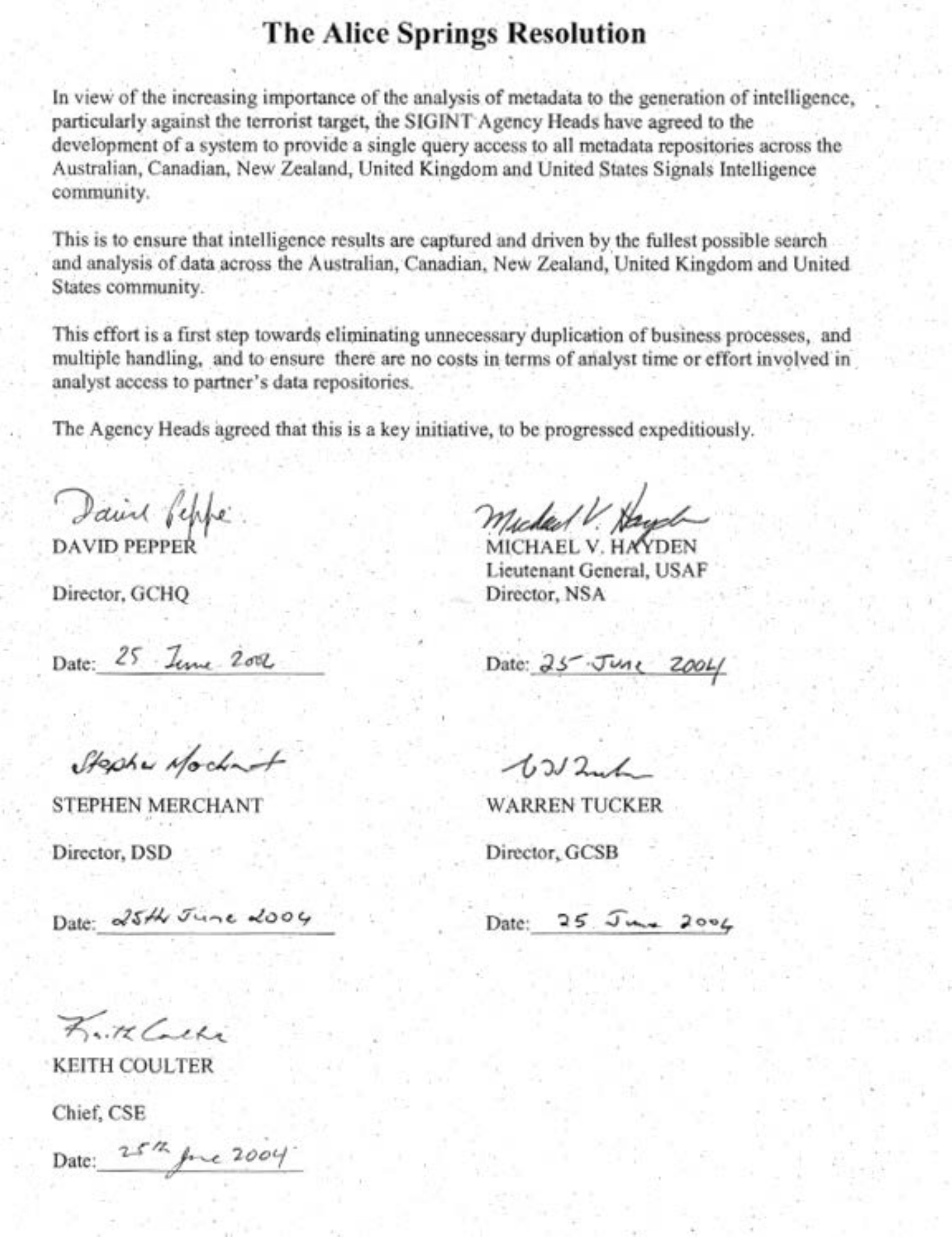
The Alice Springs Resolution
In view of the increasing importance of the analysis of metadata to the generation of intelligence, particularly against the terrorist target, the SIGINT Agency Heads have agreed to the development of a system to provide a single query access to all metadata repositories across the Australian, Canadian, New Zealand, United Kingdom and United States Signals Intelligence community.
This is to ensure that intelligence results are captured and driven by the fullest possible search and analysis of data across the Australian, Canadian, New Zealand, United Kingdom and United States community.
This effort is a first step towards eliminating unnecessary duplication of business processes, and multiple handling, and to ensure there are no costs in terms of analyst time or effort involved in analyst access to partner's data repositories.
The Agency Heads agreed that this is a key initiative, to be progressed expeditiously.
DAVID PEPPER
Director, GCHQ
Date: 25 June 2002
MICHAEL V. HAYDEN
Lieutenant General, USAF
Director, NSA
Date: 25 June 2004
STEPHEN MERCHANT
Director, DSD
Date: 25th June 2004
WARREN TUCKER
Director, GCSB
Date: 25 June 2004
KEITH COULTER
Chief, CSE
Date: 25th June 2004
Published in the Same Report
(4 documents)
-
Contact chaining [pdf]
A secret GCHQ Applied Research presentation describing how the agency's analysts use automated tools to map out a surveillance target's social network — starting with a known email address or phone number, then scoring and ranking every person that target communicates with to identify the most "suspicious" or strongly connected contacts, using twelve different relationship types including direct calls, shared locations, timing patterns, equipment sharing and calling profile similarity.
Programs: CARPAT · PRIME TIME · SNAPDRAGON · MoaG · SORTING FRIENDS · CHART BREAKER · MAMBA · CONTACTLENS · FLEXIMART · PSOUP · IMMINGLE -
Graph theory in the operational environment – GCHQ [pdf]
This document details GCHQ’s research on identifying “closed loops” of communication, where targets use a small set of phones to communicate exclusively among themselves, often with cheap, disposable handsets like the Nokia 1100. It explains the methodology for analyzing anonymized metadata, constructing contact graphs, and extracting non-giant, non-tree components to discover operationally relevant closed loops for intelligence and counterterrorism purposes.
Programs: VOICESAILPeople: Rumsfeld, Donald -
Sensitive Metadata Analytic Collaboration (SMAC) - Concept of Operations, October 2006 [pdf]
This document outlines the Sensitive Metadata Analytic Collaboration (SMAC) initiative, a system developed by the Five Eyes intelligence agencies to facilitate the sharing and analysis of sensitive metadata to support SIGINT (signals intelligence) missions. While the concept aims to improve collaboration and data sharing, its success is hindered by ongoing policy, legal, and technical barriers, as well as concerns about trust and participation among the agencies involved. The document suggests a complex, somewhat opaque process of metadata sharing that risks undermining privacy protections.
Programs: SMAC -
Transnational DNI training [pdf]
This document outlines a transnational training session on sensitive information sharing and collaboration among the "Five Eyes" intelligence partners (USA, AUS, CAN, GBR, NZL), focusing on key concepts such as "Need to Know" vs. "Need to Share" and operational frameworks for sharing SIGINT data, including the establishment of initiatives like SMAC, TICKETWINDOW, and the Alice Springs Resolution. It emphasizes the challenges of balancing security with collaboration, highlighting sensitivities related to partner identities, agreements, and interception points. Also see: PINWALE-Slides
Related Documents
-
Life in Alice (repost) SIDtoday [pdf]
(Repost) Description of life in the tiny, remote tourist town of Alice Springs in Australia's outback.
Programs: PINEGAPThe Intercept ↗ (2017-04-24) -
Life in Alice SIDtoday [pdf]
Description of life in the tiny, remote tourist town of Alice Springs in Australia's outback.
The Intercept ↗ (2016-12-07) -
Letters to the Editor: 'Life in Alice' SIDtoday [pdf]
A staffer comments on his memorable tour in Alice Springs, Australia.
The Intercept ↗ (2016-12-07) -
Gearing Up for the Spring Offensive SIDtoday [pdf]
A rock drill will be held to focus on planning for an upcoming spring offensive against al Qaeda in the Afghanistan-Pakistan area. NSA representatives will be posted to Kabul/Bagram and Islamabad.
People: Quirk, RichardThe Intercept ↗ (2016-12-07) -
UN Security Council: Round Two of U.S. Draft Resolution on Iraq SIDtoday [pdf]
Critical analysis of a U.S. draft resolution on Iraq in the U.N. Security Council and its chances of success.
People: Annan, KofiThe Intercept ↗ (2016-08-10)