Minimization Procedures used by the National Counterterrorism Center in Connection with Information Acquired by the Federal Bureau of Investigation Pursuant to Section 702 of the Foreign Intelligence Surveillance Act of 1978, As Amended
Open PDFDocument date: 2011-10-31
Type: FOIA
Pages: 13
Classification: TOP SECRET COMINT
Dissemination: NOFORN
A description of the "minimization procedures" for the acquisition, retention, use, and dissemination of information about United States persons. ACLU/EFF FOIA Litigation.
My notes





TOP SECRET//COMINT//NOFORN//20310108
INTELLIGENCE
SURVEILLANCE COURT
EXHIBIT B
MINIMIZATION PROCEDURES USED BY THE NATIONAL SECURITY AGENCY IN
CONNECTION WITH ACQUISITIONS OF FOREIGN INTELLIGENCE
INFORMATION PURSUANT TO SECTION 702 OF THE FOREIGN INTELLIGENCE
SURVEILLANCE ACT OF 1978, AS AMENDED CLERK OF COURT
Section 1 - Applicability and Scope (U)
These National Security Agency (NSA) minimization procedures apply to the acquisition,
retention, use, and dissemination of non-publicly available information concerning
unconsenting United States persons that is acquired by targeting non-United States persons
reasonably believed to be located outside the United States in accordance with section 702 of
the Foreign Intelligence Surveillance Act of 1978, as amended ("the Act"). (U)
If NSA determines that it must take action in apparent departure from these minimization
procedures to protect against an immediate threat to human life (e.g., force protection or
hostage situations) and that it is not feasible to obtain a timely modification of these
procedures, NSA may take such action immediately. NSA will report the action taken to the
Office of the Director of National Intelligence and to the National Security Division of the
Department of Justice, which will promptly notify the Foreign Intelligence Surveillance
Court of such activity. (U)
For the purposes of these procedures, the terms "National Security Agency" and "NSA
personnel" refer to any employees of the National Security Agency/Central Security Service
("NSA/CSS" or "NSA") and any other personnel engaged in Signals Intelligence (SIGINT)
operations authorized pursuant to section 702 of the Act if such operations are executed
under the direction, authority, or control of the Director, NSA/Chief, CSS (DIRNSA). (U)
Section 2 - Definitions (U)
In addition to the definitions in sections 101 and 701 of the Act, the following definitions
will apply to these procedures:
(a) Acquisition means the collection by NSA or the FBI through electronic means of a non-
public communication to which it is not an intended party. (U)
(b) Communications concerning a United States person include all communications in which
a United States person is discussed or mentioned, except where such communications
reveal only publicly-available information about the person. (U)
(c) Communications of a United States person include all communications to which a United
States person is a party. (U)
Derived From: NSA/CSSM 1-52
Dated: 20070108
Declassify On: 20320108
TOP SECRET//COMINT//NOFORN//20310108
TOP SECRET//COMINT//NOFORN//20310108
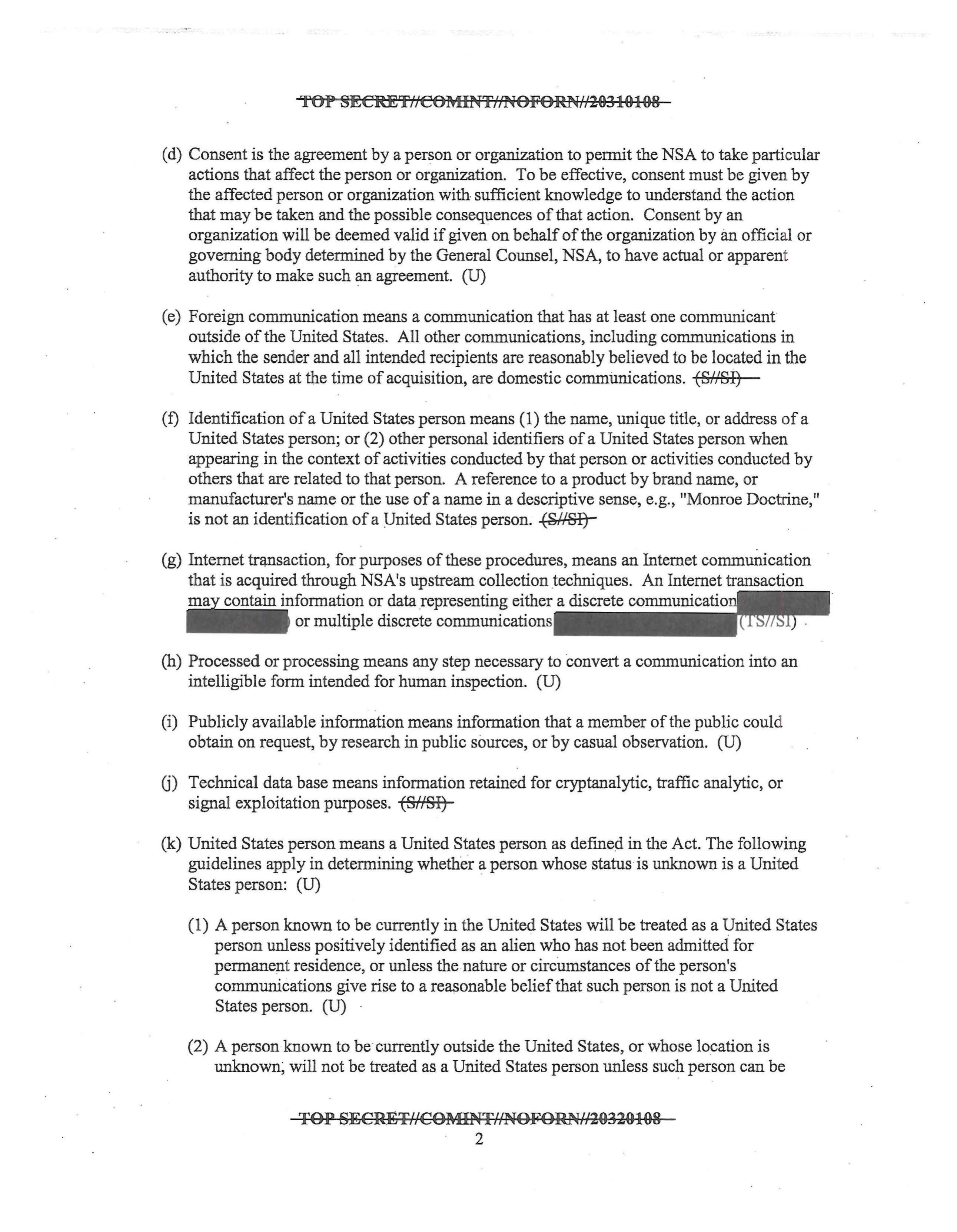
(d) Consent is the agreement by a person or organization to permit the NSA to take particular
actions that affect the person or organization. To be effective, consent must be given by
the affected person or organization with sufficient knowledge to understand the action
that may be taken and the possible consequences of that action. Consent by an
organization will be deemed valid if given on behalf of the organization by an official or
governing body determined by the General Counsel, NSA, to have actual or apparent
authority to make such an agreement. (U)
(e) Foreign communication means a communication that has at least one communicant
outside of the United States. All other communications, including communications in
which the sender and all intended recipients are reasonably believed to be located in the
United States at the time of acquisition, are domestic communications. (S//SI)
(f) Identification of a United States person means (1) the name, unique title, or address of a
United States person; or (2) other personal identifiers of a United States person when
appearing in the context of activities conducted by that person or activities conducted by
others that are related to that person. A reference to a product by brand name, or
manufacturer's name or the use of a name in a descriptive sense, e.g., "Monroe Doctrine,"
is not an identification of a United States person. (S//SI)
(g) Internet transaction, for purposes of these procedures, means an Internet communication
that is acquired through NSA's upstream collection techniques. An Internet transaction
may contain information or data representing either a discrete communication [REDACTED]
or multiple discrete communications (TS//SI)
(h) Processed or processing means any step necessary to convert a communication into an
intelligible form intended for human inspection. (U)
(i) Publicly available information means information that a member of the public could
obtain on request, by research in public sources, or by casual observation. (U)
(j) Technical data base means information retained for cryptanalytic, traffic analytic, or
signal exploitation purposes. (S//SI)
(k) United States person means a United States person as defined in the Act. The following
guidelines apply in determining whether a person whose status is unknown is a United
States person: (U)
(1) A person known to be currently in the United States will be treated as a United States
person unless positively identified as an alien who has not been admitted for
permanent residence, or unless the nature or circumstances of the person's
communications give rise to a reasonable belief that such person is not a United
States person. (U)
(2) A person known to be currently outside the United States, or whose location is
unknown, will not be treated as a United States person unless such person can be
TOP SECRET//COMINT//NOFORN//20320108-
2
TOP SECRET//COMINT//NOFORN//20310108-
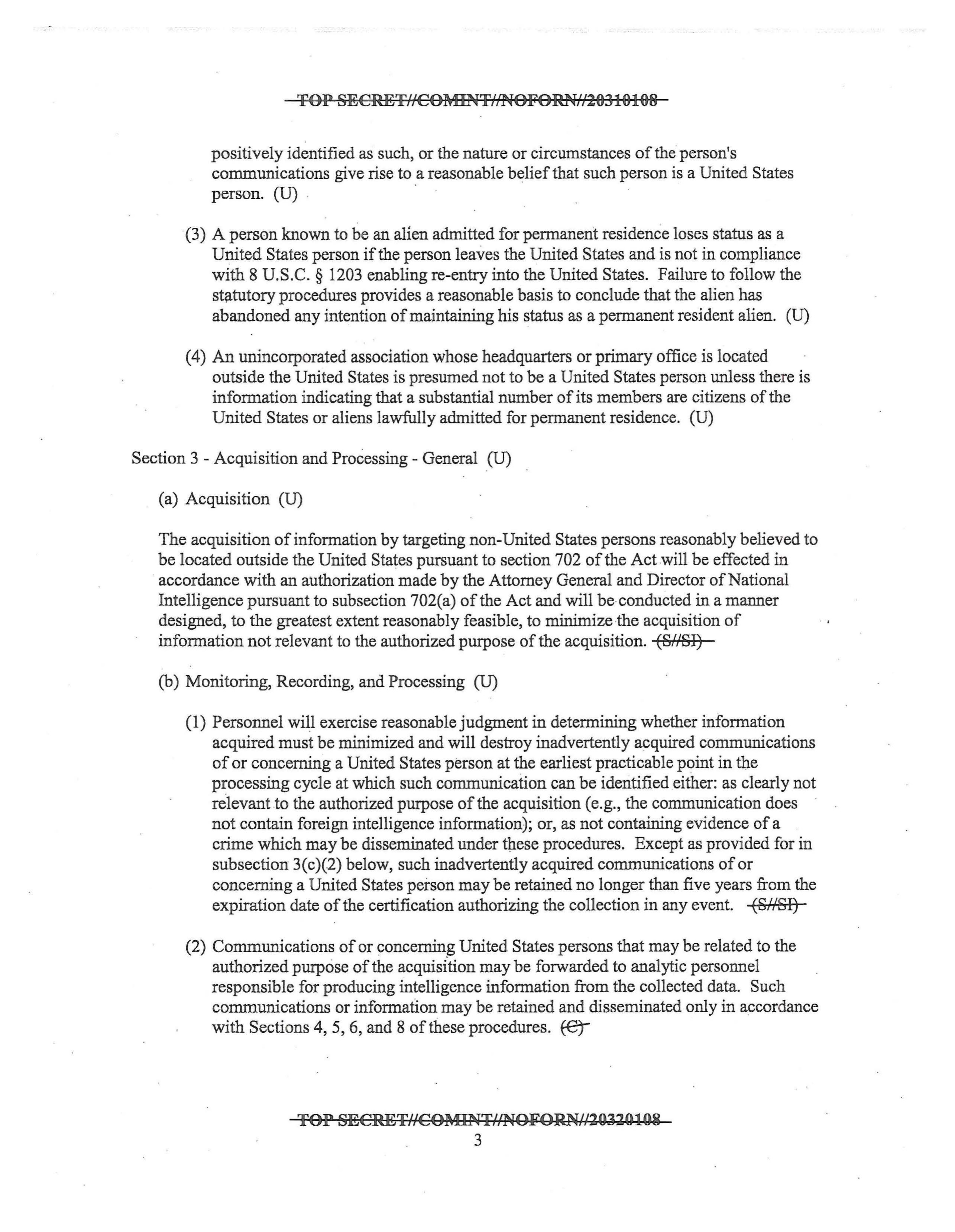
positively identified as such, or the nature or circumstances of the person's
communications give rise to a reasonable belief that such person is a United States
person. (U)
(3) A person known to be an alien admitted for permanent residence loses status as a
United States person if the person leaves the United States and is not in compliance
with 8 U.S.C. § 1203 enabling re-entry into the United States. Failure to follow the
statutory procedures provides a reasonable basis to conclude the alien has
abandoned any intention of maintaining his status as a permanent resident alien. (U)
(4) An unincorporated association whose headquarters or primary office is located
outside the United States is presumed not to be a United States person unless there is
information indicating that a substantial number of its members are citizens of the
United States or aliens lawfully admitted for permanent residence. (U)
Section 3 - Acquisition and Processing - General (U)
(a) Acquisition (U)
The acquisition of information by targeting non-United States persons reasonably believed to
be located outside the United States pursuant to section 702 of the Act will be effected in
accordance with an authorization made by the Attorney General and Director of National
Intelligence pursuant to subsection 702(a) of the Act and will be conducted in a manner
designed, to the greatest extent reasonably feasible, to minimize the acquisition of
information not relevant to the authorized purpose of the acquisition. (S//SI)
(b) Monitoring, Recording, and Processing (U)
(1) Personnel will exercise reasonable judgment in determining whether information
acquired must be minimized and will destroy inadvertently acquired communications
of or concerning a United States person at the earliest practicable point in the
processing cycle at which such communication can be identified either: as clearly not
relevant to the authorized purpose of the acquisition (e.g., the communication does
not contain foreign intelligence information); or, as not containing evidence of a
crime which may be disseminated under these procedures. Except as provided for in
subsection 3(c)(2) below, such inadvertently acquired communications of or
concerning a United States person may be retained no longer than five years from the
expiration date of the certification authorizing the collection in any event. (S//SI)
(2) Communications of or concerning United States persons that may be related to the
authorized purpose of the acquisition may be forwarded to analytic personnel
responsible for producing intelligence information from the collected data. Such
communications or information may be retained and disseminated only in accordance
with Sections 4, 5, 6, and 8 of these procedures. (C)
TOP SECRET//COMINT//NOFORN//20320108
3
TOP SECRET//COMINT//NOFORN//20310108
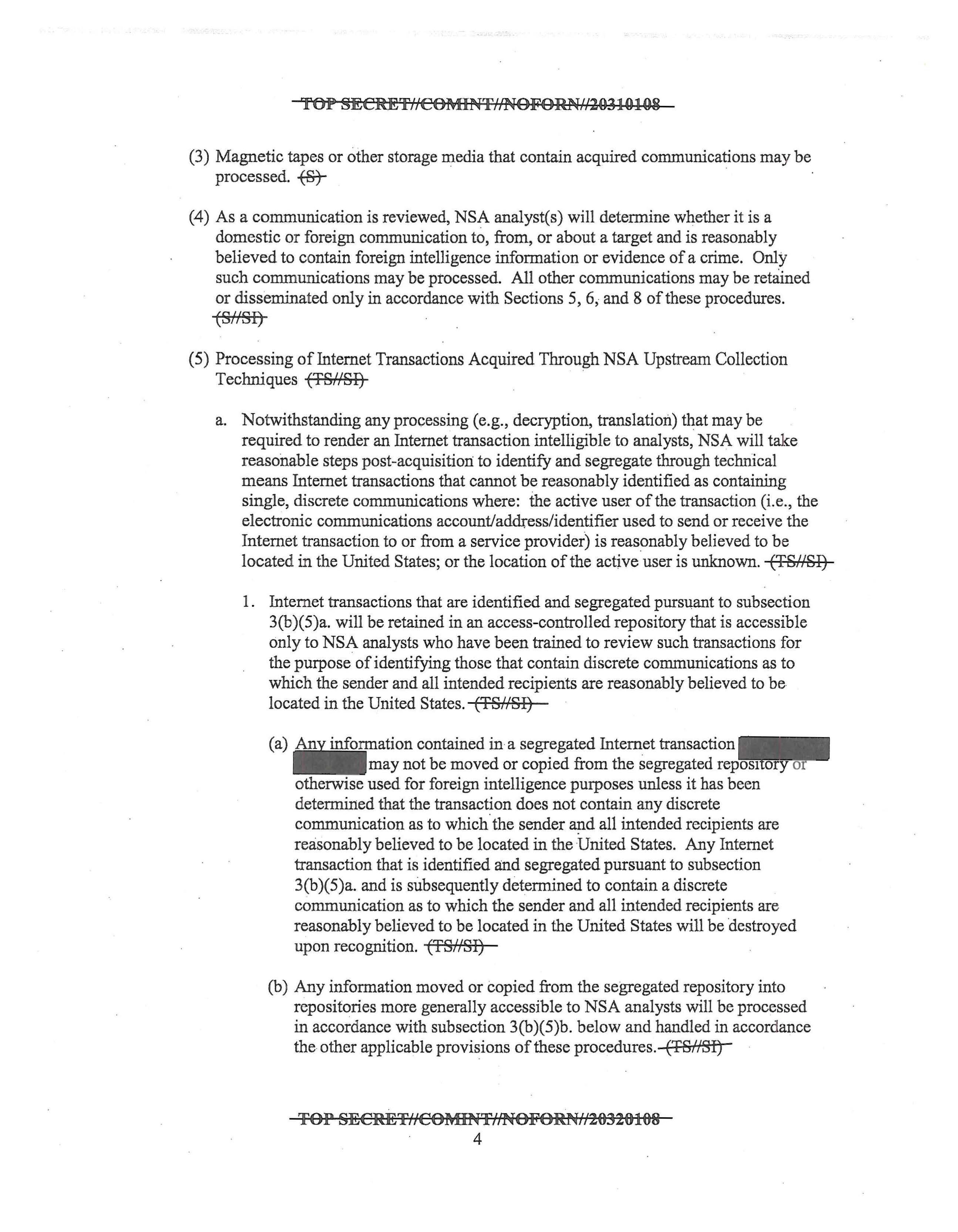
(3) Magnetic tapes or other storage media that contain acquired communications may be
processed. (S)
(4) As a communication is reviewed, NSA analyst(s) will determine whether it is a
domestic or foreign communication to, from, or about a target and is reasonably
believed to contain foreign intelligence information or evidence of a crime. Only
such communications may be processed. All other communications may be retained
or disseminated only in accordance with Sections 5, 6, and 8 of these procedures.
(S//SI)
(5) Processing of Internet Transactions Acquired Through NSA Upstream Collection
Techniques (TS//SI)
a. Notwithstanding any processing (e.g., decryption, translation) that may be
required to render an Internet transaction intelligible to analysts, NSA will take
reasonable steps post-acquisition to identify and segregate through technical
means Internet transactions that cannot be reasonably identified as containing
single, discrete communications where: the active user of the transaction (i.e., the
electronic communications account/address/identifier used to send or receive the
Internet transaction to or from a service provider) is reasonably believed to be
located in the United States; or the location of the active user is unknown. (TS//SI)
- Internet transactions that are identified and segregated pursuant to subsection
3(b)(5)a. will be retained in an access-controlled repository that is accessible
only to NSA analysts who have been trained to review such transactions for
the purpose of identifying those that contain discrete communications as to
which the sender and all intended recipients are reasonably believed to be
located in the United States. (TS//SI)
(a) Any information contained in a segregated Internet transaction [REDACTED]
may not be moved or copied from the segregated repository or
otherwise used for foreign intelligence purposes unless it has been
determined that the transaction does not contain any discrete
communication as to which the sender and all intended recipients are
reasonably believed to be located in the United States. Any Internet
transaction that is identified and segregated pursuant to subsection
3(b)(5)a. and is subsequently determined to contain a discrete
communication as to which the sender and all intended recipients are
reasonably believed to be located in the United States will be destroyed
upon recognition. (TS//SI)
(b) Any information moved or copied from the segregated repository into
repositories more generally accessible to NSA analysts will be processed
in accordance with subsection 3(b)(5)b. below and handled in accordance
the other applicable provisions of these procedures. (TS//SI)
TOP SECRET//COMINT//NOFORN//20320108-
4
TOP SECRET//COMINT//NOFORN//20310108
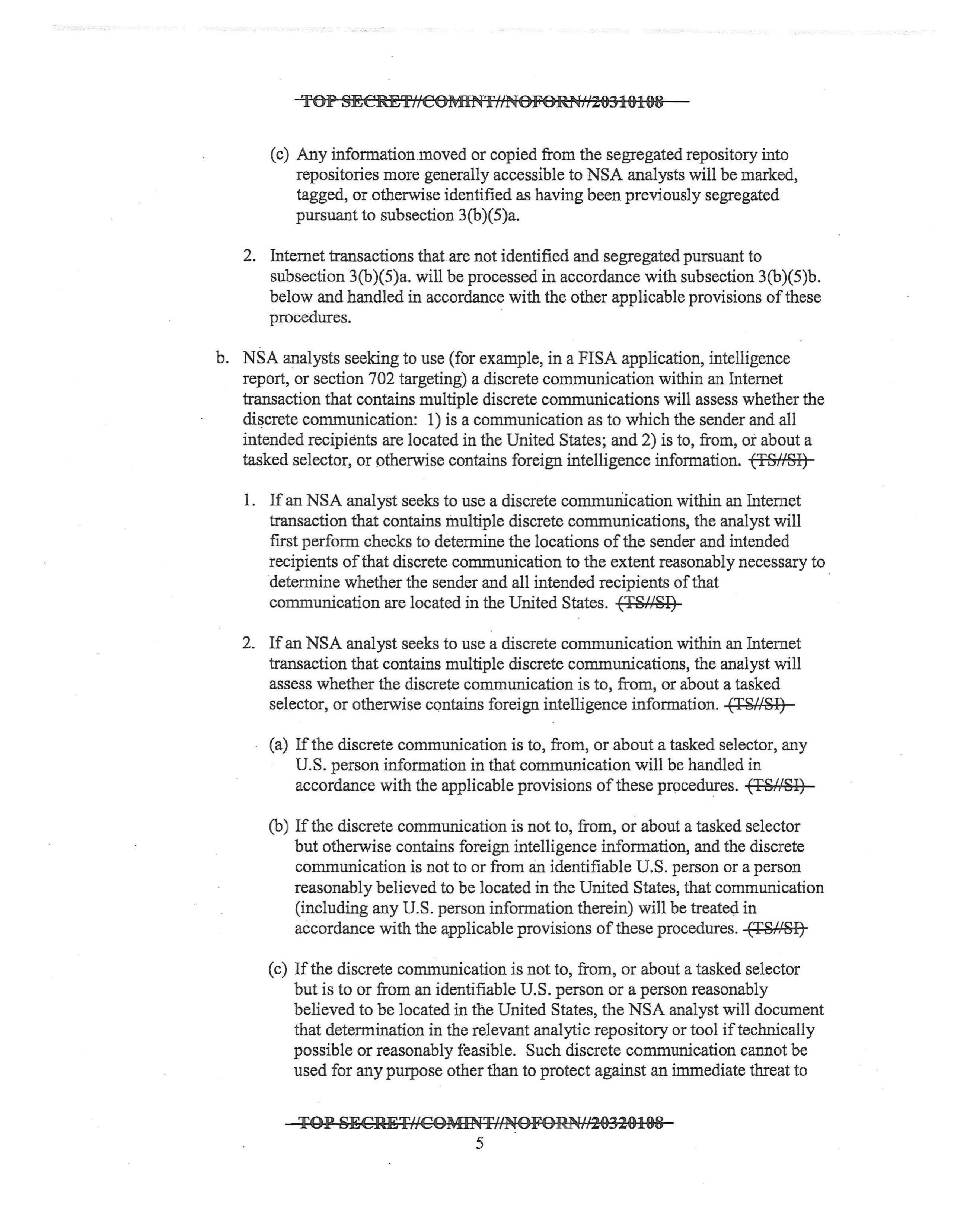
(c) Any information moved or copied from the segregated repository into
repositories more generally accessible to NSA analysts will be marked,
tagged, or otherwise identified as having been previously segregated
pursuant to subsection 3(b)(5)a.
- Internet transactions that are not identified and segregated pursuant to
subsection 3(b)(5)a. will be processed in accordance with subsection 3(b)(5)b.
below and handled in accordance with the other applicable provisions of these
procedures.
b. NSA analysts seeking to use (for example, in a FISA application, intelligence
report, or section 702 targeting) a discrete communication within an Internet
transaction that contains multiple discrete communications will assess whether the
discrete communication: 1) is a communication as to which the sender and all
intended recipients are located in the United States; and 2) is to, from, or about a
tasked selector, or otherwise contains foreign intelligence information. (TS//SI)
- If an NSA analyst seeks to use a discrete communication within an Internet
transaction that contains multiple discrete communications, the analyst will
first perform checks to determine the locations of the sender and intended
recipients of that discrete communication to the extent reasonably necessary to
determine whether the sender and all intended recipients of that
communication are located in the United States. (TS//SI)
- If an NSA analyst seeks to use a discrete communication within an Internet
transaction that contains multiple discrete communications, the analyst will
assess whether the discrete communication is to, from, or about a tasked
selector, or otherwise contains foreign intelligence information. (TS//SI)
(a) If the discrete communication is to, from, or about a tasked selector, any
U.S. person information in that communication will be handled in
accordance with the applicable provisions of these procedures. (TS//SI)
(b) If the discrete communication is not to, from, or about a tasked selector
but otherwise contains foreign intelligence information, and the discrete
communication is not to or from an identifiable U.S. person or a person
reasonably believed to be located in the United States, that communication
(including any U.S. person information therein) will be treated in
accordance with the applicable provisions of these procedures. (TS//SI)
(c) If the discrete communication is not to, from, or about a tasked selector
but is to or from an identifiable U.S. person or a person reasonably
believed to be located in the United States, the NSA analyst will document
that determination in the relevant analytic repository or tool if technically
possible or reasonably feasible. Such discrete communication cannot be
used for any purpose other than to protect against an immediate threat to
TOP SECRET//COMINT//NOFORN//20320108-
5
TOP SECRET//COMINT//NOFORN//20310108-
human life (e.g., force protection or hostage situations). NSA will report
any such use to the Office of the Director of National Intelligence and to
the National Security Division of the Department of Justice, which will
promptly notify the Foreign Intelligence Surveillance Court of such use.
(TS//SI)-
- An NSA analyst seeking to use a discrete communication within an Internet
transaction that contains multiple discrete communications in a FISA
application, intelligence report, or section 702 targeting must appropriately
document the verifications required by subsections 3(b)(5)b.1. and 2. above.
(TS//SI)-
- [REDACTED]
(6) Magnetic tapes or other storage media containing communications acquired pursuant
to section 702 may be scanned by computer to identify and select communications for
analysis. Computer selection terms used for scanning, such as telephone numbers,
key words or phrases, or other discriminators, will be limited to those selection terms
reasonably likely to return foreign intelligence information. Identifiers of an
identifiable U.S. person may not be used as terms to identify and select for analysis
any Internet communication acquired through NSA's upstream collection techniques.
Any use of United States person identifiers as terms to identify and select
communications must first be approved in accordance with NSA procedures. NSA
will maintain records of all United States person identifiers approved for use as
selection terms. The Department of Justice's National Security Division and the
Office of the Director of National Intelligence will conduct oversight of NSA's
activities with respect to United States persons that are conducted pursuant to this
paragraph. (S//SI)
(7) Further processing, retention and dissemination of foreign communications will be
made in accordance with Sections 4, 6, 7, and 8 as applicable, below. Further
processing, storage and dissemination of inadvertently acquired domestic
communications will be made in accordance with Sections 4, 5, and 8 below. (S//SI)
TOP SECRET//COMINT//NOFORN//20320108-
6
TOP SECRET//COMINT//NOFORN//20310108-
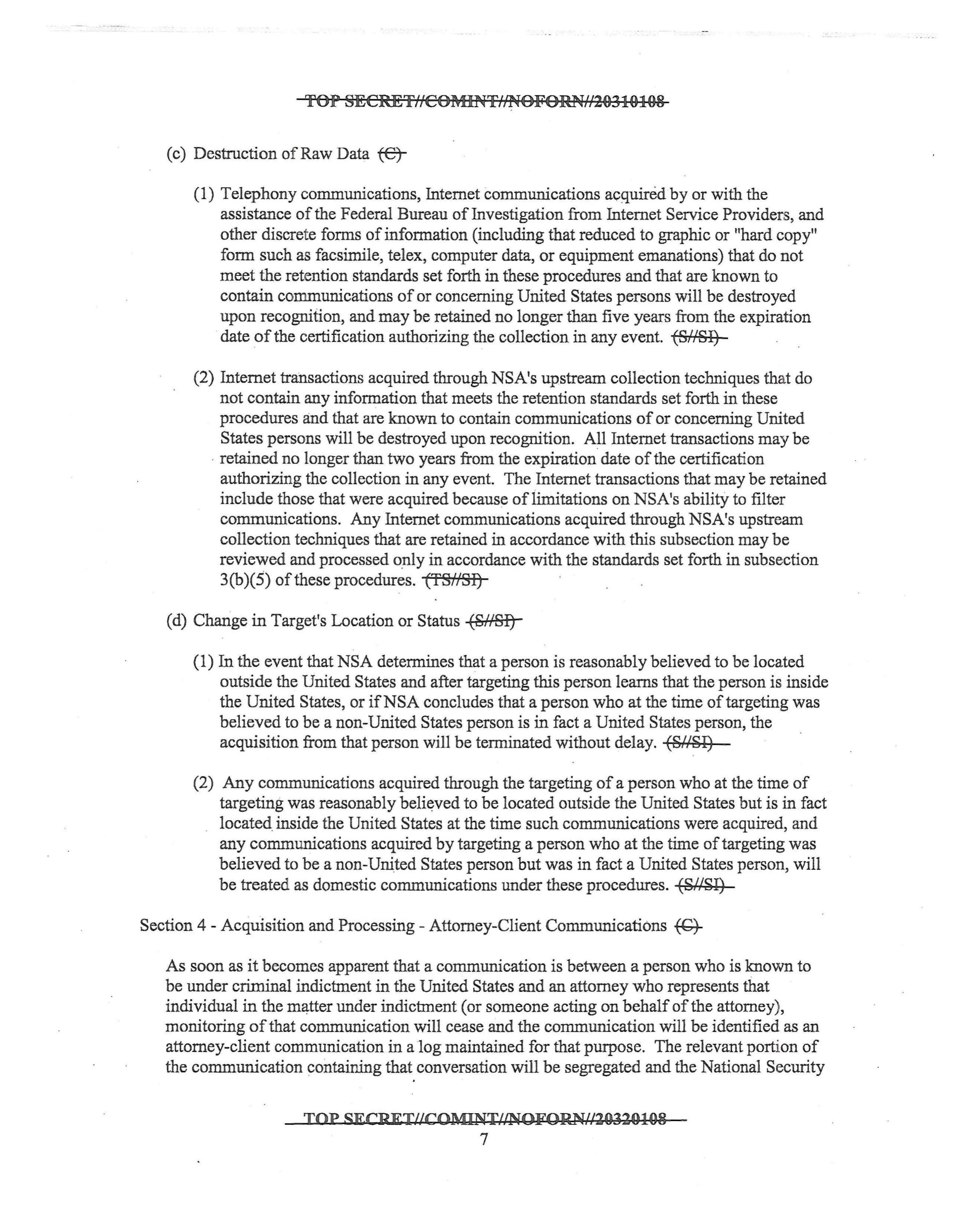
(c) Destruction of Raw Data (C)
(1) Telephony communications, Internet communications acquired by or with the
assistance of the Federal Bureau of Investigation from Internet Service Providers, and
other discrete forms of information (including that reduced to graphic or "hard copy"
form such as facsimile, telex, computer data, or equipment emanations) that do not
meet the retention standards set forth in these procedures and that are known to
contain communications of or concerning United States persons will be destroyed
upon recognition, and may be retained no longer than five years from the expiration
date of the certification authorizing the collection in any event. (S//SI)-
(2) Internet transactions acquired through NSA's upstream collection techniques that do
not contain any information that meets the retention standards set forth in these
procedures and that are known to contain communications of or concerning United
States persons will be destroyed upon recognition. All Internet transactions may be
retained no longer than two years from the expiration date of the certification
authorizing the collection in any event. The Internet transactions that may be retained
include those that were acquired because of limitations on NSA's ability to filter
communications. Any Internet communications acquired through NSA's upstream
collection techniques that are retained in accordance with this subsection may be
reviewed and processed only in accordance with the standards set forth in subsection
3(b)(5) of these procedures. (TS//SI)
(d) Change in Target's Location or Status (S//SI)
(1) In the event that NSA determines that a person is reasonably believed to be located
outside the United States and after targeting this person learns that the person is inside
the United States, or if NSA concludes that a person who at the time of targeting was
believed to be a non-United States person is in fact a United States person, the
acquisition from that person will be terminated without delay. (S//SI)
(2) Any communications acquired through the targeting of a person who at the time of
targeting was reasonably believed to be located outside the United States but is in fact
located inside the United States at the time such communications were acquired, and
any communications acquired by targeting a person who at the time of targeting was
believed to be a non-United States person but was in fact a United States person, will
be treated as domestic communications under these procedures. (S//SI)
Section 4 - Acquisition and Processing - Attorney-Client Communications (C)
As soon as it becomes apparent that a communication is between a person who is known to
be under criminal indictment in the United States and an attorney who represents that
individual in the matter under indictment (or someone acting on behalf of the attorney),
monitoring of that communication will cease and the communication will be identified as an
attorney-client communication in a log maintained for that purpose. The relevant portion of
the communication containing that conversation will be segregated and the National Security
TOP SECRET//COMINT//NOFORN//20320108
7
TOP SECRET//COMINT//NOFORN//20310108
Division of the Department of Justice will be notified so that appropriate procedures may be
established to protect such communications from review or use in any criminal prosecution,
while preserving foreign intelligence information contained therein. Additionally, all
proposed disseminations of information constituting United States person attorney-client
privileged communications must be reviewed by the NSA Office of General Counsel prior to
dissemination. (S//SI)
Section 5 - Domestic Communications (U)
A communication identified as a domestic communication will be promptly destroyed upon
recognition unless the Director (or Acting Director) of NSA specifically determines, in
writing, that: (S)
(1) the communication is reasonably believed to contain significant foreign intelligence
information. Such communication may be provided to the FBI (including United
States person identities) for possible dissemination by the FBI in accordance with its
minimization procedures; (S)
(2) the communication does not contain foreign intelligence information but is
reasonably believed to contain evidence of a crime that has been, is being, or is about
to be committed. Such communication may be disseminated (including United States
person identities) to appropriate Federal law enforcement authorities, in accordance
with 50 U.S.C. §§ 1806(b) and 1825(c), Executive Order No. 12333, and, where
applicable, the crimes reporting procedures set out in the August 1995 "Memorandum
of Understanding: Reporting of Information Concerning Federal Crimes," or any
successor document. Such communications may be retained by NSA for a reasonable
period of time, not to exceed six months unless extended in writing by the Attorney
General, to permit law enforcement agencies to determine whether access to original
recordings of such communications is required for law enforcement purposes; (S)
(3) the communication is reasonably believed to contain technical data base information,
as defined in Section 2(j), or information necessary to understand or assess a
communications security vulnerability. Such communication may be provided to the
FBI and/or disseminated to other elements of the United States Government. Such
communications may be retained for a period sufficient to allow a thorough
exploitation and to permit access to data that are, or are reasonably believed likely to
become, relevant to a current or future foreign intelligence requirement. Sufficient
duration may vary with the nature of the exploitation. (S//SI)-
a. In the context of a cryptanalytic effort, maintenance of technical data bases
requires retention of all communications that are enciphered or reasonably
believed to contain secret meaning, and sufficient duration may consist of any
period of time during which encrypted material is subject to, or of use in,
cryptanalysis. (S//SI)
TOP SECRET//COMINT//NOFORN//20320108-
8
TOP SECRET//COMINT//NOFORN//20310108-
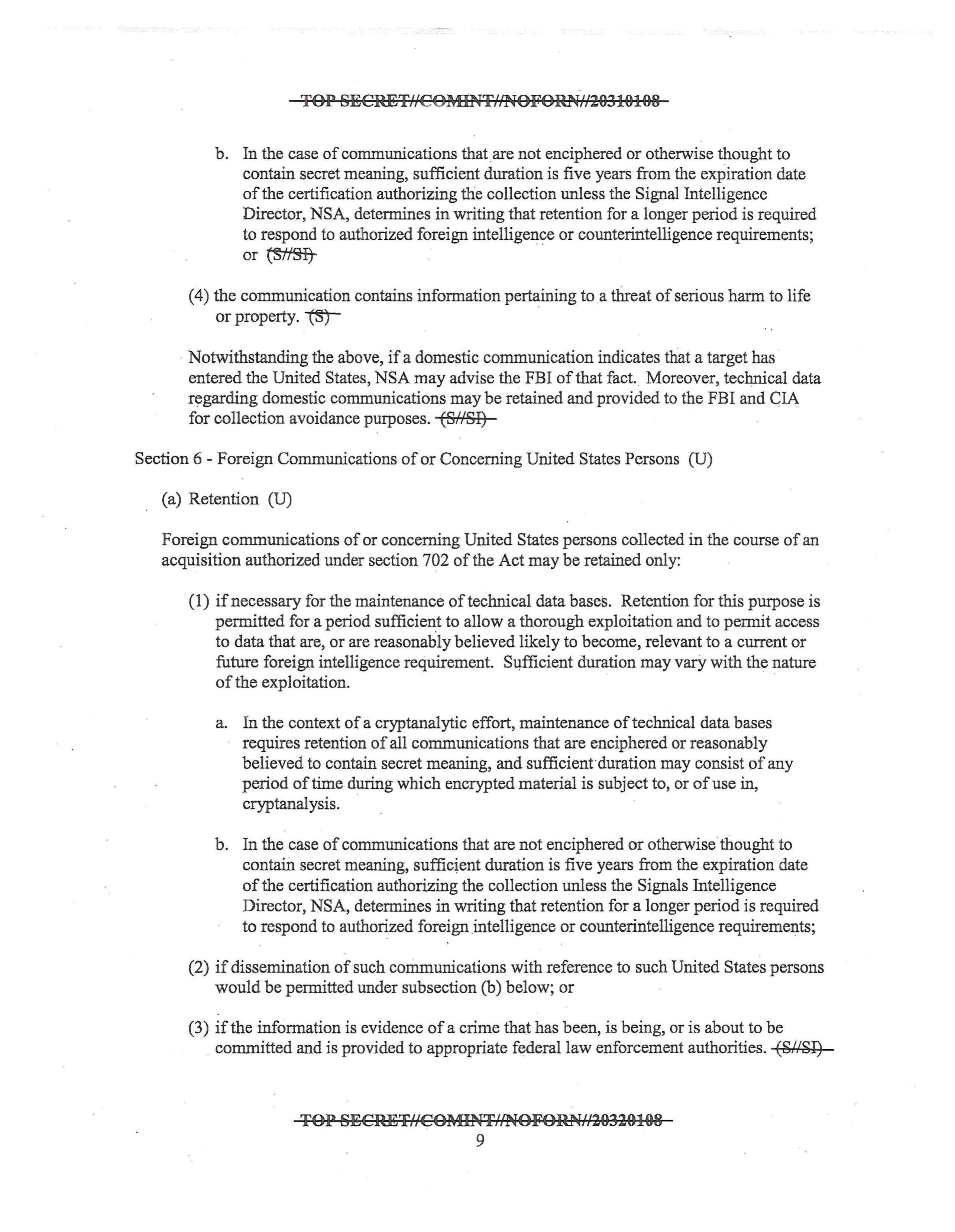
b. In the case of communications that are not enciphered or otherwise thought to
contain secret meaning, sufficient duration is five years from the expiration date
of the certification authorizing the collection unless the Signal Intelligence
Director, NSA, determines in writing that retention for a longer period is required
to respond to authorized foreign intelligence or counterintelligence requirements;
or (S//SI)
(4) the communication contains information pertaining to a threat of serious harm to life
or property. (S)
Notwithstanding the above, if a domestic communication indicates that a target has
entered the United States, NSA may advise the FBI of that fact. Moreover, technical data
regarding domestic communications may be retained and provided to the FBI and CIA
for collection avoidance purposes. (S//SI)
Section 6 - Foreign Communications of or Concerning United States Persons (U)
(a) Retention (U)
Foreign communications of or concerning United States persons collected in the course of an
acquisition authorized under section 702 of the Act may be retained only:
(1) if necessary for the maintenance of technical data bases. Retention for this purpose is
permitted for a period sufficient to allow a thorough exploitation and to permit access
to data that are, or are reasonably believed likely to become, relevant to a current or
future foreign intelligence requirement. Sufficient duration may vary with the nature
of the exploitation.
a. In the context of a cryptanalytic effort, maintenance of technical data bases
requires retention of all communications that are enciphered or reasonably
believed to contain secret meaning, and sufficient duration may consist of any
period of time during which encrypted material is subject to, or of use in,
cryptanalysis.
b. In the case of communications that are not enciphered or otherwise thought to
contain secret meaning, sufficient duration is five years from the expiration date
of the certification authorizing the collection unless the Signals Intelligence
Director, NSA, determines in writing that retention for a longer period is required
to respond to authorized foreign intelligence or counterintelligence requirements;
(2) if dissemination of such communications with reference to such United States persons
would be permitted under subsection (b) below; or
(3) if the information is evidence of a crime that has been, is being, or is about to be
committed and is provided to appropriate federal law enforcement authorities. (S//SI)
TOP SECRET//COMINT//NOFORN//20320108-
9
TOP SECRET//COMINT//NOFORN//20310108-
(b) Dissemination (U)
A report based on communications of or concerning a United States person may be
disseminated in accordance with Section 7 or 8 if the identity of the United States person is
deleted and a generic term or symbol is substituted so that the information cannot reasonably
be connected with an identifiable United States person. Otherwise, dissemination of
intelligence reports based on communications of or concerning a United States person may
only be made to a recipient requiring the identity of such person for the performance of
official duties but only if at least one of the following criteria is also met:
(1) the United States person has consented to dissemination or the information of or
concerning the United States person is available publicly;
(2) the identity of the United States person is necessary to understand foreign intelligence
information or assess its importance, e.g., the identity of a senior official in the
Executive Branch;
(3) the communication or information indicates that the United States person may be:
a. an agent of a foreign power;
b. a foreign power as defined in Section 101(a) of the Act;
c. residing outside the United States and holding an official position in the
government or military forces of a foreign power;
d. a corporation or other entity that is owned or controlled directly or indirectly by a
foreign power; or
e. acting in collaboration with an intelligence or security service of a foreign power
and the United States person has, or has had, access to classified national security
information or material;
(4) the communication or information indicates that the United States person may be the
target of intelligence activities of a foreign power;
(5) the communication or information indicates that the United States person is engaged
in the unauthorized disclosure of classified national security information or the
United States person's identity is necessary to understand or assess a communications
security vulnerability, but only after the agency that originated the information
certifies that it is properly classified;
(6) the communication or information indicates that the United States person may be
engaging in international terrorist activities;
TOP SECRET//COMINT//NOFORN//20320108-
10
TOP SECRET//COMINT//NOFORN//20310108-
(7) the acquisition of the United States person's communication was authorized by a
court order issued pursuant to the Act and the communication may relate to the
foreign intelligence purpose of the surveillance; or
(8) the communication or information is reasonably believed to contain evidence that a
crime has been, is being, or is about to be committed, provided that dissemination is
for law enforcement purposes and is made in accordance with 50 U.S.C. §§ 1806(b)
and 1825(c), Executive Order No. 12333, and, where applicable, the crimes reporting
procedures set out in the August 1995 "Memorandum of Understanding: Reporting of
Information Concerning Federal Crimes," or any successor document. (U)
(c) Provision of Unminimized Communications to CIA and FBI (S/NF)-
(1) NSA may provide to the Central Intelligence Agency (CIA) unminimized
communications acquired pursuant to section 702 of the Act. CIA will
identify to NSA targets for which NSA may provide unminimized
communications to CIA. CIA will process any such unminimized
communications received from NSA in accordance with CIA minimization
procedures adopted by the Attorney General, in consultation with the Director
of National Intelligence, pursuant to subsection 702(e) of the Act. (S//SI//NF)
(2) NSA may provide to the FBI unminimized communications acquired pursuant to
section 702 of the Act. The FBI will identify to NSA targets for which NSA may
provide unminimized communications to the FBI. The FBI will process any such
unminimized communications received from NSA in accordance with FBI
minimization procedures adopted by the Attorney General, in consultation with the
Director of National Intelligence, pursuant to subsection 702(e) of the Act. (S//SI)
Section 7 - Other Foreign Communications (U)
Foreign communications of or concerning a non-United States person may be retained, used,
and disseminated in any form in accordance with other applicable law, regulation, and policy.
(U)
Section 8 - Collaboration with Foreign Governments (S//SI)
(a) Procedures for the dissemination of evaluated and minimized information. Pursuant to
Section 1.7(c)(8) of Executive Order No. 12333, as amended, NSA conducts foreign
cryptologic liaison relationships with certain foreign governments. Information acquired
pursuant to section 702 of the Act may be disseminated to a foreign government. Except
as provided in subsection 8(b) of these procedures, any dissemination to a foreign
government of information of or concerning a United States person that is acquired
pursuant to section 702 may only be done in a manner consistent with subsections 6(b)
and 7 of these NSA minimization procedures. (S)
TOP SECRET//COMINT//NOFORN//20320108-
11
TOP SECRET//COMINT//NOFORN//20310108-
(b) Procedures for technical or linguistic assistance. It is anticipated that NSA may obtain
information or communications that, because of their technical or linguistic content, may
require further analysis by foreign governments to assist NSA in determining their
meaning or significance. Notwithstanding other provisions of these minimization
procedures, NSA may disseminate computer disks, tape recordings, transcripts, or other
information or items containing unminimized information or communications acquired
pursuant to section 702 to foreign governments for further processing and analysis, under
the following restrictions with respect to any materials so disseminated: (S)
(1) Dissemination to foreign governments will be solely for translation or analysis
of such information or communications, and assisting foreign governments
will make no use of any information or any communication of or concerning
any person except to provide technical and linguistic assistance to NSA. (S)
(2) Dissemination will be only to those personnel within foreign governments
involved in the translation or analysis of such information or communications.
The number of such personnel will be restricted to the extent feasible. There
will be no dissemination within foreign governments of this unminimized data.
(S)
(3) Foreign governments will make no permanent agency record of information or
communications of or concerning any person referred to or recorded on
computer disks, tape recordings, transcripts, or other items disseminated by
NSA to foreign governments, provided that foreign governments may
maintain such temporary records as are necessary to enable them to assist
NSA with the translation or analysis of such information. Records maintained
by foreign governments for this purpose may not be disseminated within the
foreign governments, except to personnel involved in providing technical or
linguistic assistance to NSA. (S)
(4) Upon the conclusion of such technical or linguistic assistance to NSA,
computer disks, tape recordings, transcripts, or other items or information
disseminated to foreign governments will either be returned to NSA or be
destroyed with an accounting of such destruction made to NSA. (S)
TOP SECRET//COMINT//NOFORN//20320108
12
TOP SECRET//COMINT//NOFORN//20310108
(5) Any information that foreign governments provide to NSA as a result of such
technical or linguistic assistance may be disseminated by NSA in accordance
with these minimization procedures. (S)
10-31-11
Date
Eric H. Holder, Jr.
Attorney General of the United States
TOP SECRET//COMINT//NOFORN//20320108
13
Related Documents
-
Minimization Procedures Used By The National Security Agency In Connection With Acquisitions Of Foreign Intelligence, Information Pursuant To Section 702 Of The Foreign Intelligence Court Surveillance Act Of 1978 [pdf]
The NSA’s Section 702 minimization rules expose how the agency can collect, keep, and use Americans’ communications without warrants, despite claiming to target only foreigners. While the document sets out procedures for handling U.S. data, it includes broad loopholes—like keeping “inadvertently” collected domestic messages for years, sharing unfiltered data with the FBI, CIA, and even foreign governments, and giving NSA analysts wide discretion over who gets surveilled—all under secret FISA Court approval.
People: Holder, Eric H. Jr. -
Procedures Used By The National Security Agency For Targeting Non-United States Persons Reasonably Believed To Be Located Outside The United States To Acquire Foreign Intelligence Court Information Pursuant To Section 702 Of The Foreign Intelligence Surveillance Act Of 1978 [pdf]
The NSA’s 2009 Section 702 targeting procedures lay out how analysts decide who can be surveilled without a warrant, supposedly limiting spying to foreigners abroad. In reality, the rules give the agency wide latitude to presume people are foreign, rely on vague “totality of the circumstances” tests, and allow broad technical methods like IP filters and metadata checks. Oversight is mostly internal and after-the-fact, creating significant potential for U.S. communications to be swept up with little accountability.
People: Holder, Eric H. Jr. -
Reply of the Center for National Security Studies in Support of Motion to Establish a Public Briefing Schedule Including the Filings of Briefs by Amici Curiae, for Leave to File an Amicus Curiae Brief, and a Suggestion for Hearing En Banc, In re Application of the Federal Bureau of Investigation for an Order Requiring Production of Tangible Things from [REDACTED] FOIA [pdf]
-
Motion to Establish a Public Briefing Schedule Including the Filings of Briefs by Amici Curiae, for Leave for the Center for National Security Studies to File an Amicus Brief, and a Suggestion for Hearing En Banc, In re Application of the Federal Bureau of Investigation for an Order Requiring Production of Tangible Things from [REDACTED], No. BR 13-109 (FISA Ct. Oct. 17, 2013) FOIA [pdf]
-