September 5, 2006 Cover Filing Submission to the FISC
Open PDFDocument date: 2006-09-05
Type: FOIA
Pages: 48
Classification: SECRET
Dissemination: -
An NSA submission to the FISC on the standard minimization procedures governing the FBI. ACLU/EFF FOIA Litigation.
My notes
CLASSIFIED BY NSICG J37765T94
REASON: 4 (C)
DECLASSIFY OR 10-10-2031
DATE: 10-10-2013
[REDACTED]
[REDACTED]
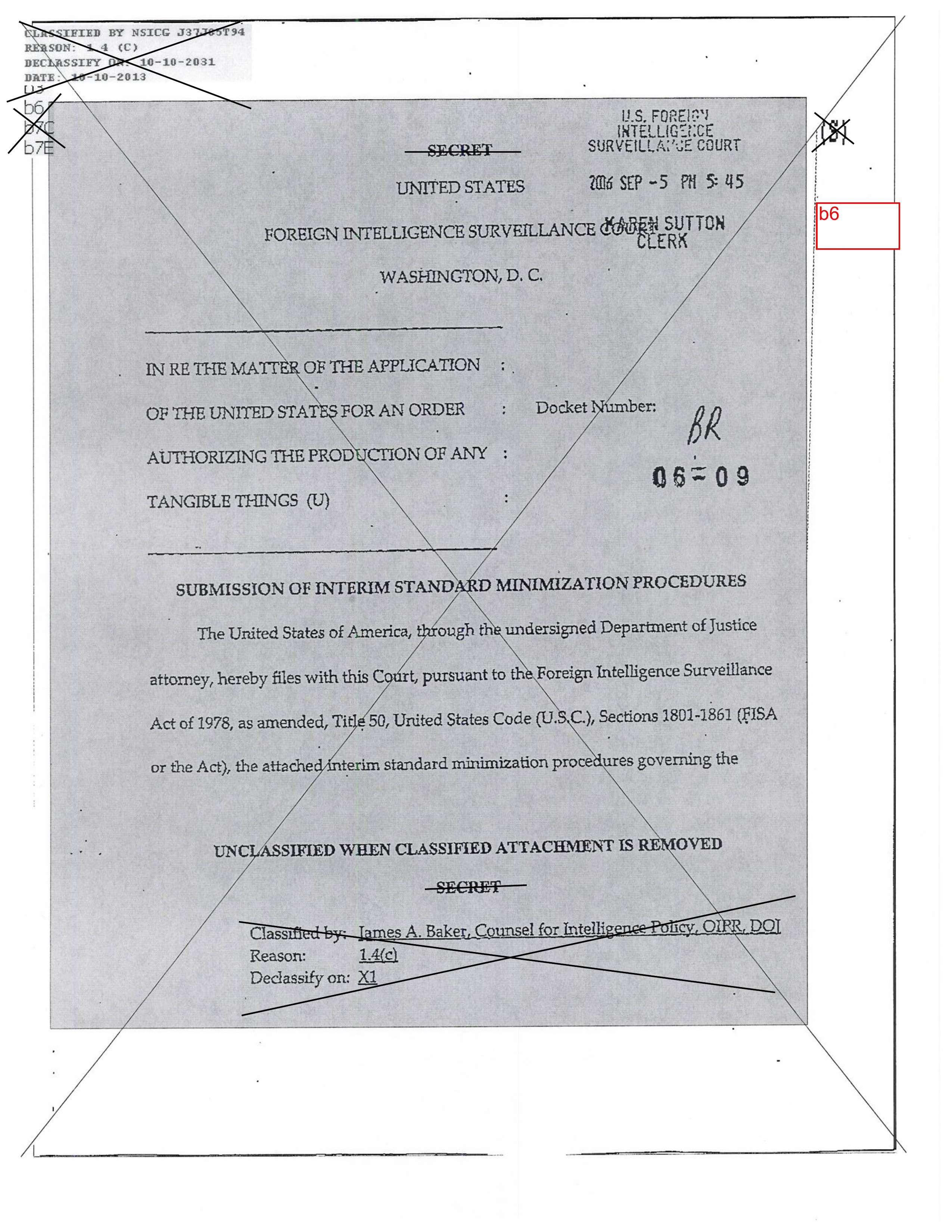
U.S. FOREIGN
INTELLIGENCE
SURVEILLANCE COURT
2006 SEP -5 PM 5:45
FOREIGN INTELLIGENCE SURVEILLANCE [REDACTED] SUTTON
CLERK
WASHINGTON, D. C.
IN RE THE MATTER OF THE APPLICATION :
OF THE UNITED STATES FOR AN ORDER : Docket Number:
[REDACTED]
BR
AUTHORIZING THE PRODUCTION OF ANY :
06-09
TANGIBLE THINGS (U) :
SUBMISSION OF INTERIM STANDARD MINIMIZATION PROCEDURES
The United States of America, through the undersigned Department of Justice
attorney, hereby files with this Court, pursuant to the Foreign Intelligence Surveillance
Act of 1978, as amended, Title 50, United States Code (U.S.C.), Sections 1801-1861 (FISA
or the Act), the attached interim standard minimization procedures governing the
UNCLASSIFIED WHEN CLASSIFIED ATTACHMENT IS REMOVED
SECRET
Classified by: James A. Baker, Counsel for Intelligence Policy, OIRR, DOI
Reason: 1.4(c)
Declassify on: X1
Removed
[REDACTED]
SECRET
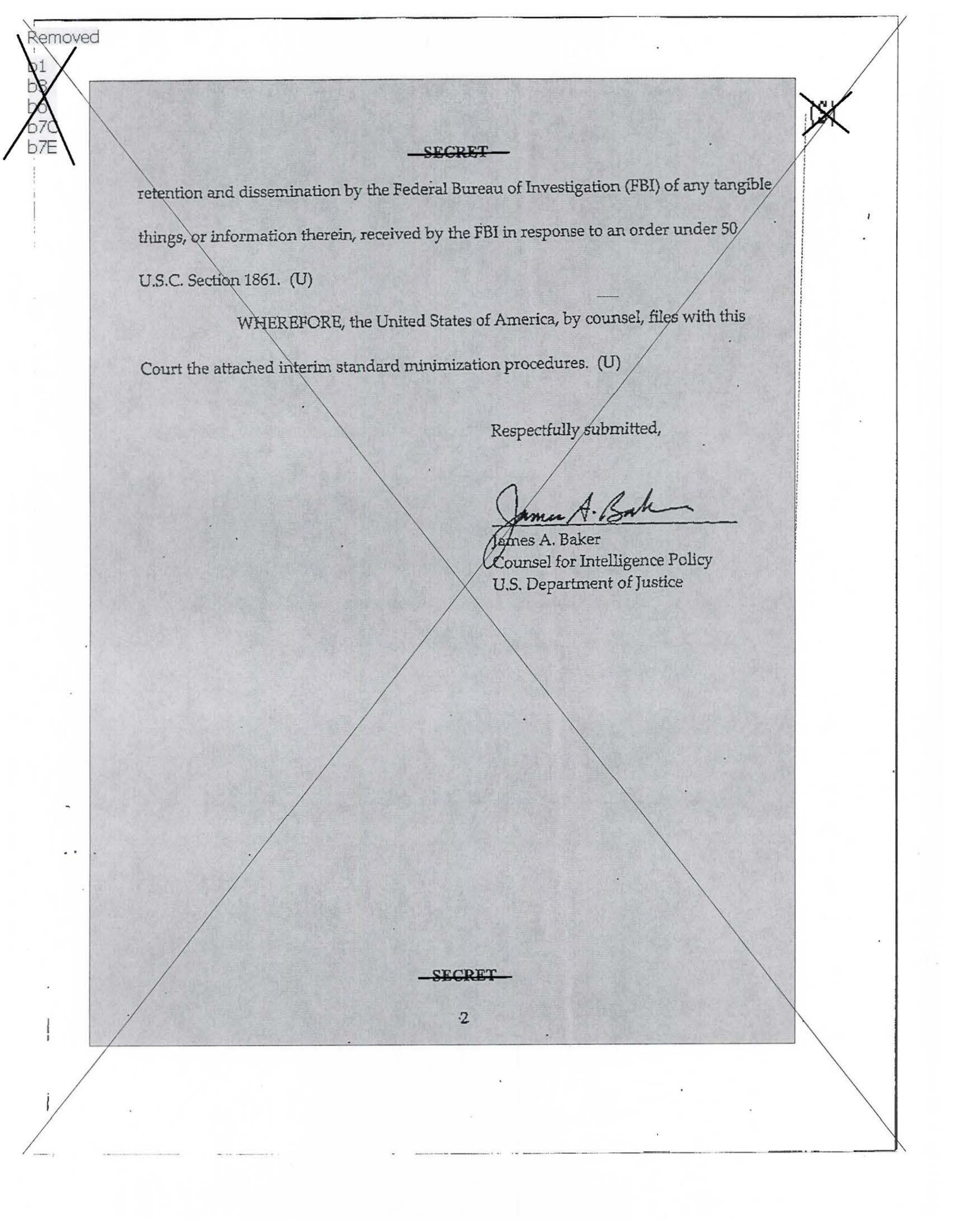
retention and dissemination by the Federal Bureau of Investigation (FBI) of any tangible
things, or information therein, received by the FBI in response to an order under 50
U.S.C. Section 1861. (U)
WHEREFORE, the United States of America, by counsel, files with this
Court the attached interim standard minimization procedures. (U)
Respectfully submitted,
James A. Baker
Counsel for Intelligence Policy
U.S. Department of Justice
SECRET
2
Removed
[REDACTED]
SECRET
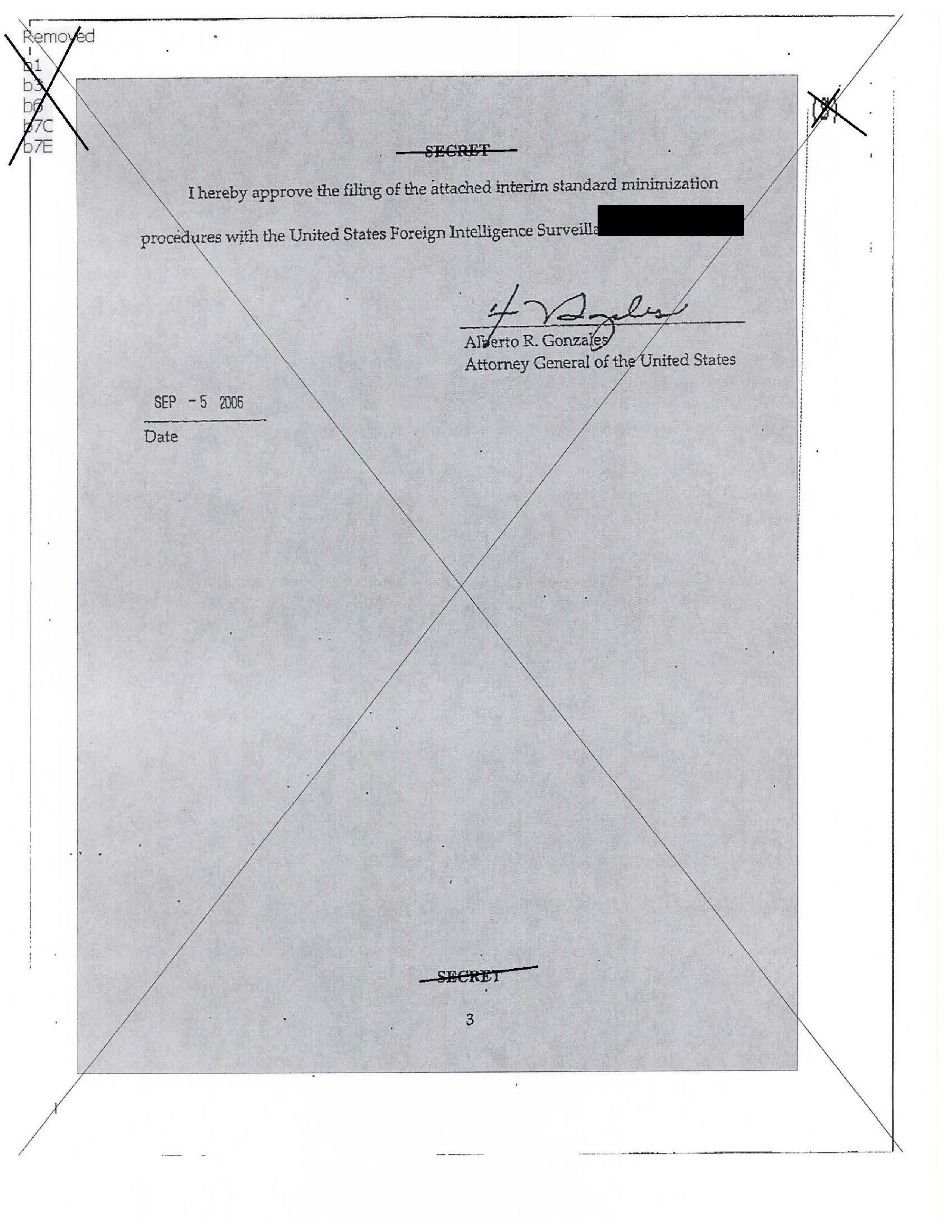
I hereby approve the filing of the attached interim standard minimization
procedures with the United States Foreign Intelligence Surveillance [REDACTED]
Alberto R. Gonzales
Attorney General of the United States
SEP -5 2006
Date
SECRET
3
CLASSIFIED BY NSICG J37J85T94
REASON: 1.1 (C)
DECLASSIFY ON: 10-2031
DATE: 10-20-2013
[REDACTED]
SECRET
UNITED STATES
FOREIGN INTELLIGENCE SURVEILLANCE COURT
WASHINGTON, D. C.
IN RE THE MATTER OF THE APPLICATION :
OF THE UNITED STATES FOR AN ORDER : Docket Number:
AUTHORIZING THE PRODUCTION OF ANY :
TANGIBLE THINGS (U) :
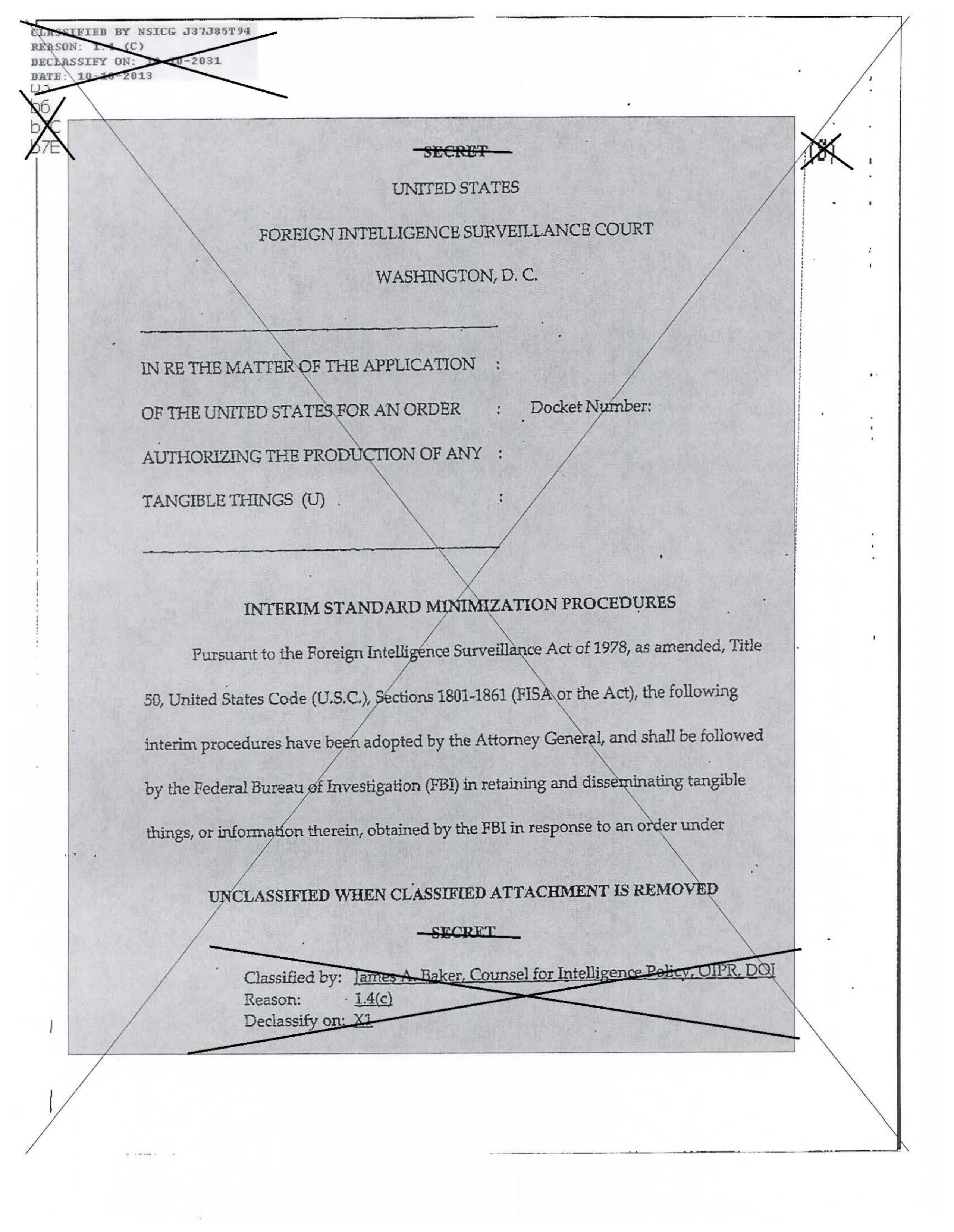
INTERIM STANDARD MINIMIZATION PROCEDURES
Pursuant to the Foreign Intelligence Surveillance Act of 1978, as amended, Title
50, United States Code (U.S.C.), Sections 1801-1861 (FISA or the Act), the following
interim procedures have been adopted by the Attorney General, and shall be followed
by the Federal Bureau of Investigation (FBI) in retaining and disseminating tangible
things, or information therein, obtained by the FBI in response to an order under
UNCLASSIFIED WHEN CLASSIFIED ATTACHMENT IS REMOVED
SECRET
Classified by: James A. Baker, Counsel for Intelligence Policy, OIPR, DOI
Reason: 1.4(c)
Declassify on: X1
Removed
[REDACTED]
SECRET
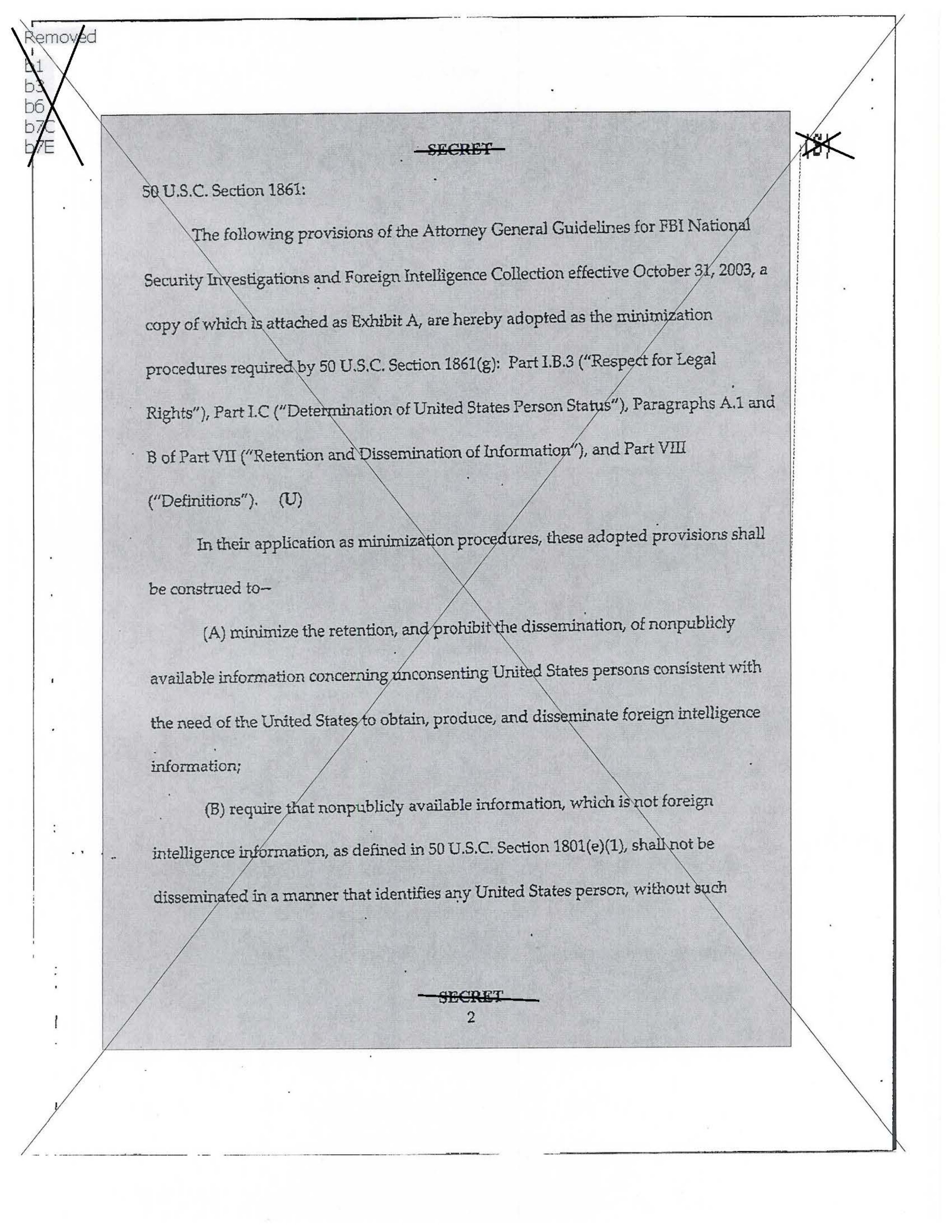
50 U.S.C. Section 1861:
The following provisions of the Attorney General Guidelines for FBI National
Security Investigations and Foreign Intelligence Collection effective October 31, 2003, a
copy of which is attached as Exhibit A, are hereby adopted as the minimization
procedures required by 50 U.S.C. Section 1861(g): Part I.B.3 ("Respect for Legal
Rights"), Part I.C ("Determination of United States Person Status"), Paragraphs A.1 and
B of Part VII ("Retention and Dissemination of Information"), and Part VIII
("Definitions"). (U)
In their application as minimization procedures, these adopted provisions shall
be construed to-
(A) minimize the retention, and prohibit the dissemination, of nonpublicly
available information concerning unconsenting United States persons consistent with
the need of the United States to obtain, produce, and disseminate foreign intelligence
information;
(B) require that nonpublicly available information, which is not foreign
intelligence information, as defined in 50 U.S.C. Section 1801(e)(1), shall not be
disseminated in a manner that identifies any United States person, without such
SECRET
2
Removed
[REDACTED]
SECRET
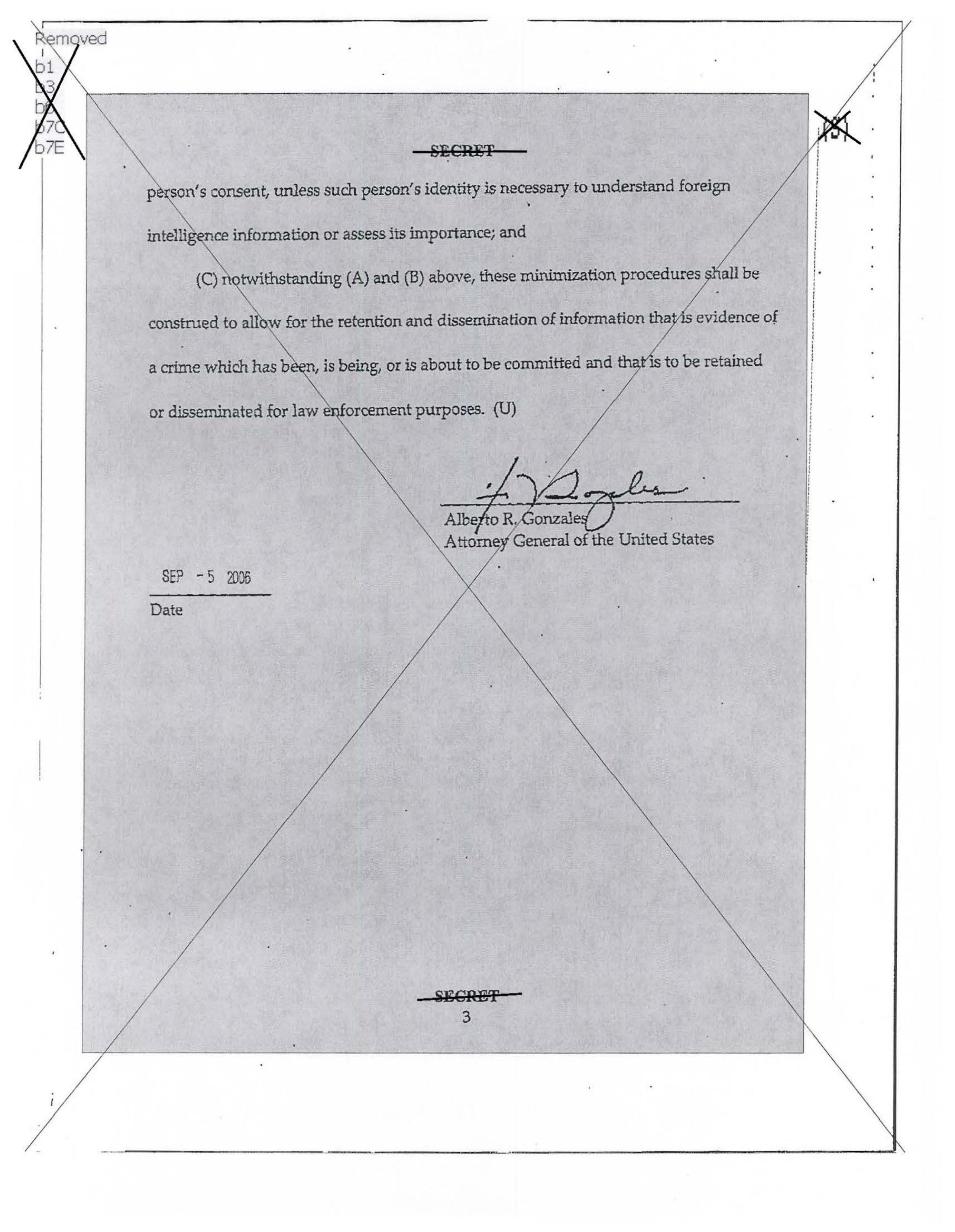
person's consent, unless such person's identity is necessary to understand foreign
intelligence information or assess its importance; and
(C) notwithstanding (A) and (B) above, these minimization procedures shall be
construed to allow for the retention and dissemination of information that is evidence of
a crime which has been, is being, or is about to be committed and that is to be retained
or disseminated for law enforcement purposes. (U)
Alberto R. Gonzales
Attorney General of the United States
SEP -5 2006
Date
SECRET
3
FBI INFO.
CLASSIFIED BY NSICG J37J85T94
REASON: 1.4 (C)
DECLASSIFY ON: 10-10-2038
DATE: 10-10-2013
SECRET
THE ATTORNEY GENERAL'S GUIDELINES FOR
FBI NATIONAL SECURITY INVESTIGATIONS
AND FOREIGN INTELLIGENCE COLLECTION (U)
Classified by: John Ashcroft, Attorney General
Reason: 1.4(c)
Declassify on: October 31, 2028.
SECRET
EFFECTIVE: October 31, 2003
SECRET
PREAMBLE (U)
The following Guidelines on national security investigations and foreign intelligence collection by
the Federal Bureau of Investigation (FBI) are issued under the authority of the Attorney General as
provided in sections 509, 510, 533, and 534 of title 28, United States Code. They apply to activities
of the FBI pursuant to Executive Order 12333 and other activities as provided herein. (U)
SECRET
ii
SECRET
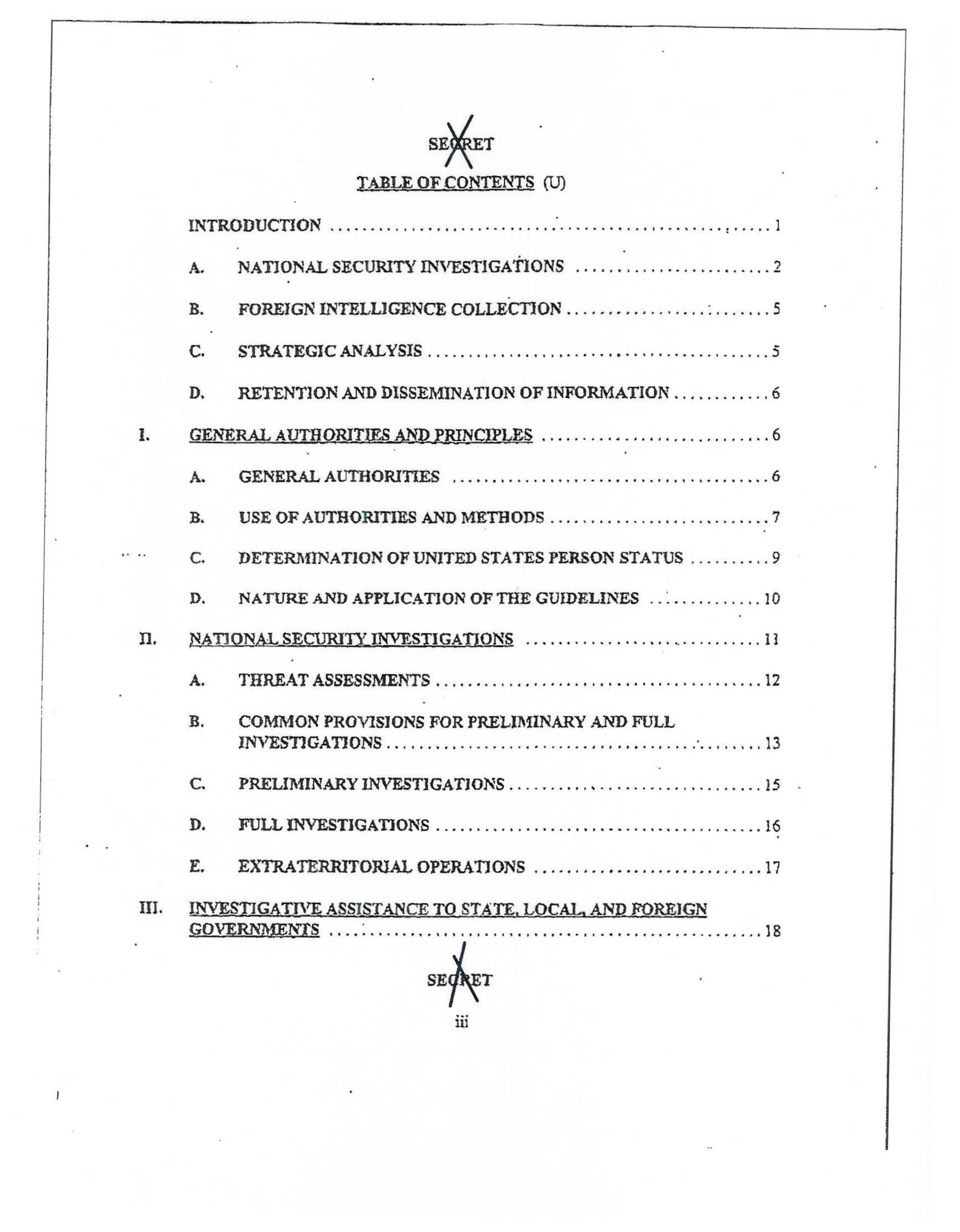
TABLE OF CONTENTS (U)
INTRODUCTION ..................................................................................................... 1
A. NATIONAL SECURITY INVESTIGATIONS ..................................................... 2
B. FOREIGN INTELLIGENCE COLLECTION .....................................................5
C. STRATEGIC ANALYSIS ...................................................................................5
D. RETENTION AND DISSEMINATION OF INFORMATION .............................6
I. GENERAL AUTHORITIES AND PRINCIPLES .....................................................6
A. GENERAL AUTHORITIES ...............................................................................6
B. USE OF AUTHORITIES AND METHODS ........................................................7
C. DETERMINATION OF UNITED STATES PERSON STATUS ...........................9
D. NATURE AND APPLICATION OF THE GUIDELINES ................................ 10
II. NATIONAL SECURITY INVESTIGATIONS ..................................................... 11
A. THREAT ASSESSMENTS ............................................................................. 12
B. COMMON PROVISIONS FOR PRELIMINARY AND FULL
INVESTIGATIONS .................................................................................... 13
C. PRELIMINARY INVESTIGATIONS .............................................................. 15
D. FULL INVESTIGATIONS .............................................................................. 16
E. EXTRATERRITORIAL OPERATIONS .......................................................... 17
III. INVESTIGATIVE ASSISTANCE TO STATE, LOCAL, AND FOREIGN
GOVERNMENTS .............................................................................................. 18
SECRET
iii
SECRET
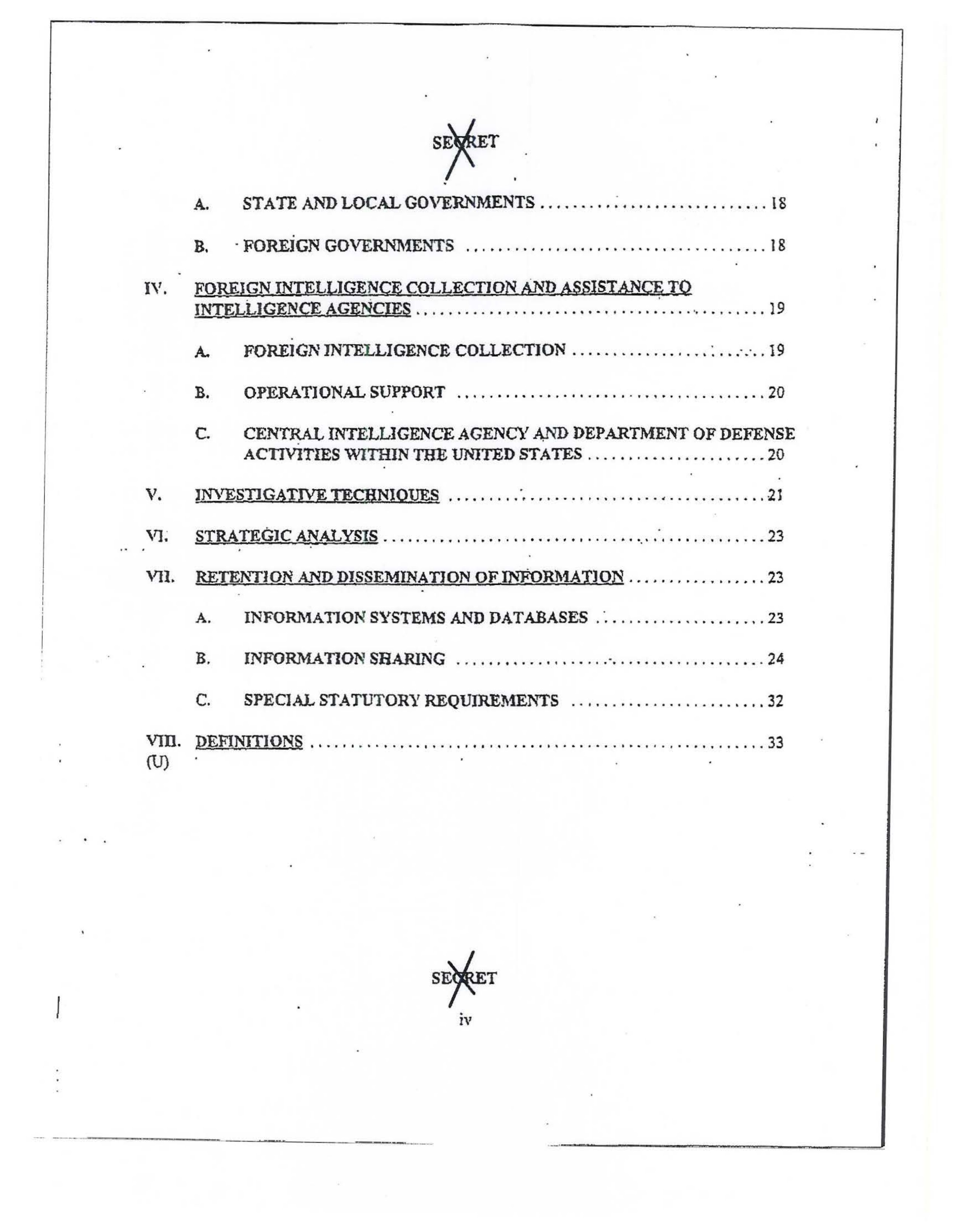
A. STATE AND LOCAL GOVERNMENTS ..................................................... 18
B. FOREIGN GOVERNMENTS ........................................................................ 18
IV. FOREIGN INTELLIGENCE COLLECTION AND ASSISTANCE TO
INTELLIGENCE AGENCIES ................................................................................ 19
A. FOREIGN INTELLIGENCE COLLECTION .................................................. 19
B. OPERATIONAL SUPPORT .......................................................................... 20
C. CENTRAL INTELLIGENCE AGENCY AND DEPARTMENT OF DEFENSE
ACTIVITIES WITHIN THE UNITED STATES ............................................ 20
V. INVESTIGATIVE TECHNIQUES ..................................................................... 21
VI. STRATEGIC ANALYSIS .................................................................................. 23
VII. RETENTION AND DISSEMINATION OF INFORMATION ............................ 23
A. INFORMATION SYSTEMS AND DATABASES ........................................... 23
B. INFORMATION SHARING .......................................................................... 24
C. SPECIAL STATUTORY REQUIREMENTS ................................................. 32
VIII. DEFINITIONS .................................................................................................. 33
(U)
SECRET
iv
SECRET
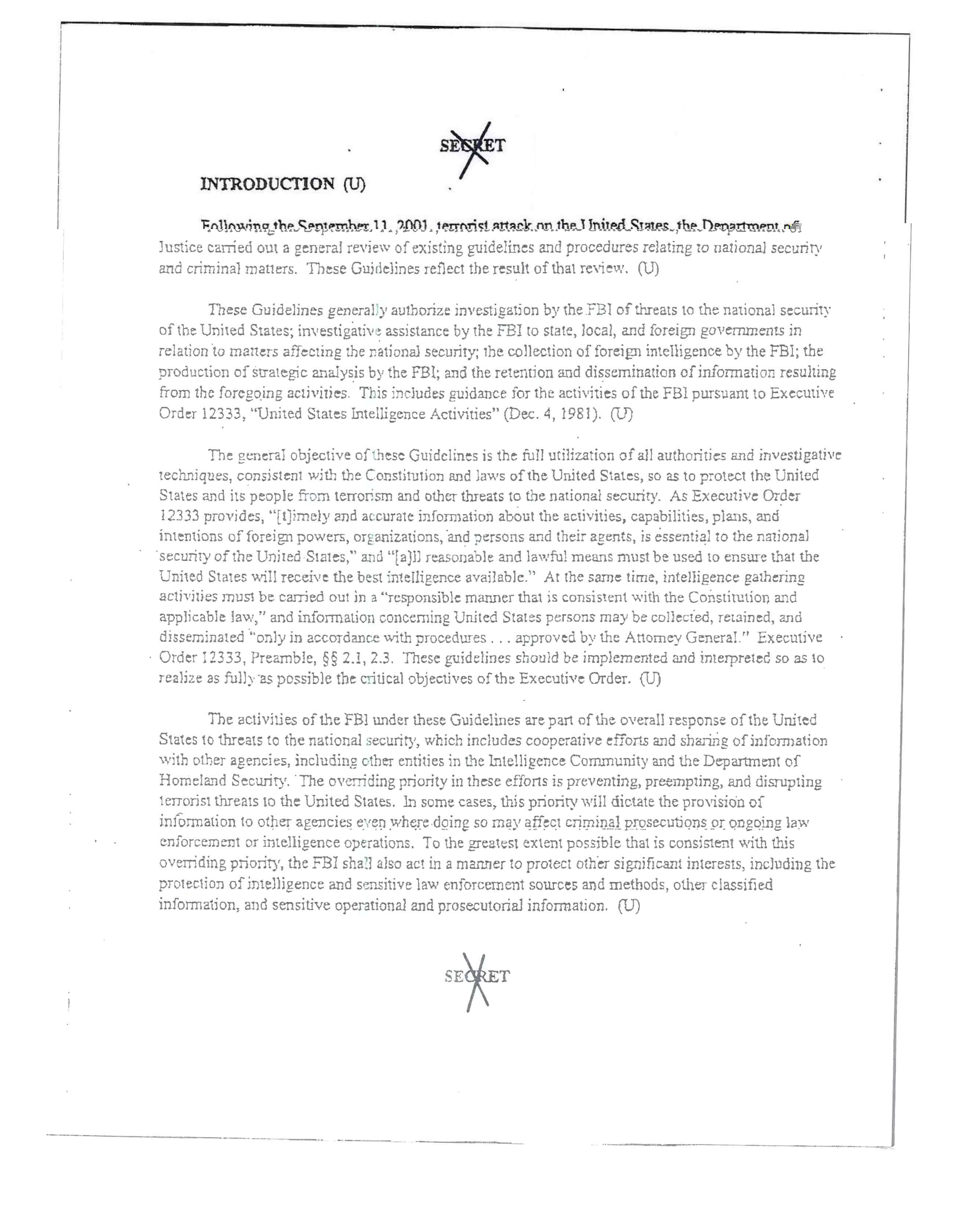
INTRODUCTION (U)
Following the September 11, 2001, terrorist attack on the United States, the Department of
Justice carried out a general review of existing guidelines and procedures relating to national security
and criminal matters. These Guidelines reflect the result of that review. (U)
These Guidelines generally authorize investigation by the FBI of threats to the national security
of the United States; investigative assistance by the FBI to state, local, and foreign governments in
relation to matters affecting the national security; the collection of foreign intelligence by the FBI; the
production of strategic analysis by the FBI; and the retention and dissemination of information resulting
from the foregoing activities. This includes guidance for the activities of the FBI pursuant to Executive
Order 12333, "United States Intelligence Activities" (Dec. 4, 1981). (U)
The general objective of these Guidelines is the full utilization of all authorities and investigative
techniques, consistent with the Constitution and laws of the United States, so as to protect the United
States and its people from terrorism and other threats to the national security. As Executive Order
12333 provides, "[t]imely and accurate information about the activities, capabilities, plans, and
intentions of foreign powers, organizations, and persons and their agents, is essential to the national
security of the United States," and "[a]]] reasonable and lawful means must be used to ensure that the
United States will receive the best intelligence available." At the same time, intelligence gathering
activities must be carried out in a "responsible manner that is consistent with the Constitution and
applicable law," and information concerning United States persons may be collected, retained, and
disseminated "only in accordance with procedures... approved by the Attorney General." Executive
Order 12333, Preamble, §§ 2.1, 2.3. These guidelines should be implemented and interpreted so as to
realize as fully as possible the critical objectives of the Executive Order. (U)
The activities of the FBI under these Guidelines are part of the overall response of the United
States to threats to the national security, which includes cooperative efforts and sharing of information
with other agencies, including other entities in the Intelligence Community and the Department of
Homeland Security. The overriding priority in these efforts is preventing, preempting, and disrupting
terrorist threats to the United States. In some cases, this priority will dictate the provision of
information to other agencies even where doing so may affect criminal prosecutions or ongoing law
enforcement or intelligence operations. To the greatest extent possible that is consistent with this
overriding priority, the FBI shall also act in a manner to protect other significant interests, including the
protection of intelligence and sensitive law enforcement sources and methods, other classified
information, and sensitive operational and prosecutorial information. (U)
SECRET
SECRET
2
SECRET
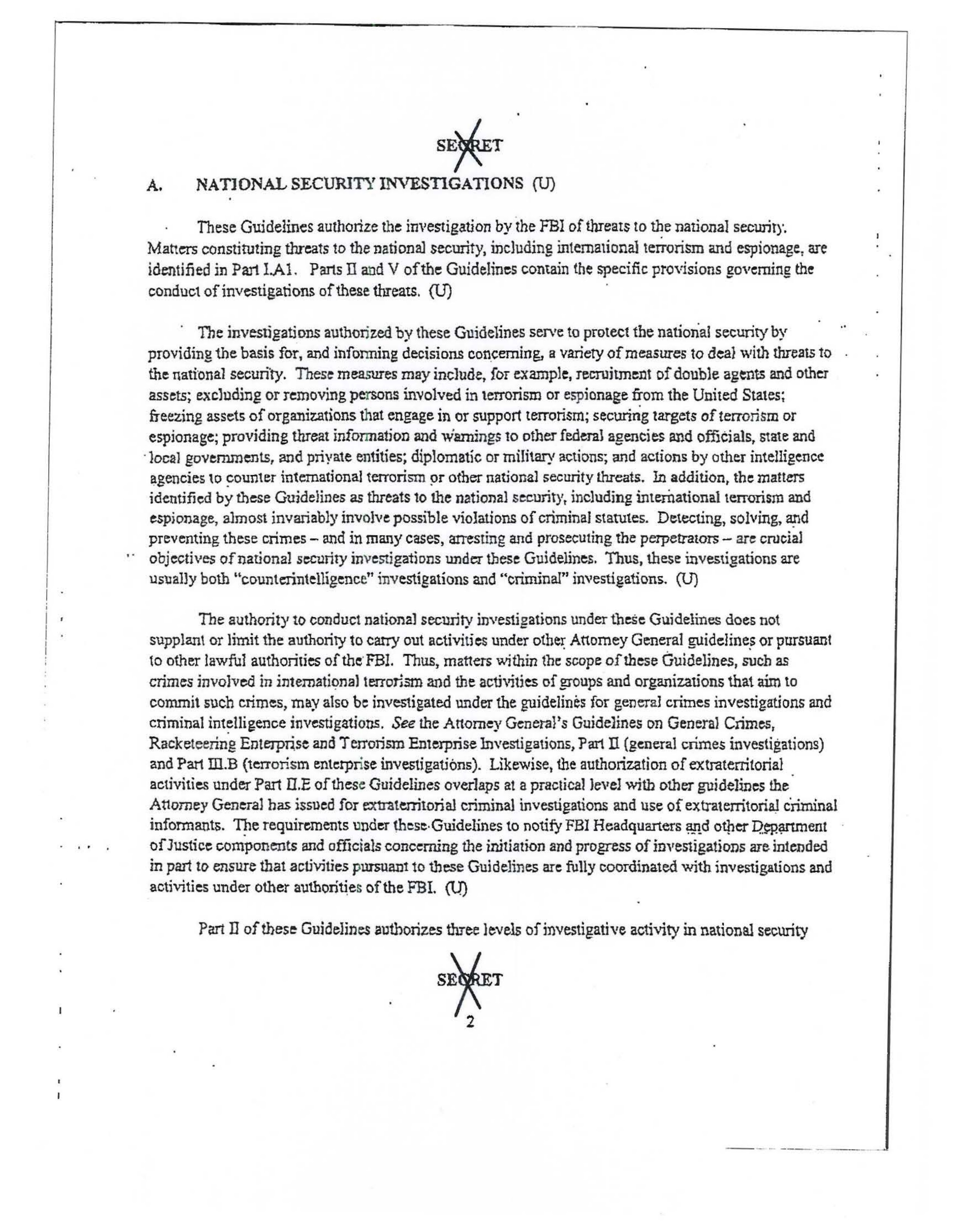
A. NATIONAL SECURITY INVESTIGATIONS (U)
These Guidelines authorize the investigation by the FBI of threats to the national security.
Matters constituting threats to the national security, including international terrorism and espionage, are
identified in Part I.A.1. Parts II and V of the Guidelines contain the specific provisions governing the
conduct of investigations of these threats. (U)
The investigations authorized by these Guidelines serve to protect the national security by
providing the basis for, and informing decisions concerning, a variety of measures to deal with threats to
the national security. These measures may include, for example, recruitment of double agents and other
assets; excluding or removing persons involved in terrorism or espionage from the United States;
freezing assets of organizations that engage in or support terrorism; securing targets of terrorism or
espionage; providing threat information and warnings to other federal agencies and officials, state and
local governments, and private entities; diplomatic or military actions; and actions by other intelligence
agencies to counter international terrorism or other national security threats. In addition, the matters
identified by these Guidelines as threats to the national security, including international terrorism and
espionage, almost invariably involve possible violations of criminal statutes. Detecting, solving, and
preventing these crimes – and in many cases, arresting and prosecuting the perpetrators – are crucial
objectives of national security investigations under these Guidelines. Thus, these investigations are
usually both "counterintelligence" investigations and "criminal" investigations. (U)
The authority to conduct national security investigations under these Guidelines does not
supplant or limit the authority to carry out activities under other Attorney General guidelines or pursuant
to other lawful authorities of the FBI. Thus, matters within the scope of these Guidelines, such as
crimes involved in international terrorism and the activities of groups and organizations that aim to
commit such crimes, may also be investigated under the guidelines for general crimes investigations and
criminal intelligence investigations. See the Attorney General's Guidelines on General Crimes,
Racketeering Enterprise and Terrorism Enterprise Investigations, Part II (general crimes investigations)
and Part III.B (terrorism enterprise investigations). Likewise, the authorization of extraterritorial
activities under Part II.E of these Guidelines overlaps at a practical level with other guidelines the
Attorney General has issued for extraterritorial criminal investigations and use of extraterritorial criminal
informants. The requirements under these Guidelines to notify FBI Headquarters and other Department
of Justice components and officials concerning the initiation and progress of investigations are intended
in part to ensure that activities pursuant to these Guidelines are fully coordinated with investigations and
activities under other authorities of the FBI. (U)
Part II of these Guidelines authorizes three levels of investigative activity in national security
SECRET
2
SECRET
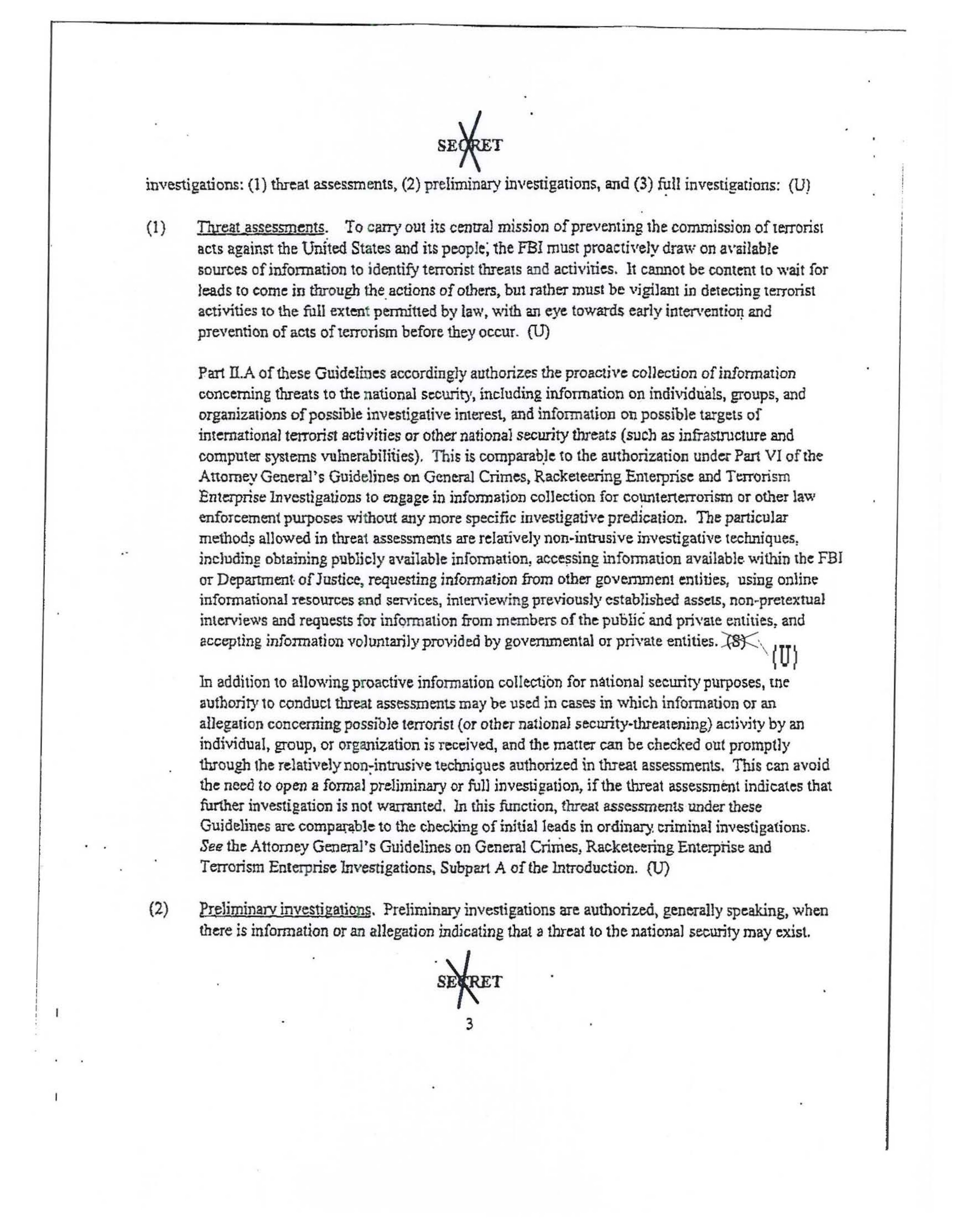
investigations: (1) threat assessments, (2) preliminary investigations, and (3) full investigations: (U)
(1) Threat assessments. To carry out its central mission of preventing the commission of terrorist
acts against the United States and its people, the FBI must proactively draw on available
sources of information to identify terrorist threats and activities. It cannot be content to wait for
leads to come in through the actions of others, but rather must be vigilant in detecting terrorist
activities to the full extent permitted by law, with an eye towards early intervention and
prevention of acts of terrorism before they occur. (U)
Part II.A of these Guidelines accordingly authorizes the proactive collection of information
concerning threats to the national security, including information on individuals, groups, and
organizations of possible investigative interest, and information on possible targets of
international terrorist activities or other national security threats (such as infrastructure and
computer systems vulnerabilities). This is comparable to the authorization under Part VI of the
Attorney General's Guidelines on General Crimes, Racketeering Enterprise and Terrorism
Enterprise Investigations to engage in information collection for counterterrorism or other law
enforcement purposes without any more specific investigative predication. The particular
methods allowed in threat assessments are relatively non-intrusive investigative techniques,
including obtaining publicly available information, accessing information available within the FBI
or Department of Justice, requesting information from other government entities, using online
informational resources and services, interviewing previously established assets, non-pretextual
interviews and requests for information from members of the public and private entities, and
accepting information voluntarily provided by governmental or private entities. (S) (U)
In addition to allowing proactive information collection for national security purposes, the
authority to conduct threat assessments may be used in cases in which information or an
allegation concerning possible terrorist (or other national security-threatening) activity by an
individual, group, or organization is received, and the matter can be checked out promptly
through the relatively non-intrusive techniques authorized in threat assessments. This can avoid
the need to open a formal preliminary or full investigation, if the threat assessment indicates that
further investigation is not warranted. In this function, threat assessments under these
Guidelines are comparable to the checking of initial leads in ordinary criminal investigations.
See the Attorney General's Guidelines on General Crimes, Racketeering Enterprise and
Terrorism Enterprise Investigations, Subpart A of the Introduction. (U)
(2) Preliminary investigations. Preliminary investigations are authorized, generally speaking, when
there is information or an allegation indicating that a threat to the national security may exist.
SECRET
3
SECRET
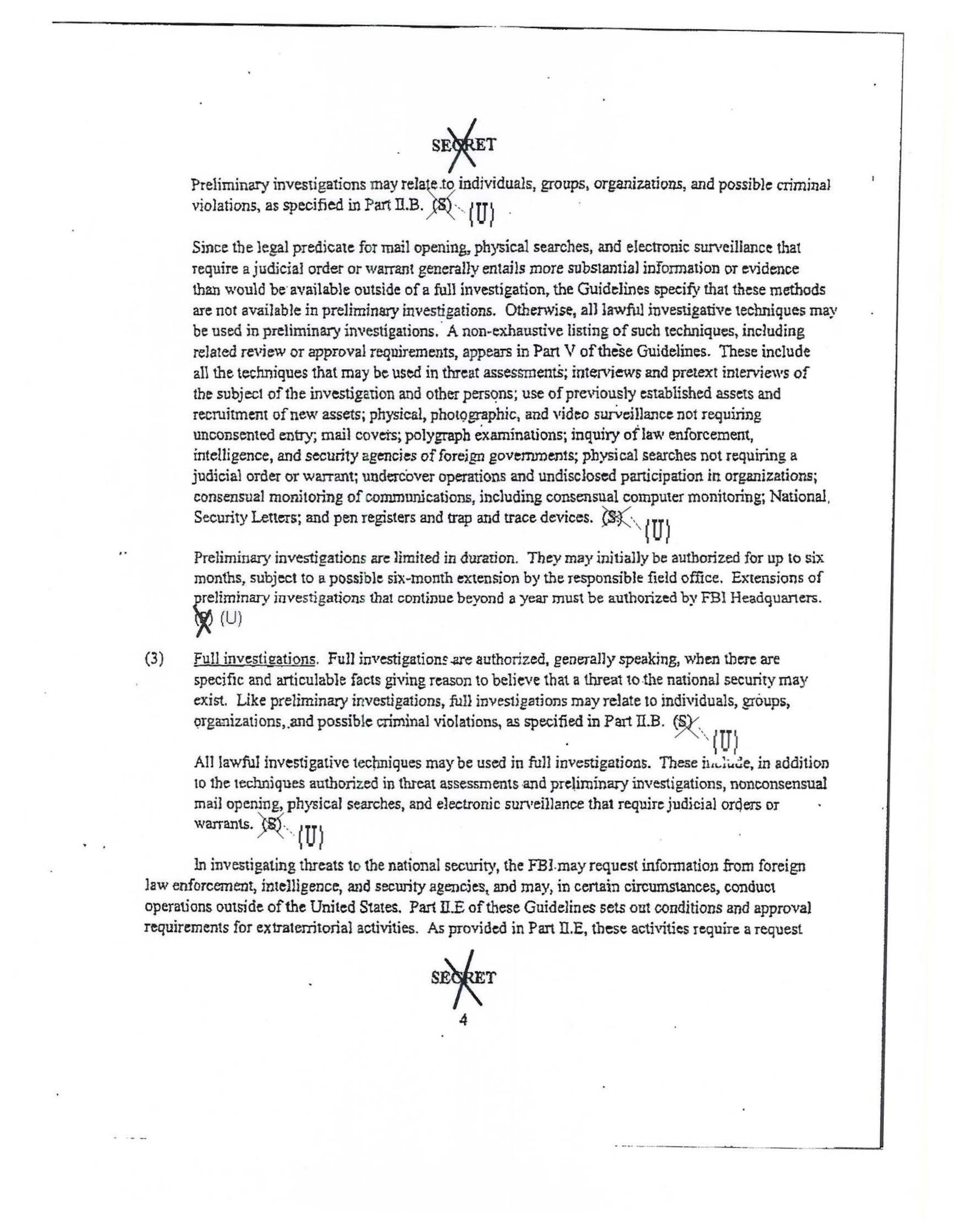
Preliminary investigations may relate to individuals, groups, organizations, and possible criminal
violations, as specified in Part II.B. (S) (U)
Since the legal predicate for mail opening, physical searches, and electronic surveillance that
require a judicial order or warrant generally entails more substantial information or evidence
than would be available outside of a full investigation, the Guidelines specify that these methods
are not available in preliminary investigations. Otherwise, all lawful investigative techniques may
be used in preliminary investigations. A non-exhaustive listing of such techniques, including
related review or approval requirements, appears in Part V of these Guidelines. These include
all the techniques that may be used in threat assessments; interviews and pretext interviews of
the subject of the investigation and other persons; use of previously established assets and
recruitment of new assets; physical, photographic, and video surveillance not requiring
unconsented entry; mail covers; polygraph examinations; inquiry of law enforcement,
intelligence, and security agencies of foreign governments; physical searches not requiring a
judicial order or warrant; undercover operations and undisclosed participation in organizations;
consensual monitoring of communications, including consensual computer monitoring; National
Security Letters; and pen registers and trap and trace devices. (S) (U)
Preliminary investigations are limited in duration. They may initially be authorized for up to six
months, subject to a possible six-month extension by the responsible field office. Extensions of
preliminary investigations that continue beyond a year must be authorized by FBI Headquarters.
(U)
(3) Full investigations. Full investigations are authorized, generally speaking, when there are
specific and articulable facts giving reason to believe that a threat to the national security may
exist. Like preliminary investigations, full investigations may relate to individuals, groups,
organizations, and possible criminal violations, as specified in Part II.B. (S) (U)
All lawful investigative techniques may be used in full investigations. These include, in addition
to the techniques authorized in threat assessments and preliminary investigations, nonconsensual
mail opening, physical searches, and electronic surveillance that require judicial orders or
warrants. (S) (U)
In investigating threats to the national security, the FBI may request information from foreign
law enforcement, intelligence, and security agencies, and may, in certain circumstances, conduct
operations outside of the United States. Part II.E of these Guidelines sets out conditions and approval
requirements for extraterritorial activities. As provided in Part II.E, these activities require a request
SECRET
4
SECRET
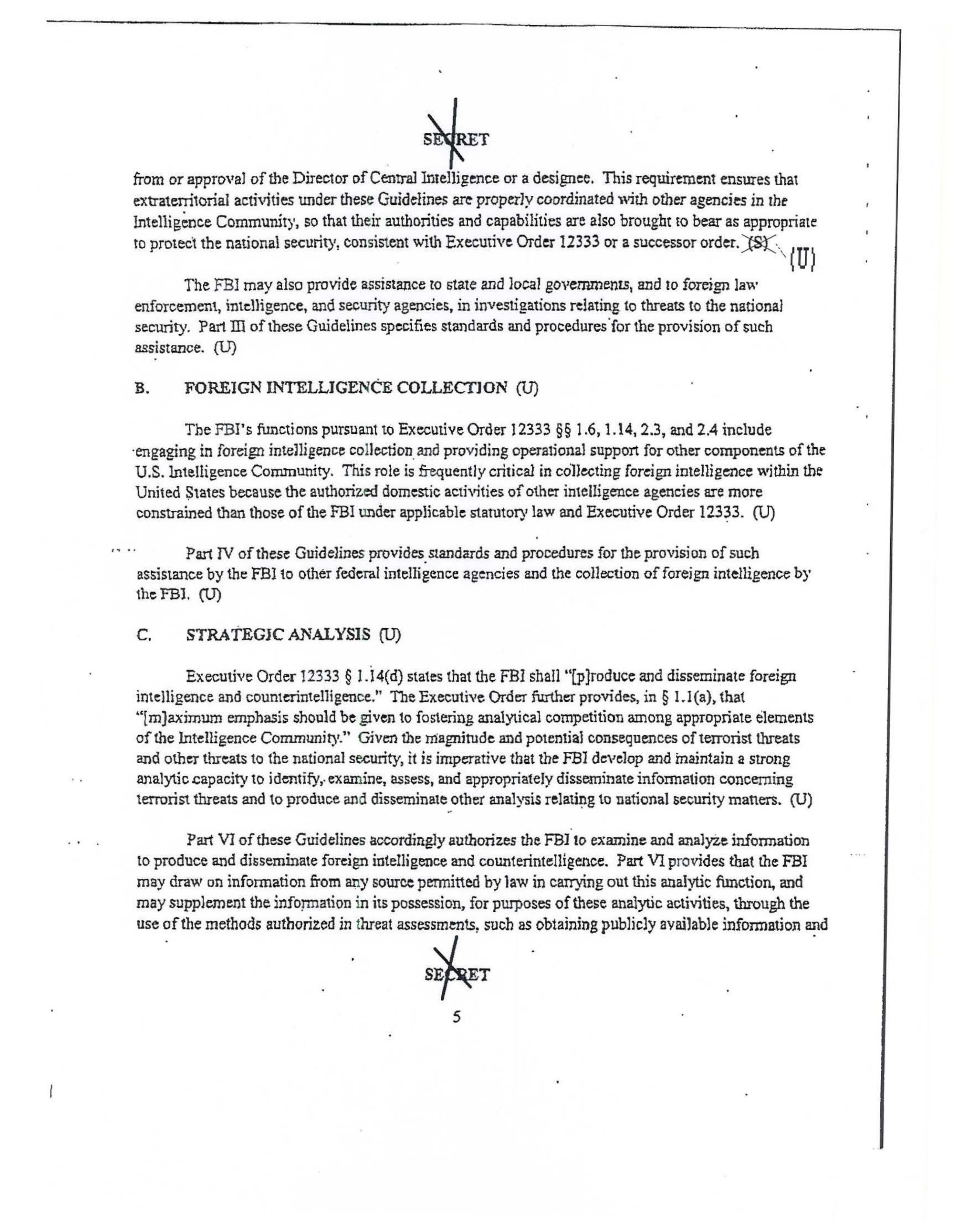
from or approval of the Director of Central Intelligence or a designee. This requirement ensures that
extraterritorial activities under these Guidelines are properly coordinated with other agencies in the
Intelligence Community, so that their authorities and capabilities are also brought to bear as appropriate
to protect the national security, consistent with Executive Order 12333 or a successor order. (S) (U)
The FBI may also provide assistance to state and local governments, and to foreign law
enforcement, intelligence, and security agencies, in investigations relating to threats to the national
security. Part III of these Guidelines specifies standards and procedures for the provision of such
assistance. (U)
B. FOREIGN INTELLIGENCE COLLECTION (U)
The FBI's functions pursuant to Executive Order 12333 §§ 1.6, 1.14, 2.3, and 2.4 include
engaging in foreign intelligence collection and providing operational support for other components of the
U.S. Intelligence Community. This role is frequently critical in collecting foreign intelligence within the
United States because the authorized domestic activities of other intelligence agencies are more
constrained than those of the FBI under applicable statutory law and Executive Order 12333. (U)
Part IV of these Guidelines provides standards and procedures for the provision of such
assistance by the FBI to other federal intelligence agencies and the collection of foreign intelligence by
the FBI. (U)
C. STRATEGIC ANALYSIS (U)
Executive Order 12333 § 1.14(d) states that the FBI shall "[p]roduce and disseminate foreign
intelligence and counterintelligence." The Executive Order further provides, in § 1.1(a), that
"[m]aximum emphasis should be given to fostering analytical competition among appropriate elements
of the Intelligence Community." Given the magnitude and potential consequences of terrorist threats
and other threats to the national security, it is imperative that the FBI develop and maintain a strong
analytic capacity to identify, examine, assess, and appropriately disseminate information concerning
terrorist threats and to produce and disseminate other analysis relating to national security matters. (U)
Part VI of these Guidelines accordingly authorizes the FBI to examine and analyze information
to produce and disseminate foreign intelligence and counterintelligence. Part VI provides that the FBI
may draw on information from any source permitted by law in carrying out this analytic function, and
may supplement the information in its possession, for purposes of these analytic activities, through the
use of the methods authorized in threat assessments, such as obtaining publicly available information and
SECRET
5
SECRET
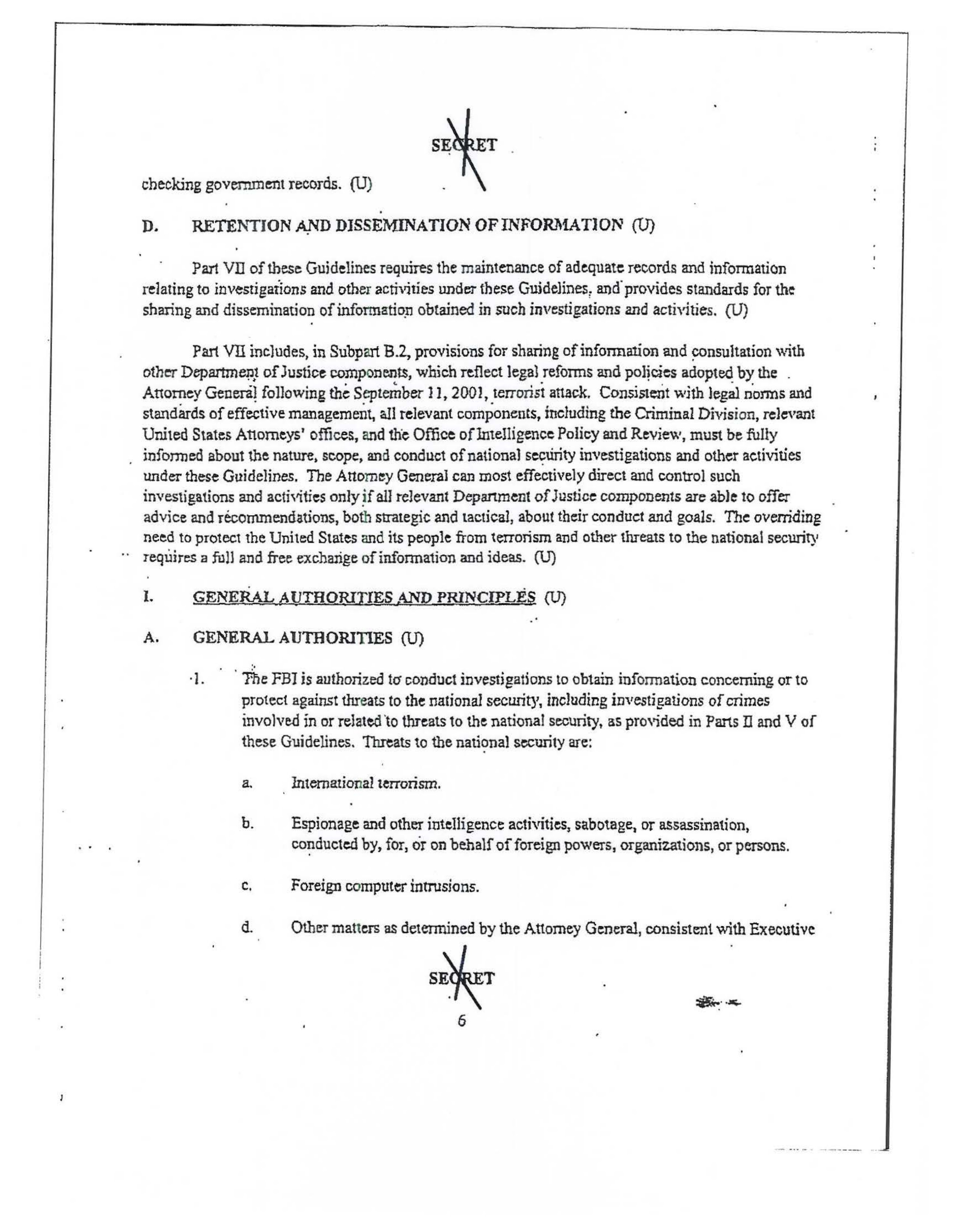
checking government records. (U)
D. RETENTION AND DISSEMINATION OF INFORMATION (U)
Part VII of these Guidelines requires the maintenance of adequate records and information
relating to investigations and other activities under these Guidelines, and provides standards for the
sharing and dissemination of information obtained in such investigations and activities. (U)
Part VII includes, in Subpart B.2, provisions for sharing of information and consultation with
other Department of Justice components, which reflect legal reforms and policies adopted by the
Attorney General following the September 11, 2001, terrorist attack. Consistent with legal norms and
standards of effective management, all relevant components, including the Criminal Division, relevant
United States Attorneys' offices, and the Office of Intelligence Policy and Review, must be fully
informed about the nature, scope, and conduct of national security investigations and other activities
under these Guidelines. The Attorney General can most effectively direct and control such
investigations and activities only if all relevant Department of Justice components are able to offer
advice and recommendations, both strategic and tactical, about their conduct and goals. The overriding
need to protect the United States and its people from terrorism and other threats to the national security
requires a full and free exchange of information and ideas. (U)
I. GENERAL AUTHORITIES AND PRINCIPLES (U)
A. GENERAL AUTHORITIES (U)
- The FBI is authorized to conduct investigations to obtain information concerning or to
protect against threats to the national security, including investigations of crimes
involved in or related to threats to the national security, as provided in Parts II and V of
these Guidelines. Threats to the national security are:
a. International terrorism.
b. Espionage and other intelligence activities, sabotage, or assassination,
conducted by, for, or on behalf of foreign powers, organizations, or persons.
c. Foreign computer intrusions.
d. Other matters as determined by the Attorney General, consistent with Executive
SECRET
6
SECRET
Order 12333 or a successor order. (U)
- The FBI is authorized to assist state, local, and foreign governments as provided in Part
III of these Guidelines. (U)
- The FBI is authorized to collect foreign intelligence and to assist federal intelligence
agencies as provided in Part IV of these Guidelines. (U)
- The FBI is authorized to conduct strategic analysis as provided in Part VI of these
Guidelines. (U)
- The FBI is authorized to retain and disseminate information collected pursuant to these
Guidelines as provided in Part VII of these Guidelines. (U)
B. USE OF AUTHORITIES AND METHODS (U)
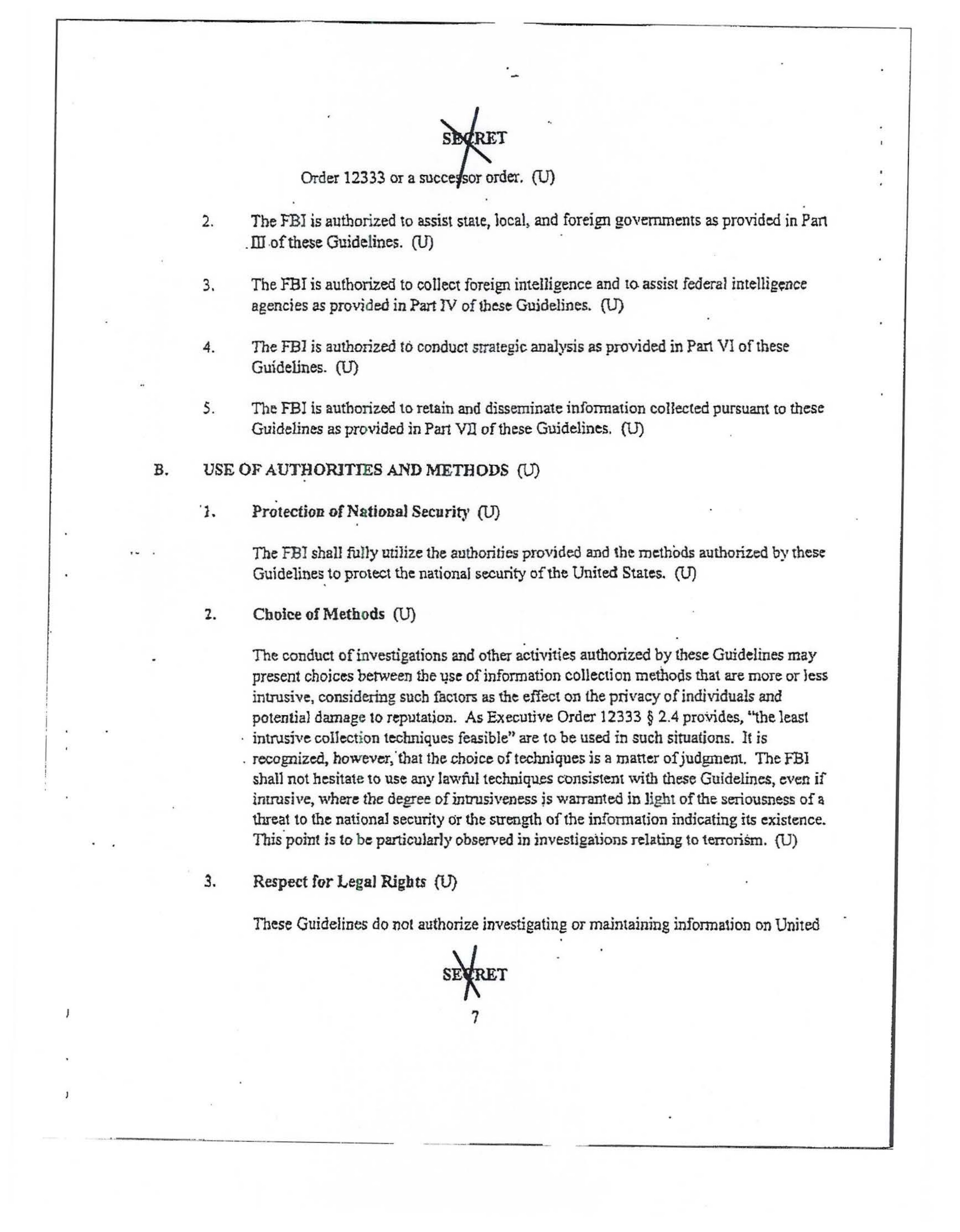
- Protection of National Security (U)
The FBI shall fully utilize the authorities provided and the methods authorized by these
Guidelines to protect the national security of the United States. (U)
- Choice of Methods (U)
The conduct of investigations and other activities authorized by these Guidelines may
present choices between the use of information collection methods that are more or less
intrusive, considering such factors as the effect on the privacy of individuals and
potential damage to reputation. As Executive Order 12333 § 2.4 provides, "the least
intrusive collection techniques feasible" are to be used in such situations. It is
recognized, however, that the choice of techniques is a matter of judgment. The FBI
shall not hesitate to use any lawful techniques consistent with these Guidelines, even if
intrusive, where the degree of intrusiveness is warranted in light of the seriousness of a
threat to the national security or the strength of the information indicating its existence.
This point is to be particularly observed in investigations relating to terrorism. (U)
- Respect for Legal Rights (U)
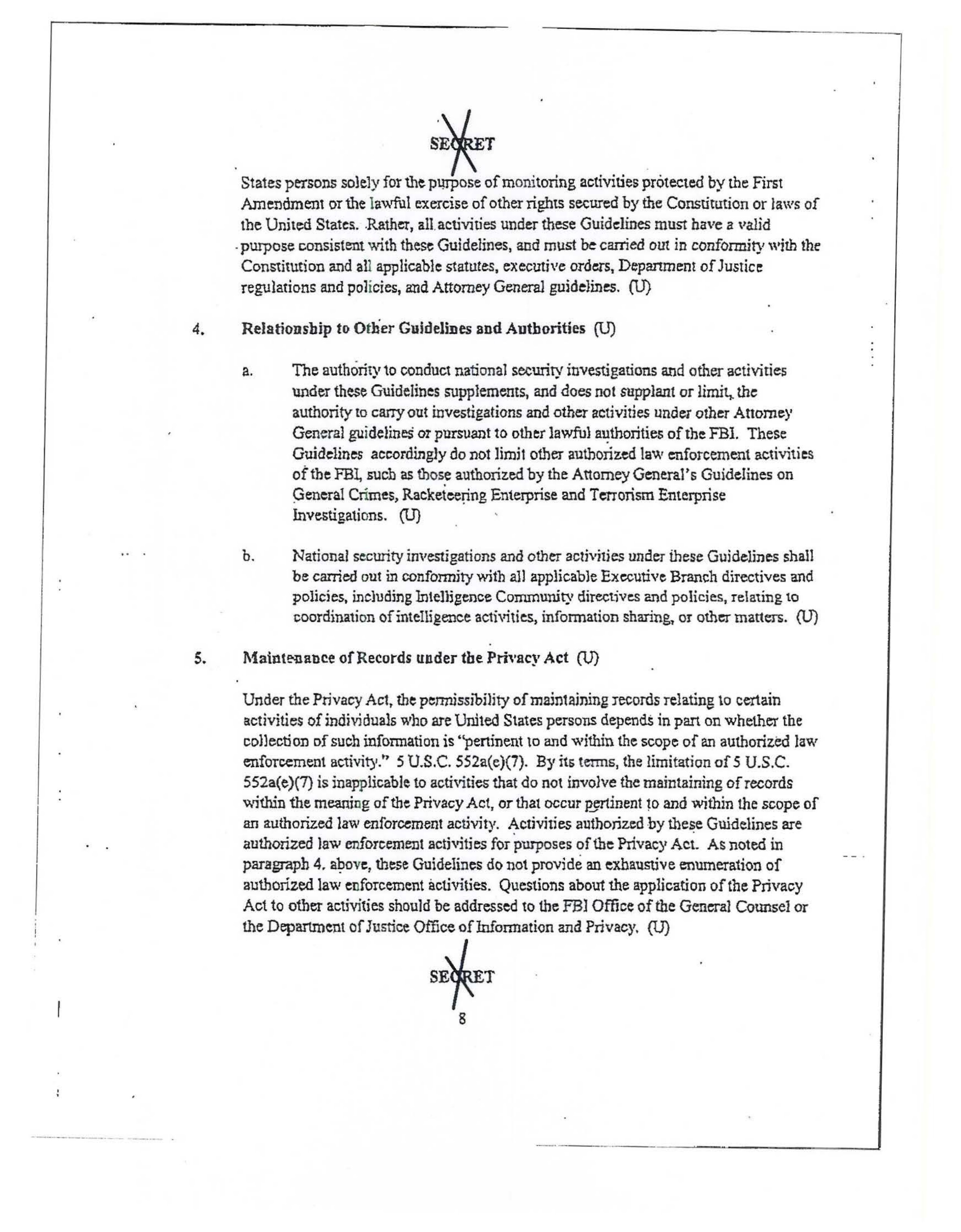
These Guidelines do not authorize investigating or maintaining information on United
SECRET
7
SECRET
States persons solely for the purpose of monitoring activities protected by the First
Amendment or the lawful exercise of other rights secured by the Constitution or laws of
the United States. Rather, all activities under these Guidelines must have a valid
purpose consistent with these Guidelines, and must be carried out in conformity with the
Constitution and all applicable statutes, executive orders, Department of Justice
regulations and policies, and Attorney General guidelines. (U)
- Relationship to Other Guidelines and Authorities (U)
a. The authority to conduct national security investigations and other activities
under these Guidelines supplements, and does not supplant or limit, the
authority to carry out investigations and other activities under other Attorney
General guidelines or pursuant to other lawful authorities of the FBI. These
Guidelines accordingly do not limit other authorized law enforcement activities
of the FBI, such as those authorized by the Attorney General's Guidelines on
General Crimes, Racketeering Enterprise and Terrorism Enterprise
Investigations. (U)
b. National security investigations and other activities under these Guidelines shall
be carried out in conformity with all applicable Executive Branch directives and
policies, including Intelligence Community directives and policies, relating to
coordination of intelligence activities, information sharing, or other matters. (U)
- Maintenance of Records under the Privacy Act (U)
Under the Privacy Act, the permissibility of maintaining records relating to certain
activities of individuals who are United States persons depends in part on whether the
collection of such information is "pertinent to and within the scope of an authorized law
enforcement activity." 5 U.S.C. 552a(e)(7). By its terms, the limitation of 5 U.S.C.
552a(e)(7) is inapplicable to activities that do not involve the maintaining of records
within the meaning of the Privacy Act, or that occur pertinent to and within the scope of
an authorized law enforcement activity. Activities authorized by these Guidelines are
authorized law enforcement activities for purposes of the Privacy Act. As noted in
paragraph 4. above, these Guidelines do not provide an exhaustive enumeration of
authorized law enforcement activities. Questions about the application of the Privacy
Act to other activities should be addressed to the FBI Office of the General Counsel or
the Department of Justice Office of Information and Privacy. (U)
SECRET
8
SECRET
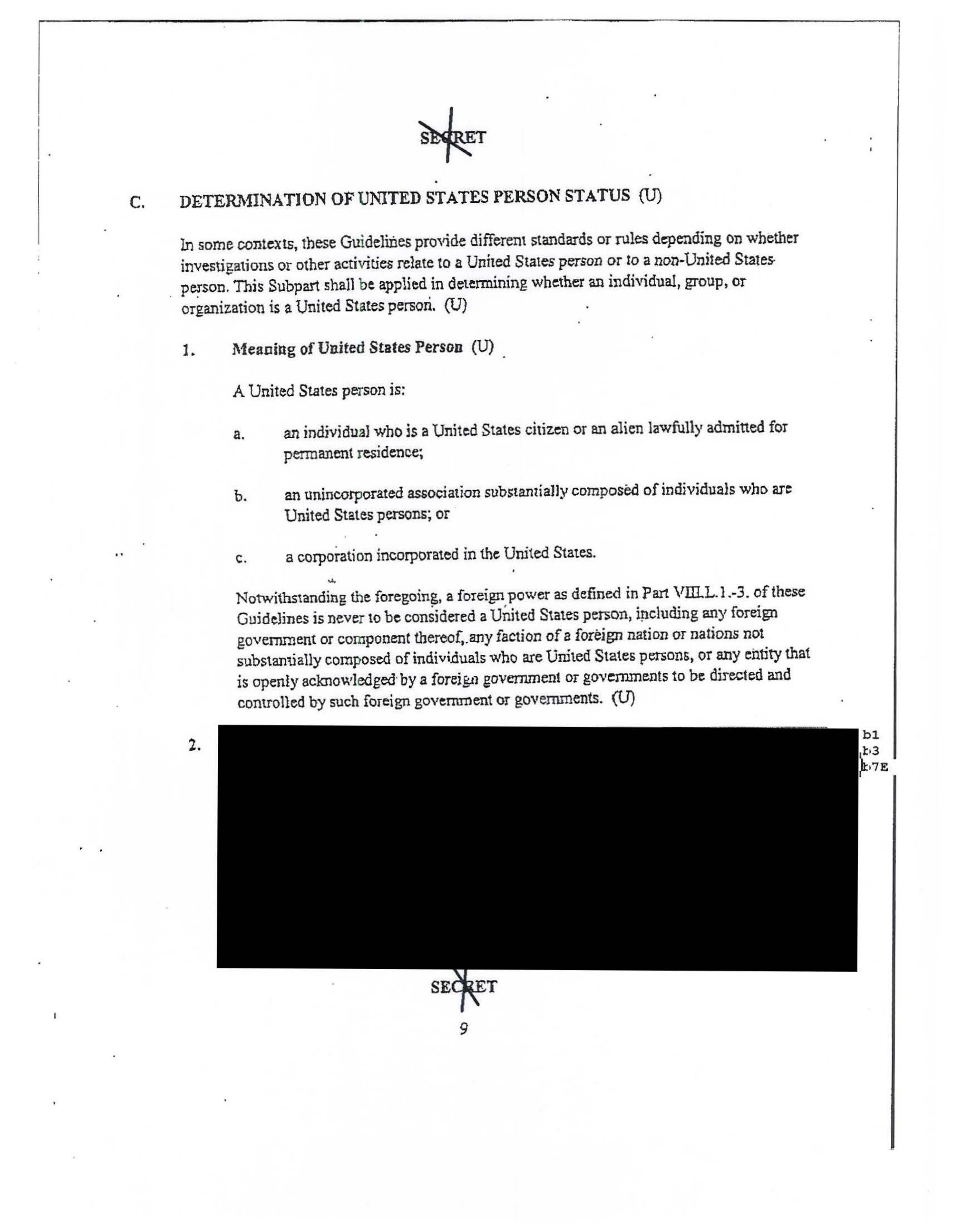
C. DETERMINATION OF UNITED STATES PERSON STATUS (U)
In some contexts, these Guidelines provide different standards or rules depending on whether
investigations or other activities relate to a United States person or to a non-United States
person. This Subpart shall be applied in determining whether an individual, group, or
organization is a United States person. (U)
- Meaning of United States Person (U)
A United States person is:
a. an individual who is a United States citizen or an alien lawfully admitted for
permanent residence;
b. an unincorporated association substantially composed of individuals who are
United States persons; or
c. a corporation incorporated in the United States.
Notwithstanding the foregoing, a foreign power as defined in Part VIII.1.-3. of these
Guidelines is never to be considered a United States person, including any foreign
government or component thereof, any faction of a foreign nation or nations not
substantially composed of individuals who are United States persons, or any entity that
is openly acknowledged by a foreign government or governments to be directed and
controlled by such foreign government or governments. (U)
- [REDACTED]
SECRET
9
[REDACTED]
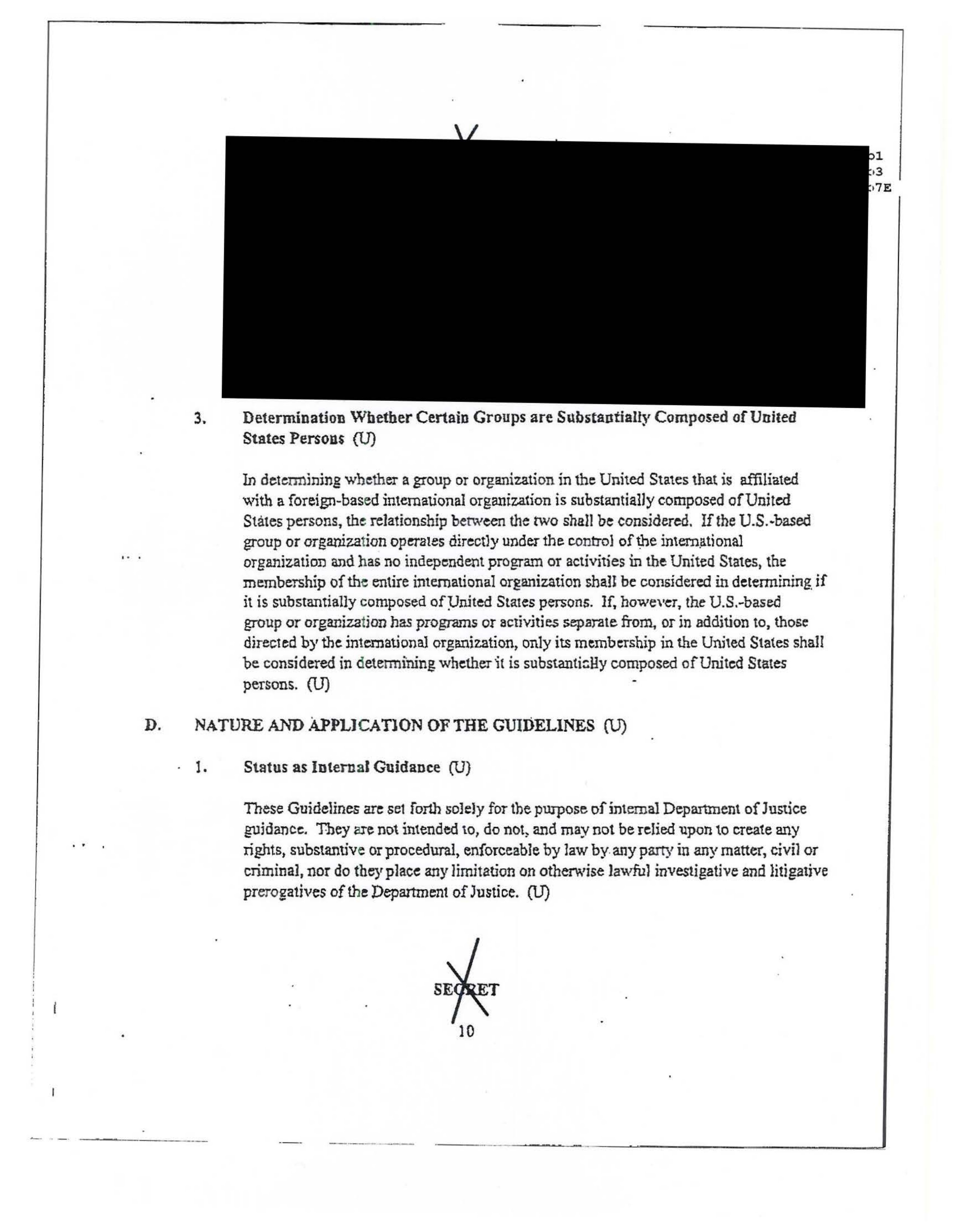
- Determination Whether Certain Groups are Substantially Composed of United
States Persons (U)
In determining whether a group or organization in the United States that is affiliated
with a foreign-based international organization is substantially composed of United
States persons, the relationship between the two shall be considered. If the U.S.-based
group or organization operates directly under the control of the international
organization and has no independent program or activities in the United States, the
membership of the entire international organization shall be considered in determining if
it is substantially composed of United States persons. If, however, the U.S.-based
group or organization has programs or activities separate from, or in addition to, those
directed by the international organization, only its membership in the United States shall
be considered in determining whether it is substantially composed of United States
persons. (U)
D. NATURE AND APPLICATION OF THE GUIDELINES (U)
- Status as Internal Guidance (U)
These Guidelines are set forth solely for the purpose of internal Department of Justice
guidance. They are not intended to, do not, and may not be relied upon to create any
rights, substantive or procedural, enforceable by law by any party in any matter, civil or
criminal, nor do they place any limitation on otherwise lawful investigative and litigative
prerogatives of the Department of Justice. (U)
SECRET
10
SECRET
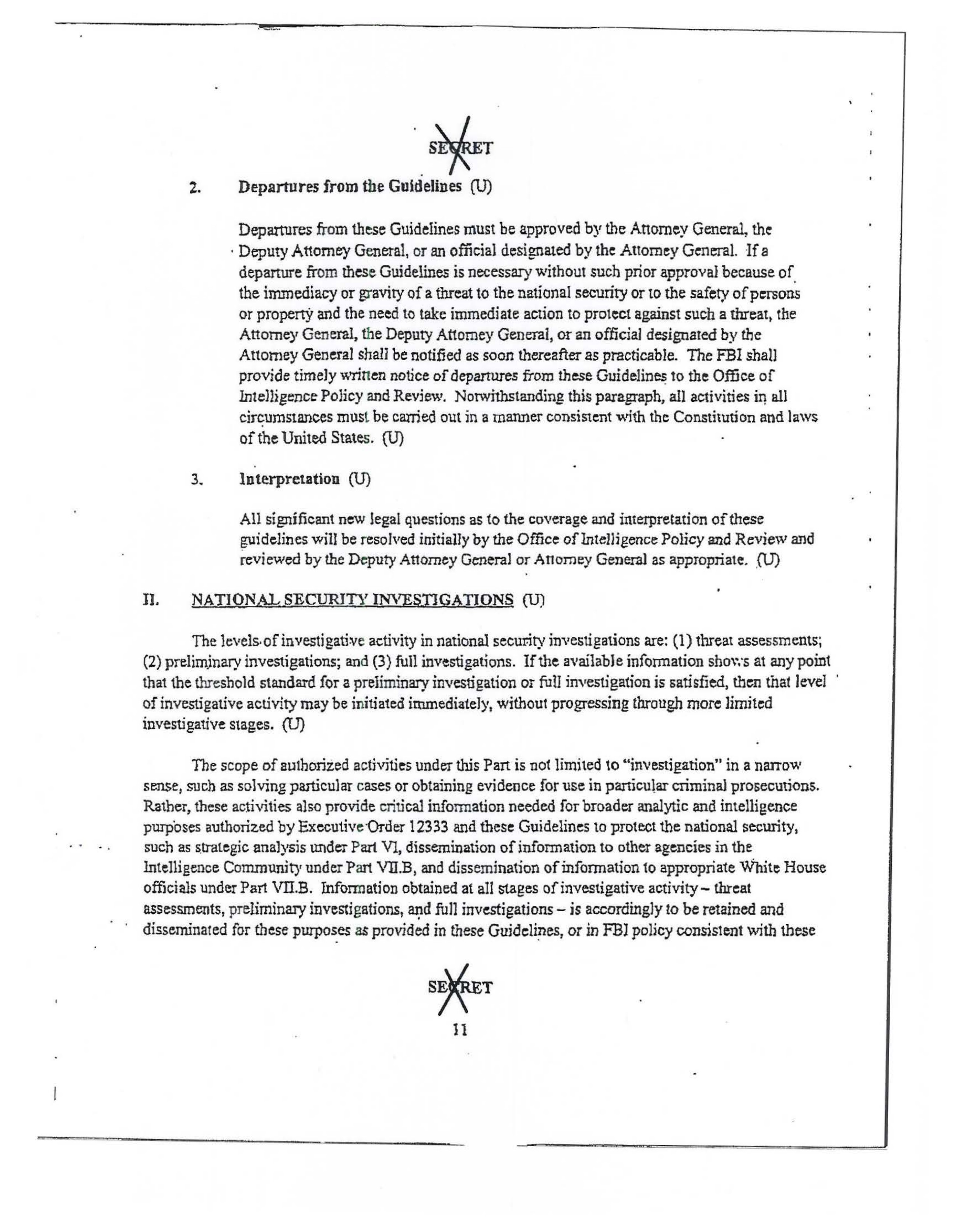
- Departures from the Guidelines (U)
Departures from these Guidelines must be approved by the Attorney General, the
Deputy Attorney General, or an official designated by the Attorney General. If a
departure from these Guidelines is necessary without such prior approval because of
the immediacy or gravity of a threat to the national security or to the safety of persons
or property and the need to take immediate action to protect against such a threat, the
Attorney General, the Deputy Attorney General, or an official designated by the
Attorney General shall be notified as soon thereafter as practicable. The FBI shall
provide timely written notice of departures from these Guidelines to the Office of
Intelligence Policy and Review. Notwithstanding this paragraph, all activities in all
circumstances must be carried out in a manner consistent with the Constitution and laws
of the United States. (U)
- Interpretation (U)
All significant new legal questions as to the coverage and interpretation of these
guidelines will be resolved initially by the Office of Intelligence Policy and Review and
reviewed by the Deputy Attorney General or Attorney General as appropriate. (U)
II. NATIONAL SECURITY INVESTIGATIONS (U)
The levels of investigative activity in national security investigations are: (1) threat assessments;
(2) preliminary investigations; and (3) full investigations. If the available information shows at any point
that the threshold standard for a preliminary investigation or full investigation is satisfied, then that level
of investigative activity may be initiated immediately, without progressing through more limited
investigative stages. (U)
The scope of authorized activities under this Part is not limited to "investigation" in a narrow
sense, such as solving particular cases or obtaining evidence for use in particular criminal prosecutions.
Rather, these activities also provide critical information needed for broader analytic and intelligence
purposes authorized by Executive Order 12333 and these Guidelines to protect the national security,
such as strategic analysis under Part VI, dissemination of information to other agencies in the
Intelligence Community under Part VII.B, and dissemination of information to appropriate White House
officials under Part VII.B. Information obtained at all stages of investigative activity - threat
assessments, preliminary investigations, and full investigations - is accordingly to be retained and
disseminated for these purposes as provided in these Guidelines, or in FBI policy consistent with these
SECRET
11
SECRET
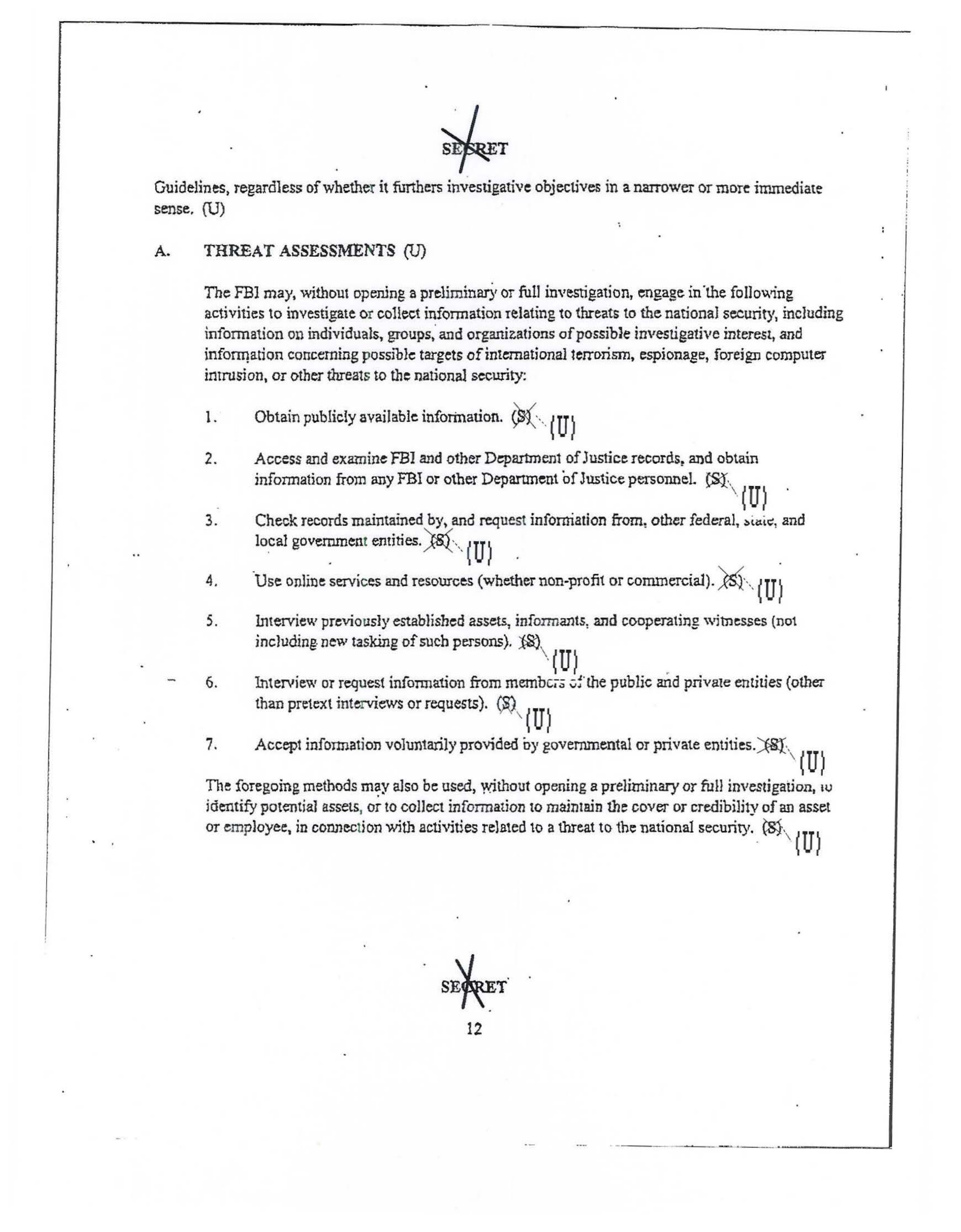
Guidelines, regardless of whether it furthers investigative objectives in a narrower or more immediate
sense. (U)
A. THREAT ASSESSMENTS (U)
The FBI may, without opening a preliminary or full investigation, engage in the following
activities to investigate or collect information relating to threats to the national security, including
information on individuals, groups, and organizations of possible investigative interest, and
information concerning possible targets of international terrorism, espionage, foreign computer
intrusion, or other threats to the national security:
- Obtain publicly available information. (S) (U)
- Access and examine FBI and other Department of Justice records, and obtain
information from any FBI or other Department of Justice personnel. (S) (U)
- Check records maintained by, and request information from, other federal, state, and
local government entities. (S) (U)
- Use online services and resources (whether non-profit or commercial). (S) (U)
- Interview previously established assets, informants, and cooperating witnesses (not
including new tasking of such persons). (S) (U)
- Interview or request information from members of the public and private entities (other
than pretext interviews or requests). (S) (U)
- Accept information voluntarily provided by governmental or private entities. (S) (U)
The foregoing methods may also be used, without opening a preliminary or full investigation, to
identify potential assets, or to collect information to maintain the cover or credibility of an asset
or employee, in connection with activities related to a threat to the national security. (S) (U)
SECRET
12
SECRET
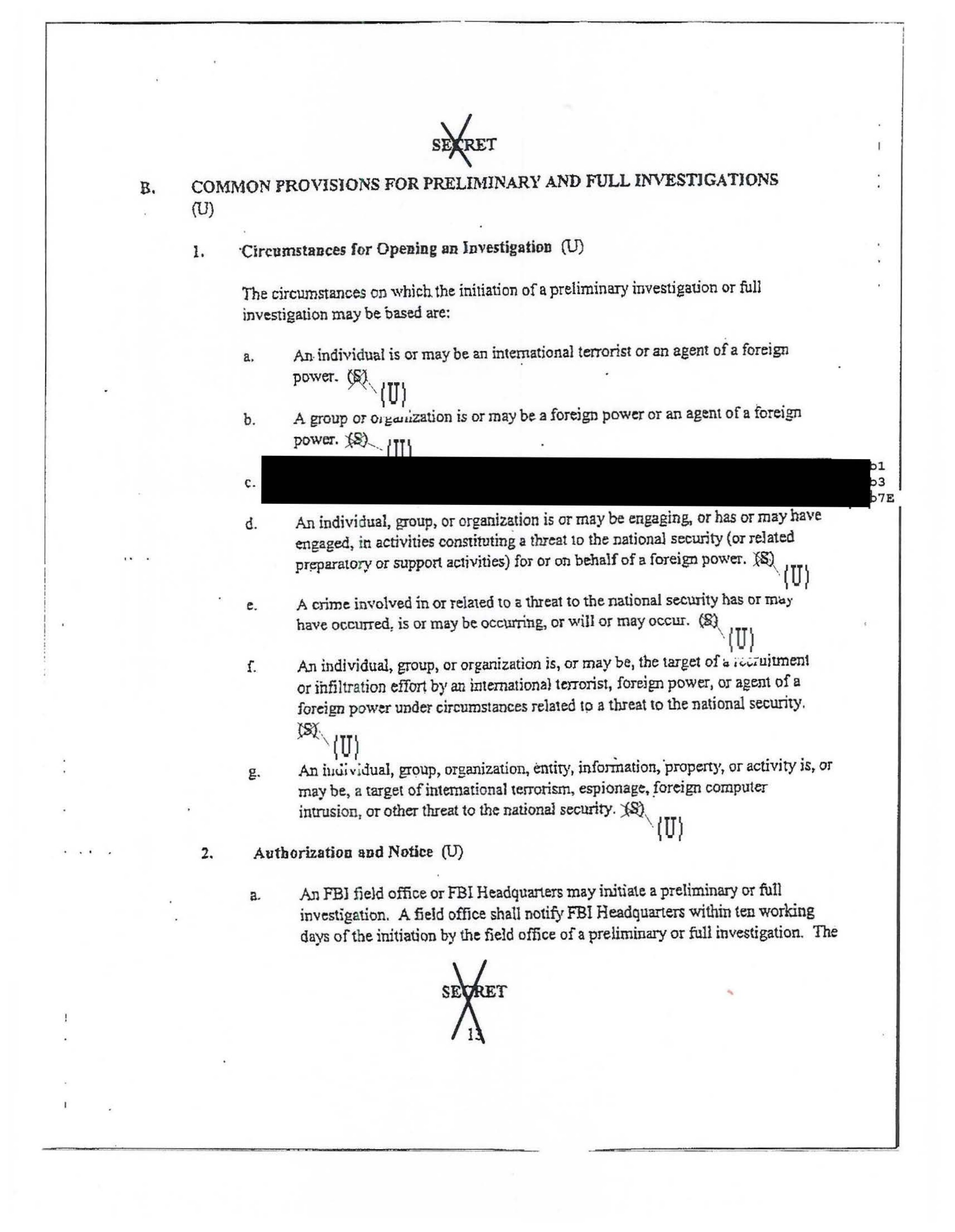
B. COMMON PROVISIONS FOR PRELIMINARY AND FULL INVESTIGATIONS
(U)
- Circumstances for Opening an Investigation (U)
The circumstances on which the initiation of a preliminary investigation or full
investigation may be based are:
a. An individual is or may be an international terrorist or an agent of a foreign
power. (S) (U)
b. A group or Organization is or may be a foreign power or an agent of a foreign
power. (S) [REDACTED]
c. [REDACTED]
d. An individual, group, or organization is or may be engaging, or has or may have
engaged, in activities constituting a threat to the national security (or related
preparatory or support activities) for or on behalf of a foreign power. (S) (U)
e. A crime involved in or related to a threat to the national security has or may
have occurred, is or may be occurring, or will or may occur. (S) (U)
f. An individual, group, or organization is, or may be, the target of a recruitment
or infiltration effort by an international terrorist, foreign power, or agent of a
foreign power under circumstances related to a threat to the national security.
(S) (U)
g. An individual, group, organization, entity, information, property, or activity is, or
may be, a target of international terrorism, espionage, foreign computer
intrusion, or other threat to the national security. (S) (U)
- Authorization and Notice (U)
a. An FBI field office or FBI Headquarters may initiate a preliminary or full
investigation. A field office shall notify FBI Headquarters within ten working
days of the initiation by the field office of a preliminary or full investigation. The
SECRET
13
SECRET
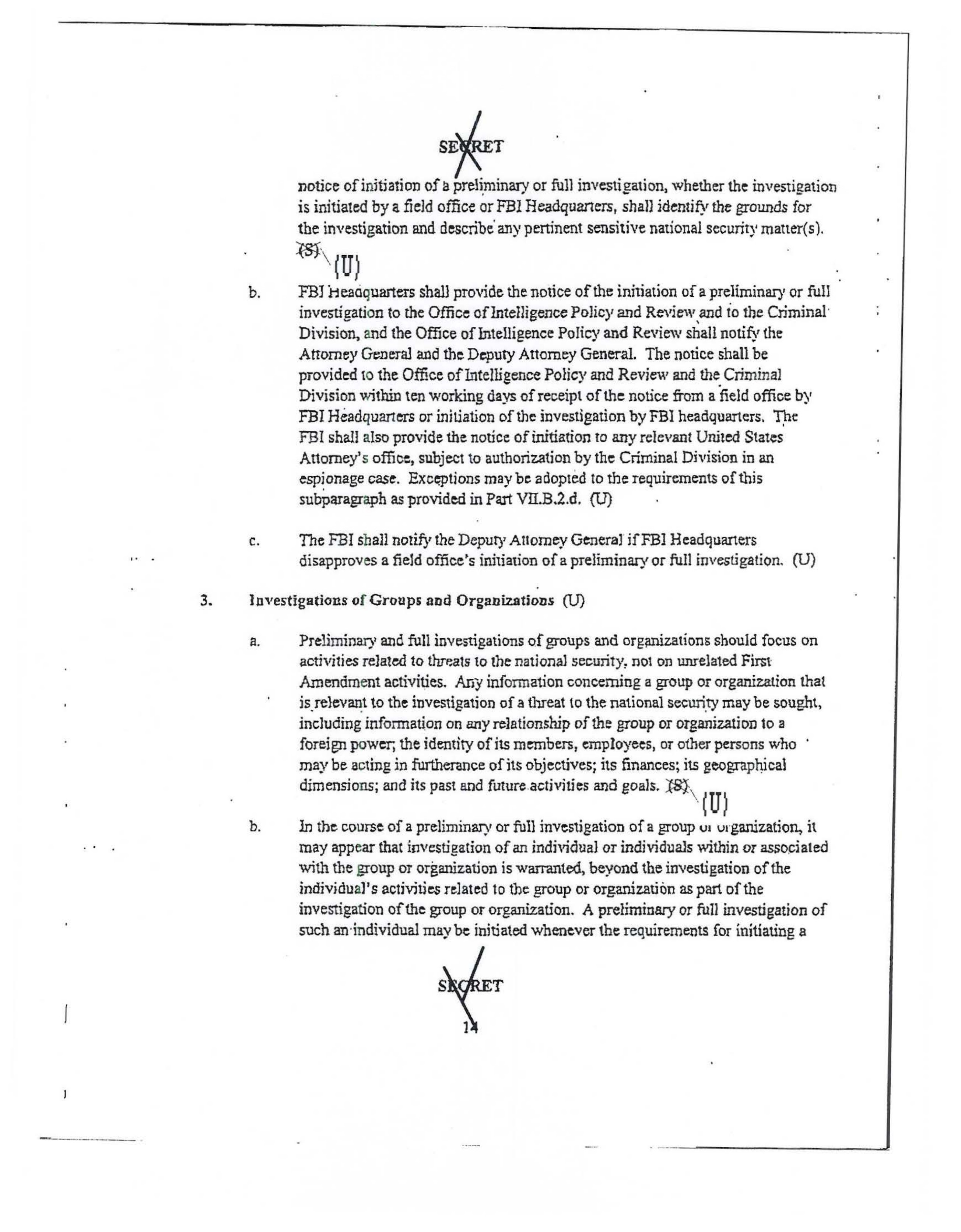
notice of initiation of a preliminary or full investigation, whether the investigation
is initiated by a field office or FBI Headquarters, shall identify the grounds for
the investigation and describe any pertinent sensitive national security matter(s).
(S) (U)
b. FBI Headquarters shall provide the notice of the initiation of a preliminary or full
investigation to the Office of Intelligence Policy and Review and to the Criminal
Division, and the Office of Intelligence Policy and Review shall notify the
Attorney General and the Deputy Attorney General. The notice shall be
provided to the Office of Intelligence Policy and Review and the Criminal
Division within ten working days of receipt of the notice from a field office by
FBI Headquarters or initiation of the investigation by FBI headquarters. The
FBI shall also provide the notice of initiation to any relevant United States
Attorney's office, subject to authorization by the Criminal Division in an
espionage case. Exceptions may be adopted to the requirements of this
subparagraph as provided in Part VII.B.2.d. (U)
c. The FBI shall notify the Deputy Attorney General if FBI Headquarters
disapproves a field office's initiation of a preliminary or full investigation. (U)
- Investigations of Groups and Organizations (U)
a. Preliminary and full investigations of groups and organizations should focus on
activities related to threats to the national security, not on unrelated First
Amendment activities. Any information concerning a group or organization that
is relevant to the investigation of a threat to the national security may be sought,
including information on any relationship of the group or organization to a
foreign power, the identity of its members, employees, or other persons who
may be acting in furtherance of its objectives; its finances; its geographical
dimensions; and its past and future activities and goals. (S) (U)
b. In the course of a preliminary or full investigation of a group or organization, it
may appear that investigation of an individual or individuals within or associated
with the group or organization is warranted, beyond the investigation of the
individual's activities related to the group or organization as part of the
investigation of the group or organization. A preliminary or full investigation of
such an individual may be initiated whenever the requirements for initiating a
SECRET
14
SECRET
preliminary or full investigation of an individual are satisfied. (S) (U)
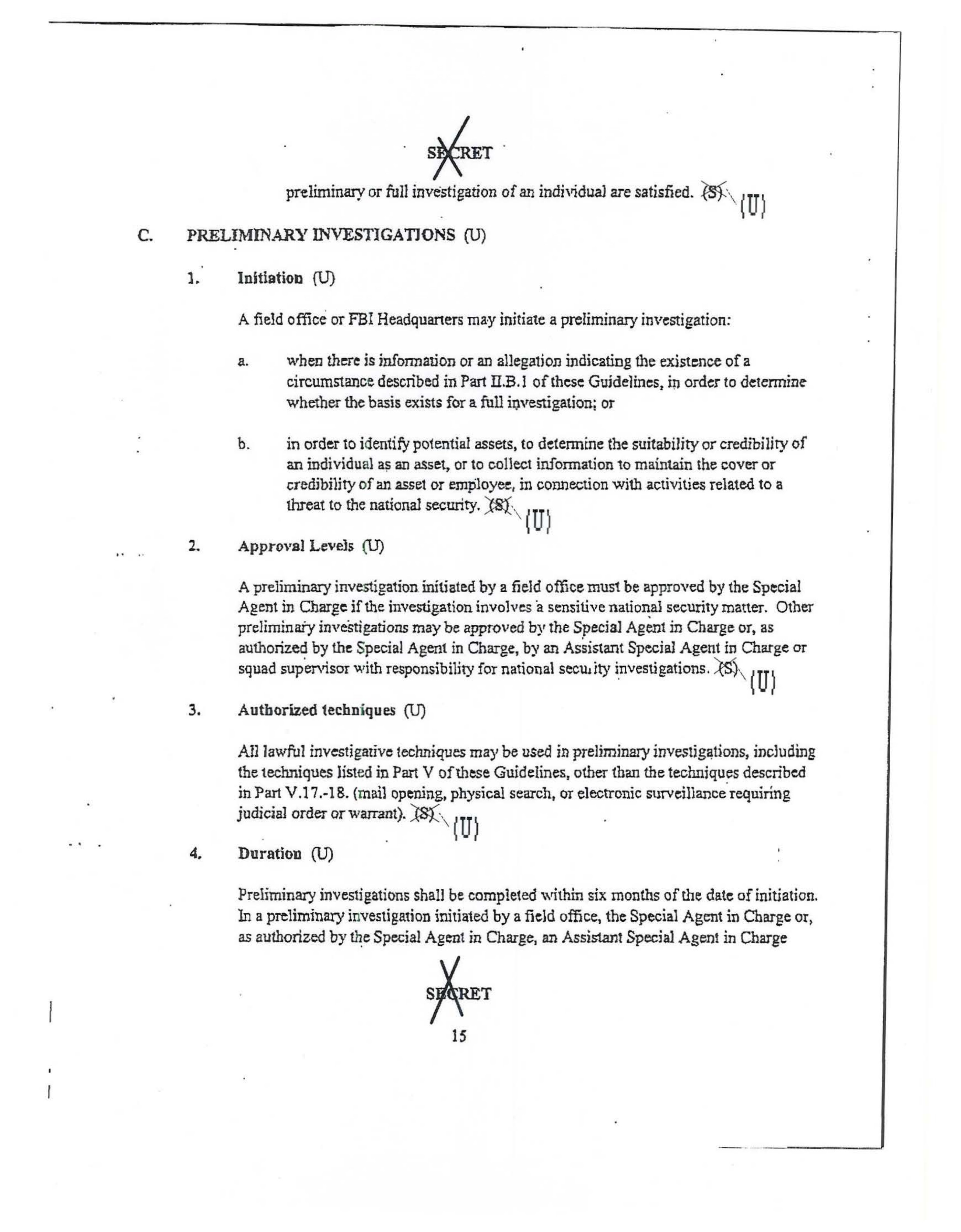
C. PRELIMINARY INVESTIGATIONS (U)
- Initiation (U)
A field office or FBI Headquarters may initiate a preliminary investigation:
a. when there is information or an allegation indicating the existence of a
circumstance described in Part II.B.1 of these Guidelines, in order to determine
whether the basis exists for a full investigation; or
b. in order to identify potential assets, to determine the suitability or credibility of
an individual as an asset, or to collect information to maintain the cover or
credibility of an asset or employee, in connection with activities related to a
threat to the national security. (S) (U)
- Approval Levels (U)
A preliminary investigation initiated by a field office must be approved by the Special
Agent in Charge if the investigation involves a sensitive national security matter. Other
preliminary investigations may be approved by the Special Agent in Charge or, as
authorized by the Special Agent in Charge, by an Assistant Special Agent in Charge or
squad supervisor with responsibility for national security investigations. (S) (U)
- Authorized techniques (U)
All lawful investigative techniques may be used in preliminary investigations, including
the techniques listed in Part V of these Guidelines, other than the techniques described
in Part V.17.-18. (mail opening, physical search, or electronic surveillance requiring
judicial order or warrant). (S) (U)
- Duration (U)
Preliminary investigations shall be completed within six months of the date of initiation.
In a preliminary investigation initiated by a field office, the Special Agent in Charge or,
as authorized by the Special Agent in Charge, an Assistant Special Agent in Charge
SECRET
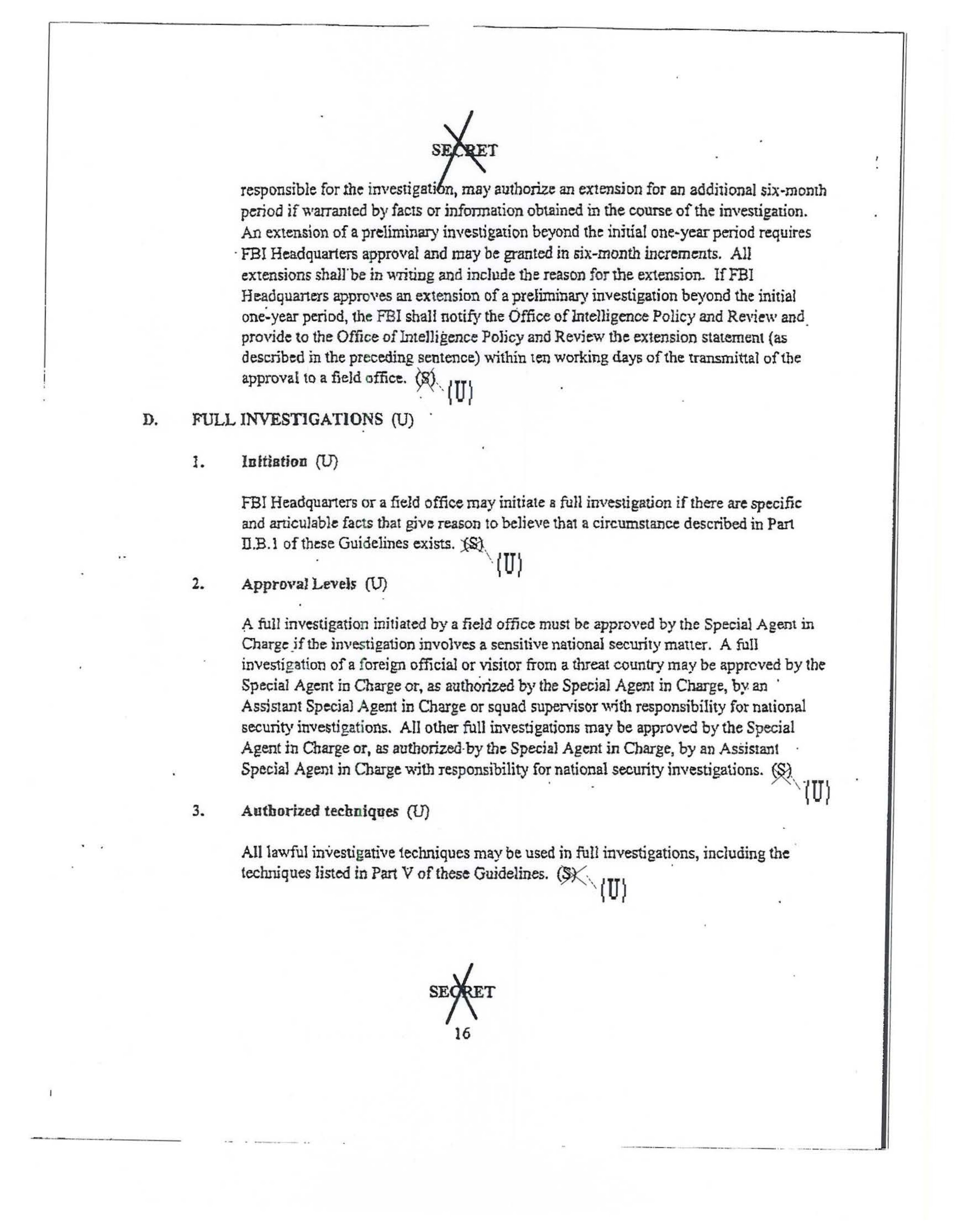
15
SECRET
responsible for the investigation, may authorize an extension for an additional six-month
period if warranted by facts or information obtained in the course of the investigation.
An extension of a preliminary investigation beyond the initial one-year period requires
FBI Headquarters approval and may be granted in six-month increments. All
extensions shall be in writing and include the reason for the extension. If FBI
Headquarters approves an extension of a preliminary investigation beyond the initial
one-year period, the FBI shall notify the Office of Intelligence Policy and Review and
provide to the Office of Intelligence Policy and Review the extension statement (as
described in the preceding sentence) within ten working days of the transmittal of the
approval to a field office. (S) (U)
D. FULL INVESTIGATIONS (U)
- Initiation (U)
FBI Headquarters or a field office may initiate a full investigation if there are specific
and articulable facts that give reason to believe that a circumstance described in Part
II.B.1 of these Guidelines exists. (S) (U)
- Approval Levels (U)
A full investigation initiated by a field office must be approved by the Special Agent in
Charge if the investigation involves a sensitive national security matter. A full
investigation of a foreign official or visitor from a threat country may be approved by the
Special Agent in Charge or, as authorized by the Special Agent in Charge, by an
Assistant Special Agent in Charge or squad supervisor with responsibility for national
security investigations. All other full investigations may be approved by the Special
Agent in Charge or, as authorized by the Special Agent in Charge, by an Assistant
Special Agent in Charge with responsibility for national security investigations. (S) (U)
- Authorized techniques (U)
All lawful investigative techniques may be used in full investigations, including the
techniques listed in Part V of these Guidelines. (S) (U)
SECRET
16
SECRET
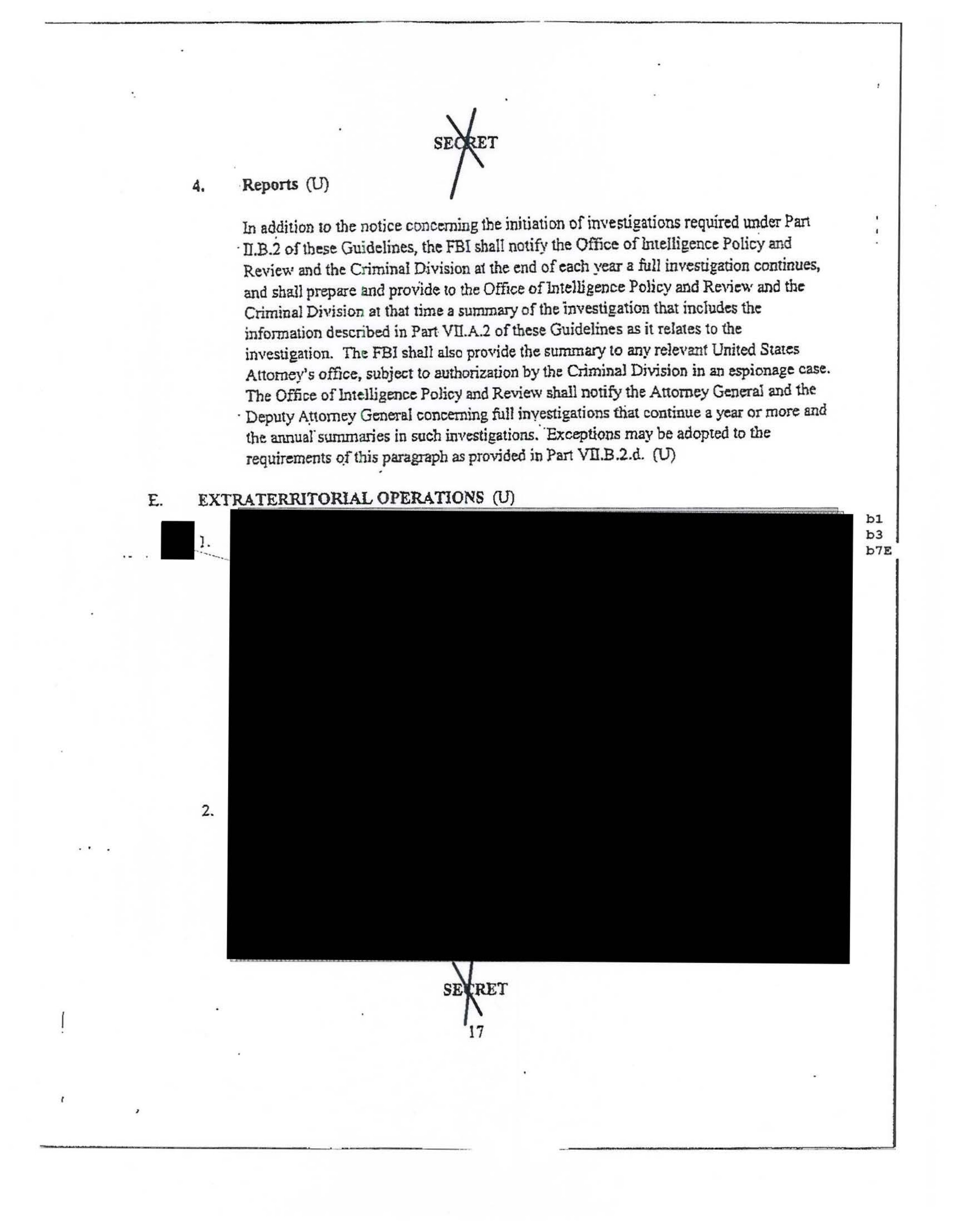
- Reports (U)
In addition to the notice concerning the initiation of investigations required under Part
II.B.2 of these Guidelines, the FBI shall notify the Office of Intelligence Policy and
Review and the Criminal Division at the end of each year a full investigation continues,
and shall prepare and provide to the Office of Intelligence Policy and Review and the
Criminal Division at that time a summary of the investigation that includes the
information described in Part VII.A.2 of these Guidelines as it relates to the
investigation. The FBI shall also provide the summary to any relevant United States
Attorney's office, subject to authorization by the Criminal Division in an espionage case.
The Office of Intelligence Policy and Review shall notify the Attorney General and the
Deputy Attorney General concerning full investigations that continue a year or more and
the annual summaries in such investigations. Exceptions may be adopted to the
requirements of this paragraph as provided in Part VII.B.2.d. (U)
E. EXTRATERRITORIAL OPERATIONS (U)
- [REDACTED]
- [REDACTED]
SECRET
17
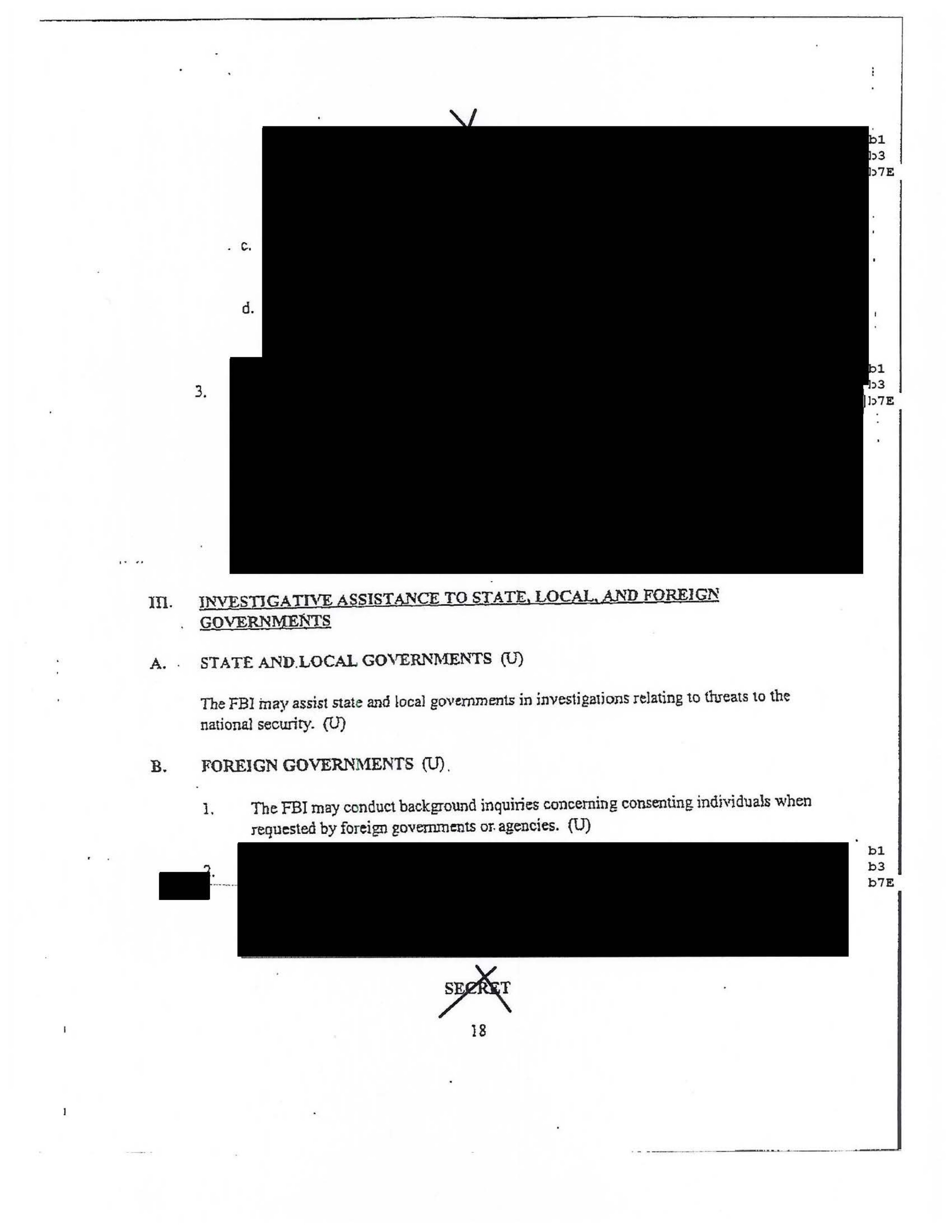
[REDACTED]
c. [REDACTED]
d. [REDACTED]
3. [REDACTED]
III. INVESTIGATIVE ASSISTANCE TO STATE, LOCAL, AND FOREIGN
GOVERNMENTS
A. STATE AND LOCAL GOVERNMENTS (U)
The FBI may assist state and local governments in investigations relating to threats to the
national security. (U)
B. FOREIGN GOVERNMENTS (U)
- The FBI may conduct background inquiries concerning consenting individuals when
requested by foreign governments or agencies. (U)
- [REDACTED]
SECRET
18
[REDACTED]
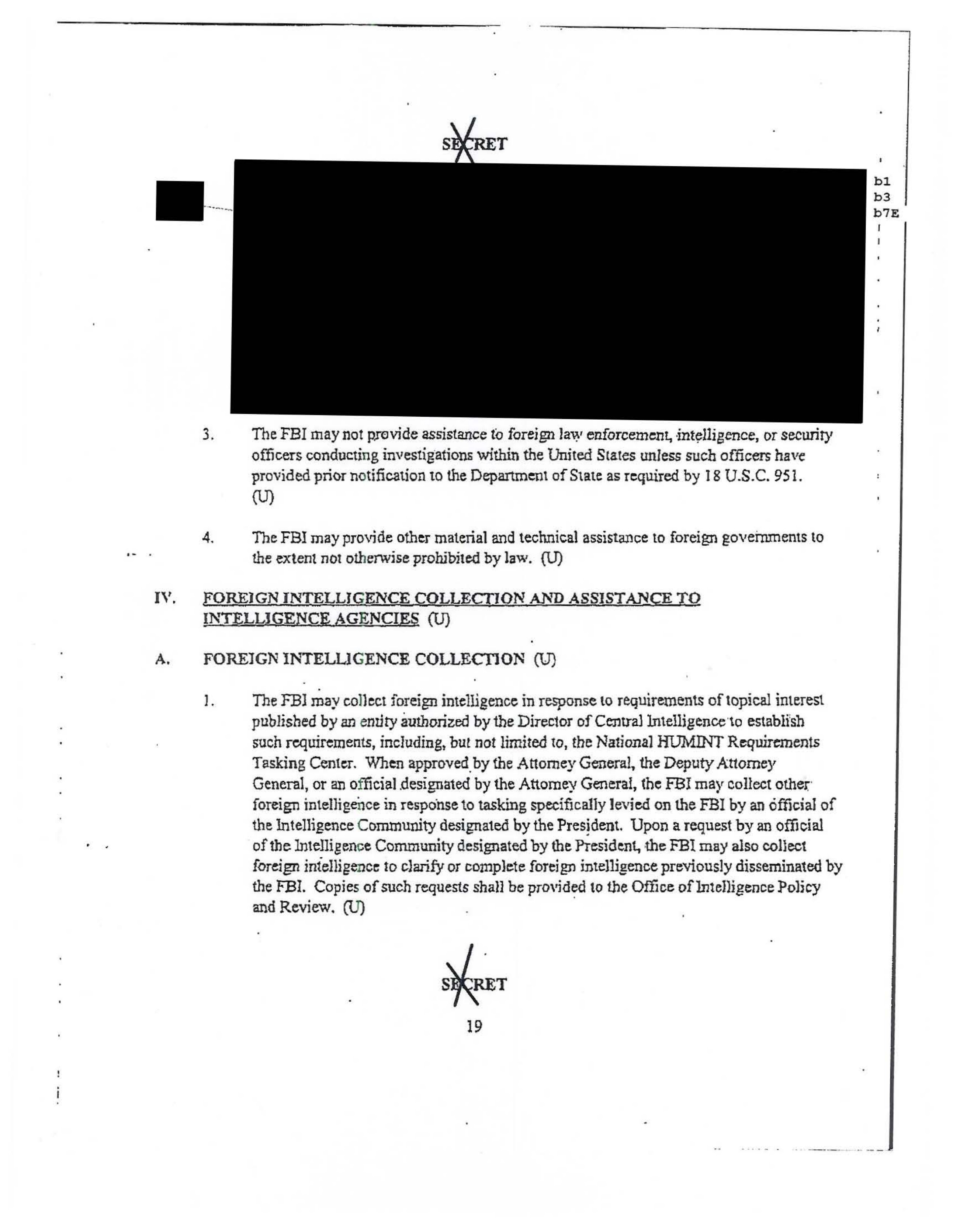
- The FBI may not provide assistance to foreign law enforcement, intelligence, or security
officers conducting investigations within the United States unless such officers have
provided prior notification to the Department of State as required by 18 U.S.C. 951.
(U)
- The FBI may provide other material and technical assistance to foreign governments to
the extent not otherwise prohibited by law. (U)
IV. FOREIGN INTELLIGENCE COLLECTION AND ASSISTANCE TO
INTELLIGENCE AGENCIES (U)
A. FOREIGN INTELLIGENCE COLLECTION (U)
- The FBI may collect foreign intelligence in response to requirements of topical interest
published by an entity authorized by the Director of Central Intelligence to establish
such requirements, including, but not limited to, the National HUMINT Requirements
Tasking Center. When approved by the Attorney General, the Deputy Attorney
General, or an official designated by the Attorney General, the FBI may collect other
foreign intelligence in response to tasking specifically levied on the FBI by an official of
the Intelligence Community designated by the President. Upon a request by an official
of the Intelligence Community designated by the President, the FBI may also collect
foreign intelligence to clarify or complete foreign intelligence previously disseminated by
the FBI. Copies of such requests shall be provided to the Office of Intelligence Policy
and Review. (U)
SECRET
19
SECRET
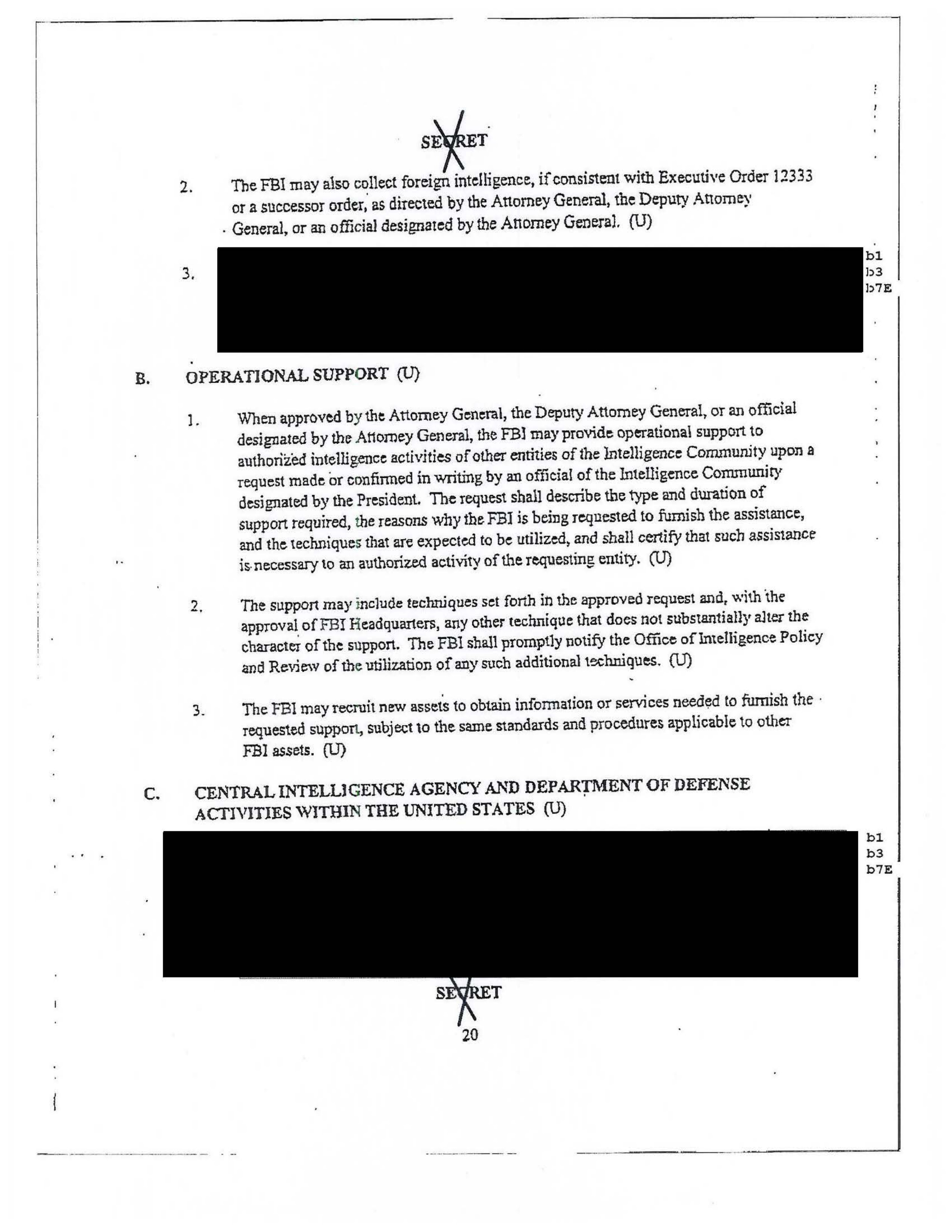
- The FBI may also collect foreign intelligence, if consistent with Executive Order 12333
or a successor order, as directed by the Attorney General, the Deputy Attorney
General, or an official designated by the Attorney General. (U)
- [REDACTED]
B. OPERATIONAL SUPPORT (U)
- When approved by the Attorney General, the Deputy Attorney General, or an official
designated by the Attorney General, the FBI may provide operational support to
authorized intelligence activities of other entities of the Intelligence Community upon a
request made or confirmed in writing by an official of the Intelligence Community
designated by the President. The request shall describe the type and duration of
support required, the reasons why the FBI is being requested to furnish the assistance,
and the techniques that are expected to be utilized, and shall certify that such assistance
is necessary to an authorized activity of the requesting entity. (U)
- The support may include techniques set forth in the approved request and, with the
approval of FBI Headquarters, any other technique that does not substantially alter the
character of the support. The FBI shall promptly notify the Office of Intelligence Policy
and Review of the utilization of any such additional techniques. (U)
- The FBI may recruit new assets to obtain information or services needed to furnish the
requested support, subject to the same standards and procedures applicable to other
FBI assets. (U)
C. CENTRAL INTELLIGENCE AGENCY AND DEPARTMENT OF DEFENSE
ACTIVITIES WITHIN THE UNITED STATES (U)
[REDACTED]
SECRET
20
SECRET
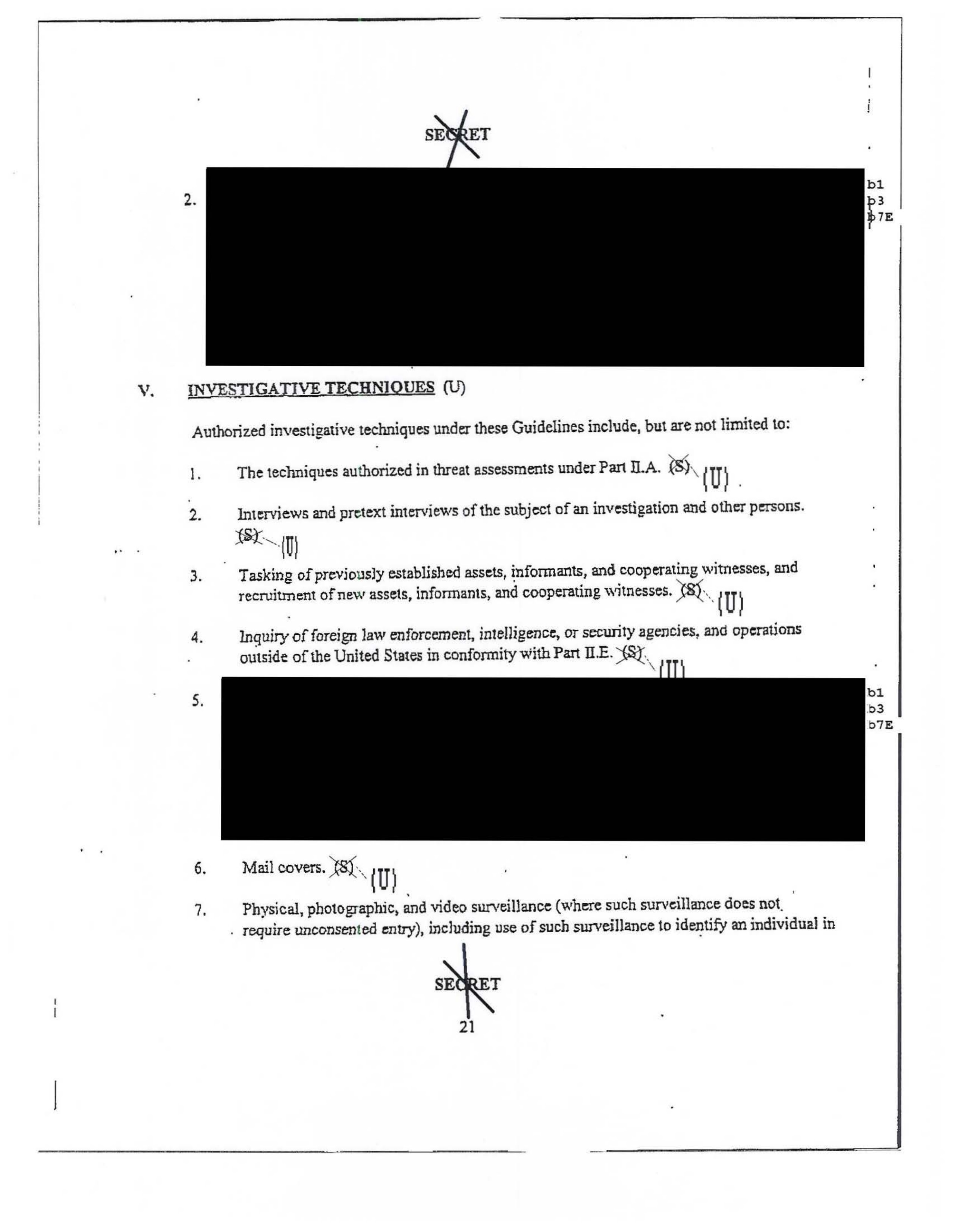
V. INVESTIGATIVE TECHNIQUES (U)
Authorized investigative techniques under these Guidelines include, but are not limited to:
- The techniques authorized in threat assessments under Part II.A. (S) (U).
- Interviews and pretext interviews of the subject of an investigation and other persons.
(S) [REDACTED]
- Tasking of previously established assets, informants, and cooperating witnesses, and
recruitment of new assets, informants, and cooperating witnesses. (S) (U)
- Inquiry of foreign law enforcement, intelligence, or security agencies, and operations
outside of the United States in conformity with Part II.E. (S) [REDACTED]
- [REDACTED]
- Mail covers. (S) (U)
- Physical, photographic, and video surveillance (where such surveillance does not
require unconsented entry), including use of such surveillance to identify an individual in
SECRET
21
SECRET
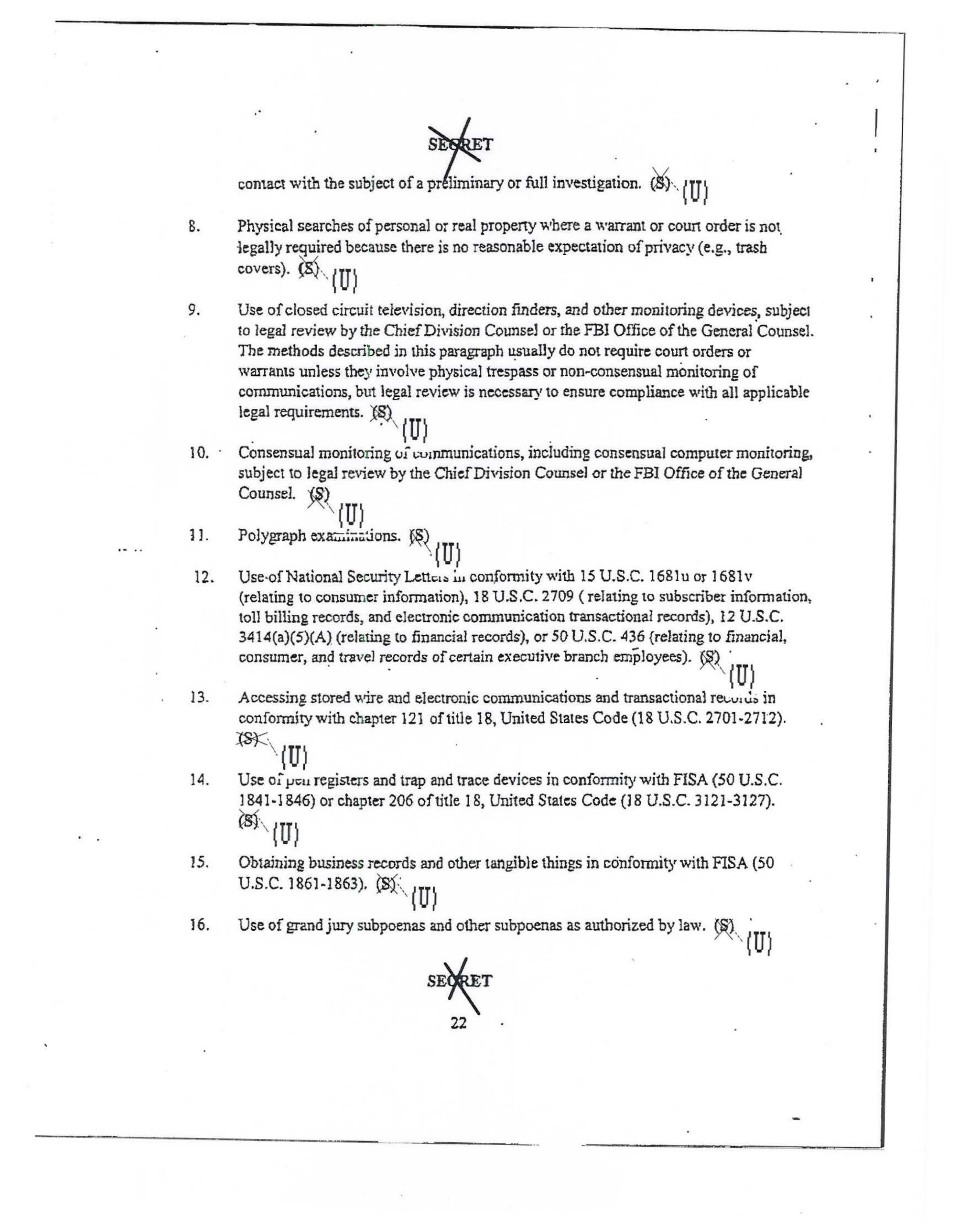
contact with the subject of a preliminary or full investigation. (S) (U)
- Physical searches of personal or real property where a warrant or court order is not
legally required because there is no reasonable expectation of privacy (e.g., trash
covers). (S) (U)
- Use of closed circuit television, direction finders, and other monitoring devices, subject
to legal review by the Chief Division Counsel or the FBI Office of the General Counsel.
The methods described in this paragraph usually do not require court orders or
warrants unless they involve physical trespass or non-consensual monitoring of
communications, but legal review is necessary to ensure compliance with all applicable
legal requirements. (S) (U)
- Consensual monitoring of communications, including consensual computer monitoring,
subject to legal review by the Chief Division Counsel or the FBI Office of the General
Counsel. (S) (U)
- Polygraph examinations. (S) (U)
- Use of National Security Letters in conformity with 15 U.S.C. 1681u or 1681v
(relating to consumer information), 18 U.S.C. 2709 (relating to subscriber information,
toll billing records, and electronic communication transactional records), 12 U.S.C.
3414(a)(5)(A) (relating to financial records), or 50 U.S.C. 436 (relating to financial,
consumer, and travel records of certain executive branch employees). (S) (U)
- Accessing stored wire and electronic communications and transactional records in
conformity with chapter 121 of title 18, United States Code (18 U.S.C. 2701-2712).
(S) (U)
- Use of pen registers and trap and trace devices in conformity with FISA (50 U.S.C.
1841-1846) or chapter 206 of title 18, United States Code (18 U.S.C. 3121-3127).
(S) (U)
- Obtaining business records and other tangible things in conformity with FISA (50
U.S.C. 1861-1863). (S) (U)
- Use of grand jury subpoenas and other subpoenas as authorized by law. (S) (U)
SECRET
22
SECRET
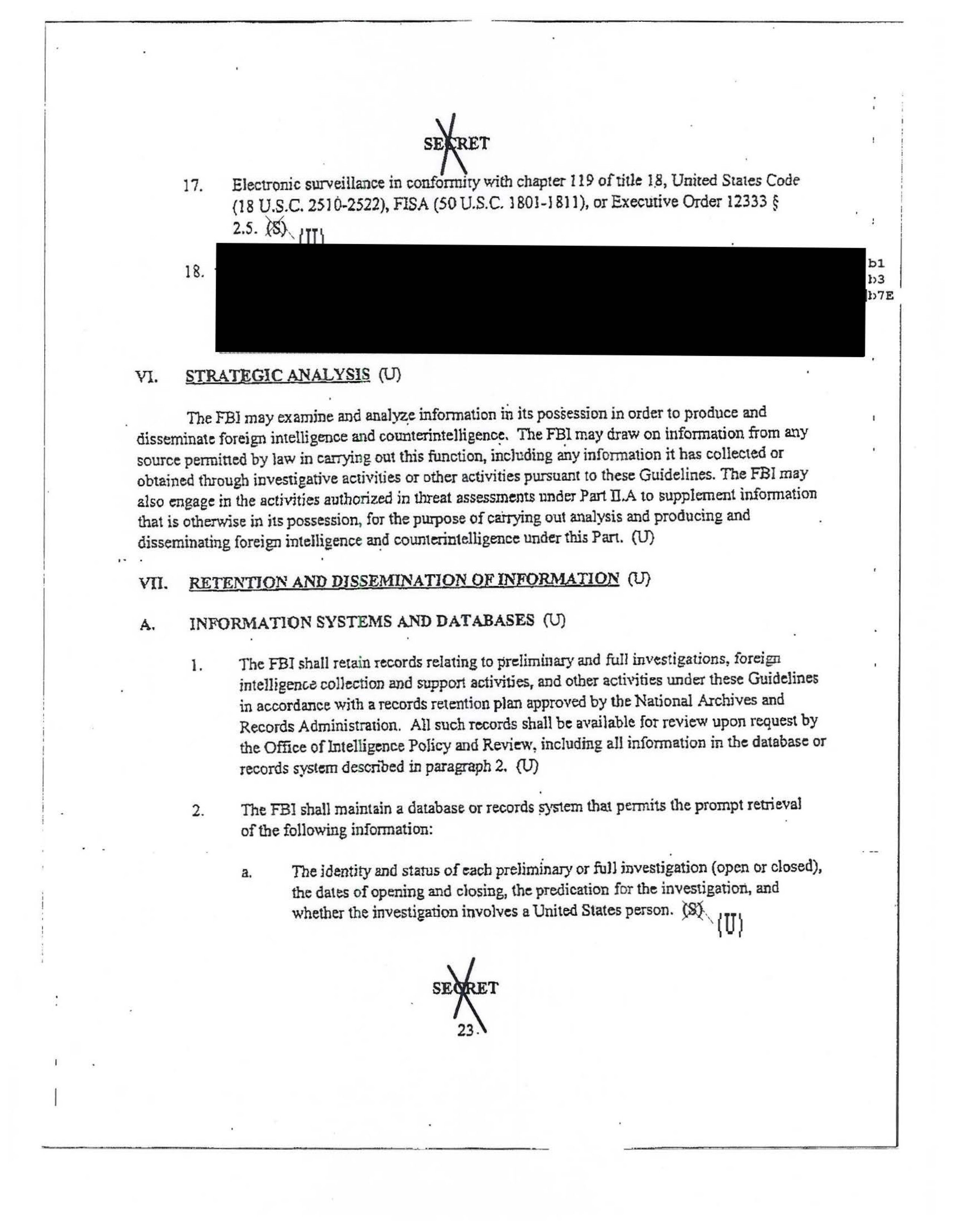
- Electronic surveillance in conformity with chapter 119 of title 18, United States Code
(18 U.S.C. 2510-2522), FISA (50 U.S.C. 1801-1811), or Executive Order 12333 §
[REDACTED]
- [REDACTED]
VI. STRATEGIC ANALYSIS (U)
The FBI may examine and analyze information in its possession in order to produce and
disseminate foreign intelligence and counterintelligence. The FBI may draw on information from any
source permitted by law in carrying out this function, including any information it has collected or
obtained through investigative activities or other activities pursuant to these Guidelines. The FBI may
also engage in the activities authorized in threat assessments under Part II.A to supplement information
that is otherwise in its possession, for the purpose of carrying out analysis and producing and
disseminating foreign intelligence and counterintelligence under this Part. (U)
VII. RETENTION AND DISSEMINATION OF INFORMATION (U)
A. INFORMATION SYSTEMS AND DATABASES (U)
- The FBI shall retain records relating to preliminary and full investigations, foreign
intelligence collection and support activities, and other activities under these Guidelines
in accordance with a records retention plan approved by the National Archives and
Records Administration. All such records shall be available for review upon request by
the Office of Intelligence Policy and Review, including all information in the database or
records system described in paragraph 2. (U)
- The FBI shall maintain a database or records system that permits the prompt retrieval
of the following information:
a. The identity and status of each preliminary or full investigation (open or closed),
the dates of opening and closing, the predication for the investigation, and
whether the investigation involves a United States person. (S) (U)
SECRET
23
SECRET
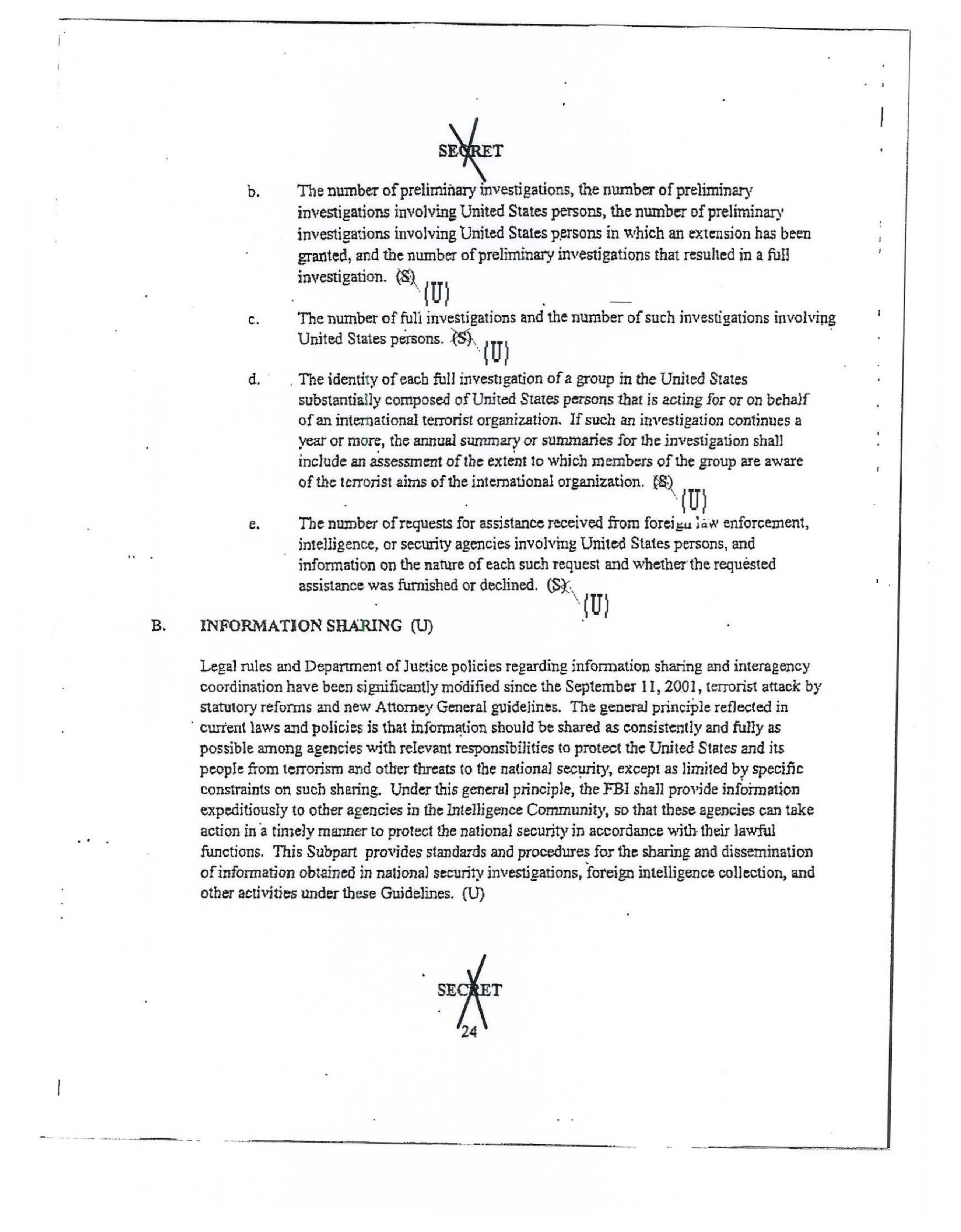
b. The number of preliminary investigations, the number of preliminary
investigations involving United States persons, the number of preliminary
investigations involving United States persons in which an extension has been
granted, and the number of preliminary investigations that resulted in a full
investigation. (S) (U)
c. The number of full investigations and the number of such investigations involving
United States persons. (S) (U)
d. The identity of each full investigation of a group in the United States
substantially composed of United States persons that is acting for or on behalf
of an international terrorist organization. If such an investigation continues a
year or more, the annual summary or summaries for the investigation shall
include an assessment of the extent to which members of the group are aware
of the terrorist aims of the international organization. (S) (U)
e. The number of requests for assistance received from foreign law enforcement,
intelligence, or security agencies involving United States persons, and
information on the nature of each such request and whether the requested
assistance was furnished or declined. (S) (U)
B. INFORMATION SHARING (U)
Legal rules and Department of Justice policies regarding information sharing and interagency
coordination have been significantly modified since the September 11, 2001, terrorist attack by
statutory reforms and new Attorney General guidelines. The general principle reflected in
current laws and policies is that information should be shared as consistently and fully as
possible among agencies with relevant responsibilities to protect the United States and its
people from terrorism and other threats to the national security, except as limited by specific
constraints on such sharing. Under this general principle, the FBI shall provide information
expeditiously to other agencies in the Intelligence Community, so that these agencies can take
action in a timely manner to protect the national security in accordance with their lawful
functions. This Subpart provides standards and procedures for the sharing and dissemination
of information obtained in national security investigations, foreign intelligence collection, and
other activities under these Guidelines. (U)
SECRET
24
SECRET
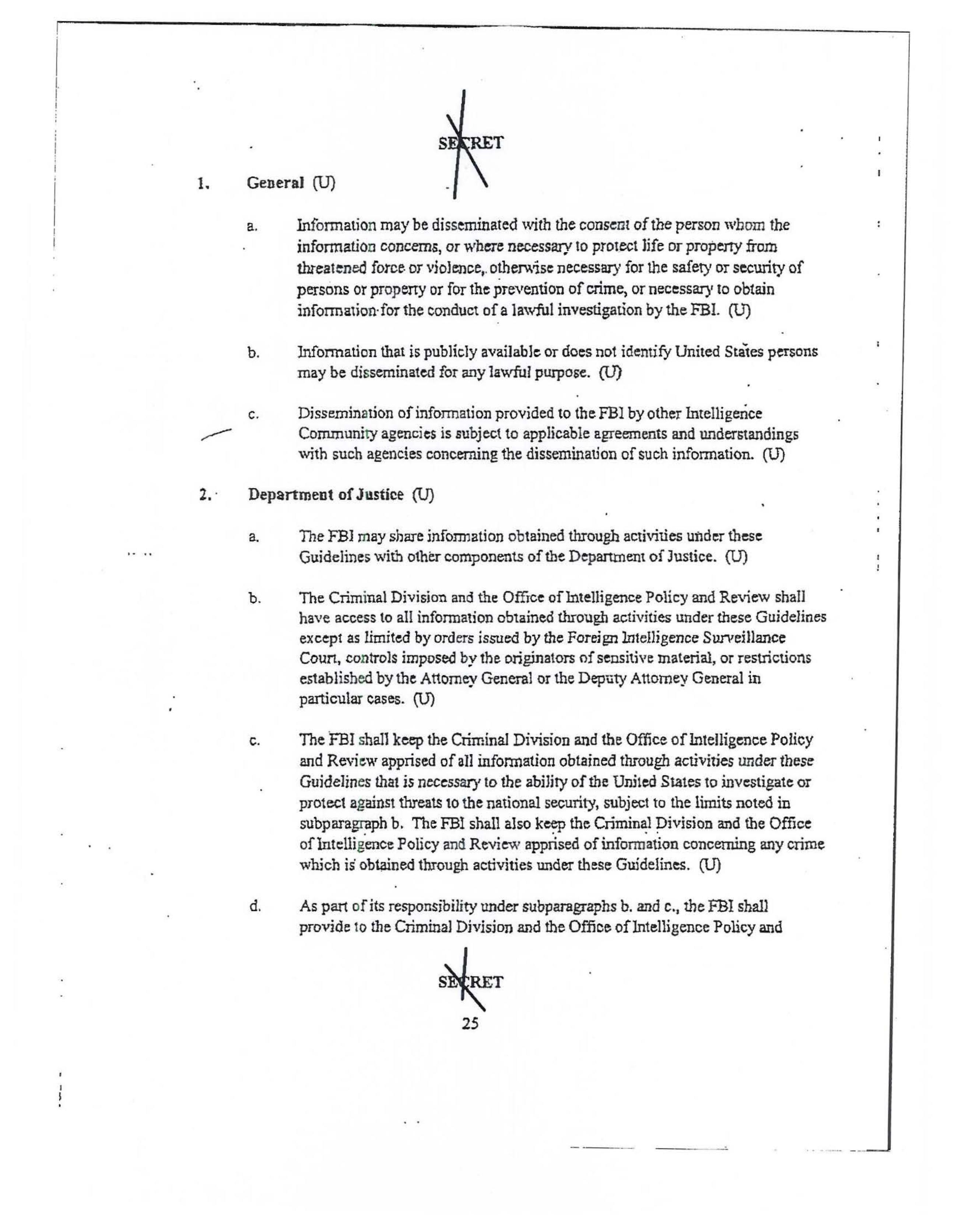
- General (U)
a. Information may be disseminated with the consent of the person whom the
information concerns, or where necessary to protect life or property from
threatened force or violence, otherwise necessary for the safety or security of
persons or property or for the prevention of crime, or necessary to obtain
information for the conduct of a lawful investigation by the FBI. (U)
b. Information that is publicly available or does not identify United States persons
may be disseminated for any lawful purpose. (U)
c. Dissemination of information provided to the FBI by other Intelligence
Community agencies is subject to applicable agreements and understandings
with such agencies concerning the dissemination of such information. (U)
- Department of Justice (U)
a. The FBI may share information obtained through activities under these
Guidelines with other components of the Department of Justice. (U)
b. The Criminal Division and the Office of Intelligence Policy and Review shall
have access to all information obtained through activities under these Guidelines
except as limited by orders issued by the Foreign Intelligence Surveillance
Court, controls imposed by the originators of sensitive material, or restrictions
established by the Attorney General or the Deputy Attorney General in
particular cases. (U)
c. The FBI shall keep the Criminal Division and the Office of Intelligence Policy
and Review apprised of all information obtained through activities under these
Guidelines that is necessary to the ability of the United States to investigate or
protect against threats to the national security, subject to the limits noted in
subparagraph b. The FBI shall also keep the Criminal Division and the Office
of Intelligence Policy and Review apprised of information concerning any crime
which is obtained through activities under these Guidelines. (U)
d. As part of its responsibility under subparagraphs b. and c., the FBI shall
provide to the Criminal Division and the Office of Intelligence Policy and
SECRET
25
SECRET
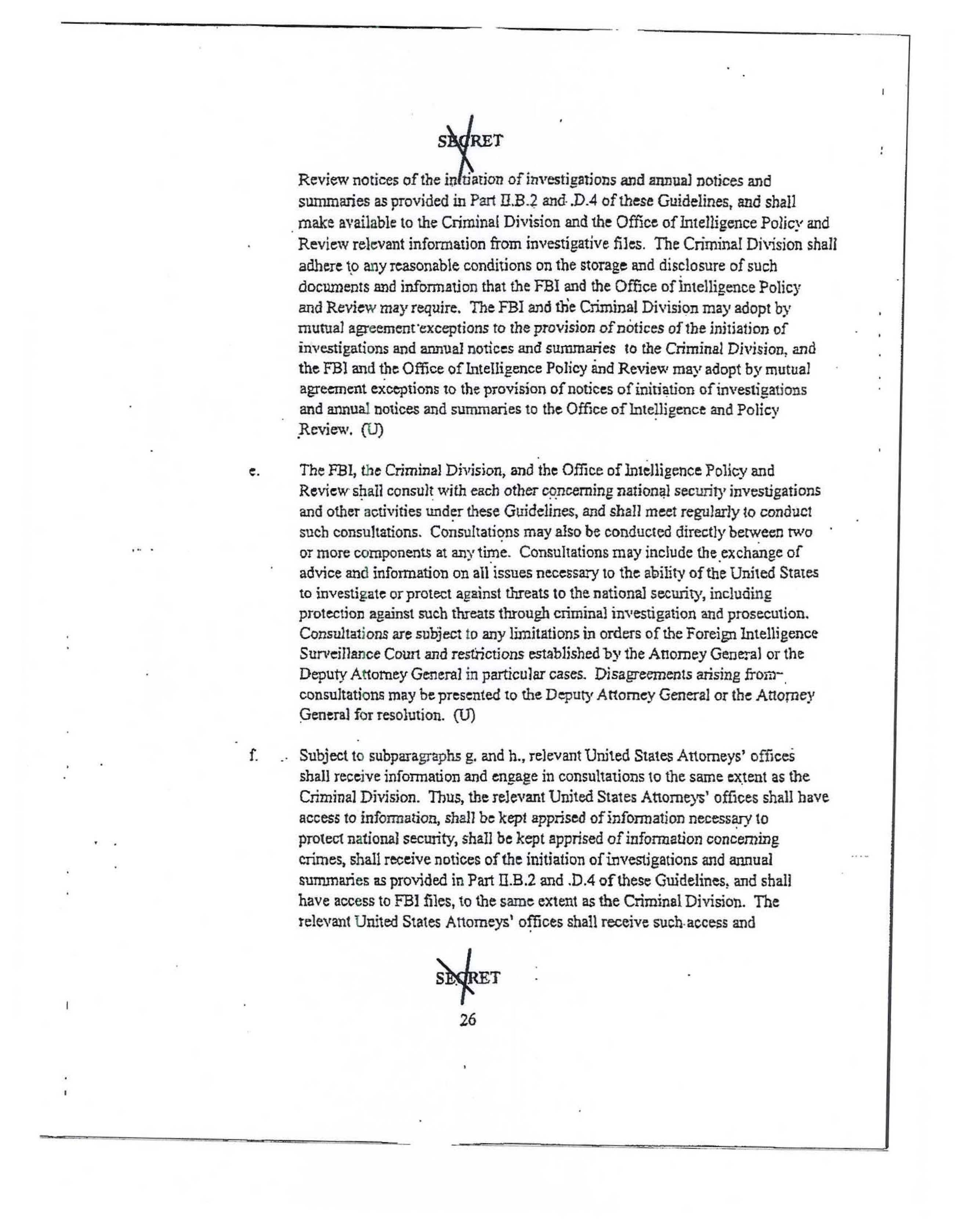
Review notices of the initiation of investigations and annual notices and
summaries as provided in Part II.B.2 and .D.4 of these Guidelines, and shall
make available to the Criminal Division and the Office of Intelligence Policy and
Review relevant information from investigative files. The Criminal Division shall
adhere to any reasonable conditions on the storage and disclosure of such
documents and information that the FBI and the Office of Intelligence Policy
and Review may require. The FBI and the Criminal Division may adopt by
mutual agreement exceptions to the provision of notices of the initiation of
investigations and annual notices and summaries to the Criminal Division, and
the FBI and the Office of Intelligence Policy and Review may adopt by mutual
agreement exceptions to the provision of notices of initiation of investigations
and annual notices and summaries to the Office of Intelligence and Policy
Review. (U)
e. The FBI, the Criminal Division, and the Office of Intelligence Policy and
Review shall consult with each other concerning national security investigations
and other activities under these Guidelines, and shall meet regularly to conduct
such consultations. Consultations may also be conducted directly between two
or more components at any time. Consultations may include the exchange of
advice and information on all issues necessary to the ability of the United States
to investigate or protect against threats to the national security, including
protection against such threats through criminal investigation and prosecution.
Consultations are subject to any limitations in orders of the Foreign Intelligence
Surveillance Court and restrictions established by the Attorney General or the
Deputy Attorney General in particular cases. Disagreements arising from
consultations may be presented to the Deputy Attorney General or the Attorney
General for resolution. (U)
f. Subject to subparagraphs g. and h., relevant United States Attorneys' offices
shall receive information and engage in consultations to the same extent as the
Criminal Division. Thus, the relevant United States Attorneys' offices shall have
access to information, shall be kept apprised of information necessary to
protect national security, shall be kept apprised of information concerning
crimes, shall receive notices of the initiation of investigations and annual
summaries as provided in Part II.B.2 and .D.4 of these Guidelines, and shall
have access to FBI files, to the same extent as the Criminal Division. The
relevant United States Attorneys' offices shall receive such access and
SECRET
26
SECRET
information from the FBI field offices. The relevant United States Attorneys'
offices also may and shall engage in regular consultations with the FBI and the
Office of Intelligence Policy and Review to the same extent as the Criminal
Division. (U)
g. In espionage cases, dissemination of information to United States Attorneys'
offices and consultations between the FBI and United States Attorneys' offices
are subject to authorization by the Criminal Division. In an emergency, the FBI
may disseminate information to, and consult with, a United States Attorney's
office concerning an espionage investigation without the approval of the
Criminal Division, but shall notify the Criminal Division as soon as possible
thereafter. (U)
h. Information disseminated to a United States Attorney's office pursuant to
subparagraph f. shall be disseminated only to the United States Attorney
and/or any Assistant United States Attorneys designated to the Department of
Justice by the United States Attorney as points of contact to receive such
information. The United States Attorneys and designated Assistant United
States Attorneys shall have appropriate security clearances and shall receive
training in the handling of classified information and information derived from
FISA, including training concerning restrictions on the use and dissemination of
such information. (U)
- Intelligence Community, Federal Law Enforcement Agencies, and Department
of Homeland Security (U)
a. The FBI shall carry out the requirements of the Memorandum of Understanding
Between the Intelligence Community, Federal Law Enforcement Agencies, and
the Department of Homeland Security Concerning Information Sharing
("Memorandum of Understanding"), signed by the Attorney General on March
4, 2003. As provided in the Memorandum of Understanding and subject to its
provisions, these requirements include timely sharing by the FBI of covered
information with other covered entities having a need-to-know, based on a
broad interpretation of the missions of the prospective recipients. As used in
this paragraph:
1) 'covered entity' has the same meaning as in the Memorandum of
SECRET
27
SECRET
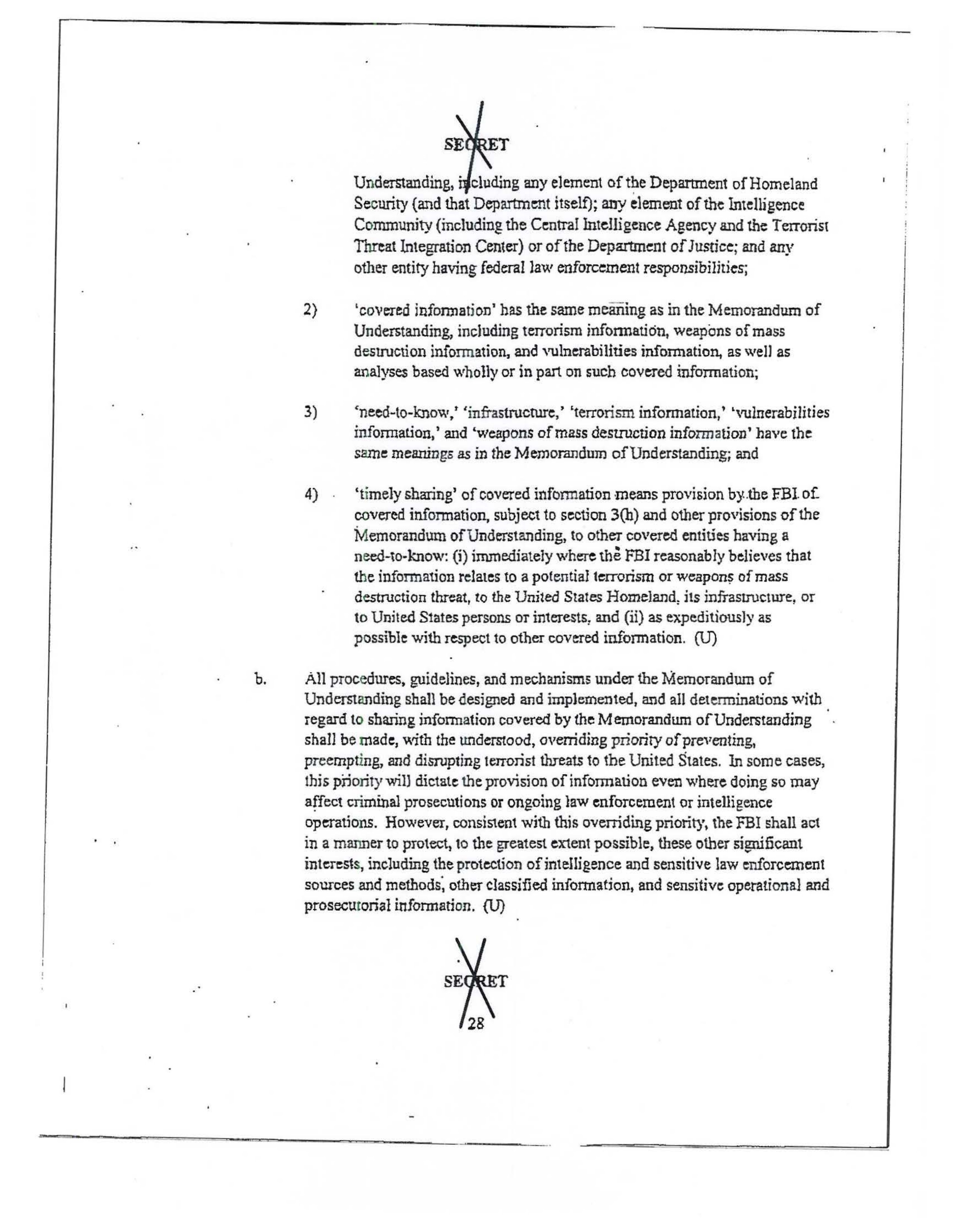
Understanding, including any element of the Department of Homeland
Security (and that Department itself); any element of the Intelligence
Community (including the Central Intelligence Agency and the Terrorist
Threat Integration Center) or of the Department of Justice; and any
other entity having federal law enforcement responsibilities;
2) 'covered information' has the same meaning as in the Memorandum of
Understanding, including terrorism information, weapons of mass
destruction information, and vulnerabilities information, as well as
analyses based wholly or in part on such covered information;
3) 'need-to-know,' 'infrastructure,' 'terrorism information,' 'vulnerabilities
information,' and 'weapons of mass destruction information' have the
same meanings as in the Memorandum of Understanding; and
4) 'timely sharing' of covered information means provision by the FBI. of
covered information, subject to section 3(h) and other provisions of the
Memorandum of Understanding, to other covered entities having a
need-to-know: (i) immediately where the FBI reasonably believes that
the information relates to a potential terrorism or weapons of mass
destruction threat, to the United States Homeland, its infrastructure, or
to United States persons or interests, and (ii) as expeditiously as
possible with respect to other covered information. (U)
b. All procedures, guidelines, and mechanisms under the Memorandum of
Understanding shall be designed and implemented, and all determinations with
regard to sharing information covered by the Memorandum of Understanding
shall be made, with the understood, overriding priority of preventing,
preempting, and disrupting terrorist threats to the United States. In some cases,
this priority will dictate the provision of information even where doing so may
affect criminal prosecutions or ongoing law enforcement or intelligence
operations. However, consistent with this overriding priority, the FBI shall act
in a manner to protect, to the greatest extent possible, these other significant
interests, including the protection of intelligence and sensitive law enforcement
sources and methods, other classified information, and sensitive operational and
prosecutorial information. (U)
SECRET
28
SECRET
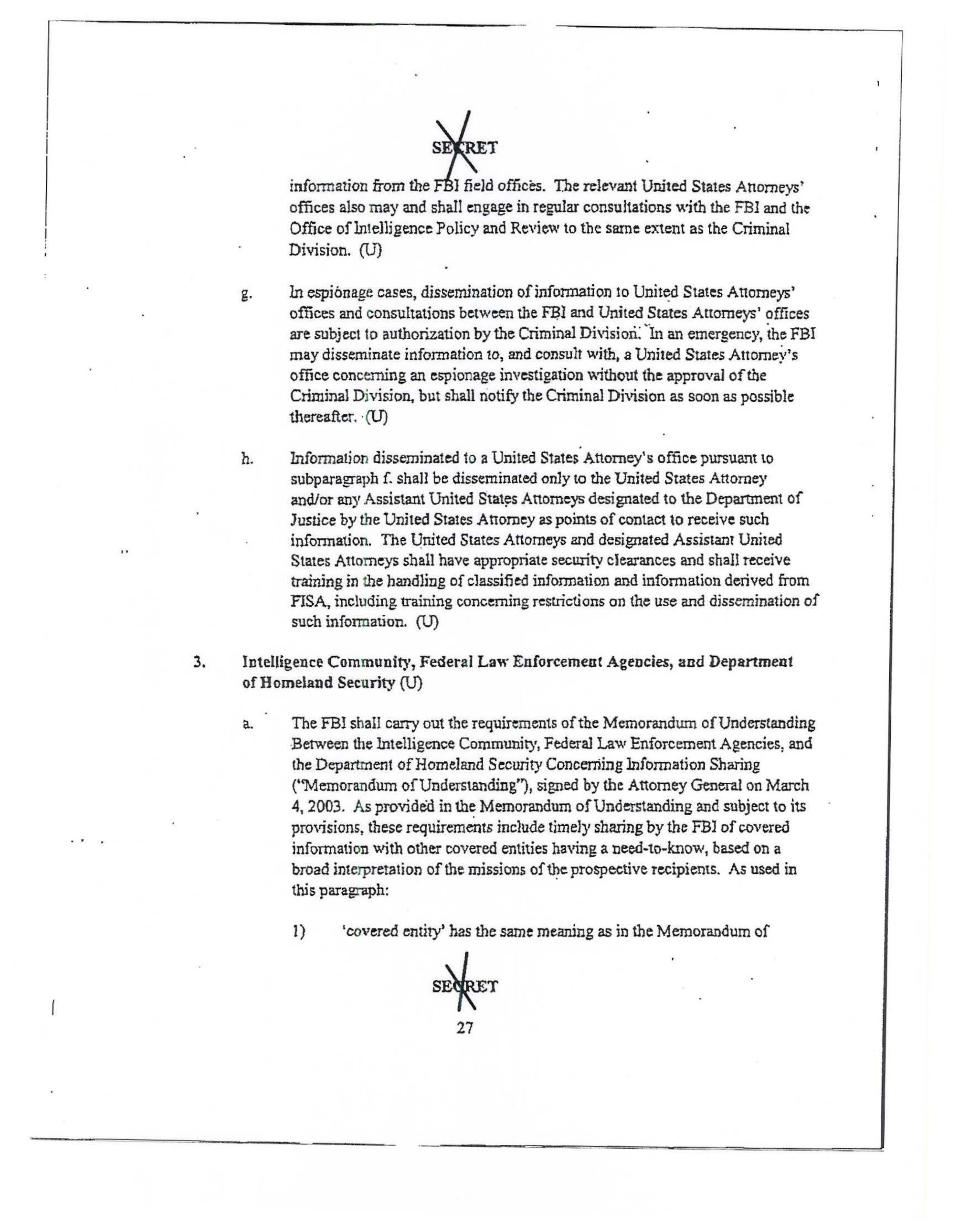
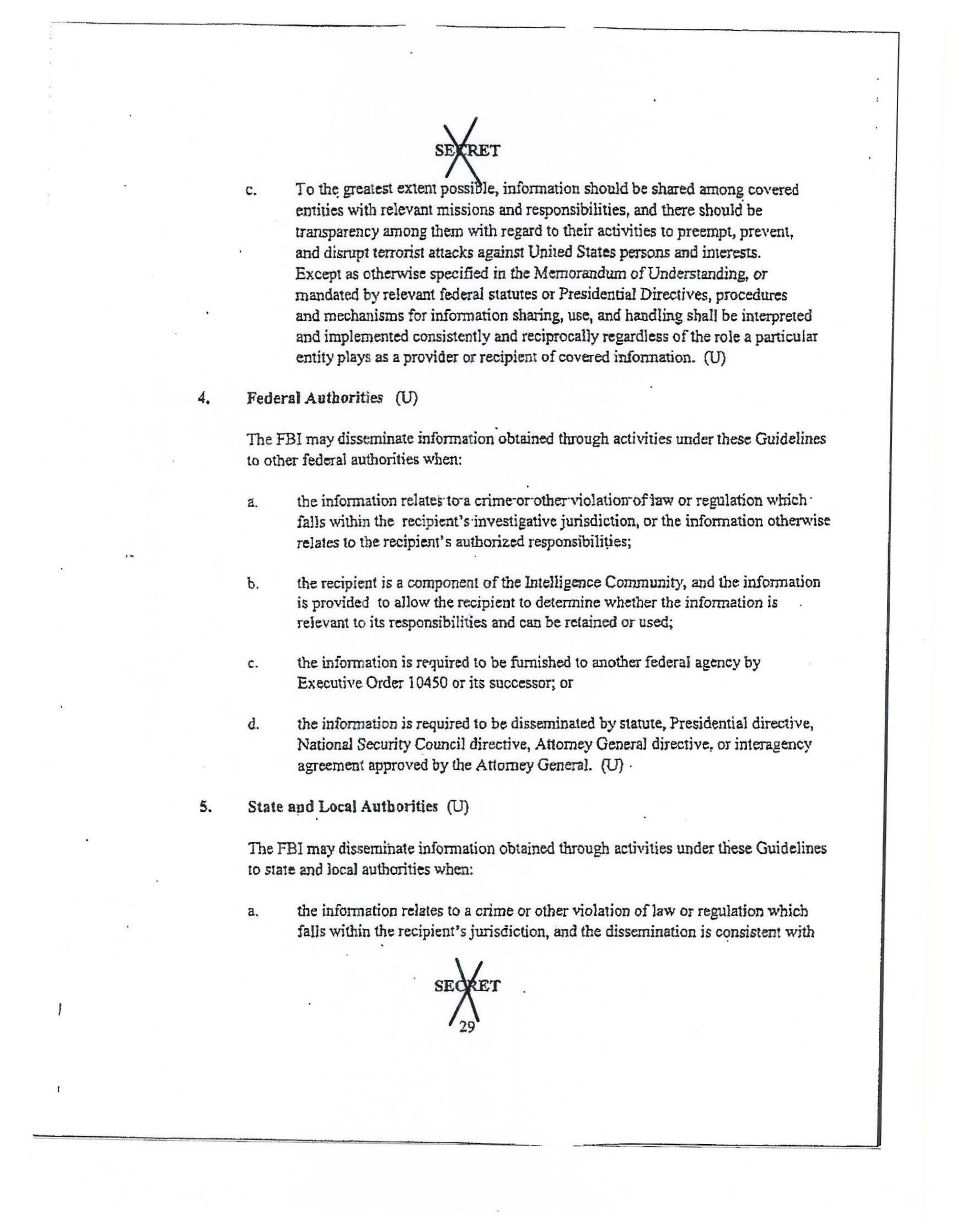
c. To the greatest extent possible, information should be shared among covered
entities with relevant missions and responsibilities, and there should be
transparency among them with regard to their activities to preempt, prevent,
and disrupt terrorist attacks against United States persons and interests.
Except as otherwise specified in the Memorandum of Understanding, or
mandated by relevant federal statutes or Presidential Directives, procedures
and mechanisms for information sharing, use, and handling shall be interpreted
and implemented consistently and reciprocally regardless of the role a particular
entity plays as a provider or recipient of covered information. (U)
- Federal Authorities (U)
The FBI may disseminate information obtained through activities under these Guidelines
to other federal authorities when:
a. the information relates to a crime or other violation of law or regulation which
falls within the recipient's investigative jurisdiction, or the information otherwise
relates to the recipient's authorized responsibilities;
b. the recipient is a component of the Intelligence Community, and the information
is provided to allow the recipient to determine whether the information is
relevant to its responsibilities and can be retained or used;
c. the information is required to be furnished to another federal agency by
Executive Order 10450 or its successor; or
d. the information is required to be disseminated by statute, Presidential directive,
National Security Council directive, Attorney General directive, or interagency
agreement approved by the Attorney General. (U)
- State and Local Authorities (U)
The FBI may disseminate information obtained through activities under these Guidelines
to state and local authorities when:
a. the information relates to a crime or other violation of law or regulation which
falls within the recipient's jurisdiction, and the dissemination is consistent with
SECRET
29
SECRET
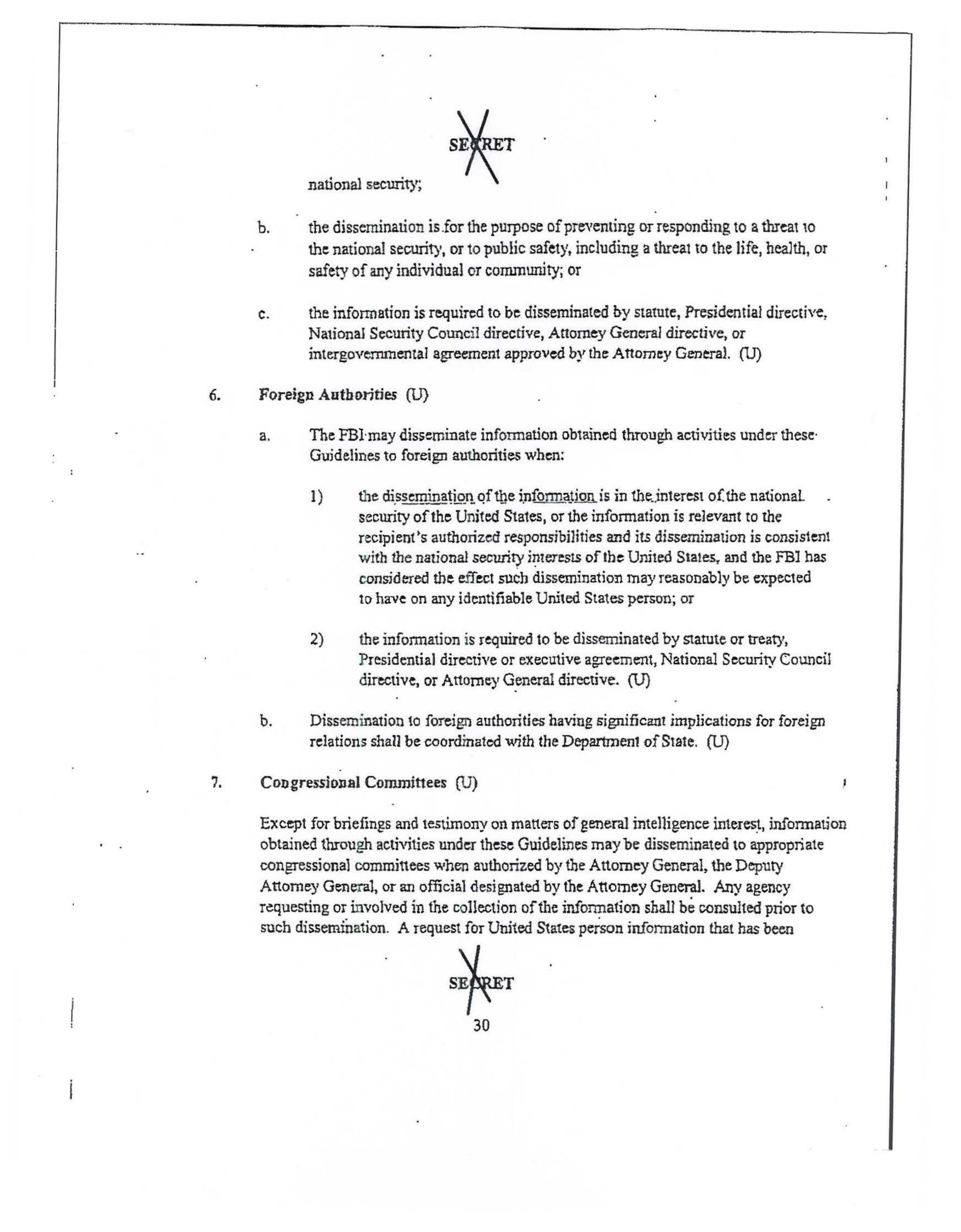
national security;
b. the dissemination is for the purpose of preventing or responding to a threat to
the national security, or to public safety, including a threat to the life, health, or
safety of any individual or community; or
c. the information is required to be disseminated by statute, Presidential directive,
National Security Council directive, Attorney General directive, or
intergovernmental agreement approved by the Attorney General. (U)
- Foreign Authorities (U)
a. The FBI may disseminate information obtained through activities under these
Guidelines to foreign authorities when:
1) the dissemination of the information is in the interest of the national
security of the United States, or the information is relevant to the
recipient's authorized responsibilities and its dissemination is consistent
with the national security interests of the United States, and the FBI has
considered the effect such dissemination may reasonably be expected
to have on any identifiable United States person; or
2) the information is required to be disseminated by statute or treaty,
Presidential directive or executive agreement, National Security Council
directive, or Attorney General directive. (U)
b. Dissemination to foreign authorities having significant implications for foreign
relations shall be coordinated with the Department of State. (U)
- Congressional Committees (U)
Except for briefings and testimony on matters of general intelligence interest, information
obtained through activities under these Guidelines may be disseminated to appropriate
congressional committees when authorized by the Attorney General, the Deputy
Attorney General, or an official designated by the Attorney General. Any agency
requesting or involved in the collection of the information shall be consulted prior to
such dissemination. A request for United States person information that has been
SECRET
30
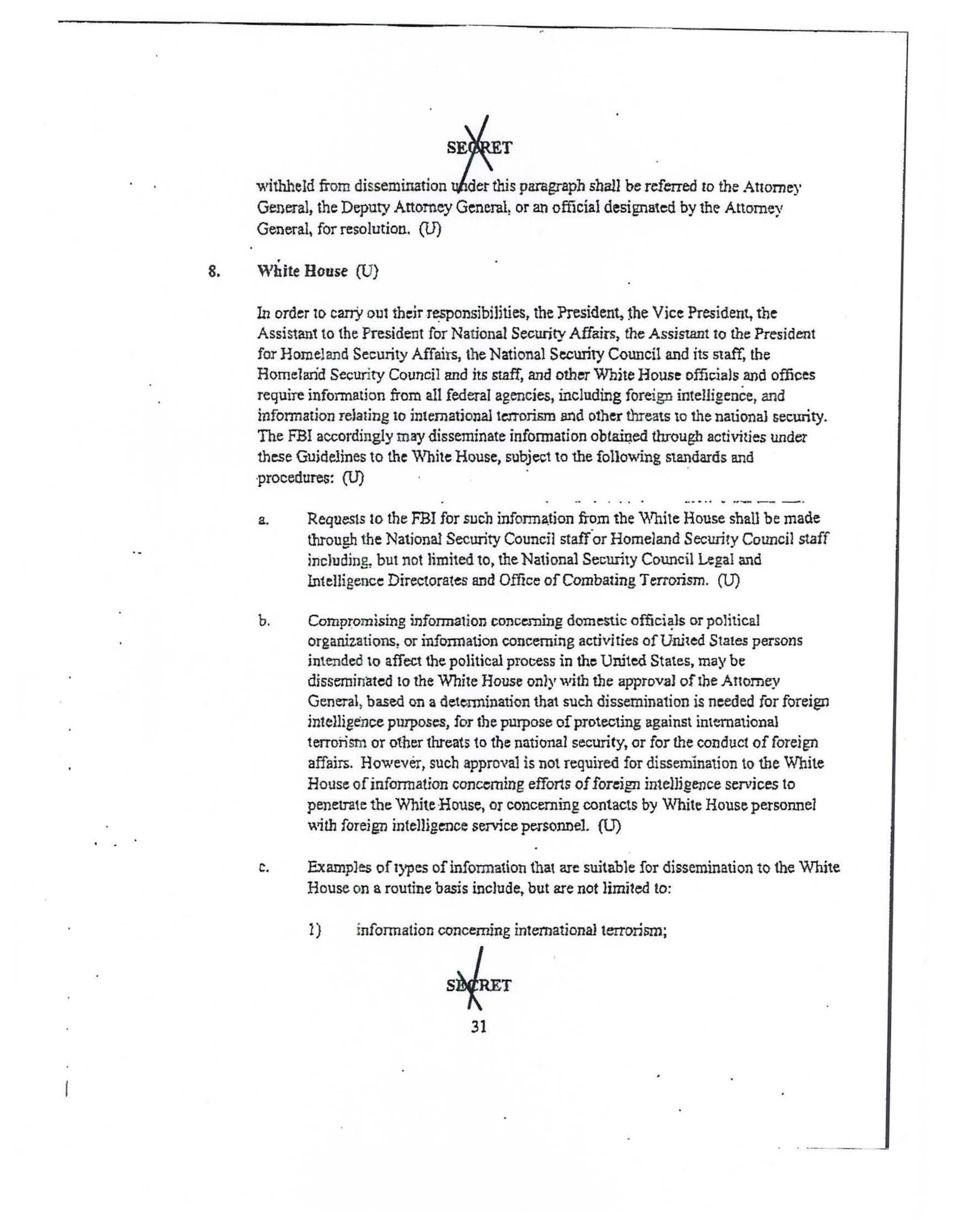
SECRET
withheld from dissemination under this paragraph shall be referred to the Attorney
General, the Deputy Attorney General, or an official designated by the Attorney
General, for resolution. (U)
- White House (U)
In order to carry out their responsibilities, the President, the Vice President, the
Assistant to the President for National Security Affairs, the Assistant to the President
for Homeland Security Affairs, the National Security Council and its staff, the
Homeland Security Council and its staff, and other White House officials and offices
require information from all federal agencies, including foreign intelligence, and
information relating to international terrorism and other threats to the national security.
The FBI accordingly may disseminate information obtained through activities under
these Guidelines to the White House, subject to the following standards and
procedures: (U)
a. Requests to the FBI for such information from the White House shall be made
through the National Security Council staff or Homeland Security Council staff
including, but not limited to, the National Security Council Legal and
Intelligence Directorates and Office of Combating Terrorism. (U)
b. Compromising information concerning domestic officials or political
organizations, or information concerning activities of United States persons
intended to affect the political process in the United States, may be
disseminated to the White House only with the approval of the Attorney
General, based on a determination that such dissemination is needed for foreign
intelligence purposes, for the purpose of protecting against international
terrorism or other threats to the national security, or the conduct of foreign
affairs. However, such approval is not required for dissemination to the White
House of information concerning efforts of foreign intelligence services to
penetrate the White House, or concerning contacts by White House personnel
with foreign intelligence service personnel. (U)
c. Examples of types of information that are suitable for dissemination to the White
House on a routine basis include, but are not limited to:
1) information concerning international terrorism;
SECRET
31
SECRET
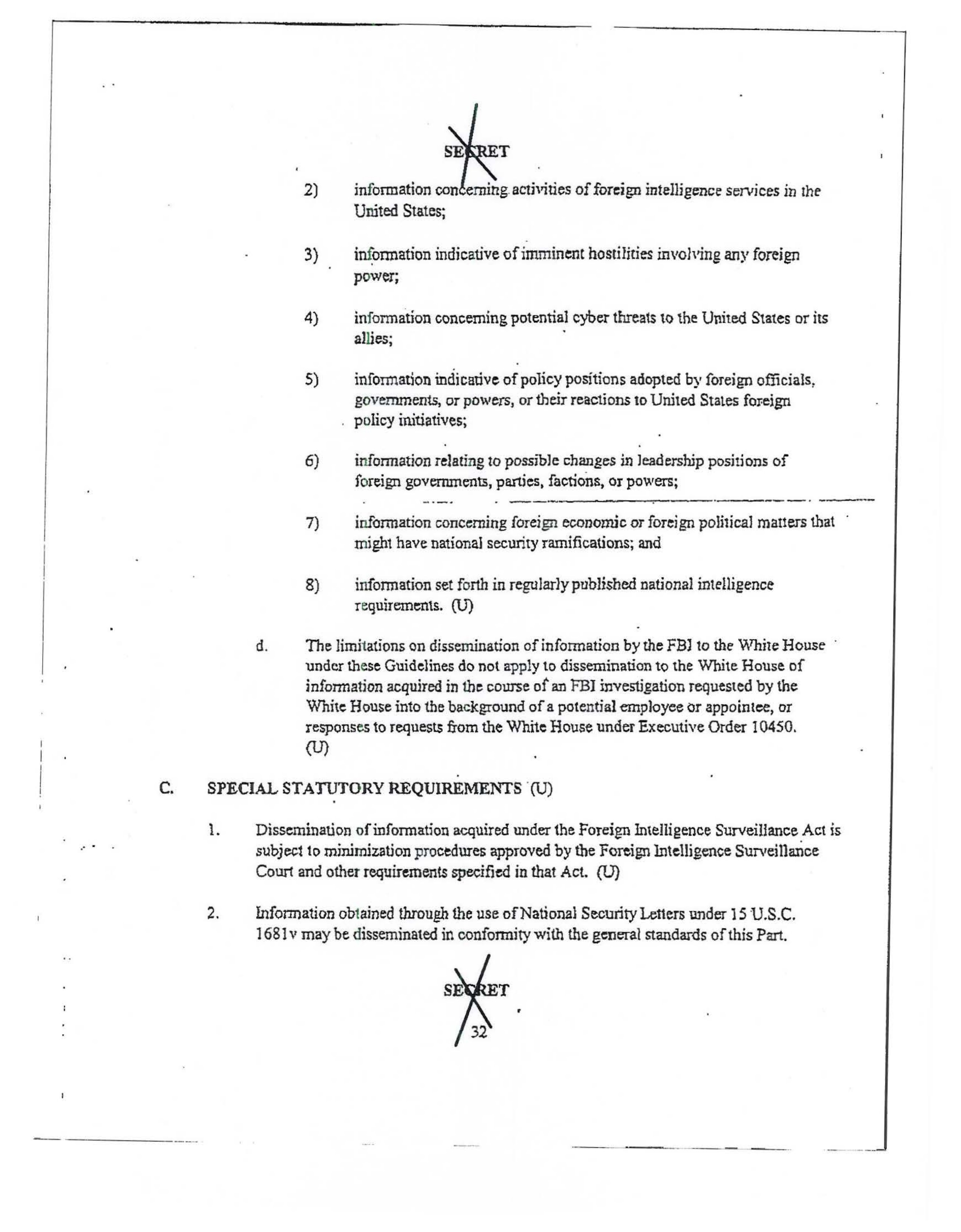
2) information concerning activities of foreign intelligence services in the
United States;
3) information indicative of imminent hostilities involving any foreign
power;
4) information concerning potential cyber threats to the United States or its
allies;
5) information indicative of policy positions adopted by foreign officials,
governments, or powers, or their reactions to United States foreign
policy initiatives;
6) information relating to possible changes in leadership positions of
foreign governments, parties, factions, or powers;
7) information concerning foreign economic or foreign political matters that
might have national security ramifications; and
8) information set forth in regularly published national intelligence
requirements. (U)
d. The limitations on dissemination of information by the FBI to the White House
under these Guidelines do not apply to dissemination to the White House of
information acquired in the course of an FBI investigation requested by the
White House into the background of a potential employee or appointee, or
responses to requests from the White House under Executive Order 10450.
(U)
C. SPECIAL STATUTORY REQUIREMENTS (U)
- Dissemination of information acquired under the Foreign Intelligence Surveillance Act is
subject to minimization procedures approved by the Foreign Intelligence Surveillance
Court and other requirements specified in that Act. (U)
- Information obtained through the use of National Security Letters under 15 U.S.C.
1681v may be disseminated in conformity with the general standards of this Part.
SECRET
32
SECRET
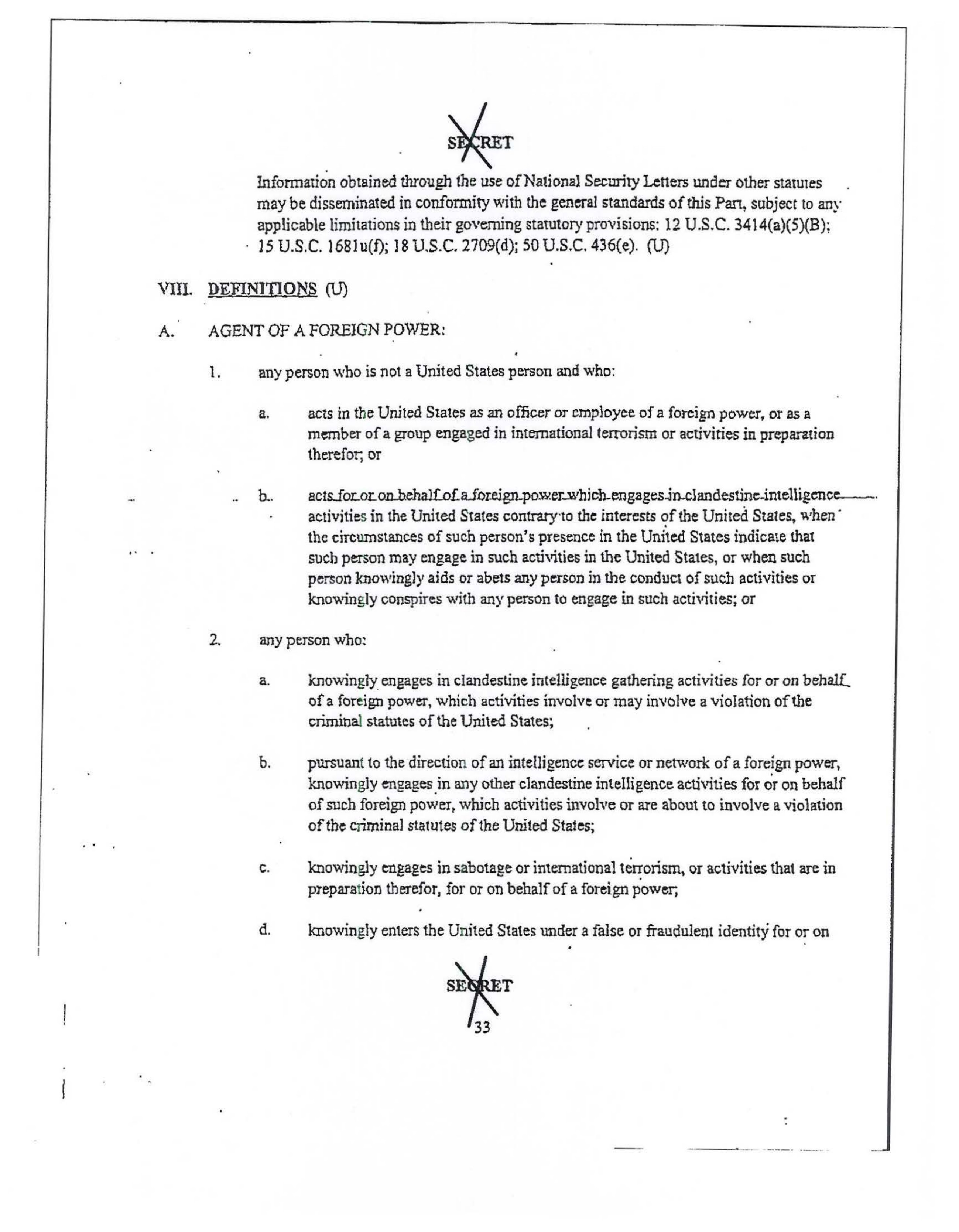
Information obtained through the use of National Security Letters under other statutes
may be disseminated in conformity with the general standards of this Part, subject to any
applicable limitations in their governing statutory provisions: 12 U.S.C. 3414(a)(5)(B);
15 U.S.C. 1681u(f); 18 U.S.C. 2709(d); 50 U.S.C. 436(e). (U)
VIII. DEFINITIONS (U)
A. AGENT OF A FOREIGN POWER:
- any person who is not a United States person and who:
a. acts in the United States as an officer or employee of a foreign power, or as a
member of a group engaged in international terrorism or activities in preparation
therefor; or
b. acts for or on behalf of a foreign power which engages in clandestine intelligence
activities in the United States contrary to the interests of the United States, when
the circumstances of such person's presence in the United States indicate that
such person may engage in such activities in the United States, or when such
person knowingly aids or abets any person in the conduct of such activities or
knowingly conspires with any person to engage in such activities; or
- any person who:
a. knowingly engages in clandestine intelligence gathering activities for or on behalf
of a foreign power, which activities involve or may involve a violation of the
criminal statutes of the United States;
b. pursuant to the direction of an intelligence service or network of a foreign power,
knowingly engages in any other clandestine intelligence activities for or on behalf
of such foreign power, which activities involve or are about to involve a violation
of the criminal statutes of the United States;
c. knowingly engages in sabotage or international terrorism, or activities that are in
preparation therefor, for or on behalf of a foreign power;
d. knowingly enters the United States under a false or fraudulent identity for or on
SECRET
33
SECRET
e. behalf of a foreign power or, while in the United States, knowingly assumes a
false or fraudulent identity for or on behalf of a foreign power; or
knowingly aids or abets any person in the conduct of activities described in
subparagraph a., b., or c., or knowingly conspires with any person to engage in
such activities. (U)
B. CONSENSUAL MONITORING OF COMMUNICATIONS: monitoring of oral, wire, or
electronic communications for which a court order or warrant is not legally required because of
the consent of a party to the communication. (U)
C. COUNTERINTELLIGENCE: information gathered and activities conducted to protect against
espionage or other intelligence activities, sabotage, or assassinations conducted by, for or on
behalf of foreign powers, organizations or persons, or international terrorist activities, but not
including personnel, physical, document or communications security programs. (U)
D. CRIME INVOLVED IN OR RELATED TO A THREAT TO THE NATIONAL SECURITY:
both crimes directly involved in activities constituting a threat to the national security, and crimes
that are preparatory for or facilitate or support such activities. For example, if international
terrorists engage in a bank robbery in order to finance their terrorist activities, the bank robbery
is a crime involved in or related to a threat to the national security. (U)
[REDACTED]
F. FOR OR ON BEHALF OF A FOREIGN POWER: the determination that activities are for or
on behalf of a foreign power shall be based on consideration of the extent to which the foreign
power is involved in:
- control or policy direction;
- financial or material support; or
- leadership, assignments, or discipline. (U)
G. FOREIGN COMPUTER INTRUSION: the use or attempted use of any cyber-activity or other
means by, for, or on behalf of a foreign power to scan, probe, or gain unauthorized access into
SECRET
34
SECRET
one or more U.S.-based computers. (U)
H. FOREIGN CONSULAR ESTABLISHMENT: the buildings or parts of buildings and the land
ancillary thereto, irrespective of ownership, used exclusively by a foreign government for the
purposes of a consular post. (U)
I. FOREIGN DIPLOMATIC ESTABLISHMENT: the buildings or parts of buildings and the land
ancillary thereto, irrespective of ownership, used by a foreign government for the purposes of a
diplomatic mission, such as an embassy or other premises and including the residence of the
head of the mission; premises of international organizations as defined by 22 U.S.C. 288;
premises of establishments authorized to be treated as international organizations or diplomatic
missions by specific statute (e.g., 22 U.S.C. 288f-1 to 288h); and the premises of establishments
of foreign representatives to such international organizations. (U)
J. FOREIGN INTELLIGENCE: information relating to the capabilities, intentions, or activities of
foreign powers, organizations, or persons, or international terrorist activities. (U)
K. FOREIGN OFFICIAL: a foreign national in the United States who is acting in an official
capacity for a foreign power, attached to a foreign diplomatic establishment, foreign consular
establishment, or other establishment under the control of a foreign power, or employed by an
international organization or other organization established under an agreement to which the
United States is a party. (U)
L. FOREIGN POWER:
- a foreign government or any component thereof, whether or not recognized by the
United States;
- a faction of a foreign nation or nations, not substantially composed of United States
person;
- an entity that is openly acknowledged by a foreign government or governments to be
directed and controlled by such foreign government or government;
- a group engaged in international terrorism or activities in preparation therefor;
- a foreign-based political organization, not substantially composed of United States
SECRET
35
SECRET
person; or
- an entity that is directed or controlled by a foreign government or governments. (U)
M. FOREIGN VISITOR: a foreign national in the United States who is not a permanent resident
alien of the United States. (U)
N. INTELLIGENCE ACTIVITIES: any activity conducted for intelligence purposes or to affect
political or governmental processes by, for, or on behalf of a foreign power. (U)
O. INTERNATIONAL TERRORISM:
Activities that:
- involve violent acts or acts dangerous to human life that are a violation of the criminal
laws of the United States or of any State, or that would be a criminal violation if
committed within the jurisdiction of the United States or any State;
- appear to be intended:
A. to intimidate or coerce a civilian population;
B. to influence the policy of a government by intimidation or coercion;
C. to affect the conduct of a government by assassination or kidnapping; and
- occur totally outside the United States, or transcend national boundaries in terms of the
means by which they are accomplished, the persons they appear to be intended to
coerce or intimidate, or the locale in which their perpetrators operate or seek asylum.
(U)
P. INTERNATIONAL TERRORIST: an individual or group that knowingly engages in
international terrorism or activities in preparation therefor, or knowingly aids, abets, or conspires
with any person engaged in such activities. (U)
Q. NATIONAL SECURITY INVESTIGATION: a counterintelligence investigation, pursuant to
Part II of these Guidelines, conducted to obtain information concerning or to protect against a
SECRET
36
SECRET
threat to the national security as defined in Part I.A.1. (U)
R. PHYSICAL SEARCH: any physical intrusion within the United States into premises or property
(including examination of the interior of property by technical means) that is intended to result in
the seizure, reproduction, inspection, or alteration of information, material, or property, under
circumstances in which a person has a reasonable expectation of privacy and a warrant would
be required for law enforcement purposes, but does not include: (1) electronic surveillance as
defined in FISA, or (2) the acquisition by the United States Government of foreign intelligence
information from international foreign communications, or foreign intelligence activities conducted
in accordance with otherwise applicable Federal law involving a foreign electronic
communications system, utilizing a means other than electronic surveillance as defined in FISA.
(U)
S. PUBLICLY AVAILABLE: information that has been published or broadcast for public
consumption, is available on request to the public, is accessible on-line or otherwise to the
public, is available to the public by subscription or purchase, could lawfully be seen or heard by
any casual observer, is made available at a meeting open to the public, or is obtained by visiting
any place or attending any event that is open to the public. (U)
T. RECORDS: any records, databases, files, indices, information systems, or other retained
information. (U)
U. [REDACTED]
V. SPECIAL AGENT IN CHARGE: the Special Agent in Charge of a field office, including an
Acting Special Agent in Charge. In a field office headed by an Assistant Director, the functions
authorized for Special Agents in Charge by these Guidelines may be exercised by the Assistant
Director in Charge, or by any Special Agent in Charge as authorized by the Assistant Director in
Charge. (U)
W. STRATEGIC ANALYSIS: assessment and analysis of information gathered and activities
conducted to produce and disseminate foreign intelligence and counterintelligence. (U)
SECRET
37
SECRET
Y. UNDISCLOSED PARTICIPATION: joining or participating in the activities of an organization
by an FBI asset or employee without disclosure of FBI affiliation, but not including participation
with the knowledge and approval of an official of the organization authorized to act in relation to
the activities in question, attendance at an activity open to the public or to acknowledged U.S.
Government employees, personal activities not related to FBI employment, or attendance at an
academic institution to obtain education or training relevant to FBI employment or to a future
undercover role. (U)
Z. UNITED STATES: when used in a geographical sense, means all areas under the territorial
sovereignty of the United States. (U)
Date: October 31, 2003
John Ashcroft
Attorney General
SECRET
38
Related Documents
-
-
August 17, 2006 NSA Presentation for the FISC FOIA [pdf]
An NSA presentation for the FISC on the bulk telephony metadata program pursuant to Section 501 of FISA and notification of two compliance issues concerning the collection. ACLU/EFF FOIA Litigation.
ACLU,EFF ↗ (2013-11-18) -
Cover Letter: DOJ to Congressional and Judiciary Intelligence Committees on Several FISC Documents Related to Section 215 FOIA [pdf]
A letter from the DOJ’s Office of Legislative Affairs to the Congressional Intelligence and Judiciary Committees relating to the NSA collection of bulk telephony metadata under Section 501 of FISA, as amended by Section 215 of the Patriot Act. ACLU/EFF FOIA Litigation.
People: Leahy, Patrick J. · Conyers, John Jr. · Feinstein, Dianne · Reyes, Silvestre · Sessions, Jeff · Bond, Christopher S. · Smith, Lamar S. · Hoekstra, Peter · Bates, John D. · Weich, RonaldACLU,EFF ↗ (2013-10-28) -
September 1, 2009 NSA Presentation for the FISC FOIA [pdf]
An NSA presentation regarding NSA’s bulk telephony metadata program pursuant to Section 501 of FISA with respect to NSA’s compliance with the Court’s orders. ACLU/EFF FOIA Litigation.
Programs: NAVIGATORPeople: DeLong, John M.ACLU,EFF ↗ (2013-11-18) -
Production to Congress of a May 23, 2006 Government Memorandum of Law FOIA [pdf]
A memo in support of the government’s application to the FISC for authorization of metadata collection under Section 501 of FISA. ACLU/EFF FOIA Litigation.
People: al-Zawahiri, Ayman · bin Laden, Osama · Redd, John Scott · Alexander, Keith B. · Gonzales, Alberto R. · McConnell, J. M.ACLU,EFF ↗ (2013-11-18)