January 8, 2007 NSA Web-Based Training Slides
Open PDFDocument date: 2007-01-08
Type: FOIA
Pages: 39
Classification: TOP SECRET COMINT
Dissemination: NOFORN
A 2007 NSA web-based training presentation on its bulk telephony metadata program pursuant to Section 501 of FISA. ACLU/EFF FOIA Litigation.
My notes
TOP SECRET
(Security Classification)
ROUTING
| TO: | NAME AND ADDRESS | DATE | INITIALS |
|---|---|---|---|
| 1 | |||
| 2 | |||
| 3 | |||
| 4 | |||
| ACTION | DIRECT REPLY | PREPARE REPLY | |
| APPROVAL | DISPATCH | RECOMMENDATION | |
| COMMENT | FILE | RETURN | |
| CONCURRENCE | INFORMATION | SIGNATURE | |
| REMARKS: |
CONTROL NO.
COPY OF
FROM: NAME, ADDRESS, AND PHONE NO. DATE
Handle Via
CONTAINS SENSITIVE COMINT
COMPARTMENTED INFORMATION Channels
Access to this document will be restricted to
those approved for the following specific activities:
[REDACTED]
CONTAINS SENSITIVE
COMPARTMENTED INFORMATION
NATIONAL SECURITY INFORMATION
Unauthorized Disclosure Subject to Criminal Sanctions
[REDACTED]
TOP SECRET
(Security Classification)
TOP SECRET//COMINT//NOFORN
Business Records FISA
Business Records (BR) FISA Course Welcome
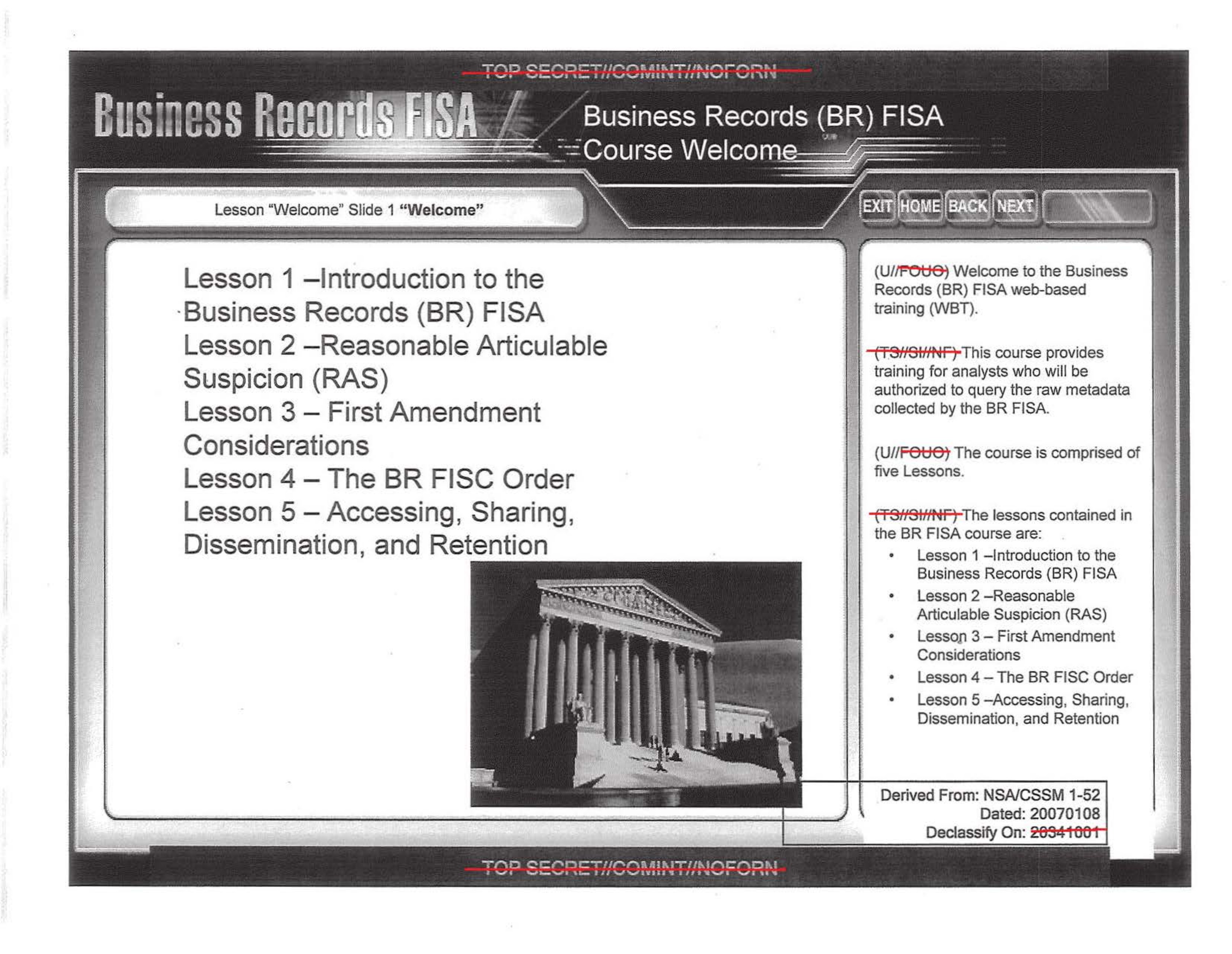
Lesson "Welcome" Slide 1 "Welcome"
| Lesson 1 -Introduction to the | (U//FOUO) Welcome to the Business Records (BR) FISA web-based training (WBT). |
| Business Records (BR) FISA | |
| Lesson 2 -Reasonable Articulable | (TS//SI//NF) This course provides training for analysts who will be authorized to query the raw metadata collected by the BR FISA. |
| Suspicion (RAS) | |
| Lesson 3 - First Amendment | (U//FOUO) The course is comprised of five Lessons. |
| Considerations | |
| Lesson 4 - The BR FISC OrderLesson 5 - Accessing, Sharing, Dissemination, and Retention | (TS//SI//NF) The lessons contained in the BR FISA course are: |
| - Lesson 1-Introduction to the Business Records (BR) FISA | |
| - Lesson 2-Reasonable Articulable Suspicion (RAS) | |
| - Lesson 3 - First Amendment Considerations | |
| - Lesson 4-The BR FISC Order | |
| - Lesson 5-Accessing, Sharing, Dissemination, and Retention | |
| Derived From: NSA/CSSM 1-52 | |
| Dated: 20070108 | |
| Declassify On: 20341001 |
TOP SECRET//COMINT//NOFORN
Business Records FISA
Business Records (BR) FISA Course Welcome
Lesson "Welcome" Slide 2 "Lesson Titles and Lesson objectives"
(U//FOUO) The course begins with an overview of the BR FISA authority and then moves into an overview of the Reasonable Articulable Suspicion standard. Next, students will explore First Amendment considerations before taking a closer look at the BR FISC Order. The BR Order points out special considerations that distinguish this FISA authority from other FISAs typically encountered at this Agency. The final lesson of this course provides specific rules and procedures regarding the access, sharing, dissemination, and retention of BR FISA metadata.
TOP SECRET//COMINT//NOFORN
Business Records FISA
Business Records (BR) FISA Course Welcome
Lesson "Welcome", Slide 3 Course Objectives
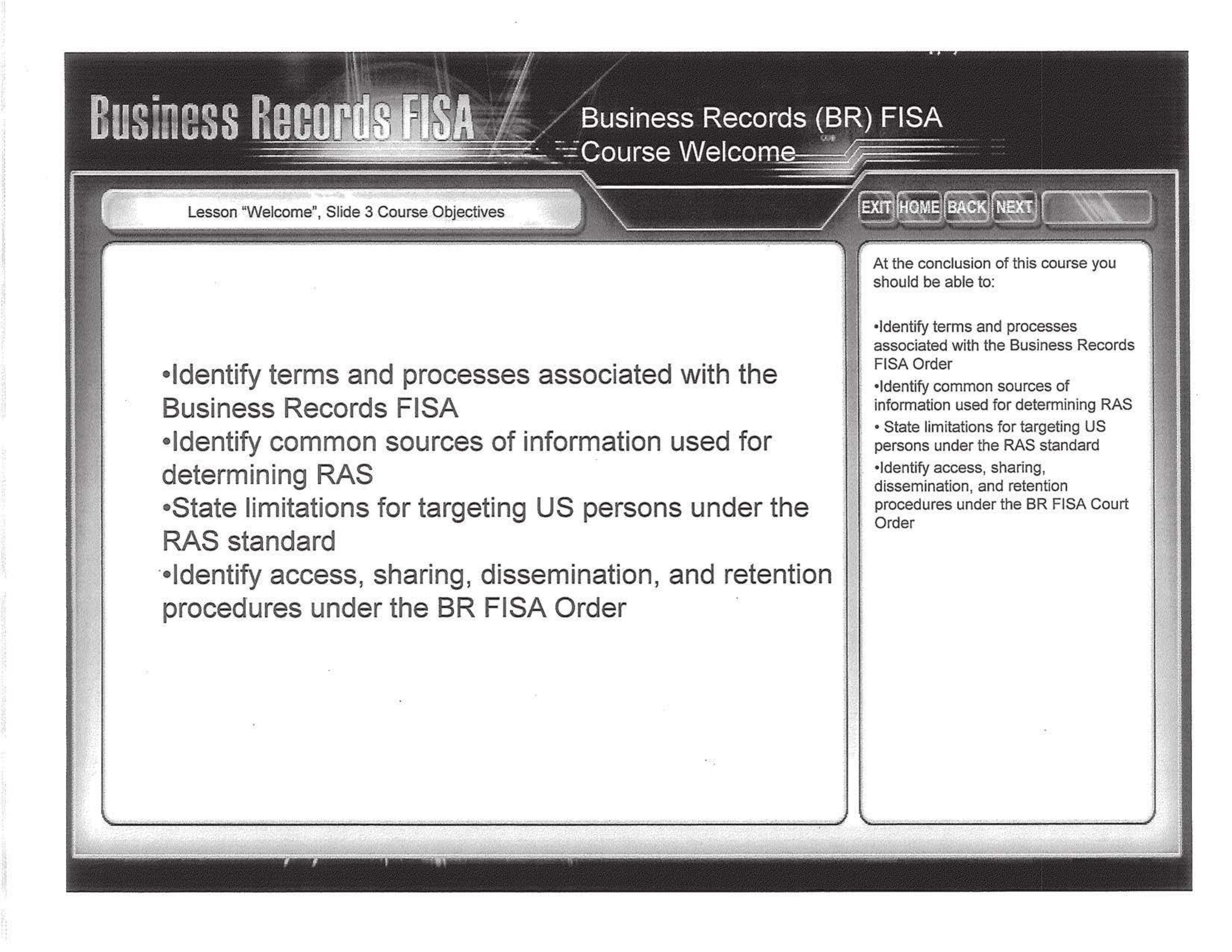
- Identify terms and processes associated with the Business Records FISA
- Identify common sources of information used for determining RAS
- State limitations for targeting US persons under the RAS standard
- Identify access, sharing, dissemination, and retention procedures under the BR FISA Order
At the conclusion of this course you should be able to:
- Identify terms and processes associated with the Business Records FISA Order
- Identify common sources of information used for determining RAS
- State limitations for targeting US persons under the RAS standard
- Identify access, sharing, dissemination, and retention procedures under the BR FISA Court Order
TOP SECRET//COMINT//NOFORN
Business Records FISA
Business Records (BR) FISA Course Welcome
Lesson "Welcome", Slide 4 "Legal Readings Access"
(U//FOUO) As you progress through the different course lessons you may want to also access the related Legal Readings. The two core readings are the Reasonable Articulable Suspicion (RAS) memorandum written by OGC and the BR FISC Order Issued by the FISA Court.
(U//FOUO) You can access these documents by clicking on the Legal Readings button located in eCampus.
Business Records FISA
Lesson 1 - Introduction to the Business Records (BR) FISA
Lesson 1 Slide 1 Introduction and Definitions
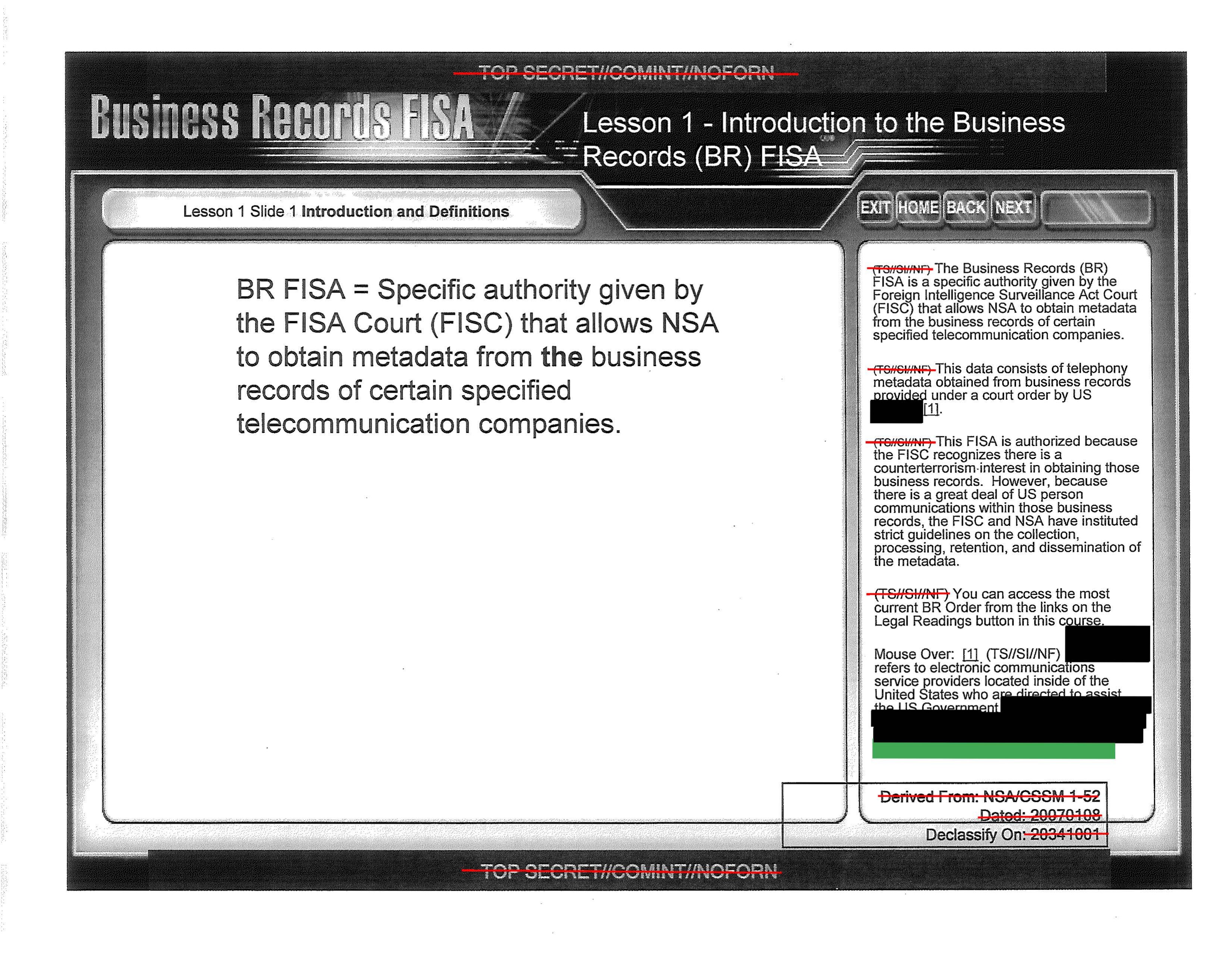
BR FISA = Specific authority given by the FISA Court (FISC) that allows NSA to obtain metadata from the business records of certain specified telecommunication companies.
(TO/SWNF) The Business Records (BR) FISA is a specific authority given by the Foreign Intelligence Surveillance Act Court (FISC) that allows NSA to obtain metadata from the business records of certain specified telecommunication companies.
(TS/SWNF) This data consists of telephony metadata obtained from business records provided under a court order by US [REDACTED].
(TS/GWWNF) This FISA is authorized because the FISC recognizes there is a counterterrorism-interest in obtaining those business records. However, because there is a great deal of US person communications within those business records, the FISC and NSA have instituted strict guidelines on the collection, processing, retention, and dissemination of the metadata.
(TS//SI//NF) You can access the most current BR Order from the links on the Legal Readings button in this course.
Mouse Over: [1] (TS//SI//NF) refers to electronic communications service providers located inside of the United States who are directed to assist the US Government [REDACTED]
TOP SECRET//COMINT//NOFORN
Derived From: NSA/CSSM 1-52
Dated: 20070108
Declassify On: 20341001
TOP SECRET//COMINT//NOFORN
Business Records FISA
Lesson 1 - Introduction to the Business Records (BR) FISA
Lesson 1 Slide 2 Introduction to the BR -Objectives
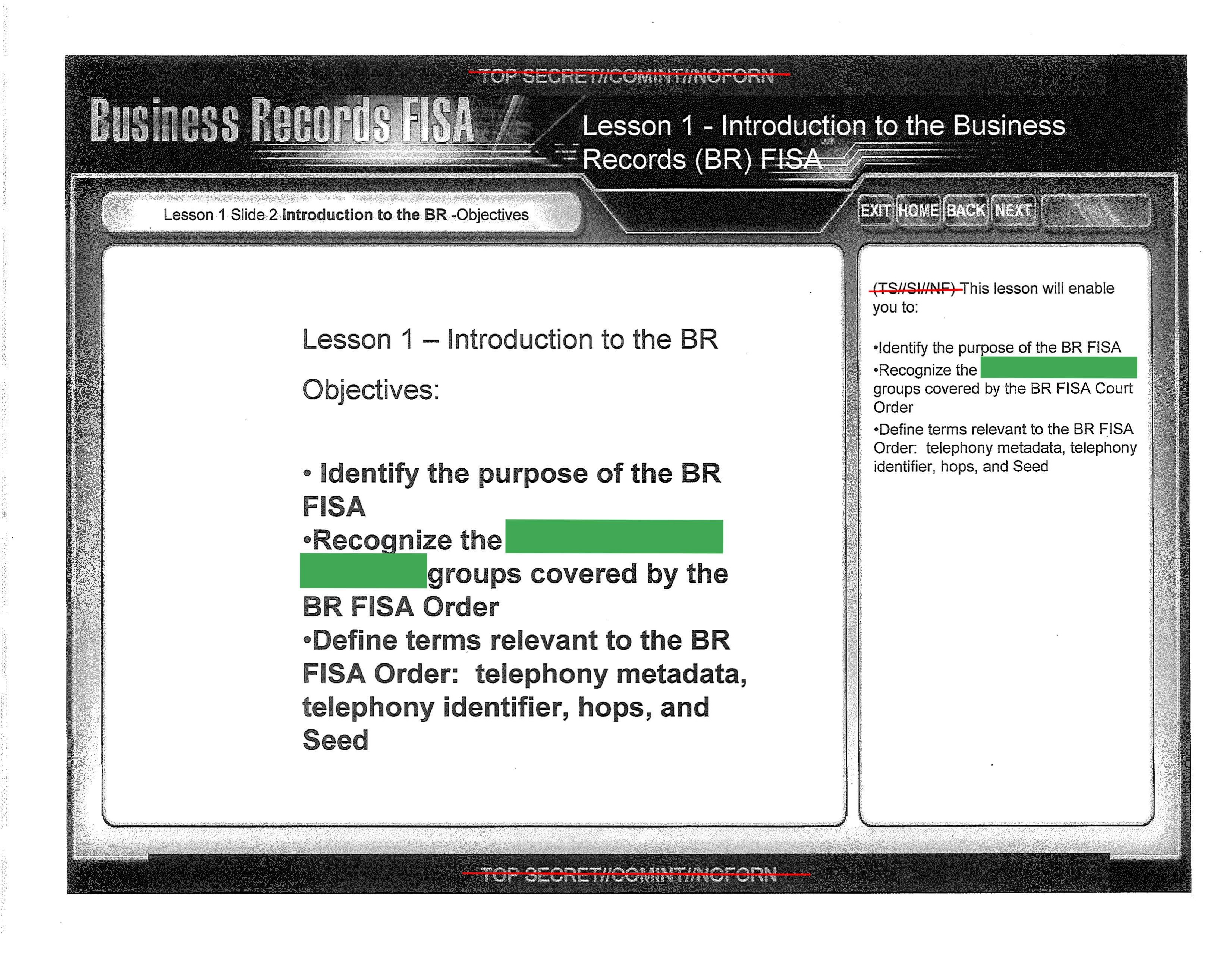
Lesson 1 - Introduction to the BR Objectives:
- Identify the purpose of the BR FISA
- Recognize the [REDACTED] groups covered by the BR FISA Order
- Define terms relevant to the BR FISA Order: telephony metadata, telephony identifier, hops, and Seed
(TS//SI//NF) This lesson will enable you to:
- Identify the purpose of the BR FISA
- Recognize the [REDACTED] groups covered by the BR FISA Court Order
- Define terms relevant to the BR FISA Order: telephony metadata, telephony identifier, hops, and Seed
TOP SECRET//COMINT//NOFORN
TOP SECRET//COMINT//NOFORN
Business Records FISA
Lesson 1 - Introduction to the Business Records (BR) FISA
Lesson 1 Slide 3 Overview of RAS
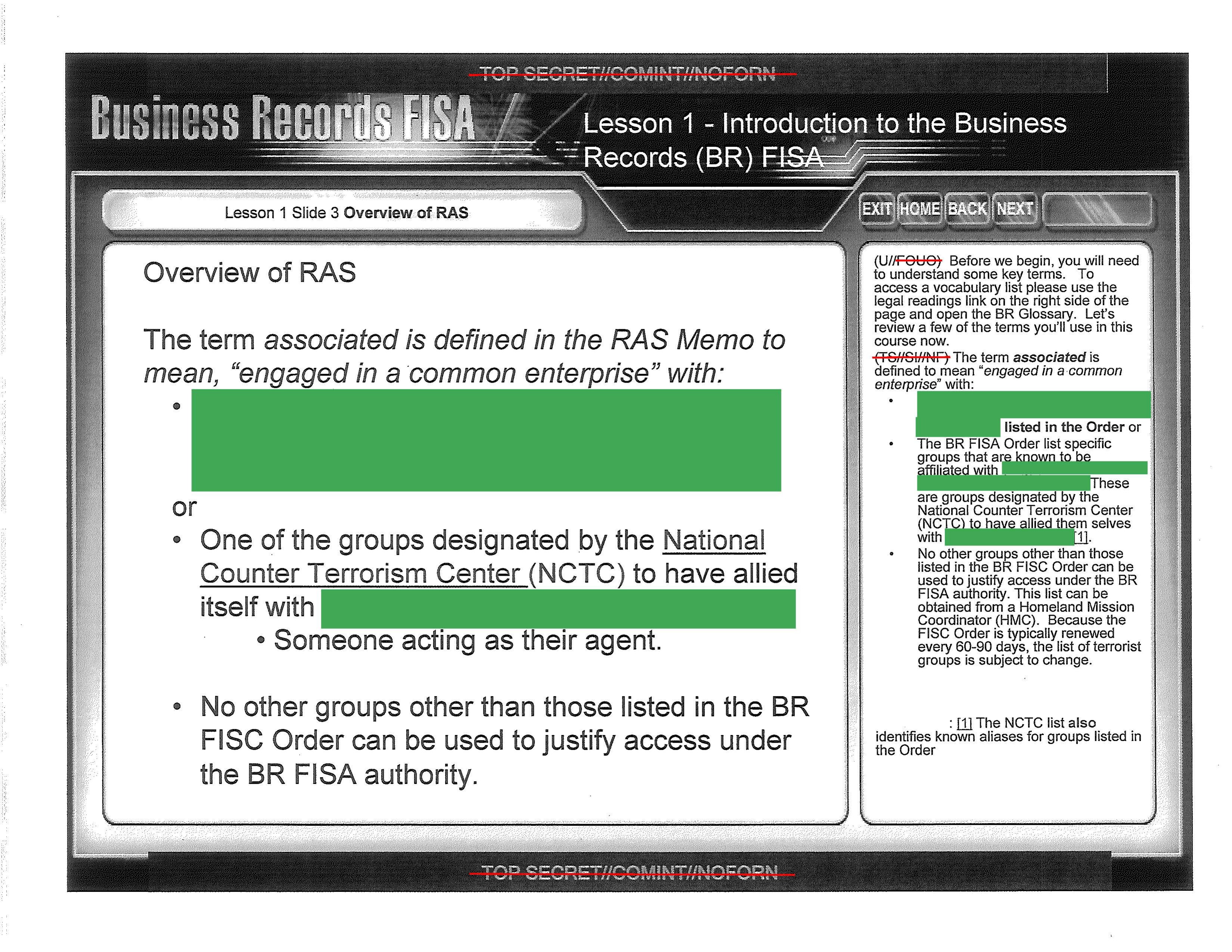
Overview of RAS
The term associated is defined in the RAS Memo to mean, "engaged in a common enterprise" with:
- [REDACTED]
or
- One of the groups designated by the National Counter Terrorism Center (NCTC) to have allied itself with [REDACTED]
- Someone acting as their agent.
- No other groups other than those listed in the BR FISC Order can be used to justify access under the BR FISA authority.
(U//FOUO) Before we begin, you will need to understand some key terms. To access a vocabulary list please use the legal readings link on the right side of the slide and also when you finish this course review a few of the terms you'll use in this course now.
(TS//SI//NF) The term associated is defined to mean "engaged in a common enterprise" with:
- [REDACTED] listed in the Order or [REDACTED].
- The BR FISA Order list specific groups that are known to be affiliated with [REDACTED]. These are groups designated by the National Counter Terrorism Center (NCTC) to have allied them selves with [REDACTED].
- No other groups other than those listed in the BR FISC Order can be used to justify access under the BR FISA authority. Information obtained from a Homeland Mission Coordinator (HMC). Because the FISC Order is typically renewed every 60-90 days, the list of terrorist groups is subject to change.
- [1] The NCTC list also identifies known aliases for groups listed in the Order.
TOP SECRET//COMINT//NOFORN
TOP SECRET//COMINT//NOFORN
Business Records FISA
Lesson 1 - Introduction to the Business Records (BR) FISA
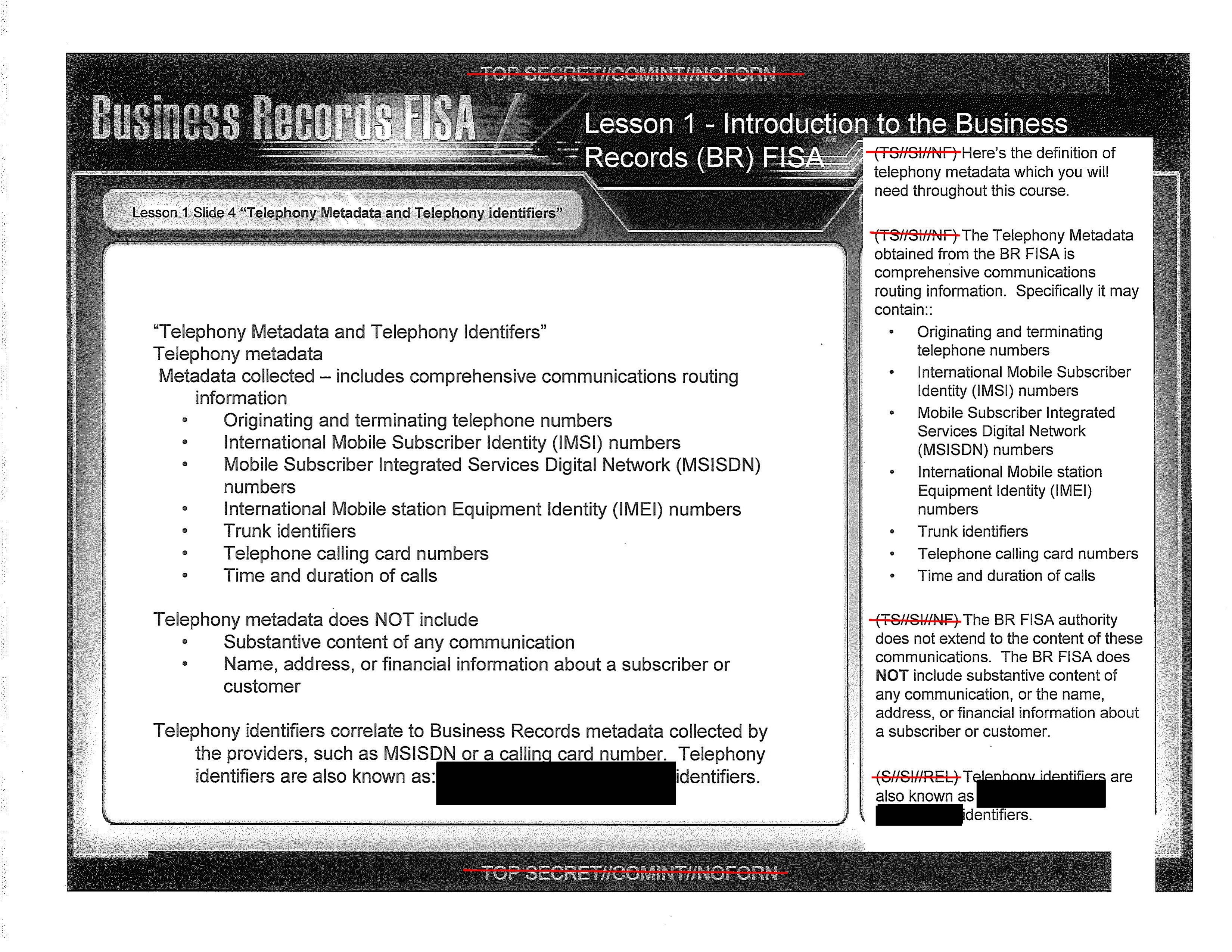
(TS//SI//NF) Here's the definition of telephony metadata which you will need throughout this course.
Lesson 1 Slide 4 "Telephony Metadata and Telephony Identifiers"
"Telephony Metadata and Telephony Identifiers"
Telephony metadata
Metadata collected – includes comprehensive communications routing information
- Originating and terminating telephone numbers
- International Mobile Subscriber Identity (IMSI) numbers
- Mobile Subscriber Integrated Services Digital Network (MSISDN) numbers
- International Mobile station Equipment Identity (IMEI) numbers
- Trunk identifiers
- Telephone calling card numbers
- Time and duration of calls
Telephony metadata does NOT include
- Substantive content of any communication
- Name, address, or financial information about a subscriber or customer
Telephony identifiers correlate to Business Records metadata collected by the providers, such as MSISDN or a calling card number. Telephony identifiers are also known as: [REDACTED] identifiers.
(TS//SI//NF) The Telephony Metadata obtained from the BR FISA is comprehensive communications routing information. Specifically it may contain::
- Originating and terminating telephone numbers
- International Mobile Subscriber Identity (IMSI) numbers
- Mobile Subscriber Integrated Services Digital Network (MSISDN) numbers
- International Mobile station Equipment Identity (IMEI) numbers
- The trunk identifier
- Telephone calling card numbers
- Time and duration of call
(TS//SI//NF) The BR FISA authority does not extend to the content of these communications. The BR FISA does NOT include substantive content of any communication or the name, address, or financial information about a subscriber or customer.
(S//SI//REL) Telephony identifiers are also known as [REDACTED] identifiers.
TOP SECRET//COMINT//NOFORN
TOP SECRET//COMINT//NOFORN
Business Records FISA
Lesson 1 - Introduction to the Business Records (BR) FISA
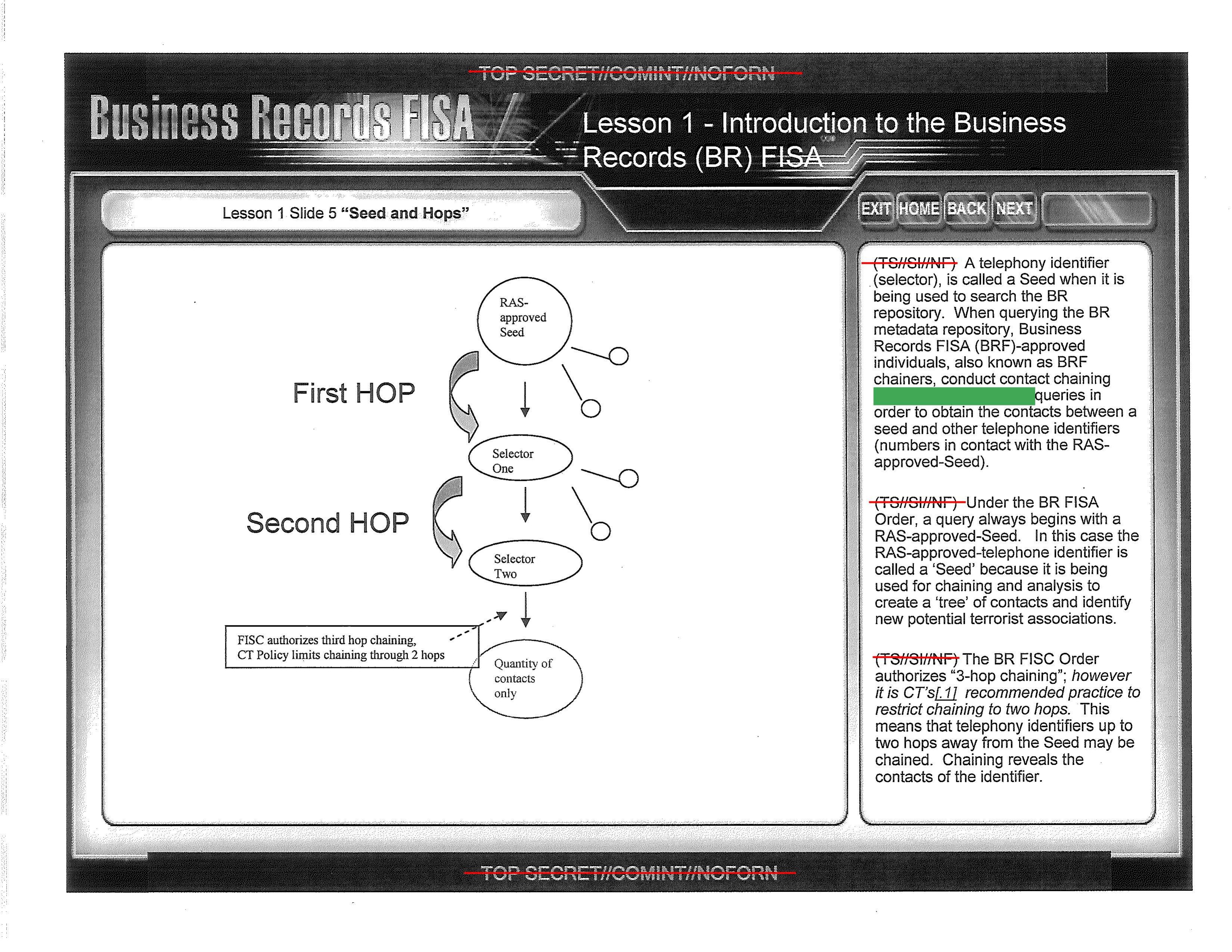
Lesson 1 Slide 5 "Seed and Hops"
| First HOP | RAS-approved Seed |
|---|---|
| Selector One | |
| Second HOP | Selector Two |
FISC authorizes third hop chaining,
CT Policy limits chaining through 2 hops
Quantity of
contacts
only
(TS//SI//NF) A telephony identifier (selector), is called a Seed when it is being used to search the BR repository. When querying the BR metadata repository, Business Records FISA (BRF)-approved individuals, also known as BRF chainers, conduct contact chaining queries in [REDACTED] order to obtain the contacts between a seed and other telephone identifiers (numbers in contact with the RAS-approved-Seed).
(TS//SI//NF) Under the BR FISA Order, a query always begins with a RAS-approved-Seed. In this case the RAS-approved-telephone identifier is called a 'Seed' because it is being used for chaining and analysis to create a 'tree' of contacts and identify new potential terrorist associations.
(TS//SI//NF) The BR FISC Order authorizes "3-hop chaining"; however it is CT's[.1] recommended practice to restrict chaining to two hops. This means that telephony identifiers up to two hops away from the Seed may be chained. Chaining reveals the contacts of the identifier.
TOP SECRET//COMINT//NOFORN
TOP SECRET//COMINT//NOFORN
Business Records FISA
Lesson 1 - Introduction to the Business Records (BR) FISA
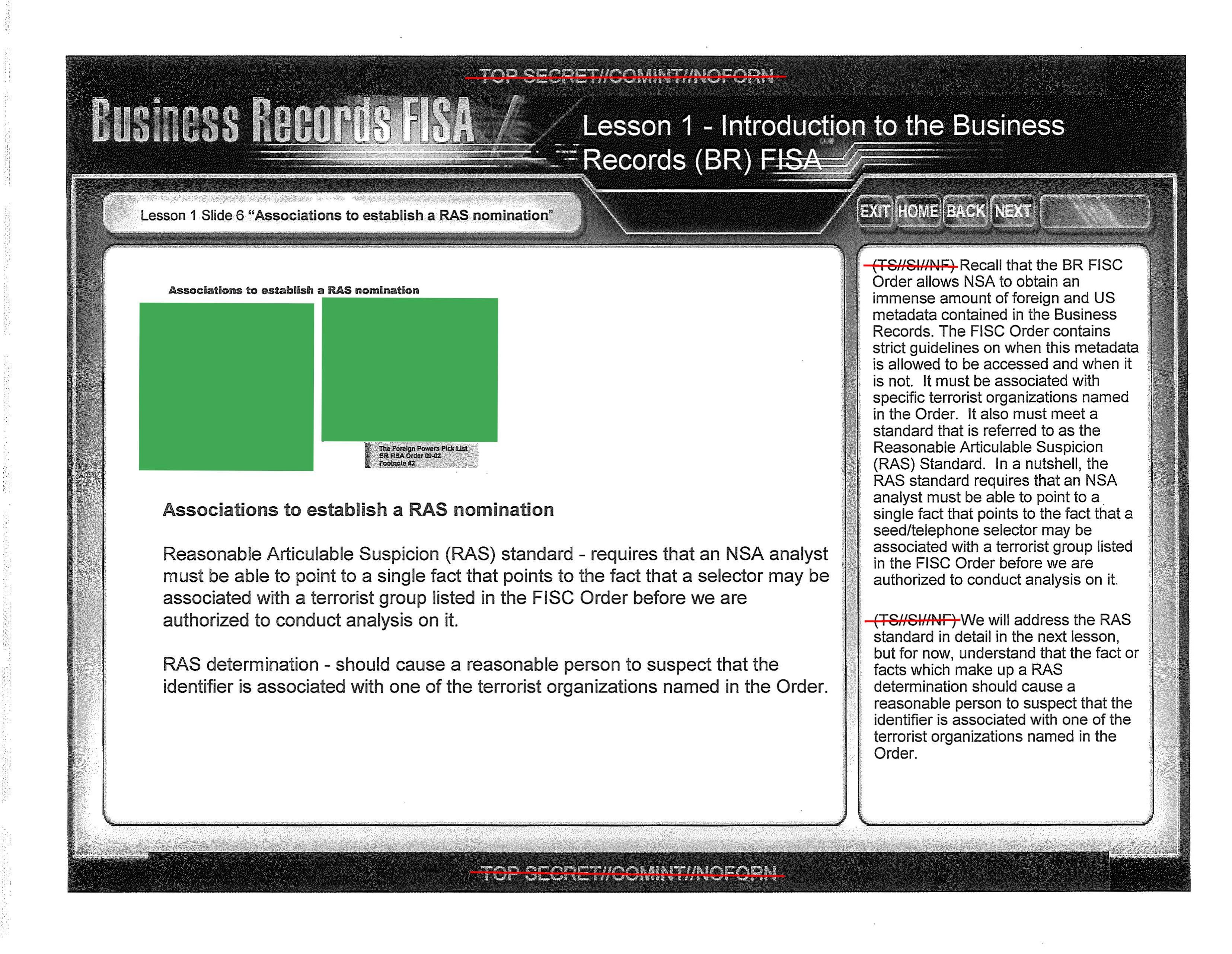
Lesson 1 Slide 6 "Associations to establish a RAS nomination"
Associations to establish a RAS nomination
[REDACTED]
The Foreign Powers Pick List.
[.2] This appears on all
nominations
Associations to establish a RAS nomination
Reasonable Articulable Suspicion (RAS) standard - requires that an NSA analyst must be able to point to a single fact that points to the fact that a selector may be associated with a terrorist group listed in the FISC Order before we are authorized to conduct analysis on it.
RAS determination - should cause a reasonable person to suspect that the identifier is associated with one of the terrorist organizations named in the Order.
(TS//SI//NF) Recall that the BR FISC Order allows NSA to obtain an immense amount of data and US metadata contained in the Business Records. The FISC Order contains strict guidelines on when this metadata is allowed to be accessed and when it is not. It must be associated with specific terrorist organizations named in the Order. It also must meet a standard that is referred to as the Reasonable Articulable Suspicion (RAS) Standard. In a nutshell, the RAS standard requires that an NSA analyst must be able to point to a single fact that points to the fact that a seed/telephone selector may be associated with a terrorist group listed in the FISC Order before we are authorized to conduct analysis on it.
(TS//SI//NF) We will address the RAS standard in detail in the next lesson, but for now, understand that the fact or facts which make up a RAS determination should cause a reasonable person to suspect that the identifier is associated with one of the terrorist organizations named in the Order.
TOP SECRET//COMINT//NOFORN
UNCLASSIFIED//FOR OFFICIAL USE ONLY
Business Records FISA
Lesson 1 - Introduction to the Business Records (BR) FISA
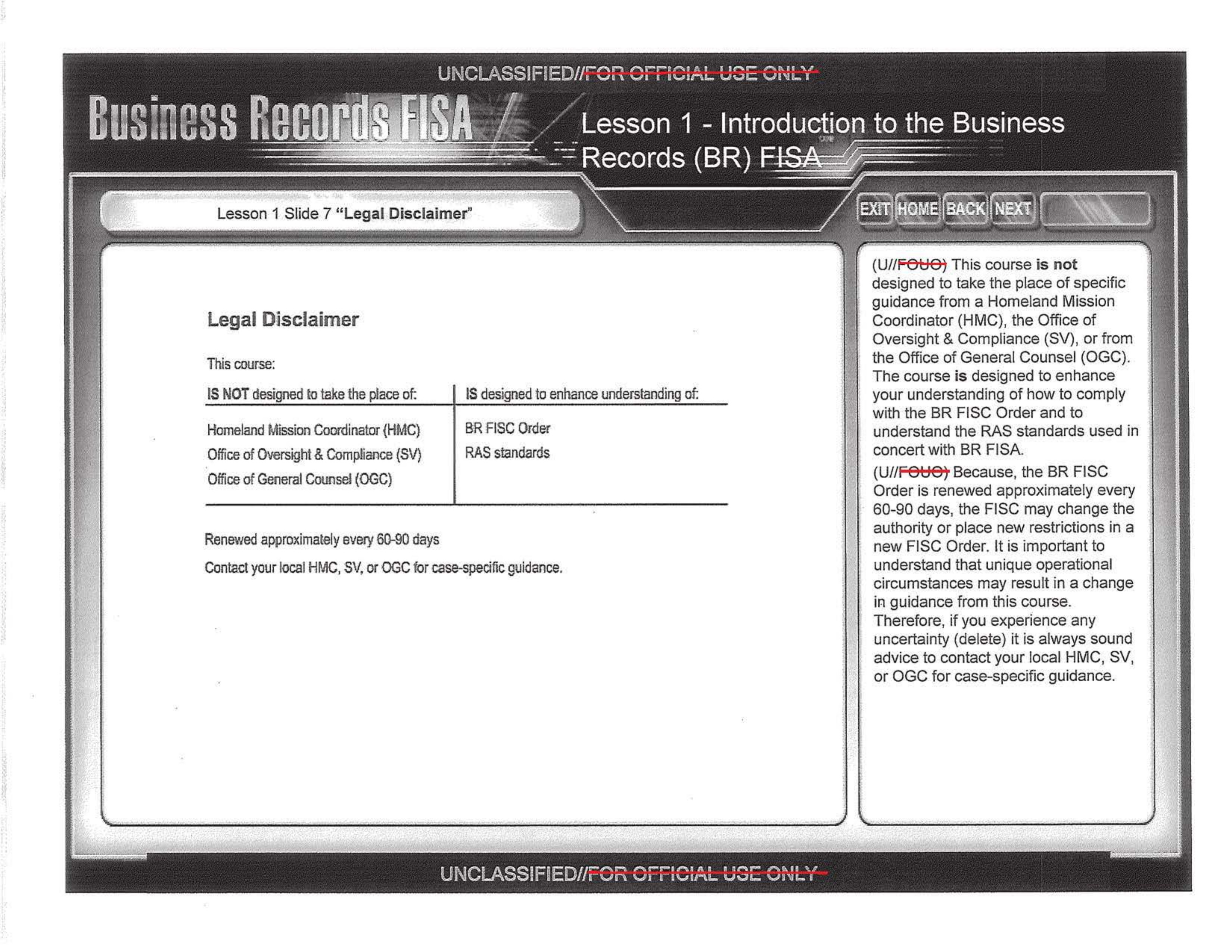
Lesson 1 Slide 7 "Legal Disclaimer"
Legal Disclaimer
This course:
| IS NOT designed to take the place of: | IS designed to enhance understanding of: |
|---|---|
| Homeland Mission Coordinator (HMC) | BR FISC Order |
| Office of Oversight & Compliance (SV) | RAS standards |
| Office of General Counsel (OGC) |
Renewed approximately every 60-90 days
Contact your local HMC, SV, or OGC for case-specific guidance.
(U//FOUO) This course is not designed to take the place of specific guidance from a Homeland Mission Coordinator (HMC), the Office of Oversight & Compliance (SV), or from the Office of General Counsel (OGC). The course is designed to enhance your understanding of how to comply with the BR FISC Order and to understand the RAS standards used in concert with BR FISA.
(U//FOUO) Because, the BR FISC Order is renewed approximately every 60-90 days, the FISC may change the authority or place new restrictions in a new FISC Order. It is important to understand that unique operational circumstances may result in a change in guidance from this course. Therefore, if you experience any uncertainty (delete) it is always sound advice to contact your local HMC, SV, or OGC for case-specific guidance.
UNCLASSIFIED//FOR OFFICIAL USE ONLY
TOP SECRET//COMINT//NOFORN
Business Records FISA
Lesson 1 - Introduction to the Business Records (BR) FISA
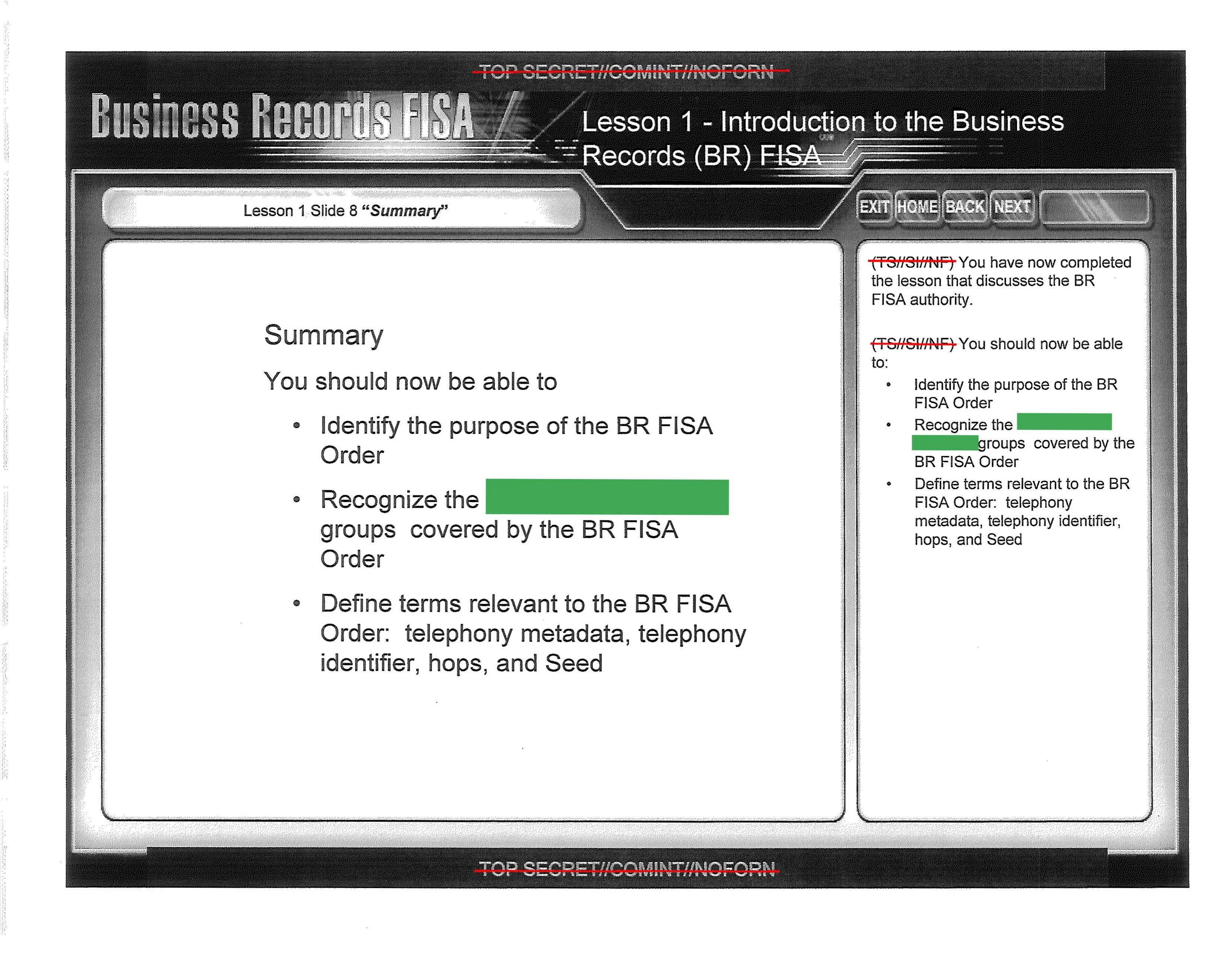
Lesson 1 Slide 8 "Summary"
Summary
You should now be able to
- Identify the purpose of the BR FISA Order
- Recognize the [REDACTED] groups covered by the BR FISA Order
- Define terms relevant to the BR FISA Order: telephony metadata, telephony identifier, hops, and Seed
(TS//SI//NF) You have now completed the lesson that discusses the BR FISA authority.
(TS//SI//NF) You should now be able to:
- Identify the purpose of the BR FISA Order
- Recognize the [REDACTED] groups covered by the BR FISA Order
- Define terms relevant to the BR FISA Order: telephony metadata, telephony identifier, hops, and Seed
TOP SECRET//COMINT//NOFORN
TOP SECRET//COMINT//NOFORN
Business Records FISA
Lesson 2: Reasonable Articulable Suspicion (RAS)
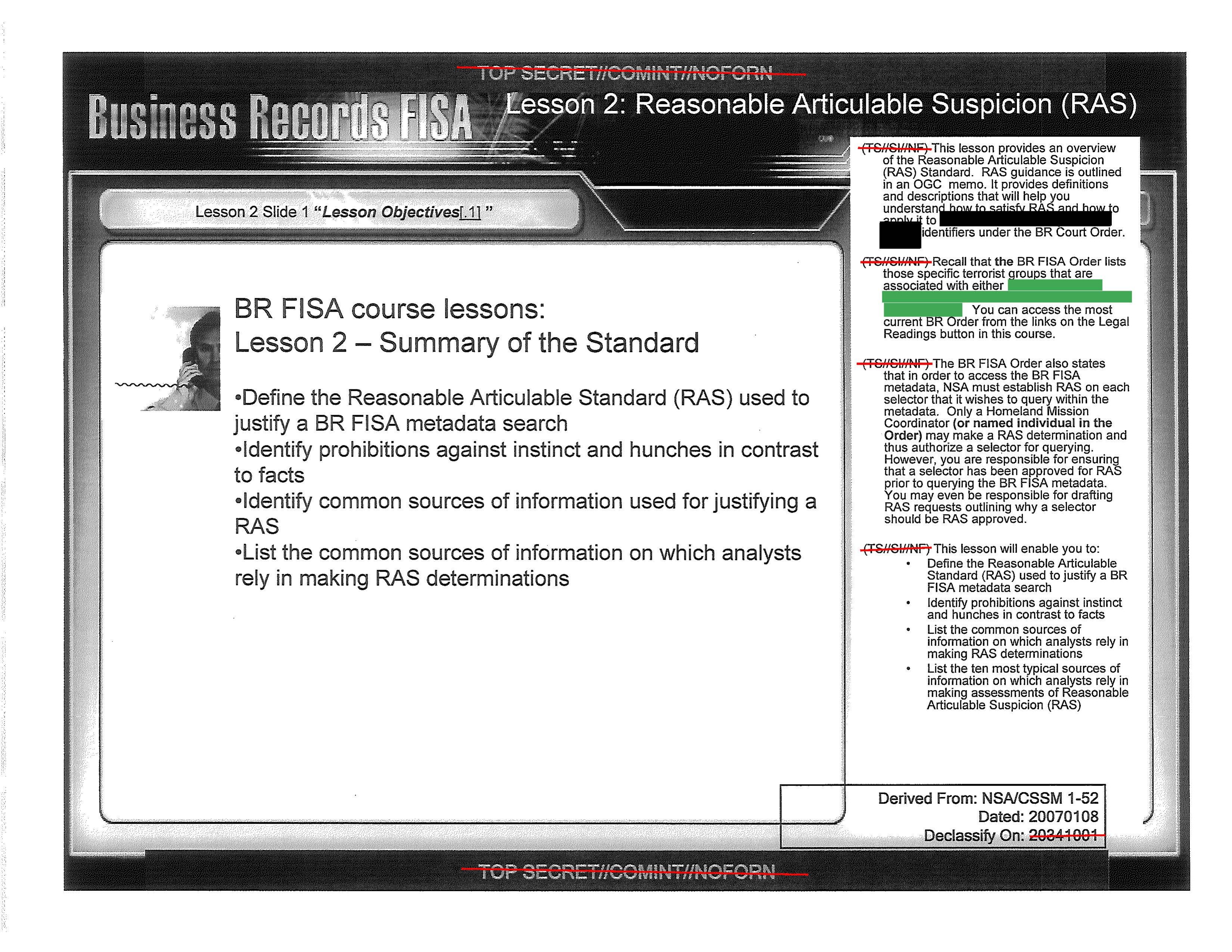
Lesson 2 Slide 1 “Lesson Objectives[.1] "
BR FISA course lessons: Lesson 2 - Summary of the Standard
- Define the Reasonable Articulable Standard (RAS) used to justify a BR FISA metadata search
- Identify prohibitions against instinct and hunches in contrast to facts
- Identify common sources of information used for justifying a RAS
- List the common sources of information on which analysts rely in making RAS determinations
(TS//SI//NF) This lesson provides an overview of the Reasonable Articulable Suspicion (RAS) Standard. RAS guidance is outlined in an OGC memo. It provides definitions and descriptions that will help you understand how to satisfy RAS and how to apply it to [REDACTED] identifiers under the BR Court Order.
(TS//SI//NF) Recall that the BR FISA Order lists those specific terrorist groups that are associated with either [REDACTED]. You can access the most current BR Order from the links on the Legal Readings button in this course.
(TS//CI//NF) The BR FISA Order also states that in order to access the BR FISA metadata, NSA must establish RAS on each selector that it wishes to query within the metadata. Only a Homeland Mission Coordinator (or named individual in the Order) may make a RAS determination and thus authorize a selector for querying. However, you are responsible for ensuring that a selector has been approved for RAS prior to querying the BR FISA metadata. You may even be responsible for drafting RAS requests outlining why a selector should be RAS approved.
(TS//SI//NF) This lesson will enable you to:
- Define the Reasonable Articulable Standard (RAS) used to justify a BR FISA metadata search
- Identify prohibitions against instinct and hunches in contrast to facts
- List the common sources of information on which analysts rely in making RAS determinations
- List the ten most typical sources of information on which analysts rely in making assessments of Reasonable Articulable Suspicion (RAS)
TOP SECRET//COMINT//NOFORN
Derived From: NSA/CSSM 1-52
Dated: 20070108
Declassify On: 20341001
TOP SECRET//COMINT//NOFORN-
Business Records FISA
Lesson 2: Reasonable Articulable Suspicion (RAS)
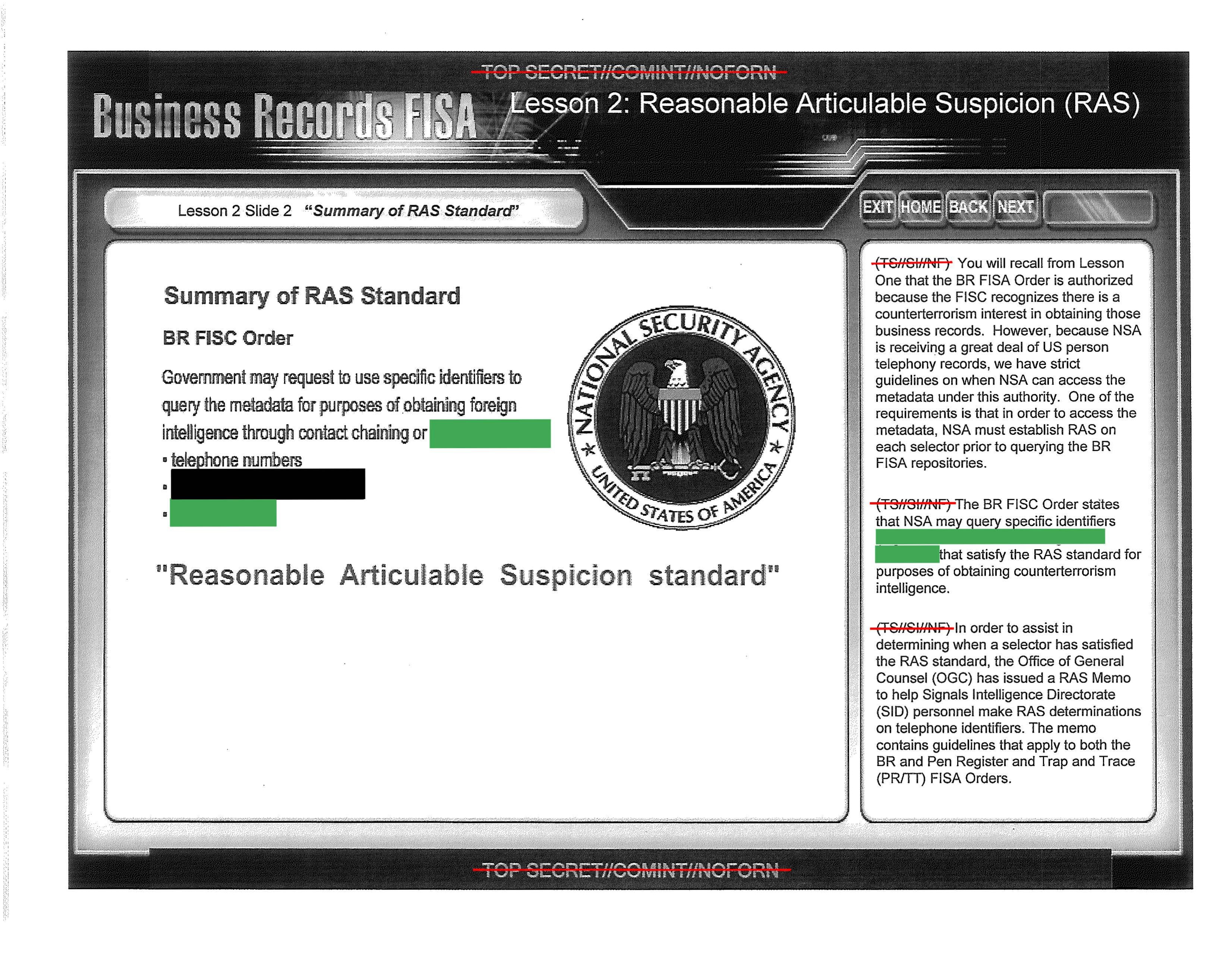
Lesson 2 Slide 2 "Summary of RAS Standard"
Summary of RAS Standard
BR FISC Order
Government may request to use specific identifiers to query the metadata for purposes of obtaining foreign intelligence through contact chaining or
- telephone numbers
- [REDACTED]
"Reasonable Articulable Suspicion standard"
(TS//SI/NF) You will recall from Lesson One that the BR FISA Order is authorized because the FISC recognizes there is a counterterrorism interest in obtaining those business records. However, because NSA is receiving a great deal of US person telephony records, we have strict guidelines on when NSA can access the metadata under this authority. One of the requirements is that in order to access the metadata, NSA must establish RAS on each selector prior to querying the BR FISA repositories.
(TS//SI//NF) The BR FISC Order states that NSA may query specific identifiers [REDACTED] that satisfy the RAS standard for purposes of obtaining counterterrorism intelligence.
(TS//SI//NF) In order to assist in determining when a selector has satisfied the RAS standard, the Office of General Counsel (OGC) has issued a RAS Memo to help Signals Intelligence Directorate (SID) personnel make RAS determinations on telephone identifiers. The memo contains guidelines that apply to both the BR and Pen Register and Trap and Trace (PR/TT) FISA Orders.
TOP SECRET//COMINT//NOFORN
TOP SECRET//COMINT//NOFORN
Business Records FISA
Lesson 2: Reasonable Articulable Suspicion (RAS)
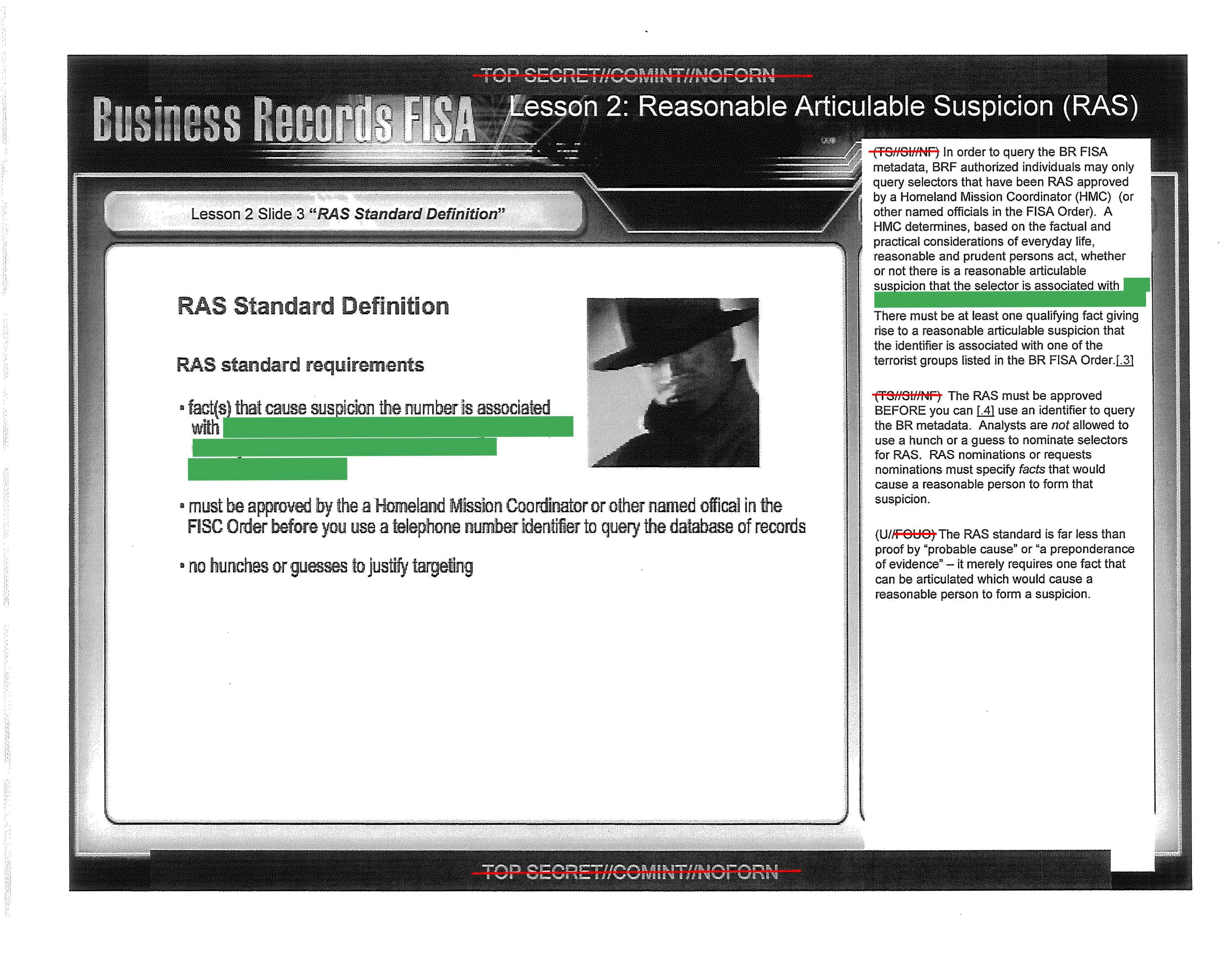
Lesson 2 Slide 3 "RAS Standard Definition"
RAS Standard Definition
RAS standard requirements
- fact(s) that cause suspicion the number is associated with [REDACTED]
- must be approved by the a Homeland Mission Coordinator or other named offical in the FISC Order before you use a telephone number identifier to query the database of records
- no hunches or guesses to justify targeting
(TS//SI//NF) In order to query the BR FISA metadata, BRF authorized individuals may only query selectors that have been RAS approved by a Homeland Mission Coordinator (HMC) (or other named officials in the FISA Order). A HMC determines, based on the factual and practical considerations of everyday life, reasonable and prudent persons act, whether or not there is a reasonable articulable suspicion that the selector is associated with [REDACTED]. There must be at least one qualifying fact giving rise to a reasonable articulable suspicion that the identifier is associated with one of the terrorist groups listed in the BR FISA Order.[.3]
(TS//SI//NF) The RAS must be approved BEFORE you can [.4] use an identifier to query the BR metadata. Analysts are not allowed to use a hunch or a guess to nominate selectors for RAS. RAS nominations or requests nominations must specify facts that would cause a reasonable person to form that suspicion.
(U//FOUO) The RAS standard is far less than proof by "probable cause" or "a preponderance of evidence" - it merely requires one fact that can be articulated which would cause a reasonable person to form a suspicion.
TOP SECRET//COMINT//NOFORN
TOP SECRET//COMINT//NOFORN
Business Records FISA
Lesson 2: Reasonable Articulable Suspicion (RAS)
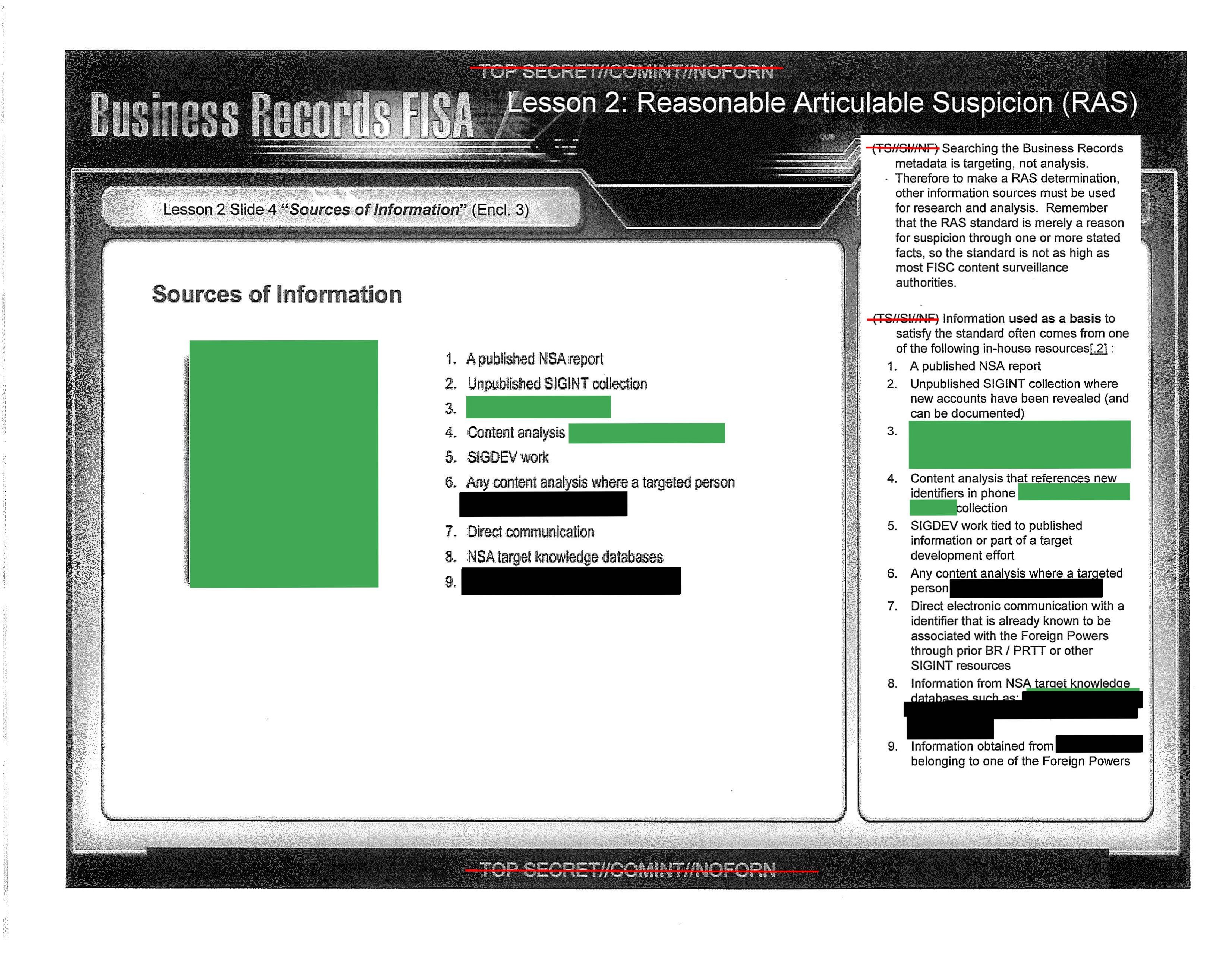
Lesson 2 Slide 4 "Sources of Information” (Encl. 3)
Sources of Information
[REDACTED]
- A published NSA report
- Unpublished SIGINT collection
- [REDACTED]
- Content analysis
- SIGDEV work
- Any content analysis where a targeted person [REDACTED]
- Direct communication
- NSA target knowledge databases
- [REDACTED]
(TS//SI//NF) Searching the Business Records metadata is targeting, not analysis. Therefore to make a RAS determination, other information sources must be used for research and analysis. Remember that the RAS standard is merely a reason for suspicion through one or more stated facts, so the standard is not as high as most FISC content surveillance authorities.
(TS//SI//NF) Information used as a basis to satisfy the standard often comes from one of the following in-house resources[.2] :
- A published NSA report
- Unpublished SIGINT collection where new accounts have been revealed (and can be documented)
- [REDACTED]
- Content analysis that references new identifiers in phone [REDACTED] collection
- SIGDEV work tied to published information or part of a target development effort
- Any content analysis where a targeted person [REDACTED]
- Direct electronic communication with a identifier that is already known to be associated with the Foreign Powers through prior BR / PRTT or other SIGINT resources
- Information from NSA target knowledge databases such as [REDACTED]
- Information obtained from [REDACTED] belonging to one of the Foreign Powers
TOP SECRET//COMINT//NOFORN
TOP SECRET//COMINT//NOFORN
Business Records FISA
Lesson 2: Reasonable Articulable Suspicion (RAS)
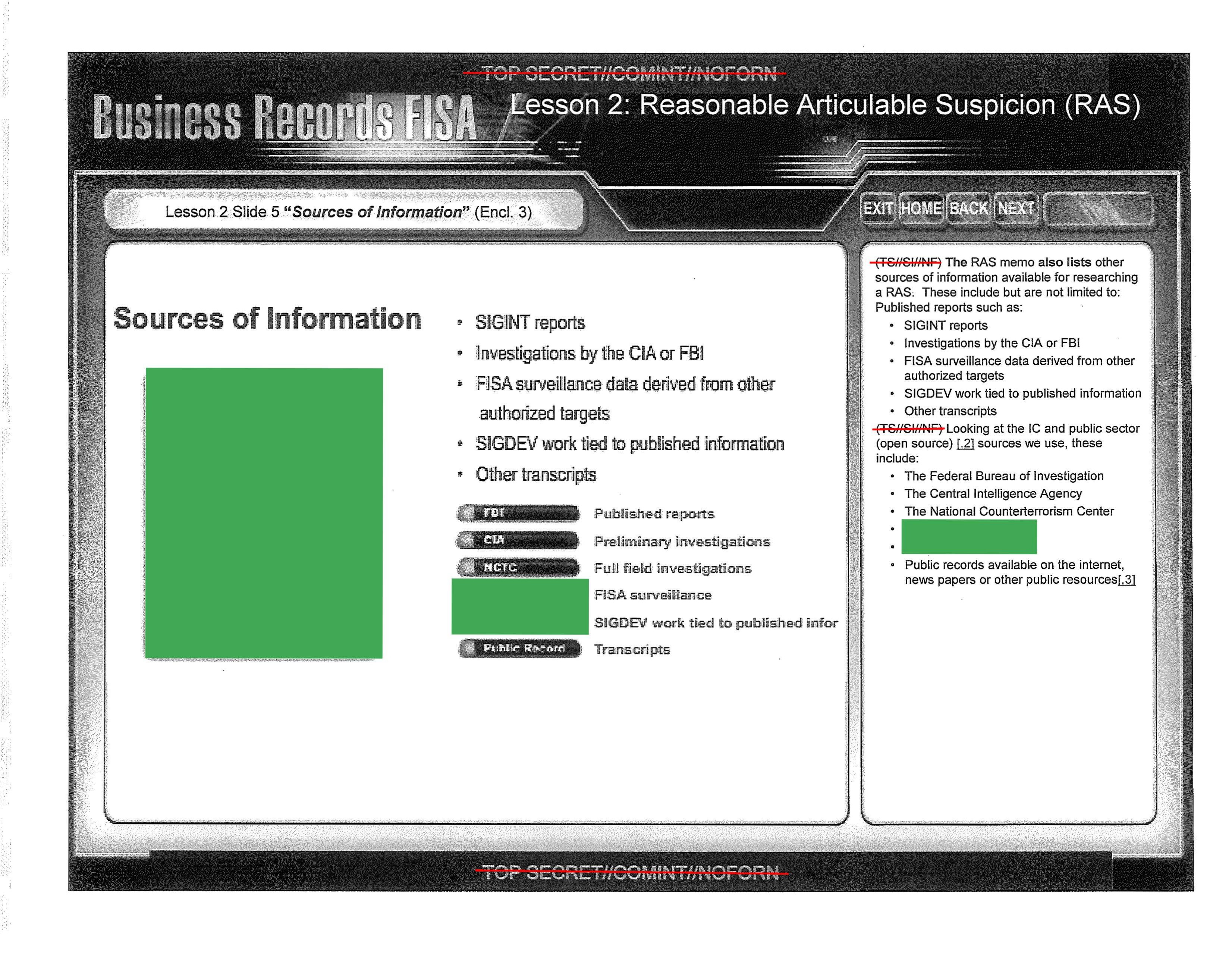
Lesson 2 Slide 5 "Sources of Information" (Encl. 3)
Sources of Information
- SIGINT reports
- Investigations by the CIA or FBI
- FISA surveillance data derived from other authorized targets
- SIGDEV work tied to published information
- Other transcripts
| FDE | Published reports |
|---|---|
| CIA | Preliminary investigations |
| NCTC | Full field investigations |
| [REDACTED] | FISA surveillance |
| Public Record | SIGDEV work tied to published infor |
| [REDACTED] | Transcripts |
(TS//SI//NF) The RAS memo also lists other sources of information available for researching a RAS: These include but are not limited to:
Published reports such as:
- SIGINT reports
- Investigations by the CIA or FBI
- FISA surveillance data derived from other authorized targets
- SIGDEV work tied to published information
- Other transcripts
(TS//SI//NF) Looking at the IC and public sector (open source) [2] sources we use, these include:
- The Federal Bureau of Investigation
- The Central Intelligence Agency
- The National Counterterrorism Center
- [REDACTED]
- Public records available on the internet, news papers or other public resources[.3]
TOP SECRET//COMINT//NOFORN
TOP SECRET//COMINT//NOFORN
Business Records FISA
Lesson 2: Reasonable Articulable Suspicion (RAS)
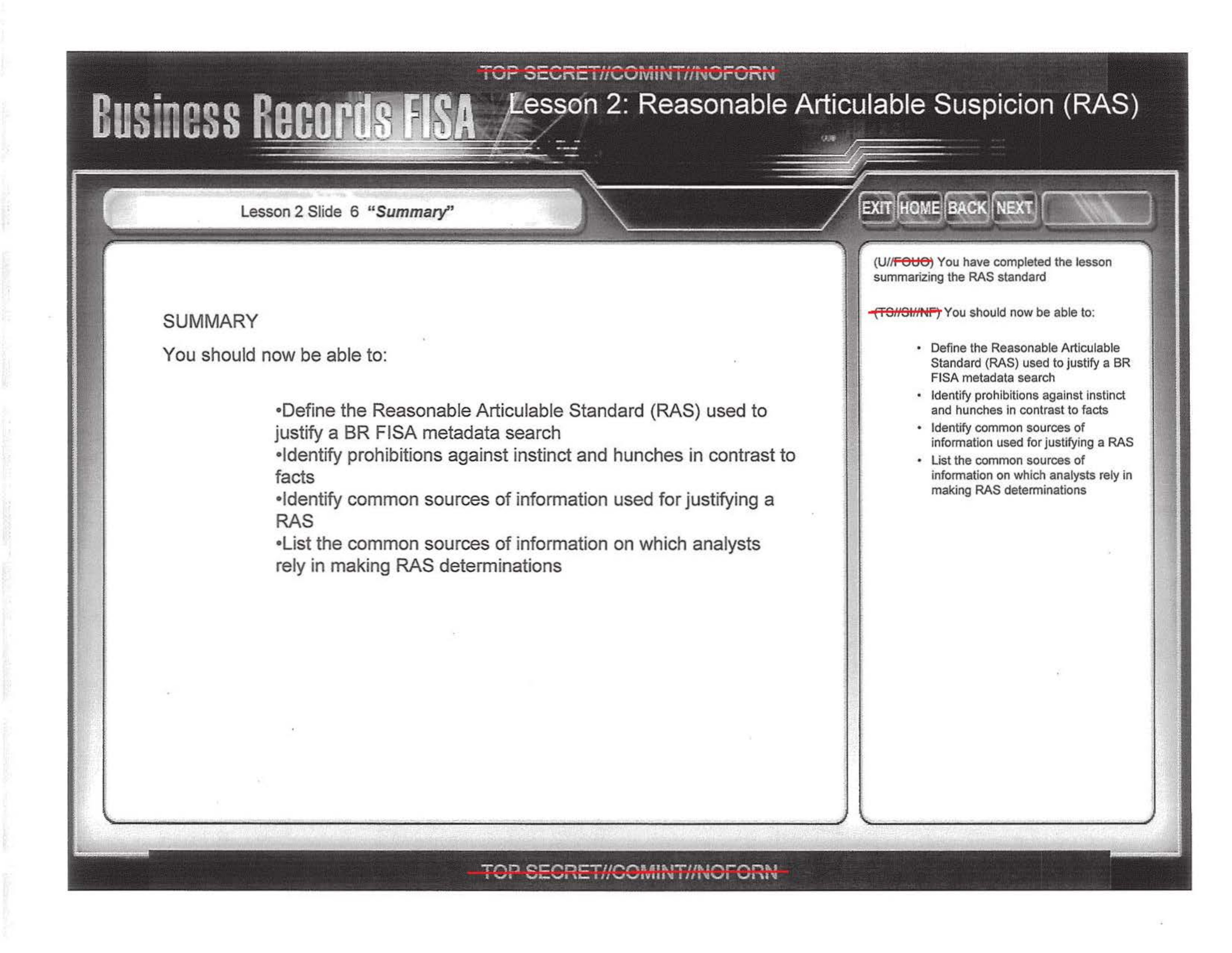
Lesson 2 Slide 6 "Summary"
SUMMARY
You should now be able to:
- Define the Reasonable Articulable Standard (RAS) used to justify a BR FISA metadata search
- Identify prohibitions against instinct and hunches in contrast to facts
- Identify common sources of information used for justifying a RAS
- List the common sources of information on which analysts rely in making RAS determinations
(U//FOUO) You have completed the lesson summarizing the RAS standard
(TS//SI//NF) You should now be able to:
- Define the Reasonable Articulable Standard (RAS) used to justify a BR FISA metadata search.
- Identify prohibitions against instinct and hunches in contrast to facts
- Identify common sources of information used for justifying a RAS
- List the common sources of information on which analysts rely in making RAS determinations
TOP SECRET//COMINT//NOFORN
TOP SECRET//COMINT/NOFORN
Business Records FISA /
Lesson 3: First Amendment Considerations
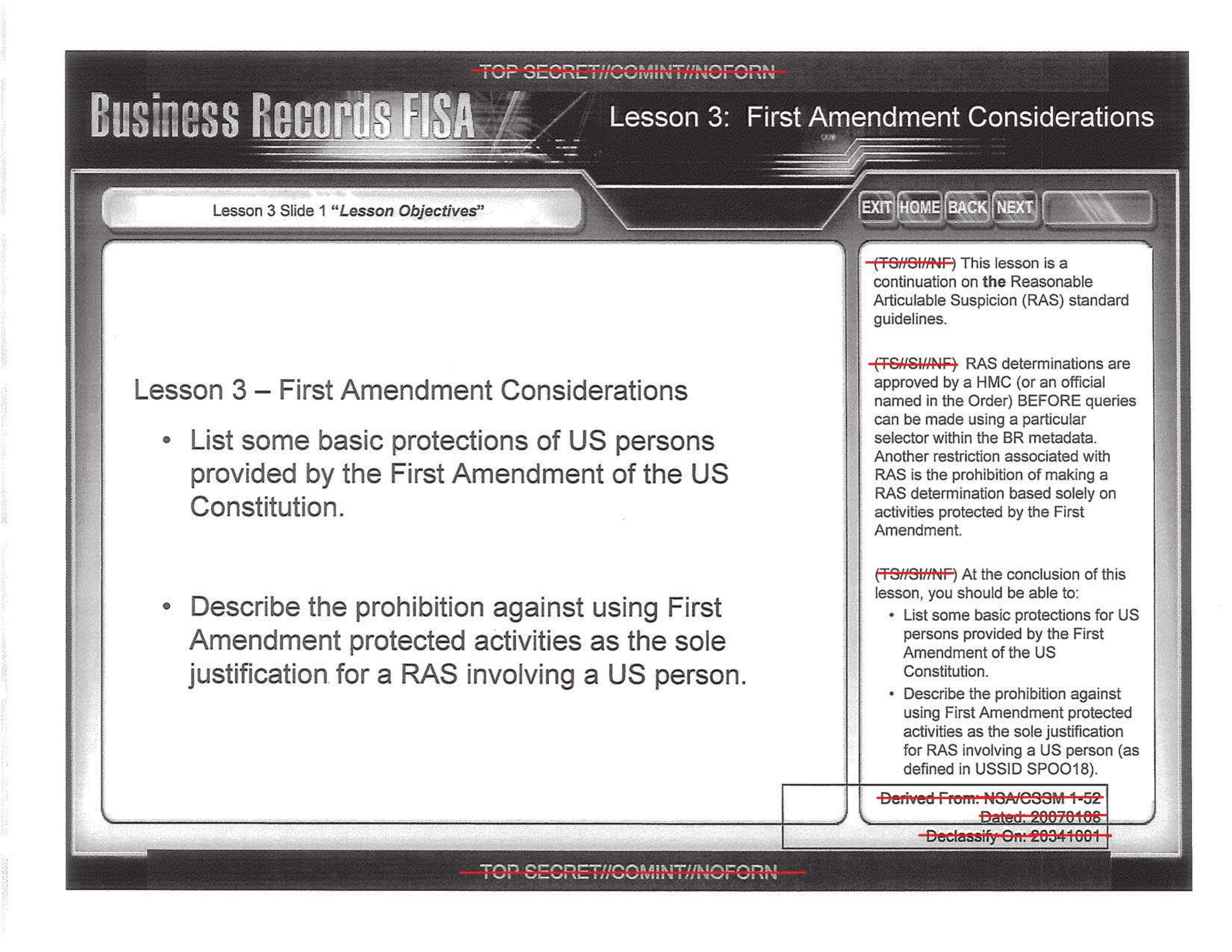
Lesson 3 Slide 1 "Lesson Objectives"
Lesson 3 - First Amendment Considerations
- List some basic protections of US persons provided by the First Amendment of the US Constitution.
- Describe the prohibition against using First Amendment protected activities as the sole justification for a RAS involving a US person.
(TS//SI/NF) This lesson is a continuation on the Reasonable Articulable Suspension (RAS) standard guidelines.
(TS//SI/NF) RAS determinations are approved by a HMC (or an official named in the Order) BEFORE queries can be made using a particular selector within the BR metadata. Another restriction associated with RAS is the prohibition of making a RAS determination based solely on activities protected by the First Amendment.
(TS//SI//NF) At the conclusion of this lesson, you should be able to:
- List some basic protections for US persons provided by the First Amendment of the US Constitution.
- Describe the prohibition against using First Amendment protected activities as the sole justification for RAS involving a US person (as defined in USSID SPOO18).
Derived From: NOA/CSSM 1-52
Dated. 20070108
Declassify On: 20041001-
TOP SECRET//COMINT//NOFORN
TOP SECRET//COMINT//NOFORN
Business Records FISA
Lesson 3: First Amendment Considerations
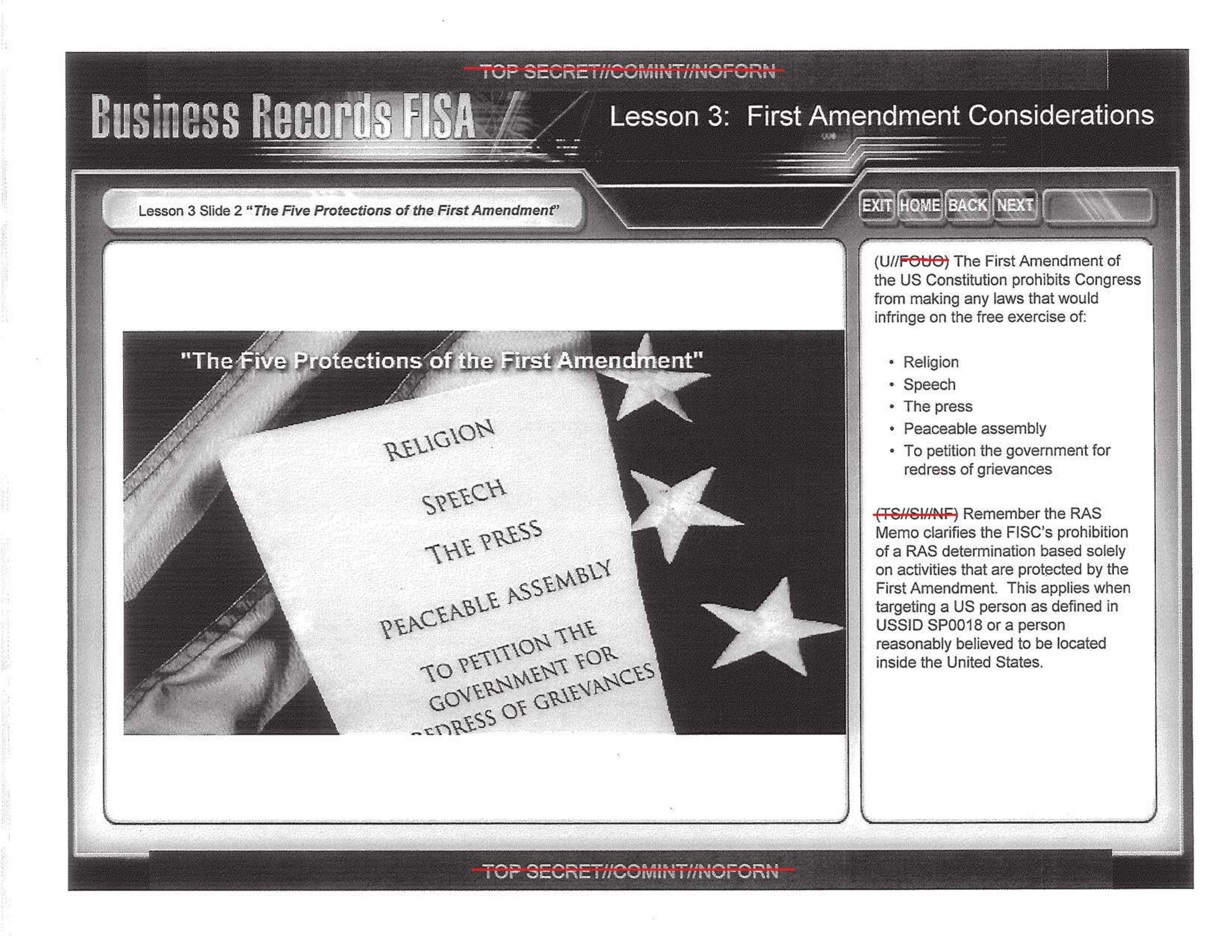
Lesson 3 Slide 2 "The Five Protections of the First Amendment"
"The Five Protections of the First Amendment"
(U//FOUO) The First Amendment of the US Constitution prohibits Congress from making any laws that would infringe on the free exercise of:
- Religion
- Speech
- The press
- Peaceable assembly
- To petition the government for redress of grievances
(TS//SI/NF) Remember the RAS Memo clarifies the FISC's prohibition of a RAS determination based solely on activities that are protected by the First Amendment. This applies when targeting a US person as defined in USSID SP0018 or a person reasonably believed to be located inside the United States.
TOP SECRET//COMINT//NOFORN
TOP SECRET//COMINT//NOFORN
Business Records FISA
Lesson 3: First Amendment Considerations
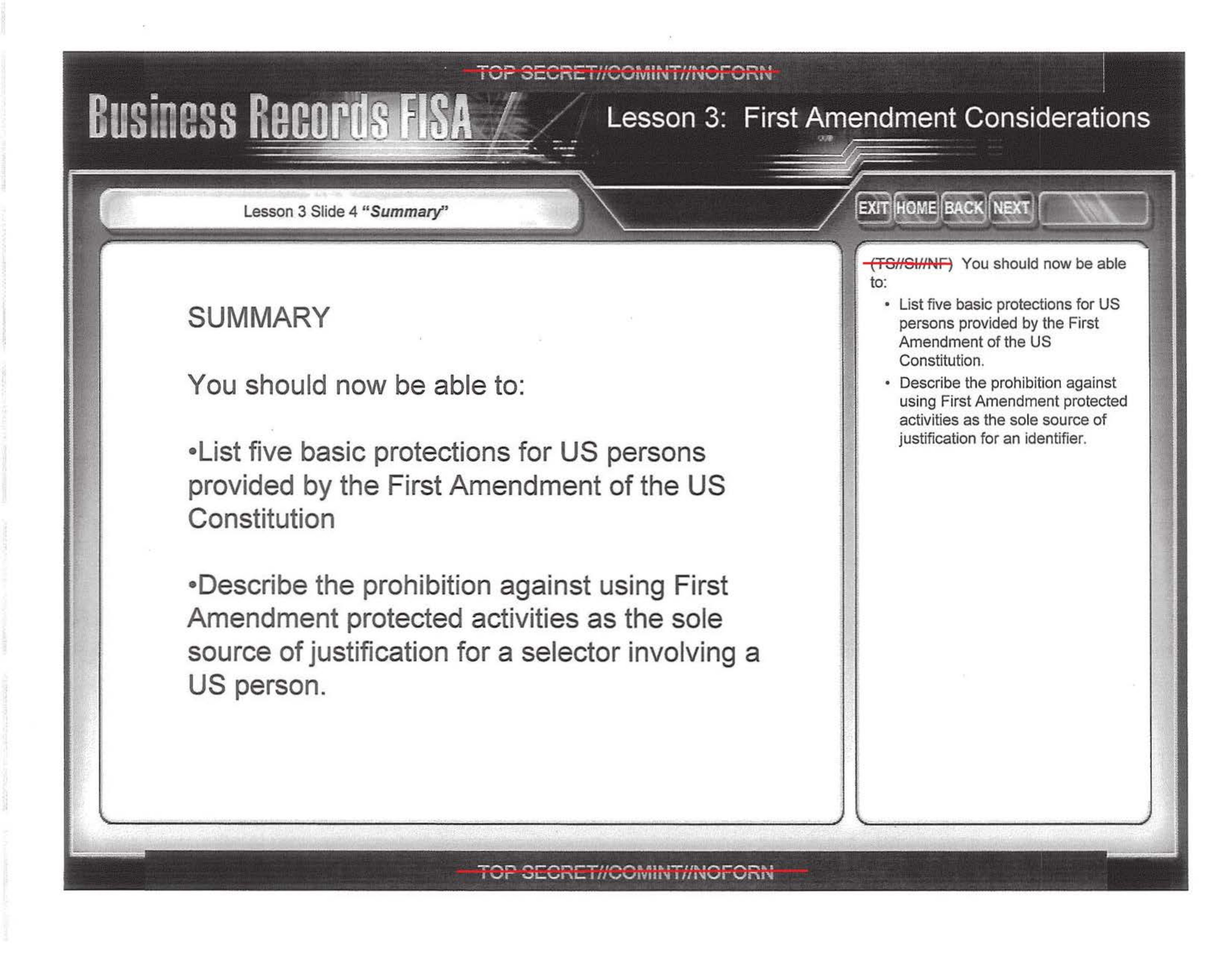
Lesson 3 Slide 4 "Summary"
SUMMARY
You should now be able to:
- List five basic protections for US persons provided by the First Amendment of the US Constitution
- Describe the prohibition against using First Amendment protected activities as the sole source of justification for a selector involving a US person.
(TS//SI/NF) You should now be able to:
- List five basic protections for US persons provided by the First Amendment of the US Constitution.
- Describe the prohibition against using First Amendment protected activities as the sole source of justification for an identifier.
TOP SECRET//COMINT//NOFORN
TOP SECRET//COMINT//NOFORN
Business Records FISA /
Lesson 4: The BR Order
Lesson 4 Slide 1 "Lesson Objectives"
In this lesson we will examine a Business Records (BR) FISA Court (FISC) Order.
At the conclusion of this lesson you will be able to:
- Identify BR FISC Orders as NSA's authorization to collect telephony metadata from specified US telecommunication companies in order to protect against international terrorism
(TS//SI//NF) In this lesson we will examine a Business Records (BR) FISA Court (FISC) Order. At the conclusion of this lesson you will be able to:
- Identify BR FISC Orders as NSA's authorization to collect telephony metadata from specified US telecommunication companies in order to protect against international terrorism
TOP SECRET//COMINT//NOFORN
Derived From: NSA/CSSM 1-52
Dated: 20070108-
Deelassify On: 20341001
TOP SECRET//COMINT//NOFORN
Business Records FISA
Lesson 4: The BR Order
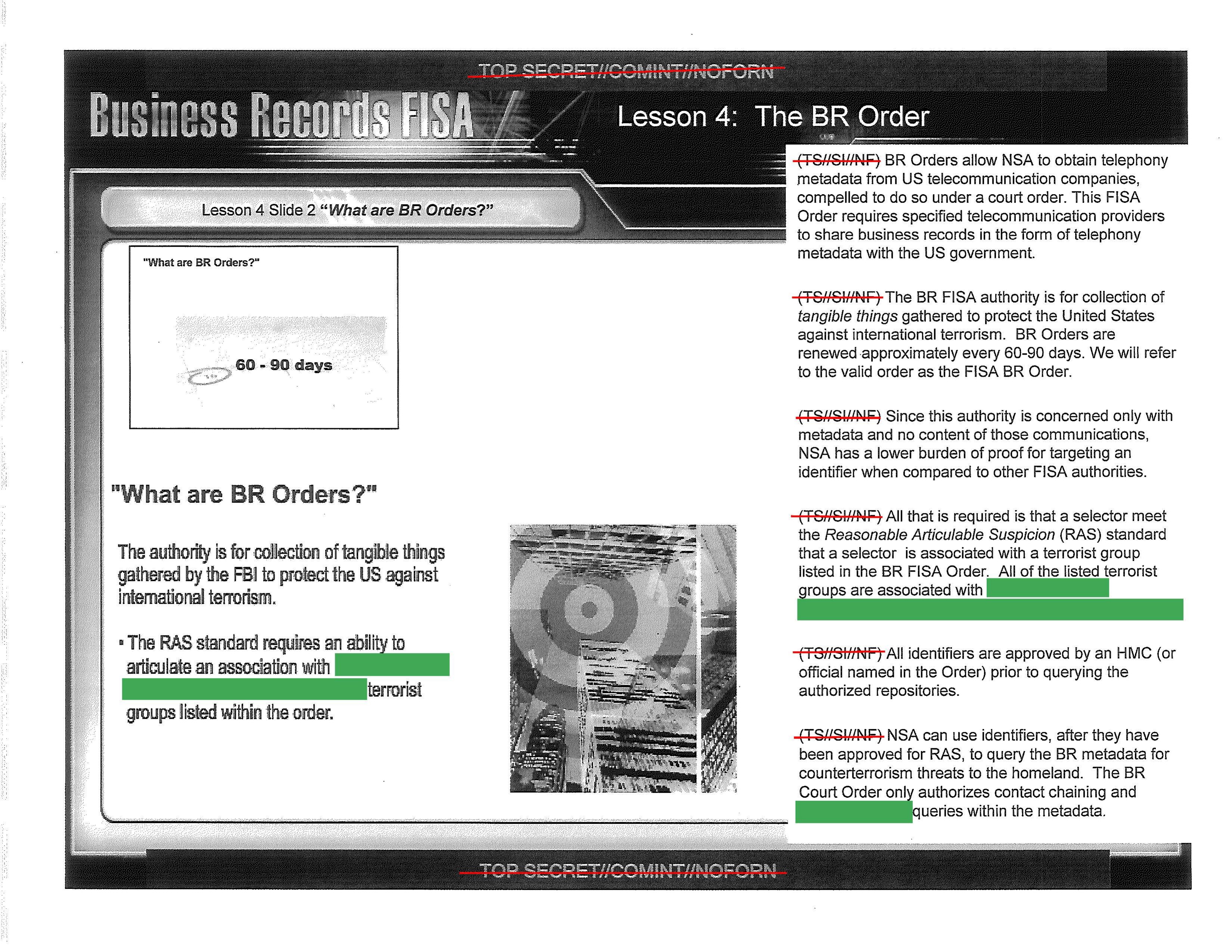
Lesson 4 Slide 2 "What are BR Orders?"
"What are BR Orders?"
[REDACTED]
60 - 90 days
"What are BR Orders?"
The authority is for collection of tangible things gathered by the FBI to protect the US against international terrorism.
- The RAS standard requires an ability to articulate an association with [REDACTED] terrorist groups listed within the order.
(TS//SI//NF) BR Orders allow NSA to obtain telephony metadata from US telecommunication companies, compelled to do so under a court order. This FISA Order requires specified telecommunication providers to share business records in the form of telephony metadata with the US government.
(TS//SI//NF) The BR FISA authority is for collection of tangible things gathered to protect the United States against international terrorism. BR Orders are renewed approximately every 60-90 days. We will refer to the valid order as the FISA BR Order.
(TS//SI//NF) Since this authority is concerned only with metadata and no content of those communications, NSA has a lower burden of proof for targeting an identifier when compared to other FISA authorities.
(TS//SI//NF) All that is required is that a selector meet the Reasonable Articulable Suspicion (RAS) standard that a selector is associated with a terrorist group listed in the BR FISA Order. All of the listed terrorist groups are associated with [REDACTED]
(TS//SI//NF) All identifiers are approved by an HMC (or official named in the Order) prior to querying the authorized repositories.
(TS//SI//NF) NSA can use identifiers, after they have been approved for RAS, to query the BR metadata for counterterrorism threats to the homeland. The BR Court Order only authorizes contact chaining and [REDACTED] queries within the metadata.
TOP SECRET//COMINT//NOFORN
TOP SECRET//COMINT//NOFORN
Business Records FISA
Lesson 4: The BR Order
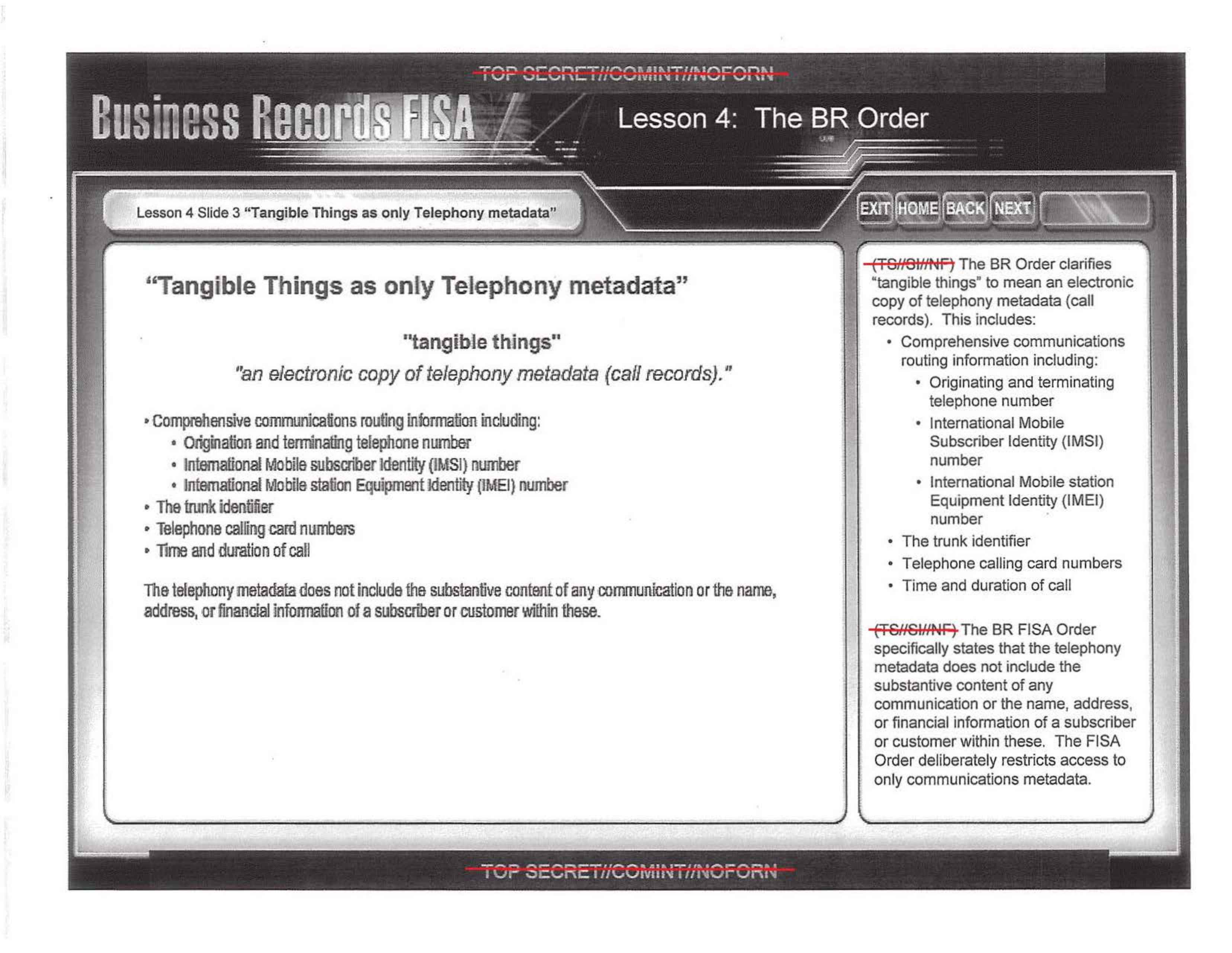
Lesson 4 Slide 3 "Tangible Things as only Telephony metadata"
"Tangible Things as only Telephony metadata"
"tangible things"
"an electronic copy of telephony metadata (call records)."
- Comprehensive communications routing information including:
- Origination and terminating telephone number
- International Mobile subscriber Identity (IMSI) number
- International Mobile station Equipment Identity (IMEI) number
- The trunk identifier
- Telephone calling card numbers
- Time and duration of call
The telephony metadata does not include the substantive content of any communication or the name, address, or financial information of a subscriber or customer within these.
(TS//SI/NF) The BR Order clarifies "tangible things" to mean an electronic copy of telephony metadata (call records). This includes:
- Comprehensive communications routing information including:
- Originating and terminating telephone number
- International Mobile Subscriber Identity (IMSI) number
- International Mobile station Equipment Identity (IMEI) number
- The trunk identifier
- Telephone calling card numbers
- Time and duration of call
(TS//SI//NF) The BR FISA Order specifically states that the telephony metadata does not include the substantive content of any communication or the name, address, or financial information of a subscriber or customer within these. The FISA Order deliberately restricts access to only communications metadata.
TOP SECRET//COMINT//NOFORN
TOP SECRET//COMINT//NOFORN
Business Records FISA
Lesson 4: The BR Order
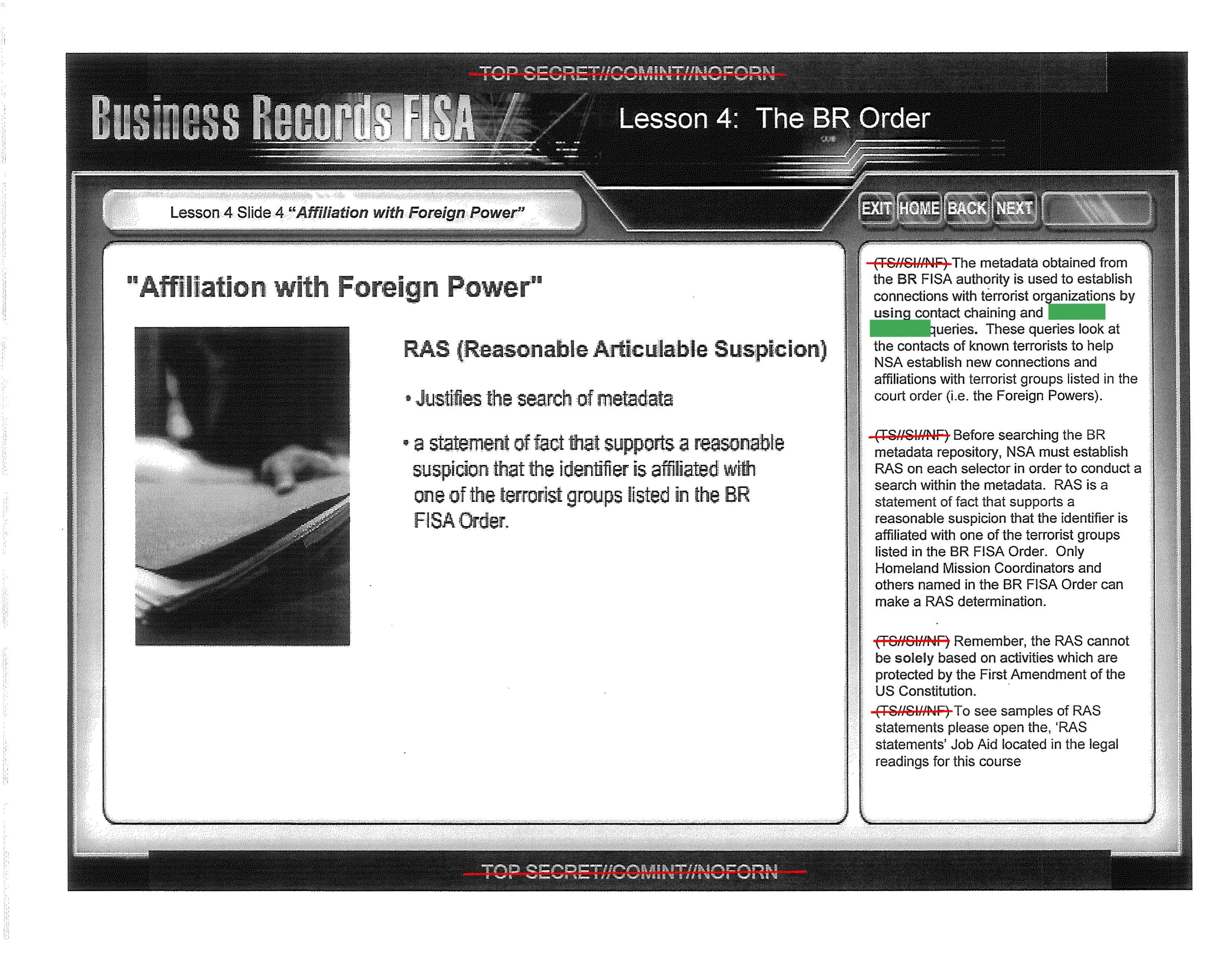
Lesson 4 Slide 4 "Affiliation with Foreign Power"
"Affiliation with Foreign Power"
RAS (Reasonable Articulable Suspicion)
- Justifies the search of metadata
- a statement of fact that supports a reasonable suspicion that the identifier is affiliated with one of the terrorist groups listed in the BR FISA Order.
(TS//SI//NF) The metadata obtained from the BR FISA authority is used to establish connections with terrorist organizations by using contact chaining and [REDACTED] queries. These queries look at the contacts of known terrorists to help NSA establish new connections and affiliations with terrorist groups listed in the court order (i.e. the Foreign Powers).
(TS//SI/NF) Before searching the BR metadata repository, NSA must establish RAS on each selector in order to conduct a search within the metadata. RAS is a statement of fact that supports a reasonable suspicion that the identifier is affiliated with one of the terrorist groups listed in the BR FISA Order. Only Homeland Mission Coordinators and others named in the BR FISA Order can make a RAS determination.
(TS//SI//NF) Remember, the RAS cannot be solely based on activities which are protected by the First Amendment of the US Constitution.
(TS//SI//NF) To see samples of RAS statements please open the, 'RAS statements' Job Aid located in the legal readings for this course
TOP SECRET//COMINT//NOFORN
TOP SECRET//COMINT/NOFORN
Business Records FISA /
Lesson 4: The BR Order
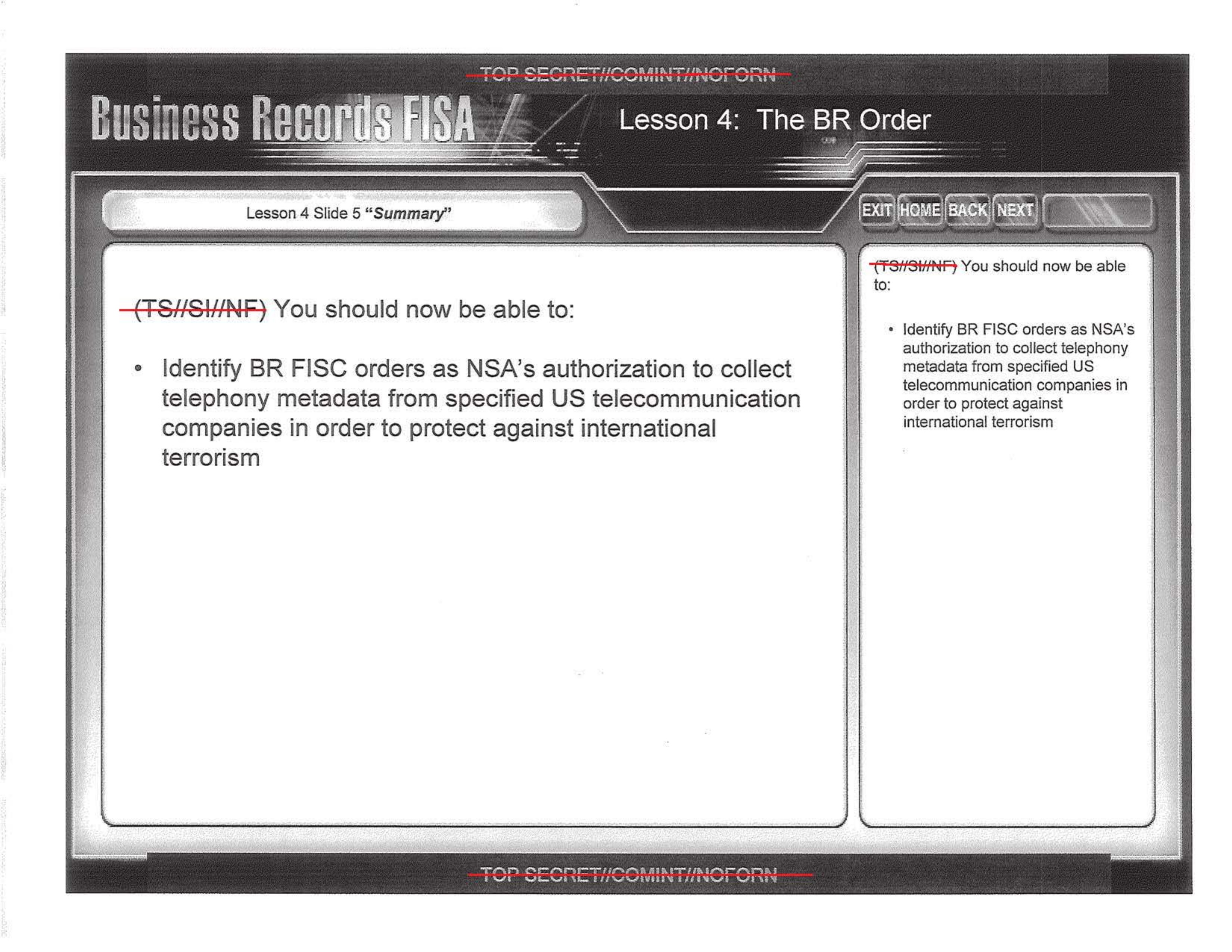
Lesson 4 Slide 5 "Summary"
(TS//SI//NF) You should now be able to:
- Identify BR FISC orders as NSA's authorization to collect telephony metadata from specified US telecommunication companies in order to protect against international terrorism
(TS//SI//NF) You should now be able to:
- Identify BR FISC orders as NSA's authorization to collect telephony metadata from specified US telecommunication companies in order to protect against international terrorism
TOP SECRET//COMINT//NOFORN
TOP SECRET//COMINT//NOFORN
Business Records FISA /
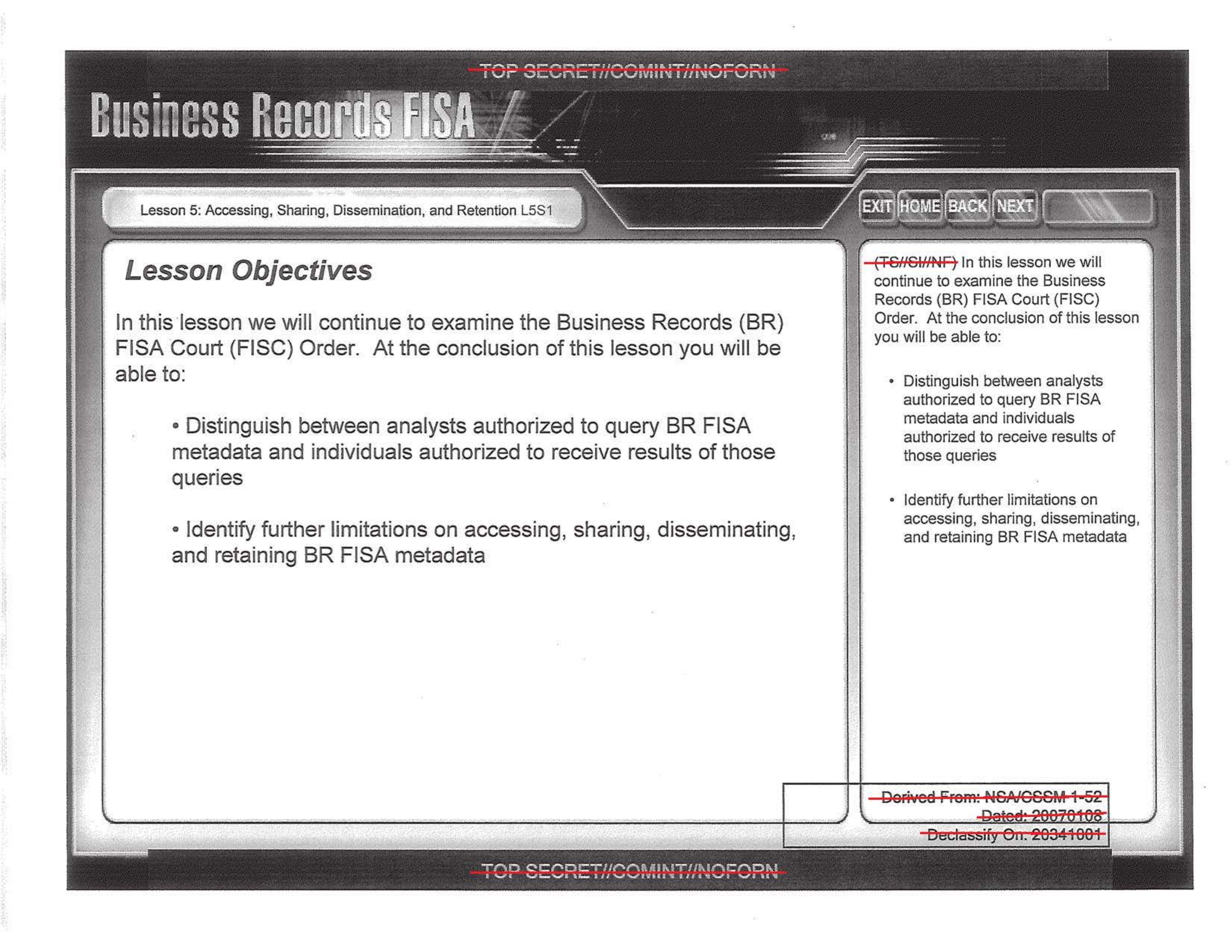
Lesson 5: Accessing, Sharing, Dissemination, and Retention L5S1
Lesson Objectives
In this lesson we will continue to examine the Business Records (BR) FISA Court (FISC) Order. At the conclusion of this lesson you will be able to:
- Distinguish between analysts authorized to query BR FISA metadata and individuals authorized to receive results of those queries
- Identify further limitations on accessing, sharing, disseminating, and retaining BR FISA metadata
(TS//SI//NF) In this lesson we will continue to examine the Business Records (BR) FISA Court (FISC) Order. At the conclusion of this lesson you will be able to:
- Distinguish between analysts authorized to query BR FISA metadata and individuals authorized to receive results of those queries
- Identify further limitations on accessing, sharing, disseminating, and retaining BR FISA metadata
TOP SECRET//COMINT//NOFORN
Derived From: NSA/CCCM-1-52
Dated: 20070108
Declassify On. 20341001
TOP SECRET//COMINT//NOFORN
Business Records FISA /
Lesson 5: Accessing, Sharing, Dissemination, and Retention L5S2
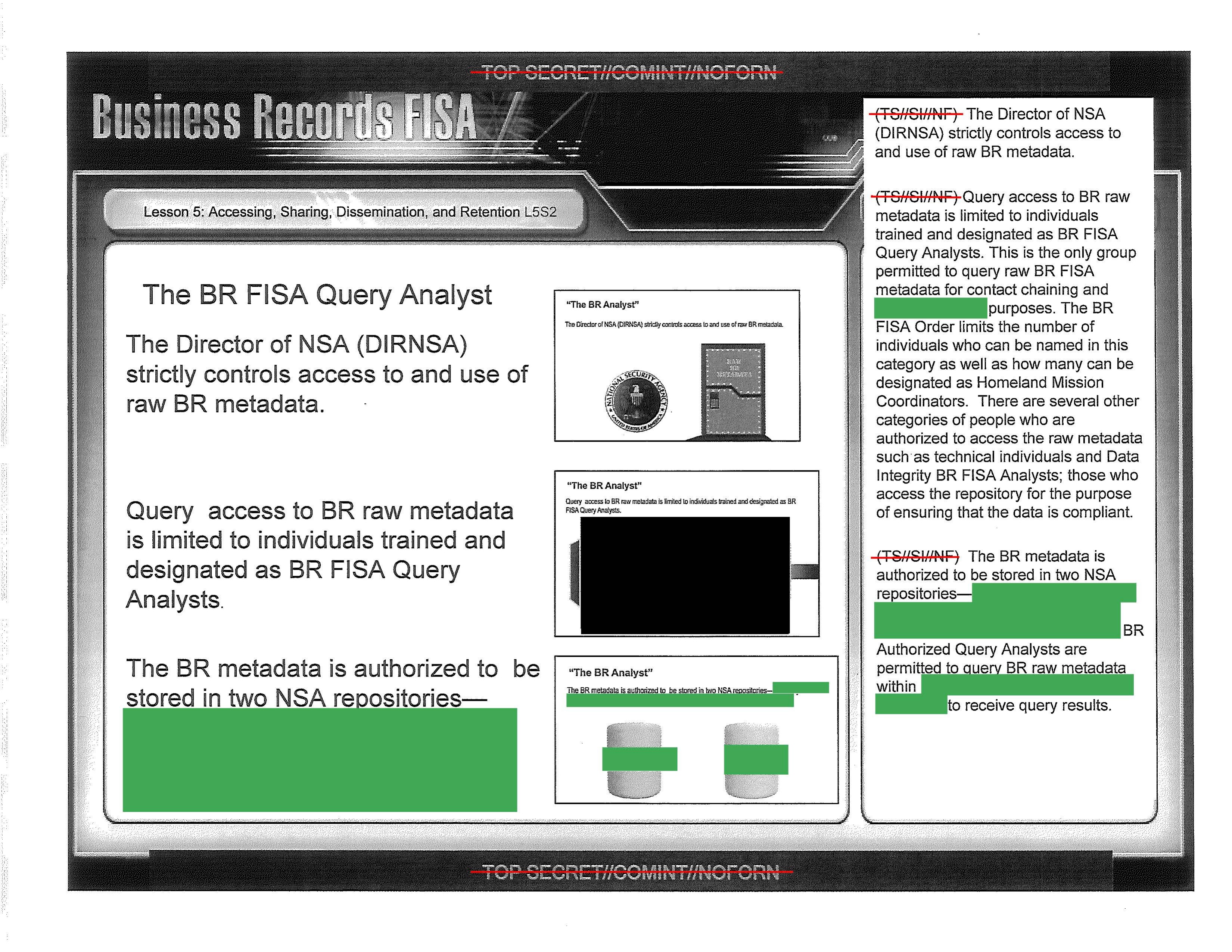
The BR FISA Query Analyst
The Director of NSA (DIRNSA) strictly controls access to and use of raw BR metadata.
"The BR Analyst"
The Director of NSA (DIRNSA) strictly controls access to and use of raw BR metadata.
Query access to BR raw metadata is limited to individuals trained and designated as BR FISA Query Analysts.
"The BR Analyst"
Query access to BR raw metadata is limited to individuals trained and designated as BR FISA Query Analysts.
The BR metadata is authorized to be stored in two NSA repositories- [REDACTED]
"The BR Analyst"
The BR metadata is authorized to be stored in two NSA repositories- [REDACTED]
(TS//SI//NF) The Director of NSA (DIRNSA) strictly controls access to and use of raw BR metadata.
(TS//SI//NF) Query access to BR raw metadata is limited to individuals trained and designated as BR FISA Query Analysts. This is the only group permitted to query raw BR FISA metadata for contact chaining and [REDACTED] purposes. The BR FISA Order limits the number of individuals who can be named in this category as well as how many can be designated as Homeland Mission Coordinators. There are several other categories of people who are authorized to access the raw metadata such as technical individuals and Data Integrity BR FISA Analysts; those who access the repository for the purpose of ensuring that the data is compliant.
(TS//SI//NF) The BR metadata is authorized to be stored in two NSA repositories- [REDACTED] BR Authorized Query Analysts are permitted to query BR raw metadata within [REDACTED] to receive query results.
TOP SECRET//COMINT//NOFORN-
TOP SECRET//COMINT//NOFORN
Business Records FISA
Lesson 5: Accessing, Sharing, Dissemination, and Retention L5S3
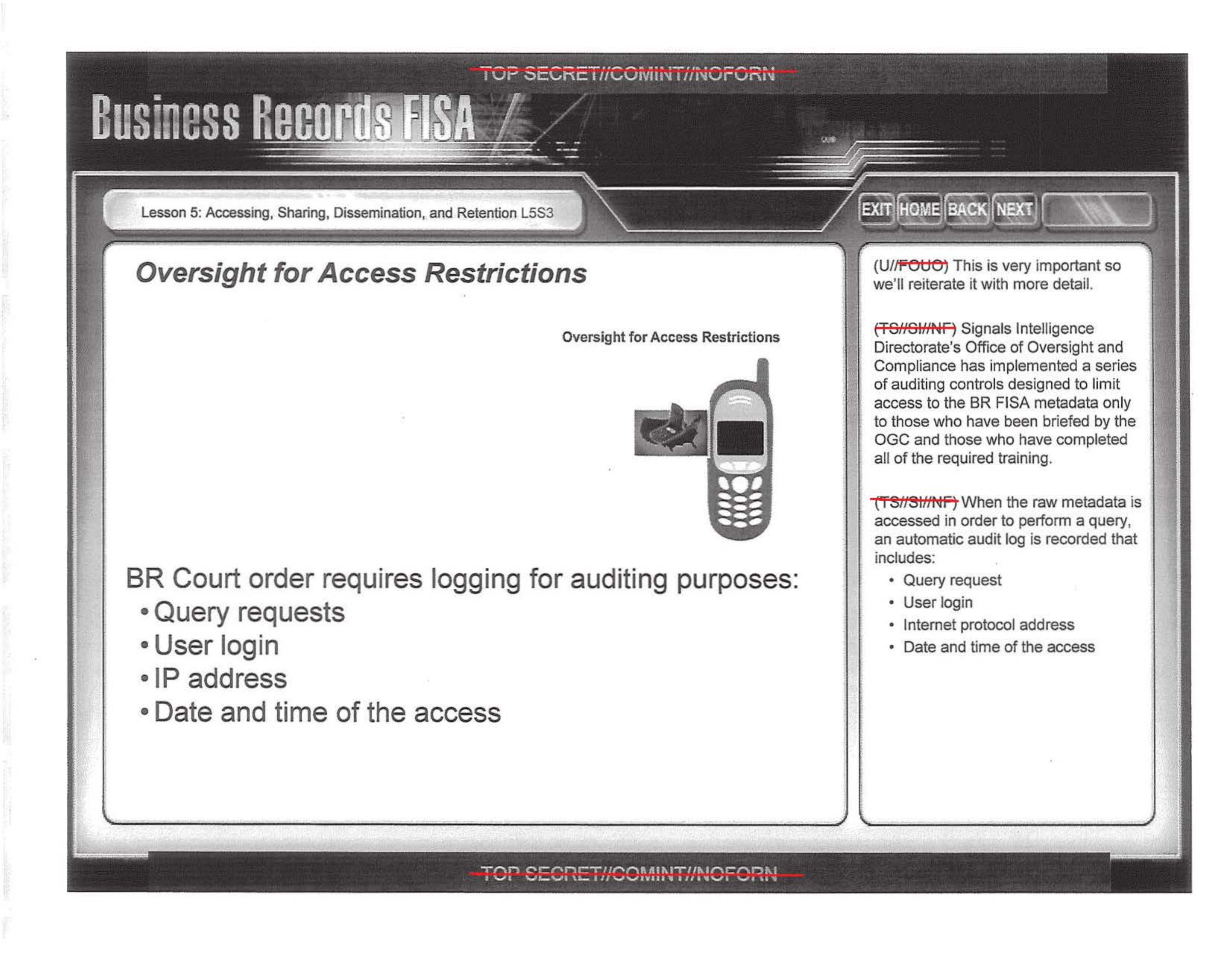
Oversight for Access Restrictions
Oversight for Access Restrictions
BR Court order requires logging for auditing purposes:
- Query requests
- User login
- IP address
- Date and time of the access
(U//FOUO) This is very important so we'll reiterate it with more detail.
(TS//SI//NF) Signals Intelligence Directorate's Office of Oversight and Compliance has implemented a series of auditing controls designed to limit access to the BR FISA metadata only to those who have been briefed by the OGC and those who have completed all of the required training.
(TS//SI//NF) When the raw metadata is accessed in order to perform a query, an automatic audit log is recorded that includes:
- Query request
- User login
- Internet protocol address
- Date and time of the access
TOP SECRET//COMINT//NOFORN
TOP SECRET//COMINT//NOFORN
Business Records FISA
Lesson 5: Accessing, Sharing, Dissemination, and Retention L5S4
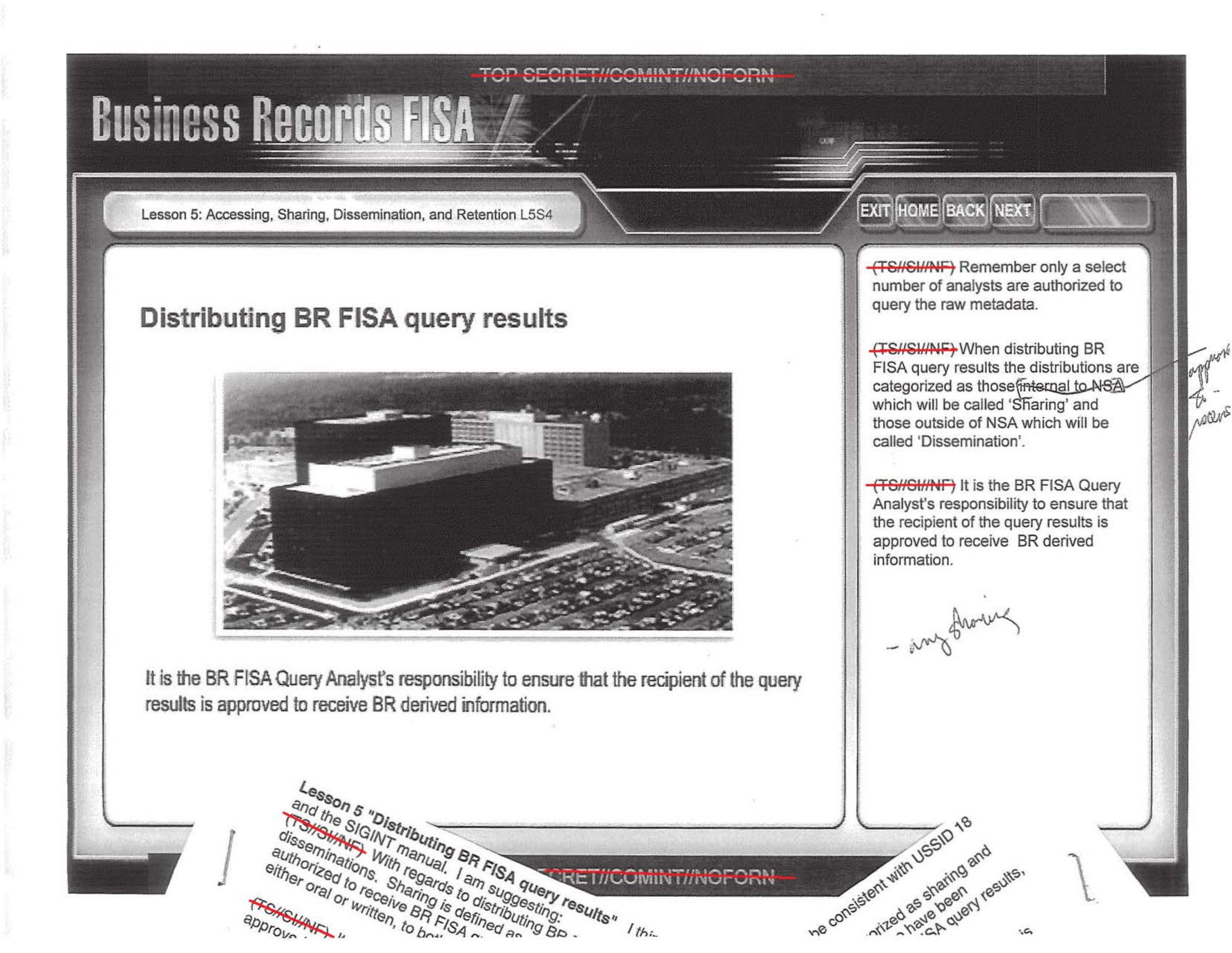
Distributing BR FISA query results
It is the BR FISA Query Analyst's responsibility to ensure that the recipient of the query results is approved to receive BR derived information.
CRET//COMINT//NOFORN
Lesson 5 "Distributing BR FISA query results" I thin
and the SIGINT manual. I am suggesting:
(TS//SI//NF) With regards to distributing BP-
disseminations. Sharing is defined as [REDACTED]
authorized to receive BR FISA ~
either oral or written, to be"
(TS/SW/NF)"
approve
(TS//SI//NF) Remember only a select number of analysts are authorized to query the raw metadata.
(TS//SW/NF) When distributing BR FISA query results the distributions are categorized as those (internal to NSA which will be called 'Sharing' and those outside of NSA which will be called 'Dissemination'.
(TS//SI/NF) It is the BR FISA Query Analyst's responsibility to ensure that the recipient of the query results is approved to receive BR derived information.
[REDACTED] ing sharing
he consistent with USSID 18
[REDACTED] have been
[REDACTED] orized as sharing and
[REDACTED] SA query results,
[REDACTED] is
[REDACTED] approx
[REDACTED] roans
TOP SECRET//COMINT//NOFORN
Business Records FISA
Lesson 5: Accessing, Sharing, Dissemination, and Retention L5S5
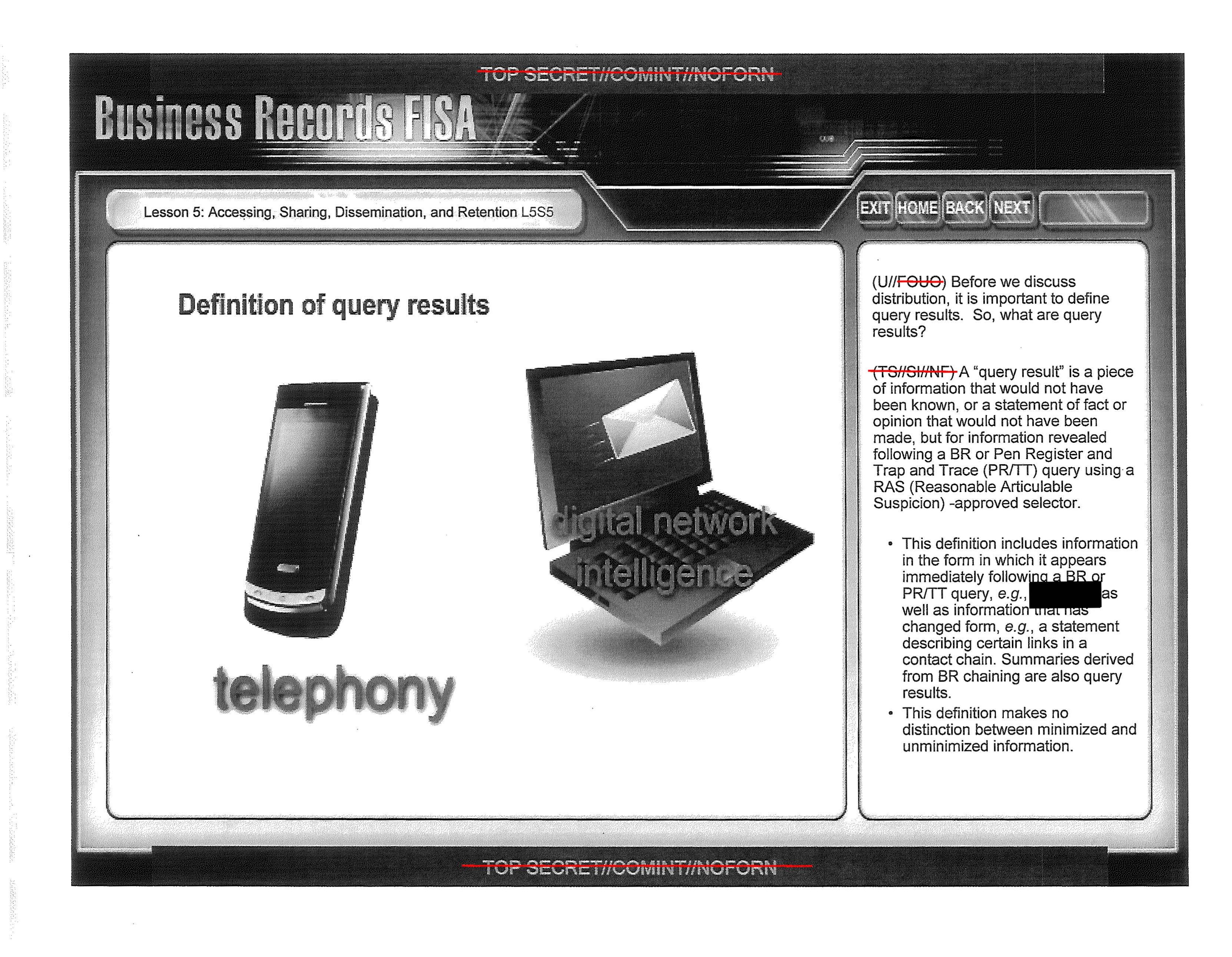
Definition of query results
(U//FOUO) Before we discuss distribution, it is important to define query results. So, what are query results?
(TS//SI/NF) A "query result" is a piece of information that would not have been known, or a statement of fact or opinion that would not have been made, but for information revealed following a BR or Pen Register and Trap and Trace (PR/TT) query using a RAS (Reasonable Articulable Suspicion) -approved selector.
- This definition includes information in the form in which it appears immediately following a BR or PR/TT query, or [REDACTED] as well as information that has changed form, e.g., a statement describing certain links in a contact chain. Summaries derived from BR chaining are also query results.
- This definition makes no distinction between minimized and unminimized information.
TOP SECRET//COMINT//NOFORN
TOP SECRET//COMINT//NOFORN
Business Records FISA /
Lesson 5: Accessing, Sharing, Dissemination, and Retention L5S6
Sharing Procedures
(TS//SI/NF) Sharing of BR FISA query results can take place formally or informally and may take place orally or in writing. Sharing can even include a phone call.
(TS//SI//NF) So, when do the restrictions on the sharing of query results cease to apply?
(TS//SI//NF) The term "query result" does not govern properly disseminated SIGINT products containing information derived from authorized queries of the BR or PR/TT metadata.
(TS//SI//NF) The term "query result" does not extend to identifiers discovered as a result of authorized queries of the BR or PR/TT metadata, to the extent those identifiers are used for tasking purposes elsewhere. E.g., a foreign identifier discovered as a result of an authorized BR query may be tasked in [REDACTED] and neither the tasking information contained in [REDACTED] nor the collection that results would continue to require the sharing restrictions applicable to BR query results.
TOP SECRET//COMINT//NOFORN
TOP SECRET//COMINT//NOFORN
Business Records FISA
Lesson 5: Accessing, Sharing, Dissemination, and Retention L5S7
You are responsible for following current Order's rules when sharing BR FISA query results
(TS//SI//NF) The person who is sharing a query result is responsible for ensuring that the recipient is authorized to receive it. To see your current responsibility please refer to the job-aid entitled BR FISA Query Analyst Responsibilities.
(TS//SI//NF) Individuals who receive BR derived information (query results) must be briefed by the OGC and have current OVSC1800 training. They will be authorized by SID Office of Oversight and Compliance SV4 to receive BR query results. Remember, authorization to receive query results does not authorize access to BR raw metadata.
TOP SECRET//COMINT//ΝΟΓΟΝΝ
TOP SECRET//COMINT//NOFORIN
Business Records FISA
Lesson 5: Accessing, Sharing, Dissemination, and Retention L5S8
Sharing Procedures
If any BR FISA derived metadata is to be shared or coordinated beyond the personnel who are approved to receive it, contact the Office of Oversight and Compliance or the Office of General Counsel BEFORE you share!
(TS//SI/NF) If any BR FISA derived metadata is to be shared or coordinated beyond the personnel who are approved to receive it, contact the Office of Oversight and Compliance or OGC BEFORE you share!
TOP GECRET//COMINT//ΝΟFORN
TOP SECRET//COMINT//ΝΟΓΟΝ
Business Records FISA
Lesson 5: Accessing, Sharing, Dissemination, and Retention L5S9
Dissemination Procedures
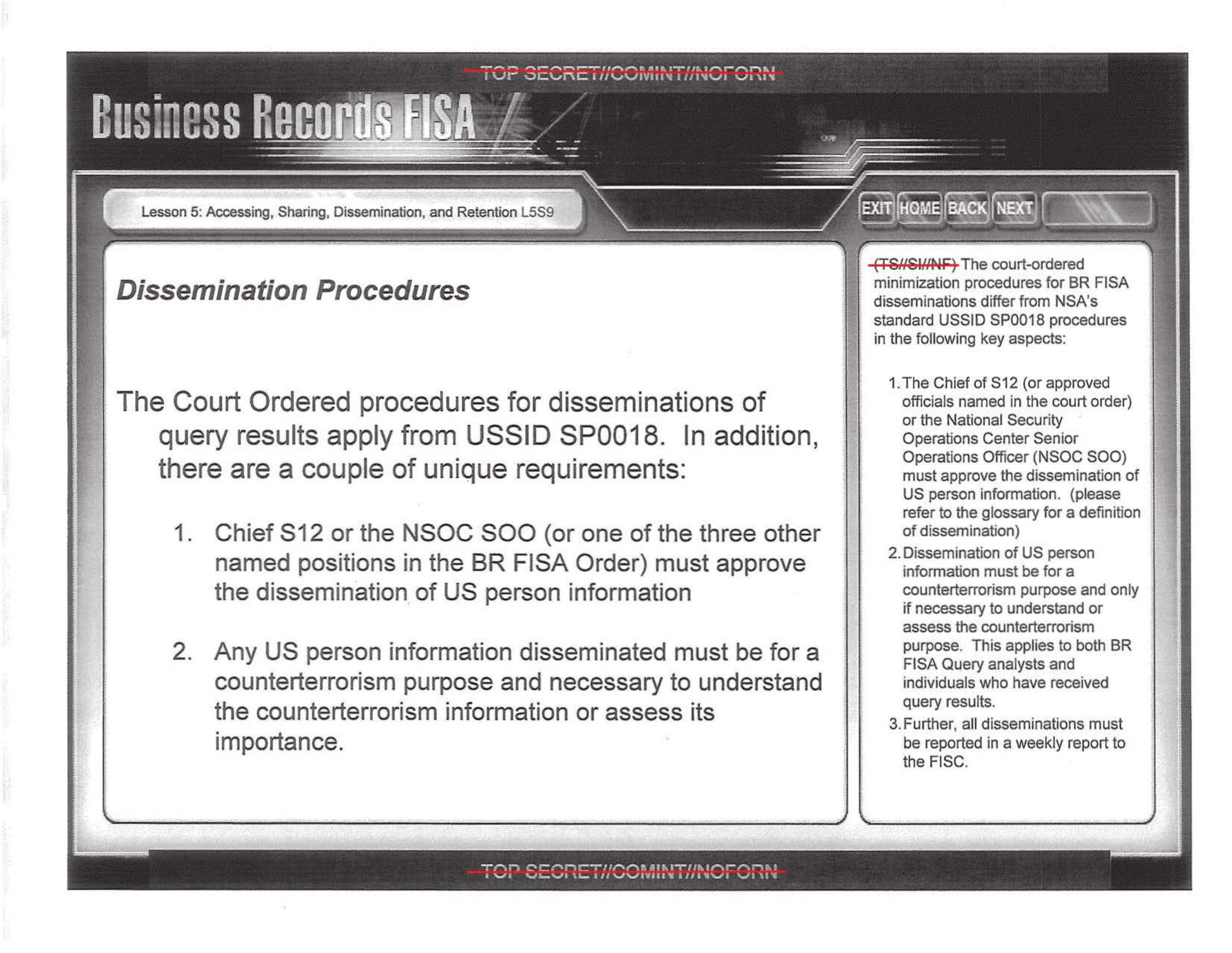
The Court Ordered procedures for disseminations of query results apply from USSID SP0018. In addition, there are a couple of unique requirements:
- Chief S12 or the NSOC SOO (or one of the three other named positions in the BR FISA Order) must approve the dissemination of US person information
- Any US person information disseminated must be for a counterterrorism purpose and necessary to understand the counterterrorism information or assess its importance.
(TS//SI//NF) The court-ordered minimization procedures for BR FISA disseminations differ from NSA's standard USSID SP0018 procedures in the following key aspects:
- The Chief of S12 (or approved officials named in the court order) or the National Security Operations Center Senior Operations Officer (NSOC SOO) must approve the dissemination of US person information. (please refer to the glossary for a definition of dissemination)
- Dissemination of US person information must be for a counterterrorism purpose and only if necessary to understand or assess the counterterrorism purpose. This applies to both BR FISA Query analysts and individuals who have received query results.
- Further, all disseminations must be reported in a weekly report to the FISC.
TOP SECRET//COMINT//NOFORN
TOP SECRET//COMINT//NOFORN
Business Records FISA
Lesson 5: Accessing, Sharing, Dissemination, and Retention L5S10
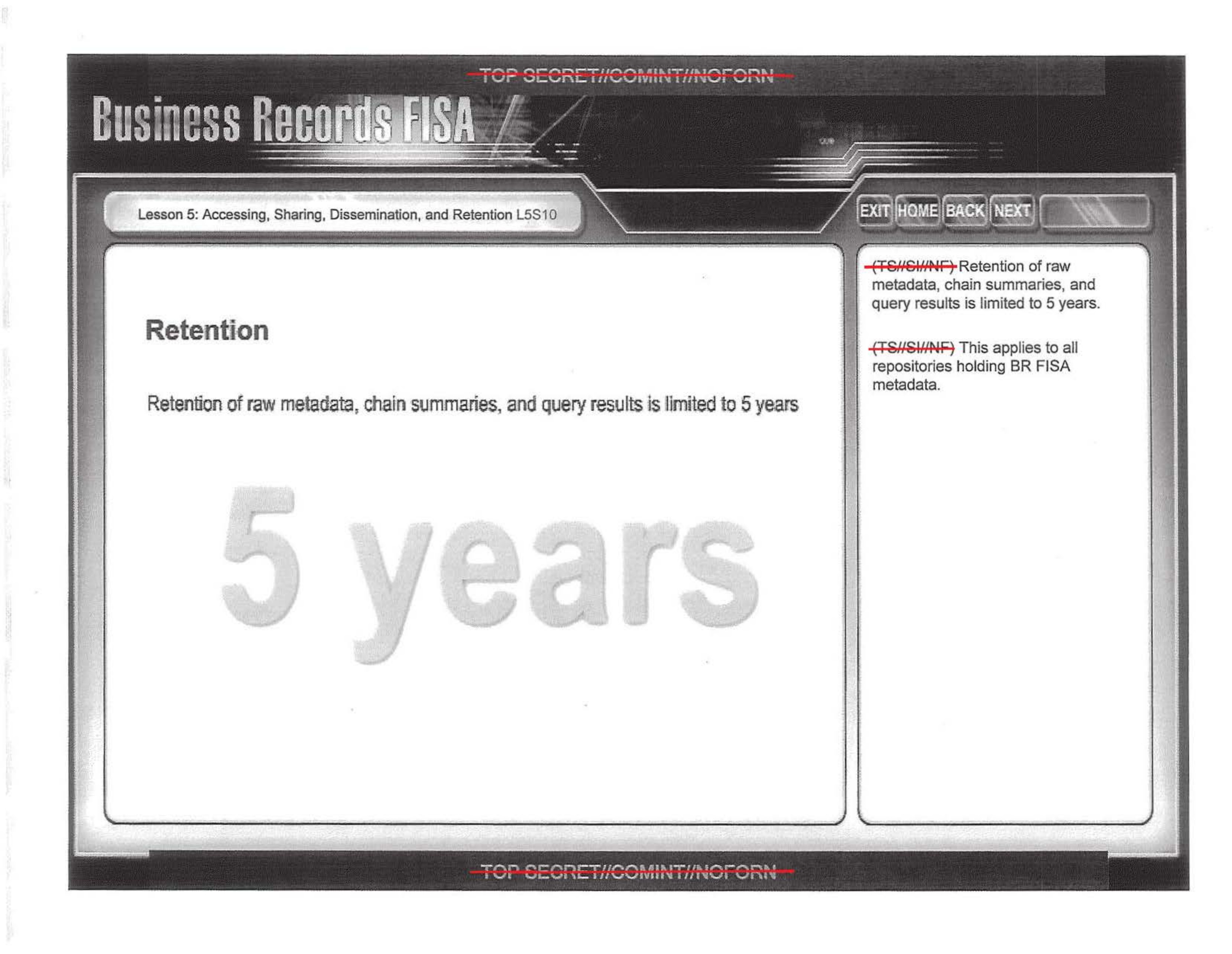
Retention
Retention of raw metadata, chain summaries, and query results is limited to 5 years
(TS//SI//NF) Retention of raw metadata, chain summaries, and query results is limited to 5 years.
(TS//SI//NF) This applies to all repositories holding BR FISA metadata.
TOP SECRET//COMINT//NOFORN
TOP SECRET//COMINT//ΝΟΓΟΝ
Business Records FISA
Lesson 5: Accessing, Sharing, Dissemination, and Retention L5S11
Lesson Summary
You should now be able to:
- Distinguish between analysts authorized to query BR FISA metadata and individuals authorized to receive results of those queries
- Identify further limitations on accessing, sharing, disseminating, and retaining BR FISA metadata
(TS//SI//NF) You should now be able to:
- Distinguish between analysts authorized to query BR FISA metadata and individuals authorized to receive results of those queries
- Identify further limitations on accessing, sharing, disseminating, and retaining BR FISA metadata
TOP SECRET//COMINT//NOFORN
TOP SECRET//COMINT//NOFORN
Business Records FISA
"Where do we go from here?" L5S12
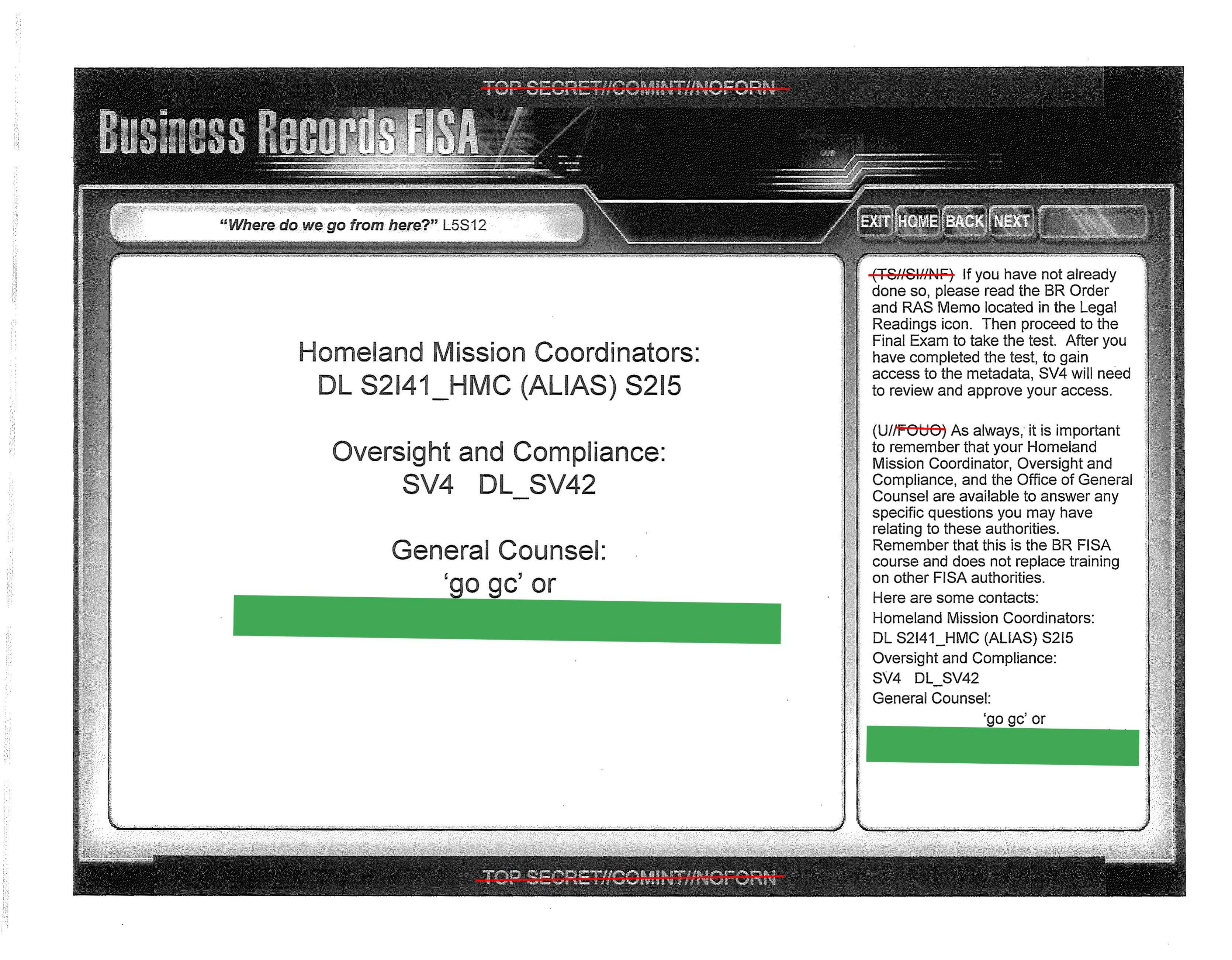
Homeland Mission Coordinators:
DL S2I41_HMC (ALIAS) S2I5
Oversight and Compliance:
SV4 DL_SV42
General Counsel:
'go gc' or [REDACTED]
(TS//SI//NF) If you have not already done so, please read the BR Order and RAS Memo located in the Legal Readings icon. Then proceed to the Final Exam to take the test. After you have completed the test, to gain access to the metadata, SV4 will need to review and approve your access.
(U//FOUO) As always, it is important to remember that your Homeland Mission Coordinator, Oversight and Compliance, and the Office of General Counsel are available to answer any specific questions you may have relating to these authorities. Remember that this is the BR FISA course and does not replace training on other FISA authorities.
Here are some contacts:
Homeland Mission Coordinators:
DL S2141_HMC (ALIAS) S215
Oversight and Compliance:
SV4 DL_SV42
General Counsel:
'go gc' or [REDACTED]
TOP SECRET//COMINT//NOFORN
Related Documents
-
MESSIAH Web-Based Training Now Available to Analysts SIDtoday [pdf]
The Reporter Toolsuite Services office announced a new web-based online course to teach analysts to use the "MESSIAH" reporting tool.
The Intercept ↗ (2017-09-13) -
January 8, 2007 NSA PowerPoint Presentation FOIA [pdf]
A 2007 NSA PowerPoint presentation for NSA personnel with access to bulk telephony metadata acquired pursuant to Section 501 of FISA. ACLU/EFF FOIA Litigation.
ACLU,EFF ↗ (2013-11-18) -
January 8, 2007 Interim Competency Test FOIA [pdf]
A 2007 NSA competency test for NSA analysts on legal and compliance issues concerning queries of bulk telephony metadata acquired pursuant to Section 501 of FISA. ACLU/EFF FOIA Litigation.
ACLU,EFF ↗ (2013-11-18) -
United States SIGINT System January 2007 Strategic Mission List [pdf]
This 2007 list of the National Security Agency’s major missions illustrates the sweep of the agency’s goals for signals intelligence (Sigint) or electronic eavesdropping, which include not only such obvious targets as terrorist groups and Iran’s nuclear program, but the diplomacy and economic policy of friendly countries.
-
DANCEHALL Semi-Annual Data Call Coming Soon - January 2007 SIDtoday [pdf]
In January, all employees will be asked to update their profiles in the DANCEHALL database which documents the skills, knowledge and experience of SID employees. Once again the article notes that entering information in the database will not result in an "involuntary directed assignment."
Programs: DANCEHALLThe Intercept ↗ (2019-05-29)