2009 OIG Report on Bulk Collection
Open PDFDocument date: 2009-12-14
Type: FOIA
Pages: 7
Classification: TOP SECRET COMINT
Dissemination: NOFORN
A DOJ report to the House Intelligence Committee describing the government's bulk collection program under Section 215. ACLU/EFF FOIA Litigation.
My notes
TOP SECRET//COMINT//NOFORN
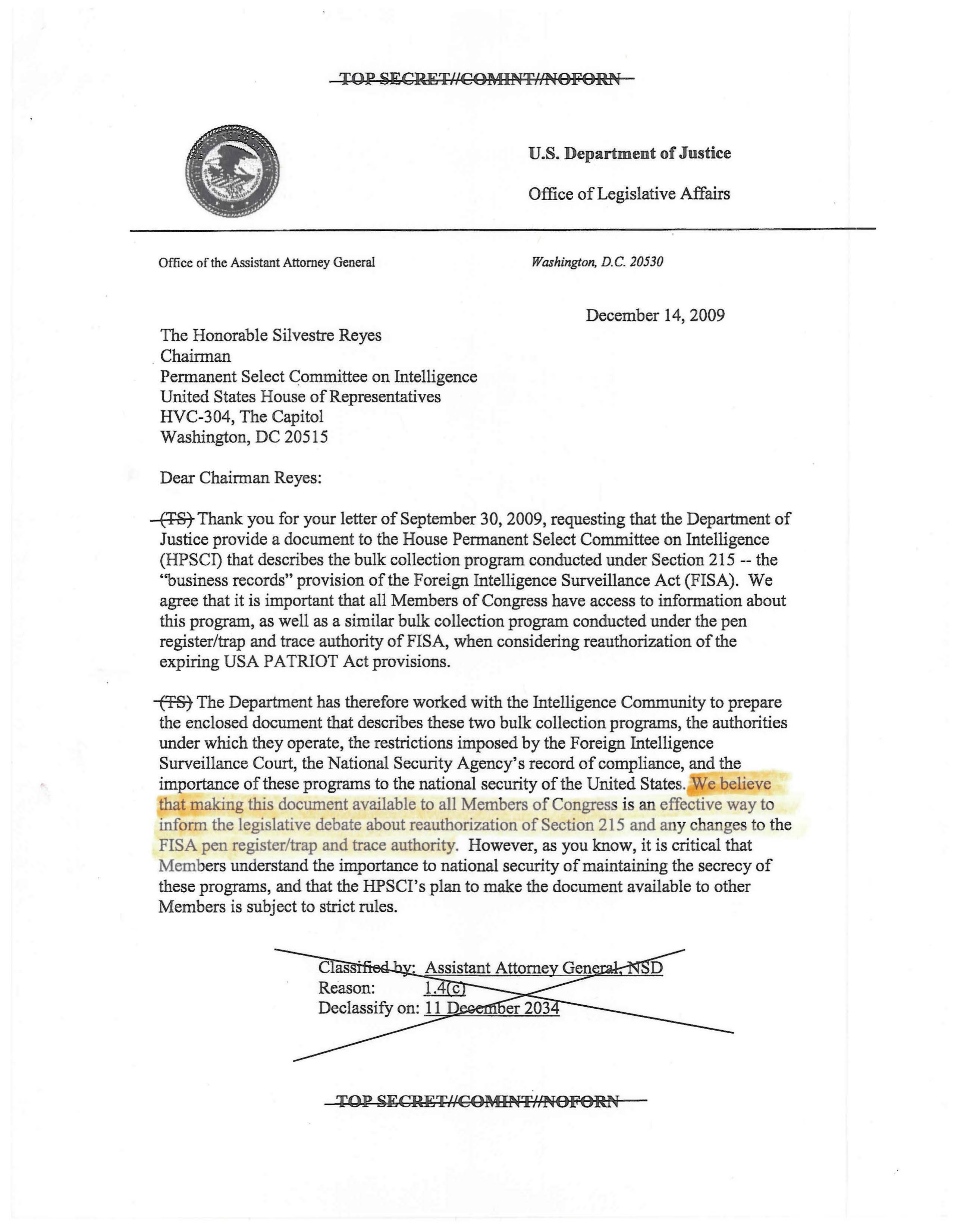
U.S. Department of Justice
Office of Legislative Affairs
Office of the Assistant Attorney General
Washington, D.C. 20530
December 14, 2009
The Honorable Silvestre Reyes
Chairman
Permanent Select Committee on Intelligence
United States House of Representatives
HVC-304, The Capitol
Washington, DC 20515
Dear Chairman Reyes:
(TS) Thank you for your letter of September 30, 2009, requesting that the Department of
Justice provide a document to the House Permanent Select Committee on Intelligence
(HPSCI) that describes the bulk collection program conducted under Section 215 - the
"business records" provision of the Foreign Intelligence Surveillance Act (FISA). We
agree that it is important that all Members of Congress have access to information about
this program, as well as a similar bulk collection program conducted under the pen
register/trap and trace authority of FISA, when considering reauthorization of the
expiring USA PATRIOT Act provisions.
(TS) The Department has therefore worked with the Intelligence Community to prepare
the enclosed document that describes these two bulk collection programs, the authorities
under which they operate, the restrictions imposed by the Foreign Intelligence
Surveillance Court, the National Security Agency's record of compliance, and the
importance of making this document available to all Members of Congress in an effective way to
inform the legislative debate about reauthorization of Section 215, and any changes to the
FISA pen register/trap and trace authority. However, as you know, it is critical that
Members understand the importance to national security of maintaining the secrecy of
these programs, and that the HPSCI's plan to make the document available to other
Members is subject to strict rules.
Classified by: Assistant Attorney General, NSD
Reason: 1.4(c)
Declassify on: 11 December 2034
TOP SECRET//COMINT//NOFORN
TOP SECRET//COMINT//NOFORN
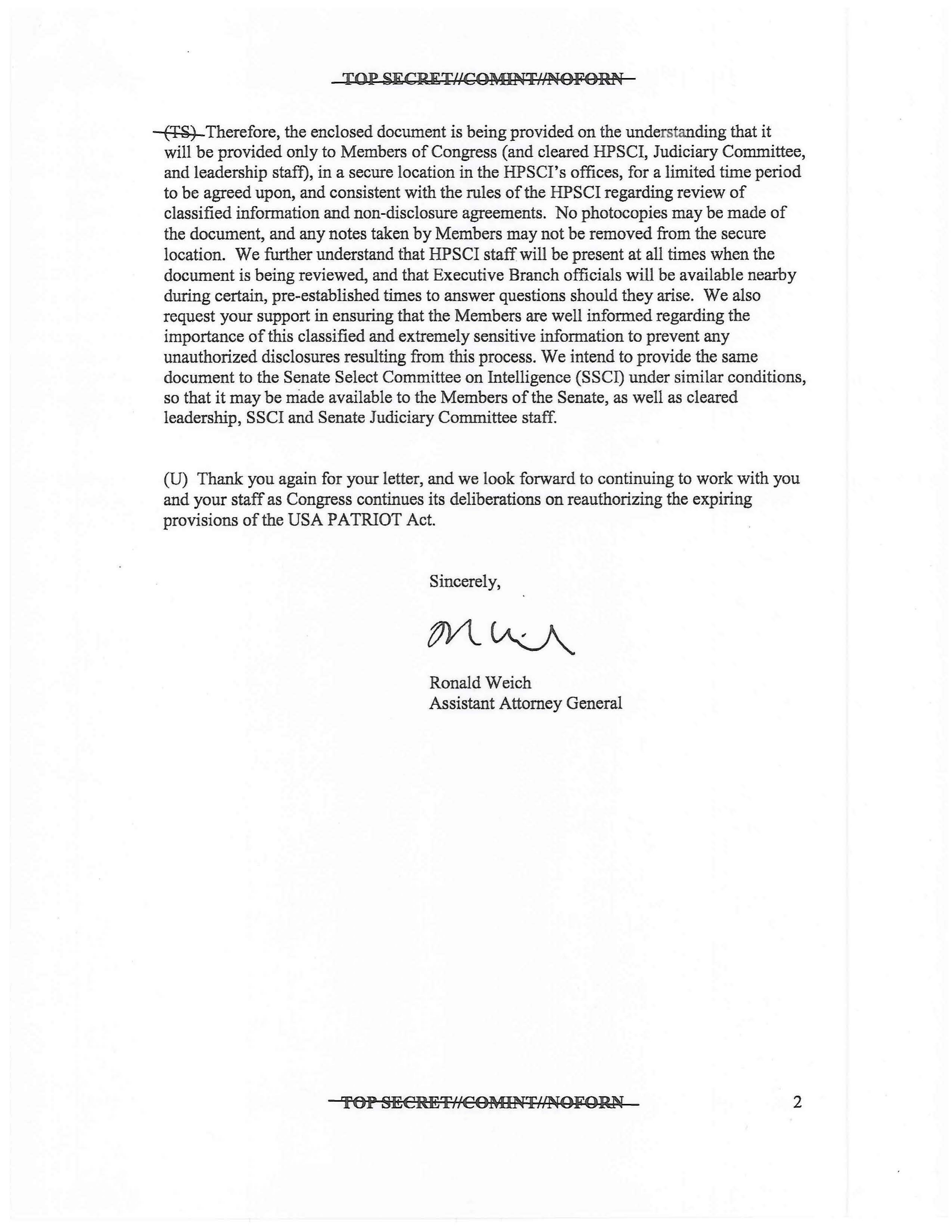
(TS) Therefore, the enclosed document is being provided on the understanding that it
will be provided only to Members of Congress (and cleared HPSCI, Judiciary Committee,
and leadership staff), in a secure location in the HPSCI's offices, for a limited time period
to be agreed upon, and consistent with the rules of the HPSCI regarding review of
classified information and non-disclosure agreements. No photocopies may be made of
the document, and any notes taken by Members may not be removed from the secure
location. We further understand that HPSCI staff will be present at all times when the
document is being reviewed, and that Executive Branch officials will be available nearby
during certain, pre-established times to answer questions should they arise. We also
request your support in ensuring that the Members are well informed regarding the
importance of this classified and extremely sensitive information to prevent any
unauthorized disclosures resulting from this process. We intend to provide the same
document to the Senate Select Committee on Intelligence (SSCI) under similar conditions,
so that it may be made available to the Members of the Senate, as well as cleared
leadership, SSCI and Senate Judiciary Committee staff.
(U) Thank you again for your letter, and we look forward to continuing to work with you
and your staff as Congress continues its deliberations on reauthorizing the expiring
provisions of the USA PATRIOT Act.
Sincerely,
(Signature)
Ronald Weich
Assistant Attorney General
TOP SECRET//COMINT//NOFORN
2
TOP SECRET//COMINT//NOFORN-
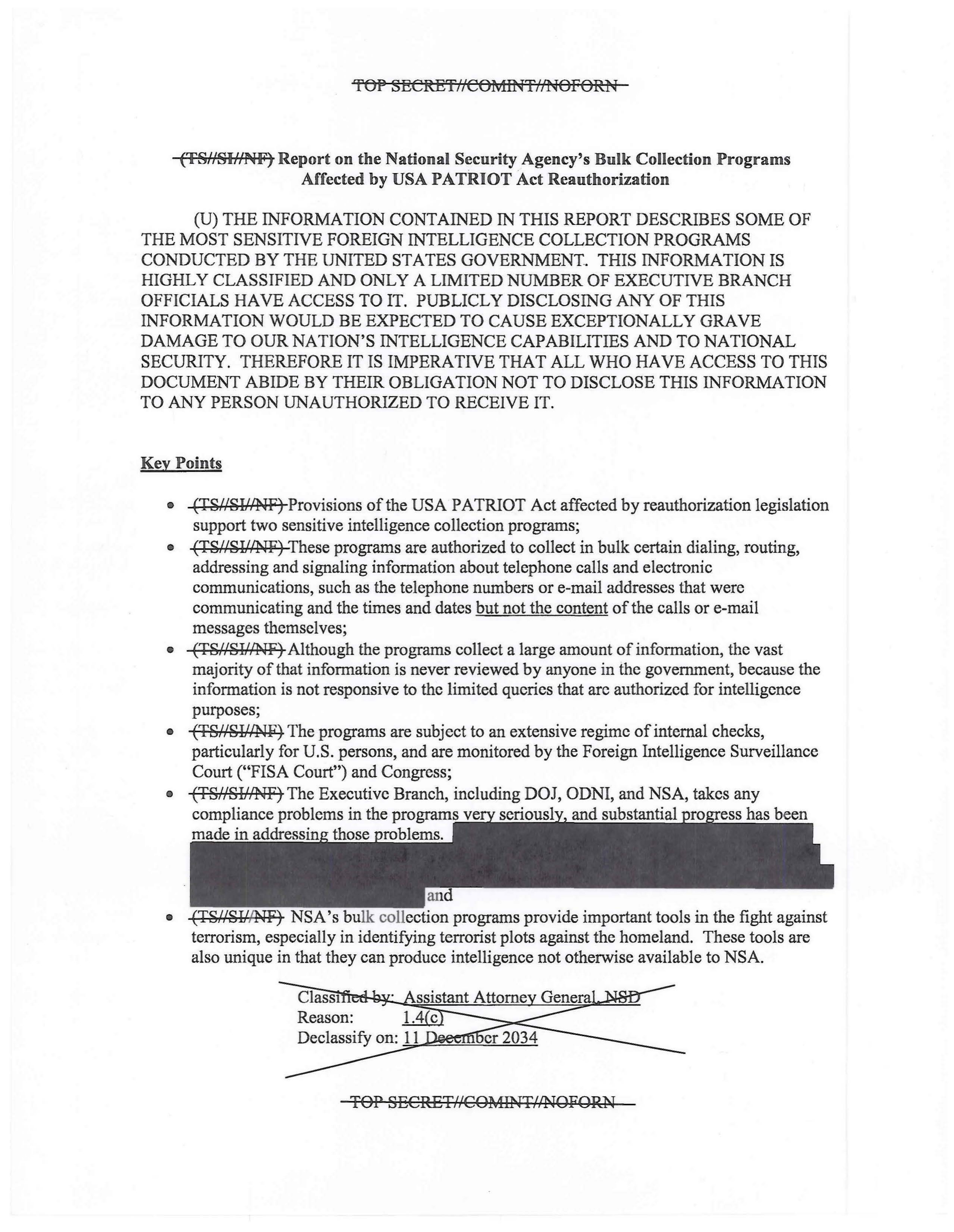
(TS//SI//NF) Report on the National Security Agency's Bulk Collection Programs
Affected by USA PATRIOT Act Reauthorization
(U) THE INFORMATION CONTAINED IN THIS REPORT DESCRIBES SOME OF
THE MOST SENSITIVE FOREIGN INTELLIGENCE COLLECTION PROGRAMS
CONDUCTED BY THE UNITED STATES GOVERNMENT. THIS INFORMATION IS
HIGHLY CLASSIFIED AND ONLY A LIMITED NUMBER OF EXECUTIVE BRANCH
OFFICIALS HAVE ACCESS TO IT. PUBLICLY DISCLOSING ANY OF THIS
INFORMATION WOULD BE EXPECTED TO CAUSE EXCEPTIONALLY GRAVE
DAMAGE TO OUR NATION'S INTELLIGENCE CAPABILITIES AND TO NATIONAL
SECURITY. THEREFORE IT IS IMPERATIVE THAT ALL WHO HAVE ACCESS TO THIS
DOCUMENT ABIDE BY THEIR OBLIGATION NOT TO DISCLOSE THIS INFORMATION
TO ANY PERSON UNAUTHORIZED TO RECEIVE IT.
Key Points
(TS//SI//NF)Provisions of the USA PATRIOT Act affected by reauthorization legislation
support two sensitive intelligence collection programs;(TS//SI//NF)These programs are authorized to collect in bulk certain dialing, routing,
addressing and signaling information about telephone calls and electronic
communications, such as the telephone numbers or e-mail addresses that were
communicating and the times and dates but not the content of the calls or e-mail
messages themselves;(TS//SI//NF)Although the programs collect a large amount of information, the vast
majority of that information is never reviewed by anyone in the government, because the
information is not responsive to the limited queries that are authorized for intelligence
purposes;(TS//SI//NF)The programs are subject to an extensive regime of internal checks,
particularly for U.S. persons, and are monitored by the Foreign Intelligence Surveillance
Court ("FISA Court") and Congress;(TS//SI//NF)The Executive Branch, including DOJ, ODNI, and NSA, takes any
compliance problems in the programs very seriously, and substantial progress has been
made in addressing those problems. [REDACTED] and(TS//SI//NF)NSA's bulk collection programs provide important tools in the fight against
terrorism, especially in identifying terrorist plots against the homeland. These tools are
also unique in that they can produce intelligence not otherwise available to NSA.
Classified by: Assistant Attorney General NSD
Reason: 1.4(c)
Declassify on: 11 December 2034
TOP SECRET//COMINT//NOFORN
TOP SECRET//COMINT//NOFORN
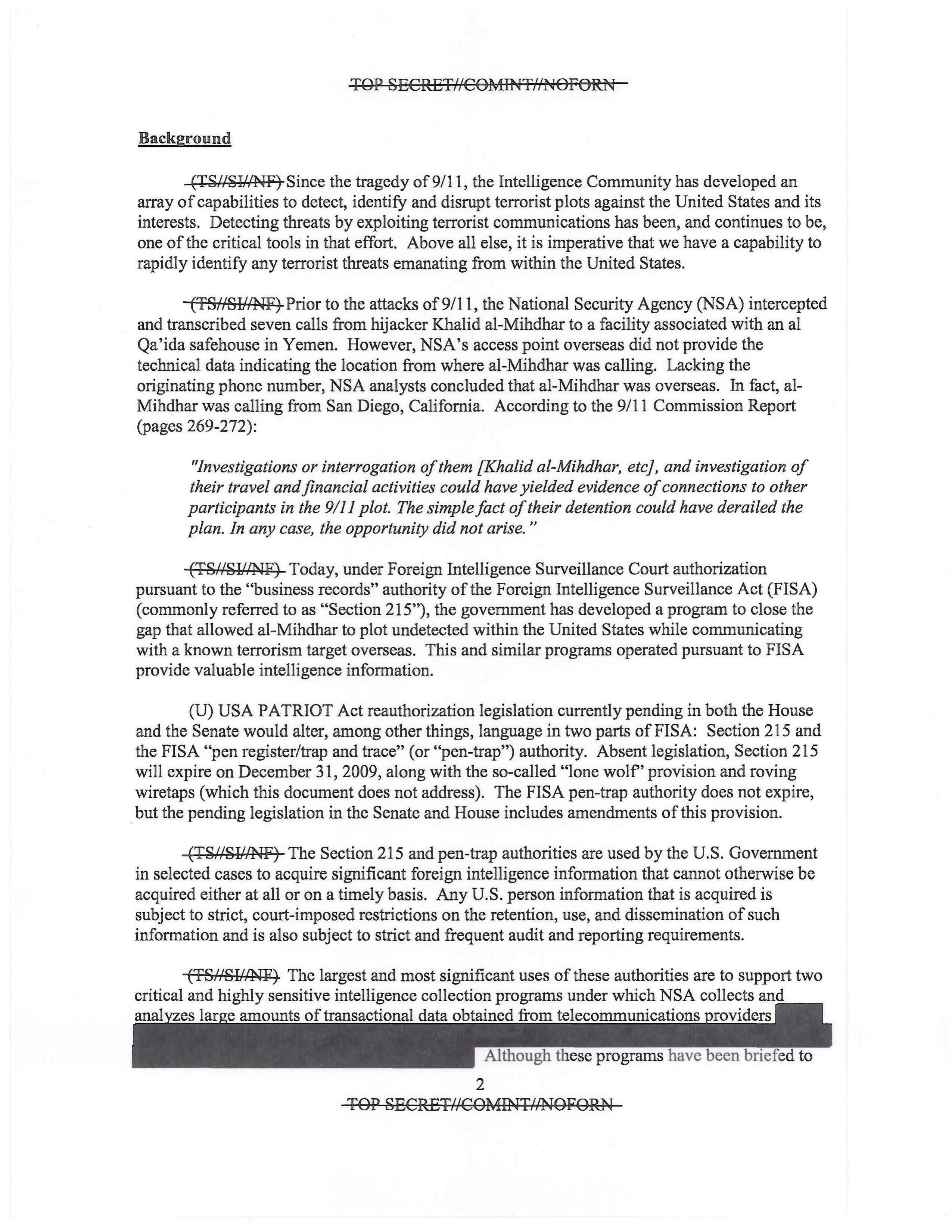
Background
(TS//SI//NF) Since the tragedy of 9/11, the Intelligence Community has developed an
array of capabilities to detect, identify and disrupt terrorist plots against the United States and its
interests. Detecting threats by exploiting terrorist communications has been, and continues to be,
one of the critical tools in that effort. Above all else, it is imperative that we have a capability to
rapidly identify any terrorist threats emanating from within the United States.
(TS//SI//NF) Prior to the attacks of 9/11, the National Security Agency (NSA) intercepted
and transcribed seven calls from hijacker Khalid al-Mihdhar to a facility associated with an al
Qa'ida safehouse in Yemen. However, NSA's access point overseas did not provide the
technical data indicating the location from where al-Mihdhar was calling. Lacking the
originating phone number, NSA analysts concluded that al-Mihdhar was overseas. In fact, al-
Mihdhar was calling from San Diego, California. According to the 9/11 Commission Report
(pages 269-272):
*"investigations or interrogation of them (Khalid al-Mihdhar, etc.), and investigation of
their travel and financial activities could have yielded evidence of connections to other
participants in the 9/11 plot. The simple fact of their detention could have derailed the
plan. In any case, the opportunity did not arise."*
(TS//SI//NF) Today, under Foreign Intelligence Surveillance Court authorization
pursuant to the "business records" authority of the Foreign Intelligence Surveillance Act (FISA)
(commonly referred to as "Section 215"), the government has developed a program to close the
gap that allowed al-Mihdhar to plot undetected within the United States while communicating
with a known terrorism target overseas. This and similar programs operated pursuant to FISA
provide valuable intelligence information.
(U) USA PATRIOT Act reauthorization legislation currently pending in both the House
and the Senate would alter, among other things, language in two parts of FISA: Section 215 and
the FISA "pen register/trap and trace" (or "pen-trap") authority. Absent legislation, Section 215
will expire on December 31, 2009, along with the so-called "lone wolf" provision and roving
wiretaps (which this document does not address). The FISA pen-trap authority does not expire,
but the pending legislation in the Senate and House includes amendments of this provision.
(TS//SI//NF) The Section 215 and pen-trap authorities are used by the U.S. Government
in selected cases to acquire significant foreign intelligence information that cannot otherwise be
acquired either at all or on a timely basis. Any U.S. person information that is acquired is
subject to strict, court-imposed restrictions on the retention, use, and dissemination of such
information and is also subject to strict and frequent audit and reporting requirements.
(TS//SI//NF) The largest and most significant uses of these authorities are to support two
critical and highly sensitive intelligence collection programs under which NSA collects and
analyzes large amounts of transactional data obtained from telecommunications providers [REDACTED].
Although these programs have been briefed to
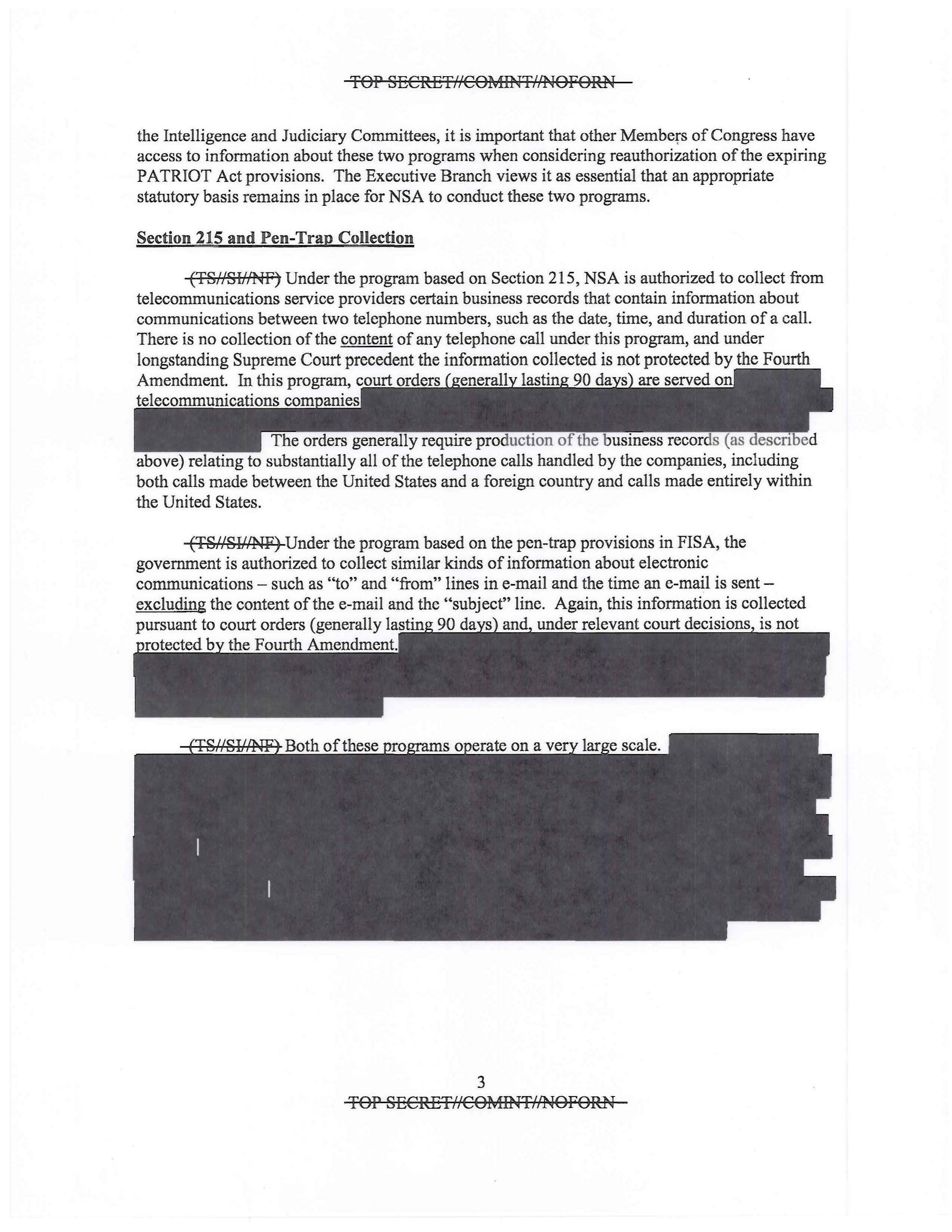
2
TOP SECRET//COMINT//NOFORN
TOP SECRET//COMINT//NOFORN
the Intelligence and Judiciary Committees, it is important that other Members of Congress have
access to information about these two programs when considering reauthorization of the expiring
PATRIOT Act provisions. The Executive Branch views it as essential that an appropriate
statutory basis remains in place for NSA to conduct these two programs.
Section 215 and Pen-Trap Collection
(TS//SI//NF) Under the program based on Section 215, NSA is authorized to collect from
telecommunications service providers certain business records that contain information about
communications between two telephone numbers, such as the date, time, and duration of a call.
There is no collection of the content of any telephone call under this program, and under
longstanding Supreme Court precedent the information collected is not protected by the Fourth
Amendment. In this program, court orders (generally lasting 90 days) are served on
telecommunications companies [REDACTED].
The orders generally require production of the business records (as described
above) relating to substantially all of the telephone calls handled by the companies, including
both calls made between the United States and a foreign country and calls made entirely within
the United States.
(TS//SI//NF) Under the program based on the pen-trap provisions in FISA, the
government is authorized to collect similar kinds of information about electronic
communications - such as "to" and "from" lines in e-mail and the time an e-mail is sent –
excluding the content of the e-mail and the "subject" line. Again, this information is collected
pursuant to court orders (generally lasting 90 days) and, under relevant court decisions, is not
protected by the Fourth Amendment.
[REDACTED]
(TS//SI//NF) Both of these programs operate on a very large scale. [REDACTED]
3
TOP SECRET//COMINT//NOFORN
TOP SECRET//COMINT//NOFORN
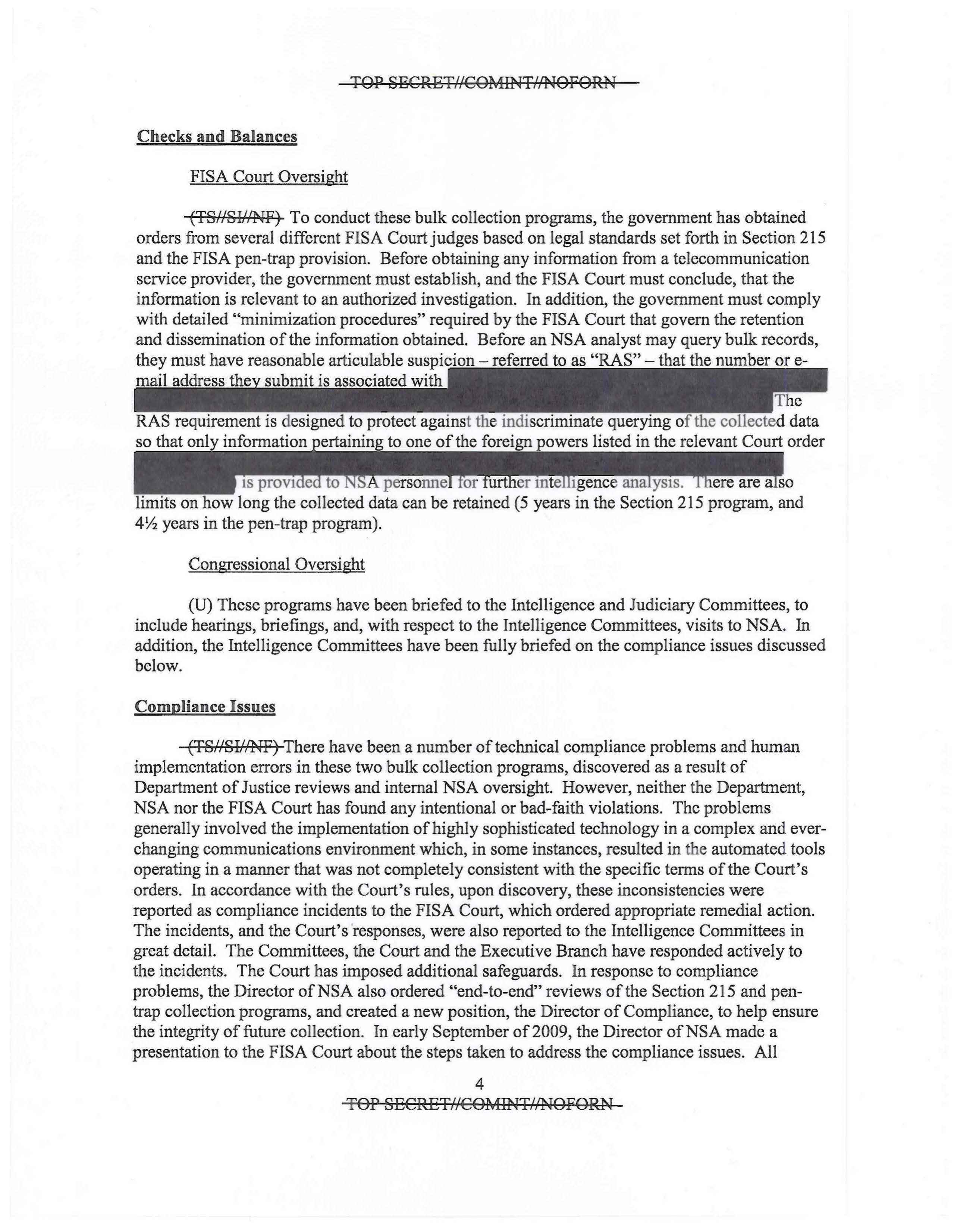
Checks and Balances
FISA Court Oversight
(TS//SI//NF) To conduct these bulk collection programs, the government has obtained
orders from several different FISA Court judges based on legal standards set forth in Section 215
and the FISA pen-trap provision. Before obtaining any information from a telecommunication
service provider, the government must establish, and the FISA Court must conclude, that the
information is relevant to an authorized investigation. In addition, the government must comply
with detailed "minimization procedures" required by the FISA Court that govern the retention
and dissemination of the information obtained. Before an NSA analyst may query bulk records,
they must have reasonable articulable suspicion – referred to as "RAS" – that the number or e-
mail address they submit is associated with [REDACTED]. The
RAS requirement is designed to protect against the indiscriminate querying of the collected data
so that only information pertaining to one of the foreign powers listed in the relevant Court order
is provided to NSA personnel for further intelligence analysis. There are also
limits on how long the collected data can be retained (5 years in the Section 215 program, and
4½ years in the pen-trap program).
Congressional Oversight
(U) These programs have been briefed to the Intelligence and Judiciary Committees, to
include hearings, briefings, and, with respect to the Intelligence Committees, visits to NSA. In
addition, the Intelligence Committees have been fully briefed on the compliance issues discussed
below.
Compliance Issues
(TS//SI//NF) There have been a number of technical compliance problems and human
implementation errors in these two bulk collection programs, discovered as a result of
Department of Justice reviews and internal NSA oversight. However, neither the Department,
NSA nor the FISA Court has found any intentional or bad-faith violations. The problems
generally involved the implementation of highly sophisticated technology in a complex and ever-
changing communications environment which, in some instances, resulted in the automated tools
operating in a manner that was not completely consistent with the specific terms of the Court's
orders. In accordance with the Court's rules, upon discovery, these inconsistencies were
reported as compliance incidents to the FISA Court, which ordered appropriate remedial action.
The incidents, and the Court's responses, were also reported to the Intelligence Committees in
great detail. The Committees, the Court and the Executive Branch have responded actively to
the incidents. The Court has imposed additional safeguards. In response to compliance
problems, the Director of NSA also ordered "end-to-end" reviews of the Section 215 and pen-
trap collection programs, and created a new position, the Director of Compliance, to help ensure
the integrity of future collection. In early September of 2009, the Director of NSA made a
presentation to the FISA Court about the steps taken to address the compliance issues. All
4
TOP SECRET//COMINT//NOFORN
TOP SECRET//COMINT//NOFORN
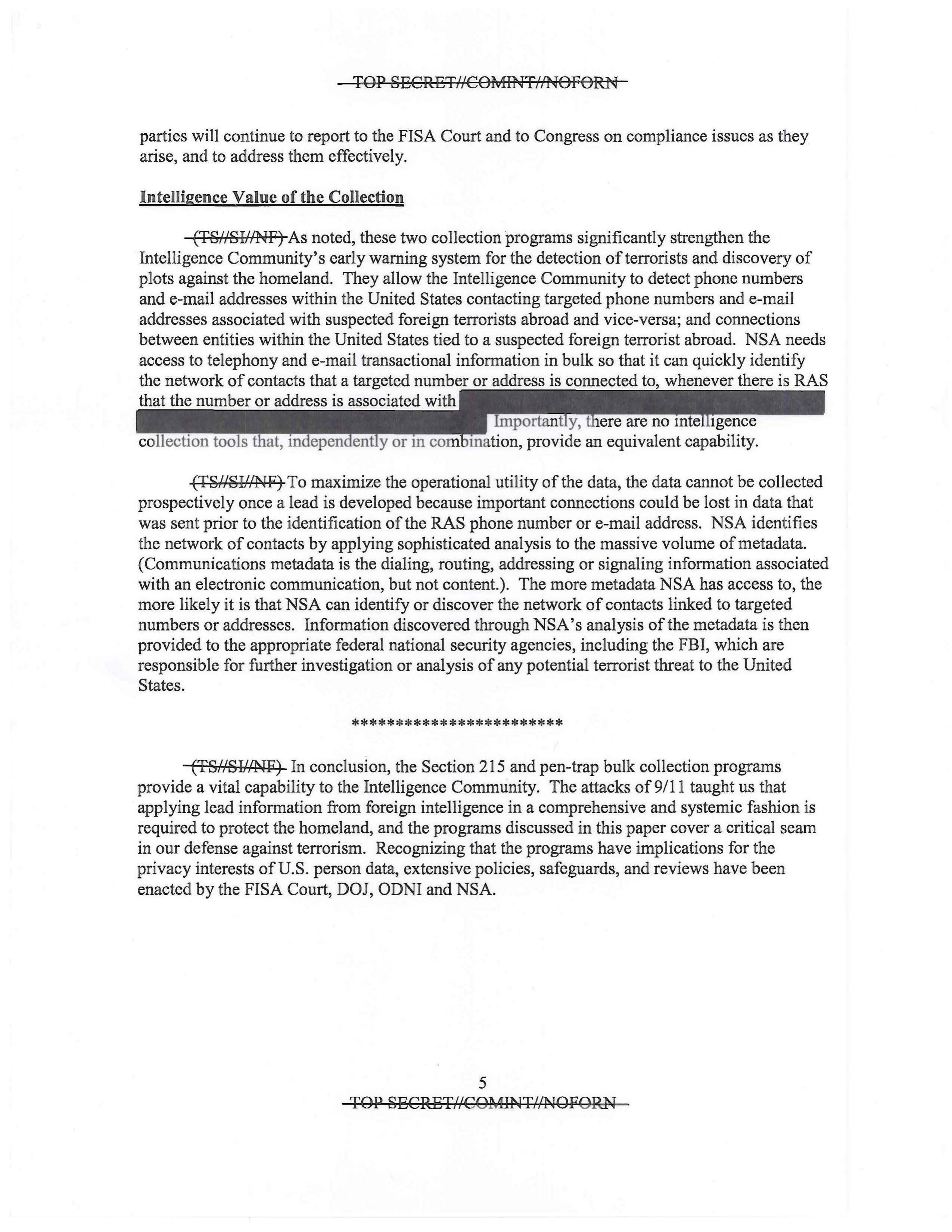
parties will continue to report to the FISA Court and to Congress on compliance issues as they
arise, and to address them effectively.
Intelligence Value of the Collection
(TS//SI//NF) As noted, these two collection programs significantly strengthen the
Intelligence Community's early warning system for the detection of terrorists and discovery of
plots against the homeland. They allow the Intelligence Community to detect phone numbers
and e-mail addresses within the United States contacting targeted phone numbers and e-mail
addresses associated with suspected foreign terrorists abroad and vice-versa; and connections
between entities within the United States tied to a suspected foreign terrorist abroad. NSA needs
access to telephony and e-mail transactional information in bulk so that it can quickly identify
the network of contacts that a targeted number or address is connected to, whenever there is RAS
that the number or address is associated with [REDACTED].
Importantly, there are no intelligence
collection tools that, independently or in combination, provide an equivalent capability.
(TS//SI//NF) To maximize the operational utility of the data, the data cannot be collected
prospectively once a lead is developed because important connections could be lost in data that
was sent prior to the identification of the RAS phone number or e-mail address. NSA identifies
the network of contacts by applying sophisticated analysis to the massive volume of metadata.
(Communications metadata is the dialing, routing, addressing or signaling information associated
with an electronic communication, but not content.). The more metadata NSA has access to, the
more likely it is that NSA can identify or discover the network of contacts linked to targeted
numbers or addresses. Information discovered through NSA's analysis of the metadata is then
provided to the appropriate federal national security agencies, including the FBI, which are
responsible for further investigation or analysis of any potential terrorist threat to the United
States.
[REDACTED]
(TS//SI//NF) In conclusion, the Section 215 and pen-trap bulk collection programs
provide a vital capability to the Intelligence Community. The attacks of 9/11 taught us that
applying lead information from foreign intelligence in a comprehensive and systemic fashion is
required to protect the homeland, and the programs discussed in this paper cover a critical seam
in our defense against terrorism. Recognizing that the programs have implications for the
privacy interests of U.S. person data, extensive policies, safeguards, and reviews have been
enacted by the FISA Court, DOJ, ODNI and NSA.
5
TOP SECRET//COMINT//NOFORN
Related Documents
-
2011 OIG Report on Bulk Collection FOIA [pdf]
A DOJ report to the Senate Intelligence Committee describing the government's bulk collection program under Section 215 of the PATRIOT Act.
Programs: PATRIOT ActACLU,EFF ↗ (2013-06-27) -
NSA inspector general report on email and internet data collection under Stellar Wind, 24 March 2009 [Working Draft] [pdf]
This 2009 NSA Inspector General draft report details the origins and legal framework of the President’s Surveillance Program (PSP), launched after 9/11 to bypass FISA limits and authorize bulk interception of internet and telephony content and metadata, including communications with one end inside the U.S. It reveals how NSA, with White House backing, expanded surveillance authority to cover “collection gaps” that existing law didn’t allow, effectively legalizing large-scale warrantless spying under a secret presidential directive.
People: Bush, George W. · Hayden, Michael · Tenet, George · Gonzales, Alberto R. · Addington, David S. · Graham, Robert · Deitz, Robert L. · Shelby, Richard · Pelosi, Nancy · Cheney, Dick · Libby, I. Lewis · Lamberth, Royce · Inouye, Daniel · Levin, Daniel · Stevens, Theodore · Kollar-Kotelly, Colleen · Rockefeller, Jay · Alexander, Keith B. · Potenza, Vito -
July 2, 2009 - DOJ Letter to Judge Walton on 2009 NSA FISA Business Records Report FOIA [pdf]
ACLU/EFF FOIA Litigation.
ACLU,EFF ↗ (2013-10-28) -
2009 Attorney General Report on Requests for Access to FISA Business Records FOIA [pdf]
An annual report from the Attorney General to the Senate Select Committee on Intelligence (SSCI), House Permanent Select Committee on Intelligence (HPSCI), Senate Judiciary Committee, and House Judiciary Committee concerning requests for access to business records under Section 215. ACLU/EFF FOIA Litigation.
Marking: SECRETPeople: Kris, David S.ACLU,EFF ↗ (2013-11-18) -
Motion of the American Civil Liberties Union, the American Civil Liberties Union of the Nation's Capital, and the Media Freedom and Information Clinic for the Release of Court Records, In re Opinions & Orders of this Court Addressing Bulk Collection of Data Under the Foreign Intelligence Surveillance Act, No. Misc. 13-08 (FISA Ct. Nov. 7, 2013). FOIA [pdf]