Tag: directory servers 4 documents
Search documents matching “directory servers” →Free-text subjects the curators added. Unlike the other axes these are not necessarily from the documents' own vocabulary, so they are the loosest thing to browse by (and the most forgiving).
Graphs
By Banner
By Classification
Refine (combine with another filter, via search)
Sort: Title
Documents
-
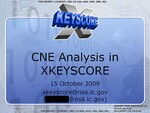
CNE Analysis in XKEYSCORE [pdf]
This document is an NSA training presentation from October 2009 demonstrating how XKEYSCORE integrates with Computer Network Exploitation (CNE) operations, allowing analysts to search and analyze data extracted from compromised computers including keystrokes, browser history, registry files, documents, emails, and directory structures collected through implants like UNITEDRAKE and OLYMPUS.
Programs: XKEYSCORE · OLYMPUS · UNITEDRAKE · PINWALE · TUNINGFORK · TURBOCHASER · MARINA · JOLLYROGER · TREASUREMAP · TURBINE · PRESSUREWAVE · MAD · TUCKER · EXPANDINGPULLY · UNIX · SEARCHLIGHT · KEYLOGGER · PILBEAM · FOXACID · WAYTIDE · SHADOWQUEST · SEAGULLFARO · DARKHELMET · LUTEUSICARUS · FOGGYBOTTOM · GREENCHAOS · RADIUS · NKB · VALIDATOR -
Tailored Access Operations, FOXACID, QUANTUM [pdf]
These NSA presentation slides detail "QUANTUM," a sophisticated system that allows the agency to intercept internet traffic and inject malware onto target computers with up to 80% success rates, far exceeding traditional spam-based methods. The system works by monitoring internet traffic for specific identifiers (like Yahoo or Facebook cookies), then racing to inject malicious code before legitimate web servers can respond, thereby compromising targets' computers without their knowledge and establishing persistent backdoor access.
Programs: FOXACID · QUANTUM · QUANTUMTHEORY · QUANTUMBISCUIT · VALIDATOR · OLYMPUS · UNITEDRAKE · OLYMPUSFIRE · SSO · FORESTPLACE -
Tor - 2006 CES Summer Program [pdf]
The following document is a 2006 research paper produced for the NSA's "Cryptanalysis and Exploitation Services" office. It lays out the technical features of Tor and proposes a number of theoretical and practical attacks, some of which the NSA developed and used in subsequent years. Among other things, the paper describes an NSA-written adaptation of Tor, "indistinguishable from an original Tor client," which enables the NSA to gather intelligence inside the network. It also describes two kinds of "denial of service" attacks against Tor, code-named Coil and Flower, which are used to divert would-be anonymous communications into open channels.
Programs: MJOLNIR -
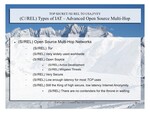
Types of IAT - Advanced Open Source Multi-hop [pdf]
This top-secret NSA/GCHQ document provides a detailed technical overview of the Tor network, including how it works, its strengths as the “king of high secure, low-latency Internet anonymity,” methods for identifying Tor traffic, censorship-driven protocol obfuscation, and ongoing intelligence efforts to analyze, fingerprint, and exploit Tor through passive SIGINT and active research, including collaboration between US and UK agencies.
People: Appelbaum, Jacob