Tag: collection points 3 documents
Search documents matching “collection points” →Free-text subjects the curators added. Unlike the other axes these are not necessarily from the documents' own vocabulary, so they are the loosest thing to browse by (and the most forgiving).
Refine (combine with another filter, via search)
Sort: Title
Documents
-
Access Breakdown [pdf]
This GCHQ document provides a technical breakdown of surveillance access points showing 11 different interception sites (with codenames like DONNINGTON, LATUS, SCEPTRE) accessing various undersea cables including Flag, Apollo North/South, BT, Cable & Wireless (C&W), SMW-3, Solas, and Verizon, totaling 541 10-gigabit connections representing 5,410 gigabits of surveillance capacity across the network.
Programs: DONNINGTON · LATUS · SCEPTRE · PRESCOTT · GIBUS · KIRKISTOWN · MONDELLO · LINNELL · CATEGORY · KNAPWEED · ELAPSE · BROKER“Vodafone – der lange Arm des britischen Geheimdienstes?” - WDR ↗ (2014-11-20) · “Spy cable revealed: how telecoms firm worked with GCHQ” - Channel 4 ↗ (2014-11-20) · “Der lange Arm des Geheimdienstes?” - NDR ↗ (2014-11-21) · “Snowden-Leaks: How Vodafone-Subsidiary Cable & Wireless Aided GCHQ’s Spying Efforts” - Süddeutsche Zeitung ↗ (2014-11-25) · Restle, Georg · White, Geoff · Strozyk, Jan · Moltke, Henrik · Poitras, Laura · Obermaier, Frederik -
Moving Data Through Disconnected Networks - Delay-Tolerant Networking and the IC [pdf]
This June 2012 NSA Laboratory for Telecommunications Sciences presentation details Delay-Tolerant Networking (DTN) applications for surveillance operations, including covert communications in denied areas, data exfiltration from isolated networks, unwitting data mules, and integration with TAO's CHIMNEYPOOL implant framework. The document reveals R4 development of FUZZYLINT, an ultra-lightweight DTN implementation designed to enable multi-hop exfiltration from implants without requiring direct physical access.
People: Vahdat, Amin · Becker, David · Juang, Philo · Oki, Hidekazu · Wang, Yong · Martonosi, Margaret · Peh, Li-Shiuan · Rubenstein, Daniel · Grossglauser, Matthias · Tse, David N. C. · Fall, Kevin · Shah, Rahul C. · Roy, Sumit · Jain, Sushant · Brunette, Waylon · Lindgren, Anders · Doria, Avri · Schelen, Olov · Small, Tara · Haas, Zygmunt J. · Zhao, Wenrui · Ammar, Mostafa · Zegura, Ellen · Ginzboorg, Philip · Kärkkäinen, Teemu · Nagata, Akira · Lenders, Vincent · Legendre, Franck · May, Martin · Karlsson, Gunnar · Du, Bowei · Demmer, Michael · Brewer, Eric · Ott, Jörg · Pitkänen, Mikko Juhani · Han, Bo · Hui, Pan -
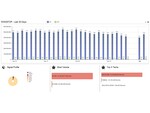
WINDSTOP - Last 30 Days [pdf]
The WINDSTOP report shows massive NSA collection activity over a 30-day period, with daily DNI (Digital Network Intelligence) and DNR (Dialed Number Recognition) records reaching up to 600 million per day. Most data volume came from DS-300 and DS-200B collection points, processed primarily through XKEYSCORE and TURMOIL, and included a mix of signal types such as PCS, INMAR, MCIP, VSAT, and PSTN. The chart follows the same structure as BOUNDLESSINFORMANT, the NSA’s global SIGINT visualization tool, using bar and pie charts to track and categorize collection volume by signal type, SIGAD, and processing system.