Tag: analyst guide 9 documents
Search documents matching “analyst guide” →Free-text subjects the curators added. Unlike the other axes these are not necessarily from the documents' own vocabulary, so they are the loosest thing to browse by (and the most forgiving).
Graphs
By Banner
By Classification
Refine (combine with another filter, via search)
Sort: Title
Documents
-
DNI101 [pdf]
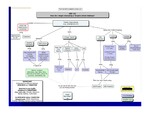
This TOP SECRET training guide, "DNI 101," provides a workflow for Digital Network Intelligence analysts on how to investigate a target's email address, detailing the specific tools, databases, and methodology used, and stressing the critical difference between initial open-source/classified research and the active "targeting" of raw SIGINT repositories like XKEYSCORE, PINWALE, and MARINA.
Programs: NKB · FOXTRAIL · FOREMAN · PINWALE · LIONHEART · XKEYSCORE · DISHFIRE · MARINA · MECWEB · MAINWAY · TRAFFICTHIEF · MAUI · ANCHORY · M3 · INTELLINK · HOMEBASE · PROTON · UTT · CADENCE · SPEEDBUMP · TUNINGFORK · MASTERSHAKE · BLACKPEARL · JACKSPARROW · ROADBED · STORYDUTY · LIONROAR · DOPHONE · UIS -
Email Address vs User Activity [pdf]
This 2009 NSA training presentation explains how to use the XKEYSCORE system to search raw SIGINT, detailing the differences between the "Email Address" query, which finds email addresses in full content, and the more flexible "User Activity" query, which can search for selectors like cookies, usernames, and phone numbers.
“XKEYSCORE: NSA’s Google for the World’s Private Communications” - The Intercept ↗ (2015-07-01) · “No Place to Hide” - Metropolitan Books ↗ (2014-05-13) · Marquis-Boire, Morgan · Greenwald, Glenn · Lee, Micah -
Events Analysis [pdf]
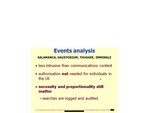
This GCHQ document explains authorization policies for querying metadata databases (SALAMANCA, HAUSTORIUM, THUGGEE, IMMINGLE), stating that metadata is "less intrusive than communications content" and that authorization is "not needed for individuals in the UK," though searches are logged and audited with necessity and proportionality considerations still applying.
-
Finding and Querying Document Metadata [pdf]
This 2009 NSA training guide, created by Booz Allen Hamilton, explains how analysts can use the XKEYSCORE system to track targets by searching for "non-traditional selectors" embedded within documents, such as author names, company information, or even the hash values of company logos.
Programs: XKEYSCORE · TUNINGFORK · PINWALE · FOXACID · FOXBASE · CARBOY · CARDAMON · UNITEDRAKE · CADENCE -
Free File Uploaders [pdf]
This 2009 NSA training presentation for the XKEYSCORE system details how analysts can monitor Free File Uploader (FFU) websites like Zshare and RapidShare, which are difficult to track due to a lack of strong selectors. The guide introduces the "Web File Transfer" plug-in, a specialized tool designed to extract key metadata like original filenames and download/delete links from FFU web traffic.
-
Full Log vs HTTP [pdf]
This 2009 NSA training presentation explains the difference between using the "Full Log" and "HTTP Activity" queries in the XKEYSCORE surveillance system, showing analysts how to use both in tandem to gain a complete picture of a target's online activities, including identifying the use of anonymizing proxies.
-
HTTP Activity in XKEYSCORE [pdf]
This training presentation from March 2009 provides NSA and Five Eyes analysts with detailed instructions on exploiting HTTP web browsing activity collected by XKEYSCORE, explaining how to differentiate client-to-server requests (GET/POST) from server-to-client responses, extract metadata like search terms, URLs, cookies, language, and browser types, and use this data to discover new surveillance targets, track individuals' online behavior, and conduct "pattern of life" analysis.
-
New Contact-Chaining Procedures to Allow Better, Faster Analysis SIDtoday [pdf]
The SIGINT Management Directive 424 briefing (Jan 2011) announces a major procedural shift at the NSA, allowing analysts to conduct contact chaining and large-scale metadata analysis from any selector, regardless of nationality or location. This change removes prior restrictions on U.S. data, enabling more powerful social network mapping for foreign intelligence purposes.
Programs: GATEKEEPER -
User's Guide For PRISM Skype Collection - August 2012 [pdf]
An NSA analyst user guide for PRISM Skype collection, explaining how to task Skype selectors, locate collected content across PINWALE, NUCLEON and MARINA, interpret common collection artefacts, and troubleshoot issues with video synchronisation, timestamp discrepancies and incomplete file transfers — covering peer-to-peer, in/out and conference call collection modes from PRISM coverage that began in February 2011.