Publisher: The Washington Post 27 documents
Search documents matching “The Washington Post” →Who published each document. Mostly a news outlet, but sometimes a book. A partner outlet that reported the story without publishing the documents keeps its byline and its article, but is not a publisher here.
Showing the documents The Washington Post itself published in 2013 - all years.
Graphs
By Banner
By Classification
Refine (combine with another filter, via search)
Sort: Title
Documents
-
SSO Collection Optimization Overview [pdf]
This excerpt is from an article in the NSA's "Intellipedia," a classified system built with the same open-source software used by Wikipedia. Like the other documents, it describes the problem of high-volume, low-value data collection — and the NSA's response — with a focus on Internet contact lists.
-
SSO GHOSTMACHINE Analytics [pdf]
This document describes the NSA’s cloud analytics platform GHOSTMACHINE, used by Special Source Operations (SSO) to process and analyze massive volumes of data (e.g., from FASCIA) using Hadoop-based infrastructure. It’s essentially the backbone system for querying, correlating, and enriching surveillance data at scale — not just a single analytic, but the analytic/cloud environment powering many programs.
Programs: GHOSTMACHINE · FASCIA · CERF · POPTOP · DRT · SIGDASYS · JUGGERNAUT · SEADIVER · AST128 · TUSKATTIRE · ASDF · BROKENRECORD · REDHAWK · SSO -
Summary of DNR and DNI Co-Travel Analytics [pdf]
The document outlines the NSA’s development and testing of multiple “co-traveler” analytics—sophisticated tools that analyze bulk mobile location data to identify people who travel together or follow similar patterns, even if they are not known intelligence targets. It details various analytic systems, their data sources (such as FASCIA, VLR, GCID), architectures, scoring methods, and future enhancements, illustrating a large-scale surveillance framework for mapping human movement and relationships.
Programs: CO-TRAVELER · CHALKFUN · TMI · PACT · RT-RG · SORTINGLEAD · FASCIA · Hectic Snare · DRT · Juggernaut · GM-PLACE · Fast Follower · MGSC · ELKPRINTS · VOICESAIL · CULTWEAVE · OCTAVE · OCTSKYWARD · SEDB · JEMA · The Café · UTT · ASDF · GHOSTMACHINE · CLOUDBASE · FASTSCOPE · GOLDMINER · CHET · GEOT · TMAC · SPCMA · MAPREDUCE · ACCUMULO · GAMBIT · ICREACH -
Targeting Rationale (TAR) [pdf]
An NSA document describing how analysts should explain their targeting decisions under the FISA Amendments Act.
-
Tor - 2006 CES Summer Program [pdf]
The following document is a 2006 research paper produced for the NSA's "Cryptanalysis and Exploitation Services" office. It lays out the technical features of Tor and proposes a number of theoretical and practical attacks, some of which the NSA developed and used in subsequent years. Among other things, the paper describes an NSA-written adaptation of Tor, "indistinguishable from an original Tor client," which enables the NSA to gather intelligence inside the network. It also describes two kinds of "denial of service" attacks against Tor, code-named Coil and Flower, which are used to divert would-be anonymous communications into open channels.
Programs: MJOLNIR -
WINDSTOP - Last 30 Days [pdf]
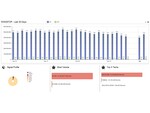
The WINDSTOP report shows massive NSA collection activity over a 30-day period, with daily DNI (Digital Network Intelligence) and DNR (Dialed Number Recognition) records reaching up to 600 million per day. Most data volume came from DS-300 and DS-200B collection points, processed primarily through XKEYSCORE and TURMOIL, and included a mix of signal types such as PCS, INMAR, MCIP, VSAT, and PSTN. The chart follows the same structure as BOUNDLESSINFORMANT, the NSA’s global SIGINT visualization tool, using bar and pie charts to track and categorize collection volume by signal type, SIGAD, and processing system.
-
WINDSTOP/2P System Highlights [pdf]
A March 2013 NSA Special Source Operations internal report describing a volume management problem at MUSCULAR — the joint NSA/GCHQ programme tapping Yahoo and Google inter-datacenter fiber links — specifically concerning Yahoo's proprietary Narchive email transfer format, which was generating 15GB/day of mostly stale email data representing 25% of the collection site's daily allocation.