Savage-FOIA-Stellarwind IG Report
Open PDFDocument date: 2009-07-10
Type: FOIA
Pages: 747
Classification: TOP SECRET STLW HCS COMINT ORCON
Dissemination: NOFORN
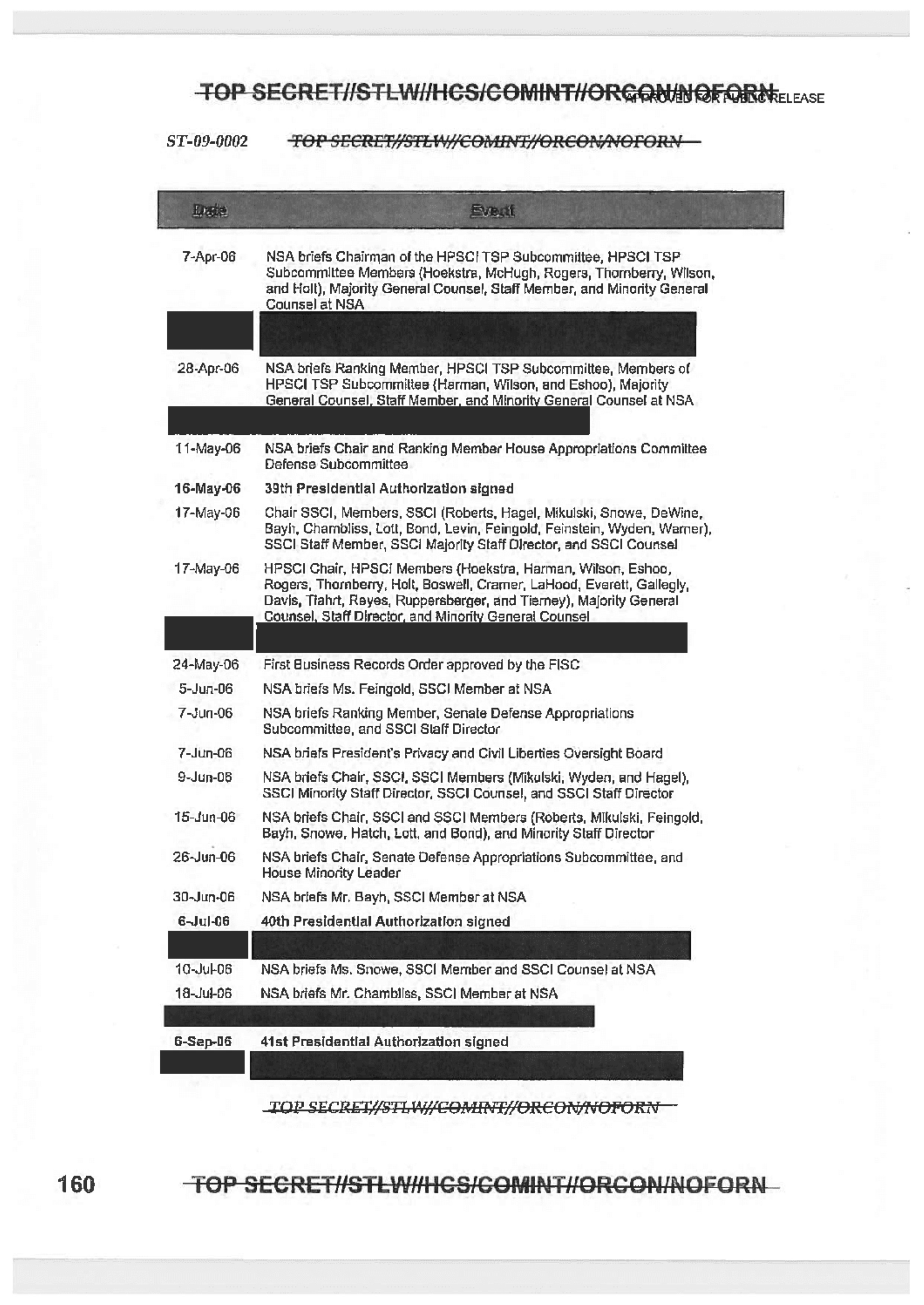
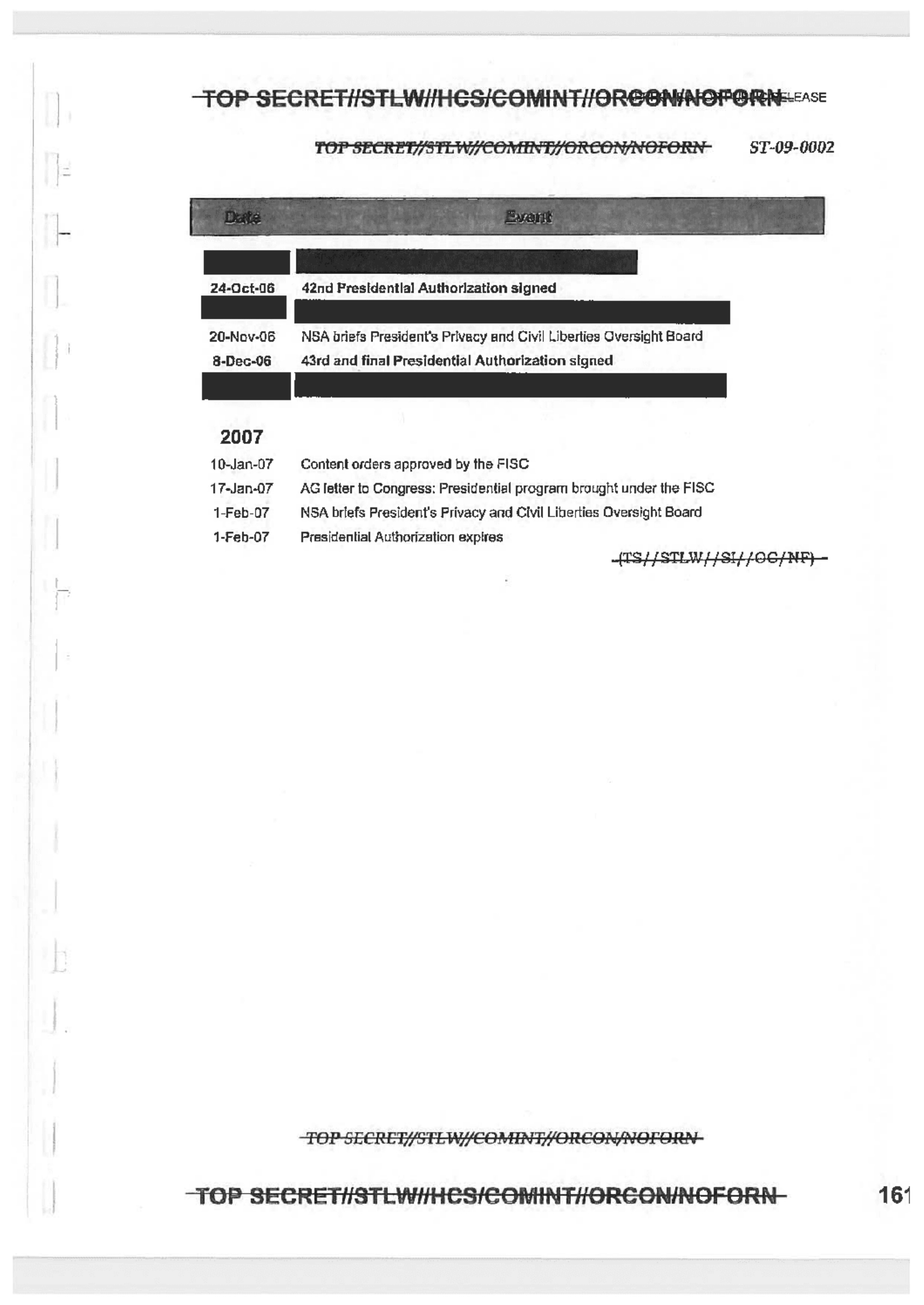
In response to a Freedom of Information Act lawsuit by The New York Times, the government has declassified a 2009 report by five agencies’ inspectors general about the Stellarwind program, the group of N.S.A. warrantless wiretapping and bulk phone and e-mail records collection activities initiated by President George W. Bush after the terrorist attacks of Sept. 11, 2001. In 2009, the government released a 43-page unclassified version which omitted discussion of many key facts that then remained secret. After the 2013 leaks by the former intelligence contractor Edward J. Snowden, which included a draft version of the N.S.A. inspector general’s contribution to this larger joint I.G. report, the government declassified many facts about surveillance, leading to The Times’ lawsuit seeking release of the full and final report.
My notes


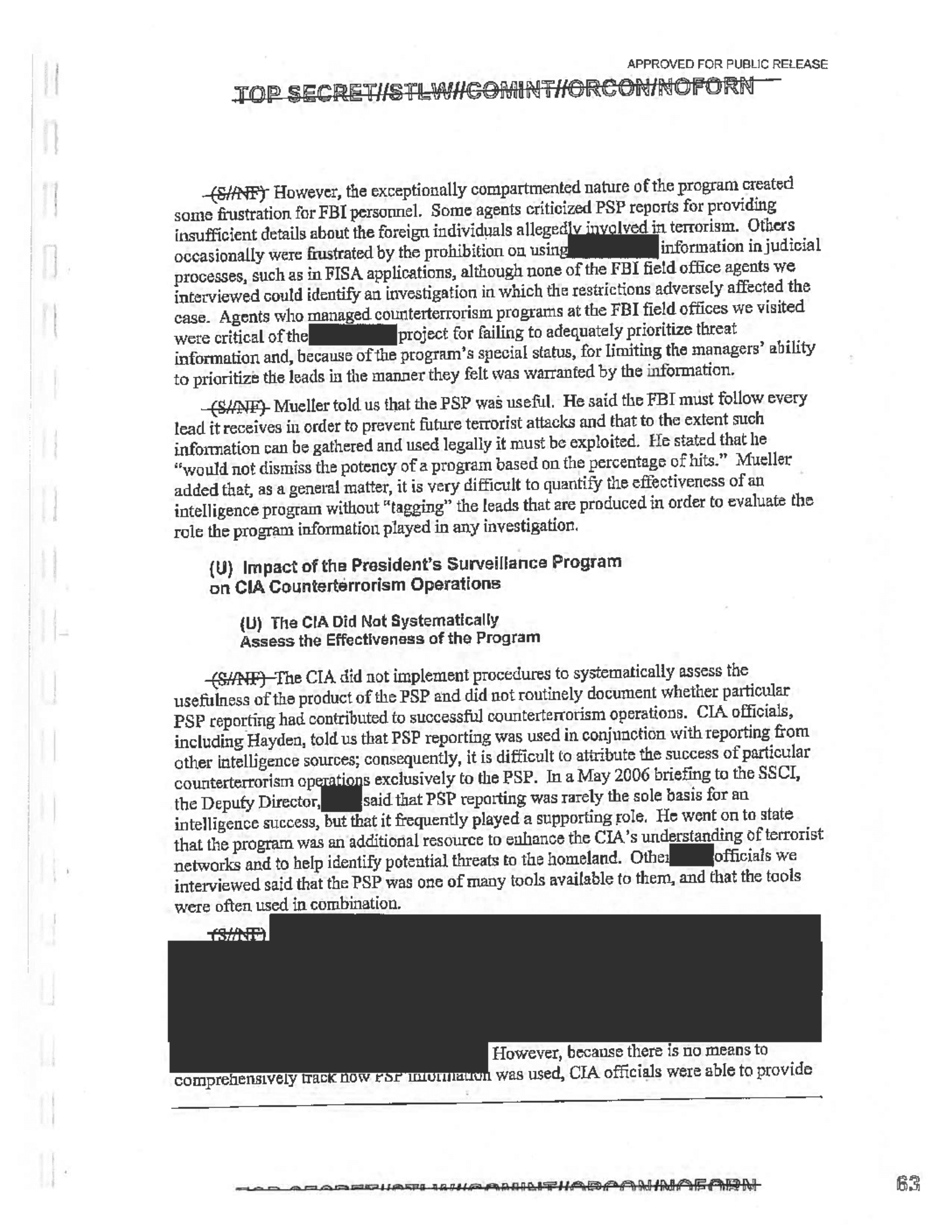
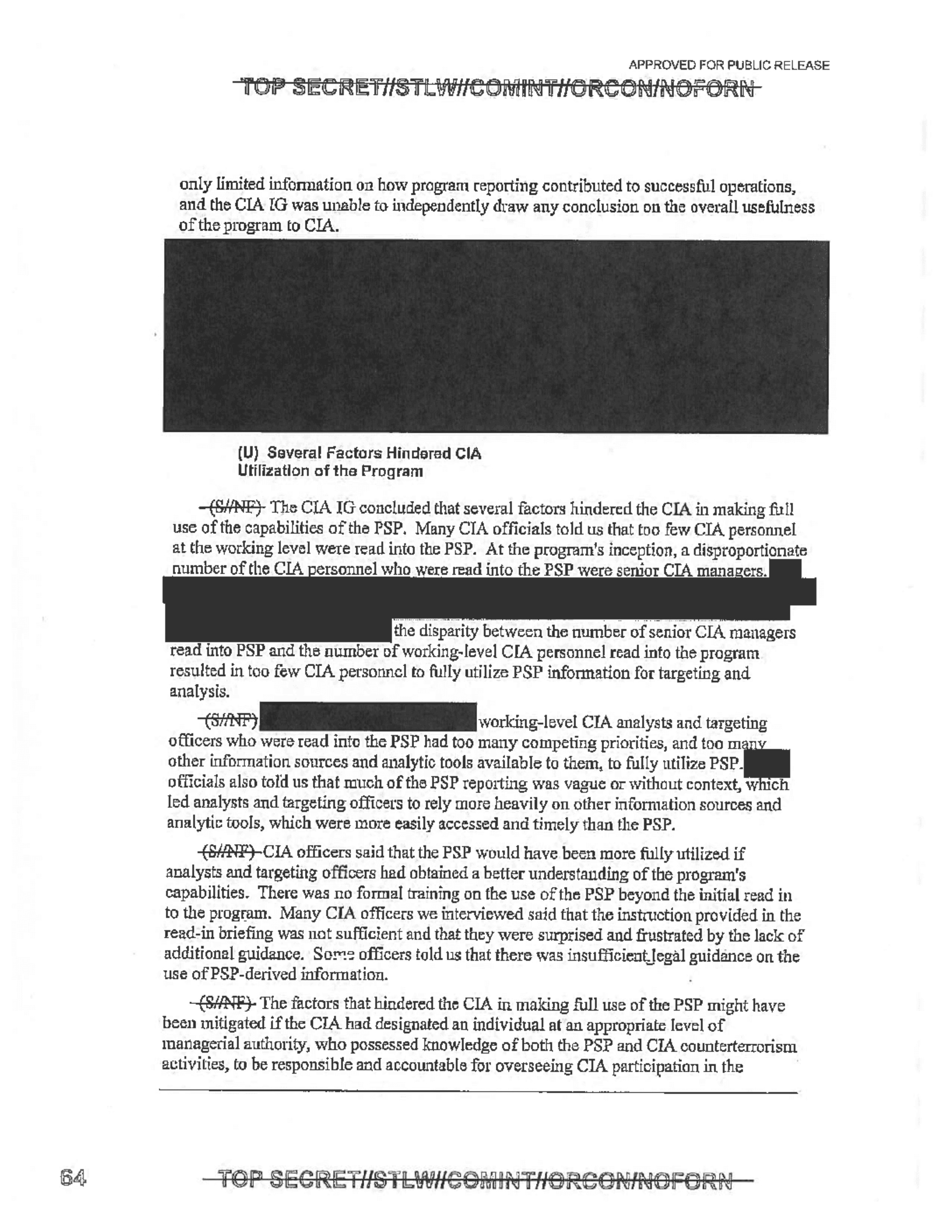
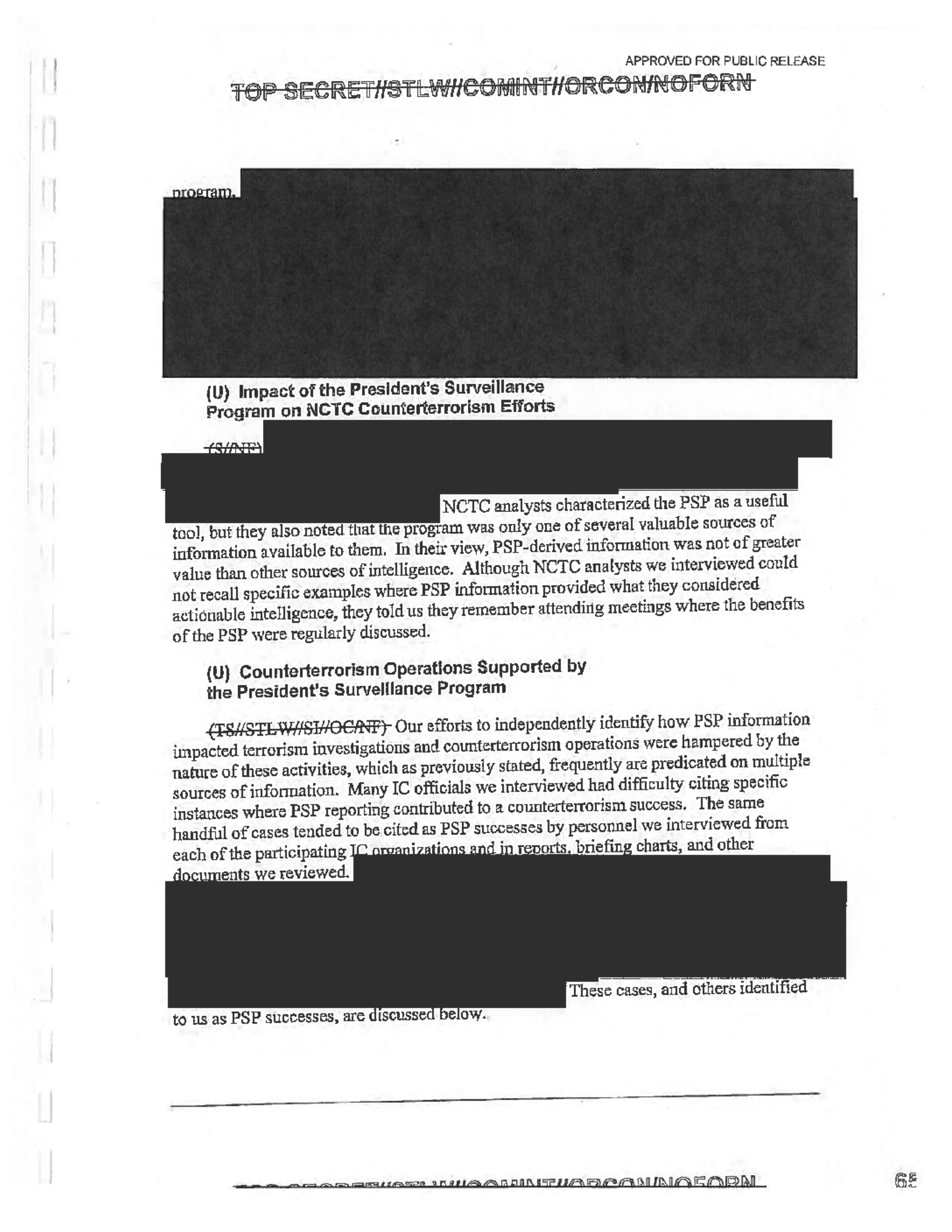

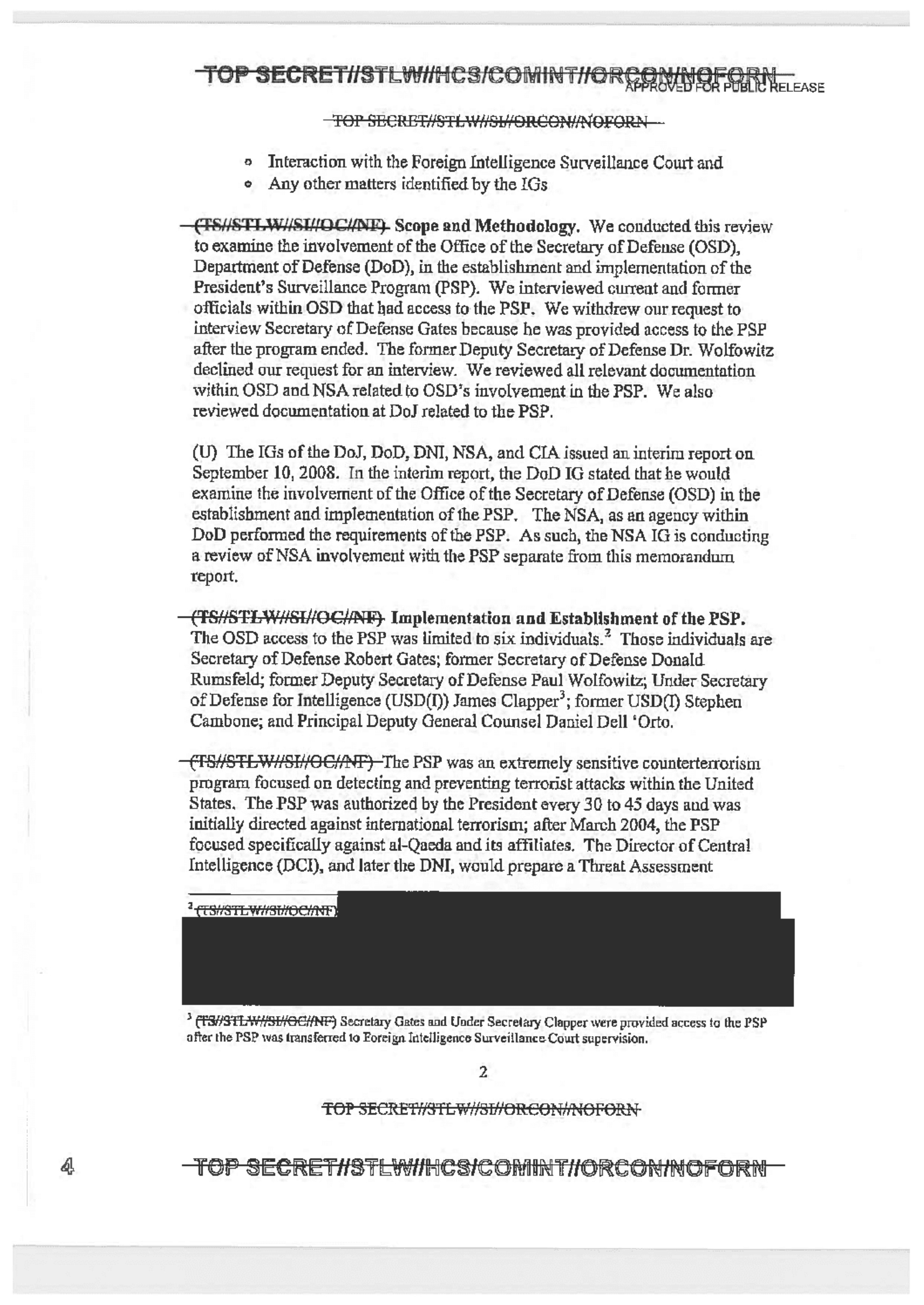
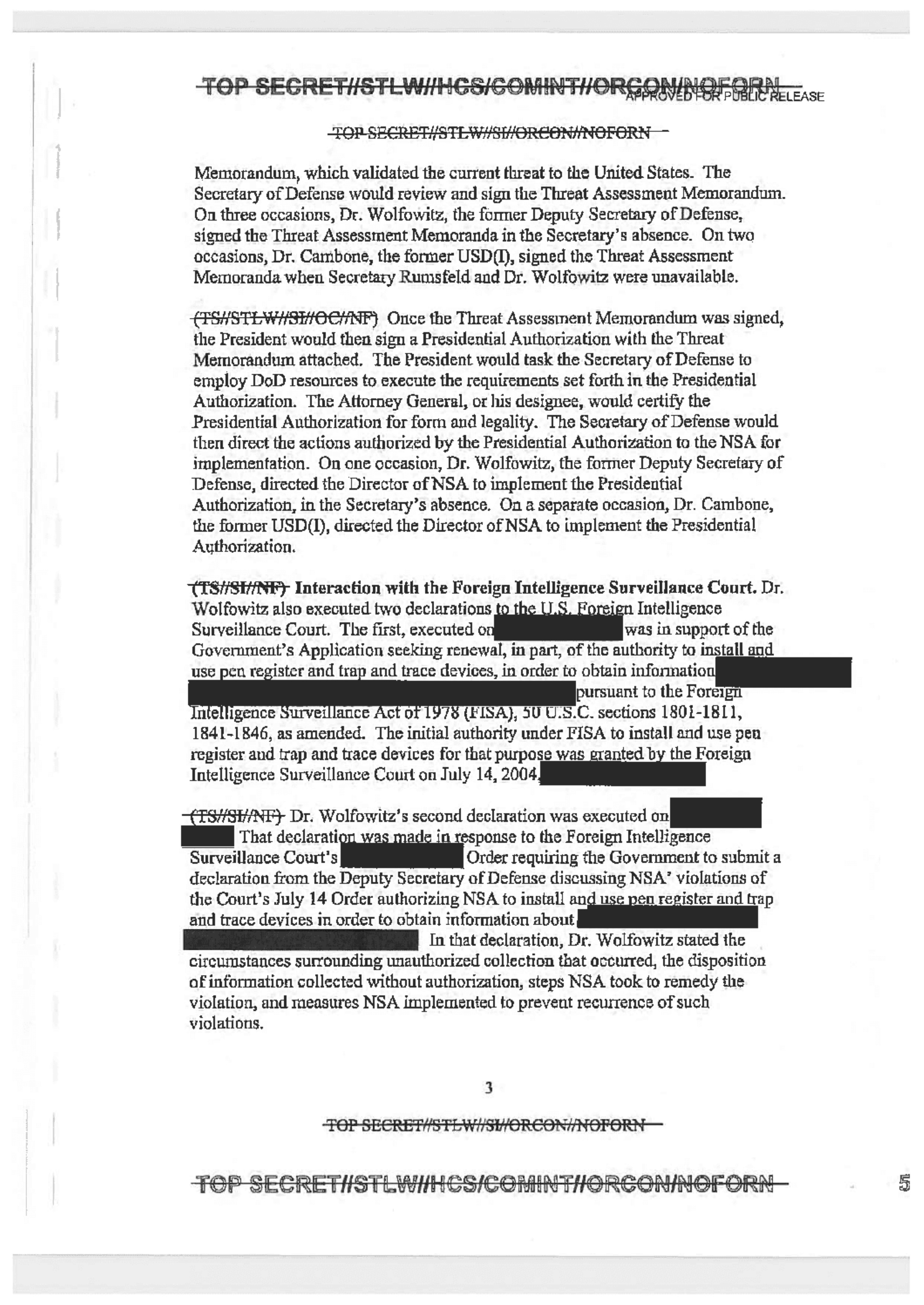




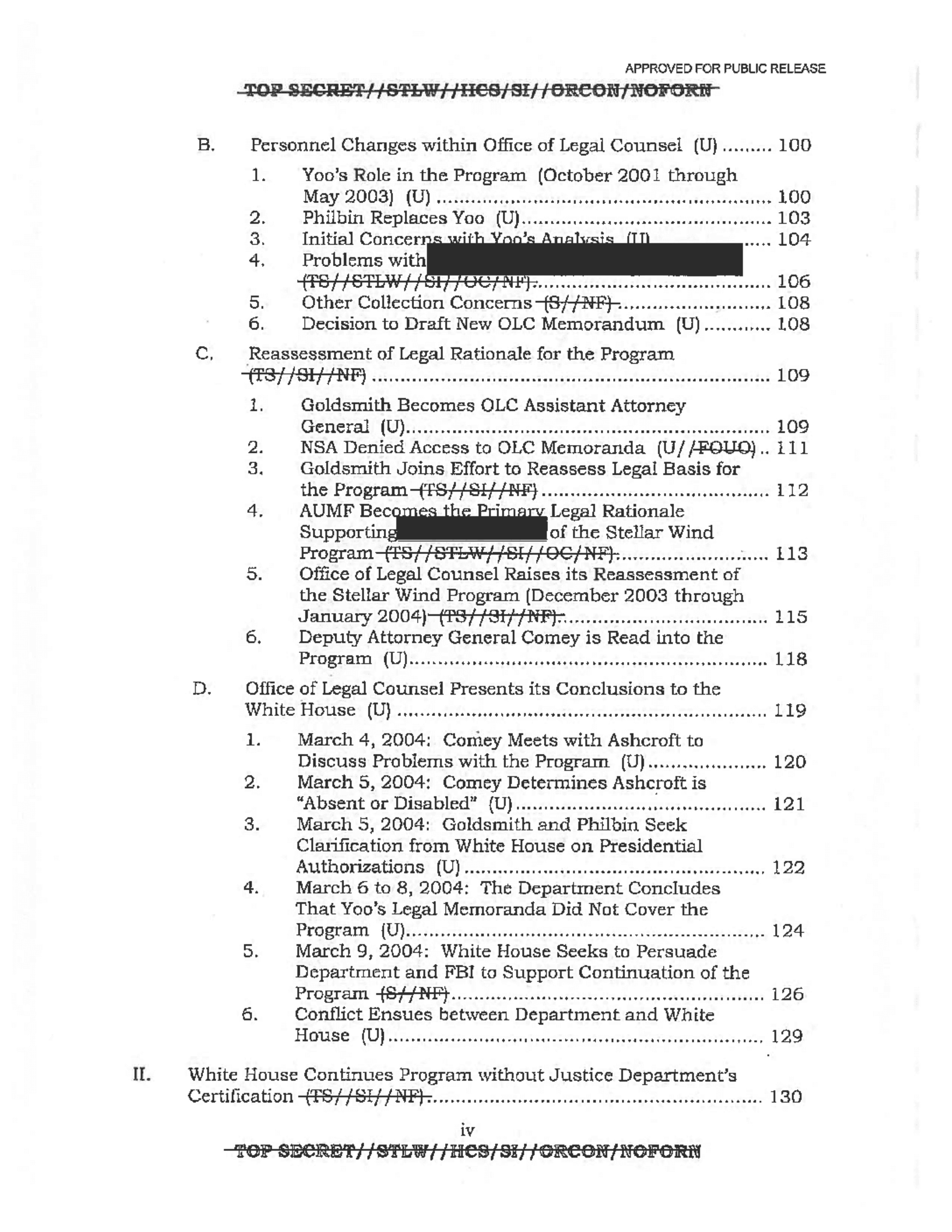
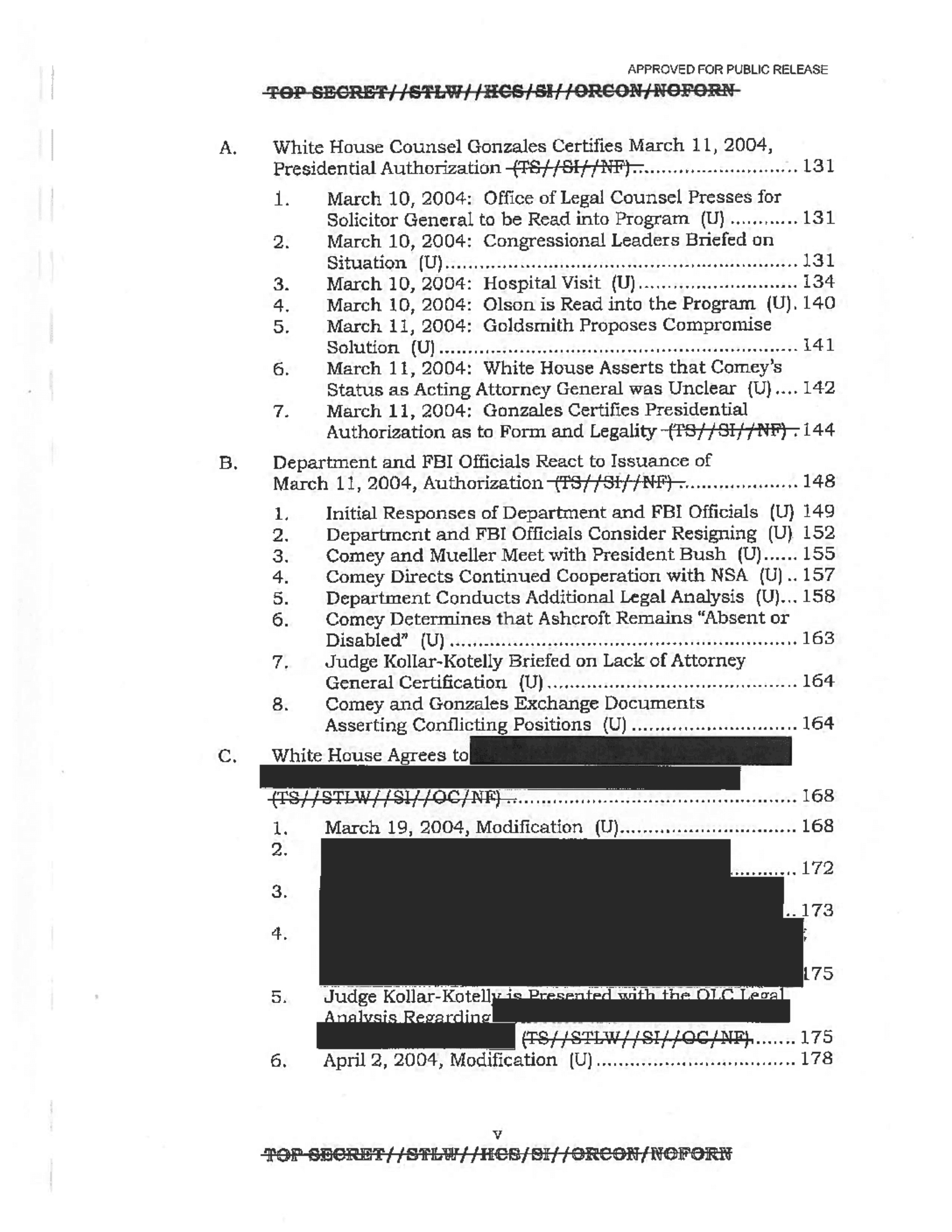
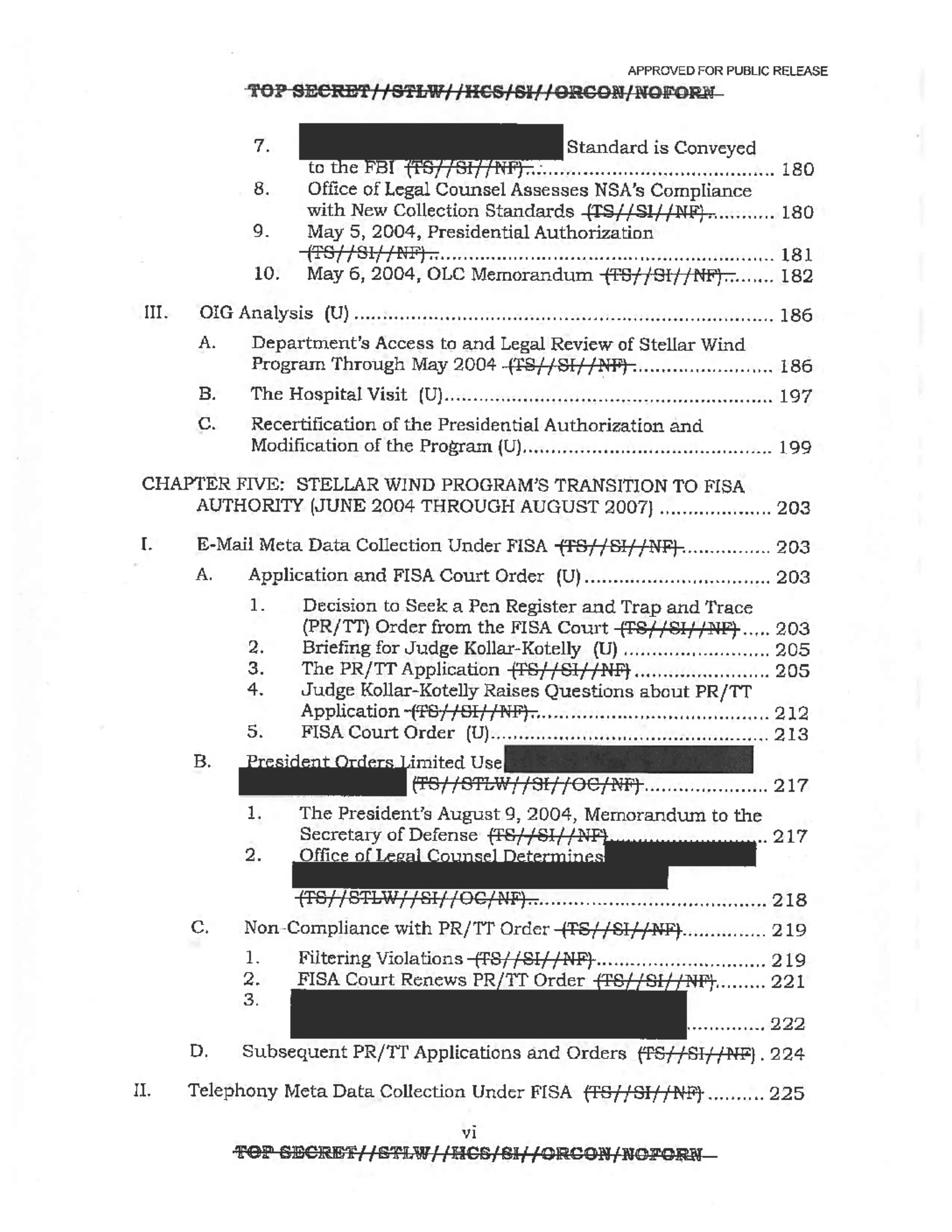
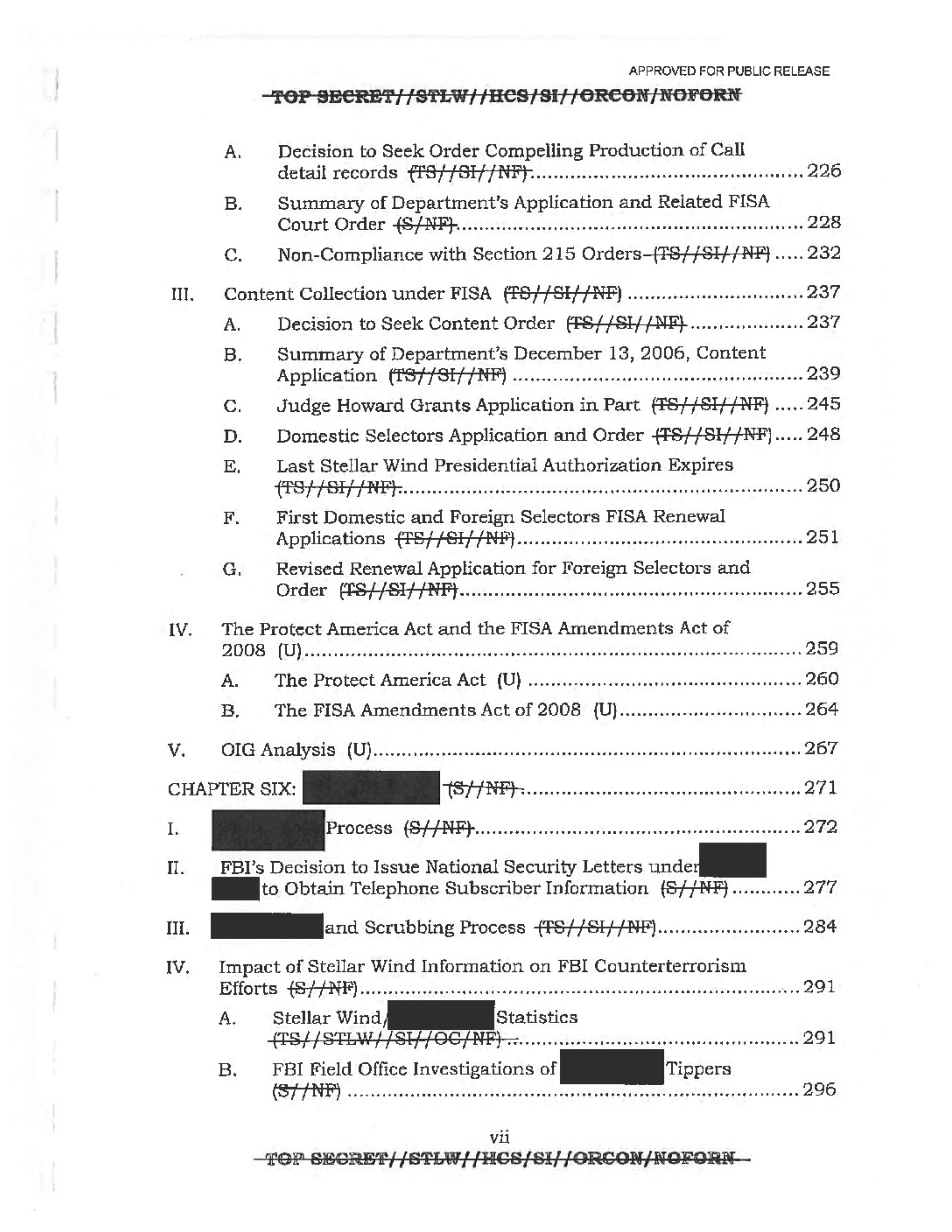
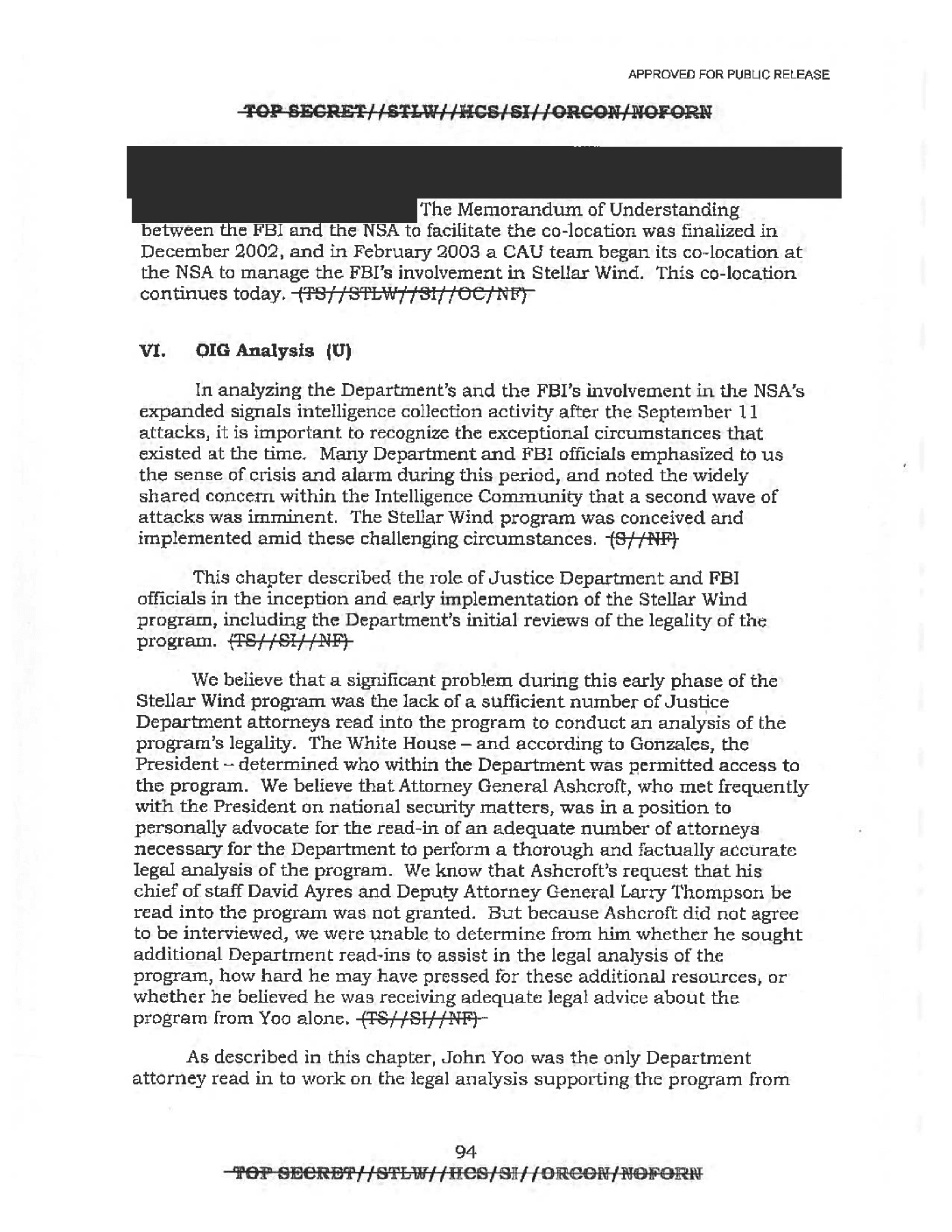
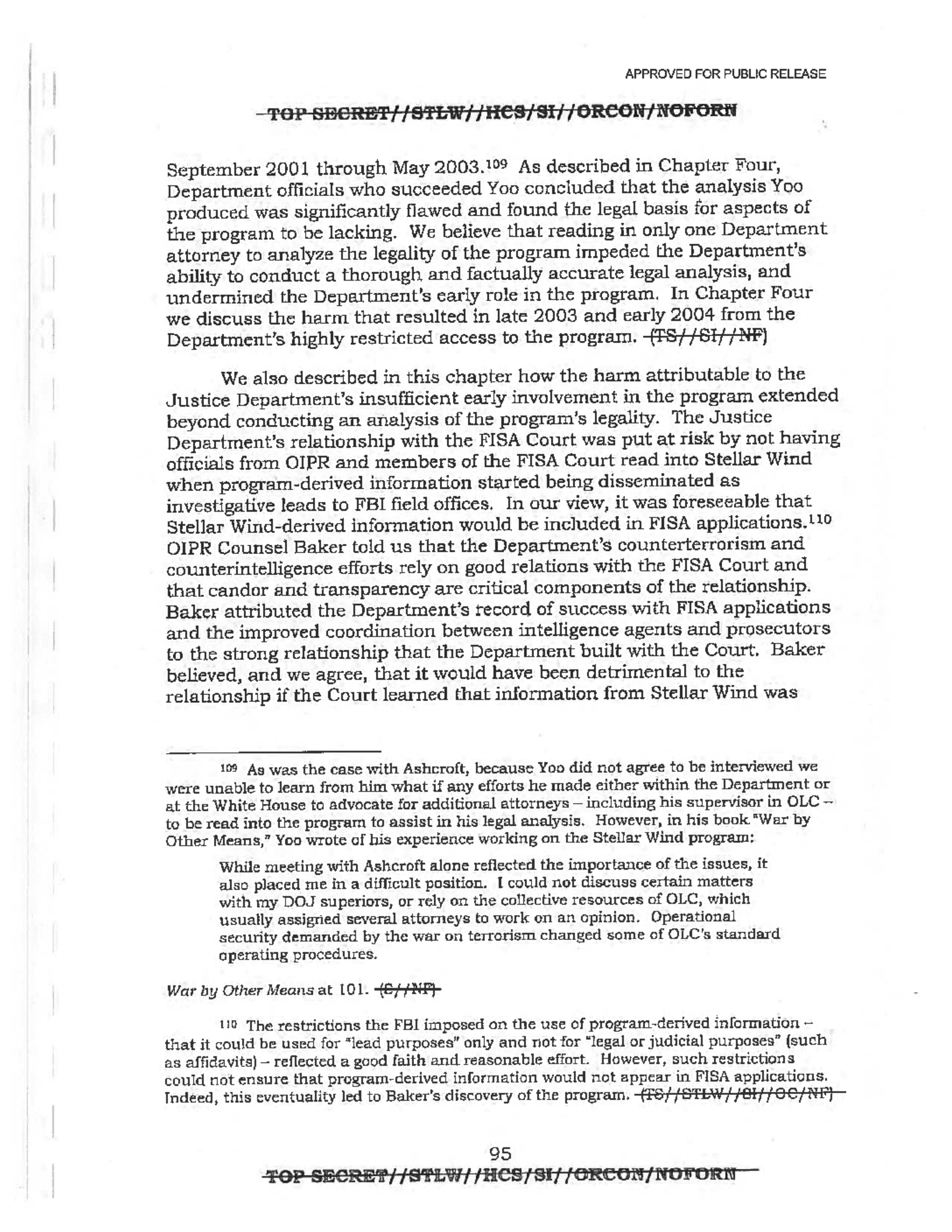
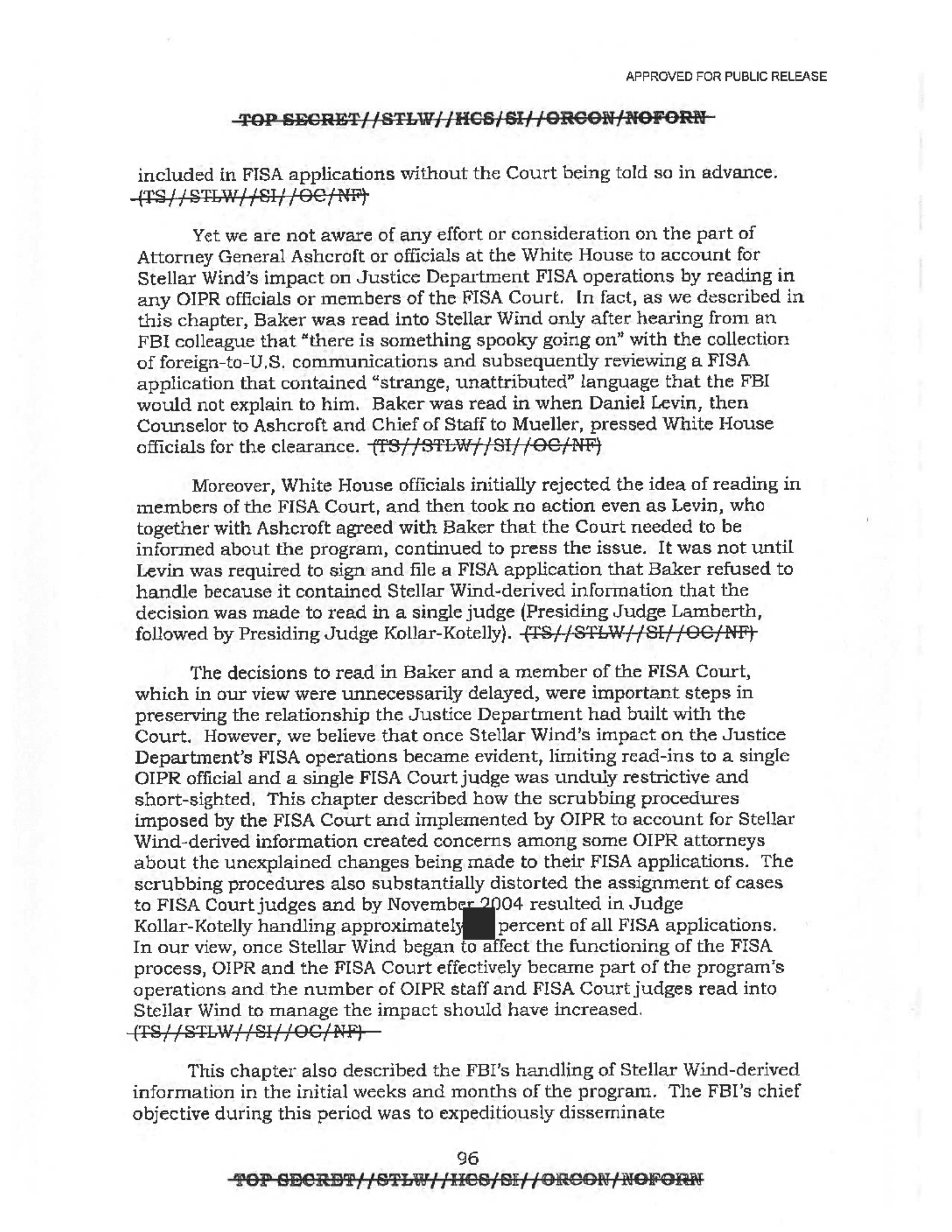
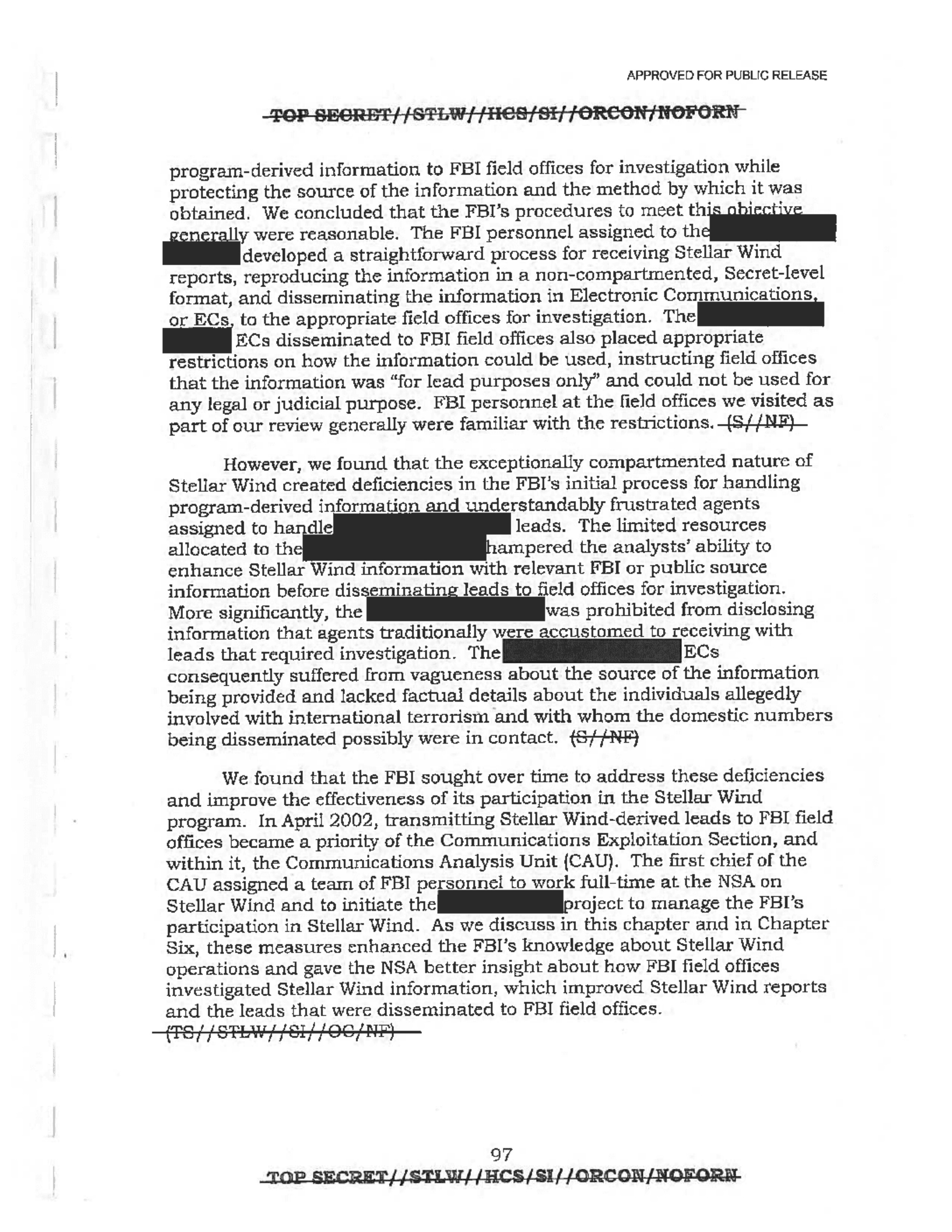

U.S. Department of Justice
United States Attorney
Southern District of New York
86 Chambers Street
New York, New York 10007
April 24, 2015
BY E-MAIL
David McCraw
Jeremy Kutner
Legal Department
The New York Times Company
620 8th Avenue, 18th Floor
New York, NY 10018
Re: New York Times Company v. U.S. Department of Justice,
14 Civ. 3776 (AT)
Dear Mr. McCraw and Mr. Kutner:
On behalf of the United States Department of Justice (the “Government”), we enclose
one three-volume document pursuant to the schedule so-ordered by the Court on August 28,
2014, as finally modified by the Court's Order on April 17, 2015, in the above-referenced FOIA
case. Information in this document has been redacted pursuant to certain FOIA exemptions,
including 5 U.S.C. §§ 552(b)(1), (b)(3), (b)(5), (b)(6), (b)(7)(C) and (b)(7)(E).
The Government reserves its right to modify or supplement the exemptions listed for
information that has been redacted from this document. If you have any questions, please let us
know.
Sincerely,
PREET BHARARA
United States Attorney
Southern District of New York
By: s/ John Clopper
JOHN D. CLOPPER
EMILY DAUGHTRY
Assistant United States Attorneys
Tel.: (212) 637-2716/2777
Fax: (212) 637-2702
john.clopper@usdoj.gov
emily.daughtry@usdoj.gov
Encls.
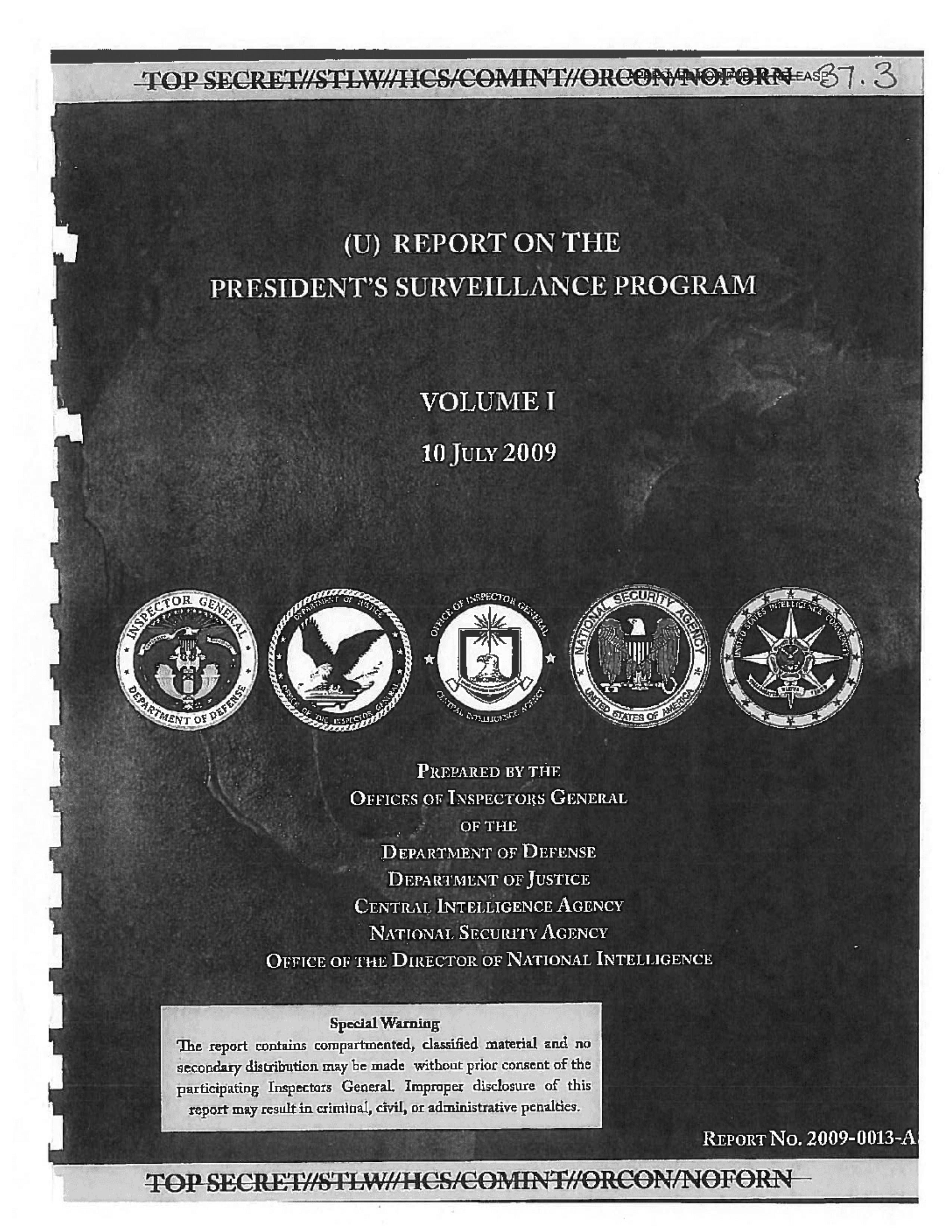
TOP SECRET//STLW//HCS/COMINT//ORCON/NOFORN 37.3
(U) REPORT ON THE
PRESIDENT'S SURVEILLANCE PROGRAM
VOLUME I
10 JULY 2009
PREPARED BY THE
OFFICES OF INSPECTORS GENERAL
OF THE
DEPARTMENT OF DEFENSE
DEPARTMENT OF JUSTICE
CENTRAL INTELLIGENCE AGENCY
NATIONAL SECURITY AGENCY
OFFICE OF THE DIRECTOR OF NATIONAL INTELLIGENCE
Special Warning
The report contains compartmented, classified material and no
secondary distribution may be made without prior consent of the
participating Inspectors General. Improper disclosure of this
report may result in criminal, civil, or administrative penalties.
REPORT NO. 2009-0013-A
TOP SECRET//STLW//HCS/COMINT//ORCON/NOFORN
APPROVED FOR PUBLIC RELEASE
1
APPROVED PUBLIC RELEASE
TOP SECRET//STLW//HCS/COMINT//ORCON/NOFORN
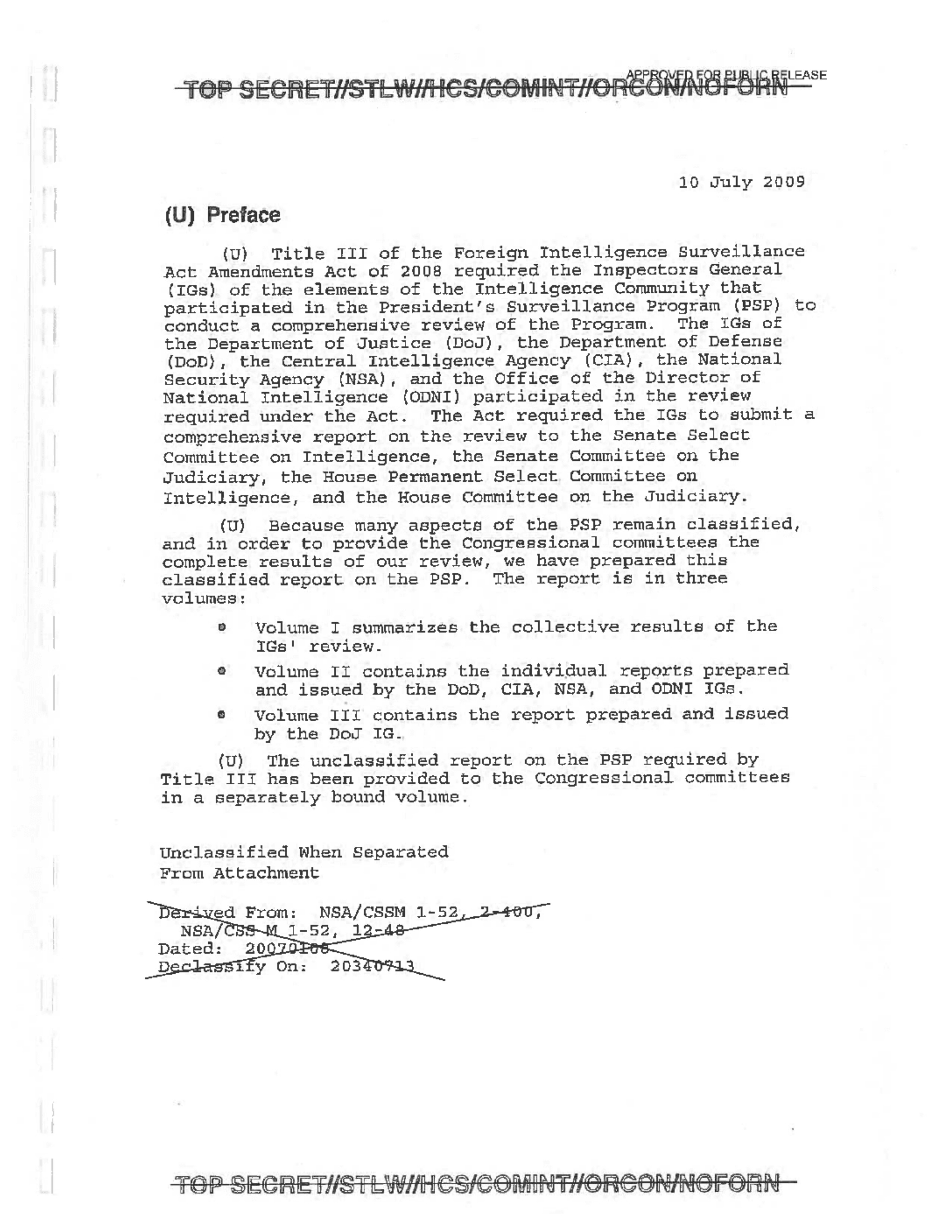
(U) Preface
10 July 2009
(U) Title III of the Foreign Intelligence Surveillance
Act Amendments Act of 2008 required the Inspectors General
(IGs) of the elements of the Intelligence Community that
participated in the President's Surveillance Program (PSP) to
conduct a comprehensive review of the Program. The IGs of
the Department of Justice (DOJ), the Department of Defense
(DOD), the Central Intelligence Agency (CIA), the National
Security Agency (NSA), and the Office of the Director of
National Intelligence (ODNI) participated in the review
required under the Act. The Act required the IGs to submit a
comprehensive report on the review to the Senate Select
Committee on Intelligence, the Senate Committee on the
Judiciary, the House Permanent Select Committee on
Intelligence, and the House Committee on the Judiciary.
(U) Because many aspects of the PSP remain classified,
and in order to provide the Congressional committees the
complete results of our review, we have prepared this
classified report on the PSP. The report is in three
volumes:
- Volume I summarizes the collective results of the
IGs' review. - Volume II contains the individual reports prepared
and issued by the DoD, CIA, NSA, and ODNI IGs. - Volume III contains the report prepared and issued
by the DoJ IG.
(U) The unclassified report on the PSP required by
Title III has been provided to the Congressional committees
in a separately bound volume.
Unclassified When Separated
From Attachment
Derived From: NSA/CSSM 1-52, 2-400,
NSA/CSS M1-52, 12-48
Dated: 20070100
Declassify On: 20340713
TOP SECRET//STLW//HCS/COMINT//ORCON/NOFORN
APPROVED FOR PUBLIC RELEASE
RELEASE
TOP SECRET//STLW//HCS/COMINT//ORCON/NOFORN
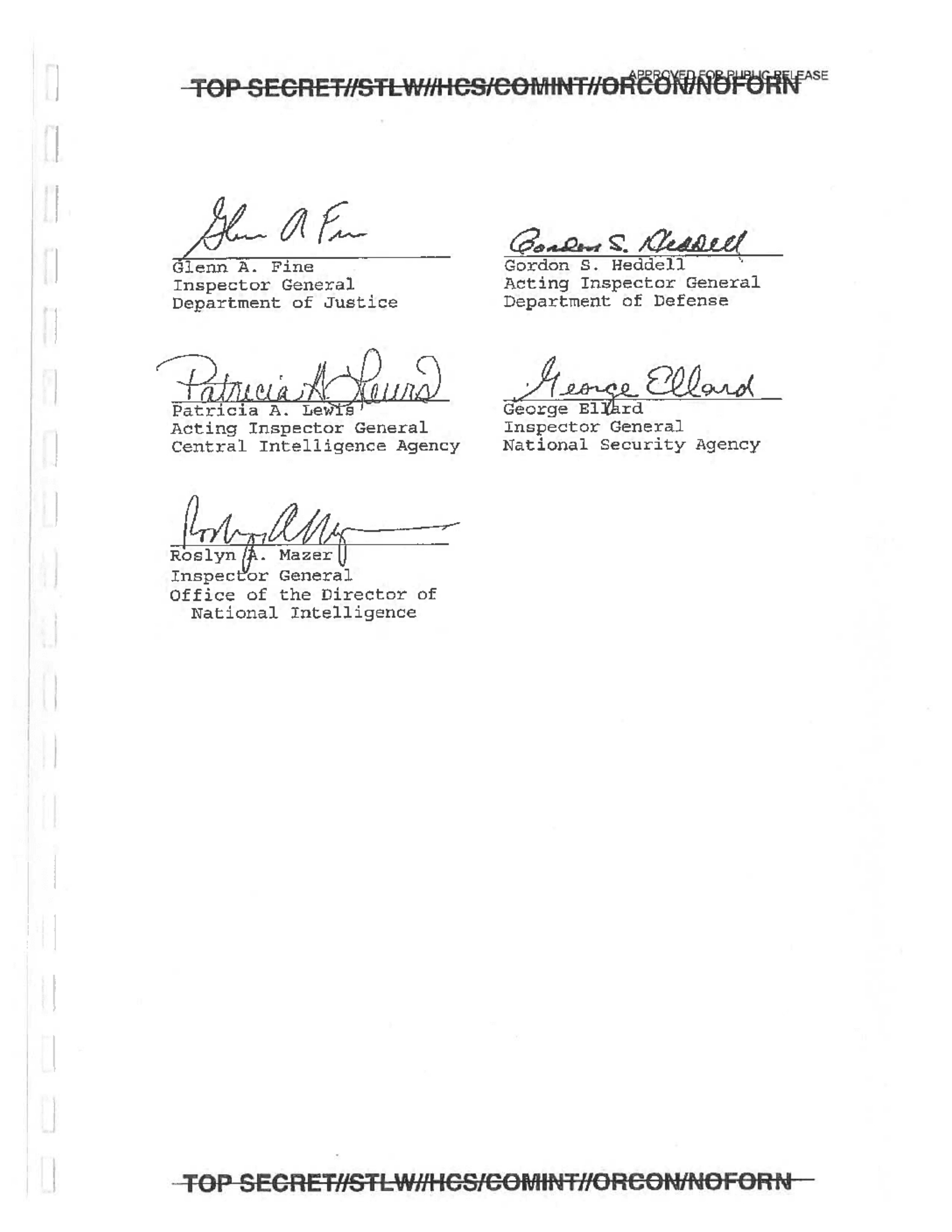
Glenn A. Fine
Inspector General
Department of Justice
Gordon S. Heddell
Acting Inspector General
Department of Defense
Patricia A. Lewis
Acting Inspector General
Central Intelligence Agency
George Ellard
Inspector General
National Security Agency
Roslyn A. Mazer
Inspector General
Office of the Director of
National Intelligence
TOP SECRET//STLW//HCS/COMINT//ORCON/NOFORN
APPROVED FOR PUBLIC RELEASE
APPROVED FOR PUBLIC RELEASE
TOP SECRET//STLW//COMINT//ORCON/NOFORN
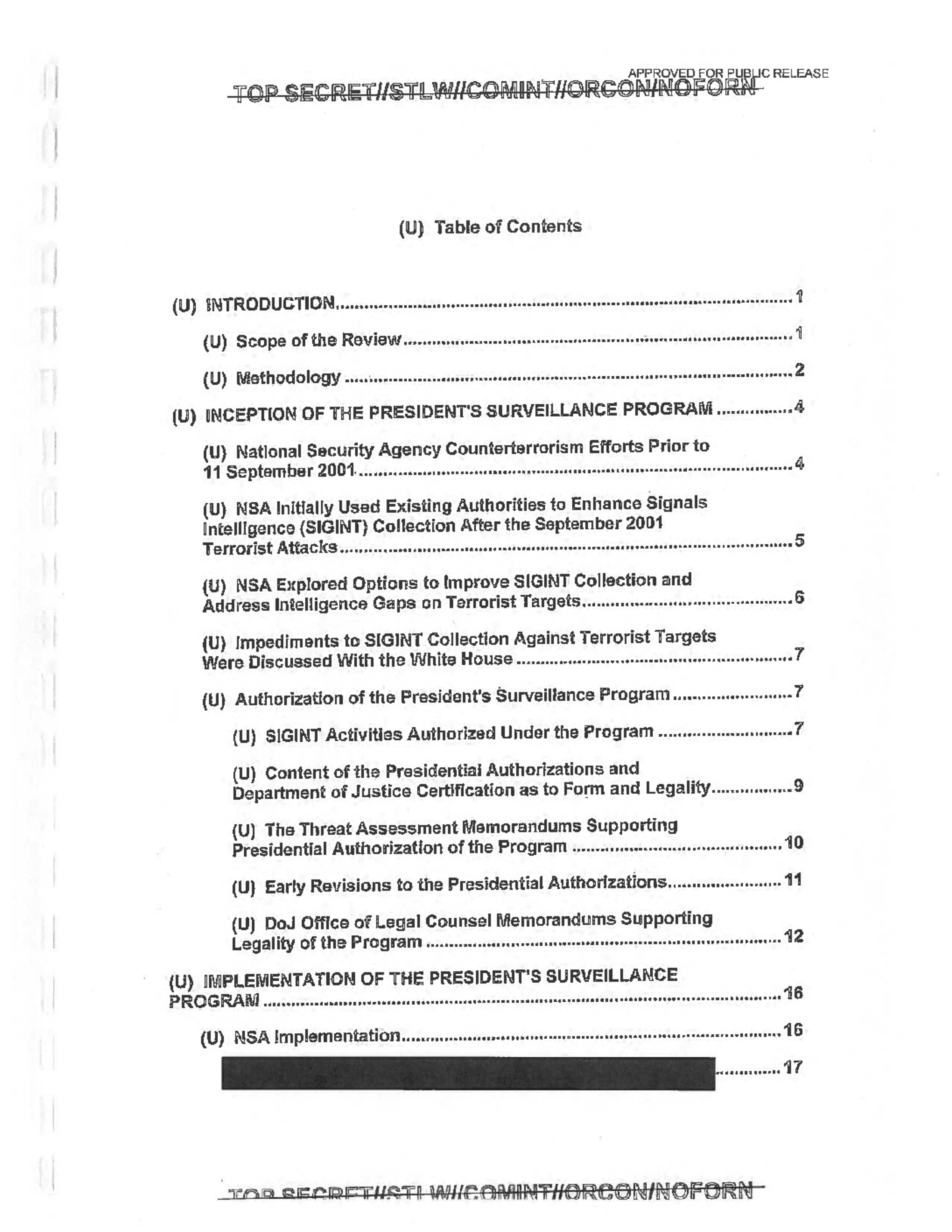
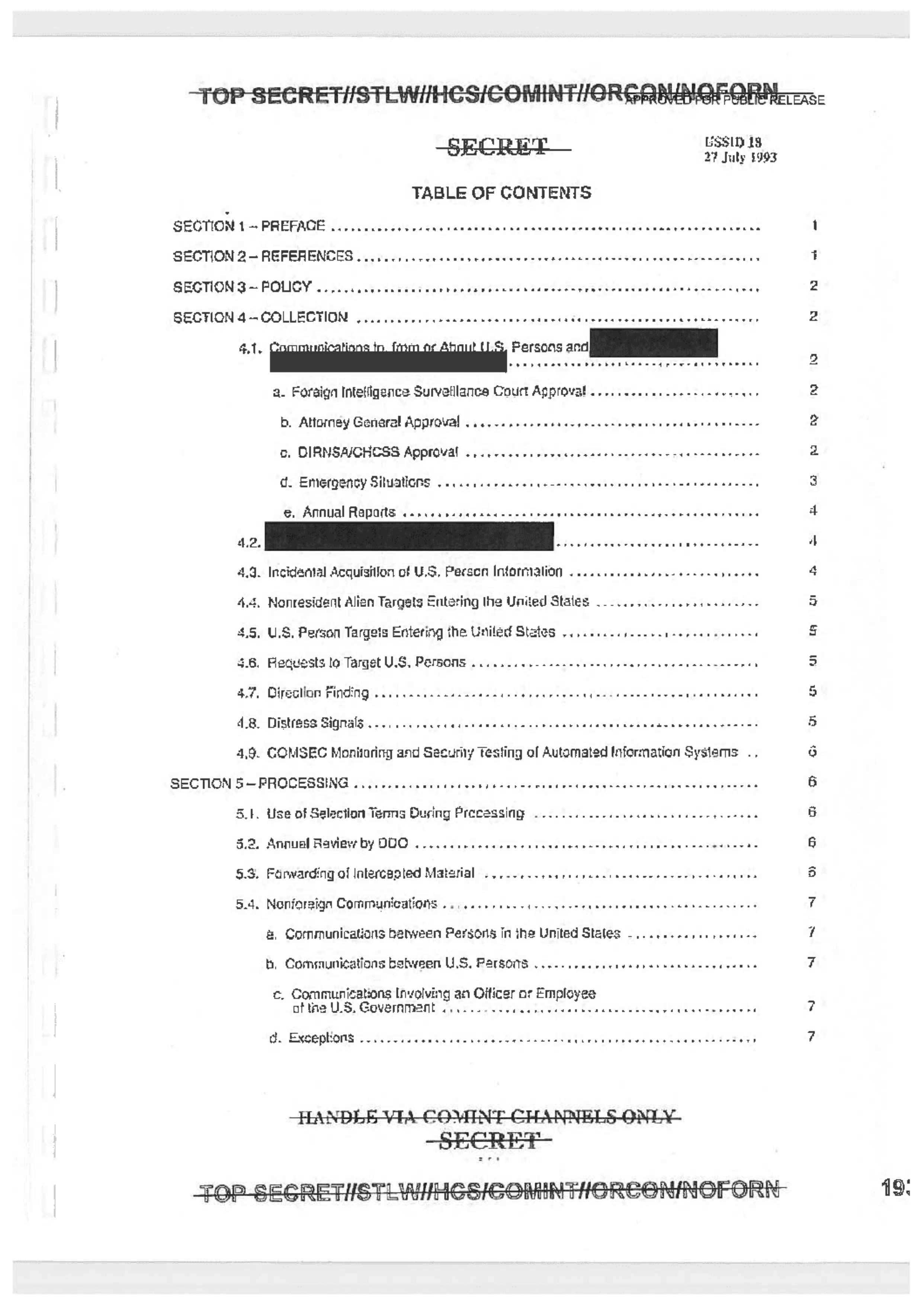
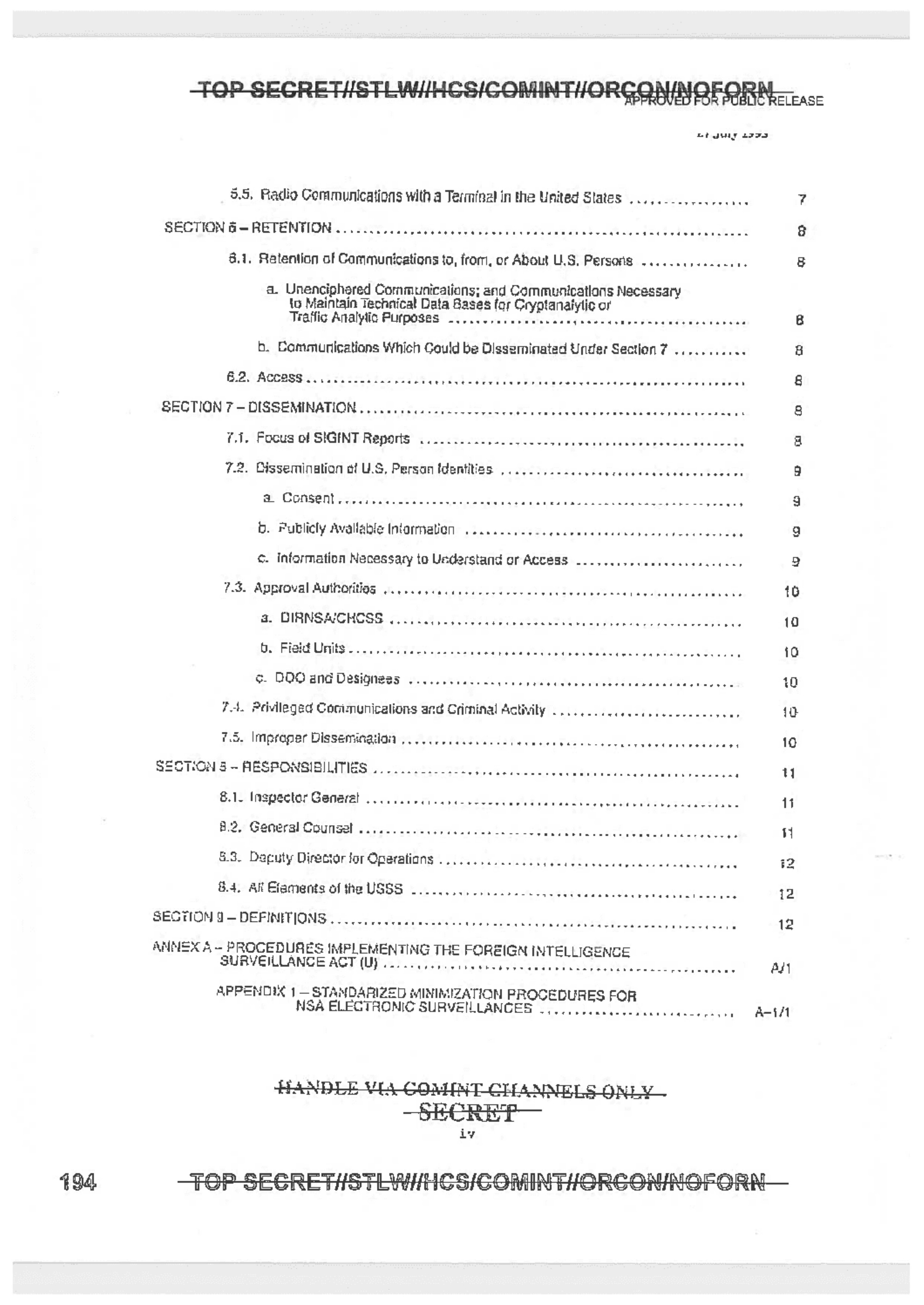
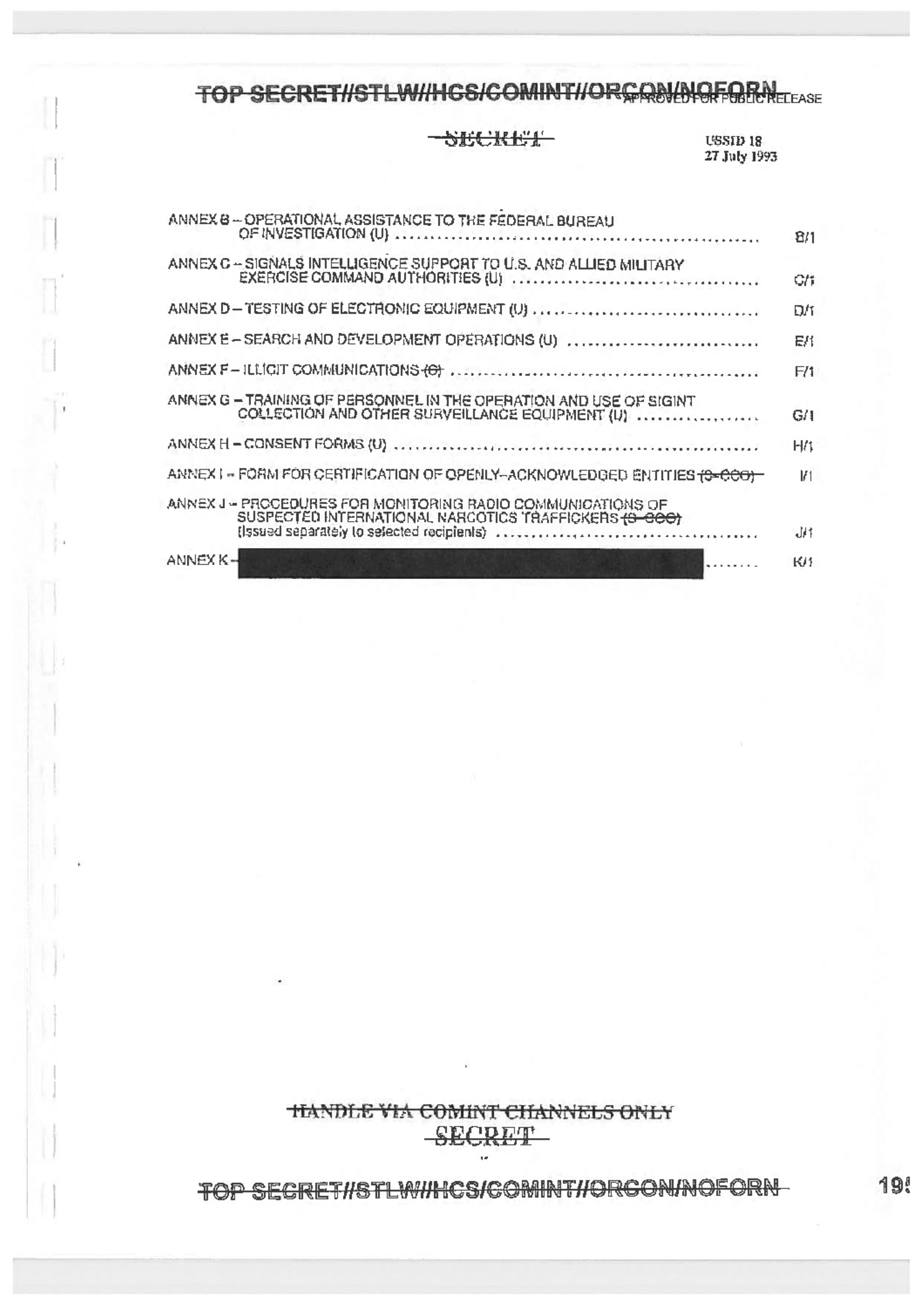
(U) Table of Contents
(U) INTRODUCTION...................................................................................1
(U) Scope of the Review...........................................................................1
(U) Methodology ......................................................................................2
(U) INCEPTION OF THE PRESIDENT'S SURVEILLANCE PROGRAM ...................4
(U) National Security Agency Counterterrorism Efforts Prior to
11 September 2001.................................................................................4
(U) NSA Initially Used Existing Authorities to Enhance Signals
Intelligence (SIGINT) Collection After the September 2001
Terrorist Attacks.....................................................................................5
(U) NSA Explored Options to Improve SIGINT Collection and
Address Intelligence Gaps on Terrorist Targets......................................6
(U) Impediments to SIGINT Collection Against Terrorist Targets
Were Discussed With the White House...................................................7
(U) Authorization of the President's Surveillance Program ......................7
(U) SIGINT Activities Authorized Under the Program ............................7
(U) Content of the Presidential Authorizations and
Department of Justice Certification as to Form and Legality.................9
(U) The Threat Assessment Memorandums Supporting
Presidential Authorization of the Program ...........................................10
(U) Early Revisions to the Presidential Authorizations..........................11
(U) DoJ Office of Legal Counsel Memorandums Supporting
Legality of the Program .........................................................................12
(U) IMPLEMENTATION OF THE PRESIDENT'S SURVEILLANCE
PROGRAM ................................................................................................16
(U) NSA Implementation.........................................................................16
[REDACTED]....................................................................................................17
TOP SECRET//STLW//COMINT//ORCON/NOFORN
APPROVED FOR PUBLIC RELEASE
TOP SECRET//STLW//COMINT//ORCON/NOFORN
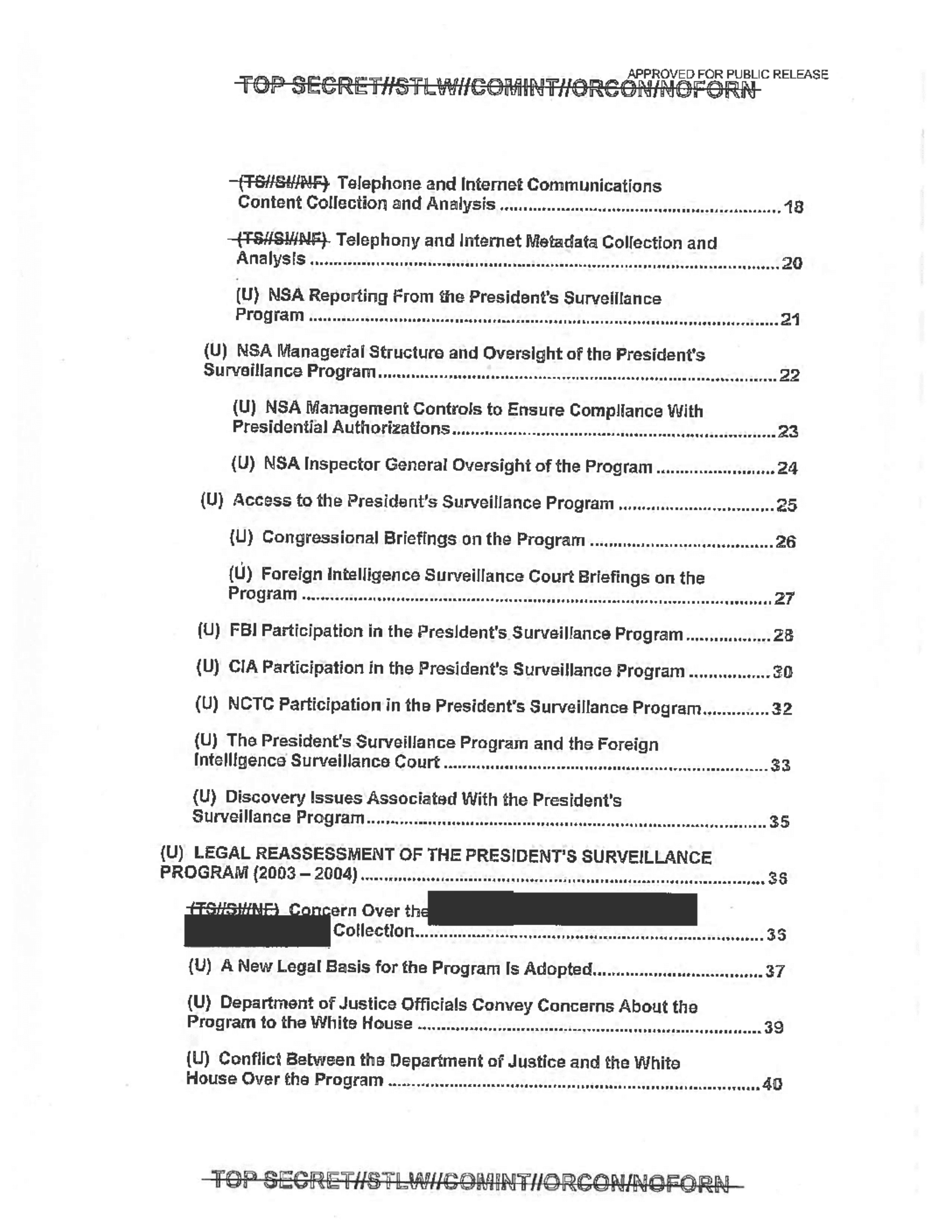
(TS//SI//NF) Telephone and Internet Communications
Content Collection and Analysis ..............................................................18
(TS//SI//NF) Telephony and Internet Metadata Collection and
Analysis ....................................................................................................20
(U) NSA Reporting From the President's Surveillance
Program ....................................................................................................21
(U) NSA Managerial Structure and Oversight of the President's
Surveillance Program................................................................................22
(U) NSA Management Controls to Ensure Compliance With
Presidential Authorizations.......................................................................23
(U) NSA Inspector General Oversight of the Program ..............................24
(U) Access to the President's Surveillance Program ..................................25
(U) Congressional Briefings on the Program .............................................26
(U) Foreign Intelligence Surveillance Court Briefings on the
Program ....................................................................................................27
(U) FBI Participation in the President's Surveillance Program...................28
(U) CIA Participation in the President's Surveillance Program ..................30
(U) NCTC Participation in the President's Surveillance Program...............32
(U) The President's Surveillance Program and the Foreign
Intelligence Surveillance Court ................................................................33
(U) Discovery Issues Associated With the President's
Surveillance Program................................................................................35
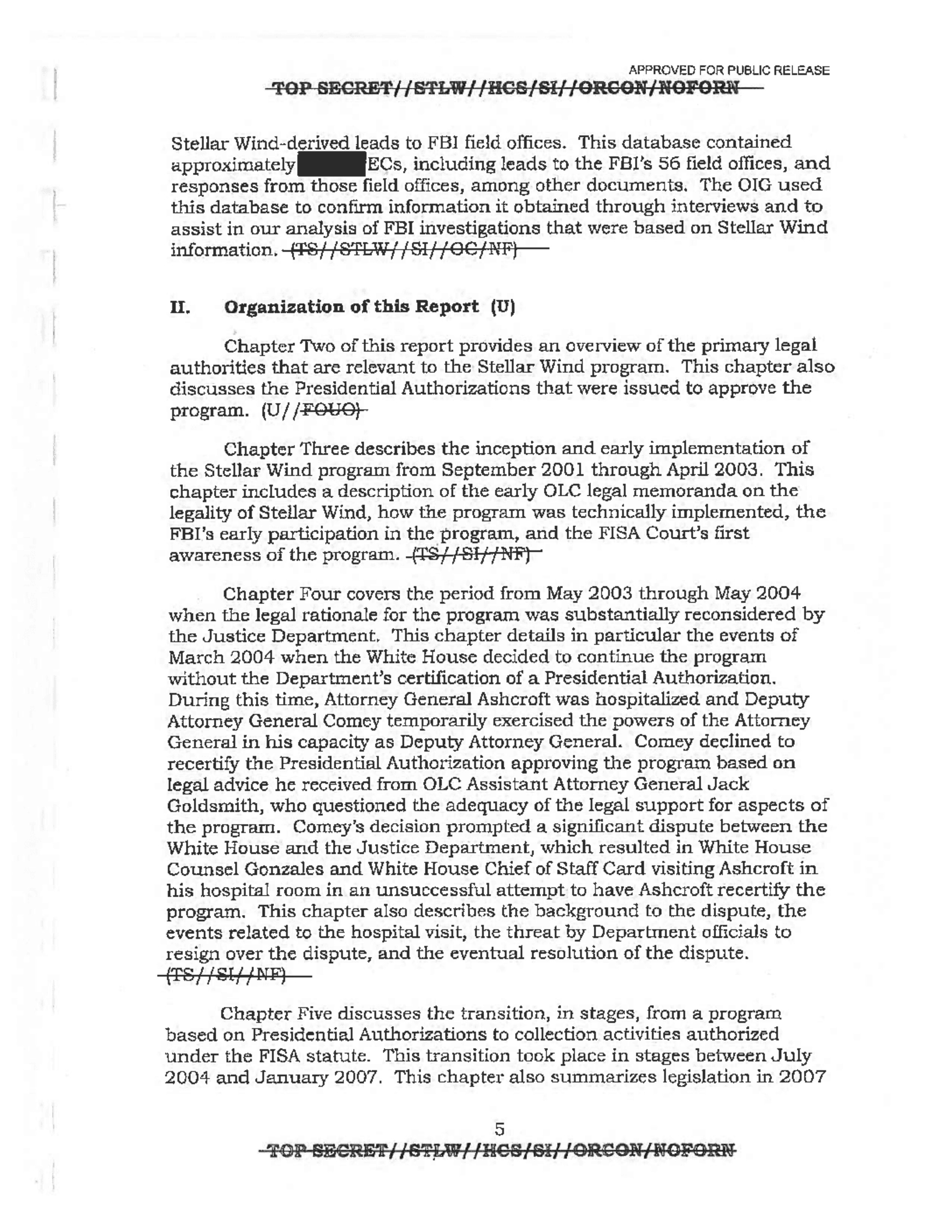
(U) LEGAL REASSESSMENT OF THE PRESIDENT'S SURVEILLANCE
PROGRAM (2003 – 2004) ..........................................................................35
(TS//SI/NF) Concern Over the [REDACTED]
[REDACTED] Collection..............................36
(U) A New Legal Basis for the Program Is Adopted...................................37
(U) Department of Justice Officials Convey Concerns About the
Program to the White House ...................................................................39
(U) Conflict Between the Department of Justice and the White
House Over the Program ..........................................................................40
TOP SECRET//STLW//COMINT//ORCON/NOFORN
APPROVED FOR PUBLIC RELEASE
TOP SECRET//STLW//COMINT//ORCON/NOFORN
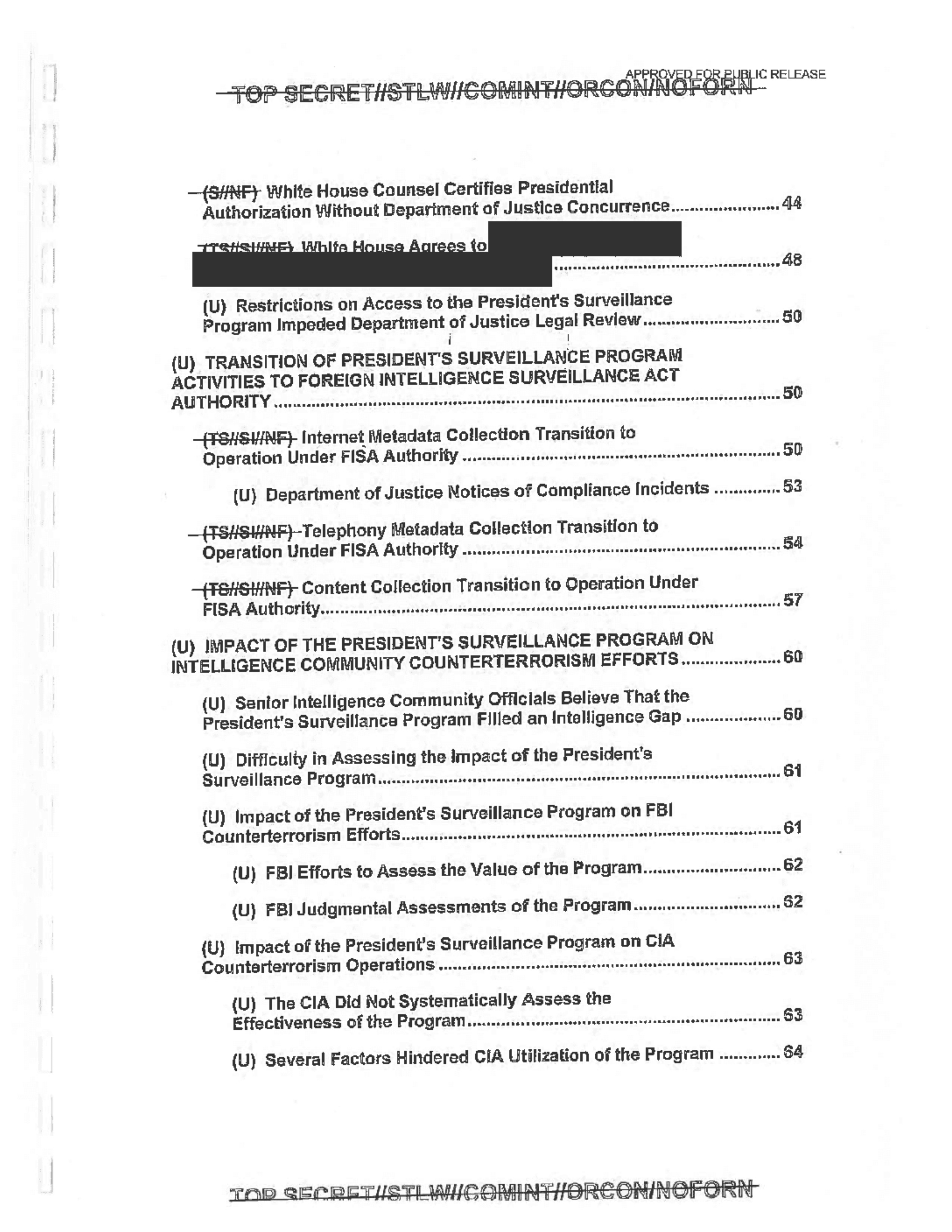
(S//NF) White House Counsel Certifies Presidential
Authorization Without Department of Justice Concurrence......................44
(TS//SI//NF) White House Agrees to [REDACTED]
[REDACTED]..................................48
(U) Restrictions on Access to the President's Surveillance
Program Impeded Department of Justice Legal Review...........................50
(U) TRANSITION OF PRESIDENT'S SURVEILLANCE PROGRAM
ACTIVITIES TO FOREIGN INTELLIGENCE SURVEILLANCE ACT
AUTHORITY...............................................................................................50
(TS//SI//NF) Internet Metadata Collection Transition to
Operation Under FISA Authority ..............................................................50
(U) Department of Justice Notices of Compliance Incidents......................53
(TS//SI//NF) Telephony Metadata Collection Transition to
Operation Under FISA Authority ..............................................................54
(TS//SI//NF) Content Collection Transition to Operation Under
FISA Authority..........................................................................................57
(U) IMPACT OF THE PRESIDENT'S SURVEILLANCE PROGRAM ON
INTELLIGENCE COMMUNITY COUNTERTERRORISM EFFORTS.....................60
(U) Senior Intelligence Community Officials Believe That the
President's Surveillance Program Filled an Intelligence Gap...................60
(U) Difficulty in Assessing the Impact of the President's
Surveillance Program................................................................................61
(U) Impact of the President's Surveillance Program on FBI
Counterterrorism Efforts...........................................................................61
(U) FBI Efforts to Assess the Value of the Program ..................................62
(U) FBI Judgmental Assessments of the Program .....................................62
(U) Impact of the President's Surveillance Program on CIA
Counterterrorism Operations ...................................................................63
(U) The CIA Did Not Systematically Assess the
Effectiveness of the Program.....................................................................63
(U) Several Factors Hindered CIA Utilization of the Program .................64
TOP SECRET//STLW//COMINT//ORCON/NOFORN
APPROVED FOR PUBLIC RELEASE
TOP SECRET//STLW//COMINT//ORCON/NOFORN
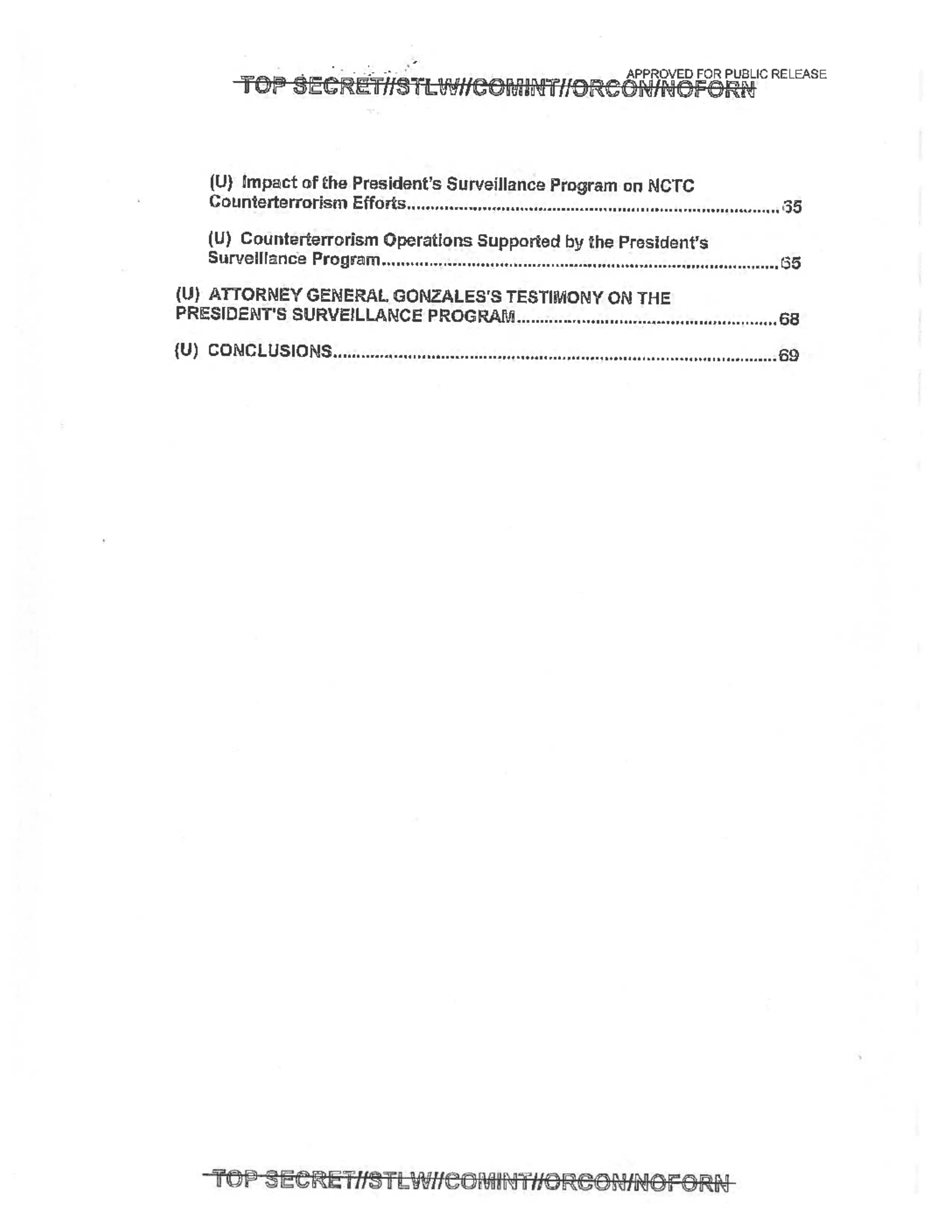
(U) Impact of the President's Surveillance Program on NCTC
Counterterrorism Efforts..........................................................................................65
(U) Counterterrorism Operations Supported by the President's
Surveillance Program...............................................................................................65
(U) ATTORNEY GENERAL GONZALES'S TESTIMONY ON THE
PRESIDENT'S SURVEILLANCE PROGRAM..........................................................68
(U) CONCLUSIONS.....................................................................................................69
TOP SECRET//STLW//COMINT//ORCON/NOFORN
APPROVED FOR PUBLIC RELEASE
TOP SECRET//STLW//COMINT//ORCON/NOFORN
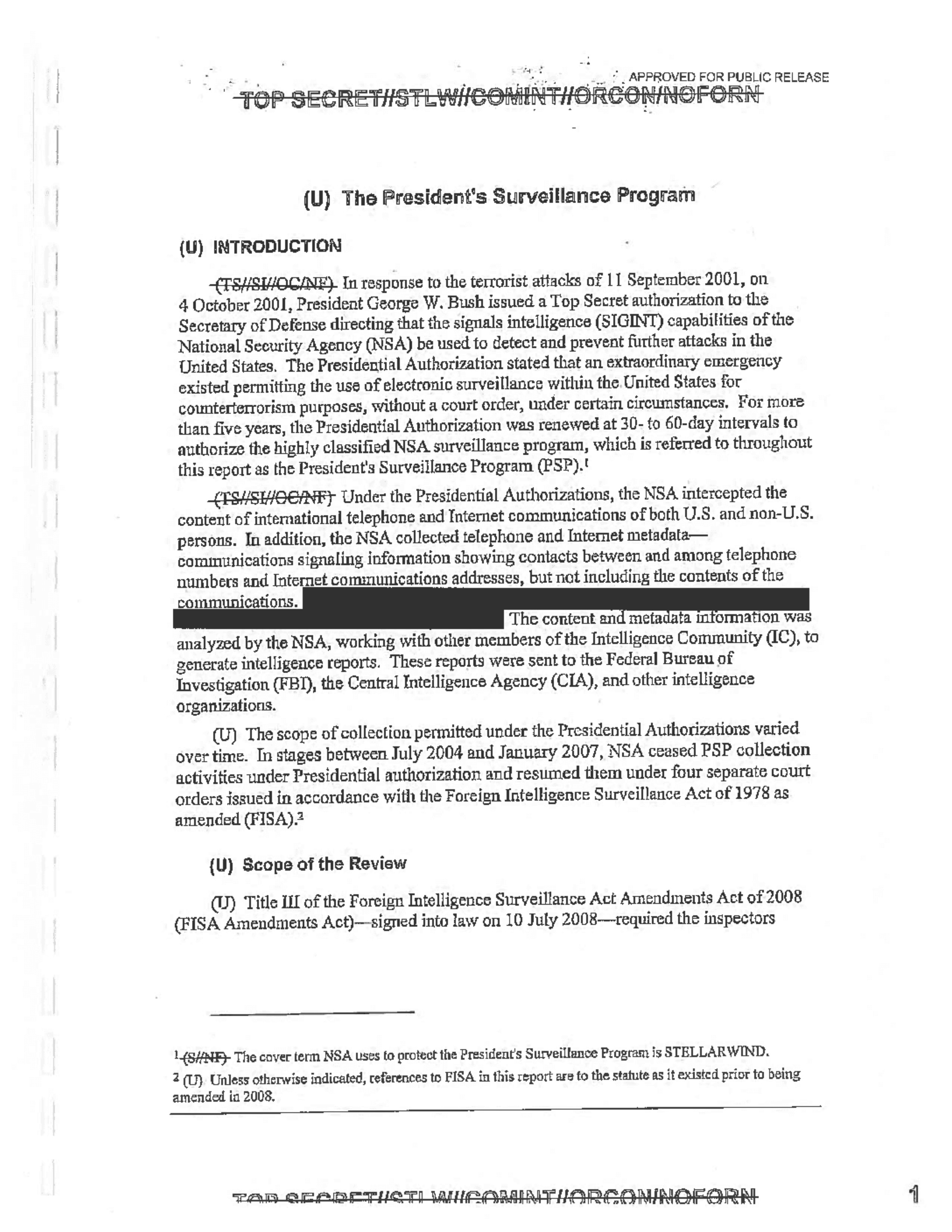
(U) The President's Surveillance Program
(U) INTRODUCTION
(TS//SI//OC/NF). In response to the terrorist attacks of 11 September 2001, on
4 October 2001, President George W. Bush issued a Top Secret authorization to the
Secretary of Defense directing that the signals intelligence (SIGINT) capabilities of the
National Security Agency (NSA) be used to detect and prevent further attacks in the
United States. The Presidential Authorization stated that an extraordinary emergency
existed permitting the use of electronic surveillance within the United States for
counterterrorism purposes, without a court order, under certain circumstances. For more
than five years, the Presidential Authorization was renewed at 30- to 60-day intervals to
authorize the highly classified NSA surveillance program, which is referred to throughout
this report as the President's Surveillance Program (PSP).¹
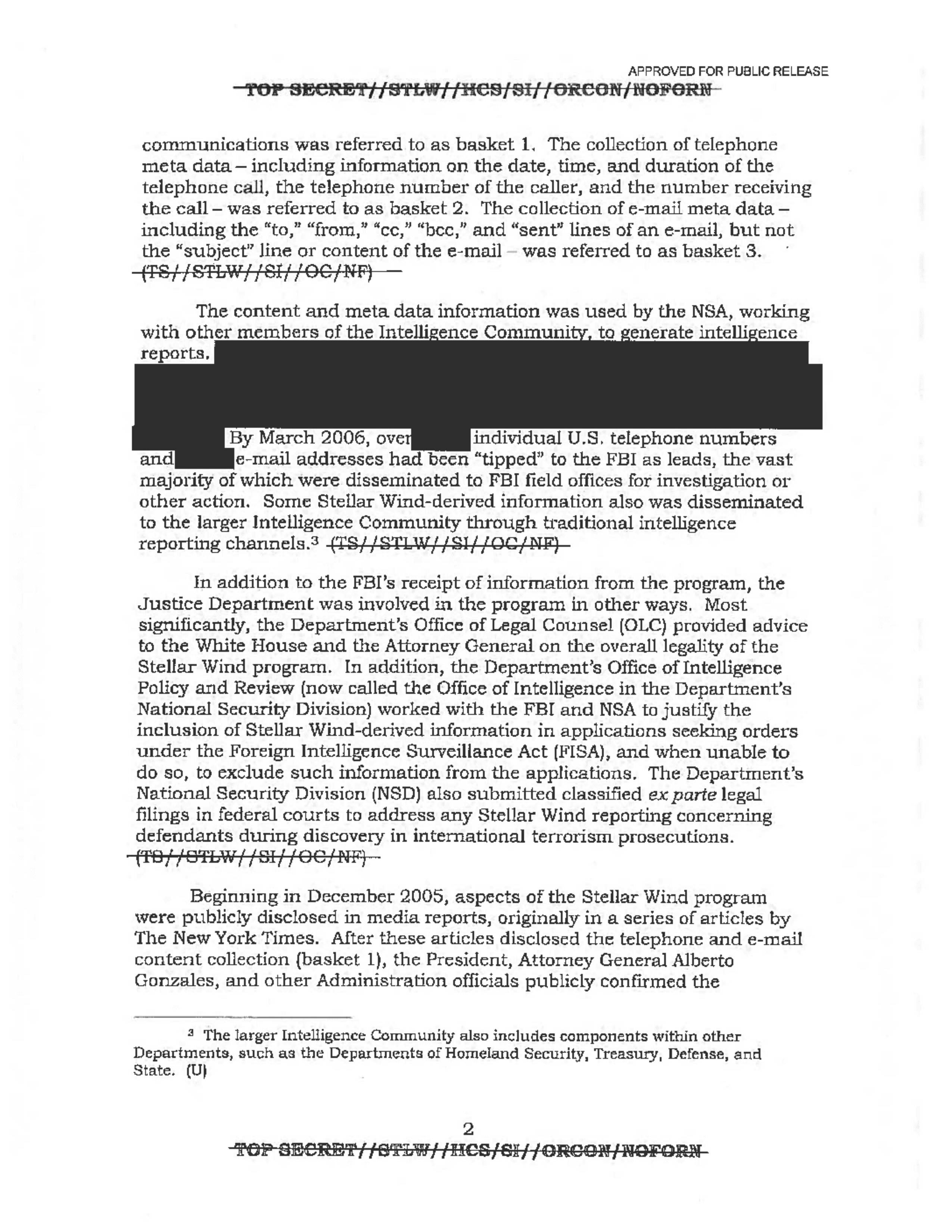
(TS//SI//OC/NF) Under the Presidential Authorizations, the NSA intercepted the
content of international telephone and Internet communications of both U.S. and non-U.S.
persons. In addition, the NSA collected telephone and Internet metadata—
communications signaling information showing contacts between and among telephone
numbers and Internet communications addresses, but not including the contents of the
communications. [REDACTED]
[REDACTED] The content and metadata information was
analyzed by the NSA, working with other members of the Intelligence Community (IC), to
generate intelligence reports. These reports were sent to the Federal Bureau of
Investigation (FBI), the Central Intelligence Agency (CIA), and other intelligence
organizations.
(U) The scope of collection permitted under the Presidential Authorizations varied
over time. In stages between July 2004 and January 2007, NSA ceased PSP collection
activities under Presidential authorization and resumed them under four separate court
orders issued in accordance with the Foreign Intelligence Surveillance Act of 1978 as
amended (FISA).²
(U) Scope of the Review
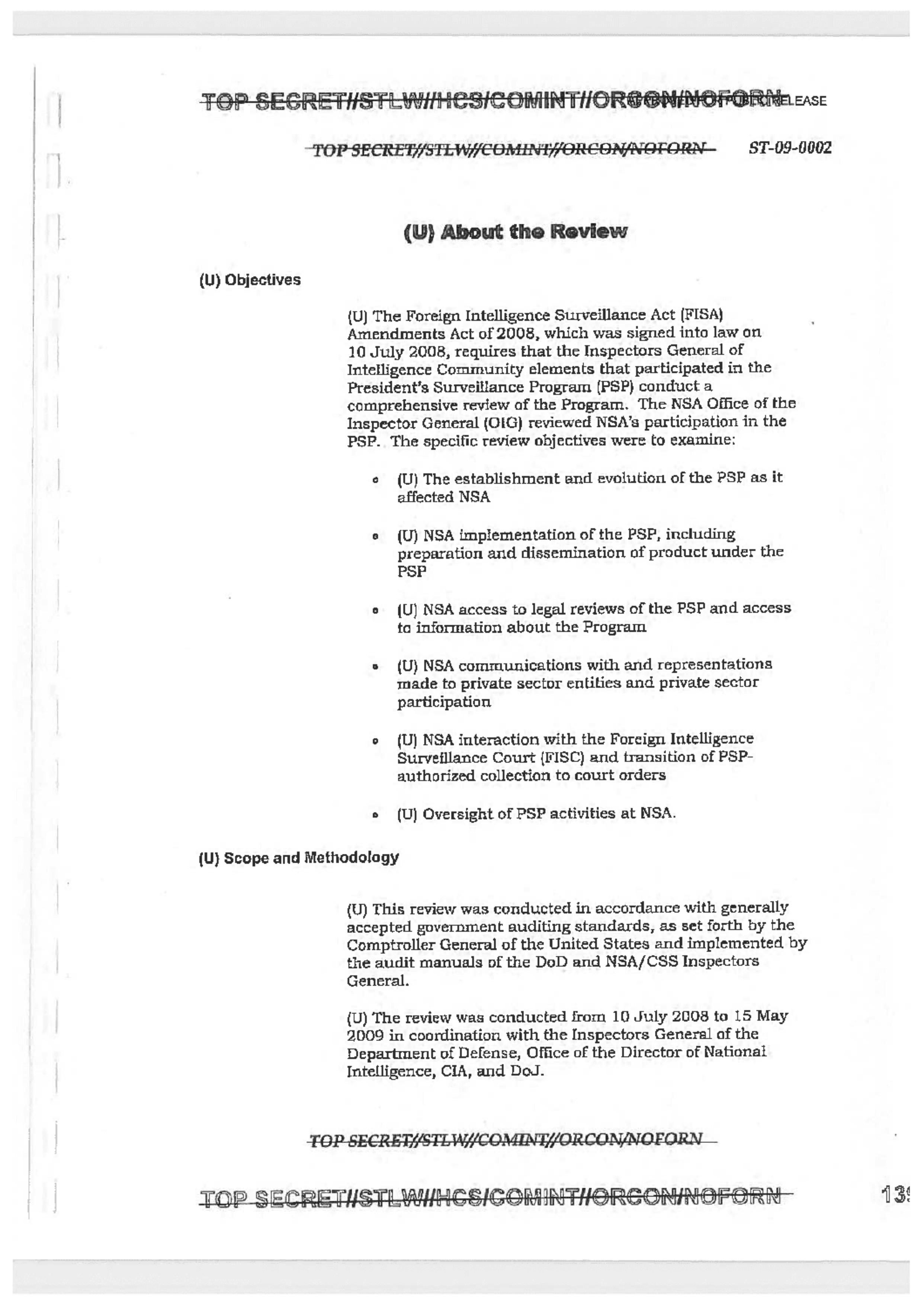
(U) Title III of the Foreign Intelligence Surveillance Act Amendments Act of 2008
(FISA Amendments Act)—signed into law on 10 July 2008—required the inspectors
¹ (S//NF) The cover term NSA uses to protect the President's Surveillance Program is STELLARWIND.
² (U) Unless otherwise indicated, references to FISA in this report are to the statute as it existed prior to being
amended in 2008.
TOP SECRET//STLW//COMINT//ORCON/NOFORN
1
APPROVED FOR PUBLIC RELEASE
TOP SECRET//STLW//COMINT//ORCON/NOFORN
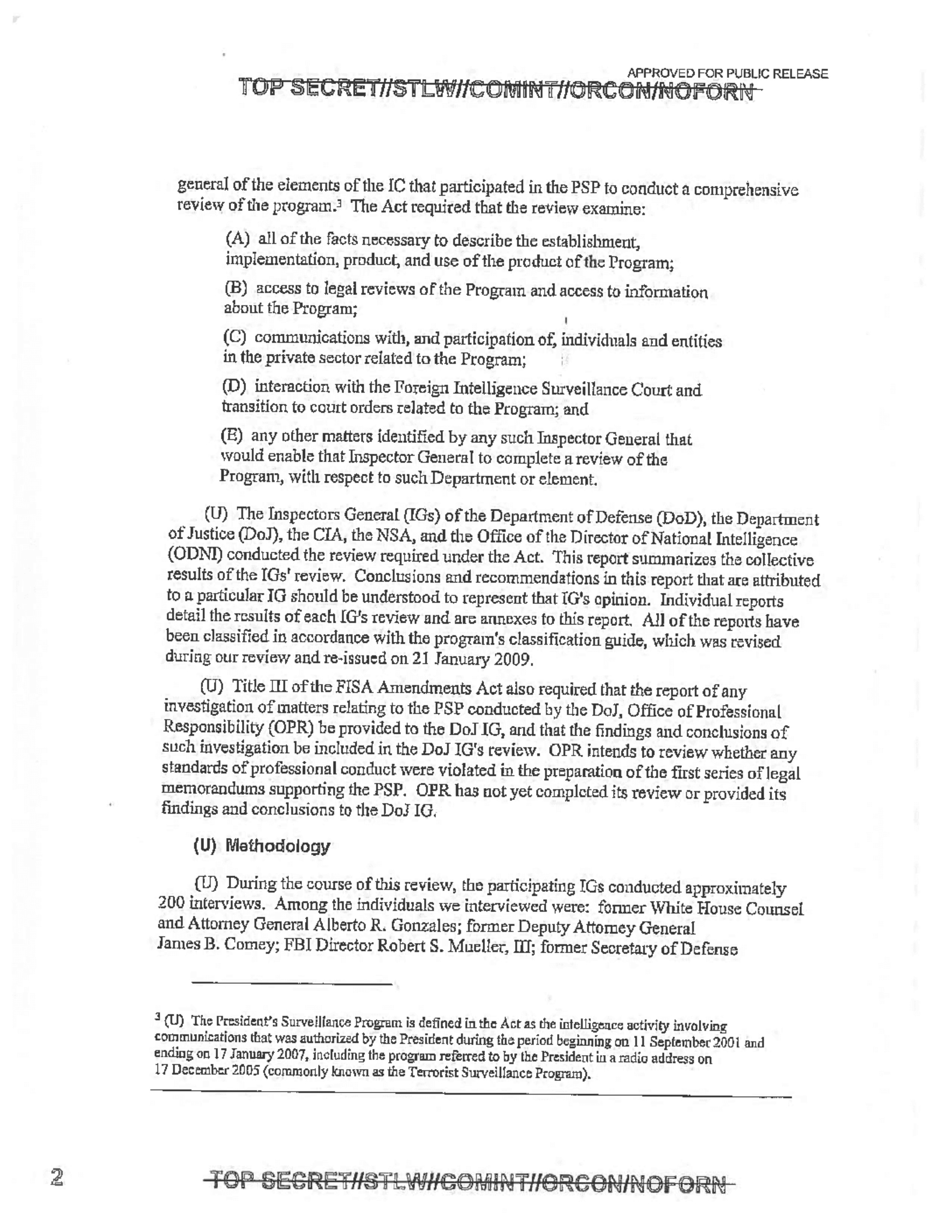
general of the elements of the IC that participated in the PSP to conduct a comprehensive
review of the program.³ The Act required that the review examine:
(A) all of the facts necessary to describe the establishment,
implementation, product, and use of the product of the Program;
(B) access to legal reviews of the Program and access to information
about the Program;
(C) communications with, and participation of, individuals and entities
in the private sector related to the Program;
(D) interaction with the Foreign Intelligence Surveillance Court and
transition to court orders related to the Program; and
(E) any other matters identified by any such Inspector General that
would enable that Inspector General to complete a review of the
Program, with respect to such Department or element.
(U) The Inspectors General (IGs) of the Department of Defense (DoD), the Department
of Justice (DoJ), the CIA, the NSA, and the Office of the Director of National Intelligence
(ODNI) conducted the review required under the Act. This report summarizes the collective
results of the IGs' review. Conclusions and recommendations in this report that are attributed
to a particular IG should be understood to represent that IG's opinion. Individual reports
detail the results of each IG's review and are annexes to this report. All of the reports have
been classified in accordance with the program's classification guide, which was revised
during our review and re-issued on 21 January 2009.
(U) Title III of the FISA Amendments Act also required that the report of any
investigation of matters relating to the PSP conducted by the DoJ, Office of Professional
Responsibility (OPR) be provided to the DoJ IG, and that the findings and conclusions of
such investigation be included in the DoJ IG's review. OPR intends to review whether any
standards of professional conduct were violated in the preparation of the first series of legal
memorandums supporting the PSP. OPR has not yet completed its review or provided its
findings and conclusions to the DoJ IG.
(U) Methodology
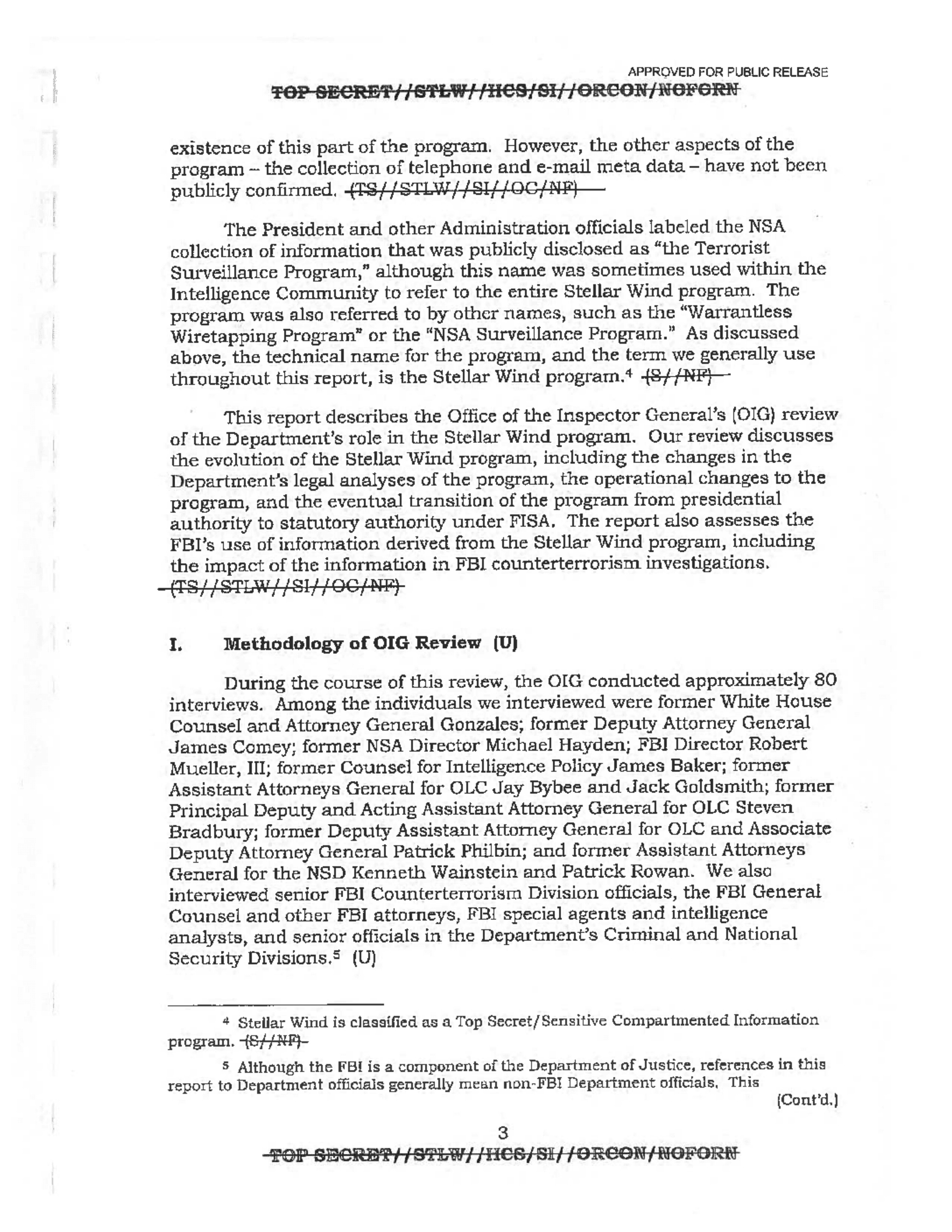
(U) During the course of this review, the participating IGs conducted approximately
200 interviews. Among the individuals we interviewed were: former White House Counsel
and Attorney General Alberto R. Gonzales; former Deputy Attorney General
James B. Comey; FBI Director Robert S. Mueller, III; former Secretary of Defense
³ (U) The President's Surveillance Program is defined in the Act as the intelligence activity involving
communications that was authorized by the President during the period beginning on 11 September 2001 and
ending on 17 January 2007, including the program referred to by the President in a radio address on
17 December 2005 (commonly known as the Terrorist Surveillance Program).
2
TOP SECRET//STLW//COMINT//ORCON/NOFORN
APPROVED FOR PUBLIC RELEASE
TOP SECRET//STLW//COMINT//ORCON/NOFORN
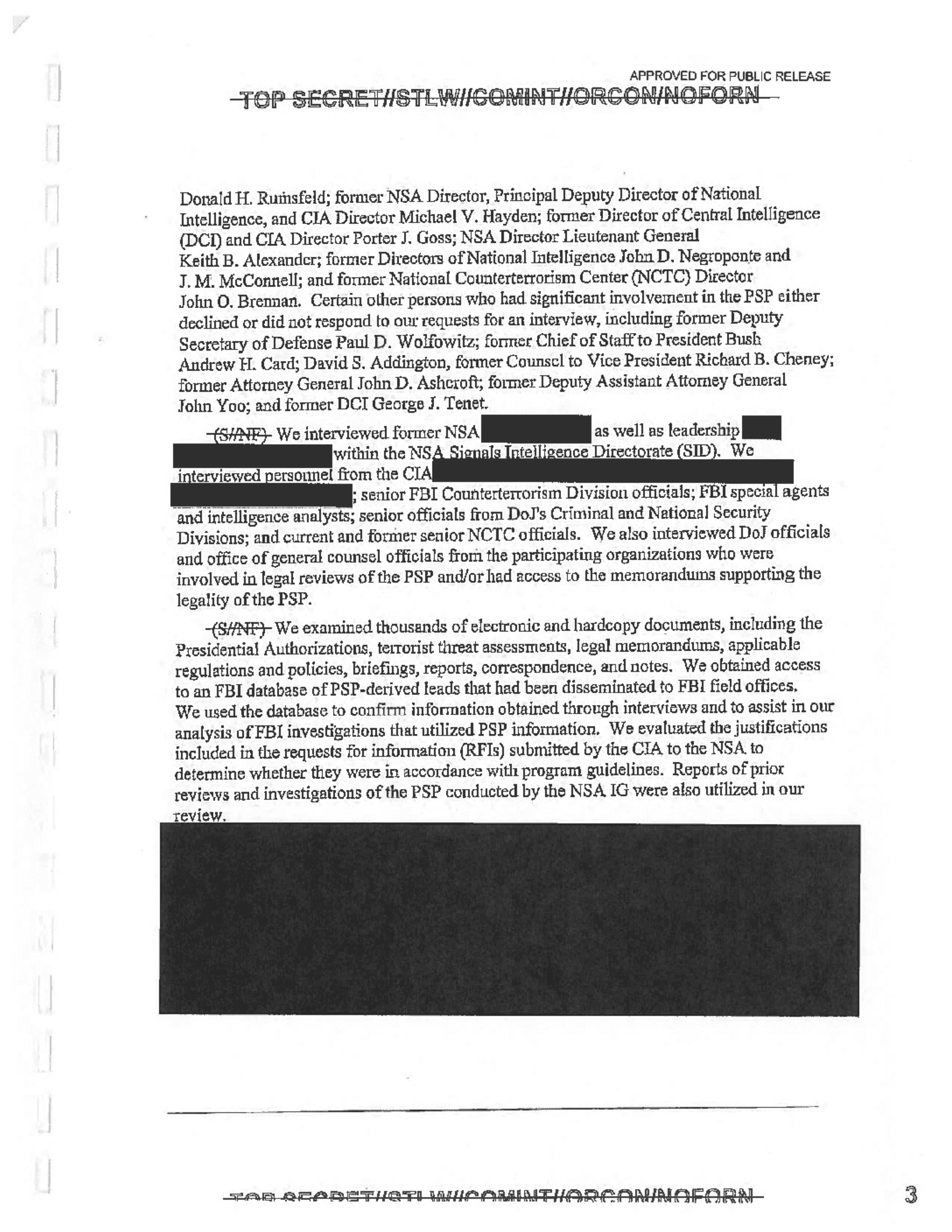
Donald H. Rumsfeld; former NSA Director, Principal Deputy Director of National
Intelligence, and CIA Director Michael V. Hayden; former Director of Central Intelligence
(DCI) and CIA Director Porter J. Goss; NSA Director Lieutenant General
Keith B. Alexander; former Directors of National Intelligence John D. Negroponte and
J. M. McConnell; and former National Counterterrorism Center (NCTC) Director
John O. Brennan. Certain other persons who had significant involvement in the PSP either
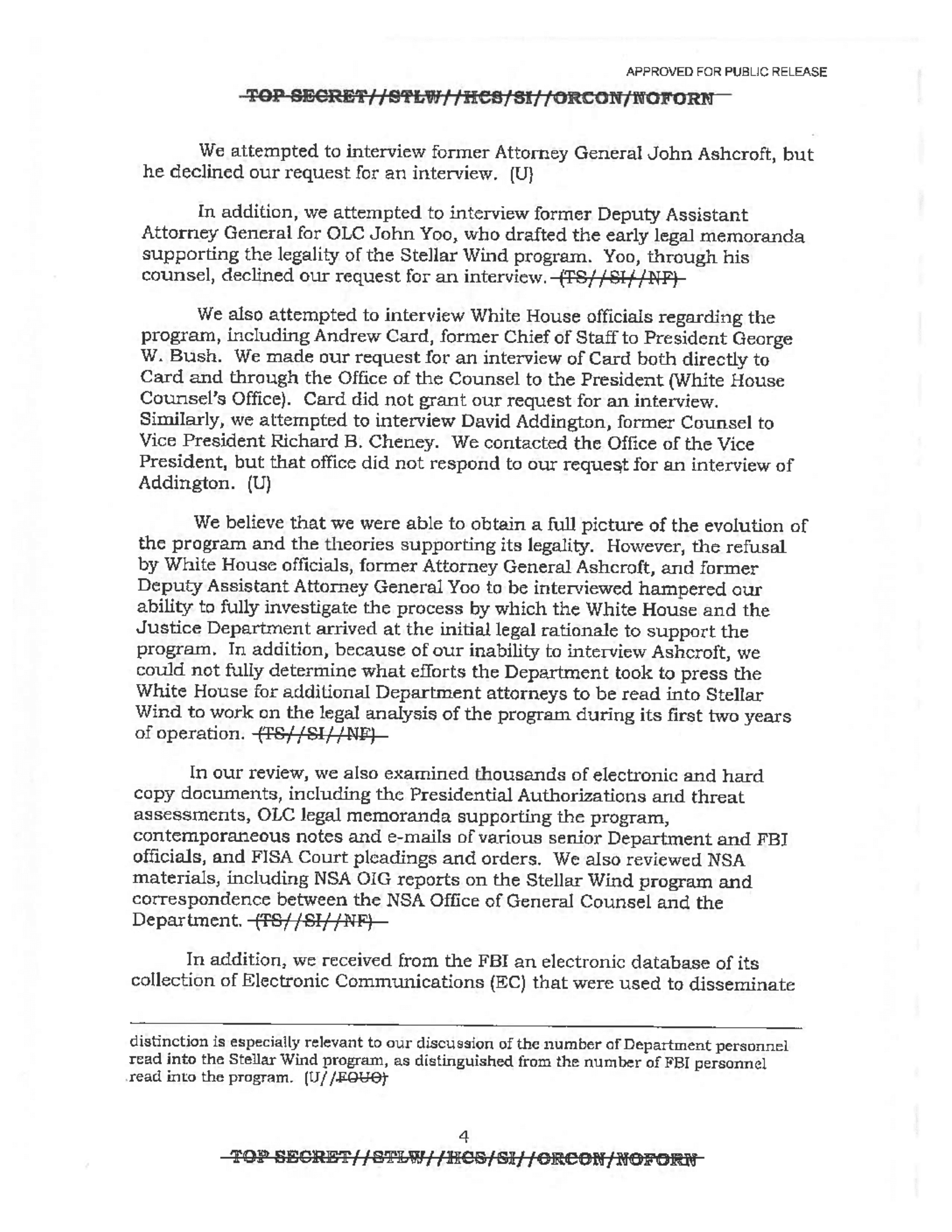
declined or did not respond to our requests for an interview, including former Deputy
Secretary of Defense Paul D. Wolfowitz; former Chief of Staff to President Bush
Andrew H. Card; David S. Addington, former Counsel to Vice President Richard B. Cheney;
former Attorney General John D. Ashcroft; former Deputy Assistant Attorney General
John Yoo; and former DCI George J. Tenet.
(S//NF) We interviewed former NSA [REDACTED] as well as leadership [REDACTED]
[REDACTED] within the NSA Signals Intelligence Directorate (SID). We
interviewed personnel from the CIA [REDACTED]
[REDACTED]; senior FBI Counterterrorism Division officials; FBI special agents
and intelligence analysts; senior officials from DoJ's Criminal and National Security
Divisions; and current and former senior NCTC officials. We also interviewed DoJ officials
and office of general counsel officials from the participating organizations who were
involved in legal reviews of the PSP and/or had access to the memorandums supporting the
legality of the PSP.
(S//NF) We examined thousands of electronic and hardcopy documents, including the
Presidential Authorizations, terrorist threat assessments, legal memorandums, applicable
regulations and policies, briefings, reports, correspondence, and notes. We obtained access
to an FBI database of PSP-derived leads that had been disseminated to FBI field offices.
We used the database to confirm information obtained through interviews and to assist in our
analysis of FBI investigations that utilized PSP information. We evaluated the justifications
included in the requests for information (RFIs) submitted by the CIA to the NSA to
determine whether they were in accordance with program guidelines. Reports of prior
reviews and investigations of the PSP conducted by the NSA IG were also utilized in our
review.
[REDACTED]
TOP SECRET//STLW//COMINT//ORCON/NOFORN
3
APPROVED FOR PUBLIC RELEASE
TOP SECRET//STLW//COMINT//ORCON/NOFORN
(U) INCEPTION OF THE PRESIDENT'S
SURVEILLANCE PROGRAM
(U) National Security Agency Counterterrorism
Efforts Prior to 11 September 2001
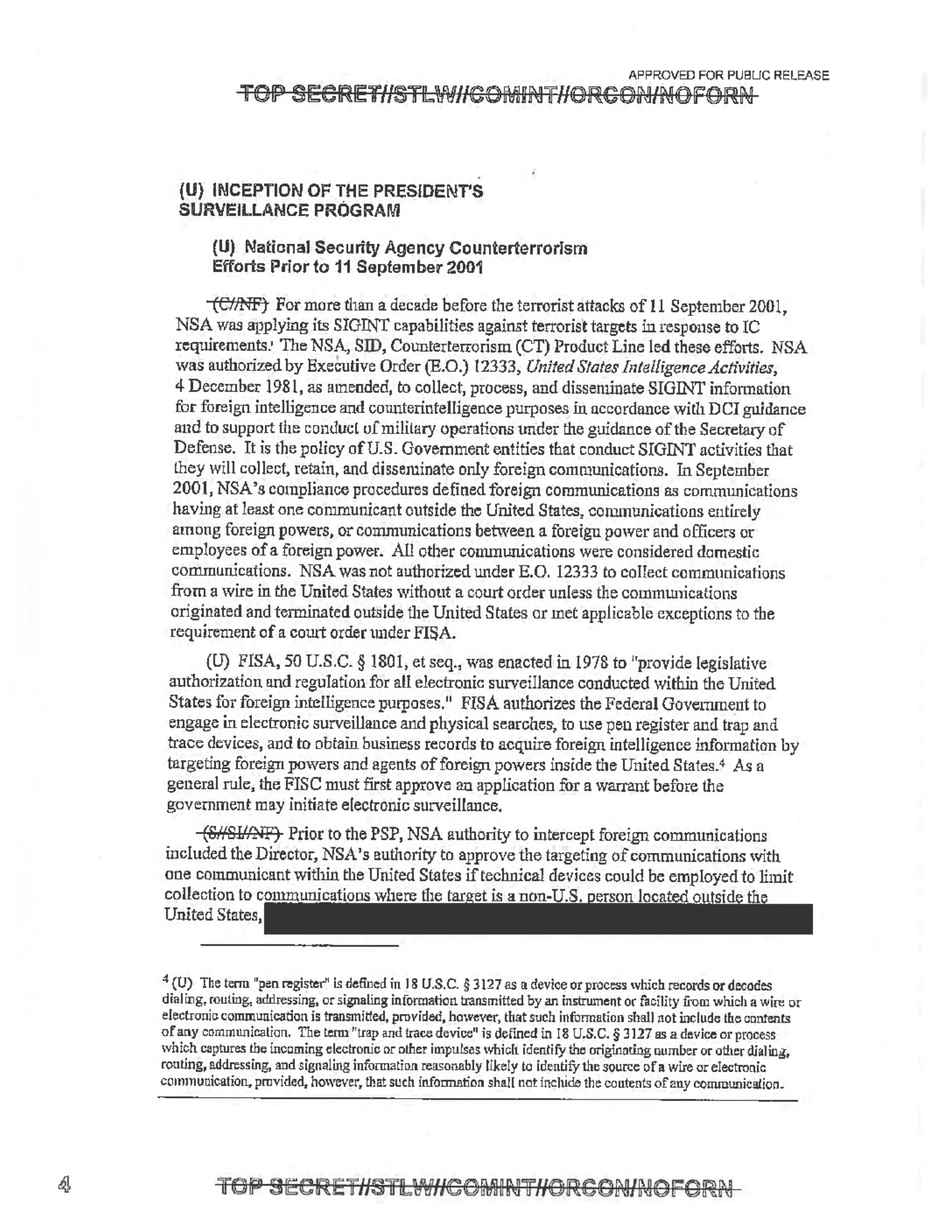
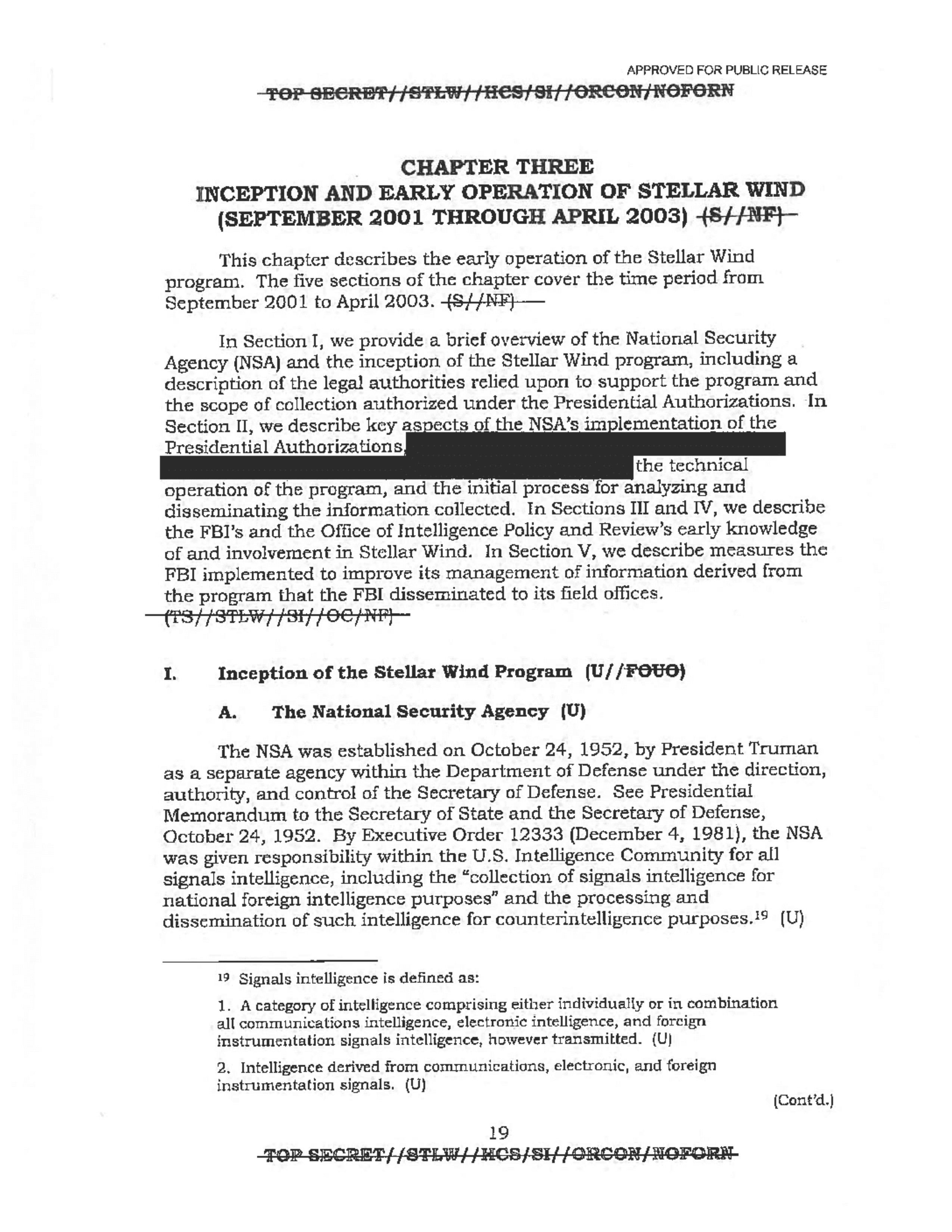
(C/NF) For more than a decade before the terrorist attacks of 11 September 2001,
NSA was applying its SIGINT capabilities against terrorist targets in response to IC
requirements. The NSA, SID, Counterterrorism (CT) Product Line led these efforts. NSA
was authorized by Executive Order (E.O.) 12333, United States Intelligence Activities,
4 December 1981, as amended, to collect, process, and disseminate SIGINT information
for foreign intelligence and counterintelligence purposes in accordance with DCI guidance
and to support the conduct of military operations under the guidance of the Secretary of
Defense. It is the policy of U.S. Government entities that conduct SIGINT activities that
they will collect, retain, and disseminate only foreign communications. In September
2001, NSA's compliance procedures defined foreign communications as communications
having at least one communicant outside the United States, communications entirely
among foreign powers, or communications between a foreign power and officers or
employees of a foreign power. All other communications were considered domestic
communications. NSA was not authorized under E.O. 12333 to collect communications
from a wire in the United States without a court order unless the communications
originated and terminated outside the United States or met applicable exceptions to the
requirement of a court order under FISA.
(U) FISA, 50 U.S.C. § 1801, et seq., was enacted in 1978 to "provide legislative
authorization and regulation for all electronic surveillance conducted within the United
States for foreign intelligence purposes." FISA authorizes the Federal Government to
engage in electronic surveillance and physical searches, to use pen register and trap and
trace devices, and to obtain business records to acquire foreign intelligence information by
targeting foreign powers and agents of foreign powers inside the United States. As a
general rule, the FISC must first approve an application for a warrant before the
government may initiate electronic surveillance.
(S//SI//NF) Prior to the PSP, NSA authority to intercept foreign communications
included the Director, NSA's authority to approve the targeting of communications with
one communicant within the United States if technical devices could be employed to limit
collection to communications where the target is a non-U.S. person located outside the
United States, [REDACTED]
⁴ (U) The term "pen register" is defined in 18 U.S.C. § 3127 as a device or process which records or decodes
dialing, routing, addressing, or signaling information transmitted by an instrument or facility from which a wire or
electronic communication is transmitted, provided, however, that such information shall not include the contents
of any communication. The term "trap and trace device" is defined in 18 U.S.C. § 3127 as a device or process
which captures the incoming electronic or other impulses which identify the originating number or other dialing,
routing, addressing, and signaling information reasonably likely to identify the source of a wire or electronic
communication, provided, however, that such information shall not include the contents of any communication.
4
TOP SECRET//STLW//COMINT//ORCON/NOFORN
APPROVED FOR PUBLIC RELEASE
TOP SECRET//STLW//COMINT//ORCON/NOFORN
[REDACTED]
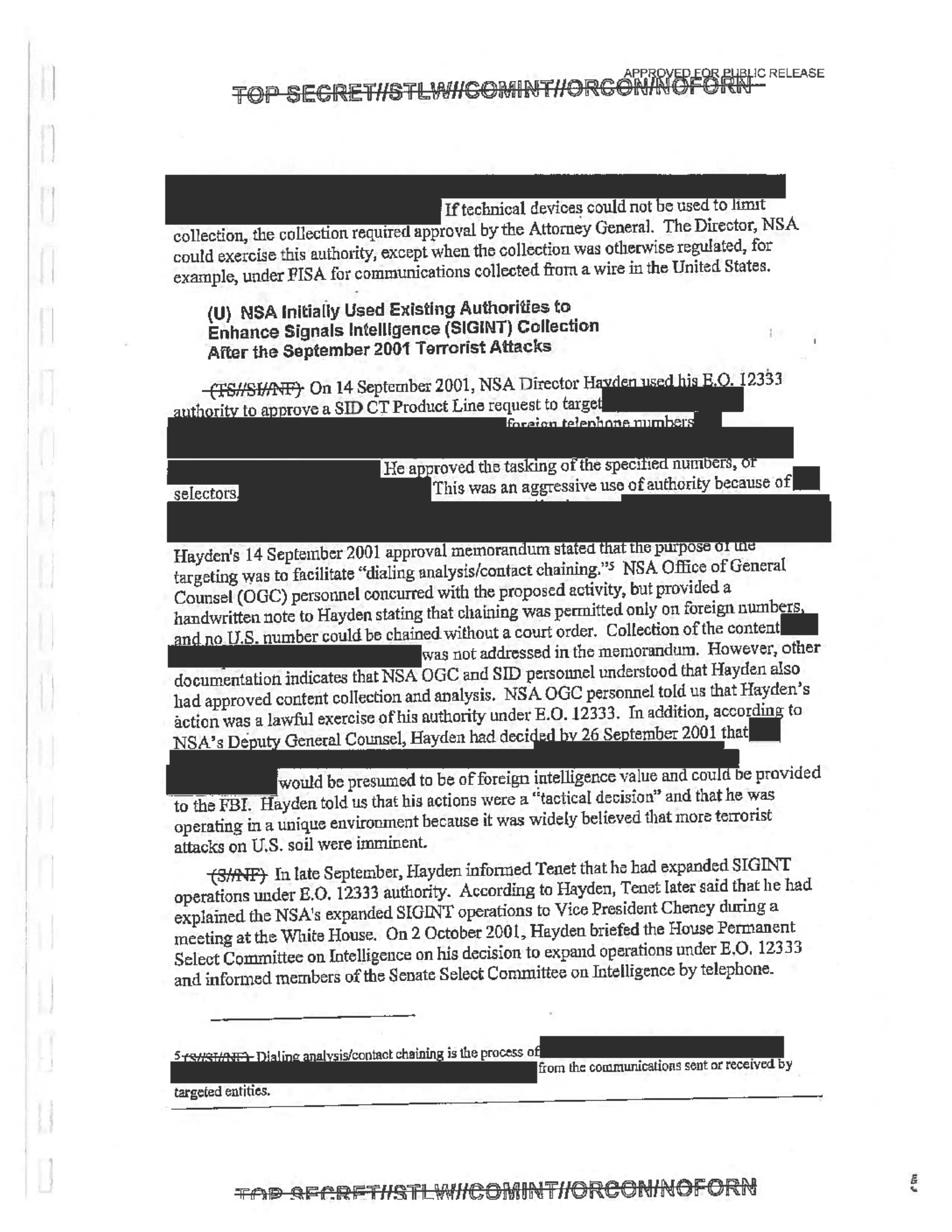
[REDACTED] If technical devices could not be used to limit
collection, the collection required approval by the Attorney General. The Director, NSA
could exercise this authority, except when the collection was otherwise regulated, for
example, under FISA for communications collected from a wire in the United States.
(U) NSA Initially Used Existing Authorities to
Enhance Signals Intelligence (SIGINT) Collection
After the September 2001 Terrorist Attacks
(TS//SI//NF) On 14 September 2001, NSA Director Hayden used his E.O. 12333
authority to approve a SID CT Product Line request to target [REDACTED]
[REDACTED] foreign telephone numbers [REDACTED]
[REDACTED]
[REDACTED] He approved the tasking of the specified numbers, or
selectors [REDACTED] This was an aggressive use of authority because of [REDACTED]
[REDACTED]
Hayden's 14 September 2001 approval memorandum stated that the purpose of the
targeting was to facilitate "dialing analysis/contact chaining."⁵ NSA Office of General
Counsel (OGC) personnel concurred with the proposed activity, but provided a
handwritten note to Hayden stating that chaining was permitted only on foreign numbers,
and no U.S. number could be chained without a court order. Collection of the content [REDACTED]
[REDACTED] was not addressed in the memorandum. However, other
documentation indicates that NSA OGC and SID personnel understood that Hayden also
had approved content collection and analysis. NSA OGC personnel told us that Hayden's
action was a lawful exercise of his authority under E.O. 12333. In addition, according to
NSA's Deputy General Counsel, Hayden had decided by 26 September 2001 that [REDACTED]
[REDACTED]
[REDACTED] would be presumed to be of foreign intelligence value and could be provided
to the FBI. Hayden told us that his actions were a “tactical decision" and that he was
operating in a unique environment because it was widely believed that more terrorist
attacks on U.S. soil were imminent.
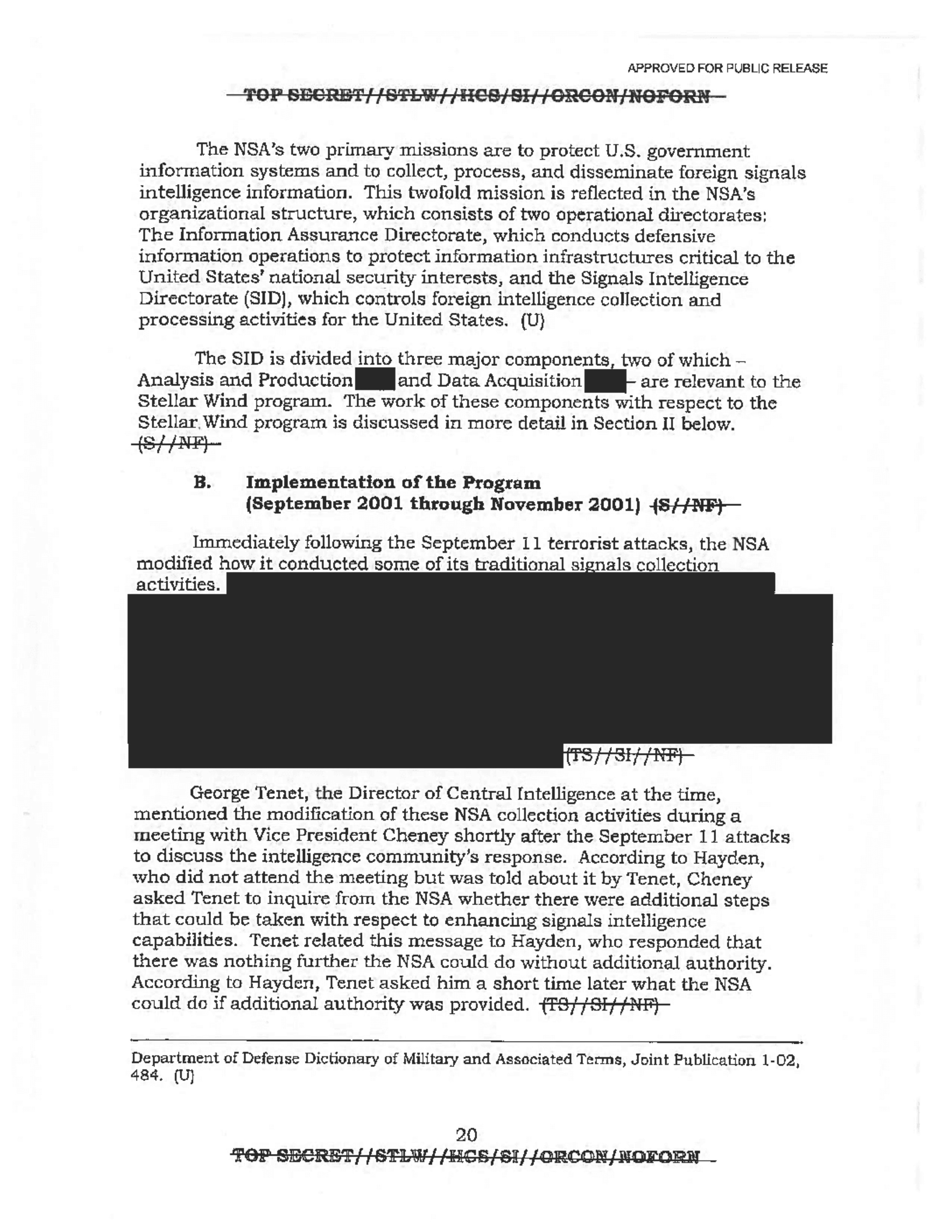
(S//NF) In late September, Hayden informed Tenet that he had expanded SIGINT
operations under E.O. 12333 authority. According to Hayden, Tenet later said that he had
explained the NSA's expanded SIGINT operations to Vice President Cheney during a
meeting at the White House. On 2 October 2001, Hayden briefed the House Permanent
Select Committee on Intelligence on his decision to expand operations under E.O. 12333
and informed members of the Senate Select Committee on Intelligence by telephone.
⁵ (S//SI//NF) Dialing analysis/contact chaining is the process of [REDACTED]
[REDACTED] from the communications sent or received by
targeted entities.
TOP SECRET//STLW//COMINT//ORCON/NOFORN
5
APPROVED FOR PUBLIC RELEASE
TOP SECRET//STLW//COMINT//ORCON/NOFORN
(U) NSA Explored Options to Improve
SIGINT Collection and Address
Intelligence Gaps on Terrorist Targets
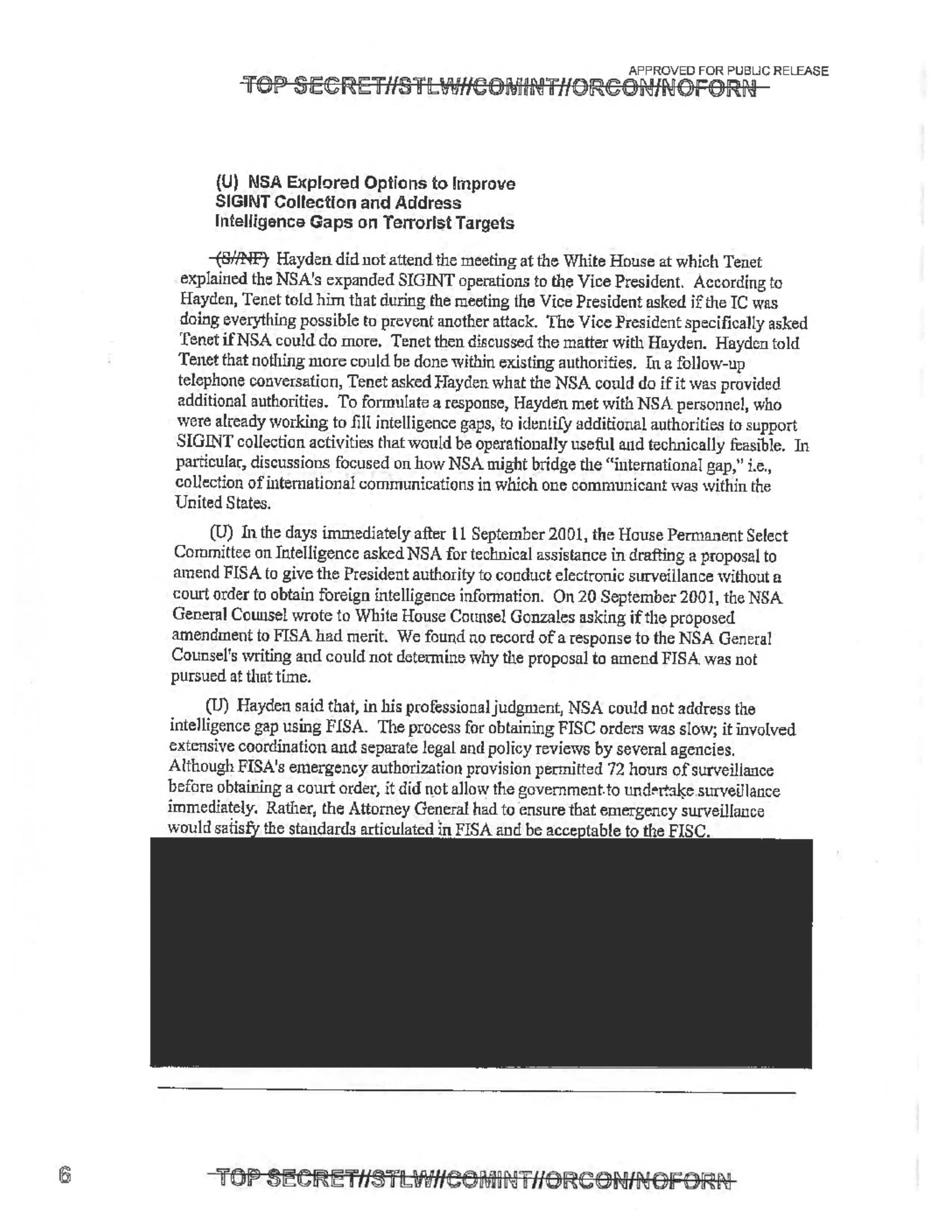
(S//NF) Hayden did not attend the meeting at the White House at which Tenet
explained the NSA's expanded SIGINT operations to the Vice President. According to
Hayden, Tenet told him that during the meeting the Vice President asked if the IC was
doing everything possible to prevent another attack. The Vice President specifically asked
Tenet if NSA could do more. Tenet then discussed the matter with Hayden. Hayden told
Tenet that nothing more could be done within existing authorities. In a follow-up
telephone conversation, Tenet asked Hayden what the NSA could do if it was provided
additional authorities. To formulate a response, Hayden met with NSA personnel, who
were already working to fill intelligence gaps, to identify additional authorities to support
SIGINT collection activities that would be operationally useful and technically feasible. In
particular, discussions focused on how NSA might bridge the "international gap," i.e.,
collection of international communications in which one communicant was within the
United States.
(U) In the days immediately after 11 September 2001, the House Permanent Select
Committee on Intelligence asked NSA for technical assistance in drafting a proposal to
amend FISA to give the President authority to conduct electronic surveillance without a
court order to obtain foreign intelligence information. On 20 September 2001, the NSA
General Counsel wrote to White House Counsel Gonzales asking if the proposed
amendment to FISA had merit. We found no record of a response to the NSA General
Counsel's writing and could not determine why the proposal to amend FISA was not
pursued at that time.
(U) Hayden said that, in his professional judgment, NSA could not address the
intelligence gap using FISA. The process for obtaining FISC orders was slow; it involved
extensive coordination and separate legal and policy reviews by several agencies.
Although FISA's emergency authorization provision permitted 72 hours of surveillance
before obtaining a court order, it did not allow the government to undertake surveillance
immediately. Rather, the Attorney General had to ensure that emergency surveillance
would satisfy the standards articulated in FISA and be acceptable to the FISC.
[REDACTED]
6
TOP SECRET//STLW//COMINT//ORCON/NOFORN
APPROVED FOR PUBLIC RELEASE
TOP SECRET//STLW//COMINT//ORCON/NOFORN
[REDACTED]
(U) Impediments to SIGINT Collection
Against Terrorist Targets Were Discussed
With the White House
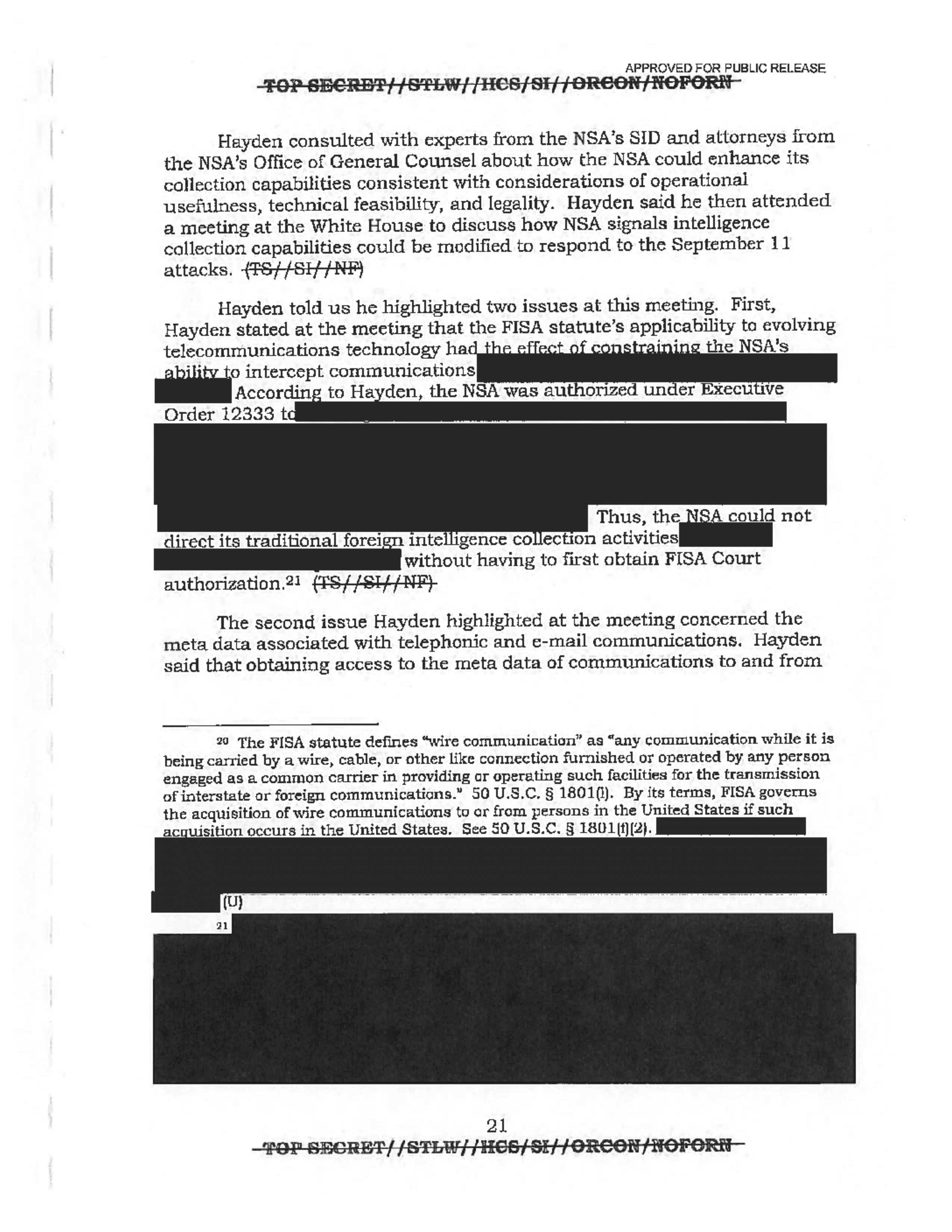
(S//NF) Hayden recalled that, after consulting with NSA personnel, he discussed with
the White House how FISA constrained NSA collection of communications carried on a
wire in the United States. Hayden explained that NSA could not collect from a wire in the
United States, without a court order, content or metadata from communications that
originated and/or terminated in the United States. Hayden also said that communications
metadata do not have the same level of constitutional protection as the content of
communications and that access to metadata concerning communications having one end
in the United States would significantly enhance NSA's analytic capabilities. Hayden
suggested that the ability to collect communications that originated or terminated in the
United States without a court order would increase NSA's speed and agility. After two
additional meetings with Vice President Cheney to discuss further how NSA collection
capabilities could be expanded along the lines described at the White House meeting, the
Vice President told Hayden to work out a solution with Counsel to the Vice President
David Addington.
(U) Authorization of the
President's Surveillance Program
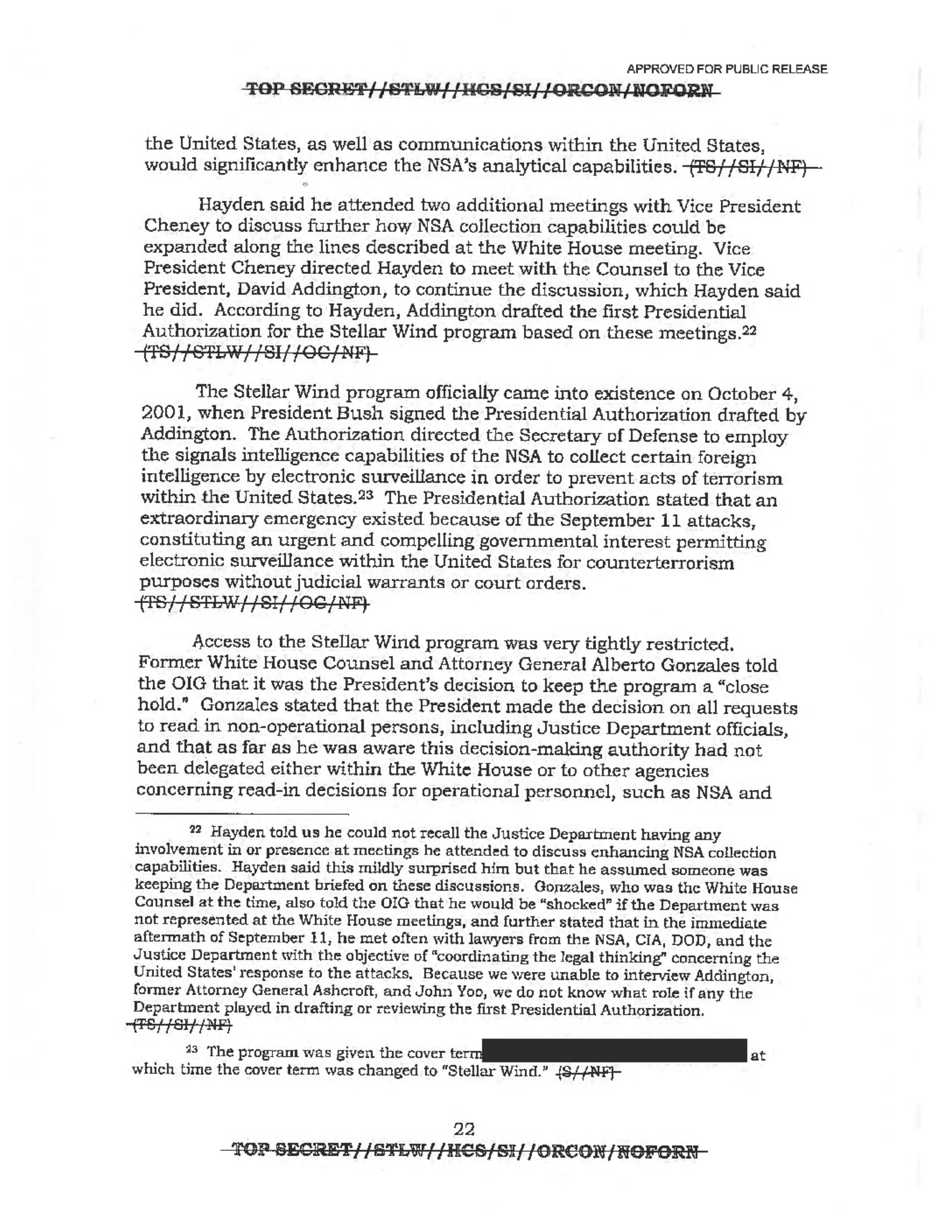
(TS//SI//NF) According to Hayden, Addington drafted the first Presidential
Authorization of the PSP. Hayden characterized himself as the "subject matter expert,"
and he said that no other NSA personnel, including the General Counsel, participated in
drafting the authorization. Hayden also said that DoJ personnel had not been involved in
his discussions with Addington concerning Presidential authorization of the PSP. The PSP
came into existence on 4 October 2001, when President Bush signed the Presidential
Authorization drafted by Addington. The authorization was entitled: *Presidential
Authorization for Specified Electronic Surveillance Activities during a Limited Period to
Detect and Prevent Acts of Terrorism within the United States*. Between 4 October 2001
and 8 December 2006, President Bush signed 43 authorizations, exclusive of modifications
and other program-related memoranda to the Secretary of Defense.
(U) SIGINT Activities Authorized Under the Program
(TS//STLW//SI//OC/NF) The 4 October 2001 Presidential Authorization directed the
Secretary of Defense to [REDACTED]
TOP SECRET//STLW//COMINT//ORCON/NOFORN
7
APPROVED FOR PUBLIC RELEASE
TOP SECRET//STLW//COMINT//ORCON/NOFORN
[REDACTED]
(TS//STLW//SI//OC/NF) The first Presidential Authorization allowed NSA to
intercept the content of [REDACTED]
any communication, including those to, from, or exclusively within the United States,
where probable cause existed to believe one of the communicants was engaged in
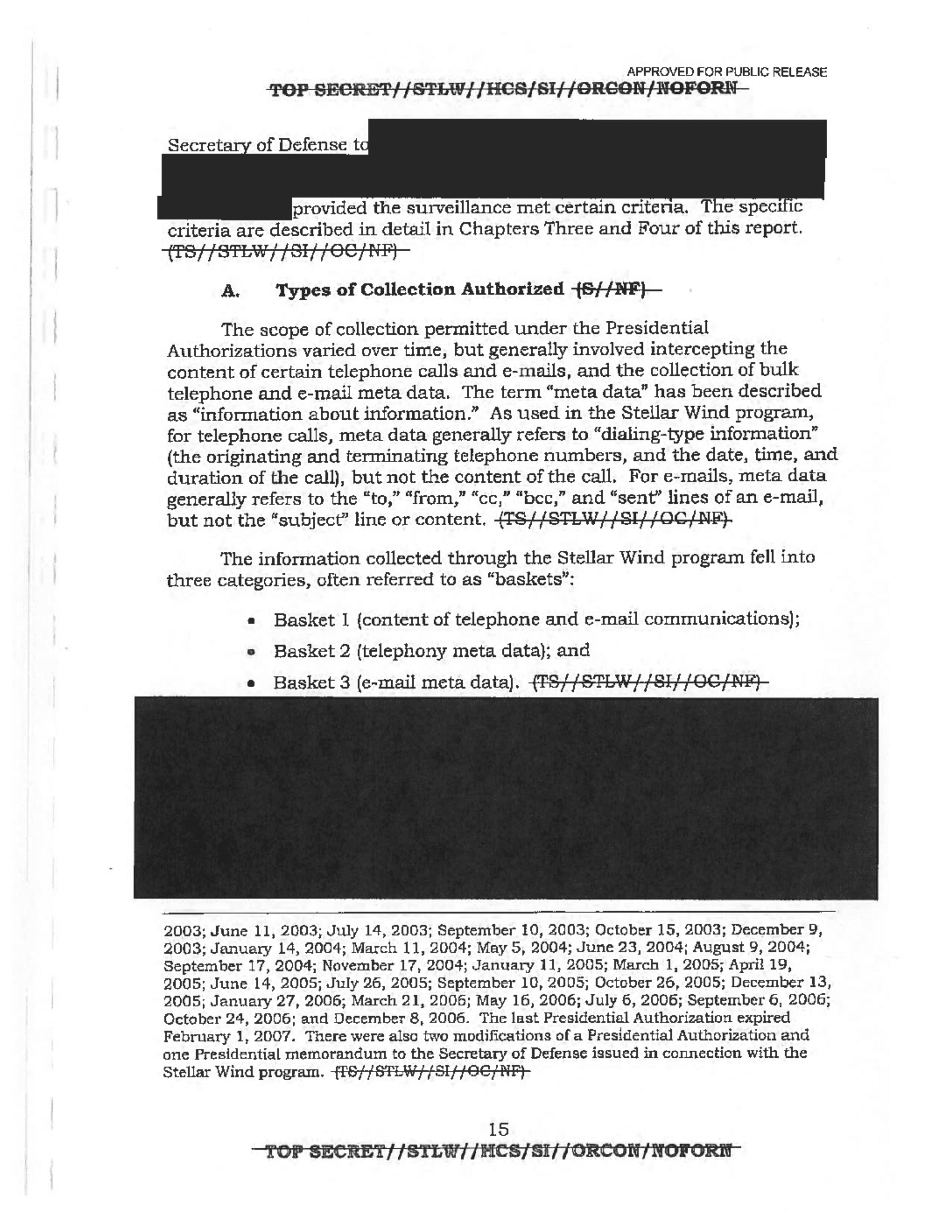
international terrorism. The authorization also allowed the NSA to acquire telephony and
Internet metadata where one end of the communication was outside the United States or
neither communicant was known to be a U.S. citizen. For telephone calls, metadata
generally referred to "dialing-type information" (the originating and terminating telephone
numbers, and the date, time, and duration of the call), but not the content of the call. For
Internet communications, metadata generally referred to the "to," "from," "cc," "bcc," and
"sent" lines of a message, but not the "subject" line or content. [REDACTED]
[REDACTED]
(TS//STLW//SI//OC/NF) The Secretary of Defense directed NSA, in writing, on
8 October 2001 to execute the authorization to conduct specified electronic surveillance on
targets related to [REDACTED] international terrorism.⁶ Because the surveillance was
conducted in the United States, included [REDACTED] communications into or out of the
United States, and a subset of these communications was to or from persons in the United
States, the surveillance otherwise would have required a FISC order. NSA was also
allowed to retain, process, analyze, and disseminate intelligence from communications
acquired under the Presidential Authorization.
(TS//STLW//SI//OC/NF) In addition to allowing the interception of the content of
communications into or out of the United States, paragraph (a)(ii) of the first Presidential
Authorization allowed NSA to intercept the content of purely domestic communications.
Hayden told us he did not realize this until Addington specifically raised the subject during
⁶ [REDACTED]
[REDACTED]
8
TOP SECRET//STLW/COMINT//ORCON/NOFORN
APPROVED FOR PUBLIC RELEASE
TOP SECRET//STLW/COMINT//ORCON/NOFORN
a meeting to discuss renewing the authorization. According to Hayden, he told Addington
that NSA would not collect domestic communications because NSA is a foreign
intelligence agency, its infrastructure did not support domestic collection, and he would
require such a high evidentiary standard to justify intercepting purely domestic
communication that such cases might just as well go to the FISC.
(U) Content of the Presidential Authorizations
and Department of Justice Certification
as to Form and Legality
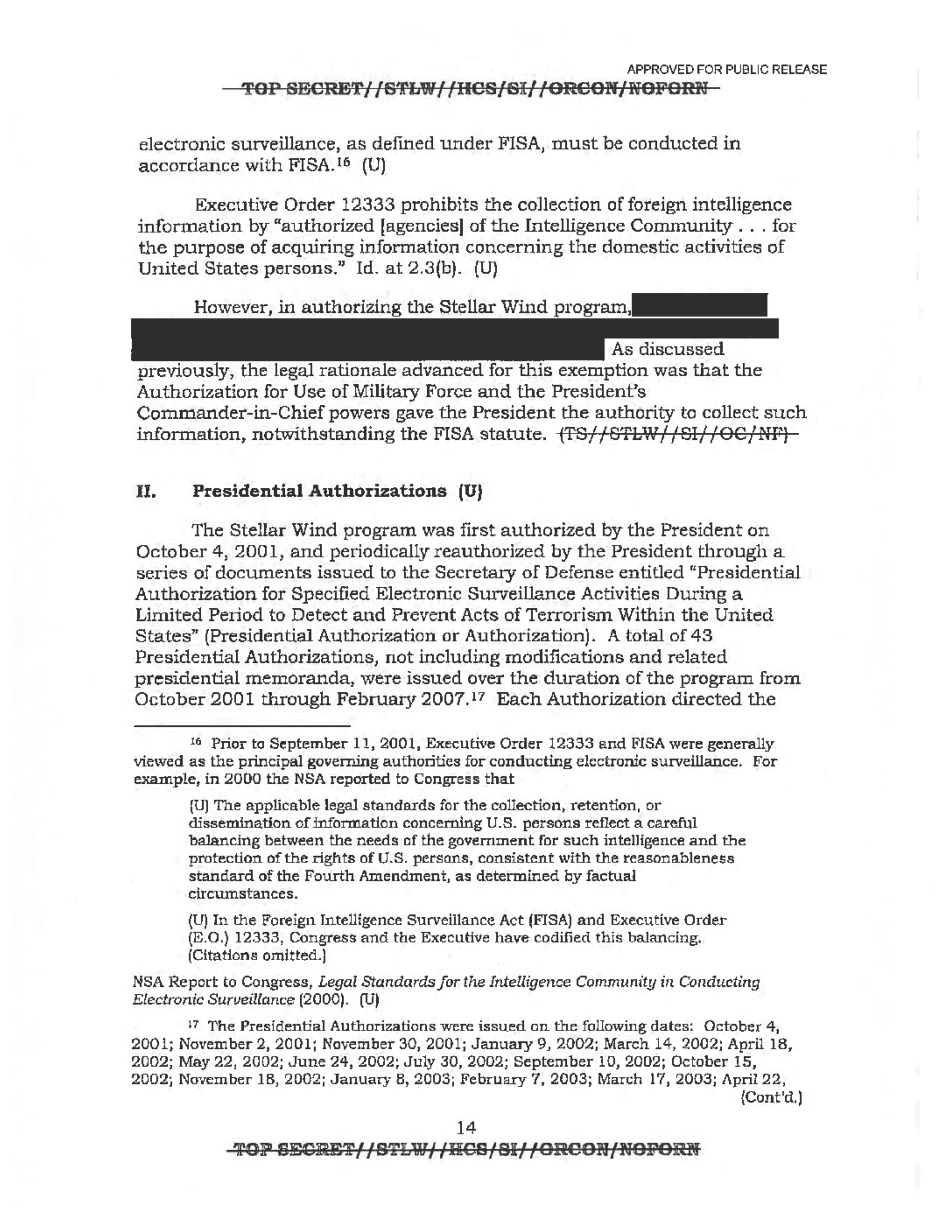
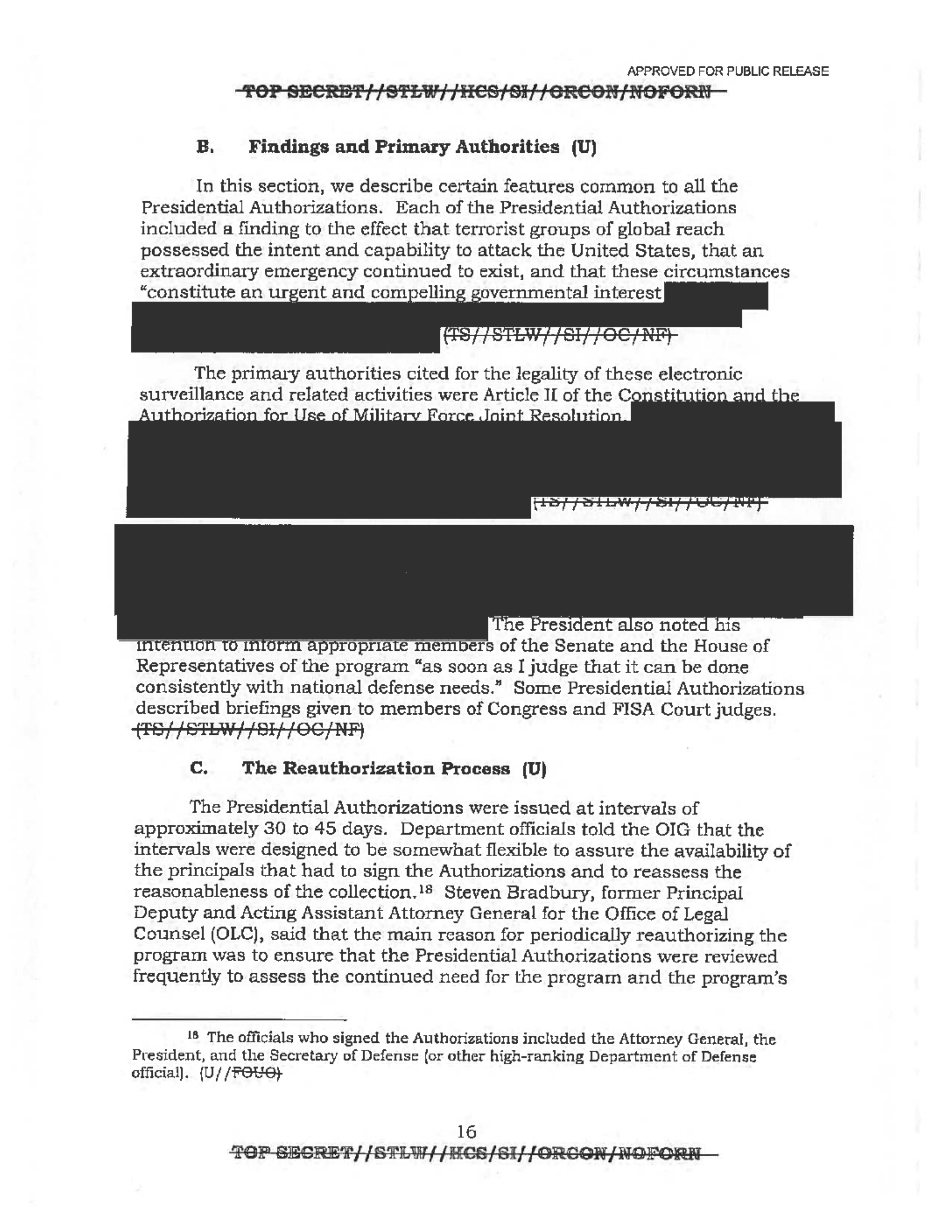
(S//NF) Each of the Presidential Authorizations included a finding to the effect that
terrorist groups of global reach possessed the intent and capability to attack the United
States, that an extraordinary emergency continued to exist, and that these circumstances
constituted an urgent and compelling governmental interest permitting electronic
surveillance within the United States for counterterrorism purposes, without judicial
warrants or court orders. The primary authorities cited for the legality of the electronic
surveillance and related activities were Article II of the Constitution and the
18 September 2001 Authorization for Use of Military Force Joint Resolution (AUMF).
[REDACTED]
[REDACTED] The President also
noted his intention to inform appropriate members of the Senate and the House of
Representatives of the program "as soon as I judge that it can be done consistently with
national defense needs."
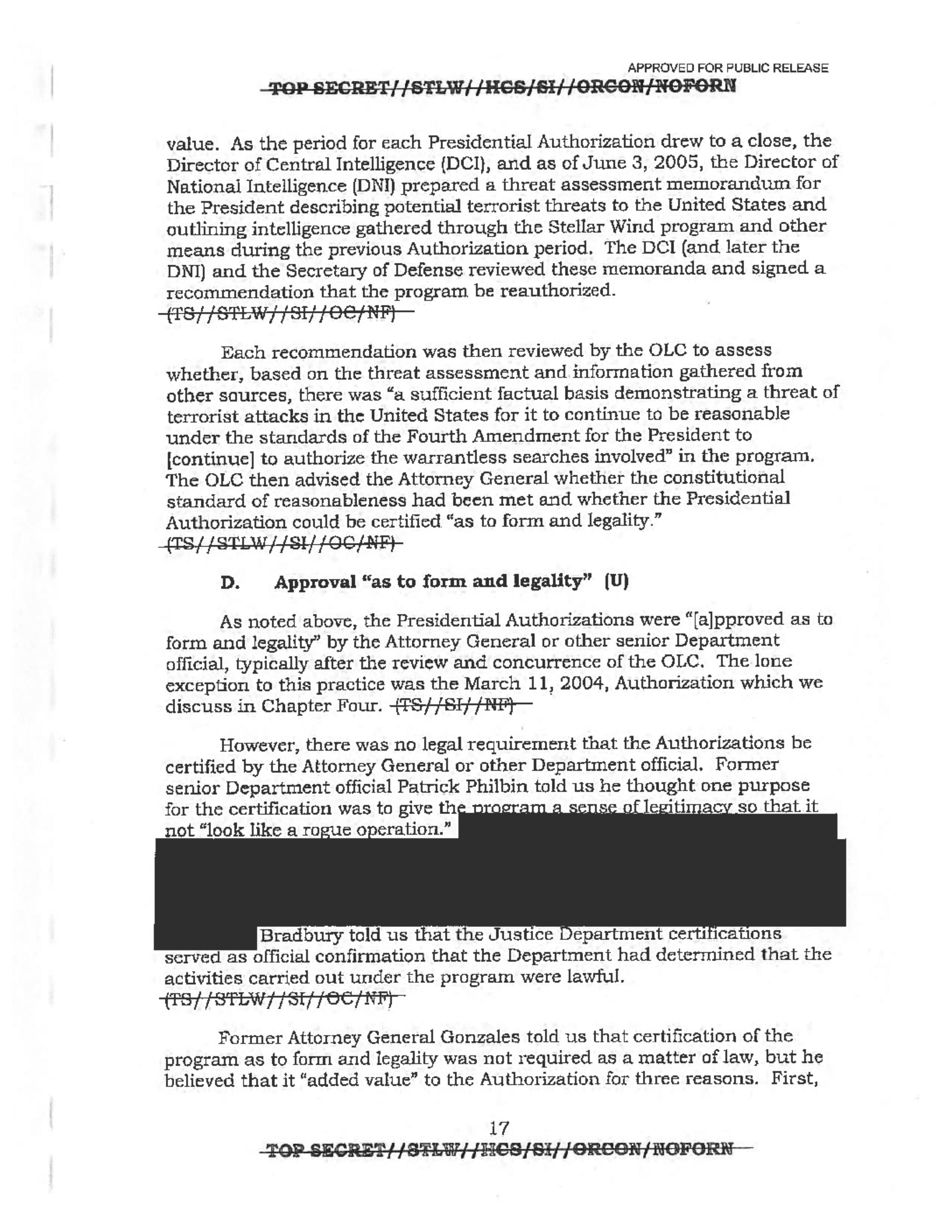
(S//NF) Ashcroft certified the first Presidential Authorization as to "form and
legality" on 4 October 2001. According to NSA records, this was the same day that
Ashcroft was read into the PSP. There was no legal requirement that the Presidential
Authorizations of the PSP be certified by the Attorney General or other DoJ officials.
Former senior DoJ official Patrick F. Philbin told us he thought one purpose of the
certification was to give the program a sense of legitimacy so that it not "look like a rogue
operation." [REDACTED]
[REDACTED]
Principal Deputy and Acting Assistant Attorney General Steven G. Bradbury told us that
the DoJ certifications served as official confirmation that DoJ had determined that the
activities carried out under the program were lawful.
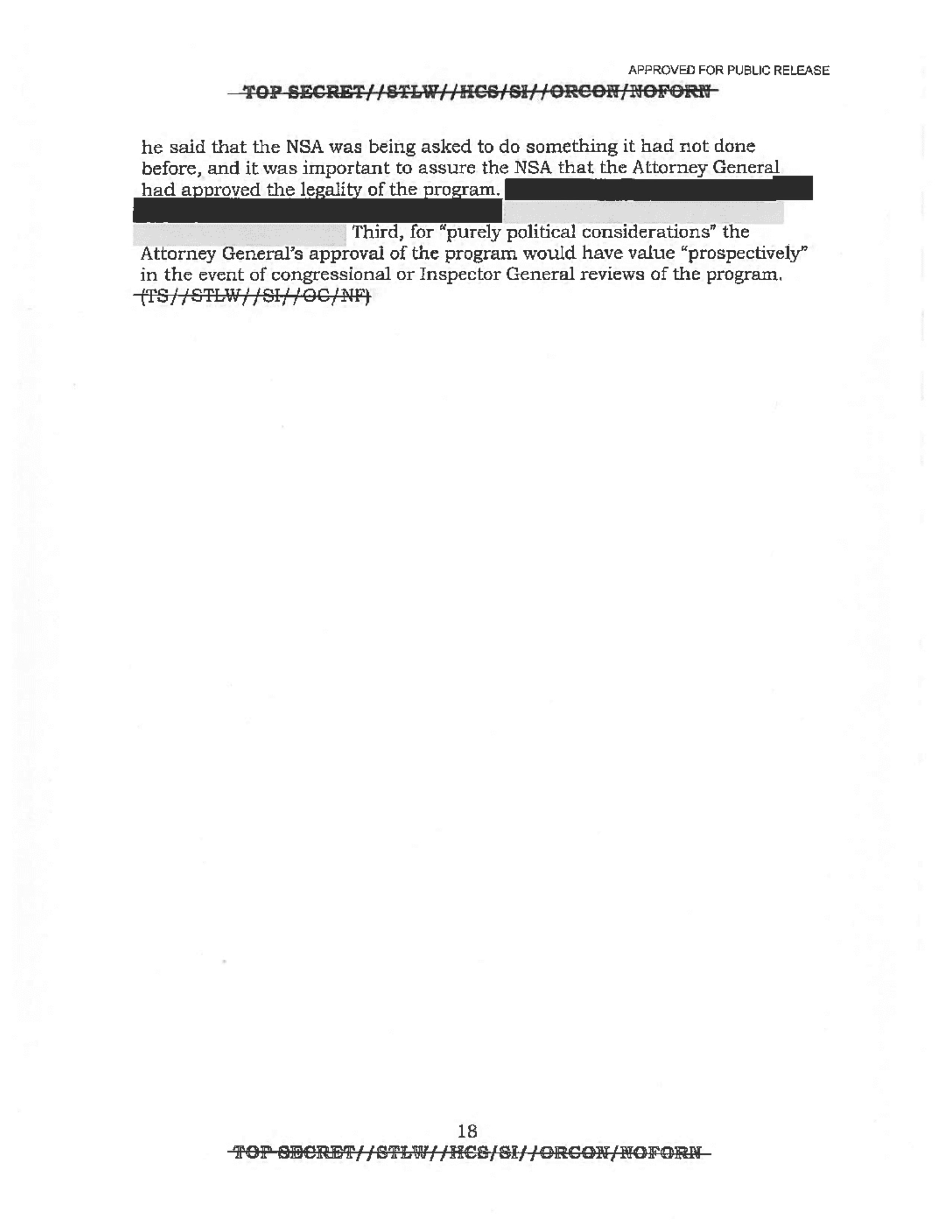
(S//NF) Gonzales told us that approval of the program as to form and legality was not
required as a matter of law, but he believed that it "added value" to the Presidential
Authorization for three reasons. First, NSA was being asked to do something it had not
done before, and it was important to assure the NSA that the Attorney General had
TOP SECRET//STLW//COMINT//ORCON/NOFORN
9
APPROVED FOR PUBLIC RELEASE
TOP SECRET//STLW//COMINT//ORCON/NOFORN
approved the legality of the program
[REDACTED]
[REDACTED] Third, for "purely political considerations," the Attorney General's approval of
the program would have value "prospectively" in the event of Congressional or inspector
general reviews of the program.
(U) The Presidential Authorizations were issued at intervals of approximately 30 to
60 days. Bradbury said that the main reason for periodically reauthorizing the program
was to ensure that the Presidential Authorizations were reviewed frequently to assess the
program's value and effectiveness. As the period for each Presidential Authorization drew
to a close, the DCI prepared a threat assessment memorandum for the President describing
the current state of potential terrorist threats to the United States.
(U) The Threat Assessment Memorandums
Supporting Presidential Authorization of the Program
(S/NF) From October 2001 to May 2003, the CIA prepared the threat assessment
memorandums that supported Presidential authorization and periodic reauthorization of the
PSP. The memorandums documented the current threat to the U.S. homeland and to U.S.
interests abroad from al-Qa'ida and affiliated terrorist organizations. The first threat
assessment memorandum—The Continuing Near-Term Threat from Usama Bin Ladin—
was signed by the DCI on 4 October 2001.7 Subsequent threat assessment memorandums
were prepared every 30 to 60 days to correspond with the President's reauthorizations.
(S/NF) The DCI Chief of Staff, John H. Moseman, was the CIA focal point for
preparing the threat assessment memorandums. According to Moseman, he directed the
CIA, [REDACTED] to prepare objective appraisals of the
current terrorist threat, focusing primarily on threats to the homeland, and to document
those appraisals in a memorandum. [REDACTED] analysts drew upon all sources of intelligence in
preparing their threat assessments. Each of the memorandums focused primarily on the
current threat situation and did not routinely provide information concerning previously
reported threats or an assessment of the PSP's utility in addressing previously reported
threats.
(S/NF) After [REDACTED] completed its portion of the memorandums, Moseman added a
paragraph at the end of the memorandums stating that the individuals and organizations
involved in global terrorism (and discussed in the memorandums) possessed the capability
and intention to undertake further terrorist attacks within the United States. Moseman
recalled that the paragraph was provided to him initially by either Gonzales or Addington.
The paragraph recommended that the President authorize the Secretary of Defense to
employ within the United States the capabilities of DoD, including but not limited to
NSA's SIGINT capabilities, to collect foreign intelligence by electronic surveillance. The
paragraph described the types of communication and data that would be collected and the
⁷ (U) The title of the threat assessment memorandums was changed to The Global War Against Terrorism in
June 2002.
10
TOP SECRET//STLW//COMINT//ORCON/NOFORN
APPROVED FOR PUBLIC RELEASE
TOP SECRET//STLW//COMINT//ORCON/NOFORN
circumstances under which they could be collected. The draft threat assessment
memorandums were reviewed by CIA Office of General Counsel attorneys assigned to
[REDACTED] and CIA Acting General Counsel (Principal Deputy General Counsel), John A. Rizzo.
Rizzo told us that the draft memorandums were generally sufficient, but there were
occasions when, based on his experience with previous memorandums, he thought that
draft memorandums contained insufficient threat information or did not present a
compelling case for reauthorization of the PSP. In such instances, Rizzo would request
that [REDACTED] provide additional available threat information or make revisions to the draft
memorandums.
(S//NF) The threat assessment memorandums were then signed by the DCI and
forwarded to the Secretary of Defense to be co-signed. Tenet signed most of the threat
memorandums prepared during his tenure as DCI. There were no occasions when the DCI
or Acting DCI withheld their signature from the threat assessment memorandums. The
threat assessment memorandums were reviewed by DoJ's OLC to assess whether there was
"a sufficient factual basis demonstrating a threat of terrorist attacks in the United States for
it to continue to be reasonable under the standards of the Fourth Amendment for the
President to [continue] to authorize the warrantless searches involved" in the program.
OLC then advised the Attorney General whether the constitutional standards for
reasonableness had been met and whether the Presidential Authorization could be certified
as to form and legality. After review and approval as to form and legality by the Attorney
General, the threat assessment memorandums were delivered to the White House to be
attached to the PSP reauthorization memorandums signed by the President.
(S//NF) Responsibility for drafting the threat assessment memorandums was
transferred from [REDACTED] to the newly-established Terrorist Threat Integration Center in May
2003. This responsibility was retained by TTIC's successor organization, NCTC. The
DCI continued to sign the threat assessment memorandums through 15 April 2005.
Subsequent memorandums were signed by the Director of National Intelligence or his
designee.
(U) Early Revisions to the Presidential Authorizations
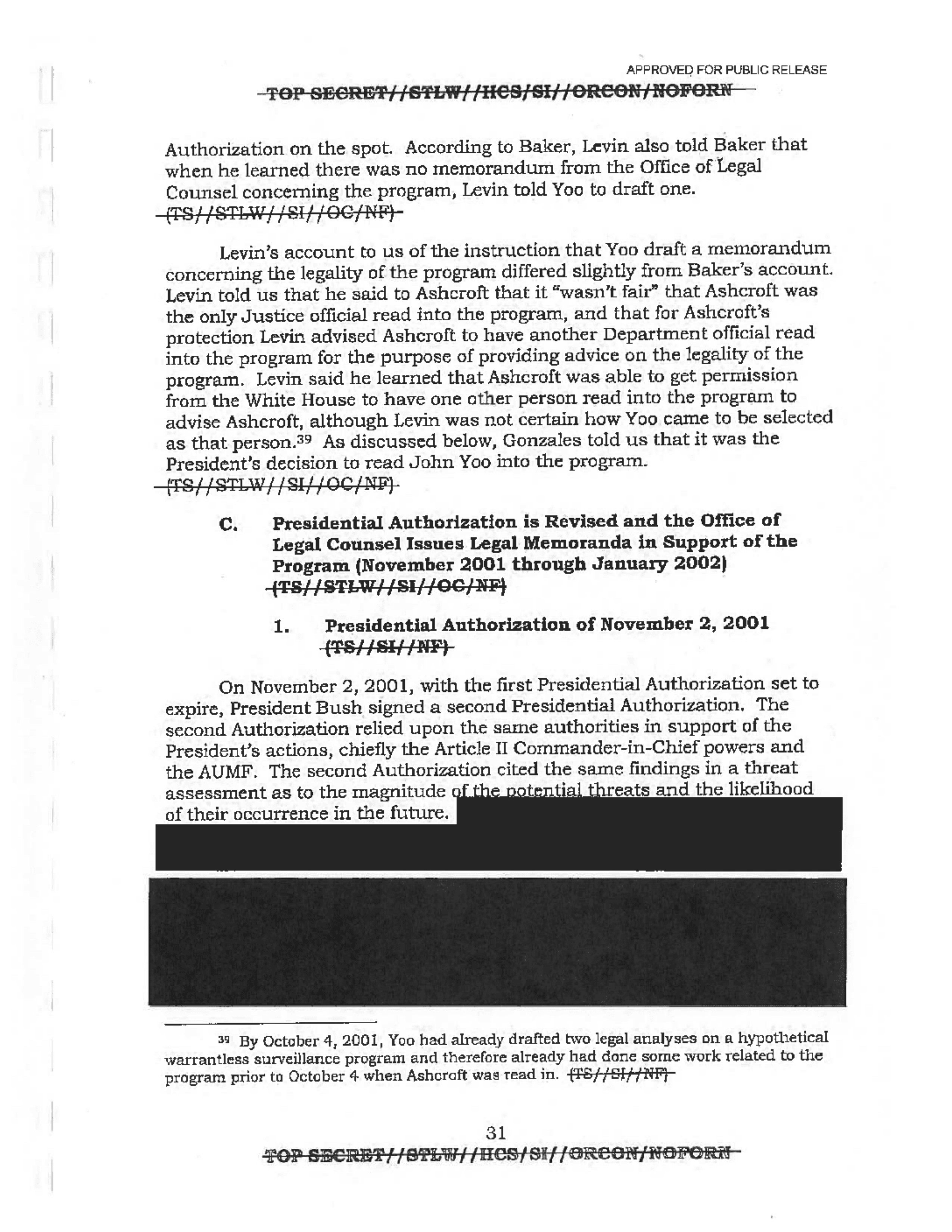
(TS//STLW//SI//OC/NF) On 2 November 2001, with the first authorization set to
expire, President Bush signed a second Presidential Authorization of the PSP. The second
authorization cited the same authorities in support of the President's actions, principally the
Article II Commander-in-Chief powers and the AUMF. The second authorization also
cited the same findings of a threat assessment concerning the magnitude of potential
terrorist threats and the likelihood of their occurrence in the future. [REDACTED]
[REDACTED]
11
TOP SECRET//STLW//COMINT//ORCON/NOFORN
APPROVED FOR PUBLIC RELEASE
TOP SECRET//STLW//COMINT//ORCON/NOFORN
[REDACTED]
(TS//STLW//SI//OC/NF) On 30 November 2001, the President signed a third
authorization for the PSP. [REDACTED]
[REDACTED]
(U) DoJ Office of Legal Counsel Memorandums
Supporting Legality of the Program
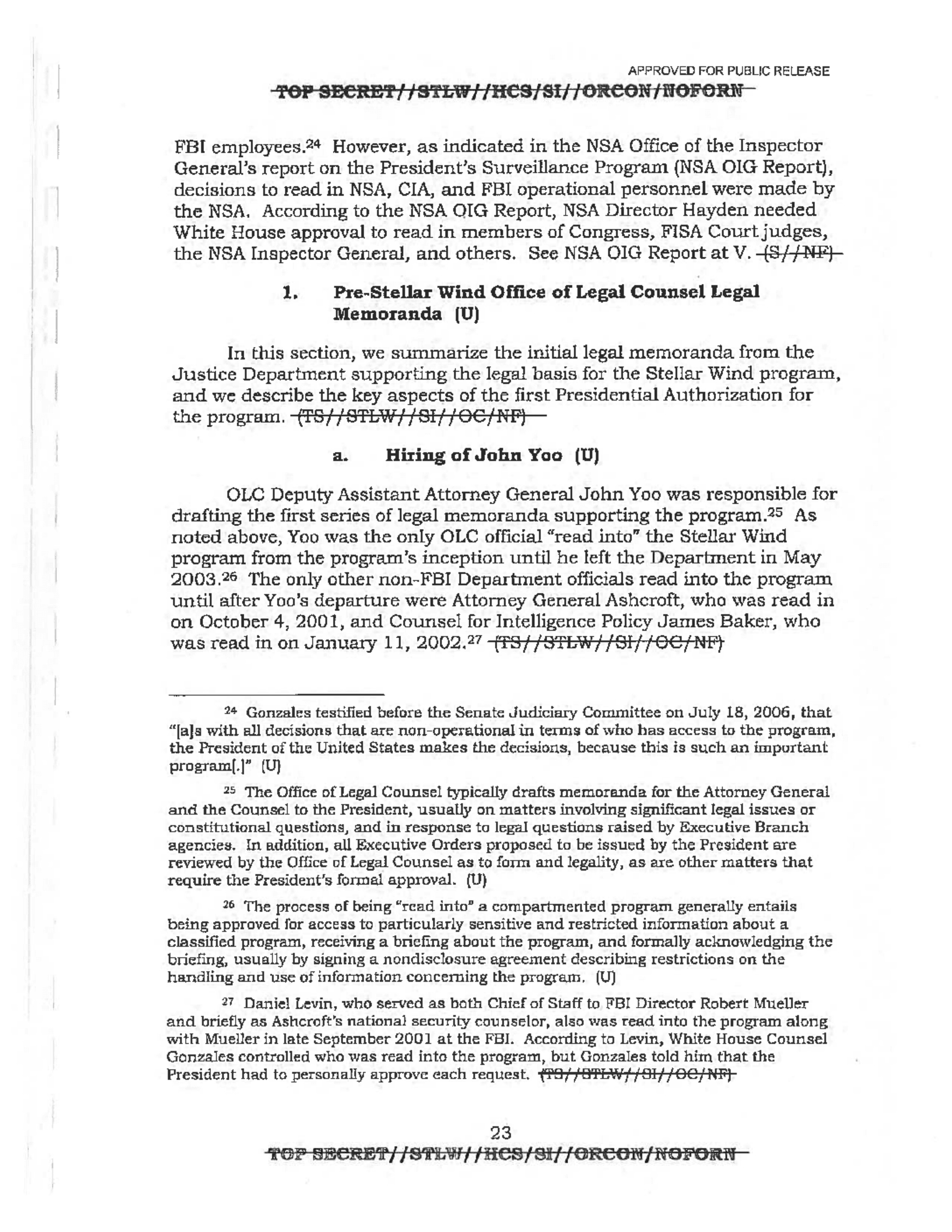
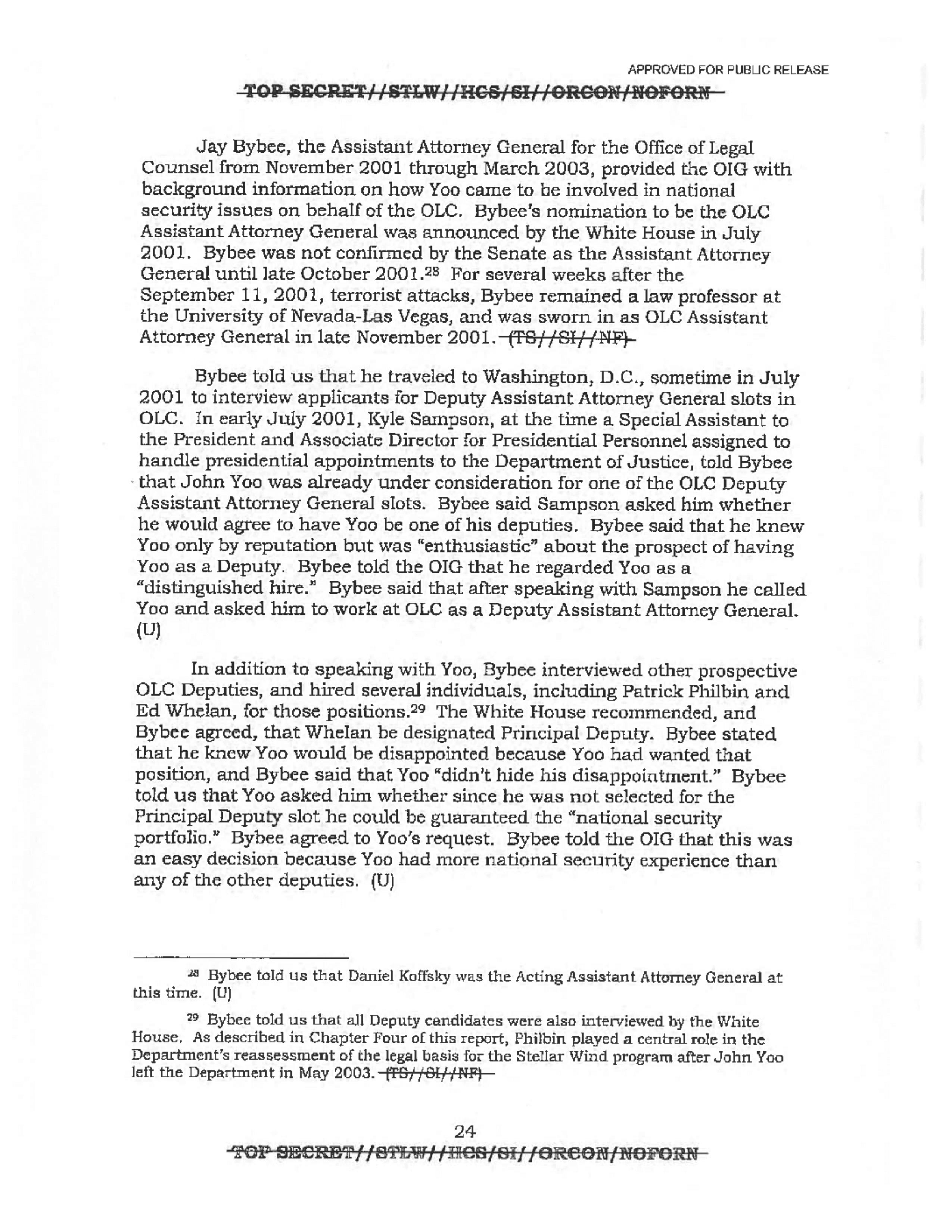
(S/NF) OLC Deputy Assistant Attorney General John Yoo was responsible for
drafting the first series of legal memorandums supporting the PSP. Yoo was the only OLC
official read into the PSP from the program's inception until he left DoJ in May 2003.
12
TOP SECRET//STLW//COMINT//ORCON/NOFORN
APPROVED FOR PUBLIC RELEASE
TOP SECRET//STLW//COMINT//ORCON/NOFORN
During Yoo's tenure at DoJ, he was one of only three DoJ officials read into the PSP. The
other two were Ashcroft and Baker. OLC Assistant Attorney General Jay S. Bybee, Yoo's
direct supervisor, was never read into the program.
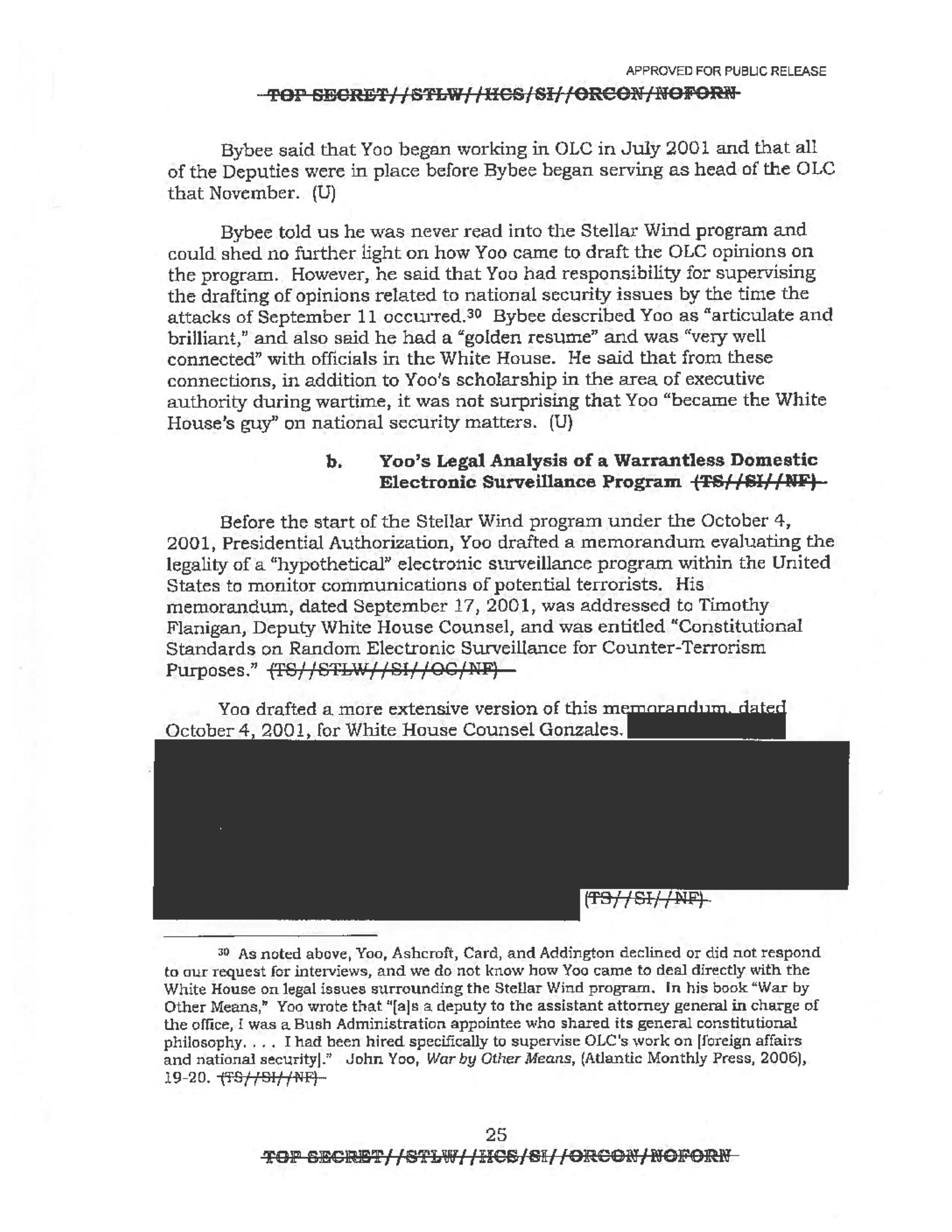
(S/NF) Before the President authorized the PSP on 4 October 2001, Yoo had
prepared a memorandum evaluating the legality of a hypothetical electronic surveillance
program within the United States to monitor communications of potential terrorists. His
memorandum, dated 17 September 2001, was addressed to Deputy White House Counsel
Timothy E. Flanigan and was entitled Constitutional Standards on Random Electronic |
Surveillance for Counter-Terrorism Purposes. Yoo drafted a more extensive version of the
memorandum, dated 4 October 2001, for Gonzales. [REDACTED]
[REDACTED]
13
TOP SECRET//STLW//COMINT//ORCON/NOFORN
APPROVED FOR PUBLIC RELEASE
TOP SECRET//STLW//COMINT//ORCON/NOFORN
[REDACTED]
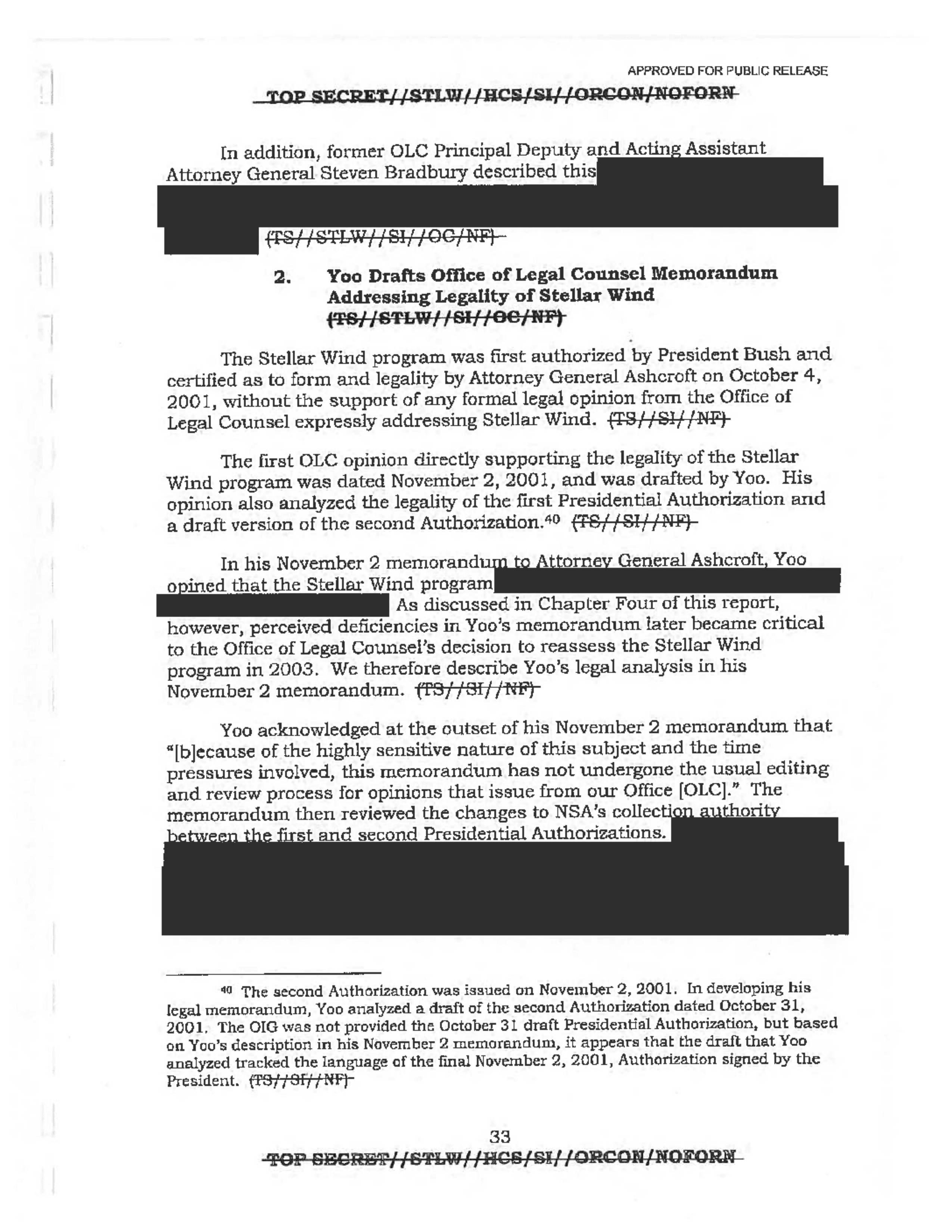
(S/NF) The first OLC memorandum explicitly addressing the legality of PSP was
not drafted until after the program had been formally authorized by the President and after
Ashcroft had certified the program as to form and legality. The first OLC opinion directly
supporting the legality of the PSP was dated 2 November 2001, and was drafted by Yoo.
Yoo acknowledged at the outset of his 2 November memorandum that "[b]ecause of the
highly sensitive nature of this subject and the time pressures involved, this memorandurn
has not undergone the usual editing and review process for opinions that issue from our
Office OLCL"
[REDACTED]
(S/NF) Yoo acknowledged in his 2 November 2001 memorandum that the first
Presidential Authorization was "in tension with FISA." Yoo stated that FISA "purports to
be the exclusive statutory means for conducting electronic surveillance for foreign
intelligence." But Yoo then opined that "[s]uch a reading of FISA would be an
unconstitutional infringement on the President's Article II authorities." Citing advice of
OLC and DoJ's position as presented to Congress during passage of the USA PATRIOT
Act several weeks earlier, Yoo characterized FISA as merely providing a "safe harbor for
electronic surveillance," adding that it "cannot restrict the President's ability to engage in
warrantless searches that protect the national security."
(S//NF) Regarding whether the activities conducted under the PSP could be
conducted under FISA, Yoo described the same potential impediments that he had cited in
his 4 October memorandum. Noting that the Presidential Authorization could be viewed as
a violation of FISA's civil and criminal sanctions in 50 U.S.C. §§ 1809-10, Yoo opined that
in this regard FISA represented an unconstitutional infringement on the President's
Article II powers. According to Yoo, the ultimate test of whether the government may
engage in warrantless electronic surveillance activities is whether such conduct is
consistent with the Fourth Amendment, not whether it meets the standards of FISA.
14
TOP SECRET//STLW//COMINT//ORCON/NOFORN
APPROVED FOR PUBLIC RELEASE
TOP SECRET//STLW//COMINT//ORCON/NOFORN
(S//NF) Yoo wrote that reading FISA to restrict the President's inherent authority to
conduct foreign intelligence surveillance would raise grave constitutional questions which,
under the doctrine of constitutional avoidance, would require resolving the issue in a
manner that preserves the President's [REDACTED]
[REDACTED] "[U]nless Congress made a clear statement in FISA
that it sought to restrict presidential authority to conduct warrantless searches in the
national security area—which it has not—then the statute must be construed to avoid such
a reading."
(TS//SI//NF) Yoo's 2 November 2001 memorandum dismissed Fourth Amendment
concerns to the extent that the authorized collection involved non-U.S. persons outside the
United States. Regarding those aspects of the program that involved interception of the
international communications of U.S. persons within the United States, Yoo asserted that
Fourth Amendment jurisprudence allowed for searches of persons crossing U.S.
international borders and that interceptions of communications into or out of the United
States fell within the "border crossing exception." Yoo further opined that electronic
surveillance in "direct support of military operations" did not trigger constitutional
protection against illegal searches and seizures, in part because the Fourth Amendment is
primarily aimed at curbing law enforcement abuses. Finally, Yoo wrote that the electronic
surveillance described in the Presidential Authorizations was "reasonable" under the
Fourth Amendment and therefore did not require a warrant, i.e., in this situation the
government's national security interest outweighed the individual's privacy interest.
[REDACTED]
[REDACTED]
15
TOP SECRET//STLW//COMINT//ORCON/NOFORN
APPROVED FOR PUBLIC RELEASE
TOP SECRET//STLW//COMINT//ORCON/NOFORN
(TS//SI//NF) In October 2002, at Ashcroft's request, Yoo drafted another opinion
concerning the PSP. The memorandum, dated 11 October 2002, reiterated the same basic
analysis as Yoo's 2 November 2001 memorandum in support of the legality of the PSP.
[REDACTED]
(U) IMPLEMENTATION OF THE
PRESIDENT'S SURVEILLANCE PROGRAM
(U) NSA Implementation
(S/NF) On 4 October 2001, Hayden received the initial Presidential Authorization of
the PSP and briefed the NSA SIGINT Director and other key NSA personnel on the
authorization. [REDACTED]
[REDACTED]
[REDACTED] He also said that the NSA General Counsel
had reviewed the authorization and concluded that the authorized activities were legal.
[REDACTED]
16
TOP SECRET//STLW//COMINT//ORCON/NOFORN
APPROVED FOR PUBLIC RELEASE
TOP SECRET//STLW//COMINT//ORCON/NOFORN
[REDACTED]
[REDACTED] NSA began to collect the
content of telephone calls under PSP authority in October 2001. [REDACTED]
[REDACTED]
17
TOP SECRET//STLW//COMINT//ORCON/NOFORN
APPROVED FOR PUBLIC RELEASE
TOP SECRET//STLW//COMINT//ORCON/NOFORN
[REDACTED]
(TS//SI//NF) Telephone and Internet
Communications Content Collection and Analysis
(TS//SI//NF) Content collection and analysis under the PSP was conducted in the
same manner as collection and analysis conducted previously by the NSA under
E.O. 12333 authority. NSA management applied standard minimization and specially
designed procedures to task domestic selectors such as telephone numbers and e-mail
addresses. Selectors had to meet two criteria before being tasked under the PSP: the
purpose of the collection had to be to prevent and detect terrorist attacks in the United
States; and the selector had to be linked to al-Qa'ida, an associate, or international
terrorism. [REDACTED]
[REDACTED]
(TS//SI//NF) NSA collection managers were responsible for ensuring that telephony
and Internet communications selectors were appropriately added or removed from
collection. Content collection for domestic selectors was sometimes approved for specific
18
TOP SECRET//STLW//COMINT//ORCON/NOFORN
APPROVED FOR PUBLIC RELEASE
TOP SECRET//STLW//COMINT//ORCON/NOFORN
time periods. Data collected under the PSP were stored in compartmented NSA databases,
and access to the databases was strictly controlled.
(TS//SI//OC/NF) The majority of targets for content collection under the PSP were
foreign telephone numbers and Internet communications addresses. In 2008, NSA reported
that [REDACTED] foreign telephone numbers and in excess of [REDACTED] foreign Internet
communications addresses had been targeted from October 2001 through December 2006.
NSA reported in 2008 that [REDACTED] domestic telephone numbers and [REDACTED] domestic Internet
communications addresses were targeted for PSP content collection from October 2001 to
January 2007. Although targeted domestic telephone numbers and Internet
communications addresses were located in the United States, they were not necessarily
used by U.S. citizens.
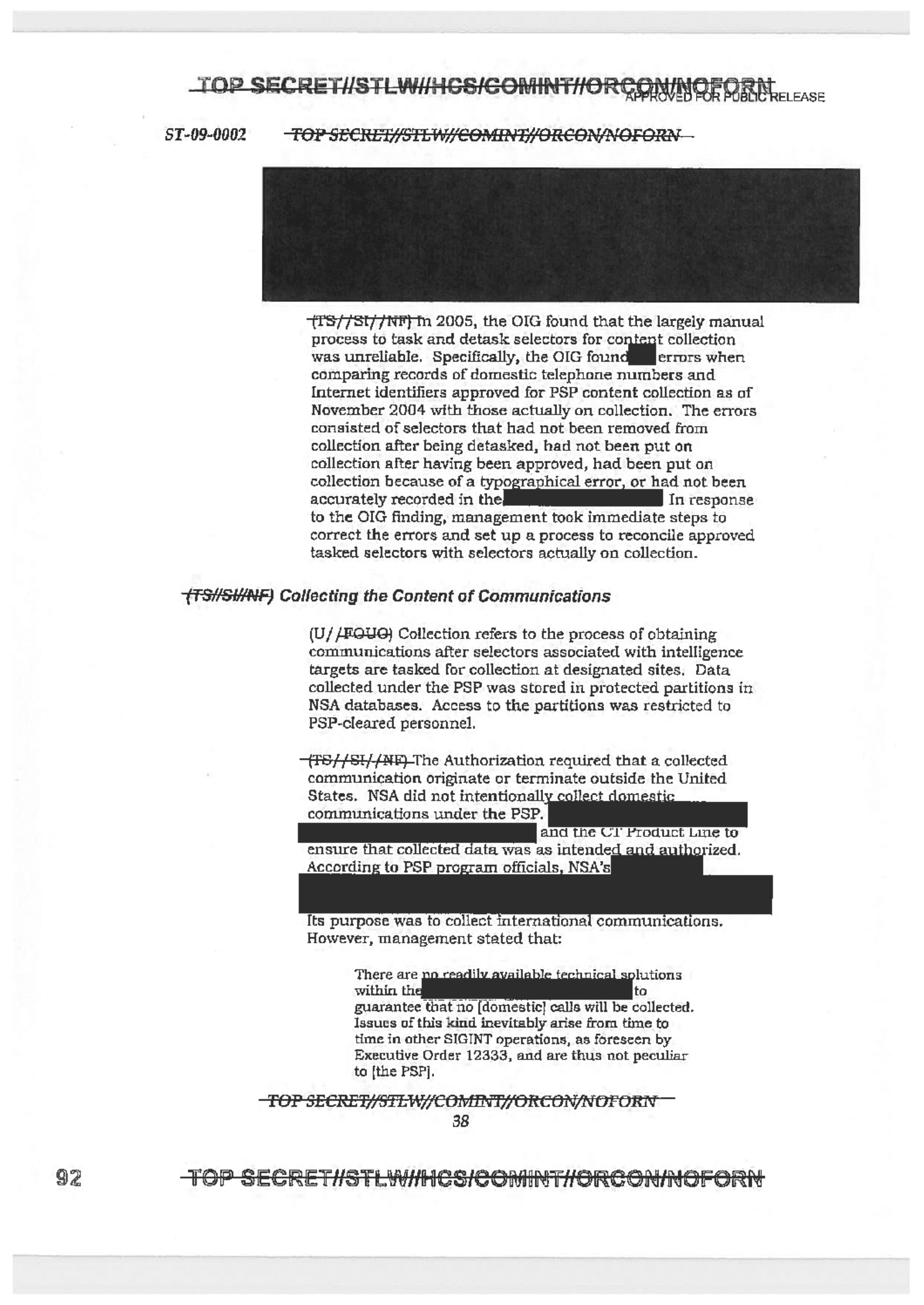
PSP program officials told us that the NSA did not seek to collect domestic
communications under the PSP. However, NSA managers said that there are no readily
available technical means within the [REDACTED] to guarantee that no
domestic calls will be collected. Issues of this kind inevitably arise from time to time in
other SIGINT operations, and are not unique to the PSP. Over the life of the program, the
NSA reported [REDACTED] incidents of unintentional collection of domestic communications or
non-targeted communications. In such cases, the NSA IG determined that personnel
followed established procedures in reporting the incidents, adjusting collection, and
purging unauthorized collection records from NSA databases.
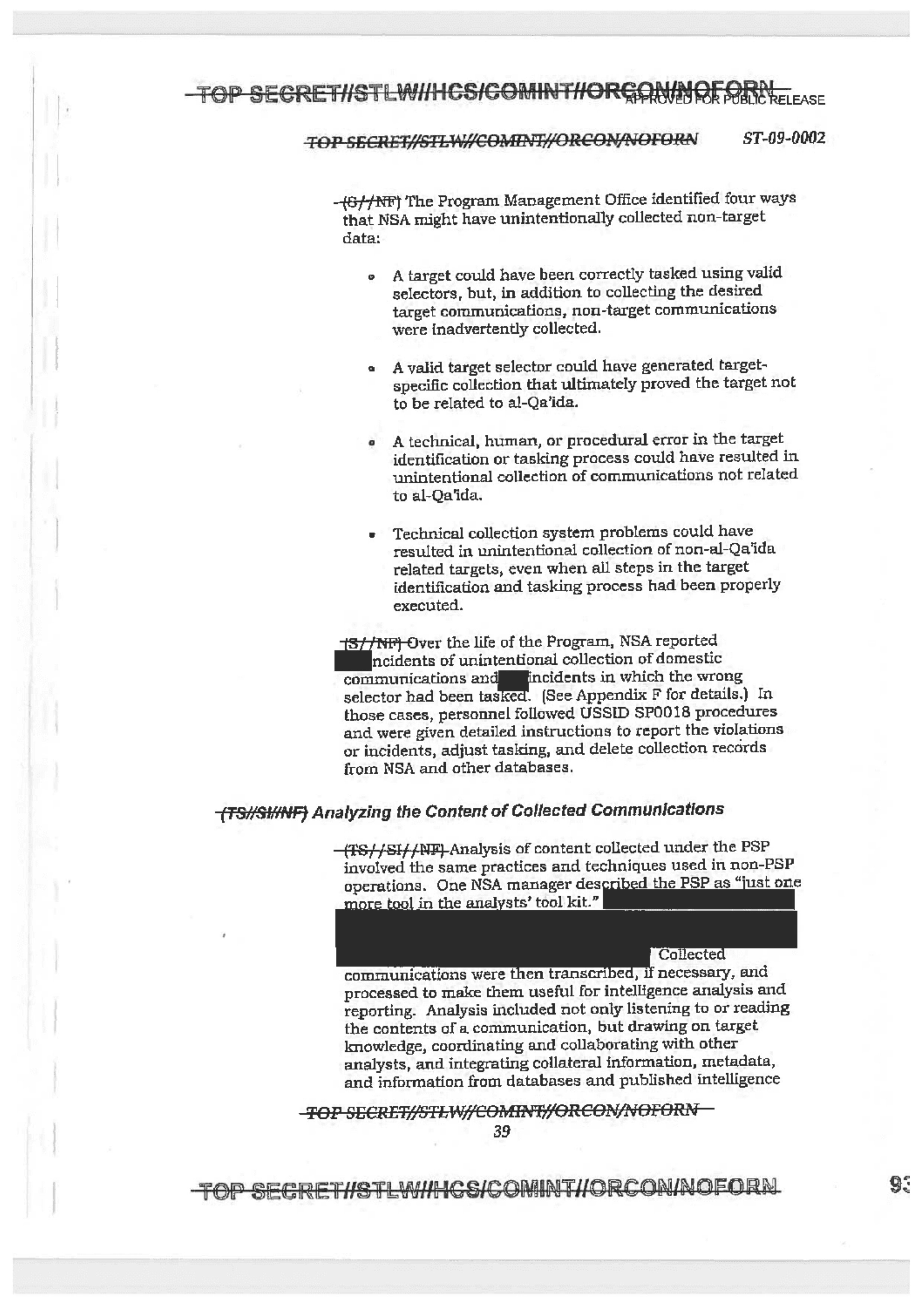
(TS//SI//NF) NSA analysis of content collected under the PSP involved the same
practices and techniques used in analyzing information from other SIGINT operations.
Telephone content was made available to NSA analysts through a voice processing system;
Internet communications content was available from the database in which it was stored.
Analysis involved more than listening to, or reading the content of, a communication and
transcribing and disseminating a transcript. Analysis also involved coordinating and
collaborating with other IC analysts, applying previous knowledge of the target, and
integrating other relevant intelligence.
19
TOP SECRET//STLW//COMINT//ORCON/NOFORN
(TS//SI//NF) Telephony and Internet
Metadata Collection and Analysis
(TS//SI//OC/NF) [REDACTED]
[REDACTED]
[REDACTED] NSA personnel used PSP metadata to perform contact chaining.
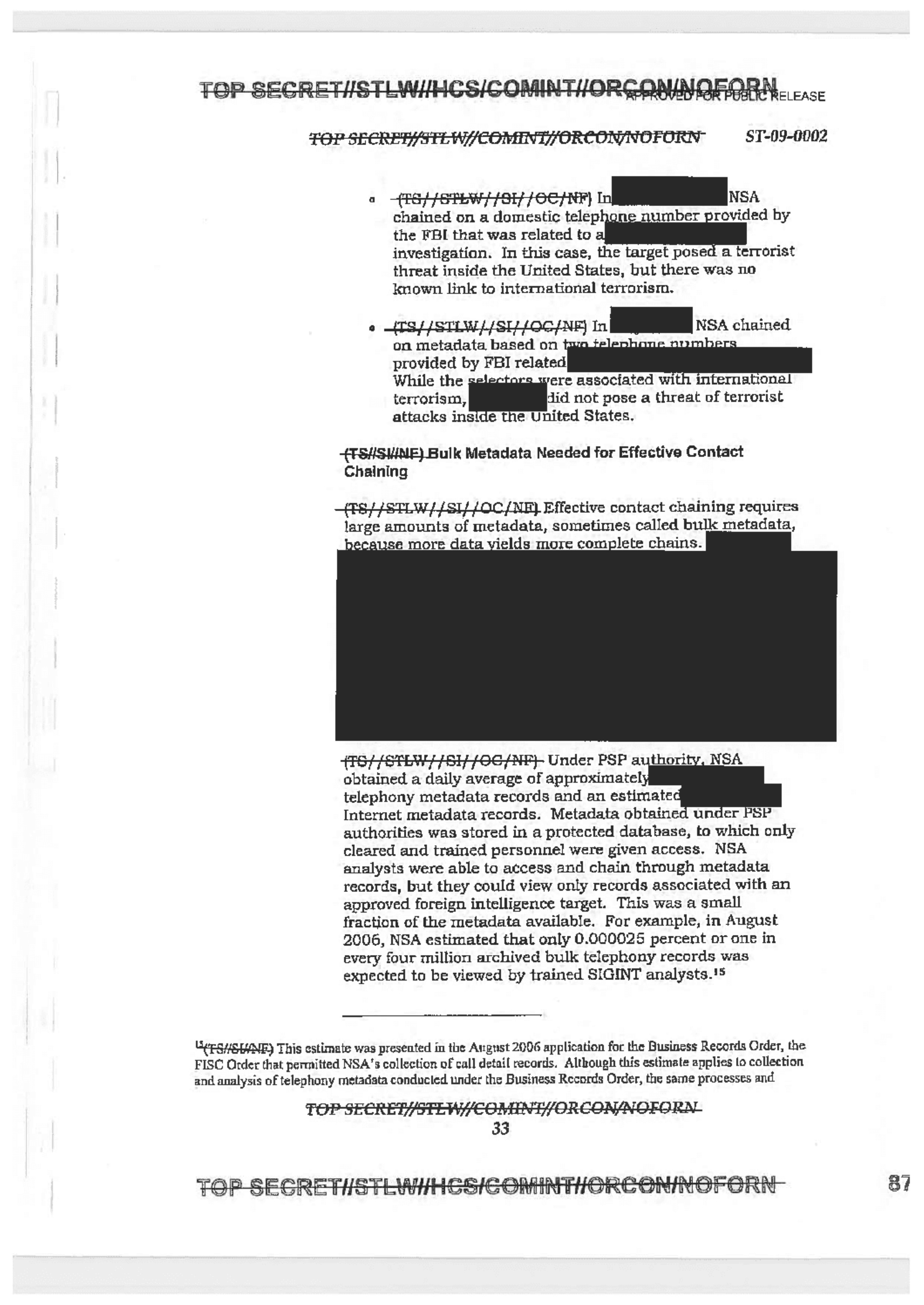
Although the NSA had the capability to collect bulk telephony and Internet metadata
before the PSP, collection was limited because the NSA was not authorized to collect
metadata from a wire inside the United States without a court order when one end of the
communication was in the United States. NSA could "chain" to, but not through, domestic
selectors. Access to large amounts of metadata is required for effective contact chaining,
and the PSP increased the data available to NSA analysts and allowed them to perform
more thorough contact chaining.
(TS//SI//OC/NF) Although NSA analysts could search bulk-collected metadata under
the PSP, the analysts' searches were limited to targets that were approved under the
standards set forth in the Presidential Authorizations. As such, only a small fraction of the
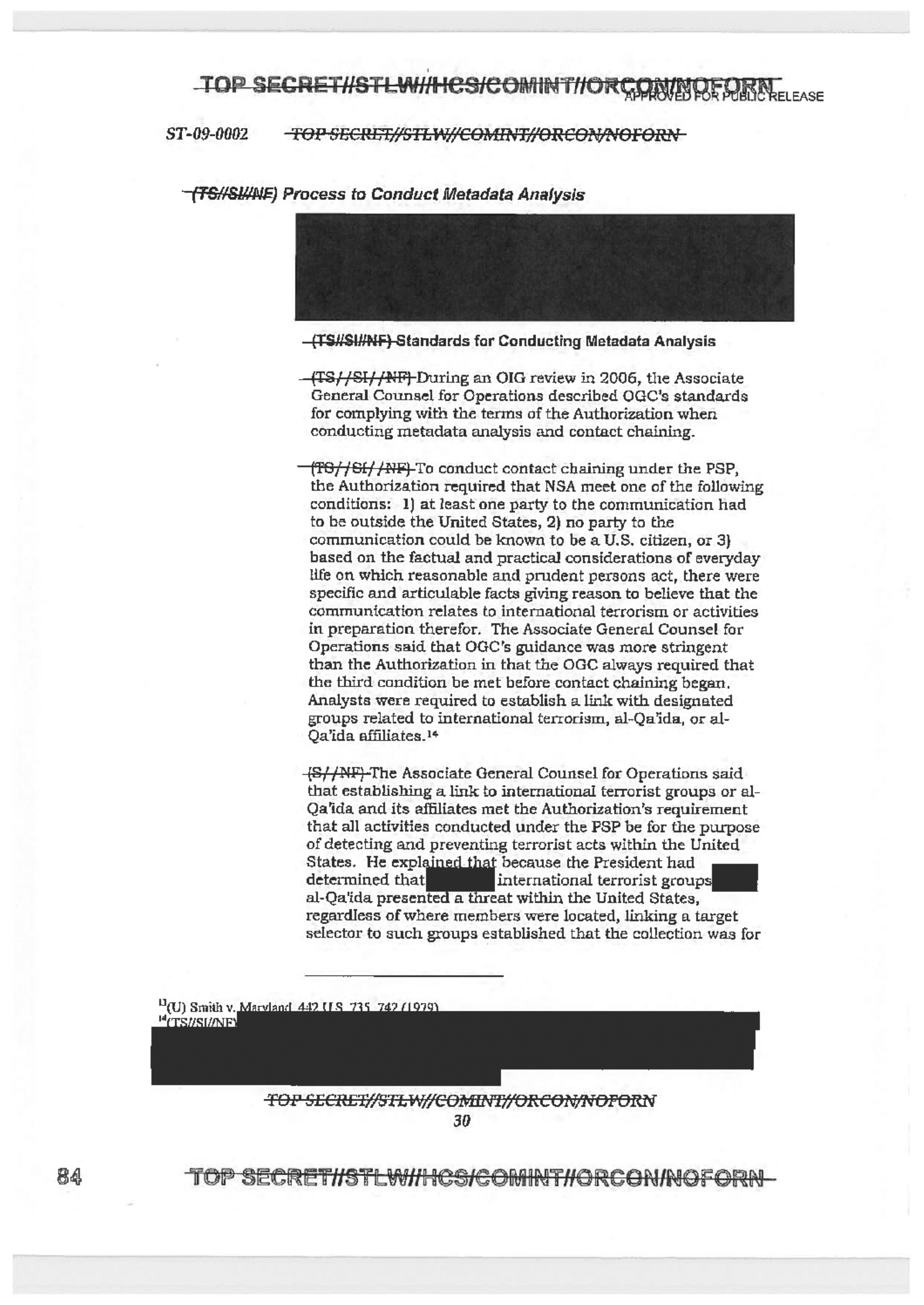
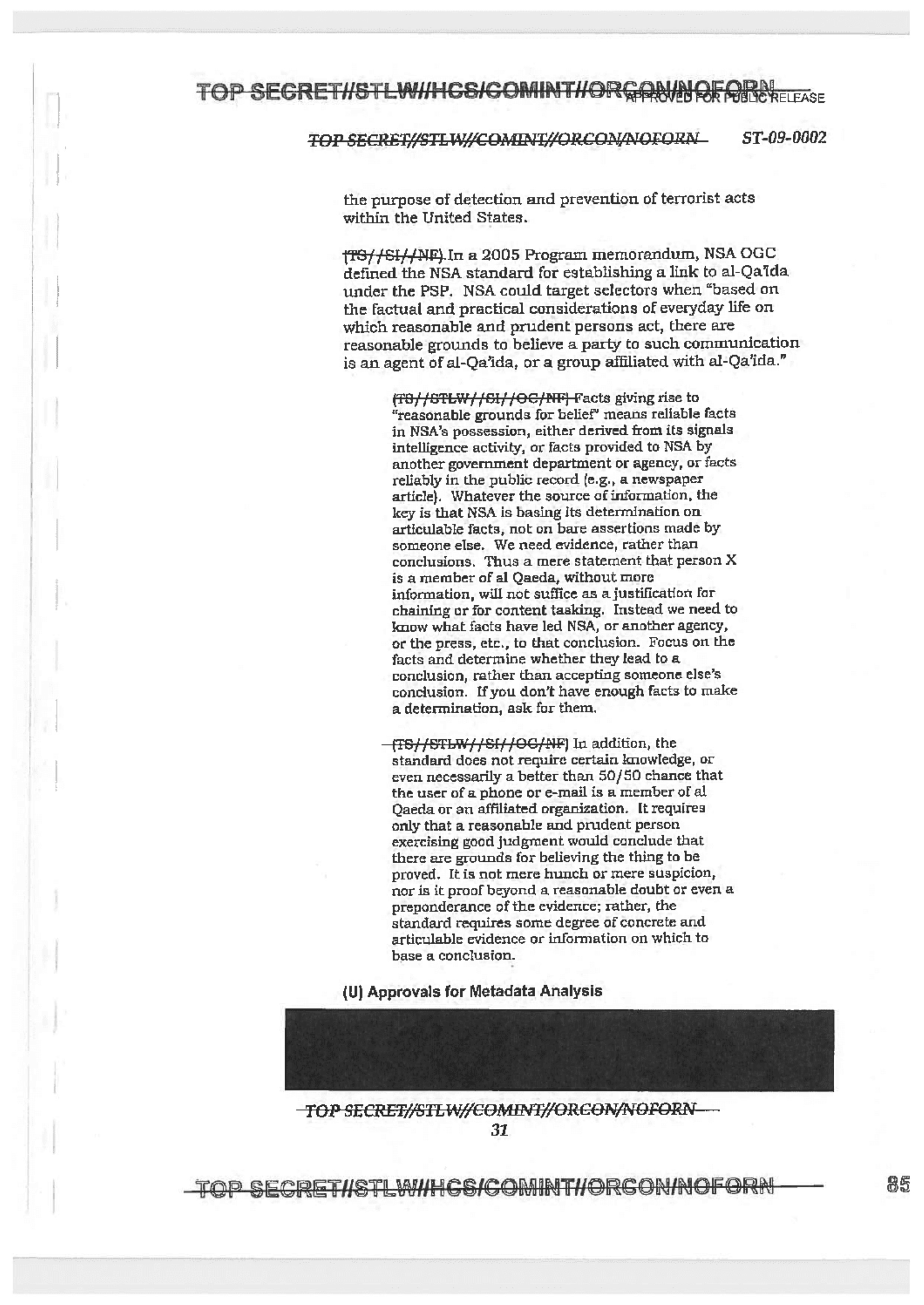
metadata collected under the PSP was ever accessed. In August 2006, the NSA estimated
that 0.000025 percent of the telephone records in the PSP database (or one of every
four million records) could be expected to be seen by NSA analysts through chaining
analysis.
[REDACTED]
(TS//SI//NF) NSA analysts conduct contact chaining by entering a target selector—a
telephone number or Internet communication address—in a specialized metadata analysis
tool, which searches the metadata and identifies contacts between the selector and other
telephone numbers or Internet communications addresses. The resulting contact graph is
analyzed for intelligence and to develop investigative leads. [REDACTED]
[REDACTED]
[REDACTED] Although the Presidential Authorizations did not prohibit chaining more
than two degrees of separation from the target, NSA analysts determined that it was not
analytically useful to do so.
(TS//SI//NF) An automated process was created to alert and automatically chain new
and potentially reportable telephone numbers using what was called an "alert list."
Telephone numbers on the alert list were automatically run against incoming metadata to
look for contacts. [REDACTED]
[REDACTED]
20
TOP SECRET//STLW//COMINT//ORCON/NOFORN
APPROVED FOR PUBLIC RELEASE
TOP SECRET//STLW//COMINT//ORCON/NOFORN
[REDACTED]
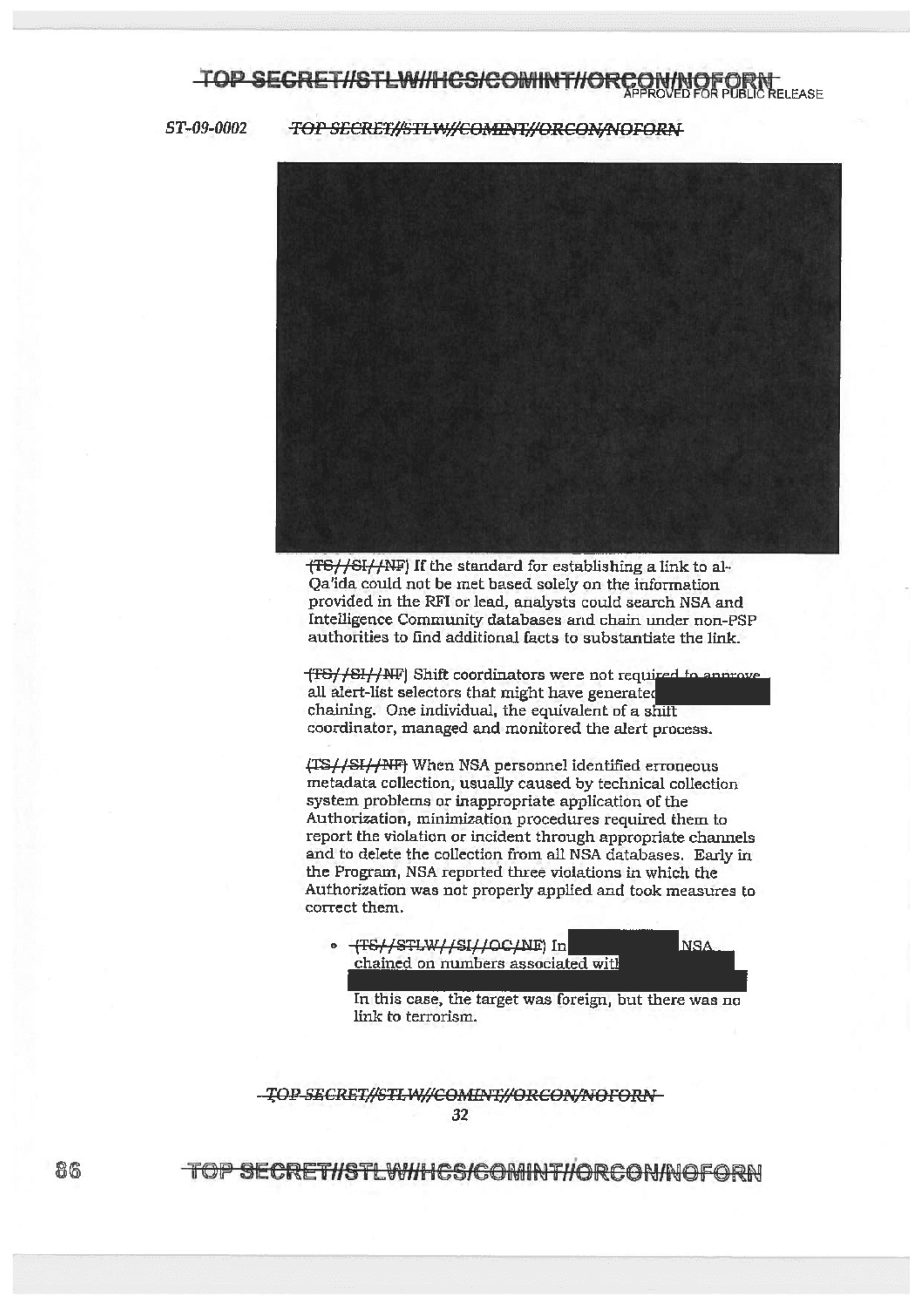
(TS//SI//NF) When NSA personnel identified erroneous metadata collection—usually
caused by technical problems or inappropriate application of the authorization—they were
directed to report the violation or incident through appropriate channels and to delete the
collection from all NSA databases. NSA reported three such violations early in the
program and took measures to correct them.
(U) NSA Reporting From the
President's Surveillance Program
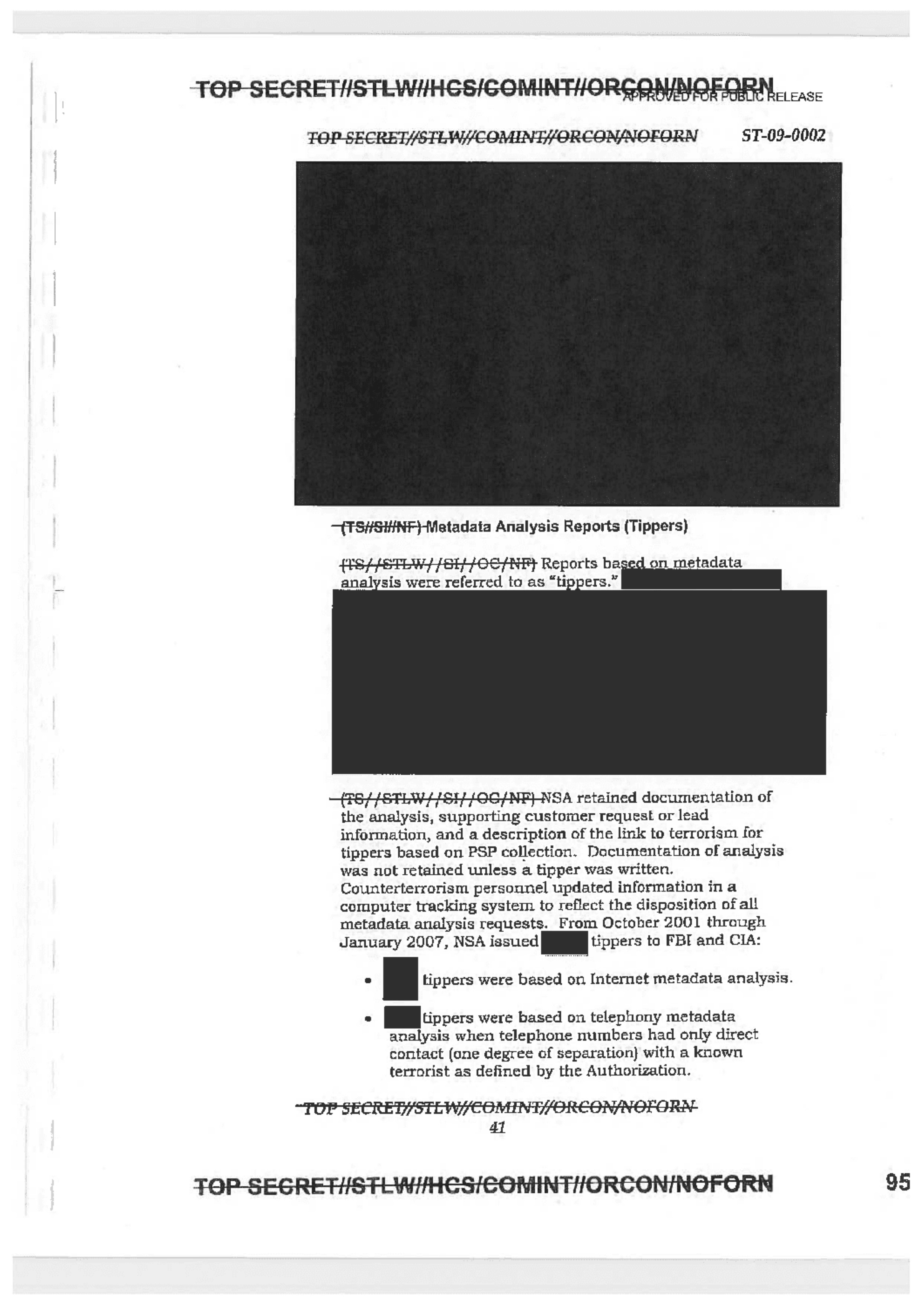
(TS//SI//OC/NF) PSP information was disseminated in [REDACTED] types of reports:
"tippers," which provided metadata analysis; content reports, which provided NSA analysis
of content collection; [REDACTED]
[REDACTED]
[REDACTED] Tippers were sent to the FBI and the CIA by e-mail on a
secure communications network. Some tippers contained "tear line" information that
allowed for wider distribution of a sanitized version of the information. From October
2001 through January 2007, the NSA issued [REDACTED] tippers to the FBI and the CIA.⁸
[REDACTED]
⁸ [REDACTED]
TOP SECRET//STLW//COMINT//ORCON/NOFORN
21
APPROVED FOR PUBLIC RELEASE
TOP SECRET//STLW//COMINT//ORCON/NOFORN
[REDACTED]
(U) NSA Managerial Structure and Oversight
of the President's Surveillance Program
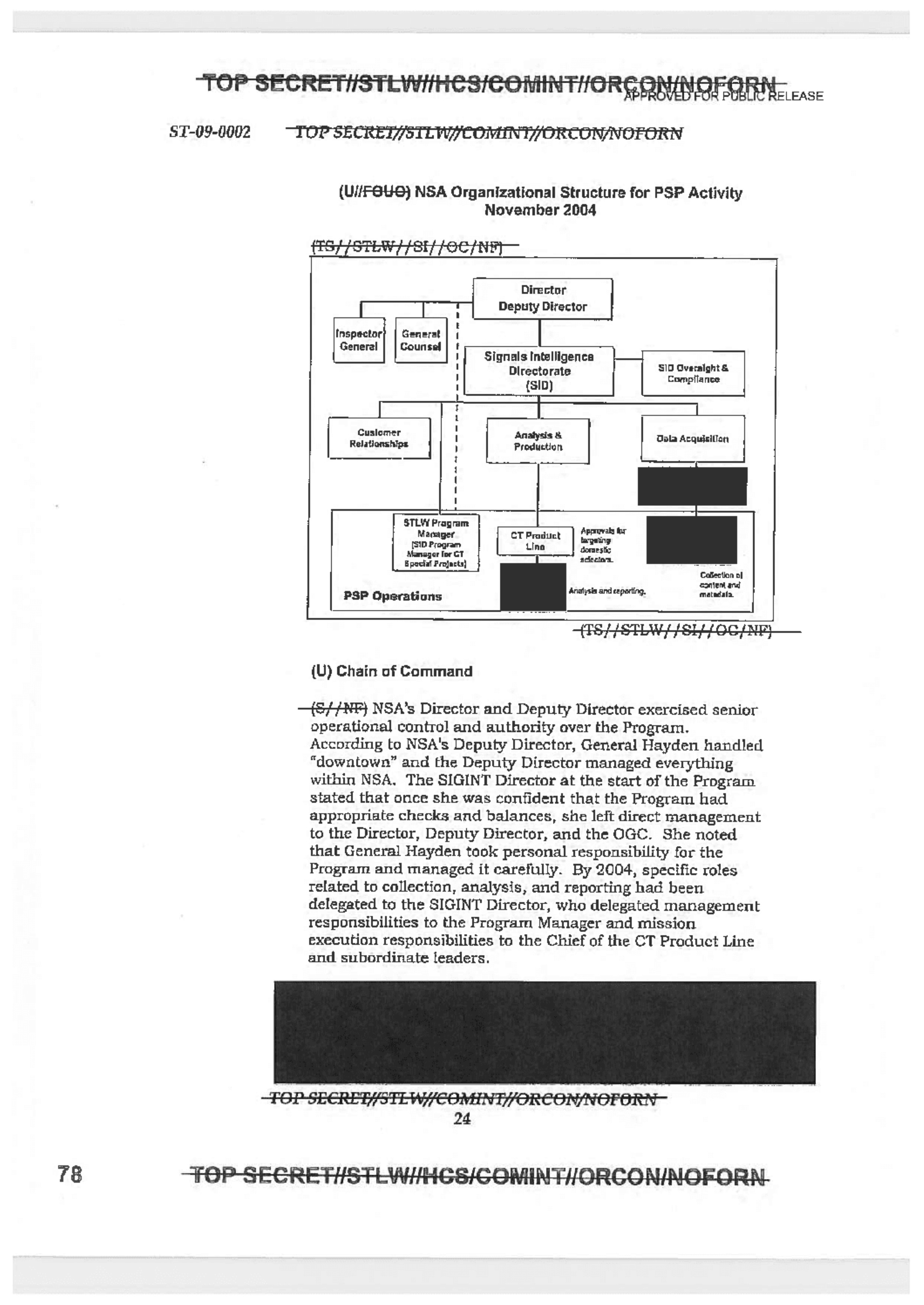
(S/NF) Analysis and reporting associated with the PSP was conducted within SID at
NSA's Fort Meade, Maryland headquarters. PSP activities were not conducted at NSA
field sites. The Director and Deputy Director of NSA exercised senior operational control
and authority over the program. The individual who was SIGINT Director in 2001 told us
that, aside from ensuring that the PSP had appropriate checks and balances, she left direct
management of the program to the NSA Director, the Deputy Director, and the Office of
General Counsel. She noted that Hayden took personal responsibility for the program and
managed it carefully.
(S//NF) By 2004, specific managerial authorities concerning PSP collection, analysis,
and reporting activities had been delegated to the SIGINT Director. The SIGINT Director
further delegated managerial authority to the PSP program manager and mission execution
responsibilities to the Chief of the CT Product Line. The PSP program manager position
was restructured to provide the incumbent authority and responsibility for oversight of PSP
22
TOP SECRET//STLW//COMINT//ORCON/NOFORN
APPROVED FOR PUBLIC RELEASE
TOP SECRET//STLW//COMINT//ORCON/NOFORN
activity across SID, and the PSP program manager was provided additional staff. Over the
life of the program, there were five PSP program managers, who reported directly to the
SIGINT Director or the Chief of the CT Product Line.
(TS//STLW//SI/OC/NF) The NSA supported the operation of the PSP with
approximately [REDACTED] from fiscal years
(FYs) 2002 through 2006. Funds were used for the acquisition of [REDACTED]
[REDACTED]
(U) NSA PSP Costs From FY 2002 through FY 2006
(dollars in thousands, personnel costs not included)
(TS//STLW//SI//OC/NF)
[REDACTED]
(U) NSA Management Controls to Ensure
Compliance With Presidential Authorizations
(S//NF) NSA management took steps to protect U.S. person information and ensure
compliance with the Presidential Authorizations. [REDACTED]
[REDACTED]
[REDACTED]
TOP SECRET//STLW//COMINT//ORCON/NOFORN
23
APPROVED FOR PUBLIC RELEASE
TOP SECRET//STLW//COMINT//ORCON/NOFORN
[REDACTED]
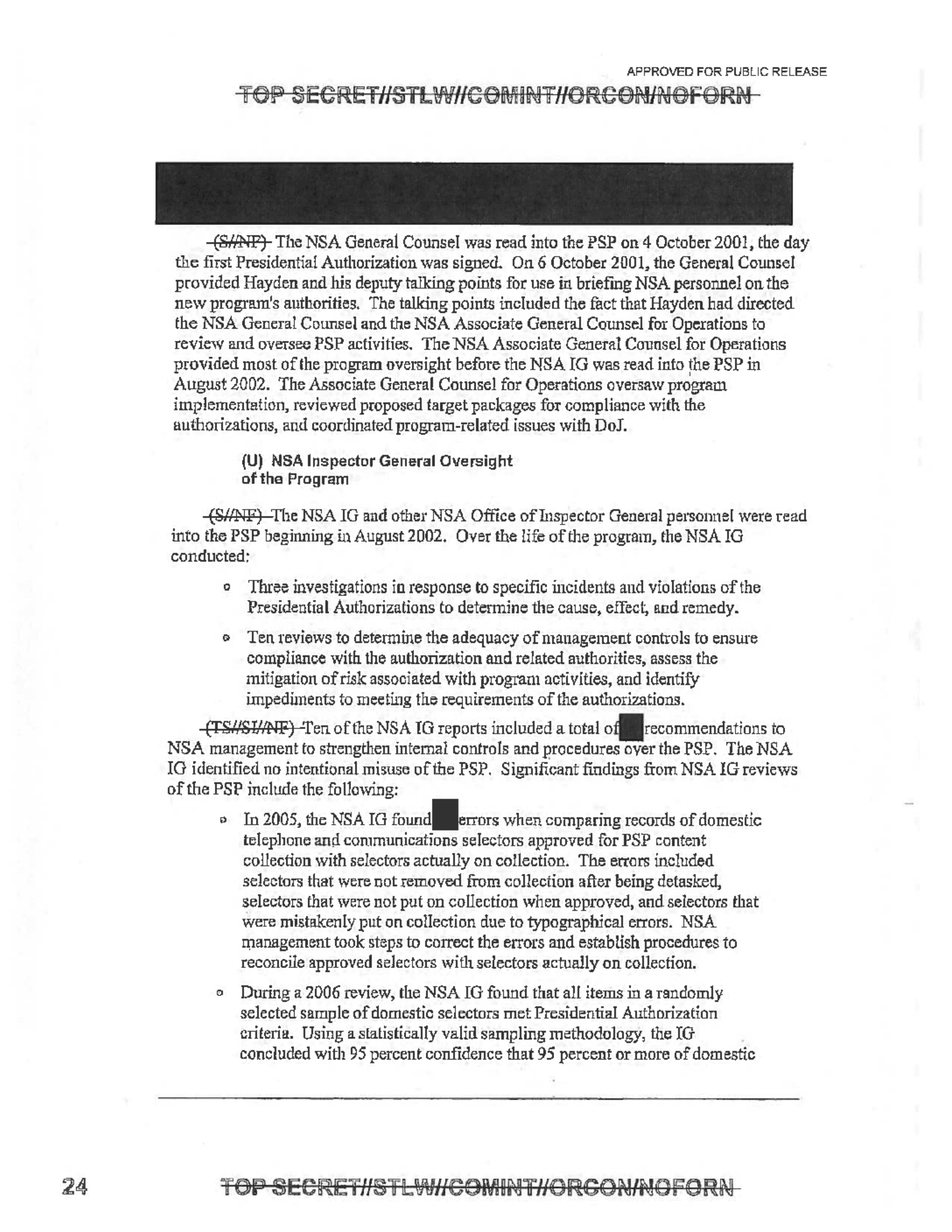
(S//NF) The NSA General Counsel was read into the PSP on 4 October 2001, the day
the first Presidential Authorization was signed. On 6 October 2001, the General Counsel
provided Hayden and his deputy talking points for use in briefing NSA personnel on the
new program's authorities. The talking points included the fact that Hayden had directed
the NSA General Counsel and the NSA Associate General Counsel for Operations to
review and oversee PSP activities. The NSA Associate General Counsel for Operations
provided most of the program oversight before the NSA IG was read into the PSP in
August 2002. The Associate General Counsel for Operations oversaw program
implementation, reviewed proposed target packages for compliance with the
authorizations, and coordinated program-related issues with DoJ.
(U) NSA Inspector General Oversight
of the Program
(S//NF) The NSA IG and other NSA Office of Inspector General personnel were read
into the PSP beginning in August 2002. Over the life of the program, the NSA IG
conducted:
- Three investigations in response to specific incidents and violations of the
Presidential Authorizations to determine the cause, effect, and remedy. - Ten reviews to determine the adequacy of management controls to ensure
compliance with the authorization and related authorities, assess the
mitigation of risk associated with program activities, and identify
impediments to meeting the requirements of the authorizations.
(TS//SI//NF) Ten of the NSA IG reports included a total of [REDACTED] recommendations to
NSA management to strengthen internal controls and procedures over the PSP. The NSA
IG identified no intentional misuse of the PSP. Significant findings from NSA IG reviews
of the PSP include the following:
- In 2005, the NSA IG found [REDACTED] errors when comparing records of domestic
telephone and communications selectors approved for PSP content
collection with selectors actually on collection. The errors included
selectors that were not removed from collection after being detasked,
selectors that were not put on collection when approved, and selectors that
were mistakenly put on collection due to typographical errors. NSA
management took steps to correct the errors and establish procedures to
reconcile approved selectors with selectors actually on collection. - During a 2006 review, the NSA IG found that all items in a randomly
selected sample of domestic selectors met Presidential Authorization
criteria. Using a statistically valid sampling methodology, the IG
concluded with 95 percent confidence that 95 percent or more of domestic
24
TOP SECRET//STLW//COMINT//ORCON/NOFORN
APPROVED FOR PUBLIC RELEASE
TOP SECRET//STLW//COMINT//ORCON/NOFORN
selectors tasked for PSP content collection were linked to al-Qa'ida, its
associates, or international terrorist threats inside the United States.
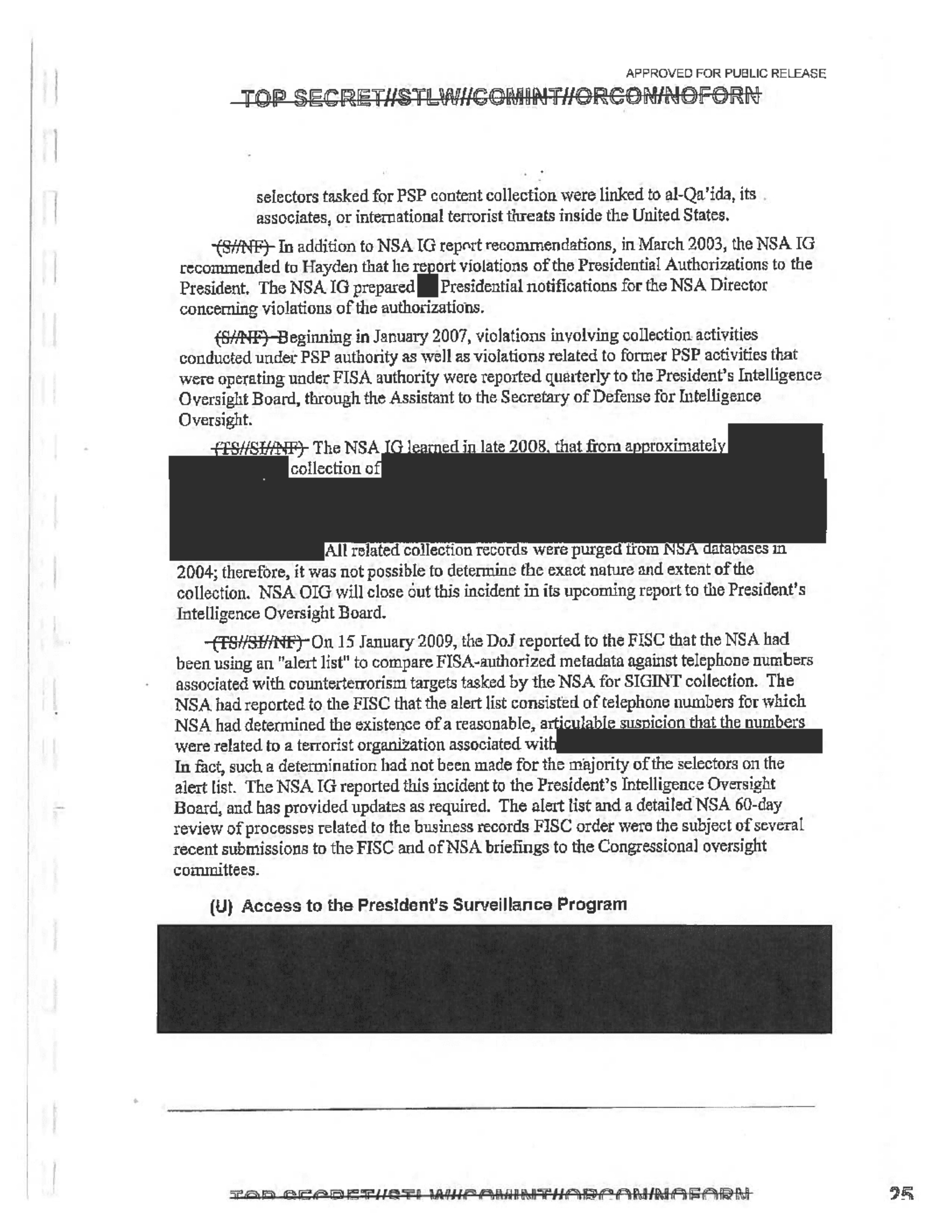
(S//NF) In addition to NSA IG report recommendations, in March 2003, the NSA IG
recommended to Hayden that he report violations of the Presidential Authorizations to the
President. The NSA IG prepared [REDACTED] Presidential notifications for the NSA Director
concerning violations of the authorizations.
(S//NF) Beginning in January 2007, violations involving collection activities
conducted under PSP authority as well as violations related to former PSP activities that
were operating under FISA authority were reported quarterly to the President's Intelligence
Oversight Board, through the Assistant to the Secretary of Defense for Intelligence
Oversight.
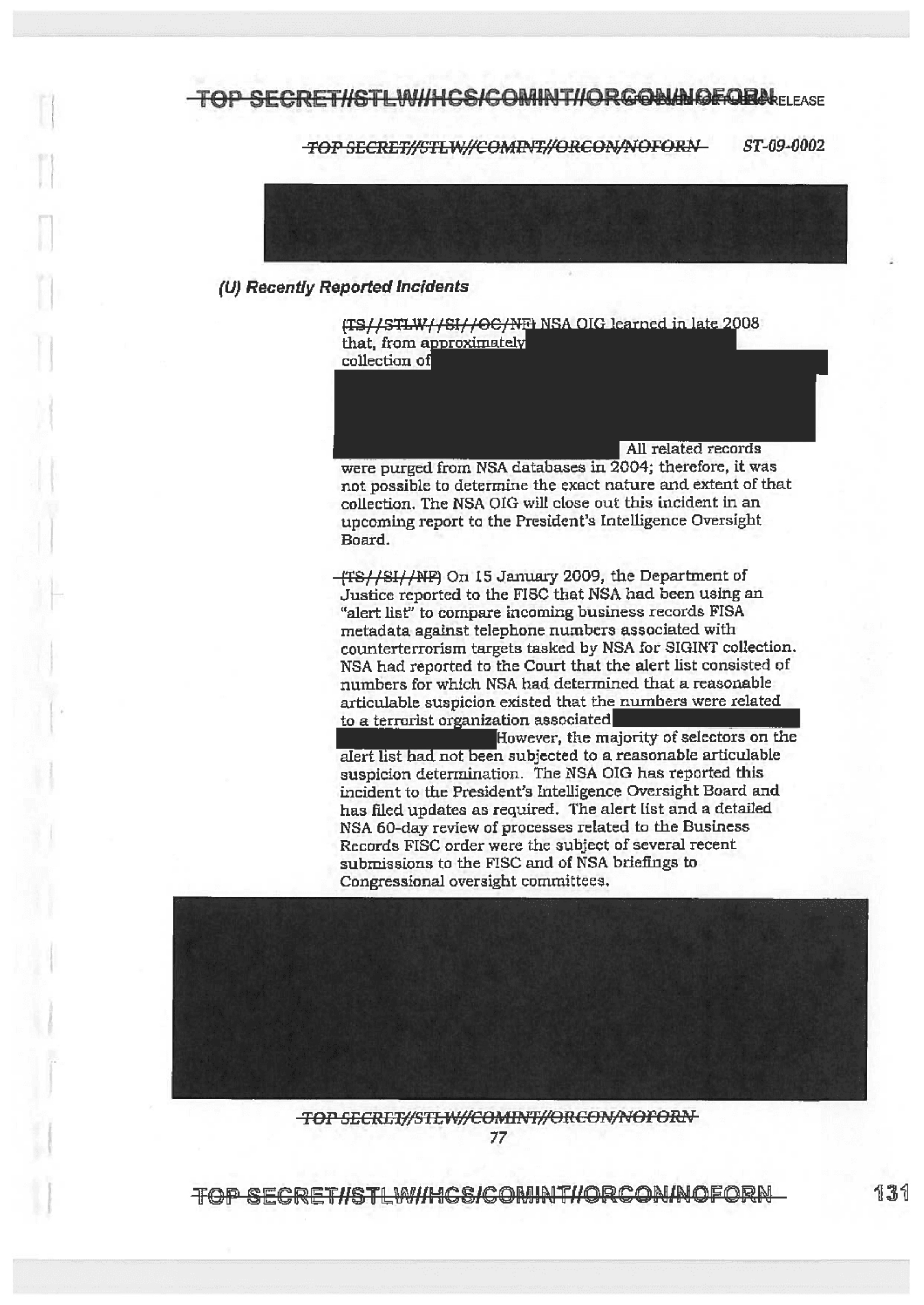
(TS//SI//NF) The NSA IG learned in late 2008, that from approximately [REDACTED]
[REDACTED] collection of [REDACTED] All related collection records were purged from NSA databases in
2004; therefore, it was not possible to determine the exact nature and extent of the
collection. NSA OIG will close out this incident in its upcoming report to the President's
Intelligence Oversight Board.
(TS//SI//NF) On 15 January 2009, the DoJ reported to the FISC that the NSA had
been using an "alert list" to compare FISA-authorized metadata against telephone numbers
associated with counterterrorism targets tasked by the NSA for SIGINT collection. The
NSA had reported to the FISC that the alert list consisted of telephone numbers for which
NSA had determined the existence of a reasonable, articulable suspicion that the numbers
were related to a terrorist organization associated with [REDACTED]
In fact, such a determination had not been made for the majority of the selectors on the
alert list. The NSA IG reported this incident to the President's Intelligence Oversight
Board, and has provided updates as required. The alert list and a detailed NSA 60-day
review of processes related to the business records FISC order were the subject of several
recent submissions to the FISC and of NSA briefings to the Congressional oversight
committees.
(U) Access to the President's Surveillance Program
[REDACTED]
TOP SECRET//STLW//COMINT//ORCON/NOFORN
25
APPROVED FOR PUBLIC RELEASE
TOP SECRET//STLW//COMINT//ORCON/NOFORN
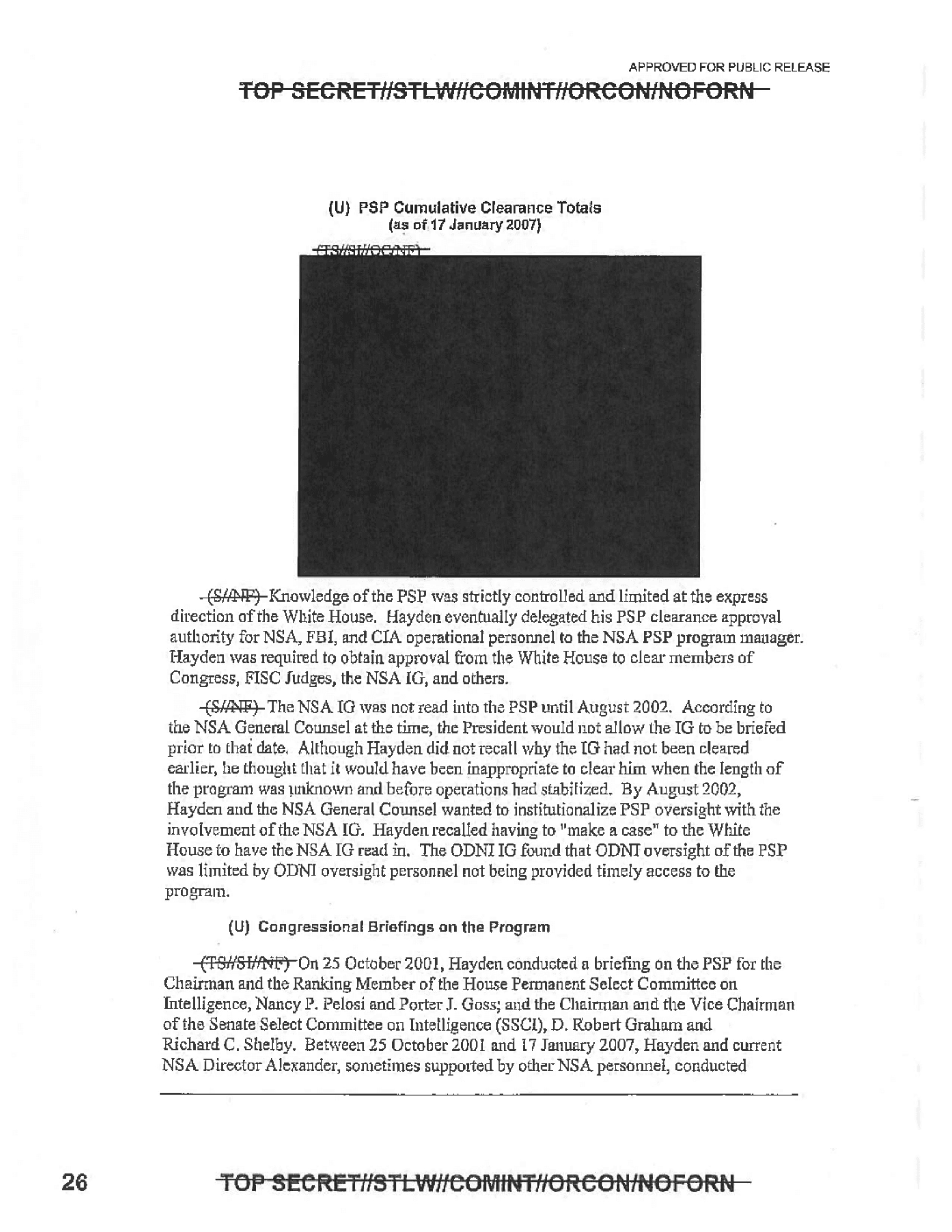
(U) PSP Cumulative Clearance Totals
(as of 17 January 2007)
(TS//SI/OC/NF)
[REDACTED]
(S//NF) Knowledge of the PSP was strictly controlled and limited at the express
direction of the White House. Hayden eventually delegated his PSP clearance approval
authority for NSA, FBI, and CIA operational personnel to the NSA PSP program manager.
Hayden was required to obtain approval from the White House to clear members of
Congress, FISC Judges, the NSA IG, and others.
(S//NF) The NSA IG was not read into the PSP until August 2002. According to
the NSA General Counsel at the time, the President would not allow the IG to be briefed
prior to that date. Although Hayden did not recall why the IG had not been cleared
earlier, he thought that it would have been inappropriate to clear him when the length of
the program was unknown and before operations had stabilized. By August 2002,
Hayden and the NSA General Counsel wanted to institutionalize PSP oversight with the
involvement of the NSA IG. Hayden recalled having to "make a case" to the White
House to have the NSA IG read in. The ODNI IG found that ODNI oversight of the PSP
was limited by ODNI oversight personnel not being provided timely access to the
program.
(U) Congressional Briefings on the Program
(TS//SI//NF) On 25 October 2001, Hayden conducted a briefing on the PSP for the
Chairman and the Ranking Member of the House Permanent Select Committee on
Intelligence, Nancy P. Pelosi and Porter J. Goss; and the Chairman and the Vice Chairman
of the Senate Select Committee on Intelligence (SSCI), D. Robert Graham and
Richard C. Shelby. Between 25 October 2001 and 17 January 2007, Hayden and current
NSA Director Alexander, sometimes supported by other NSA personnel, conducted
26
TOP SECRET//STLW//COMINT//ORCON/NOFORN
APPROVED FOR PUBLIC RELEASE
TOP SECRET//STLW//COMINT//ORCON/NOFORN
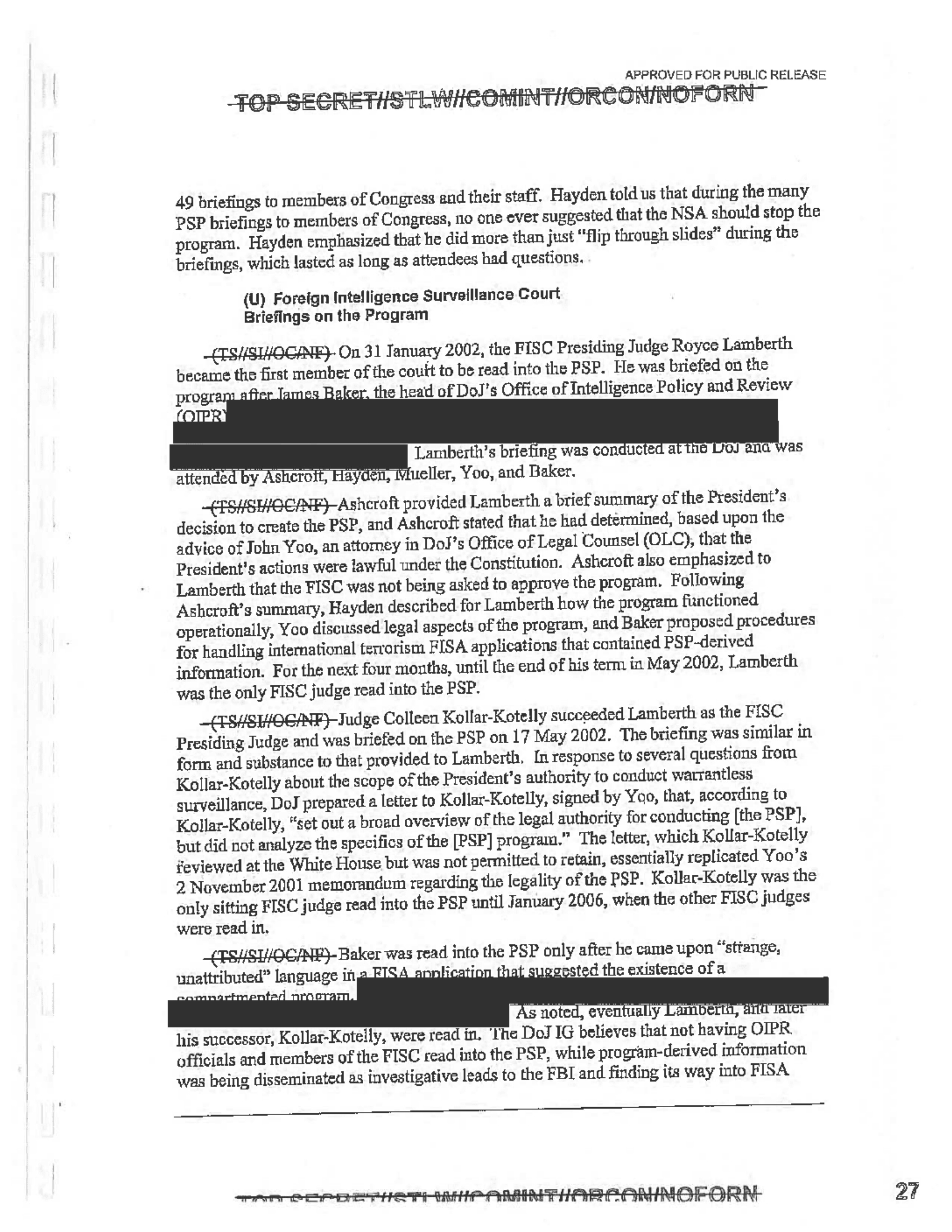
49 briefings to members of Congress and their staff. Hayden told us that during the many
PSP briefings to members of Congress, no one ever suggested that the NSA should stop the
program. Hayden emphasized that he did more than just "flip through slides" during the
briefings, which lasted as long as attendees had questions.
(U) Foreign Intelligence Surveillance Court
Briefings on the Program
(TS//SI//OC/NF) On 31 January 2002, the FISC Presiding Judge Royce Lamberth
became the first member of the court to be read into the PSP. He was briefed on the
program after James Baker, the head of DoJ's Office of Intelligence Policy and Review
(OIPR). [REDACTED]
[REDACTED] Lamberth's briefing was conducted at the DoJ and was
attended by Ashcroft, Hayden, Mueller, Yoo, and Baker.
(TS//SI//OC/NF) Ashcroft provided Lamberth a brief summary of the President's
decision to create the PSP, and Ashcroft stated that he had determined, based upon the
advice of John Yoo, an attorney in DoJ's Office of Legal Counsel (OLC), that the
President's actions were lawful under the Constitution. Ashcroft also emphasized to
Lamberth that the FISC was not being asked to approve the program. Following
Ashcroft's summary, Hayden described for Lamberth how the program functioned
operationally, Yoo discussed legal aspects of the program, and Baker proposed procedures
for handling international terrorism FISA applications that contained PSP-derived
information. For the next four months, until the end of his term in May 2002, Lamberth
was the only FISC judge read into the PSP.
(TS//SI//OC/NF) Judge Colleen Kollar-Kotelly succeeded Lamberth as the FISC
Presiding Judge and was briefed on the PSP on 17 May 2002. The briefing was similar in
form and substance to that provided to Lamberth. In response to several questions from
Kollar-Kotelly about the scope of the President's authority to conduct warrantless
surveillance, DoJ prepared a letter to Kollar-Kotelly, signed by Yoo, that, according to
Kollar-Kotelly, "set out a broad overview of the legal authority for conducting [the PSP],
but did not analyze the specifics of the [PSP] program." The letter, which Kollar-Kotelly
reviewed at the White House but was not permitted to retain, essentially replicated Yoo's
2 November 2001 memorandum regarding the legality of the PSP. Kollar-Kotelly was the
only sitting FISC judge read into the PSP until January 2006, when the other FISC judges
were read in.
(TS//SI//OC/NF) Baker was read into the PSP only after he came upon "strange,
unattributed" language in a FISA application that suggested the existence of a
compartmented program. [REDACTED]
[REDACTED] As noted, eventually Lamberth, and later
his successor, Kollar-Kotelly, were read in. The DoJ IG believes that not having OIPR
officials and members of the FISC read into the PSP, while program-derived information
was being disseminated as investigative leads to the FBI and finding its way into FISA
TOP SECRET//STLW//COMINT//ORCON/NOFORN
27
APPROVED FOR PUBLIC RELEASE
TOP SECRET//STLW//COMINT//ORCON/NOFORN
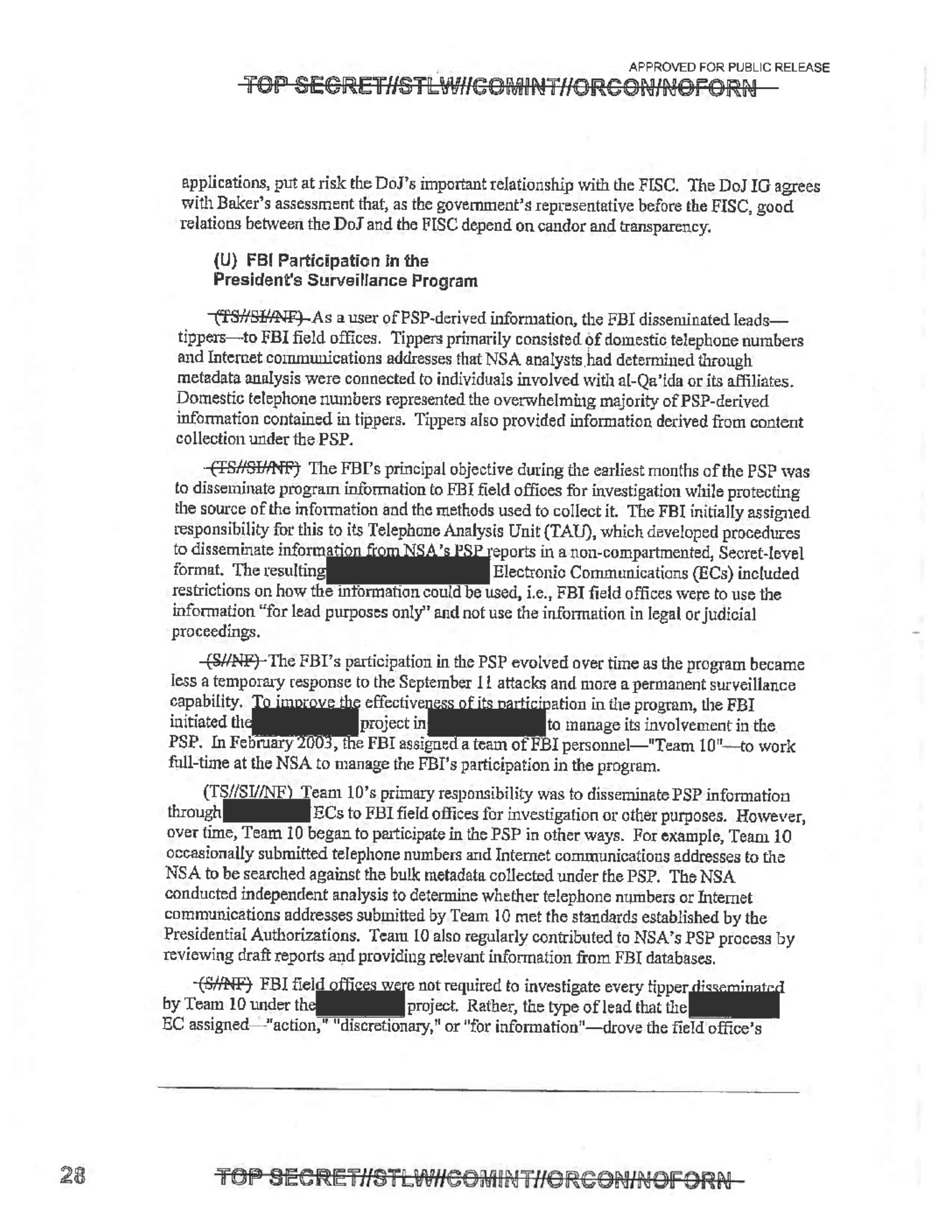
applications, put at risk the DoJ's important relationship with the FISC. The DoJ IG agrees
with Baker's assessment that, as the government's representative before the FISC, good
relations between the DoJ and the FISC depend on candor and transparency.
(U) FBI Participation in the
President's Surveillance Program
(TS//SI//NF) As a user of PSP-derived information, the FBI disseminated leads—
tippers—to FBI field offices. Tippers primarily consisted of domestic telephone numbers
and Internet communications addresses that NSA analysts had determined through
metadata analysis were connected to individuals involved with al-Qa'ida or its affiliates.
Domestic telephone numbers represented the overwhelming majority of PSP-derived
information contained in tippers. Tippers also provided information derived from content
collection under the PSP.
(TS//SI//NF) The FBI's principal objective during the earliest months of the PSP was
to disseminate program information to FBI field offices for investigation while protecting
the source of the information and the methods used to collect it. The FBI initially assigned
responsibility for this to its Telephone Analysis Unit (TAU), which developed procedures
to disseminate information from NSA's PSP reports in a non-compartmented, Secret-level
format. The resulting [REDACTED] Electronic Communications (ECs) included
restrictions on how the information could be used, i.e., FBI field offices were to use the
information "for lead purposes only" and not use the information in legal or judicial
proceedings.
(S//NF) The FBI's participation in the PSP evolved over time as the program became
less a temporary response to the September 11 attacks and more a permanent surveillance
capability. To improve the effectiveness of its participation in the program, the FBI
initiated the [REDACTED] project in [REDACTED] to manage its involvement in the
PSP. In February 2003, the FBI assigned a team of FBI personnel—"Team 10"—to work
full-time at the NSA to manage the FBI's participation in the program.
(TS//SI//NF) Team 10's primary responsibility was to disseminate PSP information
through [REDACTED] ECs to FBI field offices for investigation or other purposes. However,
over time, Team 10 began to participate in the PSP in other ways. For example, Team 10
occasionally submitted telephone numbers and Internet communications addresses to the
NSA to be searched against the bulk metadata collected under the PSP. The NSA
conducted independent analysis to determine whether telephone numbers or Internet
communications addresses submitted by Team 10 met the standards established by the
Presidential Authorizations. Team 10 also regularly contributed to NSA's PSP process by
reviewing draft reports and providing relevant information from FBI databases.
(S//NF) FBI field offices were not required to investigate every tipper disseminated
by Team 10 under the [REDACTED] project. Rather, the type of lead that the [REDACTED]
EC assigned "action," "discretionary," or "for information"—drove the field office's
28
TOP SECRET//STLW//COMINT//ORCON/NOFORN
TOP SECRET//STLW//COMINT//ORCON/NOFORN
APPROVED FOR PUBLIC RELEASE
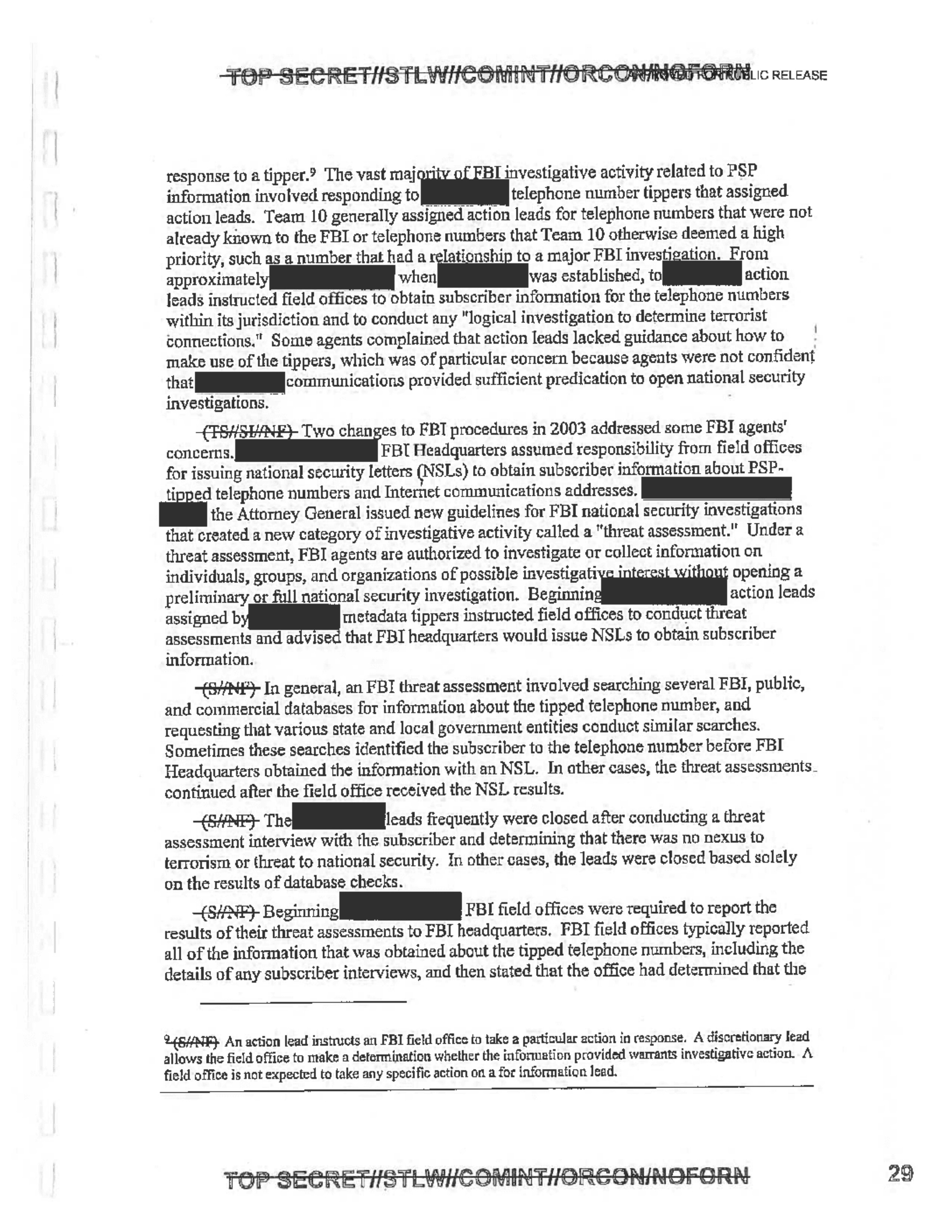
response to a tipper.⁹ The vast majority of FBI investigative activity related to PSP
information involved responding to [REDACTED] telephone number tippers that assigned
action leads. Team 10 generally assigned action leads for telephone numbers that were not
already known to the FBI or telephone numbers that Team 10 otherwise deemed a high
priority, such as a number that had a relationship to a major FBI investigation. From
approximately [REDACTED] when [REDACTED] was established, to [REDACTED] action
leads instructed field offices to obtain subscriber information for the telephone numbers
within its jurisdiction and to conduct any "logical investigation to determine terrorist
connections." Some agents complained that action leads lacked guidance about how to
make use of the tippers, which was of particular concern because agents were not confident
that [REDACTED] communications provided sufficient predication to open national security
investigations.
(TS//SI//NF) Two changes to FBI procedures in 2003 addressed some FBI agents'
concerns. [REDACTED] FBI Headquarters assumed responsibility from field offices
for issuing national security letters (NSLs) to obtain subscriber information about PSP-
tipped telephone numbers and Internet communications addresses. [REDACTED]
[REDACTED] the Attorney General issued new guidelines for FBI national security investigations
that created a new category of investigative activity called a "threat assessment." Under a
threat assessment, FBI agents are authorized to investigate or collect information on
individuals, groups, and organizations of possible investigative interest without opening a
preliminary or full national security investigation. Beginning [REDACTED] action leads
assigned by [REDACTED] metadata tippers instructed field offices to conduct threat
assessments and advised that FBI headquarters would issue NSLs to obtain subscriber
information.
(S//NF) In general, an FBI threat assessment involved searching several FBI, public,
and commercial databases for information about the tipped telephone number, and
requesting that various state and local government entities conduct similar searches.
Sometimes these searches identified the subscriber to the telephone number before FBI
Headquarters obtained the information with an NSL. In other cases, the threat assessments
continued after the field office received the NSL results.
(S//NF) The [REDACTED] leads frequently were closed after conducting a threat
assessment interview with the subscriber and determining that there was no nexus to
terrorism or threat to national security. In other cases, the leads were closed based solely
on the results of database checks.
(S//NF) Beginning [REDACTED] FBI field offices were required to report the
results of their threat assessments to FBI headquarters. FBI field offices typically reported
all of the information that was obtained about the tipped telephone numbers, including the
details of any subscriber interviews, and then stated that the office had determined that the
⁹ (S//NF) An action lead instructs an FBI field office to take a particular action in response. A discretionary lead
allows the field office to make a determination whether the information provided warrants investigative action. A
field office is not expected to take any specific action on a for information lead.
TOP SECRET//STLW//COMINT//ORCON/NOFORN
29
TOP SECRET//STLW//COMINT//ORCON/NOFORN
telephone number did not have a nexus to terrorism and considered the lead closed. Much
less frequently, field offices reported that a preliminary investigation was opened.
Regardless of whether any links to international terrorism were identified in a threat
assessment, the results of the threat assessments and the information that was collected
about subscribers generally were reported to FBI headquarters and uploaded to FBI
databases.
(U) CIA Participation in the
President's Surveillance Program
(S//NF) CIA analysts and targeters, as PSP consumers, requested information from
the program and utilized program reporting in their analyses. [REDACTED]
[REDACTED]
30
TOP SECRET//STLW//COMINT//ORCON/NOFORN
APPROVED FOR PUBLIC RELEASE
TOP SECRET//STLW//COMINT//ORCON/NOFORN
[REDACTED]
[REDACTED]
TOP SECRET//STLW//COMINT//ORCON/NOFORN
31
APPROVED FOR PUBLIC RELEASE
TOP SECRET//STLW//COMINT//ORCON/NOFORN
(U) NCTC Participation in the
President's Surveillance Program
(TS//SI//NF) The ODNI IG found that the ODNI's primary role in the PSP was the
preparation of the threat assessments that summarized the al-Qa'ida threat to the United
States and were used to support periodic reauthorization of the program. The ODNI IG
found that the threat assessments were drafted by experienced NCTC personnel who
prepared the documents in a memorandum style following an established DoJ format. The
ODNI IG also determined that the ODNI threat assessments were prepared using
evaluated intelligence information chosen from a wide variety of IC sources. ODNI
personnel said that during the period when the ODNI prepared the threat assessments, the
IC had access to fully evaluated intelligence that readily supported an assessment that
al-Qa'ida remained a significant threat to the United States.
(TS//SI//NF) [REDACTED]
[REDACTED]
[REDACTED] The NCTC
analysts told us that PSP information was subject to stringent security protections [REDACTED]
[REDACTED]
(S//NF) The NCTC analysts said that they handle NSA surveillance information,
including PSP information, consistent with the standard rules and procedures for handling
NSA intelligence information including minimization of U.S. person identities. On those
occasions when the NCTC analysts knew that a particular NSA intelligence product was
derived from the PSP, the analysts told us they reviewed program information in the same
manner as other incoming NSA intelligence products. If appropriate, NCTC analysts then
incorporated the PSP information into analytical products being prepared for the Director
of National Intelligence (DNI) and other senior intelligence officials. They identified the
President's Terrorism Threat Report and the Senior Executive Terrorism Report as
examples of the types of finished intelligence products that would, at times, contain PSP
information.
32
TOP SECRET//STLW//COMINT//ORCON/NOFORN
APPROVED FOR PUBLIC RELEASE
TOP SECRET//STLW//COMINT//ORCON/NOFORN
(U) The President's Surveillance Program
and the Foreign Intelligence Surveillance Court
(TS//SI//NF) DoJ, initially with the FISC's concurrence and later at the court's
direction, developed and implemented procedures-referred to as "scrubbing"
procedures-to account for and make the court aware of instances when PSP-derived
information was included in FISA applications. Lamberth required that all FISA
applications that contained PSP-derived information or that would result in simultaneous
collection against particular targets under both the PSP and a FISC order, be filed with him
only. Baker told us that Lamberth wanted to be informed of applications that contained
PSP information and of dual coverage situations. According to Baker, the scrubbing
procedures were a means of meeting his ethical duty of candor to the FISC without
disclosing the existence of the PSP to uncleared judges.
(TS//SI//NF) DoJ effectuated the scrubbing procedures by compiling lists of
information contained in initial and renewal FISA applications that was attributed to the
NSA and of all facilities targeted for electronic surveillance in the applications. These lists
were sent to the NSA to determine whether any of the NSA-attributed information was
PSP-derived and whether any of the facilities also were targeted under the PSP. The NSA
communicated the results back to DoJ, which then filed the applications with the FISC
consistent with the scrubbing procedures.
(TS//SI//NF) Kollar-Kotelly continued the procedures that had been developed by
Baker and agreed to by Lamberth for handling FISA applications that contained PSP-
derived information. However, Kollar-Kotelly required DoJ to excise from FISA
applications any information obtained or derived from the PSP. But Kollar-Kotelly also
instructed Baker to alert her to any instances where an application's basis for the requisite
probable cause showing under FISA was weakened by excising PSP information. In such
cases, Kollar-Kotelly would then assess the application with the knowledge that additional
relevant information had been excised.
(TS//SI//NF) Kollar-Kotelly also instructed DoJ to discontinue the practice
employed under Lamberth of including in applications a descriptive phrase associated with
[REDACTED]
[REDACTED] as a means of indicating that incentives targeted by the applications were
also targeted under the PSP. Baker told us that while Kollar-Kotelly understood that
instances of dual coverage would occur, she did not want to appear to judicially sanction
PSP coverage.
(TS//SI//NF) In March 2004, Kollar-Kotelly was informed of operational changes
made to the PSP following a dispute between DoJ and the White House about the legal
basis for certain aspects of the program. Kollar-Kotelly responded by imposing an
additional scrubbing requirement to further ensure, to the extent possible, that PSP-derived
information was not included in FISA applications. The FBI, in coordination with DoJ and
NSA, was to determine whether a facility included in a FISA application-not just a
targeted telephone number or Internet communication address-also appeared in a PSP
report. Kollar-Kotelly permitted any such facility to remain in the application if it could be
TOP SECRET//STLW//COMINT//ORCON/NOFORN
33
APPROVED FOR PUBLIC RELEASE
TOP SECRET//STLW//COMINT//ORCON/NOFORN
demonstrated that the FBI had developed, independent of the PSP, an investigative interest
in the facility, or that the FBI inevitably would have identified the facility in question
through normal investigative steps. An OIPR official who was responsible for discussing
such cases with Kollar-Kotelly told us that the judge generally accepted DoJ's assessment
that there was a non-PSP investigative basis for a facility in question, or that the facility
inevitably would have been discovered even in the absence of PSP-derived leads to the
FBI.
(S//NF) Implementing the scrubbing procedures, both under Lamberth and Kollar-
Kotelly, was a complicated and time-consuming endeavor for OIPR staff. Baker, who
until March 2004 was the only individual in OIPR read into the PSP, found himself having
to ask OIPR attorneys to compile information about their cases, and sometimes to make
changes to their FISA applications, without being able to provide an explanation other than
that he had spoken to the Attorney General and the FISC about the situation. Baker
regularly told attorneys that they did not have to sign applications that they were not
comfortable with, and, in some instances, international terrorism cases had to be reassigned
for this reason.
(S//NF) The situation was further complicated by the fact that, until August 2003,
only one of the two DoJ officials authorized by statute to approve FISA applications-
Attorney General Ashcroft and Deputy Attorney General Larry Thompson-was read into
the PSP. Thompson, who served as Deputy Attorney General from May 2001 to August
2003, was never read into the PSP, despite Ashcroft's request to the White House.
(TS//SI//NF) Similarly, Kollar-Kotelly, who by November 2004 was handling
approximately [REDACTED] percent of all FISA applications as a result of her requirement that
scrubbed applications be filed with her only, made unsuccessful requests for additional
FISC judges to be cleared for the program. Kollar-Kotelly decided in November 2004 that
in view of the scrubbing procedures that were in operation, international terrorism FISA
applications could be decided by other judges based on the information contained in the
applications.
(TS//SI//NF) DoJ, together with the FBI and the NSA, continue to apply the
scrubbing procedures to international terrorism FISA applications. Since January 2006,
all members of the FISC have been briefed on the PSP and all of the judges handle
applications that involve the issue of PSP-derived information. Although compliance with
the scrubbing procedures has been burdensome, we did not find instances when the
government was unable to obtain FISA surveillance coverage on a target because of the
requirement. However, the DoJ IG concluded that once the PSP began to affect the
functioning of the FISA process, OIPR and the FISC effectively became part of the PSP's
operations, and more OIPR staff and FISC judges should have been read into the PSP to
address the impact. Instead, access to the PSP was limited for years to a single OIPR
official and one FISC judge.
34
TOP SECRET//STLW//COMINT//ORCON/NOFORN
APPROVED FOR PUBLIC RELEASE
TOP SECRET//STLW//COMINT//ORCON/NOFORN
(U) Discovery Issues Associated With
the President's Surveillance Program
(TS//SI//NF) DOJ was aware as early as [REDACTED] that information collected
under the PSP could have implications for DoJ's litigation responsibilities under Rule 16 of
the Federal Rules of Criminal Procedure and Brady v. Maryland, 373 U.S. 83 (1963).
Analysis of the discovery issue was first assigned to Yoo in [REDACTED]
[REDACTED]
(S//NF) No DoJ attorneys with terrorism prosecution responsibilities were read into
the PSP until mid-2004, and as a result, DoJ did not have access to the advice of attorneys
who were best equipped to identify and examine discovery issues associated with the PSP.
The DoJ IG believes that since then, DoJ has taken steps to respond [REDACTED]
[REDACTED] to [REDACTED] discovery motions [REDACTED]
[REDACTED] DoJ's
responses to the discovery motions involve the use of the Classified Information
Procedures Act, 18 U.S.C. App. 3, to file ex parte in camera pleadings with federal courts
to describe potentially responsive PSP-derived information. [REDACTED]
[REDACTED]
(S//NF) [REDACTED]
[REDACTED]
[REDACTED] the DoJ IG recommends that DoJ assess its discovery obligations regarding PSP-
derived information in international terrorism prosecutions currently considering whether it
must re-examine past cases to see whether potentially discoverable but undisclosed
Rule 16 or Brady material was collected by the NSA, and take appropriate steps to ensure
that it has complied with its discovery obligations in such cases. The DoJ IG also
recommends that DoJ, in coordination with the NSA, implement a procedure to identify
PSP-derived information that may be associated with international terrorism cases
TOP SECRET//STLW//COMINT//ORCON/NOFORN
35
APPROVED FOR PUBLIC RELEASE
TOP SECRET//STLW//COMINT//ORCON/NOFORN
currently pending or likely to be brought in the future and evaluate whether such
information should be disclosed in light of the government's discovery obligations under
Rule 16 and Brady.
(U) LEGAL REASSESSMENT OF THE
PRESIDENT'S SURVEILLANCE PROGRAM (2003 – 2004)
(TS//SI//NF) Concern Over the [REDACTED]
[REDACTED] Collection
(TS//SI//NF) Yoo was the sole OLC attorney who advised Ashcroft and White House
officials on the PSP from the program's inception in October 2001 through Yoo's
resignation from DoJ in May 2003. Upon Yoo's departure, Patrick Philbin was selected by
the White House to be read into the PSP to assume Yoo's role as advisor to the Attorney
General concerning the program.
(TS//SI//NF) Philbin told us that when he reviewed Yoo's legal memorandums about
the PSP, he realized that Yoo had omitted from his analysis any reference to the FISA
provision allowing the interception of electronic communications without a warrant for a
period of 15 days following a Congressional declaration of war. (See 50 U.S.C. § 1811.)
Philbin stated that Yoo's OLC opinions were premised on the assumption that FISA did
not expressly apply to wartime operations, an assumption that from Philbin's perspective
made the opinions "problematic."
[REDACTED]
TOP SECRET//STLW//COMINT//ORCON/NOFORN
36
APPROVED FOR PUBLIC RELEASE
TOP SECRET//STLW//COMINT//ORCON/NOFORN
[REDACTED]
(S//NF) In August 2003, Philbin told Ashcroft that there were problems with the legal
analysis supporting the PSP but probably not with the conclusions reached, and he
therefore advised Ashcroft to continue to certify the program "as to form and legality."
Philbin also recommended that a new OLC memorandum assessing the legality of the PSP
be drafted, and with Ashcroft's concurrence he began drafting the memorandum.
(U) A New Legal Basis for the Program Is Adopted
(S//NF) Goldsmith was sworn in as the Assistant Attorney General for OLC on
6 October 2003, replacing Bybee, who had left that position several months earlier to serve
as a judge on the U.S. Court of Appeals for the Ninth Circuit. Philbin told us that he
pressed hard to have Goldsmith read into the PSP, and when Addington told Philbin he
would have to justify the request before Addington would take it to the President for a
decision, Addington subsequently read Goldsmith into the program on
17 November 2003.
(TS//SI//NF) After reviewing Yoo's memorandums and Philbin's new draft analysis
of the PSP, Goldsmith agreed with Philbin's concerns about the existing legal analysis
supporting the program, [REDACTED]
[REDACTED]
(S//SI//NF) [REDACTED]
[REDACTED]
TOP SECRET//STLW//COMINT//ORCON/NOFORN
37
APPROVED FOR PUBLIC RELEASE
TOP SECRET//STLW//COMINT//ORCON/NOFORN
[REDACTED]
(TS//SI//NF) Goldsmith concluded that the NSA's interception of [REDACTED]
[REDACTED] did not comply with FISA's requirement to obtain
judicial authorization, and did not fall within any of the exceptions to this requirement.
Goldsmith later wrote in a May 2004 legal memorandum reassessing the legality of the
program that a proper analysis of the PSP "must not consider FISA in isolation" but rather
must "consider whether Congress, by authorizing the use of military force against al-Qa'ida,
also "effectively exempts" such surveillance from FISA. Goldsmith believed that this
reading of the AUMF was correct because the AUMF authorized the President to use "all
necessary and appropriate force" "against the enemy that attacked the United States on
11 September 2001, and to prevent any future acts of international terrorism against the
United States" by such enemy-authority that has long been recognized to include the use
of SIGINT as a military tool. Alternatively, Goldsmith reasoned that even if the AUMF
did not exempt surveillance under the program from the restrictions imposed by FISA, the
question was sufficiently ambiguous to warrant the application of the doctrine of
constitutional avoidance, and therefore should be construed not to prohibit the activity.¹¹
[REDACTED]
¹¹ (TS//SI//NF) [REDACTED]
[REDACTED]
38
TOP SECRET//STLW//COMINT//ORCON/NOFORN
APPROVED FOR PUBLIC RELEASE
TOP SECRET//STLW//COMINT//ORCON/NOFORN
(TS//SI//NF) In late 2003, Philbin and Goldsmith were the only two DoJ officials in a
position to brief the Attorney General and White House officials on the status of their legal
reassessment and its potential ramifications for the operation of the program. Goldsmith
advised Ashcroft that, despite concerns about the program, Ashcroft should certify the
9 December 2003 Presidential Authorization. Goldsmith later advised Ashcroft to certify
the 14 January 2004 authorization as well. Goldsmith told us that he made these
recommendations to Ashcroft with the caveat that although he believed Yoo's
memorandums to be flawed, Goldsmith had not yet concluded that the program itself was
illegal.
(U) Department of Justice Officials Convey
Concerns About the Program to the White House
(TS//SI//NF) In December 2003, Goldsmith and Philbin met with Addington and
Gonzales at the White House to express their growing concerns about the legal
underpinnings for the program. Goldsmith told us he told them that OLC was not sure the
program could survive in its current form. According to Goldsmith's contemporaneous
notes of these events, these discussions did not contemplate an interruption of the program,
although the White House officials represented that they would "agree to pull the plug" if
the problems with the program were found to be sufficiently serious. Goldsmith told us
that the White House "typically through Addington" told him "several times" that it
would halt the program if DoJ found that it could not be legally supported.
(TS//SI//NF) On 18 December 2003, Goldsmith met again with Addington and
Gonzales and wrote in his notes that during this meeting he conveyed with "more force"
his "serious doubts and the need to get more help to resolve the issue [as soon as
possible]." Goldsmith told us that during this meeting he also asked to have Deputy
Attorney General Comey read into the program. According to Goldsmith's notes,
Addington and Gonzales "bristle[d]" at that suggestion. Goldsmith told us that he
requested that Comey be read in because he believed he would need Comey's assistance to
help "make the case" to the White House that the program was legally flawed. In addition,
he said he wanted Comey read in because, as the Deputy Attorney General, Comey was
Philbin's direct supervisor.
(TS//SI//NF) Goldsmith's efforts to gain the White House's permission to have
additional attorneys, and especially Comey, read into the program continued through
January 2004. According to Goldsmith's notes, both Addington and Gonzales pressed
Goldsmith on his reasons for the request and continued to express doubt that additional DoJ
personnel were needed. However, in late January 2004 the White House agreed to allow
Comey to be read in, and Comey was briefed into the PSP on 12 March 2004 by Hayden.
TOP SECRET//STLW//COMINT//ORCON/NOFORN
39
(S/NF) After his briefing, Comey discussed the program with Goldsmith, Philbin,
and other DoJ officials, and agreed that the concerns with Yoo's legal analysis were well-
founded.12 Comey told us that of particular concern to him and Goldsmith was the notion
that Yoo's legal analysis entailed ignoring an act of Congress, and doing so without full
Congressional notification.
(TS//SI//NF) Comey told us that in early March 2004 the sense at DoJ was that “we
can get there" with regard to [REDACTED] albeit by using an aggressive
legal analysis. However, he agreed with Goldsmith's conclusion that [REDACTED]
would require [REDACTED]
[REDACTED]
(U) Conflict Between the Department of Justice
and the White House Over the Program
(U) Comey told us that he met with Ashcroft for lunch on 4 March 2004 to discuss
the PSP, and that Ashcroft agreed with Comey and the other DoJ officials' assessment of
the potential legal problems with the program. Three hours after their lunch meeting,
Ashcroft became ill and was admitted to the George Washington University Hospital.¹³ On
5 March 2004, Goldsmith advised Comey by memorandum that under the circumstances of
Ashcroft's medical condition and hospitalization, a "clear basis" existed for Comey to
exercise the authorities of the Attorney General allowed by law as Deputy Attorney
General or Acting Attorney General. The "cc" line of Goldsmith's memorandum to
Comey indicated that a copy of the memorandum was sent to Gonzales.
(TS//SI//NF) On 5 March 2004—six days before the Presidential Authorization then
in effect was set to expire—Goldsmith and Philbin met with Addington and Gonzales at
the White House to again convey their concerns about the PSP. [REDACTED]
[REDACTED]
[REDACTED] Later that day, Gonzales called Goldsmith to
request a letter from OLC stating that Yoo's prior OLC opinions "covered the program.”
Philbin told us that Gonzales was not requesting a new opinion that the program itself was
legal, but only a letter stating that the prior opinions had concluded that it was.
¹² (TS//SI//OC/NF) The other officials included Counsel for Intelligence Policy Baker, Counselor to the Attorney
General Levin, and Comey's Chief of Staff Chuck Rosenberg. Both Levin and Rosenberg had been read into the
PSP while at the FBI. Comey also discussed DoJ's concerns about the legality of the program with FBI Director
Mueller on 1 March 2004. Mueller told us that this was the first time he had been made aware of DoJ's concerns.
¹³ (U) Ashcroft's doctors did not clear Ashcroft to resume his duties as Attorney General until 31 March 2004.
40
TOP SECRET//STLW//COMINT//ORCON/NOFORN
APPROVED FOR PUBLIC RELEASE
TOP SECRET//STLW//COMINT//ORCON/NOFORN
(TS//SI//NF) As a result of Gonzales's request, Goldsmith, Philbin, and Comey re-
examined Yoo's memorandums with a view toward determining whether they adequately
described the actual collection activities of the NSA under the Presidential Authorizations.
They concluded that the memorandums did not. According to Goldsmith, the conclusion
that Yoo's memorandums failed to accurately describe, let alone provide a legal analysis
of [REDACTED] meant that OLC could not tell the White House that the
program could continue under the authority of those legal memorandums.
(TS//SI//NF) On 6 March 2004, Goldsmith and Philbin, with Comey's concurrence,
went to the White House to meet with Addington and Gonzales to convey their conclusions
that [REDACTED]
[REDACTED] According to Goldsmith's notes,
Addington and Gonzales "reacted calmly and said they would get back with us." On
Sunday, 7 March 2004, Goldsmith and Philbin met again with Addington and Gonzales at
the White House. According to Goldsmith, the White House officials informed Goldsmith
and Philbin that they disagreed with their interpretation of Yoo's memorandums and on the
need to change the scope of the NSA's collection under the PSP.
(S/NF) On 9 March 2004, Gonzales called Goldsmith to the White House in an effort
to persuade him that his criticisms of Yoo's memorandums were incorrect and that Yoo's
analysis provided sufficient legal support for the program. [REDACTED]
[REDACTED]
After Goldsmith stated that he disagreed, Gonzales next argued for a "30-day bridge to
get past the expiration of the current Presidential Authorization on 11 March 2004.
Gonzales reasoned that Ashcroft, who was still hospitalized, was not in any condition to
sign a renewal of the authorization, and that a "30-day bridge” would move the situation to
a point where Ashcroft would be well enough to approve the program. Goldsmith told
Gonzales he could not agree to recommend an extension because aspects of the program
lacked legal support.
(TS//SI//NF) At noon on 9 March, another meeting was held at the White House in
Card's office. According to Mueller's notes, Mueller, Card, Vice President Cheney,
Deputy Director of Central Intelligence John E. McLaughlin, Hayden, Gonzales, and other
unspecified officials were present. Comey, Goldsmith, and Philbin were not invited to this
meeting. After a presentation on the value of the PSP by NSA and CIA officials, it was
then explained to the group that Comey "has problems" with [REDACTED]
[REDACTED] Mueller's notes state that the Vice President suggested that "the President may
have to reauthorize without [the] blessing of DoJ,” to which Mueller responded, "I could
have a problem with that,” and that the FBI would "have to review legality of continued
participation in the program."
(TS//SI//NF) A third meeting at the White House was held on 9 March, this time with
Comey, Goldsmith, and Philbin present. Gonzales told us that the meeting was held to
make sure that Comey understood what was at stake with the program and to demonstrate
its value. Comey said the Vice President stressed that the program was "critically
41
TOP SECRET//STLW//COMINT//ORCON/NOFORN
APPROVED FOR PUBLIC RELEASE
TOP SECRET//STLW//COMINT//ORCON/NOFORN
important" and warned that Comey would risk "thousands" of lives if he did not agree to
recertify it. Comey said he stated at the meeting that he, as Acting Attorney General, could
support reauthorizing [REDACTED] provided the collection was [REDACTED]
[REDACTED] However, he told the group "we can't
get there" on [REDACTED]
[REDACTED]
According to Comey, the White House officials said they could not agree to that
modification.
(S/NF) Gonzales told us after President Bush was advised of the results of the
9 March meetings, he instructed the Vice President on the morning of 10 March to call a
meeting with Congressional leaders to advise them of the impasse with DoJ. That
afternoon, Gonzales and other White House and IC officials, including Vice President
Cheney, Card, Hayden, McLaughlin, and Tenet, convened an "emergency meeting" with
Congressional leaders in the White House Situation Room. The Congressional leaders in
attendance were Senate Majority and Minority Leaders William H. "Bill" Frist and
Thomas A. Daschle; Senate Select Committee on Intelligence Chairman Pat Roberts and
Vice Chairman John D. Rockefeller, IV; Speaker of the House J. Dennis Hastert and House
Minority Leader Nancy Pelosi; and House Permanent Select Committee on Intelligence
Chair Porter Goss and Ranking Member Jane Harman. No DoJ officials were asked to be
present at the meeting.
(S/NF) According to Gonzales's notes of the meeting, individual Congressional
leaders expressed thoughts and concerns related to the program. Gonzales told us that the
consensus was that the program should continue. Gonzales also said that following the
meeting with Congressional leaders, President Bush instructed him and Card to go to the
George Washington University Hospital to speak to Ashcroft, who was in the intensive
care unit recovering from surgery.
(U) According to notes from Ashcroft's FBI security detail, at 18:20 on
10 March 2004, Card called the hospital and spoke with an agent in the security detail,
advising the agent that President Bush would be calling shortly to speak with Ashcroft.
Ashcroft's wife told the agent that Ashcroft would not accept the call. Ten minutes later,
the agent called Ashcroft's Chief of Staff David Ayres at DoJ to request that Ayres speak
with Card about the President's intention to call Ashcroft. The agent conveyed to Ayres
Mrs. Ashcroft's desire that no calls be made to Ashcroft for another day or two. However,
at 18:45, Card and the President called the hospital and, according to the agent's notes,
"insisted on speaking [with Attorney General Ashcroft]." According to the agent's notes,
Mrs. Ashcroft took the call from Card and the President and was informed that Gonzales
and Card were coming to the hospital to see Ashcroft regarding a matter involving national
security.
(U) At approximately 19:00, Ayres was advised that Gonzales and Card were on their
way to the hospital. Ayres then called Comey, who at the time was being driven home by
his security detail, and told Comey that Gonzales and Card were on their way to the
42
TOP SECRET//STLW//COMINT//ORCON/NOFORN
APPROVED FOR PUBLIC RELEASE
TOP SECRET//STLW//COMINT//ORCON/NOFORN
hospital. Comey told his driver to take him to the hospital. According to his May 2007
testimony before the Senate Judiciary Committee, Comey then called his Chief of Staff,
Chuck Rosenberg, and directed him to "get as many of my people as possible to the
hospital immediately." Comey next called Mueller and told him that Gonzales and Card
were on their way to the hospital to see Ashcroft, and that Ashcroft was in no condition to
receive visitors, much less make a decision about whether to recertify the PSP. According
to Mueller's notes, Comey asked Mueller to come to the hospital to "witness [the]
condition of AG." Mueller told Comey he would go to the hospital right away.
(U) Comey arrived at the hospital between 19:10 and 19:30. Comey said he began
speaking to Ashcroft, and that it was not clear that Ashcroft could focus and that he
"seemed pretty bad off." Goldsmith and Philbin also had been summoned to the hospital
and arrived within a few minutes of each other. Comey, Goldsmith, and Philbin met
briefly in an FBI "command post" that had been set up in a room adjacent to Ashcroft's
room. Moments later, the command post was notified that Card and Gonzales had arrived
at the hospital and were on their way upstairs to see Ashcroft. Comey, Goldsmith, and
Philbin entered Ashcroft's room and, according to Goldsmith's notes, Comey and the
others advised Ashcroft "not to sign anything."
(U) Gonzales and Card entered Ashcroft's hospital room at 19:35. Gonzales told us
that he had with him in a manila envelope the 11 March 2004, Presidential Authorization
for Ashcroft to sign. According to Philbin, Gonzales first asked Ashcroft how he was
feeling. Ashcroft replied, "not well." Gonzales then said words to the effect, "You know,
there's a reauthorization that has to be renewed...." Gonzales told us that he may also
have told Ashcroft that White House officials had met with Congressional leaders "to
pursue a legislative fix."
(TS//SI//NF) Comey testified to the Senate Judiciary Committee that at this point
Ashcroft told Gonzales and Card "in very strong terms" his objections to the PSP, which
Comey testified Ashcroft drew from his meeting with Comey about the program a week
earlier. Goldsmith's notes indicate that Ashcroft complained in particular that NSA's
collection activities exceeded the scope of the authorizations and the OLC memorandums.
Comey testified that Ashcroft next stated:
"But that doesn't matter, because I'm not the Attorney
General. There is the Attorney General," and he pointed to
me—I was just to his left. The two men [Gonzales and Card]
did not acknowledge me; they turned and walked from the
room.
(U) Moments after Gonzales and Card departed, Mueller arrived at the hospital.
Mueller met briefly with Ashcroft and later wrote in his notes, "AG in chair; is feeble,
barely articulate, clearly stressed."
TOP SECRET//STLW//COMINT//ORCON/NOFORN
43
APPROVED FOR PUBLIC RELEASE
TOP SECRET//STLW//COMINT//ORCON/NOFORN
(U) Before leaving the hospital, Comey received a call from Card. Comey testified
that Card was very upset and demanded that Comey come to the White House
immediately. Comey told Card that he would meet with him, but not without a witness,
and that he intended that witness to be Solicitor General Theodore B. Olson.
(U) Comey and the other DoJ officials left the hospital at 20:10 and met at DoJ. They
were joined there by Olson. During this meeting, a call came from the Vice President for
Olson, which Olson took on a secure line in Comey's office while Comey waited outside.
Comey told us he believes the Vice President effectively read Olson into the program
during that conversation. Comey and Olson then went to the White House at about 23:00
that evening and met with Gonzales and Card. Gonzales told us that little more was
achieved at this meeting than a general acknowledgement that a "situation" continued to
exist because of the disagreement between DoJ and the White House regarding the
program.
(S/NF) White House Counsel Certifies
Presidential Authorization Without
Department of Justice Concurrence
(TS//STLW//SI//OC/NF) On the morning of 11 March 2004, with the Presidential
Authorization set to expire, President Bush signed a new authorization for the PSP. In a
departure from the past practice of having the Attorney General certify the authorization as
to form and legality, the 11 March authorization was certified by White House Counsel
Gonzales. The 11 March authorization also differed markedly from prior authorizations in
three other respects.
(TS//STLW//SI//OC/NF) The first significant difference between the 11 March 2004
Presidential Authorization and prior authorizations was the President's explicit assertion
that the exercise of his Article II Commander-in-Chief authority [REDACTED]
[REDACTED]
(TS//STLW//SI//OC/NF) Second, [REDACTED]
[REDACTED]
44
TOP SECRET//STLW//COMINT//ORCON/NOFORN
APPROVED FOR PUBLIC RELEASE
TOP SECRET//STLW//COMINT//ORCON/NOFORN
[REDACTED]
45
TOP SECRET//STLW//COMINT//ORCON/NOFORN
APPROVED FOR PUBLIC RELEASE
TOP SECRET//STLW//COMINT//ORCON/NOFORN
(TS//SI//NF) The third departure from prior authorizations was the inclusion of a
statement that [REDACTED]
[REDACTED] (Id. at para. 10.)¹⁴
(TS//SI//NF) Card informed Comey by telephone on the morning of 11 March 2004
that the President had signed the new authorization that morning. At approximately 12:00,
Gonzales called Goldsmith to inform him that the President, in issuing the authorization,
had made an interpretation of law concerning his authorities and that DoJ should not act in
contradiction of the President's determinations.
(TS//SI//NF) Also at 12:00 on 11 March, Mueller met with Card at the White House.
According to Mueller's notes, Card summoned Mueller to his office to bring Mueller up-
to-date on the events of the preceding 24 hours, including the briefing of the Congressional
leaders the prior afternoon and the President's issuance of the new authorization without
DoJ's certification as to legality. In addition, Card told Mueller that if no "legislative fix"
could be found by 6 May 2004, when the 11 March authorization was set to expire, the
program would be discontinued.
(TS//SI//NF) According to Mueller's notes, Card acknowledged to Mueller that
President Bush had sent him and Gonzales to the hospital to seek Ashcroft's certification
for the 11 March 2004 authorization, but that Ashcroft had said he was too ill to make the
determination and that Comey was the Acting Attorney General. Mueller wrote that he
told Card that the failure to have DoJ representation at the Congressional briefing and the
attempt to have Ashcroft certify the authorization without going through Comey "gave the
strong perception that the [White House] was trying to do an end run around the Acting
[Attorney General] whom they knew to have serious concerns as to the legality of portions
of the program." Card responded that he and Gonzales were unaware at the time of the
hospital visit that Comey was the Acting Attorney General, and that they had only been
following the directions of the President.
(S/NF) Several senior DoJ and FBI officials, including Comey, Goldsmith, and
Mueller considered resigning after the 11 March 2004 Presidential Authorization was
signed without DoJ's concurrence. These officials cited as reasons for considering
resignation the manner in which the White House had handled its dispute with DoJ and the
treatment of Ashcroft, among other reasons.
(S/NF) On 12 March 2004, Mueller drafted by hand a letter stating, in part: "[A]fter
reviewing the plain language of the FISA statute, and the order issued yesterday by the
President... and in the absence of further clarification of the legality of the program from
the Attorney General, I am forced to withdraw the FBI from participation in the program.
¹⁴ [REDACTED]
[REDACTED]
46
TOP SECRET//STLW//COMINT//ORCON/NOFORN
APPROVED FOR PUBLIC RELEASE
TOP SECRET//STLW//COMINT//ORCON/NOFORN
Further, should the President order the continuation of the FBI's participation in the
program, and in the absence of further legal advice from the AG, I would be constrained to
resign as Director of the FBI." Mueller told us he planned on having the letter typed and
then tendering it, but that based on subsequent events his resignation was not necessary.
(TS//SI//NF) Mueller sent Comey a memorandum seeking guidance on how the FBI
should proceed in light of developments related to the Presidential Authorizations. The
memorandum asked whether FBI agents detailed to the NSA to work on the PSP should be
recalled: whether the FBI should continue to receive and investigate tips based on [REDACTED]
[REDACTED] and whether [REDACTED]
[REDACTED]
(U) On the morning of 12 March, Comey and Mueller attended the regular daily
threat briefing with the President in the Oval Office. Comey said that, following the
briefing, President Bush called him into the President's private study for an "unscheduled
meeting." Comey told the President of DoJ's legal concerns regarding the PSP.
According to Comey, the President's response indicated that he had not been fully
informed of these concerns. Comey told the President that the President's staff had been
advised of these issues "for weeks." According to Comey, the President said that he just
needed until May 6 (the date of the next authorization), and that if he could not get
Congress to fix FISA by then he would shut down the program. The President emphasized
the importance of the program and that it "saves lives."
(TS//SI//NF) The President next met with Mueller. According to Mueller's notes,
Mueller told the President of his concerns regarding the FBI's continued participation in
the program without an opinion from the Attorney General as to its legality, and that he
was considering resigning if the FBI were directed to continue to participate without the
concurrence of the Attorney General. The President directed Mueller to meet with Comey
and other PSP principals to address the legal concerns so that the FBI could continue
participating in the program "as appropriate under the law." Comey decided not to direct
the FBI to cease cooperating with the NSA in conjunction with the PSP. Comey's decision
is documented in a one-page memorandum from Goldsmith to Comey in which Goldsmith
explained that the President, as Commander-in-Chief and Chief Executive with the
constitutional duty to "take care that the laws are faithfully executed," made a
determination that the PSP, as practiced, was lawful. Goldsmith concluded that this
determination is binding on the entire Executive Branch, including Comey in his
exercise of the powers of the Attorney General.
(TS//SI//NF) The same day, an interagency working group was convened to continue
reanalyzing the legality of the PSP. In accordance with the President's directive to
Mueller, officials from the FBI, NSA, and CIA were brought into the process, although the
OLC maintained the lead role. On 16 March 2004, Comey drafted a memorandum to
Gonzales setting out Comey's advice to the President regarding the PSP. Comey advised
that the President may lawfully continue [REDACTED]
[REDACTED]
[REDACTED] Comey further
47
TOP SECRET//STLW//COMINT//ORCON/NOFORN
APPROVED FOR PUBLIC RELEASE
TOP SECRET//STLW//COMINT//ORCON/NOFORN
wrote that DoJ remained unable to find a legal basis to support [REDACTED]
[REDACTED] and he advised that such [REDACTED]
[REDACTED]
[REDACTED] Finally, Comey cautioned that he believed the
ongoing collection of [REDACTED] raised "serious issues" about
Congressional notification, "particularly where the legal basis for the program is the
President's decision to assert his authority to override an otherwise applicable Act of
Congress."
(U) Gonzales replied by letter on the evening of 16 March. The letter stated, in part:
Your memorandum appears to have been based on a
misunderstanding of the President's expectations regarding
the conduct of the Department of Justice. While the President
was, and remains, interested in any thoughts the Department
of Justice may have on alternative ways to achieve effectively
the goals of the activities authorized by the Presidential
Authorization of March 11, 2004, the President has addressed
definitively for the Executive Branch in the Presidential
Authorization the interpretation of the law.
(TS//SI//NF) White House Agrees to
REDACTED]
(TS//SI//NF) Notwithstanding Gonzales's letter, on 17 March 2004 the President
decided to [REDACTED]
[REDACTED]
The President's directive was expressed in two modifications to the 11 March 2004
Presidential Authorization.
(TS//STLW//SI//OC/NF) On 19 March 2004, the President signed, and Gonzales
certified as to form and legality, a modification of the 11 March 2004 Presidential
Authorization. The modification made two significant changes to the current authorization
and a third important change affecting all subsequent authorizations. First, the
modification [REDACTED]
[REDACTED]
[REDACTED] Second, the modification [REDACTED]
[REDACTED]
48
TOP SECRET//STLW//COMINT//ORCON/NOFORN
APPROVED FOR PUBLIC RELEASE
TOP SECRET//STLW//COMINT//ORCON/NOFORN
[REDACTED] Third the modification authorized [REDACTED]
[REDACTED]
(TS//STLW//SI//OC/NF). On 2 April 2004, President Bush signed, and Gonzales
certified as to form and legality, a second modification of the 11 March 2004, Presidential
Authorization. This modification addressed only [REDACTED] of the
PSP.[REDACTED]
[REDACTED]
(S/NF) On 6 May 2004, Goldsmith and Philbin completed an OLC legal
memorandum assessing the legality of the PSP as it was then operating. The memorandum
stated that the AUMF passed by Congress shortly after the attacks of 11 September 2001
gave the President authority to use both domestically and abroad “all necessary and
appropriate force,” including SIGINT capabilities, to prevent future acts of international
terrorism against the United States. According to the memorandum, the AUMF was
properly read as an express authorization to conduct targeted electronic surveillance
against al-Qa'ida and its affiliates, the entities responsible for attacking the United States,
thereby supporting the President's directives to conduct these activities under the PSP.
Much of the legal reasoning in the 6 May 2004 OLC memorandum was publicly released
by DoJ in a "White Paper”—“Legal Authorities Supporting the Activities of the National
Security Agency Described by the President"—issued on 19 January 2006 after the content
[REDACTED]
49
TOP SECRET//STLW//COMINT//ORCON/NOFORN
APPROVED FOR PUBLIC RELEASE
TOP SECRET//STLW//COMINT//ORCON/NOFORN
collection portion of the program was revealed in The New York Times and publicly
confirmed by the President in December 2005.
(U) Restrictions on Access to the
President's Surveillance Program
Impeded Department of Justice Legal Review
(TS//SI//OC/NF) The DoJ IG found it extraordinary and inappropriate that a single
DoJ attorney, John Yoo, was relied upon to conduct the initial legal assessment of the PSP,
and that the lack of oversight and review of Yoo's work, which was contrary to the
customary practice of OLC, contributed to a legal analysis of the PSP that, at a minimum,
was factually flawed. Deficiencies in the legal memorandums became apparent once
additional Doj attorneys were read into the program in 2003 and those attorneys sought a
greater understanding of the PSP's operation. The White House's strict controls over
access to the PSP undermined DoJ's ability to provide the President the best available
advice about the program. The DoJ IG also concluded that the circumstances plainly
called for additional DoJ resources to be applied to the legal review of the program, and
that it was the Attorney General's responsibility to be aware of this need and to take steps
to address it. However, the DoJ OIG could not determine whether Ashcroft aggressively
sought additional read-ins to assist with DoJ's legal review of the program prior to 2003
because Ashcroft did not agree to be interviewed.
(U) TRANSITION OF PRESIDENT'S SURVEILLANCE
PROGRAM ACTIVITIES TO FOREIGN INTELLIGENCE
SURVEILLANCE ACT AUTHORITY
(TS//SI//NF) Internet Metadata Collection
Transition to Operation Under FISA Authority
(TS//SI//OC/NF) [REDACTED]
(TS//SI//NF) The government's FISA application, entitled "Application for Pen
Registers and Trap and Trace Devices for Foreign Intelligence Purposes," was filed [REDACTED]
[REDACTED]
[REDACTED]
[REDACTED] The application package included:
- A proposed order authorizing the collection activity and secondary orders
mandating carriers to cooperate. - A declaration by Hayden explaining the technical aspects of the proposed
Internet metadata collection and identifying the government official
50
TOP SECRET//STLW//COMINT//ORCON/NOFORN
APPROVED FOR PUBLIC RELEASE
TOP SECRET//STLW//COMINT//ORCON/NOFORN
seeking to use the pen register and trap and trace (PR/TT) devices covered
by the application for purposes of 50 U.S.C. § 1842(c)(1).
- A declaration by Tenet describing the threat posed by [REDACTED]
[REDACTED] to the United States. - A certification from Ashcroft stating that the information likely to be
obtained from the PR/TT devices was relevant to an ongoing investigation
to protect against international terrorism, as required by 50 U.S.C. § 1842(c). - A memorandum of law and fact in support of the application.
(TS//SI//OC/NF) The objective of the application was to secure authority under FISA
to collect [REDACTED] bulk Internet metadata. [REDACTED]
[REDACTED] DoJ constructed its legal argument for
this novel use of PR/TT devices around traditional authorities provided under FISA. (See
50 U.S.C. § 1842(a)(1).) The government argued that the NSA's proposed collection of
metadata met the requirements of FISA by noting that the metadata sought comported with
the "dialing, routing, addressing, or signaling information" type of data described in
FISA's definitions of PR/TT devices. (See 18 U.S.C. § 3127(3) and (4).) The government
next argued that the information likely to be obtained from the PR/TT devices was relevant
to an ongoing investigation to protect against international terrorism, as certified by the
Attorney General under 50 U.S.C. § 1842(c). In support of this “certification of relevance"
the government stated that the FBI [REDACTED]
[REDACTED] The government also stated that
the NSA needed to collect metadata in bulk to effectively perform contact chaining [REDACTED]
[REDACTED] that would enable the NSA to discover enemy communications.
(TS//SI//NF) The application requested that the NSA be authorized to collect
metadata [REDACTED]
[REDACTED] The application represented that for most of the proposed collection on [REDACTED]
[REDACTED] it was "overwhelmingly likely" that at least one end of the transmitted
communication either originated in or was destined for locations outside the United States,
and that in some cases both ends of the communication were entirely foreign. However,
the government acknowledged that [REDACTED]
(TS//SI//NF) The application proposed allowing 10 NSA analysts access to the
database. The NSA analysts were to be briefed by NSA OGC personnel concerning the
circumstances under which the database could be queried, and all queries would have to be
TOP SECRET//STLW//COMINT//ORCON/NOFORN
51
APPROVED FOR PUBLIC RELEASE
TOP SECRET//STLW//COMINT//ORCON/NOFORN
approved by one of seven senior NSA officials. The application proposed that queries of
the Internet metadata archive would be performed when the Internet communication
address met the following standard:
[B]ased on the factual and practical considerations of
everyday life on which reasonable and prudent persons act,
there are facts giving rise to a reasonable articulable suspicion
that a particular known e-mail address is associated with
[REDACTED]
[REDACTED]
(TS//SI//OC/NF) The application and supporting documents explained that the NSA
intended to use the Internet metadata to develop contact chaining [REDACTED]
The NSA estimated that its queries of the database would generate approximately 400
tips to the FBI and CIA each year. Of these tips, the NSA projected that 25 percent would
include U.S. person information, amounting to leads including information on about "four
to five U.S. persons each month."
(TS//SI//NF) On 14 July 2004, Kollar-Kotelly signed a Pen Register and Trap and Trace
Opinion and Order (PR/TT Order) based on her findings that the proposed collection
of Internet metadata and the government's proposed controls over and dissemination of
this information satisfied the requirements of FISA. The PR/TT Order, which granted the
government's application in all key respects, approved for a period of 90 days the
collection within the United States of Internet metadata [REDACTED]
[REDACTED]
(TS//SI//NF) The PR/TT Order also required the government to comply with certain
additional restrictions and procedures either adapted from or not originally proposed in the
application. The FISC amended the government's proposed querying standard, consistent
with 50 U.S.C. § 1842(c)(2), to include the proviso that the NSA may query the database
based on its reasonable articulable suspicion that a particular known Internet
communication address is associated with [REDACTED]
"provided, however, that an [REDACTED] believed to be used by a U.S. person shall
not be regarded as associated with [REDACTED] solely on
the basis of activities that are protected by the First Amendment to the Constitution."
Regarding the storing, accessing, and disseminating of the Internet metadata obtained by
the NSA, the FISC ordered that the NSA store the information in a manner that ensures it
is not commingled with other data, and "generate a log of auditing information for each
occasion when the information is accessed, to include the ... retrieval request." The FISC
also issued separate orders to [REDACTED] service providers [REDACTED]
[REDACTED] to assist the NSA with the installation and use of the PR/TT devices and to maintain
the secrecy of the NSA's activities.
52
TOP SECRET//STLW//COMINT//ORCON/NOFORN
APPROVED FOR PUBLIC RELEASE
TOP SECRET//STLW//COMINT//ORCON/NOFORN
(TS//SI//NF) Several officials told us that obtaining the PR/TT Order was seen as a
great success, and that there was general agreement that the government had secured all the
authority it sought to conduct the bulk Internet metadata collection.
(TS//SI//NF) The FISC first renewed the PR/TT Order on [REDACTED] and then
renewed it by subsequent orders at approximately 90-day intervals. In these renewals, the
FISC [REDACTED] that it approved with the
14 July 2004 PR/TT Order. Under the PR/TT renewal applications, the scope of
authorized queries, against the PR/TT database remained limited to queries that concerned
[REDACTED]
(U) Department of Justice Notices
of Compliance Incidents
(TS//SI//NF) On [REDACTED] DoJ OIPR filed a Notice of Compliance Incidents
with the FISC describing certain "unauthorized collection" that had taken place following
issuance of the PR/TT Order. [REDACTED]
[REDACTED]
(TS//SI//NF) On [REDACTED] the FISC issued a Compliance Order stating that
the "NSA violated its own proposed limitations." The FISC stated that it was troubled by
the duration of the violations, which extended from 14 July through [REDACTED]
and that the Court was reluctant to issue a renewal of the PR/TT Order as to [REDACTED]
[REDACTED] However, Kollar-Kotelly signed a Renewal Order on [REDACTED] allowing
the NSA to continue collecting Internet metadata under FISA on terms similar to the
original PR/TT Order.
[REDACTED]
TOP SECRET//STLW//COMINT//ORCON/NOFORN
53
APPROVED FOR PUBLIC RELEASE
TOP SECRET//STLW//COMINT//ORCON/NOFORN
[REDACTED]
(TS//SI//NF) Telephony Metadata Collection
Transition to Operation Under FISA Authority
(TS//SI//NF) Another part of the PSP, bulk collection of telephony metadata, was
brought under FISA authority in May 2006. As with Internet metadata, the bulk nature of
the telephony metadata collection provided the NSA the ability to conduct contact chaining
[REDACTED]
(TS//SI//NF) The transition of bulk telephony metadata collection from Presidential
authority to FISA authority relied on a provision in FISA that authorized the FBI to seek an
order from the FISC compelling the production of "any tangible things" from any business,
organization, or entity, provided the items are for an authorized investigation to protect
against international terrorism or clandestine intelligence activities. (See
50 U.S.C. § 1861.) Orders under this provision are commonly referred to as "Section 215"
orders in reference to Section 215 of the USA PATRIOT Act, which amended the
"business records" provision in Title V of FISA.¹⁸ The "tangible things" sought in this
Section 215 application were the telephone call detail records of certain
telecommunications service providers.
(TS//SI/NF) The timing of the decision in May 2006 to seek a FISC order for the
bulk collection of telephony metadata was driven primarily by external events. A
16 December 2005 article in The New York Times entitled, "Bush Lets U.S. Spy on Callers
Without Courts." described in broad terms the content collection aspect of the PSP. [REDACTED]
[REDACTED] On 17 December 2005, in response to the article, President
Bush publicly confirmed that he had authorized the NSA to intercept the international
communications of people with known links to al-Qa'ida and related terrorist
organizations. On 19 January 2006, DoJ issued its White Paper–"Legal Authorities
Supporting the Activities of the National Security Agency Described by the President"–
that addressed in an unclassified form the legal basis for the collection activities described
in The New York Times article and confirmed by the President.
¹⁸ (U) Prior to the enactment of Section 215 of the USA PATRIOT Act, the FISA "business records" provisions
were limited to obtaining information about a specific person or entity under investigation and only from common
carriers, public accommodation facilities, physical storage facilities, and vehicle rental facilities.
54
TOP SECRET//STLW//COMINT//ORCON/NOFORN
APPROVED FOR PUBLIC RELEASE
TOP SECRET//STLW//COMINT//ORCON/NOFORN
(TS//SI//NF) According to Bradbury, the head of OLC at that time, the legal analysis
contained in the White Paper [REDACTED]
[REDACTED]
[REDACTED] Although The New York Times article did not describe this aspect of the PSP,
reporters at USA Today asked about this aspect of the program in early 2006. Bradbury
[REDACTED] anticipated that a USA Today article would attract
significant public attention when published. As anticipated, on 11 May 2006, the USA
Today published the results of its investigation in an article entitled, "NSA Has Massive
Database of American Phone Calls."
(TS//SI//NF) On 23 May 2006, the FBI filed with the FISC a Section 215 application
seeking authority to collect telephony metadata to assist the NSA in finding and identifying
members or agents of [REDACTED] in support of the [REDACTED]
[REDACTED] FBI investigations then pending and other IC operations. The application requested
an order compelling certain telecommunications companies to produce (for the duration of
the 90-day order) call detail records relating to all telephone communications maintained
by the carriers. According to the application, the majority of the telephony metadata
provided to the NSA was expected to involve communications that were (1) between
domestic and foreign locations, or (2) wholly within the United States, including local
telephone calls. The application estimated that the collection would involve the NSA
receiving approximately [REDACTED] call detail records per day.¹⁹
(TS//SI//NF) The application acknowledged that the vast collection would include
communications records of U.S. persons located within the United States who were not the
subject of any FBI investigation. However, relying on the precedent established by the
PR/TT Order, the application asserted that the collection was needed for the NSA to find
[REDACTED] and to identify unknown operatives, some of whom may be in
the United States or in communication with U.S. persons, by using contact chaining [REDACTED]
[REDACTED] As was done under the PSP, the call detail records would be entered in an
NSA database and analysts would query the data with particular telephone numbers to
identify connections with other numbers [REDACTED] The proposed
query standard in the Section 215 application essentially was the same standard applied
under the PSP in connection with telephony metadata, and the same standard the FISC
authorized in the PR/TT Order for Internet metadata. The Section 215 application also
included in the proposed query standard the First Amendment proviso that the FISC added
to the PR/TT query standard.
¹⁹ (TS//SI//NF) The actual average amount of telephony metadata collected per day is [REDACTED] call detail records rather than [REDACTED] estimated in the application.
TOP SECRET//STLW//COMINT//ORCON/NOFORN
55
APPROVED FOR PUBLIC RELEASE
TOP SECRET//STLW//COMINT//ORCON/NOFORN
(TS//SI//NF) On 24 May 2006, the FISC approved the Section 215 application,
finding that there were reasonable grounds to believe that the telephony metadata records
sought were relevant to authorized investigations the FBI was conducting to protect against
international terrorism. The FISC Section 215 order incorporated each of the procedures
proposed in the government's application relating to access to and use of the metadata,
which were nearly identical to those included in the Internet metadata PR/TT Order.
(TS//SI//NF) Through March 2009, the FISC renewed the authorities granted in the
24 May 2006 order at approximately 90-day intervals, with some modifications sought by
the U.S. government. For example, the FISC granted an August 2006 motion requesting
[REDACTED] Except for these and other minor modifications, the terms of the FISC's grant of
Section 215 authority for the bulk collection of telephony metadata remained essentially
unchanged from the first approval in May 2006 until March 2009. [REDACTED]
[REDACTED] Further, the FISC's Section 215 Orders
did not require the NSA to modify its use of the telephony metadata from an analytical
perspective. NSA analysts were authorized to query the data as they had under the PSP,
conduct metadata analysis, and disseminate the results to the FBI, the CIA, and other
customers.
(TS//SI//NF) However, the FISC drastically changed the authority contained in its
March 2009 Section 215 Order after it was notified in January 2009 that the NSA had
been querying the metadata in a manner that was not authorized by the court's Section 215
Orders. Specifically, the NSA, on a daily basis, was automatically querying the metadata
with [REDACTED] telephone numbers from an alert list that had not been determined to
satisfy the reasonable articulable suspicion standard required by the FISC to access the
telephony metadata for search or analysis purposes.
(TS//SI//NF) On 2 March 2009, the FISC issued an order that addressed the
compliance incidents that had been reported in January 2009, the government's
explanation for their occurrence, and the remedial and prospective measures being taken in
response. The FISC stated its concerns with the telephony metadata program and its lack
of confidence "that the government is doing its utmost to ensure that those responsible for
implementation fully comply with the Court's orders." Nonetheless, the FISC authorized
the government to continue collecting telephony metadata under the Section 215 Orders.
The FISC explained that in light of the government's repeated representations that the
collection of the telephony metadata is vital to national security, taken together with the
court's prior determination that the collection properly administered conforms with the
FISA statute, that "it would not be prudent" to order the government to cease the bulk
collection.
56
TOP SECRET//STLW//COMINT//ORCON/NOFORN
APPROVED FOR PUBLIC RELEASE
TOP SECRET//STLW//COMINT//ORCON/NOFORN
(TS//SI//NF) However, believing that "more is needed to protect the privacy of U.S.
person information acquired and retained" pursuant to the Section 215 Orders, the FISC
prohibited the government from accessing the metadata collected "until such time as the
government is able to restore the Court's confidence that the government can and will
comply with previously approved procedures for accessing such data." The government
may, on a case-by-case basis, request authority from the FISC to query the metadata with a
specific telephone number to obtain foreign intelligence. The FISC also authorized the
government to query the metadata without court approval to protect against an imminent
threat to human life, provided the government notifies the court within the next business
day.
(TS//SI//NF) Content Collection Transition
to Operation Under FISA Authority
(TS//SI//NF) The last part of the PSP brought under FISA authority was telephone
and Internet communications content collection. As explained below, the effort to
accomplish this transition was legally and operationally complex and required an enormous
effort on the part of the government and the FISC. The FISC judge who ruled on the initial
application approved the unconventional legal approach the government proposed to fit
PSP's content collection activities within FISA. However, the FISC judge responsible for
considering the government's renewal application rejected the legal approach. This
in significant diminution in authorized surveillance activity involving content
collection and hastened the enactment of legislation that significantly amended FISA and
provided the government surveillance authorities broader than those authorized under the
PSP.
[REDACTED]
(TS//SI/NF) The government filed the content collection application with the FISC
on 13 December 2006. The application sought authority to intercept the content of
telephone and electronic communications of [REDACTED]
[REDACTED] The
application sought to replace the conventional practice under FISA of filing individual
applications each time the government had probable cause to believe that a particular
telephone number or Internet communication address was being used or about to be used
by members or agents of a foreign power. In the place of the individualized process, the
application proposed that the FISC establish broad parameters for the interception of
communications—the groups that can be targeted and the locations where the surveillance
can be conducted—and that NSA officials, rather than FISC judges, determine within these
parameters the particular selectors to be collected against. [REDACTED]
TOP SECRET//STLW//COMINT//ORCON//NOFORN
57
APPROVED FOR PUBLIC RELEASE
TOP SECRET//STLW//COMINT//ORCON//NOFORN
[REDACED]
[REDACED] albeit with FISC review and supervision. The government's approach in the
FISA application rested on a broad interpretation of the statutory term "facility" and the
use of minimization procedures by NSA officials to make probable cause determinations
about individual selectors, rather than have a FISC judge make such determinations.
(TS//SI//NF) In short, the government's content application asked the FISC to find
probable cause to believe that [REDACTED]
[REDACED] engaged in international terrorism, and that [REDACTED]
[REDACED] Then, within these parameters, NSA officials would make probable
cause findings (subsequently reviewed by the FISC) about whether individual telephone
numbers or Internet communications addresses are used by members or agents of
[REDACTED] and whether the
communications of those numbers and addresses are to or from a foreign country. When
probable cause findings were made, the NSA could direct the telecommunications
companies to provide the content of communications associated with those telephone
numbers and Internet communications addresses.
(TS//STLW//SI//OC/NF) On 10 January 2007, Judge Malcolm J. Howard approved
the government's 13 December 2006 content application as it pertained to foreign
selectors—telephone numbers and Internet communications addresses reasonably believed
to be used by individuals outside the United States. The effort to implement the order was
a massive undertaking for DoJ and NSA. At the time of the order, the NSA was actively
tasking for content collection approximately [REDACTED] foreign selectors—Internet
communications addresses or telephone numbers—under authority of the PSP.
Approximately [REDACTED] of these were filed with Howard on an approved schedule of rolling
submissions over the 90-day duration of the order.
(TS//SI//NF) However, Howard did not approve the government's 13 December 2006
content application as it pertained to domestic selectors—telephone numbers and Internet
communications addresses reasonably believed to be used by individuals in the United
States. Howard advised DoJ to file a separate application for the international calls of
domestic selectors that took a more traditional approach to FISA. A more traditional
approach meant that the facilities targeted by the FISA application should be particular
telephone numbers and Internet communication addresses and that the probable cause
determination for a particular selector would reside with the FISC. DoJ did this in an
application filed on 9 January 2007, which Howard approved the following day. The FISC
renewed the domestic selectors order approved by Howard for the final time in
[REDACTED] and it has since expired.
58
TOP SECRET//STLW//COMINT//ORCON/NOFORN
APPROVED FOR PUBLIC RELEASE
TOP SECRET//STLW//COMINT//ORCON/NOFORN
(TS//SI/NF) DoJ's first renewal application to extend the foreign selectors authorities
was filed on 20 March 2007 with Judge Roger Vinson, the FISC duty judge that week. On
29 March 2007, Vinson orally advised DoJ that he could not approve the application and,
on 3 April 2007, he issued an order and Memorandum Opinion explaining the reasoning
for his conclusion. Vinson wrote that DoJ's foreign selectors renewal application concerns
an "extremely important issue" regarding who may make probable cause findings that
determine the individuals and the communications that can be subjected to electronic
surveillance under FISA. In Vinson's view, the question was whether probable cause
determinations are required to be made by the FISC through procedures established by
statute, or whether the NSA may make such determinations under an alternative
mechanism cast as "minimization procedures." Vinson concluded, based on past practice
under FISA and the Congressional intent underlying the statute, that probable cause
determinations must be made by the FISC.
(TS//SI//NF) Vinson also wrote that he was mindful of the government's argument
that the government's proposed approach to foreign selectors was necessary to provide or
enhance the "speed and flexibility" with which the NSA responds to threats, and that
foreign intelligence information may be lost in the time it takes to obtain Attorney General
emergency authorizations. However, in Vinson's view, FISA's requirements reflected a
balance struck by Congress between privacy interests and the need to obtain foreign
intelligence information, and until Congress took legislative action on FISA to respond to
the government's concerns, the FISC must apply the statute's procedures. He concluded
that the government's application sought to strike a different balance for the surveillance of
foreign telephone numbers and Internet communications addresses. Vinson rejected this
position, stating, "the [FISA] statute applies the same requirements to surveillance of
facilities used overseas as it does to surveillance of facilities used in the United States."
Vinson suggested that, "Congress should also consider clarifying or modifying the scope of
FISA and of this Court's jurisdiction with regard to such facilities...." Vinson's
suggestion was a spur to Congress to consider FISA modernization legislation in the summer of 2007.
(TS//STLW//SI//OC/NF) In May 2007, DoJ filed, and Vinson approved, a revised
foreign selectors application that took a more traditional approach to FISA. Although the
revised approach sought to preserve some of the "speed and agility" the government had
under Howard's order, the comparatively laborious process for targeting foreign selectors
under Vinson's order caused the government to place only a fraction of the desired foreign
selectors under coverage. The number of foreign selectors on collection dropped from
about [REDACTED] under the January 2007 order to about [REDACTED] under the May 2007 order. The
situation accelerated the government's efforts to obtain legislation that would amend FISA
to address the government's surveillance capabilities within the United States directed at
persons located outside the United States. The Protect America Act, signed into law on
5 August 2007, accomplished this objective by authorizing the NSA to intercept inside the
United States any communications of non-U.S. persons reasonably believed to be located
outside the United States, provided a significant purpose of the acquisition pertains to
foreign intelligence. The Protect America Act effectively superseded Vinson's foreign
TOP SECRET//STLW//COMINT//ORCON/NOFORN
59
TOP SECRET//STLW//COMINT//ORCON/NOFORN
selectors order and the government therefore did not seek to renew the order when it
expired on 24 August 2007.
(TS//SI//NF) The DOJ IG concluded that several considerations favored initiating
PSP's transition from Presidential authority to FISA authority earlier than March 2004,
especially as the program became less a temporary response to the September 11 terrorist
attacks and more a permanent surveillance tool. These considerations included PSP's
substantial effect on privacy interests of U.S. persons, the instability of the legal reasoning
on which the program rested for several years, and the substantial restrictions placed on
FBI agents' and analysts' access to and use of program-derived information due to the
highly classified status of the PSP. The DOJ IG also recommended that DoJ carefully
monitor the collection, use, and retention of the information that is now collected under
FISA authority and, together with other agencies, continue to examine its value to the
government's ongoing counterterrorism efforts.
(U) IMPACT OF THE PRESIDENT'S SURVEILLANCE
PROGRAM ON INTELLIGENCE COMMUNITY
COUNTERTERRORISM EFFORTS
(U) Senior Intelligence Community Officials
Believe That the President's Surveillance Program
Filled an Intelligence Gap
(TS//SI//NF) Hayden, Goss, McLaughlin, and other senior IC officials we
interviewed told us that the PSP addressed a gap in intelligence collection. The IC needed
increased access to international communications that transited domestic U.S.
communication wires, particularly international communications that originated or
terminated within the United States. However, collection of such communications required
authorization under FISA, and there was widespread belief among senior IC officials that
the process for obtaining FISA authorization was too cumbersome and time consuming to
address the current threat. [REDACTED]
[REDACTED] During the May 2006 Senate hearing on
his nomination to be Director of the CIA, Hayden said that, had PSP been in place before
the September 2001 attacks, hijackers Khalid Almihdhar and Nawaf Alhazmi almost
certainly would have been identified and located.
(TS//SI//OC/NF) According to senior NSA officials, the PSP gave NSA the
capability to exploit a key terrorist vulnerability. [REDACTED]
[REDACTED] With PSP authority, NSA could collect communications between terrorists
in the United States and members of al-Qa'ida [REDACTED] located in
foreign countries. The PSP provided SIGINT coverage at the seam between foreign and
TOP SECRET/STLW//COMINT//ORCON/NOFORN
61
APPROVED FOR PUBLIC RELEASE
TOP SECRET/STLW//COMINT//ORCON/NOFORN
domestic intelligence collection. Havden cited as an important consequence of the PSP the
NSA's ability to collect more [REDACTED]
(S//NF) Hayden told us that he always felt the PSP was worthwhile and successful.
His expectation was that the CIA and the FBI would be customers of program-derived
information and integrate it into their respective operations. [REDACTED]
[REDACTED] Hayden
told us that the program helped to determine that terrorist cells were not embeaded within
the United States to the extent that had been feared.
(U) Difficulty in Assessing the Impact of
the President's Surveillance Program
(S//SI//NF) It was difficult to assess the overall impact of PSP on IC counterterrorism
efforts. Except for the FBI, IC organizations that participated in the PSP did not have
systematic processes for tracking how PSP reporting was used. [REDACTED]
[REDACTED] We
were repeatedly told that the PSP was one of a number of intelligence sources and analytic
tools that were available to IC personnel, and that, because PSP reporting was used in
conjunction with reporting from other intelligence sources, it was difficult to attribute the
success of particular counterterrorism operations exclusively to the PSP.
(U) Impact of the President's Surveillance
Program on FBI Counterterrorism Efforts
(S/NF) The DoJ IG found it difficult to assess or quantify the impact of the PSP on
FBI counterterrorism efforts. However, based on our interviews of FBI managers and
agents and our review of documents, we concluded that, although PSP information had
value in some counterterrorism investigations, the program generally played a limited role
in the FBI's overall counterterrorism efforts. Several officials we interviewed suggested
that the program provided an “early warning system" to allow the IC to detect potential
TOP SECRET//STLW//COMINT//ORCON/NOFORN
61
APPROVED FOR PUBLIC RELEASE
TOP SECRET//STLW//COMINT//ORCON/NOFORN
terrorist attacks, even if the program had not specifically uncovered evidence of
preparations for such attacks.
(U) FBI Efforts to Assess the
Value of the Program
(TS//SI//NF) The FBI made several attempts to assess the value of the PSP to FBI
counterterrorism efforts. In 2004 and again in 2006, FBI's Office of General Counsel
(OGC) attempted to assess the value to the FBI of PSP information. This first assessment
relied on anecdotal information and informal feedback from FBI field offices. The 2006
assessment was limited to the aspect of the PSP disclosed in The New York Times article
and subsequently confirmed by the President, i.e., content collection.
(S/NF) The FBI undertook two more efforts to study PSP's impact on FBI
operations in early 2006. In both of these statistical studies, the FBI sought to determine
what percentage of PSP tippers resulted in "significant contribution[s] to the identification
of terrorist subjects or activity on U.S. soil." The FBI considered a tipper significant if it
led to any of three investigative results: the identification of a terrorist, the deportation
from the United States of a suspected terrorist, or the development of an asset that can
report about the activities of terrorists.
(TS//SI//OC/NF) The first study examined a sample of leads selected from the
[REDACTED] tippers the NSA provided the FBI from approximately October
2001 to December 2005. The study found that 1.2 percent of the leads made significant
contributions, as defined above. The study extrapolated this figure to the entire population
of leads and determined that one could expect to find that [REDACTED] leads
made significant contributions to FBI counterterrorism efforts. The second study, which
reviewed all of the [REDACTED] leads the NSA provided the FBI from
August 2004 through January 2006, identified no instances of significant contributions to
FBI counterterrorism efforts. The studies did not include explicit conclusions on the
program's usefulness. However, based in part on the results of the first study, FBI
executive management, including Mueller and Deputy Director John Pistole, concluded
that the PSP was "of value."
(U) FBI Judgmental Assessments
of the Program
(S/NF) We interviewed FBI headquarters and field office personnel who regularly
handled PSP information for their assessments of the impact of program information on
FBI counterterrorism efforts. The FBI personnel we interviewed were generally supportive
of the PSP as "one tool of many" in the FBI's anti-terrorism efforts that "could help move
cases forward". Even though most leads were determined not to have any connection to
terrorism, many of the FBI officials believed the mere possibility of a terrorist connection
made investigating the tips worthwhile.
TOP SECRET//STLW//COMINT//ORCON/NOFORN
63
APPROVED FOR PUBLIC RELEASE
TOP SECRET//STLW//COMINT//ORCON/NOFORN
(S/NF) However, the exceptionally compartmented nature of the program created
some frustration for FBI personnel. Some agents criticized PSP reports for providing
insufficient details about the foreign individuals allegedly involved in terrorism. Others
occasionally were frustrated by the prohibition on using [REDACTED] information in judicial
processes, such as in FISA applications, although none of the FBI field office agents we
interviewed could identify an investigation in which the restrictions adversely affected the
case. Agents who managed counterterrorism programs at the FBI offices we visited
were critical of the [REDACTED] project for failing to adequately prioritize threat
information and, because of the program's special status, for limiting the managers' ability
to prioritize the leads in the manner they felt was warranted by the information.
(S/NF) Mueller told us that the PSP was useful. He said the FBI must follow every
lead it receives in order to prevent future terrorist attacks and that to the extent such
information can be gathered and used legally it must be exploited. He stated that he
"would not dismiss the potency of a program based on the percentage of hits." Mueller
added that, as a general matter, it is very difficult to quantify the effectiveness of an
intelligence program without “tagging" the leads that are produced in order to evaluate the
role the program information played in any investigation.
(U) Impact of the President's Surveillance Program
on CIA Counterterrorism Operations
(U) The CIA Did Not Systematically
Assess the Effectiveness of the Program
(S/NF) The CIA did not implement procedures to systematically assess the
usefulness of the product of the PSP and did not routinely document whether particular
PSP reporting had contributed to successful counterterrorism operations. CIA officials,
including Hayden, told us that PSP reporting was used in conjunction with reporting from
other intelligence sources; consequently, it is difficult to attribute the success of particular
counterterrorism operations exclusively to the PSP. In a May 2006 briefing to the SSCI,
the Deputy Director, [REDACTED] said that PSP reporting was rarely the sole basis for an
intelligence success, but that it frequently played a supporting role. He went on to state
that the program was an additional resource to enhance the CIA's understanding of terrorist
networks and to help identify potential threats to the homeland. Other [REDACTED] officials we
interviewed said that the PSP was one of many tools available to them, and that the tools
were often used in combination.
(S//NF) [REDACTED]
[REDACTED] However, because there is no means to
comprehensively track now PSP information was used, CIA officials were able to provide
TOP SECRET//STLW//COMINT//ORCON/NOFORN
63
APPROVED FOR PUBLIC RELEASE
TOP SECRET//STLW//COMINT//ORCON/NOFORN
only limited information on how program reporting contributed to successful operations,
and the CIA IG was unable to independently draw any conclusion on the overall usefulness
of the program to CIA.
[REDACTED]
(U) Several Factors Hindered CIA
Utilization of the Program
(S/NF) The CIA IG concluded that several factors hindered the CIA in making full
use of the capabilities of the PSP. Many CIA officials told us that too few CIA personnel
at the working level were read into the PSP. At the program's inception, a disproportionate
number of the CIA personnel who were read into the PSP were senior CIA managers. [REDACTED]
[REDACTED] the disparity between the number of senior CIA managers
read into PSP and the number of working-level CIA personnel read into the program
resulted in too few CIA personnel to fully utilize PSP information for targeting and
analysis.
(S/NF) [REDACTED] working-level CIA analysts and targeting
officers who were read into the PSP had too many competing priorities, and too many
other information sources and analytic tools available to them, to fully utilize PSP [REDACTED]
officials also told us that much of the PSP reporting was vague or without context, which
led analysts and targeting officers to rely more heavily on other information sources and
analytic tools, which were more easily accessed and timely than the PSP.
(S//NF) CIA officers said that the PSP would have been more fully utilized if
analysts and targeting officers had obtained a better understanding of the program's
capabilities. There was no formal training on the use of the PSP beyond the initial read in
to the program. Many CIA officers we interviewed said that the instruction provided in the
read-in briefing was not sufficient and that they were surprised and frustrated by the lack of
additional guidance. Some officers told us that there was insufficient legal guidance on the
use of PSP-derived information.
(S/NF) The factors that hindered the CIA in making full use of the PSP might have
been mitigated if the CIA had designated an individual at an appropriate level of
managerial authority, who possessed knowledge of both the PSP and CIA counterterrorism
activities, to be responsible and accountable for overseeing CIA participation in the
TOP SECRET//STLW//COMINT//ORCON/NOFORN
65
APPROVED FOR PUBLIC RELEASE
TOP SECRET//STLW//COMINT//ORCON/NOFORN
program. [REDACTED]
[REDACTED]
(U) Impact of the President's Surveillance
Program on NCTC Counterterrorism Efforts
(S//NF) [REDACTED]
[REDACTED] NCTC analysts characterized the PSP as a useful
tool, but they also noted that the program was only one of several valuable sources of
information available to them. In their view, PSP-derived information was not of greater
value than other sources of intelligence. Although NCTC analysts we interviewed could
not recall specific examples where PSP information provided what they considered
actionable intelligence, they told us they remember attending meetings where the benefits
of the PSP were regularly discussed.
(U) Counterterrorism Operations Supported by
the President's Surveillance Program
(TS//STLW//SI//OC/NF) Our efforts to independently identify how PSP information
impacted terrorism investigations and counterterrorism operations were hampered by the
nature of these activities, which as previously stated, frequently are predicated on multiple
sources of information. Many IC officials we interviewed had difficulty citing specific
instances where PSP reporting contributed to a counterterrorism success. The same
handful of cases tended to be cited as PSP successes by personnel we interviewed from
each of the participating IC organizations and in reports, briefing charts, and other
documents we reviewed. [REDACTED]
[REDACTED] These cases, and others identified
to us as PSP successes, are discussed below.
TOP SECRET//STLW//COMINT//ORCON/NOFORN
65
APPROVED FOR PUBLIC RELEASE
TOP SECRET//STLW//COMINT//ORCON/NOFORN
(TS//STLW/SI//OC/NF) Among the more significant PSP successes was
[REDACTED]
(TS//STLW//SI//OC/NF) In [REDACTED] the FBI arrested [REDACTED] and [REDACTED] later pled
guilty to [REDACTED]. After [REDACTED] arrest, [REDACTED]
provided valuable information to the law enforcement and intelligence communities. [REDACTED]
[REDACTED]
[REDACTED] NSA Director Alexander cited reporting on [REDACTED] as the most significant
success of the PSP. Alexander said that PSP reporting on [REDACTED]
"probably saved more lives" than any other PSP information produced by NSA.
(TS//STIW/SI//OC/NF) An [REDACTED] tipper dated [REDACTED] reported that
[REDACTED]
[REDACTED] Additional [REDACTED]
[REDACTED] reporting, in [REDACTED] provided telephone contacts between and
among [REDACTED] and several individuals with suspected terrorist ties located in [REDACTED]
[REDACTED] The FBI learned more about [REDACTED] ties
to terrorist groups from evidence seized [REDACTED]
evidence gathered through several interviews [REDACTED]. The
FBI arrested [REDACTED] on [REDACTED] and [REDACTED] was indicted on [REDACTED]
[REDACTED] was
convicted on [REDACTED] on [REDACTED] and was sentenced to [REDACTED] prison term.
[REDACTED]
TOP SECRET//STLW//COMINT//ORCON/NOFORN
66
APPROVED FOR PUBLIC RELEASE
TOP SECRET//STLW//COMINT//ORCON/NOFORN
TOP SECRET//STLW/SI//OC/NF) In an undated summary of PSP successes, the NSA
characterized [REDACTED] as:
[REDACTED]
(TS//STLW/SI/OC/NF) Other examples of PSP successes cited in IC records and
briefings include the [REDACTED] cases.
[REDACTED] PSP analysis and reporting helped to identify and
locate [REDACTED] who was arrested in [REDACTED]. Subsequent PSP analysis of [REDACTED]
[REDACTED] identified [REDACTED].
[REDACTED] This information generated
several leads for the FBI.
(S//STLW/SI//OC/NF) [REDACTED] According to
internal FBI briefing materials PSP reporting was "instrumental in [REDACTED] becoming the
subject of a Full Investigation [REDACTED]." However, the FBI's Counterterrorism
Division told the DoJ OIG that "no [REDACTED] reporting factored into [REDACTED]
investigation." [REDACTED]
[REDACTED] PSP reporting assisted in locating his network's
worldwide associates [REDACTED]
67
APPROVED FOR PUBLIC RELEASE
TOP SECRET//STLW//COMINT//ORCON/NOFORN
[REDACTED]
(U) ATTORNEY GENERAL GONZALES'S TESTIMONY
ON THE PRESIDENT'S SURVEILLANCE PROGRAM
(U) As part of this review, the DoJ IG examined whether Attorney General Gonzales
made false, inaccurate, or misleading statements to Congress related to the PSP. Aspects
of the PSP were first disclosed publicly in a series of articles in The New York Times in
December 2005. In response, the President publicly confirmed a portion of the PSP-
which he called the terrorist surveillance program-describing it as the interception of the
content of international communications of people reasonably believed to have links to
al-Qaeda and related organizations. Subsequently, Gonzales was questioned about NSA
surveillance activities in two hearings before the Senate Judiciary Committee in
February 2006 and July 2007.
(S/NF) Through media accounts and Comey's Senate Judiciary Committee
testimony in May 2007, it was publicly revealed that DoJ and the White House had a major
disagreement related to the PSP, which brought several senior DoJ and FBI officials to the
brink of resignation in March 2004. In his testimony before the Senate Judiciary
Committee, Gonzales stated that the dispute at issue between DoJ and the White House did
not relate to the “Terrorist Surveillance Program" that the President had confirmed, but
rather pertained to other intelligence activities. We believe this testimony created the
misimpression that the dispute concerned activities entirely unrelated to the terrorist
surveillance program, which was not accurate. In addition, we believe Gonzales's
testimony that DoJ attorneys did not have "reservations" or "concerns" about the program
the "President has confirmed" was incomplete and confusing [REDACTED]
[REDACTED] and that
these concerns had been conveyed to the White House over a period of months before the
issue was resolved.
(S/NF) The DoJ IG recognizes that Gonzales was in the difficult position of
testifying about a highly classified program in an open forum. However, Gonzales, as a
participant in the March 2004 dispute between DoJ and the White House and, more
importantly, as the nation's chief law enforcement officer, had a duty to balance his
obligation not to disclose classified information with the need not to be misleading in his
testimony. Although we believe that Gonzales did not intend to mislead Congress, we
believe his testimony was confusing, inaccurate, and had the effect of misleading those
who were not knowledgeable about the program.
TOP SECRET//STLW//COMINT//ORCON/NOFORN
68
APPROVED FOR PUBLIC RELEASE
TOP SECRET//STLW//COMINT//ORCON/NOFORN
(U) CONCLUSIONS
(U) Pursuant to Title III of the FISA Amendments Act of 2008, the Inspectors General
of the DoD, the DoJ, the CIA, the NSA, and the ODNI conducted reviews of the PSP. In this
report and the accompanying individual reports of the participating IGs, we describe how,
following the terrorist attacks of 11 September 2001, the President enhanced the NSA's
SIGINT collection authorities in an effort to "detect and prevent acts of terrorism against the
United States."
(TS//SI//NF) Pursuant to this authority, the NSA, [REDACTED]
[REDACTED] collected significant new information, such as the
content of communications into and out of the United States, where one party to the
communication was reasonably believed to be a member of al-Qa'ida, or its affiliates, or a
group the President determined was in armed conflict with the United States. In addition,
the President authorized the collection of significant amounts of telephony and Internet
metadata. The NSA analyzed this information for dissemination as leads to the IC,
principally the CIA and the FBI. As described in the IG reports, the scope of this
collection authority changed over the course of the PSP.
(U//FOUO) The IG reports describe the role of each of the participating agencies in
the PSP, including the NSA's management and oversight of the collection, analysis, and
reporting process; the CIA's and FBI's use of the PSP-derived intelligence in their
counterterrorism efforts; the ODNI's support of the program by providing periodic threat
assessments; and the DoJ's role in analyzing and certifying the legality of the PSP and
managing use of PSP information in the judicial process.
(U) The IG reports also describe the conflicting views surrounding the legality of
aspects of the PSP during 2003 and 2004, the confrontation between officials from DoJ and
the White House about the legal basis for parts of the program and the resolution of that
conflict. The ensuing transition of the PSP, in stages, from presidential authority to
statutory authority under FISA, is also described in the IG reports.
(U) The IGs also examined the impact of PSP information on counterterrorism
efforts. Many senior IC officials believe that the PSP filled a gap in intelligence collection
thought to exist under FISA by increasing access to international communications that
transited domestic U.S. communication wires, particularly international communications
that originated or terminated within the United States. Others within the IC Community,
including FBI agents, CIA analysts and managers, and other officials had difficulty
evaluating the precise contribution of the PSP to counterterrorism efforts because it was
most often viewed as one source among many available analytic and intelligence-gathering
tools in these efforts. The IG reports describe several examples of how PSP-derived
information factored into specific investigations and operations.
(U) The collection activities pursued under the PSP, and under FISA following the
activities' transition to operation under that authority, as described in this report, resulted in
unprecedented collection of communications content and metadata. We believe the retention
and use by IC organizations of information collected under the PSP and FISA, particularly
information on U.S. persons, should be carefully monitored.
69
APPROVED FOR PUBLIC RELEASE
TOP SECRET//STLW//COMINT//ORCON//NOFORN
This page intentionally left blank.
70
TOP SECRET//STLW//COMINT//ORCON//NOFORN
APPROVED FOR PUBLIC RELEASE
TOP SECRET//STLW//HCS//COMINT//ORCON//NOFORN
PREPARED BY THE
OFFICES OF INSPECTORS GENERAL
OF THE
DEPARTMENT OF DEFENSE
DEPARTMENT OF JUSTICE
CENTRAL INTELLIGENCE AGENCY
NATIONAL SECURITY AGENCY
OFFICE OF THE DIRECTOR OF NATIONAL INTELLIGENCE
(U) REPORT ON THE
PRESIDENT'S SURVEILLANCE PROGRAM
REPORT NO. 2009-0013-AS
VOLUME I
TOP SECRET//STLW//HCS//COMINT//ORCON//NOFORN
TOP SECRET//STLW//HCS//COMINT//ORCON//NOFORN 37. 3
(U) ANNEX TO THE REPORT ON THE
PRESIDENT'S SURVEILLANCE PROGRAM
VOLUME II
10 JULY 2009
PREPARED BY THE
OFFICES OF INSPECTORS GENERAL
OF THE
DEPARTMENT OF DEFENSE
DEPARTMENT OF JUSTICE
CENTRAL INTELLIGENCE AGENCY
NATIONAL SECURITY AGENCY
OFFICE OF THE DIRECTOR OF NATIONAL INTELLIGENCE
Special Warning
The report contains compartmented, classified material and no
secondary distribution may be made without prior consent of the
participating Inspectors General. Improper disclosure of this
report may result in criminal, civil, or administrative penalties.
REPORT NO. 2009-0013-A
TOP SECRET//STLW//HCS//COMINT//ORCON//NOFORN
APPROVED FOR PUBLIC RELEASE
TOP SECRET//STLW//HCS//COMINT//ORCON//NOFORN
APPROVED FOR PUBLIC RELEASE
(U) Table of Contents
(U) The Department of Defense Inspector General's Review
of the President's Surveillance Program...........................................1
(S//NF) The Central Intelligence Agency Inspector
General's Review of CIA Participation in the President's
Surveillance Program.........................................................................11
(U) The National Security Agency, Central Security Service
Inspector General's Review of the President's Surveillance
Program...............................................................................................45
(S//NF) The Office of the Director of National Intelligence
Inspector General's Review of the Participation of the ODNI
in the President's Surveillance Program...........................................213
TOP SECRET//STLW//HCS//COMINT//ORCON//NOFORN
TOP SECRET//STLW//HCS//COMINT//ORCON//NOFORN
APPROVED FOR PUBLIC RELEASE
This page intentionally left blank.
TOP SECRET//STLW//HCS//COMINT//ORCON//NOFORN
TOP SECRET//STLW//HCS//COMINT//ORCON//NOFORN
APPROVED FOR PUBLIC RELEASE
TOP SECRET//STLW//SI//ORCON//NOFORN
SPECIAL ACCESS REQUIRED
Report No. 09-INTEL-08
June 26, 2009
Review
Inspector General
United States
Department of Defense
DEPUTY INSPECTOR GENERAL FOR INTELLIGENCE
Review of the President's Surveillance Program (U)
"Derived From: Multiple Sources"
"Declassify On: 20390515."
Copy of
TOP SECRET//STLW//SI//ORCON//NOFORN
SPECIAL ACCESS REQUIRED
TOP SECRET//STLW//HCS//COMINT//ORCON//NOFORN
TOP SECRET//STLW//HCS//COMINT//ORCON//NOFORN
APPROVED FOR PUBLIC RELEASE
This page intentionally left blank.
2
TOP SECRET//STLW//HCS//COMINT//ORCON//NOFORN
TOP SECRET//STLW//HCS//COMINT//ORCON//NOFORN
APPROVED FOR PUBLIC RELEASE
TOP SECRET//STLW//SI//ORCON//NOFORN
INSPECTOR GENERAL
DEPARTMENT OF DEFENSE
400 ARMY NAVY DRIVE
ARLINGTON, VIRGINIA 22202-4704
June 26, 2009
MEMORANDUM FOR SECRETARY OF DEFENSE
SUBJECT: (U) Report on Review of the President's Surveillance Program
Report No.: 09-INTEL-08 (U)
(U) We are providing this report for your information. This report fulfills the
DOD Inspector General's requirement pursuant to Section 301 of Public Law 110-
261, the Foreign Intelligence Surveillance Act (FISA) Amendments Act of 2008
(the Act). This report, along with reports prepared by the Inspectors General of
the Department of Justice (DoJ), the Office of the Director of National Intelligence
(DNI), Central Intelligence Agency (CIA), the National Security Agency (NSA),
will be summarized in a comprehensive report as required by the Act.
(TS//STLW//SI//OC//NF) Results. The OSD role in the establishment and
implementation of the PSP was limited, with the burden of program execution
residing with the NSA. We determined that there had been six OSD officials with
access to the PSP. These individuals had limited involvement, and did not make
any additional tasking decisions beyond those directed for NSA implementation.
We are aware of no other OSD involvement in the PSP.
(U) Background. The Act requires the IGs of the DoJ, DNI, NSA, the DoD, and
any other element of the intelligence community that participated in the
President's Surveillance Program (PSP), to complete a comprehensive review of,
with respect to the oversight authority and responsibility of each such IG:
- All facts necessary to describe establishment, implementation, product
and use of the product in the program - Access to legal reviews and access to information about the Program
- Communications and participation of individuals/entities related to the
Program
(U) The President's Surveillance Program is defined in the Act as the intelligence activity involving
communications that was authorized by the President during the period beginning on September 11, 2001,
and ending on January 17, 2007, including the program referred to by the President in a radio address on
December 17, 2005 (commonly known as the Terrorist Surveillance Program).
TOP SECRET//STLW//SI//ORCON//NOFORN
Derived From: Multiple Sources
Declassify On: 20390515.
TOP SECRET//STLW//HCS//COMINT//ORCON//NOFORN
3
TOP SECRET//STLW//COMINT//ORCON/NOFORN
APPROVED FOR PUBLIC RELEASE
- Interaction with the Foreign Intelligence Surveillance Court and
- Any other matters identified by the IGs
(TS//STLW//SI//OC//NF) Scope and Methodology. We conducted this review
to examine the involvement of the Office of the Secretary of Defense (OSD),
Department of Defense (DoD), in the establishment and implementation of the
President's Surveillance Program (PSP). We interviewed current and former
officials within OSD that had access to the PSP. We withdrew our request to
interview Secretary of Defense Gates because he was provided access to the PSP
after the program ended. The former Deputy Secretary of Defense Dr. Wolfowitz
declined our request for an interview. We reviewed all relevant documentation
within OSD and NSA related to OSD's involvement in the PSP. We also
reviewed documentation at DoJ related to the PSP.
(U) The IGs of the DoJ, DoD, DNI, NSA, and CIA issued an interim report on
September 10, 2008. In the interim report, the DoD IG stated that he would
examine the involvement of the Office of the Secretary of Defense (OSD) in the
establishment and implementation of the PSP. The NSA, as an agency within
DoD performed the requirements of the PSP. As such, the NSA IG is conducting
a review of NSA involvement with the PSP separate from this memorandum
report.
(TS//STLW//SI//OC//NF) Implementation and Establishment of the PSP.
The OSD access to the PSP was limited to six individuals.² Those individuals are
Secretary of Defense Robert Gates; former Secretary of Defense Donald
Rumsfeld; former Deputy Secretary of Defense Paul Wolfowitz; Under Secretary
of Defense for Intelligence (USD(I)) James Clapper³; former USD(I) Stephen
Cambone; and Principal Deputy General Counsel Daniel Dell 'Orto.
(TS//STLW//SI//OC//NF) The PSP was an extremely sensitive counterterrorism
program focused on detecting and preventing terrorist attacks within the United
States. The PSP was authorized by the President every 30 to 45 days and was
initially directed against international terrorism; after March 2004, the PSP
focused specifically against al-Qaeda and its affiliates. The Director of Central
Intelligence (DCI), and later the DNI, would prepare a Threat Assessment
[REDACTED]
² (TS//STLW//SI//OC//NF) [REDACTED]
³ (TS//STLW//SI//OC//NF) Secretary Gates and Under Secretary Clapper were provided access to the PSP
after the PSP was transferred to Foreign Intelligence Surveillance Court supervision.
2
TOP SECRET//STLW//SI//ORCON//NOFORN
4
TOP SECRET//STLW/HCS/COMINT//ORCON/NOFORN
TOP SECRET//STLW/HCS/COMINT//ORCON/NOFORN
APPROVED PUBLIC RELEASE
-TOP SECRET//STLW//SI//ORCON//NOFORN
Memorandum, which validated the current threat to the United States. The
Secretary of Defense would review and sign the Threat Assessment Memorandum.
On three occasions, Dr. Wolfowitz, the former Deputy Secretary of Defense,
signed the Threat Assessment Memoranda in the Secretary's absence. On two
occasions, Dr. Cambone, the former USD(I), signed the Threat Assessment
Memoranda when Secretary Rumsfeld and Dr. Wolfowitz were unavailable.
(TS//STLW//SI//OC//NF) Once the Threat Assessment Memorandum was signed,
the President would then sign a Presidential Authorization with the Threat
Memorandum attached. The President would task the Secretary of Defense to
employ DoD resources to execute the requirements set forth in the Presidential
Authorization. The Attorney General, or his designee, would certify the
Presidential Authorization for form and legality. The Secretary of Defense would
then direct the actions authorized by the Presidential Authorization to the NSA for
implementation. On one occasion, Dr. Wolfowitz, the former Deputy Secretary of
Defense, directed the Director of NSA to implement the Presidential
Authorization, in the Secretary's absence. On a separate occasion, Dr. Cambone,
the former USD(I), directed the Director of NSA to implement the Presidential
Authorization.
(TS//SI//NF) Interaction with the Foreign Intelligence Surveillance Court. Dr.
Wolfowitz also executed two declarations to the U.S. Foreign Intelligence
Surveillance Court. The first, executed on [REDACTED] was in support of the
Government's Application seeking renewal, in part, of the authority to install and
use pen register and trap and trace devices, in order to obtain information [REDACTED]
[REDACTED] pursuant to the Foreign
Intelligence Surveillance Act of 1978 (FISA), 50 U.S.C. sections 1801-1811,
1841-1846, as amended. The initial authority under FISA to install and use pen
register and trap and trace devices for that purpose was granted by the Foreign
Intelligence Surveillance Court on July 14, 2004,[REDACTED]
(TS//SI//NF) Dr. Wolfowitz's second declaration was executed on [REDACTED]
[REDACTED] That declaration was made in response to the Foreign Intelligence
Surveillance Court's [REDACTED] Order requiring the Government to submit a
declaration from the Deputy Secretary of Defense discussing NSA' violations of
the Court's July 14 Order authorizing NSA to install and use pen register and trap
and trace devices in order to obtain information about [REDACTED]
[REDACTED] In that declaration, Dr. Wolfowitz stated the
circumstances surrounding unauthorized collection that occurred, the disposition
of information collected without authorization, steps NSA took to remedy the
violation, and measures NSA implemented to prevent recurrence of such
violations.
3
TOP SECRET//STLW//SI//ORCON//NOFORN
TOP SECRET//STLW//HCS/COMINT//ORCON/NOFORN
5
TOP SECRET//STLW//HCS/COMINT//ORCON/NOFORN
APPROVED FOR PUBLIC RELEASE
6
TOP SECRET//STLW//HCS/COMINT//ORCON/NOFORN
TOP SECRET//STLW//HCS/COMINT//ORCON/NOFORN
APPROVED PUBLIC RELEASE
TOP SECRET//STLW//SI//ORCON//NOFORN
APPENDIX (U)
REPORT DISTRIBUTION LIST (U)
(U)
OFFICE OF THE SECRETARY OF DEFENSE
Secretary of Defense
Under Secretary of Defense for Intelligence
Deputy General Counsel, Intelligence
OTHER DEFENSE ORGANIZATION
Inspector General, National Security Agency
NON-DEFENSE FEDERAL ORGANIZATIONS
Inspector General, Director of National Intelligence
Inspector General, Department of Justice
Inspector General, Central Intelligence Agency
CONGRESSIONAL COMMITTEES
Senate Judiciary Committee
Senate Select Committee on Intelligence
House Judiciary Committee
House Permanent Select Committee on Intelligence
5
TOP SECRET//STLW//SI//ORCON//NOFORN
TOP SECRETI/STLW//HCS/COMINT//ORCON/NOFORN
7
TOP SECRET//STLW//HCS/COMINT//ORCON/NOFORN
APPROVED FOR PUBLIC RELEASE
TOP SECRET//STLW//SI//ORCON//NOFORN
SPECIAL ACCESS REQUIRED
DEPARTMENT OF DEFENSE
UNITED STATES OF AMERICA
Inspector General
Department of Defense
TOP SECRET//STLW//SI//ORCON//NOFORN
SPECIAL ACCESS REQUIRED
8
TOP SECRET//STLW//HCS/COMINT//ORCON/NOFORN
TOP SECRET//STLW//HCS/COMINT//ORCON/NOFORN
This page intentionally left blank.
TOP SECRET//STLW//HCS/COMINT//ORCON/NOFORN
9
TOP SECRET//STLW//HCS/COMINT//ORCON/NOFORN
PUBLIC RELEASE
This page intentionally left blank.
10
TOP SECRETI/STLW//HCS/COMINT//ORCON/NOFORN
TOP SECRET//STLW//HCS/COMINT//ORCON/NOFORN
APPROVED FOR PUBLIC RELEASE
TOP SECRET//STLW//HCS/COMINT//ORCON/NOFORN
CENTRAL INTELLIGENCE AGENCY
Office of Inspector General
(U) FINAL REPORT
(S//NF) CIA Participation in the
President's Surveillance Program
Report No. 2008-0016-AS
[REDACTED]
30 June 2009
Issue Date
TOP SECRET//STLW//HCS/COMINT//ORCON/NOFORN
TOP SECRET//STLW//HCS/COMINT//ORCON/NOFORN
1
TOP SECRET//STLW//HCS/COMINT//ORCON/NOFORN
APPROVED FOR PUBLIC RELEASE
This page intentionally left blank.
12
TOP SECRET//STLW//HCS/COMINT//ORCON/NOFORN
TOP SECRET//STLW//HCS/COMINT//ORCON/NOFORN
APPROVED FOR PUBLIC RELEASE
TOP SECRET//STLW//HCS/COMINT//ORCON/NOFORN
(U) Table of Contents
(U) EXECUTIVE SUMMARY....................................................................................... 1
(U) BACKGROUND ...................................................................................................... 3
(U) Origin and Scope of the Review ....................................................................... 4
(U) The President's Surveillance Program ............................................................ 5
(U) REVIEW RESULTS................................................................................................ 6
(S//NF) CIA Participation in the President's Surveillance
Program ................................................................................................................. 6
(TS//STLW//SI//OC/NF) CIA Prepared the Threat Assessment
Memorandums Supporting Authorization of the President's
Surveillance Program........................................................................................... 7
(U//FOUO) CIA Tasked and Received Reporting From the
President's Surveillance Program ........................................................................ 9
(U//FOUE) Procedures and Standards for
Requesting Information ....................................................................................... 9
(U//FOUO) Reporting Provided in Response to Requests for
Information........................................................................................................... 10
(U//FOUO) Primary CIA Users of the President's Surveillance
Program................................................................................................................ 11
(U//FOUO) CIA Requests for Information Were Adequately
Justified .............................................................................................................. 13
(U//FOUO) Senior CIA Officials Believe That the President's
Surveillance Program Filled an Intelligence Gap............................................ 13
(U//FOUO) The CIA Did Not Assess the Effectiveness of the
President's Surveillance Program...................................................................... 15
(U) Counterterrorism Successes Supported by the President's
Surveillance Program ........................................................................................ 16
(S//NF) Several Factors Hindered CIA Utilization of the
President's Surveillance Program...................................................................... 17
TOP SECRET//STLW//HCS/COMINT//ORCON/NOFORN
TOP SECRET//STLW//HCS/COMINT//ORCON/NOFORN
1
TOP SECRET//STLW//HCS/COMINT//ORCON/NOFORN
APPROVED FOR PUBLIC RELEASE
TOP SECRET//STLW//HCS/COMINT//ORCON/NOFORN
(U) CIA Had Limited Access to Legal Reviews of the President's
Surveillance Program............................................19
(S//NF) CIA Officials Sought to Delay Exposure of the
President's Surveillance Program by the New York Times..........20
(U) Methodology.................................................Exhibit A
(U) Threat Assessment Memorandum Concluding Paragraph ..........Exhibit B
(U) Example of Link Diagram From August 2002....................Exhibit C
(U) Review Team.................................................Exhibit D
14
TOP SECRET//STLW//HCS/COMINT//ORCON/NOFORN
TOP SECRET//STLW//HCS/COMINT//ORCON/NOFORN
TOP SECRET//STLW//HCS/COMINT//ORCON/NOFORN
APPROVED FOR PUBLIC RELEASE
TOP SECRET//STLW//HCS/COMINT//ORCON/NOFORN
(S/NF) CIA Participation in the
President's Surveillance Program
(U) EXECUTIVE SUMMARY
(S/NF) Title III of the Foreign Intelligence Surveillance Act (FISA) Amendments
Act of 2008 requires the Inspectors General (IGs) of the elements of the Intelligence
Community (IC) that participated in the President's Surveillance Program (PSP) to
conduct a comprehensive review of the program. The results of our review of CIA
participation in the PSP are presented in this report, and will be included in the
comprehensive report required to be provided to the appropriate committees of Congress
by 10 July 2009.
(TS//STLW//SI//OC/NF) The CIA prepared the threat assessment memorandums
that were used to support Presidential authorization and periodic reauthorizations of the
PSP. The threat assessment memorandums were prepared by personnel from the CIA
[REDACTED] Each of the
memorandums focused on the current threat situation and did not provide an
assessment of the PSP's utility in addressing previously reported threats. The threat
assessment memorandums were signed by the Director of Central Intelligence (DCI)
and forwarded to the Secretary of Defense to be co-signed. Responsibility for drafting
the threat assessment memorandums was transferred to the newly-established Terrorist
Threat Integration Center in May 2003 and retained by TTIC's successor organization,
NCTC (the National Counterterrorism Center). The DCI continued to sign the threat
assessment memorandums through 15 April 2005. Subsequent memorandums were
signed by the Director of National Intelligence.
(TS//STLW//SI//OCANF) CIA analysts and targeters, as PSP consumers, tasked
the program and utilized the product from the program in their analyses.
[REDACTED]
1
TOP SECRET//STLW//HCS/COMINT//ORCON/NOFORN
TOP SECRET//STLW//HCS/COMINT//ORCON/NOFORN
15
TOP SECRET//STLW//HCS/COMINT//ORCON/NOFORN
APPROVED FOR PUBLIC RELEASE
TOP SECRET//STLW//HCS/COMINT//ORCON/NOFORN
[REDACTED]
(TS//STLW//SI//OC/NF) Two former Directors, a former Acting Director, and
other senior CIA officials we interviewed told us that the PSP addressed a gap in
intelligence collection. [REDACTED]
[REDACTED] However, collection of
such communications required authorization under FISA, and there was widespread
belief among senior IC and CIA officials that the process for obtaining FISA
authorization was too cumbersome and time consuming to address the current threat.
Current and former CIA officials emphasized the increased timeliness, flexibility, and
access provided by the PSP as compared to the process for obtaining a warrant under
FISA.
(TS//STLW//SI//OC/NF) The CIA did not implement procedures to assess the
usefulness of the product of the PSP and did not routinely document whether particular
PSP reporting had contributed to successful counterterrorism operations. CIA officials
told us that PSP reporting was used in conjunction with reporting from other
intelligence sources and was rarely the sole basis for a counterterrorism success [REDACTED]
[REDACTED] CIA
officers, even those read into the program, would have been unaware of the full extent of
PSP reporting. Consequently, there is no means to comprehensively track how PSP
information was used. CIA officials were able to provide only limited information on
how program reporting contributed to successful operations, and therefore, we were
unable to independently draw any conclusion on the overall usefulness of the program
to CIA.
TOP SECRET//STLW//HCS/COMINT//ORCON/NOFORN
TOP SECRET//STLW//HCS/COMINT//ORCON/NOFORN
2
16
TOP SECRET//STLW//HCS/COMINT//ORCON/NOFORN
APPROVED FOR PUBLIC RELEASE
TOP SECRET//STLW//HCS/COMINT//ORCON/NOFORN
(S/NF) Several factors hindered the CIA in making full use of the capabilities of
the PSP. Many CIA officials told us that too few CIA personnel at the working level
were read into the PSP. [REDACTED] officials told us that CIA analysts and targeting officers
who were read in had too many competing priorities and too many other available
information sources and analytic tools-many of which were more easily accessed and
timely to fully utilize the PSP. CIA officers also told us that the PSP would have
been more fully utilized if analysts and targeting officers had obtained a better
understanding of the program's capabilities. Many CIA officers noted that there was
insufficient training and legal guidance concerning the program's capabilities and the
use of PSP-derived information. The factors that hindered the CIA in making full use
of the PSP might have been mitigated if the CIA had designated an individual at an
appropriate level of managerial authority, who possessed knowledge of both the PSP
and CIA counterterrorism activities, to be responsible and accountable for overseeing
CIA participation in the program.
(TS//STLW//SI//OC/NF) There is no indication that personnel from the CIA
Office of General Counsel or other CIA components were involved in preparing the
legal memorandums supporting the PSP that were produced by the Department of
Justice, Office of Legal Counsel (OLC). CIA OGC personnel had very limited access
to these memorandums.
(S/NF) Senior CIA officials participated in meetings with a New York Times
editor and reporter and senior Administration officials concerning an article the
newspaper was preparing concerning the PSP.
[REDACTED]
Assistant Inspector General for Audit
3
TOP SECRET//STLW//HCS/COMINT//ORCON/NOFORN
TOP SECRET//STLW//HCS/COMINT//ORCON/NOFORN
17
TOP SECRET//STLW//HCS/COMINT//ORCON/NOFORN
APPROVED FOR PUBLIC RELEASE
This page intentionally left blank.
18
TOP SECRET//STLW//HCS/COMINT//ORCON/NOFORN
TOP SECRET//STLW//HCS/COMINT//ORCON/NOFORN
APPROVED FOR PUBLIC RELEASE
TOP SECRET//STLW//HCS/COMINT//ORCON/NOFORN
(U) BACKGROUND
(U) Origin and Scope of the Review
(U) Title III of the Foreign Intelligence Surveillance Act Amendments Act of
2008, which was signed into law on 10 July 2008, requires the IGs of the elements of
the Intelligence Community that participated in the PSP to conduct a comprehensive
review of the program.¹ The review required to be conducted under the Act is to
examine:
(A) all of the facts necessary to describe the establishment,
implementation, product, and use of the product of the Program;
(B) access to legal reviews of the program and access to information
about the Program;
(C) communications with, and participation of, individuals and
entities in the private sector related to the Program;
(D) interaction with the Foreign Intelligence Surveillance Court and
transition to court orders related to the Program; and
(E) any other matters identified by any such Inspector General that
would enable that Inspector General to complete a review of the
Program, with respect to such Department or element.
(TS//STLW//SI//OC/NF) The interim report required under the Act was submitted
to the committees of Congress prescribed in the Act on 10 September 2008. That
report described the scope of the work to be conducted by each of the participating IGs,
which include the Inspectors General of the Department of Justice, the Office of the
Director of National Intelligence, the National Security Agency, the Department of
Defense, and the CIA. Our review of CIA participation in the PSP examined CIA's :
- Role in preparing the threat assessments and legal certifications
supporting periodic reauthorization of the PSP. - Role in identifying targets for the PSP.
¹ (S/NF) The President's Surveillance Program is defined in the Act as the intelligence activity involving
communications that was authorized by the President during the period beginning on 11 September 2001, and
ending on 17 January 2007, including the program referred to by the President in a radio address on
17 December 2005 (commonly known as the Terrorist Surveillance Program). The classified name for the
President's Surveillance Program is "STELLARWIND."
TOP SECRET//STLW//HCS/COMINT//ORCON/NOFORN
TOP SECRET//STLW//HCS/COMINT//ORCON/NOFORN
4
19
TOP SECRET//STLW//HCS/COMINT//ORCON/NOFORN
APPROVED FOR PUBLIC RELEASE
TOP SECRET//STLW//HCS/COMINT//ORCON/NOFORN
[REDACTED]
The results of our review of CIA participation in the PSP are presented in this
report, and will be included in the comprehensive final report required to be provided
to the appropriate committees of Congress by 10 July 2009.
(U) The President's Surveillance Program
(TS//STLW//SI//OC/NF) According to former Director of the NSA and former
Director of the CIA (DCIA) Michael V. Hayden, initial discussions concerning the
activities that would become the PSP occurred less than two weeks after
the 11 September 2001 terrorist attacks in a meeting between DCI George J. Tenet and
Vice President Richard B. Cheney. Although Hayden did not attend the meeting, he
was told by Tenet that Cheney asked if the Intelligence Community was doing
everything possible to prevent another terrorist attack. In response, Tenet described [REDACTED]
[REDACTED]
[REDACTED] Cheney then asked if there was more that NSA could do.
This led to discussions between Cheney, Hayden, Cheney's legal counsel
David S. Addington, and senior NSA officials. It was determined that the NSA had the
capability to collect additional wire communications that could enhance the IC's
counterterrorism efforts, but that new authority was needed to employ the capability.
The determination led to the authorization of the PSP by President George W. Bush on
4 October 2001.
(TS//STLW//SI//OC/NF) The PSP was intended to help prevent additional
terrorist attacks against the US Homeland. Although the authorized collection
activities changed over the life of the program, in general, the program authorized the
NSA to acquire content and/or metadata concerning telephone and e-mail
communications for which there were reasonable grounds to believe that at least one of
the participants in the communication was located outside the US and that a party to
TOP SECRET//STLW//HCS/COMINT//ORCON/NOFORN
TOP SECRET//STLW//HCS/COMINT//ORCON/NOFORN
5
20
TOP SECRET//STLW//HCS/COMINT//ORCON/NOFORN
APPROVED FOR PUBLIC RELEASE
TOP SECRET//STLW//HCS/COMINT//ORCON/NOFORN
the communication was affiliated with a group engaged in international terrorism. The
collection activities conducted under the PSP were brought under Foreign Intelligence
Surveillance Court oversight in stages between July 2004 and January 2007.²
(TS//STLW//SI//OC/NF) Under the PSP, the NSA collected three sets of data.
The first set included the content of individually targeted telephone and e-mail
communications. The second set consisted of telephone dialing information-the date,
time, and duration of calls; the telephone number of the caller; and the number
receiving the call–collected in bulk [REDACTED] The third data
set consisted of e-mail transactional data–[REDACTED]
[REDACTED]
collected in bulk [REDACTED]
(U) REVIEW RESULTS
(S/NF) CIA Participation in the
President's Surveillance Program
[REDACTED]
² (U) The Foreign Intelligence Surveillance Act of 1978 established the Foreign Intelligence Surveillance Court
to oversee requests for surveillance warrants by federal agencies against suspected foreign intelligence agents
inside the US.
TOP SECRET//STLW//HCS/COMINT//ORCON/NOFORN
6
TOP SECRET//STLW//HCS/COMINT//ORCON/NOFORN
21
TOP SECRET//STLW//HCS/COMINT//ORCON/NOFORN
APPROVED FOR PUBLIC RELEASE
TOP SECRET//STLW//HCS/COMINT//ORCON/NOFORN
[REDACTED]
FS//STLW//SI//OC/NF) CIA personnel prepared the threat assessment memorandums
that were used to support the initial Presidential authorization and subsequent
reauthorizations of the PSP. [REDACTED]
[REDACTED]
(TS//STLW//SI//OC/NF) CIA Prepared
the Threat Assessment Memorandums
Supporting Authorization of the
President's Surveillance Program
(TS//STLW//SI//OC/NF) The CIA initially prepared the threat assessment
memorandums that were used to support Presidential authorization and periodic
reauthorizations of the PSP. The memorandums documented the current threat to the
US homeland and to US interests abroad from al-Qa'ida and affiliated terrorist
organizations. The first threat assessment memorandum-The Continuing Near-Term
Threat from Usama Bin Ladin-was signed by DCI Tenet on 4 October 2001.³
Subsequent threat assessment memorandums were prepared every 30 to 60 days to
correspond with the President's reauthorizations of the PSP.
(TS//STLW//SI//OC/NF) The DCI Chief of Staff, John H. Moseman, was the CIA
focal point for preparing the threat assessment memorandums. According to
Moseman, he directed the [REDACTED] to prepare objective
appraisals of the current terrorist threat, focusing primarily on threats to the homeland,
and to document those appraisals in a memorandum. Initially, the [REDACTED] analysts who
prepared the threat assessments were not read into the PSP and did not know how the
threat assessments would be used. [REDACTED] analysts drew upon all sources of intelligence
in preparing their threat assessments. Each of the memorandums focused on the
current threat situation and did not provide an assessment of the PSP's utility in
addressing previously reported threats.
³ (S/NF) The title of the threat assessment memorandums was changed to The Global War Against Terrorism in
June 2002.
TOP SECRET//STLW//HCS/COMINT//ORCON/NOFORN
TOP SECRET//STLW//HCS/COMINT//ORCON/NOFORN
7
22
TOP SECRET//STLW//HCS/COMINT//ORCON/NOFORN
APPROVED FOR PUBLIC RELEASE
TOP SECRET//STLW//HCS/COMINT//ORCON/NOFORN
(TS//STLW//SI//OC/NF) After [REDACTED] completed its portion of the memorandums,
the DCI's Chief of Staff added a paragraph at the end of the memorandums stating that
the individuals and organizations involved in global terrorism (and discussed in the
memorandums) possessed the capability and intention to undertake further terrorist
attacks within the US. Moseman recalled that the paragraph was provided to him
initially by either White House Counsel Alberto R. Gonzales or Addington. The
paragraph recommended that the President authorize the Secretary of Defense to
employ within the US the capabilities of the Department of Defense, including but not
limited to NSA's signals intelligence capabilities, to collect foreign intelligence by
electronic surveillance. The paragraph also described the types of communication and
data that would be collected and the circumstances under which they could be
collected.⁴ The draft threat assessment memorandums were then reviewed by Office of
General Counsel attorneys assigned to [REDACTED] and Acting General Counsel (Senior
Deputy General Counsel) John A. Rizzo. Rizzo told us that the draft memorandums
were generally sufficient, but that there were occasions when, based on his experience
with previous memorandums, he thought that draft memorandums contained
insufficient threat information or did not present a compelling case for reauthorization
of the PSP. In such instances, Rizzo would request tha[REDACTED] provide additional
available threat information or make revisions to the draft memorandums.
(TS//STLW//SI//OC/NF) The threat assessment memorandums were then signed
by DCI Tenet and forwarded to the Secretary of Defense to be co-signed. Tenet signed
most of the threat memorandums prepared during his tenure as DCI. On the few
occasions when he was unavailable, the Deputy Director of Central Intelligence
(DDCI), John E. McLaughlin, signed the memorandums on behalf of Tenet.
McLaughlin also signed the memorandums in the capacity of Acting DCI in August
and September 2004. In November 2004, Porter J. Goss became DCI and assumed
responsibility for signing the memorandums. There were no occasions when the DCI
or Acting DCI withheld his signature from the threat assessment memorandum. After
they were signed by the Secretary of Defense, the memorandums were reviewed by the
Attorney General and delivered to the White House to be attached to the PSP
reauthorization memorandums signed by the President.
(TS//STLW//SI//OC/NF) Responsibility for drafting the threat assessment
memorandums was transferred from [REDACTED] to the newly established Terrorist Threat
Integration Center in May 2003. This responsibility was retained by TTIC's successor
organization, NCTC. The DCI continued to sign the threat assessment memorandums
⁴ (U) Exhibit B presents the conclusion and recommendation paragraph included in the threat assessment
memorandum dated 10 January 2005. Similar language was included in each of the memorandums.
TOP SECRET//STLW//HCS/COMINT//ORCON/NOFORN
TOP SECRET//STLW//HCS/COMINT//ORCON/NOFORN
8
23
TOP SECRET//STLW//HCS/COMINT//ORCON/NOFORN
APPROVED FOR PUBLIC RELEASE
TOP SECRET//STLW//HCS/COMINT//ORCON/NOFORN
through 15 April 2005. Subsequent memorandums were signed by the Director of
National Intelligence.⁵
(U//FOUO) CIA Tasked and Received Reporting
From the President's Surveillance Program
(U//FOUO) Procedures and Standards
for Requesting Information
[REDACTED]
9
TOP SECRET//STLW//HCS/COMINT//ORCON/NOFORN
24
TOP SECRET//STLW//HCS/COMINT//ORCON/NOFORN
TOP SECRET//STLW//HCS/COMINT//ORGON/NOFORN
APPROVED FOR PUBLIC RELEASE
TOP SECRET//STLW//HCS/COMINT//ORCON/NOFORN
[REDACTED]
(U//FOUO) Reporting Provided in
Response to Requests for Information
[REDACTED]
10
TOP SECRET//STLW//HCS/COMINT//ORGON/NOFORN
TOP SECRETI/STLW//HCS/COMINT//ORCON/NOFORN
25
TOP SECRET//STLW//HCS/COMINT//ORCON/NOFORN
APPROVED FOR PUBLIC RELEASE
TOP SECRET//STLW//HCS/COMINT//ORCON/NOFORN
[REDACTED]
(U//FOUO) Primary CIA Users of the
President's Surveillance Program
[REDACTED]
11
TOP SECRET//STLW//HCS/COMINT//ORCON/NOFORN
26
TOP SECRET//STLW//HCS/COMINT//ORCON/NOFORN
TOP SECRET//STLW//HCS/COMINT//ORCON/NOFORN
APPROVED FOR PUBLIC RELEASE
TOP SECRET//STLW//HCS/COMINT//ORCON/NOFORN
[REDACTED]
12
TOP SECRET//STLW//HCS/COMINT//ORCON/NOFORN
TOP SECRET//STLW//HCS/COMINT//ORCON/NOFORN
27
TOP SECRET//STLW//HCS/COMINT//ORCON/NOFORN
APPROVED FOR PUBLIC RELEASE
TOP SECRET//STLW//HCS/COMINT//ORCON/NOFORN
[REDACTED]
(U//FOUO) Senior CIA Officials Believe
That the President's Surveillance Program
Filled an Intelligence Gap
(TS//STLW//SI//OC/NF) Former Directors Hayden and Goss, former Acting
Director McLaughlin, and other senior CIA officials we interviewed told us that the
PSP addressed a gap in intelligence collection. Following the terrorist attacks on
11 September 2001, there was concern that additional acts of terrorism would be
perpetrated by terrorist cells already inside the US. [REDACTED]
[REDACTED] However, collection of such communications required
authorization under FISA, and there was widespread belief among senior IC and CIA
officials that the process for obtaining FISA authorization was too cumbersome and
time consuming to address the current threat.
13
TOP SECRET//STLW//HCS/COMINT//ORCON/NOFORN
28
TOP SECRET//STLW//HCS/COMINT//ORCON/NOFORN
TOP SECRET//STLW//HCS/COMINT//ORCON/NOFORN
APPROVED FOR PUBLIC RELEASE
TOP SECRET//STLW//HCS/COMINT//ORCON/NOFORN
[REDACTED]
(TS//STLW//SI//OC/NF) Other senior CIA officials told us that the PSP provided
CIA access to information that was previously unavailable. [REDACTED]
[REDACTED]
14
TOP SECRET//STLW//HCS/COMINT//ORCON/NOFORN
TOP SECRET//STLW//HCS/COMINT//ORCON/NOFORN
29
TOP SECRET//STLW//HCS/COMINT//ORGON/NOFORN
APPROVED FOR PUBLIC RELEASE
TOP SECRET//STLW//HCS/COMINT//ORCON/NOFORN
(U//FOUO) The CIA Did Not Assess
the Effectiveness of the
President's Surveillance Program
(TS//STLW//SI//OC/NF) The CIA did not implement procedures to assess the
usefulness of the product of the PSP and did not routinely document whether particular
PSP reporting had contributed to successful counterterrorism operations. CIA officials,
including DCIA Hayden, told us that PSP reporting was used in conjunction with
reporting from other intelligence sources; consequently, it is difficult to attribute the
success of particular counterterrorism operations exclusively to the PSP. In a May
2006 briefing to the Senate Select Committee on Intelligence (SSCI), the Deputy
Director [REDACTED] said that PSP reporting was rarely the sole basis for an intelligence
success, but that it frequently played a supporting role. He went on to state that the
program was an additional resource to enhance the CIA's understanding of terrorist
networks and to help identify potential threats to the homeland. Other [REDACTED] officials
we interviewed said that the PSP was one of many tools available to them, and that the
tools were often used in combination.
[REDACTED]
15
TOP SECRET//STLW//HCS/COMINT//ORCON/NOFORN
30
TOP SECRET//STLW//HCS/COMINT//ORCON/NOFORN
TOP SECRET//STLW//HCS/COMINT//ORCON/NOFORN
APPROVED FOR PUBLIC RELEASE
TOP SECRET//STLW//HCS/COMINT//ORCON/NOFORN
[REDACTED]
(U) Counterterrorism Successes Supported
by the President's Surveillance Program
(S//NF) Despite the fact that CIA officials we interviewed did not provide much
specific information on PSP-derived counterterrorism successes, some key
counterterrorism operations supported by the PSP were cited in briefings presented by
CIA officials. In March 2004, the CIA provided a series of three briefings at the White
House to senior Administration officials and Congressional leaders. These briefings
included operational details concerning the PSP as well as examples of program
successes. In May 2006, the Deputy Director, [REDACTED] briefed SSCI members and staff on
the usefulness to [REDACTED] of the PSP.
[REDACTED]
16
TOP SECRET//STLW//HCS/COMINT//ORCON/NOFORN
TOP SECRET//STLW//HCS/COMINT//ORCON/NOFORN
3
TOP SECRET//STLW//HCS/COMINT//ORCON/NOFORN
APPROVED FOR PUBLIC RELEASE
TOP SECRET//STLW//HCS/COMINT//ORCON/NOFORN
[REDACTED]
(S/NF) Several Factors Hindered CIA
Utilization of the President's Surveillance Program
(S/ANE) Several factors hindered the CIA in making full use of the capabilities of
the PSP. Many CIA officials told us that too few CIA personnel at the working level
were read into the PSP. At the program's inception, a disproportionate number of the
17
TOP SECRET//STLW//HCS/COMINT//ORCON/NOFORN
32
TOP SECRET//STLW//HCS/COMINT//ORCON/NOFORN
TOP SECRET//STLW//HCS/COMINT//ORCON/NOFORN
APPROVED FOR PUBLIC RELEASE
TOP SECRET//STLW//HCS/COMINT//ORCON/NOFORN
CIA personnel who were read into the PSP were senior CIA managers. [REDACTED]
[REDACTED]
(S//NF) [REDACTED] officials also told us that working-level CIA analysts and targeting
officers who were read into the PSP had too many competing priorities, and too many
other information sources and analytic tools available to them, to fully utilize PSP. [REDACTED]
[REDACTED] officials also told us that much of the PSP reporting was vague or
without context, which led analysts and targeting officers to rely more heavily on other
information sources and analytic tools, which were more easily accessed and timely
than the PSP.
(S//NE) CIA officers also told us that the PSP would have been more fully
utilized if analysts and targeting officers had obtained a better understanding of the
program's capabilities. There was no formal training on the use of the PSP beyond the
initial read in to the program. Many CIA officers we interviewed said that the
instruction provided in the read-in briefing was not sufficient and that they were
surprised and frustrated by the lack of additional guidance. Some officers told us that
there was insufficient legal guidance on the use of PSP-derived information.
[REDACTED]
(S//NF) The factors that hindered the CIA in making full use of the PSP might
have been mitigated if the CIA had designated an individual at an appropriate level of
managerial authority, who possessed knowledge of both the PSP and CIA
counterterrorism activities, to be responsible and accountable for overseeing CIA
participation in the program. [REDACTED]
[REDACTED]
18
TOP SECRET//STLW//HCS/COMINT//ORCON/NOFORN
TOP SECRET//STLW//HCS/COMINT//ORCON/NOFORN
33
TOP SECRET//STLW//HCS/COMINT//ORCON/NOFORN
APPROVED FOR PUBLIC RELEASE
TOP SECRET//STLW//HCS/COMINT//ORCON/NOFORN
(U) CIA Had Limited Access
to Legal Reviews of the
President's Surveillance Program
(TS//STLW//SI//OC/NF) There is no indication that personnel from the CIA
Office of General Counsel or other CIA components were involved in preparing the
legal memorandums supporting the PSP that were produced by the Department of
Justice, Office of Legal Counsel (OLC). At the time of the initial authorization of the
PSP (4 October 2001), Robert M. McNamara, Jr. was the CIA General Counsel. There
is no record that McNamara was ever read into PSP, and he retired from the CIA on
15 November 2001. Acting General Counsel John Rizzo was read into the program on
21 December 2001, but, at that time, he was not provided access to the OLC legal
opinions. Rizzo told us that by working through Addington, with whom Rizzo was
acquainted, he eventually was allowed to read the OLC legal memorandums at
Addington's office in July 2004.
(TS//STLW//SI//OC/NF) Scott W. Muller became the CIA General Counsel on
24 October 2002. Although NSA records do not indicate that Muller was read into
PSP, during our interview with Muller, he acknowledged having been read into the
program and having read the OLC legal memorandums supporting the program. After
Jack L. Goldsmith became the Assistant Attorney General for the Office of Legal
Counsel in October 2003, the OLC undertook a reassessment of the legal rationale for
the PSP. Muller recounted discussions with Deputy Attorney General James B. Comey
around March 2004 concerning the legal basis for certain aspects of the program.
Muller told us that he shared Comey's concern [REDACTED]
[REDACTED]
Several of the senior CIA
managers we interviewed said that, although they were concerned that the PSP operate
within legal authorities, they believed that it was important to continue CIA
19
TOP SECRET//STLW//HCS/COMINT//ORCON/NOFORN
TOP SECRET//STLW//HCS/COMINT//ORCON/NOFORN
TOP SECRET//STLW//HCS/COMINT//ORCON/NOFORN
APPROVED FOR PUBLIC RELEASE
TOP SECRET//STLW//HCS/COMINT//ORCON/NOFORN
participation in the program because CIA analysts and targeters had told them that the
program was a useful counterterrorism tool.
(S//NF) CIA Officials Sought to
Delay Exposure of the President's
Surveillance Program by the New York Times
(S//NF) In October 2004, James Risen, a reporter for The New York Times,
contacted the CIA Office of Public Affairs seeking an interview with DCI Goss
concerning an article the newspaper was planning on the PSP. Senior officials from
the CIA, NSA, Office of the Vice President, and the Office of the Secretary of Defense
met to discuss a response. On 20 October 2004, DDCI McLaughlin and DCI Chief of
Staff Moseman met with the Washington, DC editor of The New York Times, Philip
Taubman, and Risen. According to a memorandum for the record prepared by
Moseman, McLaughlin did not provide any details regarding the PSP or comment on
the legal basis for the program, but he stressed that publication of the article would
expose, and potentially compromise, effective counterterrorism tools.
(S//NF) [REDACTED]
[REDACTED] Ultimately, based on assurances from Hayden that he would advise
them of inquiries from other news organizations concerning the PSP, Taubman and
Risen agreed to hold the article and publish it only when it became apparent that other
news organizations were preparing their own stories on the PSP. On 16 December
2005, The New York Times published its first article on the PSP: "Bush Lets U.S. Spy
on Callers Without Courts." On 17 December 2005, President Bush publicly
confirmed in a radio address the existence of the disclosed portion of the PSP.
20
TOP SECRET//STLW//HCS/COMINT//ORCON/NOFORN
35
TOP SECRET//STLW//HCS/COMINT//ORCON/NOFORN
TOP SECRET//STLW//HCS/COMINT//ORCON/NOFORN
APPROVED FOR PUBLIC RELEASE
TOP SECRET//STLW//HCS/COMINT//ORCON/NOFORN
This page intentionally left blank.
36
TOP SECRET//STLW//HCS/COMINT//ORCON/NOFORN
TOP SECRET//STLW//HCS/COMINT//ORCON/NOFORN
APPROVED FOR PUBLIC RELEASE
TOP SECRET//STLW//HCS/COMINT//ORCON/NOFORN
Exhibit A
(U) Methodology
(U//FOUO) During our review, we conducted 50 interviews of current and former
CIA personnel who had been involved with the President's Surveillance Program
(PSP). Among the senior CIA officials we interviewed were former Director of the
National Security Agency (NSA) and former Director of the CIA (DCIA)
Michael V. Hayden, former Director of Central Intelligence (DCI) and former DCIA
Porter J. Goss, and former Acting DCI John E. McLaughlin. We contacted former DCI
George J. Tenet for an interview. Tenet suggested that we first interview his former
Chief of Staff, John H. Moseman, and then contact him if we still had a need to
interview him. Following our interview with Moseman, we contacted Tenet's office
several times to request an interview, but he did not return our telephone calls.
[REDACTED]
TOP SECRET//STLW//HCS/COMINT//ORCON/NOFORN
37
TOP SECRET//STLW//HCS/COMINT//ORCON/NOFORN
TOP SECRET//STLW//HCS/COMINT//ORCON/NOFORN
APPROVED FOR PUBLIC RELEASE
TOP SECRET//STLW//HCS/COMINT//ORCON/NOFORN
(U//FOUO) Management comments were received from Michael V. Havden:
[REDACTED] Scott W. Muller; John H. Moseman; the Director, [REDACTED] and the Chief [REDACTED]
[REDACTED] Their comments were considered in preparation of the final report.
2
TOP SECRET//STLW//HCS/COMINT//ORCON/NOFORN
38
TOP SECRET//STLW//HCS/COMINT//ORCON/NOFORN
TOP SECRET//STLW//HCS/COMINT//ORCON/NOFORN
APPROVED FOR PUBLIC RELEASE
TOP SECRET//STLW//HCS/COMINT//ORCON/NOFORN
Exhibit B
(U) Threat Assessment Memorandum Concluding Paragraph
[Excerpt from the Global War Against Terrorism memorandum dated 10 January 2005.]
[REDACTED]
TOP SECRET//STLW//HCS/COMINT//ORCON/NOFORN
39
TOP SECRET//STLW//HCS/COMINT//ORCON/NOFORN
TOP SECRET//STLW//HCS/COMINT//ORCON/NOFORN
APPROVED FOR PUBLIC RELEASE
This page intentionally left blank.
40
TOP SECRET//STLW//HCS/COMINT//ORCON/NOFORN
TOP SECRET//STLW//HCS/COMINT//ORCON/NOFORN
APPROVED OR PUBLIC RELEASE
TOP SECRET//STLW//HCS/COMINT//ORCON/NOFORN
Exhibit C
(U) Example of a Link Diagram From August 2002
[REDACTED]
TOP SECRET//STLW//HCS/COMINT//ORCON/NOFORN
41
TOP SECRET//STLW//HCS/COMINT//ORCON/NOFORN
TOP SECRET//STLW//HCS/COMINT//ORCON/NOFORN
APPROVED FOR PUBLIC RELEASE
This page intentionally left blank.
42
TOP SECRET//STLW//HCS/COMINT//ORCON/NOFORN
TOP SECRET//STLW//HCS/COMINT//ORCON/NOFORN
APPROVED FOR PUBLIC RELEASE
TOP SECRET//STLW//HCS/COMINT//ORCON/NOFORN
Exhibit D
(U) Review Team
(U//FOUO) This report was prepared by the Operations Division, Audit Staff,
Office of Inspector General.
[REDACTED] Division Chief
[REDACTED] Project Manager
[REDACTED] Auditor
[REDACTED] Auditor
[REDACTED] Auditor
This Exhibit is UNCLASSIFIED//FOUO
TOP SECRET//STLW//HCS/COMINT//ORCON/NOFORN
TOP SECRET//STLW//HCS/COMINT//ORCON/NOFORN
43
TOP SECRET//STLW//HCS/COMINT//ORCON/NOFORN
APPROVED FOR PUBLIC RELEASE
This page intentionally left blank.
TOP SECRET//STLW//HCS/COMINT//ORCON/NOFORN
44
TOP SECRET//STLW//HCS/COMINT//ORCON/NOFORN
TOP SECRET//STLW//COMINT//ORCON/NOFORN
NATIONAL SECURITY AGENCY/CENTRAL SECURITY SERVICE
Further dissemination of this report outside the
addressee organizations is PROHIBITED without the
approval of the Inspector General.
THE INSPECTOR GENERAL OFFICE
INSPECTOR GENERAL REPORT
(U) Review of the President's Surveillance Program
ST-09-0002
29 June 2009
Derived From: STLW Classification Guide
Dated: 22 January 2009
Declassify On: MR
TOP SECRET//STLW//COMINT//ORCON/NOFORN
TOP SECRET//STLW//HCS/COMINT//ORCON/NOFORN
45
TOP SECRET//STLW//HCS/COMINT//ORCON/NOFORN
APPROVED FOR PUBLIC RELEASE
TOP SECRET//STLW//COMINT//ORCON/NOFORN
(U) OFFICE OF THE INSPECTOR GENERAL
(U) Chartered by the Director, NSA/Chief, CSS, the Office of the Inspector General (OIG)
conducts inspections, audits, and investigations. Its mission is to ensure the integrity, efficiency,
and effectiveness of NSA/CSS operations; to provide intelligence oversight; to protect against
fraud, waste, and mismanagement of resources; and to ensure that NSA/CSS activities are
conducted in compliance with the Constitution, laws, executive orders, regulations, and
directives. The OIG also serves as ombudsman, assisting all NSA/CSS employees and affiliates,
civilian and military.
(U) INSPECTIONS
(U) The inspection function conducts management and program evaluations in the form of
organizational and functional reviews, undertaken either as part of the OIG's annual plan or by
management request. The inspection team's findings are designed to yield accurate and up-to-
date information on the effectiveness and efficiency of entities and programs, along with an
assessment of compliance with laws and regulations; the recommendations for corrections or
improvements are subject to followup. The inspection office also partners with the Inspectors
General of the Service Cryptologic Elements to conduct joint inspections of the consolidated
cryptologic facilities.
(U) AUDITS
(U) The internal audit function is designed to provide an independent assessment of programs
and organizations. Performance audits evaluate the economy and efficiency of an entity or
program, as well as whether program objectives are being met and operations are in compliance
with regulations. Financial audits determine the accuracy of an entity's financial statements. All
audits are conducted in accordance with standards established by the Comptroller General of the
United States.
(U) INVESTIGATIONS AND SPECIAL INQUIRIES
(U) THE OIG administers a system for receiving and acting upon requests for assistance or
complaints (including anonymous tips) about fraud, waste and mismanagement. Investigations
and Special Inquiries may be undertaken as a result or irregularities that surface during an
inspection or audit; or at the initiative of the Inspector General.
TOP SECRET//STLW//COMINT//ORCON/NOFORN
TOP SECRET//STLW//HCS/COMINT//ORCON/NOFORN
46
TOP SECRET//STLW//HCS/COMINT//ORCON/NOFORN
APPROVED FOR PUBLIC RELEASE
TOP SECRET//STLW//COMINT//ORCON/NOFORN
ST-09-0002
OFFICE OF THE INSPECTOR GENERAL
NATIONAL SECURITY AGENCY
CENTRAL SECURITY SERVICE
29 June 2009
[G-11051-09
TO: DISTRIBUTION
SUBJECT: (U) Review of President's Surveillance Program (ST-09-0002) —
INFORMATION MEMORANDUM
- (U//FOUO) This report summarizes our review of the President's
Surveillance Program, as mandated by the Foreign Intelligence Surveillance
Act Amendments Act of 2008.
- (U//FOUO) For additional information, please contact my office on
301-688-6666. We appreciate the courtesy and cooperation extended to our
staff throughout the review.
GEORGE ELLARD
Inspector General
TOP SECRET//STLW//COMINT//ORCON/NOFORN
TOP SECRET//STLW//HCS/COMINT//ORCON/NOFORN
47
TOP SECRET//STLW//HCS/COMINT//ORCON/NOFORN
APPROVED FOR PUBLIC RELEASE
ST-09-0002 TOP SECRET//STLW//COMINT//ORCON/NOFORN
DISTRIBUTION:
SID
OGC
TOP SECRET//STLW//COMINT//ORCON/NOFORN
TOP SECRET//STLW//HCS/COMINT//ORCON/NOFORN
48
TOP SECRET//STLW//HCS/COMINT//ORCON/NOFORN
APPROVED FOR PUBLIC RELEASE
TOP SECRET//STLW//COMINT//ORCON/NOFORN
ST-09-0002
(U) EXECUTIVE SUMMARY
(U) OVERVIEW
(TS//SI//NF) For over a decade before the terrorist
attacks on 11 September 2001, NSA used its SIGINT authorities to
provide information in response to Intelligence Community
requirements on terrorism targets. In late September 2001,
when the Vice President asked the Director of Central
Intelligence what more NSA could do with additional
authority, NSA's Director identified impediments to
enhancing SIGINT collection under existing authorities. He
said that in most instances NSA could not collect
communications on a wire in the United States without a
court order. As a result, NSA's ability to quickly collect and
report on a large volume of communications from foreign
countries to the United States was impeded by the time-
consuming court order approval process. Attempting to
obtain court orders for [REDACTED] foreign telephone
numbers and Internet addresses was impractical for
collecting terrorist communications with speed and agility.
(TS//STLW//SI//OC/NF) Counsel to the Vice President
drafted the 4 October 2001 Authorization that established
the President's Surveillance Program (PSP), under which NSA
could routinely collect on a wire, for counterterrorism
purposes, foreign communications originating or terminating
in the United States. Under the PSP, NSA did not target
communications with both ends in the United States,
although some of these communications were incidentally
collected.
(TS//STLW//SI//OC/NF) The PSP gave NSA a capability to
exploit a key vulnerability in terrorist communications.
[REDACTED]
According to senior NSA leaders, the value of the program
was that this SIGINT coverage provided confidence that
someone was looking at the seam between foreign and
domestic intelligence domains to detect and prevent attacks
in the United States.
TOP SECRET//STLW//COMINT//ORCON/NOFORN
i
TOP SECRET//STLW//HCS/COMINT//ORCON/NOFORN
49
TOP SECRET//STLW//HCS/COMINT//ORCON/NOFORN
APPROVED FOR PUBLIC RELEASE
ST-09-0002 TOP SECRET//STLW//COMINT//ORCON/NOFORN
(TS//STLW//SI//OC/NF) NSA's Director said that SIGINT
reporting on an extremist linked [REDACTED]
[REDACTED] "probably saved more lives" than any other PSP information and is, therefore,
the most important SIGINT success of the PSP, NSA analysis
[REDACTED]
(TS//STLW//SI//OC//NF) Knowledge of the Program was
strictly limited at the express direction of the White House,
and NSA's Director needed White House approval to inform
members of Congress about Program activity. Between
25 October 2001 and 17 January 2007, General Michael V.
Hayden and Lieutenant General Keith B. Alexander
conducted [REDACTED] PSP briefings for members of Congress and
staff.
(TS//STLW//SI//OC/NF) NSA activity conducted under the
PSP was authorized by Doreign Intelligence Surveillance
Court (FISC) orders by 17 January 2007, when NSA stopped
operating under PSP authority. The NSA Office of the
Inspector General (OIG) detected no intentional misuse of
Program authority.
(U) HIGHLIGHTS
- (U) PSP establishment, implementation, and product
(TS//STLW//SI//OC/NF) NSA began PSP operations on
6 October 2001. Although the Director of NSA was
"comfortable" exercising the new authority and believed that
it was lawful, he realized that it would be controversial.
Under the PSP, NSA issued over [REDACTED] reports. This included
[REDACTED] reports based on collected metadata, which was
defined in the Authorization as [REDACTED]
[REDACTED]
included [REDACTED] reports [REDACTED]
[REDACTED]
(TS//STLW//SI//OC/NF) NSA's PSP products, all of which
were sent to CIA and FBI, were intended for intelligence
purposes to develop investigative leads and were not to be
used for jucidial purposes. [REDACTED]
TOP SECRET//STLW//COMINT//ORCON/NOFORN
ii
50
TOP SECRET//STLW//HCS/COMINT//ORCON/NOFORN
TOP SECRET//STLW//HCS/COMINT//ORCON/NOFORN
APPROVED FOR PUBLIC RELEASE
ST-09-0002 TOP SECRET//STLW//COMINT//ORCON/NOFORN
[REDACTED] and NSA had no mechanism to track and assess the effectiveness of PSP reporting.
- (U) Access to legal reviews and program information
(C//NF) NSA's General Counsel and Inspector General were
not permitted to read the 2001 DoJ, Office of Legal Counsel
opinion on the PSP, but they were given access to draft 2004
Office of Legal Counsel opinions. Knowledge of the PSP was
strictly controlled by the White House. Between 4 October
2001 and 17 January 2007, [REDACTED] people were cleared for
access to PSP information.
- [REDACTED]
[REDACTED]
- (U) NSA-FISC interaction and transition to court orders
(TS//STLW//SI//OC/NF) NSA's PSP-related interaction with
the FISC was primarily briefings to presiding judges,
beginning in January 2002. Interaction increased when NSA
and the DoJ began to transition PSP activities to FISC orders.
After parts of the program had been publicly revealed in
December 2005, all members of the FISC were briefed. NSA's
PSP authorized collection of bulk Internet metadata,
telephony business records, and the content of
communications transitioned to FISC orders on 14 July
2004, 24 May 2006, and 10 January 2007, respectively.
- (U) Program oversight at NSA
(C//NF) NSA's Office of General Counsel and Signals
Intelligence Directorate provided oversight of NSA PSP
activities from October 2001 to January 2007. NSA OIG
oversight began after the IG was cleared for PSP information
in August 2002.
TOP SECRET//STLW//COMINT//ORCON/NOFORN
iii
TOP SECRET//STLW//HCS/COMINT//ORCON/NOFORN
51
TOP SECRET//STLW//HCS/COMINT//ORCON/NOFORN
APPROVED FOR PUBLIC RELEASE
ST-09-0002 TOP SECRET//STLW//COMINT//ORCON/NOFORN
This page intentionally left blank.
TOP SECRET//STLW//COMINT//ORCON/NOFORN
iv
TOP SECRET//STLW//HCS/COMINT//ORCON/NOFORN
52
TOP SECRET//STLW//HCS/COMINT//ORCON/NOFORN
APPROVED FOR PUBLIC RELEASE
TOP SECRET//STLW//COMINT//ORCON/NOFORN ST-09-0002
[REDACTED]
TOP SECRET//STLW//COMINT//ORCON/NOFORN
v
TOP SECRET//STLW//HCS/COMINT//ORCON/NOFORN
53
TOP SECRET//STLW//HCS/COMINT//ORCOWNOFORN
APPROVED FOR PUBLIC RELEASE
ST-09-0002
TOP SECRET//STLW//COMINT//ORCON/NOFORN
This page intentionally left blank.
TOP SECRET//STLW//COMINT//ORCON/NOFORN
54
vi
TOP SECRET//STLW//HCS/COMINT//ORCON/NOFORN
TOP SECRET//STLW//HCS/COMINT//ORCON/NOFORN
APPROVED FOR PUBLIC RELEASE
TOP SECRET//STLW//COMINT//ORCON/NOFORN
ST-09-0002
[REDACTED]
TOP SECRET//STLW//HCS/COMINT//ORCON/NOFORN
55
TOP SECRET//STLW//HCS/COMINT//ORGON/NOFORN
APPROVED FOR PUBLIC RELEASE
ST-09-0002
TOP SECRET//STLW//COMINT//ORCON/NOFORN
This page intentionally left blank.
TOP SECRET//STLW//COMINT//ORCON/NOFORN
56
2
TOP SECRET//STLW//HCS/COMINT//ORCON/NOFORN
APPROVED FOR PUBLIC RELEASE
TOP SECRET//STLW//HCS/COMINT//ORCON/NOFORN
TOP SECRET//STLW//COMINT//ORCON/NOFORN ST-09-0002
[REDACTED]
(S/NF) For years before the 11 September 2001 terrorist attacks in the
United States, NSA had been using its authorities to focus the United
States Signals Intelligence (SIGINT) System on foreign intelligence
targets, including terrorism, in response to Intelligence Community
requirements. After the attacks, NSA adjusted SIGINT collection, in
accordance with its authorities, to counter the terrorist threat within the
United States. In late September, the Vice President asked the Director of
Central Intelligence (DCI) if NSA could do more to prevent another attack.
NSA's Director responded by describing impediments to SIGINT collection
of terrorist-related communications to the Vice President. Counsel to the
Vice President used the information about impediments to draft the
Presidential Authorization that established the PSP.
(U) SIGINT Efforts against Terrorists before 11 September 2001
(C//NF) For over a decade before terrorists attacked the
United States in September 2001, NSA was applying SIGINT
assets against terrorist targets in response to Intelligence
Community requirements. The Signals Intelligence
Directorate (SID) Counterterrorism (CT) Product Line led
these efforts in accordance with SIGINT authorities, which
defined what NSA could and could not do against SIGINT
targets.
(U) Authorized SIGINT activity in September 2001
(U) NSA was authorized by Executive Order (E.O.) 12333,
United States Intelligence Activities, 4 December 1981, as
amended, to collect, process, and disseminate SIGINT
information for foreign intelligence and counterintelligence
purposes in accordance with DCI guidance and to support
the conduct of military operations under the guidance of the
Secretary of Defense. NSA and other Intelligence Community
agencies were required by E.O. 12333 to conduct intelligence
activities in accordance with U.S. law and other E.O. 12333
provisions.
(U) Both DoD regulation and NSA/Central Security Service
(CSS) policy implemented NSA's authorities under E.O.
12333 and specified procedures governing activities that
affect U. S. persons (DoD Regulation 5240.1-R, December
TOP SECRET//STLW//COMINT//ORCON/NOFORN
3
TOP SECRET//STLW//HCS/COMINT//ORCON/NOFORN
57
TOP SECRET//STLW//HCS/COMINT//ORCON/NOFORN
APPROVED FOR PUBLIC RELEASE
ST-09-0002
TOP SECRET//STLW//COMINT//ORCON/NOFORN
1982, Procedures Governing the Activities of DoD Intelligence
Components that Affect United States Persons and NSA/CSS
Policy 1-23, 11 March 2004, Procedures Governing NSA/CSS
Activities that Affect U. S. Persons).
(S//SI//NF) The policy of the U.S. SIGINT System is to
collect, retain, and disseminate only foreign communications,
which, in September 2001, were defined in NSA's legal
compliance procedures (described below) as communications
having at least one communicant outside the United States
or entirely among foreign powers or between a foreign power
and officers or employees of a foreign power. All other
communications were considered domestic communications.
NSA could not collect communications from a wire in the
United States without a court order unless they originated
and terminated outside the United States.
(S//SI//NF) In 2001, NSA's authority to collect foreign
communications included the Director of NSA's authority to
approve targeting communications with one communicant in
the United States, if technical devices (such as [REDACTED]
[REDACTED] could be employed to limit acquisition of
communications to those in which the target is a non-U.S.
person located outside of the United States, [REDACTED]
[REDACTED] or
[REDACTED]
(S//SI//NF) NSA's Director could exercise this authority,
except when the collection was otherwise regulated, for
example, under FISA for communications collected from a
wire in the United States.
(U) NSA safeguards to protect U.S. persons' Constitutional
rights
(U) The Fourth Amendment to the U.S. Constitution protects
all U.S. persons anywhere in the world and all persons within
the United States from unreasonable searches and seizures
by any person or agency acting on behalf of the U.S.
Government.¹ United States Signals Intelligence Directive
(USSID) SP0018, Legal Compliance and Minimization
1 (C//NF) USSID SP0018 defines a U.S. person as a citizen of the United States, an alien lawfully admitted for
permanent residence in the United States, unincorporated groups or associations a substantial number of the
members of which constitute either of the first two groups, or corporations incorporated in the United States,
including U.S. flag non-governmental aircraft or vessels, but not including those entities openly acknowledged
by a foreign government to be directed and controlled by them.
TOP SECRET//STLW//COMINT//ORCON/NOFORN
58
4
TOP SECRET//STLW//HCS/COMINT//ORCON/NOFORN
TOP SECRET//STLW//HCS/COMINT//ORCON/NOFORN
APPROVED FOR PUBLIC RELEASE
TOP SECRET//STLW//COMINT//ORCON/NOFORN
ST-09-0002
Procedures, 27 July 1993, prescribes policies and
minimization procedures and assigns responsibilities to
ensure that United States SIGINT System missions and
activities are conducted in a manner that safeguards U.S.
persons' Constitutional rights. (See Appendix G.)
(S//SI//NF) During the course of normal operations, NSA
personnel sometimes inadvertently encounter information to,
from, or about U.S. persons. When that happens, they must
apply standard minimization procedures approved by the
Attorney General in accordance with E.O. 12333 and defined
in USSID SP0018. These procedures implement the
constitutional principle of reasonableness by giving different
categories of individuals and entities different levels of
protection. They ensure that U.S. person information is
minimized during collection, processing, dissemination, and
retention of SIGINT by, for example, strictly controlling
collection with a high risk of encountering U.S. person
information and focusing all reporting solely on the activities
of foreign entities and persons and their agents.
(U) NSA Director Used Existing Authorities to Enhance SIGINT
Collection after Terrorist Attacks
[REDACTED]
TOP SECRET//STLW//COMINT//ORCON/NOFORN
59
5
TOP SECRET//STLW//HCS/COMINT//ORCON/NOFORN
APPROVED FOR PUBLIC RELEASE
TOP SECRET//STLW//HCS/COMINT//ORCON/NOFORN
ST-09-0002
TOP SECRET//STLW//COMINT//ORCON/NOFORN
[REDACTED]
TOP SECRET//STLW//COMINT//ORCON/NOFORN
60
6
TOP SECRET//STLW//HCS/COMINT//ORCON/NOFORN
TOP SECRET//STLW//HCS/COMINT//ORCON/NOFORN
APPROVED FOR PUBLIC RELEASE
TOP SECRET//STLW//COMINT//ORCON/NOFORN
ST-09-0002
[REDACTED]
(S//NF) In Oval Office Meeting, DCI Explained NSA Director's
Decision to Expand Operations under Existing SIGINT Authorities
(U//FOUO) General Hayden recalled that in late September
2001, he told Mr. Tenet about NSA actions under E.O. 12333
to counter the terrorist threat. Mr. Tenet shared that
information with the White House in an Oval Office meeting.
(U//FOUO) We did not interview Mr. Tenet or White House
personnel during this review. We asked the White House to
provide documentation of meetings at which General Hayden
or NSA employees discussed the PSP or the Terrorist
Surveillance Program with the President, Vice President, or
White House personnel, but we did not receive a response
before this report was published. Therefore, information
about the sequence of events leading up to the establishment
of the PSP comes from interviews of NSA personnel.
(U) Vice President Asked What Other Authorities NSA Needed
[REDACTED]
TOP SECRET//STLW//COMINT//ORCON/NOFORN
61
7
TOP SECRET//STLW//HCS/COMINT//ORCON/NOFORN
TOP SECRET//STLW//HCS/COMINT//ORCON/NOFORN
APPROVED FOR PUBLIC RELEASE
ST-09-0002 -TOP SECRET//STLW//COMINT//ORCON/NOFORN
[REDACTED]
(S//NF) NSA Options to Improve SIGINT Collection Could Not Fill
Intelligence Gaps on Terrorist Targets
(U) FISA Amendments Considered
[REDACTED]
(S//NF) General Hayden said that, in his professional
judgment, NSA could not get the needed collection using the
FISA. The process for obtaining court orders was slow, and it
involved extensive coordination and separate legal and policy
reviews by several agencies. Although an emergency
authorization provision permitted 72 hours of surveillance
without a court order, it did not allow the government to
undertake surveillance immediately. Rather, the Attorney
General had to ensure that emergency surveillance would
TOP SECRET//STLW//COMINT//ORCON/NOFORN
62
8
TOP SECRET//STLW//HCS/COMINT//ORCON/NOFORN
TOP SECRET//STLW//HCS/COMINT//ORCON/NOFORN
APPROVED FOR PUBLIC RELEASE
TOP SECRET//STLW//COMINT//ORCON/NOFORN
ST-09-0002
satisfy the standards articulated in the FISA and be
acceptable to the FISC.
[REDACTED]
(S//SI//NF) Under its authorities, NSA had no other options
for the timely collection of communications of suspected
terrorists when one end of those communications was in the
United States and the communications could only be
collected from a wire or cable in the United States.
(U//FOUO) NSA Director Described to the Vice President the Impediments
to Improved SIGINT Collection against Terrorist Targets
[REDACTED]
(TS//SI//NF) According to NSA OGC, DoJ has since agreed with NSA that simply processing
communications metadata in this manner does not constitute electronic surveillance under the FISA.
TOP SECRET//STLW//COMINT//ORCON/NOFORN
63
9
TOP SECRET//STLW//HCS/COMINT//ORCON/NOFORN
TOP SECRET//STLW//HCS/COMINT//ORCON/NOFORN
APPROVED FOR PUBLIC RELEASE
ST-09-0002 TOP SECRET//STLW//COMINT//ORCON/NOFORN
(U//FOUO) After two additional meetings, the Vice President
asked General Hayden to work with his Counsel, David
Addington. Because early discussions about expanding NSA
authority were not documented, we do not have records of
attendees or specific topics discussed at General Hayden's
meetings with White House representatives.
TOP SECRET//STLW//COMINT//ORCON/NOFORN
10
TOP SECRET//STLW//HCS/COMINT//ORCON/NOFORN
64
TOP SECRET//STLW//HCS/COMINT//ORCON/NOFORN
APPROVED FOR PUBLIC RELEASE
TOP SECRET//STLW//COMINT//ORCON/NOFORN ST-09-0002
III. (U) THE PRESIDENTIAL AUTHORIZATIONS
[REDACTED]
(TS//STLW//SI//OC/NF)Between 4 October 2001 and
8 December 2006, President George W. Bush signed
43 Authorizations, two modifications, and one document
described as [REDACTED]. The authorizations were
based on the President's determination that after the
11 September 2001 terrorist attacks in the United States, an
extraordinary emergency existed for national defense
purposes. The Authorization documents contained the terms
under which NSA executed special Presidential authority and
were titled Presidential Authorization for Specified Electronic
Surveillance Activities during a Limited Period to Detect and
Prevent Acts of Terrorism within the United States. They were
addressed to the Secretary of Defense.
(U) SIGINT Activity Permitted under the PSP
[REDACTED]
TOP SECRET//STLW//COMINT//ORCON/NOFORN
11
TOP SECRET//STLW//HCS/COMINT//ORCON/NOFORN
65
TOP SECRET//STLW//HCS/COMINT//ORGON/NOFORN
APPROVED FOR PUBLIC RELEASE
ST-09-0002 TOP SECRET//STLW//COMINT//ORCON/NOFORN
[REDACTED]
(TS//STLW//SI//OC/NF) The authorizations changed over
time, first eliminating the possibility that the Authority could
be interpreted to permit collection of communications with
both ends in the United States and adding an additional
qualification that metadata could be collected for
communications related to international terrorism or
activities in preparation for international terrorism.⁷ [REDACTED]
[REDACTED]
(TS//STLW//SI//OC/NF) Starting in March 2004, the
authorizations underwent several adjustments related to
DoJ's Office of Legal Counsel's review of the Authority. [REDACTED]
[REDACTED] When these two
clarifications were added to the 11 March 2004 and
subsequent authorizations, an accompanying statement
added that these clarifications had been previously
understood and implemented by NSA and that they applied
to past and future activities. Al-Qaida (also spelled al-Qaeda)
was specified as a target for content collection [REDACTED]
[REDACTED] and NSA's authority to
acquire [REDACTED]
[REDACTED] Finally, as a result of a subsequent change, NSA's
authority to collect [REDACTED] but only
for [REDACTED] with [REDACTED] thus [REDACTED]
(TS//STLW//SI//OC/NF) The definition of "terrorist groups"
within the authorities was also refined, and, for a limited
⁵ (TS//SI//NF) Metadata, as defined by the Authorization, is [REDACTED]
[REDACTED]
⁷ (U) See Appendix B for information about the types of collection permitted.
TOP SECRET//STLW//COMINT//ORCON/NOFORN
12
TOP SECRET//STLW//HCS/COMINT//ORCON/NOFORN
66
TOP SECRET//STLW//HCS/COMINT//ORCON/NOFORN
APPROVED FOR PUBLIC RELEASE
TOP SECRET//STLW//COMINT//ORCON/NOFORN ST-09-0002
period in 2004, NSA analysts were permitted to query
[REDACTED]
(TS//SI//OC/NF) According to General Hayden, the
Authorization, for the most part, did not change the
communications that NSA could collect, but did change the
location from which the Agency could collect them by
permitting collection [REDACTED] in the United
States. Without that authorization, [REDACTED]
[REDACTED]
(U) NSA Discussions about the Lawfulness of the Authorization
(TS//SI//NF) NSA leaders believed that they could lawfully
carry out the President's authorizations. However, they also
recognized that the Program would be controversial and
politically sensitive. This section describes how key NSA
leaders-the Director, the NSA General Counsel, Deputy
General Counsel, and Associate General Counsel for
TOP SECRET//STLW//COMINT//ORCON/NOFORN
13
TOP SECRET//STLW//HCS/COMINT//ORCON/NOFORN
67
TOP SECRET//STLW//HCS/COMINT//ORCON/NOFORN
APPROVED FOR PUBLIC RELEASE
ST-09-0002 TOP SECRET//STLW//COMINT//ORCON/NOFORN
Operations-concluded that the Program was legally
defensible.
(U) Director of NSA
(TS//SI//NF) Generals Hayden and Alexander stated that
they believed the Authorization was lawful.
(U) General Hayden
(TS//SI//NF) When asked how he had decided to execute an
Authorization that some would consider legally and politically
controversial, General Hayden said that NSA's highest
ranking lawyers had advised him, collectively and
individually, that the Program was lawful under the
President's Article II powers. He said that three factors
influenced his decision to implement the Authority. First,
NSA would do exactly what the Authorization stated and "not
one electron or photon more." Second, the Program was
simply an expansion of existing NSA collection activities.
Third, the periodic renewal of the Authorization would ensure
that the threat continued to justify the Program.
(TS//SI//NF) General Hayden said that as time passed, he
determined that the Program was still needed. Specifically,
he and NSA's Deputy Director reviewed the DCI threat
memorandum for each reauthorization and judged that the
threats continued to justify the Program.
(TS//SI//NF) General Hayden said that no one at NSA
expressed concerns to him or the NSA IG that the
Authorization was not lawful. Most importantly, General
Hayden said that no one outside NSA asserted that he should
stop the Program. He occasionally heard concerns from
members of Congress, but he sensed general support for the
Program from those he briefed outside NSA. He emphasized
that he did not just "flip through slides" during briefings. He
wanted to ensure that attendees understood the Program;
consequently, briefings lasted as long as the attendees
wanted.
(U) General Alexander
(TS//STLW//SI//OC/NF) When Lieutenant General Keith B.
Alexander became NSA/CSS Director in mid-2005, some of
the more controversial legal questions surrounding the
Authorization had been settled. [REDACTED]
[REDACTED] the Office of Legal Counsel had
TOP SECRET//STLW//COMINT//ORCON/NOFORN
14
TOP SECRET//STLW//HCS/COMINT//ORCON/NOFORN
68
TOP SECRET//STLW//HCS/COMINT//ORCON/NOFORN
APPROVED FOR PUBLIC RELEASE
TOP SECRET//STLW//COMINT//ORCON/NOFORN ST-09-0002
reviewed its initial opinion and determined that the
remaining three types of collection were legally supportable.
(U) NSA Office of General Counsel
(TS//SI//NF) After the Authorization was signed on
4 October 2001, NSA's highest ranking attorneys, the NSA
General Counsel and Deputy General Counsel, as well as the
Associate General Counsel for Operations, orally advised
General Hayden that the Authorization was legal
(U) General Counsel
(TS//SI//NF) After having received the Authorization on
4 October 2001, General Hayden asked NSA General Counsel
Robert Deitz if it was lawful. Mr. Deitz said that General
Hayden understood that the Attorney General had already
certified its legality by signing the Authorization, but General
Hayden wanted Mr. Deitz's view. Mr. Deitz said that on
5 October he told General Hayden that he believed the
Authorization to be lawful. He added that he emphasized to
General Hayden that if this issue were before the Supreme
Court, it would likely rule, although not unanimously, that
the Authorization was legal.
(U) Associate General Counsel for Operations
(TS//SI//NF) On 5 October 2001, the General Counsel
consulted the Associate General Counsel for Operations at
his home via secure telephone. The Associate General
Counsel for Operations was responsible for all legal matters
related to NSA SIGINT activities. According to the General
Counsel, he had not yet been authorized to tell the Associate
General Counsel about the PSP, so he "talked around" it and
did not divulge details. The Associate General Counsel was
given enough information to assess the lawfulness of the
concept described, but records show that he was not officially
cleared for the PSP until 11 October 2001. On Tuesday,
9 October, he told Mr. Deitz that he believed the
Authorization was lawful, and he began planning for its
implementation.
(U) Deputy General Counsel
(TS//SI//NF) The Deputy General Counsel was cleared for
the PSP on 11 October 2001. He reviewed the Authorization
with Mr. Deitz and the Associate General Counsel for
Operations and also concluded that it was lawful.
TOP SECRET//STLW//COMINT//ORCON/NOFORN
15
TOP SECRET//STLW//HCS/COMINT//ORCON/NOFORN
69
TOP SECRET//STLW//HCS/COMINT//ORCON/NOFORN
APPROVED FOR PUBLIC RELEASE
ST-09-0002 TOP SECRET//STLW//COMINT//ORCON/NOFORN
(U) Discussions on Legality
(TS//SI//NF) OGC attorneys said that their discussions
about the Program's lawfulness took into account the severity
of the 11 September attacks and the fear that foreign persons
were in the United States planning attacks. The NSA
attorneys concluded that the Authorization was lawful.
Given the following factors, the General Counsel said the
Authorization was constitutional and did not violate FISA.
[REDACTED]
- (S//NF) FISA was not a realistic means of addressing
the terrorist threat inside the United States because
the process lacked speed and agility. - (U//FOUO) The Authorization was a temporary 30-day
grant of authority. - (U//FOUO) The statute allowed such an exception, or,
to the extent that it did not, it was unconstitutional.
(TS//SI//NF) The NSA attorneys determined that the
President could issue the Authorization through his authority
under Article II of the Constitution to perform warrantless
electronic surveillance for foreign intelligence purposes
outside and inside the United States. This conclusion, they
said, was supported by the concurring opinion in
Youngstown Sheet & Tube Co. v. Sawyer, 343 U.S. 579
(1952), and appellate cases.⁸
(TS//SI//NF) The Congressional Authorization of Use of
Military Force and the canon of constitutional avoidance,
which requires a court to attempt to interpret issues so as to
avoid constitutional questions, cemented OGC's belief that
the President's interpretation of Article II authority had legal
merit.
⁸ (U) United States v. Truong Dinh Hung, 629 F.2d 908 (4th Cir. 1980); United States v Buck, 548 F.2d 871 (9th
Cir. 1977); Zweibon v. Mitchell, 516 F.2d 594 (DC Cir. 1975); United States v. Brown 484 F.2d 418 (5th Cir.
1973), cert. denied, 415 U.S. 960 (1974); United States v. Butenko, 494 F.2d 593 (3rd Cir. 1974), cert. denied,
419 U.S. 881 (1974).
TOP SECRET//STLW//COMINT//ORCON/NOFORN
16
TOP SECRET//STLW//COMINT//ORCON/NOFORN
70
TOP SECRET//STLW//COMINT//ORCON/NOFORN
APPROVED FOR PUBLIC RELEASE
ST-09-0002 TOP SECRET//STLW//COMINT//ORCON/NOFORN
(TS//SI//NF) The Associate General Counsel for Operations
described his position:
(TS//SI//NF) Does Congress have the authority to
limit Presidential Article II authority in foreign
intelligence collection? Given the threat, this was a
perfect storm of events-3,000 people killed,
airplanes and buildings destroyed by foreign
terrorists, an attack in the United States by a
foreign terrorist organization. No one knew where
the terrorists were or if there were more terrorists,
and NSA had a collection capability unable to
function because with the FISA, you cannot get
[REDACTED] FISA orders needed to cover what you
needed covered at that time to look for the
terrorists. You go to the President and tell him
that there is a statute that prevents him from doing
something from a collection standpoint that may
protect the United States from a future attack and
that while the country is in danger, I have to
adhere with a statute and can't get the amount of
warrants I need. Any president is going to say
there has got to be a way to do this a federal law
can't let me stand here and watch the country go
down the tubes. Does the President have to abide
by a statute depriving him of his authority and
watch the country go down the tubes? Given the
case law of five different circuits with the Supreme
Court denying certiorari in two cases, there was
good basis for deciding this.
(TS//SI//NF) NSA OGC attorneys said that they did not
prepare a formal written legal opinion because it was not
necessary. The Attorney General had already certified the
legality of the Program, and General Hayden had not asked
for a written legal opinion. The attorneys also said that they
did not have time to prepare a written legal opinion given the
pace of operations.
(TS//SI//NF) After having concluded that the Authorization
was lawful, NSA attorneys believed it was important to
ensure that NSA's implementation of the Program complied
with the Authorization, that processes were well documented,
and that strict controls and due diligence were embedded
into the execution of the Program. Recognizing that the legal
basis of the Program might become controversial, they said
that they wanted to ensure that NSA's execution of the
Authority would withstand scrutiny.
TOP SECRET//STLW//COMINT//ORCON/NOFORN
17
TOP SECRET//STLW//HCS/COMINT//ORCON/NOFORN
71
TOP SECRET//STLW//HCS/COMINT//ORCON/NOFORN
APPROVED FOR PUBLIC RELEASE
ST-09-0002 TOP SECRET//STLW//COMINT//ORCON/NOFORN
This page intentionally left blank.
TOP SECRET//STLW//COMINT//ORCON/NOFORN
18
TOP SECRET//STLW//HCS/COMINT//ORCON/NOFORN
72
TOP SECRET//STLW//HCS/COMINT//ORCON/NOFORN
APPROVED FOR PUBLIC RELEASE
TOP SECRET//STLW//COMINT//ORCON/NOFORN ST-09-0002
[REDACTED]
(TS//STLW//SI//OC/NF) NSA PSP operations began on 6 October 2001
and ended on 17 January 2007 and involved the collection, analysis, and
reporting of two types of information: metadata and content. NSA
assumed that the PSP was temporary and did not immediately formalize
processes and procedures for operations, which were quickly set up to
provide SIGINT on terrorist targets. As the Authorization continued to be
renewed, NSA implemented special procedures to ensure that selectors
used for metadata analysis and domestic selectors tasked for content
collection were linked to al-Qa'ida, its associates, or international terrorism
and that related decisions were documented. NSA did not target
communications with both ends in the United States under PSP authority,
although some of these communications were incidentally collected, and
the OIG found no intentional violations of the Authorization. Over the life
of the Program, NSA issued more than [REDACTED] products based on PSP
data. According to senior NSA leaders, the value of the PSP was that
SIGINT coverage provided confidence that someone was looking at the
seam between the foreign and domestic intelligence domains to detect
and prevent attacks in the United States.
(U) NSA Begins PSP Operations
(S//NF) On 4 October 2001, General Hayden received the
initial Authorization and informed the SIGINT Director and
other key personnel.
[REDACTED]
TOP SECRET//STLW//COMINT//ORCON/NOFORN
19
TOP SECRET//STLW//HCS/COMINT//ORCON/NOFORN
73
TOP SECRET//STLW//HCS/COMINT//ORCON/NOFORN
APPROVED FOR PUBLIC RELEASE
ST-09-0002 TOP SECRET//STLW//COMINT//ORCON/NOFORN
[REDACTED]
(S/NF) A permanent cover term, STELLARWIND, was assigned to Program information on
31 October 2001
¹⁰ (S//NF) [REDACTED]
TOP SECRET//STLW//COMINT//ORCON/NOFORN
20
TOP SECRET//STLW//HCS/COMINT//ORCON/NOFORN
74
TOP SECRET//STLW//HCS/COMINT//ORCON/NOFORN
APPROVED FOR PUBLIC RELEASE
TOP SECRET//STLW//COMINT//ORCON/NOFORN ST-09-0002
[REDACTED]
(TS//SI//NF) Authorization Renewed
(S//NF) NSA leaders assumed the PSP would be temporary,
so they did not establish processes and procedures for a
long-term program, and they had plans to cease operations if
the Authorization was not renewed. However, the President
continued to renew the Authorization, and General Hayden
stated that the DCI threat memoranda accompanying each
renewal continued to justify the Program.
TOP SECRET//STLW//COMINT//ORCON/NOFORN
21
TOP SECRETI/STLW//HCS/COMINT//ORCON/NOFORN
75
TOP SECRETI/STLW//HCS/COMINT//ORCON/NOFORN
APPROVED FOR PUBLIC RELEASE
ST-09-0002 TOP SECRET//STLW//COMINT//ORCON/NOFORN
(U) FISA Authority Still not an Option in 2002
(TS//SI//NF) In January 2002, senior NSA leaders still
thought that neither the FISA court order process nor the
infrastructure associated with FISA collection was suited to
large numbers of targets [REDACTED]
[REDACTED]
(TS//SI//NF) NSA's First Attempt to Obtain FISA Authority on [REDACTED] Failed.
(TS//SI//NF) In September 2002, NSA attempted to obtain
FISA authority to collect Internet and electronic wire
communications of [REDACTED]
[REDACTED] using the standard process for
seeking authority on foreign powers and foreign agents.
Before preparing an application, NSA submitted a
"Memorandum of Justification" to the [REDACTED]
[REDACTED]¹¹
[REDACTED]
TOP SECRET//STLW//COMINT//ORCON/NOFORN
22
TOP SECRET//STLW//HCS/COMINT//ORCON/NOFORN
76
TOP SECRET//STLW//HCS/COMINT//ORCON/NOFORN
TOP SECRET//STLW//COMINT//ORCON/NOFORN
ST-09-0002
(TS//SI//NF) The request was prompted by a CT Product
Line staff member, who explained that technical problems
delayed NSA's receipt of e-mail collected through FISC orders
that the FBI had obtained. [REDACTED]
[REDACTED] In one case, an
FBI order listed only [REDACTED] terrorist agents of interest to
NSA.
[REDACTED]
(U) NSA Structure for PSP Operations
[REDACTED]
TOP SECRET//STLW//COMINT//ORCON/NOFORN
23
TOP SECRET//STLW//HCS/COMINT//ORCON/NOFORN
77
TOP SECRET//STLW//HCS/COMINT//ORCON/NOFORN
APPROVED FOR PUBLIC RELEASE
ST-09-0002
TOP SECRET//STLW//COMINT//ORCON/NOFORN
(U//FOUO) NSA Organizational Structure for PSP Activity
November 2004
(TS//STLW//SI//OC/NF)
Director Deputy Director
Inspector General
General Counsel
Signals Intelligence Directorate (SID)
SID Oversight & Compliance
Customer Relationships
Analysis & Production
Data Acquisition
PSP Operations
STLW Program Manager (SID Program Manager for CT Special Projects)
CT Product Line
Approvals for targeting domestic selectors
[REDACTED]
[REDACTED]
[REDACTED]
Analysts and reporting
Collection of content and metadata
PSP Operations
(TS//STLW//SI//OC/NF)
(U) Chain of Command
(S//NF) NSA's Director and Deputy Director exercised senior
operational control and authority over the Program.
According to NSA's Deputy Director, General Hayden handled
"downtown" and the Deputy Director managed everything
within NSA. The SIGINT Director at the start of the Program
stated that once she was confident that the Program had
appropriate checks and balances, she left direct management
to the Director, Deputy Director, and the OGC. She noted
that General Hayden took personal responsibility for the
Program and managed it carefully. By 2004, specific roles
related to collection, analysis, and reporting had been
delegated to the SIGINT Director, who delegated management
responsibilities to the Program Manager and mission
execution responsibilities to the Chief of the CT Product Line
and subordinate leaders.
[REDACTED]
TOP SECRET//STLW//COMINT//ORCON/NOFORN
24
TOP SECRET//STLW//HCS/COMINT//ORCON/NOFORN
78
TOP SECRET//STLW//HCS/COMINT//ORCON/NOFORN
APPROVED FOR PUBLIC RELEASE
TOP SECRET//STLW//COMINT//ORCON/NOFORN
ST-09-0002
[REDACTED]
(U) Coordination with FBI
(TS//STLW//SI//OC/NF) On 24 January 2003, NSA, SID,
and the FBI agreed to detail FBI personnel working under
NSA SIGINT authorities to SID's [REDACTED]
Under the agreement, detailees assisted with terrorism-
related SIGINT metadata analysis, identified and
disseminated terrorism-related SIGINT information meeting
FBI foreign intelligence information needs, and facilitated
NSA analyst access to FBI terrorism-related information.
[REDACTED]
TOP SECRET//STLW//CO[REDACTED]//ORCON/NOFORN
25
TOP SECRET//STLW//HCS/COMINT//ORCON/NOFORN
79
TOP SECRET//STLW//HCS/COMINT//ORCON/NOFORN
APPROVED FOR PUBLIC RELEASE
ST-09-0002
TOP SECRET//STLW//COMINT//ORCON/NOFORN
[REDACTED]
(TS//SI//NF) Minimization Procedures and Additional Controls on PSP
Operations¹²
(TS//STLW//SI//OC/NF) Management emphasized that the
minimization rules required under non-PSP authorities also
applied to PSP. The Authorization specifically directed NSA
[REDACTED]
¹²(U) Internal control, or management control, comprises the plans, methods, and procedures used to meet
missions, goals, and objectives. It provides reasonable assurance that an entity is effective and efficient in its
operations, reliable in its reporting, and compliant with applicable laws and regulations.
TOP SECRET//STLW//COMINT//ORCON/NOFORN
26
TOP SECRET//STLW//HCS/COMINT//ORCON//NOFORN
80
TOP SECRET//STLW//HCS/COMINT//ORCON//NOFORN
APPROVED FOR PUBLIC RELEASE
TOP SECRET//STLW//COMINT//ORCON/NOFORN
ST-09-0002
[REDACTED] NSA complied by
applying USSID SP0018 minimization procedures. For
example, and as described in the following sections:
- The collection of U.S. person information was
minimized by [REDACTED] - When analysts encountered U.S. person information,
they handled it in accordance with minimization
guidance, which included reporting violations or
incidents. - Dissemination of U.S. person information was
minimized by requiring pre-release verification that the
information was related to counterterrorism and
necessary to understand the foreign intelligence or
assess its importance.
(e//NE) In addition, as PSP operations stabilized and the
Authorization continued to be renewed, NSA management
designed processes and procedures to implement the
Program effectively while ensuring compliance with the
Authorization and protecting U.S. person information. By
April 2004, formal procedures were in place, many of which
were more stringent than those used for non-PSP SIGINT
operations. One analyst commented that the PSP "had more
documentation than anything else [she] had ever been
involved with." Examples of controls, some of which will be
explained in more detail in the following sections of this
report, include:
- (TS//STLW//SI//OC/NF) Approvals-Shift
Coordinators approved foreign and domestic target
selectors for metadata analysis. The Chief or Deputy
of CT Product Line Chief or the Program Manager
approved domestic selectors for content collection
under the PSP. - (TS//STLW//SI//OC/NF) Documentation-RFIs,
leads, tasked domestic selectors, and tippers were
tracked in the [REDACTED] Justifications for
contact chaining were recorded, and justification
packages and approvals for tasking domestic selectors
for content collection were formally documented.
TOP SECRET//STLW//HSC//COMINT//ORCON/NOFORN
27
TOP SECRET//STLW///HSC//COMINT//ORCON/NOFORN
81
TOP SECRET//STLW///HSC//COMINT//ORCON/NOFORN
APPROVED FOR PUBLIC RELEASE
ST-09-0002
TOP SECRET//STLW//COMINT//ORCON/NOFORN
- (TS//SI//NF) Monitoring-Statistics on content
tasking and reports were maintained and reviewed by
SID, Oversight and Compliance by 2003. A CT
Product Line employee stated: "... [N]owhere else did
NSA have to report on selectors and how many
selectors were rolled off [detasked) and why." - (U//FOUO) OGC involvement-Personnel working
under PSP authority noted that they had a continuous
dialogue with the OGC on what was permissible under
the Authorization. The Associate General Counsel for
Operations confirmed that the OGC "was involved with
the operations people day in and day out." - (U//FOUO) Due Diligence Meetings-The PSP Program
Manager chaired due-diligence meetings attended by
operational, OIG, and OGC personnel. They discussed
OIG and OGC reviews and Program challenges,
processes, procedures, and documentation.
(TS//SI//NF) PSP Operations: Metadata
(TS//STLW//SI//OC/NF) The Authorization defines
"metadata" as [REDACTED]
[REDACTED] For example, e-mail
message metadata includes the sender and recipient e-mail
addresses. It does not include the subject line or the text of
the e-mail, which are considered content. Telephony
metadata includes such information as the calling and called
telephone numbers, but not spoken words.
[REDACTED]
TOP SECRET//STLW//COMINT//ORCON/NOFORN
28
TOP SECRET//STLW//HCS/COMINT//ORCON/NOFORN
82
TOP SECRET//STLW//HCS/COMINT//ORCON/NOFORN
APPROVED FOR PUBLIC RELEASE
TOP SECRET//STLW//COMINT//ORCON/NOFORN
ST-09-0002
[REDACTED]
TOP SECRETI/STLW//HCS/COMINT//ORCON/NOFORN
29
TOP SECRETI/STLW//HCS/COMINT//ORCON/NOFORN
83
TOP SECRET//STLW//HCS/COMINT//ORCON/NOFORN
APPROVED FOR PUBLIC RELEASE
ST-09-0002 TOP SECRET//STLW//COMINT//ORCON/NOFORN
(TS//SI//NE) Process to Conduct Metadata Analysis
[REDACTED]
(TS//SI//NF) Standards for Conducting Metadata Analysis
(TS//SI//NF) During an OIG review in 2006, the Associate
General Counsel for Operations described OGC's standards
for complying with the terms of the Authorization when
conducting metadata analysis and contact chaining.
(TS//SI//NF) To conduct contact chaining under the PSP,
the Authorization required that NSA meet one of the following
conditions: 1) at least one party to the communication had
to be outside the United States, 2) no party to the
communication could be known to be a U.S. citizen, or 3)
based on the factual and practical considerations of everyday
life on which reasonable and prudent persons act, there were
specific and articulable facts giving reason to believe that the
communication relates to international terrorism or activities
in preparation therefor. The Associate General Counsel for
Operations said that OGC's guidance was more stringent
than the Authorization in that the OGC always required that
the third condition be met before contact chaining began.
Analysts were required to establish a link with designated
groups related to international terrorism, al-Qa'ida, or al
-Qa'ida affiliates.¹⁴
(S//NF) The Associate General Counsel for Operations said
that establishing a link to international terrorist groups or al-
Qa'ida and its affiliates met the Authorization's requirement
that all activities conducted under the PSP be for the purpose
of detecting and preventing terrorist acts within the United
States. He explained that because the President had
determined that [REDACTED] international terrorist groups
al-Qa'ida presented a threat within the United States,
regardless of where members were located, linking a target
selector to such groups established that the collection was for
¹³ (U) Smith v. Maryland 442 U.S. 735 742 (1979)
¹⁴ (TS//SI//NF) [REDACTED]
TOP SECRET//STLW//HCS/COMINT//ORCON/NOFORN
30
TOP SECRET//STLW//HCS/COMINT//ORCON/NOFORN
84
TOP SECRET//STLW//HCS/COMINT//ORCON/NOFORN
APPROVED FOR PUBLIC RELEASE
TOP SECRET//STLW//COMINT//ORCON/NOFORN ST-09-0002
the purpose of detection and prevention of terrorist acts
within the United States.
(TS//SI//NF) In a 2005 Program memorandum, NSA OGC
defined the NSA standard for establishing a link to al-Qa'ida
under the PSP, NSA could target selectors when "based on
the factual and practical considerations of everyday life on
which reasonable and prudent persons act, there are
reasonable grounds to believe a party to such communication
is an agent of al-Qa'ida, or a group affiliated with al-Qa'ida."
(TS//STLW//SI//OC/NF) Facts giving rise to
"reasonable grounds for belief" means reliable facts
in NSA's possession, either derived from its signals
intelligence activity, or facts provided to NSA by
another government department or agency, or facts
reliably in the public record (e.g., a newspaper
article). Whatever the source of information, the
key is that NSA is basing its determination on
articulable facts, not on bare assertions made by
someone else. We need evidence, rather than
conclusions. Thus a mere statement that person X
is a member of al Qaeda, without more
information, will not suffice as a justification for
chaining or for content tasking. Instead we need to
know what facts have led NSA, or another agency,
or the press, etc., to that conclusion. Focus on the
facts and determine whether they lead to a
conclusion, rather than accepting someone else's
conclusion. If you don't have enough facts to make
a determination, ask for them.
(TS//STLW//SI//OC/NF) In addition, the
standard does not require certain knowledge, or
even necessarily a better than 50/50 chance that
the user of a phone or e-mail is a member of al
Qaeda or an affiliated organization. It requires
only that a reasonable and prudent person
exercising good judgment would conclude that
there are grounds for believing the thing to be
proved. It is not mere hunch or mere suspicion,
nor is it proof beyond a reasonable doubt or even a
preponderance of the evidence; rather, the
standard requires some degree of concrete and
articulable evidence or information on which to
base a conclusion.
(U) Approvals for Metadata Analysis
[REDACTED]
TOP SECRET//STLW//COMINT//ORCON/NOFORN
31
TOP SECRET//STLW//HCS/COMINT//ORCON/NOFORN
85
TOP SECRET//STLW//HCS/COMINT//ORCON/NOFORN
APPROVED FOR PUBLIC RELEASE
ST-09-0002 TOP SECRET//STLW//COMINT//ORCON/NOFORN
[REDACTED]
(TS//SI//NF) If the standard for establishing a link to al-
Qa'ida could not be met based solely on the information
provided in the RFI or lead, analysts could search NSA and
Intelligence Community databases and chain under non-PSP
authorities to find additional facts to substantiate the link.
(TS//SI//NF) Shift coordinators were not required to approve
all alert-list selectors that might have generated [REDACTED]
chaining. One individual, the equivalent of a shift
coordinator, managed and monitored the alert process.
(TS//SI//NF) When NSA personnel identified erroneous
metadata collection, usually caused by technical collection
system problems or inappropriate application of the
Authorization, minimization procedures required them to
report the violation or incident through appropriate channels
and to delete the collection from all NSA databases. Early in
the Program, NSA reported three violations in which the
Authorization was not properly applied and took measures to
correct them.
- (TS//STLW//SI//OC/NF) In [REDACTED] NSA
chained on numbers associated with [REDACTED]
[REDACTED]
In this case, the target was foreign, but there was no link to terrorism.
TOP SECRET//STLW//COMINT//ORCON/NOFORN
32
TOP SECRET//STLW//HCS/COMINT//ORCON/NOFORN
86
TOP SECRET//STLW//HCS/COMINT//ORCON/NOFORN
APPROVED FOR PUBLIC RELEASE
TOP SECRET//STLW//COMINT//ORCON/NOFORN ST-09-0002
- (TS//STLW//SI//OC/NF) In [REDACTED] NSA
chained on a domestic telephone number provided by
the FBI that was related to a [REDACTED]
investigation. In this case, the target posed a terrorist
threat inside the United States, but there was no
known link to international terrorism.
- (TS//STLW//SI//OC/NF) In [REDACTED] NSA chained
on metadata based on two telephone numbers
provided by FBI related [REDACTED]
While the selectors were associated with international
terrorism, [REDACTED] did not pose a threat of terrorist
attacks inside the United States.
(TS//SI//NF) Bulk Metadata Needed for Effective Contact
Chaining
(TS//STLW//SI//OC/NF) Effective contact chaining requires
large amounts of metadata, sometimes called bulk metadata,
because more data yields more complete chains.
[REDACTED]
(TS//STLW//SI//OC/NF) Under PSP authority, NSA
obtained a daily average of approximately [REDACTED]
telephony metadata records and an estimated [REDACTED]
Internet metadata records. Metadata obtained under PSP
authorities was stored in a protected database, to which only
cleared and trained personnel were given access. NSA
analysts were able to access and chain through metadata
records, but they could view only records associated with an
approved foreign intelligence target. This was a small
fraction of the metadata available. For example, in August
2006, NSA estimated that only 0.000025 percent or one in
every four million archived bulk telephony records was
expected to be viewed by trained SIGINT analysts.¹⁵
¹⁵ (TS//SI//NE) This estimate was presented in the August 2006 application for the Business Records Order, the
FISC Order that permitted NSA's collection of call detail records. Although this estimate applies to collection
and analysis of telephony metadata conducted under the Business Records Order, the same processes and
TOP SECRET//STLW//COMINT//ORCON/NOFORN
33
TOP SECRET//STLW//HCS/COMINT//ORCON/NOFORN
87
TOP SECRET//STLW//HCS/COMINT//ORCON/NOFORN
APPROVED FOR PUBLIC RELEASE
ST-09-0002 TOP SECRET//STLW//COMINT//ORCON/NOFORN
(TS//SI//NF) PSP Operations: Content
(TS//STLW//SI//OC/NF) [REDACTED]
[REDACTED] PSP content
operations involved three separate activities: tasking selectors
for content collection, collecting the content of
communications associated with tasked selectors, and
analyzing the content collected. To comply with the
Authorization, NSA management combined standard
minimization procedures and specially designed procedures
to task domestic selectors, collect the resulting
communications, and analyze and report the foreign
intelligence they contained. Over the life of the Program, NSA
tasked approximately [REDACTED] foreign and domestic selectors
for content collection.
(TS//SI//NF) Tasking Selectors for Content Collection
(TS//STLW//SI//OC/NF) "Tasking" is the direct levying of
SIGINT collection requirements on designated collectors.
Analysts must task selectors to obtain a target's
communications.
(TS//STLW//SI//OC/NF) Under the PSP. [REDACTED]
Before NSA personnel tasked target selectors for PSP content
collection, the Authorization required that target selectors
comply with two criteria. First, they had to determine that
[REDACTED] as described in guidance issued by OGC in
2005. Second, the purpose of the collection had to be
the prevention and detection of terrorist attacks in the United
States. The OGC provided the same guidance for tasking
selectors for content collection as it had for contact chaining.
Specifically, because the President had determined that al-
Qa'ida presented a threat within the United States, regardless
of where its members were located, linking a target selector to
designated international terrorist groups or al-Qaida and its
affiliates, established that the collection was for the purpose
of detection and prevention of terrorist acts within the United
States.
techniques were used under the PSP, making this a reasonable comparison. This estimate was based on data
available in August 2006 and cannot be replicated.
TOP SECRET//STLW//COMINT//ORCON/NOFORN
34
TOP SECRET//STLW//HCS/COMINT//ORCON/NOFORN
88
TOP SECRET//STLW//HCS/COMINT//ORCON/NOFORN
APPROVED FOR PUBLIC RELEASE
TOP SECRET//STLW//COMINT//ORCON/NOFORN ST-09-0002
(TS//SI//NF) Approvals to Task Domestic Selectors for Content
Collection
(TS//SI//NF) NSA analysts determined whether foreign
selectors met the Authorization criteria and tasked them
without further approval. However, because NSA leadership
considered selectors located in the United States to be
extremely sensitive, the associated tasking process required
extra documentation, reviews, and approvals than foreign
selector tasking under the PSP.
[REDACTED]
[REDACTED]
¹⁶(U) From 2005 to 2007, SID, Analysis and Production leadership titles changed. The Primary Production
Center Manager became the primary approval authority for tasking packages.
TOP SECRET//STLW//COMINT//ORCON/NOFORN
35
TOP SECRET//STLW//HCS/COMINT//ORCON/NOFORN
89
TOP SECRET//STLW//HCS/COMINT//ORCON/NOFORN
APPROVED FOR PUBLIC RELEASE
ST-09-0002 TOP SECRET//STLW//COMINT//ORCON/NOFORN
[REDACTED]
(TS//SI//NF) Most Selectors Tasked for Content Collection Were Foreign.
[REDACTED]
(TS//STLW//SI//OC/NF) In 2008, NSA reported to a
member of Congress that [REDACTED] domestic telephone numbers
and [REDACTED] domestic Internet addresses were tasked for PSP
content collection from October 2001 to January 2007.
Domestic selectors were located in the United States and
associated with al-Qa'ida or international terrorism and were
not necessarily used by U.S. citizens. In a 2008 Attorney
General Certification, NSA reported that [REDACTED] foreign
telephone numbers and in excess of [REDACTED] foreign Internet
addresses had been targeted from October 2001 through
December 2006, which spans all but one month of the
Program. NSA could not precisely estimate the number of
TOP SECRET//STLW//COMINT//ORCON/NOFORN
36
TOP SECRET//STLW//HCS/COMINT//ORCON/NOFORN
90
TOP SECRET//STLW//HCS/COMINT//ORCON/NOFORN
APPROVED FOR PUBLIC RELEASE
TOP SECRET//STLW//COMINT//ORCON/NOFORN ST-09-0002
foreign Internet addresses targeted because the tools used by
analysts before September 2005 did not accurately account
for the number of individual addresses targeted.
(TS//SI//NF) In 2006, the OIG Found that Justifications for
Tasking Domestic Selectors Met Authorization Criteria.
(TS//STLW//SI//OC/NF) During a 2006 review, the OIG
found that all items in a randomly selected sample of tasked
domestic selectors met Authorization criteria. Based on a
statistically valid sampling methodology, the OIG was able to
conclude with 95 percent confidence that 95 percent or more
of domestic selectors tasked for PSP content collection could
be linked to al-Qa'ida, its associates, or international terrorist
threats inside the United States. Justification packages for
all sample items tested were supported by one or more of the
following types of information:
[REDACTED]
- Information associated with or obtained through FBI investigations.
(U) Process to Task Selectors
[REDACTED]
TOP SECRET//STLW//COMINT//ORCON/NOFORN
37
TOP SECRET//STLW//HCS/COMINT//ORCON/NOFORN
91
TOP SECRET//STLW//HCS/COMINT//ORCON/NOFORN
APPROVED FOR PUBLIC RELEASE
ST-09-0002 TOP SECRET//STLW//COMINT//ORCON/NOFORN
[REDACTED]
(TS//SI//NF) In 2005, the OIG found that the largely manual
process to task and detask selectors for content collection
was unreliable. Specifically, the OIG found [REDACTED] errors when
comparing records of domestic telephone numbers and
Internet identifiers approved for PSP content collection as of
November 2004 with those actually on collection. The errors
consisted of selectors that had not been removed
from collection after being detasked, had not been put on
collection after having been approved, had been put on
collection because of a typographical error, or had not been
accurately recorded in the [REDACTED] In response
to the OIG finding, management took immediate steps to
correct the errors and set up a process to reconcile approved
tasked selectors with selectors actually on collection.
(TS//SI//NF) Collecting the Content of Communications
(U//FOUO) Collection refers to the process of obtaining
communications after selectors associated with intelligence
targets are tasked for collection at designated sites. Data
collected under the PSP was stored in protected partitions in
NSA databases. Access to the partitions was restricted to
PSP-cleared personnel.
(TS//SI//NF) The Authorization required that a collected
communication originate or terminate outside the United
States. NSA did not intentionally collect domestic
communications under the PSP. [REDACTED]
[REDACTED] and the CT Product Line to
ensure that collected data was as intended and authorized.
According to PSP program officials, NSA's [REDACTED]
[REDACTED]
Its purpose was to collect international communications.
However, management stated that:
There are no readily available technical solutions
within the [REDACTED] to
guarantee that no (domestic) calls will be collected.
Issues of this kind inevitably arise from time to
time in other SIGINT operations, as foreseen by
Executive Order 12333, and are thus not peculiar
to [the PSP].
TOP SECRET//STLW//COMINT//ORCON/NOFORN
38
TOP SECRET//STLW//HCS/COMINT//ORCON/NOFORN
92
TOP SECRET//STLW//HCS/COMINT//ORCON/NOFORN
APPROVED FOR PUBLIC RELEASE
TOP SECRET//STLW//COMINT//ORCON/NOFORN ST-09-0002
(S//NF) The Program Management Office identified four ways
that NSA might have unintentionally collected non-target data:
- A target could have been correctly tasked using valid
selectors, but, in addition to collecting the desired
communications, non-target communications were inadvertently
collected.
- A valid target selector could have generated target-
specific collection that ultimately proved the target not
to be related to al-Qa'ida.
- A technical, human, or procedural error in the target
identification or tasking process could have resulted in
unintentional collection of communications not related
to al-Qa'ida.
- Technical collection system problems could have
resulted in unintentional collection of non-al-Qa'ida
related targets, even when all steps in the target
identification and tasking process had been properly
executed.
(S//NF) Over the life of the Program, NSA reported
[REDACTED]ncidents of unintentional collection of domestic
communications and [REDACTED] incidents in which the wrong
selector had been tasked. (See Appendix F for details.) In
those cases, personnel followed USSID SP0018 procedures
and were given detailed instructions to report the violations
or incidents, adjust tasking, and delete collection records
from NSA and other databases.
(TS//SI//NF) Analyzing the Content of Collected Communications
(TS//SI//NF) Analysis of content collected under the PSP
involved the same practices and techniques used in non-PSP
operations. One NSA manager described the PSP as "just one
more tool in the analysts' tool kit." [REDACTED]
[REDACTED] Collected
communications were then transcribed, if necessary, and
processed to make them useful for intelligence analysis and
reporting. Analysis included not only listening to or reading
the contents of a communication, but drawing on target
knowledge, coordinating and collaborating with other
analysts, and integrating collateral information, metadata,
and information from databases and published intelligence
TOP SECRET//STLW//COMINT//ORCON/NOFORN
39
TOP SECRET//STLW//HCS/COMINT//ORCON/NOFORN
93
TOP SECRET//STLW//HCS/COMINT//ORCON/NOFORN
APPROVED FOR PUBLIC RELEASE
ST-09-0002
TOP SECRET//STLW//COMINT//ORCON/NOFORN
reports to determine whether the communications included
foreign intelligence that was timely, unique, actionable, and
reportable.
[REDACTED]
¹⁷ (U//FOUO) A serialized report is a formatted intelligence product produced pursuant to USSID CR1400 that
has a reference serial number, contains foreign intelligence information derived from SIGINT, and goes to
approved users of intelligence.
¹⁸ (TS///STLW//SI//OC/NF) NSA issued [REDACTED] additional reports between 17 January 2007 and December 2008
that were based on analysis of data previously collected under PSP authority.
TOP SECRET//STLW//COMINT//ORCON/NOFORN
40
94
TOP SECRET//STLW//HCS/COMINT//ORCON/NOFORN
TOP SECRET//STLW//HCS/COMINT//ORCON/NOFORN
APPROVED FOR PUBLIC RELEASE
TOP SECRET//STLW//COMINT//ORCON/NOFORN
ST-09-0002
[REDACTED]
(TS//SI//NF) Metadata Analysis Reports (Tippers)
(TS//STLW//SI//OC/NF) Reports based on metadata
analysis were referred to as "tippers." [REDACTED]
[REDACTED]
(TS//STLW//SI//OC/NF) NSA retained documentation of
the analysis, supporting customer request or lead
information, and a description of the link to terrorism for
tippers based on PSP collection. Documentation of analysis
was not retained unless a tipper was written.
Counterterrorism personnel updated information in a
computer tracking system to reflect the disposition of all
metadata analysis requests. From October 2001 through
January 2007, NSA issued [REDACTED] tippers to FBI and CIA:
- [REDACTED] tippers were based on Internet metadata analysis.
- [REDACTED] tippers were based on telephony metadata
analysis when telephone numbers had only direct
contact (one degree of separation) with a known
terrorist as defined by the Authorization.
TOP SECRET//STLW//COMINT//ORCON/NOFORN
41
95
TOP SECRET//STLW//HCS/COMINT//ORCON/NOFORN
TOP SECRET//STLW//HCS/COMINT//ORCON/NOFORN
APPROVED FOR PUBLIC RELEASE
ST-09-0002
TOP SECRET//STLW//COMINT//ORCON/NOFORN
- [REDACTED] tippers were based on more detailed telephony
metadata analysis that included contacts with two
degrees of separation from known terrorists. - [REDACTED] tippers were based on telephony and Internet
metadata analysis.
(TS//SI//NF) Content Reports
(TS//STLW//SI//OC/NF) PSP content reports contained
NSA's analysis of communications [REDACTED]
[REDACTED]
(U//FOUO) Protection of U.S. Person Information in Reporting
(TS//SI//NF) Before sending PSP reports to customers, NSA
removed unnecessary U.S. person information, as required
by minimization procedures in USSID SP0018. The CT
Product Line reviewed PSP reports to ensure that they had
been written in accordance with these procedures. SID's
Oversight and Compliance office then reviewed PSP reports
containing U.S. person information. Oversight and
Compliance personnel reviewed U.S. person information in
reports, determined if it was necessary to understand the
foreign intelligence in the reports, and submitted
recommendations for the inclusion of U.S. person
information to SID, Chief of Information Sharing Services for
final approval. For example, if an individual's name was not
necessary to understand the foreign intelligence in the report,
the name was deleted or changed to "a U.S. person."
TOP SECRET//STLW//COMINT//ORCON/NOFORN
42
96
TOP SECRET//STLW//HCS/COMINT//ORCON/NOFORN
TOP SECRET//STLW//HCS/COMINT//ORCON/NOFORN
APPROVED FOR PUBLIC RELEASE
TOP SECRET//STLW//COMINT//ORCON/NOFORN
ST-09-0002
(TS//SI//NF) Oversight and Compliance did not review
tippers based on metadata analysis. When NSA began to
issue tippers based on the content of communications, SID
adapted its procedures for the dissemination of U.S. person
information. Additional Oversight and Compliance personnel
were cleared for the Program to assist with reviews. They
gave PSP and other terrorism reporting priority for review
over other Agency reporting.
(U) Use of SIGINT Product
(TS//SI//NF)As NSA's primary customers for PSP
information, [REDACTED]
[REDACTED] All products included this statement:
This information is provided only for intelligence
purposes in an effort to develop potential
investigative leads. It cannot be used in court
proceedings, subpoenas, or for other legal or
judicial purposes.
(U//FOUO) Value of the PSP
(TS//SI//NF) Referring to portions of the PSP in 2005,
General Hayden said there were probably no communications
more important to NSA efforts to defend the nation than
those involving al-Qaida. NSA collected communications
when one end was inside the United States and one end was
associated with al-Qa'ida or international terrorism in order
to detect and prevent attacks inside the United States.
General Hayden stated that "the program in this regard has
been successful." During the May 2006 Senate hearing on
his nomination to be CIA Director, General Hayden said that,
had the PSP been in place before the September 2001
attacks, hijackers Khalid Almihdhar and Nawaf Alhazmi
almost certainly would have been identified and located.
(TS//SI//NF) In May 2009, General Hayden told us that the
value of the Program was in knowing that NSA SIGINT
activities under the PSP covered an important "quadrant"
(terrorist communications between foreign countries and the
United States). This coverage provided confidence that there
were "not additional terrorist cells in the United States."
NSA's Deputy Director, who was the SID Deputy Director for
Analysis and Production on 11 September 2001, echoed
TOP SECRET//STLW//COMINT//ORCON/NOFORN
43
97
TOP SECRET//STLW//HCS/COMINT//ORCON/NOFORN
TOP SECRET//STLW//HCS/COMINT//ORCON/NOFORN
APPROVED FOR PUBLIC RELEASE
ST-09-0002
TOP SECRET//STLW//COMINT//ORCON/NOFORN
General Hayden's comment: "The value of the PSP was in the
confidence it provided that someone was looking at the seam
between the foreign and domestic intelligence domains."
(TS//SI//NF) The former SID Deputy Director for Data
Acquisition said that the possibility of a large terrorist
presence in the United States [REDACTED]
[REDACTED] The PSP gave NSA a capability to
exploit a key vulnerability in terrorists' communications: [REDACTED]
[REDACTED] With PSP
authority, NSA could collect communications between
[REDACTED] al-Qa'ida
[REDACTED]
(TS//STLW//SI//OC/NF) Current NSA Director General
Alexander cited SIGINT reporting on [REDACTED]
[REDACTED] as the most important SIGINT success of the PSP.
NSA analysis of PSP metadata and content collection placed
[REDACTED] General
Alexander said, "probably saved more lives" than any other
PSP information produced by NSA because the information
[REDACTED]
(TS//SI//NF) From an operational standpoint, the PSP
enabled NSA to:
- Support customers
- Provide SIGINT that contributed to customers'
investigative work
[REDACTED]
(U//FOUO) Support to Customers
(TS//SI//NF) From April 2002 to January 2007 NSA
responded to [REDACTED] and more than [REDACTED] from FBI. These
numbers do not account for requests submitted before NSA
began to use an automated tracking system in April 2002.
(TS//SI//NF) Based on information obtained under PSP
authority, NSA sent [REDACTED]
TOP SECRET//STLW//COMINT//ORCON/NOFORN
44
98
TOP SECRET//STLW//HCS/COMINT//ORCON/NOFORN
TOP SECRET//STLW//HCS/COMINT//ORCON/NOFORN
APPROVED FOR PUBLIC RELEASE
TOP SECRET//STLW//COMINT//ORCON/NOFORN
ST-09-0002
and FBI. In the early days of the Program, the FBI said that
the large number of tippers from NSA was causing them
unnecessary work because agents treated each tipper as a
lead requiring action. General Hayden said that NSA's
intention was that SIGINT information be added to FBI's
knowledge base, not that the FBI act on each piece of
information. When NSA realized that it was sending too
much data to the FBI, the Agency made appropriate
adjustments.
(U//FOUO) PSP Reporting Contributed to Customers' Investigative Work.
(TS//STLW//SI//OC/NF) [REDACTED]
[REDACTED] For example, an
FBI briefing dated 4 May 2006 stated that “STELLARWIND
continues to provide timely and carefully vetted intelligence
to support FBI's investigations in connection with [REDACTED]
operations]."
(TS//STLW//SI//OC/NF) [REDACTED] FBI did not routinely
provide feedback on NSA reporting under the PSP, and NSA
had no mechanism to track and assess the effectiveness of
SIGINT reporting in general or PSP reporting in particular.¹⁹
Tracking PSP contributions was also difficult because
customers did not know that [REDACTED] General Hayden
noted that success stories decreased over time as intelligence
became more integrated and it became more difficult to
attribute success to any one activity.
(TS//STLW//SI//OC/NF) The Program Management Office
provided the following examples of PSP reporting that helped
redirect FBI resources [REDACTED]
[REDACTED] viewed as vulnerable to terrorism targeting. The
examples also include cases in which NSA provided reporting
that contributed to FBI investigations, FBI confidential
human sources, FISA warrants, arrests, and convictions.
¹⁹ (C//NF) In July 2007, SID initiated a formal effort to assess the effectiveness of its CT efforts. By the fall of
2007, that effort was struggling.
TOP SECRET//STLW//COMINT//ORCON/NOFORN
45
99
TOP SECRET//STLW//HGS/COMINT//ORCON/NOFORN
TOP SECRET//STLW//HCS/COMINT//ORCON/NOFORN
APPROVED FOR PUBLIC RELEASE
ST-09-0002
TOP SECRET//STLW//COMINT//ORCON/NOFORN
(U) Case Name (U) PSP Contribution
[REDACTED]
TOP SECRET//STLW//COMINT//ORCON/NOFORN
46
100
TOP SECRET//STLW//HCS/COMINT//ORCON/NOFORN
TOP SECRET//STLW//HCS/COMINT//ORCON/NOFORN
APPROVED PUBLIC RELEASE
TOP SECRET//STLW//COMINT//ORCON/NOFORN
ST-09-0002
(U) Case Name (U) PSP Contribution
[REDACTED]
TOP SECRET//STLW//COMINT//ORCON/NOFORN
47
10
TOP SECRET//STLW//HCS/COMINT//ORCON/NOFORN
TOP SECRET//STLW//HCS/COMINT//ORCON/NOFORN
APPROVED FOR PUBLIC RELEASE
ST-09-0002
TOP SECRET//STLW//COMINT//ORCON/NOFORN
(U) Case Name (U) PSP Contribution
[REDACTED]
TOP SECRET//STLW//COMINT//ORCON/NOFORN
48
102
TOP SECRET//STLW//HCS/COMINT//ORCON/NOFORN
TOP SECRET//STLW//HCS/COMINT//ORCON/NOFORN
APPROVED FOR PUBLIC RELEASE
TOP SECRET//STLW//COMINT//ORCON/NOFORN
ST-09-0002
(U) Case Name (U) PSP Contribution
[REDACTED]
TOP SECRET//STLW//COMINT//ORCON/NOFORN
49
10:
TOP SECRET//STLW//HCS/COMINT//ORCON/NOFORN
U
104
TOP SECRET//STLW//HCS/COMINT//ORCON/NOFORN
APPROVED FOR PUBLIC RELEASE
ST-09-0002
TOP SECRET//STLW//COMINT//ORCON/NOFORN
(U) PSP information (U) Description of SIGINT Reporting
[REDACTED]
TOP SECRET//STLW//COMINT//ORCON/NOFORN
50
TOP SECRET//STLW//HCS/COMINT//ORCON/NOFORN
TOP SECRET//STLW//HCS/COMINT//ORCON/NOFORN
APPROVED FOR PUBLIC RELEASE
TOP SECRET//STLW//COMINT//ORCON/NOFORN ST-09-0002
(U) Case Name (U) PSP Contribution
[REDACTED]
TOP SECRET//STLW//COMINT//ORCON/NOFORN
51
TOP SECRET//STLW//HCS/COMINT//ORCON/NOFORN
105
106
TOP SECRET//STLW//HCS/COMINT//ORCON/NOFORN
APPROVED FOR PUBLIC RELEASE
ST-09-0002
TOP SECRET//STLW//COMINT//ORCON/NOFORN
(U) PSP Information (U) Description of SIGINT Reporting
[REDACTED]
TOP SECRET//STLW//COMINT//ORCON/NOFORN
52
TOP SECRET//STLW//HCS/COMINT//ORCON/NOFORN
TOP SECRET//STLW//HCS/COMINT//ORCON/NOFORN
APPROVED FOR PUBLIC RELEASE
TOP SECRET//STLW//COMINT//ORCON/NOFORN ST-09-0002
(U) PSP information (U) Description of SIGINT Reporting
[REDACTED]
53
TOP SECRET//STLW//HCS/COMINT//ORCON/NOFORN
107
TOP SECRET//STLW//HCS/COMINT//ORCON/NOFORN
APPROVED FOR PUBLIC RELEASE
ST-09-0002
TOP SECRET//STLW//COMINT//ORCON/NOFORN
[REDACTED]
54
108
TOP SECRET//STLW//HCS/COMINT//ORCON/NOFORN
TOP SECRET//STLW//HCS/COMINT//ORCON/NOFORN
APPROVED FOR PUBLIC RELEASE
TOP SECRET//STLW//COMINT//ORCON/NOFORN ST-09-0002
[REDACTED]
TOP SECRET//STLW//COMINT//ORCON/NOFORN
55
TOP SECRET//STLW//HCS/COMINT//ORCON/NOFORN
109
110
TOP SECRET//STLW//HCS/COMINT//ORCON/NOFORN
APPROVED FOR PUBLIC RELEASE
ST-09-0002
TOP SECRET//STLW//COMINT//ORCON/NOFORN
[REDACTED]
TOP SECRET//STLW//COMINT//ORCON/NOFORN
56
TOP SECRET//STLW//HCS/COMINT//ORCON/NOFORN
TOP SECRET//STLW//HCS/COMINT//ORCON/NOFORN
APPROVED FOR PUBLIC RELEASE
TOP SECRET//STLW//COMINT//ORCON/NOFORN ST-09-0002
[REDACTED]
TOP SECRET//STLW//HCS/COMINT//ORCON/NOFORN
111
112
TOP SECRET//STLW//HCS/COMINT//ORCON/NOFORN
APPROVED FOR PUBLIC RELEASE
ST-09-0002
TOP SECRET//STLW//COMINT//ORCON/NOFORN
[REDACTED]
TOP SECRET//STLW//COMINT//ORCON/NOFORN
58
TOP SECRET//STLW//HCS/COMINT//ORCON/NOFORN
TOP SECRET//STLW//HCS/COMINT//ORCON/NOFORN
APPROVED FOR PUBLIC RELEASE
TOP SECRET//STLW//COMINT//ORCON/NOFORN ST-09-0002
[REDACTED]
TOP SECRET//STLW//COMINT//ORCON/NOFORN
59
TOP SECRET//STLW//HCS/COMINT//ORCON/NOFORN
113
TOP SECRET//STLW//HCS/COMINT//ORCON/NOFORN
APPROVED FOR PUBLIC RELEASE
ST-09-0002 TOP SECRET//STLW//COMINT//ORCON/NOFORN
[REDACTED]
TOP SECRET//STLW//COMINT//ORCON/NOFORN
60
TOP SECRET//STLW//HCS/COMINT//ORCON/NOFORN
114
TOP SECRET//STLW//HCS/COMINT//ORCON/NOFORN
APPROVED FOR PUBLIC RELEASE
TOP SECRET//STLW//COMINT//ORCON/NOFORN ST-09-0002
[REDACTED]
TOP SECRET//STLW//COMINT//ORCON/NOFORN
61
TOP SECRET//STLW//HCS/COMINT//ORCON/NOFORN
115
TOP SECRET//STLW//HCS/COMINT//ORCON/NOFORN
APPROVED FOR PUBLIC RELEASE
ST-09-0002 TOP SECRET//STLW//COMINT//ORCON/NOFORN
[REDACTED]
TOP SECRET//STLW//COMINT//ORCON/NOFORN
62
TOP SECRET//STLW//HCS/COMINT//ORCON/NOFORN
116
TOP SECRET//STLW//HCS/COMINT//ORGONINOFORN
APPROVED PUBLIC RELEASE
TOP SECRET//STLW//COMINT//ORCON/NOFORN
ST-09-0002
[REDACTED]
TOP SECRET//STLW//COMINT//ORCON/NOFORN
63
TOP SECRETI/STLW//HCS/COMINT//ORCON/NOFORN
117
TOP SECRET//STLW//HCS/COMINT//ORCON/NOFORN
APPROVED FOR PUBLIC RELEASE
ST-09-0002
TOP SECRET//STLW//COMINT//ORCON/NOFORN
[REDACTED]
TOP SECRET//ST OMINT//ORCON/NOFORN
64
TOP SECRETI/STLW//HCS/COMINT//ORCON/NOFORN
118
TOP SECRETI/STLW//HCS/COMINT//ORCON/NOFORN
APPROVED FOR PUBLIC RELEASE
TOP SECRET//STLW//COMINT//ORCON/NOFORN
ST-09-0002
[REDACTED]
TOP SECRET//STLW//COMINT//ORCON/NOFORN
65
TOP SECRET//STLW//HCS/COMINT//ORCON/NOFORN
119
TOP SECRET//STLW//HCS/COMINT//ORCON/NOFORN
APPROVED FOR PUBLIC RELEASE
ST-09-0002 TOP SECRET//STLW//COMINT//ORCON/NOFORN
[REDACTED]
TOP SECRET//STLW//COMINT//ORCON/NOFORN
66
TOP SECRET//STLW//HCS/COMINT//ORCON/NOFORN
120
TOP SECRET//STLW//HCS/COMINT//ORCON/NOFORN
APPROVED FOR PUBLIC RELEASE
ST-09-0002
[REDACTED]
TOP SECRET//STLW//COMINT//ORCON/NOFORN
67
TOP SECRET//STLW//HCS/COMINT//ORCON/NOFORN
121
TOP SECRET//STLW//HCS/COMINT//ORCON/NOFORN
APPROVED FOR PUBLIC RELEASE
ST-09-0002 TOP SECRET//STLW//COMINT//ORCON/NOFORN
[REDACTED]
TOP SECRET//STLW//COMINT//ORCON/NOFORN
68
TOP SECRET//STLW//HCS/COMINT//ORCON/NOFORN
122
TOP SECRET//STLW//HCS/COMINT//ORCON/NOFORN
APPROVED FOR PUBLIC RELEASE
TOP SECRET//STLW//COMINT//ORCON/NOFORN
ST-09-0002
[REDACTED]
(TS//SI//NF) On 12 March, the President directed DoJ to
continue working on the legal issues, and on 15 March OLC
issued a three page memorandum to the Deputy Attorney
General stating that, while it had only begun to analyze the
issues and was not yet prepared to issue a final opinion, it
believed that [REDACTED] types of collection authorized
under the PSP were legally supportable. OLC had not yet
developed a supportable argument to justify [REDACTED]
[REDACTED]
²⁵ (TS//SI//NF) The Assistant Attorney General for OLC issued a memorandum on 6 May 2004 concluding that
operation of the PSP as described in the opinion was lawful. A 16 July memorandum upheld the 6 May
opinion [REDACTED]
TOP SECRET//STLW//COMINT//ORCON/NOFORN
69
TOP SECRET//STLW//HCS/COMINT//ORCON/NOFORN
123
TOP SECRET//STLW//HCS/COMINT//ORCON/NOFORN
APPROVED FOR PUBLIC RELEASE
ST-09-0002 TOP SECRET//STLW//COMINT//ORCON/NOFORN
[REDACTED]
TOP SECRET//STLW//COMINT//ORCON/NOFORN
70
TOP SECRET//STLW//HCS/COMINT//ORCON/NOFORN
TOP SECRET//STLW//HCS/COMINT//ORCON/NOFORN
APPROVED FOR PUBLIC RELEASE
TOP SECRET//STLW//COMINT//ORCON/NOFORN ST-09-0002
[REDACTED]
TOP SECRET//STLW//COMINT//ORCON//NOFORN
71
TOP SECRET//STLW//HCS/COMINT//ORCON/NOFORN
125
126
TOP SECRET//STLW//HCS/COMINT//ORCON/NOFORN
APPROVED FOR PUBLIC RELEASE
ST-09-0002 TOP SECRET//STLW//COMINT//ORCON/NOFORN
[REDACTED]
²⁷ (TS//SI//NF) The minimization probable cause standard states that the Agency may target for collection, communications for which there is probable cause to believe that one of the communicants is a member or
agent of [REDACTED] and the communication is to or from a foreign country.
TOP SECRET//STLW//COMINT//ORCON/NOFORN
72
TOP SECRET//STLW//HCS/COMINT//ORCON/NOFORN
TOP SECRET//STLW//HCS/COMINT//ORCON/NOFORN
APPROVED FOR PUBLIC RELEASE
TOP SECRET//STLW//COMINT//ORCON/NOFORN ST-09-0002
[REDACTED]
TOP SECRET//STLW//COMINT//ORCON/NOFORN
73
TOP SECRET//STLW//HCS/COMINT//ORCON/NOFORN 127
127
TOP SECRET//STLW//HCS/COMINT//ORCON/NOFORN
APPROVED FOR PUBLIC RELEASE
ST-09-0002 TOP SECRET//STLW//COMINT//ORCON/NOFORN
This page intentionally left blank.
TOP SECRET//STLW//COMINT//ORCON/NOFORN
74
TOP SECRET//STLW//HCS/COMINT//ORCON/NOFORN
128
TOP SECRET//STLW//HCS/COMINT//ORCON/NOFORN
APPROVED FOR PUBLIC RELEASE
TOP SECRET//STLW//COMINT//ORCON/NOFORN ST-09-0002
[REDACTED]
75
TOP SECRET//STLW//HCS/COMINT//ORCON/NOFORN
129
TOP SECRET//STLW//HCS/COMINT//ORCON/NOFORN
APPROVED FOR PUBLIC RELEASE
ST-09-0002 TOP SECRET//STLW//COMINT//ORCON/NOFORN
[REDACTED]
(U//FOUO) The OIG issued a report for each of the
13 investigations and reviews described above. Ten
reports on PSP activity resulted in 11 recommendations to
management; 10 have been closed, and one remains open.
Three reports on FISC-approved activity previously
authorized by the PSP contained nine recommendations to
management; three have been closed and six remain open.
(TS//STLW//SI//OC/NF) Beginning in January 2007,
violations that had occurred under the Authorization and
violations related to PSP activity transitioned to court orders
were reported quarterly to the President's Intelligence
Oversight Board (through the Assistant to the Secretary of
Defense for Intelligence Oversight).
TOP SECRET//STLW//COMINT//ORCON/NOFORN
76
TOP SECRET//STLW//HCS/COMINT//ORCON/NOFORN
130
TOP SECRET//STLW//HCS/COMINT//ORCON/NOFORN
APPROVED FOR PUBLIC RELEASE
TOP SECRET//STLW//COMINT//ORCON/NOFORN
ST-09-0002
[REDACTED]
(U) Recently Reported Incidents
(TS//STLW//SI//OC/NF NSA OIG learned in late 2008
that, from approximately [REDACTED]
collection of [REDACTED]
[REDACTED] All related records
were purged from NSA databases in 2004; therefore, it was
not possible to determine the exact nature and extent of that
collection. The NSA OIG will close out this incident in an
upcoming report to the President's Intelligence Oversight
Board.
(TS//SI//NF) On 15 January 2009, the Department of
Justice reported to the FISC that NSA had been using an
"alert list" to compare incoming business records FISA
metadata against telephone numbers associated with
counterterrorism targets tasked by NSA for SIGINT collection.
NSA had reported to the Court that the alert list consisted of
numbers for which NSA had determined that a reasonable
articulable suspicion existed that the numbers were related
to a terrorist organization associated [REDACTED]
[REDACTED] However, the majority of selectors on the
alert list had not been subjected to a reasonable articulable
suspicion determination. The NSA OIG has reported this
incident to the President's Intelligence Oversight Board and
has filed updates as required. The alert list and a detailed
NSA 60-day review of processes related to the Business
Records FISC order were the subject of several recent
submissions to the FISC and of NSA briefings to
Congressional oversight committees.
[REDACTED]
TOP SECRET//STLW//COMINT//ORCON/NOFORN
77
TOP SECRET//STLW//HCS/COMINT//ORCON/NOFORN
131
TOP SECRET//STLW//HCS/COMINT//ORCON/NOFORN
APPROVED FOR PUBLIC RELEASE
ST-09-0002 TOP SECRET//STLW//COMINT//ORCON/NOFORN
[REDACTED]
(U//FOUO) Other IG Program concerns were documented in
the 2003-2008 reports. Presidential Notifications are listed
and described in Appendix F. The 2008 report described the
adequacy of Program decompartmentation plans.
132
TOP SECRET//STLW//COMINT//ORCON/NOFORN
78
TOP SECRET//STLW//HCS/COMINT//ORCON/NOFORN
APPROVED FOR PUBLIC RELEASE
TOP SECRET//STLW//COMINT//ORCON/NOFORN ST-09-0002
(U) ACRONYMS AND ABBREVIATIONS
(TS//SI//NF)
Bps Bits per Second
BR Business Records
CDR Call Detail Records
[REDACTED]
CIA Central Intelligence Agency
COMINT Communications Intelligence
CT Counterterrorism
DCI Director of Central Intelligence
DNI Director of National Intelligence
DoD Department of Defense
DoJ Department of Justice
EO Executive Order
FAA FISA Amendments Act
FBI Federal Bureau of Investigation
FISA Foreign Intelligence Surveillance Act
FISC Foreign Intelligence Surveillance Court
GC General Counsel
Gbps Gigabits per Second
HPSCI House Permanent Select Committee on Intelligence
IG Inspector General
LAN Local Area Network
[REDACTED]
NSA National Security Agency
NSA/CSS National Security Agency/Central Security Service
O&C Oversight and Compliance
ODNI Office of the Director of National Intelligence
OGC Office of the General Counsel
OIG Office of the Inspector General
OIPR Office of Intelligence Policy and Review (now the Office of
Intelligence, National Security Division)
OLC Office of Legal Counsel
TOP SECRET//STLW//COMINT//ORCON/NOFORN
79
TOP SECRETI/STLW//HCS/COMINT//ORCON/NOFORN
133
TOP SECRETI/STLW//HCS/COMINT//ORCON/NOFORN
APPROVED FOR PUBLIC RELEASE
ST-09-0002 TOP SECRET//STLW//COMINT//ORCON/NOFORN
PM Program Manager
PR/TT Pen Register/Trap & Trace
PSP President's Surveillance Program
RFI Request for Information
SID Signals Intelligence Directorate
SIGINT Signals Intelligence
SSCI Senate Select Committee on Intelligence
[REDACTED]
TS/SCI Top Secret/Sensitive Compartmented Information
(TS//SI//NF)
TOP SECRET//STLW//COMINT//ORCON/NOFORN
80
134
TOP SECRET//STLW//HCS/COMINT//ORCON/NOFORN
TOP SECRET//STLW//HCS/COMINT//ORCON/NOFORN
FOR PUBLIC RELEASE
TOP SECRET//STLW//COMINT//ORCON/NΟFORN ST-09-0002
(U) GLOSSARY OF TERMS
(U) COMINT (U) Communications Intelligence - technical
and intelligence information derived from
foreign communications by someone other
than the intended recipients
(U) Ε.Ο. 12333 (U) Executive Order 12333 - United States
Intelligence Activities - provides goals, duties,
and responsibilities with respect to the
national intelligence effort. It mandates that
certain activities of U.S. intelligence
components are to be governed by
procedures issued by agency heads and
approved by the Attorney General.
(U) FISA (U) The Foreign Intelligence Surveillance Act
of 1978, as amended, governs the conduct of
certain electronic surveillance activities
within the United States to collect foreign
intelligence information.
(U) [REDACTED] (S//SI//NF) Analytic tool for contact
chaining used by analysts to do target
discovery by quickly and easily navigating
global communications metadata
(TS//SI//NF) METADATA (TS//SI//NE) Header, router, and
addressing-type information, including
telecommunications dialing-type data, but
not the contents of the communication
(U) [REDACTED]
(U) [REDACTED] (S//NF) NSA's primary storage, search, and
retrieval mechanism for SIGINT text
(U) SANITIZATION (U) The process of disguising COMINT to
protect sensitive intelligence sources,
methods, capabilities, and analytical
procedures in order to disseminate the
information outside COMINT channels.
TOP SECRET//STLW//COMINT//ORCON/NOFORN
81
TOP SECRET//STLW//HCS/COMINT//ORCON/NOFORN
135
TOP SECRET//STLW//HCS/COMINT//ORCON/NOFORN
APPROVED FOR PUBLIC RELEASE
ST-09-0002 TOP SECRET//STLW//COMINT//ORCON/NOFORN
(U) SIGNALS INTELLIGENCE (U) A category of intelligence comprising
individually or in combination all
communications intelligence (COMINT),
electronic intelligence (ELINT) and foreign
instrumentation intelligence (FISINT),
however transmitted.
(U) TEAR LINE REPORTS (U) Reports used to disseminate SIGINT-
derived information and sanitized
information in the same record. The
sanitized tear line conveys the same facts as
the COMINT-controlled information, while
hiding COMINT as the source.
(U) TELEPHONY (U) The technology associated with the
electronic transmission of voice, fax, and
other information between parties using
systems historically associated with the
telephone
(U) TIPPERS [REDACTED]
TOP SECRET//STLW//COMINT//ORCON/NOFORN
82
TOP SECRET//STLW//HCS/COMINT//ORCON/NOFORN
136
TOP SECRET//STLW//HCS/COMINT//ORCON/NOFORN
APPROVED FOR PUBLIC RELEASE
TOP SECRET//STLW//COMINT//ORCON/NOFORN ST-09-0002
APPENDIX A
(U) About the Review
TOP SECRET//STLW//COMINT//ORCON/NOFORN
TOP SECRET//STLW//HCS/COMINT//ORCON/NOFORN
137
TOP SECRET//STLW//HCS/COMINT//ORCON/NOFORN
APPROVED FOR PUBLIC RELEASE
ST-09-0002 TOP SECRET//STLW//COMINT//ORCON/NOFORN
This page intentionally left blank.
TOP SECRET//STLW//COMINT//ORCON/NOFORN
138
TOP SECRET//STLW//HCS/COMINT//ORCON/NOFORN
TOP SECRET//STLW//HCS/COMINT//ORCON/NOFORN
APPROVED FOR PUBLIC RELEASE
TOP SECRET//STLW//COMINT//ORCON/NOFORN ST-09-0002
(U) About the Review
(U) Objectives
(U) The Foreign Intelligence Surveillance Act (FISA)
Amendments Act of 2008, which was signed into law on
10 July 2008, requires that the Inspectors General of
Intelligence Community elements that participated in the
President's Surveillance Program (PSP) conduct a
comprehensive review of the Program. The NSA Office of the
Inspector General (OIG) reviewed NSA's participation in the
PSP. The specific review objectives were to examine:
- (U) The establishment and evolution of the PSP as it
affected NSA
- (U) NSA implementation of the PSP, including
preparation and dissemination of product under the
PSP
- (U) NSA access to legal reviews of the PSP and access
to information about the Program
- (U) NSA communications with and representations
made to private sector entities and private sector
participation
- (U) NSA interaction with the Foreign Intelligence
Surveillance Court (FISC) and transition of PSP-
authorized collection to court orders
- (U) Oversight of PSP activities at NSA.
(U) Scope and Methodology
(U) This review was conducted in accordance with generally
accepted government auditing standards, as set forth by the
Comptroller General of the United States and implemented by
the audit manuals of the DoD and NSA/CSS Inspectors
General.
(U) The review was conducted from 10 July 2008 to 15 May
2009 in coordination with the Inspectors General of the
Department of Defense, Office of the Director of National
Intelligence, CIA, and DoJ.
TOP SECRET//STLW//COMINT//ORCON/NOFORN
TOP SECRET//STLW//HCS/COMINT//ORCON/NOFORN
139
TOP SECRET//STLW//HCS/COMINT//ORCON/NOFORN
APPROVED FOR PUBLIC RELEASE
ST-09-0002 TOP SECRET//STLW//COMINT//ORCON/NOFORN
(U//FOUO) The scope of this review was limited to NSA's
participation in the PSP from 4 October 2001 to 17 January
2007. The review included NSA activities before and after
the terrorist attacks of 11 September 2001 that led to the
Presidential Authorization on 4 October 2001. It also
included the transition of PSP-authorized activity to FISC
orders.
(TS//NF) To satisfy review objectives, we interviewed
[REDACTED] current and former NSA personnel who participated in the
PSP including NSA Directors and Deputy Director, General
Counsels, Deputy General Counsels, Associate General
Counsels for Operations, and the Inspector General
responsible for Program oversight from August 2002 until
August 2006. We also interviewed former [REDACTED]
as well as leadership [REDACTED] within the
Signals Intelligence Directorate.
(TS//SI//NF) Interviews of the former Director of NSA,
General Hayden, the former NSA Associate General Counsel
for Operations, [REDACTED] were conducted
with other IG offices involved in the joint PSP review.
(U//FOUO) We requested White House documentation of
meetings at which General Hayden or NSA employees
discussed the PSP or the Terrorist Surveillance Program with
the President, Vice President, or White House personnel, but
did not receive a response before publication of this report.
(TS//SI//NF) [REDACTED]
(U//FOUO) We reviewed NSA records dated 27 July 1993 to
10 July 2008 that pertained to review objectives. Records
included NSA policies and regulations, correspondence,
e-mail, briefings, notes, reports, calendars, and database
reports.
(S//NF) Numbers of selectors tasked and reports issued
were based on information provided by the PSP Program
Management Office and were not independently verified
during this review.
TOP SECRET//STLW//COMINT//ORCON/NOFORN
140
TOP SECRET//STLW//HCS/COMINT//ORCON/NOFORN
TOP SECRET//STLW//HCS/COMINT//ORCON/NOFORN
APPROVED FOR PUBLIC RELEASE
TOP SECRET//STLW//COMINT//ORCON/NOFORN ST-09-0002
(U//FOUO) Information about individuals cleared for access
to Program information was based on records provided by the
PSP Project Security Officer and were not independently
verified during this review.
(U) Prior Coverage
(U//FOUO) The OIG began oversight of the PSP and related
activities in August 2002 and issued twelve reports dated
21 February 2003 through 30 June 2008 (Appendix E.) The
OIG also issued 14 Presidential notifications from
March 2003 to October 2006 (Appendix F). Detailed
discussion of the OIG's oversight of the PSP is included in
Section VIII of this report.
(TS//SI//NF). As portions of the Program were transitioned
to FISC orders for the collection of internet metadata and
telephony business records, the OIG reviewed the execution
and adequacy of controls in ensuring compliance with the
orders. The OIG did not test the efficacy of controls for
metadata collected under the authority of the PSP or court
orders. Three reports summarized OIG investigations into
possible misuse of the Authority or violations of FISC orders.
One report summarized the OIG's oversight of the PSP, and
the last report reviewed the adequacy of Program
decompartmentation plans.
TOP SECRET//STLW//COMINT//ORCON/NOFORN
TOP SECRET//STLW//HCS/COMINT//ORCON/NOFORN
141
TOP SECRET//STLW//HCS/COMINT//ORCON/NOFORN
APPROVED FOR PUBLIC RELEASE
ST-09-0002 TOP SECRET//STLW//COMINT//ORCON/NOFORN
This page intentionally left blank.
TOP SECRET//STLW//COMINT//ORCON/NOFORN
142
TOP SECRET//STLW//HCS/COMINT//ORCON/NOFORN
TOP SECRET//STLW//HCS/COMINT//ORCON/NOFORN
APPROVED FOR PUBLIC RELEASE
TOP SECRET//STLW//COMINT//ORCON/NOFORN ST-09-0002
APPENDIX B
(U) The Presidential Authorizations
TOP SECRET//STLW//COMINT//ORCON/NOFORN
TOP SECRET//STLW//HCS/COMINT//ORCON/NOFORN
143
TOP SECRET//STLW//HCS/COMINT//ORCON/NOFORN
APPROVED FOR PUBLIC RELEASE
ST-09-0002 TOP SECRET//STLW//COMINT//ORCON/NOFORN
This page intentionally left blank.
TOP SECRET//STLW//COMINT//ORCON/NOFORN
144
TOP SECRET//STLW//HCS/COMINT//ORCON/NOFORN
TOP SECRET//STLW//HCS/COMINT//ORCON/NOFORN
APPROVED FOR PUBLIC RELEASE
TOP SECRET//STLW//COMINT//ORCON/NOFORN ST-09-0002
(U) The Presidential Authorizations
(TS//STLW//SI//OC/NF) The Authorization documents that contained the terms
under which NSA executed special Presidential authority were addressed to the
Secretary of Defense and were titled "Presidential Authorization for Specified
Electronic Surveillance Activities during a Limited Period to Detect and Prevent Acts
of Terrorism within the United States." The first Authorization consisted of [REDACTED]
[REDACTED] There
were 43 Authorizations, two modifications, and one document described as
[REDACTED]
TOP SECRET//STLW//COMINT//ORCON/NOFORN
145
TOP SECRET//STLW//HCS/COMINT//ORCON/NOFORN
TOP SECRET//STLW//HCS/COMINT//ORCON/NOFORN
APPROVED FOR PUBLIC RELEASE
ST-09-0002 -TOP SECRET//STLW//COMINT//ORCON/NOFORN
[REDACTED]
TOP SECRET//STLW//COMINT//ORCON/NOFORN
146
TOP SECRET//STLW//HCS/COMINT//ORCON/NOFORN
TOP SECRET//STLW//HCS/COMINT//ORCON/NOFORN
APPROVED FOR PUBLIC RELEASE
TOP SECRET//STLW//COMINT//ORCON/NOFORN ST-09-0002
[REDACTED]
TOP SECRET//STLW//COMINT//ORCON/NOFORN
TOP SECRET//STLW//HCS/COMINT//ORCON/NOFORN
147
TOP SECRET//STLW//HCS/COMINT//ORCON/NOFORN
APPROVED FOR PUBLIC RELEASE
ST-09-0002 TOP SECRET//STLW//COMINT//ORCON/NOFORN
[REDACTED]
TOP SECRET//STLW//COMINT//ORCON/NOFORN
TOP SECRET//STLW//HCS/COMINT//ORCON/NOFORN
148
TOP SECRET//STLW//HCS/COMINT//ORCON/NOFORN
APPROVED FOR PUBLIC RELEASE
TOP SECRET//STLW//COMINT//ORCON/NOFORN ST-09-0002
[REDACTED]
TOP SECRET//STLW//COMINT//ORCON/NOFORN
TOP SECRET//STLW//HCS/COMINT//ORCON/NOFORN
149
TOP SECRET//STLW//HCS/COMINT//ORCON/NOFORN
APPROVED FOR PUBLIC RELEASE
ST-09-0002 -TOP SECRET//STLW//COMINT//ORCON/NOFORN
[REDACTED]
(U//FOUO) Signature of President
(TS//STLW//SI//OC/NF) The Authorizations were signed by
the President, followed by a place and date of signature. All
but one authorization was signed in Washington, D.C.
(U) Other Signatures
(TS//STLW//SI//OC/NF) Under the phrase "approved for
form and legality," the Attorney General signed all but one of
the Authorizations. The other authorization and the two
modifications were signed by the Counsel to the President.
[REDACTED]
TOP SECRET//STLW//COMINT//ORCON/NOFORN
TOP SECRET//STLW//HCS/COMINT//ORCON/NOFORN
150
TOP SECRET//STLW//HCS/COMINT//ORCON/NOFORN
APPROVED FOR PUBLIC RELEASE
TOP SECRET//STLW//COMINT//ORCON/NOFORN ST-09-0002
APPENDIX C
(U) Timeline of Key Events
TOP SECRET//STLW//COMINT//ORCON/NOFORN
151
TOP SECRET//STLW//HCS/COMINT//ORCON/NOFORN
TOP SECRET//STLW//HCS/COMINT//ORCON/NOFORN
APPROVED FOR PUBLIC RELEASE
ST-09-0002 TOP SECRET//STLW//COMINT//ORCON/NOFORN
This page intentionally left blank.
TOP SECRET//STLW//COMINT//ORCON/NOFORN
152
TOP SECRET//STLW//HCS/COMINT//ORCON/NOFORN
TOP SECRET//STLW//HCS/COMINT//ORCON/NOFORN
APPROVED FOR PUBLIC RELEASE
TOP SECRET//STLW//COMINT//ORCON/NOFORN ST-09-0002
(U) Timeline of Key Events
(U//FOUO) This timeline includes key events that occurred during NSA's
implementation of the President's Surveillance Program (PSP). In addition to
issuances of the Authorization, the timeline includes selected communications
between NSA and Congress, the Foreign Intelligence Surveillance Court (FISC),
[REDACTED] Because the timeline is limited to documented
events and communications, it is not all-inclusive.
(TS//STLW//SI//OC/NF)
2001
| Date | Event |
|---|---|
| 4-Oct-01 | 1st Presidential Authorization signed |
| 4-Oct-01 | General Hayden briefs White House (President, Vice President [VP], VP Counsel, VP Chief of Staff, White House Counsel) |
| [REDACTED] | [REDACTED] |
| 25-Oct-01 | NSA briefs Chair and Ranking Member of House Permanent Select Committee on Intelligence (HPSCI), Chair and Vice Chair of Senate Select Committee on Intelligence (SSCI) |
| 2-Nov-01 | 2nd Presidential Authorization signed |
| [REDACTED] | [REDACTED] |
| 14-Nov-01 | NSA briefs Chair and Ranking Member, HPSCI, Chair and Vice Chair, SSCI |
| 30-Nov-01 | 3rd Presidential Authorization signed |
| 4-Dec-01 | NSA briefs Chair, Senate Defense Appropriations Subcommittee, and Ranking Member, Senate Defense Appropriations Subcommittee |
| 5 Dec 01 | NSA briefs FBI Director Mueller |
| [REDACTED] | [REDACTED] |
2002
| Date | Event |
|---|---|
| 9-Jan-02 | 4th Presidential Authorization signed |
| [REDACTED] | [REDACTED] |
| 11-Jan-02 | NSA briefs Department of Justice, Office of Intelligence Policy and Review (DoJ, OIPR), James Baker |
| 31-Jan-02 | NSA briefs FISC Presiding Judge Lamberth |
| [REDACTED] | [REDACTED] |
| 5-Mar-02 | NSA briefs Chair and Ranking Member, HPSCI, and Vice Chair, SSCI |
| 14-Mar-02 | 5th Presidential Authorization signed |
| [REDACTED] | [REDACTED] |
TOP SECRET//STLW//COMINT//ORCON/NOFORN
153
TOP SECRET//STLW//HCS/COMINT//ORCON/NOFORN
TOP SECRET//STLW//HCS/COMINT//ORCON/NOFORN
APPROVED FOR PUBLIC RELEASE
ST-09-0002
TOP SECRET//STLW//COMINT//ORCON/NOFORN
| Date | Event |
|---|---|
| 10-Apr-02 | NSA briefs Chair SSCI |
| 18-Apr-02 | 6th Presidential Authorization signed |
| [REDACTED] | [REDACTED] |
| 17-May-02 | NSA briefs incumbent FISC Presiding Judge Kollar-Kotelly |
| [REDACTED] | [REDACTED] |
| 22-May-02 | 7th Presidential Authorization signed |
| 12-Jun-02 | NSA briefs Chair, HPSCI, and Ranking Member HPSCI |
| 24-Jun-02 | 8th Presidential Authorization signed |
| [REDACTED] | [REDACTED] |
| 8-Jul-02 | NSA briefs Chair and Ranking Member SSCI |
| 30-Jul-02 | 9th Presidential Authorization signed |
| [REDACTED] | [REDACTED] |
| 12-Aug-02 | NSA briefs FISC Presiding Judge Kollar-Kotelly at the White House |
| 13-Aug-02 | NSA Inspector General (IG) cleared for the PSP |
| 10-Sep-02 | 10th Presidential Authorization signed |
| 11-Sep-02 | NSA GC, Deputy General Counsel (GC), Associate GC for Operations, and IG meet to discuss PSP oversight |
| [REDACTED] | [REDACTED] |
| 18-Sep-02 | 1st NSA Due Diligence Meeting |
| 30-Sep-02 | Chair HPSCI visits NSA for briefing |
| [REDACTED] | [REDACTED] |
| 15-Oct-02 | 11th Presidential Authorization signed |
| [REDACTED] | [REDACTED] |
| [REDACTED] | [REDACTED] |
| [REDACTED] | [REDACTED] |
| [REDACTED] | [REDACTED] |
| 18-Nov-02 | 12th Presidential Authorization signed |
| [REDACTED] | [REDACTED] |
| [REDACTED] | [REDACTED] |
| 16-Dec-02 | NSA IG advises General Hayden to issue "Delegation of Authority Letters" to "units that administer the project" |
2003
| Date | Event |
|---|---|
| 8-Jan-03 | 13th Presidential Authorization signed |
| [REDACTED] | [REDACTED] |
154
TOP SECRET//STLW//COMINT//ORCON/NOFORN
TOP SECRET//STLW//HCS/COMINT//ORCON/NOFORN
TOP SECRET//STLW//HCS/COMINT//ORCON/NOFORN
APPROVED FOR PUBLIC RELEASE
ST-09-0002
TOP SECRET//STLW//COMINT//ORCON/NOFORN
| Date | Event |
|---|---|
| 13-Jan-03 | FBI Director visits NSA for briefing |
| 29-Jan-03 | NSA briefs Chair and Ranking Member, HPSCI, Chair and Vice Chair, SSCI |
| 7-Feb-03 | 14th Presidential Authorization signed |
| [REDACTED] | [REDACTED] |
| [REDACTED] | [REDACTED] |
| 4-Mar-03 | General Hayden issues first Delegation of Authority letter to key Signals Intelligence (SIGINT) Directorate operational personnel |
| [REDACTED] | [REDACTED] |
| 17-Mar-03 | 15th Presidential Authorization signed |
| [REDACTED] | [REDACTED] |
| [REDACTED] | [REDACTED] |
| 22-Apr-03 | 16th Presidential Authorization signed |
| [REDACTED] | [REDACTED] |
| [REDACTED] | [REDACTED] |
| 11-Jun-03 | 17th Presidential Authorization signed |
| [REDACTED] | [REDACTED] |
| [REDACTED] | [REDACTED] |
| [REDACTED] | [REDACTED] |
| 14-Jul-03 | 18th Presidential Authorization signed |
| [REDACTED] | [REDACTED] |
| [REDACTED] | [REDACTED] |
| [REDACTED] | [REDACTED] |
| [REDACTED] | [REDACTED] |
| 17-Jul-03 | NSA briefs Chair and Ranking Member, HPSCI, Chair and Vice Chair, SSCI |
| [REDACTED] | [REDACTED] |
| [REDACTED] | [REDACTED] |
| [REDACTED] | [REDACTED] |
| [REDACTED] | [REDACTED] |
| 10-Sep-03 | 19th Presidential Authorization signed |
| [REDACTED] | [REDACTED] |
| [REDACTED] | [REDACTED] |
TOP SECRET//STLW//COMINT//ORCON/NOFORN
TOP SECRET//STLW//HCS/COMINT//ORCON/NOFORN
155
TOP SECRET//STLW//HCS/COMINT//ORCON/NOFORN
APPROVED FOR PUBLIC RELEASE
ST-09-0002
TOP SECRET//STLW//COMINT//ORCON/NOFORN
| Date | Event |
|---|---|
| 8-Oct-03 | NSA-FBI-CIA conference at NSA to discuss PSP operations and customer needs |
| 15-Oct-03 | 20th Presidential Authorization signed |
| [REDACTED] | |
| 1-Dec-03 | NSA IG announces a review of NSA PSP operations |
| 8-Dec-03 | NSA IG asks VP Counsel for access to PSP legal opinions and is told that a request should come from General Hayden |
| 9-Dec-03 | 21st Presidential Authorization signed |
| 9-Dec-03 | IG memo asks General Hayden to ask VP Counsel's permission for NSA IG and GC to obtain copies of, or view, PSP legal justification |
| [REDACTED] |
2004
| Date | Event |
|---|---|
| 6-Jan-04 | NSA briefing to DoJ Mr. Philbin, Mr. Goldsmith for Mr. Goldsmith's orientation to the PSP and other NSA Signals Intelligence efforts against terrorism |
| 8-Jan-04 | NSA and FBI [REDACTED] meet to discuss the PSP and recent changes at NSA |
| 14-Jan-04 | 22nd Presidential Authorization signed |
| [REDACTED] | [REDACTED] |
| 9-Mar-04 | General Hayden briefs Director of Central Intelligence (DCI) on value of the PSP |
| 10-Mar-04 | General Hayden briefs White House Counsel and Chief of Staff, Deputy DCI, Deputy AG, and FBI Director on value of the PSP |
| 10-Mar-04 | General Hayden briefs Speaker of the House, Senate Majority and Minority leaders, House Minority Leader, Chairman and Ranking Member, HPSCI, and Chair and Vice Chair, SSCI |
| 10-Mar-04 | General Hayden briefs Secretary of Defense, DoD Principal Deputy GC |
| 11-Mar-04 | 23rd Presidential Authorization signed |
| 11-Mar-04 | NSA IG and Acting GC discuss new Authorization signed by President's Counsel rather than the AG |
| 11-Mar-04 | NSA briefs House Majority Leader |
| [REDACTED] | [REDACTED] |
| 12-Mar-04 | General Hayden briefs House Majority Leader |
| 19-Mar-04 | Revision to 23rd Presidential Authorization signed |
| [REDACTED] | [REDACTED] |
| [REDACTED] | General Hayden sends letter to Assistant AG. Office of Legal Counsel (OLC) |
156
TOP SECRET//STLW//COMINT//ORCON/NOFORN
TOP SECRET//STLW//HCS/COMINT//ORCON/NOFORN
TOP SECRET//STLW//HCS/COMINT//ORCON/NOFORN
APPROVED FOR PUBLIC RELEASE
ST-09-0002
TOP SECRET//STLW//COMINT//ORCON/NOFORN
| Date | Event |
|---|---|
| 2-Apr-04 | 2nd Revision to 23rd Presidential Authorization signed |
| 4-Apr-04 | General Hayden briefs DoD Principal Deputy GC |
| 5-May-04 | 24th Presidential Authorization signed |
| [REDACTED] | [REDACTED] |
| 20-May-04 | NSA briefs the Minority Leader of the Senate |
| [REDACTED] | [REDACTED] |
| [REDACTED] | [REDACTED] |
| [REDACTED] | [REDACTED] |
| [REDACTED] | [REDACTED] |
| 23-Jun-04 | 25th Presidential Authorization signed |
| [REDACTED] | [REDACTED] |
| 14-Jul-04 | Initial PR/TT Order approved by FISC |
| 9-Aug-04 | 26th Presidential Authorization signed |
| [REDACTED] | [REDACTED] |
| [REDACTED] | [REDACTED] |
| [REDACTED] | [REDACTED] |
| 23-Aug-04 | General Hayden briefs National Security Advisor and Homeland Security Advisor |
| [REDACTED] | [REDACTED] |
| 17-Sep-04 | 27th Presidential Authorization signed |
| [REDACTED] | [REDACTED] |
| 23-Sep-04 | Presidential "further direction" of 9 August 2004 expires |
| 23-Sep-04 | NSA briefs Chair, HPSCI |
| [REDACTED] | [REDACTED] |
| 17-Nov-04 | 28th Presidential Authorization signed |
| [REDACTED] | [REDACTED] |
| [REDACTED] | [REDACTED] |
2005
| Date | Event |
|---|---|
| 5-Jan-05 | NSA briefs National Security Advisor and White House Counsel |
| [REDACTED] | [REDACTED] |
| 11-Jan-05 | 29th Presidential Authorization signed |
TOP SECRET//STLW//COMINT//ORCON/NOFORN
TOP SECRET//STLW//HCS/COMINT//ORCON/NOFORN
157
TOP SECRET//STLW//HCS/COMINT//ORCON/NOFORN
APPROVED FOR PUBLIC RELEASE
ST-09-0002
TOP SECRET//STLW//COMINT//ORCON/NOFORN
| Date | Event |
|---|---|
| [REDACTED] | [REDACTED] |
| 3-Feb-05 | NSA briefs Chair and Ranking Member, HPSCI, Chair and Vice Chair, SSCI |
| 25-Feb-05 | General Hayden briefs White House Counsel and Counsel to Deputy AG |
| 1-Mar-05 | 30th Presidential Authorization signed |
| 2-Mar-05 | NSA briefs Senate Minority Leader |
| [REDACTED] | [REDACTED] |
| [REDACTED] | [REDACTED] |
| 19-Apr-05 | 31st Presidential Authorization signed |
| [REDACTED] | [REDACTED] |
| 22-Apr-05 | General Hayden briefs Director of National Intelligence (DNI) |
| 23-May-05 | Two-level PSP clearance structure discontinued |
| 1-Jun-05 | Discussions to seek FISC orders to authorize content collection begin with DoJ OLC |
| 14-Jun-05 | 32nd Presidential Authorization signed |
| [REDACTED] | [REDACTED] |
| 26-Jul-05 | 33rd Presidential Authorization signed |
| [REDACTED] | [REDACTED] |
| [REDACTED] | [REDACTED] |
| 3-Aug-05 | Principal Deputy DNI Hayden briefs new NSA/CSS Director General Alexander on the PSP |
| 10-Sep-05 | 34th Presidential Authorization signed |
| 14-Sep-05 | NSA briefs Chair and Ranking Member, HPSCI, Chair and Vice Chair, SSCI |
| [REDACTED] | [REDACTED] |
| [REDACTED] | [REDACTED] |
| 26-Oct-05 | 35th Presidential Authorization signed |
| [REDACTED] | [REDACTED] |
| [REDACTED] | [REDACTED] |
| 13-Dec-05 | 36th Presidential Authorization signed |
| 16-Dec-05 | New York Times says that President secretly authorized NSA eavesdropping on Americans |
| [REDACTED] | [REDACTED] |
| 20-Dec-05 | DoD IG receives letter, signed by 39 Congressmen, requesting a review of the PSP. DoD IG faxes the letter to the NSA IG on 10 Jan 06 |
| 21-Dec-05 | NSA briefs DNI |
158
TOP SECRET//STLW//COMINT//ORCON/NOFORN
TOP SECRET//STLW//HCS/COMINT//ORCON/NOFORN
TOP SECRET//STLW//HCS/COMINT//ORCON/NOFORN
APPROVED FOR PUBLIC RELEASE
ST-09-0002
TOP SECRET//STLW//COMINT//ORCON/NOFORN
2006
| Date | Event |
|---|---|
| 3-Jan-06 | NSA IG and DoD IG discuss letter from 39 Congressmen requesting DoD IG review of the PSP |
| 9-Jan-06 | NSA briefs nine FISC judges and three FISC legal advisors |
| 11-Jan-06 | NSA briefs Speaker of the House, Senate Majority Leader, Chair of HPSCI, Chair and Vice Chair, SSCI |
| 20-Jan-06 | NSA briefs Senate Minority Leader, House Minority Leader, Chair SSCI, and Ranking Member HPSCI |
| [REDACTED] | [REDACTED] |
| 27-Jan-06 | 37th Presidential Authorization signed |
| 31-Jan-06 | NSA briefs FISC Judge Scullin |
| [REDACTED] | [REDACTED] |
| 11-Feb-06 | NSA briefs Chair SSCI |
| 16-Feb-06 | NSA briefs Speaker of the House and Chair, HPSCI |
| 28-Feb-06 | NSA briefs Chair and Ranking Member, House Appropriations Subcommittee on Defense |
| [REDACTED] | [REDACTED] |
| [REDACTED] | [REDACTED] |
| 3-Mar-06 | NSA briefs Vice Chair, SSCI |
| 9-Mar-06 | NSA briefs Chair and Vice Chair, SSCI, and Members of SSCI Terrorist Surveillance Program (TSP) Subcommittee (Roberts, Rockefeller, Hatch, DeWine, Feinstein, Levin, Bond) with SSCI Minority and Majority Staff Directors, Senior Director for Legislative Affairs, National Security Counsel, VP, AG, White House Counsel, and VP Chief of Staff |
| 10-Mar-06 | NSA briefs Mr. Bond, Member, SSCI TSP Subcommittee |
| 13-Mar-06 | NSA briefs Chair, SSCI TSP Subcommittee, Members SSCI TSP Subcommittee (Roberts, Feinstein, and Hatch), SSCI Majority and Minority Staff Directors, and SSCI Counsel at NSA |
| 14-Mar-06 | NSA briefs Mr. DeWine, Member, SSCI TSP Subcommittee at NSA |
| [REDACTED] | [REDACTED] |
| 21-Mar-06 | 38th Presidential Authorization signed |
| 21-Mar-06 | NSA briefs FISC Judge Bates |
| [REDACTED] | [REDACTED] |
| 27-Mar-06 | NSA briefs Mr. Levin, Member, SSCI TSP Subcommittee and Minority Staff Director at NSA |
| 29-Mar-06 | NSA briefs Chairman and Ranking Member HPSCI TSP Subcommittee, TSP Subcommittee Members (Hoekstra, Harman, McHugh, Rogers, Thornberry, Wilson, Davis, Holt, Cramer, Eshoo, and Boswell), Majority General Counsel, Staff Member, and Minority General Counsel |
TOP SECRET//STLW//COMINT//ORCON/NOFORN
TOP SECRET//STLW//HCS/COMINT//ORCON/NOFORN
159
TOP SECRET//STLW//HCS/COMINT//ORCON/NOFORN
APPROVED FOR PUBLIC RELEASE
ST-09-0002
TOP SECRET//STLW//COMINT//ORCON/NOFORN
| Date | Event |
|---|---|
| 7-Apr-06 | NSA briefs Chairman of the HPSCI TSP Subcommittee, HPSCI TSP Subcommittee Members (Hoekstra, McHugh, Rogers, Thornberry, Wilson, and Holt), Majority General Counsel, Staff Member, and Minority General Counsel at NSA |
| [REDACTED] | [REDACTED] |
| 28-Apr-06 | NSA briefs Ranking Member, HPSCI TSP Subcommittee, Members of HPSCI TSP Subcommittee (Harman, Wilson, and Eshoo), Majority General Counsel, Staff Member, and Minority General Counsel at NSA |
| [REDACTED] | [REDACTED] |
| 11-May-06 | NSA briefs Chair and Ranking Member House Appropriations Committee Defense Subcommittee |
| 16-May-06 | 39th Presidential Authorization signed |
| 17-May-06 | Chair SSCI, Members, SSCI (Roberts, Hagel, Mikulski, Snowe, DeWine, Bayh, Chambliss, Lott, Bond, Levin, Feingold, Feinstein, Wyden, Warner), SSCI Staff Member, SSCI Majority Staff Director, and SSCI Counsel |
| 17-May-06 | HPSCI Chair, HPSCI Members (Hoekstra, Harman, Wilson, Eshoo, Rogers, Thornberry, Holt, Boswell, Cramer, LaHood, Everett, Gallegly, Davis, Tiahrt, Reyes, Ruppersberger, and Tierney), Majority General Counsel, Staff Director, and Minority General Counsel |
| [REDACTED] | [REDACTED] |
| 24-May-06 | First Business Records Order approved by the FISC |
| 5-Jun-06 | NSA briefs Ms. Feingold, SSCI Member at NSA |
| 7-Jun-06 | NSA briefs Ranking Member, Senate Defense Appropriations Subcommittee, and SSCI Staff Director |
| 7-Jun-06 | NSA briefs President's Privacy and Civil Liberties Oversight Board |
| 9-Jun-06 | NSA briefs Chair, SSCI, SSCI Members (Mikulski, Wyden, and Hagel), SSCI Minority Staff Director, SSCI Counsel, and SSCI Staff Director |
| 15-Jun-06 | NSA briefs Chair, SSCI and SSCI Members (Roberts, Mikulski, Feingold, Bayh, Snowe, Hatch, Lott, and Bond), and Minority Staff Director |
| 26-Jun-06 | NSA briefs Chair, Senate Defense Appropriations Subcommittee, and House Minority Leader |
| [REDACTED] | [REDACTED] |
| 30-Jun-06 | NSA briefs Mr. Bayh, SSCI Member at NSA |
| 6-Jul-06 | 40th Presidential Authorization signed |
| [REDACTED] | [REDACTED] |
| 10-Jul-06 | NSA briefs Ms. Snowe, SSCI Member and SSCI Counsel at NSA |
| 18-Jul-06 | NSA briefs Mr. Chambliss, SSCI Member at NSA |
| [REDACTED] | [REDACTED] |
| 6-Sep-06 | 41st Presidential Authorization signed |
| [REDACTED] | [REDACTED] |
160
TOP SECRET//STLW//COMINT//ORCON/NOFORN
TOP SECRET//STLW//HCS/COMINT//ORCON/NOFORN
TOP SECRET//STLW//HCS/COMINT//ORCON/NOFORN
APPROVED FOR PUBLIC RELEASE
ST-09-0002
TOP SECRET//STLW//COMINT//ORCON/NOFORN
| Date | Event |
|---|---|
| [REDACTED] | [REDACTED] |
| 24-Oct-06 | 42nd Presidential Authorization signed |
| [REDACTED] | [REDACTED] |
| 20-Nov-06 | NSA briefs President's Privacy and Civil Liberties Oversight Board |
| 8-Dec-06 | 43rd and final Presidential Authorization signed |
| [REDACTED] | [REDACTED] |
2007
| Date | Event |
|---|---|
| 10-Jan-07 | Content orders approved by the FISC |
| 17-Jan-07 | AG letter to Congress: Presidential program brought under the FISC |
| 1-Feb-07 | NSA briefs President's Privacy and Civil Liberties Oversight Board |
| 1-Feb-07 | Presidential Authorization expires |
(TS//STLW//SI//OC/NF)
TOP SECRET//STLW//COMINT//ORCON/NOFORN
TOP SECRET//STLW//HCS/COMINT//ORCON/NOFORN
161
TOP SECRET//STLW//HCS/COMINT//ORCON/NOFORN
APPROVED FOR PUBLIC RELEASE
ST-09-0002
TOP SECRET//STLW//COMINT//ORCON/NOFORN
This page intentionally left blank.
TOP SECRET//STLW//COMINT//ORCON/NOFORN
TOP SECRET//STLW//HCS/COMINT//ORCON/NOFORN
162
TOP SECRET//STLW//HCS/COMINT//ORCON/NOFORN
APPROVED FOR PUBLIC RELEASE
ST-09-0002
TOP SECRET//STLW//COMINT//ORCON/NOFORN
APPENDIX D
(U) Cumulative Number of Clearances for the President's Surveillance Program
TOP SECRET//STLW//COMINT//ORCON/NOFORN
TOP SECRET//STLW//HCS/COMINT//ORCON/NOFORN
163
TOP SECRET//STLW//HCS/COMINT//ORCON/NOFORN
APPROVED FOR PUBLIC RELEASE
ST-09-0002 TOP SECRET//STLW//COMINT//ORCON/NOFORN
This page intentionally left blank.
TOP SECRET//STLW//COMINT//ORCON/NOFORN
164
TOP SECRET//STLW//HCS/COMINT//ORCON/NOFORN
TOP SECRET//STLW//HCS/COMINT//ORCON/NOFORN
APPROVED FOR PUBLIC RELEASE
ST-09-0002 TOP SECRET//STLW//COMINT//ORCON/NOFORN
(U) Cumulative Number of Clearances for the
President's Surveillance Program⁴
[REDACTED]
TOP SECRET//STLW//COMINT//ORCON/NOFORN
TOP SECRET//STLW//HCS/COMINT//ORCON/NOFORN
165
TOP SECRET//STLW//HCS/COMINT//ORCON/NOFORN
APPROVED FOR PUBLIC RELEASE
ST-09-0002 TOP SECRET//STLW//COMINT//ORCON/NOFORN
This page intentionally left blank.
TOP SECRET//STLW//COMINT//ORCON/NOFORN
166
TOP SECRET//STLW//HCS/COMINT//ORCON/NOFORN
TOP SECRET//STLW//HCS/COMINT//ORCON/NOFORN
APPROVED FOR PUBLIC RELEASE
ST-09-0002 TOP SECRET//STLW//COMINT//ORCON/NOFORN
APPENDIX E
(U) NSA Office of the Inspector General Reports on the
President's Surveillance Program and Related Activities
TOP SECRET//STLW//COMINT//ORCON/NOFORN
TOP SECRET//STLW//HCS/COMINT//ORCON/NOFORN
167
TOP SECRET//STLW//HCS/COMINT//ORCON/NOFORN
APPROVED FOR PUBLIC RELEASE
ST-09-0002 TOP SECRET//STLW//COMINT//ORCON/NOFORN
This page intentionally left blank.
TOP SECRET//STLW//COMINT//ORCON/NOFORN
168
TOP SECRET//STLW//HCS/COMINT//ORCON/NOFORN
TOP SECRET//STLW//HCS/COMINT//ORCON/NOFORN
APPROVED FOR PUBLIC RELEASE
ST-09-0002 TOP SECRET//STLW//COMINT//ORCON/NOFORN
(U) NSA Office of the Inspector General Reports on the
President's Surveillance Program and Related Activities
(TS//SI//NF) This appendix lists and describes OIG investigation and review
reports of activity conducted under the PSP, also referred to as the STELLARWIND
Program, and related activities such as the Pen Register Trap and Trace (PR/TT)
Order and the Business Records Order. These reports are limited to activity
conducted between 4 October 2001 and 17 January 2007.
(U) OIG Investigations
(U) Report of Investigation of Two Violations
(S//NF) On [REDACTED] the OIG issued a report on
what it believed to be the first two violations of Authorization,
both of which were unintentional.
(TS//STLW//SI//OC/NF) The first incident occurred on
[REDACTED] An
NSA analyst misguidedly used PSP authority to collect
communications between [REDACTED]
[REDACTED] These
communications were foreign within the meaning of the
Authorization, but they were not terrorist related. [REDACTED]
(TS//STLW//SI//OC/NF) The second incident occurred on
[REDACTED] when NSA inappropriately performed
contact chaining on [REDACTED]
[REDACTED] This query was requested by an
FBI official during the investigation of [REDACTED]
[REDACTED]
(S//NF) NSA OIG found that in neither incident had NSA
personnel acted with intent to disregard their authority.
TOP SECRET//STLW//COMINT//ORCON/NOFORN
TOP SECRET//STLW//HCS/COMINT//ORCON/NOFORN
169
TOP SECRET//STLW//HCS/COMINT//ORCON/NOFORN
APPROVED FOR PUBLIC RELEASE
ST-09-0002 TOP SECRET//STLW//COMINT//ORCON/NOFORN
Both incidents occurred, at least in part, because early in the
Program the terms of the Authorization were so closely held
that few, if any, operational personnel working under the
Authority were permitted to see the Authorization or its
operative provisions. It was unreasonable to hold persons
accountable for violating an order that they had not seen,
when the order was too complex to be easily committed to
memory. Accordingly, the OIG did not recommend
disciplinary action, but did recommend that the NSA Director
issue formal written delegations of authority to the Signals
Intelligence Director and specified subordinates so that
personnel working the Program would know the precise
terms of the Authorization. Management concurred with the
recommendations and made appropriate notifications.
(U//FOUO) This report was sent to SSCI on 31 May 2006
and HPSCI on 2 January 2008.
[REDACTED]
(TS//SI//NF) Violations of Court Orders in [REDACTED]
[REDACTED] Foreign Intelligence Surveillance Court
(TS//STLW//SI//OC/NF) On 14 July 2004 [REDACTED]
[REDACTED] The Order permitted NSA to
collect internet metadata under the pen register/trap-and-
trace provisions of the FISA (§§ 1841-1846). The authority to
collect Internet metadata under the Order [REDACTED]
[REDACTED] Material acquired under the Order
continued to be protected in PSP channels.
(TS//STLW//SI//OC/NF) On [REDACTED] NSA OIG
issued a report on an investigation of a management
breakdown that had resulted in unintentional filtering
violations of the FISC Order. The Order permitted NSA to
collect Internet metadata from communications involving
[REDACTED] The violations occurred because NSA
[REDACTED] However, no
violations resulted from the collection of domestic
communications. An NSA collection manager discovered the
violations on [REDACTED] The following day, the
questionable collection was stopped and reported to the OIG
and the OGC. With the exception of [REDACTED] the OIG
TOP SECRET//STLW//COMINT//ORCON/NOFORN
170
TOP SECRET//STLW//HCS/COMINT//ORCON/NOFORN
TOP SECRET//STLW//HCS/COMINT//ORCON/NOFORN
APPROVED FOR PUBLIC RELEASE
ST-09-0002 TOP SECRET//STLW//COMINT//ORCON/NOFORN
found no reason to believe that any violations resulted in the
collection of U.S. person information. The OIG reserved
judgment on [REDACTED] The OIG evaluation of responsibility for the incident
led directly to the replacement of the Program Manager and
to changes in Program management, leadership, and chain of command.
(U//FOUO) This report was sent to SSCI on 31 May 2006
and HPSCI on 2 January 2008 and was redacted at the
request of the White House.
[REDACTED]
(TS//SI//NF) Supplemental Report on Violations of Court
Orders in [REDACTED]
(TS//STLW//SI//OC/NF) A follow-up investigation of the
questionable [REDACTED] revealed no additional
violations. On [REDACTED] the NSA OIG issued a
report detailing its examination of [REDACTED]
[REDACTED] that the OIG suspected
might not have originated or terminated outside the United
States. [REDACTED]
[REDACTED] All but [REDACTED] messages could have been associated
with a foreign sender or recipient. [REDACTED]
[REDACTED] None of the [REDACTED] messages had been intentionally
collected, none had been analyzed, and none had been
reported outside NSA.
(U//FOUO) This report was sent to SSCI on 31 May 2006
and HPSCI on 2 January 2008.
(U) OIG Reviews
14 May 2004 (U) Need for Documentation and Development of Key
Processes (ST-04-0024)
(TS//SI//NF) This OIG report concluded that a continuing
deficiency in clear, written procedures governing the
collection, processing, and dissemination of PSP material
created undue risk of unintentional violations of the
Authorization. The report noted that Program officials had
TOP SECRET//STLW//COMINT//ORCON/NOFORN
TOP SECRET//STLW//HCS/COMINT//ORCON/NOFORN
171
TOP SECRET//STLW//HCS/COMINT//ORCON/NOFORN
APPROVED FOR PUBLIC RELEASE
ST-09-0002 TOP SECRET//STLW//COMINT//ORCON/NOFORN
made progress in addressing some of these deficiencies, but
found that processes had not been fully documented in the
form of management directives, administrative policies, or
operating manuals. The NSA OIG recommended that
Program officials formally adopt rigorous, written operating
procedures for the following key processes:
- Approvals for content collection by the appropriate
named officials - Reporting of violations of the Authority, similar to
procedures for documenting violations of Legal
Compliance and Minimization Procedures⁵ - Evaluation of dual FISA and PSP content collection
- Systematic identification and evaluation of telephone
numbers and Internet identifiers for detasking.⁶
(U//FOUO) Corrective action was taken in response to the
four recommendations.
(U//FOUO) This report was sent to SSCI on 31 May 06 and
HPSCI on 2 January 2008.
13 Sep 2004 (S//NF) Need for Increased Attention to Security-Related
Aspects of the STELLARWIND Program (ST-04-0025)
(U//FOUO) This OIG report disclosed weaknesses in Program
security. The Program was particularly vulnerable to
exposure because it involved numerous organizations inside
and outside NSA.
(U//FOUO) While the Program Manager placed a strong
emphasis on personnel security, he did not take a proactive
and strategic approach to physical and operational security.
In particular, better use of the Program Security Officer
would have helped to improve special security practices for
handling Program material and strengthen operations
security (OPSEC).
(U//FOUO) The Program Manager and the Associate Director
for Security and Counterintelligence concurred with the
findings and implemented corrective measures. In particular,
⁵(U) U.S. Signals Intelligence Directive 18 or "USSID SP0018" (as of 27 July 2003).
⁶(TS//SI/NF) [REDACTED]
TOP SECRET//STLW//COMINT//ORCON/NOFORN
172
TOP SECRET//STLW//HCS/COMINT//ORCON/NOFORN
TOP SECRET//STLW//HCS/COMINT//ORCON/NOFORN
APPROVED FOR PUBLIC RELEASE
ST-09-0002 TOP SECRET//STLW//COMINT//ORCON/NOFORN
the Staff Security Officer was freed from other responsibilities
and took a more active and effective role in Program security.
Management did not conduct a formal OPSEC survey as
recommended; however, steps taken by management to
implement OPSEC practices met the intent of the original
recommendation.
(U//FOUO) This report was sent to SSCI on 31 May 2006
and HPSCI on 2 January 2008.
21 Nov 2005 (TS//SI//NF) Review of the Tasking Process for
STELLARWIND U.S. Content Collection (ST-04-0026)
(TS//STLW//SI//OC/NF) This report identified material
weaknesses in the tasking and detasking process under the
PSP. The process to task and detask telephone numbers for
content collection under the Program was inherently fragile
because it was based on e-mail exchanges and was not
automated or monitored.
(TS//STLW//SI//OC/NF) The OIG examined [REDACTED] telephone
numbers and Internet identifiers approved for content
collection on the date in November 2004 when the audit
began and identified the following types of errors:
- [REDACTED] involved under-collection; identifiers were
not put on collection quickly enough or were not put
on collection until the OIG discovered the errors. - [REDACTED] involved unauthorized collection caused by a
typographical error. - [REDACTED] involved over-collection; they were not
removed from collection quickly enough. - [REDACTED] record-keeping errors in the Program's tracking
database
(TS//STLW//SI//OC/NF) In the [REDACTED] of
unauthorized collection caused by a typographical error, NSA
personnel did not review the collected information before
destroying it, nor did NSA issue any report based on, or
otherwise disseminate, any information from the
[REDACTED] of untimely detasking. However, without a
robust and reliable collection and tracking process, NSA
increased its risk of unintentionally violating the
Authorization. NSA also increased the risk of missing
TOP SECRET//STLW//COMINT//ORCON/NOFORN
TOP SECRET//STLW//HCS/COMINT//ORCON/NOFORN
173
TOP SECRET//STLW//HCS/COMINT//ORCON/NOFORN
APPROVED FOR PUBLIC RELEASE
ST-09-0002 TOP SECRET//STLW//COMINT//ORCON/NOFORN
valuable foreign intelligence by failing to task telephone
numbers and Internet identifiers in a timely manner.
(U//FOUO) NSA OIG recommended that all errors be swiftly
resolved, that specific procedures be adopted to prevent
recurrences, and that identifiers tasked for collection be
promptly reconciled with identifiers approved for tasking, and
repeated every 90 days. Management implemented the
recommendations.
(U//FOUO) This report was sent to SSCI on 31 May 2006
and HPSCI on 2 January 2008 and was redacted at the
request of the White House.
31 May 2006 (TS//SI//NF) Review of Compliance with Authorization
Requirements for STELLARWIND U.S. Content Collection
(ST-04-0027)
(TS//STLW//SI//OC/NF) This report determined that, based
on a statistical sample, Program officials were adhering to the
terms of the Authorization and the Director's delegation
thereunder; that tasking was appropriately approved and
duly recorded under the Authorization; and that tasking was
justified as linked to al-Qa'ida or affiliates of al-Qa'ida. The
report recommended improvements in record-keeping
practices.
(S//NF) Due to a lack of sufficient and reliable data, the NSA
OIG could not reach a conclusion on the tasking approval
process for two PSP-related collection programs. The OIG
recommended that management responsible for the affected
programs, design and implement a tasking and tracking
process to allow managers to audit, assess timeliness, and
validate the sequencing of tasking activities. Management
agreed to install automated tracking of tasking and
detasking.
(TS//SI//NF) Although the collection architecture was
designed to produce one-end-foreign communications,
inadvertent collection of domestic communications occurred
and was addressed. The OIG recommended changes in
management reporting to improve the tracking and resolution
of inadvertent collection issues.
(U//FOUO) Corrective action has been completed for one of
the two recommendations.
TOP SECRET//STLW//COMINT//ORCON/NOFORN
174
TOP SECRET//STLW//HCS/COMINT//ORCON/NOFORN
TOP SECRET//STLW//HCS/COMINT//ORCON/NOFORN
APPROVED FOR PUBLIC RELEASE
TOP SECRET//STLW//COMINT//ORCON/NOFORN
ST-09-0002
(U//FOUΘ) This report was sent to SSCI on 31 May 2006
and HPSCI on 2 January 2008 and was redacted at the
request of the White House.
11 Jul 2006 (TS//SI//NF) Supplemental Report to Review of Compliance
with Authorization Requirements for STELLARWIND U.S.
Content Collection (ST-04-0027.01)
(TS//STLW//SI//OC/NF) After issuing the original report,
the NSA OIG conducted further research to determine
whether Program officials were approving content tasking
requests based solely on metadata analysis. Using the
statistical sample in the original audit, the OIG found no
instances of metadata analysis as the sole justification for
content tasking. In all cases tested, there was corroborating
evidence to support the tasking decision.
(U//FOUO) This report was sent to SSCI on 13 February
2007 and HPSCI on 2 January 2008.
5 Sep 2006 (TS//SI//NF) Report on the Assessment of Management
Controls for Implementing the Foreign Intelligence
Surveillance Court Order: Telephony Business Records
(ST-06-0018)
(TS//STLW//SI//OC/NF) On 24 May 2006, the telephony
metadata portion of the PSP was transferred to FISC Order
BR-06-05, In re Application of the Federal Bureau of
Investigation for an Order Requiring the Production of Tanaible
Things from [Telecommunications Providers] Relating to [REDACTED]
[REDACTED] The Order authorized NSA to collect and
retain telephony metadata to protect against international
terrorism and to process and disseminate this data regarding
[REDACTED]
(TS//SI//NF)On 10 July 2006, in a memorandum with the
subject FISA Court Order: Telephony Business Records (ST-06-
0018), the NSA OIG issued "a report to the Director of NSA
45 days after the initiation of the activity (permitted by the
Order] assessing the adequacy of the management controls
for the processing and dissemination of U.S. person
information." This report was issued with the Office of the
General Counsel's concurrence as mandated by the Order.
(TS//SI//NE) The "Report on the Assessment of Management
Controls for Implementing the Foreign Intelligence Surveillance
TOP SECRET//STLW//COMINT//ORCON/NOFORN
175
TOP SECRET//STLW//HCS/COMINT//ORCON/NOFORN
TOP SECRET//STLW//HCS/COMINT//ORCON/NOFORN
APPROVED FOR PUBLIC RELEASE
ST-09-0002 TOP SECRET//STLW//COMINT//ORCON/NOFORN
Court Order: Telephony Business Records (ST-06-0018),"
5 September 2006, provided the details of the findings of the
10 July memorandum and made formal recommendations to
management.
(TS//SI//NF) Management controls governing the
processing, dissemination, data security, and oversight of
telephony metadata and U.S. person information obtained
under the Order were adequate and in several aspects
exceeded the terms of the Order. However, due to the risk
associated with the collection and processing of telephony
metadata involving U.S. person information, the NSA OIG
recommended three additional controls regarding collection
procedures, reconciliation of audit logs, and segregation of
duties.
(TS//SI//NF) Collection Procedures
(TS//SI//NF) During an OIG review of collection procedures.
Program management discovered that NSA was obtaining [REDACTED]
[REDACTED] data that might not have been in keeping with the
Order: [REDACTED]
[REDACTED] OGC advised
that [REDACTED] data should have been suppressed from
the incoming data flow. Immediately, management blocked
the data from analysts' view. Further, working with the
providers, Program management completed suppression of
the suspect data on 11 October 2006 and agreed to
implement additional procedures to prevent the collection of
unauthorized data.
(TS//SI//NF) Reconciliation of Audit Logs
(TS//SI//NF) Management controls were not in place to
verify that telephone numbers approved for querying were the
only numbers queried. Although audit logs documented the
queries of the archived metadata, the logs were not in a
usable format, and Program management did not routinely
use them to audit telephone numbers queried. Management
concurred with the recommendation to conduct periodic
reconciliations; however, action was contingent on the
approval of a Program management request for two additional
computer Programmers.
[REDACTED]
TOP SECRET//STLW//COMINT//ORCON/NOFORN
176
TOP SECRET//STLW//HCS/COMINT//ORCON/NOFORN
TOP SECRET//STLW//HCS/COMINT//ORCON/NOFORN
APPROVED FOR PUBLIC RELEASE
TOP SECRET//STLW//COMINT//ORCON/NOFORN
ST-09-0002
(C//NF) Lack of Segregation of Duties
(C//NF) The seven individuals with the authority to approve
queries also had the ability to conduct queries under the
Order. Standard internal control practices require that key
duties and responsibilities be divided among different people
to reduce the risk of error and fraud. Although Program
management concurred with the finding, it could not
implement the recommendation due to staffing and
operational needs. As an alternative, Program management
agreed to develop a process to monitor independently the
queries of the seven individuals. This action plan was
contingent on the development of usable audit logs
recommended above.
(U//FOUO) Corrective action has been completed for one of
the three recommendations.
(U//FOUO) This report was sent to SSCI on 13 February
2007 and HPSCI on 2 January 2008.
20 Dec 2006 (S//NF) Summary of OIG Oversight 2001-2006
STELLARWIND Program Activities (ST-07-0011)
(S//NF) On 20 December 2006, the OIG issued a report
summarizing OIG's oversight of the STELLARWIND Program
after five years of implementation.
(U//FOUO) This report was sent to SSCI on 13 February
2007 and HPSCI on 2 January 2008 and was redacted at the
request of the White House.
[REDACTED] (TS//SI//NF) Assessment of Management Controls to
Implement the FISC Order Authorizing NSA to Collect
Information Using Pen Register and Trap and Trace
Devices (ST-06-0020)
(TS//SI//NF) On [REDACTED] the OIG reported that the
management controls governing the collection,
dissemination, and data security of electronic
communications metadata and U.S. person information
obtained under the FISC Order authorizing NSA to collect
Internet metadata using PR/TT devices were adequate and in
several aspects exceeded the terms of the Order. Due to the
risk associated with the processing of electronic
communications metadata involving U.S. person information,
additional controls were needed for processing and
monitoring queries made against PR/TT data, documenting [REDACTED]
TOP SECRET//STLW//COMINT//ORCON/NOFORN
177
TOP SECRET//STLW//HCS/COMINT//ORCON/NOFORN
TOP SECRET//STLW//HCS/COMINT//ORCON/NOFORN
APPROVED FOR PUBLIC RELEASE
ST-09-0002 TOP SECRET//STLW//COMINT//ORCON/NOFORN
oversight activities, and providing annual refresher training
on the terms of the Order.
(U//FOUO) Corrective action has been completed for two of
the six recommendations.
(U//FOUO) This report was sent to SSCI on [REDACTED]
and HPSCI on [REDACTED]
5 Jul 2007 (TS//SI//NF) Domestic Selector Tasking Justification Review
(ST-07-0017)
(U//FOUO) The OIG conducted this review to determine
whether tasking justification statements were supported with
intelligence information consistent with sources cited in the
justifications. The OIG identified some justifications
containing errors, but there was no pattern of errors or
exaggeration of facts or intentional misstatements.
(U//FOUΘ) This report was sent to SSCI on 28 January 2008
and HPSCI on 28 January 2008.
30 June 2008 (TS//SI//NF) Advisory Report on the Adequacy of
STELLARWIND Decompartmentation Plans (ST-08-0018)
(TS//SI//NF) At the request of the SID Program Manager for
CT Special Projects, the OIG assessed the adequacy of NSA's
plans to remove data from the STELLARWIND compartment,
as authorized by the Director of National Intelligence. On
30 June 2008, the OIG reported that NSA management had a
solid foundation of planning for decompartmentation. In
particular, the content, communication, and assignment of
supporting plans were adequate to provide reasonable
assurance of successfully removing data from the
STELLARWIND compartment, while complying with laws and
authorities. Management also was diligent in assessing the
scope and complexity of this undertaking. Although the OIG
made no formal recommendations, it suggested
improvements to develop more detailed plans, set firm
milestones, and establish a feedback system to ensure that
plans were successfully implemented.
(U//FOUO) This report was not sent to SSCI or HPSCI.
TOP SECRET//STLW//COMINT//ORCON/NOFORN
178
TOP SECRET//STLW//HCS/COMINT//ORCON/NOFORN
TOP SECRET//STLW//HCS/COMINT//ORCON/NOFORN
APPROVED PUBLIC RELEASE
TOP SECRET//STLW//COMINT//ORCON/NOFORN
ST-09-0002
APPENDIX F
(U) Presidential Notifications
TOP SECRET//STLW//COMINT//ORCON/NOFORN
179
TOP SECRET//STLW//HCS/COMINT//ORCON/NOFORN
TOP SECRET//STLW//HCS/COMINT//ORCON/NOFORN
APPROVED FOR RELEASE
ST-09-0002 TOP SECRET//STLW//COMINT//ORCON/NOFORN
This page intentionally left blank.
TOP SECRET//STLW//COMINT//ORCON/NOFORN
180
TOP SECRET//STLW//HCS/COMINT//ORCON/NOFORN
TOP SECRET//STLW//HCS/COMINT//ORCON/NOFORN
APPROVED FOR RELEASE
ST-09-0002
(U) Presidential Notifications
(TS//STLW//SI//OC/NF) Executive Orders 12333 and 12863 require intelligence
agencies to report to the President, through the President's Intelligence Oversight
Board, activities they have reason to believe may be unlawful or contrary to
executive order or presidential directive. Knowing that Board members were not
cleared, however, the NSA Director or Deputy Director reported the following
violations of the Presidential Authorization and related authorities to the President
through his Counsel, rather than through the Board. Each notification was
approved if not actually drafted by OIG. Some of the notifications were not the
subject of the OIG reviews or investigations discussed in Appendix E.
| (U) Date | (U) Summary of Notification |
|---|---|
| [REDACTED] | (TS//STLW//SI//OC/NF) Describes violations regarding (1) the [REDACTED] and (2) [REDACTED] |
| [REDACTED] | [REDACTED] |
| [REDACTED] | (TS//STLW//SI//OC/NF) Describes a delay of about 90 days in detasking a telephone number [REDACTED] |
| [REDACTED] | (TS//SI//NF) Describes the investigation mentioned above regarding metadata collection violations that occurred under FISA Court Order In Re [REDACTED] FISA Court [REDACTED] The complete OIG report was issued [REDACTED] |
| [REDACTED] | (TS//SI//NF) Describes [REDACTED] instances in which cleared NSA analysts mistakenly accessed data [REDACTED] In one instance, a report based on such data went out, but it was not cancelled because the same information was available elsewhere. In the other [REDACTED] instances, no reports were issued. [REDACTED] |
TOP SECRET//STLW//COMINT//ORCON/NOFORN
181
TOP SECRET//STLW//HCS/COMINT//ORCON/NOFORN
TOP SECRET//STLW//HCS/COMINT//ORCON/NOFORN
APPROVED FOR PUBLIC RELEASE
ST-09-0002 TOP SECRET//STLW//COMINT//ORCON/NOFORN
| (U) Date | (U) Summary of Notification |
|---|---|
| [REDACTED] | |
| [REDACTED] | (TS//STLW//SI//OC/NF) Describes one instance of inadvertent collection of a call with both ends in the U.S. - a fact that could not have been known until it was listened to because [REDACTED] showed the call as having a foreign origin. [REDACTED] |
| [REDACTED] | (TS//SI//NF) Describes three incidents: The first involved a one-digit typo resulting in one incorrectly tasked number. The second involved a number improperly tasked for metadata analysis. The operator discovered it almost immediately and promptly removed it from tasking. The third involved [REDACTED] numbers that were not detasked in a timely fashion. |
| 2 Aug 2005 [REDACTED] | (TS//SI//NF) Describes the evolving [REDACTED] a practice that may have resulted in over-collection. The notification refers to NSA's work in developing more rigorous [REDACTED] |
| [REDACTED] | (TS//STLW//SI//OC/NF) Describes an incident in which bulk telephony metadata was actively collected in spite [REDACTED] At that time NSA limited collection of bulk telephone records to [REDACTED] as permitted by statute. The collection resulted when [REDACTED] The error was not discovered for 18 months. (TS//STLW//SI//OC/NF) Although most of the metadata improperly collected was also properly acquired [REDACTED] pursuant to statute, the dataflow was terminated immediately upon discovery. Also, because the improperly collected metadata had been forwarded to non-STELLARWIND databases, the Agency removed non-compliant metadata from all affected databases, including those in which |
| STELLARWIND data is normally stored. |
TOP SECRET//STLW//COMINT//ORCON/NOFORN
182
TOP SECRET//STLW//HCS/COMINT//ORCON/NOFORN
TOP SECRET//STLW//HCS/COMINT//ORCON/NOFORN
APPROVED FOR PUBLIC RELEASE
TOP SECRET//STLW//COMINT//ORCON/NOFORN
ST-09-0002
| (U) Date | (U) Summary of Notification |
|---|---|
| [REDACTED] | (TS//STLW//SI//OC/NF) Describes [REDACTED] instances in which authorized targeting of properly tasked [REDACTED] telephone numbers resulted in inadvertent collection of U.S.-to-US calls In each case [REDACTED] No reporting was generated, and collection was deleted. |
| [REDACTED] | (TS//STLW//SI//OC/NF) Describes an incident in which an [REDACTED] This resulted [REDACTED] of non-target data. The error was discovered within hours, when personnel responsible for monitoring [REDACTED] The error was corrected, and all inadvertently collected records were deleted. |
| [REDACTED] | (TS//STLW//SI//OC/NF) Describes [REDACTED] instances in which authorized targeting of properly tasked [REDACTED] telephone numbers resulted in inadvertent collection of U.S.-to-U.S. calls. In each case, [REDACTED] No reporting was generated, and collection was deleted. |
| [REDACTED] | (TS//STLW//SI//OC/NF) Describes [REDACTED] instances in which authorized targeting of properly tasked [REDACTED] telephone numbers resulted in inadvertent collection of U.S.-to-U.S. calls. In each case, [REDACTED] No reporting was generated, and collection was deleted. |
| [REDACTED] | (TS//STLW//SI//OC/NF) Describes an instance where a [REDACTED] Although no reports were generated, and there was no evidence that U.S.-to-U.S. communications were collected, we could not certify that the files were all one-end foreign without reviewing [REDACTED] The [REDACTED] files were deleted, and procedures used by [REDACTED] were being reviewed. (TS//STLW//SI//OC/NE) A second incident was reported in which a typographical error resulted in contact chaining on a U.S. telephone number with no [REDACTED] affiliation. The telephone number was rechecked, and the error was corrected. |
TOP SECRET//STLW//COMINT//ORCON/NOFORN
183
TOP SECRET//STLW//HCS/COMINT//ORCON/NOFORN
TOP SECRET//STLW//HCS/COMINT//ORCON/NOFORN
APPROVED FOR PUBLIC RELEASE
ST-09-0002
TOP SECRET//STLW//COMINT//ORCON/NOFORN
This page intentionally left blank.
TOP SECRET//STLW//COMINT//ORCON/NOFORN
184
TOP SECRET//STLW//HCS/COMINT//ORCON/NOFORN
TOP SECRET//STLW//HCS/COMINT//ORCON/NOFORN
APPROVED FOR PUBLIC RELEASE
TOP SECRET//STLW//COMINT//ORCON/NOFORN ST-09-0002
APPENDIX G
(U) United States Signals Intelligence Directive
SP0018, Legal Compliance and Minimization
Procedures
TOP SECRET//STLW//COMINT//ORCON/NOFORN
TOP SECRET//STLW//HCS/COMINT//ORCON/NOFORN
185
TOP SECRET//STLW//HCS/COMINT//ORCON/NOFORN
APPROVED FOR PUBLIC RELEASE
ST-09-0002
TOP SECRET//STLW//COMINT//ORCON/NOFORN
This page intentionally left blank.
TOP SECRET//STLW//COMINT//ORCON/NOFORN
186
TOP SECRET//STLW//HCS/COMINT//ORCON/NOFORN
TOP SECRET//STLW//HCS/COMINT//ORCON/NOFORN
APPROVED FOR PUBLIC RELEASE
SECRET
AUTHORIZED REPRODUCTION NUMBER R0043
NATIONAL SECURITY AGENCY
CENTRAL SECURITY SERVICE
Fort George G. Meade, Maryland
UNITED STATES
SIGNALS INTELLIGENCE
DIRECTIVE
18
27 July 1993
INCLUDES CHANGES 1 and 2
See Letter of Promulgation for instructions on reproduction or release of this document.
OPC: D2
CLASSIFIED BY NSA/CSSM 123-2
DECLASSIFY ON: ORIGINATING AGENCY'S DETERMINATION REQUIRED
HANDLE VIA COMINT CHANNELS ONLY
SECRET
TOP SECRET//STLW//HCS/COMINT//ORCON/NOFORN
187
TOP SECRET//STLW//HCS/COMINT//ORCON/NOFORN
APPROVED FOR PUBLIC RELEASE
This page intentionally left blank.
188
TOP SECRET//STLW//HCS/COMINT//ORCON/NOFORN
TOP SECRET//STLW//HCS/COMINT//ORCON/NOFORN
APPROVED FOR PUBLIC RELEASE
SECRET
NATIONAL SECURITY AGENCY
CENTRAL SECURITY SERVICE
Fort George G. Meade, Maryland
27 July 1993
UNITED STATES SIGNALS INTELLIGENCE DIRECTIVE
(USSID)
18
LEGAL COMPLIANCE AND MINIMIZATION
PROCEDURES (FOUO)
LETTER OF PROMULGATION
(U) This USSID prescribes policies and procedures and assigns responsibilities to ensure that the
missions and functions of the United States SIGINT System (USSS) are conducted in a manner that
safeguards the constitutional rights of U.S. persons.
(U) This USSID has been completely rewritten to make it shorter and easier to understand. It
constitutes a summary of the laws and regulations directly affecting USSS operations. All USSS personnel
who collect, process, retain, or disseminate information to, from, or about U.S. persons or persons in the
United States must be familiar with its contents.
(FOUO) This USSID supersedes USSID 18, and USSID 18, Annex A (distributed separately to
selected recipients), both of which are dated 20 October 1980, and must now be destroyed. Notify
DIRNSA/CHCSS (USSID Manager) if this edition of USSID 18 is destroyed because of an emergency action;
otherwise, request approval from DIRNSA/CHCSS before destroying this USSID.
(FOUO) Release or exposure of this document to contractors and consultants without approval from
the USSID Manager is prohibited. Instructions applicable to release or exposure of USSID to contractors and
consultants may be found in USSID 19.
(FOUO) Questions and comments concerning this USSID should be addressed to the Office of the
General Counsel, NSA/CSS, NSTS 963-3121 on [REDACTED]
J.M.MCCONNELL
Vice Admiral, U.S. Navy
Director
CLASSIFIED BY NSA/CSSM 123-2
DECLASSIFY ON: ORIGINATING AGENCY'S DETERMINATION REQUIRED
HANDLE VIA COMINT CHANNELS ONLY
SECRET
TOP SECRET//STLW//HCS/COMINT//ORCON/NOFORN
189
TOP SECRET//STLW//HCS/COMINT//ORCON/NOFORN
APPROVED FOR PUBLIC RELEASE
HANDLE VIA COMINT CHANNELS ONLY
SECRET
This page intentionally left blank.
HANDLE VIA COMINT CHANNELS ONLY
SECRET
190
TOP SECRET//STLW//HCS/COMINT//ORCON/NOFORN
TOP SECRET//STLW//HCS/COMINT//ORCON/NOFORN
APPROVED FOR PUBLIC RELEASE
USSID 18
27 July 1993
CHANGE REGISTER
CHANGE ENTERED
No | Date | Authority (Msg Cite/DTG, Hard Copy (HC)) | Date | By
---|----------|----------------------------------------------------------------|----------|---
1 | 28OCT97 | HARDCOPY CHANGE | 29OCT97 | RS
2 | 11Dec98 | P0211-0307-98, 111800Z Dec 98 | 11Dec98 | WF
2 | 11Dec98 | P0211-0309-98, 111840Z Dec 98 (correction to above) | 11Dec98 | WF
FOR OFFICIAL USE ONLY
ii
TOP SECRET//STLW//HCS/COMINT//ORCON/NOFORN
191
TOP SECRET//STLW//HCS/COMINT//ORCON/NOFORN
APPROVED FOR PUBLIC RELEASE
This page intentionally left blank.
192
TOP SECRET//STLW//HCS/COMINT//ORCON/NOFORN
TOP SECRET//STLW//HCS/COMINT//ORCON/NOFORN
APPROVED FOR PUBLIC RELEASE
SECRET
USSID 18
27 July 1993
TABLE OF CONTENTS
SECTION 1 – PREFACE ..................................................................... 1
SECTION 2 – REFERENCES ................................................................. 1
SECTION 3 – POLICY ..................................................................... 2
SECTION 4 – COLLECTION ................................................................. 2
4.1. Communications to, from or About U.S. Persons and [REDACTED] ................... 2
a. Foreign Intelligence Surveillance Court Approval .......................... 2
b. Attorney General Approval ............................................. 2
c. DIRNSA/CHCSS Approval ................................................. 2
d. Emergency Situations .................................................. 3
e. Annual Reports ........................................................ 4
4.2. [REDACTED] ....................................................................... 4
4.3. Incidental Acquisition of U.S. Person Information ............................. 4
4.4. Nonresident Alien Targets Entering the United States .......................... 5
4.5. U.S. Person Targets Entering the United States ................................ 5
4.6. Requests to Target U.S. Persons ............................................. 5
4.7. Direction Finding ........................................................... 5
4.8. Distress Signals ............................................................ 5
4.9. COMSEC Monitoring and Security Testing of Automated Information Systems ..... 6
SECTION 5 – PROCESSING ................................................................. 6
5.1. Use of Selection Terms During Processing ...................................... 6
5.2. Annual Review by DDO ........................................................ 6
5.3. Forwarding of Intercepted Material .......................................... 6
5.4. Nonforeign Communications ................................................... 7
a. Communications between Persons in the United States ..................... 7
b. Communications between U.S. Persons ................................... 7
c. Communications Involving an Officer or Employee
of the U.S. Government .............................................. 7
d. Exceptions ............................................................ 7
HANDLE VIA COMINT CHANNELS ONLY
SECRET
TOP SECRET//STLW//HCS/COMINT//ORCON/NOFORN
193
TOP SECRET//STLW//HCS/COMINT//ORGON/NOFORN
APPROVED FOR PUBLIC RELEASE
27 July 1993
5.5. Radio Communications with a Terminal in the United States..........7
SECTION 6 - RETENTION........................8
6.1. Retention of Communications to, from, or About U.S. Persons.......8
a. Unenciphered Communications; and Communications Necessary
to Maintain Technical Data Bases for Cryptanalytic or
Traffic Analytic Purposes..........................8
b. Communications Which Could be Disseminated Under Section 7 .........8
6.2. Access...................................................8
SECTION 7 - DISSEMINATION..............................................8
7.1. Focus of SIGINT Reports................................................8
7.2. Dissemination of U.S. Person Identities..................................9
a. Consent......................................9
b. Publicly Available Information.................9
c. Information Necessary to Understand or Access.................9
7.3. Approval Authorities..................................10
a. DIRNSA/CHCSS..................................10
b. Field Units..................................10
c. DDO and Designees..................................10
7.4. Privileged Communications and Criminal Activity.................10
7.5. Improper Dissemination..................................10
SECTION 8 - RESPONSIBILITIES..................................11
8.1. Inspector General..................................11
8.2. General Counsel..................................11
8.3. Deputy Director for Operations..................................12
8.4. All Elements of the USSS..................................12
SECTION 9 - DEFINITIONS.........................12
ANNEX A - PROCEDURES IMPLEMENTING THE FOREIGN INTELLIGENCE
SURVEILLANCE ACT (U)...................................................A/1
APPENDIX 1 - STANDARDIZED MINIMIZATION PROCEDURES FOR
NSA ELECTRONIC SURVEILLANCES..................................A-1/1
HANDLE VIA COMINT CHANNELS ONLY
SECRET
iv
194
TOP SECRET//STLW//HCS/COMINT//ORCON/NOFORN
TOP SECRET//STLW//HCS/COMINT//ORCON/NOFORN
APPROVED FOR PUBLIC RELEASE
SECRET
USSID 18
27 July 1993
ANNEX B - OPERATIONAL ASSISTANCE TO THE FEDERAL BUREAU
OF INVESTIGATION (U)..................................B/1
ANNEX C - SIGNALS INTELLIGENCE SUPPORT TO U.S. AND ALLIED MILITARY
EXERCISE COMMAND AUTHORITIES (U)..................................C/1
ANNEX D - TESTING OF ELECTRONIC EQUIPMENT (U)...................D/1
ANNEX E - SEARCH AND DEVELOPMENT OPERATIONS (U).................E/1
ANNEX F - ILLICIT COMMUNICATIONS (6).................F/1
ANNEX G - TRAINING OF PERSONNEL IN THE OPERATION AND USE OF SIGINT
COLLECTION AND OTHER SURVEILLANCE EQUIPMENT (U).................G/1
ANNEX H - CONSENT FORMS (U).................H/1
ANNEX I - FORM FOR CERTIFICATION OF OPENLY-ACKNOWLEDGED ENTITIES (S-CCO).................I/1
ANNEX J - PROCEDURES FOR MONITORING RADIO COMMUNICATIONS OF
SUSPECTED INTERNATIONAL NARCOTICS TRAFFICKERS (S-CCO)
(Issued separately to selected recipients).................J/1
ANNEX K - [REDACTED].................K/1
HANDLE VIA COMINT CHANNELS ONLY
SECRET
194
TOP SECRET//STLW//HCS/COMINT//ORCON/NOFORN
TOP SECRET//STLW//HCS/COMINT//ORGON/NOFORN
APPROVED FOR PUBLIC RELEASE
HANDLE VIA COMINT CHANNELS ONLY
SECRET
This page intentionally left blank.
HANDLE VIA COMINT CHANNELS ONLY
SECRET
196
TOP SECRET//STLW//HCS/COMINT//ORCON/NOFORN
TOP SECRET//STLW//HCS/COMINT//ORGON/NOFORN
APPROVED FOR PUBLIC RELEASE
SECRET
USSID 18
27 July 1993
LEGAL COMPLIANCE AND MINIMIZATION PROCEDURES (U)
SECTION 1 - PREFACE
1.1. (U) The Fourth Amendment to the United States Constitution protects all U.S. persons anywhere
in the world and all persons within the United States from unreasonable searches and seizures by any person
or agency acting on behalf of the U.S. Government. The Supreme Court has ruled that the interception of
electronic communications is a search and seizure within the meaning of the Fourth Amendment. It is
therefore mandatory that signals intelligence (SIGINT) operations be conducted pursuant to procedures
which meet the reasonableness requirements of the Fourth Amendment.
1.2. (U) In determining whether United States SIGINT System (USSS) operations are "reasonable,"
it is necessary to balance the U.S. Government's need for foreign intelligence information and the privacy
interests of persons protected by the Fourth Amendment. Striking that balance has consumed much time
and effort by all branches of the United States Government. The results of that effort are reflected in the
references listed in Section 2 below. Together, these references require the minimization of U.S. person
information collected, processed, retained or disseminated by the USSS. The purpose of this document is
to implement these minimization requirements.
1.3. (U) Several themes run throughout this USSID. The most important is that intelligence operations
and the protection of constitutional rights are not incompatible. It is not necessary to deny legitimate foreign
intelligence collection or suppress legitimate foreign intelligence information to protect the Fourth Amendment
rights of U.S. persons.
1.4. (U) Finally, these minimization procedures implement the constitutional principle of
"reasonableness" by giving different categories of individuals and entities different levels of protection. These
levels range from the stringent protection accorded U.S. citizens and permanent resident aliens in the United
States to provisions relating to foreign diplomats in the U.S. These differences reflect yet another main theme
of these procedures, that is, that the focus of all foreign intelligence operations is on foreign entities and
persons.
SECTION 2 - REFERENCES
2.1. (U) References
a. 50 U.S.C. 1801, et seq.. Foreign Intelligence Surveillance Act (FISA) of 1978, Public Law
No. 95-511.
b. Executive Order 12333, "United States Intelligence Activities," dated 4 December 1931.
HANDLE VIA COMINT CHANNELS ONLY
SECRET
1
197
TOP SECRET//STLW//HCS/COMINT//ORCON/NOFORN
TOP SECRET//STLW//HCS/COMINT//ORCON/NOFORN
APPROVED FOR PUBLIC RELEASE
USSID 18
27 July 1993
c. DoD Directive 5240.1, "Activities of DoD Intelligence Components that Affect U.S. Persons,"
dated 25 April 1988.
d. NSA/CSS Directive No. 10-30, "Procedures Governing Activities of NSA/CSS that Affect
U.S. Persons," dated 20 September 1990.
SECTION 3 - POLICY
3.1. (U) The policy of the USSS is to TARGET or COLLECT only FOREIGN COMMUNICATIONS.
The USSS will not intentionally COLLECT communications to, from or about U.S. PERSONS or persons or
entities in the U.S. except as set forth in this USSID. If the USSS Inadvertently COLLECTS such
communications, it will process, retain and disseminate them only in accordance with this USSID.
SECTION 4 - COLLECTION
4.1. (S-CCO) Communications which are known to be to, from or about a U.S. PERSON [REDACTED]
[REDACTED] will not be intentionally intercepted, or selected through the use
of a SELECTION TERM, except in the following instances:
a. With the approval of the United States Foreign Intelligence Surveillance Court under the
conditions outlined in Annex A of this USSID.
b. With the approval of the Attorney General of the United States, if:
(1) The COLLECTION is directed against the following:
(a) Communications to or from U.S. PERSONS outside the UNITED STATES, or
(b) International communications to, from, [REDACTED], or
(c) Communications which are not to or from but merely about U.S. PERSONS
(wherever located).
(2) The person is an AGENT OF A FOREIGN POWER, and
(3) The purpose of the COLLECTION is to acquire significant FOREIGN INTELLIGENCE
information.
c. With the approval of the Director, National Security Agency/Chief, Central Security Service
(DIRNSA/CHCSS), so long as the COLLECTION need not be approved by the Foreign Intelligence
Surveillance Court or the Attorney General, and
(1) The person has CONSENTED to the COLLECTION by executing one of the
CONSENT forms contained in Annex H, or
HANDLE VIA COMINT CHANNELS ONLY
SECRET
2
198
TOP SECRET//STLW//HCS/COMINT//ORCON/NOFORN
TOP SECRET//STLW//HCS/COMINT//ORCON/NOFORN
APPROVED FOR PUBLIC RELEASE
SECRET
USSID 18
27 July 1993
- Capitalized words in Sections 3 through 9 are defined terms in Section 9.
(2) The person is reasonably believed to be held captive by a FOREIGN POWER or group
engaged in INTERNATIONAL TERRORISM, or
(3) The TARGETED [REDACTED]
[REDACTED] and the DIRNSA/CHCSS has approved the COLLECTION in accordance with Annex
1, or
(4) The COLLECTION is directed against [REDACTED] between a U.S.
PERSON in the UNITED STATES and a foreign entity outside the UNITED STATES, the TARGET is the
foreign entity, and the DIRNSA/CHCSS has approved the COLLECTION in accordance with Annex K, or
(5) Technical devices (e.g. [REDACTED]) are employed to
limit acquisition by the USSS to communications to or from the TARGET or to specific forms of
communications used by the TARGET (e.g. [REDACTED]) and
the COLLECTION is directed against [REDACTED] voice and facsimile
communications with one COMMUNICANT in the UNITED STATES, and the TARGET of the COLLECTION
is [REDACTED]:
(a) A non-U.S. PERSON located outside the UNITED STATES [REDACTED]
(b) [REDACTED]
(6) Copies of approvals granted by the DIRNSA/CHCSS under these provisions will be
retained in the Office of General Counsel for review by the Attorney General.
d. Emergency Situations.
(1) In emergency situations, DIRNSA/CHCSS may authorize the COLLECTION of
information to, from, or about a U.S. PERSON who is outside the UNITED STATES when securing the prior
approval of the Attorney General is not practical because:
(a) The time required to obtain such approval would result in the loss of significant
FOREIGN INTELLIGENCE and would cause substantial harm to the national security.
(b) A person's life or physical safety is reasonably believed to be in immediate
danger.
(c) The physical security of a defense installation or government property is
reasonably believed to be in immediate danger.
(2) In those cases where the DIRNSA/CHCSS authorizes emergency COLLECTION,
except for actions taken under paragraph d.(1)(b) above. DIRNSA/CHCSS shall find that there is probable
cause that the TARGET meets one of the following criteria:
(a) A person who, for or on behalf of a FOREIGN POWER, is engaged in clandestine
intelligence activities (Including covert activities intended to affect the political or governmental process).
HANDLE VIA COMINT CHANNELS ONLY
SECRET
3
199
TOP SECRET//STLW//HCS/COMINT//ORCON/NOFORN
TOP SECRET//STLW//HCS/COMINT//ORCON/NOFORN
APPROVED FOR PUBLIC RELEASE
USSID 18
27 July 1993
sabotage, or INTERNATIONAL TERRORIST activities, or activities in preparation for INTERNATIONAL
TERRORIST activities; or who conspires with, or knowingly aids and abets a person engaging in such
activities.
(b) A person who is an officer or employee of a FOREIGN POWER.
(c) A person unlawfully acting for, or pursuant to the direction of, a FOREIGN
POWER. The mere fact that a person's activities may benefit or further the aims of a FOREIGN POWER is
not enough to bring that person under this subsection, absent evidence that the person is taking direction
from, or acting in knowing concert with, the FOREIGN POWER.
(d) A CORPORATION or other entity that is owned or controlled directly or indirectly
by a FOREIGN POWER.
(e) A person in contact with, or acting in collaboration with, an intelligence or security
service of a foreign power for the purpose of providing access to information or material classified by the
United States to which such person has access.
(3) In all cases where emergency collection is authorized, the following steps shall be
taken;
(a) The General Counsel will be notified immediately that the COLLECTION has
started.
(b) The General Counsel will initiate Immediate efforts to obtain Attorney General
approval to continue the collection If Attorney General approval is not obtained within seventy two hours, the
COLLECTION will be terminated. If the Attorney General approves the COLLECTION, it may continue for
the period specified in the approval.
e. Annual reports to the Attorney General are required for COLLECTION conducted under
paragraphs 4.1.c.(3) and (4). Responsible analytic offices will provide such reports through the Deputy
Director for Operations (DDO) and the General Counsel to the DIRNSA/CHCSS for transmittal to the Attorney
General by 31 January of each year.
4.2. (S-CCO) [REDACTED]
a. [REDACTED]
b. [REDACTED]
4.3. (U) Incidental Acquisition of U.S. PERSON Information. Information to, from or about U.S.
PERSONS acquired incidentally as a result of COLLECTION directed against appropriate FOREIGN
INTELLIGENCE TARGETS may be retained and processed in accordance with Section 5 and Section 3 of
this USSID.
HANDLE VIA COMINT CHANNELS ONLY
SECRET
4
200
TOP SECRET//STLW//HCS/COMINT//ORCON/NOFORN
TOP SECRET//STLW//HCS/COMINT//ORCON/NOFORN
APPROVED FOR PUBLIC RELEASE
SECRET
USSID 18
27 July 1993
4.4. (S-CCO) Nonresident Alien TARGETS Entering the UNITED STATES.
a. If the communications of a nonresident alien located abroad are being TARGETED and the
USSS learns that the individual has entered the UNITED STATES, COLLECTION may continue for a period
of 72 hours provided that the DIRNSA/CHCSS is advised immediately and:
(1) Immediate efforts are initiated to obtain Attorney General approval, or
(2) A determination is made within the 72 hour period that the [REDACTED]
b. If Attorney General approval is obtained, the COLLECTION may continue for the length of
time specified in the approval.
c. If it is determined that [REDACTED] COLLECTION may continue
at the discretion of the operational element.
d. If [REDACTED] or if Attorney General approval is not obtained within 72
hours, COLLECTION must be terminated [REDACTED] Attorney General approval is
obtained, or the individual leaves the UNITED STATES.
4.5. (C-CCO) U.S. PERSON TARGETS Entering the UNITED STATES.
a. If communications to, from or about a U.S. PERSON located outside the UNITED STATES
are being COLLECTED under Attorney General approval described in Section 4.1.b. above, the
COLLECTION must stop when the USSS learns that the individual has entered the UNITED STATES.
b. While the individual is in the UNITED STATES, COLLECTION may be resumed only with the
approval of the United States Foreign Intelligence Surveillance Court as described in Annex A.
4.6. (S-CCO) Requests to TARGET U.S. PERSONS. All proposals for COLLECTION against U.S.
PERSONS, [REDACTED] must be submitted through
the DDO and the General Counsel to the DIRNSA/CHCSS for review.
4.7. (S-CCO) Direction Finding. Use of direction finding solely to determine the location of a
transmitter located outside of the UNITED STATES does not constitute ELECTRONIC SURVEILLANCE or
COLLECTION even if directed at transmitters believed to be used by U.S. PERSONS. Unless COLLECTION
of the communications is otherwise authorized under these procedures, the contents of communications to
which a U.S. PERSON is a party monitored in the course of direction finding may only be used to identify the
transmitter.
4.8. (U) Distress Signals. Distress signals may be intentionally collected, processed, retained, and
disseminated without regard to the restrictions contained in this USSID.
4.9. (U) COMSEC Monitoring and Security Testing of Automated Information Systems. Monitoring
for communications security purposes must be conducted with the consent of the person being monitored
and in accordance with the procedures established in National Telecommunications and Information Systems
Security Directive 600, Communications Security (COMSEC) Monitoring, dated 10 April 1990. Monitoring for
HANDLE VIA COMINT CHANNELS ONLY
SECRET
5
201
TOP SECRET//STLW//HCS/COMINT//ORCON/NOFORN
TOP SECRET//STLW//HCS/COMINT//ORCON/NOFORN
APPROVED FOR PUBLIC RELEASE
USSID 18
27 July 1993
communications security purposes is not governed by this USSID. Intrusive security testing to assess
security vulnerabilities in automated information systems likewise is not governed by this USSID.
SECTION 5 - PROCESSING
5.1. (S-CCO) Use of Selection Terms During Processing.
When a SELECTION TERM is intended to INTERCEPT a communication on the basis of the content of the
communication, or because a communication is enciphered, rather than on the basis of the Identity of the
COMMUNICANT or the fact that the communication mentions a particular individual, the following rules apply:
a. No SELECTION TERM that is reasonably likely to result in the INTERCEPTION of
communications to or from a U.S. PERSON (wherever located) [REDACTED]
[REDACTED] may be used unless there is reason to believe that FOREIGN
INTELLIGENCE will be obtained by use of such SELECTION TERM.
b. No SELECTION TERM that has resulted in the INTERCEPTION of a significant number of
communications to or from such persons or entities may be used unless there is reason to believe that
FOREIGN INTELLIGENCE will be obtained.
c. SELECTION TERMS that have resulted or are reasonably likely to result in the
INTERCEPTION of communications to or from such persons or entities shall be designed to defeat to the
greatest extent practicable under the circumstances, the INTERCEPTION of those communications which
do not contain FOREIGN INTELLIGENCE.
5.2. (S-CCO) Annual Review by DDO.
a. All SELECTION TERMS that are reasonably likely to result in the INTERCEPTION of
communications to or from a U.S. PERSON or terms that have resulted in the INTERCEPTION of a significant
number of such communications shall be reviewed annually by the DDO or a designee.
b. The purpose of the review shall be to determine whether there is reason to believe that
FOREIGN INTELLIGENCE will be obtained, or will continue to be obtained, by the use of these SELECTION
TERMS.
c. A copy of the results of the review will be provided to the Inspector General and the General
Counsel.
5.3. (S-CCO) Forwarding of Intercepted Material. FOREIGN COMMUNICATIONS collected by the
USSS may be forwarded as intercepted to NSA, intermediate processing facilities, and collaborating centers.
5.4. (S-CCO) Nonforeign Communications.
a. Communications between persons in the UNITED STATES. Private radio communications
solely between persons in the UNITED STATES inadvertently intercepted during the COLLECTION of
FOREIGN COMMUNICATIONS will be promptly destroyed unless the Attorney General determines that the
contents indicate a threat of death or serious bodily harm to any person.
HANDLE VIA COMINT CHANNELS ONLY
SECRET
6
202
TOP SECRET//STLW//HCS/COMINT//ORCON/NOFORN
TOP SECRET//STLW//HCS/COMINT//ORCON/NOFORN
APPROVED FOR PUBLIC RELEASE
SECRET
USSID 18
27 July 1993
b. Communications between U.S. PERSONS. Communications solely between U.S.
PERSONS will be treated as follows:
(1) Communications solely between U.S. PERSONS inadvertently intercepted during the
COLLECTION of FOREIGN COMMUNICATIONS will be destroyed upon recognition, if technically possible,
except as provided in paragraph 5.4.d. below.
(2) Notwithstanding the preceding provision, cryptologic data (e.g., signal and
encipherment information) and technical communications data (e.g., circuit usage) may be extracted and
retained from those communications if necessary to:
(a) Establish or maintain intercept, or
(b) Minimize unwanted Intercept, or
(c) Support cryptologic operations related to FOREIGN COMMUNICATIONS.
c. Communications Involving an Officer or Employee of the U.S. Government.
Communications to or from any officer or employee of the U.S. Government, or any state or local government,
will not be intentionally intercepted. Inadvertent INTERCEPTIONS of such communications (including those
between foreign TARGETS and U.S. officials) will be treated as Indicated in paragraphs 5.4.a. and b., above.
d. Exceptions: Notwithstanding the provisions of paragraphs 5.4.b. and c., the
DIRNSA/CHCSS may waive the destruction requirement for international communications containing, inter
alia, the following types of information:
(1) Significant FOREIGN INTELLIGENCE, or
(2) Evidence of a crime or threat of death or serious bodily harm to any person, or
(3) Anomalies that reveal a potential vulnerability to U.S. communications security.
Communications for which the Attorney General or DIRNSA/CHCSS's waiver is sought should be forwarded
to NSA/CSS, Attn: P02.
5.5. (S-CCO) Radio Communications with a Terminal in the UNITED STATES.
a. All radio communications that pass over channels with a terminal in the UNITED STATES
must be processed through a computer scan dictionary or similar device unless those communications occur
over channels used exclusively by a FOREIGN POWER.
b. International communications that pass over channels with a terminal
in the UNITED STATES [REDACTED] communications, may be processed
without the use of a computer scan dictionary or similar device if necessary to determine whether a channel
contains communications of FOREIGN INTELLIGENCE interest which NSA may wish to collect. Such
processing may not exceed two hours without the specific prior written approval of the DDO and, in any event.
shall be limited to the minimum amount of time necessary to determine the nature of communications on the
channel and the amount of such communications that include FOREIGN INTELLIGENCE. Once it is
determined that the channel contains sufficient communications of FOREIGN INTELLIGENCE interest to
HANDLE VIA COMINT CHANNELS ONLY
SECRET
7
203
TOP SECRET//STLW//HCS/COMINT//ORCON/NOFORN
TOP SECRET//STLW//HCS/COMINT//ORGON/NOFORN
APPROVED PUBLIC RELEASE
USSID 18
27 July 1993
warrant COLLECTION and exploitation to produce FOREIGN INTELLIGENCE, a computer scan dictionary
or similar device must be used for additional processing.
c. Copies of all DDO written approvals made pursuant to 5.5.b. must be provided to the General
Counsel and the Inspector General.
SECTION 6 - RETENTION
6.1. (S-GGO) Retention of Communications to, from or About U.S. PERSONS.
a. Except as otherwise provided in Annex A, Appendix 1, Section 4, communications to, from
or about U.S. PERSONS that are intercepted by the USSS may be retained in their original or transcribed
form only as follows:
(1) Unenciphered communications not thought to contain secret meaning may be retained
for five years unless the DDO determines in writing that retention for a longer period is required to respond
to authorized FOREIGN INTELLIGENCE requirements.
(2) Communications necessary to maintain technical data bases for cryptanalytic or traffic
analytic purposes may be retained for a period sufficient to allow a thorough exploitation and to permit access
to data that are, or are reasonably believed likely to become, relevant to a current or future FOREIGN
INTELLIGENCE requirement. Sufficient duration may vary with the nature of the exploitation and may consist
of any period of time during which the technical data base is subject to, or of use in, cryptanalysis. If a U.S.
PERSON'S identity is not necessary to maintaining technical data bases, it should be deleted or replaced by
a generic term when practicable.
b. Communications which could be disseminated under Section 7, below (i.e., without
elimination of references to U.S. PERSONS) may be retained in their original or transcribed form,
6.2. (5.000) Access. Access to raw traffic storage systems which contain Identities of U.S.
PERSONS must be limited to SIGINT production personnel.
SECTION 7 - DISSEMINATION
7.1. (0-CCO) Focus of SIGINT Reports. All SIGINT reports will be written so as to focus solely on
the activities of foreign entities and persons and their agents. Except as provided in Section 7.2., FOREIGN
INTELLIGENCE information concerning U.S. PERSONS must be disseminated in a manner which does not
identify the U.S. PERSON. Generic or general terms or phrases must be substituted for the identity (e.g.,
"U.S. firm" for the specific name of a U.S. CORPORATION or "U.S. PERSON" for the specific name of a U.S.
PERSON). Files containing the identities of U.S. persons deleted from SIGINT reports will be maintained for
a maximum period of one year and any requests from SIGINT customers for such identities should be referred
to P02.
7.2. (G-GCO) Dissemination of U.S. PERSON Identities. SIGINT reports may include the
identification of a U.S. PERSON only if one of the following conditions is met and a determination is made
HANDLE VIA COMINT CHANNELS ONLY
SECRET
9
TOP SECRET//STLW//HCS/COMINT//ORCON/NOFORN
TOP SECRET//STLW//HCS/COMINT//ORCON/NOFORN
APPROVED FOR PUBLIC RELEASE
SECRET
USSID 18
27 July 1993
by the appropriate approval authority that the recipient has a need for the identity for the performance of his
official duties:
a. The U.S. PERSON has CONSENTED to the dissemination of communications of, or about,
him or her and has executed the CONSENT form found in Annex H of this USSID, or
b. The information is PUBLICLY AVAILABLE (i.e., the information is derived from unclassified
> information available to the general public), or
c. The identity of the U.S. PERSON is necessary to understand the FOREIGN INTELLIGENCE
information or assess its importance. The following nonexclusive list contains examples of the type of
information that meet this standard:
(1) FOREIGN POWER or AGENT OF A FOREIGN POWER. The information indicates
that the U.S. PERSON is a FOREIGN POWER or an AGENT OF A FOREIGN POWER.
(2) Unauthorized Disclosure of Classified Information. The Information indicates that the
U.S. PERSON may be engaged in the unauthorized disclosure of classified information.
(3) International Narcotics Activity. The Information Indicates that the individual may be
engaged in international narcotics trafficking activities. (See Annex J of this USSID for further Information
concerning Individuals involved in international narcotics trafficking).
(4) Criminal Activity. The information is evidence that the individual may be involved in a
crime that has been, is being, or is about to be committed, provided that the dissemination is for law
enforcement purposes.
(5) Intelligence TARGET. The information indicates that the U.S. PERSON may be the
TARGET of hostile intelligence activities of a FOREIGN POWER.
(6) Threat to Safety. The information indicates that the identity of the U.S. PERSON is
pertinent to a possible threat to the safety of any person or organization, including those who are TARGETS,
victims or hostages of INTERNATIONAL TERRORIST organizations. Reporting units shall identify to P02
any report containing the identity of a U.S. PERSON reported under this subsection (6). Field reporting to
P02 should be in the form of a CRITICOMM message (DDI XAO) and include the report date-time-group
(DTG), product serial number and the reason for inclusion of the U.S. PERSON'S identity.
(7) Senior Executive Branch Officials. The identity is that of a senior official of the Executive
Branch of the U.S. Government. In this case only the official's title will be disseminated. Domestic political
or personal information on such individuals will be neither disseminated nor retained.
7.3. (U-000) Approval Authorities. Approval authorities for the release of identities of U.S. persons
under Section 7 are as follows:
a. DIRNSA/CHCSS. DIRNSA/CHCSS must approve dissemination of:
(1) The identities of any senator, congressman, officer, or employee of the Legislative
Branch of the U.S. Government.
HANDLE VIA COMINT CHANNELS ONLY
SECRET
9
TOP SECRET//STLW//HCS/COMINT//ORCON/NOFORN
TOP SECRET//STLW//HCS/COMINT//ORCON/NOFORN
APPROVED PUBLIC RELEASE
USSID 18
27 July 1993
(2) The identity of any person for law enforcement purposes.
b. Field Units and NSA Headquarters Elements. All SIGINT production organizations are
authorized to disseminate the identities of U.S. PERSONS when:
(1) The identity is pertinent to the safety of any person or organization.
(2) The Identity is that of a senior official of the Executive Branch.
(3) The U.S. PERSON has CONSENTED under paragraph 7.2.a. above.
c. DDO and Designees.
(1) In all other cases, U.S. PERSON identities may be released only with the prior approval
of the Deputy Director for Operations, the Assistant Deputy Director for Operations, the Chief, P02, the
Deputy Chief, P02, or, in their absence, the Senior Operations Officer of the National SIGINT Operations
Center. The DDO or ADDO shall review all U.S. Identities released by these designees as soon as practicable
after the release is made.
(1) For law enforcement purposes involving narcotics related information, DIRNSA has
granted to the DDO authority to disseminate U.S. identities. This authority may not be further delegated.
7.4. (U) Privileged Communications and Criminal Activity. All proposed disseminations of
information constituting U.S. PERSON privileged communications (e.g., attorney/client, doctor/patient) and
all information concerning criminal activities or criminal or judicial proceedings in the UNITED STATES must
be reviewed by the Office of General Counsel prior to dissemination.
7.5. (U) Improper Dissemination. If the name of a U.S. PERSON is improperly disseminated, the
Incident should be reported to P02 within 24 hours of discovery of the error.
SECTION 8 - RESPONSIBILITIES
8.1. (U) Inspector General.
The Inspector General shall:
a. Conduct regular inspections and perform general oversight of NSA/CSS activities to ensure
compliance with this USSID.
b. Establish procedures for reporting by Key Component and Field Chiefs of their activities and
practices for oversight purposes.
c. Report to the DIRNSA/CHCSS, annually by 31 October, concerning NSA/CSS compliance
with this USSID.
d. Report quarterly with the DIRNSA/CHCSS and General Counsel to the President's
Intelligence Oversight Board through the Assistant to the Secretary of Defense (Intelligence Oversight).
HANDLE VIA COMINT CHANNELS ONLY
SECRET
10
TOP SECRET//STLW//HCS/COMINT//ORCON/NOFORN
TOP SECRET//STLW//HCS/COMINT//ORCON/NOFORN
APPROVED FOR PUBLIC RELEASE
TOP SECRET//STLW//HCS/COMINT//ORCON/NOFORN
SECRET
USSID 18
27 July 1993
8.2. (U) General Counsel. The General Counsel shall:
a. Provide legal advice and assistance to all elements of the USSS regarding SIGINT activities.
Requests for legal advice on any aspect of these procedures should be sent by CRITICOMM to DDI XDI, or
by NSA/CSS secure telephone 963-3121, or [REDACTED]
b. Prepare and process all applications for Foreign Intelligence Surveillance Court orders and
requests for Attorney General approvals required by these procedures.
c. Advise the Inspector General in inspections and oversight of USSS activities.
d. Review and assess for legal implications as requested by the DIRNSA/CHCSS, Deputy
Director, Inspector General or Key Components Chief, all new major requirements and internally generated
USSS activities.
e. Advise USSS personnel of new legislation and case law that may affect USSS missions,
functions, operations, activities, or practices.
f. Report as required to the Attorney General and the President's Intelligence Oversight Board
and provide copies of such reports to the DIRNSA/CHCSS and affected agency elements.
g. Process requests from any DDO intelligence component for authority to use signals as
described in Procedure 5, Part 5, of DoD 5240.1-9, for periods in excess of 90 days in the development, test,
or calibration of ELECTRONIC SURVEILLANCE equipment and other equipment that can intercept
communications.
8.3. (U) Deputy Director for Operations (DDO).
The DDO shall:
a. Ensure that all SIGINT production personnel understand and maintain a high degree of
awareness and sensitivity to the requirements of this USSID.
b. Apply the provisions of this USSID to all SIGINT production activities. The DDO staff focal
point for USSID 18 matters is P02 (use CRITICOMM DDI XAO).
c. Conduct necessary reviews of SIGINT production activities and practices to ensure
consistency with this USSID.
d. Ensure that all new major requirements levied on the USSS or internally generated activities
are considered for review by the General Counsel. All activities that raise questions of law or the proper
interpretation of this USSID must be reviewed by the General Counsel prior to acceptance or execution.
8.4. (U) All Elements of the USSS. All elements of the USSS shall:
a. Implement this directive upon receipt.
b. Prepare new procedures or amend or supplement existing procedures as required to ensure
adherence to this USSID. A copy of such procedures shall be forwarded to NSA/CSS, Attn: P02.
HANDLE VIA COMINT CHANNELS ONLY
SECRET
11
TOP SECRET//STLW//HCS/COMINT//ORCON/NOFORN
APPROVED FOR PUBLIC RELEASE
TOP SECRET//STLW//HCS/COMINT//ORCON/NOFORN
USSID 18
27 July 1993
c. Immediately inform the DDO of any tasking or instructions that appear to require actions at
variance with this USSID.
d. Promptly report to the NSA Inspector General and consult with the NSA General Counsel
on all activities that may raise a question of compliance with this USSID.
SECTION 9 - DEFINITIONS
9.1. (6-CGO) AGENT OF A FOREIGN POWER means:
a. Any person, other than a U.S. PERSON, who:
(1) Acts in the UNITED STATES as an officer or employee of a FOREIGN POWER, or as
a member of a group engaged in INTERNATIONAL TERRORISM or activities in preparation therefor; or
(2) Acts for, or on behalf of, a FOREIGN POWER that engages in clandestine intelligence
activities in the UNITED STATES contrary to the interests of the UNITED STATES, when the circumstances
of such person's presence in the UNITED STATES indicate that such person may engage in such activities
in the UNITED STATES, or when such person knowingly aids or abets any person in the conduct of such
activities or knowingly conspires with any person to engage in such activities; or
b. Any person, including a U.S. PERSON, who:
(1) Knowingly engages in clandestine intelligence gathering activities for, or on behalf of,
A FOREIGN POWER, which activities involve, or may involve, a violation of the criminal statutes of the
UNITED STATES; or
(2) Pursuant to the direction of an intelligence service or network of a FOREIGN POWER,
knowingly engages in any other clandestine intelligence activities for, or on behalf of, such FOREIGN
POWER, which activities involve or are about to Involve, a violation of the criminal statutes of the UNITED
STATES; or
(3) Knowingly engages in sabotage or INTERNATIONAL TERRORISM, or activities that
are in preparation therefor, for or on behalf of a FOREIGN POWER; or
(4) Knowingly aids or abets any person in the conduct of activities described in paragraphs
9.1.b.(1) through (3) or knowingly conspires with any person to engage in those activities.
c. For all purposes other than the conduct of ELECTRONIC SURVEILLANCE as defined by
The Foreign Intelligence Surveillance Act (see Annex A), the phrase "AGENT OF A FOREIGN POWER" also
means any person, including U.S. PERSONS outside the UNITED STATES, who are officers or employees
of a FOREIGN POWER, or who act unlawfully for or pursuant to the direction of a FOREIGN POWER, or
who are in contact with or acting in collaboration with an intelligence or security service of a FOREIGN
POWER for the purpose of providing access to information or material classified by the UNITED STATES
Government and to which the person has or has had access. The mere fact that a person's activities may
benefit or further the aims of a FOREIGN POWER is not enough to bring that person under this provision,
HANDLE VIA COMINT CHANNELS ONLY
SECRET
12
TOP SECRET//STLW//HCS/COMINT//ORCON/NOFORN
APPROVED FOR PUBLIC RELEASE
TOP SECRET//STLW//HCS/COMINT//ORCON/NOFORN
SECRET
USSID 18
27 July 1993
absent evidence that the person is taking direction from or acting in knowing concert with a FOREIGN
POWER.
9.2. (C) COLLECTION means intentional tasking or SELECTION of identified nonpublic
communications for subsequent processing aimed at reporting or retention as a file record.
9.3. (U) COMMUNICANT means a sender or intended recipient of a communication.
9.4. (U) COMMUNICATIONS ABOUT A U.S. PERSON are those in which the U.S. PERSON is
identified in the communication. A U.S. PERSON is identified when the person's name, unique title, address,
or other personal identifier is revealed in the communication in the context of activities conducted by that
person or activities conducted by others and related to that person. A mere reference to a product by brand
name or manufacturer's name, e.g., "Boeing 707" is not an identification of a U.S. person.
9.5. (U) CONSENT, for SIGINT purposes, means an agreement by a person or organization to permit
the USSS to take particular actions that affect the person or organization. An agreement by an organization
with the National Security Agency to permit COLLECTION of information shall be deemed valid CONSENT
if given on behalf of such organization by an official or governing body determined by the General Counsel,
National Security Agency, to have actual or apparent authority to make such an agreement.
9.6. (U) CORPORATIONS, for purposes of this USSID, are entities legally recognized as separate
from the persons who formed, own, or run them. CORPORATIONS have the nationality of the nation state
under whose laws they were formed. Thus, CORPORATIONS incorporated under UNITED STATES federal
or state law are U.S. PERSONS.
9.7. (U) ELECTRONIC SURVEILLANCE means:
a. In the case of an electronic communication, the acquisition of a nonpublic communication
by electronic means without the CONSENT of a person who is a party to the communication.
b. In the case of a nonelectronic communication, the acquisition of a nonpublic communication
by electronic means without the CONSENT of a person who is visibly present at the place of communication.
c. The term ELECTRONIC SURVEILLANCE does not include the use of radio direction finding
equipment solely to determine the location of a transmitter.
9.8. (S) FOREIGN COMMUNICATION means a communication that has at least one
COMMUNICANT outside of the UNITED STATES, or that is entirely among FOREIGN POWERS or between
a FOREIGN POWER and officials of a FOREIGN POWER, but does not include communications intercepted
by ELECTRONIC SURVEILLANCE directed at premises in the UNITED STATES used predominantly for
residential purposes.
9.9. (U) FOREIGN INTELLIGENCE means information relating to the capabilities, Intentions, and
activities of FOREIGN POWERS, organizations, or persons, and for purposes of this USSID Includes both
positive FOREIGN INTELLIGENCE and counterintelligence.
9.10. (U) FOREIGN POWER means:
HANDLE VIA COMINT CHANNELS ONLY
SECRET
13
TOP SECRET//STLW//HCS/COMINT//ORCON/NOFORN
APPROVED FOR PUBLIC RELEASE
TOP SECRET//STLW//HCS/COMINT//ORCON/NOFORN
USSID 18
27 July 1993
STATES,
a. A foreign government or any component thereof, whether or not recognized by the UNITED
STATES,
b. A faction of a foreign nation or nations, not substantially composed of UNITED STATES
PERSONS,
c. An entity that is openly acknowledged by a foreign government or governments to be
directed and controlled by such foreign government or governments,
d. A group engaged in INTERNATIONAL TERRORISM or activities in preparation therefor,
e. A foreign-based political organization, not substantially composed of UNITED STATES
PERSONS, or
f. An entity that is directed and controlled by a foreign government or governments.
9.11. (U) INTERCEPTION means the acquisition by the USSS through electronic means of a
nonpublic communication to which it is not an intended party, and the processing of the contents of that
communication into an intelligible form, but does not include the display of signals on visual display devices
Intended to permit the examination of the technical characteristics of the signals without reference to the
information content carried by the signal.
9.12. (U) INTERNATIONAL TERRORISM means activities that:
a. Involve violent acts or acts dangerous to human life that are a violation of the criminal laws
of the UNITED STATES or of any State, or that would be a criminal violation if committed within the jurisdiction
of the UNITED STATES or any State, and
b. Appear to be intended:
(1) to intimidate or coerce a civilian population,
(2) to influence the policy of a government by intimidation or coercion, or
(3) to affect the conduct of a government by assassination or kidnapping, and
c. Occur totally outside the UNITED STATES, or transcend national boundaries in terms of the
means by which they are accomplished, the persons they appear intended to coerce or intimidate, or the
locale in which their perpetrators operate or seek asylum.
9.13. (U) PUBLICLY AVAILABLE INFORMATION means information that has been published or
broadcast for general public consumption, is available on request to a member of the general public, has been
seen or heard by a casual observer, or is made available at a meeting open to the general public.
9.14. (S) SELECTION, as applied to manual and electronic processing activities, means the
intentional insertion of a [REDACTED] telephone number, [REDACTED]
[REDACTED] into a computer scan dictionary or manual scan guide for the purpose of identifying
messages of interest and isolating them for further processing.
HANDLE VIA COMINT CHANNELS ONLY
SECRET
14
TOP SECRET//STLW//HCS/COMINT//ORCON/NOFORN
APPROVED FOR PUBLIC RELEASE
TOP SECRET//STLW//HCS/COMINT//ORCON/NOFORN
SECRET
USSID 18
27 July 1993
9.15. (C) SELECTION TERM means the composite of individual terms used to effect or defeat
SELECTION of particular communications for the purpose of INTERCEPTION. It comprises the entire term
or series of terms so used, but not any segregable term contained therein. It applies to both electronic and
manual processing.
9.16. (U) TARGET, OR TARGETING: See COLLECTION.
9.17. (U) UNITED STATES, when used geographically, includes the 50 states and the District of
Columbia, Puerto Rico, Guam, American Samoa, the U.S. Virgin Islands, the Northern Mariana Islands, and
any other territory or possession over which the UNITED STATES exercises sovereignty.
9.18. (C) UNITED STATES PERSON:
a. A citizen of the UNITED STATES,
b. An alien lawfully admitted for permanent residence in the UNITED STATES,
c. Unincorporated groups and associations a substantial number of the members of which
constitute a. or b. above, or
d. CORPORATIONS incorporated in the UNITED STATES, including U.S. flag
nongovernmental aircraft or vessels, but not including those entities which are openly acknowledged by a
foreign government or governments to be directed and controlled by them.
e. The following guidelines apply in determining whether a person is a U.S. PERSON:
(1) A person known to be currently in the United States will be treated as a U.S. PERSON
unless that person is reasonably Identified as an alien who has not been admitted for permanent residence
or if the nature of the person's communications or other indicia in the contents or circumstances of such
communications give rise to a reasonable belief that such person is not a U.S. PERSON.
(2) A person known to be currently outside the UNITED STATES, or whose location is not
known, will not be treated as a U.S. PERSON unless such person is reasonably identified as such or the
nature of the person's communications or other indicia in the contents or circumstances of such
communications give rise to a reasonable belief that such person is a U.S. PERSON.
(3) A person known to be an alien admitted for permanent residence may be assumed to
have lost status as a U.S. PERSON if the person leaves the UNITED STATES and it is known that the person
is not in compliance with the administrative formalities provided by law (8 U.S.C. Section 1203) that enable
such persons to reenter the UNITED STATES without regard to the provisions of law that would otherwise
restrict an alien's entry into the UNITED STATES. The failure to follow the statutory procedures provides a
reasonable basis to conclude that such alien has abandoned any intention of maintaining status as a
permanent resident alien.
(4) An unincorporated association whose headquarters are located outside the UNITED
STATES may be presumed not to be a U.S. PERSON unless the USSS has information indicating that a
substantial number of members are citizens of the UNITED STATES or aliens lawfully admitted for permanent
residence.
HANDLE VIA COMINT CHANNELS ONLY
SECRET
15
TOP SECRET//STLW//HCS/COMINT//ORCON/NOFORN
APPROVED FOR PUBLIC RELEASE
TOP SECRET//STLW//HCS/COMINT//ORCON/NOFORN
USSID 18
27 July 1993
(5) CORPORATIONS have the nationality of the nation-state in which they are
Incorporated. CORPORATIONS formed under U.S. federal or state law are thus U.S. persons, even if the
corporate stock is foreign-owned. The only exception set forth above is CORPORATIONS which are openly
acknowledged to be directed and controlled by foreign governments. Conversely, CORPORATIONS
incorporated in foreign countries are not U.S. PERSONS even if that CORPORATION is a subsidiary of a
U.S. CORPORATION.
(6) Nongovernmental ships and aircraft are legal entities and have the nationality of the
country in which they are registered. Ships and aircraft fly the flag and are subject to the law of their place
of registration.
HANDLE VIA COMINT CHANNELS ONLY
SECRET
16
TOP SECRET//STLW//HCS/COMINT//ORCON/NOFORN
APPROVED FOR PUBLIC RELEASE
TOP SECRET//STLW//HCS/COMINT//ORCON/NOFORN
TOP SECRET//STLW//SI//ORCON/NOFORN
No. OP 2008-0009
OFFICE OF THE DIRECTOR OF NATIONAL INTELLIGENCE
OFFICE OF THE INSPECTOR GENERAL
OFFICE OF THE DIRECTOR OF NATIONAL INTELLIGENCE
UNITED STATES OF AMERICA
(S/NF) REVIEW OF THE PARTICIPATION OF THE
OFFICE OF THE DIRECTOR OF NATIONAL INTELLIGENCE
IN THE PRESIDENT'S SURVEILLANCE PROGRAM
July 2, 2009
ROSLYN A. MAZER
INSPECTOR GENERAL
Copy No.
CL BY: 2385885
CL
REASON 1.4(C), (G)
DECL ON! 20340218
DRV FROM: MISS-06,
ODNI COM T-08
TOP SECRET//STLW//SI//ORCON/NOFORN
213
APPROVED FOR PUBLIC RELEASE
TOP SECRET//STLW//HCS/COMINT//ORCON/NOFORN
This page intentionally left blank.
214
TOP SECRET//STLW//HCS/COMINT//ORCON/NOFORN
APPROVED FOR PUBLIC RELEASE
TOP SECRET//STLW//HCS/COMINT//ORCON/NOFORN
TOP SECRET//STLW//SI//ORCON/NOFORN
(U) TABLE OF CONTENTS
PAGE
I. (U) EXECUTIVE SUMMARY 2
II. (U) INTRODUCTION 3
ΠΙ. (U) SCOPE AND METHODOLOGY 3
IV. (U) DISCUSSION OF FINDINGS 4
A. (U) Initial Response by the President and Congress to
the Terrorist Attacks of September 11, 2001 (U) 4
B. (TS//STLW//SI//OC/NF) ODNI Role in Preparing Threat
Assessments in Support of the Program 6
C. (TS//STLW//SI//OC//NF) NCTC Use of the Program to
Support Counterterrorism Analysis 10
D. [REDACTED] 12
E. (TS//STLW//SI//OC/NF) NCTC Role in Identifying Program
Targets or Tasking Collection 13
F. (S/NF) ODNI Oversight of the Program 13
V. (U) CONCLUSION 16
VI. (U) APPENDIX – STRUCTURE OF THE ODNI - 2005 17
TOP SECRET//STLW//SI//ORCON/NOFORN
1
APPROVED FOR PUBLIC RELEASE
TOP SECRET//STLW//HCS//COMINT//ORCON/NOFORN
This page intentionally left blank.
216
TOP SECRET//STLW//HCS/COMINT//ORCON/NOFORN
APPROVED FOR PUBLIC RELEASE
TOP SECRET//STLW//HCS/COMINT//ORCON/NOFORN
TOP SECRET//STLW//SI//ORCON/NOFORN
(S//NF) REVIEW OF THE PARTICIPATION OF THE
OFFICE OF THE DIRECTOR OF NATIONAL INTELLIGENCE
IN THE PRESIDENT'S SURVEILLANCE PROGRAM
I. (U) EXECUTIVE SUMMARY
(TS//STLW//SI//OC/NF) The Office of Inspector General (OIG), Office of the
Director of National Intelligence (ODNI), was one of five Intelligence Community
Inspectors General that conducted a review of their agency's participation in the
President's Surveillance Program (hereafter "the Program"), a top secret National
Security Agency (NSA) electronic surveillance activity undertaken at the direction of the
President. The Program became operational on October 4, 2001, three weeks after the
deadly terrorist attacks of September 11, 2001. The review examined the ODNI's
involvement in the Program from the period beginning with the stand-up of the ODNI in
April 2005 through the termination of the Program in January 2007.
(TS//STLW//SI//OC/NF) The ODNI's primary role in the Program was the
preparation of the threat assessments that summarized the al Qaeda terrorist threat to the
United States and were used to support the periodic reauthorization of the Program. That
role began in April 2005, shortly after the ODNI stand-up and contemporaneous with the
arrival of General Michael Hayden as the first Principal Deputy Director of National
Intelligence (PDDNI). Prior to his ODNI appointment, Hayden was Director of NSA.
In April 2005, ODNI personnel in the National Counterterrorism Center (NCTC) began
to prepare the first of 12 Program threat assessments. In coordination with the
Department of Justice (DOJ), then Director of National Intelligence (DNI) John
Negroponte or PDDNI Hayden approved 12 ODNI-prepared threat assessments over an
18-month period. Once approved by the DNI or PDDNI, the Program threat assessments
were reviewed and approved by the Secretary of Defense, and were subsequently used by
DOJ, NSA, and White House personnel in support of the Program reauthorization. In
addition to the preparation of the threat assessments, we found that NCTC used Program
information in producing analytical products that were distributed to senior IC
community officials and analysts. [REDACTED]
(TS//STLW//SI//OC/NF) During the review, we made several related findings
and observations. We learned that the ODNI usage of Program-derived information in
ODNI intelligence products was consistent with the standard rules and procedures for
handling NSA intelligence. We learned that ODNI personnel were not involved in
nominating specific targets for collection through the Program. While ODNI personnel
were identified as having contact [REDACTED] regarding the
Program, we found that those communications were limited in frequency and scope. We
also found that the ODNI intelligence oversight components -- the Civil Liberties
Protection Officer (CLPO), Office of General Counsel (OGC), and the OIG -- had little
involvement in oversight of the Program and had limited opportunity to participate in
Program oversight due to delays in ODNI oversight personnel being granted access to the
TOP SECRET//STLW//SI//ORCON/NOFORN
2
A4F
APPROVED FOR PUBLIC RELEASE
TOP SECRET//STLW//HCS/COMINT//ORCON/NOFORN
TOP SECRET//STLW//SI//ORCON/NOFORN
Program and temporary resource limitations attendant to the stand-up of the ODNI.
Finally, we found that the 2008 amendments to Executive Order 12333 and the current
ODNI staffing levels provide the ODNI oversight components with sufficient resources
and authority to fulfill their current oversight responsibilities, assuming timely
notification.
Π. (U) INTRODUCTION
(TS//STLW//SI/OCANF) The Foreign Intelligence Surveillance Act Amendments
Act of 2008, Pub L. No. 110-261, 122 Stat. 2438 (hereafter "FISA Amendments Act")
required the IGs of the DOJ, ODNI, NSA, Department of Defenses (DOD), and any other
element of the intelligence community that participated in the President's Surveillance
Program to conduct a comprehensive review of the Program.¹ The FISA Amendments
Act defined the "President's Surveillance Program" as the "intelligence activity involving
communications authorized by the President during the period beginning on September
11, 2001, and ending on January 17, 2007, including the program referred to by the
President in a radio address on December 17, 2005." In response to this tasking, the IGs
of the following five agencies were identified as having a role in Program review: DOJ,
ODNI, NSA, DOD, and the Central Intelligence Agency (CIA).
(S//NF) The participating IGs organized the review in a manner where each OIG
conducted a review of its own agency's involvement in the Program. CIA IG John
Helgerson was initially designated by the IGs to coordinate the review and oversee the
preparation of an interim report due within 60 days after the enactment of the Act, and a
later final report due not later than 1 year after the enactment of the Act. Because of IG
Helgerson's recent retirement, DOJ IG Glenn Fine was selected to coordinate the
preparation of the final report. This report contains the results of the ODNI OIG review.
ΠΙ. (U) SCOPE AND METHODOLOGY
(TS//STLW//SI//OC/NF) We sought to identify the role of the ODNI in
implementing the Program beginning with the stand-up of the ODNI in April 2005
through the Program's termination in January 2007. This review examined the:
A. Role of the ODNI and its component the National Counterterrorism Center
(NCTC) in drafting and coordinating the threat assessments that supported the
periodic reauthorization of the Program;
¹ (S/ANT) The Program is also known within the Intelligence Community by the cover term STELLARWIND.
The Program is a Top Secret/Sensitive Compartmented Information (SCI) program.
² (U) The participating IGs submitted an interim report, dated September 10, 2008, to the Chairman and Ranking
member of the Senate Select Committee on Intelligence (SSCI) and a revised interim report, dated November 24, 2008,
to the Chairman and Ranking member of the House of Representatives Permanent Select Committee on Intelligence
(HPSCI).
TOP SECRET//STLW//SI//ORCON/NOFORN
3
218
TOP SECRET//STLW//HCS/COMINT//ORCON/NOFORN
APPROVED FOR PUBLIC RELEASE
TOP SECRET//STLW//HCS/COMINT//ORCON/NOFORN
TOP SECRET//STLW//SI//ORCON/NOFORN
B. NCTC's use of Program information to support counterterrorism analysis;
C. NCTC's role in identifying Program targets and tasking Program collection;
D. [REDACTED] and
F. Role of the ODNI in providing compliance oversight of the Program.
(TS//STLW//SI//OCANF) - During the review, we interviewed 23 current or
former ODNI officials and employees involved in the Program. The ODNI personnel we
interviewed were cooperative and helpful. Our interviews included the following ODNI
senior officials:
John Negroponte, former Director of National Intelligence
Michael McConnell, former Director of National Intelligence
Michael V. Hayden, former Principal Deputy Director of National Intelligence
Ronald Burgess, former Acting Principal Deputy Director of National Intelligence
David R. Shedd, Deputy Director of National Intelligence for
Policy, Plans, and Requirements
Alexander W. Joel, Civil Liberties Protection Officer
Edward Maguire, former Inspector General
Benjamin Powell, former General Counsel
Corin Stone, Deputy General Counsel and Acting General Counsel
Joel Brenner, former National Counterintelligence Executive³
John Scott Redd, former NCTC Director
Michael Leiter, NCTC Director
(S//NF) In addition to the interviews noted above, we reviewed Program-related
documents made available by the NSA OIG, the DOJ OIG, and the ODNI OGC.
IV. (U) DISCUSSION OF FINDINGS
(TS//STLW//SI/OC/NF) The following discussion contains our findings
regarding the topics identified above. First, we briefly describe the terrorist attacks of
September 11, 2001, and the initial government response to the attacks, including the
authorization of the President's Surveillance Program. Next, we discuss the ODNI and
NCTC role in implementing the Program. Finally, we set forth our conclusions and
observations.
A. (U) Initial Response by the President and Congress
to the Terrorist Attacks of September 11, 2001
(U) The devastating al Qaeda terrorist attacks against the United States quickly
triggered an unprecedented military and intelligence community response to protect the
³ (U) Brenner was the NSA Inspector General before joining the ODNI.
TOP SECRET//STLW//SI//ORCON/NOFORN
4
APPROVED FOR PUBLIC RELEASE
TOP SECRET//STLW//HCS/COMINT//ORCON/NOFORN
TOP SECRET//STLW//SI//ORCON/NOFORN
country from additional attacks. The following quote describes the initial terrorist attacks
and the intended al Qaeda goal to deliver a decapitating strike against our political
institutions.
(U) On September 11, 2001, the al Qaeda terrorist network launched a set of
coordinated attacks along the East Coast of the United States. Four commercial
airliners, each carefully selected to be fully loaded with jet fuel for a
transcontinental flight, were hijacked by al Qaeda operatives. Two of the jetliners
were targeted at the Nation's financial center in New York and were deliberately
flown into the Twin Towers of the World Trade Center. The third was targeted at
the headquarters of the Nation's Armed Forces, the Pentagon. The fourth was
apparently headed toward Washington, D.C., when passengers struggled with the
hijackers and the plane crashed in Shanksville, Pennsylvania. The intended target
of this fourth jetliner was evidently the White House or the Capitol, strongly
suggesting that its intended mission was to strike a decapitating blow on the
Government of the United States - to kill the President, the Vice President, or
Members of Congress. The attacks of September 11th resulted in approximately
3,000 deaths - the highest single-day death toll from hostile foreign attacks in the
Nation's history.⁴
(U) On September 14, 2001, in response to the attacks, the President issued a
Declaration of National Emergency by Reason of Certain Terrorist Attacks stating that
"(a) national emergency exists by reason of the terrorist attacks at the World Trade
Center, New York, New York, and the Pentagon, and continuing immediate threat of
further attacks on the United States."⁵
(U) On September 18, 2001, by an overwhelming majority in both the Senate
and House of Representatives, a joint resolution was passed that authorized the use of
United States military force against those responsible for the terrorist attacks launched
against the United States. The joint resolution, also known as the Authorization for Use
of Military Force (AUMF), is often cited by White House and DOJ officials as one of the
principal legal authorities upon which the Program is based. In relevant part, the AUMF
provides:⁶
(a) IN GENERAL - That the President is authorized to use all
necessary and appropriate force against those nations,
organizations, or persons he determines planned, authorized,
committed or aided the terrorist attacks that occurred on September
11, 2001, or harbored such organization or persons, in order to
⁴ (U) This summary of the events of September 11, 2001, was prepared by DOJ personnel and is set forth in the
unclassified DOJ "White Paper" entitled Legal Authorities Supporting the Activities of the National Security Agency
Described by the President, dated January 19, 2006.
⁵ (U) Proclamation 7463, 66 Fed. Reg. No. 181, September 14, 2001.
⁶ (U) Authorization for Use of Military Force, Section 2(a), Pub, L. No. 170-40, 115 Stat. 224, September 18, 2001.
TOP SECRET//STLW//SI//ORCON/NOFORN
5
220
TOP SECRET//STLW//HCS/COMINT//ORCON/NOFORN
APPROVED FOR PUBLIC RELEASE
TOP SECRET//STLW//HCS/COMINT//ORCON/NOFORN
TOP SECRET//STLW//SI//ORCON/NOFORN
prevent any future acts of international terrorism against the United
States by such nations, organizations or persons.
(TS//STLW//SI//OC/NF) On October 4, 2001, three days before the start of overt
military action against the al Qaeda and Taliban terrorist camps, the President authorized
the Secretary of Defense to implement the President's Surveillance Program. The
Program, a closely held top-secret NSA electronic surveillance project, authorized the
Secretary of Defense to employ within the United States the capabilities of the DOD,
including but not limited to the signals intelligence capabilities of the NSA, to collect
international terrorism-related foreign intelligence information under certain specified
circumstances. Each Program reauthorization was supported by a written threat
assessment, approved by a senior Intelligence Community official, that described the
threat of a terrorist attack against the United States.
(U) On October 7, 2001, in a national television broadcast, the President
announced the start of military operations against al Qaeda and Taliban terrorist camps in
Afghanistan.⁸
(TS//STLW//SI//OCANF) On April 22, 2005, the ODNI began operations as the
newest member of the Intelligence Community. The ODNI was created, in part, in
response to the findings of the Independent National Commission on Terrorist Attacks
Upon the United States (hereafter 9/11 Commission) that recommended the creation of a
national "Director of National Intelligence" to oversee and coordinate the planning,
policy, and budgets of the Intelligence Community.⁹ In late April 2005, ODNI personnel
began to prepare the threat assessments used in the periodic reauthorization of the
Program. In June 2005, ODNI officials began to approve the threat assessments.
B. (TS//STLW//SI//OC/NF) ODNI Role in Preparing Threat Assessments
in Support of the Program Reauthorizations
(TS//STLW//SI//OC/NF) Prior to the ODNI's involvement in the Program, the
Program was periodically reauthorized approximately every 30 to 45 days pursuant to a
reauthorization process overseen by DOJ, NSA, and White House personnel. Each
reauthorization relied, in part, on a written threat assessment approved by a senior
Intelligence Community official that described the current threat of a terrorist attack
against the United States and contained the approving official's recommendation
regarding the need to reauthorize the Program. Before the ODNI's involvement in the
⁷ (TS//STLW//SW/OGANF) The NSA materials we reviewed identified October 4, 2001, as the date of the first Program
authorization.
⁸ (U) The CNN.com webpage article entitled President announces opening of attack, dated, October 7, 2001, provides
a summary of the President's announcement and describes the national television broadcast.
⁹ (U) While the Intelligence Reform and Terrorism Prevention Act of 2004 (IRTPA) that created the ODNI was
signed by the President on December 17, 2004, the actual ODNI stand-up occurred months later. The official ODNI
history, A Brief History of the ODNI's Founding, sets April 22, 2005, as the date when the ODNI commenced
operations.
TOP SECRET//STLW//SI//ORCON/NOFORN
6
APPROVED FOR PUBLIC RELEASE
TOP SECRET//STLW//HCS/COMINT//ORCON/NOFORN
TOP SECRET//STLW//SI//ORCON/NOFORN
Program, every threat assessment prepared by the Intelligence Community in support of
the Program reauthorization identified the threat of a terrorist attack against the United
States and recommended that the Program be reauthorized. Accordingly, the Program
was regularly reauthorized during the approximately 3-year period prior to the
involvement of the ODNI. During that period, the Director of Central Intelligence or his
designee approved 31 threat assessments in support of the reauthorization of the Program.
(TS//STLW//SI//OC/NF) In reviewing the circumstances that led to the decision
to transfer responsibility for preparing the Program threat assessments to the ODNI, we
found that the ODNI does not have identifiable records regarding that decision. Senior
ODNI officials involved with the Program told us that after the merger of the Terrorist
Threat Integration Center (TTIC) into the NCTC, and the later incorporation of NCTC
into the ODNI, it made sense for the ODNI to take responsibility for preparing the
Program threat assessments as both TTIC and NCTC previously handled that task.
Former PDDNI Hayden told us that the primary reason that the ODNI become involved
in the Program was the statutory creation of the new DNI position as the senior
Intelligence Community advisor to the President. When Ambassador Negroponte was
confirmed as the first DNI, Hayden and other senior intelligence officials believed that
DNI Negroponte, as the President's new senior intelligence advisor, should make the
Intelligence Community's recommendation to the President regarding the need to renew
the Program. Hayden commented that the new DNI's involvement in this important
intelligence program enhanced the DNI's role as the leader of the Intelligence
Community and gave immediate credibility to the ODNI as a new intelligence agency.
(TS//STLW//SI//OC/NF) Once the ODNI became involved in the Program, the
preparation and approval of the threat assessments became the ODNI's primary Program
role.¹⁰ Beginning in April 2005, and continuing at about 30 to 45 day intervals until the
Program's termination in January 2007, ODNI personnel prepared and approved 12
written threat assessments in support of the periodic reauthorization of the Program. We
found that the ODNI threat assessments were drafted by experienced NCTC personnel
who prepared the documents following an established DOJ format used in earlier
Program reauthorizations. NCTC analysts prepared the threat assessments in a
memorandum format, usually 12 to 14 pages in length. Senior ODNI and NCTC officials
told us that each threat assessment was intended to set forth the ODNI's view regarding
the current threat of an al Qaeda attack against the United States and to provide the DNI's
recommendation whether to continue the Program. NCTC personnel involved in
preparing the threat assessments told us that the danger of a terrorist attack described in
the threat assessments was sobering and "scary," resulting in the threat assessments
becoming known by ODNI and Intelligence Community personnel involved in the
Program as the "scary memos."
¹⁰ (TS//STLW//SI//OC/NF) The joint interim report prepared by the participating IGs notified congressional
oversight committees that the review would examine the ODNI's involvement in preparing "threat assessments and
legal certifications" submitted in support of the Program. Because we did not identify any ODNI officials executing a
legal certification, we treated our review of the legal certifications to be the same as the review of the threat
assessments. The Attorney General made legal certifications in support of the Program that are addressed in the DOJ
OIG report.
TOP SECRET//STLW//SI//ORCON/NOFORN
7
222
TOP SECRET//STLW//HCS/COMINT//ORCON/NOFORN
APPROVED FOR PUBLIC RELEASE
TOP SECRET//STLW//HCS/COMINT//ORCON/NOFORN
TOP SECRET//STLW//SI//ORCON/NOFORN
(TS//STLW//SI//OC/NF) - During interviews, ODNI personnel said they were
aware that the threat assessments were relied upon by DOJ and the White House as the
basis for continuing the Program and further understood that if a threat assessment
identified a threat against the United States, the Program was likely to be reauthorized.
NCTC analysts also said that on a less frequent basis they prepared a related document
that set forth a list of al Qaeda-affiliated groups that they understood were targets of the
Program. Both the threat assessments and the less frequent list of al Qaeda-affiliated
groups underwent the same ODNI approval process.
(TS//STLW//SI//OC/NF) We examined the ODNI process for preparing the
Program documents, particularly the threat assessments, and found that the documents
were drafted by experienced NCTC analysts under the supervision of the NCTC Director
and his management staff, who were ultimately responsible for the accuracy of the
information in the documents. We determined that the ODNI threat assessments were
prepared using evaluated intelligence information chosen from a wide-variety of
Intelligence Community sources. ODNI personnel told us that during the period when
the ODNI prepared the threat assessments, the Intelligence Community had access to
fully evaluated intelligence that readily supported the ODNI assessments that al Qaeda
terrorists remained a significant threat to the United States.
(TS//STLW//SI//OC/NF) Once the ODNI threat assessments were approved
within NCTC and by the NCTC Director, the documents were forwarded through an
established approval chain to senior ODNI personnel who independently satisfied
themselves that the documents were accurate, properly prepared, and in the appropriate
format. Throughout the ODNI preparation and approval process, the threat assessments
were also subject to varying degrees of review and comment by DOJ and OGC attorneys,
including then General Counsel Benjamin Powell and Deputy General Counsel Corin
Stone. Powell said his review of the threat assessments was not a legal review, but was
focused on spotting issues that might merit further review or analysis. Powell said he
relied on DOJ to conduct the legal review. Once the draft threat assessments were
subjected to this systematic and multi-layered management and legal review, the
documents were provided to the DNI or PDDNI for consideration and, if appropriate,
approval. Overall, we found the process used by the ODNI to prepare and obtain
approval of the threat assessments was straightforward, reasonable, and consistent with
the preparation of other documents requiring DNI or PDDNI approval.
(TS//STLW//SI//OC/NF) Negroponte told us that because of time-sensitive
issues present in 2005 relating to the ongoing ODNI start-up as a new agency and other
Intelligence Community matters requiring his attention, he tasked his deputy, then
PDDNI Hayden, to oversee the ODNI approval of the threat assessments and related
documents. Negroponte told us that when making this decision, he was aware of
Hayden's prior experience with the Program during Hayden's earlier assignment as
Director of NSA. In June 2005, shortly after his arrival at ODNI, Hayden received and
approved the first ODNI threat assessment. Hayden later approved the next six ODNI
threat assessments. After Hayden left the ODNI in May 2006 to become Director of
CIA, Negroponte approved the next five ODNI threat assessments, including a December
TOP SECRET//STLW//SI//ORCON/NOFORN
8
APPROVED FOR PUBLIC RELEASE
TOP SECRET//STLW//HCS/COMINT//ORCON/NOFORN
TOP SECRET//STLW//SI//ORCON/NOFORN
2006 threat assessment used in the final reauthorization of the Program. In total,
Negroponte and Hayden approved 12 ODNI threat assessments prepared in support of the
Program reauthorizations.¹¹
(TS/STLW/SI/OC/NF) In discussing the ODNI process used to prepare and
approve the threat assessments, Negroponte told us he was “extremely satisfied” with the
quality and content of the threat assessments provided for his approval. He did not recall
any inaccuracies or problems relating to preparation of the ODNI threat assessments.
Negroponte said the al Qaeda threat information described in the Program threat assessments
was consistent with the terrorist threat information found in the President’s
Daily Briefing and other senior-level Intelligence Community products he had read.
Hayden had a similar view. Negroponte and Hayden separately told us that when they
approved the threat assessments, credible intelligence was readily available to the
Intelligence Community that demonstrated the ongoing and dangerous al Qaeda terrorist
threat to the United States. Similarly, Negroponte and Hayden each told us that the
nature and scope of the al Qaeda terrorist threat to the United States was well
documented and easily supported the ODNI threat assessments used in the Program
reauthorizations.
(TS/STLW/SI/OC/NF) Because of questions raised in the media about the
legal basis for the Program, we asked the ODNI personnel involved in the preparation or
approval of the threat assessments about their concerns, if any, regarding the legal basis
for the Program. We found that ODNI personnel involved in the Program generally
understood that the Program had been in operation for several years and was approved
by senior Intelligence Community and DOJ officials. During our interviews, ODNI officials
told us they were satisfied with the legal basis for the Program, primarily because of their
knowledge that the Attorney General and senior DOJ attorneys had personally approved
the Program and remained directly involved in the Program reauthorization process. We
did not identify any ODNI personnel who believed that the Program was unlawful.
(TS/STLW/SI/OC/NF) Former ODNI General Counsel Powell told us that after
his Program briefings in early 2006, he had questions regarding the DOJ description of
the legal authority for the Program but lacked the time to conduct his own legal review of
the issue given the many time-sensitive ODNI legal issues that required his attention.
Powell said he understood the rationale of DOJ's legal opinion that the Program was
lawfully based on the FISA optional "deeply complex issue" with "legal
scholarship on both sides." Powell said he recognized that he was a newcomer to a
complex legal issue that was previously and continuously approved by DOJ, personally
supported by the Attorney General, and was being transacted in judicial oversight – an
idea he strongly supported. Powell said he knew the DOJ legal opinion regarding the
Program and directed his efforts to supporting the Program's transition to judicial
oversight under traditional FISA, the 2007 Protect America Act, and the subsequent FISA
Amendments Act of 2008.
¹¹(TS/STLW/SI/OC/NF) The DNI and PDDNI together approved 12 of the 43 threat assessments used in support of the Program reauthorizations. CIA officials approved the other 31 threat assessments.
TOP SECRET//STLW//SI//ORCON/NOFORN
9
224
TOP SECRET//STLW//HCS/COMINT//ORCON/NOFORN
APPROVED FOR PUBLIC RELEASE
TOP SECRET//STLW//HCS/COMINT//ORCON/NOFORN
TOP SECRET//STLW//SI//ORCON/NOFORN
(TS/STLW/SI/OC/NF) Negroponte recalled having regular contact with senior
NSA and DOJ officials who offered no legal concerns to him about the Program. He said
he remembered attending a Program-related meeting that included members of the FISA
Court who did not raise any legal concerns to him about the authority for the Program
and seemed generally supportive of the Program. Negroponte also recalled attending
meetings in which the Program was briefed to congressional leadership who did not raise
legal concerns to him. Overall, his direct involvement of DOJ and other senior
Intelligence Community officials in the Program resulted in Negroponte and other
ODNI personnel having few, if any, concerns about the legal basis for the Program.
C. (TS/STLW/SI/OC/NF) NCTC Use of Program Information to Support
Counterterrorism Analysis
(TS/STLW/SI/OC/NF) The Program information was closely held within the
ODNI and was made available to no more than 15 NCTC analysts for review and, if
appropriate, use in preparing NCTC analytical products.¹² Generally, the NCTC analysts
approved for access received the Program information in the form of finished NSA
intelligence products. [REDACTED]
[REDACTED] The NCTC analysts said the
Program information was subject to stringent security protections [REDACTED]
[REDACTED] The NCTC analysts told us they received training regarding proper
handling of NSA intelligence. They said they handled the NSA intelligence, including
Program information, consistent with the standard rules and procedures for handling NSA
intelligence information, including the minimization of U.S. person identities.
(TS/STLW/SI/OC/NF) Hayden told us that during his tenure as Director of
NSA, he sought to disseminate as much Program information as possible to the
Intelligence Community. [REDACTED]
[REDACTED]
(TS/STLW/SI/OC/NF) During our review, NCTC analysts told us they often
did not know if the NSA intelligence available to them was derived from the Program.
¹²(TS/STLW/SI/OC/NF) The number of NCTC analysts read into the Program ranged from 5 to 15 analysts.
TOP SECRET//STLW//SI//ORCON/NOFORN
10
APPROVED FOR PUBLIC RELEASE
TOP SECRET//STLW//HCS/COMINT//ORCON/NOFORN
TOP SECRET//STLW//SI//ORCON/NOFORN
[REDACTED] On those occasions when the NCTC analysts
knew that a particular NSA intelligence product was derived from the Program, the
analysts said they reviewed the Program information in the same manner as other NSA
intelligence products and, if appropriate, incorporated Program information into
analytical products being prepared for the DNI and other senior intelligence officials.
They identified the President's Terrorism Threat Report and the Senior Executive
Terrorism Report as examples of the types of finished intelligence products that would,
at times, contain Program information.
(TS/STLW/SI/OC/NF) NCTC analysts with Program access said they had
broad access to a wide variety of high quality and fully evaluated terrorism related
intelligence. In particular, NCTC analysts told us that by virtue of their NCTC
assignments, they had access to some of the most sensitive and valuable
terrorism intelligence available to the Intelligence Community. NCTC analysts characterized the
Program information as being a useful tool, but also noted that the Program information
was only one of several valuable sources of information available to them from numerous
collection sources and methods. During interviews, NCTC analysts and other ODNI
personnel described the Program information as “one tool in the tool box,” “one arrow in
the quiver,” or in other similar phrases to connote that the Program information was not
of greater value than other sources of intelligence. The NCTC analysts we interviewed
said they could not identify specific examples where the Program information provided
what they considered time-sensitive or actionable intelligence, but they generally recalled
attending meetings in which the benefits of the Program were discussed. [REDACTED]
[REDACTED] The NCTC analysts uniformly told us that during
the period when NCTC prepared the threat assessment memoranda, the intelligence
demonstrating the al Qaeda threat to the United States was overwhelming and readily
available to the Intelligence Community.
(TS/STLW/SI/OC/NF) When asked about the value of the Program, Hayden
said “without the Program as a skirmish line you wouldn't know what you don't know.”
He explained that by using the Program to look at a “quadrant of communications” the
Intelligence Community was able to assess the threat arising from those communications,
which allowed Intelligence Community leaders to make valuable judgments regarding the
allocation of national security resources. He said looking at the terrorist threat in this
manner was similar to soldiers on a combat patrol who look in all directions for the threat
and adjust resources based on what they learn. Hayden said that NSA General Counsel
Vito Potenza often described the Program as an “early warning system” for terrorist
threats, which Hayden thought was an accurate description of the Program. Hayden told
us the Program was extremely valuable in protecting the United States from an al Qaeda
terrorist attack. Hayden cited [REDACTED]
TOP SECRET//STLW//SI//ORCON/NOFORN
11
226
TOP SECRET//STLW//HCS/COMINT//ORCON/NOFORN
APPROVED FOR PUBLIC RELEASE
TOP SECRET//STLW//HCS/COMINT//ORCON/NOFORN
TOP SECRET//STLW//SI//ORCON/NOFORN
[REDACTED] as examples where
the Program information was effectively used to disrupt al Qaeda operatives.¹³
D. [REDACTED]
[REDACTED]
[REDACTED]
TOP SECRET//STLW//SI//ORCON/NOFORN
12
APPROVED FOR PUBLIC RELEASE
TOP SECRET//STLW//HCS/COMINT//ORCON/NOFORN
TOP SECRET//STLW//SI//ORCON/NOFORN
E. (TS/STLW/SI/OC/NF) No NCTC Role in Identifying Program Targets
and Tasking Collection
(TS/STLW/SI/OC/NF) We did not identify any information that indicated that
ODNI or NCTC personnel were involved in identifying or nominating targets for
collection within the Program. ODNI personnel told us that ODNI and NCTC are non-
operational elements of the Intelligence Community and were not involved in nominating
targets for Program collection.
F. (S/NF) ODNI Oversight of the Program
(TS/STLW/SI/OC/NF) We examined the role of the ODNI oversight
components -- CLPO, OIG, and OGC -- in providing compliance oversight for the
Program. We found that while the Program was subject to oversight by the NSA OIG,
the ODNI oversight components had a limited role in providing oversight for the
Program. During the review, we learned that within the first year of the Program, then
NSA Director Hayden obtained White House approval allowing the NSA IG and
designated NSA OGC officials to be read into the Program to provide compliance
oversight for the Program. In furtherance of its NSA oversight program, the NSA IG
provided compliance reports and briefings to the NSA Director, NSA General Counsel,
and cleared White House personnel, including the Counsel to the President.¹⁶
(TS/STLW/SI/OC/NF) In reviewing the ODNI oversight role regarding the
Program, we found that the ODNI oversight components had limited involvement in
oversight of the Program. We found that the opportunity for the ODNI to participate in
Program oversight was limited by the fact that ODNI oversight personnel were not
[REDACTED]
¹⁵(TS/STLW/SI/OC/NF) [REDACTED]
¹⁶(S/NF) According to the General Counsel to the President's Intelligence Oversight Board (IOB), the IOB members
and staff were not read into the Program and did not receive compliance reports from the NSA IG.
TOP SECRET//STLW//SI//ORCON/NOFORN
13
228
TOP SECRET//STLW//HCS/COMINT//ORCON/NOFORN
APPROVED FOR PUBLIC RELEASE
TOP SECRET//STLW//HCS/COMINT//ORCON/NOFORN
TOP SECRET//STLW//SI//ORCON/NOFORN
granted timely access to the Program by the White House personnel responsible for
approving access. In addition, we found that the newly formed ODNI oversight offices
were in varying stages of agency stand-up and lacked the necessary experienced staff and
resources to effectively participate in oversight of the Program.
(TS/STLW/SI/OC/NF) For example, General Counsel Powell received
Program access after his arrival in January 2006, but his predecessor, then Acting
General Counsel Corin Stone, was not read into the Program until a few days before
Powell in January 2006, several months after the Program became operational within
ODNI and only after she had read about the Program in a December 2005 newspaper
article.¹⁶ Similarly, CLPO Alexander Joel, who is responsible for reviewing the privacy
and civil liberties implications of intelligence activities, requested but did not receive
Program access until October 2006, shortly before the Program terminated.¹⁸ Joel told us
that Negroponte and Hayden supported his request for Program access, but White House
staff delayed approval for several months. Joel said that while waiting for approval of his
Program access, Hayden gave him some insight about the Program that did not require
the disclosure of compartmented information. Joel found this information helpful in
planning his later review. Finally, then ODNI Inspector General Edward Maguire and
his oversight staff did not obtain Program access until 2008, long after the Program had
terminated.¹⁹
(TS/STLW/SI/OC/NF) Once read into the Program, Powell and Joel were
provided with reasonable access to NSA compliance reports and briefings relating to the
NSA OIG oversight program. Powell told us that he was satisfied that the NSA IG
provided a reasonable degree of Program oversight. Similarly, Joel said he believed that
he had received full disclosure regarding the NSA oversight program and found the NSA
oversight effort to be reasonable.
(TS/STLW/SI/OC/NF) We also learned that the members of the President's
Privacy and Civil Liberties Oversight Board (PCLOB) reviewed the Program, in part,
in association with Joel.²⁰ The PCLOB review was contemporaneous with Joel's review
¹⁷ (S//NF) Powell was appointed General Counsel in January 2006 and served in that position as a recess
appointment until Senate confirmation in April 2006. Prior to his appointment, Powell was an Associate Counsel to
the President and Special Assistant to the President where he worked on initiatives related to the Intelligence
Community. However, Powell was not read into the Program while serving at the White House.
¹⁸ (U//FOUO) Joel is the Civil Liberties Protection Officer (CLPO) and has responsibility for ensuring that the
protection of privacy and civil liberties is incorporated in the policies and procedures of the Intelligence Community.
The CLPO responsibilities are set forth in the Section 1038 of Intelligence Reform and Terrorism Prevention Act of
2004.
¹⁹ (S//NF) While OIG personnel were not read into the Program until 2008, OIG officials were alerted to the existence
of the bulk collection program through a December 2005 newspaper report. Shortly after that report, the NSA IG told
ODNI OIG officials that the NSA OIG was reviewing the program and NSA prog am. PDDNI Hayden that told IG
Maguire that the NSA program was subject to NSA OIG oversight.
²⁰ (U) The PCLOB was created by the Intelligence Reform and Terrorism Prevention Act of 2004 (IRTPA), which
requires the Board to ensure that concerns with respect to privacy and civil liberties are appropriately considered in the
implementation of laws, regulations, and executive branch policies related to efforts to protect the Nation against
terrorism (P.L. 108-458, 2004).
TOP SECRET//STLW//SI//ORCON/NOFORN
14
APPROVED FOR PUBLIC RELEASE
TOP SECRET//STLW//HCS/COMINT//ORCON/NOFORN
TOP SECRET//STLW//SI//ORCON/NOFORN
and resulted in an independent and generally favorable finding regarding the NSA
implementation of the Program. After the PCLOB review, a PCLOB board member
published an editorial article, in part, quoted below, that summarized his observations
regarding the NSA effort in implementing the Program.
There were times, including when the Board was "read into" and given
complete access to the operation of the Terrorist Surveillance Program that
I wondered whether the individuals doing this difficult job on behalf of all
of us were not being too careful, too concerned, about going over the
privacy and liberties lines -- so concerned, with so many internal checks
and balances, that they could miss catching or preventing the bad guys
from another attack. And I remember walking out of these briefing
sessions in some dark and super secret agency with the thought: I wish the
American people could meet these people and observe what they are doing.²¹
(S//NF) In sum, the ODNI oversight components had limited and belated
involvement in the oversight of the Program. However, once read into the Program,
Powell and Joel determined that the Program was subject to reasonable oversight by the
NSA OIG. Moreover, the initial White House delay in granting ODNI oversight
personnel access to the Program occurred prior to the 2008 revision to Executive Order
(EO) 12333, which expressly grants ODNI oversight components broad access to any
information necessary for performing their oversight duties. In particular, EO 12333
provides in relevant part that:
Section 1.6 Heads of Elements of the Intelligence Community. The heads
of elements of the Intelligence Community shall:
(h) Ensure that the inspectors general, general counsels, and agency
officials responsible for privacy and civil liberties protection for their
respective organizations have access to any information or intelligence
necessary to perform their duties.
(TS/STLW/SI/OC/NF) EO 12333, as amended, clarifies and strengthens the
ODNI's ability to provide compliance oversight. In light of the recent change to EO
12333, and with our new finding, we believe that ODNI's oversight components have
sufficient resources and authority to perform their responsibilities to conduct oversight of
closely held intelligence activities, assuming timely notification.
²¹(U) The quote is taken from a May 5, 2007, article by former PCLOB member Lanny Davis, entitled, "Why I
Resigned From The President's Privacy and Civil Liberties Oversight Board – And Where We Go From Here." The
article was published on webpage of The Huffington Post, www.huffingtonpost.com.
TOP SECRET//STLW//SI//ORCON/NOFORN
15
230
TOP SECRET//STLW//HCS/COMINT//ORCON/NOFORN
APPROVED FOR PUBLIC RELEASE
TOP SECRET//STLW//HCS/COMINT//ORCON/NOFORN
TOP SECRET//STLW//SI//ORCON/NOFORN
V. (U) CONCLUSION
(TS/STLW/SI/OC/NF) We found that the ODNI's primary role in the Program
was the preparation of 12 ODNI threat assessments approved by the DNI or PDDNI for
use in the Program reauthorizations. The ODNI-prepared threat assessments set forth
the ODNI's view regarding the existing threat of an al Qaeda terrorist attack against the
United States and provided the DNI's recommendation regarding the need to reauthorize
the Program. We found that the ODNI threat assessments were drafted by experienced
NCTC personnel under the supervision of knowledgeable NCTC supervisors. We noted
that the threat assessments were subject to review by OGC and DOJ attorneys before
approval. Additionally, we found that the process used by the ODNI to prepare and
obtain approval of the threat assessments was straightforward, reasonable, and consistent
with the preparation of other documents requiring DNI approval. Overall, we found the
ODNI process for the preparation and approval of the threat assessments was responsible
and effective.
(TS/STLW/SI/OC/NF) We also found that the ODNI oversight components
played a limited role in oversight of the Program. The limited ODNI oversight role was
due to delays in obtaining Program access for ODNI oversight personnel and
to temporary resource limitations related to the stand-up of the agency. However, we
believe that the 2008 amendments to EO 12333 and improved staffing levels provide the
ODNI oversight components with sufficient resources and authority to fulfill their current
oversight responsibilities, assuming timely notification.
TOP SECRET//STLW//SI//ORCON/NOFORN
16
APPROVED FOR PUBLIC RELEASE
TOP SECRET//STLW//HCS/COMINT//ORCON/NOFORN
This page intentionally left blank.
232
TOP SECRET//STLW//HCS/COMINT//ORCON/NOFORN
APPROVED FOR PUBLIC RELEASE
TOP SECRET//STLW//HCS/COMINT//ORCON/NOFORN
TOP SECRET//STLW//SI//ORCON/NOFORN
VI. (U) APPENDIX – STRUCTURE OF THE ODNI – 2005
DNI
Ambassador John D. Negroponte
PDDNI
General Michael V. Hayden
Inspector General
Mr. Edward Maguire
General Counsel
Nominee pending Confirmation
ADNI/Civil Liberties Protection
Interim: Mr. Alex Joel
ADNI & CoS
Mr. David R. Shedd
ADNI/S&T
Dr. Eric C. Haseltine
ADNI/CIO
Nominee pending Confirmation
NCIX
Ms. Michelle Van Cleave
EEO
Vacant
Ombudsman
Vacant
DDNI for Customer Outcomes
"Want It"
LTG Ronald L. Burgess, Jr.
DDNI for Analysis
"Know It"
Dr. Charles Thomas Fingar
DDNI for Collection
"Get It"
Mrs. Mary Margaret Graham
DDNI for Management
"Build It"
Ambassador Patrick F. Kennedy
NCTC
Vice Admiral Radd, Ret.
NCPC
Ambassador Kenneth Brill
TOP SECRET//STLW//SI//ORCON/NOFORN
17
APPROVED FOR PUBLIC RELEASE
APPROVED FOR PUBLIC RELEASE
APPROVED FOR PUBLIC RELEASE
TOP SECRET//STLW//HCS/COMINT//ORCON/NOFORN
PREPARED BY THE
OFFICES OF INSPECTORS GENERAL
OF THE
DEPARTMENT OF DEFENSE
DEPARTMENT OF JUSTICE
CENTRAL INTELLIGENCE AGENCY
NATIONAL SECURITY AGENCY
OFFICE OF THE DIRECTOR OF NATIONAL INTELLIGENCE
(U) ANNEX TO THE REPORT ON THE
PRESIDENT'S SURVEILLANCE PROGRAM
REPORT NO. 2009-0013-AS
VOLUME II
TOP SECRET//STLW//HCS/COMINT//ORCON/NOFORN 37.3
(U) ANNEX TO THE REPORT ON THE
PRESIDENT'S SURVEILLANCE PROGRAM
VOLUME III
10 JULY 2009
PREPARED BY THE
OFFICES OF INSPECTORS GENERAL
OF THE
DEPARTMENT OF DEFENSE
DEPARTMENT OF JUSTICE
CENTRAL INTELLIGENCE AGENCY
NATIONAL SECURITY AGENCY
OFFICE OF THE DIRECTOR OF NATIONAL INTELLIGENCE
Special Warning
The report contains compartmented, classified material and no
secondary distribution may be made without prior consent of the
participating Inspectors General. Improper disclosure of this
report may result in criminal, civil, or administrative penalties.
REPORT NO. 2009-0013-AS
TOP SECRET//STLW//HCS/COMINT//ORCON/NOFORN
APPROVED FOR PUBLIC RELEASE
APPROVED FOR PUBLIC RELEASE
TOP SECRET//STLW//HCS/SI//ORCON/NOFORN
U.S. Department of Justice
Office of the Inspector General
A Review of the Department of Justice's
Involvement with the
President's Surveillance Program (U)
DEPARTMENT OF JUSTICE
OFFICE OF THE INSPECTOR GENERAL
Department of Justice
Office of the Inspector General
Oversight and Review Division
July 2009
TOP SECRET//STLW//HCS/SI//ORCON/NOFORN
Derived From. NSA/C99 M 1-52, 2-400
NSA/CSS M-1-52, 12-18
Dated: 20070108
Declassify On: 20340713
APPROVED FOR PUBLIC RELEASE
APPROVED FOR PUBLIC RELEASE
TOP SECRET//STLW//HCS/SI//ORCON/NOFORN
TABLE OF CONTENTS
CHAPTER ONE: INTRODUCTION (U) .......................1
I. Methodology of OIG Review (U) .......................3
II. Organization of this Report (U) ....................5
CHAPTER TWO: LEGAL AUTHORITIES (U) .......................7
I. Constitutional, Statutory, and Executive Order Authorities (U) .......................7
A. Article II, Section 2 of the Constitution (U) .......................7
B. The Fourth Amendment (U) .......................7
C. The Foreign Intelligence Surveillance Act (FISA) (U) .......................8
- Overview of FISA (U) .......................8
- FISA Applications and Orders (U) .......................10
- FISA Court (U) .......................11
D. Authorization for Use of Military Force (U) .......................12
E. Executive Order 12333 (U) .......................13
II. Presidential Authorizations (U) .......................14
A. Types of Collection Authorized (S//NF) .......................15
B. Findings and Primary Authorities (U) .......................16
C. The Reauthorization Process (U) .......................16
D. Approval "as to form and legality" (U) .......................17
CHAPTER THREE: INCEPTION AND EARLY OPERATION OF STELLAR
WIND (SEPTEMBER 2001 THROUGH APRIL 2003) (S//NF) .......................19
I. Inception of the Stellar Wind Program (U//FOUO) .......................19
A. The National Security Agency (U) .......................19
B. Implementation of the Program (September 2001 through
November 2001) (S//NF) .......................20
- Pre-Stellar Wind Office of Legal Counsel Legal
Memoranda (U) .......................23 - Presidential Authorization of October 4, 2001
(TS//SI//NF) .......................28
i
TOP SECRET//STLW//HCS/SI//ORCON/NOFORN
APPROVED FOR PUBLIC RELEASE
TOP SECRET//STLW//HCS/SI//ORCON/NOFORN
C. Presidential Authorization is Revised and the Office of Legal
Counsel Issues Legal Memoranda in Support of the Program
(November 2001 through January 2002)
(TS//STLW//SI//OC/NF) .......................31
- Presidential Authorization of November 2, 2001
(TS//SI//NF) .......................31 - Yoo Drafts Office of Legal Counsel Memorandum
Addressing Legality of Stellar Wind
(TS//STLW//SI//OC/NF) .......................33 - Additional Presidential Authorizations (U) .......................38
- Subsequent Yoo Opinions (U) .......................39
- Yoo's Communications with the White House (U) .......................40
- Gonzales's View of the Department's Role in
Authorizing the Stellar Wind Program (S//NF) .......................41
II. NSA's Implementation of the Stellar Wind Program (U//FOUO) .......................42
A. Implementation of Stellar Wind (U//FOUO) .......................42
- Basket 1 - Telephone and E-Mail Content Collection
(TS//STLW//SI//OC/NF) .......................44 - Basket 2 - Telephony Meta Data Collection
(TS//STLW//SI//OC/NF) .......................48 - Basket 3 - E-Mail Meta Data Collection
(TS//STLW//SI//OC/NF) .......................51
B. NSA Process for Analyzing Information Collected Under
Stellar Wind (S//NF) .......................52 - Basket 1: Content tasking, Analysis, and
Dissemination (TS//STLW//SI//OC/NF) .......................52 - Baskets 2 and 3: Telephony and E-Mail Meta Data
Queries, Analysis, and Dissemination
(TS//STLW//SI//OC/NF) .......................54
III. FBI's Early Participation in the Stellar Wind Program (S//NF) .......................58
A. FBI Director First Informed of Stellar Wind Program
(U//FOUO) .......................59
B. [REDACTED] .......................59
C. FBI Begins to Receive and Disseminate Stellar Wind
"Tippers" (S//NF) .......................63
- FBI Initiates [REDACTED] (S//NF) .......................63
- FBI Field Offices' Response to [REDACTED] Leads
(S//NF) .......................67
ii
TOP SECRET//STLW//HCS/SI//ORCON/NOFORN
APPROVED FOR PUBLIC RELEASE
TOP SECRET//STLW//HCS/SI//ORCON/NOFORN
- FBI's Efforts to Track Stellar Wind Tippers and
Undate Executive Management on Status of [REDACTED]
[REDACTED] Leads (S//NF) .......................69
IV. Justice Department Office of Intelligence Policy and Review's (OIPR)
and FISA Court's Early Role in Stellar Wind
(TS//STLW//SI//OC/NF) .......................70
A. Overview of OIPR (U) .......................71
B. OIPR Counsel Learns of Stellar Wind Program (U//FOUO)..71
C. FISA Court is Informed of Stellar Wind (TS//SI//NF). .......................74
D. OIPR Implements "Scrubbing" Procedures for Stellar Wind
Information in International Terrorism FISA Applications
(TS//STLW//SI//OC/NF) .......................78- Initial Scrubbing Procedures (TS//SI//NF) .......................79
- Complications with Scrubbing Procedures
(TS//SI//NF) .......................81
E. Judge Kollar-Kotelly Succeeds Judge Lamberth as FISA
Court Presiding Judge (U) .......................83 - Judge Kollar-Kotelly Modifies OIPR Scrubbing
Procedures (TS//SI//NF) .......................83 - OIPR implements Judge Kollar-Kotelly's Scrubbing
Procedure (TS//SI//NF) .......................85
V. FBI Initiates Measures to Improve the Management of
Stellar Wind Information (S//NF) .......................88
A. CAU Acting Unit Chief Evaluates FBI Response to
Stellar Wind (S//NF) .......................89
B. FBI Increases Cooperation with NSA and Initiates
Project to Manage Stellar Wind Information
(TS//STLW//SI//OC/NF) .......................90
C. FBI Assigns CAU Personnel to NSA on Full-Time Basis
(S//NF) .......................93
VI. OIG Analysis (U) .......................94
CHAPTER FOUR: LEGAL REASSESSMENT OF STELLAR WIND
(MAY 2003 THROUGH MAY 2004) (TS//SI//NF) .......................99
I. Justice Department Reassesses Legality of Stellar Wind Program
(TS//SI//NF) .......................99
A. Overview of Office of Legal Counsel (U) .......................99
iii
TOP SECRET//STLW//HCS/SI//ORCON/NOFORN
APPROVED FOR PUBLIC RELEASE
TOP SECRET//STLW//HCS/SI//ORCON/NOFORN
B. Personnel Changes within Office of Legal Counsel (U) .......................100
- Yoo's Role in the Program (October 2001 through
May 2003) (U) ................................................................ 100 - Philbin Replaces Yoo (U)............................................... 103
- Initial Concerns with Yoo's Analysis (U) ........................ 104
- Problems with [REDACTED]
(TS//STLW//SI//OC/NF)................................................ 106 - Other Collection Concerns (S//NF)................................. 108
- Decision to Draft New OLC Memorandum (U) ................ 108
C. Reassessment of Legal Rationale for the Program
(TS//SI//NF) .......................................................................... 109
- Goldsmith Becomes OLC Assistant Attorney
General (U).................................................................... 109 - NSA Denied Access to OLC Memoranda (U//FOUO).. 111
- Goldsmith Joins Effort to Reassess Legal Basis for
the Program (TS//SI//NF)............................................ 112 - AUMF Becomes the Primary Legal Rationale
Supporting [REDACTED] of the Stellar Wind
Program (TS//STLW//SI//OC/NF)................................. 113 - Office of Legal Counsel Raises its Reassessment of
the Stellar Wind Program (December 2003 through
January 2004) (TS//SI//NF).......................................... 115 - Deputy Attorney General Comey is Read into the
Program (U).................................................................. 118
D. Office of Legal Counsel Presents its Conclusions to the
White House (U) ..................................................................... 119
- March 4, 2004: Comey Meets with Ashcroft to
Discuss Problems with the Program (U) ........................ 120 - March 5, 2004: Comey Determines Ashcroft is
"Absent or Disabled” (U) ............................................... 121 - March 5, 2004: Goldsmith and Philbin Seek
Clarification from White House on Presidential
Authorizations (U) ........................................................ 122 - March 6 to 8, 2004: The Department Concludes
That Yoo's Legal Memoranda Did Not Cover the
Program (U)................................................................... 124 - March 9, 2004: White House Seeks to Persuade
Department and FBI to Support Continuation of the
Program (S//NF)............................................................ 126 - Conflict Ensues between Department and White
House (U) ...................................................................... 129
II. White House Continues Program without Justice Department's
Certification (TS//SI//NF)......................................................... 130
iv
TOP SECRET//STLW//HCS/SI//ORCON/NOFORN
APPROVED FOR PUBLIC RELEASE
TOP SECRET//STLW//HCS/SI//ORCON/NOFORN
A. White House Counsel Gonzales Certifies March 11, 2004,
Presidential Authorization (TS//SI//NF)................................. 131
- March 10, 2004: Office of Legal Counsel Presses for
Solicitor General to be Read into Program (U) ............... 131 - March 10, 2004: Congressional Leaders Briefed on
Situation (U) ................................................................ 131 - March 10, 2004: Hospital Visit (U)............................... 134
- March 10, 2004: Olson is Read into the Program (U). 140
- March 11, 2004: Goldsmith Proposes Compromise
Solution (U) ................................................................. 141 - March 11, 2004: White House Asserts that Comey's
Status as Acting Attorney General was Unclear (U).... 142 - March 11, 2004: Gonzales Certifies Presidential
Authorization as to Form and Legality (TS//SI//NF):144
B. Department and FBI Officials React to Issuance of
March 11, 2004, Authorization (TS//SI//NF).......................... 148
- Initial Responses of Department and FBI Officials (U) 149
- Department and FBI Officials Consider Resigning (U) 152
- Comey and Mueller Meet with President Bush (U)...... 155
- Comey Directs Continued Cooperation with NSA (U).. 157
- Department Conducts Additional Legal Analysis (U)... 158
- Comey Determines that Ashcroft Remains "Absent or
Disabled" (U) ................................................................ 163 - Judge Kollar-Kotelly Briefed on Lack of Attorney
General Certification (U) ............................................. 164 - Comey and Gonzales Exchange Documents
Asserting Conflicting Positions (U) .............................. 164
C. White House Agrees to [REDACTED]
(TS//STLW//SI//OC/NF) ........................................................ 168
- March 19, 2004, Modification (U)................................. 168
- [REDACTED] 172
- [REDACTED] 173
- [REDACTED] 175
- Judge Kollar-Kotelly is Presented with the OLC Legal
Analysis Regarding [REDACTED]
(TS//STLW//SI//OC/NF)............................................ 175
- April 2, 2004, Modification (U) ..................................... 178
v
TOP SECRET//STLW//HCS/SI//ORCON/NOFORN
APPROVED FOR PUBLIC RELEASE
TOP SECRET//STLW//HCS/SI//ORCON/NOFORN
- [REDACTED] Standard is Conveyed
to the FBI (TS//SI//NF)................................................ 180 - Office of Legal Counsel Assesses NSA's Compliance
with New Collection Standards (TS//SI//NF)............... 180 - May 5, 2004, Presidential Authorization
(TS//SI//NF)................................................................. 181 - May 6, 2004, OLC Memorandum (TS//SI//NF)............ 182
III. OIG Analysis (U) ................................................................. 186
A. Department's Access to and Legal Review of Stellar Wind
Program Through May 2004 (TS//SI//NF).............................. 186
B. The Hospital Visit (U)............................................................ 197
C. Recertification of the Presidential Authorization and
Modification of the Program (U)............................................ 199
CHAPTER FIVE: STELLAR WIND PROGRAM'S TRANSITION TO FISA
AUTHORITY (JUNE 2004 THROUGH AUGUST 2007) ................... 203
I. E-Mail Meta Data Collection Under FISA (TS//SI//NF)................. 203
A. Application and FISA Court Order (U) ............................ 203
- Decision to Seek a Pen Register and Trap and Trace
(PR/TT) Order from the FISA Court (TS//SI//NF) .... 203 - Briefing for Judge Kollar-Kotelly (U) ........................ 205
- The PR/TT Application (TS//SI//NF) .......................... 205
- Judge Kollar-Kotelly Raises Questions about PR/TT
Application (TS//SI//NF)............................................. 212 - FISA Court Order (U)................................................. 213
B. President Orders Limited Use [REDACTED]
[REDACTED] (TS//STLW//SI//OC/NF)......................................................... 217
- The President's August 9, 2004, Memorandum to the
Secretary of Defense (TS//SI//NF)................................ 217 - Office of Legal Counsel Determines [REDACTED]
(TS//STLW//SI//OC/NF)............................................ 218
C. Non-Compliance with PR/TT Order (TS//SI//NF)................. 219
- Filtering Violations (TS//SI//NF)................................ 219
- FISA Court Renews PR/TT Order (TS//SI//NF)........ 221
- [REDACTED] 222
D. Subsequent PR/TT Applications and Orders (TS//SI//NF). 224
II. Telephony Meta Data Collection Under FISA (TS//SI//NF) .......... 225
vi
TOP SECRET//STLW//HCS/SI//ORCON/NOFORN
APPROVED FOR PUBLIC RELEASE
TOP SECRET//STLW//HCS/SI//ORCON/NOFORN
A. Decision to Seek Order Compelling Production of Call
detail records (TS//SI//NF).................................................... 226
B. Summary of Department's Application and Related FISA
Court Order (S/NF)................................................................ 228
C. Non-Compliance with Section 215 Orders (TS//SI//NF) .... 232
III. Content Collection under FISA (TS//SI//NF) ............................... 237
A. Decision to Seek Content Order (TS//SI//NF) ................... 237
B. Summary of Department's December 13, 2006, Content
Application (TS//SI//NF) .................................................... 239
C. Judge Howard Grants Application in Part (TS//SI//NF) .... 245
D. Domestic Selectors Application and Order (TS//SI//NF)..... 248
E. Last Stellar Wind Presidential Authorization Expires
(TS//SI//NF)............................................................................ 250
F. First Domestic and Foreign Selectors FISA Renewal
Applications (TS//SI//NF)..................................................... 251
G. Revised Renewal Application for Foreign Selectors and
Order (TS//SI//NF)................................................................. 255
IV. The Protect America Act and the FISA Amendments Act of
2008 (U)..................................................................................... 259
A. The Protect America Act (U) ............................................. 260
B. The FISA Amendments Act of 2008 (U)............................. 264
V. OIG Analysis (U) ................................................................. 267
CHAPTER SIX: [REDACTED] (S//NF).................................. 271
I. [REDACTED] Process (S//NF).......................................... 272
II. FBI's Decision to Issue National Security Letters under [REDACTED]
[REDACTED] to Obtain Telephone Subscriber Information (S//NF)............277
III. [REDACTED] and Scrubbing Process (TS//SI//NF)...................... 284
IV. Impact of Stellar Wind Information on FBI Counterterrorism
Efforts (S//NF).......................................................................... 291
A. Stellar Wind [REDACTED] Statistics
(TS//STLW//SI//OC/NF) ................................................... 291
B. FBI Field Office Investigations of [REDACTED] Tippers
(S//NF) [REDACTED] 296
vii
TOP SECRET//STLW//HCS/SI//ORCON/NOFORN
APPROVED FOR PUBLIC RELEASE
TOP SECRET//STLW//HCS/SI//ORCON/NOFORN
C. FBI Statistical Surveys of [REDACTED] Meta Data Tippers
(TS//STLW//SI//OC/NF) ........................................................ 300
- Early 2006 Survey of [REDACTED] Telephony and E-Mail
Meta Data Tippers (TS//STLW//SI//OC/NF)................. 301 - January 2006 Survey of E-Mail Meta Data
Tippers (TS//STLW//SI//OC/NF)................................... 304
D. FBI Judgmental Assessments of Stellar Wind Information
(S//NF)..................................................................................... 305
E. Examples of FBI Counterterrorism Cases Involving
Stellar Wind Information (S//NF)............................................ 310
- [REDACTED] 311
- [REDACTED] 313
- [REDACTED] 315
- [REDACTED] 318
- [REDACTED] 322
V. OIG Analysis (U) ................................................................. 325
CHAPTER SEVEN: DISCOVERY ISSUES RELATED TO STELLAR WIND
INFORMATION (TS//SI//NF)...................................................... 333
I. Relevant Law (U) ................................................................. 333
II. Cases Raise Questions about Government's Compliance with
Discovery Obligations (U) ...................................................... 335
A. [REDACTED] 335
B. [REDACTED] 336
III. Criminal Division Examines Discovery Issues (U) ...................... 340
A. The "Informal Process" for Treating Discovery Issues in
International Terrorism Cases (U)........................................ 341
B. [REDACTED] Memorandum Analyzing Discovery Issues Raised
by the Stellar Wind Program (TS//STLW//SI//OC/NF)...... 342
C. Office of Legal Counsel and Discovery Issue (U) ............... 346
IV. Use of the Classified Information Procedures Act (CIPA) to
Respond to Discovery Requests (U) ........................................ 347
A. Overview of CIPA (U)........................................................ 348
B. Use of CIPA in International Terrorism Prosecutions
Alleged to Involve Stellar Wind-Derived Information
(TS//STLW//SI//OC/NF) .................................................... 348
viii
TOP SECRET//STLW//HCS/SI//ORCON/NOFORN
APPROVED FOR PUBLIC RELEASE
TOP SECRET//STLW//HCS/SI//ORCON/NOFORN
C. Government Arguments in Specific Cases (U) ................... 351
[REDACTED] ....... 351
[REDACTED] ....... 353
[REDACTED] ....... 354
[REDACTED] ....... 355
V. OIG ANALYSIS (U).............................................................. 357
CHAPTER EIGHT: PUBLIC STATEMENTS ABOUT THE
SURVEILLANCE PROGRAM (U) ............................................... 361
I. Summary of the Dispute about the Program (U) ..................... 361
II. The New York Times Articles and President Bush's Confirmation
Regarding NSA Activities (U)................................................ 363
III. Other Administration Statements (U)........................................ 365
IV. Testimony and Other Statements (U) ....................................... 366
A. Gonzales's February 6, 2006, Senate Judiciary Committee
Testimony (U) ................................................................... 367
B. Comey's May 15, 2007, Senate Judiciary Committee Testimony
(U) .................................................................................... 370
C. Gonzales's June 5, 2007, Press Conference (U) ............... 371
D. Gonzales's July 24, 2007, Senate Judiciary Committee
Testimony (U) ................................................................... 371
E. FBI Director Mueller's July 26, 2007, House Committee
on the Judiciary Testimony (U) ........................................ 376
F. Gonzales's Follow-up Letter to the Senate Judiciary
Committee (U)................................................................... 377
V. OIG Analysis (U).............................................................. 378
CHAPTER NINE: CONCLUSIONS (U)......................................... 387
I. Operation of the Program (U//FOUO)................................... 388
II. Office of Legal Counsel's Analysis of the Stellar Wind Program
(TS//SI//NF).......................................................................... 389
III. Hospital Visit and White House Recertification of the Program (U) 394
IV. Transition of Program to FISA Authority
(TS//STLW//SI//OC/NF).......................................................... 396
ix
TOP SECRET//STLW//HCS/SI//ORCON/NOFORN
APPROVED FOR PUBLIC RELEASE
TOP SECRET//STLW//HCS/SI//ORCON/NOFORN
V. Impact of Stellar Wind Information on FBI Counterterrorism
Efforts (S//NF) ........................................................................ 397
VI. Discovery and "Scrubbing" Issues (TS//SI//NF)..................... 402
VII. Gonzales's Statements (U)...................................................... 404
VIII. Conclusion (U) ...................................................................... 406
x
TOP SECRET//STLW//HCS/SI//ORCON/NOFORN
APPROVED FOR PUBLIC RELEASE
TOP SECRET//STLW//HCS/SI//ORCON/NOFORN
CHAPTER ONE
INTRODUCTION (U)
On October 4, 2001, three weeks after the terrorist attacks of
September 11, 2001, the President issued a Top Secret Presidential
Authorization to the Secretary of Defense directing that the signals
intelligence capabilities of the National Security Agency (NSA) be used to
detect and prevent further attacks in the United States. The Presidential
Authorization stated that an extraordinary emergency existed permitting the
use of electronic surveillance within the United States for counterterrorism
purposes, without a court order, under certain circumstances. For over 6
years, this Presidential Authorization was renewed at approximately 30 to
45 day intervals to authorize the highly classified NSA surveillance program,
which was given the cover term "Stellar Wind."¹ (TS//STLW//SI//OC/NF)
Under these Presidential Authorizations and subsequently obtained
Foreign Intelligence Surveillance Court (FISA Court) orders, the NSA
intercepted the content of international telephone and e-mail
communications of both U.S. and non-U.S. persons when certain criteria
were met. In addition, the NSA collected vast amounts of telephony and
e-mail meta data – that is, communications signaling information showing
contacts between and among telephone numbers and e-mail addresses, but
not including the contents of the communications.
[REDACTED]²
(TS//STLW//SI//OC/NF)
Within the Department of Justice (Department or Justice Department)
and the Intelligence Community, the different types of information collected
under the NSA program came to be referred to as three different "baskets" of
information. The collection of the content of telephone and e-mail
¹ This program is also known as the President's Surveillance Program (PSP). In
Title III of the Foreign Intelligence Surveillance Act Amendments Act of 2008 (FISA
Amendments Act), the President's Surveillance Program is defined as
the intelligence activity involving communications that was authorized by the
President during the period beginning on September 11, 2001, and ending
on January 17, 2007, including the program referred to by the President in a
radio address on December 17, 2005 (commonly known as the Terrorist
Surveillance Program).
FISA Amendments Act, Title III, Sec. 301(a)(3). (U)
² [REDACTED]
1
TOP SECRET//STLW//HCS/SI//ORCON/NOFORN
APPROVED FOR PUBLIC RELEASE
TOP SECRET//STLW//HCS/SI//ORCON/NOFORN
communications was referred to as basket 1. The collection of telephone
meta data - including information on the date, time, and duration of the
telephone call, the telephone number of the caller, and the number receiving
the call - was referred to as basket 2. The collection of e-mail meta data -
including the "to,” “from,” “cc,” “bcc,” and “sent" lines of an e-mail, but not
the "subject" line or content of the e-mail was referred to as basket 3.
(TS//STLW//SI//OC/NF)
The content and meta data information was used by the NSA, working
with other members of the Intelligence Community, to generate intelligence
reports. [REDACTED]
[REDACTED] By March 2006, over [REDACTED] individual U.S. telephone numbers
and [REDACTED] e-mail addresses had been "tipped" to the FBI as leads, the vast
majority of which were disseminated to FBI field offices for investigation or
other action. Some Stellar Wind-derived information also was disseminated
to the larger Intelligence Community through traditional intelligence
reporting channels.³ (TS//STLW//SI//OC/NF)
In addition to the FBI's receipt of information from the program, the
Justice Department was involved in the program in other ways. Most
significantly, the Department's Office of Legal Counsel (OLC) provided advice
to the White House and the Attorney General on the overall legality of the
Stellar Wind program. In addition, the Department's Office of Intelligence
Policy and Review (now called the Office of Intelligence in the Department's
National Security Division) worked with the FBI and NSA to justify the
inclusion of Stellar Wind-derived information in applications seeking orders
under the Foreign Intelligence Surveillance Act (FISA), and when unable to
do so, to exclude such information from the applications. The Department's
National Security Division (NSD) also submitted classified ex parte legal
filings in federal courts to address any Stellar Wind reporting concerning
defendants during discovery in international terrorism prosecutions.
(TS//STLW//SI//OC/NF)
Beginning in December 2005, aspects of the Stellar Wind program
were publicly disclosed in media reports, originally in a series of articles by
The New York Times. After these articles disclosed the telephone and e-mail
content collection (basket 1), the President, Attorney General Alberto
Gonzales, and other Administration officials publicly confirmed the
³ The larger Intelligence Community also includes components within other
Departments, such as the Departments of Homeland Security, Treasury, Defense, and
State. (U)
2
TOP SECRET//STLW//HCS/SI//ORCON/NOFORN
APPROVED FOR PUBLIC RELEASE
TOP SECRET//STLW//HCS/SI//ORCON/NOFORN
existence of this part of the program. However, the other aspects of the
program - the collection of telephone and e-mail meta data – have not been
publicly confirmed. (TS//STLW//SI//OC/NF)
The President and other Administration officials labeled the NSA
collection of information that was publicly disclosed as "the Terrorist
Surveillance Program," although this name was sometimes used within the
Intelligence Community to refer to the entire Stellar Wind program. The
program was also referred to by other names, such as the "Warrantless
Wiretapping Program" or the "NSA Surveillance Program." As discussed
above, the technical name for the program, and the term we generally use
throughout this report, is the Stellar Wind program.⁴ (S//NF)
This report describes the Office of the Inspector General's (OIG) review
of the Department's role in the Stellar Wind program. Our review discusses
the evolution of the Stellar Wind program, including the changes in the
Department's legal analyses of the program, the operational changes to the
program, and the eventual transition of the program from presidential
authority to statutory authority under FISA. The report also assesses the
FBI's use of information derived from the Stellar Wind program, including
the impact of the information in FBI counterterrorism investigations.
(TS//STLW//SI//OC/NF)
I. Methodology of OIG Review (U)
During the course of this review, the OIG conducted approximately 80
interviews. Among the individuals we interviewed were former White House
Counsel and Attorney General Gonzales; former Deputy Attorney General
James Comey; former NSA Director Michael Hayden; FBI Director Robert
Mueller, III; former Counsel for Intelligence Policy James Baker; former
Assistant Attorneys General for OLC Jay Bybee and Jack Goldsmith; former
Principal Deputy and Acting Assistant Attorney General for OLC Steven
Bradbury; former Deputy Assistant Attorney General for OLC and Associate
Deputy Attorney General Patrick Philbin; and former Assistant Attorneys
General for the NSD Kenneth Wainstein and Patrick Rowan. We also
interviewed senior FBI Counterterrorism Division officials, the FBI General
Counsel and other FBI attorneys, FBI special agents and intelligence
analysts, and senior officials in the Department's Criminal and National
Security Divisions.⁵ (U)
⁴ Stellar Wind is classified as a Top Secret/Sensitive Compartmented Information
program. (S/NF)
⁵ Although the FBI is a component of the Department of Justice, references in this
report to Department officials generally mean non-FBI Department officials. This
(Cont'd.)
3
TOP SECRET//STLW//HCS/SI//ORCON/NOFORN
APPROVED FOR PUBLIC RELEASE
TOP SECRET//STLW//HCS/SI//ORCON/NOFORN
We attempted to interview former Attorney General John Ashcroft, but
he declined our request for an interview. (U)
In addition, we attempted to interview former Deputy Assistant
Attorney General for OLC John Yoo, who drafted the early legal memoranda
supporting the legality of the Stellar Wind program. Yoo, through his
counsel, declined our request for an interview. (TS//SI//NF)
We also attempted to interview White House officials regarding the
program, including Andrew Card, former Chief of Staff to President George
W. Bush. We made our request for an interview of Card both directly to
Card and through the Office of the Counsel to the President (White House
Counsel's Office). Card did not grant our request for an interview.
Similarly, we attempted to interview David Addington, former Counsel to
Vice President Richard B. Cheney. We contacted the Office of the Vice
President, but that office did not respond to our request for an interview of
Addington. (U)
We believe that we were able to obtain a full picture of the evolution of
the program and the theories supporting its legality. However, the refusal
by White House officials, former Attorney General Ashcroft, and former
Deputy Assistant Attorney General Yoo to be interviewed hampered our
ability to fully investigate the process by which the White House and the
Justice Department arrived at the initial legal rationale to support the
program. In addition, because of our inability to interview Ashcroft, we
could not fully determine what efforts the Department took to press the
White House for additional Department attorneys to be read into Stellar
Wind to work on the legal analysis of the program during its first two years
of operation. (TS//SI//NF)
In our review, we also examined thousands of electronic and hard
copy documents, including the Presidential Authorizations and threat
assessments, OLC legal memoranda supporting the program,
contemporaneous notes and e-mails of various senior Department and FBI
officials, and FISA Court pleadings and orders. We also reviewed NSA
materials, including NSA OIG reports on the Stellar Wind program and
correspondence between the NSA Office of General Counsel and the
Department. (TS//SI//NF)
In addition, we received from the FBI an electronic database of its
collection of Electronic Communications (EC) that were used to disseminate
distinction is especially relevant to our discussion of the number of Department personnel
read into the Stellar Wind program, as distinguished from the number of FBI personnel
read into the program. (U//FOUO)
4
TOP SECRET//STLW//HCS/SI//ORCON/NOFORN
APPROVED FOR PUBLIC RELEASE
TOP SECRET//STLW//HCS/SI//ORCON/NOFORN
Stellar Wind-derived leads to FBI field offices. This database contained
approximately [REDACTED] ECs, including leads to the FBI's 56 field offices, and
responses from those field offices, among other documents. The OIG used
this database to confirm information it obtained through interviews and to
assist in our analysis of FBI investigations that were based on Stellar Wind
information. (TS//STLW//SI//OC/NF)
II. Organization of this Report (U)
Chapter Two of this report provides an overview of the primary legal
authorities that are relevant to the Stellar Wind program. This chapter also
discusses the Presidential Authorizations that were issued to approve the
program. (U//FOUO)
Chapter Three describes the inception and early implementation of
the Stellar Wind program from September 2001 through April 2003. This
chapter includes a description of the early OLC legal memoranda on the
legality of Stellar Wind, how the program was technically implemented, the
FBI's early participation in the program, and the FISA Court's first
awareness of the program. (TS//SI//NF)
Chapter Four covers the period from May 2003 through May 2004
when the legal rationale for the program was substantially reconsidered by
the Justice Department. This chapter details in particular the events of
March 2004 when the White House decided to continue the program
without the Department's certification of a Presidential Authorization.
During this time, Attorney General Ashcroft was hospitalized and Deputy
Attorney General Comey temporarily exercised the powers of the Attorney
General in his capacity as Deputy Attorney General. Comey declined to
recertify the Presidential Authorization approving the program based on
legal advice he received from OLC Assistant Attorney General Jack
Goldsmith, who questioned the adequacy of the legal support for aspects of
the program. Comey's decision prompted a significant dispute between the
White House and the Justice Department, which resulted in White House
Counsel Gonzales and White House Chief of Staff Card visiting Ashcroft in
his hospital room in an unsuccessful attempt to have Ashcroft recertify the
program. This chapter also describes the background to the dispute, the
events related to the hospital visit, the threat by Department officials to
resign over the dispute, and the eventual resolution of the dispute.
(TS//SI//NF)
Chapter Five discusses the transition, in stages, from a program
based on Presidential Authorizations to collection activities authorized
under the FISA statute. This transition took place in stages between July
2004 and January 2007. This chapter also summarizes legislation in 2007
TOP SECRET//STLW//HCS/SI//ORCON/NOFORN
APPROVED FOR PUBLIC RELEASE
TOP SECRET//STLW//HCS/SI//ORCON/NOFORN
and 2008 designed to modernize certain provisions of FISA.
(TS//STLW//SI//OC/NF)
Chapter Six discusses the use of Stellar Wind information by the FBI.
It describes the process by which the FBI disseminated Stellar Wind-derived
leads to FBI field offices under a program called [REDACTED] as well as the
impact and effectiveness of the Stellar Wind program to the FBI's
counterterrorism efforts. (TS//STLW//SI//OC/NF)
Chapter Seven examines the Department's handling of discovery
issues related to Stellar Wind-derived information in international terrorism
prosecutions. (TS//STLW//SI//OC/NF)
Chapter Eight analyzes testimony and public statements about
aspects of the Stellar Wind program by Attorney General Gonzales. We
assess whether the Attorney General's statements, particularly his
testimony to the Senate Judiciary Committee in February 2006 and July
2007, were false, inaccurate, or misleading. (S//NF)
Chapter Nine contains our conclusions and recommendations. (U)
6
TOP SECRET//STLW//HCS/SI//ORCON/NOFORN
APPROVED FOR PUBLIC RELEASE
TOP SECRET//STLW//HCS/SI//ORCON/NOFORN
CHAPTER TWO
LEGAL AUTHORITIES (U)
This chapter summarizes the primary legal authorities referred to
throughout this report concerning the Stellar Wind program. These
authorities include Article II, Section 2 of the Constitution; the Fourth
Amendment to the Constitution; the Foreign Intelligence Surveillance Act;
the Authorization for Use of Military Force Joint Resolution (AUMF) passed
by Congress after the terrorist attacks of September 11, 2001; Executive
Order 12333; and the Presidential Authorizations specifically authorizing
the Stellar Wind program. Other authorities, including relevant criminal
statutes and judicial opinions, are discussed throughout the report.
(TS//SI//NF)
I. Constitutional, Statutory, and Executive Order Authorities (U)
A. Article II, Section 2 of the Constitution (U)
Article II, Section 2 of the Constitution, which was one of the primary
authorities cited in the Presidential Authorizations in support of the legality
of the Stellar Wind program, provides in relevant part:
The President shall be Commander in Chief of the Army and
Navy of the United States, and of the Militia of the several
States, when called into the actual Service of the United States;
he may require the Opinion, in writing, of the principal Officer
in each of the executive Departments, upon any Subject relating
to the Duties of their respective Offices....(TS//SI//NF)
B. The Fourth Amendment (U)
The Fourth Amendment to the Constitution, which also was raised as
an important factor in the analysis of the legality of the Stellar Wind
program, provides:
The right of the people to be secure in their persons, houses,
papers, and effects, against unreasonable searches and
seizures, shall not be violated, and no Warrants shall issue, but
upon probable cause, supported by Oath or affirmation, and
particularly describing the place to be searched, and the person
or things to be seized. (TS//SI//NF)
7
TOP SECRET//STLW//HCS/SI//ORCON/NOFORN
APPROVED FOR PUBLIC RELEASE
TOP SECRET//STLW//HCS/SI//ORCON/NOFORN
C. The Foreign Intelligence Surveillance Act (FISA)⁶ (U)
The Foreign Intelligence Surveillance Act (FISA), 50 U.S.C. § 1801, et
seq., was enacted in 1978 to "provide legislative authorization and
regulation for all electronic surveillance conducted within the United States
for foreign intelligence purposes." S. Rep. No. 95-701, at 9 (1978), reprinted
in 1978 U.S.C.C.A.N. 3973, 3977. Three major FISA issues are covered in
this report. First, as discussed in Chapter Four, FISA was central to a
controversy that arose in late 2003 and early 2004 when officials in the
Office of Legal Counsel (OLC) and others viewed FISA as potentially in
conflict with the legal rationale for at least one aspect of the Stellar Wind
program. OLC officials reasoned that if courts viewed FISA in isolation, they
might conclude that Congress intended to regulate the President's power to
conduct electronic surveillance during wartime, thereby raising questions
about the legality of aspects of the program. (TS//STLW//SI//OC/NF)
Second, after the FISA Court was informed about the Stellar Wind
program in January 2002, it required the government to carefully scrutinize
each FISA application to ensure that no Stellar Wind-derived information
was relied upon in support of a FISA application without the Court's
knowledge, and later without its consent. This process, known as
"scrubbing,” is discussed in Chapters Three and Six.
(TS//STLW//SI//OC/NF)
Third, beginning in July 2004, the Stellar Wind program was brought
under FISA authority in stages, with the entire program brought under FISA
authority by January 2007. In August 2007 and again in July 2008, FISA
was amended, and [REDACTED]
[REDACTED] The migration of the Stellar Wind program
from presidential authority to FISA authority, as well as legislation
subsequently enacted to modernize FISA, is discussed in Chapter Five.
(TS//STLW//SI//OC/NF)
In the following sections, we summarize relevant provisions of FISA as
they related to the Stellar Wind program. (TS//SI//NF)
- Overview of FISA (U)
FISA authorizes the federal government to engage in electronic
surveillance and physical searches, to use pen register and trap and trace
⁶ Unless otherwise indicated, all references to FISA are to the statute as it existed
prior to the Protect America Act of 2007 and the FISA Amendments Act of 2008. (U)
8
TOP SECRET//STLW//HCS/SI//ORCON/NOFORN
APPROVED FOR PUBLIC RELEASE
TOP SECRET//STLW//HCS/SI//ORCON/NOFORN
devices, and to obtain business records to acquire inside the United States
foreign intelligence information by, in some instances, targeting foreign
powers and agents of foreign powers.⁷ FISA also permits the targeting of
foreign powers and their agents who are located outside the United States.
As a general rule, the FISA Court must first approve an application by the
government before the government initiates electronic surveillance. FISA
applications must identify or describe the "target" of the surveillance, and
must establish probable cause to believe that the target is a "foreign power"
or "agent of a foreign power" and that "each of the facilities or places at
which the electronic surveillance is directed is being used, or is about to be
used, by a foreign power or an agent of a foreign power."⁸ 50 U.S.C.
§ 1804(a)(4)(A) & (B). (TS//SI//NF)
FISA provides four exceptions to the requirement of obtaining judicial
approval prior to conducting electronic surveillance: (1) for electronic
surveillance directed at certain facilities where the Attorney General certifies
that the electronic surveillance is solely directed at communications
transmitted by means used exclusively between or among foreign powers or
from property under the open and exclusive control of a foreign power, 50
U.S.C. § 1802; (2) where the Attorney General determines an emergency
exists and authorizes emergency surveillance until the information sought is
obtained, the after-filed application for an order is denied, or the expiration
of 72 hours from the time of Attorney General authorization, 50 U.S.C.
§ 1805(f); (3) for training and testing purposes, 50 U.S.C. § 1805(g); and (4)
for 15 days following a congressional declaration of war, 50 U.S.C. § 1811.⁹
(U)
The 15-day war declaration exception to FISA's warrant requirement
was particularly relevant to the events of 2004, when OLC reassessed its
prior opinions concerning the legality of the Stellar Wind program.
(TS//SI//NF)
⁷ This report is primarily concerned with the provisions of FISA that authorize
electronic surveillance, pen register and trap and trace devices, and access to certain
business records. (TS//SI//NF)
⁸ The terms "foreign power" and "agent of a foreign power" are defined in FISA at 50
U.S.C. § 1801(a) & (b). "Foreign power" is defined, inter alia, as "a group engaged in
international terrorism or activities in preparation therefor; ...." 50 U.S.C. § 1801(a)(4).
An "agent of a foreign power" may be a U.S. person, defined at 50 U.S.C. § 1801(i) to mean,
inter alia, a United States citizen or permanent resident alien. The term "facilities" is not
defined in FISA. (U)
⁹ The Attorney General's emergency surveillance authority under 50 U.S.C.
§ 1805(f) was extended to 7 days under Section 105(a) of the FISA Amendments Act of
2008. (U)
9
TOP SECRET//STLW//HCS/SI//ORCON/NOFORN
APPROVED FOR PUBLIC RELEASE
TOP SECRET//STLW//HCS/SI//ORCON/NOFORN
As discussed in Chapter Four [REDACTED]
[REDACTED]
(TS//SI//NF)
Another FISA provision prohibits persons from intentionally engaging
in electronic surveillance "under color of law except as authorized by
statute[.]" 50 U.S.C. § 1809(a)(1). As discussed in Chapter Eight, in 2006
the Justice Department asserted in a publicly released legal analysis that
this provision did not preclude certain warrantless electronic surveillance
activities because such surveillance was "authorized by" subsequent
legislative enactments – principally the AUMF. The Department also
asserted that the AUMF "confirms and supplements the President's
constitutional authority" to conduct warrantless electronic surveillance
against the enemy during wartime. (U)
- FISA Applications and Orders (U)
FISA applications were presented to the FISA Court by the
Department's Office of Intelligence Policy and Review (OIPR).¹⁰ Department
and FBI officials familiar with the preparation and presentation of FISA
applications described this process as extremely time-consuming and labor
intensive. (U)
Each application must be approved and signed by the Attorney
General (or Acting Attorney General) or Deputy Attorney General and must
include the certification of a federal officer identifying or describing the
target of the electronic surveillance; a "statement of the facts and
circumstances relied upon by the applicant to justify his belief that the
target is a foreign power or agent of a foreign power and that the electronic
surveillance is directed at the facilities or places used or to be used by the
target; a statement of proposed minimization procedures; and a detailed
description of the nature of the information sought and the type of
communication or activities to be subjected to the surveillance. 50 U.S.C.
§ 1804(a)(1)-(6).11 The application must also include the certification of a
¹⁰ The Office of Intelligence Policy and Review became a part of the Department's
National Security Division, which was created in September 2006. As of April 2008, the
Office of Intelligence Policy and Review was renamed the Office of Intelligence. This
organizational change did not affect the FISA application process. (U)
¹¹ FISA defines minimization procedures as
[s]pecific procedures, which shall be adopted by the Attorney General, that
are reasonably designed in light of the purpose and technique of the
(Cont'd.)
10
TOP SECRET//STLW//CS/SI//ORCON/NOFORN
APPROVED FOR PUBLIC RELEASE
TOP SECRET//STLW//HCS/SI//ORCON/NOFORN
high-ranking executive branch official or officials designated by the
President from among those executive officers employed in the area of
national security or defense that the information sought is deemed to be
foreign intelligence information, that such information "cannot reasonably
be obtained by normal investigative techniques," and that a "significant
purpose" of the surveillance is to obtain foreign intelligence information.¹²
Id. at § 1804(a)(7). (U)
FISA orders authorize electronic surveillance of U.S. persons for 90
days. FISA orders may be renewed upon the same basis as the underlying
order. 50 U.S.C. § 1805(e). As noted, FISA also provides for the emergency
use of electronic surveillance. When the Attorney General reasonably
determines that an emergency situation exists, the use of electronic
surveillance may be approved for a period of up to 72 hours (and under the
FISA Amendments Act of 2008, up to 7 days) without a FISA order. 50
U.S.C. § 1805(f). (U)
- FISA Court (U)
The FISA statute established the FISA Court to review applications
and issue orders. The FISA Court initially was composed of seven U.S.
District Court judges designated by the Chief Justice of the U.S. Supreme
Court to serve staggered, non-renewable 7-year terms.¹³ 50 U.S.C.
particular surveillance, to minimize the acquisition and retention, and
prohibit the dissemination, of nonpublicly available information concerning
unconsenting United States persons consistent with the need of the United
States to obtain, produce, and disseminate foreign intelligence
information..
50 U.S.C. § 1801(h)(1). (U)
¹² As initially enacted, FISA required officials to certify that "the purpose" of the
surveillance was to obtain "foreign intelligence information." However, the Uniting and
Strengthening America by Providing Appropriate Tools Required to Intercept and Obstruct
Terrorism Act (the USA PATRIOT Act) was enacted in October 2001 and amended this
language in FISA to require only that officials certify that "a significant purpose" of the
surveillance was to obtain foreign intelligence information. 50 U.S.C. § 1804(a)(7)(B). This
amendment, along with post-September 11 changes to Attorney General guidelines on
intelligence sharing procedures and a ruling by the FISA Court of Review, removed the
so-called "wall" that had existed between intelligence-gathering activities and criminal
investigations. See Memorandum from the Attorney General to Director of the FBI, et al.,
entitled "Intelligence Sharing Procedures for Foreign Intelligence and Foreign
Counterintelligence Investigations Conducted by the FBI" (March 6, 2002); In re Sealed
Case, 310 F.3d 717, 727 (For. Int. Surv. Ct. Rev. 2002)(FISA did not "preclude or limit the
government's use or proposed use of foreign intelligence information, which included
evidence of certain kinds of criminal activity, in a criminal prosecution."). (U)
¹³ To achieve staggered terms, the initial appointments ranged from one to seven
years. 50 U.S.C. § 1803(d). (U)
TOP SECRET//STLW//HCS/SI//ORCON/NOFORN
APPROVED FOR PUBLIC RELEASE
TOP SECRET//STLW//HCS/SI//ORCON/NOFORN
§ 1803(a) & (d). The number of judges serving on the FISA Court was
increased to 11 by the USA PATRIOT Act of 2001. (U)
D. Authorization for Use of Military Force (U)
On September 18, 2001, in response to the terrorist attacks of
September 11, Congress approved an Authorization for Use of Military Force
Joint Resolution (AUMF). In conjunction with the President's
Commander-in-Chief authority under Article II of the Constitution, this
legislation has been cited in support of the President's authority to conduct
electronic surveillance without judicial approval. See, e.g., Legal Authorities
Supporting the Activities of the National Security Agency Described by the
President, January 19, 2006 (Justice Department White Paper), at 6-17.
The AUMF states, in pertinent part:
To authorize the use of the United States Armed Forces against
those responsible for the recent attacks launched against the
United States.
Whereas, on September 11, 2001, acts of treacherous violence
were committed against the United States and its citizens; and
Whereas, such acts render it both necessary and appropriate
that the United States exercise its rights to self-defense and to
protect United States citizens both at home and abroad; and
Whereas, in light of the threat to the national security and
foreign policy of the United States posed by these grave acts of
violence; and
Whereas, such acts continue to pose an unusual and
extraordinary threat to the national security and foreign policy
of the United States; and
Whereas, the President has authority under the Constitution to
take action to deter and prevent acts of international terrorism
against the United States: Now, therefore, be it
Resolved by the Senate and House of Representatives of the
United States of America in Congress assembled,
...
SEC. 2. AUTHORIZATION FOR USE OF UNITED STATES
ARMED FORCES
(a) IN GENERAL – That the President is authorized to use all
necessary and appropriate force against those nations,
organizations, or persons he determines planned, authorized,
committed, or aided the terrorist attacks that occurred on
September 11, 2001, or harbored such organizations or
12
TOP SECRET//STLW//HCS/SI//ORCON/NOFORN
APPROVED FOR PUBLIC RELEASE
TOP SECRET//STLW//HCS/SI//ORCON/NOFORN
persons, in order to prevent any future acts of international
terrorism against the United States by such nations,
organizations or persons. (U)
Pursuant to this authority, the President ordered the U.S. armed
forces to invade Afghanistan to combat al Qaeda terrorists and overthrow
the Taliban government that had given them refuge. (U)
In 2004, OLC took the position that the AUMF was "expressly
designed to authorize whatever military actions the Executive deems
appropriate to safeguard the United States[,]" including the use of electronic
surveillance to detect and prevent further attacks. See Office of Legal
Counsel Memorandum, May 6, 2004, at 31, citing 50 U.S.C. § 1811. In
addition, the Justice Department asserted in the 2006 White Paper that in
enacting FISA Congress contemplated that a later legislative enactment
could authorize electronic surveillance outside the procedures set forth in
FISA itself, and cited the AUMF as such a legislative enactment. See Justice
Department White Paper at 20-28, citing 50 U.S.C. § 1809(a)(1).
(TS//STLW//SI//OC/NF)
E. Executive Order 12333 (U)
On December 4, 1981, President Reagan signed Executive Order
12333 as part of a series of legal reforms that followed abuses of
intelligence-gathering authority documented by the Church Commission in
the 1970s.¹⁴ Executive Order 12333 placed restrictions on intelligence
collection activities engaged in by Executive Branch agencies, including the
NSA, while also seeking to foster "full and free exchange of information"
among these agencies.¹⁵ Executive Order 12333 at 1.1. (U)
Executive Order 12333 provides that the Attorney General is
authorized "to approve the use for intelligence purposes, within the United
States or against a United States person abroad, of any technique for which
a warrant would be required if undertaken for law enforcement purposes,
provided that such techniques shall not be undertaken unless the Attorney
General has determined in each case that there is probable cause to believe
the technique is directed against a foreign power or an agent of a
foreign power." Id. at 2.5. Executive Order 12333 also provides that
¹⁴ See http://www.aarclibrary.org/publib/church/reports/contents.htm. Volumes
5 and 6 of the Church Commission report address abuses of intelligence-gathering
authority by the NSA and the FBI. (U)
¹⁵ Executive Order 12333 was amended on July 30, 2008, by Executive Order
13470. This report refers to Executive Order 12333 as it existed prior to that amendment.
(U)
13
TOP SECRET//STLW//HCS/SI//ORCON/NOFORN
APPROVED FOR PUBLIC RELEASE
TOP SECRET//STLW//HCS/SI//ORCON/NOFORN
electronic surveillance, as defined under FISA, must be conducted in
accordance with FISA.¹⁶ (U)
Executive Order 12333 prohibits the collection of foreign intelligence
information by "authorized [agencies] of the Intelligence Community . . . for
the purpose of acquiring information concerning the domestic activities of
United States persons." Id. at 2.3(b). (U)
However, in authorizing the Stellar Wind program, [REDACTED]
[REDACTED] As discussed
previously, the legal rationale advanced for this exemption was that the
Authorization for Use of Military Force and the President's
Commander-in-Chief powers gave the President the authority to collect such
information, notwithstanding the FISA statute. (TS//STLW//SI//OC/NF)
II. Presidential Authorizations (U)
The Stellar Wind program was first authorized by the President on
October 4, 2001, and periodically reauthorized by the President through a
series of documents issued to the Secretary of Defense entitled "Presidential
Authorization for Specified Electronic Surveillance Activities During a
Limited Period to Detect and Prevent Acts of Terrorism Within the United
States" (Presidential Authorization or Authorization). A total of 43
Presidential Authorizations, not including modifications and related
presidential memoranda, were issued over the duration of the program from
October 2001 through February 2007.¹⁷ Each Authorization directed the
¹⁶ Prior to September 11, 2001, Executive Order 12333 and FISA were generally
viewed as the principal governing authorities for conducting electronic surveillance. For
example, in 2000 the NSA reported to Congress that
(U) The applicable legal standards for the collection, retention, or
dissemination of information concerning U.S. persons reflect a careful
balancing between the needs of the government for such intelligence and the
protection of the rights of U.S. persons, consistent with the reasonableness
standard of the Fourth Amendment, as determined by factual
circumstances.
(U) In the Foreign Intelligence Surveillance Act (FISA) and Executive Order
(E.O.) 12333, Congress and the Executive have codified this balancing.
(Citations omitted.)
NSA Report to Congress, Legal Standards for the Intelligence Community in Conducting
Electronic Surveillance (2000). (U)
¹⁷ The Presidential Authorizations were issued on the following dates: October 4,
2001; November 2, 2001; November 30, 2001; January 9, 2002; March 14, 2002; April 18,
2002; May 22, 2002; June 24, 2002; July 30, 2002; September 10, 2002; October 15,
2002; November 18, 2002; January 8, 2003; February 7, 2003; March 17, 2003; April 22,
(Cont'd.)
14
TOP SECRET//STLW//HCS/SI//ORCON/NOFORN
APPROVED FOR PUBLIC RELEASE
TOP SECRET//STLW//HCS/SI//ORCON/NOFORN
Secretary of Defense to [REDACTED]
[REDACTED] provided the surveillance met certain criteria. The specific
criteria are described in detail in Chapters Three and Four of this report.
(TS//STLW//SI//OC/NF)
A. Types of Collection Authorized (S//NF)
The scope of collection permitted under the Presidential
Authorizations varied over time, but generally involved intercepting the
content of certain telephone calls and e-mails, and the collection of bulk
telephone and e-mail meta data. The term "meta data" has been described
as "information about information." As used in the Stellar Wind program,
for telephone calls, meta data generally refers to "dialing-type information"
(the originating and terminating telephone numbers, and the date, time, and
duration of the call), but not the content of the call. For e-mails, meta data
generally refers to the "to," "from," "cc," "bcc," and "sent" lines of an e-mail,
but not the "subject" line or content. (TS//STLW//SI//OC/NF)
The information collected through the Stellar Wind program fell into
three categories, often referred to as "baskets":
- Basket 1 (content of telephone and e-mail communications);
- Basket 2 (telephony meta data); and
- Basket 3 (e-mail meta data). (TS//STLW//SI//OC/NF)
[REDACTED]
2003; June 11, 2003; July 14, 2003; September 10, 2003; October 15, 2003; December 9,
2003; January 14, 2004; March 11, 2004; May 5, 2004; June 23, 2004; August 9, 2004;
September 17, 2004; November 17, 2004; January 11, 2005; March 1, 2005; April 19,
2005; June 14, 2005; July 26, 2005; September 10, 2005; October 26, 2005; December 13,
2005; January 27, 2006; March 21, 2006; May 16, 2006; July 6, 2006; September 6, 2006;
October 24, 2006; and December 8, 2006. The last Presidential Authorization expired
February 1, 2007. There were also two modifications of a Presidential Authorization and
one Presidential memorandum to the Secretary of Defense issued in connection with the
Stellar Wind program. (TS//STLW//SI//OC/NF)
15
TOP SECRET//STLW//HCS/SI//ORCON/NOFORN
APPROVED FOR PUBLIC RELEASE
TOP SECRET//STLW//HCS/SI//ORCON/NOFORN
B. Findings and Primary Authorities (U)
In this section, we describe certain features common to all the
Presidential Authorizations. Each of the Presidential Authorizations
included a finding to the effect that terrorist groups of global reach
possessed the intent and capability to attack the United States, that an
extraordinary emergency continued to exist, and that these circumstances
"constitute an urgent and compelling governmental interest [REDACTED]
[REDACTED] (TS//STLW//SI//OC/NF)
The primary authorities cited for the legality of these electronic
surveillance and related activities were Article II of the Constitution and the
Authorization for Use of Military Force Joint Resolution.[REDACTED]
[REDACTED] (TS//STLW//SI//OC/NF)
[REDACTED] The President also noted his
intention to inform appropriate members of the Senate and the House of
Representatives of the program "as soon as I judge that it can be done
consistently with national defense needs." Some Presidential Authorizations
described briefings given to members of Congress and FISA Court judges.
(TS//STLW//SI//OC/NF)
C. The Reauthorization Process (U)
The Presidential Authorizations were issued at intervals of
approximately 30 to 45 days. Department officials told the OIG that the
intervals were designed to be somewhat flexible to assure the availability of
the principals that had to sign the Authorizations and to reassess the
reasonableness of the collection.¹⁸ Steven Bradbury, former Principal
Deputy and Acting Assistant Attorney General for the Office of Legal
Counsel (OLC), said that the main reason for periodically reauthorizing the
program was to ensure that the Presidential Authorizations were reviewed
frequently to assess the continued need for the program and the program's
¹⁸ The officials who signed the Authorizations included the Attorney General, the
President, and the Secretary of Defense (or other high-ranking Department of Defense
official). (U//FOUO)
16
TOP SECRET//STLW//HCS/SI//ORCON/NOFORN
APPROVED FOR PUBLIC RELEASE
TOP SECRET//STLW//HCS/SI//ORCON/NOFORN
value. As the period for each Presidential Authorization drew to a close, the
Director of Central Intelligence (DCI), and as of June 3, 2005, the Director of
National Intelligence (DNI) prepared a threat assessment memorandum for
the President describing potential terrorist threats to the United States and
outlining intelligence gathered through the Stellar Wind program and other
means during the previous Authorization period. The DCI (and later the
DNI) and the Secretary of Defense reviewed these memoranda and signed a
recommendation that the program be reauthorized.
(TS//STLW//SI//OC/NF)
Each recommendation was then reviewed by the OLC to assess
whether, based on the threat assessment and information gathered from
other sources, there was "a sufficient factual basis demonstrating a threat of
terrorist attacks in the United States for it to continue to be reasonable
under the standards of the Fourth Amendment for the President to
[continue] to authorize the warrantless searches involved in the program.
The OLC then advised the Attorney General whether the constitutional
standard of reasonableness had been met and whether the Presidential
Authorization could be certified "as to form and legality."
(TS//STLW//SI//OC/NF)
D. Approval "as to form and legality" (U)
As noted above, the Presidential Authorizations were "[a]pproved as to
form and legality" by the Attorney General or other senior Department
official, typically after the review and concurrence of the OLC. The lone
exception to this practice was the March 11, 2004, Authorization which we
discuss in Chapter Four. (TS//SI//NF)
However, there was no legal requirement that the Authorizations be
certified by the Attorney General or other Department official. Former
senior Department official Patrick Philbin told us he thought one purpose
for the certification was to give the program a sense of legitimacy so that it
not "look like a rogue operation." [REDACTED]
[REDACTED] Bradbury told us that the Justice Department certifications
served as official confirmation that the Department had determined that the
activities carried out under the program were lawful.
(TS//STLW//SI//OC/NF)
Former Attorney General Gonzales told us that certification of the
program as to form and legality was not required as a matter of law, but he
believed that it "added value" to the Authorization for three reasons. First,
17
TOP SECRET//STLW//HCS/SI//ORCON/NOFORN
APPROVED FOR PUBLIC RELEASE
TOP SECRET//STLW//HCS/SI//ORCON/NOFORN
he said that the NSA was being asked to do something it had not done
before, and it was important to assure the NSA that the Attorney General
had approved the legality of the program. [REDACTED]
[REDACTED] Third, for "purely political considerations" the
Attorney General's approval of the program would have value "prospectively"
in the event of congressional or Inspector General reviews of the program.
(TS//STLW//SI//OC/NF)
18
TOP SECRET//STLW//HCS/SI//ORCON/NOFORN
APPROVED FOR PUBLIC RELEASE
TOP SECRET//STLW//HCS/SI//ORCON/NOFORN
CHAPTER THREE
INCEPTION AND EARLY OPERATION OF STELLAR WIND
(SEPTEMBER 2001 THROUGH APRIL 2003) (S//NF)
This chapter describes the early operation of the Stellar Wind
program. The five sections of the chapter cover the time period from
September 2001 to April 2003. (S//NF)
In Section I, we provide a brief overview of the National Security
Agency (NSA) and the inception of the Stellar Wind program, including a
description of the legal authorities relied upon to support the program and
the scope of collection authorized under the Presidential Authorizations. In
Section II, we describe key aspects of the NSA's implementation of the
Presidential Authorizations, [REDACTED]
[REDACTED] the technical
operation of the program, and the initial process for analyzing and
disseminating the information collected. In Sections III and IV, we describe
the FBI's and the Office of Intelligence Policy and Review's early knowledge
of and involvement in Stellar Wind. In Section V, we describe measures the
FBI implemented to improve its management of information derived from
the program that the FBI disseminated to its field offices.
(TS//STLW//SI//OC/NF)
I. Inception of the Stellar Wind Program (U//FOUO)
A. The National Security Agency (U)
The NSA was established on October 24, 1952, by President Truman
as a separate agency within the Department of Defense under the direction,
authority, and control of the Secretary of Defense. See Presidential
Memorandum to the Secretary of State and the Secretary of Defense,
October 24, 1952. By Executive Order 12333 (December 4, 1981), the NSA
was given responsibility within the U.S. Intelligence Community for all
signals intelligence, including the "collection of signals intelligence for
national foreign intelligence purposes" and the processing and
dissemination of such intelligence for counterintelligence purposes.¹⁹ (U)
¹⁹ Signals intelligence is defined as:
- A category of intelligence comprising either individually or in combination
all communications intelligence, electronic intelligence, and foreign
instrumentation signals intelligence, however transmitted. (U)
- Intelligence derived from communications, electronic, and foreign
instrumentation signals. (U)
(Cont'd.)
19
TOP SECRET//STLW//HCS/SI//ORCON/NOFORN
APPROVED FOR PUBLIC RELEASE
TOP SECRET//STLW//HCS/SI//ORCON/NOFORN
The NSA's two primary missions are to protect U.S. government
information systems and to collect, process, and disseminate foreign signals
intelligence information. This twofold mission is reflected in the NSA's
organizational structure, which consists of two operational directorates:
The Information Assurance Directorate, which conducts defensive
information operations to protect information infrastructures critical to the
United States' national security interests, and the Signals Intelligence
Directorate (SID), which controls foreign intelligence collection and
processing activities for the United States. (U)
The SID is divided into three major components, two of which -
Analysis and Production [REDACTED] and Data Acquisition [REDACTED] are relevant to the
Stellar Wind program. The work of these components with respect to the
Stellar Wind program is discussed in more detail in Section II below.
(S//NF)
B. Implementation of the Program
(September 2001 through November 2001) (S//NF)
Immediately following the September 11 terrorist attacks, the NSA
modified how it conducted some of its traditional signals collection
activities. [REDACTED]
[REDACTED] (TS//SI//NF)
George Tenet, the Director of Central Intelligence at the time,
mentioned the modification of these NSA collection activities during a
meeting with Vice President Cheney shortly after the September 11 attacks
to discuss the intelligence community's response. According to Hayden,
who did not attend the meeting but was told about it by Tenet, Cheney
asked Tenet to inquire from the NSA whether there were additional steps
that could be taken with respect to enhancing signals intelligence
capabilities. Tenet related this message to Hayden, who responded that
there was nothing further the NSA could do without additional authority.
According to Hayden, Tenet asked him a short time later what the NSA
could do if additional authority was provided. (TS//SI//NF)
Department of Defense Dictionary of Military and Associated Terms, Joint Publication 1-02,
484. (U)
20
TOP SECRET//STLW//HCS/SI//ORCON/NOFORN
APPROVED FOR PUBLIC RELEASE
TOP SECRET//STLW//HCS/SI//ORCON/NOFORN
Hayden consulted with experts from the NSA's SID and attorneys from
the NSA's Office of General Counsel about how the NSA could enhance its
collection capabilities consistent with considerations of operational
usefulness, technical feasibility, and legality. Hayden said he then attended
a meeting at the White House to discuss how NSA signals intelligence
collection capabilities could be modified to respond to the September 11
attacks. (TS//SI//NF)
Hayden told us he highlighted two issues at this meeting. First,
Hayden stated at the meeting that the FISA statute's applicability to evolving
telecommunications technology had the effect of constraining the NSA's
ability to intercept communications [REDACTED]
[REDACTED] According to Hayden, the NSA was authorized under Executive
Order 12333 to [REDACTED]
[REDACTED] Thus, the NSA could not
direct its traditional foreign intelligence collection activities [REDACTED]
[REDACTED] without having to first obtain FISA Court
authorization.²¹ (TS//SI//NF)
The second issue Hayden highlighted at the meeting concerned the
meta data associated with telephonic and e-mail communications. Hayden
said that obtaining access to the meta data of communications to and from
[REDACTED]
²⁰ The FISA statute defines "wire communication" as "any communication while it is
being carried by a wire, cable, or other like connection furnished or operated by any person
engaged as a common carrier in providing or operating such facilities for the transmission
of interstate or foreign communications." 50 U.S.C. § 1801(1). By its terms, FISA governs
the acquisition of wire communications to or from persons in the United States if such
acquisition occurs in the United States. See 50 U.S.C. § 1801(1)(2).
[REDACTED] (U)
²¹ [REDACTED]
21
TOP SECRET//STLW//HCS/SI//ORCON/NOFORN
APPROVED FOR PUBLIC RELEASE
TOP SECRET//STLW//HCS/SI//ORCON/NOFORN
the United States, as well as communications within the United States,
would significantly enhance the NSA's analytical capabilities. (TS//SI//NF)
Hayden said he attended two additional meetings with Vice President
Cheney to discuss further how NSA collection capabilities could be
expanded along the lines described at the White House meeting. Vice
President Cheney directed Hayden to meet with the Counsel to the Vice
President, David Addington, to continue the discussion, which Hayden said
he did. According to Hayden, Addington drafted the first Presidential
Authorization for the Stellar Wind program based on these meetings.²²
(TS//STLW//SI//OC/NF)
The Stellar Wind program officially came into existence on October 4,
2001, when President Bush signed the Presidential Authorization drafted by
Addington. The Authorization directed the Secretary of Defense to employ
the signals intelligence capabilities of the NSA to collect certain foreign
intelligence by electronic surveillance in order to prevent acts of terrorism
within the United States.²³ The Presidential Authorization stated that an
extraordinary emergency existed because of the September 11 attacks,
constituting an urgent and compelling governmental interest permitting
electronic surveillance within the United States for counterterrorism
purposes without judicial warrants or court orders.
(TS//STLW//SI//OC/NF)
Access to the Stellar Wind program was very tightly restricted.
Former White House Counsel and Attorney General Alberto Gonzales told
the OIG that it was the President's decision to keep the program a "close
hold." Gonzales stated that the President made the decision on all requests
to read in non-operational persons, including Justice Department officials,
and that as far as he was aware this decision-making authority had not
been delegated either within the White House or to other agencies
concerning read-in decisions for operational personnel, such as NSA and
²² Hayden told us he could not recall the Justice Department having any
involvement in or presence at meetings he attended to discuss enhancing NSA collection
capabilities. Hayden said this mildly surprised him but that he assumed someone was
keeping the Department briefed on these discussions. Gonzales, who was the White House
Counsel at the time, also told the OIG that he would be "shocked" if the Department was
not represented at the White House meetings, and further stated that in the immediate
aftermath of September 11, he met often with lawyers from the NSA, CIA, DOD, and the
Justice Department with the objective of "coordinating the legal thinking" concerning the
United States' response to the attacks, Because we were unable to interview Addington,
former Attorney General Ashcroft, and John Yoo, we do not know what role if any the
Department played in drafting or reviewing the first Presidential Authorization.
(TS//SI//NF)
²³ The program was given the cover term [REDACTED] at
which time the cover term was changed to "Stellar Wind." (S//NF)
22
TOP SECRET//STLW//HCS/SI//ORCON/NOFORN
APPROVED FOR PUBLIC RELEASE
TOP SECRET//STLW//HCS/SI//ORCON/NOFORN
FBI employees.²⁴ However, as indicated in the NSA Office of the Inspector
General's report on the President's Surveillance Program (NSA OIG Report),
decisions to read in NSA, CIA, and FBI operational personnel were made by
the NSA. According to the NSA OIG Report, NSA Director Hayden needed
White House approval to read in members of Congress, FISA Court judges,
the NSA Inspector General, and others. See NSA OIG Report at V.
(S//NF)
- Pre-Stellar Wind Office of Legal Counsel Legal
Memoranda (U)
In this section, we summarize the initial legal memoranda from the
Justice Department supporting the legal basis for the Stellar Wind program,
and we describe the key aspects of the first Presidential Authorization for
the program. (TS//STLW//SI//OC/NF)
a. Hiring of John Yoo (U)
OLC Deputy Assistant Attorney General John Yoo was responsible for
drafting the first series of legal memoranda supporting the program.²⁵ As
noted above, Yoo was the only OLC official "read into" the Stellar Wind
program from the program's inception until he left the Department in May
2003.²⁶ The only other non-FBI Department officials read into the program
until after Yoo's departure were Attorney General Ashcroft, who was read in
on October 4, 2001, and Counsel for Intelligence Policy James Baker, who
was read in on January 11, 2002.²⁷
(TS//STLW//SI//OC/NF)
²⁴ Gonzales testified before the Senate Judiciary Committee on July 18, 2006, that
"[a]s with all decisions that are non-operational in terms of who has access to the program,
the President of the United States makes the decisions, because this is such an important
program[.]" (U)
²⁵ The Office of Legal Counsel typically drafts memoranda for the Attorney General
and the Counsel to the President, usually on matters involving significant legal issues or
constitutional questions, and in response to legal questions raised by Executive Branch
agencies. In addition, all Executive Orders proposed to be issued by the President are
reviewed by the Office of Legal Counsel as to form and legality, as are other matters that
require the President's formal approval. (U)
²⁶ The process of being "read into" a compartmented program generally entails
being approved for access to particularly sensitive and restricted information about a
classified program, receiving a briefing about the program, and formally acknowledging the
briefing, usually by signing a nondisclosure agreement describing restrictions on the
handling and use of information concerning the program. (U)
²⁷ Daniel Levin, who served as both Chief of Staff to FBI Director Robert Mueller
and briefly as Ashcroft's national security counselor, also was read into the program along
with Mueller in late September 2001 at the FBI. According to Levin, White House Counsel
Gonzales controlled who was read into the program, but Gonzales told him that the
President had to personally approve each request.
[REDACTED]
(TS//STLW//SI//OC/NF)
23
TOP SECRET//STLW//HCS/SI//ORCON/NOFORN
APPROVED FOR PUBLIC RELEASE
TOP SECRET//STLW//HCS/SI//ORCON/NOFORN
Jay Bybee, the Assistant Attorney General for the Office of Legal
Counsel from November 2001 through March 2003, provided the OIG with
background information on how Yoo came to be involved in national
security issues on behalf of the OLC. Bybee's nomination to be the OLC
Assistant Attorney General was announced by the White House in July
2001. Bybee was not confirmed by the Senate as the Assistant Attorney
General until late October 2001.²⁸ For several weeks after the
September 11, 2001, terrorist attacks, Bybee remained a law professor at
the University of Nevada-Las Vegas, and was sworn in as OLC Assistant
Attorney General in late November 2001. (TS//SI//NF)
Bybee told us that he traveled to Washington, D.C., sometime in July
2001 to interview applicants for Deputy Assistant Attorney General slots in
OLC. In early July 2001, Kyle Sampson, at the time a Special Assistant to
the President and Associate Director for Presidential Personnel assigned to
handle presidential appointments to the Department of Justice, told Bybee
that John Yoo was already under consideration for one of the OLC Deputy
Assistant Attorney General slots. Bybee said Sampson asked him whether
he would agree to have Yoo be one of his deputies. Bybee said that he knew
Yoo only by reputation but was "enthusiastic" about the prospect of having
Yoo as a Deputy. Bybee told the OIG that he regarded Yoo as a
"distinguished hire." Bybee said that after speaking with Sampson he called
Yoo and asked him to work at OLC as a Deputy Assistant Attorney General.
(U)
In addition to speaking with Yoo, Bybee interviewed other prospective
OLC Deputies, and hired several individuals, including Patrick Philbin and
Ed Whelan, for those positions. ²⁹ The White House recommended, and
Bybee agreed, that Whelan be designated Principal Deputy. Bybee stated
that he knew Yoo would be disappointed because Yoo had wanted that
position, and Bybee said that Yoo "didn't hide his disappointment." Bybee
told us that Yoo asked him whether since he was not selected for the
Principal Deputy slot he could be guaranteed the "national security
portfolio." Bybee agreed to Yoo's request. Bybee told the OIG that this was
an easy decision because Yoo had more national security experience than
any of the other deputies. (U)
²⁸ Bybee told us that Daniel Koffsky was the Acting Assistant Attorney General at
this time. (U)
²⁹ Bybee told us that all Deputy candidates were also interviewed by the White
House. As described in Chapter Four of this report, Philbin played a central role in the
Department's reassessment of the legal basis for the Stellar Wind program after John Yoo
left the Department in May 2003. (TS//SI//NF)
24
TOP SECRET//STLW//HCS/SI//ORCON/NOFORN
APPROVED FOR PUBLIC RELEASE
TOP SECRET//STLW//HCS/SI//ORCON/NOFORN
Bybee said that Yoo began working in OLC in July 2001 and that all
of the Deputies were in place before Bybee began serving as head of the OLC
that November. (U)
Bybee told us he was never read into the Stellar Wind program and
could shed no further light on how Yoo came to draft the OLC opinions on
the program. However, he said that Yoo had responsibility for supervising
the drafting of opinions related to national security issues by the time the
attacks of September 11 occurred.³⁰ Bybee described Yoo as "articulate and
brilliant," and also said he had a "golden resume" and was "very well
connected" with officials in the White House. He said that from these
connections, in addition to Yoo's scholarship in the area of executive
authority during wartime, it was not surprising that Yoo "became the White
House's guy" on national security matters. (U)
b. Yoo's Legal Analysis of a Warrantless Domestic
Electronic Surveillance Program (TS//SI//NF)
Before the start of the Stellar Wind program under the October 4,
2001, Presidential Authorization, Yoo drafted a memorandum evaluating the
legality of a "hypothetical" electronic surveillance program within the United
States to monitor communications of potential terrorists. His
memorandum, dated September 17, 2001, was addressed to Timothy
Flanigan, Deputy White House Counsel, and was entitled "Constitutional
Standards on Random Electronic Surveillance for Counter-Terrorism
Purposes." (TS//STLW//SI//OC/NF)
Yoo drafted a more extensive version of this memorandum, dated
October 4, 2001, for White House Counsel Gonzales. [REDACTED]
[REDACTED] (TS//SI//NF)
³⁰ As noted above, Yoo, Ashcroft, Card, and Addington declined or did not respond
to our request for interviews, and we do not know how Yoo came to deal directly with the
White House on legal issues surrounding the Stellar Wind program. In his book "War by
Other Means," Yoo wrote that "[a]s a deputy to the assistant attorney general in charge of
the office, I was a Bush Administration appointee who shared its general constitutional
philosophy.. I had been hired specifically to supervise OLC's work on [foreign affairs
and national security)." John Yoo, War by Other Means, (Atlantic Monthly Press, 2006),
19-20. (TS//SI//NF)
25
TOP SECRET//STLW//HCS/SI//ORCON/NOFORN
APPROVED FOR PUBLIC RELEASE
TOP SECRET//STLW//HCS/SI//ORCON/NOFORN
[REDACTED]
³¹ As discussed below, however, his description of how communications would be
collected and used under the program differed in key respects from the actual operation of
the Stellar Wind program. In fact, in a January 23, 2006, address to the National Press
Club, former NSA Director Hayden stated: (TS//SI//NF)
Let me talk for a few minutes also about what this program is not. It is not a
drift net over Dearborn or Lackawanna or Freemont grabbing conversations
that we then sort out by these alleged keyword searches or data-mining tools
or other devices that so-called experts keep talking about. (U)
[REDACTED]
26
TOP SECRET//STLW//HCS/SI//ORCON/NOFORN
APPROVED FOR PUBLIC RELEASE
TOP SECRET//STLW//HCS/SI//ORCON/NOFORN
[REDACTED]
27
TOP SECRET//STLW//HCS/SI//ORCON/NOFORN
APPROVED FOR PUBLIC RELEASE
TOP SECRET//STLW//HCS/SI//ORCON/NOFORN
Yoo's September 17 and October 4 memoranda were not addressed
specifically to the Stellar Wind program, but rather to a "hypothetical"
randomized or broadly scoped domestic warrantless surveillance program.
As discussed below, the first Office of Legal Counsel opinion explicitly
addressing the legality of the Stellar Wind program was not drafted until
after the program had been formally authorized by President Bush on
October 4, 2001. (TS//SI//OC/NF)
Gonzales told the OIG that he did not believe these first two
memoranda fully addressed the White House's understanding of the Stellar
Wind program. Rather, as described above, these memoranda addressed the
legality of a "hypothetical" domestic surveillance program rather than the
Stellar Wind program as authorized by the President and carried out by the
NSA.³⁵ However, Gonzales also told us that he believed these first two
memoranda described as lawful activities that were broader than those
carried out under Stellar Wind, and that therefore these opinions "covered"
the Stellar Wind program. (TS//SI//NF)
- Presidential Authorization of October 4, 2001
(TS//SI//NF)
On October 4, 2001, President Bush issued the first of 43 Presidential
Authorizations for the Stellar Wind program. The October 4 Authorization
[REDACTED]
³⁵ Gonzales noted that Deputy White House Counsel Timothy Flanigan, the
recipient of the first Yoo memorandum, was not read into Stellar Wind. (U//FOBO)
28
TOP SECRET//STLW//HCS/SI//ORCON/NOFORN
APPROVED FOR PUBLIC RELEASE
TOP SECRET//STLW//HCS/SI//ORCON/NOFORN
In short, this first Authorization allowed NSA to intercept the content of any
communication, including those to, from, or exclusively within the United
States, where probable cause existed to believe one of the communicants
was engaged in international terrorism, [REDACTED]
[REDACTED] The Authorization also allowed
the NSA to "acquire" telephony and e-mail meta data where one end of the
communication was foreign or neither communicant was known to be a U.S.
citizen.³⁶ (TS//STLW//SI//OC/NF)
The Authorization stated that it relied primarily on Article II of the
Constitution and on the recently passed Authorization for the Use of
Military Force (AUMF) to support the intelligence-gathering activities. The
Authorization also stated that the President's directive was based on threat
assessments indicating that terrorist groups remained determined to attack
in the United States. The Authorization stated that it was to terminate [REDACTED]
[REDACTED] from the date of its execution.
(TS//STLW//SI//OC/NF)
As several Office of Legal Counsel and other Department and NSA
officials acknowledged, in addition to allowing the interception of the
content of communications into or out of the United States, the literal terms
of paragraph 4(a)(ii) of this first Authorization would have allowed NSA to
intercept the content of purely domestic communications. NSA Director
Hayden told us he did not realize this until Addington specifically raised the
subject during a meeting the two had to discuss renewing the first
Authorization. According to Hayden, he told Addington that he did not want
the NSA conducting such domestic interceptions and cited three reasons for
this. First, he said the NSA was a foreign intelligence agency. Second, the
NSA's collection infrastructure would not support the collection of purely
domestic communications. Third, Hayden said he would require such a
high evidentiary standard to justify intercepting purely domestic
communication that such cases might just as well go to the FISA Court. 37
(TS//STLW//SI//OC/NF)
³⁶ [REDACTED]
³⁷ Hayden said Addington did not pressure him on the subject and simply modified
the next Authorization to provide that the NSA may only intercept the content of
communications that originated or terminated in the United States. We discuss the
modifications to the Authorization in the next part of this chapter.
(TS//STLW//SI//OC/NF)
29
TOP SECRET//STLW//HCS/SI//ORCON/NOFORN
APPROVED FOR PUBLIC RELEASE
TOP SECRET//STLW//HCS/SI//ORCON/NOFORN
As a result, Hayden said the NSA did not exercise the apparent
authority in the first Authorization to intercept domestic-to-domestic
communications. Goldsmith stated that Hayden's position that the NSA not
involve itself in domestic spying related back to NSA's "getting in a lot of
trouble" for its abuses during the 1970s. In addition, former Deputy
Attorney General Comey told us that Hayden had said he was willing to
"walk up to the line" but would be careful "not to get chalk on [his] shoes."
(TS//STLW//SI//OC/NF)
As discussed above, subsection (b) of paragraph 4 of the Authorization
covered the acquisition of both e-mail and telephony meta data. The e-mail
meta data included the "to," "from," "cc," "bcc," and "sent" lines of an e-mail
but not the "subject" line or content of the e-mail. [REDACTED]
[REDACTED] Telephony meta data acquisition
included the dialing information from telephone billing data, such as the
originating and terminating telephone number and the date, time, and
duration of the telephone calls, but not the content of telephone calls.
Under the Presidential Authorization, collection of both e-mail and
telephony meta data was limited to circumstances in which one party to the
communication was outside the United States or no party to the
communication was known to be a U.S. citizen. (TS//STLW//SI//OC/NF)
Attorney General Ashcroft approved the first Presidential
Authorization as to "form and legality" on October 4, 2001. According to
NSA records, this was the same day that Ashcroft was verbally read into the
Stellar Wind program. Daniel Levin, who in October 2001 was both a
national security counselor to Attorney General Ashcroft and FBI Director
Mueller's Chief of Staff, told us that, according to Ashcroft, the Presidential
Authorization was "pushed in front of Ashcroft and he was told to sign it.³⁸
Levin stated that he was not with Ashcroft when this occurred and therefore
he did not have an opportunity to advise Ashcroft about the Authorization
before Ashcroft signed it. (TS//STLW//SI//OC/NF)
James Baker, Counsel for Intelligence Policy, told us that Levin had
given him the same account of how Ashcroft came to approve the October 4,
2001, Presidential Authorization. According to Baker, Ashcroft was told
that the program was "critically important" and that it must be approved as
to form and legality. Baker said that Levin told him Ashcroft approved the
³⁸ According to Hayden, Addington typed the Presidential Authorizations and
personally couriered them around for signatures. However, the OIG was unable to
determine whether Addington presented the first Authorization to Ashcroft for signature,
because both Ashcroft and Addington declined or did not respond to our requests to
interview them. (S//NF)
30
TOP SECRET//STLW//HCS/SI//ORCON/NOFORN
APPROVED FOR PUBLIC RELEASE
TOP SECRET//STLW//HCS/SI//ORCON/NOFORN
Authorization on the spot. According to Baker, Levin also told Baker that
when he learned there was no memorandum from the Office of Legal
Counsel concerning the program, Levin told Yoo to draft one.
(TS//STLW//SI//OC/NF)
Levin's account to us of the instruction that Yoo draft a memorandum
concerning the legality of the program differed slightly from Baker's account.
Levin told us that he said to Ashcroft that it "wasn't fair" that Ashcroft was
the only Justice official read into the program, and that for Ashcroft's
protection Levin advised Ashcroft to have another Department official read
into the program for the purpose of providing advice on the legality of the
program. Levin said he learned that Ashcroft was able to get permission
from the White House to have one other person read into the program to
advise Ashcroft, although Levin was not certain how Yoo came to be selected
as that person.³⁹ As discussed below, Gonzales told us that it was the
President's decision to read John Yoo into the program.
(TS//STLW//SI//OC/NF)
C. Presidential Authorization is Revised and the Office of
Legal Counsel Issues Legal Memoranda in Support of the
Program (November 2001 through January 2002)
(TS//STLW//SI//OC/NF)
- Presidential Authorization of November 2, 2001
(TS//SI//NF)
On November 2, 2001, with the first Presidential Authorization set to
expire, President Bush signed a second Presidential Authorization. The
second Authorization relied upon the same authorities in support of the
President's actions, chiefly the Article II Commander-in-Chief powers and
the AUMF. The second Authorization cited the same findings in a threat
assessment as to the magnitude of the potential threats and the likelihood
of their occurrence in the future. [REDACTED]
[REDACTED]
³⁹ By October 4, 2001, Yoo had already drafted two legal analyses on a hypothetical
warrantless surveillance program and therefore already had done some work related to the
program prior to October 4 when Ashcroft was read in. (TS//SI//NF)
31
TOP SECRET//STLW//HCS/SI//ORCON/NOFORN
APPROVED FOR PUBLIC RELEASE
TOP SECRET//STLW//HCS/SI//ORCON/NOFORN
[REDACTED]
32
TOP SECRET//STLW//HCS/SI//ORCON/NOFORN
APPROVED FOR PUBLIC RELEASE
TOP SECRET//STLW//HCS/SI//ORCON/NOFORN
In addition, former OLC Principal Deputy and Acting Assistant
Attorney General Steven Bradbury described this [REDACTED]
[REDACTED] (TS//STLW//SI//OC/NF)
- Yoo Drafts Office of Legal Counsel Memorandum
Addressing Legality of Stellar Wind
(TS//STLW//SI//OC/NF)
The Stellar Wind program was first authorized by President Bush and
certified as to form and legality by Attorney General Ashcroft on October 4,
2001, without the support of any formal legal opinion from the Office of
Legal Counsel expressly addressing Stellar Wind. (TS//SI//NF)
The first OLC opinion directly supporting the legality of the Stellar
Wind program was dated November 2, 2001, and was drafted by Yoo. His
opinion also analyzed the legality of the first Presidential Authorization and
a draft version of the second Authorization.⁴⁰ (TS//SI//NF)
In his November 2 memorandum to Attorney General Ashcroft, Yoo
opined that the Stellar Wind program [REDACTED]
[REDACTED] As discussed in Chapter Four of this report,
however, perceived deficiencies in Yoo's memorandum later became critical
to the Office of Legal Counsel's decision to reassess the Stellar Wind
program in 2003. We therefore describe Yoo's legal analysis in his
November 2 memorandum. (TS//SI//NF)
Yoo acknowledged at the outset of his November 2 memorandum that
"[b]ecause of the highly sensitive nature of this subject and the time
pressures involved, this memorandum has not undergone the usual editing
and review process for opinions that issue from our Office [OLC]." The
memorandum then reviewed the changes to NSA's collection authority
between the first and second Presidential Authorizations. [REDACTED]
[REDACTED]
⁴⁰ The second Authorization was issued on November 2, 2001. In developing his
legal memorandum, Yoo analyzed a draft of the second Authorization dated October 31,
2001. The OIG was not provided the October 31 draft Presidential Authorization, but based
on Yoo's description in his November 2 memorandum, it appears that the draft that Yoo
analyzed tracked the language of the final November 2, 2001, Authorization signed by the
President. (TS//SI//NF)
33
TOP SECRET//STLW//HCS/SI//ORCON/NOFORN
APPROVED FOR PUBLIC RELEASE
TOP SECRET//STLW//HCS/SI//ORCON/NOFORN
[REDACTED]
[REDACTED] (TS//STLW//SI//OC/NF)
Yoo did acknowledge in his memorandum that the first Presidential
Authorization was "in tension with FISA." Yoo stated that FISA "purports to
be the exclusive statutory means for conducting electronic surveillance for
foreign intelligence," but Yoo then opined that "[s]uch a reading of FISA
would be an unconstitutional infringement on the President's Article II
authorities."⁴¹ Citing advice of the OLC and the position of the Department
as presented to Congress during passage of the USA PATRIOT Act several
weeks earlier, Yoo characterized FISA as merely providing a "safe harbor for
electronic surveillance,” adding that it "cannot restrict the President's ability
to engage in warrantless searches that protect the national security."
(TS//STLW//SI//OC/NF)
[REDACTED]
⁴¹ As discussed in Chapter Four, Goldsmith criticized this statement as conclusory
and unsupported by any separation of powers analysis. (U//FOUO)
34
TOP SECRET//STLW//HCS/SI//ORCON/NOFORN
APPROVED FOR PUBLIC RELEASE
TOP SECRET//STLW//HCS/SI//ORCON/NOFORN
Regarding whether the activities conducted under the Stellar Wind
program could be conducted under FISA, Yoo wrote that it was problematic
that FISA required an application to the FISA Court to describe the [REDACTED]
or "facilities" to be used by the target of the surveillance. Yoo also stated
that it was unlikely that a FISA Court would grant a warrant to cover [REDACTED]
[REDACTED] as contemplated in the Presidential
Authorization. Noting that the Authorization could be viewed as a violation
of FISA's civil and criminal sanctions in 50 U.S.C. §§ 1809-10, Yoo opined
that in this regard FISA represented an unconstitutional infringement on
the President's Article II powers. According to Yoo, the ultimate test of
whether the government may engage in warrantless electronic surveillance
activities is whether such conduct is consistent with the Fourth
Amendment, not whether it meets the standards of FISA.
(TS//STLW//SI//OC/NF)
Citing cases applying the doctrine of constitutional avoidance, Yoo
reasoned that reading FISA to restrict the President's inherent authority to
conduct foreign intelligence surveillance would raise grave constitutional
questions.⁴² Yoo wrote that "unless Congress made a clear statement in
FISA that it sought to restrict presidential authority to conduct warrantless
searches in the national security area – which it has not – then the statute
must be construed to avoid such a reading."⁴³ (TS//STLW//SI//OC/NF)
⁴² Yoo's memorandum cited the doctrine of constitutional avoidance, which holds
that "where an otherwise acceptable construction of a statute would raise serious
constitutional problems, the Court will construe the statute to avoid such problems unless
such construction is plainly contrary to the intent of Congress." Edward J. DeBartolo Corp.
v. Florida Gulf Coast Building & Construction Trades Council, 485 U.S. 568, 575 (1988). Yoo
cited cases supporting the application of this doctrine in a manner that preserves the
President's "inherent constitutional power, so as to avoid potential constitutional
problems." See, e.g., Public Citizen v, Department of Justice, 491 U.S. 440, 466 (1989).
(TS//STLW//SI//OC/NF)
⁴³ On March 2, 2009, the Justice Department released nine opinions written by the
OLC from 2001 through 2003 regarding "the allocation of authorities between the President
and Congress in matters of war and national security" containing certain propositions that
no longer reflect the views of the OLC and "should not be treated as authoritative for any
purpose." Steven G. Bradbury, Principal Deputy Assistant Attorney General, Office of Legal
Counsel, Department of Justice, Memorandum for the Files, "Re: Status of Certain OLC
Opinions Issued in the Aftermath of the Terrorist Attacks of September 11, 2001,"
January 15, 2009, 1, 11. Among these opinions was a February 2002 classified
memorandum written by Yoo which asserted that Congress had not included a clear
statement in FISA that it sought to restrict presidential authority to conduct warrantless
surveillance activities in the national security area and that the FISA statute therefore does
not apply to the president's exercise of his Commander-in-Chief authority. In a
January 15, 2009, memorandum (included among those released in March), Bradbury
stated that this proposition "is problematic and questionable, given FISA's express
references to the President's authority" and is "not supported by convincing reasoning."
(TS/STLW//SI//OC/NF)
35
TOP SECRET//STLW//HCS/SI//ORCON/NOFORN
APPROVED FOR PUBLIC RELEASE
TOP SECRET//STLW//HCS/SI//ORCON/NOFORN
Yoo's analysis of this point would later raise serious concerns for
other officials in the Office of Legal Counsel and the Office of the Deputy
Attorney General (ODAG) in late 2003 and early 2004.⁴⁴ Among other
concerns, Yoo did not address the 15-day warrant requirement exception in
FISA following a congressional declaration of war. See 50 U.S.C. § 1811.
Yoo's successors in the Office of Legal Counsel criticized this omission in
Yoo's memorandum because they believed that by including this provision
in FISA, Congress arguably had demonstrated an intention to "occupy the
field" on the matter of electronic surveillance during wartime.⁴⁵
(TS//STLW//SI//OC/NF)
Yoo's memorandum next analyzed Fourth Amendment issues raised
by the Presidential Authorizations. Yoo dismissed Fourth Amendment
concerns regarding the NSA surveillance program to the extent that the
Authorizations applied to non-U.S. persons outside the United States.
Regarding those aspects of the program that involved interception of the
international communications of U.S. persons in the United States, Yoo
asserted that Fourth Amendment jurisprudence allowed for searches of
persons crossing the border and that interceptions of communications in or
out of the United States fell within the "border crossing exception." Yoo
further opined that electronic surveillance in "direct support of military
operations" did not trigger constitutional rights against illegal searches and
seizures, in part because the Fourth Amendment is primarily aimed at
curbing law enforcement abuses. (TS//STLW//SI//OC/NF)
Finally, Yoo wrote that the electronic surveillance described in the
Presidential Authorizations was "reasonable" under the Fourth Amendment
and therefore did not require a warrant. In support of this position, Yoo
cited Supreme Court opinions upholding warrantless searches in a variety
of contexts, such as drug testing of employees and sobriety checkpoints to
detect drunk drivers, and in other circumstances "when special needs,
beyond the normal need for law enforcement, make the warrant and
probable cause requirement impracticable," Veronia School Dist. 47J v.
Acton, 515 U.S. 464, 652 (1995) (as quoted in November 2, 2001,
Memorandum at 20). Yoo wrote that in these situations the government's
interest was found to have outweighed the individual's privacy interest, and
that in this regard "no governmental interest is more compelling than the
security of the Nation." Haig v. Agee, 435 U.S. 280, 307 (1981). According
⁴⁴ One of these officials was Patrick Philbin, who following Yoo's departure was
"dual-hatted" as both an Associate Deputy Attorney General and a Deputy Assistant
Attorney General in the Office of Legal Counsel. (U)
⁴⁵ We discuss the OLC's reassessment and criticism of Yoo's analysis in Chapter
Four. (U)
36
TOP SECRET//STLW//HCS/SI//ORCON/NOFORN
APPROVED FOR PUBLIC RELEASE
TOP SECRET//STLW//HCS/SI//ORCON/NOFORN
to Yoo, the surveillance authorized by the Presidential Authorizations
advanced this governmental security interest. [REDACTED] (TS//STLW//SI//OC/NF)
Yoo's memorandum focused almost exclusively on content
interceptions. [REDACTED]
[REDACTED] (TS//STLW//SI//OC/NF)
[REDACTED]
Yoo also omitted from his November 2 memorandum as well as from
his earlier September 17 and October 4, 2001, memoranda – any discussion
of Youngstown Sheet & Tube Co. v. Sawyer, 343 U.S. 579 (1952), a leading
case on the distribution of government powers between the Executive and
⁴⁶ [REDACTED]
37
TOP SECRET//STLW//HCS/SI//ORCON/NOFORN
APPROVED FOR PUBLIC RELEASE
TOP SECRET//STLW//HCS/SI//ORCON/NOFORN
Legislative branches.⁴⁷ As discussed in Chapter Four, Justice Jackson's
analysis of President Truman's Article II Commander-in-Chief authority
during wartime in the Youngstown case was an important factor in the
Office of Legal Counsel's reevaluation in 2004 of Yoo's opinion on the
legality of the Stellar Wind program. (TS//SI//NF)
- Additional Presidential Authorizations (U)
On November 30, 2001, the President signed a third Authorization
authorizing the Stellar Wind program. The third Authorization was virtually
identical to the second Authorization of November 2, 2001, in finding that
the threat of terrorist attacks in the United States continued to exist, the
legal authorities cited for continuing the electronic surveillance, and the
scope of collection. (TS//STLW//SI//OC/NF)
OLC Principal Deputy and Acting Assistant Attorney General
Bradbury told the OIG that [REDACTED]
[REDACTED] Accordingly, the fourth
Presidential Authorization, signed on January 9, 2002, modified the scope of
collection to provide:
[REDACTED]
⁴⁷ In Youngstown, the Supreme Court held that President Truman's Executive
Order directing the Secretary of Commerce to seize and operate steel plants during a labor
dispute to produce steel needed for American troops during the Korean War was an
unconstitutional exercise of the President's Article II Commander-in-Chief authority. In a
concurring opinion, Justice Jackson listed three categories of Presidential actions against
which to judge the Presidential powers. First, "[w]hen the President acts pursuant to an
express or implied authorization of Congress, his authority is at its maximum[.]" Id. at
635. Second, Justice Jackson described a category of concurrent authority between the
President and Congress as a "zone of twilight" in which the distribution of power is
uncertain and dependant on "the imperatives of events and contemporary imponderables
rather than on abstract theories of law." Id. at 637 (footnote omitted). Third, "[w]hen the
President takes measures incompatible with the express or implied will of Congress, his
power is at its lowest ebb, for then he can rely only upon his own constitutional powers
minus any constitutional powers of Congress over the matter." Id. Justice Jackson
concluded that President Truman's actions fell within this third category, and thus "under
circumstances which leave Presidential power most vulnerable to attack and in the least
favorable of possible constitutional postures." Id. at 640. (U)
38
TOP SECRET//STLW//HCS/SI//ORCON/NOFORN
APPROVED FOR PUBLIC RELEASE
TOP SECRET//STLW//HCS/SI//ORCON/NOFORN
[REDACTED]
Presidential Authorization, January 9, 2002. (TS//STLW//SI//OC/NF)
[REDACTED] The language of the Authorization as modified
in January 2002 remained the collection standard in subsequent
Presidential Authorizations extending the Stellar Wind Program, until the
disputed Presidential Authorization in March 2004, which we discuss in
Chapter Four. (TS//STLW//SI//OC/NF)
- Subsequent Yoo Opinions (U)
In a 2-page memorandum to Attorney General Ashcroft dated
January 9, 2002, Yoo wrote that [REDACTED] did not affect the
legality of the Authorization. (TS//STLW//SI//OC/NF)
Several identical Presidential Authorizations recertifying the Stellar
Wind program were signed in 2002. (U//FOUO)
In October 2002, at Attorney General Ashcroft's request, Yoo drafted
another opinion for Ashcroft concerning the Stellar Wind program. This
memorandum, dated October 11, 2002, reiterated the same basic analysis
in Yoo's November 2, 2001, memorandum in support of the legality of the
Stellar Wind program.⁴⁸ [REDACTED]
[REDACTED]
⁴⁸ As in the November 2, 2001, memorandum, Yoo's October 11, 2002,
memorandum included the following caveat: "Because of the highly sensitive nature of this
subject and its level of classification, this memorandum has not undergone the usual
editing and review process for opinions that issue from our Office [OLC]."
(TS//STLW//SI//OC/NF)
39
TOP SECRET//STLW//HCS/SI//ORCON/NOFORN
APPROVED FOR PUBLIC RELEASE
TOP SECRET//STLW//HCS/SI//ORCON/NOFORN
[REDACTED]
[REDACTED] (TS//STLW//SI//OC/NF)
- Yoo's Communications with the White House (U)
As the only Office of Legal Counsel official who had been read into the
Stellar Wind program through early 2003, Yoo consulted directly with White
House officials about the program during this period. Because we were
unable to interview Yoo, we could not determine the exact nature and extent
of these consultations. We were also unable to determine whether Ashcroft
was fully aware of the advice Yoo was providing directly to the White House
about the program. (S//NF)
Gonzales told the OIG that Yoo was among those with whom the
White House consulted to develop advice for the President on the program,
but he asserted that Yoo was not sought out to provide approval of the
program for the Department. However, Gonzales told us that he did not
know how Yoo came to be the primary Justice Department official that the
White House consulted during this period about the program. (S//NF)
In fact, Jay Bybee, who served as the OLC Assistant Attorney General
for most of this period and was Yoo's supervisor, was never read into the
Stellar Wind program. Bybee told the OIG that during his tenure as
Assistant Attorney General he did not know that Yoo was working alone on
a sensitive compartmented program and he had no knowledge of how Yoo
40
TOP SECRET//STLW//HCS/SI//ORCON/NOFORN
APPROVED FOR PUBLIC RELEASE
TOP SECRET//STLW//HCS/SI//ORCON/NOFORN
came to be selected for this responsibility. Bybee told us that he was
"surprised" and "a little disappointed" to learn in media accounts that he
was not privy to Yoo's work on what Bybee had later learned to be a
compartmented counterterrorism program involving warrantless electronic
surveillance. Bybee said that it would not be unusual for a Deputy
Assistant Attorney General such as Yoo to have direct contact with the
White House for the purpose of rendering legal advice, but that the OLC
Assistant Attorney General must be aware of all opinions that issue from
the OLC. Bybee said that the Assistant Attorney General has an obligation
to "see the whole picture" and is the person in the office who knows the full
range of issues that are being addressed by the OLC and who can assure
that OLC opinions remain consistent. (TS//SI//NF)
- Gonzales's View of the Department's Role in
Authorizing the Stellar Wind Program (S//NF)
The OIG asked Gonzales about how he, as White House Counsel,
viewed the role of the Justice Department during the early phase of the
Stellar Wind program. Gonzales stated that he and others at the White
House tried to be very careful to understand what could be done legally, and
they wanted to have "constant communications with the Department" in the
first few months following the September 11, 2001, terrorist attacks.
Gonzales also stated that it was the President, and not the Attorney General
or the White House Counsel, who authorized the warrantless surveillance
activity under the Stellar Wind program. However, Gonzales acknowledged
that the President's decision was based on advice from the Attorney General
and White House Counsel, among others. (TS//SI//NF)
The OIG also asked whether Gonzales had a personal belief about the
justification for having a single attorney - Yoo - speak on behalf of the
Department regarding the legality of the program. Gonzales stated that it
was up to the Attorney General to make that determination or calculation.
Gonzales stated that he understood the Department's position was that the
program was legal and that Yoo would sit down with Attorney General
Ashcroft to answer any legal questions when the Presidential Authorizations
were presented to Ashcroft for his signature. Gonzales said he understood
that the Yoo opinions represented the legal opinion of the Department.
However, as noted previously, for the first year and a half of the program the
Department read-ins included only Yoo, Ashcroft, and Baker. (TS//SI//NF)
Gonzales also stated that it was Ashcroft's decision as to how to
satisfy his legal obligations as Attorney General. However, when the OIG
asked whether Gonzales was aware if Ashcroft ever requested to have
additional people read into Stellar Wind, Gonzales stated that he recalled
Ashcroft wanted Deputy Attorney General Larry Thompson and his Chief of
Staff, David Ayres, read in. Gonzales acknowledged that neither official was
41
TOP SECRET//STLW//HCS/SI//ORCON/NOFORN
APPROVED FOR PUBLIC RELEASE
TOP SECRET//STLW///HCS/SI//ORCON/NOFORN
ever read into the program. Gonzales said that Ashcroft complained that it
was "inconvenient" not to have Thompson and Ayres read in, but Gonzales
also stated that he never got the sense from Ashcroft that it affected the
quality of the legal advice the Department provided to the White House.
Gonzales stated that other than Ashcroft's request that Thompson and
Ayres be read in, he did not recall Ashcroft requesting to have additional
Department officials read in.⁴⁹ (S//NF)
II. NSA's Implementation of the Stellar Wind Program (U//FOUO)
In this section, we describe the NSA's initial implementation of the
Stellar Wind program. We first describe how the NSA acquired the
communications data authorized for collection under the program. We also
discuss the process the NSA used to analyze the information received from
the Stellar Wind program and how this information was provided to the FBI.
(U//FOVO)
A. Implementation of Stellar Wind (U//FOUO)
Our description of the implementation of the Stellar Wind program is
based on NSA and Justice Department documents we obtained during our
review, as well as interviews of NSA and Department personnel with
knowledge of Stellar Wind's technical operation. This section provides a
basic overview of how the NSA obtained [REDACTED]
[REDACTED] the information authorized for collection under Stellar Wind. This
information is also important for later sections of this report that describe
significant modifications to the Authorizations regarding the manner and
scope of collection, the Department's re-assessment of the legal rationale
supporting the Stellar Wind program during late 2003 and early 2004, and
compliance issues that arose when the Department decided to seek
collection of [REDACTED]
[REDACTED] (TS//STLW//SI//OC/NF)
⁴⁹ Gonzales stated that Ashcroft, as the Attorney General, would be well-positioned
to request the President to allow additional attorneys to be read into the program. Drawing
on his own experience as Attorney General, Gonzales cited his request to the President in
2006 that the then head of the Office of Professional Responsibility (OPR) and several
attorneys within OPR be granted security clearances in order to conduct an inquiry into the
professional conduct of Department lawyers with respect to the Stellar Wind program.
Gonzales said he made his request both through White House Counsel Harriet Miers and
directly to the President. However, the President initially declined the request, and the
request was not granted until October 2007. (U//FOU)
42
TOP SECRET//STLW//HCS/SI//ORCON/NOFORN
APPROVED FOR PUBLIC RELEASE
TOP SECRET//STLW//HCS/SI//ORCON/NOFORN
[REDACTED]
[REDACTED] As discussed
previously, the NSA collected three categories of information under Stellar
Wind that came to be commonly referred to as the three "baskets.” Basket 1
referred to collection of the content of telephone and e-mail
communications; basket 2 referred to collection of meta data associated
with telephone communications; and basket 3 referred to collection of meta
data associated with e-mail and other Internet communications. [REDACTED]
[REDACTED]
[REDACTED]⁵² (TS//STLW//SI//OC/NF)
⁵⁰ [REDACTED]
⁵¹ We describe in Chapter Four changes made in March and [REDACTED] 2004 [REDACTED]
[REDACTED] under Presidential Authorization following a dispute between the White House
and Justice Department concerning the legality of the Stellar Wind program. [REDACTED]
[REDACTED] (TS//SI//NF)
⁵² Title 18 of the United States Code generally prohibits the interception and
disclosure of wire, oral, or electronic communications, and provides for criminal penalties
for any person engaging in such activity. See 18 U.S.C. § 2511. [REDACTED]
[REDACTED]
43
TOP SECRET//STLW//HCS/SI//ORCON/NOFORN
APPROVED FOR PUBLIC RELEASE
TOP SECRET//STLW//HCS/SI//ORCON/NOFORN
The meta data collected [REDACTED]
under Stellar Wind (baskets 2 and 3), as well as the meta data associated
with communications targeted for content collection under the program,
was placed into an NSA database system called [REDACTED] which according
to NSA officials is a configuration of databases and analytical tools.
[REDACTED] databases are segregated into "realms" organized by the specific
authority allowing the particular data to be collected.⁵³ The content data
collected under the Stellar Wind program was placed in a separate NSA
repository.⁵⁴ (TS//STLW//SI//OC/NF)
- Basket 1 - Telephone and E-Mail Content Collection
(TS//STLW//SI//OC/NF)
a. Telephone Communications (U)
In this section we describe briefly the technical means used by the
NSA to access the international telephone system to accomplish the
collection of international calls under the Stellar Wind program.⁵⁵
(TS//STLW//SI//OC/NF)
[REDACTED]
(U)
[REDACTED]
⁵³ NSA officials said the realms also establish a system of access control to ensure
that only authorized users access certain data. (S//NF)
⁵⁴ As discussed in Chapter Five of this report, the NSA created an additional realm
in July 2004 when the government obtained FISA authority to collect e-mail meta data, and
another realm in May 2006 when it obtained authority under FISA to collect telephony
meta data. These realms were separate from the realms that contained information
collected under Stellar Wind. (TS//STLW//SI//OC/NF)
55 The NSA's interception of international telephone communications under Stellar
Wind highlighted the dramatic change in telecommunications technology that had been
taking place for nearly 20 years. In 1978, when FISA was enacted, telephone calls placed
by and to individuals within the United States (domestic calls) were carried mostly on
copper wires, while telephone calls placed to or from individuals outside the United States
(international calls) generally were transmitted by satellites. FISA reflected the state of
technology then by defining the term "electronic surveillance" to be the acquisition of the
contents of certain wire and radio (satellite) communications. FISA stated that as to radio
(Cont'd.)
44
TOP SECRET//STLW//HCS/SI//ORCON/NOFORN
APPROVED FOR PUBLIC RELEASE
TOP SECRET//STLW//HCS/SI//ORCON/NOFORN
[REDACTED]
communications specifically, and thus as to most international communications, the
interception of calls constituted "electronic surveillance" only if the acquisition intentionally
targeted a particular known U.S. person in the United States, or if all participants to the
communication were located in the United States. See 50 U.S.C. §§ 1801(f)(1) and (3).
Accordingly, government surveillance that targeted foreign persons outside the United
States generally was not considered electronic surveillance under FISA, and the
government was not required to obtain a FISA Court order authorizing the surveillance
even if one of the parties to the communication was in the United States.
(TS//STLW//SI//OC/NF)
[REDACTED]
⁵⁶ [REDACTED]
45
TOP SECRET//STLW//HCS/SI//OC/NF
APPROVED FOR PUBLIC RELEASE
TOP SECRET//STLW//HCS/SI//ORCON/NOFORN
[REDACTED]
b. E-Mail Communications (TS//SI//NF)
[REDACTED]
46
TOP SECRET//STLW//HCS/SI//ORCON/NOFORN
APPROVED FOR PUBLIC RELEASE
TOP SECRET//STLW//HCS/SI//ORCON/NOFORN
[REDACTED]
[REDACTED] However, under [REDACTED]
the October 4, 2001, Presidential Authorization, the NSA for the first time
was authorized to intercept international e-mails originating or terminating
inside the United States. [REDACTED]
[REDACTED] (TS//STLW//SI//OC/NF)
⁵⁸ [REDACTED]
⁵⁹ [REDACTED]
47
TOP SECRET//STLW//HCS/SI//ORCON/NOFORN
APPROVED FOR PUBLIC RELEASE
TOP SECRET//STLW//HCS/SI//ORCON/NOFORN
[REDACTED]
- Basket 2 - Telephony Meta Data Collection
(TS//STLW//SI//OC/NF)
[REDACTED]
⁶⁰ [REDACTED]
The NSA informed the FISA Court of this issue in the government's December 2006
FISA application that sought to bring Stellar Wind's content collection under FISA authority
(discussed in Chapter Five of this report). [REDACTED]
[REDACTED]
(TS//STLW//SI//OC/NF)
48
TOP SECRET//STLW//HCS/SI//ORCON/NOFORN
APPROVED FOR PUBLIC RELEASE
TOP SECRET//STLW//HCS/SI//ORCON/NOFORN
[REDACTED]
[REDACTED] These records, also referred to as call detail records, consist of
routing information that includes the originating and terminating telephone
number of each call, and the date, time, and duration of each call. The call
detail records do not include the substantive content of any communication
or the name, address, or financial information of a subscriber or customer.
(TS//STLW//SI//OC/NF)
As discussed above the initial Presidential Authorizations [REDACTED]
[REDACTED] that is, call detail records
pertaining to communications where at least one party was outside the
United States, where no party was known to be a United States citizen, or
where there was reasonable articulable suspicion to believe the
communication related to international terrorism. As noted in Chapter One,
the NSA interpreted this authority to also permit it to collect telephony and
e-mail meta data in bulk so that it would have a database from which to
acquire the targeted meta data. [REDACTED]
[REDACTED] (TS//STLW//SI//OC/NF)
[REDACTED]
(Cont'd.)
49
TOP SECRET//STLW//HCS/SI//ORCON/NOFORN
APPROVED FOR PUBLIC RELEASE
TOP SECRET//STLW//HCS/SI//ORCON/NOFORN
[REDACTED]
[REDACTED] The NSA personnel also organized the data
into a format that could be used by NSA analysts responsible for analyzing
the information under the Stellar Wind program. The data was archived
into an NSA analytical database that contained exclusively Stellar Wind
information and that was accessible only by specially authorized NSA
personnel read into the program. (TS//STLW//SI//OC/NF)
[REDACTED]
[REDACTED] ⁶³ While the magnitude of the bulk collection was enormous, the
NSA did not retrieve or review most of this data because access was
authorized only with respect to telephone communications that satisfied the
Presidential Authorizations "acquisition" standard. In fact, the NSA
reported that by the end of 2006, .001% of the data collected had actually
been retrieved from its database for analysis. (TS//STLW//SI//OC/NF)
[REDACTED]
⁶³ We describe these techniques in part B of this section. (U)
50
TOP SECRET//STLW//HCS/SI//ORCON/NOFORN
APPROVED FOR PUBLIC RELEASE
TOP SECRET//STLW//HCS/SI//ORCON/NOFORN
- Basket 3 - E-Mail Meta Data Collection
(TS//STLW//SI//OC/NF)
[REDACTED]
The meta data the NSA obtained from e-mail communications
included the information that appeared on the "to," "from," "cc," "bcc," and
"sent" lines of a standard e-mail. Thus, the NSA collected the e-mail
address of the sender, the e-mail addresses of any recipients, and the
information concerning the date and time when the e-mail was sent.
(TS//STLW//SI//OC/NF)
[REDACTED]
[REDACTED] The meta data collection did not include information
from the "subject" or "re" lines of the e-mails or the body of the e-mails.64
(TS//STLW//SI//OC/NF)
⁶⁴ [REDACTED]
51
TOP SECRET//STLW//HCS/SI//ORCON/NOFORN
APPROVED FOR PUBLIC RELEASE
TOP SECRET//STLW//HCS/SI//ORCON/NOFORN
[REDACTED]
[REDACTED] (TS//STLW//SI//OC/NF)
B. NSA Process for Analyzing Information Collected Under
Stellar Wind (S//NF)
The NSA conducted two functionally distinct types of review of the
massive amount of data it collected under the Stellar Wind program. First,
the NSA conducted procedures intended to ensure that it only reviewed or
"acquired" the information that was within the scope of the Presidential
Authorizations. Second, the NSA conducted substantive analysis of the
acquired information to determine whether it had intelligence value that
should be disseminated to customer agencies such as the FBI and the CIA.
(TS//SI//NF)
The NSA procedures to ensure that the acquisition and dissemination
standards were satisfied became more formalized over time. We describe
below how the NSA handled the enormous volume of data it was collecting
with the Stellar Wind program. (TS//SI//NF)
- Basket 1: Content tasking, Analysis, and
Dissemination (TS//STLW//SI//OC/NF)
Stellar Wind's "basket 1" content database contains telephone and
e-mail communications of individuals. The NSA refers to the telephone
numbers and e-mail addresses tasked for interception as "selectors." To
task a selector under the Presidential Authorizations, the NSA was required
to establish probable cause to believe the intercepted communications
originated or terminated outside the United States and probable cause to
believe a party to the communications was a group engaged in international
terrorism, or activities in preparation therefor, or any agent of such a
group.⁶⁵ (TS//STLW//SI//OC/NF)
The NSA had two processes for tasking selectors under Stellar Wind.
One process applied to tasking foreign selectors, or selectors believed to be
⁶⁵ [REDACTED]
52
TOP SECRET//STLW//HCS/SI//ORCON/NOFORN
APPROVED FOR PUBLIC RELEASE
TOP SECRET//STLW//HCS/SI//ORCON/NOFORN
used by non-U.S. persons outside the United States. The other process
applied to tasking domestic selectors, or selectors believed to be used by
persons inside the United States or by U.S. persons abroad. A foreign
selector could be tasked for collection under Stellar Wind based upon an
NSA analyst's determination, following some amount of documented
research and analysis about the selector, that the terms of the
Authorizations were satisfied. The NSA did not require any additional levels
of approval before a foreign selector could be tasked.⁶⁶
(TS//STLW//SI//OC/NF)
A domestic selector could be tasked only after the NSA analyst
obtained specific approvals. The rigor of the process to task a domestic
selector evolved over time, but essentially it required an analyst to draft a
formal tasking package that demonstrated, through analysis and
documentation, that the selector satisfied the terms of the Authorizations.
This package was reviewed by a designated senior official who could approve
or reject the package, or request that additional information be provided.
(TS//STLW//SI//OC/NF)
In emergency situations, the NSA could commence content
interception on a selector within [REDACTED] of identifying a number or address
that satisfied the criteria in the Presidential Authorizations. In other cases,
interception commenced within [REDACTED] for urgent or priority taskings
and within a week for routine taskings. (TS//STLW//SI//OC/NF)
The NSA conducted 15-, 30-, and 90-day reviews of tasked foreign
and domestic selectors to assess whether the interception should continue.
The NSA stated that the selectors were "de-tasked" if the user was arrested,
if probable cause could no longer be established, or if other targets took
priority. (TS//STLW//SI//OC/NF)
The content intercepted under taskings was sent to the NSA and
placed in a database accessible by NSA analysts cleared into the Stellar
Wind program. The analysts were responsible for reviewing the
communications and assessing whether a Stellar Wind report should be
generated for the FBI and the CIA. [REDACTED]
[REDACTED]
[REDACTED]
53
TOP SECRET//STLW//HCS/SI//ORCON/NOFORN
APPROVED FOR PUBLIC RELEASE
TOP SECRET//STLW//COMINT//ORCON/NOFORN
[REDACTED]
(TS//STLW//SI//OC/NF)
- Baskets 2 and 3: Telephony and E-Mail Meta Data
Queries, Analysis, and Dissemination
(TS//STLW//SI//OC/NF)
The NSA received [REDACTED] a massive amount of telephony and
e-mail meta data (basket 2 and 3 information) that was stored in a realm
accessible only by NSA analysts assigned to the Stellar Wind program. The
purpose of the collection was to facilitate the identification of connections
[REDACTED] among particular telephone numbers and e-mail addresses by
using [REDACTED] sophisticated analytical techniques called "contact chaining" [REDACTED]
[REDACTED] (TS//STLW//SI//OC/NF)
As described by the NSA in declarations filed with the FISA Court,
contact chaining is used to determine the contacts made by a particular
telephone number or e-mail address (tier one contacts), as well as contacts
made by subsequent contacts (tier two and tier three contacts). The NSA
uses computer algorithms to identify the first two tiers of contacts an e-mail
address makes and the first three tiers of contacts a telephone number
makes. According to the NSA, multi-tiered contact analysis is particularly
useful with telephony meta data because a telephone does not lend itself to
simultaneous contact with large numbers of individuals as e-mail does with
spam. [REDACTED]
[REDACTED] (TS//STLW//SI//OC/NF)
[REDACTED]
54
TOP SECRET//STLW//HCS/SI//ORCON/NOFORN
APPROVED FOR PUBLIC RELEASE
TOP SECRET//STLW//HCS/SI//ORCON/NOFORN
As previously noted, the NSA interpreted the Presidential
Authorizations to permit it to collect telephony and e-mail meta data in
bulk.⁶⁷ The NSA "queried” the databases that held this data to identify meta
data for communications to or from a particular telephone or e-mail address
(the "selector," also known as the "seed number" or "seed account"). NSA
analysts queried the database using a selector for which there was a
reasonable articulable suspicion to believe that the number or account had
been used for communications related to international terrorism.⁶⁸ [REDACTED]
[REDACTED]
(TS//STLW//SI//OC/NF)
[REDACTED]
As with proposals to task selectors, an NSA shift coordinator typically
reviewed for approval proposals to query either the e-mail or telephony meta
data bulk databases using particular selectors. If the shift coordinator
agreed that the reasonable articulable suspicion standard was met, the
selector was approved and the analyst was authorized to query the meta
data bulk database to identify all of the other telephone numbers or e-mail
addresses that had been in contact with the seed account. Each contact
along the chain of contacts that originated with the selector was referred to
as a "hop," meaning that a telephone call from the seed account to
telephone number A was considered "one hop out," and a call from
telephone number A to telephone number B was considered "two hops out"
(relative to the seed account), and so on. NSA analysts used specialized
software to chain and analyze the contacts identified by each query. The
⁶⁷ [REDACTED]
⁶⁸ [REDACTED]
55
TOP SECRET//STLW//HCS/SI//ORCON/NOFORN
APPROVED FOR PUBLIC RELEASE
TOP SECRET//STLW//HCS/SI//ORCON/NOFORN
NSA told us that Stellar Wind analysts were permitted to chain the results
of queries up to three hops out from the selector. (TS//STLW//SI//OC/NF)
The results of each query were analyzed to determine whether any of
the contacts should be reported, or "tipped," to Stellar Wind customers —
primarily the FBI, CIA, and the National Counterterrorism Center. In the
first months of the Stellar Wind program, the NSA reported to the FBI most
contacts identified between a U.S. telephone number or e-mail address and
the selector used to query the meta data realm, as well as domestic contacts
that were two and three hops out from a selector. As discussed in Chapter
Six of this report, over time the NSA and FBI worked to improve the
reporting process and the quality of the intelligence being disseminated
under Stellar Wind. (TS//STLW//SI//OC/NF)
The domestic contacts from specified numbers or e-mail addresses,
called "tippers," were provided to the FBI by the NSA. These tippers were
included in reports that contained two sections separated by a dashed line,
commonly referred to as a "tearline," made to appear as a perforation
extending across the width of a page. The purpose of the tearline was to
separate the compartmented information above the tearline, which could
identify the specific sources and methods used to obtain the information,
from the non-compartmented information that the FBI could further
disseminate to its field offices. Only FBI personnel read into the Stellar
Wind program could have access to the full Stellar Wind reports from NSA.
(TS//STLW//SI//OC/NF)
The information that appeared above the tearline typically was
classified Top Secret/SCI and identified Stellar Wind as the source of the
intelligence. The information included specific details [REDACTED]
[REDACTED] as well as any pertinent comments by NSA intelligence analysts.
(TS//STLW//SI//OC/NF)
The information that appeared below the tearline of a report generally
was classified Secret or Confidential and did not identify Stellar Wind as the
source of the intelligence. The text typically included some version of the
following statement:
[REDACTED]
The amount of information about the contacts that followed this
statement varied.
56
TOP SECRET//STLW//HCS/SI//ORCON/NOFORN
APPROVED FOR PUBLIC RELEASE
TOP SECRET//STLW//HCS/SI//ORCON/NOFORN
[REDACTED]
[REDACTED] and provided the date or dates of the contacts,
or the period of time in which contact was made. (TS//STLW//SI//OC/NF)
During the first several months of the Stellar Wind program, nearly all
reports based on telephone or e-mail meta data analysis designated each of
the tippers as [REDACTED]
(TS//STLW//SI//OC/NF)
As examples, the following Stellar Wind reports were among those
disseminated to the FBI in November 2001. We have excerpted only the
information below the tearline, which is often referred to simply as "tearline
information." In addition, we did not provide the actual telephone numbers
provided by the NSA to the FBI. (TS//SI//NF)
[REDACTED]
57
TOP SECRET//STLW//HCS/SI//ORCON/NOFORN
APPROVED FOR PUBLIC RELEASE
TOP SECRET//STLW//HCS/SI//ORCON/NOFORN
III. FBI's Early Participation in the Stellar Wind Program (S//NF)
Stellar Wind was not an FBI program, nor was the FBI involved in the
program's creation. However, as the lead agency for counterterrorism in the
United States, the FBI received much intelligence produced under Stellar
Wind. In the following sections, we describe how the FBI became involved in
the Stellar Wind program, the personnel resources allocated to handle
Stellar Wind information, and the initial procedures the FBI established to
receive, control, and disseminate the program information.
(TS//STLW//SI//OC/NF)
⁶⁹ In addition to the queries the NSA conducted on a case-by-case basis, the NSA
also maintained a list of foreign and domestic telephone numbers and e-mail addresses for
which, based on NSA analysts' assessments, there was a reasonable basis to believe were
associated with international terrorism. These selectors, called "alerts," were queried
against the incoming meta data automatically on a daily basis, and any contacts with a
domestic telephone number or e-mail address were directed to NSA analysts for review and
possible reporting to the FBI. The NSA regularly updated the alert list by adding or
removing selectors, depending on the available intelligence. As we discuss in Chapter Five
in connection with the transition of Stellar Wind's bulk meta data collection from
presidential authority to FISA authority, the FISA Court found that the NSA's use of the
alert list to query incoming telephone meta data did not comply with terms of the Court's
Order. (TS//STLW//SI//OC/NF)
58
TOP SECRET//STLW//HCS/SI//ORCON/NOFORN
APPROVED FOR PUBLIC RELEASE
TOP SECRET//STLW//HCS/SI//ORCON/NOFORN
A. FBI Director First Informed of Stellar Wind Program
(U//FOUO)
Director Mueller told us that his earliest recollection of the Stellar
Wind program was a meeting he attended at the White House with Attorney
General Ashcroft, which occurred either after the decision had been made to
move forward with the presidentially authorized program or shortly after the
October 4, 2001, Authorization was issued. Mueller told us the meeting was
"more than a formal read-in" and that Director Hayden may have attended.
Mueller said that at or around this time he also briefly reviewed the
October 4, 2001, Presidential Authorization, which he characterized as
"relatively complex." (TS//SI//OC/NF)
Director Mueller said his impression at the time was that the terms of
the Presidential Authorization might allow for collecting purely domestic
telephone and e-mail communications. Mueller said he discussed the
matter with Ashcroft and asked whether OLC had issued an opinion on the
program. Mueller said that he recalled being told that OLC might have
opined orally on the program and Mueller said he suggested to Ashcroft that
OLC issue a formal written opinion. Mueller told us that he did not think
the NSA ever exercised authority under the Authorization to collect purely
domestic communications. (TS//STLW//SI//OC/NF)
Mueller stated that based on the meeting he attended at the White
House and his brief review of the October 4, 2001, Presidential
Authorization, he understood the FBI's role in the Stellar Wind program was
to be a "recipient" of intelligence generated by the NSA, and to provide any
technical support to the NSA as necessary to support the program.
(TS//SI//NF)
B. [REDACTED]
[REDACTED]
59
TOP SECRET//STLW//HCS/SI//ORCON/NOFORN
APPROVED FOR PUBLIC RELEASE
TOP SECRET//STLW//HCS/SI//ORCON/NOFORN
[REDACTED]
⁷⁰ Executive Order 12333 authorizes the FBI to provide operational support to the Intelligence Community. (U)
⁷¹ [REDACTED]
60
TOP SECRET//STLW//HCS/SI//ORCON/NOFORN
APPROVED FOR PUBLIC RELEASE
TOP SECRET//STLW//HCS/SI//ORCON/NOFORN
[REDACTED]
[REDACTED] Mueller said he therefore decided to request an order from the
61
TOP SECRET//STLW//HCS/SI//ORCON/NOFORN
APPROVED FOR PUBLIC RELEASE
TOP SECRET//STLW//HCS/SI//ORCON/NOFORN
Attorney General formally directing the FBI to support the NSA program.
Mueller said that he also requested the order because he wanted a "record
as to our participation." (TS//STLW//SI//OC/NF)
In response, on October 20, 2001, Attorney General Ashcroft sent a
memorandum to Director Mueller stating:
As part of the Nation's self defense activities, the National
Security Agency (NSA) is engaged in certain additional collection
activities, the details of which you are aware. Those activities
are legal and have been appropriately authorized, and the
Federal Bureau of Investigation should cooperate with NSA as
necessary for it to conduct those activities. (TS//SI//NF)
According to Mueller, the combination of this memorandum from the
Attorney General and the November 2, 2001, memorandum prepared by the
Department's Office of Legal Counsel regarding the legality of Stellar Wind
gave him comfort at that time with the FBI's participation in the program.
(TS//SI//NF)
[REDACTED]
Bowman also told us that the White House officials primarily
responsible for Stellar Wind, who he identified as the Vice President and
Addington, were "amateurs" when it came to intelligence work. Bowman
stated that one of the potential consequences of severely limiting the
number of individuals read into a program is that uncleared personnel who
62
TOP SECRET//STLW//HCS/SI//ORCON/NOFORN
APPROVED FOR PUBLIC RELEASE
TOP SECRET//STLW//HCS/SI//ORCON/NOFORN
occupy positions placing them in close proximity to program-related
activities might construe certain actions as questionable or illegal and
report that activity, thereby potentially compromising the activities.
Bowman said that this is what occurred with Stellar Wind. For this reason
and others, Bowman did not agree with the decision to so severely limit
access to the program. (TS//STLW//SI//OC/NF)
[REDACTED]
C. FBI Begins to Receive and Disseminate Stellar Wind
"Tippers" (S//NF)
In the immediate aftermath of the September 11 terrorist attacks, the
FBI had created a task force of agents and analysts to analyze the flood of
telephone numbers it received from multiple sources, including agencies
within the U.S. Intelligence Community, foreign intelligence services, and
concerned citizens. The task force, called the Telephone Analysis Unit
(TAU), was located at FBI Headquarters and consisted of approximately 50
FBI employees working on shift rotations 24 hours per day, 6 days per
week. The operation was supervised by FBI supervisors working out of the
FBI's Strategic Information and Operations Center. As described below,
personnel assigned to this task force were among the first at the FBI to
handle Stellar Wind-derived information. (TS//STLW//SI//OC/NF)
- FBI Initiates [REDACTED] (S//NF)
In October or November 2001, several TAU analysts were assigned to
what came to be called the [REDACTED] which was the FBI's effort
to manage the Stellar Wind-derived information being received from the
NSA. The information, referred to as Stellar Wind "tippers," consisted of
telephone numbers and e-mail accounts derived from NSA meta data
analysis, and sometimes content intercepted from particular telephone and
e-mail communications. The essential purpose of the [REDACTED]
was to receive Stellar Wind tippers from the NSA and disseminate the
information to FBI field offices for investigation in a manner that did not
reveal the source of the information or the methods by which it was
collected. (TS//STLW//SI//OC/NF)
Working alternating shifts in the FBI's Strategic Information and
Operations Center, two FBI analysts were primarily responsible for
managing Stellar Wind tippers in the initial months of the program. These
analysts told the OIG that until December 2001, the Stellar Wind tippers
63
TOP SECRET//STLW//HES/SI//ORCON/NOFORN
APPROVED FOR PUBLIC RELEASE
TOP SECRET//STLW//HCS/SI//ORCON/NOFORN
consisted nearly exclusively of telephone numbers. According to the
analysts, the process for handling Stellar Wind tippers began when the NSA
liaison co-located at FBI Headquarters provided one of the analysts the
information below the tearline from a Stellar Wind report containing one or
more tippers. The analyst then queried FBI databases for any information
about each tipper, such as whether the tipper appeared in any pending or
closed FBI investigations. The analyst also queried the tipper against the
FBI's [REDACTED] database, which is the FBI's central repository
for telephone subscriber data acquired during the course of investigations.
In addition, the analyst checked each tipper against public source
databases for relevant information, such as the identity of a telephone
number subscriber. (TS//STLW//SI//OC/NF)
After completing these database checks, the analyst drafted an
Electronic Communication, or EC, from FBI Headquarters to the
appropriate FBI field office. The EC described the tearline information
about the tipper contained in the Stellar Wind report together with any
additional information the analyst was able to locate.
(TS//STLW//SI//OC/NF)
The [REDACTED] ECs disseminated to field offices included
several features concerning the nature of the information and how it could
be used. First, the ECs advised the field offices that the information being
provided was "derived from an established and reliable source” and that it
was "being addressed by the TAU as the [REDACTED]"⁷² (S//NF)
Second, the ECs included a caveat about the use of the information
being provided, stating that the information "is for lead purposes only and is
intended solely for the background information of recipients in developing
their own collateral leads. It cannot be used in affidavits, court proceedings,
subpoenas, or for other legal or judicial purposes." The FBI said this
language was included in each EC to protect the source of the information
and the methods by which it was collected. (S//NF)
Third, the ECs provided an explanation about the qualitative rankings
assigned to the tippers. As described previously, the NSA assigned each
tipper a [REDACTED] ranking.
[REDACTED] (TS//SI//NF)
⁷² [REDACTED] (S//NF)
⁷³ [REDACTED]
(Cont'd.)
64
TOP SECRET//STLW//HCS/SI//ORCON/NOFORN
APPROVED FOR PUBLIC RELEASE
TOP SECRET//STLW//HCS/SI//ORCON/NOFORN
Fourth, the ECs instructed the field offices how the tippers should be
addressed. These instructions were provided as "leads," for which the FBI
had three categories: Action, Discretionary, and For Information. An Action
lead instructed a field office to take a particular action in response to the
EC. An Action lead was "covered" when the field office took the specified
action or conducted appropriate investigation to address the information in
the EC. A Discretionary lead allowed the field office to take whatever action
it deemed appropriate. A field office that receives a "For Information" lead
was not expected to take any specific action in response to the EC other
than possibly route the communication to the office personnel whose
investigations or duties the information concerned. (S//NF)
After the FBI analyst completed this process and drafted the EC, an
FBI Supervisory Special Agent read into the Stellar Wind program reviewed
the EC, in part to ensure that it did not reveal the source of the information
or the method by which the information was obtained. Once approved, the
analyst entered the EC into the FBI's Automated Case Management System
and the receiving field offices were notified electronically to review the
communication. (TS//SI//NF)
Each [REDACTED] EC typically contained multiple tippers and
therefore was distributed to multiple field offices. The receiving field offices
were responsible for handling the leads that concerned tippers falling in
their respective geographic jurisdictions. (S//NF)
Most of the [REDACTED] leads that disseminated Stellar Wind
tippers were designated Action leads. As noted, during this period the
tippers were almost exclusively telephone numbers. Accordingly, the typical
lead instructed the field office to [REDACTED]
The lead also instructed the field
office to report the investigative results to the Telephone Analysis Unit.
(TS//SI//NF)
The two [REDACTED] analysts told us that the focus of their
work in the first months after the September 11 attacks was to detect what
many believed was an imminent second attack. During this period, nearly
all of the Stellar Wind tippers the FBI received were disseminated to a field
office for investigation as quickly as possible. (S//NF)
In addition to tippers containing the content of intercepted telephone
and e-mail communications (content tippers), in approximately December
[REDACTED] (TS//SI//NF)
65
TOP SECRET//STLW//HCS/SI//ORCON/NOFORN
APPROVED FOR PUBLIC RELEASE
TOP SECRET//STLW//HCS/SI//ORCON/NOFORN
2001 the NSA began providing the FBI tippers derived from the NSA's e-mail
meta data analysis (e-mail tippers). These e-mail tippers initially were
routed to the same two analysts who were managing the telephone tippers.
The analysts told us that the e-mail tippers were processed and
disseminated in the same manner as the telephone tippers. Content
tippers, which according to the analysts were received very infrequently
during this early period, generally were also disseminated by EC to the
appropriate field offices, but little if any research regarding the information
was conducted. The analysts said they considered the content tippers
particularly time-sensitive and for that reason occasionally transmitted the
ECs directly to the appropriate field offices or called the offices to advise that
the information was being loaded into the FBI's Automated Case
Management System. In 2002, responsibility for e-mail tippers was
reassigned to the Electronic Communications Analysis Unit.
(TS//STLW//SI//OC/NF)
In February 2002, one of the two FBI analysts left the [REDACTED]
[REDACTED] after being selected for a management position in a different
analytical section within the FBI's Counterterrorism Division. The
remaining analyst became solely responsible for managing the Stellar Wind
tippers under the [REDACTED] a situation that continued for
approximately the next 12 months. The analyst told us that while her work
hours during this period were "ridiculous," she did not feel there was any
pressure to add analysts to the project because "the process was working
well." (TS//SI//NF)
In early 2002, FBI management instructed the lone [REDACTED]
[REDACTED] analyst to conduct some of her work while physically located in the
NSA Headquarters at Fort Meade, Maryland. This created an unusual
arrangement for the analyst. The analyst continued to receive the NSA's
daily Stellar Wind reports at FBI Headquarters, and she would then drive to
the NSA with the reports to draft the ECs (the analyst had remote access to
FBI databases from an NSA workstation). The analyst told us that
interaction with NSA counterparts during these daily visits was minimal.
After the ECs were drafted, the analyst returned to FBI Headquarters to
obtain approval to disseminate the communications to the FBI's field offices.
The analyst's impression was that FBI management created this unusual
arrangement "for show" and that its purpose was to establish an FBI
"presence" at the NSA in connection with Stellar Wind.
(TS//STLW//SI//OC/NF)
The analyst continued working on Stellar Wind matters until
approximately February 2003, when a small team of FBI personnel were
66
TOP SECRET//STLW//HCS/SI//ORCON/NOFORN
APPROVED FOR PUBLIC RELEASE
TOP SECRET//STLW//HCS/SI//ORCON/NOFORN
assigned permanently to the NSA to manage the FBI's participation in the
Stellar Wind program.⁷⁴ (S//NF)
- FBI Field Offices' Response to [REDACTED]
Leads (S//NF)
According to the two FBI analysts responsible for managing Stellar
Wind information under the [REDACTED] from approximately
October 2001 to February 2003, some agents in FBI field offices grew
frustrated with the information they were receiving under the program.
Because the [REDACTED] ECs that disseminated the tippers to the
field offices assigned most of them as Action leads, this required that the
leads be covered expeditiously. (S//NF
Under ordinary operating procedures, investigative leads for
international terrorism matters are set by FBI Headquarters' International
Terrorism Operations Section. In addition, the ECs assigning international
terrorism leads typically identified a Supervisory Special Agent within ITOS
as the point-of-contact for any questions field offices might have. Because
the Stellar Wind program was so tightly compartmented, the leads sent
during this early period by the [REDACTED] were not coordinated
with ITOS, and the FBI Headquarters point-of-contact identified in the ECs
for any questions generally was one of the two [REDACTED] analysts.
(S//NF)
According to one of the [REDACTED] analysts, agents
responsible for covering the Action leads complained that the lack of
background information provided in the ECs about the tippers made it
difficult to determine what investigative steps could or should be taken.
[REDACTED]
[REDACTED]⁷⁵ Consequently, the analyst
⁷⁴ This co-location of FBI personnel at the NSA is discussed below. (S//NF)
⁷⁵ To open a full investigation, the FBI was required to [REDACTED]
[REDACTED] A preliminary inquiry required
only a showing of [REDACTED] See Attorney General
Guidelines for [REDACTED]
The FBI's practice of issuing national security letters based on Stellar Wind-derived
information is discussed in Chapter Six of this report. (S//NF)
67
TOP SECRET//STLW//HCS/SI//ORCON/NOFORN
APPROVED FOR PUBLIC RELEASE
TOP SECRET//STLW//HCS/SI//ORCON/NOFORN
received calls from agents requesting additional information about the
source of the intelligence provided in the ECs to help the agents decide
whether there was sufficient predication to open an investigation on the
telephone number or to issue a national security letter for subscriber
information. (TS//SI//NF)
The analyst stated that in response to these calls he could only
reiterate to the agents that the information was provided by a reliable,
sensitive source. The analyst said this situation produced a "dichotomy"
with the tippers. On the one hand, there was a demand in the International
Terrorism Operations Section and field offices for the telephone numbers
because of their priority [REDACTED] status and the prevailing concern
that there would be a second terrorist attack; on the other hand, the limited
and vague information contained in the [REDACTED] ECs caused
some confusion and frustration among agents investigating the lead.
(S//NF)
Agents also complained that many tippers were already known to the
FBI from past or pending investigations and that the [REDACTED]
ECs were providing "circular reporting."⁷⁶ However, according to one [REDACTED]
[REDACTED] analyst, this generally did not occur. The analyst explained
that an agent in the field assigned to cover a lead on a telephone number
did not know the NSA was the source of the intelligence. Consequently,
when the agent discovered that the number was identical to a number the
agent was already investigating or was aware of, it appeared to the agent
that the [REDACTED] simply had identified a previously known
number, conducted some additional research that the field office likely had
already done, and disseminated the information back to the field as new
reporting. Because the analysts could not fully explain the source of the
intelligence, the agent did not realize the [REDACTED] reporting in
fact reflected a new foreign connection to the telephone number.
(TS//STLW//SI//OC/NF)
Another frustration voiced by agents to the [REDACTED]
analysts was that leads disseminated under the project that were
designated "Action leads" frequently did not yield significant investigative
results, such as identifying new persons of interest or contributing to an
active investigation. [REDACTED]
[REDACTED]
⁷⁶ For example, circular reporting might have occurred when the FBI passed a
Stellar Wind-derived telephone number or e-mail address to another agency within the U.S.
Intelligence Community, that agency in turn requested the NSA to analyze the information,
and the NSA subsequently disseminated the results back to the FBI in a Stellar Wind
report. (TS//STLW//SI//OC/NF)
68
TOP SECRET//STLW//HCS/SI//ORCON/NOFORN
APPROVED FOR PUBLIC RELEASE
TOP SECRET//STLW//HCS/SI//ORCON/NOFORN
[REDACTEd]
(TS//STLW//SI//OC/NF)
The NSA responded to this frustration by implementing the [REDACTED]
[REDACTED] rankings described earlier to provide the agents some
guidance on prioritizing the tippers. In addition, the FBI analysts told us
that they became more adept at telephone analysis and "got better at their
game" by eliminating low value tippers [REDACTED] from being
disseminated to field offices. According to FBI documents, the FBI also
sought additional information from the NSA about tippers ranked [REDACTED]
before the FBI disseminated these tippers to the field for investigation.
(TS//STLW//SI//OC/NF)
- FBI's Efforts to Track Stellar Wind Tippers and Update
Executive Management on Status of [REDACTED]
Leads (S//NF)
Typically, FBI ECs originate from a specific investigative or
administrative case file number. A file number is also required for an EC to
be loaded into the FBI's Automated Case Management System and to enable
the sending office to assign a lead to the receiving office. However, FBI
Headquarters did not initially open an investigative file for the [REDACTED]
[REDACTED] ECs that disseminated Stellar Wind tippers to field offices. One of
the original analysts assigned to the project told the OIG that he was
familiar with a telephone analysis project in the FBI's drug program and
that as a result he decided to issue the first Stellar Wind-related EC from
that drug investigative file. This confused some field offices receiving the
earliest ECs because counterterrorism leads were being disseminated under
a drug investigation file number. (TS//STLW//SI//OC/NF)
In mid-October 2001, the FBI created a subfile under the FBI's
investigation of the September 11 terrorist attacks to disseminate Stellar
Wind information. The FBI used this subfile, referred to as the [REDACTED]
[REDACTED] until September 2002, when a more formal program for
disseminating Stellar Wind information, called [REDACTED] was created.⁷⁷
(TS//STLW//SI//OC/NF)
The [REDACTED] analysts also told us that they created a
database to attempt to track the status of leads disseminated to the field
offices. The database identified each tipper by field office and the status of
the lead that was assigned. One analyst stated that the response rate from
⁷⁷ We describe this more formal program in Chapter Six of this report. (U)
69
TOP SECRET//STLW//HCS/SI//ORCON/NOFORN
APPROVED FOR PUBLIC RELEASE
TOP SECRET//STLW//HCS/SI//ORCON/NOFORN
field offices was uneven during these early months, and their supervisors
instructed the analysts at one point to contact the head of each field office
to determine the status of the [REDACTED] leads for which each office was
responsible. (S//NF)
The [REDACTED] analysts used the database they created to
produce status reports for senior FBI officials who were read into the Stellar
Wind program. These reports provided statistics regarding the quantity and
rankings of disseminated tippers, as well as brief synopses of the status of
the [REDACTED] leads. The Stellar Wind program was viewed as an
emergency response to the September 11 attacks and these status reports
were intended to provide FBI executives information about how the program
was contributing to the FBI's counterterrorism efforts. (TS//SI//NF)
IV. Justice Department Office of Intelligence Policy and Review's
(OIPR) and FISA Court's Early Role in Stellar Wind
(TS//STLW//SI//OC/NF)
When the President signed the first Authorization for the program on
October 4, 2001, only two Department officials outside the FBI were read
into the Stellar Wind program: Attorney General John Ashcroft, who
certified the Authorization as to form and legality; and John Yoo, the Deputy
Assistant Attorney General in the Office of Legal Counsel responsible for
advising the Attorney General on the matter and for drafting the
Department's first memorandum on the legality of the program.⁷⁸ The
Department's Office of Intelligence Policy and Review (OIPR), despite its
expertise in FISA matters, was not asked to consider how FISA might affect
the program's legality or implementation, nor was OIPR asked to consider
how the program might affect the Department's FISA operations.
(TS//SI//NF)
In this section, we provide an overview of OIPR, how James Baker, the
head of OIPR, inadvertently came to learn about Stellar Wind soon after it
was initiated, and the subsequent role that OIPR played in the program's
operation. We also describe the circumstances surrounding the decision to
have the FISA Court Presiding Judge and his successor read into the Stellar
Wind program, and the Court's response to the program.
(TS//STLW//SI//OC/NF)
[REDACTED]
⁷⁸ Levin told us that he did not believe Yoo was read into Stellar Wind before the
October 4, 2001, Presidential Authorization was signed, and we were not able to determine
precisely when Yoo's read-in occurred. However, Yoo's November 2, 2001, memorandum
analyzes the legality of the October 4, 2001, Authorization and the draft of the November 2,
2001, Authorization. Thus, it appears that Yoo was read into the program not later than
November 2, 2001. (TS//STLW//SI//OC/NF)
70
TOP SECRET//STLW//HCS/SI//ORCON/NOFORN
APPROVED FOR PUBLIC RELEASE
TOP SECRET//STLW//HCS/SI//ORCON/NOFORN
A. Overview of OIPR (U)
At the time of the implementation of the Stellar Wind program, OIPR
was responsible for advising the Attorney General on matters relating to the
national security activities of the United States.⁷⁹ Created shortly after
enactment of the Foreign Intelligence Surveillance Act of 1978, OIPR
reviewed executive orders, directives, and procedures relating to the
intelligence community, and approved certain intelligence-gathering
activities. OIPR also provided formal and informal legal advice to the
Attorney General and U.S. intelligence agencies regarding questions of law
and procedure relating to U.S. intelligence activities. In addition, OIPR
advised the Attorney General and agencies such as the CIA, FBI, and
Defense and State Departments concerning questions of law relating to U.S.
national security activities and the legality of domestic and overseas
intelligence operations. (U//FOVO)
OIPR also represented the United States before the FISA Court. OIPR
was responsible for preparing and presenting applications to the FISA Court
for orders authorizing electronic surveillance and physical searches by U.S.
intelligence agencies for foreign intelligence purposes in investigations
involving espionage and international terrorism. When evidence obtained
under FISA was proposed to be used in criminal proceedings, OIPR sought
the necessary authorization from the Attorney General, and in coordination
with the Criminal Division and U.S. Attorney's Office prepared the motions
and briefs required by the federal court whenever surveillance under FISA
was challenged. (U)
The head of OIPR was referred to as the Counsel for Intelligence Policy
and was supported by two Deputy Counsel and a staff of attorneys,
paralegals, and administrative professionals. James Baker served as the
Counsel for OIPR from May 2001 to January 2007.⁸⁰ (U)
B. OIPR Counsel Learns of Stellar Wind Program (U//FOUO)
Baker told us that while standing outside the Department one evening
several weeks after the September 11 attacks, he was approached by an FBI
colleague who said, "There is something spooky going on," that it appeared
⁷⁹ In September 2006, the Justice Department moved OIPR into the newly created
National Security Division (NSD). In April 2008, NSD modified OIPR's structure and name.
The new organization is called the Office of Intelligence and includes operations, oversight,
and litigation sections. For purposes of this report we use the term OIPR to reflect the time
period our review encompasses. (U)
⁸⁰ Baker served as Acting Counsel for OIPR from May 2001 to January 2002, and
as Counsel from February 2002 until January 2007. Baker officially resigned from the
Justice Department in October 2007. (U)
71
TOP SECRET//STLW//HCS/SI//ORCON/NOFORN
APPROVED FOR PUBLIC RELEASE
TOP SECRET//STLW//HCS/SI//ORCON/NOFORN
foreign-to-domestic collection was being conducted without a FISA order,
and that some FBI personnel "were getting nervous." The FBI colleague
asked Baker whether he knew anything about the activity, and Baker
responded that he did not. (TS//STLW//SI//OC/NF)
Baker said that while reviewing a FISA application several weeks after
this conversation, a particular passage regarding international
communications "leapt out at" him. According to Baker, the passage
contained "strange, unattributed language" and information that was "not
attributed in the usual way." Baker told the OIG that the information
concerned connections between telephone numbers, but he could not recall
if the information simply identified a link between individuals or also
included the content of communications. (TS//SI//NF)
Baker asked the OIPR attorney responsible for the application about
the information in the passage, and the attorney responded that nobody at
the FBI would disclose where the information had come from, only that it
was part of a "special collection." Baker therefore contacted the FBI about
the application. Unable to obtain any answers to his questions, Baker
informed the FBI that he would not allow the application to be filed with the
FISA Court. Baker said that, to the best of his recollection, he did not
believe the application was filed with the Court. (TS//SI//NF)
Soon thereafter, Baker spoke with Daniel Levin, who at that time was
serving as both Counselor to the Attorney General and Chief of Staff to the
FBI Director. Levin told Baker that approval from the White House was
needed before he could tell Baker about the special collection. Levin told us
that he successfully pressed the White House for Baker to be read into
Stellar Wind. Baker stated that David Addington, counselor to Vice
President Cheney, was the individual who approved his clearance into the
program. (TS//STLW//SI//OC/NF)
According to NSA records, Baker was read into Stellar Wind in
January 2002.⁸¹ He said his read in essentially consisted of Levin providing
him a short briefing and a copy of Yoo's November 2, 2001, memorandum
regarding the legality of the program. Baker told us that his initial reaction
was that the program, and Yoo's memorandum, were flawed legally. Baker
said he did not consider himself a constitutional law scholar, but was
⁸¹ Baker told us that he initially was read into the program in December 2001 by
Levin. Baker said he later received a more formal briefing on the program at the NSA,
where he was allowed to read the Presidential Authorizations and discuss the program with
NSA attorneys. This formal briefing appears to be the event that the NSA considers Baker's
official read-in, which according to NSA records occurred on January 11, 2002. We used
this date for purposes of calculating the number of Justice Department employees read into
the program. (U//FOUO)
72
TOP SECRET//STLW//HCS/SI//ORCON/NOFORN
APPROVED FOR PUBLIC RELEASE
TOP SECRET//STLW//HCS/SI//ORCON/NOFORN
nevertheless surprised that while Stellar Wind was in his view "overriding a
criminal statute" on the basis of the President's power as Commander in
Chief, Yoo's memorandum did not even cite an important U.S. Supreme
Court opinion on presidential authority during wartime, Youngstown Sheet
& Tube Co. Baker said he believed that it is important to exercise some
"humility" when dealing with national security matters because of the
complexity and importance of the issues, and he therefore reserved final
judgment on the memorandum until he researched the legal issues further.
Yet, Baker said his initial opinion that the memorandum was flawed legally
did not change over time. (TS//STLW//SI//OC/NF)
We asked Baker whether at the time he thought the collection
authorized under Stellar Wind could have been accomplished under FISA.
Baker said that his thinking on this issue has evolved over time, but that he
staunchly believed that "FISA works in wartime." He stated that although it
is difficult to do, FISA can be made to work under the circumstances that
existed following the September 11 attacks, but that it also was easy to
"make FISA not work" under these circumstances.
(TS//STLW//SI//OC/NF)
Baker cited a lack of resources as the primary impediment to using
the FISA process, rather than Stellar Wind, to collect foreign intelligence
following the September 11 attacks. Baker said that he did not believe
OIPR, as staffed in October 2001, had sufficient resources to process the
volume of telephone numbers the NSA was tasking for content collection
under Stellar Wind at that time. However, Baker explained that in his view
FISA is "scalable" and that to some degree the statute's utility is limited by
the resources allocated to OIPR.⁸² (TS//STLW//SI//OC/NF)
Baker also observed that to bring Stellar Wind's content and meta
data collections fully under FISA authority would have required a different
approach to the statute. Baker said that developing such an approach
would have been possible only by convening a working group to examine
constitutional and practical issues. Baker, one of only three people in the
Justice Department read into Stellar Wind as of January 2002, said he did
not have the ability or the authority to do this himself.⁸³ Baker stated that
his belief in this approach was informed by his own experience with and
participation in a small, informal group composed of U.S. Intelligence
Community officials that had worked periodically since shortly before the
⁸² Baker also observed that OIPR could have been staffed with detailees from the
Department of Defense and other components within the Justice Department. (U)
⁸³ Baker also said that he did not have the legal resources within OIPR to
"challenge" Yoo's November 2, 2001, legal analysis of the Stellar Wind program, although
he believed it was flawed. (TS//STLW//SI//OC/NF)
73
TOP SECRET//STLW//HCS/SI//ORCON/NOFORN
APPROVED FOR PUBLIC RELEASE
TOP SECRET//STLW//HCS/SI//ORCON/NOFORN
September 11 terrorist attacks to develop solutions to various foreign
intelligence collection issues.⁸⁴ (TS//STLW//SI//OC/NF)
C. FISA Court is Informed of Stellar Wind (TS//SI//NF)
Baker told the OIG that sometime in the December 2001 to January
2002 time period he concluded, based on his awareness that information
derived from Stellar Wind had been used to support at least one request for
a FISA application, that the FISA Court also needed to be made aware of the
Stellar Wind program. Baker said that the Department's counterterrorism
efforts rely on good relations with the FISA Court and that candor and
transparency are critical components of that relationship. According to
Baker, OIPR had a policy of full disclosure with the Court that he said
served the Department well when problematic issues arose. Baker also
attributed the Department's record of success with FISA applications and
the improved coordination between intelligence agents and prosecutors to
the strong relationship that the Department had built with the Court.
Baker believed it would be detrimental to this relationship if the Court
learned later that information from Stellar Wind was included in FISA
applications without notice to the Court. (TS//STLW//SI//OC/NF)
Baker said he raised the issue of the FISA Court not being informed
about Stellar Wind with Levin, who first responded by suggesting that the
Attorney General order Baker not to disclose the program to the Court while
the issue was being considered. Baker initially agreed to this approach and
drafted a memorandum from Ashcroft to Baker to this effect. He said that
Levin edited the document and presented it to Ashcroft, who signed it. The
memorandum, dated January 17, 2002, stated that Ashcroft understood
FISA Court applications would include information obtained or derived from
Stellar Wind, and that these applications would seek authorizations to
conduct surveillance of targets already subject to surveillance under Stellar
Wind. Ashcroft's memorandum also stated that he was considering Baker's
recommendation that the Department brief the FISA Court on the program.
The memorandum stated further:
In the interim, I am directing you to file applications with the
Foreign Intelligence Surveillance Court without informing the
court of the existence of the Stellar Wind program or any aspect
thereof. I am also directing you not to brief any other
⁸⁴ This type of collaborative effort ultimately developed the legal theories used to
transition Stellar Wind's collection activities to FISA authority. However, as we discuss in
Chapter Five, while the transition was successful with respect to bulk meta data collection,
the legal theory to transition Stellar Wind's content collection, while initially approved by
one FISA Court judge, subsequently was rejected by a second judge.
(TS//STLW//SI//OC/NF)
74
TOP SECRET//STLW//HCS/SI//ORCON/NOFORN
APPROVED FOR PUBLIC RELEASE
TOP SECRET//STLW//HCS/SI//ORCON/NOFORN
individuals in the Department of Justice, including the FBI,
regarding Stellar Wind without my prior authorization.
(TS//STLW//SI//OC/NF)
Levin told us that he, as well as Ashcroft, soon came to agree with
Baker that the FISA Court should be made aware of the program. Levin
said he told Ashcroft during this time that Baker had done a "remarkable
job" building a relationship with the FISA Court that greatly benefited the
Department's counterintelligence and counterterrorism efforts. Levin said
he advised Ashcroft, "We should do what Baker thinks is right." According
to Levin, Ashcroft agreed. (TS//STLW//SI//OC/NF)
Levin said that he informed Gonzales and Addington at some point of
Baker's position that the FISA Court should be made aware of Stellar Wind,
but said they initially rejected the idea of reading any judges into the
program. Levin stated that he continued to press the issue without success.
(TS//STLW//SI//OC/NF)
However, the issue came to a head on a weekend in January 2002
when Baker reviewed a second FISA application that contained the "strange,
unattributed language" Baker understood to indicate that the information
referenced was obtained from the Stellar Wind program. This second FISA
application sought emergency approval from the FISA Court to conduct
electronic surveillance of [REDACTED]
[REDACTED] Because this would
be the first application seeking FISA authority to monitor this particular
subject's telephone communications, Baker recognized that the NSA had
already engaged in some level of electronic surveillance in the United States
of a domestic telephone number without a FISA order.
(TS//STLW//SI//OC/NF)
Although Baker viewed the memorandum from Ashcroft directing him
not to inform the FISA Court about Stellar Wind as "cover" for him not to
inform the FISA Court about Stellar Wind, he remained uncomfortable
about filing an application that contained Stellar Wind information without
informing the FISA Court. Baker therefore approached the Chief of the
Justice Department's Professional Responsibility Advisory Office (PRAO) to
discuss his ethical responsibilities to the FISA Court under circumstances
where a FISA application contains certain information that is material to the
Court's decision, but Baker was not authorized to disclose the source of the
75
TOP SECRET//STLW//HCS/SI//ORCON/NOFORN
APPROVED FOR PUBLIC RELEASE
TOP SECRET//STLW//HCS/SI//ORCON/NOFORN
information.⁸⁵ Baker stated that the PRAO Chief told him that he had an
affirmative duty of candor to the Court, and that this duty of candor was
heightened due to the ex parte nature of the FISA proceedings.⁸⁶ Baker
concurred with this guidance, which Baker felt also was compelled by his
position as a federal officer and officer of the Court. Baker said he therefore
concluded, and informed Levin, that he would not sign the pending
application or present to it to the FISA Court, nor would he allow any OIPR
attorney do so. According to Baker, Levin spoke to David Addington about
the situation, but Addington nevertheless declared that the Court would not
be read into the program. (TS//STLW//SI//OC/NF)
According to Baker, the White House, the Attorney General, and Levin
then decided that Levin, rather than Baker, would sign the FISA application
and present it to Judge Claude M. Hilton, the FISA Court judge responsible
for hearing FISA matters that weekend.⁸⁷ Baker told us that he notified
Judge Hilton in advance that the application was being handled in this
manner. Levin said he brought the application to Judge Hilton's residence
and explained that he, instead of the OIPR Counsel, was presenting the case
because it involved a "special classified program." Levin told us that Judge
Hilton approved the application without asking any questions. According to
Levin, when he later told Addington how the matter was resolved, and that
he agreed with Baker's position that the Court should be briefed into the
program, Addington responded that Baker should be fired for
insubordination for not signing the application. (TS//STLW//SI//OC/NF)
According to Baker, a consensus formed after this episode among the
Attorney General, the FBI, and the White House that future FISA matters
could not be handled in the same fashion, particularly in view of the
anticipated increase in FISA applications resulting from the intelligence
collected and disseminated under Stellar Wind.⁸⁸ Baker said that the
⁸⁵ The Professional Responsibility Advisory Office provides advice to Department
attorneys with respect to professional responsibility issues. (U)
⁸⁶ Baker cited Rule 3.3 of the American Bar Association's Model Rules of
Professional Conduct as the specific rule implicated by the situation. That rule provides, in
relevant part, that "in an ex parte proceeding, a lawyer shall inform the tribunal of all
material facts known to the lawyer which will enable the tribunal to make an informed
decision, whether or not the facts are adverse." Baker stated that he also consulted with
two officials from the Office of the Deputy Attorney General on the matter and that they
provided the same advice as PRAO. (U)
⁸⁷ Director Mueller and Attorney General Ashcroft already had signed the
application. (U)
⁸⁸ We asked Baker whether he thought the FBI's restrictions on the use of Stellar
Wind-derived leads disseminated to field offices, as described above, were sufficient to
guard against including Stellar Wind information in FISA applications. Baker stated that
his experience with FBI record-keeping practices did not give him a high degree of
76
TOP SECRET//STLW//HCS/SI//ORCON/NOFORN
(Cont'd.)
APPROVED FOR PUBLIC RELEASE
TOP SECRET//STLW//HCS/SI//ORCON/NOFORN
decision was therefore made to brief the FISA Court's Presiding Judge,
Royce Lamberth.⁸⁹ (TS//STLW//SI//OC/NF)
Judge Lamberth was read into Stellar Wind on January 31, 2002.
The briefing was conducted in the Attorney General's office at the
Department, and was attended by Ashcroft, Hayden, Mueller, Levin, Yoo,
and Baker. According to a memorandum of talking points prepared for the
briefing, Ashcroft provided Judge Lamberth a brief summary of the
program's creation, explaining that the President had authorized a sensitive
collection technique in response to the September 11 attacks in order to
obtain foreign intelligence information necessary to protect the United
States from future attacks and acts of international terrorism. Ashcroft said
the NSA, at the instruction of the Secretary of Defense, implemented the
collection, which was code named Stellar Wind. (TS//STLW//SI//OC/NF)
According to the talking points, Ashcroft also discussed the factors
the President considered in determining that an "extraordinary emergency
existed to support electronic surveillance without a warrant. The factors
cited to Judge Lamberth paralleled those contained in the Presidential
Authorizations, including "the magnitude and probability of death from
terrorist attacks, the need to detect and prevent such attacks with secrecy,
the possible intrusion into the privacy of American citizens, the absence of a
more narrowly tailored means to obtain the information, and the
reasonableness of such intrusion in light of the magnitude of the potential
threat of such terrorist acts and the probability of their occurrence."
(TS//STLW//SI//OC/NF)
According to the talking points, Ashcroft stated that he determined,
based upon the advice of the Office of Legal Counsel, that the President's
actions were lawful under the Constitution. Levin told us that Ashcroft
emphasized to Judge Lamberth that the FISA Court was not being asked to
approve the program. (TS//STLW//SI//OC/NF)
Following Ashcroft's summary, the briefing continued in three parts.
First, Hayden described how the program worked operationally. Second,
Yoo discussed legal aspects of the program. Third, Baker discussed a
confidence that such separation could be consistently maintained. In addition, Baker
believed that the nature of FBI international terrorism investigations would make it difficult
to track Stellar Wind-derived information. According to the FBI OGC, Baker did not share
with the FBI his concerns about whether its record-keeping practices would keep Stellar
Wind information from being used in FISA applications. (TS//STLW//SI//OC/NF)
⁸⁹ The Presiding Judge for the FISA Court is appointed to a 7-year term by the Chief
Justice of the Supreme Court of the United States. Judge Lamberth did not appointe as
Presiding Judge in 1995. (U)
77
TOP SECRET//STLW//HCS/SI//ORCON/NOFORN
APPROVED FOR PUBLIC RELEASE
TOP SECRET//STLW//HCS/SI//ORCON/NOFORN
proposal for handling FISA applications that contained program-derived
information. (TS//STLW//SI//OC/NF)
Levin told us that when the briefing concluded, Lamberth
acknowledged he was not being asked to approve the program and
expressed his appreciation for being read in. According to Baker, Lamberth
also remarked, "Well, it all depends on whether you can get five votes on the
Supreme Court, but I'm comfortable with it." For the next 4 months, until
the end of his term in May 2002, Judge Lamberth was the only FISA Court
judge read into Stellar Wind. (TS//STLW//SI//OC/NF)
D. OIPR Implements "Scrubbing" Procedures for Stellar Wind
Information in International Terrorism FISA Applications
(TS//STLW//SI//OC/NF)
Following Judge Lamberth's read-in to the Stellar Wind program,
Baker implemented procedures in OIPR to address two scenarios in which
Stellar Wind could affect international terrorism FISA applications.⁹⁰ First,
information obtained or derived from Stellar Wind might be included in a
FISA application to establish probable cause that the target of the
application is a foreign power or an agent of a foreign power and that the
target is using or is about to use a particular "facility” (a term used in FISA
generally to refer to a specific telephone number or e-mail address) at which
the electronic surveillance is directed. Second, a FISA application might
target facilities that were also targeted by Stellar Wind, a situation referred
to as "dual coverage" because the targeted communications were collected
under two separate authorities. Baker's procedures, referred to as
"scrubbing" procedures, applied to initial FISA applications as well as to
renewal applications seeking to continue existing coverage of targets
(electronic surveillance under FISA generally is authorized for 90-day
periods). (TS//STLW//SI//OC/NF)
Judge Lamberth required that all applications that contained NSA
information derived from Stellar Wind or that would produce dual coverage
of a facility be filed with him only. Baker told the OIG that the scrubbing
process was his idea, with Judge Lamberth's full concurrence, and that it
had as its core principle OIPR's obligation to inform the Court of all material
facts contained in a FISA application. According to Baker, the scrubbing
⁹⁰ The procedures implemented by Baker only applied to international terrorism
FISA applications, not to counterintelligence FISA applications. As Baker later explained in
a letter to Judge Lamberth's successor as FISA Presiding Judge, this limitation was based
on the understanding that the Stellar Wind program targeted only certain international
terrorist communications "and there is no reason to believe that the fruits of Stellar Wind
collection would appear in a counterintelligence FISA application."
(TS//STLW//SI//OC/NF)
78
TOP SECRET//STLW//HCS/SI//ORCON/NOFORN
APPROVED FOR PUBLIC RELEASE
TOP SECRET//STLW//HCS/SI//ORCON/NOFORN
procedures were a means of implementing his ethical duty of candor to the
Court without disclosing the existence of the Stellar Wind program to
uncleared attorneys and judges. Baker also said that Judge Lamberth
wanted to be informed of applications that contained Stellar Wind
information and of dual coverage situations, and that Judge Lamberth
believed that the procedures devised by Baker were an appropriate and
acceptable means of accomplishing this. According to Baker, the scrubbing
process made him and Judge Lamberth "comfortable the Court being
told what it needed to be told."⁹¹ (TS//STLW//SI//OC/NF)
We describe below the initial two scrubbing procedures implemented
by Baker as well as the difficulties they created for the FISA application
process. (TS//STLW//SI//OC/NF)
- Initial Scrubbing Procedures (TS//SI//NF)
Each international terrorism FISA application was "scrubbed" for
Stellar Wind information and dual coverage before it was filed. However,
Baker, as the only person in OIPR read into Stellar Wind, was unable to
explain to his staff why the scrubbing was being conducted. With the NSA's
cooperation, Baker initially scrubbed the applications without any
assistance from OIPR staff. Baker said the time and effort he expended on
this practice was not sustainable, and within weeks of beginning the
scrubbing procedures Baker enlisted the assistance of OIPR's Acting Deputy
Counsel for Intelligence Operations, Peggy Skelly-Nolen. Skelly-Nolen stated
to the OIG that Baker told her at that time that he "needed to tell me
something that he couldn't tell me," but was able to convey that he needed
her and the office's assistance to process international terrorism FISA
applications because the supporting declarations contained information that
required special handling. (TS//STLW//SI//OC/NF)
The scrubbing process, or "the program check" as it came to be
known within OIPR, had two purposes. The first purpose was to identify
draft applications that contained Stellar Wind-derived information in
support of probable cause to believe that the target of the application was a
foreign power or an agent of a foreign power and was using or was about to
use a particular facility. The second purpose was to identify applications
that targeted facilities that were already actively targeted under the Stellar
Wind program. (TS//STLW//SI//OC/NF)
⁹¹ The FBI OGC told us that Baker never disclosed to it that the FISA Court was
concerned about risks presented by the inclusion of Stellar Wind information in FISA
applications, nor did Baker inform the FBI that OIPR implemented procedures to address
these concerns. (TS//STLW//SI//OC/NF)
79
TOP SECRET//STLW//HCS/SI//ORCON/NOFORN
APPROVED FOR PUBLIC RELEASE
TOP SECRET//STLW//HCS/SI//ORCON/NOFORN
To accomplish the first purpose, OIPR attorneys were required to
identify any information in applications attributed to the NSA, even if there
was no suggestion the information was derived from a special program. The
OIPR attorneys provided by e-mail the relevant excerpts from the
applications to a designated OIPR legal assistant, who in turn compiled the
information and transmitted it to the NSA by secure e-mail or facsimile.
Upon receipt, the NSA conducted a check of the identified information
against the Stellar Wind activity database, among others, to determine
whether the information was derived or obtained from the program (as
distinguished from being obtained by some other NSA signals collection
activity). The NSA provided OIPR the results of its search by return e-mail
or facsimile, writing next to each excerpt either "yes" or "no" to indicate
whether the information was Stellar Wind-derived. Judge Lamberth did not
require that Stellar Wind-derived information be removed from FISA
applications, only that any such applications be filed with him exclusively
and the Stellar Wind information identified to him orally.⁹²
(TS//STLW//SI//OC/NF)
The second purpose of the scrub – to identify dual collection
applications - followed similar steps. On approximately a weekly basis, an
OIPR legal assistant requested that OIPR attorneys transmit to him all
facilities targeted for electronic surveillance in applications scheduled to be
filed with the FISA Court that week. The legal assistant created a single list
of all targeted telephone numbers and e-mail accounts and e-mailed or
faxed the information to the NSA. The NSA in turn checked the Stellar Wind
database to determine whether any of the listed facilities were tasked for
content collection under the program. The NSA provided OIPR the results of
this check by return e-mail or facsimile, writing next to each facility either
"yes" or "no" to indicate whether the facility was tasked under Stellar Wind.
(TS//STLW//SI//OC/NF)
Baker proposed to Judge Lamberth that OIPR notify him of dual
coverage cases by including in the applications a [REDACTED]
[REDACTED]
⁹² Baker said that only [REDACTED] international terrorism FISA applications
presented to Judge Lamberth included Stellar Wind information to support the application.
(TS//STLW//SI//OC/NF)
[REDACTED]
(Cont'd.)
80
TOP SECRET//STLW//HCS/SI//ORCON/NOFORN
APPROVED FOR PUBLIC RELEASE
TOP SECRET//STLW//HCS/SI//ORCON/NOFORN
[REDACTED] Baker proposed to include this descriptive phrase
in applications that, if approved, would result in dual coverage.
(TS//STLW//SI//OC/NF)
Beginning in early 2002, any FISA applications that included the
descriptive phrase [REDACTED] were to be
presented to Judge Lamberth, [REDACTED]
[REDACTED] also would inform Judge Lamberth directly that it was a
"Lamberth only" case to indicate it was connected to Stellar Wind.
(TS//STLW//SI//OC/NF)
- Complications with Scrubbing Procedures
(TS//SI//NF)
Skelly-Nolen told us that no one in OIPR, including her at that time,
was aware that the checks Baker was requiring the office to make concerned
a specific compartmented program. However, the scrubbing procedures
generated questions from OIPR attorneys and FBI agents, particularly when
Skelly-Nolen instructed an OIPR attorney to add to an application the
descriptive phrase [REDACTED]
Skelly-Nolen told us that she was not able to provide a satisfactory response
to the questions because she did not have the answers. (TS//SI//NF)
Skelly-Nolen also stated that it was stressful to comply with the
procedures, due in large part to the fact that the attorneys and agents
responsible for the contents of the international terrorism applications were
asked to follow certain procedures for filings but were not being provided an
explanation for these measures. She said this stress was compounded by
the concurrent anthrax scare and the prevailing belief that there would be
another terrorist attack. Skelly-Nolen stated that OIPR staff was acting
based on Baker's representations alone, and while Baker sought to assuage
any concerns the OIPR attorneys had over these new procedures by
[REDACTED]
81
TOP SECRET//STLW//HCS/SI//ORCON/NOFORN
APPROVED FOR PUBLIC RELEASE
TOP SECRET//STLW//HCS/SI//ORCON/NOFORN
explaining to the office that he had spoken to the Attorney General and the
FISA Court on the issue, some OIPR attorneys simply were not comfortable
under these circumstances and Skelly-Nolen had to reassign the
international terrorism cases these attorneys were handling. Baker stated
that he regularly told attorneys that they did not have to sign applications
that they were not comfortable with. (TS//SI//NF)
The process for filing international terrorism FISA applications was
further complicated by the fact that of the two Justice Department officials
authorized to approve such applications – the Attorney General and the
Deputy Attorney General – only Attorney General Ashcroft was read into
Stellar Wind.⁹⁴ As mentioned previously, Larry Thompson, who served as
Deputy Attorney General from May 2001 to August 2003, was never read
into the Stellar Wind program. Alberto Gonzales, who served as White
House Counsel from January 2000 to February 2005, stated to the OIG that
he recalled that Ashcroft wanted Thompson, as well as Ashcroft's Chief of
Staff, read into Stellar Wind, but that neither official ever was. Gonzales
said Ashcroft complained that it was "inconvenient" not having these two
officials read into the program.⁹⁵ (TS//STLW//SI//OC/NF)
The situation with Thompson caused Associate Deputy Attorney
General David Kris, who oversaw national security matters in the Office of
the Deputy Attorney General during Thompson's tenure, to draft a
memorandum on January 11, 2002, advising Baker that he should not send
Kris any FISA applications that included information obtained or derived
from the Stellar Wind program, and that Kris intended to advise Thompson
not to review or approve any such applications.⁹⁶ The memorandum stated
that Kris was aware of the existence of a "highly classified
information-collection program that has the unclassified code name 'Stellar
Wind'," but that he was "wholly unaware of the nature and scope of the
⁹⁴ Each FISA application must be approved by the Attorney General, defined under
§ 1801(g) to include the Deputy Attorney General or Acting Attorney General, based on the
Attorney General's finding that the application "satisfies the criteria and requirements of
such application as set forth in [subchapter I concerning electronic surveillance]." 50
U.S.C. § 1804(a). (U)
⁹⁵ As noted above, Gonzales also told the OIG that he never got the sense from
Ashcroft that the situation affected the quality of the legal advice the Department provided
to the White House. However, as described in Chapter Four, others had a decidedly
different impression of Ashcroft's opinion of the legal advice he received on Stellar Wind
during this period. We were unable to interview Ashcroft about this issue. (TS//SI//NF)
⁹⁶ Baker told the OIG that he had informed Kris about the existence of a classified
program that he could not discuss further, and that it impacted FISA applications. Baker
said he and Kris agreed that, under the circumstances, it was not appropriate for
Thompson to sign applications if he was not fully informed about all of the material facts
related to them. (TS//SI//NF)
82
TOP SECRET//STLW//HCS/SI//ORCON/NOFORN
APPROVED FOR PUBLIC RELEASE
TOP SECRET//STLW//HCS/SI//ORCON/NOFORN
program." Kris also stated in the memorandum that his request for a
briefing on the program had been denied and that he was aware Deputy
Attorney General Thompson also had not been briefed on the program.⁹⁷
(TS//STLW//SI//OC/NF)
E. Judge Kollar-Kotelly Succeeds Judge Lamberth as FISA
Court Presiding Judge (U)
Judge Lamberth's 7-year term on the FISA Court ended in May 2002.
On May 19, 2002, Judge Colleen Kollar-Kotelly was appointed to the Court
to replace Lamberth as the Presiding Judge. In connection with this
appointment, Judge Kollar-Kotelly was read into the Stellar Wind program
and provided an opportunity to examine the Department's analysis of the
program's legality. Judge Kollar-Kotelly also spoke with Baker on numerous
occasions about the scrubbing procedures he implemented to account for
Stellar Wind information in international terrorism FISA applications and to
identify applications that would result in dual coverage.
(TS//STLW//SI//OC/NF)
- Judge Kollar-Kotelly Modifies OIPR Scrubbing
Procedures (TS//SI//NF)
Judge Kollar-Kotelly received her first briefing on the Stellar Wind
program in the Attorney General's office on May 17, 2002, 2 days prior to
being formally appointed Presiding Judge for the FISA Court. Baker, who
attended the briefing, told us that the presentation was similar to the
briefing initially provided to Judge Lamberth. Judge Kollar-Kotelly had
several questions concerning the scope of the President's authority to
conduct warrantless surveillance, and the Department responded that same
day with a letter signed by OLC Deputy Assistant Attorney General Yoo that
outlined the legal basis for the activity. The letter essentially replicated
Yoo's November 2, 2001, memorandum regarding the legality of Stellar
Wind. (TS//STLW//SI//OC/NF)
According to Baker, Judge Kollar-Kotelly met at the White House with
Addington, Gonzales, and Yoo to read Yoo's letter, but she was not
permitted to retain a copy or take any notes. Judge Kollar-Kotelly later
wrote in a letter to Baker that Yoo's letter "set out a broad overview of the
legal authority for conducting [Stellar Wind), but did not analyze the
specifics of the [Stellar Wind] program." (TS//SI//NF)
⁹⁷ [REDACTED]
(TS//SI//NF)
83
TOP SECRET//STLW//HCS/SI//ORCON/NOFORN
APPROVED FOR PUBLIC RELEASE
TOP SECRET//STLW//HCS/SI//ORCON/NOFORN
Judge Kollar-Kotelly also requested an opportunity to review the
Presidential Authorization initiating Stellar Wind. On August 12, 2002, she
reviewed the October 4, 2001, Authorization. (TS//SI//NF)
Baker said that he met with Judge Kollar-Kotelly on several occasions
after her initial Stellar Wind briefing to discuss how OIPR had been
handling Stellar Wind's impact on FISA applications. Baker described for
her the existing procedures to account for NSA information contained in
FISA applications derived from Stellar Wind, and to identify applications
that, if approved, would produce dual coverage of a facility.
(TS//STLW//SI//OC/NF)
Judge Kollar-Kotelly also was interested in identifying whether a
facility targeted in a FISA application had been tipped to the FBI as
Stellar-Wind derived information. Baker told the OIG that at this time he
did not believe the FBI and NSA had the ability to track Stellar Wind tips on
a timely basis. Baker said he mistakenly believed that as tips passed from
the NSA to FBI Headquarters, and from there to FBI field offices for
investigation, it would be exceedingly difficult to trace the specific source of
the information in a sufficiently timely manner for inclusion in a FISA
application. Baker provided his understanding to Judge Kollar-Kotelly,
likening the Stellar Wind information in tips to the FBI as "salt in soup" that
is impossible to extract once added. Based on Baker's representations,
Judge Kollar-Kotelly did not require the Department to identify whether a
facility targeted in a FISA application was ever provided to the FBI under
Stellar Wind.⁹⁸ (TS//STLW//SI//OC/NF)
Judge Kollar-Kotelly decided that the scrubbing procedures
implemented under Judge Lamberth should continue, but she directed
OIPR to discontinue including in applications the descriptive phrase
[REDACTED] as a means of
notifying her that facilities targeted by the applications were also targeted
under Stellar Wind. Baker said that while Judge Kollar-Kotelly understood
that instances of dual coverage would occur, she did not want to appear to
judicially sanction Stellar Wind coverage. Baker told us his impression was
that Judge Kollar-Kotelly "did not want to rule on the legality of the
program" by appearing to "authorize" the NSA's technique for collecting the
same information the government was seeking to collect under FISA.⁹⁹
⁹⁸ Baker eventually learned that the FBI and the NSA in fact did have some ability
to track Stellar Wind information. As discussed in Chapter Six, in March 2004 Judge
Kollar-Kotelly added to the scrubbing process a check performed by the FBI to determine
whether any telephone numbers or e-mail addresses contained in a FISA application had
ever been provided to the FBI in a Stellar Wind report. (TS//STLW//SI//OC/NF)
⁹⁹ Judge Kollar-Kotelly later wrote about the dual coverage issue, in a January 12,
2005, letter to Baker that discussed the "Stellar Wind Program and Practice Before the
(Cont'd.)
84
TOP SECRET//STLW//HCS/SI//ORCON/NOFORN
APPROVED FOR PUBLIC RELEASE
TOP SECRET//STLW//HCS/SI//ORCON/NOFORN
Baker said he believes Judge Kollar-Kotelly was trying to protect the FISA
Court and did not want the legality of the Court's orders called into
question. (TS//STLW//SI//OC/NF)
Judge Kollar-Kotelly also directed OIPR to excise from FISA
applications any information obtained or derived from Stellar Wind. Baker
told Judge Kollar-Kotelly that OIPR could implement this requirement using
the scrubbing procedures already in place, and that where the FBI included
NSA information in an application determined to be Stellar Wind-derived,
OIPR would excise it. (TS//STLW//SI//OC/NF)
Judge Kollar-Kotelly also instructed Baker to alert her of any
instances where an application's basis for the requisite probable cause
showing under FISA was weakened by excising the Stellar Wind
information. In such cases, Judge Kollar-Kotelly would then decide whether
to approve the application with the knowledge that additional relevant
information had been excised. (TS//STLW//SI//OC/NF)
Even though Judge Kollar-Kotelly's scrubbing process was intended to
eliminate all Stellar Wind information from international terrorism FISA
applications, she still required that scrubbed applications be filed with her
only. In time, Judge Kollar-Kotelly relaxed this requirement and permitted
other judges on the Court to handle these applications, although only after
first being filed with her. 100 (TS//STLW//SI//OC/NF)
- OIPR implements Judge Kollar-Kotelly's Scrubbing
Procedure (TS//SI//NF)
According to Baker and Skelly-Nolen, the mechanics within OIPR for
determining whether an application contained Stellar Wind information or
targeted a facility also targeted under Stellar Wind remained essentially
unchanged after the transition from Judge Lamberth to Judge
Kollar-Kotelly. However, the scrubbing process became more complex. For
FISC." The letter memorialized the information Judge Kollar-Kotelly received from the
government about the program and how she requested the government to proceed in
preparing and presenting applications. On the subject of dual coverage, Judge
Kollar-Kotelly wrote, "Without opining on [Stellar Wind]-related legal issues, I have sought
to protect the proper functioning of the FISA process, under which separate court
authorities are granted to conduct foreign intelligence collection against a set of targets that
overlaps the set of [Stellar Wind] targets." We discuss this letter in Chapter Four of this
report. (TS//STLW//SI//OC/NF)
100 [REDACTED]
85
TOP SECRET//STLW//HCS/SI//ORCON/NOFORN
APPROVED FOR PUBLIC RELEASE
TOP SECRET//STLW//HCS/SI//ORCON/NOFORN
example, because only the Attorney General could sign the applications and
Judge Kollar-Kotelly required that only she receive the applications (even
after being scrubbed), Skelly-Nolen had to regularly visit the Attorney
General's and Presiding Judge's residences with stacks of what Skelly-Nolen
came to refer to as "AG-KK only" FISA applications.
(TS//STLW//SI//OC/NF)
The situation was further complicated when Ashcroft was on overseas
travel and his signature was needed for a scrubbed application ready to be
filed. When this occurred, the classification of the application's signature
page was "downgraded" and then sent to Ashcroft by secure fax. The actual
application was not faxed; instead, Skelly-Nolen typically included a
statement from her or Baker with the signature page indicating that the
application was proper and complied with the requirements of the FISA
statute. Skelly-Nolen observed that in these cases Ashcroft essentially
relied on her and Baker's assessments of the applications – even though
Skelly-Nolen was not read into Stellar Wind at this time. Scrubbed
applications were handled similarly when Ashcroft was traveling
domestically, although in those instances the applications could be provided
along with the signature page if requested.¹⁰¹ (TS//STLW//SI//OC/NF)
Judge Kollar-Kotelly also required that hearings for the "AG-KK only"
FISA applications and renewals be scheduled for late in the day or on the
weekend, either in her courtroom chambers at the District Court for the
District of Columbia or at her residence. According to Skelly-Nolen, Judge
Kollar-Kotelly insisted on this practice so that the "AG-KK only" docket did
not interfere with her regular court docket. From Skelly-Nolen's perspective,
this practice proved to be an "enormous burden," particularly in cases
involving applications to continue FISA coverage on targets of emergency
authorizations.¹⁰² Skelly-Nolen explained that these authorizations were,
for "no good operations reason" that she was aware of, routinely approved
by the Attorney General on Fridays, meaning that a FISA application had to
be filed with the Court within 72 hours – by Monday - to continue the
emergency surveillance coverage. However, because Judge Kollar-Kotelly
had a regular court docket on Mondays, she required that any scrubbed
FISA application seeking authority to continue surveillance initiated under
¹⁰¹ Baker and Skelly-Nolen told the OIG that in their experience it was not unusual
for an Attorney General or Deputy Attorney General to rely on OIPR's representations that
the FISA applications presented for signature satisfied the statute's requirements, instead
of reviewing the full contents of each application. (U//FOUO)
¹⁰² As previously described, under FISA during this time period, when the Attorney
General reasonably determines that an emergency situation exists prior to obtaining a FISA
order, the Attorney General may approve the use of electronic surveillance for a period of
up to 72 hours without an order. (U)
86
TOP SECRET//STLW//HCS/SI//ORCON/NOFORN
APPROVED FOR PUBLIC RELEASE
TOP SECRET//STLW//HCS/SI//ORCON/NOFORN
emergency authorization be scheduled with her for Sunday. Skelly-Nolen
stated that these cases would be in addition to the renewal applications that
also had to be heard on Sundays so the authority for the surveillance in
those cases did not expire and the coverage lapse.
(TS//STLW//SI//OC/NF)
Baker identified another issue that stemmed from Judge
Kollar-Kotelly's requirement that only she receive dual coverage
applications. The problem arose when Judge Kollar-Kotelly was out of town
and unavailable to hear a dual coverage application. Baker's solution was
either to fly the application to the place Judge Kollar-Kotelly was located, or
to contact the NSA and request that it "de-task" the facilities that the FISA
application was targeting. In this way, the application could be presented to
an alternative FISA Court judge because it no longer targeted facilities that
were also targeted under Stellar Wind. (TS//STLW//SI//OC/NF)
For example, Baker described a situation where the FBI was urgently
interested in a particular individual whose telephone was currently tasked
by the NSA under Stellar Wind. In this case, Baker instructed the NSA to
de-task the telephone number so the FBI's FISA application could be
presented to a judge other than Judge Kollar-Kotelly. To prevent any gap in
coverage between the time the NSA detasked the telephone number and the
Court approved the FBI's application, surveillance was initiated under
FISA's emergency authorization provision and then presented to a FISA
Court judge within the requisite 72 hours. According to Baker, proceeding
in this fashion "made everyone comfortable," including the NSA. Baker told
us that this situation occurred a couple of times each year.
(TS//STLW//SI//OC/NF)
According to Baker and Skelly-Nolen, these examples illustrate how
having only the Attorney General and a single judge on the FISA Court read
into Stellar Wind complicated the FISA process. Baker said that "fairly early
on" after being read into the program, Judge Kollar-Kotelly made several
requests for other FISA Court judges to be read into the program. Baker
told the OIG that these requests were generally made through him, orally
and in writing, but was aware that on at least one occasion Judge
Kollar-Kotelly made the request directly to Attorney General Ashcroft.
Baker said that sometime prior to March 2004 he personally advised
Ashcroft of Judge Kollar-Kotelly's concerns, and that Ashcroft responded
with words to the effect that the White House would not allow more judges
to be read into Stellar Wind. (TS//STLW//SI//OC/NF)
In a January 12, 2005, letter to Baker, Judge Kollar-Kotelly
summarized the situation, stating, "I have repeatedly asked that the other
members of the FISC be given access to the same information that I have
received regarding the [Stellar Wind] program. To date, the executive
87
TOP SECRET//STLW//HCS/SI//ORCON/NOFORN
APPROVED FOR PUBLIC RELEASE
TOP SECRET//STLW//HCS/SI//ORCON/NOFORN
branch has declined to do so, citing a need to maintain the strictest secrecy
regarding [Stellar Wind]." (TS//STLW//SI//OC/NF)
As a consequence of only Judge Kollar-Kotelly being read into Stellar
Wind and her insistence that she alone handle applications scrubbed of
Stellar Wind information or that involved tasking telephone numbers or
e-mail addresses already tasked under Stellar Wind (dual coverage), by
November 2004 she was handling approximately [REDACTED] percent of all FISA
applications. Judge Kollar-Kotelly also tended to hear successive
applications regarding the same targeted facilities. She discontinued this
practice in November 2004 and permitted other judges to hear scrubbed
applications. Judge Kollar-Kotelly later wrote that her decision was "based
on the operational systems" OIPR had in place to scrub applications and
that she assured her colleagues "that they could properly decide [the cases]
based on the information in each application, without the additional
information on which I have been briefed, but which, to date, the other
judges have not received." (TS//STLW//SI//OC/NF)
V. FBI Initiates Measures to Improve the Management of Stellar
Wind Information (S//NF)
Following the terrorist attacks of September 11, the FBI had
reallocated personnel and resources to counterterrorism operations, and
established the Telephone Analysis Unit (TAU) to exploit telephone
communications data. We described above how a small team of agents and
analysts from this unit was reassigned to the [REDACTED] which
was responsible for handling the Stellar Wind reports provided by the NSA.
(S//NF)
In approximately May 2002, the TAU was renamed the
Communications Analysis Unit (CAU) and became one of the units within
the newly created Communications Exploitation Section (CXS). According to
the first Acting CAU Unit Chief, the FBI's vision for the unit was that it
would support FBI international terrorism investigations by [REDACTED]
The Stellar Wind [REDACTED] program was one source for obtaining this [REDACTED]
(S//NF)
In this section, we describe changes the FBI implemented in late 2002
and early 2003 to manage the intelligence it received under Stellar Wind.
These changes included attempts to improve coordination with the NSA,
implement a more formal program to receive intelligence from the NSA and
disseminate it to FBI field offices, educate the FBI field offices about the
value of the intelligence and FBI Headquarters' expectations concerning its
use, and assign a small team of FBI personnel to work full-time at the NSA
on Stellar Wind. (S//NF)
88
TOP SECRET//STLW//HCS/SI//ORCON/NOFORN
APPROVED FOR PUBLIC RELEASE
TOP SECRET//STLW//HCS/SI//ORCON/NOFORN
A. CAU Acting Unit Chief Evaluates FBI Response to Stellar
Wind (S//NF)
When the first CAU Unit Chief arrived at FBI Headquarters in
September 2002, CXS was newly established and most of the Section's
15-20 staff was there on temporary duty assignments. The CAU was staffed
similarly at this time, but also contained some professional support
employees from other divisions at FBI Headquarters. (S//NF)
The CAU Unit Chief said that the CAU's mission was to support FBI
international terrorism investigations – al Qaeda investigations in particular
by analyzing telephone calling activity and e-mail communications. He
explained that prior to September 11, 2001, the FBI analyzed telephone
numbers received by field offices or other sources by querying the numbers
against the FBI's [REDACTED] database, the FBI's central
repository for telephone subscriber data. However, he said the FBI's
database at that time was relatively small and had limited analytical
capability. In the wake of the September 11 attacks, the FBI gained access
to additional tools and began to utilize more sophisticated analytical
techniques. Stellar Wind was one of those new tools.
(TS//STLW//SI//OC/NF)
The CAU Unit Chief said that after he was read into Stellar Wind in
late September 2002, it was clear to him based on conversations with the
CXS Acting Section Chief that the FBI wanted to increase its participation in
the Stellar Wind program. As a counterterrorism agent in the FBI's Chicago
field office, the Unit Chief had some exposure to Stellar Wind in the form of
[REDACTED] leads. He told us that he had recalled thinking the
leads were "stupid" and "not sensible.” He also said that he had been
critical of the leads because they did not provide any context to the
information, such as how it was obtained. He stated that the leads did not
adequately explain the [REDACTED] rankings associated with the
telephone numbers, and the leads were not sufficiently specific as to what
action the field office was expected to take. In his view, the intelligence
disseminated by the [REDACTED] ECs was not "actionable." The Unit
Chief told us that he could not figure out why FBI Headquarters was
"pushing this stuff out" after September 11, and that other agents in the
field shared his views. 103 (TS//STLW//SI//OC/NF)
¹⁰³ As previously described, former NSA Director Hayden told us that immediately
following the September 11 terrorist attacks the NSA modified the agency's collection [REDACTED]
[REDACTED] and that this resulted in a flood of telephone numbers to the FBI. Thus, it is possible that
(Cont'd.)
89
TOP SECRET//STLW//HCS/SI//ORCON/NOFORN
APPROVED FOR PUBLIC RELEASE
TOP SECRET//STLW//HCS/SI//ORCON/NOFORN
After becoming the acting Unit Chief for the CAU and reviewing how
the FBI was handling the Stellar Wind information, he learned that there
was no unit that oversaw the [REDACTED] and no guidance for how
the NSA information should be processed by FBI analysts. He also said that
the process in place - essentially re-typing into ECs the tearline information
contained in Stellar Wind reports - merely "regurgitated" information that,
by itself, was not actionable. He was not critical of the FBI analysts
responsible for drafting the ECs, who simply performed this task as
directed. Rather, he believed the process suffered from a lack of leadership.
He described the FBI's involvement in Stellar Wind up to this point as
"happenstance" and said the FBI did not have "a real good handle on it." He
said that the deficiencies he identified were attributable in part to the
significant resource challenges the FBI encountered after September 11, but
he nevertheless considered the FBI's effort to respond to the Stellar Wind
information as "half-baked." He said he therefore set about implementing
changes within the CAU to better organize this effort, which he believed
would improve the quality of the intelligence disseminated to FBI field
offices. (TS//STLW//SI//OC/NF)
B. FBI Increases Cooperation with NSA and Initiates [REDACTED]
[REDACTED] Project to Manage Stellar Wind Information
(TS//STLW//SI//OC/NF}
The CAU Unit Chief said that the first step he took to improve the
FBI's involvement in Stellar Wind was to detail to the NSA one of CAU's
temporary duty special agents. He instructed the agent to form a working
group at the NSA to identify any problems and evaluate the quality of the
information provided in the NSA's Stellar Wind reports, as well as the
information that the FBI reported back to the NSA about tips.¹⁰⁴ The CAU
Unit Chief said he took this step so that the NSA gained a "case agent's
perspective" on the type of information useful to FBI field offices, and also to
explain to the NSA that the information that could be disseminated about
the tippers should include "context" and "clarity" sufficient to justify the FBI
conducting an inquiry under the FBI's investigative guidelines.¹⁰⁵ He said
he did not believe that the NSA's interest in obscuring the “sources and
methods" associated with the information had to compromise the quality of
the information provided to the FBI. He also said that the NSA needed to
FBI agents' early frustration with leads that provided telephone numbers was attributable
in part to the leads generated under this NSA collection activity. (TS//STLW//SI//OC/NF)
¹⁰⁴ The CAU Unit Chief recalled that the NSA had expressed frustration that the FBI
never provided the NSA any responses to the tipped information. (S//NF)
¹⁰⁵ FBI international terrorism investigations at this time were governed by the
Attorney General Guidelines for FBI Foreign Intelligence Collection and Foreign
Counterintelligence Investigations. (U)
90
TOP SECRET//STLW//HCS/SI//ORCON/NOFORN
APPROVED FOR PUBLIC RELEASE
TOP SECRET//STLW//HCS/SI//ORCON/NOFORN
understand how the FBI investigated intelligence that it received, and that
FBI agents did not have to know the specific sources and methods used to
acquire information in order to effectively investigate the information.
(S//NF)
The CAU Unit Chief said that this liaison effort occurred over a couple
of weeks, with the temporary duty agent driving to the NSA daily. According
to the Unit Chief, the agent explained to NSA personnel what the FBI was
permitted to do with certain types of information and that the NSA would
receive more feedback from the FBI if the quality of the disseminable
information about the tippers improved. The Unit Chief told us that
following this exchange the NSA improved the Stellar Wind reports by
providing better information in both the compartmented and tearline
portions of the reports. (S//NF)
In addition, the CAU Unit Chief told us that he took steps to increase
cooperation within the FBI between CAU, which was part of an analytical
section that supported counterterrorism investigations, and FBI
Headquarters' International Terrorism Operations Section, which was
responsible for overseeing FBI counterterrorism investigations. The Unit
Chief said that based on his experience in the field working
counterterrorism cases, he believed it was important that the CAU analysts
consult with agents in the operational section about leads the CAU
proposed to set in the ECs. While he was confident the CAU analysts could
identify logical investigative steps, he thought they should nevertheless
coordinate with the operational personnel to see if there was agreement and
to determine whether a lead potentially could affect any ongoing operations
that the CAU was not aware of. He also noted that his CAU Unit Chief
successors discontinued this practice, a decision he disagreed with and
complained about to the Section Chief for CXS because he believed the
program risked losing a measure of effectiveness and efficiency as a
consequence. (S//NF)
Another step the CAU Unit Chief took relating to the FBI's
management of Stellar Wind information was to open an administrative file,
or "control file," to serve as the repository for all communications that the
CAU sent to the field offices containing Stellar Wind information, as well as
all communications the CAU received from field offices reporting the results
of the investigative activity taken in response to assigned leads.¹⁰⁶ As
explained previously, the [REDACTED] communications had been
91
TOP SECRET//STLW//HCS/SI//ORCON/NOFORN
APPROVED FOR PUBLIC RELEASE
TOP SECRET//STLW//HES/SI//ORCON/NOFORN
disseminated from a subfile associated with the FBI's international
terrorism investigation of the September 11 attacks. In the EC requesting
that a control file be opened for Stellar Wind information, the CAU Unit
Chief wrote that "a dedicated control file for this project will better serve the
specific needs of the special project and will add an additional layer of
security for the source." (TS//STLW//SI//OC/NF)
A control file for Stellar Wind information was opened on
September 30, 2002, and given the designation [REDACTED] From that
point forward, all ECs that disseminated Stellar Wind tips were sent in
connection with the [REDACTED] control file.¹⁰⁷ The ECs were classified at
the Secret level and, similar to the [REDACTED] ECs, included a
vague explanation about the source of the information and a caveat
concerning its use. 108 (TS//STLW//SI//OC/NF)
¹⁰⁷ The Unit Chief told us that Director Mueller held a telephone conference call in
October 2002 with the heads of all FBI field offices and advised them that FBI
Headquarters was working to improve the process for disseminating [REDACTED]
information to the field offices by adding both context and clarity to the communications.
Director Mueller expressed his expectation that the offices would act on the information.
According to the Unit Chief, Director Mueller essentially was trying to sell the program and
ensure the "tool" was being used. Director Mueller told the OIG that he did not recall
having specific discussions with the heads of FBI field offices about Stellar Wind
information. (TS//STLW//SI//OC/NF)
[REDACTED]
92
TOP SECRET//STLW//HCS/SI//ORCON/NOFORN
APPROVED FOR PUBLIC RELEASE
TOP SECRET//STLW//HCS/SI//ORCON/NOFORN
Several months later, in January 2003, the CAU Unit Chief sent an
EC to all FBI field offices seeking "to clarify the mission of [CAU]... as well
as to describe this unit's distinct role in the FBI's participation in the global
war on terror." The EC emphasized CAU's capabilities in examining
telephone calling activity and its liaison function with members of the U.S.
Intelligence Community that are "in a unique position to provide potentially
actionable intelligence to the FBI." The EC explained that many of the leads
from the CAU were sent under the [REDACTED] file. On the subject of
investigative responses to [REDACTED] leads, the EC stated:
[REDACTED]
C. FBI Assigns CAU Personnel to NSA on Full-Time Basis
(S//NF)
The CAU Unit Chief also assigned a team of FBI personnel to the NSA
on a full-time basis to manage Stellar Wind information. The Unit Chief told
us that shortly before his temporary duty assignment to FBI Headquarters
was set to expire, he and the CXS Acting Section Chief briefed Director
Mueller's assistant – and later Director Mueller – about the role they
recommended that the FBI take in the Stellar Wind program. The CAU Unit
Chief recommended co-locating at the NSA approximately four FBI agents
and analysts with remote access to FBI information systems. He likened the
suggestion to a "task force environment" that would introduce the FBI's
investigative skills at the beginning of the NSA's analysis of Stellar Wind
information. Director Mueller approved the recommendation and told the
CAU Unit Chief to implement it. (S//NF)
For the next 2 months the CAU Unit Chief worked with the NSA on
the proposal. [REDACTED]
93
TOP SECRET//STLW//HCS/SI//ORCON/NOFORN
APPROVED FOR PUBLIC RELEASE
TOP SECRET//STLW//HCS/SI//ORCON/NOFORN
[REDACTED]
[REDACTED] The Memorandum of Understanding
between the FBI and the NSA to facilitate the co-location was finalized in
December 2002, and in February 2003 a CAU team began its co-location at
the NSA to manage the FBI's involvement in Stellar Wind. This co-location
continues today. (TS//STLW//SI//OC/NF)
VI. OIG Analysis (U)
In analyzing the Department's and the FBI's involvement in the NSA's
expanded signals intelligence collection activity after the September 11
attacks, it is important to recognize the exceptional circumstances that
existed at the time. Many Department and FBI officials emphasized to us
the sense of crisis and alarm during this period, and noted the widely
shared concern within the Intelligence Community that a second wave of
attacks was imminent. The Stellar Wind program was conceived and
implemented amid these challenging circumstances. (S//NF)
This chapter described the role of Justice Department and FBI
officials in the inception and early implementation of the Stellar Wind
program, including the Department's initial reviews of the legality of the
program. (TS//SI//NF)
We believe that a significant problem during this early phase of the
Stellar Wind program was the lack of a sufficient number of Justice
Department attorneys read into the program to conduct an analysis of the
program's legality. The White House – and according to Gonzales, the
President - determined who within the Department was permitted access to
the program. We believe that Attorney General Ashcroft, who met frequently
with the President on national security matters, was in a position to
personally advocate for the read-in of an adequate number of attorneys
necessary for the Department to perform a thorough and factually accurate
legal analysis of the program. We know that Ashcroft's request that his
chief of staff David Ayres and Deputy Attorney General Larry Thompson be
read into the program was not granted. But because Ashcroft did not agree
to be interviewed, we were unable to determine from him whether he sought
additional Department read-ins to assist in the legal analysis of the
program, how hard he may have pressed for these additional resources, or
whether he believed he was receiving adequate legal advice about the
program from Yoo alone. (TS//SI//NF)
As described in this chapter, John Yoo was the only Department
attorney read in to work on the legal analysis supporting the program from
94
TOP SECRET//STLW//HCS/SI//ORCON/NOFORN
APPROVED FOR PUBLIC RELEASE
TOP SECRET//STLW//HCS/SI//ORCON/NOFORN
September 2001 through May 2003.¹⁰⁹ As described in Chapter Four,
Department officials who succeeded Yoo concluded that the analysis Yoo
produced was significantly flawed and found the legal basis for aspects of
the program to be lacking. We believe that reading in only one Department
attorney to analyze the legality of the program impeded the Department's
ability to conduct a thorough and factually accurate legal analysis, and
undermined the Department's early role in the program. In Chapter Four
we discuss the harm that resulted in late 2003 and early 2004 from the
Department's highly restricted access to the program. (TS//SI//NF)
We also described in this chapter how the harm attributable to the
Justice Department's insufficient early involvement in the program extended
beyond conducting an analysis of the program's legality. The Justice
Department's relationship with the FISA Court was put at risk by not having
officials from OIPR and members of the FISA Court read into Stellar Wind
when program-derived information started being disseminated as
investigative leads to FBI field offices. In our view, it was foreseeable that
Stellar Wind-derived information would be included in FISA applications.¹¹⁰
OIPR Counsel Baker told us that the Department's counterterrorism and
counterintelligence efforts rely on good relations with the FISA Court and
that candor and transparency are critical components of the relationship.
Baker attributed the Department's record of success with FISA applications
and the improved coordination between intelligence agents and prosecutors
to the strong relationship that the Department built with the Court. Baker
believed, and we agree, that it would have been detrimental to the
relationship if the Court learned that information from Stellar Wind was
¹⁰⁹ As was the case with Ashcroft, because Yoo did not agree to be interviewed we
were unable to learn from him what if any efforts he made either within the Department or
at the White House to advocate for additional attorneys - including his supervisor in OLC -
to be read into the program to assist in his legal analysis. However, in his book "War by
Other Means," Yoo wrote of his experience working on the Stellar Wind program:
While meeting with Ashcroft alone reflected the importance of the issues, it
also placed me in a difficult position. I could not discuss certain matters
with my DOJ superiors, or rely on the collective resources of OLC, which
usually assigned several attorneys to work on an opinion. Operational
security demanded by the war on terrorism changed some of OLC's standard
operating procedures.
War by Other Means at 101. (S//NF)
¹¹⁰ The restrictions the FBI imposed on the use of program-derived information -
that it could be used for "lead purposes only and not for "legal or judicial purposes" (such
as affidavits) - reflected a good faith and reasonable effort. However, such restrictions
could not ensure that program-derived information would not appear in FISA applications.
Indeed, this eventuality led to Baker's discovery of the program. (TS//STLW//SI//OC/NF)
95
TOP SECRET//STLW//HCS/SI//ORCON/NOFORN
APPROVED FOR PUBLIC RELEASE
TOP SECRET//STLW//HCS/SI//ORCON/NOFORN
included in FISA applications without the Court being told so in advance.
(TS//STLW//SI//OC/NF)
Yet we are not aware of any effort or consideration on the part of
Attorney General Ashcroft or officials at the White House to account for
Stellar Wind's impact on Justice Department FISA operations by reading in
any OIPR officials or members of the FISA Court. In fact, as we described in
this chapter, Baker was read into Stellar Wind only after hearing from an
FBI colleague that "there is something spooky going on" with the collection
of foreign-to-U.S. communications and subsequently reviewing a FISA
application that contained "strange, unattributed" language that the FBI
would not explain to him. Baker was read in when Daniel Levin, then
Counselor to Ashcroft and Chief of Staff to Mueller, pressed White House
officials for the clearance. (TS//STLW//SI//OC/NF)
Moreover, White House officials initially rejected the idea of reading in
members of the FISA Court, and then took no action even as Levin, who
together with Ashcroft agreed with Baker that the Court needed to be
informed about the program, continued to press the issue. It was not until
Levin was required to sign and file a FISA application that Baker refused to
handle because it contained Stellar Wind-derived information that the
decision was made to read in a single judge (Presiding Judge Lamberth,
followed by Presiding Judge Kollar-Kotelly). (TS//STLW//SI//OC/NF)
The decisions to read in Baker and a member of the FISA Court,
which in our view were unnecessarily delayed, were important steps in
preserving the relationship the Justice Department had built with the
Court. However, we believe that once Stellar Wind's impact on the Justice
Department's FISA operations became evident, limiting read-ins to a single
OIPR official and a single FISA Court judge was unduly restrictive and
short-sighted. This chapter described how the scrubbing procedures
imposed by the FISA Court and implemented by OIPR to account for Stellar
Wind-derived information created concerns among some OIPR attorneys
about the unexplained changes being made to their FISA applications. The
scrubbing procedures also substantially distorted the assignment of cases
to FISA Court judges and by November 2004 resulted in Judge
Kollar-Kotelly handling approximately [REDACTED] percent of all FISA applications.
In our view, once Stellar Wind began to affect the functioning of the FISA
process, OIPR and the FISA Court effectively became part of the program's
operations and the number of OIPR staff and FISA Court judges read into
Stellar Wind to manage the impact should have increased.
(TS//STLW//SI//OC/NF)
This chapter also described the FBI's handling of Stellar Wind-derived
information in the initial weeks and months of the program. The FBI's chief
objective during this period was to expeditiously disseminate
96
TOP SECRET//STLW//HCS/SI//ORCON/NOFORN
APPROVED FOR PUBLIC RELEASE
TOP SECRET//STLW//HCS/SI//ORCON/NOFORN
program-derived information to FBI field offices for investigation while
protecting the source of the information and the method by which it was
obtained. We concluded that the FBI's procedures to meet this objective
generally were reasonable. The FBI personnel assigned to the [REDACTED]
[REDACTED] developed a straightforward process for receiving Stellar Wind
reports, reproducing the information in a non-compartmented, Secret-level
format, and disseminating the information in Electronic Communications,
or ECs, to the appropriate field offices for investigation. The [REDACTED]
[REDACTED] ECs disseminated to FBI field offices also placed appropriate
restrictions on how the information could be used, instructing field offices
that the information was "for lead purposes only" and could not be used for
any legal or judicial purpose. FBI personnel at the field offices we visited as
part of our review generally were familiar with the restrictions. (S//NF)
However, we found that the exceptionally compartmented nature of
Stellar Wind created deficiencies in the FBI's initial process for handling
program-derived information and understandably frustrated agents
assigned to handle [REDACTED] leads. The limited resources
allocated to the [REDACTED] hampered the analysts' ability to
enhance Stellar Wind information with relevant FBI or public source
information before disseminating leads to field offices for investigation.
More significantly, the [REDACTED] was prohibited from disclosing
information that agents traditionally were accustomed to receiving with
leads that required investigation. The [REDACTED] ECs
consequently suffered from vagueness about the source of the information
being provided and lacked factual details about the individuals allegedly
involved with international terrorism and with whom the domestic numbers
being disseminated possibly were in contact. (S//NF)
We found that the FBI sought over time to address these deficiencies
and improve the effectiveness of its participation in the Stellar Wind
program. In April 2002, transmitting Stellar Wind-derived leads to FBI field
offices became a priority of the Communications Exploitation Section, and
within it, the Communications Analysis Unit (CAU). The first chief of the
CAU assigned a team of FBI personnel to work full-time at the NSA on
Stellar Wind and to initiate the [REDACTED] project to manage the FBI's
participation in Stellar Wind. As we discuss in this chapter and in Chapter
Six, these measures enhanced the FBI's knowledge about Stellar Wind
operations and gave the NSA better insight about how FBI field offices
investigated Stellar Wind information, which improved Stellar Wind reports
and the leads that were disseminated to FBI field offices.
(TS//STLW//SI//OC/NF)
97
TOP SECRET//STLW//HCS/SI//ORCON/NOFORN
APPROVED FOR PUBLIC RELEASE
TOP SECRET//STLW//HCS/SI//ORCON/NOFORN
98
TOP SECRET//STLW//HCS/SI//ORCON/NOFORN
APPROVED FOR PUBLIC RELEASE
TOP SECRET//STLW//HCS/SI//ORCON/NOFORN
CHAPTER FOUR
LEGAL REASSESSMENT OF STELLAR WIND
(MAY 2003 THROUGH MAY 2004) (TS//SI//NF)
By early 2003, while the operation of the Stellar Wind program had
evolved, particularly with respect to the means by which intelligence from
the program was provided to the FBI, the program still remained legally
premised on John Yoo's November 2001 and October 2002 Office of Legal
Counsel memoranda. (TS//SI//NF)
This chapter describes the pivotal period between May 2003 and May
2004 during which Yoo's departure from the Office of Legal Counsel and the
arrival of new officials at the Justice Department resulted in a
comprehensive reassessment of the Stellar Wind program's legal basis. This
legal reassessment led to a contentious dispute between the Justice
Department and the White House on the legality of important aspects of the
program. This dispute eventually resulted in modifications to the operation
of the program, and also contributed to the decision to place at least one
aspect of the program under FISA authority. (TS//STLW//SI//OC/NF)
Section I of this chapter discusses how personnel changes within the
Office of Legal Counsel led to a re-examination of Yoo's legal analysis,
culminating in a Justice Department legal position against continuing to
certify the program and the resulting dispute with the White House. Section
II describes how, faced with the prospect that the Attorney General, Deputy
Attorney General, FBI Director, and other senior Department officials would
resign in March 2004 if the program continued unchanged, the White House
agreed to modify the program to conform it to the Department's revised legal
analysis. (TS//SI//NF)
I. Justice Department Reassesses Legality of Stellar Wind Program
(TS//SI//NF)
A. Overview of Office of Legal Counsel (U)
One of the responsibilities of the Assistant Attorney General for the
Office of Legal Counsel (OLC) is to assist the Attorney General in his
function as legal advisor to the President and all Executive Branch agencies.
OLC drafts legal opinions for the Attorney General and also provides its own
opinions in response to requests from the Counsel to the President, various
agencies of the Executive Branch, and offices within the Department of
Justice. OLC often deals with complex legal issues on which two or more
agencies are in disagreement, and provides legal advice to the Executive
Branch on constitutional questions, including the review of pending
99
TOP SECRET//STLW//HCS/SI//ORCON/NOFORN
APPROVED FOR PUBLIC RELEASE
TOP SECRET//STLW//HCS/SI//ORCON/NOFORN
legislation for constitutionality. Executive Orders proposed to be issued by
the President are reviewed by OLC as to form and legality, as are other
matters that require the President's formal approval. OLC also reviews
proposed orders by the Attorney General and all regulations requiring the
Attorney General's approval. (U)
B. Personnel Changes within Office of Legal Counsel (U)
John Yoo advised Attorney General Ashcroft and White House officials
on the Stellar Wind program from the program's inception in October 2001
through Yoo's resignation from the Department in May 2003. Upon Yoo's
departure, Patrick Philbin told the OIG that he was selected by the White
House to assume Yoo's role as advisor to the Attorney General concerning
the program.¹¹¹ With this personnel change came a fresh review of the legal
underpinnings of the Stellar Wind program. We describe in the following
sections the circumstances leading to what one official described as "the
great rethink" of the program. (TS//SI//NF)
- Yoo's Role in the Program
(October 2001 through May 2003) (U)
On September 11, 2001, and through November 2001, Daniel Koffsky
was the Acting Assistant Attorney General for OLC. Koffsky was not read
into the Stellar Wind program. Jay Bybee served as Assistant Attorney
General for OLC from November 2001 until March 2003, when he became a
judge on the U.S. Court of Appeals for the Ninth Circuit.¹¹² Bybee also was
never read into the Stellar Wind program. As discussed in Chapter Three,
John Yoo, a Deputy Assistant Attorney General in OLC, had sole
responsibility within that office and within the Department of Justice for
developing the legal analysis relating to the Stellar Wind program until May
2003.¹¹³ Bybee told us he was not aware at the time that Yoo was drafting
legal opinions in connection with a compartmented program. (TS//SI//NF)
Bybee told us that the OLC normally adheres to a tradition called the
"two Deputy rule," so that OLC opinions are reviewed by two OLC Deputy
Assistant Attorneys General before going to the OLC Assistant Attorney
General for approval. Bybee said that the purpose of this rule is to ensure
¹¹¹ On June 1, 2003, Philbin became an Associate Deputy Attorney General.
However, he told us that he still technically remained a Deputy Assistant Attorney General
in OLC and was thus "dual-hatted." (U)
¹¹² Bybee was nominated by President Bush to serve on the Ninth Circuit in May
2002 but was not confirmed by the Senate until March 2003. (U)
¹¹³ Yoo's major opinions about electronic surveillance and Stellar Wind are
summarized in Chapter Three. (TS//SI//NF)
100
TOP SECRET//STLW//HCS/SI//ORCON/NOFORN
APPROVED FOR PUBLIC RELEASE
TOP SECRET//STLW//HCS/SI//ORCON/NOFORN
the quality of the legal research and soundness of the legal analysis. In
addition, Bybee stressed that the Assistant Attorney General must be aware
of all opinions that issue from the OLC. Bybee said that the OLC Assistant
Attorney General has an obligation to "see the whole picture" and is the only
person in the office who knows the full range of issues that are being
addressed by the OLC. Bybee also said the Assistant Attorney General is
the only official in that office who can assure that OLC opinions remain
consistent. Bybee stated that the Assistant Attorney General, as a
Senate-confirmed official, has ultimate accountability for the work of the
office. Bybee noted that, by contrast, the Deputy Assistant Attorney
General position, though political, does not require Senate confirmation. (U)
Bybee told the OIG that it would not be unusual for a Deputy
Assistant Attorney General such as Yoo to have direct contact with the
White House for the purpose of rendering legal advice. Bybee stated that it
is "not clear" whether or to what extent the Attorney General needs to be
kept informed of such contacts. However, Bybee said that the Attorney
General may appropriately decide to ask a single OLC attorney to work on a
particular project, but that it is "not the White House's call" to make such
assignments because the White House may not be aware of what advice the
OLC is providing to other Executive Branch agencies. Bybee told us that
during his tenure as Assistant Attorney General he did not know that Yoo
was working alone on a sensitive compartmented program, and he had no
knowledge of how Yoo came to be selected for this responsibility. (U)
Philbin said he believed that White House Counsel Gonzales and Vice
President Cheney's Counsel David Addington had selected Yoo to draft the
OLC's opinions on Stellar Wind and other national security programs, and
that Yoo was the "obvious choice" to assume this role because of his
expertise in war powers issues and the authority of the
Commander-in-Chief.¹¹⁴ (S//NF)
Gonzales told the OIG he understood that Yoo had asked others
within OLC to help out with specific legal issues during this period without
telling them what they were asked to assist with, and Yoo then
aggregated that work into his memoranda concerning electronic surveillance
and the Stellar Wind program. Gonzales also stated that Yoo did not
consult with any experts outside the Department in drafting his
memoranda.¹¹⁵ (TS//SI//NF)
¹¹⁴ As discussed in Chapter Three, Yoo had been given responsibility for working on
national security issues prior to the inception of the Stellar Wind program. (U)
¹¹⁵ When Gonzales testified before the Senate Judiciary Committee on February 6,
2006, he stated that although he was not at the Department when the program
commenced, "I suspect - in fact I'm fairly sure that there were not discussions with
(Cont'd.)
101
TOP SECRET//STLW//HCS/SI//ORCON/NOFORN
APPROVED FOR PUBLIC RELEASE
TOP SECRET//STLW//HES/SI//ORCON/NOFORN
As noted above, neither Yoo nor Ashcroft agreed to be interviewed for
the OIG's investigation. Other witnesses gave the OIG various accounts of
Yoo's interactions with Attorney General Ashcroft and with the White House
concerning the program. Gonzales told us that Yoo regularly advised
Ashcroft on the legal aspects of the program so that Ashcroft could continue
to certify it as to form and legality. Gonzales also said that it was
incumbent on Ashcroft as Attorney General to satisfy the Department's legal
obligations regarding the program. Gonzales told us he thus understood
Yoo's opinions as representing the opinions of the Department. However,
Gonzales acknowledged that White House officials consulted with Yoo and
sought his advice without going through the Attorney General or Bybee -
Yoo's supervisor - although Gonzales also said they did not seek
Department approval from Yoo concerning the Stellar Wind program.
(TS//SI//NF)
Other witnesses described their concerns regarding Yoo's direct
contacts with the White House, and with Addington and Gonzales in
particular. Philbin said he told Addington that Yoo's direct access to
Addington on legal matters was "not a good way to run things," referring to
the lack of oversight of an OLC Deputy Assistant Attorney General by a
supervisor. Philbin stated that there was nothing wrong with assigning a
project to a subordinate, but not without the head of the office knowing
what the subordinate was doing. (U)
Jack Goldsmith told us that when he became the Assistant Attorney
General for the Office of Legal Counsel in October 2003, he learned that
Yoo's contacts with the White House had had the effect of cutting the
Attorney General "out of the loop," a practice Goldsmith said he resolved not
to continue with any OLC attorney. (U)
Goldsmith also told us the White House had wanted Yoo to replace
Bybee as the Assistant Attorney General for the Office of Legal Counsel
following Bybee's confirmation as a judge on the Ninth Circuit, but that
Ashcroft blocked the move. Yoo resigned from the Department in May
2003.¹¹⁶ (U)
outside expertise at the Department, although I don't know for sure." An NSA Associate
General Counsel for Operations told the OIG that Yoo visited the NSA for a briefing about
the program at some point after he had drafted his November 2, 2001, legal memorandum.
(TS//SI//NF)
¹¹⁶ In addition to working on the legal analysis for the Stellar Wind program while
at the Justice Department, Yoo also worked on at least one other project involving a Top
Secret compartmented detainee interrogation program. In contrast to the Stellar Wind
program, the OIG determined that at least three OLC attorneys, including Bybee and
Philbin, worked on the program's legal analysis with Yoo or participated by supervising his
work. In addition, attorneys from the Department's Criminal Division and from other
(Cont'd.)
102
TOP SECRET//STLW//HCS/SI//ORCON/NOFORN
APPROVED FOR PUBLIC RELEASE
TOP SECRET//STLW//HCS/SI//ORCON/NOFORN
- Philbin Replaces Yoo (U)
Patrick Philbin joined the Department as a Deputy Assistant Attorney
General in the Office of Legal Counsel on September 4, 2001.¹¹⁷ He was
read into the Stellar Wind program in late May 2003, just before Yoo left the
Department. Philbin said that he, accompanied by Yoo, was read into the
program by Addington in Addington's office in the Old Executive Office
Building. Philbin told us that Addington provided an overview of the
program, describing the two basic categories of collection as “content” and
"meta data." Philbin said that later, based on his legal analysis of the
Stellar Wind program, he developed the "three baskets" terminology to
describe more specifically the three types of collections.
(TS//STLW//SI//OC/NF)
Philbin said he was told by Addington he was being read into the
program because Yoo was leaving the Department and another attorney was
needed to review the threat assessments that supported the Presidential
Authorizations and to then advise the Attorney General on recertifying the
program as to form and legality.¹¹⁸ Philbin said he also was told that he and
the Attorney General were the only Justice Department officials who were
supposed to be involved in this "review and recertification" process. Philbin
told us he was aware that OIPR Counsel James Baker had also been read
into the program; however, Philbin stated that Addington told him he should
not discuss the program with Baker and should only advise the Attorney
General on the program. Philbin said he believed Addington did not want
Philbin speaking with Baker about the program because Addington had
always taken the position that the program should be kept as
compartmented as possible.¹¹⁹ (TS//SI//NF)
agencies were regularly consulted by Yoo in his drafting of the legal memoranda on the
legality of this program. Yoo told the Department's Office of Professional Responsibility that
Attorney General Ashcroft determined who was allowed to work on the memoranda for the
detainee interrogation program. Transcript of Interview of John Yoo by Office of
Professional Responsibility, June 7, 2005, at 12. (TS//STLW//SI//OC/NF)
¹¹⁷ Prior to joining the Department Philbin had been at a private law firm and had
specialized in telecommunications law. (U)
¹¹⁸ When asked whether he had any knowledge of the program prior to being read
in, Philbin said he did not, but he recalled that in the fall of 2001 he had a discussion with
Yoo about some general electronic surveillance issues. Yoo told Philbin that Yoo was told to
work alone on this particular matter. Yoo did not state who had given him this instruction.
(TS//SI//NF)
¹¹⁹ Baker told us he was not similarly advised to avoid discussions with Philbin
about the program, nor was he aware that Addington had instructed Philbin not to discuss
the program with him. In fact, according to Baker, Philbin initiated several conversations
with Baker about the operational details of the program as Baker understood them at the
time. (U)
103
TOP SECRET//STLW//HCS/SI//ORCON/NOFORN
APPROVED FOR PUBLIC RELEASE
TOP SECRET//STLW//HCS/SI//ORCON/NOFORN
The day after being read into the program, Philbin moved from the
Office of Legal Counsel to the Office of the Deputy Attorney General to
become an Associate Deputy Attorney General, although technically he still
retained his OLC Deputy Assistant Attorney General position and was thus
"dual-hatted." Philbin took over the "national security portfolio" from David
Kris, who had recently left the Department. Philbin stated he was
"somewhat concerned" that he would be advising the Attorney General on
the Stellar Wind program even though Deputy Attorney General Larry
Thompson, Philbin's supervisor, was not read into the program. However,
Philbin said he anticipated at the outset that his work on the program
would not require a lot of his time. (3//NF)
- Initial Concerns with Yoo's Analysis (U)
Philbin said that after he was read into the Stellar Wind program he
believed he needed to do "due diligence" to learn about the program. He
said he reviewed Yoo's legal opinions about the program and realized that
Yoo had omitted from his analysis any reference to the FISA provision
allowing the interception of electronic communications without a warrant
for a period of 15 days following a congressional declaration of war. See 50
U.S.C. § 1811. Philbin also stated that Yoo's OLC opinions were premised
on the assumption that FISA did not expressly apply to wartime operations,
an assumption that from Philbin's perspective rendered the opinions
"problematic." Philbin said that this gap in Yoo's analysis was his first
indication that the legal reasoning underpinning the Presidential
Authorizations would have to be revisited. (TS//STLW//SI//OC/NF)
Philbin said the second indication of problems with Yoo's analysis
came when he read a summary document Yoo had prepared concerning the
program. [REDACTED]
[REDACTED]
104
TOP SECRET//STLW//HCS/SI//ORCON/NOFORN
APPROVED FOR PUBLIC RELEASE
TOP SECRET//STLW//HCS/SI//ORCON/NOFORN
[REDACTED]
Second, and more significantly, Philbin stated that [REDACTED]
[REDACTED] ¹²⁰ (TS//STLW//SI//OC/NF)
[REDACTED]
¹²⁰ See Presidential Authorization of April 22, 2003 at para. 4(b)(i) & (ii). The
April 22, 2003, Authorization was the only Authorization personally approved as to form
and legality by Yoo. He approved the Authorization on April 18, 2003, five days before the
date of his talking points memorandum. (TS//STLW//SI//OC/NF)
¹²[REDACTED]
105
TOP SECRET//STLW//HCS/SI//ORCON/NOFORN
APPROVED FOR PUBLIC RELEASE
TOP SECRET//STLW//HCS/SI//ORCON/NOFORN
[REDACTED]
Philbin said the errors in the Yoo's talking points document
represented "a significant step toward the realization that the whole legal
analysis was screwed up." Philbin told us he felt he could not rely on the
existing analysis and that he needed to "build from the ground up."
(TS//SI//NF)
- Problems with [REDACTED]
(TS//STLW//SI//OC/NF)
In addition to the flaws Philbin identified in Yoo's legal analysis,
Philbin told us he grew increasingly concerned that [REDACTED]
[REDACTED] (TS//STLW//SI//OC/NF)
¹²² Philbin told us he visited the NSA three times during the summer of 2003 in an
effort to learn how the program operated. Several officials we interviewed told us that
Philbin understood the program well, in part due to his background in telecommunications
law. (U//FOUO
106
TOP SECRET//STLW//HCS/SI//ORCON/NOFORN
APPROVED FOR PUBLIC RELEASE
TOP SECRET//STLW//HCS/SI//ORCON/NOFORN
[REDACTED]
Philbin said that he and later Goldsmith recognized that the existence
of the Stellar Wind program would be disclosed at some point in the future.
[REDACTED]
107
TOP SECRET//STLW//HCS/SI//ORCON/NOFORN
APPROVED FOR PUBLIC RELEASE
TOP SECRET//STLW//HCS/SI//ORCON/NOFORN
[REDACTED]
[REDACTED]¹²³ (TS//STLW//SI//OC/NF)
- Other Collection Concerns (S//NF)
Philbin told us that during the summer of 2003 he identified other
concerns about the Stellar Wind program. First, Philbin said he began to
believe that the existing OLC memoranda failed to describe the [REDACTED]
[REDACTED] Philbin said he also had concerns over
[REDACTED] (TS//STLW//SI//OC/NF)
- Decision to Draft New OLC Memorandum (U)
In August 2003, Philbin brought his concerns about the OLC legal
opinions to Attorney General Ashcroft. Philbin told Ashcroft that there were
problems with the legal analysis supporting the program but probably not
with the conclusions reached. Philbin told us that he believed that since
the conclusions would not change there would be no need to "pull the plug"
on the analytically problematic aspects of the program. Philbin said he
¹²³ [REDACTED]
¹²⁴ [REDACTED]
108
TOP SECRET//STLW//HCS/SI//ORCON/NOFORN
APPROVED FOR PUBLIC RELEASE
TOP SECRET//STLW//HCS/SI//ORCON/NOFORN
therefore advised that Ashcroft could continue to certify the program "as to
form and legality." (TS//SI//NF)
However, Philbin also recommended that a new OLC memorandum be
drafted. According to Philbin, Ashcroft concurred, told him to continue
working on his analysis, and asked to be kept updated on Philbin's
progress. After meeting with Ashcroft to discuss the issue, Philbin said he
began to write a new memorandum on the legality of the entire Stellar Wind
program.¹²⁵ (TS//SI//NF)
C. Reassessment of Legal Rationale for the Program
(TS//SI//NF)
- Goldsmith Becomes OLC Assistant Attorney
General (U)
Jack Goldsmith told the OIG that he was recommended for the
Assistant Attorney General position by Yoo after Yoo was not selected for the
position. Goldsmith stated that during his interview for the position,
Attorney General Ashcroft and Ashcroft's Chief of Staff David Ayres
emphasized that the OLC Assistant Attorney General must keep the
Attorney General informed of matters the Office of Legal Counsel was
working on and stressed the importance of keeping the Attorney General "in
the loop." Goldsmith told the OIG that he believed Ashcroft and Ayres
raised these issues as a result of their experience with Yoo. (U)
Goldsmith was selected for the position, confirmed by the Senate, and
on October 6, 2003, was sworn in as the OLC Assistant Attorney General.
(U)
According to Goldsmith, he was told by Department colleagues that
the procedures OLC historically followed in drafting its opinions were
changing and that the Attorney General was being circumvented in the new
¹²⁵ Philbin said that he was not certain at the time that Ashcroft fully understood
the [REDACTED] because the subject matter was "difficult." Philbin also stated
that for "client management" purposes, he needed to first make sure that he too fully
understood the issues before raising his concerns to others. He said he did not just want
to be "a naysayer" identifying problems, but also wanted to propose solutions. He said that
the program would be examined by Congress one day and that the legal analysis had to be
"carefully done to protect the President." Philbin said he therefore believed that the OLC
legal memoranda had to be rewritten to achieve that objective. Philbin told us he also was
concerned that the program not appear like a "rogue operation," but rather as a responsible
approach to collecting intelligence with adequate controls and oversight. In this regard,
Philbin emphasized that it would be important to demonstrate that the program had
appropriate restrictions based on the law, and that the restrictions guarded against abuses.
(TS//SI//NF)
109
TOP SECRET//STLW//HCS/SI//ORCON/NOFORN
APPROVED FOR PUBLIC RELEASE
TOP SECRET//STLW//HCS/SI//ORCON/NOFORN
process. Goldsmith said that OLC Principal Deputy Assistant Attorney
General Ed Whelan also told him that OLC's procedures, built on custom
and practice but still "hugely important," had "broken down" prior to
Goldsmith's arrival as the Assistant Attorney General. (U)
Goldsmith told us that he also became aware that Ashcroft sensed
there was a White House-Office of Legal Counsel relationship over which
Ashcroft did not have full control. Goldsmith said that when he became the
OLC Assistant Attorney General he immediately moved to "bring things back
to normalcy" by, for example, making sure all OLC memoranda were
provided to client agencies for review and input and that all memoranda
were reviewed by two OLC deputies, as was the traditional OLC practice.¹²⁶
(U)
With regard to the Stellar Wind program, Philbin told us he had
always intended to request that Goldsmith be read into the program after
Goldsmith was confirmed by the Senate. Philbin said that he went to the
White House and asked Addington (and possibly Gonzales) to have
Goldsmith read into the program. Philbin stated that Addington told him
that he would have been "fine" with not allowing Goldsmith to be read in,
and that Philbin would have to justify the request before Addington would
convey the request to the President. Philbin told us he explained to
Addington that he would need to have the head of OLC sign off on the new
memorandum he was writing or the memorandum would lack credibility.
(U//FOVO)
On November 17, 2003, Goldsmith was read into the Stellar Wind
program by Addington in Addington's office.¹²⁷ Philbin was also present.
On the way to the read-in, Philbin told Goldsmith to "prepare for your mind
to be blown." Goldsmith told us that the read-in took approximately 5
minutes, and when it was over he remarked to Philbin, "That doesn't seem
¹²⁶ Goldsmith's view of how the OLC should operate was later echoed by a
subsequent head of the office, Steven Bradbury. In a May 16, 2005, internal OLC guidance
memorandum entitled "Best Practices for OLC Opinions," Bradbury emphasized that OLC
legal memoranda should reflect the positions and expertise of interested agencies, and he
also stressed the importance of a rigorous peer review process within the office before
finalizing OLC memoranda. (U)
¹²⁷ After Ashcroft, Yoo, Baker, and Philbin, Goldsmith was only the fifth non-FBI
Justice Department official to be read into the Stellar Wind program since the program's
inception over 2 years earlier. Philbin stated that prior to Goldsmith's arrival at the
Department and subsequent read-in to the program, he had no one to help him draft a new
legal memorandum and no one other than Ashcroft with whom to discuss the legal issues.
He told the OIG that it was extremely beneficial to have another attorney working with him
on the project. Philbin also told us he did not press the White House to read in additional
attorneys during the summer 2003 period before Goldsmith arrived at the Department.
(TS//SI//NF)
110
TOP SECRET//STLW//HCS/SI//ORCON/NOFORN
APPROVED FOR PUBLIC RELEASE
TOP SECRET//STLW//HCS/91//ORCON/NOFORN
so bad." Goldsmith said that 3 weeks later, after studying the matter, he
would come to a "different conclusion." (U//FOVO)
- NSA Denied Access to OLC Memoranda (U//FOUO)
One of the first Stellar Wind meetings Goldsmith and Philbin attended
after Goldsmith's read-in was held in the DOJ Command Center with
Addington, NSA Deputy General Counsel Vito Potenza, and NSA Inspector
General Joel Brenner, Goldsmith stated that the NSA Inspector General
requested a copy of the OLC legal memoranda regarding the program as
part of an audit the NSA Office of the Inspector General wanted to conduct
of the program. According to Goldsmith, Addington "bit [the Inspector
General's] head off," and made it clear that the memoranda would not be
provided to the NSA OIG. (TS//SI//NF)
Goldsmith said he learned either at that meeting or shortly thereafter
that NSA's Office of General Counsel also had been denied access to the
OLC memoranda. Bob Deitz, the NSA General Counsel during this period,
told the NSA OIG that he was never permitted to see Yoo's legal memoranda.
Dietz stated that he called Addington several weeks after the first
Presidential Authorization was signed and asked if he could see a copy of
Yoo's memorandum (likely the November 2, 2001, memorandum), and that
Addington responded "no." Dietz said that Addington would only read "a
paragraph or two" from the memorandum to him over a classified telephone
line. Deitz stated that he never advised Yoo on his legal analysis, although
he did advise NSA Director Hayden that he thought the program was legal
and within the President's authority. (TS//SI//NF)
The OIG also interviewed [REDACTED] the NSA's Associate General
Counsel for Operations during Yoo's and Goldsmith's tenure in OLC.
[REDACTED] told us that he was not troubled by the fact that other senior NSA
officials had been denied access to Yoo's legal memoranda, and that he felt
no need to review them. [REDACTED] stated that his primary concern with
respect to the legality of the program was whether "Justice was comfortable
with it." [REDACTED] also stated that he assumed that the Justice Department
would find the program legal by resolving the tension between FISA and the
President's inherent Commander-in-Chief authority based upon the doctrine
of constitutional avoidance. (TS//STLW//SI//OC/NF)
Goldsmith told us he found it "shocking” that the NSA was not
provided access to Yoo's legal memoranda. He stated that the decision to
withhold the memoranda was one of the "most astonishing things" he
learned about how the program was handled, and that he could not "draw a
good inference" from that fact. Goldsmith emphasized that under the
Stellar Wind program the NSA had been asked to do something contrary to
its ordinary practices, and yet was not allowed to review the legal
111
TOP SECRET//STLW//HCS/91//ORCON/NOFORN
APPROVED FOR PUBLIC RELEASE
TOP SECRET//STLW//HCS/SI//ORCON/NOFORN
justifications for being permitted to do it. Goldsmith told us he believed
that the NSA might have identified problems or mistakes in Yoo's analysis
early in the program had it been given access to his memoranda.
(TS//SI//NF)
Goldsmith told us that upon becoming the Assistant Attorney General
he intended to reverse the practice of keeping OLC memoranda closely held,
and that he also decided he would seek client agency expertise in drafting
these documents. (U)
- Goldsmith Joins Effort to Reassess Legal Basis for the
Program (TS//SI//NF)
In the two or three weeks following his read-in to the Stellar Wind
program, Goldsmith reviewed several documents to educate himself about
the program. These included the memorandum that Philbin had already
begun to draft (which included a description of how the program worked
operationally), Yoo's memoranda, and older OLC memoranda concerning
surveillance activities. After Goldsmith familiarized himself with the
program, Goldsmith provided Philbin with additional research and helped
supplement Philbin's draft memorandum. (TS//STLW//SI//OC/NF)
Goldsmith stated that Philbin had done an "amazingly heroic job" in
reviewing the program. Goldsmith believed "ninety-nine out of a hundred"
attorneys in Philbin's position, having been asked simply to opine as to form
and legality, would have just relied on the previous Office of Legal Counsel
memoranda. Goldsmith said that Philbin, however, was not convinced by
those memoranda and therefore did not rely on them. In addition,
Goldsmith noted that Philbin sought to understand the program as it was
actually implemented at the NSA before advising the Attorney General on its
legality. (TS//SI//NF)
[REDACTED]
¹²⁸ [REDACTED]
(Cont'd.)
112
TOP SECRET//STLW//HCS/SI//ORCON/NOFORN
APPROVED FOR PUBLIC RELEASE
TOP SECRET//STLW//HCS/SI//ORCON/NOFORN
[REDACTED]
(TS//STLW//SI//OC/NF)
- AUMF Becomes the Primary Legal Rationale
Supporting [REDACTED] of the Stellar Wind
Program (TS//STLW//SI//OC/NF)
[REDACTED]
Goldsmith concluded the NSA's interception of [REDACTED]
[REDACTED] did not comply with FISA's
requirement to obtain judicial authorization, and did not fall within any of
the exceptions to this requirement. Goldsmith later wrote in his legal
memorandum reassessing the legality of the program that a proper analysis
[REDACTED]
[REDACTED] (TS//STLW//SI//OC/NF)
¹²⁹ [REDACTED]
¹³⁰ See Goldsmith's May 6, 2004, memorandum entitled "Review of the Legality of
the Stellar Wind Program" (Goldsmith Memorandum, May 6, 2004). This memorandum is
discussed in Section II C below. (TS//STLW//SI//OC/NF)
113
TOP SECRET//STLW//HCS/SI//ORCON/NOFORN
APPROVED FOR PUBLIC RELEASE
TOP SECRET//STLW//HCS/SI//ORCON/NOFORN
of Stellar Wind "must not consider FISA in isolation" but rather must
consider whether Congress, by authorizing the use of military force against
al Qaeda, also "effectively exempts" such surveillance from FISA. Goldsmith
concluded that this reading of the AUMF was correct because the AUMF
authorized the President to use "all necessary and appropriate force" against
the enemy that attacked the United States on September 11, 2001, and to
"prevent any future acts of international terrorism against the United
States" by such enemy - authority that has long been recognized to include
the use of signals intelligence as a military tool. (TS//STLW//SI//OC/NF)
Alternatively, Goldsmith reasoned that even if the AUMF did not
exempt surveillance under the program from the restrictions imposed by
FISA, the question was sufficiently ambiguous to warrant the application of
the doctrine of constitutional avoidance, and therefore should be construed
not to prohibit the activity.¹³¹ (TS//STLW//SI//OC/NF)
[REDACTED]
[REDACTED] (TS//STLW//SI//OC/NF)
[REDACTED]
¹³¹ In his May 6, 2004, memorandum, Goldsmith concluded that if the [REDACTED]
[REDACTED] arguments under the AUMF did not create
sufficient ambiguity as to trigger the doctrine of constitutional avoidance, FISA as applied
would represent an unconstitutional infringement on the President's exclusive authority as
Commander-in-Chief in wartime to protect the nation from attack.
(TS//STLW//SI//OC/NF)
114
TOP SECRET//STLW//HCS/SI//ORCON/NOFORN
APPROVED FOR PUBLIC RELEASE
TOP SECRET//STLW//HCS/SI//ORCON/NOFORN
[REDACTED]
- Office of Legal Counsel Raises its Reassessment of the
Stellar Wind Program (December 2003 through
January 2004)¹³³ (TS//SI//NF)
During late 2003, Goldsmith and Philbin continued their analysis of
the legal bases for the Stellar Wind program. During this time Philbin and
Goldsmith were the only two Department officials in a position to brief the
Attorney General and White House officials on the status of their legal
reassessment and its potential ramifications for the operation of the
program.¹³⁴ (TS//SI//NF)
With the existing Presidential Authorization set to expire on
December 11, 2003, Goldsmith and Philbin met with Ashcroft on
December 8, 2003, to advise him on recertifying the program as to form and
legality. Goldsmith wrote in notes that he maintained during this time
period that at the meeting he and Philbin "note[d] problems gently" to
Ashcroft. Goldsmith told us Ashcroft was "extraordinarily supportive" of his
and Philbin's efforts to reassess the legality of the program and made clear
his view that the program had to be on solid legal footing.
(TS//STLW//SI//OC/NF)
Goldsmith advised Ashcroft that, despite concerns about the program,
Ashcroft should certify the December 9, 2003, Authorization. Goldsmith
¹³² [REDACTED]
¹³³ The narrative in this and the following sections is based on our interviews of
Philbin, Goldsmith, Comey, Mueller, Gonzales, and others. We also relied on Philbin's and
Goldsmith's contemporaneous notes, Goldsmith's chronology of events that he wrote during
this period, Mueller's Program Log documenting events in March 2004, and Attorney
General Ashcroft's FBI security detail log of events that occurred while Ashcroft was
hospitalized from March 4 through March 14, 2004, among other documents. (U)
¹³⁴ James Comey became the Deputy Attorney General on December 9, 2003, but
was not read into the program until over 2 months later. (U)
¹³⁴
115
TOP SECRET//STLW//HCS/SI//ORCON/NOFORN
APPROVED FOR PUBLIC RELEASE
TOP SECRET//STLW//HCS/SI//ORCON/NOFORN
later advised Ashcroft to certify the January 14, 2004, Authorization as well.
Goldsmith told us he made these recommendations to Ashcroft with the
caveat that although he believed Yoo's memoranda to be flawed, Goldsmith
had not yet concluded that the program itself was illegal. (TS//SI//NF)
Based on Goldsmith's advice, Ashcroft certified the December 9, 2003,
and January 14, 2004, Authorizations. (TS//SI//NF)
In December 2003 Philbin and Goldsmith informed Ashcroft that they
believed Comey, who was sworn in as the new Deputy Attorney General in
December 2003, also needed to be read into the program. Philbin said he
justified this request by noting that he would be traveling abroad for 2
weeks later that month on an unrelated Justice Department matter.¹³⁵ (U)
In December 2003, Goldsmith and Philbin met with Addington and
Gonzales at the White House to express their growing concerns about the
legal underpinnings for program. Goldsmith said he told them that OLC
was not sure the program could survive in its current form. According to
Goldsmith's notes, these discussions did not contemplate an interruption of
the program, although the White House represented that it would "agree to
pull the plug" if the problems with the program were found to be sufficiently
serious. Goldsmith told us that the White House - typically through
Addington - told him "several times" that it would halt the program if the
Department found that it could not be legally supported. (TS//SI//NF)
Philbin told us he recalled that Addington in particular was "annoyed"
with the OLC's preliminary conclusion that [REDACTED]
[REDACTED] Philbin said that Addington nevertheless told him and
Goldsmith to continue analyzing the program and that if serious problems
were found, the program would be shut down. (TS//STLW//SI//OC/NF)
On December 18, 2003, while Philbin was abroad, Goldsmith met
again with Addington and Gonzales. Goldsmith wrote in his chronology that
this time he conveyed with "more force" his "serious doubts and the need to
get more help to resolve the issue [as soon as possible]." Goldsmith also
told Addington and Gonzales that he needed more resources to continue
examining the legality of the program. They responded to this request by
telling Goldsmith that Philbin should devote all of his time to the project.
¹³⁵ As discussed in Chapter Three, Comey's predecessor as Deputy Attorney
General, Larry Thompson, was never read into the Stellar Wind program despite Ashcroft's
request to the White House on behalf of both Thompson and Ashcroft's chief of staff.
(U//FOUO)
116
TOP SECRET//STLW//HCS/SI//ORCON/NOFORN
APPROVED FOR PUBLIC RELEASE
TOP SECRET//STLW//HCS/SI//ORCON/NOFORN
Goldsmith told us that he asked to have Comey read into the program.
According to Goldsmith's notes, Addington and Gonzales "bristle[d]" at that
suggestion. Goldsmith told us he made the request for Comey to be read in
because he believed he would need the Deputy Attorney General's
assistance to help "make the case" to the White House that the program was
legally flawed. Goldsmith also stated that he wanted Comey read in
because, as the Deputy Attorney General, Comey was Philbin's direct
supervisor. (TS//SI//NF)
We asked Gonzales when he first became aware that the Department
had concerns about the legality of the Stellar Wind program. Gonzales
stated that he remembered that sometime after Philbin and Goldsmith
joined the Department, they decided to conduct a programmatic review of
the legal basis for Stellar Wind. Gonzales said that he welcomed this review,
and that it was always important to reassess the value of or need for the
program, as well as its legality. Gonzales told us he thought that Goldsmith
and Philbin's review arose out of concerns about Yoo's November 2, 2001,
opinion and that their review was limited to that document. Gonzales said
that Goldsmith periodically told him that Philbin was reviewing the program
and that some questions had been raised or that some changes to the
program might be needed as a result of their reassessment. Gonzales said
that he told Goldsmith to let him know how the review was progressing.
Gonzales also told us he did not recall getting into any specific discussions
with Goldsmith about OLC's concerns until early March 2004.
(TS//SI//NF)
In contrast, Goldsmith told us he had been "crystal clear" with
Gonzales and Addington that the Office of Legal Counsel had concerns
about the legality of aspects of the program as early as December 2003,
although Goldsmith also acknowledged that his discussions with Gonzales
and Addington became more detailed in March 2004. Goldsmith told us
that he gave the two White House officials the same caveats he gave
Ashcroft when advising him on the legality of the program – that there were
flaws in Yoo's analysis, but that OLC had not yet concluded that the
program itself was illegal. (TS//SI//NF)
Goldsmith's efforts to gain the White House's permission to have
others (including Comey) read into the program continued through January
2004. According to Goldsmith's notes, both Addington and Gonzales
pressed Goldsmith on his reason for the request and continued to express
doubt that additional resources were needed. However, in late January the
White House agreed to allow Comey to be read in, provided that Philbin
devoted all of his time to his analysis of the program and, according to
Goldsmith, that the Department's legal analysis be completed by March
2004 when the Presidential Authorization was due to be renewed. (U)
117
TOP SECRET//STLW//HCS/SI//ORCON/NOFORN
APPROVED FOR PUBLIC RELEASE
TOP SECRET//STLW//HCS/SI//ORCON/NOFORN
- Deputy Attorney General Comey is Read into the
Program (U)
Comey became the Deputy Attorney General on December 9, 2003,
and was read into the Stellar Wind program on February 17, 2004. Comey
told us that he had no awareness of the program prior to being read in. He
said he learned after his read-in that Addington had resisted Goldsmith and
Philbin's efforts to have him read in earlier. Comey said Addington was the
"gatekeeper" for Stellar Wind and wanted to keep the program a "close hold."
(U)
Comey told us that NSA Director Hayden personally wanted to
conduct Comey's read-in to the program. Hayden read in Comey at the
Justice Command Center in a briefing that took approximately 20 to 30
minutes. Comey said that, at the read in, Hayden explained the "three
baskets" to him. (TS//STLW//SI//OC/NF)
Comey told us that after Hayden left the Command Center, Comey
and Philbin continued discussing the program. Philbin told Comey that
there were problems with the legality of the program and that there were
"operational issues" as well. Comey told us that his initial reaction to the
program was "unprintable." He said he thought that the NSA could not
collect the content of certain communications covered by the program
outside of FISA authority. Hayden told the OIG that Comey raised no
objections to him about the program upon being read in. (U)
Within the first month after being read in, Comey discussed the
program with Ashcroft, Goldsmith, Philbin, and other Department officials
who had been read in by this time, including James Baker, Counsel for
Intelligence Policy; Chuck Rosenberg, Comey's Chief of Staff, and Daniel
Levin, Counsel to the Attorney General.¹³⁶ Comey said he did not recall
having any discussions about the program with FBI Director Mueller during
this period. (U)
Comey also recalled meeting with Scott Muller, the CIA General
Counsel, shortly after being read into the program. Comey said that he told
Muller about the legal concerns Philbin and Goldsmith had raised regarding
Yoo's analysis and that Muller agreed that the concerns were well founded.
(U)
Comey also told us that Goldsmith had identified for Comey as a
particular concern the notion that Yoo's legal analysis entailed ignoring an
¹³⁶ Levin had just returned to the Department after working in private practice and
serving as a Bush Administration liaison to the September 11 Commission, Rosenberg was
read into Stellar Wind in 2003 while serving as Counsel to FBI Director Mueller. (U)
118
TOP SECRET//STLW//HCS/SI//ORCON/NOFORN
APPROVED FOR PUBLIC RELEASE
TOP SECRET//STLW//HCS/SI//ORCON/NOFORN
act of Congress, and doing so in secret. Comey stated that Goldsmith
described such action as "breathtaking." Comey agreed, describing the
action as "unprecedented." (U)
D. Office of Legal Counsel Presents its Conclusions to the
White House (U)
On March 1, 2004, Philbin completed a first draft of a revised OLC
opinion on the Stellar Wind program. According to Goldsmith's notes, at
this time Goldsmith and Philbin had not yet concluded "definitively" that
there was "anything certainly wrong" with the program, with the possible
exception of the scope of [REDACTED]
(TS//STLW//SI//OC/NF)
In explaining the rationale for the revised opinion, Comey described to
the OIG his view of two approaches or standards that could be used to
undertake legal analysis of government action. If the government is
contemplating taking a particular action, OLC's legal analysis will be based
on a "best view of the law" standard. However, if the government already is
taking the action, the analysis should instead focus on whether reasonable
legal arguments can be made to support the continuation of the conduct.¹³⁷
Comey said that because Stellar Wind was an ongoing program, Goldsmith
and Philbin's analysis proceeded under the second approach. Under this
approach, at this point they concluded that there were reasonable legal
arguments to be made to continue the collection of [REDACTED]
[REDACTED] but they still had not identified a legal
argument to support [REDACTED]
(TS//STLW//SI//OC/NF)
Comey said that during early March 2004 the sense was that "we can
get there" as to [REDACTED] albeit by using an aggressive legal analysis.
However, he said that collection of [REDACTED] would require [REDACTED]
[REDACTED] (TS//STLW//SI//OC/NF)
¹³⁷ Goldsmith emphasized to us that this second situation almost never presents
itself, and that OLC rarely is asked to furnish legal advice on an ongoing program because
the pressure "to say 'yes' to the President" invariably would result in applying a lower
standard of review. Goldsmith stated that OLC's involvement in Stellar Wind was
"unprecedented" because OLC is always asked to review the facts and formulate its advice
"up front." (S//NF)
119
TOP SECRET//STLW//HCS/SI//ORCON/NOFORN
APPROVED FOR PUBLIC RELEASE
TOP SECRET//STLW//HCS/SI//ORCON/NOFORN
On March 1, 2004, Comey met with FBI Director Mueller to inform
him that the OLC had found problems with the legal authority for the Stellar
Wind program, particularly with the [REDACTED]
According to a log Mueller kept documenting events in March 2004
concerning the program, Comey said he was trying to work out these
problems with the OLC and "other interested parties."¹³⁸ Mueller told us
that March 1, 2004, was when he first became aware of the Department's
concerns about the legal support for the program. Mueller described the
FBI as "recipients of information from the program," and that the dialogue
as to the program's legality was between the Department and the White
House. (TS//STLW//SI//OC/NF)
- March 4, 2004: Comey Meets with Ashcroft to
Discuss Problems with the Program (U)
Comey told us he met with Attorney General Ashcroft for lunch on
March 4, 2004, to discuss the Stellar Wind program. Comey reminded
Ashcroft of the details of the program and said he used salt and pepper
shakers and a knife to represent the three baskets during the discussion.
According to Comey, Ashcroft agreed with Comey and OLC's assessment of
the potential legal problems, and he instructed Comey to "just fix it" and
"tell them to make the changes that need to be done."
(TS//STLW//SI//OC/NF)
Comey said he assumed Ashcroft meant that Comey should reach out
to the NSA and the White House for the necessary changes. The
Presidential Authorization in effect at the time was due to expire on
March 11, 2004. Comey said Ashcroft did not discuss with him whether he
would recertify the program as it was currently being authorized by the
President. (TS//SI//NF)
Comey also described Ashcroft as being frustrated, and said he was
"beating himself up" because he was "in a box" with Yoo, yet was learning
from Philbin, Goldsmith, and now Comey that parts of the program were not
in their view legally supportable.¹³⁹ (TS//SI//NF)
After the lunch meeting on March 4, Comey traveled to Phoenix,
Arizona, to make a speech. Three hours after their lunch meeting, Ashcroft
was struck with severe gallstone pancreatitis and was admitted to the
¹³⁸ Mueller told us he maintained the program log because "[t]hese were
extraordinary circumstances about which I would one day be questioned." Mueller said the
program log was drafted "relatively contemporaneously" with the events described in it. (U)
¹³⁹ By the time Ashcroft received OLC's preliminary findings concerning the legality
of the program in December 2003, he had already certified the program as to form and
legality approximately 20 times. (TS//SI//NF)
120
TOP SECRET//STLW//HCS/SI//ORCON/NOFORN
APPROVED FOR PUBLIC RELEASE
TOP SECRET//STLW//HCS/SI//ORCON/NOFORN
George Washington University Hospital. After being informed that Ashcroft
was hospitalized, Comey returned to Washington the next morning on an
FBI jet. (U)
- March 5, 2004: Comey Determines Ashcroft is
"Absent or Disabled" (U)
On March 5, 2004, Goldsmith advised Comey by memorandum that
under the circumstances of Ashcroft's medical condition and
hospitalization, a "clear basis" existed for Comey to determine that "this is a
case of 'absence or disability' of the Attorney General" within the meaning of
28 U.S.C. § 508(a). This statute provides:
In case of a vacancy in the office of Attorney General, or of his
absence or disability, the Deputy Attorney General may exercise
all the duties of that office, and for purposes of section 3345 of
title 5 the Deputy Attorney General is the first assistant to the
Attorney General. (U)
Goldsmith's memorandum further advised Comey that he could serve
as Acting Attorney General until Ashcroft's absence or disability no longer
existed, and that Comey could exercise "all the power and authority of the
Attorney General, unless such power or authority is required by law to be
exercised by the Attorney General personally." See 28 C.F.R. § 0.15(a).
Goldsmith noted in the memorandum that there are "very few duties" that
can be exercised only by the Attorney General. Goldsmith wrote that,
except for these duties, Comey could opt to exercise the duties of the
Attorney General as Deputy Attorney General rather than as Acting Attorney
General, noting, "Your office has informed us that this is your intention."¹⁴⁰ (U)
Goldsmith's memorandum to Comey referenced an attached draft
memorandum for Comey's review, which would memorialize Comey's
decision to invoke 28 U.S.C. § 508(a) in writing, although Goldsmith advised
that it was not necessary to do so. The "cc" line of Goldsmith's
memorandum to Comey indicated that a copy of the memorandum was also
[REDACTED]
¹⁴⁰ According to an e-mail sent on March 5, 2004, at 9:15 a.m. from OLC Special
Counsel Daniel Koffsky to OLC Principal Deputy Assistant Attorney General Edward
Whelan and other Department officials, among the duties that can only be exercised by the
Attorney General or his designee is the authority to approve FISA applications to engage in
electronic surveillance of a specific type of agent of a foreign power based on requests of
certain high level officials. 50 U.S.C. § 1804(e)(2)(A). This section represents an exception
to FISA's general conferral of authority on the Attorney General, a term that is defined to
include the Acting Attorney General and the Deputy Attorney General. See 50 U.S.C.
§ 1801(g). (U)
121
TOP SECRET//STLW//HCS/SI//ORCON/NOFORN
APPROVED FOR PUBLIC RELEASE
TOP SECRET//STLW//HCS/SI//ORCON/NOFORN
sent to White House Counsel Gonzales.¹⁴¹ As discussed below, a significant
dispute between White House and Department officials later arose over
whether the White House in fact received notice of Comey's decision to
assume the powers of the Attorney General, whether as Deputy Attorney
General or otherwise. (U)
- March 5, 2004: Goldsmith and Philbin Seek
Clarification from White House on Presidential
Authorizations (U)
On the afternoon of Friday, March 5, 2004 – 6 days before the
Presidential Authorization then in effect was set to expire - Goldsmith and
Philbin met with Addington and Gonzales at the White House to seek
clarification on two key issues related to the Authorizations. (U//FOUO)
First Goldsmith expressed his belief that the [REDACTED]
[REDACTED]
Philbin said they explained to Addington and Gonzales the importance of
briefing the President on this new legal approach to justifying the program.
(TS//STLW//SI//OC/NF)
Second [REDACTED]
[REDACTED] (TS//STLW//SI//OC/NF)
¹⁴¹ A March 12, 2004, e-mail from Ashcroft's Chief of Staff David Ayres to Deputy
White House Counsel David Leitch detailing the Department's efforts to inform the White
House Counsel's Office of Ashcroft's hospitalization and Comey's assumption of Ashcroft's
duties shows that Ayres confirmed the White House's receipt of a facsimile from OLC
advising the White House of Comey's decision to exercise "all the power and authority of the
Attorney General... in [his] capacity as Deputy Attorney General." Ayres also wrote in the
e-mail that a copy of OLC's "legal memorandum" was sent to White House Counsel
Gonzales. Ayres also wrote in the e-mail that he personally called Harriet Miers, a White
House Deputy Chief of Staff, and informed her that Comey "had assumed the Attorney
General's responsibilities[.]" Ayres wrote in the e-mail that he also informed others at the
White House of Comey's status, including another White House Deputy Chief of Staff [Joe
Hagin] and the White House Cabinet Secretary (Brian Montgomery). (U)
122
TOP SECRET//STLW//HCS/SI//ORCON/NOFORN
APPROVED FOR PUBLIC RELEASE
TOP SECRET//STLW//HCS/SI//ORCON/NOFORN
[REDACTED]
However according to Gonzales Goldsmith's conclusion [REDACTED]
[REDACTED] created a serious issue. Gonzales stated
that Goldsmith's argument on this point was that Congress had spoken on
the matter by enacting FISA, but Yoo previously had opined that FISA was
unconstitutional to the extent it infringed on the President's
Commander-in-Chief authority to conduct electronic surveillance without a
judicial warrant.¹⁴² (TS//STLW//SI//OC/NF)
Gonzales also told us that the March 5, 2004, meeting with Goldsmith
and Philbin represented the first substantively detailed discussion he had
with the OLC officials regarding their concerns with the existing legal
analysis and their reservations about continuing the program as it had been
operating. As noted above, Goldsmith said that he had informed Gonzales
and Addington about his general concerns with Yoo's legal analysis of the
program as early as December 2003. (TS//SI//NF)
Later that day on March 5, Gonzales called Goldsmith to request a
letter from the OLC stating that Yoo's prior OLC opinions "covered the
program." Philbin told the OIG that Gonzales was not requesting a new
¹⁴² [REDACTED]
123
TOP SECRET//STLW//HCS/SI//ORCON/NOFORN
APPROVED FOR PUBLIC RELEASE
TOP SECRET//STLW//HCS/SI//ORCON/NOFORN
opinion that the program itself was legal, but only that the prior opinions
had concluded that it was. (TS//SI//NF)
- March 6 to 8, 2004: The Department Concludes That
Yoo's Legal Memoranda Did Not Cover the Program
(U)
As a result of Gonzales's request on March 5, Goldsmith re-examined
Yoo's memoranda with a view toward determining whether they adequately
described the actual collection activities of the NSA under the
Authorizations. Goldsmith told us that after a brief review, he called Philbin
to tell him he agreed with Philbin's assessment that Yoo's memoranda were
problematic from a factual standpoint. Philbin said that through this
re-examination he and Goldsmith confirmed Philbin's initial sense that
Yoo's memoranda did not describe the [REDACTED]¹⁴³
(TS//STLW//SI//OC/NF)
[REDACTED]
Goldsmith's account of the response to Gonzales's request was
similar. Goldsmith also stated that his and Philbin's conclusion that Yoo's
memoranda failed to adequately describe the [REDACTED]
meant that OLC could not tell the White House that the program could
continue under the authority of those legal memoranda. Goldsmith stated
that he and Philbin realized at this point that the program had been
conducted for 2 years without a proper OLC review. Specifically, both
Goldsmith and Philbin stated that they had always viewed Yoo's legal
analysis as poorly reasoned; however, they were now realizing that Yoo's
factual description of the program was inaccurate and incomplete as well,
and thus did not "cover" aspects of the program. Goldsmith said Gonzales's
request for ratification of Yoo's memoranda "forced [the Office of Legal
¹⁴³ [REDACTED]
124
TOP SECRET//STLW//HCS/SI//ORCON/NOFORN
APPROVED FOR PUBLIC RELEASE
TOP SECRET//STLW//HCS/SI//ORCON/NOFORN
Counsel's] hand" and was the point at which the "presumption in favor of
legality flipped."¹⁴⁵ (TS//STLW//SI//OC/NF)
On Saturday, March 6, 2004, Goldsmith and Philbin advised Comey
that they believed the [REDACTED]
[REDACTED] Goldsmith also told Comey that the White House would
have to be notified of this development. Comey agreed with this
recommendation. (TS//STLW//SI//OC/NF)
Later on March 6, Goldsmith and Philbin went to the White House to
meet with Addington and Gonzales to convey their conclusions that the
[REDACTED]
According to Goldsmith's chronology of these events, Addington and
Gonzales "reacted calmly and said they would get back with us." Goldsmith
told us that the White House was now worried that it was "out there,"
meaning that it was implementing a program without legal support.
(TS//STLW//SI//OC/NF)
On Sunday afternoon, March 7, 2004, Goldsmith and Philbin met
again with Addington and Gonzales at the White House.¹⁴⁵ According to
Goldsmith, the White House officials informed Goldsmith and Philbin that
they disagreed with Goldsmith and Philbin's interpretation of Yoo's
memoranda and on the need to change the scope of the NSA's collection,¹⁴⁶
Gonzales told us he recalled the meetings of March 6 and 7, 2004, but did
not recall the specifics of the discussions. He said he remembered that the
overall tenor of the meetings with Goldsmith was one of trying to "find a way
forward."147 (TS//SI//NF)
¹⁴⁴ As noted in Chapter Three, Gonzales told us that he believed Yoo's memoranda
described as lawful activities that were broader than those carried out under Stellar Wind,
and that therefore these opinions "covered" the Stellar Wind program. (TS//SI//NF)
¹⁴⁵ Gonzales told us that White House Chief of Staff Card may also have been
present for this meeting. Goldsmith's chronology indicates that only Addington and
Gonzales were present. (U)
¹⁴⁶ In discussing these early March meetings with the OIG, Goldsmith told us that
Addington had stated on more than one occasion that Goldsmith was the head of OLC and
if he determined that the program needed to be shut down, it would be shut down.
Goldsmith told us he believed that the White House officials' references to "shutting down
the program" extended only to those aspects of the program for which no legal support
could be found. Goldsmith also told us that he did not know whether Addington and
Gonzales were keeping the President informed of OLC's concerns. (TS//SI//NF)
147 As noted above, Gonzales was represented by counsel during his interview with
the OIG. Also present during the interview because of the issue of executive privilege was a
Special Counsel to the President, Emmitt Flood. We asked Gonzales whether the President
had been informed by this point in time of the OLC position regarding the lack of legal
(Cont'd.)
125
TOP SECRET//STLW//HCS/SI//ORCON/NOFORN
APPROVED FOR PUBLIC RELEASE
TOP SECRET//STLW//HCS/SI//ORCON/NOFORN
On the evening of Sunday, March 7, 2004, Goldsmith and Philbin met
with Comey in Comey's office to again review Yoo's opinions and make sure
all three agreed with the conclusion that the opinions failed to support the
Stellar Wind program as it was being implemented. Philbin said that until
Gonzales's March 5 request for a letter from the OLC stating that Yoo's prior
OLC opinions "covered the program," he and Goldsmith had intended to
recommend that the program be recertified on March 11.2004, while they
continued to work on the new OLC opinion. [REDACTED]
(TS//STLW//SI//OC/NF)
According to Goldsmith's chronology, there was no interaction with
the White House on the issue on the following day, Monday, March 8, 2004.
Goldsmith wrote in his chronology of events for this day: "Monday,
March 8: Silence." (U)
- March 9, 2004: White House Seeks to Persuade
Department and FBI to Support Continuation of the
Program (S//NF)
On Tuesday, March 9, 2004, Gonzales called Goldsmith to attend an
early morning meeting (at 6:00 or 6:30 a.m.) at the White House to discuss
the issues regarding Yoo's memoranda and the Stellar Wind program.¹⁴⁹
Goldsmith called Philbin and told him to meet Goldsmith at the White
House. According to Goldsmith, Philbin was allowed into the White House,
but Gonzales excluded Philbin from the meeting despite Goldsmith's
requests that Philbin be allowed to participate. (S//NF)
support for the program and [REDACTED] Flood
objected to the question on relevancy grounds and advised Gonzales not to answer, and
Gonzales did not provide us an answer. However, when Gonzales commented on a draft of
this report, he stated that he would not have brought Goldsmith and Philbin's "concerns" to
the attention of the President because there would have been nothing for the President to
act upon at that point. Gonzales stated that this was especially true given that Ashcroft
continued to certify the program as to legality during this period. Gonzales stated he
generally would only bring matters to the President's attention if the President could make
a decision about them. (TS//STLW//SI//OC/NF)
¹⁴⁸ [REDACTED]
¹⁴⁹ Gonzales told the OIG that he did not recall this meeting. Both Goldsmith and
Philbin told the OIG about the meeting. The meeting is also briefly described in
Goldsmith's contemporaneous notes and chronology. (U)
126
TOP SECRET//STLW//HCS/SI//ORCON/NOFORN
APPROVED FOR PUBLIC RELEASE
TOP SECRET//STLW//HCS/SI//ORCON/NOFORN
Goldsmith said Gonzales tried first to persuade him that he and
Philbin were wrong to conclude that Yoo's memoranda did not provide
sufficient legal justification to cover the parts of the program that OLC had
identified as problematic, but that Gonzales did not persuade him on this
point. Gonzales next argued for a "30-day bridge" to get past the upcoming
March 11, 2004, Authorization. Gonzales reasoned that Ashcroft, who was
still hospitalized, was not in any condition to sign the upcoming
Authorization, and that a "30-day bridge" would move the situation to a
point where Ashcroft would be well enough to approve the program.
Goldsmith told Gonzales he could not agree to recommend an extension.
(TS//SI//NF)
Goldsmith said Gonzales noted that Ashcroft had certified the
program as to form and legality for the previous two and a half years, yet
now Comey was the Acting Attorney General. Goldsmith said the
implication of Gonzales's statement was that not approving the March 11,
2004, Authorization would "undercut" Ashcroft. Goldsmith said he made
clear to Gonzales that Ashcroft was "supportive" of his and Philbin's
analysis. Goldsmith's notes from the meeting also indicate that Gonzales
stated that he did not "want to face" Ashcroft in the hospital. Goldsmith
told us he recommended to Gonzales that he not visit Ashcroft.¹⁵⁰
(TS//SI//NF)
Goldsmith said his discussion with Gonzales lasted about 1 hour.
Philbin was then brought into Gonzales's office and the issues were
discussed again. According to Goldsmith's chronology, nothing was
resolved during the meeting. (U)
At noon that day, another meeting was held in Andrew Card's office at
the White House. According to Director Mueller's program log, Mueller,
Chief of Staff Card, Vice President Cheney, CIA Deputy Director John
McLaughlin, Hayden, Gonzales, and other unspecified officials were present.
Comey, Goldsmith, and Philbin were not invited to this meeting. Mueller
described this gathering as a "pre-meeting" in anticipation of another
meeting that was to be held later that afternoon in which the Justice
Department officials (Comey, Goldsmith, and Philbin) would be
participating.¹⁵¹ (U)
¹⁵⁰ At noon on March 9, 2004, Attorney General Ashcroft underwent surgery at the
George Washington University Hospital. The surgery was completed by 2:30 p.m. (U)
¹⁵¹ Mueller prepared for this meeting by meeting earlier that morning with Michael
Fedarcyk, the Chief of the FBI's Communications Exploitation Section; General Counsel
Valerie Caproni; and possibly others. Mueller's program log indicates that Fedarcyk
"appears unaware of details of how [REDACTED] is collected." (TS//SI//NF)
127
TOP SECRET//STLW//HCS/SI//ORCON/NOFORN
APPROVED FOR PUBLIC RELEASE
TOP SECRET//STLW//HCS/SI//ORCON/NOFORN
According to Mueller's notes, a presentation on the value of the Stellar
Wind program was given by CIA and NSA representatives.¹⁵² It was then
explained to the group that Comey "has problems" with [REDACTED]
[REDACTED] Mueller's notes state that Vice President Cheney suggested
that "the President may have to reauthorize without [the] blessing of DOJ,"
to which Mueller responded, "I could have a problem with that," and that
the FBI would "have to review legality of continued participation in the
program." (TS//STLW//SI//OC/NF)
A third meeting was held at the White House that afternoon, at 4:00
p.m. The meeting included Comey, Goldsmith, and Philbin, in addition to
Vice President Cheney, Card, Addington, Gonzales, Hayden, Mueller, CIA
General Counsel Muller, McLaughlin, and approximately 10 NSA analysts.
Gonzales told us the meeting was held to make sure that Comey understood
what was at stake with the program and to demonstrate its value. (S//NF)
At the beginning of the meeting the NSA analysts made a presentation
to Comey, Goldsmith, and Philbin Comey said the presentation consisted
of charts showing the chaining [REDACTED] capabilities that could
be generated from Stellar Wind-derived information, as well as a description
of "success stories" resulting from the program. Comey told us that the
cases the analysts highlighted were not in his view the Stellar Wind
successes that the analysts claimed, and that he felt "the NSA had no good
stories to tell about the program."¹⁵³ Comey also told us that the collection
of content communications under Stellar Wind was somewhat duplicative of
existing FISA coverage, and that only the meta data collection under baskets
2 and 3 represented truly new capabilities. However, Comey said he did not
challenge the analysts on the assertion that Stellar Wind was a critical
anti-terrorism tool because the value of the program was not his primary
concern. Rather, Comey said he was willing to concede the program's value,
and that his concern was with its legality. (TS//STLW//SI//OC/NF)
Goldsmith told us that he did not believe it was his place to judge the
value of the program from an intelligence-gathering standpoint. Goldsmith
told us he found persuasive a remark by Hayden that even though there
may not have been major successes under the program to date, the program
still could produce successes in the future. However, both Goldsmith and
¹⁵² Mueller's notes indicate that [REDACTED] were cited as
examples during the presentation. We discuss [REDACTED] briefly in this chapter and
[REDACTED] in Chapter Six. (TS//STLW//SI//OC/NF)
¹⁵³ Comey specifically questioned whether the [REDACTED] case was a legitimate
"success story" under the Stellar Wind program. The [REDACTED] case, as well as other cases
cited as successes under Stellar Wind, is discussed in Chapter Six.
(TS//STLW//SI//OC/NF)
128
TOP SECRET//STLW//HCS/SI//ORCON/NOFORN
APPROVED FOR PUBLIC RELEASE
TOP SECRET//STLW//HCS/SI//ORCON/NOFORN
Philbin told us that they believed that identifiable successes under the
program. [REDACTED]
(TS//STLW//SI//OC/NF)
The NSA analysts were excused after their presentation and the
meeting continued. Comey said Vice President Cheney stressed that the
program was "critically important" and warned that Comey would risk
"thousands" of lives if Comey did not agree to recertify it. Comey said he
told those at the meeting that he, as the Deputy Attorney General exercising
the powers of the Attorney General, could support reauthorizing [REDACTED]
[REDACTED]¹⁵⁴ However, he told the group "we can't
get there" on [REDACTED]
According to Comey, the White House said it could not agree to that
modification. (TS//STLW//SI//OC/NF)
Comey also told us he was certain the White House understood him to
be the acting in Attorney General Ashcroft's stead during this meeting. (U)
[REDACTED]
Gonzales told us that he came away from the meeting with the
understanding that Comey [REDACTED]
(TS//STLW//SI//OC/NF)
- Conflict Ensues between Department and White
House (U)
Each of the Department witnesses we interviewed concerning the
Department's discussions with the White House during this time period
¹⁵⁴ [REDACTED]
129
TOP SECRET//STLW//HCS/SI//ORCON/NOFORN
APPROVED FOR PUBLIC RELEASE
TOP SECRET//STLW//HCS/SI//ORCON/NOFORN
emphasized the sense of pressure and anxiety that pervaded the
discussions in March 2004. For instance, Comey said discussions during
the meeting at the White House on March 9 became heated as he sought to
convey to everyone how difficult it was for the Department to take the
position it was taking, and how hard the Department officials were working
to find a solution. Comey also stated that Vice President Cheney was
"understandably frustrated" because the Department was changing its
advice to the White House about the program. (U)
Goldsmith also recalled that at one point during these meetings with
the White House, Addington told him that if he narrowed the Stellar Wind
program Goldsmith "will have the blood of 100,000 American lives on his
hands." (S//NF)
Goldsmith observed to us that from the White House's point of view,
due to the timing of the events, and in particular with Ashcroft in the
hospital, it appeared to the White House that a "palace coup" was taking
place at the Department of Justice. Goldsmith said that this perception was
somewhat understandable under the circumstances. (U)
Philbin also stated that tensions were high during this period and that
the Department and White House "started to divide into camps." Philbin
added that Department and White House officials were "starting to attribute
motives" to each other. Philbin said he thought Addington came to believe
that Comey was opposed to recertifying the program for "political reasons,"
and that Comey wanted to be on the "politically right" side of the dispute.
(U)
Comey said that his dealings with Gonzales, Card, Addington, and
others at the White House were generally civil. Comey acknowledged that
there was tension between the Department and the White House during the
March 2004 period, but believed that it resulted primarily from differences
in legal perspectives. (U)
II. White House Continues Program without Justice Department's
Certification (TS//SI//NF)
The Presidential Authorization under which the program was
operating during early 2004 was set to expire on March 11, 2004. As
described in the preceding section, Comey concurred with the views of
Goldsmith and Philbin, and as the Deputy Attorney General exercising the
powers of the Attorney General Comey refused to certify the program as to
form and legality. He conveyed this decision to the White House during the
meeting on the afternoon of March 9, 2004. In response, as described
below, the President decided to reauthorize the program without the Justice
130
TOP SECRET//STLW//HCS/SI//ORCON/NOFORN
APPROVED FOR PUBLIC RELEASE
TOP SECRET//STLW//HCS/SI//ORCON/NOFORN
Department's support, precipitating a serious confrontation between White
House and Department officials. (TS//STLW//SI//OC/NF)
A. White House Counsel Gonzales Certifies March 11, 2004,
Presidential Authorization (TS//SI//NF)
- March 10, 2004: Office of Legal Counsel Presses for
Solicitor General to be Read into Program (U)
Goldsmith, Philbin, and Comey met in the early afternoon of
March 10, 2004, to discuss the meeting at the White House the day before
and how the Department should proceed. Goldsmith and Philbin
reconfirmed their position to Comey that collection under [REDACTED]
(TS//STLW//SI//OC/NF)
Goldsmith and Philbin also recommended to Comey that Solicitor
General Theodore Olson be read into the program. Goldsmith told us that
Olson had been at the Department for a long time and had valuable
experience and credibility. Goldsmith said that given the importance of the
decisions being made at the Department concerning the program at this
time, he believed it was imperative to have Olson read in. (U)
Comey agreed with Goldsmith and Philbin, and he directed Goldsmith
to call Gonzales to reaffirm the Department's position on the program and
also to request that Olson be read in. (U)
Goldsmith called Gonzales at 2:20 p.m. on March 10 to tell him that
the Department could not support the legality of [REDACTED] as then being implemented under the program.
Goldsmith also told Gonzales of the "urgent need" for approval to read Olson
into the program. Goldsmith's notes indicate that he called Gonzales twice
that day with the request to have Olson read in, but by early evening had
not heard back from Gonzales. (TS//STLW//SI//OC/NF)
- March 10, 2004: Congressional Leaders Briefed on
Situation (U)
Gonzales told us that after President Bush was advised of the results
of the March 9, 2004, meeting, the President instructed Vice President
Cheney on the morning of Wednesday, March 10, to call a meeting with
congressional leaders to advise them of the impasse with the Justice
Department. On the afternoon of March 10, at approximately 4:00 or 5:00
p.m., Gonzales and other White House and intelligence agency officials,
including Vice President Cheney, Card, Hayden, McLaughlin, and Director
of Central Intelligence George Tenet, convened an "emergency meeting" with
Congressional leaders in the White House Situation Room. The
131
TOP SECRET//STLW//HCS/SI//ORCON/NOFORN
APPROVED FOR PUBLIC RELEASE
TOP SECRET//STLW//HCS/SI//ORCON/NOFORN
congressional leaders in attendance were Senate Majority and Minority
Leaders Bill Frist and Tom Daschle; Senate Select Committee on Intelligence
Chairman Pat Roberts and Vice Chairman Jay Rockefeller; Speaker of the
House Dennis Hastert and House Minority Leader Nancy Pelosi; and House
Permanent Select Committee on Intelligence Chair Porter Goss and Ranking
Member Jane Harman. This congressional group was known informally as
the "Gang of Eight." (U)
No officials from the Department were present at the meeting. When
we asked Gonzales whether the White House had given any consideration to
inviting Department officials to attend, Gonzales declined to answer on the
advice of the Special Counsel to the President, who was present during
Gonzales's interview with the OIG.¹⁵⁵ (U)
Gonzales told us that President Bush also directed him to
"memorialize" the meeting, although Gonzales said he could not recall
whether the President directed him to do so before or after the meeting.
Gonzales did not take notes during the meeting. Rather, he said he wrote
down his recollection of the meeting within a few days of Wednesday,
March 10, probably, according to him, the following weekend.¹⁵⁶ Gonzales
said that, with the exception of a single phrase discussed below, he wrote
his notes in one sitting in his White House office. (U)
The notes indicate that President Bush appeared briefly at the start of
the meeting to explain how important the meeting was. Vice President
Cheney, who chaired the meeting, gave a general explanation of the program
and indicated that the purpose of the meeting was to "discuss potential
legislation to continue the program." According to Gonzales's notes, Hayden
then explained the collection of "telephone content and meda data [sic]"
under the program. [REDACTED]
¹⁵⁵ However, when Gonzales commented on a draft of this report, he stated that the
Department was not invited to the meeting because the purpose of the meeting was to
advise the congressional leaders that a legislative fix was necessary, not to describe or
resolve the legal dispute between the Department and the White House. (U//FOUO)
¹⁵⁶ Gonzales's handling of his notes from this meeting later became the subject of a
separate OIG misconduct investigation. The OIG found that when Gonzales became the
Attorney General in 2005, he took the notes, which contained TS/SCI information relating
to the Stellar Wind program, from the White House and improperly stored these notes at
his residence for an indeterminate period. When he brought the notes to the Justice
Department, he kept them in a safe near his office that was not cleared for storage of
TS/SCI material. The OIG also determined through this investigation that Gonzales
improperly stored several other TS/SCI documents in the safe near his office, many of
which concerned Stellar Wind. The OIG's report, entitled "Report of Investigation Regarding
Allegations of Mishandling of Classified Documents by Attorney General Alberto Gonzales,"
was released by the OIG on September 2, 2008, and can be found at
http://www.usdoj.gov/oig/special/s0809/index.htm. (S//NF)
132
TOP SECRET//STLW//HICS/SI//ORCON/NOFORN
APPROVED FOR PUBLIC RELEASE
TOP SECRET//STLW//HCS/SI//ORCON/NOFORN
[REDACTED]
[REDACTED] ¹⁵⁷ According to Gonzales's notes, the
briefers then left the meeting and the remaining participants discussed the
need for legislation so that the program's intelligence collection activities
could continue. (TS//STLW//SI//OC/NF)
Gonzales's notes indicate that when he was asked at the meeting why
Comey was "reluctant" to sign the Authorization, Gonzales responded [REDACTED]
[REDACTED] The notes do not indicate what else was discussed
about the basis for the Department's concerns about the legal support for
the program. (TS//STLW//SI//OC/NF)
The notes indicate that Andrew Card stated that "it would be hard to
explain if another attack occurred and we could have stopped it with this
tool." Gonzales's notes then state:
- Andy asked if anyone had any reservation and no one spoke up
raising an objection
- The VP said that what I am hearing is that we should go forward with
the program for a period of 30-45 days and see if there was a
legislative fix. (TS//SI//NF)
The notes indicate that Vice President Cheney read aloud proposed
language of new legislation. However, the notes do not describe the
proposed legislation that was discussed. (U)
According to Gonzales's notes, the reactions and comments of the
congressional leaders were as follows: Both Hastert and Roberts "said they
now felt an obligation to use the tool," although according to the notes
Hastert "kept coming back to the [REDACTED] Roberts said that if Comey would not certify
the Authorization "he should be fired." Harman suggested that another
branch of government "should have some role, checks and balances on the
program" and raised the possibility of involving the FISA Court. According
to the notes, Gonzales responded to Harman's suggestion by volunteering
that it would be possible to have the Presiding Judge of the FISA Court
"approve or develop the guidelines to protect privacy rights." The notes
state that Daschle felt it would be "impossible to get [new legislation] passed
¹⁵⁷ Gonzales told us he was unable to recall [REDACTED] he was referring to in
the notes, and said he did not recall whether it had to do with [REDACTED] (U)
133
TOP SECRET//STLW//HCS/9I//ORCON/NOFORN
APPROVED FOR PUBLIC RELEASE
TOP SECRET//STLW//HCS/SI//ORCON/NOFORN
without it becoming very public." Rockefeller was "concerned about privacy
safeguards" and was advised of "the 39 steps followed [by the NSA] to make
sure privacy concerns were addressed." According to the notes, Pelosi
expressed concern about giving "total discretion" to the President and
discussed the need for the proposed legislation to be periodically renewed by
Congress and that it not be permanent. (TS//STLW//SI//OC/NF)
Gonzales told us he initially left a gap in one section of the notes
where he described Pelosi's comments. He stated that a day or so later,
after recalling what she had said at the meeting, he filled in the gap with the
following italicized language: "Pelosi said tell DAG that everyone is
comfortable and the program should go forward."¹⁵⁸ (U)
- March 10, 2004: Hospital Visit (U)
Gonzales told us that following the meeting with the congressional
leaders during the afternoon of March 10, President Bush instructed him
and Card to go to the George Washington University Hospital to speak to
Ashcroft, who was recovering from surgery in the intensive care unit. The
events that followed, which are recounted below, are based on notes from
Ashcroft's FBI security detail, Goldsmith's notes, and Mueller's program log;
the OIG's interviews of Gonzales, Comey, Goldsmith, Philbin, and Mueller;
and Comey and Gonzales's congressional testimony.¹⁵⁹ (U)
At 6:20 p.m. on March 10, Card called the hospital and spoke with an
agent in Ashcroft's FBI security detail, advising the agent that President
Bush would be calling shortly to speak with Ashcroft. Ashcroft's wife told
¹⁵⁸ When Gonzales testified before the Senate Judiciary Committee on July 24,
2007, he essentially described the congressional leaders' reactions to the March 10, 2004,
Gang of Eight briefing as he did in his handwritten notes of the briefing, stating, "The
consensus in the room from the congressional leadership is that we should continue the
activities, at least for now." However, after Gonzales testified, Representative Pelosi,
Senator Rockefeller, and Senator Daschle issued statements to the media sharply disputing
Gonzales's characterization of their statements at the March 10, 2004, briefing, and stating
that there was no consensus at the meeting that the program should proceed. See
"Gonzales, Senators Spar on Credibility," by Dan Eggen and Paul Kane, The Washington
Post (July 25, 2007). Pelosi's office also issued a statement that she "made clear my
disagreement with what the White House was asking" concerning the program. See
"Gonzales Comes Under New Bipartisan Attack in Senate," by James Rowley,
Bloomberg.com (July 24, 2007). We did not attempt to interview the congressional leaders
and obtain their recollections as to what was said at this meeting, because this was beyond
the scope of our review. (U)
¹⁵⁹ Comey described the events surrounding the hospital visit in testimony before
the Senate Judiciary Committee on May 15, 2007. Gonzales testified about these issues
before the Senate Judiciary Committee on July 24, 2007. As noted above, Attorney General
Ashcroft and Card declined our request to be interviewed. Ayres, Ashcroft's Chief of Staff at
the time, also declined our request for an interview. (U)
134
TOP SECRET//STLW//HCS/SI//ORCON/NOFORN
APPROVED FOR PUBLIC RELEASE
TOP SECRET//STLW//HCS/SI//ORCON/NOFORN
the agent that Ashcroft would not accept the call. Ten minutes later, the
agent called Ashcroft's Chief of Staff David Ayres through the Justice
Command Center to request that Ayres speak with Card about the
President's intention to call Ashcroft. The agent conveyed to Ayres Mrs.
Ashcroft's desire that no calls be made to Ashcroft for another day or two.¹⁶⁰
Ayres told the agent he would relay this message to Card. (U)
However, at 6:45 p.m., Card and the President called the hospital
and, according to the agent's notes, "insisted on speaking [with Attorney
General Ashcroft]." According to the agent's notes, Mrs. Ashcroft, rather
than Attorney General Ashcroft, took the call from Card and the President.
According to the agent's notes, she was informed that Gonzales and Card
were coming to the hospital to see Ashcroft regarding a matter involving
national security. (U)
At approximately 7:00 p.m., Ayres was advised, either by Mrs.
Ashcroft or a member of the Attorney General's security detail that Gonzales
and Card were on their way to the hospital. Ayres then called Comey, who
at the time was being driven home by his security detail, and told Comey
that Gonzales and Card were on their way to the hospital. Comey told his
driver to rush him to the hospital. According to Comey, his driver activated
the emergency lights on the vehicle and headed to the hospital. (U)
According to his congressional testimony, Comey then called his Chief
of Staff, Chuck Rosenberg, and directed him to "get as many of my people as
possible to the hospital immediately." Comey then called FBI Director
Mueller, who was having dinner with his wife and daughter at a restaurant,
and told him that Gonzales and Card were on their way to the hospital to
see Ashcroft, and that Ashcroft was in no condition to receive guests, much
less make a decision about whether to continue the program. According to
Mueller's program log, Comey asked Mueller to come to the hospital to
"witness [the] condition of AG." Mueller told Comey he would go to the
hospital right away. (U)
At 7:05 p.m., Ayres was notified by an agent on Ashcroft's security
detail that Comey was en route to the hospital. Ayres called the agent back
at approximately 7:20 p.m. and told the agent that "things may get 'a little
weird'" when Gonzales and Card arrived. Ayres instructed Ashcroft's
security detail, which was composed of FBI agents, to give its "full support"
to Comey and to follow Comey's instructions. Ayres also told the agent that
the security detail should not allow the U.S. Secret Service agents who
¹⁶⁰ Ashcroft was recovering from his gallbladder surgery the prior day. He was
described by those who saw him that night as being very weak and appearing heavily
medicated. Philbin told us that Ashcroft was "on morphine" on the evening of March 10.
(U)
135
TOP SECRET//STLW//HCS/SI//ORCON/NOFORN
APPROVED FOR PUBLIC RELEASE
TOP SECRET//STLW//HCS/SI//ORCON/NOFORN
would be accompanying Gonzales and Card to remove Comey from
Ashcroft's room. The FBI agent told Ayres that the Attorney General's
security detail would "fully back" Comey and that "this is 'our scene'." (U)
Philbin said he was leaving work that evening when he received a call
from Comey, who said that Philbin needed to get to the hospital right away
because Gonzales and Card were on their way there "to get Ashcroft to sign
something." Comey also directed Philbin to call Goldsmith and tell him
what was happening at the hospital. Philbin called Goldsmith from a taxi
on his way to the hospital. Goldsmith told us he was home having dinner
when he received Philbin's call telling him to go immediately to the hospital.
(U)
Comey arrived at the hospital between 7:10 and 7:30 p.m.¹⁶¹ In his
congressional testimony, Comey said he ran up the stairs with his security
detail to Ashcroft's floor, and he entered Ashcroft's room, which he
described as darkened, with Ashcroft lying in bed and his wife standing by
the bed. Comey said he began speaking to Ashcroft, "trying to orient him as
to time and place, and try to see if he could focus on what was happening."
Comey said it was not clear that Ashcroft could focus and that he "seemed
pretty bad off[.]" Comey stepped out of the room into the hallway and
telephoned Mueller, who was on his way to the hospital. With Mueller still
on the line, Comey gave his phone to an FBI agent on Ashcroft's security
detail, and according to Comey Mueller instructed the agent not to allow
Comey to be removed from Ashcroft's room "under any circumstances." (U)
Goldsmith and Philbin arrived at the hospital within a few minutes of
each other. Comey, Goldsmith, and Philbin met briefly in an FBI "command
post" that had been set up in a room adjacent to Ashcroft's room. Moments
later, word was received at the command post that Card and Gonzales had
arrived at the hospital and were on their way upstairs to see Ashcroft.
Philbin told us the FBI agents in the command post called down to the
checkpoint at the hospital entrance to ask whether Card and Gonzales were
accompanied by Secret Service agents, which Philbin said indicated concern
that a "stand-off" between the FBI agents and the Secret Service agents
might ensue. (U)
Comey, Goldsmith, and Philbin entered Ashcroft's room. Goldsmith
described Ashcroft's appearance as "weak" and "frail," and observed that his
breathing was shallow. Philbin said he was shocked by Ashcroft's
appearance and said he "looked terrible." Philbin said that Ashcroft
¹⁶¹ There is a discrepancy in the Attorney General's security detail log on the time.
One agent wrote that Comey arrived at 7:10. Another agent wrote that Comey arrived at
7:30. (U)
136
TOP SECRET//STLW//HCS/SI//ORCON/NOFORN
APPROVED FOR PUBLIC RELEASE
TOP SECRET//STLW//HCS/SI//ORCON/NOFORN
appeared to have lost a lot of weight, was "gray in the face," and was "almost
out of it" because he was on morphine. Comey stated that Ashcroft was
"clearly medicated." (U)
Comey testified that he sat in an armchair by the head of Ashcroft's
bed, with Goldsmith and Philbin standing behind him; Mrs. Ashcroft stood
on the other side of the bed holding Ashcroft's arm. No security or medical
personnel were present. (U)
Goldsmith's notes indicate that at this point Comey and the others
advised Ashcroft "not to sign anything." (U)
Gonzales and Card, unaccompanied by Secret Service agents, entered
Ashcroft's hospital room at 7:35 p.m., according to the FBI agent's notes.¹⁶²
The two stood across from Mrs. Ashcroft at the head of the bed, with Comey,
Goldsmith, and Philbin behind them. (U)
Gonzales stated that when he entered the hospital room, Ashcroft was
in the bed and his wife was "at the 11:00 position." Gonzales said to us that
he was unaware that Comey, Goldsmith, and Philbin were also present in
the room until Card told him this later. Gonzales told us that he could
"sense" that others were in the room, but that he was not sure who, because
his focus was on Ashcroft. Gonzales said he carried with him in a manila
envelope the March 11, 2004, Presidential Authorization for Ashcroft to
sign. (U)
According to Philbin, Gonzales first asked Ashcroft how he was
feeling. Ashcroft replied, "Not well." Gonzales then said words to the effect,
"You know, there's a reauthorization that has to be renewed....” (U)
Goldsmith told the OIG that Gonzales next reminded Ashcroft that he
had been certifying the program for the past 2 years. Comey told us that
Gonzales told Ashcroft, "We have arranged for a legislative remediation;
we're going to get Congress to fix it," and that more time was needed to
accomplish this. Comey told us he did not know what Gonzales meant by
"legislative remediation." (U)
Gonzales told us that he did not recall telling Ashcroft that a
legislative remediation had been arranged, but rather may have told
Ashcroft that White House officials had met with congressional leaders "to
pursue a legislative fix." (U)
Comey testified to the Senate Judiciary Committee about what
happened next:
¹⁶² Gonzales told us he and Card arrived in Ashcroft's hospital room at 7:20. (U)
137
TOP SECRET//STLW//HCS/SI//ORCON/NOFORN
APPROVED FOR PUBLIC RELEASE
TOP SECRET//STLW//HCS/SI//ORCON/NOFORN
... Attorney General Ashcroft then stunned me. He lifted his
head off the pillow and in very strong terms expressed his view
of the matter, rich in both substance and fact, which stunned
me, drawn from the hourlong meeting we'd had a week earlier,
and in very strong terms expressed himself, and then laid his
head back down on the pillow. He seemed spent. ... And as
he laid back down, he said, "But that doesn't matter, because
I'm not the Attorney General. There is the Attorney General,"
and he pointed to me - I was just to his left. The two men
[Gonzales and Card] did not acknowledge me; they turned and
walked from the room. (U)
Comey also testified that "I thought I had just witnessed an effort to
take advantage of a very sick man, who did not have the powers of the
Attorney General because they had been transferred to me." (U)
Philbin described to us Ashcroft's statements to Gonzales and Card in
the hospital room, stating that Ashcroft "rallied and held forth for two
minutes" about problems with the program as had been explained to him by
Comey, and that Ashcroft agreed with Comey. Gonzales told us that he did
not recall Ashcroft stating that he agreed with Comey. Goldsmith's notes
indicate that Ashcroft argued in particular that NSA's collection activities
exceeded the scope of the Authorizations and the OLC memoranda, stating
that he was troubled by [REDACTED]"¹⁶³ According to
Goldsmith's notes Ashcroft also said that it was “very troubling that
[REDACTED] people in other agencies" had been read into the program, but that
Ashcroft's own Chief of Staff, and until recently the Deputy Attorney
General, had not been allowed to be read in. Gonzales told us he responded
to Ashcroft that this was the President's decision. (TS//SI//NF) -
According to Goldsmith's notes, Ashcroft also complained that the
White House had "not returned phone calls," and that the Department had
been "treated badly and cut out of [the] whole affair." Ashcroft told
Gonzales that he was "not prepared to sign anything.” (U)
When we interviewed Gonzales about the hospital visit, he stated that
these were "extraordinary circumstances," that the program had been
reauthorized over the past two years, and that the sentiment of the
¹⁶³ As discussed in Chapter Three, Ashcroft was present for the January 31, 2002,
briefing of Presiding Judge of the FISA Court Royce Lamberth about the program.
According to an outline of information to be covered during that briefing, NSA Director
Hayden would have explained how the program functioned operationally. Because Ashcroft
did not agree to be interviewed, we were unable to determine what Ashcroft understood
about the [REDACTED] collection prior to Philbin and Goldsmith's explanation to
him of this aspect of the program in late 2003. (TS//STLW//SI//OC/NF)
138
TOP SECRET//STLW//HCS/SI//ORCON/NOFORN
APPROVED FOR PUBLIC RELEASE
TOP SECRET//STLW//HCS/SI//ORCON/NOFORN
congressional leadership was that it should continue. Gonzales said he
therefore felt it was very important that Ashcroft be told what was
happening, adding "If I were the Attorney General I would damn sure want
to know." (U)
In his July 2007 congressional testimony, Gonzales also explained the
visit to the hospital by stating that it was "important that the Attorney
General knew about the views and recommendations of the congressional
leadership; that as a former member of Congress and as someone who had
authorized these activities for over two years, that it might be important for
him to hear this information. That was the reason that Mr. Card and I went
to the hospital." Gonzales further testified, "We didn't know whether or not
he knew of Mr. Comey's position and, if he did know, whether or not he
agreed with it." Gonzales also disputed Goldsmith's account that Ashcroft
stated that he was "not prepared to sign anything," and referred us to his
July 2007 testimony where he stated: (U)
My recollection, Senator [Feinstein], is – and, of course, this
happened some time ago and people's recollections are going to
differ. My recollection is that Mr. Ashcroft did most of the
talking. At the end, my recollection is, he said, "I've been told it
would be improvident for me to sign. But that doesn't matter,
because I'm no longer the Attorney General.” (U)
Gonzales told us that he and Card would not have gone to the
hospital if they believed Ashcroft did not have the authority to certify the
Authorization and told us that as soon as Ashcroft stated he no longer
retained authority to act, Gonzales decided not ask Ashcroft to sign the
Authorization. In his congressional testimony Gonzales stated, "Obviously
there was concern about General Ashcroft's condition ... [W]e knew, of
course, that he was ill, that he'd had surgery." Gonzales also stated that
"We would not have sought nor did we intend to get any approval from
General Ashcroft if in fact he wasn't fully competent to make that decision."
He also testified, "There's no governing legal principle that says that Mr.
Ashcroft [...] If he decided he felt better, could decide, I'm feeling better
and I can make this decision, and I'm going to make this decision."¹⁶⁴ (U)
The Attorney General security detail's logs indicate that Gonzales and
Card left Ashcroft's room at 7:40 p.m. (U)
¹⁶⁴ Hearing before Senate Judiciary Committee, July 24, 2007. Gonzales also told
us that he would not have gone to the hospital solely over the dispute concerning the scope
[REDACTED] (TS//SI//NF)
139
TOP SECRET//STLW//HCS/SI//ORCON/NOFORN
APPROVED FOR PUBLIC RELEASE
TOP SECRET//STLW//HCS/SI//ORCON/NOFORN
Moments after Gonzales and Card departed, Mueller arrived at the
hospital. According to Mueller's notes, outside the hospital room Comey
informed him of the exchange that had occurred in Ashcroft's room, and in
particular that Ashcroft had stated that Comey was the Acting Attorney
General, that "all matters" were to be taken to Comey, but that Ashcroft
supported Comey's position regarding the program. Mueller's notes also
state: "The AG also told [Gonzales and Card] that he was barred from
obtaining the advice he needed on the program by the strict
compartmentalization rules of the [White House].” (U)
Mueller's notes indicate that Comey asked Mueller to witness
Ashcroft's condition, and requested Mueller to inform the FBI security detail
that no visitors, other than family, be allowed to see Ashcroft without
Mueller's consent. Both Mueller's notes and the security detail log indicate
that Mueller instructed the detail that under no circumstances was anyone
to be allowed into Ashcroft's room without express approval from either Mrs.
Ashcroft or Mueller. (U)
At approximately 8:00p.m. Mueller went into Ashcroft's room for 5 to
10 minutes. Mueller wrote in his program log: "AG in chair; is feeble,
barely articulate, clearly stressed." (U)
- March 10, 2004: Olson is Read into the Program (U)
According to Comey's congressional testimony, while he was speaking
with Mueller prior to Mueller's departure from the hospital, an FBI agent
interrupted, stating that Comey had an urgent telephone call from Card.
Comey testified that he then spoke with Card, who was very upset and
demanded that Comey come to the White House immediately. Comey
testified that he told Card that based on the conduct Comey had just
witnessed at the hospital, he would not meet with Card without a witness
present. Comey testified that Card replied, "What conduct? We were just
there to wish him well." Comey reiterated his condition that he would only
meet Card with a witness present, and that he intended the witness to be
Solicitor General Olson. Comey testified that until he could "connect" with
Olson, he was not going to meet with Card. Card asked if Comey was
refusing to come to the White House, and Comey responded that he was not
refusing and would be there, but that he had to go back to the Justice
Department first. (U)
Comey and the other Department officials left the hospital at 8:10
p.m. Philbin stated that he returned to the Department with Comey in
Comey's vehicle, and that the emergency lights were again activated.
Goldsmith also left the hospital and went to the Department. At the
Department Comey, Goldsmith, and Philbin were joined by Olson, who had
come to the Justice Department after being contacted at a dinner party.
140
TOP SECRET//STLW//HCS/SI//ORCON/NOFORN
APPROVED FOR PUBLIC RELEASE
TOP SECRET//STLW//HCS/SI//ORCON/NOFORN
Comey told us that he believed there was an urgent need to have Olson read
into the program because he was confident Olson would agree with Comey
and the others that Yoo's legal analysis was flawed and that Olson would be
a strong ally in the matter because of Olson's respected intellect and
credibility. (U)
During this meeting at the Justice Department, a call came from Vice
President Cheney for Olson, which Olson took on a secure line in Comey's
office while Comey waited outside. Comey told us he believes Vice President
Cheney effectively read Olson into the program during that conversation.
(U)
Comey and Olson then went to the White House at about 11:00p.m.,
and met with Gonzales and Card that evening. Comey testified that Card
would not allow Olson to enter his office. Comey relented and spoke to Card
alone for about 15 minutes. At that point, Gonzales arrived and brought
Olson into the room. According to Comey, he communicated the
Department's views on the dispute and that the dispute was not resolved in
this discussion. Comey stated that Card was concerned that he had heard
reports there was to be a large number of resignations at the
Department. (U)
Gonzales told us that he recalled that Comey met first with him and
Card while Olson waited outside the office, and that Olson joined them
shortly thereafter. Gonzales said that little more was achieved than a
general acknowledgement that a "situation" continued to exist because of
the disagreement between the Department and the White House regarding
the program.¹⁶⁵ (U)
- March 11, 2004: Goldsmith Proposes Compromise Solution (U)
According to a memorandum to the file drafted by Goldsmith, he met
with Gonzales at 6:30 a.m. the next morning, March 11, 2004, at the White
House to discuss a proposal under which the Department could support
¹⁶⁵ Comey stated that Olson did not become deeply involved in analyzing the Stellar
Wind program in the days that followed because he was preparing for a major argument
before the Supreme Court. Comey told us that Deputy Solicitor General Paul Clement was
read into the program on March 12, 2004, and reviewed all of the OLC memoranda that
weekend. Comey said Clement agreed with Goldsmith and Philbin's analysis "one hundred
percent" and later worked with the OLC on drafting a new memorandum on the legality of
the program, which is discussed below. However, Bradbury told us that Comey's
characterization of Clement's view of the analysis was exaggerated. Bradbury told us that
Clement had remarked to him after these events transpired that Goldsmith and Philbin's
analysis "sounded reasonable to me at the time," and that Clement's view of the analysis
was based only on a limited review of it. (TS//SI//NF)
141
TOP SECRET//STLW//HCS/SI//ORCON/NOFORN
APPROVED FOR PUBLIC RELEASE
TOP SECRET//STLW//HCS/SI//ORCON/NOFORN
certification of the program. Goldsmith's proposal had three conditions.
[REDACTED] (TS//STLW//SI//OC/NF)
Goldsmith told us that he did not specifically recall this meeting.
Gonzales told us that he recalled conveying to Goldsmith and Philbin at
some point during this day that the President had decided he had the
constitutional authority to continue the program. Gonzales said he also
expressed to Department officials the sentiment that the Department should
continue seeking a way to "get comfortable" with the President's decision.
(U)
- March 11, 2004: White House Asserts that Comey's
Status as Acting Attorney General was Unclear (U)
Goldsmith told the OIG that later during the morning of March 11,
2004, he received a call from Deputy White House Counsel David Leitch.
Goldsmith said Leitch was "yelling and screaming" about the White House
not being informed that Comey was the Acting Attorney General. Goldsmith
told the OIG that Leitch made two specific complaints. First, Leitch claimed
that the White House had never received a determination from OLC on
Comey's assumption of Ashcroft's powers and duties. Goldsmith told us
that to rebut this charge, OLC Deputy Assistant Attorney General Edward
Whelan was sent to the Justice Command Center to retrieve from a waste
basket the facsimile transmittal confirmation sheet from the March 5, 2004,
memorandum Goldsmith had sent to Gonzales entitled "Determination that
Attorney General is absent or disabled." This confirmation sheet
subsequently was sent to Leitch.¹⁶⁶ (U)
¹⁶⁶ In a March 12, 2004, e-mail to Ayres, Comey, Goldsmith, Philbin, and others
(including a copy to Gonzales), Leitch offered a "clarification," asserting that the White
House had in fact received the Goldsmith memoranda of March 5, as well as the
(Cont'd.)
142
TOP SECRET//STLW//HCS/SI//ORCON/NOFORN
APPROVED FOR PUBLIC RELEASE
TOP SECRET//STLW//HCS/SI//ORCON/NOFORN
Leitch's second claim was that the OLC memorandum was ambiguous
because it did not specify whether the Attorney General was determined to
be "absent" or "disabled," a difference for purposes of the Attorney General's
authority. According to Goldsmith, if the Attorney General was "absent,"
the Deputy Attorney General could act as the Attorney General, although
the Attorney General would retain his authority and technically could
overrule the Deputy. If the Attorney General was "disabled," the Attorney
General was divested of all authority. Goldsmith said he responded to
Leitch by noting the inconsistency of the White House making this second
claim because, according to Leitch, it had not received Goldsmith's
memorandum in the first instance. (U)
Goldsmith said he also told Leitch to "lay off" the complaints, but that
Leitch did not. Goldsmith said he therefore reluctantly sent a detailed
e-mail to Leitch on March 11 to support the Department's contention that it
had properly informed the White House of Ashcroft's status. Goldsmith
stated that in the e-mail he also made the point that his conversation with
Gonzales on March 9, 2004 (discussed above) was premised on Gonzales's
knowledge that Ashcroft was ill and that Comey needed to authorize a
"30-day bridge" until Ashcroft was well enough to sign the Authorizations
again.¹⁶⁷ (U)
Gonzales told us that he had no recollection of having seen OLC's
March 5, 2004, memorandum entitled "Determination that Attorney General
is absent or disabled." As described above, Gonzales stated that he and
Card would not have gone to the hospital if they believed Ashcroft did not
have the authority to certify the Authorization as to form and legality.
Gonzales also said that while he believed Comey would be making the
decision to recertify the program, this did not mean that Ashcroft had
relinquished his authority or had been "recused" from making the decision.
Gonzales said he believed that Ashcroft retained the authority if he was
competent to exercise it and was inclined to do so.¹⁶⁸ (TS//SI//NF)
memorandum from Comey's Chief of Staff Chuck Rosenberg memorializing Comey's
decision that the Attorney General was "absent or disabled" within the meaning of 28
U.S.C. § 508(a). Leitch's clarification stated that the Rosenberg memorandum had been in
draft form. (U)
¹⁶⁷ The OIG searched for but was unable to find this e-mail from Goldsmith to
Leitch. (U)
¹⁶⁸ During his July 24, 2007, testimony before the Senate Judiciary Committee,
however, Gonzales stated that he thought there had been newspaper accounts of Comey's
assumption of the Attorney General's duties and stated that "the fact that Mr. Comey was
the acting Attorney General is probably something that I knew of." Gonzales testified that
he was aware that Ashcroft was ill and had undergone surgery, but Gonzales stated that
Ashcroft "could always reclaim" his authority. (U)
143
TOP SECRET//STLW//HCS/SI//ORCON/NOFORN
APPROVED FOR PUBLIC RELEASE
TOP SECRET//STLW//HCS/SI//ORCON/NOFORN
- March 11, 2004: Gonzales Certifies Presidential
Authorization as to Form and Legality (TS//SI//NF)
On the morning of March 11, 2004, with the Presidential
Authorization set to expire, President Bush signed a new Authorization.¹⁶⁹
In a departure from the past practice of having the Attorney General certify
the Authorization as to form and legality, the March 11 Authorization was
certified by White House Counsel Gonzales. The March 11 Authorization
also differed markedly from prior Authorizations in three other respects.
(TS//STLW//SI//OC/NF)
The first significant difference between the March 11, 2004,
Presidential Authorization and prior Authorizations was the President's
explicit assertion that the exercise of his Article II Commander-in-Chief
authority [REDACTED]
[REDACTED]
As discussed above, FISA and the Omnibus Crime Control and Safe Streets
Act of 1968, 18 U.S.C. §§ 2510-2521 (generally referred to as Title III) are by
their terms the "exclusive means by which electronic surveillance, as
defined in (FISA), and the interception of domestic wire, oral, and electronic
communications may be conducted." 18 U.S.C. § 2511(2)(f). This new
language was based on the same legal rationale Yoo first advanced in
support of the Stellar Wind program – that FISA cannot be read to infringe
upon the President's Commander-in-Chief authority under Article II of the
Constitution during wartime. (TS//STLW//SI//OC/NF)
[REDACTED]
[REDACTED] Steven Bradbury told the OIG
that he believed the language was included in the March 11 Authorization
as a way of indicating that the President did not agree with Goldsmith and
Philbin's analysis, and to protect those who had been implementing the
program under the prior OLC opinions. (TS//SI//NF)
Second, [REDACTED]
¹⁶⁹ The March 11, 2004, Presidential Authorization stated that it would expire on
May 6, 2004. (TS//SI//NF)
144
TOP SECRET//STLW//HCS/SI//ORCON/NOFORN
APPROVED FOR PUBLIC RELEASE
TOP SECRET//STLW//HCS/SI//ORCON/NOFORN
[REDACTED]
¹⁷⁰ [REDACTED] (TS//SI//NF)
145
TOP SECRET//STLW//HCS/SI//ORCON/NOFORN
APPROVED FOR PUBLIC RELEASE
TOP SECRET//STLW//HCS/SI//ORCON/NOFORN
[REDACTED]
According to Comey and Philbin, this new language was Addington's
"fix."172 Philbin said he believed the new language was "sufficient" to
address the Department's concern that the Authorizations did not
adequately describe the [REDACTED] being carried out by the
NSA, although he believed the new language was “cumbersome." [REDACTED]
[REDACTED]
(TS//STLW//SI//OC/NF)
In his OIG interview, Gonzales declined to explain the significance of
this new language, based on an assertion from the Special Counsel to the
President that his answer would reveal internal White House deliberations
[REDACTED]
(TS//STLW//SI//OC/NF)
¹⁷¹ [REDACTED]
(TS//STLW//SI//OC/NF)
¹⁷² Hayden and Philbin both told the OIG that Addington drafted the Presidential
Authorizations. In his OIG interview, we asked Gonzales who drafted the March 11, 2004,
Authorization. On the advice of the Special Counsel to the President, Gonzales declined to
answer. (TS//SI//NF)
146
TOP SECRET//STLW//HCS/SI//ORCON/NOFORN
APPROVED FOR PUBLIC RELEASE
TOP SECRET//STLW//HCS/SI//ORCON/NOFORN
[REDACTED]
The March 11 Presidential Authorization did not [REDACTED]
[REDACTED] (TS//STLW//SI//OC/NF)
The third significant departure from prior Authorizations was the
inclusion of a statement that [REDACTED]
[REDACTED] Id.
at para. 10. (TS//STLW//SI//OC/NF)
[REDACTED]
¹⁷³ [REDACTED]
However, Gonzales told us that he found it "hard to believe" that no one at the
Department understood that the NSA [REDACTED] Gonzales said he was aware
that Philbin had been to the NSA several times and had met with NSA officials to gain an
understanding of how the program was actually implemented. (TS//STLW//SI//OC/NF)
147
TOP SECRET//STLW//HCS/SI//ORCON/NOFORN
APPROVED FOR PUBLIC RELEASE
TOP SECRET//STLW//HCS/SI//ORCON/NOFORN
[REDACTED]
We asked Gonzales why he signed the March 11, 2004, Presidential
Authorization even though the Department could not support it. On the
advice of the Special Counsel to the President, Gonzales declined to answer.
However, Gonzales stated that the White House Counsel, like OLC, provides
legal advice to the President and that his signature on the Authorization
simply represented his advice as to its form and legality. (TS//SI//NF)
NSA Director Hayden told us that Addington asked him whether the
NSA would be willing to continue the Stellar Wind program without the
Justice Department's certification of the Presidential Authorization. Hayden
said this was a "tough question" and that he consulted with his leadership
team at the NSA before making a decision. Hayden said that three
considerations persuaded him to continue the program. First, the
congressional members briefed on the situation on March 10, 2004, were
supportive of continuing the program without Comey's certification.
Second, the program had been operating for the previous two and a half
years with Department approval. Third, the NSA General Counsel's office
told him the program was legal. Hayden said he was unsure whether
proceeding without the Department's certification was a sustainable
approach, but that he was comfortable doing so when the issue arose in
March 2004. (TS//SI//NF)
B. Department and FBI Officials React to Issuance of
March 11, 2004, Authorization (TS//SI//NF)
Several Department and FBI leadership officials considered resigning
after the Presidential Authorization was signed despite the Deputy Attorney
General's refusal to certify the program based on the Department's
determination that certain activities it authorized were without adequate
legal support. Many of the Department, FBI, and White House officials we
interviewed characterized the events immediately surrounding the issuance
¹⁷⁴ In a closed session of the Senate Select Committee on Intelligence on June 26,
2007, Comey described his belief regarding the new language, stating, "[T]here were some
additions to the text that were an effort by someone to try and fix the record in some
respect." (U//FOUO)
148
TOP SECRET//STLW//HCS/SI//ORCON/NOFORN
APPROVED FOR PUBLIC RELEASE
TOP SECRET//STLW//HCS/SI//ORCON/NOFORN
of the March 11, 2004, Presidential Authorization in dramatic, sharp terms.
Several of the Department witnesses described the impasse as a "crisis" and
described a sense of distrust and anger that permeated their relations with
White House officials during this period. In a letter of resignation that
Comey wrote but did not send, he described this period as an "apocalyptic
situation." (TS//SI//NF)
In this section, we describe the reactions of Department, FBI, and
White House officials to the White House decision to continue the program
without the support of the Justice Department. (U)
- Initial Responses of Department and FBI Officials (U)
White House Chief of Staff Card informed Comey by telephone on the
morning of March 11, 2004, that the President had signed the new
Authorization that morning. At approximately noon, Gonzales called
Goldsmith to inform him that the President, in issuing the Authorization,
had made an interpretation of law concerning his authorities and that the
Department should not act in contradiction of his determinations.
Goldsmith took notes on the call. According to his notes, Goldsmith asked
Gonzales, "What were those determinations?" and Gonzales responded that
he would let Goldsmith know. (TS//SI//NF)
Later that day, Gonzales called Goldsmith again and told him that
OLC should continue working on its legal analysis of the program. In a
third call that day, however, Gonzales directed Goldsmith to suspend work
on the legal analysis and to decline a request from the CIA General Counsel
to review a draft of the new OLC memorandum. (TS//SI//NF)
Goldsmith followed up this series of calls with a letter to Gonzales
seeking clarification on Gonzales's instructions. Goldsmith wrote that he
interpreted the March 11, 2004, Authorization signed by the President to
mean that "the President has determined the legality of [the program] in all
respects based upon the advice and analysis of your office, and that officers
of the Department of Justice should refrain from calling into question the
legality of [the program], or from undertaking further legal analysis of it." In
the letter Goldsmith recounted how Gonzales had then called him to advise
that OLC should continue its legal analysis of the program, adding, "I am
now uncertain about your direction based on the President's exercise of his
authority." Goldsmith concluded his letter by reiterating OLC's position
that its existing legal memoranda "should not be relied upon in support for
the entire program." Goldsmith described the document he wrote as a "for
the record" letter.¹⁷⁵ As described below, Goldsmith and Philbin delivered
¹⁷⁵ Goldsmith said he discussed a draft of the letter with Comey, Rosenberg, Ayres,
Olson, and others and edited it based on their suggestions. (U)
149
TOP SECRET//STLW//HCS/SI//ORCON/NOFORN
APPROVED FOR PUBLIC RELEASE
TOP SECRET//STLW//HCS/SI//ORCON/NOFORN
this letter to Gonzales at his residence at approximately 11:00 p.m. that
night. (TS//SI//NF)
At noon on March 11, 2004, Director Mueller met with Card at the
White House. According to Mueller's program log, Card summoned Mueller
to his office to bring Mueller up to date on the events of the preceding 24
hours. Card recounted for Mueller the briefing of the congressional leaders
the prior afternoon and the President's issuance of the new Authorization
without the Department's approval. In addition, Card told Mueller that if no
"legislative fix" could be found by May 6, 2004, when the current
Authorization was set to expire, the program would be discontinued.
(TS//SI//NF)
According to Mueller's notes, Card acknowledged to Mueller that
President Bush had sent him and Gonzales to the hospital to seek Ashcroft's
certification for the March 11, 2004, Authorization, but that Ashcroft had
said he was too ill to make the determination and that Comey was the
Acting Attorney General. Mueller wrote in his program log that he told Card
that the failure to have Department of Justice representation at the
congressional briefing and the attempt to have Ashcroft certify the
Authorization without going through Comey "gave the strong perception that
the [White House] was trying to do an end run around the Acting [Attorney
General] whom they knew to have serious concerns as to the legality of
portions of the program." Card responded that he and Gonzales were
unaware at the time of the hospital visit that Comey was the Acting Attorney
General, and that they had only been following the directions of the
President. (TS//SI//NF)
Mueller reminded Card that Mueller had told Vice President Cheney
during their March 9, 2004, noon meeting that Mueller could have problems
with the FBI's continued involvement in the program if the White House
issued an Authorization without the Department's approval. Card said he
understood Mueller's concern and told him to stop by Gonzales's office to
pick up a copy of the March 11, 2004, Authorization, which Mueller did.
(TS//SI//NF)
Mueller met with Comey at 1:15 p.m. to review the Authorization, and
he left a copy of it with Comey. During this meeting, Mueller told Comey he
would be submitting a letter to Comey requesting advice on the legality of
the FBI's continued participation in the program.¹⁷⁶ (TS//SI//NF)
¹⁷⁶ According to the Mueller's program log, Gonzales called Mueller at 2:50 p.m. to
tell him to "assure security of copy of President's order." (U)
150
TOP SECRET//STLW//HCS/SI//ORCON/NOFORN
APPROVED FOR PUBLIC RELEASE
TOP SECRET//STLW//HCS/SI//ORCON/NOFORN
Later that day, Mueller sent Comey a memorandum, prepared by FBI
General Counsel Valerie Caproni and an FBI Deputy General Counsel,
seeking guidance on how the FBI should proceed in light of recent
developments. The memorandum asked whether FBI agents detailed to the
NSA to work on Stellar Wind should be recalled; whether the FBI should
continue to receive and investigate tips based on [REDACTED]
[REDACTED] and whether [REDACTED]
[REDACTED] (TS//STLW//SI//OC/NF)
Office of Intelligence Policy and Review (OIPR) Counsel James Baker
also expressed his concern about the White House's action. On the evening
of March 11, 2004, he drafted a memorandum to Comey containing what he
later described as a series of "loaded questions" concerning whether it was
"lawful and ethical" for OIPR to continue filing applications with the FISA
Court under the circumstances.¹⁷⁷ (TS//SI//NF)
Goldsmith and Philbin called Gonzales late in the evening of March 11
to ask if they could visit him at his residence to deliver the letter Goldsmith
had written earlier in the day. As described above, Goldsmith sought to
make a record of his earlier conversations with Gonzales in which
Goldsmith believed Gonzales had conveyed conflicting instructions
regarding how OLC should proceed in light of the President's issuance of the
March 11 Authorization. (TS//SI//NF)
Gonzales told us that Goldsmith drafted the letter because Goldsmith
was "confused" about whether OLC should continue working on its legal
analysis of the program. Gonzales said he recalled that Goldsmith and
Philbin were "somber" during the meeting at his house. Gonzales said that
he told them that the President had decided to go forward with the program,
but that they should continue working to resolve the outstanding legal
questions they had and try to find a solution. He said he tried to convey to
them his confidence that everyone would "get through this." (TS//SI//NF)
Goldsmith and Philbin told us that Gonzales was very cordial during
the meeting and expressed regret for having gone to Ashcroft's hospital
room that evening. Philbin stated that initially he believed that Gonzales
had instructed him and Goldsmith "not to do our job, not to determine what
the law is," but that it became evident to him that Gonzales "wanted to do
the legally right thing." Goldsmith also stated that as a general proposition
¹⁷⁷ These issues are described in Section II C of this chapter in connection with the
Department's meetings with FISA Court Presiding Judge Kollar-Kotelly to discuss the use in
FISA applications of information derived from [REDACTED] collected under the program
following the March 11, 2004, Presidential Authorization and its subsequent modifications.
(TS//STLW//SI//OC/NF)
151
TOP SECRET//STLW//HCS/SI//ORCON/NOFORN
APPROVED FOR PUBLIC RELEASE
TOP SECRET//STLW//HCS/SI//ORCON/NOFORN
he encountered more "pushback" from Addington than from Gonzales, and
that Gonzales "wanted to do the right thing." (TS//SI//NF)
- Department and FBI Officials Consider Resigning (U)
Comey told us he drafted a letter of resignation shortly after the
incident in Ashcroft's hospital room on March 10. Comey said he drafted
the letter because he believed it was impossible for him to remain with the
Department if the President would do something the Department said was
not legally supportable.¹⁷⁸ (U)
Comey also testified that Ashcroft's Chief of Staff David Ayres believed
Ashcroft also was likely to resign and urged Comey to wait until Ashcroft
was well enough to resign with him. In written responses to Senator
Charles Schumer following his testimony, Comey wrote that he believed the
following individuals also were prepared to resign: Goldsmith, Philbin,
Chuck Rosenberg, Daniel Levin, James Baker, David Ayres, Deputy Chief of
Staff to the Attorney General David Israelite, and Director Mueller. Comey
also responded to the question that he believed that "a large portion" of his
staff also would have resigned if he had. (U)
Goldsmith told us he was "completely disgusted" by his recent
meetings with White House officials in connection with the Stellar Wind
program and that he drafted a resignation letter at around the same time as
Comey. The OIG obtained a handwritten list Goldsmith had compiled as
these events were taking place to memorialize his grievances with the White
House's actions during this period. The list includes:
- the "[s]hoddiness of the whole thing," which Goldsmith told us
referred to his belief that both the process by which the
program was implemented and the substantive analysis
underpinning it represented the extreme opposite of how to
manage a program as important as the White House claimed
Stellar Wind to be;
¹⁷⁸ The letter was addressed to President Bush. Also, at 5:46 p.m. on the evening of
March 11, 2004, Comey sent an e-mail to two Department colleagues stating in part:
I have been through the roughest patch of my professional life in the last 24
hours. You would not believe what has gone on. . . . I am hugely upset
about the conduct of certain members of the executive branch. But I am
also hugely proud of the Department of Justice, including SG, Associate AG,
OLC, Ayres, my staff, the AG, and even Mrs. Ashcroft. I believe this has
been our finest hour, although it is not over yet. . . . I suspect I will either be
fired by the President or quit, but I will have done the right thing for my
country. (U)
152
TOP SECRET//STLW//HCS/SI//ORCON/NOFORN
APPROVED FOR PUBLIC RELEASE
TOP SECRET//STLW//HCS/SI//ORCON/NOFORN
- "[o]ver-secrecy," both in terms of not reading in attorneys at the
Justice Department and other agencies, and not keeping
Congress informed; - the hospital incident, which Goldsmith described as "shameful";
"[d]isregard of law" on the part of the White House (a reference
Goldsmith did not expand upon with more specificity during his
interview with the OIG); and - the White House's claim that a legislative fix could be achieved,
which Goldsmith regarded as "irresponsible" because he
believed at the time that a legislative remedy was not a viable
option. (TS//SI//NF)
Goldsmith described three additional items on the list in particular as
"false representations" by the White House:
- "[l]ies re shutting down," referring to the White House's
assurances to Goldsmith on several occasions that it would
shut down the program if the Office of Legal Counsel could not
find legal support for it; - "[l]ies re telling [the President] of problem," referring to
representations that the President had been kept informed of
the Department's concerns about the program; and - assertions by White House officials that they "[d]idn't know AG
was incapacitated". (TS//SI//NF)
Goldsmith stated that on Thursday, March 11, Ayres asked him not to
resign because the Attorney General should have the chance to do so first
once he had fully recovered from his surgery. Goldsmith said he was still
"on the fence" the following Monday or Tuesday about resigning and that
there was great concern that his and other resignations would “spark a
panic" that might lead to the program being revealed publicly.¹⁷⁹ (U)
Philbin told us that there was an “eerie silence" at the Department on
March 11 as he and others awaited word from the White House on the fate
of the program. Philbin said he and others believed they would have to
resign. Philbin said his primary concern was that the White House planned
to go forward with the Presidential Authorization and continue the program
¹⁷⁹ Goldsmith ultimately tendered his resignation in June 2004, effective July 30,
2004. Goldsmith told us he resigned in part because he did not believe he could be an
effective head of the Office of Legal Counsel after his "unprecedented" withdrawal of several
legal memoranda, including those drafted by Yoo. Goldsmith added that he also resigned
because he was "exhausted" from his work in OLC and had recently been offered a teaching
position at Harvard Law School. (U)
153
TOP SECRET//STLW//HCS/SI//ORCON/NOFORN
APPROVED FOR PUBLIC RELEASE
TOP SECRET//STLW//COMINT//ORCON/NOFORN
despite the flaws that the Office of Legal Counsel had identified in its legal
analysis. Philbin said he was "absolutely serious" about resigning, adding,
"[If] they're going to try to strong-arm the guy on morphine, what else are
they going to do?" (TS//SI//NF)
Baker told us that he also considered resigning after the President
signed the Authorization but ultimately decided to remain in his position, in
part because of his fear that if the White House was willing to tolerate mass
resignations of senior government officials rather than revise the Stellar
Wind program, "I don't know what this means in terms of the rule of law in
this country." Baker also stated that he knew he had certain protections
from removal for a period of time because he was a career official and that
he wanted to remain as Chief of OIPR to protect the government's
relationship with the FISA Court and to protect the attorneys in his office.
(TS//SI//NF)
Levin said he was willing to resign over the matter, and he gave a
signed resignation letter to Comey to be used by him "however [he] felt
appropriate." Levin said he did so "if it would help to get the White House to
change its mind." Levin said that even though he was not certain he shared
Goldsmith's view that the [REDACTED] was legally
without support, he thought the White House's conduct during the incident
at the hospital had been "outrageous" and he was willing to resign on that
basis alone. (TS//STLW//SI//OC/NF)
FBI General Counsel Caproni told us that she also was prepared to
resign. She said that the FBI's primary concern regarding the impasse
between the Department and the White House over the program was not
with issues of privacy and civil liberties, but rather with "the rule of law."
(TS//SI//NF)
At approximately 1:30 a.m. on March 12, 2004, Mueller drafted by
hand a letter stating, in part: "[A]fter reviewing the plain language of the
FISA statute, and the order issued yesterday by the President... and in the
absence of further clarification of the legality of the program from the
Attorney General, I am forced to withdraw the FBI from participation in the
program. Further, should the President order the continuation of the FBI's
participation in the program, and in the absence of further legal advice from
the AG, I would be constrained to resign as Director of the FBI." Mueller
told us he planned on having the letter typed and then tendering it, along
with his March 11, 2004, memorandum to Comey, but that based on
subsequent events his resignation was not necessary. (TS//SI//NF)
154
TOP SECRET//STLW//HCS/SI//ORCON/NOFORN
APPROVED FOR PUBLIC RELEASE
TOP SECRET//STLW//HCS/SI//ORCON/NOFORN
- Comey and Mueller Meet with President Bush (U)
On the morning of March 12, 2004, Comey and Mueller went to the
White House to attend the regular daily threat briefing with the President in
the Oval Office. Comey said that following the briefing President Bush
called him into the President's private study for an "unscheduled meeting."
(U)
Comey told us that President Bush said to him, "You look burdened."
Comey told the President that he did feel burdened, to which the President
responded, "Let me lift that burden from you." Comey told the President
that he felt as if he were standing on railroad tracks with a train coming
toward him to run over his career and "I can't get off the tracks." (U)
Comey said he then explained to the President the three baskets of
Stellar Wind collection and the issues and problems associated with each.
President Bush responded with words to the effect, "You whipped this on
me" all of a sudden, that he was hearing about these problems at the last
minute, and that the President not being told of these developments
regarding the program was "not fair to the American people." Comey
responded that the President's staff had been advised of these issues "for
weeks," and that the President was being "poorly served" and "misled" by his
advisors. Comey also said to the President, "The American people are going
to freak when they hear what collection is going on." President Bush
responded, "That's for me to worry about." (TS//STLW//SI//OC/NF)
According to Comey, the President said that he just needed until
May 6 (the date of the next Authorization), and that if he could not get
Congress to fix FISA by then he would shut down the program. The
President emphasized the importance of the program and that it "saves
lives." Comey told the President that while he understood the President's
position he still could not agree to certify the program. Comey said he then
quoted Martin Luther to the President: "Here I stand, I can do no other." At.
the end of the conversation, Comey told the President, "You should know
that Bob Mueller is going to resign this morning." The President thanked
Comey for telling him that and said he would speak with Mueller next.
(TS//STLW//SI//OC/NF)
Comey said his conversation with the President lasted approximately
15 minutes. Following the conversation, Comey went to Mueller, who was
waiting in the West Wing, and started discussing his meeting with the
155
TOP SECRET//STLW//HCS/SI//ORCON/NOFORN
APPROVED FOR PUBLIC RELEASE
TOP SECRET//STLW//HCS/SI//ORCON/NOFORN
President. Word was then sent to Mueller through a Secret Service agent
that the President wanted to meet with him.¹⁸⁰ (U)
Mueller later made notes in his program log about his meeting with
President Bush. According to his notes, the President told Mueller that he
was "tremendously concerned" about another terrorist attack and that he
had been informed that the Stellar Wind program was essential to protecting
against another attack. The President cited an ongoing investigation
[REDACTED]
The President said he
believed that he would be "justly held accountable" if he did not do
everything possible to prevent another attack. The President explained to
Mueller that for these reasons he had authorized the continuation of the
program even without the concurrence of the Attorney General as to the
legality of "various aspects of the program." (TS//STLW//SI//OC/NF)
According to the notes, the President told Mueller that the
congressional leadership had been briefed on the President's action to
extend the program and was "understanding and supportive of the
President's position." The President also told Mueller that he had urged
Comey to agree to extend the program until May 6 and that he hoped for a
legislative fix by that time, but that if no legislative solution could be found
and the legality of the program was still in question by that time, he "would
shut it down." (TS//SI//NF)
According to Mueller's notes, Mueller told the President of his
concerns regarding the FBI's continued participation in the program without
an opinion from the Attorney General as to its legality, and that he was
considering resigning if the FBI were directed to continue to participate
without the concurrence of the Attorney General. The President responded
that he "wished to relieve any burden (Mueller) may be laboring under" and
that he did not want Mueller to resign. Mueller said he explained to the
President that he had an "independent obligation to the FBI and to the
Justice Department to assure the legality of actions we undertook, and that
a presidential order alone could not do that." (TS//SI//NF)
¹⁸⁰ At this point (9:27 a.m.), Comey sent an e-mail from his Blackberry to
Goldsmith, Philbin, Ayres, Levin, and others, stating:
President just took me into his private office for 15 minute one on one talk.
Told him he was being misled and poorly served. We had a very full and
frank exchange. Don't know that either of us can see a way out. He
promised that he would shut down 5/6 if Congress didn't fix FISA. Told him
Mueller was about to resign. He just pulled Bob into his office.
(TS//SI//NF)
156
TOP SECRET//STLW//HCS/SI//ORCON/NOFORN
APPROVED FOR PUBLIC RELEASE
TOP SECRET//STLW//HCS/SI//ORCON/NOFORN
According to Mueller's notes, the President expressed understanding
for Mueller's position and asked what needed to be done to address
Mueller's concerns. Mueller responded that Comey, the Office of Legal
Counsel, the CIA, and the NSA "needed to sit down immediately" and assess
the legal status of the program in light of OLC's doubts about the existing
legal rationale and the March 11, 2004, Authorization. Mueller wrote:
The President questioned me closely on the impact on national
security from discontinuing elements of the program. [REDACTED]
[REDACTED]
According to Mueller's notes, the President then directed Mueller to
meet with Comey and other principals to address the legal concerns so that
the FBI could continue participating in the program "as appropriate under
the law." (TS//SI//NF)
Mueller told us he met with Comey an hour later to begin
coordinating that effort. At 4:50 p.m. that afternoon, Mueller called
Gonzales to request that additional Department lawyers be read into the
program.¹⁸¹ Mueller told us that this request originated with Comey and
that Mueller was merely acting as an "intermediary." (U)
The President's direction to Mueller to meet with Comey and other
principals to address the legal concerns averted the mass resignations at
the Department and the FBI. According to Comey and other Department
officials, the White House's decision to seek a legal solution and allow more
attorneys to be read into the program was a significant step toward
resolving the dispute, and in the words of one Department official provided a
way of "stepping back from the brink." As we describe below, these
Department officials still faced the challenge of finding a legal and
operational remedy for the program that would address the concerns of the
White House, the NSA, and Department. (TS//SI//NF)
- Comey Directs Continued Cooperation with NSA (U)
On the morning of March 12, 2004, Comey decided not to direct OIPR
and the FBI to cease cooperating with the NSA in conjunction with the
program. Comey's decision is documented in a 1-page memorandum from
¹⁸¹ At least three additional Department attorneys were read into the program on
March 12, 2004, including OIPR Acting Deputy Counsel for Intelligence Operations Peggy
Skelly-Nolen and two OLC attorneys. (U)
157
TOP SECRET//STLW//HCS/SI//ORCON/NOFORN
APPROVED FOR PUBLIC RELEASE
TOP SECRET//STLW//HCS/SI//ORCON/NOFORN
Goldsmith to Comey in which Goldsmith explained why Comey's action was
legal. (S//NF)
In his memorandum, Goldsmith stated that the President, as
Commander-in-Chief and Chief Executive with the constitutional duty to
"take care that the laws are faithfully executed," made a determination that
Stellar Wind, as practiced, was lawful. Goldsmith concluded that this
determination was binding on the entire Executive Branch, including Comey
in his exercise of the powers of the Attorney General.¹⁸² (TS//SI//NF)
[REDACTED]
- Department Conducts Additional Legal Analysis (U)
On March 12, 2004, an interagency working group was convened to
continue the legal analysis of the program. In accordance with the
President's directive to Mueller, officials from the FBI, NSA, and the CIA
were brought into the process, although the OLC maintained the lead role.
The working group included Deputy Solicitor General Clement, Baker, FBI
General Counsel Caproni, Mueller, and several attorneys from OLC. Comey
said CIA Director Tenet and his Deputy, McLaughlin, may have had limited
participation as well. (TS//STLW//SI//OC/NF)
On March 13, Mueller asked NSA Director Hayden to assist FBI
General Counsel Caproni in assessing the value of the Stellar Wind
program. Mueller said he wanted Caproni to become more familiar with the
program and to understand how the FBI's view of the value of the program
¹⁸² Goldsmith told us his determination that the entire Executive Branch was
bound by the President's interpretation of law was based on his discussions with several
other Justice Department attorneys, as well as on long-standing OLC precedent. (U)
158
TOP SECRET//STLW//HCS/SI//ORCON/NOFORN
APPROVED FOR PUBLIC RELEASE
TOP SECRET//STLW//HCS/SI//ORCON/NOFORN
compared with that of the NSA.¹⁸³ Mueller said that Hayden provided slides
highlighting cases in which the NSA believed Stellar Wind-derived
information proved useful. (S//NF)
Caproni told us that during this March 2004 period she and two other
FBI officials made an effort to determine what value the FBI was getting
from Stellar Wind-derived information. She explained that it was difficult to
assess the value of the program during its early stages because FBI field
offices at that time were not required to report back to FBI Headquarters
with information about how information from the NSA program had been
used.¹⁸⁴ (S//NF)
On the afternoon of Sunday, March 14, 2004, the Department
convened a large meeting in the Justice Command Center to review OLC's
analysis on the legality of the program. Mueller, Comey, Goldsmith, Philbin,
Baker, CIA General Counsel Muller, Caproni, Tenet, Hayden, Olson,
Clement, and several NSA lawyers attended the meeting. (TS//SI//NF)
Prior to the meeting, Goldsmith and Philbin prepared a detailed
outline of OLC's current analysis, which Goldsmith described to us as his
"most honest take" of the legal issues at that time. Goldsmith said he
distributed the outline to meeting participants and used it to walk the group
through the analysis. (U)
The outline highlights the evolution of OLC's analysis. [REDACTED]
[REDACTED]
¹⁸³ Caproni had been appointed the FBI General Counsel in August 2003 and was
read into the Stellar Wind program in September or October 2003. She told us she did not
give much thought to the program at the time because OLC had determined that it was
legal. She stated that in 2004 she learned that OLC was re-examining Yoo's legal analysis
and had concerns with it. She told us she later spoke with Philbin, who confirmed to her
that he and Goldsmith had problems with the legal support for the program and that he
was frustrated because the program was so tightly compartmented that he could not talk to
anybody about it. Caproni told us that at some point she obtained a copy of Yoo's legal
opinion. She stated that after reading it she immediately understood Philbin's concerns
because the opinion appeared to lack analysis and simply concluded that the program was
legal. (TS//SI//NF)
¹⁸⁴ The FBI's Electronic Communications Analysis Unit compiled a summary of
known [REDACTED] Stellar Wind tip results from January 1, 2003, through mid-December 2003.
However, the data included in the summary was incomplete, and the summary did not
contain any analysis of the effectiveness of these tips. Another study of the [REDACTED]
[REDACTED] tippers was conducted in 2006. The results of that study are discussed in Chapter Six
of this report, along with the OIG's analysis of the effectiveness of the program.
(TS//STLW//SI//OC/NF)
159
TOP SECRET//STLW//HCS/SI//ORCON/NOFORN
APPROVED FOR PUBLIC RELEASE
TOP SECRET//STLW//HCS/SI//ORCON/NOFORN
[REDACTED]
¹⁸⁵ Goldsmith also noted that as of the March 14, 2004, meeting, the Attorney
General had not yet reported to Congress on the program under 28 U.S.C. § 530D.
However, as discussed above, the White House had briefed the congressional leadership
about the program on March 10, 2004. In addition, the former Presiding Judge of the FISA
Court, Royce Lamberth, and the current Presiding Judge, Colleen Kollar-Kotelly, had been
read into the program by this time. (U)
160
TOP SECRET//STLW//HCS/SI//ORCON/NOFORN
APPROVED FOR PUBLIC RELEASE
TOP SECRET//STLW//HCS/SI//ORCON/NOFORN
[REDACTED]
¹⁸⁶ [REDACTED]
(Cont'd.)
161
TOP SECRET//STLW//HCS/SI//ORCON/NOFORN
APPROVED FOR PUBLIC RELEASE
TOP SECRET//STLW//HCS/SI//ORCON/NOFORN
[REDACTED]
[REDACTED]
162
TOP SECRET//STLW//HCS/SI//ORCON/NOFORN
APPROVED FOR PUBLIC RELEASE
TOP SECRET//STLW//HCS/SI//ORCON/NOFORN
[REDACTED]
Goldsmith told us that during his presentation of the legal analysis at
the March 14 meeting he received "tough but fair and appropriate"
questions from Mueller and Olson with respect to why the
[REDACTED]
[REDACTED] (TS//STLW//SI//OC/NF)
Goldsmith told us that the March 14 meeting was designed to achieve
full consensus among the principals on the issues, and that the meeting
was successful in this regard. (U)
That evening, Mueller called Gonzales to report that progress had
been made, although legal support for [REDACTED] still had
not been found. Mueller also told Gonzales that in the future Gonzales
should speak directly with Comey on these matters.
(TS//STLW//SI//OC/NF)
- Comey Determines that Ashcroft Remains “Absent or
Disabled" (U)
Attorney General Ashcroft was released from the hospital at noon on
March 14, 2004. The next day, Comey advised Ayres by memorandum that
Ashcroft's doctor believed that Ashcroft required additional time to
recuperate at home and was not yet ready to resume his responsibilities as
Attorney General. Comey's memorandum noted that the doctor intended to
reassess Ashcroft's condition on March 24, 2004. Comey's memorandum
stated that, based on these circumstances, Comey continued to believe that
Ashcroft was "absent or disabled" within the meaning of 28 U.S.C. § 508(a).
Comey's memorandum concluded:
As before, notwithstanding my continued temporary capacity as
Acting Attorney General, I intend, where possible, to exercise
"all the power and authority of the Attorney General" pursuant
to the authority that 28 C.F.R. § 0.15(a) delegates to me in my
regular capacity as Deputy Attorney General. (U)
163
TOP SECRET//STLW//HCS/SI//ORCON/NOFORN
APPROVED FOR PUBLIC RELEASE
TOP SECRET//STLW//HCS/SI//ORCON/NOFORN
A copy of the memorandum was sent to Gonzales at the White House and to
senior Department officials.¹⁸⁹ (U)
- Judge Kollar-Kotelly Briefed on Lack of Attorney
General Certification (U)
As discussed earlier in this report, the extent to which OIPR could use
Stellar Wind-derived information in FISA applications had been limited by
Judge Kollar-Kotelly, the FISA Court's Presiding Judge. After her read-in to
the program in May 2002, Judge Kollar-Kotelly had directed OIPR to
continue, with some modifications, the "scrubbing" procedures for FISA
applications in place at that time. [REDACTED]
According to an OLC memorandum, on March 14, 2004, Judge
Kollar-Kotelly was informed that the President had reauthorized the Stellar
Wind program, but that the latest Authorization lacked the Attorney
General's certification as to form and legality.¹⁹⁰ The memorandum
indicated that as a result of Judge Kollar-Kotelly's uncertainty about the
implications of this development, she intended to insist on a complete
separation of any information derived from Stellar Wind, whether directly or
indirectly, from all FISA applications presented to the FISA Court. The
memorandum noted that "[b]ecause of the way tips get worked into (and lost
in) the mix of intelligence information, that standard would have virtually
crippled all counter-terrorism FISAs." [REDACTED]
- Comey and Gonzales Exchange Documents Asserting
Conflicting Positions (U)
According to Mueller's program log, on the morning of Monday,
March 15, 2004, following the daily threat briefing in the White House
Situation Room, President Bush remarked to Mueller that he understood
"progress had been made," referring to the discussions on the legal basis for
the Stellar Wind program. Mueller called Comey shortly thereafter to convey
the President's remark. Mueller suggested to Comey that additional
briefings on the program should be given to Congress, including to both the
House and Senate Judiciary Committees. [REDACTED]
Also on March 15, Goldsmith drafted for Comey a 3-page
memorandum summarizing OLC's views with respect to the legality of the
program. The memorandum recast in narrative form Goldsmith's outline of
¹⁸⁹ As discussed below, Ashcroft's doctors later cleared Ashcroft to resume his
duties as Attorney General as of March 31. (U)
¹⁹⁰ The memorandum was prepared in anticipation of a briefing for the Attorney
General on March 30, 2004. (U)
164
TOP SECRET//STLW//HCS/SI//ORCON/NOFORN
APPROVED FOR PUBLIC RELEASE
TOP SECRET//STLW//HCS/SI//ORCON/NOFORN
March 14, 2004 (discussed above), and noted that OLC had not reached any
"final conclusions and [was] not yet prepared to issue a final opinion on the
program." The memorandum also stated that the Stellar Wind program
potentially implicated various congressional and intra-Executive Branch
reporting requirements imposed both by statute and Executive Order. The
memorandum stated that OLC was only beginning to analyze these
reporting issues. [REDACTED]
Goldsmith and Philbin went to see Gonzales on the afternoon of
March 15 to explain what OLC had determined in its legal analysis to that
point, and also to notify Gonzales that he would be hearing from Comey
shortly about the Department's position as to the program's legality. (U)
According to Philbin's contemporaneous notes on the events of the
next two days, on March 16, 2004, following the morning threat briefing at
the White House, Comey told President Bush that OLC had finished its
preliminary legal analysis of the program.¹⁹¹ Comey asked the President if
Comey should convey the details of the analysis to Gonzales, and the
President indicated that Comey should do so. [REDACTED]
After Comey returned to the Department, he signed a short
memorandum to Gonzales that he had drafted the night before. In the
memorandum, Comey first recounted how the President on March 12, 2004,
had directed the Justice Department to continue its analysis of the Stellar
Wind program and to "provide its best advice concerning ways to change the
program to conform with the Justice Department's understanding of the
applicable law." Comey then described the composition of the working
group convened to accomplish this objective and how the group's efforts had
resulted in Goldsmith's 3-page analysis, which Comey attached to his
memorandum. [REDACTED]
Comey then set out his advice to the President. According to the
memorandum, Comey advised that the President may lawfully continue
[REDACTED] Comey
wrote that [REDACTED] involved "close legal questions, requiring
legally aggressive - indeed, novel - supporting arguments...." Comey
further wrote that the Department remained unable to find a legal basis to
support [REDACTED] Accordingly, Comey advised that such
[REDACTED]
¹⁹¹ Philbin told the OIG he kept notes of these events because Comey had asked
him to "keep a record." (U)
165
TOP SECRET//STLW//HCS/SI//ORCON/NOFORN
APPROVED FOR PUBLIC RELEASE
TOP SECRET//STLW//HCS/SI//ORCON/NOFORN
[REDACTED] Finally, Comey cautioned
that he believed the ongoing collection of [REDACTED]
raised "serious issues" about congressional notification, “particularly where
the legal basis for the program is the President's decision to assert his
authority to override an otherwise applicable Act of Congress." Comey wrote
that the Department would continue to explore the notification issue.
[REDACTED]
Comey instructed Goldsmith and Philbin to hand deliver the
memoranda to Gonzales at the White House, which they did. Philbin also
delivered copies to Solicitor General Olson. Philbin's notes indicate that
Olson was "annoyed" that Comey had sent the memoranda to the White
House without consulting him, and asked Philbin several times, "What's my
role supposed to be here?" Olson also said to Philbin that he thought the
memoranda were a "poke in the eye" to the White House. Philbin wrote that
Olson's reaction "raised concerns that [Comey] may have gotten himself too
far out there alone" by not bringing Olson in on the Department's legal
opinion in advance. (U)
Comey told us that he knew his memorandum would anger people at
the White House because he had put in writing the arguments questioning
the legality of aspects of the program and that the memorandum and
Goldsmith's attachment would become a part of the Presidential records
and would be discovered later by historians. He stated he believed it was
important to "make a record." (U)
According to Mueller's program log, Gonzales called Mueller at 1:45
p.m. on March 16 to discuss the situation. Gonzales explained to Mueller
that, in view of the Department's tentative conclusion that legal support for
[REDACTED] was still lacking, Gonzales would have to make a
recommendation to the President on how to proceed. Gonzales told Mueller
he needed to know whether Mueller would resign if the President decided
[REDACTED] Mueller responded that he
would have to take time to consider his actions, but that he "would have to
give it serious consideration if the President decided to go ahead in the face
of DOJ's finding." (TS//STLW//SI//OC/NF)
Later that afternoon on March 16, Card called Comey to the White
House for a meeting. According to Philbin's notes, "the back channel word
from Judge Gonzales" was that President Bush might be willing to
[REDACTED] Prior to the meeting, Comey, Goldsmith, and Philbin
agreed that Comey should be ready to convey to the White House that the
Department would support [REDACTED]
[REDACTED] (TS//STLW//SI//OC/NF)
166
TOP SECRET//STLW//HCS/SI//ORCON/NOFORN
APPROVED FOR PUBLIC RELEASE
TOP SECRET//STLW//HCS/SI//ORCON/NOFORN
Philbin's notes indicate that at the meeting Card told Comey that the
President was "wrestling" with the issue of whether to [REDACTED]
[REDACTED] and would decide "very soon." Card also expressed to
Comey his displeasure that Comey had put in writing the Department's
position on the legality of the program. (TS//STLW//SI//OC/NF)
That evening, while attending a farewell dinner for a Department
colleague at a local restaurant, Philbin received a call from David Addington
indicating that he wanted to deliver a letter Gonzales had written to Comey.
Philbin met Addington at the Department at 8:30 p.m. that night to accept
the letter. Philbin's notes also indicate that Gonzales had called Comey in
advance to tell Comey "not to get too overheated by the letter." (U)
Comey told us he recalled that Gonzales told him in the call that the
White House would agree to work with the Department to fix the program
and that Comey should not "overreact" to Gonzales's letter. Comey said he
believed Addington, and not Gonzales, had actually drafted the letter, and
that Gonzales sent it only to counter Comey's memorandum and to make a
record on behalf of the White House. (U)
Gonzales's letter stated that the President had directed him to
respond to Comey's memorandum. The letter stated:
Your memorandum appears to have been based on a
misunderstanding of the President's expectations regarding the
conduct of the Department of Justice. While the President was,
and remains, interested in any thoughts the Department of
Justice may have on alternative ways to achieve effectively the
goals of the activities authorized by the Presidential
Authorization of March 11, 2004, the President has addressed
definitively for the Executive Branch in the Presidential
Authorization the interpretation of the law.¹⁹²
The letter also excerpted the language of paragraph 10 from the March 11,
2004, Authorization, which recited the bases on which the President acted
to reauthorize the program, and then concluded: "Please ensure that the
¹⁹² Gonzales's letter also addressed Comey's comments about congressional
notification. Citing Department of the Navy v. Egan, 484 U.S. 518 (1988) and a 2003 OLC
opinion, Gonzales's letter stated that the President has the constitutional authority to
define and control access to the nation's secrets, "including authority to determine the
extent to which disclosure may be made outside the Executive Branch."
(TS//STLW//SI//OC/NF)
167
TOP SECRET//STLW//HCS/SI//ORCON/NOFORN
APPROVED FOR PUBLIC RELEASE
TOP SECRET//STLW//HCS/SI//ORCON/NOFORN
Department of Justice complies with the direction given in the Presidential
Authorization."¹⁹³ (TS//STLW//SI//OC/NF)
C. White House Agrees to [REDACTED]
(TS//STLW//SI//OC/NF)
Notwithstanding Gonzales's letter, on March 17, 2004. the President
decided to [REDACTED] effective at midnight on March 26, 2004.
According to Mueller's program log, Gonzales called Comey to advise him of
the President's decision on March 17, 2004, and Comey passed this
information to Mueller later that day. Comey, in an e-mail dated March 17,
expressed relief at the President's decision, writing:
Today, in a remarkable development, we stepped back from the
brink of disaster. All seems well in the Government. The right
thing was done. (TS//STLW//SI//OC/NF)
Gonzales told the OIG during his interview that he could not say
whether the prospect of resignations at the Department and the FBI may
have had an impact on the President's decision.¹⁹⁴ We were not able to
interview others at the White House to determine what specifically caused
the program to be modified in accord with the Department's legal position.
(U)
The President's directive was expressed in two modifications to the
March 11, 2004, Presidential Authorization. These modifications, as well as
the operational and legal implications of the President's decision for the
Department and the FBI, are described in the next sections. (TS//SI//NF)
- March 19, 2004, Modification (U)
On March 19, 2004, the President signed, and Gonzales certified as to
form and legality, a Modification of the March 11, 2004, Presidential
¹⁹³ Comey stated that he did not believe Gonzales wrote this letter. He stated that
"Addington was the flame-thrower" and that Gonzales was generally more reasonable and
moderate. Comey said that Gonzales had later apologized to both Comey and Ashcroft for
his conduct during the March 10 incident at the hospital and had even come around to
agree with Philbin and Goldsmith's analysis regarding the program. Gonzales told the OIG
that he did not apologize to Ashcroft for the incident in the hospital because he had been
instructed by the President to go there, but stated that he "regretted" the incident. (U)
¹⁹⁴ However, when Gonzales commented on a draft of this report, he told the OIG
that the prospect of resignations at the Department and the FBI were not the reason for the
President's decision. Gonzales stated that he could not elaborate on this statement due to
executive privilege considerations. (U)
168
TOP SECRET//STLW//HCS/SI//ORCON/NOFORN
APPROVED FOR PUBLIC RELEASE
TOP SECRET//STLW//HCS/SI//ORCON/NOFORN
Authorization. The first paragraph of the Modification stated that [REDACTED]
[REDACTED]
[REDACTED] The March 19 Modification made two significant changes to
the existing Authorization and a third important change affecting all
Authorizations. [REDACTED] these changes were to
become effective beginning at midnight on [REDACTED]
(TS//STLW//SI//OC/NF)
[REDACTED]
Modification, March 19, 2004, para. 2(a)(italics and brackets added). This
additional language resulted in [REDACTED]
[REDACTED]
[REDACTED] (TS//STLW//SI//OC/NF)
Second, the Modification [REDACTED] The language, with the deleted
language in brackets and the insertion indicated in italics, was:
[REDACTED]
169
TOP SECRET//STLW//HCS/SI//ORCON/NOFORN
APPROVED FOR PUBLIC RELEASE
TOP SECRET//STLW//HCS/SI//ORCON/NOFORN
[REDACTED]
Modification, March 19, 2004 [REDACTED]
[REDACTED]
[REDACTED]
Third, the March 19 Modification[REDACTED]
[REDACTED]
Modification, March 19, 2004 [REDACTED]
[REDACTED]
Each Presidential Authorization had contained a directive to the
Secretary of Defense not to disclose the program outside the Executive
Branch without the President's approval. The Modification reiterated that
any change was not intended to reverse the President's control over access
to the program. (TS//STLW//SI//OC/NF)
[REDACTED]
¹⁹⁵ The ultimate disposition of this previously obtained [REDACTED] was
subsequently addressed in an April 2, 2004, Modification, and thereafter in an August
2004 Presidential memorandum to the Secretary of Defense, as described below in
subsection 6. [REDACTED]
170
TOP SECRET//STLW//HCS/SI//ORCON/NOFORN
APPROVED FOR PUBLIC RELEASE
TOP SECRET//STLW//HCS/SI//ORCON/NOFORN
[REDACTED]¹⁹⁶ The President's
decision to [REDACTED]
[REDACTED] (TS//STLW//SI//OC/NF)
¹⁹⁶ Bradbury was nominated to be Assistant Attorney General for OLC in June
2005. He was not confirmed for this position, and told us that after exhausting the time
period for use of the "Acting" title under the Vacancies Reform Act of 1998 (see 5 U.S.C.
§ 3345 et seq.) in April 2007, he reverted to Principal Deputy Assistant Attorney General,
the position he had held prior to his nomination. As head of OLC, Bradbury became
responsible for briefing members of Congress on OLC's legal analyses concerning the
program as well as on the Presidential Authorizations. Bradbury's access to these
documents and the officials responsible for drafting them provided him significant
background information on the changes to the program. (U)
¹⁹⁷ [REDACTED]
171
TOP SECRET//STLW//HCS/SI//ORCON/NOFORN
APPROVED FOR PUBLIC RELEASE
TOP SECRET//STLW//HCS/SI//ORCON/NOFORN
[REDACTED]
- [REDACTED]
[REDACTED]
172
TOP SECRET//STLW//HCS/SI//ORCON/NOFORN
APPROVED FOR PUBLIC RELEASE
TOP SECRET//STLW//HCS/SI//ORCON/NOFORN
[REDACTED]
- [REDACTED]
[REDACTED]
¹⁹⁸ [REDACTED]
¹⁹⁹ [REDACTED]
²⁰⁰ [REDACTED]
(Cont'd.)
173
TOP SECRET//STLW//HCS/SI//ORCON/NOFORN
APPROVED FOR PUBLIC RELEASE
TOP SECRET//STLW//HCS/SI//ORCON/NOFORN
[REDACTED]
²⁰¹ [REDACTED]
174
TOP SECRET//STLW//HCS/SI//ORCON/NOFORN
APPROVED FOR PUBLIC RELEASE
TOP SECRET//STLW//HCS/SI//ORCON/NOFORN
- [REDACTED]
- Judge Kollar-Kotelly is Presented with the OLC Legal
Analysis Regarding [REDACTED]
[REDACTED] (TS//STLW//SI//OC/NF)
As noted above, Judge Kollar-Kotelly was made aware on March 14,
2004, that the March 11 Authorization had been signed by the President
175
TOP SECRET//STLW//HCS/SI//ORCON/NOFORN
APPROVED FOR PUBLIC RELEASE
TOP SECRET//STLW//HCS/SI//ORCON/NOFORN
but had not been certified as to form and legality by the Justice
Department. On March 18, 2004, Goldsmith, Philbin, Baker, and Gonzales
met with Judge Kollar-Kotelly to further brief her on the status of the
program. According to an internal OLC memorandum, they advised her
that forthcoming legal opinions from OLC would allay her concerns about
the use of program-derived information in FISA applications.²⁰²
(TS//STLW//SI//OC/NF)
The OIG reviewed a handwritten letter from Judge Kollar-Kotelly to
OIPR Counsel Baker, which appeared to have been written just after the
initiation of [REDACTED] mandated in the March 19, 2004,
Modification. Baker told us that the handwritten letter should be viewed as
an informal draft designed to convey Judge Kollar-Kotelly's preliminary
understanding of the issues raised by the changes to the Stellar Wind
program. In the letter, Judge Kollar-Kotelly reiterated her position that
Stellar Wind-derived information should be excluded from FISA
applications, writing, "so there is no misunderstanding, I will not sign a
FISA application which contains any information derived from and/or
obtained from the [Stellar Wind] program," including applications in which a
Stellar Wind tip "was the sole or principal factor in starting an investigation
by any of the agencies, even if the investigation was conducted
independently of the tip from [Stellar Wind]." Judge Kollar-Kotelly also
requested, as a precondition to her agreeing to sign FISA applications in the
future, that OIPR clarify in writing its proposal for reviewing FISA
applications to ensure that all Stellar Wind-derived information had been
excluded. Baker told us that he had a lot of "verbal back and forth" with
Judge Kollar-Kotelly to explain OIPR's scrubbing procedures.
(TS//STLW//SI//OC/NF)
In late March 2004. OLC provided Judge Kollar-Kotelly with a draft
analysis discussing [REDACTED]
²⁰² As described below these legal opinions, which addressed the legality of [REDACTED]
[REDACTED] were provided to Judge Kollar-Kotelly in late March and
early April 2004. (TS//STLW//SI//OC/NF)
²⁰³ Chapter Three, Section II B contains a description of this process. (U)
176
TOP SECRET//STLW//HCS/SI//ORCON/NOFORN
APPROVED FOR PUBLIC RELEASE
TOP SECRET//STLW//HCS/SI//ORCON/NOFORN
[REDACTED]
On March 26, 2004, OLC completed a draft memorandum for Baker
entitled "Use or Disclosure of Certain Stellar Wind Information in
Applications Under FISA." This memorandum addressed the inclusion in
FISA applications of information derived indirectly from [REDACTED].²⁰⁵
OLC also provided Judge Kollar-Kotelly with a copy of its draft legal
analysis.²⁰⁶ (TS//STLW//SI//OC/NF)
[REDACTED]
²⁰⁴ This argument is discussed below in connection with Goldsmith's May 6, 2004,
legal analysis. (U)
²⁰⁵ With respect to [REDACTED] the memorandum stated that the
Department did not believe the acquisition of such information was subject to any
constitutional restraints or statutory restrictions, but that "[t]o the extent Judge
Kollar-Kotelly has concerns about those conclusions, we note that the analysis in this
memorandum independently demonstrates that there are no legal restrictions on the use of
information indirectly derived from [REDACTED] tippers in FISA applications."
(TS//STLW//SI//OC/NF)
²⁰⁶ The draft memorandum did not address inclusion in FISA applications of
information derived directly from the program because OIPR had successfully managed to
address Judge Kollar-Kotelly's order to exclude such information.
(TS//STLW//SI//OC/NF)
177
TOP SECRET//STLW//HCS/SI//ORCON/NOFORN
APPROVED FOR PUBLIC RELEASE
TOP SECRET//STLW//HCS/SI//ORCON/NOFORN
- [REDACTED] Modification (U)
Attorney General Ashcroft's doctors cleared him to resume his duties
as Attorney General as of March 31. Comey advised Ayres in a March 30,
2004, memorandum that as of 7:00 a.m. on March 31, the Attorney General
was no longer "absent or disabled" within the meaning of 28 U.S.C. § 508(a),
and that as of that time Comey could no longer exercise the duties of the
Office of Attorney General pursuant to the statute. A copy of the
memorandum was sent to White House Counsel Gonzales and other senior
Department officials. (U)
On [REDACTED] President Bush signed, and Gonzales certified as to
form and legality, a second Modification of the March 11, 2004, Presidential
Authorization. This modification addressed only [REDACTED]
[REDACTED] activities of the Stellar Wind program. (TS//STLW//SI//OC/NF)
[REDACTED]
Thus, under this new standard [REDACTED]
[REDACTED]
(TS//STLW//SI//OC/NF)
178
TOP SECRET//STLW//HCS/SI//ORCON/NOFORN
APPROVED FOR PUBLIC RELEASE
TOP SECRET//STLW//HCS/SI//ORCON/NOFORN
[REDACTED]
²⁰⁷ An April 5, 2004, Goldsmith memorandum to file stated that OLC worked with
Addington to craft the new [REDACTED] standard.
(TS//STLW//SI//OC/NF)
²⁰⁸ Bradbury distinguished the limitation on [REDACTED]
[REDACTED] (TS//STLW//SI//OC/NF)
179
TOP SECRET//STLW//HCS/SI//ORCON/NOFORN
APPROVED FOR PUBLIC RELEASE
TOP SECRET//STLW//HCS/SI//ORCON/NOFORN
[REDACTED] (TS//STLW//SI//OC/NF)
- [REDACTED] Standard is Conveyed to
the FBI (TS//SI//NF)
The OIG sought to determine how the presidentially authorized
limitations on [REDACTED] in the Modifications
and subsequent Authorizations were communicated to FBI employees
responsible for tipping Stellar Wind information to the field.
(TS//STLW//SI//OC/NF)
A former Unit Chief in the Communications Analysis Unit (CAU)
within the FBI's Communications Exploitation Section (CXS) of the
Counterterrorism Division told us he became aware that at some point the
scope of collection under Stellar Wind was narrowed to include only [REDACTED]
[REDACTED] He said this information was passed along to him
and others at the FBI during either a monthly or quarterly meeting with
NSA representatives. He said the [REDACTED] practice was "taken
very seriously" by the NSA. As an example, he said that Requests for
Information (RFI) from the FBI to the NSA on numbers not associated with
[REDACTED] were rejected by the NSA as outside the scope of the
revised Authorization. (TS//STLW//SI//OC/NF)
An FBI Supervisory Special Agent in the CAU's unit co-located at the
NSA (called Team 10), told us that when he first began collection and
analysis work under the program, [REDACTED] were
"fair game." He recalled that at some later point the scope of collection [REDACTED]
[REDACTED] He said that [REDACTED]
[REDACTED] was rigorously adhered to and was "scrutinized very
closely." He said that when the FBI requested that the NSA collect
information on a particular number, the NSA closely analyzed the number
and requested supporting information from the FBI before querying the
Stellar Wind database. This supervisor also stated that the NSA did a good
job of keeping the co-located FBI personnel informed of changes to the scope
of collections. He said this information typically would be conveyed to
appropriate personnel during the daily "all hands meetings."
(TS//STLW//SI//OC/NF)
- Office of Legal Counsel Assesses NSA's Compliance
with New Collection Standards (TS//SI//NF)
Goldsmith told us that during the week of March 29, 2004, he and
Philbin conducted an "audit" of the Stellar Wind program to ensure that the
querying of [REDACTED] was being conducted in accordance with
the Presidential Authorizations. (TS//STLW//SI//OC/NF)
180
TOP SECRET//STLW//HCS/SI//ORCON/NOFORN
APPROVED FOR PUBLIC RELEASE
TOP SECRET//STLW//HCS/SI//ORCON/NOFORN
Goldsmith said that while resources were not available to conduct a
"professional" audit, he visited the NSA and reviewed with relevant NSA
officials the legal parameters for querying [REDACTED]
which as discussed above required a showing of reasonable articulable
suspicion that the target belonged to a group that was engaged in
international terrorism.²⁰⁹ Goldsmith told the OIG that as part of the
review, he and Philbin familiarized the NSA with the new collection
parameters [REDACTED] (TS//STLW//SI//OC/NF)
To conduct their review, Goldsmith and Philbin requested that the
NSA [REDACTED]
[REDACTED] (TS//STLW//SI//OC/NF)
On April 15, 2004, Goldsmith reported the results of his and Philbin's
review to [REDACTED] the Assistant General Counsel for Operations in the
NSA's Office of General Counsel. On April 22, 2004, Goldsmith
memorialized his conversation with [REDACTED] in a memorandum to file. In the
memorandum, Goldsmith noted four types of problems he and Philbin
found in their review. [REDACTED]
The memorandum stated that [REDACTED]
Goldsmith also conveyed this advice to Vito Potenza, the NSA's Acting
General Counsel at the time. (TS//STLW//SI//OC/NF)
- May 5, 2004, Presidential Authorization (TS//SI//NF)
As noted above, the March 11, 2004, Presidential Authorization, as
modified, was set to expire on May 6, 2004. On May 5, the President signed
another Authorization extending the Stellar Wind program through June 24,
2004. Unlike the March 11 Authorization and the two modifications that
²⁰⁹ [REDACTED]
181
TOP SECRET//STLW//HCS/SI//ORCON/NOFORN
APPROVED FOR PUBLIC RELEASE
TOP SECRET//STLW//HCS/SI//ORCON/NOFORN
followed it, the May 5 Authorization was certified as to form and legality by
Attorney General Ashcroft. (TS//SI//NF)
The May 5, Authorization contained the language from the March 11
Authorization narrowing the scope of [REDACTED]
[REDACTED] The May 5 Authorization also
included the paragraph defining the scope of [REDACTED] as
modified on March 19 to encompass only [REDACTED]
As to [REDACTED] the May 5 Authorization
reiterated the new collection standard set forth in the April 2, 2004,
Modification, which required that [REDACTED]
[REDACTED]
(TS//STLW//SI//OC/NF)
With minor variations, the collection standards and other language
set forth in the May 5, 2004, Presidential Authorization remained
unchanged in all of the subsequent Authorizations.²¹¹
(TS//STLW//SI//OC/NF)
- May 6, 2004, OLC Memorandum (TS//SI//NF)
On May 6, 2004, Goldsmith completed a revised OLC memorandum
on the legality of the Stellar Wind program. The 108-page document stated
that it was written for the Attorney General in response to his request for
OLC "to undertake a thorough reexamination of the Stellar Wind program
as it is currently operated to confirm that the actions that the President has
directed the Department of Defense to undertake through the National
Security Agency (NSA) are lawful." (TS//SI//NF) —
The memorandum traced the history of the program and analyzed the
legality of each of the three collection baskets in light of applicable statutes,
Executive Orders, cases, and constitutional provisions.
(TS//STLW//SI//OC/NF)
²¹⁰ This Authorization also dropped the language describing [REDACTED]
[REDACTED] in the March 11,
2004, Authorization. (TS//SI//NF)
²¹¹ [REDACTED]
182
TOP SECRET//STLW//HCS/SI//ORCON/NOFORN
APPROVED FOR PUBLIC RELEASE
TOP SECRET//STLW//HCS/SI//ORCON/NOFORN
The memorandum noted that Section 111 of FISA, 50 U.S.C. § 1811,
providing that the President "may authorize electronic surveillance without
a court order . . . to acquire foreign intelligence information for a period not
to exceed fifteen calendar days following a declaration of war by Congress,"
made it clear that FISA expressly addresses electronic surveillance during
wartime.²¹² The memorandum stated that the Authorization for Use of
Military Force (AUMF) passed by Congress shortly after the attacks of
September 11, 2001, gave the President authority to use both domestically
and abroad "all necessary and appropriate force," including signals
intelligence capabilities, to prevent future acts of international terrorism
against the United States. According to the memorandum, the AUMF was
properly read as an express authorization to conduct targeted electronic
surveillance against al Qaeda and its affiliates, the entities responsible for
attacking the United States. (TS//STLW//SI//OC/NF)
The memorandum noted that the legislative history of FISA indicates
that the 15-day window was "thought sufficient for the President to secure
legislation easing the restrictions of FISA for the conflict at hand." Quoting
H.R. Conf. Rep. No. 95-1720, at 34, reprinted in U.S.C.C.A.N. 4048, 4063
("[T]he conferees intend that this period will allow time for consideration of
any amendment to this act that may be appropriate during a wartime
emergency"). According to the OLC memorandum, "The Congressional
Authorization functions as precisely such legislation: it is emergency
legislation passed to address a specific armed conflict and expressly
designed to authorize whatever military actions the Executive deems
appropriate to safeguard the United States." (TS//SI//NF)
The memorandum concluded that at a minimum the AUMF made the
application of FISA in a wartime context sufficiently ambiguous that the
doctrine of constitutional avoidance properly applied to avoid a conflict
between FISA and the presidentially authorized Stellar Wind program.
Alternatively, the memorandum argued FISA, as applied in the
particular circumstances of a President directing surveillance of the enemy
to prevent future attacks upon the nation, represented an unconstitutional
infringement on the President's Article II Commander-in-Chief powers.
(TS//STLW//SI//OC/NF)
These two arguments also were cited in support of [REDACTED]
[REDACTED]
²¹² As discussed in section I of this chapter, the legal implications of this provision
of FISA was not addressed in the memoranda John Yoo had drafted in support of the
program in late 2001. (TS//SI//NF)
183
TOP SECRET//STLW//HCS/SI//ORCON/NOFORN
APPROVED FOR PUBLIC RELEASE
TOP SECRET//STLW//HCS/SI//ORCON/NOFORN
[REDACTED]
The memorandum also analyzed the legal rationale for [REDACTED]
[REDACTED]
[REDACTED] (TS//STLW//SI//OC/NF)
²¹³ [REDACTED]
184
TOP SECRET//STLW//HCS/SI//ORCON/NOFORN
APPROVED FOR PUBLIC RELEASE
TOP SECRET//STLW//HCS/SI//ORCON/NOFORN
[REDACTED]
Finally, the memorandum discussed the Fourth Amendment
implications of the Stellar Wind program. To determine whether
interception of [REDACTED] violated the Fourth
Amendment's prohibition against unreasonable searches, the memorandum
analyzed whether the importance of the government's interest in this
collection outweighed the individual privacy interests at stake. Citing
various authorities, including Supreme Court opinions, the Federalist
Papers, [REDACTED] and congressional testimony, the memorandum
concluded that "the government's overwhelming interest in detecting and
thwarting further al Qaeda attacks is easily sufficient to make reasonable
the intrusion into privacy involved in intercepting selected
communications." The memorandum noted that the weight of the
²¹⁴ [REDACTED]
²¹⁵ [REDACTED]
185
TOP SECRET//STLW//HCS/SI//ORCON/NOFORN
APPROVED FOR PUBLIC RELEASE
TOP SECRET//STLW//HCS/SI//ORCON/NOFORN
government's interest in this regard could change over time if the threat
from al Qaeda were deemed to recede. (TS//STLW//SI//OC/NF)
The memorandum also analyzed telephone and e-mail meta data
collection under the Fourth Amendment. The memorandum concluded,
based on the Supreme Court's holding in Smith v. Maryland, 442 U.S. 735,
742 (1979), that there is no legitimate expectation of privacy in the numbers
dialed to place telephone calls. Referring to cases holding that no
expectation of privacy attached to the address information on either letter
mail or e-mail, the memorandum concluded that no Fourth Amendment
privacy interests were implicated in the collection of e-mail meta data.
(TS//STLW//SI//OC/NF)
In sum, the May 6 memorandum was the most comprehensive
assessment of the Stellar Wind program drafted by the Office of Legal
Counsel. [REDACTED]
[REDACTED] (TS//STLW//SI//OC/NF)
[REDACTED]
[REDACTED] (TS//STLW//SI//OC/NF)
(TS//STLW//SI//OC/NF)
III. OIG Analysis (U)
A. Department's Access to and Legal Review of Stellar Wind
Program Through May 2004 (TS//SI//NF)
The Justice Department's access to the Stellar Wind program was
controlled by the White House, and Gonzales told the OIG that the President
decided whether non-operational personnel, including Department lawyers,
could be read into the program. Department and FBI officials told us that
obtaining approval to read in Department officials and FISA Court judges
involved justifying the requests to Addington and Gonzales, who effectively
acted as gatekeepers to the read-in process for non-operational officials. In
contrast, according to the NSA, operational personnel at the NSA, CIA, and
the FBI were read into the program on the authority of the NSA Director,
who at some point delegated this authority to the Stellar Wind Program
Manager. (TS//SI//NF)
186
TOP SECRET//STLW//HCS/SI//ORCON/NOFORN
APPROVED FOR PUBLIC RELEASE
TOP SECRET//STLW//HCS/SI//ORCON/NOFORN
Various officials we interviewed about the issue uniformly agreed that
the White House sought to strictly limit overall access to the Stellar Wind
program. We believe that this policy was applied at the Department in an
unnecessarily restrictive manner prior to March 2004, and was detrimental
to the Department's role in the operation of the program through that
period. We also believe that Attorney General Ashcroft, as head of the
Department, was responsible for seeking to ensure that the Department had
adequate attorney resources to conduct a thorough and accurate review of
the legality of the program. Because Ashcroft did not agree to be
interviewed for this investigation, we were unable to determine the extent of
his efforts to press the White House to read in additional Department
officials between the program's inception in October 2001 and the critical
events of March 2004. (TS//SI//NF)
In Chapter Three we described how the Department's early
involvement in the Stellar Wind program was limited to the participation of
only three attorneys – Attorney General Ashcroft, OLC Deputy Assistant
Attorney General John Yoo, and Counsel for Intelligence Policy James
Baker.²¹⁶ Working alone, Yoo drafted several legal memoranda in 2001 and
2002 advising the Attorney General and the White House that the program
was legally supported. In reliance on Yoo's advice, Attorney General
Ashcroft certified the legality of the Presidential Authorizations to implement
the program. (TS//SI//NF)
Because Yoo worked alone, his legal analysis was not reviewed by
other attorneys, either in OLC or elsewhere in the Department.²¹⁷ Even
²¹⁶ Counsel for Intelligence Policy James Baker was read into the program in either
late 2001 or January 2002. But Baker appears to have been read in only because he
inadvertently came across information that suggested such a program existed. While Baker
had involvement in several aspects of the program, he had no involvement in drafting or
reviewing Yoo's legal memoranda supporting the program. Daniel Levin, who served as
both Chief of Staff to FBI Director Mueller and briefly as a national security counselor to
Ashcroft, also was read into Stellar Wind at the inception of the program. However, Levin
only served for two months at the Department during this early phase of Stellar Wind and
had very limited involvement in the program during this period. Levin told us he was read
into Stellar Wind along with Director Mueller at the FBI and that he understood that he
was being cleared into the program as an FBI official. We therefore consider Levin to be an
FBI read-in, not a Department read-in. (TS//STLW//SI//OC/NF)
²¹⁷ Gonzales told us that he thought Yoo may have assigned discrete tasks to other
attorneys in connection with his work on the Stellar Wind legal memoranda. Because Yoo
declined our request for an interview, we were unable to confirm this. In any event, no
other attorneys were read into Stellar Wind and therefore would not have been permitted to
work on or review those portions of the memoranda that contained Top Secret/Sensitive
Compartmented Information (TS/SCI) related to the Stellar Wind program. By contrast,
Yoo had at least one other OLC attorney to assist him in drafting other OLC legal
memoranda on the detainee interrogation program during the 2001 to 2003 period, and
these memoranda were reviewed by another OLC Deputy Assistant Attorney General
187
TOP SECRET//STLW//HCS/SI//ORCON/NOFORN
(Cont'd.)
APPROVED FOR PUBLIC RELEASE
TOP SECRET//STLW//HCS/SI//ORCON/NOFORN
when Jay Bybee became the OLC Assistant Attorney General in November
2001, and was therefore Yoo's supervisor, Bybee was not read into the
program.²¹⁸ Bybee told us he also was unaware that Yoo was providing
advice to the Attorney General and the White House on the legal basis to
support the program. (TS//SI//NF)
We believe that even before Patrick Philbin voiced his initial concerns
with Yoo's analysis in 2003, the circumstances in 2001 and 2002 plainly
called for additional Department resources to be applied to the legal review
of the program and that it was the Attorney General's responsibility to be
aware of this need and to take steps to address it. Moreover, because
Ashcroft met frequently with the President on national security matters, he
would have been well-positioned to request additional legal resources if he
believed they were necessary. (TS//SI//NF)
The facts suggest that Ashcroft had some awareness and concern that
Yoo was working on the legal justification for the Stellar Wind program
without any Department assistance or oversight, and possibly was advising
the White House directly of his findings. Based on accounts of the incident
in Ashcroft's hospital room in March 2004, Ashcroft made specific
complaints to Gonzales and Card about insufficient legal resources at the
Department and that the Department had been “cut out of the whole affair.”
He had also expressed frustration to Comey months earlier about being “in
a box” with Yoo. Further, according to Goldsmith, when Goldsmith first
interviewed for the position of Assistant Attorney General for OLC in 2003,
Ashcroft and his Chief of Staff alluded to concerns over being kept informed
of matters the Office of Legal Counsel was working on and the importance of
keeping the Attorney General “in the loop.” We also note that Yoo's
November 2, 2001, memorandum to Ashcroft indicated that “[b]ecause of
the highly sensitive nature of this subject and the time pressures involved,
this memorandum has not undergone the usual editing and review process
for opinions that issue from our Office [OLC].” (TS//SI//NF)
While we believe that Ashcroft may have been aware that Yoo was
working alone on the Stellar Wind analysis and had concerns about this, we
do not know whether or how hard he pressed the White House to read in
additional attorneys to assist or supervise Yoo. At the same time, however,
(Philbin) and approved by the OLC Assistant Attorney General (Bybee). The detainee
interrogation program also was classified as TS/SCI. We also note that Philbin's
background in telecommunications law would have made him a logical choice to assist Yoo
on the Stellar Wind legal analysis. (TS//SI//NF)
²¹⁸ In contrast, Bybee was allowed to supervise Yoo's work drafting legal
memoranda concerning a detainee interrogation program during the same time period.
(TS//SI//NF)
188
TOP SECRET//STLW//HCS/SI//ORCON/NOFORN
APPROVED FOR PUBLIC RELEASE
TOP SECRET//STLW//HCS/SI//ORCON/NOFORN
we cannot assume that any requests by Ashcroft for additional attorney
read-ins would have been granted by the White House. Gonzales told us
that Ashcroft had requested that Deputy Attorney General Larry Thompson
and Ashcroft's Chief of Staff David Ayres be read in. However, neither
request was approved.²¹⁹ Gonzales stated that he did not recall Ashcroft
requesting additional read-ins beyond Thompson and Ayres. (U)
In analyzing the read-in situation at the Department during Yoo's
tenure, we also considered that Ashcroft certified the program as to its
legality each time the program came up for renewal, and did so at a time
when Yoo's legal advice was the only Department guidance available
concerning the program's legality. We believe the fact that only three
Department attorneys were read into Stellar Wind through mid-2003 may
have been due at least in part to Ashcroft's routine recertifications of the
Presidential Authorizations during this period. As noted in Chapter Three,
Gonzales told us that it was up to the Attorney General to decide how to
satisfy his legal obligations as Attorney General, and that if Ashcroft
believed more attorneys were needed for this purpose, he could have asked
the President to approve additional Department read-ins. Gonzales also told
us that Ashcroft's continued certifications of the Presidential Authorizations
supported Gonzales's belief that Ashcroft was satisfied with the quality of
the legal advice he was receiving at the time within the Department.
(TS//SI//NF)
There is evidence as well that Gonzales, as White House Counsel, was
satisfied with Yoo's legal memoranda supporting the program. Gonzales
told us that although he did not believe Yoo's first two memoranda fully
addressed the White House's understanding of the Stellar Wind program,
Gonzales believed that they described as lawful activities that were broader
than those carried out under Stellar Wind, and that Yoo's memoranda
therefore “covered” the program.²²⁰ (TS//SI//NF)
²¹⁹ Deputy Attorney General Thompson resigned from the Department in August
2003, so Ashcroft's request to have him read into the program would have been made
before that time. That neither Thompson nor Ayres was read in contrasts with the decision
to allow in the case of [REDACTED] to be
briefed about the program in 2002, and [REDACTED] to be read into the program in 2003. The OIG does not know who
authorized these read-ins. (TS//SI//NF)
²²⁰ We were troubled by Gonzales's suggestion that Yoo's memoranda covered the
program because the memoranda determined to be lawful a range of “hypothetical”
activities that were interpreted by Gonzales to be broader than those actually carried out
under Stellar Wind. Such an approach, if deemed acceptable by the “client” (in this case
the White House), would encourage the Office of Legal Counsel to draft broad and imprecise
(Cont'd.)
189
TOP SECRET//STLW//HCS/SI//ORCON/NOFORN
APPROVED FOR PUBLIC RELEASE
TOP SECRET//STLW//HCS/SI//ORCON/NOFORN
However, even apart from the limited number of Department read-ins,
we believe that the White House imposed excessively strict controls over
access to the program in other ways that were detrimental to the
Department's ability to provide the White House with the soundest possible
legal advice. For instance, we found no indication that Yoo coordinated his
legal analysis with the NSA. According to Michael Hayden, the Director of
the NSA when Stellar Wind began, the NSA relied on its Office of General
Counsel, and not the Department of Justice, for advice as to the legality of
the program when it was created. However, we found that the NSA's Office
of General Counsel did not coordinate its legal advice with the Department,
and even as late as 2003 the NSA General Counsel was prevented by the
White House from reviewing the Department's legal opinions on the
program.²²¹ Hayden also told the OIG that he was “surprised with a small
's” that the Department did not participate in the early meetings with him
and White House officials when Stellar Wind was first conceived. In
addition, Addington instructed Philbin not to discuss the program with
Baker, who as Counsel for Intelligence Policy was responsible for
representing the government before the FISA Court.²²² (TS//SI//NF)
We believe that that White House should have allowed and even
encouraged coordination between the Department and the NSA regarding
the development of the legal analysis of the program, especially as this
analysis was first being formulated in late 2001. Such interaction between
the Department and other Executive agencies is a mainstay of traditional
OLC practice, and we believe its absence here contributed to factual errors
in Yoo's opinions regarding the operation of the program. (TS//SI//NF)
Although we could not determine exactly why Yoo remained the only
Department attorney assigned to assess the program's legality from 2001
until his departure in May 2003, we discuss below our belief that this
practice represented an extraordinary and inappropriate departure from
OLC's traditional review and oversight procedures and resulted in
significant harm to the Department's role in the program. (TS//SI//NF)
When Yoo left the Department in May 2003, he was replaced by
Patrick Philbin, who was read into the program to advise Ashcroft whether
he could continue to certify the Presidential Authorizations as to their form
legal analysis and would discourage the type of careful scholarship to which the OLC
traditionally aspires. (TS//SI//NF)
²²¹ In addition, the NSA Office of the Inspector General, which wanted to conduct
an internal audit of the program during this period, was prevented by Addington from
reviewing the Justice Department's legal memoranda supporting the program. (U//FOUO)
²²² Philbin told the OIG that he spoke with Baker about the program despite
Addington's instruction not to. (U)
190
TOP SECRET//STLW//HCS/SI//ORCON/NOFORN
APPROVED FOR PUBLIC RELEASE
TOP SECRET//STLW//HCS/SI//ORCON/NOFORN
and legality. When Goldsmith became the OLC Assistant Attorney General
in October 2003, Philbin pressed Addington to have Goldsmith read in, and
Goldsmith became the first head of OLC to be read into the program. As
noted, Goldsmith's predecessor Jay Bybee was never read into the program.
(TS//SI//NF)
Thus, by the end of 2003, a total of only 5 Department officials – Yoo,
Ashcroft, Baker, Philbin, and Goldsmith – had been read into Stellar Wind.
By comparison, and as shown in Chart 4.1 below, we determined that many
other individuals throughout the government were read into the program.
Through the same period, [REDACTED]
(TS//STLW//SI//OC/NF)
[REDACTED]
The assignment of only one Department attorney, John Yoo, to
conduct a legal review of the program without assistance or oversight from
anyone else at the Department, combined with the White House's decision
to prevent the NSA from reviewing Yoo's work, resulted in legal opinions by
Yoo that were later determined by OLC to be so inaccurate and incomplete
²²³ This table was derived from NSA read-in information. Justice Department
read-ins include [REDACTED] OIG personnel who were read into Stellar Wind in 2006. (U//FOUO)
191
TOP SECRET//STLW//HCS/SI//ORCON/NOFORN
APPROVED FOR PUBLIC RELEASE
TOP SECRET//STLW//HCS/SI//ORCON/NOFORN
as to be regarded as not covering key aspects of the Stellar Wind program.
Given the enormously complex nature of the program from both a technical
and legal perspective, coupled with the fact that he was working alone, it
was not altogether surprising that Yoo's analysis contained inaccuracies
and omitted critical elements, particularly given the pressure to generate a
legal analysis within weeks of the program's implementation. However,
Yoo's analysis did not change or include a more accurate description of the
program's operation over the course of his 20-month tenure with the OLC.
(TS//SI//NF)
After reviewing Yoo's legal opinions on the program, Goldsmith and
Philbin quickly discovered what they characterized as serious flaws in Yoo's
legal analysis. These flaws included Yoo's failure to describe [REDACTED]
[REDACTED] being conducted by the NSA under
the Stellar Wind program and his failure to assess the legality of this and
other activities as they were carried out by the NSA.
(TS//STLW//SI//OC/NF)
Specifically, both Goldsmith and Philbin stated that Yoo
mischaracterized in his memoranda the nature and scope of the NSA's
[REDACTED]. They stated that Yoo's
characterization of this activity in his 2001 and 2002 legal memoranda was
factually flawed and that Yoo appears to have based his legal analysis of
this aspect of the program on an incomplete and inaccurate description
both of [REDACTED] and the
[REDACTED].²²⁴ Both Goldsmith and
Philbin also acknowledged that they initially incorrectly believed the NSA's
[REDACTED] was broader than it in fact was under the
program. However, unlike Yoo, Goldsmith and Philbin accurately
²²⁴ [REDACTED]
192
TOP SECRET//STLW//HCS/SI//ORCON/NOFORN
APPROVED FOR PUBLIC RELEASE
TOP SECRET//STLW//HCS/SI//ORCON/NOFORN
characterized the collection [REDACTED] and thus their legal advice was based
on facts that more closely reflected the actual operation of the program.²²⁵
(TS//STLW//SI//OC/NF)
In addition, Goldsmith and Philbin discovered that Yoo's assertion
that the President had broad authority to conduct electronic surveillance
without a warrant pursuant to his Commander-in-Chief powers under
Article II of the Constitution, particularly during wartime, never addressed
the FISA provision that expressly addressed electronic surveillance following
a formal declaration of war. See 50 U.S.C. § 1811. Goldsmith also criticized
Yoo's legal memoranda for failing to support Yoo's aggressive Article II
Commander-in-Chief theory with a fully developed separation of powers
analysis, and instead offering only sweeping conclusions. As an example,
Goldsmith cited Yoo's assertion that reading FISA to be the “exclusive
statutory means for conducting electronic surveillance for foreign
intelligence” amounts to an “unconstitutional infringement on the
President's Article II authorities.”²²⁶ Moreover, noted Goldsmith, Yoo
omitted from his separation-of-powers discussion any analysis of how the
Youngstown Steel Seizure Case, a seminal Supreme Court decision on the
distribution of governmental powers between the Executive and Legislative
Branches during wartime, would affect the legality of the President's actions
with respect to Stellar Wind.²²⁷ (TS//STLW//SI//OC/NF)
In reliance on Yoo's advice, the Attorney General certified the program
“as to form and legality” some 20 times before Yoo's analysis was
determined to be flawed by his successors in OLC and by attorneys in the
Office of the Deputy Attorney General. We agree with many of the criticisms
offered by Department officials regarding the practice of allowing a single
Department attorney to develop the legal justification for the program
²²⁵ [REDACTED]
²²⁶ See Yoo Memorandum, November 2, 2001, at 9. Yoo went on to state that [REDACTED]
[REDACTED] Yoo
concluded that FISA “represents a statutory procedure that creates a safe harbor for
surveillance for foreign intelligence purposes." Id. (TS//SI//NF)
²²⁷ The Department's Office of Professional Responsibility (OPR) intends to review
whether Yoo's legal analysis concerning the Stellar Wind program violated any standards of
professional conduct. OPR has similarly reviewed whether the legal analysis by Yoo and
others concerning the detainee interrogation program violated standards of professional
conduct. (TS//SI//NF)
193
TOP SECRET//STLW//HCS/SI//ORCON/NOFORN
APPROVED FOR PUBLIC RELEASE
TOP SECRET//STLW//HES/SI//ORCON/NOFORN
during its early stage of operation. We summarize these criticisms below.
(TS//SI//NF)
Goldsmith described as "crazy" and "outrageous" the assignment of
an OLC Deputy Assistant Attorney General to provide legal advice to the
White House without the knowledge or concurrence of the Senate-confirmed
Assistant Attorney General for OLC, who is accountable for the legal
positions taken by the office. (U)
Goldsmith said that not a single critical eye reviewed Yoo's work on a
program that Goldsmith described as "flying in the face" of the conventional
understanding of the law at the time. Goldsmith noted that Yoo's legal
memoranda did not include facts about how the Stellar Wind program
operated in practice, and he surmised that Yoo instead might have "keyed
off" the Presidential Authorizations rather than NSA's actual collection
practices in developing his analysis. Goldsmith also said it was "insane"
that Yoo's memoranda were not shared with the NSA. Goldsmith said that
had the NSA reviewed these memoranda Yoo's failure to accurately describe
the nature and scope of the collection by the NSA and the resulting
"mismatch" between the actual practice and the wording of the Presidential
Authorizations might have been detected earlier. (TS//SI//NF)
Similarly, Daniel Levin, who was one of the first FBI officials to be
read into Stellar Wind and who would later become Acting Assistant
Attorney General for OLC upon Goldsmith's departure in June 2004,
criticized allowing a single attorney to be the sole voice of the OLC
concerning a program such as Stellar Wind. Levin stated that OLC has a
special role at the Department and within the government, especially with
"highly secret programs where opinions may never see the light of day."
Under such circumstances, according to Levin, it is very difficult not to say
"yes" to the White House - OLC's client – in the face of national security
threats. Levin stated that unlike situations where a court places limitations
on the positions the government may take, there are no such limitations
when OLC considers a position that will remain secret, and it is easier to be
more aggressive and "cut some corners" under such circumstances.
(TS//STLW//SI//OC/NF)
Levin stated that Yoo's memoranda justifying the program suffered
from too little circulation and a lack of alternative views. He said that the
OLC memoranda produced under Goldsmith's tenure were better, not
because the authors were "smarter" than Yoo, but because the authors
benefited from multiple viewpoints and input. Levin also said that he never
understood why the Stellar Wind program was deemed so sensitive at the
operational level. Levin said he appreciated that the program was politically
sensitive, but added that it was a "huge mistake" to keep the program so
closely held within the Department. (TS//STLW//SI//OC/NF)
194
TOP SECRET//STLW//HCS/SI//ORCON/NOFORN
APPROVED FOR PUBLIC RELEASE
TOP SECRET//STLW//HCS/SI//ORCON/NOFORN
We believe that Goldsmith's and Levin's comments concerning the
secrecy of Stellar Wind are especially relevant to the need for legally and
factually sound OLC analysis with respect to classified national security
programs. Because programs like Stellar Wind are not subject to the usual
external checks and balances on Executive authority, OLC's advisory role is
particularly critical to the Executive's understanding of potential statutory
and Constitutional constraints on its actions. (TS//STLW//SI//OC/NF)
Deputy Attorney General Comey also criticized the decision to allow a
single person to assess the legality of the program on behalf of the
Department. Comey told us that Goldsmith had once aptly described the
Yoo situation to him as "the perfect storm" in which the following factors
converged: the terrorist attacks of September 11, 2001; a "brilliant guy" at
the Department who was "an aggressive advocate for executive power"; and
a White House "determined to restore executive power." Comey expressed a
degree of sympathy for Yoo, noting the extraordinary situation into which
Yoo had been placed. Comey also observed that the response to
September 11 essentially placed the policy burden on lawyers, who were
now looked to by others for guidance as to what counterterrorism activities
fell within the bounds of the law. However, Comey said that he believed
White House officials "got what they ordered" by asking Yoo for opinions and
restricting the number of persons with access to the program or the
opinions.²²⁸ (TS//SI//NF)
Attorney General Ashcroft declined to be interviewed in our review,
and we were thus unable to determine what his views were on the
assignment of Yoo alone to conduct the legal review of the program.
However, as noted above, witness accounts of his statements concerning the
Yoo situation leave little doubt that Ashcroft was plainly upset with the
White House for putting him "in a box" with Yoo. According to Goldsmith
and Philbin, Ashcroft was direct about his grievances when Gonzales and
Card came to see him in the hospital on March 10, 2004, including
complaining that Ashcroft's Chief of Staff and until recently the Deputy
Attorney General had not been allowed to be read into the program, and
that he found it "very troubling that [REDACTED] people in other agencies"
had been read into the program. What remains unclear is whether Ashcroft
came to the realization that the Department had been given an insufficient
number of read-ins only after Philbin and Goldsmith presented him with
their concerns about the quality of Yoo's legal analysis, or at some point
before. (TS//SI//NF)
²²⁸ As noted in Chapter Three, Yoo had been given the national security portfolio
when he first joined the OLC in July 2001, several months before the attacks of
September 11, 2001, and the inception of Stellar Wind. (U//FOUO)
195
TOP SECRET//STLW//HCS/SI//ORCON/NOFORN
APPROVED FOR PUBLIC RELEASE
TOP SECRET//STLW//HCS/SI//ORCON/NOFORN
We sought to obtain Yoo's and the White House's perspective on his
selection as the sole Justice Department attorney to be read into Stellar
Wind to provide advice on the legality of the program. We were not able to
interview Yoo, who declined our request, or Addington and Card, who did
not respond to our requests. (TS//SI//NF)
The OIG asked Gonzales about how the White House determined who
in the Department could be read into the program, but on the advice of
Special Counsel to the President, Gonzales limited his answer to his
personal views and declined to discuss internal White House deliberations
that may have factored into the read-in decisions. Gonzales stated that he
believed it was necessary for national security reasons to limit the number
of read-ins to those "who were absolutely essential." Gonzales also stated
there had to be sufficient operational personnel at the NSA, CIA, and
FBI read in for the purpose of running the program, while reading in
additional lawyers at the Department had comparatively less value because
all lawyers will "have opinions" about the program. Yet, Gonzales also
stressed to us that he welcomed the Department's reassessment of Yoo's
opinions and encouraged Goldsmith and Philbin to re-examine the legal
basis for the program in 2003 and 2004.²²⁹ (TS//SI//NF)
We think the proposition that the participation of Department
attorneys to analyze the legality of a program as factually and legally
complex as Stellar Wind should be limited for the reasons offered by
Gonzales is shortsighted and counterproductive. First, it is evident that
Stellar Wind was as legally complex as it was technically challenging. Just
as a sufficient number of operational personnel were read into the program
to assure its proper technical implementation, we think as many attorneys
as necessary should have been read in to assure the soundness of the
program's legal foundation. This was not done during the early phase of the
program. (TS//SI//NF)
The full history of the program also indicates that the program
benefited from additional attorney read-ins. In this chapter, we described
how Philbin and Goldsmith - who held differing opinions on which legal
theory best supported the program - discovered serious deficiencies in Yoo's
analysis and together drafted more factually accurate and legally thorough
support for the program. In Chapters Five, Six, and Seven we further
describe how reading in additional attorneys facilitated the grounding of the
program on firmer legal footing under FISA, allowed the Department more
efficiently to "scrub” Stellar Wind-derived information in FISA applications,
²²⁹ As discussed in this chapter, Comey, Goldsmith, and Philbin generally agreed
that Gonzales supported the Department's legal reassessment of the program. They also
characterized Addington as far less supportive of their work than Gonzales. (TS//SI//NF)
196
TOP SECRET//STLW//HCS/SI//ORCON/NOFORN
APPROVED FOR PUBLIC RELEASE
TOP SECRET//STLW//HCS/SI//ORCON/NOFORN
and improved the handling of Stellar Wind-related discovery issues in
international terrorism prosecutions. (TS//STLW//SI//OC/NF)
Second, we do not believe that reading in a few additional Department
attorneys during the first 2 years of the program would have jeopardized
national security as suggested by Gonzales, especially given the hundreds of
operational personnel who were cleared into the program during the same
period (see Chart 4.1). In fact, as noted above, we think the highly classified
nature of the program, rather than constituting an argument for limiting the
OLC read-ins to a single attorney, made the need for careful analysis and
review within the Department and by the NSA only more compelling.
(TS//SI//NF)
In sum, we concluded that the departure from established OLC and
Department practices resulted in legal opinions to support the program that
were later determined to be flawed. We believe the strict control over the
Department's access to the program undermined the role of the Department
to ensure the legality of Executive Branch actions, and as discussed below,
contributed to the March 2004 crisis that nearly resulted in the mass
resignation of the Department's leadership. (TS//SI//NF)
We recommend that when the Justice Department is involved with
such programs in the future, the Attorney General should carefully assess
whether the Department has been given adequate resources to carry out its
vital function as legal advisor to the President and should aggressively seek
additional resources if they are found to be insufficient. We also believe that
the White House should allow the Department a sufficient number of
read-ins when requested, consistent with national security considerations,
to ensure that sensitive programs receive a full and careful legal review. (U)
B. The Hospital Visit (U)
The Department's reassessment of Yoo's analysis led Comey, who was
exercising the powers of the Attorney General while Ashcroft was
hospitalized in March 2004, to conclude that he could not certify the legality
of the Stellar Wind program. In response, the President sent Gonzales and
Chief of Staff Andrew Card to visit Ashcroft in the hospital to seek his
certification of the program, an action Ashcroft refused to take. We believe
that the way the White House handled its dispute with the Department
about the program - particularly in dispatching Gonzales and Card to
Ashcroft's hospital room to override Comey's decision was troubling for
several reasons. (TS//SI//NF)
As discussed in this chapter, by March 2004, when the Presidential
Authorization was set to expire again, Goldsmith had placed Gonzales and
Addington on notice for several months of the Department's doubts about
197
TOP SECRET//STLW//HES/SI//ORCON/NOFORN
APPROVED FOR PUBLIC RELEASE
TOP SECRET//STLW//HCS/SI//ORCON/NOFORN
the legality of aspects of the Stellar Wind program. In particular, he and
Philbin had made clear that the Department questioned the legality of the
collections of [REDACTED].²³⁰
(TS//STLW//SI//OC/NF)
After Attorney General Ashcroft was hospitalized and unable to fulfill
his duties, the White House was informed that Deputy Attorney General
Comey had assumed the Attorney General's responsibilities. We found that
the assertion by some in the White House at the time that they had not been
informed of the situation was subsequently contradicted by the facts. In
particular, Gonzales later acknowledged that he was aware that Comey was
acting as the Attorney General.²³¹ (U)
Before the Presidential Authorization was set to expire on March 11,
Comey, who was exercising the powers of the Attorney General at the time,
told top officials in the White House – including Vice President Cheney and
White House Counsel Gonzales – that the Justice Department could not
recertify the legality of the program as it was presently operating. The White
House disagreed with the Justice Department's position, and on March 10,
2004, convened a meeting of eight congressional leaders to brief them on
the Justice Department's seemingly sudden reluctance to recertify the
program and on the need to continue the program. The White House did
not invite anyone from the Department to this briefing to describe the basis
for its advice about the legality of the program, nor did it inform the
Department of its intention to hold the meeting.²³² (TS//SI//NF)
Following this briefing, Gonzales and Card went to the hospital to ask
Attorney General Ashcroft, who was in the intensive care unit recovering
²³⁰ Our conclusion that Goldsmith advised Gonzales and Addington of the
Department's concerns in December 2003 is supported by his contemporaneous notes of
these events. In addition, although Gonzales told us that the first time he recalled hearing
of these concerns in detail was in early March 2004, he did not dispute that Goldsmith had
first begun to advise him of the Department's general concerns months earlier. (U)
²³¹ During his congressional testimony, when questioned about whether he knew
that Attorney General Ashcroft's powers had been transferred to Comey, Gonzales
responded, "I think that there were newspaper accounts, and that fact that Mr. Comey was
the acting Attorney General is probably something I knew of." (U)
²³² On the advice of White House counsel, Gonzales declined to provide a reason to
the OIG why the Department was not asked to participate in the briefing. However, when
Gonzales commented on a draft of this report, he stated that the purpose of the meeting
was to inform the congressional leaders that the Department had a problem with the legal
basis for aspects of the program, [REDACTED]
and that a legislative fix therefore was necessary. Gonzales stated that the purpose of the
meeting was not to have a "debate" between the White House and the Department
concerning the legality of the program, but rather to explore just such a legislative "fix."
(TS//SI//NF)
198
TOP SECRET//STLW//HCS/SI//ORCON/NOFORN
APPROVED FOR PUBLIC RELEASE
TOP SECRET//STLW//HCS/SI//ORCON/NOFORN
from surgery and according to witnesses appeared heavily medicated, to
certify the program, notwithstanding Comey's stated opposition. Yet, they
did not notify Comey or anyone else in the Department that they intended to
take this action. Their attempt to have Ashcroft recertify the program did
not succeed. Ashcroft told them from his hospital bed that he supported
the Department's legal position, but that in any event he was not the
Attorney General at the time – Comey was. (U)
Gonzales stated that even if he knew that Ashcroft was aware of
Comey's opposition to recertifying the program, Gonzales would still have
wanted to speak with Ashcroft because he believed Ashcroft still retained
the authority to certify the program. Gonzales testified before the Senate
Judiciary Committee in July 2007 that although there was concern over
Ashcroft's condition, "We would not have sought nor did we intend to get
any approval from General Ashcroft if in fact he wasn't fully competent to
make that decision." Gonzales also testified, "There's no governing legal
principle that says that Mr. Ashcroft, if he decided he felt better, could
decide, I'm feeling better and I can make this decision, and I'm going to
make this decision.” (U)
We found this explanation and the way the White House handled the
dispute to be troubling. Rather, we agree with Director Mueller's
observation, as recorded in his program log following his meeting with Card
on March 11, 2004, that the failure to have Department of Justice
representation at the congressional briefing and the attempt to have
Ashcroft certify the Authorization by overruling Comey "gave the strong
perception that the [White House] was trying to do an end run around the
Acting [Attorney General] whom they knew to have serious concerns as to
the legality of portions of the program." (TS//SI//NF)
At a minimum, we would have expected the White House to alert
Comey directly that it planned to brief the congressional leaders on the
Department's position and that it intended to seek Ashcroft's approval of the
program despite Comey and Goldsmith's stated legal position against
continuing certain activities under the program. Instead, White House
officials briefed congressional leaders and sought to have Attorney General
Ashcroft recertify the program from his hospital bed without any notice to
Comey or anyone else at the Department. We believe these actions gave the
appearance of an "end run" around the ranking Justice Department official
with whom they disagreed. (TS//SI//NF)
C. Recertification of the Presidential Authorization and
Modification of the Program (U)
As described in this chapter, the Department had notified Gonzales
and Addington of its concerns about the legality of aspects of the program
199
TOP SECRET//STLW//HCS/SI//ORCON/NOFORN
APPROVED FOR PUBLIC RELEASE
TOP SECRET//STLW//HCS/SI//ORCON/NOFORN
for several months. In fact, the Department had made clear to the White
House in December 2003 and more emphatically in a series of meetings in
March 2004 that it believed that aspects of the program could not be legally
supported in their existing form. Comey and Goldsmith were clear in their
advice to the President and other White House officials. At the hospital,
Ashcroft also expressed deep concern [REDACTED]
[REDACTED] and told Gonzales and Card that he supported the position of his
subordinates. We believe that Ashcroft acted admirably under arduous
circumstances. (TS//STLW//SI//OC/NF)
Despite the legal concerns uniformly expressed by senior Department
of Justice leaders, the White House, through White House Counsel
Gonzales, recertified the Authorization, allowing the program to continue
substantively unchanged. (TS//SI//NF)
Only after Mueller, Comey, and other senior Department and FBI
officials made known their intent to resign if the White House continued the
program unchanged, despite the Department's conclusion that aspects of
the program could not be legally supported, did the President direct that the
issue be resolved, and the program be modified to address the Department's
legal concerns. Because we were unable to interview key White House
officials, we could not determine for certain what caused the White House to
change its position and modify the program, although the prospect of mass
resignations at the Department and the FBI appears to have been a
significant factor in this decision.²³³ According to Comey, the President
raised a concern that he was hearing about these problems at the last
minute, and the President thought it was not fair that he was not told
earlier about the Department's legal position. In fact, as Comey informed
the President, the President's staff had been advised of these issues "for
weeks." (TS//SI//NF)
Finally, we believe that the Department and FBI officials who resisted
the pressure to recertify the Stellar Wind program because of their belief
that aspects of the program were not legally supportable acted courageously
and at significant professional risk. We believe that this action by
Department and FBI officials – particularly Ashcroft, Comey, Mueller,
²³³ For instance, we found it significant that on March 16, 2004, White House
Counsel Gonzales, who had to make a recommendation to the President about how to
proceed with the program in view of the Department's conclusion that legal support for
[REDACTED] called Director Mueller to ask him
whether he would resign if the President did not [REDACTED]. Mueller
responded that he "would have to give it serious consideration if the President decided to go
ahead in the face of DOJ's finding." [REDACTED]
[REDACTED] (TS//STLW//SI//OC/NF)
200
TOP SECRET//STLW//HCS/SI//ORCON/NOFORN
APPROVED FOR PUBLIC RELEASE
TOP SECRET//STLW//HCS/SI//ORCON/NOFORN
Goldsmith, Philbin, and Baker - was in accord with the highest professional
standards of the Justice Department. (TS//SI//NF)
201
TOP SECRET//STLW//HCS/SI//ORCON/NOFORN
APPROVED FOR PUBLIC RELEASE
TOP SECRET//STLW//HCS/SI//ORCON/NOFORN
202
TOP SECRET//STLW//HCS/SI//ORCON/NOFORN
APPROVED FOR PUBLIC RELEASE
TOP SECRET//STLW//HCS/SI//ORCON/NOFORN
CHAPTER FIVE
STELLAR WIND PROGRAM'S TRANSITION TO FISA
AUTHORITY
(JUNE 2004 THROUGH AUGUST 2007)
In this chapter we examine the transition in stages of the Stellar Wind
program from presidential authority to FISA authority. We first describe the
FISA Court's approval in July 2004 of the government's application to
acquire foreign intelligence information through the collection of bulk e-mail
meta data (basket 3 information). This application was based on a legal
theory related to FISA's pen register and trap and trace device provisions.
We next discuss the government's successful May 2006 application to the
FISA Court for an order to obtain bulk telephony meta data (basket 2
information) by the production of business records by certain
telecommunications carriers. We then describe the government's
interaction with the FISA Court to place under FISA the government's
authority to intercept the content of certain communications involving both
domestic and foreign telephone numbers and e-mail addresses (basket 1
information). Finally, we summarize legislation enacted in August 2007 and
July 2008 to amend FISA to address, among other concerns, the difficulty
the government encountered in obtaining FISA authority for content
collection, as well as the government's contention that certain provisions of
FISA had failed to keep pace with changes in telecommunications
technology. (TS//STLW//SI//OC/NF)
I. E-Mail Meta Data Collection Under FISA (TS//SI//NF)
A. Application and FISA Court Order (U)
[REDACTED] The FISA Court granted this authority
on July 14, 2004 [REDACTED]
[REDACTED] (TS//STLW//SI//OC/NF)
- Decision to Seek a Pen Register and Trap and Trace
(PR/TT) Order from the FISA Court (TS//SI//NF)
[REDACTED]
203
TOP SECRET//STLW//HCS/SI//ORCON/NOFORN
APPROVED FOR PUBLIC RELEASE
TOP SECRET//STLW//HCS/SI//ORCON/NOFORN
[REDACTED]
Philbin told us that he encountered some opposition to the FISA
approach from Counsel to the Vice President David Addington, who argued
that the FISA Court was unconstitutional and questioned the need to seek
its authorization for e-mail meta data collection. Philbin said that he
responded that obtaining an order from the FISA Court was "ironclad safe."
Baker recalled attending at least one meeting at the White House with White
House Counsel Gonzales and Addington to discuss whether to seek an order
from the FISA Court based on FISA's pen register and trap and trace device
provisions (a PR/TT Order) and how the FISA Court should be approached
to obtain such an order. Baker stated that during the meeting Addington
said, "We are one bomb away from getting rid of this obnoxious Court."
Baker said Addington also stressed to him that there is a lot riding on your
[Baker's] relationship with this Court." (TS//STLW//SI//OC/NF)
In contrast, Hayden told us that he did not have any concerns about
transitioning the bulk e-mail meta data collection to FISA authority and was
enthusiastic about the move. Hayden stated that while he believed the
President had the authority to collect the bulk meta data for the NSA to
conduct meta data analysis, he believes that involving an additional branch
of government in the activity provided some clarity on this subject.
(TS//STLW//SI//OC/NF)
Gonzales told us that he did not recall much about the process of
filing the application with the FISA Court to obtain e-mail meta data
through a PR/TT Order, but stated that there may have been individuals at
the White House who expressed concern that seeking the Order from the
FISA Court was not a good idea. However, Gonzales told us that he was
supportive of seeking the Order [REDACTED]
[REDACTED] He stated that he relied on what the intelligence
professionals told him and that he would not have supported the PR/TT
application if NSA Director Hayden and others did not believe the collection
under the PR/TT Order provided the coverage necessary to protect the
nation [REDACTED] Gonzales
204
TOP SECRET//STLW//HCS/SI//ORCON/NOFORN
APPROVED FOR PUBLIC RELEASE
TOP SECRET//STLW//HCS/SI//ORCON/NOFORN
also told us that there was concern at the White House that filing the PR/TT
application could lead to an unauthorized disclosure of the program.
(TS//STLW//SI//OC/NF)
- Briefing for Judge Kollar-Kotelly (U)
In [REDACTED] Baker, Philbin, and Goldsmith met with Gonzales
and Addington at the White House to discuss how to approach Judge
Kollar-Kotelly concerning the proposed PR/TT application, and it was
decided to give her a "presentation" about the application. The presentation
was provided to Judge Kollar-Kotelly on [REDACTED] Present
were Attorney General Ashcroft, Central Intelligence Agency Director George
Tenet, FBI Director Mueller, Hayden, Gonzales, OLC Assistant Attorney
General Goldsmith, Philbin, Baker, and Director of the Terrorist Threat
Integration Center (TTIC) John Brennan. According to an agenda of the
briefing, and as confirmed to the OIG, the presentation was given in three
parts. First, Mueller, Tenet, and Brennan described the nature of the
terrorist threat facing the United States including concerns of [REDACTED]
Second, Hayden
described the technical aspects of the proposed bulk e-mail meta data
collection, including how the information was to be collected, archived,
queried, and minimized. This portion of the presentation stressed that the
NSA required the collection of meta data in bulk to maximize analytic
capabilities through contact chaining [REDACTED] to identify
terrorist communications.²³⁴ Third, Philbin explained the government's
legal argument that FISA authorized the Court to approve a broad
application to collect e-mail meta data under the statute's pen register and
trap and trace provisions. (TS//STLW//SI//OC/NF)
[REDACTED]
[REDACTED] (TS//SI//NF)
- The PR/TT Application (TS//SI//NF)
Philbin, Baker, and at least two Office of Legal Counsel attorneys
assumed primary responsibility for drafting the PR/TT application to the
FISA Court and a memorandum of law in support of the application.²³⁵
²³⁴ The agenda refers to the "needle in haystack" metaphor to illustrate the need for
bulk collection, noting "must transform streams of hay into haystack that can later be
searched." (TS///SI//NF)
²³⁵ The application package captioned [REDACTED] consisted of the application; a
proposed order authorizing the collection activity and secondary orders mandating carriers
to cooperate; a declaration of NSA Director Hayden explaining the technical aspects of the
(Cont'd.)
205
TOP SECRET//STLW//HCS/SI//ORCON/NOFORN
APPROVED FOR PUBLIC RELEASE
TOP SECRET//STLW//HCS/SI//ORCON/NOFORN
Baker said that Judge Kollar-Kotelly was given a "read-ahead copy" of the
application, since it was standard practice to give the FISA Court draft
applications for review. (TS//SI//NF)
The final application was filed [REDACTED] A short addendum to
the application filed [REDACTED]
[REDACTED] it
sought authorization from the FISA Court to collect. (TS//SI//NF)
The objective of the application was to secure authority under FISA to
collect [REDACTED] bulk e-mail meta data [REDACTED]
[REDACTED] the meta data to be collected
under FISA authority would be stored in a database. According to the
application, queries could be run against the database to identify [REDACTED]
[REDACTED] by looking for contacts with other
individuals reasonably suspected to be [REDACTED] and to reveal
communications links between such operatives. The resulting analytical
products would then be tipped out as leads to the FBI and other elements of
the U.S. Intelligence Community to find members of [REDACTED]
[REDACTED] disrupt their activities, and prevent future terrorist attacks in the
United States.²³⁶ (TS//STLW//SI//OC/NF)
The Justice Department constructed its legal argument for this novel
use of pen register and trap and trace devices around traditional authorities
provided under FISA. Specifically, 50 U.S.C. § 1842(a)(1) authorizes the
Attorney General or other designated government attorney to apply
for an order or an extension of an order authorizing or
approving the installation and use of a pen register or trap and
trace device for any investigation to obtain foreign intelligence
information not concerning a United States person or to protect
proposed e-mail meta data collection and identifying the government official seeking to use
the pen register and trap and trace devices covered by the application for purposes of 50
U.S.C. § 1842(c)(1); a declaration of Director of Central Intelligence Tenet describing the
threat posed by [REDACTED]; a certification from Attorney
General Ashcroft stating that the information likely to be obtained from the pen register
and trap and trace devices was relevant to an ongoing investigation to protect against
international terrorism, as required by 50 U.S.C. § 1842(c); and a memorandum of law and
fact in support of the application. (TS//SI//NF)
²³⁶ The application emphasized that Internet e-mail is one of the primary methods
by which [REDACTED] communicate. The memorandum of law in support of the
application stated that Internet e-mail is particularly attractive to terrorists [REDACTED]
(TS//SI//NF)
206
TOP SECRET//STLW//HCS/SI//ORCON/NOFORN
APPROVED FOR PUBLIC RELEASE
TOP SECRET//STLW//HCS/SI//ORCON/NOFORN
against international terrorism or clandestine intelligence
activities, provided that such investigation of a United States
person is not conducted solely upon the basis of activities
protected by the first amendment to the Constitution which is
being conducted by the Federal Bureau of Investigation under
such guidelines as the Attorney General approves pursuant to
Executive Order No. 12333, or a successor order. (TS//SI//NF)
FISA incorporated the definitions of the terms "pen register" and "trap and
trace device" from 18 U.S.C. § 3127. Thus, FISA adopted as the definition of
a "pen register"
a device or process which records or decodes dialing, routing,
addressing, or signaling information transmitted by an
instrument or facility from which a wire or electronic
communication is transmitted, provided, however, that such
information shall not include the contents of any
communication. (TS//SI//NF)
18 U.S.C. § 3127(3). FISA also adopted as the definition of a "trap and trace
device"
a device or process which captures the incoming electronic or
other impulses which identify the originating number or other
dialing, routing, addressing, and signaling information
reasonably likely to identify the source of a wire or electronic
communication, provided, however, that such information shall
not include the contents of any communication. (TS//SI//NF)
18 U.S.C. § 3127(4).
In its application the government argued that the NSA's proposed
collection of meta data met the requirements of FISA by noting that the
meta data sought comported with the "dialing, routing, addressing, or
signaling information" type of data described in FISA's definitions of pen
registers and trap and trace devices. The government also noted that
nothing in these definitions required that the "instrument" or "facility" on
which the device is placed carry communications of only a single user rather
than multiple users. (TS//SI//NF)
The government next argued that the information likely to be obtained
from the pen register and trap and trace devices was relevant to an ongoing
investigation to protect against international terrorism, as certified by the
Attorney General under 50 U.S.C. § 1842(c). In support of this "certification
of relevance" the government stated that the FBI was conducting more than
[REDACTED]
[REDACTED] (TS//SI//NF)
207
TOP SECRET//STLW//HCS/SI//ORCON/NOFORN
APPROVED FOR PUBLIC RELEASE
TOP SECRET//STLW//HCS/SI//ORCON/NOFORN
The government acknowledged that "the overwhelming majority of
communications from which meta data will be collected will not be
associated with [REDACTED] However, the government
maintained that FISA did not impose any requirement to tailor collection
precisely to obtain only communications that are strictly relevant to the
investigation. The government argued that, in any event, "the tailoring
analysis must be informed by the balance between the overwhelming
national security interest at stake... and the minimal intrusion into
privacy interests that will be implicated by collecting meta data – especially
meta data that will never be seen by a human being unless a connection to
a terrorist-associated e-mail is found." (TS//SI//NF)
The government also stated that the NSA needed to collect meta data
in bulk in order to effectively use analytic tools such as contact chaining
[REDACTED] that would enable the NSA to discover enemy
communications. This argument echoed a premise many officials told us
about the nature of intelligence gathering in general. For example, Baker
likened the search for useful intelligence, particularly in the meta data
context, to finding a needle in a haystack, stating, "the only way to find the
needle is to have the haystack." Gonzales argued that "to connect the dots
you first have to collect the dots." (TS//SI//NF)
The application and supporting documents described the [REDACTED] types of
e-mail meta data NSA sought authority to collect:
[REDACTED]
208
TOP SECRET//STLW//HES/SI//ORCON/NOFORN
APPROVED FOR PUBLIC RELEASE
TOP SECRET//STLW//HCS/SI//ORCON/NOFORN
The application requested that the NSA be authorized to collect this
meta data [REDACTED] were described as
follows:
[REDACTED]
The application represented that for most of the proposed collection on
[REDACTED] it was "overwhelmingly likely" that at least one end of the
transmitted communication either originated in or was destined for
locations outside the United States, and that in some cases both ends of the
communication were entirely overseas.²³⁷ However, the government
acknowledged that [REDACTED]
[REDACTED] (TS//SI//NF)
[REDACTED]
²³⁷ [REDACTED]
209
TOP SECRET//STLW//HCS/SI//ORCON/NOFORN
APPROVED FOR PUBLIC RELEASE
TOP SECRET//STLW//HCS/SI//ORCON/NOFORN
[REDACTED]
[REDACTED] As discussed below, the government argued and the FISA
Court ultimately agreed that the above-described collection [REDACTED]
[REDACTED] satisfied the definitions of pen register and trap and trace devices
under FISA and Title 18. See 50 U.S.C. § 1841(2); 18 U.S.C. § 3127(3) & (4).
(TS//SI//NF)
The application also explained the proposed archiving and querying
process. According to the application, the collected meta data would be
stored in a secure NSA network accessible only through two administrative
login accounts and by specially-cleared meta data archive system
administrators. Each time the database was accessed, the retrieval request
would be recorded for auditing purposes. (TS//SI//NF)
210
TOP SECRET//STLW//HCS/SI//ORCON/NOFORN
APPROVED FOR PUBLIC RELEASE
TOP SECRET//STLW//HCS/SI//ORCON/NOFORN
The application proposed allowing 10 NSA analysts access to the
database.²³⁸ The NSA analysts were to be briefed by the NSA Office of
General Counsel concerning the circumstances under which the database
could be queried, and all queries would have to be approved by one of seven
senior NSA officials.²³⁹ (TS//SI//NF)
The application explained that the bulk collection would be queried
with particular e-mail addresses in order to conduct chaining [REDACTED]
[REDACTED] The application
proposed that queries of the e-mail meta data archive would be performed
when the e-mail address met the following standard:
based on the factual and practical considerations of everyday
life on which reasonable and prudent persons act, there are
facts giving rise to a reasonable articulable suspicion that a
particular known e-mail address is associated with [REDACTED]
[REDACTED]
[REDACTED]
[REDACTED] Under the PR/TT application, the
government proposed that it be authorized under FISA [REDACTED]
[REDACTED] to use the reasonable articulable suspicion standard to query
the database with specific addressing information [REDACTED]
(TS//STLW//SI//OC/NF)
In addition, the NSA proposed applying the minimization procedures
in the United States Signals Intelligence Directive 18 (USSID 18) to minimize
the information reported concerning U.S. persons. According to the
application, compliance with these minimization procedures would be
²³⁸ At the government's request the number of NSA analysts was increased to 15
when the Order was renewed [REDACTED] (TS//SI//NFY
²³⁹ When it granted the government's application, the FISA Court noted that in
conventional pen register and trap and trace surveillances a court first reviews the
application before a particular e-mail account can be targeted. The FISA Court stressed the
importance of the NSA Office of General Counsel's obligation to ensure that the legal
adequacy for such queries was met. (TS//SI//NF)
211
TOP SECRET//STLW//HCS/SI//ORCON/NOFORN
APPROVED FOR PUBLIC RELEASE
TOP SECRET//STLW//HCS/SI//ORCON/NOFORN
monitored by the NSA's Inspector General and General Counsel. The
government also proposed that in each renewal application the NSA would
report to the FISA Court on queries that were made during the prior period
and the application of the reasonable articulable suspicion standard for
determining that queried addresses were terrorist-related. (TS//SI//NF)
The application and supporting documents explained how the NSA
intended to use the collected meta data. The NSA sought to use the meta
data [REDACTED] to apply sophisticated
algorithms to develop contact chaining [REDACTED].²⁴⁰ In the
application, the NSA estimated that through external intelligence gathering
and internal analysis it would meet the proposed querying standard on
average less than once a day. The NSA further estimated that these queries
would generate approximately 400 tips to the FBI and CIA per year.²⁴¹ Of
these tips to the FBI and CIA, the NSA projected that 25 percent would
include U.S. person information, amounting to leads including information
on about "four to five U.S. persons each month." (TS//SI//NF)
- Judge Kollar-Kotelly Raises Questions about PR/TT
Application (TS//SI//NF)
On [REDACTED] Judge Kollar-Kotelly wrote Baker to inform him
that she was considering the application and was in the process of
preparing an opinion and order in response to it. She wrote that before the
opinion and Order could be completed, however, she required written
responses to two questions:
(1) Apart from the First Amendment proviso in the statute (50
U.S.C. § 1842(a)(1), (c)(2)), what are the general First
Amendment implications of collecting and retaining this
large volume of information that is derived, in part, from the
communications of U.S. persons?
(2) For how long would the information collected under this
authority continue to be of operational value to the
counter-terrorism investigation(s) for which it would be
collected? (TS//SI//NF)
Baker responded in a letter to the FISA Court on [REDACTED]
Concerning the first question, Baker's letter asserted that the proposed
²⁴⁰ These analytic tools are discussed in Chapter Three. (U)
²⁴¹ The NSA arrived at this estimate based on the assumption that each query could
be expected to generate e-mail addresses "one level out," and [REDACTED] addresses "two levels
out." The overall number of direct and indirect contacts with the initial seed address would
be significantly reduced using "analytical tradecraft." (TS//SI//NF)
212
TOP SECRET//STLW//HES/SI//ORCON/NOFORN
APPROVED FOR PUBLIC RELEASE
TOP SECRET//STLW//HCS/SI//ORCON/NOFORN
collection activity was consistent with the First Amendment and that he
could find no reported decisions holding that the use of pen register and
trap and trace devices violated the First Amendment. (TS//SI//NF)
In his letter, Baker argued that although the meta data collection
would include entirely innocent communications, a good-faith investigation
does not violate the First Amendment simply because it is ""broa[d] in
scope" (quoting Laird v. Tatum, 408 U.S. 1, 10 (1972)). He also wrote that
the use of the collected meta data would be "narrowly constrained" because
the querying standard for the meta data would be subject to a "reasonable
articulable suspicion" of a nexus to [REDACTED] (TS//SI//NF)
Regarding Judge Kollar-Kotelly's second question concerning how
long the collected meta data would continue to be of operational value,
Baker wrote that, based on the analytic judgment of the NSA. such
information would continue to be relevant to [REDACTED] for at
least 18 months. Baker also advised that the NSA believed the e-mail meta
data would continue to retain operational value beyond 18 months, but that
it should be stored "off-line" and be accessible to queries only by a
specially-cleared administrator. Baker proposed that 3 years after the
18-month timeframe, or 4½ years after it is first collected, the meta data
could be destroyed.²⁴² (TS//SI//NF)
- FISA Court Order (U)
In response to the application and follow-up questions, on July 14,
2004, Judge Kollar-Kotelly signed a Pen Register and Trap and Trace
Opinion and Order based on her findings that the proposed collection of
e-mail meta data and the government's proposed controls over and
dissemination of this information satisfied the requirements of FISA.
(TS//HCS//SI//NF)
The Order granted the government's application in all key respects. It
approved for a period of 90 days the collection within the United States of
e-mail meta data [REDACTED] The Order
also required the government to comply with certain additional restrictions
and procedures either adapted from or not originally proposed in the
application. (TS//HCS//SI//NF)
In the Order, the Court found that the information to be collected was
"dialing, routing, addressing, or signaling information" that did not include
[REDACTED]
²⁴² On [REDACTED] the FISA Court issued an order authorizing the NSA to
maintain bulk meta data on-line for 4½ years after which time it must be destroyed.
According to the NSA Office of General Counsel, the NSA still follows this retention
procedure. (TS//HCS//SI//NF)
213
TOP SECRET//STLW//HCS/SI//ORCON/NOFORN
APPROVED FOR PUBLIC RELEASE
TOP SECRET//STLW//HCS/SI//ORCON/NOFORN
the contents of any communication. The Court stressed that it was only
authorizing collection of the [REDACTED] categories of information delineated in the
application, but acknowledged that additional information "could be
gleaned" from that meta data, [REDACTED]
[REDACTED] The Court found that the means by which the [REDACTED] categories
of meta data were to be collected met the FISA definition of a "pen register,"
and that the means for collecting the [REDACTED] category of meta data satisfied the
FISA definition of a "trap and trace device." See 18 U.S.C. § 3127(3) & (4),
as incorporated in FISA at 50 U.S.C. § 1841(2). (TS//HES//SI//NF)
The Court further found that the government satisfied FISA's
requirement that the application certify that the information likely to be
obtained is relevant to an ongoing investigation to protect against
international terrorism. The Court concluded that, "under the
circumstances of this case, the applicable relevance standard does not
require a statistical 'tight fit' between the volume of proposed collection and
the much smaller proportion of information that will be directly relevant to
[REDACTED] FBI investigations."²⁴³ (TS//HCS//SI//NF)
The Court also agreed with the government's position that the privacy
interest at stake in the collection of e-mail meta data did not rise to the
"stature protected by the Fourth Amendment," and that the nature of the
intrusion was mitigated by the restrictions on accessing and disseminating
the information, only a small percentage of which would be seen by any
person. (TS//HCS//SI//NF)
In sum, the Court concluded that the use of pen register and trap and
trace devices to collect e-mail meta data would not violate the First
Amendment, stating that
the bulk collection proposed in this case is analogous to
suspicionless searches or seizures that have been upheld under
the Fourth Amendment in that the Government's need is
compelling and immediate, the intrusion on individual privacy
interests is limited, and bulk collection appears to be a
reasonably effective means of detecting and monitoring [REDACTED]
²⁴³ The Court cautioned that its ruling with regard to the breadth of the meta data
collection should not be construed as precedent for similar collections of the full content of
communications under the electronic surveillance provisions of FISA. The Court noted
important differences in the two types of collection, including the fact that overbroad
electronic surveillance requires a showing of probable cause to believe the target is an agent
of a foreign power, while the bulk meta data collection under FISA's pen register and trap
and trace device provisions merely requires a showing that the overbroad collection is
justified as necessary to discover unknown [REDACTED] persons. The Court also
contrasted the high privacy interests at stake with respect to content communications with
the absence of a privacy interest in meta data. (TS//SI//NF)
214
TOP SECRET//STLW//HCS/SI//ORCON/NOFORN
APPROVED FOR PUBLIC RELEASE
TOP SECRET//STLW//HCS/SI//ORCON/NOFORN
[REDACTED] related operatives and thereby obtaining information
likely to be [REDACTED] to ongoing FBI investigations.
(TS//HCS//SI//NF)
However, the Court also was concerned that "the extremely broad
nature of this collection carries with it a heightened risk that collected
information could be subject to various forms of misuse, potentially
involving abridgement of First Amendment rights of innocent persons." The
Court noted that under 50 U.S.C. § 1842(c)(2), pen register and trap and
trace information about the communications of a U.S. person cannot be
targeted for collection unless it is relevant to an investigation that is not
solely based upon the First Amendment. Therefore, the Court ordered that
the NSA modify its criterion for querying the archived data by inserting the
following underlined language, as shown below:
[REDACTED] will qualify as a seed [REDACTED]
only if NSA concludes, based on the factual and practical
considerations of everyday life on which reasonable and
prudent persons act, there are facts giving rise to a reasonable
articulable suspicion that a particular known e-mail address is
associated with [REDACTED]
provided, however, that an [REDACTED] believed to be
used by a U.S. person shall not be regarded as associated with
[REDACTED] solely on the
basis of activities that are protected by the First Amendment to
the Constitution. (TS//HCS//SI//NF)
Regarding the storage, accessing, and disseminating of the e-mail
meta data obtained by the NSA, the Court ordered that the NSA must store
the information in a manner that ensures it is not commingled with other
data, and must "generate a log of auditing information for each occasion
when the information is accessed, to include the . . . retrieval request." The
Court further ordered that the e-mail meta data “shall be accessed only
through queries using the contact chaining [REDACTED]” as
described by the NSA in the government's application. (TS//HCS//SI//NF)
The Court noted the "distinctive legal considerations" involved in
implementing the authority the Court was vesting in the NSA. Specifically,
the Court observed that conventional pen register and trap and trace
surveillance required judicial review before any particular e-mail account
could be targeted. However, by granting the government's application, the
Court noted that the NSA's decision to target an e-mail address (sometimes
referred to as a "seed [REDACTED]") would be made without judicial review.
Therefore, the Court ordered that the NSA's Office of General Counsel would
be responsible for training analysts to comply with querying standards and
215
TOP SECRET//STLW//HCS/SI//ORCON/NOFORN
APPROVED FOR PUBLIC RELEASE
TOP SECRET//STLW//HCS/SI//ORCON/NOFORN
other procedures and "to review the legal adequacy for the basis of such
queries, including the First Amendment proviso...." (TS//HCS//SI//NF)
As suggested by Baker in his [REDACTED] response to Judge
Kollar-Kotelly's inquiry regarding the useful life of the collected data, the
Court ordered that the e-mail meta data shall be available for 18 months.for
querying. The Court further ordered that after the 18-month period, the
data must be transferred to an "off-line" tape system from which it could
still be accessed for querying upon approval of the NSA officials authorized
to approve queries, and that such meta data must be destroyed 4½ years
after initially collected. (TS//HCS//SI//NF)
The Court's Order was set to expire after 90 days. The Court required
that any application to renew or reinstate the authority granted in the Order
must include: a report discussing queries made since the prior application
and the NSA's application of the requisite legal standard to those queries;
detailed information regarding [REDACTED] proposed to be added to the
authority granted under the Order; any changes to the description of the
[REDACTED] described in the Order or the nature of the communications
[REDACTED] and any changes to the proposed means of collection,
including to the [REDACTED] of the pen register and
trap and trace devices [REDACTED]
(TS//HCS//SI//NF)
Finally, the Court issued separate orders [REDACTED] to
assist the NSA with the installation and use of the pen register and trap and
trace devices and to maintain the secrecy of the NSA's activities. These
orders [REDACTED] called "secondary orders," [REDACTED].
[REDACTED] The NSA was directed to compensate the carriers for all
assistance provided in connection with the PR/TT Order.
(TS//HCS//SI//NF)
Baker and other witnesses told us that obtaining the Order was seen
by the Department as a great success, and that there was general
agreement that the government had secured all the authority it sought to
conduct the bulk e-mail meta data collection. [REDACTED]
[REDACTED] Comey told us that
obtaining the Order from the FISA Court also provided an "air of legitimacy"
to the program.²⁴⁴ (TS//STLW//SI//OC/NF)
²⁴⁴ Comey and others informally referred to the PR/TT Order as "the mother of all
pen registers." (TS//SI//NF)
216
TOP SECRET//STLW//HCS/SI//ORCON/NOFORN
APPROVED FOR PUBLIC RELEASE
TOP SECRET//STLW//HCS/SI//ORCON/NOFORN
B. President Orders Limited Use
(TS//STLW//SI//OC/NF)
E-mail meta data collection under FISA pen register authority began
when the PR/TT Order took effect on July 14, 2004. As required by the
Order, the data was placed in its own database or "realm." [REDACTED]
[REDACTED]
(TS//STLW//SI//OC/NF)
We discuss below the President's directive and the OLC memorandum
that was drafted to analyze its legality. (TS//STLW//SI//OC/NF)
- The President's August 9, 2004, Memorandum to the
Secretary of Defense (TS//SI//NF)
On August 9, 2004, the same day a routine Presidential Authorization
was issued to continue Stellar Wind, the President sent a separate
memorandum to the Secretary of Defense regarding the use of the e-mail
meta data collected [REDACTED]. The
memorandum directed the Secretary of Defense that, consistent with the
August 9, 2004, Presidential Authorization (and any successor Presidential
Authorizations), the NSA was authorized to [REDACTED]
[REDACTED] e-mail meta data [REDACTED]
[REDACTED] when there was a reasonable articulable suspicion that (1) a
party to the communication belonged to [REDACTED] and
(2) the purpose of the search was to produce foreign intelligence information
concerning threats [REDACTED]
[REDACTED]²⁴⁵ (TS//STLW//SI//OC/NF)
²⁴⁵ The President's Memorandum provided that the authority to conduct such
searches was to terminate on September 23, 2004. In the September 17, 2004, Presidential
Authorization, this authority was extended until November 18, 2004.
(TS//STLW//SI//OC/NF)
217
TOP SECRET//STLW//HCS/SI//ORCON/NOFORN
APPROVED FOR PUBLIC RELEASE
TOP SECRET//STLW//HCS/SI//ORCON/NOFORN
- Office of Legal Counsel Determines [REDACTED]
[REDACTED]
(TS//STLW//SI//OC/NF)
Jack Goldsmith resigned as Assistant Attorney General for the Office
of Legal Counsel on July 30, 2004. Goldsmith was replaced by Daniel
Levin, who served as the Acting Assistant Attorney General for OLC until
February 2005. (U)
During late 2004, at the request of Comey and Ashcroft, Levin began
work on an OLC memorandum addressing whether it would be lawful for
the NSA to analyze the e-mail meta data collected [REDACTED]
[REDACTED]
[REDACTED] (TS//STLW//SI//OC/NF)
[REDACTED]
²⁴⁶ The [REDACTED] e-mail meta data has since been placed on tape and is being held
by the NSA Office of General Counsel pursuant to a preservation order.
(TS//STLW//SI//OC/NF)
²⁴⁷ The final version of the OLC memorandum was signed by Levin on February 4,
2005. Levin told the OIG that a "policy decision" was made to limit application of the
memorandum to the specific purpose [REDACTED].
However, Levin stated that, based on his analysis of the issue, he believed that [REDACTED]
(Cont'd.)
218
TOP SECRET//STLW//HCS/SI//ORCON/NOFORN
APPROVED FOR PUBLIC RELEASE
TOP SECRET//STLW//HCS/SI//ORCON/NOFORN
Thus, the President asserted extrajudicial authority to order the
further use of e-mail meta data collected under Stellar Wind for the limited
purpose described in his August 9 memorandum. The FISA Court was
notified of this action, although the government did not seek its permission.
(TS//STLW//SI//OC/NF)
C. Non-Compliance with PR/TT Order (TS//SI//NF)
As with other orders issued under FISA, the PR/TT Order was
renewed every 90 days. During the early renewals, two major instances of
non-compliance were brought to the FISA Court's attention. As described
below, these violations of the Order resulted primarily from the NSA senior
officials' failure to adequately communicate the technical requirements of
the Order to the NSA operators tasked with implementing them, and from
miscommunications among the FISA Court, the Justice Department, and
the NSA concerning certain legal issues. (TS//SI//NF)
- Filtering Violations (TS//SI//NF)
On [REDACTED], OIPR filed a Notice of Compliance Incidents with
the FISA Court. In the Notice, Baker stated that the compliance incidents
cited in the Notice "raise compliance issues with about [REDACTED] of the
collection authorized by the Court."²⁴⁸ The Notice included as an
attachment a letter from NSA General Counsel Robert Deitz to Baker
describing incidents that led to "unauthorized collection." Deitz learned of
these incidents on [REDACTED].²⁴⁹ (TS//SI//NF)
[REDACTED]
[REDACTED] could be queried for any purpose. Levin told
us that, other than Addington, no one else was pushing to broaden the memorandum's
application. (TS//STLW//SI//OC/NF)
²⁴⁸ Subsequent filings indicate that [REDACTED] of overall collections under the Order
were affected by the violations. (TS//SI//NF)
²⁴⁹ One tipper that was based on this unauthorized collection was disseminated as
a lead to the FBI but was subsequently retracted. (TS//SI//NF)
[REDACTED]
(Cont'd.)
219
TOP SECRET//STLW//HCS/SI//ORCON/NOFORN
APPROVED FOR PUBLIC RELEASE
TOP SECRET//STLW//HCS/SI//ORCON/NOFORN
[REDACTED]
Baker told us that Judge Kollar-Kotelly was "not happy" about the
violation. On [REDACTED] the FISA Court issued an Order Regarding
[REDACTED] (Compliance Order).
The Court wrote that the "NSA violated its own proposed limitations, which
were attested to by its Director and, at the government's invitation, adopted
as provisions of the orders of this Court." The Court found that the
violations "resulted from deliberate actions by NSA personnel," as
distinguished from technical failures. The Court stated it was also troubled
by the duration of the violations, which extended from July 14 through
[REDACTED] and that the Court was reluctant to issue a renewal of
the PR/TT Order as to [REDACTED] (TS//SI//NF)
That same day, the Court issued an Order to address [REDACTED]
[REDACTED] (Order Regarding Required Information for Authorities Involving [REDACTED]
[REDACTED], requiring that any application
for renewal or reinstatement of PR/TT surveillance authorities [REDACTED]
[REDACTED] be accompanied by
a sworn declaration by the Secretary of Defense attesting to the state of
compliance with the PR/TT Order and a description of the procedures that
would be used to ensure compliance. (TS//SI//NF)
On [REDACTED] the government moved for an extension of time
(until [REDACTED]) within which to provide the Secretary of Defense's
declaration. The motion, which the Court granted, assured the Court that
surveillance [REDACTED] had been terminated on
[REDACTED] and that on [REDACTED] the NSA had moved to a
separate database all meta data obtained [REDACTED] through
[REDACTED] The NSA also represented that it reconstructed its
contact chaining database using only properly obtained meta data and
purged the unauthorized meta data from the system. (TS//SI//NF)
A declaration by NSA Director Hayden accompanying the
government's motion stated a total of [REDACTED] e-mail addresses were tipped as
leads to the FBI and CIA during the violation period and that [REDACTED] of these
leads may have come from the unauthorized collection. Hayden wrote that
[REDACTED]
220
TOP SECRET//STLW//HCS/SI//ORCON/NOFORN
APPROVED FOR PUBLIC RELEASE
TOP SECRET//STLW//HCS/SI//ORCON/NOFORN
this lead was purged from the FBI's and CIA's databases on [REDACTED]
[REDACTED] (TS//SI//NF)
The NSA Office of the Inspector General subsequently issued a report
on its investigation of the unauthorized collections. The NSA OIG report
stated that the filtering violations "probably led to actual unauthorized
collection, but we have not been able to determine the extent of such
collection, and we are not certain that we will be able to do so." The report
further stated that the collection program under PR/TT Order authority was
[REDACTED]
(TS//STLW//HCS//SI//OC/NF)
The report concluded that "there were systemic management failures
within both [REDACTED]
within the Signals Intelligence Directorate (SID)], and a complete lack of
program management with regard to collection." The report stated that
while the training provided by the NSA Office of General Counsel was
"vigorous, conscientious, and compliant with the July 14 Order, it was
inadequate in scope." (TS//STLW//HCS//SI//OC/NF)
According to the report, the NSA removed as much of the tainted
collection from the PR/TT database as possible. The NSA was unable to
segregate unauthorized collection from [REDACTED] so it rebuilt
that portion of the PR/TT database from [REDACTED] (the day after
the violation was discovered), forward. Moreover, according to the NSA OIG
report, analytical personnel were restricted from accessing the unauthorized
meta data. (TS//STLW//HCS//SI//OC/NF)
- FISA Court Renews PR/TT Order (TS//SI//NF)
The FISA Court's PR/TT Order expired on [REDACTED]. On that
date the government filed its first renewal application. The Renewal
Application sought authorization to collect e-mail meta data on [REDACTED]
[REDACTED] and stated that the NSA had fully complied with the PR/TT Order
with respect to [REDACTED]. The government did not seek [REDACTED]
reauthorization for collection [REDACTED] due to a variety of
operational reasons which the application did not specify. (TS//SI//NF)
221
TOP SECRET//STLW//HCS/SI//ORCON/NOFORN
APPROVED FOR PUBLIC RELEASE
TOP SECRET//STLW//HCS/SI//ORCON/NOFORN
Judge Kollar-Kotelly signed the Renewal Order on [REDACTED]
authorizing through [REDACTED] the use of pen register and trap and
trace devices at [REDACTED] to collect e-mail meta data. The
Renewal Order and the original Order were similar in most respects.
However, in the Renewal Order the Court required the NSA to submit
reports every 30 days concerning queries made since the prior report and
describing any changes made to [REDACTED] and the [REDACTED]
[REDACTED]²⁵¹ (TS//SI//NF)
- [REDACTED]
Baker told us that during one of his "oversight" visits to the NSA
following the FISA Court's PR/TT Order, he was given a demonstration of
how the NSA analysts processed the e-mail meta data, including an
explanation of how e-mail meta data is collected and queried. Baker said he
was informed that among the pieces of data that might be used to meet the
reasonable articulable standard for querying the e-mail meta data [REDACTED]
[REDACTED]
[REDACTED] (TS//STLW//SI//OC/NF)
[REDACTED]
²⁵¹ In the initial PR/TT Order, the Court required such a report only upon the
government's submission of a renewal application every 90 days. (TS//SI//NF)
²⁵² As noted above, seed [REDACTED] are e-mail addresses or telephone numbers for
which a reasonable articulable suspicion exists to believe the [REDACTED] is related
to a terrorist entity. Seed [REDACTED] are used to query the meta data database to reveal
links with other addresses or numbers. (TS//SI//NF)
222
TOP SECRET//STLW//HCS/SI//ORCON/NOFORN
APPROVED FOR PUBLIC RELEASE
TOP SECRET//STLW//HCS/SI//ORCON/NOFORN
[REDACTED]
223
TOP SECRET//STLW//HCS/SI//ORCON/NOFORN
APPROVED FOR PUBLIC RELEASE
TOP SECRET//STLW//HCS/SI//ORCON/NOFORN
[REDACTED]
D. Subsequent PR/TT Applications and Orders (TS//SI//NF)
As described above, the PR/TT Order was first renewed on [REDACTED]
[REDACTED] and was renewed by subsequent orders of the FISA Court at
approximately 90-day intervals.²⁵⁴ (TS//SI//NF)
On [REDACTED] the FISA Court issued a Supplemental Order
requiring the government to enhance its reporting to the Court of the foreign
intelligence benefits realized under the PR/TT Orders. Writing for the FISA
Court, Judge Kollar-Kotelly stated that the authority granted under these
orders allowed the NSA "to collect vast amounts of information about e-mail
[REDACTED] communications[,]" but that "the Court is unable on the
current record to ascertain the extent to which information so collected has
actually resulted in the foreign intelligence benefits originally anticipated."
Supplemental Order at 1-2. The government responded with a motion
requesting that, in light of prior briefings it had given the FISA Court, it not
be required to fully comply with the Supplemental Order. It is not clear
what if any specific action the FISA Court took in response to this motion,
although based on the OIG's review of the PR/TT docket the government
continued to submit regular reports to the FISA Court.
(TS//STLW//SI//OC/NF)
Under the PR/TT renewal applications the scope of authorized queries
against the PR/TT database remained limited to queries that concerned [REDACTED]
[REDACTED]
²⁵⁴ In these renewals, [REDACTED] were added and dropped from [REDACTED]
[REDACTED] that were approved in the July 14, 2004, PR/TT Order. (TS//SI//NF)
224
TOP SECRET//STLW//HCS/SI//ORCON/NOFORN
APPROVED FOR PUBLIC RELEASE
TOP SECRET//STLW//HCS/SI//ORCON/NOFORN
[REDACTED]
[REDACTED] (TS//SI//NF)
[REDACTED]
Although the FISA Court continued to renew the NSA's authority to
collect and query e-mail meta data, and the NSA proceeded under that
authority [REDACTED]
[REDACTED]
[REDACTED] (TS//STLW//SI//OC/NF)
II. Telephony Meta Data Collection Under FISA (TS//SI//NF)
The second part of the Stellar Wind program brought under FISA
authority was the NSA's bulk collection of telephony meta data (basket 2).
As described in Chapter Three, under this aspect of the Stellar Wind
program the NSA obtained the call detail records of telephone calls,
domestic and international [REDACTED]
[REDACTED] As with e-mail meta data, the bulk [REDACTED]
[REDACTED]
257 As discussed in Chapter Three. [REDACTED]
[REDACTED] Call detail
records consist of routing information, including the originating and terminating telephone
number of each call, and the date, time, and duration of each call. The call detail records
do not include the substantive content of any communication or the name, address, or
financial information of a subscriber or customer. (TS//SI//NF)
225
TOP SECRET//STLW//HCS/SI//ORCON/NOFORN
APPROVED FOR PUBLIC RELEASE
TOP SECRET//STLW//HCS/SI//ORCON/NOFORN
nature of the telephony collection provided the NSA the ability to conduct
[REDACTED] - contact chaining [REDACTED]
(TS//STLW//SI//OC/NF)
The transition of bulk telephony meta data collection from
Presidential Authorization under the Stellar Wind program to FISA authority
relied on a provision in the FISA statute that authorized the FBI to seek an
order from the FISA Court compelling the production of "any tangible
things" from any business, organization, or entity, provided the items are for
an authorized investigation to protect against international terrorism or
clandestine intelligence activities. See 50 U.S.C. § 1861. Orders under this
provision commonly are referred to as "Section 215" orders in reference to
Section 215 of the USA PATRIOT ACT, which amended the "business
records" provision in title V of FISA.²⁵⁸ The "tangible things" the government
sought in the Section 215 application described in this section were the call
detail records [REDACTED]. (TS//STLW//SI//OC/NF)
We describe below the circumstances that led to the government's
decision to transition the bulk collection of telephony meta data from
presidential authority to FISA Authority. We then summarize the
government's initial application and the related Court Order.
(TS//STLW//SI//OC/NF)
A. Decision to Seek Order Compelling Production of Call detail
records (TS//SI//NF)
The timing of the Department's decision in May 2006 to seek a FISA
Court order for the bulk collection of telephony meta data was driven
primarily by external events. On December 16, 2005, The New York Times
published an article entitled, "Bush Lets U.S. Spy on Callers Without
Courts." The article, which we discuss in more detail in Chapter Eight,
described in broad terms the content collection aspect of the Stellar Wind
program, stating that the NSA had "monitored the international telephone
calls of hundreds, perhaps thousands, of people inside the United States
without warrants over the past three years in an effort to track possible
'dirty numbers' linked to al Qaeda." [REDACTED]
[REDACTED]
[REDACTED] (TS//STLW//SI//OC/NF)
²⁵⁸ The term "USA PATRIOT Act" is an acronym for the Uniting and Strengthening America by Providing Appropriate Tools Required to Intercept and Obstruct Terrorism Act of 2001, Pub. L. No. 107-56, 115 Stat. 272 (2001). It is commonly referred to as "the Patriot Act." (U)
226
TOP SECRET//STLW//HCS/SI//ORCON/NOFORN
APPROVED FOR PUBLIC RELEASE
TOP SECRET//STLW//HCS/SI//ORCON/NOFORN
On December 17, 2005, in response to the article, President Bush
publicly confirmed that he had authorized the NSA to intercept the
international communications of people with "known links" to al Qaeda and
related terrorist organizations (basket 1). On January 19, 2006, the Justice
Department issued a document entitled "Legal Authorities Supporting the
Activities of the National Security Agency Described by the President" and
informally referred to as a "White Paper," that addressed in an unclassified
form the legal basis for the collection activities that were described in the
New York Times article and confirmed by the President.
(TS//STLW//SI//OC/NF)
According to Steven Bradbury, the head of OLC at that time, the legal
analysis contained in the White Paper [REDACTED]
[REDACTED]
[REDACTED] Although the New York
Times article did not describe this aspect of Stellar Wind, reporters at USA
Today were asking about this aspect of the program in early 2006.
Bradbury [REDACTED] anticipated that a USA
Today story would attract significant public attention when it was
published.²⁵⁹ (TS//STLW//SI//OC/NF)
[REDACTED]
²⁵⁹ On May 11, 2006, USA Today published the results of its investigation. The
article, entitled "NSA Has Massive Database of American Phone Calls," reported that the
NSA "had been secretly collecting the phone call records of tens of millions of Americans,
using data provided by AT&T, Verizon, and BellSouth." The article stated that the program,
launched shortly after the September 11 attacks, collected the records of billions of
domestic calls in order to analyze calling patterns to detect terrorist activity. The article
reported that the records provided to the NSA did not include customer names, street
addresses, and other personal information, but noted that such information was readily
available by cross-checking the telephone numbers against other databases.
(TS//STLW//1//OC/NF)
227
TOP SECRET//STLW//HES/SI//ORCON/NOFORN
APPROVED FOR PUBLIC RELEASE
TOP SECRET//STLW//HCS/SI//ORCON/NOFORN
[REDACTED]
B. Summary of Department's Application and Related FISA Court Order (S/NF)
As noted previously, applications to the FISA Court that seek an order
compelling the production of "tangible things" are commonly referred to as
"Section 215" applications, in reference to Section 215 of the USA PATRIOT
ACT. Section 215 authorizes the FBI to request a FISA Court order
requiring the production of any tangible things (including
books, records, papers, documents, and other items) for an
investigation to obtain foreign intelligence information not
concerning a United States person or to protect against
international terrorism or clandestine intelligence activities,
provided that such investigation of a United States person is not
conducted solely upon the basis of activities protected by the
first amendment to the Constitution. (U)
50 U.S.C. § 1861(a)(1).²⁶¹ Section 215 does not require that the items
sought pertain to the subject of an investigation; the government need only
demonstrate that the items are relevant to an authorized investigation.²⁶² (U)
On May 23, 2006, the FBI filed with the FISA Court a Section 215
application seeking authority to collect telephony meta data to assist the
NSA in finding and identifying known and unknown members or agents of [REDACTED]
[REDACTED] in support of the [REDACTED] related FBI
investigations then pending and other Intelligence Community operations.
The application requested an order compelling [REDACTED] to
produce (for the duration of the 90-day order) call detail records relating to
all telephone communications maintained by the carriers. The application
described call detail records as routing information that included the
[REDACTED]
²⁶¹ "United States person" is defined in FISA as a citizen, legal permanent resident,
or unincorporated association in which a "substantial number" of members are citizens or
legal permanent residents, and corporations incorporated in the United States as long as
such associations or corporations are not themselves "foreign powers." 50 U.S.C.
§ 1801 (i) (2005). (U)
²⁶² Prior to the enactment of Section 215, the FISA statute's "business records"
provisions were limited to obtaining information about a specific person or entity under
investigation. Also, information could be obtained only from common carriers, public
accommodation facilities, physical storage facilities, and vehicle rental facilities. (U)
228
TOP SECRET//STLW//HCS/SI//ORCON/NOFORN
APPROVED FOR PUBLIC RELEASE
TOP SECRET//STLW//HCS/SI//ORCON/NOFORN
originating and terminating telephone number of each call, and the date,
time, and duration of each call. The application stated that telephony meta
data did not include the substantive content of any communication or the
name, address, or financial information of a subscriber or customer.
According to the application, the majority of the telephony meta data
provided to the NSA was expected to involve communications that were (1)
between the United States and abroad, or (2) wholly within the United
States, including local telephone calls. [REDACTED]
[REDACTED].²⁶³ (TS//SI//NF)
The application acknowledged that the [REDACTED] collection would include
records of communications of U.S. persons located within the United States
who were not the subject of any FBI investigation. However, relying on the
precedent established by the PR/TT Order, the application asserted that the
collection was needed for the NSA to perform analysis to find known [REDACTED]
[REDACTED] and to identify unknown operatives, some of whom may be
in the United States or in communication with U.S. persons. The
application stated that it was not possible to determine in advance which
particular piece of meta data will identify a terrorist. The application stated
that obtaining such bulk data increases the NSA's ability, through
contact-chaining [REDACTED] to detect and identify members of [REDACTED]
[REDACTED]²⁶⁴ In other words, according to the application,
meta data analysis is possible only if the NSA "has collected and archived a
broad set of metadata that contains within it the subset of communications
that can later be identified as terrorist-related."²⁶⁵ (TS//SI//NF)
²⁶³ The NSA told us that the actual average amount of telephony meta data
collected per day is approximately [REDACTED] call detail records and that the figure has not
reached [REDACTED] (TS//SI//NF)
²⁶⁴ [REDACTED]
²⁶⁵ The FISA Court had stated in its July 2004 PR/TT Order that the FISA statute's
"relevance" requirement is a relatively low standard and that in evaluating whether bulk
meta data is "relevant" to an investigation into [REDACTED] "deference
should be given to the fully considered judgment of the executive branch in assessing and
responding to national security threats and in determining the potential significance of
intelligence-related information." The government cited this precedent in the Section 215
application, stating, "[j]ust as the bulk collection of e-mail meta data was relevant to FBI
investigations into [REDACTED] so is the bulk collection of telephony
metadata described herein." (TS//SI//NF)
229
TOP SECRET//STLW//HCS/SI//ORCON/NOFORN
APPROVED FOR PUBLIC RELEASE
TOP SECRET//STLW//HCS/SI//ORCON/NOFORN
The application also explained how the meta data would be used. [REDACTED]
[REDACTED]²⁶⁶ The database could be
queried only if the NSA determined that, "based on the factual and practical
considerations of everyday life on which reasonable and prudent persons
act, there are facts giving rise to a reasonable, articulable suspicion that the
telephone number is associated with [REDACTED]
[REDACTED]
the Section 215 application, like the PR/TT application and Order, added
the following proviso to the query standard: "provided, however, that a
telephone number believed to be used by a U.S. person shall not be
regarded as associated with [REDACTED]
solely on the basis of activities that are protected by the First Amendment to
the Constitution." (TS//SI//NF)
According to the application, the NSA estimated that only a tiny
fraction (1 in 4 million, or 0.000025 percent) of the call detail records
included in the database were expected to be analyzed. The results of any
such analysis would be provided, or "tipped," to the FBI or other federal
agencies (as was being done under Stellar Wind). [REDACTED]
[REDACTED] (TS//SI//NF)
The application also proposed restrictions on access to, and the
processing and dissemination of, the data collected that were essentially
identical to those included in the PR/TT Order. These included the
requirement that queries be approved by one of seven NSA officials or
managers and that the NSA's Office of the General Counsel would review
and approve proposed queries of telephone numbers reasonably believed to
be used by U.S. persons.²⁶⁷ (TS//SI//NF)
²⁶⁶ [REDACTED]
²⁶⁷ The application included several other measures to provide oversight of the use
of meta data, such as controls on the dissemination of any U.S. person information, the
creation of a capability to audit NSA analysts with access to the meta data, the destruction
of collected meta data after a period of 5 years (the destruction period for e-mail meta data
was 4½ years), and a review by the NSA's Inspector General and General Counsel
conducted within 45 days of implementing the FISA Court order that assessed the
(Cont'd.)
230
TOP SECRET//STLW//HCS/SI//ORCON/NOFORN
APPROVED FOR PUBLIC RELEASE
TOP SECRET//STLW//HCS/SI//ORCON/NOFORN
On May 24, 2006, the FISA Court approved the Section 215
application. The Court's Order stated that there were reasonable grounds to
believe that the telephony meta data records sought were relevant to
authorized investigations being conducted by the FBI to protect against
international terrorism. The Order incorporated each of the procedures
proposed in the government's application relating to access to and use
of the meta data. These procedures included a requirement that any
application to renew or reinstate the authority for the bulk collection
contain a report describing (1) the queries made since the Order was
granted; (2) the manner in which the procedures relating to access and use
of the meta data were applied; and (3) any proposed changes in the way in
which the call detail records would be received from the communications
carriers. The Order also requires the Justice Department to review, at least
every 90 days, a sample of the NSA's justifications for querying the call
detail records. (TS//SI//NF)
Through March 2009, the FISA Court renewed the authorities granted
in the May 24 Order at approximately 90-day intervals, with some
modifications sought by the government. For example the Court granted a
motion filed on August 8. 2006. requesting [REDACTED]
[REDACTED]²⁶⁸ [REDACTED]
[REDACTED] Except for these and other
minor modifications, the terms of the FISA Court's grant of Section 215
authority for the bulk collection of telephony meta data remained essentially
unchanged since first approved on May 24, 2006. through March 2009.
[REDACTED]
[REDACTED] Further, the FISA Court's Section
215 Orders did not require the NSA to modify its use of the telephony meta
data from an analytical perspective. However, as discussed below, the FISA
Court drastically changed the authority contained in its March 2009 Section
215 Order following the government's disclosure of incidents involving the
NSA's failure to comply with the terms of the Court's prior orders.
(TS//STLW//SI//OC/NF)
adequacy of the management controls for the processing and dissemination of U.S. person
information. (TS//SI//NF)
²⁶⁸ As noted above, the Court granted an identical motion at the same time in
connection with the bulk collection of e-mail meta data. (TS//SI//NF)
231
TOP SECRET//STLW//HCS/SI//ORCON/NOFORN
APPROVED FOR PUBLIC RELEASE
TOP SECRET//STLW//HES/SI//ORCON/NOFORN
C. Non-Compliance with Section 215 Orders (TS//SI//NF)
On January 9, 2009, representatives from the Department's National
Security Division attended a briefing at the NSA concerning the telephony
meta data collection. During the course of this briefing, and as confirmed
by the NSA in the days that followed, the Department came to understand
that the NSA was querying the telephony meta data in a manner that was
not authorized by the FISA Court's Section 215 Orders. Specifically, the
NSA was on a daily basis automatically querying the meta data with
thousands of telephone identifiers from an "alert list” that had not been
determined to satisfy the reasonable articulable suspicion (RAS) standard
the Court required be met before the NSA was authorized to "access the
archived data" for search or analysis purposes.²⁶⁹ (TS//SI//NF)
The alert list contained telephone identifiers that were of interest to
NSA counterterrorism analysts responsible for tracking the targets of the
Section 215 Orders [REDACTED] The list was used
to compare the incoming telephony meta data obtained under FISA
authority, [REDACTED]
[REDACTED]
[REDACTED] Under the procedures the NSA had
developed to implement the Section 215 authority, alerts (or matches)
generated from RAS-approved identifiers could be used to automatically
conduct contact chaining [REDACTED] of the telephony meta data.
However, automated analysis for alerts generated by non-RAS approved
identifiers were not permitted; instead, the alerts were sent to analysts to
determine whether chaining [REDACTED] was warranted in
accordance with the RAS standard. (TS//SI//NF)
On January 15, 2009, the Justice Department notified the FISA Court
that the NSA had been accessing the telephony meta data with non-RAS
approved identifiers.[REDACTED]
[REDACTED].²⁷⁰ On January 28, 2009, the
²⁶⁹ The term "telephone identifier" used by the government means a telephone
number as well as other unique identifiers associated with a particular user or
telecommunications device for purposes of billing or routing communications.
(TS//SI//NF)
²⁷⁰ Following the Department's notice to the Court, the NSA attempted to complete
a software fix to the alert process so that "hits" against the telephony meta data generated
by non-RAS-approved telephone identifiers were deleted and that only "hits" generated by
RAS-approved identifiers were sent to NSA analysts for further analysis. The NSA also
attempted to construct a new alert list consisting of only RAS-approved telephone
identifiers. However, the implementation of these modifications was unsuccessful and on
January 24, 2009, the NSA shut down the alert process completely. (TS//SI//NF)
232
TOP SECRET//STLW//HCS/SI//ORCON/NOFORN
APPROVED FOR PUBLIC RELEASE
TOP SECRET//STLW//HCS/SI//ORCON/NOFORN
Court issued an order stating that it was "exceptionally concerned about
what appears to be a flagrant violation of its Order in this matter[.]" The
Court required the government to file a brief to "help the Court assess
whether the Orders in this docket should be modified or rescinded; whether
other remedial steps should be directed; and whether the Court should take
action regarding persons responsible for any misrepresentations to the
Court or violation of its Orders, either through its contempt powers or by
referral to appropriate investigative offices." The Court also required the
government to address several additional specific issues, including who
knew that the alert list being used to query the meta data included
identifiers that had not been determined to meet the reasonable and
articulable suspicion standard, how long the "unauthorized querying" had
been conducted, and why none of the entities the Court directed to conduct
reviews of the meta data collection program identified the problem earlier.²⁷¹
(TS//SI//NF)
On February 17, 2009, the government responded to the Court's
Order and acknowledged that the NSA's previous descriptions to the Court
of the alert list process were inaccurate and that the Section 215 Order did
not authorize the government to use the alert list in the manner that it did.
The government described for the Court in detail how the NSA developed
procedures in May 2006 to implement the Section 215 authority that
resulted in the NSA querying the telephony meta data with non-RAS
approved telephone identifiers for over 2 years in violation of the Court's
Orders, and how those procedures came to be described incorrectly to the
Court. According to the government, the situation resulted from the NSA's
interpretation of the term "archived data" used in the Court's Orders and
the NSA's mistaken belief that the alert process under the Section 215
authority operated the same as the alert process under the Pen
Register/Trap and Trace authority.²⁷² The government told the Court that
"there was never a complete understanding among key personnel" who
reviewed the initial report to the Court describing the alert process about
²⁷¹ The entities directed to conduct such reviews under the Section 215 Orders were
the NSA's Inspector General, General Counsel, and Signals Intelligence Directorate
Oversight and Compliance Office. (U//FOUO)
²⁷² The NSA understood the term "archived data" in the Court's Order to refer to the
NSA's analytical repository for the telephony meta data. As the term is normally used by
[REDACTED]
[REDACTED] The NSA believed that the requirement to
satisfy the RAS standard was only triggered when the NSA sought access to the stored, or
"archived," repository of telephony meta data. For this reason, in the NSA's view, it was not
required to limit the alert list to RAS-approved identifiers. (TS//SI//NF)
233
TOP SECRET//STLW//HCS/SI//ORCON/NOFORN
APPROVED FOR PUBLIC RELEASE
TOP SECRET//STLW//HCS/SI//ORCON/NOFORN
what certain terminology was intended to mean, and that "there was no
single person who had complete technical understanding of the BR FISA
system architecture." (TS//SI//NF)
The government argued that the Section 215 Orders should not be
rescinded or modified "in light of the significant steps that the Government
has already taken to remedy the alert list compliance incident and its
effects, the significant oversight modifications the Government is in the
process of implementing, and the value of the telephony metadata collection
to the Government's national security mission[.]"²⁷³ Among the several
measures the government highlighted to the Court was the NSA Director's
decision to order "end-to-end system engineering and process reviews
(technical and operational) of NSA's handling of [telephony] metadata." Less
than two weeks after the government filed the response summarized above,
the government informed the Court that the NSA had identified additional
compliance incidents during these reviews.²⁷⁴ (TS//SI//NF)
In Orders dated March 2 and 5, 2009, the FISA Court addressed the
compliance incidents reported by the government and imposed drastic
changes to the Section 215 authorities previously granted. The Court first
addressed the NSA's interpretation of the term "archived data." The Court
said the interpretation "strains credulity" and observed that an
interpretation that turns on whether the meta data being accessed has been
"archived" in a particular database at the time of the access would "render
compliance with the RAS requirement merely optional." (TS//SI//NF)
²⁷³ [REDACTED]
[REDACTED] The NSA also
determined that in all instances that a U.S. telephone identifier was used to query the meta
data for a report, the identifier was either already the subject of a FISA Court order or had
been reviewed by the NSA's Office of General Counsel to ensure the RAS determination was
not based solely on a U.S. person's First Amendment-protected activities. (TS//SI//NF)
²⁷⁴ The additional compliance incidents involved the NSA's handling of the
telephony meta data in an unauthorized manner. The first incident involved the NSA's use
of an analytical tool to query (usually automatically) the meta data with non-RAS approved
telephone identifiers. The tool determined if a record of a telephone identifier was present
in NSA databases and, if so, provided analysts with information about the calling activity
associated with that identifier. The second incident involved three analysts who conducted
chaining analyses in the telephony meta data using 14 non-RAS approved identifiers.
According to the government's notice to the Court, the analysts conducted queries of
non-FISA authorized telephony meta data and were unaware their queries also ran against
the FISA-authorized meta data. The government stated that none of the queries used an
identifier associated with a U.S. person or telephone identifier and none of the queries
resulted in intelligence reporting. (TS//SI//NF)
234
TOP SECRET//STLW//HCS/SI//ORCON/NOFORN
APPROVED FOR PUBLIC RELEASE
TOP SECRET//STLW//HCS/SI//ORCON/NOFORN
The Court next addressed the misrepresentations the government
made to the Court from August 2006 to December 2008 in reports that
inaccurately described the alert list process. The Court recounted the
specific misrepresentations and summarized the government's explanation
for their occurrence. The Court then concluded,
Regardless of what factors contributed to making these
misrepresentations, the Court finds that the government's
failure to ensure that responsible officials adequately
understood the NSA's alert list process, and to accurately report
its implementation to the Court, has prevented, for more than
two years, both the government and the FISC from taking steps
to remedy daily violations of the minimization procedures set
forth in FISC orders and designed to protect [REDACTED] call
detail records pertaining to telephone communications of U.S.
persons located within the United States who are not the
subject of any FBI investigations and whose call detail
information could not otherwise have been legally captured in
bulk. (TS//SI//NF)
The Court also addressed the additional non-compliance incidents
that were identified during the initial review ordered by the NSA Director,
observing that the incidents occurred despite the NSA implementing
measures specifically intended to prevent their occurrence. In view of the
record of compliance incidents the government had reported to date, the
Court stated,
[I]t has finally come to light that the FISC's authorizations of
this vast collection program have been premised on a flawed
depiction of how the NSA uses BR metadata. This
misperception by the FISC existed from the inception of its
authorized collection in May 2006, buttressed by repeated
inaccurate statements made in the government's submissions,
and despite a government-devised and Court-mandated
oversight regime. The minimization procedures proposed by the
government in each successive application and approved and
adopted as binding by the orders of the FISC have been so
frequently and systemically violated that it can fairly be said
that this critical element of the overall BR regime has never
functioned effectively. (TS//SI//NF)
Despite the Court's concerns with the telephony meta data program,
and its lack of confidence "that the government is doing its utmost to ensure
that those responsible for implementation fully comply with the Court's
orders," it authorized the government to continue collecting telephony meta
data under the Section 215 Orders. The Court explained that in light of the
235
TOP SECRET//STLW//HCS/SI//ORCON/NOFORN
APPROVED FOR PUBLIC RELEASE
TOP SECRET//STLW//HCS/SI//ORCON/NOFORN
government's repeated representations that the collection of the telephony
meta data is vital to national security, taken together with the Court's prior
determination that the collection properly administered conforms with the
FISA statute, "it would not be prudent" to order the government to cease the
bulk collection. (TS//SI//NF)
However, believing that "more is needed to protect the privacy of U.S.
person information acquired and retained" pursuant to the Section 215
Orders, the Court prohibited the government from accessing the meta data
collected "until such time as the government is able to restore the Court's
confidence that the government can and will comply with previously
approved procedures for accessing such data."²⁷⁵ The government may, on
a case-by-case basis, request authority from the Court to query the meta
data to obtain foreign intelligence. ²⁷⁶ Such a request must specify the
telephone identifier to be used and the factual basis for the NSA'S RAS
determination. (TS//SI//NF)
The Court ordered that upon completion of the NSA's end-to-end
system engineering and process reviews, the government file a report that
describes the results of reviews, discusses the steps taken to remedy
non-compliance incidents, and proposes minimization and oversight
procedures to employ should the Court authorize resumption of regular
access to the telephony meta data. The government's report also must
include an affidavit from the FBI Director and any other government
national security official deemed appropriate describing the value of the
telephony meta data to U.S. national security. (TS//SI//NF)
Additionally, the Court ordered the government to implement
oversight mechanisms proposed in the government's response to the
compliance incidents. These mechanisms generally require the Justice
Department's National Security Division to assume a more prominent role in
the NSA's administration of the bulk collection program. For example, the
NSA's Office of General Counsel must now consult with the National
²⁷⁵ The Court also stated, "Given the Executive Branch's responsibility for and
expertise in determining how best to protect our national security, and in light of the scale
of this bulk collection program, the Court must rely heavily on the government to monitor
this program to ensure that it continues to be justified, in the view of those responsible for
our national security, and that it is being implemented in a manner that protects the
privacy interests of U.S. persons[.]" (TS//SI//NF)
²⁷⁶ The Court authorized the government to query the meta data without Court
approval to protect against an imminent threat to human life, with notice to the Court
within the next business day of the query being conducted. The Court also authorized the
government to access the meta data to ensure "data integrity" and to develop and test
technological measures designed to enable to the NSA to comply with previously approved
procedures for accessing the meta data. (TS//SI//NF)
236
TOP SECRET//STLW//HCS/SI//ORCON/NOFORN
APPROVED FOR PUBLIC RELEASE
TOP SECRET//STLW//HCS/SI//ORCON/NOFORN
Security Division on all significant legal opinions that relate to the
interpretation, scope, or implementation of past, current, and future Section
215 Orders related to the telephony bulk meta data collection.
(TS//SI//NF)
On May 29, 2009, the Court authorized the government to continue
collecting telephony meta data under the Section 215 Orders for 43 days
subject to the same limitations set out in its orders of March 2 and 5, 2009.
(TS//SI//NF)
III. Content Collection under FISA (TS//SI//NF)
The third and last part of the Stellar Wind program brought under
FISA authority was content collection (basket 1). The effort to accomplish
this transition was legally and operationally complex, and our discussion in
this section does not address each statutory element or the full chronology
of the government's applications and related FISA Court orders. Rather, we
describe the circumstances surrounding the government's decision to
transition content collection from presidential to FISA authority [REDACTED]
[REDACTED] We also summarize the FISA
Court's response to the government's content collection proposals and the
orders it issued. In this section, we describe one FISA Court judge's
rejection of the government's legal approach to content collection, a decision
that hastened the enactment of legislation that significantly amended the
FISA statute and provided the government surveillance authorities broader
than those authorized under Stellar Wind. (TS//STLW//SI//OC/NF)
A. Decision to Seek Content Order (TS//SI//NF)
The Department first began work on bringing Stellar Wind's content
collection activity (basket 1) under FISA in March 2005, shortly after Alberto
Gonzales became Attorney General. Gonzales told us that he initiated
discussions about making this change with OLC Principal Deputy Assistant
Attorney General Bradbury. Gonzales said that he had questions about how
the NSA was conducting the collection in terms of audits and checks being
performed, and he wanted to ensure that the agency was running the
program properly. Gonzales told us that placing content collection under
FISA authority would also eliminate the constitutional debate about the
activity and would reassure people that the President was acting according
to the Constitution and the law. Gonzales said that, in his view, it is better
to conduct activities such as content collection without a direct order from
the President when possible. Gonzales added that in 2001 nobody thought
it was possible to bring Stellar Wind under FISA authority.
(TS//STLW//SI//OC/NF)
237
TOP SECRET//STLW//HCS/SI//ORCON/NOFORN
APPROVED FOR PUBLIC RELEASE
TOP SECRET//STLW//HCS/SI//ORCON/NOFORN
When Gonzales became Attorney General in early 2005, however, he
also knew there had been a leak to The New York Times about the NSA's
content collection activity under Stellar Wind and that the paper was
actively investigating the story. In November 2004, Gonzales (then the
White House Counsel), together with Deputy Attorney General Comey and
his Chief of Staff, had met with New York Times reporters to discuss the
potential article.²⁷⁷ (TS//STLW//SI//OC/NF)
In response to Gonzales's request, Bradbury, working with attorneys
in OLC and the Office of Intelligence and Policy Review (OIPR) as well as
with NSA personnel, devised a legal theory, summarized below, for bringing
under FISA the Stellar Wind program's content collection activities while
preserving the "speed and agility" many Intelligence Community officials
cited as the chief advantage of the NSA program. In June 2005, Bradbury,
together with Associate Deputy Attorney General Patrick Philbin, presented
the legal theory to White House officials David Addington, Harriet Miers, and
Daniel Levin and received their approval to continue work on a draft FISA
application.²⁷⁸ (TS//STLW//SI//OC/NF)
Bradbury told the OIG that he also spoke to the Director of National
Intelligence and to NSA officials about bringing Stellar Wind's content
collection under FISA. According to Bradbury, the Director of National
Intelligence responded positively to the proposal, but the NSA was skeptical
as to whether a FISA approach would be feasible, in view of the substantial
administrative requirements under the FISA Court's PR/TT Order. The NSA
also believed that the FISA Court would be reluctant to grant the NSA the
operational flexibility it would insist on in any content application, resulting
in less surveillance coverage of telephone numbers and e-mail addresses
used by persons outside the United States. (TS//STLW//SI//OC/NF)
As discussed in detail in Chapter Eight of this report, in December
2005 The New York Times published its series of articles on the content
collection portion of the Stellar Wind program, resulting in considerable
controversy and public criticism of the NSA program. Through the spring of
2006, the Department continued work on the content application. In May
2006, at the first of the FISA Court's semiannual meetings that year, the
Department provided the Court a draft of the application for content
collection to obtain feedback on the government's unconventional approach
to the FISA statute. None of FISA Court judges indicated whether the
²⁷⁷ The New York Times held the article until December 2005, when it published a
series of articles on the content collection portion of Stellar Wind. (TS//SI//NF)
²⁷⁸ After serving as Acting Assistant Attorney General for OLC from June 2004 to
February 2005, Levin joined the National Security Council, where he remained until
approximately November 2005. (U)
238
TOP SECRET//STLW//HCS/SI//ORCON/NOFORN
APPROVED FOR PUBLIC RELEASE
TOP SECRET//STLW//HCS/SI//ORCON/NOFORN
application would be granted if filed, but some identified concerns with
certain aspects of the proposal. (TS//STLW//SI//OC/NF)
At this time, Congress and the Administration were also discussing
how to modernize the FISA statute to authorize the type of electronic
surveillance that the content application sought. Work on the application
was temporarily suspended as the Department focused its attention on
working with Congress to craft this legislation. However, this suspension of
work on the content application was brief. Bradbury said he concluded by
the fall of 2006, as Congress was heading for recess, that there would be no
legislative reform of the FISA statute in the foreseeable future that would
address content collection as it was being conducted under Stellar Wind. As
a result, the Department pressed forward with the draft content application
to the FISA Court. (TS//STLW//SI//OC/NF)
B. Summary of Department's December 13, 2006, Content
Application (TS//SI//NF)
In November 2006, at the second of the Court's semiannual meetings,
the Department presented an updated draft of the application that
incorporated feedback received from members of the Court during the
previous semiannual meeting. On December 13, 2006, the Department
formally filed the content application with the Court. (TS//SI//NF)
The government's December 13 application sought authority to
intercept the content of telephonic and electronic communications of [REDACTED]
[REDACTED]
[REDACTED].²⁷⁹ The
application stated:
Speed and flexibility are essential in tracking individuals who
[REDACTED]
[REDACTED] To follow the trails effectively,
and to respond to new leads, it is vital for the U.S. Intelligence
Community to be able quickly and efficiently to acquire
communications to or from individuals reasonably believed to
²⁷⁹ The content application included the following caveat:
By filing this application, the United States does not in any way suggest that
the President lacks constitutional or statutory authority to conduct the
electronic surveillance detailed herein without Court authorization.
(TS//SI//NF)
239
TOP SECRET//STLW//HES/SI//ORCON/NOFORN
APPROVED FOR PUBLIC RELEASE
TOP SECRET//STLW//HCS/SI//ORCON/NOFORN
be members or agents of these [REDACTED] foreign powers.
(TS//SI//NF)
According to the application, the goal was to establish "an early
warning system" under FISA to alert the government to the presence of
members and agents of foreign powers [REDACTED]
[REDACTED] and to assist tracking such
individuals within the United States. The "early warning system" sought to
replace the conventional practice under FISA of filing individual applications
each time the government had probable cause to believe that a particular
phone number or e-mail address, referred to by the NSA as a "selector," was
being used or about to be used by members or agents of a foreign power.
(TS//SI//NF)
In the place of this individualized process, the application proposed
that the FISA Court establish broad parameters for the interception of
communications - specifically, [REDACTED] that can be targeted and the
locations where the surveillance can be conducted - and that NSA officials,
rather than FISA Court judges, determine within these parameters the
particular selectors whose communications the NSA would intercept. [REDACTED]
[REDACTED]
[REDACTED] albeit with FISA Court
review and supervision.²⁸⁰ (TS//SI//NF)
The legal arguments underlying the government's approach are
complex and involve substantial communications terminology. They also
require lengthy discussion of the FISA statute and previous FISA Court
decisions. Rather than describe at length these issues, in this section we
detail the two main components of the government's approach to content
collection in the FISA application that are critical for understanding one
judge's approval of the application and another judge's later rejection of
essentially the same application. (TS//SI//NF)
First, the government proposed an interpretation of the term "facility"
in the FISA statute that was broader than how the term was ordinarily, but
²⁸⁰ The Department's application provided an example to illustrate the risks
associated with the existing requirement that FISA Court approval or Attorney General
emergency authorization be obtained each time the government seeks to target a particular
telephone number or e-mail address: [REDACTED]
[REDACTED]
[REDACTED] According to the application, valuable
intelligence could be lost in the time it would take to receive FISA Court authorization or
Attorney General emergency authorization to target the new address. (TS//SI//NF)
240
TOP SECRET//STLW//HCS/SI//ORCON/NOFORN
APPROVED FOR PUBLIC RELEASE
TOP SECRET//STLW//HCS/SI//ORCON/NOFORN
not always, applied.²⁸¹ Section 1805(a)(3)(B) of FISA provides that the Court
may order electronic surveillance only upon finding that there is probable
cause to believe that "each of the facilities or places at which the electronic
surveillance is directed is being used, or is about to be used, by" a group
involved in international terrorism. The term "facilities" generally was
interpreted to refer to individual telephone numbers or e-mail addresses at
which surveillance is "directed." (TS//SI//NF)
The government proposed in its content application that the term
"facilities" be interpreted broadly to include [REDACTED]
[REDACTED]
[REDACTED]²⁸² Under this approach, instead of
examining the target's use of particular telephone numbers or e-mail
addresses, the Court would determine only whether there was probable
cause to believe that the target was using [REDACTED] to
communicate telephonically or by e-mail.²⁸³ (TS//STLW//SI//OC/NF)
Second, the government's application requested that senior NSA
officials be authorized to make individualized findings of probable cause
about whether a particular telephone number or e-mail address was being
used by a member or agent of one of the application's targets. Ordinarily, a
FISA Court judge makes this probable cause determination. (TS//SI//NF)
To implement this transfer of authority, the government proposed that
NSA officials make the probable cause determinations as part of
requirements called "minimization procedures," which are detailed rules
²⁸¹ The government's Memorandum of Law filed in support of the content
application described several instances where the FISA Court authorized surveillance of
facilities that was not limited to particular telephone numbers and e-mail addresses.
According to the application, [REDACTED]
[REDACTED]
The government's proposed interpretation of the term in the content application was far
broader than previously authorized by the Court. (TS//SI//NF)
²⁸² [REDACTED]
²⁸³ As noted the targets of the content application were [REDACTED]
The government's content
application included a declaration from the NSA Director that addressed [REDACTED]
[REDACTED] use of the international telephone system and [REDACTED]
communications. (TS//SI//NF)
241
TOP SECRET//STLW//HCS/SI//ORCON/NOFORN
APPROVED FOR PUBLIC RELEASE
TOP SECRET//STLW//HCS/SI//ORCON/NOFORN
that govern how the government must handle communications that it
intercepts pertaining to U.S. persons. The FISA statute provides that each
FISA application must include, and the FISA Court must approve,
minimization procedures that the agency will follow with respect to
communications intercepted pursuant to a FISA Court order. (TS//SI//NF)
Minimization procedures, in the FISA context, ordinarily govern the
handling of intercepted communications involving U.S. persons after the
acquisition has been approved by the FISA Court. In other words, a FISA
Court authorizes the agency to intercept the communications of particular
selectors, and the agency follows the minimization procedures with respect
to how it retains, uses, and disseminates any U.S. person information it
collects under the Court's order. (TS//SI//NF)
However, the government proposed as part of the content application
that the minimization procedures also encompass how the NSA acquires the
communications.²⁸⁴ Specifically, the application proposed that the NSA
could intercept the communications of specific selectors if agency officials
determined there was probable cause to believe that (1) the selector is being
used by a member or agent of a [REDACTED]
and (2) the communication is to or from a foreign country. The
application referred to this as the "minimization probable cause
standard."²⁸⁵ (TS//SI//NF)
Thus, the content application had a two-prong “minimization probable
cause standard": (1) probable cause to believe a selector is being used by a
member or agent of a targeted group, and (2) probable cause to believe the
communication intercepted is to or from a foreign country. [REDACTED]
²⁸⁴ Bradbury told the OIG that this argument was based on the text of the FISA
statute, which states that minimization procedures apply to the "acquisition" of
communications in addition to their retention and dissemination. See 50 U.S.C.
§ 1801(h)(1). Indeed, the government's Memorandum of Law filed in support of the content
application described several cases in which the FISA Court authorized the government to
conduct electronic surveillance that included minimization at the time of acquisition.
According to the application, the cases involved surveillance broadly targeted [REDACTED]
[REDACTED] than those the
government specifically sought to acquire. [REDACTED]
[REDACTED]
[REDACTED] (TS//SI//NF)
²⁸⁵ The proposed "minimization probable cause standard" was in addition to the
standard minimization procedures that accompany every FISA application submitted by the
government and that have been long-approved by the FISA Court. (TS//SI//NF)
242
TOP SECRET//STLW//HCS/SI//ORCON/NOFORN
APPROVED FOR PUBLIC RELEASE
TOP SECRET//STLW//HCS/SI//ORCON/NOFORN
[REDACTED]
[REDACTED] (TS//STLW//SI//OC/NF)
For the first prong - probable cause to believe a selector is being used
by a member or agent of a targeted group - NSA analysts would assess
sources of "reliable intelligence," defined in the application as information
from a variety of domestic and foreign intelligence and law enforcement
activities. Under the terms of the application, positive findings of probable
cause would be recorded in a database and the assessment process would
be subject to periodic internal review by NSA officials, including the NSA
General Counsel and Inspector General. (TS//SI//NF)
For the second prong - probable cause to believe the communication
intercepted is to or from a foreign country [REDACTED].
[REDACTED] For
example, the application stated that there would be probable cause to
believe [REDACTED]
[REDACTED]
[REDACTED]²⁸⁶ With respect to e-mails the application stated that
[REDACTED]
[REDACTED]²⁸⁷ (TS//STLW//SI//OC/NF)
²⁸⁶ The application acknowledged that communications intercepted at the
"facilities" could include some calls where [REDACTED] in the United States,
or where [REDACTED] in the United States (even where there is probable cause
to believe that [REDACTED] the United States). [REDACTED]
[REDACTED]
[REDACTED] If the NSA had probable
cause to believe one of the communicants was a member of [REDACTED], the call could be
intercepted. The application stated such communications would be handled in
accordance with NSA's standard minimization procedures that apply to all of the agency's
electronic surveillance activities. (TS//SI//NF)
²⁸⁷ As it did with telephone communications, the application acknowledged that the
manner in which e-mail communications are routed would cause the NSA to collect some
e-mail communications that in fact are between communicants wholly within the United
(Cont'd.)
243
TOP SECRET//STLW//HCS/SI//ORCON/NOFORN
APPROVED FOR PUBLIC RELEASE
TOP SECRET//STLW//HCS/SI//ORCON/NOFORN
Thus, viewing the government's approach to both "facilities" and
"minimization procedures" together, the December 13, 2006, content
application asked the FISA Court to find probable cause to believe that [REDACTED]
[REDACTED]
[REDACTED] engaged in international terrorism, and that these groups use
the international telephone system and the [REDACTED] communications
system [REDACTED]
[REDACTED] Then, within these broad parameters authorized by the
Court, NSA officials would make probable cause findings about whether
individual telephone numbers or e-mail addresses are used by members or
agents of [REDACTED]
[REDACTED] and whether the communications of those numbers and
addresses are to or from a foreign country. If they were, the NSA could
direct the telecommunications carriers to intercept the communications of
those telephone numbers and e-mail addresses and provide them to the
NSA. [REDACTED]
[REDACTED] (TS//STLW//SI//OC/NF)
Under the terms of the application, communications acquired by the
NSA could be retained for 5 years, unless the Court approved retention for a
longer period. The application also stated that the NSA expected to initially
target [REDACTED] telephone numbers and e-mail addresses used by members or
agents or [REDACTED]
[REDACTED]
(TS//SI//NF)
An additional aspect of the content application is important to
understand. The "early warning system" the government proposed applied
both to "domestic selectors" and "foreign selectors." Domestic selectors are
telephone numbers and e-mail addresses reasonably believed to be used by
individuals in the United States; foreign selectors are telephone numbers
and e-mail addresses reasonably believed to be used by individuals outside
the United States. Under Stellar Wind, the NSA intercepted the
communications of both categories of selectors, although the NSA tasked far
more foreign selectors than domestic selectors. (TS//STLW//SI//OC/NF)
States, even though the NSA had probable cause to believe the communication was to or
from a foreign country. The application stated that the NSA would handle any such
communications in accordance with its standard minimization procedures. (TS//SI//NF)
244
TOP SECRET//STLW//HCS/SI//ORCON/NOFORN
APPROVED FOR PUBLIC RELEASE
TOP SECRET//STLW//HCS/SI//ORCON/NOFORN
The government proposed in its content application that the domestic
selectors would be subject to more rigorous targeting approval and more
frequent reporting to the FISA Court than foreign selectors, but the
application sought to preserve NSA officials' authority to make the probable
cause determinations as to each.²⁸⁸ As we describe below, the first FISA
Court judge to consider the content application, Judge Malcolm Howard,
was unwilling to extend this authority to domestic selectors. (TS//SI//NF)
C. Judge Howard Grants Application in Part (TS//SI//NF)
The Department's December 13, 2006, content application was
assigned to Judge Howard, because he was the "duty" judge that week
responsible for considering new applications.²⁸⁹ Judge Howard advised the
Department orally that he would not authorize, on the terms proposed in
the application, the electronic surveillance of selectors to be used by
persons in the United States (domestic selectors). He did not issue a written
opinion or order concerning this decision. The Department, in response to
Judge Howard's oral advisement, filed a separate application requesting
authority to conduct electronic surveillance on domestic selectors. This
application, summarized below, was filed on January 9, 2007, and is
considered the first "domestic selectors application"; the December 13
application is considered the first "foreign selectors application."
(TS//SI//NF)
Judge Howard also requested additional briefing from the Justice
Department on the subject of whether [REDACTED]
[REDACTED] constituted "facilities" under FISA,
and whether the surveillance authority sought in the government's content
application would in fact be "directed" not at these "facilities" but rather at
the particular telephone numbers and e-mail addresses the government
would task for collection. (TS//SI//NF)
In response, the Department filed a supplemental memorandum of
law on January 2, 2007, arguing that the government's construction of the
²⁸⁸ Under the terms of the original content application, domestic selectors tasked by
the government would subsequently be reported to the Court for approval. The Court
either had to approve each domestic selector within 48 hours of receiving the government's
report or, if the Court did not agree there was probable cause to believe the selector was
being used by a member or agent of a target of the application, provide the government 24
hours to submit additional information establishing probable cause. Foreign selectors
tasked by the government did not require subsequent approval by the Court, although the
Court could direct that the surveillance of any selector cease. (TS//SI//NF)
²⁸⁹ The Department offered to submit the application to the FISA Presiding Judge,
Judge Kollar-Kotelly, but she said that it should be filed in the normal fashion, which
meant it would be assigned to the FISA duty judge that week. (TS//SI//NF)
245
TOP SECRET//STLW//HCS/SI//ORCON/NOFORN
APPROVED FOR PUBLIC RELEASE
TOP SECRET//STLW//HCS/SI//ORCON/NOFORN
terms "facilities" and "directed" was fully consistent with the text of FISA
and supported by FISA Court practice and precedent. The memorandum
further explained why the traditional approach to surveillance under FISA
would not provide the speed and agility necessary for the "early warning
system" the application sought to create.²⁹⁰ (TS//SI//NF)
On January 10, 2007, Judge Howard approved the Department's
content application as to foreign selectors, endorsing the legal framework on
which the content application for foreign selectors was based, including the
broad construction of the term "facilities” and the use of minimization
procedures to empower NSA officials to make targeting decisions about
particular selectors. Judge Howard's Order authorized the government to
conduct electronic surveillance for a period of 90 days at the "facilities"
identified in the application, and was set to expire on April 6, 2007. The
Order [REDACTED]
[REDACTED]
[REDACTED].²⁹¹ (TS//SI//NF)
Judge Howard's Order also required that an attorney from the Justice
Department's National Security Division review the NSA's justifications for
targeting particular foreign selectors. The Order required the government to
submit reports to the FISA Court every 30 days listing new selectors tasked
during the previous 30 days and briefly summarizing the basis for the NSA's
determination that the first prong of the minimization probable cause
standard has been met for each new selector.²⁹² The Order preserved the
Court's authority to direct that surveillance cease on any selectors for which
²⁹⁰ On this point, the memorandum cited the government's limited resources as
presenting a significant obstacle to filing a separate FISA application for each selector it
wanted to place under surveillance. The government stated that it anticipated initiating
collection on [REDACTED] new selectors each month, a figure that translates to filing a
motion to amend a FISA order or seeking Attorney General emergency authority
[REDACTED] [REDACTED]
[REDACTED] times per day (or, alternatively, filing one motion or seeking one Attorney General
emergency authorization covering [REDACTED] new selectors each day). The government
stated that if the government proceeded under any of these options, valuable intelligence
would be lost. (TS//SI//NF)
²⁹¹ As noted earlier, the Order compelled [REDACTED] The Order
also required that with each request for reauthorization, the government present a list of
current selectors previously reported to the Court that the government intended to continue
tasking, identify any selectors reasonably believed to be used by U.S. persons outside the
United States, and assess the efficacy of the collection of communications that mentioned a
tasked e-mail address [REDACTED] but that were not to or from that
selector. (TS//SI//NF)
²⁹² As noted above, the first prong of the standard is probable cause to believe that
the selector is being used by a member or agent of a targeted [REDACTED]
[REDACTED] (TS//SI//NF)
246
TOP SECRET//STLW//HCS/SI//ORCON/NOFORN
APPROVED FOR PUBLIC RELEASE
TOP SECRET//STLW//HCS/SI//ORCON/NOFORN
the Court found that the first prong of the standard has not been satisfied.
In addition, the Order required the NSA Inspector General, General Counsel,
and Signals Intelligence Directorate to periodically review the authorized
collection activities. These NSA offices were required to submit a report to
the Court 60 days after the collection was initiated under the Order that
would address the adequacy of management controls and whether U.S.
person information was being handled properly. (TS//SI//NF)
According to several Department and NSA officials, the effort to
implement Judge Howard's January 10, 2007, Order was a massive
undertaking.[REDACTED]
[REDACTED]
[REDACTED] (TS//STLW//SI//OC/NF)
As a result of the Order, the Department and NSA submitted to the
FISA Court for its review the factual basis for each selector supporting the
government's determination that the "minimization probable cause
standard" had been satisfied. The Department accomplished this pursuant
to a schedule approved by Judge Howard under which the Department filed
[REDACTED] foreign selectors every [REDACTED] days for the duration of the
90-day Order. (TS//SI//NF)
The probable cause explanation for each foreign selector filed with the
Court typically was described in several sentences. According to Bradbury,
he impressed upon the NSA that Judge Howard would review each
submission and inquire about how recently the NSA had acquired
communications relating to a particular selector. According to Matthew
Olsen, the Deputy Assistant Attorney General in the Department's National
Security Division who was responsible for overseeing intelligence matters,
Judge Howard did in some cases inquire about the government's factual
basis for believing the minimization probable cause standard has been
met.²⁹³ Bradbury also said he stressed that the Court would scrutinize the
NSA's probable cause determinations more rigorously than the agency had
been doing itself and that the Court was more likely to approve a selector
where the surveillance was current than it would a selector that has
"remained dormant for months."²⁹⁴ (TS//SI//NF)
²⁹³ Olsen was involved in the drafting and presentation to the FISA Court of the
content application and the government's implementation of the related FISA Court Orders.
(TS//SI//NF)
²⁹⁴ However, Bradbury noted that the FISA Court's "tendency to look for recent
information" in assessing whether the probable cause standard has been met is
"problematic" because [REDACTED]
(Cont'd.)
247
TOP SECRET//STLW//HCS/SI//ORCON/NOFORN
APPROVED FOR PUBLIC RELEASE
TOP SECRET//STLW//HCS/SI//ORCON/NOFORN
Olsen told us that [REDACTED] foreign selectors ultimately
were filed with the FISA Court under the terms of Judge Howard's Order.
Olsen said that the NSA strived to submit selectors that were deemed high
priority, that had a well-documented nexus to [REDACTED] foreign powers,
and that had recent communications activity. Attorneys from OIPR, who
under the terms of the Order were required to review the NSA's justification
for each foreign selector that it tasked, worked with the NSA on this
large-scale review process. According to Olsen, OIPR attorneys
"double-checked" the NSA's probable cause determination for each selector,
but did not conduct independent probable cause inquiries. This review
identified [REDACTED] selectors that in OIPR's judgment required
additional documentation before they could be submitted to the Court.²⁹⁵
Olsen described the back-and-forth between OIPR and the NSA as
"constant," and said the NSA was receptive to OIPR's involvement. Olsen
stated that the NSA committed significant resources to the transition of
foreign selectors. (TS//SI//NF)
Both Bradbury and Olsen observed that the transition of content
collection of foreign selectors to FISA required some adjustment by the NSA
in its approach to establishing probable cause. For example, while an NSA
analyst might base a probable cause determination to some extent on
intuition, similar to a "cop on the beat," it was a different proposition when
that probable cause determination had to be reviewed by several OIPR
attorneys trying to anticipate how the FISA Court might view the judgment.
Olsen stated that it was also "new" for the NSA to document the probable
cause to the level OIPR believed the FISA Court would require. According to
Bradbury, the effort sought an equilibrium between "the necessary speed
and agility" and the "multiple layers of probable cause determination."
Bradbury and Olsen both told the OIG that the NSA had concerns about
whether the FISA approach to content collection would work and the extent
to which a measure of effectiveness would be lost under FISA Court
supervision. (TS//SI//NF)
D. Domestic Selectors Application and Order (TS//SI//NF)
In contrast to foreign selectors, Judge Howard advised the Justice
Department that requests for surveillance of the international calls of
domestic selectors – telephone numbers or e-mail addresses reasonably
believed to be used by individuals in the United States – should be filed with
[REDACTED]
[REDACTED] (TS//SI//NF)
²⁹⁵ Olsen told the OIG that he believes the NSA de-tasked some of these foreign
selectors. (TS//SI//NF)
248
TOP SECRET//STLW//HCS/SI//ORCON/NOFORN
APPROVED FOR PUBLIC RELEASE
TOP SECRET//STLW//HCS/SI//ORCON/NOFORN
the Court in a separate application. Judge Howard also advised OIPR
officials that any such application should take a more traditional approach
to FISA, meaning the "facilities" targeted by the application should be
particular telephone numbers and e-mail addresses and that the probable
cause determination for tasking a selector would reside with the FISA Court,
not with NSA officials pursuant to minimization procedures. (TS//SI//NF)
On January 9, 2007, the Department filed the first domestic selectors
application. The application sought two things. First, the application
requested authority to intercept the international communications of
[REDACTED] specific domestic selectors.²⁹⁶ Second, the application
sought, for purposes of future applications, approval to use a "streamlined
version" of the emergency authorization procedures available under FISA.
These emergency procedures authorize the use of electronic surveillance for
a period of up to 72 hours without a Court order when the Attorney General
reasonably determined that an emergency situation exists. See 50 U.S.C.
§ 1805(f). The procedures required the Attorney General to inform the FISA
Court that the surveillance has been initiated and required the Department
to file with the Court an emergency application to continue the surveillance
not more that 72 hours after the surveillance was authorized. (TS//SI//NF)
The goal of the Department's proposed streamlined emergency
application procedures, referred to in the January 9, 2007, application as a
"Verified Application," was to ensure that the emergency surveillance
process be completed as swiftly as possible for qualifying domestic selectors.
The proposal allowed the Verified Application to incorporate by reference the
reasons or facts contained in the original domestic selectors application
necessary to satisfy some of the statutory requirements under FISA, instead
of reestablishing in each application for a new domestic selector that each of
the requirements of FISA were met. The only new substantive information
contained in a Verified Application would be the identity of the target, if
known, the telephone number the target was using or was about to use, and
the factual basis supporting probable cause to believe the target is [REDACTED]
[REDACTED] and is using or is about
to use the identified telephone number. (TS//SI//NF)
Judge Howard granted the domestic selectors application on
January 10, 2007, for a period of 90 days. His Order also approved the
²⁹⁶ Unlike the December 13, 2006, application, the January 9, 2007, application
did not seek authority to target agents of [REDACTED]
[REDACTED] nor did the application seek authority to conduct content surveillance of
e-mail communications. The declaration summarized for each of the domestic selectors,
generally in two to three paragraphs, the facts that supported the government's belief that
the telephone number was used or about to be used by a known or unknown agent of [REDACTED]
[REDACTED] located in the United States. (TS//SI//NF)
249
TOP SECRET//STLW//HCS/SI//ORCON/NOFORN
APPROVED FOR PUBLIC RELEASE
TOP SECRET//STLW//HCS/SI//ORCON/NOFORN
streamlined emergency authorization procedures proposed in the
application for any additional domestic selectors whose communications the
government sought to intercept during the 90-day period for which
surveillance was authorized.²⁹⁷ (TS//SI//NF)
NSD Deputy Assistant Attorney General Olsen told the OIG that in
comparison with foreign selectors, the Department conducted a more
rigorous review of the initial domestic selectors submitted to the FISA Court
to ensure that probable cause was met. Olsen said a few domestic selector
packages "on [their] face" lacked sufficient documentation and that these
deficiencies were apparent to OIPR attorneys reviewing the information
because the attorneys were looking at the information for the first time. He
said that the NSA analysts responsible for the selectors, in contrast, were
very familiar with the numbers and knowledgeable of details about the
users that might not have been evident to persons reviewing documentation
de novo. According to Olsen, for selector packages that were considered
deficient, the NSA either provided the Justice Department attorneys with
additional information or de-tasked the selector.²⁹⁸ (TS//SI//NF)
E. Last Stellar Wind Presidential Authorization Expires
(TS//SI//NF)
On December 8, 2006, the President signed what would become the
final Presidential Authorization for the Stellar Wind program. The
December 8 Authorization was scheduled to expire on February 1, 2007.
However, Judge Howard's January 10, 2007, Orders relating to foreign and
domestic selectors completed the transition of Stellar Wind's
²⁹⁷ On January 22, 2007, the Department filed, and Judge Howard approved, the
first Verified Application with the FISA Court using the streamlined procedures approved in
the Order. (TS//SI//NF)
²⁹⁸ Olsen and OIPR Deputy Counsel Margaret Skelly-Nolen told the OIG that during
the application for and implementation of the domestic selectors Order, it became apparent
that there were coordination problems between the FBI and the NSA. They noted that in
many instances a domestic selector the NSA sought to task was already targeted by an FBI
FISA order. According to Skelly-Nolen, in those cases problems can arise in providing
accurate, current, and consistent information to the FISA Court about such selectors. She
said the NSA's practice has been to consult with the FBI analysts assigned to the NSA and
to request from them the most current information the FBI has about a particular
telephone number or user of that number. The FBI analysts at the NSA have access to FBI
databases to search for such information, although the most current information frequently
can only be obtained from the operational personnel at FBI Headquarters. As a
consequence, according to Skelly-Nolen, the FISA Court has on some limited occasions
been provided inconsistent information concerning domestic telephone numbers or the
users of those numbers. Olsen told the OIG that the domestic selectors Order has required
a higher level of coordination between the FBI and NSA and that the National Security
Division has worked to address this issue. (TS//SI//NF)
250
TOP SECRET//STLW//HCS/SI//ORCON/NOFORN
APPROVED FOR PUBLIC RELEASE
TOP SECRET//STLW//HCS/SI//ORCON/NOFORN
communications and meta data collection activities from Presidential
Authorization to FISA authority. Bradbury told the OIG that because it was
believed that Judge Howard's Orders, particularly the foreign selectors
Order, provided the NSA sufficient flexibility to conduct content collection, it
was not necessary to renew the December 8, 2006, Presidential
Authorization. (TS//STLW//SI//OC/NF)
Therefore, on February 1, 2007, the Presidential Authorization for the
Stellar Wind program officially expired.²⁹⁹ (TS//SI//NF)
F. First Domestic and Foreign Selectors FISA Renewal
Applications (TS//SI//NF)
Judge Howard's January 10, 2007, Orders were set to expire after 90
days. During the week of March 20, 2007, the government filed renewal
applications to extend the authorities both as to domestic and foreign
selectors. These applications were filed with Judge Roger Vinson, the FISA
Court duty judge that week. (TS//SI//NF)
The domestic selectors application, filed March 22, 2007, was in all
material respects identical to the government's original application. Judge
Vinson granted the application on April 5, 2007.³⁰⁰ (TS//SI//NF)
The foreign selectors application was filed on March 20, 2007. The
content and construction of the March 20 application was substantially
identical to the government's original application, and advanced the same
broad construction of the term "facilities" and the use of minimization
procedures to authorize NSA officials, instead of judges, to make probable
cause determinations (subsequently reviewed by the FISA Court) about
particular selectors. (TS//SI//NF)
On March 29, 2007, Judge Vinson orally advised the Department that
he could not grant the foreign selectors application. His decision validated
some concerns within the Justice Department that Judge Howard's original
²⁹⁹ On January 17, 2007, Attorney General Gonzales sent a letter to Senators Leahy
and Specter, the Chairman and Ranking Member of the Senate Judiciary Committee,
informing them of Judge Howard's Orders. Gonzales's letter stated that as a result of the
January 10, 2007, FISA Court Orders, any electronic surveillance that was occurring under
the Terrorist Surveillance Program would now be conducted under FISA, and that "the
President determined not to reauthorize the Terrorist Surveillance Program when the
current authorization expires." (TS//SI//NF)
³⁰⁰ As noted previously, the domestic selectors Order presented special coordination
issues between the FBI and the NSA, and [REDACTED]
[REDACTED] The Order was renewed for the final time in [REDACTED]
[REDACTED] and has since expired. (TS//SI//NF)
251
TOP SECRET//STLW//HCS/SI//ORCON/NOFORN
APPROVED FOR PUBLIC RELEASE
TOP SECRET//STLW//HCS/SI//ORCON/NOFORN
Order might not be a sustainable long-term strategy for intercepting the
communications of foreign selectors. Judge Vinson's decision also
accelerated the Department's efforts to obtain legislation amending the FISA
statute to authorize the type of surveillance conducted under Stellar Wind
and that was approved by Judge Howard. (TS//SI//NF)
On April 3, 2007, Judge Vinson issued an Order and Memorandum
Opinion explaining the reasoning for his conclusion that he could not grant
the foreign selectors application. However, Judge Vinson did not deny the
government's application. Instead, he encouraged the Department to file a
motion with Judge Howard requesting a 60-day extension of the existing
January 10, 2007, foreign selectors Order. In explaining why he was
encouraging the Department of file the motion with Judge Howard, Judge
Vinson wrote,
I have concluded that an extension for this purpose is
appropriate, in view of the following circumstances: that the
government has commendably devoted substantial resources to
bring the NSA's surveillance program, which had been
conducted under the President's assertion of non-FISA
authorities, within the purview of FISA; that a judge of this
Court previously authorized this surveillance in [the
January 10, 2007, foreign selectors Order], on substantially the
same terms as the government now proposes; that it would be
no simple matter for the government to terminate surveillance
[REDACTED] phone numbers and e-mail addresses under
FISA authority, and to decide whether and how it should
continue some or all of the surveillance under non-FISA
authority; and, importantly, that within the allotted time the
government may be able to submit an application that would
permit me to authorize at least part of the surveillance in a
manner consistent with this order and opinion. (TS//SI//NF)
Judge Vinson wrote that the Department's foreign selectors renewal
application concerns an "extremely important issue" regarding who may
make probable cause findings that determine the individuals and the
communications that can be subjected to electronic surveillance under
FISA. In Judge Vinson's view, the question was whether probable cause
determinations are required to be made by the FISA Court through
procedures established by statute, or whether the NSA may make such
determinations under an alternative mechanism cast as "minimization
procedures." Judge Vinson concluded, based on past practice under FISA
and the congressional intent underlying the statute, that probable cause
determinations must be made by the FISA Court. (TS//SI//NF)
252
TOP SECRET//STLW//HCS/SI//ORCON/NOFORN
APPROVED FOR PUBLIC RELEASE
TOP SECRET//STLW//HCS/SI//ORCON/NOFORN
In explaining his reasoning, Judge Vinson first rejected the
Department's broad construction of the term "facilities," concluding that the
"electronic surveillance" under the government's application - the
acquisition of the content of communications was directed at particular
telephone numbers and e-mail addresses, and not at broad swaths of
communications [REDACTED]
[REDACTED], as the
government contended. Judge Vinson distinguished prior cases that the
government cited for its broad interpretation of "facilities," observing,
"[t]ellingly, none of the cited cases stand for the proposition on which this
application rests - that electronic surveillance is not 'directed' at particular
phone numbers and e-mail addresses, [REDACTED]
[REDACTED]." (TS//SI//NF)
Judge Vinson wrote that his conclusion was also supported by the
government's and the Court's past practice, as well as the legislative history
of FISA, which, according to Judge Vinson, made clear that "Congress
intended the pre-surveillance 'judicial warrant procedure,' and particularly
the judge's probable cause findings, to provide an 'external check' on
executive branch decisions to conduct surveillance." He wrote that the
government's proposal that "the Court assess [REDACTED]
[REDACTED] and make a highly abstract and generalized
probable cause finding [REDACTED]" " removed from the
Court's pre-surveillance purview the question of whether the
communications to be acquired will relate to the targeted foreign powers.³⁰¹
(TS//SI//NF)
Judge Vinson rejected the government's "minimization probable cause
standard," stating that "[m]inimization does not provide a substitute for, or
a mechanism for overriding, the other requirements of FISA." Judge Vinson
concluded that government's proposed minimization procedures, by
authorizing the NSA to make probable cause decisions, conflicted with
specific provisions of FISA that govern electronic surveillance, such the
requirement that only the Attorney General can grant emergency approvals
to conduct surveillance (followed within 72 hours by an application to the
³⁰¹ Stated another way, "[the application] represented that NSA will make the
required probable cause finding for each such facility before commencing surveillance."
Judge Vinson wrote, "[t]he application seeks, in effect, to delegate to the NSA the Court's
responsibility to make such findings 'based on the totality of circumstances.' Obviously,
this would be inconsistent with the statutory requirement and the congressional intent that
the Court make such findings prior to issuing the order (emphasis in original)."
[REDACTED]
(TS//SI//NF)
253
TOP SECRET//STLW//HCS/SI//ORCON/NOFORN
APPROVED FOR PUBLIC RELEASE
TOP SECRET//STLW//HCS/SI//ORCON/NOFORN
FISA Court), and that renewals for surveillance coverage must be based on
"new findings" of probable cause by a judge. Judge Vinson summarized his
position:
The clear purpose of these statutory provisions is to ensure
that, as a general rule, surveillances are supported by judicial
determinations of probable cause before they commence; that
decisions to initiate surveillance prior to judicial review in
emergency circumstances are made at politically accountable
levels; that judicial review of such emergency authorizations
follows swiftly; and that decisions to continue surveillance
receive the same degree of scrutiny as decisions to initiate. The
law does not permit me, under the rubric of minimization, to
approve or authorize alternative procedures to relieve the
government of burdensome safeguards expressly imposed by
the statute. (TS//SI//NF)
Judge Vinson wrote that he was mindful of the government's
argument that the proposed minimization procedures were necessary to
provide or enhance the "speed and flexibility" with which the NSA responds
to threats, and that foreign intelligence information may be lost in the time
it takes to obtain Attorney General emergency authorizations. However, in
Judge Vinson's view, FISA's requirements reflected a balance struck by
Congress between privacy interests and the need to obtain foreign
intelligence information, and until Congress took legislative action on FISA
to respond to the government's concerns, the Court must apply the statute's
procedures.³⁰² He concluded that the government's application sought to
strike a different balance for the surveillance of foreign telephone numbers
and e-mail addresses. Vinson rejected this position, stating, "provided that
the surveillance is within FISA at all, the statute applies the same
requirements to surveillance of facilities used overseas as it does to
surveillance of facilities used in the United States."³⁰³ (TS//SI//NF)
³⁰² Judge Vinson stated that he recognized that the government maintained the
President may have constitutional or statutory authority to conduct the surveillance
requested in the renewal application. Judge Vinson stated, "[n]othing in this order and
opinion is intended to address the existence or scope of such authority, or this Court's
jurisdiction over such matters." (TS//SI//NF)
³⁰³ Judge Vinson wrote in a footnote that the status of the proposed surveillance as
being within the scope of FISA was "assumed, but not decided, for purposes of this order
and opinion." He continued, "I believe that there are jurisdictional issues regarding the
application of FISA to communications that are between or among parties who are all
located outside the United States." Judge Vinson suggested that "Congress should also
consider clarifying or modifying the scope of FISA and of this Court's jurisdiction with
regard to such facilities...." Bradbury told the OIG that Judge Vinson's suggestion was
an important spur to Congress's willingness to consider FISA modernization legislation in
(Cont'd.)
254
TOP SECRET//STLW//HCS/SI//ORCON/NOFORN
APPROVED FOR PUBLIC RELEASE
TOP SECRET//STLW//HCS/SI//ORCON/NOFORN
Attorney General Gonzales told us that his reaction to Judge Vinson's
decision was one of "disappointment" and that the decision “confirmed our
concern about going to the [FISA Court]." Gonzales also said he believed the
decision was "troubling for purposes of the national security of our country."
(TS//STLW//SI//OC/NF)
Bradbury told us the government considered several options after
Judge Vinson's ruling, including appealing the decision to the FISA Court of
Review. However, he said the decision was made to attempt to work with
Judge Vinson to craft a revised application and also separately to renew the
Administration's efforts to obtain legislation to modernize FISA.
(TS//SI//NF)
G. Revised Renewal Application for Foreign Selectors and
Order (TS//SI//NF)
As suggested by Judge Vinson, in April 2007 the Justice Department.
obtained from Judge Howard an extension of the existing foreign selectors
Order until May 31, 2007, to prepare a revised foreign selectors application.
In the interim, the Department filed two reports with Judge Vinson
describing a new approach to foreign selectors that addressed the concerns
expressed in his Opinion, and that sought input from the Court about how
best to facilitate the submission of an application that would seek authority
to direct surveillance at [REDACTED] selectors. (TS//SI//NF)
On May 24, 2007, the Department filed a revised renewal application
seeking to renew, with modifications, the authorities granted in Judge
Howard's January 10, 2007, Order. However, the application did not
include the broad construction of "facilities" and instead sought authority to
conduct electronic surveillance of conventional facilities – telephone
numbers and "e-mail [REDACTED]."³⁰⁴ The application
also did not include the "probable cause minimization standard" approved
the summer of 2007. In Section IV below, we summarize this legislation, the Protect
America Act, and its successor, the FISA Amendments Act of 2008. (TS//SI//NF) -
³⁰⁴ According to the May 24, 2007, application, such uses include Internet
communications that are sent to and from a targeted e-mail "address," [REDACTED]
[REDACTED]
[REDACTED] The May 24 application was the
[REDACTED] to use the term "e-mail
[REDACTED]" to describe the facility at which e-mail surveillance would be
directed; [REDACTED]
However, according to the application, the government "routinely requests, and the Court
authorizes, electronic surveillance using [the e-mail [REDACTED] descriptor
to identify this type of facility." (TS//STLW//SI//OC/NF)
255
TOP SECRET//STLW//HCS/SI//ORCON/NOFORN
APPROVED FOR PUBLIC RELEASE
TOP SECRET//STLW//HCS/SI//ORCON/NOFORN
by Judge Howard that had the effect of shifting from the FISA Court to the
NSA the probable cause determinations about particular selectors.
(TS//SI//NF)
However, the targets of the government's revised application remained
selectors (telephone number and e-mail facilities) reasonably believed to be
used outside the United States and for which there is probable cause to
believe were being used, or are about to be used. by [REDACTED]
[REDACTED]
[REDACTED]³⁰⁵ The application also sought [REDACTED]
[REDACTED]
[REDACTED] and in the same manner as was approved
in Judge Howard's Order.³⁰⁶ (TS//SI//NF)
Specifically, the application requested authority to direct surveillance
at [REDACTED] categories of foreign selectors:
- Foreign telephone number and e-mail selectors presently known
to the government. This category accounted for a portion of the
[REDACTED] foreign selectors already under surveillance
pursuant to Judge Howard's Order.³⁰⁷
[REDACTED]
³⁰⁵ The May 24, 2007, application explicitly stated that the government was not
seeking surveillance authority for any new facilities reasonably believed by the NSA to be
used by U.S. persons. The application stated that surveillance of those facilities would be
initiated only through FISA's emergency authorization provisions and the streamlined FISA
applications approved for domestic selectors. (TS//SI//NF)
³⁰⁶ [REDACTED]
³⁰⁷ The government submitted an appendix with the revised renewal application
that identified [REDACTED] facilities and contained the factual basis for the NSA's
belief that each of the facilities was being used by a person outside the United States and
for which there was probable cause to believe were being used or about to be used by a
member or agent of one of the targeted foreign powers. The government had provided
Judge Vinson these facilities on a rolling basis during May 2007 for his consideration. The
NSA discontinued the surveillance of facilities that were targeted under Judge Howard's
Order, but that were not included among the facilities submitted to Judge Vinson for
approval. The NSA told the OIG that the decision to discontinue surveillance on these
[REDACTED] facilities largely was a resource decision and that [REDACTED] facilities figure
was the amount the NSA could timely process for filing with the Court. (TS//SI//NF)
256
TOP SECRET//STLW//HCS/SI//ORCON/NOFORN
APPROVED FOR PUBLIC RELEASE
TOP SECRET//STLW//HCS/SI//ORCON/NOFORN
[REDACTED]
- Foreign e-mail selectors (not telephone number selectors)
presently unknown to the government but that "refer to" or are
"about" known foreign e-mail selectors. This category of
surveillance, which the NSA had been conducting under Judge
Howard's Order, includes situations where an already targeted
e-mail facility is mentioned in the body of a message between
two third-party, non-targeted facilities.³⁰⁸ (TS//SI//NF)
According to the application, the [REDACTED] of
surveillance would enable the NSA to imuait survemance on newly
discovered facilities "with the speed and agility necessary to obtain vital
intelligence and to detect and prevent terrorist attacks." The application
stated,
[REDACTED]
The collection authorities requested in the renewal application that
pertained to currently unknown facilities would, according to the
application, address this limitation.³⁰⁹ (TS//SI//NF)
Judge Vinson granted the government's revised renewal application
on May 31, 2007. His Order authorized, for a period of 90 days, each of the
[REDACTED] categories of electronic surveillance described above, although the
³⁰⁸ The category presented an issue under FISA in that communications are being
acquired because they contain the targeted e-mail selector, and not because there was
probable cause to believe the e-mail accounts sending or receiving the communications are
used or about to be used by an international terrorist group. In such cases, the
surveillance is not "directed at the targeted e-mail selector. The government argued that
such acquisition was still consistent with FISA because, "at the time of acquisition, the NSA
has probable cause to believe that the facilities at which the NSA is directing surveillance
are being used by the foreign power target." (TS//SI//NF)
³⁰⁹ The government argued that the FISA Court's authority to authorize subsequent
collection against new selectors unknown to the government at the time an application was
approved is rooted in section 1805(c)(3) of FISA. That provision imposes specific reporting
requirements on the government where the FISA Court approves an electronic surveillance
in circumstances where the nature and location of each of the facilities at which
surveillance will be directed is unknown at the time of the application. (TS//SI//NF)
257
TOP SECRET//STLW//HCS/SI//ORCON/NOFORN
APPROVED FOR PUBLIC RELEASE
TOP SECRET//STLW//HCS/SI//ORCON/NOFORN
Order defined the precise circumstances under which the NSA could acquire
communications falling within the [REDACTED] category of surveillance.³¹⁰ The
Order also included reporting schedules with respect to the [REDACTED]
[REDACTED] categories of surveillance, for which the government was required to
submit newly discovered selectors to the Court. (TS//SI//NF)
Judge Vinson initially approved [REDACTED] foreign selectors
under the terms of his May 31, 2007, Order (these selectors were submitted
with the government's May 24, 2007, application). Shortly after the Order
was issued, the FISA Court decided that the weekly reports filed by the
government notifying the Court of newly discovered selectors, as well as the
government's motions seeking approval to conduct surveillance on
additional selectors, could be filed for review with any member of the Court.
As the government received feedback from judges on the first reports and
motions that were filed, it observed that judges were applying a more
rigorous standard of review to the factual basis supporting the surveillance
for each selector than Judge Vinson applied to the [REDACTED] selectors he
approved. The government consequently adjusted the amount of factual
information it provided the FISA Court in subsequent reports and motions
and ultimately added [REDACTED] foreign selectors to Judge
Vinson's Order. (TS//SI//NF)
According to Bradbury, the more rigorous scrutiny applied by FISA
Court judges after Judge Vinson's initial approval [REDACTED] foreign selectors
caused the NSA place only a fraction of the foreign selectors under coverage
than it wanted to. This concern, combined with the comparatively laborious
process for targeting foreign selectors under Judge Vinson's Order,
accelerated the government's efforts to obtain legislation that would amend
FISA to address the government's surveillance capabilities within the United
States directed at persons located outside the United States. The Protect
America Act, signed into law on August 5, 2007, accomplished this objective
[REDACTED]
³¹⁰ [REDACTED]
[REDACTED]
[REDACTED] However, his Order
authorized the surveillance of any previously non-targeted e-mail facilities that transmitted
e-mail messages containing a targeted e-mail account only when the NSA determined,
based on the acquired communication and other intelligence or publicly available
information, that there was probable cause to believe the e-mail facility was being used, or
was about to be used, by one of the targeted foreign powers. Judge Vinson agreed with the
government's position that there was probable cause to believe that Internet
communications relating to a previously targeted e-mail facility were themselves being sent
or received by one of the targeted foreign powers and could be acquired. Judge Vinson
called this holding "novel," but concluded that the decision was "consistent with the overall
statutory requirements; it requires the government to promptly report and provide
appropriate justification to the Court; and it supplies the Government with a necessary
degree of agility and flexibility in tracking the targeted foreign powers." (TS//SI//NF)
258
TOP SECRET//STLW//HCS/SI//ORCON/NOFORN
APPROVED FOR PUBLIC RELEASE
TOP SECRET//STLW//HCS/SI//ORCON/NOFORN
and effectively superseded Judge Vinson's foreign selectors Order. The
government therefore did not seek to renew the Order when it expired on
August 24, 2007. (TS//SI//NF)
In the next section, we summarize the effect of the Protect America
Act and successor legislation, the FISA Amendments Act of 2008. (U)
IV. The Protect America Act and the FISA Amendments Act of
2008 (U)
In August 2007, the Protect America Act was enacted, amending FISA
to address the government's ability to conduct electronic surveillance in the
United States of persons reasonably believed to be located outside the
United States. This legislation expired on February 1, 2008, but was
extended by Congress to February 16, 2008. In July 2008, the FISA
Amendments Act of 2008 was enacted, which, among other things, created
a comprehensive process under FISA for content collection directed at
foreign targets. These two laws modernized the FISA statute as it applied to
the acquisition in the United States of communications of persons
reasonably believed to be outside the United States. (U)
As discussed in Chapter Three, FISA was enacted in 1978 when most
international calls were carried by satellite. The interception of such calls
constituted "electronic surveillance" for purposes of FISA only if the
acquisition intentionally targeted a U.S. person in the United States, or if all
participants to the communication were located in the United States. Thus,
government surveillance of satellite communications that targeted foreign
persons outside the United States generally was not considered electronic
surveillance, and the government was not required to obtain a FISA Court
order authorizing the surveillance even if one of the parties to the
communication was in the United States. However, in the mid-1980s, fiber
optic technology began to replace satellites as the primary means for
transmitting international (and domestic) telephone communications. This
change brought within FISA's definition of "electronic surveillance" the
acquisition of telephone calls to or from a person in the United States if the
acquisition occurred in the United States, thereby triggering the
requirement that the government obtain FISA Court orders to conduct
surveillance that it previously conducted outside of FISA. (TS//SI//NF)
Under the Stellar Wind program, the NSA collected international
communications [REDACTED]
[REDACTED] by targeting facilities (telephone
numbers and e-mail addresses) located outside the United States (foreign
259
TOP SECRET//STLW//HCS/SI//ORCON/NOFORN
APPROVED FOR PUBLIC RELEASE
TOP SECRET//STLW//HCS/SI//ORCON/NOFORN
selectors).³¹¹ As noted in Chapters Three and Four, the Administration
contended that FISA, as supplemented by a subsequent legislative
enactment (the AUMF), did not preclude the surveillance activities under
Stellar Wind, or in the alternative represented an unconstitutional
infringement on the President's Article II authority as Commander in Chief
to the extent it conflicted with these collection activities.
(TS//STLW//SI//OC/NF)
The Justice Department's effort to transfer content collection from
presidential authority under Stellar Wind to FISA raised the issue of FISA's
application to the acquisition in the United States of communications to or
from targeted foreign selectors. The Protect America Act and the FISA
Amendments Act, in slightly different ways, addressed this issue by treating
the communications of persons reasonably believed to be located outside
the United States differently from communications of persons located in the
United States.³¹² (TS//STLW//SI//OC/NF)
A. The Protect America Act (U)
The Protect America Act of 2007, Pub. L. No. 110-55, was a temporary
measure signed into law on August 5, 2007.³¹³ The Protect America Act's
chief objective was to exclude from the requirements of FISA the
interception in the United States of communications of persons located
outside the United States, the category of communications referred to above
as "foreign selectors." (U)
The Protect America Act amended FISA so that the interception of
foreign selector communications fell outside the statute's definition of
"electronic surveillance." Under the original definition of "electronic
surveillance," FISA generally applied to any communication to or from a
known United States person inside the United States if the communication
is acquired by targeting the known United States person.³¹⁴ FISA also
³¹¹ The NSA also targeted under Stellar Wind a much smaller number of facilities
located inside the United States (domestic selectors). (TS//STLW//SI//OC/NF)
³¹² The two laws did not substantially affect the provisions of FISA relating to pen
register and trap and trace surveillance or to the production of "tangible things." The
government continues to collect bulk e-mail and telephone meta data under the PR/TT and
Section 215 Orders described in Sections I and II of this chapter. (TS//SI//NF)
³¹³ The Protect America Act was set to expire 180 days after its enactment, or on
February 1, 2008. However, Congress passed and on January 31, 2008, the President
signed a bill to extend the Protect America Act for 15 days while further discussions on new
legislation occurred. However, no agreement was reached on new legislation and the Act
expired on February 16, 2008. (U)
³¹⁴ The original FISA definition of "electronic surveillance" included:
(Cont'd.)
260
TOP SECRET//STLW//HCS/SI//ORCON/NOFORN
APPROVED FOR PUBLIC RELEASE
TOP SECRET//STLW//HCS/SI//ORCON/NOFORN
applied to the acquisition of other communications (such as
communications acquired by targeting persons outside the United States) if
the communication was a "wire communication" and the acquisition
occurred inside the United States. (U)
The Protect America Act amended FISA by stating: "Nothing in the
definition of electronic surveillance... shall be construed to encompass
surveillance directed at a person reasonably believed to be located outside
the United States." The effect of this amendment was to exclude from the
requirements of FISA any communication acquired by targeting a foreign
selector, regardless of where the communication was intercepted or whether
the communication traveled by wire. As a result, the Act eliminated the
need for Judge Vinson's May 2007 foreign selectors Order, because the
collection of communications targeted under that Order no longer
constituted "electronic surveillance” under FISA and therefore no longer
required FISA Court orders.³¹⁵ (TS//SI//NF)
(1) the acquisition by an electronic, mechanical, or other surveillance device
of the contents of any wire or radio communication sent by or intended to be
received by a particular, known United States person who is in the United
States, if the contents are acquired by intentionally targeting that United
States person, under circumstances in which a person has a reasonable
expectation of privacy and a warrant would be required for law enforcement
purposes;
(2) the acquisition by an electronic, mechanical, or other surveillance device
of the contents of any wire communication to or from a person in the United
States, without the consent of any party thereto, if such acquisition occurs
in the United States, but does not include the acquisition of those
communications of computer trespassers that would be permissible under
section 2511(20(i) of Title 18;
(3) the intentional acquisition by an electronic, mechanical, or other
surveillance device of the contents of any radio communication, under
circumstances in which a person has a reasonable expectation of privacy
and a warrant would be required for law enforcement purposes, and if both
the sender and all intended recipients are located within the United States;
or
(4) the installation or use of an electronic, mechanical, or other surveillance
device in the United States for monitoring to acquire information, other than
from a wire or radio communication, under circumstances in which a person
has a reasonable expectation of privacy and a warrant would be required for
law enforcement purposes.
50 U.S.C. § 1801(f). (U)
315 [REDACTED]
261
TOP SECRET//STLW//HCS/SI//ORCON/NOFORN
(Cont'd.)
APPROVED FOR PUBLIC RELEASE
TOP SECRET//STLW//HCS/SI//ORCON/NOFORN
In the place of individualized FISA Court orders, the Protect America
Act also inserted several provisions into the FISA statute to govern the
acquisition of communications from persons "reasonably believed to be
outside the United States." These provisions authorized the Attorney
General and the Director of National Intelligence to acquire foreign
intelligence information concerning such persons for up to one year,
provided these officials certified that there are reasonable procedures in
place for the government to determine that a target is reasonably believed to
be outside the United States and that the acquisition of the foreign
intelligence therefore is not "electronic surveillance" under the amended
definition of the term.³¹⁶ The targeting procedures accompanying the
certification had to be submitted to the FISA Court for approval, based on
the clearly erroneous standard, within 120 days of the Protect America Act's
enactment. However, the certification was not required to identify specific
facilities or places at which the acquisition of foreign intelligence
information would be directed.³¹⁷ (U)
In addition, the Protect America Act authorized the Attorney Gerieral
and the Director of National Intelligence to direct a person
(telecommunications carriers) to provide the government with "all
information, facilities, and assistance necessary to accomplish the
acquisition in such a manner as will protect the secrecy of the
acquisition. ." Protect America Act, Sec. 2(e). The Protect America Act
also authorized the Attorney General and the Director of National
[REDACTED] The Protect America Act addressed this issue by excluding all
surveillance directed at persons reasonably believed to be outside the United States.
(TS//SI//NF)
³¹⁶ The Attorney General and the Director of National Intelligence also had to certify
that the acquisition involves the assistance of a communications service provider; that a
"significant purpose" of the acquisition to obtain foreign intelligence information is for
foreign intelligence purposes; and the minimization procedures to be used with the
acquisition activity comport with 50 U.S.C. § 1801(h). Protect America Act, Sec. 2, codified
in FISA at 50 U.S.C. § 1805B(a)(1)-(5). (U)
³¹⁷ The Protect America Act left unchanged the procedures for acquiring foreign
intelligence information by targeting foreign powers or agents of foreign power inside the
United States, as well as the procedures under Executive Order 12333 Sec. 2.5 to obtain
Attorney General approval before acquiring foreign intelligence information against a U.S.
person outside the United States. Thus, FISA orders issued prior to the enactment of the
Protect America Act, and FISA orders, including applications for renewals, sought after
enactment of the Protect America Act but not pursuant to the Act's amendments
(acquisition of foreign intelligence information from targets outside the United States) were
still subject to FISA as it existed prior to the Protect America Act. The Protect America Act
also provided, by means of an "opt-out" clause, that the government did not have to use the
new procedures for new applications and could instead file applications under the
provisions of FISA as it existed before the Protect America Act. See Protect America Act,
Sec. 6(b). (U)
262
TOP SECRET//STLW//HCS/SI//ORCON/NOFORN
APPROVED FOR PUBLIC RELEASE
TOP SECRET//STLW//HCS/SI//ORCON/NOFORN
Intelligence to seek the assistance of the FISA Court to compel compliance
with such directives, and implemented procedures for the
telecommunications carriers to challenge the legality of any such
directives.³¹⁸ (U)
The Protect America Act authorized the Attorney General and the
Director of National Intelligence to issue orders without individualized FISA
Court approval for up to one year targeting persons reasonably believed to
be outside the United States. These orders remained in effect beyond the
expiration of the Protect America Act on February 16, 2008. (U)
On August 10, 2007, the Attorney General and the Director of
National Intelligence filed a certification with the FISA Court, as required
under the Protect America Act, relating to surveillance of persons
reasonably believed to be outside the United States likely to communicate
information concerning [REDACTED]
[REDACTED]
[REDACTED] The certification included directives for assistance to specific
telecommunications carriers. (TS//SI//NF)
[REDACTED] foreign selectors under Judge Vinson's Order
were "rolled over" to the new Protect America Act authority. A Deputy
Assistant Attorney General in the National Security Division familiar with
the transition of Stellar Wind to FISA Court authority told us that the
government also began to "build new selectors" under the Protect America
Act and worked toward restoring the universe of foreign selectors that were
first authorized for tasking under Judge Howard's January 2007 Order
when content collection under Stellar Wind initially had migrated to FISA
Court authority. (TS//SI//NF)
Although the Department viewed the Protect America Act as an
adequate temporary fix to those provisions of FISA seen as outdated
because of changes in telecommunications technology, Department officials
continued to press Congress for more permanent modernization legislation.
(U)
³¹⁸ The Protect America Act also stated that any person providing assistance to the
government pursuant to a governmental directive would not be subject to any cause of
action for providing such assistance. However, the Protect America Act did not grant
retroactive legal immunity to any "person," a term defined in FISA to include "any group,
entity, association, corporation, or foreign power." 50 U.S.C. § 1801(m). On August 22,
2008, the FISA Court of Review upheld as constitutional the Protect America Act provision
authorizing the Director of National Intelligence and the Attorney General to direct a person
to assist the government in implementing the Act. See In Re: Directives (redacted text]
Pursuant to Section 105B of the Foreign Intelligence Surveillance Act, No. 08-01. (U)
263
TOP SECRET//STLW//HCS/SI//ORCON/NOFORN
APPROVED FOR PUBLIC RELEASE
TOP SECRET//STLW//HCS/SI//ORCON/NOFORN
B. The FISA Amendments Act of 2008 (U)
On July 11, 2008, the President signed the Foreign Intelligence
Surveillance Act of 1978 Amendments Act of 2008 (FISA Amendments Act).
This legislation, composed of four titles, replaced the Protect America Act
with similar but more comprehensive surveillance authority. The provisions
of the FISA Amendments Act expire, with limited exceptions, on
December 31, 2012. (U)
A chief objective of the FISA Amendments Act was to change the rules
for intercepting the electronic communications of persons reasonably
believed to be outside the United States when the acquisition occurs in the
United States. As discussed above, the Protect America Act accomplished
this by amending FISA's definition of "electronic surveillance" to exclude this
activity from FISA requirements. The FISA Amendments Act took a different
approach. Instead of excluding the activity from the statute's definition of
"electronic surveillance," the FISA Amendments Act created a new title in
FISA to govern how the government may conduct this electronic
surveillance. Under this approach, the FISA Amendments Act, unlike the
Protect America Act, distinguishes between the targeting of non-U.S. and
U.S. persons reasonably believed to be outside the United States.³¹⁹ (U)
For non-U.S. persons, the new title created by the FISA Amendments
Act provides for surveillance authority similar to the Protect America Act.
Instead of requiring the government to obtain individualized orders from the
FISA Court to intercept communications of non-U.S. persons reasonably
believed to be outside the United States, the FISA Amendments Act
authorized the government to conduct any such interceptions for a period of
up to one year provided that it adopts, and the FISA Court approves, general
targeting procedures designed to ensure that the new authority is not used
³¹⁹ The Senate Select Committee on Intelligence (SSCI) prepared a
section-by-section analysis of the FISA Amendments Act of 2008 explaining the significance
of the FISA Amendment Act's approach. According to the SSCI report, the goal of the
Protect America Act in redefining the term "electronic surveillance" was to exclude the
surveillance of persons outside the United States from the individualized order
requirements of FISA. However, a consequence of the term's redefinition was to broadly
exempt foreign surveillance activities both of non-U.S. and U.S. persons outside the United
States. The FISA Amendments Act of 2008, instead of adopting the Protect America Act's
modified definition of "electronic surveillance," explicitly stated that the targeting of
non-U.S. persons outside the United States shall be conducted under the new FISA
procedures, which does not require an application for a FISA order. In this way, the FISA
Amendments Act accomplished the same goal as the Protect America Act without
exempting the targeting of U.S. persons outside the United States from FISA's
individualized order requirements. (U)
264
TOP SECRET//STLW//HCS/SI//ORCON/NOFORN
APPROVED FOR PUBLIC RELEASE
TOP SECRET//STLW//HCS/SI//ORCON/NOFORN
to direct surveillance at persons within the United States or at U.S. persons
outside the United States.³²⁰ (U)
In contrast, to conduct U.S.-based surveillance of U.S. persons
reasonably believed to be located outside the United States, the FISA
Amendments Act requires the government to obtain individualized FISA
Court orders for 90-day periods based on a showing of probable cause to
believe that the U.S. person is outside the United States and is a foreign
power or an agent, officer, or employee of a foreign power. Such
surveillance previously was governed by Executive Order 12333, and
required only a certification from the Attorney General, not the FISA Court.
(U)
Compared to Stellar Wind, the FISA Amendments Act provides the
government broader authority to acquire in the United States, with Court
supervision, the communications of non-U.S. persons reasonably believed to
be located outside the United States. Under Stellar Wind, the NSA was
authorized to collect communications where there was probable cause to
believe the communications originated or terminated outside the United
States and a party to the communications was al Qaeda or a group affiliated
with al Qaeda. Under the FISA Amendments Act, the NSA is authorized to
collect in the United States any communications of non-U.S. persons
reasonably believed to be located outside the United States, provided a
significant purpose of the acquisition pertains to foreign intelligence. [REDACTED]
[REDACTED]
[REDACTED]
(TS//STLW//SI//OC/NF)
³²⁰ Like the Protect America Act, in addition to these targeting procedures the
certification the government is required to file with the FISA Court must also contain
minimization procedures and state that a significant purpose of the acquisition that will be
conducted is to obtain foreign intelligence information. However, unlike the Protect
America Act the FISA Amendments Act does not limit the FISA Court's review of the
targeting procedures to a "clearly erroneous" standard. On August 5, 2008, the
government submitted to the FISA Court a certification pursuant to the FISA Amendments
Act. On September 5, 2008, the Court approved the certification and the use of the
targeting and minimization procedures the government submitted. (S//NF)
³²¹ On the other hand, the FISA Amendments Act does not similarly broaden the
government's authority to conduct surveillance of U.S. persons reasonably believed to be
located outside the United States. The Presidential Authorizations did not distinguish
between U.S. and non-U.S. persons, and the NSA was authorized under Stellar Wind to
intercept the communications of U.S. persons (domestic selectors) provided the
communications originated or terminated outside the United States.
(TS//STLW//SI//OC/NF)
265
TOP SECRET//STLW//HCS/SI//ORCON/NOFORN
APPROVED FOR PUBLIC RELEASE
TOP SECRET//STLW//HCS/SI//ORCON/NOFORN
In Chapter Three, we noted that under certain circumstances
technological limitations associated with the e-mail content aspect of the
Stellar Wind program caused [REDACTED]
[REDACTED]
[REDACTED]
[REDACTED] (TS//SI//NF)
The NSA undertook measures to identify and correct incidents [REDACTED]
[REDACTED] under Stellar Wind, and the government described the issue
to the FISA Court in the December 2006 application that sought to bring
Stellar Wind's content collection under FISA authority.[REDACTED]
[REDACTED]
[REDACTED]
[REDACTED] (TS//SI//NF)
[REDACTED]
266
TOP SECRET//STLW//HCS/SI//ORCON/NOFORN
APPROVED FOR PUBLIC RELEASE
TOP SECRET//STLW//HCS/SI//ORCON/NOFORN
V. OIG Analysis (U)
As discussed in this chapter, the government's effort to transition
Stellar Wind from presidential authority to FISA, which began in March
2004, eventually resulted in all three baskets of collection being authorized
by FISA. While the legal theories supporting this transition were aggressive,
we believe that the Department could have and should have pursued
transition to FISA as a viable legal alternative earlier than it did, rather than
operate aspects of the Stellar Wind program solely under presidential
authority for several years. (TS//STLW//SI//OC/NF)
In Chapters Three and Four we discussed John Yoo's 2001 and 2002
memoranda concerning the legality of Stellar Wind and his contention that
FISA represented an unconstitutional infringement on the President's
Commander-in-Chief authority under Article II of the Constitution to
conduct electronic surveillance during wartime. We recognize that Yoo's
analysis was to some extent a response to the extraordinary circumstances
that confronted the federal government immediately after the September 11
terrorist attacks and its effort to take emergency steps to thwart what many
officials believed was an imminent second wave of attacks. Yet, even if one
agrees with Yoo's Article II analysis and supports the decision to enhance
outside the judicial or legislative process the NSA's signals intelligence
collection capabilities, we believe there are strong countervailing
considerations that favored attempting to transition the program to FISA,
especially as Stellar Wind became less a temporary response to the
September 11 attacks and more a permanent surveillance tool.
(TS//STLW//SI//OC/NF)
Chief among these considerations was the Stellar Wind program's
substantial effect on privacy interests of U.S. persons. Under Stellar Wind,
the government engaged in an unprecedented collection of information
concerning U.S. persons. The President authorized the NSA to intercept,
without judicial approval or oversight, the content of international
communications involving many U.S. persons and the NSA collected large
amounts of non-content data about U.S. persons' domestic and
international telephone calls and to a lesser extent e-mail communications
for possible analysis consistent with the extant Presidential Authorization.
We believe the FISA Court, as an Article III court and the judicial authority
charged by statute to oversee U.S.-based electronic surveillance and other
collection activities affecting U.S. persons for foreign intelligence purposes,
was the appropriate entity to monitor and approve such broad acquisitions
267
TOP SECRET//STLW//HCS/SI//ORCON/NOFORN
APPROVED FOR PUBLIC RELEASE
TOP SECRET//STLW//HCS/SI//ORCON/NOFORN
of U.S.-person information conducted under Stellar Wind.³²²
(TS//STLW//SI//OC/NF)
Second, as several Justice Department and NSA officials commented,
the FISA statute offered a "firmer footing" for the NSA's collection activities
under Stellar Wind. As discussed in Chapter Three and Four, the
aggressive assertion of Article II authority on which Stellar Wind was based
largely reflected the legal reasoning of a single Justice Department attorney
working alone, without adequate review or scrutiny of his analysis. As we
also concluded, this led to a flawed legal analysis on which the program
rested for several years. This approach also led to a contentious dispute
between Department and White House officials in 2004 involving renewal of
aspects of the program. By contrast, the FISA statute provided an
alternative basis for Stellar Wind-like collection activities that we believe
should have been considered, and pursued, much earlier by the
Administration. (TS//STLW//SI//OC/NF)
In this regard, the White House's strict control over the Justice
Department's access to the program lessened the opportunity for lawyers
with relevant expertise to advise the Administration on the viability of
working within the FISA statute to achieve the same operational objectives
as the Stellar Wind program. Moreover, as the limited number of
Department read-ins persisted, meaningful consideration of FISA as an
alternative to presidential authority for the program was limited.³²³
(TS//STLW//SI//OC/NF)
³²² For instance, under Stellar Wind the meta data querying standards did not
include restrictions on acquiring data that may have been based solely on the exercise of
First Amendment rights. When these activities were placed under the FISA Court's
supervision, the Court required that this intelligence-gathering activity adhere to the FISA
standard that an e-mail address or telephone number cannot be targeted for acquisition
based solely on activities protected by the First Amendment. (TS//STLW//SI//OC/NF)
³²³ [REDACTED]
268
TOP SECRET//STLW//HCS/SI//ORCON/NOFORN
APPROVED FOR PUBLIC RELEASE
TOP SECRET//STLW//HCS/SI//ORCON/NOFORN
We also found there were operational benefits to transitioning Stellar
Wind to FISA. The PR/TT and Section 215 Orders to collect e-mail and
telephone meta data that were eventually obtained from the FISA Court
allowed the government to compel[REDACTED] the
telecommunications carriers.[REDACTED]
[REDACTED]
[REDACTED]
[REDACTED] (TS//STLW//SI//OC/NF)
The transition of Stellar Wind to FISA authority, together with the
passage of the Protect America Act, allowed the NSA to begin the process to
close, or "de-compartment," the Stellar Wind program. This change, which
was not completed until mid-2008, has allowed agents in FBI field offices
greater access to information about the telephone numbers and e-mail
addresses being provided as leads. As described in Chapter Three, the
principal complaint of agents who were assigned [REDACTED] and
[REDACTED] leads was the lack of detail provided about the nature of the
international contacts and the foreign entity allegedly involved with
terrorism that was one of the communicants. These details often were not
provided because of the highly classified and compartmented nature of the
Stellar Wind program. Now that such information is gathered under FISA
authority and not compartmented as it was under Stellar Wind, it is
classified at a level that allows agents in FBI field offices to gain access to
additional details upon request.³²⁴ (TS//STLW//SI//OC/NF)
We recognize that Stellar Wind's transition to FISA resulted in the
imposition of new responsibilities and conditions on the exercise of these
unprecedented collection authorities. In the PR/TT and Section 215 Orders,
the FISA Court imposed significant oversight measures that were not
required under Stellar Wind. To be sure, the government, particularly the
NSA, must devote substantial resources to ensure compliance with these
oversight measures. Yet, we believe that such requirements are
appropriate, given the massive amounts of data collected and the potential
impact on the privacy interests of U.S. persons. (TS//STLW//SI//OC/NF)
We also recognize that the transition of content collection from
presidential authority to statutory authority under FISA resulted in
significant diminution in authorized surveillance activity of the content of
communications. We described in this chapter how first under Judge
Howard's Order, and then more significantly under Judge Vinson's revised
³²⁴ Chapter Six of this report discusses FBI agents' improved access to
program-derived information under FISA after the Stellar Wind program was closed.
(TS//SI//NF)
269
TOP SECRET//STLW//HCS/SI//ORCON/NOFORN
APPROVED FOR PUBLIC RELEASE
TOP SECRET//STLW//HCS/SI//ORCON/NOFORN
Order, the NSA placed increasingly fewer foreign selectors under FISA
coverage as compared to Stellar Wind. The NSA was tasking [REDACTED]
[REDACTED] foreign selectors under Stellar Wind at the time of the first content
application in December 2006, but placed [REDACTED] foreign selectors under
surveillance coverage under Judge Vinson's May 2007 Order. National
Security Division officials told us that they successfully added
approximately [REDACTED] foreign selectors under the terms of the
Court's Order. (TS//STLW//SI//OC/NF)
However, we believe that such broad surveillance and collection
activities conducted in the United States, particularly for a significant period
of time, should be conducted pursuant to statute and judicial oversight,
even though this resulted in a diminution of foreign selectors due to
resource issues. We also believe that placing the activities under Court
supervision provides an important measure of accountability for the
government's conduct that is less assured when the activities are both
authorized and supervised by the Executive Branch alone.³²⁵
(TS//STLW//SI//OC/NF)
In sum, we concluded there were compelling reasons to pursue
beginning the process of transitioning the collection activities of Stellar
Wind to FISA authority earlier than [REDACTED] 2004. These included the
program's large collection of information about U.S. persons, which
warranted judicial oversight; the instability of the legal reasoning on which
the program rested for several years; and the substantial restrictions placed
on FBI agents' access to and use of program-derived information due to
Stellar Wind's highly classified status. We acknowledge that transitioning
Stellar Wind's collection activities to FISA would have been an enormously
complex and time-consuming effort that rested upon novel interpretations
and uses of FISA that not all FISA Court judges would authorize.
Nevertheless, the events described in this chapter demonstrate that a full
transition to FISA authority was achievable and, and in our judgment,
should have been pursued earlier. (TS//STLW//SI//OC/NF)
³²⁵ Even Judge Vinson's decision regarding the foreign selectors content
application, [REDACTED] was not
without benefit. Judge Vinson's decision reflected what some intelligence officials
considered limitations in the FISA statute as it applied to the acquisition of
communications in the United States of persons located outside the United States,
especially non-U.S. persons. In this way, transitioning Stellar Wind's content collection to
FISA helped the government make its case to Congress in concrete, non-hypothetical terms
for modernization legislation amending the statute. (TS//STLW//SI//OC/NF)
270
TOP SECRET//STLW//HCS/SI//ORCON/NOFORN
APPROVED FOR PUBLIC RELEASE
TOP SECRET//STLW//HCS/SI//ORCON/NOFORN
CHAPTER SIX
[REDACTED] (S//NF)
The preceding chapters examined the evolution of the Stellar Wind
program and its transition from Presidential Authorization to FISA
authority. In this chapter, we examine more closely the FBI's involvement
in Stellar Wind and the impact the program had on FBI counterterrorism
efforts. (TS//STLW//SI//OC/NF)
[REDACTED] is the codename for the project, classified at the Secret
level, that the FBI initiated in September 2002 to disseminate Stellar Wind
information to FBI field offices in a manner that did not disclose the source
of the information or the means by which it was acquired. The FBI
originally opened [REDACTED] as an administrative file to serve as the
repository for all communications FBI Headquarters disseminated to FBI
field offices relating to Stellar Wind information, as well as all
communications FBI Headquarters received from field offices reporting the
results of any investigation conducted in response to the "tipped"
information originating from Stellar Wind. In November 2006, the FBI
opened an investigative file under the name [REDACTED]³²⁶ to
(TS//STLW//SI//OC/NF)
Section I of his chapter summarizes how the FBI used [REDACTED] to
disseminate Stellar Wind information to FBI field offices. Section II
describes the FBI's decision in mid-2003 to make its headquarters-based
Communications Analysis Unit (CAU), instead of FBI field offices,
responsible for issuing National Security Letters (NSL) to obtain subscriber
information for telephone numbers (basket 2 of Stellar Wind) disseminated
under [REDACTED]³²⁷ Section III discusses the role the FBI played,
beginning in approximately March 2004, in the process to "scrub"
international terrorism FISA applications for Stellar Wind information.
(TS//STLW//SI//OC/NF)
Section IV of this chapter examines the impact of the information
obtained from Stellar Wind on FBI counterterrorism efforts. It first provides
statistics concerning the number of tippers the NSA derived from Stellar
Wind information - telephony, e-mail, and content - disseminated to FBI
³²⁶ As discussed in Chapter Three, [REDACTED] was preceded by the [REDACTED]
which the FBI created in October 2001 to receive and disseminate Stellar
Wind-derived information. (TS//STLW//SI//OC/NF)
³²⁷ The CAU is the successor to the Telephone Analysis Unit (TAU), which the FBI
created after the September 11 terrorist attacks to analyze telephone communications. The
CAU assumed TAU's responsibilities in late 2002. (S//NF)
271
TOP SECRET//STLW//HCS/SI//ORCON/NOFORN
APPROVED FOR PUBLIC RELEASE
TOP SECRET//STLW//HCS/SI//ORCON/NOFORN
field offices through the [REDACTED] process. Next, it describes how FBI
field offices generally investigated [REDACTED] tippers and the typical results
of the investigations. The section then summarizes two statistical surveys
of meta data tippers the FBI conducted in 2006 to assess the value of Stellar
Wind to FBI operations, and describes observations about the program's
contribution and value provided by FBI officials and employees in OIG
interviews and contained in documents the OIG obtained during the course
of this review. In addition, the section examines five FBI international
terrorism investigations commonly cited as examples of Stellar Wind's
contribution to counterterrorism efforts in the United States.³²⁸
(TS//STLW//SI//OC/NF)
Lastly, Section V of this chapter contains the OIG's analysis of [REDACTED]
[REDACTED] impact on FBI operations. (S//NF)
I. [REDACTED] Proces (S//NF)
The [REDACTED] process was managed by a group of FBI employees
from CAU, designated as "Team 10,” who in February 2003 were assigned
full-time to the NSA to work on the Stellar Wind program.³²⁹ Team 10 was
described to us as a "conduit" and a "curtain" between Stellar Wind and the
FBI, in that Team 10's chief responsibility was to disseminate Stellar
Wind-derived information to FBI field offices for investigation without
disclosing that the NSA was the source of the information or how the NSA
acquired the information. (TS//STLW//SI//OC/NF)
Team 10 initially was staffed with two FBI special agents (one of
whom served as supervisor) and two analysts. The CAU subsequently
replaced one agent position with a third analyst and later added a fourth
analyst. At the NSA, Team 10 was co-located in a large open space with
dozens of NSA and other Intelligence Community personnel assigned to the
Stellar Wind program. Each team member was provided a computer with
direct access to NSA information associated with Stellar Wind. The NSA
told the OIG that Team 10 members worked at the NSA under the authority
of the NSA Director and as such were required to adhere to NSA
minimization rules and attend the same training as NSA employees. Team
10 members also were provided access to Stellar Wind-related systems and
³²⁸ As noted above, our report examines the FBI's role in the Stellar Wind program
and does not review the use of the program by other agencies, such as the CIA. (S//NF)
³²⁹ The CAU is organized into ten teams, nine of which are responsible for providing
communications analysis support to specific field offices and FBI Legal Attaches (Legat).
According to an FBI organizational chart, Team 10 supports "Off-site Intelligence
Community Special Projects." Team 10 was exclusively responsible for managing [REDACTED]
[REDACTED]
(S//NF)
272
TOP SECRET//STLW//HCS/SI//ORCON/NOFORN
APPROVED FOR PUBLIC RELEASE
TOP SECRET//STLW//HCS/SI//ORCON/NOFORN
databases, and had access from their computers to FBI systems such the
Automated Case Support (ACS) system and [REDACTED]
(TS//STLW//SI//OC/NF)
The process under [REDACTED] to disseminate Stellar Wind
information was similar to the process the FBI established under the [REDACTED]
[REDACTED] described in Chapter Three. In short, the NSA provided Top
Secret, compartmented Stellar Wind reports to Team 10, which in turn
converted the information into Secret, non-compartmented [REDACTED]
electronic communications (EC) and disseminated the communications,
referred to as [REDACTED] "tippers," to FBI field offices for appropriate
action.³³⁰ The [REDACTED] process was applied, with some differences, to
each of Stellar Wind's three "baskets" of information. The vast majority of
Stellar Wind reports involved the NSA's analysis of telephony meta data –
that is, basic information such as date, time, and duration, about contacts
between foreign and domestic telephone numbers for which the NSA
determined there was a reasonable articulable suspicion to believe were
related to al Qaeda or an affiliated group.³³¹ (TS//STLW//SI//OC/NF)
Each [REDACTED] EC included a paragraph that summarized the
[REDACTED] project and explained that the CAU could not disclose the
source of the information contained in the EC, but that the information
came from a "sensitive and highly reliable" source. Each EC also included a
paragraph advising the field offices that the information provided by the
[REDACTED] source could be used for "lead purposes only" and could not be
"incorporated into any affidavit, court proceeding, FISA application or
³³⁰ [REDACTED]
³³¹ [REDACTED]
273
TOP SECRET//STLW//HCS/SI//ORCON/NOFORN
APPROVED FOR PUBLIC RELEASE
TOP SECRET//STLW//HCS/SI//ORCON/NOFORN
unclassified investigative file." In addition, each [REDACTED] EC assigned a
"lead" that instructed the field office what investigative action, if any, should
be taken regarding the information provided. We further describe [REDACTED]
[REDACTED] leads and FBI field offices' handling of them in Section IV of this
chapter. (TS//STLW//SI//OC/NF)
Before Team 10 disseminated Stellar Wind-derived information to field
offices, an analyst queried FBI databases for relevant information about the
telephone number, e-mail address, or individual (in the case of a content
report) identified in the Stellar Wind report. These queries often identified,
for example, subscriber information the FBI previously obtained for Stellar
Wind telephone numbers as part of a prior FBI investigation, or active
counterterrorism investigations in which the subscriber to a Stellar
Wind-targeted number was the subject or in which the number, and
sometimes the subscriber, were referenced. Team 10 analysts also checked
public and commercial databases, most commonly in connection with
e-mail addresses. These checks sometimes identified the specific [REDACTED]
[REDACTED] and any domain names the user of an e-mail address
had registered. [REDACTED]
[REDACTED]
[REDACTED] Any such information Team 10 located
about a Stellar Wind-derived telephone number or e-mail address was
included in the [REDACTED] EC as a "CAU Comment" or an "Analyst
Comment" to differentiate the FBI information from the information
provided by the Stellar Wind source.³³² (TS//STLW//SI//OC/NF)
Over time, Team 10 began to do more than receive and disseminate
program-derived information. For example, Team 10 occasionally submitted
telephone numbers to the NSA for possible querying against the database
containing the bulk telephony meta data collected under Stellar Wind.³³³
³³² In this respect, Team 10 handled Stellar Wind content reports differently from
meta data reports. Team 10 analysts typically did not perform additional analytical work
on the information provided in Stellar Wind content reports other than to identify any FBI
cases to which the information was relevant. For example, a content report might
summarize intercepted communications indicating that an acquaintance of the subject of
an FBI investigation is traveling to or from the United States. The connection between this
Stellar Wind information and the relevant FBI investigation would be reported in the [REDACTED]
[REDACTED] EC. (TS//STLW//SI//OC/NF)
³³³ As described in previous chapters, the purpose of the bulk collection of meta
data under Stellar Wind was to allow the NSA to use analytical tools such as contact
chaining [REDACTED] to identify known and unknown individuals associated with
al Qaeda or an al Qaeda affiliate. The technique involves querying the telephony or e-mail
database with a number or address for which an analyst had a "reasonable articulable
suspicion to believe was used by persons involved in al Qaeda or an al Qaeda affiliate, and
then examining any contacts with that number or address. (TS//STLW//SI//OC/NF)
274
TOP SECRET//STLW//HCS/SI//ORCON/NOFORN
APPROVED FOR PUBLIC RELEASE
TOP SECRET//STLW//HCS/SI//ORCON/NOFORN
The telephone numbers Team 10 provided typically were obtained from the
FBI's domestic and international counterterrorism operations, such as a
number identified during a phone conversation monitored under FISA or a
number found in the address book of a subject arrested abroad. The NSA
conducted independent analysis to determine whether telephone numbers
(or e-mail addresses) provided by Team 10 met the querying standard
established by the Presidential Authorizations that governed Stellar Wind
(that is, a reasonable articulable suspicion to believe that communications
from the telephone number relate to al Qaeda or an affiliated group).³³⁴
(TS//STLW//SI//OC/NF)
Team 10 also contributed to the NSA's drafting process for Stellar
Wind reports. Telephone numbers and e-mail addresses identified through
queries of the databases that contained the bulk telephony and e-mail meta
data were reviewed by NSA analysts to determine whether the contacts
should be reported to the FBI in a Stellar Wind report. Team 10
participated in this process by reviewing draft reports and providing any
information from FBI databases that might be relevant to this
determination.³³⁵ (TS//STLW//SI//OC/NF)
We were told that one of the benefits of Team 10's presence at the
NSA and its involvement in the Stellar Wind report drafting process was an
improvement in the quality of the information disseminated to FBI field
offices. For example, the FBI Supervisory Special Agent (SSA) who
supervised Team 10 from April 2005 to July 2006 told the OIG that he tried
to reduce the NSA's reporting of telephone numbers that were several hops
removed from the telephone number linked to al Qaeda or an affiliated
terrorist group. He said that he wanted Team 10 to disseminate "solid
numbers with value,” not numbers with questionable value such as "high
volume numbers" (public telephones, for example) and [REDACTED]
[REDACTED] The FBI SSA said that the NSA expressed the concern
³³⁴ Team 10 analysts submitted such telephone numbers to the NSA electronically
through "Requests for Information," or RFIs, which is the formal process by which the FBI
and other agencies provide leads and request information from the Stellar Wind database.
FBI records indicate that from April 2002 to January 2006 the FBI directed [REDACTED]
[REDACTED] to NSA analysts for possible analysis under Stellar Wind. The records do not
indicate the disposition of each RFI. (TS//STLW//SI//OC/NF)
³³⁵ The NSA developed formal "checklists" to guide the Stellar Wind report drafting
process for telephony and e-mail tippers. The checklists include over 30 steps that NSA
analysts were required to complete, and a supervisor had to approve, before a report could
be distributed to the FBI or any other Stellar Wind customers (the CIA and National
Counterterrorism Center). A significant feature of the checklist from the FBI's perspective
was the requirement that NSA analysts check any telephone numbers and e-mail addresses
in a draft report with the FBI and "make best effort to include FBI... data in [the] tipper."
(TS//STLW//SI//OC/NF)
275
TOP SECRET//STLW//HCS/SI//ORCON/NOFORN
APPROVED FOR PUBLIC RELEASE
TOP SECRET//STLW//HCS/SI//ORCON/NOFORN
that it could not foresee whether any particular contact, although remote,
might prevent the next terrorist attack, and did not want to find itself in the
position of defending its decision not to pass that number to the FBI.
However, he said the NSA took several steps to improve the quality of
information such as [REDACTED] for the domestic contacts that
were reported and including analytical judgments about the contacts.³³⁶
(TS//STLW//SI//OC/NF)
As discussed in Chapter Five, the government transitioned Stellar
Wind's bulk e-mail meta data collection (basket 3) to FISA authority in July
2004 with the Pen Register/Trap and Trace Order, bulk telephony meta
data collection (basket 2) in May 2006 with the Section 215 Business
Records Order, and content collection (basket 1) in January 2007 when the
FISA Court granted the government's domestic and foreign selectors
applications. (TS//STLW//SI//OC/NF)
However, after the transition was completed the NSA continued to
produce reports within the Stellar Wind compartment to the FBI and other
program customers, even though the information contained in the reports
was derived from the FISA-authorized collection activities. Consequently,
the FBI continued to disseminate the information under the [REDACTED]
process. The current Team 10 supervisor told us that this decision, reached
after consultation with the FBI's Office of the General Counsel (OGC), was
made to adhere to the FISA Court's continuing requirement that
international terrorism FISA applications be scrubbed for Stellar Wind
information (the procedure for which is described in Section III of this
chapter). (TS//STLW//SI//OC/NF)
The NSA received permission to begin the process to close, or
"de-compartment," the Stellar Wind program after the Protect America Act
was passed in August 2007. In mid-2008, the NSA officially closed the
program and discontinued issuing "Stellar Wind" reports. In November
2008, the FBI initiated a new investigative file, [REDACTED] to
disseminate the NSA's FISA-derived information.³³⁷ The Team 10 supervisor
³³⁶ The NSA told us that one of the difficulties it faced with the Stellar Wind
program was that the NSA was serving two customers - the FBI and the CIA - but had just
one set of reporting guidelines. This was so because the NSA traditionally does not provide
single-agency reporting except in narrowly defined circumstances. [REDACTED]
(S//NF)
³³⁷ According to the FBI memorandum explaining the predication for opening the
file, the focus of [REDACTED] investigation is on known and unknown operatives of [REDACTED]
FBI had [REDACTED] The memorandum stated that as of August 2008 the [REDACTED]
open national security investigations related to [REDACTED]
of individuals believed to be associated with [REDACTED] (Contd.)
276
TOP SECRET//STLW//HCS/SI//ORCON/NOFORN
APPROVED FOR PUBLIC RELEASE
TOP SECRET//STLW//HCS/SI//ORCON/NOFORN
told us that the dissemination process and the FBI's coordination with the
NSA under [REDACTED] is similar to what occurred under [REDACTED]
However, one notable difference is that the NSA's FISA-derived reports,
while classified at the Top Secret/Sensitive Compartmented Information
(TS/SCI) level, are not subject to the highly restrictive Stellar Wind
compartment designation, which is significant from an operational
standpoint. [REDACTED] ECs, like [REDACTED] ECs, can only include
information classified Secret or lower because the FBI's primary computer
network for disseminating communications cannot be used for Top Secret
information. Unlike under [REDACTED] agents in field offices can now
request access to additional information about [REDACTED] leads because
agents have the appropriate clearances. As discussed in Chapter Three and
addressed below, the chief criticism of [REDACTED] leads was the lack of
detailed information that could be provided to field agents about tippers
because of the highly compartmented nature of Stellar Wind.
(TS//STLW//SI//OC/NF)
II. FBI's Decision to Issue National Security Letters under [REDACTED]
[REDACTED] to Obtain Telephone Subscriber Information (S//NF)
From August 2003 to November 2006, as part of the [REDACTED]
process the Communications Analysis Unit (CAU) assumed responsibility
from the field offices for requesting National Security Letters (NSL) to obtain
subscriber information for [REDACTED] telephone number tippers.³³⁸ The
NSLs were authorized by the FBI's OGC and issued pursuant to the [REDACTED]
[REDACTED] project. As discussed below, however, this practice was contrary to
applicable FBI investigative guidelines because [REDACTED] was opened as a
non-investigative file and therefore under FBI policy should not have been
used as the basis for issuing NSLS. (S//NF)
The FBI uses NSLs to obtain information from third parties such as
telephone companies, financial institutions, Internet service providers, and
consumer credit agencies. NSLs, authorized by five specific provisions
contained in four federal statutes, direct third parties to provide customer
account information and transactional records such as telephone toll billing
[REDACTED] of individuals believed to be associated with [REDACTED] and [REDACTED]
[REDACTED] of [REDACTED] (S//NF)
³³⁸ Field offices remained responsible for issuing NSLs in connection with e-mail
address tippers, which was likely attributable to the comparatively low volume of e-mail
tippers and the ability of field offices to handle them expeditiously. (S//NF)
277
TOP SECRET//STLW//HCS/SI//ORCON/NOFORN
APPROVED FOR PUBLIC RELEASE
TOP SECRET//STLW//HCS/SI//ORCON/NOFORN
records.³³⁹ The OIG issued two reviews in 2007 and 2008 examining the
FBI's use of NSLS.³⁴⁰ (U)
Justice Department investigative guidelines issued by the Attorney
General govern the circumstances under which the FBI may use NSLs. The
Attorney General guidelines in effect during the Stellar Wind program
authorized the FBI to issue NSLs relevant to and in the course of an
authorized national security investigation.³⁴¹ Further, FBI internal policy
distinguishes between "investigative files" and non-investigative
"administrative files" (commonly referred to as "control files"). This
distinction is not a mere technicality. Investigative files, in the national
security context, are opened based on evidence that a person, group, or
organization is involved in international terrorism. From October 2003 to
September 2008, the Attorney General Guidelines required the FBI to
provide summary reports to the Justice Department at the end of each year
³³⁹ The four federal statutes are the Right to Financial Privacy Act, 12 U.S.C.
§§ 3401-3422; the Electronic Communications Privacy Act (ECPA), 18 U.S.C. § 2709; the
Fair Credit Reporting Act, 15 U.S.C. § 1681 et seq.; and the National Security Act, 50
U.S.C. § 436(a)(1) (2000). NSLs issued under [REDACTED] relied on the ECPA statute, which
provides that the FBI may obtain subscriber information from a communications service
provider if the FBI certifies that the information sought is
relevant to an authorized investigation to protect against international
terrorism or clandestine intelligence activities provided that such an
investigation of a United States person is not conducted solely on the basis
of activities protected by the first amendment to the Constitution of the
United States.
18 U.S.C. § 2709(b)(2) (2000 & Supp. IV 2005). The statute also permits access to "toll
billing records" or "electronic communication transactional records," 18 U.S.C. § 2709(a),
but requires a warrant for access to the content of telephone communications. See 18
U.S.C. § 2511 (Wiretap Act) and 3121 (Pen Register Act); see also 18 U.S.C. § 2702(b)(8).
(U)
³⁴⁰ The OIG's first report on NSLs, issued in March 2007, was entitled, A Review of
the Federal Bureau of Investigation's Use of National Security Letters. The OIG's second
report, issued in March 2008, was entitled, A Review of the FBI's Use of National Security
Letters: Assessment of Corrective Actions and Examination of NSL Usage in 2006. (U)
³⁴¹ From March 8, 1999, through October 31, 2003, national security investigations
were governed by the Attorney General's Guidelines for FBI Foreign Intelligence Collection
and Foreign Counterintelligence Investigations (FCI Guidelines). The FCI Guidelines were
replaced, effective October 31, 2003, with the Attorney General's Guidelines for FBI
National Security Investigations and Foreign Intelligence Collection (NSI Guidelines). (U)
The evidentiary standard for initiating an investigation is the same under both sets
of guidelines. To open a full investigation, the FBI is required to demonstrate [REDACTED]
[REDACTED]
[REDACTED] A preliminary investigation (or
"inquiry," under the FCI guidelines) requires only a showing of [REDACTED]
of such involvement. See NSI Guidelines, Section II.C. (October 31, 2003); FCI Guidelines,
Section III.B. (March 8, 1999). (S//NF)
278
TOP SECRET//STLW//HCS/SI//ORCON/NOFORN
APPROVED FOR PUBLIC RELEASE
TOP SECRET//STLW//HCS/SI//ORGON/NOFORN
a full national security investigation continues. These requirements helped
ensure that there was sufficient, documented predication for investigative
activities FBI agents sought to conduct, such as requesting NSLs. (S//NF)
Control files, in contrast, are "separate files established for the
purpose of administering specific phases of an investigative matter or
program." The files do not require any predication and remain open
indefinitely without any reporting requirements for national security
investigations. For example, the September 2002 EC requesting that a
control file [REDACTED] be opened for Stellar Wind information stated that
"a dedicated control file for this project will better serve the specific needs of
the special project and will add an additional layer of security for the
source." The file has remained open since September 2002 without any
official documentation of need or justification. (As discussed below, in
November 2006 the FBI opened an [REDACTED] investigative file; however,
the [REDACTED] control file was not closed at that time.)
(TS//STLW//SI//OC/NF)
The FBI's National Foreign Intelligence Program (NFIP) Manual states
that [REDACTED]
[REDACTED]³⁴² Thus, in accordance with the NFIP Manual, it was
improper for the FBI to issue NSLs from control files during the Stellar Wind
program. (9//NF)
The OIG's March 2007 NSL report identified the [REDACTED] project as
one of two circumstances where the FBI was using control files rather than
investigative files to issue NSLs. The OIG report concluded that this use
was contrary to FBI policy. However, our report also found that the CAU
officials involved in the decision to issue NSLs from the [REDACTED] control
file concluded in good faith that the FBI had sufficient predication either to
connect the [REDACTED] NSLs with existing preliminary or full investigations
of al Qaeda and affiliated groups or to open new preliminary or full
investigations in compliance with Justice Department investigative
guidelines. (S//NF)
³⁴² [REDACTED]
279
TOP SECRET//STLW//HCS/SI//ORCON/NOFORN
APPROVED FOR PUBLIC RELEASE
TOP SECRET//STLW//HCS/SI//ORCON/NOFORN
As part of our review of the FBI's participation in Stellar Wind, we
sought additional explanation for the use of NSLs under [REDACTED]. We
were told the purpose of having the CAU instead of the field offices obtain
approval for the issuance of such NSLs was to make the telephony tippers
more "actionable" by ensuring that field offices at a minimum knew the
subscribers for the numbers. As described in Chapter Three, the members
of the [REDACTED] (the predecessor to [REDACTED]) had received
complaints from agents in FBI field offices that [REDACTED] leads lacked
direction about how to make investigative use of the telephone numbers and
did not provide sufficient information to open national security
investigations. This was problematic because leads disseminated under the
[REDACTED] and for a time under [REDACTED] instructed field
offices to obtain subscriber information for tipped telephone numbers.
Thus, if agents could not locate the information in FBI or commercial
databases, they faced a dilemma about how to proceed in the absence of
what they viewed as sufficient predication. (TS//STLW//SI//OC/NF)
The CAU's first Unit Chief (who served in an Acting capacity)
discussed the problem in an EC distributed in January 2003 that addressed
the [REDACTED] project. The EC stated,
Depending on the nature of the information provided [in an [REDACTED]
lead], field offices may determine this intelligence
could be used to predicate either a criminal investigation or an
intelligence investigation of someone in their territory. Some of
the [REDACTED] leads may contain a request for a field office to
confirm a subscriber in their territory, if possible, in addition to
providing intelligence. The identification of some subscribers
might actually require a National Security Letter (NSL) or a
Grand Jury subpoena; however, the [REDACTED] control file
would not be the appropriate legal authority for these requests.
(S//NF)
The Acting Unit Chief's supervision of the CAU ended in February
2003. In March 2003, another FBI Supervisory Special Agent (SSA) was
appointed as the CAU's first permanent Unit Chief. He told us that when he
joined the CAU he was aware that field offices sometimes did not obtain
subscriber information on tippers because some agents did not believe
[REDACTED] ECs provided sufficient information to open a national security
investigation. The Unit Chief disagreed, based in part on his insider
knowledge about how Stellar Wind operated. He said that he believed the
280
TOP SECRET//STLW//HCS/SI//ORCON/NOFORN
APPROVED FOR PUBLIC RELEASE
TOP SECRET//STLW//HCS/SI//ORCON/NOFORN
[REDACTED] tippers contained sufficient information to open preliminary
investigations and issue NSLs.³⁴³ (TS//STLW//SI//OC/NF)
The Unit Chief wanted field offices at a minimum to know the identity
of subscribers of tipped telephone numbers. He also said it was important
to ascertain the correct identities of the subscribers at the time the tipped
calls were placed. The Unit Chief stated that if the field office did not issue
an NSL for subscriber information promptly, or if the field office relied only
on publicly available information, the passage of time could cause the user
of the phone to be misidentified. In addition, the Unit Chief said that even if
a tipper did not result in any investigative value at the time of the tip, it
nevertheless was important to identify the subscriber in the event the tipper
became relevant in the future or to another investigation. For all of these
reasons, the Unit Chief said he took steps to make the CAU, instead of the
FBI field offices, responsible for issuing NSLs for telephone number tippers
under the Stellar Wind program.³⁴⁴ (TS//STLW//SI//OC/NF)
In approximately July 2003, a CAU analyst was read into the Stellar
Wind program to process [REDACTED] NSLs. The analyst told us she
questioned the Unit Chief and the Team 10 supervisor about whether it was
permissible to issue NSLs out of a control file. The Unit Chief told us that
he was not aware at this time that a control file such as [REDACTED] could
not be used to issue NSLs. (TS//STLW//SI//OC/NF)
The analyst volunteered to approach FBI OGC and met with Marion
"Spike" Bowman of the OGC's National Security Law Unit to discuss this
concern. She said she told Bowman that the CAU wanted to know if it
could issue NSLs under [REDACTED] in view of its status as a control file.
She said she told Bowman that the NSLs would seek subscriber information
only and that field offices would be responsible for seeking related toll billing
records if warranted by additional investigation. (TS//STLW//SI//OC/NF)
According to the analyst, Bowman said that it would be permissible to
issue NSLs out of the [REDACTED] file as long as only subscriber information
was sought. The analyst said she could not recall whether Bowman
affirmatively stated that issuing NSLs from a control file would be
³⁴³ On January 16, 2003, 2 months before the FBI SSA was appointed Unit Chief of
the CAU, Attorney General Ashcroft authorized the FBI to issue NSLs during preliminary
investigations. Prior to this time, the FCI guidelines authorized the FBI to issue NSLs only
as part of a "full investigation." (S//NF)
³⁴⁴ The Unit Chief told us that he did not believe it was critical at the preliminary
stage to also obtain telephone subscribers' calling records, or "toll records," identifying all
outgoing and incoming calls. (TS//STLW//SI//OC/NF)
281
TOP SECRET//STLW//HCS/SI//ORCON/NOFORN
APPROVED FOR PUBLIC RELEASE
TOP SECRET//STLW//HCS/SI//ORCON/NOFORN
permissible or whether he merely agreed that it would be permissible under
the conditions the analyst presented.³⁴⁵ (TS//STLW//SI//OC/NF)
Shortly after the meeting, the CAU implemented procedures for
requesting that OGC issue NSLs to obtain subscriber information for each
[REDACTED] telephone number tipper disseminated to field offices that the
FBI was not already aware of or for which it did not have subscriber
information. Under these procedures, the CAU analyst received a copy of
each [REDACTED] EC with telephone number tippers as they were issued by
Team 10 and drafted a separate approval EC to the NSLB that repeated this
information and requested that the NSLB issue NSLs for the numbers listed.
NSLB attorneys were responsible for determining whether the NSL requests
were "relevant to an authorized investigation," as required by statute. If the
attorneys determined that they were, NSLs were drafted and signed by the
Deputy General Counsel for NSLB and forwarded to the CAU for service on
the appropriate communications service providers. The providers returned
the responsive records to the CAU, which in turn disseminated the
information to the appropriate FBI field offices. From August 2003 to
November 2006, the CAU issued over 500 NSLs under [REDACTED]
(TS//STLW//SI//OC/NF)
We interviewed FBI Deputy General Counsel Julie Thomas about NSL
issuance practices under [REDACTED]. Thomas was read into Stellar Wind
shortly after joining the NSLB in October 2004. She was responsible for
reviewing and authorizing [REDACTED] NSLs requested by the CAU. Thomas
said she was familiar with the operational reasons the CAU began issuing
NSLs under [REDACTED], but stated that it was not until the OIG was
conducting its first review of the FBI's use of NSLs in 2006 that she learned
[REDACTED] was a control file and the significance of this status as it related
to issuing NSLS. Thomas said that the CAU's requests to NSLB to authorize
NSLS under [REDACTED] always identified the specific file number associated
with the project and indicated that the CAU had initiated a preliminary
inquiry in connection with the NSL request. Thus, in Thomas's view, the
NSL being requested was "relevant to" an authorized investigation, as
³⁴⁵ FBI General Counsel Valerie Caproni told the OIG that she believes Bowman
based his guidance to the CAU on the understanding that the NSA, by reporting a tipper to
the FBI, already had established a reasonable articulable suspicion that the foreign end of
the contact was related to al Qaeda or an affiliated group. Caproni said that in view of the
hundreds of al Qaeda investigations the FBI was conducting, Bowman likely concluded it
was permissible to issue NSLs under [REDACTED] for the subscriber information of tippers
even if at the time there was not a specific investigation to which each NSL could be
connected. The Team 10 supervisor at this time told the OIG that he recalled the decision
to issue NSLs from [REDACTED] was based on [REDACTED] close relationship to the FBI's
ongoing investigations of al Qaeda and affiliated groups. (TS//STLW//SI//OC/NF)
282
TOP SECRET//STLW//HCS/SI//ORCON/NOFORN
APPROVED FOR PUBLIC RELEASE
-TOP SECRET//STLW//HCS/SI//ORCON/NOFORN
required by statute and Justice Department investigative guidelines.³⁴⁶
(TS//STLW//SI//OC/NF)
However, Thomas said she did not believe the [REDACTED] NSLs were
improper even though they were issued from a control file. Thomas stated
that the NSLs in fact were relevant to authorized international terrorism
investigations in that the FBI was conducting hundreds of investigations of
al Qaeda and its affiliates at the time the NSLs issued. Thomas told the OIG
that, notwithstanding this position, in November 2006 the FBI converted
[REDACTED] to an "umbrella investigative file" to reflect the program's
relationship to international terrorism investigations. (TS//SI//NF)
The OIG reviewed the communication from the CAU opening this
investigative file. It stated that a member of the U.S. Intelligence
Community [the NSA] reported to the FBI that al Qaeda members and
associates are using telecommunications systems to facilitate their terrorist
activities, that the FBI has independently determined that this is occurring,
and that "inasmuch that Al-Qa'ida is a multi-faceted and international
terrorism organization, the FBI has determined it is appropriate to open a
full field investigative [sic]." The communication stated that the CAU was
using information obtained from the member of the U.S. Intelligence
Community to issue NSLs and that the results are disseminated to the
appropriate FBI field offices. The communication also advised that all
investigative leads associated with the investigation would be titled
[REDACTED] to protect the source of the information and the methods used to
obtain the information. (TS//STLW//SI//OC/NF)
The FBI currently is taking a similar approach to NSLs under the
[REDACTED]. A field office (instead of the CAU) is authorized to issue an
NSL under the [REDACTED] investigative file, even if the field office does not
open its own investigation and the tipped domestic telephone number or
e-mail address is not relevant to another open investigation. However, NSLs
issued under [REDACTED] can request subscriber information only and may not
request transactional records, as was done under [REDACTED]
(TS//SI//NF)
The FBI's decision to restrict [REDACTED] NSLs in this way was not
required by law, but was an operational decision. As discussed below, FBI
³⁴⁶ The [REDACTED] file number is [REDACTED]. Thomas told us that she
did not realize that the "C" designation stood for "Control File." In addition, in the approval
ECs reviewed by the OIG that sought the issuance of NSLs, the CAU stated, among other
things, that the [REDACTED] source" reported telephonic contact between possible al Qaeda
or other international terrorism entities and numbers in the United States and that "a
preliminary CAU inquiry was conducted for the US telephone numbers reported by this
source." (TS//STLW//SI//OC/NF)
283
TOP SECRET//STLW//HCS/SI//ORCON/NOFORN
APPROVED FOR PUBLIC RELEASE
TOP SECRET//STLW//HCS/SI//ORCON/NOFORN
field offices addressed most [REDACTED] tippers by conducting "threat
assessments" to determine whether the tipper had a nexus to terrorism and
warranted the field office initiating a preliminary or full investigation. The
subscriber information for a tipper is sufficient for purposes of completing a
threat assessment. The same is true for [REDACTED] tippers, and the current
Team 10 supervisor told us that it would not be a "good business" practice
to collect transactional records on a U.S. person unless a threat assessment
justified the field office initiating its own preliminary or full investigation of
the individual. (TS//SI//NF)
We believe the FBI should have opened an [REDACTED] investigative
file in July 2003 and used it to issue NSLs related to Stellar Wind
information. The Justice Department investigative guidelines in effect at
that time authorized the FBI to open full investigations of groups for which
there were specific and articulable facts to believe were involved in
international terrorism, such as al Qaeda. However, the FBI decided to
issue Stellar Wind NSLs from an existing control file, which was contrary to
FBI internal policy. (TS//STLW//SI//OC/NF)
We did not find evidence that officials from the CAU and OGC involved
in the decision to use an existing control file to issue NSLs related to Stellar
Wind information deliberately tried to circumvent FBI guidelines. The July
2003 rationale for issuing the NSLs out of the control file – the close
relationship between the Stellar Wind program and the FBI's ongoing
investigations of al Qaeda and affiliated groups – essentially was the
reasoning used in November 2006 to open the [REDACTED] investigative file
and in November 2008 to open the [REDACTED] investigative file. As we found
in our March 2007 report concerning the FBI's use of NSLs, the CAU and
OGC officials involved in the decision to issue NSLs from the [REDACTED]
control file concluded in good faith that the FBI had sufficient predication
either to connect the [REDACTED] NSLs with existing preliminary or full
investigations of al Qaeda and attiliated groups or to open new preliminary
or full investigations in compliance with Justice Department investigative
guidelines. Nevertheless, the decision violated FBI internal policy.
(TS//STLW//SI//OC/NF)
III. [REDACTED] and Scrubbing Process (TS//SI//NF)
As discussed in Chapter Three, the Department implemented a
process imposed by the FISA Court to "scrub" FISA applications to account
for Stellar Wind-derived information. The objectives of the initial scrubbing
process were to determine whether any NSA information contained in
international terrorism FISA applications was derived from Stellar Wind and
whether any of the facilities (telephone numbers or e-mail addresses)
targeted by international terrorism FISA applications were also targeted for
284
TOP SECRET//STLW//HCS/SI//ORCON/NOFORN
APPROVED FOR PUBLIC RELEASE
TOP SECRET//STLW//HCS/SI//ORCON/NOFORN
Stellar Wind collection (commonly referred to as dual coverage).
(TS//STLW//SI//OC/NF)
The scrubbing process was coordinated by the Justice Department
and NSA, beginning in February 2002 after Judge Lamberth was read into
Stellar Wind. In May 2002, Judge Kollar-Kotelly succeeded Judge Lamberth
as Presiding Judge of the FISA Court and continued the scrubbing
procedures. However, whereas Judge Lamberth required only that he be
notified of applications that contained Stellar Wind information, Judge
Kollar-Kotelly required that such information be removed.
(TS//STLW//SI//OC/NF)
As described in Chapter Four, on March 14, 2004, OIPR Counsel
Baker briefed Judge Kollar-Kotelly about the President's decision to sign the
March 11, 2004, Presidential Authorization without the Justice
Department's certification as to the Authorization's form and legality, and
about subsequent changes the Authorization made to the Stellar Wind
program. (TS//SI//NF)
According to a handwritten letter Judge Kollar-Kotelly drafted to
Baker following this meeting, Baker had informed her that the Stellar Wind
program [REDACTED]
[REDACTED]
[REDACTED] The letter also stated that Baker informed her that with these
changes the Deputy Attorney General agreed to certify the program as to
form and legality, and that OLC had prepared a new legal memorandum
regarding the legality of Stellar Wind to replace the November 2001
memorandum authored by Yoo. (TS//STLW//SI//OC/NF)
Judge Kollar-Kotelly's letter marked the first time her expectations
concerning the Department's use of Stellar Wind information in FISA
applications was communicated in writing to OIPR. Judge Kollar-Kotelly
wrote,
Although the Court has every confidence in the oral
representations of Jim Baker [and] does not have any reason to
question his honesty or credibility with the FISC or this judge, I
am requesting that representations, previously done orally, now
be put in writing that relate to [Stellar Wind] and FISA
applications so that there are no misunderstandings.
...
I want to emphasize my position which has been consistent
since I came on the FISC in May 2002, the [Stellar Wind]
program and FISA applications are to be kept separate, and no
285
TOP SECRET//STLW//HCS/SI//ORCON/NOFORN
APPROVED FOR PUBLIC RELEASE
TOP SECRET//STLW//HCS/SI//ORCON/NOFORN
information direct or indirect, derived or obtained from [Stellar
Wind] should be included in FISA applications. Only in this
way can the integrity of the process and intelligence collected
through FISA applications be maintained.
(TS//STLW//SI//OC/NF)
Judge Kollar-Kotelly also wrote that she would not sign any FISA
applications that contained substantive information from Stellar
Wind-generated tips or any applications where the Stellar Wind tip was the
sole or principal factor for an agency initiating the underlying investigation,
"even if the investigation was conducted independently of the tip from
[Stellar Wind]." (TS//STLW//SI//OC/NF)
Baker told us that this letter was Judge Kollar-Kotelly's preliminary
response to the changes in the Stellar Wind program. Through subsequent
discussions between Judge Kollar-Kotelly and Baker, and between Baker
and other Department and FBI officials, a more flexible arrangement was
reached on scrubbing that addressed Judge Kollar-Kotelly's concerns
without imposing an absolute prohibition on including certain Stellar
Wind-derived information in FISA applications.³⁴⁷
(TS//STLW//SI//OC/NF)
In short, the scrubbing procedures implemented in March 2004, and
that continue to the present day, substantially expanded the procedures
OIPR originally developed in February 2002.³⁴⁸ In addition to determining
whether any NSA information contained in international terrorism FISA
applications was derived from Stellar Wind and whether there was any dual
coverage, Judge Kollar-Kotelly required the FBI to determine whether any
facility (telephone number or e-mail address) that appeared in a FISA
application also appeared in a Stellar Wind report and, if so, whether the
FBI had developed, independent of Stellar Wind, an investigative interest in
the facility before it was the subject of an [REDACTED] tipper.³⁴⁹ This third
³⁴⁷ FBI OGC said that it was not until these discussions that the FBI was aware of
the scrubbing procedures OIPR had implemented in approximately February 2002 after
Judge Lamberth was read into the Stellar Wind program. (TS//SI//NF)
³⁴⁸ The scrubbing procedures described here apply both to NSA information derived
from the Stellar Wind program and to information derived from the FISA Court's PR/TT and
Section 215 bulk meta data orders. Until mid-2008 when the Stellar Wind program
officially was closed, leads the NSA developed from the FISA-authorized bulk meta
data collections were disseminated under the Stellar Wind compartment.
(TS//STLW//SI//OC/NF)
³⁴⁹ As discussed in Chapter Three, Baker did not believe in May 2002, when he first
discussed the subject with Judge Kollar-Kotelly, that such a scrub was possible. Baker
told us that by March 2004 he better understood the NSA's and FBI's process for
disseminating Stellar Wind information and the agencies' ability to track program-derived
tips in a timely manner. (TS//STLW//SI//OC/NF)
286
TOP SECRET//STLW//HCS/SI//ORCON/NOFORN
APPROVED FOR PUBLIC RELEASE
TOP SECRET//STLW//HCS/SI//ORCON/NOFORN
scrub is coordinated among OIPR, the FBI's National Security Law Branch
(NSLB), and Team 10. (TS//STLW//SI//OC/NF)
The scrub requires NSLB to compile a list of all "facilities" – telephone
numbers and e-mail addresses - that appeared in any draft international
terrorism FISA applications.³⁵⁰ This list is compiled as FISA packages
become ready for filing with the Court and is provided to an attorney in
NSLB read into the Stellar Wind program. The attorney in turn forwards the
facilities list to Team 10 at the NSA. Team 10 checks each facility against
the NSA's Stellar Wind reports database to determine whether a listed
facility is contained in any Stellar Wind reports and, if so, whether the
facility appeared in the tearline portion of a report that was further
disseminated to FBI field offices. If both inquiries are positive, Team 10
notes the date of the relevant Stellar Wind report and searches the FBI's
Automated Case Support System (ACS) to determine whether the facility
appears in ACS and, if so, the date the facility came to the FBI's attention.
Team 10 reports the results of these checks to the NSLB attorney for review.
(TS//STLW//SI//OC/NE)
The NSLB attorney takes one of two steps at this stage. If Team 10's
checks are negative - meaning none of the facilities are contained in a
Stellar Wind report or contained in information below the tearline of a
Stellar Wind report - the NSLB scrub attorney notifies the OIPR attorney
and FBI case agent that the FISA application can be cleared for presentation
to the FISA Court and that the application can proceed to final processing.
If both checks on a facility are positive, the NSLB attorney will try to
determine if there is a basis for the Court to allow the information in the
application based on the theories, discussed in further detail below, that the
FBI had an independent investigative interest in or would have inevitably
discovered the facility in question. To determine this, the NSLB attorney
researches FBI databases, analyzes records, and attempts to craft an
argument under one of these theories. The NSLB attorney then provides
this information to OIPR for presentation the Court. If the NSLB attorney
cannot find a basis for including the information under either of the
theories, and the facility is not essential to the showing of probable cause
for the requested FISA coverage, the facility is excised from the FISA
application, and processing continues. If the information is important to
the probable cause showing, the NSLB attorney discusses with OIPR
whether to make the argument to the appropriate FISA Court judge (initially
³⁵⁰ [REDACTED]
287
TOP SECRET//STLW//HCS/SI//ORCON/NOFORN
APPROVED FOR PUBLIC RELEASE
TOP SECRET//STLW//HCS/SI//ORCON/NOFORN
Judge Kollar-Kotelly and now, the judge assigned to case) that the facility
nevertheless can remain in the application. (TS//STLW//SI//OC/NF)
According to the Deputy General Counsel for NSLB, the argument to
keep such information in an application is based on "standard Fourth
Amendment [exclusionary rule] analysis." The "exclusionary rule" generally
holds that where the government obtains evidence in violation of the Fourth
Amendment, the court will suppress, or exclude, the evidence from the
prosecutor's case-in-chief in a criminal trial. Under the "fruit of the
poisonous tree" doctrine, a corollary to the exclusionary rule, any evidence
obtained directly or derivatively from the government's improper conduct is
also excluded. However, there are several exceptions to the exclusionary
rule, two of which were relevant to scrubbing: independent source and
inevitable discovery. The independent source exception holds that the
exclusionary rule does not bar the use of evidence obtained in violation of
the Fourth Amendment if there is also an independent, legal source for the
evidence.³⁵¹ The inevitable discovery exception applies when evidence
obtained in violation of the Fourth Amendment would have been obtained
independently had the illegal search not occurred, which the government
must prove by a preponderance of the evidence.³⁵² (U)
Thus, in the scrubbing context, the issue is whether the Stellar Wind
information contained in a FISA application should not be excluded, either
because the FBI had an investigative basis independent of Stellar Wind for
including the information in the application or because the FBI inevitably
would have discovered the information in the absence of Stellar Wind. More
specifically, under the independent investigative basis exception, if Team
10's search of ACS shows that a facility came to the FBI's attention before
the facility appeared in a Stellar Wind report, this fact establishes that the
FBI has an independent, non-Stellar Wind factual basis to include the
facility in the application.³⁵³ NSLB Deputy General Counsel Thomas told us
that in her experience the FBI already is aware of the facility - meaning it
appears in ACS or other FBI databases - in nearly every instance that a
facility contained in a FISA application also appears in a Stellar Wind
report. (TS//STLW//SI//OC/NF)
³⁵¹ See Segura v. United States, 468 U.S. 796, 805 (1984). (U)
³⁵² See Nix v. Williams, 467 U.S. 431, 443 (1984). (U)
³⁵³ For example, in one case the NSLB attorney's review of the underlying investigative file showed that the FBI had obtained the telephone number at issue in response to an NSL Letter. Because the NSL was dated earlier than the Stellar Wind report that also contained the telephone number, the FBI had an independent investigative basis for including the number in the FISA application. (TS//STLW//SI//OC/NF)
288
TOP SECRET//STLW//HCS/SI//ORCON/NOFORN
APPROVED FOR PUBLIC RELEASE
TOP SECRET//STLW//HCS/SI//ORCON/NOFORN
The inevitable discovery exception in the scrubbing context applies
when Team 10's check of ACS indicates the FBI was not aware of the facility
before the date of the Stellar Wind report containing the facility. Under this
approach, the NSLB attorney attempts to demonstrate to OIPR that normal
investigative steps in the underlying investigation inevitably would have
identified the facility in question. The scrubbing attorney analyzes such
case evidence as close associates and other relationships of the
subjects of the investigation that could logically lead investigators - through NSLs, for
example - to the facility contained in the Stellar Wind report.³⁵⁴
(TS//STLW//SI//OC/NF)
Until January 2006, when the full FISA Court was read into Stellar
Wind, Judge Kollar-Kotelly required that all applications the FBI determined
contained facilities or information that also appeared in Stellar Wind reports
be cleared with her before being filed with the FISA Court. As she wrote in a
January 12, 2005, letter to OIPR, "I want to ensure, that, to the extent
possible, [Stellar Wind] information is excluded from applications submitted
to the FISC and that, if it is necessary to include such information, it is
specifically identified to the FISC as derived from [Stellar Wind] collection
when the application is presented." OIPR Deputy Counsel Skelly-Nolen –
who was read into Stellar Wind on March 12, 2004, but who had been
involved in the scrubbing process since 2001 – was responsible, along with
Baker, for coordinating this aspect of the scrubbing process and, when
warranted, for presenting the argument to the judge that an application
containing information that was the subject of a Stellar Wind report to the
FBI should nevertheless be approved for filing. (TS//STLW//SI//OC/NF)
Skelly-Nolen characterized the applications she presented to Judge
Kollar-Kotelly as either "vanilla" or "non-vanilla." Vanilla applications were
those for which Skelly-Nolen could confidently represent that the FBI had
an independent investigative basis for the facility identified in the
application that was the subject of a Stellar Wind report (for example, a
facility the FBI learned of through FISA coverage that pre-dated the Stellar
Wind report). Skelly-Nolen told us that over time Judge Kollar-Kotelly
allowed the vanilla applications to be handled telephonically in an
unclassified manner, a departure from her general requirement that the
discussions be held in judge's chambers. Non-vanilla applications typically
involved those cases that required Skelly-Nolan to demonstrate that the FBI
³⁵⁴ For example, in one case a telephone number of a particular business did not
appear in an FBI database prior to the date it appeared in a Stellar Wind report. However,
the subject of the underlying investigation was the target of an FBI national security
investigation, and OIPR argued that the telephone number inevitably would have been
connected to the subject through the "natural course of the investigation," possibly from
toll records associated with other telephone numbers used by the subject, trash covers and
open source information, or physical surveillance. (TS//STLW//SI//OC/NF)
289
TOP SECRET//STLW//HCS/SI//ORCON/NOFORN
APPROVED FOR PUBLIC RELEASE
TOP SECRET//STLW//HCS/SI//ORCON/NOFORN
inevitably would have discovered the facility in question during the normal
course of investigation. Skelly-Nolen said these cases were always
discussed with Judge Kollar-Kotelly in person. (TS//STLW//SI//OC/NF)
Skelly-Nolen told us that there were instances when Judge
Kollar-Kotelly requested additional information to support the proffered
theory for including Stellar Wind information in the FISA application. In
some cases, Judge Kollar-Kotelly simply struck a line through the
paragraphs in the filed application that contained the Stellar Wind-derived
information and annotated in the margin, "This section (strike) not
considered in evaluation of probable cause," followed by her signature and
the date. Skelly-Nolen also said that in one or two cases Judge
Kollar-Kotelly required that certain Stellar Wind information arguably
necessary for establishing probable cause be removed from the
applications.³⁵⁵ However, in general Judge Kollar-Kotelly accepted OIPR's
and the FBI's assessment that there was a non-Stellar Wind investigative
basis for the information in question, or that the information inevitably
would have been discovered even in the absence of Stellar Wind-derived tips
to the FBI. (TS//STLW//SI//OC/NF)
After operating under the expanded scrubbing procedures for
approximately 6 months, Judge Kollar-Kotelly agreed in November 2004 to
allow other FISA Court judges who had not yet been read into the Stellar
Wind program to handle scrubbed international terrorism applications.
However, Judge Kollar-Kotelly still required that Skelly-Nolen bring to her
attention all vanilla and non-vanilla applications so they could be "cleared"
before being formally filed. As noted above, it was not until January 2006,
when the full FISA Court was read into Stellar Wind, that Skelly-Nolen was
able to discuss such cases with other judges. (TS//STLW//SI//OC/NF)
Since that time, the basic scrubbing procedure described above has
continued. The Office of Intelligence attorney primarily responsible for the
process told us that each new FISA application that references a facility that
was disseminated under Stellar Wind is brought to the attention of the
judge assigned to the case.³⁵⁶ However, with limited exceptions, the FISA
Court judges do not require that the government inform them of renewal
applications that contain such facilities so long as they were previously
brought to the Court's attention in the initiation application or prior renewal
applications. The Office of Intelligence attorney told us that the government
³⁵⁵ According to Skelly-Nolen, Judge Kollar-Kotelly nevertheless allowed OIPR to file these applications and approved them. (TS//STLW//SI//OC/NF)
³⁵⁶ The Office of Intelligence Policy and Review (OIPR) became a part of the Department's National Security Division, which was created in September 2006. As of April 2008, OIPR was renamed the Office of Intelligence. (U)
290
TOP SECRET//STLW//HCS/SI//ORCON/NOFORN
APPROVED FOR PUBLIC RELEASE
TOP SECRET//STLW//HCS/SI//ORCON/NOFORN
relies on the independent investigative interest theory in the majority of
cases in which it seeks to keep a facility in an application. The attorney
also said that from the perspective of the Office of Intelligence the scrubbing
process is more manageable today than in the past because the process is
better organized, additional personnel have been read into the program, and
the FISA Amendments Act of 2008 extended the period of time the
government must bring emergency applications to the FISA Court from 72
hours to 7 days. However, from the FBI's perspective, the scrubbing
process continues to be burdensome and requires a significant expenditure
of time and other resources. (TS//STLW//SI//OC/NF)
IV. Impact of Stellar Wind Information on FBI Counterterrorism
Efforts (S//NF)
This section examines the impact of the information obtained from
Stellar Wind on FBI counterterrorism efforts. It first provides statistics
concerning the number of tippers from Stellar Wind information –
telephony, e-mail, and content – disseminated to FBI field offices through
the [REDACTED] process. Next, it describes how FBI field offices generally
investigated [REDACTED] tippers and the typical results of the investigations.
This section then summarizes two statistical surveys of meta data tippers
the FBI conducted in 2006 to assess the value of Stellar Wind to FBI
operations, and describes observations about the program's value provided
to us by FBI officials and employees in OIG interviews and contained in
documents the OIG obtained during the course of this review. Finally, the
section examines [REDACTED] FBI international terrorism investigations commonly
cited as examples of Stellar Wind's contribution to counterterrorism efforts
in the United States. (TS//STLW//SI//OC/NF)
A. Stellar Wind/[REDACTED] Statistics
(TS//STLW//SI//OC/NF)
We reviewed FBI and NSA statistics relating to the Stellar Wind
program. According to an NSA document, from October 1, 2001, to
February 28, 2006, the NSA provided [REDACTED] telephone numbers and
e-mail addresses under the Stellar Wind program. The FBI disseminated
most of these as tippers to field offices. Chart 6.1 depicts the distribution of
the telephone numbers and e-mail addresses the NSA provided the FBI by
type. (TS//STLW//SI//OC/NF)
291
TOP SECRET//STLW//KCS/SI//ORCON/NOFORN
[REDACTED]
APPROVED FOR PUBLIC RELEASE
TOP SECRET//STLW//HCS/SI//ORCON/NOFORN
As described in Chapter Three, the NSA provided ratings, or
[REDACTED] for each telephone number and e-mail address to help
the FBI prioritize the tippers being disseminated to field offices. The FBI
defined the rankings in ECs disseminated to field offices in the following
manner:
[REDACTED]
The FBI included these rankings in [REDACTED] and [REDACTED]
ECs until early 2003. At that time, Team 10 began to make independent
assessments about tippers' priority for the FBI, set leads on that basis, and
generally discontinued including the ratings in [REDACTED] ECs. As
discussed in this chapter, Team 10 usually set Action leads for telephone
numbers and e-mail addresses the FBI did not already know and
Discretionary leads for those the FBI was aware of in connection with closed
or ongoing cases. (TS//STLW//SI//OC/NF)
We could not compare the relationship between the NSA's [REDACTED]
[REDACTED] and the FBI's leads because the FBI did not maintain statistics
about the lead type for each tipper that Team 10 disseminated. However, in
connection with our visits to the FBI's Detroit and Seattle field offices, we
examined the number of individual telephone numbers and e-mail
addresses provided to those offices and the type of lead assigned for each.
We determined that FBI Headquarters assigned Action leads for
approximately 50 percent of the total [REDACTED] leads sent to these offices.
As depicted in Chart 6.2, of the [REDACTED] leads sent to the Detroit
field office from December 2001 to December 2006, [REDACTED] as
Action leads. During this same period, of the [REDACTED] leads sent
293
TOP SECRET//STLW//HCS/SI//ORCON/NOFORN
APPROVED FOR PUBLIC RELEASE
TOP SECRET//STLW//HCS/SI//ORCON/NOFORN
to the Seattle field office, [REDACTED] as Action leads. These figures,
taken together with the fact that only 5 percent of the meta data leads the
NSA provided the FBI from October 1, 2001, to February 28, 2006, were
rated [REDACTED] indicate that FBI field offices were required to investigate a
substantial volume of telephone numbers and e-mail addresses that NSA
analysts had rated [REDACTED] in terms of their connections to
terrorism. (TS//STLW//SI//OC/NF)
CHART 6.2: Percentage of Lead Types for Detroit and Seattle
(January 2001 to May 2007) (S//NF)
(Chart below is SECRET//NOFORN)
DETROIT [REDACTED]
For Information 10%
Discretionary 40%
Action 50%
SEATTLE [REDACTED]
For Information 29%
Discretionary 19%
Action 52%
With respect to leads that provided the content of communications the
NSA intercepted under Stellar Wind, the manner in which these leads were
disseminated depended on the nature of the communication [REDACTED]
[REDACTED]
[REDACTED]
294
TOP SECRET//STLW//HCS/SI//ORCON/NOFORN
APPROVED FOR PUBLIC RELEASE
TOP SECRET//STLW//HCS/SI//ORCON/NOFORN
[REDACTED].³⁵⁷ The FBI did not maintain statistics on the number of [REDACTED]
[REDACTED] content tippers disseminated to FBI field offices from Stellar Wind
content reports. (TS//STLW//SI//OC/NF)
We also found that [REDACTED] leads were distributed unevenly
among FBI field offices. The majority of tippers were disseminated to large
offices with substantial counterterrorism programs, such as New York,
Washington, Chicago, and Los Angeles, and to offices whose territory
contained significant Middle Eastern populations, such as Detroit. For
example, FBI records indicate that of the [REDACTED] leads
disseminated in 2005, 50 percent were assigned to 10 field offices. Table
6.1 depicts the distribution of [REDACTED] in 2005 among FBI field
offices.³⁵⁸ (TS//STLW//SI//OC/NF)
TABLE 6.1: [REDACTED] Leads by Division (2005) (U//FOUO)
(Table below is SECRET//NOFORN)
[REDACTED]
³⁵⁷ [REDACTED]
³⁵⁸ A "lead" in these figures does not equate to a single telephone number or e-mail
address; each [REDACTED] lead could contain several telephone numbers or e-mail
addresses. For example, the Detroit field office received [REDACTED] in 2005 containing
[REDACTED] individual tippers. (TS//STLW//SI//OC/NF)
295
TOP SECRET//STLW//HCS/SI//ORCON/NOFORN
APPROVED FOR PUBLIC RELEASE
TOP SECRET//STLW//HCS/SI//ORCON/NOFORN
[REDACTED]
B. FBI Field Office Investigations of [REDACTED] Tippers
(S//NF)
FBI field offices were not required to investigate every tipper
disseminated under [REDACTED] ³⁵⁹ Rather, the type of lead that the [REDACTED]
[REDACTED] EC assigned - Action, Discretionary, or For Information – governed a
field office's response to a tipper.³⁶⁰ [REDACTED] content tippers, which
³⁵⁹ As discussed in Chapter Three, the practice under the [REDACTED] in the
first several weeks of the Stellar Wind program was to set Action leads for all telephone
number tippers. This practice was modified when the NSA began to designate each tipper
in a Stellar Wind report [REDACTED]
[REDACTED]
(TS//STLW//SI//OC/NF)
³⁶⁰ An Action lead instructs a field office to take a particular action in response to
the EC. An Action lead is "covered" when the field office takes the specified action or
conducts appropriate investigation to address the information in the EC. A Discretionary
lead allows the field office to make a determination whether the information provided
warrants investigative action. A field office that receives a "For Information" lead is not
expected to take any specific action in response to the EC, other than possibly route the
(Cont'd.)
296
TOP SECRET//STLW//HCS/SI//ORCON/NOFORN
APPROVED FOR PUBLIC RELEASE
TOP SECRET//STLW//HCS/SI//ORCON/NOFORN
provided information derived from communications of telephone numbers
and e-mail addresses under surveillance, generally assigned Discretionary
or For Information leads. The information in these tippers usually related to
individuals already under FBI investigation and was provided to the agents
responsible for those cases, [REDACTED] e-mail address tippers generally
assigned Discretionary leads to field offices unless the information was
particularly urgent. As noted above, content and e-mail address tippers
accounted for a comparatively small portion of the [REDACTED] tippers
disseminated by Team 10. (TS//STLW//SI//OC/NF)
The vast majority of FBI investigative activity related to Stellar Wind
information involved responding to [REDACTED] telephone number tippers
that assigned Action leads. Team 10 generally assigned Action leads for
telephone numbers that the FBI did not previously know or that Team 10
otherwise deemed a high priority, such as a number that had a relationship
to a major FBI investigation.³⁶¹ From approximately September 2002 (when
[REDACTED] was created) to July 2003, Action leads instructed field offices to
obtain subscriber information for the telephone numbers within its
jurisdiction and to conduct any "logical investigation to determine terrorist
connections." However, some agents complained that these Action leads
lacked guidance about how to make use of the tippers, particularly given
concerns that the [REDACTED] communications provided insufficient
predication to open national security investigations.
(TS//STLW//SI//OC/NF)
Two changes in 2003 addressed some of these complaints. First, in
July 2003 the CAU assumed responsibility from field offices for issuing
NSLs, as we discussed in Section II above. Second, in October 2003 the
Attorney General issued new guidelines for FBI national security
investigations that created a new category of investigative activity called a
"threat assessment."³⁶² [REDACTED]
communication to the office personnel whose investigations or duties the information
concerns. (S//NF)
³⁶¹ Discretionary leads were assigned to telephone numbers that already were
known to the FBI, meaning the number or the number's subscriber was referenced in an
active FBI investigation. These leads identified the case number of the related investigation
and advised receiving field offices to "use the information as deemed appropriate" to bring
the information to the attention of the appropriate case agent. (S//NF)
³⁶² As noted earlier, the October 2003 guidelines, entitled Attorney General's
Guidelines for FBI National Security Investigations and Foreign Intelligence Collection (NSI
guidelines), replaced the Attorney General Guidelines for FBI Foreign Intelligence Collection
and Foreign Counterintelligence Investigations. In September 2008, the Attorney General
issued Guidelines for Domestic FBI Operations that replaced the October 2003 NSI
guidelines with respect to domestic operations. The September 2008 guidelines use the
term "assessment" instead of "threat assessment." (U)
297
TOP SECRET//STLW//HCS/SI//ORCON/NOFORN
APPROVED FOR PUBLIC RELEASE
TOP SECRET//STLW//HCS/SI//ORCON/NOFORN
[REDACTED]
[REDACTED] Thus,
[REDACTED] beginning in October 2003, Action leads assigned by [REDACTED] telephone
number tippers instructed field offices to conduct threat assessments.
(TS//STLW//SI//OC/NF)
During our review, we visited the Detroit and Seattle field offices to
review their handling of [REDACTED] leads. In addition, we interviewed
several supervisory special agents at FBI Headquarters who had experience
handling the leads in their respective field offices before being read into the
program. In general, these agents' and analysts' experience with [REDACTED]
[REDACTED] leads was unremarkable. A threat assessment conducted by these
agents and analysts typically involved querying several FBI, public, and
commercial databases for any information about the tipped telephone
number, and requesting that various state and local government entities
conduct similar queries. Sometimes these queries identified the subscriber
to the telephone number before the CAU obtained the information with an
NSL. In other cases, the threat assessments continued after the field office
received the NSL results.³⁶³ (TS//STLW//SI//OC/NF)
Examples of the databases utilized in their threat assessments
included FBI systems such as the Automated Case Management System
and [REDACTED] other government databases such as the
[REDACTED]
[REDACTED] state [REDACTED] databases, and local police
department databases; and commercial databases, such as [REDACTED]
[REDACTED] The results of their checks of these databases
could sometimes be extensive and include personal information not only
about the subscriber to the tipped telephone number, but also about
individuals residing in the subscriber's residence or other acquaintances.
In other cases, checks were negative or revealed little information about the
number or the subscriber. (S//NF)
³⁶³ We were told that it sometimes took [REDACTED] for field offices to receive
subscriber information from the CAU. A Team 10 supervisor said field offices frequently
contacted the CAU about the status of outstanding NSLs because the usefulness of threat
assessments conducted on a telephone number were limited without the identity of the
subscriber. (S//NF)
298
TOP SECRET//STLW//HCS/SI//ORCON/NOFORN
APPROVED FOR PUBLIC RELEASE
TOP SECRET//STLW//HCS/SI//ORCON/NOFORN
The agents and analysts said they reviewed the results of these
database checks to determine whether additional investigative steps under
the threat assessment were warranted or whether there was predication to
open a preliminary inquiry. None of the agents we interviewed could recall
initiating any investigations based on a threat assessment of an [REDACTED]
tipper.³⁶⁴ They said they frequently closed [REDACTED] leads after
conducting a threat assessment interview of the subscriber and determining
that there was no nexus to terrorism or threat to national security.
Alternatively, the leads were closed based solely on the results of database
checks. (TS//SI//NF)
Under the Attorney General's October 2003 national security
investigations guidelines, [REDACTED]
[REDACTED] Under [REDACTED]
[REDACTED] agents were not permitted to explain to subscribers how they
obtained the information that caused them to seek an interview. Instead,
agents simply asked subscribers about their contacts in certain countries
and with specific telephone numbers. Agents told us that subscribers
generally consented to these interviews and were cooperative and
forthcoming. In a few cases, subscribers refused the request or sought the
advice of counsel.³⁶⁶ (TS//STLW//SI//OC/NF)
³⁶⁴ Prior to the CAU's July 2003 decision to assume responsibility for issuing NSLs,
agents in FBI field offices often opened investigations in order to issue NSLs to obtain
subscriber information. These cases usually were closed after the agents conducted
investigations and determined the domestic telephone number tipper did not have a nexus
to terrorism. (S//NF)
³⁶⁵ On September 29, 2008, the Attorney General issued new guidelines for
domestic FBI operations, which includes national security investigations. These guidelines
[REDACTED] Compare
Attorney General's Guidelines for Domestic FBI Operations, Section II.A.4.f. (September 29,
2008), with Attorney General's Guidelines for FBI National Security Investigations and
Foreign Intelligence Collection, Section II.A.6. (October 31, 2003). (S//NF)
³⁶⁶ Several of the threat assessment interviews that agents described to us and that
we reviewed in FBI documents provided examples of how some domestic telephone
numbers appeared on their face to be in contact with an individual involved in terrorism.
In the Seattle field office, several interviews revealed that the foreign telephone calls placed
to domestic numbers were made using a pre-paid telephone service from local stores
because the callers, often relatives of the domestic contacts, did not have telephone service
at their residences. Thus, while the intelligence indicating that an individual involved in
terrorism used the foreign telephone number might have been accurate, the number also
was used by individuals about whom there was no reason to believe were involved in
terrorism. (TS//STLW//SI//OC/NF)
299
TOP SECRET//STLW//HCS/SI//ORCON/NOFORN
APPROVED FOR PUBLIC RELEASE
TOP SECRET//STLW//HCS/SI//ORCON/NOFORN
FBI field offices were required to report the results of the threat
assessments to the CAU. In most of the ECs we reviewed, the field offices
reported all of the information that was located about the telephone
numbers, including the details of any subscriber interviews, and then stated
that the office determined the tipped telephone number did not have a
nexus to terrorism and considered the lead closed. Much less frequently,
field offices reported that a preliminary investigation was opened to conduct
additional investigation.³⁶⁷ Regardless of whether any links to international
terrorism were identified, the results of any threat assessments and the
information that was collected about subscribers generally were reported in
communications to FBI Headquarters and uploaded into FBI databases.
(S//NF)
C. FBI Statistical Surveys of [REDACTED] Meta Data Tippers
(TS//STLW//SI//OC/NF)
The FBI made several attempts, both informal and more formal, to
assess the value of Stellar Wind to FBI counterterrorism efforts. The first
was an informal attempt by the FBI's OGC. FBI General Counsel Valerie
Caproni told us that in early 2004 she spoke with the CAU Unit Chief and
the Section Chief for the Communications Exploitation Section about trying
to assess the value of Stellar Wind information. According to Caproni, the
two managers stated that based on anecdotal and informal feedback from
FBI field offices, the telephony meta data tippers were the most valuable
intelligence from the program for agents working on counterterrorism
matters. However, Caproni told us it was difficult to conduct any
meaningful assessment of the program's value in early 2004 because FBI
field offices at that time were not required to report to FBI Headquarters the
investigative results of the Stellar Wind leads disseminated under [REDACTED]
[REDACTED] FBI Headquarters did not make such reporting mandatory until
October 2004. As a result, Caproni's discussions with the FBI managers did
not result in any written assessment of the program.
(TS//STLW//SI//OC/NF)
³⁶⁷ The CAU advised field offices that investigative feedback about [REDACTED]
tippers was important because it informed the "reliable source's" (the NSA's) assessment of
whether to continue analyzing the "foreign entity" that caused the tippers to be
disseminated. An NSA official told us that such information was also important to
improving the NSA's analytical process, but he said it was sometimes difficult to obtain
such feedback. A CAU Unit Chief told us that the NSA expressed particular concern about
insufficient feedback from the FBI regarding investigative results pertaining to the tippers'
nexus to terrorism. He said this was a difficult situation in that [REDACTED] professed to
be sending out high value information about known links to terrorism," and it was
"uncomfortable" to receive little feedback from field offices other than, "You're sending us
garbage." Members of Team 10 told us that efforts to improve field office feedback over time
had mixed results. (TS//STLW//SI//OC/NF)
300
TOP SECRET//STLW//HCS/SI//ORCON/NOFORN
APPROVED FOR PUBLIC RELEASE
TOP SECRET//STLW//HCS/SI//ORCON/NOFORN
The FBI's second informal assessment of the value of Stellar Wind
came after the December 2005 New York Times articles that publicly
disclosed the content collection aspect of the Stellar Wind program. Caproni
said that in preparation for Director Mueller's testimony at congressional
hearings in 2006 on the issue, she attempted to evaluate the Stellar Wind
program. Caproni stated that because NSA Director Hayden asserted
publicly that the program was valuable, she wanted Mueller's testimony to
identify, if possible, any investigations that illustrated Stellar Wind's positive
contribution to the FBI's counterterrorism efforts. Caproni stated that this
effort was complicated by the fact that Mueller's testimony would be limited
only to the aspect of the program disclosed in the New York Times article
and subsequently confirmed by the President - the content collection
basket. (TS//STLW//SI//OC/NF)
As discussed above, Caproni said that FBI field offices did not find
this aspect of the program to be as useful as the telephony meta data,
primarily because [REDACTED] was comparatively small and the FBI had FISA coverage on
many of these already. Caproni told us that ultimately she was able to
identify "a couple" of content tippers that contributed to FBI investigations,
but she commented that there were not many. (TS//STLW//SI//OC/NF)
The FBI subsequently conducted two more efforts to study the Stellar
Wind program's impact on FBI operations, both in early 2006. The first
study sampled the [REDACTED] tippers the FBI had received under
Stellar Wind from 2001 through 2005. The second study reviewed [REDACTED]
[REDACTED] e-mail tippers the NSA provided the FBI from August 2004 through
January 2006. In both of these studies, the FBI sought to determine what
percentage of tippers resulted in "significant contribution[s] to the
identification of terrorist subjects or activity on U.S. soil." We describe in
the next sections the findings of these two studies.
(TS//STLW//SI//OC/NF)
- Early 2006 Survey [REDACTED] Telephony and E-Mail
Meta Data Tippers (TS//STLW//SI//OC/NF)
Following the December 2005 New York Times article publicly
disclosing the content collection aspect of Stellar Wind, additional members
of the Senate and House Intelligence Committees were read into the
program. During this time, the NSA provided to cleared members of
Congress substantive briefings about Stellar Wind, and the FBI was asked
to testify about its participation in the program. In preparation for these
briefings and testimony, the FBI sought to quantify the value of Stellar Wind
intelligence for FBI counterterrorism operations. The CAU conducted a
statistical study for this purpose, and in May 2006 the FBI provided a copy
301
TOP SECRET//STLW//HCS/SI//ORCON/NOFORN
APPROVED FOR PUBLIC RELEASE
TOP SECRET//STLW//HCS/SI//ORCON/NOFORN
of the statistical report to the Senate Select Committee on Intelligence.
(TS//STLW//SI//OC/NF)
The study, conducted during a 1-week period in January 2006,
sampled [REDACTED] unique telephone numbers and e-mail addresses the
NSA provided the FBI from the inception of the Stellar Wind program
through 2005.³⁶⁸ The study sought to determine what percentage of the
tippers resulted in "significant contribution[s] to the identification of
terrorist subjects or activity on U.S. soil." Working with an FBI statistician,
the CAU determined that [REDACTED] randomly selected tippers
would be required to obtain statistically significant results.
(TS//STLW//SI//OC/NF)
Approximately 30 analysts from the FBI's Counterterrorism Division
were assigned the task of reviewing [REDACTED] tippers to determine the
disposition of each.³⁶⁹ The analysts sought to determine whether a
particular tipper made a "significant" contribution to FBI counterterrorism
efforts. For purposes of the study, a tipper was considered "significant if it
led to any of three investigative results: the identification of a terrorist, the
deportation from the United States of a suspected terrorist, or the
development of an asset that can report about the activities of terrorists." A
tipper that led to a field office opening a preliminary or full investigation was
not considered "significant" for purposes of the study.
(TS//STLW//SI//OC/NF)
The analysts researched each tipper's disposition in investigative
records contained in FBI electronic databases, beginning with the [REDACTED]
[REDACTED] EC that disseminated the tipper to the field. If an analyst concluded
based on this research that a tipper was significant, a second analyst who
was familiar with the Stellar Wind program further reviewed that
determination. If the CAU analyst agreed with the initial finding, the tipper
³⁶⁸ According to the CAU report the NSA had provided the FBI [REDACTED] tippers since
the inception of Stellar Wind, but [REDACTED] were duplicates. [REDACTED] was the
total number of unique tippers. The tippers by year were broken down as follows: [REDACTED]
[REDACTED]
[REDACTED] The study also did not
include content tippers. (TS//STLW//SI//OC/NF)
³⁶⁹ Most of the analysts were not read into the Stellar Wind program and were told
that the study concerned the disposition of [REDACTED] leads. Of [REDACTED] tippers reviewed
by the analysts, approximately 12 percent were e-mail addresses, a figure consistent with
the overall tipper breakdown between e-mail addresses and telephone numbers.
(TS//STLW//SI//OC/NF)
302
TOP SECRET//STLW//HCS/SI//ORCON/NOFORN
APPROVED FOR PUBLIC RELEASE
TOP SECRET//STLW//HCS/SI//ORCON/NOFORN
and supporting information was presented to the CAU Unit Chief for a final
review.370 (TS//STLW//SI//OC/NF)
Based on this methodology, the study found that [REDACTED] 1.2 percent,
of [REDACTED] tippers were "significant." The study extrapolated this
figure to the entire population of [REDACTED] tippers and determined that one
could expect to find [REDACTED] tippers the NSA provided the FBI
under Stellar Wind were significant. (TS//STLW//SI//OC/NF)
The report documenting the study's findings included brief
descriptions of [REDACTED] "significant" tippers. For example, according to the
report, one tipper led to the opening of a full investigation that developed
evidence that the user of the tipped e-mail address had "definite ties to
terrorism." The user was arrested and pled guilty to charges of [REDACTED]
[REDACTED] Another tipper led to the identification of an individual who,
[REDACTED]
[REDACTED] (TS//STLW//SI//OC/NF)
Several of the "significant" tippers related to ongoing FBI
investigations. For example, information from one tipper designated as
significant was already known to the relevant FBI field office, which had an
investigation ongoing concerning a subject associated with the tipper prior
to receiving the [REDACTED] EC. According to the study's brief description of
the case's significance, the investigative file stated that the tipper was "very
beneficial in the on-going investigation" by connecting the subject to
terrorism, without describing that connection. Another tipper caused a field
office to change a preliminary investigation to a full investigation regarding
the possible illegal [REDACTED] The tipper indicated a
connection between one of the subjects of the preliminary investigation and
a known terrorist. (TS//STLW//SI//OC/NF)
The study also found that 28 percent of [REDACTED] tippers were never
disseminated to FBI field offices for investigation. According to the report,
the CAU filtered out these tippers based on "lack of significance" when they
were first provided to the FBI by the NSA. These tippers were deemed
non-significant for purposes of the study. In addition, the study found that
for 22 percent of the sample tippers, FBI field offices did not report any
³⁷⁰ According to a CAU analyst closely involved with the study, establishing a fairly
"tight" criteria to identify "significant" tippers was necessary in order to obtain statistically
significant results within the one-week time frame the CAU was given to complete the
review. The analyst told the OIG that analysts initially applied a broader "significant"
standard in their reviews of the tippers, but that it immediately became apparent that a
stricter standard was required. The Unit Chief for the CAU told the OIG that the definition
of "significant" ultimately used for the study was reached by consensus among
Counterterrorism Division operational and analytical personnel. (S//OC/NF)
303
TOP SECRET//STLW//HCS/SI//ORCON/NOFORN
APPROVED FOR PUBLIC RELEASE
TOP SECRET//STLW//HCS/SI//ORCON/NOFORN
investigative results. The study assumed that the field offices investigated
the leads that were set but did not document their work in ACS. These
tippers were deemed non-significant for purposes of the study.³⁷¹ Thus,
combining these two categories, approximately 50 percent of the tippers
reviewed as part of the CAU study either were never disseminated to FBI
field offices, or were disseminated but with unknown investigative results.³⁷²
(TS//STLW//SI//OC/NF)
The FBI's report of the study did not explicitly state any conclusions
about whether Stellar Wind was a valuable program. FBI OGC told the OIG
that based in part on the results of this study, which found [REDACTED] of the
leads were significant, FBI executive management concluded that the
program was "of value." The FBI OGC also said that FBI Director Mueller
and Deputy Director Pistole provided congressional testimony in February
and May 2006, respectively, about the value of the program, which the FBI
OGC stated was based in part on the results of the study.
(TS//STLW//SI//OC/NF)
- January 2006 Survey [REDACTED] E-Mail Meta Data Tippers
(TS//STLW//SI//OC/NF)
The CAU conducted a second study of Stellar Wind tippers in January
2006. According to Caproni, this study was in response to a request from
the FISA Court about intelligence being obtained pursuant to the July 14,
2004, Pen Register/Trap and Trace Order that authorized the bulk
collection of e-mail meta data. As discussed in Chapter Five, e-mail meta
data was the first basket of Stellar Wind's signals collection activity that was
placed under the FISA Court's authority. However, as noted earlier, the
³⁷¹ As noted, Caproni cited this lack of reporting from field offices as a reason for
not being able to conduct a meaningful assessment of the Stellar Wind program's value in
the spring of 2004. FBI Headquarters did not officially require field offices to report
investigative results concerning [REDACTED] tippers until October 2004. According to the
CAU analyst with whom the OIG spoke about the study, the idea of contacting field offices
to discuss the disposition of tippers and to seek general observations about [REDACTED] was
rejected because of the concern the inquiries might expose the Stellar Wind program.
(TS//STLW//SI//OC/NF)
³⁷² By its methodology, the only tippers the study assessed for "significance" were
those for which field offices reported investigative results to the CAU and therefore generally
did not take into account tippers assigned as Discretionary leads. Discretionary leads, as
distinguished from Action leads, did not require field offices to report to the CAU about how
the tippers were used. Yet, according to FBI personnel, these leads sometimes were
associated with ongoing investigations and sometimes provided new or additional
indications of terrorist connections, or reported the content of communications indicating a
subject's international movements. The "value" of this category of tippers was not captured
in the FBI's study. (TS//STLW//SI//OC/NF)
304
TOP SECRET//STLW//HCS/SI//ORCON/NOFORN
APPROVED FOR PUBLIC RELEASE
TOP SECRET//STLW//HCS/SI//ORCON/NOFORN
NSA continued to provide e-mail addresses to the FBI in Stellar Wind
reports. (TS//STLW//SI//OC/NF)
This second study, which reviewed each [REDACTED] e-mail tippers the
NSA provided the FBI from August 2004 through January 2006, applied the
same methodology for assessing "significance" that was used in CAU's first
study. The second study found that none [REDACTED] e-mail tippers was
"significant" under this standard. The report noted, however, that many of
the investigations related to the reviewed e-mail tippers were still ongoing.
In addition, the study observed that some of the tippers reviewed had only
recently been disseminated to field offices for investigation and that it was
possible investigation of these tippers had not been completed.
(TS//STLW//SI//OC/NF)
D. FBI Judgmental Assessments of Stellar Wind Information
(S//NF)
To attempt to further assess the value of Stellar Wind information for
the FBI, we interviewed FBI Headquarters officials and employees who
regularly handled Stellar Wind information. We also interviewed personnel
in FBI field offices who were responsible for handling [REDACTED] tippers.
We asked these witnesses for their assessments of the impact of Stellar
Wind or [REDACTED] information on FBI counterterrorism operations. We
also recognize that FBI officials and agents other than those we interviewed
may have had experiences with [REDACTED] different than those summarized
below. (TS//STLW//SI//OC/NF)
The members of Team 10 and its predecessor [REDACTED]
were strong advocates of the program and stated that they believed it
contributed significantly to FBI international terrorism investigations.
Several claimed that program tippers helped the FBI identify previously
unknown subjects, although they were not able to identify for us any
specific cases where this occurred. Other witnesses cited the FBI's
increased cooperation with the NSA on international terrorism matters as a
side benefit of the Stellar Wind program.³⁷³ (TS//STLW//SI//OC/NF)
FBI officials and agents from the International Terrorism and
Operations Section (ITOS) expressed a more moderate assessment of Stellar
Wind. None of the ITOS officials we interviewed could identify significant
investigations to which Stellar Wind substantially contributed. However,
³⁷³ FBI Deputy General Counsel Julie Thomas also said that Stellar Wind helped
improve the relationship between the FBI and CIA. She said the program provided an
opportunity to demonstrate the "interoperability of different agencies," and based on her
experience dealing with program-related matters the relationship between the FBI and the
NSA was "better now than it has ever been." (TS//STLW//SI//OC/NF)
305
TOP SECRET//STLW//HCS/SI//ORCON/NOFORN
APPROVED FOR PUBLIC RELEASE
TOP SECRET//STLW//HCS/SI//ORCON/NOFORN
they were generally supportive of the program, often stating that it was "one
tool of many" in the FBI's fight against international terrorism.
(TS//SI//NF)
ITOS personnel frequently noted for us the deficiencies in the Stellar
Wind information disseminated to field offices, such as the lack of details
about the foreign individuals allegedly involved in terrorism with whom
domestic telephone numbers and e-mail addresses were in contact.
However, these FBI employees believed the possibility that such contacts
related to terrorism made investigating the tips worthwhile. Some ITOS
witnesses also told us that in their experience the FBI was already aware of
many of the telephone numbers and e-mail addresses disseminated under
[REDACTED] but that this duplication did not mean the information was
without investigative value. For example, one witness said such contacts
could "help move cases forward" by confirming a subject's contacts with
individuals involved in terrorism or identifying additional terrorist contacts.
(TS//STLW//SI//OC/NF)
One FBI Headquarters supervisory special agent said that FBI field
offices might have been less critical of [REDACTED] had there been agents in
the offices read into Stellar Wind. He said that such agents would have
been better positioned than FBI Headquarters' officials to assure others in
their respective offices about the reliability of the information being
disseminated. A former ITOS section chief told the OIG that he proposed to
the NSA that the head of each FBI field office be read into Stellar Wind for
this reason and to be able to make fully informed decisions about handling
the Stellar Wind tippers. (TS//STLW//SI//OC/NF)
The most critical comments we heard about [REDACTED] impact
came primarily from the supervisory special agents we interviewed who
managed counterterrorism programs at the two FBI field offices we visited.
These agents said the [REDACTED] tippers and any information developed
from the leads might be useful, but that the [REDACTED] program was not an
effective way to identify threats. For example, one supervisor stated that
[REDACTED] represented FBI Headquarters' failure to prioritize threat
information. He said that by simply disseminating [REDACTED] tippers to
field offices in ECs that often provided little in the way of details, FBI
Headquarters effectively made the field offices "insurance carriers," placing
the responsibility solely on them to timely and adequately investigate every
lead. The supervisor stated that ordinarily he accepts this responsibility as
part of his job, but that the [REDACTED] tippers were especially frustrating
306
TOP SECRET//STLW//HCS/SI//ORCON/NOFORN
APPROVED FOR PUBLIC RELEASE
TOP SECRET//STLW//HCS/SI//ORCON/NOFORN
as compared to other counterterrorism leads the office received because
they did not provide sufficient information for him to prioritize the leads.³⁷⁴
Another supervisory special agent expressed a similar assessment of
[REDACTED] stating that he felt the project "perverted the logical priority of
tasking." He said that absent the leads' special status as part of [REDACTED]
a very low percentage of the tippers would have been considered
priority matters. He told us that he did not have the freedom to prioritize
the leads in the manner he felt was warranted by the information provided
in [REDACTED] ECs. (TS//SI//NF)
Field office agents who investigated [REDACTED] leads also were critical
of the lack of details contained in [REDACTED] ECs about the nature of the
terrorist connection to the domestic contact, or about the contact itself,
such as the duration or frequency of the calling activity. Some agents we
interviewed said they also occasionally were frustrated by the prohibition on
using [REDACTED] information in any judicial process, such as in FISA
applications, although none could identify an investigation in which the
restrictions adversely affected the case. (TS//STLW//SI//OC/NF)
Most of the agents we interviewed viewed [REDACTED] tippers as just
another type of lead that required appropriate attention, and the agents
generally did not handle the leads with any greater care or sense of urgency
than non-[REDACTED] counterterrorism leads. (TS//SI//NF)
Moreover, none of the agents we interviewed identified an
investigation in their office in which [REDACTED] played a significant role,
nor could they recall how such a tipper contributed to any of their
international terrorism cases. Nevertheless, the agents generally viewed
[REDACTED] tippers as a potentially valuable source of information, noting
that the information developed from the investigations of tippers might
prove useful in the future. (TS//SI//NF)
Agents also stated that through the threat assessment interviews they
conducted of the subscribers to tipped telephone numbers, [REDACTED]
"opened a window" to populations within the field offices' jurisdiction that
³⁷⁴ The supervisor stated that [REDACTED] leads had little investigative value to his
office. First, he said the leads did not provide enough detail about the reliability of the
information being provided. Such details might include, for example, what other
individuals had access to the foreign telephone allegedly used by someone involved in
international terrorism, and how many calls were made from that number and for what
durations. These details would help evaluate the threat represented by the foreign
number's contact with the tipped domestic number. Second, the supervisor said the
[REDACTED] tippers lacked direction about what the office should do with a tipped number after a
threat assessment has been conducted. (TS//SI//NF)
307
TOP SECRET//STLW//HCS/SI//ORCON/NOFORN
APPROVED FOR PUBLIC RELEASE
TOP SECRET//STLW//HCS/SI//ORCON/NOFORN
might not otherwise be as accessible. For example. [REDACTED]
[REDACTED]
[REDACTED] (TS//STLW//SI//OC/NF)
In 2007, FBI Deputy Director John Pistole briefed the Senate Select
Committee on Intelligence concerning the FBI's participation in the Stellar
Wind program. A document prepared in connection with that briefing
addressed, among other subjects, the program's value in FBI national
security investigations. The document stated,
[S]uccessful national security investigations are rarely the result
of a single source of information. Rather they occur after
exhaustive hours of investigation and the use of legal process in
which bits and pieces of intelligence from many sources are
gathered and combined into a coherent whole. The success or
effectiveness of any intelligence program - whether Stellar
Wind... or anything else - is sometimes difficult to assess in
the abstract because of that blending of multiple strains of
intelligence and because success should never be measured
only in terms of terrorist plots that have visibly been disrupted,
but also in plots that never formed because our investigative
actions themselves had a disruptive effect. (Italics in
original.)³⁷⁵ (TS//STLW//SI//OC/NF)
We interviewed FBI Director Mueller in connection with this review
and asked him about the value of Stellar Wind to the FBI's counterterrorism
program. FBI Director Mueller told us that he believes the Stellar Wind
program was useful and that the FBI must follow every lead it receives in
order to prevent future terrorist attacks. He said "communications are
absolutely essential" to this task and called meta data the "key" to the FBI's
³⁷⁵ A "talking points" document the FBI drafted for Director Mueller also expressed
this view. The document stated:
[The] impact of any single piece of intelligence or program is difficult to
quantify. Combination of various information, including humint, sigint, and
elsur, is necessary to address the global threat. Accordingly, it is not
possible to make an unequivocal "but for" connection between a tip and any
particular FBI investigation that has resulted in a seizure or arrest.
However, the information has amplified, corroborated and directed FBI
investigative resources. (TS//STLW//SI//OC/NF)
308
TOP SECRET//STLW//HCS/SI//ORCON/NOFORN
APPROVED FOR PUBLIC RELEASE
TOP SECRET//STLW//HCS/SI//ORCON/NOFORN
communications analysis. Mueller also stated that to the extent such
information can be gathered and used legally it must be exploited and that
he "would not dismiss the potency of a program based on the percentage of
hits." Asked if he was familiar with any specific FBI investigations that
represent Stellar Wind successes, Mueller said that as a general matter it is
very difficult to quantify the effectiveness of an intelligence program without
"tagging" the leads that are produced in order to evaluate the role the
program information played in any investigation. (TS//STLW//SI//OC/NF)
We also asked Mueller about the issue of allocating finite FBI
resources to respond to Stellar Wind leads. Mueller said that in the period
after the September 11 terrorist attacks, the FBI remained in a state of
continuous alert for several years. Mueller stated that he understood the
President's desire to take every step to prevent another terrorist attack, and
believes that it would be wrong not to utilize all available capabilities to
accomplish this, so long as it is done legally. (TS//STLW//SI//OC/NF)
Mueller also commented on media reports regarding FBI agents'
frustration with the volume of [REDACTED] leads. For example, articles
described complaints of unidentified FBI field agents regarding the lack of
information in the tippers they received under [REDACTED] and how the
high volume of tippers necessitated devoting significant resources to what
were described as "dry leads. "376 Mueller said that the agents' frustration
was similar to that expressed about other sources for the thousands of leads
the FBI received after September 11, such as calls from citizens. Mueller
stated that he understood the frustration associated with expending finite
resources on numerous leads unlikely to have a terrorism nexus, but said
that his philosophy after September 11 was that "no lead goes
unaddressed." Moreover, he stated that frustrations can result from any
counterterrorism program. (S//NF)
We also interviewed Kenneth Wainstein, the first Assistant Attorney
General for the Justice Department's National Security Division, which was
created in September 2006. Wainstein told us that he was aware of "both
sides" on the question of Stellar Wind's value. He also said that he heard
the government had not "gotten a heck of a lot out of it," but noted that NSA
Director Hayden and FBI Director Mueller have stated that the program was
valuable. (S//NF)
Hayden told us that he always felt the Stellar Wind program was
worthwhile and successful. [REDACTED]
³⁷⁶ See, e.g., Lowell Bergman, et al., "Domestic Surveillance: The Program; Spy
Agency Data After Sept. 11 Led F.B.I. to Dead Ends," The New York Times, January 17,
2006. (U)
309
TOP SECRET//STLW//HCS/SI//ORCON/NOFORN
APPROVED FOR PUBLIC RELEASE
TOP SECRET//STLW//HCS/SI//ORCON/NOFORN
[REDACTED]
[REDACTED] Hayden said the FBI
believed the leads represented "something certain," when in fact the leads
were only "narrow threads" and that the idea was to help build the FBI's
intelligence base. Hayden also observed that the enemy may not have been
as embedded in the United States as much as feared, but said that he
believes Stellar Wind helped determine this. (TS//STLW//SI//OC/NF)
E. Examples of FBI Counterterrorism Cases Involving Stellar
Wind Information (S//NF)
As part of our review, we sought to identify specific FBI international
terrorism investigations in which Stellar Wind information was used and to
describe the information's specific contributions to the investigations. We
agree with FBI officials that this is a difficult task in view of the nature of
these investigations, which frequently are predicated on multiple sources of
information. To the extent Stellar Wind tips played a role in an
investigation, the tips could be one of several sources of information
acquired over time and used by the FBI to pursue the investigation.
Moreover, the FBI agents and analysts we interviewed during our review
could not say that "but for" a Stellar Wind tipper a given investigation would
not have been productive, and they were unable to recall specifically how, if
at all, Stellar Wind intelligence may have caused their investigations to take
a particular direction. (S//NF)
Our review did not seek to describe Stellar Wind's impact on each FBI
field office, and we recognize that FBI officials and agents other than those
we interviewed might have had experiences with [REDACTED] different than
those summarized in this chapter. [REDACTED]
[REDACTED]
Because such reporting was not disseminated to FBI field offices under
[REDACTED] any contribution the information might have made to
investigations FBI personnel we interviewed were familiar with might not
have been accounted for in our questions about Stellar Wind and [REDACTED]
[REDACTED] information. (TS//STLW//SI//OC/NF)
In view of these difficulties, we examined several investigations
frequently cited in NSA and FBI documents the OIG obtained during this
310
TOP SECRET//STLW//HCS/SI//ORCON/NOFORN
APPROVED FOR PUBLIC RELEASE
TOP SECRET//STLW//HCS/SI//ORCON/NOFORN
review as examples of Stellar Wind information that contributed to the FBI's
counterterrorism efforts. 377 For these investigations, we examined [REDACTED]
[REDACTED] ECs, FBI Letterhead Memoranda describing the status of investigative
activities in specific cases, Counterterrorism Division responses to OIG
questions about the role of [REDACTED] in specific investigations,
government pleadings filed in international terrorism prosecutions, and FBI
briefing materials. 378 (TS//STLW//SI//OC/NF)
- [REDACTED] (TS//STLW//SI//OC/NF)
[REDACTED]
³⁷⁷ As noted above, the FBI was not the only customer of Stellar Wind information.
The CIA and the National Counterterrorism Center also received Stellar Wind reports
potentially relevant to their operations. Pursuant to a directive in the FISA Amendments
Act of 2008, Intelligence Community OIGs are examining the impact Stellar Wind had on
their respective agencies or if Stellar Wind information contributed to their agencies'
operations. (TS//STLW//SI//OC/NF)
³⁷⁸ The briefing materials were prepared by the FBI's Communications Exploitation
Section (CXS) shortly after aspects of the Stellar Wind program were publicly revealed in a
series of New York Times articles in December 2005. The briefing materials were prepared
at the direction of FBI General Counsel Valarie Caproni, who anticipated that Director
Mueller and Deputy Director Pistole would be called to testify about the program. These
briefing materials were intended to help prepare Mueller and Pistole for their testimony.
The briefing materials include summaries of specific cases relating to Stellar Wind
information that were highlighted by the NSA. (TS//STLW//SI//OC/NF)
311
TOP SECRET//STLW//HCS/SI//ORCON/NOFORN
APPROVED FOR PUBLIC RELEASE
TOP SECRET//STLW//HCS/SI//ORCON/NOFORN
[REDACTED]
[REDACTED] This information generated
several [REDACTED] leads for FBI field offices. (TS//STLW//SI//OC/NF)
Several of these leads resulted in the FBI initiating investigations of
[REDACTED] to identify any involvement in terrorism. In
most cases, the FBI concluded that the individuals' connection [REDACTED] was
not related to any involvement in terrorism. However, in one case FBI
investigation determined that the individual was in contact with additional
[REDACTED] engaged in activities indicating possible
involvement in terrorist activities.³⁸¹ In another case, the FBI
³⁷⁹ We described [REDACTED] in Chapter Three. (S//OC//NF)
³⁸⁰ [REDACTED]
[REDACTED]
312
TOP SECRET//STLW//HCS/SI///ORCON/NOFORN
APPROVED FOR PUBLIC RELEASE
TOP SECRET//STLW//HCS/SI//ORCON/NOFORN
[REDACTED]
[REDACTED] ³⁸² The individual, who had come
to the FBI's attention [REDACTED] but who was
not under investigation at the time of the [REDACTED] tipper, voluntarily
departed the country [REDACTED] (TS//STLW//SI//OC/NF)
The subject of another of the [REDACTED] leads generated by
[REDACTED] was already under investigation by an FBI field office. The
[REDACTED] lead caused the FBI office to convert its preliminary
investigation into a full investigation and obtain emergency authorization to
conduct electronic surveillance under FISA [REDACTED]
[REDACTED] used by the individual. The FBI also interviewed the
individual several times and issued National Security Letters [REDACTED]
[REDACTED] However, the FBI did not develop any
information that linked the individual to terrorism or terrorist groups.
(TS//STLW//SI//OC/NF)
- [REDACTED] (TS//STLW//SI//OC/NF)
On [REDACTED] the FBI's field office [REDACTED]
[REDACTED]
[REDACTED] (S//OC/NF)
[REDACTED]
313
TOP SECRET//STLW//HCS/SI//ORCON/NOFORN
APPROVED FOR PUBLIC RELEASE
TOP SECRET//STLW//HCS/SI//ORCON/NOFORN
[REDACTED]
314
TOP SECRET//STLW//HCS/SI//ORCON/NOFORN
APPROVED FOR PUBLIC RELEASE
TOP SECRET//STLW//HCS/SI//ORCON/NOFORN
However, according to documents provided to the OIG, the FBI was
[REDACTED]
[REDACTED] The FBI
therefore was unable to establish that there was a nationwide conspiracy
[REDACTED] to provide material support to
terrorism. (S//OC/NF)
Nevertheless, FBI documents state that after [REDACTED] was
closed, field offices with [REDACTED] related investigations conducted
"successful disruption operations” of criminal activities that were identified
during the course of the investigations. (S//OC/NF)
- [REDACTED] (TS//STLW//SI//OC/NF)
[REDACTED]
[REDACTED]
The FBI's [REDACTED] opened a full investigation on [REDACTED]
based on his statements [REDACTED] (S//OC/NF)
Acting in coordination with [REDACTED] law
enforcement and intelligence agencies, the FBI learned that a group of
[REDACTED]
[REDACTED] This investigation came to be known by the code
name [REDACTED] ³⁸⁴ (TS//SI//OC/NF)
³⁸³ [REDACTED]
[REDACTED]
³⁸⁴ [REDACTED]
[REDACTED]
315
TOP SECRET//STLW//HCS/SI//ORCON/NOFORN
APPROVED FOR PUBLIC RELEASE
TOP SECRET//STLW//HCS/SI//ORCON/NOFORN
[REDACTED]
[REDACTED] The EC set a discretionary lead for the FBI [REDACTED]
[REDACTED] but encouraged the field office to "provide any pertinent
follow-up questions to . . . CAU, for submission to and consideration by the
[REDACTED] source." (TS//STLW//SI//OC/NF)
[REDACTED]
An FBI response to an OIG request for information about the role of
[REDACTED] in [REDACTED] case stated that as a result of the [REDACTED]
[REDACTED] tipper, the [REDACTED] located [REDACTED] after [REDACTED] return to the
United States and established surveillance on [REDACTED] In an FBI document
entitled [REDACTED]
³⁸⁵ FBI documents we reviewed do not indicate how this information was obtained
or whether it was derived from Stellar Wind. (TS//STLW//SI//OC/NF)
³⁸⁶ The briefing materials state that it could not be verified whether [REDACTED]
[REDACTED] (S//OC/NF)
316
TOP SECRET//STLW//HCS/SI//ORCON/NOFORN
APPROVED FOR PUBLIC RELEASE
TOP SECRET//STLW//HES/SI//ORCON/NOFORN
[REDACTED]
[REDACTED]"it is noted that at the time [REDACTED] returned to the United
States the FBI had FISA coverage on [REDACTED]
According to the document, [REDACTED]
[REDACTED]
[REDACTED]³⁸⁷ (TS//STLW//SI//OC/NF)
FBI briefing materials state that the FBI first began surveillance of an
individual later determined to be misidentified [REDACTED] Through open
source investigation, the FBI obtained the telephone number of the
misidentified subject and was granted emergency FISA authority on that
number. FISA surveillance was initiated on the telephone believed to be
used [REDACTED] (TS//STLW//SI//OC/NF)
On [REDACTED] the FBI employees located at the NSA (Team 10)
submitted a request to the NSA for call chaining analysis and consideration
for Stellar Wind "tasking," or content collection. The NSA initiated content
collection on the erroneous telephone number the same day. Contact
chaining on the telephone number did not reveal any contacts with any
known terrorist-associated numbers. On [REDACTED] it was
determined [REDACTED] was not using the telephone number tasked and
chained under Stellar Wind authority. The FBI also ceased FISA-authorized
electronic surveillance of the number [REDACTED] By [REDACTED] ongoing
physical surveillance confirmed that the telephone number believed to be
associated [REDACTED] had been misidentified. (PS//STLW//SI//OC/NF)
On [REDACTED] the primary suspects in the [REDACTED]
[REDACTED] were arrested [REDACTED]
[REDACTED] (S//OC/NF)
An FBI document stated that since [REDACTED] arrest "has provided a
wealth of intelligence to the FBI and the Intelligence Community," and that
the intelligence [REDACTED] provided has been disseminated to intelligence services [REDACTED]
[REDACTED] (S//OC/NF)
³⁸⁷ A CXS intelligence analyst who drafted the summary of [REDACTED]
for the CXS briefing materials told the OIG that she concluded that the FBI "probably
would have figured out eventually" [REDACTED] was back in the United States based on [REDACTED]
[REDACTED]
(TS//STLW//SI//OC/NF)
317
TOP SECRET//STLW//HCS/SI//ORCON/NOFORN
APPROVED FOR PUBLIC RELEASE
TOP SECRET//STLW//HCS/SI//ORCON/NOFORN
On [REDACTED] pled guilty to [REDACTED] of [REDACTED]
[REDACTED] remains incarcerated [REDACTED]
(S//NF)
[REDACTED]
According to a [REDACTED] FBI PowerPoint presentation about the FBI's role
in Stellar Wind, the [REDACTED] tipper "facilitated the FBI's
ability to locate, initiate physical surveillance, and debrief [REDACTED] in a timely
manner." The facts reviewed by the OIG show that [REDACTED] failed to
result in notification to the FBI of [REDACTED] return to the United States, but
that through Stellar Wind information the FBI was able to locate [REDACTED] and
obtain surveillance of [REDACTED] (TS//STLW//SI//OC/NF)
- [REDACTED] (TS//STLW//SI//OC/NF)
[REDACTED]
318
TOP SECRET//STLW//HCS/SI//ORCON/NOFORN
APPROVED FOR PUBLIC RELEASE
TOP SECRET//STLW//HCS/SI//ORCON/NOFORN
According to FBI briefing material, as a result of the [REDACTED] tipper
the [REDACTED] opened a full international terrorism investigation on
[REDACTED] (S//OC/NF)
[REDACTED]
After receiving the [REDACTED] tipper in [REDACTED] the [REDACTED]
[REDACTED] requested that KBL Headquarters apply for a FISA order to
conduct surveillance of [REDACTED] The FBI subsequently obtained
[REDACTED] and began FISA electronic
surveilance [REDACTED] (TS//STLW//SI//OC/NF)
According to an [REDACTED] Letterhead Memorandum (LHM)
drafted by the FBI case agent on [REDACTED] the FBI determined
from [REDACTED]
[REDACTED]
[REDACTED] (TS//STLW//SI//OC/NF)
³⁸⁹ According to the EC [REDACTED] interviewed in connection with the FBI's effort to.........
ascertain [REDACTED] who the FBI suspected of having ties to [REDACTED]
[REDACTED] (S//NF)
³⁹⁰ According to the EC, the individual was reported to have told the police [REDACTED]
[REDACTED] (S//OC/NF)
319
TOP SECRET//STLW//HCS/SI//ORCON/NOFORN
APPROVED FOR PUBLIC RELEASE
TOP SECRET//STLW//HCS/SI//ORCON/NOFORN
[REDACTED]
The [REDACTED] LHM described other evidence seized [REDACTED]
[REDACTED]
[REDACTED] In addition, the LHM described
additional evidence gathered through several detainee interviews [REDACTED]
[REDACTED] (S//OC/NF)
The FBI arrested [REDACTED] and an associate [REDACTED]
[REDACTED] were indicted on [REDACTED]
[REDACTED] indicted on [REDACTED]
[REDACTED]
[REDACTED] (S//NF)
The arrest and indictment arose out of [REDACTED]
[REDACTED]
[REDACTED] (S//NF)
[REDACTED]
320
TOP SECRET//STLW//HCS/SI//ORCON/NOFORN
APPROVED FOR PUBLIC RELEASE
TOP SECRET//STLW//HCS/SI//ORCON/NOFORN
[REDACTED]
Following [REDACTED] trial, [REDACTED] was convicted on [REDACTED]
[REDACTED]³⁹³ He was sentenced to [REDACTED] prison term. (S//NF)
In an undated summary of successes under the Stellar Wind program,
the NSA characterized [REDACTED] as
[REDACTED]
³⁹³ [REDACTED] (S//NF) [REDACTED] was convicted on [REDACTED] against [REDACTED]
321
TOP SECRET//STLW//HCS/SI//ORCON/NOFORN
APPROVED FOR PUBLIC RELEASE
TOP SECRET//STLW//HES/SI//ORCON/NOFORN
[REDACTED]
The government's response to the [REDACTED] stated that
the FBI initiated a national security-international terrorism investigation of
[REDACTED] after receiving the [REDACTED] EC. The government stated that the
[REDACTED]
[REDACTED] (TS//STLW//SI//OC/NF)
- [REDACTED] (TS//STLW//SI//OC/NF)
[REDACTED]
The FBI closed its preliminary investigation of [REDACTED]
[REDACTED] after it concluded [REDACTED] had no nexus to terrorist activities.
(S//NF)
[REDACTED]
322
TOP SECRET//STLW//HCS/SI//ORCON/NOFORN
APPROVED FOR PUBLIC RELEASE
TOP SECRET//STLW//HCS/SI//ORCON/NOFORN
[REDACTED]
According to FBI briefing materials, based on the [REDACTED]
[REDACTED] investigation of [REDACTED] associates [REDACTED]
[REDACTED] a FISA order was obtained for [REDACTED]
[REDACTED] According to
an FBI declaration filed in discovery litigation concerning [REDACTED] the
[REDACTED] tipper in [REDACTED] investigation was not used to obtain the FISA
order; however, the declaration stated that the tippen [REDACTED]
[REDACTED]
[REDACTED] (TS//STLW//SI//OC/NF)
[REDACTED] was arrested by the FBI later in [REDACTED] According to the
FBI briefing materials, [REDACTED]
[REDACTED]
[REDACTED] (S//OC/NF)
On [REDACTED] the FBI applied for and obtained a FISA order to
conduct electronic surveillance and a physical search [REDACTED]
[REDACTED] By this time [REDACTED] had been in FBI custody for several days.³⁹⁵ In
support of the FISA application, the government reported that [REDACTED]
[REDACTED] also in custody at that time, recently had [REDACTED]
[REDACTED]
[REDACTED]
³⁹⁴ Based on the specific wording of the EC, it is evident that the tipper was derived
[REDACTED] (TS//STLW//SI//OC/NF)
[REDACTED]
323
TOP SECRET//STLW//HCS/SI//ORCON/NOFORN
APPROVED FOR PUBLIC RELEASE
TOP SECRET//STLW//HCS/SI//ORCON/NOFORN
[REDACTED]
On [REDACTED] pleaded guilty to [REDACTED]
[REDACTED]
[REDACTED]³⁹⁷ (S//NF)
The NSA recommended that the FBI cite [REDACTED] investigation in
briefing materials as an example of Stellar Wind's contribution to
counterterrorism efforts. The FBI briefing materials also state that the
tipper in [REDACTED] investigation was "instrumental in [REDACTED] becoming the
subject of a Full Investigation on [REDACTED]" (TS//STLW//SI//OC/NF)
In response to the OIG's request for information about the role [REDACTED]
[REDACTED] information played in the investigation [REDACTED] the FBI's
Counterterrorism Division told us [REDACTED] that, based on its searches of
internal FBI databases and discussions with the case agents, "no [REDACTED]
[REDACTED] reporting factored into [REDACTED] investigation." According to a [REDACTED]
declaration the FBI filed in [REDACTED] prosecution, the [REDACTED] tipper in
[REDACTED] investigation "did not directly lead to any information or evidence
that was used in the prosecution of the case against [REDACTED] and was not
incorporated into any application to a court, including the [FISA Court]."³⁹⁸
(TS//STLW//SI//OC/NF)
[REDACTED]
³⁹⁸ [REDACTED]
[REDACTED]
(TS//STLW//SI//OC/NF)
324
TOP SECRET//STLW//HCS/SI//ORCON/NOFORN
APPROVED FOR PUBLIC RELEASE
TOP SECRET//STLW//HCS/SI//ORCON/NOFORN
V. OIG Analysis (U)
The FBI created the [REDACTED] project to disseminate Stellar Wind
information as leads to FBI field offices and assigned the CAU's Team 10 to
the NSA to work on Stellar Wind full-time for this purpose. We found that
the co-location improved the FBI's knowledge about Stellar Wind operations
and gave the NSA better insight about how FBI field offices investigated
Stellar Wind information. We were told these benefits translated to
improvements in the Stellar Wind report drafting process, and by extension,
in [REDACTED] leads. (TS//STLW//SI//OC/NF)
One of the changes the FBI implemented to attempt to improve the
investigation of [REDACTED] leads was to make FBI Headquarters-based
CAU, instead of the field offices, responsible for issuing National Security
Letters (NSL) to obtain subscriber information on tipped telephone numbers
and e-mail addresses. This measure, initiated in July 2003, was intended
to address agent concerns that [REDACTED] leads did not provide sufficient
information to initiate national security investigations, a prerequisite under
Justice Department investigative guidelines to issuing NSLs.
(TS//STLW//SI//OC/NF)
However, we found that the CAU issued the NSLs from the [REDACTED]
control file, a non-investigative file created in September 2002 to serve as a
repository for [REDACTED] related communications between FBI
Headquarters and field offices. Issuing the NSLs from a control file instead
of an investigative file was contrary to internal FBI policy. The FBI finally
opened an investigative file for the [REDACTED] project in November 2006.
We believe the CAU and OGC officials involved in the decision to issue NSLS
from the [REDACTED] control file concluded in good faith that the FBI had
sufficient predication either to connect the [REDACTED] NSLs with existing
preliminary or full investigations of al Qaeda and affiliated groups or to open
new preliminary or full investigations in compliance with Justice
Department investigative guidelines. However, we also concluded that the
FBI could have, and should have, opened an investigative file for the [REDACTED]
[REDACTED] project when the decision first was made to have FBI Headquarters
issue NSLs for [REDACTED] leads. (TS//STLW//SI//OC/NF)
We also described in this chapter a change the FISA Court made in
March 2004 to the "scrubbing" process used to account for Stellar Wind
information in international terrorism FISA applications. The change
requires the FBI's Team 10 and FBI OGC, in coordination with the
Department's Office of Intelligence (formerly OIPR), to determine whether
any facility (telephone number or e-mail address) that appears in a FISA
application also appeared in a Stellar Wind report and, if so, whether the
FBI had developed, independent of Stellar Wind, an investigative interest in
the facility before it was the subject of an [REDACTED] tipper, or whether the
325
TOP SECRET//STLW//HCS/SI//ORCON/NOFORN
APPROVED FOR PUBLIC RELEASE
TOP SECRET//STLW//HCS/SI//ORCON/NOFORN
facility would have been "inevitably discovered." FISA Court Presiding
Judge Kollar-Kotelly imposed this additional scrubbing requirement after
being advised of modifications made to Stellar Wind in March 2004 following
the Justice Department's revised legal analysis of the program. The FBI and
Office of Intelligence continue to expend significant resources to comply with
this scrubbing requirement.³⁹⁹ However, we did not find any instances of
the requirement causing the FBI not to be able to obtain FISA surveillance
coverage on a target. (TS//STLW//SI//OC/NF)
Our primary focus in this chapter was to assess the general role of
Stellar Wind information in FBI investigations and its value to the FBI's
overall counterterrorism efforts. Similar to the FBI, we had difficulty
assessing the specific value of the program to the FBI's counterterrorism
activities. However, based on our interviews of FBI managers and agents
and our review of documents, and taking into account the substantial
volume of leads the program generated for the FBI, we concluded that
although the information produced under the Stellar Wind program had
value in some counterterrorism investigations, it played a limited role in the
FBI's overall counterterrorism efforts. (S//NF)
The vast majority of Stellar Wind information the NSA provided the
FBI related to telephone numbers and e-mail addresses the NSA identified
through meta data analysis as having connections to individuals believed to
be involved in international terrorism. The NSA rated a small percentage of
these contacts [REDACTED]
[REDACTED]
[REDACTED] (TS//STLW//SI//OC/NF)
FBI agents and analysts with experience investigating [REDACTED]
leads told us that most leads were determined not to have any connection to
³⁹⁹ As noted earlier, the scrubbing procedure applies both to NSA information
derived from the Stellar Wind program and to information derived from the FISA Court's
PR/TT and Section 215 bulk meta data orders. This is so because until mid-2008, when
the Stellar Wind program officially was closed, leads the NSA developed from the
FISA-authorized bulk meta data collections were disseminated under the Stellar Wind
compartment. (TS//STLW//SI//OC/NF)
⁴⁰⁰ Stated another way, the Stellar Wind program generated [REDACTED]
leads for the FBI each month from October 2001 to February 2006.
(TS//STLW//SI//OC/NF)
326
TOP SECRET//STLW//HCS/SI//ORCON/NOFORN
APPROVED FOR PUBLIC RELEASE
TOP SECRET//STLW//HCS/SI//ORCON/NOFORN
terrorism, and they did not identify for us any specific cases where leads
helped the FBI identify previously unknown subjects involved in terrorism
(although several stated that this did occur). This is not surprising given
that the vast majority of leads sent to FBI field offices for investigation
concerned telephone numbers and e-mail addresses that the NSA already
had determined were at best one or two steps removed from numbers and
addresses suspected of being used by individuals believed to be involved in
terrorism. (TS//STLW//SI//OC/NF)
The FBI's two statistical studies that attempted to assess the
"significance" of Stellar Wind meta data leads to FBI counterterrorism efforts
did not include explicit conclusions on the program's usefulness. The first
study found [REDACTED] samples taken from [REDACTED] meta data leads the
NSA provided the FBI from approximately October 2001 to December 2005,
[REDACTED] or 1.2 percent [REDACTED] made "significant" contributions. The FBI's
second statistical study, which reviewed each [REDACTED] e-mail tippers the
NSA provided the FBI from August 2004 through January 2006, identified
no examples of "significant" contributions to FBI counterterrorism efforts.⁴⁰¹
The FBI OGC told us that FBI executive management's statements in
congressional testimony that the Stellar Wind program had value was based
in part on the results of the first study. (TS//STLW//SI//OC/NF)
While we believe Stellar Wind's role in FBI cases was limited,
assessing the value of the program to the FBI's overall counterterrorism
efforts is more complex. Some witnesses commented that an intelligence
program's value cannot be assessed by statistical measures alone. Other
witnesses, such as General Hayden, said that the value of the program may
lie in its ability to help the Intelligence Community determine that the
terrorist threat embedded within the country is not as great as once feared.
Witnesses also suggested that the value of the program should not depend
on documented "success stories," but rather on maintaining an intelligence
capability to detect potential terrorist activity in the future. (TS//SI//NF)
FBI personnel we interviewed generally were supportive of the Stellar
Wind (or [REDACTED] program, calling the information "one tool of many" in
the FBI's anti-terrorism efforts that "could help move cases forward" by, for
example, confirming a subject's contacts with individuals involved in
terrorism or identifying additional terrorist contacts. However, FBI
personnel also frequently noted for us the deficiencies in the Stellar Wind
information disseminated to FBI field offices, such as the lack of details
⁴⁰¹ As described earlier in this chapter, the FBI considered a tipper "significant" if it
led to any of three investigative results: the identification of a terrorist, the deportation
from the United States of a suspected terrorist, or the development of an asset that can
report about the activities of terrorists. (TS//STLW//SI//OC/NF)
327
TOP SECRET//STLW//HCS/SI//ORCON/NOFORN
APPROVED FOR PUBLIC RELEASE
TOP SECRET//STLW//HCS/SI//ORCON/NOFORN
about the foreign individuals allegedly involved in terrorism with whom
domestic telephone numbers and e-mail addresses were in contact. Yet,
these FBI employees also believed the possibility that such contacts related
to terrorism made investigating the tips worthwhile. Some FBI employees
also cited the FBI's increased cooperation with the NSA on international
terrorism matters as a side benefit of the Stellar Wind program.
(TS//STLW//SI//OC/NF)
FBI Director Mueller told us that he believes the Stellar Wind program
was useful and that the FBI must follow every lead it receives in order to
prevent future terrorist attacks. He said "communications are absolutely
essential" to this task and called meta data the "key" to the FBI's
communications analysis. Mueller also stated that to the extent such
information can be gathered and used legally it must be exploited and that
he "would not dismiss the potency of a program based on the percentage of
hits." (TS//STLW//SI//OC/NF)
We sought to look beyond these comments of general support for
Stellar Wind to specific, concrete examples of the program's contributions
that also illustrated the role Stellar Wind information could play. We
therefore examined five cases frequently cited in documents we reviewed
and during our interviews as examples of Stellar Wind's contribution to the
FBI's counterterrorism efforts. The cases include [REDACTED]
[REDACTED]
[REDACTED] In another case, Stellar Wind information revealed to the FBI that [REDACTED]
[REDACTED]
[REDACTED] (TS//STLW//SI//OC/NF)
In another case [REDACTED]
[REDACTED]
[REDACTED] According to the FBI,
while the Stellar Wind information was either never used or "was of no
value" in the criminal investigation that led to [REDACTED] arrest and conviction, it
was an [REDACTED] tipper that led to the national security investigation that
preceded the criminal prosecution. (TS//STLW//SI//OC/NF)
The final investigation we examined [REDACTED] did not appear to result
directly from Stellar Wind information. The NSA and the FBI at times have
cited [REDACTED] case as an example of the contributions of Stellar Wind to
328
TOP SECRET//STLW//HCS/SI//ORCON/NOFORN
APPROVED FOR PUBLIC RELEASE
TOP SECRET//STLW//HCS/SI//ORCON/NOFORN
counterterrorism investigations. An FBI declaration filed in [REDACTED]
prosecution indicated that [REDACTED]
[REDACTED]
[REDACTED] Moreover, the FBI told us in response to our
inquiry that Stellar Wind information did not "factor into [REDACTED]
investigation." However, we concluded that Stellar Wind may have played
some indirect role [REDACTED] becoming the subject of a Full Investigation by
the FBI. Our review of documents indicated that [REDACTED]
investigation, which appears to have been advanced by Stellar Wind
reporting, might have caused the FBI to reopen its investigation [REDACTED]
We were unable to describe with the same certainty as in [REDACTED]
investigation the extent of Stellar Wind's contribution to [REDACTED]
investigation, in part because of differing assessments in the FBI's own
documents regarding the role of Stellar Wind this matter.
(TS//STLW//SI//OC/NF)
In short, we found that Stellar Wind generally has played a limited
role in FBI counterterrorism investigations, but that the evidence shows
there are cases where Stellar Wind information had value. For example, in
some of the cases we examined Stellar Wind information caused the FBI to
take action that led to useful investigative results. However, in others the
connection between the Stellar Wind information and the FBI's investigative
actions was more difficult to discern. (S//NF)
As discussed in Chapter Five and in this chapter, Stellar Wind's bulk
meta data collection activities were transitioned to FISA authority and are
ongoing... The FBI, under the [REDACTED] project (the successor to [REDACTED],
requires field offices to conduct, at a minimum, threat assessments on
telephone numbers and e-mail addresses the NSA derives from this
FISA-authorized collection that the FBI is not already aware of, including
numbers and addresses one or two steps removed from direct contacts with
individuals involved in terrorism. In view of our findings about the Stellar
Wind program's contribution to the FBI's counterterrorism efforts, we
believe that the FBI should regularly assess the impact [REDACTED] leads
have on FBI field offices and whether limited FBI resources should be used
to investigate all of them. (TS//STLW//SI//OC/NF)
Another consequence of the Stellar Wind program and the FBI's
approach to assigning leads was that many threat assessments were
conducted on individuals located in the United States, including U.S.
persons, who were determined not to have any nexus to terrorism or [REDACTED]
329
TOP SECRET//STLW//HCS/SI//ORCON/NOFORN
APPROVED FOR PUBLIC RELEASE
TOP SECRET//STLW//HCS/SI//ORCON/NOFORN
represent a threat to national security.⁴⁰² These assessments also caused
the FBI to collect and retain a significant amount of personal information
about the users of tipped telephone numbers and e-mail addresses. In
addition to an individual's name and home address, such information could
include where the person worked, records of foreign travel, and the identity
of family members. The results of these threat assessments and the
information that was collected generally were reported in communications to
FBI Headquarters and uploaded into FBI databases.
(TS//STLW//SI//OC/NF)
The FBI's collection of U.S. person information in this manner is
ongoing under the NSA's FISA-authorized bulk meta data collection. To the
extent leads derived from this program generate results similar to those
under Stellar Wind, the FBI will continue to collect and retain a significant
amount of information about individuals in the United States, including
U.S. persons, that do not have a nexus to terrorism or represent a threat to
national security. (TS//STLW//SI//OC/NF)
We recommend that as part of the [REDACTED] project, the Justice
Department's National Security Division (NSD), working with the FBI,
should collect information about the quantity of telephone numbers and
e-mail addresses disseminated to FBI field offices that are assigned as
Action leads and that require offices to conduct threat assessments. The
information compiled should include whether individuals identified in threat
assessments are U.S. or non-U.S. persons and whether the threat
assessments led to the opening of preliminary or full national security
investigations. With respect to threat assessments that conclude that users
of tipped telephone numbers or e-mail addresses are not involved in
terrorism and are not threats to national security, the Justice Department
should take steps to track the quantity and nature of the U.S. person
information collected and how the FBI retains and utilizes this information.
This will enable the Justice Department and entities with oversight
responsibilities, including the OIG and congressional committees, to assess
the impact this intelligence program has on the privacy interests of U.S.
persons and to consider whether, and for how long, such information
should be retained. (TS//SI//OC/NF)
⁴⁰² [REDACTED]
[REDACTED]
330
TOP SECRET//STLW//HCS/SI//ORCON/NOFORN
APPROVED FOR PUBLIC RELEASE
TOP SECRET//STLW//HCS/SI//ORCON/NOFORN
We also recommend that, consistent with NSD's current oversight
activities and as part of its periodic reviews of national security
investigations at FBI Headquarters and field offices, NSD should review a
representative sampling [REDACTED] leads to those offices. For each lead
examined, NSD should assess FBI compliance with applicable legal
requirements in the use of the lead and in any ensuing investigations,
particularly with the requirements governing the collection and use of U.S.
person information. (TS//SI//OC/NF)
In sum, we agree that it is difficult to assess or quantify the
effectiveness of a particular intelligence program. However, based on the
interviews we conducted and documents we reviewed, we found that Stellar
Wind information generally played a limited role in the FBI's
counterterrorism efforts, but that the information had value in some cases.
In addition, some witnesses said the program provides an "early warning
system" to allow the Intelligence Community to detect potential terrorist
attacks, even if the system has not specifically uncovered evidence of
preparations for such an attack. Moreover, other OIGs in the Intelligence
Community are reviewing their agency's involvement with the program and
the results of those reviews, analyzed together, will provide a more
comprehensive picture of the program's overall usefulness.
(TS//STLW//SI//OC/NF)
Finally, because the bulk meta data aspect of the Stellar Wind
program continues under FISA authority, we recommend that the NSD take
steps to gather information on the continuing operations of the program,
including the use and handling of vast amounts of information on U.S.
persons and the effectiveness of the program in FBI counterterrorism
investigations. (TS//STLW//SI//OC/NF)
331
TOP SECRET//STLW//HCS/SI//ORCON/NOFORN
APPROVED FOR PUBLIC RELEASE
TOP SECRET//STLW//HCS/SI//ORCON/NOFORN
332
TOP SECRET//STLW//HCS/SI//ORCON/NOFORN
APPROVED FOR PUBLIC RELEASE
TOP SECRET//STLW//HCS/SI//ORCON/NOFORN
CHAPTER SEVEN
DISCOVERY ISSUES RELATED TO STELLAR WIND
INFORMATION (TS//SI//NF)
In this chapter we discuss the government's statutory and judicial
discovery obligations in international terrorism cases relating to Stellar
Wind-derived information. Under the Stellar Wind program, the federal
government collected vast amounts of information, including the content of
communications and meta data about telephone and e-mail
communications involving U.S. citizens and non-U.S. citizens. [REDACTED]
[REDACTED]
[REDACTED] potentially triggering an obligation under the Federal
Rules of Criminal Procedure and applicable case law for the government to
disclose certain information to the defendant. This obligation created a
tension between the need to protect the secrecy of the Stellar Wind program
and the need to comply with legal disclosure requirements.
(TS//STLW//SI//OC/NF)
In this chapter, we examine the process by which the Department of
Justice attempted to resolve this tension and meet its discovery obligations
to criminal defendants.⁴⁰³ (U)
I. Relevant Law (U)
The government's obligation to disclose certain statements made by a
defendant and to disclose other information concerning a defendant in a
criminal proceeding comes primarily from two sources: Federal Rule of
Criminal Procedure 16 and the U.S. Supreme Court case of Brady v.
Maryland, 373 U.S. 83 (1963). (U)
Federal Rule of Criminal Procedure 16(a)(1)(B)(i) requires the
government to make various disclosures at the request of a criminal
defendant. Among other things, the government must disclose "any relevant
written or recorded statement by the defendant if the statement is within
the government's possession, custody, or control; and the attorney for the
government knows - or through due diligence could know - that the
statement exists[.]" Rule 16(a)(1)(E) provides that, upon a defendant's
request, the government must allow a defendant to inspect and copy papers,
⁴⁰³ In our review, we did not seek to determine what the government disclosed in
specific cases. Rather, we focused on the adequacy of the process that the Justice
Department implemented to comply with its discovery obligations in cases that involved
Stellar Wind-derived information. (TS//STLW//SI//OC/NF)
333
TOP SECRET//STLW//HCS/SI//ORCON/NOFORN
APPROVED FOR PUBLIC RELEASE
TOP SECRET//STLW//HCS/SI//ORCON/NOFORN
documents, data, and other materials "if the item is within the government's
possession, custody, or control" and the item is material to preparing the
defense; the government intends to use the item in its case-in-chief at trial;
or the item was obtained from or belongs to the defendant. (U)
Under Rule 16, a defendant's statements carry a "near presumption of
relevance," and "the production of a defendant's statements has become
'practically a matter of right even without a showing of materiality." United
States v. Yunis, 867 F.2d 617, 621-22, 625 & n.10 (D.C. Circuit 1989).⁴⁰⁴
(U)
Disclosure of a defendant's statements is usually made by the
government after receiving a request pursuant to Rule 16. However, even
without making a Rule 16 request, a defendant has an independent right to
discovery of his statements and certain other relevant information under
Brady v. Maryland, 373 U.S. 83 (1963). Brady requires the government to
disclose evidence in its possession favorable to the defendant and material
to either guilt or punishment. Material evidence must be disclosed if it is
exculpatory or if it could be used to impeach a government witness. (U)
According to an Office of Intelligence Policy and Review (OIPR)
memorandum on the government's Rule 16 and Brady obligations
[REDACTED]
[REDACTED]⁴⁰⁵ (U)
However, according to the memorandum, when production of the
defendant's statements or other information would reveal classified
information, the government may assert a national security privilege,
sometimes known as the state secrets privilege.⁴⁰⁶ If the government
asserts a colorable claim in a legal proceeding that classified information is
privileged, the defendant must show that the information is not only
⁴⁰⁴ See also United States v. Scarpa, 913 F.2d 993, 1011 (2nd Cir. 1990), citing
United States v. McElroy, 697 F.2d 459, 464 (2nd Cir. 1982)("Rule 16 does not cover oral
statements unrelated to the crime charged or completely separate from the government's
trial evidence."). (U)
⁴⁰⁵ Counsel for Intelligence Policy James Baker told us the memorandum was
drafted at his request by an Assistant U.S. Attorney who had been detailed to OIPR. Baker
said he requested the memorandum to refresh his understanding of the government's
discovery obligations in criminal prosecutions. (U//FOUO
⁴⁰⁶ The state secrets privilege is a common law doctrine asserted by the United
States government to protect classified information. See generally, United States v.
Reynolds, 345 U.S. 1 (1952), (U)
334
TOP SECRET//STLW//HCS/SI//ORCON/NOFORN
APPROVED FOR PUBLIC RELEASE
TOP SECRET//STLW//HCS/SI//ORCON/NOFORN
relevant but material. If the defendant can show materiality, some courts
balance the defendant's need for disclosure against the government's
substantial interest in protecting sources and methods associated with the
sensitive information. See United States v. Sarkissian, 841 F.2d 959, 965
(9th Cir. 1988); United States v. Smith, 781 F.2d 1102, 1180 (4th Cir. 1985)
(en banc). (U)
The government can also invoke the Classified Information Procedures
Act (CIPA), 18 U.S.C. App. 3, to protect classified information in federal
prosecutions. CIPA does not expand or limit a defendant's right to discovery
under Rule 16; rather, CIPA allows a court, "upon a sufficient showing" to
authorize the government to delete specified items of classified information
from otherwise discoverable documents, substitute a summary of the
information, or stipulate to relevant facts that the classified information
would tend to prove. (U)
As detailed below, after aspects of the Stellar Wind program were
disclosed in The New York Times and confirmed by the President in
December 2005, the Justice Department invoked CIPA to prevent disclosure
of the program and any program-derived information in [REDACTED]
criminal cases [REDACTED]
(TS//STLW//SI//OC/NF)
II. Cases Raise Questions about Government's Compliance with
Discovery Obligations (U)
The tension between the highly classified nature of the Stellar Wind
program and the government's discovery obligations in criminal cases
initially arose in [REDACTED]
(TS//STLW//SI//OC/NF)
A. [REDACTED] (TS//STLW//SI//OC/NF)
The Department's awareness that Stellar Wind would have
implications in criminal discovery arose in a case involving [REDACTED]
[REDACTED]
¹⁰⁷ [REDACTED]
335
TOP SECRET//STLW//HCS/SI//ORCON/NOFORN
(Cont'd.)
APPROVED FOR PUBLIC RELEASE
TOP SECRET//STLW//HCS/SI//ORCON/NOFORN
information collected under Stellar Wind would be discoverable and, more
generally, how the Stellar Wind collections might be treated in view of the
government's discovery obligations in criminal prosecutions.
(TS//STLW//SI//OC/NF)
Baker said he raised these issues with Attorney General Ashcroft, FBI
Director Mueller, and other Justice Department, FBI, and NSA officials.
Baker stated that they concluded that a determination should first be made
whether the [REDACTED] obtained through Stellar Wind also
were captured through FISA and therefore could be produced. Baker said it
turned out [REDACTED] had been intercepted under FISA and
could be produced under that authority rather than as a result of Stellar
Wind collections. Baker told the OIG that he was relieved by this outcome,
but continued to be concerned about future cases.
(TS//STLW//SI//OC/NF)
B. [REDACTED] (TS//STLW//SI//OC/NF)
[REDACTED]
[REDACTED]
(TS//STLW//SI//OC/NF)
336
TOP SECRET//STLW//HCS/SI//ORCON/NOFORN
APPROVED FOR PUBLIC RELEASE
TOP SECRET//STLW//HCS/SI//ORCON/NOFORN
[REDACTED]
On [REDACTED] Yoo orally recommended to Ashcroft that the
Justice Department not disclose the Stellar Wind program intercepts to the
[REDACTED] Yoo subsequently memorialized his advice in a
memorandum. (TS//STLW//SI//OC/NF)
[REDACTED]
337
TOP SECRET//STLW//HCS/SI//ORCON/NOFORN
APPROVED FOR PUBLIC RELEASE
TOP SECRET//STLW//HCS/SI//ORCON/NOFORN
[REDACTED]
Yoo finished his written memorandum regarding [REDACTED]
[REDACTED] ⁴¹⁰ [REDACTED]
[REDACTED]
[REDACTED]
(TS//STLW//SI//OC/NF)
[REDACTED]
338
TOP SECRET//STLW//HCS/SI//ORCON/NOFORN
APPROVED FOR PUBLIC RELEASE
TOP SECRET//STLW//HCS/SI//ORCON/NOFORN
[REDACTED] ⁴¹¹
(TS//STLW//SI//OC/NF)
[REDACTED]
[REDACTED] (TS//STLW//SI//OC/NF)
As a final point, Yoo wrote, [REDACTED]
[REDACTED]
[REDACTED] (TS//STLW//SI//OC/NF)
[REDACTED]
⁴¹¹ [REDACTED]
[REDACTED]
⁴¹² At the time Yoo wrote the [REDACTED] memorandum, he, Baker, and
Ashcroft were the only non-FBI Justice Department officials read into the Stellar Wind
program. (TS//STLW//SI//OC/NF)
413 [REDACTED]
[REDACTED]
414 [REDACTED]
[REDACTED]
(Cont a.)
339
TOP SECRET//STLW//HCS/SI//ORCON/NOFORN
APPROVED FOR PUBLIC RELEASE
TOP SECRET//STLW//HCS/SI//ORCON/NOFORN
[REDACTED]
In another internal Justice Department review of his actions, Yoo has
acknowledged that he is not well versed in criminal law. During an
interview with the Department's Office of Professional Responsibility (OPR)
in connection with its investigation concerning his legal opinions in support
of a detainee interrogation program, Yoo stated that "criminal prosecution
process in the Department was not my specialty," and "criminal law was not
my area."⁴¹⁵ (TS//SI//OC/NF)
III. Criminal Division Examines Discovery Issues (U)
Following [REDACTED] the Justice Department's Criminal
Division was tasked with developing procedures for handling Rule 16
disclosure issues because the issues fell within its area of expertise. As a
result, in [REDACTED] Patrick Rowan, a senior counsel in the Criminal
Division, was read into the program to deal with Stellar Wind-related
discovery issues. Rowan's supervisor, Criminal Division Assistant Attorney
General Christopher Wray, was also read into the program at the same time.
[REDACTED]
⁴¹⁵ The OPR investigation concerned a Top Secret compartmented program relating
to detainee interrogations. Yoo drafted legal opinions for this program while in the Office of
Legal Counsel. However, as discussed in Chapter Four, in contrast with the Stellar Wind
program at least four other OLC attorneys assisted Yoo with drafting the legal memoranda.
Yoo was also able to consult with Criminal Division attorneys and the client agency on this
matter. (TS//STLW//SI//OC/NF)
340
TOP SECRET//STLW//HCS/SI//ORCON/NOFORN
APPROVED FOR PUBLIC RELEASE
TOP SECRET//STLW//HCS/SI//ORCON/NOFORN
Wray and Rowan were the first Department attorneys with Criminal
Division-level responsibility for terrorism prosecutions to be read into the
program.(TS//STLW//SI//OC/NF)
Wray told the OIG that after his and Rowan's read-in, they "were kind
of left on our own." He said that no one directed him or Rowan to continue
studying the Rule 16 issues or the government's Brady obligations in
connection with international terrorism prosecutions, nor did anyone tell
them to develop any judgments or opinions on the subject. (U)
Wray told us that at some point after his read-in he may have read
Yoo's [REDACTED] memorandum on the Department's discovery
obligations in [REDACTED] and he instructed Rowan to review the
memorandum. Rowan told us that he was familiar with Yoo's
memorandum, but stated that he could not recall whether the purpose of
Yoo's memorandum was to lay out in general the pertinent legal issues or to
document how [REDACTED] in particular was to be handled. Rowan
told us that he did not recall having any problems with the conclusions Yoo
reached. (TS//STLW//SI//OC/NF)
A. The "Informal Process" for Treating Discovery Issues in
International Terrorism Cases (U)
During his OIG interview, Rowan described the processes at the
Department prior to the December 2005 disclosure of aspects of the Stellar
Wind program in The New York Times to address discovery obligations with
respect to Stellar Wind-derived information. He said that the NSA was
generally aware of the Justice Department's international terrorism criminal
cases, at least in part due to NSA's ongoing contacts with Patrick Philbin
and others in the Department. According to Rowan, the NSA's general
awareness of the Department's international terrorism docket amounted to
an "informal process" for spotting cases that may present discovery issues.
Rowan stated that prosecutors in U.S. Attorney's Offices typically would
request the NSA to perform "prudential searches" of its databases for any
relevant information concerning their prosecutions, including for discovery
purposes, although this did not happen in every international terrorism
case. Rowan stated that if the NSA located any responsive but classified
information, it would be expected to notify senior Justice Department
officials with the requisite clearances about the information. Rowan said he
was confident that if Brady information were known to the NSA, it would be
brought to the attention of the Department and steps would have been
taken to dismiss the case or otherwise ensure the program was not
disclosed. (TS//STLW//SI//OC/NF)
In addition to these routine communications between Department
prosecutors and the NSA in criminal prosecutions, Rowan described other
341
TOP SECRET//STLW//HCS/SI//ORCON/NOFORN
APPROVED FOR PUBLIC RELEASE
TOP SECRET//STLW//HCS/SI//ORCON/NOFORN
measures that were in place to keep Stellar Wind-derived information out of
the criminal prosecution process. He stated that the FBI had "walled off"
any evidence it collected from inclusion in criminal cases by tipping out
Stellar Wind-derived information under [REDACTED] with a caveat that the
information in the tipper was "for lead purposes only." Rowan noted that
OIPR also had in place a scrubbing process to delete program-derived
information from FISA applications. Rowan expressed confidence that these
mechanisms ensured that no program information was used in
international terrorism prosecutions.⁴¹⁶ Finally, Rowan stated that the FBI
is "very quick to get FISAs up," thereby minimizing the likelihood that the
NSA's Stellar Wind database would be the sole repository of Brady material.
(TS//STLW//SI//OC/NF)
B. [REDACTED] Memorandum Analyzing Discovery Issues Raised
by the Stellar Wind Program (TS//STLW//SI//OC/NF)
At the direction of Assistant Attorney General Wray, Rowan
memorialized his research regarding these discovery issues in a
memorandum entitled [REDACTED]
[REDACTED] Rowan said he worked on the memorandum largely alone,
consulting occasionally with Wray. Rowan said it was very difficult to work
on the matter because of the secrecy surrounding the program and the
other demands of his job.⁴¹⁷ (TS//STLW//SI//OC/NF)
In his [REDACTED] memorandum, [REDACTED]
[REDACTED]
⁴¹⁶ As discussed in Chapter Six, the caveats were intended to exclude at the outset
any Stellar Wind-derived information from FISA applications and other criminal pleadings.
The scrubbing process acts as a second check against including this information in FISA
applications. However, neither the caveats nor the scrubbing process relieved the
government of its obligations under Brady to disclose evidence in the government's
possession favorable to the defendant and material to either guilt or punishment.
(TS//STLW//SI//OC/NF)
⁴¹⁷ The memorandum noted, "Because there were no additional attorneys within the
Criminal Division who were read into the program (and very few in the Department
generally), we have been unable to assign work to others or to fully consult with others
within the Division." (TS//SI//NF)
[REDACTED]
342
TOP SECRET//STLW//HCS/SI//ORCON/NOFORN
APPROVED FOR PUBLIC RELEASE
TOP SECRET//STLW//HCS/SI//ORCON/NOFORN
[REDACTED]
Rowan's memorandum also referred to guidance in the United States
Attorney's Manual (USAM). For cases in which the Intelligence Community
had no active involvement in the criminal investigation, the USAM stated
that there are two circumstances in which the prosecutor must conduct a
"suitable search" of Intelligence Community files: (1) where the prosecutor
has "direct or reliable knowledge" that the Intelligence Community
[REDACTED]
343
TOP SECRET//STLW//HCS/SI//ORCON/NOFORN
APPROVED FOR PUBLIC RELEASE
TOP SECRET//STLW//HCS/SI//ORCON/NOFORN
possesses potential Brady or other discovery material; or, (2) in the absence
of such knowledge, where "there nonetheless exists any reliable indication
suggesting" that the Intelligence Community possesses such material.
USAM, Criminal Resources Manual § 2052 (2002). The USAM stated that,
as a general rule, a prosecutor should not seek access to Intelligence
Community files unless there is an affirmative obligation to do so. However,
it noted that certain types of cases, including terrorism prosecutions, fall
outside this general rule. In such cases, the USAM advised that the
prosecutor should conduct a "prudential search." Id.
(TS//STLW//SI//OC/NF)
Rowan wrote that the practice in several sections within the Criminal
Division was to "generally go beyond both the legal obligations outlined [in
his memorandum] and the general rule outlined in the USAM, initiating
searches out of prudence, rather than a legal obligation." For instance,
Rowan reported that the practice of the Criminal Division's
Counterespionage Section (CES) was to search Intelligence Community files
in almost every case, even in instances in which the Intelligence Community
had no involvement in the investigation or prosecution [REDACTED]
[REDACTED] ⁴²⁰
(TS//STLW//SI//OC/NF)
[REDACTED]
[REDACTED]⁴²¹ In cases involving the NSA, the typical practice
⁴²⁰ The OIG interviewed John Dion, the Chief of CES. which became part of the
National Security Division in 2006. [REDACTED]
[REDACTED]
[REDACTED] Dion stated that such searches are conducted in cases in
which there is likely to be intelligence collection concerning the defendant as "suggested by
the facts of the matter." He added that the searches were requested for a variety of
reasons, including for purposes of meeting discovery obligations. Dion said that searches
also were requested to determine whether the defendant has a "relationship" with an
intelligence agency. He noted that CES does not request prudential searches as a matter of
course to avoid making spurious requests. (S//NF)
⁴²¹ [REDACTED]
[REDACTED]
[REDACTED] Dion said CES was a proponent
of the position that line prosecutors with whom CES co-prosecutes cases should have the
same knowledge as CES concerning the "national security equities" involved in each case.
Dion said this arrangement also allows for the AUSA, who is often the prosecutor most
familiar with the case and the jurisdictional practices, to review any Intelligence
Community material for Rule 16 and Brady purposes. Dion acknowledged the limitations
to this arrangement concerning strictly compartmented programs such as Stellar Wind,
where the NSA understandably would be reluctant to read in line prosecutors for the
limited purpose of screening defense discovery requests. (TS//STLW//SI//OC/NF)
344
TOP SECRET//STLW//HCS/SI//ORCON/NOFORN
APPROVED FOR PUBLIC RELEASE
TOP SECRET//STLW//HCS/SI//ORCON/NOFORN
was for the CES attorney to use the provisions of CIPA to prevent disclosure
of sensitive material. Rowan noted that other sections within the Criminal
Division also relied on CIPA to protect Intelligence Community files found
during searches. (TS//SI//OC/NF)
[REDACTED]
[REDACTED]
Thus, although Rowan's memorandum did not contain a proposal for
handling discovery requests in cases involving Stellar Wind, it identified key
legal issues that would have to be addressed as a part of any such proposal.
[REDACTED]
(TS//STLW//SI//OC/NF)
⁴²² When Rowan became principally responsible for coordinating the Department's
responses to defense discovery requests as a Deputy Assistant Attorney General in the
(Cont'd.)
345
TOP SECRET//STLW//HES/SI//ORCON/NOFORN
APPROVED FOR PUBLIC RELEASE
TOP SECRET//STLW//HCS/SI//ORCON/NOFORN
C. Office of Legal Counsel and Discovery Issue (U)
Shortly before Rowan finished his memorandum in [REDACTED] OLC
Principal Deputy Assistant Attorney General Steve Bradbury became the
acting head of OLC. Bradbury told us that he recalled having some
discussion with Rowan about how discovery matters should be handled in
connection with the Stellar Wind program. Bradbury said that John
Eisenberg, later a Deputy in OLC, also may have discussed the matter with
Rowan. Bradbury stated that he did not believe that OLC followed up on
Rowan's request that it continue researching these issues.
(TS//STLW//SI//OC/NF)
Eisenberg told us that he discussed the Rule 16 issue with Rowan at
some point, but did not recall whether they discussed the Brady issue. He
recalled discussing Yoo's [REDACTED] memorandum with Rowan and
said he believes the Justice Department took the position that the Yoo
memorandum was correct, at least with respect to Yoo's legal analysis in [REDACTED]
[REDACTED] (TS//STLW//SI//OC/NF)
When we showed Eisenberg a copy of Rowan's [REDACTED]
memorandum, Eisenberg stated that he had not previously seen it.
Eisenberg told us that OLC would not typically be responsible for
addressing the discovery issues presented in Rowan's memorandum and
that he was not aware of any OLC opinion on the subject other than Yoo's
memorandum. Eisenberg also said he was not aware of any formal
procedures for handling Rule 16 disclosure requests or the government's
affirmative Brady obligations other than the ex parte in camera motions
practice pursued by the National Security Division, discussed below.
(TS//STLW//SI//OC/NF)
CES Chief Dion agreed that OLC would not be the appropriate entity
to review discovery procedures in the context of Stellar Wind, in part
because OLC attorneys generally do not have criminal litigation expertise.
Dion suggested that if the Department were to develop procedures for
handling discovery of Intelligence Community files, it should be done by the
Department's National Security Division in coordination with United States
Attorneys' Offices, and it should be binding only on those two entities.
Rowan, while generally agreeing with Dion, told the OIG that he believed the
OLC appropriately could have analyzed the legal issue of what impact a
National Security Division in 2006 [REDACTED]
[REDACTED]
[REDACTED] The results of these searches were produced to the courts ex
parte, in camera, pursuant to CIPA. (TS//STLW//SI//OC/NF)
346
TOP SECRET//STLW//HCS/SI//ORCON/NOFORN
APPROVED FOR PUBLIC RELEASE
TOP SECRET//STLW//HCS/SI//ORCON/NOFORN
guilty plea would have on the government's Brady obligations.
(TS//STLW//SI//OC/NF)
[REDACTED]
IV. Use of the Classified Information Procedures Act (CIPA) to
Respond to Discovery Requests (U)
After publication of The New York Times articles in December 2005,
the Justice Department received numerous discovery requests in connection
with international terrorism prosecutions throughout the country. After
these articles, additional officials in the Criminal Division were read into the
Stellar Wind program, including the new Assistant Attorney General Alice
Fisher and other senior officials, both to assist with the Criminal Division's
investigation into the leak of information to The New York Times and to
handle the discovery requests following the public confirmation of the
program by the President and other Administration officials in December
2005.⁴²³ After the National Security Division was created in September
2006, it assumed much of the responsibility for handling the responses to
discovery requests. (TS//STLW//SI//OC/NF)
Typically, the defense motions sought to compel the government to
produce information concerning a defendant that had been derived from the
"Terrorist Surveillance Program," the term sometimes used by the
government to refer to what the President confirmed after publication of The
New York Times articles. The government responded to the discovery
requests by filing ex parte in camera responses requesting to "delete items"
from material to be produced in discovery pursuant to CIPA. (S//NF)
In the following sections we provide a brief overview of CIPA and its
use in international terrorism cases potentially involving Stellar
Wind-derived intelligence. (TS//STLW//SI//OC/NF)
⁴²³ [REDACTED]
[REDACTED]
347
TOP SECRET//STLW//HCS/SI//ORCON/NOFORN
APPROVED FOR PUBLIC RELEASE
TOP SECRET//STLW//HES/SI//ORCON/NOFORN
A. Overview of CIPA (U)
The Classified Information Procedures Act, 18 U.S.C. App. 3, was
enacted in 1980 to provide procedures for protecting classified information
in federal criminal prosecutions. When a party to a criminal proceeding
notifies the court that classified information will be used in the course of the
proceeding, CIPA requires the court to initiate procedures to "determine the
use, relevance, or admissibility of the classified information that would
otherwise be made during the trial or pretrial proceeding." 18 U.S.C. App. 3
§ 6(a). Where the government holds the classified information, it may bring
the matter before the court ex parte, but it also must provide notice to the
defense that classified information is at issue. Id. at § 6(b)(1). (U)
Protective procedures generally are established through a CIPA
hearing with both parties present. The hearing may be conducted in
camera if the government certifies that an in camera hearing is necessary to
protect the classified information. Id. at § 6(a). Typically, the government
seeks an order to protect against the disclosure of any classified information
to the defense. The government may also seek to withhold production of the
classified information in one of three ways: (1) deletion of the classified
items from the material disclosed to the defendant, (2) summarization of the
classified information, or (3) admission of certain facts that the classified
information would tend to prove. Id. at § 4. Based on the OIG's review of
CIPA filings related to the Stellar Wind program, the government has only
used option 1 (deleting classified items from material to be disclosed to the
defendant) in response to defense motions for Stellar Wind information.
(TS//STLW//SI//OC/NF)
To prevent the disclosure of classified information, the government
may make an ex parte showing to the court. To do so the government must
submit "an affidavit of the Attorney General certifying that disclosure of
classified information would cause identifiable damage to the national
security of the United States and explaining the basis for the classification
of such information." Id. at § 6(c)(2). If the court decides that the
defendant's right to access to the evidence outweighs the government's
national security interests, the government can choose to dismiss the
indictment rather than make a disclosure. United States v. Moussaoui, 382
F.3d 453, 466 n. 18, 474-76 (4th Cir. 2004). (U)
B. Use of CIPA in International Terrorism Prosecutions Alleged
to Involve Stellar Wind-Derived Information
(TS//STLW//SI//OC/NF)
We reviewed the CIPA pleadings files maintained in the National
Security Division relating to the Stellar Wind program. In almost every
instance, the CIPA litigation was handled by the National Security Division
348
TOP SECRET//STLW//HCS/SI//ORCON/NOFORN
APPROVED FOR PUBLIC RELEASE
TOP SECRET//STLW//HCS/SI//ORCON/NOFORN
without the involvement of the line prosecutors in the U.S. Attorney's Offices
who handled the underlying prosecutions but who were not read into the
Stellar Wind program. (TS//STLW//SI//OC/NE)
[REDACTED]
[REDACTED] Rowan, who became the National Security Division Acting
Assistant Attorney General in April 2008 and was confirmed as the
Assistant Attorney General in September 2008, told us that [REDACTED]
[REDACTED]
[REDACTED] (TS//STLW//SI//OC/NF)
The scope and nature of the defense motions initiating the CIPA
litigation varied, depending on the procedural posture of the case. For
instance, some defense motions sought to compel discovery of NSA
surveillance information, while others sought to suppress all government
evidence and, in the alternative, have the government's case dismissed on
the theory that illegal electronic surveillance caused the government to
initiate its criminal investigation in the first instance. [REDACTED]
[REDACTED]
[REDACTED] (TS//STLW//SI//OC/NF)
Regardless of the varying procedural posture of the cases and the
scope and nature of the defense motions, the government responses we
examined were fairly uniform, consisting of a motion to delete items from
discovery, a legal memorandum in support of the motion, declarations from
senior FBI and NSA officials, and a proposed order.
(TS//STLW//SI//OC/NF)
[REDACTED]
[REDACTED] (TS//STLW//SI//OC/NF)
The government's CIPA submissions asserted that the information at
issue in the discovery litigation was classified and subject to the national
security privilege as codified in CIPA. They generally described the types of
information its searches of intelligence databases (including Stellar Wind)
might reveal. [REDACTED]
[REDACTED]
349
TOP SECRET//STLW//HCS/SI//ORCON/NOFORN
APPROVED FOR PUBLIC RELEASE
TOP SECRET//STLW//HCS/SI//ORCON/NOFORN
[REDACTED]
[REDACTED]
[REDACTED]
[REDACTED]
⁴²⁴ [REDACTED]
[REDACTED]
350
TOP SECRET//STLW//HCS/SI//ORCON/NOFORN
APPROVED FOR PUBLIC RELEASE
TOP SECRET//STLW//HCS/SI//ORCON/NOFORN
[REDACTED] ⁴²⁵
The government's responses we reviewed uniformly stated that
information in the NSA's intelligence reports had not been or would not be
used as evidence, and that there was no causal connection between the
information in the reports and any evidence used or to be used at trial, or
was too attenuated from the evidence to be discoverable. The government
argued that because the facts concerning the NSA's reporting would not aid
the defense, the court need not explore the sources and methods used to
acquire the information. The submissions also argued that the information
collected by the NSA was not included in the government's FISA application,
and therefore was too attenuated from the trial evidence to merit a review of
the means by which the intelligence information was gathered. The
government asserted that the "causal connection" between discovery of the
derivative evidence and the alleged illegal search "may have become so
attenuated as to dissipate the taint."⁴²⁶ It is important to note that the
government did not argue in the CIPA responses we reviewed that [REDACTED]
(TS//STLW//SI//OC/NF)
C. Government Arguments in Specific Cases (U)
In this section we describe [REDACTED] cases that illustrate the arguments
made by the government in CIPA litigation with respect to defendant's
requests for discovery of Stellar Wind-derived information.
(TS//STLW//SI//OC/NF)
[REDACTED]
⁴²⁵ In several instances, the Stellar Wind information was disseminated within the
FBI after the FBI already had obtained a FISA order to conduct electronic surveillance of
the defendant, thus allowing the government to argue that the NSA reporting played no role
in its acquisition of the evidence used or planned to be used against the defendant.
(TS//STLW//SI//OC/NF)
⁴²⁶ Nardone v. United States, 308 U.S. 338, 341 (1939). The government also
argued in its submissions that suppressing its evidence would not serve any deterrence
purpose. The government argued that the NSA acquires, processes, and disseminates
intelligence not to produce criminal prosecutions, but to protect the national security. It
asserted that any suppression of evidence would therefore frustrate a criminal prosecution
and create an incentive for the intelligence community not to share information with law
enforcement, thereby harming national security. (TS//SI//OC/NF)
351
TOP SECRET//STLW//HCS/SI//ORCON/NOFORN
APPROVED FOR PUBLIC RELEASE
TOP SECRET//STLW//HCS/SI//ORCON/NOFORN
[REDACTED]
352
TOP SECRET//STLW//HCS/SI//ORCON/NOFORN
APPROVED FOR PUBLIC RELEASE
TOP SECRET//STLW//HCS/SI//ORCON/NOFORN
[REDACTED]
353
TOP SECRET//STLW//HCS/SI//ORCON/NOFORN
APPROVED FOR PUBLIC RELEASE
TOP SECRET//STLW//COMINT//ORCON/NOFORN
APPROVED FOR PUBLIC RELEASE
TOP SECRET//STLW//HCS/SI//ORCON/NOFORN
[REDACTED]
354
TOP SECRET//STLW//HCS/SI//ORCON/NOFORN
APPROVED FOR PUBLIC RELEASE
TOP SECRET//STLW//HCS/SI//ORCON/NOFORN
[REDACTED]
355
TOP SECRET//STLW//HCS/SI//ORCON/NOFORN
APPROVED FOR PUBLIC RELEASE
TOP SECRET//STLW//HCS/SI//ORCON/NOFORN
[REDACTED]
356
TOP SECRET//STLW//HCS/SI//ORCON/NOFORN
APPROVED FOR PUBLIC RELEASE
TOP SECRET//STLW//HCS/SI//ORCON/NOFORN
[REDACTED]
V. OIG ANALYSIS (U)
We found that the Department made little effort to understand and
comply with its discovery obligations in connection with Stellar
Wind-derived information for the first several years of the program. The
Department's limited initial effort was also hampered by the limited number
of attorneys who were read into the program. As a result, OLC attorney
John Yoo alone initially analyzed the government's discovery obligations in
one early case, and he produced a legal analysis that was based on an
incorrect understanding of the facts of the case to which it applied. When
other attorneys from the Department's Criminal Division eventually were
read into the program [REDACTED]
[REDACTED] At that point, the Department eventually took steps
to address [REDACTED] its discovery obligations. However, in
our view, those steps are not complete and do not fully ensure that the
government has met its discovery obligations regarding information
obtained through the Stellar Wind program. (TS//STLW//SI//OC/NF)
As described in this chapter, in 2002 the Department first recognized that the Stellar Wind program could have implications for discovery obligations in terrorism cases. OIPR Counsel Baker raised with Department
[REDACTED]
357
TOP SECRET//STLW//HCS/SI//ORCON/NOFORN
APPROVED FOR PUBLIC RELEASE
TOP SECRET//STLW//HCS/SI//ORCON/NOFORN
and FBI officials the question of how the government would meet its
discovery obligations regarding Stellar Wind information. Despite
awareness of this issue, the Department took no action at this time to
ensure that it was in compliance with Rule 16 or Brady with respect to
Stellar Wind-derived information. We believe that at this point senior
Department officials were on notice that, at a minimum, the discovery issue
merited attention. However, no concrete action was taken until early [REDACTED]
in the context of [REDACTED] when the Department had to address
how to handle Stellar Wind information that was not also obtained under
FISA and that could be material to the defense under Rule 16. This issue
was assigned to Yoo, who concluded [REDACTED]
[REDACTED]
[REDACTED] (TS//STLW//SI//OC/NF)
[REDACTED]
As with other aspects of the Stellar Wind program, we believe the
error in Yoo's legal analysis may have resulted in part from the failure to
subject his memorandum to typical OLC and Department review and
scrutiny. Because other Department attorneys were not read into the
Stellar Wind program, the risk that the Department would produce a
factually flawed and inadequate legal analysis of these important discovery
issues was escalated. As we concluded in Chapters Three and Four, we
believe the lack of sufficient legal resources at the Department during this
early phase of the Stellar Wind program hampered its legal analysis of
important issues related to the program. We believe that Yoo's [REDACTED]
memorandum is one more manifestation of this problem.
(TS//STLW//SI//OC/NF)
In July 2004, Patrick Rowan, a senior counsel in the Criminal
Division, was read into the program and conducted a more systemic
analysis of the Department's discovery obligations with regard to Stellar
Wind information. [REDACTED]
[REDACTED]
358
TOP SECRET//STLW//HCS/SI//ORCON/NOFORN
APPROVED FOR PUBLIC RELEASE
TOP SECRET//STLW//HCS/SI//ORCON/NOFORN
[REDACTED]
[REDACTED]. (TS//STLW//SI//OC/NF)
[REDACTED]
With his memorandum, Rowan initiated a request that the issue be further
examined by OLC. (TS//SI//NF)
However, other than in informal discussions with Rowan concerning
Yoo's [REDACTED] memorandum, OLC did not further examine these issues or
follow up on Rowan's recommendation. While we recognize that OLC was
not responsible for developing litigative strategy on this issue, we believe
that OLC or another appropriate Department component should have
provided guidance on this important legal issue. (TS//STLW//SI//OC/NF)
We recommend that the Department conduct a comprehensive legal
assessment of the important issues [REDACTED]
that still remain unresolved [REDACTED] the legal
ramifications of a guilty plea on the government's disclosure obligations
under Rule 16 and in particular Brady. We believe the Department should
carefully consider whether it must re-examine past cases to see whether
potentially discoverable but undisclosed Rule 16 or Brady material was
collected by the NSA, and take appropriate steps to ensure that it has
complied with its discovery obligations in such cases. (TS//SI//NF)
The Department took steps to respond [REDACTED] to
discovery motions [REDACTED]
[REDACTED]
However, the Department's handling of these motions did not require the
Department to identify the potentially discoverable information derived
under the Stellar Wind program that may exist in other cases. We
recommend that the Department, in coordination with the NSA, develop and
implement a procedure for identifying Stellar Wind-derived information that
may be associated with international terrorism cases, currently pending or
likely to be brought in the future, and to evaluate such information in light
of the government's discovery obligations under Rule 16 and Brady.
(TS//STLW//SI//OC/NF)
359
TOP SECRET//STLW//HCS/SI//ORCON/NOFORN
APPROVED FOR PUBLIC RELEASE
TOP SECRET//STLW//HCS/SI//ORCON/NOFORN
360
TOP SECRET//STLW//HES/SI//ORCON/NOFORN
APPROVED FOR PUBLIC RELEASE
TOP SECRET//STLW//HCS/SI//ORCON/NOFORN
CHAPTER EIGHT
PUBLIC STATEMENTS ABOUT THE SURVEILLANCE
PROGRAM (U)
This chapter examines Attorney General Alberto Gonzales's testimony
and public statements related to the Stellar Wind program. Aspects of this
program were first disclosed publicly in a series of articles in The New York
Times in December 2005. In response, the President publicly confirmed a
portion of the Stellar Wind program – the interception of the content of
international communications of people reasonably believed to have links to
al Qaeda and related organizations. Subsequently, Attorney General
Gonzales was questioned about the program in two hearings before the
Senate Judiciary Committee in February 2006 and July 2007. (S//NF)
In between those two hearings, former Deputy Attorney General
James Comey testified before the Senate Judiciary Committee about the
dispute between the Department and the White House concerning the
program. Gonzales's and Comey's differing congressional testimony led to
allegations that Gonzales had made misleading statements to Congress
about the dispute and the program itself.⁴³⁴ (U)
In this chapter, we examine whether Attorney General Gonzales made
false, inaccurate, or misleading statements related to the Stellar Wind
program. (U//FOUO)
I. Summary of the Dispute about the Program (U)
As described in detail in Chapters Three and Four, the Stellar Wind
program is best understood as consisting of three types of collections,
informally referred to as "baskets." Basket 1 related to the collection of
e-mail and telephone content. Initially, the Stellar Wind program collected
e-mail and telephone content when probable cause existed to believe one of
the parties to the call or e-mail was outside the United States and at least
one of the communicants was a member of an international terrorist group.
⁴³⁴ For example, Senator Arlen Specter stated at a Senate hearing on July 24, 2007,
that he did not find Attorney General Gonzales's testimony to be credible and suggested to
the Attorney General that he "review this transcript very, very carefully." After this hearing
Senate Judiciary Committee Chairman Patrick Leahy sent a letter to the OIG, dated
August 16, 2007, asking the OIG to review Gonzales's statements to determine whether
they were intentionally false, misleading, or inappropriate. Gonzales testified several times
before the Senate and House Judiciary and Intelligence Committees about the program. In
this chapter, we focus on his February 2006 and July 2007 testimony in which he
discussed the events of March 2004. (U)
361
TOP SECRET//STLW//HCS/SI//ORCON/NOFORN
APPROVED FOR PUBLIC RELEASE
TOP SECRET//STLW//HCS/SI//ORCON/NOFORN
Basket 2 involved bulk collection of telephony meta data, and basket 3
involved bulk collection of e-mail meta data. (TS//STLW//SI//OC/NF)
These collections were authorized by a Presidential Authorization that
was re-issued at approximately 30 to 45-day intervals. Each Authorization
was certified as to form and legality by the Attorney General. The Attorney
General's certifications were initially supported by legal opinions from OLC
attorney John Yoo affirming the legality of the program.
(TS//STLW//SI//OC/NF)
As discussed in Chapter Four, after Jack Goldsmith was confirmed as
Assistant Attorney General for OLC in October 2003, he, along with
Associate Deputy Attorney General Patrick Philbin, conducted an analysis of
the legal basis underlying each basket in the Stellar Wind program. As a
result of this review, he, Philbin, and recently confirmed Deputy Attorney
General Comey concluded that they could find no legal support for several
aspects of the existing program. [REDACTED]
[REDACTED]
[REDACTED] (TS//STLW//SI//OC/NF)
[REDACTED]
In early March 2004, the dispute between the Department and the
White House over the Department's revised legal analysis of the Stellar Wind
program came to a head. Deputy Attorney General Comey, who assumed
the duties of the Attorney General when Attorney General Ashcroft was
hospitalized, informed the White House that the Department could not
recertify the program. This dispute culminated in the unsuccessful attempt
by then-White House Counsel Gonzales and White House Chief of Staff
Andrew Card to get Attorney General Ashcroft to overrule Comey and
recertify the program while he was in the hospital. When Ashcroft refused
to certify the program and said that Comey was acting as the Attorney
General, not him, the President reauthorized the program without the
362
TOP SECRET//STLW//HCS/SI//ORCON/NOFORN
APPROVED FOR PUBLIC RELEASE
TOP SECRET//STLW//HCS/SI//ORCON/NOFORN
Attorney General's certification. Instead Gonzales, as White House Counsel,
recertified the program. (TS//SI//NF)
After the White House's actions to continue the program without
Justice Department certification, Deputy Attorney General Comey, FBI
Director Mueller, and many other senior Department officials considered
resigning. When the President learned of this, he directed that the
Department work with other involved agencies and the White House to place
the program on a firmer legal foundation. [REDACTED]
[REDACTED]
(TS//STLW//SI//OC/NF)
II. The New York Times Articles and President Bush's Confirmation
Regarding NSA Activities (U)
In 2004, aspects of the Stellar Wind program were disclosed to two
reporters for The New York Times. The reporters, James Risen and Eric
Lichtblau, sought to publish an article about the program in late 2004.
However, after a series of meetings with Administration officials who argued
that publication of the story would harm the national security, The New
York Times agreed to delay publishing the story. (S//NF)
The New York Times eventually published a series of articles about
the program on December 16 through 19, 2005. According to one of the
reporters, the Times decided to publish the articles at least in part because
the newspaper learned of serious concerns about the legality of the program
that had "reached the highest levels of the Bush Administration."⁴³⁵ (U)
The first article, on December 16, 2005, was entitled, "Bush Lets U.S.
Spy on Callers Without Courts." This article stated that "Months after the
Sept. 11 attacks, President Bush secretly authorized the National Security
Agency to eavesdrop on Americans and others inside the United States to
search for evidence of terrorist activity without the court-approved warrants
ordinarily required for domestic spying, according to government officials."
The article described in broad terms the content collection aspect of the NSA
program (basket 1), stating that according to officials the NSA has
"monitored the international telephone calls of hundreds, perhaps
⁴³⁵ See Eric Lichtblau, Bush's Law (2008), p. 203. (U)
363
TOP SECRET//STLW//HCS/SI//ORCON/NOFORN
APPROVED FOR PUBLIC RELEASE
TOP SECRET//STLW//HCS/SI//ORCON/NOFORN
thousands, of people inside the United States without warrants over the
past three years in an effort to track possible ‘dirty numbers' linked to al
Qaeda." The article stated that the NSA continued to seek warrants to
monitor purely domestic communications. (TS//SI//NF)
The article asserted that "reservations about aspects of the program"
had also been expressed by Senator Jay Rockefeller (the Vice Chair of the
Senate Select Committee on Intelligence) and a judge who presided over the
FISA Court. The article added, "Some of the questions about the [NSA's]
new powers led the administration to temporarily suspend the operation last
year and impose more restrictions, officials said." The article also stated
that “In mid-2004, concerns about the program expressed by national
security officials, government lawyers and a judge prompted the Bush
administration to suspend elements of the program and revamp it."
However, the article incorrectly tied this suspension of the program to Judge
Colleen Kollar-Kotelly's concerns that information gained from the program
was also being used to seek FISA orders, rather than to the March 2004
dispute between Department officials and the White House about the
legality of aspects of the program. (TS//SI//NF)
On December 17, 2005, the day after The New York Times published
the first article, President Bush publicly acknowledged the portion of the
NSA program that was described in the article. President Bush described in
broad terms these NSA electronic surveillance activities, stating:
In the weeks following the terrorist attacks on our nation, I
authorized the National Security Agency, consistent with U.S.
law and the Constitution, to intercept international
communications of people with known links to al Qaeda and
related terrorist organizations. Before we intercept these
communications, the government must have information that
establishes a clear link to these terrorist networks.
This is a highly classified program that is crucial to our national
security. Its purpose is to detect and prevent terrorist attacks
against the United States, our friends and allies. Yesterday the
existence of this secret program was revealed in media reports,
after being improperly provided to news organizations. As a
result, our enemies have learned information they should not
have, and the unauthorized disclosure of this effort damages
our national security and puts our citizens at risk. Revealing
classified information is illegal, alerts our enemies, and
endangers our country . . . .
The activities I authorized are reviewed approximately every 45
days. Each review is based on a fresh intelligence assessment of
terrorist threats to the continuity of our government and the
364
TOP SECRET//STLW//HCS/SI//ORCON/NOFORN
APPROVED FOR PUBLIC RELEASE
TOP SECRET//STLW//HCS/SI//ORCON/NOFORN
threat of catastrophic damage to our homeland. During each
assessment, previous activities under the authorization are
reviewed. The review includes approval by our nation's top legal
officials, including the Attorney General and the Counsel to the
President. I have reauthorized the program more than 30 times
since the September 11th attacks, and I intend to do so for as
long as our nation faces a continuing threat from al Qaeda and
related groups.⁴³⁶ (U)
III. Other Administration Statements (U)
On January 19, 2006, the Justice Department issued a document,
informally referred to as a "White Paper," entitled “Legal Authorities
Supporting the Activities of the National Security Agency Described by the
President.” The 42-page document addressed in an unclassified form the
legal basis for the collection activities that were described in the
December 16, 2005, New York Times article and other media reports and
confirmed by President Bush. The White Paper stated that the President
acknowledged that “he has authorized the NSA to intercept international
communications into and out of the United States of persons linked to al
Qaeda or other related terrorist organizations.” (U)
The White Paper reiterated the legal theory advanced by the
Department in Goldsmith's May 2004 memorandum about the revised NSA
program, which concluded that the September 18, 2001, Congressional
Authorization for the Use of Military Force authorized the President to
employ "warrantless communications intelligence targeted at the enemy," a
fundamental incident of the use of military force, pursuant to the
President's Article II Commander-in-Chief powers. The White Paper also
argued that the NSA's activities were consistent with FISA, as confirmed and
supplemented by the AUMF. (TS//SI//NF)
On January 23, 2006, the White House also issued a press release
and memorandum to counter criticism of the NSA program by members of
Congress. The press release was entitled “Setting the Record Straight:
Democrats Continue to Attack the Terrorist Surveillance Program.” This
document was the first time we found any official use of the term “Terrorist
Surveillance Program” to apply to the NSA program or aspects of the
program.⁴³⁷ (S//NF)
⁴³⁶ The full text of President Bush's December 17, 2005, radio address can be found
at http://www.whitehouse.gov/news/releases/2005/12/print/20051217.html. (U)
⁴³⁷ See http://www.whitehouse.gov/news/releases/2006/01/20060122.html. We
found that the term was used in the media prior to this time. The first published reference
(Cont'd.)
365
TOP SECRET//STLW//HCS/SI//ORCON/NOFORN
APPROVED FOR PUBLIC RELEASE
TOP SECRET//STLW//HCS/SI//ORCON/NOFORN
The following day, on January 23, 2006, President Bush referred to
the “terrorist surveillance program” during a speech at Kansas State
University:
Let me talk about one other program ... something that you've
been reading about in the news lately. It's what I would call a
terrorist surveillance program. (U)
In the speech, President Bush described the program as the interception “of
certain communications emanating between somebody inside the United
States and outside the United States; and one of the numbers would be
reasonably suspected to be an al Qaeda link or affiliate.” (U)
On January 24, 2006, Attorney General Gonzales delivered a speech
at the Georgetown University Law Center which, according to his prepared
remarks, began by stating that his remarks “speak only to those activities
confirmed publicly by the President, and not to purported activities
described in press reports.” Gonzales referred to the program throughout
his speech as either the “terrorist surveillance program” or “the NSA's
terrorist surveillance program.” (U)
IV. Testimony and Other Statements (U)
After the New York Times articles disclosed aspects of the NSA
program, members of Congress expressed concern that the President had
exceeded his authority by authorizing electronic surveillance activity
without FISA orders, and Congressional hearings were held on the issue.
Gonzales testified before the Senate Judiciary Committee on February 6,
2006, and July 24, 2007, about the NSA's surveillance activities. We
describe in the next sections his testimony and other statements he made
about the NSA's activities, as well as testimony by former Deputy Attorney
General Comey before the Senate Judiciary Committee on May 15, 2007.
(TS//SI//NF)
we found to the "terrorist surveillance program" in connection with the NSA electronic
surveillance activities was in NewsMax, an online news website, on December 22, 2005. (U)
See "Barbara Boxer: Bush Spy Hearings Before Alito," NewsMax.com, December 22, 2005,
http://archive.newsmax.com/archives/ic/2005/12/22/173255.shtml. On January 20,
2006, the term appeared again on another Internet blog called "RedState." See "Making the
case for the NSA terrorist surveillance program," at
http://redstate.com/story/2006/1/20/92630/0977. (U)
366
TOP SECRET//STLW//HCS//SI//ORCON/NOFORN
APPROVED FOR PUBLIC RELEASE
TOP SECRET//STLW//HCS/SI//ORCON/NOFORN
A. Gonzales's February 6, 2006, Senate Judiciary Committee
Testimony (U)
In his opening statement before the Senate Judiciary Committee on
February 6, 2006, Gonzales began by saying that his testimony would
necessarily be limited:
Before going any further, I should make clear what I can
discuss today. I am here to explain the Department's
assessment that the President's terrorist surveillance program
is consistent with our laws and Constitution. I am not here to
discuss the operational details of that program, or any other
classified activity. The President has described the terrorist
surveillance program in response to certain leaks, and my
discussion in this open forum must be limited to those facts the
President has publicly confirmed - nothing more. Many
operational details of our intelligence activities remain classified
and unknown to our enemy – and it is vital that they remain so.
(U)
The questioning of Gonzales at this hearing focused primarily on the
nature of the NSA surveillance activity and the legal basis for it.⁴³⁸ Senator
Charles Schumer asked Gonzales specifically about accounts of a
disagreement within the Justice Department over the NSA program:
SEN. SCHUMER: But it's not just Republican senators who
seriously question the NSA program, but very high-ranking
officials within the administration itself. Now, you've already
acknowledged that there were lawyers in the administration
who expressed reservations about the NSA program. There was
dissent. Is that right?
ATTY GEN. GONZALES: Of course, Senator. As I indicated,
this program implicates very difficult issues. The war on terror
has generated several issues that are very, very complicated.
SEN. SCHUMER: Understood.
ATTY GEN. GONZALES: Lawyers disagree.
⁴³⁸ Neither the Chairman of the Senate Judiciary Committee at the time (Senator
Specter), nor the Ranking Member (Senator Leahy), were read into the program or provided
the underlying documents authorizing the program. Senator Leahy stated at the outset of
the hearing that he and others had made a request to review the Presidential
Authorizations and OLC memoranda about the program, but that these materials had not
been provided to the Committee. (U)
367
TOP SECRET//STLW//HCS/SI//ORCON/NOFORN
APPROVED FOR PUBLIC RELEASE
TOP SECRET//STLW//HCS/SI//ORCON/NOFORN
SEN. SCHUMER: I concede all those points. Let me ask you
about some specific reports. It's been reported by multiple
news outlets that the former number two man in the Justice
Department, the premier terrorism prosecutor, Jim Comey,
expressed grave reservations about the NSA program and at
least once refused to give it his blessing. Is that true?
ATTY GEN. GONZALES: Senator, here's a response that I feel
that I can give with respect to recent speculation or stories
about disagreements. There has not been any serious
disagreement, including - and I think this is accurate - there's
not been any serious disagreement about the program that the
President has confirmed.
There have been disagreements about other matters regarding
operations, which I cannot get into. I will also say -
SEN. SCHUMER: But there was some – I'm sorry to cut you off.
But there was some dissent within the administration, and Jim
Comey did express at some point – that's all I asked you – some
reservation.
ATTY GEN. GONZALES: The point I want to make is that, to my
knowledge, none of the reservations dealt with the program that
we're talking about today. They dealt with operational
capabilities that we're not talking about today.
SEN. SCHUMER: I want to ask you again about – I'm just – we
have limited time.
ATTY GEN. GONZALES: Yes, sir.
SEN. SCHUMER: It's also been reported that the head of the
Office of Legal Counsel, Jack Goldsmith, a respected lawyer and
professor at Harvard Law School, expressed reservations about
the program. Is that true?
ATTY GEN. GONZALES: Senator, rather than going individual
by individual –
SEN. SCHUMER: No, I think we're – this is –
ATTY GEN. GONZALES: - let me just say that I think differing
views that have been the subject of some of these stories does
not – did not deal with the program that I'm here testifying
about today.
SEN. SCHUMER: But you are telling us that none of these
people expressed any reservations about the ultimate program.
Is that right?
368
TOP SECRET//STLW//HCS/SI//ORCON/NOFORN
APPROVED FOR PUBLIC RELEASE
TOP SECRET//STLW//HCS/SI//ORCON/NOFORN
ATTY GEN. GONZALES: Senator, I want to be very careful here,
because, of course, I'm here only testifying about what the
President has confirmed. And with respect to what the
President has confirmed, I believe – I do not believe that these
DOJ officials that you're identifying had concerns about this
program. (U)
Throughout the hearing, other Senators asked Gonzales questions
relating to various aspects of the NSA program, and Gonzales would often
qualify his answers by stating that he was not discussing activities beyond
what the President had confirmed. However, in doing so Gonzales
sometimes suggested that the NSA's activities under the program were
limited to what the President had confirmed. In one exchange with Senator
Leahy, for example, Gonzales suggested that the electronic surveillance
activities the President had publicly confirmed were the only activities the
President has authorized to be conducted. Specifically, in response to a
series of questions from Senator Leahy regarding what activities beyond
warrantless electronic surveillance Gonzales would deem legal under the
Authorization for the Use of Military Force, Gonzales stated,
Sir, I have tried to outline for you and the committee what the
President has authorized, and that is all that he has
authorized. . . . There is all kinds of wild speculation out there
about what the President has authorized and what we're
actually doing. And I'm not going to get into a discussion,
Senator, about hypotheticals.⁴³⁹ (S//NF)
⁴³⁹ On February 28, 2006, Gonzales wrote to Senator Specter to provide additional
responses to questions that he had answered during his February 6 hearing and to clarify
certain responses. Gonzales wrote that he confined his letter and testimony
to the specific NSA activities that have been publicly confirmed by the
President. Those activities involve the interception by the NSA of the
contents of communications in which one party is outside the United States
where there are reasonable grounds to believe that at least one party to the
communication is a member or agent of al Qaeda or an affiliated terrorist
organization (hereinafter, the “Terrorist Surveillance Program”).
One response Gonzales sought to clarify was this response to Senator Leahy.
Gonzales wrote:
First, as I emphasized in my opening statement, in all of my testimony at the
hearing I addressed – with limited exceptions – only the legal underpinnings
of the Terrorist Surveillance Program, its defined scope. I did not and could
not address operational aspects of the program or any other classified
intelligence activities. So, for example, when I testified in response to a
question from Senator Leahy, “Sir, I have tried to outline for you and the
Committee what the President has authorized, and that is all that he has
authorized,” Tr. at 53, I was confining my remarks to the Terrorist
(Cont'd.)
369
TOP SECRET//STLW//HCS/SI//ORCON/NOFORN
APPROVED FOR PUBLIC RELEASE
TOP SECRET//STLW//HCS/SI//ORCON/NOFORN
in response to Senator Sam Brownback's question about whether the
FISA application process would include "even these sort of operations we've
read about data mining operations? Would that include those sorts of
operations, or are those totally a separate type of field?" (U)
Gonzales responded:
I'm not here to talk about that. Again, let me just caution
everyone that you need to read these stories with caution.
There is a lot of mumbling – I mean, mixing and mangling of
activities that are totally unrelated to what the President has
authorized under the terrorist surveillance program, and so I'm
uncomfortable talking about other kinds of operations that
might – that are unrelated to the terrorist surveillance program.
(U)
B. Comey's May 15, 2007, Senate Judiciary Committee
Testimony (U)
Former Deputy Attorney General Comey appeared before the Senate
Judiciary Committee on May 15, 2007, in a hearing called to examine
whether the Department had politicized the firing of U.S. Attorneys.
Senator Schumer, who presided over the hearing, began the questioning by
asking Comey about reports in the media that in March 2004 White House
Counsel Gonzales and White House Chief of Staff Card had visited Attorney
General Ashcroft in the hospital in an effort to override Comey's decision,
made when he served as Acting Attorney General, not to certify a classified
program. Comey was asked to recount the details of the incident. (U)
After prefacing his remarks by stating that he could not discuss
classified information, Comey described the events of March 2004, including
the confrontation between the Department and White House officials in
Ashcroft's hospital room. In describing these events, Comey referred to a
single classified program. For example, Comey testified that:
In the early part of 2004, the Department of Justice was
engaged – the Office of Legal Counsel, under my supervision, in
a reevaluation both factually and legally of a particular
classified program. And it was a program that was renewed on
a regular basis and required signature by the Attorney General
Surveillance Program as described by the President, the legality of which was
the subject of the February 6th hearing.
Gonzales also attempted to clarify a response he had given to Senator Leahy about
when the first Presidential Authorization was signed. Gonzales wrote that "The President
first authorized the [Terrorist Surveillance] Program in October 2001...." (U)
370
TOP SECRET//STLW//HCS/SI//ORCON/NOFORN
APPROVED FOR PUBLIC RELEASE
TOP SECRET//STLW//HCS/SI//ORCON/NOFORN
certifying to its legality. And the – and I remember the precise
date; the program had to be renewed by March the 11th, which
was a Thursday, of 2004. And we were engaged in a very
intensive reevaluation of the matter. (U)
Comey also testified that "as Acting Attorney General, I would not
certify the program as to its legality, and explained our reasoning in detail,
which I will not go into here, nor am I confirming it's any particular
program." As detailed in Chapter Four, Comey then described from his
perspective the incident in the hospital room and testified that after that
incident "[t]he program was reauthorized without us, without a signature
from the Department of Justice attesting as to its legality...." (U)
C. Gonzales's June 5, 2007, Press Conference (U)
In light of Comey's statements, questions were raised about the
accuracy of Gonzales's February 2006 testimony to the Senate Judiciary
Committee. For example, in a press conference on June 5, 2007, called to
announce the indictment of members of an international gang called MS-13,
the first question a reporter asked Gonzales concerned Comey's testimony:
REPORTER: Attorney General, last month Jim Comey testified
about visits you and Andy Card made to John Ashcroft's
hospital bed. Can you tell us your side of the story? Why were
you there and did Mr. Comey testify truthfully about it? Did he
remember it correctly?
ATTY GEN. GONZALES: Mr. Comey's testimony related to a
highly classified program which the President confirmed to the
American people some time ago. Because it's on a classified
program I'm not going to comment on his testimony. (U)
As discussed below, when later asked about this statement, Gonzales
said that he had misspoke, and that he did not mean to say that Comey's
testimony related to the program that the President confirmed. (U)
D. Gonzales's July 24, 2007, Senate Judiciary Committee
Testimony (U)
Gonzales was again called to testify before the Senate Judiciary
Committee on July 24, 2007. In advance of Gonzales's July 24 appearance,
Senator Leahy sent Gonzales a letter advising him of the questions that
would be asked at the hearing.⁴⁴⁰ The letter referenced Gonzales's
⁴⁴⁰ According to the letter, Senator Leahy took this step because in Gonzales's
appearance before the Senate Judiciary Committee on April 19, 2007, to discuss the
removal of nine U.S. Attorneys, Gonzales had responded to an estimated 100 questions that
(Cont'd.)
371
TOP SECRET//STLW//HCS/SI//ORCON/NOFORN
APPROVED FOR PUBLIC RELEASE
TOP SECRET//STLW//HCS/SI//ORCON/NOFORN
February 6, 2006, testimony in which he stated that Department officials
did not have "concerns about this program." The letter also referenced
Comey's May 15 testimony concerning the incident in Ashcroft's hospital
room in March 2004. The letter specifically advised Gonzales that he would
be asked to provide a full explanation for the legal authorization for the
President's warrantless electronic surveillance program in March and April
2004.* (U)
At the July 24 hearing, Gonzales was repeatedly questioned about
alleged inconsistencies between his and Comey's accounts of the events of
March 2004 and the NSA program. For example, Senator Specter asked:
Let me move quickly through a series of questions – there's a lot
to cover – starting with the issue that Mr. Comey raises. You
said, quote, "there has not been any serious disagreement
about the program." Mr. Comey's testimony was that Mr.
Gonzales began to discuss why they were there to seek approval
and he then says, quote, "I was very upset. I was angry. I
thought I had just witnessed an effort to take advantage of a
very sick man."
First of all, Mr. Attorney General, what credibility is left for you
when you say there's no disagreement and you're party to going
to the hospital to see Attorney General Ashcroft under sedation
to try to get him to approve the program?
ATTY GEN. GONZALES: The disagreement that occurred and
the reason for the visit to the hospital, Senator, was about other
intelligence activities. It was not about the terrorist surveillance
program that the President announced. (U)
At other points in the hearing, Gonzales stated that the dispute
referred to "other intelligence activities," and not the "terrorist surveillance
program." (U)
Senator Schumer also questioned Gonzales about his answer in the
June 5 press conference in which he stated that Comey's testimony “related
to a highly classified program which the President confirmed to the
American people some time ago." Gonzales first responded that he would
have to look at the question and his response from the press conference,
and then he said “I'm told that what I'd in fact – here in the press
he could "not recall." Leahy wrote that he wanted to assist Gonzales with his preparation
for the July 24 testimony to “avoid a repeat of that performance.” (U)
372
TOP SECRET//STLW//HCS/SI//ORCON/NOFORN
APPROVED FOR PUBLIC RELEASE
TOP SECRET//STLW//HCS/SI//ORCON/NOFORN
conference – I did misspeak, but I also went back and clarified it with the
reporter.”⁴⁴¹ (U)
Gonzales then responded to Senator Schumer that “The President
confirmed the existence of one set of activities,” and that “Mr. Comey was
talking about a disagreement that existed with respect to other intelligence
activities. . . . Mr. Comey's testimony about the hospital visit was about
other intelligence activities, disagreements over other intelligence activities.
That's how we'd clarify it." (U)
Other Senators questioned Gonzales's responses on this issue. For
example, Senator Feingold stated:
With respect to the NSA's illegal wiretapping program, last year
in hearings before this committee and the House Judiciary
Committee, you stated that, quote, "There has not been any
serious disagreement about the program that the President has
confirmed," unquote, that any disagreement that did occur,
quote, "did not deal with the program that I am here testifying
about today," unquote, and that, quote, "The disagreement that
existed does not relate to the program the President confirmed
in December to the American people,” unquote. (U)
Two months ago, you sent a letter to me and other members of
this committee defending that testimony and asserting that it
remains accurate. And I believe you said that again today.
Now, as you probably know, I'm a member of the Intelligence
Committee. And therefore I'm one of the members of this
committee who has been briefed on the NSA wiretapping
program and other sensitive intelligence programs. I've had the
opportunity to review the classified matters at issue here. And I
believe that your testimony was misleading, at least. I am
prevented from elaborating in this setting, but I intend to send
you a classified letter explaining why I have come to that
conclusion. (U)
Senator Whitehouse, also a member of the Intelligence Committee,
similarly stated:
Mr. Gonzales, let me just follow up briefly on what Senator
Feingold was saying, because I'm also a member of both
committees. And I have to tell you, I have the exact same
⁴⁴¹ Gonzales also testified that he did not speak directly to the reporter (Dan Eggen,
from the Washington Post) to clarify the comment. Rather, Gonzales said he told a
Department spokesperson to go back and clarify the statement to Eggen. (U)
373
TOP SECRET//STLW//HCS/SI//ORCON/NOFORN
APPROVED FOR PUBLIC RELEASE
TOP SECRET//STLW//HCS/SI//ORCON/NOFORN
perception that he does, and that is that if there is a kernel of
truth in what you've said about the program which we can't
discuss but we know it to be the program at issue in your
hospital visit to the Attorney General, the path to that kernel of
truth is so convoluted and is so contrary to the plain import of
what you said, that I, really, at this point have no choice but to
believe that you intended to deceive us and to lead us or
mislead us away from the dispute that the Deputy Attorney
General subsequently brought to our attention. So you may act
as if he's behaving, you know, in a crazy way to even think this,
but at least count two of us and take it seriously.⁴⁴² (U)
Gonzales also offered to answer a question about the terrorist
surveillance program in closed session during this exchange with Senator
Specter:
SEN. SPECTER: Going back to the question about your
credibility on whether there was dissent within the
administration as to the terrorist surveillance program, was
there any distinction between the terrorist surveillance program
in existence on March 10th, when you and the Chief of Staff
went to see Attorney General Ashcroft, contrasted with the
terrorist surveillance program which President Bush made
public in December of 2005?
ATTY GEN. GONZALES: Senator, this is a question that I
should answer in a classified setting, quite frankly, because
now you're asking me to hint or talk - to hint about our
operational activities. And I'd be happy to answer that
question, but in a classified setting.
SEN. SPECTER: Well, if you won't answer that question, my
suggestion to you, Attorney General Gonzales, is that you
review this transcript very, very carefully. I do not find your
testimony credible, candidly. When I look at the issue of
credibility, it is my judgment that when Mr. Comey was
testifying he was talking about the terrorist surveillance
program and that inference arises in a number of ways,
principally because it was such an important matter that led
you and the Chief of Staff to Ashcroft's hospital room. So
my suggestion to you is that you review your testimony very
carefully. The chairman's already said that the committee's
⁴⁴² According to a May 17, 2006, letter from the Director of National Intelligence,
two other members of the Judiciary Committee - Senators Dianne Feinstein and Orrin
Hatch - also had been briefed on the NSA program. (U)
374
TOP SECRET//STLW//HCS/SI//ORCON/NOFORN
APPROVED FOR PUBLIC RELEASE
TOP SECRET//STLW//HCS/SI//ORCON/NOFORN
going to review your testimony very carefully to see if your
credibility has been breached to the point of being actionable.
(U)
Near the end of the hearing Senator Schumer questioned Gonzales
regarding the meeting at the White House with the "Gang of Eight"
congressional leaders, just before Gonzales and Card went to Ashcroft's
hospital room on March 10, 2004:
SEN. SCHUMER: OK. But you testified to us that you didn't
believe there was serious dissent on the program that the
President authorized. And now you're saying they knew of the
dissent and you didn't?
ATTY GEN. GONZALES: The dissent related to other
intelligence activities. The dissent was not about the terrorist
surveillance program the President confirmed and . . .
SEN. SCHUMER: You said, sir - sir, you said that they knew
that there was dissent. But when you testified before us, you
said there has not been any serious disagreement. And it's
about the same program. It's about the same exact program.
You said the President authorized only one before. And the
discussion - you see, it defies credulity to believe that the
discussion with Attorney General Ashcroft or with this group of
eight, which we can check on – and I hope we will, Mr.
Chairman: that will be yours and Senator Specter's prerogative
was about nothing other than the TSP. And if it was about
the TSP, you're dissembling to this committee. Now was it
about the TSP or not, the discussion on the eighth?
ATTY GEN. GONZALES: The disagreement on the 10th was
about other intelligence activities.
SEN. SCHUMER: Not about the TSP, yes or no?
ATTY GEN. GONZALES: The disagreement and the reason we
had to go to the hospital had to do with other intelligence
activities.
SEN. SCHUMER: Not the TSP? Come on. If you say it's about
"other," that implies not. Now say it or not.
ATTY GEN. GONZALES: It was not. It was about other
intelligence activities.
SEN. SCHUMER: Was it about the TSP? Yes or no, please?
That's vital to whether you're telling the truth to this committee.
375
TOP SECRET//STLW//HCS/SI//ORCON/NOFORN
APPROVED FOR PUBLIC RELEASE
TOP SECRET//STLW//HCS/SI//ORCON/NOFORN
ATTY GEN. GONZALES: It was about other intelligence
activities. (U)
When we interviewed Gonzales, he stated that there was never any
intent to hide the NSA program from Congress, and he said that Congress
was briefed on multiple occasions about the program.⁴⁴³ Gonzales also
stated that he could not explain to the Senate Judiciary Committee that the
"serious" dispute concerned [REDACTED]
[REDACTED]
[REDACTED] Gonzales said that he could
not recall where the term "terrorist surveillance program" originated, but
that when he used the term it referred only to the content collection
activities the President had confirmed publicly, and that the rest of the
program remained classified. Gonzales also asserted that this distinction
should have been clear to those on the committee who were read into the
Stellar Wind program. (TS//STLW//SI//OC/NF)
E. FBI Director Mueller's July 26, 2007, House Committee on
the Judiciary Testimony (U)
Two days after Gonzales's July 24, 2007, Senate Judiciary Committee
testimony, FBI Director Mueller testified before the House Judiciary
Committee. At this hearing, Mueller was asked about his conversation with
Attorney General Ashcroft at the hospital on the evening of March 10, 2004.
As discussed in Chapter Four of this report, Mueller arrived at the hospital
just after Gonzales and Card left. Mueller was asked to recount what he
learned from Ashcroft concerning Ashcroft's exchange with Gonzales and
Card earlier that evening:
REP. JACKSON LEE: Could I just say, did you have an
understanding that the discussion was on TSP?
MR. MUELLER: I had an understanding the discussion was on
a-a NSA program, yes.
REP JACKSON LEE: I guess we use "TSP," we use warrantless
wiretapping, so would I be comfortable in saying that those were
the items that were part of the discussion?
⁴⁴³ Gonzales cited in particular the "Gang of Eight" briefing convened on March 10,
2004, to inform congressional leaders of the Department's legal concerns about aspects of
the program and the need for a legislative fix. We also reviewed Gonzales's closed-session
testimony before the House Permanent Select Committee on Intelligence (HPSCI), which he
provided on July 19, 2007, just a few days before his July 24 Senate Judiciary Committee
testimony. In his classified HPSCI testimony, Gonzales stated, "This disagreement [with
Justice Department officials] primarily centered on [REDACTED]
(TS//STLW//SI//OC/NF)
376
TOP SECRET//STLW//HCS/SI//ORCON/NOFORN
APPROVED FOR PUBLIC RELEASE
TOP SECRET//STLW//HCS/SI//ORCON/NOFORN
MR. MUELLER: I- the discussion was on a national - an NSA
program that has been much discussed, yes. (U)
We asked Mueller about his understanding of the term "terrorist
surveillance program." Mueller said that the term "TSP" was not used by
the FBI prior to The New York Times article and the President's confirmation
of one aspect of the program. Mueller said he understood the term to refer
to what the President publicly confirmed as to content intercepts. Mueller
said he believed the term "TSP" was part of the "overarching" Stellar Wind
program, but that "TSP" is not synonymous with Stellar Wind.⁴⁴⁴ (S//NF)
F. Gonzales's Follow-up Letter to the Senate Judiciary
Committee (U)
In an effort to clarify his July 24, 2007, Senate testimony, on
August 1, 2007, Gonzales sent unclassified letters to Judiciary Committee
Chairman Leahy and Senator Specter. Gonzales's letter to Leahy stated that
he was deeply concerned with suggestions that his testimony was
misleading and he was determined to address any such impression. He
explained that "shortly after 9/11, the President authorized the NSA to
undertake a number of highly classified activities," and that, "although the
legal bases for these activities varied, all of them were authorized in one
presidential order, which was reauthorized approximately every 45 days."
Gonzales wrote that before December 2005 "the term 'Terrorist Surveillance
Program' was not used to refer to these activities, collectively or otherwise."
Rather, Gonzales wrote that the term was first used in early 2006 "as part of
the public debate that followed the unauthorized disclosure [by the New
York Times] and the President's acknowledgement of one aspect of the NSA
activities[.]" (U)
⁴⁴⁴ We also interviewed an NSA official, who serves as an original classifying
authority for the NSA, about the use of the term "terrorist surveillance program" or "TSP" at
the NSA. [REDACTED]
[REDACTED]
(TS//STLW//SI//OC/NF)
377
TOP SECRET//STLW//HCS/SI//ORCON/NOFORN
APPROVED FOR PUBLIC RELEASE
TOP SECRET//STLW//HCS/SI//ORCON/NOFORN
Gonzales also wrote in this letter that in his July 24 testimony he was
discussing "only that particular aspect of the NSA activities that the
President has publicly acknowledged, and that we have called the Terrorist
Surveillance Program[.]" He wrote that he recognized that his use of this
term or his shorthand reference to the "program' publicly 'described by the
President" may have "created confusion." Gonzales maintained that there
was "not a serious disagreement between the Department and the White
House in March 2004 about whether there was a legal basis for the
particular activity later called the Terrorist Surveillance Program." (U)
Gonzales also wrote in his letter, "That is not to say that the legal
issues raised by the Terrorist Surveillance Program were insubstantial; it
was an extraordinary activity that presented novel and difficult issues and
was, as I understand, the subject of intense deliberations within the
Department. In the spring of 2004, after a thorough reexamination of all
these activities, Mr. Comey and the Office of Legal Counsel ultimately agreed
that the President could direct the NSA to intercept international
communications without a court order where the interceptions were
targeted at al Qaeda or its affiliates. Other aspects of the NSA's activities
referenced in the DNI's letter [attached to Gonzales's letter] did precipitate
very serious disagreement." (U)
V. OIG Analysis (U)
In this section, we assess whether Gonzales made false, inaccurate, or
misleading statements during his testimony before the Senate Judiciary
Committee. As discussed below, we concluded that Gonzales's testimony
did not constitute a false statement under the criminal statutes. We also
concluded that he did not intend his testimony to be inaccurate, false, or
misleading. However, we found in at least two important respects his
testimony was confusing, inaccurate, and had the effect of misleading those
who were not read into the program. (U)
At the outset, we recognize that Gonzales was in a difficult position
because he was testifying in an open, unclassified forum about a highly
classified program. In this setting, it would be difficult for any witness to
clearly explain the nature of the dispute between the White House and the
Department while not disclosing additional details about classified activities,
particularly because only certain NSA activities had been publicly confirmed
by the President. (U)
However, some of this difficulty was attributable to the White House's
decision not to brief the Judiciary Committee, which had oversight of the
Department of Justice, about the program. As discussed in Chapter Four,
the strict controls over the Department's access to the program hindered the
378
TOP SECRET//STLW//HCS/SI//ORCON/NOFORN
APPROVED FOR PUBLIC RELEASE
TOP SECRET//STLW//HCS/SI//ORCON/NOFORN
Department's ability to adequately fulfill its legal responsibilities concerning
the program through March 2004. Similarly, the White House's decision
not to allow at least the Chair and Ranking Members of the House and
Senate Judiciary Committees to be briefed into the program created
difficulties for Gonzales when he testified before Congress about the
disputes regarding the program. This limitation also affected the
Committee's ability to understand or adequately assess the program,
especially in connection with the March 2004 dispute. We agree with
Goldsmith's observation about the harm in the White House's "over-secrecy"
for this program, as well as Director Mueller's suggestion, made in March
2004, that briefings on the program should have been given to the House
and Senate Judiciary Committees. This did not occur, and it made
Gonzales's testimony to the Senate Judiciary Committee unusually difficult.
(TS//SI//NF)
Yet, even given these difficulties, we believe that Gonzales's testimony
was imprecise, confusing, and likely to lead those not read into the program
to draw wrong conclusions about the nature of the dispute between White
House and Department officials in March 2004. In addition, two Senators
who had been read into the program stated that they were confused by
Gonzales's testimony. Although we concluded that Gonzales did not intend
to mislead Congress, his testimony nonetheless had the effect of creating
confusion and inaccurate perceptions about certain issues covered during
his hearings. (U)
Gonzales, as a participant in the March 2004 dispute between the
White House and the Justice Department and, more importantly, as the
nation's chief law enforcement officer, had a duty to balance his obligation
not to disclose classified information with the need not to be misleading in
his testimony about the events that nearly led to mass resignations of senior
officials at the Justice Department and the FBI. Instead, Gonzales's
testimony only deepened the confusion among members of Congress and
the public about these matters. We were especially troubled by Gonzales's
testimony at the July 2007 Senate hearing because it related to an
important matter of significant public interest and because he had sufficient
time to prepare for this hearing and the questions he knew he would be
asked. (U)
At the outset of his testimony on February 6, 2006, Gonzales
explained that he was confining his remarks to the program and the facts
that the President publicly confirmed in his radio address on December 17,
2005. In those remarks, the President had, in essence, confirmed the
379
TOP SECRET//STLW//HCS/SI//ORCON/NOFORN
APPROVED FOR PUBLIC RELEASE
TOP SECRET//STLW//HCS/SI//ORCON/NOFORN
content collection part, or basket 1, of the NSA surveillance program.⁴⁴⁵
The President, and Gonzales, used the term "terrorist surveillance program"
in connection with the President's confirmation of these NSA activities.
However, as discussed below, it was not clear - even to those read into the
program - whether the term "terrorist surveillance program" referred only to
content collection (basket 1) or the entire program.
(TS//STLW//SI//OC/NF)
Nevertheless, Gonzales suggested in his testimony that the dispute
between the White House and the Department concerned other intelligence
activities that were unrelated to the content collection portion of the
program that the President had confirmed. This was not accurate. (S//NF)
We recognize that the term "terrorist surveillance program" was
intended by Gonzales and other Administration officials to describe a limited
set of activities within the Stellar Wind program and that the term was
created only in response to public disclosures about the program. However,
by using phrases such as the "terrorist surveillance program" or "the
program that the President has confirmed," and setting that program
distinctly apart from "other intelligence activities," Gonzales's testimony
created a perception that the two sets of activities were entirely unrelated,
which was not accurate. Gonzales's testimony suggested that the dispute
that Comey testified about was not related to the program that the President
had confirmed, and instead that the dispute concerned unrelated
"operations" or "intelligence activities." Thus, while Gonzales may have
intended the term "terrorist surveillance program" to cover only content
collection (basket 1), it led to confusion and misperceptions when he
testified that the dispute [REDACTED]
was unrelated to "the terrorist surveillance program.
(TS//STLW//SI//OC/NF)
Gonzales reinforced this misperception throughout his testimony. For
example, when asked by Senator Leahy what activities Gonzales believed
would be supported under the Authorization for Use of Military Force
rationale, Gonzales stated, "I have tried to outline for you and the committee
what the President has authorized, and that is all that he has authorized."
In fact, the President had authorized two other types of collections in the
same Authorization. Gonzales himself subsequently realized that his
response to Senator Leahy was problematic. In a February 28, 2006, letter
to Senators Specter and Leahy, Gonzales sought to clarify his response,
⁴⁴⁵ [REDACTED]
380
TOP SECRET//STLW//HCS/SI//ORCON/NOFORN
APPROVED FOR PUBLIC RELEASE
TOP SECRET//STLW//HCS/SI//ORCON/NOFORN
stating, "I was confining my remarks to the Terrorist Surveillance Program
as described by the President, the legality of which was the subject of the
February 6th hearing." However, in our view this attempt to clarify his
remarks did not go nearly far enough. As discussed below, it was not until
after Gonzales's next appearance before the Senate Judiciary Committee in
July 2007 that Gonzales acknowledged that the President had also
authorized a range of intelligence-gathering activities, including those
described under the terrorist surveillance program, in a single order.
(TS//STLW//SI//OC/NF)
We concluded that Gonzales created a misimpression for Congress
and the public by suggesting that the March 2004 dispute between the
Department and the White House concerned issues wholly unrelated to "the
program the President confirmed," or the terrorist surveillance program. We
believe a fairer and more accurate characterization would have been that
the March 2004 dispute concerned aspects of a larger program of which the
terrorist surveillance program was a part. As discussed earlier, the NSA
viewed the three types of collections as a single program. The three types of
collections were all authorized by the same Presidential order and
administered by a single intelligence agency. Moreover, all three collections
were known in the Intelligence Community by the same Top
Secret/Sensitive Compartmented Information program cover term, Stellar
Wind. (TS//STLW//SI//OC/NF)
In addition, we believe that Gonzales's testimony regarding the
dispute between the Department and the White House [REDACTED]
[REDACTED]
was incomplete and not accurate. (TS//SI//OC/NF)
When Senator Schumer asked Gonzales at the February 2006 Senate
hearing whether media accounts that Comey "expressed grave reservations
about the NSA program" were true, Gonzales responded that there was no
"serious disagreement about the program that the President has confirmed."
But there was a dispute about [REDACTED] As
recounted in detail in Chapter Four of this report. [REDACTED]
[REDACTED]
[REDACTED] The dispute involving [REDACTED]
[REDACTED] was not resolved, and the March 11, 2004,
381
TOP SECRET//STLW//HES/SI//ORCON/NOFORN
APPROVED FOR PUBLIC RELEASE
TOP SECRET//STLW//HCS/SI//ORCON/NOFORN
Presidential Authorization continued to permit the activity [REDACTED]
[REDACTED] (TS//STLW//SI//OC/NF)
When we interviewed Gonzales, he told us that he was trying to be
careful during his public testimony about discussing or characterizing a
classified program with persons not read into the program, and that he used
the term "serious disagreement" to distinguish the disagreement regarding
[REDACTED] from other disagreements regarding the
program. Gonzales told us that he believed his statement that there was
"no serious disagreement" was accurate because he did not consider the
Department's conclusion that [REDACTED]
[REDACTED] to be a point of "serious disagreement" between
the Justice Department and the White House particularly when compared
to the more serious disagreement related to [REDACTED]⁴⁴⁶
Gonzales also told the OIG that he would not have gone to Ashcroft's
hospital room solely over [REDACTED] and other evidence
discussed in Chapter Four tends to confirm that [REDACTED]
[REDACTED] was not the critical issue in the confrontation with
Department officials at the hospital or that it precipitated the threat of mass
resignations by senior Department and FBI officials.
(TS//STLW//SI//OC/NF)
Yet, even if one agrees that [REDACTED]
was not a "serious disagreement" between the Department and the White
House, Gonzales's testimony is still problematic. When Senator Schumer
pressed Gonzales on whether Department officials "expressed any
reservations about the ultimate program," Gonzales replied: "Senator, I
want to be very careful here, because, of course, I'm here only testifying
about what the President has confirmed. And with respect to what the
President has confirmed, I believe - I do not believe that these DOJ officials
that you're identifying had concerns about this program."
(TS//STLW//SI//OC/NF)
We understand that it is possible to construct an argument that the
Department officials did not have "reservations" or "concerns" about the
[REDACTED]
However, while such an argument at best might be considered technically
accurate, it would still not account for key details that were omitted from
⁴⁴⁶ While Gonzales may subjectively have believed the disagreement about this
issue did not rise to the level of a serious dispute, he was aware that Goldsmith and
Addington sharply disagreed about [REDACTED]
(TS//SI//NF)
382
TOP SECRET//STLW//HCS/SI//ORCON/NOFORN
APPROVED FOR PUBLIC RELEASE
TOP SECRET//STLW//HCS/SI//ORCON/NOFORN
Gonzales's testimony that would be necessary for an accurate
understanding of the situation. The Department clearly had reservations
and concerns about the [REDACTED] of the program,
[REDACTED] Moreover, Gonzales himself contradicted this attempted
construction by stating in a February 28, 2006, letter to Senator Specter
that the terrorist surveillance program was first authorized by the President
in October 2001, years before the [REDACTED]
[REDACTED] Gonzales knew that Comey,
Goldsmith, and others at the Department had expressed "reservations" or
"concerns" about [REDACTED] prior to the President's decision to [REDACTED]
[REDACTED] (TS//STLW//SI//OC/NF)
While we believe the evidence does show that [REDACTED]
[REDACTED] was more significant than
the dispute about [REDACTED] the evidence is clear that Comey and others had
strong and clearly identified concerns regarding the extent of the President's
authority to conduct [REDACTED] These concerns had
been communicated to the White House in several meetings over a period of
months prior to and including March 2004, and the White House did not
[REDACTED] part of the program in response to
these concerns.
However, Gonzales's testimony suggested that such
concerns and reservations on the part of Justice Department officials never
existed. To the contrary, the Department's firm objections to this aspect of
the program were instrumental in bringing about [REDACTED]
collection in "the program the President has confirmed."
(TS//STLW//SI//OC/NF)
Following his July 24, 2007, testimony, Gonzales acknowledged in an
unclassified August 1, 2007, letter to Senator Leahy that his use of the term
"terrorist surveillance program" and his "shorthand reference to the
'program' publicly 'described by the President' may have created confusion,"
particularly for those familiar with the full range of NSA activities authorized
by the President. Gonzales wrote that he was determined to address any
impression that his testimony was misleading. In this letter, Gonzales
attempted to describe what he had meant by the term "terrorist surveillance
program," stating that it covered one aspect of the NSA activities that the
President had authorized. His letter also acknowledged the dispute
concerned the legal basis for certain NSA activities that were regularly
authorized in the same Presidential Authorization as the terrorist
surveillance program. Gonzales also acknowledged that Comey had refused
to certify a Presidential Authorization "because of concerns about the legal
basis of certain of these NSA activities." Yet, this follow-up letter, while
providing more context about the issues than his July 2007 statements, did
not completely address the misimpressions created by his testimony.
383
TOP SECRET//STLW//HCS/SI//ORCON/NOFORN
APPROVED FOR PUBLIC RELEASE
TOP SECRET//STLW//HCS/SI//ORCON/NOFORN
Gonzales still suggested in his August 1 letter that the only dispute between
the Department and the White House concerned aspects of the program
[REDACTED] (TS//STLW//SI//OC/NF)
While we again acknowledge the difficulty of the situation Gonzales
faced in testifying publicly about a highly classified and controversial
program, we believe Gonzales could have done other things to provide
clearer and more accurate testimony without divulging classified
information. Similar to the import of his August 1 letter, and without
providing operational details about these other activities, he could have
clarified that part of the dispute with the Department concerned the scope
of what he called "the terrorist surveillance program," while another part of
the dispute concerned other "intelligence activities" that were either related
to the terrorist surveillance program or, more accurately, a different aspect
of the same NSA program. Gonzales also could have explained that different
activities under the program raised different concerns within the
Department because each set of activities rested upon different legal
theories.⁴⁴⁷ (S//NF)
Alternatively, Gonzales could have declined to discuss any aspect of
the dispute at an open hearing.⁴⁴⁸ Or, short of seeking a closed session,
Gonzales could have sought White House approval to brief the Chairs and
Ranking Members of the Senate and House Judiciary Committees about the
program so that they would fully understand the nature of the NSA program
and the classified issues surrounding the dispute. Instead, Gonzales gave
public testimony that was confusing and inaccurate, and had the effect of
misleading those who were not read into the program, as well as some who
were. (U)
Concerning Gonzales's July 2007 testimony in particular, the
questions Would be expected to answer were clearly foreseeable,
especially in light of the disparities between his February 6, 2006, testimony
and Comey's May 15, 2007, testimony. In addition, Gonzales had been
provided a letter by Senator Leahy referencing Comey's testimony and
advising Gonzales to be prepared to discuss the legal authorization for the
"President's warrantless electronic surveillance program in March and April
⁴⁴⁷ [REDACTED]
⁴⁴⁸ As noted, Gonzales provided closed-session testimony before HPSCI on
July 19, 2007, in which he described the March 2004 dispute between White House and
Justice Department officials as [REDACTED]
[REDACTED] (TS//STLW//SI//OC/NF)
384
TOP SECRET//STLW//HCS/SI//ORCON/NOFORN
APPROVED FOR PUBLIC RELEASE
TOP SECRET//STLW//HCS/SI//ORCON/NOFORN
2004." Gonzales was therefore on notice that he would be expected to bring
clarity to the confusion that existed following Comey's testimony. Rather
than clarify these matters, we believe Gonzales further confused the issues
through his testimony. (U)
Finally, we considered whether Gonzales's testimony constituted
criminal false statements and concluded that his statements did not
constitute a criminal violation of 18 U.S.C. § 1001. A person violates that
statute by "knowingly and willfully" making a "materially false, fictitious, or
fraudulent statement or representation[.]" 18 U.S.C. § 1001(a)(2). We do
not believe the evidence showed that Gonzales intended to mislead Congress
or willfully make a false statement. Moreover, we do not believe a
prosecutor could prove beyond a reasonable doubt that there was no
interpretation of his words that could be viewed as literally true, even if his
testimony was confusing and created misperceptions.⁴⁴⁹ (U)
In sum, we believe that while the evidence did not show that
Gonzales's statements constitute a criminal violation, or that he intended to
mislead Congress, his testimony was confusing, not accurate, and had the
effect of misleading those who were not knowledgeable about the program.
His testimony also undermined his credibility on this important issue. As
the Attorney General, we believe Gonzales should have taken more care to
ensure that his testimony was as accurate as possible without revealing
classified information, particularly given the significance of this matter and
the fact that aspects of the dispute had been made public previously. (U)
⁴⁴⁹ See United States v. Milton, 8 F.3d 39, 45 (D.C. Cir. 1993) ("defense of literal
truth" applies to false statement prosecutions under 18 U.S.C. § 1001), cert. denied, 513
U.S. 919 (1994). See also United States v. Hsia, 24 F. Supp. 2d 33 (D.D.C. 1998), in which
the court stated, "A false statement is an essential element of a prosecution under 18
U.S.C. § 1001, and if the statement at issue is literally true a defendant cannot be
convicted of violating Section 1001." Id. at 58; United States v. Hsia, 176 F.3d 517, 525
(D.C. Cir. 1999) (reversing on other grounds). (U)
385
TOP SECRET//STLW//HCS/SI//ORCON/NOFORN
APPROVED FOR PUBLIC RELEASE
TOP SECRET//STLW//HCS/SI//ORCON/NOFORN
386
TOP SECRET//STLW//HCS/SI//ORCON/NOFORN
APPROVED FOR PUBLIC RELEASE
TOP SECRET//STLW//HCS/SI//ORCON/NOFORN
CHAPTER NINE
CONCLUSIONS (U)
Within weeks of the terrorist attacks of September 11, 2001, the
National Security Agency (NSA) initiated a Top Secret, compartmented
program to collect and analyze international and domestic telephone and
e-mail communications and related data. The intent of the NSA program,
which used the cover term Stellar Wind, was to function as an "early
warning system" to detect and prevent future terrorist attacks within the
United States. (TS//STLW//SI//OC/NF)
The program was authorized by the President in a series of
Presidential Authorizations that were issued at approximately 30 to 45 day
intervals and certified as to form and legality by the Attorney General. The
Presidential Authorizations stated that an extraordinary emergency existed
permitting the use of electronic surveillance within the United States for
counterterrorism purposes, without a court order, under specified
circumstances. Under the program the NSA collected vast amounts of
information through electronic surveillance and other intelligence-gathering
techniques, including information concerning the telephone and e-mail
communications of American citizens and other U.S. persons. Top Secret
compartmented information derived from this collection was provided to,
among other agencies, the FBI, which sent Secret-level, non-compartmented
versions of the information to FBI field offices as investigative leads.
(TS//STLW//SI//OC/NF)
The Stellar Wind program represented an extraordinary expansion of
the NSA's signals intelligence activity and a departure from the traditional
restrictions on electronic surveillance imposed under the Foreign
Intelligence Surveillance Act (FISA), Executive Order 12333, and other laws.
Yet, the program was conducted with limited notification to Congress and
without judicial oversight, even as the program continued for years after the
September 11 attacks. (TS//STLW//SI//OC/NF)
The White House tightly controlled who within the Justice
Department could be read into the Stellar Wind program. In particular, we
found that only three Department attorneys, including the Attorney General,
were read into the program and only one attorney was assigned to assess
the program's legality in its first year and a half of operation. The limited
number of Justice Department read-ins contrasted sharply with the
hundreds of operational personnel who were read into the program at the
FBI and other agencies involved with the program.
(TS//STLW//SI//OC/NF)
387
TOP SECRET//STLW//HCS/SI//ORCON/NOFORN
APPROVED FOR PUBLIC RELEASE
TOP SECRET//STLW//HCS/SI//ORCON/NOFORN
I. Operation of the Program (U//FOUQ)
Under the program, the NSA initially intercepted the content of
international telephone and e-mail communications in cases where at least
one of the communicants was reasonably believed to be associated with any
international terrorist group. These collections became known as basket 1
of the Stellar Wind program. [REDACTED]
[REDACTED]
[REDACTED] (TS//STLW//SI//OC/NF)
The NSA also collected bulk telephony and e-mail meta data –
communications signaling information showing contacts between and
among telephone numbers and e-mail addresses, but not the contents of
those communications. These collections became known as basket 2
(telephone meta data) and basket 3 (e-mail meta data) of the Stellar Wind
program. (TS//STLW//SI//OC/NF)
Under basket 2 collections, [REDACTED]
[REDACTED]
[REDACTED] These call detail records included the originating and terminating
telephone number of each call, and the date, time, and duration of each call,
but not the content of the call. The NSA collected [REDACTED] "pairs"
of contacts per day, including all domestic and international telephone calls
[REDACTED]
(TS//STLW//SI//OC/NF)
Regarding e-mail meta data (basket 3) the NSA collected and archived
[REDACTED] Internet traffic [REDACTED]
[REDACTED]
[REDACTED]⁴⁵⁰ E-mail meta data included only
the "to," "from," "cc,” "bcc,” and other addressing-type information, but
similar to call detail records did not include the subject line or the message
contents. (TS//STLW//SI//OC/NF)
NSA analysts accessed baskets 2 and 3 for analytical purposes with
specific telephone numbers or e-mail addresses that satisfied the standard
⁴⁵⁰ [REDACTED]
388
TOP SECRET//STLW//HCS/SI//ORCON/NOFORN
APPROVED FOR PUBLIC RELEASE
TOP SECRET//STLW//HCS/SI//ORCON/NOFORN
for querying the data as described in the Presidential Authorizations. A
small amount of the collected content and meta data was analyzed by the
NSA, working with other members of the Intelligence Community, to
generate intelligence reports about suspected terrorists and individuals
possibly associated with them. Many of these reports were disseminated, or
"tipped," to the FBI for further dissemination as leads to FBI field offices. As
of March 2006, [REDACTED] individual U.S. telephone numbers
[REDACTED] e-mail addresses had been tipped to the FBI, the vast majority of which were
disseminated to FBI field offices for investigation or other action. The
results of these investigations were uploaded into FBI databases.
(TS//STLW//SI//OC/NF)
The Justice Department had two primary roles in the Stellar Wind
program. First, the Attorney General was required to certify each
Presidential Authorization as to form and legality - in effect, to give the
Department's assurance that the activities the President was authorizing
the NSA to conduct were legal. In carrying out this responsibility, the
Attorney General was advised by the Department's Office of Legal Counsel
(OLC). As we described in this report and discuss in the next section, we
found that during the early phase of the Stellar Wind program the
Department lacked sufficient attorney resources to be applied to the legal
review of the program and, due in significant part to the White House's
extremely close hold over the program, was not able to coordinate its legal
review of the program with the NSA. (TS//STLW//SI//OC/NF)
The Department's other primary role in Stellar Wind was as a member
of the Intelligence Community. The FBI was one of two main customers of
the intelligence produced under the program (the other being the CIA).
Working with the NSA, a small team of FBI personnel converted the NSA's
Top Secret Stellar Wind intelligence reports into leads that were
disseminated at the Secret level, under an FBI program called [REDACTED]
to FBI field offices for appropriate action. As detailed in Chapter Six and
discussed below, we concluded that although the information produced
under the Stellar Wind program had value in some counterterrorism
investigations, it played a limited role in the FBI's overall counterterrorism
efforts. (TS//STLW//SI//OC/NF)
II. Office of Legal Counsel's Analysis of the Stellar Wind Program
(TS//SI//NF)
As described in Chapters Three, Four, and Five of this report, the
Justice Department advised the Executive Branch, and in particular the
President, as to the legality of the Stellar Wind program. The Department's
view of the legal support for the activities conducted under the program
changed over time as more attorneys were read into the program. These
389
TOP SECRET//STLW//HCS/SI//ORCON/NOFORN
APPROVED FOR PUBLIC RELEASE
TOP SECRET//STLW//HCS/SI//ORCON/NOFORN
changes occurred in three phases. In the first phase of the program
(September 2001 through May 2003), the legality of the program was
founded on an analysis developed by John Yoo, a Deputy Assistant Attorney
General in OLC. In the second phase (May 2003 through May 2004), the
program's legal rationale underwent significant review and revision by OLC
Assistant Attorney General Jack Goldsmith and Associate Deputy Attorney
General Patrick Philbin. In the third and final phase (July 2004 through
January 2007), based in part upon the legal concerns raised by the
Department, the entire program was moved from presidential authority to
statutory authority under FISA, with oversight by the FISA Court.
(TS//STLW//SI//OC/NF)
In Chapters Three and Four, we examined the Department's early role
in assessing the legality of the Stellar Wind program. The Justice
Department's access to the program was controlled by the White House, and
former White House Counsel and Attorney General Alberto Gonzales told the
OIG that the President decided whether non-operational personnel,
including Department lawyers, could be read into the program. Department
and FBI officials told us that obtaining approval to read in Department
officials and FISA Court judges involved justifying the requests to Counsel
to the Vice President David Addington and White House Counsel Gonzales,
who effectively acted as gatekeepers to the read-in process for
non-operational officials. In contrast, according to the NSA, operational
personnel at the NSA, CIA, and the FBI were read into the program on the
authority of the NSA Director, who at some point delegated this authority to
the Stellar Wind Program Manager. (TS//SI//NF)
We believe the White House's policy of limiting access to the program
for non-operational personnel was applied at the Department of Justice in
an unnecessarily restrictive manner prior to March 2004, and was
detrimental to the Department's role in the operation of the program from
its inception through that period. We also believe that Attorney General
Ashcroft, as head of the Department during this time, was responsible for
seeking to ensure that the Department had adequate attorney resources to
conduct a thorough and accurate review of the legality of the program. We
believe that the circumstances as they existed as early as 2001 and 2002
called for additional Department resources to be applied to the legal review
of the program. As noted in Chapter Three, Ashcroft requested to have his
Chief of Staff and Deputy Attorney General Larry Thompson read into the
program, but the White House did not approve this request. However,
because Ashcroft did not agree to be interviewed by the OIG for this
investigation, we were unable to determine the full extent of his efforts to
press the White House to read in additional Department officials between
the program's inception in October 2001 and the critical events of March
2004. (TS//SI//NF)
390
TOP SECRET//STLW//HCS/SI//ORCON/NOFORN
APPROVED FOR PUBLIC RELEASE
TOP SECRET//STLW//HCS/SI//ORCON/NOFORN
Although we could not determine exactly why Yoo remained the only
Department attorney assigned to assess the program's legality from 2001
until his departure in May 2003, we believe that this practice represented
an extraordinary and inappropriate departure from OLC's traditional review
and oversight procedures and resulted in significant harm to the
Department's role in the program. (TS//SI//NF)
In the earliest phase of the program, Yoo advised Attorney General
Ashcroft and the White House that the collection activities under Stellar
Wind were a lawful exercise of the President's inherent authorities as
Commander-in-Chief under Article II of the Constitution, subject only to the
Fourth Amendment's reasonableness standard. In reaching this
conclusion, Yoo dismissed as constitutionally incompatible with the
President's Article II authority the FISA statute's provision that FISA was to
be the "exclusive means" for conducting electronic surveillance in the United
States for foreign intelligence purposes, and he concluded that these
statutory provisions should be read to avoid conflicts with the President's
constitutional Commander-in-Chief authority. (TS//STLW//SI//OC/NF)
As noted above, during the first year and a half of the Stellar Wind
program only three Department attorneys were read into the program – Yoo,
Attorney General Ashcroft, and James Baker, Counsel in the Office of
Intelligence Policy and Review. Jay Bybee, the OLC Assistant Attorney
General and Yoo's direct supervisor, was not read into the program and was
unaware that Yoo was providing advice on the legal basis to support the
program. Thus, Yoo was providing legal opinions on this unprecedented
expansion of the NSA's surveillance authority without review by his OLC
supervisor or any other Department attorney. Rather, Yoo worked alone on
this project, and produced two major opinions supporting the legality of the
program. (TS//STLW//SI//OC/NF)
When additional attorneys were read into the program in 2003, they
provided a fresh review of Yoo's legal memoranda. Patrick Philbin, an
Associate Deputy Attorney General, and later Jack Goldsmith, Bybee's
replacement as the Assistant Attorney General for OLC, concluded that
Yoo's analysis was seriously flawed, both factually and legally. Goldsmith
and Philbin concluded that Yoo's analysis fundamentally mischaracterized
[REDACTED] by failing to address the fact
that the NSA was collecting [REDACTED] and also failing to assess
the legality of this activity as it was carried out by the NSA. Goldsmith and
Philbin also pointed to Yoo's assertion that Congress had not sought to
restrict presidential authority to conduct warrantless searches in the
national security area, and criticized Yoo's omission from his analysis of a
FISA provision (50 U.S.C. § 1811) that addressed the President's authority
to conduct electronic surveillance during wartime. They further noted that
Yoo based his assessment of the program's legality on an extremely
391
TOP SECRET//STLW//HCS/SI//ORCON/NOFORN
APPROVED FOR PUBLIC RELEASE
TOP SECRET//STLW//HCS/SI//ORCON/NOFORN
aggressive view of the law that revolved around the Constitutional primacy
of the President's Article II Commander-in-Chief powers, and he may have
done so based on a faulty understanding of key elements of the program.
(TS//STLW//SI//OC/NF)
As described in Chapter Four, Goldsmith and Philbin's reassessment
of the legality of Stellar Wind began after Yoo left the Department in May
2003, and culminated in a 108-page legal memorandum issued on May 6,
2004. That memorandum superseded Yoo's earlier Stellar Wind opinions
and premised the legality of the program's electronic surveillance activities
on statutory rather than Article II constitutional grounds. 451 As a
consequence of this new legal rationale, Department officials concluded that
the President's authority to conduct electronic surveillance of the enemy in
wartime was [REDACTED]
[REDACTED]
[REDACTED] The
Department's advice to the White House that the scope of collection under
the program [REDACTED] was legally problematic
led to a contentious dispute in March 2004 (discussed below in Section III).
(TS//STLW//SI//OC/NF)
We agree with many of the criticisms offered by Department officials
regarding the practice of allowing a single Department attorney to develop
the legal justification for such a complex and contentious program without
critical review both within the Department and by the NSA. These officials
told us that errors in Yoo's legal memoranda may have been identified and
corrected if the NSA had been allowed to review his work. They also
stressed the importance of adhering to OLC's traditional practice of peer
review of all OLC memoranda and the need for the OLC Assistant Attorney
General, as a Senate-confirmed official, to review and approve all such
opinions. (TS//SI//NF)
These officials also stated that such review and oversight measures
are especially important with regard to legal opinions on classified matters
that are not subjected to outside scrutiny. We agree with these officials'
comments and note that because programs like Stellar Wind are not subject
to the usual external checks and balances on Executive authority, OLC's
advisory role is particularly critical to the Executive's understanding of
potential statutory and Constitutional constraints on its actions.
(TS//SI//NF)
⁴⁵¹ [REDACTED]
[REDACTED]
(TS//STLW//SI//OC/NF)
392
TOP SECRET//STLW//HCS/SI//ORCON/NOFORN
APPROVED FOR PUBLIC RELEASE
TOP SECRET//STLW//HCS/SI//ORCON/NOFORN
We did not agree with Gonzales's view that it was necessary for
national security reasons to limit the number of Department read-ins to
those "who were absolutely essential," as distinguished from the numerous
operational read-ins who were necessary to the technical implementation of
the program. First, the program was as legally challenging as it was
technically complex. Just as a sufficient number of operational personnel
were read into the program to assure its proper technical implementation,
we believe that as many attorneys as necessary should have been read in to
assure the soundness of the program's legal foundation. This was not done
during at least the first 20 months of the program. (TS//SI//NF)
Second, we do not believe that reading in a few additional Department
attorneys during the initial phase of the program would have jeopardized
national security, especially given the [REDACTED] operational personnel
who were cleared into the program during the same period.⁴⁵² In fact, the
highly classified nature of the program, rather than constituting an
argument for limiting the OLC read-ins to a single attorney, made the need
for careful analysis and review within the Department and by the NSA more
compelling. (TS//SI//NF)
We also found that the expansion of legal thinking and breadth of
expertise from reading in additional Department attorneys over time
eventually produced more factually accurate and legally comprehensive
analyses concerning the program. Increased attorney read-ins also was an
important factor in grounding the program on firmer legal footing under
FISA. The transition of the program from presidential authority to statutory
authority under FISA with judicial oversight was made possible through the
collective work of the attorneys who finally were read into the program
beginning in 2004. The applications to the FISA Court to effectuate this
transition were produced by Department attorneys, working with both legal
and technical personnel at the NSA, further reinforcing our view that such
coordinated efforts are more likely to produce well-considered legal
strategies and analysis. (TS//SI//NF)
In addition, as discussed in Chapters Six and Seven, the increase in
the number of attorneys read into the program beginning in 2004 helped the
Department to more efficiently "scrub" Stellar Wind-derived information in
FISA applications and improve the handling of Stellar Wind-related
discovery issues in international terrorism prosecutions.
(TS//STLW//SI//OC/NF)
⁴⁵² By the end of 2003, only Yoo, Ashcroft, Baker, Philbin, and Goldsmith had been
read into Stellar Wind at the Department. [REDACTED]
[REDACTED]
[REDACTED] (TS//SI//NF)
393
TOP SECRET//STLW//HCS/SI//ORCON/NOFORN
APPROVED FOR PUBLIC RELEASE
TOP SECRET//STLW//HCS/SI//ORCON/NOFORN
III. Hospital Visit and White House Recertification of the Program (U)
In Chapter Four, we describe how the Department's reassessment of
Yoo's legal analysis led Deputy Attorney General James Comey, who was
exercising the powers of the Attorney General while Ashcroft was
hospitalized in March 2004, to conclude that he could not certify the legality
of the Stellar Wind program. In response, the President sent Gonzales and
Chief of Staff Andrew Card to visit Ashcroft in the hospital to seek his
certification of the program, an action Ashcroft refused to take. We believe
that the way the White House handled its dispute with the Department
about the program – particularly in dispatching Gonzales and Card to
Ashcroft's hospital room in an attempt to override Comey's decision – was
troubling. (TS//SI//NF)
As detailed in Chapter Four, by March 2004 when the Presidential
Authorization in effect at that time was set to expire, Goldsmith had already
notified the White House several months earlier about the Department's
doubts concerning the legality of aspects of the Stellar Wind program. He
had made clear that the Department questioned the legality of [REDACTED]
[REDACTED]
[REDACTED] (TS//STLW//SI//OC/NF)
When Attorney General Ashcroft was hospitalized and unable to fulfill
his duties, Deputy Attorney General Comey assumed the Attorney General's
responsibilities. Before the Presidential Authorization was set to expire on
March 11, 2004, Comey made clear to senior White House officials,
including Vice President Cheney and White House Counsel Gonzales, that
the Justice Department could not certify the program as legal. The White
House disagreed with the Justice Department's position, and on March 10,
2004, convened a meeting of eight congressional leaders to brief them on
the Justice Department's decision not to recertify the program and on the
need to continue the program. The White House did not ask Comey or
anyone from the Department to participate in this briefing, nor did it notify
any Department officials that the briefing had been convened.
(TS//SI//NF)
Following this congressional briefing, at the direction of President
Bush, Gonzales and White House Chief of Staff Andrew Card went to the
hospital to seek Attorney General Ashcroft's certification of the
Authorization. Again, the White House did not notify any Department
officials, including Comey, the ranking Department official at the time, that
it planned to take this action. Gonzales's and Card's attempt to persuade
Attorney General Ashcroft, who was in the intensive care unit recovering
from surgery and according to witnesses appeared heavily medicated, to
certify the program over Comey's opposition was unsuccessful. Ashcroft
394
TOP SECRET//STLW//HCS/SI//ORCON/NOFORN
APPROVED FOR PUBLIC RELEASE
TOP SECRET//STLW//HCS/SI//ORCON/NOFORN
told Gonzales and Card from his hospital bed that he supported the
Department's revised legal position, but that in any event he was not the
Attorney General at the time – Comey was.⁴⁵³ (TS//SI//NF)
On March 11, the following day, Gonzales certified the Presidential
Authorization as to form and legality. (TS//SI//NF)
We agree with Director Mueller's observation that the White House's
failure to have Justice Department representation at the congressional
briefing and the attempt to persuade Ashcroft to recertify the Authorization
without going through Comey "gave the strong perception that the [White
House] was trying to do an end run around the Acting [Attorney General]
whom they knew to have serious concerns as to the legality of portions of
the program." (TS//SI//NF)
After Mueller, Comey, and other senior Department and FBI officials
made known their intent to resign, the President directed that the issue be
resolved, and the program was modified to address the Department's legal
concerns. Because we were unable to interview key White House officials,
we could not determine for certain what caused the White House to change
its position and modify the program, although we believe the prospect of
mass resignations at the Department and the FBI was a significant factor in
this decision. (TS//SI//NF)
We reached several conclusions based on our review of the
Department's role in the legal analysis of this program and the events
surrounding the dispute between the Department and the White House.
First, legal opinions supporting complex national security programs –
especially classified programs that press the bounds of established law –
should be collaborative products supported by sufficient legal and technical
expertise and resources at the Department, working in concert with other
participating agencies, with the goal of providing the Executive Branch the
most informed and accurate legal advice. By limiting access to this program
as it did, the White House undermined the Department's ability to perform
its critical legal function. (TS//SI//NF)
⁴⁵³ Gonzales stated that even if he knew that Ashcroft was aware Comey opposed
recertifying the program, Gonzales would still have wanted to speak with Ashcroft because
he believed Ashcroft still retained the authority to certify the program. Gonzales testified
before the Senate Judiciary Committee in July 2007 that although there was concern over
Ashcroft's condition, "We would not have sought nor did we intend to get any approval from
General Ashcroft if in fact he wasn't fully competent to make that decision." Gonzales also
testified, "There's no governing legal principle that says that Mr. Ashcroft [...] If he
decided he felt better, could decide, I'm feeling better and I can make this decision, and I'm
going to make this decision." (U)
395
TOP SECRET//STLW//HCS/SI//ORCON/NOFORN
APPROVED FOR PUBLIC RELEASE
TOP SECRET//STLW//HCS/SI//ORCON/NOFORN
Second, we believe that if the OLC's traditional peer review and
supervisory procedures had been adhered to at the outset, the prospect that
aspects of the program would have rested on a questionable legal
foundation for over 2 years would have been greatly mitigated.
(TS//SI//NF)
Third, we believe that the Department and FBI officials who resisted
the pressure to recertify the Stellar Wind program because of their belief
that aspects of the program were not legally supportable acted courageously
and at significant professional risk. We believe that this action by
Department and FBI officials – particularly Ashcroft, Comey, Mueller,
Goldsmith, Philbin, and Counsel for Intelligence Policy James Baker – was
in accord with the highest professional standards of the Justice
Department. (TS//SI//NF)
We recommend that when the Department of Justice is involved with
such programs in the future, the Attorney General should carefully assess
whether the Department has been given adequate resources to carry out its
vital function as legal advisor to the President and should aggressively seek
additional resources if they are found to be insufficient. We also believe that
the White House should allow the Department a sufficient number of
read-ins when requested, consistent with national security considerations,
to ensure that such sensitive programs receive a full and careful legal
review. (U)
IV. Transition of Program to FISA Authority
(TS//STLW//SI//OC/NF)
We also examined the transition of the Stellar Wind program's
collection activities from presidential authority to FISA authority. We
believe there were strong considerations that favored attempting to
transition the program to FISA sooner than actually happened, especially as
the program became less a temporary response to the September 11 attacks
and more a permanent surveillance tool. (TS//STLW//SI//OC/NF)
Chief among these considerations was the Stellar Wind program's
substantial effect on privacy interests of U.S. persons. Under Stellar Wind,
the government engaged in an unprecedented collection of information
concerning U.S. persons. The President authorized the NSA to intercept,
without judicial approval or oversight, the content of international
communications involving many U.S. persons and the NSA collected
massive amounts of non-content data about U.S. persons' domestic and
international telephone calls and e-mail communications. We believe that
such broad surveillance and collection activities, particularly for a
significant period of time, should be conducted pursuant to statute and
396
TOP SECRET//STLW//HCS/SI//ORCON/NOFORN
APPROVED FOR PUBLIC RELEASE
TOP SECRET//STLW//HCS/SI//ORCON/NOFORN
judicial oversight. We also believe that placing these activities under Court
supervision provides an important measure of accountability for the
government's conduct that is less assured where the activities are both
authorized and supervised by the Executive Branch alone.
(TS//STLW//SI//OC/NF)
The instability of the legal reasoning on which the program rested for
several years and the substantial restrictions placed on FBI agents' access
to and use of program-derived information due to Stellar Wind's highly
classified status were additional reasons for transitioning Stellar Wind's
collection activities to FISA authority. We acknowledge that the transition
would always have been an enormously complex and time-consuming effort
that rested upon novel interpretations and uses of FISA that not all FISA
Court judges would authorize. Nevertheless, the events described in this
report demonstrate that a full transition to FISA authority was achievable
and, in our judgment, should have been pursued earlier.
(TS//STLW//SI//OC/NF)
V. Impact of Stellar Wind Information on FBI Counterterrorism
Efforts (S//NF)
As a user of Stellar Wind program information, the FBI disseminated
leads or "tippers" to FBI field offices. These tippers primarily consisted of
specific domestic telephone numbers and e-mail addresses that NSA
analysts had determined through meta data analysis were connected to
individuals involved with al Qaeda or affiliated groups. The tippers also
included content of communications intercepted by the NSA based upon its
determination that there was probable cause to believe that a party to the
communication was al Qaeda or an affiliated group. From October 2001
through February 2006, the NSA provided the FB[REDACTED] Stellar Wind
tippers, the vast majority of which were domestic telephone numbers.
(TS//STLW//SI//OC/NF)
The FBI's chief objective during the earliest months of Stellar Wind's
operation was to expeditiously disseminate program information to FBI field
offices for investigation, while protecting the NSA as the source of the
information and the methods used to collect the information. The FBI
assigned this task to a small group of personnel from the Telephone
Analysis Unit (TAU) at FBI Headquarters. This group developed a
straightforward process to receive the Top Secret, compartmented Stellar
Wind reports from the NSA, reproduce the information in a
non-compartmented, Secret-level format, and disseminate the information
in Electronic Communications, or ECs, to the appropriate field offices for
investigation. These [REDACTED] ECs placed restrictions on how
the information could be used, instructing field offices that the information
397
TOP SECRET//STLW//HCS/SI//ORCON/NOFORN
APPROVED FOR PUBLIC RELEASE
TOP SECRET//STLW//HCS/SI//ORCON/NOFORN
was "for lead purposes only" and could not be used for any legal or judicial
purpose. (TS//STLW//SI//OC/NF)
The FBI's participation in Stellar Wind evolved over time as the
program became less a temporary response to the September 11 attacks
and more a permanent surveillance capability. As Stellar Wind continued to
be reauthorized, the FBI tried to improve the effectiveness of its
participation in the program. Most significantly, in February 2003 a team of
FBI personnel (Team 10) was assigned to work full-time at the NSA to
manage the FBI's participation in the program. (TS//SI//NF)
Team 10's chief responsibility was to disseminate Stellar Wind
information to FBI field offices. However, over time Team 10 began to
participate in Stellar Wind in other ways. For example, Team 10 submitted
telephone numbers and e-mail addresses to the NSA for possible querying
against the bulk meta data collected under the program, and Team 10
regularly contributed to the NSA's drafting process for Stellar Wind reports.
Overall, we found that the decision to assign Team 10 to the NSA improved
the FBI's knowledge about Stellar Wind operations and gave the NSA better
insight about how FBI field offices investigated Stellar Wind information.
These benefits translated to improvements in the Stellar Wind report
drafting process, and by extension, in [REDACTED] leads.
(TS//STLW//SI//OC/NF)
One of the other changes the FBI implemented to attempt to improve
the process for handling Stellar Wind leads was to make the FBI's
Headquarters-based Communications Analysis Unit (CAU), instead of the
field offices, responsible for issuing National Security Letters (NSL) to obtain
subscriber information on tipped telephone numbers and e-mail addresses.
This measure, initiated in July 2003, was intended to address agent
concerns that the leads, which reproduced the information in a
non-compartmented, Secret-level format, did not provide sufficient
information to initiate national security investigations, a prerequisite under
Justice Department investigative guidelines to issuing NSLs. Agents
complained that the ECs suffered from vagueness about the source of the
information being provided and lacked factual details about the individuals
allegedly involved with al Qaeda and with whom the domestic numbers
being disseminated possibly were in contact. (TS//STLW//SI//OC/NF)
We found that the CAU implemented this change by issuing NSLs
from the [REDACTED] control file, the non-investigative file created in
September 2002 as a repository for [REDACTED]-related communications
between FBI Headquarters and field offices. Issuing NSLs from a control file
instead of an investigative file was contrary to internal FBI policy. In
November 2006, the FBI finally opened an investigative file for the [REDACTED]
[REDACTED] project. We believe the CAU and OGC officials involved in the decision
398
TOP SECRET//STLW//HCS/SI//ORCON/NOFORN
APPROVED FOR PUBLIC RELEASE
TOP SECRET//STLW//HCS/SI//ORCON/NOFORN
to issue NSLs from the [REDACTED] control file concluded in good faith that
the FBI had sufficient predication either to connect the [REDACTED] NSLS
with existing preliminary or full investigations of al Qaeda and affiliated
groups or to open new preliminary or full investigations in compliance with
Justice Department investigative guidelines. However, we concluded that
the FBI could have, and should have, opened an investigative file for [REDACTED]
[REDACTED] when the decision was first made to have FBI Headquarters instead of
field offices issue NSLs for [REDACTED] leads. (TS//STLW//SI//OC/NF)
We also tried to assess the general role of Stellar Wind information in
FBI investigations and its value to the FBI's overall counterterrorism efforts.
Similar to the FBI, we had difficulty assessing the specific value of the
program to the FBI's counterterrorism activities. (S//NF)
The majority of Stellar Wind information the NSA provided the FBI
related to domestic telephone numbers and e-mail addresses the NSA had
identified through meta data analysis as having connections to al Qaeda or
affiliated organizations. [REDACTED]
[REDACTED]
[REDACTED] Not
surprisingly, FBI agents and analysts with experience investigating [REDACTED]
[REDACTED] leads told us that most leads were determined not to have any
connection to terrorism. These agents and analysts did not identify for us
any specific cases where [REDACTED] leads helped the FBI identify previously
unknown subjects involved in terrorism, although we recognize that FBI
officials and agents other than we interviewed may have had different
experiences with Stellar Wind information. (TS//STLW//SI//OC/NF)
Two FBI statistical studies that attempted to assess the value of
Stellar Wind meta data leads to FBI counterterrorism efforts did not reach
explicit conclusions on the program's usefulness. The first study found that
1.2 percent of Stellar Wind leads made "significant" contributions.⁴⁵⁴ The
second study did not identify any examples of "significant" Stellar Wind
contributions to FBI counterterrorism efforts.⁴⁵⁵ The FBI OGC told us that
⁴⁵⁴ As we described earlier in this chapter, the FBI considered a tipper "significant"
if it led to any of three investigative results: the identification of a terrorist, the deportation
from the United States of a suspected terrorist, or the development of an asset that can
report about the activities of terrorists. (S//NF)
⁴⁵⁵ As described earlier in this chapter, the FBI considered a tipper "significant" if it
led to any of three investigative results: the identification of a terrorist, the deportation
from the United States of a suspected terrorist, or the development of an asset that can
report about the activities of terrorists. (TS//NF)
399
TOP SECRET//STLW//HCS/SI//ORCON/NOFORN
APPROVED FOR PUBLIC RELEASE
TOP SECRET//STLW//HCS/SI//ORCON/NOFORN
statements by senior FBI officials in congressional testimony that the Stellar
Wind program had value were based in part on the results of the first study,
which found that 1.2 percent of the Stellar Wind leads made significant
contributions to FBI cases. (TS//STLW//SI//OC/NF)
FBI agents we interviewed generally were supportive of Stellar Wind
(or [REDACTED]), calling the information "one tool of many" in the FBI's
anti-terrorism efforts that "could help move cases forward" by, for example,
confirming a subject's contacts with individuals involved in terrorism or
identifying additional terrorist contacts. However, FBI agents and analysts
also told us that the Stellar Wind information disseminated to FBI field
offices could also be frustrating because it often lacked details about the
foreign individuals allegedly involved in terrorism with whom domestic
telephone numbers and e-mail addresses were in contact. Some agents also
believed that the [REDACTED] project failed to adequately prioritize leads sent
to FBI field offices. (TS//STLW//SI//OC/NF)
FBI Director Mueller told us that he believes the Stellar Wind program
was useful and that the FBI must follow every lead it receives in order to
prevent future terrorist attacks. He stated that to the extent such
information can be gathered and used legally it must be exploited, and that
he "would not dismiss the potency of a program based on the percentage of
hits." Other witnesses shared this view that an intelligence program's value
cannot be assessed by statistical measures alone. General Hayden said that
the value of the program may lie in its ability to help the Intelligence
Community determine that the terrorist threat embedded within the country
is not as great as once feared. Some witnesses also believed that the value
of the program should not depend on documented "success stories," but
rather on maintaining an intelligence capability to detect potential terrorist
activity in the future. Several witnesses suggested that the program
provides an "early warning system" to allow the Intelligence Community to
detect potential terrorist attacks, even if the system has not specifically
uncovered evidence of preparations for such an attack.
(TS//STLW//SI//OC/NF)
As part of our analysis, we sought to look beyond these comments of
general support for Stellar Wind to specific, concrete examples of the
program's contributions that illustrated the role Stellar Wind information
either has or could play in the FBI's counterterrorism efforts. We examined
five cases frequently cited in documents we reviewed and during our
interviews as examples of Stellar Wind's positive contributions to the FBI's
counterterrorism efforts. The evidence indicated that Stellar Wind
information had value in some of these investigations by causing the FBI to
take action that led to useful investigative results. In other cases the
connection between the Stellar Wind information and the FBI's investigative
actions was more difficult to discern. (TS//STLW//SI//OC/NF)
400
TOP SECRET//STLW//HCS/SI//ORCON/NOFORN
APPROVED FOR PUBLIC RELEASE
TOP SECRET//STLW//HCS/SI//ORCON/NOFORN
In the end, we found it difficult to assess or quantify the overall
effectiveness of the Stellar Wind program to the FBI's counterterrorism
activities. However, based on the interviews conducted and documents
reviewed, we concluded that although Stellar Wind information had value in
some counterterrorism investigations, it generally played a limited role in
the FBI's overall counterterrorism efforts. (S//NF)
It is also important to note that a significant consequence of the NSA
program and the FBI's approach to assigning leads for program information
was that FBI field offices conducted many threat assessments on individuals
located in the United States, including U.S. persons, that typically were
determined not to have any nexus to terrorism or represent a threat to
national security. As a result, the FBI collected and retained a significant
amount of personal information about the users of tipped telephone
numbers and e-mail addresses, such as names and home addresses, places
of employment, foreign travel, and the identity of family members. The
results of these threat assessments and the information collected generally
were reported in communications to FBI Headquarters and uploaded into
FBI databases. (TS//STLW//SI//OC/NF)
The FBI's collection of information in this manner is ongoing under
[REDACTED] project, the successor FBI project to [REDACTED] which
disseminates to FBI field offices lead information the NSA derives from bulk
telephony and e-mail meta data now collected under FISA authority. Like
[REDACTED] project requires FBI field offices to conduct threat
assessments on telephone numbers and e-mail addresses identified through
the NSA's analytical process that the FBI is not already aware of, including
telephone numbers and e-mail addresses one or two steps removed from
direct contacts with individuals involved in terrorism. To the extent the
leads derived from the FISA-authorized activities generate results similar to
those under Stellar Wind, the FBI threat assessments will continue to result
in the collection and retention of a significant amount of personal
information about individuals in the United States, including U.S. persons,
who do not have a nexus to terrorism or represent a threat to national
security. (TS//STLW//SI//OC/NF)
We recommend that, as part of the [REDACTED] project, the Justice
Department's National Security Division (NSD), working with the FBI,
should collect information about the quantity of telephone numbers and
e-mail addresses disseminated to FBI field offices that are assigned as
Action leads and that require offices to conduct threat assessments. The
information compiled by the Justice Department should include whether
individuals identified in threat assessments are U.S. or non-U.S. persons
and whether the threat assessments led to the opening of preliminary or full
national security investigations. With respect to threat assessments that
conclude that users of tipped telephone numbers or e-mail addresses are
401
TOP SECRET//STLW//HCS/SI//ORCON/NOFORN
APPROVED FOR PUBLIC RELEASE
TOP SECRET//STLW//HCS/SI//ORCON/NOFORN
not involved in terrorism and are not threats to national security, the
Justice Department should take steps to track the quantity and nature of
the U.S. person information collected and how the FBI retains and utilizes
this information. This will enable the Justice Department and entities with
oversight responsibilities, including the OIG and congressional committees,
to assess the impact this intelligence program has on the privacy interests
of U.S. persons and to consider whether, and for how long, such information
should be retained. (TS//SI//NF)
We also recommend that, consistent with NSD's current oversight
activities and as part of its periodic reviews of national security
investigations at FBI Headquarters and field offices, NSD should review a
representative sampling [REDACTED] leads to those offices. For each lead
examined, NSD should assess FBI compliance with applicable legal
requirements in the use of the lead and in any ensuing investigations,
particularly with the requirements governing the collection and use of U.S.
person information. (TS//SI//NF)
VI. Discovery and "Scrubbing" Issues (TS//SI//NF)
Although Stellar Wind was conceived and implemented as an
intelligence-gathering program, it was inevitable that the information from
this program would intersect with the Department's prosecutorial functions,
both in criminal cases brought in federal courts and in seeking FISA orders
from the FISA Court. We found that the limited number of Department
read-ins also had adverse consequences on issues related to these
Department functions. (TS//STLW//SI//OC/NF)
One such issue concerned the Department's compliance with
discovery obligations in international terrorism prosecutions, which we
discuss in Chapter Seven. We determined that the Department was aware
as early as [REDACTED] that information collected under Stellar Wind could have
implications for the Department's litigation responsibilities under Federal
Rule of Criminal Procedure 16 and Brady v. Maryland, 373 U.S. 83 (1963).
(TS//STLW//SI//OC/NF)
Analysis of this discovery issue was first assigned to John Yoo in
[REDACTED]. Yoo, working alone, produced a legal analysis of the government's
discovery obligations in the case of [REDACTED] and [REDACTED]
REDACTED]
402
TOP SECRET//STLW//HCS/SI//ORCON/NOFORN
APPROVED FOR PUBLIC RELEASE
TOP SECRET//STLW//HCS/SI//ORCON/NOFORN
[REDACTED]
(TS//STLW//SI//OC/NF)
[REDACTED]
No Justice Department attorneys with terrorism prosecution
responsibilities were read into the Stellar Wind program until mid-2004,
and as a result the Department continued to lack the advice of attorneys
who were best equipped to identify and examine the discovery issues in
connection with the program. Since that time the Department has taken
steps to respond, [REDACTED] to [REDACTED] discovery motions
[REDACTED]
[REDACTED] These responses involve the use of the Classified Information
Procedures Act, 18 U.S.C. App. 3, to file ex parte in camera pleadings with
federal courts to describe any potentially responsive Stellar Wind-derived
information. [REDACTED]
[REDACTED]
[REDACTED] (TS//STLW//SI//OC/NF)
[REDACTED]
[REDACTED] we recommend that the
Department assess its discovery obligations regarding Stellar Wind-derived
information in international terrorism prosecutions. We also recommend
that the Department carefully consider whether it must re-examine past
cases to see whether potentially discoverable but undisclosed Rule 16 or
Brady material was collected by the NSA under the program, and take
appropriate steps to ensure that it has complied with its discovery
obligations in such cases. We also recommend that the Department, in
coordination with the NSA, implement a procedure to identify Stellar
Wind-derived information that may be associated with international
terrorism cases currently pending or likely to be brought in the future and
evaluate whether such information should be disclosed in light of the
403
TOP SECRET//STLW//HCS/SI//ORCON/NOFORN
APPROVED FOR PUBLIC RELEASE
TOP SECRET//STLW//HCS//SI//ORCON//NOFORN
government's discovery obligations under Rule 16 and Brady.
(TS//STLW//SI//OC/NF)
In addition, we examined the issue of the Department's use of Stellar
Wind derived information in FISA applications. We believe it was
foreseeable that some Stellar Wind-derived information would be contained
in the FISA applications filed by the Department's Office of Intelligence
Policy and Review (OIPR). OIPR counsel Baker believed, and we agree, that
it would have been detrimental to this relationship if the Court learned that
information from Stellar Wind was included in FISA applications without the
Court being told so in advance. As discussed in Chapter Three, White
House officials initially rejected the idea of reading in members of the FISA
Court, but after Department officials continued to press the issue,
ultimately in January 2003 agreed to read in a single judge. In January 2002
(Presiding Judge Lamberth, followed by Presiding Judge Kollar-Kotelly in
May 2002). (TS//STLW//SI//OC/NF)
The “scrubbing” procedures imposed by the Court and implemented
by Baker to account for Stellar Wind-derived information in international
terrorism FISA applications created concerns among some OIPR attorneys
about the unexplained changes being made to their FISA applications.
These scrubbing procedures also substantially altered the assignment of
cases to FISA Court Judges for nearly 3 years. We concluded that once
Stellar Wind began to affect the functioning of the FISA process shortly after
the program’s inception, the number of OIPR staff and FISA Court Judges
read into Stellar Wind should have increased. Instead, read-ins were
limited to a single OIPR official for over two years and to the Presiding Judge
of the FISA Court for a period of four years. (TS//STLW//SI//OC/NF)
The Justice Department, together with the FBI and the NSA, today
continues to apply scrubbing procedures to international terrorism FISA
applications. Since January 2006, all members of the Court have been
applied to the Stellar Wind program and all of the judges handle
applications that involve Stellar Wind-derived information in FISA
applications. While we found that the government has expended
considerable resources to comply with the scrubbing procedures required by
the FISA Court since February 2002, we did not find any instances of the
government being unable to obtain FISA surveillance coverage on a target
because of this requirement. (TS//STLW//SI//OC/NF)
VII. Gonzales’s Statements (U)
As part of this review, the OIG examined whether Attorney General
Gonzales made false or misleading statements to Congress related to the
Stellar Wind program. We concluded that Gonzales’s testimony did not
404
TOP SECRET//STLW//HCS//SI//ORCON//NOFORN
APPROVED FOR PUBLIC RELEASE
TOP SECRET//STLW//HCS//SI//ORCON//NOFORN
constitute a false statement and that he did not intend to mislead Congress.
However, we concluded that his testimony in several respects was
confusing, not accurately, and had the effect of misleading those who were
not knowledgeable about the program. (S//NF)
Aspects of the Stellar Wind program were first disclosed publicly in a
series of articles in The New York Times in December 2005. In response,
the President publicly confirmed a portion of the program – which he called
the terrorist surveillance program – describing it as the interception of the
content of international communications of people reasonably believed to
have links to al Qaeda and related organizations (basket 1). Subsequently,
Attorney General Gonzales was questioned about NSA surveillance activities
in two hearings before the Senate Judiciary Committee in February 2006
and July 2007. (TS//STLW//SI//OC/NF)
Through media accounts and former Deputy Attorney General
Comey's Senate Judiciary Committee testimony in May 2007, it was publicly
revealed that the Department and the White House had a major
disagreement related to the program in March 2004. As discussed in
Chapter Four, this dispute – which resulted in the visit to Attorney General
Ashcroft's hospital room by Gonzales and Card and brought several senior
Department and FBI officials to the brink of resignation after the White
House continued the program [REDACTED]
[REDACTED] (TS//STLW//SI//OC/NF)
In his testimony before the Senate Judiciary Committee, Gonzales
stated that the dispute at issue between the Department and the White
House did not relate to the Terrorist Surveillance Program* that the
President had confirmed, but rather pertained to other intelligence
activities. We believe this testimony created the misimpression that the
dispute concerned activities entirely unrelated to the terrorist surveillance
program, which was not accurate. In addition, we believe Gonzales's
testimony that Department attorneys did not have "reservations" or
"concerns" about the program the "President has confirmed" was incomplete
and confusing because Gonzales did not account for the fact that the
Department's concerns were what led to [REDACTED]
[REDACTED] and that these concerns had been conveyed to the White House
over a period of months prior to and including March 2004 when the issue
was resolved. (S//NF)
We recognize that Attorney General Gonzales was in the difficult
position of testifying about a highly classified program in an open forum.
However, we also believe that Gonzales, as a participant in the March 2004
dispute between the White House and the Justice Department and, more
importantly, as the nation’s chief law enforcement officer, had a duty to
balance his obligation not to disclose classified information with the need
405
TOP SECRET//STLW//HCS//SI//ORCON//NOFORN
APPROVED FOR PUBLIC RELEASE
TOP SECRET//STLW//HCS//SI//ORCON//NOFORN
not to be misleading in his testimony about the events that nearly led to
mass resignations of the most senior officials at the Justice Department and
the FBI. Although we believe that Gonzales did not intend to mislead
Congress, we believe his testimony was confusing, inaccurate, and had the
effect of misleading those who were not knowledgeable about the program.
(TS//SI//NF)
VIII. Conclusion (U)
From the inception of the Stellar Wind program in October 2001, vast
amounts of information about telephone and e-mail communications were
collected and stored in databases at the NSA. The NSA used this
information to conduct analysis and disseminate reports to support the
government's counterterrorism efforts. We found that in the early years of
the Stellar Wind program, the Department of Justice lacked the necessary
legal resources to carry out an adequate review of the legality of the
program. The White House strictly controlled the Department's access to
the program. For the first year and a half of the program only 3 Department
officials were read into Stellar Wind, and only 3 more officials had been read
in by the end of 2003. Only a single Department attorney analyzed the legal
basis for the program during its first year and a half of its operation.
Beginning in mid-2003, after additional Department officials were read into
the program, the Department determined that this attorney's initial legal
analysis was legally and factually flawed. (TS//STLW//SI//OC/NF)
We believe that the strict controls over the Department's access to the
program undermined the role of the Justice Department in advising the
President as to the legality of the program during its early phase of
operation. The Department's comprehensive reassessment of the program's
legality beginning in mid-2003 resulted in a contentious dispute with the
White House that nearly led to the mass resignation of the Department's
senior leadership. In March 2004 the White House continued the program
despite the Department’s conclusion that it found no legal support for
aspects of the program. In the face of the potential resignations, however,
the White House [REDACTED] in accord with the
Department’s legal concerns. Eventually, the entire program was
transitioned, in stages, to the authority of the FISA statute.
(TS//STLW//SI//OC/NF)
Given the broad nature of the collection activities under the Stellar
Wind program, the substantial amount of information the program collected
related to U.S. persons, and the novel legal theories advanced to support the
program, we believe that the Department should have more carefully and
thoroughly reviewed the legality of the program, in accord with its normal
406
TOP SECRET//STLW//HCS//SI//ORCON//NOFORN
APPROVED FOR PUBLIC RELEASE
TOP SECRET//STLW//HCS//SI//ORCON//NOFORN
peer review and oversight practices, particularly during its first year and a
half of operation. (TS//STLW//SI//OC/NF)
We also concluded that the Department should have begun efforts to
transition the Stellar Wind program to FISA authority earlier than March
2004, when that process began, especially as Stellar Wind became less a
temporary response to the September 11 attacks and more a permanent
surveillance tool. We believe that such broad surveillance and collection
activities conducted in the United States that impact U.S. persons,
particularly when they extend for such a significant period of time, should
be conducted pursuant to statute and be subjected to judicial oversight.
Placing such activities under Court supervision, as now occurs, also
provides an important measure of accountability for the government's
conduct that is less assured when the activities are authorized and
supervised by the Executive Branch alone. (TS//STLW//SI//OC/NF)
Finally, we believe that the Department should carefully monitor the
collection, use, and retention of the information that is now collected under
FISA authority, given the expansive scope of the collection activities. The
Department and other agencies should also continue to examine the value
of collecting such information to the government's ongoing counterterrorism
efforts. (TS//SI//NF)
407
TOP SECRET//STLW//HCS//SI//ORCON//NOFORN
APPROVED FOR PUBLIC RELEASE
TOP SECRET//STLW//HCS//SI//ORCON//NOFORN
TOP SECRET//STLW//HCS//SI//ORCON//NOFORN
APPROVED FOR PUBLIC RELEASE
APPROVED FOR PUBLIC RELEASE
TOP SECRET//STLW//HCS/COMINT//ORCON//NOFORN
PREPARED BY THE
OFFICES OF INSPECTORS GENERAL
OF THE
DEPARTMENT OF DEFENSE
DEPARTMENT OF JUSTICE
CENTRAL INTELLIGENCE AGENCY
NATIONAL SECURITY AGENCY
OFFICE OF THE DIRECTOR OF NATIONAL INTELLIGENCE
(U) ANNEX TO THE REPORT ON THE
PRESIDENT'S SURVEILLANCE PROGRAM
REPORT No. 2009-0013-AS
VOLUME III
TOP SECRET//STLW//HCS/COMINT//ORCON//NOFORN
Related Documents
-
NSA inspector general report on email and internet data collection under Stellar Wind, 24 March 2009 [Working Draft] [pdf]
This 2009 NSA Inspector General draft report details the origins and legal framework of the President’s Surveillance Program (PSP), launched after 9/11 to bypass FISA limits and authorize bulk interception of internet and telephony content and metadata, including communications with one end inside the U.S. It reveals how NSA, with White House backing, expanded surveillance authority to cover “collection gaps” that existing law didn’t allow, effectively legalizing large-scale warrantless spying under a secret presidential directive.
People: Bush, George W. · Hayden, Michael · Tenet, George · Gonzales, Alberto R. · Addington, David S. · Graham, Robert · Deitz, Robert L. · Shelby, Richard · Pelosi, Nancy · Cheney, Dick · Libby, I. Lewis · Lamberth, Royce · Inouye, Daniel · Levin, Daniel · Stevens, Theodore · Kollar-Kotelly, Colleen · Rockefeller, Jay · Alexander, Keith B. · Potenza, Vito -
STELLARWIND Classification Guide [pdf]
Stellarwind was the code name for the Bush administration’s surveillance and data collection programs that operated from 2001 to 2007 outside rules set by the Foreign Intelligence Surveillance Act. This guide lays out secrecy restrictions for various aspects of the program. It discusses the “Large Content” FISA order as part of the “sequence of transition events” from the warrantless wiretapping program to the Protect America Act.
-
SID Oversight and Compliance [pdf]
Signals Intelligence Directorate (SID) oversight and compliance. A 2012 quarterly audit of the NSA's surveillance activities, which describes 865 violations by the NSA of the surveillance laws and its internal rules and regulations.
-
NSA's damage assessment on NYTimes 2005 article [pdf]
This internal NSA memorandum from December 2005 documents the agency's immediate response to the New York Times exposé "Bush Lets U.S. Spy on Callers Without Courts." It confirms that the article revealed classified National Security Information regarding warrantless domestic surveillance and recommends a Department of Justice investigation into the unauthorized disclosure.
Programs: STELLARWINDPeople: Cerlenko, Ariane E. · Rice, Condoleezza · Hayden, Michael · bin Laden, Osama · Bush, George W. · Faris, Iyman · Risen, James · Lichtblau, Eric · Rockefeller, Jay · Zubaydah, Abu · Cheney, Dick · Tenet, George J. · Kerry, John · Kollar-Kotelly, Colleen · Yoo, John · Mikulski, Barbara A. · Gonzales, Alberto R. · Mueller, Robert S. · Walsh, Barclay -
NSA Fleisch 2012 Jewel Declaration FOIA [pdf]
Classified declaration of Frances J. Fleisch disclosing information regarding the government. ACLU/EFF FOIA Litigation.
Programs: STELLARWINDACLU,EFF ↗ (2013-12-20)