Israel. Policy makers remain deeply concerned
Open PDFDocument date: 2008-01-01
Pages: 1
Genre: report
Banner: TOP SECRET STRAP1
Classification: TOP SECRET STRAP 1
Dissemination: -
My notes
TOP SECRET STRAP1
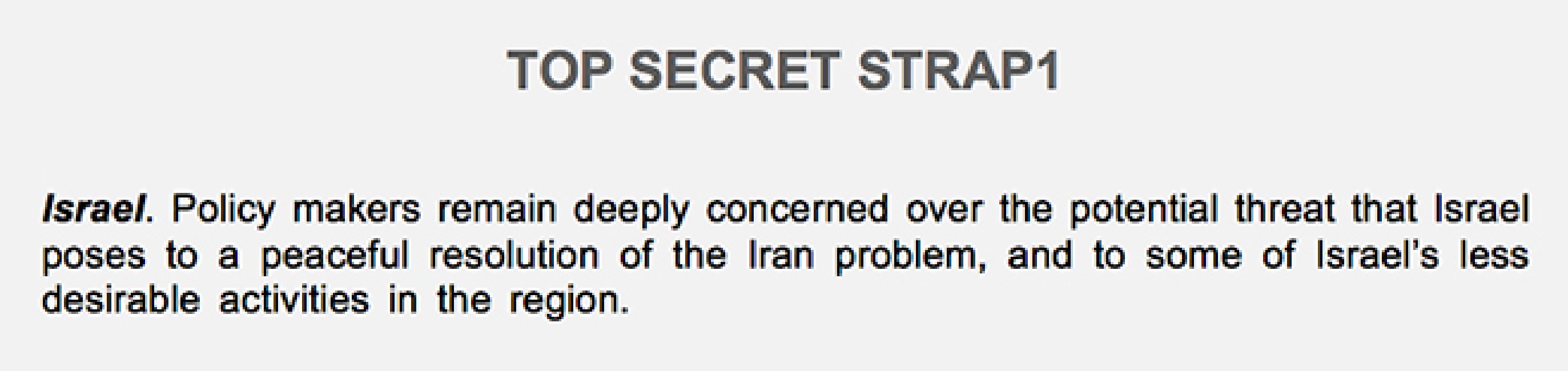
Israel. Policy makers remain deeply concerned over the potential threat that Israel poses to a peaceful resolution of the Iran problem, and to some of Israel's less desirable activities in the region.
Published in the Same Report
(5 documents)
-
-
RECEIPT OF FUNDS [pdf]
In 2003 and 2004, the Israelis were pressuring the NSA to agree to a massively expanded intelligence-sharing relationship called “Gladiator.” As part of that process, Israel wanted the Americans to pay hundreds of millions of dollars to fund Israeli activities. The specific proposed “Gladiator” agreement appears never to have been consummated, derailed by Israeli demands that the U.S. bear the full cost, but documents in the Snowden archive pertaining to those negotiations contain what appear to be two receipts for one or more payments of $500,000 in cash to Israeli officials for unspecified purposes.
Programs: GLADIATOR -
Israel-US 1999 Agreement [pdf]
This July 1999 top secret agreement between the U.S. Defense Intelligence Agency and Israel's Directorate of Military Intelligence establishes comprehensive intelligence-sharing arrangements covering Middle Eastern threats, terrorism, weapons of mass destruction, and foreign materiel exploitation, superseding previous agreements dating back to 1968 and including specific provisions for conferences, written requests, face-to-face analyst meetings, and security protocols.
-
-
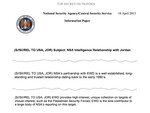
NSA Intelligence Relationship with Jordan [pdf]
A brief NSA information paper confirming the agency's long-standing intelligence-sharing partnership with Jordan's Electronic Warfare Directorate (EWD), noting that Jordan is the sole source of a significant portion of NSA reporting on Palestinian Security Forces.
Related Documents
-
Israel targets the U.S. government for invasive electronic surveillance [pdf]
Israel targets the U.S. government for invasive electronic surveillance, and does so more aggressively and threateningly than almost any other country in the world. Indeed, so concerted and aggressive are Israeli efforts against the U.S. that some key U.S. government documents — including the top secret 2013 intelligence budget — list Israel among the U.S.’s most threatening cyber-adversaries and as a “hostile” foreign intelligence service.
-
Israel's Post-Sharon Policy Prospects: Part 2 -- Iran SIDtoday [pdf]
Given the developments in Iran’s nuclear program in spring 2004, “rumors abound in international political circles” that Israel will attempt to destroy Iranian nuclear facilities unilaterally, as it did with an Iraqi reactor in 1981. A SIGINT national intelligence officer deems this possibility unlikely, because of the risks from Iran’s strengthened defense capabilities and the political implications of such an action.
The Intercept ↗ (2018-08-15) -
Israel's Post-Sharon Policy Prospects: Part 1 -- the Palestinians SIDtoday [pdf]
An NSA staffer assesses two changes that could affect Israeli-Palestinian relations: Ehud Olmert’s ascendance to prime minister following Prime Minister Ariel Sharon’s debilitating stroke; and Hamas’s victory in the Palestinian elections. Regarding Israel and Hamas, the staffer writes that “negotiations between sworn enemies often begin with zero-sum game positions that then moderate over time.”
The Intercept ↗ (2018-08-15) -
Israel-US 1999 Agreement [pdf]
This July 1999 top secret agreement between the U.S. Defense Intelligence Agency and Israel's Directorate of Military Intelligence establishes comprehensive intelligence-sharing arrangements covering Middle Eastern threats, terrorism, weapons of mass destruction, and foreign materiel exploitation, superseding previous agreements dating back to 1968 and including specific provisions for conferences, written requests, face-to-face analyst meetings, and security protocols.
-