Motion of the Electronic Frontier Foundation for Consent to Disclosure of Court Records or, in the Alternative, a Determination of the Effect of the Court's Rules of Statutory Access Rights, In re Motion for Consent to Disclosure of Court Records or, in the Alternative, A Determination of the Effect of the Court's Rules on Statutory Access Rights, Exhibit 2
Open PDFDocument date: 2013-05-21
Type: FOIA
Pages: 8
Classification: -
Dissemination: -
FISC/FISCR Court Filings
My notes
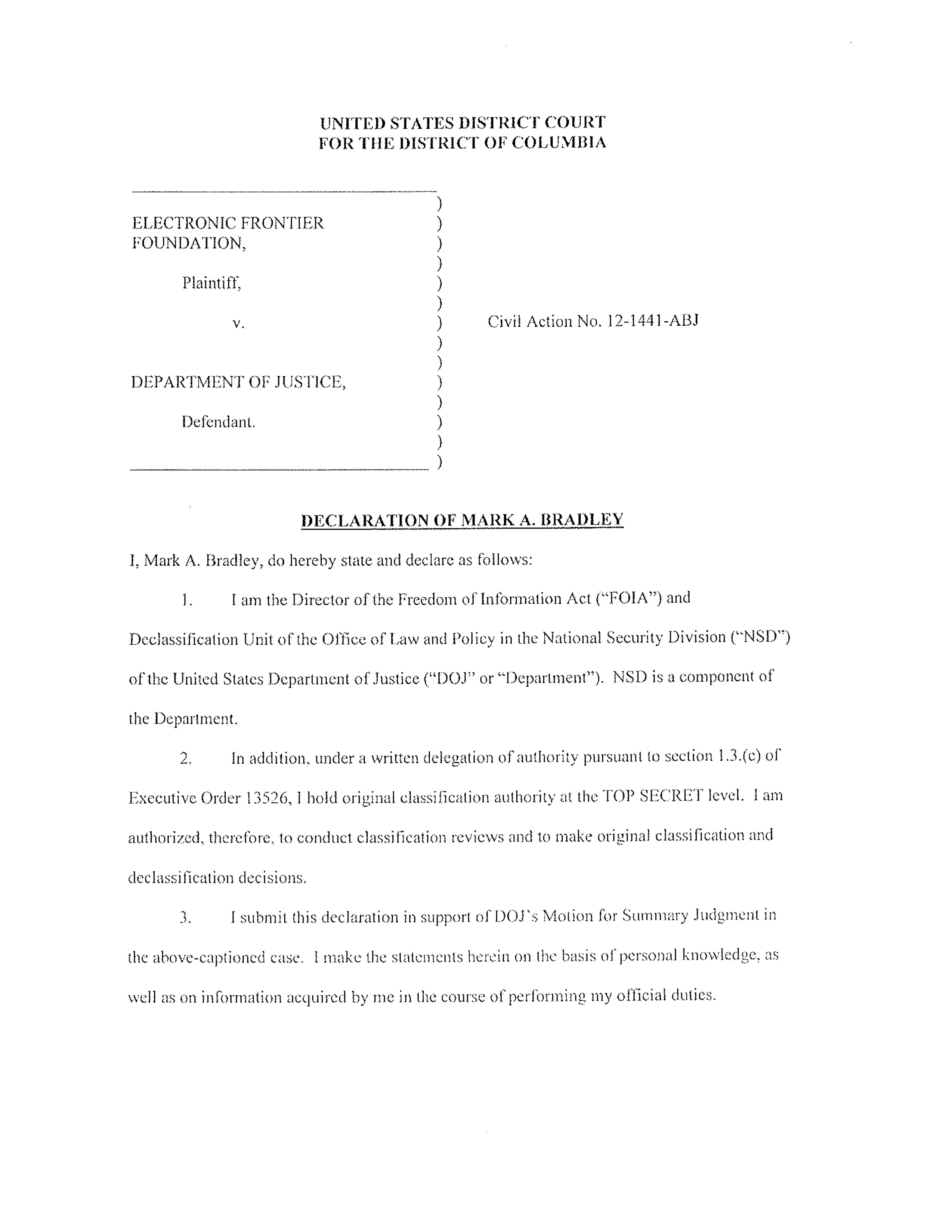
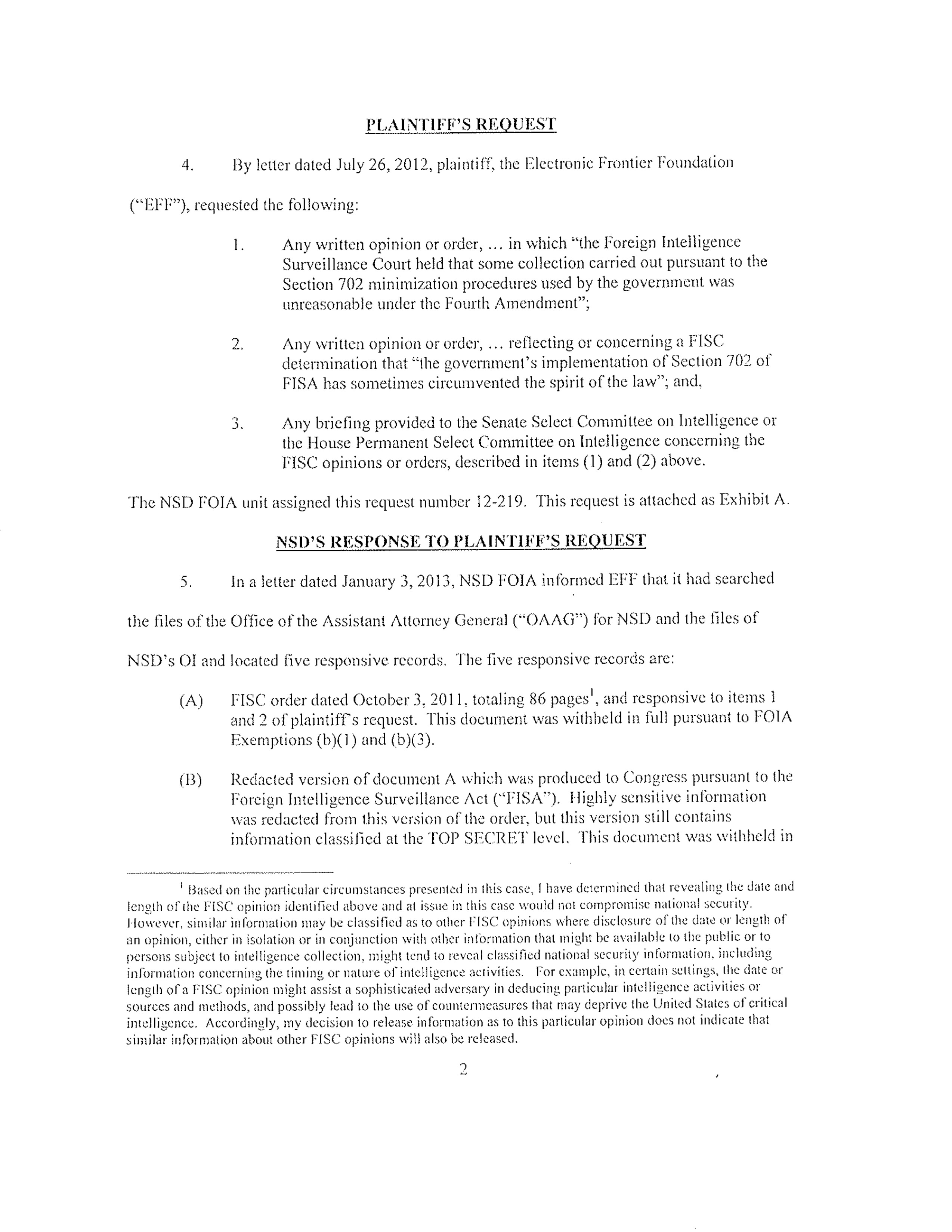
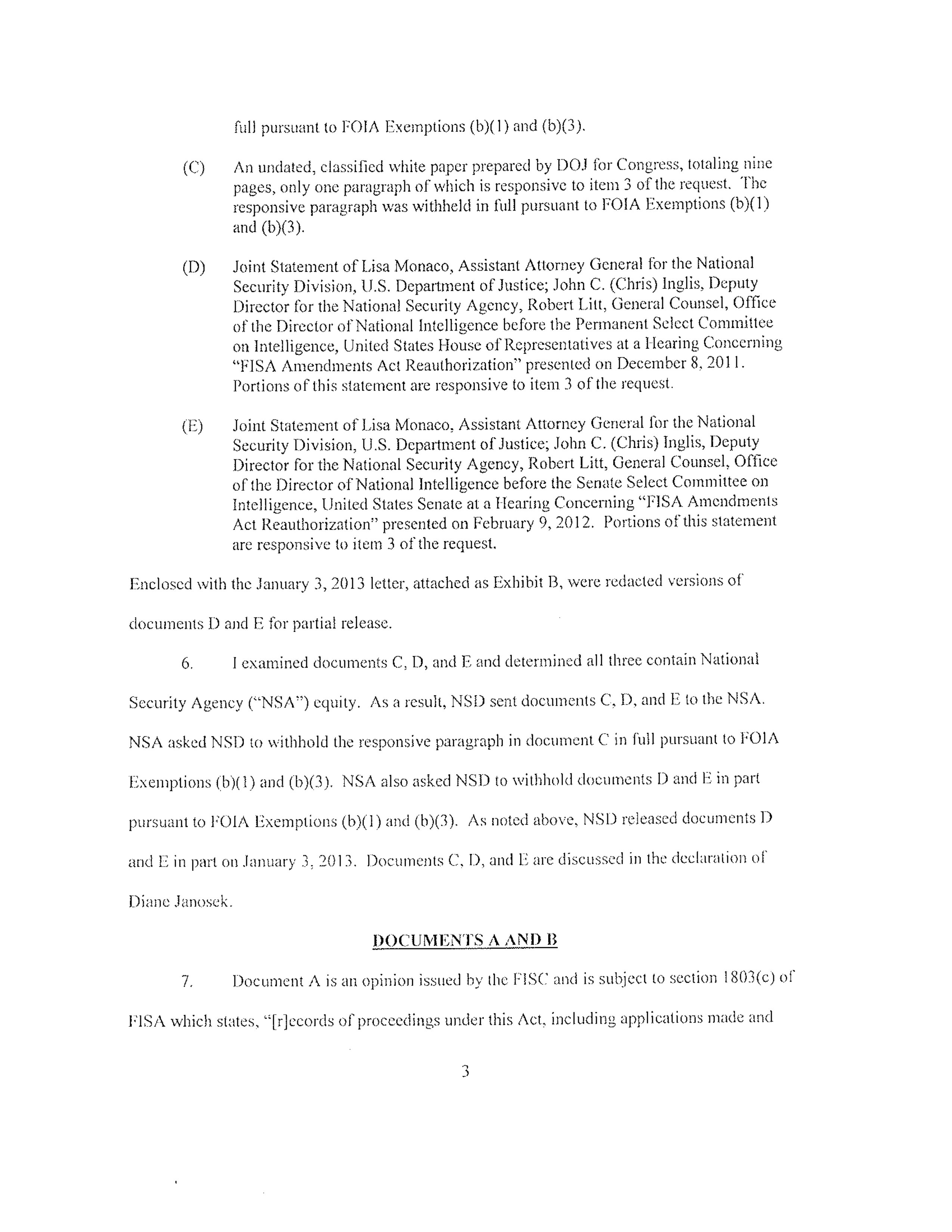
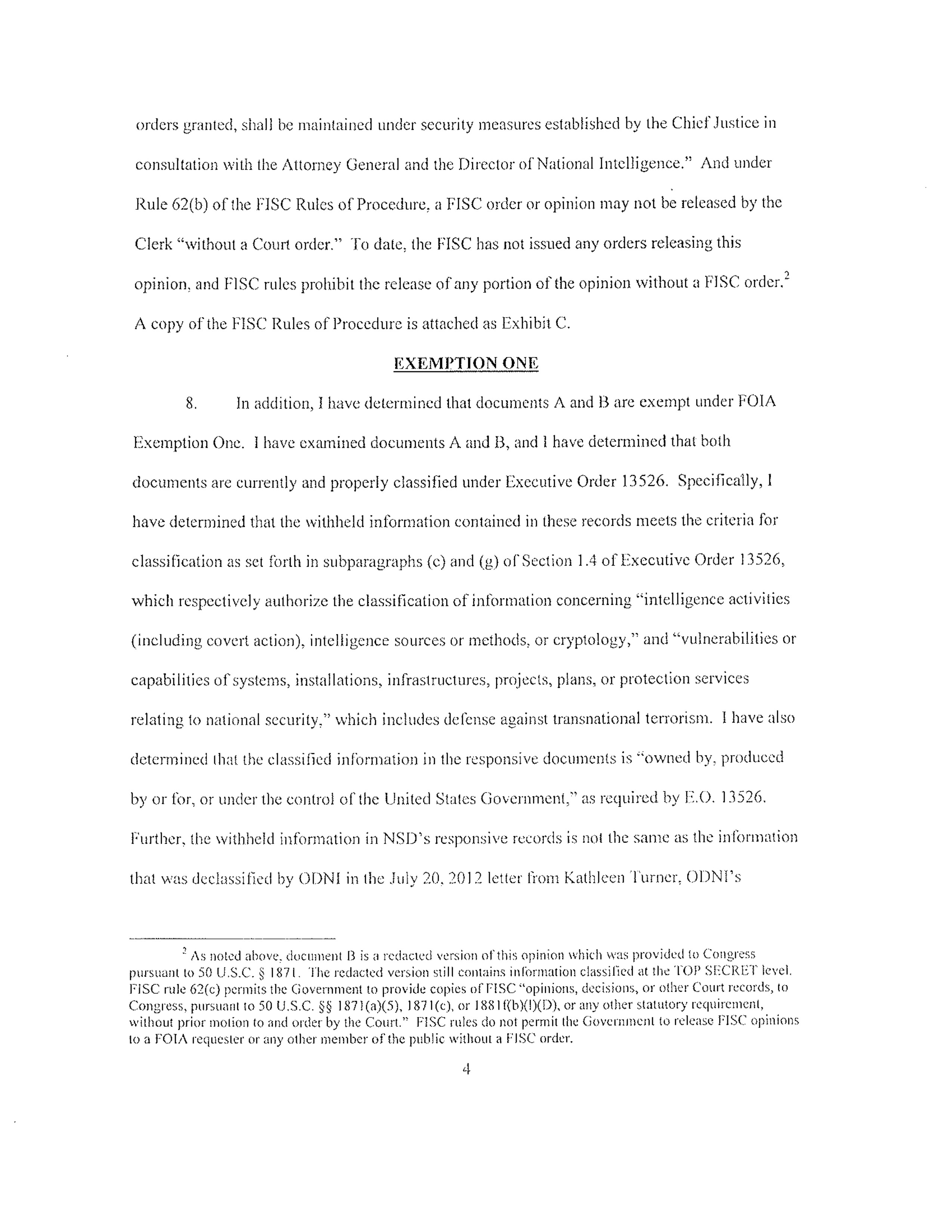
EXHIBIT 2
Motion of the Electronic Frontier Foundation for Consent to Disclosure of Court
Records or, in the Alternative, a Determination of the Effect of the Court's
Rules on Statutory Access Rights
UNITED STATES DISTRICT COURT
FOR THE DISTRICT OF COLUMBIA
Civil Action No. 12-1441-ABJ
ELECTRONIC FRONTIER
FOUNDATION,
Plaintiff,
V.
DEPARTMENT OF JUSTICE,
Defendant.
ECLARATION OF MARK A. BRADLEY
I, Mark A. Bradley, do hereby state and declare as follows:
- I am the Director of the Freedom of Information Act ("FOIA") and
Declassification Unit of the Office of Law and Policy in the National Security Division ("NSD)
of the United States Department of Justice ("DOJ" or "Department"). NSD is a component of
the Department.
- In addition, under a written delegation of authority pursuant to section 1.3.(c) of
Executive Order 13526, I hold original classification authority at the TOP SECRET level. I am
authorized, therefore, to conduct classification reviews and to make original classification and
declassification decisions.
- I submit this declaration in support of DOF's Motion for Summary Judgment in
the above-captioned case. I make the statements herein on the basis of personal knowledge, as
well as on information acquired by me in the course of performing my official duties.
PLAINTIFF'S REQUEST
- By letter dated July 26, 2012, plaintiff, the Electronic Frontier Foundation
("EFF"), requested the following:
- Any written opinion or order, in which "the Foreign Intelligence
Suryeillance Court held that some collection carried out pursuant to the
Section 702 minimization procedures used by the government was
unreasonable under the Fourth Amendment";
- Any written opinion or order,... reflecting or concerning a FISC
determination that "the government's implementation of Section 702 of
FISA has sometimes circumvented the spirit of the law"; and,
- Any briefing provided to the Senate Select Committee on Intelligence or
the House Permanent Select Committee on Intelligence concerning the
FISC opinions or orders, described in items (1) and (2) above.
The NSD FOIA unit assigned this request number 12-219. This request is attached as Exhibit A.
NSD'S RESPONSE TO PLAINTIFF'S REQUEST
- In a letter dated January 3, 2013, NSD FOIA informed EFF that it had searched
the files of the Office of the Assistant Attorney General ("OAAG") for NSD and the files of
NSD's OI and located five responsive records. The five responsive records are:
(A) FISC order dated October 3, 2011, totaling 86 pages', and responsive to items 1
and 2 of plaintiff's request. This document was withheld in full pursuant to FOIA
Exemptions (b)(1) and (b)(3).
(B) Redacted version of document A which was produced to Congress pursuant to the
Foreign Intelligence Surveillance Act ("FISA"). Highly sensitive information
was redacted from this version of the order, but this version still contains
information classified at the TOP SECRET level. This document was withheld in
¹ Based on the particular circumstances presented in this case, I have determined that revealing the date and
length of the FISC opinion identified above and at issue in this case would not compromise national security.
However, similar information may be classified as to other FISC opinions where disclosure of the date or length of
an opinion, either in isolation or in conjunction with other information that might be available to the public or to
persons subject to intelligence collection, might tend to reveal classified national security information, including
information concerning the timing or nature of intelligence activities. For example, in certain settings, the date or
length of a FISC opinion might assist a sophisticated adversary in deducing particular intelligence activities or
sources and methods, and possibly lead to the use of countermeasures that may deprive the United States of critical
intelligence. Accordingly, my decision to release information as to this particular opinion does not indicate that
similar information about other FISC opinions will also be released.
2
(C) full pursuant to FOIA Exemptions (b)(1) and (b)(3).
An undated, classified white paper prepared by DOJ for Congress, totaling nine
pages, only one paragraph of which is responsive to item 3 of the request. The
responsive paragraph was withheld in full pursuant to FOIA Exemptions (b)(1)
and (b)(3).
(D) Joint Statement of Lisa Monaco, Assistant Attorney General for the National
Security Division, U.S. Department of Justice; John C. (Chris) Inglis, Deputy
Director for the National Security Agency, Robert Litt, General Counsel, Office
of the Director of National Intelligence before the Permanent Select Committee
on Intelligence, United States House of Representatives at a Hearing Concerning
"FISA Amendments Act Reauthorization" presented on December 8, 2011.
Portions of this statement are responsive to item 3 of the request.
(E) Joint Statement of Lisa Monaco, Assistant Attorney General for the National
Security Division, U.S. Department of Justice, John C. (Chris) Inglis, Deputy
Director for the National Security Agency, Robert Litt, General Counsel, Office
of the Director of National Intelligence before the Senate Select Committee on
Intelligence, United States Senate at a Hearing Concerning "FISA Amendments
Act Reauthorization" presented on February 9, 2012. Portions of this statement
are responsive to item 3 of the request.
Enclosed with the January 3, 2013 letter, attached as Exhibit B, were redacted versions of
documents D and E for partial release.
- 1 examined documents C, D, and E and determined all three contain National
Security Agency ("NSA") equity. As a result, NSD sent documents C, D, and E to the NSA.
NSA asked NSD to withhold the responsive paragraph in document C in full pursuant to FOIA
Exemptions (b)(1) and (b)(3), NSA also asked NSD to withhold documents D and E in part
pursuant to FOIA Exemptions (b)(1) and (b)(3). As noted above, NSD released documents D
and E in part on January 3, 2013. Documents C, D, and E are discussed in the declaration of
Diane Janosek.
DOCUMENTS A AND B
- Document A is an opinion issued by the FISC and is subject to section 1803(c) of
FISA which states, "[r]ecords of proceedings under this Act, including applications made and
3
orders granted, shall be maintained under security measures established by the Chief Justice in
consultation with the Attorney General and the Director of National Intelligence." And under
Rule 62(b) of the FISC Rules of Procedure, a FISC order or opinion may not be released by the
Clerk "without a Court order." To date, the FISC has not issued any orders releasing this
opinion, and FISC rules prohibit the release of any portion of the opinion without a FISC order.
A copy of the FISC Rules of Procedure is attached as Exhibit C.
EXEMPTION ONE
- In addition, I have determined that documents A and B are exempt under FOIA
Exemption One. I have examined documents A and B, and I have determined that both
documents are currently and properly classified under Executive Order 13526. Specifically, I
have determined that the withheld information contained in these records meets the criteria for
classification as set forth in subparagraphs (c) and (g) of Section 1.4 of Executive Order 13526,
which respectively authorize the classification of information concerning "intelligence activities
(including covert action), intelligence sources or methods, or cryptology," and "vulnerabilities or
capabilities of systems, installations, infrastructures, projects, plans, or protection services
relating to national security," which includes defense against transnational terrorism. I have also
determined that the classified information in the responsive documents is "owned by, produced
by or for, or under the control of the United States Government," as required by E.O. 13526.
Further, the withheld information in NSD's responsive records is not the same as the information
that was declassified by ODNI in the July 20, 2012 letter from Kathleen Turner, ODNI's
² As noted above, document B is a redacted version of this opinion which was provided to Congress
pursuant to 50 U.S.C. § 1871. The redacted version still contains information classified at the TOP SECRET level.
FISC rule 62(c) permits the Government to provide copies of FISC "opinions, decisions, or other Court records, to
Congress, pursuant to 50 U.S.C. §§ 1871(a)(5), 1871(c), or 18811(b)(1)(D), or any other statutory requirement,
without prior motion to and order by the Court." FISC rules do not permit the Government to release FISC opinions
10 a FOIA requester or any other member of the public without a FISC order.
4
Director of Legislative Affairs, to Senator Ron Wyden.
- Because the withheld material in documents A and B is classified at the TOP
SECRET level, its disclosure could be expected to cause exceptionally grave damage to the
national security of the United States. I have examined documents A and B, and I have
determined that the withheld material contains specific descriptions of the manner and means by
which the United States Government targets non-United States persons located overseas to
acquire foreign intelligence information under Section 702. As such, I have determined that the
withheld information describes highly sensitive intelligence activities, sources and methods, and
disclosure of this information would provide our adversaries and foreign intelligence targets with
insight into the United States Government's foreign intelligence collection capabilities, which in
turn could be used to develop the means to degrade and evade those collection capabilities.
EXEMPTION THREE
- I have also determined that the information in documents A and B is also exempt
from disclosure pursuant to FOIA Exemption 3. Exemption 3 states that FOIA's disclosure
provisions do not apply to matters that are specifically exempted from disclosure by statute. In
this case, I examined the withheld information and determined that it is protected by the National
Security Act of 1947, as amended by the Intelligence Reform and Terrorism Prevention Act
("IRTPA") of 2004, which protects intelligence sources and methods from unauthorized
disclosure. 50 U.S.C. § 403-1(i)(1). I determined the information in documents A and B
contains intelligence sources and method and is therefore protected from release by the National
Security Act and FOIA Exemption 3.
SEGREGABILITY
- I reviewed documents A, B, C, D, and E for purposes of complying with FOIA's
5
segregability provision which requires the Government to release "any reasonably segregable
portion of a record" after proper application of the FOIA exemptions. 5 U.S.C. § 552(b). For
documents A and B, I determined that no portion of them could be properly segregated and
released due to the FISC's rules pertaining to the release of its orders.
- After careful examination, I have also determined that the one responsive
paragraph in document C contains no unclassified portions that can be segregated and released.
The unclassified, non-exempt material in the one responsive paragraph in document C is so
inextricably intertwined with the classified material that the release of any non-exempt
information would produce only incomplete, fragmented, unintelligible sentences and phrases
that are devoid of any meaning.
- For documents D and E, the non-exempt, responsive information was segregated
and provided in NSD's response, dated January 3, 2013. The exempt and non-responsive
portions of the document were redacted.
6
CONCLUSION
I certify. pursuant to 28 U.S.C. § 1746, under penalty of perjury that the foregoing is true
and correct to the best of my knowledge and belief.
Executed this 1st day of April 2013
Mark A. Bradley
7
Published in the Same Report
(2 documents)
-
Motion of the Electronic Frontier Foundation for Consent to Disclosure of Court Records or, in the Alternative, a Determination of the Effect of the Court's Rules of Statutory Access Rights, In re Motion for Consent to Disclosure of Court Records or, in the Alternative, A Determination of the Effect of the Court's Rules on Statutory Access Rights FOIA [pdf]
-
Motion of the Electronic Frontier Foundation for Consent to Disclosure of Court Records or, in the Alternative, a Determination of the Effect of the Court's Rules of Statutory Access Rights, In re Motion for Consent to Disclosure of Court Records or, in the Alternative, A Determination of the Effect of the Court's Rules on Statutory Access Rights, Exhibit 1 FOIA [pdf]

Related Documents
-
Motion of the Electronic Frontier Foundation for Consent to Disclosure of Court Records or, in the Alternative, a Determination of the Effect of the Court's Rules of Statutory Access Rights, In re Motion for Consent to Disclosure of Court Records or, in the Alternative, A Determination of the Effect of the Court's Rules on Statutory Access Rights, Exhibit 1 FOIA [pdf]
-
Motion of the Electronic Frontier Foundation for Consent to Disclosure of Court Records or, in the Alternative, a Determination of the Effect of the Court's Rules of Statutory Access Rights, In re Motion for Consent to Disclosure of Court Records or, in the Alternative, A Determination of the Effect of the Court's Rules on Statutory Access Rights FOIA [pdf]
-
-
-