NSA Core Intelligence Oversight Training Materials
Open PDFDocument date: 2011-01-01
Type: FOIA
Pages: 141
Classification: SECRET COMINT
Dissemination: -
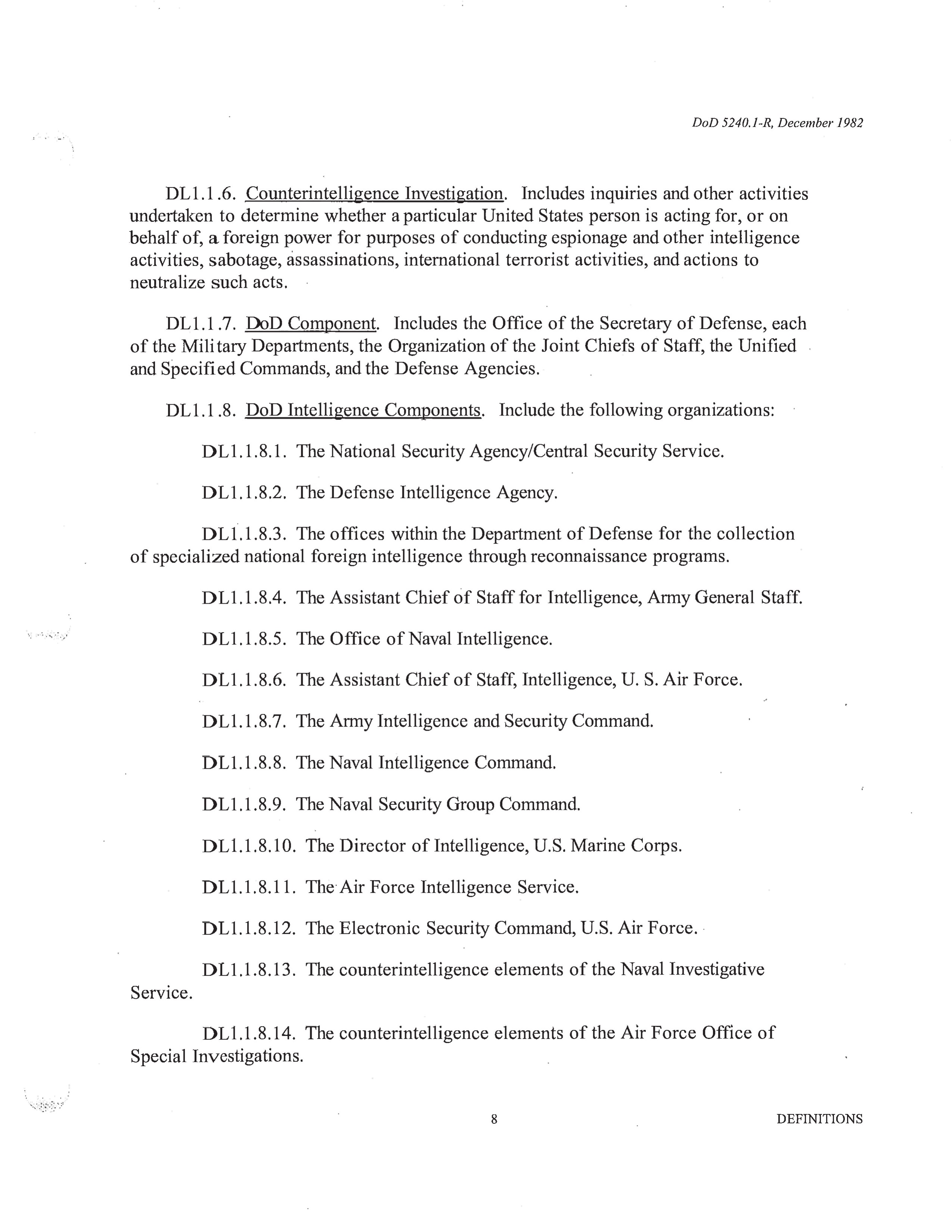
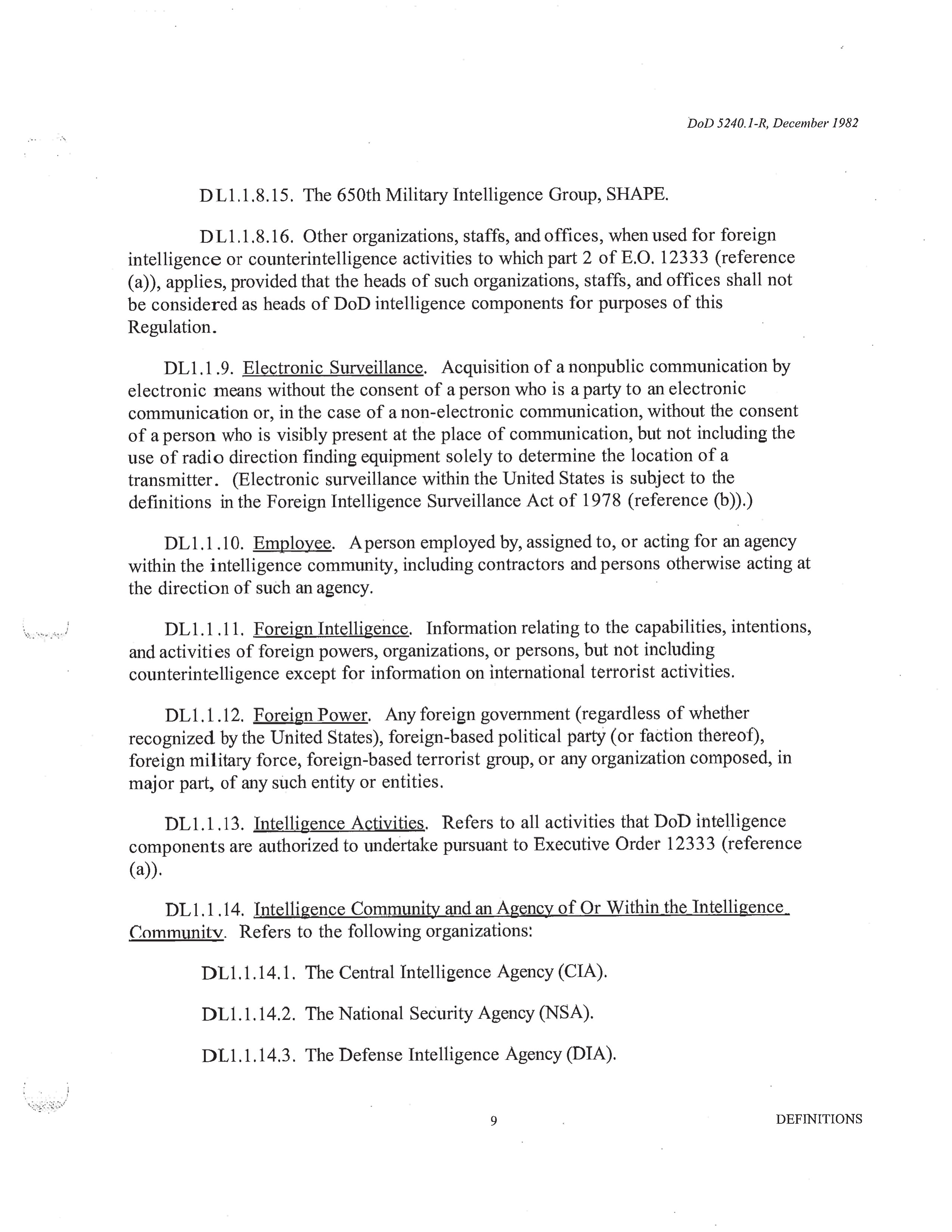
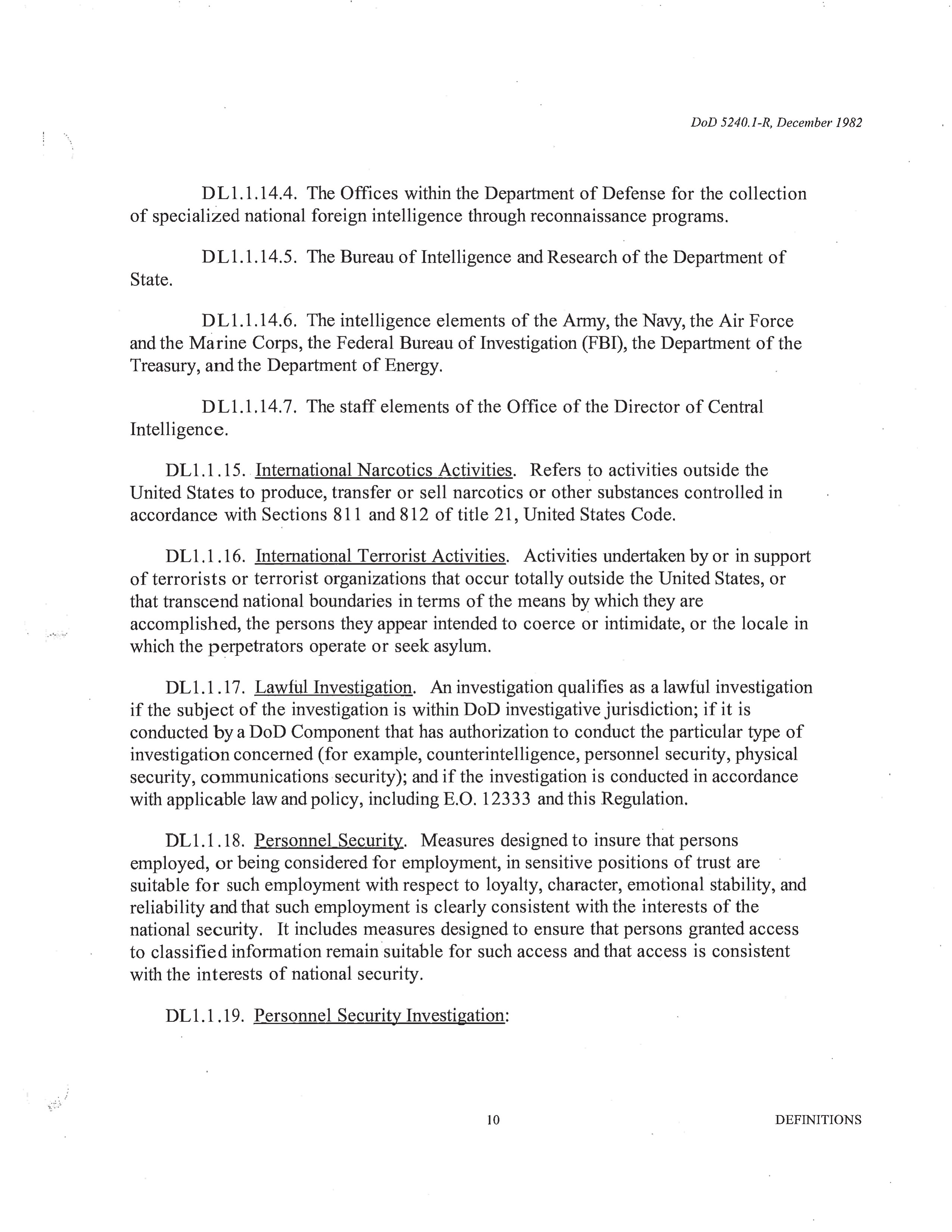
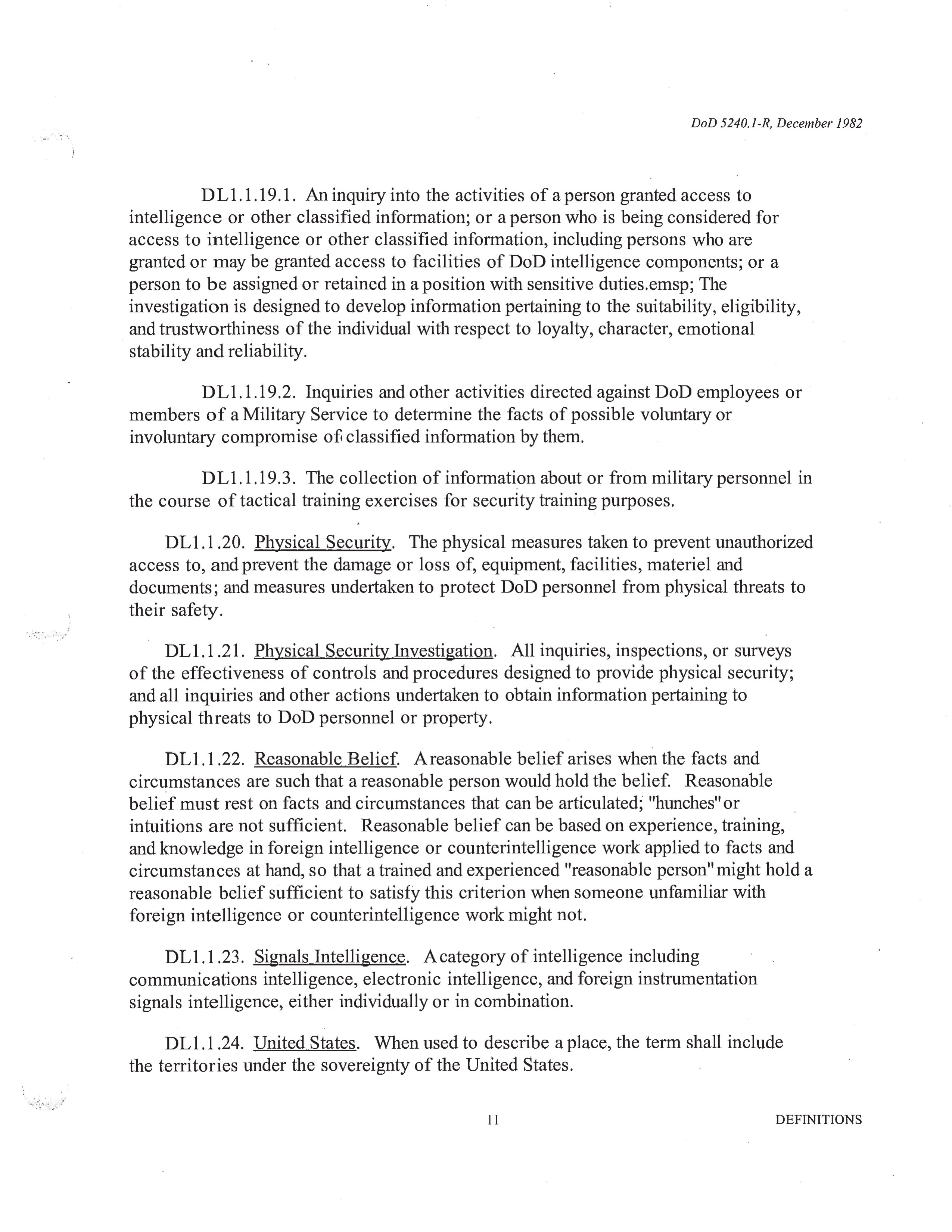
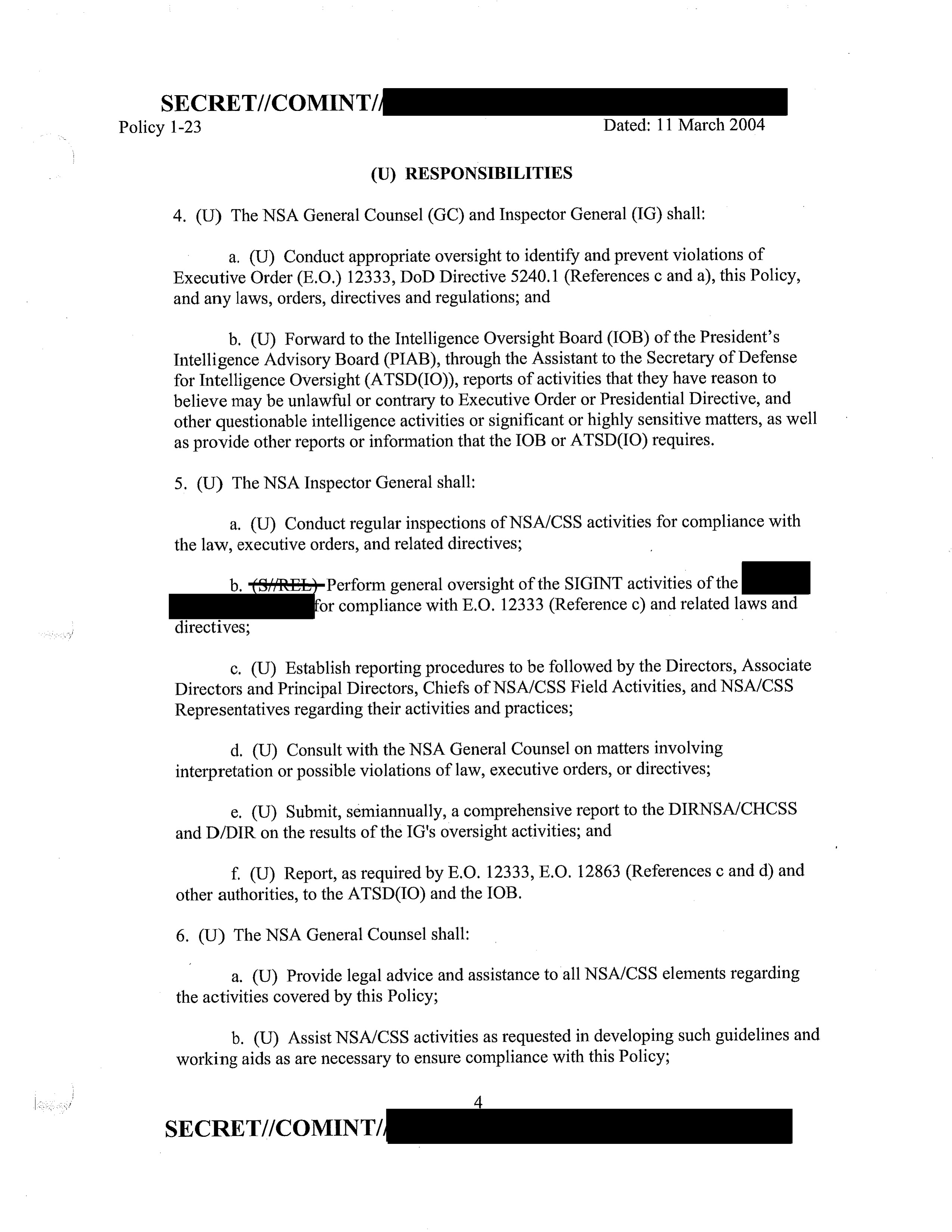
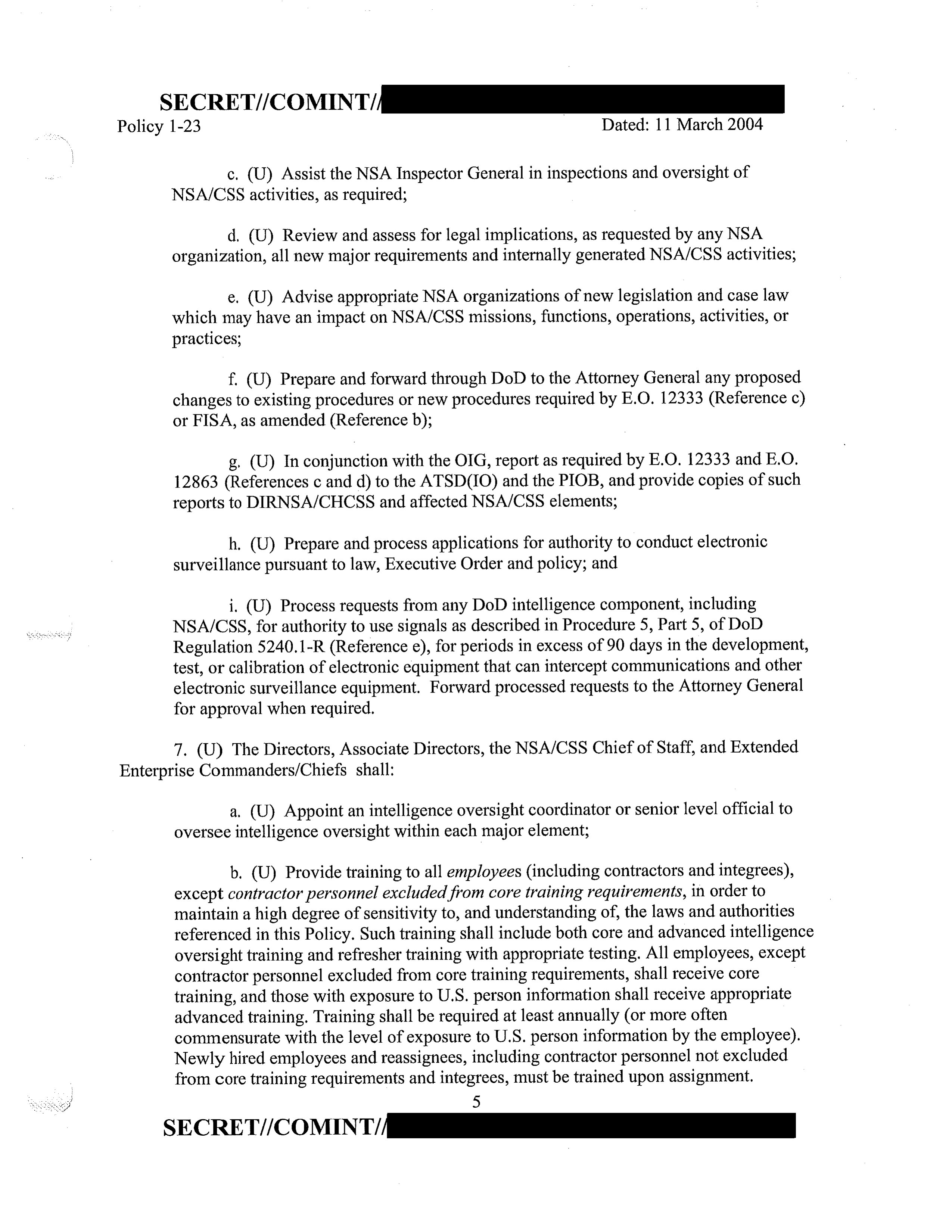
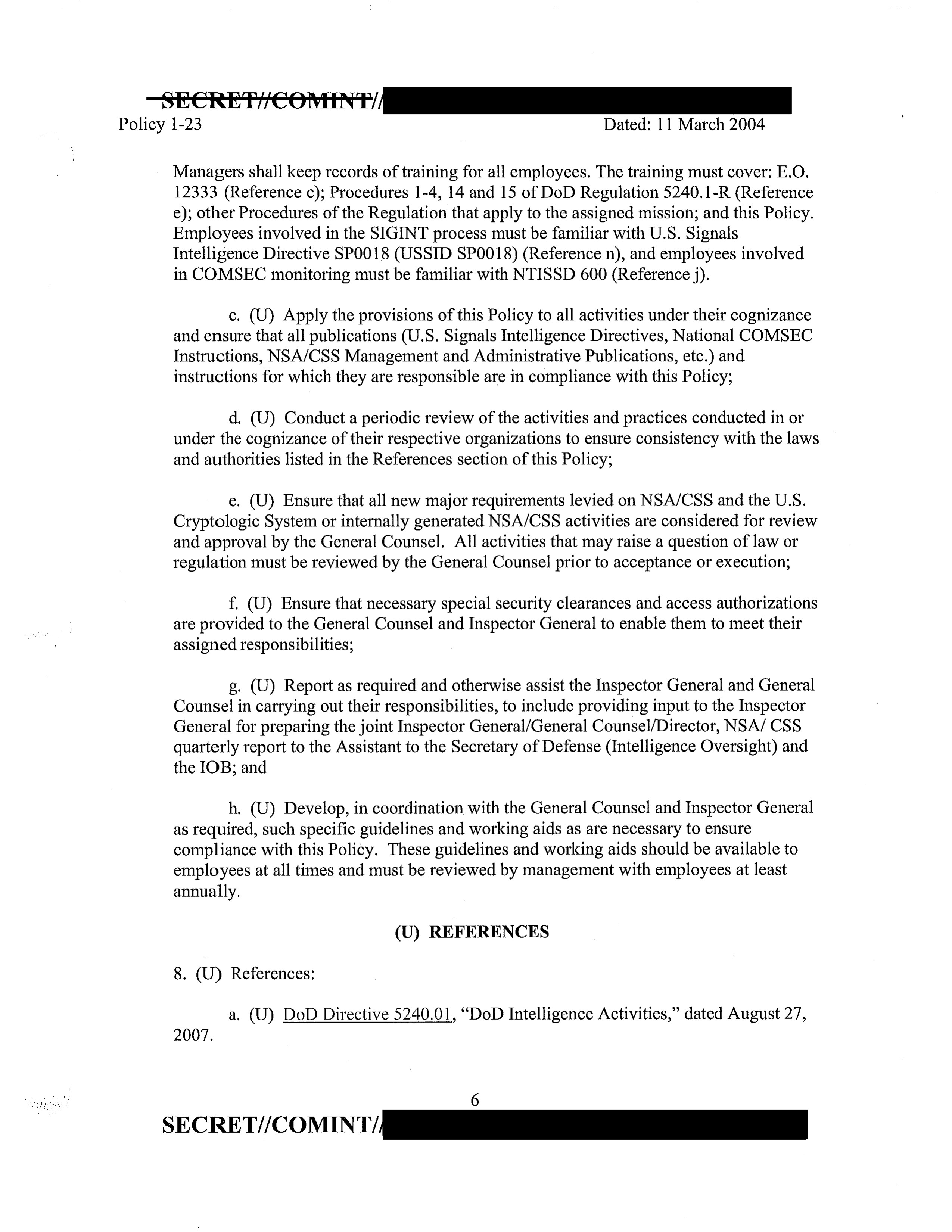
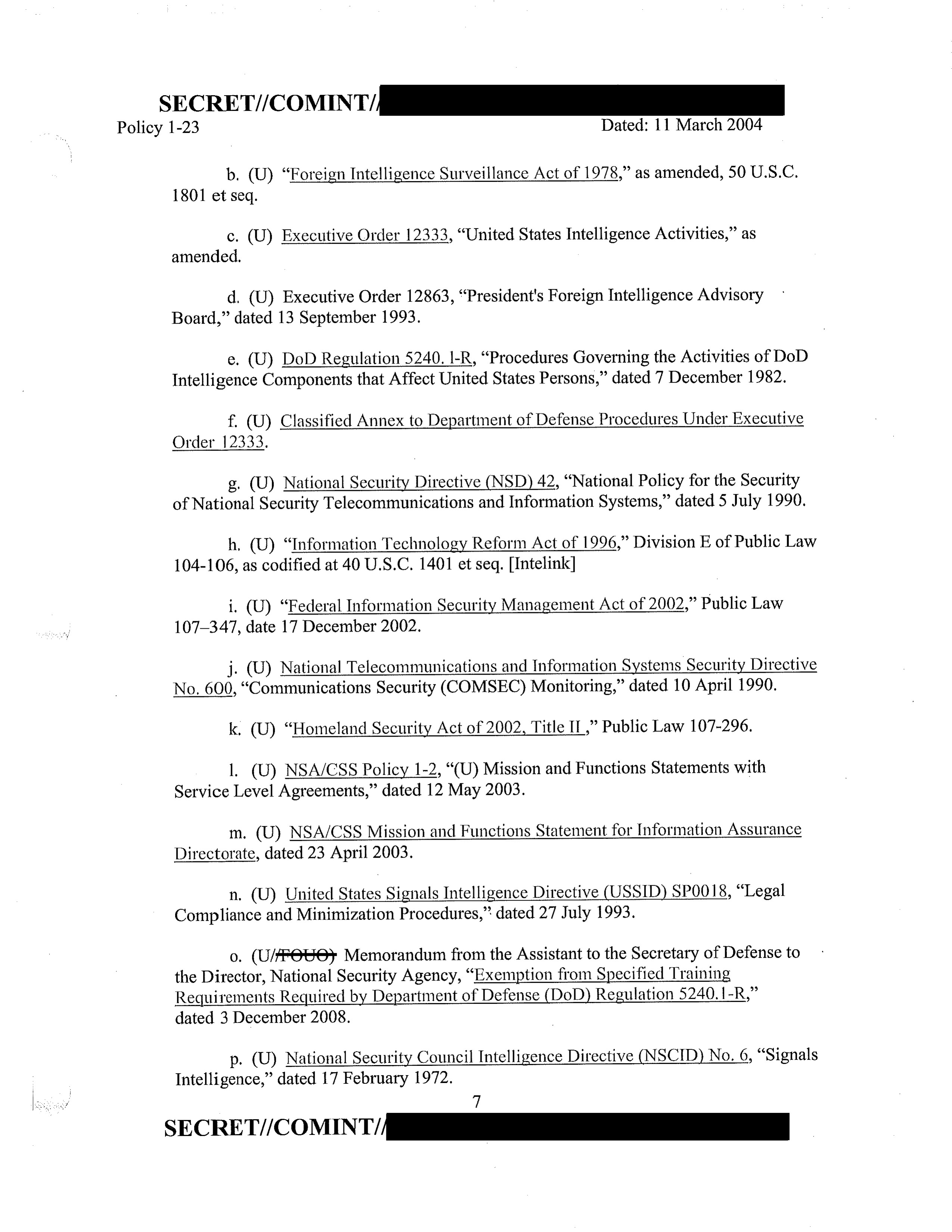
NSA training materials relating to signals intelligence collection activities involving Executive Order 12333, 1892 DOD Procedures Governing the Activities of DOD Intelligence Components affecting US persons, and NSA/Central Security Service (CSS) Policy 1-23. ACLU/EFF FOIA Litigation.
My notes


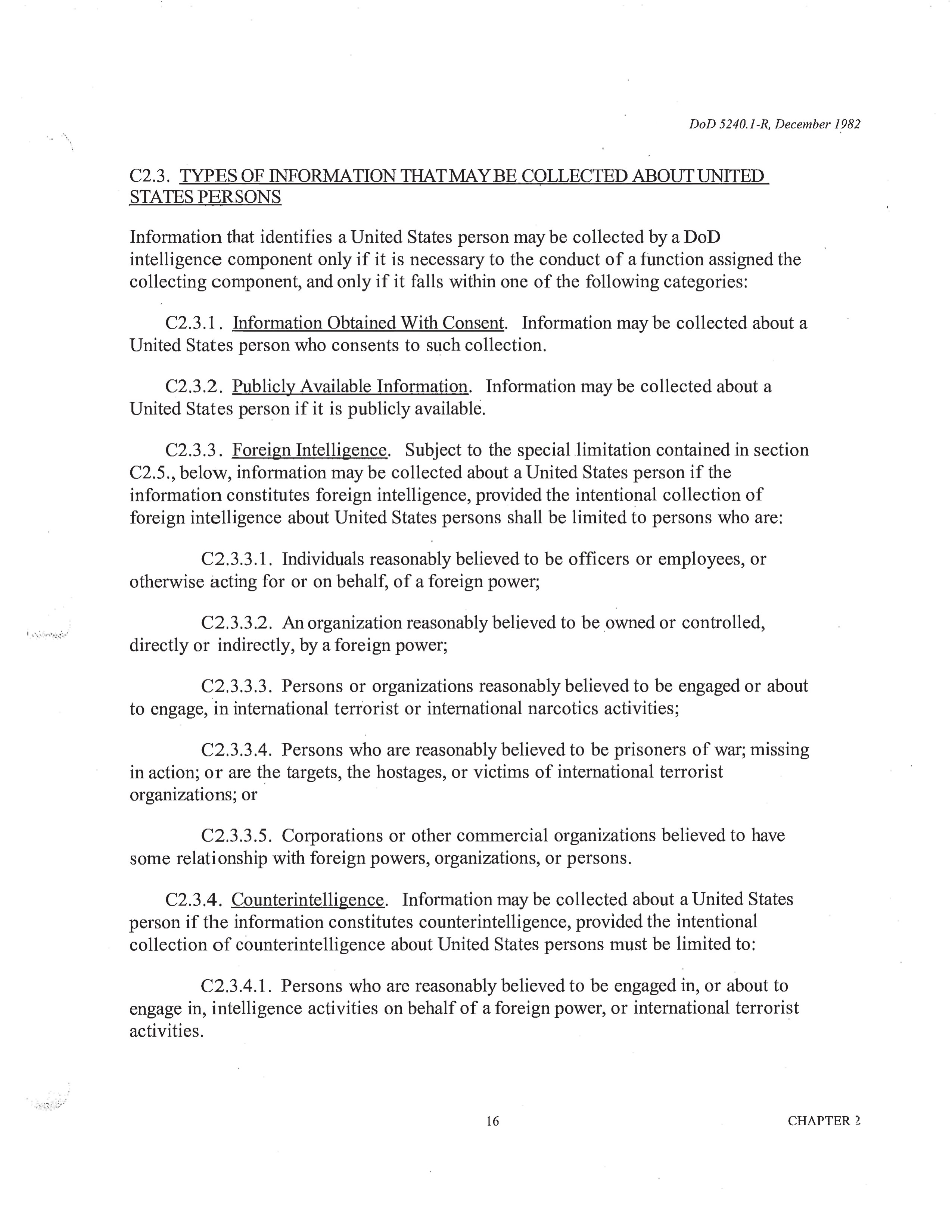
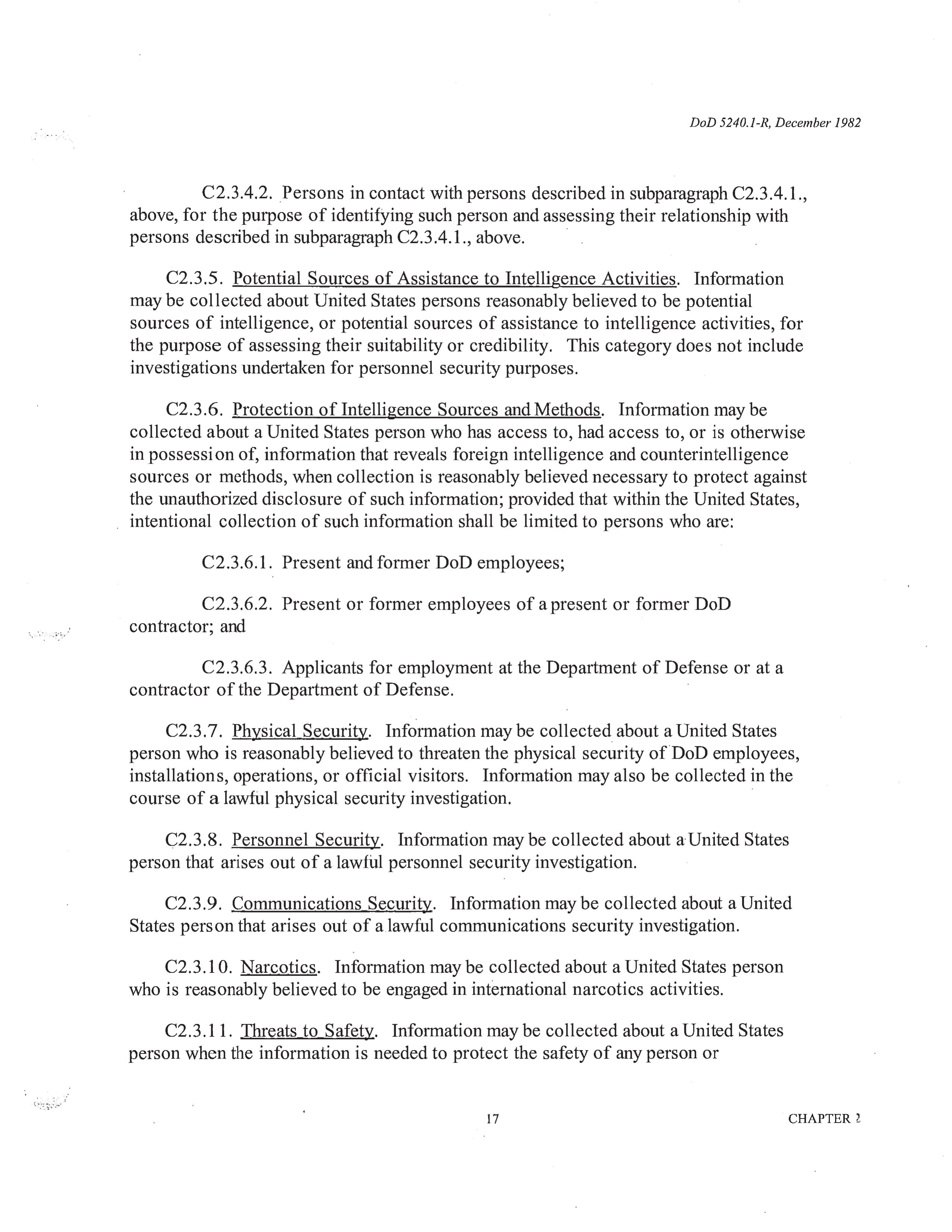
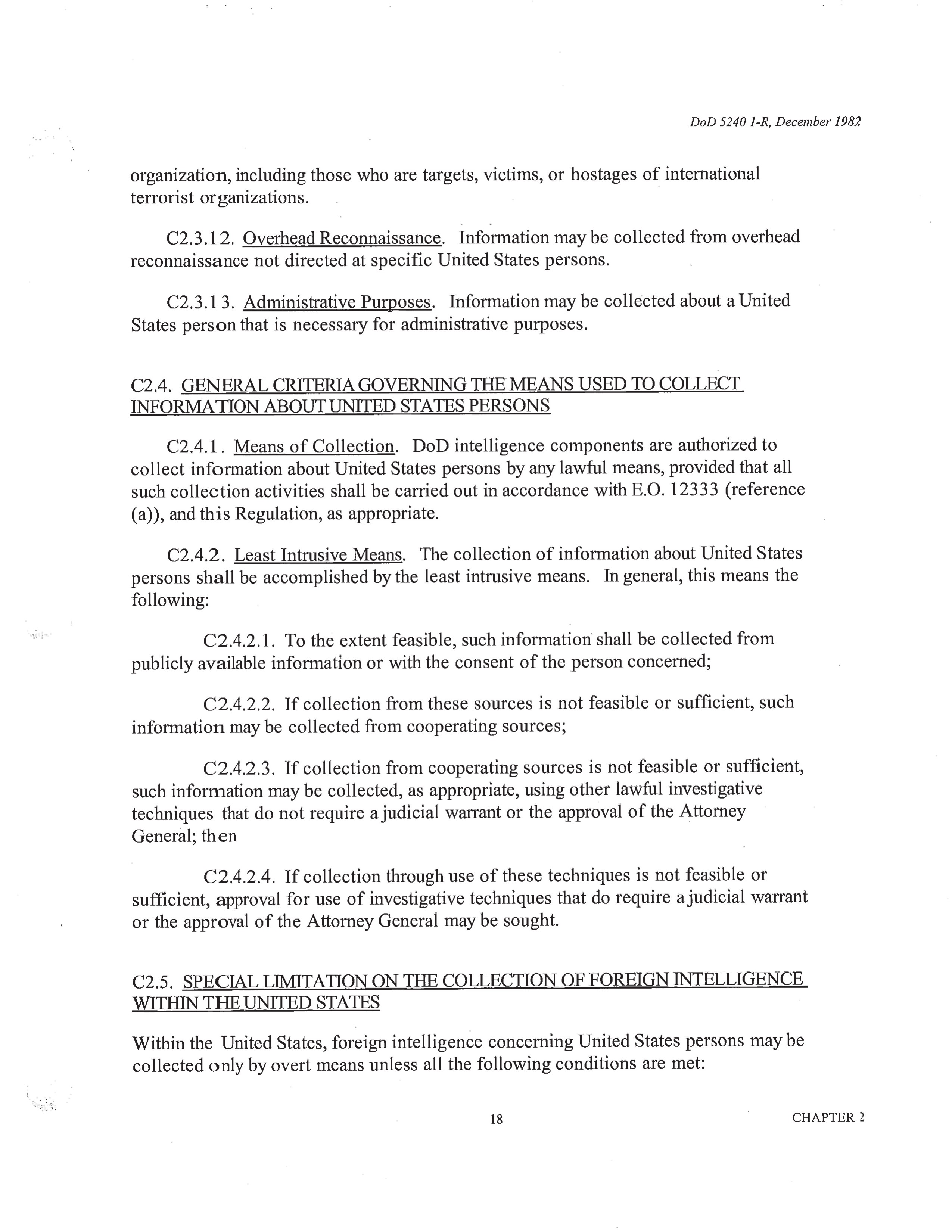
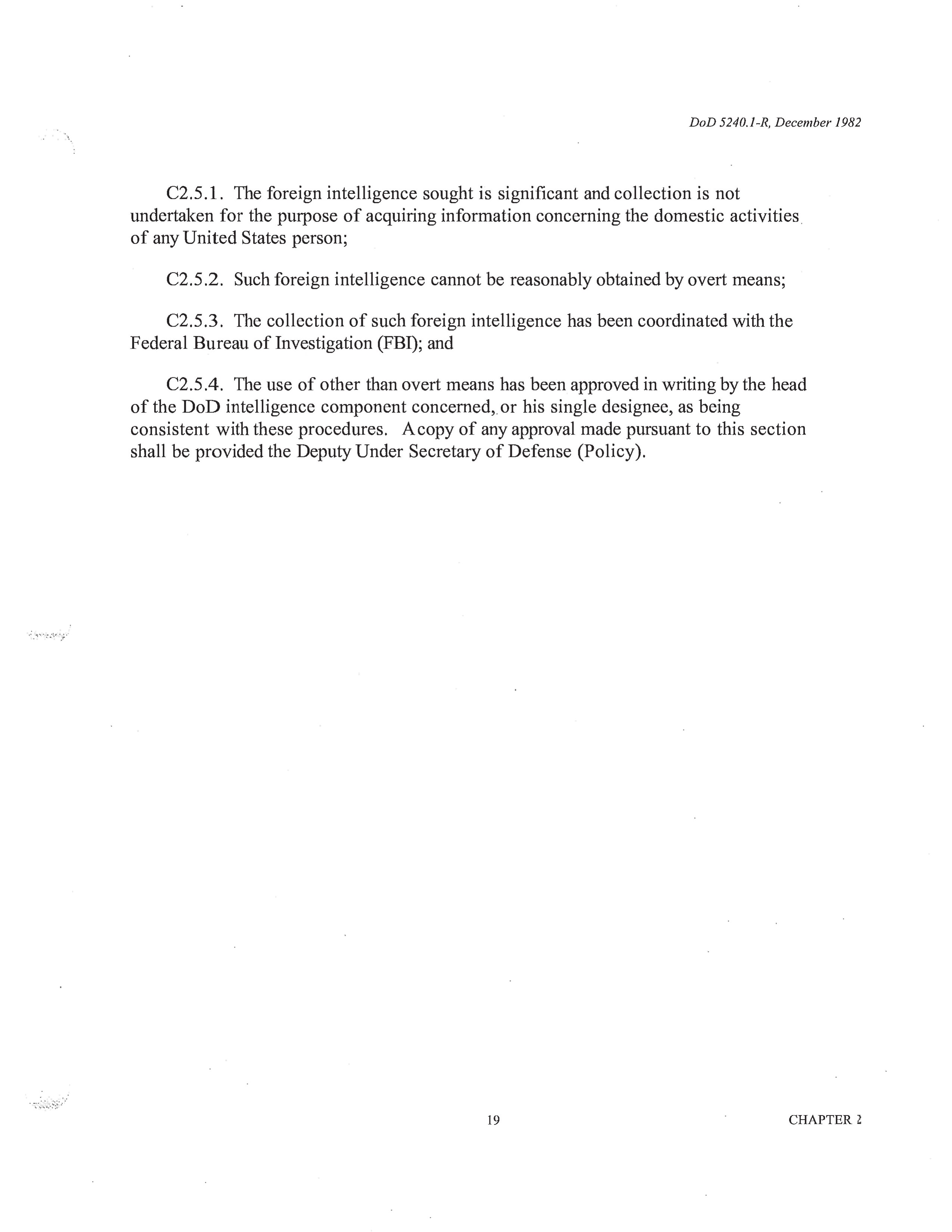
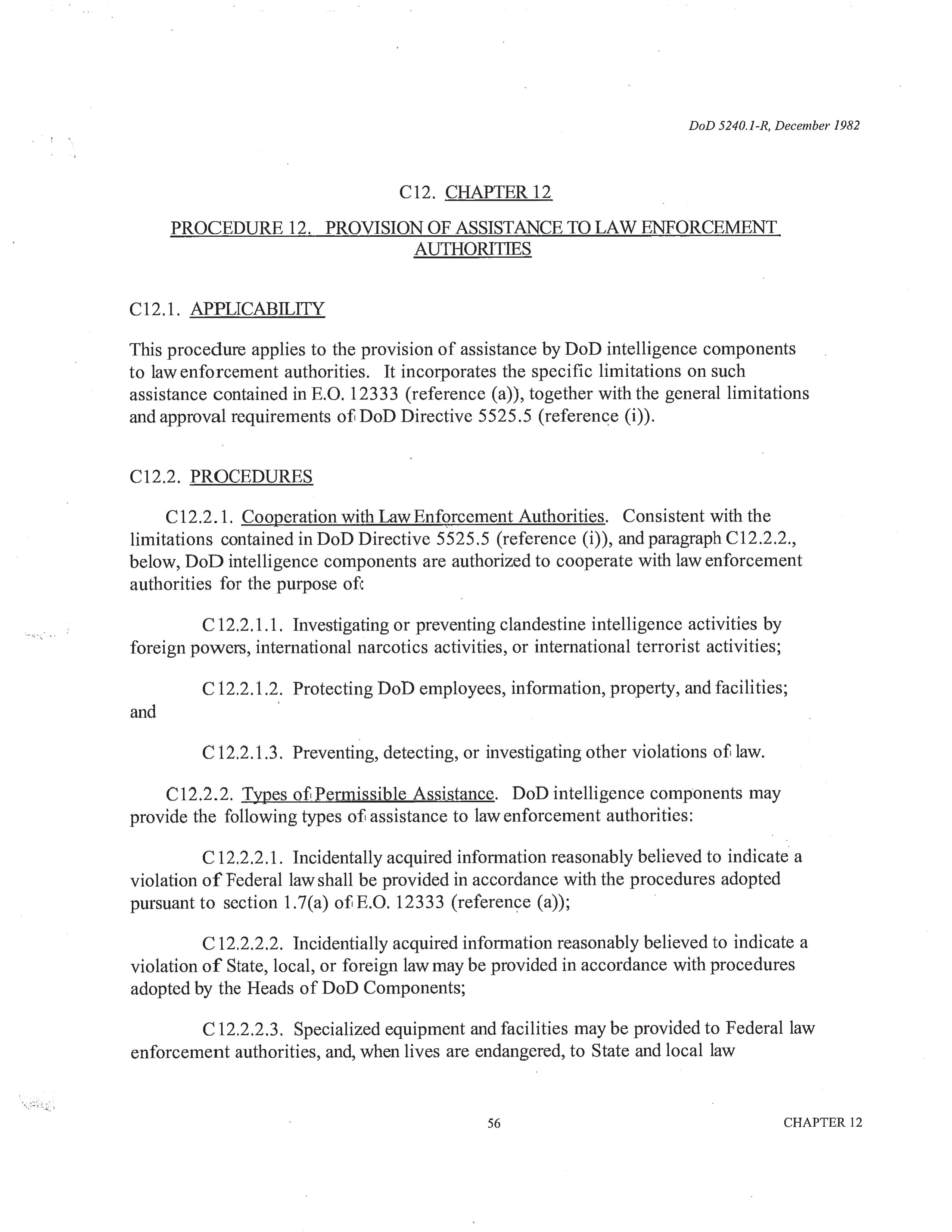
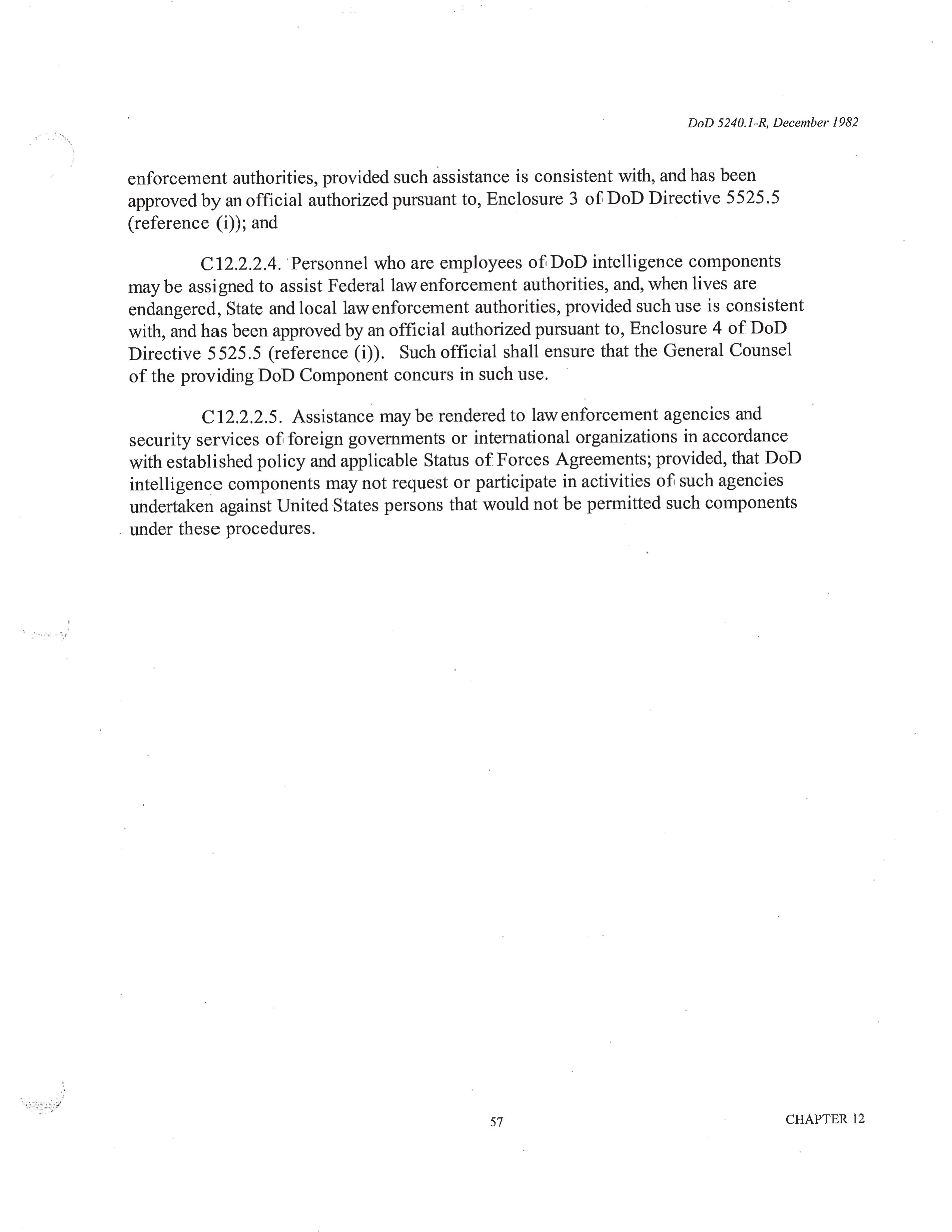
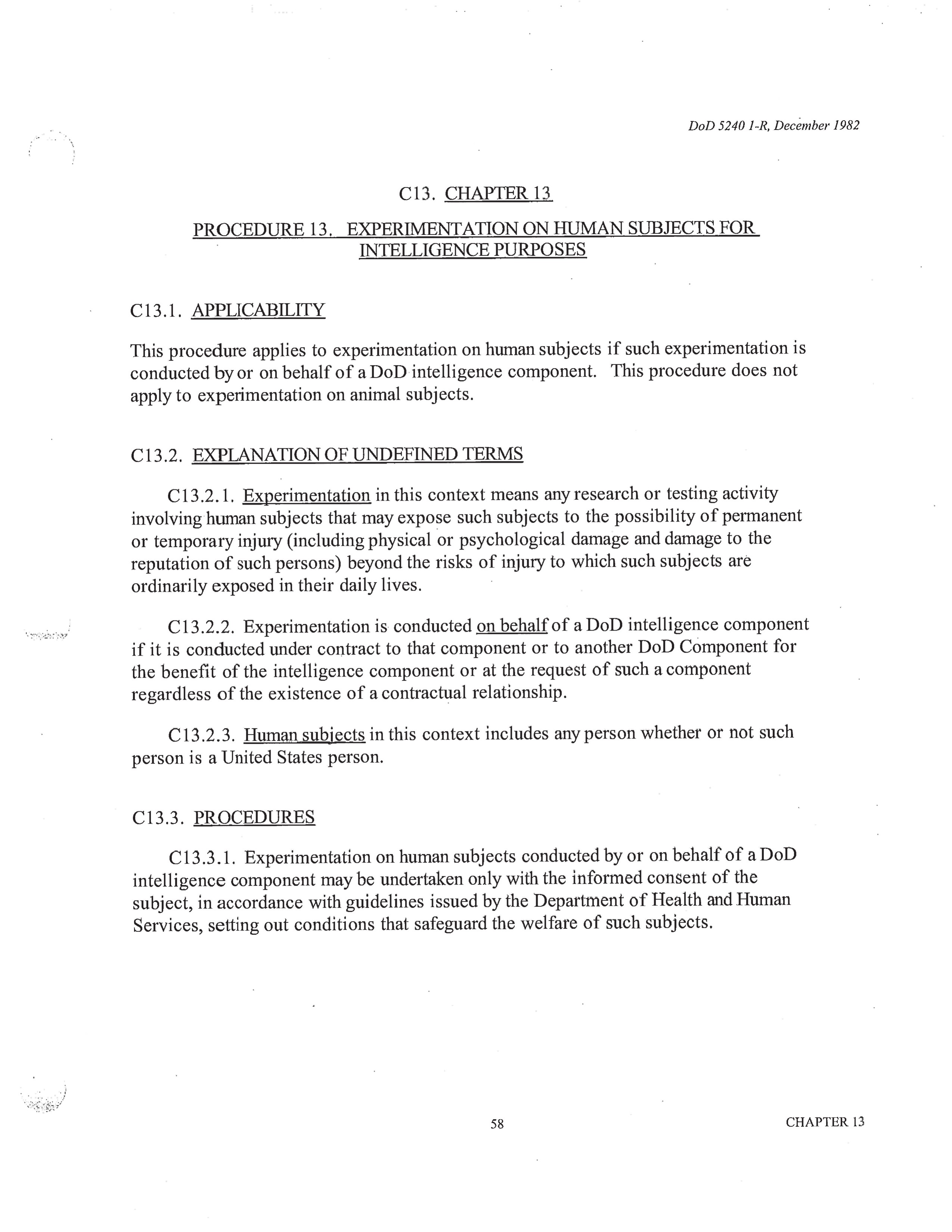
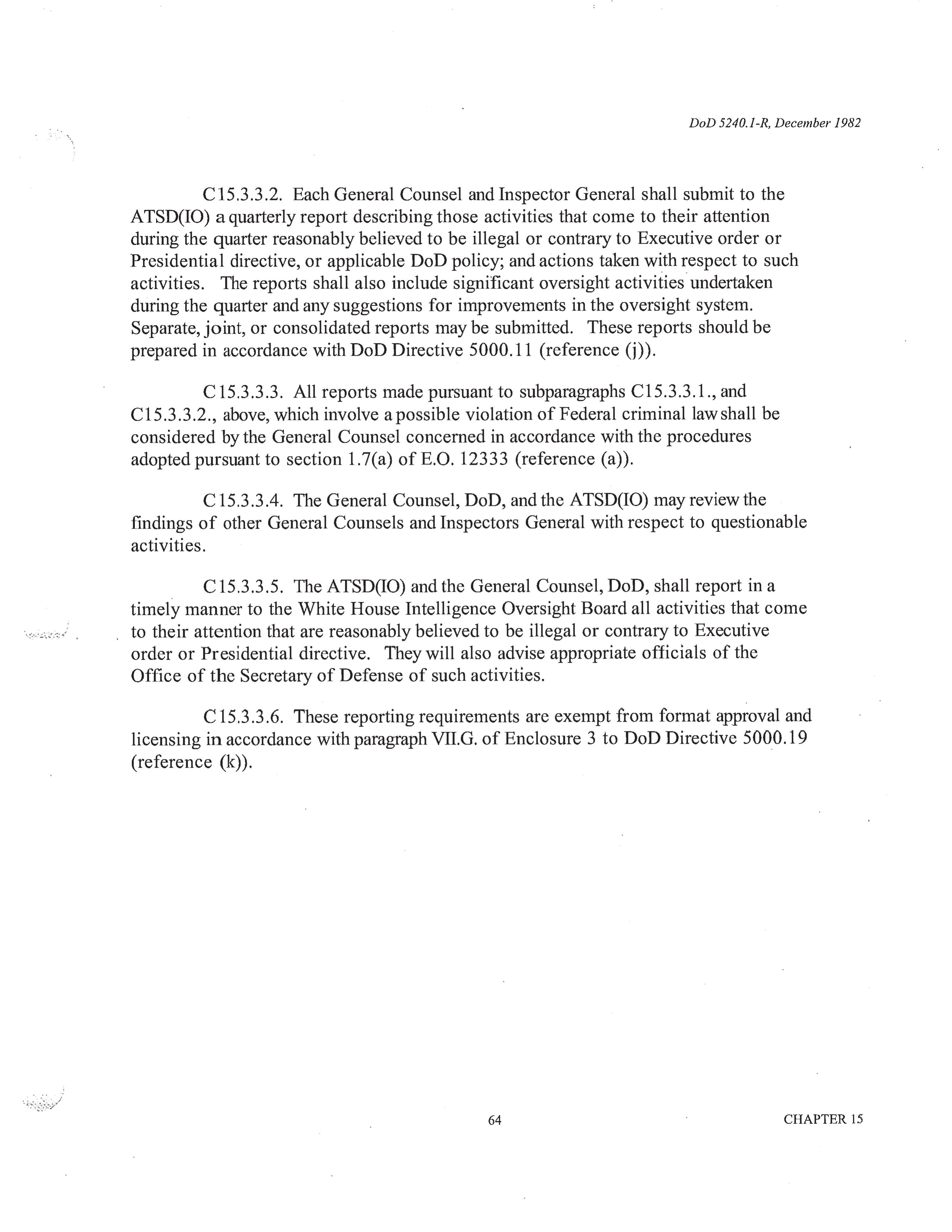

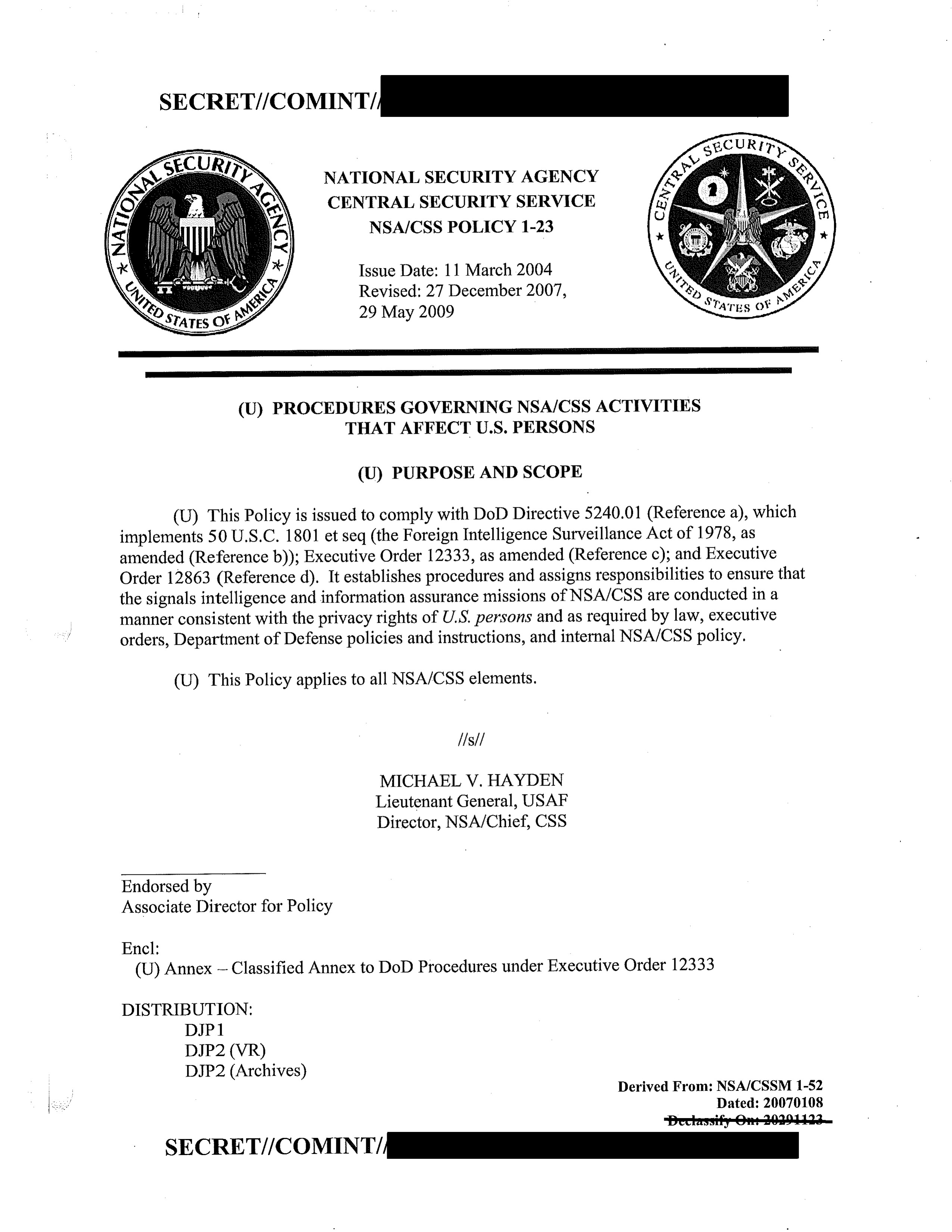
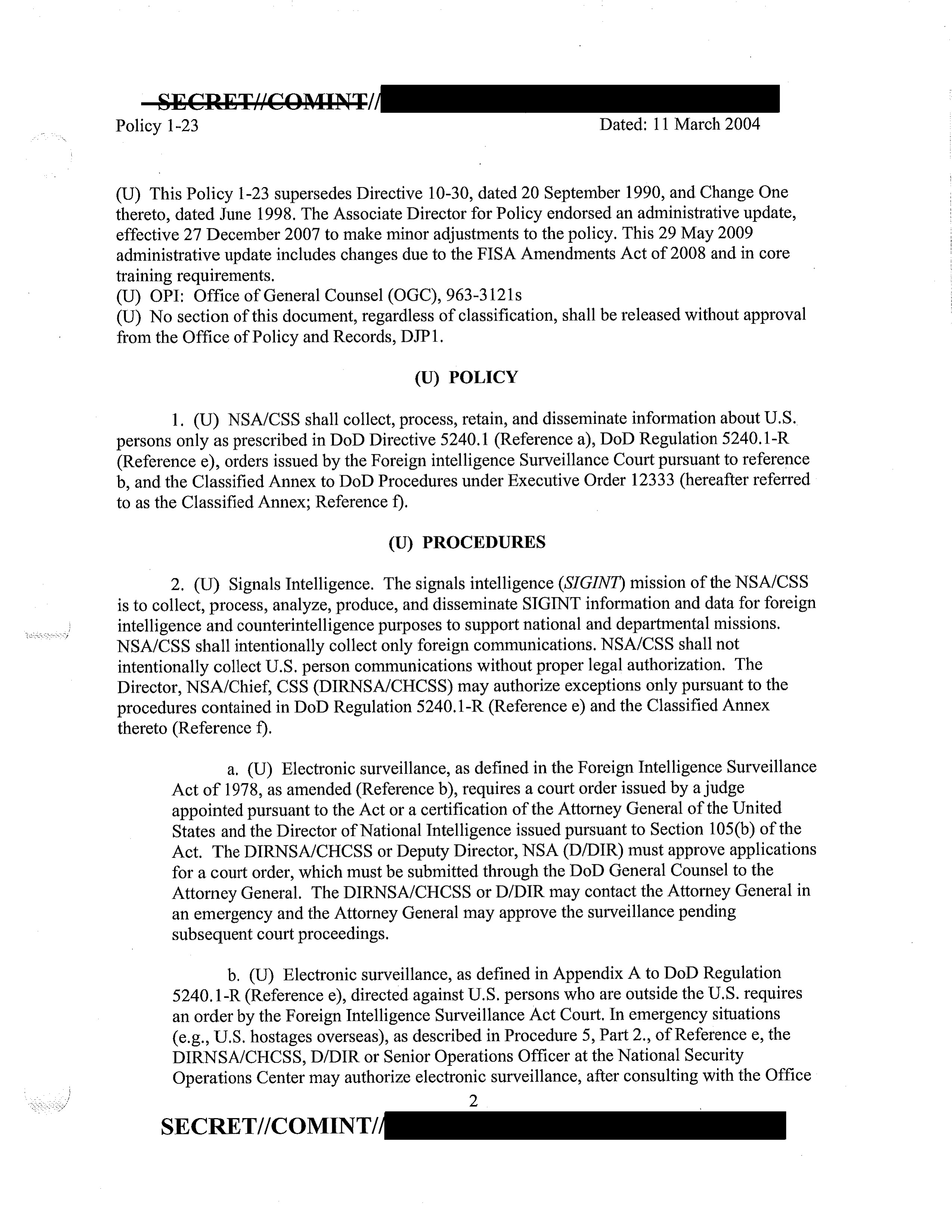
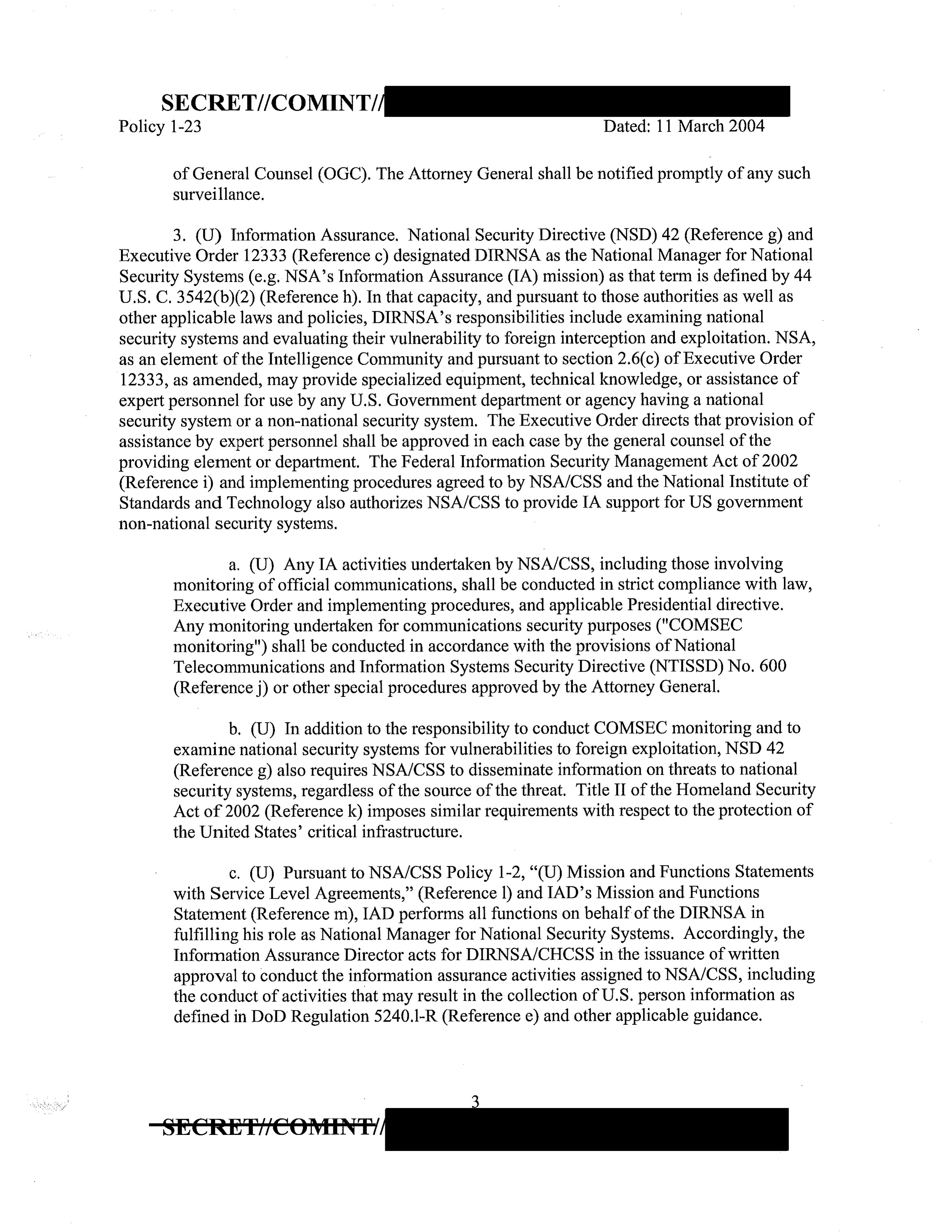
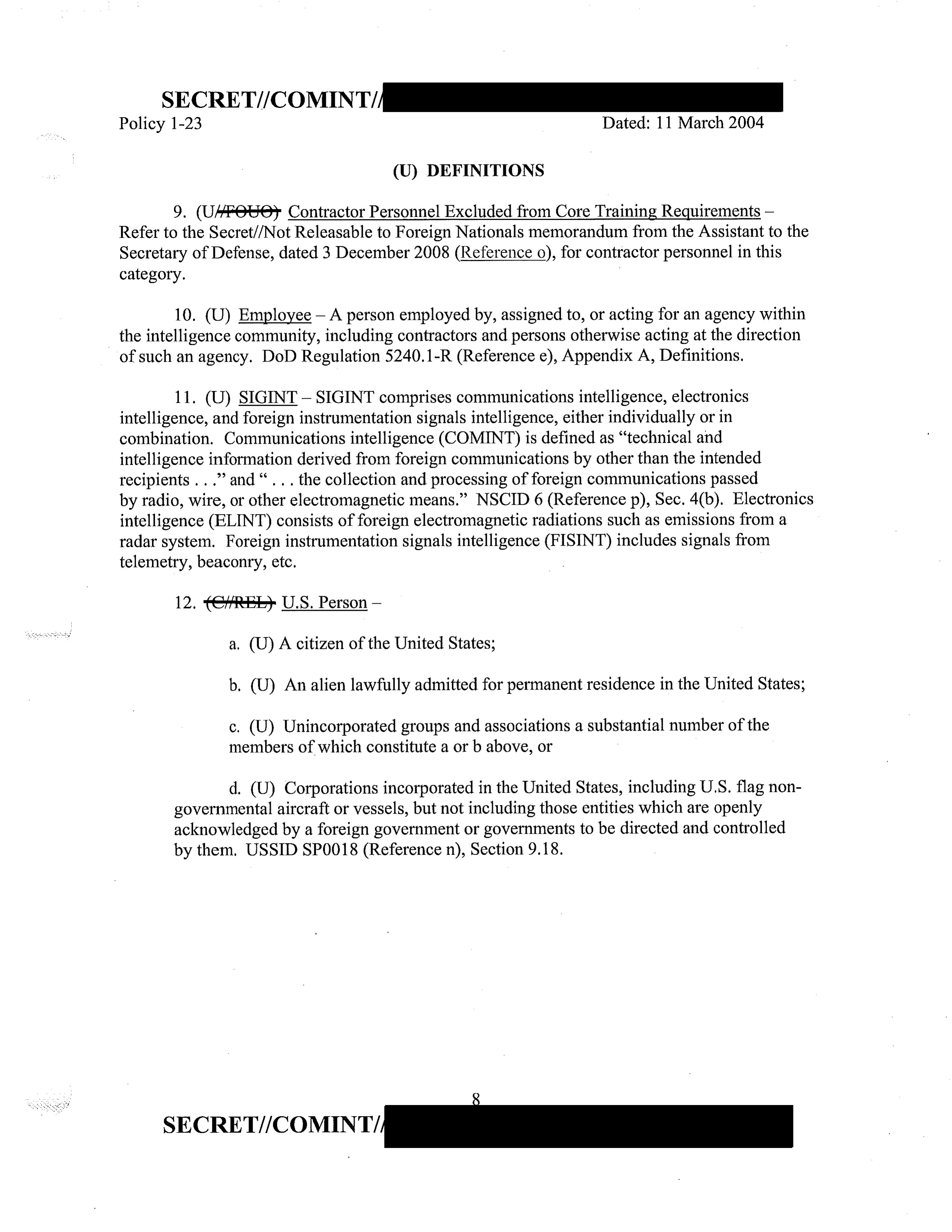
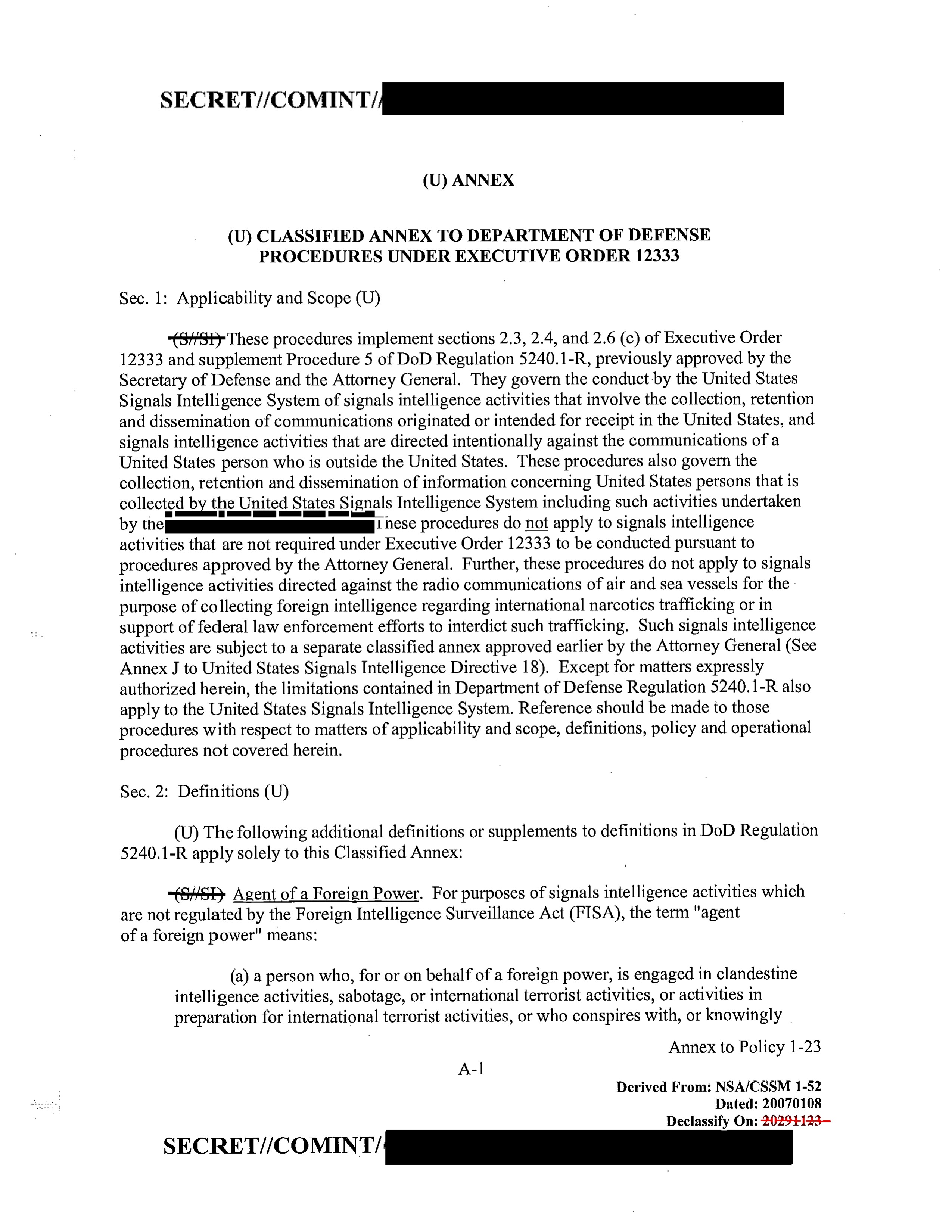
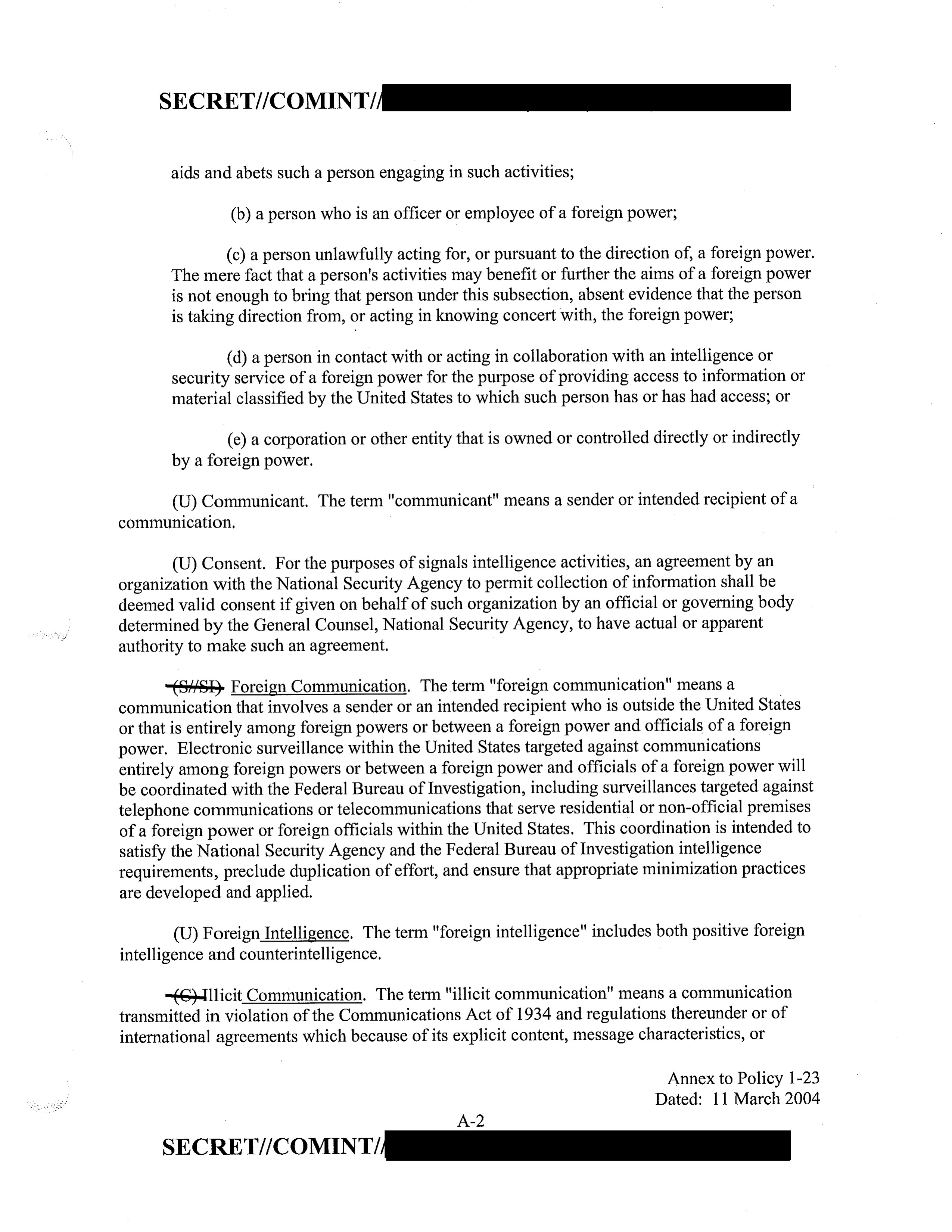
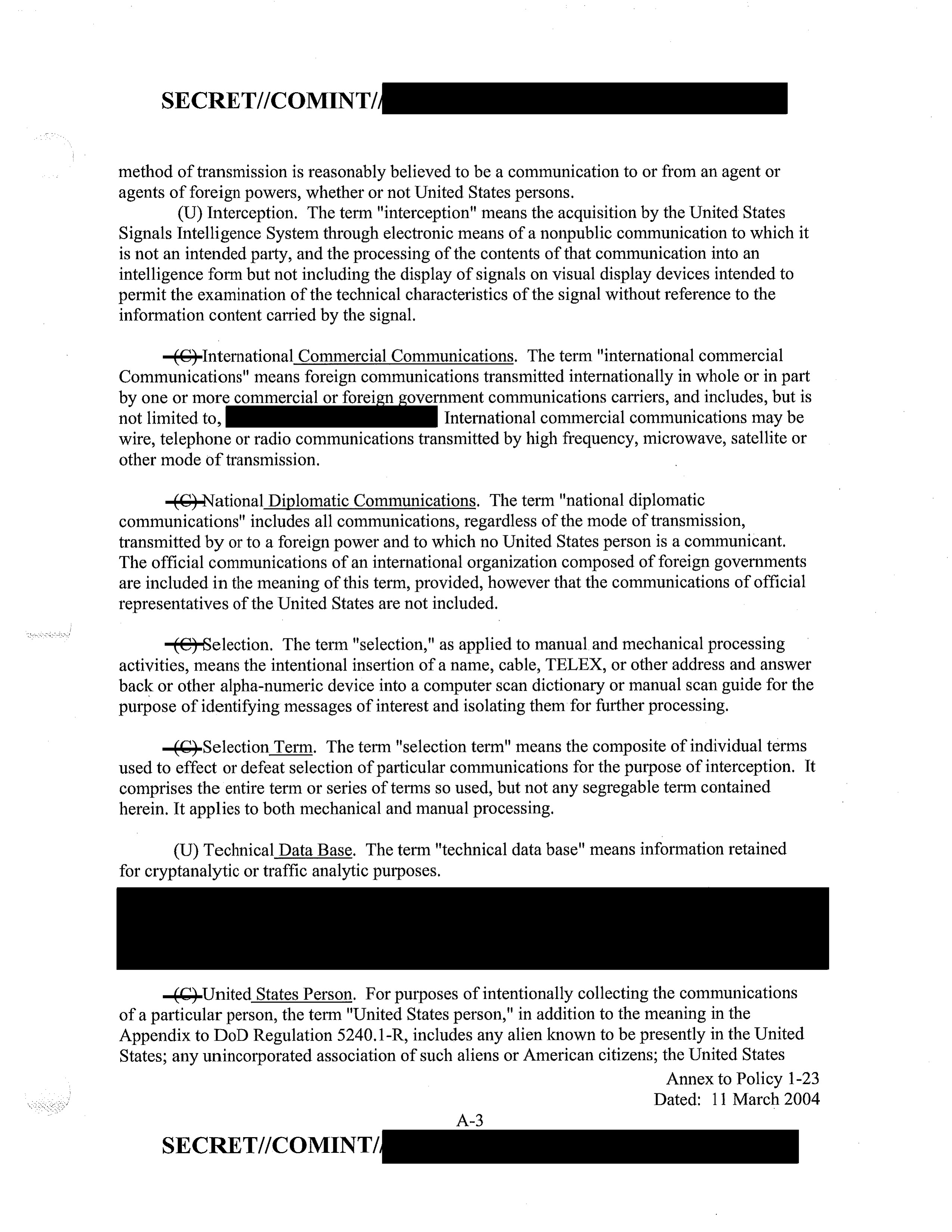
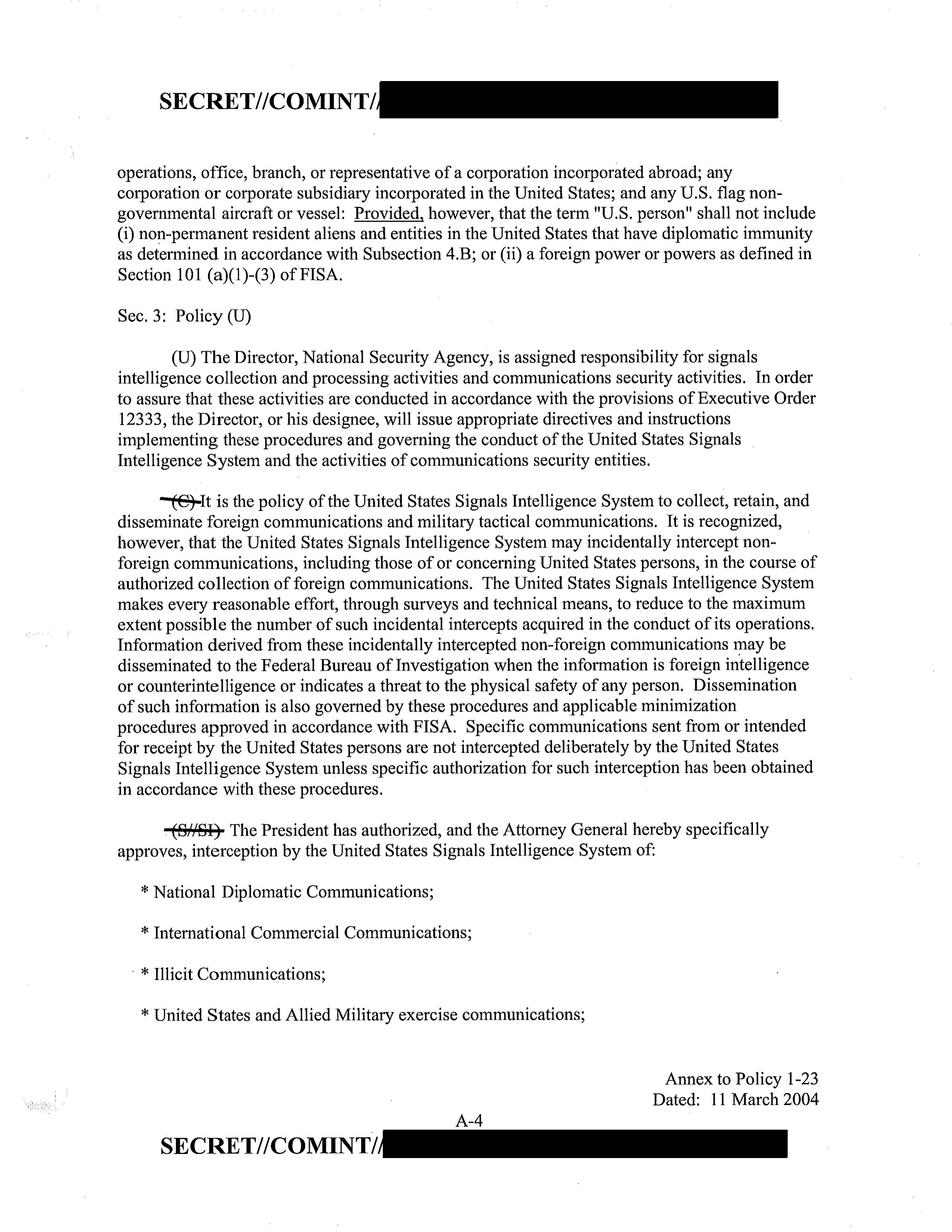
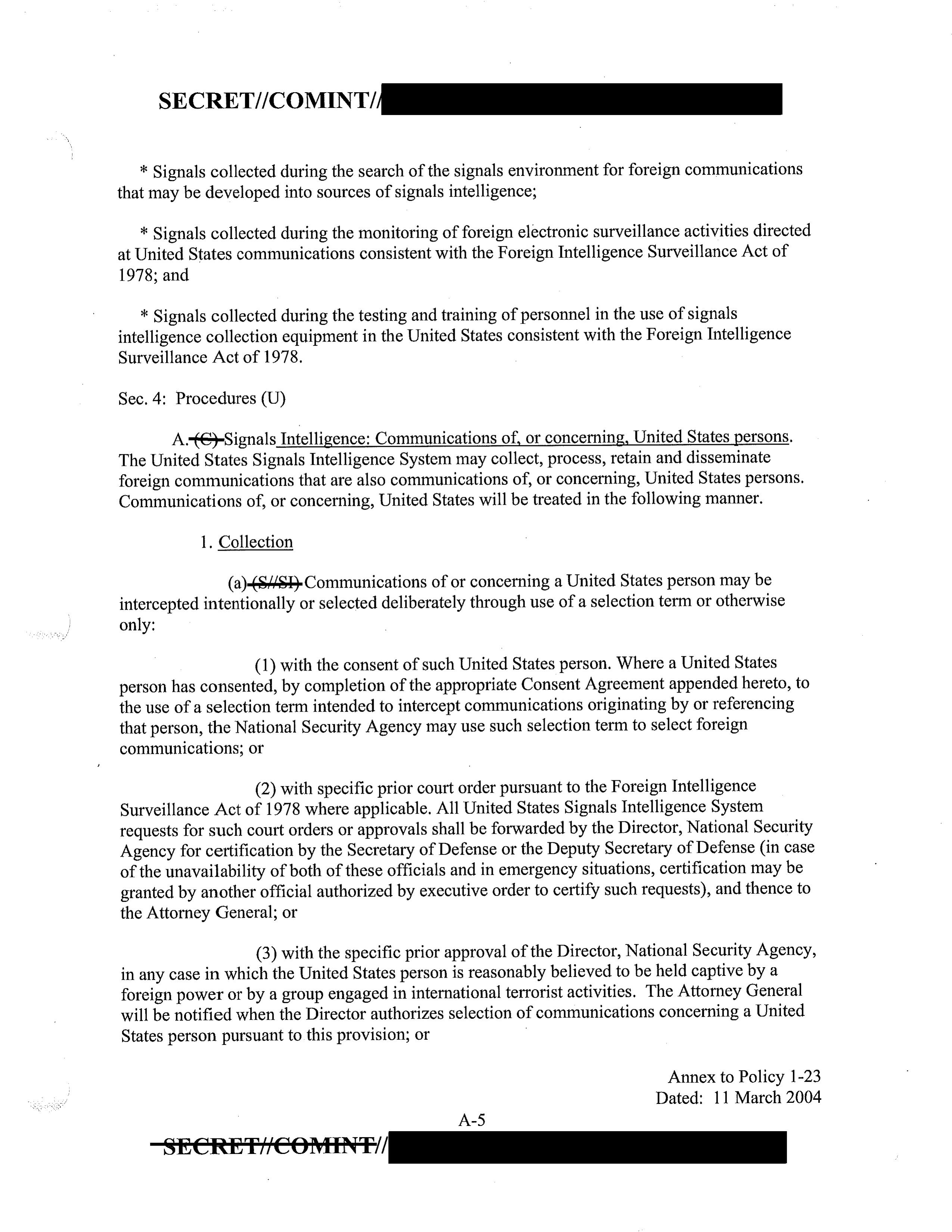
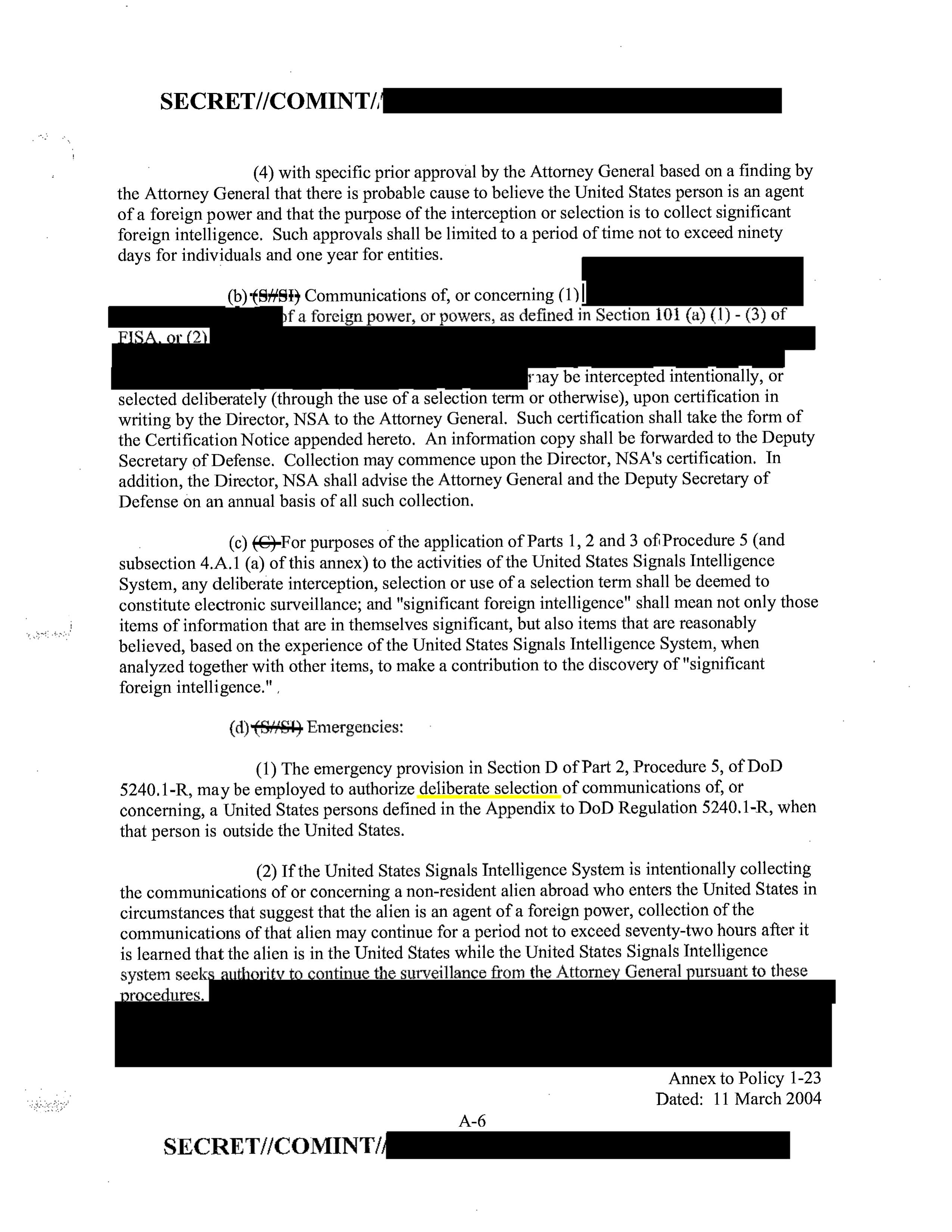
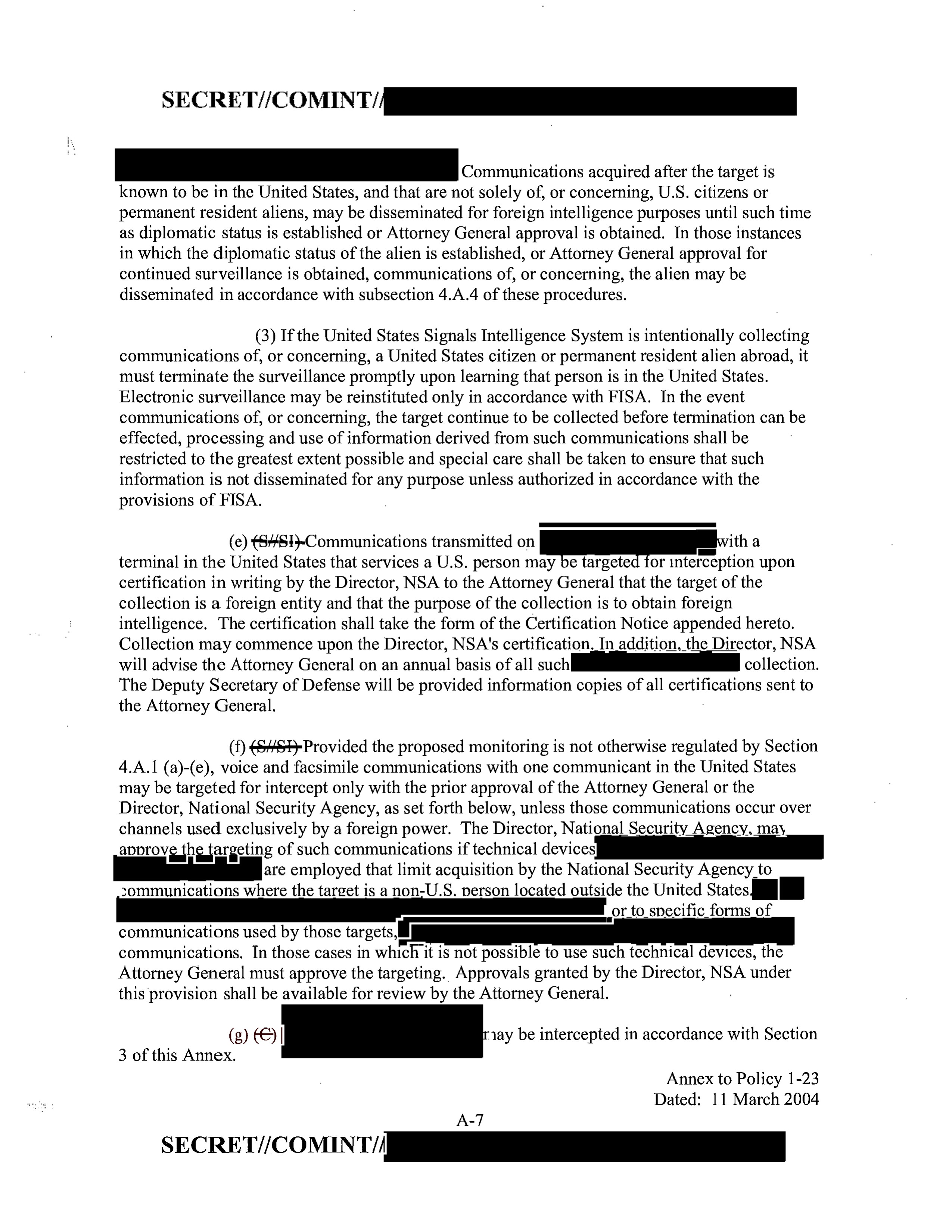
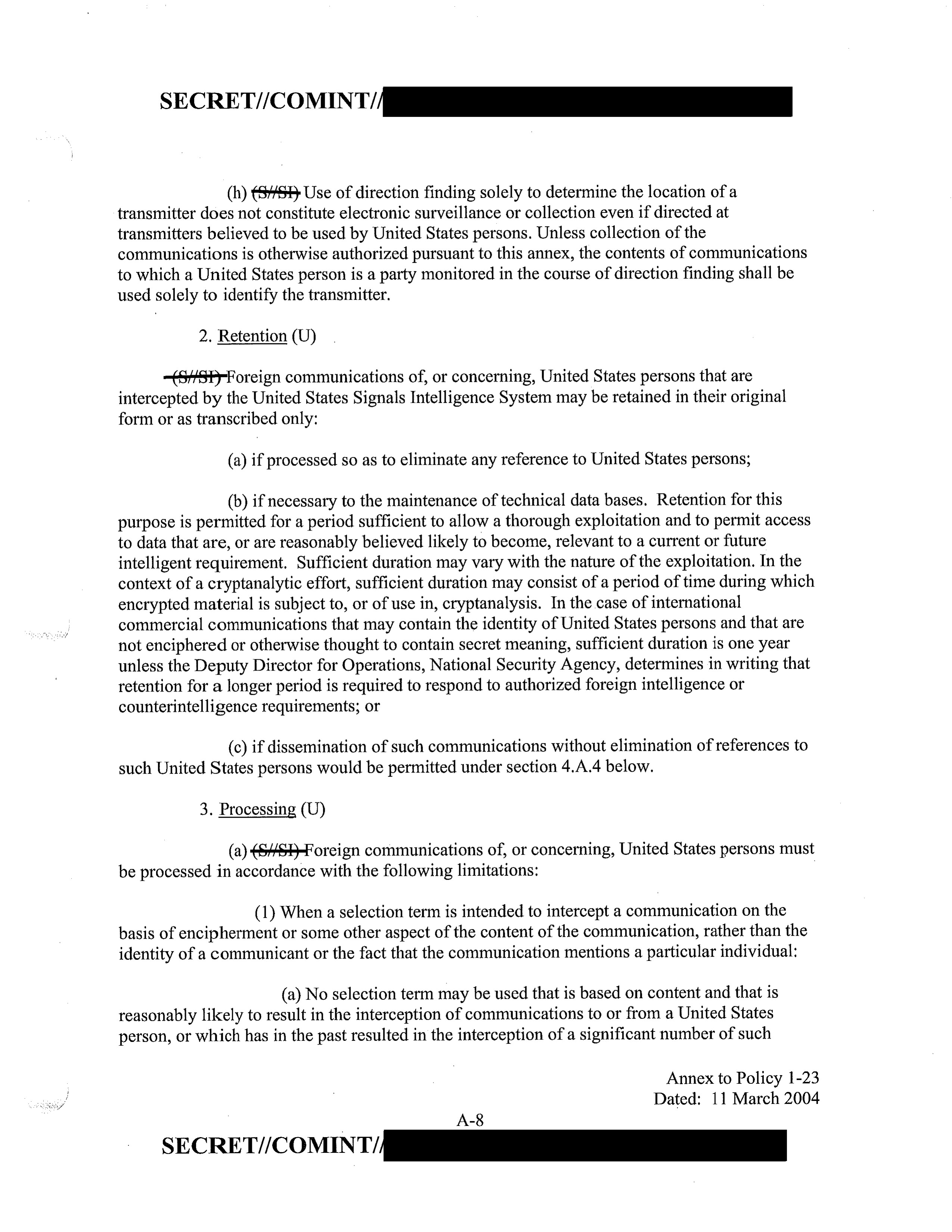
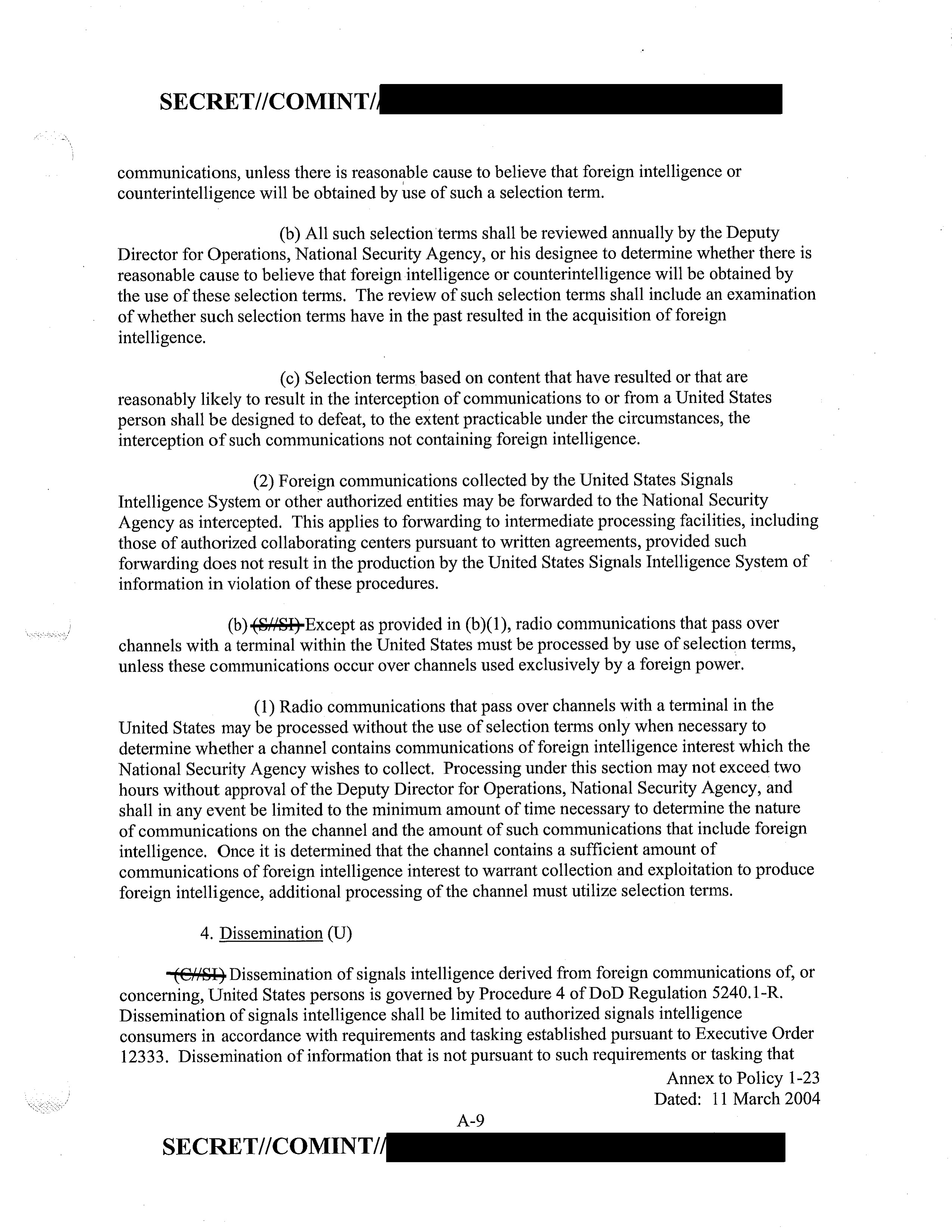
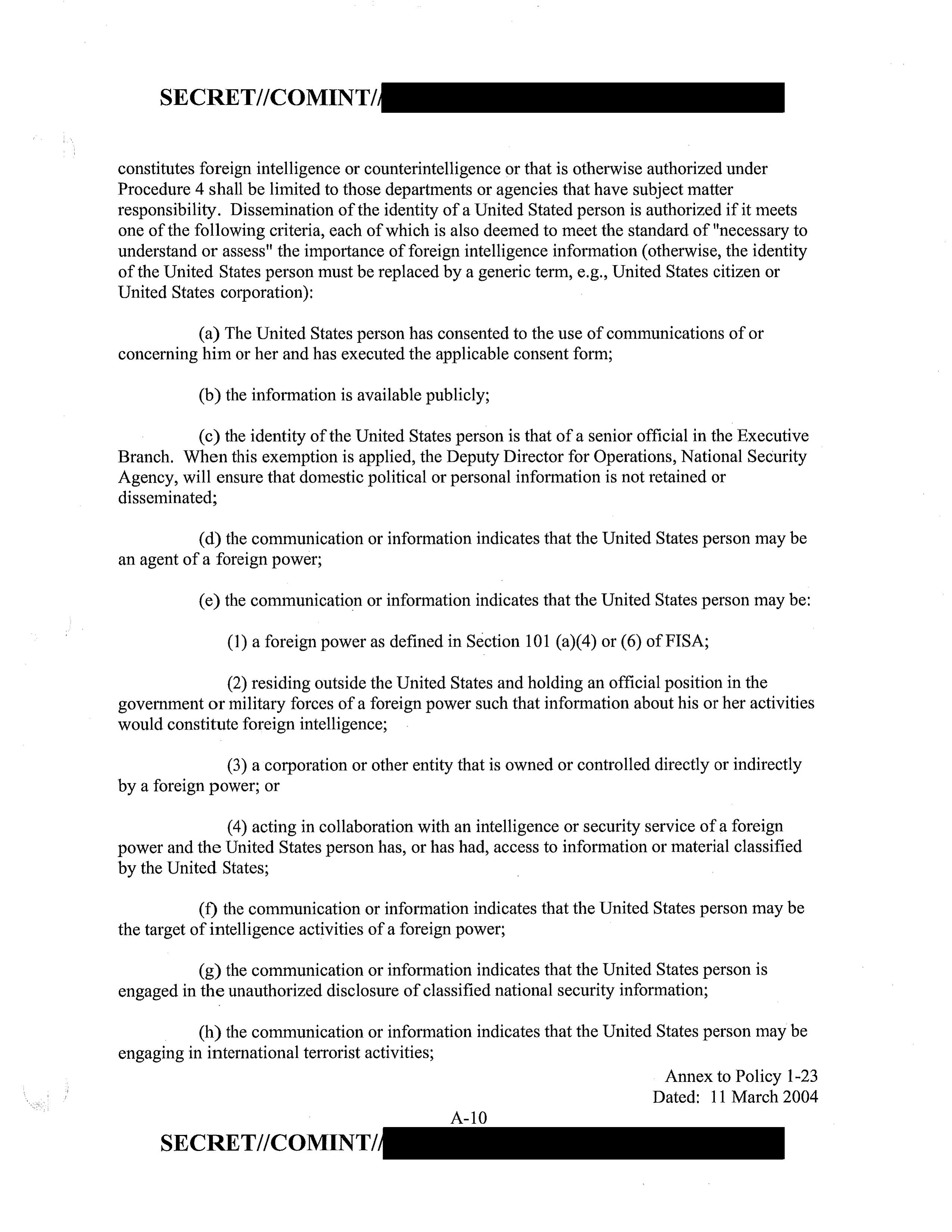
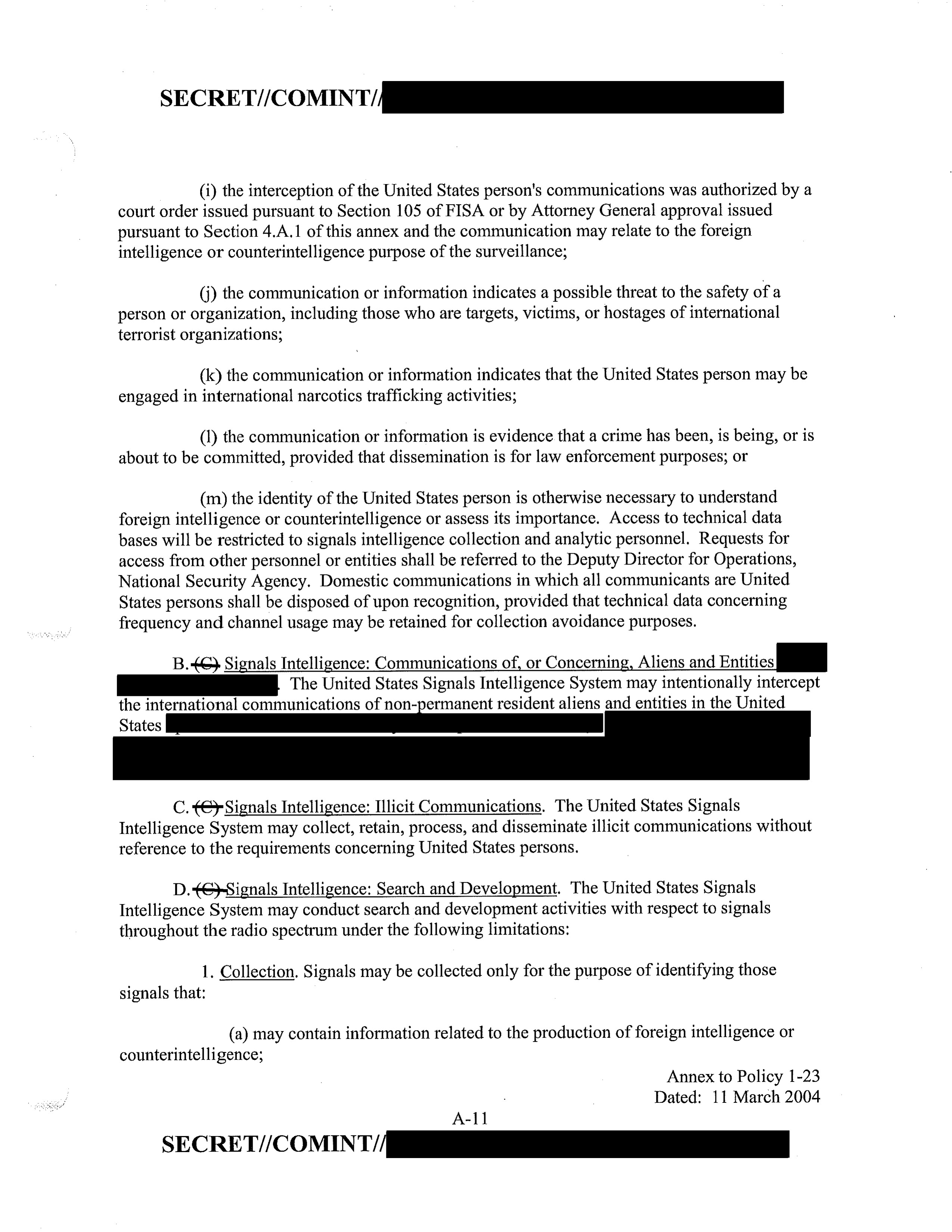
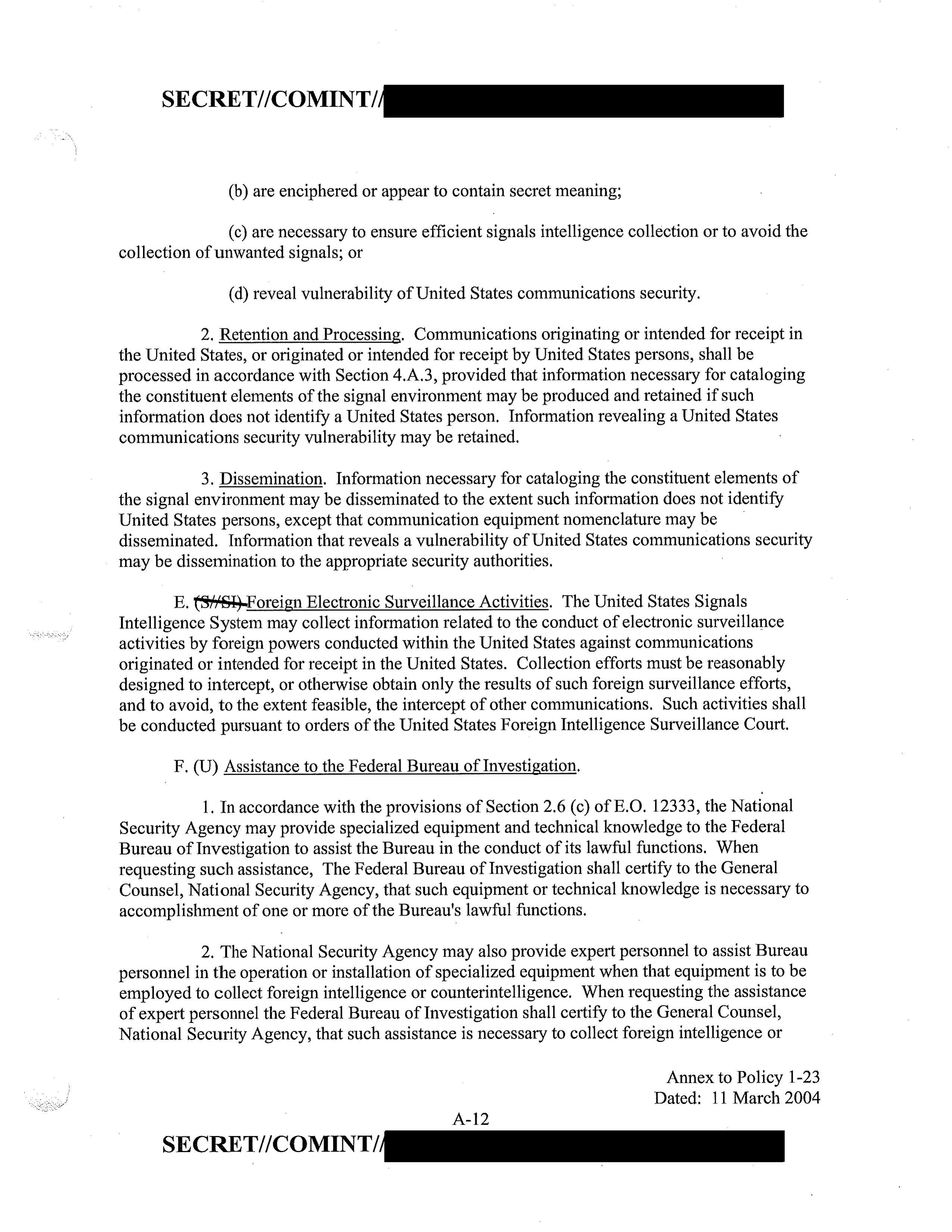
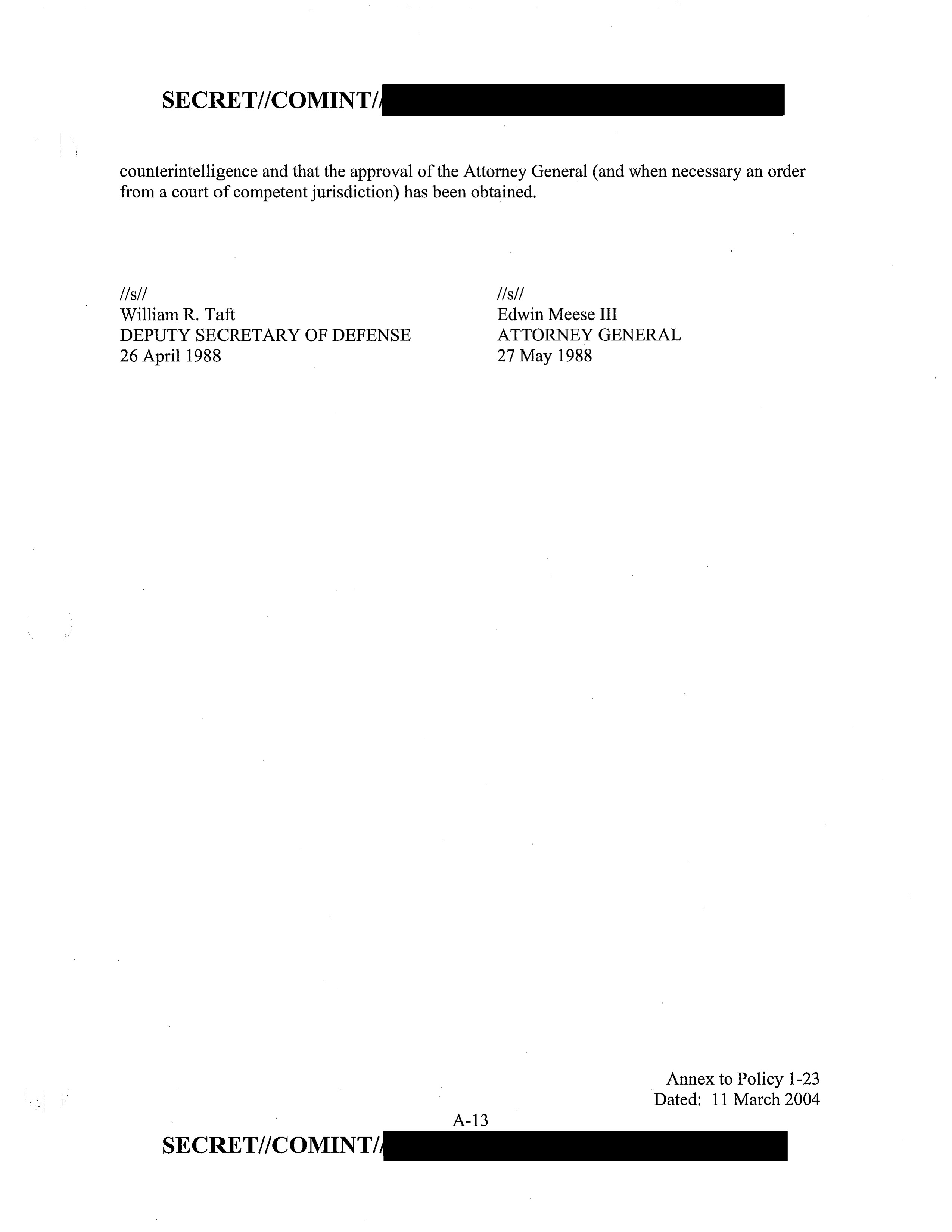
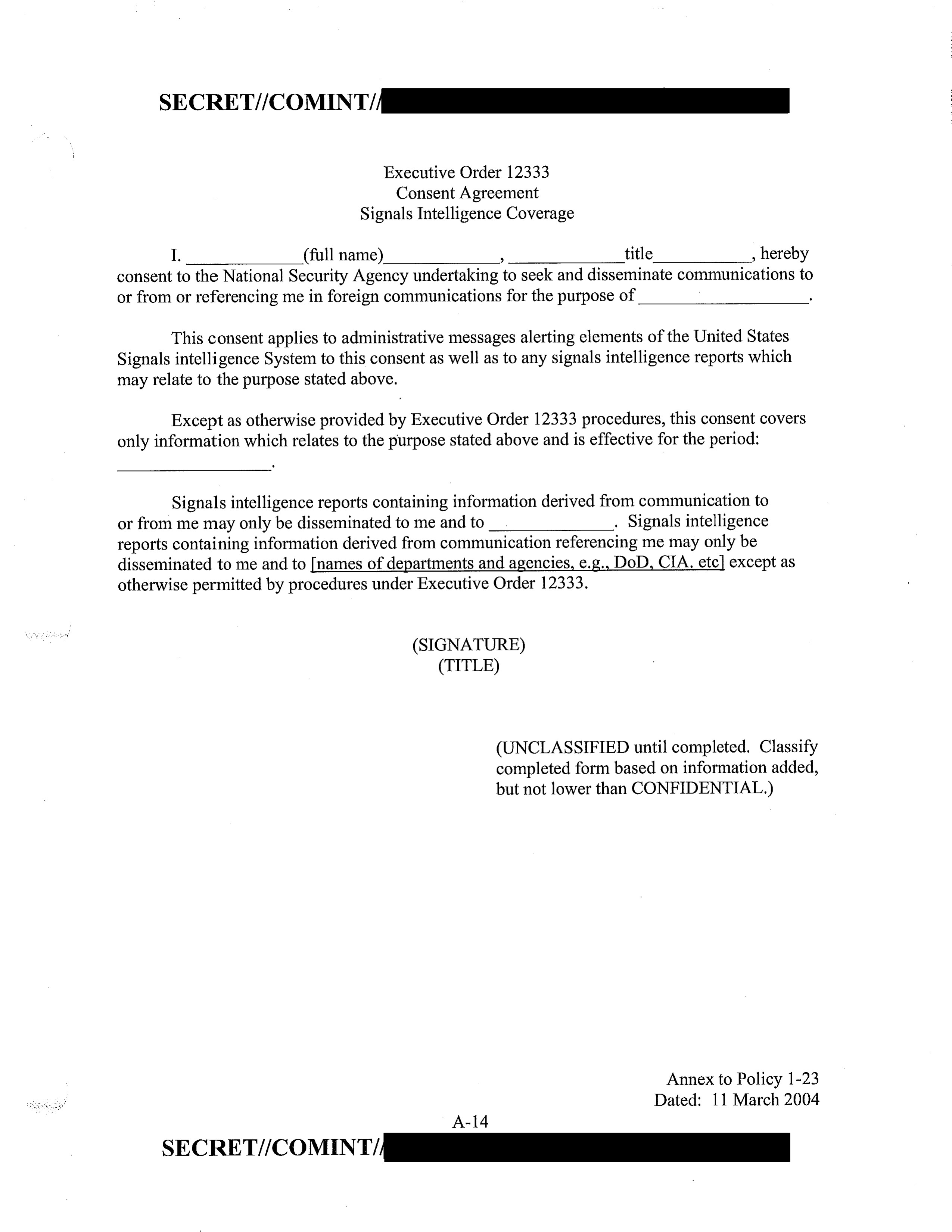
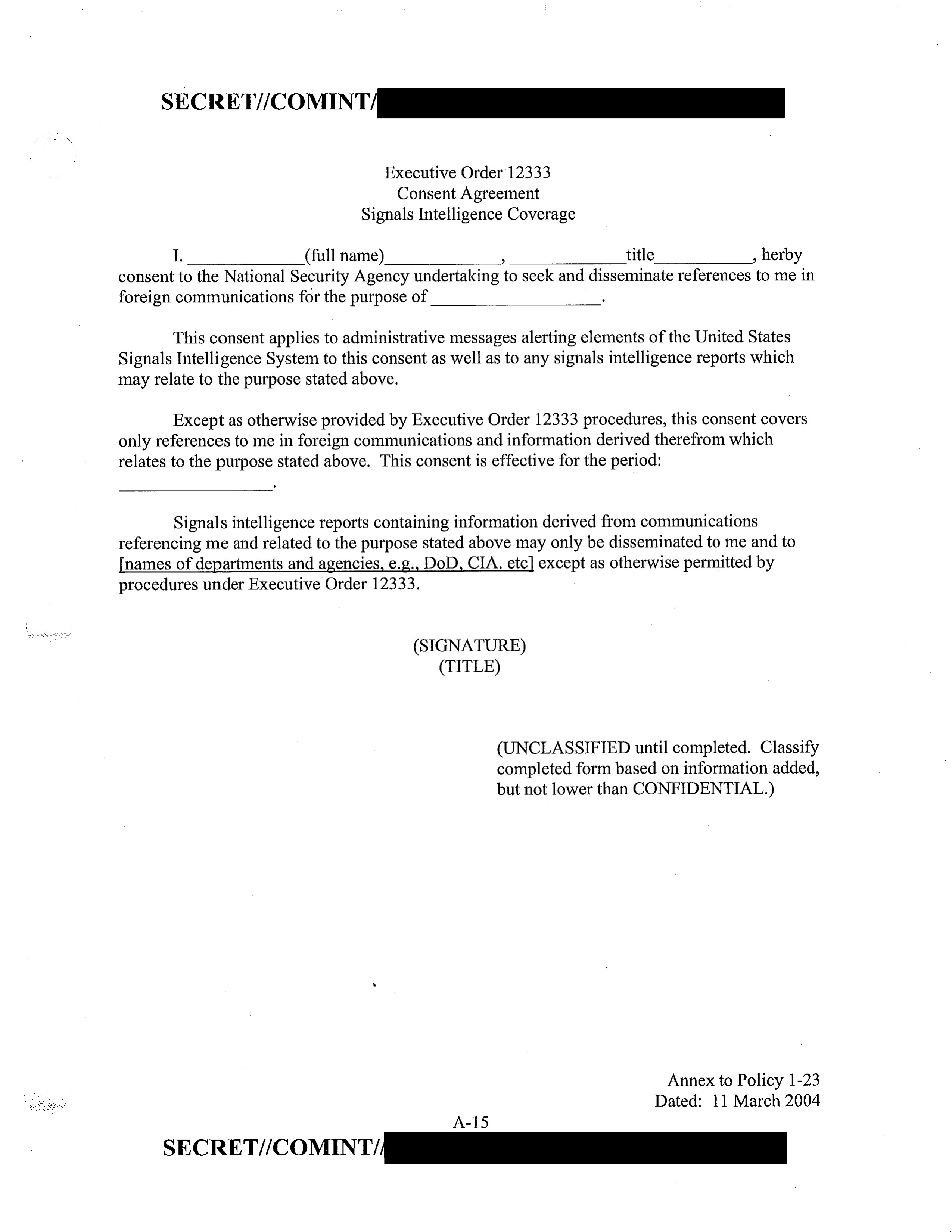

SECRET//COMINT/[REDACTED]
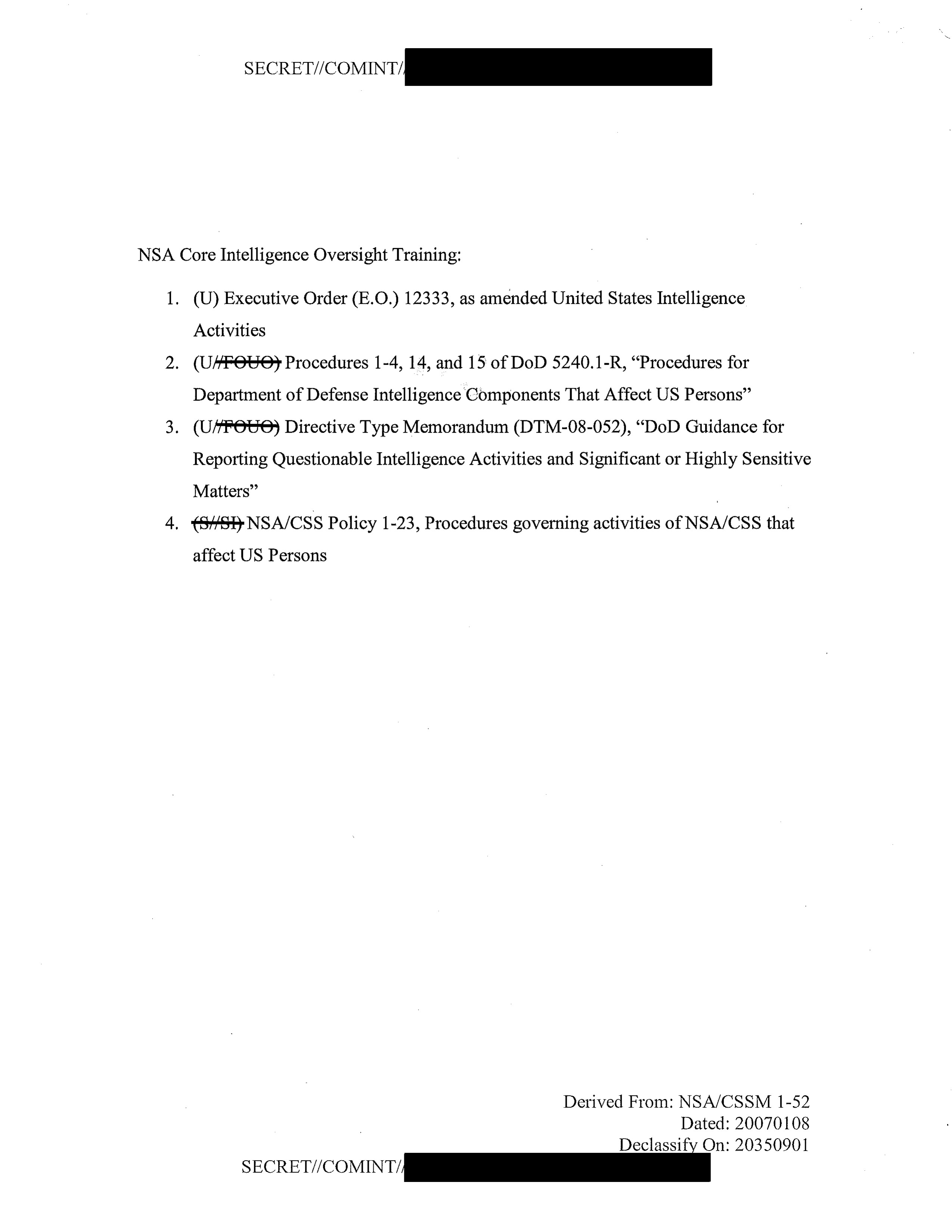
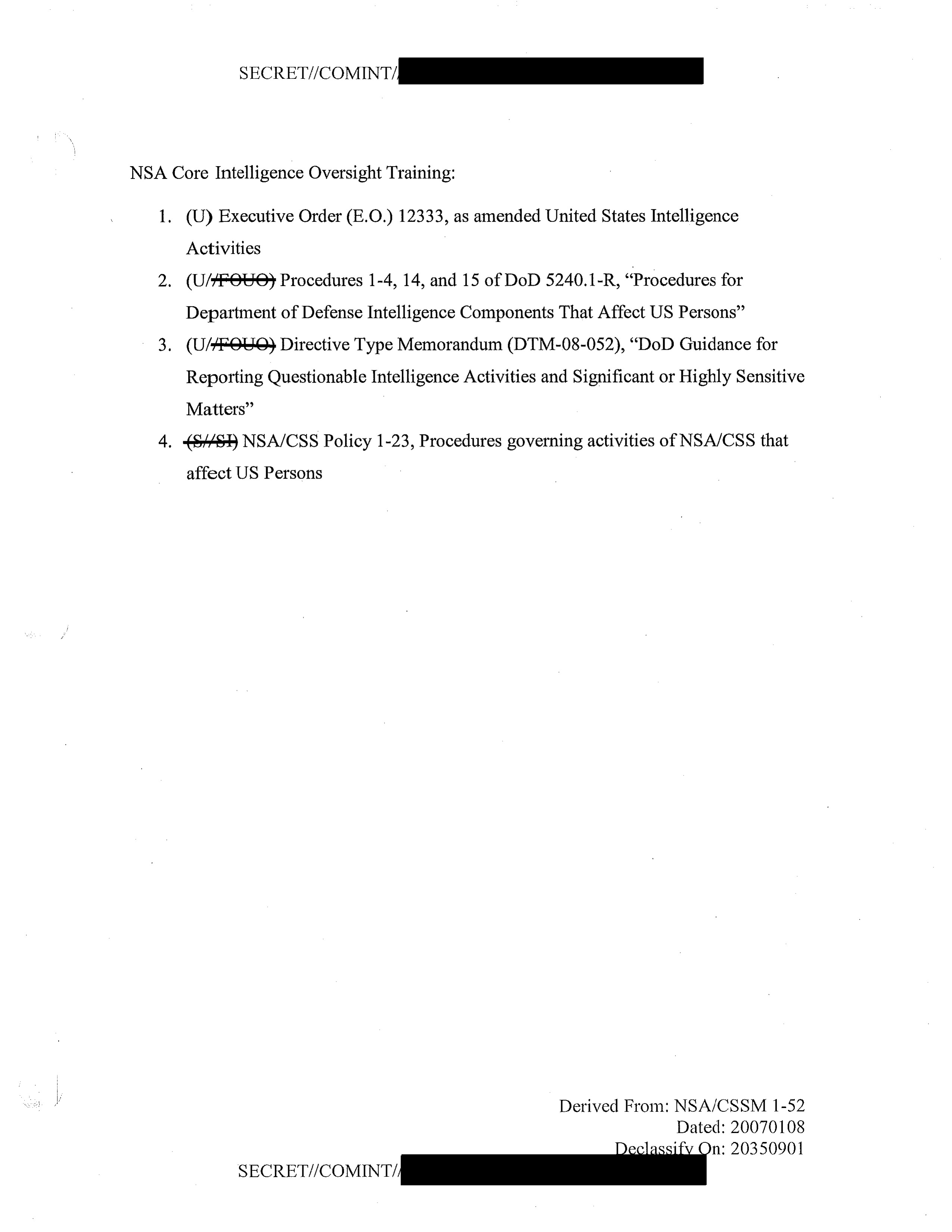
NSA Core Intelligence Oversight Training:
- (U) Executive Order (E.O.) 12333, as amended United States Intelligence
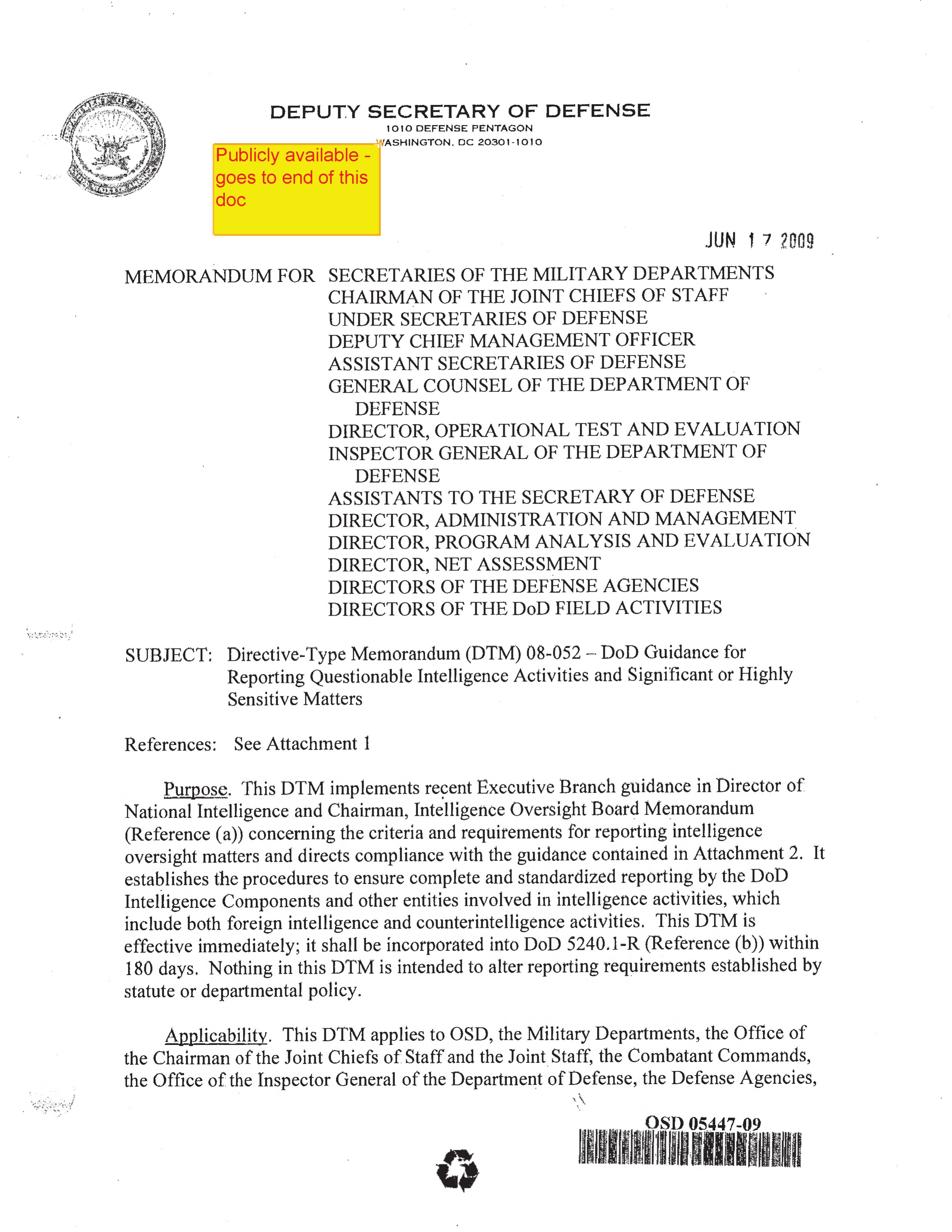
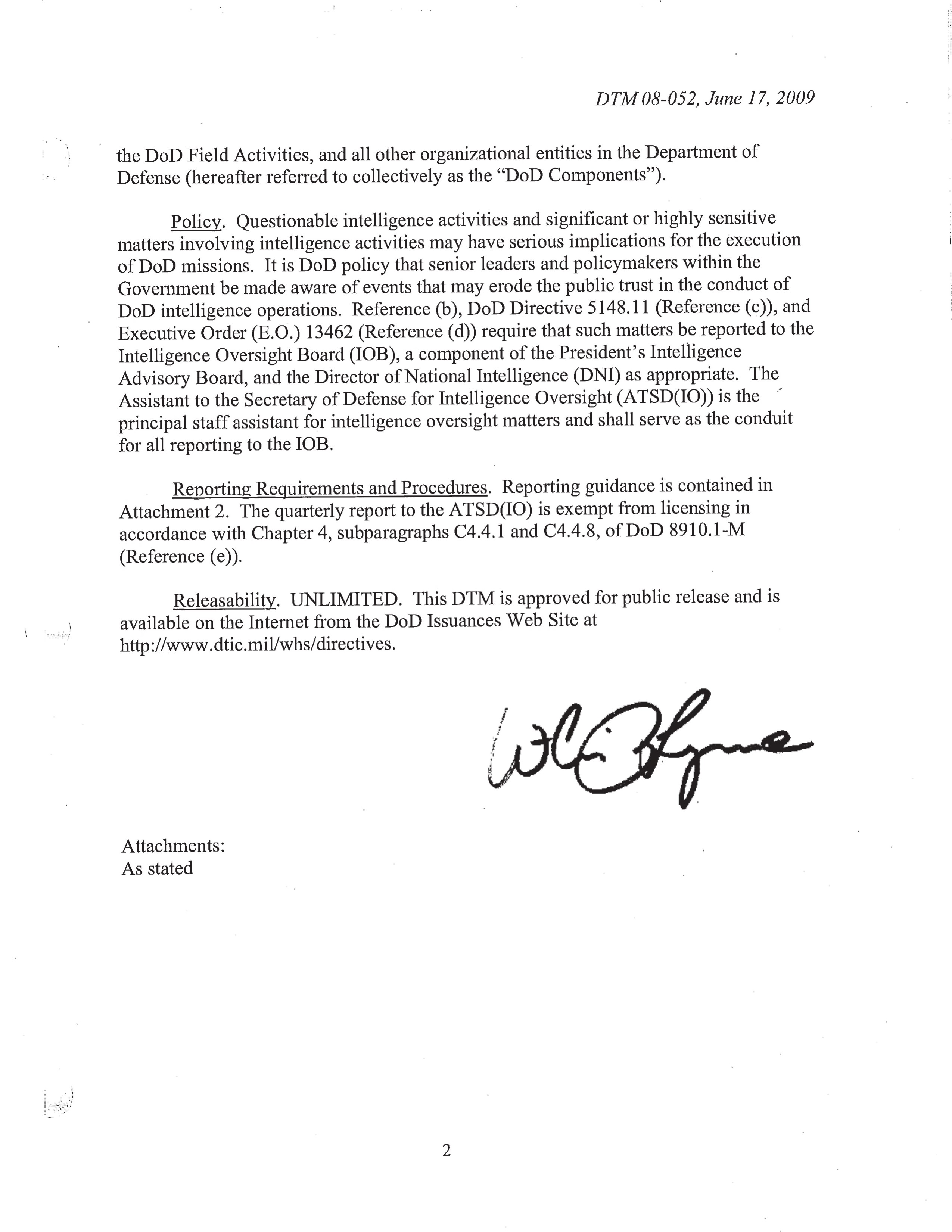
Activities - (U//FOUO) Procedures 1-4, 14, and 15 of DoD 5240.1-R, “Procedures for
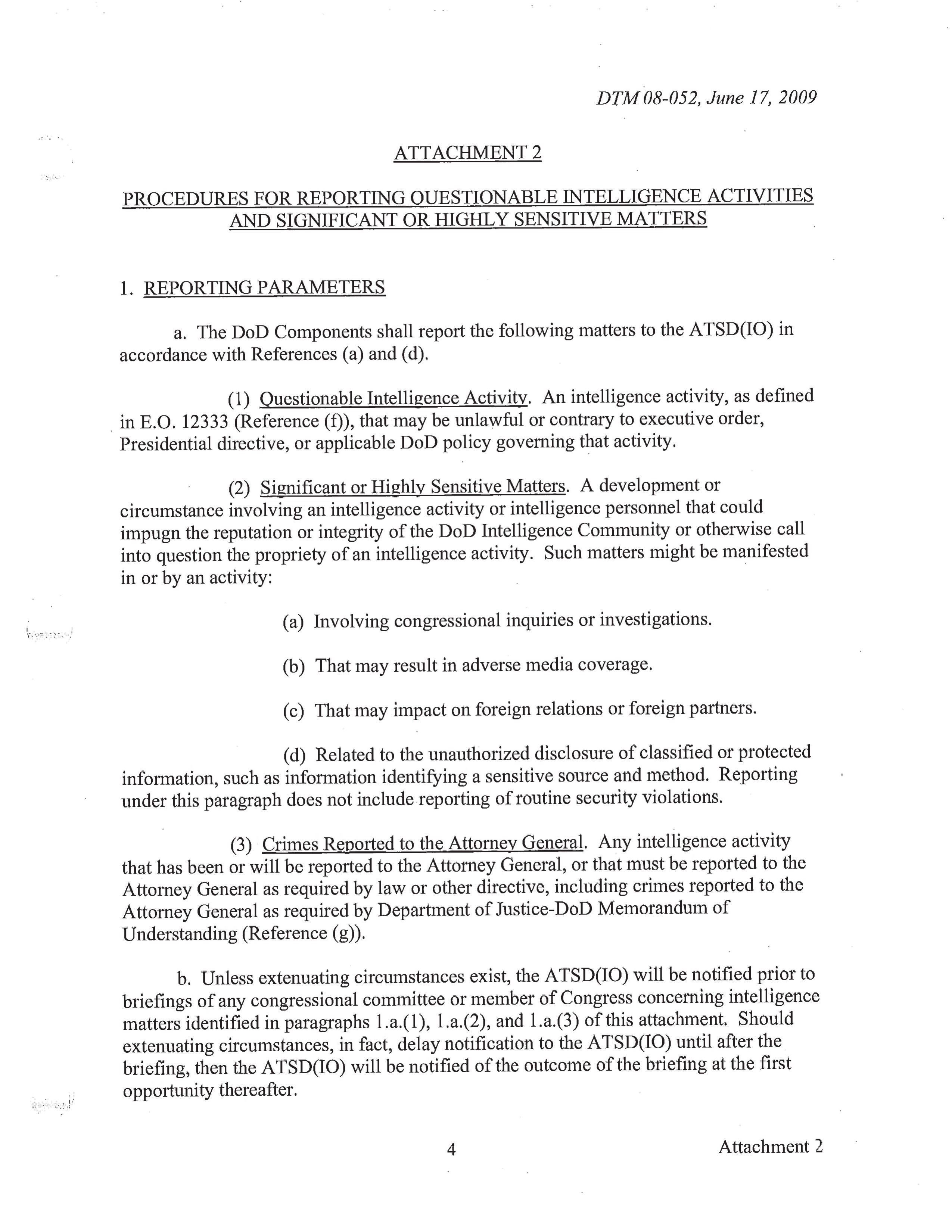
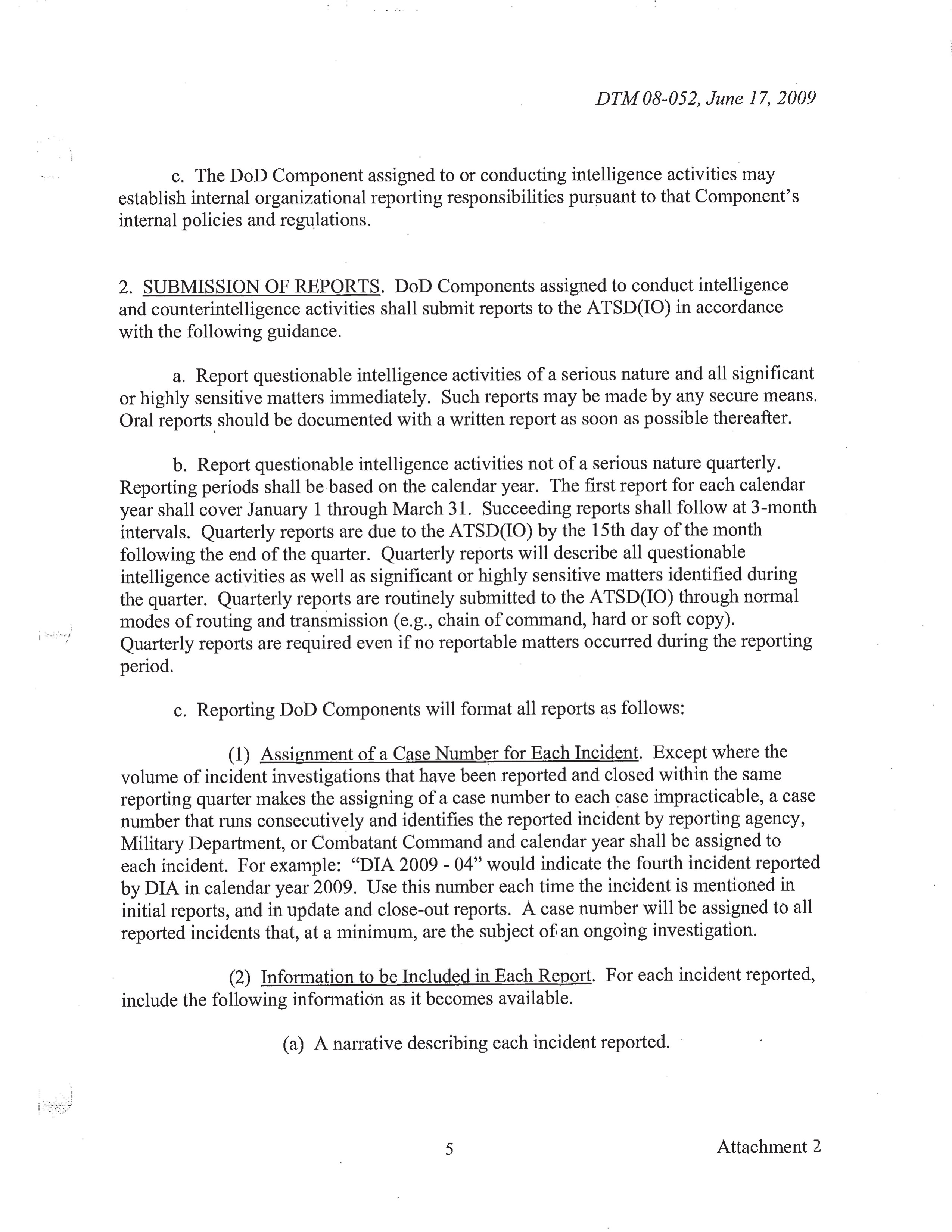
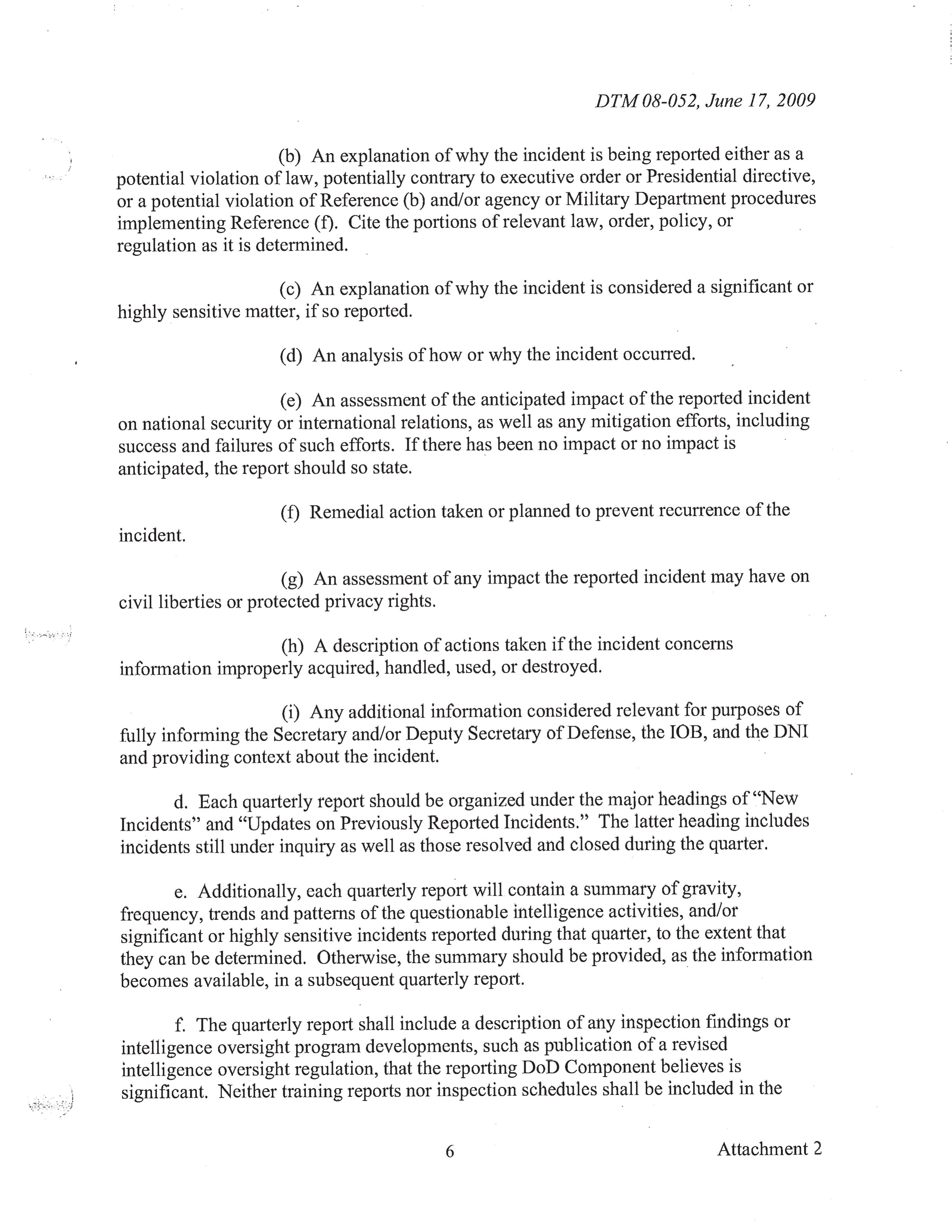
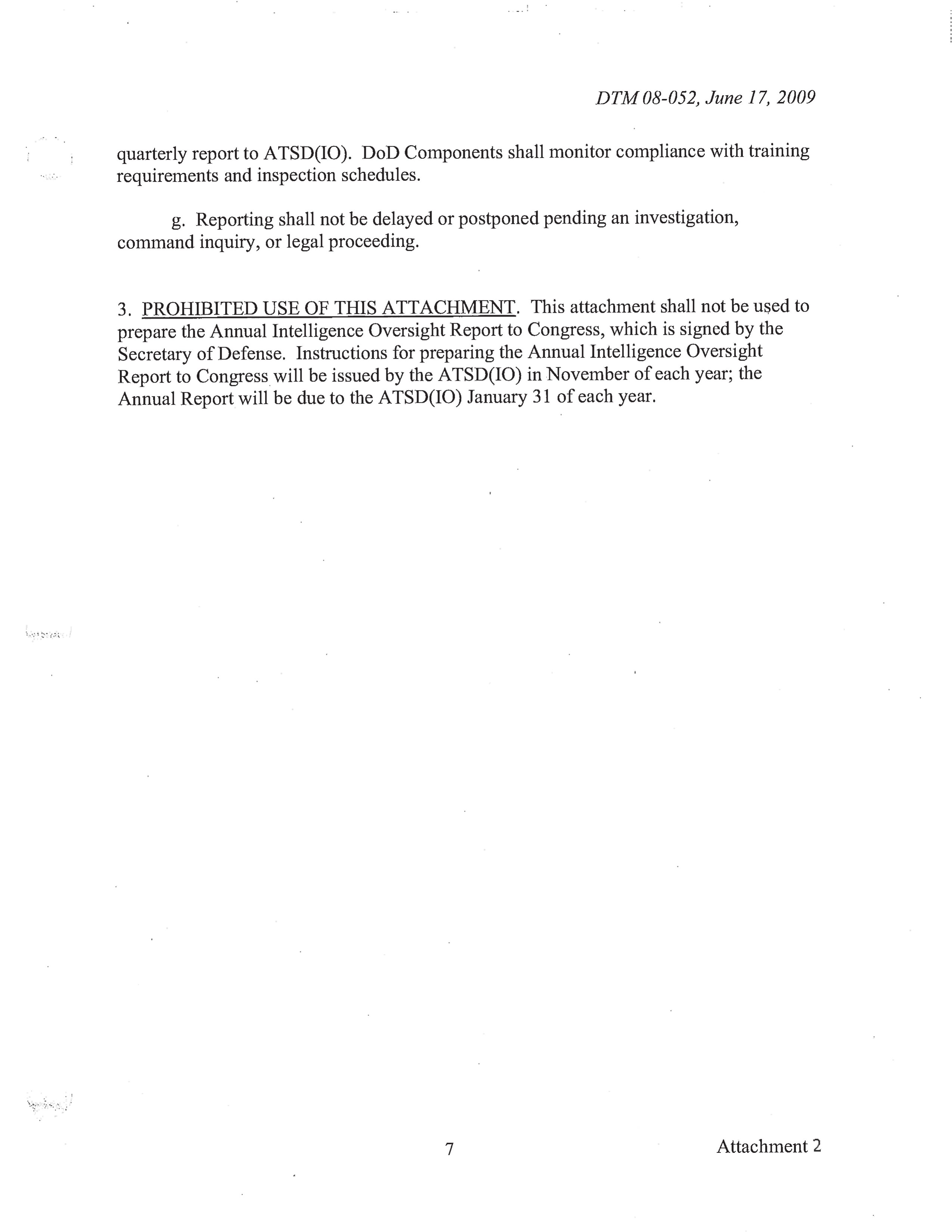
Department of Defense Intelligence Components That Affect US Persons" - (U//FOUO) Directive Type Memorandum (DTM-08-052), "DoD Guidance for
Reporting Questionable Intelligence Activities and Significant or Highly Sensitive
Matters" - (S//SI) NSA/CSS Policy 1-23, Procedures governing activities of NSA/CSS that
affect US Persons
SECRET//COMINT/[REDACTED]
Derived From: NSA/CSSM 1-52
Dated: 20070108
Declassify On: 20350901
SECRET//COMINT/[REDACTED]
NSA Core Intelligence Oversight Training:
- (U) Executive Order (E.O.) 12333, as amended United States Intelligence
Activities - (U//FOUO) Procedures 1-4, 14, and 15 of DoD 5240.1-R, "Procedures for
Department of Defense Intelligence Components That Affect US Persons" - (U//FOUO) Directive Type Memorandum (DTM-08-052), "DoD Guidance for
Reporting Questionable Intelligence Activities and Significant or Highly Sensitive
Matters" - (S//SI) NSA/CSS Policy 1-23, Procedures governing activities of NSA/CSS that
affect US Persons
SECRET//COMINT/[REDACTED]
Derived From: NSA/CSSM 1-52
Dated: 20070108
Declassify On: 20350901
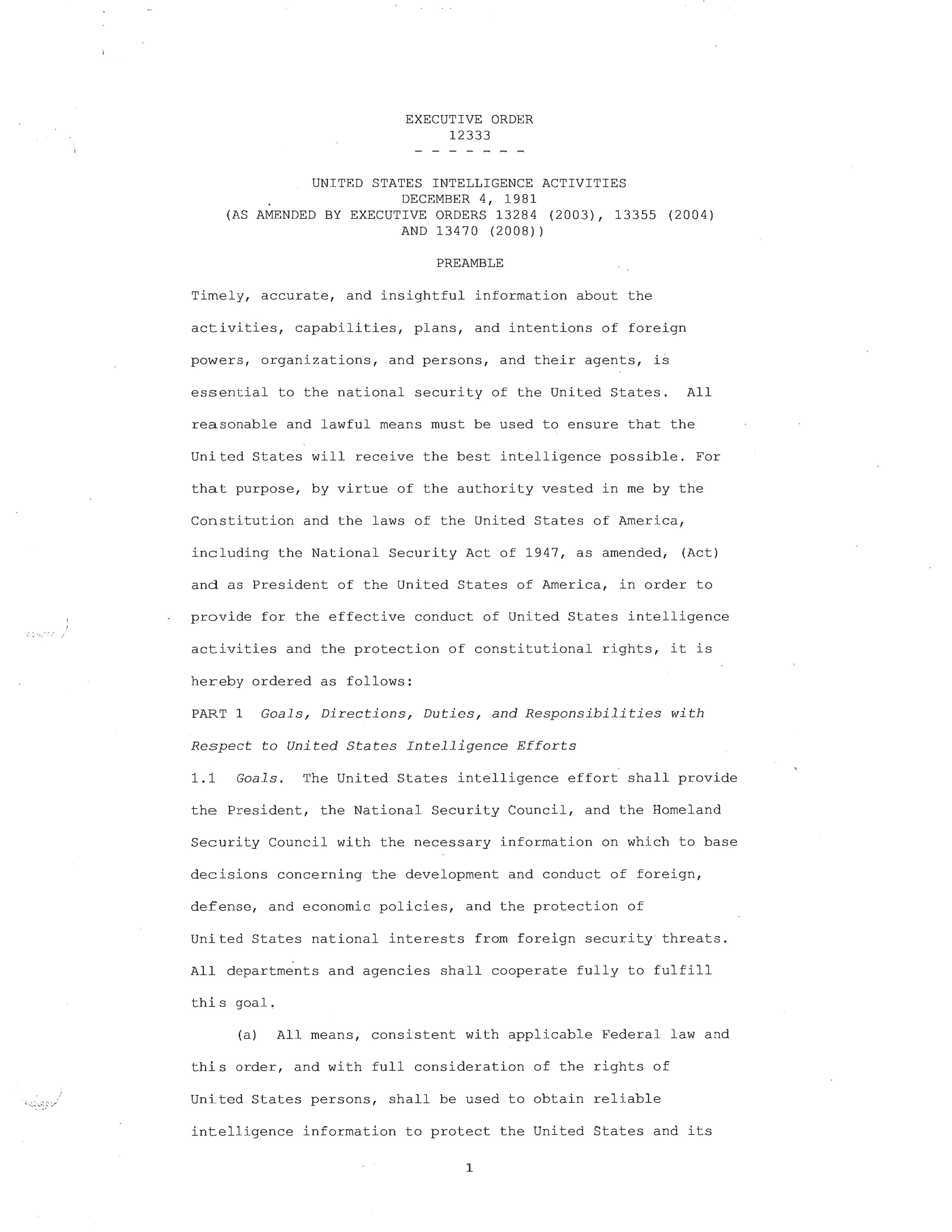
EXECUTIVE ORDER
12333
UNITED STATES INTELLIGENCE ACTIVITIES
DECEMBER 4, 1981
(AS AMENDED BY EXECUTIVE ORDERS 13284 (2003), 13355 (2004)
AND 13470 (2008))
PREAMBLE
Timely, accurate, and insightful information about the
activities, capabilities, plans, and intentions of foreign
powers, organizations, and persons, and their agents, is
essential to the national security of the United States. All
reasonable and lawful means must be used to ensure that the
United States will receive the best intelligence possible. For
that purpose, by virtue of the authority vested in me by the
Constitution and the laws of the United States of America,
including the National Security Act of 1947, as amended, (Act)
and as President of the United States of America, in order to
provide for the effective conduct of United States intelligence
activities and the protection of constitutional rights, it is
hereby ordered as follows:
PART 1 Goals, Directions, Duties, and Responsibilities with
Respect to United States Intelligence Efforts
1.1 Goals. The United States intelligence effort shall provide
the President, the National Security Council, and the Homeland
Security Council with the necessary information on which to base
decisions concerning the development and conduct of foreign,
defense, and economic policies, and the protection of
United States national interests from foreign security threats.
All departments and agencies shall cooperate fully to fulfill
this goal.
(a) All means, consistent with applicable Federal law and
this order, and with full consideration of the rights of
United States persons, shall be used to obtain reliable
intelligence information to protect the United States and its
1
interests.
(b) The United States Government has a solemn obligation,
and shall continue in the conduct of intelligence activities
under this order, to protect fully the legal rights of all
United States persons, including freedoms, civil liberties, and
privacy rights guaranteed by Federal law.
(c) Intelligence collection under this order should be
guided by the need for information to respond to intelligence
priorities set by the President.
(d) Special emphasis should be given to detecting and
countering:
(1) Espionage and other threats and activities
directed by foreign powers or their intelligence
services against the United States and its interests;
(2) Threats to the United States and its interests
from terrorism; and
(3) Threats to the United States and its interests
from the development, possession, proliferation, or
use of weapons of mass destruction.
(e) Special emphasis shall be given to the production
of timely, accurate, and insightful reports, responsive to
decisionmakers in the executive branch, that draw on all
appropriate sources of information, including open source
information, meet rigorous analytic standards, consider
diverse analytic viewpoints, and accurately represent
appropriate alternative views.
(f) State, local, and tribal governments are critical
partners in securing and defending the United States from
terrorism and other threats to the United States and its
interests. Our national intelligence effort should take into
account the responsibilities and requirements of State, local,
and tribal governments and, as appropriate, private sector
2
entities, when undertaking the collection and dissemination of
information and intelligence to protect the United States.
(g) All departments and agencies have a responsibility
to prepare and to provide intelligence in a manner that allows
the full and free exchange of information, consistent with
applicable law and presidential guidance.
1.2 The National Security Council.
(a) Purpose. The National Security Council (NSC)
shall act as the highest ranking executive branch entity that
provides support to the President for review of, guidance
for, and direction to the conduct of all foreign intelligence,
counterintelligence, and covert action, and attendant policies
and programs.
(b) Covert Action and Other Sensitive Intelligence
Operations. The NSC shall consider and submit to the President
a policy recommendation, including all dissents, on each
proposed covert action and conduct a periodic review of ongoing
covert action activities, including an evaluation of the
effectiveness and consistency with current national policy
of such activities and consistency with applicable legal
requirements. The NSC shall perform such other functions
related to covert action as the President may direct, but shall
not undertake the conduct of covert actions. The NSC shall also
review proposals for other sensitive intelligence operations.
1.3 Director of National Intelligence. Subject to the
authority, direction, and control of the President, the Director
of National Intelligence (Director) shall serve as the head of
the Intelligence Community, act as the principal adviser to the
President, to the NSC, and to the Homeland Security Council
for intelligence matters related to national security, and
shall oversee and direct the implementation of the National
Intelligence Program and execution of the National Intelligence
3
Program budget. The Director will lead a unified, coordinated,
and effective intelligence effort. In addition, the Director
shall, in carrying out the duties and responsibilities under
this section, take into account the views of the heads of
departments containing an element of the Intelligence Community
and of the Director of the Central Intelligence Agency.
(a) Except as otherwise directed by the President or
prohibited by law, the Director shall have access to all
information and intelligence described in section 1.5(a) of this
order. For the purpose of access to and sharing of information
and intelligence, the Director:
(1) Is hereby assigned the function under
section 3(5) of the Act, to determine that intelligence,
regardless of the source from which derived and including
information gathered within or outside the United States,
pertains to more than one United States Government agency; and
(2) Shall develop guidelines for how information
or intelligence is provided to or accessed by the Intelligence
Community in accordance with section 1.5(a) of this order, and
for how the information or intelligence may be used and shared
by the Intelligence Community. All guidelines developed in
accordance with this section shall be approved by the Attorney
General and, where applicable, shall be consistent with
guidelines issued pursuant to section 1016 of the Intelligence
Reform and Terrorism Protection Act of 2004 (Public Law 108-458)
(IRTPA).
(b) In addition to fulfilling the obligations and
responsibilities prescribed by the Act, the Director:
(1) Shall establish objectives, priorities, and
guidance for the Intelligence Community to ensure timely and
effective collection, processing, analysis, and dissemination of
intelligence, of whatever nature and from whatever source
4
derived;
(2) May designate, in consultation with affected
heads of departments or Intelligence Community elements, one or
more Intelligence Community elements to develop and to maintain
services of common concern on behalf of the Intelligence
Community if the Director determines such services can be more
efficiently or effectively accomplished in a consolidated
manner;
(3) Shall oversee and provide advice to the
President and the NSC with respect to all ongoing and proposed
covert action programs;
(4) In regard to the establishment and conduct of
intelligence arrangements and agreements with foreign
governments and international organizations:
(A) May enter into intelligence and
counterintelligence arrangements and agreements with foreign
governments and international organizations;
(B) Shall formulate policies concerning
intelligence and counterintelligence arrangements and agreements
with foreign governments and international organizations; and
(C) Shall align and synchronize intelligence and
counterintelligence foreign relationships among the elements of
the Intelligence Community to further United States national
security, policy, and intelligence objectives;
(5) Shall participate in the development of
procedures approved by the Attorney General governing criminal
drug intelligence activities abroad to ensure that these
activities are consistent with foreign intelligence programs;
(6) Shall establish common security and access
standards for managing and handling intelligence systems,
information, and products, with special emphasis on
facilitating:
5
(A) The fullest and most prompt access to and
dissemination of information and intelligence practicable,
assigning the highest priority to detecting, preventing,
preempting, and disrupting terrorist threats and activities
against the United States, its interests, and allies; and
(B) The establishment of standards for an
interoperable information sharing enterprise that facilitates
the sharing of intelligence information among elements of the
Intelligence Community;
(7) Shall ensure that appropriate departments and
agencies have access to intelligence and receive the support
needed to perform independent analysis;
(8) Shall protect, and ensure that programs are
developed to protect, intelligence sources, methods, and
activities from unauthorized disclosure;
(9) Shall, after consultation with the heads of
affected departments and agencies, establish guidelines for
Intelligence Community elements for:
(A) Classification and declassification of all
intelligence and intelligence-related information classified
under the authority of the Director or the authority of the head
of a department or Intelligence Community element; and
(B) Access to and dissemination of all
intelligence and intelligence-related information, both in its
final form and in the form when initially gathered, to include
intelligence originally classified by the head of a department
or Intelligence Community element, except that access to and
dissemination of information concerning United States persons
shall be governed by procedures developed in accordance with
Part 2 of this order;
(10) May, only with respect to Intelligence
Community elements, and after consultation with the head of the
6
originating Intelligence Community element or the head of the
originating department, declassify, or direct the
declassification of, information or intelligence relating to
intelligence sources, methods, and activities. The Director may
only delegate this authority to the Principal Deputy Director of
National Intelligence;
(11) May establish, operate, and direct one or more
national intelligence centers to address intelligence
priorities;
(12) May establish Functional Managers and Mission
Managers, and designate officers or employees of the
United States to serve in these positions.
(A) Functional Managers shall report to the
Director concerning the execution of their duties as Functional
Managers, and may be charged with developing and implementing
strategic guidance, policies, and procedures for activities
related to a specific intelligence discipline or set of
intelligence activities; set training and tradecraft standards;
and ensure coordination within and across intelligence
disciplines and Intelligence Community elements and with related
non-intelligence activities. Functional Managers may also
advise the Director on: the management of resources; policies
and procedures; collection capabilities and gaps; processing and
dissemination of intelligence; technical architectures; and
other issues or activities determined by the Director.
(i) The Director of the National
Security Agency is designated the Functional Manager for signals
intelligence;
(ii) The Director of the Central
Intelligence Agency is designated the Functional Manager for
human intelligence; and
(iii) The Director of the National
7
Geospatial-Intelligence Agency is designated the Functional
Manager for geospatial intelligence.
(B) Mission Managers shall serve as principal
substantive advisors on all or specified aspects of intelligence
related to designated countries, regions, topics, or functional
issues;
(13) Shall establish uniform criteria for the
determination of relative priorities for the transmission of
critical foreign intelligence, and advise the Secretary of
Defense concerning the communications requirements of the
Intelligence Community for the transmission of such
communications;
(14) Shall have ultimate responsibility for
production and dissemination of intelligence produced by the
Intelligence Community and authority to levy analytic tasks on
intelligence production organizations within the Intelligence
Community, in consultation with the heads of the Intelligence
Community elements concerned;
(15) May establish advisory groups for the purpose
of obtaining advice from within the Intelligence Community to
carry out the Director's responsibilities, to include
Intelligence Community executive management committees composed
of senior Intelligence Community leaders. Advisory groups shall
consist of representatives from elements of the Intelligence
Community, as designated by the Director, or other executive
branch departments, agencies, and offices, as appropriate;
(16) Shall ensure the timely exploitation and
dissemination of data gathered by national intelligence
collection means, and ensure that the resulting intelligence is
disseminated immediately to appropriate government elements,
including military commands;
(17) Shall determine requirements and priorities
8
for, and manage and direct the tasking, collection, analysis,
production, and dissemination of, national intelligence by
elements of the Intelligence Community, including approving
requirements for collection and analysis and resolving conflicts
in collection requirements and in the tasking of national
collection assets of Intelligence Community elements (except
when otherwise directed by the President or when the Secretary
of Defense exercises collection tasking authority under plans
and arrangements approved by the Secretary of Defense and the
Director);
(18) May provide advisory tasking concerning
collection and analysis of information or intelligence relevant
to national intelligence or national security to departments,
agencies, and establishments of the United States Government
that are not elements of the Intelligence Community; and shall
establish
procedures, in consultation with affected heads of
departments or agencies and subject to approval by the Attorney
General, to implement this authority and to monitor or evaluate
the responsiveness of United States Government departments,
agencies, and other establishments;
(19) Shall fulfill the responsibilities in
section 1.3(b) (17) and (18) of this order, consistent with
applicable law and with full consideration of the rights of
United States persons, whether information is to be collected
inside or outside the United States;
(20) Shall ensure, through appropriate policies and
procedures, the deconfliction, coordination, and integration of
all intelligence activities conducted by an Intelligence
Community element or funded by the National Intelligence
Program. In accordance with these policies and procedures:
(A) The Director of the Federal Bureau of
9
Investigation shall coordinate the clandestine collection of
foreign intelligence collected through human sources or through
human-enabled means and counterintelligence activities inside
the United States;
(B) The Director of the Central Intelligence
Agency shall coordinate the clandestine collection of foreign
intelligence collected through human sources or through human-
enabled means and counterintelligence activities outside the
United States;
(C) All policies and procedures for the
coordination of counterintelligence activities and the
clandestine collection of foreign intelligence inside the
United States shall be subject to the approval of the Attorney
General; and
(D) All policies and procedures developed under
this section shall be coordinated with the heads of affected
departments and Intelligence Community elements;
(21) Shall, with the concurrence of the heads of
affected departments and agencies, establish joint procedures to
deconflict, coordinate, and synchronize intelligence activities
conducted by an Intelligence Community element or funded by the
National Intelligence Program, with intelligence activities,
activities that involve foreign intelligence and security
services, or activities that involve the use of clandestine
methods, conducted by other United States Government
departments, agencies, and establishments;
(22) Shall, in coordination with the heads of
departments containing elements of the Intelligence Community,
develop procedures to govern major system acquisitions funded in
whole or in majority part by the National Intelligence Program;
(23) Shall seek advice from the Secretary of State
to ensure that the foreign policy implications of proposed
10
intelligence activities are considered, and shall ensure,
through appropriate policies and procedures, that intelligence
activities are conducted in a manner consistent with the
responsibilities pursuant to law and presidential direction of
Chiefs of United States Missions; and
(24) Shall facilitate the use of Intelligence
Community products by the Congress in a secure manner.
(c) The Director's exercise of authorities in the
Act and this order shall not abrogate the statutory or
other responsibilities of the heads of departments of the
United States Government or the Director of the Central
Intelligence Agency. Directives issued and actions taken by
the Director in the exercise of the Director's authorities
and responsibilities to integrate, coordinate, and make the
Intelligence Community more effective in providing intelligence
related to national security shall be implemented by the
elements of the Intelligence Community, provided that any
department head whose department contains an element of the
Intelligence Community and who believes that a directive or
action of the Director violates the requirements of section 1018
of the IRTPA or this subsection shall bring the issue to the
attention of the Director, the NSC, or the President for
resolution in a manner that respects and does not abrogate the
statutory responsibilities of the heads of the departments.
(d) Appointments to certain positions.
(1) The relevant department or bureau head shall
provide recommendations and obtain the concurrence of the
Director for the selection of: the Director of the National
Security Agency, the Director of the National Reconnaissance
Office, the Director of the National Geospatial-Intelligence
Agency, the Under Secretary of Homeland Security for
Intelligence and Analysis, the Assistant Secretary of State for
11
Intelligence and Research, the Director of the Office of
Intelligence and Counterintelligence of the Department of
Energy, the Assistant Secretary for Intelligence and Analysis of
the Department of the Treasury, and the Executive Assistant
Director for the National Security Branch of the Federal Bureau
of Investigation. If the Director does not concur in the
recommendation, the department head may not fill the vacancy or
make the recommendation to the President, as the case may be.
If the department head and the Director do not reach an
agreement on the selection or recommendation, the Director and
the department head concerned may advise the President directly
of the Director's intention to withhold concurrence.
(2) The relevant department head shall consult with
the Director before appointing an individual to fill a vacancy
or recommending to the President an individual be nominated to
fill a vacancy in any of the following positions: the Under
Secretary of Defense for Intelligence; the Director of the
Defense Intelligence Agency; uniformed heads of the intelligence
elements of the Army, the Navy, the Air Force, and the Marine
Corps above the rank of Major General or Rear Admiral; the
Assistant Commandant of the Coast Guard for Intelligence; and
the Assistant Attorney General for National Security.
(e) Removal from certain positions.
(1) Except for the Director of the Central
Intelligence Agency, whose removal the Director may recommend to
the President, the Director and the relevant department head
shall consult on the removal, or recommendation to the President
for removal, as the case may be, of: the Director of the
National Security Agency, the Director of the National
Geospatial-Intelligence Agency, the Director of the Defense
Intelligence Agency, the Under Secretary of Homeland Security
for Intelligence and Analysis, the Assistant Secretary of State
12
for Intelligence and Research, and the Assistant Secretary for
Intelligence and Analysis of the Department of the Treasury. If
the Director and the department head do not agree on removal, or
recommendation for removal, either may make a recommendation to
the President for the removal of the individual.
(2) The Director and the relevant department or
bureau head shall consult on the removal of: the Executive
Assistant Director for the National Security Branch of the
Federal Bureau of Investigation, the Director of the Office of
Intelligence and Counterintelligence of the Department of
Energy, the Director of the National Reconnaissance Office,
the Assistant Commandant of the Coast Guard for Intelligence,
and the Under Secretary of Defense for Intelligence. With
respect to an individual appointed by a department head, the
department head may remove the individual upon the request of
the Director; if the department head chooses not to remove the
individual, either the Director or the department head may
advise the President of the department head's intention to
retain the individual. In the case of the Under Secretary of
Defense for Intelligence, the Secretary of Defense may recommend
to the President either the removal or the retention of the
individual. For uniformed heads of the intelligence elements of
the Army, the Navy, the Air Force, and the Marine Corps, the
Director may make a recommendation for removal to the Secretary
of Defense.
(3) Nothing in this subsection shall be construed
to limit or otherwise affect the authority of the President to
nominate, appoint, assign, or terminate the appointment or
assignment of any individual, with or without a consultation,
recommendation, or concurrence.
1.4 The Intelligence Community. Consistent with applicable
Federal law and with the other provisions of this order, and
13
under the leadership of the Director, as specified in such law
and this order, the Intelligence Community shall:
(a) Collect and provide information needed by the
President and, in the performance of executive functions, the
Vice President, the NSC, the Homeland Security Council, the
Chairman of the Joint Chiefs of Staff, senior military
commanders, and other executive branch officials and, as
appropriate, the Congress of the United States;
(b) In accordance with priorities set by the President,
collect information concerning, and conduct activities to
protect against, international terrorism, proliferation of
weapons of mass destruction, intelligence activities directed
against the United States, international criminal drug
activities, and other hostile activities directed against the
United States by foreign powers, organizations, persons, and
their agents;
(c) Analyze, produce, and disseminate intelligence;
(d) Conduct administrative, technical, and other support
activities within the United States and abroad necessary for
the performance of authorized activities, to include providing
services of common concern for the Intelligence Community as
designated by the Director in accordance with this order;
(e) Conduct research, development, and procurement of
technical systems and devices relating to authorized functions
and missions or the provision of services of common concern for
the Intelligence Community;
(f) Protect the security of intelligence related
activities, information, installations, property, and employees
by appropriate means, including such investigations of
applicants, employees, contractors, and other persons with
similar associations with the Intelligence Community elements as
are necessary;
14
(g) Take into account State, local, and tribal
governments' and, as appropriate, private sector entities'
information needs relating to national and homeland security;
(h) Deconflict, coordinate, and integrate all intelligence
activities and other information gathering in accordance with
section 1.3(b) (20) of this order; and
(i) Perform such other functions and duties related to
intelligence activities as the President may direct.
1.5 Duties and Responsibilities of the Heads of Executive
Branch Departments and Agencies. The heads of all departments
and agencies shall:
(a) Provide the Director access to all information and
intelligence relevant to the national security or that otherwise
is required for the performance of the Director's duties,
to include administrative and other appropriate management
information, except such information excluded by law, by the
President, or by the Attorney General acting under this order
at the direction of the President;
(b) Provide all programmatic and budgetary information
necessary to support the Director in developing the National
Intelligence Program;
(c) Coordinate development and implementation of
intelligence systems and architectures and, as appropriate,
operational systems and architectures of their departments,
agencies, and other elements with the Director to respond
to national intelligence requirements and all applicable
information sharing and security guidelines, information
privacy, and other legal requirements;
(d) Provide, to the maximum extent permitted by
law, subject to the availability of appropriations and not
inconsistent with the mission of the department or agency, such
further support to the Director as the Director may request,
15
after consultation with the head of the department or agency,
for the performance of the Director's functions;
(e) Respond to advisory tasking from the Director
under section 1.3 (b) (18) of this order to the greatest extent
possible, in accordance with applicable policies established
by the head of the responding department or agency;
(f) Ensure that all elements within the department
or agency comply with the provisions of Part 2 of this order,
regardless of Intelligence Community affiliation, when
performing foreign intelligence and counterintelligence
functions;
(g) Deconflict, coordinate, and integrate all
intelligence activities in accordance with section 1.3 (b) (20),
and intelligence and other activities in accordance with
section 1.3 (b) (21) of this order;
(h) Inform the Attorney General, either directly or
through the Federal Bureau of Investigation, and the Director
of clandestine collection of foreign intelligence and
counterintelligence activities inside the United States not
coordinated with the Federal Bureau of Investigation;
(i) Pursuant to arrangements developed by the head of
the department or agency and the Director of the Central
Intelligence Agency and approved by the Director, inform the
Director and the Director of the Central Intelligence Agency,
either directly or through his designee serving outside the
United States, as appropriate, of clandestine collection of
foreign intelligence collected through human sources or through
human-enabled means outside the United States that has not been
coordinated with the Central Intelligence Agency; and
(j) Inform the Secretary of Defense, either directly or
through his designee, as appropriate, of clandestine collection
of foreign intelligence outside the United States in a region of
16
combat or contingency military operations designated by the
Secretary of Defense, for purposes of this paragraph, after
consultation with the Director of National Intelligence.
1.6 Heads of Elements of the Intelligence Community. The heads
of elements of the Intelligence Community shall:
(a) Provide the Director access to all information and
intelligence relevant to the national security or that otherwise
is required for the performance of the Director's duties,
to include administrative and other appropriate management
information, except such information excluded by law, by the
President, or by the Attorney General acting under this order
at the direction of the President;
(b) Report to the Attorney General possible violations
of Federal criminal laws by employees and of specified Federal
criminal laws by any other person as provided in procedures
agreed upon by the Attorney General and the head of the
department, agency, or establishment concerned, in a manner
consistent with the protection of intelligence sources and
methods, as specified in those procedures;
(c) Report to the Intelligence Oversight Board, consistent
with Executive Order 13462 of February 29, 2008, and provide
copies of all such reports to the Director, concerning any
intelligence activities of their elements that they have reason
to believe may be unlawful or contrary to executive order or
presidential directive;
(d) Protect intelligence and intelligence sources,
methods, and activities from unauthorized disclosure in
accordance with guidance from the Director;
(e) Facilitate, as appropriate, the sharing of information
or intelligence, as directed by law or the President, to State,
local, tribal, and private sector entities;
(f) Disseminate information or intelligence to foreign
17
governments and international organizations under intelligence
or counterintelligence arrangements or agreements established in
accordance with section 1.3(b) (4) of this order;
(g) Participate in the development of procedures approved
by the Attorney General governing production and dissemination
of information or intelligence resulting from criminal drug
intelligence activities abroad if they have intelligence
responsibilities for foreign or domestic criminal drug
production and trafficking; and
(h) Ensure that the inspectors general, general counsels,
and agency officials responsible for privacy or civil liberties
protection for their respective organizations have access to any
information or intelligence necessary to perform their official
duties.
1.7 Intelligence Community Elements. Each element of
the Intelligence Community shall have the duties and
responsibilities specified below, in addition to those
specified by law or elsewhere in this order. Intelligence
Community elements within executive departments shall serve the
information and intelligence needs of their respective heads
of departments and also shall operate as part of an integrated
Intelligence Community, as provided in law or this order.
(a) THE CENTRAL INTELLIGENCE AGENCY. The Director of the
Central Intelligence Agency shall:
(1) Collect (including through clandestine means),
analyze, produce, and disseminate foreign intelligence and
counterintelligence;
(2) Conduct counterintelligence activities without
assuming or performing any internal security functions within
the United States;
(3) Conduct administrative and technical support
activities within and outside the United States as necessary for
cover and proprietary arrangements;
(4) Conduct covert action activities approved by the
President. No agency except the Central Intelligence Agency (or
the Armed Forces of the United States in time of war declared by
the Congress or during any period covered by a report from the
President to the Congress consistent with the War Powers
Resolution, Public Law 93-148) may conduct any covert action
activity unless the President determines that another agency is
more likely to achieve a particular objective;
(5) Conduct foreign intelligence liaison
relationships with intelligence or security services of foreign
governments or international organizations consistent with
section 1.3(b) (4) of this order;
(6) Under the direction and guidance of the Director,
and in accordance with section 1.3(b) (4) of this order,
coordinate the implementation of intelligence and
counterintelligence relationships between elements of the
Intelligence Community and the intelligence or security services
of foreign governments or international organizations; and
(7) Perform such other functions and duties related
to intelligence as the Director may direct.
(b) THE DEFENSE INTELLIGENCE AGENCY. The Director of the
Defense Intelligence Agency shall:
(1) Collect (including through clandestine means),
analyze, produce, and disseminate foreign intelligence and
counterintelligence to support national and departmental
missions;
(2) Collect, analyze, produce, or, through tasking
and coordination, provide defense and defense-related
intelligence for the Secretary of Defense, the Chairman of the
Joint Chiefs of Staff, combatant commanders, other Defense
components, and non-Defense agencies;
(3) Conduct counterintelligence activities;
(4) Conduct administrative and technical support
activities within and outside the United States as necessary for
cover and proprietary arrangements;
(5) Conduct foreign defense intelligence liaison
'relationships and defense intelligence exchange programs with
foreign defense establishments, intelligence or security
services of foreign governments, and international organizations
in accordance with sections 1.3(b) (4), 1.7(a) (6), and 1.10(i) of
this order;
(6) Manage and coordinate all matters related to the
Defense Attaché system; and
(7) Provide foreign intelligence and
counterintelligence staff support as directed by the Secretary
of Defense.
(c) THE NATIONAL SECURITY AGENCY. The Director of the
National Security Agency shall:
(1) Collect (including through clandestine means),
process, analyze, produce, and disseminate signals intelligence
information and data for foreign intelligence and
counterintelligence purposes to support national and
departmental missions;
(2) Establish and operate an effective unified
organization for signals intelligence activities, except for the
delegation of operational control over certain operations that
are conducted through other elements of the Intelligence
Community. No other department or agency may engage in signals
intelligence activities except pursuant to a delegation by the
Secretary of Defense, after coordination with the Director;
(3) Control signals intelligence collection and
processing activities, including assignment of resources to an
appropriate agent for such periods and tasks as required for the
direct support of military commanders;
(4) Conduct administrative and technical support
activities within and outside the United States as necessary for
cover arrangements;
(5) Provide signals intelligence support for national
and departmental requirements and for the conduct of military
operations;
(6) Act as the National Manager for National Security
Systems as established in law and policy, and in this capacity
be responsible to the Secretary of Defense and to the Director;
(7) Prescribe, consistent with section 102A(g) of
the Act, within its field of authorized operations, security
regulations covering operating practices, including the
transmission, handling, and distribution of signals intelligence
and communications security material within and among the
elements under control of the Director of the National Security
Agency, and exercise the necessary supervisory control to ensure
compliance with the regulations; and
(8) Conduct foreign cryptologic liaison relationships
in accordance with sections 1.3 (b) (4), 1.7(a) (6), and 1.10(i) of
this order.
(d) THE NATIONAL RECONNAISSANCE OFFICE. The Director of
the National Reconnaissance Office shall:
(1) Be responsible for research and development,
acquisition, launch, deployment, and operation of overhead
systems and related data processing facilities to collect
intelligence and information to support national and
departmental missions and other United States Government needs;
and
(2) Conduct foreign liaison relationships relating
to the above missions, in accordance with sections 1.3(b) (4),
1.7(a) (6), and 1.10(i) of this order.
(e) THE NATIONAL GEOSPATIAL-INTELLIGENCE AGENCY. The
Director of the National Geospatial-Intelligence Agency shall:
(1) Collect, process, analyze, produce, and
disseminate geospatial intelligence information and data for
foreign intelligence and counterintelligence purposes to support
national and departmental missions;
(2) Provide geospatial intelligence support for
national and departmental requirements and for the conduct of
military operations;
(3) Conduct administrative and technical support
activities within and outside the United States as necessary for
cover arrangements; and
(4) Conduct foreign geospatial intelligence liaison
relationships, in accordance with sections 1.3(b) (4), 1.7(a) (6),
and 1.10 (i) of this order.
(f) THE INTELLIGENCE AND COUNTERINTELLIGENCE ELEMENTS OF
THE ARMY, NAVY, AIR FORCE, AND MARINE CORPS. The Commanders and
heads of the intelligence and counterintelligence elements of
the Army, Navy, Air Force, and Marine Corps shall:
(1) Collect (including through clandestine means),
produce, analyze, and disseminate defense and defense-related
intelligence and counterintelligence to support departmental
requirements, and, as appropriate, national requirements;
(2) Conduct counterintelligence activities;
(3) Monitor the development, procurement, and
management of tactical intelligence systems and equipment and
conduct related research, development, and test and evaluation
activities; and
(4) Conduct military intelligence liaison
relationships and military intelligence exchange programs with
selected cooperative foreign defense establishments and
international organizations in accordance with
sections 1.3 (b) (4), 1.7(a) (6), and 1.10(i) of this order.
(g) INTELLIGENCE ELEMENTS OF THE FEDERAL BUREAU OF
INVESTIGATION. Under the supervision of the Attorney General
and pursuant to such regulations as the Attorney General may
establish, the intelligence elements of the Federal Bureau of
Investigation shall:
(1) Collect (including through clandestine means),
analyze, produce, and disseminate foreign intelligence and
counterintelligence to support national and departmental
missions, in accordance with procedural guidelines approved by
the Attorney General, after consultation with the Director;
(2) Conduct counterintelligence activities; and
(3) Conduct foreign intelligence and
counterintelligence liaison relationships with intelligence,
security, and law enforcement services of foreign governments or
international organizations in accordance with
sections 1.3(b) (4) and 1.7(a) (6) of this order.
(h) THE INTELLIGENCE AND COUNTERINTELLIGENCE ELEMENTS OF
THE COAST GUARD. The Commandant of the Coast Guard shall:
(1) Collect (including through clandestine means),
analyze, produce, and disseminate foreign intelligence and
counterintelligence including defense and defense-related
information and intelligence to support national and
departmental missions;
(2) Conduct counterintelligence activities;
(3) Monitor the development, procurement, and
management of tactical intelligence systems and equipment and
conduct related research, development, and test and evaluation
activities; and
(4) Conduct foreign intelligence liaison
relationships and intelligence exchange programs with foreign
intelligence services, security services or international
23
organizations in accordance with sections 1.3(b) (4), 1.7(a)(6),
and, when operating as part of the Department of Defense,
1.10 (i) of this order.
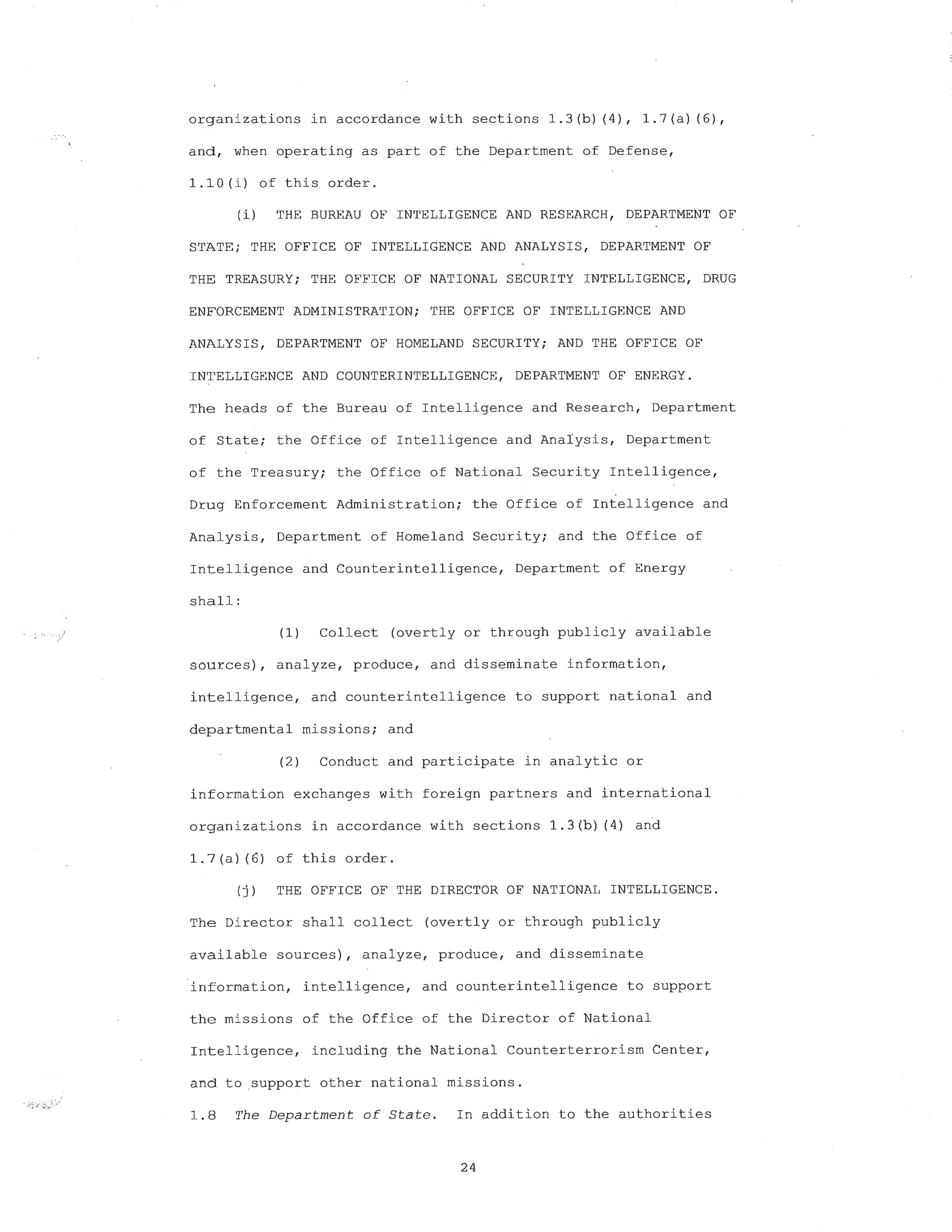
(i) THE BUREAU OF INTELLIGENCE AND RESEARCH, DEPARTMENT OF
STATE; THE OFFICE OF INTELLIGENCE AND ANALYSIS, DEPARTMENT OF
THE TREASURY; THE OFFICE OF NATIONAL SECURITY INTELLIGENCE, DRUG
ENFORCEMENT ADMINISTRATION; THE OFFICE OF INTELLIGENCE AND
ANALYSIS, DEPARTMENT OF HOMELAND SECURITY; AND THE OFFICE OF
INTELLIGENCE AND COUNTERINTELLIGENCE, DEPARTMENT OF ENERGY.
The heads of the Bureau of Intelligence and Research, Department
of State; the Office of Intelligence and Analysis, Department
of the Treasury; the Office of National Security Intelligence,
Drug Enforcement Administration; the Office of Intelligence and
Analysis, Department of Homeland Security; and the Office of
Intelligence and Counterintelligence, Department of Energy
shall:
(1) Collect (overtly or through publicly available
sources), analyze, produce, and disseminate information,
intelligence, and counterintelligence to support national and
departmental missions; and
(2) Conduct and participate in analytic or
information exchanges with foreign partners and international
organizations in accordance with sections 1.3 (b) (4) and
1.7 (a) (6) of this order.
(j) THE OFFICE OF THE DIRECTOR OF NATIONAL INTELLIGENCE.
The Director shall collect (overtly or through publicly
available sources), analyze, produce, and disseminate
information, intelligence, and counterintelligence to support
the missions of the Office of the Director of National
Intelligence, including the National Counterterrorism Center,
and to support other national missions.
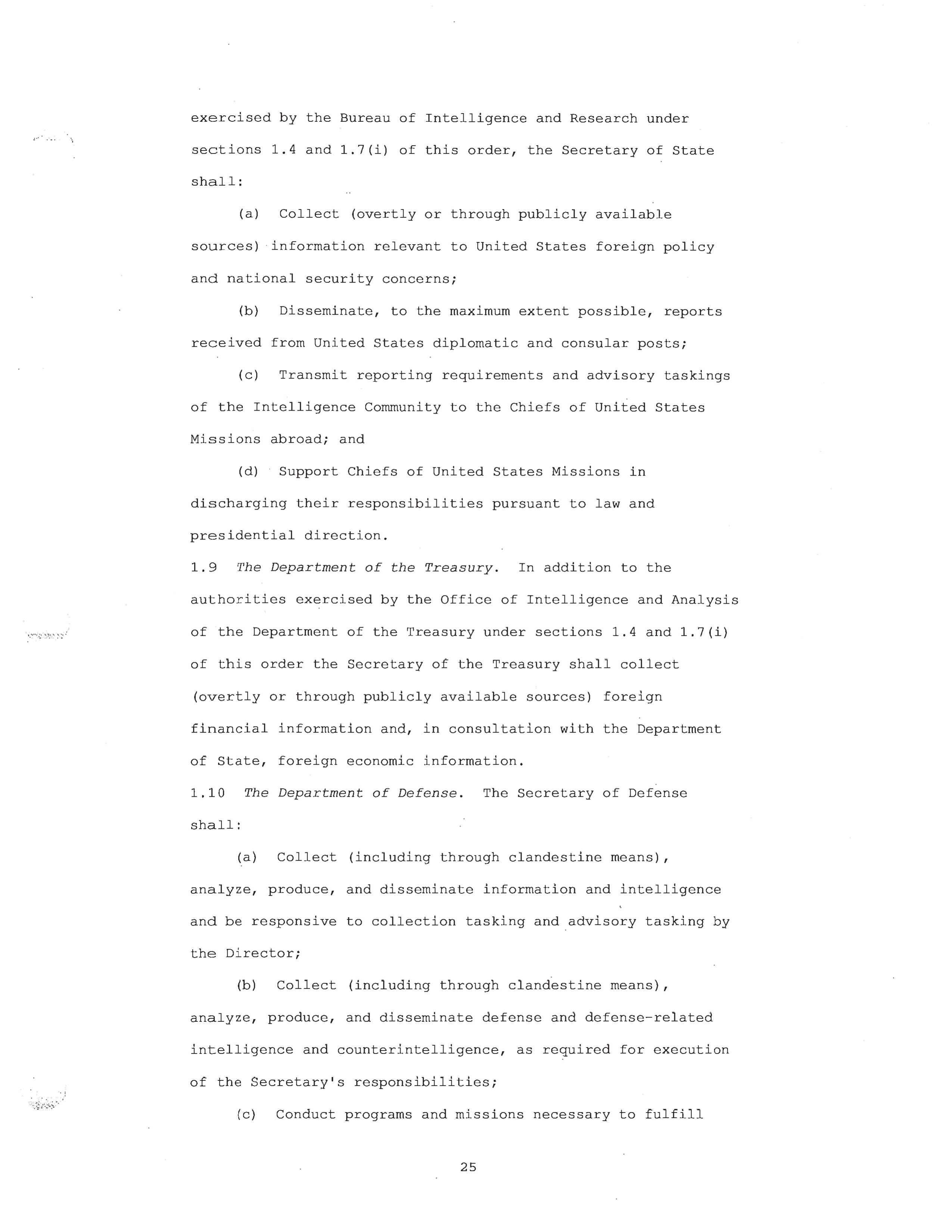
1.8 The Department of State. In addition to the authorities
24
exercised by the Bureau of Intelligence and Research under
sections 1.4 and 1.7(i) of this order, the Secretary of State
shall:
(a) Collect (overtly or through publicly available
sources) information relevant to United States foreign policy
and national security concerns;
(b) Disseminate, to the maximum extent possible, reports
received from United States diplomatic and consular posts;
(c) Transmit reporting requirements and advisory taskings
of the Intelligence Community to the Chiefs of United States
Missions abroad; and
(d) Support Chiefs of United States Missions in
discharging their responsibilities pursuant to law and
presidential direction.
1.9 The Department of the Treasury. In addition to the
authorities exercised by the Office of Intelligence and Analysis
of the Department of the Treasury under sections 1.4 and 1.7(i)
of this order the Secretary of the Treasury shall collect
(overtly or through publicly available sources) foreign
financial information and, in consultation with the Department
of State, foreign economic information.
1.10 The Department of Defense. The Secretary of Defense
shall:
(a) Collect (including through clandestine means),
analyze, produce, and disseminate information and intelligence
and be responsive to collection tasking and advisory tasking by
the Director;
(b) Collect (including through clandestine means),
analyze, produce, and disseminate defense and defense-related
intelligence and counterintelligence, as required for execution
of the Secretary's responsibilities;
(c) Conduct programs and missions necessary to fulfill
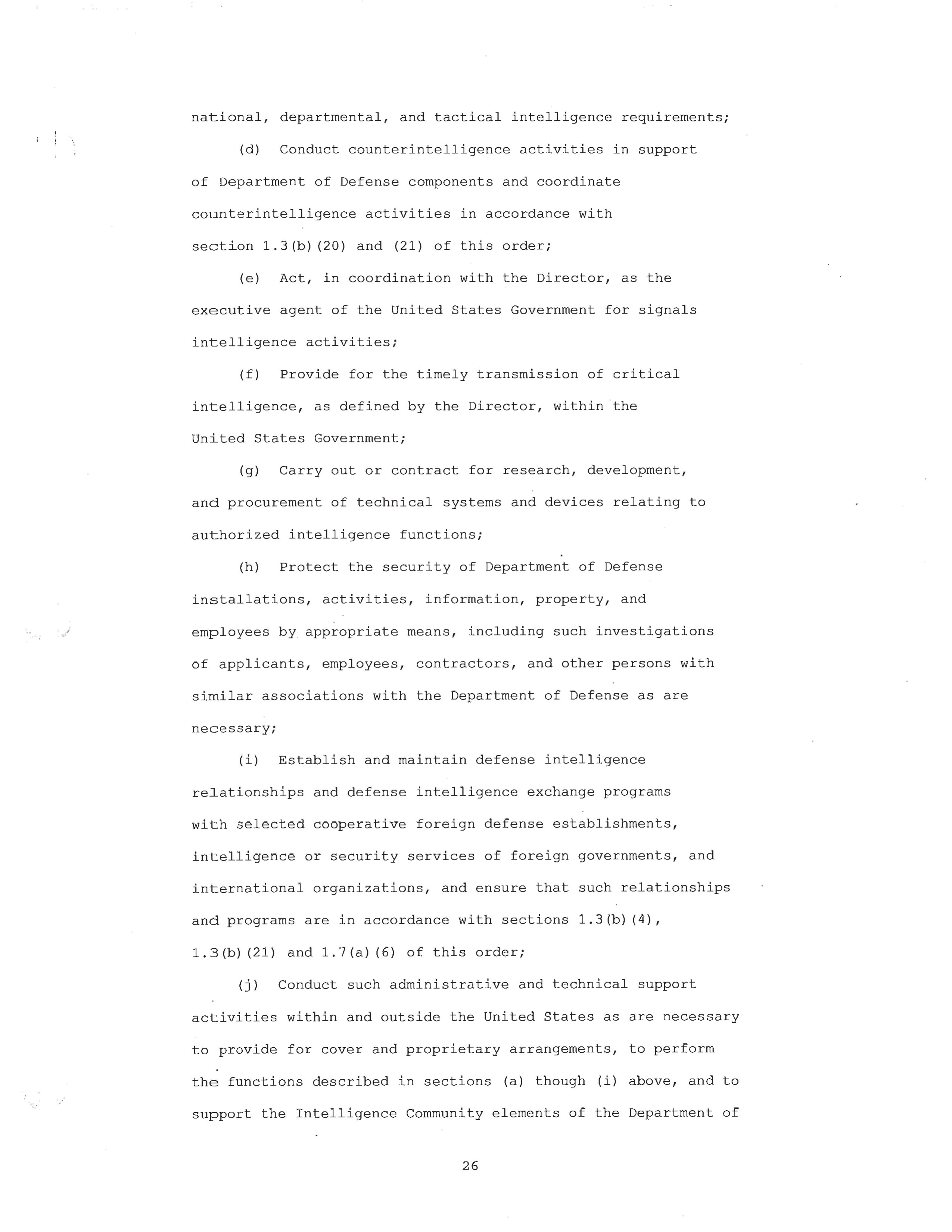
25
national, departmental, and tactical intelligence requirements;
(d) Conduct counterintelligence activities in support
of Department of Defense components and coordinate
counterintelligence activities in accordance with
section 1.3 (b) (20) and (21) of this order;
(e) Act, in coordination with the Director, as the
executive agent of the United States Government for signals
intelligence activities;
(f) Provide for the timely transmission of critical
intelligence, as defined by the Director, within the
United States Government;
(g) Carry out or contract for research, development,
and procurement of technical systems and devices relating to
authorized intelligence functions;
(h) Protect the security of Department of Defense
installations, activities, information, property, and
employees by appropriate means, including such investigations
of applicants, employees, contractors, and other persons with
similar associations with the Department of Defense as are
necessary;
(i) Establish and maintain defense intelligence
relationships and defense intelligence exchange programs
with selected cooperative foreign defense establishments,
intelligence or security services of foreign governments, and
international organizations, and ensure that such relationships
and programs are in accordance with sections 1.3(b) (4),
1.3 (b) (21) and 1.7(a) (6) of this order;
(j) Conduct such administrative and technical support
activities within and outside the United States as are necessary
to provide for cover and proprietary arrangements, to perform
the functions described in sections (a) though (i) above, and to
support the Intelligence Community elements of the Department of
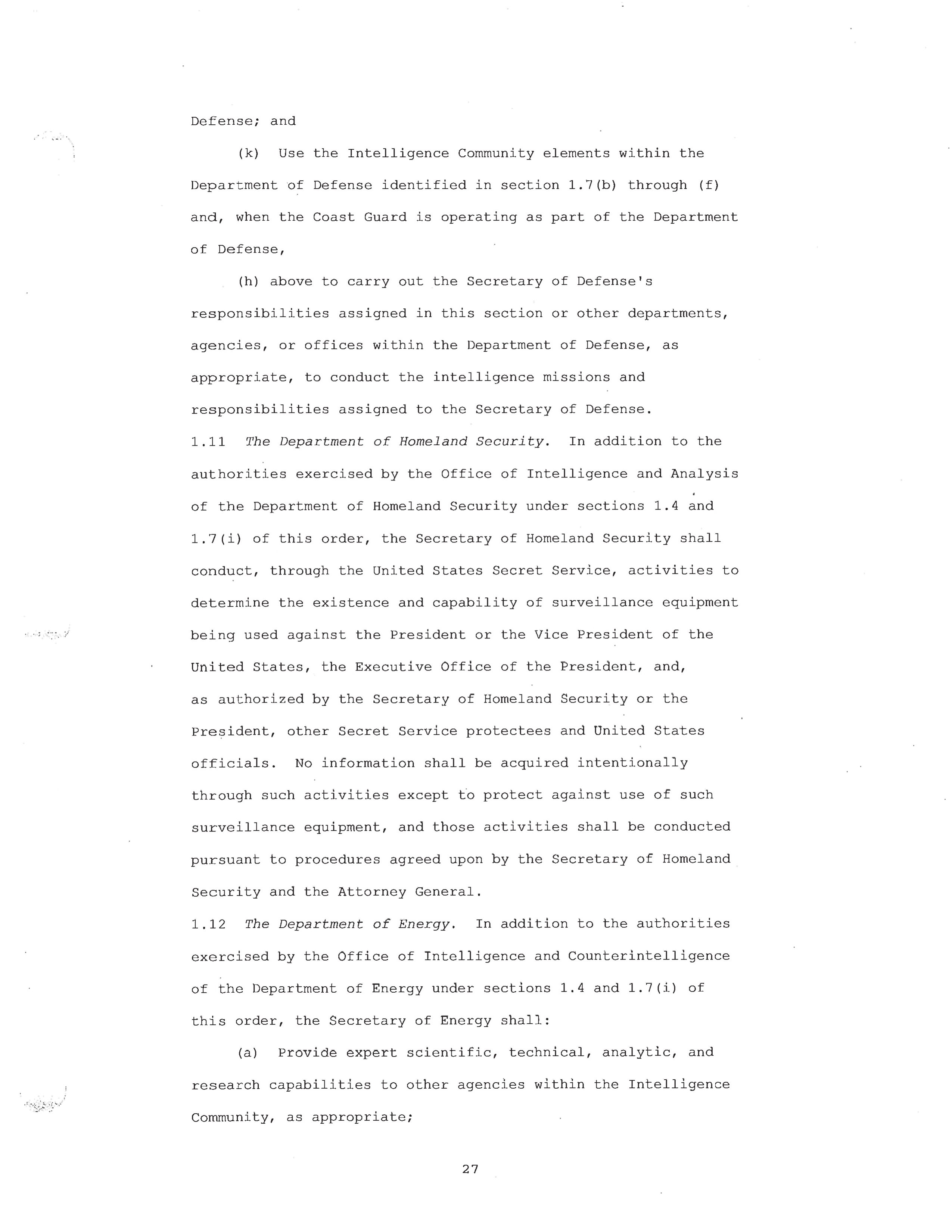
26
Defense; and
(k) Use the Intelligence Community elements within the
Department of Defense identified in section 1.7(b) through (f)
and, when the Coast Guard is operating as part of the Department
of Defense,
(h) above to carry out the Secretary of Defense's
responsibilities assigned in this section or other departments,
agencies, or offices within the Department of Defense, as
appropriate, to conduct the intelligence missions and
responsibilities assigned to the Secretary of Defense.
1.11 The Department of Homeland Security. In addition to the
authorities exercised by the Office of Intelligence and Analysis
of the Department of Homeland Security under sections 1.4 and
1.7(i) of this order, the Secretary of Homeland Security shall
conduct, through the United States Secret Service, activities to
determine the existence and capability of surveillance equipment
being used against the President or the Vice President of the
United States, the Executive Office of the President, and,
as authorized by the Secretary of Homeland Security or the
President, other Secret Service protectees and United States
officials. No information shall be acquired intentionally
through such activities except to protect against use of such
surveillance equipment, and those activities shall be conducted
pursuant to procedures agreed upon by the Secretary of Homeland
Security and the Attorney General.
1.12 The Department of Energy. In addition to the authorities
exercised by the Office of Intelligence and Counterintelligence
of the Department of Energy under sections 1.4 and 1.7(i) of
this order, the Secretary of Energy shall:
(a) Provide expert scientific, technical, analytic, and
research capabilities to other agencies within the Intelligence
Community, as appropriate;
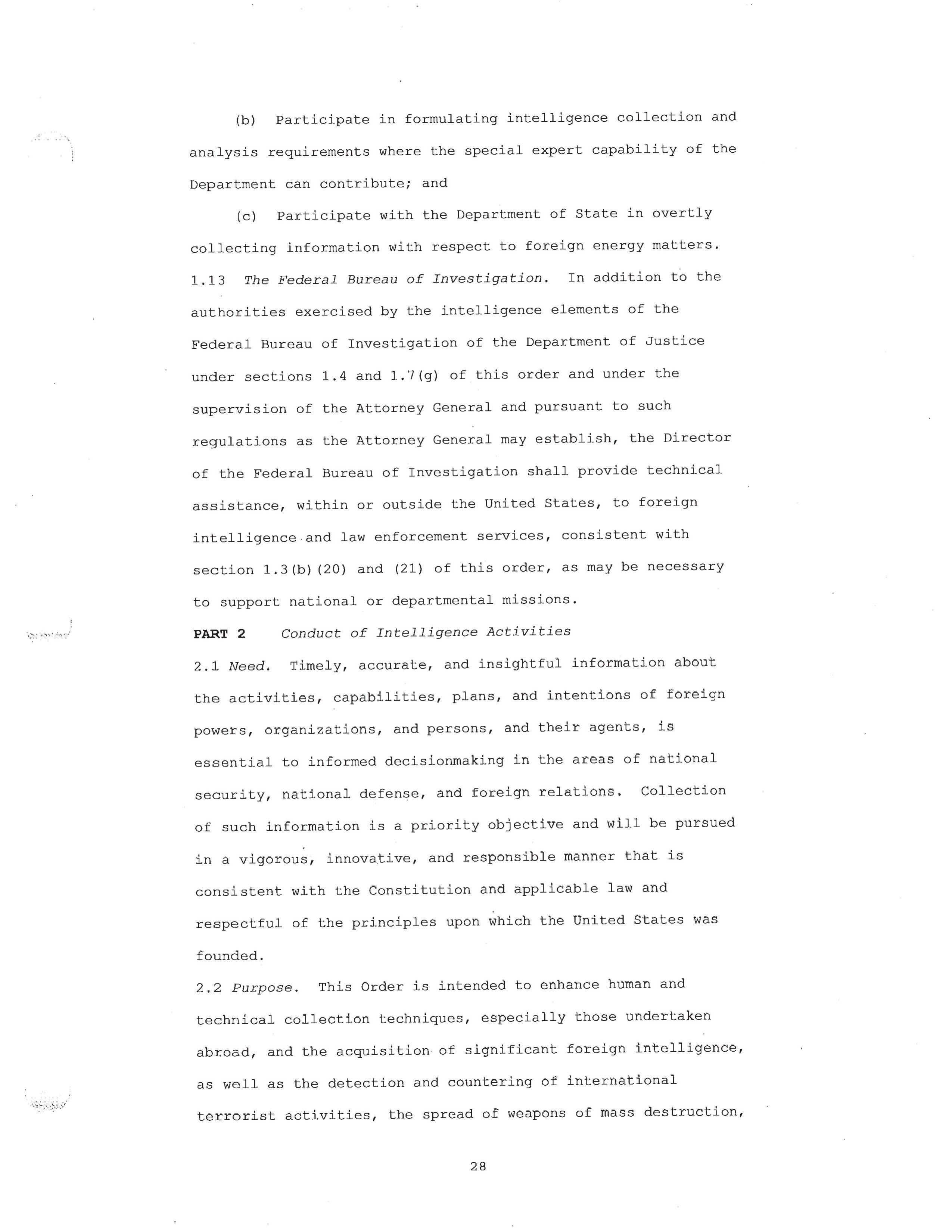
27
(b) Participate in formulating intelligence collection and
analysis requirements where the special expert capability of the
Department can contribute; and
(c) Participate with the Department of State in overtly
collecting information with respect to foreign energy matters.
1.13 The Federal Bureau of Investigation.
In addition to the
authorities exercised by the intelligence elements of the
Federal Bureau of Investigation of the Department of Justice
under sections 1.4 and 1.7(g) of this order and under the
supervision of the Attorney General and pursuant to such
regulations as the Attorney General may establish, the Director
of the Federal Bureau of Investigation shall provide technical
assistance, within or outside the United States, to foreign
intelligence and law enforcement services, consistent with
section 1.3 (b) (20) and (21) of this order, as may be necessary
to support national or departmental missions.
PART 2 Conduct of Intelligence Activities
2.1 Need.
Timely, accurate, and insightful information about
the activities, capabilities, plans, and intentions of foreign
powers, organizations, and persons, and their agents, is
essential to informed decisionmaking in the areas of national
security, national defense, and foreign relations.
Collection
of such information is a priority objective and will be pursued
in a vigorous, innovative, and responsible manner that is
consistent with the Constitution and applicable law and
respectful of the principles upon which the United States was
founded.
2.2 Purpose. This Order is intended to enhance human and
technical collection techniques, especially those undertaken
abroad, and the acquisition of significant foreign intelligence,
as well as the detection and countering of international
terrorist activities, the spread of weapons of mass destruction,
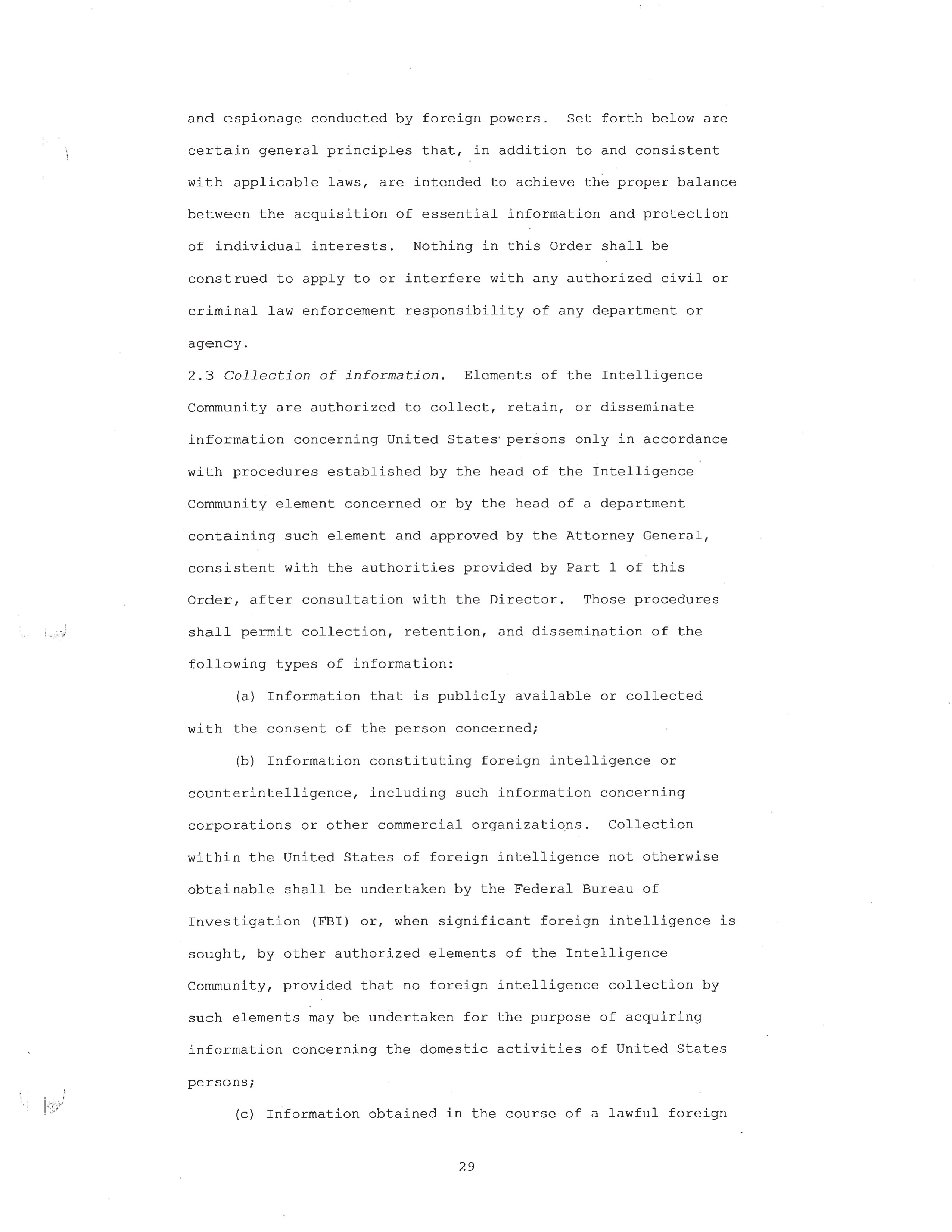
28
and espionage conducted by foreign powers. Set forth below are
certain general principles that, in addition to and consistent
with applicable laws, are intended to achieve the proper balance
between the acquisition of essential information and protection
of individual interests. Nothing in this Order shall be
construed to apply to or interfere with any authorized civil or
criminal law enforcement responsibility of any department or
agency.
2.3 Collection of information.
Elements of the Intelligence
Community are authorized to collect, retain, or disseminate
information concerning United States persons only in accordance
with procedures established by the head of the Intelligence
Community element concerned or by the head of a department
containing such element and approved by the Attorney General,
consistent with the authorities provided by Part 1 of this
Order, after consultation with the Director.
Those procedures
shall permit collection, retention, and dissemination of the
following types of information:
(a) Information that is publicly available or collected
with the consent of the person concerned;
(b) Information constituting foreign intelligence or
counterintelligence, including such information concerning
corporations or other commercial organizations.
Collection
within the United States of foreign intelligence not otherwise
obtainable shall be undertaken by the Federal Bureau of
Investigation (FBI) or, when significant foreign intelligence is
sought, by other authorized elements of the Intelligence
Community, provided that no foreign intelligence collection by
such elements may be undertaken for the purpose of acquiring
information concerning the domestic activities of United States
persons;
(c) Information obtained in the course of a lawful foreign
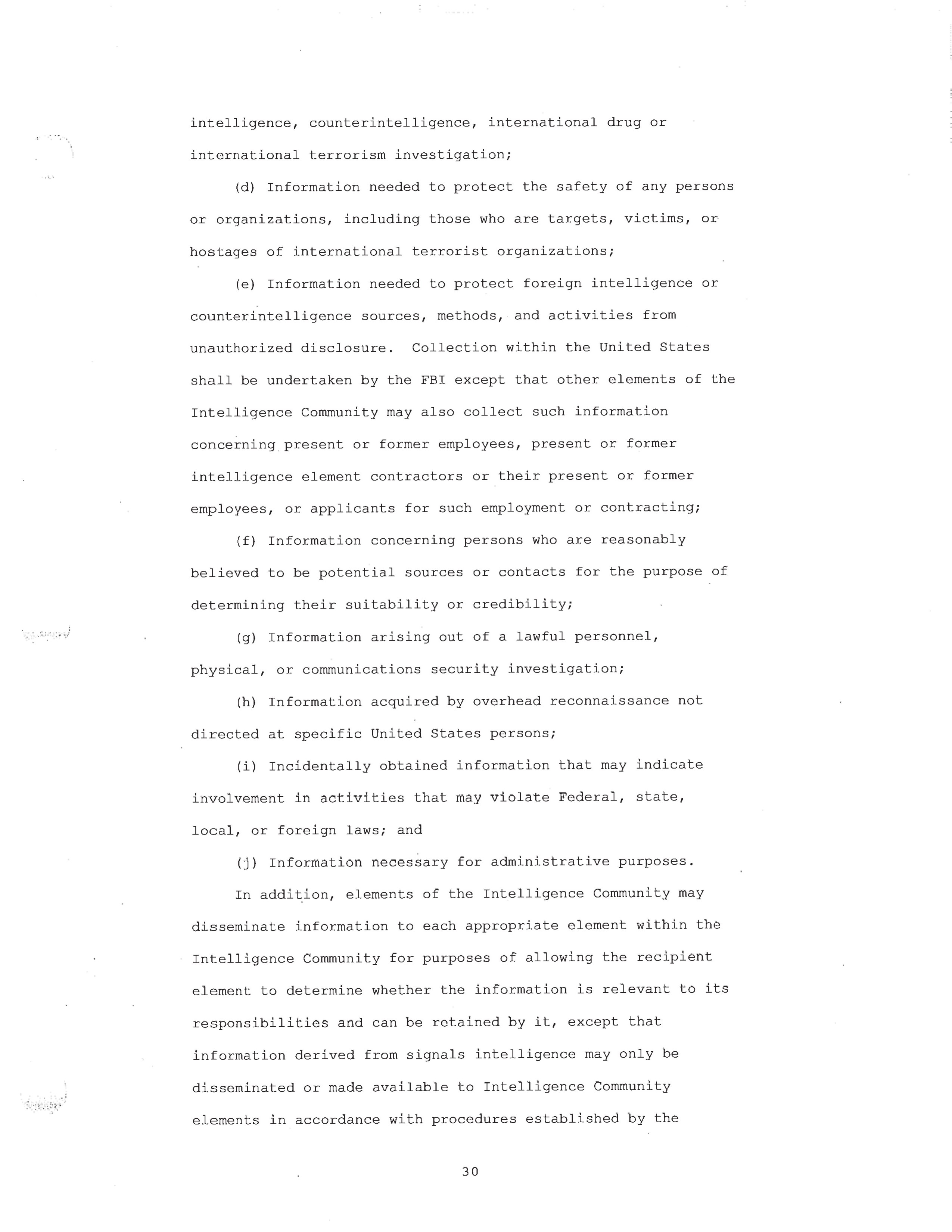
29
intelligence, counterintelligence, international drug or
international terrorism investigation;
(d) Information needed to protect the safety of any persons
or organizations, including those who are targets, victims, or
hostages of international terrorist organizations;
(e) Information needed to protect foreign intelligence or
counterintelligence sources, methods, and activities from
unauthorized disclosure. Collection within the United States
shall be undertaken by the FBI except that other elements of the
Intelligence Community may also collect such information
concerning present or former employees, present or former
intelligence element contractors or their present or former
employees, or applicants for such employment or contracting;
(f) Information concerning persons who are reasonably
believed to be potential sources or contacts for the purpose of
determining their suitability or credibility;
(g) Information arising out of a lawful personnel,
physical, or communications security investigation;
(h) Information acquired by overhead reconnaissance not
directed at specific United States persons;
(i) Incidentally obtained information that may indicate
involvement in activities that may violate Federal, state,
local, or foreign laws; and
(j) Information necessary for administrative purposes.
In addition, elements of the Intelligence Community may
disseminate information to each appropriate element within the
Intelligence Community for purposes of allowing the recipient
element to determine whether the information is relevant to its
responsibilities and can be retained by it, except that
information derived from signals intelligence may only be
disseminated or made available to Intelligence Community
elements in accordance with procedures established by the
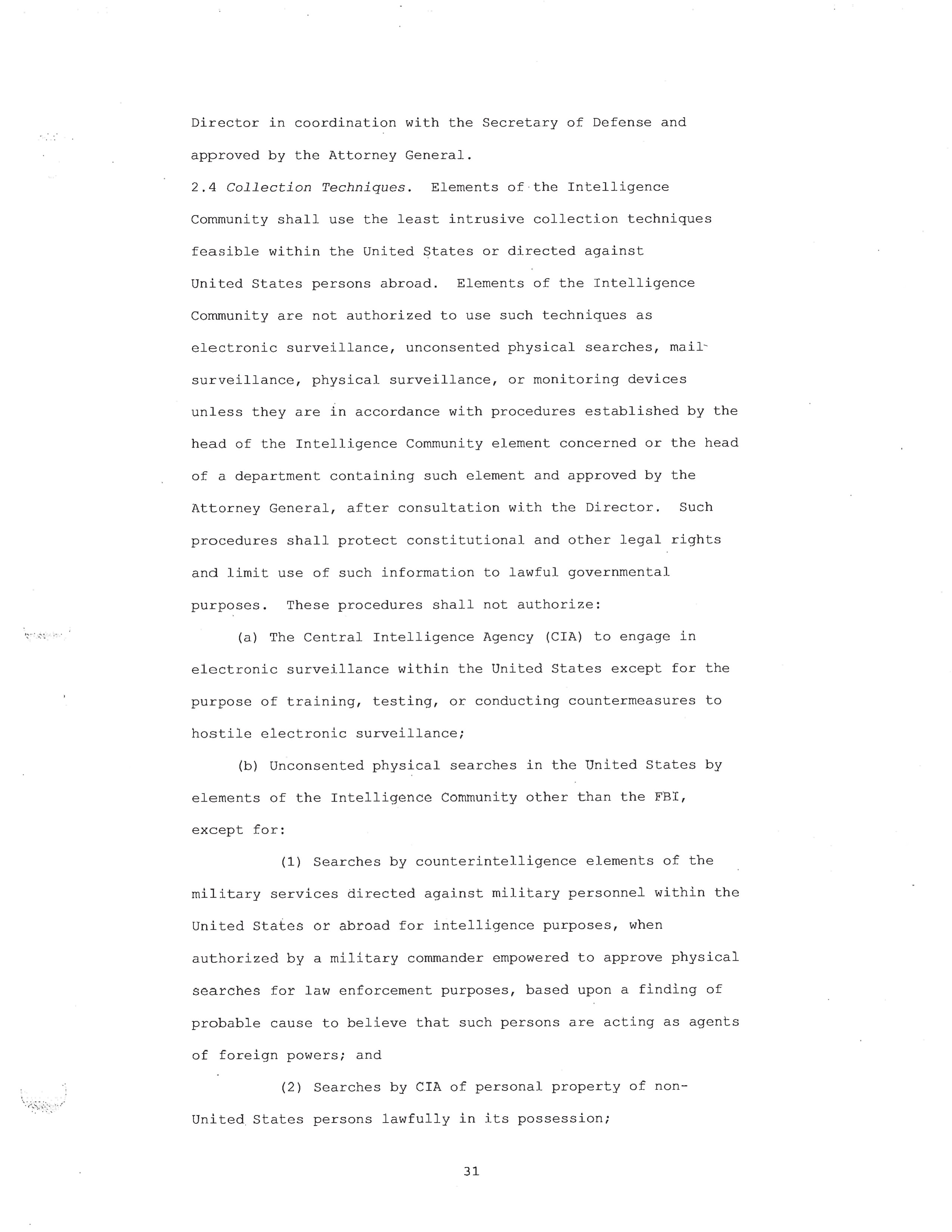
30
Director in coordination with the Secretary of Defense and
approved by the Attorney General.
2.4 Collection Techniques. Elements of the Intelligence
Community shall use the least intrusive collection techniques
feasible within the United States or directed against
United States persons abroad. Elements of the Intelligence
Community are not authorized to use such techniques as
electronic surveillance, unconsented physical searches, mail-
surveillance, physical surveillance, or monitoring devices
unless they are in accordance with procedures established by the
head of the Intelligence Community element concerned or the head
of a department containing such element and approved by the
Attorney General, after consultation with the Director.
procedures shall protect constitutional and other legal rights
and limit use of such information to lawful governmental
purposes.
These procedures shall not authorize:
Such
(a) The Central Intelligence Agency (CIA) to engage in
electronic surveillance within the United States except for the
purpose of training, testing, or conducting countermeasures to
hostile electronic surveillance;
(b) Unconsented physical searches in the United States by
elements of the Intelligence Community other than the FBI,
except for:
(1) Searches by counterintelligence elements of the
military services directed against military personnel within the
United States or abroad for intelligence purposes, when
authorized by a military commander empowered to approve physical
searches for law enforcement purposes, based upon a finding of
probable cause to believe that such persons are acting as agents
of foreign powers; and
(2) Searches by CIA of personal property of non-
United States persons lawfully in its possession;
31
(c) Physical surveillance of a United States person in the
United States by elements of the Intelligence Community other
than the FBI, except for:
(1) Physical surveillance of present or former
employees, present or former intelligence element contractors or
their present or former employees, or applicants for any such
employment or contracting; and
(2) Physical surveillance of a military person
employed by a non-intelligence element of a military service;
and
(d) Physical surveillance of a United States person abroad
to collect foreign intelligence, except to obtain significant
information that cannot reasonably be acquired by other means.
2.5 Attorney General Approval. The Attorney General hereby is
delegated the power to approve the use for intelligence
purposes, within the United States or against a United States
person abroad, of any technique for which a warrant would be
required if undertaken for law enforcement purposes, provided
that such techniques shall not be undertaken unless the Attorney
General has determined in each case that there is probable cause
to believe that the technique is directed against a foreign
power or an agent of a foreign power. The authority delegated
pursuant to this paragraph, including the authority to approve
the use of electronic surveillance as defined in the Foreign
Intelligence Surveillance Act of 1978, as amended, shall be
exercised in accordance with that Act.
2.6 Assistance to Law Enforcement and other Civil Authorities.
Elements of the Intelligence Community are authorized to:
(a) Cooperate with appropriate law enforcement agencies for
the purpose of protecting the employees, information, property,
and facilities of any element of the Intelligence Community;
(b) Unless otherwise precluded by law or this Order,
32
participate in law enforcement activities to investigate or
prevent clandestine intelligence activities by foreign powers,
or international terrorist or narcotics activities;
(c) Provide specialized equipment, technical knowledge, or
assistance of expert personnel for use by any department or
agency, or when lives are endangered, to support local law
enforcement agencies. Provision of assistance by expert
personnel shall be approved in each case by the general counsel
of the providing element or department; and
(d) Render any other assistance and cooperation to law
enforcement or other civil authorities not precluded by
applicable law.
2.7 Contracting.
Elements of the Intelligence Community are
authorized to enter into contracts or arrangements for the
provision of goods or services with private companies or
institutions in the United States and need not reveal the
sponsorship of such contracts or arrangements for authorized
intelligence purposes. Contracts or arrangements with academic
institutions may be undertaken only with the consent of
appropriate officials of the institution.
2.8 Consistency With Other Laws. Nothing in this Order shall be
construed to authorize any activity in violation of the
Constitution or statutes of the United States.
2.9 Undisclosed Participation in Organizations Within the
United States. No one acting on behalf of elements of the
Intelligence Community may join or otherwise participate in any
organization in the United States on behalf of any element of
the Intelligence Community without disclosing such person's
intelligence affiliation to appropriate officials of the
organization, except in accordance with procedures established
by the head of the Intelligence Community element concerned or
the head of a department containing such element and approved by
33
the Attorney General, after consultation with the Director.
Such participation shall be authorized only if it is essential
to achieving lawful purposes as determined by the Intelligence
Community element head or designee. No such participation may
be undertaken for the purpose of influencing the activity of the
organization or its members except in cases where:
(a) The participation is undertaken on behalf of the FBI in
the course of a lawful investigation; or
(b) The organization concerned is composed primarily of
individuals who are not United States persons and is reasonably
believed to be acting on behalf of a foreign power.
2.10 Human Experimentation.
No element of the Intelligence
Community shall sponsor, contract for, or conduct research on
human subjects except in accordance with guidelines issued by
the Department of Health and Human Services. The subject's
informed consent shall be documented as required by those
guidelines.
2.11 Prohibition on Assassination.
No person employed by or
acting on behalf of the United States Government shall engage in
or conspire to engage in assassination.
2.12 Indirect Participation. No element of the Intelligence
Community shall participate in or request any person to
undertake activities forbidden by this Order.
2.13 Limitation on Covert Action. No covert action may be
conducted which is intended to influence United States political
processes, public opinion, policies, or media.
PART 3
General Provisions
3.1 Congressional Oversight. The duties and responsibilities of
the Director and the heads of other departments, agencies,
elements, and entities engaged in intelligence activities to
cooperate with the Congress in the conduct of its
responsibilities for oversight of intelligence activities shall
34
be implemented in accordance with applicable law, including
title V of the Act. The requirements of applicable law,
including title V of the Act, shall apply to all covert action
activities as defined in this Order.
3.2 Implementation.
The President, supported by the NSC,
and the Director shall issue such appropriate directives,
procedures, and guidance as are necessary to implement this
order. Heads of elements within the Intelligence Community
shall issue appropriate procedures and supplementary directives
consistent with this order. No procedures to implement Part 2
of this order shall be issued without the Attorney General's
approval, after consultation with the Director. The Attorney
General shall provide a statement of reasons for not approving
any procedures established by the head of an element in the
Intelligence Community (or the head of the department containing
such element) other than the FBI. In instances where the
element head or department head and the Attorney General are
unable to reach agreements on other than constitutional or other
legal grounds, the Attorney General, the head of department
concerned, or the Director shall refer the matter to the NSC.
3.3 Procedures. The activities herein authorized that
require procedures shall be conducted in accordance with
existing procedures or requirements established under Executive
Order 12333. New procedures, as required by Executive
Order 12333, as further amended, shall be established as
expeditiously as possible. All new procedures promulgated
pursuant to Executive Order 12333, as amended, shall be made
available to the Select Committee on Intelligence of the Senate
and the Permanent Select Committee on Intelligence of the House
of Representatives.
3.4 References and Transition.
References to "Senior Officials
of the Intelligence Community" or "SOICS" in executive orders or
35
other Presidential guidance, shall be deemed references to the
heads of elements in the Intelligence Community, unless the
President otherwise directs; references in Intelligence
Community or Intelligence Community element policies or
guidance, shall be deemed to be references to the heads of
elements of the Intelligence Community, unless the President or
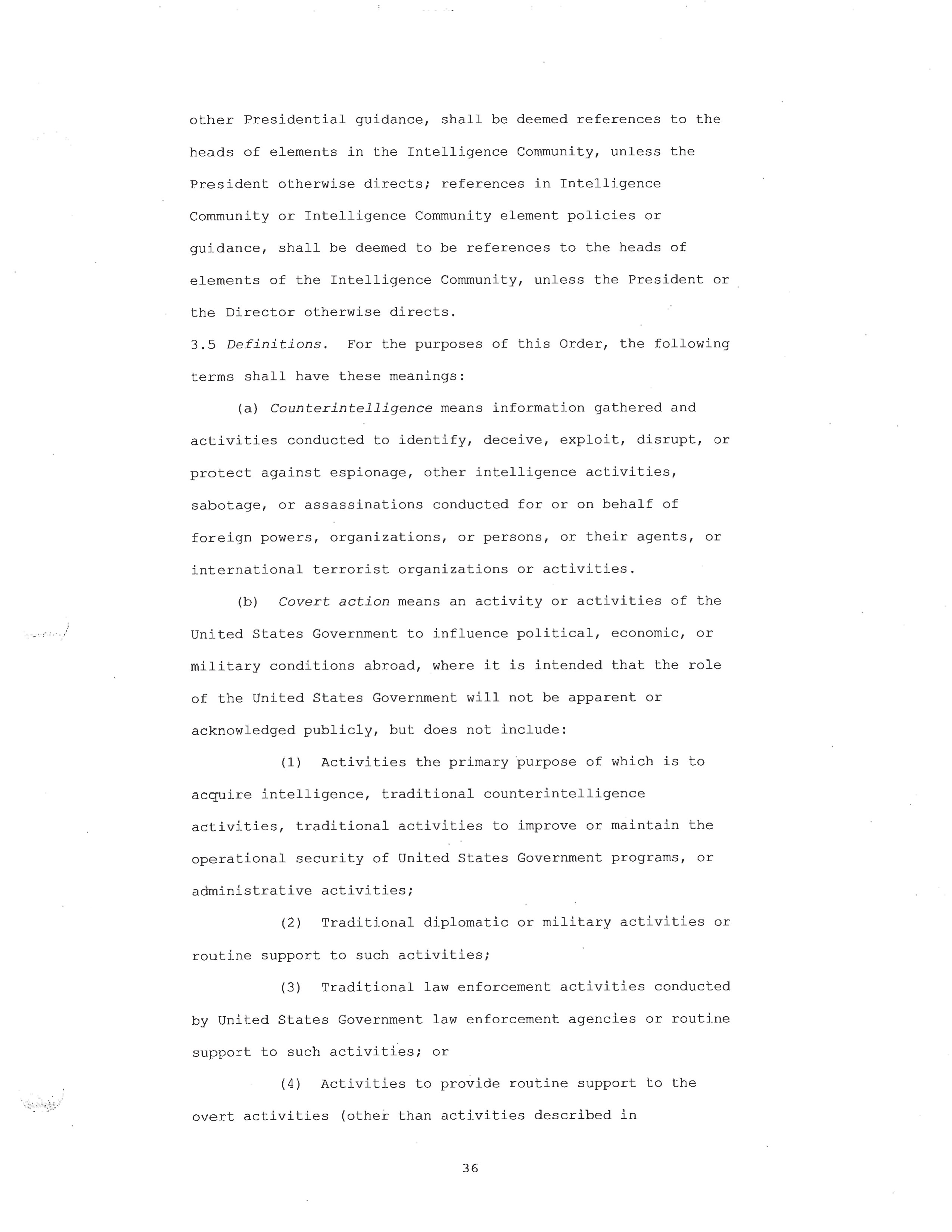
the Director otherwise directs.
3.5 Definitions. For the purposes of this Order, the following
terms shall have these meanings:
(a) Counterintelligence means information gathered and
activities conducted to identify, deceive, exploit, disrupt, or
protect against espionage, other intelligence activities,
sabotage, or assassinations conducted for or on behalf of
foreign powers, organizations, or persons, or their agents, or
international terrorist organizations or activities.
(b) Covert action means an activity or activities of the
United States Government to influence political, economic, or
military conditions abroad, where it is intended that the role
of the United States Government will not be apparent or
acknowledged publicly, but does not include:
(1) Activities the primary purpose of which is to
acquire intelligence, traditional counterintelligence
activities, traditional activities to improve or maintain the
operational security of United States Government programs, or
administrative activities;
(2)
Traditional diplomatic or military activities or
routine support to such activities;
(3)
Traditional law enforcement activities conducted
by United States Government law enforcement agencies or routine
support to such activities; or
(4)
Activities to provide routine support to the
overt activities (other than activities described in
36
paragraph (1), (2), or (3)) of other United States Government
agencies abroad.
(c)
Electronic surveillance means acquisition of a
nonpublic communication by electronic means without the consent
of a person who is a party to an electronic communication or, in
the case of a nonelectronic communication, without the consent
of a person who is visibly present at the place of
communication, but not including the use of radio direction-
finding equipment solely to determine the location of a
transmitter.
(d) Employee means a person employed by, assigned
or detailed to, or acting for an element within the Intelligence
Community.
(e)
Foreign intelligence means information relating to the
capabilities, intentions, or activities of foreign governments
or elements thereof, foreign organizations, foreign persons, or
international terrorists.
(f) Intelligence includes foreign intelligence and
counterintelligence.
(g) Intelligence activities means all activities that
elements of the Intelligence Community are authorized to conduct
pursuant to this order.
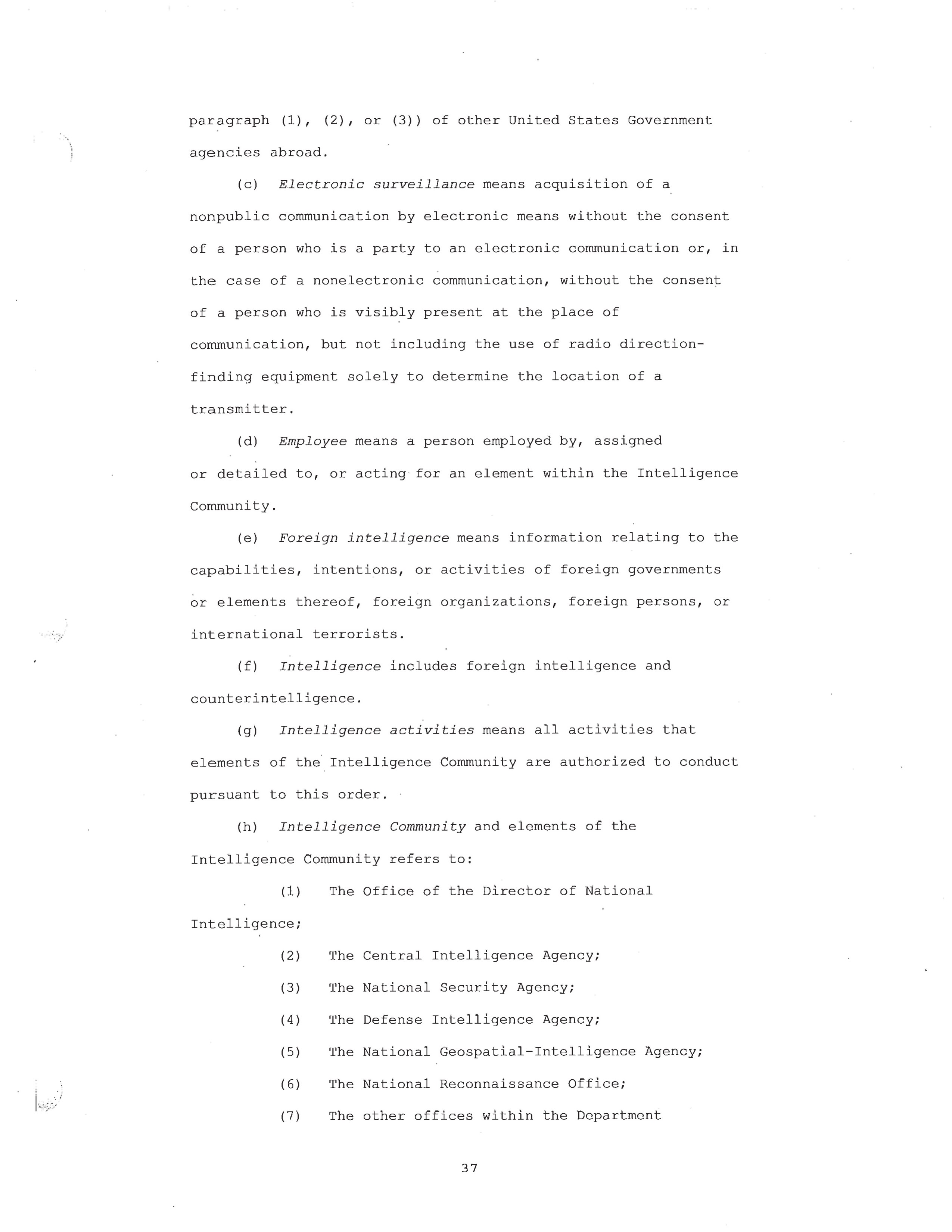
(h) Intelligence Community and elements of the
Intelligence Community refers to:
(1)
The Office of the Director of National
Intelligence;
(2)
The Central Intelligence Agency;
(3) The National Security Agency;
(4)
The Defense Intelligence Agency;
(5) The National Geospatial-Intelligence Agency;
(6)
The National Reconnaissance Office;
(7)
The other offices within the Department
37
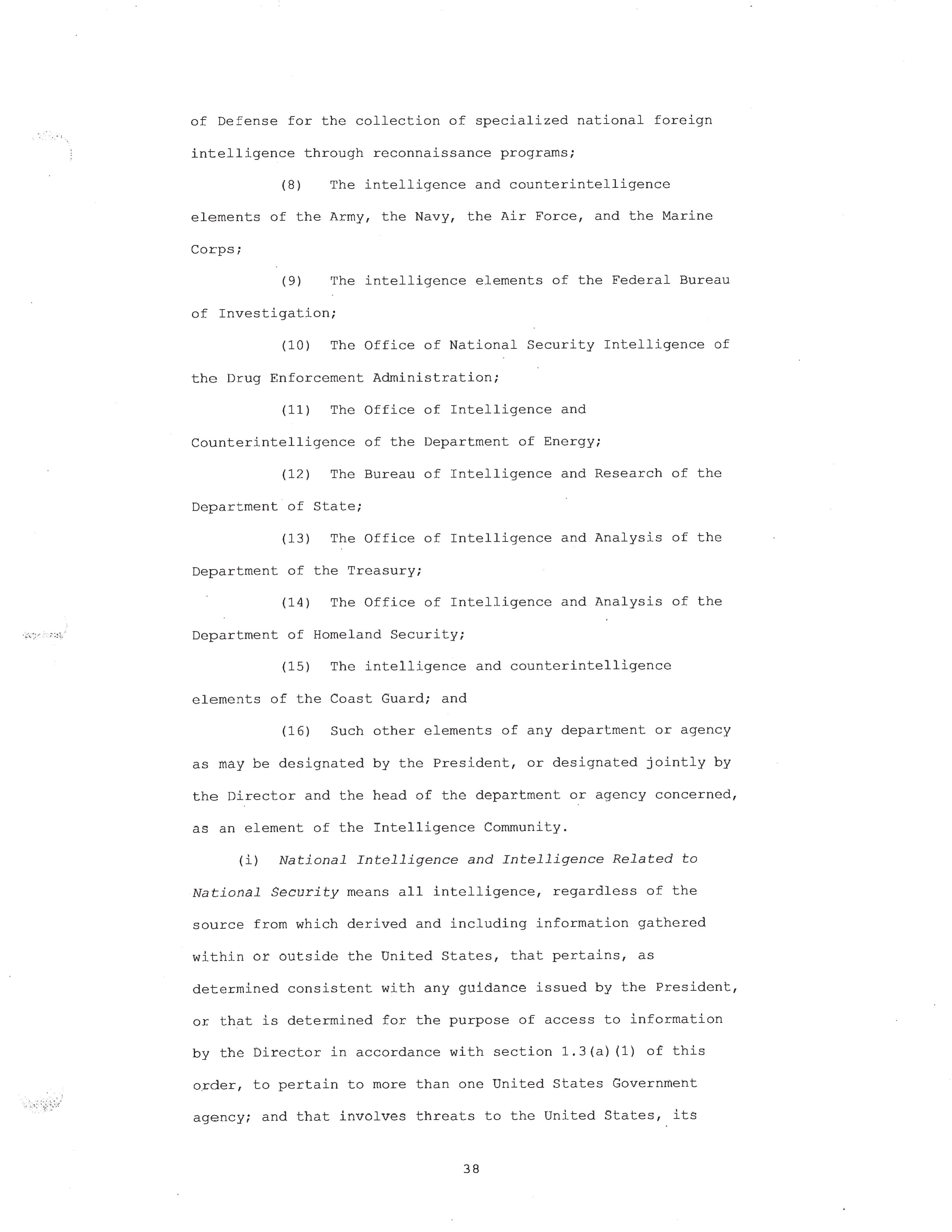
of Defense for the collection of specialized national foreign
intelligence through reconnaissance programs;
(8) The intelligence and counterintelligence
elements of the Army, the Navy, the Air Force, and the Marine
Corps;
(9) The intelligence elements of the Federal Bureau
of Investigation;
(10) The Office of National Security Intelligence of
the Drug Enforcement Administration;
(11) The Office of Intelligence and
Counterintelligence of the Department of Energy;
(12) The Bureau of Intelligence and Research of the
Department of State;
(13) The Office of Intelligence and Analysis of the
Department of the Treasury;
(14) The Office of Intelligence and Analysis of the
Department of Homeland Security;
(15) The intelligence and counterintelligence
elements of the Coast Guard; and
(16) Such other elements of any department or agency
as may be designated by the President, or designated jointly by
the Director and the head of the department or agency concerned,
as an element of the Intelligence Community.
(i) National Intelligence and Intelligence Related to
National Security means all intelligence, regardless of the
source from which derived and including information gathered
within or outside the United States, that pertains, as
determined consistent with any guidance issued by the President,
or that is determined for the purpose of access to information
by the Director in accordance with section 1.3(a) (1) of this
order, to pertain to more than one United States Government
agency; and that involves threats to the United States, its
38
people, property, or interests; the development, proliferation,
or use of weapons of mass destruction; or any other matter
bearing on United States national or homeland security.
(j) The National Intelligence Program means all programs,
projects, and activities of the Intelligence Community, as well
as any other programs of the Intelligence Community designated
jointly by the Director and the head of a United States
department or agency or by the President. Such term does not
include programs, projects, or activities of the military
departments to acquire intelligence solely for the planning and
conduct of tactical military operations by United States Armed
Forces.
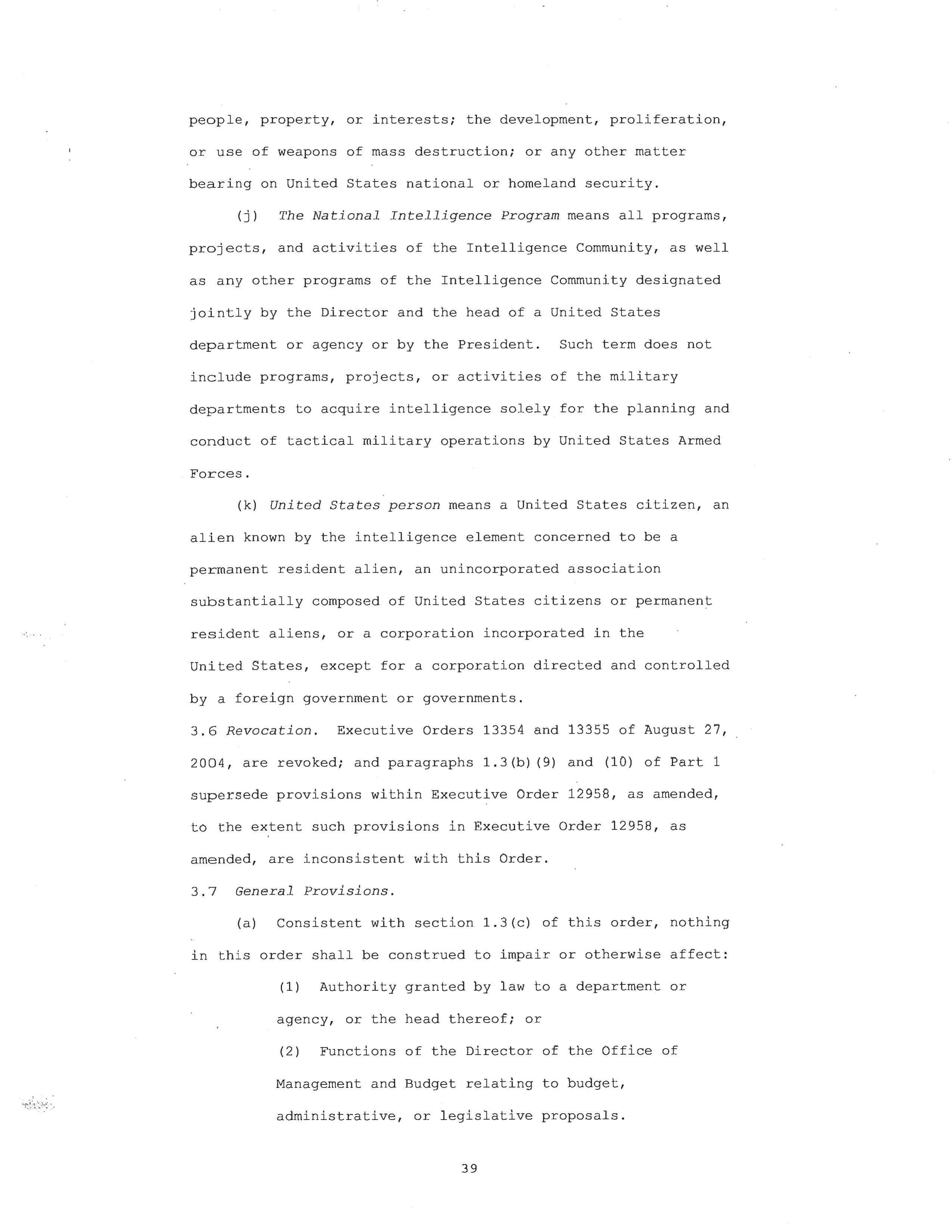
(k) United States person means a United States citizen, an
alien known by the intelligence element concerned to be a
permanent resident alien, an unincorporated association
substantially composed of United States citizens or permanent
resident aliens, or a corporation incorporated in the
United States, except for a corporation directed and controlled
by a foreign government or governments.
3.6 Revocation. Executive Orders 13354 and 13355 of August 27,
2004, are revoked; and paragraphs 1.3(b) (9) and (10) of Part 1
supersede provisions within Executive Order 12958, as amended,
to the extent such provisions in Executive Order 12958, as
amended, are inconsistent with this Order.
3.7 General Provisions.
(a) Consistent with section 1.3(c) of this order, nothing
in this order shall be construed to impair or otherwise affect:
(1) Authority granted by law to a department or
agency, or the head thereof, or
(2) Functions of the Director of the Office of
Management and Budget relating to budget,
administrative, or legislative proposals.
39
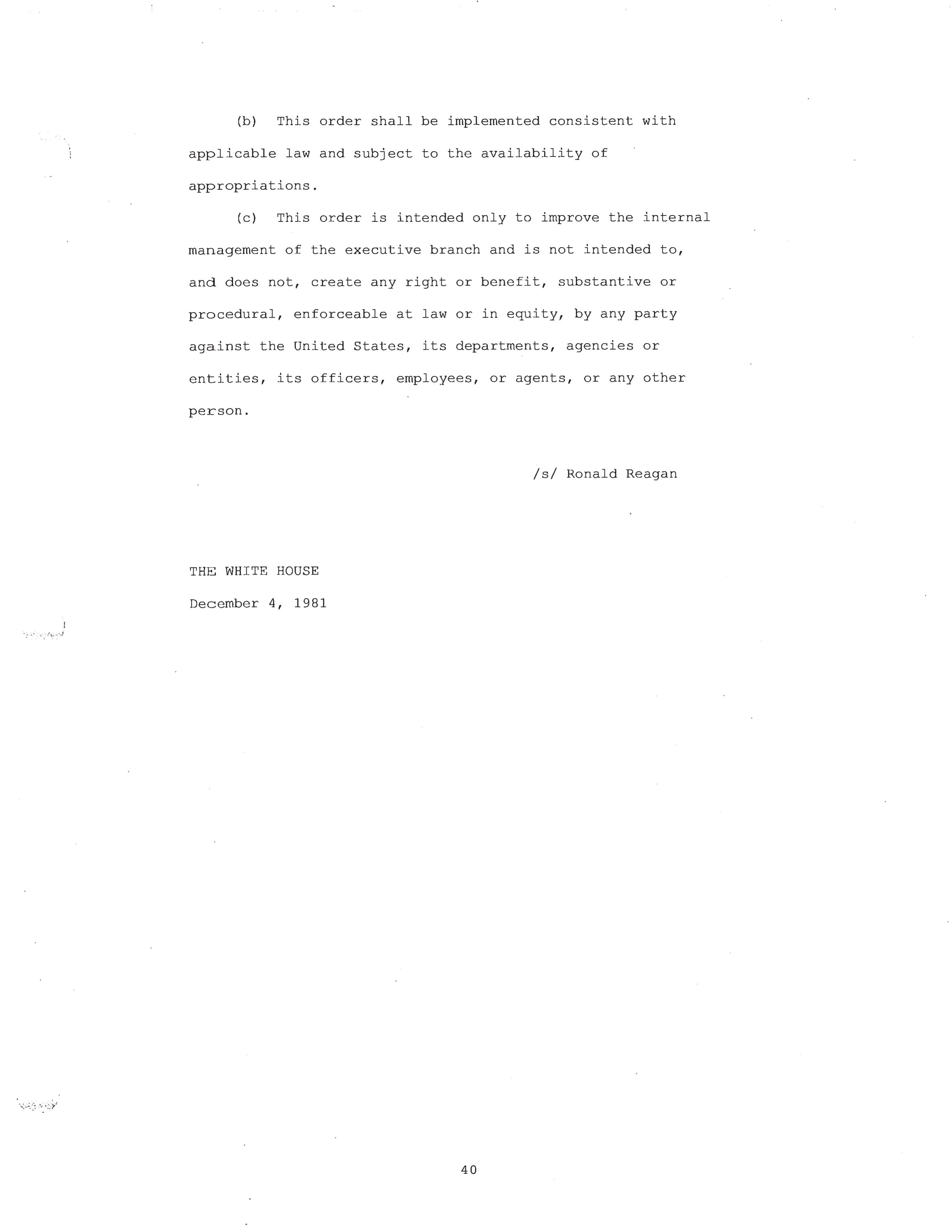
(b) This order shall be implemented consistent with
applicable law and subject to the availability of
appropriations.
(c) This order is intended only to improve the internal
management of the executive branch and is not intended to,
and does not, create any right or benefit, substantive or
procedural, enforceable at law or in equity, by any party
against the United States, its departments, agencies or
entities, its officers, employees, or agents, or any other
person.
/s/ Ronald Reagan
THE WHITE HOUSE
December 4, 1981
40
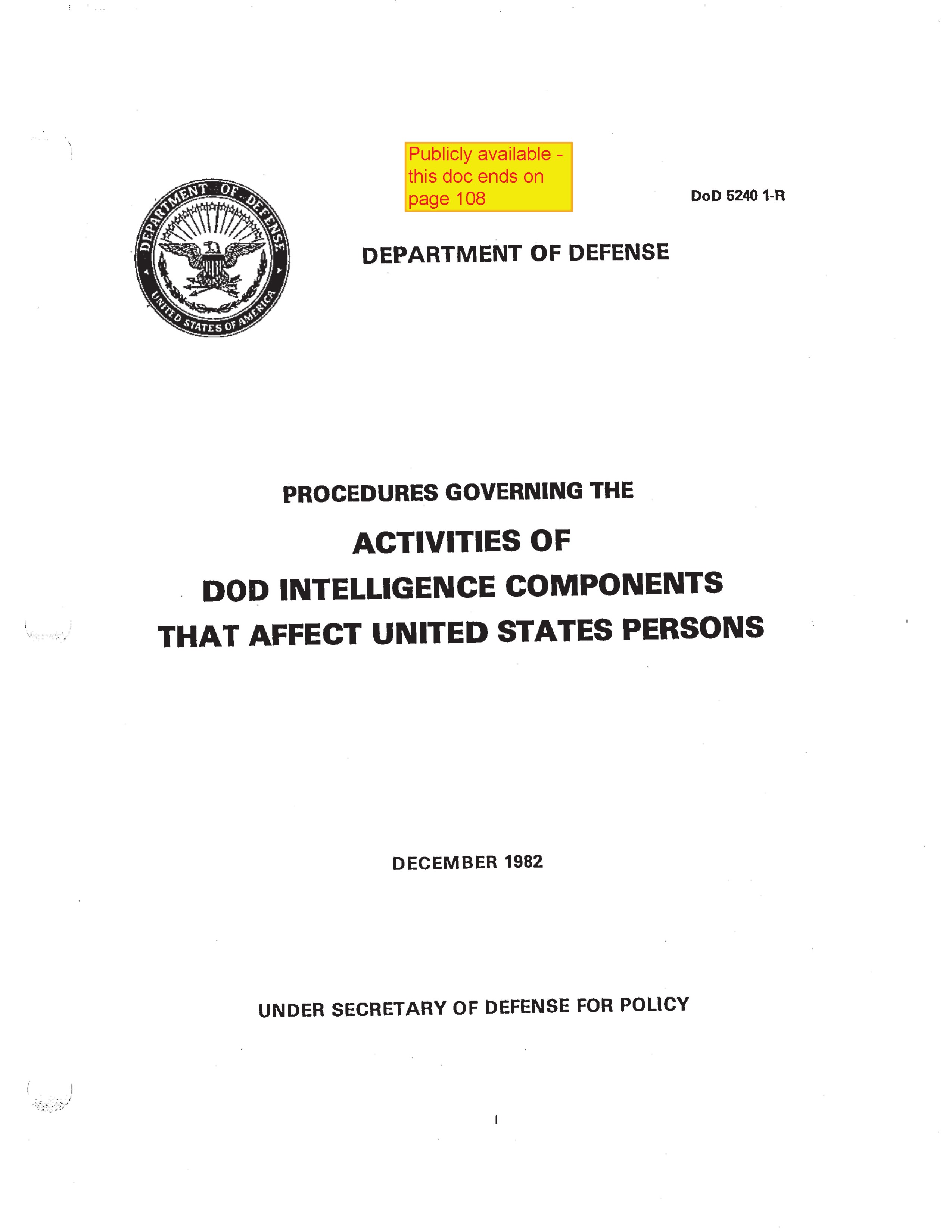
DEPARTMENT OF DEFENSE
Publicly available -
this doc ends on
page 108
DEPARTMENT OF DEFENSE
DoD 5240 1-R
PROCEDURES GOVERNING THE
ACTIVITIES OF
DOD INTELLIGENCE COMPONENTS
THAT AFFECT UNITED STATES PERSONS
DECEMBER 1982
UNDER SECRETARY OF DEFENSE FOR POLICY
1
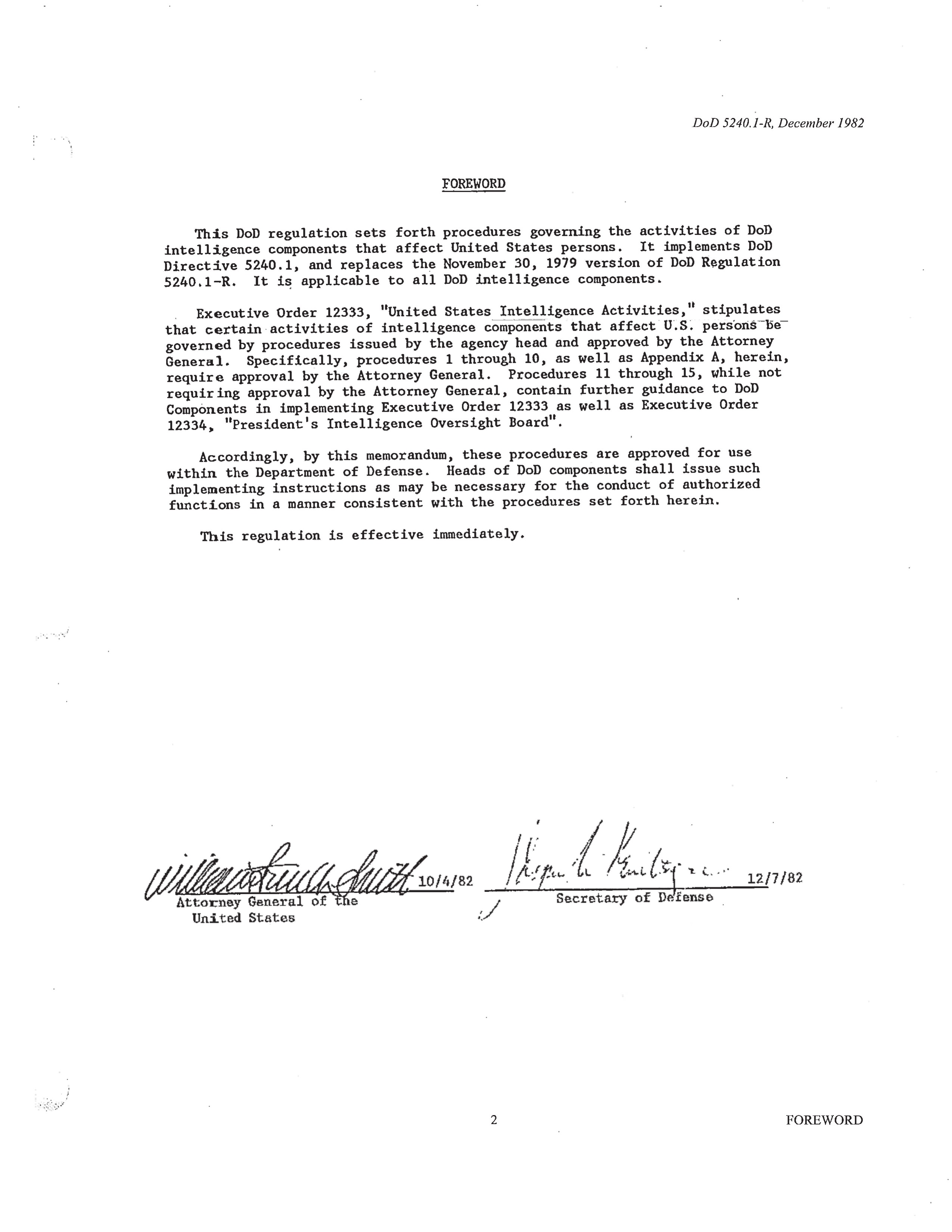
DoD 5240.1-R, December 1982
FOREWORD
This DoD regulation sets forth procedures governing the activities of DoD
intelligence components that affect United States persons. It implements DoD
Directive 5240.1, and replaces the November 30, 1979 version of DoD Regulation
5240.1-R. It is applicable to all DoD intelligence components.
Executive Order 12333, "United States Intelligence Activities," stipulates
that certain activities of intelligence components that affect U.S. persons be
governed by procedures issued by the agency head and approved by the Attorney
General. Specifically, procedures 1 through 10, as well as Appendix A, herein,
require approval by the Attorney General. Procedures 11 through 15, while not
requiring approval by the Attorney General, contain further guidance to DoD
Components in implementing Executive Order 12333 as well as Executive Order
12334, "President's Intelligence Oversight Board".
Accordingly, by this memorandum, these procedures are approved for use
within the Department of Defense. Heads of DoD components shall issue such
implementing instructions as may be necessary for the conduct of authorized
functions in a manner consistent with the procedures set forth herein.
This regulation is effective immediately.
Attorney General of the
United States
10/4/82
Secretary of Defense
12/7/82
2
FOREWORD
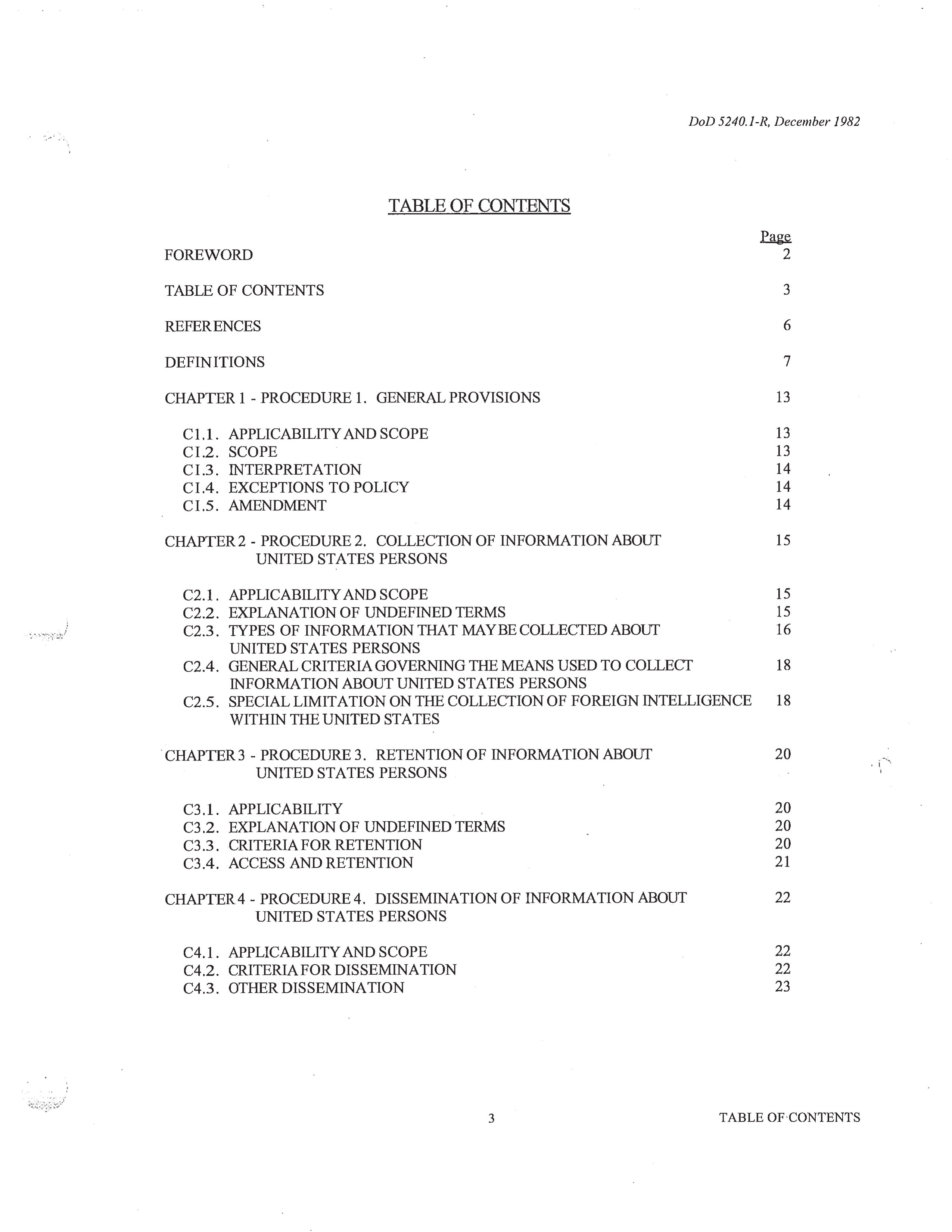
DoD 5240.1-R, December 1982
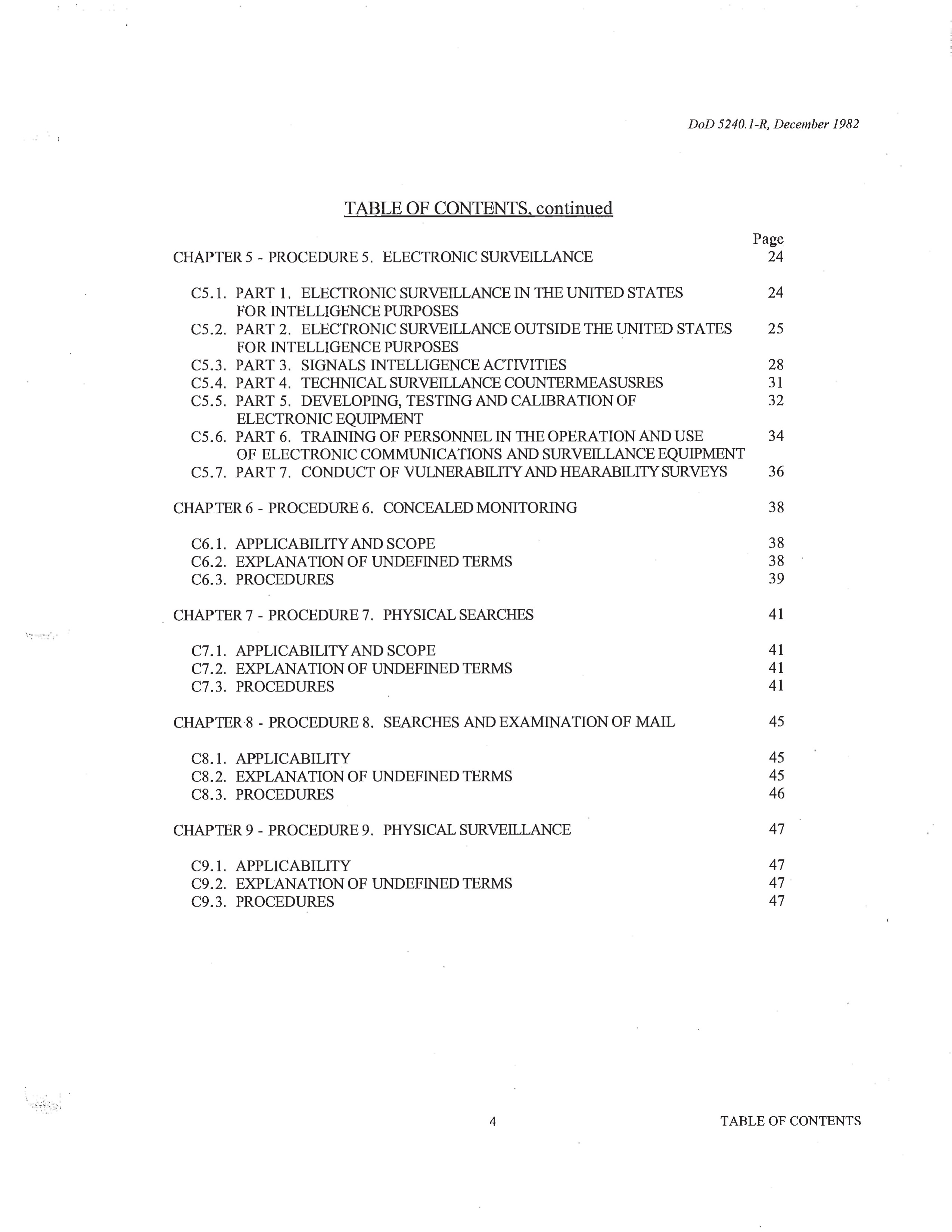
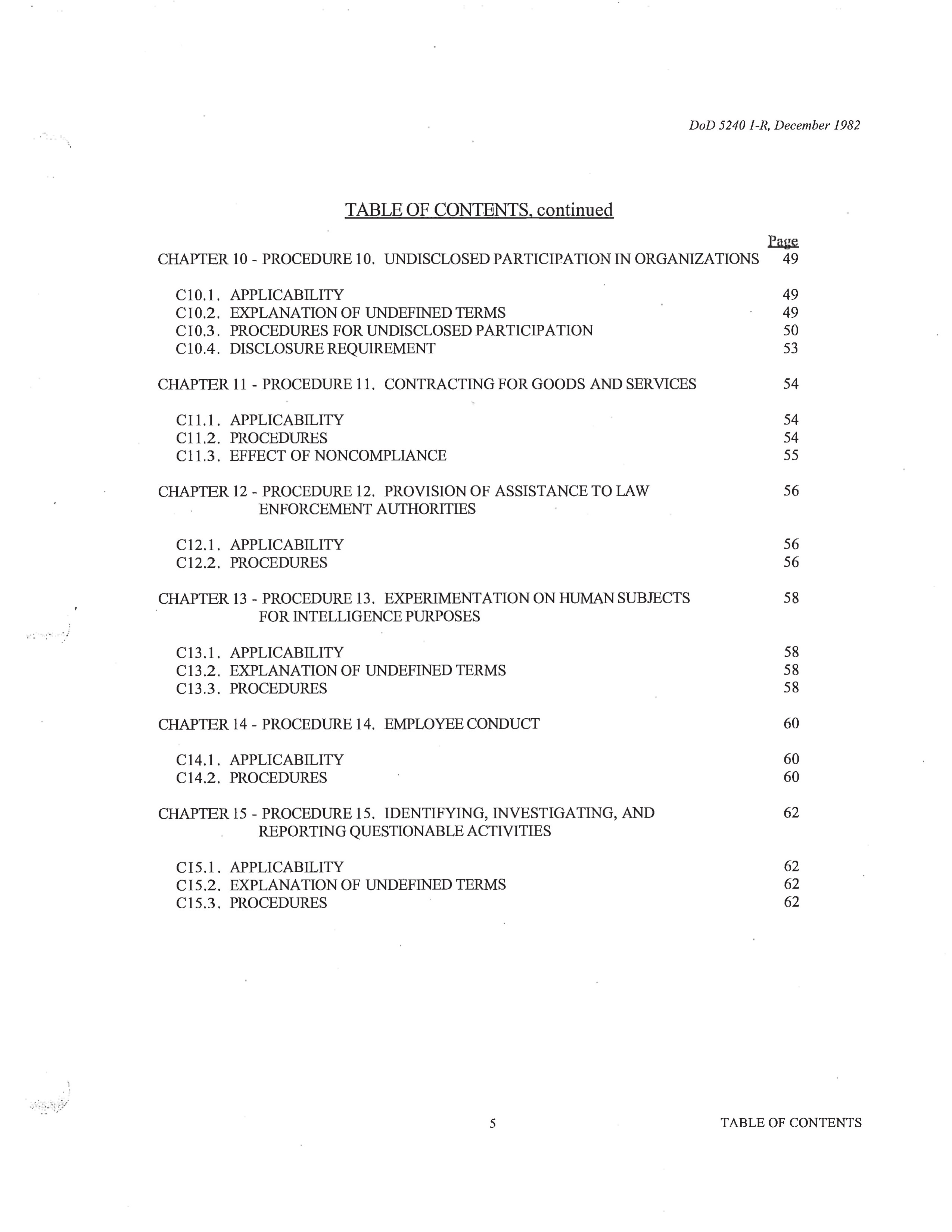
TABLE OF CONTENTS
Page
FOREWORD
TABLE OF CONTENTS
REFERENCES
DEFINITIONS
CHAPTER 1 - PROCEDURE 1. GENERAL PROVISIONS
C1.1. APPLICABILITY AND SCOPE
CI.2. SCOPE
C1.3. INTERPRETATION
CI.4. EXCEPTIONS TO POLICY
CI.5. AMENDMENT
CHAPTER 2 - PROCEDURE 2. COLLECTION OF INFORMATION ABOUT
UNITED STATES PERSONS
C2.1. APPLICABILITY AND SCOPE
C2.2. EXPLANATION OF UNDEFINED TERMS
C2.3. TYPES OF INFORMATION THAT MAY BE COLLECTED ABOUT
UNITED STATES PERSONS
C2.4. GENERAL CRITERIA GOVERNING THE MEANS USED TO COLLECT
INFORMATION ABOUT UNITED STATES PERSONS
C2.5. SPECIAL LIMITATION ON THE COLLECTION OF FOREIGN INTELLIGENCE
WITHIN THE UNITED STATES
CHAPTER 3 - PROCEDURE 3. RETENTION OF INFORMATION ABOUT
UNITED STATES PERSONS
C3.1. APPLICABILITY
C3.2. EXPLANATION OF UNDEFINED TERMS
C3.3. CRITERIA FOR RETENTION
C3.4. ACCESS AND RETENTION
CHAPTER 4 - PROCEDURE 4. DISSEMINATION OF INFORMATION ABOUT
UNITED STATES PERSONS
C4.1. APPLICABILITY AND SCOPE
C4.2. CRITERIA FOR DISSEMINATION
C4.3. OTHER DISSEMINATION
2
3
6
7
13
13
13
14
14
14
15
15
15
16
18
18
20
20
20
20
21
22
22
22
23
3
TABLE OF CONTENTS
DoD 5240.1-R, December 1982
TABLE OF CONTENTS, continued
CHAPTER 5 - PROCEDURE 5. ELECTRONIC SURVEILLANCE
C5.1. PART 1. ELECTRONIC SURVEILLANCE IN THE UNITED STATES
FOR INTELLIGENCE PURPOSES
C5.2. PART 2. ELECTRONIC SURVEILLANCE OUTSIDE THE UNITED STATES
FOR INTELLIGENCE PURPOSES
C5.3. PART 3. SIGNALS INTELLIGENCE ACTIVITIES
C5.4. PART 4. TECHNICAL SURVEILLANCE COUNTERMEASUSRES
C5.5. PART 5. DEVELOPING, TESTING AND CALIBRATION OF
ELECTRONIC EQUIPMENT
C5.6. PART 6. TRAINING OF PERSONNEL IN THE OPERATION AND USE
OF ELECTRONIC COMMUNICATIONS AND SURVEILLANCE EQUIPMENT
C5.7. PART 7. CONDUCT OF VULNERABILITY AND HEARABILITY SURVEYS
CHAPTER 6 - PROCEDURE 6. CONCEALED MONITORING
C6.1. APPLICABILITY AND SCOPE
C6.2. EXPLANATION OF UNDEFINED TERMS
C6.3. PROCEDURES
CHAPTER 7 - PROCEDURE 7. PHYSICAL SEARCHES
C7.1. APPLICABILITY AND SCOPE
C7.2. EXPLANATION OF UNDEFINED TERMS
C7.3. PROCEDURES
CHAPTER-8 - PROCEDURE 8. SEARCHES AND EXAMINATION OF MAIL
C8.1. APPLICABILITY
C8.2. EXPLANATION OF UNDEFINED TERMS
C8.3. PROCEDURES
CHAPTER 9 - PROCEDURE 9. PHYSICAL SURVEILLANCE
C9.1. APPLICABILITY
C9.2. EXPLANATION OF UNDEFINED TERMS
C9.3. PROCEDURES
Page
24
24
25
28
31
32
34
36
38
38
38
39
41
41
41
41
45
45
45
46
47
47
47
47
4
TABLE OF CONTENTS
DoD 5240 1-R, December 1982
TABLE OF CONTENTS, continued
CHAPTER 10 - PROCEDURE 10, UNDISCLOSED PARTICIPATION IN ORGANIZATIONS
C10.1. APPLICABILITY
C10.2. EXPLANATION OF UNDEFINED TERMS
C10.3. PROCEDURES FOR UNDISCLOSED PARTICIPATION
C10.4. DISCLOSURE REQUIREMENT
CHAPTER 11 - PROCEDURE 11, CONTRACTING FOR GOODS AND SERVICES
C11.1. APPLICABILITY
C11.2. PROCEDURES
C11.3. EFFECT OF NONCOMPLIANCE
CHAPTER 12 - PROCEDURE 12. PROVISION OF ASSISTANCE TO LAW
ENFORCEMENT AUTHORITIES
C12.1. APPLICABILITY
C12.2. PROCEDURES
CHAPTER 13 - PROCEDURE 13. EXPERIMENTATION ON HUMAN SUBJECTS
FOR INTELLIGENCE PURPOSES
C13.1. APPLICABILITY
C13.2. EXPLANATION OF UNDEFINED TERMS
C13.3. PROCEDURES
CHAPTER 14 - PROCEDURE 14. EMPLOYEE CONDUCT
C14.1. APPLICABILITY
C14.2. PROCEDURES
CHAPTER 15 - PROCEDURE 15, IDENTIFYING, INVESTIGATING, AND
REPORTING QUESTIONABLE ACTIVITIES
C15.1, APPLICABILITY
C15.2. EXPLANATION OF UNDEFINED TERMS
C15.3. PROCEDURES
Page
49
49
49
50
53
54
54
54
55
56
56
56
58
58
58
58
60
60
60
62
62
62
62
5
TABLE OF CONTENTS
DoD 5240.1-R, December 1982
REFERENCES
(a) Executive Order 12333, "United States Intelligence Activities,"December 4, 1981
(b) Public Law 95-511, "Foreign Intelligence Surveillance Act of 1978"
(c) DoD Directive 5200.29, "DoD Technical Surveillance Countermeasures (TSCM)
Survey Program," February 12, 1975
(d) Chapters 105 and 119 of title 18, United States Code
(e) Public Law 73-416, "Communications Act of 1934," Section 605
(f) Sections 801-840 of title 10, United States Code, "Uniform Code of Military
Justice"
(g) Agreement Between the Deputy Secretary of Defense and Attorney General, April 5,
1979
(h) Executive Order 12198, "Prescribing Amendments to the Manual for
Courts-Martial, United States, 1969," March 12, 1980
(i) DoD Directive 5525.5, "DoD Cooperation with Civilian Law Enforcement Officials,"
March 22, 1982
(j) DoD Directive 5000.11, "Data Elements and Data Codes Standardization Program,"
December 7, 1964
(k) DoD Directive 5000.19, "Policies for the Management and Control of Information
Requirements," March 12, 1976
6
REFERENCES
DoD 5240.1-R, December 1982
DL1. DEFINITIONS
DL1.1.1. Administrative Purposes. Information is collected for "administrative
purposes" when it is necessary for the administration of the component concerned, but
is not collected directly in performance of the intelligence activities assigned such
component. Examples include information relating to the past performance of
potential contractors; information to enable such components to discharge their public
affairs and legislative duties, including the maintenance of correspondence files; the
maintenance of employee personnel and training records; and training materials or
documents produced at training facilities.
DL1.1.2. Available Publicly. Information that has been published or broadcast for
general public consumption, is available on request to a member of the general public,
could lawfully be seen or heard by any casual observer, or is made available at a meeting
open to the general public. In this context, the "general public" also means general
availability to persons in a military community even though the military community is
not open to the civilian general public.
DL1.1.3. Communications Security. Protective measures taken to deny
unauthorized persons information derived from telecommunications of the U.S.
Government related to national security and to ensure the authenticity of such
telecommunications.
DL1.1.4. Consent. The agreement by a person or organization to permit DoD
intelligence components to take particular actions that affect the person or
organization. Consent may be oral or written unless a specific form of consent is
required by a particular procedure. Consent may be implied if adequate notice is
provided that a particular action (such as entering a building) carries with it the
presumption of consent to an accompanying action (such as search of briefcases).
(Questions regarding what is adequate notice in particular circumstances should be
referred to the legal office responsible for advising the DoD intelligence component
concerned.)
DL1.1.5. Counterintelligence. Information gathered and activities conducted to
protect against espionage, other intelligence activities, sabotage, or assassinations
conducted for or on behalf of foreign powers, organizations, or persons, or international
terrorist activities, but not including personnel, physical, document, or communications
security programs.
7
DEFINITIONS
DoD 5240.1-R, December 1982
DL1.1.6. Counterintelligence Investigation. Includes inquiries and other activities
undertaken to determine whether a particular United States person is acting for, or on
behalf of, a foreign power for purposes of conducting espionage and other intelligence
activities, sabotage, assassinations, international terrorist activities, and actions to
neutralize such acts.
DL1.1.7. DoD Component. Includes the Office of the Secretary of Defense, each
of the Military Departments, the Organization of the Joint Chiefs of Staff, the Unified
and Specified Commands, and the Defense Agencies.
DL1.1.8. DoD Intelligence Components. Include the following organizations:
DL1.1.8.1. The National Security Agency/Central Security Service.
DL1.1.8.2. The Defense Intelligence Agency.
DL1.1.8.3. The offices within the Department of Defense for the collection
of specialized national foreign intelligence through reconnaissance programs.
DL1.1.8.4. The Assistant Chief of Staff for Intelligence, Army General Staff.
DL1.1.8.5. The Office of Naval Intelligence.
DL1.1.8.6. The Assistant Chief of Staff, Intelligence, U. S. Air Force.
DL1.1.8.7. The Army Intelligence and Security Command.
DL1.1.8.8. The Naval Intelligence Command.
DL1.1.8.9. The Naval Security Group Command.
DL1.1.8.10. The Director of Intelligence, U.S. Marine Corps.
DL1.1.8.11. The Air Force Intelligence Service.
DL1.1.8.12. The Electronic Security Command, U.S. Air Force.
DL1.1.8.13. The counterintelligence elements of the Naval Investigative
Service.
DL1.1.8.14. The counterintelligence elements of the Air Force Office of
Special Investigations.
8
DEFINITIONS
DoD 5240.1-R, December 1982
DL1.1.8.15. The 650th Military Intelligence Group, SHAPE.
DL1.1.8.16. Other organizations, staffs, and offices, when used for foreign
intelligence or counterintelligence activities to which part 2 of E.O. 12333 (reference
(a)), applies, provided that the heads of such organizations, staffs, and offices shall not
be considered as heads of DoD intelligence components for purposes of this
Regulation.
DL1.1.9. Electronic Surveillance. Acquisition of a nonpublic communication by
electronic means without the consent of a person who is a party to an electronic
communication or, in the case of a non-electronic communication, without the consent
of a person who is visibly present at the place of communication, but not including the
use of radio direction finding equipment solely to determine the location of a
transmitter. (Electronic surveillance within the United States is subject to the
definitions in the Foreign Intelligence Surveillance Act of 1978 (reference (b)).)
DL1.1.10. Employee. A person employed by, assigned to, or acting for an agency
within the intelligence community, including contractors and persons otherwise acting at
the direction of such an agency.
DL1.1.11. Foreign Intelligence. Information relating to the capabilities, intentions,
and activities of foreign powers, organizations, or persons, but not including
counterintelligence except for information on international terrorist activities.
DL1.1.12. Foreign Power. Any foreign government (regardless of whether
recognized by the United States), foreign-based political party (or faction thereof),
foreign military force, foreign-based terrorist group, or any organization composed, in
major part, of any such entity or entities.
DL1.1.13. Intelligence Activities. Refers to all activities that DoD intelligence
components are authorized to undertake pursuant to Executive Order 12333 (reference
(a)).
DL1.1.14. Intelligence Community and an Agency of Or Within the Intelligence
Community. Refers to the following organizations:
DL1.1.14.1. The Central Intelligence Agency (CIA).
DL1.1.14.2. The National Security Agency (NSA).
DL1.1.14.3. The Defense Intelligence Agency (DIA).
9
DEFINITIONS
DoD 5240.1-R, December 1982
DL1.1.14.4. The Offices within the Department of Defense for the collection
of specialized national foreign intelligence through reconnaissance programs.
DL1.1.14.5. The Bureau of Intelligence and Research of the Department of
State.
DL1.1.14.6. The intelligence elements of the Army, the Navy, the Air Force
and the Marine Corps, the Federal Bureau of Investigation (FBI), the Department of the
Treasury, and the Department of Energy.
DL1.1.14.7. The staff elements of the Office of the Director of Central
Intelligence.
DL1.1.15. International Narcotics Activities. Refers to activities outside the
United States to produce, transfer or sell narcotics or other substances controlled in
accordance with Sections 811 and 812 of title 21, United States Code.
DL1.1.16. International Terrorist Activities. Activities undertaken by or in support
of terrorists or terrorist organizations that occur totally outside the United States, or
that transcend national boundaries in terms of the means by which they are
accomplished, the persons they appear intended to coerce or intimidate, or the locale in
which the perpetrators operate or seek asylum.
DL1.1.17. Lawful Investigation. An investigation qualifies as a lawful investigation
if the subject of the investigation is within DoD investigative jurisdiction; if it is
conducted by a DoD Component that has authorization to conduct the particular type of
investigation concerned (for example, counterintelligence, personnel security, physical
security, communications security); and if the investigation is conducted in accordance
with applicable law and policy, including E.O. 12333 and this Regulation.
DL1.1.18. Personnel Security. Measures designed to insure that persons
employed, or being considered for employment, in sensitive positions of trust are
suitable for such employment with respect to loyalty, character, emotional stability, and
reliability and that such employment is clearly consistent with the interests of the
national security. It includes measures designed to ensure that persons granted access
to classified information remain suitable for such access and that access is consistent
with the interests of national security.
DL1.1.19. Personnel Security Investigation:
10
DEFINITIONS
DoD 5240.1-R, December 1982
DL1.1.19.1. An inquiry into the activities of a person granted access to
intelligence or other classified information; or a person who is being considered for
access to intelligence or other classified information, including persons who are
granted or may be granted access to facilities of DoD intelligence components; or a
person to be assigned or retained in a position with sensitive duties.emsp; The
investigation is designed to develop information pertaining to the suitability, eligibility,
and trustworthiness of the individual with respect to loyalty, character, emotional
stability and reliability.
DL1.1.19.2. Inquiries and other activities directed against DoD employees or
members of a Military Service to determine the facts of possible voluntary or
involuntary compromise of classified information by them.
DL1.1.19.3. The collection of information about or from military personnel in
the course of tactical training exercises for security training purposes.
DL1.1.20. Physical Security. The physical measures taken to prevent unauthorized
access to, and prevent the damage or loss of, equipment, facilities, materiel and
documents; and measures undertaken to protect DoD personnel from physical threats to
their safety.
DL1.1.21. Physical Security Investigation. All inquiries, inspections, or surveys
of the effectiveness of controls and procedures designed to provide physical security;
and all inquiries and other actions undertaken to obtain information pertaining to
physical threats to DoD personnel or property.
DL1.1.22. Reasonable Belief. A reasonable belief arises when the facts and
circumstances are such that a reasonable person would hold the belief. Reasonable
belief must rest on facts and circumstances that can be articulated; "hunches" or
intuitions are not sufficient. Reasonable belief can be based on experience, training,
and knowledge in foreign intelligence or counterintelligence work applied to facts and
circumstances at hand, so that a trained and experienced "reasonable person" might hold a
reasonable belief sufficient to satisfy this criterion when someone unfamiliar with
foreign intelligence or counterintelligence work might not.
DL1.1.23. Signals Intelligence. A category of intelligence including
communications intelligence, electronic intelligence, and foreign instrumentation
signals intelligence, either individually or in combination.
DL1.1.24. United States. When used to describe a place, the term shall include
the territories under the sovereignty of the United States.
11
DEFINITIONS
DoD 5240 1-R, December 1982
DL1.1.25. United States Person
DL1.1.25.1. The term "United States person" means:
DL1.1.25.1.1. A United States citizen;
DL1.1.25.1.2. An alien known by the DoD intelligence component concerned to be a permanent resident alien;
DL1.1.25.1.3. An unincorporated association substantially composed of United States citizens or permanent resident aliens;
DL1.1.25.1.4. A corporation incorporated in the United States, except for a corporation directed and controlled by a foreign government or governments. A corporation or corporate subsidiary incorporated abroad, even if partially or wholly owned by a corporation incorporated in the United States, is not a United States person.
DL1.1.25.2. A person or organization outside the United States shall be presumed not to be a United States person unless specific information to the contrary is obtained. An alien in the United States shall be presumed not to be a United States person unless specific information to the contrary is obtained.
DL1.1.25.3. A permanent resident alien is a foreign national lawfully admitted into the United States for permanent residence.
12
DEFINITIONS
C1. CHAPTER 1
PROCEDURE 1. GENERAL PROVISIONS
DoD 5240.1-R, December 1982
C1.1. APPLICABILITY AND SCOPE
C1.1.1. These procedures apply only to "DoD intelligence components," as defined in the Definitions Section. Procedures 2 through 4 provide the sole authority by which such components may collect, retain and disseminate information concerning United States persons. Procedures 5 through 10 set forth applicable guidance with respect to the use of certain collection techniques to obtain information for foreign intelligence and counterintelligence purposes. Authority to employ such techniques shall be limited to that necessary to perform functions assigned the DoD intelligence component concerned. Procedures 11 through 15 govern other aspects of DoD intelligence activities, including the oversight of such activities.
C1.1.2. The functions of DoD intelligence components not specifically addressed herein shall be carried out in accordance with applicable policy and procedure.
C1.1.3. These procedures do not apply to law enforcement activities, including civil disturbance activities, that may be undertaken by DoD intelligence components. When an investigation or inquiry undertaken pursuant to these procedures establishes reasonable belief that a crime has been committed, the DoD intelligence component concerned shall refer the matter to the appropriate law enforcement agency in accordance with procedures 12 and 15 or, if the DoD intelligence component is otherwise authorized to conduct law enforcement activities, shall continue such investigation under appropriate law enforcement procedures.
C1.1.4. DoD intelligence components shall not request any person or entity to undertake any activity forbidden by Executive Order 12333 (reference (a)).
C1.2. PURPOSE
The purpose of these procedures is to enable DoD intelligence components to carry out effectively their authorized functions while ensuring their activities that affect U.S. persons are carried out in a manner that protects the constitutional rights and privacy of such persons.
13
CHAPTER 1
DoD 5240.1-R, December 1982
C1.3. INTERPRETATION
C1.3.1. These procedures shall be interpreted in accordance with their stated purpose.
C1.3.2. All defined terms appear in the Definitions Section. Additional terms, not otherwise defined, are explained in the text of each procedure, as appropriate.
C1.3.3. All questions of interpretation shall be referred to the legal office responsible for advising the DoD intelligence component concerned. Questions that cannot be resolved in this manner shall be referred to the General Counsel of the Military Department concerned, or, as appropriate, the General Counsel of the Department of Defense for resolution.
C1.4. EXCEPTIONS TO POLICY
Requests for exception to the policies and procedures established herein shall be made in writing to the Deputy Under Secretary of Defense (Policy), who shall obtain the written approval of the Secretary of Defense and, if required, the Attorney General for any such exception.
C1.5. AMENDMENT
Requests for amendment of these procedures shall be made to the Deputy Under Secretary of Defense (Policy), who shall obtain the written approval of the Secretary of Defense, and, if required, the Attorney General, for any such amendment.
14
CHAPTER 1
C2. CHAPTER 2
PROCEDURE 2. COLLECTION OF
INFORMATION ABOUT UNITED STATES PERSONS
DoD 5240.1-R, December 1982
C2.1. APPLICABILITY AND SCOPE
This procedure specifies the kinds of information about United States persons that may be collected by DoD intelligence components and sets forth general criteria governing the means used to collect such information. Additional limitations are imposed in Procedures 5 through 10 on the use of specific collection techniques.
C2.2. EXPLANATION OF UNDEFINED TERMS
C2.2.1. Collection. Information shall be considered as "collected" only when it has been received for use by an employee of a DoD intelligence component in the course of his official duties. Thus, information volunteered to a DoD intelligence component by a cooperating source would be "collected" under this procedure when an employee of such component officially accepts, in some manner, such information for use within that component. Data acquired by electronic means is "collected" only when it has been processed into intelligible form.
C2.2.2. Cooperating sources means persons or organizations that knowingly and voluntarily provide information to DoD intelligence components, or access to information, at the request of such components or on their own initiative. These include Government Agencies, law enforcement authorities, credit agencies, academic institutions, employers, and foreign governments.
C2.2.3. Domestic activities refers to activities that take place within the United States that do not involve a significant connection with a foreign power, organization, or person.
C2.2.4. Overt means refers to methods of collection whereby the source of the information being collected is advised, or is otherwise aware, that he is providing such information to the Department of Defense or a component thereof.
15
CHAPTER 2
DoD 5240.1-R, December 1982
C2.3. TYPES OF INFORMATION THAT MAY BE COLLECTED ABOUT UNITED STATES PERSONS
Information that identifies a United States person may be collected by a DoD intelligence component only if it is necessary to the conduct of a function assigned the collecting component, and only if it falls within one of the following categories:
C2.3.1. Information Obtained With Consent. Information may be collected about a United States person who consents to such collection.
C2.3.2. Publicly Available Information. Information may be collected about a United States person if it is publicly available.
C2.3.3. Foreign Intelligence. Subject to the special limitation contained in section C2.5., below, information may be collected about a United States person if the information constitutes foreign intelligence, provided the intentional collection of foreign intelligence about United States persons shall be limited to persons who are:
C2.3.3.1. Individuals reasonably believed to be officers or employees, or otherwise acting for or on behalf, of a foreign power;
C2.3.3.2. An organization reasonably believed to be owned or controlled, directly or indirectly, by a foreign power;
C2.3.3.3. Persons or organizations reasonably believed to be engaged or about to engage, in international terrorist or international narcotics activities;
C2.3.3.4. Persons who are reasonably believed to be prisoners of war; missing in action; or are the targets, the hostages, or victims of international terrorist organizations; or
C2.3.3.5. Corporations or other commercial organizations believed to have some relationship with foreign powers, organizations, or persons.
C2.3.4. Counterintelligence. Information may be collected about a United States person if the information constitutes counterintelligence, provided the intentional collection of counterintelligence about United States persons must be limited to:
C2.3.4.1. Persons who are reasonably believed to be engaged in, or about to engage in, intelligence activities on behalf of a foreign power, or international terrorist activities.
16
CHAPTER 2
DoD 5240.1-R, December 1982
C2.3.4.2. Persons in contact with persons described in subparagraph C2.3.4.1.,
above, for the purpose of identifying such person and assessing their relationship with
persons described in subparagraph C2.3.4.1., above.
C2.3.5. Potential Sources of Assistance to Intelligence Activities. Information
may be collected about United States persons reasonably believed to be potential
sources of intelligence, or potential sources of assistance to intelligence activities, for
the purpose of assessing their suitability or credibility. This category does not include
investigations undertaken for personnel security purposes.
C2.3.6. Protection of Intelligence Sources and Methods. Information may be
collected about a United States person who has access to, had access to, or is otherwise
in possession of, information that reveals foreign intelligence and counterintelligence
sources or methods, when collection is reasonably believed necessary to protect against
the unauthorized disclosure of such information; provided that within the United States,
intentional collection of such information shall be limited to persons who are:
C2.3.6.1. Present and former DoD employees;
C2.3.6.2. Present or former employees of a present or former DoD
contractor; and
C2.3.6.3. Applicants for employment at the Department of Defense or at a
contractor of the Department of Defense.
C2.3.7. Physical Security. Information may be collected about a United States
person who is reasonably believed to threaten the physical security of DoD employees,
installations, operations, or official visitors. Information may also be collected in the
course of a lawful physical security investigation.
C2.3.8. Personnel Security. Information may be collected about a United States
person that arises out of a lawful personnel security investigation.
C2.3.9. Communications Security. Information may be collected about a United
States person that arises out of a lawful communications security investigation.
C2.3.10. Narcotics. Information may be collected about a United States person
who is reasonably believed to be engaged in international narcotics activities.
C2.3.11. Threats to Safety. Information may be collected about a United States
person when the information is needed to protect the safety of any person or
17
CHAPTER 2
DoD 5240 1-R, December 1982
organization, including those who are targets, victims, or hostages of international
terrorist organizations.
C2.3.12. Overhead Reconnaissance. Information may be collected from overhead
reconnaissance not directed at specific United States persons.
C2.3.13. Administrative Purposes. Information may be collected about a United
States person that is necessary for administrative purposes.
C2.4. GENERAL CRITERIA GOVERNING THE MEANS USED TO COLLECT
INFORMATION ABOUT UNITED STATES PERSONS
C2.4.1. Means of Collection. DoD intelligence components are authorized to
collect information about United States persons by any lawful means, provided that all
such collection activities shall be carried out in accordance with E.O. 12333 (reference
(a)), and this Regulation, as appropriate.
C2.4.2. Least Intrusive Means. The collection of information about United States
persons shall be accomplished by the least intrusive means. In general, this means the
following:
C2.4.2.1. To the extent feasible, such information shall be collected from
publicly available information or with the consent of the person concerned;
C2.4.2.2. If collection from these sources is not feasible or sufficient, such
information may be collected from cooperating sources;
C2.4.2.3. If collection from cooperating sources is not feasible or sufficient,
such information may be collected, as appropriate, using other lawful investigative
techniques that do not require a judicial warrant or the approval of the Attorney
General; then
C2.4.2.4. If collection through use of these techniques is not feasible or
sufficient, approval for use of investigative techniques that do require a judicial warrant
or the approval of the Attorney General may be sought.
C2.5. SPECIAL LIMITATION ON THE COLLECTION OF FOREIGN INTELLIGENCE
WITHIN THE UNITED STATES
Within the United States, foreign intelligence concerning United States persons may be
collected only by overt means unless all the following conditions are met:
18
CHAPTER 2
DoD 5240.1-R, December 1982
C2.5.1. The foreign intelligence sought is significant and collection is not
undertaken for the purpose of acquiring information concerning the domestic activities
of any United States person;
C2.5.2. Such foreign intelligence cannot be reasonably obtained by overt means;
C2.5.3. The collection of such foreign intelligence has been coordinated with the
Federal Bureau of Investigation (FBI); and
C2.5.4. The use of other than overt means has been approved in writing by the head
of the DoD intelligence component concerned, or his single designee, as being
consistent with these procedures. A copy of any approval made pursuant to this section
shall be provided the Deputy Under Secretary of Defense (Policy).
19
CHAPTER 2
DoD 5240.1-R, December 1982
C3. CHAPTER 3
PROCEDURE 3. RETENTION OF INFORMATION
ABOUT UNITED STATES PERSONS
C3.1. APPLICABILITY
This procedure governs the kinds of information about United States persons that may
knowingly be retained by a DoD intelligence component without the consent of the
person whom the information concerns. It does not apply when the information in
question is retained solely for administrative purposes or is required by law to be
maintained.
C3.2. EXPLANATION OF UNDEFINED TERMS
The term "retention," as used in this procedure, refers only to the maintenance of
information about United States persons that can be retrieved by reference to the
person's name or other identifying data.
C3.3. CRITERIA FOR RETENTION
C3.3.1. Retention of Information Collected Under Procedure 2. Information about
United States persons may be retained if it was collected pursuant to Procedure 2.
C3.3.2. Retention of Information Acquired Incidentally. Information about United
States persons collected incidentally to authorized collection may be retained if:
C3.3.2.1. Such information could have been collected intentionally under
Procedure 2;
C3.3.2.2. Such information is necessary to understand or assess foreign
intelligence or counterintelligence;
C3.3.2.3. The information is foreign intelligence or counterintelligence
collected from electronic surveillance conducted in compliance with this Regulation; or
C3.3.2.4. Such information is incidental to authorized collection and may
indicate involvement in activities that may violate Federal, State, local, or foreign law.
20
CHAPTER 3
DoD 5240.1-R, December 1982
C3.3.3. Retention of Information Relating to Functions of Other DoD Components
or non-DoD Agencies. Information about United States persons that pertains solely to
the functions of other DoD Components or Agencies outside the Department of
Defense shall be retained only as necessary to transmit or deliver such information to
the appropriate recipients.
C3.3.4. Temporary Retention. Information about United States persons may be
retained temporarily, for a period not to exceed 90 days, solely for the purpose of
determining whether that information may be permanently retained under these
procedures.
C3.3.5. Retention of Other Information. Information about United States persons
other than that covered by paragraphs C3.3.1. through C3.3.4., above, shall be retained
only for purposes of reporting such collection for oversight purposes and for any
subsequent proceedings that may be necessary.
C3.4. ACCESS AND RETENTION
C3.4.1. Controls On Access to Retained Information. Access within a DoD
intelligence component to information about United States persons retained pursuant to
this procedure shall be limited to those with a need to know.
C3.4.2. Duration of Retention. Disposition of information about United States
Persons retained in the files of DoD intelligence components will comply with the
disposition schedules approved by the Archivist of the United States for the files or
records in which the information is retained.
C3.4.3. Information Acquired Prior to Effective Date. Information acquired prior
to the effective date of this procedure may be retained by DoD intelligence components
without being screened for compliance with this procedure or Executive Order 12333
(reference (a)), so long as retention was in compliance with applicable law and previous
Executive orders.
21
CHAPTER 3
DoD 5240.1-R, December 1982
C4. CHAPTER 4
PROCEDURE 4. DISSEMINATION OF INFORMATION
ABOUT UNITED STATES PERSONS
C4.1. APPLICABILITY AND SCOPE
This procedure governs the kinds of information about United States persons that may
be disseminated, without their consent, outside the DoD intelligence component that
collected and retained the information. It does not apply to information collected
solely for administrative purposes; or disseminated pursuant to law; or pursuant to a
court order that otherwise imposes controls upon such dissemination.
C4.2. CRITERIA FOR DISSEMINATION
Except as provided in section C4.3., below, information about United States persons that
identifies those persons may be disseminated without the consent of those persons only
under the following conditions:
C4.2.1. The information was collected or retained or both under Procedures 2 and
3;
C4.2.2. The recipient is reasonably believed to have a need to receive such
information for the performance of a lawful governmental function, and is one of the
following:
C4.2.2.1. An employee of the Department of Defense, or an employee of a
contractor of the Department of Defense, and has a need for such information in the
course of his or her official duties;
C4.2.2.2. A law enforcement entity of Federal, State, or local government, and
the information may indicate involvement in activities that may violate laws that the
recipient is responsible to enforce;
C4.2.2.3. An Agency within the intelligence community; provided that within
the intelligence community, information other than information derived from signals
intelligence, may be disseminated to each appropriate Agency for the purpose of
allowing the recipient Agency to determine whether the information is relevant to its
responsibilities without such a determination being required of the disseminating DoD
intelligence component;
22
CHAPTER 4
DoD 5240.1-R, December 1982
C4.2.2.4. An Agency of the Federal Government authorized to receive such
information in the performance of a lawful governmental function; or
C4.2.2.5. A foreign government, and dissemination is undertaken pursuant to an
agreement or other understanding with such government.
C4.3. OTHER DISSEMINATION
Any dissemination that does not conform to the conditions set forth in section C4.2.,
above, must be approved by the legal office responsible for advising the DoD
Component concerned after consultation with the Department of Justice and General
Counsel of the Department of Defense. Such approval shall be based on determination
that the proposed dissemination complies with applicable laws, Executive orders, and
regulations.
23
CHAPTER 1
C5. CHAPTER 5
PROCEDURE 5. ELECTRONIC SURVEILLANCE
DoD 5240.1-R, December 1982
C5.1. PART1: ELECTRONIC SURVEILLANCE IN THE UNITED STATES FOR
INTELLIGENCE PURPOSES
C5.1.1. Applicability. This part of Procedure 5 implements the Foreign
Intelligence Surveillance Act of 1979 (reference (b)), and applies to electronic
surveillance, as defined in that Act, conducted by DoD intelligence components within
the United States to collect "foreign intelligence information," as defined in that Act.
C5.1.2. General Rules
C5.1.2.1. Electronic Surveillance Pursuant to the Foreign Intelligence
Surveillance Act. A DoD intelligence component may conduct electronic surveillance
within the United States for foreign intelligence and counterintelligence purposes only
pursuant to an order issued by a judge of the court appointed pursuant to the Foreign
Intelligence Surveillance Act of 1978 (reference (b)), or pursuant to a certification of
the Attorney General issued under the authority of Section 102(a) of the Act.
C5.1.2.2. Authority to Request Electronic Surveillance. Authority to approve
the submission of applications or requests for electronic surveillance under the Foreign
Intelligence Surveillance Act of 1978 (reference (b)) shall be limited to the Secretary
of Defense, the Deputy Secretary of Defense, the Secretary or Under Secretary of a
Military Department, and the Director of the National Security Agency. Applications
for court orders will be made through the Attorney General after prior clearance by the
General Counsel, DoD. Requests for Attorney General certification shall be made only
after prior clearance by the General Counsel, DoD.
C5.1.2.3. Electronic Surveillance In Emergency Situations
C5.1.2.3.1. ADoD intelligence component may conduct electronic
surveillance within the United States in emergency situations under an approval from the
Attorney General in accordance with Section 105(e) of reference (b).
C5.1.2.3.2. The head of a DoD intelligence component may request that
the DoD General Counsel seek such authority directly from the Attorney General in an
emergency, if it is not feasible to submit such request through an official designated in
subparagraph C5.1.2.2., above, provided the appropriate official concerned shall be
advised of such requests as soon as possible thereafter.
24
CHAPTER 5
DoD 5240.1-R, December 1982
C5.2. PART2: ELECTRONIC SURVEILLANCE OUTSIDE THE UNITED STATES FOR
INTELLIGENCE PURPOSES
C5.2.1. Applicability. This part of Procedure 5 applies to electronic surveillance,
as defined in the Definitions Section, for foreign intelligence and counterintelligence
purposes directed against United States persons who are outside the United States, and
who, under the circumstances, have a reasonable expectation of privacy. It is intended
to be applied in conjunction with the regulation of electronic surveillance "within the
United States" under Part 1 and the regulation of "signals intelligence activities" under
Part 3 so that the intentional interception for foreign intelligence and
counterintelligence purposes of all wire or radio communications of persons within the
United States and against United States persons abroad where such persons enjoy a
reasonable expectation of privacy is covered by one of the three parts. In addition, this
part governs the use of electronic, mechanical, or other surveillance devices for foreign
intelligence and counterintelligence purposes against a United States person abroad in
circumstances where such person has a reasonable expectation of privacy. This part
does not apply to the electronic surveillance of communications of other than United
States persons abroad or the interception of the communications of United States
persons abroad that do not constitute electronic surveillance.
C5.2.2. Explanation of Undefined Terms
C5.2.2.1. Electronic surveillance is "directed against a United States person"
when the surveillance is intentionally targeted against or designed to intercept the
communications of that person. Electronic surveillance directed against persons who
are not United States persons that results in the incidental acquisition of the
communications of a United States person does not thereby become electronic
surveillance directed against a United States person.
C5.2.2.2. Electronic surveillance is "outside the United States" if the person
against whom the electronic surveillance is directed is physically outside the United
States, regardless of the location at which surveillance is conducted. For example, the
interception of communications that originate and terminate outside the United States
can be conducted from within the United States and still fall under this part rather than
Part 1.
C5.2.3. Procedures. Except as provided in paragraph C5.2.5., below, DoD
intelligence components may conduct electronic surveillance against a United States
person who is outside the United States for foreign intelligence and counterintelligence
purposes only if the surveillance is approved by the Attorney General. Requests for
25
CHAPTER 5
DoD 5240.1-R, December 1982
approval will be forwarded to the Attorney General by an official designated in
subparagraph C5.2.5.1., below. Each request shall include:
C5.2.3.1. An identification or description of the target.
C5.2.3.2. A statement of the facts supporting a finding that:
C5.2.3.2.1. There is probable cause to believe the target of the electronic
surveillance is one of the following:
C5.2.3.2.1.1. Aperson who, for or on behalf of a foreign power is
engaged in clandestine intelligence activities (including covert activities intended to
affect the political or governmental process), sabotage, or international terrorist
activities, or activities in preparation for international terrorist activities; or who
conspires with, or knowingly aids and abets a person engaging in such activities;
C5.2.3.2.1.2. Aperson who is an officer or employee of a foreign
power;
C5.2.3.2.1.3. Aperson unlawfully acting for, or pursuant to the
direction of, a foreign power. The mere fact that a person's activities may benefit or
further the aims of a foreign power is not enough to bring that person under this
paragraph, absent evidence that the person is taking direction from, or acting in knowing
concert with, the foreign power;
C5.2.3.2.1.4. Acorporation or other entity that is owned or
controlled directly or indirectly by a foreign power; or
C5.2.3.2.1.5. Aperson in contact with, or acting in collaboration with,
an intelligence or security service of a foreign power for the purpose of providing
access to information or material classified by the United States to which such person
has access.
C5.2.3.2.2. The electronic surveillance is necessary to obtain significant
foreign intelligence or counterintelligence.
C5.2.3.2.3. The significant foreign intelligence or counterintelligence
expected to be obtained from the electronic surveillance could not reasonably be
obtained by other less intrusive collection techniques.
C5.2.3.3. Adescription of the significant foreign intelligence or
counterintelligence expected to be obtained from the electronic surveillance.
26
CHAPTER 5
DoD 5240.1-R, December 1982
C5.2.3.4. A description of the means by which the electronic surveillance will be effected.
C5.2.3.5. If physical trespass is required to effect the surveillance, a statement of facts supporting a finding that the means involve the least amount of intrusion that will accomplish the objective.
C5.2.3.6. A statement of period of time, not to exceed 90 days, for which the electronic surveillance is required.
C5.2.3.7. A description of the expected dissemination of the product of the surveillance, including a description of the procedures that will govern the retention and dissemination of communications of or concerning United States persons other than those targeted, acquired incidental to such surveillance.
C5.2.4. Electronic Surveillance in Emergency Situations. Notwithstanding paragraph C5.2.3., above, a DoD intelligence component may conduct surveillance directed at a United States person who is outside the United States in emergency situations under the following limitations:
C5.2.4.1. Officials designated in paragraph C5.2.5., below, may authorize electronic surveillance directed at a United States person outside the United States in emergency situations, when securing the prior approval of the Attorney General is not practical because:
C5.2.4.1.1. The time required would cause failure or delay in obtaining significant foreign intelligence or counterintelligence and such failure or delay would result in substantial harm to the national security;
C5.2.4.1.2. A person's life or physical safety is reasonably believed to be in immediate danger; or
C5.2.4.1.3. The physical security of a defense installation or Government property is reasonably believed to be in immediate danger.
C5.2.4.2. Except for actions taken under subparagraph C5.2.4.1.2., above, any official authorizing such emergency surveillance shall find that one of the criteria contained in subparagraph C5.2.3.2.1., above, is met. Such officials shall notify the DoD General Counsel promptly of any such surveillance, the reason for authorizing such surveillance on an emergency basis, and the expected results.
27
CHAPTER 5
DoD 5240.1-R, December 1982
C5.2.4.3. The Attorney General shall be notified by the General Counsel, DoD, as soon as possible of the surveillance, the circumstances surrounding its authorization, and the results thereof, and such other information as may be required to authorize continuation of such surveillance.
C5.2.4.4. Electronic surveillance authorized pursuant to this section may not continue longer than the time required for a decision by the Attorney General and in no event longer than 72 hours.
C5.2.5. Officials Authorized to Request and Approve Electronic Surveillance Outside the United States
C5.2.5.1. The following officials may request approval of electronic surveillance outside the United States under paragraph C5.2.3., above, and approve emergency surveillance under paragraph C5.2.4., above:
C5.2.5.1.1. The Secretary and Deputy Secretary of Defense.
C5.2.5.1.2. The Secretaries and Under Secretaries of the Military Departments.
C5.2.5.1.3. The Director and Deputy Director of the National Security Agency/Chief, Central Security Service.
C5.2.5.2. Authorization for emergency electronic surveillance under paragraph C5.2.4., may also be granted by:
C5.2.5.2.1. Any general or flag officer at the overseas location in question, having responsibility for either the subject of the surveillance, or responsibility for the protection of the persons, installations, or property that is endangered, or
C5.2.5.2.2. The Deputy Director for Operations, National Security Agency.
C5.3. PART 3: SIGNALS INTELLIGENCE ACTIVITIES
C5.3.1. Applicability and Scope
C5.3.1.1. This procedure governs the conduct by the United States Signals Intelligence System of signals intelligence activities that involve the collection,
28
CHAPTER 5
DoD 5240.1-R, December 1982
retention, and dissemination of foreign communications and military tactical communications. Such activities may incidentally involve the collection of information concerning United States persons without their consent, or may involve communications originated or intended for receipt in the United States, without the consent of a party thereto.
C5.3.1.2. This part of Procedure 5 shall be supplemented by a classified Annex promulgated by the Director, National Security Agency/Chief, Central Security Service, which shall also be approved by the Attorney General. That regulation shall provide that signals intelligence activities that constitute electronic surveillance, as defined in Parts 1, and 2 of this procedure, will be authorized in accordance with those parts. Any information collected incidentally about United States persons shall be subjected to minimization procedures approved by the Attorney General.
C5.3.2. Explanation of Undefined Terms
C5.3.2.1. Communications concerning a United States person are those in which the United States person is identified in the communication. A United States person is identified when the person's name, unique title, address or other personal identifier is revealed in the communication in the context of activities conducted by that person or activities conducted by others and related to that person. A reference to a product by brand name or manufacturer's name or the use of a name in a descriptive sense, as, for example, "Monroe Doctrine," is not an identification of a United States person.
C5.3.2.2. Interception means the acquisition by the United States Signals Intelligence system through electronic means of a nonpublic communication to which it is not an intended party, and the processing of the contents of that communication into an intelligible form, but not including the display of signals on visual display devices intended to permit the examination of the technical characteristics of the signals without reference to the information content carried by the signals.
C5.3.2.3. Military tactical communications means United States and allied military exercise communications within the United States and abroad necessary for the production of simulated foreign intelligence and counterintelligence or to permit an analysis of communications security.
C5.3.2.4. United States Person. For purposes of signals intelligence activities only, the following guidelines will apply in determining whether a person is a United States person:
29
CHAPTER 5
DoD 5240.1-R, December 1982
C5.3.2.4.1. A person known to be currently in the United States will be treated as a United States person unless the nature of the person's communications or other available information concerning the person gives rise to a reasonable belief that such person is not a United States citizen or permanent resident alien.
C5.3.2.4.2. A person known to be currently outside the United States, or whose location is not known, will not be treated as a United States person unless the nature of the person's communications or other available information concerning the person give rise to a reasonable belief that such person is a United States citizen or permanent resident alien.
C5.3.2.4.3. A person known to be an alien admitted for permanent residence may be assumed to have lost status as a United States person if the person leaves the United States and it is known that the person is not in compliance with the administrative formalities provided by law that enable such persons to reenter the United States without regard to the provisions of law that would otherwise restrict an alien's entry into the United States. The failure to follow the statutory procedures provides a reasonable basis to conclude that such alien has abandoned any intention of maintaining status as a permanent resident alien.
C5.3.2.4.4. An unincorporated association whose headquarters are located outside the United States may be presumed not to be a United States person unless the collecting agency has information indicating that a substantial number of members are citizens of the United States or aliens lawfully admitted for permanent residence.
C5.3.2.5. United States Signals Intelligence System means the unified organization for signals intelligence activities under the direction of the Director, National Security Agency/Chief, Central Security Service, comprised of the National Security Agency, the Central Security Service, the components of the Military Services authorized to conduct signals intelligence and such other entities (other than the Federal Bureau of Investigation) as are authorized by the National Security Council or the Secretary of Defense to conduct signals intelligence. FBI activities are governed by procedures promulgated by the Attorney General.
C5.3.3. Procedures
C5.3.3.1. Foreign Communications. The United States Signals Intelligence System may collect, process, retain, and disseminate foreign communications that are also communications of or concerning United States persons, but only in accordance with the classified annex to this procedure.
30
CHAPTER
DoD 5240.1-R, December 1982
C5.3.3.2. Military Tactical Communications. The United States Signals Intelligence System may collect, process, retain, and disseminate military tactical communications that are also communications of or concerning United States persons but only in accordance with the classified annex to this procedure.
C5.3.3.2.1. Collection. Collection efforts will be conducted in the same manner as in the case of signals intelligence for foreign intelligence purposes and must be designed in such a manner as to avoid to the extent feasible the intercept of communications not related to military exercises.
C5.3.3.2.2. Retention and Processing. Military tactical communications may be retained and processed without deletion of references to United States persons who are participants in, or are otherwise mentioned in exercise-related communications, provided that the communications of United States persons not participating in the exercise that are inadvertently intercepted during the exercise shall be destroyed as soon as feasible.
C5.3.3.2.3. Dissemination. Dissemination of military tactical communications and exercise reports or information files derived from such communications shall be limited to those authorities and persons participating in or conducting reviews and critiques of such exercise.
C5.4. PART 4: TECHNICAL SURVEILLANCE COUNTERMEASURES
C5.4.1. Applicability and Scope. This part of Procedure 5 applies to the use of electronic equipment to determine the existence and capability of electronic surveillance equipment being used by persons not authorized to conduct electronic surveillance. It implements Section 105(f)(2) of the Foreign Intelligence Surveillance Act (reference (b)).
C5.4.2. Explanation of Undefined Terms. The term technical surveillance countermeasures refers to activities authorized pursuant to DoD Directive 5200.29 (reference (c)), and, as used in this procedure, refers to the use of electronic surveillance equipment, or electronic or mechanical devices, solely for determining the existence and capability of electronic surveillance equipment being used by persons not authorized to conduct electronic surveillance, or for determining the susceptibility of electronic equipment to unlawful electronic surveillance.
31
CHAPTER 5
DoD 5240.1-R, December 1982
C5.4.3. Procedures A DoD intelligence component may use technical surveillance
countermeasures that involve the incidental acquisition of the nonpublic
communications of United States persons without their consent, provided:
C5.4.3.1. The use of such countermeasures has been authorized or consented
to by the official in charge of the facility, organization, or installation where the
countermeasures are to be undertaken;
C5.4.3.2. The use of such countermeasures is limited in that necessary to
determine the existence and capability of such equipment; and
C5.4.3.3. Access to the content of communications acquired during the use of
countermeasures is limited to persons involved directly in conducting such measures,
and any content acquired is destroyed as soon as practical or upon completion of the
particular use. However, if the content is acquired within the United States, only
information that is necessary to protect against unauthorized electronic surveillance, or
to enforce Chapter 119 of title 18, United States Code (reference (d)) and Section 605
of the Communication Act of 1934 (reference (e)), may be retained and disseminated
only for these purposes. If acquired outside the United States, information that
indicates a violation of Federal law, including the Uniform Code of Military Justice
(reference (f)), or a clear and imminent threat to life or property, may also be
disseminated to appropriate law enforcement authorities. A record of the types of
communications and information subject to acquisition by the illegal electronic
surveillance equipment may be retained.
C5.5. PART 5: DEVELOPING, TESTING, AND CALIBRATION OF ELECTRONIC
EQUIPMENT
C5.5.1. Applicability This part of Procedure 5 applies to developing, testing, or
calibrating electronic equipment that can intercept or process communications and
non-communications signals. It also includes research and development that needs
electronic communications as a signal source.
C5.5.2. Procedures
C5.5.2.1. Signals Authorized for Use
C5.5.2.1.1. The following may be used without restriction:
C5.5.2.1.1.1. Laboratory-generated signals.
32
CHAPTER 5
DoD 5240.1-R, December 1982
C5.5.2.1.1.2. Communications signals with the consent of the
communicator.
C5.5.2.1.1.3. Communications in the commercial or public service
broadcast bands.
C5.5.2.1.1.4. Communications transmitted between terminals located
outside of the United States not used by any known United States person.
C5.5.2.1.1.5. Non-communications signals (including telemetry, and
radar).
C5.5.2.1.2. Communications subject to lawful electronic surveillance
under the provisions of Parts 1, 2, or 3, of this procedure may be used subject to the
minimization procedures applicable to such surveillance.
C5.5.2.1.3. Any of the following may be used subject to the restrictions
of subparagraph C5.5.2.2., below.
C5.5.2.1.3.1. Communications over official Government
communications circuits with consent from an appropriate official of the controlling
agency.
bands.
C5.5.2.1.3.2. Communications in the citizens and amateur-radio
C5.5.2.1.4. Other signals may be used only when it is determined that it is
not practical to use the signals described above and it is not reasonable to obtain the
consent of persons incidentally subjected to the surveillance. The restrictions of
subparagraph C5.5.2.2., below, will apply in such cases. The Attorney General must
approve use of signals pursuant to this subsection for the purpose of development,
testing, or calibration when the period of use exceeds 90 days. When Attorney General
approval is required, the DoD intelligence component shall submit a test proposal to the
General Counsel, DoD, or the NSA General Counsel for transmission to the Attorney
General for approval. The test proposal shall state the requirement for a period beyond
90 days, the nature of the activity, the organization that will conduct the activity, and the
proposed disposition of any signals or communications acquired during the activity.
C5.5.2.2. Restrictions. For signals described in subparagraphs C5.5.2.1.3. and
C5.5.2.1.4., above, the following restrictions apply:
33
CHAPTER 5
DoD 5240.1-R, December 1982
C5.5.2.2.1. The surveillance shall be limited in scope and duration to that
necessary for the purposes referred to in paragraph C5.5.1., above.
C5.5.2.2.2. No particular United States person shall be targeted
intentionally without consent.
C5.5.2.2.3. The content of any communication shall:
C5.5.2.2.3.1. Be retained only when actually needed for the purposes
referred to in paragraph C5.5.1., above;
C5.5.2.2.3.2. Be disseminated only to persons conducting the
activity; and
C5.5.2.2.3.3. Be destroyed immediately upon completion of the
activity.
C5.5.2.2.4. The technical parameters of a communication (such as
frequency, modulation, bearing, signal strength, and time of activity) may be retained and
used for the purposes outlined in paragraph C5.5.1., above, or for collection avoidance
purposes. Such parameters may be disseminated to other DoD intelligence components
and other entities authorized to conduct electronic surveillance or related development,
testing, and calibration of electronic equipment provided such dissemination and use are
limited to the purposes outlined in paragraph C5.5.1., or collection avoidance purposes.
No content of any communication may be retained or used other than as provided in
subparagraph C5.5.2.2.3., above.
C5.6. PART 6: TRAINING OF PERSONNEL IN THE OPERATION AND USE OF
ELECTRONIC COMMUNICATIONS AND SURVEILLANCE EQUIPMENT
C5.6.1. Applicability. This part of Procedure 5 applies to the training of
personnel by DoD intelligence components in the operation and use of electronic
communications and surveillance equipment. It does not apply to the interception of
communications with the consent of one of the parties to the communication or to the
training of intelligence personnel by non-intelligence components.
C5.6.2. Procedures
C5.6.2.1. Training Guidance. The training of personnel by DoD intelligence
components in the operation and use of electronic communications and surveillance
34
CHAPTER 5
DoD 5240.1-R, December 1982
equipment shall include guidance concerning the requirements and restrictions of the
Foreign Intelligence Surveillance Act of 1978 (reference (b)), and E.O. 12333
(reference (a)), with respect to the unauthorized acquisition and use of the content of
communications of United States persons.
C5.6.2.2. Training Limitations
C5.6.2.2.1. Except as permitted by paragraph C5.6.2.2.2. and C5.6.2.2.3.,
below, the use of electronic communications and surveillance equipment for training
purposes is permitted, subject to the following limitations:
C5.6.2.2.1.1. To the maximum extent practical, use of such
equipment for training purposes shall be directed against communications that are
subject to lawful electronic surveillance for foreign intelligence and
counterintelligence purposes under Parts 1, 2, and 3 of this procedure.
C5.6.2.2.1.2. The contents of private communications of
non-consenting United States persons may not be acquired aurally unless the person is
an authorized target of electronic surveillance.
C5.6.2.2.1.3. The electronic surveillance will be limited in extent
and duration to that necessary to train personnel in the use of the equipment.
C5.6.2.2.2. Public broadcasts, distress signals, or official U.S.
Government communications may be monitored, provided that when Government
Agency communications are monitored, the consent of an appropriate official is
obtained.
C5.6.2.2.3. Minimal acquisition of information is permitted as required
for calibration purposes.
C5.6.2.3. Retention and Dissemination. Information collected during training
that involves communications described in subparagraph C5.6.2.2.1.1., above, shall be
retained and disseminated in accordance with minimization procedures applicable to that
electronic surveillance. Information collected during training that does not involve
communications described in subparagraph C5.6.2.2.1.1., above, or that is acquired
inadvertently, shall be destroyed as soon as practical or upon completion of the training
and may not be disseminated for any purpose. This limitation does not apply to distress
signals.
35
CHAPTER 5
DoD 5240.1-R, December 1982
C5.7. PART 7: CONDUCT OF VULNERABILITY AND HEARABILITY SURVEYS
C5.7.1. Applicability and Scope This part of Procedure 5 applies to the conduct
of vulnerability surveys and hearability surveys by DoD intelligence components.
C5.7.2. Explanation of Undefined Terms
C5.7.2.1. The term vulnerability survey refers to the acquisition of radio
frequency propagation and its subsequent analysis to determine empirically the
vulnerability of the transmission media to interception by foreign intelligence services.
C5.7.2.2. The term hearability survey refers to monitoring radio
communications to determine whether a particular radio signal can be received at one
or more locations and, if reception is possible, to determine the hearability of reception
over time.
C5.7.3. Procedures
C5.7.3.1. Conduct of Vulnerability Surveys. Nonconsensual surveys may be
conducted to determine the potential vulnerability to intelligence services of a foreign
power of transmission facilities of communications common carriers, other private
commercial entities, and entities of the federal government, subject of the following
limitations:
C5.7.3.1.1. No vulnerability survey may be conducted without the prior
written approval of the Director, National Security Agency, or his designee.
C5.7.3.1.2. No transmission may be acquired aurally.
C5.7.3.1.3. No content of any transmission may be acquired by any means.
C5.7.3.1.4. No transmissions may be recorded.
C5.7.3.1.5. No report or log may identify any United States person or
entity except to the extent of identifying transmission facilities that are vulnerable to
surveillance by foreign powers. If the identities of the users of such facilities are not
identical with the identities of the owners of the facilities, the identity of such users
may be obtained but not from the content of the transmissions themselves, and may be
included in such report or log. Reports may be disseminated. Logs may be
disseminated only if required to verify results contained in reports.
36
CHAPTER 5
DoD 5240.1-R, December 1982
C5.7.3.2. Conduct of Hearability Surveys. The Director, National Security
Agency, may conduct, or may authorize the conduct by other Agencies, of hearability
surveys of telecommunications that are transmitted in the United States.
C5.7.3.2.1. Collection. When practicable, consent will be secured from
the owner or user of the facility against which the hearability survey is to be conducted
prior to the commencement of the survey.
C5.7.3.2.2. Processing and Storage. Information collected during a
hearability survey must processed and stored as follows:
C5.7.3.2.2.1. The content of communications may not be recorded
or included in any report.
C5.7.3.2.2.2. No microwave transmission may be de-multiplexed or
demodulated for any purpose.
C5.7.3.2.2.3. No report or log may identify any person or entity
except to the extent of identifying the transmission facility that can be intercepted from
the intercept site. If the identities of the users of such facilities are not identical with
the identities of the owners of the facilities, and their identities are relevant to the
purpose for which the hearability survey has been conducted, the identity of such users
may be obtained provided such identities may not be obtained from the contents of the
transmissions themselves.
C5.7.3.2.3. Dissemination. Reports may be disseminated only within the
U.S. Government. Logs may not be disseminated unless required to verify results
contained in reports.
37
CHAPTER 5
C6. CHAPTER 6
PROCEDURE 6. CONCEALED MONITORING
DoD 5240,1-R, December 1982
C6.1. APPLICABILITY AND SCOPE
C6.1.1. This procedure applies to concealed monitoring only for foreign
intelligence and counterintelligence purposes conducted by a DoD intelligence
component within the United States or directed against a United States person who is
outside the United States where the subject of such monitoring does not have a
reasonable expectation of privacy, as explained in section 6.2., below, and no warrant
would be required if undertaken for law enforcement purposes.
C6.1.2. Concealed monitoring in the United States for foreign intelligence and
counterintelligence purposes where the subject of such monitoring has a reasonable
expectation of privacy and a warrant would be required for law enforcement purposes
shall be treated as "electronic surveillance within the United States" under Part 1 of
Procedure 5, and processed pursuant to that procedure.
C6.1.3. Concealed monitoring for foreign intelligence and counterintelligence
purposes of a United States person abroad where the subject of such monitoring has a
reasonable expectation of privacy and a warrant would be required for law enforcement
purposes shall be treated as "electronic surveillance outside the United States" under
Part 2 of Procedure 5, and processed pursuant to that procedure.
C6.1.4. Concealed monitoring for foreign intelligence and counterintelligence
purposes when the monitoring is a signals intelligence activity shall be conducted
pursuant to Part 3 of Procedure 5.
C6.2. EXPLANATION OF UNDEFINED TERMS
C6.2.1. Concealed monitoring means targeting by electronic, optical, or
mechanical devices a particular person or a group of persons without their consent in a
surreptitious and continuous manner. Monitoring is surreptitious when it is targeted in
a manner designed to keep the subject of the monitoring unaware of it. Monitoring is
continuous if it is conducted without interruption for a substantial period of time.
C6.2.2. Monitoring is within the United States if the monitoring device, or the
target of the monitoring, is located within the United States.
38
CHAPTER 5
DoD 5240.1-R, December 1982
C6.2.3. Whether concealed monitoring is to occur where the subject has a
reasonable expectation of privacy is a determination that depends upon the
circumstances of a particular case, and shall be made only after consultation with the
legal office responsible for advising the DoD intelligence component concerned.
Reasonable expectation of privacy is the extent to which a reasonable person in the
particular circumstances involved is entitled to believe his or her actions are not
subject to monitoring by electronic, optical, or mechanical devices. For example, there
are ordinarily reasonable expectations of privacy in work spaces if a person's actions
and papers are not subject to ready observation by others under normal working
conditions. Conversely, a person walking out of his or her residence into a public
street ordinarily would not have a reasonable expectation that he or she is not being
observed or even photographed; however, such a person ordinarily would have an
expectation of privacy within his or her residence.
C6.3. PROCEDURES
C6.3.1. Limitations On Use of Concealed Monitoring. Use of concealed
monitoring under circumstances when the subject of such monitoring has no reasonable
expectation of privacy is subject to the following limitations:
C6.3.1.1. Within the United States, a DoD intelligence component may
conduct concealed monitoring only on an installation or facility owned or leased by the
Department of Defense or otherwise in the course of an investigation conducted
pursuant to the Agreement Between the Secretary of Defense and the Attorney General
(reference (g)).
C6.3.1.2. Outside the United States, such monitoring may be conducted on
installations and facilities owned or leased by the Department of Defense. Monitoring
outside such facilities shall be conducted after coordination with appropriate host
country officials, if such coordination is required by the governing Status of Forces
Agreement, and with the Central Intelligence Agency.
C6.3.2. Required Determination. Concealed monitoring conducted under
paragraph C6.3.1., requires approval by an official designated in paragraph C6.3.3.,
below, based on a determination that such monitoring is necessary to the conduct of
assigned foreign intelligence or counterintelligence functions, and does not constitute
electronic surveillance under Parts 1 or 2 of Procedure 5.
C6.3.3. Officials Authorized to Approve Concealed Monitoring. Officials
authorized to approve concealed monitoring under this procedure include the Deputy
39
CHAPTER 5
DoD 5240.1-R, December 1982
Under Secretary of Defense (Policy); the Director, Defense Intelligence Agency; the
Director, National Security Agency; the Assistant Chief of Staff for Intelligence,
Department of Army; the Director, Naval Intelligence; the Director of Intelligence, U.S.
Marine Corps; the Assistant Chief of Staff, Intelligence, U.S. Air Force; the
Commanding General, Army Intelligence and Security Command; the Director, Naval
Investigative Service; and the Commanding Officer, Air Force Office of Special
Investigations.
40
CHAPTER 5
C7. CHAPTER 7
PROCEDURE 7. PHYSICAL SEARCHES
DoD 5240.1-R, December 1982
C7.1. APPLICABILITY
This procedure applies to nonconsensual physical searches of any person or property
within the United States and to physical searches of the person or property of a United
States person outside the United States by DoD intelligence components for foreign
intelligence or counterintelligence purposes. DoD intelligence components may
provide assistance to the Federal Bureau of Investigation and other law enforcement
authorities in accordance with Procedure 12.
C7.2. EXPLANATION OF UNDEFINED TERMS
Physical search means any intrusion upon a person or a person's property or possessions
to obtain items of property or information. The term does not include examination of
areas that are in plain view and visible to the unaided eye if no physical trespass is
undertaken, and does not include examinations of abandoned property left in a public
place. The term also does not include any intrusion authorized as necessary to
accomplish lawful electronic surveillance conducted pursuant to Parts 1 and 2 of
Procedure 5.
C7.3. PROCEDURES
C7.3.1. Nonconsensual Physical Searches Within the United States
C7.3.1.1. Searches of Active Duty Military Personnel for Counterintelligence
Purposes. The counterintelligence elements of the Military Departments are
authorized to conduct nonconsensual physical searches in the United States for
counterintelligence purposes of the person or property of active duty military
personnel, when authorized by a military commander empowered to approve physical
searches for law enforcement purposes pursuant to rule 315(d) of the Manual for
Courts Martial, Executive Order 12198 (reference (h)), based upon a finding of
probable cause to believe such persons are acting as agents of foreign powers. For
purposes of this section, the term "agent of a foreign power" refers to an individual who
meets the criteria set forth in subparagraph C7.3.1.2., below.
41
CHAPTER 7
DoD 5240.1-R, December 1982
C7.3.1.2. Other Nonconsensual Physical Searches. Except as permitted by
section C7.1., above, DoD intelligence components may not conduct nonconsensual
physical searches of persons and property within the United States for foreign
intelligence or counterintelligence purposes. DoD intelligence components may,
however, request the FBI to conduct such searches. All such requests, shall be in
writing; shall contain the information required in subparagraphs C7.3.2.2.1., through
C7.3.2.2.2.6., below; and be approved by an official designated in subparagraph
C7.3.2.2.2.3., below. A copy of each such request shall be furnished the General
Counsel, DoD.
C7.3.2. Nonconsensual Physical Searches Outside the United States
C7.3.2.1. Searches of Active Duty Military Personnel for Counterintelligence
Purposes. The counterintelligence elements of the Military Departments may conduct
nonconsensual physical searches of the person or property of active duty military
personnel outside the United States for counterintelligence purposes when authorized
by a military commander empowered to approve physical searches for law enforcement
purposes pursuant to rule 315(d) of the Manual for Courts Martial, Executive Order
12198 (reference (h)), based upon a finding of probable cause to believe such persons
are acting as agents of foreign powers. For purposes of this section, the term "agent of
a foreign power" refers to an individual who meets the criteria set forth in subparagraph
C7.3.2.2.2., below.
C7.3.2.2. Other Nonconsensual Physical Searches. DoD intelligence
components may conduct other nonconsensual physical searches for foreign
intelligence and counterintelligence purposes of the person or property of United States
persons outside the United States only pursuant to the approval of the Attorney
General. Requests for such approval will be forwarded by a senior official designated
in subparagraph C7.3.2.3., below, to the Attorney General and shall include:
C7.3.2.2.1. An identification of the person or description of the property
to be searched.
C7.3.2.2.2. A statement of facts supporting a finding that there is
probable cause to believe the subject of the search is:
42
CHAPTER 7
DoD 5240.1-R, December 1982
C7.3.2.2.2.1. A person who, for or on behalf of a foreign power, is
engaged in clandestine intelligence activities (including covert activities intended to
affect the political or governmental process), sabotage, or international terrorist
activities, activities in preparation for international terrorist activities, or who conspires
with, or knowingly aids and abets a person engaging in such activities;
C7.3.2.2.2.2. A person who is an officer or employee of a foreign
power;
C7.3.2.2.2.3. A person unlawfully acting for, or pursuant to the
direction of, a foreign power. The mere fact that a person's activities may benefit or
further the aims of a foreign power does not justify a nonconsensual physical search
without evidence that the person is taking direction from, or acting in knowing concert
with, the foreign power;
C7.3.2.2.2.4. A corporation or other entity that is owned or
controlled directly or indirectly by a foreign power; or
C7.3.2.2.2.5. A person in contact with, or acting in collaboration with,
an intelligence or security service of a foreign power for the purpose of providing
access to information or material classified by the United States to which such person
has access.
C7.3.2.2.3. A statement of facts supporting a finding that the search is
necessary to obtain significant foreign intelligence or counterintelligence.
C7.3.2.2.4. A statement of facts supporting a finding that the significant
foreign intelligence or counterintelligence expected to be obtained could not be
obtained by less intrusive means.
C7.3.2.2.5. A description of the significant foreign intelligence or
counterintelligence expected to be obtained from the search.
C7.3.2.2.6. A description of the extent of the search and a statement of
facts supporting a finding that the search will involve the least amount of physical
intrusion that will accomplish the objective sought.
C7.3.2.2.7. A description of the expected dissemination of the product of
the search, including a description of the procedures that will govern the retention and
dissemination of information about United States persons acquired incidental to the
search.
43
CHAPTER 7
DoD 5240.1-R, December 1982
C7.3.2.3. Requests for approval of nonconsensual physical searches under
subparagraph C7.3.2.2., must be made by:
C7.3.2.3.1. The Secretary or the Deputy Secretary of Defense;
C7.3.2.3.2. The Secretary or the Under Secretary of a Military
Department;
C7.3.2.3.3. The Director, National Security Agency; or
C7.3.2.3.4. The Director, Defense Intelligence Agency.
44
CHAPTER 7
DoD 5240.1-R, December 1982
C8. CHAPTER 8
PROCEDURE 8. SEARCHES AND EXAMINATION OF MAIL
C8.1. APPLICABILITY
This procedure applies to the opening of mail in United States postal channels, and the
use of mail covers with respect to such mail, for foreign intelligence and
counterintelligence purposes. It also applies to the opening of mail to or from United
States persons where such activity is conducted outside the United States and such mail
is not in United States postal channels.
C8.2. EXPLANATION OF UNDEFINED TERMS
C8.2.1. Mail Within United States Postal Channels includes:
C8.2.1.1. Mail while in transit within, among, and between the United States,
its territories and possessions (including mail of foreign origin that is passed by a
foreign postal administration, to the United States Postal Service for forwarding to a
foreign postal administration under a postal treaty or convention, and mail temporarily in
the hands of the United States Customs Service or the Department of Agriculture),
Army-Air Force (APO) and Navy (FPO) post offices, and mail for delivery to the United
Nations, NY; and
C8.2.1.2. International mail enroute to an addressee in the United States or its
possessions after passage to United States Postal Service from a foreign postal
administration or enroute to an addressee abroad before passage to a foreign postal
administration. As a rule, mail shall be considered in such postal channels until the
moment it is delivered manually in the United States to the specific addressee named on
the envelope, or his authorized agent.
C8.2.2. To examine mail means to employ a mail cover with respect to such mail.
C8.2.3. Mail cover means the process by which a record is made of any data
appearing on the outside cover of any class of mail matter as permitted by law, other
than that necessary for the delivery of mail or administration of the Postal Service.
45
CHAPTER 3
DoD 5240.1-R, December 1982
C8.3. PROCEDURES
C8.3.1. Searches of Mail Within United States Postal Channels
C8.3.1.1. Applicable postal regulations do not permit DoD intelligence
components to detain or open first-class mail within United States postal channels for
foreign intelligence and counterintelligence purposes, or to request such action by the
U.S. Postal Service.
C8.3.1.2. DoD intelligence components may request appropriate U.S. postal
authorities to inspect, or authorize the inspection, of the contents of second-, third-, or
fourth-class mail in United States postal channels, for such purposes, in accordance with
applicable postal regulations. Such components may also request appropriate U.S.
postal authorities to detain, or permit the detention of, mail that may become subject to
search under this section, in accordance with applicable postal regulations.
C8.3.2. Searches of Mail Outside United States Postal Channels
C8.3.2.1. DoD intelligence components are authorized to open mail to or
from a United States person that is found outside United States postal channels only
pursuant to the approval of the Attorney General. Requests for such approval shall be
treated as a request for a nonconsensual physical search under subparagraph C7.3.2.2.,
of Procedure 7.
C8.3.2.2. Heads of DoD intelligence components may authorize the opening
of mail outside U.S. postal channels when both the sender and intended recipient are
other than United States persons if such searches are otherwise lawful and consistent
with any Status of Forces Agreement that may be in effect.
C8.3.3. Mail Covers
C8.3.3.1. DoD intelligence components may request U.S. postal authorities to
examine mail in U.S. postal channels, for counterintelligence purposes, in accordance
with applicable postal regulations.
C8.3.3.2. DoD intelligence components may also request mail covers with
respect to mail to or from a United States person that is outside U.S. postal channels, in
accordance with appropriate law and procedure of the host government, and any Status of
Forces Agreement that may be effect.
46
CHAPTER 3
DoD 5240.1-R, December 1982
C9. CHAPTER 9
PROCEDURE 9. PHYSICAL SURVEILLANCE
C9.1. APPLICABILITY
This procedure applies only to the physical surveillance of United States persons by DoD intelligence components for foreign intelligence and counterintelligence purposes. This procedure does not apply to physical surveillance conducted as part of a training exercise when the subjects are participants in the exercise.
C9.2. EXPLANATION OF UNDEFINED TERMS
The term physical surveillance means a systematic and deliberate observation of a person by any means on a continuing basis, or the acquisition of a nonpublic communication by a person not a party thereto or visibly present thereat through any means not involving electronic surveillance.
C9.3. PROCEDURES
C9.3.1. Criteria for Physical Surveillance In the United States. Within the United States, DoD Intelligence components may conduct nonconsensual physical surveillances for foreign intelligence and counterintelligence purposes against United States persons who are present or former employees of the intelligence component concerned; present or former contractors of such components or their present or former employees; applicants for such employment or contracting; or military persons employed by a non-intelligence element of a Military Service. Any physical surveillance within the United States that occurs outside a DoD installation shall be coordinated with the FBI and other law enforcement agencies, as may be appropriate.
C9.3.2. Criteria for Physical Surveillance Outside the United States. Outside the United States, DoD Intelligence components may conduct nonconsensual physical surveillance of United States persons in one of the categories identified in paragraph C9.3.1., above. In addition, such components may conduct physical surveillance of other United States persons in the course of a lawful foreign intelligence or counterintelligence investigation, provided:
C9.3.2.1. Such surveillance is consistent with the laws and policy of the host government and does not violate any Status of Forces Agreement that may be in effect;
47
CHAPTER
DoD 5240.1-R, December 1982
C9.3.2.2. That physical surveillance of a United States person abroad to collect foreign intelligence may be authorized only to obtain significant information that cannot be obtained by other means.
C9.3.3. Required Approvals for Physical Surveillance
C9.3.3.1. Persons Within DoD Investigative Jurisdiction. Physical surveillances within the United States or that involve United States persons within DoD investigative jurisdiction overseas may be approved by the head of the DoD intelligence component concerned or by designated senior officials of such components in accordance with this procedure.
C9.3.3.2. Persons Outside DoD Investigative Jurisdiction. Outside the United States, physical surveillances of United States persons who are not within the investigative jurisdiction of the DoD intelligence component concerned will be forwarded through appropriate channels to the Deputy Under Secretary of Defense (Policy) for approval. Such requests shall indicate coordination with the Central Intelligence Agency.
48
CHAPTER
DoD 5240.1-R, December 1982
C10. CHAPTER 10
PROCEDURE 10. UNDISCLOSED PARTICIPATION IN ORGANIZATIONS
C10.1. APPLICABILITY
This procedure applies to participation by employees of DoD intelligence components in any organization within the United States, or any organization outside the United States that constitutes a United States person, when such participation is on behalf of any entity of the intelligence community. These procedures do not apply to participation in organizations for solely personal purposes.
C10.2. EXPLANATION OF UNDEFINED TERMS
C10.2.1. Domestic activities refers to activities that take place within the United States that do not involve a significant connection with a foreign power, organization or person.
C10.2.2. The term organization includes corporations and other commercial organizations, academic institutions, clubs, professional societies, associations, and any other group whose existence is formalized in some manner or otherwise functions on a continuing basis.
C10.2.3. An organization within the United States means all organizations physically located within the geographical boundaries of the United States whether or not they constitute a United States persons. Thus, a branch, subsidiary, or office of an organization within the United States, which is physically located outside the United States, is not considered as an organization within the United States.
C10.2.4. Participation refers to any action undertaken within the structure or framework of the organization involved. Such actions include serving as a representative or agent of the organization; acquiring membership; attending meetings not open to the public, including social functions for the organization as a whole; carrying out the work or functions of the organization; and contributing funds to the organization other than in payment for goods or services. Actions taken outside the organizational framework, however, do not constitute participation. Thus, attendance at meetings or social gatherings that involve organization members, but are not functions or activities of the organization itself does not constitute participation.
49
CHAPTER 10
DoD 5240.1-R, December 1982
C10.2.5. Participation is on behalf of an agency within the intelligence community when an employee is tasked or requested to take action within an organization for the benefit of such agency. Such employee may already be a member of the organization or may be asked to join. Actions undertaken for the benefit of an intelligence agency include collecting information, identifying potential sources or contacts, or establishing and maintaining cover. If a cooperating source furnishes information to an intelligence agency that he or she obtained by participation within an organization, but was not given prior direction or tasking by the intelligence agency to collect such information, then such participation was not on behalf of such agency.
C10.2.6. Participation is solely for personal purposes, if undertaken at the initiative and expense of the employee for the employee's benefit.
C10.3. PROCEDURES FOR UNDISCLOSED PARTICIPATION
Except as permitted herein, employees of DoD intelligence components may participate on behalf of such components in organizations within the United States, or in organizations outside the United States that constitute United States persons, only if their affiliation with the intelligence component concerned is disclosed to an appropriate official of the organization in accordance with section C10.4., below. Participation without such disclosure is permitted only if it is consistent with the limitations set forth in paragraph C10.3.1., below, and has been approved in accordance with paragraph C10.3.2., below.
C10.3.1. Limitations On Undisclosed Participation
C10.3.1.1. Lawful Purpose. No undisclosed participation shall be permitted under this procedure unless it is essential to achieving a lawful foreign intelligence or counterintelligence purpose within the assigned mission of the collecting DoD intelligence component.
C10.3.1.2. Limitations On Use of Undisclosed Participation for Foreign Intelligence Purposes Within the United States. Undisclosed participation may not be authorized within the United States for the purpose of collecting foreign intelligence from or about a United States person, nor to collect information necessary to assess United States persons as potential sources of assistance to foreign intelligence activities. This does not preclude the collection of information about such persons, volunteered by cooperating sources participating in organizations to which such persons belong, however, if otherwise permitted by Procedure 2.
50
CHAPTER 10
DoD 5240.1-R, December 1982
C10.3.1.3. Duration of Participation. Authorization to participate under subparagraphs C10.3.2.1., and C10.3.2.2., shall be limited to the period covered by such participation, which shall be no longer than 12 months. Participation that lasts longer than 12 months shall be re-approved by the appropriate official on an annual basis in accordance with this procedure.
C10.3.1.4. Participation for the Purpose of Influencing the Activities of the Organization or Its Members. No participation under this procedure shall be authorized for the purpose of influencing the activities of the organization in question, or its members, unless such participation is undertaken on behalf of the FBI in the course of a lawful investigation, or the organization concerned is composed primarily of individuals who are not United States persons and is reasonably believed to be acting on behalf of a foreign power. Any DoD intelligence component that desires to undertake participation for such purpose shall forward its request to the Deputy Under Secretary of Defense (Policy) setting forth the relevant facts justifying such participation and explaining the nature of its contemplated activity. Such participation may be approved by the DUSD(P) with the concurrence of the General Counsel, DoD.
C10.3.2. Required Approvals
C10.3.2.1. Undisclosed Participation That May Be Approved Within the DoD Intelligence Component. Undisclosed participation on behalf of a DoD intelligence component may be authorized with such component under the following circumstances:
C10.3.2.1.1. Participation in meetings open to the public. For purposes of this section, a seminar or conference sponsored by a professional organization that is open to persons of a particular profession, whether or not they are members of the organization itself or have received a special invitation, shall be considered a meeting open to the public.
C10.3.2.1.2. Participation in organizations that permit other persons acknowledged to the organization to be employees of the U.S. Government to participate.
C10.3.2.1.3. Participation in educational or professional organizations for the purpose of enhancing the professional skills, knowledge, or capabilities of employees.
C10.3.2.1.4. Participation in seminars, forums, conferences, exhibitions, trade fairs, workshops, symposiums, and similar types of meetings, sponsored by organizations in which the employee is a member, has been invited to participate, or
51
CHAPTER 10
DoD 5240.1-R, December 1982
when the sponsoring organization does not require disclosure of the participants'
employment affiliations, for the purpose of collecting significant foreign intelligence
that is generally made available to participants at such meetings, and does not involve
the domestic activities of the organization or its members.
C10.3.2.2. Participation That May Be Approved By Senior Intelligence
Officials. Undisclosed participation may be authorized by the Deputy Under Secretary
of Defense (Policy); the Director, Defense Intelligence Agency; the Assistant Chief of
Staff for Intelligence, Department of Army; the Commanding General, U.S. Army
Intelligence and Security Command; the Director of Naval Intelligence; the Director of
Intelligence, U.S. Marine Corps; the Assistant Chief of Staff, Intelligence, United States
Air Force; the Director, Naval Investigative Service; the Commanding Officer, Air Force
Office of Special Investigations; or their single designees, for the following purposes:
C10.3.2.2.1. To collect significant foreign intelligence outside the
United States, or from or about other than United States persons within the United
States, provided no information involving the domestic activities of the organization or
its members may be collected.
C10.3.2.2.2. For counterintelligence purposes, at the written request of
the Federal Bureau of Investigation.
C10.3.2.2.3. To collect significant counterintelligence about other than
United States persons, or about United States persons who are within the investigative
jurisdiction of the Department of Defense, provided any such participation that occurs
within the United States shall be coordinated with the Federal Bureau of Investigation.
C10.3.2.2.4. To collect information necessary to identify and assess
other than United States persons as potential sources of assistance for foreign
intelligence and counterintelligence activities.
C10.3.2.2.5. To collect information necessary to identify United States
persons as potential sources of assistance to foreign intelligence and
counterintelligence activities.
C10.3.2.2.6. To develop or maintain cover necessary for the security of
foreign intelligence or counterintelligence activities.
CI0.3.2.2.7. Outside the United States, to assess United States persons as
potential sources of assistance to foreign intelligence and counterintelligence activities.
52
CHAPTER 10
DoD 5240.1-R, December 1982
C10.4. DISCLOSURE REQUIREMENT
C10.4.1. Disclosure of the intelligence affiliation of an employee of a DoD
intelligence component shall be made to an executive officer of the organization in
question, or to an official in charge of membership, attendance, or the records of the
organization concerned.
C10.4.2. Disclosure may be made by the DoD intelligence component involved, an
authorized DoD official, or by another component of the Intelligence Community that is
otherwise authorized to take such action on behalf of the DoD intelligence component
concerned.
53
CHAPTER 10
DoD 5240.1-R, December 1982
C11. CHAPTER 11
PROCEDURE 11. CONTRACTING FOR GOODS AND SERVICES
C11.1. APPLICABILITY
This procedure applies to contracting or other arrangements with United States persons
for the procurement of goods and services by DoD intelligence components within the
United States. This procedure does not apply to contracting with government entities,
or to the enrollment of individual students in academic institutions. The latter situation
is governed by Procedure 10.
C11.2. PROCEDURES
C11.2.1. Contracts with Academic Institutions. DoD intelligence components may
enter into a contract for goods or services with an academic institution only if prior to
the making of the contract, the intelligence component has disclosed to appropriate
officials of the academic institution the fact of sponsorship by a DoD intelligence
component.
C11.2.2. Contracts with Commercial Organizations, Private Institutions, and
Individuals. Contracting by or for a DoD intelligence component with commercial
organizations, private institutions, or private individuals within the United States may be
done without revealing the sponsorship of the intelligence component if:
CI1.2.2.1. The contract is for published material available to the general
public or for routine goods or services necessary for the support of approved activities,
such as credit cards, car rentals, travel, lodging, meals, rental of office space or
apartments, and other items incident to approved activities; or
C11.2.2.2. There is a written determination by the Secretary or the Under
Secretary of a Military Department, the Director of the National Security Agency, the
Director of the Defense Intelligence Agency, or the Deputy Under Secretary of
Defense (Policy) that the sponsorship of a DoD intelligence component must be
concealed to protect the activities of the DoD intelligence component concerned.
54
CHAPTER 11
DoD 5240 1-R, December 1982
C11.3. EFFECT OF NONCOMPLIANCE
No contract shall be void or voidable for failure to comply with this procedure.
55
CHAPTER 11
DoD 5240.1-R, December 1982
C12. CHAPTER 12
PROCEDURE 12. PROVISION OF ASSISTANCE TO LAW ENFORCEMENT
AUTHORITIES
C12.1. APPLICABILITY
This procedure applies to the provision of assistance by DoD intelligence components
to law enforcement authorities. It incorporates the specific limitations on such
assistance contained in E.O. 12333 (reference (a)), together with the general limitations
and approval requirements of DoD Directive 5525.5 (reference (i)).
C12.2. PROCEDURES
C12.2.1. Cooperation with Law Enforcement Authorities. Consistent with the
limitations contained in DoD Directive 5525.5 (reference (i)), and paragraph C12.2.2.,
below, DoD intelligence components are authorized to cooperate with law enforcement
authorities for the purpose of:
C12.2.1.1. Investigating or preventing clandestine intelligence activities by
foreign powers, international narcotics activities, or international terrorist activities;
and
C12.2.1.2. Protecting DoD employees, information, property, and facilities;
C12.2.1.3. Preventing, detecting, or investigating other violations of law.
C12.2.2. Types of Permissible Assistance. DoD intelligence components may
provide the following types of assistance to law enforcement authorities:
C12.2.2.1. Incidentally acquired information reasonably believed to indicate a
violation of Federal law shall be provided in accordance with the procedures adopted
pursuant to section 1.7(a) of E.O. 12333 (reference (a));
C12.2.2.2. Incidentially acquired information reasonably believed to indicate a
violation of State, local, or foreign law may be provided in accordance with procedures
adopted by the Heads of DoD Components;
C12.2.2.3. Specialized equipment and facilities may be provided to Federal law
enforcement authorities, and, when lives are endangered, to State and local law
56
CHAPTER 12
DoD 5240.1-R, December 1982
enforcement authorities, provided such assistance is consistent with, and has been
approved by an official authorized pursuant to, Enclosure 3 of DoD Directive 5525.5
(reference (i)); and
C12.2.2.4. Personnel who are employees of DoD intelligence components
may be assigned to assist Federal law enforcement authorities, and, when lives are
endangered, State and local law enforcement authorities, provided such use is consistent
with, and has been approved by an official authorized pursuant to, Enclosure 4 of DoD
Directive 5525.5 (reference (i)). Such official shall ensure that the General Counsel
of the providing DoD Component concurs in such use.
C12.2.2.5. Assistance may be rendered to law enforcement agencies and
security services of foreign governments or international organizations in accordance
with established policy and applicable Status of Forces Agreements; provided, that DoD
intelligence components may not request or participate in activities of such agencies
undertaken against United States persons that would not be permitted such components
under these procedures.
57
CHAPTER 12
DoD 5240 1-R, December 1982
C13. CHAPTER 13
PROCEDURE 13. EXPERIMENTATION ON HUMAN SUBJECTS FOR
INTELLIGENCE PURPOSES
C13.1. APPLICABILITY
This procedure applies to experimentation on human subjects if such experimentation is
conducted by or on behalf of a DoD intelligence component. This procedure does not
apply to experimentation on animal subjects.
C13.2. EXPLANATION OF UNDEFINED TERMS
C13.2.1. Experimentation in this context means any research or testing activity
involving human subjects that may expose such subjects to the possibility of permanent
or temporary injury (including physical or psychological damage and damage to the
reputation of such persons) beyond the risks of injury to which such subjects are
ordinarily exposed in their daily lives.
C13.2.2. Experimentation is conducted on behalf of a DoD intelligence component
if it is conducted under contract to that component or to another DoD Component for
the benefit of the intelligence component or at the request of such a component
regardless of the existence of a contractual relationship.
C13.2.3. Human subjects in this context includes any person whether or not such
person is a United States person.
C13.3. PROCEDURES
C13.3.1. Experimentation on human subjects conducted by or on behalf of a DoD
intelligence component may be undertaken only with the informed consent of the
subject, in accordance with guidelines issued by the Department of Health and Human
Services, setting out conditions that safeguard the welfare of such subjects.
58
CHAPTER 13
DoD 5240.1-R, December 1982
C13.3.2. DoD intelligence components may not engage in or contract for
experimentation on human subjects without approval of the Secretary or Deputy
Secretary of Defense, or the Secretary or Under Secretary of a Military Department, as
appropriate.
59
CHAPTER 13
DoD 5240.1-R, December 1982
C14. CHAPTER 14
PROCEDURE 14. EMPLOYEE CONDUCT
C14.1. APPLICABILITY
This procedure sets forth the responsibilities of employees of DoD intelligence
components to conduct themselves in accordance with this Regulation and other
applicable policy. It also provides that DoD intelligence components shall ensure, as
appropriate, that these policies and guidelines are made known to their employees.
C14.2. PROCEDURES
C14.2.1. Employee Responsibilities. Employees shall conduct intelligence
activities only pursuant to, and in accordance with, Executive Order 12333 (reference
(a)) and this Regulation. In conducting such activities, employees shall not exceed the
authorities granted the employing DoD intelligence component by law; Executive order,
including E.O. 12333 (reference (a)), and applicable DoD Directives.
C14.2.2. Familiarity With Restrictions
C14.2.2.1. Each DoD intelligence component shall familiarize its personnel
with the provisions of E.O. 12333 (reference (a)), this Regulation, and any instructions
implementing this Regulation that apply to the operations and activities of such
component. At a minimum, such familiarization shall contain:
C14.2.2.1.1. Applicable portions of Procedures 1 through 4;
C14.2.2.1.2. A summary of other procedures that pertains to collection
techniques that are, or may be, employed by the DoD intelligence component
concerned; and
C14.2.2.1.3. A statement of individual employee reporting responsibility
under Procedure 15.
C14.2.2.2. The Assistant to the Secretary of Defense (Intelligence Oversight)
(ATSD(IQ)) and each Inspector General responsible for a DoD intelligence component
shall ensure, as part of their inspections, that procedures are in effect that will achieve
the objectives set forth in subparagraph C14.2.2.1., above.
60
CHAPTER 14
DoD 5240.1-R, December 1982
C14.2.3. Responsibilities of the Heads of DoD Components. The Heads of DoD
Components that constitute, or contain, DoD intelligence components shall:
C14.2.3.1. Ensure that all proposals for intelligence activities that may be
unlawful, in whole or in part, or may be contrary to applicable Executive Branch or DoD
policy are referred to the General Counsel responsible for such component.
C14.2.3.2. Ensure that no adverse action is taken against any employee
because the employee reports activities pursuant to Procedure 15.
CI4.2.3.3. Impose such sanctions as may be appropriate upon any employee
who violates the provisions of this Regulation or any instruction promulgated
thereunder.
C14.2.3.4. In any case involving serious or continuing breaches of security by
either DoD or non-DoD employees, recommend to the Secretary of Defense
appropriate investigative actions.
C14.2.3.5. Ensure that the General Counsel and Inspector General with
responsibility for the component, as well as the General Counsel, DoD, and the
ATSD(IO), have access to all information concerning the intelligence activities of that
component necessary to perform their oversight responsibilities.
C14.2.3.6. Ensure that employees cooperate fully with the Intelligence
Oversight Board and its representatives.
61
CHAPTER 14
DoD 5240 1-R, December 1982
C15. CHAPTER 15
PROCEDURE 15. IDENTIFYING, INVESTIGATING, AND REPORTING
OUSTIONABLE ACTIVITIES
C15.1. APPLICABILITY
This procedure provides for the identification, investigation, and reporting of
questionable intelligence activities.
C15.2. EXPLANATION OF UNDEFINED TERMS
C15.2.1. The term "questionable activity," as used herein, refers to any conduct
that constitutes, or is related to, an intelligence activity that may violate the law, any
Executive order or Presidential directive, including E.O. 12333 (reference (a)), or
applicable DoD policy, including this Regulation.
C15.2.2. The terms "General Counsel"and "Inspector General," as used herein,
refer, unless otherwise specified, to any General Counsel or Inspector General with
responsibility for one or more DoD intelligence components. Unless otherwise
indicated, the term "Inspector General" shall also include the ATSD(IO).
C15.3. PROCEDURES
C15.3.1. Identification
C15.3.1.1. Each employee shall report any questionable activity to the
General Counsel or Inspector General for the DoD intelligence component concerned,
or to the General Counsel, DoD, or ATSD(IO).
C15.3.1.2. Inspectors General, as part of their inspection of DoD intelligence
components, and General Counsels, as part of their oversight responsibilities shall seek
to determine if such components are involved in any questionable activities. If such
activities have been or are being undertaken, the matter shall be investigated under
paragraph C15.3.2., below. If such activities have been undertaken, but were not
reported, the Inspector General shall also ascertain the reason for such failure and
recommend appropriate corrective action.
62
CHAPTER 15
DoD 5240.1-R, December 1982
C15.3.1.3. Inspectors General, as part of their oversight responsibilities, shall,
as appropriate, ascertain whether any organizations, staffs, or offices within their
respective jurisdictions, but not otherwise specifically identified as DoD intelligence
components, are being used for foreign intelligence or counterintelligence purposes to
which Part 2 of E.O. 12333 (reference (a)), applies, and, if so, shall ensure the
activities of such components are in compliance with this Regulation and applicable
DoD policy.
C15.3.1.4. Inspectors General, as part of their inspection of DoD intelligence
components, shall ensure that procedures exist within such components for the
reporting of questionable activities, and that employees of such components are aware
of their responsibilities to report such activities.
C15.3.2. Investigation
C15.3.2.1. Each report of a questionable activity shall be investigated to the
extent necessary to determine the facts and assess whether the activity is legal and is
consistent with applicable policy.
C15.3.2.2. When appropriate, questionable activities reported to a General
Counsel shall be referred to the corresponding Inspector General for investigation, and
if reported to an Inspector General, shall be referred to the corresponding General
Counsel to determine whether the activity is legal and consistent with applicable
policy. Reports made to the DoD General Counsel or the ATSD(IO) may be referred,
after consultation between these officials, to the appropriate Inspector General and
General Counsel for investigation and evaluation.
C15.3.2.3. Investigations shall be conducted expeditiously. The officials
responsible for these investigations may, in accordance with established procedures,
obtain assistance from within the component concerned, or from other DoD
Components, when necessary, to complete such investigations in a timely manner.
C15.3.2.4. To complete such investigations, General Counsels and Inspectors
General shall have access to all relevant information regardless of classification or
compartmentation.
C15.3.3. Reports
C15.3.3.1. Each General Counsel and Inspector General shall report
immediately to the General Counsel, DoD, and the ATSD(IO) questionable activities of
a serious nature.
63
CHAPTER 15
DoD 5240.1-R, December 1982
C15.3.3.2. Each General Counsel and Inspector General shall submit to the
ATSD(IO) a quarterly report describing those activities that come to their attention
during the quarter reasonably believed to be illegal or contrary to Executive order or
Presidential directive, or applicable DoD policy; and actions taken with respect to such
activities. The reports shall also include significant oversight activities undertaken
during the quarter and any suggestions for improvements in the oversight system.
Separate, joint, or consolidated reports may be submitted. These reports should be
prepared in accordance with DoD Directive 5000.11 (reference (j)).
C15.3.3.3. All reports made pursuant to subparagraphs C15.3.3.1., and
C15.3.3.2., above, which involve a possible violation of Federal criminal law shall be
considered by the General Counsel concerned in accordance with the procedures
adopted pursuant to section 1.7(a) of E.O. 12333 (reference (a)).
C15.3.3.4. The General Counsel, DoD, and the ATSD(IO) may review the
findings of other General Counsels and Inspectors General with respect to questionable
activities.
C15.3.3.5. The ATSD(IO) and the General Counsel, DoD, shall report in a
timely manner to the White House Intelligence Oversight Board all activities that come
to their attention that are reasonably believed to be illegal or contrary to Executive
order or Presidential directive. They will also advise appropriate officials of the
Office of the Secretary of Defense of such activities.
C15.3.3.6. These reporting requirements are exempt from format approval and
licensing in accordance with paragraph VII.G. of Enclosure 3 to DoD Directive 5000.19
(reference (k)).
64
CHAPTER 15
SECRET//COMINT//
NATIONAL SECURITY AGENCY
CENTRAL SECURITY SERVICE
NSA/CSS POLICY 1-23
Issue Date: 11 March 2004
Revised: 27 December 2007,
29 May 2009
(U) PROCEDURES GOVERNING NSA/CSS ACTIVITIES
THAT AFFECT U.S. PERSONS
(U) PURPOSE AND SCOPE
(U) This Policy is issued to comply with DoD Directive 5240.01 (Reference a), which
implements 50 U.S.C. 1801 et seq (the Foreign Intelligence Surveillance Act of 1978, as
amended (Reference b)); Executive Order 12333, as amended (Reference c); and Executive
Order 12863 (Reference d). It establishes procedures and assigns responsibilities to ensure that
the signals intelligence and information assurance missions of NSA/CSS are conducted in a
manner consistent with the privacy rights of U.S. persons and as required by law, executive
orders, Department of Defense policies and instructions, and internal NSA/CSS policy.
(U) This Policy applies to all NSA/CSS elements.
//s//
MICHAEL V. HAYDEN
Lieutenant General, USAF
Director, NSA/Chief, CSS
Endorsed by
Associate Director for Policy
Encl:
(U) Annex - Classified Annex to DoD Procedures under Executive Order 12333
DISTRIBUTION:
DJP1
DJP2 (VR)
DJP2 (Archives)
SECRET//COMINT//
Derived From: NSA/CSSM 1-52
Dated: 20070108
Declassify Ont 20291123
---SECRET//COMINT//
Policy 1-23
Dated: 11 March 2004
(U) This Policy 1-23 supersedes Directive 10-30, dated 20 September 1990, and Change One
thereto, dated June 1998. The Associate Director for Policy endorsed an administrative update,
effective 27 December 2007 to make minor adjustments to the policy. This 29 May 2009
administrative update includes changes due to the FISA Amendments Act of 2008 and in core
training requirements.
(U) OPI: Office of General Counsel (OGC), 963-3121s
(U) No section of this document, regardless of classification, shall be released without approval
from the Office of Policy and Records, DJP1.
(U) POLICY
- (U) NSA/CSS shall collect, process, retain, and disseminate information about U.S.
persons only as prescribed in DoD Directive 5240.1 (Reference a), DoD Regulation 5240.1-R
(Reference e), orders issued by the Foreign intelligence Surveillance Court pursuant to reference
b, and the Classified Annex to DoD Procedures under Executive Order 12333 (hereafter referred
to as the Classified Annex; Reference f).
(U) PROCEDURES
- (U) Signals Intelligence. The signals intelligence (SIGINT) mission of the NSA/CSS
is to collect, process, analyze, produce, and disseminate SIGINT information and data for foreign
intelligence and counterintelligence purposes to support national and departmental missions.
NSA/CSS shall intentionally collect only foreign communications. NSA/CSS shall not
intentionally collect U.S. person communications without proper legal authorization. The
Director, NSA/Chief, CSS (DIRNSA/CHCSS) may authorize exceptions only pursuant to the
procedures contained in DoD Regulation 5240.1-R (Reference e) and the Classified Annex
thereto (Reference f).
a. (U) Electronic surveillance, as defined in the Foreign Intelligence Surveillance
Act of 1978, as amended (Reference b), requires a court order issued by a judge
appointed pursuant to the Act or a certification of the Attorney General of the United
States and the Director of National Intelligence issued pursuant to Section 105(b) of the
Act. The DIRNSA/CHCSS or Deputy Director, NSA (D/DIR) must approve applications
for a court order, which must be submitted through the DoD General Counsel to the
Attorney General. The DIRNSA/CHCSS or D/DIR may contact the Attorney General in
an emergency and the Attorney General may approve the surveillance pending
subsequent court proceedings.
b. (U) Electronic surveillance, as defined in Appendix A to DoD Regulation
5240.1-R (Reference e), directed against U.S. persons who are outside the U.S. requires
an order by the Foreign Intelligence Surveillance Act Court. In emergency situations
(e.g., U.S. hostages overseas), as described in Procedure 5, Part 2., of Reference e, the
DIRNSA/CHCSS, D/DIR or Senior Operations Officer at the National Security
Operations Center may authorize electronic surveillance, after consulting with the Office
SECRET//COMINT//
2
SECRET//COMINT//
Policy 1-23
Dated: 11 March 2004
of General Counsel (OGC). The Attorney General shall be notified promptly of any such
surveillance.
- (U) Information Assurance. National Security Directive (NSD) 42 (Reference g) and
Executive Order 12333 (Reference c) designated DIRNSA as the National Manager for National
Security Systems (e.g. NSA's Information Assurance (IA) mission) as that term is defined by 44
U.S. C. 3542(b)(2) (Reference h). In that capacity, and pursuant to those authorities as well as
other applicable laws and policies, DIRNSA's responsibilities include examining national
security systems and evaluating their vulnerability to foreign interception and exploitation. NSA,
as an element of the Intelligence Community and pursuant to section 2.6(c) of Executive Order
12333, as amended, may provide specialized equipment, technical knowledge, or assistance of
expert personnel for use by any U.S. Government department or agency having a national
security system or a non-national security system. The Executive Order directs that provision of
assistance by expert personnel shall be approved in each case by the general counsel of the
providing element or department. The Federal Information Security Management Act of 2002
(Reference i) and implementing procedures agreed to by NSA/CSS and the National Institute of
Standards and Technology also authorizes NSA/CSS to provide IA support for US government
non-national security systems.
a. (U) Any IA activities undertaken by NSA/CSS, including those involving
monitoring of official communications, shall be conducted in strict compliance with law,
Executive Order and implementing procedures, and applicable Presidential directive.
Any monitoring undertaken for communications security purposes ("COMSEC
monitoring") shall be conducted in accordance with the provisions of National
Telecommunications and Information Systems Security Directive (NTISSD) No. 600
(Reference j) or other special procedures approved by the Attorney General.
b. (U) In addition to the responsibility to conduct COMSEC monitoring and to
examine national security systems for vulnerabilities to foreign exploitation, NSD 42
(Reference g) also requires NSA/CSS to disseminate information on threats to national
security systems, regardless of the source of the threat. Title II of the Homeland Security
Act of 2002 (Reference k) imposes similar requirements with respect to the protection of
the United States' critical infrastructure.
c. (U) Pursuant to NSA/CSS Policy 1-2, "(U) Mission and Functions Statements
with Service Level Agreements," (Reference 1) and IAD's Mission and Functions
Statement (Reference m), IAD performs all functions on behalf of the DIRNSA in
fulfilling his role as National Manager for National Security Systems. Accordingly, the
Information Assurance Director acts for DIRNSA/CHCSS in the issuance of written
approval to conduct the information assurance activities assigned to NSA/CSS, including
the conduct of activities that may result in the collection of U.S. person information as
defined in DoD Regulation 5240.1-R (Reference e) and other applicable guidance.
-SECRET//COMINT//
3
SECRET//COMINT//
Policy 1-23
Dated: 11 March 2004
(U) RESPONSIBILITIES
- (U) The NSA General Counsel (GC) and Inspector General (IG) shall:
a. (U) Conduct appropriate oversight to identify and prevent violations of
Executive Order (E.O.) 12333, DoD Directive 5240.1 (References c and a), this Policy,
and any laws, orders, directives and regulations; and
b. (U) Forward to the Intelligence Oversight Board (IOB) of the President's
Intelligence Advisory Board (PIAB), through the Assistant to the Secretary of Defense
for Intelligence Oversight (ATSD(IO)), reports of activities that they have reason to
believe may be unlawful or contrary to Executive Order or Presidential Directive, and
other questionable intelligence activities or significant or highly sensitive matters, as well
as provide other reports or information that the IOB or ATSD(IO) requires.
- (U) The NSA Inspector General shall:
a. (U) Conduct regular inspections of NSA/CSS activities for compliance with
the law, executive orders, and related directives;
b. (S//REL) Perform general oversight of the SIGINT activities of the [REDACTED]
for compliance with E.O. 12333 (Reference c) and related laws and
directives;
c. (U) Establish reporting procedures to be followed by the Directors, Associate
Directors and Principal Directors, Chiefs of NSA/CSS Field Activities, and NSA/CSS
Representatives regarding their activities and practices;
d. (U) Consult with the NSA General Counsel on matters involving
interpretation or possible violations of law, executive orders, or directives;
e. (U) Submit, semiannually, a comprehensive report to the DIRNSA/CHCSS
and D/DIR on the results of the IG's oversight activities; and
f. (U) Report, as required by E.O. 12333, E.O. 12863 (References c and d) and
other authorities, to the ATSD(IO) and the IOB.
- (U) The NSA General Counsel shall:
a. (U) Provide legal advice and assistance to all NSA/CSS elements regarding
the activities covered by this Policy;
b. (U) Assist NSA/CSS activities as requested in developing such guidelines and
working aids as are necessary to ensure compliance with this Policy;
4
SECRET//COMINT/[REDACTED]
SECRET//COMINT//
Policy 1-23
Dated: 11 March 2004
c. (U) Assist the NSA Inspector General in inspections and oversight of
NSA/CSS activities, as required;
d. (U) Review and assess for legal implications, as requested by any NSA
organization, all new major requirements and internally generated NSA/CSS activities;
e. (U) Advise appropriate NSA organizations of new legislation and case law
which may have an impact on NSA/CSS missions, functions, operations, activities, or
practices;
f. (U) Prepare and forward through DoD to the Attorney General any proposed
changes to existing procedures or new procedures required by E.O. 12333 (Reference c)
or FISA, as amended (Reference b);
g. (U) In conjunction with the OIG, report as required by E.O. 12333 and E.O.
12863 (References c and d) to the ATSD(IO) and the PIOB, and provide copies of such
reports to DIRNSA/CHCSS and affected NSA/CSS elements;
h. (U) Prepare and process applications for authority to conduct electronic
surveillance pursuant to law, Executive Order and policy; and
i. (U) Process requests from any DoD intelligence component, including
NSA/CSS, for authority to use signals as described in Procedure 5, Part 5, of DoD
Regulation 5240.1-R (Reference e), for periods in excess of 90 days in the development,
test, or calibration of electronic equipment that can intercept communications and other
electronic surveillance equipment. Forward processed requests to the Attorney General
for approval when required.
- (U) The Directors, Associate Directors, the NSA/CSS Chief of Staff, and Extended
Enterprise Commanders/Chiefs shall:
a. (U) Appoint an intelligence oversight coordinator or senior level official to
oversee intelligence oversight within each major element;
b. (U) Provide training to all employees (including contractors and integrees),
except contractor personnel excluded from core training requirements, in order to
maintain a high degree of sensitivity to, and understanding of, the laws and authorities
referenced in this Policy. Such training shall include both core and advanced intelligence
oversight training and refresher training with appropriate testing. All employees, except
contractor personnel excluded from core training requirements, shall receive core
training, and those with exposure to U.S. person information shall receive appropriate
advanced training. Training shall be required at least annually (or more often
commensurate with the level of exposure to U.S. person information by the employee).
Newly hired employees and reassignees, including contractor personnel not excluded
from core training requirements and integrees, must be trained upon assignment.
SECRET//COMINT//
5
-SECRET//COMINT//
Policy 1-23
Dated: 11 March 2004
Managers shall keep records of training for all employees. The training must cover: E.O.
12333 (Reference c); Procedures 1-4, 14 and 15 of DoD Regulation 5240.1-R (Reference
e); other Procedures of the Regulation that apply to the assigned mission; and this Policy.
Employees involved in the SIGINT process must be familiar with U.S. Signals
Intelligence Directive SP0018 (USSID SP0018) (Reference n), and employees involved
in COMSEC monitoring must be familiar with NTISSD 600 (Reference j).
c. (U) Apply the provisions of this Policy to all activities under their cognizance
and ensure that all publications (U.S. Signals Intelligence Directives, National COMSEC
Instructions, NSA/CSS Management and Administrative Publications, etc.) and
instructions for which they are responsible are in compliance with this Policy;
d. (U) Conduct a periodic review of the activities and practices conducted in or
under the cognizance of their respective organizations to ensure consistency with the laws
and authorities listed in the References section of this Policy;
e. (U) Ensure that all new major requirements levied on NSA/CSS and the U.S.
Cryptologic System or internally generated NSA/CSS activities are considered for review
and approval by the General Counsel. All activities that may raise a question of law or
regulation must be reviewed by the General Counsel prior to acceptance or execution;
f. (U) Ensure that necessary special security clearances and access authorizations
are provided to the General Counsel and Inspector General to enable them to meet their
assigned responsibilities;
g. (U) Report as required and otherwise assist the Inspector General and General
Counsel in carrying out their responsibilities, to include providing input to the Inspector
General for preparing the joint Inspector General/General Counsel/Director, NSA/CSS
quarterly report to the Assistant to the Secretary of Defense (Intelligence Oversight) and
the IOB; and
h. (U) Develop, in coordination with the General Counsel and Inspector General
as required, such specific guidelines and working aids as are necessary to ensure
compliance with this Policy. These guidelines and working aids should be available to
employees at all times and must be reviewed by management with employees at least
annually.
(U) REFERENCES
- (U) References:
a. DoD Directive 5240.01, “DoD Intelligence Activities," dated August 27,
2007.
SECRET//COMINT/[REDACTED]
6
SECRET//COMINT/[REDACTED]
Policy 1-23
Dated: 11 March 2004
b. (U) "Foreign Intelligence Surveillance Act of 1978," as amended, 50 U.S.C.
1801 et seq.
c. (U) Executive Order 12333, "United States Intelligence Activities," as
amended.
d. (U) Executive Order 12863, "President's Foreign Intelligence Advisory
Board," dated 13 September 1993.
e. (U) DoD Regulation 5240. 1-R, "Procedures Governing the Activities of DoD
Intelligence Components that Affect United States Persons," dated 7 December 1982.
f. (U) Classified Annex to Department of Defense Procedures Under Executive
Order 12333.
g. (U) National Security Directive (NSD) 42, "National Policy for the Security
of National Security Telecommunications and Information Systems," dated 5 July 1990.
h. (U) "Information Technology Reform Act of 1996," Division E of Public Law
104-106, as codified at 40 U.S.C. 1401 et seq. [Intelink]
i. (U) "Federal Information Security Management Act of 2002,” Public Law
107-347, date 17 December 2002.
j. (U) National Telecommunications and Information Systems Security Directive
No. 600, “Communications Security (COMSEC) Monitoring," dated 10 April 1990.
k. (U) "Homeland Security Act of 2002, Title II," Public Law 107-296.
- (U) NSA/CSS Policy 1-2, “(U) Mission and Functions Statements with
Service Level Agreements," dated 12 May 2003.
m. (U) NSA/CSS Mission and Functions Statement for Information Assurance
Directorate, dated 23 April 2003.
n. (U) United States Signals Intelligence Directive (USSID) SP0018, “Legal
Compliance and Minimization Procedures," dated 27 July 1993.
- (U//FOUO) Memorandum from the Assistant to the Secretary of Defense to
the Director, National Security Agency, "Exemption from Specified Training
Requirements Required by Department of Defense (DoD) Regulation 5240.1-R,”
dated 3 December 2008.
p. (U) National Security Council Intelligence Directive (NSCID) No. 6, “Signals
Intelligence," dated 17 February 1972.
7
SECRET//COMINT/[REDACTED]
SECRET//COMINT/[REDACTED]
Policy 1-23
Dated: 11 March 2004
(U) DEFINITIONS
- (U//FOUO) Contractor Personnel Excluded from Core Training Requirements
Refer to the Secret//Not Releasable to Foreign Nationals memorandum from the Assistant to the
Secretary of Defense, dated 3 December 2008 (Reference o), for contractor personnel in this
category.
- (U) Employee - A person employed by, assigned to, or acting for an agency within
the intelligence community, including contractors and persons otherwise acting at the direction
of such an agency. DoD Regulation 5240.1-R (Reference e), Appendix A, Definitions.
- (U) SIGINT – SIGINT comprises communications intelligence, electronics
intelligence, and foreign instrumentation signals intelligence, either individually or in
combination. Communications intelligence (COMINT) is defined as “technical and
intelligence information derived from foreign communications of other than the intended
recipients..." and "... the collection and processing of foreign communications passed
by radio, wire, or other electromagnetic means." NSCID 6 (Reference p), Sec. 4(b). Electronics
intelligence (ELINT) consists of foreign electromagnetic radiations such as emissions from a
radar system. Foreign instrumentation signals intelligence (FISINT) includes signals from
telemetry, beaconry, etc.
- (C//REL) U.S. Person
a. (U) A citizen of the United States;
b. (U) An alien lawfully admitted for permanent residence in the United States;
c. (U) Unincorporated groups and associations a substantial number of the
members of which constitute a or b above, or
d. (U) Corporations incorporated in the United States, including U.S. flag non-
governmental aircraft or vessels, but not including those entities which are openly
acknowledged by a foreign government or governments to be directed and controlled
by them. USSID SP0018 (Reference n), Section 9.18.
8
SECRET//COMINT/[REDACTED]
SECRET//COMINT/[REDACTED]
(U) ANNEX
(U) CLASSIFIED ANNEX TO DEPARTMENT OF DEFENSE
PROCEDURES UNDER EXECUTIVE ORDER 12333
Sec. 1: Applicability and Scope (U)
(S//SI) These procedures implement sections 2.3, 2.4, and 2.6 (c) of Executive Order
12333 and supplement Procedure 5 of DoD Regulation 5240.1-R, previously approved by the
Secretary of Defense and the Attorney General. They govern the conduct by the United States
Signals Intelligence System of signals intelligence activities that involve the collection, retention
and dissemination of communications originated or intended for receipt in the United States, and
signals intelligence activities that are directed intentionally against the communications of a
United States person who is outside the United States. These procedures also govern the
collection, retention and dissemination of information concerning United States persons that is
collected by the United States Signals Intelligence System including such activities undertaken
by the [REDACTED]. These procedures do not apply to signals intelligence
activities that are not required under Executive Order 12333 to be conducted pursuant to
procedures approved by the Attorney General. Further, these procedures do not apply to signals
intelligence activities directed against the radio communications of air and sea vessels for the
purpose of collecting foreign intelligence regarding international narcotics trafficking or in
support of federal law enforcement efforts to interdict such trafficking. Such signals intelligence
activities are subject to a separate classified annex approved earlier by the Attorney General (See
Annex J to United States Signals Intelligence Directive 18). Except for matters expressly
authorized herein, the limitations contained in Department of Defense Regulation 5240.1-R also
apply to the United States Signals Intelligence System. Reference should be made to those
procedures with respect to matters of applicability and scope, definitions, policy and operational
procedures not covered herein.
Sec. 2: Definitions (U)
(U) The following additional definitions or supplements to definitions in DoD Regulation
5240.1-R apply solely to this Classified Annex:
(S//SI) Agent of a Foreign Power. For purposes of signals intelligence activities which
are not regulated by the Foreign Intelligence Surveillance Act (FISA), the term "agent
of a foreign power" means:
(a) a person who, for or on behalf of a foreign power, is engaged in clandestine
intelligence activities, sabotage, or international terrorist activities, or activities in
preparation for international terrorist activities, or who conspires with, or knowingly
A-1
Annex to Policy 1-23
Derived From: NSA/CSSM 1-52
Dated: 20070108
Declassify On: 20291123-
SECRET//COMINT/[REDACTED]
SECRET//COMINT/[REDACTED]
aids and abets such a person engaging in such activities;
(b) a person who is an officer or employee of a foreign power;
(c) a person unlawfully acting for, or pursuant to the direction of, a foreign power.
The mere fact that a person's activities may benefit or further the aims of a foreign power
is not enough to bring that person under this subsection, absent evidence that the person
is taking direction from, or acting in knowing concert with, the foreign power;
(d) a person in contact with or acting in collaboration with an intelligence or
security service of a foreign power for the purpose of providing access to information or
material classified by the United States to which such person has or has had access; or
(e) a corporation or other entity that is owned or controlled directly or indirectly
by a foreign power.
(U) Communicant. The term "communicant" means a sender or intended recipient of a
communication.
(U) Consent. For the purposes of signals intelligence activities, an agreement by an
organization with the National Security Agency to permit collection of information shall be
deemed valid consent if given on behalf of such organization by an official or governing body
determined by the General Counsel, National Security Agency, to have actual or apparent
authority to make such an agreement.
(S//SI) Foreign Communication. The term "foreign communication" means a
communication that involves a sender or an intended recipient who is outside the United States
or that is entirely among foreign powers or between a foreign power and officials of a foreign
power. Electronic surveillance within the United States targeted against communications
entirely among foreign powers or between a foreign power and officials of a foreign power will
be coordinated with the Federal Bureau of Investigation, including surveillances targeted against
telephone communications or telecommunications that serve residential or non-official premises
of a foreign power or foreign officials within the United States. This coordination is intended to
satisfy the National Security Agency and the Federal Bureau of Investigation intelligence
requirements, preclude duplication of effort, and ensure that appropriate minimization practices
are developed and applied.
(U) Foreign Intelligence. The term "foreign intelligence" includes both positive foreign
intelligence and counterintelligence.
(C) Illicit Communication. The term "illicit communication" means a communication
transmitted in violation of the Communications Act of 1934 and regulations thereunder or of
international agreements which because of its explicit content, message characteristics, or
A-2
Annex to Policy 1-23
Dated: 11 March 2004
SECRET//COMINT/[REDACTED]
SECRET//COMINT/[REDACTED]
method of transmission is reasonably believed to be a communication to or from an agent or
agents of foreign powers, whether or not United States persons.
(U) Interception. The term "interception" means the acquisition by the United States
Signals Intelligence System through electronic means of a nonpublic communication to which it
is not an intended party, and the processing of the contents of that communication into an
intelligence form but not including the display of signals on visual display devices intended to
permit the examination of the technical characteristics of the signal without reference to the
information content carried by the signal.
(C)International Commercial Communications. The term "international commercial
Communications" means foreign communications transmitted internationally in whole or in part
by one or more commercial or foreign government communications carriers, and includes, but is
not limited to, [REDACTED]. International commercial communications may be
wire, telephone or radio communications transmitted by high frequency, microwave, satellite or
other mode of transmission.
(C)National Diplomatic Communications. The term "national diplomatic
communications" includes all communications, regardless of the mode of transmission,
transmitted by or to a foreign power and to which no United States person is a communicant.
The official communications of an international organization composed of foreign governments
are included in the meaning of this term, provided, however that the communications of official
representatives of the United States are not included.
(C)Selection. The term "selection," as applied to manual and mechanical processing
activities, means the intentional insertion of a name, cable, TELEX, or other address and answer
back or other alpha-numeric device into a computer scan dictionary or manual scan guide for the
purpose of identifying messages of interest and isolating them for further processing.
(C)Selection Term. The term "selection term" means the composite of individual terms
used to effect or defeat selection of particular communications for the purpose of interception. It
comprises the entire term or series of terms so used, but not any segregable term contained
herein. It applies to both mechanical and manual processing.
(U) Technical Data Base. The term "technical data base" means information retained
for cryptanalytic or traffic analytic purposes.
[REDACTED]
[REDACTED]
(C)United States Person. For purposes of intentionally collecting the communications
of a particular person, the term "United States person," in addition to the meaning in the
Appendix to DoD Regulation 5240.1-R, includes any alien known to be presently in the United
States; any unincorporated association of such aliens or American citizens; the United States
A-3
Annex to Policy 1-23
Dated: 11 March 2004
SECRET//COMINT/[REDACTED]
SECRET//COMINT/[REDACTED]
operations, office, branch, or representative of a corporation incorporated abroad; any
corporation or corporate subsidiary incorporated in the United States; and any U.S. flag non-
governmental aircraft or vessel: Provided, however, that the term "U.S. person" shall not include
(i) non-permanent resident aliens and entities in the United States that have diplomatic immunity
as determined in accordance with Subsection 4.B; or (ii) a foreign power or powers as defined in
Section 101 (a)(1)-(3) of FISA.
Sec. 3: Policy (U)
(U) The Director, National Security Agency, is assigned responsibility for signals
intelligence collection and processing activities and communications security activities. In order
to assure that these activities are conducted in accordance with the provisions of Executive Order
12333, the Director, or his designee, will issue appropriate directives and instructions
implementing these procedures and governing the conduct of the United States Signals
Intelligence System and the activities of communications security entities.
(C)It is the policy of the United States Signals Intelligence System to collect, retain, and
disseminate foreign communications and military tactical communications. It is recognized,
however, that the United States Signals Intelligence System may incidentally intercept non-
foreign communications, including those of or concerning United States persons, in the course of
authorized collection of foreign communications. The United States Signals Intelligence System
makes every reasonable effort, through surveys and technical means, to reduce to the maximum
extent possible the number of such incidental intercepts acquired in the conduct of its operations.
Information derived from these incidentally intercepted non-foreign communications may be
disseminated to the Federal Bureau of Investigation when the information is foreign intelligence
or counterintelligence or indicates a threat to the physical safety of any person. Dissemination
of such information is also governed by these procedures and applicable minimization
procedures approved in accordance with FISA. Specific communications sent from or intended
for receipt by the United States persons are not intercepted deliberately by the United States
Signals Intelligence System unless specific authorization for such interception has been obtained
in accordance with these procedures.
(S//SI) The President has authorized, and the Attorney General hereby specifically
approves, interception by the United States Signals Intelligence System of:
- National Diplomatic Communications;
- International Commercial Communications;
- Illicit Communications;
- United States and Allied Military exercise communications;
A-4
Annex to Policy 1-23
Dated: 11 March 2004
SECRET//COMINT//[REDACTED]
SECRET//COMINT//[REDACTED]
- Signals collected during the search of the signals environment for foreign communications
that may be developed into sources of signals intelligence;
- Signals collected during the monitoring of foreign electronic surveillance activities directed
at United States communications consistent with the Foreign Intelligence Surveillance Act of
1978; and
- Signals collected during the testing and training of personnel in the use of signals
intelligence collection equipment in the United States consistent with the Foreign Intelligence
Surveillance Act of 1978.
Sec. 4: Procedures (U)
A.(C) Signals Intelligence: Communications of, or concerning, United States persons.
The United States Signals Intelligence System may collect, process, retain and disseminate
foreign communications that are also communications of, or concerning, United States persons.
Communications of, or concerning, United States will be treated in the following manner.
- Collection
(a) (S//SI) Communications of or concerning a United States person may be
intercepted intentionally or selected deliberately through use of a selection term or otherwise
only:
(1) with the consent of such United States person. Where a United States
person has consented, by completion of the appropriate Consent Agreement appended hereto, to
the use of a selection term intended to intercept communications originating by or referencing
that person, the National Security Agency may use such selection term to select foreign
communications; or
(2) with specific prior court order pursuant to the Foreign Intelligence
Suryeillance Act of 1978 where applicable. All United States Signals Intelligence System
requests for such court orders or approvals shall be forwarded by the Director, National Security
Agency for certification by the Secretary of Defense or the Deputy Secretary of Defense (in case
of the unavailability of both of these officials and in emergency situations, certification may be
granted by another official authorized by executive order to certify such requests), and thence to
the Attorney General; or
(3) with the specific prior approval of the Director, National Security Agency,
in any case in which the United States person is reasonably believed to be held captive by a
foreign power or by a group engaged in international terrorist activities. The Attorney General
will be notified when the Director authorizes selection of communications concerning a United
States person pursuant to this provision; or
Annex to Policy 1-23
Dated: 11 March 2004
-SECRET//COMINT//[REDACTED]
A-5
SECRET//COMINT/[REDACTED]
(4) with specific prior approval by the Attorney General based on a finding by
the Attorney General that there is probable cause to believe the United States person is an agent
of a foreign power and that the purpose of the interception or selection is to collect significant
foreign intelligence. Such approvals shall be limited to a period of time not to exceed ninety
days for individuals and one year for entities.
(b) (S//SI) Communications of, or concerning (1)[REDACTED]
of a foreign power, or powers, as defined in Section 101 (a) (1) - (3) of
FISA. or (2) [REDACTED] may be intercepted intentionally, or
selected deliberately (through the use of a selection term or otherwise), upon certification in
writing by the Director, NSA to the Attorney General. Such certification shall take the form of
the Certification Notice appended hereto. An information copy shall be forwarded to the Deputy
Secretary of Defense. Collection may commence upon the Director, NSA's certification. In
addition, the Director, NSA shall advise the Attorney General and the Deputy Secretary of
Defense on an annual basis of all such collection.
(c) [REDACTED] For purposes of the application of Parts 1, 2 and 3 of Procedure 5 (and
subsection 4.A.1 (a) of this annex) to the activities of the United States Signals Intelligence
System, any deliberate interception, selection or use of a selection term shall be deemed to
constitute electronic surveillance; and "significant foreign intelligence" shall mean not only those
items of information that are in themselves significant, but also items that are reasonably
believed, based on the experience of the United States Signals Intelligence System, when
analyzed together with other items, to make a contribution to the discovery of "significant
foreign intelligence.",
(d) (S//SI) Emergencies:
(1) The emergency provision in Section D of Part 2, Procedure 5, of DoD
5240.1-R, may be employed to authorize deliberate selection of communications of, or
concerning, a United States persons defined in the Appendix to DoD Regulation 5240.1-R, when
that person is outside the United States.
(2) If the United States Signals Intelligence System is intentionally collecting
the communications of or concerning a non-resident alien abroad who enters the United States in
circumstances that suggest that the alien is an agent of a foreign power, collection of the
communications of that alien may continue for a period not to exceed seventy-two hours after it
is learned that the alien is in the United States while the United States Signals Intelligence
system seeks authority to continue the surveillance from the Attorney General pursuant to these
procedures.
A-6
Annex to Policy 1-23
Dated: 11 March 2004
SECRET//COMINT//[REDACTED]
SECRET//COMINT//[REDACTED]
Communications acquired after the target is
known to be in the United States, and that are not solely of, or concerning, U.S. citizens or
permanent resident aliens, may be disseminated for foreign intelligence purposes until such time
as diplomatic status is established or Attorney General approval is obtained. In those instances
in which the diplomatic status of the alien is established, or Attorney General approval for
continued surveillance is obtained, communications of, or concerning, the alien may be
disseminated in accordance with subsection 4.A.4 of these procedures.
(3) If the United States Signals Intelligence System is intentionally collecting
communications of, or concerning, a United States citizen or permanent resident alien abroad, it
must terminate the surveillance promptly upon learning that person is in the United States.
Electronic surveillance may be reinstituted only in accordance with FISA. In the event
communications of, or concerning, the target continue to be collected before termination can be
effected, processing and use of information derived from such communications shall be
restricted to the greatest extent possible and special care shall be taken to ensure that such
information is not disseminated for any purpose unless authorized in accordance with the
provisions of FISA.
(e) (S//SI)-Communications transmitted on [REDACTED] with a
terminal in the United States that services a U.S. person may be targeted for interception upon
certification in writing by the Director, NSA to the Attorney General that the target of the
collection is a foreign entity and that the purpose of the collection is to obtain foreign
intelligence. The certification shall take the form of the Certification Notice appended hereto.
Collection may commence upon the Director, NSA's certification. In addition, the Director, NSA
will advise the Attorney General on an annual basis of all such [REDACTED] collection.
The Deputy Secretary of Defense will be provided information copies of all certifications sent to
the Attorney General.
(f) (S//SI) Provided the proposed monitoring is not otherwise regulated by Section
4.A.1 (a)-(e), voice and facsimile communications with one communicant in the United States
may be targeted for intercept only with the prior approval of the Attorney General or the
Director, National Security Agency, as set forth below, unless those communications occur over
channels used exclusively by a foreign power. The Director, National Security Agency, may
approve the targeting of such communications if technical devices [REDACTED]
are employed that limit acquisition by the National Security Agency to [REDACTED]
communications where the target is a non-U.S. person located outside the United States.
[REDACTED] or to specific forms of
communications used by those targets, [REDACTED] communications. In those cases in which it is not possible to use such technical devices, the
Attorney General must approve the targeting. Approvals granted by the Director, NSA under
this provision shall be available for review by the Attorney General.
(g) (C) [REDACTED] may be intercepted in accordance with Section
3 of this Annex.
Annex to Policy 1-23
Dated: 11 March 2004
A-7
SECRET//COMINT/[REDACTED]
SECRET//COMINT//[REDACTED]
(h) (S//SI) Use of direction finding solely to determine the location of a
transmitter does not constitute electronic surveillance or collection even if directed at
transmitters believed to be used by United States persons. Unless collection of the
communications is otherwise authorized pursuant to this annex, the contents of communications
to which a United States person is a party monitored in the course of direction finding shall be
used solely to identify the transmitter.
- Retention (U)
(S//SI) Foreign communications of, or concerning, United States persons that are
intercepted by the United States Signals Intelligence System may be retained in their original
form or as transcribed only:
(a) if processed so as to eliminate any reference to United States persons;
(b) if necessary to the maintenance of technical data bases. Retention for this
purpose is permitted for a period sufficient to allow a thorough exploitation and to permit access
to data that are, or are reasonably believed likely to become, relevant to a current or future
intelligent requirement. Sufficient duration may vary with the nature of the exploitation. In the
context of a cryptanalytic effort, sufficient duration may consist of a period of time during which
encrypted material is subject to, or of use in, cryptanalysis. In the case of international
commercial communications that may contain the identity of United States persons and that are
not enciphered or otherwise thought to contain secret meaning, sufficient duration is one year
unless the Deputy Director for Operations, National Security Agency, determines in writing that
retention for a longer period is required to respond to authorized foreign intelligence or
counterintelligence requirements; or
(c) if dissemination of such communications without elimination of references to
such United States persons would be permitted under section 4.A.4 below.
- Processing (U)
(a) (S//SI) Foreign communications of, or concerning, United States persons must
be processed in accordance with the following limitations:
(1) When a selection term is intended to intercept a communication on the
basis of encipherment or some other aspect of the content of the communication, rather than the
identity of a communicant or the fact that the communication mentions a particular individual:
(a) No selection term may be used that is based on content and that is
reasonably likely to result in the interception of communications to or from a United States
person, or which has in the past resulted in the interception of a significant number of such
SECRET//COMINT/[REDACTED]
A-8
Annex to Policy 1-23
Dated: 11 March 2004
SECRET//COMINT//[REDACTED]
communications, unless there is reasonable cause to believe that foreign intelligence or
counterintelligence will be obtained by use of such a selection term.
(b) All such selection terms shall be reviewed annually by the Deputy
Director for Operations, National Security Agency, or his designee to determine whether there is
reasonable cause to believe that foreign intelligence or counterintelligence will be obtained by
the use of these selection terms. The review of such selection terms shall include an examination
of whether such selection terms have in the past resulted in the acquisition of foreign
intelligence.
(c) Selection terms based on content that have resulted or that are
reasonably likely to result in the interception of communications to or from a United States
person shall be designed to defeat, to the extent practicable under the circumstances, the
interception of such communications not containing foreign intelligence.
(2) Foreign communications collected by the United States Signals
Intelligence System or other authorized entities may be forwarded to the National Security
Agency as intercepted. This applies to forwarding to intermediate processing facilities, including
those of authorized collaborating centers pursuant to written agreements, provided such
forwarding does not result in the production by the United States Signals Intelligence System of
information in violation of these procedures.
(b) [REDACTED] Except as provided in (b)(1), radio communications that pass over
channels with a terminal within the United States must be processed by use of selection terms,
unless these communications occur over channels used exclusively by a foreign power.
(1) Radio communications that pass over channels with a terminal in the
United States may be processed without the use of selection terms only when necessary to
determine whether a channel contains communications of foreign intelligence interest which the
National Security Agency wishes to collect. Processing under this section may not exceed two
hours without approval of the Deputy Director for Operations, National Security Agency, and
shall in any event be limited to the minimum amount of time necessary to determine the nature
of communications on the channel and the amount of such communications that include foreign
intelligence. Once it is determined that the channel contains a sufficient amount of
communications of foreign intelligence interest to warrant collection and exploitation to produce
foreign intelligence, additional processing of the channel must utilize selection terms.
- Dissemination (U)
[REDACTED] Dissemination of signals intelligence derived from foreign communications of, or
concerning, United States persons is governed by Procedure 4 of DoD Regulation 5240.1-R.
Dissemination of signals intelligence shall be limited to authorized signals intelligence
consumers in accordance with requirements and tasking established pursuant to Executive Order
12333. Dissemination of information that is not pursuant to such requirements or tasking that
SECRET//COMINT//[REDACTED]
A-9
Annex to Policy 1-23
Dated: 11 March 2004
SECRET//COMINT//[REDACTED]
constitutes foreign intelligence or counterintelligence or that is otherwise authorized under
Procedure 4 shall be limited to those departments or agencies that have subject matter
responsibility. Dissemination of the identity of a United Stated person is authorized if it meets
one of the following criteria, each of which is also deemed to meet the standard of "necessary to
understand or assess" the importance of foreign intelligence information (otherwise, the identity
of the United States person must be replaced by a generic term, e.g., United States citizen or
United States corporation):
(a) The United States person has consented to the use of communications of or
concerning him or her and has executed the applicable consent form;
(b) the information is available publicly;
(c) the identity of the United States person is that of a senior official in the Executive
Branch. When this exemption is applied, the Deputy Director for Operations, National Security
Agency, will ensure that domestic political or personal information is not retained or
disseminated;
(d) the communication or information indicates that the United States person may be
an agent of a foreign power;
(e) the communication or information indicates that the United States person may be:
(1) a foreign power as defined in Section 101 (a)(4) or (6) of FISA;
(2) residing outside the United States and holding an official position in the
government or military forces of a foreign power such that information about his or her activities
would constitute foreign intelligence;
(3) a corporation or other entity that is owned or controlled directly or indirectly
by a foreign power; or
(4) acting in collaboration with an intelligence or security service of a foreign
power and the United States person has, or has had, access to information or material classified
by the United States;
(f) the communication or information indicates that the United States person may be
the target of intelligence activities of a foreign power;
(g) the communication or information indicates that the United States person is
engaged in the unauthorized disclosure of classified national security information;
(h) the communication or information indicates that the United States person may be
engaging in international terrorist activities;
Annex to Policy 1-23
Dated: 11 March 2004
SECRET//COMINT//[REDACTED]
A-10
SECRET//COMINT//[REDACTED]
(i) the interception of the United States person's communications was authorized by a
court order issued pursuant to Section 105 of FISA or by Attorney General approval issued
pursuant to Section 4.A.1 of this annex and the communication may relate to the foreign
intelligence or counterintelligence purpose of the surveillance;
(j) the communication or information indicates a possible threat to the safety of a
person or organization, including those who are targets, victims, or hostages of international
terrorist organizations;
(k) the communication or information indicates that the United States person may be
engaged in international narcotics trafficking activities;
(l) the communication or information is evidence that a crime has been, is being, or is
about to be committed, provided that dissemination is for law enforcement purposes; or
(m) the identity of the United States person is otherwise necessary to understand
foreign intelligence or counterintelligence or assess its importance. Access to technical data
bases will be restricted to signals intelligence collection and analytic personnel. Requests for
access from other personnel or entities shall be referred to the Deputy Director for Operations,
National Security Agency. Domestic communications in which all communicants are United
States persons shall be disposed of upon recognition, provided that technical data concerning
frequency and channel usage may be retained for collection avoidance purposes.
B. [REDACTED] Signals Intelligence: Communications of, or Concerning, Aliens and Entities
The United States Signals Intelligence System may intentionally intercept
the international communications of non-permanent resident aliens and entities in the United
States
[REDACTED]
C. [REDACTED] Signals Intelligence: Illicit Communications. The United States Signals
Intelligence System may collect, retain, process, and disseminate illicit communications without
reference to the requirements concerning United States persons.
D. [REDACTED] Signals Intelligence: Search and Development. The United States Signals
Intelligence System may conduct search and development activities with respect to signals
throughout the radio spectrum under the following limitations:
- Collection. Signals may be collected only for the purpose of identifying those
signals that:
(a) may contain information related to the production of foreign intelligence or
counterintelligence;
A-11
SECRET//COMINT//[REDACTED]
Annex to Policy 1-23
Dated: 11 March 2004
SECRET//COMINT//[REDACTED]
(b) are enciphered or appear to contain secret meaning;
(c) are necessary to ensure efficient signals intelligence collection or to avoid the
collection of unwanted signals; or
(d) reveal vulnerability of United States communications security.
- Retention and Processing. Communications originating or intended for receipt in
the United States, or originated or intended for receipt by United States persons, shall be
processed in accordance with Section 4.A.3, provided that information necessary for cataloging
the constituent elements of the signal environment may be produced and retained if such
information does not identify a United States person. Information revealing a United States
communications security vulnerability may be retained.
- Dissemination. Information necessary for cataloging the constituent elements of
the signal environment may be disseminated to the extent such information does not identify
United States persons, except that communication equipment nomenclature may be
disseminated. Information that reveals a vulnerability of United States communications security
may be dissemination to the appropriate security authorities.
E. [REDACTED] Foreign Electronic Surveillance Activities. The United States Signals
Intelligence System may collect information related to the conduct of electronic surveillance
activities by foreign powers conducted within the United States against communications
originated or intended for receipt in the United States. Collection efforts must be reasonably
designed to intercept, or otherwise obtain only the results of such foreign surveillance efforts,
and to avoid, to the extent feasible, the intercept of other communications. Such activities shall
be conducted pursuant to orders of the United States Foreign Intelligence Surveillance Court.
F. [REDACTED] Assistance to the Federal Bureau of Investigation.
- In accordance with the provisions of Section 2.6 (c) of E.O. 12333, the National
Security Agency may provide specialized equipment and technical knowledge to the Federal
Bureau of Investigation to assist the Bureau in the conduct of its lawful functions. When
requesting such assistance, The Federal Bureau of Investigation shall certify to the General
Counsel, National Security Agency, that such equipment or technical knowledge is necessary to
accomplishment of one or more of the Bureau's lawful functions.
- The National Security Agency may also provide expert personnel to assist Bureau
personnel in the operation or installation of specialized equipment when that equipment is to be
employed to collect foreign intelligence or counterintelligence. When requesting the assistance
of expert personnel the Federal Bureau of Investigation shall certify to the General Counsel,
National Security Agency, that such assistance is necessary to collect foreign intelligence or
Annex to Policy 1-23
Dated: 11 March 2004
SECRET//COMINT//[REDACTED]
A-12
SECRET//COMINT/[REDACTED]
counterintelligence and that the approval of the Attorney General (and when necessary an order
from a court of competent jurisdiction) has been obtained.
//s//
William R. Taft
DEPUTY SECRETARY OF DEFENSE
26 April 1988
//s//
Edwin Meese III
ATTORNEY GENERAL
27 May 1988
Annex to Policy 1-23
Dated: 11 March 2004
A-13
SECRET//COMINT/[REDACTED]
SECRET//COMINT//[REDACTED]
Executive Order 12333
Consent Agreement
Signals Intelligence Coverage
I.
(full name)
title
hereby
consent to the National Security Agency undertaking to seek and disseminate communications to
or from or referencing me in foreign communications for the purpose of
This consent applies to administrative messages alerting elements of the United States
Signals intelligence System to this consent as well as to any signals intelligence reports which
may relate to the purpose stated above.
Except as otherwise provided by Executive Order 12333 procedures, this consent covers
only information which relates to the purpose stated above and is effective for the period:
Signals intelligence reports containing information derived from communication to
or from me may only be disseminated to me and to
Signals intelligence
reports containing information derived from communication referencing me may only be
disseminated to me and to [names of departments and agencies, e.g., DoD, CIA. etc] except as
otherwise permitted by procedures under Executive Order 12333.
(SIGNATURE)
(TITLE)
(UNCLASSIFIED until completed. Classify
completed form based on information added,
but not lower than CONFIDENTIAL.)
A-14
SECRET//COMINT//
Annex to Policy 1-23
Dated: 11 March 2004
SECRET//COMINT/[REDACTED]
Executive Order 12333
Consent Agreement
Signals Intelligence Coverage
I.
(full name)
title
herby
consent to the National Security Agency undertaking to seek and disseminate references to me in
foreign communications for the purpose of
This consent applies to administrative messages alerting elements of the United States
Signals Intelligence System to this consent as well as to any signals intelligence reports which
may relate to the purpose stated above.
Except as otherwise provided by Executive Order 12333 procedures, this consent covers
only references to me in foreign communications and information derived therefrom which
relates to the purpose stated above. This consent is effective for the period:
Signals intelligence reports containing information derived from communications
referencing me and related to the purpose stated above may only be disseminated to me and to
[names of departments and agencies, e.g., DoD, CIA. etc] except as otherwise permitted by
procedures under Executive Order 12333.
(SIGNATURE)
(TITLE)
(UNCLASSIFIED until completed. Classify
completed form based on information added,
but not lower than CONFIDENTIAL.)
A-15
SECRET//COMINT//
Annex to Policy 1-23
Dated: 11 March 2004
SECRET//COMINT//[REDACTED]
[REDACTED]
Annex to Policy 1-23
Dated: 11 March 2004
A-16
-SECRET//COMINT//[REDACTED]
DEPUTY SECRETARY OF DEFENSE
1010 DEFENSE PENTAGON
WASHINGTON, DC 20301-1010
Publicly available -
goes to end of this
doc
JUN 17 2009
MEMORANDUM FOR SECRETARIES OF THE MILITARY DEPARTMENTS
CHAIRMAN OF THE JOINT CHIEFS OF STAFF
UNDER SECRETARIES OF DEFENSE
DEPUTY CHIEF MANAGEMENT OFFICER
ASSISTANT SECRETARIES OF DEFENSE
GENERAL COUNSEL OF THE DEPARTMENT OF
DEFENSE
DIRECTOR, OPERATIONAL TEST AND EVALUATION
INSPECTOR GENERAL OF THE DEPARTMENT OF
DEFENSE
ASSISTANTS TO THE SECRETARY OF DEFENSE
DIRECTOR, ADMINISTRATION AND MANAGEMENT
DIRECTOR, PROGRAM ANALYSIS AND EVALUATION
DIRECTOR, NET ASSESSMENT
DIRECTORS OF THE DEFENSE AGENCIES
DIRECTORS OF THE DOD FIELD ACTIVITIES
SUBJECT: Directive-Type Memorandum (DTM) 08-052 – DoD Guidance for
Reporting Questionable Intelligence Activities and Significant or Highly
Sensitive Matters
References: See Attachment 1
Purpose. This DTM implements recent Executive Branch guidance in Director of
National Intelligence and Chairman, Intelligence Oversight Board Memorandum
(Reference (a)) concerning the criteria and requirements for reporting intelligence
oversight matters and directs compliance with the guidance contained in Attachment 2. It
establishes the procedures to ensure complete and standardized reporting by the DoD
Intelligence Components and other entities involved in intelligence activities, which
include both foreign intelligence and counterintelligence activities. This DTM is
effective immediately; it shall be incorporated into DoD 5240.1-R (Reference (b)) within
180 days. Nothing in this DTM is intended to alter reporting requirements established by
statute or departmental policy.
Applicability. This DTM applies to OSD, the Military Departments, the Office of
the Chairman of the Joint Chiefs of Staff and the Joint Staff, the Combatant Commands,
the Office of the Inspector General of the Department of Defense, the Defense Agencies,
OSD 05447-09
DTM 08-052, June 17, 2009
the DoD Field Activities, and all other organizational entities in the Department of
Defense (hereafter referred to collectively as the "DoD Components").
Policy. Questionable intelligence activities and significant or highly sensitive
matters involving intelligence activities may have serious implications for the execution
of DoD missions. It is DoD policy that senior leaders and policymakers within the
Government be made aware of events that may erode the public trust in the conduct of
DoD intelligence operations. Reference (b), DoD Directive 5148.11 (Reference (c)), and
Executive Order (E.O.) 13462 (Reference (d)) require that such matters be reported to the
Intelligence Oversight Board (IOB), a component of the President's Intelligence
Advisory Board, and the Director of National Intelligence (DNI) as appropriate. The
Assistant to the Secretary of Defense for Intelligence Oversight (ATSD(IO)) is the
principal staff assistant for intelligence oversight matters and shall serve as the conduit
for all reporting to the IOB.
Reporting Requirements and Procedures. Reporting guidance is contained in
Attachment 2. The quarterly report to the ATSD(IO) is exempt from licensing in
accordance with Chapter 4, subparagraphs C4.4.1 and C4.4.8, of DoD 8910.1-M
(Reference (e)).
Releasability. UNLIMITED. This DTM is approved for public release and is
available on the Internet from the DoD Issuances Web Site at
http://www.dtic.mil/whs/directives.
WlBlque
Attachments:
As stated
2
DTM 08-052, June 17, 2009
ATTACHMENT 1
REFERENCES
(a) Director of National Intelligence and Chairman, Intelligence Oversight Board
Memorandum, "Intelligence Oversight Reporting Criteria," July 17, 2008¹
(b) DoD 5240.1-R, "Procedures Governing the Activities of DoD Intelligence
Components That Affect United States Persons," December 1982
(c) DoD Directive 5148.11, "Assistant to the Secretary of Defense for
Intelligence Oversight (ATSD(IO))," May 21, 2004
(d) Executive Order 13462, "President's Intelligence Advisory Board and
Intelligence Oversight Board," February 29, 2008
(e) DoD 8910.1-M, "Department of Defense Procedures for Management of
Information Requirements," June 30, 1998
(f) Executive Order 12333, "United States Intelligence Activities," as amended
(g) Department of Justice-DoD Memorandum of Understanding: "Reporting of
Information Concerning Federal Crimes," August 1995²
¹Available at: http://www.defenselink.mil/atsdio
²Contact ATSD(IO), 703-275-6550
3
Attachment 1
DTM 08-052, June 17, 2009
ATTACHMENT 2
PROCEDURES FOR REPORTING QUESTIONABLE INTELLIGENCE ACTIVITIES
AND SIGNIFICANT OR HIGHLY SENSITIVE MATTERS
- REPORTING PARAMETERS
a. The DoD Components shall report the following matters to the ATSD(IO) in
accordance with References (a) and (d).
(1) Questionable Intelligence Activity. An intelligence activity, as defined
in E.O. 12333 (Reference (f)), that may be unlawful or contrary to executive order,
Presidential directive, or applicable DoD policy governing that activity.
(2) Significant or Highly Sensitive Matters. A development or
circumstance involving an intelligence activity or intelligence personnel that could
impugn the reputation or integrity of the DoD Intelligence Community or otherwise call
into question the propriety of an intelligence activity. Such matters might be manifested
in or by an activity:
(a) Involving congressional inquiries or investigations.
(b) That may result in adverse media coverage.
(c) That may impact on foreign relations or foreign partners.
(d) Related to the unauthorized disclosure of classified or protected
information, such as information identifying a sensitive source and method. Reporting
under this paragraph does not include reporting of routine security violations.
(3) Crimes Reported to the Attorney General. Any intelligence activity
that has been or will be reported to the Attorney General, or that must be reported to the
Attorney General as required by law or other directive, including crimes reported to the
Attorney General as required by Department of Justice-DoD Memorandum of
Understanding (Reference (g)).
b. Unless extenuating circumstances exist, the ATSD(IO) will be notified prior to
briefings of any congressional committee or member of Congress concerning intelligence
matters identified in paragraphs 1.a.(1), 1.a.(2), and 1.a.(3) of this attachment. Should
extenuating circumstances, in fact, delay notification to the ATSD(IO) until after the
briefing, then the ATSD(IO) will be notified of the outcome of the briefing at the first
opportunity thereafter.
4
Attachment 2
DTM 08-052, June 17, 2009
c. The DoD Component assigned to or conducting intelligence activities may
establish internal organizational reporting responsibilities pursuant to that Component's
internal policies and regulations.
- SUBMISSION OF REPORTS. DoD Components assigned to conduct intelligence
and counterintelligence activities shall submit reports to the ATSD(IO) in accordance
with the following guidance.
a. Report questionable intelligence activities of a serious nature and all significant
or highly sensitive matters immediately. Such reports may be made by any secure means.
Oral reports should be documented with a written report as soon as possible thereafter.
b. Report questionable intelligence activities not of a serious nature quarterly.
Reporting periods shall be based on the calendar year. The first report for each calendar
year shall cover January 1 through March 31. Succeeding reports shall follow at 3-month
intervals. Quarterly reports are due to the ATSD(IO) by the 15th day of the month
following the end of the quarter. Quarterly reports will describe all questionable
intelligence activities as well as significant or highly sensitive matters identified during
the quarter. Quarterly reports are routinely submitted to the ATSD(IO) through normal
modes of routing and transmission (e.g., chain of command, hard or soft copy).
Quarterly reports are required even if no reportable matters occurred during the reporting
period.
c. Reporting DoD Components will format all reports as follows:
(1) Assignment of a Case Number for Each Incident. Except where the
volume of incident investigations that have been reported and closed within the same
reporting quarter makes the assigning of a case number to each case impracticable, a case
number that runs consecutively and identifies the reported incident by reporting agency,
Military Department, or Combatant Command and calendar year shall be assigned to
each incident. For example: "DIA 2009 - 04" would indicate the fourth incident reported
by DIA in calendar year 2009. Use this number each time the incident is mentioned in
initial reports, and in update and close-out reports. A case number will be assigned to all
reported incidents that, at a minimum, are the subject of an ongoing investigation.
(2) Information to be Included in Each Report. For each incident reported,
include the following information as it becomes available.
(a) A narrative describing each incident reported.
5
Attachment 2
DTM 08-052, June 17, 2009
(b) An explanation of why the incident is being reported either as a
potential violation of law, potentially contrary to executive order or Presidential directive,
or a potential violation of Reference (b) and/or agency or Military Department procedures
implementing Reference (f). Cite the portions of relevant law, order, policy, or
regulation as it is determined.
(c) An explanation of why the incident is considered a significant or
highly sensitive matter, if so reported.
(d) An analysis of how or why the incident occurred.
(e) An assessment of the anticipated impact of the reported incident
on national security or international relations, as well as any mitigation efforts, including
success and failures of such efforts. If there has been no impact or no impact is
anticipated, the report should so state.
(f) Remedial action taken or planned to prevent recurrence of the
incident.
(g) An assessment of any impact the reported incident may have on
civil liberties or protected privacy rights.
(h) A description of actions taken if the incident concerns
information improperly acquired, handled, used, or destroyed.
(i) Any additional information considered relevant for purposes of
fully informing the Secretary and/or Deputy Secretary of Defense, the IOB, and the DNI
and providing context about the incident.
d. Each quarterly report should be organized under the major headings of "New
Incidents" and "Updates on Previously Reported Incidents." The latter heading includes
incidents still under inquiry as well as those resolved and closed during the quarter.
e. Additionally, each quarterly report will contain a summary of gravity,
frequency, trends and patterns of the questionable intelligence activities, and/or
significant or highly sensitive incidents reported during that quarter, to the extent that
they can be determined. Otherwise, the summary should be provided, as the information
becomes available, in a subsequent quarterly report.
f. The quarterly report shall include a description of any inspection findings or
intelligence oversight program developments, such as publication of a revised
intelligence oversight regulation, that the reporting DoD Component believes is
significant. Neither training reports nor inspection schedules shall be included in the
6
Attachment 2
DTM 08-052, June 17, 2009
quarterly report to ATSD(IO). DoD Components shall monitor compliance with training
requirements and inspection schedules.
g. Reporting shall not be delayed or postponed pending an investigation,
command inquiry, or legal proceeding.
3. PROHIBITED USE OF THIS ATTACHMENT. This attachment shall not be used to
prepare the Annual Intelligence Oversight Report to Congress, which is signed by the
Secretary of Defense. Instructions for preparing the Annual Intelligence Oversight
Report to Congress will be issued by the ATSD(IO) in November of each year; the
Annual Report will be due to the ATSD(IO) January 31 of each year.
7
Attachment 2
Related Documents
-
New Intelligence Oversight Training Process SIDtoday [pdf]
Each year, as part of Intelligence Oversight training, all SID employees are required to read the five legal documents that govern SID's mission. "The basic principle behind these documents is the right to privacy. Since the SID mission involves electronic surveillance, it is subject to strict control under the U.S. Constitution."
The Intercept ↗ (2016-12-07) -
Intelligence Oversight Training -- Register Your Compliance SIDtoday [pdf]
Each year, SID employees must complete Intelligence Oversight training, to be reported to NSA's Inspector General office. As of September 8, 2004, only 60 percent of the workforce completed their training, and that needed to be 100 percent by September 30. The article explains who must complete this process, what reading materials they must review (legal documents that justify NSA's surveillance authorities), where to access this reading material, when it's due, and why. ("The basic principles behind these documents is the right to privacy.")
The Intercept ↗ (2017-04-24) -
Intelligence Oversight Training: Webpage Access Restored SIDtoday [pdf]
The Oversight Training Webpage is on a new server and is now working.
The Intercept ↗ (2016-12-07) -
The Who, What, When, Where and Why of Oversight Training SIDtoday [pdf]
NSA's annual intelligence oversight training is the required reading of five legal documents that govern the signals intelligence mission. The documents are available on the NSA web.
The Intercept ↗ (2017-09-13) -
NSA Trains FBI Officers in Intelligence Reporting SIDtoday [pdf]
FBI Terrorist Reporting and Requirements Section staffers visited the NSA for SIGINT training and an opportunity to dispel some "Hollywood myths about the NSA."
The Intercept ↗ (2016-12-07)