July 27, 1993 United States Signals Intelligence Directive 18
Open PDFDocument date: 1993-07-27
Type: FOIA
Pages: 53
Classification: SECRET
Dissemination: -
United States Intelligence Directive 18 (USSID 18) prescribing NSA policies and procedures as they relate to the Fourth Amendment of the Constitution and minimization procedures/rules governing the collection, retention, and dissemination of information about US persons. ACLU/EFF FOIA Litigation.
My notes
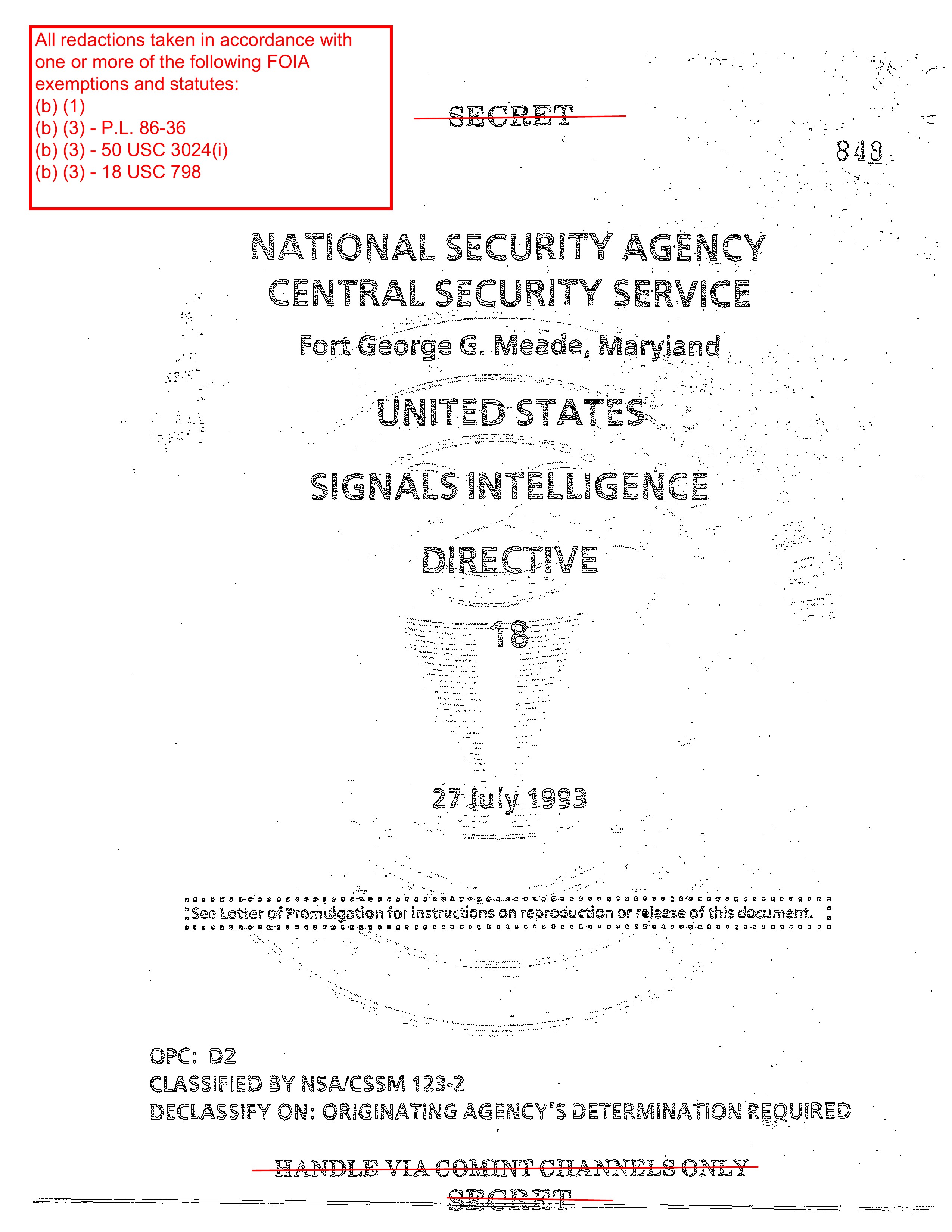

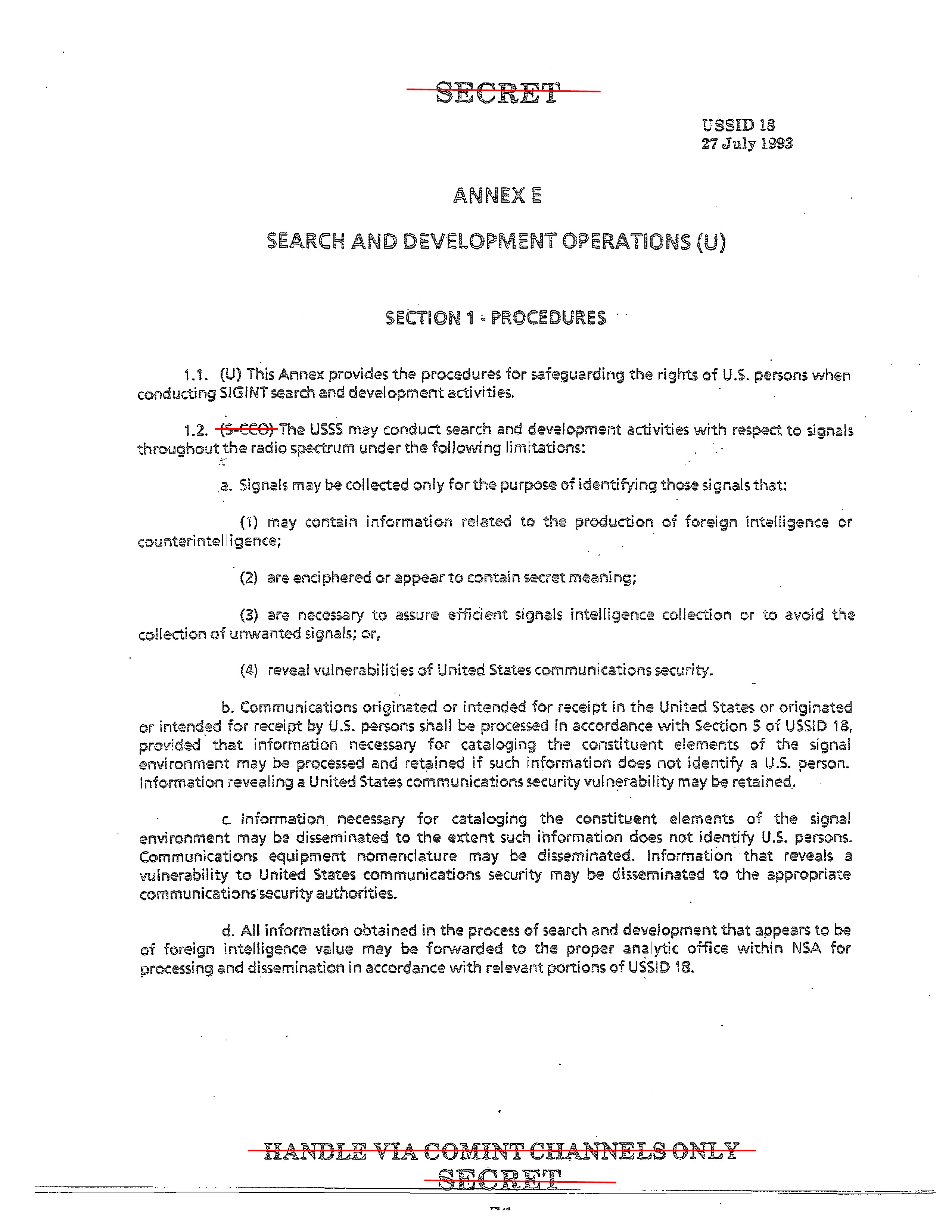
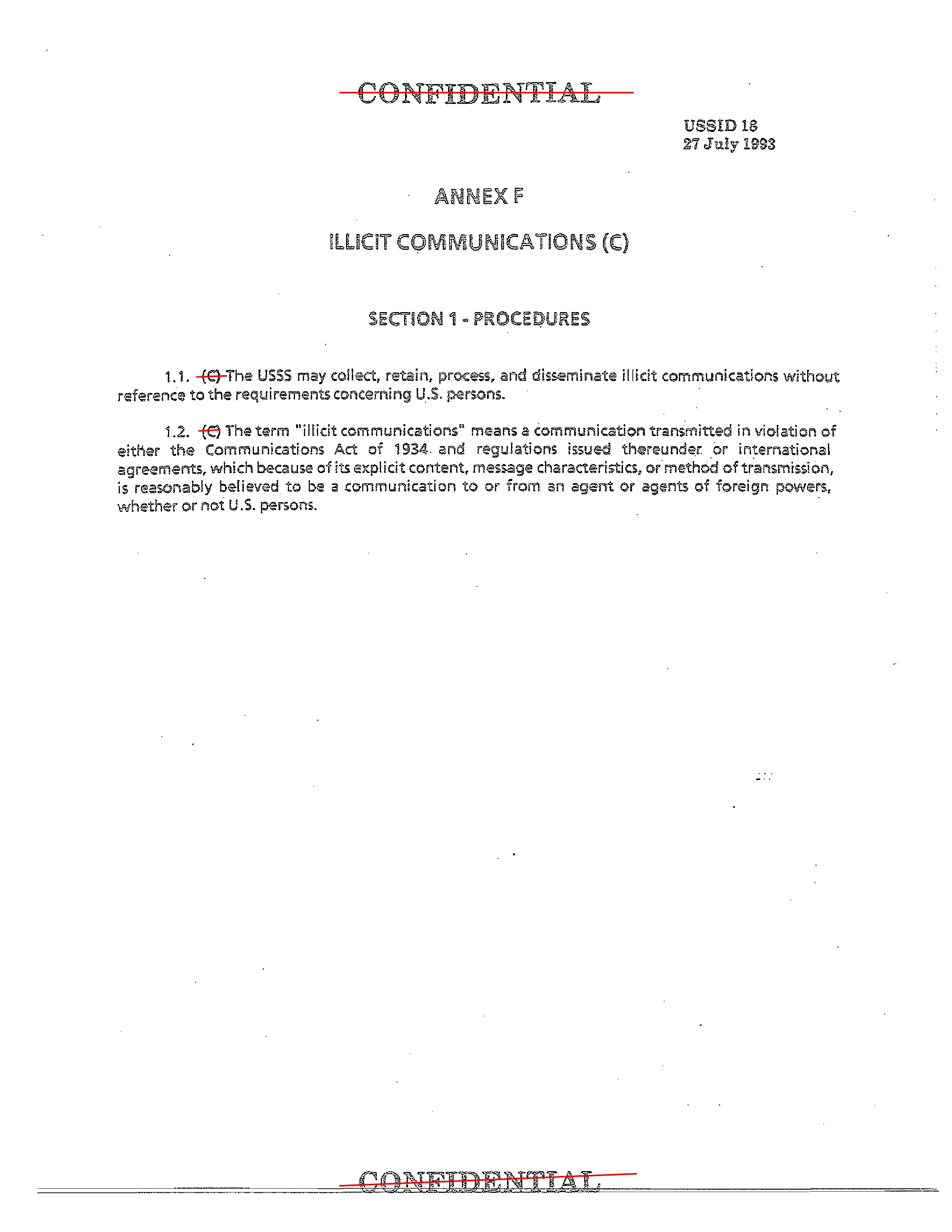
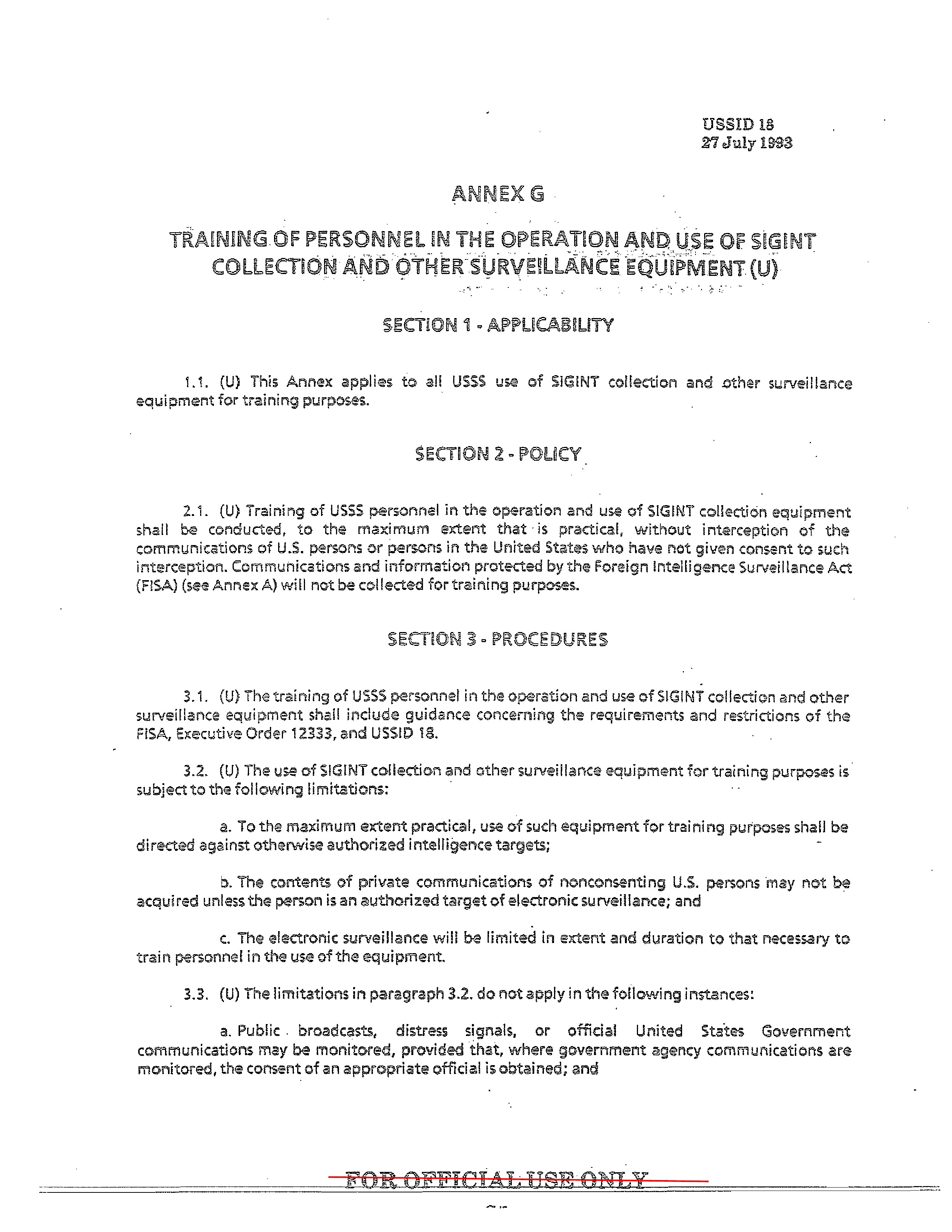
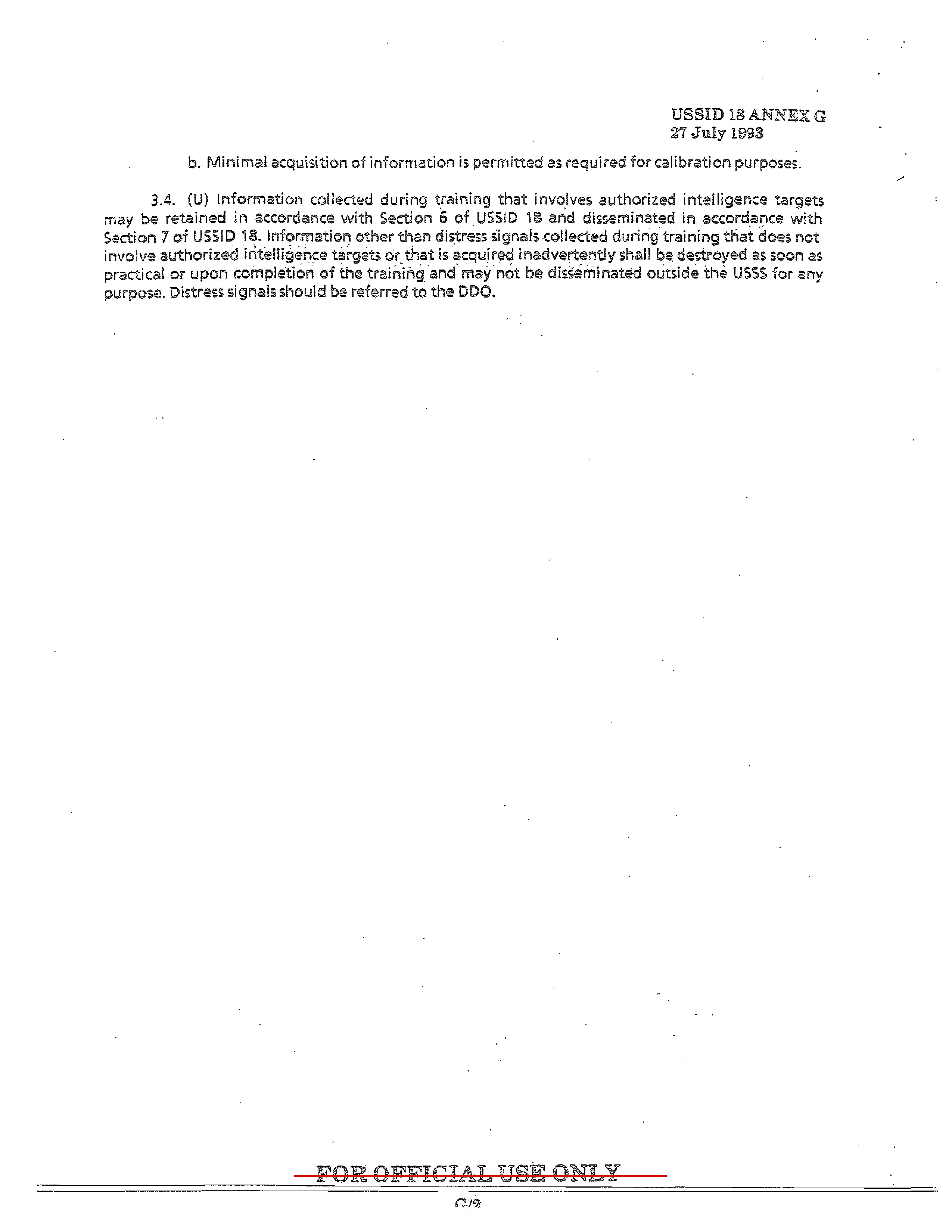
All redactions taken in accordance with one or more of the following FOIA exemptions and statutes:
(b) (1)
(b) (3) - P.L. 86-36
(b) (3) - 50 USC 3024(i)
(b) (3) - 18 USC 798
SECRET
849
NATIONAL SECURITY AGENCY
CENTRAL SECURITY SERVICE
Fort George G. Meade, Maryland
UNITED STATES
SIGNALS INTELLIGENCE
DIRECTIVE
18
27 July 1993
See Letter of Promulgation for instructions on reproduction or release of this document.
OPC: D2
CLASSIFIED BY NSA/CSSM 123-2
DECLASSIFY ON: ORIGINATING AGENCY'S DETERMINATION REQUIRED
HANDLE VIA COMINT CHANNELS ONLY
SECRET
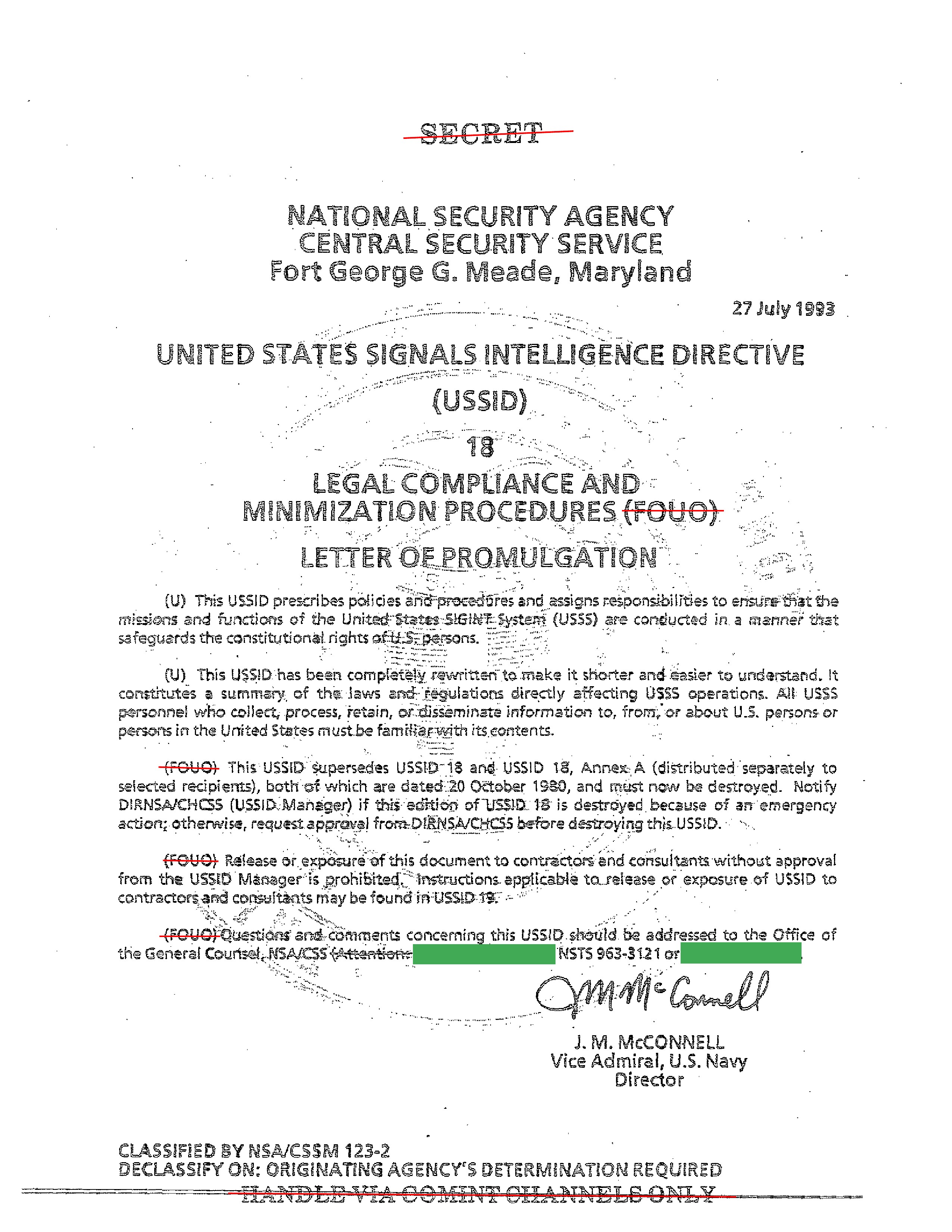
SECRET
NATIONAL SECURITY AGENCY
CENTRAL SECURITY SERVICE
Fort George G. Meade, Maryland
27 July 1993.
UNITED STATES SIGNALS INTELLIGENCE DIRECTIVE
(USSID)
18
LEGAL COMPLIANCE AND
MINIMIZATION PROCEDURES (FOUO)
LETTER OF PROMULGATION
(U) This USSID prescribes policies and procedures and assigns responsibilities to ensure that the
missions and functions of the United States SIGINT: System (USSS) are conducted in a manner that
safeguards the constitutional rights of U.S. persons.
(U) This USSID has been completely rewritten to make it shorter and easier to understand. It
constitutes a summary of the laws and regulations directly affecting USSS operations. All USSS
personnel who collect, process, retain, or disseminate information to, from, or about U.S. persons or
persons in the United States must be familiar with its contents.
(FOUO) This USSID supersedes USSID 18 and USSID 18, Annex A (distributed separately to
selected recipients), both of which are dated: 20 October 1980, and must now be destroyed. Notify
DIRNSA/CHOSS (USSID Manager) if this edition of USSID: 18 is destroyed because of an emergency
action; otherwise, request approval from DIRNSA/CHCSS before destroying this USSID.
(FOUO) Release or exposure of this document to contractors and consultants without approval
from the USSID Manager is prohibited, instructions applicable to release or exposure of USSID to
contractors and consultants may be found in USSID 19.
(FOUO) Questions and comments concerning this USSID should be addressed to the Office of
the General Counsel, NSA/CSS (Attention: [REDACTED]) NSTS 963-3121 or [REDACTED]
J. M. MCCONNELL
Vice Admiral, U.S. Navy
Director
CLASSIFIED BY NSA/CSSM 123-2
DECLASSIFY ON: ORIGINATING AGENCY'S DETERMINATION REQUIRED
HANDLE VIA COMINT CHANNELS ONLY
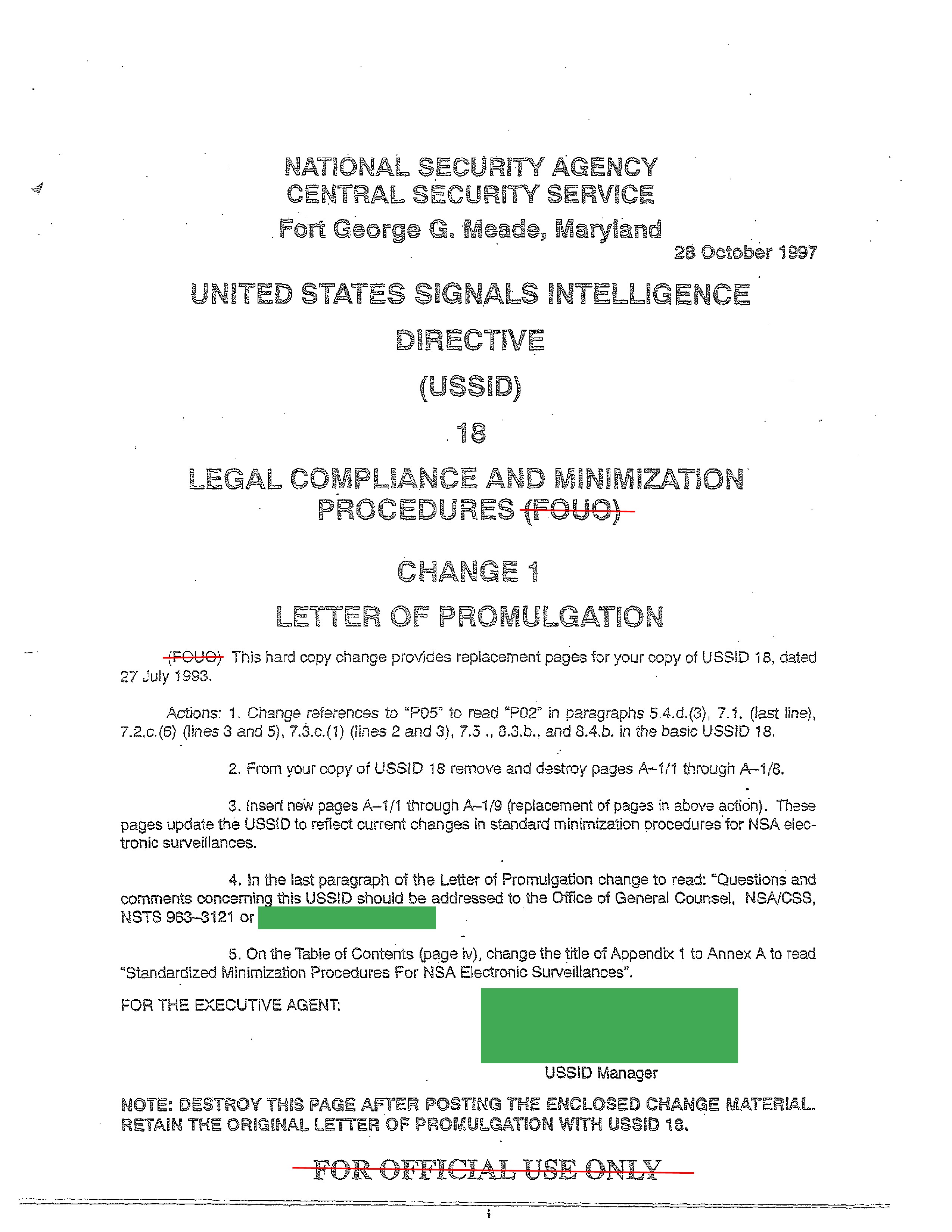
NATIONAL SECURITY AGENCY
CENTRAL SECURITY SERVICE
Fort George G. Meade, Maryland
28 October 1997
UNITED STATES SIGNALS INTELLIGENCE
DIRECTIVE
(USSID)
18
LEGAL COMPLIANCE AND MINIMIZATION
PROCEDURES (FOUO)
CHANGE 1
LETTER OF PROMULGATION
(FOUO) This hard copy change provides replacement pages for your copy of USSID 18, dated
27 July 1993.
Actions: 1. Change references to "P05" to read "P02" in paragraphs 5.4.d.(3), 7.1. (last line),
7.2.c.(6) (lines 3 and 5), 7.3.c.(1) (lines 2 and 3), 7.5., 8.3.b., and 8.4.b. in the basic USSID 18.
2. From your copy of USSID 18 remove and destroy pages A-1/1 through A-1/8.
3. Insert new pages A-1/1 through A-1/9 (replacement of pages in above action). These
pages update the USSID to reflect current changes in standard minimization procedures for NSA elec-
tronic surveillances.
4. In the last paragraph of the Letter of Promulgation change to read: "Questions and
comments concerning this USSID should be addressed to the Office of General Counsel, NSA/CSS,
NSTS 963-3121 or [REDACTED]
5. On the Table of Contents (page iv), change the title of Appendix 1 to Annex A to read
"Standardized Minimization Procedures For NSA Electronic Surveillances".
FOR THE EXECUTIVE AGENT:
[REDACTED]
USSID Manager
NOTE: DESTROY THIS PAGE AFTER POSTING THE ENCLOSED CHANGE MATERIAL.
RETAIN THE ORIGINAL LETTER OF PROMULGATION WITH USSID 18.
FOR OFFICIAL USE ONLY
USSID 18
27 July 1993
CHANGE REGISTER..
CHANGE
ENTERED
No.
Date
Authority (Msg Cite/DTG, Hard Copy (HC))
Date
By
FOR OFFICIAL USE ONLY
B
SECRET
USSID 18
27 July 1993
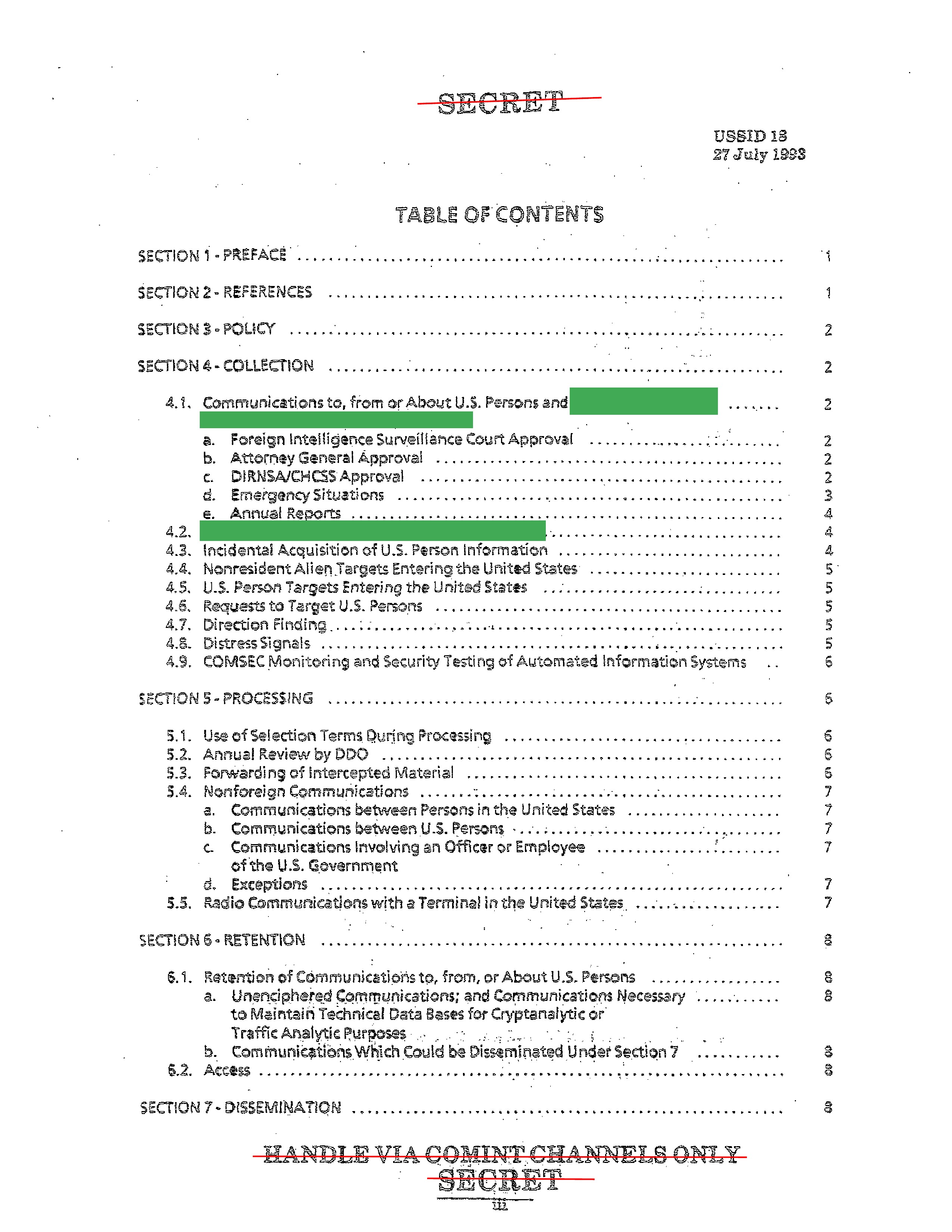
TABLE OF CONTENTS
SECTION 1-PREFACE
1
SECTION 2-REFERENCES
1
SECTION 3-POLICY
2
SECTION 4-COLLECTION
2
4.1. Communications to, from or About U.S. Persons and [REDACTED]
2
a. Foreign Intelligence Surveillance Court Approval
2
b. Attorney General Approval
2
C. DIRNSA/CHOSS Approval
2
d. Emergency Situations
3
e. Annual Reports
4
4.2. [REDACTED]
4
4.3. Incidental Acquisition of U.S. Person Information
4
4.4. Nonresident Alien Targets Entering the United States
5
4.5. U.S. Person Targets Entering the United States
5
4.6. Requests to Target U.S. Persons
5
4.7. Direction Finding..
5
4.8. Distress Signals
5
4.9. COMSEC Monitoring and Security Testing of Automated Information Systems
6
SECTION 5-PROCESSING
6
5.1. Use of Selection Terms During Processing
6
5.2. Annual Review by DDO
6
5.3. Forwarding of Intercepted Material
6
5.4. Nonforeign Communications
7
a. Communications between Persons in the United States
7
b. Communications between U.S. Persons
7
C. Communications Involving an Officer or Employee
7
of the U.S. Government
d. Exceptions
7
5.5. Radio Communications with a Terminal in the United States
7
SECTION 6-RETENTION
8
6.1. Retention of Communications to, from, or About U.S. Persons
8
a. Unenciphered Communications; and Communications Necessary
to Maintain Technical Data Bases for Cryptanalytic or
Traffic Analytic Purposes
8
b. Communications Which Could be Disseminated Under Section 7
8
6.2. Access
8
SECTION 7-DISSEMINATION
8
HANDLE VIA COMINT CHANNELS ONLY
SECRET
SECRET
USSID 18
27 July 1993
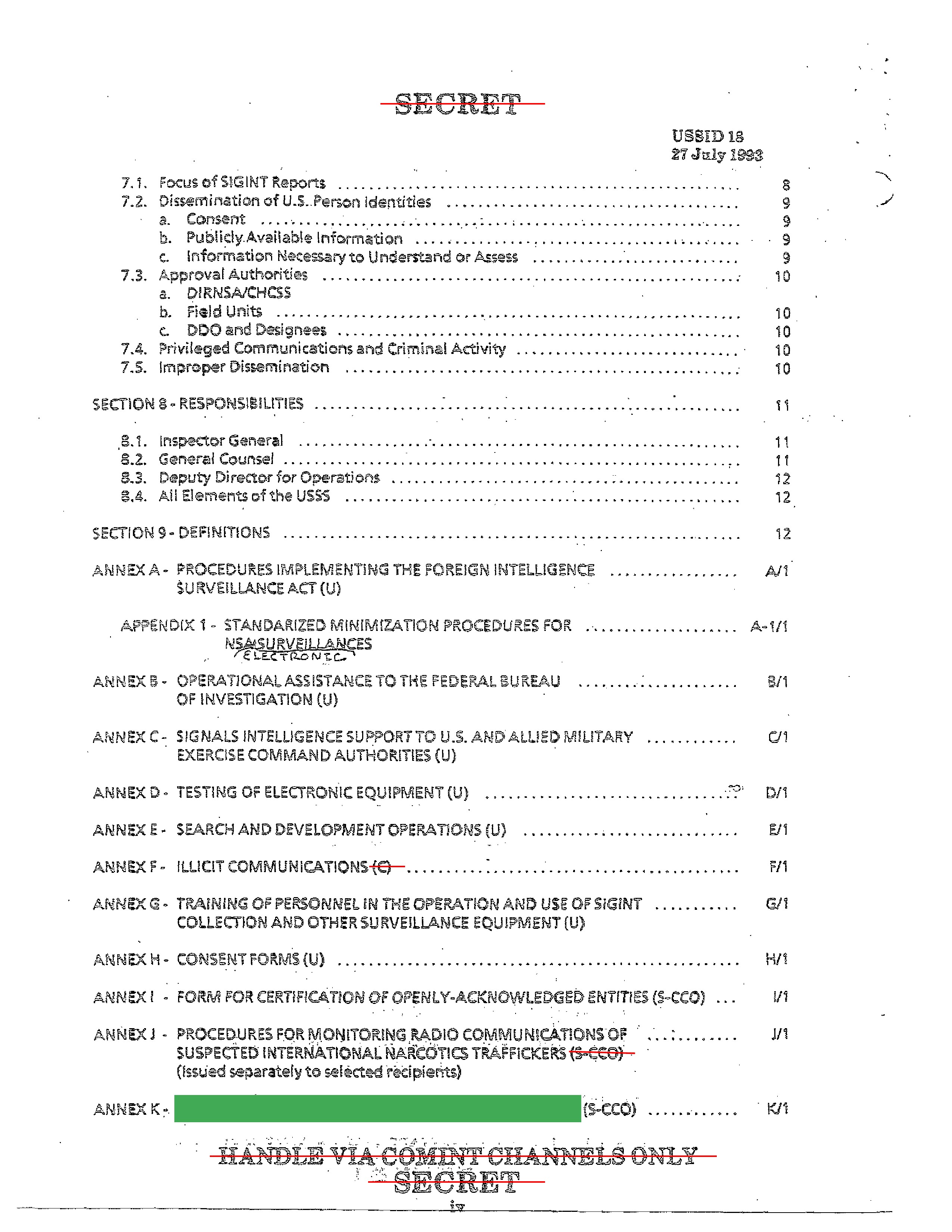
7.1. Focus of SIGINT Reports
7.2. Dissemination of U.S. Person Identities
a. Consent
b. Publicly Available Information
c. Information Necessary to Understand or Assess
7.3. Approval Authorities
a. DIRNSA/CHCSS
b. Field Units
c. DDO and Designees
7.4. Privileged Communications and Criminal Activity
7.5. Improper Dissemination
SECTION 8 - RESPONSIBILITIES
8.1. Inspector General
8.2. General Counsel
8.3. Deputy Director for Operations
8.4. All Elements of the USSS
SECTION 9 - DEFINITIONS
ANNEX A - PROCEDURES IMPLEMENTING THE FOREIGN INTELLIGENCE
SURVEILLANCE ACT (U)
APPENDIX 1 - STANDARIZED MINIMIZATION PROCEDURES FOR
NSA ELECTRONIC SURVEILLANCES
ANNEX B - OPERATIONAL ASSISTANCE TO THE FEDERAL BUREAU
OF INVESTIGATION (U)
ANNEX C - SIGNALS INTELLIGENCE SUPPORT TO U.S. AND ALLIED MILITARY
EXERCISE COMMAND AUTHORITIES (U)
ANNEX D - TESTING OF ELECTRONIC EQUIPMENT (U)
ANNEX E - SEARCH AND DEVELOPMENT OPERATIONS (U)
ANNEX F - ILLICIT COMMUNICATIONS (C)
ANNEX G - TRAINING OF PERSONNEL IN THE OPERATION AND USE OF SIGINT
COLLECTION AND OTHER SURVEILLANCE EQUIPMENT (U)
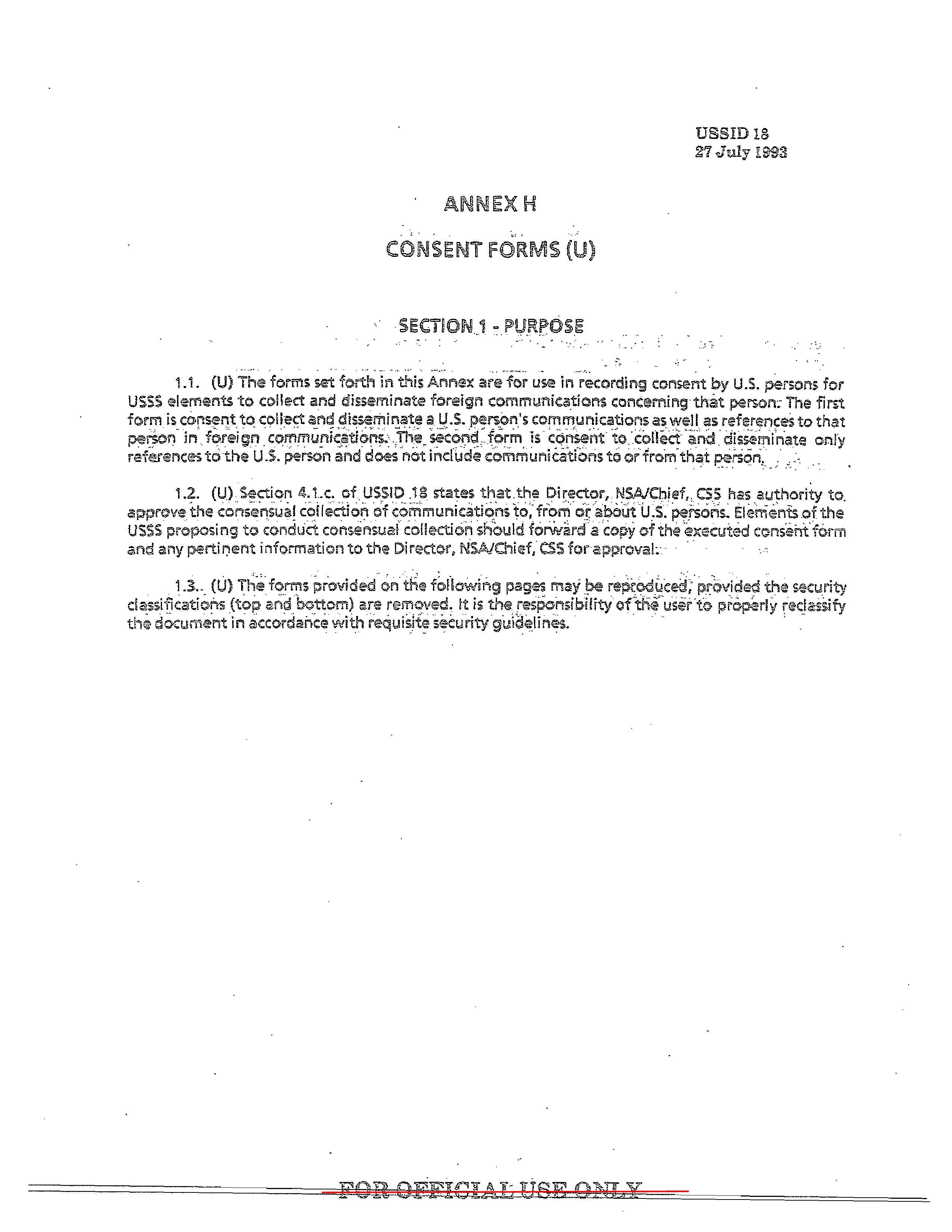
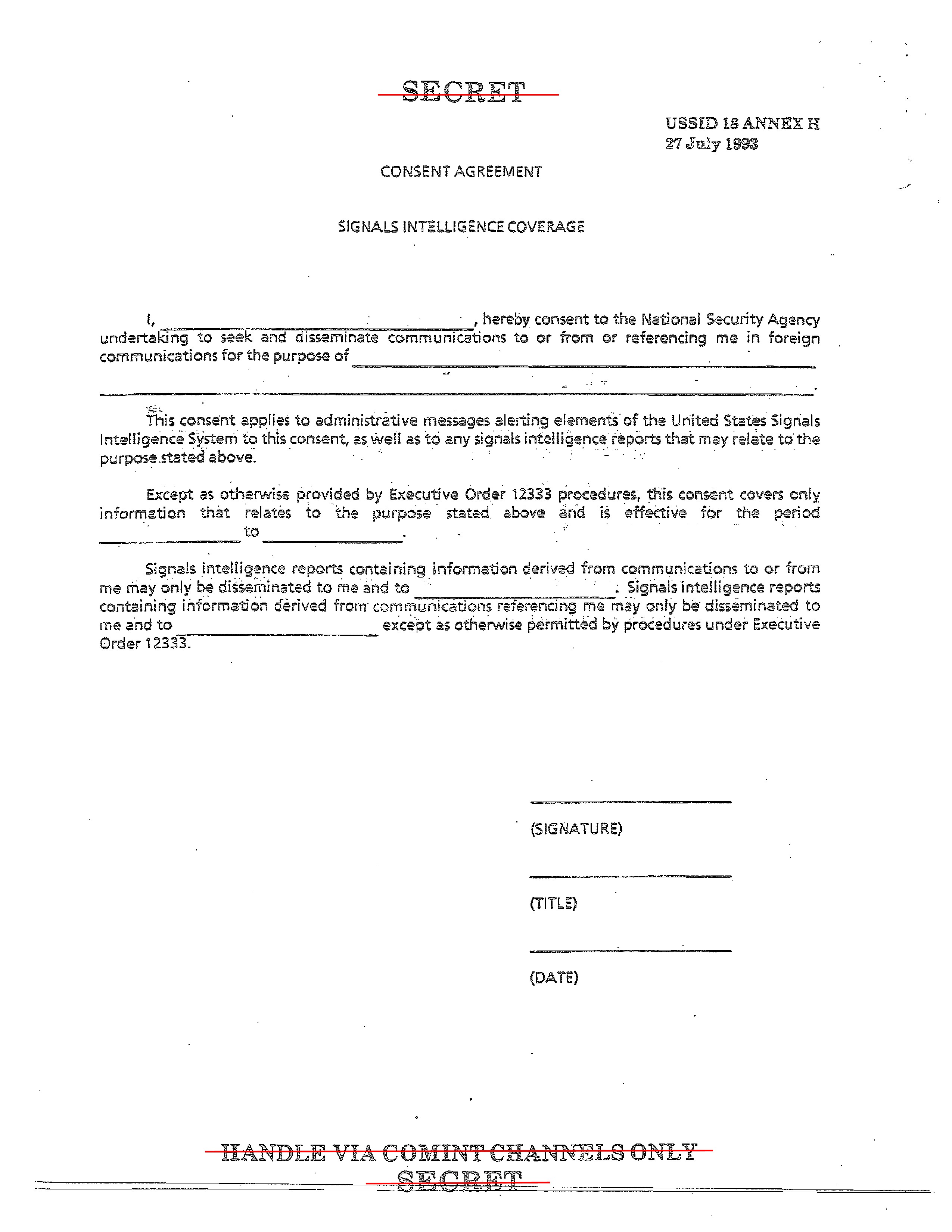
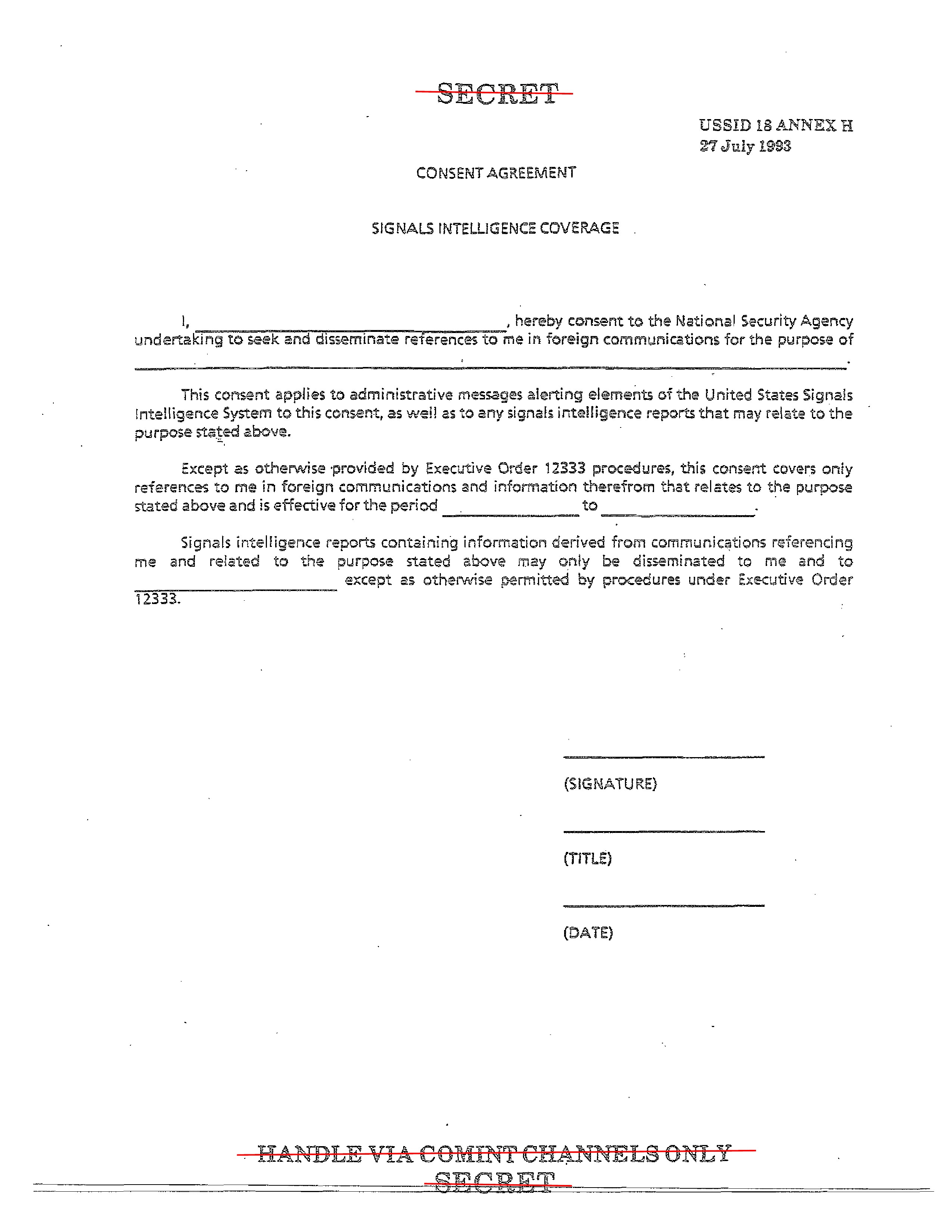
ANNEX H - CONSENT FORMS (U)
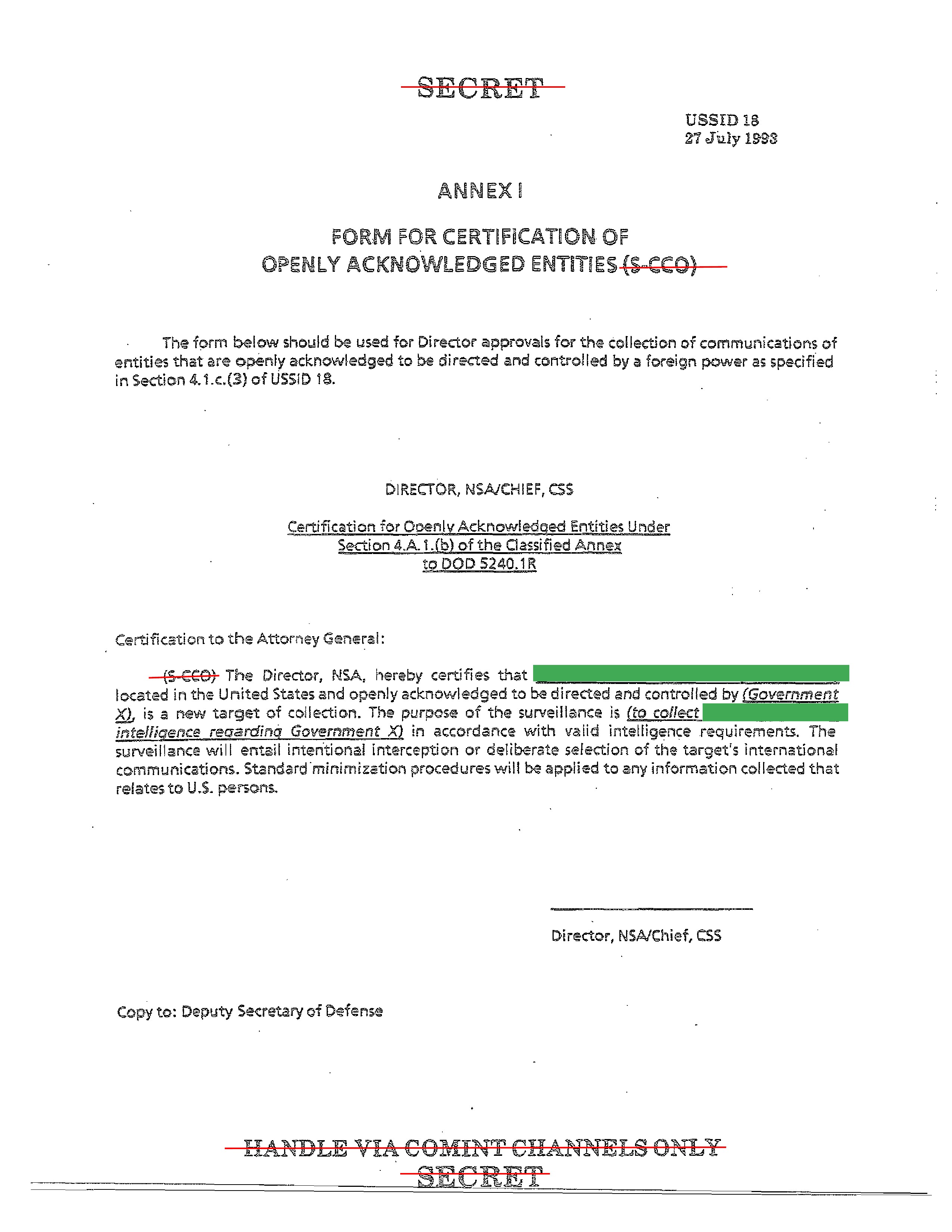
ANNEX I - FORM FOR CERTIFICATION OF OPENLY-ACKNOWLEDGED ENTITIES (S-CCO)
ANNEX J - PROCEDURES FOR MONITORING RADIO COMMUNICATIONS OF
SUSPECTED INTERNATIONAL NARCOTICS TRAFFICKERS (S-CCO)
(Issued separately to selected recipients)
ANNEX K - [REDACTED] (S-CCO)
HANDLE VIA COMINT CHANNELS ONLY
SECRET
CONFIDENTIAL
USSID 18
27 July 1993
DISTRIBUTION
2 A041
2 A055
3 A1095
8 A111
1 A112
4 A113
2 A114
2 A12
1 A13
1 A131
3 A132
4 A133
4 A134
1 A135
4 A136
2 A14
1 A153
1 A209
2 A21
1 A22
2 A23
1 A405
2 A42
2 A609
1 A62
1 A63
1 A64
1 A641
1 A65
6 A67
1 A72
1 B04
3 B05
1 B109
2 B209
5 B21
1 B22
2 B23
1 B26
1 B3094
1 B3095
3 B31
4 B312
6 B32
12 B33
5 B34
10 B35
1 B351/[REDACTED]
1 B409
14 B41
10 B42
4 B43
7 B44
3 B45
1 B461
1 B5094
6 B521
1 B522
1 B54
1 B5423
1 B55
1 B56
4 B609
1 B61
1 B63
1 B646
2 B709
2 B7095
26 B71
3 B72
15 B73
4 B75
1 CSPO
1 CMATT
12 D1
6 D2
1 D3
1 DCN
1 E
1 E09
1 E1
1 E11
1 E31
3 E32
1 E32/B
1 E32/G
3 E42
1 E54
TOTAL COPIES 1193
CONFIDENTIAL
Distribution Page 1 of 6
CONFIDENTIAL
USSID 18
27 July 1993
1 G01
2 G111
3 G112
1 G112 [REDACTED]
1 G133
1 G133C
2 G223
2 G23
1 G24 (SLO)
1 G27
2 G31
1 G33
1 G35
1 G36
1 G364
2 G36N
2 G41
1 G412
1 G42
1 G421
1 G44
1 G45
2 G5 NSOC (ASGC)
1 G5 NSOC (BSGC)
1 G5 NSOC (NALA)
1 G5 NSOC (NMJIC)
1 G5 NSOC (SRO)
1 G5 NSOC (WSGC)
1 G509
1 G561
1 G562
1 G564
1 G58
1 G71
1 I1
2 I2
1 J23
1 J25
1 J34
1 K1
1 K13
2 K2
1 K34
1 K4
1 K41
2 K42
1 K43
3 K51
1 K52 [REDACTED]
1 K609
1 K609
1 L091
1 LAO
1 M091
1 M31
1 M5
1 M51
1 M52
1 N22
1 N252
1 N511
1 N5209
1 P042
1 P043
1 P0433
150 P0442 (STOCK)
1 P05
6 P052
3 P0522
1 P0533
1 P0541
1 P05A
1 Q109
1 Q32
1 S9
1 T09
2 T093
1 V09
1 W04
1 W05
1 W109
1 W15
1 W16
1 W17
1 W174
1 W18
1 W2091
1 W21
1 W232
1 W27
1 W309
2 W31
1 W32
2 W33
1 W335 (SOC)
1 W341
3 W4
1 X41
1 Z03
1 Z09
5 Z109
1 Z11
CONFIDENTIAL
Distribution Page 2 of 6
CONFIDENTIAL
USSID 18
27 July 1993
1 Z14
2 Z156
1 Z3
1 Z31
1 Z33
1 Z34
1 Z41
1 Z42
[REDACTED]
[REDACTED]
CONFIDENTIAL
Distribution Page 3 of 6
CONFIDENTIAL
USSID 18
27 July 1993
[REDACTED]
[REDACTED]
CONFIDENTIAL
Distribution Page 4 of 6
CONFIDENTIAL
USSID 18
27 July 1993
[REDACTED]
[REDACTED]
CONFIDENTIAL
Distribution Page 5 of 6
CONFIDENTIAL
USSID 18
27 July 1993
[REDACTED]
[REDACTED]
CONFIDENTIAL
Distribution Page 6 of 6
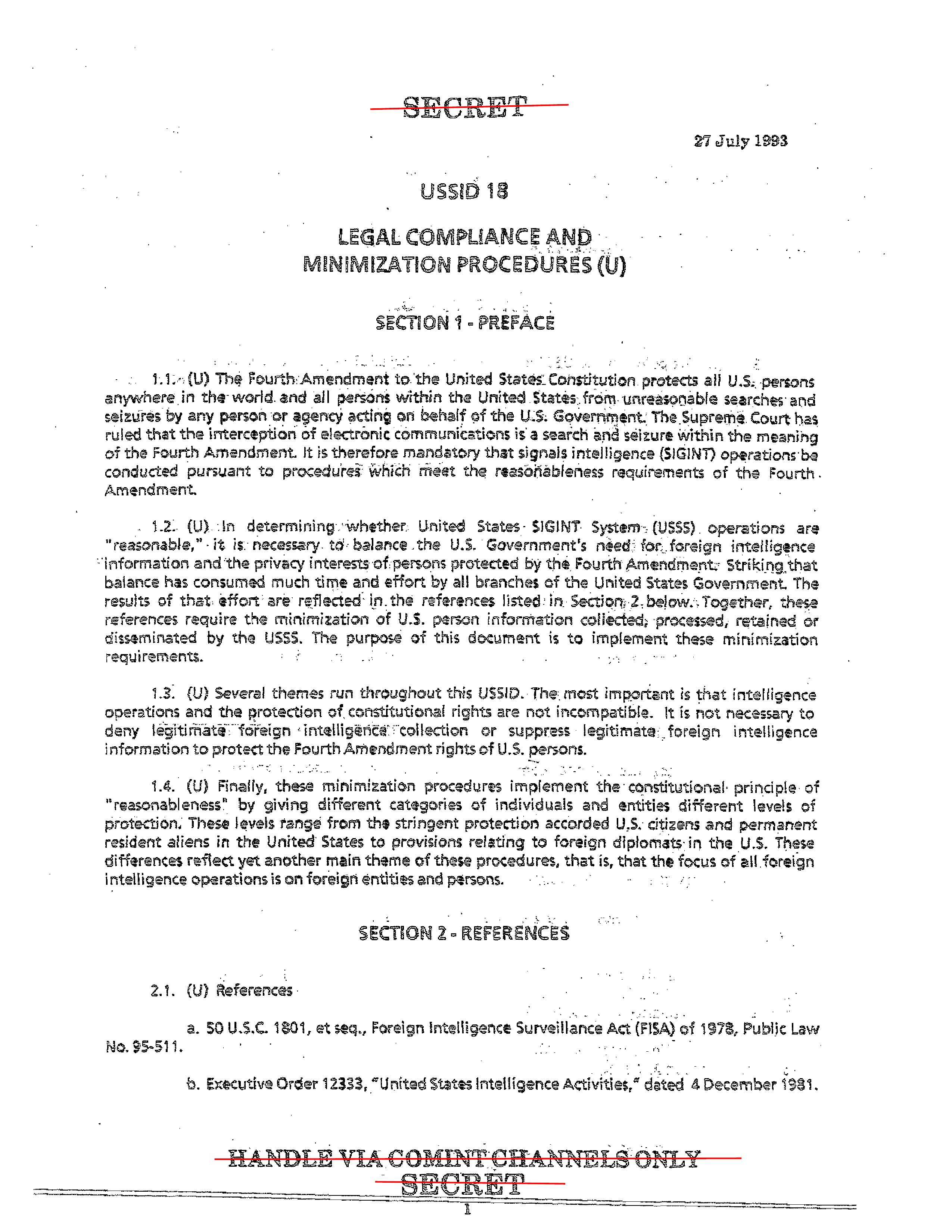
SECRET
USSID 18
LEGAL COMPLIANCE AND
MINIMIZATION PROCEDURES (U)
SECTION 1- PREFACE
27 July 1993
1.1.0 (U) The Fourth Amendment to the United States Constitution protects all U.S. persons
anywhere in the world. and all persons within the United States from unreasonable searches and
seizures by any person or agency acting on behalf of the U.S. Government. The Supreme Court has
ruled that the interception of electronic communications is a search and seizure within the meaning
of the Fourth Amendment. It is therefore mandatory that signals intelligence (SIGINT) operations be
conducted pursuant to procedures which meet the reasonableness requirements of the Fourth.
Amendment.
1.2. (U) In determining whether: United States SIGINT System (USSS) operations are
"reasonable," it is necessary to balance the U.S. Government's need for foreign intelligence
information and the privacy interests of persons protected by the Fourth Amendment. Striking that
balance has consumed much time and effort by all branches of the United States Government. The
results of that effort are reflected in the references listed in Section 2. below. Together, these
references require the minimization of U.S. person information collected, processed, retained or
disseminated by the USSS. The purpose of this document is to implement these minimization
requirements.
1.3. (U) Several themes run throughout this USSID. The most important is that intelligence
operations and the protection of constitutional rights are not incompatible. It is not necessary to
deny legitimate foreign intelligence collection or suppress legitimate foreign intelligence
information to protect the Fourth Amendment rights of U.S. persons.
1.4. (U) Finally, these minimization procedures implement the constitutional principle of
"reasonableness" by giving different categories of individuals and entities different levels of
protection. These levels range from the stringent protection accorded U.S. citizens and permanent
resident aliens in the United States to provisions relating to foreign diplomats in the U.S. These
differences reflect yet another main theme of these procedures, that is, that the focus of all foreign
intelligence operations is on foreign entities and persons.
SECTION 2 - REFERENCES
2.1. (U) References
No. 95-511.
a. 50 U.S.C. 1801, et seq., Foreign Intelligence Surveillance Act (FISA) of 1978, Public Law
b. Executive Order 12333, "United States Intelligence Activities," dated 4 December 1981.
HANDLE VIA COMINT CHANNELS ONLY
SECRET
1
SECRET
USSID 18
27 July 1993
c. DoD Directive 5240.1, "Activities of DoD Intelligence Components that Affect U.S.
Persons," dated 25 April 1988.
d. NSA/CSS Directive No. 10-30, "Procedures Governing Activities of NSA/CSS that Affect
U.S. Persons," dated 20 September 1990.
SECTION 3-POLICY
3.1. (U) The policy of the USSS is to TARGET or COLLECT only FOREIGN COMMUNICATIONS.*
The USSS will not intentionally COLLECT communications to, from or about U.S. PERSONS or persons
or entities in the U.S. except as set forth in this USSID. If the USSS inadvertently COLLECTS such
communications, it will process, retain and disseminate them only in accordance with this USSID.
SECTION 4- COLLECTION
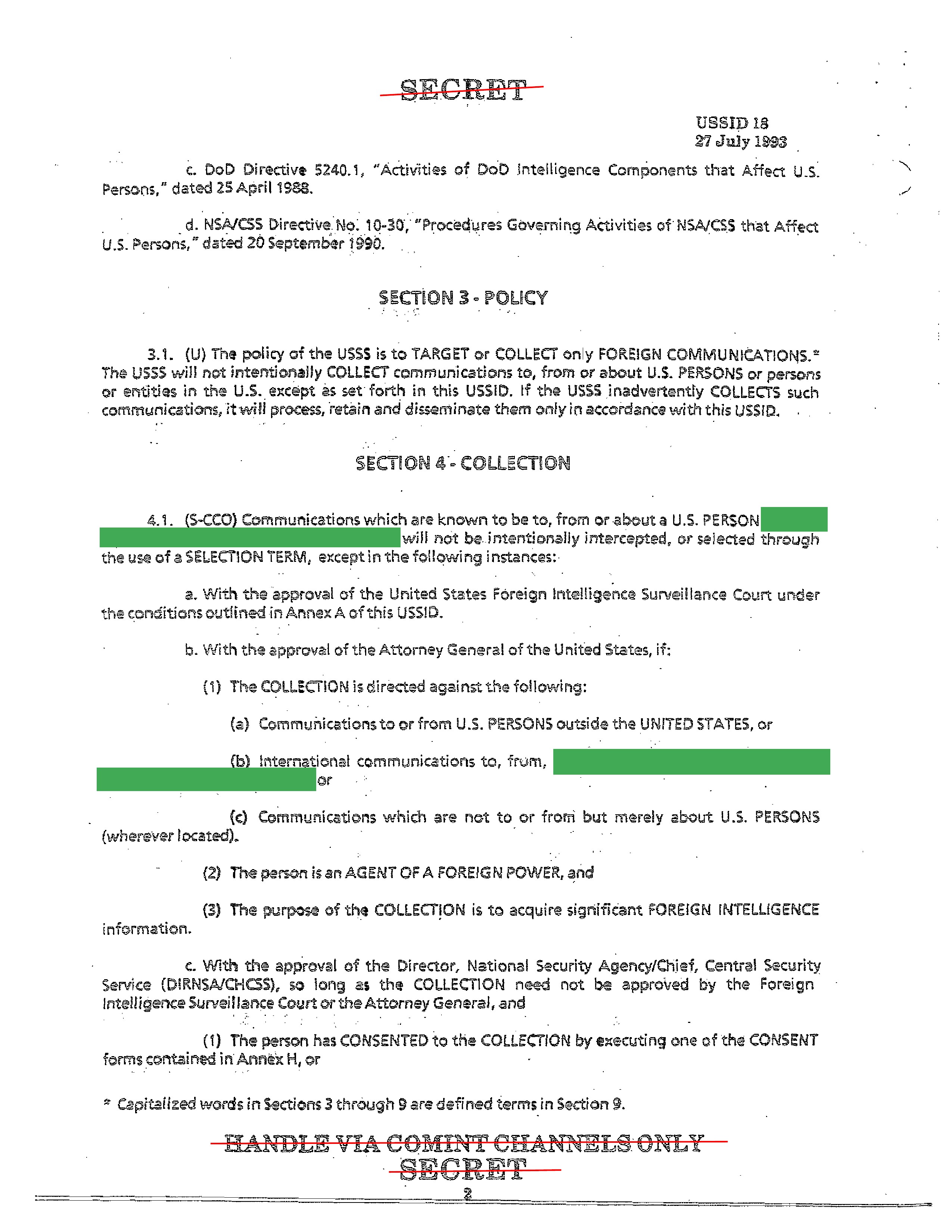
4.1. (S-CCO) Communications which are known to be to, from or about a U.S. PERSON
[REDACTED] will not be intentionally intercepted, or selected through
the use of a SELECTION TERM, except in the following instances:
a. With the approval of the United States Foreign Intelligence Surveillance Court under
the conditions outlined in Annex A of this USSID.
:
b. With the approval of the Attorney General of the United States, if:
(1) The COLLECTION is directed against the following:
(a) Communications to or from U.S. PERSONS outside the UNITED STATES, or
(b) International communications to, frum,
[REDACTED]
or
[REDACTED]
:
(c) Communications which are not to or from but merely about U.S. PERSONS
(wherever located).
(2) The person is an AGENT OF A FOREIGN POWER, and
information.
(3) The purpose of the COLLECTION is to acquire significant FOREIGN INTELLIGENCE
c. With the approval of the Director, National Security Agency/Chief, Central Security
Service (DIRNSA/CHCSS), so long as the COLLECTION need not be approved by the Foreign
Intelligence Surveillance Court or the Attorney General, and
(1) The person has CONSENTED to the COLLECTION by executing one of the CONSENT
forms contained in Annex H, or
- Capitalized words in Sections 3 through 9 are defined terms in Section 9.
HANDLE VIA COMINT CHANNELS ONLY
SECRET
2
SECRET
USSID 18
27 July 1993
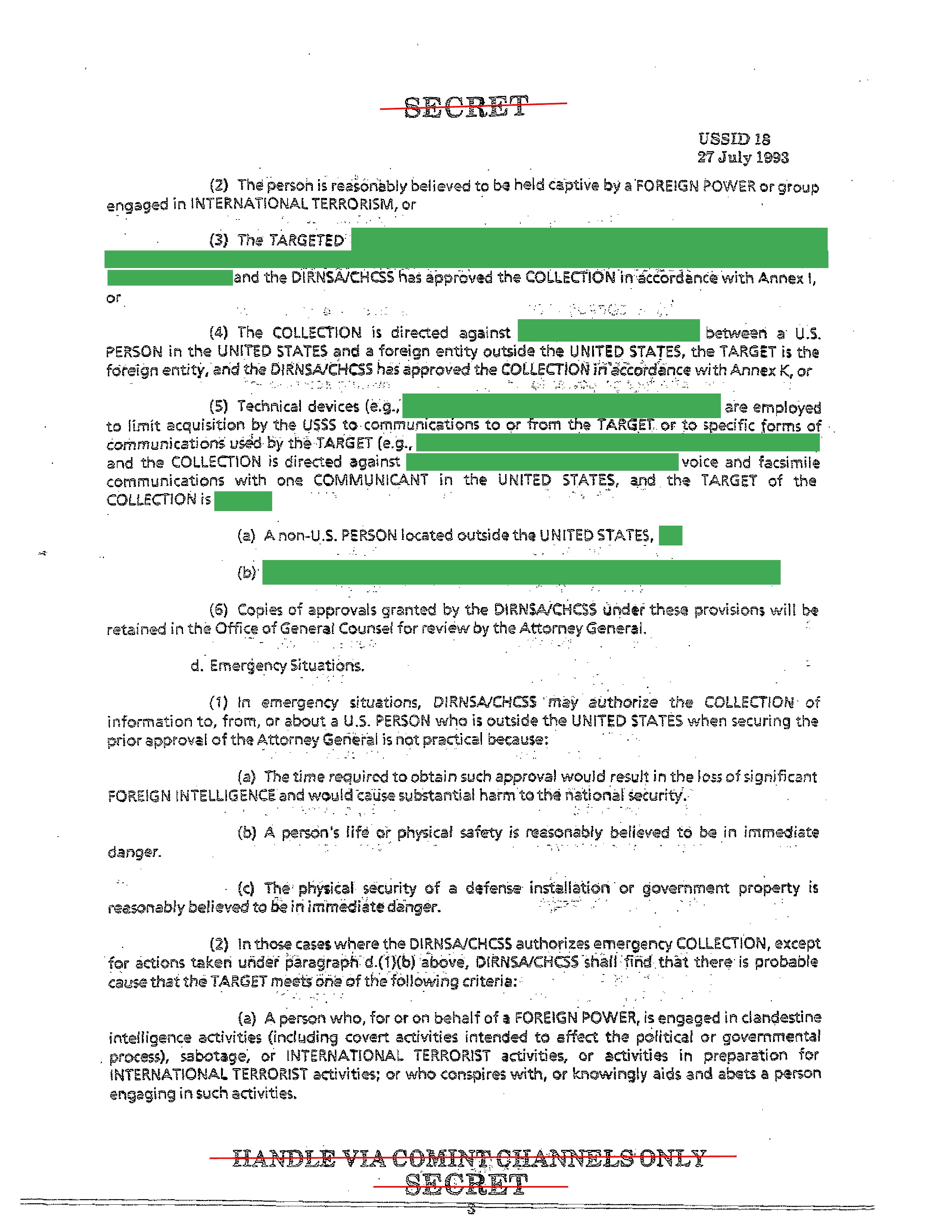
(2) The person is reasonably believed to be held captive by a FOREIGN POWER or group
engaged in INTERNATIONAL TERRORISM, or
(3) The TARGETED
[REDACTED]
and the DIRNSA/CHCSS has approved the COLLECTION in accordance with Annex 1,
or
(4) The COLLECTION is directed against
[REDACTED]
between a U.S.
PERSON in the UNITED STATES and a foreign entity outside the UNITED STATES, the TARGET is the
foreign entity, and the DIRNSA/CHCSS has approved the COLLECTION in accordance with Annex K, or
(5) Technical devices (e.g.,
[REDACTED]
are employed
to limit acquisition by the USSS to communications to or from the TARGET or to specific forms of
communications used by the TARGET (e.g.,
[REDACTED]
and the COLLECTION is directed against
[REDACTED]
voice and facsimile
communications with one COMMUNICANT in the UNITED STATES, and the TARGET of the
COLLECTION is
[REDACTED]
(a) A non-U.S. PERSON located outside the UNITED STATES,
[REDACTED]
(9)
(b)
[REDACTED]
(6) Copies of approvals granted by the DIRNSA/CHCSS under these provisions will be
retained in the Office of General Counsel for review by the Attorney General.
d. Emergency Situations.
(1) In emergency situations, DIRNSA/CHCSS may authorize the COLLECTION of
information to, from, or about a U.S. PERSON who is outside the UNITED STATES when securing the
prior approval of the Attorney General is not practical because:
(a) The time required to obtain such approval would result in the loss of significant
FOREIGN INTELLIGENCE and would caüse substantial harm to the national security.
danger.
(b) A person's life or physical safety is reasonably believed to be in immediate
(c) The physical security of a defense installation or government property is
reasonably believed to be in immediate danger.
(2) In those cases where the DIRNSA/CHCSS authorizes emergency COLLECTION, except
for actions taken under paragraph d.(1)(b) above, DIRNSA/CHCSS shall find that there is probable
cause that the TARGET meets one of the following criteria:
(a) A person who, for or on behalf of a FOREIGN POWER, is engaged in clandestine
intelligence activities (including covert activities intended to affect the political or governmental
process), sabotage, or INTERNATIONAL TERRORIST activities, or activities in preparation for
INTERNATIONAL TERRORIST activities; or who conspires with, or knowingly aids and abets a person
engaging in such activities.
HANDLE VIA COMINT CHANNELS ONLY
SECRET
3
SECRET
USSID 18
27 July 1993
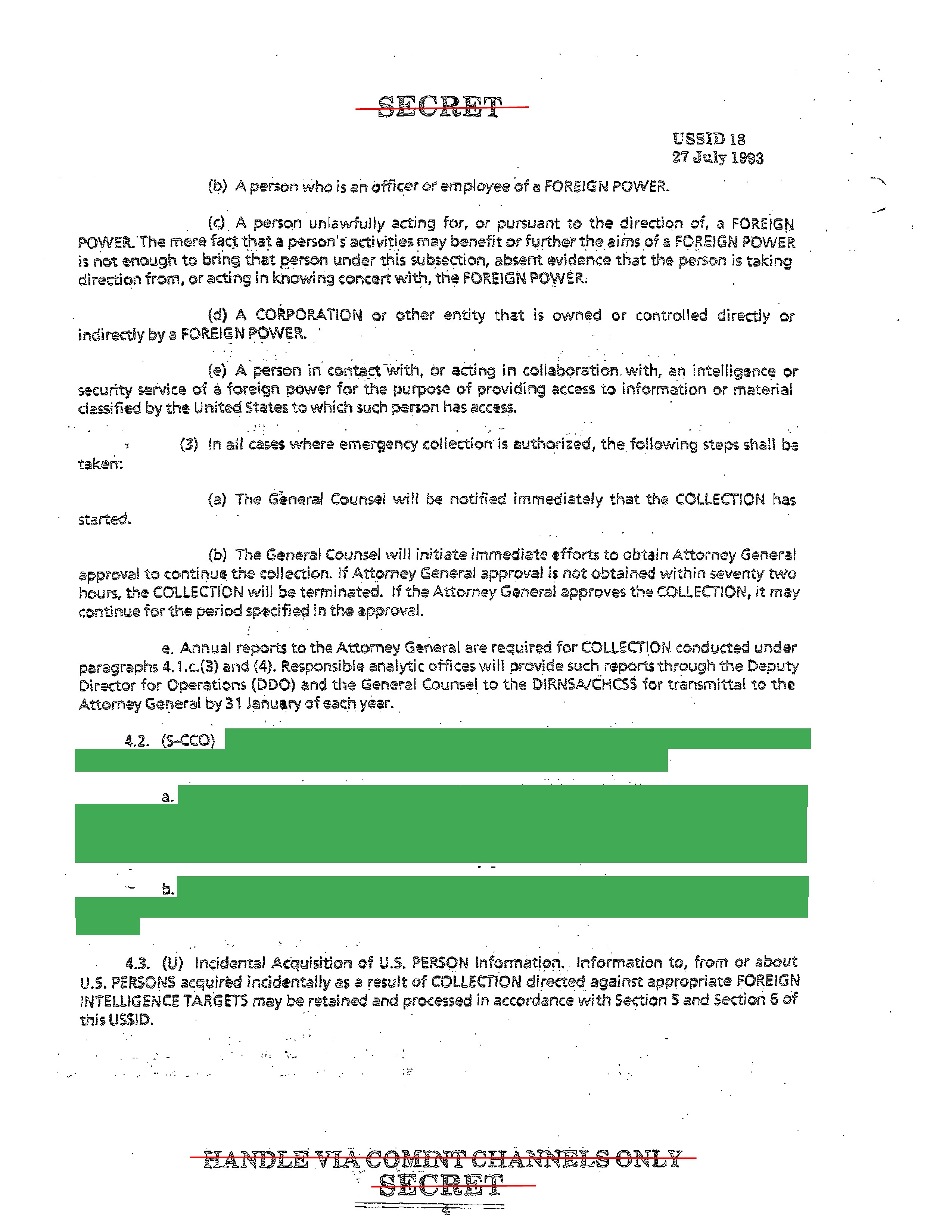
(b) A person who is an officer or employee of a FOREIGN POWER.
(c) A person unlawfully acting for, or pursuant to the direction of, a FOREIGN
POWER. The mere fact that a person's activities may benefit or further the aims of a FOREIGN POWER
is not enough to bring that person under this subsection, absent evidence that the person is taking
direction from, or acting in knowing concert with, the FOREIGN POWER.
(d) A CORPORATION or other entity that is owned or controlled directly or
indirectly by a FOREIGN POWER.
(e) A person in contact with, or acting in collaboration with, an intelligence or
security service of a foreign power for the purpose of providing access to information or material
classified by the United States to which such person has access.
(3) in all cases where emergency collection is authorized, the following steps shall be
taken:
(a) The General Counsel will be notified immediately that the COLLECTION has
started.
(b) The General Counsel will initiate immediate efforts to obtain Attorney General
approval to continue the collection. If Attorney General approval is not obtained within seventy two
hours, the COLLECTION will be terminated. If the Attorney General approves the COLLECTION, it may
continue for the period specified in the approval.
e. Annual reports to the Attorney General are required for COLLECTION conducted under
paragraphs 4.1.c.(3) and (4). Responsible analytic offices will provide such reports through the Deputy
Director for Operations (DDO) and the General Counsel to the DIRNSA/CHCSS for transmittal to the
Attorney General by 31 January of each year.
4.2. (5-CCO)
a. [REDACTED]
b. [REDACTED]
4.3. (U) Incidental Acquisition of U.S. PERSON Information. Information to, from or about
U.S. PERSONS acquired incidentally as a result of COLLECTION directed against appropriate FOREIGN
INTELLIGENCE TARGETS may be retained and processed in accordance with Section 5 and Section 6 of
this USSID.
HANDLE VIA COMINT CHANNELS ONLY
SECRET
4
SECRET
USSID 18
27 July 1993
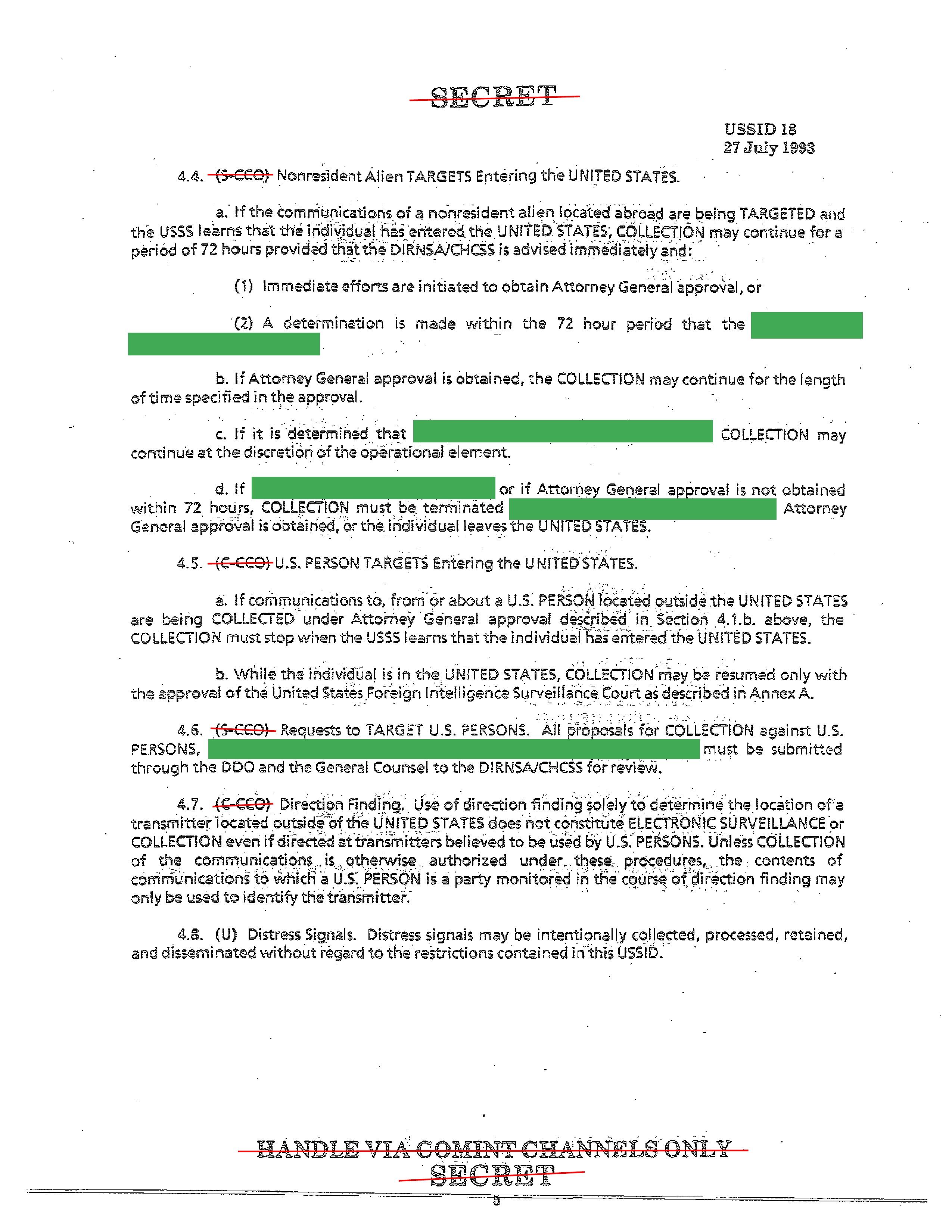
4.4. (S-CCO) Nonresident Alien TARGETS Entering the UNITED STATES.
a. If the communications of a nonresident alien located abroad are being TARGETED and
the USSS learns that the individual has entered the UNITED STATES, COLLECTION may continue for a
period of 72 hours provided that the DIRNSA/CHCSS is advised immediately and:
(1) Immediate efforts are initiated to obtain Attorney General approval, or
(2) A determination is made within the 72 hour period that the [REDACTED]
b. If Attorney General approval is obtained, the COLLECTION may continue for the length
of time specified in the approval.
c. If it is determined that [REDACTED] COLLECTION may
continue at the discretion of the operational element.
d. If [REDACTED] or if Attorney General approval is not obtained
within 72 hours, COLLECTION must be terminated [REDACTED] Attorney
General approval is obtained, or the individual leaves the UNITED STATES.
4.5. (C-ECO)U.S. PERSON TARGETS Entering the UNITED STATES.
a. If communications to, from or about a U.S. PERSON located outside the UNITED STATES
are being COLLECTED under Attorney General approval described in Section 4.1.b. above, the
COLLECTION must stop when the USSS learns that the individual has entered the UNITED STATES.
b. While the individual is in the UNITED STATES, COLLECTION may be resumed only with
the approval of the United States Foreign Intelligence Surveillance Court as described in Annex A.
4.6. (S-CCO) Requests to TARGET U.S. PERSONS. All proposals for COLLECTION against U.S.
PERSONS, [REDACTED] must be submitted
through the DDO and the General Counsel to the DIRNSA/CHCSS for review.
4.7. (C-CCO) Direction Finding. Use of direction finding solely to determine the location of a
transmitter located outside of the UNITED STATES does not constitute ELECTRONIC SURVEILLANCE or
COLLECTION even if directed at transmitters believed to be used by U.S. PERSONS. Unless COLLECTION
of the communications is otherwise authorized under these procedures, the contents of
communications to which a U.S. PERSON is a party monitored in the course of direction finding may
only be used to identify the transmitter.
4.8. (U) Distress Signals. Distress signals may be intentionally collected, processed, retained,
and disseminated without regard to the restrictions contained in this USSID.
HANDLE VIA COMINT CHANNELS ONLY
SECRET
5
SECRET
USSID 18
27 July 1993
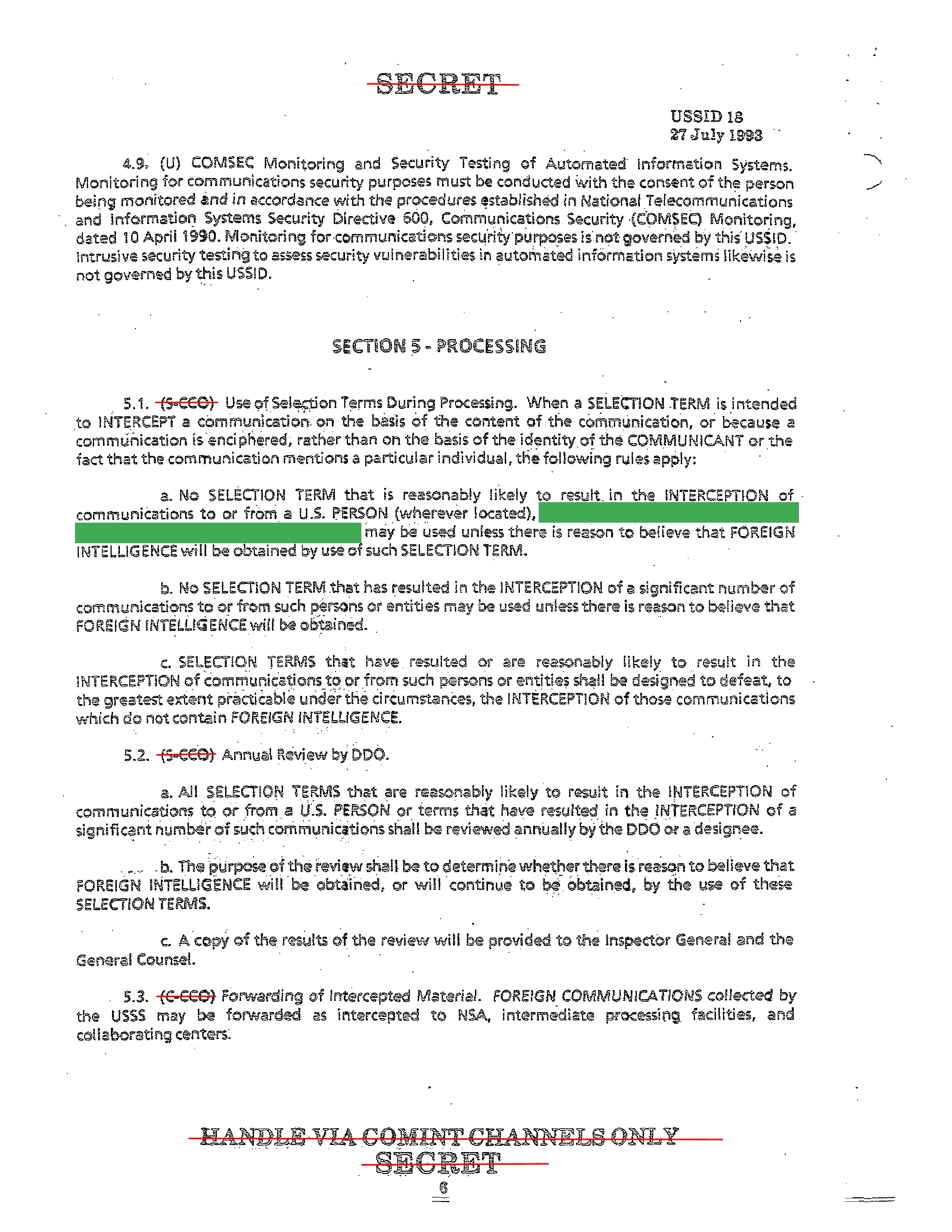
4.9. (U) COMSEC Monitoring and Security Testing of Automated Information Systems.
Monitoring for communications security purposes must be conducted with the consent of the person
being monitored and in accordance with the procedures established in National Telecommunications
and Information Systems Security Directive 600, Communications Security (COMSEC) Monitoring,
dated 10 April 1990. Monitoring for communications security purposes is not governed by this USSID.
Intrusive security testing to assess security vulnerabilities in automated information systems likewise is
not governed by this USSID.
SECTION 5 - PROCESSING
5.1. (S-CCO) Use of Selection Terms During Processing. When a SELECTION TERM is intended
to INTERCEPT a communication on the basis of the content of the communication, or because a
communication is enciphered, rather than on the basis of the identity of the COMMUNICANT or the
fact that the communication mentions a particular individual, the following rules apply:
a. No SELECTION TERM that is reasonably likely to result, in the INTERCEPTION of
communications to or from a U.S. PERSON (wherever located), [REDACTED]
may be used unless there is reason to believe that FOREIGN
INTELLIGENCE will be obtained by use of such SELECTION TERM.
b. NO SELECTION TERM that has resulted in the INTERCEPTION of a significant number of
communications to or from such persons or entities may be used unless there is reason to believe that
FOREIGN INTELLIGENCE will be obtained.
C. SELECTION TERMS that have resulted or are reasonably likely to result in the
INTERCEPTION of communications to or from such persons or entities shall be designed to defeat, to
the greatest extent practicable under the circumstances, the INTERCEPTION of those communications
which do not contain FOREIGN INTELLIGENCE.
5.2. (S-CCO) Annual Review by DDO.
a. All SELECTION TERMS that are reasonably likely to result in the INTERCEPTION of
communications to or from a U.S. PERSON or terms that have resulted in the INTERCEPTION of a
significant number of such communications shall be reviewed annually by the DDO or a designee.
b. The purpose of the review shall be to determine whether there is reason to believe that
FOREIGN INTELLIGENCE will be obtained, or will continue to be obtained, by the use of these
SELECTION TERMS.
c. A copy of the results of the review will be provided to the Inspector General and the
General Counsel.
5.3. (C-660) Forwarding of Intercepted Material. FOREIGN COMMUNICATIONS collected by
the USSS may be forwarded as intercepted to NSA, intermediate processing facilities, and
collaborating centers.
HANDLE VIA COMINT CHANNELS ONLY
SECRET
6
SECRET
USSID 18
27 July 1993
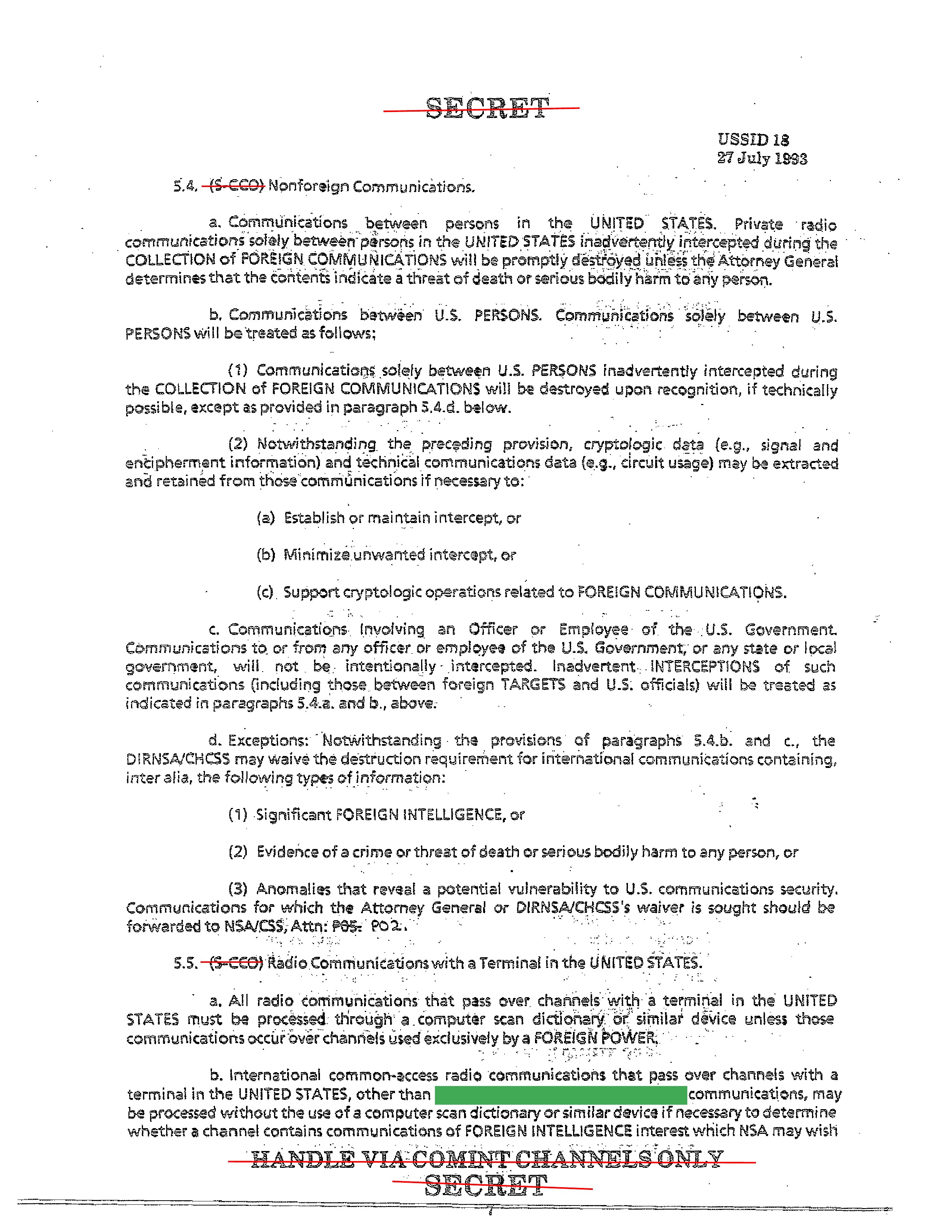
5.4. (S-CCO) Nonforeign Communications.
a. Communications between persons in the UNITED STATES. Private radio
communications solely between persons in the UNITED STATES inadvertently intercepted during the
COLLECTION OF FOREIGN COMMUNICATIONS will be promptly destroyed unless the Attorney General
determines that the contents indicate a threat of death or serious bodily harm to any person.
b. Communications between U.S. PERSONS. Communications solely between U.S.
PERSONS will be treated as follows;
(1) Communications solely between U.S. PERSONS inadvertently intercepted during
the COLLECTION of FOREIGN COMMUNICATIONS will be destroyed upon recognition, if technically
possible, except as provided in paragraph 5.4.d. below.
(2) Notwithstanding the preceding provision, cryptologic data (e.g., signal and
encipherment information) and technical communications data (e.g., circuit usage) may be extracted
and retained from those commünications if necessary to:
(a) Establish or maintain intercept, or
(b) Minimize unwanted intercept, or
(c) Support cryptologic operations related to FOREIGN COMMUNICATIONS.
c. Communications Involving an Officer or Employee of the U.S. Government.
Communications to or from any officer or employee of the U.S. Government, or any state or local
government, will. not be intentionally intercepted. Inadvertent INTERCEPTIONS of such
communications (including those between foreign TARGETS and U.S. officials) will be treated as
indicated in paragraphs 5.4.a. and b., above.
d. Exceptions: Notwithstanding the provisions of paragraphs 5.4.b. and c., the
DIRNSA/CHCSS may waive the destruction requirement for international communications containing,
inter alia, the following types of information:
(1) Significant FOREIGN INTELLIGENCE, or
(2) Evidence of a crime or threat of death or serious bodily harm to any person, or
(3) Anomalies that reveal a potential vulnerability to U.S. communications security.
Communications for which the Attorney General or DIRNSA/CHCSS's waiver is sought should be
forwarded to NSA/CSS, Attn: POS: PO2.
5.5.(S-CCO) Radio Communications with a Terminal in the UNITED STATES.
a. All radio communications that pass over channels with a terminal in the UNITED
STATES must be processed through a computer scan dictionary or similar device unless those
communications occur over channels üsed exclusively by a FOREIGN POWER,
b. International common-access radio communications that pass over channels with a
terminal in the UNITED STATES, other than [REDACTED] communications, may
be processed without the use of a computer scan dictionary or similar device if necessary to determine
whether a channel contains communications of FOREIGN INTELLIGENCE interest which NSA may wish
HANDLE VIA COMINT CHANNELS ONLY
SECRET
7
SECRET
USSID 18
27 July 1993
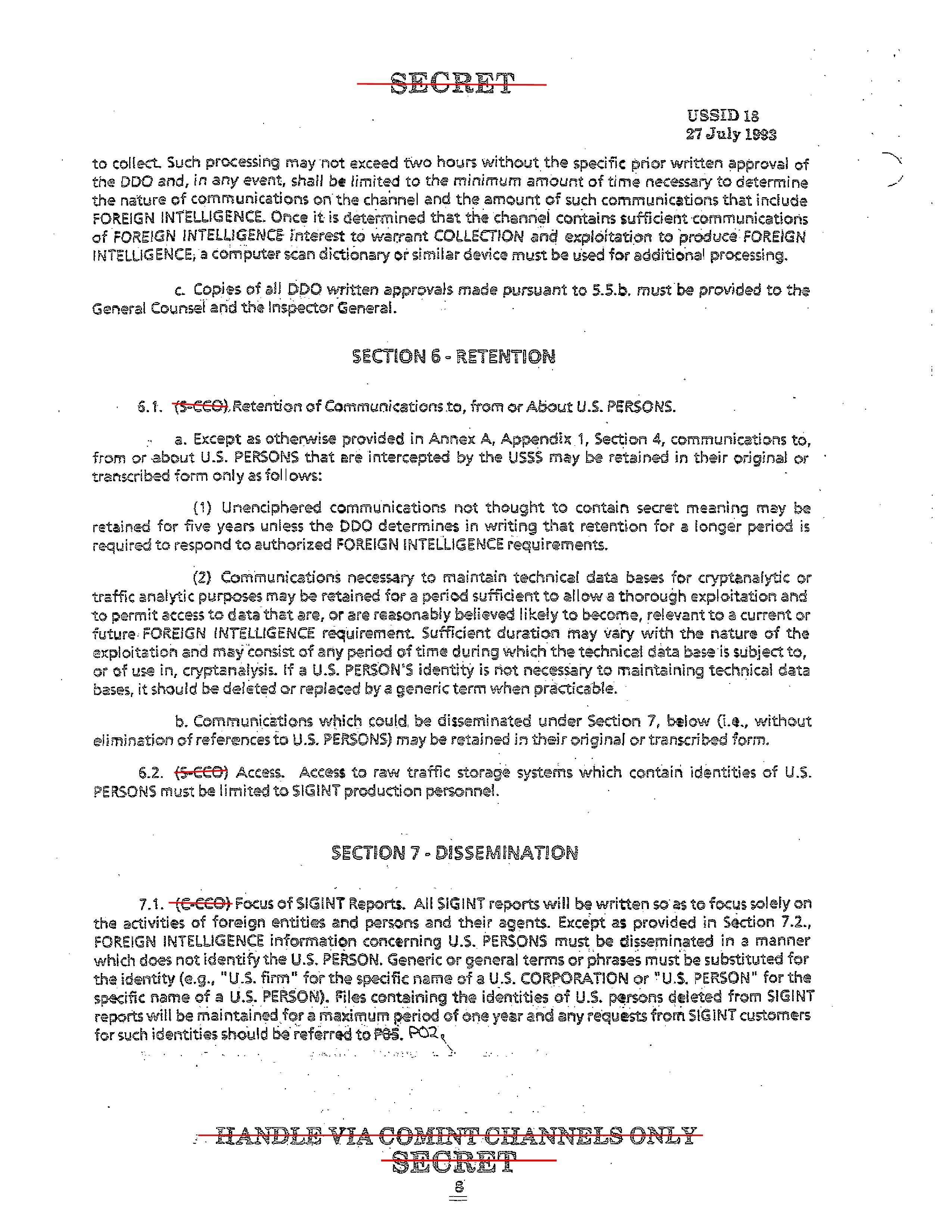
to collect. Such processing may not exceed two hours without the specific prior written approval of
the DDO and, in any event, shall be limited to the minimum amount of time necessary to determine
the nature of communications on the channel and the amount of such communications that include
FOREIGN INTELLIGENCE. Once it is determined that the channel contains sufficient communications
of FOREIGN INTELLIGENCE interest to warrant COLLECTION and exploitation to produce FOREIGN
INTELLIGENCE, a computer scan dictionary or similar device must be used for additional processing.
c. Copies of all DDO written approvals made pursuant to 5.5.b. must be provided to the
General Counsel and the Inspector General.
SECTION 6- RETENTION
6.1. (5-CCO) Retention of Communications to, from or About U.S. PERSONS.
a. Except as otherwise provided in Annex A, Appendix 1, Section 4, communications to,
from or about U.S. PERSONS that are intercepted by the USSS may be retained in their original or
transcribed form only as follows:
(1) Unenciphered communications not thought to contain secret meaning may be
retained for five years unless the DDO determines in writing that retention for a longer period is
required to respond to authorized FOREIGN INTELLIGENCE requirements.
(2) Communications necessary to maintain technical data bases for cryptanalytic or
traffic analytic purposes may be retained for a period sufficient to allow a thorough exploitation and
to permit access to data that are, or are reasonably believed likely to become, relevant to a current or
future FOREIGN INTELLIGENCE requirement. Sufficient duration may vary with the nature of the
exploitation and may consist of any period of time during which the technical data base is subject to,
or of use in, cryptanalysis. If a U.S. PERSON'S identity is not necessary to maintaining technical data
bases, it should be deleted or replaced by a generic term when practicable.
b. Communications which could be disseminated under Section 7, below (i.e., without
elimination of references to U.S. PERSONS) may be retained in their original or transcribed form.
6.2. (5-660) Access. Access to raw traffic storage systems which contain identities of U.S.
PERSONS must be limited to SIGINT production personnel.
SECTION 7 - DISSEMINATION
7.1. (C-CCO) Focus of SIGINT Reports. All SIGINT reports will be written so as to focus solely on
the activities of foreign entities and persons and their agents. Except as provided in Section 7.2.,
FOREIGN INTELLIGENCE information concerning U.S. PERSONS must be disseminated in a manner
which does not identify the U.S. PERSON. Generic or general terms or phrases must be substituted for
the identity (e.g., "U.S. firm" for the specific name of a U.S. CORPORATION or "U.S. PERSON" for the
specific name of a U.S. PERSON). Files containing the identities of U.S. persons deleted from SIGINT
reports will be maintained for a maximum period of one year and any requests from SIGINT customers
for such identities should be referred to P65. POZ,
HANDLE VIA COMINT CHANNELS ONLY
SECRET
8
SECRET
USSID 18
27 July 1993
7.2. (C-CCO) Dissemination of U.S. PERSON Identities. SIGINT reports may include the
identification of a U.S. PERSON only if one of the following conditions is met and a determination is
made by the appropriate approval authority that the recipient has a need for the identity for the
performance of his official duties:
a. The U.S. PERSON has CONSENTED to the dissemination of communications of, or about,
him or her and has executed the CONSENT form found in Annex H of this USSID, or
b. The information is PUBLICLY AVAILABLE (i.e., the information is derived from
unclassified information available to the general public), or
c. The identity of the U.S. PERSON is necessary to understand the FOREIGN INTELLIGENCE
information or assess its importance. The following nonexclusive list contains examples of the type of
information that meet this standard:
(1) FOREIGN POWER or AGENT OF A FOREIGN POWER. The information indicates that
the U.S. PERSON is a FOREIGN POWER or an AGENT OF A FOREIGN POWER.
(2) Unauthorized Disclosure of Classified Information. The information indicates that
the U.S. PERSON may be engaged in the unauthorized disclosure of classified information.
(3) International Narcotics Activity. The information indicates that the individual may
be engaged in international narcotics trafficking activities. (See Annex I of this USSID for further
information concerning individuals involved in international narcotics trafficking).
(4) Criminal Activity. The information is evidence that the individual may be involved
in a crime that has been, is being, or is about to be committed, provided that the dissemination is for
law enforcement purposes.
(5) Intelligence TARGET. The information indicates that the U.S. PERSON may be the
TARGET of hostile intelligence activities of a FOREIGN POWER.
(6) Threat to Safety. The information indicates that the identity of the U.S. PERSON is
pertinent to a possible threat to the safety of any person or organization, including those who are
TARGETS, victims or hostages of INTERNATIONAL TERRORIST organizations. Reporting units shall
identify to P05 any report containing the identity of a U.S. PERSON reported under this subsection (6).
Field reporting to P05 should be in the form of a CRITICOMM message (DDI XAO) and include the
report date-time-group (DTG), product serial number and the reason for inclusion of the U.S.
PERSON'S identity.
(7) Senior Executive Branch Officials. The identity is that of a senior official of the
Executive Branch of the U.S. Government. In this case only the official's title will be disseminated.
Domestic political or personal information on such individuals will be neither disseminated nor
retained.
HANDLE VIA COMINT CHANNELS ONLY
SECRET
9
SECRET
USSID 18
27 July 1993
7.3. (C-CCO) Approval Authorities. Approval authorities for the release of identities of U.S.
persons under Section 7 are as follows:
a. DIRNSA/CHCSS. DIRNSA/CHCSS must approve dissemination of:
(1) The identities of any senator, congressman, officer, or employee of the Legislative
Branch of the U.S. Government.
(2) The identity of any person for law enforcement purposes.
b. Field Units and NSA Headquarters Elements. All SIGINT production organizations are
authorized to disseminate the identities of U.S. PERSONS when:
(1) The identity is pertinent to the safety of any person or organization.
(2) The identity is that of a senior official of the Executive Branch.
(3) The U.S. PERSON has CONSENTED under paragraph 7.2.a. above.
c. DDO and Designees.
(1) In all other cases, U.S. PERSON identities may be released only with the prior
approval of the Deputy Director for Operations, the Assistant Deputy Director for Operations, the
Chief, P05, the Deputy Chief, P05, or, or, in their absence, the Senior Operations Officer of the National
SIGINT Operations Center. The DDO or ADDO shall review all U.S. identities released by these
designees as soon as practicable after the release is made.
(2) For law enforcement purposes involving narcotics related information, DIRNSA has
granted to the DDO authority to disseminate U.S. identities. This authority may not be further
delegated.
7.4. (U) Privileged Communications and Criminal Activity. All proposed disseminations of
information constituting U.S. PERSON privileged communications (e.g., attorney/client,
doctor/patient) and all information concerning criminal activities or criminal or judicial proceedings
in the UNITED STATES must be reviewed by the Office of General Counsel prior to dissemination.
7.5. (U) Improper Dissemination. If the name of a U.S. PERSON is improperly disseminated,
the incident should be reported to P05 within 24 hours of discovery of the error.
P02
HANDLE VIA COMINT CHANNELS ONLY
SECRET
10
SECRET
USSID 18
27 July 1993
SECTION 8 - RESPONSIBILITIES
8.1. (U) Inspector General. The Inspector General shall:
a. Conduct regular inspections and perform general oversight of NSA/CSS activities to
ensure compliance with this USSID.
b. Establish procedures for reporting by Key Component and Field Chiefs of their activities
and practices for oversight purposes.
c. Report to the DIRNSA/CHCSS, annually by 31 October, concerning NSA/CSS compliance
with this USSID.
d. Report quarterly with the DIRNSA/CHCSS and General Counsel to the President's
Intelligence Oversight Board through the Assistant to the Secretary of Defense (Intelligence
Oversight).
8.2. (U) General Counsel. The General Counsel shall:
a. Provide legal advice and assistance to all elements of the USSS regarding SIGINT
activities. Requests for legal advice on any aspect of these procedures should be sent by CRITICOMM
to DDI XDI, or by NSA/CSS secure telephone 963-3121, or [REDACTED]
b. Prepare and process all applications for Foreign Intelligence Surveillance Court orders
and requests for Attorney General approvals required by these procedures.
c. Advise the Inspector General in inspections and oversight of USSS activities.
d. Review and assess for legal implications as requested by the DIRNSA/CHCSS, Deputy
Director, Inspector General or Key Components Chief, all new major requirements and internally
generated USSS activities.
e. Advise USSS personnel of new legislation and case law that may affect USSS missions,
functions, operations, activities, or practices.
f. Report as required to the Attorney General and the President's Intelligence Oversight
Board and provide copies of such reports to the DIRNSA/CHCSS and affected agency elements.
g. Process requests from any DoD intelligence component for authority to use signals as
described in Procedure 5, Part 5, of DoD 5240.1-R, for periods in excess of 90 days in the development,
test, or calibration of ELECTRONIC SURVEILLANCE equipment and other equipment that can intercept
communications.
HANDLE VIA COMINT CHANNELS ONLY
SECRET
11
SECRET
USSID 18
27 July 1993
8.3. (U) Deputy Director for Operations (DDO). The DDO shall:
a. Ensure that all SIGINT production personnel understand and maintain a high degree of
awareness and sensitivity to the requirements of this USSID.
b. Apply the provisions of this USSID to all SIGINT production activities. The DDO staff
focal point for USSID 18 matters is P05 (use CRITICOMM DDI XAO).
P02
c. Conduct necessary reviews of SIGINT production activities and practices to ensure
consistency with this USSID.
d. Ensure that all new major requirements levied on the USSS or internally generated
activities are considered for review by the General Counsel. All activities that raise questions of law or
the proper interpretation of this USSID must be reviewed by the General Counsel prior to acceptance
or execution.
8.4. (U) All Elements of the USSS. All elements of the USSS shall:
a. Implement this directive upon receipt.
b. Prepare new procedures or amend or supplement existing procedures as required to
ensure adherence to this USSID. A copy of such procedures shall be forwarded to NSA/CSS, Attn: P05, P02,
c. Immediately inform the DDO of any tasking or instructions that appear to require
actions at variance with this USSID.
d. Promptly report to the NSA Inspector General and consult with the NSA General
Counsel on all activities that may raise a question of compliance with this USSID.
SECTION 9 - DEFINITIONS
9.1. (S-CCO) AGENT OF A FOREIGN POWER means:
a. Any person, other than a U.S. PERSON, who:
(1) Acts in the UNITED STATES as an officer or employee of a FOREIGN POWER, or as a
member of a group engaged in INTERNATIONAL TERRORISM or activities in preparation therefor; or
(2) Acts for, or on behalf of, a FOREIGN POWER that engages in clandestine
intelligence activities in the UNITED STATES contrary to the interests of the UNITED STATES, when the
circumstances of such person's presence in the UNITED STATES indicate that such person may engage
in such activities in the UNITED STATES, or when such person knowingly aids or abets any person in
the conduct of such activities or knowingly conspires with any person to engage in such activities; or
b. Any person, including a U.S. PERSON, who:
(1) Knowingly engages in clandestine intelligence gathering activities for, or on behalf
of, a FOREIGN POWER, which activities involve, or may involve, a violation of the criminal statutes of
the UNITED STATES; or
HANDLE VIA COMINT CHANNELS ONLY
SECRET
12
SECRET
USSID 18
27 July 1993
(2) Pursuant to the direction of an intelligence service or network of a FOREIGN
POWER, knowingly engages in any other clandestine intelligence activities for, or on behalf of, such
FOREIGN POWER, which activities involve or are about to involve, a violation of the criminal statutes
of the UNITED STATES; or
(3) Knowingly engages in sabotage or INTERNATIONAL TERRORISM, or activities that
are in preparation therefor, for or on behalf of a FOREIGN POWER; or
(4) Knowingly aids or abets any person in the conduct of activities described in
paragraphs 9.1.b.(1) through (3) or knowingly conspires with any person to engage in those activities.
c. For all purposes other than the conduct of ELECTRONIC SURVEILLANCE as defined by
the Foreign Intelligence Surveillance Act (see Annex A), the phrase "AGENT OF A FOREIGN POWER"
also means any person, including U.S. PERSONS outside the UNITED STATES, who are officers or
employees of a FOREIGN POWER, or who act unlawfully for or pursuant to the direction of a FOREIGN
POWER, or who are in contact with or acting in collaboration with an intelligence or security service
of a FOREIGN POWER for the purpose of providing access to information or material classified by the
UNITED STATES Government and to which the person has or has had access. The mere fact that a
person's activities may benefit or further the aims of a FOREIGN POWER is not enough to bring that
person under this provision, absent evidence that the person is taking direction from or acting in
knowing concert with a FOREIGN POWER.
9.2. (C) COLLECTION means intentional tasking or SELECTION of identified nonpublic
communications for subsequent processing aimed at reporting or retention as a file record.
9.3. (U) COMMUNICANT means a sender or intended recipient of a communication.
9.4. (U) COMMUNICATIONS ABOUT A U.S. PERSON are those in which the U.S. PERSON is
identified in the communication. A U.S. PERSON is identified when the person's name, unique title,
address, or other personal identifier is revealed in the communication in the context of activities
conducted by that person or activities conducted by others and related to that person. A mere
reference to a product by brand name or manufacturer's name, e.g., "Boeing 707" is not an
identification of a U.S. person.
9.5. (U) CONSENT, for SIGINT purposes, means an agreement by a person or organization to
permit the USSS to take particular actions that affect the person or organization. An agreement by an
organization with the National Security Agency to permit COLLECTION of information shall be
deemed valid CONSENT if given on behalf of such organization by an official or governing body
determined by the General Counsel, National Security Agency, to have actual or apparent authority
to make such an agreement.
9.6. (U) CORPORATIONS, for purposes of this USSID, are entities legally recognized as separate
from the persons who formed, own, or run them. CORPORATIONS have the nationality of the nation
state under whose laws they were formed. Thus, CORPORATIONS incorporated under UNITED STATES
federal or state law are U.S. PERSONS.
9.7. (U) ELECTRONIC SURVEILLANCE means:
a. In the case of an electronic communication, the acquisition of a nonpublic
communication by electronic means without the CONSENT of a person who is a party to the
communication.
HANDLE VIA COMINT CHANNELS ONLY
SECRET
13
SECRET
USSID 18
27 July 1993
b. In the case of a nonelectronic communication, the acquisition of a nonpublic
communication by electronic means without the CONSENT of a person who is visibly present at the
place of communication.
c. The term ELECTRONIC SURVEILLANCE does not include the use of radio direction
finding equipment solely to determine the location of a transmitter.
9.8.(C) FOREIGN COMMUNICATION means a communication that has at least one
COMMUNICANT outside of the UNITED STATES, or that is entirely among FOREIGN POWERS or
between a FOREIGN POWER and officials of a FOREIGN POWER, but does not include communications
intercepted by ELECTRONIC SURVEILLANCE directed, at premises in the UNITED STATES used
predominantly for residential purposes.
9.9. (U) FOREIGN INTELLIGENCE means information relating to the capabilities, intentions,
and activities of FOREIGN POWERS, organizations, or persons, and for purposes of this USSID includes
both positive FOREIGN INTELLIGENCE and counterintelligence.
9.10. (U) FOREIGN POWER means:
a. A foreign government or any component thereof, whether or not recognized by the
UNITED STATES,
PERSONS,
b. A faction of a foreign nation or nations, not substantially composed of UNITED STATES
c. An entity that is openly acknowledged by a foreign government or governments to be
directed and controlled by such foreign government or governments,
d. A group engaged in INTERNATIONAL TERRORISM or activities in preparation therefor,
e. A foreign-based political organization, not substantially composed of UNITED STATES
PERSONS, or
f. An entity that is directed and controlled by a foreign government or governments.
9.11. (U) INTERCEPTION means the acquisition by the USSS through electronic means of a
nonpublic communication to which it is not an intended party, and the processing of the contents of
that communication into an intelligible form, but does not include the display of signals on visual
display devices intended to permit the examination of the technical characteristics of the signals
without reference to the information content carried by the signal.
HANDLE VIA COMINT CHANNELS ONLY
SECRET
14
SECRET
USSID 18
27 July 1993
9.12. (U) INTERNATIONAL TERRORISM means activities that:
a. Involve violent acts or acts dangerous to human life that are a violation of the criminal
laws of the UNITED STATES or of any State, or that would be a criminal violation if committed within
the jurisdiction of the UNITED STATES or any State, and
b. Appear to be intended:
(1) to intimidate or coerce a civilian population,
(2) to influence the policy of a government by intimidation or coercion, or
(3) to affect the conduct of a government by assassination or kidnapping, and
c. Occur totally outside the UNITED STATES, or transcend national boundaries in terms of
the means by which they are accomplished, the persons they appear intended to coerce or intimidate,
or the locale in which their perpetrators operate or seek asylum.
9.13. (U) PUBLICLY AVAILABLE INFORMATION means information that has been published or
broadcast for general public consumption, is available on request to a member of the general public,
has been seen or heard by a casual observer, or is made available at a meeting open to the general
public.
9.14.(C) SELECTION, as applied to manual and electronic processing activities, means the
intentional insertion of a [REDACTED] telephone
number, [REDACTED] into a computer scan dictionary or manual scan guide for the
purpose of identifying messages of interest and isolating them for further processing.
9.15. (C) SELECTION TERM means the composite of individual terms used to effect or defeat
SELECTION of particular communications for the purpose of INTERCEPTION. It comprises the entire
term or series of terms so used, but not any segregable term contained therein. It applies to both
electronic and manual processing.
9.16. (U) TARGET, OR TARGETING: See COLLECTION.
9.17. (U) UNITED STATES, when used geographically, includes the 50 states and the District of
Columbia, Puerto Rico, Guam, American Samoa, the U.S. Virgin Islands, the Northern Mariana Islands,
and any other territory or possession over which the UNITED STATES exercises sovereignty.
9.18. (U) UNITED STATES PERSON:
a. A citizen of the UNITED STATES,
b. An alien lawfully admitted for permanent residence in the UNITED STATES,
c. Unincorporated groups and associations a substantial number of the members of
which constitute a. or b. above, or
d. CORPORATIONS incorporated in the UNITED STATES, including U.S. flag
nongovernmental aircraft or vessels, but not including those entities which are openly acknowledged
by a foreign government or governments to be directed and controlled by them.
HANDLE VIA COMINT CHANNELS ONLY
SECRET
15
SECRET
USSID 18
27 July 1993
e. The following guidelines apply in determining whether a person is a U.S. PERSON:
(1) A person known to be currently in the United States will be treated as a U.S.
PERSON unless that person is reasonably identified as an alien who has not been admitted for
permanent residence or if the nature of the person's communications or other indicia in the contents
or circumstances of such communications give rise to a reasonable belief that such person is not a U.S.
PERSON.
(2) A person known to be currently outside the UNITED STATES, or whose location is
not known, will not be treated as a U.S. PERSON unless such person is reasonably identified as such or
the nature of the person's communications or other indicia in the contents or circumstances of such
communications give rise to a reasonable belief that such person is a U.S. PERSON.
(3) A person known to be an alien admitted for permanent residence may be assumed
to have lost status as a U.S. PERSON if the person leaves the UNITED STATES and it is known that the
person is not in compliance with the administrative formalities provided by law (8 U.S.C. Section 1203)
that enable such persons to reenter the UNITED STATES without regard to the provisions of law that
would otherwise restrict an alien's entry into the UNITED STATES. The failure to follow the statutory
procedures provides a reasonable basis to conclude that such alien has abandoned any intention of
maintaining status as a permanent resident alien.
(4) An unincorporated association whose headquarters are located outside the
UNITED STATES may be presumed not to be a U.S. PERSON unless the USSS has information indicating
that a substantial number of members are citizens of the UNITED STATES or aliens lawfully admitted
for permanent residence.
(5) CORPORATIONS have the nationality of the nation-state in which they are
incorporated. CORPORATIONS formed under U.S. federal or state law are thus U.S. persons, even if
the corporate stock is foreign-owned. The only exception set forth above is CORPORATIONS which
are openly acknowledged to be directed and controlled by foreign governments. Conversely,
CORPORATIONS incorporated in foreign countries are not U.S. PERSONS even if that CORPORATION is
a subsidiary of a U.S. CORPORATION.
(6) Nongovernmental ships and aircraft are legal entities and have the nationality of
the country in which they are registered. Ships and aircraft fly the flag and are subject to the law of
their place of registration.
HANDLE VIA COMINT CHANNELS ONLY
SECRET
16
SECRET
USSID 18
27 July 1993
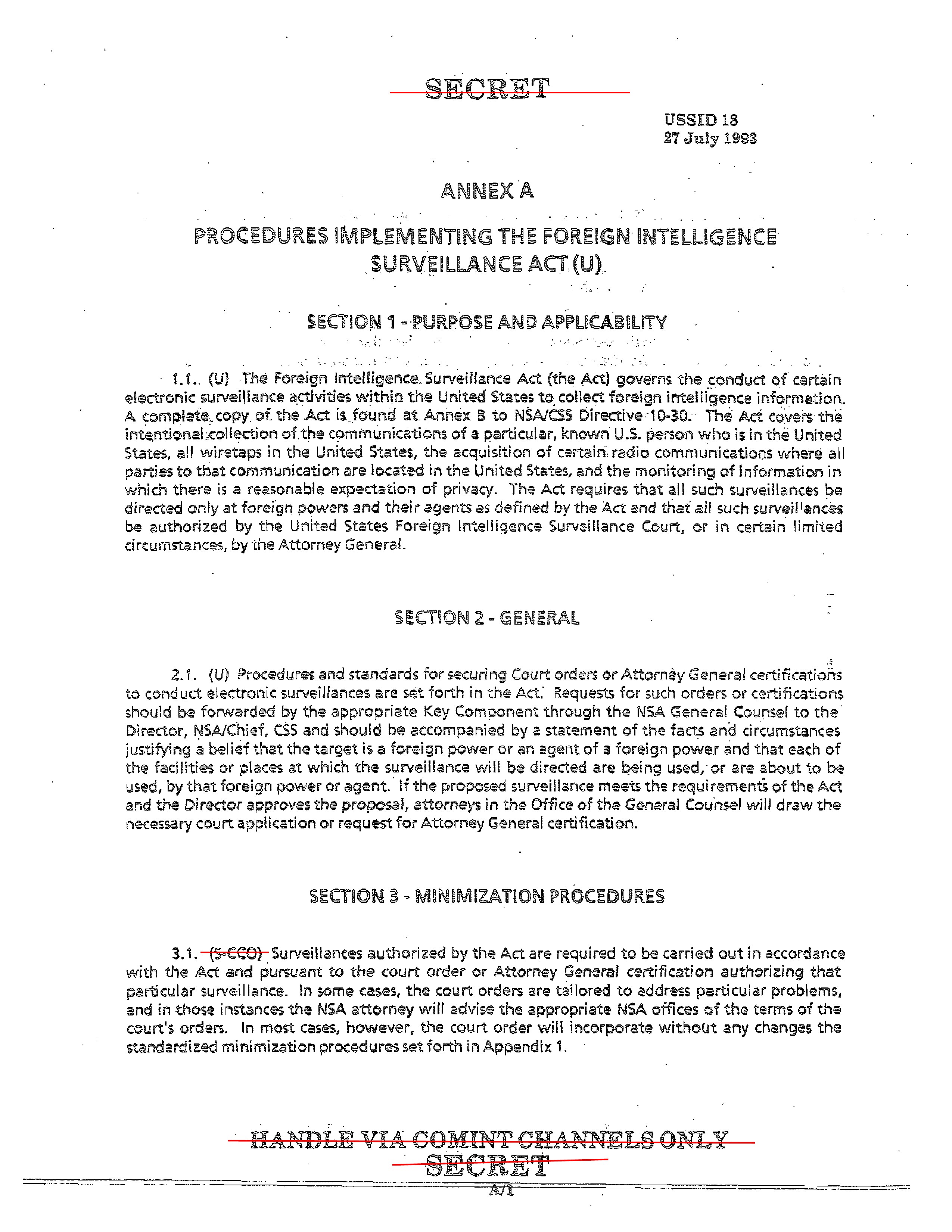
ANNEX A
PROCEDURES IMPLEMENTING THE FOREIGN INTELLIGENCE
SURVEILLANCE ACT (U).
SECTION 1-PURPOSE AND APPLICABILITY
1.1.. (U) The Foreign Intelligence. Surveillance Act (the Act) governs the conduct of certain
electronic surveillance activities within the United States to collect foreign intelligence information.
A complete copy of the Act is found at Annex B to NSA/CSS Directive 10-30. The Act covers the
intentional collection of the communications of a particular, known U.S. person who is in the United
States, all wiretaps in the United States, the acquisition of certain radio communications where all
parties to that communication are located in the United States, and the monitoring of information in
which there is a reasonable expectation of privacy. The Act requires that all such surveillances be
directed only at foreign powers and their agents as defined by the Act and that all such surveillances
be authorized by the United States Foreign Intelligence Surveillance Court, or in certain limited
circumstances, by the Attorney General.
SECTION 2 - GENERAL
2.1. (U) Procedures and standards for securing Court orders or Attorney General certifications
to conduct electronic surveillances are set forth in the Act. Requests for such orders or certifications
should be forwarded by the appropriate Key Component through the NSA General Counsel to the
Director, NSA/Chief, CSS and should be accompanied by a statement of the facts and circumstances
justifying a belief that the target is a foreign power or an agent of a foreign power and that each of
the facilities or places at which the surveillance will be directed are being used, or are about to be
used, by that foreign power or agent. If the proposed surveillance meets the requirements of the Act
and the Director approves the proposal, attorneys in the Office of the General Counsel will draw the
necessary court application or request for Attorney General certification.
SECTION 3 - MINIMIZATION PROCEDURES
3.1.(S-CCO) Surveillances authorized by the Act are required to be carried out in accordance
with the Act and pursuant to the court order or Attorney General certification authorizing that
particular surveillance. In some cases, the court orders are tailored to address particular problems,
and in those instances the NSA attorney will advise the appropriate NSA offices of the terms of the
court's orders. In most cases, however, the court order will incorporate without any changes the
standardized minimization procedures set forth in Appendix 1.
HANDLE VIA COMINT CHANNELS ONLY
SECRET
A/1
SECRET
USSID 18 ANNEX A
27 July 1993
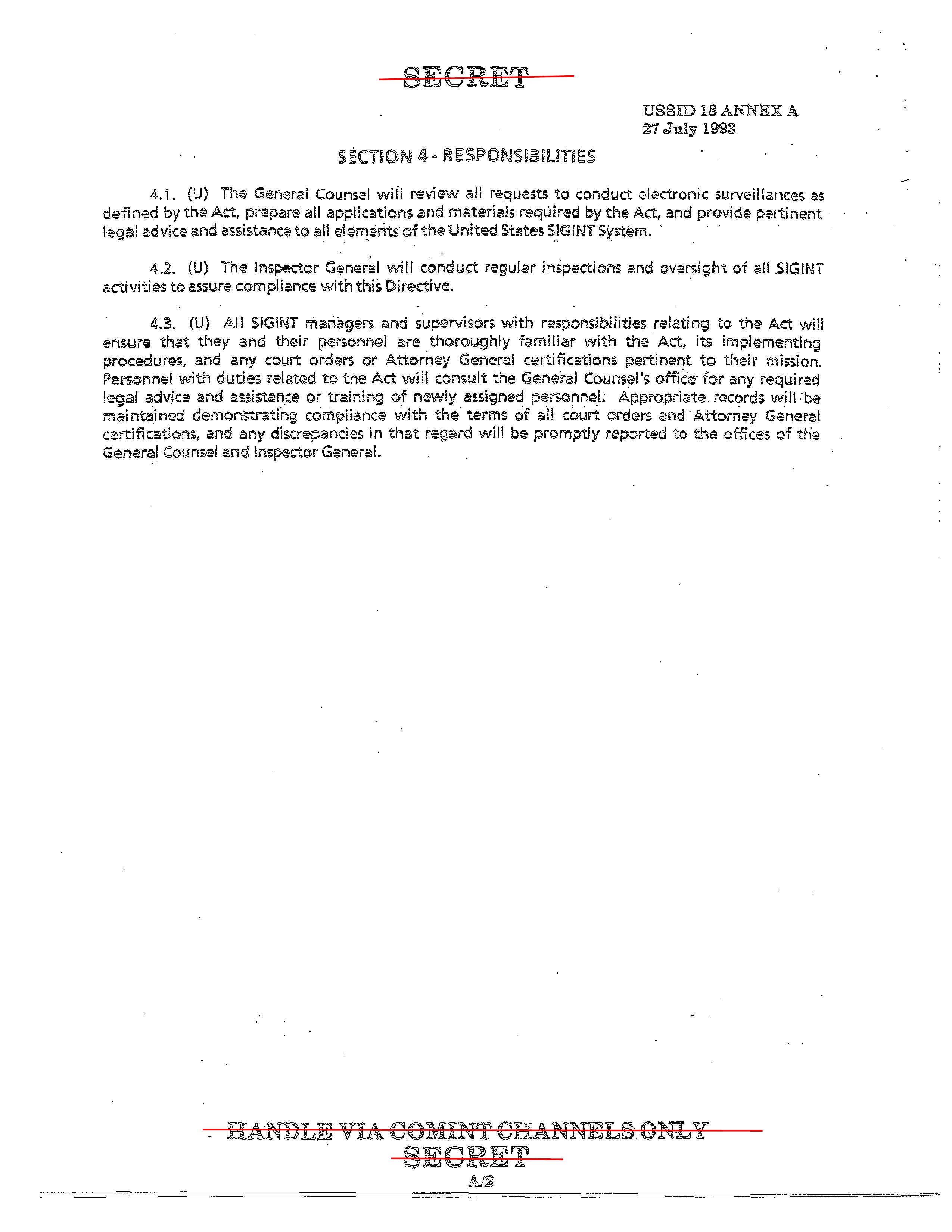
SECTION 4- RESPONSIBILITIES
4.1. (U) The General Counsel will review all requests to conduct electronic surveillances as
defined by the Act, prepare all applications and materiais required by the Act, and provide pertinent
legal advice and assistance to all elements of the United States SIGINT System.
4.2. (U) The Inspector General will conduct regular inspections and oversight of all SIGINT
activities to assure compliance with this Directive.
4.3. (U) All SIGINT managers and supervisors with responsibilities relating to the Act will
ensure that they and their personnel are thoroughly familiar with the Act, its implementing
procedures, and any court orders or Attorney General certifications pertinent to their mission.
Personnel with duties related to the Act will consult the General Counsel's office for any required
legal advice and assistance or training of newly assigned personnel. Appropriate. records will be
maintained demonstrating compliance with the terms of all court orders and Attorney General
certifications, and any discrepancies in that regard will be promptly reported to the offices of the
General Counsel and Inspector General.
HANDLE VIA COMINT CHANNELS ONLY
SECRET
A/2
SECRET
USSID 18 ANNEX A
27 July 1993
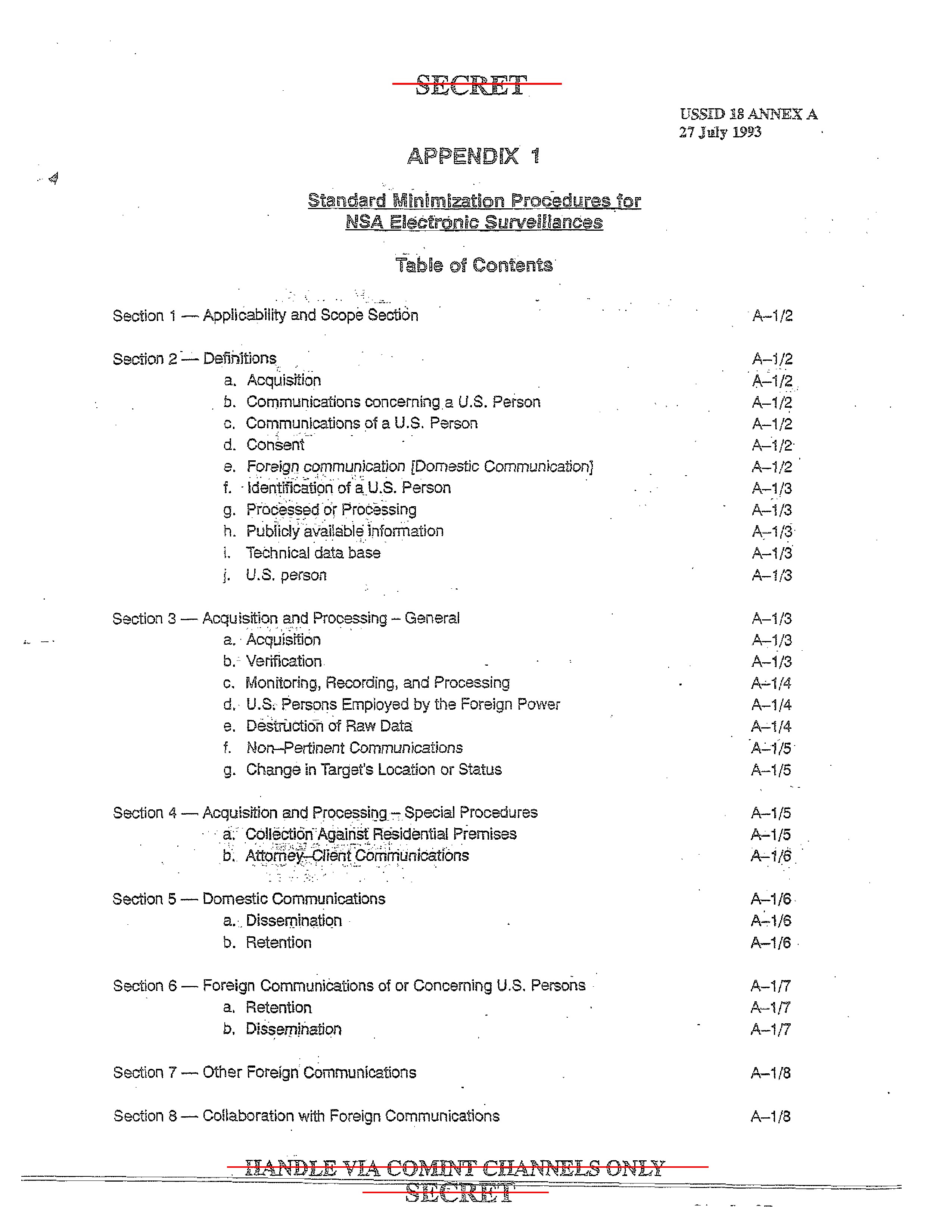
APPENDIX 1
Standard Minimization Procedures for
NSA Electronic Surveillances
Table of Contents
Section 1 — Applicability and Scope Section
A-1/2
Section 2— Definitions
A-1/2
a. Acquisition
A-1/2
b. Communications concerning a U.S. Person
A-1/2
c. Communications of a U.S. Person
A-1/2
d. Consent
A-1/2
e. Foreign communication [Domestic Communication]
A-1/2
f. Identification of a U.S. Person
A-1/3
g. Processed or Processing
A-1/3
h. Publicly available information
A-1/3
i. Technical data base
A-1/3
j. U.S. person
A-1/3
Section 3 — Acquisition and Processing - General
A-1/3
a. Acquisition
A-1/3
b. Verification.
A-1/3
c. Monitoring, Recording, and Processing
A-1/4
d. U.S. Persons Employed by the Foreign Power
A-1/4
e. Destruction of Raw Data
A-1/4
f. Non-Pertinent Communications
A-1/5
g. Change in Target's Location or Status
A-1/5
Section 4 — Acquisition and Processing - Special Procedures
A-1/5
a. Collection Against Residential Premises
A-1/5
b. Attorney-Client Communications
A-1/6
Section 5 — Domestic Communications
A-1/6
a. Dissemination
A-1/6
b. Retention
A-1/6
Section 6 - Foreign Communications of or Concerning U.S. Persons
A-1/7
a. Retention
A-1/7
b. Dissemination
A-1/7
Section 7 — Other Foreign Communications
A-1/8
Section 8 — Collaboration with Foreign Communications
A-1/8
HANDLE VIA COMINT CHANNELS ONLY
SECRET
SECRET
USSID 18 ANNEX A
APPENDIX 1
27 July 1993
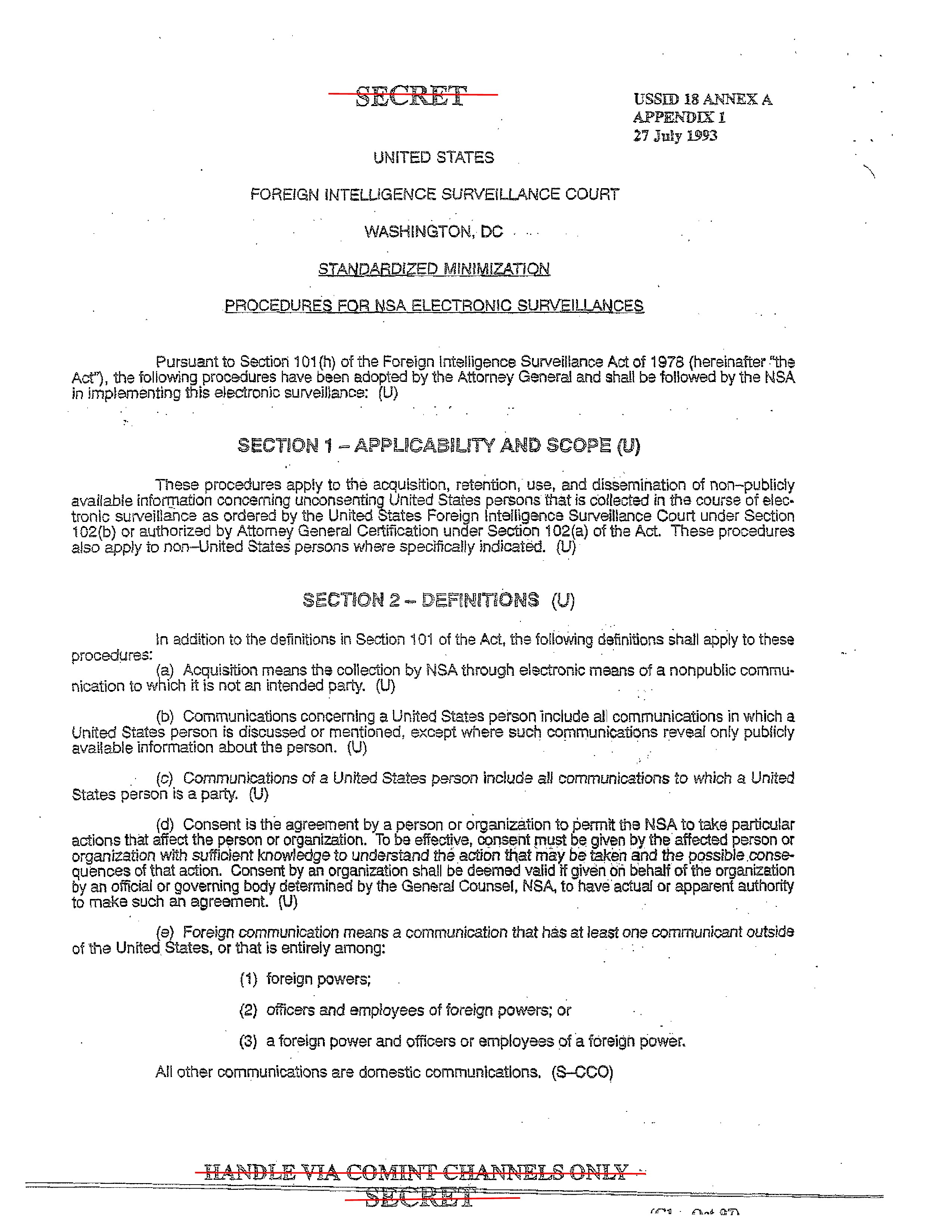
UNITED STATES
FOREIGN INTELLIGENCE SURVEILLANCE COURT
WASHINGTON, DC
STANDARDIZED MINIMIZATION
PROCEDURES FOR NSA ELECTRONIC SURVEILLANCES
Pursuant to Section 101 (h) of the Foreign Intelligence Surveillance Act of 1978 (hereinafter "the
Act"), the following procedures have been adopted by the Attorney General and shall be followed by the NSA
in implementing this electronic surveillance: (U)
SECTION 1 - APPLICABILITY AND SCOPE (U)
These procedures apply to the acquisition, retention, use, and dissemination of non-publicly
available information concerning unconsenting United States persons that is collected in the course of elec-
tronic surveillance as ordered by the United States Foreign Intelligence Surveillance Court under Section
102(b) or authorized by Attorney General Certification under Section 102(a) of the Act. These procedures
also apply to non-United States persons where specifically indicated. (U)
SECTION 2 - DEFINITIONS (U)
In addition to the definitions in Section 101 of the Act, the following definitions shall apply to these
procedures:
(a) Acquisition means the collection by NSA through electronic means of a nonpublic commu-
nication to which it is not an intended party. (U)
(b) Communications concerning a United States person include all communications in which a
United States person is discussed or mentioned, except where such communications reveal only publicly
available information about the person. (U)
(c) Communications of a United States person include all communications to which a United
States person is a party. (U)
(d) Consent is the agreement by a person or organization to permit the NSA to take particular
actions that affect the person or organization. To be effective, consent must be given by the affected person or
organization with sufficient knowledge to understand the action that may be taken and the possible.conse-
quences of that action. Consent by an organization shall be deemed valid if given on behalf of the organization
by an official or governing body determined by the General Counsel, NSA, to have actual or apparent authority
to make such an agreement. (U)
(e) Foreign communication means a communication that has at least one communicant outside
of the United States, or that is entirely among:
(1) foreign powers;
(2) officers and employees of foreign powers; or
(3) a foreign power and officers or employees of a foreign power.
All other communications are domestic communications. (S-CCO)
HANDLE VIA COMINT CHANNELS ONLY
SECRET
(C1-Oct 97)
SECRET
USSID 18 ANNEX A
APPENDIX 1
27 July 1993
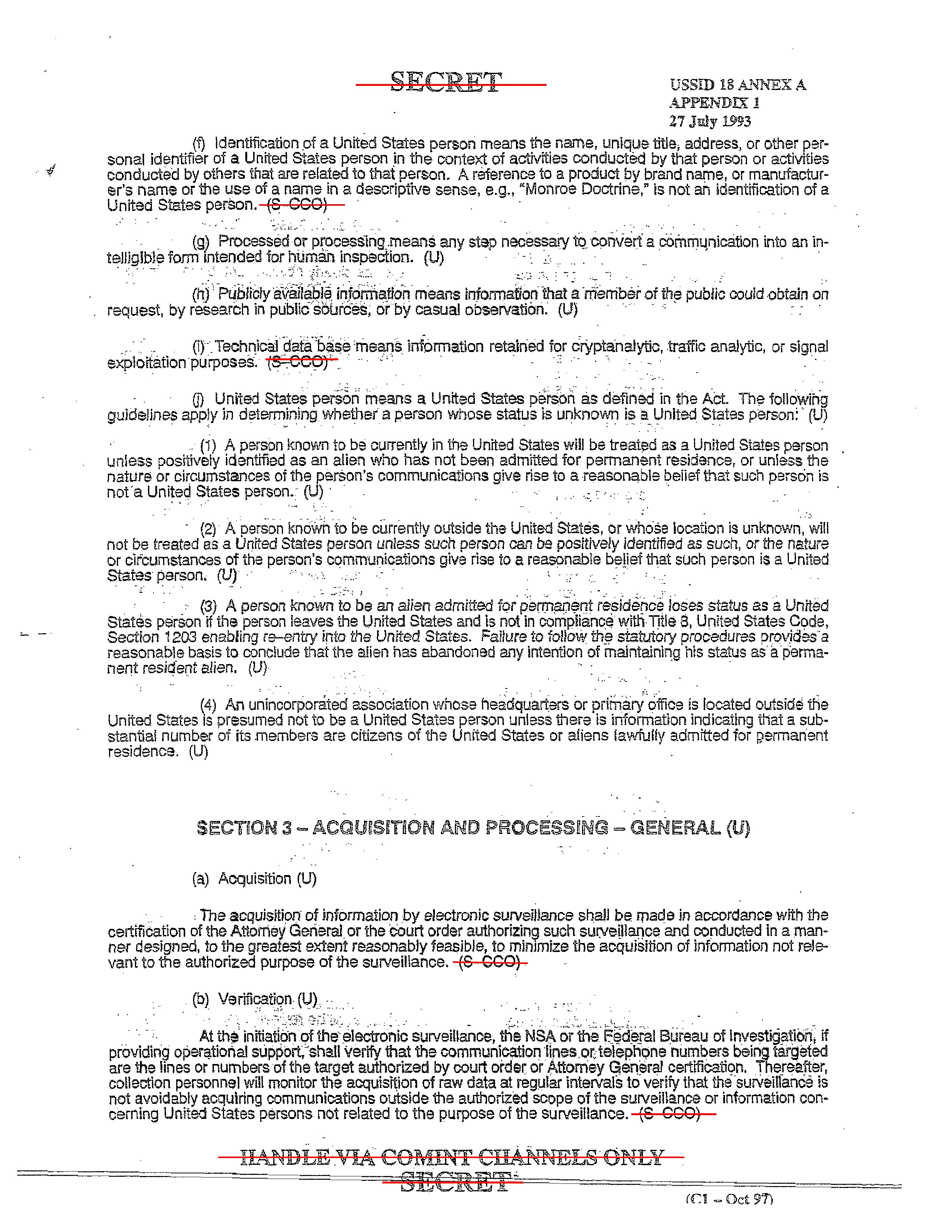
(f) Identification of a United States person means the name, unique title, address, or other per-
sonal identifier of a United States person in the context of activities conducted by that person or activities
conducted by others that are related to that person. A reference to a product by brand name, or manufactur-
er's name or the use of a name in a descriptive sense, e.g., "Monroe Doctrine," is not an identification of a
United States person. (S CCO)
(g) Processed or processing means any step necessary to convert a communication into an in-
telligible form intended for human inspection. (U)
(h) Publicly available information means information that a member of the public could obtain on
request, by research in public sources, or by casual observation. (U)
(i) Technical data base means information retained for cryptanalytic, traffic analytic, or signal
exploitation purposes. (S-CCO)
(j) United States person means a United States person as defined in the Act. The following
guidelines apply in determining whether a person whose status is unknown is a United States person: (U)
(1) A person known to be currently in the United States will be treated as a United States person
unless positively identified as an alien who has not been admitted for permanent residence, or unless the
nature or circumstances of the person's communications give rise to a reasonable belief that such person is
not a United States person. (U)
(2) A person known to be currently outside the United States, or whose location is unknown, will
not be treated as a United States person unless such person can be positively identified as such, or the nature
or circumstances of the person's communications give rise to a reasonable belief that such person is a United
States person. (U)
(3) A person known to be an alien admitted for permanent residence loses status as a United
States person if the person leaves the United States and is not in compliance with Title 8, United States Code,
Section 1203 enabling re-entry into the United States. Failure to follow the statutory procedures provides a
reasonable basis to conclude that the alien has abandoned any intention of maintaining his status as a perma-
nent resident alien. (U)
(4) An unincorporated association whose headquarters or primary office is located outside the
United States is presumed not to be a United States person unless there is information indicating that a sub-
stantial number of its members are citizens of the United States or aliens lawfully admitted for permanent
residence. (U)
SECTION 3 – ACQUISITION AND PROCESSING – GENERAL (U)
(a) Acquisition (U)
The acquisition of information by electronic surveillance shall be made in accordance with the
certification of the Attorney General or the court order authorizing such surveillance and conducted in a man-
ner designed, to the greatest extent reasonably feasible, to minimize the acquisition of information not rele-
vant to the authorized purpose of the surveillance. (S CCO)
(b) Verification (U)
At the initiation of the electronic surveillance, the NSA or the Federal Bureau of Investigation, if
providing operational support, shall verify that the communication lines or telephone numbers being targeted
are the lines or numbers of the target authorized by court order or Attorney General certification. Thereafter,
collection personnel will monitor the acquisition of raw data at regular intervals to verify that the surveillance is
not avoidably acquiring communications outside the authorized scope of the surveillance or information con-
cerning United States persons not related to the purpose of the surveillance. (S CCO)
HANDLE VIA COMINT CHANNELS ONLY
SECRET
(C1-Oct 97)
SECRET
USSID 18 ANNEX A
APPENDIX 1
27 July 1993
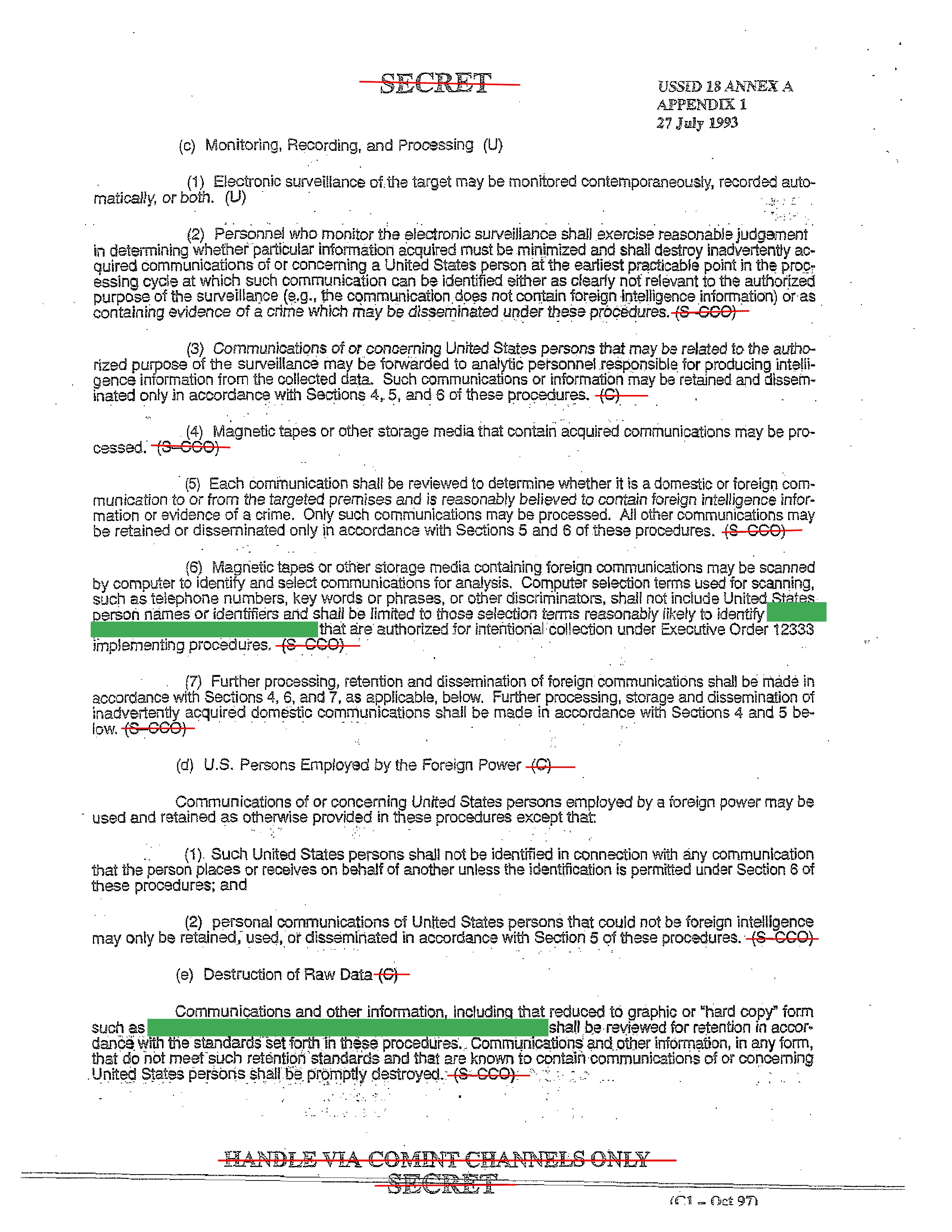
(c) Monitoring, Recording, and Processing (U)
(1) Electronic surveillance of the target may be monitored contemporaneously, recorded auto-
matically, or both. (U)
(2) Personnel who monitor the electronic surveillance shall exercise reasonable judgement
in determining whether particular information acquired must be minimized and shall destroy inadvertently ac-
quired communications of or concerning a United States person at the earliest practicable point in the proc-
essing cycle at which such communication can be identified either as clearly not relevant to the authorized
purpose of the surveillance (e.g., the communication does not contain foreign intelligence information) or as
containing evidence of a crime which may be disseminated under these procedures. (S-CCO)
(3) Communications of or concerning United States persons that may be related to the autho-
rized purpose of the surveillance may be forwarded to analytic personnel responsible for producing intelli-
gence information from the collected data. Such communications or information may be retained and dissem-
inated only in accordance with Sections 4, 5, and 6 of these procedures. (C)
(4) Magnetic tapes or other storage media that contain acquired communications may be pro-
cessed. (S-CCO)
(5) Each communication shall be reviewed to determine whether it is a domestic or foreign com-
munication to or from the targeted premises and is reasonably believed to contain foreign intelligence infor-
mation or evidence of a crime. Only such communications may be processed. All other communications may
be retained or disseminated only in accordance with Sections 5 and 6 of these procedures. (S-CCO)
(6) Magnetic tapes or other storage media containing foreign communications may be scanned
by computer to identify and select communications for analysis. Computer selection terms used for scanning,
such as telephone numbers, key words or phrases, or other discriminators, shall not include United States
person names or identifiers and shall be limited to those selection terms reasonably likely to identify
[REDACTED] that are authorized for intentional collection under Executive Order 12333
implementing procedures. (S-CCO)
(7) Further processing, retention and dissemination of foreign communications shall be made in
accordance with Sections 4, 6, and 7, as applicable, below. Further processing, storage and dissemination of
inadvertently acquired domestic communications shall be made in accordance with Sections 4 and 5 be-
low. (S-CCO)
(d) U.S. Persons Employed by the Foreign Power (C)
Communications of or concerning United States persons employed by a foreign power may be
used and retained as otherwise provided in these procedures except that:
(1). Such United States persons shall not be identified in connection with any communication
that the person places or receives on behalf of another unless the identification is permitted under Section 6 of
these procedures; and
(2) personal communications of United States persons that could not be foreign intelligence
may only be retained, used, or disseminated in accordance with Section 5 of these procedures. (S-CCO)
(e) Destruction of Raw Data (C)
Communications and other information, including that reduced to graphic or "hard copy" form
such as [REDACTED] shall be reviewed for retention in accor-
dance with the standards set forth in these procedures. Communications and other information, in any form,
that do not meet such retention standards and that are known to contain communications of or concerning
United States persons shall be promptly destroyed. (S-CCO)
HANDLE VIA COMINT CHANNELS ONLY
SECRET
(C1-Oct 97)
SECRET
USSID 18 ANNEX A
APPENDIX 1
27 July 1993
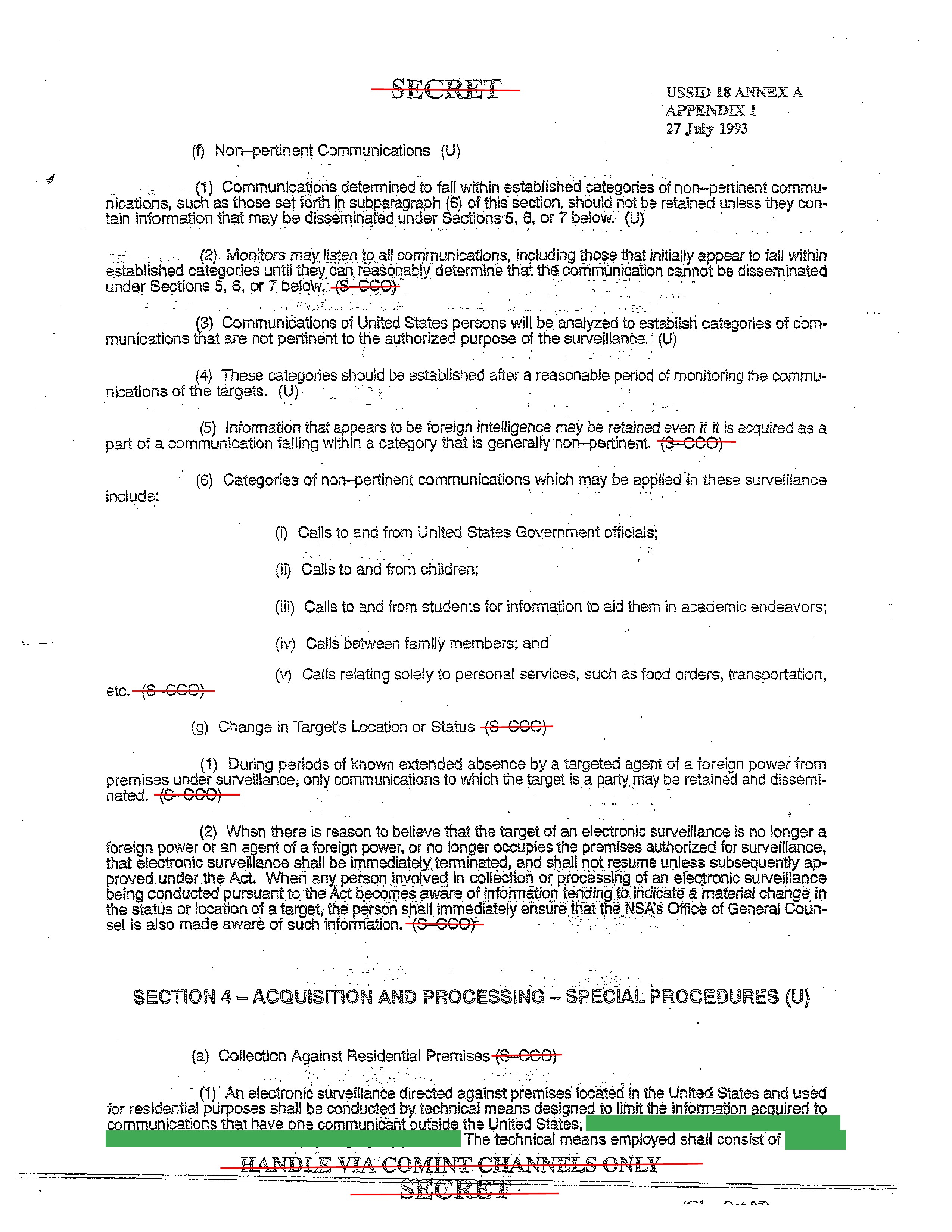
(f) Non-pertinent Communications (U)
(1) Communications determined to fall within established categories of non-pertinent commu-
nications, such as those set forth in subparagraph (6) of this section, should not be retained unless they con-
tain information that may be disseminated under Sections 5, 6, or 7 below. (U)
(2) Monitors may listen to all communications, including those that initially appear to fall within
established categories until they can reasonably determine that the communication cannot be disseminated
under Sections 5, 6, or 7 below. (S CCO)
(3) Communications of United States persons will be analyzed to establish categories of com-
munications that are not pertinent to the authorized purpose of the surveillance... (U)
(4) These categories should be established after a reasonable period of monitoring the commu-
nications of the targets. (U)
(5) Information that appears to be foreign intelligence may be retained even if it is acquired as a
part of a communication falling within a category that is generally non-pertinent. (S-CCO)
(6) Categories of non-pertinent communications which may be applied in these surveillance
include:
(1) Calls to and from United States Government officials;
(ii) Calls to and from children;
(iii) Calls to and from students for information to aid them in academic endeavors;
(iv) Calls between family members; and
(v) Calls relating solely to personal services, such as food orders, transportation,
etc. (S-CCO)
(g) Change in Target's Location or Status (S-CCO)
(1) During periods of known extended absence by a targeted agent of a foreign power from
premises under surveillance, only communications to which the target is a party may be retained and dissemi-
nated. (S-CCO)
(2) When there is reason to believe that the target of an electronic surveillance is no longer a
foreign power or an agent of a foreign power, or no longer occupies the premises authorized for surveillance,
that electronic surveillance shall be immediately terminated, and shall not resume unless subsequently ap-
proved under the Act. When any person involved in collection or processing of an electronic surveillance
being conducted pursuant to the Act becomes aware of information tending to indicate a material change in
the status or location of a target, the person shall immediately ensure that the NSA's Office of General Coun-
sel is also made aware of such information. (S-CCO)
SECTION 4 - ACQUISITION AND PROCESSING – SPECIAL PROCEDURES (U)
(a) Collection Against Residential Premises (S-CCO)
(1) An electronic surveillance directed against premises located in the United States and used
for residential purposes shall be conducted by technical means designed to limit the information acquired to
communications that have one communicant outside the United States, [REDACTED]
The technical means employed shall consist of
[REDACTED]
HANDLE VIA COMINT CHANNELS ONLY
SECRET
(C1-Oct 97)
SECRET
USSID 18 ANNEX A
APPENDIX 1
27 July 1993
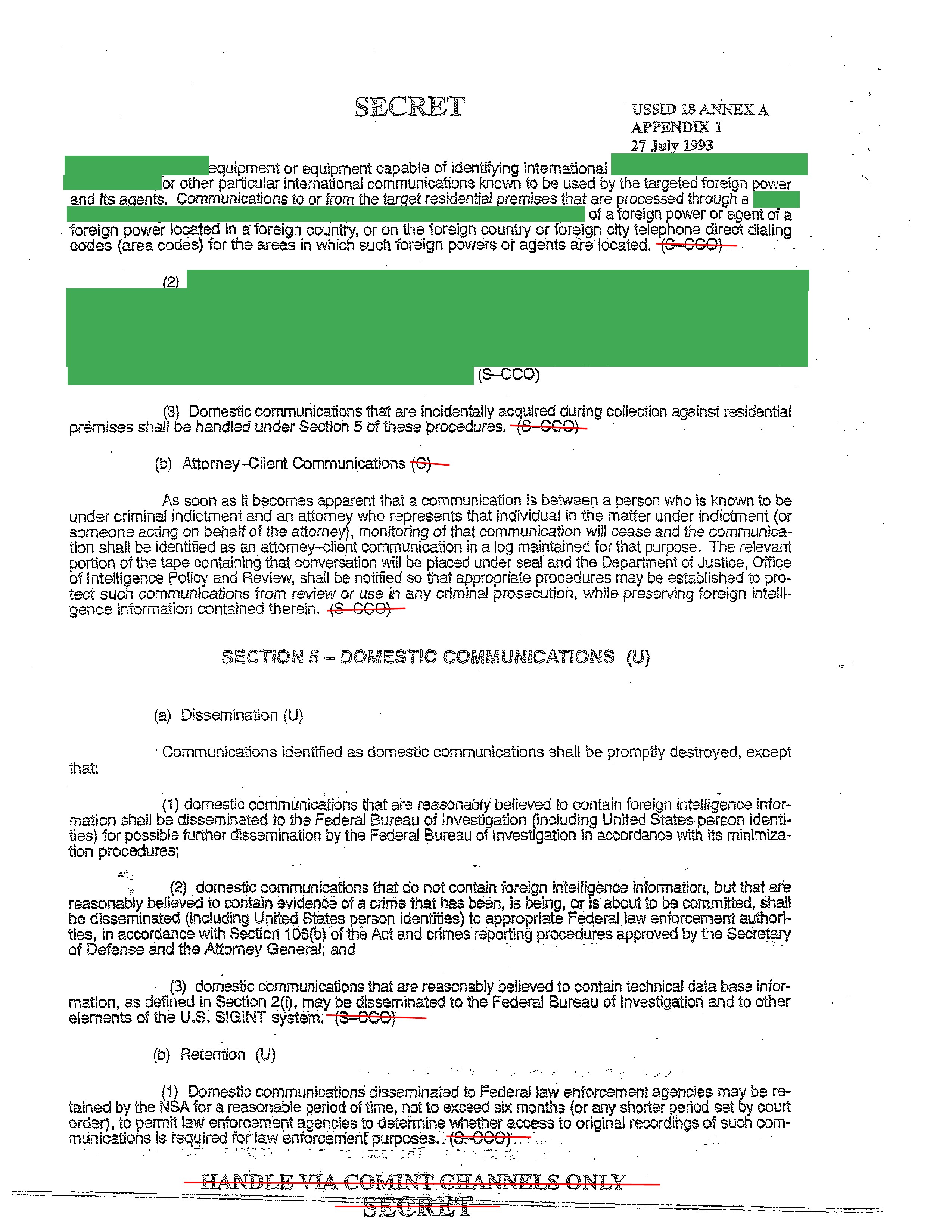
equipment or equipment capable of identifying international [REDACTED] or other particular international communications known to be used by the targeted foreign power and its agents. Communications to or from the target residential premises that are processed through a [REDACTED] of a foreign power or agent of a foreign power located in a foreign country, or on the foreign country or foreign city telephone direct dialing codes (area codes) for the areas in which such foreign powers of agents are located. (S-CCO).
(2) [REDACTED]
(S-CCO)
(3) Domestic communications that are incidentally acquired during collection against residential premises shall be handled under Section 5 of these procedures. (S CCO)
(b) Attorney-Client Communications (C)
As soon as it becomes apparent that a communication is between a person who is known to be under criminal indictment and an attorney who represents that individual in the matter under indictment (or someone acting on behalf of the attorney), monitoring of that communication will cease and the communica- tion shall be identified as an attomey-client communication in a log maintained for that purpose. The relevant portion of the tape containing that conversation will be placed under seal and the Department of Justice, Office of Intelligence Policy and Review, shall be notified so that appropriate procedures may be established to pro- tect such communications from review or use in any criminal prosecution, while preserving foreign intelli- gence information contained therein. (SCCO)
SECTION 5 - DOMESTIC COMMUNICATIONS (U)
(a) Dissemination (U)
Communications identified as domestic communications shall be promptly destroyed, except that:
(1) domestic communications that are reasonably believed to contain foreign intelligence infor- mation shall be disseminated to the Federal Bureau of Investigation (including United States person identi- tles) for possible further dissemination by the Federal Bureau of Investigation in accordance with its minimiza- tion procedures;
(2) domestic communications that do not contain foreign intelligence information, but that are reasonably believed to contain evidence of a crime that has been, is being, or is about to be committed, shall be disseminated (including United States person identities) to appropriate Federal law enforcement authori- ties, in accordance with Section 106(b) of the Act and crimes reporting procedures approved by the Secretary of Defense and the Attorney General; and
(3) domestic communications that are reasonably believed to contain technical data base infor- mation, as defined in Section 2(i), may be disseminated to the Federal Bureau of Investigation and to other elements of the U.S. SIGINT system. (S-CCO)
(b) Retention (U)
:
(1) Domestic communications disseminated to Federal law enforcement agencies may be re- tained by the NSA for a reasonable period of time, not to exceed six months (or any shorter period set by court order), to permit law enforcement agencies to determine whether access to original recordings of such com- munications is required for law enforcement purposes. (S-CCO)
HANDLE VIA COMINT CHANNELS ONLY
SECRET
SECRET
USSID 18 ANNEX A
APPENDIX 1
27 July 1993
(2) Domestic communications reasonably believed to contain technical data base information may be retained for a period sufficient to allow a thorough exploitation and to permit access to data that are, or are reasonably believed likely to become, relevant to a current or future foreign intelligence requirement. Sufficient duration may vary with the nature of the exploitation. (S-CCO)
a. In the context of a cryptanalytic effort, maintenance of technical data bases requires reten- tion of all communications that are enciphered or reasonably believed to contain secret meaning, and suffi- cient duration may consist of any period of time during which encrypted material is subject to, or of use in, cryptanalysis. (S-CCO)
b. In the case of communications that are not enciphered or otherwise thought to contain secret meaning, sufficient duration is one year unless the Deputy Director for Operations, NSA, determines in writing that retention for a longer period is required to respond to authorized foreign intelligence or counterintelligence requirements. (S CCO)
SECTION 6 – FOREIGN COMMUNICATIONS OF OR CONCERNING UNITED
STATES PERSONS (U)
(a) Retention (U)
Foreign communications of or concerning United States persons acquired by the NSA in the course of an electronic surveillance subject to these procedures may be retained only:
(1) if necessary for the maintenance of technical data bases. Retention for this purpose is permitted for a period sufficient to allow a thorough exploitation and to permit access to data that are, or are reasonably believed likely to become, relevant to a current or future foreign intelligence requirement. Suffi- cient duration may vary with the nature of the exploitation.
a. in the context of a cryptanalytic effort, maintenance of technical data bases re- quires retention of all communications that are enciphered or reasonably believed to contain secret meaning, and sufficient duration may consist of any period of time during which encrypted material is subject to, or of use in, cryptanalysis.
b. In the case of communications that are not enciphered or otherwise thought to contain secret meaning, sufficient duration is one year unless the Deputy Director for Operations, NSA, deter- mines in writing that retention for a longer period is required to respond to authorized foreign intelligence or counterintelligence requirements;
(2) if dissemination of such communications with reference to such United States persons would be permitted under subsection (b) below; or
(3). if the information is evidence of a crime that has been, is being, or is about to be committed and is provided to appropriate federal law enforcement authorities. (S-CCO)
(b) Dissemination (U)
:
A report based on communications of or concerning a United States person may be dissemi- nated in accordance with Section 7 if the identity of the United States person is deleted and a generic term or symbol is substituted so that the information cannot reasonably be connected with an identifiable United States person. Otherwise dissemination of intelligence reports based on communications of or concerning a United States person may only be made to a recipient requiring the identity of such person for the performance of official duties but only if at least one of the following criteria is also met
(1) the United States person has consented to dissemination or the information of or concerning the United States person is available publicly;
(2) the identity of the United States person is necessary to understand foreign intelligence information or assess its importance, e.g., the identity of a senior official in the Executive Branch;
HANDLE VIA COMINT CHANNELS ONLY
SECRET
(C1 - Oct 97)
SECRET
USSID 18 ANNEX A
APPENDIX 1
27 July 1993
(3) the communication or information indicates that the United States person may be:
(A) an agent of a foreign power;
(B). a foreign power as defined in Section 101(a) (4) or (6) of the Act;
(C) residing outside the United States and holding an official position in the govern- ment or military forces of a foreign power;
(D) a corporation or other entity that is owned or controlled directly or indirectly by a foreign power; or
(E) acting in collaboration with an intelligence or security service of a foreign power and the United States person has, or has had, access to classified national security information or material.
(4) the communication or information indicates that the United States person may be the target of intelligence activities of a foreign power,
(5) the communication or information indicates that the United States person is engaged in the unauthorized disclosure of classified national security information; but only after the agency that originated the information certifies that it is properly classified;
(6) the communication or information indicates that the United States person may be engaging in international terrorist activities;
(7) the acquisition of the United States person's communication was authorized by a court order issued pursuant to Section 105 of the Act and the communication may relate to the foreign intelligence pur- pose of the surveillance;
(8) the communication or information is reasonably believed to contain evidence that a crime has been, is being, or is about to be committed, provided that dissemination is for law enforcement purposes and is made in accordance with Section 106(b) of the Act and crimes reporting procedures approved by the Secretary of Defense and the Attomey General. (U)
SECTION 7 – OTHER FOREIGN COMMUNICATIONS (U)
Foreign communications of or concerning a non-United States person may be retained, used, and disseminated in any form in accordance with other applicable law, regulation, and policy. (U)
SECTION 8 – COLLABORATION WITH FOREIGN GOVERNMENTS (S-CCO)
(a) The sharing or exchange of foreign communications governed by these procedures with sig- nals intelligence authorities of collaborating foreign governments (Second Parties) may be undertaken by the NSA only with the written assurance of the Second Party that the use of those foreign communications will be subject to the retention and dissemination provisions of these procedures. (S-CCO)
(b) Domestic communications and communications to or from United States persons shall not be shared with Second Parties. (S-CCO)
(c) Foreign plain text communications may be shared with Second Parties if they are first re- viewed by NSA analysts, who shall remove references to United States persons that are not necessary to understand or assess the foreign intelligence information contained therein. (S-CCO)
(d) Foreign enciphered or encoded communications may be shared with Second Parties without such prior review, provided that at least annually a representative sampling of those shared communications that can be deciphered or decoded is reviewed by the NSA to ensure that any references therein to United States persons are necessary to understand or assess the foreign intelligence information being dissemi-
HANDLE VIA COMINT CHANNELS ONLY
SECRET
(C1-Oct 97)
SECRET
USSID 18 ANNEX A
APPENDIX 1
27 July 1993
nated. Corrective measures with respect to each target or line shall be undertaken as necessary to maintain compliance with the above dissemination standard. The results of each review shall be made available to the Attorney General or a designee. (S-CCO)
Approved by Attorney General Janet Reno on 1 July 1997
HANDLE VIA COMINT CHANNELS ONLY
SECRET
USSID 18
27 July 1993
ANNEX B
OPERATIONAL ASSISTANCE TO THE
FEDERAL BUREAU OF INVESTIGATION (U)
SECTION 1- GENERAL
1.1.. (U) In accordance with the provisions of Section 2.6 of E.O. 12333, and the NSA/FBI Memorandum of Understanding of 25 November 1980, the National Security Agency may provide specialized equipment and technical knowledge to the FBI to assist the FBI in the conduct of its lawful functions. When requesting such assistance, the FBI will certify to the General Counsel of NSA that such equipment or technical knowledge is necessary to the accomplishment of one or more of the FBI's lawful functions.
1.2. (U) NSA may also provide expert personnel to assist FBI personnel in the operation or installation of specialized equipment when. that equipment is to be employed to collect foreign intelligence. When requesting the assistance of expert personnel, the FBI will certify to the General Counsel that such assistance is necessary to collect foreign intelligence and that the approval of the Attorney General (and, when necessary, a warrant from a court of competent jurisdiction) has been obtained.
SECTION 2-CONTROL
2.1. (U) No operational assistance as discussed in Section 1 shall be provided without the express permission of the Director, NSA/Chief, CSS, Deputy Director, NSA, the Deputy Director for Operations, or the Deputy Director for Technology and Systems. The Deputy Director for Operations and the Deputy Director for Technology and Systems may approve requests for such assistance only with the concurrence of the General Counsel.
FOR OFFICIAL USE ONLY
B/1
CONFIDENTIAL
USSID 18
27 July 1993
ANNEX C
SIGNALS INTELLIGENCE SUPPORT TO U.S. AND ALLIED MILITARY
EXERCISE COMMAND AUTHORITIES (U)
SECTION 1-POLICY
1.1. Signals Intelligence support to U.S. and Allied military exercise command authorities is
provided for in USSID 56 and DoD Directive 5200.17 (M-2). Joint Chiefs of Staff Memorandum
MJCS111-88, 18 August 1988, and USSID 4, 16 December, 1988, establish doctrine and procedures for
providing signals intelligence support to military commanders. The procedures in this Annex provide
policy guidelines for safeguarding the rights of U.S. persons in the conduct of exercise SIGINT support
activities.
SECTION 2 - DEFINITIONS
2.1. (U) The term "Military Tactical Communications" means United States and Allied military
exercise communications, within the United States and abroad, that are necessary for the production
of simulated foreign intelligence and counterintelligence or to permit an analysis of communications
security.
SECTION 3-PROCEDURES
3.1. (C-CCO) The USSS may collect, process, store, and disseminate military tactical
communications that are also communications of, or concerning, U.S. persons.
a. Collection efforts will be conducted in such a manner as to avoid, to the extent feasible,
the intercept of non-exercise-related communications.
b. Military tactical communications may be stored and processed without deletion of
references to U.S. persons if the names and communications of the U.S. persons who are exercise
participants, whether military, government, or contractor, are contained in, or such communications
constitute, exercise-related communications or fictitious communications or information prepared
for the exercise.
c. Communications of U.S. persons not participating in the exercise that are inadvertently
intercepted during the exercise shall be destroyed as soon as feasible, provided that a record
describing the signal or frequency user in technical and generic terms may be retained for signal
identification and Collection-avoidance purposes. Inadvertently intercepted communications that
contain anomalies in enciphered communications that reveal a potential vulnerability to United
States communications security should be forwarded to the NSA Deputy Director for Information
Systems Security.
CONFIDENTIAL
CONFIDENTIAL
USSID 18 ANNEX C
27 July 1993
d. Dissemination of military exercise communications, exercise reports, or information
files derived from such communications shall be limited to those authorities and persons participating
in the exercise or conducting reviews and critiques thereof.
CONFIDENTIAL
C/2
ANNEX D
TESTING OF ELECTRONIC EQUIPMENT (U)
USSID 18
27 July 1993
SECTION 1-PURPOSE AND APPLICABILITY
1.1. (U) This Annex applies to the testing of electronic equipment that has the capability to
intercept communications and other non-public information. Testing includes development,
calibration, and evaluation of such equipment, and will be conducted, to the maximum extent
practical, without interception or monitoring of U.S. persons.
SECTION 2 - PROCEDURES
2.1. (U) The USSS may test electronic equipment that has the capability to intercept
communications and other information subject to the following limitations:
a. To the maximum extent practical, the following should be used:
(1) Laboratory-generated signals,
(2) Communications transmitted between terminals located outside the United States
not used by any known U.S. person,
(3) Official government agency communications with the consent of an appropriate
official of that agency, or an individual's communications with the consent of that individual,
(4) Public broadcast signals, or
(5) Other communications in which there is no reasonable expectation of privacy (as
approved in each instance by the NSA General Counsel).
b. Where it is not practical to test electronic equipment solely against signals described in
paragraph 2.1.a., above, testing may be conducted, provided:
(1) the proposed test is coordinated with the NSA General Counsel;
(2) the test is limited in scope and duration to that necessary to determine the
capability of the equipment;
(3) no particular person is targeted without consent and it is not reasonable to obtain
the consent of the persons incidentally subjected to the surveillance; and
(4) the test does not exceed 90 calendar days.
FOR OFFICIAL USE ONLY
D/1
USSID 18 ANNEX D
27 July 1993
c. Where the test involves communications other than those identified in 2.1.a. and a test
period longer than 90 days is required, the Foreign Intelligence Surveillance Act requires that the test
be approved by the Attorney General. Such proposals and plans shall be submitted by USSS elements
through the General Counsel, NSA, to the Director, NSA/Chief, CSS for transmission to the Attorney
General. The test proposal shall state the requirement for an extended test involving such
communications, the nature of the test, the organization that will conduct the test, and the proposed
disposition of any signals or communications acquired during the test.
2.2. (U) The content of any communication other than communications between non-U.S.
persons outside the United States which are acquired during a test and evaluation shall be:
a. retained and used only for the purpose of determining the capability of the electronic
equipment;
b. disclosed only to persons conducting or evaluating the test; and
c. destroyed before or immediately upon completion of the testing.
2.3. (U) The technical parameters of a communication, such as frequency, modulation, and
time of activity of acquired electronic signals, may be retained and used for test reporting or
collection-avoidance purposes. Such parameters may be disseminated to other DoD intelligence
components and other entities authorized to conduct electronic surveillance, provided such
dissemination and use are limited to testing, evaluation, or collection-avoidance purposes.
FOR OFFICIAL USE ONLY
D/2
SECRET
USSID 18
27 July 1993
ANNEX E
SEARCH AND DEVELOPMENT OPERATIONS (U)
SECTION 1 PROCEDURES
1.1. (U) This Annex provides the procedures for safeguarding the rights of U.S. persons when
conducting SIGINT search and development activities.
1.2. (S-ECO) The USSS may conduct search and development activities with respect to signals
throughout the radio spectrum under the following limitations:
a. Signals may be collected only for the purpose of identifying those signals that:
(1) may contain information related to the production of foreign intelligence or
counterintelligence;
(2) are enciphered or appear to contain secret meaning;
(3) are necessary to assure efficient signals intelligence collection or to avoid the
collection of unwanted signals; or,
(4) reveal vulnerabilities of United States communications security.
b. Communications originated or intended for receipt in the United States or originated
or intended for receipt by U.S. persons shall be processed in accordance with Section 5 of USSID 18,
provided that information necessary for cataloging the constituent elements of the signal
environment may be processed and retained if such information does not identify a U.S. person.
Information revealing a United States communications security vulnerability may be retained.
c. Information necessary for cataloging the constituent elements of the signal
environment may be disseminated to the extent such information does not identify U.S. persons.
Communications equipment nomenclature may be disseminated. Information that reveals a
vulnerability to United States communications security may be disseminated to the appropriate
communications security authorities.
d. All information obtained in the process of search and development that appears to be
of foreign intelligence value may be forwarded to the proper analytic office within NSA for
processing and dissemination in accordance with relevant portions of USSID 18.
HANDLE VIA COMINT CHANNELS ONLY
SECRET
CONFIDENTIAL
USSID 18
27 July 1993
ANNEX F
ILLICIT COMMUNICATIONS (C)
SECTION 1 - PROCEDURES
1.1. The USSS may collect, retain, process, and disseminate illicit communications without reference to the requirements concerning U.S. persons.
1.2. The term "illicit communications" means a communication transmitted in violation of either the Communications Act of 1934. and regulations issued thereunder or international agreements, which because of its explicit content, message characteristics, or method of transmission, is reasonably believed to be a communication to or from an agent or agents of foreign powers, whether or not U.S. persons.
CONFIDENTIAL
USSID 18
27 July 1993
ANNEX G
TRAINING OF PERSONNEL IN THE OPERATION AND USE OF SIGINT
COLLECTION AND OTHER SURVEILLANCE EQUIPMENT (U)
SECTION 1- APPLICABILITY
1.1. (U) This Annex applies to all USSS use of SIGINT collection and other surveillance equipment for training purposes.
SECTION 2-POLICY
2.1. (U) Training of USSS personnel in the operation and use of SIGINT collection equipment shall be conducted, to the maximum extent that is practical, without interception of the communications of U.S. persons or persons in the United States who have not given consent to such interception. Communications and information protected by the Foreign Intelligence Surveillance Act (FISA) (see Annex A) will not be collected for training purposes.
SECTION 3-PROCEDURES
3.1. (U) The training of USSS personnel in the operation and use of SIGINT collection and other surveillance equipment shall include guidance concerning the requirements and restrictions of the FISA, Executive Order 12333, and USSID 18.
3.2. (U) The use of SIGINT collection and other surveillance equipment for training purposes is subject to the following limitations:
a. To the maximum extent practical, use of such equipment for training purposes shall be directed against otherwise authorized intelligence targets;
b. The contents of private communications of nonconsenting U.S. persons may not be acquired unless the person is an authorized target of electronic surveillance; and
c. The electronic surveillance will be limited in extent and duration to that necessary to train personnel in the use of the equipment.
3.3. (U) The limitations in paragraph 3.2. do not apply in the following instances:
a. Public broadcasts, distress signals, or official United States Government communications may be monitored, provided that, where government agency communications are monitored, the consent of an appropriate official is obtained; and
FOR OFFICIAL USE ONLY
USSID 18 ANNEX G
27 July 1993
b. Minimal acquisition of information is permitted as required for calibration purposes.
3.4. (U) Information collected during training that involves authorized intelligence targets may be retained in accordance with Section 6 of USSID 18 and disseminated in accordance with Section 7 of USSID 18. Information other than distress signals collected during training that does not involve authorized intelligence targets or that is acquired inadvertently shall be destroyed as soon as practical or upon completion of the training and may not be disseminated outside the USSS for any purpose. Distress signals should be referred to the DDO.
FOR OFFICIAL USE ONLY
619
USSID 18
27 July 1993
ANNEX H
CONSENT FORMS (U)
SECTION 1- PURPOSE
1.1. (U) The forms set forth in this Annex are for use in recording consent by U.S. persons for USSS elements to collect and disseminate foreign communications concerning that person. The first form is consent to collect and disseminate a U.S. person's communications as well as references to that person in foreign communications. The second form is consent to collect and disseminate only references to the U.S. person and does not include communications to or from that person.
1.2. (U) Section 4.1.c. of USSID 18 states that the Director, NSA/Chief, CSS has authority to approve the consensual collection of communications to, from or about U.S. persons. Elements of the USSS proposing to conduct consensual collection should forward a copy of the executed consent form and any pertinent information to the Director, NSA/Chief, CSS for approval:
1.3.. (U) The forms provided on the following pages may be reproduced, provided the security classifications (top and bottom) are removed. It is the responsibility of the user to properly reclassify the document in accordance with requisite security guidelines.
FOR OFFICIAL USE ONLY
SECRET
USSID 18 ANNEX H
27 July 1993
CONSENT AGREEMENT
SIGNALS INTELLIGENCE COVERAGE
I, [BLANK LINE] hereby consent to the National Security Agency undertaking to seek and disseminate communications to or from or referencing me in foreign communications for the purpose of [BLANK LINE]
This consent applies to administrative messages alerting elements of the United States Signals Intelligence System to this consent, as well as to any signals intelligence reports that may relate to the purpose stated above.
Except as otherwise provided by Executive Order 12333 procedures, this consent covers only information that relates to the purpose stated above and is effective for the period [BLANK LINE] to [BLANK LINE]
Signals intelligence reports containing information derived from communications to or from me may only be disseminated to me and to [BLANK LINE]. Signals intelligence reports containing information derived from communications referencing me may only be disseminated to me and to [BLANK LINE] except as otherwise permitted by procedures under Executive Order 12333.
(SIGNATURE)
(TITLE)
(DATE)
HANDLE VIA COMINT CHANNELS ONLY
SECRET
SECRET
USSID 18 ANNEX H
27 July 1993
CONSENT AGREEMENT
SIGNALS INTELLIGENCE COVERAGE
I, [REDACTED], hereby consent to the National Security Agency
undertaking to seek and disseminate references to me in foreign communications for the purpose of
[REDACTED]
This consent applies to administrative messages alerting elements of the United States Signals
Intelligence System to this consent, as well as to any signals intelligence reports that may relate to the
purpose stated above.
Except as otherwise provided by Executive Order 12333 procedures, this consent covers only
references to me in foreign communications and information therefrom that relates to the purpose
stated above and is effective for the period [REDACTED] to [REDACTED].
Signals intelligence reports containing information derived from communications referencing
me and related to the purpose stated above may only be disseminated to me and to
[REDACTED] except as otherwise permitted by procedures under Executive Order
12333.
(SIGNATURE)
[REDACTED]
(TITLE)
[REDACTED]
(DATE)
[REDACTED]
HANDLE VIA COMINT CHANNELS ONLY
SECRET
SECRET
USSID 18
27 July 1993
ANNEX I
FORM FOR CERTIFICATION OF
OPENLY ACKNOWLEDGED ENTITIES (S-CCO)
The form below should be used for Director approvals for the collection of communications of
entities that are openly acknowledged to be directed and controlled by a foreign power as specified
in Section 4.1.c.(3) of USSID 18.
DIRECTOR, NSA/CHIEF, CSS
Certification for Openly Acknowledged Entities Under
Section 4.A.1.(b) of the Classified Annex
to DOD 5240.1R
Certification to the Attorney General:
(S-CCO) The Director, NSA, hereby certifies that [REDACTED]
located in the United States and openly acknowledged to be directed and controlled by (Government
X), is a new target of collection. The purpose of the surveillance is (to collect
[REDACTED] intelligence regarding Government X) in accordance with valid intelligence requirements. The
surveillance will entail intentional interception or deliberate selection of the target's international
communications. Standard minimization procedures will be applied to any information collected that
relates to U.S. persons.
[REDACTED]
Director, NSA/Chief, CSS
Copy to: Deputy Secretary of Defense
HANDLE VIA COMINT CHANNELS ONLY
SECRET
SECRET
USSID 18
27 July 1993
ANNEX K
(S-CCO)
[REDACTED]
[REDACTED]
[REDACTED]
(S-CCO)
[REDACTED]
[REDACTED]
[REDACTED]
HANDLE VIA COMINT CHANNELS ONLY
SECRET
Related Documents
-
January 25, 2011 United States Signals Intelligence Directive 18 FOIA [pdf]
United States Intelligence Directive 18 (USSID 18) dated January 25, 2011 prescribing NSA policies and procedures as they relate to the Fourth Amendment of the Constitution and minimization procedures/rules governing the collection, retention, and dissemination of information about US persons. ACLU/EFF FOIA Litigation.
People: Alexander, Keith B.ACLU,EFF ↗ (2013-11-18) -
United States Signals Intelligence Directive 18 Appendix J FOIA [pdf]
Appendix J to the United States Signals Intelligence Directive 18 (USSID 18) dated April 24, 1986. ACLU/EFF FOIA Litigation.
People: Odom, William E.ACLU,EFF ↗ (2013-11-08) -
-
-