The Basics of 'REL TO'
Open PDFDocument date: 2006-03-14
Type: SIDtoday
Pages: 1
Genre: newsletter
Banner: DYNAMIC PAGE -- HIGHEST POSSIBLE CLASSIFICATION IS TOP SECRET // SI / TK // REL TO USA AUS CAN GBR NZL
Classification: UNCLASSIFIED
Dissemination: FOUO
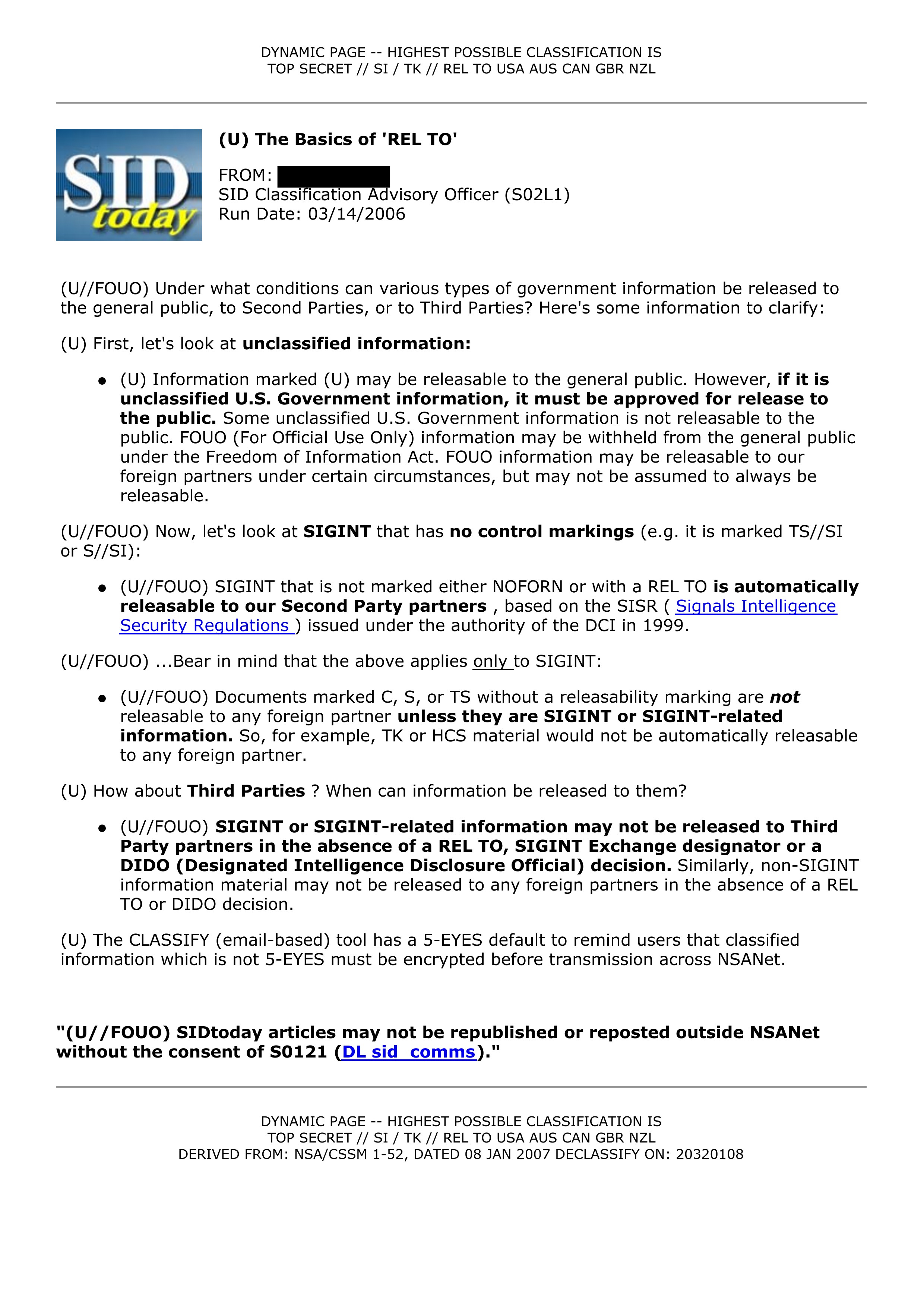
This article looks at which types of government information can be released to foreign partners. Unclassified information must be approved for release. Classified signals intelligence without control markings is automatically releasable to second parties, but must be specifically marked as releasable to third parties with “REL TO.”
My notes
DYNAMIC PAGE -- HIGHEST POSSIBLE CLASSIFICATION IS
TOP SECRET // SI / TK // REL TO USA AUS CAN GBR NZL
(U) The Basics of 'REL TO'
FROM: [REDACTED]
SID Classification Advisory Officer (S02L1)
Run Date: 03/14/2006
(U//FOUO) Under what conditions can various types of government information be released to
the general public, to Second Parties, or to Third Parties? Here's some information to clarify:
(U) First, let's look at unclassified information:
- (U) Information marked (U) may be releasable to the general public. However, if it is unclassified U.S. Government information, it must be approved for release to the public. Some unclassified U.S. Government information is not releasable to the public. FOUO (For Official Use Only) information may be withheld from the general public under the Freedom of Information Act. FOUO information may be releasable to our foreign partners under certain circumstances, but may not be assumed to always be releasable.
(U//FOUO) Now, let's look at SIGINT that has no control markings (e.g. it is marked TS//SI
or S//SI):
- (U//FOUO) SIGINT that is not marked either NOFORN or with a REL TO is automatically releasable to our Second Party partners , based on the SISR ( Signals Intelligence Security Regulations ) issued under the authority of the DCI in 1999.
(U//FOUO) ...Bear in mind that the above applies only to SIGINT:
- (U//FOUO) Documents marked C, S, or TS without a releasability marking are not releasable to any foreign partner unless they are SIGINT or SIGINT-related information. So, for example, TK or HCS material would not be automatically releasable to any foreign partner.
(U) How about Third Parties ? When can information be released to them?
- (U//FOUO) SIGINT or SIGINT-related information may not be released to Third Party partners in the absence of a REL TO, SIGINT Exchange designator or a DIDO (Designated Intelligence Disclosure Official) decision. Similarly, non-SIGINT information material may not be released to any foreign partners in the absence of a REL TO or DIDO decision.
(U) The CLASSIFY (email-based) tool has a 5-EYES default to remind users that classified
information which is not 5-EYES must be encrypted before transmission across NSANet.
"(U//FOUO) SIDtoday articles may not be republished or reposted outside NSANet
without the consent of S0121 (DL sid_comms)."
DYNAMIC PAGE -- HIGHEST POSSIBLE CLASSIFICATION IS
TOP SECRET // SI / TK // REL TO USA AUS CAN GBR NZL
DERIVED FROM: NSA/CSSM 1-52, DATED 08 JAN 2007 DECLASSIFY ON: 20320108
Related Documents
-
What's the Policy on Sharing NOFORN With Second Party Integrees? SIDtoday [pdf]
Details on how and when Five Eyes alliance employees stationed at the NSA can be shown signals intelligence with restrictive markings such as “REL TO” or “NOFORN.”
Marking: SECRETPrograms: INTELINKThe Intercept ↗ (2018-08-15) -
'Top 5' SIDtoday Articles of May SIDtoday [pdf]
Links to the top five SIDtoday articles from May 2006.
The Intercept ↗ (2018-08-15) -
Coming Soon: A SID Classification Guide SIDtoday [pdf]
The Signals Intelligence Directorate has a new classification guide separate from the NSA/CSS classification guide, which "significantly revamp[s] what is considered COMINT [communications intelligence]." It also changes the default classification to be releasable to Five Eyes allies.
Programs: CLASSIFYThe Intercept ↗ (2017-09-13) -
Foreign Partner Contributions, January 2003 - 2006 SIDtoday [pdf]
A chart (not shown) shows how second- and third-party partner countries contributed to Signals Intelligence Directorate production.
The Intercept ↗ (2018-08-15) -
Foreign Partners as a Linguistic Resource SIDtoday [pdf]
The 24 second- and third-party partners have capabilities to work in 43 different languages. The decision to collaborate with a partner to exploit these skills, however, requires a cost-benefit analysis: What would the NSA gain from asking a partner to help them with a target, and what could potentially pose as a risk? Signals Intelligence Directorate management weighs these questions and makes the final decision about partnerships.
Marking: SECRETPeople: Quirk, RichardThe Intercept ↗ (2017-09-13)