CENTCOM's 'Long War'
Open PDFDocument date: 2005-11-02
Type: SIDtoday
Pages: 2
Genre: newsletter
Banner: DYNAMIC PAGE -- HIGHEST POSSIBLE CLASSIFICATION IS TOP SECRET // SI / TK // REL TO USA AUS CAN GBR NZL
Classification: SECRET SI
Dissemination: REL
- Meet the Central Command
- Challenges - What Can You Do For the Nation?
- CENTCOM's 'Long War'
The final part of the series about U.S. Central Command outlines CENTCOM Gen. John Abizaid’s vision for the future of combat against extremism and instability and describes how this will affect the NSA.
My notes
DYNAMIC PAGE -- HIGHEST POSSIBLE CLASSIFICATION IS
TOP SECRET // SI / TK // REL TO USA AUS CAN GBR NZL
SIDtoday
(U) CENTCOM's 'Long War'
FROM: [REDACTED]
CENTCOM Account Manager (S113)
Run Date: 11/02/2005
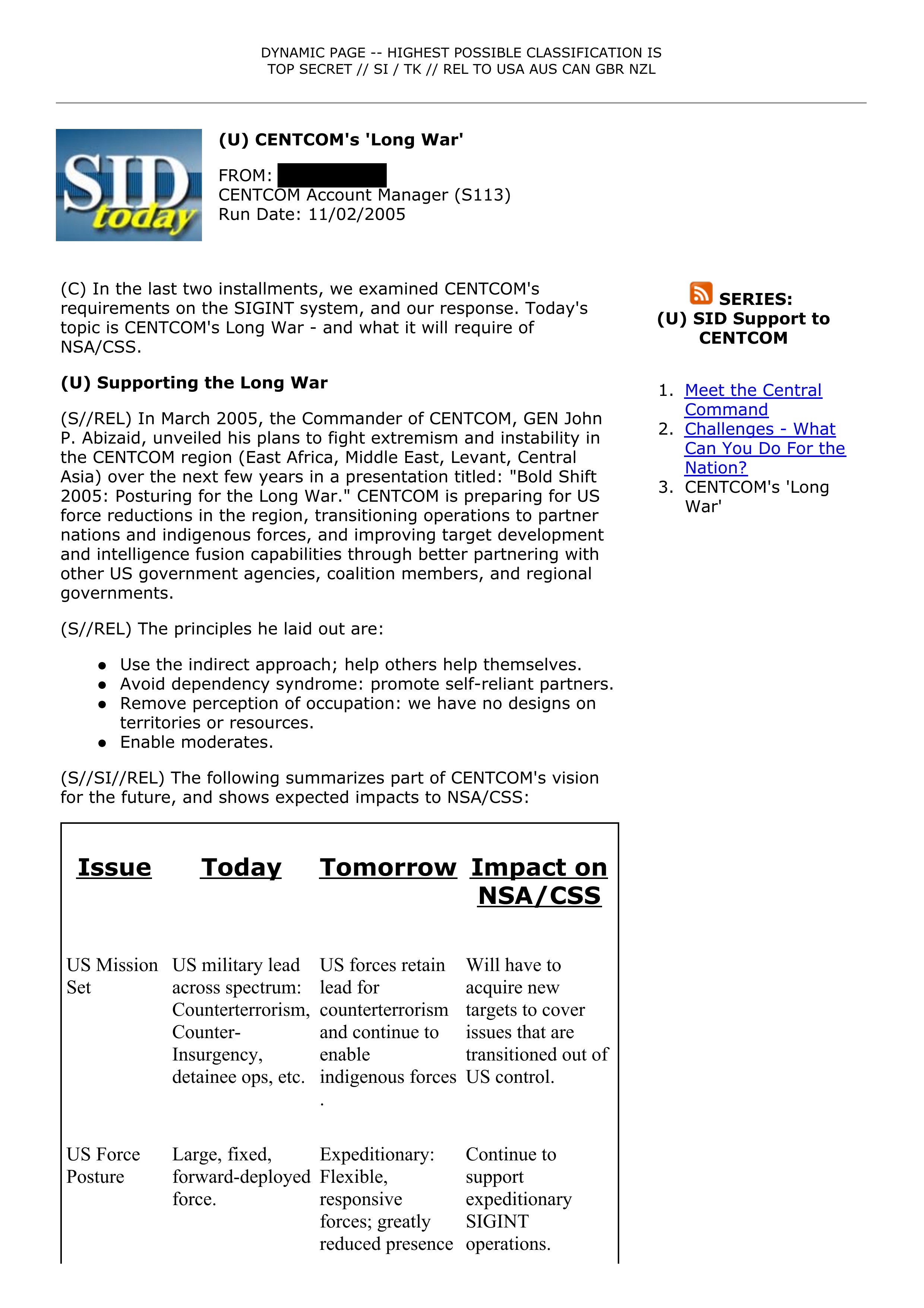
(C) In the last two installments, we examined CENTCOM'Ssrequirements on the SIGINT system, and our response. Today's topic is CENTCOM's Long War - and what it will require of NSA/CSS.
SERIES:
(U) SID Support to CENTCOM
- Meet the Central Command
- Challenges - What Can You Do For the Nation?
- CENTCOM's 'Long War'
(U) Supporting the Long War
(S//REL) In March 2005, the Commander of CENTCOM, GEN John P. Abizaid, unveiled his plans to fight extremism and instability in the CENTCOM region (East Africa, Middle East, Levant, Central Asia) over the next few years in a presentation titled: "Bold Shift 2005: Posturing for the Long War." CENTCOM is preparing for US force reductions in the region, transitioning operations to partner nations and indigenous forces, and improving target development and intelligence fusion capabilities through better partnering with other US government agencies, coalition members, and regional governments.
(S//REL) The principles he laid out are:
- Use the indirect approach; help others help themselves.
- Avoid dependency syndrome: promote self-reliant partners.
- Remove perception of occupation: we have no designs on territories or resources.
- Enable moderates.
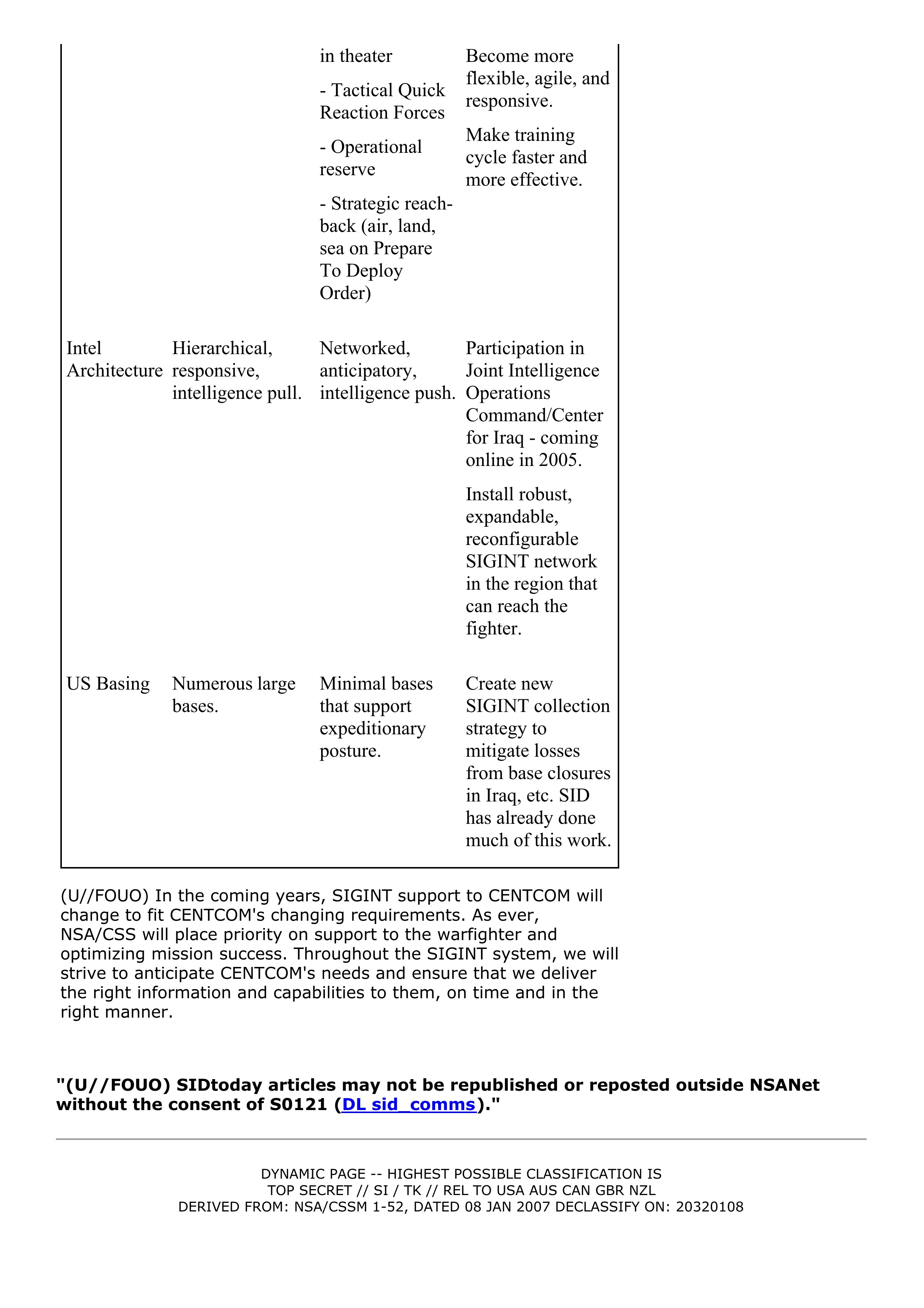
(S//SI//REL) The following summarizes part of CENTCOM's vision for the future, and shows expected impacts to NSA/CSS:
| Issue | Today | Tomorrow | Impact on NSA/CSS |
|---|---|---|---|
| US Mission Set | US military lead across spectrum: Counterterrorism, Counter- Insurgency, detainee ops, etc. | US forces retain lead for counterterrorism and continue to enable indigenous forces | Will have to acquire new targets to cover issues that are transitioned out of US control. |
| US Force Posture | Large, fixed, forward-deployed force. | Expeditionary: Flexible, responsive forces; greatly reduced presence in theater - Tactical Quick Reaction Forces - Operational reserve - Strategic reach-back (air, land, sea on Prepare To Deploy Order) |
Continue to support expeditionary SIGINT operations. Become more flexible, agile, and responsive. Make training cycle faster and more effective. |
| Intel Architecture | Hierarchical, responsive, intelligence pull. | Networked, anticipatory, intelligence push. | Participation in Joint Intelligence Operations Command/Center for Iraq - coming online in 2005. Install robust, expandable, reconfigurable SIGINT network in the region that can reach the fighter. |
| US Basing | Numerous large bases. | Minimal bases that support expeditionary posture. | Create new SIGINT collection strategy to mitigate losses from base closures in Iraq, etc. SID has already done much of this work. |
(U//FOUO) In the coming years, SIGINT support to CENTCOM will change to fit CENTCOM's changing requirements. As ever, NSA/CSS will place priority on support to the warfighter and optimizing mission success. Throughout the SIGINT system, we will strive to anticipate CENTCOM's needs and ensure that we deliver the right information and capabilities to them, on time and in the right manner.
"(U//FOUO) SIDtoday articles may not be republished or reposted outside NSANet without the consent of S0121 (DL sid_comms)."
DYNAMIC PAGE -- HIGHEST POSSIBLE CLASSIFICATION IS
TOP SECRET // SI / TK // REL TO USA AUS CAN GBR NZL
DERIVED FROM: NSA/CSSM 1-52, DATED 08 JAN 2007 DECLASSIFY ON: 20320108
Related Documents
-
Kudos from CENTCOM SIDtoday [pdf]
CENTCOM’s director of intelligence commended NSA for signals intelligence contributing to the success of operations in Iraq and also highlighted “great and timely reporting” by the NSA’s United Nations team.
People: Fast, BarbaraThe Intercept ↗ (2016-08-10) -
CT Support For CENTCOM In Afghanistan SIDtoday [pdf]
Job listing for SIGINT analysts interested in joining an "exclusive group" of counterterrorism subject matter experts in Kabul.
Marking: SECRETThe Intercept ↗ (2016-12-07) -
Real-Time Regional Gateway Cloud Analytics for Forward Users [pdf]
This document outlines the NSA’s Real-Time Regional Gateway (RT-RG) program, a global cloud-based signals intelligence system designed to provide near real-time data analysis and targeting support for military and intelligence operations. It details the transition to scalable cloud architectures such as GHOSTMACHINE and Cloudbase, enabling massive data retention, exploitation, advanced geolocation, and automated analytics for tracking high-value targets across multiple theaters, including Afghanistan, Iraq, and the Horn of Africa.
Programs: RT-RG · GOLDMINER · GEOT · AGENTLOGIC · SHARKFINN · SKS · PANOPTICON · DRT · CIDNE · JUGGERNAUT · LOPERS · TALIS · MATTERHORN · AIRHANDLER · LYCANTHROPE · VOICESAIL · RETURNSPRING · SORTINGLEAD · GHOSTMACHINE · GMROYALE · GMREGAL · GMGEIST · GMIDEA · GMTOTE · GMPEN · GMPAC · GMCALM · GMMATE · GMAPPLE · GMCAVE · GMPEACH · GMDEN · GMMOUNT · GMALAMO · GMLIGHT · GMBALTIC · GMPLACE · GMPARK · GMHALO · GMCARBON · DRAGONFIRE · DOMEEXPOSE · GIANTSQUID · MAINWAY · FURIOUSCHAINSAW · SHARKFURY · NIAGARAFILES · SHARKQUERY · SHARKDOCS · OCTAVE · UTT · BEDDOWN · CHEEKYMONKEY · LAYERCAKE · CYBERTRANS · GMSEMINOLE · GMGULF · GMZILLA · HLT · JEMA · NEVIS · SEDB · CLOUDBASE · MAPREDUCE · CASPORT · WAVELEGAL“Mission Creep: How the NSA’s Game-Changing Targeting System Built for Iraq and Afghanistan Ended Up on the Mexico Border” - The Intercept ↗ (2019-05-29) · “Norges hemmelige krig i Afghanistan” - NRK ↗ (2019-05-29) · Moltke, Henrik · Skille, Øyvind Bye · Døvik, Olav · Hansen, Ståle Ellingsgard · Fjørtoft, Martin -
Meet the Central Command SIDtoday [pdf]
NSA personnel are integrated with U.S. Central Command at the Tampa headquarters and in deployment to Iraq, Afghanistan, Pakistan, Qatar, and other locations. Gen. John Abizaid says the NSA relationship with CENTCOM is “excellent.”
People: Abizaid, John P.The Intercept ↗ (2018-03-01) -
Challenges - What Can You Do For the Nation? SIDtoday [pdf]
The NSA has deployed over 300 people in the field to support the missions of U.S. Central Command. Most of those positions are 90-180 day rotations. Keeping those positions staffed is a challenge and Signals Intelligence Directorate employees are encouraged to apply for CENTCOM assignments overseas or in Tampa, Florida. Analysts with language skills in Pashto, Arabic, Dari, and Kurdish are also needed.
People: Meals, CharlieThe Intercept ↗ (2018-03-01)