Speak Easy: Dress Rehearsal
Open PDFDocument date: 2005-07-07
Type: SIDtoday
Pages: 1
Genre: newsletter
Banner: DYNAMIC PAGE -- HIGHEST POSSIBLE CLASSIFICATION IS TOP SECRET // SI / TK // REL TO USA AUS CAN GBR NZL
Classification: UNCLASSIFIED
Dissemination: -
- Speak Easy: Creating Notes
- Speak Easy: Dress Rehearsal
- Speak Easy: Take-Away Documentation
- Speak Easy: Game Day
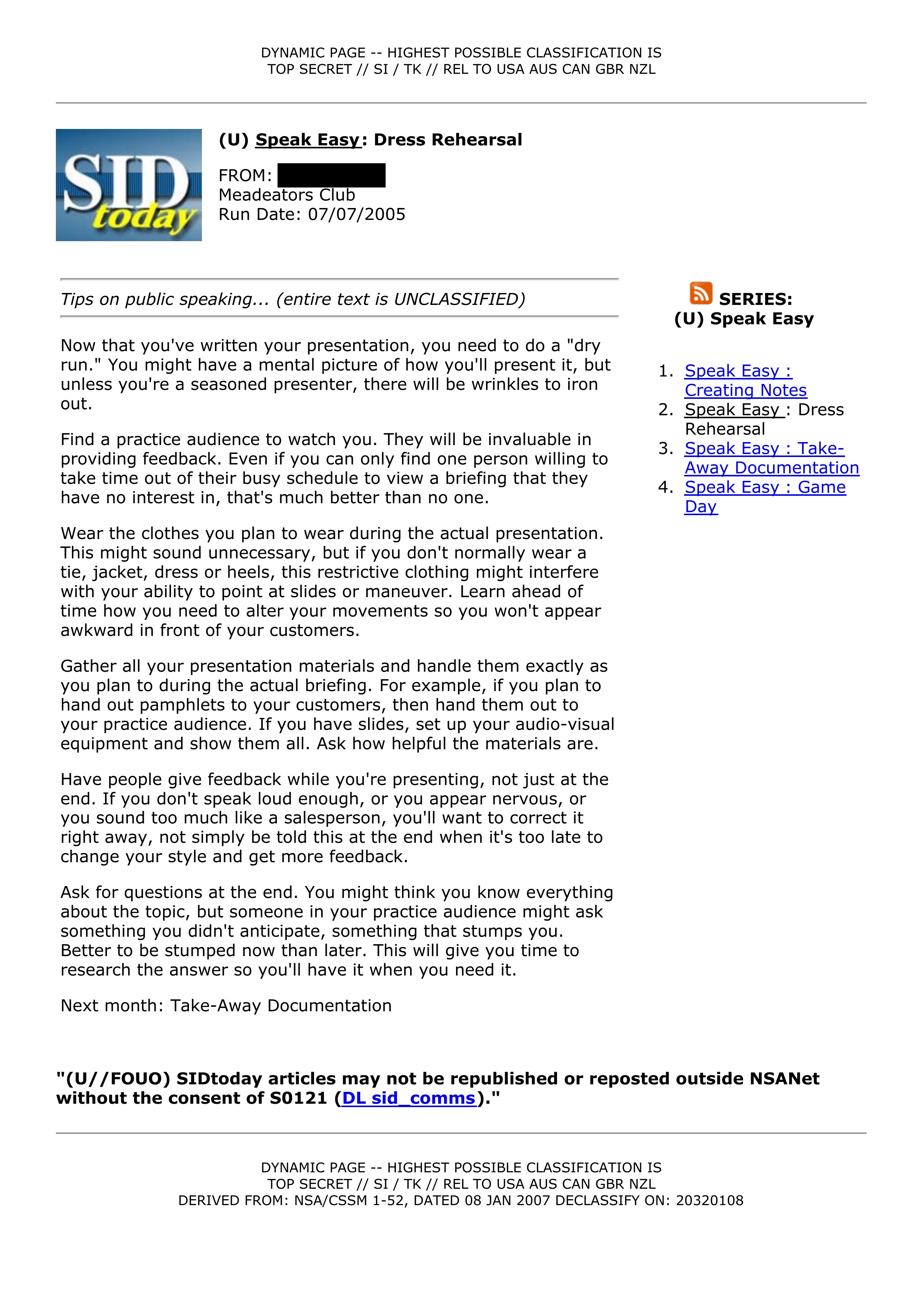
The second part of the series about public speaking recommends practicing your talk to a group of friends in the outfit you plan to wear, handing out any materials you plan to distribute, showing slides, and asking for questions from the crowd.
My notes
DYNAMIC PAGE -- HIGHEST POSSIBLE CLASSIFICATION IS
TOP SECRET // SI / TK // REL TO USA AUS CAN GBR NZL
SIDtoday
(U) Speak Easy: Dress Rehearsal
FROM: [REDACTED]
Meadeators Club
Run Date: 07/07/2005
Tips on public speaking... (entire text is UNCLASSIFIED)
Now that you've written your presentation, you need to do a "dry
run." You might have a mental picture of how you'll present it, but
unless you're a seasoned presenter, there will be wrinkles to iron
out.
Find a practice audience to watch you. They will be invaluable in
providing feedback. Even if you can only find one person willing to
take time out of their busy schedule to view a briefing that they
have no interest in, that's much better than no one.
Wear the clothes you plan to wear during the actual presentation.
This might sound unnecessary, but if you don't normally wear a
tie, jacket, dress or heels, this restrictive clothing might interfere
with your ability to point at slides or maneuver. Learn ahead of
time how you need to alter your movements so you won't appear
awkward in front of your customers.
Gather all your presentation materials and handle them exactly as
you plan to during the actual briefing. For example, if you plan to
hand out pamphlets to your customers, then hand them out to
your practice audience. If you have slides, set up your audio-visual
equipment and show them all. Ask how helpful the materials are.
Have people give feedback while you're presenting, not just at the
end. If you don't speak loud enough, or you appear nervous, or
you sound too much like a salesperson, you'll want to correct it
right away, not simply be told this at the end when it's too late to
change your style and get more feedback.
Ask for questions at the end. You might think you know everything
about the topic, but someone in your practice audience might ask
something you didn't anticipate, something that stumps you.
Better to be stumped now than later. This will give you time to
research the answer so you'll have it when you need it.
Next month: Take-Away Documentation
SERIES:
(U) Speak Easy
- Speak Easy :
Creating Notes - Speak Easy: Dress
Rehearsal - Speak Easy : Take-
Away Documentation - Speak Easy : Game
Day
"(U//FOUO) SIDtoday articles may not be republished or reposted outside NSANet
without the consent of S0121 (DL sid_comms)."
DYNAMIC PAGE -- HIGHEST POSSIBLE CLASSIFICATION IS
TOP SECRET // SI / TK // REL TO USA AUS CAN GBR NZL
DERIVED FROM: NSA/CSSM 1-52, DATED 08 JAN 2007 DECLASSIFY ON: 20320108
Related Documents
-
Speak Easy: Creating Notes SIDtoday [pdf]
The first post in a series about improving public speaking skills details the first steps to creating a good presentation: writing a summary of everything you want to discuss and then turning it into a clear bullet point list.
The Intercept ↗ (2017-09-13) -
Speak Easy: Game Day SIDtoday [pdf]
When you are going to give a public talk, arrive early, make sure all the equipment is working properly, embrace your nervousness, and try not to look at your notes too often.
Marking: UNCLASSIFIEDThe Intercept ↗ (2017-09-13) -
Speak Easy: Game Day (repost) SIDtoday [pdf]
When you are going to give a public talk, arrive early, make sure all the equipment is working properly, embrace your nervousness, and try not to look at your notes too often.
Marking: UNCLASSIFIEDThe Intercept ↗ (2018-03-01) -
Speak Easy: Take-Away Documentation SIDtoday [pdf]
Although it might be helpful to create handouts for your audience, be succinct and format your handout cleanly: "The less you inundate people with, the more likely you are to get your point across."
Marking: UNCLASSIFIEDThe Intercept ↗ (2017-09-13) -
Speak Easy: Creating Notes (repost) SIDtoday [pdf]
(Repost) The first post in a series about improving public-speaking skills details the first steps to creating a good presentation: write a summary of everything you want to discuss and then turn it into a clear list of bullet points.
Marking: UNCLASSIFIEDThe Intercept ↗ (2017-09-13)