Countering Improvised Explosive Devices in Iraq
Open PDFDocument date: 2005-01-31
Type: SIDtoday
Pages: 2
Genre: newsletter
Banner: DYNAMIC PAGE -- HIGHEST POSSIBLE CLASSIFICATION IS TOP SECRET // SI / TK // REL TO USA AUS CAN GBR NZL
Classification: TOP SECRET SI
Dissemination: -
Insurgents in Iraq triggered bombs using "cordless" phone systems that involved a base station and a number of associated wireless handsets. Target Exploitation operators discovered that they could plug a confiscated phone into a laptop's microphone jack, record a sound file, and use the recording to geolocate the base station. "As a result," SIDtoday reported, "a principal component in many [bombs] can now be targeted and hopefully, the... makers neutralized."
My notes
DYNAMIC PAGE -- HIGHEST POSSIBLE CLASSIFICATION IS
TOP SECRET // SI / TK // REL TO USA AUS CAN GBR NZL
SIDtoday
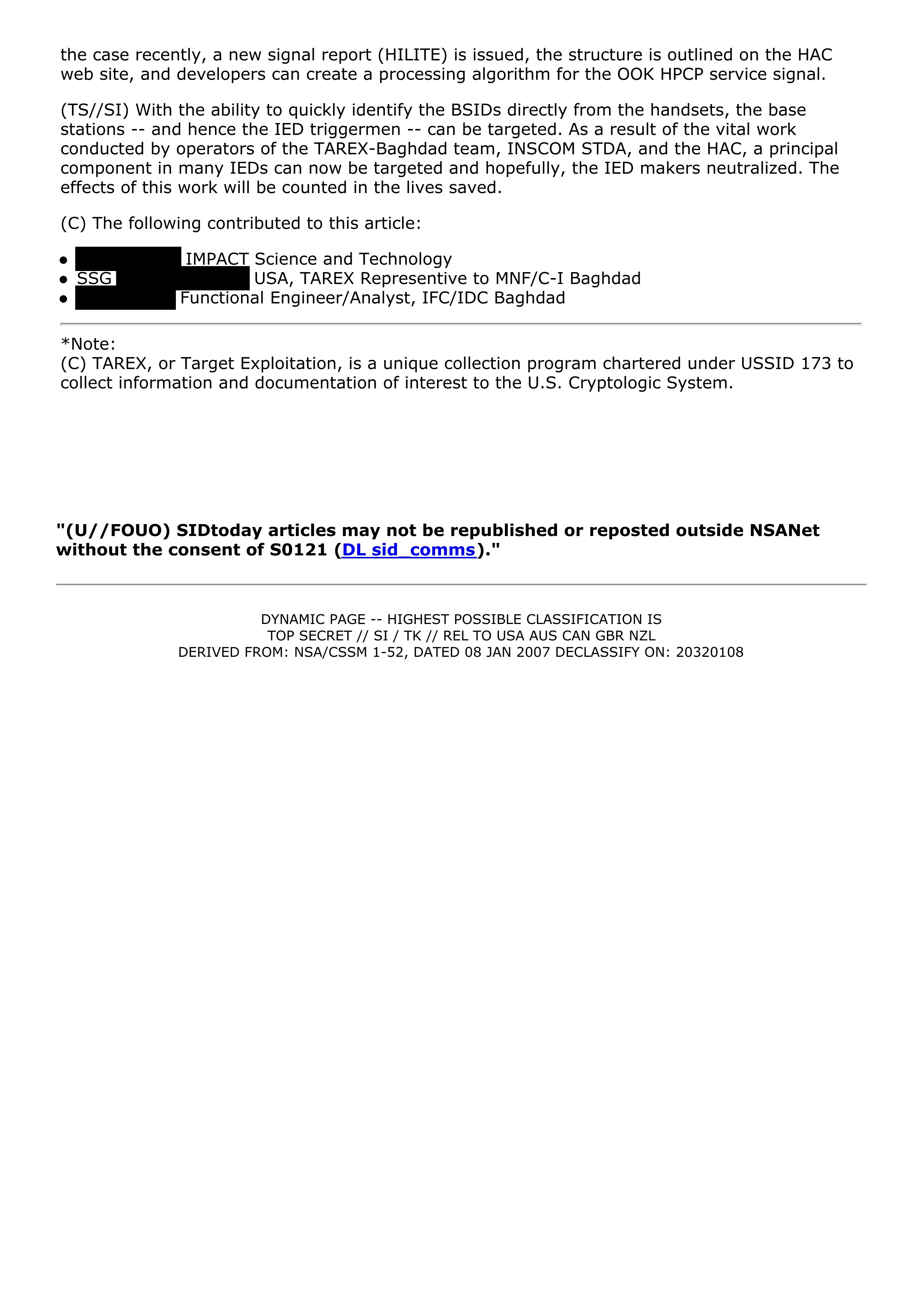
(U) Countering Improvised Explosive Devices in Iraq
FROM: (C) [REDACTED] SSG Representative at CSG Baghdad, and
[REDACTED] SSG Operations Orchestration
Run Date: 01/31/2005
New exploitation of High-Powered Cordless Phone Base Stations raises hopes that attackers can be neutralized (S//SI)
(S//REL TO MCFI) The most potent weapon used by the insurgents in Iraq is the improvised explosive device (IED). Because IEDs are often triggered from a distance with no discernable enemy visible, these attacks are extremely frustrating to Coalition troops. In 2004, 822 American servicemen were either killed or wounded by IEDs.
(S//SI) Building on analysis done by Meade Operations Center's HPCP Analysis Cell (also known as the HAC) and teaming with INSCOM's SIGINT Technical Development Activity (STDA), TAREX* operators in theater developed a technique to quickly recover the security codes of High-Powered Cordless Phones (HPCP) handsets. This procedure has reduced the time needed to decode the HPCP security codes from weeks to a matter of hours, and in doing so, has opened a new avenue to pursue IED triggermen and take the fight to them.
(S//REL TO MCFI) Many IED triggers within Iraq are HPCP handsets controlled from a common base station. Recent HPCP models allow for the programming of as many as fifty handsets per base station, allowing insurgents to use one base station as a trigger for numerous IEDs-a real challenge to the SIGINT System.
(S//SI) Locating the IED triggermen is the first hard challenge with this technology. Finding the base station's location is critical to determining the location of the triggermen, and identifying the point of initiation. For SIGINT, this means trying to identify the security code or the "Base Station Identification" (BSID) and locating that equipment for targeting. Handsets used as triggers for the IEDs are often recovered; however, until recently, it was not possible to quickly identify the BSID from these captured handsets.
(S//SI) The TAREX-Baghdad team realized the value of acquiring the BSID quickly to support Geospatial analysis as well as assist with collection/tasking processes. They took on the challenge of trying to use existing collection and processing equipment (PROPHET, SALVAGE, and ALASKA) to extract the security codes, but without success. At this point, TAREX decided to employ their laptop computers to record the digital wave files directly, using the "Sound Recorder" program. Hooking the XPLORER test receiver directly into the laptop's microphone jack, then tuning to the handset's 228.74 megahertz broadcast frequency, the TAREX staff was able to broadcast and record a series of on-off sequences. Since audible beeps were heard only when keying the handset transmitter on and off, these segments were most likely the security code. TAREX then sent this recorded file to INSCOM STDA and the HAC. Several days later, the HAC (Mr. [REDACTED]) informed TAREX that the files were of sufficient quality to allow a breakout of the security codes they contained.
(TS//SI) As a result of TAREX's ability to send the recorded wave files, the HAC developed and standardized a MARTES Software method for processing these new input files. These MARTES methods can easily determine the keying rate, coding scheme, center frequency, signal fielding, service signal identification, mode/function and-when possible-the BSID of the captured phone (either handset or base station).
(TS//SI) To take this success one step further, when an intercepted signal is known and the security code (BSID) is recovered, the HAC forwards an immediate turn-around report to the TAREX report originator, as well as collection and analysis resources (Overhead, Airborne, and Ground-based assets) for special emphasis targeting. If the service signal is unknown, as was the case recently, a new signal report (HILITE) is issued, the structure is outlined on the HAC web site, and developers can create a processing algorithm for the OOK HPCP service signal.
(TS//SI) With the ability to quickly identify the BSIDs directly from the handsets, the base stations -- and hence the IED triggermen -- can be targeted. As a result of the vital work conducted by operators of the TAREX-Baghdad team, INSCOM STDA, and the HAC, a principal component in many IEDs can now be targeted and hopefully, the IED makers neutralized. The effects of this work will be counted in the lives saved.
(C) The following contributed to this article:
- [REDACTED] IMPACT Science and Technology
- SSG [REDACTED] USA, TAREX Representive to MNF/C-I Baghdad
- [REDACTED] Functional Engineer/Analyst, IFC/IDC Baghdad
*Note:
(C) TAREX, or Target Exploitation, is a unique collection program chartered under USSID 173 to collect information and documentation of interest to the U.S. Cryptologic System.
"(U//FOUO) SIDtoday articles may not be republished or reposted outside NSANet without the consent of S0121 (DL sid_comms)."
DYNAMIC PAGE -- HIGHEST POSSIBLE CLASSIFICATION IS
TOP SECRET // SI / TK // REL TO USA AUS CAN GBR NZL
DERIVED FROM: NSA/CSSM 1-52, DATED 08 JAN 2007 DECLASSIFY ON: 20320108
Related Documents
-
Economic Reporting Strives to Interdict the Flow of 'Improvised Explosive Device' Components SIDtoday [pdf]
NSA reporting led to restrictions on dual-use microprocessor sales by U.S. companies, “ultimately saving American and coalition lives.” Front companies in the United Arab Emirates facilitated the transfer of components used for improvised explosive devices to Iran and Syria.
The Intercept ↗ (2018-08-15) -
Worldwide 'Improvised Explosive Devices Analyst Summit' Held SIDtoday [pdf]
An “Improvised Explosive Devices Analyst Summit” was held. It included briefings on tools and techniques for “countering IEDs and terrorism.”
The Intercept ↗ (2018-08-15) -
New CNO Capability Poised to Help Counter IEDs, Geolocate Terrorists SIDtoday [pdf]
A new capability allows for denial-of-service attacks against High Power Cordless Phone (HPCP) networks and geolocation of high value targets. HPCP networks are frequently used by insurgents in Iraq and Afghanistan as a way to trigger IEDs.
The Intercept ↗ (2018-08-15) -
Tool Proves Invaluable in Providing Actionable Intelligence in Iraq SIDtoday [pdf]
Spy tool fingers Iraqis for death or capture. QUADSPECTRE takes intercepts of cellular communications (from Stingray-type devices) to see who talks to whom and to read SMS text messages. JSOC (Task Force 145) or other units are then deployed to capture or kill targets. Some 263 suspected insurgents were killed in seven months and a remote-controlled improvised explosive device attack on Coalition forces was thwarted.
People: Mollenkopf, MarkThe Intercept ↗ (2018-08-15) -
Success Against al-Zarqawi's Group in Northern Iraq SIDtoday [pdf]
A tool called “Quadra Spectre,” developed and deployed in Iraq, correlates text messages and provides “near real-time” location data on suspected insurgents, cutting “days of painstaking analysis to mere hours” and creating a “snowball effect” that helped lead, over 90 days in northern Iraq, to the killing or capture of “134 high-level insurgents and countless associates.”
Programs: QUADRA SPECTREThe Intercept ↗ (2018-03-01)